On 23 March 2026, Natalie McNally’s murderer was found guilty. Natalie was one of 33 women and girls violently murdered by men in Northern Ireland since 2020. Per head of population, this makes Northern Ireland the most likely place in the UK or Ireland for a woman to be killed by a man, and the most dangerous place to be a woman in western Europe.
These figures are underpinned by staggering levels of violence. A 2025 Ulster University study found that 98 per cent of women in Northern Ireland have experienced violence or abuse at least once in their lifetime. Domestic abuse crimes recorded in 2024 and 2025 were 91 per cent higher than 20 years ago, according to the PSNI.
In addition to the clear moral abomination, this is also doing serious damage to the reputation of Northern Ireland. In March 2026, Secretary of State Hilary Benn MP described it as “a source of shame” that Northern Ireland is “the most dangerous part of the UK to be a woman”.
Justice and deterrence matter, but real change requires political leadership. Unfortunately, the Executive’s End Violence Against Women and Girls strategy falls short. Its ‘Power to Change’ campaign, aimed at changing men and boys’ attitudes towards women and girls, is too limited and under-resourced to match the scale of the crisis and the aforementioned statistics suggest that it is not delivering results.
There are examples we can learn from. In Spain, a comprehensive system combining specialist courts, policing, protection orders, and victim support has contributed to a 25-35 per cent reduction in femicide since 2004. In Uganda, the SASA! programme tackled the root causes of abuse by changing attitudes and power dynamics, leading to a 52 per cent reduction in physical intimate partner violence in participating communities since 1996.
Meaningful progress requires both political leadership and sustained social efforts to prevent violence before it begins. The ultimate goal must be the elimination of violence against women, but in the short term, governments can reduce it. It is time for the Executive to take the necessary steps this crisis demands.
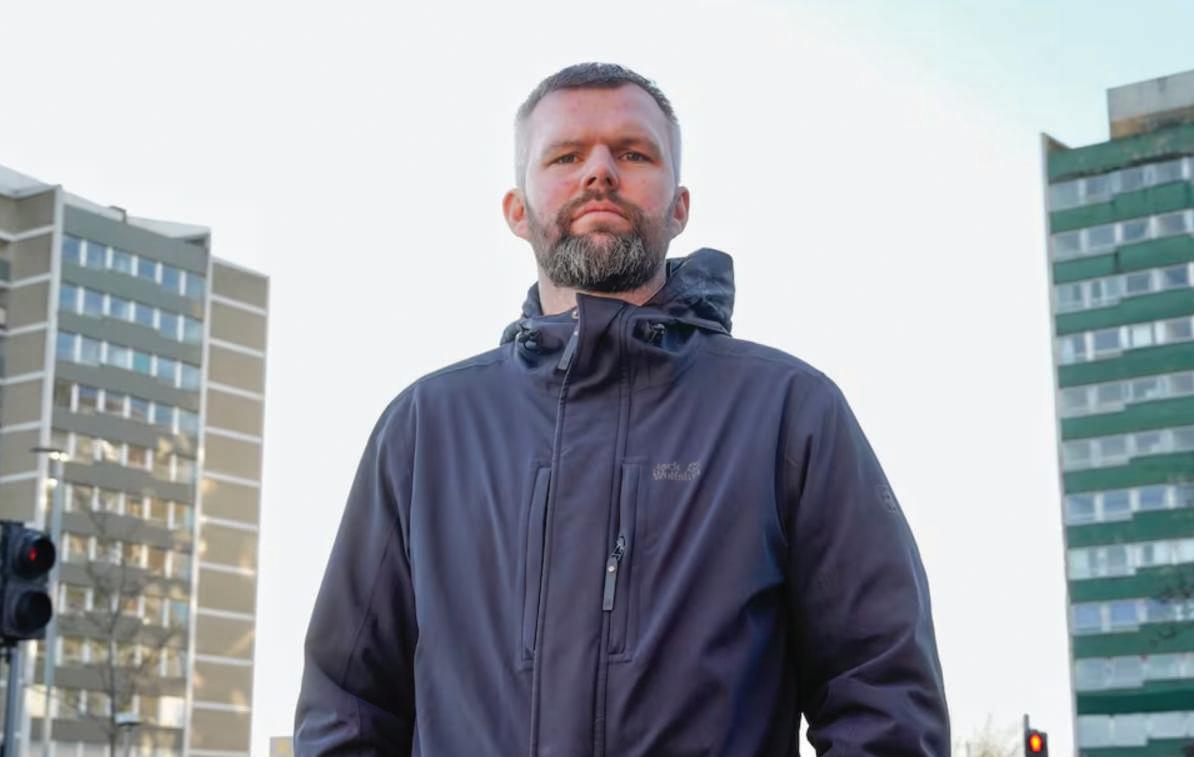
Gareth Duffy, Head of Design gareth.duffy@agendani.com
Jamie Hogan jamie.hogan@agendani.com
Subscriptions
Sharon Morrison
Email: subscriptions@agendani.com
Online: www.agendani.com/subscribe
agendaNi
Owen McQuade, Publisher owen.mcquade@agendani.com
bmf Business Services
19a Maghaberry Road
Maghaberry, Co Antrim, BT67 0JE
Tel: +44 (0) 28 9261 9933
Web: www.agendani.com
Printed by: GPS Colour Graphics
PUBLIC AFFAIRS
Escalating Civil Service workforce challenges
Workforce challenges are escalating in the Northern Ireland Civil Service (NICS), a report by the Northern Ireland Audit Office (NIAO) has found.
The NICS declared nearly 5,500 vacant posts on 31 March 2025, finds Leading and Resourcing the Northern Ireland Civil Service, published in January 2026.
There is an increasing reliance on temporary staffing solutions with the number of agency workers doubling to 5,000 between April 2019 and April 2025. Additionally, over 3,000 NICS staff were temporarily promoted, representing 13 per cent of the workforce.
Sickness absence rates are rising with an average of 13.4 days lost per staff year in 2024/25 compared to 12.6 days in
2018/19. Costs associated with sickness absence have also increased from £32.9 million in 2018/19 to £48.8 million in 2024/25.
The report finds improvements have been made to governance arrangements. A people committee was established, a new people strategy was launched, and new apprenticeship, student, and work placement programmes were launched.
However, the report concludes that: “Without sustained, collective leadership and urgent delivery, the NICS is at continued risk of failing to demonstrate value for money for its pay bill, which exceeded £1.27 billion in 2024/25 (before 2024 and 2025 pay awards).”
JUSTICE
UN accuses PSNI of potential lawyer-client privilege breach
PSNI requests to access the phone data of Belfast solicitors Peter Corrigan and Darragh Mackin regarding a murder appeal may have breached international norms on lawyer-client privilege, the UN has said.
In September 2025, The McCullough Review found that the PSNI unlawfully sought the solicitors’ phone data when they were part of the legal team appealing the convictions of two men found guilty of murdering PSNI officer Stephen Carroll in 2009.
UN Special rapporteurs Margaret Satterthwaite and Ana Brian Nougrères wrote to the UK Government in March 2026 to “express their concern regarding indications of a pattern of communications data authorisations that seem to coincide with Mr Mackin and Mr Corrigan’s
representation of clients bringing allegations against the PSNI”.
The UK Government must respond by 30 May 2026. Satterthwaite and Nougrères asked the Government to tell the solicitors why, when, and for how long they were surveilled, and what has been done with the collected data.
Mackin says that the communication is a “landmark indication that the international human rights community will no longer sit back and tolerate misuse of state powers deployed in a ‘reprisal’ against lawyers simply by virtue of the cases they bring”.
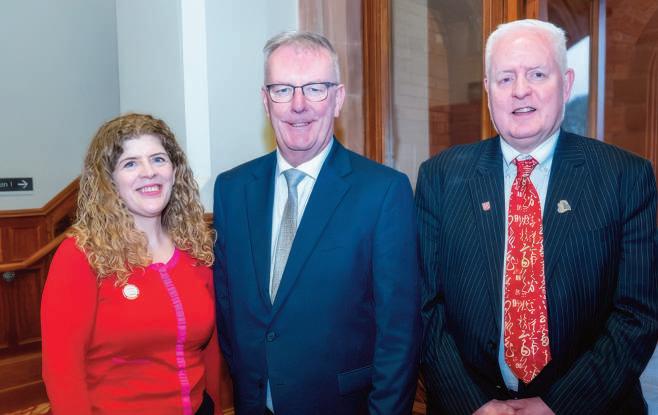
Two Belfast-based academics as well as a unionist Irish language activist have been appointed to the Council of State of President of Ireland Catherine Connolly.
Linda Ervine is the manager of Turas, the first Irish language centre based in a loyalist area. She is also the founder of Scoil na Seolta, the first Irish language integrated school.
Colin Harvey is a Professor of Human Rights Law in the School of Law at Queen’s University Belfast. He is a commissioner on the Irish Human Rights and Equality Commission and a member of the Scientific Committee of the EU Fundamental Rights Agency.
Three northernbased Council of State appointees
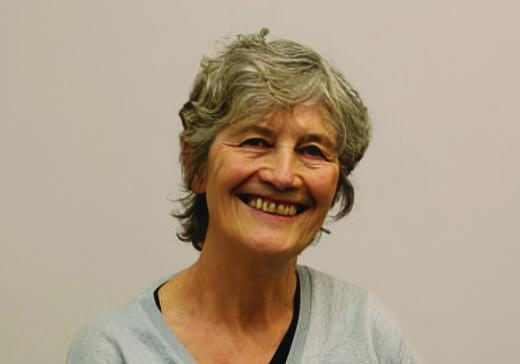
Fionnuala Ní Aoláin, a Professor of Law at Queen’s University Belfast, was also appointed to the council.
Other appointees are sociologist Kathleen Lynch, law professor Donncha O’Connell, constitutional law and children’s rights expert Conor O’Mahony, and former president of the University of Galway, Ciarán Ó hÓgartaigh.
The Council of State consists of seven members and aids and counsels the President, and consults them on the use of presidential powers. This includes expedition of bills, referring bills to the Supreme Court, and deciding if bills should be subject to a referendum.
Economic output increases
Northern Ireland’s economic output increased by 1.6 per cent in the 12 months to Q4 2025, the Northern Ireland Statistics and Research Agency (NISRA) has found.
The increase, higher than the 0.1 per cent increase recorded in Britain, was driven by contributions from the construction, public, production, and services sectors. Private sector output increased by 1.5 per cent while public sector output increased by 2.1 per cent over the year.
Over the quarter to Q4 2025 economic activity increased by 0.2 per cent. The largest contribution to growth came from increased activity in the construction sector. This was offset by decreased activity in the services sector.
Private sector output increased by 0.1 per cent while public sector output increased by 0.8 per cent over the quarter. Economic output is now 11.2 per cent above the pre-pandemic level of Q4 2019.
Economy Minister Caoimhe Archibald MLA says: “As we face into an increasingly uncertain economic situation as a result of the conflict in the Middle East, these figures continue to demonstrate the resilience of our businesses and workers.”
Reforming adult social care
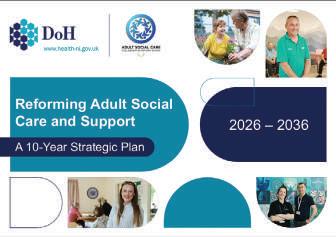
A new 10-year plan to reform the experience and delivery of adult social care in Northern Ireland was published by the Department of Health in March 2026.
The plan focuses on enabling individuals’ choice, supporting early intervention, and increasing preparedness. The Department of Health says that these changes will enable people in need of care to “live fulfilling lives in their communities”.
The plan identifies six priorities including ensuring patients have control over decisions affecting their wellbeing, supporting unpaid carers, and supporting patients though early interventions. Other key priorities include centring care in patients’ homes, recognising value in the workforce, and building sustainable care system.
Ulster University intends to make up to 450 staff redundant, staff were told by vice-chancellor Paul Bartholomew in an online meeting on 15 April 2026.
The plan also highlights the ageing population of Northern Ireland, stating that the working age population decreased by 0.2 per cent, with the number of people aged 65 and over to overtake the number of children. The plan says investment in prevention and early intervention so people can stay in their own communities is central to alleviating pressure on the social care system.
Health Minister Mike Nesbitt MLA says: “We need to make the shift towards greater preventative, early intervention, community-based support, which is focussed on keeping adults well for as long as possible.”
The university, which currently employs around 3,100 staff, aims to reduce its workforce by 15 per cent to lower its operating deficit, which stood at £20.2 million in 2024/25; a 30.4 per cent increase from its 2023/24 defect of £5 million.
In May 2025, Ulster University joined Queen’s University and the Open University in calls to raise tuition fees in Northern Ireland by £1,000 for local students. Tuition fees in Northern Ireland are currently around £4,900 per year. This is about half the figure charged in England and Wales (around £9,500 per year). However, in Scotland, there are
Ulster University announces 450 redundancies
no tuition fees for Scottish students and in the Republic, students pay around €2,000 per year.
The call to raise fees was rejected by the Minister for the Economy Caoimhe Archibald MLA, who argued placing additional financial burden on students was not how to address financial pressures colleges and universities face.
In 2018, the university called for the cap on local student numbers to be lifted. However, as the Executive was collapsed at the time, there was no response to the proposal by any minister.
The job losses have been condemned by all the political parties, and the university is to run a 90-day consultation with trade unions.
Weaknesses in assessment data and limited school inspections means there is a “limited ability” to understand the quality of education being delivered across Northern Ireland’s 14,000 schools and early years settings, a Northern Ireland Audit Office (NIAO) report has found.
Assessing the Quality of Education in Northern Ireland, published in April 2026, finds there has been disruption to school inspections, with 13 primary schools having received a full inspection uninterrupted by action short of strike from 2018 to 2023. No post-primary schools received a full inspection in that period.
The report raises concerns about the absence of inspections, as there is no external assurance that pupils
Significant weaknesses in education system
are receiving a high standard of education. While this affects all pupils, it impacts children with special educational needs (SEN) most.
The NIAO recommends that the Department ensure robust measures are in place so all schools are compliant with the school development planning process.
Comptroller and Auditor General Dorinnia Carville says: “My recommendations seek to ensure that the Department can define, measure, and support highquality education for every child, including those who are most vulnerable and disadvantaged.”
DUP MLA Gary Middleton resigns
The DUP’s Gary Middleton resigned in April 2026 due to mental health struggles having served in the Assembly for over 10 years.
The former Foyle MLA said that he had been suffering with ill-health over the last few months. He said this has “significantly limited” his ability to represent his constituents.
“I had hoped to be able to return to work and to recover but I have come to the point of accepting that if I am to focus on getting back to full health, I cannot do this whilst remaining in public office,” Middleton said.
Middleton was co-opted to the Northern Ireland Assembly in 2015 to replace Maurice Devenney. DUP Leader Gavin Robinson MP called Middleton a “strong and consistent voice in the Northern Ireland Assembly” and thanked him for his years of service and dedication.
Alliance Party Leader Naomi Long MLA wished Middleton well for the future. Posting on X, she wrote: “Mental health isn’t easy to talk about but it’s important that we do, and encourage others to ask for help, too, so thank you for being so open.”
Julie Middleton, councillor in Derry City and Strabane District Council, and Middleton’s wife, has been co-opted to replace him.
issues agenda
Improving regional balance
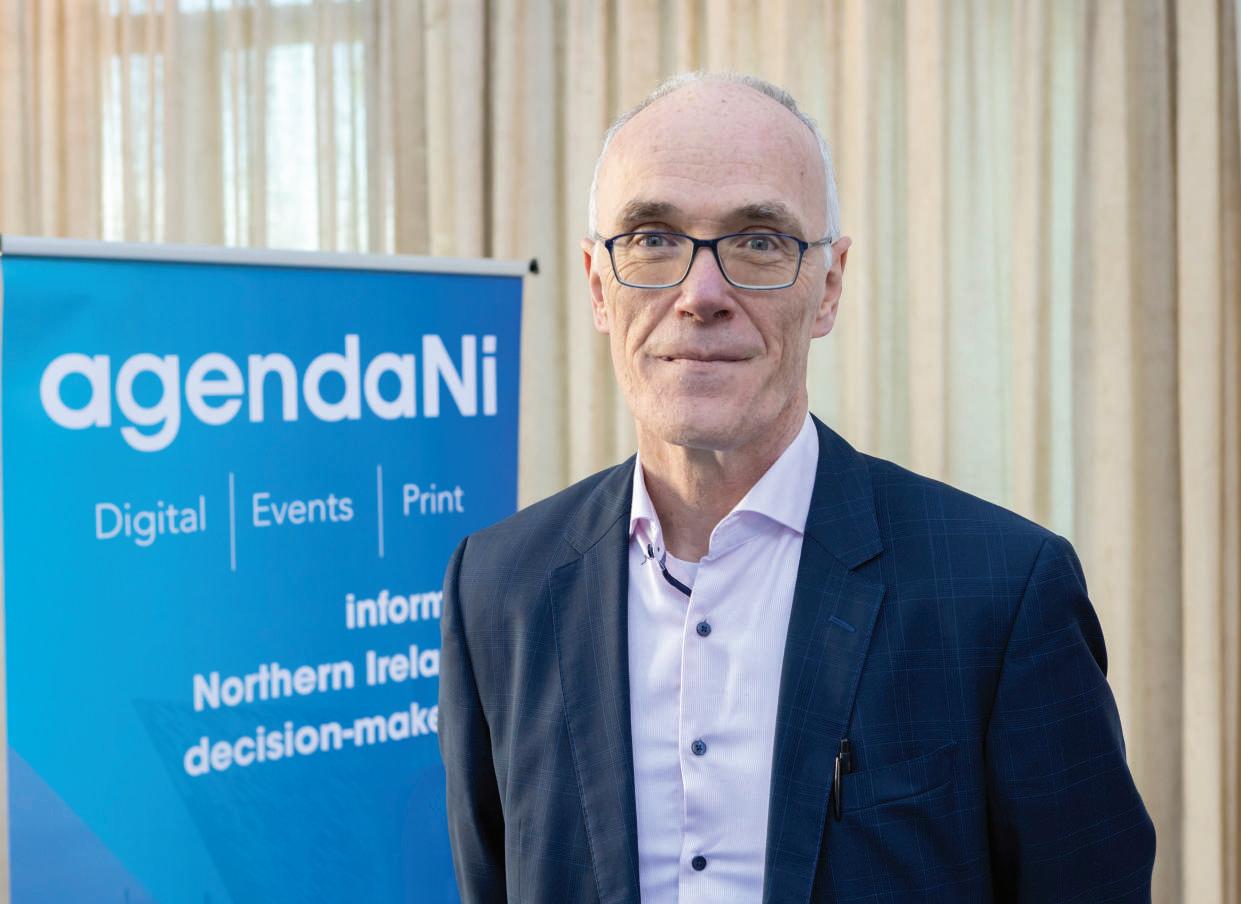
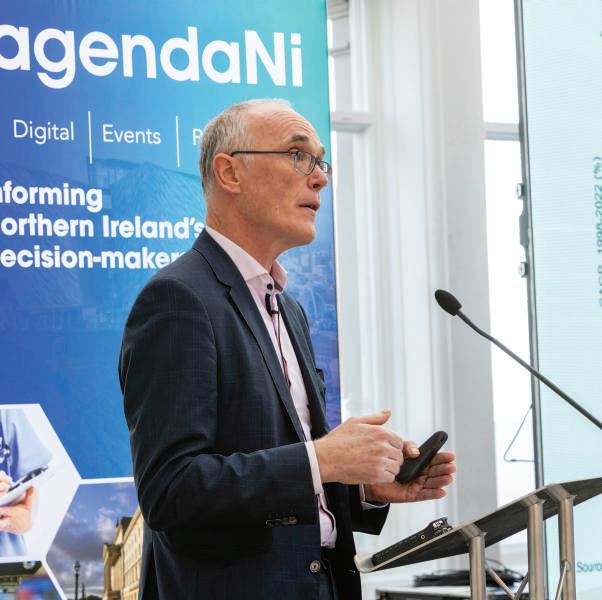
Solving the productivity shortfall holds the key to tacking regional economic inequality, according to Eoin Magennis, principal economist at the Ulster University Economic Policy Centre.
Eoin Magennis states that Northern Ireland has experienced sustained economic growth over the last 30 years. However, he emphasises that this has been “largely driven by employment growth as opposed to productivity growth”.
He explains that this imbalance is significant because “productivity underpins wages and long-term growth”, adding that improving productivity must be “an ongoing focus”.
Magennis reflects on traditional economic theory, which assumed that poorer regions would naturally catch up with richer ones. He asserts that this assumption “has been
exposed very clearly”, pointing to growing regional divergence across advanced economies.
Within the UK, he says, inequality remains pronounced. “It is still very much a case of London and the rest,” he states, noting that Northern Ireland continues to sit in a lowerperforming group for both productivity and output.
Despite some growth, he explains that the region’s starting point limits progress. “It started out in such a low way, that progress has not made much of a difference.”
“We may meet our targets, but whether we will hit them with the kind of quality of jobs that we want is another question.”
Cities
Magennis challenges the assumption that cities are consistently driving economic growth. While Belfast is often perceived as performing strongly, he says: “We are not seeing many stars. Belfast growth has not set the world on fire, and it is slightly below the UK average.” This underperformance, he suggests, reflects a wider challenge across UK cities and contributes to weak national productivity growth.
Magennis also highlights a disconnect between output and lived experience. “Regional inequalities does mean that the residents of affluent areas are doing well,” he says.
He explains that Belfast performs strongly on output-based measures, but “resident-based indicators place Belfast well down the rankings, with lower employment rates and higher economic inactivity”, adding: “Belfast’s position is more nuanced than we give it credit for.”
Regional inequality
Magennis outlines persistent disparities across local government districts. “There are gaps between top performing and bottom performing areas across a range of indicators, including GVA, employment, and qualifications.”
While some convergence has occurred, he cautions against interpreting this as progress. “Sometimes gaps can close, but this is not always to be wished for,” he says.
In some cases, convergence reflects declining performance in stronger areas rather than improvement elsewhere. He adds that lower-performing areas have improved, but “not at a much faster rate than other LGDs”, limiting meaningful catch-up.
Education and skills
Magennis states that education remains important but is not sufficient on its own. “Education helps, but without the employment opportunities, it does not help that much.”
He adds that its impact is diminishing: “It is not helping to the extent as it did 20 years ago and this creates challenges in retaining talent, particularly in areas where highquality jobs are limited.”
Structural challenges
Magennis highlights the long-term impact of deindustrialisation. In theory, he says, lost jobs should be replaced over time. However, he says that “in some places, that either did not happen or has happened more slowly”.
He points to the northwest as an example, where jobs “were not replaced to the level that they were lost at”. In this context, Magennis warns that job creation must accompany skills development.
issues agenda
Policy
On the role of policy in addressing regional imbalance, Magennis acknowledges a case for “spreading FDI more evenly”, but cautions that outcomes may not align with expectations.
“There is a danger in that we may meet our targets, but whether we will hit them with the kind of quality of jobs that we want is another question,” he says. He welcomes the development of local economic partnerships, describing them as “a good idea that brings local insight into policymaking”. However, he highlights challenges in ensuring alignment and joined up thinking.
“There is going to be a challenge to get people to do things that target what they are good at, as opposed to targeting what they think they want to do,” he explains.
He also questions whether local areas have sufficient scale to support sectoral clusters, suggesting that some interventions may be more effective at a regional level.
Performance
Magennis says that Northern Ireland is not necessarily more unequal than other UK regions, and that in some areas of the region, economic disparities are narrower.
However, he attributes this to overall economic performance rather than successful regional balance. “It is an issue of poor performance overall,” he concludes.
Eoin Magennis is Principal Economist at the Ulster University Economic Policy Centre with a research background in local and regional economic development, low pay and earnings, and the all-island economy.
North-south cancer research collaboration
Government, clinical, research, and policy leaders have agreed that closer north-south collaboration on cancer data is essential to reducing the disease burden across the island of Ireland.
At the All-Island Cancer Data Forum 2026, which took place in Belfast under the eHealth Hub for Cancer, stakeholders from Northern Ireland and the Republic agreed to advance cooperation on data standards, governance, and digital infrastructure.
Cancer accounts for approximately 30 per cent of all deaths across the island. In the Republic, age-standardised cancer incidence stands at approximately 640 cases per 100,000 population annually (excluding non-melanoma skin cancer), one of the highest rates in Europe. Mortality is estimated at around 260 deaths per 100,000 population.
In Northern Ireland, approximately 10,300 new cancer cases are diagnosed annually in a population of 1.9 million. Agestandardised mortality is estimated at approximately 240 deaths per 100,000 population. While survival outcomes are improving in both jurisdictions, variation persists by cancer type, deprivation, and stage at diagnosis.
Participants at the Forum endorsed Harnessing Cancer Data for Better Health, a seven-point roadmap designed to position the island as a global leader in cancer data innovation. Central to the plan is the establishment of an All-Island Cancer Data Innovation Co-Centre.
Strategic priorities include:
• alignment of data standards to enable interoperability across jurisdictions;
• strengthening of data governance frameworks;
• development of shared infrastructure for genomics and tumour imaging data;
• improved coordination of clinical trial enrolment; and
• enhanced integration of treatment and outcomes data.
The initiative is led by the eHealth Hub for Cancer, a joint programme between Queen’s University Belfast and University of Limerick.
Unless addressed through coordinated action, the number of new cancer diagnoses across the island is projected to increase substantially by 2045, driven primarily by population ageing and rising risk factors.
Health Minister Mike Nesbitt MLA welcomed the commitment to collaboration, saying: “Our recent successful implementation of the encompass programme across Northern Ireland is already driving a digital transformation across our health service.”
Mark Lawler, Professor of Digital Health at Queen’s University Belfast, says that Ireland’s cancer mortality rate remains above the EU average and requires coordinated intervention across both jurisdictions.
Aedín Culhane, Professor of Cancer Genomics at University of Limerick, emphasises that trusted and interoperable data standards are fundamental to accelerating innovation while ensuring patient privacy and security.
Leading Northern Ireland’s digital future
Colin Hutchinson, Group Managing Director and Chief Financial Officer of Fibrus, speaks to Joshua Murray about the rollout of Project Gigabit, enabling rural connectivity, and his ambitions for Fibrus in the short, medium, and long term.
“What Fibrus does is founded on building networks and building them on time and on budget.”
Colin Hutchinson, Fibrus
The telecommunications provider Fibrus has become a central player in Northern Ireland’s digital infrastructure landscape, building full-fibre network access across some of the most remote parts of the region.
The pace of expansion has been notable and, according to Hutchinson, growth has been built on a combination of disciplined network delivery, a focus on rural connectivity, and an ability to convert infrastructure investment into real customer adoption.
“What Fibrus does is founded on building networks and building them on time and on budget. Often that is in quite challenging rural locations. The foundation for our growth has been delivering those builds successfully and then connecting customers to the network once it is there.”
That second element is converting infrastructure into active users, and this is where Hutchinson believes the company has distinguished itself from competitors. Over the past year, Fibrus reached a key milestone, with around 30 per cent of homes within its network footprint now connected to its service.
Hutchinson explains: “This means that 30 per cent of the homes we have built are now connected and actively using the service. When you consider that in many of those areas people can choose more established providers, we are competing against very big brands and we are winning.”
This figure signals both customer trust and the effectiveness of the company’s broader strategy. “We are now looking ahead to 35 and 40 per cent penetration and that is how you really drive growth in this sector,” Hutchinson says.
Project Stratum
Central to Fibrus’ progress has been its role in delivering Project Stratum, the Executive’s major broadband infrastructure programme designed to bring gigabit-capable connectivity to areas with the poorest existing services.
Completed in June 2025, the project represented one of the largest infrastructure initiatives undertaken in Northern Ireland in recent years.
“For us, completing Project Stratum was a defining moment. It was a huge infrastructure project and we are incredibly proud that we delivered it on time and on budget.”
The objective of the project was to reach homes and businesses in rural communities where broadband speeds were previously limited by ageing copper networks or where connectivity had lagged far behind urban areas.
“The focus was on areas that had the poorest broadband speeds. People often had access to copper, but it was poor-quality copper and the experience simply was not good enough.”
By replacing these legacy connections with full-fibre infrastructure, the programme has fundamentally changed digital connectivity across large parts of rural Northern Ireland.
“The goal was to give people access to gigabitcapable broadband services. That is essential infrastructure now. It supports how people work, how they run businesses and how they live their lives.”
Independent analysis suggests the impact has already been substantial. Hutchinson points to economic research indicating that the project could 4
generate more than £400 million in economic benefit, including around £50 million annually for the economy.
However, the transformation is not solely economic. “It goes deeper than the numbers. Access to fibre broadband is now essential for everyday life. It enables people to work from home, supports education and entertainment, and underpins how households operate.”
Bridging the rural divide
From the beginning, Fibrus structured its business model around reaching communities that had historically been underserved by telecommunications investment.
Initially focusing on smaller towns, the company subsequently expanded further into rural areas following the awarding of the Project Stratum contract. That approach has had a significant social dimension.
“Having the same broadband speeds available in rural Fermanagh as you would have in Belfast or London really helps bridge that divide. Businesses can operate from rural locations just as effectively, and people can do exactly the same things from home.”
For policymakers concerned about regional imbalance, the implications are significant. Reliable high-speed connectivity reduces the disadvantage
faced by rural communities and creates new opportunities for economic activity beyond major urban centres.
“It really breaks down the barriers that one region might otherwise have compared with another,” Hutchinson adds.
Beyond Northern Ireland
While Northern Ireland remains central to Fibrus’ identity, the company’s expertise in rural network construction is also utilised further afield. Over the past year, Fibrus has also reached key milestones under the UK Government’s Project Gigabit programme in Cumbria.
Although geographically very different from Northern Ireland, the region presents its own set of challenges.
“Rural Northern Ireland can be difficult to build in, but in Cumbria you are dealing with national parks and additional planning restrictions, so the environment can be even more complex.”
Despite these obstacles, Fibrus has successfully met its contractual build targets, something which Hutchinson asserts has proven difficult for several other operators across the UK.
“A lot of peers who have won these contracts have struggled to hit their milestones. Some have had to hand them back,” he says. “The expertise developed through Project Stratum, and particularly the experience of our build partner Fibre Networks, has been crucial in allowing us to deliver.”
That operational knowledge, built through years of deploying infrastructure in remote and technically demanding landscapes, is now a competitive advantage.
Serving customers
Hutchinson emphasises that long-term growth depends on both customer experience and infrastructure development.
“Fibrus has invested heavily in customer support, including its service centre in Belfast. We have spent a lot of time and effort improving the customer experience,” he says.
That local presence has proven particularly valuable in communities where Fibrus is introducing full-fibre broadband for the first time. “It creates confidence because people know they are dealing with a company that is rooted here and invested in the region.”
Combined with competitive pricing and the reliability of fibre connectivity, the strategy has supported strong customer uptake across the network footprint.
Sustaining growth
Hutchinson believes the fundamentals of Fibrus’ strategy will remain consistent. These are to build high-quality infrastructure, connect more customers, and invest in the people who make the business work.
“The basics are delivering the network, making sure it is reliable, and driving customer penetration but a lot of it is about the people who make that happen.”
Fibrus’ founders placed significant emphasis on assembling the right expertise from the outset. That focus on talent has continued as the company scales. “Having the right people in the organisation has always been central to how the company grows.”
closely tied to the communities it serves.
“Connectivity is only going to become more important as we rely more on digital technology. If we can ensure that rural communities have the same access and opportunities as anywhere else, that is a hugely positive outcome for Northern Ireland,” he concludes.
Colin Hutchinson
Colin Hutchinson is chief financial officer and group managing director at Fibrus, the full-fibre broadband provider headquartered in Northern Ireland. He oversees the company’s financial strategy and operational delivery as it expands gigabit-capable broadband across rural and regional communities.
Hutchinson has extensive experience in corporate finance and infrastructure-led businesses and has played a central role in Fibrus’ rapid growth, including the successful delivery of Project Stratum.
For many SMEs, the cross-border market is the most accessible route to scale, allowing them to grow, innovate, and build their export capability without the cost and risk associated with more distant markets.
Given the challenging trade environment, ensuring businesses can access new market opportunities and supporting collaboration that translates into economic impact, is an increasingly important policy priority.
“In an uncertain global economy, the cross-border market provides a relatively stable and compelling proposition right on their doorstep,” says Margaret Hearty. “Strengthening economic links across the island gives our indigenous SMEs a platform to build scale and compete internationally.”
Established under Strand Two of the Belfast/Good Friday Agreement, InterTradeIreland has a unique mandate to support economic cooperation across the island. In doing so, it contributes directly to the delivery of Programme for Government commitments in both jurisdictions on growth, productivity, and regional economic development. In practice, this means helping businesses trade, innovate, collaborate, and scale using the opportunities available in both economies.
Maximising crossborder economic opportunities
With all-island trade now at an all-time high of £14.6 billion, agendaNi speaks to InterTradeIreland Chief Executive Margaret Hearty to discuss the opportunities in the cross-border market, and how the organisation’s strategic priorities will support indigenous SMEs.
InterTradeIreland’s work is underpinned by its research and engagement activity, which provides policymakers and businesses with a shared evidence base on trade, competitiveness, and enterprise growth. The most recent data shows cross-border trade at a new high of £14.6 billion, while its All-Island Business Monitor, a quarterly survey of 750 SMEs, shows that those active in the cross-border market typically perform better and are more resilient.
Hearty explains: “What we consistently see in the data is that firms trading across the island are more profitable and enjoy higher growth. Our role is to make it easier for businesses to access those opportunities. The crossborder market provides a practical first step into exporting for many SMEs, allowing them to develop new skills and gain valuable export experience before expanding into more distant markets.”
SustainIQ, a Belfast-based sustainability reporting software company, is an example of this progression. With support from InterTradeIreland, it successfully expanded its customer base into Ireland, transforming crossborder sales from a small share of revenue into a significant growth driver. This success in the neighbouring market accelerated its overall expansion.
Hearty says: “Success in the cross-border market builds the confidence and capability needed to compete internationally. Our experience shows that the majority of businesses who take that first step cross-border then go on to export off-island. In our most recent AIBM survey, three quarters of businesses said they would recommend the cross-border market as a stepping stone to exporting further afield.”
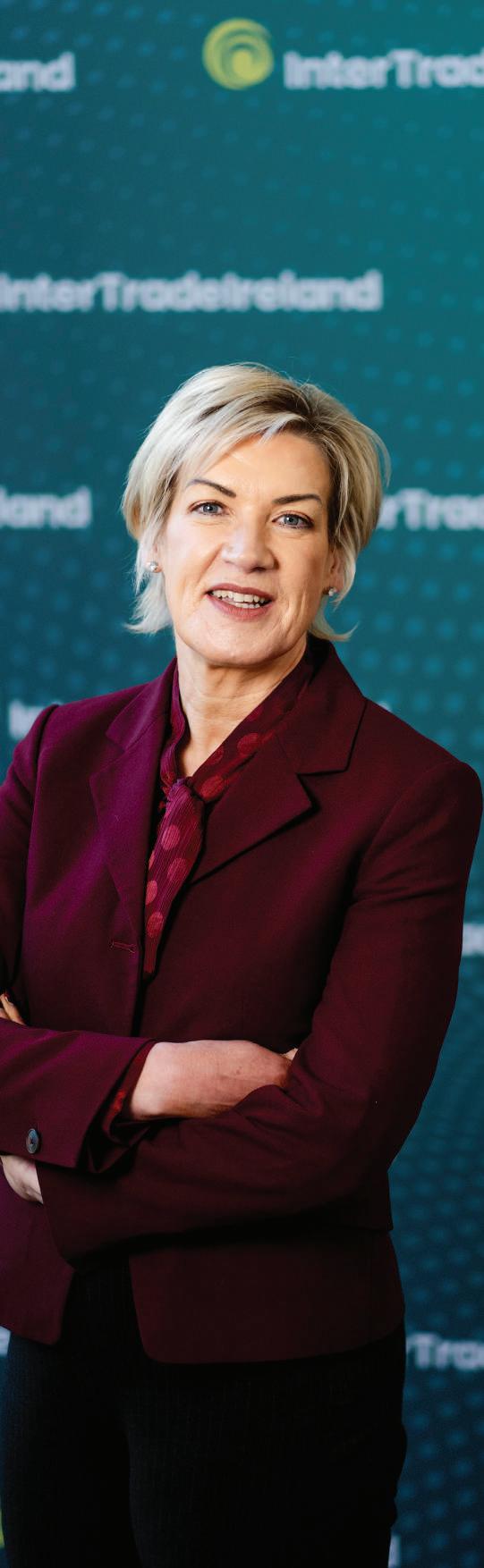
InterTradeIreland’s Chief Executive Margaret Hearty. Cross-border trade is now at a record-high.
InterTradeIreland has a direct mandate to lead economic collaboration across the island, and plays a key role as a connector and convenor between businesses, academia, and policymakers, which is crucial to unlocking new opportunities for growth and driving innovation and competitiveness.
Central to this role is helping SMEs across the island to better understand and embrace innovation.
InterTradeIreland’s Innovation Boost Programme supports SMEs to hire a graduate to take forward an innovation project and benefit from the support of an academic expert. In addition, through an open market call in 2025, InterTradeIreland launched several new innovation programmes including an initiative to support SMEs in the construction sector to adopt AI solutions to drive productivity improvements and create new market opportunities.
For many ambitious SMEs, the challenge is often not a shortage of ideas but access to the finance, expertise, skills, and networks that enable them to scale and turn those ideas into economic reality. InterTradeIreland’s investor readiness competition, Seedcorn, mirrors the fundraising process for startup and early-stage firms with a panel of expert judges. Regional finals mean that the whole island’s talent can be involved. Recent Northern Ireland based winners included dispute resolution platform TalkTerms, Routine Roo who have developed an online behavioural tool for parents and children as well as the deeptech winner BioMarx.
Through its suite of funding advisory offerings, InterTradeIreland supports
entrepreneurs across the island to refine their market proposition, secure new investment and scale their business. That focus on linking high potential earlystage SMEs with the right networks was in evidence at its Venture Capital Conference in Belfast in March 2026, which brought together over 600 companies and potential investors from across the island.
Another significant policy focus for both governments is improving the productivity of indigenous businesses through cluster development. International evidence shows that SMEs benefit from collaborative innovation and cluster participation, because the shared expertise and resources that they can access allows them to grow more quickly. Collaboration on an all-island basis offers a scale that neither economy would be able to offer on its own and allows cross-border clusters and participating businesses to compete internationally. A key theme of the Government of Ireland’s Shared Island Enterprise Fund has been clusters; InterTradeIreland has been central to this work, organising the global TCI clustering conference in Dublin in 2025 in partnership with Invest NI and Enterprise Ireland and leading the development of all-island clusters in strategically important sectors.
The Fintech Corridor demonstrates how this approach has already delivered results. With InterTradeIreland as its lead partner, the initiative links companies across cybersecurity, payments, and emerging financial technologies, helping firms collaborate, innovate, enter new markets and attract international investment.
A central focus has been addressing skills gaps through partnerships with education providers along the DublinBelfast corridor, including establishing a new Fintech Academy, postgraduate qualifications, micro-credential programmes and specialist training. Through partnerships with universities, institutes of technology, and industry the initiative has created the island’s first coordinated fintech ecosystem supporting internships, apprenticeships, and skills development.
Hearty says: “Businesses scale faster and are more competitive when they embrace innovation, can access the right markets, partners, and expertise. Our role, and it is central to everything we do, is to make those connections together across the island so firms can compete and grow more effectively than they would working on their own. For the ambitious business, the border is not a barrier; it is a launchpad.”
As global markets become increasingly volatile, the most effective tool for an SME is a strong regional network. By bridging the gap between North and South, InterTradeIreland is building an island-wide engine of competitiveness and resilience. Strengthening these practical links ensures that firms in both jurisdictions do not just survive in the changing global economy but can lead it.
Visit www.intertradeireland.com to find out more about how InterTradeIreland connects business to opportunities across the island.
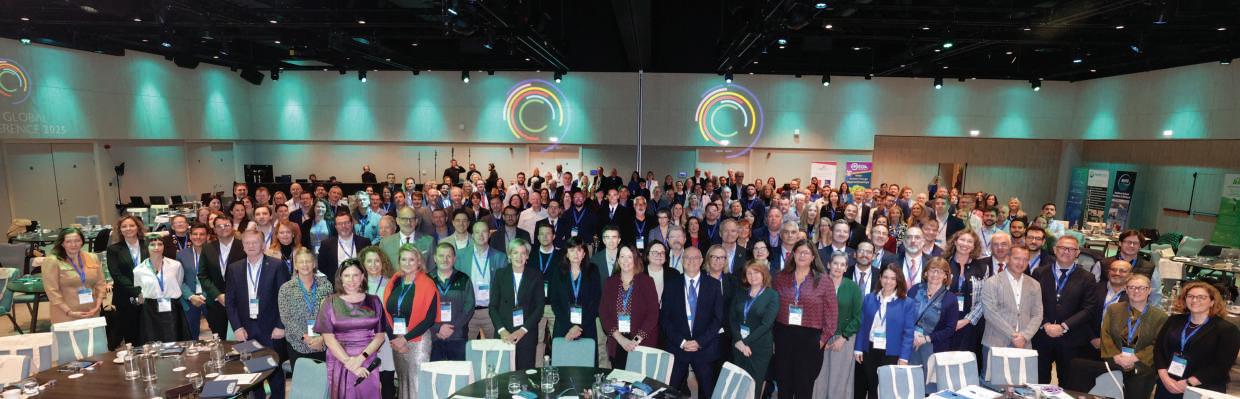
Over 230 delegates from 20 countries attended the TCI global conference. This flagship event for clusters was held on a cross-border basis under the Shared Island Enterprise Scheme and delivered by InterTradeIreland in partnership with Invest NI and Enterprise Ireland.
issues agenda
Structural north-south economic gaps persist
A new ESRI report has found that while Northern Ireland’s economy is growing and outperforming the UK average, deep structural gaps with the Republic persist across income, employment, demographics, and education.
Assessing economic trends in Ireland and Northern Ireland, published in December 2025, is the first in a planned annual series examining economic performance across the island. Drawing together comparable data from both jurisdictions, it presents a picture of two economies moving in the same direction, but at very different speeds.
On headline growth, the findings offer some encouragement for Northern Ireland. In the year to Q2 2025, output grew by 2.8 per cent, driven primarily by services and construction. This compares favourably with the UK as a whole and with Scotland. However, the Republic remains the fastest-growing economy across the UK and Ireland, with modified domestic demand increasing by 3.2 per cent over the same period.
Forecasts cited in the report suggest this divergence is likely to continue. Private-sector forecasts expect Northern Ireland’s gross value added to grow at just over 1 per cent in both 2025 and 2026, while forecasts in the South anticipate stronger domestic growth and continued job creation, albeit at a slower pace than in recent years.
Employment trends
Both jurisdictions recorded similar yearon-year employment growth in 2025, the long-term picture is markedly different. Since 2010, employment in Ireland has grown by 45.5 per cent, compared to 19.1 per cent in Northern Ireland.
The ESRI says that the Republic’s postpandemic labour market expansion has been particularly strong, with female employment rising sharply. Northern Ireland’s labour market, by contrast, continues to be characterised by higher inactivity and weaker participation.
Although Northern Ireland’s unemployment rate stood at just 1.8 per cent in 2024, compared to 4.4 per cent in Ireland, the report cautions against interpreting this as a sign of stronger labour market performance. Instead, it reflects a larger share of the working age population being economically inactive. Almost one-quarter of people aged between 15 and 64 in Northern Ireland are not in the labour market, compared to just over one-fifth in the Republic.
Demographics
Between 2015 and 2024, the Republic’s population grew by 14.8 per cent, driven largely by strong net migration. Northern Ireland’s population grew by just 3.9 per cent over the same period.
The Republic’s population is younger, with a lower old age dependency ratio, while Northern Ireland is further along the ageing curve. The ESRI highlights this as a key long-term challenge, particularly for labour supply and public services. Migration has become a significant driving force of economic growth in the Republic, while Northern Ireland’s more modest migration flows limit its growth potential.
Living standards gap
The most pronounced differences emerge in measures of living standards. In 2023, the Republic’s GNI* per capita stood at €63,500, compared to GDP per capita of €34,500 in Northern Ireland, an 84 per cent gap. While the South’s GDP is known to be distorted by multinational
activity, the ESRI emphasises that alternative measures still show a substantial and widening divergence.
After adjusting for purchasing power, hourly earnings in the Republic were 29 per cent higher than in Northern Ireland in 2024. Household disposable income is closer but still favours the South by around 10 per cent.
Life expectancy, which the ESRI describes as a robust indicator of overall wellbeing, also highlights persistent inequality. In 2022, people in the Republic lived longer on average than those in Northern Ireland, with a two-year gap for men and a 1.5-year gap for women. The gap has widened over time, suggesting structural differences in income, education, and access to services.
Education and skills
The Republic consistently outperforms Northern Ireland in post-compulsory education participation, with higher retention rates beyond age 16 and lower levels of early school leaving. NEET rates remain higher in Northern Ireland, at 10.6 per cent compared to 8.6 per cent in the South.
The report warns that weaker engagement with education and training risks reinforcing productivity gaps and limiting future growth, particularly as both jurisdictions face tightening labour supply due to ageing populations.
Public finances and policy
The ESRI also points to fundamental differences in policy capacity. The Republic, as a sovereign state, controls taxation and spending and has used this
autonomy to support growth, though the report cautions about rising public expenditure and reliance on volatile corporation tax revenues.
Northern Ireland, by contrast, operates within a constrained fiscal framework. The Executive has limited revenue-raising powers and depends heavily on the block grant determined by the Barnett formula. While funding increased in 2025/26, pressures remain acute, particularly in health, which accounts for more than half of departmental spending.
Data gaps
A recurring theme throughout the report is the lack of timely, comparable data for Northern Ireland. Gaps in household income, skills, and trade in services data limit the ability to assess policy effectiveness and track convergence or divergence over time.
The ESRI argues that improving all-island data cooperation should be a strategic priority, supporting more informed policymaking and shared responses to common challenges.
The report concludes that while Northern Ireland’s recent growth performance is relatively strong within the UK context, it continues to lag significantly behind Ireland on income, employment, education, and living standards. Addressing these gaps will require sustained policy focus, improved data, and a realistic assessment of the structural constraints facing the Northern Ireland economy.
The Rule of Law in Perspective
A new initiative from the Bar of NI and the Office of the Lady Chief Justice.
In short, the rule of law means that laws, not individuals, govern. It means no individual is above the law and that no one is above its protection. Laws must be clear, fair, and applied equally by courts that are independent from the government, and the rights and freedoms of all citizens must be protected under those laws.
This principle shapes our everyday lives, from our ability to speak freely, to knowing that our system of justice is designed to treat everyone as equals. In jurisdictions where the rule of law is strong, we find stronger economies, better educational opportunities for all, greater peace and social cohesion.
The importance of the rule of law is often lost in the complexity of modern life, our
systems of democracy and our legal and justice systems. If the rule of law operates as an invisible hand, it stands at risk of being pushed away.
A new initiative from the Bar of NI and the Office of the Lady Chief Justice
The Rule of Law in Perspective is a new collaboration between the Bar of Northern Ireland and the Office of the Lady Chief Justice which seeks to promote the value and meaning of the rule of law. The initiative promotes informed dialogue and involves the business community, civic society, the judiciary, the legal professions, and elected representatives.
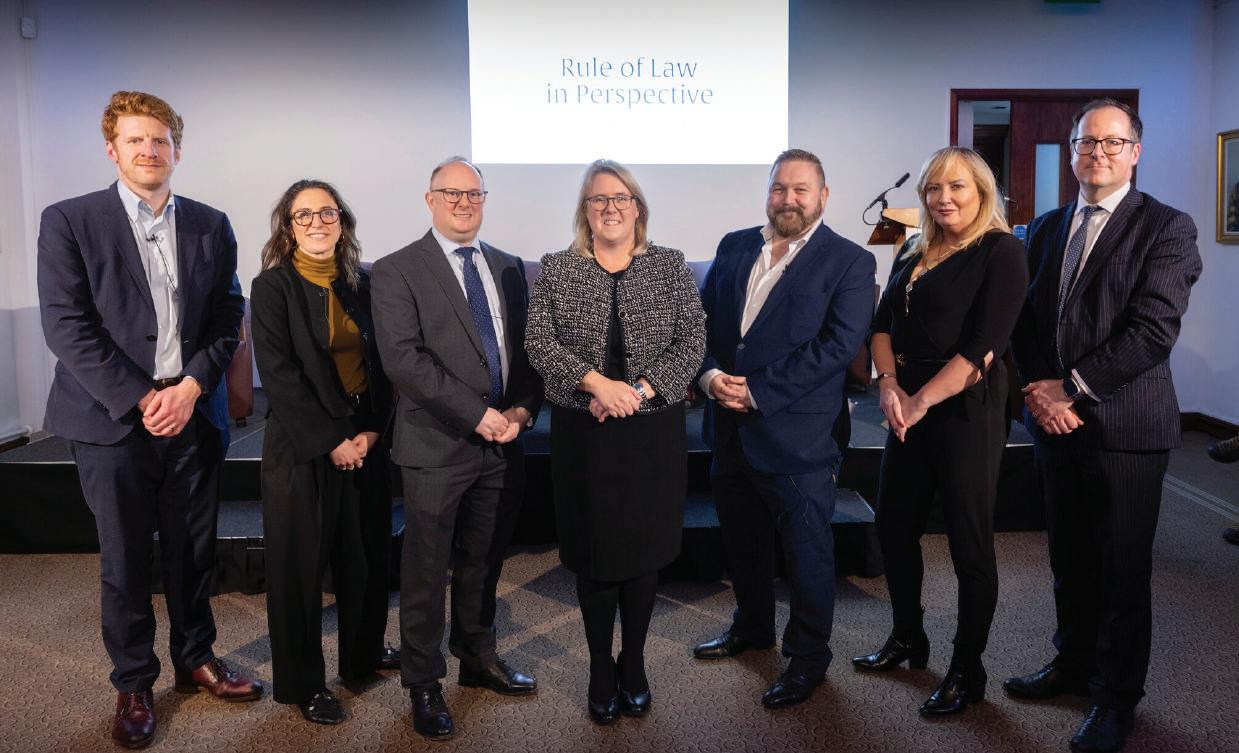
(L-R): Matthew O’Toole MLA; Stephanie Needleman, Justice; Justice David Scoffield; Lady Chief Justice Siobhan Keegan; William Crawley; Allison Morris; and Donal Lunny KC.
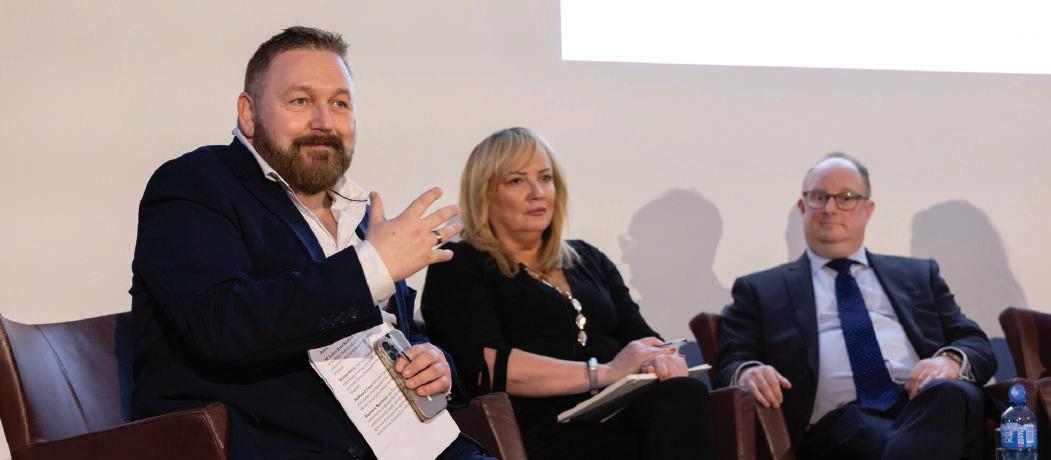
(L-R) Willam Crawley, Allison Morris, and Justice David Scoffield.
The first event in the series took place in November 2025 and focused on defining the rule of law and its connection to economic performance and the realisation of rights and equality and took the form of a well-attended and insightful panel discussion.
Contributions were offered from former Head of the Northern Ireland Civil Service David Sterling; public law expert Fiona Doherty; Chief Commissioner of the Equality Commission for Northern Ireland, Geraldine McGahey; Tracy Stuart, Head of Legal at Invest Northern Ireland; and Senior Associate at Phoenix Law, Sinead Marmion.
The panel discussion underscored the critical role of the rule of law in shaping and supporting economic growth. The correlation between the rule of law and stable, just and prosperous societies was clearly articulated by the panellists.
The discussion also distilled the role of public law in upholding the rule of law by ensuring that public bodies operate lawfully and fairly. The development of common law and its importance in advancing the rule of law was also outlined.
The launch event was also an opportunity to preview a campaign video that accompanies the public debates and contextualises the aims of the series.
Challenges to the rule of law
The second event in the series explored challenges to the rule of law at home and beyond our jurisdiction and took place in March 2026.
The panellists tasked with exploring the issues brought together figures drawn from politics, media, the judiciary and legal reform groups. Astute and lively contributions came from journalist Allison Morris, Justice David Scoffield, Stephanie Needleman of the law reform charity Justice, and South Belfast MLA Matthew O’Toole.
Broadcaster William Crawley chaired the discussion, creating an immersive atmosphere, bringing in questions and contributions from the audience throughout.
Broadly, the consensus attributed backsliding on the rule of law to rising global authoritarianism, underfunding of the legal and justice systems, the spread of disinformation undermining trust in institutions, and threats to judicial independence.
How can the rule of law backslide be halted?
But what can be done by way of a response and how can the backslide on the rule of law be halted?
The scale of that challenge is clear. Recent global events have led UN Secretary-General António Guterres to describe how the rule of law is being superseded by the law of force, reflecting a growing reliance on coercive power over diplomacy and legal safeguards.
Backsliding on the rule of law across Europe has been evidenced through a recent report by the NGO Liberties. Drawing on evidence from a collaboration of 40 human rights organisations across 22 EU member states, the report highlights a serious, deliberate erosion of the rule of law in five countries (Bulgaria, Croatia, Hungary, Italy, and Slovakia) and shows that even historically strong democracies, including Belgium, Denmark, France, Germany, and Sweden, are experiencing regression.
Closer to home, threats to the rule of law are becoming evident. The law reform charity Justice has identified structural and cultural issues that threaten the rule of law in the UK context, including:
• rushed, complex legislation with senior judges describing rules as a “bewildering flurry,” and immigration law described as “Byzantine”;
• an increased use of framework bills that set out the principle of policy direction but leave the detail to be filled in later by ministers through delegated powers, thereby bypassing scrutiny;
• underfunding of the legal and justice system, leaving access to justice more difficult for litigants through the administration of publicly funded legal services; and
• public confidence corroding through online disinformation and misinformation and the lack of a coordinated approach to assisting people to understand and advance their rights through public legal education.
The shared responsibility of the rule of law
The Lady Chief Justice described the advancement and protection of the rule of law as a “shared responsibility”. The rule of law belongs to every part of society: to the courts who interpret it, to the professionals who practise it, and the public who rely on it.
The Rule of Law in Perspective series is aimed at giving effect to that shared responsibility. The Bar of Northern Ireland and the Office of the Lady Chief Justice look forward to continuing the dialogue through an exploration of how the rule of law can be maintained and advanced.
T: 028 9024 1523
W: www.barofni.com
(L-R) Fiona Doherty KC, Geraldine McGahey, Sinead Marmion, David Sterling, and Donal Lunny KC.
Tenant engagement: Leading the way and why it matters
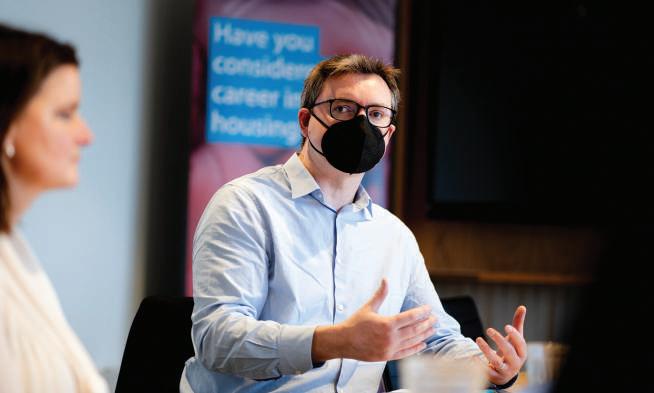
Radius Housing hosts experts from across Northern Ireland’s social housing sector for a round table discussion on tenant engagement and how housing associations can lead the way.
Should tenant participation in housing decision-making be mandated and would this improve services?
Cameron Watt
Tenant participation in housing decisionmaking is essential, but mandating it in a rigid, prescriptive way could be difficult and counterproductive. The priority should be ensuring tenants have a meaningful voice in shaping decisions that affect them and in holding landlords to account, including through governance structures. Participation should not become a mechanistic tickbox exercise requiring involvement in every decision. Tenants are often most concerned with issues affecting their own homes, developments, or sheltered schemes rather than wider strategic matters, so engagement must reflect those priorities. Stronger, clearer expectations should be established to ensure tenants can contribute meaningfully to key decision-making
Round table discussion hosted by
structures, while allowing flexibility in how landlords achieve this. The focus should remain on outcomes and ensuring tenants are genuinely heard and can influence decisions, rather than imposing blanket requirements that may not suit every context.
Loma Wilson
I would support a light-touch mandate requiring social landlords to have clear structures in place to facilitate tenant participation. The housing sector already performs well in this area, but some level of formal framework would help ensure consistency across all landlords and provide assurance that engagement is being carried out effectively. A common framework could outline expected methods of engagement, encourage sharing of best practice, and potentially include measures such as tenant satisfaction benchmarks so that performance can be compared across organisations. This could also create healthy competition and help raise standards, as seen in other parts of the UK. Any mandate should avoid being overly heavy-handed, but a proportionate approach could strengthen tenant participation, provide greater clarity, and ensure all housing associations are meeting a consistent standard while still retaining flexibility in how they engage with tenants.
Colm McDaid
Tenant participation should be rooted in meaningful engagement rather than compliance-driven obligation. Participation and empowerment are central principles because they help individuals and communities take ownership of their neighbourhoods and influence decisions affecting their homes and lives. The real value lies not in requiring landlords to simply ‘do participation’ as a formality, but in embedding it into organisational culture so that tenants’ voices genuinely shape services and improve outcomes. Housing is about people and place, and lived experience is critical in designing better services. Existing frameworks, such as the Tenant Participation Strategy 20152020 and its principles of mutual trust, respect, and partnership between tenants, boards, and staff, already provide a strong foundation. The opportunity now is to build on these standards, ensuring tenant engagement becomes more meaningful, influential, and embedded across all landlords, whether housing associations or the Housing Executive.
Heloise Brown
Meaningful and genuine tenant engagement is vital if participation is to improve housing services. The key question is how tenants influence
priorities and help shape what landlords do in practice. Northern Ireland already benefits from a strong and closely connected social housing sector, which is a major advantage for tenants and communities, and this should not be overlooked. There are useful opportunities within the regulatory framework to strengthen tenant participation further, particularly by listening to housing associations about how current consumer standards are working and how benchmarking could be improved. The most effective benchmarking should be shaped by the sector itself. Existing forums, such as housing policy panels, adaptations forums, and consultative groups, already show how tenants can influence both landlord practice and wider public policy, especially for vulnerable or disadvantaged groups. Building on these strengths can further improve both engagement and service quality.
Jennifer Hawthorne
Tenant participation must be central to housing because landlords work in people’s homes and communities over the long-term, creating a unique and privileged relationship. Unlike other public services, housing providers remain embedded in communities, so failing to incorporate tenants’ needs, views, and lived experiences into decisionmaking means missing a critical opportunity to improve services. Tenant voices are essential at every level, from resolving local issues such as anti-social behaviour in individual streets, to shaping major policies like domestic abuse and youth homelessness strategies. Effective participation strengthens communities while also improving business performance, because it helps landlords understand whether services are meeting expectations. This is why tenant satisfaction and engagement should be treated as core business objectives, measured through clear KPIs and benchmarking. Meaningful tenant participation is both the right thing to do and essential to delivering effective, responsive housing services.
How have tenant needs and expectations changed, and what should landlords do differently?
Jennifer Hawthorne
Tenant needs and expectations have changed significantly since the Covid-19 pandemic, with satisfaction levels declining and expectations rising across housing services. Our longitudinal tenant survey shows this is shift particularly strongly among younger tenants, whose expectations differ markedly from older age groups. There is growing dissatisfaction with communication, neighbourhood quality, and responsiveness. Landlords must understand not only satisfaction scores but the reasons behind dissatisfaction. The key is to use this evidence dynamically by tracking trends, identifying emerging concerns, and acting on them visibly. Landlords need to move beyond simply collecting data and instead demonstrate clearly how tenant feedback is shaping service improvements. Understanding changing attitudes, especially among younger tenants, is essential if landlords are to remain responsive. Expectations are higher than before, and housing providers must
Heloise Brown
Round table participants
Heloise Brown is Director of Social Housing Policy and Oversight in the Department for Communities. The Department is the sponsor body for the Housing Executive and the regulator for registered housing associations. Since joining the Civil Service in 2002, she has worked in a range of roles including homelessness policy and social housing policy, research and legislation. She led the passage of the Housing (Amendment) Acts 2016 and 2020 and is now responsible for policy areas including the tenant participation strategy, social housing regulation, housing support services, and social housing allocations.
Jennifer Hawthorne
Jennifer Hawthorne was appointed the Director of Housing Services at the Northern Ireland Housing Executive in April 2022. She is responsible for a division with 1,500 staff and manages 83,000 Housing Executive homes across Northern Ireland. She is also responsible for the management of all homelessness services. Since joining the Housing Executive in 1978, Hawthorne has worked in a number of roles throughout her career in the Housing Executive, including Regional Manager for Belfast, Public Relations Manager for Belfast and operational manager for the Shankill area. Hawthorne also headed up the Community Cohesion division in the Housing Executive for 10 years, with major accomplishments including the development of shared housing, re-imaging, and peace wall barrier removal programmes. In 2015, she was awarded an OBE for her work on the successful transformation of post conflict communities.
Colm McDaid
Colm McDaid took up the position of Chief Executive of Supporting Communities in January 2014. Supporting Communities is a Northern Ireland-wide community development and tenant support organisation with a dedicated staff of 30. McDaid joined the organisation in 1994 and has held various positions within the organisation. He holds a BSc in housing management from Ulster University, a Henley Certificate in management, and a MSc in social administration and policy. McDaid is a board member of the Chartered Institute of Housing in Northern Ireland.
Cameron Watt
Cameron Watt has been Chief Executive of Alpha Housing since 2017. Alpha Housing is a leading housing association which was founded in 2009. Watt was previously Chief Executive at the Northern Ireland Federation of Housing Associations (NIFHA) and started his career in the Renewing One Nation unit at the British Conservative Party Central Office. Watt subsequently co-founded the Centre for Social Justice.
Loma Wilson
Loma Wilson is Director of Communities at Radius Housing, leading a 350 strong directorate responsible for housing management, tenant services, and community support across 13,000 homes. She also oversees the Radius Foundation, which delivers direct assistance and community investment programmes for tenants. Before joining Radius in 2020, she spent 23 years with the Northern Ireland Housing Executive in senior roles focused on housing management and organisational change, bringing extensive frontline and strategic experience to the sector.
“Landlords must deliver quick wins where possible and clearly communicate progress, showing tenants that their views are genuinely listened to and acted upon.” Loma Wilson
adapt by listening more carefully, responding more effectively, and ensuring tenants see real improvements resulting from their feedback.
Loma Wilson
Tenant expectations have risen sharply, particularly around transparency, speed of communication, and responsiveness. People increasingly expect quicker replies, clearer accountability when things go wrong, and more influence over decisions affecting their homes and communities. Traditional engagement models alone are no longer enough; many tenants prefer flexible, accessible methods such as online surveys, quick polls, and digital feedback tools rather than formal panel meetings. Landlords must adapt communication methods to reflect these changing preferences while ensuring engagement remains meaningful rather than tokenistic. Codesign is becoming increasingly important, with tenants expecting to shape services directly rather than simply comment on them. For example, tenant feedback has led us to redesign our website to make it more user-friendly. Even where some service improvements take time, landlords must deliver quick wins where possible and clearly communicate progress, showing tenants that their views are genuinely listened to and acted upon.
Cameron Watt
Tenant expectations are changing most visibly in two areas: the quality of homes and the speed of service delivery. Tenants increasingly compare older housing stock with newly built or refurbished schemes and expect higher standards in the appearance and condition of their homes, including landscaping and communal areas. Limited maintenance budgets make it difficult to meet those expectations quickly, creating challenges in managing perceptions. Expectations have also risen sharply around repairs and communication. Tenants now expect housing services to mirror the convenience of other sectors, such as being able to book repairs easily online and receive prompt updates if issues arise. To meet these expectations, landlords need to invest significantly in digital self-service systems that improve responsiveness and communication. For smaller associations, this presents financial challenges, but better technology is increasingly essential if landlords are to deliver the faster, more transparent service tenants now expect.
Colm McDaid
Tenant expectations have evolved alongside wider consumer expectations and increased awareness of housing rights, particularly around safety, accountability, and service quality. Events such as Grenfell and the introduction of Awaab’s Law have heightened
expectations that landlords will respond quickly to concerns and take tenant complaints seriously. At the same time, tenants increasingly expect faster communication and better digital access to services. While investment in digital systems is important, landlords must avoid a one-size-fits-all approach, as many tenants still cannot or do not wish to rely on digital channels. Services must remain inclusive, offering choice and ensuring no one is excluded. Landlords should also support digital inclusion by helping tenants gain safe online access and confidence in using digital tools. The challenge is to modernise services while maintaining accessibility, ensuring all tenants, regardless of age, ability, or digital confidence, can engage fully and receive high-quality support.
Heloise Brown
Tenant expectations now reflect both immediate service demands and longerterm relationship expectations with landlords. In the short term, tenants increasingly expect faster responses, clearer communication, and greater responsiveness, shaped by broader consumer experiences in other sectors. At the same time, social housing is built on long-term tenancies, so landlords must also focus on sustaining trusted relationships and agreeing clear mutual expectations with tenants over time. In learning the lessons from Grenfell and Awaab’s Law, it is essential that landlords treat concerns seriously and ensure complaints are not overlooked. The key lesson is not only to respond faster, but to listen better and recognise tenant concerns early and acting on them before they escalate. Landlords should strengthen systems that capture and respond to tenant voices consistently, ensuring that both urgent issues and everyday concerns are acknowledged and addressed effectively.
Should tenant satisfaction measures be reported annually by all social landlords?
Loma Wilson
Tenant satisfaction measures should be reported annually by all social landlords. Annual reporting would create a valuable opportunity for consistent benchmarking, especially if developed within a local framework where landlords operate in the same policy and service context. Comparing results with peers locally would provide more meaningful insights than comparisons with England alone,
where conditions may differ. The value is not simply in producing league tables, but in understanding where organisations are performing strongly and identifying best practice that others can learn from. If one landlord is achieving particularly high satisfaction in a certain area, that should create opportunities for shared learning across the sector. Annual reporting would strengthen transparency, encourage continuous improvement, and help landlords identify weaknesses as well as successes. Used constructively, these measures would support better services for tenants while helping housing providers learn from one another in a more structured and informed way.
Jennifer Hawthorne
Tenant satisfaction should absolutely be reported annually because it is a core indicator of business performance as well as service quality. Housing providers exist to serve tenants, and measuring satisfaction provides essential evidence of whether services are meeting expectations. Annual reporting enables benchmarking, learning from bestperforming organisations, and identifying where improvements are needed. Independent benchmarking is especially valuable because it provides objective comparisons and allows landlords to examine practices in organisations achieving stronger outcomes. Tenant satisfaction should not be treated separately from wider organisational performance because it is a fundamental part of understanding whether a landlord is operating effectively. Robust annual reporting also provides transparency and accountability, ensuring landlords cannot ignore what tenants are saying. Satisfaction data becomes even more meaningful when gathered independently, as this gives a more balanced and reliable picture than internal surveys alone. Annual reporting should therefore be seen as an essential part of responsible housing management.
Cameron Watt
Annual tenant satisfaction reporting should be a standard expectation for all social landlords because accountability to tenants must sit at the heart of housing services. Since landlords exist to serve tenants, robust and transparent reporting on tenant experience is both logical and necessary. Established models such as the English tenant satisfaction measures provide a useful basis for this, but any reporting framework must also ensure consistency
“The challenge is to modernise services while maintaining accessibility, ensuring all tenants, regardless of age, ability, or digital confidence, can engage fully and receive high-quality support.” Colm McDaid
in methodology. Independence is particularly important: satisfaction surveys carried out by independent researchers are likely to produce more reliable and comparable results than those conducted directly by landlords. Outcomes can vary significantly depending on who asks the questions, how surveys are conducted, and which tenant groups are responding. For example, older tenants and those in specialist housing may report higher satisfaction than other groups, which can affect interpretation. Annual reporting is valuable, but results must be carefully contextualised to avoid misleading comparisons or oversimplified league tables.
Heloise Brown
Annual tenant satisfaction reporting is clearly an area of importance from a regulatory perspective, particularly in supporting transparency, consistency, and accountability across the sector. Comparable reporting across landlords allows regulators and tenants alike to understand how services are performing and where improvements may be needed. However, the greatest value comes when this information is directly accessible to tenants themselves, for example through websites, apps, or other easy-to-use channels, rather than existing only in formal returns submitted to regulators. When tenants can readily
access satisfaction information, they are better able to engage with it and understand how their landlord is performing. This strengthens trust and reinforces accountability in a more immediate and meaningful way. For annual reporting to be effective, measures must also be consistent across landlords so that the same standards are being applied and comparisons are fair, reliable, and useful both for tenants and for oversight purposes.
Colm McDaid
Tenant satisfaction measures should be reported annually because regular reporting strengthens openness, accountability, and tenant confidence in their landlords. As tenants become more informed and empowered, they increasingly expect to understand how landlords are performing and to hold them accountable where services fall short. Annual reporting gives tenants clear evidence of what their landlord is delivering and creates benchmarks against which progress can be measured. It also helps landlords identify where resources need to be targeted and supports service improvement through co-design with tenants. While there is always room for improvement, it is equally important to recognise the strong work already being done across the sector, including the positive standards set through tenant participation
“Meaningful and genuine tenant engagement is vital if participation is to improve housing services.” Heloise Brown
strategies and consumer standards. Annual reporting should therefore not only highlight areas needing attention but also showcase good practice, helping to build trust and spread successful approaches across the housing sector. How can tenants have a stronger role in governance including board representation and tenant participation accreditation?
Heloise Brown
I think it is for individual landlords to decide. It is important for landlords to
make informed decisions about how they encourage tenants to engage in and influence decisions. Tenant surveys are valuable tools to show what is on people’s minds and what trends are emerging.
Loma Wilson
We have a tenant board member, Bobby McConnell, who is now very well known in the sector. That has worked very well but it is probably not something you can mandate as it is not a role that suits everybody. Bobby started by coming through as a complainant of the service and is the textbook example of how to
“Tenant satisfaction should not be treated separately from wider organisational performance because it is a fundamental part of understanding whether a landlord is operating effectively.” Jennifer Hawthorne
engage with tenants. The biggest difference I have noticed is when we are making important decisions, people are very cognisant of what Bobby will think of them. It is also key to give tenant board members the opportunity to attend as many external events as possible to build their knowledge and ensure they are learning how to use their voice. You are not always going to have a tenant that fits the role so well but you can get just as much out of your tenant executive committees and panels.
Colm McDaid
It is crucial that each organisation’s board and executive team buys into the fact that engaging with tenants is not just the right thing to do, it is the smart thing to do. It is not a necessity to have a tenant on the board but it is a necessity that landlords have an infrastructure that enables the tenant’s voice to be heard. It is equally important that social landlords invest the necessary resources in supporting this infrastructure, for example, Supporting Communities provides independent support to the Housing Executive’s Housing Community Network (HCN). This helps build capacity, confidence, and skills. The Housing Policy Panel is a good example of this on the Department’s behalf. Tenant board members are crucial to give account of the lived experience.
Jennifer Hawthorne
We were awarded the Customer Service Excellence (CSE) accreditation due to the Housing Community Network which was described by CSE as the ‘jewel in the crown’. The network is our infrastructure facilitating tenant voices to be heard, and it is designed to hold the board and directors to account. It is critical to ensure the tenant’s voice is at the heart of holding you to account and that is how you make real change.
Cameron Watt
We can raise the bar from having tenant participation gatherings and structures to having meaningful tenant engagement structures that are an integral part of your governance process. We have tenant members on our customer services committee that look in-depth at day-today delivery of housing management. On tenant participation accreditation, it is important to have a robust outcomefocused approach and that there is independent quality control to provide assurance for your tenant participation activities.
Colm McDaid
Our TP Accreditation is invaluable as it provides social landlords with an independent assessment tool that gives both Boards and tenants assurance that participation is being offered to a high standard. It is vital for Northern Ireland that we have landlords that want to excel and be the best. Our counterparts in England, Scotland, and Wales have similar accreditation schemes and that is an opportunity to benchmark similar accreditation across the island of Ireland and Britain because we all use a similar framework. For too long we have admired what is going on across the water without looking at our own achievements regarding tenant engagement; particularly given the challenges that we have.
What is the single most effective method to engage hard-to-reach groups?
Colm McDaid
Hard-to-reach groups can also be categorised as ‘easy-to-ignore’. It is important to identify who we are talking about when we reference that: Rural communities, young people, the elderly, those with disabilities, ethnic minorities, LGBTQ+, people from the Travelling community, refugees. These are the groups we need to create opportunity and structures to ensure their voices are heard. From a landlord’s perspective, it is important to know who your tenants are.
Heloise Brown
This is an area where staff in the Housing Executive and housing associations have huge experience and perform really well. It is an area that other jurisdictions could learn from. The skills and experience of housing professionals in this area could be shared as best practice with other jurisdictions, and we could show how much has been achieved here.
Jennifer Hawthorne
The cohesion side is a huge passion of mine. You need to know where your gaps are. You need to know when there is a voice that is not being heard. Social housing remains highly segregated. Community development and involvement for landlords is so instrumental for developing greater cohesion amongst hard-to-reach groups. It breaks down barriers and creates better understanding between groups. It ensures all the voices in your network are represented. It is vital that you take action to identify gaps and address them.
Cameron Watt
Each group has different needs. Continued engagement and investment in digital are vital. People should be able to expect to continue to have their voice heard and see how that has been influencing decision-making. Face-toface engagement is crucial. We have a head start: a lot of our tenants like coming out for a coffee morning and giving their views. For many marginalised groups, they want face-to-face engagement. Sometimes that needs to be one-to-one or in very small groups because not everybody feels comfortable expressing themselves in a large group setting. It is imperative that you engage with those community anchor organisations and that we, as social landlords, are seen as a community enabler. The work that has been enabled through Housing for All is immense. We are building a scheme in Quarry Heights in Newtownards. We have been able to piggyback on a lot of the Housing for All work done by Ark Housing in the neighbouring development. That has enabled them to be an embedded part of the Newtownards civil society. The reputation of housing associations has significantly improved in the last 10 to 15 years because of things like Housing for All and the work associations are doing generally. I think we are now seen as long-term investors and partners in supporting a wide range of social changes in the communities we serve.
Loma Wilson
I think the most effective way to engage is to meet people where they are. That is why community involvement work has such positive outcomes. For housing associations, scale can be a challenge, particularly in rural areas. The Housing Executive is a fantastic organisation, and it is embedded in every community. Recently we have decided to join structures that the Housing Executive facilitate, such as the Rural Community Network. We are also partnering with the Northern Ireland Youth Forum on a pilot in north Belfast to engage with young people. There could be the opportunity for housing associations to engage more with the housing Executive’s structures which are strongly embedded in communities.
Colm McDaid
Tenant engagement is not just the right thing to do; it is the valuable thing to do. We, through the Housing Executive, carried out an independent study in Newtownards in 2025 in relation to social return on investment. It showed that, for every £1 that was invested there was £11 generated in social value. Most of the value was a direct benefit for the community such as building relations, improving people’s sense of safety, and increasing people’s community pride.
“Better technology is increasingly essential if landlords are to deliver the faster, more transparent service tenants now expect.”
Cameron Watt
Global innovation in victim care and support
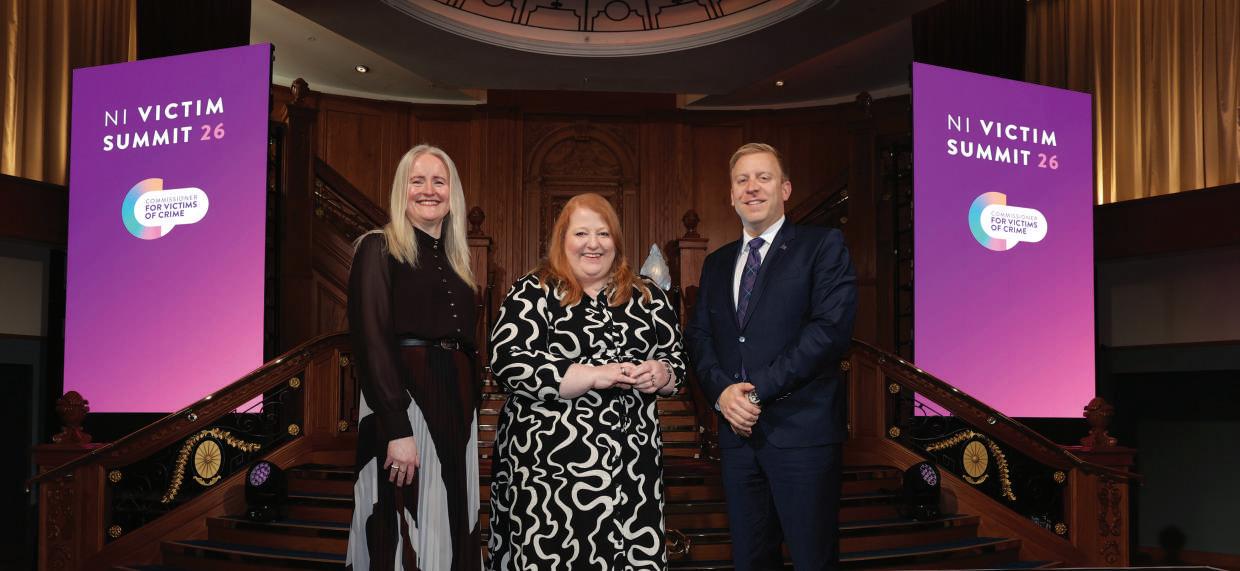
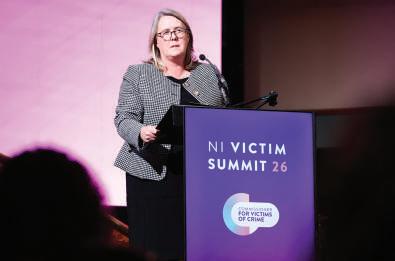
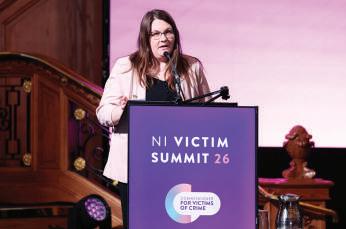
Some key highlights and findings from the inaugural Northern Ireland Victim Summit hosted by the Commissioner for Victims of Crime.
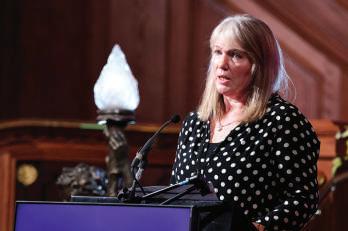
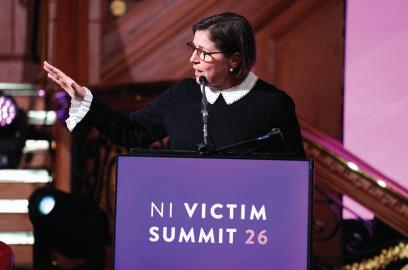
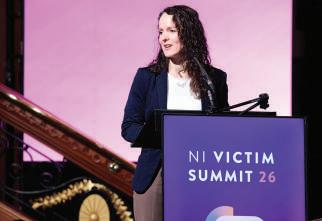
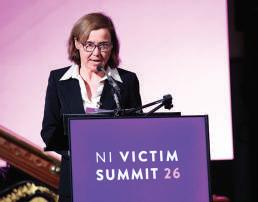
The Commissioner Designate for Victims of Crime Geraldine Hanna hosted the inaugural Northern Ireland Victim Summit on 27 March 2026.
Titanic Belfast provided the setting for the one-day conference, showcasing best practice and innovation in victim care and support from around the world. 130 delegates from across the public and voluntary sectors, the legal profession and the judiciary, gathered to learn about innovative solutions to some of justice’s most intractable challenges.
The Commissioner Designate set the tone for the day, encouraging delegates to take part in “learning, sharing and reimagining what more we can do together to ensure that the needs of victims are at the centre of everything we do”.
The summit reflected on five core themes: lived experience in policymaking, victim-centred justice, child-centred justice, domestic abuse reform, and strengthening victims’ rights in the parole process. Under each theme, delegates heard powerful testimony from victims of crime whose experience of the justice system caused further harm, before learning about problem-solving approaches to improve victim experience.
Lived experience in policymaking
The first showcase was the Survivor Council model, which integrates the lived experience of victims and survivors into policy making.
Mié Kohiyama, co-founder of Brave Movement France, spoke of her
personal experience as a sexual abuse survivor and the importance for survivors to be given a political voice and be part of the solution: “Survivors do not just want to be heard, they want to lead.”
For Kohiyama, while acknowledging the invaluable role that support agencies play in victim advocacy, victims must be at the table in terms of legislative and policy development: “It is better to talk to God than his saints.”
Kohiyama’s words coincide with efforts in Northern Ireland to establish a local Survivor Council. The group hopes to build upon experience from elsewhere to integrate survivor voices into discourse and, critically, action on child sexual abuse, by placing survivor expertise at the heart of policymaking.
Victim-centred justice
Mathieu Lévesque, of the National Assembly of Québec, shared Quebec’s experience of implementing a wraparound, multidisciplinary needs assessment and advocacy service for victims of crime. The CAVAC model is centred on building trust and creating a ‘security bubble’ around victims to keep them engaged and mitigate further harm from the justice process. Other elements include safety-driven spatial design of courts, therapy dogs in court settings, and state financial support for victims of abuse to relocate to safety.
The presentation gave Northern Ireland justice agencies in the room plenty to ponder, as they work to develop an integrated victim and witness needs assessment service in line with CJINI recommendations.
Commissioner Designate Geraldine Hanna, Justice Minister Naomi Long MLA, Mathieu Lévesque, Member of the National Assembly of Québec.
Child-centred justice
Anna O’Reilly from Children First reflected on implementing the Barnahus, or ‘Children’s House’, model in Scotland. Named ‘Bairns Hoose’, it provides a safe, holistic support and trauma recovery journey for child victims of sexual assault. Anna shared testimony from a teenage survivor, revealing insights into child victims’ needs: “Make sure we know you are coming, and we know who you are. We need your support from the moment we have told someone what has happened…. before everything becomes out of our hands.”
O’Reilly provided invaluable advice for officials considering how best to introduce Barnahus in Northern Ireland. Advocating a “think slow, act fast” philosophy, she recommended incorporating strong central leadership, development of a national plan with high aspiration but a phased approach to roll-out, underpinned by effective data collection and evaluation.
Domestic abuse reform
The Summit’s focus turned to the family court, with Domestic Abuse Commissioner for England and Wales Nicole Jacobs and the Ministry of Justice’s Jacqui Frisby discussing reform to private family court proceedings. The Pathfinder pilot,
introduced in England and Wales to overcome documented failings to protect children and domestic abuse victims from harm, centres proceedings on the child’s voice and wishes.
Research undertaken by Queen’s University has revealed similar issues within local family courts, and work is now underway to convene a task and finish group to scope a potential pilot for Northern Ireland. Chaired by the Commissioner Designate, the group will include members from departments of Justice, Health, Finance, as well as the Courts and Tribunal Service, the legal profession, victim and child advocates, and health trusts.
Strengthening victims’ rights in the parole process
The day’s final theme saw the Parole Board of Canada’s Shannon Dorken outline the federal approach to conditional release. Under Canadian law, victims have a right to information on the offender who harmed them, and to participation and protection in relation to conditional release decision-making.
The Canadian approach will undoubtedly enrich discourse as the DOJ consults on measures to improve Victim Engagement in the Parole Process.
Other highlights
The Summit showcased homegrown innovation in a two-way knowledge
exchange between Northern Ireland and visiting delegates. Justice Minister Naomi Long MLA highlighted a range of reforms including remote evidence centres, which enable victims to give evidence remotely, and SOLAs who provide legal advice to victims of sexual offences.
Lady Chief Justice Siobhán Keegan outlined her reform programme to improve transparency and understanding of the family courts as part of broader work to improve victims’ experience in court.
The most outstanding contributions came from victims of crime, who courageously shared their testimony to inspire change and help make the system better for future victims.
In closing, the Commissioner Designate called those in the room to action –resources notwithstanding, the absence of perfection cannot be an excuse for absence of progress.
T: 02890 526607
W: www.cvocni.org
Unfinished business
Writing in agendaNi, People Before Profit MLA Gerry Carroll discusses the battle for social housing in Northern Ireland.
The Housing Executive was once the envy of these islands. A single, unified, publicly accountable body with the scale and the mandate to house people who needed it. PwC, not exactly a socialist think tank, described it as one of the North’s genuine success stories, transforming our housing stock from one of the worst in western Europe to one of the best. This took political will, public investment and a recognition that housing is a basic human right, rather than a commodity.
What we are witnessing now is the systematic dismantling of that legacy, and we should be clear-sighted about the contributing factors.
In 1975, the Housing Executive built over 5,000 new homes. By the mid-1990s, that had fallen to 1,360. Today it is zero. The promise was that housing associations would fill the gap but they have not and they cannot. The Housing Executive set a new build target of 2,300 social homes per year, already revised down from 3,000. In 2024/25, housing associations built just 1,410. Meanwhile, the number of households with homelessness status has more than doubled over the past decade, rising from 13,644 to 32,159, a 136 per cent increase. Behind each of these statistics is a family suffering.
Against this backdrop, the Minister for Communities has decided to strip state funding from housing associations: the only providers of social housing in Northern Ireland. This is a regressive, indefensible decision. Housing associations will now be forced to seek more private finance, delay projects or scrap them entirely.
When private finance gets involved in what ought to be a public good, the priorities of investors crowd out the needs of tenants. Senior management of a public body like the Housing Executive are accountable to a democratically elected minister, who answers to the electorate.
“When private finance gets involved in what ought to be a public good, the priorities of investors crowd out the needs of tenants”
Gerry Carroll MLA, People Before Profit
Senior management of financialised housing associations are increasingly accountable to capital markets. It should be obvious which system produces fairer outcomes. Apparently, it is not obvious enough to everyone in Stormont.
The condition of much of the Housing Executive’s existing stock is a sorry sight. A maintenance backlog growing by the day. Thousands of families live in homes that are damp, mouldy, or inaccessible. In west Belfast in 2023/24, Housing Executive tenants submitted 1,379 repair requests for damp and mould in a single year. The Housing Executive completed 141 repairs and just one installation of cavity wall insulation. That is a 10 per cent response rate. That figure should shame every person with responsibility for housing policy in this place.
Nye Bevan, the socialist Labour MP who founded the NHS, held the housing and health ministerial portfolios simultaneously because there was a cleareyed recognition in the 1940s that housing and health are inseparable. That recognition has long since been abandoned. Forcing people to live in damp, cold, mouldy homes is a political choice, and its consequences are deadly. Cosmetic repairs without meaningful capital investment change nothing.
That is why I brought forward a motion in the Assembly calling on the Communities Minister to introduce Awaab’s Law (or equivalent legislation) in the North. Social tenants must have the legal power to take their landlord to court when damp, mould, and disrepair go unaddressed. The law already exists in England and there is no excuse for its absence here.
The Housing Executive’s stock is also being hollowed out from above. In 1981, two in five people in Northern Ireland lived in a Housing Executive home. By 2021, it was one in 10. The House Sales Scheme is a major reason why. Homes sold under the scheme have not stayed with the families who needed them. By 2019, around a quarter had ended up in the hands of private landlords. We do not have more up-to-date figures, but it is a safe bet it is higher.
The Housing Executive is losing its best homes to the private rented sector while working class families wait years on a list that only grows longer. While selling off desperately needed stock, it compounds the injustice through a succession policy that evicts grieving tenants from homes they have lived in for decades. The solution to the housing crisis will not be found in further financialisation, more private borrowing or pushing people into an under-regulated, wildly unaffordable private rented sector, where rents have risen by an extortionate 51 per cent in the past five years. That is a complete dead end. But restoring the Housing Executive’s capacity must also prompt harder questions about what kind of housing we need and for whom.
Our population is ageing, and people with chronic conditions are living longer. We need accessible homes designed around people’s actual lives. We need much more housing for single people, who are almost invisible in current policy. We need adequate refuge provision for women fleeing domestic violence. Thirty women have been murdered in the North since 2020. That epidemic of gender-based violence and the housing crisis are not separate issues.
The Housing Executive’s founding was a hard-won victory, a direct legacy of the Civil Rights Movement’s demand for fair and accountable public housing. It was born out of resistance to sectarian allocation, political neglect, and slum conditions. Defending it today is not nostalgia. It is defending the principle that everyone, regardless of income, background, or circumstance, deserves a decent and secure home. That principle is under sustained attack. The response has to be equally sustained in the Assembly, on the streets and in every community where families are living with the human cost of a housing system that is clearly unfit for purpose.
issues agenda
New wave of focus for marine protected areas
An updated five-year strategy for the continued protection of marine protected areas (MPAs), with renewed focus on management systems, has been outlined in the Marine Protected Areas Strategy for the Northern Ireland Inshore Region 2026-2030.
The strategy, published in February 2026, aims to support the recovery of key habitats and species, close ecological gaps and support the growth of naturebased solutions.
Overall, 85 per cent of wetlands, 75 per cent of land, and 66 per cent of all oceans have been significantly altered by humans since the pre-industrial era, according to the United Nations Environment Programme. The United Kingdom’s climate has been warming at a rate of 0.25 degrees Celsius per decade, with the years 2022 to 2024 being in the top five warmest on record.
The MPA strategy’s predecessor, known as the 2014 strategy, focused on the establishment of an MPA network. By its update, it had set up 48 MPAs in
Northern Ireland, around 38 per cent of Northern Ireland’s inshore regions.
The implementation of management measures, with the application of appropriate monitoring and adaptive management approaches, alongside further development, and management of the MPA network are the core aims of the strategy. Nine objectives are outlined in the strategy, alongside necessary actions to implement them.
Objectives and actions
Objective one, focused on communication and stakeholder engagement, is the development and publishing of an engagement, outreach, and communications framework by 2028. To achieve this, DAERA must publish a governance structure within the first three
months of the strategy being published, and increase public awareness of existing MPAs including making information more accessible. Further action necessary is the promotion of data from the Centre for Environment Data and Research (CEDaR), and the maintenance of community engagement to maximise awareness.
Objectives two and three are focused on designations to address gaps and improve ecological coherence. For this to be successful, DAERA will need to review the MPA network to identify gaps, and introduce new designations or amend sites, if necessary, by 2028. By 2030, the Department will need to provide an updated MPA network report to the Assembly, evaluating the 2025-2030 strategy.
The third objective is to maintain and enhance, where relevant, the MPA OSPAR network design. To follow international standards for marine conservation, the Department will need to invest in research to understand how MPAs contribute to climate change mitigation and adaptation. Studying the risks to marine ecosystems and ensuring that the network stays adaptable as scientific knowledge and environmental conditions change.
Objectives four to seven are set under management and restoration, aiming to enable good environmental status by 2030. Actions needed for this to happen include the introduction of management plans for new MPAs added to the network, the development and implementation of management measures for protected areas, and publication of annual MPA management progress reports.
Objective five is exploring the benefits of implementing management approaches from strict non-extractive highly protected marine areas (HPMAs). DAERA
issues agenda
aims to achieve this by exploring the economic and environmental costs and benefits of different management approaches. The strategy also says the Department will aim to develop policy guidelines on management approaches.
Objective six sets out how other effective area-based conservation measures (OECMs) are to complement the MPA network. This includes working with UK partners to develop clear definitions and criteria for OECMs and develop policies on how OECMs could support and complement the MPA network.
Objective seven, regarding investment in restoration projects, aims to identify restoration actions within current marine recovery programmes by 2026. The Department aims for the development of proposals for funding restoration projects in collaboration with partners and to encourage stakeholders to use other funding sources such as the Environmental Fund and Peace Plus.
Objective eight is to develop and publish a new MPA monitoring and reporting
framework which will outline statutory requirements and policy drivers to be completed by 2027. To achieve this, DAERA aims to create the framework for MPAs and for blue carbon habitats. The Department is also mandated to develop a method for evaluating management effectiveness aligned with the UK approach.
The ninth objective is development in approaches to scope and measure the costs and benefits of the MPA network. This is to help understand the social and economic impacts of marine conservation. The strategy says DAERA will consider the recommendations from the NI-MANACA, and commission followon projects to fill evidence gaps.
Minister of Agriculture, Environment and Rural Affairs Andrew Muir MLA says: “This strategy recognises the critical contribution marine protected areas (MPAs) can make in addressing biodiversity loss and their capacity to deliver nature-based solutions to climate challenges.”
In order for the rollout and adoption of AI to be sustainable, policymakers must ensure that the views of the wider public are understood and taken into account.
In November 2025, the Ulster University Strategic Policy Unit commissioned the first comprehensive opinion poll in Northern Ireland on public engagement, skills, and attitudes towards artificial intelligence. This was conducted by LucidTalk and received 1,970 responses.
The poll shows that there is considerable awareness of AI, with 83 per cent at least somewhat aware. People are already using or willing to use AI for a wide range of activities.
However, levels of AI training are very low at 10 per cent. There is strong evidence of an AI digital divide. Men are using AI more frequently than women, whilst women express greater caution. There are significant socioeconomic differences, with people from the ABC1 category using and having more confidence in AI.
Assessing the AI pulse
Artificial intelligence is transforming our world. It raises immense possibilities for new discoveries, and brings the potential for increased productivity in the economy and the public sector. However, it also raises significant concerns and poses a range of considerable risks, writes Stephen Farry, professor of strategic policy at Ulster University.
Respondents display significant recognition that AI can be beneficial, with the public identifying medical discoveries and health provision as the applications with which they are most comfortable, with clear support also for education, energy infrastructure, the environment, and transport. Perhaps unsurprisingly, the area with least support was policing.
Whilst there is a clear understanding of many of the potential benefits of AI, views around actual or perceived risks were much clearly expressed. Respondents leant towards the ‘agree’ option regarding benefits but with respect to risks, leant towards the ‘strongly agree’ option.
Some of the main concerns related to deepfakes and misinformation, disruption to or loss of jobs, environmental impacts, data security, and maintaining human control. There are significant issues of trust both in terms of the accuracy of results and ethical use.
With a fundamental transformation of our economy and society underway, effective and rapid, and often anticipatory, policy interventions are required. Given that we could be facing a radically changed landscape within a small number of years, it is perhaps surprising that AI is not higher on the political and policy agenda.
The poll demonstrates a clear need to build and sustain trust in the use of AI including through an ethical governance framework, including transparency and safeguards such as retention of ultimate human control.
Trust will likely be helped by growing evidence of tangible benefits from AI being realised to improve lives.
A delicate balance needs to be found between innovation and regulation. However, in terms of public opinion, there is overwhelming support for strong regulation.
There was clear support for the provision of AI skilling opportunities across a broad front, including the education system. A focus on skills will be crucial to ensuring inclusivity and mitigation of the risk of the economic gains of AI being overly concentrated in a few hands.
Almost all advanced economies have AI strategies. Here in Northern Ireland, the Executive has been developing an AI Strategy for the public sector under the aegis of the Chief Scientific and Technological Adviser, Helen McCarthy.
This will be fundamental building block, but it will not be the overarching approach being taken elsewhere.
Therefore, corresponding policies are needed from other departments such as the Department for the Economy dealing with skills, jobs, and energy implication and the Department of Education covering how we teach young people to adapt and flourish in this new world.
The results of the poll and an accompanying report are available at: www.ulster.ac.uk/spu
Stephen Farry is a Professor of Strategic Policy in Practice at Ulster University and former Member of Parliament (MP) for North Down.
Education crisis: Can integrated education be part of the solution?
Paul Caskey, Chief Executive of the Integrated Education Fund, asks whether integrated education can be part of the solution for the current education crisis.
Northern Ireland has a choice to make, it can rationalise the schools’ estate within the existing school sectors, or it can seize an opportunity to do things differently. The question is whether we will maintain the status quo or embrace an opportunity to build a more shared future for generations to come.
No one can deny education in Northern Ireland is in a financial crisis after years of chronic underfunding, but it is also true that the warning signs have been visible for decades.
Almost 20 years ago, the Independent Strategic Review of Education, led by George Bain, recommended action to address the overprovision of schools at a time when birth rates were falling. A 2023 Independent Review chaired by Keir Bloomer also emphasised the need for change, recommending the reconfiguration of up to 177 schools on jointly managed community basis and the creation of an independent area planning commission. The review stated that changes should be made on a ‘sector-blind’ basis and could generate annual savings of around £100 million for reinvestment.
Ulster University’s ‘Transforming Education’ project estimates that the total additional cost of maintaining a divided education system is up to £150 million each year. It highlights the duplication of services, with schools delivering the same curriculum by teachers with identical qualifications, but to different groups of children.
Nearly 30 years after the Belfast/Good Friday Agreement, we still largely educate children separately according to perceived religious and cultural identity. Whilst all schools are legally ‘open to all’, the reality is less than 2 per cent of children attending Catholicmaintained schools identify as Protestant and less than 8 per cent of those pupils attending controlled schools identify as Catholic.
The IEF would contend more Integrated schools, together with other innovative cross sectoral solutions, could potentially bring significant financial and social benefits over time.
This why the IEF supports Ulster University’s ‘Future Schools Project,’ with primary and post-primary toolkits, which empowers communities to explore sustainable solutions and models of provision that best serve their
children and young people. The IEF is not saying every solution must result in an integrated school, but where communities want integration, one highquality integrated school serving all children can offer a sustainable long term option.
Northern Ireland is becoming increasingly diverse, with more people identifying as ‘other,’ outside the traditional Protestant/Catholic binary. Integrated education promotes an ethos of respect for all cultural and religious backgrounds, including those with no faith. Children learn with, from, and beside those from different cultures every day, helping to prepare them for life after school in the Northern Ireland of today and tomorrow.
Integrated schools also bring together children with different abilities, socioeconomic backgrounds and they are co-educational. Such fully inclusive schools offer the best chance to be truly open to all. They are schools for all the family.
Integrated education is not a panacea, but it has a positive role to play. At a time when schools cannot balance the books; we urgently need action and solutions. We cannot afford to keep doing what we have been doing for another 20 years.
T: 028 9069 4099
W: ief.org.uk
Housing report
Communities Minister Gordon Lyons MLA: The future of housing reform
Communities Minister Gordon Lyons MLA reflects on two years of housing progress and pledges further positive reform.
Delivering meaningful housing reform in Northern Ireland and putting people and families at the centre of that reform is a priority for me.
I am committed to making a positive difference.
As Communities Minister, I know having the right strategies, action plans, and programmes is essential.
But ultimately, housing is about people. It is about community and connection. And it is about improving lives. That is what motivates me.
A year ago, I told agendaNi that housing was at the heart of government and a key focus of my mandate. One year on, and despite the constraints of a challenging budgetary landscape, that commitment has only strengthened.
A safe, warm, and affordable home is the foundation of so many positive life outcomes.
The benefits span health, education, and economic wellbeing, and that is why a holistic, collaborative, and cross departmental approach is essential.
The Housing Supply Strategy, launched in my first year as Minister, sits at the centre of Northern Ireland’s long-term housing future.
It also highlights the scale of the issues we face.
I am committed to delivering this strategy and will shortly bring forward the first action plan for Executive approval.
I want to see this action plan as a real step change in how government views and prioritises housing.
I have already started this process. Housing is now a priority in the Programme for Government, and I have allocated more funding than ever to our new build programme: more than £207 million in 2025/26.
The ambition is to deliver at least 100,000 more homes by 2039, with at least one-third of those social homes, and I believe we can achieve that.
We have a target of commencing at least 5,850 new build social homes by 2027 and there are approximately 5,500 social homes currently under construction across Northern Ireland.
While I have committed a significant proportion of my budget to more social house building, I will continue to press for more as I know more needs to be done.
My plans are not just about getting more money; I want to get the most from the money we already have.
I have therefore initiated two reviews into grant support and quality standards to drive efficiency and maximise the number of new social homes delivered from the Department’s budget.
Building better:
100,000 new homes by 2039
5,500 social homes currently in construction
4,000 co-ownership homes by 2029
600 temporary accommodation houses planned
300 affordable ‘intermediate’ rent homes planned
141 new units for people with complex needs by 2029
Revitalising the Northern Ireland Housing Executive (NIHE) and securing UK Government agreement for borrowing powers is another key priority.
In June 2025, I secured a significant milestone when it was agreed that the treatment of NIHE borrowing would form part of negotiations on a new Northern Ireland Fiscal Framework.
However, a long-term, sustainable solution is urgently required to help NIHE protect and improve its homes, and this is something I will continue to strive for.
Energy efficiency and affordability are also critical, and that is why, in February 2026, I launched the Executive’s Warm Healthy Homes Strategy, a long-term, cross government commitment to tackle fuel poverty.
A key proposal within the strategy is a new Warm Healthy Homes Fund, a flagship scheme delivering energy efficient improvements to households most in need.
The fund requires a £150 million investment, and I will be seeking Executive support to ensure its delivery and success.
I have also delivered a range of new and innovative programmes to increase supply and improve the quality of our homes, including:
• the planned delivery of 300 new build affordable rent homes for low income households;
• approving NIHE purchase of 600 homes for use as temporary accommodation to reduce reliance on costly and unsuitable hotel or B&B placements;
• the Northern Ireland Cladding Safety Scheme, which has already delivered £9.9 million to ensure high rise buildings meet current safety standards;
• working with the NIHE to implement a review of how social homes are allocated; and
• securing a ring fenced £2.5 million allocation for strategic homelessness prevention in 2025/26.
Those experiencing homelessness are at the sharp end. I am committed to tackling homelessness by continuing to work with other departments, the NIHE, and third sector delivery partners to make homelessness rare, brief, and non recurrent.
Alongside the Department of Health, I recently launched New Foundations, an innovative project providing young people leaving care with settled, affordable accommodation and the wraparound support needed to transition successfully to independent living.
We are also finalising a new high rise residential building safety policy tailored specifically for Northern Ireland, and in the coming weeks, I will seek Executive approval to bring forward new legislation.
Considering the financial constraints, complexities, and challenges faced, I am proud of the progress made so far.
I am also acutely aware there is much more to be done.
Continuing this vital work and delivering positive change for people and families across Northern Ireland will remain my focus in the year ahead.
Balancing demand and supply
Professor of real estate and urban studies at Ulster University, Martin Haran, discusses the performance of Northern Ireland’s housing market and the growing imbalance between supply and demand.
Martin Haran explains that, at headline level, the Northern Ireland housing market continues to demonstrate resilience. By the end of Q1 2025, the average house price had reached £233,000, representing annual growth of 4.8 per cent; a growth rate significantly higher than the rest of the UK and Ireland.
Pointing to relatively stable mortgage conditions and strong underlying demand, Haran says that “we would deem the market to be well supported”. However, he cautions that this growth must be understood in the context of wider economic uncertainty. “We are in the midst of a geopolitical storm and forecasting future trends remains challenging.”
Affordability
Despite continued price growth, Haran highlights a growing disconnect between house prices and household incomes. Northern Ireland is often described as an “affordable” market in relative terms, with 83 per cent of sales below £300,000. However, this characterisation is becoming increasingly strained.
“Whilst we are continuing to see house price inflation, the capacity of households to pay is becoming a much more significant issue.”
This challenge is not evenly distributed across the region. Haran outlines that some of the strongest price growth has occurred outside Belfast, in areas such as Mid Ulster, Fermanagh, and Causeway Coast and Glens. These patterns reflect changing housing preferences, including increased
demand for rural living, partly driven by remote working trends and shifting demographics.
“There is certainly demand in those more rural areas,” he says, adding that cross-border dynamics are also playing a role. In particular, he highlights the impact of demand spilling over from Dublin into areas such as Newry, Mourne and Down, placing additional pressure on local housing stock.
Supply
Haran says: “In 2005, we were building 8,000 more homes than we are building in 2025.” He says that this reflects both structural and capacity constraints within the construction sector, as well as planning-related challenges.
“We are not building enough homes and that is not just in the social housing sector; it is in the private sector as well.
“The consequences of this shortfall are evident in both house prices and rental markets. Limited supply, combined with sustained demand, continues to drive upward pressure, creating a system that is increasingly difficult for many households to access.”
Private rental sector
Haran describes the private rental sector as the area where affordability pressures are most acute. As more people are priced out of homeownership, and social housing provision struggles to meet demand, increasing numbers of households are turning to private renting.
“When I go out and speak to estate agents, they tell me they have got 80 tenants for every listing,” he says, highlighting the scale of demand.
At the same time, the sector itself is contracting. Haran says that a combination of policy, regulation, and market incentives have led to a reduction in available rental stock. “Some landlords have exited the sector entirely, while others have shifted properties into the shortterm lets market, attracted by higher potential returns.
“We are seeing a shrinking of the private rental sector and this is further intensifying competition and driving up rents.”
Rising rents
The impact of these dynamics is clearly reflected in rental prices. By the second half of 2025, average rents in Belfast had reached £1,101 per month and rent prices across Northern Ireland had increased by 5.8 per cent over the previous 12-month period.
The proportion of income required to service rent currently stands at 36.4 per cent across the region, rising to 41.7 per cent in Belfast. “If we think that anything above 30 per cent would be deemed unaffordable, we are well above that threshold,” he says.
For lower-income households, the situation is particularly severe. The availability of lower-cost rental properties has declined sharply, with a growing concentration of stock at higher price points. “Access for low-income households is becoming nigh on impossible,” Haran says.
Market variability
Another significant trend is the divergence between house price growth and rental growth. While house prices have followed a relatively stable trajectory, rents have become more volatile, with sharper increases in recent years.
“We are seeing greater spikes within that rental market,” Haran says, attributing this to acute supply constraints and heightened demand. This divergence, he states, is “indicative of deeper structural issues within the housing system”.
The Ulster University professor says that these pressures are likely to persist in the medium term, with factors such as potential interest rate increases, ongoing inflation, and rising energy costs expected to place further strain on household finances.
In addition, demographic challenges such as a rise in single-person households and an ageing population are increasing demand for housing units, even in the absence of the scale of population growth being recorded in Britain and the Republic of Ireland.
Policy response
In response to these challenges, Haran outlines a number of key policy recommendations. Central among these is the need to increase housing supply, although he acknowledges that this is not a straightforward task.
Addressing affordability in the private rented sector will require targeted intervention. Haran advocates for greater regulation and professionalisation, while recognising the potential impact on supply. “We do need a sector that is properly regulated,” he argues, particularly in terms of housing quality and tenant protection.
Expanding social housing provision is another critical component, alongside measures to support first-time buyers. Haran suggests that mortgage providers could also play a greater role in facilitating access, particularly through innovative and green-focused mortgage products.
Finally, he emphasises the importance of aligning housing development with infrastructure planning. “It needs to be proactive,” he says, highlighting the need for coordinated approaches that integrate housing, utilities, and wider infrastructure systems.
Concluding, Haran says: “The demand for product considerably outstrips supply and without sustained and coordinated action, affordability challenges, particularly within the private rented sector, will continue to intensify.”
Housing with Choice: A force for good
Some 50 years on from inception, Choice sees its role as a ‘force for good’ for tenants, communities, staff, and wider society, as the group remains committed to excellence, accountability and continuous improvement, writes Michael McDonnell, Choice Group Chief Executive.
Moving into the third year of delivering its Strategy to 2027, the Choice Group looks back on a period of significant progress and transformation. Today, the group manages more than 14,000 high quality homes, supporting over 30,000 tenants across a wide range of housing options. The positive impact it makes is only possible through empowered teams and strong partnerships with stakeholders which deliver benefits for the tenants and communities it serves.
In 2026, Choice became the first housing association on the island of Ireland to achieve EFQM (European Foundation for Quality Management) Level 5 recognition, marking an
important achievement for the organisation and the social housing sector in Northern Ireland. At a time when public expectations, regulatory requirements, and tenant needs continue to evolve, this accreditation provides a clear example of how a structured commitment to leadership, quality, and continuous improvement can strengthen services and outcomes across the sector.
This significant achievement reflects nearly five decades of commitment to delivering high-quality homes, services, and community support across Northern Ireland.
The EFQM Excellence Model is internationally recognised as a framework for assessing and improving organisational performance, evaluating an organisation’s success and how services are delivered. The Level 5 designation represents one of the highest commendations available, signalling sustained excellence, maturity in systems and processes, and measurable positive impact.
Choice’s achievement demonstrates that housing providers in Northern Ireland can compete, and lead on an international stage. This is especially relevant at a time when the sector faces
George Wilson, EFQM Assessor and Michael McDonnell, Choice Group Chief Executive.
increasing scrutiny around transparency, governance, tenant engagement, and long-term sustainability.
During the EFQM assessment, Choice was measured across core themes including leadership, strategy, people, partnerships and resources, results, and the quality of its processes, products, and services. In every category, the assessors found consistently high standards, demonstrating a strong operational foundation and forwardlooking innovation.
This achievement builds on Choice’s previous four-star EFQM rating in 2021 placing Choice among the highest performing housing associations across the UK and Ireland. This recognition reinforces Choice’s ongoing commitment to excellence, accountability, and continuous improvement. EFQM accreditation provides independent, internationally benchmarked assurance that an organisation is performing to its potential, staying true to its purpose and delivering value to its communities.
The EFQM award therefore serves as a platform for further progress, strengthening Choice’s determination to addressing the evolving sector challenges, including rising living costs for tenants, a shortage of new homes, need for decarbonisation and a constant focus on health and safety and maintaining homes to the highest standards.
Choice was also awarded the ‘Platinum’ Tenant Participation Standard, the highest award in demonstrating excellence in tenant engagement. This rigorous accreditation involved staff and tenants across the organisation, and we are proud to be the first housing association on the island of Ireland to achieve this recognition, which reflects our strong commitment to tenant involvement in shaping and improving our services.
As Choice looks ahead, this recognition stands as a strong testament to its role as a ‘force for good’ and the organisation remains committed to building on this achievement.
The social housing landscape in Northern Ireland has transformed dramatically over the past 50 years. What began as a sector focused primarily on the provision of basic, affordable homes has evolved into a far more dynamic, responsive, and community centred system. The changes have not only been driven by
increased investment and a strengthening of the regulatory environment, but also by the shifting needs, expectations, and aspirations of tenants.
In 2026, families and individuals seek a diverse range of living options; homes that are safe, sustainable, adaptable, and reflective of the many ways people live and work. This evolution has required housing providers to innovate, collaborate, and continually reimagine what great housing looks like. It is a journey shaped by societal change and the resilience and determination of the communities we serve, and it is this shared progress that inspires the work we do.
2026 marks a year of outstanding achievement; it also represents an important moment of reflection; the 50th anniversary of the journey to where we are now with the Choice Group.
Although Choice Housing Ireland Limited, in its current form, was established in 2014 following the merger of Oaklee and Trinity, with Ulidia and Open Door joining soon after, the organisation’s heritage extends further. Its roots can be traced back to several predecessor housing associations first registered in 1976, and it is this shared history that underpins Choice’s decision to mark 2026/27 as its 50th year of operation; a recognition of the collective contribution made over half a century.
To honour this legacy, we will reflect on the early foundations of the sector,
acknowledging how those formative years shaped the organisation we are today and continue to influence how we deliver on our commitments. Throughout the anniversary year, we will celebrate the vital roles played by our communities, staff, members and partners, each of whom has been instrumental in the organisation’s journey and success.
The triple milestone of EFQM Level 5 accreditation, the ‘Platinum’ Tenant Participation Standard and the 50th anniversary marks 2026 as a pivotal year in the evolution of Choice Group. These achievements demonstrate the organisation’s proud history, its commitment to excellence, and its focus on creating positive change for the next generation.
W: www.choice-housing.org
Altona Gardens, Lisburn.
Comparing homelessness legislation
Northern Ireland’s definition of ‘threatened with homelessness’, its implementation of the ‘priority need’ principle, and its approach to homelessness prevention differs from England, Scotland, and Wales, a research paper has found.
Homelessness: a comparison of legislative frameworks in Northern Ireland, England, Scotland and Wales, published in April 2025, outlines that legislation in England, Scotland, and Wales has been reviewed much more recently than Northern Ireland.
Northern Ireland’s primary homelessness legislation, the Housing (Northern Ireland) Order 1988, is now over 30 years old. The research paper states: “It has arguably not been subject to the same level of independent scrutiny as the reviews of the legislative frameworks in England, Scotland, and Wales.”
Reviews in the other three jurisdictions have influenced legislative reform or approaches to reform. England’s 2015 review informed the Homelessness Reduction Act 2017. Scotland’s 2021 review influenced part five of the Housing (Scotland) Act 2025.
Wales’s 2023 review informed the Welsh Government’s White Paper on ending homelessness published later that year. Subsequently, the Homelessness and Social Housing Allocation (Wales) Act was passed in February 2026.
Threatened with homelessness
The paper identifies the definition of threatened with homelessness as “one of the more obvious areas of divergence
in housing law” across jurisdictions. This is the specific number of days within which it is likely someone is to become homeless. Under the Housing (Northern Ireland) Order 1988, the threshold is 28 days.
England’s Homelessness Reduction Action Act 2017 and the Housing (Wales) Act 2014 extended the definition of threatened with homelessness to include people likely to lose their home in the next 56 days from 28 days.
The Homelessness and Social Housing Allocation (Wales) Bill provides for the extension of the definition of threatened homelessness to six months. This reform was also introduced by the Housing (Scotland) Act 2025.
Priority need
There is also divergence between jurisdictions regarding ‘priority need’. This is a means to categorise those most in need of housing based on circumstances such as pregnancy, illness, and disability.
Scotland abolished the priority need test in December 2012. This is identified as “one of the most significant differences” between the jurisdictions. The Homelessness and Social Housing Allocation (Wales) Bill provides for the abolition of differences in entitlement related to priority need.
Priority need is one of four statutory homelessness tests in Northern Ireland. Northern Ireland’s implementation of priority need is partly aligned with England and the 2014 Welsh Act but there are variations. Many of England and Wales’s priority need groups are similar to those in Northern Ireland including pregnancy, those with dependent children, and homelessness due to an emergency such as a fire or flood.
However, Northern Ireland priority categories do not explicitly mention domestic abuse as they do in England and the 2014 Welsh Act. The research paper asserts that categories for younger people and those who are ‘care experienced’ are more specific in England and the 2014 Welsh Act. Someone is care experienced if they have been or are currently in care at any point in their life.
While England and the 2014 Welsh Act provide categories for people that are vulnerable as a result of serving a custodial sentence or being remanded, Northern Ireland does not. However, Northern Ireland’s priority need categories contain a ‘vulnerability’ group for those who do not fall into one of the existing categories.
Prevention
England’s Act and the 2014 Welsh Act created a new statutory homelessness prevention duty. This statutory duty obliges local authorities to help eligible people threatened with homelessness to either remain in their existing accommodation or help them secure alternative accommodation.
The Homelessness and Social Housing Allocation (Wales) Bill states that local housing authorities have a duty to prepare and maintain prevention, support, and accommodation plans for specific applicants.
Public body participation
Article 14 of the Housing (Northern Ireland) Order 1988 requires health and social care trusts, the probation board, and housing associations to cooperate with the Housing Executive. In other jurisdictions, this duty applies to a wider set of bodies such as the policy and the prison service.
The Housing (Scotland) Act 2025 contains an ‘ask and act’ duty for specific bodies to enquire about the housing precarity of those they engage with and act on this information by assisting and/or possibly referring them to the local housing authority. It also has provisions to enable public bodies to submit a homeless application to a local authority for a person they have reason to believe is homeless.
England’s Homelessness Reduction Action Act 2017 and the Housing (Wales) Act 2014 strengthened the duty of specific public bodies to cooperate with and assist homelessness services.
The Homelessness and Social Housing Allocation (Wales) Bill states that local housing authorities must make arrangements to promote cooperation with specific public bodies to prevent homelessness.
Legislation in the Republic
Homelessness legislation in Northern Ireland is more comprehensive and detailed than in the Republic of Ireland. Key legislation pertaining to homelessness in the Republic of Ireland includes the Housing Act 1988, and the Housing (Miscellaneous Provisions) Act 2009.
The Housing Act 1988 places a responsibility on housing authorities to respond to the needs of homeless people. However, it does not impose a duty on them to do so. Authorities may house homeless people from their own housing stock or through an arrangement with a voluntary body. The Act enables the local authority to provide a homeless person with money to source private sector accommodation. It also enables the local authority to provide funding to voluntary bodies for the provision of emergency accommodation and long-term housing. Additionally, it requires the local authority to conduct periodic assessment of the number of homeless
people in their administrative area as part of their housing needs assessment.
The Housing (Miscellaneous Provisions) Act 2009 provides a statutory obligation to have a homelessness action plan in place.
Next steps
The Executive’s homelessness strategy, Ending Homelessness Together 202227, sets an ambiguous ambition for legislative review. This is with a view to place a statutory focus on homelessness prevention and to provide more “personcentred statutory homelessness services”. The research paper acknowledges that Northern Ireland operates within “a challenging fiscal climate”.
“It is important to emphasise that legislative reform is not the only important factor that would contribute to achieving the goal of ending homelessness,” the research paper states.
Revitalising Scottish social housing
Stephanie Elliot, head of operations for smart housing at the Scottish Federation of Housing Associations (SFHA) outlines how the organisation’s financial inclusion pilot is improving tenant outcomes, reducing staff burden, and supporting financial digital inclusion goals.
Stephanie Elliot explains that the main responsibility for the technology-enabled care programme aims to “upscale housing’s contributions to digital health and care strategies in Scotland”. This is done in partnership with Link Housing, which provides affordable housing, property management, advice, financial inclusion, and employability services, and Lightning Reach, which connects people to multiple forms of benefits, grants, and other supports. SFHA aimed to test if a digital first option would improve access to funds and
grants, whilst also freeing up frontline staff’s time to ensure better quality care.
Elliot says Lightning Reach provided a digital platform, “designed to streamline access to financial support”, by connecting individuals with grants, benefits, and other assistance through a single online platform, which any of the users could access.
Link Housing tenants would complete a “short application”, which would match them with relevant schemes based on their self-reported circumstances. Elliot explains
“No organisation I have worked with could confidently say that digital could or would replace their in-person services”.
that “the platform is built to support both self-service and assisted journeys”, making it particularly valuable to both tenants that face financial vulnerability and staff who are stretched beyond capacity.
The partners would then analyse the tenant profile engagement by tracking tenants’ applications and the services they were applying to. They would then check to see what schemes they had matched and engaged with. Application journeys were monitored including the time taken to create a profile and get online.
Results
Over the 12-month pilot period, 1,100 tenants engaged with communications sent out by the partners, through SMS, email, or social media, and went to the platform, with 1,028 of them completing profiles. Nearly 700 tenants engaged with support such as performing a benefit check or accessing applications for funds and grants.
Elliot says 457 users clicked on ‘external matches’, which helps users identify grants or funding from the platform; however, she explains that “there is no data or a completed user journey for anyone who went out with the platform”. A total of 227 individuals submitted direct applications via the portal, with 98 users completing a benefits check. Within those checks, Elliot reveals that they unearthed £50,700 in potential monthly entitlements for those tenants, with a further 19 tenants receiving direct awards totalling just over £14,000 with an average of £785.
The categories in which people required the most support was energy and utilities, furniture and appliances, food and essentials, advice services, and holidays and activity costs which also includes respite support for individuals who have caring responsibilities.
“We did note that external schemes saw higher engagement and potential financial impact, but there was a limited number of direct awards which suggests procedural barriers which we have taken up with the provider. The patterns underscore the need for housing providers to offer targeted follow-ups and digital support,” Elliot explains.
Elliot asserts that the housing sector can turn digital access into meaningful impact for tenants, with 98 per cent of the 1,100 tenants having self-accessed. Tenants were not identified as almost all of the data set was anonymised. However, SFHA and its partners used key demographic trends to construct the make-up of potential tenants to demonstrate the effectiveness of the pilot.
Streamlining
Elliot states that the partners wanted to streamline the benefits checking process to provide more targeted debt advice, offer reminders and alerts for benefit changes or deadlines, and to connect users to additional services such as mental health support and food banks.
Elliot says Lightning Reach was available to tenants daily. Communications were staggered and multichannel including SMS, emails, newsletters, postcards, social media, and in person community events to maximise reach and limit digital exclusion.
“Because of the data from the platform, we were able to see that it took around 14 minutes to create that profile. We also had an experienced member of the housing team mirror this in real life, and they also took stock of the time it took them. It would have taken the best part of six months for Links Advice Service to deal with all 1,100, if they all required support.”
Elliot states that technology partners need to “champion a co-designing structure with tenants and staff to ensure useability and cultural fit”. She continues by saying that she understands the “level of scepticism” surrounding a digital-first design but adds that “no organisation I have worked with could confidently say that digital could or would replace their in-person services”.
Concluding, Elliot calls for financial inclusion to be seen as a “core component” of tenancy sustainment and housing policy “essential for reducing arrears, sustaining tenancies, and achieving national anti-poverty goals”.
Building resilience in the social housing sector
As of early 2026, with nearly 50,000 households on the waiting list, the social housing sector is shifting into a phase of “achieving more with less” following changes to the Housing Association Grant (HAG) introduced on 1 December 2025, writes Seamus Leheny, Chief Executive of the Northern Ireland Federation of Housing Associations (NIFHA).
Northern Ireland’s housing associations are entering a pivotal year, balancing the urgent need for new social homes with a leaner fiscal reality. Average HAG funding has now dropped from 54 per cent to 46 per cent of total costs when building new social housing, meaning that housing associations must secure more private funding to bridge the gap. However, increasing the percentage of loans to deliver social and affordable housing increases debt, risk, repayment periods and additional interest repayments.
Every pound spent servicing debt is a pound diverted from building new
homes, maintaining existing stock, or delivering vital tenant services. The impact on rent levels will also have to be considered, if housing associations are expected to increase debt in order to continue delivery of new homes while sustaining service quality.
Despite a challenging budget and ongoing construction cost inflation, the sector’s core ambition remains the continued delivery of social and affordable housing.
While the Programme for Government aims for at least 33,000 new social homes by 2039 and 5,850 social
housing starts between 2024 and 2027, housing associations are currently navigating a Department for Communities subsidy review running parallel with a design review that will influence the delivery of new housing this year and beyond.
The sector’s ambitions for 2026/27 extend beyond new builds. Housing associations are prioritising the sustainability and quality of their existing 62,000+ homes.
Efforts are focused on retrofitting many older homes to reach SAP Band C by 2030, reducing fuel poverty and carbon emissions. Over 2024/25, our sector invested over £65 million in planned, cyclical and reactive maintenance (excluding capitalised improvements); a 12 per cent year-on-year increase driven by rising labour and material costs.
Housing associations will continue to be the primary delivery agent of social and affordable housing, but such investments must be balanced with maintaining the sustainability, safety and wellbeing of current homes and communities.
We stand at a definitive turning point over the next 12 months. The Housing Supply Strategy is not merely a policy framework, it is our blueprint to build a future where every person has a place to call home. This is an opportunity to enhance the partnership between housing associations and government, creating a collaborative approach that enables associations to invest in new housing without taking on unsustainable financial risks. By fostering a genuine partnership that protects, respects and enhances the sector’s abilities to finance and build, we will deliver more homes at the pace and quality required to meet our shared goals.
6c Citylink Business Park, Albert Street, Belfast, BT12 4HQ
Delivering the European Affordable Housing Plan
Siobhán Nic Thighearnáin from the European Commission’s Housing Task Force discusses how the European Affordable Housing Plan, published in December 2025, aims to deliver the Commission’s housing goals.
Currently, 1.6 million new units are built every year across the European Union, with an additional 650,000 units needed per year over the next 10 years at a cost of €150 billion. “It is all about activation,” says Nic Thighearnáin, who adds that “implementation is where we are at”.
A post-electoral survey by the European Parliament following the 2024 European elections analysed the most common reasons that encouraged people to vote. It found that 42 per cent voted due to rising prices, with the cost-of-living being the most common reason.
Nic Thighearnáin says “housing is a big part of that” along with energy. She says that young people in particular are affected by this along with vulnerable groups such as the elderly.
A 2025 European Commission study found that a lack of affordable housing is the most pressing issue for citizens in cities, towns, and suburbs. Nic Thighearnáin illustrates the impact of widespread calls for EU action with political parties advocating for change in their manifestos and calls to action from across society.
In 2024, member states signed the Liège Declaration which affirmed that access to “affordable, decent, and sustainable housing for all in the European Union” is a fundamental right of EU citizens.
Additionally, the April 2024 report by former Italian Minister Enrico Letta, Much More Than A Market, called for the establishment of a housing task force. Nic Thighearnáin says the report “identified housing as a critical factor impeding freedom of movement”.
In July 2024, European Commission President Ursula von der Leyen announced that she would appoint a commissioner with direct responsibility for housing, later appointing Dan Jørgensen. She also committed to the development of the European Affordable Housing Plan
“The task force’s role is very much in coordinating and mobilising all elements of the Commission to do their bit,” says Nic Thighearnáin.
“Everyone has a piece to play in the housing issue because it is not just about the bricks and mortar. It is about having the skills, putting in the wraparound services. It is about having the organisations to actually do the work.”
Nic Thighearnáin praises Denmark for engaging with the task force during its EU presidency and says she expects Ireland to do the same when it takes over the presidency later in 2024.
She outlines how the landscape has changed between 2013 and 2024. House prices in nominal terms have increased by more than 60 per cent across the EU, growing faster than household income. Average rents have grown by around 20 per cent, with new rents having grown significantly more.
“Cutting red tape could be a game-changer if the Commission gets it right.”
Siobhán Nic Thighearnáin
Furthermore, residential buildings permits are down by 22 per cent since 2021, around 20 per cent of dwellings are unoccupied, with currently more than one million homeless people including 400,000 children across the EU. This results in social disruption and isolation, economic growth and mobility constraints, implications for health and wellbeing, and environmental concerns.
“Everything is going up where it should not and everything is going down where it should not,” says Nic Thighearnáin.
There are multiple problems that must be addressed to achieve this.
Investment in housing construction and renovation declined between 2022 and 2024, and residential building permits are down by 22 per cent since 2021. In the construction sector, productivity and innovation capacity are declining, the cost of construction products has increased, and there are labour and skills shortages.
Regulations around planning, zoning, land management, and permitting are fragmented and hinder permit obtaining which has a financial impact on construction projects. Additionally, land remains scarce and is a costly resource for housing. Nic Thighearnáin asserts that better use of the existing building stock is needed, as around 20 per cent of dwellings and 9.7 per cent of offices are unoccupied.
Delivering affordable housing
The European Affordable Housing Plan is built on four pillars, the first of which is ‘boosting housing supply’. Under this pillar, the plan aims to facilitate the strengthening of productivity and innovation in construction; cut red tape
to accelerate supply; and combine affordability, sustainability, and quality in housing.
“Cutting red tape could be a gamechanger if the Commission gets it right,” says Nic Thighearnáin.
The second pillar is ‘mobilising investment’ and includes the revision of State aid rules to enable funding of social and affordable housing. It also sets an intention for the delivery of a pan-European investment platform.
The third pillar, ‘enabling immediate support while driving reforms’, aims to address short-term rentals in areas under housing stress, reduce speculation in the housing market, and drive forward structural reform in member states.
Nic Thighearnáin explains that the Commission aims to progress affordable housing legislation in 2026. This is to contain measures to address short-term rentals and give member states options “to deal with them in a proportionate way”.
Under the fourth pillar, ‘protecting the most affected’, the plan aims to provide housing for young people, and address homelessness and support households and tenants in vulnerable situations.
The European Housing Alliance acts as the plan’s governance structure. Nic Thighearnáin explains that there will be a housing summit at some point in 2026, adding that it has become a political priority across member states.
“The other really important piece is the European Strategy for Housing Construction. Here we are talking about skills, modern methods of construction, digitalisation, simplification of the building permitting process,” says Nic Thighearnáin.
‘Transformation is possible but only with a step change in homelessness prevention’
Housing Rights Chief Executive Kate McCauley makes the case for the necessary legislation and funding which takes a preventative, rather than reactionary, approach to homelessness policy.
In late-2025, the Chartered Institute of Public Finance and Accounting (CIPFA) called for a “shift towards a more preventative approach” in the reform of public services. In its report, CIPFA argued that it is essential to embed prevention “if the state is to remain financially sustainable and capable of improving outcomes in the long term”.
A shift towards prevention in public service transformation is on the agenda, and nowhere is this more important than in tackling our housing crisis. Prevention has long been recognised in homelessness policy, but only recently have resources begun to be directed meaningfully toward it. If we want to make real progress, that early commitment needs to be strengthened, protected and sustained year after year. With budgets under pressure and demand rising, we cannot afford to wait.
Investing in prevention is good policy. It saves public money, reduces pressure on frontline crisis services and leads to far better outcomes for the people who need support. There is an opportunity to showcase homelessness prevention as evidence of the type of ‘transformation’ the Northern Ireland Executive seeks to promote.
Preventing homelessness since 1964
For over 60 years, Housing Rights’ work has been rooted in preventing homelessness. Our independent advice and advocacy are shaped by the people who come to us for help – people navigating housing insecurity across all tenures, including an increasing number of private renters facing affordability pressures, poor conditions or the risk of eviction.
Their experience guides our understanding of what works, what is changing and where the system is failing.
Housing Rights’ CEO, Kate McCauley Preventing homelessness in the private rented sector has become more difficult.
We know prevention works, we see it every day in the outcomes we track and measure, and in the public savings our interventions generate (more on this in the autumn when we launch new research which sets these savings out).
But our frontline experience also shows that preventing homelessness has become harder.
We see issues around supply, affordability, and the growing vulnerability many households experience, especially in the private rented sector. In response, we are working hard to make new use of data to shape agile services, and in 2026, we are beginning to see some green shoots of recovery – but making things better for people is harder than it should be.
For too long, the public sector response has been constrained by the tension between what we know is good policy and what the law says we must do; the former champions investment in prevention while the latter requires action only when homelessness is imminent.
Progress is possible: with investment and legislation
To make progress, Northern Ireland needs a legislative framework that supports early action. We are now the only part of the UK without a legal duty on public bodies to prevent homelessness.
Legislation alone will not fix the problem, but it is a vital foundation ensuring that resources, services, and accountability are aligned with prevention rather than only with crisis response. We must also think through how the legislation will be implemented because it is only when we have the right systems, accountability and decision making in place that change will become real.
It is very welcome that the Northern Ireland Assembly Public Accounts Committee has called for proposals to support a legal prevention duty to be brought forward to the Minister. In other parts of the UK, similar proposals have been developed in partnership with a wide range of stakeholders. This is the best practice that we must replicate to ensure we do it well. Transformation will not come from legislation alone. It depends on genuine partnership working. Effective prevention requires public services to work together with community and voluntary sector organisations, which are often closest to the people most at risk. Charities bring something essential: long-term commitment to outcomes, the flexibility to respond quickly and trusted relationships with communities.
We have found that the most effective version of this work is when the people who need the service are also involved in its design and delivery.
Our work with women with experience of domestic abuse and homelessness, for example, has helped us reshape models of support so they are easier to access and built around what people say they need.
Co-locating services also allows for more ‘upstream’ prevention. For 20 years, our ‘Housing Advice in Prisons’ service, delivered in partnership with the Northern Ireland Housing Executive and Northern Ireland Prisons Service, has helped prevent homelessness for
people leaving custody. It is a service that the Northern Ireland Audit Office recently cited as an example of best practice in cross-departmental working.
More recently, a new pilot service colocated in jobs and benefits offices will reach people with housing problems at an earlier stage. We know that in doing so, we are helping people before problems spiral and that we are contributing to several strategic priorities across multiple public service areas.
These examples show that prevention is achievable when the right relationships, systems and commitments are in place. The charity sector is playing its part, bringing agility, innovation and valuable insights.
Focus on the future
What we need now is sustained investment, enabling legislation and a shared determination across sectors to deliver transformation so that we strengthen safety nets which prevent homelessness.
We know that our public sector and political leaders face difficult choices and that preventing homelessness is hard work, but it is the hard work which will make the difference. Let us keep going.
T: 028 9024 5640
W: www.housingrights.org.uk
A snapshot of Housing Rights’ impact in 2024-2025 with key statistics from their advice services.
Rising house prices
The average price of a house in Northern Ireland increased by 1.4 per cent in Q4 of 2025, data shows.
The Northern Ireland House Price Index October to December 2025 (Quarter 4 2025), published by the Northern Ireland Statistics and Research Agency (NISRA), and the Land and Property Services on 18 February 2026, measures the change in price of residential properties sold in Northern Ireland. Stamp duty information on residential property sales as recorded by His Majesty’s Revenue and Customs (HMRC) is used to calculate the index.
The provisional results for Q4 2025, show that between Q3 and Q4, the house price index increased by 1.4 per cent from an index of 113.4 to 120.6. The data also shows that there was a 7.5 per cent increase in the index from Q4 in 2024, to Q4 2025, with the index now at 20.9 per cent higher than Q1 of 2023.
The average cost of a house in Northern Ireland rose to £195,936, an increase of 5.75 per cent
(£10,614) from Q1 2025. The most expensive council area to buy a house is Lisburn and Castlereagh City with a standardised price of £231,628; followed by Ards and North Down at £221,690, and Newry, Mourne and Down at £218,595. The lowest prices in Northern Ireland, according to the index, were in Mid and East Antrim (£173,261), Derry City and Strabane (£177,589), and Belfast (£178,459).
Price per council area
The district that saw the highest percentage increase was Newry, Mourne and Down at 4.5 per cent. Fermanagh and Omagh was second with a percentage increase of 3.2 per cent with both Lisburn and Castlereagh and Armagh City, Banbridge and Craigavon having percentage increases of 2.7 per cent. Every other local government district saw percentage changes increase apart from Ards and North Down and Derry City and Strabane, which saw slight decreases of 0.9 per cent and 1 per cent, respectively.
Comparison
Comparing house prices in Northern Ireland with England, Scotland, and Wales shows that prices in England are the highest, at an average cost of £291,865, compared to Northern Ireland’s £195,936. Wages also differ from the UK to Northern Ireland, with the average salary in Northern Ireland being £37,100 per annum, almost £2,000 lower than the UK equivalent of a median of £39,000.
The Republic has an average salary of approximately €52,198 (£45,287.18) per year, a difference of £8,187.18. Average house prices in Northern Ireland are £195,936, compared to the Republic’s average of €357,851 (£310,123).
Property type
Within Q4 2025, there were a reported 6,353 residential properties sold, making the total houses sold last year 23,998. Within the period, semi-detached houses were the most popular, accounting for 7,960 (32.6 per cent) of all houses sold. Detached houses were the second most popular at 7,087 (29.1 per cent), followed by terrace houses at 6,885 (29.5 per cent) with apartments making up the remaining 2,066 (8.8 per cent).
Alongside the reported houses sold, price increases were also reported, with detached properties rising by 1.5 per cent through Q4, to a standardised price of £304,672, semi-detached houses rising to 2.7 per cent to a price of £198,170, with both terrace houses (0.3 per cent) and apartments (0.2 per cent) also slightly increasing within the last quarter to standardised prices of £140,135, and £142,315.
The number of houses sold in 2025 is expected to rise however, after late season returns and new dwellings that were sold in this period being added to the valuation list after the quarter.
The sale of a new dwelling is defined as the first sale of a new property in the Northern Ireland valuation list. Any sale that does not meet this definition is then considered to be sales of existing resold homes. New dwellings’ sale prices increased by 7.8 per cent, with standardised prices rising to £253,602, whilst existing resold properties saw an increase of 1 per cent to £195,936, with annual increases in both new dwellings and existing resold housing being 7.9 per cent and 7.5 per cent, respectively.
Analysis
Northern Ireland has the highest Higher Price Index (HPI) in the UK according to data from the United Kingdom Land Registry, with a HPI of 120.6, Wales has a HPI of 106.5, Scotland has a HPI of 106.2, and England has a HPI of 103.6.
Comparing Northern Ireland to the Republic, however, shows that the Republic’s HPI is significantly higher, with the Q3 reports showing that the Republic HPI being at an index of 188.57, compared to Northern Ireland’s 120.6 index.
Comparing Belfast and Dublin, Belfast, has a standardised house price of £178,459 to Dublin’s £435,199 (€499,999) a difference of £256,740.
Opportunity and Impact: Clanmil’s Plan to 2031
At a time of housing crisis Clanmil Housing has launched an ambitious new plan for the next five years, writes Carol McTaggart, Group Chief Executive at Clanmil.
We are stepping up to help ensure people across Northern Ireland have the security and comfort of a good home in a safe and welcoming community, because we believe that with the right home, and a bit of support when needed, people can achieve so much, not just for themselves but for their community and society too.
Our new plan is built on four pillars that focus on things our customers, colleagues, and partners have told us matter – investment in more high-quality homes, and in our existing homes, backed up by great customer service delivered by skilled, caring people, equipped and empowered to do the right thing.
Our current reality includes instability around funding for services and new homes, limiting infrastructure and utility capacity, rising costs to keep our homes safe, energy efficient and modern, and challenges when people
cannot access the services needed to support them to live well in their homes.
But there are many opportunities to do better. Smart technology and AI offer ways to be more efficient and deliver improved outcomes for customers. And by better leveraging our supply chain, we can double the social impact of our work, ensuring our customers and communities benefit from every pound we invest.
Our ambition is that by 2031 Clanmil will be known as a trusted landlord, a valued community partner and a workplace where people thrive. We will have delivered 1,500 high quality new homes through innovative funding and design. Customers will know they can rely on us, and we will be doing more to support them through their day-to-day pressures by working with partners who provide services that can help people thrive in healthy and resilient communities.
To make this a reality we need a collective response. We ask that all agencies and political representatives work together to ensure people waiting for a home do not suffer due to lack of public subsidy or infrastructure blockages, that the new Building Safety Act is enacted so people remain safe in their homes, and that there is a will and funding to progress the decarbonisation of existing homes.
The next word goes to our customer, Margaret. This is what drives our ambition: “Clanmil’s plan for the next five years shows a clear desire to provide good, safe homes, that customers can be proud of; homes that are economical to run and kind to the planet. The new homes planned are great news for people who are desperate for a good home where they can settle, raise their family and become part of the Clanmil family too.”
Carol McTaggart, Group Chief Executive at Clanmil, welcoming families to their new homes at Brookfield Mill in Belfast.
Investing in communities
Strong communities do not happen by accident. They are built through partnership, investment, and a shared commitment to opportunity, writes Eliza Martin, Community Investment Manager at Clanmil.
At Clanmil, our purpose is not only to provide homes for people to live well, but to help create communities where people can thrive. That means investing beyond bricks and mortar, supporting initiatives that strengthen confidence, wellbeing and connection.
A recent example is our involvement in the Line Change programme, delivered in partnership with the Belfast Giants at the SSE Arena. Nineteen young people from east Belfast have been given the opportunity to take part in ice-skating and hockey sessions, alongside
Building shared communities
Communities cannot flourish where fear takes hold. Yet racism, sectarianism and intimidation continue to affect neighbourhoods across Northern Ireland, placing people and families at risk, writes Pól Callaghan, Executive Director of Customer and Communities at Clanmil Housing.
In summer 2025, sectarian attacks on homes in north Belfast brought this reality into sharp focus as have other racist hate crimes. Families living in Annalee Street, who moved into new homes only months earlier, were targeted through threats, intimidation and damage to property. For those affected, the impact was immediate, causing fear, disruption and the sudden loss of safety in their own homes.
Research from Queen’s University Belfast has highlighted the continuing impact intimidation has on communities and the wider housing system. In a
region already facing acute housing pressures, intimidation places further strain on limited supply, forcing families from their homes and creating avoidable displacement.
Housing providers are responding collectively. Through the Housing for All Shared Housing Programme, supported by the Northern Ireland Housing Executive and the Department for Communities, the sector continues to invest in neighbourhoods to promote integration and good relations. We have also launched a new project, Common Ground, supported by the SEUPB
workshops focused on leadership, resilience and personal development.
Participants also benefit from hearing the powerful stories of local sporting role models including four-time Paralympic gold medallist Michael McKillop and Olympic and Commonwealth boxing champion Paddy Barnes. Their involvement reinforces the programme’s message that barriers can be broken and ambitions realised.
Line Change is linked to our new homes at Dargan House at Loftlines in Belfast’s Titanic Quarter and supported through the Department for Communities and the Housing Executive’s Housing for All Shared Housing Programme. It reflects our commitment to investing in people and place, backed by a five-year Good Relations Plan designed to deliver lasting social impact.
More widely, Clanmil continues to maximise the social value generated through our contracts, supporting local employment, apprenticeships and community initiatives.
Because building homes is only part of the story. It is also about building the opportunity that truly transforms communities.
through PEACEPLUS to help communities build trust, resilience, and shared opportunity.
But the events last summer remind us that more must be done. Interface communities often experience the greatest pressures, where housing need intersects with historic division.
A dedicated housing programme focused on interface areas would provide long-term investment to support residents and communities, strengthen neighbourhood stability and ensure homes remain places of safety.
Because housing is not just about supply. It is also about security, dignity and the foundations of a better, shared future.
To find out more about Clanmil, visit: www.clanmil.org.uk
Eliza Martin, Community Investment Manager at Clanmil, with Stephen Key, Belfast Giants CSR Coordinator and Performance Coach, and Line Change participants Riley, Koby and Blake.
Pól Callaghan, Executive Director Customer and Communities at Clanmil Housing.
Budgeting to increase housing supply
Finance
Minister John O’Dowd MLA’s draft Budget for 20262029/30 proposes capital investment of £441.7 million for new social homes and £433.7 million for water infrastructure to help unlock housing supply.
Social housing is allocated £18.7 million in earmarked funding comprising £10 million in 2028/29 and £8.7 million in 2029/30. This is supplemented by borrowing under the Reinvestment and Reform Initiative (RRI). The RRI is a borrowing facility set up in 2002 to support the Executive’s infrastructure investment programmes.
Social housing is allocated £423 million between 2026/27 and 2029/30 under RRI borrowing with £107 million provided for each financial year of 2026/27, 2027/28, and 2029/30. A total of £102 million is allocated for 2028/29.
Northern Ireland Water is also provided with earmarked funding of £18.7 million with £10 million allocated for 2028/29 and £8.7 million for 2029/30. The organisation is allocated £405 million for 2026/27 to 2029/30 under RRI. This comprises £105 million for each financial year of 2026/27, 2027/28, and 2029/30, with £100 million allocated in 2028/29.
DfC has reported sustained financial strain with its 2024/25 budget consultation identifying a resource departmental expenditure limits (DEL) shortfall of around £115.8 million and a capital DEL shortfall of around £167.3 million against assessed need.
These pressures are driven by a rising demand for social housing, homelessness prevention and temporary accommodation, regeneration programmes, and administrative costs arising from the delivery of social security benefits.
O’Dowd proposes that the Department for Communities (DfC) be provided with £2.8 billion in DEL allocations for dayto-day spending. This comprises £922 million for 2026/27, £944.3 million for 2027/28, and £960.3 million for 2028/29.
Under the proposed departmental budget outcome for 2026-30, DfC would be provided with capital DEL of £1.3 billion. This includes £294.9 million for 2026/27, £319.2 million for 2027/28,
£321.7 million for 2028/29, and £404.1 million for 2029/2030.
Communities Minister Gordon Lyons MLA told the News Letter that the draft Budget is “deeply flawed” and in need of “significant changes”.
“I want to hit a target during this mandate of 5,850 homes. I am probably going to be around 500 short on that. But it gets worse as the years go on, because the cumulative effect of that shortfall will mean that we will be over 2,000 units short of where we need to be,” said Minister Lyons.
“This is so important, because every home that we do not build here puts more pressure on the private rented sector and puts up rents; that is where people are really struggling right now. So this is critical. I have done everything that I can to make the money go as far as it can.”
Co-Ownership: A distinct model of shared ownership
In the landscape of UK housing policy, shared ownership has long been positioned as a bridge between renting and full home ownership.
Northern Ireland’s version is the CoOwnership model, and it stands apart from how it is delivered in Great Britain. Understanding how it works reveals why Co-Ownership is a more flexible and, in some respects, a more accessible route into home ownership.
Mark Graham, Chief Executive of CoOwnership explains: “Co-Ownership in Northern Ireland is a single, region-wide approach. Established in 1978 and supported by the Department for Communities, we operate as the sole provider of shared ownership in Northern Ireland. Over 35,000 homes have been delivered by Co-Ownership since 1978, and we currently have 11,000 co-owners. Last year alone, CoOwnership provided 950 new shared ownership homes.”
The mechanics are straightforward. Buyers purchase a share of a property, between 50 per cent and 90 per cent using a conventional mortgage, while Co-Ownership retains the remaining share. The buyer then pays a reduced rent on the portion owned by CoOwnership. This hybrid tenure, part ownership, part rental, lowers both the deposit requirement and monthly costs, making home ownership viable for households otherwise priced out of the market.
Purchasers can then buy out the property in full when they can afford to or incrementally buy additional shares until they reach full ownership. Crucially, there is no obligation to do this, giving households flexibility to remain partowners indefinitely or to transition gradually as their financial circumstances improve.
Graham continues: “What differentiates Northern Ireland’s approach most sharply from shared ownership schemes elsewhere is its institutional simplicity. In Great Britain, shared ownership is delivered through multiple housing associations, tied to specific developments and governed by a more fragmented regulatory and funding framework.
“By contrast, Northern Ireland’s singleprovider model creates consistency in rules, eligibility, and customer experience. Co-Ownership allows buyers to purchase both new-build and existing homes anywhere in Northern Ireland, subject to a price cap which currently sits well above the average property price here at £215,000. In Great Britain, shared ownership is restricted to new-build properties limiting choice.”
Shared ownership provision in England has been met with criticisms following a recent National Audit Office report highlighting issues with the model’s effectiveness.
Graham explains why the same challenges cannot be applied to Northern Ireland. He concludes: “Many of the issues facing England’s shared ownership model are about high prices in the London market, and the high service charges and quality issues in the apartment market there.
“Here, property still remains affordable by comparison, with our co-owners typically opting for three-bed semidetached homes, priced on average at around £170,000.
“Others around the clarity and complexity of the product are avoided in Northern Ireland’s model, largely through Co-Ownership being a long established and well trusted brand operating across the region.”
The benefits of the Co-Ownership model are recognised by the Department for Communities and its long-term commitment of £153 million of financial transactions to deliver 4,000 Co-Ownership homes over the coming years.
L-R Co-Ownership customer, Jolene, with Communities Minister Gordon Lyons MLA and Mark Graham, Chief Executive of Co-Ownership.
numbers in Housing
Housing stock and supply
Total housing stock (April 2025): 841,827 dwellings
Housing stock increased by 15.5% from 2008 to 2025
Annual increase (2024-2025): +5,839 homes
Stock by council area:
• Largest: Belfast 162,357
• Smallest: Fermanagh and Omagh 51,150
Social housing and waiting lists
Households on waiting list (Dec 2025): 49,755
Households in housing stress: 38,620
Full duty applicants: 32,993
House prices and sales
Average house price (Q3 2025): £193,247
Average new-build sale price (2025): £283,800
House price index annual increase: +7.1% (2024-2025)
Residential sales (Q3 2025): 5,768 transactions
Housing development (social housing)
New social housing starts (October-December 2025): 24
New social housing completions (same period): 359
Quarter ending Mar 2025: 1,275 starts and 667 completions
Homelessness
Households accepted as homeless (OctoberDecember 2025): 2,099
Total statutory homeless households (2024-25): 10,855
Rents and affordability
Average weekly rent:
• Private sector: £138/week
• Social sector: £94/week
Sources: DfC,NISRA.
Northern Ireland Housing Conference 2026
The 2026 Northern Ireland Housing Conference took place on Wednesday 25 March at The Europa Hotel, Belfast. Over 120 delegates attended the event, hearing from speakers, both visiting and local, from organisations including the Department for Communities; Northern Ireland Housing Executive; Scottish Federation of Housing Associations; Simon Community; and Radius Housing.
We would like to take this opportunity to thank the 2026 conference speakers, exhibitors and delegates who joined us at The Europa Hotel and made the conference a huge success.
Joshua Murray, agendaNi; conference chair Paddy Gray, Ulster University; Grainia Long, Northern Ireland Housing Executive; Martin Haran, Ulster University and Seamus Leheny, Northern Ireland Federation of Housing Associations.
Laura O'Dowd, Ark Housing Association; Loma Wilson, Radius Housing and Kelly Foster, Ark Housing Association.
Exhibitors Kyle Foster and Maureen Holmes, Legrand Care alongside speaker Stephanie Elliot, Scottish Federation of Housing Associations.
Maurice Millar, Triangle Housing Association; Ursula McAnulty, Northern Ireland Housing Executive; and Ann Marie Isherwood, Triangle Housing Association.
Paul Price, Department for Communities answering a question from a delegate.
Joshua Murray, agendaNi; Lynne Mitchell, Wheatley Foundation; Stephanie Elliot, Scottish Federation of Housing Associations; Lesa Kelly, Radius Housing; Jennifer Hawthorne, Northern Ireland Housing Executive; conference chair Paddy Gray, Ulster University and Bobby McConnell, Radius Housing.
Nick Graham, Department for Communities, with Danielle Humphries and Patricia Rice, Northern Ireland Housing Executive.
Michelle McAnespy, Jonathan Blakely and Leeanne Magee from Choice Housing.
Kerry Rogan, Northern Ireland Housing Executive with Karen McAlister, Simon Community.
Rebecca Watts, Reddy Architects and Michael McDonnell, Choice Housing.
Lesa Kelly and Bobby McConnell, Radius Housing addressing the delegates.
Carlton Bell and Tim Jordan Rafferty from Arbour Housing Association.
17-18 June • Croke Park, Dublin
Delivering Ireland’s energy transition in an uncertain world
Energy Ireland 2026 will look across the energy sector, covering all technologies and challenges facing it, including a fast growing economy; growing skills gaps and the rise of AI and data centre demand. The main focus will be on the implementation of policy, and regulation to underpin Ireland’s energy transition and the delivery of the pipeline of projects to make the transition a reality.
Darragh O’Brien TD Minister for Climate, Energy and the Environment
Caoimhe Archibald MLA Minister for the Economy Northern Ireland
Cathal Marley Chief Executive EirGrid
Dave Kirwan Country Chair Bord Gáis Energy
Geraldine Heavey Executive Director Enterprise Services ESB
David Kelly Chief Executive Officer Gas Networks Ireland
Laura Brien Chief Executive Officer Maritime Area Regulatory Authority (MARA)
Fergal Mulligan Chairperson Commission for Regulation of Utilities
Andreas Goldthau Director Willy Brandt School of Public Policy
Sonya Twohig Secretary-General ENTSO-E
Rena Kuwahata Programme Lead Grid Modernisation and Electrification Agora Energiewende
Brian Ó Gallachóir Associate Vice President of Sustainability and Director Sustainability Institute, University College Cork
Major Sponsors
Infrastructure and transport report
Q&A: Minister Liz Kimmins MLA
Minister for Infrastructure Liz Kimmins MLA speaks to agendaNi about her priorities for the remainder of her term, the state of Northern Ireland’s infrastructure, and the reforms necessary to ensure top-class infrastructure going forward.
What are your priorities between now and the end of this Assembly term as Minister for Infrastructure?
The role of Infrastructure Minister is a very important one and it is an office I feel very privileged to hold.
Infrastructure is at the very centre of our society and while it is about transport, planning, and water, people are at the heart of everything we do. Infrastructure is about connecting communities, enabling economic growth, protecting our environment, and improving the quality of life for everyone.
My department received 8 per cent of the overall Executive budget in 2025/26 and we make every penny count to deliver for people right across the North.
Road safety is one of my foremost priorities. Every death on our roads is a profound loss to families and friends and communities which is why this issue is of the utmost importance to me. I have just launched a consultation looking at safety of the most vulnerable on our roads: children, particularly when they are getting on and off buses. This is part of a programme of work looking at legislation, education, enforcement, and engineering. The Speed Limits Review, which is currently out to consultation and closing later this month, is aimed at improving road safety as speed is a significant causation factor for collisions.
We are also the first region in these islands to introduce the Graduated Driver Licensing scheme which is the most significant reform to driver
licensing and testing in almost 70 years. This scheme is designed to reduce the disproportionate involvement of new, primarily young, drivers in fatal and serious road traffic collisions. I am also taking forward a range of measures to improve road safety including delivering a third tranche of part-time 20mph zones across 40 schools which will bring the total delivered here to 273 schools.
I approved a budget allocation of almost £2 million for road safety promotion for the 2025/26 financial year. Therefore, on your screens and over the airwaves, you will have seen a new anti-drug driving advertising campaign, along with a school bus safety campaign and two new hard-hitting advertisements to address speeding and driver behaviour. Given that over 95 per cent of all road
“Road safety is one of my foremost priorities. Every death on our roads is a profound loss to families and friends and communities which is why this issue is of the utmost importance to me.”
traffic collisions where someone is killed or seriously injured is due to human error it is very important to get the message across.
The A5 remains a key commitment for me. While the A5 has huge strategic importance with the potential to tackle regional imbalance, improve the economy, and connect communities, it is, above all, about saving lives.
Addressing climate change is an important area of work for the Department, and we are delivering key schemes to help alleviate flooding.
A number of projects including the £33 million Belfast Tidal Flood Alleviation scheme, which brings enhanced protection for over 3,000 homes and businesses, have been completed and procurement has commenced for the Portadown Flood Alleviation Scheme. Looking forward, I am also progressing the development of a flood forecasting service and am committed to further commencing the Reservoirs Act (NI) 2015 in order to address the public safety risk from an uncontrolled release of water that could occur from a reservoir breach.
Inclusion is high on my agenda and this is at the heart of the Department’s efforts to create accessible transport and infrastructure for everyone. The Concessionary Fares Scheme plays an important role in this by enhancing access to essential services, employment, education, and social activities and enabling people to participate more fully in society.
I am committed to carefully considering the introduction of free public transport for people with disabilities as I fully recognise the personal and societal benefits such a measure could bring. While the current budgetary environment remains challenging, my officials are actively considering how
this policy could be implemented should budget be available in the future.
Improving our planning system is also a key priority for me. I am committed to working collaboratively with local government and other stakeholders through the planning improvement programme to strengthen our regional planning system and ensure it becomes more effective, more efficient, and sustainable in the long term.
Another key area of delivery for me is active travel and I am committed to increasing investment in active travel across the North. I intend to bring forward more active travel schemes as well as continuing to provide grant funding to local councils to support the delivery of greenways and other active travel initiatives.
How would you rank Northern Ireland’s infrastructure compared to both the Republic and Britain?
Infrastructure underpins everything that makes society work and that is the case both here in the North and right across these islands. My department is responsible for directly managing £37 billion of public assets, roads, bridges, and footways which must be maintained and improved, and supports Translink and NI Water in the delivery of their services and assets.
To do that, I got just 8 per cent of the overall Executive budget so of course there are challenges; many of which are exacerbated by years of underfunding. However, despite those challenges, my first year in office has been one of delivery. I am committed to increasing investment in active travel across the North and recognise its benefits to the lives of people who want greater choice in how they travel, particularly for shorter, everyday journeys.
This year has seen progress made in a number of projects including the delivery of schemes in Lagmore Avenue, West Belfast Greenway Phase One as well as the commencement of the £430,000 active travel scheme for Cookstown. Consultants have also recently been commissioned to advance a further six major active travel schemes for the Department. Looking forward, I intend to bring forward more active travel schemes as well as continuing to provide grant funding to local councils to support the delivery of greenways and other active travel initiatives.
I will continue to champion the transformative impact of infrastructure and to collaborate on finding innovative approaches that will enable us to deliver the infrastructure our society needs, despite the financial constraints we face.
Does Northern Ireland need fundamental planning reform analogous to what has taken place in the Republic and is being proposed in Britain?
I am aware of the planning reforms in neighbouring jurisdictions, including the Planning and Development Act in the South and the Planning and Infrastructure Act 2025 (England/Wales). My officials have, and continue to engage with counterpart officials in those jurisdictions, as well as Scotland, to support communication, mutual learning and shared good practice. However, it is important to appreciate that those planning systems operate differently to our own.
In the North, the Planning Act (Northern Ireland) 2011 underpins the reformed two-tier planning system, including the transfer of responsibility for the majority of planning functions from central government to district councils on 1
“The condition of our roads can be traced back to decades of under investment by the British Government over many years.”
April 2015. This represented the most significant reform to the planning system here in over 40 years, and the Department, councils, and stakeholders have become increasingly familiar with their respective roles and responsibilities over the past decade.
Good progress has been made on improving the planning system, and I want to pay tribute to everyone within my department and local government who have been involved. We saw improvements in the average processing time for major applications in 2024/25, which saw the lowest processing times since the transfer of planning powers in 2015 and continued improvement in performance of planning statutory consultees with the latest published statistics showing that 79 per cent of responses are on time. Legislation to enable statutory validation checklists is in place and a trainee planner scheme has been introduced to bolster capacity.
We are working in partnership with local government and key stakeholders to continue to advance the Planning Improvement Programme, with work cutting across legislation, policy, practice, and procedure, as well as resourcing and workforce capacity, to deliver improvements which make a tangible difference to all.
My focus and departmental resources remain on the ongoing planning improvement agenda, including a range of legislative and operational initiatives such as validation checklists, a review of permitted development, planning fees, preapplication community consultation, the review of the Planning (Development Management) Regulations, and publicity and notification requirements. In parallel, however, I have also asked officials to begin an early strategic scoping exercise to consider what the future planning system should involve including regional and strategic policy and the potential scope for a future Planning Bill.
How do you intend to overcome Northern Ireland’s wastewater infrastructure shortage?
Years of underinvestment have left the wastewater system under considerable strain and there is no quick fix to this issue. I have been working in partnership with key water stakeholders to find innovative ways to unlock this wastewater capacity by finding localised solutions.
I have repeatedly said I will not introduce water charges on hard pressed families but continue to develop the three-pronged approach that is already in place – securing more funding from the Executive, introducing the Water, Flooding and Sustainable Drainage Bill, and launching voluntary developer contributions – which underlines my commitment to delivering innovative solutions in partnership with NI Water, Executive colleagues, and the development sector.
The introduction of voluntary developer contributions is an important step in enabling developers to contribute to wastewater infrastructure to address constraints. This offers a potential route for developers to progress muchneeded projects, especially new homes, but it also holds out the prospect for prospective homeowners and tenants to access a greater supply of housing in areas currently held back by wastewater limitations.
The initiative is a voluntary contribution scheme for developers. Its purpose is to unlock critical wastewater capacity to allow more residential and commercial properties to be built in some areas where that is currently not possible. If we do nothing, wastewater constraints will continue to limit new housing and help drive up prices. Developer contributions provide one practical route to increase capacity so more homes can be built, and that ultimately helps, not harms, future buyers, and tenants.
In terms of funding, so far this year, NI Water has received over £500 million of public money, which is almost 92 per cent of what they asked for to operate this year.
I and my predecessor, through £30 million of ringfenced allocations, have already enabled the unlocking of wastewater capacity for 5,300 properties, which is above the 4,500 in Price Control (PC) 21 if NI Water had been fully funded to 2028. The second quarter of 2025 has also seen the highest number of new house starts since 2018 and construction output has reached a 15-year high in the North in this period, outperforming Britain.
I am focused on finding solutions to unlock capacity and I believe both innovation and collaboration are key. The connection of 400 properties in Newry shows what can be achieved when we challenge traditional thinking and focus on smarter, more sustainable solutions and my officials continue to work closely with a range of partners through a cross departmental working group to identify potential solutions to enable wastewater connections and to meet the aims and objectives of the Executive’s Housing Supply Strategy
Are the resources in place to ensure that the recommendations of the AllIsland Strategic Rail Review are implemented?
I want to increase the number of rail passengers through an expanded rail network. This could unlock significant benefits for the North driving economic growth, promoting social inclusion, and supporting environmental sustainability.
In December 2025, I published the Rail Project Prioritisation Strategy which outlines the next steps in progressing the implementation of the All-Island Strategic Rail Review and outlines a vision for the future development of our rail network. This includes important longer-term projects such as the new Portadown to Derry railway line, the Portadown to Armagh spur line; and the Lisburn to Antrim line with a link to Belfast International airport. The review provides a case for investment in a modern rail network which is a long-term infrastructure
project. Funding decisions will be over multiple budget cycles that will require the support of the Executive, to ensure that a credible long-term funding strategy is developed and agreed.
In the short term, I ring-fenced £1 million within Translink’s 2025/26 capital budget to further progress the rail feasibility studies. We continue to make plans to ensure that there is the appropriate governance and capability needed to manage a programme of this scale so that advance feasibility and development work can take place.
How can we close the gap in skilled workers needed to ensure delivery of new infrastructure projects?
My Department has around 3,000 staff whose efforts are vital to the success of the infrastructure projects developed here, however, we currently have approximately 680 vacancies of which nearly half are specialist roles which are difficult to fill. We can have all the money in the world, but it is no good to us if we have no staff to go out and do what needs to be done. As a matter of urgency I have established a people subcommittee to look at this issue and ensure we are doing as much as we can.
At present, 41 recruitment campaigns are under way which has enabled approximately 200 new appointments, with a further 200 anticipated soon. Six new trainee planners have been appointed with further candidates taking up posts with local councils. These are the first appointments to the trainee planner grade since planning was reformed in 2015.
We successfully ran a pilot skills academy in civil engineering and launched another one in late-March. This innovative approach is allowing us to provide employment for trainee civil engineering assistants as well as engineering apprentices. We are also piloting a new recruitment approach to support DVA operational roles and industrial road workers.
The initiatives are already starting to yield results and my officials continue to explore every avenue to maximise our available workforce capacity alongside a strategic approach to grow our talent inhouse.
Do you believe Belfast should have a tram/underground system akin to other major European cities?
The opening of Grand Central Station; the introduction of late-night buses in Belfast; and hourly train services to Dublin have combined to enhance the public transport experience in the city and beyond.
The hourly Belfast to Dublin service, introduced in October 2024, continues to operate with an increase in passenger journeys of 37 per cent shown in the comparable periods of November 2023 to June 2024 and November 2024 to June 2025. This year will see more improvements to public transport with progress being made to deliver eight new Enterprise trains and the beginning of detailed design of Belfast Rapid Transit 2.
When will people begin to notice an improvement in the condition of Northern Ireland’s roads?
I hope people will have already noticed some immediate improvements as a series of schemes have been rolled out across the North to fix defects in the areas worst affected by what was the wettest January on record. This work was made possible after I established the £10 million Winter Recovery Road Fund, on top of the over £30 million extra funding I allocated for road maintenance since December 2025.
Over the longer term, I want to raise the standard of maintenance across the network. The draft Road Maintenance Strategy harnesses the latest technology and a full digital road survey of all roads in the North is being carried out. Ultimately, this will mean, instead of filling one or two potholes and skipping over others, there will be more patch resurfacing, meaning the repairs will last longer because they will be better quality.
The condition of our roads can be traced back to decades of under investment by the British Government over many years. Maintenance staff will also continue to inspect and make-safe defects in accordance with our policy to help ensure the safety of the travelling public.
Prioritising all-island railway projects
The Rail Project Prioritisation Strategy outlines how to best deliver the recommendations of the AllIsland Strategic Rail Review, including which should be progressed first, which can be delivered in the short term, and which will require investment over the medium to long term.
The strategy, published in December 2025, emphasises the importance of improving connectivity between Belfast, Derry, and Dublin, and restoring rail access to areas in Northern Ireland that have been without services for decades. Projects are prioritised based on how they meet the strategic objectives and delivery needs of the review.
Strategic objectives include supporting decarbonisation of rail services; providing transport user benefits; increasing accessibility through strategic corridors including the EU Trans-European Transport Network (TEN-T), airports, and ports; and improving regional and rural connectivity.
Projects
Two strands of projects are outlined in the strategy: early interventions and
major projects. Early interventions are incremental projects identified for completion by 2030. These are schemes which are not envisaged to require a railway order or significant land acquisition.
Work on these projects will begin in 2026 for full delivery by 2030. Major projects will need to undergo detailed feasibility studies, secure necessary approvals, and acquire funding before proceeding. These are due to be completed by 2045.
Under the strategy, the Belfast-Derry corridor would be upgraded. This is significant as current journey times on the corridor are long and frequency is limited. Delivery of this project would remove bottlenecks, improve reliability, and increase frequency.
One major project aims to deliver line speed improvements and capacity or frequency enhancements on the
Belfast-Derry corridor in years 10 to 15. The strategy states that project approval could be secured by year five, and construction could begin shortly after.
The Belfast-Dublin corridor is the island’s busiest cross-border rail route and is key for mobility and trade between both jurisdictions. Early interventions for the corridor include reinstatement of the Mosney passing loop and increased use of the Skerries passing loop. This is envisaged to enable hourly services on the corridor, reduce journey times, and increase service reliability.
As part of major projects for the corridor, it would be electrified during years 10 to 15 with line speed improvements to be delivered during this period. It is intended that it would receive approval in years one to five, with construction to commence in years five to 10. Delivery of this project would support the review’s decarbonisation objectives and reduce journey times.
Another major project is the reinstatement of the Lisburn-Antrim line in years five to 10. Approval could be granted in years one to five, with construction to commence shortly after. This would deliver new regional and rural rail connectivity, improve flexibility and resilience, and enable a rail
Source: DfI
connection to Belfast International Airport in the long term.
Under major projects, Armagh City would be reconnected to the rail network for the first time since the 1950s with the reinstatement of the Portadown-Armagh line. At present, Armagh is the only city on the island without a railway station.
It is envisaged that the line would be reinstated between years 15 and 20. The strategy indicates that approval could be secured in years five to 10, with construction to commence in years 10 to 15.
Additionally, the strategy sets an aim to deliver a reinstated and partially new corridor from Portadown to Derry via Letterkenny. This would increase connectivity to the northwest and reduce journey times between Belfast and Dublin. Under early interventions for Portadown station, a new spur would be provide to future-proof the route for onward services towards Derry.
Projects in the Republic
In the Republic, enhancement projects are currently being delivered including the delivery of Dart+ in the Greater Dublin Area, and redevelopment of Ceannt Station in Galway and Colbert Station in Limerick.
Under major projects, multiple corridors are to be electrified along with the delivery of capacity or frequency enhancements and line speed improvements. This includes the Cork line, Limerick-Limerick Junction, Hazelhatch-Portarlington, the Galway line, Connolly-Clongriffin/Malahide, and the Waterford line.
Improvements to the HazelhatchPortarlington line west of Dublin is critical due to current capacity constraints on the corridor which can impede services across the national network.
Additionally, the strategy sets an aim to reinstate the Claremorris-Athenry line. This is significant as it would partially restore the western rail corridor. Reinstatement of the line would enable new passenger services between west and south while supporting the development of rail freight in tandem with port connectivity.
Early interventions under the strategy include the provision of a second platform at Enfield on the Sligo line, and at both Clara and Woodlawn on the Galway line. Passing loops are to be delivered on the Sligo line, the Athlone-Mayo line, and the LimerickWaterford line. Additionally, platform two at Sligo station is to be recommissioned and a new platform is to be provided at Limerick junction.
Outcomes
Delivery of these projects would significantly reduce journey times on critical corridors throughout the national rail network. Around 750km of the network would be electrified which could lead to a 55 per cent decrease in CO2 emissions across intercity and regional services.
Enhanced frequency of services would support balanced growth. Line reopenings would increase rail accessibility and increase network flexibility and resilience. Bottlenecks would also be removed which would increase growth capacity and enable faster, more reliable, and more regular services.
The delivery of an additional 250km in rail connectivity could open opportunities for economic development and freight. This would also ensure greater connectivity between cities and unlock access to Belfast International Airport. The strategy also states that strengthening the EU TEN-T Core rail network will ensure public transport will bring cities, towns, ports, and airports closer together.
Commentary
Infrastructure Minister Liz Kimmins MLA says: “The publication of this strategy provides a way forward for connecting communities who have been without 4
Cork Line
Limerick to Limerick Junction Phase 2
• Line Speed Improvements • Electrification Limerick Junc. Reconfiguration Higher frequency
• Capacity/Frequency Enhancements
• Line Speed Improvements • Electrification
Hazelhatch-Portarlington New Line Capacity/Frequency Enhancements • Speed Improvements Electrification
Galway Line (Phased Delivery) • Capacity/Frequency Enhancements
Line Speed Improvements
Electrification
• Line Capacity Improvement Line Speed Improvements Electrification
Belfast Line • Line Speed Improvements • Electrification
Waterford Line (Phased Delivery)
Belfast Derry~Londonderry
• Electrification
• Capacity/Frequency Enhancements • Line Speed Improvements
Claremorris-Athenry Line reinstatement Rail Freight Implementation Plan Key Project
• Line reinstatement
Lisburn-Antrim
Portadown-Armagh Line reinstatement
• Line reinstatement/new line
Portadown-Derry~LondonderryLetterkenny
KEY Planning Permission/ Approval to proceed
rail, particularly in the northwest, alongside increasing frequency and improving services for those along existing lines. This will help strengthen economic and social ties across the island.”
Stephen Bradley, from the Into the West rail lobby group for counties Derry, Tyrone, Fermanagh and Donegal says: “There are currently 54 railway stations in Northern Ireland, only three of which (5 per cent) are located in the west of the Bann.
“The All-Island Strategic Rail Review was an opportunity to address this appalling east-west imbalance but the Rail Project Prioritisation Strategy will only worsen it.”
Bradley welcomes the acknowledgement of the need for a fast rail line between the north-west and Dublin and Belfast, and the return of rail to Tyrone’s major towns. However, he also asserts that four of the five major projects for Northern Ireland contained in the strategy are “located in the east
and revolve largely around the needs of Belfast”.
“Transport in Northern Ireland always prioritises the needs of Belfast and places closest to it,” continues Bradley. “If this prioritisation strategy is a case study in how to address regional balance, we may as well pull the shutters down on Northern Ireland’s three western counties.”
When asked to what extent the strategy will improve regional imbalance and support decarbonisation, Bradley says: “In short, it will not. The 20-mile reopened Antrim-Lisburn line alone is likely to add five new railway stations to the Northern Ireland network.
“The 65-mile reopened DerryPortadown line will add only three. So even if everything in the Rail Project Prioritisation Strategy is delivered, it will add more new stations in the east of Northern Ireland than the entire total that will exist in the west of Northern Ireland as a result.”
regional and rural rail
Bradley indicates that this has a knockon impact on decarbonisation outcomes as poor public transport provision in the west will mean people have “no real alternative but to drive”.
He identifies “money, timescale, and willingness” as three potential barriers to progress for projects contained in the strategy. Some projects are due for delivery by 2045 which Bradley says is “well beyond the political and civil services lifespan of current key decision-makers”.
“You will find little or no belief in the west of Northern Ireland that those in power in either Stormont or the civil service take the issue of regional balance seriously and intend to do anything substantive to address it,” he says.
“So the biggest barrier is a lack of will. The content of this Rail Project Prioritisation Strategy does not inspire belief that the will to genuinely address and reverse Northern Ireland’s appalling regional imbalance exists.”
Reconnect Armagh’s railway network
When the last train departed Armagh Station on 30 September 1957, there were three invisible things among the travellers that evening. They were the potential for Armagh city growth, an alternative to the private car, and easy city access for visitors, writes William Hutchinson, chair of the Portadown to Armagh Railway Society.
According to the 2021 Census, since 1961 Lisburn urban area population has grown by over 33,000, Lurgan by almost 11,000, and Portadown by 14,300. In that same timeframe, the city of Armagh saw just 6,300 added to the population. There can be no doubt that being on the rail network contributes substantially to human and economic growth.
Every year, over five million car journeys take place between Armagh and Portadown on the A3. A significant percentage of these journeys are actually between Armagh and Belfast, and contribute to the congestion on the M1 which these days starts on the approach to Lisburn, and carries on to the West Link. Having a railway connection from the city of Armagh, right in to the centre of Belfast, would provide a viable alternative transport mode, contributing to Northern Ireland’s decarbonisation goals, and avoid the seemingly inevitable cost of making the A3 a dual carriageway.
The city of Armagh is teeming with places of interest for visitors to explore, and a connection to the rail network would make it much easier to do so. With the growth in cruise ship traffic into Belfast, the historic city of Armagh would be a single 40 minute train journey from Grand Central Station, and this would trigger the release of the untapped tourism potential the city of Armagh possesses.
The 1957 closure of the rail network in the counties west of the Bann massively reduced connectivity between towns and communities in Armagh,
Tyrone, and Fermanagh and drove reliance on personal transport. The city of Armagh may only be 10 miles away from the network at Portadown, but the restoration of the railway connection would open up the potential to bring Monaghan, Clones, and Enniskillen into the frame as part of a westward and cross-border corridor.
The Portadown to Armagh Railway Society (PARS) grew out of a 10,000 signature petition conducted in 2014, and delivered to the then Minister for Infrastructure. PARS engaged with Armagh City Banbridge and Craigavon Council and became part of a railway working group. Out of this came a Scoping Study, then a joint council/Department for Infrastructure technical study, and most recently to a first stage Feasibility Study (£800,000).
All of these studies concluded that this project not only has merit, but has an attractive rate of return, thanks to an estimated 500,000 new passengers per year being attracted to rail transport. This confirms the inclusion of this project in the recommendations of the All-Island Strategic Rail Review
Of the four initiatives under consideration for the rail network in Northern Ireland (Portadown to Armagh, Portadown to Derry/Londonderry, Electrification of the Belfast to Newry line, and Lisburn to Antrim), the reconnection of Armagh city is estimated to be the lowest cost of the four, and comparable in scale to some of the recent dual carriageway projects in the province.
Now we just need the political will to get it done.
Uncertain future for north-south Glider
Full delivery of the Belfast Rapid Transport Phase 2 (BRT2) project, including the Glider 2 (G2) extension connecting Glengormley and Carryduff, remains uncertain due to a lack of funding.
BRT2 is expected to cost between £142 million and £148 million but the Department of Infrastructure (DfI) has only secured £48 million to date. This comprises £35 million from partners of the Belfast Region City Deal and £13 million from DfI.
In March 2026, Infrastructure Minister Liz Kimmins MLA acknowledged the “significant funding shortfall” and told the Assembly: “I hope that the full extension, which includes Glengormley and Carryduff, can be delivered by 2033.”
Minister Kimmins said the £48 million secured to date “will allow the commencement of the phased delivery of the project”. She outlined planned developments including extending the existing G2 service to provide links to Queen’s University and Belfast City Hospital and delivery of a park-and-ride facility at O’Neill Road.
Four electric Glider vehicles are also to be trialled on the east-west G1 route with the outcomes of this to inform
future rollout of electric Gliders. This phase of works is expected to be completed by 2030.
In 2022, then-Infrastructure Minister John O’Dowd MLA decided that the north-south G2 route should extend from Glengormley to Carryduff. DfI estimated that the north-south service could be operational by autumn 2027 at this time.
In February 2025, Kimmins told the Assembly that BRT2 would have to be scaled back as the extension to Carryduff was “not economically viable” at the time. She also announced that the proposed extension to Glengormley was “not feasible” due to insufficient funding, congestion, and a public realm scheme planned for the area.
Kimmins said: “It is possible that the north-south Glider service could become operational by 2030, but it is hoped that the initial phase could be delivered by 2027.”
Leader of the Opposition Matthew O’Toole MLA says: “The north-south Glider route was supposed to be completed in 2027. Instead progress has barely started and the first buses will not run until at least 2030s, more than half a decade behind schedule.
“It is deeply frustrating that meaningful improvements will not be in place until the middle of next decade.
“I am incredibly frustrated that there is no allocation for the project in the Finance Minister’s draft multi-year budget.
“If the Minister is serious about delivering this crucial project then both she and the Finance Minister should put the money where their mouth is to fund this crucial upgrade to Belfast’s transport infrastructure.”
Road maintenance funding shortfall
The Draft Road Maintenance Strategy, published by the Department for Infrastructure (DfI) in December 2025, identifies several challenges to the maintenance and management of Northern Ireland’s road network.
Discrepancies between funding allocated to DfI, and the cost of road maintenance has resulted in non-urgent maintenance not being completed. This has led to a ‘significant backlog’ of ongoing work needed to keep the road network in a satisfactory state.
It has been independently determined by Jim Barton, a UK highway expert, that DfI needs an annual maintenance budget of approximately £190 million each year, with an approximate £60 million needed additionally for essential routine maintenance activities. The strategy also states that the money received for structural maintenance programmes falls ‘significantly below’ the amount recommended.
The draft strategy has been designated into three key principles, focusing on quality maintenance, targeted investment, and sustainability. All areas have a mix of short- and long-term actions to develop a clear plan and help “define and measure performance”.
Under ‘quality maintenance’, the Department says it will focus on higher quality repairs, making roads more durable and safe. DfI says this will help “baseline the condition of the roads network” within the first year of the strategy. Other development areas include more targeted structural maintenance programmes, ensuring that the road network is protected for the future.
Through targeted maintenance investment, the Department hopes to utilise new technology through the development of baselining and decision-making tools. Long term, it aims to develop an improved suite of condition analytics which the Department hopes will refine how decisions across their operational teams are decided.
‘Sustainable maintenance’ underpins DfI’s aim to reduce its carbon footprint through development of a long-term financial plan to support maintenance efforts.
The development of a resilient road network plan is also mentioned. This plan would help determine the durability of the current road network and its recovery after adverse weather conditions and climate change. The maintenance of active travel routes such as cycle lanes and pedestrian paths is also mentioned.
Minister for Infrastructure Liz Kimmins MLA says: “This strategy is a commitment to transparency, collaboration, and accountability. It is also a starting point for dialogue.
“We must ensure that our approach to road maintenance is strategic, sustainable, and responsive to the evolving needs of the public and the environment.”
Funding wastewater infrastructure
With the proposed introduction of water charges being ruled out by the Minister for Infrastructure, the Department has published a consultation mooting the prospect of developer contributions in order to fund wastewater infrastructure development.
Northern Ireland’s wastewater infrastructure deficit is now a measurable and significant driver of housing undersupply, and Belfast is one of the worst affected areas.
While it is challenging to calculate how many houses have not been built due to the shortfall in wastewater infrastructure, NI Water told the Northern Ireland Assembly’s Infrastructure Committee in 2024 that around 19,000 homes across Northern Ireland are currently stalled or delayed because wastewater systems cannot accommodate new connections.
In 2025, Minister for Infrastructure Liz Kimmins MLA announced a total of around £500 million for the sector, including an immediate injection of £19.5 million to NI Water, aimed at unlocking capacity for 2,300 new homes.
A 2021 report by the Northern Ireland Audit Office (NIAO) states that there will need to be investment of at least £2 billion over the next decade to bring wastewater infrastructure “up to a sustainable standard”.
Minister Kimmins subsequently introduced the Water, Sustainable Drainage and Flood Management Bill in June 2025. The Bill proposes reducing pressure on Northern Ireland’s sewerage system by preventing excess rainwater from entering wastewater pipes, improving regulation of drainage connections, and giving NI Water stronger powers to address unlawful or misconnected drains.
The Bill also promotes sustainable drainage systems so stormwater is absorbed or slowed before it reaches combined sewers, which makes it easier for NI Water to adopt and manage certain private sewer
infrastructure, and helps reduce sewer overloads that can lead to flooding and sewage pollution in rivers and coastal waters.
However, the Bill does not create new sewage treatment plants, directly expand wastewater treatment capacity, impose new environmental discharge limits on sewage outfalls, or ban storm overflow discharges. The Bill also does not provide any significant capital funding for upgrading ageing wastewater infrastructure, nor does it solve the wider capacity shortages that are delaying some new housing developments where treatment works are already full.
In this context, there remains a significant shortfall in funding. The Northern Ireland Fiscal Council said in its 2025 water sustainability report that “the current funding model is not fit for purpose,” and warned that “charging
for water or increasing taxes” are among the politically difficult options now being openly considered to secure long-term investment in NI Water.
Likewise, the independent 2025 review of NI Water’s funding model concluded that the absence of domestic water charges remains a central structural weakness, noting that its financial constraints stem directly from the longstanding decision not to introduce household charging and that this leaves the utility heavily dependent on an annual public subsidy rather than a stable independent revenue stream.
It is likely there would be significant public opposition to the introduction of water charges. In 2014 in the Republic, Enda Kenny’s government introduced domestic water charges as part of austerity-era reforms, meaning households would begin paying for water usage for the first time.
The move was implemented through Irish Water (now Uisce Éireann), a national utility set up to meter and bill households, but it triggered widespread public opposition. Large-scale protests took place across the country, with hundreds of thousands of people demonstrating and many refusing to pay, arguing that water was a basic public right and opposing what they saw as unfair double taxation after existing local taxes were already in place.
In response to the political pressure, the Government made several major concessions: it capped charges for households, introduced subsidies and allowances (including a free usage allowance), paused enforcement actions for non-payment, and eventually abolished water charges for domestic users in 2016, effectively moving back to a centrally funded model through general taxation rather than direct billing.
Consultation report
In a consultation report on the introduction of developer levies as a form of revenue raising, released in March 2026, it became clear that there was no broad consensus in favour of making developers pay for wastewater upgrades in Northern Ireland, despite widespread agreement that the infrastructure crisis itself must be addressed urgently.
Across the 293 consultation responses, a clear majority opposed the principle of introducing developer contributions. 61 per cent of all respondents disagreed with creating a developer contribution pathway, while only 32
per cent supported it. Opposition was especially strong among organisations, particularly within the development and housebuilding sectors, which accounted for the largest share of submissions. These respondents consistently argued that developer contributions would increase construction costs, reduce viability, and ultimately raise house prices and rents.
Despite this opposition, there is a strong consensus that Northern Ireland’s wastewater infrastructure is inadequate and is already constraining housing delivery, economic development, and planning approvals. Respondents broadly accept that investment is urgently needed.
A dominant theme throughout the consultation is the view that wastewater infrastructure should not be funded primarily through charges on new developments. Many respondents argued that this approach unfairly places the burden on new homebuyers and renters, effectively creating what several described as a “tax on new homes”. There is also widespread concern that imposing levies on developers could discourage construction, particularly in lower-margin rural areas, regeneration schemes, and affordable or social housing projects.
Another strong area of consensus is that the consultation’s proposed funding models were seen as insufficient or incomplete. When asked which pathway they preferred between voluntary contributions, a compulsory levy, or both, the largest single group of respondents selected “other”, indicating dissatisfaction with all of the options presented.
Respondents repeatedly called for alternative solutions instead of developer levies. These included increased Executive funding, greater borrowing powers for NI Water, household water charges, revised rates mechanisms, and broader infrastructure financing reform. Many argued that the problem requires a system-wide funding strategy rather than a targeted charge on one sector.
Writing in agendaNi in April 2026, Minister Kimmins again ruled out the introduction of water charges, saying: “I have repeatedly said I will not introduce water charges on hard pressed families but continue to develop the three-pronged approach that is already in place – securing more funding from the Executive, introducing the Water, Flooding and Sustainable Drainage Bill, and launching voluntary developer contributions – which underlines my commitment to delivering innovative solutions in partnership with NI Water, Executive colleagues, and the development sector.”
Road safety in numbers
These statistics have been compiled using data from the PSNI and the Department for Infrastructure.
In 2025 there were 57 deaths on roads in Northern Ireland
• This compares to a total of 69 deaths in 2024 and 71 deaths in 2023
There have been 751 people seriously injured on Northern Ireland’s roads from 1 January 2025 to 30 September 2025
• This compares to 653 for the same period in 2024
• Increase of 98 people seriously injured and a further 4,961 people slightly injured
• Total fatalities were down by 10 when compared to the same period in 2024
Pedestrians killed or seriously injured between January to September 2024 and January to September 2025 increased by 36
• increase of 34%
The highest monthly death toll across the year was November when 9 people died
Road user fatalities (total 57) in 2025 by category:
• Pedestrian 16
• Driver 18
• Passenger 13
• Pedal cyclist 1
• Motorcyclist 6
• Other road user 3
There were 3 child (under 16) fatalities recorded in 2025:
• 0 child fatalities recorded in 2024
• 3 in 2023
There were 9 older people pedestrian fatalities (65+) in 2025,
• 2 older pedestrians in 2024
• 4 in 2023
Source: DfI/PSNI
Alleviating flood risk
The Department for Infrastructure (DfI) has established a number of tidal flood alleviation schemes in light of flood risks in many of Northern Ireland’s towns and cities.
Flood alleviation schemes have varied through the region by design, with some involving nature-based solutions while others involved man-made infrastructure and dams.
The most advanced and visible intervention remains the Belfast Tidal Flood Alleviation Scheme. Completed in December 2024 at a cost of £33 million, the scheme now provides protection to more than 3,000 properties along an 8.5km stretch of the River Lagan.
As previously outlined by agendaNi, Belfast has long been identified as the most at-risk location for tidal flooding in Northern Ireland, with parts of the city centre lying one to two metres below projected extreme tide levels.
Over its lifetime, the Belfast scheme is expected to prevent up to £168 million in direct damages and a further £87 million in wider economic losses.
In Downpatrick, one of the areas worst affected by the unprecedented flooding of autumn 2023, a scheme is moving through the critical business case stage.
A feasibility study completed in 2025 has identified viable options capable of protecting over 100 properties, with modelling suggesting significant avoided damages and improved understanding of the town’s complex fluvial dynamics.
In Newry, work is underway on the second phase of a wider programme of three interconnected flood alleviation schemes. Ongoing activity centres on development of an outline business case and environmental screening. While earlier feasibility work has already been undertaken, the project remains in its appraisal phase, with a draft business case also anticipated in 2026.
Elsewhere, Newcastle, County Down provides an example of how completed schemes are already being tested in real-world conditions. Flood defences along the Shimna and Burren rivers have demonstrably reduced the impact of river flooding during recent severe weather events.
However, flooding in nearby areas such as Tullybrannigan, which are driven by separate catchments and surface water systems, have highlighted the limitations of single-scheme interventions and the need for continuous investigation and adaptation.
This layered understanding of flood risk is also shaping newer approaches, particularly in locations like Eglinton, County Derry. There, a pilot project involving leaky dams has been deployed upstream to slow water flow and reduce downstream pressure.
While relatively small in scale compared to traditional hard infrastructure, such nature-based solutions are being used to complement larger schemes and provide interim protection while longerterm proposals are developed.
In Portadown, County Armagh, DfI is aiming to deliver a scheme that will reduce the impact of fluvial flooding from the River Bann and some of its tributaries on properties in the Portadown area in the event of a 1 per cent annual exceedance probability flood with allowances for climate change as per the current departmental guidance.
The design stage of the Portadown Flood Alleviation Scheme has been completed, and the procurement process has commenced. Subject to the project maintaining its viability, it is anticipated that a contractor for the first phase of the works will be appointed by the autumn or winter of 2026.
DfI states: “Flood risk management remains a key priority for DfI, through both the development of flood alleviation schemes, as well as working with communities right across the North to boost our climate resilience. Flood risk management is a complicated and multi-faceted area of work, which is why it is important that, when necessary, we carry out the detailed background and investigative work necessary to get it right.”
Belfast, flood alleviation scheme.
Northern Ireland Environment Forum
2026
Wednesday 20 May • Europa Hotel, Belfast
The 2026 Forum will take stock of Northern Ireland’s current environmental landscape and its future outlook. Attendees will hear from visiting experts and local key stakeholders who will focus on the challenges facing the environment and all it encompasses – climate change, nature, water, the circular economy and more. The Northern Ireland Environment Forum provides an important opportunity for all the key players in the environment sector to come together for a day of discussion and networking – don’t miss out!
Expert speakers include:
Senior representative Department of Agriculture Environment and Rural Affairs
Robbie McDonald Chief Scientist and Chief Insights Officer The Office for Environmental Protection
Jenny Deakin Programme Manager, Water Programme Environmental Protection Agency Ireland
Dorinnia Carville Comptroller and Auditor General Audit Office
Paul Roberts Chief Executive Community Places
Louise Cullen Agriculture and Environment Correspondent BBC News NI
How to register…
Lauri McCusker Director The Fermanagh Trust
Keelin McCone Head of Environment Business in the Community NI
John Martin Director, Northern Ireland The Woodland Trust
Gary Curran Director of Engineering and Sustainability NI Water
Amanda Slevin
Lecturer and Co-Director of the Centre for Sustainability, Equality and Climate Action Queen’s University Belfast Who
Limited sponsorship and exhibition opportunities available!
There are only a small number of opportunities remaining to get involved with the Northern Ireland Environment Forum as a sponsor or exhibitor.
Contact Fiona McCarthy on 028 9261 9933 or email fiona.mccarthy@agendani.com for further information on how to feature your organisation at the conference.
Jon Burrows MLA:
‘You have to evangelise for the union’
Jon Burrows MLA has had a meteoric rise in politics. Only six months after his co-option to the Assembly, he became leader of the Ulster Unionist Party. Burrows talks to Joshua Murray about his goal to “evangelise for the union”, how he believes a united Ireland would threaten the peace process, and his lack of trust in the UK Government.
Jon Burrows MLA has a background in policing. Born in October 1977, he followed in his father’s footsteps by joining the Royal Ulster Constabulary (RUC) in 1995. He stayed in the organisation after it re-branded as the PSNI in 2001, and went on to serve as Area Commander in Foyle and head of the internal discipline branch. He retired in 2021, reportedly on health grounds.
Burrows’ pitch to voters is that he does not come from a political background and has worked a job outside politics. This, he says, is what will make him succeed where all Ulster Unionist Party leaders since David Trimble have failed, and reverse the fortunes of Northern Ireland’s oldest political party.
“That is what the difference will be. I am an ordinary person who has had a real job. I have been responsible for delivery. I have been responsible for managing risks. I was in a job where saying ‘we cannot do that’ was not an option. You have to get stuff done,” Burrows says.
After leaving the PSNI in 2021, Burrows spent a number of years doing media commentary on policing and justice issues, but this all changed when he was approached by an un-named official from the UUP in 2025 after the resignation of Colin Crawford as an MLA in North Antrim.
“I had gotten to know a number of politicians down the years… Some members of the Ulster Unionist Party said to me ‘we think you would be a good fit for the Ulster Unionist Party: pro-union, pro law and order, anti-sectarian, pro-business, pro-just values’.”
After being successfully interviewed by the party to be co-opted into the North Antrim seat, Burrows, who had never been a member of the UUP prior to this, says: “I went into Stormont. Some say I made an impact and then when Mike Nesbitt announced just after Christmas [2025] that he intended to stand down, many, many members of the party approached me and said they wanted me.”
Burrows was subsequently elected unopposed as UUP leader after initial favourite Robbie Butler MLA ruled himself out. Butler has since refused to comment on whether he supports Burrows’ leadership.
Ideology
Explaining his ideology, Burrows says that he believes “the State generally should not encroach in people’s lives unnecessarily”.
“I would be someone who has a real streak of libertarianism, of individualism, but I think the State has a responsibility for the big things and it should do them well [such as] security, welfare for those who need it, infrastructure, and law and order.”
When asked if he and his party are liberal, Burrows equivocates saying “I believe in individual liberty”, adding “but nowadays that could mean anything”.
When asked what he means by this, the UUP leader says that he is “socially compassionate” stating that he has “family and friends from an LGB background orientation”. However, he adds: “I think the whole social liberalism thing has lost the run of itself and actually the trans thing became an example.”
Continuing his response to this question, the UUP leader says that “no-one who is trans should be bullied, discriminated, or harassed” but that it is “not fair” that a “trans man [sic] can compete against sport [sic] against females”.
public affairs agenda
“I have no hostility towards anyone in society, other than those who are criminals and those who are preying on the vulnerable in society.”
He explains his thinking: “It is entirely wrong because that is not fair, that is not safe.” Burrows also says that he is opposed to “the situation where a man who commits sexual assault can designate as a woman and then they are saying they deserve to be put in a female prison”.
In Northern Ireland, there have been no public cases of trans female prisoners being incarcerated in a female prison, although the data is limited.
Nevertheless, Burrows insists that he answers questions on trans rights “with great trepidation”, but insists: “I have no hostility towards anyone in society, other than those who are criminals and those who are preying on the vulnerable in society.”
Burrows is then quizzed on his views on other social policies. When asked if he believes samesex marriage should be legal, Burrows asks: “Keep me right for a second, is it legal?”
He then says that he has “evolved to a position where I think the law is settled and that we should respect it”. He explains that, for him, same-sex marriage is a “settled issue” and “I have no wish to change that”. “What I really believe is this. Whatever our views on different things. I think stable relationships are really, really important.
“I think they are important for the fabric of society. I think they are desirable for upbringing of children, and the more we can promote stable relationships, the better, but I am actually somewhat relieved that it is an issue that seems to have moved on in Northern Ireland.”
When asked about his views on the legalisation of abortion, Burrows says: “I will just answer you this slightly differently. When I grew up, young girls who found themselves pregnant were often illtreated and stigmatised. They were shamed, and I think that was deeply wrong.
“The law in Northern Ireland is what it is, and it is not going to change in the foreseeable future. I understand this is a really sensitive, challenging, personal issue. I do not believe and do not support, for example, the decriminalisation of abortion right up to birth, which has just happened in England and Wales.
“I find that very disturbing that you can say that one day before birth, a child has effectively no legal protection, but the day after birth, it is full legal protection.”
In June 2025, the UK Parliament passed legislation to stop women in England and Wales being prosecuted for ending their pregnancy after the legal limit of 24 weeks. However, the 24-week legal limit remains and the law will still penalise anyone who assists a woman, including medical professionals, in getting an abortion outside the current legal framework.
‘Evangelise for the union’
Upon his ascension to party leadership, Burrows stated that his goal was for the UUP to become the main unionist party again. When asked if he believes this is realistic, Burrows says: “Northern Ireland and the union have not been well served in the last 20 years. I asked people who are unionists: ‘Do you think the union is stronger than it was 20 years ago? Is unionist morale higher? Is unionist representation higher?’ They say no.
“So I think there is an alternative there. But also what I am offering is a complete change in all our politics, completely refreshed view, common sense, integrity, competence, wanting to deal with the real issues people face, and not the endless culture wars and focus on international affairs that dominate this place.”
In this context, Burrows says: “The Ulster Unionist Party is probably the key answer.
“The Ulster Unionist Party were the unionist party that led bringing us peace. I now want to bring prosperity. That is the next phase, to improve our public services, to grow our economy, and make this somewhere that has prosperity that makes the best place to live in the world.
“I believe you have to evangelise for the union. If you are a unionist, you have got to make the case for the union. You have got to be persuaded for the union.”
On the Labour government in Britain, however, Burrows is not supportive: “I do not trust any particular government of the day. So my union, my loyalty, is to the United Kingdom and the union, not to the government of the day. I think there have been great mistakes made by putting too much trust and reliance on the UK Government. There will be people in the current Labour government who are pro union. There will be those who are prounited Ireland.”
When asked who in the Labour government he believes supports a united Ireland, Burrows responds with the following: “I think I recently heard a question asked by Labour backbencher with this. But I mean, traditionally in the Labour Party there has been a
significant… Certainly on the left, on the left of the Labour Party.”
Burrows clarifies that he does not believe that the Labour government is pro-union, and he asserts that unionism’s task to preserve Northern Ireland’s place in the United Kingdom is to “make our case not just as to why Northern Ireland is better off in the UK, but why the UK is better off for having Northern Ireland”.
United Ireland debate
Burrows warns against falling into the ‘trap’ of unionists taking part in debates on a united Ireland. However, he says that some engagement is of use: “My other unionist leaders are confusing two things. They are confusing the entering into a debate about what a new Ireland would look like with the completely separate issue, which is promoting the case for the union.”
Explaining his opposition to a united Ireland, Burrows asserts: “Britain and Ireland, and within the island of Ireland, we have been at war for years in different ways. Relationships have been bad. There has been terrorism. We are at our most peaceful we have ever been under the current arrangements.”
The UUP leader then claims that a united Ireland would be a threat to the peace process. “I describe a united Ireland as a
leap into the dark… We have the most peaceful situation we have been in for generations. You are then leaping into a dark and not knowing exactly what is there.
“It is like leaping off a cliff and saying: ‘Well, actually, the cliff is solid and we are safe. We are going to take a leap. There might be something good on the other side, but there could be something catastrophic’. We do not know and why risk it?”
2027 Assembly election
Looking ahead to the 2027 Assembly election, Burrows ponders which seats he believes his party can acquire. The UUP leader cites several constituencies which could produce potential gains: East Antrim, Belfast South and Mid Down, Foyle, and East Londonderry. Burrows refuses to be drawn on whether he will continue the UUP’s long-term efforts to recruit East Londonderry independent MLA Claire Sugden. Instead, he concludes: “We need to increase our votes, increase our representation, and actually promote Northern Ireland. This is a great place with great people and it can have a great future, but it needs better politicians.”
public affairs agenda
Senior civil service appointments
Three Executive departments are set to have new leadership at civil service level, with new permanent secretaries being appointed at the Department for Communities, Department of Education, and Department for Infrastructure.
The permanent secretary of an Executive department is the department’s leader at civil service level. Typically, the permanent secretary is responsible for implementing the agenda being pursued by the Executive’s political leadership.
The outgoing permanent secretaries are Colum Boyle (Department for Communities), Ronnie Armour (Department of Education), and Denis McMahon (Department for Infrastructure).
Armour, a former head of the Northern Ireland Prison Service, had been serving as interim Permanent Secretary at the Department of Education since the unexplained departure of Mark Browne in November 2024.
In March 2025, agendaNi heard from a source that that the departure was due to a dispute between Minister Paul Givan MLA and Browne alongside other senior civil servants.
The Head of the Civil Service Jayne Brady has commissioned a report into the circumstances of Browne’s departure, however, the findings of this have not been published.
In addition to the new permanent secretaries, Louise Crilly has been appointed as the Departmental Solicitor and Head of Government Legal Service for Northern Ireland through a separate recruitment process.
public affairs agenda
Grainia Long, Department for Communities
Grainia Long, former Chief Executive of the Northern Ireland Housing Executive, has been appointed the new Permanent Secretary of the Department for Communities. Long was head of the Housing Executive since February 2021. She has led a team of 3,500 people in a complex range of statutory duties and has had a responsibility for an annual budget of £1.2 billion. She has also provided strategic advice to the board of the Housing Executive, and policy advice to the Minister for Communities and senior departmental officials. Long has previously held roles with the Thames Valley Housing Association, the Northern Ireland Human Rights Commission, Irish Society for the Prevention of Cruelty to Children, the Chartered Institute of Housing, and the Equality Commission of Northern Ireland over the last 21 years.
David Malcolm, Department of Education
David Malcolm, former interim Permanent Secretary of The Executive Office, has been appointed Permanent Secretary of the Department of Education. Malcolm has been the interim Permanent Secretary of the Executive Office since June 2024. In this role, he is Principal Policy Advisor to the First Minister and deputy First Minister for departmental policy areas, such as Ending Violence Against Women and Girls (EVAWG), Good Relations, and Race and Equality policy. Malcolm has had a long career in the Northern Ireland Civil Service.
Emer Morelli, Department for Infrastructure
Emer Morelli has been appointed Permanent Secretary in the Department for Infrastructure, having served as Deputy Secretary of the Engaged Communities Group in the Department for Communities since July 2022. In her role at DfC, Morelli has led 390 staff across a wide-ranging portfolio that includes responsibility for the Active Communities Division, state care monuments and statutory planning consultee, and the Public Record Office of Northern Ireland.
public affairs agenda
Alliance Party conference: ‘Hope not fear’
At the Alliance Party conference, party leader and Justice Minister
Naomi Long MLA told delegates that Alliance is a party “forged from hope in the darkest days of our past”. agendaNi’s Harry McGoldrick was in attendance and reflects on where Alliance is in 2026.
With Assembly and local elections one year away, the Alliance Party theme for the conference, which took place at the Crowne Plaza Hotel in south Belfast for the third year in a row on 14 March 2026, was ‘Hope. Not Fear’, with leader Naomi Long MLA saying that the conference meets at “a time of global uncertainty and turmoil”.
In her leader’s speech, Long said that the Assembly election in May 2027 will have people decide, “do we move forward? Or retreat into the politics of division”.
In this, her 10th year as party leader and 25th in politics, Long spoke of the divided land that politics in Northern Ireland finds itself in, and how it differs from the politics of the 1990s and early 2000s, which was “marked by an optimism and generosity which is now sadly in short supply”.
The Alliance leader, spoke of her frustration with the political situation Northern Ireland finds itself in, and said power sharing “must mean sharing responsibility”.
“Yes, like everyone we have to have compromise, but if we reach a point where our ability to deliver on key priorities is stymied by vetoes and frustrated by heel-dragging, then rest assured I would be advocating a change in direction,” Long said.
Within her speech, Long spoke about the issues that many voters want addressed including hospital waiting times, making communities safer, along with more opportunities for people to build their futures, to which Long said: “When institutions collapse, it is ordinary people who pay the price.”
Credit: Neil Harrison
Long was interrupted by applause on more than one occasion, including when talking about the decision to not join fellow members of the Executive, such as deputy First Minister Emma LittlePengelly MLA, in Washington DC for St Patrick’s Day stating: “I am under no illusion that our absence will matter to Trump, but it does to me.
“As someone who has championed human rights, equality, and inclusion, why would I want to be with someone who mocks the disabled and engages in racebaiting?”
Remembering Alliance past
This was the first Alliance conference since the death of two important figures in the party’s 55-year history. Paying tribute to former party leader Seán Neeson, known to many as ‘Mr Carrickfergus’, Long called him the “embodiment of selfless leadership, courage, and hope”.
Betty Campbell, the first female Mayor of Lisburn City Council, had also passed away. Long called Campbell “a true lady, who was gracious and kind and an exemplary elected representative”.
The king of the north
The Mayor of Manchester, Labour’s Andy Burnham, had the biggest turnout of the conference, with nearly every seat taken before his keynote speech. Burnham began his speech by seemingly subtly criticising Prime Minister Keir Starmer MP by saying “it is nice to feel wanted by a political party,” after being blocked by Labour’s ruling body to run in the parliamentary by-election in Gorton and Denton, held in February 2026.
Burnham’s keynote speech focused on the comparisons of Northern Ireland and the northwest of England, highlighting both regions’ shared influences along with the knowledge of the effects of industrialisation.
Burnham followed this by calling for reform of Westminster, with a cross-party campaign across the nations. “This is the truth as I see it, the UK’s political system
public affairs agenda
“Our broken political system has created a level of alienation which has given rise to the populist right, and, worse, could usher them into power on 30 per cent of the vote or even less.”
Andy Burnham, Mayor of Manchester
has not worked for the northwest of England and it has not worked for Northern Ireland, indeed it has not truly worked anywhere outside London and the southeast,” Burnham said.
Burnham spoke to the sound of applause as he discussed forging relationships with Northern Ireland, “doing things for us, together, making our own decisions together, challenging the status quo”.
“Our broken political system has created a level of alienation which has given rise to the populist right, and worse could usher them into power on 30 per cent of the vote or even less.”
Burnham ended his keynote speech by calling on political parties across the UK to “wake up and work differently”.
Analysis
While the sense of hope and optimism was saturated at the Alliance conference, polls however, are more pessimistic. Polls from January 2026 show Alliance winning 11.6 per cent of first preference votes, down from 13.5 per cent in 2022 elections.
However, in her speech Long said: “To those who seek to talk down our achievements or suggest our progress is unstable, have failed to grasp is Alliance success is not merely a party-political phenomenon; it reflects the positive and progressive change happening in our society.”
Credit:
Neil Harrison
Support for Assembly reform widespread
While there is broad support for the Assembly’s system of governance, consensus for reform is becoming increasingly widespread both in politics and society, according to a paper prepared for Stormont’s Assembly and Executive Review Committee.
Public opinion on the Northern Ireland Assembly and Executive and options for reform, published in February 2026, highlights that the current powersharing system is still the most popular among nationalists, unionists, and those who are neither, although a majority of those surveyed believe it requires change.
Despite the support for the model, there is “near universal dissatisfaction” with the practical operation of the power-sharing institutions. One survey found that 70 per cent of participants disagreed that the Executive functions well as a government.
To prevent further Executive collapses, reforms of the Executive Office were popular across surveys.
There was majority support for making nomination rights transferable to another party if the First or deputy First Minister resign. However, there is no common agreement over whether community designation would factor into this process.
There was also found to be general support for renaming the titles of First Minister and deputy First Minister to ‘joint first ministers’.
The paper also demonstrated that there was dissatisfaction with the system of voting in the Assembly.
The Petition of Concern, where 30 MLAs from one designation can block legislation passed by an Assembly majority, was found to be unpopular.
Multiple surveys highlighted strong support for allowing key votes in the Assembly to be passed using a weighted majority of 60 per cent.
The smaller forums, which took place during the collapse of the Executive between 2022 and 2024, focused on attitudes towards two alternative political systems.
In both discussed systems, parties would negotiate with each other to determine the Executive’s formation. However, one would feature guaranteed cross-community representation, and the other would not.
The report recognises some benefits to these alternatives, including a more substantial opposition allowing for enhanced parliamentary scrutiny as well as a more cohesive Executive.
However, concerns about the potential loss of cross-community governance took precedence in discussions about the model without any safeguards.
Others expressed concerns that in both systems a major political party such as the DUP or Sinn Féin could be absent from government.
A survey of the participants found that support for the current system and a voluntary coalition with cross-community safeguards was identical.
A voluntary coalition system without any guaranteed community representation was the least popular and widely regarded as problematic.
There appears to be some support among politicians for reform, as a majority in the Assembly voted in favour of a motion calling for institutional reform, introduced by the Alliance Party, in December 2025.
However, there was not cross-community support as every unionist politician who voted did so against the motion.
Following the vote, Alliance Party leader Naomi Long MLA said that: “Alliance has long been clear that institutional reform is urgently needed to remove the ability of any single party to hold decision-making, or the institutions themselves, to ransom.”
She also urged the Secretary of State to immediately convene a process of institutional reform at Stormont.
Institutional reform is one of the main aims of the Alliance Party, and it has previously called for changes to the Petition of Concern and for a weighted majority voting system.
Support for reforming the institutions is becoming a more consistent theme in Northern Ireland politics as, in a meeting in March 2026, SDLP leader Claire Hanna MP told UK Prime Minister
Keir Starmer MP that there is a need for “serious discussions about the change needed at Stormont, particularly at a time when public confidence in our institutions is at an all-time low”.
As the sole party in Official Opposition, the SDLP has been consistently critical of the Executive and how it functions.
During its time in opposition, it has repeatedly called for the removal of the ‘St Andrews veto’, which allows a party to prevent an item appearing on the Executive agenda.
The party also introduced a non-binding motion in March 2026 that would “equalise the titles” of the First and deputy First Minister, which was passed by 29 votes to 21.
The two largest parties in Stormont, the DUP and Sinn Féin, have a more ambiguous position on reform, with neither publicly calling for large-scale changes.
However, the DUP has historically supported a similar reform of the institutions through the guise of ‘opposition to mandatory coalition’ with Sinn Féin. Despite this, the DUP has not supported measures which would effectively lead to this from either the Alliance party or the SDLP.
Sinn Féin and the DUP have publicly stated opposition to changing the titles of First Minister and deputy First Minister to ‘joint first ministers’, with MLAs from both parties criticising the SDLP’s motion.
Therefore, given the current make-up of the Executive, it seems unlikely that there will be any major institutional reforms in this Assembly mandate. The DUP was contacted for comment.
committees in profile
In profile:
Assembly and Executive Review Committee
The Assembly and Executive Review Committee is a standing committee established under the Northern Ireland (St Andrews Agreement) Act 2006. It reviews matters relating to the function of the Assembly and the Executive.
The 2006 Act amended the Northern Ireland Act 1998 to establish the Executive Office and set up the committee. It is required to review and report on the operation of Executive authorities and Assembly elections and proceedings. The committee comprised nine members, including a Chairperson and Deputy Chairperson, prior to the resignation of the DUP’s Gary Middleton from the Assembly. The DUP may table a motion seeking to appoint a replacement member. No such motion has been tabled at the time of writing.
committees in profile
Jonathan Buckley MLA, DUP (Chairperson)
About: Jonathan Buckley was elected to the Assembly in 2017 representing Upper Bann. Prior to this, he served on Armagh City, Banbridge an Craigavon Borough Council. He is the DUP’s director of elections and campaigns.
Pat Sheehan MLA, Sinn Féin (Deputy Chairperson)
About: Pat Sheehan replaced former Sinn Féin leader Gerry Adams as MLA for West Belfast in 2010 when the latter became a TD for Louth. He is Sinn Féin’s education spokesperson and is Deputy Chairperson of the Committee for Education.
Michelle Guy MLA, Alliance
About: Michelle Guy replaced party colleague Sorcha Eastwood MP as an MLA in Lagan Valley when the latter was elected to Westminster in 2024. Prior to her cooption, Guy served on Lisburn and Castlereagh City Council. She has a law degree from Queen’s University Belfast and previously served as Chairperson of the Alliance Party.
Carál Ní Chuilín MLA, Sinn Féin
About: Carál Ní Chuilín was elected to the Assembly in 2007 representing North Belfast. She is currently Principal Deputy Speaker in the Assembly. The North Belfast MLA has held ministerial roles including Communities; and Culture, Arts and Leisure.
Michelle McIlveen MLA, DUP
About: Michelle McIlveen has represented Strangford in the Assembly since 2007 having previously served on the Ards Borough Council. She was elected deputy leader of the DUP in March 2025. The DUP MLA has worked in multiple ministerial roles including Regional Development; Agriculture, Environment and Rural Affairs; and Education.
Sinéad Ennis MLA, Sinn Féin
About: Sinéad Ennis was elected to the Assembly in 2017 representing South Down. She is Sinn Féin’s spokesperson for culture, arts, and sports and is the party’s chief whip. Ennis served on Newry Mourne and Down District Council from 2013 to 2017. She is a playing member for Burren GAA and represented County Down in Gaelic football at senior level.
John Stewart MLA, UUP
About: John Stewart was elected to the Assembly in 2017 representing East Antrim. He is the UUP’s spokesperson for infrastructure and the party’s chief whip. The East Antrim MLA is Deputy Chairperson of the Committee for Infrastructure and sits on the Public Accounts Committee.
Matthew O’Toole MLA, SDLP
About: Matthew O’Toole was co-opted to the Assembly in January 2020 in place of SDLP leader Claire Hanna upon her election to Westminster. He is the leader of the Opposition at Stormont and is Chairperson of the Finance Committee. He worked as a civil servant at the UK Treasury and at Number 10 Downing Street until 2017.
Examining the Speaker’s role
Presiding officers in legislatures across the UK and Ireland share several common themes but differences exist regarding specific powers and mechanisms of responsibility, an Assembly briefing paper states.
The position is characterised by a combination of procedural, administrative, and representational responsibilities. They are expected “to uphold the impartiality and integrity of parliamentary proceedings”, states the Role and accountability of Speakers/Presiding Officers in legislatures in the UK and Ireland research paper, published in February 2026.
Presiding officers must ensure debates are conducted in an orderly fashion, members are treated fairly, and standing orders are applied consistently. Their duties include selecting amendments, managing legislative changes, and interpreting procedural rules.
The paper asserts that the frameworks for appointment and removal “demonstrate a balance between institutional stability and democratic oversight”. It identifies rarely invoked removal procedures as “important constitutional safeguards”.
Regarding election processes across legislatures, the paper says: “Each system seeks to confer legitimacy while safeguarding the independence of the office holder.”
The Northern Ireland Act 1998 provides the statutory basis for the role in the Assembly where it is referred to as the Speaker. It is also outlined in the Assembly’s standing orders. Former DUP leader Edwin Poots MLA has been the Assembly’s Speaker since 2022.
There is no statutory basis for the role in the House of Commons, but the position dates back to the 13th century. In 1377, MP Thomas Hungerford was the first to be formally recognised as the ‘Speaker’. Former Labour MP Lindsay Hoyle is the current Speaker in the Commons.
In Scottish Parliament, the position is referred to as the Presiding Officer and the Scotland Act 1998 provides its statutory basis. The position is also outlined in the standing orders. Independent MSP Alison Johnston currently holds the role.
public affairs agenda
public affairs agenda
In Senedd Cymru, the position is referred to as Llywydd which translates to ‘presiding officer’. The Government of Wales Act 2006 provides statutory basis for the role and it is also outlined in the standing orders. Plaid Cymru MS Elin Jones is the current Llywydd.
In Dáil Éireann, the official title of the position is Ceann Comhairle which translates to ‘head of the council’. Bunreacht na hÉireann, the Constitution of Ireland, outlines the role. Independent TD Verona Murphy is the current Ceann Comhairle.
Election and removal
The election of the presiding officer is the first item of business following an election in each legislature. Presiding officers in Scotland, Wales, and the Republic of Ireland are elected through secret ballot.
In the Assembly, the Speaker is elected by crosscommunity support. The Speaker holds office until the conclusion of the next election for Speaker unless they resign or cease to be an MLA otherwise through a dissolution.
In the House of Commons, a new Speaker may be reelected in circumstances where MPs oppose the incumbent’s re-election, the Speaker has not been reelected, or the Speaker resigned before the meeting of a new Parliament. A secret ballot takes place to elect a new speaker in such an event.
If the MP who was Speaker in the previous Parliament is re-elected to the Commons and wishes to continue as speaker, a motion is put before the House on the matter. Should the question be challenged, the decision is made by division.
In the Scottish Parliament, the presiding officer may be removed if a member proposes a seconded motion on the matter. This decision requires an absolute majority if taken by division. In the Senedd, the Llywydd may be removed if at least six members table a motion on the matter. The Ceann Comhairle of the Dáil may be removed by a special resolution of the Dáil at any time.
Presiding
In the Assembly, Scottish Parliament, and Senedd, presiding officers must ensure legislation is within the legislature’s competence. The Ceann Comhairle of the Dáil must ensure bills comply with the standing orders.
In the Assembly, the Scottish Parliament, and the Senedd, presiding officers’ rulings on questions of procedure are final. Speakers in the Assembly must be heard in silence when giving a ruling or preserving an order.
Comments on the Speaker’s actions or character may be punished as breaches of privilege. The Speaker cannot be criticised in a debate or by any form of proceedings except a substantive motion.
Presiding officers in the Commons and the Dáil have authority to suppress disorder. The Ceann Comhairle may order members to withdraw from the Dáil or name them for suspension, and can suspend or adjourn the Dáil “in the case of great disorder”.
They may interpret standing orders and rule on matters that they do not expressly cover. This includes, but is not limited to, matters relating to relevance, repetition, and appropriate use of privilege during debate.
Amendments
Presiding officers have the power to select amendments in each legislature. In the Scottish Parliament and the Senedd, they determine the ‘proper form’ bills and amendments must adhere to. They also decide on the admissibility of amendments and do not normally give reasons for these decisions.
In practice in the Senedd, clerks make routine decisions regarding amendments’ admissibility. Decisions may be escalated to the Llywydd at clerks’ discretion or if requested by a tabling member.
In the Dáil, the Ceann Comhairle can disallow amendments if they are not relevant to a bill or conflict with its intentions. Furthermore, they may disallow an amendment proposed by non-government members “if it might give rise to public expenditure of additional taxation”. The Bills Office assesses the admissibility of amendments against standing orders and may submit them to the Ceann Comhairle for disallowance.
Concluding, the research paper says: “While each legislature operates within its own constitutional and procedural context, all recognise the Speaker or Presiding Officer as a central figure in protecting the rights of members and the integrity of parliamentary proceedings.”
public affairs agenda
Political Platform
Stephen Dunne MLA
DUP MLA for North Down Stephen Dunne was co-opted to the Assembly in 2021 after his father, Gordon Dunne, stepped down due to health reasons. The North Down MLA was elected to the Assembly in 2022 and currently sits on the Public Accounts Committee and the Infrastructure Committee.
What inspired you to get into politics?
From a young age, throughout my school years, I always had a strong interest in politics, public service, and the decisions that shape our communities. I was actively involved in election campaigns for as long as I can remember, putting up posters and knocking doors. My late father, Gordon Dunne, was a councillor for many years after first
being elected in 1981 and later, an MLA in 2011. Seeing his dedication, commitment, and the positive impact he was able to make in our local community inspired me to follow in his footsteps. After graduating from Queen’s University Belfast, I had a real desire to enter elected politics. That journey began when I was elected as a councillor in 2013, later being co-opted by the Democratic Unionist Party to the Northern Ireland Assembly in 2021 following the untimely and sudden passing of my
public affairs agenda
dad from cancer. It was a moment that changed my life and my family’s lives quite dramatically, as we were very close and shared many interests.
What has been your proudest achievement in politics?
Being elected by the people of North Down to the Northern Ireland Assembly has probably been my proudest achievement in politics. However, what gives me the greatest satisfaction day-to-day is trying to make a positive difference in the lives of the people we have the honour to represent. Through my busy constituency office in North Down, we work to resolve issues relating to housing, roads, welfare, and access to public services week in, week out. We also support local community groups and sports clubs. Often people come to us when they are going through difficult times and being able to help them find solutions is both rewarding and motivating.
Who
do you admire in politics or public
life?
The late Queen Elizabeth II, was someone who truly epitomised steadfast duty and public service over so many years. When so many prime ministers, presidents, and party leaders come and go, her longevity and dedication to serving the public were unique. Her example was so inspiring to anyone involved in public life.
What drew you to the DUP?
Growing up in a political family, I was regularly taken along to hear the giants of unionism like Ian Paisley and Peter Robinson. Seeing them in action and hearing them articulate their vision for Northern Ireland in their own unique styles drew me to their beliefs and policies. As a passionate advocate of the Union, I believe the DUP is best placed to maintain Northern Ireland’s place within the United Kingdom, while making Northern Ireland work for everyone. We face many challenges today, particularly within our health service, infrastructure, economy, education, and the cost-of-living challenges. As a devolutionist party, we recognise the value of having locally elected ministers in place and an Assembly that can scrutinise the work of the Executive. While our system of government is not perfect, we now enjoy relative peace in our land, and Northern Ireland is a fantastic place to live, work, and raise a family, and has so much potential.
What are your key priorities for North Down?
I want to see further investment and regeneration across North Down, including in our city, towns, and villages. During this Assembly term, one of the key issues I have championed is progress on the long-awaited Queen’s Parade redevelopment project in Bangor, something that has frustratingly been discussed for more than 35 years. Diggers are now on site and work is progressing well, which should help transform Bangor and act as a catalyst for further investment across North Down. We also have huge potential to expand our tourism, with our stunning coastline, warm hospitality, and proximity to Belfast. Investment in schools and tackling educational underachievement have also been priorities. Two new local school building projects are now underway, with hopefully more to follow. As a member of the Infrastructure Committee, I have also consistently campaigned for increased investments to fix our roads and wastewater crisis. Delivering better sports facilities is another priority, both at performance and grassroots levels. We have so many local sports clubs run by dedicated volunteers who do fantastic work for people of all ages, yet often receive limited support. The benefits of sport and physical activity are so wide-ranging and cut across many areas of public policy.
What are your interests outside of work?
Outside of work, I am a passionate sports enthusiast, particularly when it comes to motorsports and football. I am a big supporter of Northern Ireland’s national football team and have enjoyed following the team across Europe with good friends, including during the incredible UEFA Euro 2016 campaign, which created lifelong memories. I am also a passionate supporter of local football. Rallying, road racing, and golf are other sports I follow closely, including watching stars such as Michael Dunlop at fantastic events like the North West 200, and Rory McIlroy, who was actually in the same class as me at Holywood Nursery School a few years ago now. At home, we have a lively one-year-old daughter who keeps us very busy and has been such a blessing in our lives.
A Covid education TRADE UNION DESK
You would have easily missed the press coverage of the release in March 2026 of the UK Covid-19 Inquiry’s investigation on the impact the pandemic had on the NHS healthcare systems across the United Kingdom. Outside of specialist health media, there was not much at all apart from grumblings about the cost to the Exchequer, writes John O’Farrell.
Which is a shame as the inquiry stayed away from looking for a villain (Boo! Matt Hancock!) and has focused upon its remit rather than conspiracies. There are lessons to be learnt, if and when such a pandemic reoccurs. Healthcare systems are highly technical and advances in medical science are stunning, but the core and cost of the NHS is its staff.
The inquiry chair, Heather Hallett, a member of the House of Lords, acknowledged this: “The healthcare systems coped with the pandemic, but only just. On a number of occasions, they teetered on the brink of collapse and only coped thanks to the almost superhuman efforts of healthcare workers and all the staff who support them.
“Healthcare workers and support staff were obliged (often at considerable cost to themselves and their families) to work under intolerable pressure for months on end. Some patients suffering from Covid19 did not get the quality of treatment they needed and some non-Covid-19 patients had their diagnoses and treatments delayed to the point where their conditions became untreatable.
“Many thousands of people died in hospitals and died alone.”
Among the inquiry’s recommendations is “increasing support for healthcare workers, improving retention and increasing resilience”.
In Northern Ireland, there were feats of endurance and heroism by NHS workers. In the submission made by NIC-ICTU with the assistance of healthcare unions, the context of a decade of under-
investment was outlined. Northern Ireland experienced the smallest increase in per capita health spending over the 10 years leading up to 2020. Nominal spending increased by 18 per cent in Northern Ireland compared to 29 per cent in England and Wales, and 23 per cent in Scotland. Capital spending by the Northern Ireland Executive was £137 million or 9.2 per cent below where it was in 2009/10 in real terms.
In June 2020, health unions gave evidence to the Northern Ireland Assembly Health Committee: “Over the last decade HSC services have been through a period of sustained austerity. It is accepted across the system that the cost of providing health and social care increases by around 6 per cent annually. This level of investment, effectively to allow HSC services to stand still, was not forthcoming during the last decade and has left our members working in a service that is under-resourced and under pressure.”
Health unions participated in the Executive’s Strategic Engagement Forum, which published key documents including a list of priority sectors and workplace safety guidance which informed Executive policy. After this initial work, however, the forum was unfortunately largely ignored by the Executive.
More constructive was the tripartite system of updates and information sharing was established within the HSC based on the existing NHS Agenda for Change negotiating structures used for pay and conditions, initially weekly in the early stages of the pandemic, becoming less frequent as the system established
procedures to manage the situation. The topics covered in the initial agendas included shielding, PPE, face covering, testing, fit testing, death-in-service, contact tracing, childcare, and health and safety officers.
A university survey of 1,395 NHS staff found a stark reflection of the stresses of working in the HSC, not least the pressure on staff and impact upon recruitment and retention. “Nearly onehalf of the respondents UK-wide (43 per cent) had considered changing their employer, with the highest proportion of these being from England (51.5 per cent) and followed closely by Northern Ireland (43.3 per cent). Within social work, 48.9 per cent of respondents considered changing their employer.
“Within social care workers, 44.2 per cent considered changing their occupation during the pandemic. Respondents indicated that a pay increase (61.2 per cent), manager support (46.2 per cent), wellbeing support (41.0 per cent), and safer working conditions (38.6 per cent), would change their minds about wanting to leave their employer or current occupation.”
A midwife reported: “Anxieties and environmental tension on labour ward is extremely high regarding caring for women in labouring rooms (with partners), close proximity for up to 11/12 hours per shift. They could be symptomless, exposed prior to admission, and we cannot be certain if they have been following social distancing guidance. Midwives are feeling that we have been forgot about in our unique position, undervalued and vulnerable.”
The toll of deaths among Northern Ireland’s NHS workers is unclear. The ONS records 241 Covid-19 related deaths among healthcare workers in England and Wales.
NISRA’s statistics from March 2020 to October 2021 record 391 Covid-19 related deaths in the working age population, out of 3,692 deaths overall. Almost the same as the total deaths of over three decades of ‘the Troubles’. How soon we forget.
John O’Farrell is a Communications Officer at the Irish Congress of Trade Unions (ICTU) and long-time contributor to agendaNi.
Stormont event highlights experience of women in politics
The Supporting Women in Public Life conference highlighted barriers preventing women entering politics such as caring responsibilities and lack of access to party networks, and how to address these.
The conference was organised by the Assembly’s Women’s Caucus to mark International Women’s Day and brought together female politicians from across the UK and Ireland. It focused on issues women face in politics and how to encourage more women to enter and remain in public life.
At the pre-conference dinner on 4 February 2026, the Head of the Civil Service, Jayne Brady, gave a speech that highlighted the importance of female representation in the public sector.
Brady also outlined the initiatives the civil service has put in place to support, develop, and retain women in leadership roles.
The conference took place on 5 February 2026 and was opened by speeches from junior ministers, Aisling Reilly MLA and Joanne Bunting MLA. They reflected on their own political journeys and offered advice for women at the beginning of theirs.
The first panel session featured leading women from a range of disciplines, including Justice Denise McBride and the CEO of Women in Business NI, Roseann Kelly.
The discussion focused on the challenges faced by women in public life, specifically the disproportionately high level of scrutiny they experience.
This panel also stressed the need for women to support each other and for men to challenge inappropriate behaviour.
The keynote speech was given by Kristina Wilfore, founder of #ShePersisted, an organisation that works to support women in politics who are victims of gendered attacks online.
She introduced the Digital Resilience Toolkit, a resource created to help women enhance personal digital security and develop strategies to respond effectively to hostile or misogynistic content. As well as this, Wilfore emphasised the important
role political institutions, parties, and support networks have in creating safer online environments.
The second panel featured members from Elect Her, 50:50 NI, and See Her Elected, organisations that work directly with women considering getting involved in politics. They acknowledged that strong progress has been made in recent years, as the First and deputy First Minister, as well as both junior ministers, are all women.
However, the panellists noted that many women still face barriers to entering politics, including limited access to party networks, caring responsibilities, and concerns about public scrutiny and online abuse.
The conference finished with a panel featuring members of the Youth Assembly, who spoke about their reasons for getting involved in politics and the women who inspired them.
Credit: Northern Ireland Assembly Commission.
public affairs agenda
The case for ‘joint first ministers’
At its heart, the SDLP proposal simply recognises something that has always been true: the First Minister and deputy First Minister hold a joint office. They have identical powers, govern together, and neither can act without the other.
That equality was built into the Good Friday Agreement from the beginning. Power-sharing here was deliberately designed around partnership rather than hierarchy.
For years, many people across politics have quietly acknowledged that the distinction between the titles is artificial.
But politics in Northern Ireland has often been reluctant to let go of symbols that appear to signal victory or status.
This vote suggests there may now be a willingness to move beyond that. It is the second motion of its kind brought forward by the SDLP in recent times.
Of course, as with most debates here, some of the reaction has slipped back into familiar territory. There have been claims that recognising the joint nature of the roles somehow undermines nationalism or diminishes the significance of the 2022 election result.
The election of a nationalist First Minister for the first time was a genuinely significant moment in the history of this place, and meaningful for many people.
Politics in Northern Ireland can sometimes feel stuck in old arguments about symbols, titles, and one-upmanship. That is why the vote in the Assembly in support of equalising the titles of First Minister and deputy First Minister matters more than it might first appear, writes SDLP Leader Claire Hanna MP.
But politics should not be about moments, it has to be about building a better future. Any reform proposals would take effect after the next election, five years after Michelle O’Neill MLA rightfully won the 2022 poll.
Some critics have argued that simply changing the name will not achieve anything. The SDLP is not proposing this in isolation, but rather a package of reforms to improve the effectiveness and the culture of Stormont, including its tendency of making every election a contest between communities.
Pointing that out is not sour grapes. It is about ensuring that those who are privileged to hold a mandate actually use it to govern.
For the SDLP, this conversation is about more than titles. It is about the kind of society we want to build.
We believe the future of this island lies in a new, agreed Ireland; one shaped not by victory and triumphalism, but by persuasion, partnership, and consent.
But to build that future we must first build a better Northern Ireland today; one that delivers in the here and now.
This is not a radical proposal. Martin McGuinness himself supported equalising the titles during his time in office, his party for over a decade used
the title ‘Joint First Minister’ and said that failing to equalise the names in 1998 was a mistake. Others across the political spectrum have recognised the logic of it over the years. If it was the right thing to do then, why not now?
Northern Ireland is changing. Our society is more diverse, more confident, and less interested in the political theatre of symbolic wins and losses. It is made up of many identities beyond nationalism and unionism.
People want politics that works and which is mature enough to move beyond the old narratives of dominance and defeat. They want a government that focuses on the real issues affecting their lives and reflects the kind of society they want to live in, not one long tribal arm wrestle.
The SDLP welcomed the support of the Ulster Unionist Party and Alliance Party in this vote, which secured a majority. This change is now the expressed will of the Assembly, even if Sinn Féin and the DUP want to maintain the status quo.
Reforming our institutions is not just the right thing to do. It is key to taking the ‘top dog’ dynamic out of politics here; a dynamic that people were subjected to in decades past and which seeks to create winners and losers, rather than the space to get things done.