...informing Northern Ireland’s decision-makers
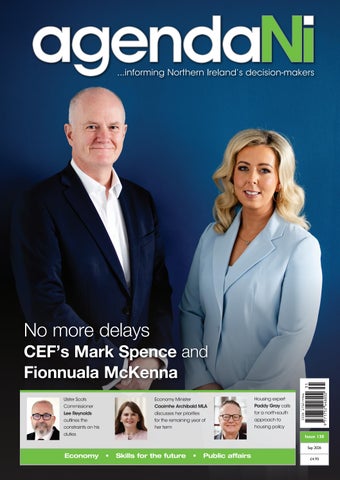
No more delays CEF’s Mark Spence and Fionnuala McKenna Ulster Scots
Economy Minister
Housing expert
Commissioner
Caoimhe Archibald MLA
Paddy Gray calls
Lee Reynolds
discusses her priorities
for a north-south
outlines the
for the remaining year of
approach to
constraints on his
her term
housing policy
duties
issue130 8 Issue Aug/Sep Sep 2026 11
Economy • Skills for the future •Health Public•affairs Carbon Tax • Special Reports: ICT
£4.95 €4.95 / £2.95
A op dv ok po ert ing rtu isin de ad nit g lin e 01 ies No ve
Bo
PUBLIC SECTOR DIRECTORY 2027 The agendaNi Public Sector Directory 2027
The agendaNi Public Sector Directory 2027 is the most comprehensive reference guide to the government and political life of Northern Ireland. Formerly known as the Northern Ireland Yearbook, which was first published in 2002, we are excited to launch this re-branded annual publication in a new and improved format.
Advertising space available
NILGA’s vision for the future
“An empowered, skilled, motivated and resourced local government – working collaboratively within a fit for purpose policy environment to improve quality of life for people and places.”
Local government for the future The local council elections on 18 May 2023 elected 462 councillors to the 11 councils in Northern Ireland. Local democracy delivers for citizens and businesses in Northern Ireland day in day out. Councils set ambitious targets to encourage growth and prosperity for all in their communities and play a critical role as place based convenors of partnerships between all sectors to deliver against these targets. Councils play an important role in a healthy democracy. That is because councillors and the local government officers that support them are at the heart of the communities they serve every day, placing local democracy in an almost unique position in public service terms. This closeness delivers an intimate understanding of what individuals, families, communities and businesses need to thrive, in a way that more centralised public services can often find more difficult. In essence it delivers accountable, visible, transparent and local public services.
NILGA full members at the AGM held in June 2023 held in Seamus Heaney HomePlace.
Strategic themes
Corporate priorities
Empowered and resourced councils
•
Influencing the delivery of outstanding legislation and financial sustainability to allow local government to function effectively
•
Delivery of balanced and respectful central/loacl relationships delivering on the principle of prioritising local decision making
•
Support sector led transformation and innovation informed by best practice
In preparation for the 2023-2027 local government mandate, NILGA has undertaken extensive engagement across the local government sector and with other important stakeholders to better understand the challenges and opportunities. As a result of that engagement, NILGA has agreed its vision and strategic priorities to support the local government sector in what is an important period for local democracy.
Empowered and Confident councillors
• •
Deliver high quality learning and development for councillors
•
Deliver improvements in effectiveness of Code of Conduct for coluncillors
Empowered and supported people and places
•
Influence further devolution of powers and resources to support local decision making
Empowered and valued NILGA
Enable confident politically led representation for the sector
•
Shape regional and national policy to empower local delivery
•
Support councils and councillors in creating the conditions for local economic, social and environmental resillence
•
Buile confidence in NILGA’s effectiveness
•
Enable proactive councillor and officer engagement in key regional sectoral work
•
Reinvigorate local democracy through communications and collaboration
In working towards this vision, NILGA will focus on four strategic themes and associated corporate priorities as shown in the table to the left. The operating financial context for public services is well documented and there is no doubt it will be a challenging time ahead, with councils experiencing the same pressures. Councils raise the majority of their income from rates paid by households and businesses. However, councils are acutely aware of striking the important balance between raising revenue to
The directory provides an excellent platform for organisations and businesses involved in, or supporting, the delivery of public services, to profile their goods or services and to highlight areas of expertise.
How NILGA helps councils in Northern Ireland NILGA is the Northern Ireland Local Government Association. We are the council-led representative body for local authorities in Northern Ireland and our membership is drawn from each of the 11 Northern Ireland councils. We fulfil our leadership role by working with councils to identify common areas of strategic interest at a regional level and working in partnership with key regional, national and international bodies and stakeholders to represent those interests and shape relevant regional, national and international policy.
deliver services and invest for the future in financially constrained times, whilst ensuring unmanageable burdens aren’t place on ratepayers. That is why for 2022/23 Councils struck well below inflationary district rates and have been working continuously in the interim to drive efficiency and modernisation in their organisations.
Supporting Councillor development NILGA also invests in the skills and knowledge of the 462 councillors in Northern Ireland. We do this by providing a regional programme of learning and development opportunities for councillors, tailored to the requirements of their role. Some recent examples of opportunities include: •
valuing data and evidence;
•
scrutiny and challenge;
•
performance improvement;
•
code of conduct;
•
local government finance for councillors;
•
mental health and wellbeing for councillors; and
•
civil contingencies/emergency planning.
NILGA also oversees the Councillor Development Charter in Northern Ireland, which provides a robust, structured framework designed to help councils enhance and embed councillor development in their work.
Key areas of responsibility for councils • Community planning; • waste collection, recycling and disposal; • local planning functions;
• Sponsorship of the directory
• street cleaning; • parks, open spaces and playgrounds; • cemeteries; • public conveniences; • food safety and health and safety; • environmental protection and improvement;
• Special positions: outside back cover, inside
• estates management; • building control; • dog control; • licensing (e.g. entertainment licensing); • enforcement (e.g. litter);
front right cover, first right hand page
• sports, leisure services and recreational facilities; • community centres; • arts, heritage and cultural facilities; • registration of births, deaths and marriages; • off-street parking (except park and ride); and
T: 44(0)28 9079 8972 W: www.nilga.org Twitter: @NI_LGA
Profile opportunities include:
• Display advertising
• supporting local economies and driving growth
• Branded-style advertorial articles • Sponsorship of dedicated chapters • Round table discussion features CITB NI: in loca Skills and co l cons tructio mpetency n sect or is that people often an indus view try of the past construction future as . The and not of the constructio challenge is prese nting and excitin n industry as the innov the influencing g industry it ative is. By the skills way of NI will of the contin future ue to to the , CITB promo young te const er gener consider ruction the varied ation, help them industry pathw as well ays within career as being the option a seriou for the s future We must The Nort . also focus hern Irela the upski on how lling of nd con we suppo rich in to meet our struction history rt the challe existing workf that is demands industry orce nges of develope central from the future is a resil clients. econo to our d our loca ient one Key my and local eco developme areas for our l cities, developm nomy nt in 2024 future towns includ ent and and has and beyon e digita and land growth needs technologie l constructio d scapes. are impe of the n and s, susta Skills new carbon, industry rative for governmen inability and effectivel to ensu zero review the long tal direct y support of trainin re it can -term ion and g suppo interv a continue wider rt the ention s to econom and effect industry in to grow the most ic deve ive way and Recent efficie possible. lopment. nt figures Our Chair from the Skills and Board Netwo Constructio opera along tional Intelligence rk Labou n with the r Marke and collec team have Report t fundin Northern the individ (2023 tive insigh g to help Ireland -2027 Levy work ual t throug suppo volum ) rt local h our as effect to help make e of const forecasts that for suppo widely the ive as schem annua the ruction rting all recognisedemployers e and l avera will grow constructio possible, meet ge rate programme the devel grant during by an skills and n emplo of about this s, servic opment of trainin and the yers to 1.4% We also constructio period with trainin g needs es and future an extra g contin n worke partne . for now ue to contra meet 4,450 rships rs neede work with ctors, the growi For furthe . profes d by 2027 bodies ng dema industry. r sional to can help information to nd in the on how developmesupport trainin and trade you CITB constructio and your CITB g NI NI is focus company the indus nt for the overa and skills for the www.citbni n training visit try and with ed on ll Northern skills and our collec benefit of CITB industry, http://www. .org.uk, like Ireland trainin tive client NI finish g constructio and it s. facebook.c us on Faceb ed the year havin is our suppo reland n ook rt and role to om/C or follow g delive 2022-2023 servic direct our busin trainin red £1.8 the discu ITBNorthern Twitte es neede provide the grant g r @CIT esses I million suppo d to ensur trainin progress BNI, Instag ssion on are rt to indus in and Linke g initiat e and expan equipped for ram @citb try for ives. The dIn http:// offers no doubt sion. Whils direct ni1 grant linkd.in/1G that we grants schem emplo challe t there are living BeyLf to regist e yers to nging is ered in times suppo trainin of living, with increa rt a wide Nutts g and mater Corne qualif range sed worki ial is essen r Train costs costs of ng in North ications for 17 Dund and inflati tial that ing Centr emplo rod grant ensuring ern Irelan CITB on, it e yees funds Co Antrim Road, Crum NI focus that our d. The are emplo skills, on lin trainin , BT29 yers are easy to claim knowledge industry has T: 028 g 4SR and encou 90825 online the right these , and raged 466 via challe trainin E: info@ to claim nges. g to meet www.citbni the website citbni.org. CITB .org.u uk NI is funde k/gran ts This year which d by an has industry we have and moving the fourth been retain levy, forwa ed at started conse 0.55% attract to re-con rd into 2024 cutive for the year. We sider constructio next gener use this ation into how we n, at all discip levels lines. and One of the key perceptions
Planned content • Northern Ireland Assembly • Executive departments and agencies • Local government • Westminster
For further details on advertising and profiling activities, contact:
Sarah-Jane Stevenson • 028 9261 9933 • sarah-jane.stevenson@agendani.com
mb
er
20
26
agendaNi Issue 130 Sep/Oct 2026 Digital
Events
Publications
Editorial
A tale of two cities…
Joshua Murray, Editor joshua.murray@agendani.com
In A Tale of Two Cities, Charles Dickens famously opened with: “It was
Ciaran Brennan ciaran.brennan@agendani.com
the best of times. It was the worst of times.” The same is true of Belfast in the summer of 2026. At the beginning of the summer, hundreds of racists brought shame on Belfast, burning people out of their homes because of the colour of their skin, setting buses on fire, with at least 27 people made homeless. Summer became a season of darkness, and this pogrom was arguably the most serious outbreak of violence in the city since the conflict ended
Gareth Hamill gareth.hamill@agendani.com Circulation and Marketing Lynda Millar lynda.millar@agendani.com Events
almost 30 years ago.
Jillian McFarlane jillian.mcfarlane@agendani.com
The irresponsibility of some of our political leaders speaks for itself. Two
Advertising
months down the line, many have already moved on and apparently
Sarah-Jane Stevenson sarah-jane.stevenson@agendani.com
forgotten about this. However, there are people for whom the scars from these events will last a lifetime. There is no justification and there are no ‘legitimate concerns’. Then came August, and with it the long-anticipated Fleadh Cheol na hÉireann, which came to Belfast for the first time in its history. Through these seven days, we saw the best of Belfast, with cultures representing
Design Gareth Duffy, Head of Design gareth.duffy@agendani.com Jamie Hogan jamie.hogan@agendani.com
everyone in Northern Ireland and beyond being celebrated by all.
Subscriptions
The economic benefits were clear too. Initially, an economic impact of
Sharon Morrison Email: subscriptions@agendani.com Online: www.agendani.com/subscribe
£53 million was projected, based on initial projections that 700,000 people would visit the city. However, the Fleadh surpassed all expectations, and that number has almost certainly been vastly surpassed as it is now estimated that 1.6 million people attended. Belfast in the summer of 2026 was a tale of two cities. The pogroms were the worst of Belfast, but the Fleadh was Belfast at its best. It showed that Belfast is a city in which racism and violence continue in the
agendaNi Owen McQuade, Publisher owen.mcquade@agendani.com bmf Business Services 19a Maghaberry Road Maghaberry, Co Antrim, BT67 0JE Tel: +44 (0) 28 9261 9933
shadows, but also that it is a city which has the capacity to embrace all. Web: www.agendani.com
As we go forward, we all have a choice. We can embrace culture and
Printed by: GPS Colour Graphics
build on how the Fleadh showcased Belfast as an open and shared city, or we can let the ignorant darken its image. I hope you enjoy this issue of agendaNi and thank everyone who has played their part in putting this 130th issue together.
Joshua Murray, Editor
www.agendaNi.com
FSC® is an acronym for the Forest Stewardship Council®, which is an independent, non-governmental, not-for-profit organization that was established to promote the responsible management of the world’s forests. The FSC® system provides an assurance that products such as wood and paper have been harvested in a socially and environmentally responsible manner. The FSC’s Chain of Custody certification provides a way in which the material can be tracked from the certified initial source through the manufacturing process to the end user and other controlled sources.
Digital
Events
Publications
contents 04 08
04
Matters arising
08
Issues
10
08 10 20
Infrastructure Minister Liz Kimmins MLA on the future of transport Cover story: CEF’s Mark Spence and Fionnuala McKenna Interview: Ulster Scots Commissioner Lee Reynolds
24
Round table discussion: Aligning industry and utilities for economic prosperity Hosted by
30
Ulster University Housing professor Paddy Gray on the potential of north-south collaboration on housing policy
32
39
39
The trial of Jeffrey Donaldson
Economy report
Sponsored by
88
40
Interview: Minister for the Economy Caoimhe Archibald MLA
44
Interview: Belfast City Airport Chief Executive Matthew Hall
56
Ulster University’s Jodie Carson outlines her proposed framework for economic transformation
60
DfE’s Heidi Redmond discusses developing a circular economy
64
ESRI’s Anne Devlin: ‘Conflict legacy must inform economic policymaking’
08
24
56
60
71
Skills for the future report
82
76
72
Learning from the failure of 10x Skills
76
Kate Nicholl MLA: ‘Skills are the engine room of our economy’
78
Bridging the digital skills gap
88
Public affairs 82
Andy Burnham’s baptism of fire
86
Will Stormont really be reformed?
88
Independent MLA Claire Sugden on how the Assembly can better serve independents and small parties
90
Irish unity: Where the Dáil stands
94
Political platform: Gareth Wilson MLA
100
Back page: Comhaltas President Attracta Ní Bhrádaigh reflects on Fleadh Cheoil na hÉireann in Belfast
71 82
matters arising
N O RT H - S O U T H
Irish EU Council Presidency commences
The Republic of Ireland has begun its six-month term holding the Presidency of the Council of the European Union. The EU Council Presidency rotates between EU member states on a six-month basis. The 2026 Presidency is Ireland’s first since 2013. Writing in agendaNi’s sister publication, eolas Magazine, Minister for Foreign Affairs and Trade Helen McEntee TD says: “Europe’s ability to act together has never been more important,” adding: “For the next six months, Ireland has the privilege of helping to lead that work.”
parties and committees. The State will also host events including 22 informal council meetings of ministers, the European Political Community Summit, an informal meeting of the European Council, around 250 conferences and stakeholder events, and additional events organised across the public, private, and third sectors. Ireland’s Presidency slogan is ‘strength with unity’, and is focused on the three pillars of competitiveness, values, and security. The term runs until 31 December 2026.
The Presidency is largely ceremonial and entails chairing around 180 council preparatory bodies such as working
POLICING
New Police Ombudsman appointed In June 2026, Jacqui Durkan was appointed as the new Police Ombudsman, replacing Marie Anderson who retired in December 2025. Durkan previously served as Chief Inspector of the Criminal Justice Inspection for Northern Ireland (CJINI) for six years. Before that, she worked as a senior civil servant in the Department of Education and held a number of senior leadership roles in the Northern Ireland Court Service. The First Minister and deputy First Minister say that Durkan brings “extensive senior leadership experience and
4
agenda matters
a strong track record in oversight, governance, and public service”. The Police Ombudsman is an independent body that investigates complaints about police conduct. It handles allegations ranging from rudeness to serious criminality and operates independently from the PSNI. The position carries a salary of just over £173,000 per annum and runs for a single term of seven years which began on 26 June 2026.
matters arising
P U B L I C A F FA I R S
New Secretary of State Anglican priest and long-time Welsh Labour MP Chris Bryant was appointed as the new Secretary of State in July 2026.
opposing Brexit and led calls for a second referendum in Britain. In 2019, he narrowly missed out on becoming Speaker of the House of Commons.
Bryant’s appointment follows the dismissal of Hilary Benn by Prime Minister Andy Burnham. Benn’s two-year spell in the role was largely uneventful, with stalled negotiations over legacy legislation being the most predominant issue.
Speaking upon his appointment, Bryant described his new job as “certainly daunting”, adding: “It comes with heavy responsibility, and I am looking forward to getting properly stuck in.”
Bryant, who represents the Welsh constituency of Rhondda, has served as an MP since 2001 and was mostly a backbencher through the Blair and Brown years, save for brief spells as a junior minister. During the Corbyn leadership of the Labour Party, Bryant was notably vocal in
Joining Bryant in the Northern Ireland Office are Sarah Owen MP and House of Lords member Ruth Anderson, both of whom were appointed Parliamentary Under-Secretary of State.
E N V I RO N M E N T
Draft Clean Air Strategy consultation The Department of Agriculture, Environment and Rural Affairs opened a consultation on the draft Clean Air Strategy for Northern Ireland in September 2026.
Launching the consultation, Minister Andrew Muir MLA said: “The air we breathe is vital to our health and that of our environment.
The draft Clean Air Strategy for Northern Ireland aims to improve air quality by 2032 through five strategic objectives and a comprehensive programme of actions, including upgraded monitoring, annual awareness campaigns, transport planning, and tighter fuel and appliance standards.
“The draft Clean Air Strategy sets my commitment to cleaner air for all. To fulfil that ambition, we must take a holistic approach, working across government, councils, and civic society. Many of the solutions to air pollution are intertwined with the actions we take for nature and our climate, delivering huge benefits from cleaner energy to a more active and healthier population.”
The strategy aims to ensure that by 2032, Northern Ireland has stronger air quality protections, greater public understanding of air pollution, and the foundations for continued long-term improvement.
agenda matters
5
matters arising
JUSTICE
Race pogroms see scores made homeless In July 2026, 27 people were made homeless after their homes were attacked by rioters going door-to-door trying to find immigrants. These pogroms, as well as the riots surrounding them, saw vehicles set alight and followed the attempted murder of north Belfast man Stephen Ogilvie, who lost his left eye in the attack. Hadi Alodid, a 30-year Sudanese national, was charged with the alleged offence, has been remanded in custody. Most of the pogroms took place in Belfast, although a small number also took place in Portadown.
Neighbours of the Romani family told The Times that it was the third time they had been “put out” of their house. Participants in the violence reportedly chanted slogans including “foreigners out” and “kill all Muslims”. The riots and racist incidents were roundly condemned by political leaders and the family of Stephen Ogilvie, who stated through local MLA Philip Brett: “We have many migrants who make a deeply valuable contribution to our country, including in our healthcare system and hospitality sector, and we depend on them to make our country work. We do not want this terrible tragedy to be used to divide people or fuel hostility.”
The pogrom victims included Ugandan carers, a Ukrainian family, and a Romani family, whose houses were set alight.
AG R I C U LT U R E
Muir-UFU showdown over cattle cull Minister of Agriculture, Environment and Rural Affairs Andrew Muir MLA has staved off calls to resign by the Ulster Farmers Union (UFU), with the UFU blaming the Minister over a cattle cull in County Tyrone in July 2026. In the early summer of 2026, 51 cattle were shot dead at a farm in Fivemiletown under orders by the Department. The cattle were subject to a court deprivation order following their owner’s conviction for animal welfare offences. DAERA subsequently euthanised the animals, saying there was “no reasonable alternative” to doing so on site. However, concerns have been raised over the manner in which the operation was conducted, including its visibility to members of the public and whether alternatives to shooting the cattle were fully explored.
6
agenda matters
The UFU has also criticised an independent review ordered by Muir, arguing that its scope and appointment of a single reviewer do not provide sufficient independence. UFU president John McLenaghan claims that “confidence has been severely damaged” and that the union “no longer [has] confidence that the Department can deliver”. Muir has defended his position, insisting the operation was carried out by departmental officials to implement a court order and was not personally authorised or directed by him. He has said he will not resign and has defended the decision to appoint former Irish chief veterinary officer Martin Blake to conduct the review. Muir also spoke of how he has received death threats over the affair and has stated: “The days of the Ulster Farmers’ Union dictating government policy are over.”
matters arising
ECONOMY
Public service cuts loom amid budget deadlock The Executive’s deadline for agreeing a budget expired on 31 July 2026, meaning that public services face potential cuts of up to 5 per cent on current levels. The passage of the deadline triggers an automatic cap restricting Stormont’s 2026/27 spending to 5 per cent below the previous year’s expenditure. It also leaves the power of the purse in the hands of civil service leaders. At the time of writing, Sinn Féin and the DUP are engaged in negotiations with the UK Government to resolve the challenge. The UK Government has reportedly offered to increase its allocation to Northern Ireland by £350 million, but both Executive leaders have stated that the proposal falls short of need, and have asked for around £450 million.
The UK Parliament’s Northern Ireland Affairs Committee has stated that the failure to reach an agreement is “limiting its ability to tackle the persistent barriers to growth that are holding Northern Ireland back from achieving its full economic potential”. The negotiations run parallel to increasing support for reforming how the Executive is formed. Sinn Féin, the Ulster Unionist Party, Alliance Party, and the SDLP have announced their support, while the DUP remains ambiguously opposed to reform despite its longstanding opposition to “mandatory coalition”.
P U B L I C A F FA I R S
Independent review of Parades Commission The new Secretary of State, Chris Bryant MP, has ordered an independent judge-led review of the Parades Commission. The review follows a recent court case that exposed flaws in some of their procedures around a proposed Orange Order parade in Portadown’s Garvaghy Road in July 2026. In August 2026, the High Court quashed a decision by the Parades Commission to impose restrictions on the proposed march. The commission had banned this year’s parade from entering the mainly nationalist Garvaghy Road, a move which reflected every decision it has made since 1998. It follows a legal challenge brought by a member of the Orange Order over its annual parade at Drumcree, a small village on the outskirts of Portadown.
In the case, the commission conceded a procedural error in how it dealt with the annual application for permission to walk along the Garvaghy Road. Not all six members of the public authority had signed off on the final determination before it was issued. It has been claimed the case may pave the way for a future parade on the road being permitted. However, this would require a new decision based on a fresh application. The Parades Commission says the High Court’s decision “does not affect any future considerations and decisions by the commission of future parades or protests”.
agenda matters
7
issues agenda
The future of transport Minister for Infrastructure Liz Kimmins MLA highlights the priorities underlying the imminent Transport Strategy 2035, as well as the importance of all-island collaboration on transport. 8
agenda issues
Minister Kimmins outlines the areas of focus in the upcoming transport strategy. The Transport Strategy 2035 is currently being finalised, with a draft already completed and the final strategy expected to be published in Summer 2026. Kimmins explains that the strategy “will set out a very clear long-term vision for the future and importantly identifies four strategic priorities that will guide how we plan, invest, and most importantly, how we deliver in terms of transport in the years ahead”. The first of these priorities is that transport should be “resilient and sustainable”, particularly in response to the increasingly frequent extreme weather conditions affecting the region, especially flooding. To this end, Kimmins says: “We have to respond directly to the climate challenges that we are facing, both by reducing emissions, but also by ensuring that our infrastructure can
withstand the impacts that we are already experiencing.” There are several actions being taken in this area, including the progression of a new road maintenance strategy which, Kimmins says, involves “taking a more targeted, data-led approach to managing our road network while also embedding climate considerations into design and delivery”. This is in addition to the work being done under the Climate Change Act to support the transition towards a decarbonised transport sector. Kimmins outlines that the department’s “focus is on cleaner vehicles and fuels”, which involves “work across the 32 counties on hydrogen infrastructure and futurefocused infrastructure planning”. The second strategic priority guiding the strategy is that transport “supports connected and inclusive communities”.
issues agenda
Kimmins explains that this means that transport “must enable people to be able to access their jobs, education, healthcare, and essential services, regardless of where they live or their circumstances”. To achieve this objective, Kimmins says that “improving our rural transport systems remains an absolute priority”, noting the work being done in community transport, which received an additional £1 million in funding in 2025. The minister also highlights the “transformative joint investment for public transport” in the Belfast-Dublin rail corridor, including the new fleet of more accessible Enterprise trains and the introduction of the early service, which has resulted in significant passenger growth. Kimmins says that the third strategic priority is to “deliver a transport system that is safe and supports healthier lives”, noting that “safety remains fundamental, every death or serious injury on our road is one too many”. This issue is being addressed through the Road Safety Strategy, which Kimmins says is being developed to “significantly reduce fatalities and serious injuries as a result of road collisions through targeted interventions, enforcement, and through a strong partnership working across other agencies and other departments within the Executive, including safer travel to school for all children”.
Kimmins says “we are enhancing transport safety through strong cooperation across the island”, referencing the meeting of the NorthSouth Ministerial Council on transport in May 2026, which focused on areas of collaboration, particularly on road safety. This priority also relates to the role that transport and active travel can play in improving air quality, as well as health and wellbeing. To facilitate this, Kimmins says the Department “is working with its partners across the island to deliver more sustainable, resilient transport options”. The final strategic priority of the strategy, Kimmins says, “is in relation to ensuring that transport supports green economic growth as a modern, efficient, transport system is essential to productivity, investment, and competitiveness”. To this end, the minister introduced a new Harbours Bill in the Assembly in June 2026 “to modernise the legislative and governance framework for our trust ports”. Kimmins adds: “We are also progressing the outcomes of the All-Island Strategic Rail Review, which sets out a very longterm but very ambitious vision for improved connectivity, faster journeys, some of which we have already been working on, and a more sustainable rail network.”
Alongside this, Kimmins says the Department is “supporting innovation through digitalisation and more efficient transport systems, ensuring that growth is aligned with our environmental objectives”. Ultimately, Kimmins believes that “the four interconnected priorities provide a clear and very coherent direction for transport in the North.” Concluding, Kimmins highlights the importance of all-island cooperation on transport, and says: “Because our rail lines and our roads do not stop at the borders, they continue on, we are all experiencing similar challenges. So, it is important that when we are working on all of these projects, we are aligned and working closely together. “I think when we look at the shared island funding and what we have been able to achieve with that, working with our partners in the South, we can see what we can do, and I am keen to continue in that vein. “It will require that continued and sustained collaboration through both governments and in collaboration with the British Government in terms of getting the funding that we are entitled to and what we need to deliver for people here.”
agenda issues
9
cover story
No more delays Mark Spence, Chief Executive of the Construction Employers Federation, and Fionnuala McKenna, Head of Strategic Development for Construction Futures, the CEF’s skills and careers spin-off, meet with Joshua Murray to discuss the infrastructure, housing, and skills challenges facing Northern Ireland, and what they want to see from the next Executive.
10
cover story
cover story
With eight months to go until a new Assembly is elected, the Northern Ireland construction sector is demanding that, with a new mandate, the next Executive must deliver the long-term investment and political stability required to unlock the infrastructure and housing delivery needed to support economic growth. The Construction Employers Federation’s (CEF) manifesto for the 2027 Assembly election sets out eight priorities ranging from water and wastewater infrastructure to skills, housing, planning, and the Executive’s spending power. Its central argument is that continued delay will increase costs, constrain housing delivery, and hold back economic development. For CEF Chief Executive Mark Spence, however, one challenge stands above all others. “The most important and pressing issue for the next Assembly is the funding of infrastructure for water and wastewater.” The challenge, he argues, extends far beyond the construction sector. Constraints on Northern Ireland’s water network are preventing homes from being built, deterring foreign investment, limiting economic development and increasingly affecting the delivery of wider public infrastructure. He believes each of these impacts has knock-ons for the cost of living which arises from a much more complex set of circumstances than often portrayed by politicians diverting from making difficult decisions. “Water unlocks every other sector. Without water, we do not meet our housing targets. Without water, we will not be able to build the schools that we need, the health facilities we need or the commercial and industrial premises to support good jobs, and that is before we even start to contemplate the worsening environmental impacts.” The CEF’s manifesto calls for a legally binding commitment to fund Northern Ireland Water’s PC28 settlement at the level determined by the Utility Regulator, alongside an Infrastructure Levy and a regional deal with the UK Government for an Infrastructure Transformation Fund.
The CEF argues that such investment is essential if Northern Ireland is to meet its housing requirements. Spence points to a sharp decline in housebuilding from the levels seen during the early 2000s, when around 15,000 homes were being built annually, to roughly 5,000 to 6,000 in recent years. The CEF is calling for a minimum of 10,000 new homes a year for the next 15 years, including around 2,000 social homes annually, targets not dissimilar to those of the Executive. “There is zero chance of us meeting those targets in the future unless we invest in water now,” he says. The scale of the blockage is illustrated by the number of homes already held up by some level of infrastructure constraint. Spence restates official estimates that around 55,000 potential new homes are, in some way, stalled while over 50,000 people remain on the social housing waiting list, a figure he describes as “scandalous”. “We have developers wanting to build homes, and a system which says they cannot,” he says. “So, the solution is money. Yes, the solution is thinking of new ways of funding, but it actually first requires those in power to engage seriously in having those conversations. Presently they will not, nor do they present alternative solutions, so we make no progress.”
Long-term planning The CEF’s main argument is that the Executive is failing to plan long-term infrastructure through disagreements over short-term budgets and investments focused on short electoral cycles. Without even the current year budget agreed, the CEF is calling for a multi-year capital budget to 2030, arguing that greater certainty would allow government to plan projects more efficiently while giving construction companies the confidence to invest in people, equipment, and capacity. At present, Spence says, the industry is effectively “living hand to mouth”, adding: “The purpose of a multi-year budget is to give all stakeholders confidence to map out a plan.”
For Fionnuala McKenna, Construction Futures’ Head of Strategic Development, the workforce implications are particularly significant: “Construction companies cannot recruit and train effectively if they do not know what work will be available beyond the next few months. While larger contractors can have greater capacity to absorb uncertainty, smaller companies may only be looking three to six months ahead.” McKenna argues that a multi-year budget would allow the industry to identify future projects, better understand the occupations and skills required to deliver them, and build the workforce accordingly. “We need to move away from reacting to skills shortages and towards longer-term workforce planning,” she says. The demand for local skills is fuelled partly by the pull of more attractive and profitable pipelines of work beyond these shores that means many young people trained locally are lost to the local economy. Additionally, companies headquartered in the region have substantial workforces operating in Great Britain and the Republic, including on major projects such as data centres. “If there was enough secure work in Northern Ireland, that would be a much more attractive proposition than local skilled trades people having to work elsewhere,” she says. The CEF is also calling for the Executive to finalise and publish its long-awaited Investment Strategy to 2050 and establish an independent Infrastructure Commission to take the politics out of key infrastructure-related decisions. The manifesto identifies the strategy as a means of providing greater certainty around major projects and investment priorities. Spence describes the strategy as important, but lacking ambition. “It is not something we are excited about for what is in it. But we are keen to see it published just for the certainty that it provides.”
Skills challenges Construction continues to experience shortages in specialist trades, particularly
cover story
4 11
cover story
“Our frustration as an organisation is with the Executive level because that is the place where the vital strategic decisions will need to be agreed.” Mark Spence, Chief Executive, Construction Employers Federation
wet trades such as bricklayers and plasterers. At the same time, the transition towards net zero is creating new demand for electricians and workers with skills in areas such as solar installation, electric vehicle charging, and retrofit. Digitalisation is also changing the sector, creating new opportunities in areas such as digital construction, project management and other technologies. McKenna argues that the issue is not a lack of data, but turning it into meaningful workforce intelligence. “We hear headline figures about how many additional construction workers we need, but we need to get underneath that. What occupations are needed, where and when, and what projects are driving that demand?” Construction Futures believes information from the CEF’s Construction Skills Register, alongside data from CITB, the Department for the Economy, and other bodies could be better joined together to provide a clearer picture of future workforce needs. The industry is simultaneously trying to attract new workers. Through Construction Futures initiatives including Open Doors, and STEMstruct programmes, the CEF has sought to challenge perceptions of construction as an industry limited to traditional sitebased roles. “There will always be the hard hats and traditional site-based roles, but construction is so much broader than that. What we are trying to do is really show all the different careers and opportunities within the sector.” That also means reaching a more diverse workforce. Construction Futures has already seen online engagement from women more than double, and working
12
cover story
with industry, initiatives such as Building Respect are focused on supporting the culture change needed to attract and retain a more diverse workforce. Attracting people, however, is only part of the challenge. Retaining them and ensuring employers can provide meaningful training opportunities is equally important. That is particularly apparent in apprenticeships. While larger contractors are seeing strong demand for higher-level apprentices and in some cases approaching capacity, smaller companies can struggle to take on apprentices because of the cost involved and limited certainty around future work available. McKenna says feedback from employers suggests that the overall cost of employing and training an apprentice can reach £30,000 a year once wages, equipment, training, and other expenses are taken into account. For a small business, that can represent a substantial barrier, particularly in a sector where almost 90 per cent of construction employers have fewer than 10 employees. While government is actively promoting apprenticeships, growing demand needs to be matched by the capacity and support for employers to provide those opportunities. The CEF’s manifesto therefore calls for a streamlined and supported entry pathway into construction, with reduced administrative burdens and targeted incentives to help SMEs take on apprentices and new entrants. The CEF also wants to revisit how the apprenticeship levy operates in Northern Ireland. Spence estimates that around £80 million is lost by Northern Ireland employers through the UK-wide levy that goes to Westminster and returns through the Barnett formula rather than being ringfenced for training.
He argues that this money could be used more effectively to address local skills shortages. McKenna points to the flexibility introduced in England through the Growth and Skills Levy as an example of how the system could evolve. “There is a real opportunity to look at how skills funding in Northern Ireland could be structured more effectively, particularly to support employers to create and sustain apprenticeship opportunities.”
Political stability Underlying the CEF’s concerns about infrastructure and skills development is a broader frustration with political instability. Construction projects operate on timescales that extend well beyond electoral cycles. Spence argues that Northern Ireland’s political system has repeatedly struggled to match the longterm nature of infrastructure planning. “Construction does not operate in fouror five-year cycles and it requires longterm planning and long-term vision.” The manifesto therefore places political stability at the top of its list of priorities, calling for an updated draft Programme for Government to be agreed before the end of May 2027 and for consideration of institutional reforms aimed at improving the functioning of devolved government. Spence says that delivery of key public infrastructure such as water, roads and public transport have suffered from the long-term political instability arising from repeated Executive collapses. However, he adds that instability is only part of the problem. “Even when government is operating, political decision-making here has consistently remained too short-term. We are stuck in four-year, five-year cycles, which we do not even normally get to the end of,” he says. The consequence is what he describes as short-sighted investment in critical infrastructure, leaving Northern Ireland lagging far behind competing regions. The CEF argues that, if Northern Ireland is to set itself on a path towards
cover story
economic and fiscal stability, plugging the funding gap must go beyond continually seeking more money from the UK Government, although that would be desirable. Its manifesto calls for consideration of enhanced borrowing, governance changes, and alternative funding mechanisms, including revenue raising such as an infrastructure levy to support investment in wastewater and road tolling. Spence says the Executive needs to take greater responsibility for its own infrastructure problems while negotiating with the UK Government for additional flexibility and funding. “Given the slim possibilities of extra funding from Westminster, our Executive needs to step up and take responsibility for doing something to help solve our structural problems ourselves,” he says.
Opportunity Despite the frustration, neither Spence nor McKenna believe that the construction industry is lacking solutions. McKenna points to the cooperation already taking place between the Construction Futures, CEF, government departments, and education organisations on skills and housing. Spence says officials across all departments broadly share the industry’s
concerns and hope that the next administration will be more forward looking and pragmatic. “Our frustration as an organisation is with the Executive level because that is the place where the vital strategic decisions will need to be agreed.” Spence therefore believes that, early into a new mandate following the 2027 election that “there is an opportunity with the next Executive, as a collective, to make difficult, bold, and necessary decisions”. “None of these should be divisive political decisions, but our politicians are fearful to take bold steps without the cover of other parties; we are asking them collectively to step up.”
Vision The CEF’s priorities converge around creating enough certainty for the construction industry to invest, recruit, and deliver. In this context, Spence reemphasises the importance of solving Northern Ireland’s wastewater infrastructure shortfall, repeating that “water unlocks every other sector”. For McKenna, the priority is opening up clearer pathways into construction and giving employers the support to build the workforce Northern Ireland needs to turn its ambitions into reality. If those two challenges can be addressed, the CEF believes Northern Ireland has the capacity to build the homes, infrastructure, and economic foundations it needs.
cover story
13
issues agenda
Nesbitt out Following the resignation of two-time Ulster Unionist Party (UUP) leader Mike Nesbitt MLA from his ministerial position in August 2026 over a dispute with party leader Jon Burrows MLA over the Causeway Hospital, Robbie Butler MLA has become the new Health Minister. On 18 August 2026, Mike Nesbitt MLA, who has served as Northern Ireland’s Health Minister since May 2024, announced his resignation from the role after what he calls UUP leader Jon Burrow’s introduction of a second “red line” regarding emergency general surgency (EGS) at Causeway Hospital. In his resignation letter, Nesbitt said that when he became party leader in January 2026, Burrows informed him that he had one “red line”, referring to puberty blockers and his opposition to Northern Ireland participating in the Pathways trial of these. However, Nesbitt said the UUP leader had effectively introduced a new “red line” over the hospital after Burrows indicated he would not support the removal of EGS.
14
agenda issues
In May 2025, following a review and public consultation, the Northern Health Trust recommend removing EGS from Causeway Hospital and instead providing at just one of its hospital sites, Antrim. The Department of Health was still awaiting Nesbitt’s final recommendation as to whether this should occur at the time of his resignation. At a town hall meeting regarding the issue in August 2026, which Nesbitt was unable to attend, Burrows went in his place and outlined his opposition to the removal of EGS from Causeway Hospital, saying: “Emergency surgery must remain at the Causeway Hospital and it should be built up, not run down and that is my position and it is not for negotiation.”
issues agenda
This prompted Nesbitt to resign as Health Minister, saying in his resignation letter that he was unhappy to have to “discover the leader’s view of issues under my purview by having to monitoring the media”. The former Health Minister also said he offered Burrows “a way to manage this situation”, the day before his resignation but did not receive a “timely response” to this. Nesbitt, who had already announced in January 2026 that this would be his last term in the Assembly remains a member of the UUP, and it is unclear whether he plans to resign from the party. His decision to quit his role means that Nesbitt is the second former leader of the UUP to resign from their party or position over disagreement with Burrows, after Doug Beattie’s resignation in June 2026. In a statement reacting to the resignation, Burrows thanked Nesbitt for his time as Minister, saying he had “arguably the hardest job in government and approached it with seriousness, integrity, and a determination to improve our health service”. However, Burrows also criticised the former Health Minister for his approach to the Causeway Hospital, saying: “Clinical evidence must be central to decision-making, but reform cannot simply be done to communities. There must be genuine engagement with the clinicians and staff delivering services and with the people who depend on them. I do not believe we have got that balance right.”
Nesbitt’s tenure In his resignation letter, Nesbitt said: “Being Minister of Health remains the greatest privilege of my political career.” Nesbitt was in the post for shortly over two years, taking over from another former UUP leader, Robin Swann MP, and he leaves behind a mixed record as Health Minister. One of his biggest successes was in reducing waiting lists, overseeing a 14 per cent reduction in patients waiting more than four years for an outpatient
New Health Minister, Robbie Butler.
appointment and a 21 per cent reduction in patients waiting more than four years for surgery. His tenure also saw the publication of the 10-year Social Care Workforce Strategy, which outlined plans to tackle recruitment and retention problems in the sector. However, record waiting lists in Northern Ireland remain with April 2026 seeing the worst 4 hour- and 12-hour performance for emergency departments in Northern Ireland for any quarter on record. Additionally, figures from September 2025 showed that 55 per cent of patients were waiting over a year to see a consultant and no health trust had met its target for patients to be seen in under nine weeks. Following his resignation, First Minister Michelle O’Neill MLA said she was “genuinely sorry” to see Nesbitt resign, adding that: “He played a constructive and mature part in the Executive and was making welcome progress in reducing waiting lists.”
New Health Minister Former UUP deputy leader Robbie Butler, who served as an MLA since 2016, was selected as the new Health Minister by Burrows in August 2026. Butler is viewed as a leadership rival of Burrows and is reportedly in greater favour among UUP MLAs than Burrows.
The decision over Causeway Hospital is an immediate issue for the new Health Minister, although he has immediately delayed this decision, instead announcing another review. In September 2026, Butler announced the creation of an independent expert advisory committee which will review how services will be delivered across hospitals. The Reconfiguration Committee will advise the Minister on major or controversial proposals for permanent changes to health and social care services, such as the removal of EGS from Causeway Hospital. Speaking after being announced as Health Minister, Butler said: “I take on this role with no illusions about the scale of the challenge. Too many people are waiting too long for care, too many staff are working under relentless pressure, and too many parts of our system are struggling to meet the needs being placed upon them. “Those problems will not be solved overnight, and I will not insult people by pretending otherwise. But neither will I accept that they are inevitable.”
agenda issues
15
Before Northern Ireland signs a 25-year cheque, look hard at the price Re-Gen has invested £20 million into a new state-of-the-art facility in Newry where cutting-edge technology enables additional recyclables, such as aluminium, paper, cardboard, and glass to be recovered from black bin waste.
The proposed Belfast incinerator is being sold as a ready-made answer to a looming crisis. Before a single signature commits ratepayers for a generation, the numbers deserve far more scrutiny than they are getting. Northern Ireland genuinely does need to decide how it treats the waste that cannot yet be recycled. Nobody sensible disputes that. But there is a difference between solving a problem and rushing into the most expensive, least flexible version of a solution and then locking ratepayers into it for the next quarter of a century.
This is the real choice now facing councils and the Department for Infrastructure over the large incinerator proposed for the outskirts of Belfast. The developer’s case rests on a simple, reassuring story: there is a crisis coming, here is a readymade plant, it needs no public money up front, and all that is missing is a minister’s signature. It is a tidy story. It also does not survive contact with the figures.
A price tag from another era Start with the number everyone repeats: £250 million. That figure was first set well over a decade ago, when the project was originally conceived. Construction costs for major infrastructure have risen enormously since then, and comparable energy-fromwaste plants being built across Britain and Ireland today are costing many hundreds of millions of pounds, some far more. The idea that this plant can still be delivered for its original price belongs to the past. No council should sign a 25-year contract against a cost estimate that old without an independent, up-to-date figure on the table. The promise that it “does not rely on initial public sector capital investment” is the most misleading part of the pitch, because the word doing the work is “initial”. The capital may be raised privately, but it is paid back, with a return, through the gate fees councils pay to use the plant year after year for decades. Those fees come from ratepayers. No upfront public capital is not the same as no public cost: it is a 25-year bill, not a free asset, and households will carry it in their rates long after the ribbon is cut.
The bill only grows from here The cost case gets worse, not better, over the life of the plant. Carbon pricing is coming to energy-from-waste: by around the end of this decade, plants like this are expected to start paying for the fossil carbon they emit – mostly from burning plastic – for the first time. It is a charge that did not exist when this project was designed, that will rise over time, and that will be passed straight through to councils and their ratepayers. Committing now to burning hundreds of thousands of tonnes a year is committing to a carbon bill that climbs for the life of the plant. There is a deeper problem with building something this big. A plant of this scale needs a guaranteed diet of waste to make the sums work – typically locked in through long-term contracts that oblige councils to keep supplying it, or pay anyway. That creates exactly the wrong incentive: once you have an expensive furnace to feed, the pressure is to keep feeding it, not to reduce, reuse and recycle more. A 25-year commitment to burning is a 25-year brake on doing better.
The green case is softer than it looks The environmental argument is not as clean as the brochure suggests, either. The plant’s headline carbon “saving” is measured against landfill – but landfill is closing anyway, so that is the wrong comparison. Measured against modern energy recovery, the advantage shrinks. Unless the plant captures and uses its heat from day one, an electricity-only incinerator turns only around a quarter to a third of the energy in the waste into anything useful. The heat use that would make it genuinely efficient is described in the proposal as a future “potential,” not a firm commitment.
Putting all our eggs in one basket There is also a resilience question that cuts against the whole “self-reliance” argument. Building one very large plant to handle the residual waste of most of Northern Ireland’s population creates a single point of failure. When a facility like that goes offline – for planned maintenance or an unplanned breakdown – the waste does not stop arriving. It still has to go somewhere, at short notice and high cost. A system built around one giant asset is more fragile, not less.
The rest of the world is stepping back Supporters like to say Northern Ireland is an outlier because others have built these plants. That was true a decade ago. It is not the direction of travel now. Wales has stopped approving large new incinerators. Scotland has turned firmly against new capacity. Denmark is working to shrink its incineration fleet, and the Netherlands is taxing it. Even in England, the rules for new plants have been tightened. Northern Ireland would be signing up, for 25 years, to a technology that our nearest neighbours are quietly stepping away from.
There is a better path and it is not ‘do nothing’ None of this means ignoring the problem. It means being smarter than a single oversized burner – and starting from what has changed since this project was drawn up. When it was
4
The proposed Belfast incinerator’s price tag is from another era when the project was originally conceived. It is the least flexible solution to Northern Ireland’s looming black bin crisis.
first envisaged, there was little you could do with black-bin waste but bury it or burn it. That is no longer true. Today’s sorting technology, increasingly driven by AI and robotics, already recovers far more metal, plastic and other material from the residual stream than was possible a decade ago, and it improves year on year. A plant sized to burn today’s black bin waste would well within its 25-year life be burning material that we will by then be able to recover and put back to use. You do not lock that in; you leave room for it. Then, for what genuinely cannot be recycled, think differently about scale and where these plants go. Instead of one enormous facility, Northern Ireland could build smaller, modern plants on industrial estates, sited well away from homes, where heavy waste infrastructure belongs, and far less likely to trouble residents with traffic or odour. Smaller plants also allow something a single megafacility never can: a staged approach. Build one, watch how waste volumes and recycling actually evolve over the next few years, and then decide whether a second or third is really needed, rather than betting a quarter of a billion pounds and 25 years on a single guess made against decade-old assumptions. That flexibility is the whole point. The makeup of our waste is changing as producers cut packaging and more materials become recyclable, and the technology keeps moving. A modular, right-sized network of
plants can adapt as that happens. One giant furnace, locked in for a generation, cannot. These are the questions government and councils should be asking before any signature commits ratepayers for the next 25 years. What will this really cost, over its full life, once carbon charges and gate fees are counted? What happens to recycling once councils are contractually bound to keep a furnace fed? Why commit to the largest, least flexible option when smaller, staged plants could do the same job with far less risk? It is a decision timed conveniently ahead of an election really being given the scrutiny that a choice of this magnitude deserves? The waste needs dealing with. But the people who will pay for it deserve the real numbers and the real alternatives first.
W: www.regenwaste.com
issues agenda
Shared Island funding surpasses €1 billion Other projects in the latest package include offshore renewable energy, the next phase of the Ulster Canal, digital creative industries, cross-border healthcare and sporting events, alongside cooperation between the Cork and Belfast docklands regeneration projects. Existing commitments include €600 million for the A5 North-West Transport Corridor, €102 million towards the Narrow Water Bridge, and €50 million for the redevelopment of Casement Park. The initiative has also increasingly expanded into environmental and economic policy. In June, DAERA Minister Andrew Muir MLA welcomed €33 million from the Shared Island Fund towards a €56.7 million Lough Neagh catchment programme, describing it as “a joint commitment to our island’s largest freshwater lake”.
Funding allocated through the Irish Government’s Shared Island Initiative has surpassed €1 billion, with a further €377 million committed to cross-border infrastructure, tourism, environmental, and cultural projects in June 2026. The latest funding package brings total allocations from the Shared Island Fund to €1 billion, following approval of €377 million for 12 major projects. The Government has committed a total of €2 billion to the initiative, which was established in 2020 to deepen practical cooperation between communities and institutions across the island. The largest element of the latest package is more than €190 million for rail infrastructure between Derry, Belfast, and Dublin. The investment is intended to increase capacity and reduce journey
times, including through works allowing Enterprise trains to pass DART services at stations rather than sharing the same section of track. The package will also support track renewal and upgrades on the DerryBelfast route, where the current journey time is more than two hours. It follows the Irish Government’s €700 million commitment in May 2025 towards a new Enterprise fleet for Translink and Iarnród Éireann. The first of the new trains are expected to enter service from late 2028.
Economy Minister Caoimhe Archibald MLA has similarly backed the initiative’s role in supporting economic development, saying north-south collaboration is “central” to developing an all-island tourism offering. Established by the Irish Government in 2020, the Shared Island Initiative is intended to implement the practical cooperation envisaged by the Good Friday Agreement. Its funding spans infrastructure, climate action, tourism, culture, research, and community development, with projects generally developed in cooperation with the Northern Ireland Executive. The Irish Government has described the programme as an example of the Agreement being translated into practical action, while Taoiseach Micheál Martin TD has argued that deeper cooperation is required given the “connections and interdependence” between both jurisdictions.
agenda issues
19
issues agenda
Promoting Ulster Scots and the Ulster British tradition Commissioner for the Ulster Scots and the Ulster British tradition Lee Reynolds talks to Ciaran Brennan about reviving the language, addressing apprehension towards the Ulster British tradition, and the funding shortages impeding his duties.
Reynolds began working as Commissioner for the Ulster Scots and the Ulster British tradition in November 2025. The commissioner’s principal aim is to “enhance and develop the language, arts, and literature” of Ulster Scots and the Ulster British tradition. The role was given statutory footing under the Identity and Language (Northern Ireland) Act 2022 which came into force in May 2023. Reynolds has the following responsibilities as commissioner:
20
•
to promote awareness of Ulster Scots services provided by public authorities to the public in Northern Ireland;
•
to provide or publish advice, support, and guidance to public authorities to develop and encourage Ulster Scots language, arts, and literature; and
•
to investigate complaints from the public into whether a public body has shown due regard to the published guidance.
agenda issues
issues agenda
Ulster Scots Reynolds is critical of how Ulster Scots policy replicates Irish language policy despite both being at different stages in their revival. Noting that core institutions are required for revival languages, he says these have been established for the Irish language, but not for Ulster Scots. He says policymakers “are coming from a good place” as they are aiming to treat both cultures equally, but that this is not what Ulster Scots requires. Reynolds says: “I do not need a cut and paste; I do not need a photocopy. I need a policy that comes from the same conversation.” Regarding education, he indicates that his long-term aim is to make Ulster Scots a discrete subject. The commissioner says this requires “a lot of institutionbuilding and a lot of hard work”, adding that the materials and teachers must be in place to ensure effective delivery of an Ulster Scots curriculum. On Ulster Scots’ presence in modern education, Reynolds criticises what he calls “Schrödinger’s curriculum”. Explaining this, he says it is there for those who seek it, but that it is absent for those who do not. He is also keen to outline that Ulster Scots pertains to culture and heritage; not just language. Reynolds says: “The Ulster Scots revival model is a threelegged stool: it is culture, it is heritage, it is language. “It is about placing the language in the education system, in that broader identity context of culture, heritage, and language.” Renolds says there is a “high degree of ignorance” around the origins, use, and value of Ulster Scots. He suggests that “there will always be deep-seeded prejudices that you cannot entirely overcome”. Despite this, he remains optimistic: “There is a golden moment for education and Ulster Scots. We have the new educational duty, we have a new curriculum being developed, and we have potentially, on top of that, the strategy.”
“The Ulster Scots revival model is a three-legged stool: it is culture, it is heritage, it is language.” The commissioner also notes that “a series of human rights commitments” regarding the language have been made. He says: “It is a case of education, persuasion, and also – I have news for people who do not like it – a series of promises have been made and, whether they like it or do not, it is my job to ensure those promises are kept.”
The Ulster British tradition When discussing his work regarding the Ulster British tradition, Reynolds says: “Ulster British is in my title. Ulster British is in my explanatory paragraph, but it is not in my specific functions. “I consider myself, in law, a commissioner for Ulster Scots and champion for Ulster British. I can produce guidance that there is a due regard [to Ulster-Scots] that public authorities will have to follow in Northern Ireland, but I can produce advice on Ulster British and that is it. “I can detect a strong undercurrent of more of a comfort zone with public bodies around having a conversation around Ulster Scots. They get much more nervous when I mention the words Ulster British. That will be one of the things that I have to get people over.” Reynolds says “there has been a degree of questioning and also a degree of snark” regarding what Ulster British means. To address this, he says he is
developing a working definition for the Ulster British tradition. This is to go out to consultation before the end of 2026, and Reynolds says he intends “to interpret it broadly”. Reynolds says he aims to develop advice for the tradition which will undergo consultation as the same time as the Ulster Scots guidance. Furthermore, the commissioner sets an aim to undertake a programme of research including analysing the celebration of Victory in Europe Day and the coronation. He intends to establish a continuous interchange of British cultural materials between museums in Northern Ireland and those in Great Britain. Reynolds says he will also go into partnership with the Orange Order to update its economic impact analysis. When asked how he would promote the tradition to those who oppose it, Reynolds says: “It is an identity of 101 gateways. Pick your gateway, you will find one, and you will find a wealth of material behind that gate.” During the development of Reynolds’ office, a 2023 Council of Europe report criticised the inclusion of Ulster British in the title. The fifth monitoring report on the UK’s compliance with the Council’s convention for the protection of national minorities says: “The naming of a commissioner for Ulster Scots as for the Ulster Scots and the Ulster British Tradition unnecessarily conflates this 4 minority identity with a distinct political one.”
agenda issues
21
issues agenda
Responding to this, Reynolds says: “Ulster British is not a political identity. There is a cultural element there. There is a cultural identity around Britishness. “That is a bit of a subtext that is almost equating Ulster Britishness as something to do with politics, as something to do with sectarianism. That is where some of this feeds through to, ‘this seems a little bit dangerous’, and it is not. That is something I am going to have to push through. “The linguistic, literary, and artistic legacy in the UK is not getting the recognition that it deserves. “There is a wealth there that we have sort of disconnected ourselves from or not managed to pass on to the next generation.”
Frustrations Reynolds has engaged extensively with relevant stakeholders since taking office. Part of this engagement has been with the Department for Communities (DfC) on the development of an Ulster Scots strategy.
22
agenda issues
He says it was on course to be an effective document, but has become “worse, less strategic, less visionary” in recent times. The commissioner says he aims to rectify this and “get it over the line with the Executive”.
Reynolds says he will be able to produce guidance on Ulster Scots, but that it will be delayed. However, he says he “almost definitely” cannot fulfil his statutory duty of investigating complaints due to the lack of resources.
“It is a new organisation with limited resources, and we now have a substantive problem with where the strategy is at,” he says. “It is part of my duties, but it is taking up more time than I had hoped.”
Reynolds’ office was established alongside the Office of the Irish language Commissioner and the Office of Identity and Cultural Expression. Tracing the significance of their formation, Reynolds says they are aimed at starting a new conversation about identity in Northern Ireland.
Outlining further difficulties in the delivery of his responsibilities he says: “The primary frustrations have been, one: getting a budget and two: that being substantially lower than what we were expecting. The next steps of the work are going to have to be delayed a bit to make it work.” The commissioner says he is persevering through the budgetary constraints but has written to the Executive Office to say he does not believe he will fulfil his duties in current conditions.
This is why the lack of resources is a huge source of frustration for Reynolds: He says: “The conversation about identity in the last 20, 25 years has not progressed significantly well. Identity has continued to dog Northern Ireland society and has caused harms. “I would have hoped that the new conversation would have been appropriately invested in and taken seriously.”
Climate leadership and social impact for Action Renewables operational support, ensuring they can reduce costs, cut carbon, and future proof their energy use. It marks a significant step in empowering local enterprises to participate fully in Northern Ireland’s clean energy transition.
Action Renewables has forged new community partnerships with local organisations to create a lasting impact on climate change. It has been operating for more than 23 years, with CEO Terry Waugh leading it for over a decade and guiding its growth and direction throughout that time. Driving forward the charity’s obligations and objectives, Lana Moore, as Head of Charity Delivery has identified meaningful partnerships and community focused action demonstrating how a renewable energy organisation can deliver social impact that reaches far beyond the sector. Initiatives driving that impact, include the signing of a Memorandum of Understanding (MoU) with EnergyCloud NI. This is a formal agreement to work together to tackle fuel poverty by redirecting excess renewable energy – particularly surplus wind power – into homes that need it most. Other community partnerships include Landscapes NI, a network of organisations which together champion the restoration of Northern Ireland’s diverse and iconic landscapes for the benefit of nature, health, economy, and the planet. The partnership led to the cofunding of a new development manager role which became the catalyst for further insight that links renewable energy development with the restoration
of peatlands, woodlands and other carbon-rich habitats which can strengthen energy security, support economic growth and improve environmental resilience for the long term. The work of Action Renewables extends further into the non-profit sector through their flagship Solar PV Programme which launched in 2013, with the installation of a photovoltaic array on the roof of Lough View Integrated Primary School in Carryduff. The programme has since supported over 35 Northern Ireland charities and non-profit organisations with solar PV systems, supporting their journey to reduce carbon emissions, energy costs and input cost savings back into their organisations. The service will be broadened to support local businesses through the new Solar as a Service (SaaS) offering, providing hands on guidance to help organisations make a confident shift toward renewable energy. This expanded provision will give businesses access to expert advice, tailored solar solutions, and ongoing
Following on from Action Renewables’ recent participation at agendaNi’s ‘Aligning Industry and Utilities for Economic Prosperity’ round table event, Terry Waugh commented: “The round table discussion focused on issues such as affordability as well as the investment needed to meet our 2030 infrastructure and decarbonisation targets. Other issues discussed were challenges, priorities, policies, and collaboration. It was interesting to note that collaboration and leadership were wholeheartedly agreed to be the most essential alignments if we are to succeed in our aims.” The Action Renewables Network further strengthens their impact by bringing together a members only community of businesses committed to advancing Northern Ireland’s clean energy future. The network helps organisations navigate the fast evolving energy landscape with confidence. It creates a space where industry leaders can collaborate, share challenges, and accelerate their own sustainability ambitions, ensuring that Action Renewables’ expertise extends beyond service delivery to shaping a more informed, connected, and resilient low carbon economy.
T: 028 9072 7760 E: info@actionrenewables.co.uk W: www.actionrenewables.co.uk
Aligning industry and utilities for economic prosperity
round table discussion
NIE Networks hosts leaders from across the public service for a round table discussion on how collaboration between industry and utilities can unlock economic prosperity. How can Northern Ireland ensure affordability as well as the investment needed to meet its 2030 infrastructure and decarbonisation targets? Ciarán McManus Affordability and investment are not competing objectives. The priority now is to deliver the agreed investment programme at pace, while ensuring it is aligned with a wider plan for electrification, economic growth and decarbonisation. Major infrastructure can take 10 to 15 years to plan, consent, and deliver, so anticipatory investment is essential to facilitate electrification, reduce dependence on imported fossil fuels and protect consumers from volatile global prices. We are already seeing constraints emerge including pressure on grid capacity and significant renewable curtailment at times. Without timely investment, those constraints will become more expensive to resolve and limit the ability to decarbonise and grow. For us, this is about preventative, forward-looking investment under a clear, plan-led approach – building the capacity, resilience and flexibility needed to support long-term affordability, prosperity and competitiveness.
Gerard Carlin It is a false dichotomy to say that delivering the infrastructure we need must be unaffordable or add to unaffordability. People are feeling pressures now, but well-planned, wellfinanced, and well-funded infrastructure investment can actually help affordability. The cheapest time to build a project was yesterday, so pace is really important. We need to make sure infrastructure planning is joined up across Northern Ireland and that projects are delivered efficiently. Taking affordability seriously does not mean holding back investment; rather, getting the right investment in place at the right time can reduce costs and support consumers over the longer term.
Terry Waugh The question is not whether we can afford to do this, but when we are going to get it done. We have legal targets under the Climate Change Act 2022, while the impacts of climate change are becoming increasingly clear. We must pay for health and education, so infrastructure competes for funding like everything else. It is about getting infrastructure as high up the budget as possible. Whatever we invest in, we need to ask two questions: what offers the
Round table discussion hosted by
24
best value for money, and what will have the biggest impact?
Kailash Chada On affordability, we need to look at the infrastructure we already have and make sure we are making the best possible use of it. Northern Ireland has a huge diversity of potential, so we need to deploy those resources as effectively as possible and get the biggest bang for our buck. On investment, we are constantly told there is a wall of green investment available. The reality is that it is competitive and mobile, and it will go wherever it sees the best opportunity. We therefore need strong, clear policy on what we want to achieve, a clear pathway, and the regulatory and support mechanisms to make that investment happen.
Oliver Hughes The conversation so far has rightly focused on the electricity grid, but it is not just about the investments we make; it is about how we sequence them. There are grid enhancements that, if done early or ideally beforehand, can reduce the cost of accessing renewable generation. We can address dispatch-down head-on rather than waiting for it to become a bigger problem. Affordability is not exclusively a grid issue, either. We also need to look at energy efficiency and support households and businesses to invest in it. The National Wealth Fund has been working with financial institutions to develop affordable financing solutions for residential retrofit, including in Northern Ireland where Arbour Housing is retrofitting older housing association
stock in Armagh City, Banbridge, and Craigavon with support from Ulster Bank and backing from the Fund.
Round table participants
Gary Curran Gerard Carlin is Group Chief Executive of Translink, Northern Ireland’s public transport operator, delivering around 13,000 bus and train services each day and managing over £5 billion in public transport assets. An engineer by background, Carlin has 20 years’ experience across infrastructure, including rail, water, and oil and gas. He previously held senior roles with SONI, London Underground, Crossrail, and Northern Ireland Water, and was part of the leadership team brought in to recover the Crossrail project.
Northern Ireland Water is about to publish its next five-year investment plan, so we have a very good view of the investment needs for water. But there are also the wider infrastructure needs for Northern Ireland. Without the infrastructure that we provide, particularly in terms of economic development, it simply will not happen. From a Northern Ireland Executive level, collaboration and alignment need to be there. One of our key criteria is affordability, particularly from a tariff perspective. We are putting together a plan that is affordable, delivers on established needs, and supports the economy, while balancing environmental and climate considerations. Ultimately, you cannot afford not to invest in infrastructure, because without it there will be limited economic development.
Kailash Chada is Group Chief Executive Officer at Phoenix Energy, having previously served as Group Chief Finance Officer. He brings over 30 years’ experience across professional services, international banking and regulated utilities, with senior leadership roles in London, Dublin, and Northern Ireland. Since joining Phoenix in 2017, Chada has played a key role in developing the company’s resilience, governance, and longterm strategy. He holds a degree in Civil Engineering and is a Chartered Accountant.
What is the biggest challenge to maintaining a secure and reliable supply as we transition to more renewable energy sources?
The biggest challenge is ensuring we do not sacrifice reliability as we decarbonise. We need energy systems that provide the population with the right resources 24 hours a day, 365 days a year. Renewable electricity will play a central role, but it will not necessarily meet all our requirements, particularly for heat and heavier industry. Renewable gases will have a role alongside renewable electricity. For Northern Ireland, energy diversity is really important for resilience. We will not achieve resilience without renewable gas, stronger networks, energy storage, and energy efficiency. The key is ensuring we do not create additional risk by focusing on one particular technology. Resilience requires diversity.
Oliver Hughes is an Investment Director with the National Wealth Fund, where he leads its activities in Northern Ireland across the public and private sectors. Based in Belfast, he works on investment and growth opportunities as part of the NWF’s £27.8 billion UKwide investment capacity. Prior to joining the National Wealth Fund, Hughes was a Project Finance and Infrastructure Director at AIB.
Ciarán McManus The biggest challenge is maintaining reliability while moving to a more complex, renewable-led energy system. Decarbonisation is a long journey, and we will need a balanced mix of energy sources and technologies to avoid compromising security of supply. As we increase reliance on variable renewable generation, intermittency becomes a bigger operational challenge, requiring solutions such as long duration energy storage, flexible demand, greater system visibility and active customer participation through smart metering. The real challenge is aligning policy, regulation, industry, and customers around the technologies, behaviours and investment needed to run a secure, reliable and lower-carbon energy system.
Ciarán McManus was appointed Managing Director of NIE Networks in April 2026. An engineer, he joined ESB in 2002 and held senior roles including Plant Director at ESB Carrington in the UK and Head of Offshore Wind Delivery. He subsequently held senior asset management and operations roles in the US before returning to ESB in 2022. Prior to joining NIE Networks, McManus was Head of Generation Major Projects within ESB’s Engineering and Major Projects Directorate. Terry Waugh is CEO of Action Renewables, where he is responsible for the charity, its subsidiaries, and their strategic alignment with its objectives. He has worked with Action Renewables for 23 years, following 21 years in the energy industry, including as Customer Relations Manager for Northern Ireland Electricity Transmission and Distribution. Waugh holds a BA (Hons) in Business and Finance and a Master of Business Administration.
Oliver Hughes We have lived through what happened in Iberia in 2025, so it is not a theoretical concept that things can go wrong if you do not make the appropriate investments in the grid. In Northern Ireland, the grid needs to allow electricity to move from west to east, provide greater connectivity to Great Britain and Europe, enable exports, and help manage frequency and inertia.
round table discussion
Gary Curran is Director of Engineering and Sustainability at Northern Ireland Water, where he leads responsibility for water and wastewater assets, environmental compliance, and long-term infrastructure investment. With over 30 years’ experience in the water sector, Curran has held senior roles across asset development, customer and operations, and infrastructure delivery. He is a Director at UK Water Industry Research and a former Secretary of the Institution of Civil Engineers. Curran holds a PhD from Queen’s University Belfast.
Kailash Chada
4
25
positive test cases. We have rolled out hundreds of battery electric buses, with lots more to come, and on every metric it is a success. Customer experience scores jump massively, reliability increases, and operational costs decrease. In the longer term, the biggest challenge is that Northern Ireland is not structurally set up to deliver multidecadal programmes and projects. A good start would be multi-year funding, which allows organisations receiving government subsidy to plan projects more effectively. Major projects need to be removed from day-to-day planning and funding cycles if we are going to deliver them.
Gary Curran
round table discussion
“The key is ensuring we do not create additional risk by focusing on one particular technology. Resilience requires diversity.” Kailash Chada Terry Waugh One of the biggest challenges for the renewable energy industry is opinions about renewable energy. We live in a world of social media, and the amount of bad publicity renewable energy gets is growing. We thought it was a good news story, the solution, and the future. One of the biggest bad news stories at the minute is that people have clued into the fact that a lot of wind being generated is not going onto the grid. Wind turbine
owners are being paid to turn turbines off because the grid cannot cope with it. We understand the logic, but the amount of bad publicity that generates is unbelievable. It comes up at conferences all the time, with people asking why turbines are being switched off and paid not to generate.
Gerard Carlin The complexity in energy is off the scale, but when you take it downstream into the hands of end users, there are lots of
Northern Ireland Water is one of the biggest consumers of electricity in Northern Ireland, so we are looking at how we can reduce, reuse, and even regenerate energy. Intelligent operation of our works is helping to improve standards and outputs while reducing overall demand. We are also looking at reuse, including pump storage systems, as well as regenerative systems. There is latent energy within our networks, and generators are now putting recovered energy back into the system to support the operation of our works. We are also looking at next-day electricity pricing to balance our demand with likely prices. Ultimately, we are trying to smooth out consumption and demand as much as possible, which should help provide greater security of supply.
Beyond 2030, what should Northern Ireland’s infrastructure priorities be to support decarbonisation and economic growth? Terry Waugh
“Stronger collaboration across departments at Executive level is fundamental, and that cross-cutting whole-system approach could ultimately make the biggest difference.” 26
Gary Curran
I think the priority is storage. If we are going to develop more renewable energy to meet our targets, we need to be able to store it. Large-scale battery storage will be crucial, particularly as we see increasing amounts of home-generated renewable energy. That energy needs to be available when it is needed, and that means storage. There are already examples of battery storage in Northern Ireland, but we need to think much longer term. At household level, electric vehicles could also play a role, allowing people to move between vehicle, battery, and home storage. Storage will be fundamental to making renewables work effectively.
Gary Curran
Gerard Carlin From a Translink perspective, the priority has to be delivery of the All-Island Strategic Rail Review. It has a strong economic case, with faster, more reliable, and more frequent services between Belfast and Dublin, new airport connections in Northern Ireland; and a new line from Portadown to Derry. That transformation could unlock significant economic growth by connecting parts of Northern Ireland that have not had rail connections for decades. Additionally, transport accounts for more than 20 per cent of Northern Ireland’s carbon emissions, so electrifying our fleet can make a major contribution by encouraging more people to use public transport. We are already seeing significant benefits from battery-electric vehicles across our network.
Ciarán McManus Enabling growth, not simply reacting to constraints. For electricity, that means continuing the Big Network Rebuild and investing in a stronger, more resilient, and higher-capacity grid that can support electrification, renewable generation, and increasing demand. Smart metering will also be a major priority with the associated data helping to manage demand, improve visibility, support flexibility, and give customers more control over their usage. We also need digital infrastructure and control systems that allow us to operate the network more efficiently and securely, reducing constraints and delivering better value for
“We need substantial funding to invest in better assets and deliver better outcomes. That requires support and facilitation from the Executive.” Oliver Hughes consumers. This must be part of a clear, plan-led approach aligned with Northern Ireland’s long-term economic and decarbonisation ambitions.
Oliver Hughes There is not necessarily an inherent tension between decarbonisation and economic growth. Decarbonisation of infrastructure can actually support economic growth by delivering lower electricity prices for industrial users and households, increasing disposable income, making Northern Ireland more attractive to foreign direct investment, and creating supply-chain opportunities. But all of this infrastructure requires significant investment. That means the entities, structures, revenue streams, and projects need to be sufficiently bankable to attract external investment. We also need the grid reinforcement, interconnection, and digitalisation already discussed. The Northern Ireland context is nuanced, but these are solutions that have been implemented elsewhere, with funding models already established.
Kailash Chada We need longer-term infrastructure plans that bring everything together. At present, responsibility is spread across different departments and organisations, but we need a much more joined-up approach. Planning is also a major issue that needs to be addressed. Beyond electricity, we need to broaden the decarbonisation agenda. Electricity currently accounts for only around 13 per cent of energy use,
round table discussion
Our plans are endeavouring to support decarbonisation and environmental improvement while also facilitating economic growth, but there is a real tension between those objectives. We have environmental regulators setting increasingly stringent standards, but the non-financial cost of meeting those standards can sometimes be detrimental to the environment. For example, to protect the environment we need to reduce spills. To do this, one option is to provide storage in the form of concrete tanks that are very carbon intensive to construct and run. Our capital allocation is currently around half of what we need, which essentially allows us to maintain existing assets. Without investment, we will be in a very difficult position in the long term. We need substantial funding to invest in better assets and deliver better outcomes. That requires support and facilitation from the Executive.
leaving 87 per cent to address. For me, biomethane is a major opportunity. Northern Ireland has significant resources that could support a domestic biomethane economy, strengthen energy security, support rural economies, attract investment, and make better use of existing infrastructure. We need a clear biomethane strategy and supporting regulation.
Gary Curran We are looking at replacing one of our incinerators at the harbour, with a proposed solution that would produce biomethane as one of its by-products. There is a clear linkage with the agricultural sector and the significant amount of waste that could potentially be converted into biomethane. Our own contribution would be relatively small if the wider system could be connected, but the opportunity is significant. I would completely concur that biomethane represents a major opportunity for Northern Ireland, particularly when you consider the potential to connect energy, agriculture, waste, and economic development.
Where can stronger collaboration between utilities, government, and industry have the greatest impact? Terry Waugh Some of the best collaboration ironically 4 took place when Northern Ireland had no 27
projects to a higher level and coordinate their delivery, with the political conditions in place to make that happen.
Oliver Hughes
round table discussion
“Stronger collaboration will have the greatest impact where it helps us agree a long-term, plan-led approach to energy and infrastructure aligned with Northern Ireland’s economic ambitions.” Ciarán McManus
Northern Ireland’s decarbonisation solutions may need to look different from those elsewhere in the UK. Agriculture is a particularly important part of that, given its contribution to emissions. We need appropriate incentives for farmers, landowners, and land users, but addressing this will require collaboration across agriculture, food processing, gas, energy, finance, and government. Other countries, including Denmark, the Netherlands, and parts of Germany, are already using agricultural manure and slurry for anaerobic digestion, producing renewable gas while addressing wider environmental issues. This is a systemwide solution and potentially the biggest prize available to Northern Ireland.
Ciarán McManus government for four years. Utilities and industry worked very closely together, and I think that continued collaboration is important. Even simple things like seminars and conferences can make a difference. If everyone in business did this two or three times a year, it would be phenomenal. Collaboration is essential, particularly when it comes to sharing knowledge and understanding. Government, utilities, and industry need to work much more closely together rather than operating in isolation.
Gerard Carlin The organisations around this table already know and work with each other well, but we need to step outside our own lanes. Three of the largest capital projects planned in Northern Ireland over the next 25 years are the A5, the 275kV grid extension, and the new rail line from Portadown to Derry. All run broadly along the same southeast-to-northwest corridor, yet nobody is discussing them together. There are huge commonalities around planning, funding, and economic development. We need to raise these
The positive thing is alignment around this table. Northern Ireland’s scale can be an advantage because we can bring the key players together and move more quickly than larger systems. Stronger collaboration will have the greatest impact where it helps us agree a longterm, plan-led approach to energy and infrastructure aligned with Northern Ireland’s economic ambitions. Major infrastructure projects operate over much longer timelines than government cycles, so policy clarity, regulatory alignment, planning certainty, and delivery focus are critical. For NIE Networks, our price control settlement gives us a clear investment pathway through to 2031 but wider alignment around an enduring whole-system plan will make best use of resources and support long-term economic growth for all.
Kailash Chada
“Some of the best collaboration ironically took place when Northern Ireland had no government for four years.” Terry Waugh 28
Industry should be much more involved in shaping policy. Government can consult widely, but we need industry to come forward with a clear view of what needs to happen and then take responsibility for delivery. We have hundreds of government plans and strategies, but the problem is often delivery. We also need to stop working in silos. For example, biomethane feedstock is largely in the west while demand is in the east, so we need to think about how the gas and electricity networks work together. We should be looking across the system and identifying where joint solutions can deliver the greatest benefit.
Gary Curran
Ciarán McManus
For NI Water, collaboration has to happen at Executive level as well as across industry. Departments need to work together in a genuinely cross-cutting way, because at times they can effectively work against each other. From Northern Ireland Water’s perspective, we can find ourselves caught between environmental requirements, funding decisions, and investment needs. Stronger collaboration across departments at Executive level is fundamental, and that cross-cutting whole-system approach could ultimately make the biggest difference.
I fully agree that the North-South Interconnector is critical. It is one of the most important infrastructure projects and it is welcome that it is recognised as a priority by both governments given its importance to the energy system across the island. Increasing interconnection will help unlock existing renewable capacity, reduce curtailment and create headroom for future renewable growth. It should also sit alongside wider measures such as continued network investment, storage, flexibility, digital capability and active demand management, so that individual projects contribute to a more resilient and efficient energy system overall. That matters for customers because making better use of lower-cost renewable generation should help put downward pressure on system costs over time.
Gerard Carlin The energy industry has demonstrated the value of a plan-led approach, but we should widen that beyond energy into infrastructure more broadly. Economic strategy and policy should have infrastructure at its heart, covering water, transport, and energy. There is a huge opportunity to improve coordination between major projects, while also bringing together expertise and experience across sectors. Taking a planled approach across infrastructure would help us coordinate investment more effectively and maximise the benefits of individual projects.
Terry Waugh The North-South Interconnector has to be the priority, but we also need a renewable energy support mechanism. That would help protect consumers by reducing or capping electricity costs through fixed-price contracts and auction-based systems. There is also significant potential for investment in offshore wind, with investors ready to put money into Northern Ireland, but that investment is not being realised because we do not have a comparable support scheme to those in Scotland, England,
Gary Curran I would come back to collaboration and innovation. Northern Ireland is very good at innovative thinking and finding solutions outside traditional approaches, and there is a huge opportunity to apply that to the net zero challenge. Innovation needs to happen at both a strategic level and across individual projects and organisations. If we can bring that innovative approach to infrastructure, energy, and environmental challenges, we can find new solutions rather than simply relying on existing models.
Kailash Chada A clear policy on biomethane is absolutely essential. It could unlock significant investment while making better use of the infrastructure we already have. We have invested more than £1 billion in a modern gas network, so unlocking biomethane’s potential to utilise that investment in to the future should be the next step. We need a clear policy and support mechanism to allow the industry to grow, much as the support framework helped Northern Ireland’s wind industry develop over the past 30 years. Biomethane could similarly build on our existing assets while supporting renewable energy and investment.
round table discussion
What single policy or investment would make the biggest difference to delivering Northern Ireland’s net zero ambitions?
and Wales. A support mechanism could unlock investment while delivering benefits for consumers and communities.
Oliver Hughes The North-South Interconnector remains the single most important investment. Everything we have discussed around reducing electricity costs, reducing dispatch down, improving grid stability and security of supply, and increasing the share of renewable generation is enhanced by that investment. It was originally seen as a critical enabler of the 2030 target, and that remains the case even if the target is delayed. Whatever timeframe we work towards, the NorthSouth Interconnector remains essential to increasing renewable generation and strengthening the energy system. Delivering it will require significant collaboration across the island.
“We need to make sure infrastructure planning is joined up across Northern Ireland and that projects are delivered efficiently.” Gerard Carlin 29
issues agenda
Rising construction costs, labour shortages, growing demand for social and affordable housing, and the need to build resilient communities are issues shared across the island. At a time when both jurisdictions are seeking innovative solutions to housing supply and sustainability, greater collaboration between the sectors North and South offers significant potential. The housing crisis does not recognise a border and neither should the search for solutions. While the causes and scale of housing pressures may differ on either side of the border, many of the challenges are shared. Given the word limit, this article explores some areas where strengthened collaboration could make a real difference.
Tackling shared labour and construction challenges
All-Ireland housing: Why working together makes sense Housing systems in the Republic of Ireland and Northern Ireland have evolved along different policy and regulatory paths, yet they face remarkably similar challenges, writes Paddy Gray. 30
agenda issues
One of the most pressing challenges facing housing providers on both sides of the border is the shortage of skilled labour. Private developers, housing associations, approved housing bodies (AHBs), and local authorities are all competing for a limited pool of construction workers. This shortage which has been largely a consequence of the 2008 financial crash, when construction activity fell dramatically and remained depressed for the following decade, has contributed directly to project delays, rising costs, and uncertainty in delivery pipelines. An all-island approach to workforce development could deliver substantial benefits. Joint apprenticeships, skills initiatives, and construction training programmes would help create a larger, more flexible labour market. There is considerable scope for housing providers, construction federations, educational institutions, and government departments to work together to identify future workforce needs and coordinate responses. Procurement collaboration also offers opportunities. Shared learning around off-site construction, modern methods of construction, and framework agreements could help reduce costs while accelerating delivery. By viewing housing supply as a common challenge rather than a jurisdictional one, both sectors can develop stronger, more resilient construction capacity.
Learning from community investment and tenant participation While increasing housing output remains essential, the success of social housing organisations is ultimately measured by the quality of the communities they help create. Strong examples already exist on both sides of the border. Radius Housing in Northern Ireland and Tuath Housing in the Republic have established charitable foundations that
issues agenda
recognise housing is much more than just bricks and mortar. Their work demonstrates the importance of community development, social inclusion, health and wellbeing, and tenant empowerment, while showcasing innovative approaches to resident participation, social value and social impact. Building on this experience, there is significant potential to establish an allisland body focused on community development and tenant participation. Bringing together housing associations, AHBs, tenant representatives, community organisations, the Northern Ireland Housing Executive, the Department for Communities, the Department of Housing, Local Government and Heritage, and the Housing Agency such a network could promote best practice, joint training, research, and collaborative initiatives. Most importantly, it would strengthen knowledge-sharing across the sector and ensure tenant voices remain at the centre of housing policy and service delivery throughout the island.
Towards a single representative voice Another area where collaboration could be transformative is sector representation. The approved housing body sector in the Republic is represented by the Irish Council for Social Housing (ICSH), while housing associations in Northern Ireland are represented through the Northern Ireland Federation of Housing Associations (NIFHA). Although both organisations advocate for social housing providers facing many of the same challenges, there has never been a formal all-island federation bringing the two sectors together. An all-island federation of AHBs and housing associations would provide a stronger collective voice on issues of mutual concern, including funding, planning reform, sustainability, skills
shortages, tenant engagement, and housing supply. Such a body would not replace existing representative organisations but instead complement them by focusing on shared priorities that transcend jurisdictional boundaries. A federation could facilitate regular policy dialogue, coordinated research, joint conferences, and collaborative advocacy. It would also give policymakers in both jurisdictions access to a broader evidence base when considering future housing reforms. The housing sectors north and south are increasingly facing similar pressures such as climate targets, demographic change, and affordability challenges. A coordinated approach would strengthen the ability of housing providers to influence policy and secure investment particularly in border areas.
Exploring regulatory cooperation Perhaps the most ambitious area for future collaboration lies in regulation. The establishment of the Approved Housing Bodies Regulatory Authority (AHBRA) in the Republic has marked a significant step in strengthening governance and accountability within the sector. In Northern Ireland, housing associations operate under a separate regulatory framework overseen by the Department for Communities. While the two systems have developed independently, there is growing merit in exploring greater regulatory cooperation. Both sectors share common objectives around governance standards, financial oversight, tenant protection, and long-term organisational sustainability. In the first instance, this could involve enhanced information sharing, joint learning exercises, and regular engagement between AHBRA and the DfC. Such cooperation would enable both jurisdictions to exchange expertise
and identify emerging risks more effectively. While significant legislative and constitutional considerations would need to be addressed, the concept warrants serious discussion.
A shared future The housing sectors in the Republic of Ireland and Northern Ireland face many of the same challenges. Both are striving to increase housing supply, support vulnerable households, strengthen communities, and respond to economic pressures. The case for greater all-island cooperation is compelling. The expertise already exists; partnerships and relationships are already developing. What is needed now is a willingness to build formal structures that allow that collaboration to flourish. Collaboration will not solve every challenge overnight. However, by working together on labour shortages, community development, tenant participation, sector representation, and regulatory oversight, housing organisations north and south can lay firmer foundations, not only for more homes, but for more resilient communities. In an era defined by complex housing challenges, the most effective solutions may not lie within individual jurisdictions but in harnessing the collective strengths of the entire island for future generations. Paddy Gray is Professor Emeritus of Housing at Ulster University. He has over 300 publications in housing. In 2010 he was appointed the first and only Irish President of the Chartered Institute of Housing, and in 2021, he was appointed to The Housing Commission by the Irish Government.
agenda issues
31
issues agenda
From the honours list to the sex offenders list Jeffrey Donaldson’s last moments as a free man, as he entered Newry Court House wearing a suit. Following his guilty verdicts, he donned prison clothes and was transferred to Maghaberry Prison.
In June 2026, people across Northern Ireland observed in stunned horror as it became a proven fact that Jeffrey Donaldson, the former leader of the DUP, was in fact a child rapist and sex offender who had been carrying out vile acts from 1985, the same year he entered electoral politics. Joshua Murray writes about the trial and its implications. “Take Mr Donaldson down,” Judge Paul Ramsay said at the end of proceedings on 22 June 2026, following an acrimonious month-long trial in Newry Crown Court. This was immediately after a jury unanimously found that Jeffrey Donaldson committed 18 acts of sexual abuse against two women when they were children between 1985 and 2008. This included one count of rape. The former DUP leader was subsequently dispatched to Maghaberry Prison, where he is remanded in custody before he is sentenced at the end of September 2026. Judge Ramsey has told Donaldson to expect a lengthy prison sentence.
32
agenda issues
His wife, Eleanor Donaldson, was proven on five counts to have aided and abetted her husband’s crimes. However, as she faced a trial of the facts due to poor mental health, it has merely been proven that she did what she was accused of, but she will face no criminal convictions and will not serve any time in prison. Donaldson was first arrested and charged with the historical offences in March 2024. At the time, he was in the immediate aftermath of a victory lap in the United States after the restoring of power sharing in Stormont, with Donaldson’s Windsor Framework being successfully sold to the DUP faithful.
While Donaldson sat in Washington DC in March 2024, lapping up the praise from his unwitting flatterers including then-US President Joe Biden, only one other attendee in the room, the PSNI chief constable Jon Boutcher, was aware of what was to come. This is because two women, known as Victim A and Victim B in order to protect their right to anonymity, had made a formal complaint to the PSNI at the time and the then-DUP leader was under investigation for the offences he has now been found guilty of committing.
issues agenda
Maghaberry Prison, the new home for the man who spent decades walking the corridors of the British Parliament.
Before the end of that month, the PSNI had arrested Donaldson and his wife for historical sexual offences, and a giant of Northern Ireland politics was defenestrated from political leadership in the most staggering of circumstances.
Crisis in the DUP For the last two years, the shadow of Donaldson has loomed over the DUP. This was an awkward situation for both the leader Gavin Robinson and the deputy First Minister, Emma Little-Pengelly. As this was a live case due to many delays in run-up to the trial for two years, the scope for public comment has been limited. However, there have been some flickers. Firstly, Robinson gave an interview to Sky News in the immediate aftermath of Donaldson’s resignation and charging, referring to it as a “devastating revelation” which had caused “tremendous shock”. Just hours earlier, Robinson had been ratified as interim leader of the DUP by its party officers, while Donaldson was expelled from the party. This swift response promoted praise by many across the local media. However, among the public, the response was not so enthusiastic. In the 2024 general election, the DUP received a bloody nose
from the electorate. The DUP lost nearly half of its seats in the House of Commons to three different parties.
The choice in wording was especially relevant as Donaldson was arrested and charged on Good Friday 2024.
In addition to the losses of seats in Lagan Valley, Donaldson’s former seat, North Antrim (home of the Paisley dynasty for over 50 years), and South Antrim to the Ulster Unionists, party stalwarts Gregory Campbell and Sammy Wilson recorded less-than-comfortable victories in their respective East Londonderry and East Antrim seats, both of which are traditional unionist strongholds.
Following Robinson’s speech, in what was expected to be a general message of appreciation for the new leader, party chairman Maurice Morrow, after ambiguously referencing the “extenuating circumstances” which plagued the DUP’s poor general election campaign, led the tributes, affirming his and the party’s support for the leadership.
While again the scope for debate was limited due to the live nature of the Donaldson case at the time, party figures have admitted that the arrest of their former leader was raised constantly on the doorsteps during the campaign. In the subsequent DUP conference in October 2024, it was clear that the spectre of the previous leader clearly continued to haunt the DUP. In reference to the circumstances in which he became leader and the general election, Robinson said: “If the message of Easter reminds us of anything, it is that the darkness of Good Friday has passed; we do not live in the shadows of yesterday but walk in the light of today and for the hope of tomorrow.”
Referring to the immediate aftermath of Donaldson’s resignation, Morrow said: “I do remember that fateful Saturday morning when we met as party officers… Our deputy leader then, Gavin, was asked a straight question: will you take over the mantle? I was the one that asked him. He said: ‘If this party asks me to do it, I will do it’.” One year later, with Donaldson’s shadow still looming large and a date for a court case still not set, agendaNi interviewed deputy First Minister Emma LittlePengelly. In a wide-ranging interview, there was an air of awkwardness. This is because the deputy First Minister holds her position due to being hand picked by Donaldson for the role.
agenda issues
4
33
issues agenda
DUP leader Gavin Robinson led the condemnation of his predecessor, however, many questions remain to be answered by the DUP.
Indeed, the Lagan Valley seat she represents in the Assembly is one for which she has no electoral mandate, and this seat was also won by Donaldson in the 2024 Assembly election. While Pengelly did not make any specific comment when asked if the DUP has been “traumatised” by the events with Donaldson, she said: “There’s no doubt about in the circumstances that that’s been very challenging.” She added that she was “very conscious that there’s legal proceedings underway, so I can say very little about at this time”. While Pengelly cannot have known the true nature of her one-time political mentor, her close association with him may prove to be a challenge for the DUP when it is campaigning for local and Assembly elections in the spring of 2027. The affair continued to linger awkwardly in the background and plagued the DUP’s standing among the public. Anyone who follows politics closely will have known that Gavin Robinson would need to prepare the most significant speech of his career for whatever the jury in Newry would find.
34
agenda issues
When Robinson’s predecessor was found guilty on all charges, the current DUP leader delivered, saying: “It is now clear, beyond doubt, that he [Donaldson] abused various positions of power over many years from 1985 onwards and covered up his vile and manipulative behaviour. “We have been shocked at the evidence presented. What we have heard reported from court has been filthy and vile. For our part, we strongly believe in placing our faith in the rule of law.” He later added: “No one, regardless of status or position, can ever be above the law and Jeffrey Donaldson is no exception. Abuse, preying on the innocent, and taking advantage of the vulnerability of children in particular is evil. “That Jeffrey Donaldson’s lies and coverups have been uncovered and the spotlight of justice shone upon them should serve as a reminder that perpetrators cannot outrun justice. Victims can and must triumph over the evil and darkness that pervaded their innocent lives. Our thoughts continue to be with them.”
While Robinson delivered a speech worthy of the moment, subsequent reporting has shed a less pleasant light on the DUP and exposed highly hypocritical behaviour by Donaldson (unrelated to his criminal convictions) which it appears was tolerated due to his political capabilities. Through reporting by BBC Spotlight, the Belfast Telegraph, and The Irish News, it has emerged that senior PSNI officers, British state security forces, Ian Paisley Junior, Jim Wells, and Edwin Poots were aware of different respective parts of Donaldson’s behaviour. Poots and Paisley have claimed to have raised his behaviour with senior party leadership at the time. What is clear is that Donaldson has, over decades, been a hypocrite who was hiding behind his Christianity all while allegedly sexually harassing a female MLA when in America in 2009, and going to ‘gay saunas’ in London at the same time as condemning homosexuality as “sinful” in 2006. Paisley also claims that Donaldson projectile vomited over the mayor of Beijing in the mid-2000s due to excessive alcohol consumption. Despite this, the DUP still saw fit to make Donaldson its leader, and even embarrassed itself by removing Poots
issues agenda
from the position after only three weeks to make way for the now convicted paedophile. The subsequent reports do not make comfortable reading for the wider media either, as many examples of Donaldson’s hypocrisy were well-known. However, many in the public remained ignorant as the mainstream media refused to report on his hypocritical nature. Instead, we were forced to wait for two brave women who subjected themselves to unimaginable trauma and accusations of lying by Donaldson’s expensivelyassembled legal team, in order to bring a predator to justice. The DUP has announced that it will hold an independent inquiry as to how Donaldson was able to rise through the party while behaving in such a manner. Jim Gamble, former Head of Child Exploitation and Online Protection (CEOP) Centre, has been appointed to lead the review.
Future of the Windsor Framework The ramifications of Donaldson’s conviction extend outside the DUP. The fact is that the very structures which allowed power sharing to be resumed in 2024 are in place because Jeffrey Donaldson negotiated them, sold it to the DUP membership, and hand picked his deputy First Minister. The TUV leader Jim Allister was immediately out of the blocks and went further than expected, accusing the UK Government of blackmailing Donaldson to enshrine the Irish Sea Border, which Donaldson pretended the Windsor Framework did. Allister said following the former DUP leader’s conviction: “It is inconceivable that the Government was unaware of his proclivities and the idea of such being used as leverage is far from fanciful. “His about-turn from ‘unalterable opposition’ to the protocol to protocol facilitator was telling. From sharing platforms with me and others in robust opposition, he somersaulted to lying salesmanship of the phoney ‘Safeguarding the Union’ document.” The UK Government has categorically denied Allister allegations, branding them “deeply distasteful and absolute nonsense”. Despite this, it has since emerged that although Victim A and Victim B only made their complaints to the PSNI in March 2024, the PSNI was aware of the possibility that Donaldson could have carried out the abuse from informal conversations with Complainant B in 2023, and would have been gathering intelligence on the then-DUP leader.
There is no evidence that Donaldson was blackmailed. To put it plainly, the stakes would likely have been too low for the UK Government as the activities of Northern Ireland are a barely relevant footnote in UK politics. However, the ability of the TUV and others to question the credibility of what is now consistently called the ‘Donaldson deal’ cannot be underestimated and could have far-reaching consequences for the future of power sharing, especially if the DUP pays an electoral price for the crimes of its former leader.
Victims Questions abound regarding the political implications of this shocking chain of events, as well as questions around safeguarding in the Presbyterian Church and Donaldson’s associations with Enoch Powell and James Molyneaux. However, what emerged though the trial is that, for decades, many people throughout Northern Ireland were misled by an evil individual who inflicted pain and suffering on two young girls while claiming to be whiter than white. Judge Paul Ramsey said Donaldson will serve a lengthy prison sentence for his crimes. However, the fact that his victims were accused of being liars through the trial process, and that Victim B, the victim of rape while of primary school age, was asked by a defence barrister why she did not “scream and shout”, shows that in spite of progress since the Gillen Review, there is still a way to go if victims are to be fully supported through a trial process. Much has emerged about Donaldson’s conduct and questions will abound for months to come for the DUP and the future of politics here. However, the fact that this dangerous man is now imprisoned is down to two people: Victim A and Victim B. While elements of the media and politicians have sat on information about Donaldson’s personal conduct for decades, the two people who took a stand and showed the ultimate level of courage and bravery are the two women who suffered the most because of his actions. The media and political circles will have much to grapple with and learn from how Donaldson has been allowed to rise through politics. However, Victim A and Victim B have not only secured justice for themselves, but have given a service in protecting people from the criminal sex offender, paedophile, and rapist who spent decades pontificating to the people of Northern Ireland about morality while he was abusing children and causing lasting damage to our politics.
In 2023, Donaldson was keeping power sharing down at Stormont and was involved in anti-Protocol rallies with Allister and loyalist activist Jamie Bryson against the Irish Sea Border.
agenda issues
35
issues agenda
PfG Progress Report: Not much progress The Executive’s last eight months have been marked by “a failure to agree a budget, an inability to work together on shared challenges, and increasing tensions and divisions between parties”, however meaningful progress has also been achieved, a new report has found. Running out of time: The performance of the Northern Ireland Executive in 2026 so far, published by Pivotal in September 2026, identifies the Executive’s inability to agree a budget as its “defining failure of the year”. It says the absence of a budget five months into the financial year means departments cannot plan or transform, will struggle to meet pay pressures, and risk further decline in public services. The report adds that significant overspends are likely. Without a budget, there are missed opportunities to plan for service delivery, pay awards, investment, and reform, the report says. This leads to increased uncertainty for public bodies and community groups, reduced business confidence, and a lack of confidence in Stormont among the electorate, it adds.
Health The Programme for Government (PfG) sets an aim to cut health wait times. A progress report on the PfG, published in May 2026, states that £135 million has
36
agenda issues
been invested this year to do so which it says has delivered over 237,000 additional outpatient, diagnostic and inpatient procedures delivered. Multidisciplinary teams have also been rolled out which the report says has reduced hospital referrals.
The PfG sets an aim to deliver enhanced support for children facing disadvantage and children with additional needs/disabilities. It also sets a target to deliver better support for children and young people with special educational needs (SEN).
However, Pivotal’s report states that over 510,000 are still waiting a consultant-led outpatient appointment. Over 54 per cent of patients were waiting over a year for treatment despite a target of 0 per cent. Emergency departments remain in “perma-crisis” with overcrowding resulting in 1,032 excess deaths.
The PfG progress report states that £27.5 million has been secured from the Public Sector Transformation board for SEN reform, adding that delivery is underway. Pivotal’s report states that some SEN regulations have been delayed in Assembly scrutiny. Furthermore, numerous SEN pupils did not have a confirmed school place at the beginning of summer.
Education The Pivotal report states that, under the TransformED programme, the Department of Education (DE) has made progress on curriculum, assessment, qualifications, tackling disadvantage, and professional development. However, it has been criticised for a lack of action on academic selection, language learning, and media literacy. Additionally, four in five teachers feel it has made their workload unmanageable. An action plan on teacher workload has been published by DE.
Justice The PfG sets an aim to end violence against women and girls. The PfG progress report states that campaigns have been implemented including ‘Power to Change’, investments have been made through local and regional change funds, and the Challenge Fund was launched to achieve this. Pivotal’s report notes that the Department of Justice (DoJ) has introduced the
issues agenda
Criminal Justice (Sentencing etc) Bill and the Victims and Witnesses of Crime Bill. The report notes that “institutional misogyny” and “systemic failures” in the PSNI was identified in a review into the killing of Katie Simpson. The PSNI also remains significantly underfunded, restricting its capacity to recruit. The PfG sets an aim to keep communities safe and improving outcomes for those who engage with the justice system. The PfG progress report states that £20.5 million in funding has been secured from the Public Sector Transformation Board to help reduce delays and free up capacity in the courts for more serious cases.
Economy The PfG sets an aim to grow a globally competitive and sustainable economy. To deliver this, it focuses on productivity, good jobs, decarbonisation, and regional balance. On regional balance, the PfG progress report states that there has been a £27 million investment in the Ulster University Magee Campus. However, Pivotal’s report states that delivery of the redevelopment remains in “jeopardy” due to a potential funding shortfall. On productivity, the PfG progress report states that over £490 million in funding has been approved for 22 projects. The Pivotal report notes that 23,000 of those aged between 16 and 24 are Not in Employment, Education, or Training (NEET). This is 4,000 more than last year. The PfG progress report states that £20 million has been invested in Skills Fund Delivery from July 2024. However, Pivotal’s report states that the Good Jobs Bill has been held up in the Executive due to concerns about trade union access and the impact of zero-hours contracts. It says: “For such a substantial Bill, time is running out for it to be scrutinised and passed within this mandate.”
Infrastructure The report says voluntary developer contributions, opted for by the Minister, to increase wastewater capacity may lead to patchwork development. It says this may increase private house prices in some areas “while affordable housing remains blocked”.
Translink states that it has been underfunded by the Department by £23 million in recent years and is considering reducing services and fare discounts for young people along with increasing the cost of promotional fares. The Department has launched an appointment process for independent planning inspectors to reform planning. This is intended to reduce backlogs in the Planning Appeals Commission. The report says: “Processing times for both local and major applications remain above the target waits.”
Agriculture, Environment and Rural Affairs The PfG sets an aim to protect Lough Neagh and the Environment. The PfG progress report states that 20 of the 37 actions in the Lough Neagh Action Plan have been delivered with the remainder currently being progressed. However, Pivotal’s report notes that the lough remains polluted by blue-green algae. A review of the Environmental Improvement Plan by the Office for Environmental Protection found that, of 38 targets, limited progress has been made towards 27, mixed progress towards six, and good progress towards two. Three could not be measured. The report notes that relations between the Department and the Ulster Farmers’ Union (UFU) have “significantly deteriorated” following the cattle cull in Fivemiletown. However, the UFU has
praised the process for the revised Nutrients Action Programme for the the manner in which it reached consensus among stakeholders.
Communities The PfG sets an aim to provide more social, affordable, and sustainable housing. The PfG progress report states that £210.7 million has been allocated to the Social Housing Development Programme, with 1,765 new social homes commenced in 2025/2026. However, Pivotal’s report states that the social housing waiting list has surpassed 50,000, a 30 per cent increase over the last 10 years. Statutory homelessness has increased by 156.5 per cent since 2014. The PfG progress report states that the Warm Health Homes Strategy was launched in February 2026, adding that work is ongoing on the development of an action plan for the strategy. While Pivotal’s report recognises “strategic and structural challenges” facing the Executive, it says Executive parties “respond to problems by blaming others, in most cases a political opponent or the UK Government”. It says: “An inability to take tough choices not only delays the decision, but makes it harder and more expensive to solve in future. This lack of action is unsustainable.”
agenda issues
37
agendaNi Digital Government CONFERENCE 2026
Titanic Belfast • Wednesday 2 December This popular, interactive conference is a must-attend event. It provides a valuable opportunity to bring together key stakeholders to gain insight into the government’s objectives for digital transformation and hear directly from those responsible for driving this forward. The move towards digital public services continues to gather pace.
As society evolves, public services must adapt to meet the changing needs of communities. This conference will feature a range of expert speakers who will talk about their digital transformation journey and look ahead to what’s next as organisations prepare for a digitally driven future.
Speakers include: Dr Paul Rice Chief Digital Information Officer Department of Health
Chris Hawthorne Engineer Momentum One Zero
Rebecca Lutton Head of Technology Adoption UK Digital Twin Centre
Pete Semple CIO NI Water Thomas Potter Head of IT and Digital Services Tourism NI
Adrian Johnston Innovation Commissioner Innovation City Belfast Graham Hitchen Director of Policy Unit University of Loughborough
Bill McCluggage Managing Director Laganview Associates
Melissa Cochrane Head of Programmes ITS Business Services Organisation (BSO)
Key themes: •
Designing public services for the digital age;
•
A collaborative approach to transforming public service delivery;
•
AI to drive innovation in the delivery of public services;
•
Building cyber resilient organisations;
•
Digital decarbonisation;
•
Health and social care: Engaging patients and staff with digital technologies;
•
Building smarter towns and cities;
•
Citizen engagement – making government accessible;
•
Intelligent data management;
•
Emerging technologies;
•
Improving the user experience;
•
Smarter government, driven by digital;
•
Digital inclusion: Technology to empower citizens;
•
Best practice case studies in digital delivery from outside Northern Ireland.
Full programme announced soon!
Sponsorship and exhibition opportunities For further information on how your organisation can benefit contact Jillian McFarlane on 028 9261 9933 or email Jillian.McFarlane@agendaNi.com
Register Now
T: 028 9261 9933 W: www.digitalgovernmentbelfast.com E: registration@agendaNi.com
Economy report
Sponsored by
88
economy report
Minister Caoimhe Archibald MLA: ‘You have to be optimistic in this role’ Economy Minister Caoimhe Archibald MLA speaks to Joshua Murray about the future of the Good Jobs Bill, regional economic development, north-south economic cooperation, and the legacy she hopes to leave ahead of the next Assembly election. Reflecting on her time in office as Minister for the Economy, Caoimhe Archibald MLA reiterates the four priorities in the Department’s Economic Vision against which she believes the current mandate should be judged: creating more good jobs, improving productivity, driving regional balance, and decarbonising the economy. Of her proudest achievements to date, Archibald singles out the expansion of the Ulster University campus in Derry
40
as an important success. But it is a more personal policy achievement that she identifies as perhaps the most meaningful aspect of her ministerial tenure. Paid miscarriage leave, introduced during her time as Minister, is something she says has generated more correspondence from the public than anything else she has done in the role.
The policy originated during the previous Assembly mandate, when Archibald was chair of the Economy Committee and introduced an amendment to legislation. As Minister, she was subsequently able to implement it. “I am really proud of the progress we have made to date. But one of the things I am personally proud of, and I am really privileged to have been in the position to do, was to introduce paid miscarriage leave.
“It is something that actually touches people’s lives. Why I do this job is because you want to make things better for people.”
Good Jobs
The legislation is intended to strengthen employment rights across Northern Ireland, including provisions for neonatal care leave and carers’ leave, alongside measures aimed at strengthening workers’ representation. Minister Archibald says significant work has already gone into ensuring that the legislation strikes an appropriate balance between the interests of workers and employers. “For me, the Good Jobs Bill is about improving people’s lives at work,” she says. “We have worked really hard to ensure that it is a balanced bill, a bill that will work for both employers and for workers.” The Minister has faced opposition from within the Executive to the legislation, with the DUP having raised concerns about aspects of the Bill. However, Archibald says she has engaged extensively with ministerial colleagues, including deputy First Minister Emma LittlePengelly MLA. “I have listened to some of the issues that she has raised. I have responded to those, and I think the legislation, as it is crafted, strikes that balance between being good for workers, but also being good for businesses.” Archibald says she will continue working with her Executive colleagues to ensure the legislation progresses after the summer recess. Asked whether she is optimistic that it will happen, her answer is characteristically straightforward: “I am always optimistic. You have to be optimistic in this role.” While she does not speculate on the reasons for the DUP’s opposition, Archibald says she believes the legislation is fundamentally progressive and that all ministers should support it. “What the DUP have for their reasons, for blocking or frustrating things in the Executive, that is a matter for them. I am just going to continue to do my job to the best of my ability to try and deliver for people.”
All-island collaboration
economy report
Minister Archibald is optimistic that the Good Jobs Bill can overcome political opposition and progress through the Assembly, despite continued uncertainty over when the legislation will be brought forward.
“I do not think you can get away from the fact that you have an economy a couple of hundred miles down the road that is performing significantly better.” seen the consequences of partition on this island, and it has negatively impacted this state in particular,” she says. At the same time, Archibald argues that Northern Ireland’s economic performance should not be viewed solely through comparisons with the Republic. She points to stronger economic growth, exports, and employee wage growth compared with Britain as positive indicators. The Minister attributes some of that performance to the post-Brexit trading arrangements, while also highlighting investment in skills and innovation. Nevertheless, she acknowledges that the gap with the Republic remains significant. “I do not think you can get away from the fact that you have an economy a couple of hundred miles down the road that is performing significantly better,” she says. However, she adds that this difference represents an opportunity as much as a challenge. “There are, from my perspective, huge opportunities there.” Cross-border trade reached €14.5 billion in 2024, with organisations such as InterTradeIreland supporting businesses on both sides of the border to enter export markets. The Department is also placing greater emphasis on allisland cooperation, with a memorandum of understanding (MOU) between the Department for the Economy and its southern counterpart intended to facilitate closer working. Archibald points to the Shared Island Enterprise Scheme, which involves €30 million of investment and cooperation between agencies including InterTradeIreland, Invest NI, and Enterprise Ireland. She also highlights collaboration in further and higher education, arguing that there are areas where closer cooperation makes practical and economic sense irrespective of the constitutional question.
Beyond the immediate political challenges facing the Department, Archibald is also focused on the wider economic relationship between north and south.
“When you are working with a budget as we are, which is so fiscally restrained, we will look at opportunities to collaborate and to do things across the island that are beneficial for both jurisdictions,” she says.
She points to the growth in north-south trade in recent years as evidence of the potential that exists from closer economic cooperation. “Over many decades, we have
“There are huge synergies in terms of the work that we are doing, the policy objectives that we have, and what we are trying to achieve.”
4 41
economy report Regional balance That same emphasis on efficiency is reflected in Archibald’s approach to regional economic development within Northern Ireland. Regional balance is one of the four priorities identified in the Executive’s economic vision, and the Minister points to a narrowing of the gap between the highest- and lowest-paid council areas as evidence of progress. The Department has established local economic partnerships across all 11 council areas, with each now moving into the delivery phase of its action plan. Higher education is another significant component of that regional strategy. Archibald highlights increased investment in Ulster University’s Magee campus, which has been accompanied by a 22 per cent increase in student numbers. There has also been a 12 per cent increase at the university’s Coleraine campus. Minister Archibald believes that regional balance needs to extend beyond direct departmental spending, with universities, colleges, and arm’s length bodies all having a role to play.
42
She also points to tourism and social enterprise as sectors with strong regional footprints, including the inclusion of Fermanagh within Ireland’s Hidden Heartlands tourism brand. However, the Minister acknowledges that addressing regional inequality will not happen quickly. “I am very clear also that the decades of underinvestment, particularly in the northwest, but not only in the northwest, and the focus on the economy around the Belfast region is going to take time to redress.” The challenge, she says, is therefore to maintain that focus over the long term. With the next Assembly election approaching in May 2027, Archibald is also beginning to consider what she wants her time as Economy Minister to represent. Asked whether she would like to remain in the role for another term, she says yes, while cautiously smiling and reiterating that any such decision rests with her electorate and party.
Northern Ireland Economic Conference 2026
Digital
Events
Publications
Wednesday 18 November Titanic Hotel • Belfast The Northern Ireland Economic Conference, now in its 31st year, is Northern Ireland’s premier forum for economic analysis and debate. As the only event dedicated to providing a strategic, high-level assessment of the performance and future prospects of the Northern Ireland economy, it has become firmly established as the annual autumn summit for the region’s economic community, bringing together policymakers, business leaders, academics and other key stakeholders. Caoimhe Archibald MLA Minister for the Economy
Chris Giles Economics Commentator Financial Times
John Campbell Economics and Business Editor BBC
Fionnuala McKenna Head of Strategic Development Construction Futures NI
Dorinnia Carville Comptroller and Auditor General, Northern Ireland Audit Office
Damian Duffy, Principal and Chief Executive Belfast Metropolitan College
Graeme Wilkinson Head of Skills in Industry Department for the Economy
Ana Desmond, Head of Policy, Federation of Small Businesses Paul Mac Flynn, Codirector, Nevin Economic Research Institute
Ann Watt, Director Pivotal Seán Ó Riain, Professor of Sociology, Maynooth University
Adele Bergin, Associate Research Professor Economic and Social Research Institute
Sponsorship opportunities There are still a small number of available sponsorship opportunities at this year’s conference. Sponsorship of the annual Northern Ireland Economic Conference is an excellent way for organisations to raise their profile with a key audience of economic decisionmakers and senior business leaders. For further details or to discuss how your organisation can benefit from close association with
Key issues to be examined by the expert speakers include: a Global and UK economic outlook a Medium term economic outlook for Northern Ireland
a Narrowing the productivity gap a Creating good jobs and tackling economic inactivity
a Addressing regional balance a Making City and Growth Deals count a Achieving net zero by 2050 a Assessing the impact of trade tariffs a Recalibrating the skills agenda a Promoting innovation and R&D a Analysing public expenditure a Infrastructure investment as an economic
Northern Ireland’s premier economic analysis event, contact Lynda
driver
Millar on 028 9261 9933 or email lynda.millar@agendani.com.
Register now T: 028 9261 9933
W: www.nieconomicconference.com
E: registration@agendani.com
economy report
The Belfast City Airport Master Plan Matthew Hall, Chief Executive of Belfast City Airport, talks to Joshua Murray about the airport’s Master Plan 2040, which outlines how it will need to grow over the next 14 years to meet demand for travel, underpinned by major investment in infrastructure that will drive growth in the Northern Ireland economy.
44
Credit: Cyanotype Media.
economy report
This CGI reflects the airport’s initial Master Plan vision. Detailed designs will be shared at its public consultation events.
Belfast City Airport currently serves around 2.5 million passengers a year, with that figure forecast to reach seven million by 2040 as demand for air travel to and from the island of Ireland grows. Around 45 million air journeys are currently made to and from the island each year, according to analysis commissioned for the airport, with the total expected to double over the next 14 years. Northern Ireland accounts for around 11 million of those journeys today, a figure also forecast to double. For Hall, that projected growth is central to the case for expansion. “We are relatively unique from a UK perspective because there is no obvious road or rail alternative for people to get back and forth to Great Britain. There is going to be a significant increase in the need for capacity, not just at Belfast City Airport, but at all airports on the island of Ireland by 2040.” The Master Plan therefore sets out how Belfast City Airport intends to grow to meet that increased demand while retaining its existing role as a convenient gateway to Great Britain and Europe. The increase in passenger numbers will not simply mean more flights to existing destinations. Hall expects the airport’s core market to remain travel between Northern Ireland and Great Britain, but
says European routes will become increasingly important. “Today, of the air journeys that are to and from Northern Ireland, 70 per cent are to and from Great Britain,” he says. “That is the core demand, and that demand will remain quite similar by 2040.” However, he adds that the fastestgrowing part of the market is expected to be European point-to-point travel, including destinations in the Eastern Mediterranean and greater choice for summer tourism.
Investment in infrastructure Accommodating that growth will require significant changes to the airport itself. Belfast City Airport recently submitted Proposal of Application Notices (PANs) to Belfast City Council and Ards and North Down Borough Council, setting out the next step in delivering its vision for 2040 and signalling the start of a formal consultation process to inform future planning applications. The airport says this plan would potentially unlock up to £200 million in private investment over the next 14 years. The PAN submissions outline draft infrastructure proposals that include
extended passenger facilities and new airfield infrastructure, improved access, a new multimodal forecourt, additional parking, and complementary airport uses, including a hotel. There would also be more space for lounges, retail, food and beverage, seating, and other facilities. One of the most significant suggestions, however, sits outside the airport’s perimeter. The proposals safeguard the opportunity to deliver a pedestrian link to a future rail halt directly serving the airport, ensuring Belfast City Airport and Translink can continue to work in partnership to explore the opportunity, building on their recently signed Memorandum of Understanding. Hall describes the opportunity as potentially transformational: “We have worked with Translink to jointly, through a unique public-private partnership, look at the feasibility of putting a station opposite the newly developed terminal building,” he says. “That will allow us to help people get to and from the airport, making Belfast City Airport the first airport on the island of Ireland to be directly connected by rail.” The Master Plan envisages the rail connection as part of a wider shift towards sustainable surface access, alongside improved bus provision and a
4 45
economy report multimodal transport hub. The airport says the proportion of passengers arriving by private car should fall as public transport usage increases.
“We do not need to extend runway length,” Hall says. Instead, the airport expects advances in aircraft technology to allow it to serve longer-range destinations while also accommodating a greater proportion of quieter, cleaner, and higher-capacity aircraft.
The airport considers that the proposed growth could deliver a substantial economic dividend. It currently estimates that Belfast City Airport generates approximately £800 million in gross value added for the Northern Ireland economy and supports around 12,000 jobs. By 2040, those figures are projected to rise to £1.7 billion and 23,000 jobs respectively, while direct employment at the airport would more than double.
“This means we can serve more passengers in a responsible and sustainable way, while staying within our existing air noise contour limit,” he says.
Hall also sees connectivity as an important component of Northern Ireland’s ability to attract foreign direct investment.
Alongside consultation on the planning applications, the airport will also undertake a voluntary public consultation on proposed changes to its current Planning Agreement, providing the community with an opportunity to comment on the full package of draft proposals.
“Any business that is attracted to invest in Northern Ireland needs to have confidence that they have the ability to scale over time,” he says. “Without increased frequency and capacity to the existing destinations that we serve, as well as the ability to unlock new destinations, business development will be stalled.”
The expansion does not require an extension to the existing runway.
46
Economic benefits
For Hall, the airport’s role goes beyond simply moving passengers. A highquality transport gateway can form part of the wider proposition presented to investors and visitors. “If you are a potential investor in Northern Ireland, you need to have confidence in the transport links,” he says. “We are an island, so having bestin-class connectivity is really important both in terms of air links and good public transport.”
Environmental objectives Environmental considerations are also central to the airport’s argument for growth. Hall says the airport has already reduced its carbon footprint and states that the Master Plan could accelerate its net zero ambitions. He asserts that the combination of greater public transport use, cleaner, quieter, new generation aircraft, and more efficient infrastructure, means the airport could accelerate its net zero ambitions by up to 10 years.
economy report
“There is going to be a significant increased need for capacity, not just by this airport, but by all airports on the island of Ireland by 2040.” “There is a real opportunity to transform how people travel to and from the airport, with more people using public transport and fewer people coming by car.” Ultimately, Hall sees the proposal as a privately funded investment in a piece of infrastructure that he believes is fundamental to Northern Ireland’s wider economic ambitions. The airport says the potential £200 million investment would require no public funding, while supporting the Executive’s objectives
around economic growth, employment, climate, and connectivity. For an airport that was handling just 13 per cent of its pre-pandemic passenger numbers when Hall became chief executive in August 2021, the proposed expansion represents a striking change in fortunes.
More information about Belfast City Airport’s Master Plan 2040 can be found at: W: www.belfastcityairport.com/vision
On the transformation going forward and the exciting potential that Northern Ireland presents, Hall concludes: “I think one should be really glass half full in terms of the opportunity.”
Matthew Hall has more than 35 years’ experience across the aviation, travel, technology, and leisure sectors. He began his career in the airline industry, spending 11 years with American Airlines, before moving into airport management and serving as Chief Commercial Officer at London City Airport. He has also held senior roles in aviation technology and distribution, including as a Vice President at Travelport, as well as a period with David Lloyd Leisure. Hall joined Belfast City Airport as Chief Executive in August 2021, taking over during the Covid-19 recovery period. He became responsible for leading the airport’s recovery before turning his attention towards longer-term growth and the development of its Master Plan 2040.
88
47
economy report
Northern Ireland outperforming Britain but lags behind Republic of Ireland 2026 marks 10 years since the Brexit referendum which brought political turmoil to these islands. agendaNi tracks how Northern Ireland’s economy has performed over the last 10 years compared to the UK as a whole and the Republic of Ireland. Northern Ireland has endured a long road towards post-Brexit stability, with three post-Brexit trading arrangements having been mooted. Eventually, the 2024 Windsor Framework was agreed and this has provided Northern Ireland with dual market access to Britain and the EU for goods and services, with trade between Northern Ireland and Britain having been disrupted by new customs checkpoints. Economically, the last decade has produced a mixed picture for Northern Ireland. In the immediate aftermath of the Brexit vote, Northern Ireland was already growing more slowly than both the UK and Republic of Ireland. In the year to Q4 2016, Northern Ireland’s output grew by 1.6 per cent, compared with 1.8 per cent for the UK and 5.2 per cent in the Republic.
48
More recently, however, the gap has narrowed in Northern Ireland’s favour. The region’s economic output was 11.2 per cent above its pre-pandemic level by Q4 2025, compared with 5.1 per cent for the UK. In Q1 2026, the region’s output increased by 3.6 per cent year-on-year, against 1.1 per cent UK GDP growth. However, the growth rate lags behind the Republic of Ireland. The Republic’s GDP grew by 8 per cent in 2025, although this was driven heavily by multinational-dominated sectors. A more representative measure of domestic activity, modified domestic demand, grew by 4.7 per cent.
Employment Northern Ireland has also made substantial progress in employment. Its employment rate for 16–64-year-olds has risen from 69.4 per cent in 2016 to 74.3 per cent in 2025.
However, the region continues to lag Britain and the Republic. Northern Ireland’s employment rate was 72.1 per cent in March-May 2026, compared with 75.1 per cent across the UK. The Republic’s comparable rate stood at 74.3 per cent in Q2 2026. While Northern Ireland’s official unemployment rate is now at around 2 per cent, its relatively high economic inactivity rate means a significant proportion of the working-age population remains outside the labour market.
Living standards The strongest recent evidence of improvement comes from household incomes. In 2024, Northern Ireland recorded the UK’s fastest growth in real household disposable income per head, at 4.1 per cent, compared with 3.1 per cent across the UK.
and the number of full-time-equivalent R&D workers rose by 9.2 per cent to 9,730. Innovation activity remains below the UK average. Just 32 per cent of Northern Ireland businesses were innovation-active during 202022, compared with 36 per cent across the UK.
economy report
The Republic’s innovation ecosystem is considerably larger relative to the size of its economy, underpinned by major multinational investment in technology, pharmaceuticals, and life sciences. Its 2025 economic figures also demonstrate the scale of R&D and intellectualproperty investment. The CSO says the sharp increase in capital formation was predominantly driven by R&D investment.
Broad analysis Ten years after the referendum, in spite of funding challenges due to Executive mismanagement, Northern Ireland cannot straightforwardly be described as an economic failure. It has recently outperformed the UK on output and real household-income growth, while employment has recovered strongly. However, the longer-term structural weaknesses such as lower employment participation, lower household incomes, weaker innovation, and a persistent productivity gap remain. But the level remains substantially lower. Northern Ireland’s gross disposable household income was £20,403 per head in 2023, just 82.2 per cent of the UK average. The Republic has pulled further ahead on household incomes. Median household disposable income reached €61,666 in the latest CSO SILC release, with real median income increasing by 2.4 per cent.
Innovation and productivity The most persistent weakness is productivity and innovation. Northern Ireland’s R&D base has expanded with a total of £1.001 billion spending reached in 2024, with business expenditure accounting for £713.8 million,
On all said metrics, Northern Ireland lags significantly behind the Republic. Therefore, it is reasonable to assert that Northern Ireland has benefitted from the dual market access granted to it by its special post-Brexit arrangements. However, the UK as a whole has lagged significantly behind the EU in terms of growth, and the Republic of Ireland is now significantly wealthier, more business friendly, and investable than both Northern Ireland and the wider UK.
Employment rate 2026 (%)
75.1 75.1 74.3 74.3
72.1 72.1
NORTHERN IRELAND
UK
REPUBLIC OF IRELAND
Sources: NISRA, ONS, CSO 49
economy report
Securing growth, decarbonisation, and affordability As the economic regulator for Northern Ireland’s electricity, gas and water industries, the Utility Regulator’s responsibility is to support economic growth, enable the transition to a lower-carbon energy system, and protect consumers from unnecessary costs, writes John French, Chief Executive, the Utility Regulator. These are not abstract policy ambitions. They are urgent choices that will shape household bills, business competitiveness, inward investment, and Northern Ireland’s ability to meet its climate commitments. The challenge is that these objectives do not always move at the same pace, or in the same direction. That is why the decisions taken matter.
50
Northern Ireland’s economy needs energy infrastructure that is resilient, modern and ready for growth. Businesses need confidence that electricity and gas networks can support investment, housing and jobs, datadriven industries, advanced manufacturing, and low-carbon technologies. Decarbonisation will also require major change, from more renewable electricity
generation to electrification of heat and transport. But Northern Ireland cannot deliver a credible energy transition by asking consumers to carry costs that are unclear or unjustified. A just transition must be at the centre of the debate. Affordability remains a serious concern for many households, as outlined in our latest Domestic Consumer Insight Tracker Survey. For Northern Ireland businesses, energy is not a marginal issue. It is a major operating cost and, for some firms, a factor in whether they can expand or invest. Our latest Non-domestic Consumer Insight Tracker Survey shows that many firms remain concerned about energy bills. This is the central test for economic regulation in Northern Ireland. It is also a core theme of the Utility Regulator’s Corporate Strategy 2024-2029; protecting consumers on the journey to
net zero, while ensuring they receive secure, reliable, and affordable services. Northern Ireland has set clear ambitions for its energy future. The Energy Strategy sets out a pathway towards net zero carbon and affordable energy, while the Climate Change Act requires at least 80 per cent of electricity consumption to come from renewable sources by 2030.
economy report
That ambition must be matched by delivery, and delivery depends on efficient and well-justified investment. Northern Ireland’s electricity network must evolve quickly to meet changing demand. More renewable generation, electric vehicles, heat pumps, battery storage, flexible connections and new industrial demand will all place pressures on the system. Investment is essential to connect more clean energy and support uptake of low-carbon technologies. However, investment has consequences. Network costs are ultimately paid by consumers through their bills. Our RP7 price control Final Determination for NIE Networks demonstrates that challenge. The Utility Regulator’s role is to allow the investment Northern Ireland needs, while rigorously testing costs and making sure consumers receive value for money. That means we must be firm, independent and evidence led. We must challenge assumptions, require companies to prove the need for expenditure, and hold them to account for delivery, service quality and performance. If Northern Ireland underinvests, we risk slowing decarbonisation, constraining growth, missing renewable targets, and creating higher costs. If we overinvest, or invest ahead of proven need, consumers may pay more than they should. Good regulation is not about avoiding hard choices. It is about making them openly, fairly, and based on the evidence. Affordability must remain nonnegotiable. A transition that people cannot afford will not command public confidence. One that leaves vulnerable consumers behind will not be fair, and a transition that adds costs without clear, measurable benefits will not be sustainable.
Decarbonisation and affordability are not enemies. Delivered properly, greater use of renewable energy, smarter networks, and improved energy efficiency can reduce Northern Ireland’s exposure to volatile fossil fuel prices. But the benefits will not appear automatically or immediately. Some benefits of decarbonisation will be realised over the long term, while investment costs may be felt sooner. That demands careful sequencing, transparent decisions and a relentless focus on consumer affordability. In a small, regionally distinct energy market where public finances, household budgets and business margins are all under pressure, Northern Ireland cannot afford poor decisions. Evidence-based regulation is more important than ever. Regulation also has a vital role in giving investors confidence. Businesses need a stable, predictable framework if they are to commit capital to long-term infrastructure. Consumers need confidence that companies will be held to account for delivery, performance, resilience, and value for money. As the energy transition accelerates, regulation will become more demanding. The scrutiny must be sharper, the evidence stronger, as the focus on consumers becomes even more important.
The choices ahead will require collaboration across the Northern Ireland Executive, departments, industry, regulators, consumer bodies, and communities. They will also require public trust. People need to understand why change is happening, what it will cost, and how they will be protected. For Northern Ireland, a modern, decarbonised energy system can strengthen economic growth, attract investment, reduce emissions, improve resilience and create new opportunities. But it will not happen by chance. It will require disciplined decisions, credible plans, and delivery that consumers can trust. Growth, decarbonisation, and affordability are not separate debates. The challenge is to recognise today’s pressures while building the infrastructure and energy system Northern Ireland will need tomorrow. This is the balancing act. It is difficult and urgent, and we must get it right for every household and business in Northern Ireland.
To find out more about the Utility Regulator, visit: W: www.uregni.gov.uk
51
economy report
Regional imbalance The persistence of a significant productivity gap between different areas in Northern Ireland means that regional inequality remains a substantial challenge which is getting worse. Gareth Hamill writes. Regional imbalance has long been identified as a significant challenge in Northern Ireland, with the Executive identifying it as one of four priorities of its economic vision in 2024. To tackle this imbalance, the Department for the Economy (DfE) launched the Sub-Regional Economic Plan, designed to correct long-standing disparities and rebalance economic development. The plan uses a figure to assess regional balance which combines those in employment with those in further or higher education. Using this metric, research from the Ulster University Economic Policy Centre (UUEPC), found that there was a 10 percentage point gap between the top and bottom performing local government district (LGD), Mid Ulster and Derry City and Strabane, respectively, in 2022. This is a significant reduction in the gap which stood at 19 percentage points in 2017.
52
However, this figure does not accurately reflect regional imbalance in Northern Ireland, which appears to be worsening.
In 2022, Ards and North Down still had the lowest GVA per capita, sitting at £14,847, meaning Belfast’s was 220 per cent larger.
The percentage share of the gross value added (GVA) to Northern Ireland that was attributable to the Belfast LGD increased from 28.8 per cent in 1998 to 32.9 per cent in 2023, according to the most recent data Office for National Statistics (ONS).
Additionally, in 2025, Belfast’s proportion of good jobs was the highest at 74.8 per cent, making it one of only two LGDs with a rate above the region’s average of 69 per cent.
In 1998, Northern Ireland’s GVA per capita was £11,684 and in Belfast it was £16,673, meaning Belfast’s GVA per capita was almost 42 per cent above the average. Belfast’s annual growth rate since 1998 has been 0.4 percentage points faster than the second fastest-growing LGD, Derry City and Strabane. This means that in 2022, Belfast’s GVA per capita was £47,466, 80 per cent above the average of £26,538. Additionally, in 1998, Belfast’s GVA per capita was 130 per cent larger than the LGD with the lowest GVA per capita, Ards and North Down, which was £7,227.
The areas containing Northern Ireland’s two largest cities lead the way in terms of business productivity. In 2024, Belfast and Derry City and Strabane LGDs recorded the two highest number of business births, 1,435 and 755, respectively. As well as this, the two also had the highest business birth rate, the proportion of active businesses which began trading within a year, with Belfast’s rate 12.1 per cent and Derry City and Strabane’s 15.1 per cent.
Regional imbalance elsewhere Northern Ireland is not the only region struggling with regional inequality, as significant imbalance exists in the UK and the Republic of Ireland.
GVA per capita by local government district (LDG) 1998 vs 2022 50,000 45,000 40,000 35,000 30,000 25,000
economy report
20,000 15,000 10,000 5,000 0 Antrim and Newtownabbey
Ards and North Down
Armagh City, Banbridge and Craigavon
1998
Belfast
Causeway Coast and Glens
2022
Derry City and Strabane
Fermanagh and Omagh
2022 Average
Lisburn and Castlereagh
Mid and East Antrim
Mid Ulster
Newry, Mourne and Down
1998 Average
Source: Office for National Statistics
The OECD Regional Outlook 2023 identified both as countries with high levels of GDP per capita but increasing regional inequalities.
This has resulted in increased student number in the University of Ulster’s Magee campus by 22 per cent and 11 per cent in its Coleraine campus.
Additionally, since 2017, the Republic and the UK have moved ahead of the overall OECD trend towards higher inequality of GVA per capita at the regional level, according to analysis from the UUEPC.
There is little data available to monitor the progress of reducing the imbalance in regional productivity since 2024 but there appears to have been little tangible action taken on this matter.
This analysis also found that the border and midland areas of the Republic consistently having a GVA per capita of around a third of the average means that it may have worse regional inequality than the UK.
With the Assembly elections due to take place in 2027, it is unlikely that any significant further progress will be made in this area by this Executive.
The UK’s imbalance is primarily caused by the strength of London’s economy, with its GVA per capita almost twice the UK average. Comparisons with the devolved nations of the UK provide a better perspective of the imbalance in Northern Ireland. According to ONS data, in 2023 the most productive region in Wales had a GVA per capita 34 per cent higher than the average, and in Scotland that figure was 96 per cent. In Northern Ireland, this figure is 80 per cent, meaning that while the region does not have the worst levels of regional inequality in the UK, progress could be made.
Improving regional balance At the heart of the DfE’s Sub-Regional Economic Plan is a £45 million Regional Balance Fund which is to be distributed across all 11 councils over three years. To best utilise this funding, local economic partnerships have been established across all council areas, and each is moving into the delivery phase of its action plan. An additional aspect of the Executive’s strategy to tackle regional imbalance is through increased investment in higher education to increase student numbers outside of Belfast.
Owing to frustration that regional inequality is not being tackled in a thorough manner, in June 2026, the SDLP’s Sinéad McLaughlin MLA introduced the Regional Balance Bill, a private member’s bill, to the Assembly. The bill proposes creating a legal duty for the Executive to establish a Regional Balance Strategic Framework to address the longstanding economic disparities between regions. It would require all Executive departments to have due regard to the framework when developing policies, strategies, and public services and would create an annual accountability mechanism to measure and evaluate progress. In September 2026, the bill received cross-party support and completed its second stage in the Assembly. Speaking after this, McLaughlin said: “For decades, communities like Derry and the North West have heard promises about addressing regional imbalance, but too often the investment, jobs and opportunities have failed to follow. “That is why the SDLP as the Official Opposition has made tackling regional inequality a key priority and why I brought forward this bill. It will put regional balance at the heart of government and ensure that tackling regional disparities is a responsibility shared across every department.” 53
economy report
Looking past the lorries: The services opportunity in cross-border trade bilateral services trade has more than quadrupled since 2011, rising from approximately £0.8 billion to £3.6 billion. Its share of total cross-border trade has increased from 14 per cent to 25 per cent. Between 2018 and 2024, services trade grew at an average annual rate of around 16 per cent, compared with roughly 12 per cent for goods.
Stuart Mathieson, Research Manager, InterTradeIreland.
Stuart Mathieson, Research Manager at InterTradeIreland, discusses the growing opportunities for north-south trade.
54
When people picture trade across the border, they generally picture a lorry: a container heading north on the A1, a milk tanker crossing near Enniskillen, pallets, paperwork and the visible machinery of moving goods between jurisdictions. That image has dominated the public conversation for much of the past decade, through the Brexit referendum, the Protocol negotiations, and the Windsor Framework.
designing for a Dublin developer, an accountancy firm in Armagh serving clients across three counties, or a software team in Coleraine delivering code to a customer it may never meet. Services now account for around a quarter of everything Northern Ireland and the Republic of Ireland sell to each other, yet services receive a disproportionately small share of policy attention.
While goods remain important, the fastest-growing part of the all-island economy cannot be loaded onto a lorry. It can be an architect in Belfast
Against a challenging global backdrop, cross-border services trade is one of the clearest economic good-news stories on the island. Official figures show that
Goods remain larger in absolute terms, and their continued growth is both a major strength and a testament to the hard work that has gone into keeping those lorries moving. But there is significant potential to grow in services. We commissioned Oxford Economics to dig deeper into the figures, and their research suggests that even the £3.6 billion headline understates the value because the official statistics exclude financial services and tourism. Including these sectors brings the estimated total value of services trade closer to £5.3 billion. The North runs a services trade surplus with Ireland of around £2 billion, equivalent to approximately 3 per cent of its economic output. The Republic of Ireland is also the North’s largest services export market outside Great Britain, accounting for around 44 per cent of the services the North sells beyond the UK. So why is this success story not trumpeted more widely? Its relative lack of visibility is partly a measurement problem. Goods are easier to count: a physical product crossing a border generates customs records and other administrative data, often available quickly. Services are generally measured through business surveys and statistical modelling, which take longer to get right, giving a less immediate picture.
Over the past decade, attention was understandably concentrated on the movement of goods: what could move, under which rules, and with what paperwork. That work was essential, and support for goods traders remains central to InterTradeIreland and our Trade offerings, including the Trade Hub. But while policy focused on keeping lorries moving, services trade continued to expand in the background.
Northern Ireland has substantial strengths in these areas, while the Republic of Ireland provides a large, sophisticated and geographically close market. Construction is the largest bilateral services category and has been growing at around 21 per cent a year, supporting housing and infrastructure delivery. Given the recent Irish Critical Infrastructure Bill, there is a real opportunity for Northern Ireland construction firms to win contracts and help to deliver these vital infrastructure projects. Technology, financial and professional services generate productive, well-paid employment and provide routes into higher-value markets. Life sciences benefit from research, clinical, and commercial relationships that already operate across the island. InterTradeIreland is currently supporting the development of an all-island precision oncology cluster, which is just one example of how these sectors can grow together.
economy report
Ironically, there is a compelling policy reason to pay more attention to services. The sectors driving services growth closely match the economic priorities of both jurisdictions. They include financial services and fintech; IT, software and cybersecurity; life sciences; professional and business services; and construction.
Between 2018 and 2024, cross-border services trade grew at an average annual rate of around 16 per cent.
“For more than 25 years, InterTradeIreland has helped firms understand the neighbouring market, develop cross-border partnerships, and build the capability to trade.” separate approaches in fields such as banking, artificial intelligence, and digital regulation. These frictions fall most heavily on SMEs, which face many of the same fixed costs as larger firms but have fewer resources to absorb them.
Cross-border services offer a practical route to higher productivity, stronger indigenous businesses, more exporters, and better-paid employment. However, there are specific policy challenges. Services barriers are rarely tariffs. They are more often regulatory or administrative: professional recognition, licensing, data rules, VAT, payroll and uncertainty about which standards apply.
The necessary policy response is relatively clear. Better services data should be treated as economic infrastructure, allowing governments and agencies to identify growth sectors, emerging barriers, and untapped potential. Regulatory developments should be monitored systematically so businesses receive early guidance rather than discovering divergence only when a contract is at risk. Support should focus on the real costs of market entry: information, compliance, networks, procurement opportunities, and trusted introductions.
Unlike goods, services in Northern Ireland and the Republic of Ireland operate under different regulatory systems. Differences can therefore accumulate as the UK and EU develop
The encouraging point is that much of the necessary capability already exists. For more than 25 years, InterTradeIreland has helped firms understand the neighbouring market,
develop cross-border partnerships, and build the capability to trade. The Trade Hub now provides businesses with direct support on the specific problems they encounter. The next phase is about recognising the services economy that has emerged and helping more firms participate in it. The lorries will remain important. But the next chapter of the cross-border trade story will also be written in offices, laboratories, construction sites, and software teams. These opportunities and the actions needed to unfurl them are explored in the full findings of Oxford Economics research, which will be launched at an InterTradeIreland event at the end of September, called Unlocking the Potential of All-Island Services Trade.
For more information about this event, email E: info@intertradeireland.com
55
economy report
A blueprint for economic transformation Writing in agendaNi, Jodie Carson, Professor of Practice in Strategic Policy at Ulster University, outlines her proposed framework for economic transformation, which she believes can help upend the siloed policymaking which holds back Northern Ireland’s economic development. The siloed nature of policymaking in Northern Ireland is well understood, and the separation of inter-related issues such as health, skills, education, poverty, economic inactivity, productivity, infrastructure, and energy brings implications for local outcomes and the quality of life of our citizens. Consider, for example, Northern Ireland’s longstanding productivity challenge. Improving productivity requires businesses to invest, innovate and scale; yet their ability to do so depends upon access to skills, affordable finance and energy, 56
infrastructure and an efficient planning system. Skills availability, in turn, depends upon a healthy population and a sustainably funded higher and further education system capable of responding to rapidly changing labour market conditions – particularly in the context of AI. Similar circularity pertains to many other policy areas and, ultimately, public services and underlying finances.
Yet, how do we capture these policy linkages and dependencies? It is with this in mind that Ulster University’s Strategic Policy Centre (UUSPU) published our latest report Unlocking NI’s Potential: A Framework for Economic Transformation. The report incorporates an overarching approach that places the economy and productivity at the centre of driving improved socioeconomic outcomes and a more inclusive and sustainable future.
Public Service Transformation Delivery
Reconfiguration of Services Prevention & Early Intervention
Strategic Investment in Skills
•
HE Funding Reform
•
Further Education
•
Apprenticeships
•
Lifelong Learning
Revised Fiscal Framework
•
AI Skills
Regional Investment Bank
Analysing the Incurrence of Future-
Economic Strategy with Productivity Target
Acknowledging Costs of Inaction
Orientated Risk
Informed by Live Data:
Zero-Based Budgeting
Collaboration to Mobilise and Crowd-in Private Sector Funding
Late Time Economic Data Observatory
economy report
Enhanced Transformation Fund
Population Health & Labour Market Participation
Ethical & Sustainable AI Adoption •
AI and the Economy
•
AI and Public Sector Productivity
Cost Effectiveness & Ease fo Doing Business Access to Affordable Finance
Green Budgeting Behavioural Insights Energy Sustainability
Research and Innovation Ecosystem
Accelerated Investment in Critical Infrastructure
SPU’s framework is based around four key pillars, a foundation and a requisite intervention in relation to the sub-optimal incentive structure currently facing the Executive. The first three of the four pillars are inter-related, with ‘Productivity’ (Pillar 2) being central to the framework, both contributing to and drawing from Pillar 1 ‘Public Sector Reform’ and Pillar 3 ‘Private Sector Growth’. Pillar 4 ‘Future Foresight’ is intentionally depicted as standing alone, to represent the fact that it is currently largely overlooked within local policymaking and requires distinct focus or will remain neglected. Northern Ireland policymaking is understandably dominated by immediate pressures; however, demographic change, climate risk, technological disruption, energy security and changing skills requirements will determine future spending requirements and societal wellbeing. Further, continued inaction in relation to pillar four risks destabilising any progress across other pillars and damaging the outlook for the economy and public finances. Progress across each of the four pillars, however, is predicated upon ‘Trust, Confidence and Stability’, without which it will be impossible to engage the population, sustain the political institutions and engender meaningful and sustained policy changes in Northern Ireland – as such this is depicted as the Foundation of the model.
reduce welfare expenditure – since proceeds accrue to UK Treasury – but recent UK bailouts of Executive overspends have introduced perverse incentives. Moral hazard has been introduced into Northern Ireland public finances; whereby the risks and costs of Executive overspends are borne by a third party, the Treasury, and this should be addressed to drive different decision-making by the Executive. As we approach a new electoral cycle and a new Programme for Government, there is an opportunity for fresh thinking regarding the policy ecosystem. Economic transformation will not be delivered via any singular intervention or department. SPU’s report is intended to contribute to this recognition and provide a basis for more joined-up policymaking and an Executive that is incentivised in a way that encourages collaboration and a focus on sustainable and inclusive economic growth. The report contains 33 recommendations spanning public sector transformation, productivity enhancement, private sector growth and futurefocused policymaking.
The report can be accessed by scanning the QR code below:
Equally important is the requirement for an amendment to the incentive structures facing the Executive, which are currently sub-optimal. Not only does the Executive currently not have any direct financial incentive to drive local economic growth or
57
economy report
Stacking the odds: A systems approach to the circular bioeconomy
Biofertiliser Production: BH Estates working with partner organisations under DAERA’s SULS programme to develop biofertilisers.
CASE argues that the systems approach to biomethane and the circular bioeconomy represents Northern Ireland’s most compelling economic opportunity of a generation. Northern Ireland has a well-established habit of outperforming its size. From the linen mills that clothed the world and the shipyards that shaped global trade, to cutting-edge advances in engineering, manufacturing, fintech, and cybersecurity, this region has repeatedly demonstrated that it can compete on the world stage, regardless of geography, scale, or political challenges. Today, a new economic opportunity is presenting
58
itself, one that builds directly on what we already have: our land, our agriculture, our business and research, and our appetite for innovation. That opportunity is the circular bioeconomy, and the time to grasp it is now. A systems approach is essential, where interventions are collectively planned and coordinated across sectors and technologies, recognising the interconnectedness of our society.
Holistically tackling national challenges maximises success for all by optimising cross-sectoral collaboration, delivering whole-of-government cooperation, and cross-regional partnership. The goal is to grow and strengthen the economy by supporting industry, increasing energy security and reducing price volatility while using local resources to generate renewable energy, create new business opportunities and jobs. In 2023 the CASE ‘Pathway to Our Renewable Future’ report unambiguously established the evidence base. Northern Ireland’s highly productive agricultural sector generates substantial volumes of livestock slurry, representing both an environmental liability and an untapped economic resource. Anaerobic digestion (AD) has the potential to transform those feedstocks into many value-added products such as biomethane for the gas grid, biofertiliser to displace synthetic fertilisers, and biochar with applications in soil improvement, concrete
decarbonisation, and carbon markets. CASE demonstrated that up to 82 per cent of Northern Ireland’s fossil gas demand could be displaced using farm wastes and surplus forage, and that existing feedstocks could support 6.1 TWh of biomethane annually, figures subsequently adopted by the Climate Change Committee.
The CASE systems approach is straightforward but powerful; treating biomethane as a single-product energy solution misses the point. By addressing the interconnected challenges of energy transition, agricultural nutrient management, and carbon reduction simultaneously, AD becomes a platform enabling revenue stacking across three integrated service areas, generating a combined return that transforms the economics of the whole. •
•
•
energy services generate biomethane for the gas grid, dispatchable and storable renewable energy that complements the intermittency of wind and solar; nutrient services recover phosphorus and ammonia from digestate, producing biofertiliser products that can replace synthetic inputs and address the nutrient surplus impacting our rivers and loughs. Thereby rebalancing agriculture to ensure compliance and position the sector as part of the solution; carbon services to sequester atmospheric carbon as biochar and biogenic CO2 for use by industry. CASE demonstrated that coproducing biochar from AD and digestate pyrolysis could sequester up to 0.4 MtCO2eq annually in Northern Ireland.
These developments have been demonstrated at scale. Working with
economy report
The legal framework leaves little room for delay. The Climate Change Act (Northern Ireland) 2022 imposes binding obligations across government, DAERA’s Nutrient Action Programme demands measurable improvements in water quality and agricultural emissions, and the Department for the Economy’s energy strategy targets 80 per cent renewable electricity by 2030. These obligations do not invite consideration. They demand delivery. The question is no longer whether Northern Ireland must act. It is how!
Biochar in Construction: Biochar roof tiles installed at Elms Village, Queen’s University Student Accommodation.
industry partners across Northern Ireland, researchers on CASE-funded projects successfully incorporated biochar derived from agricultural waste into concrete products. Factory-scale trials produced biochar roof tiles with up to 20 per cent lower carbon emissions than conventional alternatives, showcasing a practical route to decarbonising the construction sector. The innovation has now moved beyond the laboratory, with biochar roof tiles installed on a Queen’s University Belfast building at Elms Village, Queen’s Student Accommodation, highlighting the realworld potential of low-carbon construction materials to significantly reduce embodied carbon for roads and buildings. Separately, DAERA-funded research into the development of biofertiliser production from AD digestate under The Sustainable Utilisation of Livestock Slurries (SULS) programme has confirmed that properly processed digestate can replace synthetic nitrogen and phosphorus inputs with measurable agronomic benefit, provided a recognised quality standard is established thereby presenting an excellent opportunity to develop and grow an indigenous biofertiliser industry.
Stacking the odds The strategy recognises genuine budgetary constraints and the need to avoid additional costs on domestic consumers. Working together with targeted interventions and multiple revenue streams as part of a strategic plan will ensure we are stacking the odds in our favour. The economic prize extends well beyond energy. As the CASE pathway sets out, an advanced biorefinery sector built on AD and circular nutrient management would position Northern Ireland as leaders on a global pathway to ‘rebalancing’ economies. The circular bioeconomy is not a niche environmental project. It is an industrial strategy to grow the economy. Northern Ireland has the resources, the evidence base, and the knowledge to grasp this opportunity and deliver.
W: www.case-research.net
59
economy report
Towards a circular economy Heidi Redmond, Circular Economy Adviser at the Strategic Investment Board – seconded to the Department for the Economy (DfE) – outlines what DfE aims to do through the forthcoming Circular Economy Strategy, including its ambition to halve Northern Ireland’s material footprint by 2050. Arguing for a shift to a circular economy, Redmond calls the linear economy “inherently wasteful”. She says: “This pattern of extraction and processing of materials is responsible for over half of our global greenhouse gas (GHG) emissions, is a big driver of biodiversity loss and comes with a human cost too.” She says the circular economy model “turns all of that on its head” by reducing demand for virgin materials and ensuring products “stay in use at their highest value for as long as possible”. The Circularity Gap Report (CGR), published in June 2022, finds that two-thirds of Northern Ireland’s raw materials are imported and that Northern Ireland has a circularity gap of 92 per cent.
60
“That reliance comes at a cost. It exposes our businesses to rapid hikes in prices and disruptions in supply chains,” says Redmond. The CGR finds that the region’s materials footprint, the amount of virgin material society uses, is double what is considered environmentally sustainable. The Circular Economy Strategy sets a target to halve the material footprint by 2050. The aim of the target is to put resource use on par with our carbon reduction targets. The CGR finds that Northern Ireland’s carbon footprint stands at over nine tonnes per person, double the global average but similar to other highincome countries. Redmond says: “We are using too much, we are wasting too much, and we are far too reliant on materials coming from elsewhere and
that is exactly why the circular approach is essential for us.” Redmond says an often-raised concern is that environmental action comes at the expense of economic growth. However, since 2001, the regions’ GHG emissions and carbon footprint have decreased while the economy has grown. Redmond says this shows “that a relative decoupling is possible”. She states that it also presents economic opportunities for businesses, adding: “That is why lots of the Fortune 100 companies are adopting the circular business models, with the introduction of remanufactured lines or take-back schemes. “They are not doing it just because it is good for the planet. They are doing it because it is improving their resilience and resource productivity, and it is lowering the supply chain risk.”
Policy goals The strategy is based on five policy goals, the first of which is investment in innovation, skills, and R&D. Redmond says DfE has been working with the Advanced Manufacturing Innovation Centre (AMIC), led by Queen’s University, along with CIRCULÉIRE in the South to scope out “innovationfocused initiatives”. The adviser says the transition to a circular economy must be appropriately planned and resourced. She indicates that the Green Skills Action Plan, published by DfE in May 2025, will be utilised to ensure the workforce is equipped for the transition. The second policy goal of the strategy is to maximise the value of resources locally. Redmond pins this as “one of the strongest environmental and economic arguments for circularity”. She says the normalisation of reuse and repair amongst citizens is central to this. The adviser says the Northern Ireland Resources Network has been “instrumental” in delivering on this. At an industrial level, it means investing in local reprocessing infrastructure as well as creating platforms and hubs, so businesses know what materials are available. The third policy goal is to design out waste. Redmond says most environmental impacts of products are determined at the design stage. DfE is focussing on transitioning from waste management to waste prevention. Public procurement will be key the achieving this, says Redmond, who adds that it can be used “to shape markets and change behaviours”. Redmond identifies the Republic as “a leader in this space”, pointing to its €20 million circular computing contract which will see 15,000 remanufactured laptops being supplied to the Irish Government in the coming years. She says that the North can learn from this example. Policy goal four is to collaborate for system change. Redmond says: “The circular economy is fundamentally about systems change and that will require collaboration across government, business, communities and academia.” She identifies education as essential, stating that a circular schools programme by the Northern Ireland Resources Network has been instrumental. Under a waste prevention programme by the Department for Agriculture, Environment and Rural Affairs (DAERA), this will be expanded to create circular communities and circular councils programmes.
economy report
“Unless we look at how we produce stuff and how we consume things, the pressure on the environment is going to continue to mount.” including a circular bioeconomy cluster in the Republic and a clean tech cluster in the North. “These will be instrumental in driving that systems change by building capacity and enabling collaboration across sectors and disciplines,” she says. Policy goal five is to create the right enabling conditions with funding and a regulatory framework that supports circularity. Redmond asserts that businesses must be helped to manage the costs and risks associated with adopting more circular business models. She identifies forthcoming circular economy measures including the introduction of Extended Producer Responsibility schemes, a deposit return scheme, and eco-design for sustainable products regulations which will make digital product passports essential for a lot of products. The latter is European legislation which will impact businesses manufacturing and producing goods to sell in the EU. While the focus is on material footprint at present, additional targets are likely to be brought forward in the future, alongside a monitoring framework with social, economic, and environmental indicators to help measure change across the system. Concluding, Redmond says: “An economist once said that striving for net zero without embracing circularity is like trying to empty a bathtub without turning off the tap. “Unless we look at how we produce stuff and how we consume things, the pressure on the environment is going to continue to mount. The circular economy is about trying to turn off the tap.”
Redmond identifies clusters and networks as key to collaboration, stating they enable industries “to address shared challenges”. The adviser says there are many existing clusters and networks that can be utilised, 61
economy report
Persisting poverty Poverty levels have decreased across all age groups in Northern Ireland in 2025 and sit below the UK average, although one-in-eight people still live in poverty and the rate for children is one-in-seven. In 2024/25, 12 per cent of people in Northern Ireland, (approximately 232,000) were living in relative poverty before housing costs (BHC), a decrease from 14 per cent in 2023/24 when 261,000 lived in poverty. The same proportion of the population, 12 per cent were in absolute poverty (BHC), the equivalent of 232,000 people, a decrease of 65,000 from 2023/24, when the rate was 16 per cent. An individual lives in absolute poverty if their household has an equivalised income below 60 per cent of the UK median income in 2024/25. Relative poverty refers to an individual living in a household with an equivalised income below 60 per cent
62
of the UK median income in a given year. As 2024/25 has replaced 2010/11 as the reference year against which absolute poverty is calculated, absolute poverty and relative poverty levels are the same in 2024/25. Equivalised income means that the amount is adjusted according to the size and make-up of the household.
(BHC) in 2024/25, a decrease from 14 per cent to 11 per cent compared to 2023/24. The rates of poverty for pensioners also decreased in the same period, dropping from 15 per cent to 13 per cent, meaning there are 41,000 pensioners living in absolute poverty (BHC).
Child poverty
The absolute poverty threshold for a couple with no children is £22,509, which rises to £34,440 for a couple with children aged 5 and 14.
There were also decreases in the levels of child poverty in Northern Ireland in 2024/25, although it remains the age group with the highest poverty rate.
The decreases in poverty were recorded across all age groups.
An estimated 15 per cent of children, (approximately 67,000), were in absolute poverty (BHC), an annual decrease of 6 per cent.
There were approximately 123,000 working-age adults in absolute poverty
economy report
Source: Department for Communities
Child poverty rates vary significantly across Northern Ireland. Belfast West is the parliamentary constituency with the highest levels of absolute poverty (BHC), with a rate of 25.1 per cent, which is equivalent to 5,697, according to data from the UK Government. This is almost double the rate of the constituencies with the lowest levels of child poverty, North Down, and Belfast South and Mid Down where the rate in each area is 13.7 per cent. This data also highlights that child poverty is a particular problem in the west of the region. In Foyle, West Tyrone, East Londonderry, Upper Bann, and Fermanagh and South Tyrone one in five children live in absolute poverty (BHC), while every constituency west of the River Bann, has a child poverty rate above the UK Government-calculated Northern Ireland average of 18.9 per cent.
Poverty elsewhere This calculation of Northern Ireland’s child poverty rate means that it ranks sixth of the UK’s 12 regions, slightly below the UK average of 19.3 per cent. Northern Ireland poverty rate also places it in the middle of the UK’s devolved regions, sitting slightly below Wales (21.1 per cent), but drastically behind Scotland which is the lowest of the 12 regions at 12.2 per cent. The UK Government calculates that the rate of people in relative poverty (BHC) on a three-year average from 2022/23 to 2024/25 was 14 per cent, making it
the fourth lowest of the UK’s regions and below the UK average of 16 per cent. Additionally, by this metric Northern Ireland is the devolved region with the lowest poverty levels, significantly lower than Wales (19 per cent) and marginally better than Scotland (15 per cent). Northern Ireland does not compare as favourably to the Republic of Ireland, although poverty rates in the Republic are increasing according to an Economic and Social Research Institute (ESRI) report from September 2026. In 2024, the number of individuals living in a household with an income less than 60 per cent of the median household income of €34,574 was 12.9 per cent, equivalent to 692,000 people. This is an increase from 12.2 per cent in 2023, when the figure was 640,000, and is the second year in a row that the rate has risen by 0.7 per cent. Given the high costs of housing in the Republic, when the figures are calculated after housing costs (AHC) are added, there is a substantial difference. The AHC poverty rate increased from 14.6 to 15.6 per cent in 2024, equating to 835,000 individuals and significantly higher than the 12 per cent rate in Northern Ireland. The rate of child poverty, defined as the share of children both experiencing material deprivation and who are below the poverty line was 8 per cent in the Republic, compared to Northern Ireland where it is 9 per cent.
Reducing poverty To reduce the levels of poverty in Northern Ireland, in June 2025, the Department for Communities published the region’s first ever draft Anti-Poverty Strategy which outlines the Executive’s approach to tackling poverty over the next 10 years. The strategy is underpinned by three pillars; minimising risks, minimising impacts, and exiting poverty. However, its objectives and outcomes are vague with the Committee for Communities report on the strategy saying it “currently lacks the structural mechanisms, funding commitments, and precise targets required to enact systemic, generational change”. In June 2025, almost 50 charities and anti-poverty organisations including Save the Children wrote to the Executive saying “it is more harmful to have a strategy that will not address poverty, than no strategy at all”. Speaking at an Assembly debate in May 2026, Communities Minister Gordon Lyons MLA said: “We are not complacent about poverty levels, but it is worth noting that there has been a statistically significant decrease in child poverty from 21 per cent to 16 per cent. “It is still too high, but it shows some of the progress that has been made. It is a much better figure than that for other parts of the UK, but there is much more still to do.”
63
economy report
Conflict legacy must inform economic policymaking Anne Devlin, research officer at the Economic and Social Research Institute, outlines the significant economic challenges arising from ‘the Troubles’ which persist today. The local economy continues to face significant challenges with persistently high levels of economic inactivity, low productivity, disproportionate early school leaving, high levels of NEET, a reliance on public sector employment, and higher levels of benefit receipt. We also face a range of social and health issues which are likely to be related to the poor economic performance such as lower life expectancy, longer waiting lists, higher levels of disability, and a greater reliance on social security. Taken together, these issues are often interconnected and mutually reinforcing, creating barriers to both economic growth and improved societal wellbeing. For a long time, the relative weakness of the research base on local issues did not reflect the pressing issues the economy faced nor was it a reflection of the capabilities of researchers. The incentives within research bodies particularly higher education institutions did not encourage research on Northern Ireland. One benefit of Brexit has been an increased interest in the region and there has been a significant uptick in research published on its issues. 64
However, despite the growing evidence base locally, there remain several important areas that are either difficult to study formally due to data limitations and methodological challenges, avoided because they raise uncomfortable questions, or neglected because they do not have direct and clear policy relevance. As part of my PhD studies, I examined disability rates in Northern Ireland in greater detail than had been done previously, this included a study of how conflict exposure may impact disability benefit recipiency later in life. To my knowledge, this was among the first studies within the field of economics to explore this relationship. By contrast, researchers in other disciplines have long been recognised for their contributions to understanding the legacy of the conflict. Researchers in medicine have conducted important work on conflictrelated injuries, while those in mental health have, for decades, examined the impact of the conflict on psychological wellbeing and its consequences. In my initial study of disability in Northern Ireland, we look at disability rates by various measures and compare
to England finding that personal characteristics (age, gender, educational attainment etc.), health, and the local labour market play some role in determining disability rates. However, for Disability Living Allowance (DLA), which at its peak in 2016 was about twice as high proportionally in Northern Ireland than in England, there remained a significant differential could not be explained. We surmise that this could be due to differences in the social stigma attached to social security receipt, differences in health or other personal characteristics we do not pick up in our data, on average higher levels of deprivation in Northern Ireland compared to England, a weaker labour market which is hard to fully capture given our low levels of unemployment but high levels of economc inactivity, or a legacy of the conflict. I went on then to explore the latter in more detail with a view to quantifying the relationship between conflict exposure and DLA receipt looking at how those who reported in a survey of being impacted by the conflict personally differed to those who did not report the same level of exposure.
Those who were in prison, who were physically injured, who had a friend or relative killed, or who witnessed rioting were more likely to consider themselves as having been impacted by the conflict.
Figure 1: Conflict-related fatalities per 1,000 of population at DEA level, 1969-1998
economy report
Potential biases in the reporting of conflict exposure were corrected for using the Sutton (2002) Index of Deaths conflict-related fatality rate geo-coded by Declan French at Queen’s University Belfast (Figure 1). Overall, those aged 50-64 who reported greater exposure to the conflict were between 21 and 33 percentage points more likely to be in receipt of DLA than their peers who did not face the same exposure depending on the specification used. Those who reported that their community was impacted by the conflict also had elevated probabilities of being in receipt of DLA. We also examined the prevalence of medical conditions and found that, unsurprisingly, individuals impacted to a greater extent by the conflict were more likely to report mental health conditions than those impacted to a lesser degree. There was also tentative evidence of a relationship between conflict exposure and cancer. While this lies outside my own area of expertise, there is a substantial body of medical research demonstrating how adverse childhood experiences, trauma, and chronic stress can contribute to poorer physical health outcomes across the life course. These findings suggest that the legacy of the conflict may extend beyond its immediate social and psychological impacts, with significant implications for long-term health and wellbeing. It is also plausible that the legacy of the conflict affects individuals across multiple dimensions of their lives outside of health and disability. These findings, while focused on disability and health outcomes, have far-reaching implications. Higher rates of disability are associated with increased expenditure on social security, health, and social care services, while also contributing to lower levels of labour force participation. This is particularly significant in the context of a tight labour market and a rapidly ageing population, both of which place increasing pressure on public finances and service provision.
Source: Authors own using data from Sutton (2002) Index of Death from the Conflict in Ireland. Geocoded by Declan French.
While the study discussed here focuses on individuals who were directly exposed to the conflict, there is substantial evidence of the intergenerational transmission of conflict-related trauma. As a result, the consequences of conflict exposure may not be confined to those who lived through the conflict but may also affect subsequent generations. This may be especially relevant where disability arises from mental health conditions, given the complex ways in which trauma, family circumstances, and social disadvantage can be transmitted across generations. Consequently, the long-term economic and social costs of the conflict may extend far beyond those who experienced it firsthand and continue to shape outcomes many decades after the violence ended. As we continue to lament the state of the health service, the NEET rate, low levels of labour force participation, and rising levels of disability it is a clear omission to do so without considering the historical context of this place. Social and economic outcomes do not emerge in a vacuum. The 30-year conflict continues to shape the lives of many people, directly and indirectly,
and its legacy remains embedded within communities across the region. As such, the legacy of the conflict should receive far greater attention in policymaking across health, disability, employment, and social inclusion. However, effective policymaking may be tricky as the mechanisms underlying this relationship are not yet fully understood. On one level, the effects may operate through trauma, stress, and their welldocumented consequences for physical and mental health. However, the impact may also be place-based. The conflict may have constrained opportunities, dampened aspirations, and limited economic development in the areas most affected by violence. Deprivation and conflict exposure are intertwined in a complex and interconnected web of disadvantage that cannot easily be disentangled. Recognising and addressing these long-term effects should form an important part of any policymaking.
65
economy report
Economic vision progress lags Progress under the Department for the Economy’s (DfE) economic vision lags as the ‘good jobs’ rate of 69 per cent in 2025 is below the peak of 70.9 per cent in 2022, productivity levels remain “relatively weak”, and there is “much ground to cover” to meet decarbonisation goals, a report shows. Delivering The Economic Vision: Year Two Progress Report, published by DfE in January 2026, shows that the good jobs rate increased from 67.4 per cent in 2024 to 69 per cent in 2025, but remains below the 2022 peak. DfE defines good jobs as secure, adequately remunerated roles that support health, wellbeing, and economic participation. The progress report states that Economy Minister Caoimhe Archibald MLA introduced proposals for the Good Jobs Employment Rights Bill in April 2025. It is designed to modernise the employment law framework, enhance job quality, and ensure fairness in the labour market.
66
DfE launched the Apprenticeship Action Plan in August 2025. It aims to increase the pipeline of talent for business and help more people access apprenticeship opportunities. To address priority skills gaps, the Skills Fund was launched in 2024/25 with £12 million allocated in year one and £9 million allocated in year two. DfE also expanded its Assured Skills programme which is aimed at “delivering targeted training to meet employer demand and create good jobs”.
Productivity
The bill includes proposals to end zero-hours contracts, enhance protections for agency workers, ban ‘fire and rehire’ practices, modernise the trade union framework, and make flexible working more accessible.
The report describes productivity levels as “relatively weak”, noting that Northern Ireland’s economic inactivity rate remains the highest across both the island of Ireland and the UK. ONS data shows that the region’s productivity gap with the UK stood at 11.9 per cent in 2023. This is an improvement from 16.6 per cent in 2019.
Additionally, proposals include a strengthening of familyrelated rights and an introduction of carer’s leave alongside neonatal leave and pay. The Department is currently working with the Office of Legislative Council to draft the bill.
On work undertaken to improve productivity, the report points to the launch of a new round of Access to Finance funding in May 2025. The funding aims to reduce the market gap in provision of finance to start-ups and SMEs; produce economic benefits; and develop a sustainable
funding environment by encouraging the entry of other funders. It includes £100 million from Invest NI and is aimed at attracting over £150 million in private sector funding.
economy report
In December 2025, Fibrus Networks Ltd was appointed to deliver Project Gigabit which aims to deliver fast broadband to around 9,000 rural premises, supporting digital transformation, competitiveness, and innovation. AI is identified as key to boosting productivity, strengthening global competitiveness, and supporting inclusive growth. The Artificial Intelligence Collaboration Centre (AICC) has been launched, delivering postgraduate scholarships, professional training, and support for SMEs.
Regional balance The Sub-Regional Economic Plan, published by DfE in October 2024, assesses regional balance through a headline figure combining those in employment with those in further or higher education. When this metric is used, Delivering balanced regional growth in Northern Ireland, published by the Ulster University Economic Policy Centre in May 2025, says there is a 10 per cent gap between the top council area, Mid Ulster, and bottom council area (Derry City and Strabane). It notes that this has closed significantly from 19 per cent, but says “there are still significant employment rate deviations between local government districts. Regarding actions taken to improve regional balance, the report notes the publication of the Sub-Regional Economic Plan and establishment of 11 new local economic partners. Newry, Mourne and Down District Council and Causeway Coast and Glens Borough Council have commenced delivery of their local economic partnership action plans. Land required for the expansion of Ulster University’s Magee Campus was purchased in February 2025. Numbers at the campus have risen by 22 per cent since 2024, the report shows. The Tourism Vision and Action Plan, published in year one, aims to boost regional balance, raising productivity, creating good jobs, and supporting decarbonisation. In April 2025, funding was secured for the air route between Derry and London Heathrow for a further two years. This is pinned as a means of enhancing the North-West’s global connectivity.
Decarbonisation The report says there is “much ground to cover” to meet decarbonisation goals. NISRA estimates greenhouse gas emissions at 18.2 MtCO2e in 2023. This represents a 7.1 per cent decrease compared with 2022 and a decrease of 31.5 per cent compared with the base year of 1990.
The report says there was a 53 per cent growth in the turnover of the low-carbon renewable energy economy. It says that £72 million was invested across 160 projects under the Invest to Save Scheme. DfE also held a consultation on the Offshore Renewable Energy Action Plan between February 2025 and May 2025. In January 2026, the Executive agreed Archibald’s proposals to close the Non-Domestic Renewable Heat Incentive Scheme, enabling DfE to finalise regulations and progress operational planning ahead of Ofgem’s withdrawal. It was initially planned for these regulations to take effect in April 2026. The Renewable Heat Incentive Scheme (Closure) Regulations (Northern Ireland) 2026 remains in draft as of August 2026. In February 2026, DUP economy spokesperson Phillip Brett MLA said: “The Minister frequently speaks of major bills and reforms, yet we see very little actually published. “The Employment Rights Bill has become a clear example of why ministerial timelines, however wellintended, cannot even be treated as meaningful guarantees.” The DUP has refused to agree to the bill’s terms with Deputy First Minister Emma Little Pengelly MLA criticising its proposal to give trade unions a right to request access to workers for recruitment and representation. She says: “These are the most aggressive and expansionist access to trade unions, not just in the UK and Ireland but across the European Union. “There is not a single business across Northern Ireland which supports the Minister’s proposals.” First Minister Michelle O’Neill says: “The DUP continue to block this really important legislation getting over the line, this is about workers’ rights, this is about supporting women in the workplace, so I do not support their denial of rights.”
67
economy report
Productivity in decline
During the Covid-19 pandemic Northern Ireland saw its largest improvement in productivity, moving up from last to seventh place amongst the UK’s 12 regions. However, in the 2025 Northern Ireland Productivity Dashboard, it fell back to eighth. The 2025 Northern Ireland Productivity Dashboard, published in December 2025, shows that productivity in 2023 was 12.4 per cent below the UK average, equivalent to 87.6 per cent of the UK level. This represents an improvement on the 13.2 per cent gap recorded in the previous dashboard, with Northern Ireland rising from 10th to eighth among the UK’s 12 regions. However, the improvement is largely relative rather than the result of higher output per hour. Productivity remained at £40 per hour in both 2022 and 2023, meaning it has not increased since 2021. The improved ranking instead reflects weaker performance elsewhere in the UK, alongside revisions to ONS data. The gap is more pronounced when Northern Ireland is compared with the Republic of Ireland. Productivity in the Republic is approximately 9 per cent above the UK average and around 25 per cent higher than Northern Ireland. The dashboard identifies significant weaknesses across the factors that drive long-term productivity growth. Of 20 indicators assessed, 13 are below the UK average, while only four are above it.
68
Eight drivers have consistently lagged the UK average since the first dashboard in 2022: •
innovation-active businesses;
•
business births, low skills;
•
employer-provided training;
•
political uncertainty;
•
economic inactivity;
•
long-term ill health; and
•
foreign direct investment.
On business dynamism, only 9.7 per cent of Northern Ireland’s enterprises were newly created in 2024, compared with 11.2 per cent across the UK, placing Northern Ireland 11th among the 12 regions. Only 32.1 per cent of businesses were innovation active between 2020 and 2022, again below the UK average of 36.3 per cent. On skills, the dashboard states that 42.2 per cent of the working-age population held a tertiary qualification in 2024, compared with 47.1 per cent across the UK, 10.7 per cent had no or low-level skills, compared with 6.9 per cent UK-wide. Only 56.2 per cent of employers provided training in the previous 12 months, against 59.1 per cent across the UK.
Management practices also emerge as a weakness, with Northern Ireland scoring 0.52 out of one in the 2023 Management and Expectations Survey, below the UK average of 0.55 and jointlast among the regions. Infrastructure and investment present further challenges, as foreign direct investment stood at £23,916 per job in 2023, compared with £65,609 across the UK, while gross fixed capital formation was £4,725 per job in 2022, against a UK-wide rate of £8,561. Despite these challenges, the dashboard nevertheless records progress across several indicators, with 11 of the 20 drivers improving over both the short and long term. Gigabit broadband coverage reached 94 per cent of premises in January 2025, above the UK average of 84 per cent, while 55 per cent of adults participated in lifelong learning over the previous three years. The Productivity Forum argues that closing the productivity gap will require coordinated action across the public service rather than a single policy intervention. Although productivity is identified as a priority in the Executive’s Programme for Government, the document contains no specific recommended target for reducing the productivity gap.
economy report
Mark Richardson, RenewableNI Director.
Renewables: Powering investment, jobs, and growth Northern Ireland’s renewable electricity sector is no longer just a climate or energy story; it is one of the most important economic opportunities of our generation, writes Mark Richardson, Director of RenewableNI. As 2027 approaches, the sector is moving from policy asks to legislative delivery. The tabling of the Renewable Electricity Generation Bill (REGB) at Second Stage in the Assembly last week was an important milestone. It is a step towards creating the investment certainty needed to turn projects in planning into energy security, jobs, contracts, and long-term regional value. Equally welcome is the Committee for the Economy launching its call for evidence on the Bill following first stage. That reflects the importance of delivering the primary legislation during this Assembly mandate. At the committee session on the Bill, the Department for the Economy Energy Team announced that the terms and conditions timetable has been pushed back to 2027 so the consultation can align with the financial details of the Renewable Electricity Price Guarantee scheme, which the Bill will enable. Ensuring renewable ambition becomes energy delivery, RenewableNI will bring developers, investors, and policymakers together at Smart Energy, our flagship conference on 18 February 2027. If we are to secure energy resilience and economic opportunities, we need the partnerships, certainty and
policy detail that allow capital to move, supply chains to prepare and communities to share in the benefits. We cannot afford to let momentum stall once the REGB is through. Looking further ahead, the Offshore Renewable Energy Installations (OREI) Bill represents Northern Ireland’s next great opportunity, unlocking a resource that will build on our onshore success and open a new chapter for ports, engineering, skills, and supply chains. Work on the offshore legislation must continue during this mandate so progress is maintained and opportunities are not lost following the election. RenewableNI’s recent report, Our Energy Security, conducted by KPMG, puts the potential contribution of onshore wind and solar PV in Northern Ireland at up to £479 million in annual economic output and around 3,150 jobs.
In 2025, Northern Ireland avoided £219 million in gas costs due to renewable electricity. Projects provide long-term contributions to rates income for Stormont and councils, community benefit funds and work for local businesses. For rural areas, this investment supports local employers, sustains skilled jobs and creates opportunities for people to build their careers locally. With the right legislative and policy framework, Northern Ireland’s renewable electricity sector can deliver energy security, private investment, skilled jobs, and long-term benefits for communities and the wider economy. At RenewableNI, we are working with our members and engaging government, regulators, and stakeholders to help make that happen.
E: info@RenewableNI.com W: www.RenewableNI.com
69
economy report
Inadequate innovation Research and development spending in Northern Ireland has declined in real terms for the third consecutive year, leaving the region among the lowest spenders in the UK. The central innovation strategy for Northern Ireland is the Collaborative Innovation Plan, launched in October 2025 by the Department for the Economy in collaboration with Innovate UK and Invest NI. The plan aims to boost business innovation, research and development (R&D) spending, and successful local bids for UK-wide funding, although it contains few commitments to concrete actions, funding, or programmes. The most recent R&D figures from NISRA suggest that a more comprehensive strategy to boost innovation may be needed. In 2024, £1,000.7 million was spent on R&D in Northern Ireland, an increase of £4.5 million from 2023, representing a rise of 0.5 per cent. Most of this spending (71.3 per cent) was carried out by businesses (BERD), while 26.1 per cent came from higher education (HERD), and 2.5 per cent was spent by government departments. The increase of £10.9 million in higher education spending counteracted the decreases in both business and government of £4.7 million and £1.7 million respectively. 70
When using constant prices, which removes the impact of inflation, total R&D spending in Northern Ireland in 2024 decreased by £31.4 million compared to 2023, a 3.1 per cent drop. This is the third successive year that the total spend in constant prices has declined, decreasing by over £100 million pounds since 2022. The services sector contributed to the majority of BERD in 2024, spending £368.3 million, which is 51.6 per cent of the total expenditure. The largest sub-sector was ‘professional, scientific, technical, administrative, and support service activities’ which accounted for £185.6 million or 26 per cent of total BERD spend. There was also significant BERD expenditure in the manufacturing sector where £319.3 million was spent, 44.7 per cent of total BERD spending. Just under one-quarter (23.6 per cent) of this spending was accounted for by companies involved in the manufacture of transport equipment, who spent £75.2 million.
BERD expenditure was evenly split between smaller and larger businesses with firms with less than 250 employees accounting for 48.2 per cent of spending while those with more constituted 51.8 per cent. A significant proportion of Northern Ireland’s BERD stems from the Belfast council area, which accounted for £292.3 million, 41 per cent of total spending. Northern Ireland constituted 1.4 per cent of the UK’s BERD spending in 2024, meaning it was the region with the second lowest spend. The other devolved regions of the UK BERD expenditure dwarfs Northern Ireland’s £758 million with Wales spending £884 million and Scotland spending £2.84 billion. HERD expenditure is one area where innovation is increasing in Northern Ireland, rising by £10.9 million to £261.5 million in 2024, a 4.4 per cent rise. This means that the region’s HERD spending has increased every year since 2019. The primary source for HERD funding comes from the block grant which provides £110.3 million, which is 42.2 per cent of the total HERD spending.
Skills for the future report
Digital
Events
Publications
skills for the future report
Learning from 10x Skills The Public Accounts Committee (PAC) has engaged extensively with the departments for the Economy (DfE) and Education (DE) to ensure the Skills Action Plan, published in October 2025, does not “repeat the failures” of the The Skills Strategy for Northern Ireland: Skills for a 10x Economy. The Report on Developing the skills for Northern Ireland’s future, commissioned by the PAC and published by the Northern Ireland Assembly in May 2025, says the impact of significant spending on the Skills Strategy is not evident. It says there was “little progress towards achieving the Skills Strategy’s strategic goals”, despite a “broad spectrum of programmes” provided by the Department for the Economy. The report says the strategy’s aims “do not appear to be actively shaping the work of those involved in development and delivery of skills programmes and initiatives”. Amongst recommendations contained in the report, the PAC requests that the Skills Action Plan contain timebound actions allocated to officers. Each action in the action plan has been allocated to a lead official. In response to a query from the PAC as to how the action plan would “not repeat the failures” of the Skills Strategy, DfE says a monitoring and evaluation strategy has been
72
developed. DfE also says a progress report on the action plan is to be published in September 2026. The PAC also called for a strategic assessment of skills programmes to be completed by September 2026. In October 2025, DfE said this would not be done until 30 June 2027. While DfE and the Department of Education (DE) cite a lack of resources as a challenge, the report asserts that resources could be deployed more effectively. It says both departments have found collaborating challenging, and the PAC asserts that the departments “need to do much better”. The report says data technology and use must be improved, and that there must be an increased focus on identifying and removing barriers to education, training, and employment; particularly for those with special educational needs (SEN) and disabilities. The PAC called for an update on how data is being used to enable the achievement of Skills Strategy
“With job vacancies in areas with skills shortages now five times higher than they were between 2015-2022, the focus needs to be on reducing the number of economically inactive people.” skills for the future report
PAC Chairperson Daniel McCrossan MLA goals. This was to be provided by September 2026. Additionally, the PAC called for DfE to establish a data-sharing agreement with DE and the Department of Health (DoH) by March 2026. DfE has not yet committed to a timeframe for reaching a data-sharing agreement. In December 2025, DfE wrote to the PAC saying: “It is not possible to commit to an exact timeframe or subsequent actions without a thorough analysis of the scale of the work and associated resource commitments.” The report lauds the Northern Ireland Skills Council, established in 2023, for developing the digital skills policy, publishing the Digital Skills Action Plan 2024-2034, and developing the Green Skills Action Plan. It recommends DfE formally review its impact by March 2026, however, DfE extended the implementation date to September 2026. It calls for both departments to do more to ensure provision of courses that reduce the skills gap and to incentivise their uptake. The report identifies “a failure to sufficiently progress the development of a coherent approach to 14-19 education training”. Additionally, the report criticises a lack of action to quantify the extent of duplication of provision by schools and further education colleges and to address it. The PAC recommends that an action plan to identify the root cause of duplication in education provision for the 14-19 age group and to quantify its extent is developed. In a memorandum of reply to the PAC in August 2026, the Department of Finance said that some overlap in provision “will continue to be required”. In October 2025, DfE said the Post-16 Thematic Group “is currently progressing work to quantify duplication in provision”.
Furthermore, the PAC recommends that a revised delivery plan for the 14-19 framework include SMART targets and action owners and be set within clear governance and reporting structures. A progress update requested by the PAC is expected in autumn 2026. The PAC also recommends that DfE evaluate which components of the business engagement landscape work well and which are unnecessary or duplicative along with where bureaucracy can be reduced. It called for this to completed within 12 months, but the implementation date was moved to May 2027. The PAC said this delay was not appropriate. DfE says the delay is necessary due to the “scale and complexity of the work” involved, but has also set an aim to deliver it ahead of the May 2027 schedule. The PAC also called for DE to commission the Education and Training Inspectorate (ETI) to review the quality of careers education provided within education settings. In December 2025, DE said the ETI had been commissioned to conduct this review. DE said an update on the emerging findings was to be provided in February 2026. The ETI’s review was published in August 2026. PAC chairperson Daniel McCrossan MLA says: “With job vacancies in areas with skills shortages now five times higher than they were between 2015-2022, the focus needs to be on reducing the number of economically inactive people. And to help people get jobs, they need to be equipped with the necessary skills. “We believe the Department for the Economy needs to look at collaborating proactively with other departments, engaging with those people who are facing barriers to employment, and exploring new ways of working with employers.”
73
skills for the future report
Developing green skills The Department for the Economy’s (DfE) Green Skills Action Plan, published in May 2025 details its strategy to develop the skills needed to help Northern Ireland achieve its 80 per cent renewable energy target by 2030 with some progress being made on its commitments. The low carbon and renewable energy sector generated approximately £1.6 billion in turnover and provided 5,200 full-time equivalent jobs in 2024, according to figures from the Office for National Statistics (ONS). Northern Ireland’s draft Climate Action Plan 2023-2027 aims to “at least double” the size of the sector by the end of its lifespan. To achieve this, the Green Skills Action Plan commits to 28 actions focused on four priority areas: strengthening the skills ecosystem, developing crosssector partnerships, promoting awareness of green careers, and building a skilled green workforce. The Green Skills Delivery Group has been tasked with overseeing the implementation and monitoring of the Action Plan. The Action Plan designates eight actions as short term, meaning they are to be completed within 18 months. Five of these actions have been completed and the other three are currently being progressed, with work on an additional 10 medium-term actions underway. One of the delivered commitments is the Green Skills Information Hub which provides information on apprentices, skills programmes, and employability
74
programmes to employers and individuals.
Northern Ireland’s first green technology training qualifications.
The delivery group has also developed a detailed workforce analysis in the priority sectors, large-scale energy production, infrastructure, domestic low-carbon technologies, and energy efficiency.
With the Assembly elections due to take place in early 2027, it appears that this Executive will make little more significant progress on green skills, although some actions are underway.
The most definitive progress made in the green skills sector came from a programme not contained in the plan which was delivered the month after the Action Plan’s publication in June 2025.
A sub-group of the Green Skills Delivery Group was established to identify the skills required to deliver a skilled workforce to address the challenges and opportunities the transition to a sustainable economy will require.
The Green Accelerator Skills Programme (GRASP) is a €9.8 million cross-border initiative designed to address the significant green skills deficit currently present in the construction sector both north and south.
In January 2026, a survey was launched by the DfE to identify the priority infrastructure-related green skills and when they will be needed in order to influence future skills development and delivery.
GRASP is a PEACEPLUS initiative funded by the UK Government and the EU which partners with further education providers to offer approximately 50 funded green skills programmes.
The Department for the Economy has told agendaNi: “The Department’s focus will remain on accelerating the delivery of the Green Skills Action Plan to ensure Northern Ireland has the workforce needed to support the transition to a low-carbon economy.
Three Northern Ireland FE colleges – Southwest, Southern Regional, and Northwest Regional – are involved with the programme. Additionally, in 2025, the South Eastern Regional College established a new retrofit training suite and introduced
“Key priorities include strengthening the green skills ecosystem, improving pathways into green careers, embedding green skills across the curriculum, supporting upskilling and reskilling, and matching skills provision to workforce needs.”
skills for the future report
Kate Nicholl MLA: ‘Skills are the engine room of our economy’ Writing in agendaNi, chair of the All-Party Group for Skills, Kate Nicholl MLA, discusses how to close the skills gap which she believes is holding back Northern Ireland’s economy. The opportunities for Northern Ireland are enormous. We have talented people, excellent universities, brilliant further education colleges, and innovative businesses. We have the potential to lead in areas ranging from advanced manufacturing and cyber security to green technologies and artificial intelligence. Opportunities do not become outcomes by accident. Skills are not a nice-tohave. They are the engine room of our economy. If we want higher productivity, better jobs, and rising living standards, we must stop treating skills as an afterthought and start treating them as a national priority. Yet despite a mass of evidence over many years, the issue still is not getting the attention it deserves. 76
The OECD’s review of Northern Ireland’s skills system highlighted longstanding weaknesses around adult learning, skills imbalances, and the need for better coordination across government. The Department for the Economy’s own Skills Strategy later identified what it described as a “low skills equilibrium” whereby low qualifications, low productivity, low wages, and limited progression reinforce one another. More recently, the Northern Ireland Audit Office warned that skills shortages continue to constrain economic growth and that progress against key skills objectives has been limited. A staggering one in four local job vacancies are down to our skills shortage.
None of this should come as a surprise. We have known for years that our skills profile is not where it needs to be. Too many people still have low or no qualifications. Our skill levels remain lower than neighbouring jurisdictions and many of our international competitors. Too many young people complete education without the security of a good job or find themselves in work that does not fully utilise their skills and potential. Workers here receive less training during employment than many of our neighbours. At the same time, employers across multiple sectors tell us they cannot find the skills they need to grow. The result is an economy that is not reaching its potential. We continue to grapple with low productivity, relatively
low wages, and high levels of economic inactivity. Skills are not the only reason for that, but they are undoubtedly one of the most important factors.
Unfortunately, at a moment when reskilling and upskilling have never been more important, recent funding decisions have sent the opposite message. Two months ago, announcements relating to reductions in skills, reskilling, and upskilling funding caused genuine shock across the sector. Training providers, colleges, employers, and community organisations rightly expressed concern about what it would mean for learners and businesses. Yet the reaction was not simply about the cuts themselves, it was about a pattern that many have witnessed for years.
economy, higher productivity, and better jobs. Yet we are often reluctant to invest in one of the most effective tools available to achieve exactly that. Over recent years Alliance have consistently raised an issue that many in Northern Ireland agree on: that we need to be funded according to need. If we are serious about transforming our economy and addressing structural challenges which are unique to Northern Ireland, we require the resources to do so. At the same time, there is an increasingly important debate taking place around institutional reform. We should welcome that debate, because we also need to ask whether our current systems genuinely encourage economic growth and longterm investment.
Whenever difficult savings need to be found, skills budgets seem to find themselves in the firing line. Time and again, skills funding is treated as a convenient source of short-term savings even though the long-term costs are significant.
As things stand, if a department succeeds in generating savings or revenue, those resources would find their way back to the Treasury. I made this point to the Prime Minister and Secretary of State in a meeting last month: there is no incentive for growth, creating a culture focused on annual budget management rather than longterm economic transformation.
The reality is that many parts of the sector are now operating on fumes. Organisations that help people gain qualifications, return to work, switch careers or adapt to technological change are being asked to deliver more with fewer resources. That is not a sustainable model for growth.
Imagine instead a system where savings could be reinvested into skills, innovation, research, or economic development. Departments would have a much stronger incentive to think strategically. More importantly, the value of investing in skills would become impossible to ignore.
The irony is that politicians across all parties agree that we need a larger
Funding alone is not the answer. We need a much more joined-up approach
skills for the future report
I think we need to move beyond a narrow debate about qualifications and think more about balancing the entire skills ladder. Yes, we need more higherlevel skills; more people equipped for careers in digital, engineering, advanced manufacturing, life sciences, artificial intelligence, and the green economy, but we also need stronger foundations. We need greater investment in essential skills, vocational pathways, apprenticeships, community learning, further education, and lifelong learning. The skills system is only as strong as its weakest rung. Alan Milburn’s conclusion – that so many young people find themselves Not in Education, Employment or Training (NEET) because of a lack of apprenticeship opportunities and other entries into work – is very relevant to this conversation and should concern us all.
“Time and again, skills funding is treated as a convenient source of shortterm savings even though the long-term costs are significant.” across government. Skills policy cannot be viewed just through one lens. It sits at the intersection of education, communities, employability, justice, productivity, and economic development. If we are serious about tackling economic inactivity, supporting inclusion, and growing our economy, we need alignment between education policy, community programmes, and a clear economic strategy. Equally importantly, we also need to listen more carefully to those delivering skills programmes on the ground. The people working in the sector understand the challenges better than anyone, yet too often they are brought into conversations after decisions have already been made. As political parties begin developing their manifestos for the years ahead, my message is simple: ask what we are proposing on skills. Challenge us on it. Lobby us. Hold us to account. If we are serious about economic growth, there is no meaningful conversation to be had without a serious conversation about skills. And right now, that is a conversation Northern Ireland can no longer afford to avoid. Kate Nicholl has been an Alliance Party Assembly member for South Belfast since 2022. She is also the chair of the APG for Skills and, among others, the APG for AI.
77
skills for the future report
Ambitions to extend STEM qualifications Published in October 2025, the Skills Action Plan is aiming to oversee the number of STEM graduates from 24 per cent to 27 per cent by 2030. The Skills Action Plan was published amid a Skills Barometer finding that there is “an undersupply of labour at all levels”. The Skills Strategy for Northern Ireland, under whose aegis the action plan is managed, sets out three objectives for 2030: 1. Increase the proportion of individuals leaving Northern Ireland higher education institutions with first degrees and postgraduate qualifications in narrow STEM subjects from a baseline of 24 per cent in 2019/20 to 27 per cent by 2029/30; 2. Increase the proportion of the working age population with qualifications at level 2 and above (i.e. at least 5 GCSEs at grades A* to C or equivalent) from a baseline of 77.3 per cent in 2020 to 85-90 per cent by 2030; and 3. Increase the proportion of the working age population with qualifications at level 3 and above (i.e. at least A Levels (2 or more advanced level passes) or equivalent) from a baseline of 57.2 per cent in 2020 to 70-75 per cent by 2030.
78
The action plan sets out the key agreed actions that the Department will focus on to ensure that “everyone has a pathway to enhance their existing skills and contribute to the Minister’s Economic Vision”. The action plan states that a key part of the approach has been to identify opportunities to collaborate with industry and education partners to develop new ways of working. The plan states: “The initial phase of this approach will be to develop the necessary plans and actions to deliver the improvements. This includes our Careers Action Plan and Apprenticeship Action Plan, as well as a suite of sectoral skills action plans to support local businesses secure the talent they need.” On maximising output from current initiatives and programmes, the action plan says that “we will enhance our education and training system to ensure that it delivers high-quality, accessible, and relevant skills”. It adds: “By investing in our universities, further education colleges, and apprenticeships, we will ensure that people have the knowledge and capabilities required to succeed in a rapidly changing labour market.”
The plan also commits to building an “inclusive, forward-looking skills ecosystem that empowers individuals and supports economic transformation”. “By fostering innovation, expanding opportunities, and tackling barriers to participation, we will create a system that enables everyone – regardless of background – to reach their full potential.”
Create The action plan states that the key to delivery is through the Skills Council, which it asserts is “an enabler to help to reduce the fragmentation and create a more connected skills ecosystem”. The plan commits to “review and Skills Council and its sub-groups” to ensure that these bodies “continue to reflect stakeholder voices, and support priority sectors and the evolving economic and social environment”. The action plan outlines that there will be a “sectoral approach” to skills development and delivery. “We have demonstrated how this partnership approach can work through the development of the Digital Skills and Green Skills action plans and the longstanding Sectoral Partnerships
Skills Action plan: Key objectives Action
Target Mar-27
Publish and implement a careers action plan including the development of a careers portal
Mar-28
Collaborate with DfC to support outcomes for unemployed and economically inactive people
Mar-27
Expand Ulster University in Derry to 10,000
Dec-32
Implement the skills outworkings of recommendation seven of the Lyons Report.
May-27
Complete a review of the Northern Ireland Skills Council
Mar-26
Extend eligibility of postgraduate research support for fully-funded PhD studentships to ROI students
Oct-25
Introduce skills for life and work provision for young people with no academic or trade qualifications
Aug-29
which develop and refresh our Apprenticeship Frameworks,” the document states. A sectoral approach will also help maximise opportunities from City and Growth deals and the new Investment Zone proposals.
Analysis The action plan is broadly unspecific and contains very broad objectives, the success of which will be challenging to measure.
Given that revenue-raising measures have largely been ruled out, the Department outlines that it will explore access to funding through “alternative” options, including the Irish Government’s Shared Island Fund and the Enhanced Investment Zones. The action plan will fall short of raising hopes for the new skills revolution which is needed to meet Northern Ireland’s needs on future housing demand, climate change, and the energy transition. Until the funding challenge is solved, it remains difficult to envision any kind of transformation to Northern Ireland’s skills supply.
Building the next generation of public services Northern Ireland’s public sector is entering a period in which workforce capability will be as important as workforce capacity. Digitalisation, fiscal pressure, and rising expectations are increasing demand for skills in data analytics, artificial intelligence, cybersecurity, digital service design, programme management and, organisational change. Health and Social Care provides an example. The roll-out of encompass across all five HSC Trusts has created a digital care record and expanded the data available to clinical and operational teams. Stronger analytical, digital, and information-governance skills can help convert this investment into improved patient flow, earlier identification of service pressures, and effective
skills for the future report
Develop and commence reform programme to improve provision and support for those with SEN
Perhaps the most important detail in the 22-page document pertains to funding. “Achieving the necessary goals and targets set out in this plan will be conditional on securing the necessary funds,” the report states.
deployment of staff and resources. Across the Northern Ireland Civil Service, the Integr8 Programme illustrates the scale of change ahead. By replacing legacy Finance and HR systems with an integrated operating model and technology platform, Integr8 will increase demand for digital implementation, data management, process redesign, and change leadership. It will also reinforce the need for qualified accountants and finance professionals who can combine expertise with data analysis, systems knowledge and commercial judgement to improve financial planning, management information, and spending decisions.
The transformation benefits are tangible. Automation can reduce repetitive administration; integrated data can strengthen workforce and financial planning; and stronger digital, commercial and accountancy capability can improve value from public investment. The opportunity extends beyond filling skills shortages. Building these capabilities can create a more productive, connected and responsive public sector, turning technology, data and professional expertise into faster services, better decisions, and improved outcomes for Northern Ireland’s citizens.
Grace Fleming Divisional Lead, Public Sector Recruitment T: 028 90490906 E: g.fleming@mcsgroup.jobs W: www.mcsgroup.jobs
79
Addressing digital skills inequalities
NORT HERN IREL
NORTHERN IRELAND’S
Arti昀cial Intelligence Strategy Positive Use Positive Inclusion Positive Outcomes
Arti昀 AND’S Intell cial Strat igence egy
Positiv Positiv e Use Positiv e Inclusio n e Out comes
skills for the future report
Consultation Report Con August 2026 Au sultatio gust 20 n Repo rt 26
The Executive’s draft Artificial Intelligence Strategy, published in August 2026, is aiming to reduce skills inequalities among generations as well as introduce region-wide guidance for use of AI in schools. In an aspirational but vague document, the draft strategy sets out aspirations for the AI sector in Northern Ireland through seven recommended actions: 1. audit educational provision across the region to identify gaps, including gender-based gaps, as noted in the survey conducted by the Strategic Policy Unit at Ulster University, and develop an integrated strategy to future-proof our skills landscape; 2. develop region-wide guidance for use of AI in schools; 3. scope out the AI needs and opportunities for the community and voluntary sector through engagement with NICVA, and develop a business case for mechanisms to support, for example, through Artificial Intelligence Collaboration Centre (AICC), FE, or HE, although it should be noted that supporting the most marginalised often requires direct provision through community and voluntary groups; 4. roll out a public awareness campaign promoting access to freely available basic skills training; 5. integrate a basic AI training module/session into new staff inductions across sectors; 6. support further integration of AI use into teacher training provision; and 7. create mechanisms for mentorship, best-practice sharing, and peer advocacy for organisational leaders to develop confidence in AI transformation. 80
The draft strategy states that the skills agenda for AI needs to begin earlier “at school level”. The document adds: “This requires support for teachers to understand not only how they can use AI in their own practice (e.g. AI assistance with administrative or grading tasks, or in accessing datadriven insights into student performance and outcomes), but also how they can train pupils to integrate AI into their learning. “That requires consistent, region-wide guidelines and responsibilities and policies for both teachers and pupils on responsible and ethical use on approved tools, and on e-safety and data use.” The draft action plan also says that there is a need for both investment and advocacy support to extend and upscale projects such as Ulster University’s Trailblazing NI Report on GenAI in Education or the PG Cert (Education) in Digital Skills recently launched by Stranmillis University College. On basic skills, the document outlines support for an AI Skills Surge Programme which combines a public awareness campaign with access to basic training to “ensure that all citizens are AI-capable”. On intermediate skills, the draft strategy states that a higher level of skills will be required for transformation within organisations. To deliver this, the report outlines generic proposals for combining general training such as that offered by the AICC with a conscious focus on capacity building through
‘train the trainer’ programmes that “increase competence and confidence in the use of AI to enhance all business processes”. On advanced skills, the action plan outlines: “There is a need for both advanced technical skills e.g. for innovation and research in industry or universities, and advanced skills in AI transformation and delivery strategy.” The draft plan calls for an audit of Northern Ireland’s current higher education provision which is “grounded in in horizon scanning for future skills needs”. The document speculates that that the outcome of such an audit “may be additional provision in a particular specialist area such as data analytics, and/or an increase in cross-functional degrees such as joint or major/minor degree pathways combining AI with any discipline”. “If every profession is going to be transformed by AI, graduates who combine expertise in AI with other disciplines will be at a premium. However, linking in with the needs of industry will be key.” The draft Artificial Intelligence Strategy is currently out for consultation, for which submissions remain open until 7 October 2026. Submit a consultation proposal:
Skills and training: ‘Imperative for the future of the construction industry’ invest in workforce development, with funding available across a wide range of roles and skill levels. The training grant funds are easy to claim, with employers encouraged to claim online via the website.
skills for the future report
CITB NI continues to work with employers, government, and education providers to strengthen the pipeline into construction. This includes early engagement in schools, targeted outreach to career changers, and widening access through non-traditional entry routes. Programmes such as Build Your Career – A Future in Construction, Construction Bootcamps, the Adopt a School initiative, and the Construction Ambassador network are helping to reposition the sector as modern, innovative, and full of opportunity.
CITB NI Chief Executive Barry Neilson.
Northern Ireland’s construction industry is entering a period of sustained expansion alongside significant structural change, writes Barry Neilson, Chief Executive of CITB NI. Demand for housing, infrastructure, and a net zero built environment continues to grow, while the sector must also respond to persistent skills shortages, Government budgets, an ageing workforce, and the increasing adoption of digital technologies. At CITB NI, our focus is on ensuring the industry is not only equipped to meet these challenges, but actively shaping a stronger, more resilient and sustainable future. The CITB NI Levy remains central to this, ensuring industry investment is reinvested directly into skills, training, and long-term workforce planning. Recent labour market intelligence from the Construction Workforce Outlook 2026–2030 for Northern Ireland highlights both opportunity and urgency. Construction output is forecast to grow by an average of 1.9 per cent annually, broadly in line with the UK outlook. This growth will require an additional 5,200 workers between 2026 and 2030, equivalent to around 1,040 workers each year.
The report also shows that the private non-housing sector is expected to grow fastest, expanding by an average of 5.1 per cent per year, while the Northern Ireland construction workforce is forecast to increase to 73,100 by 2030. Demand will be particularly strong in leadership, coordination, and delivery roles. These figures highlight that growth is coming, but it will only be realised if the sector continues to invest in skills, training, and workforce development at scale. CITB NI aims to meet this need by supporting key training initiatives and encouraging the continued development of a skilled workforce capable of meeting the evolving demands of the industry
Skills academies, developed with employers, are already demonstrating the value of industry-led training. By aligning practical learning with real workforce needs, they are improving job readiness and ensuring new entrants can contribute from day one. Alongside this, heritage skills initiatives such as the Future for Thatch project, supported by The National Lottery Heritage Fund, are helping preserve traditional crafts while opening additional entry routes into the sector. The outlook is clear, opportunity is growing, but realising it will require sustained commitment to training, stronger alignment between education and industry, and continued investment in people. By working together, the industry can build a resilient, futureready workforce and support a stronger, more sustainable Northern Ireland economy.
CITB NI 17 Dundrod Road Crumlin BT29 4SR T: 028 90825 466 E: info@citbni.org.uk W: www.citbni.org.uk
CITB NI registered employers are being urged to make full use of available skills support as demand for a trained workforce continues to grow. CITB NI provides a £2.2 million training grant scheme designed to help businesses 81
Credit: 10 Downing Street.
public affairs agenda
Burnham’s baptism of fire The new Prime Minister, Andy Burnham MP, has enjoyed a fairly successful start to his premiership in Britain, but his first visit to Northern Ireland was a baptism of fire as clumsy remarks on a border poll led to a row with nationalists. On 27 August 2026, Andy Burnham MP visited Northern Ireland for the first time since he became Prime Minister in early July. Burnham’s inaugural visit to the region took place 39 days after he entered Downing Street, the second longest wait for a visit to Northern Ireland by a peacetime UK prime minister (second to Rishi Sunak MP, who visited after 51 days). What was meant to be a routine visit descended into a significant row, after Burnham clumsily stated to reporters that calling a border poll was “off the table”, a remark which was widely
82
public affairs agenda
interpreted by nationalists as meaning that the British Government would not meet its Good Friday Agreement obligations in the event of majority support for unification in Northern Ireland. The Prime Minister told reporters: “I will take a collaborative approach, but some issues will be off the table and that [calling a border poll] is one issue that will be off the table because we’ve got to focus on bringing people together as best we can.” He later cited the 2016 EU referendum and the 2014 vote on Scottish
independence. “What we find is that the risks that come from those situations take a long time to heal and it sets you right back, and you can’t focus on what’s right in front of us here and now.” He added: “A decade since the Brexit referendum I think we’ve had too much division, too much arguing, too much backward-looking.” The process for calling a border poll is set out in the Northern Ireland Act 1998: “Subject to paragraph 3, the Secretary of State shall exercise the power under paragraph 1 if at any time it appears likely to him that a majority of those
public affairs agenda
“I will take a collaborative approach, but some issues will be off the table and that [calling a border poll] is one issue that will be off the table.” Andy Burnham MP, Prime Minister voting would express a wish that Northern Ireland should cease to be part of the United Kingdom and form part of a united Ireland.”
people across the community, building consensus and trust, and demonstrating that a new Ireland can be about building something genuinely new together.
These vague criteria have prompted questions as to what would drive the Secretary of State to make such a decision. In an interview with agendaNi in March 2025, Fleur Anderson, then a junior minister at the Northern Ireland Office, stated that opinion polls would form the basis of such a decision, with polls being more important than election results in the UK Government’s decisionmaking process.
“Over-the-top outrage about clumsy language from UK politicians doesn’t get us closer to that.”
“It would be based on the opinion polls of the general public rather than number of politicians,” Anderson said at the time. Although the NIO subsequently distanced itself from Anderson’s remarks and then removed her from her position, the remarks raised questions as to whether additional internal criteria to the wording of the Northern Ireland Act is being used by the NIO which is not shared with the public. Sinn Féin leader Mary Lou McDonald TD, who met Burnham following the remarks, says her party’s delegation had a “very frank and very forthright” meeting with Burnham following his remarks in which he ruled out a border poll. “We have put it to him very strongly that burying his head in the sand is not a plan, not a strategy, not wise, and not acceptable to us,” she said. SDLP leader Claire Hanna MP has criticised both Burnham’s remarks and Sinn Féin’s response to them: “The society we want to build is inclusive and tolerant, and that means engaging with
Downing Street later clarified Burnham’s position, stating: “The Prime Minister said as we approached the 30th anniversary of the Good Friday Agreement, his commitment to every part of it including the principle of consent remained unwavering.” Despite this, unionists have strongly welcomed Burnham’s initial remarks. DUP leader Gavin Robinson says: “It’s particularly encouraging to hear his comments today, putting to bed the nonsense that has been mentioned over many months now around a border poll.”
Budgetary challenges The border poll furore distracted what was meant to be the Prime Minister’s main exercise, namely wagging the finger at local politicians over failure to agree a budget, overseeing significant department overspends, and failure to consider revenue raising measures. According to the Fiscal Council, Executive departments face a potential overspend of up to £1.6 billion over the current financial year. The four-party Executive has failed to agree a budget five months into the financial year, meaning that public services are currently operating under contingency arrangements. Speaking ahead of meeting the local parties, Burnham said he wanted to have “an honest exchange” with political leaders.
Ulster Unionist Party leader Jon Burrows MLA described Burnham’s remarks as “a hard reality check for Sinn Féin”, and also said that “a border poll is no closer today than when the Good Friday Agreement was signed”.
“There are things that we would say if we can work together, have a look at where possible savings can be made or where things can be done differently, it’s right and proper that I ask for those assurances.”
The latest opinion polling on Irish unification, by the University of Liverpool, says that 35.8 per cent of people in Northern Ireland would vote in favour of a united Ireland, while 49.7 per cent would vote to stay in the UK.
Burnham’s visit followed remarks by the new Secretary of State, Chris Bryant MP on 24 August 2026, in which he described the Executive’s failure to agree a budget as “shocking”.
While polls suggest unification falls short of majority support, they also demonstrate a significant increase in support since the Brexit referendum, with some post-Brexit opinion polls recording pluralities in favour. In 2015, one year before the Brexit referendum, support for Irish unification was shown as being 13 per cent in Northern Ireland.
First Minister Michelle O’Neill MLA said that there is a need for a “fair budget settlement that actually works for public services”, adding: “The reality is that we are so underfunded… Have been for years.”
public affairs agenda
83
public affairs agenda
TRADE UNION DESK The cost of flexibility John O’Farrell of the ICTU examines an employment tribunal case involving the Westville Hotel and the wider debate over flexible working, low pay, and trade union representation. If you use Google seeking information about the Westville Hotel in Enniskillen, the search engine’s AI prompt will offer you some FAQs, beginning with ‘what is the Westville Hotel known for?’
will be not less than £30,000, and that is contingent upon ECNI using in-house counsel. On top of that, Owens was awarded £20,488.79 for loss of income and injury to feelings.
In addition to its preferred blurb as ‘a stylish four-star boutique hotel’ and ‘an upscale, intimate base for exploring the Fermanagh Lakeland’, the query gained an additional detail in early August 2026: ‘Enniskillen hotel worker wins £20,500 discrimination case’.
The Westville Hotel is owned by Nicky Cassidy, who is also vice-chair of the NI Hotels Federation and, says Google’s AI “actively engages with regional trade bodies like Hospitality Ulster to support local tourism and staff development”.
The BBC reported that: “Anna Owens had agreed a fixed three-day working week at the Westville Hotel in Enniskillen that enabled her to balance her work with childcare. But she said she felt ‘betrayed and deflated’ when the arrangements she had verbally agreed before starting work were changed by a new manager.” An industrial tribunal found that this working pattern formed part of her contract of employment. In a statement, the hotel said it was “genuinely sorry that Owens’ employment with us ended as it did”. But not all that sorry. In an additional statement, the hotel added it was “considering it carefully with our legal advisers, including whether to appeal, so it would not be appropriate to comment on its detail”. If this case goes to appeal, that means that the costs of the case to both the hotel and the taxpayer via the Equality Commission and the Industrial Tribunal will get an additional hike. Based on conversations with those experienced with the Tribunal system, the bill so far
84
public affairs agenda
It is also noteworthy that both of those trade bodies (or lobbyists if you prefer), are openly opposed to the Good Jobs Bill, and in particular its clauses on zerohours contracts and flexible working arrangements. Indeed. Also, Hospitality Ulster is concerned about a perceived “increase to administrative and financial burden”, obviously not including legal fees and bad publicity, which brings us to HU’s other objection, trade union access, which “may result in increased operational uncertainty without necessarily improving employment relationships”. It could be argued that the case of Anna Owens versus Westville Hospitality Limited demonstrates the opposite. Trade union representatives are not interested in disrupting good employment relations but building them. Reps want the business they are working in to be successful and want to maintain their jobs and those of their coworkers. A good and trained trade union rep can make themselves familiar with the employment laws we have and those we
seek to improve, and can warn managers when they are in breach of the law. If there is conflict, a trade union rep can act as an honest broker between a manager and a member of staff. As the song goes, it ‘don’t cost very much’. Hospitality Ulster ‘s high-profile lobbyist Colin Neill encourages members to follow the advice from HU’s ‘official legal partner’ Mills Selig and to “proactively review their workforce models and invest in structured employment practices are more likely to mitigate risks and benefit from a more engaged and stable workforce”. Colin Neill also recently said about the Good Jobs Bill that “we have casual labour, yes, but employees often prefer that. They value that flexibility.” Which is fine and dandy if that flexibility bends both ways, for the benefit of workers as well as managers. The context of this is the regular finding from the Government’s Annual Survey of Hours and Earnings that: “Hospitality has the highest rates of low pay of any industry in Northern Ireland, with nearly three in four (72 per cent) jobs paid below the real living wage, up 11.7 per cent points from 2024 and higher than the UK average of 53 per cent.” Perhaps the money saved by having a trade union rep giving free legal advice to managers before making an expensive legal error could be offset by a competitive pay increase to hotel receptionists, cooks and housekeepers. Just a thought.
public affairs agenda
Remembering Eithne Vallely Eithne Vallely, a pioneer of the traditional Irish music scene in Armagh, sadly lost her life in a tragic accident in August 2026 at the age of 81. far beyond. For six decades, she dedicated herself to passing on our traditional music, song, and culture to generations of children and young people. “Her influence can be heard and felt across our city and throughout the wider traditional music community. Her passing leaves an enormous void in the cultural life of Armagh, but also an extraordinary legacy that will live on through the generations of musicians she taught, encouraged, and inspired.” SDLP councillor Thomas O’Hanlon says that Vallely “encouraged and inspired generations of children and young musicians”. Eithne Vallely (née Ni Chiardha) was born in Lifford, Donegal, but her home and life’s work was in Armagh. She was, quite simply, a legendary figure in Armagh, who brought music into the lives of hundreds, perhaps thousands, of children in the city for six decades. Vallely founded the Armagh Piper’s Club in 1966, alongside her husband Brian. Over six decades, the Piper’s Club has become an institution known across the island of Ireland and further afield for the teaching and promotion of Irish traditional music. In a statement, Armagh Pipers Club paid tribute to its cofounder and director of music: “Eithne brought music into the lives of children for six decades. Her enormous contribution to Irish traditional music was recognised nationally with many awards and honours. “Fágann Eithne a lorg orainn. Theagasc sí ceol is amhránaíocht ar feadh 60 bliain. Méala mór a bás dá teaghlach agus don chlann cheoil a chruthaigh agus a chothaigh sí ar feadh a saoil. Suaimhneas agus sólás na bhFlaitheas go raibh ort anois, a Eithne dhil.” Armagh Athletic Club spoke of its heartbreak at the passing of “a longstanding member of our club, who for decades, alongside her husband Brian, was the engine behind the Armagh International Road Races and who organised and helped out in every way at club events”. Political representatives from Armagh have also added their tributes.
O’Hanlon adds: “Many of the students she once taught are now the teachers of today, passing that same tradition on to another generation… Her contribution can never be overstated. Armagh is a richer place because Eithne Vallely made it her home, and generations to come will continue to benefit from the legacy she leaves behind.” Eithne Vallely is survived by her husband Brian, their children, grandchildren, and the wider family. Her loss is also one for the people of Armagh; the town she moved to, made her home, and made better for successive generations. Through her beloved Piper’s Club, her legacy continues and her life’s work goes on.
agendaNi deeply regrets the loss of Eithne Vallely, who brought music into the lives of many children over six decades and whose work was world-renowned. Eithne’s work put Armagh on the map. We express our sincere condolences to her husband Brian, their children, their wider family, and to the people of Armagh.
Ar dheis Dé go raibh a hanam.
Sinn Féin councillor Sarah Duffy says: “Eithne made an immeasurable contribution to Irish culture here in Armagh and
public affairs agenda
85 85
public affairs agenda
WILL STORMONT BE REFORMED? With four of the five main parties supporting reform of Stormont, there is increasing consensus that institutional change is needed, but the form this should take is less clear, meaning that prospects for reform are uncertain. Stormont’s current arrangements are the product of several reforms since the Good Friday Agreement, with significant changes made since 1998 to the working of the Assembly and Executive. The 2006 St Andrews Agreement brought the first major reform, replacing the joint election of the First Minister (FM) and deputy First Minister (dFM) with a system where the largest party from each community designation nominates the FM and dFM. In 2010, the Justice Minister role was created, which was to be selected through a cross-community vote. Further reforms were introduced in 2016, including a reduction in the number of MLAs from 108 to 90 and Executive departments from 12 to nine, as well as establishing an Official Opposition. Despite these reforms, the Executive has spent significant periods not functioning, being suspended six times since 1999, with the most recent collapse lasting from February 2022 to February 2024. These repeated periods of instability alongside poor legislative performance mean that four of the five main parties now support reform, although there is no consensus on what changes should be made.
Potential reforms Think-thank Pivotal’s report, Improving the institutions: Suggested reforms to the Northern Ireland Assembly and Executive proposes eight institutional reforms to increase scrutiny, tackle logjams, and encourage collaboration.
86
public affairs agenda
One of its recommendations, changing how the Speaker is elected, is already supported by Sinn Féin, Alliance, and the SDLP. The proposal would change the current cross-community vote to a twothirds majority, making it more difficult for a single party to prevent the Assembly from functioning. Another reform, selecting the Justice Minister through D’Hondt rather than a cross-community vote is also backed by Sinn Féin, Alliance, and the SDLP. The report includes more changes to the D’Hondt process, including running it once for ministerial posts and committee and deputy chairs and setting a seat threshold for parties entitled to an Executive seat. Two of the report’s reforms aim to make better use of MLAs’ time and increase the efficiency of the legislative process. Firstly, it proposes establishing ad hoc ‘bill committees’ after the second stage of legislation to question witnesses, conduct line-by-line scrutiny, and propose amendments before reporting to the relevant statutory committee. Secondly, it recommends restricting the number of non-binding private members’ motions, such as those on non-devolved issues like foreign policy, freeing up Assembly time for legislation and scrutiny of matters within its remit. The report identifies three reforms which could be agreed before the upcoming Assembly election and implemented at the beginning of the next mandate; increased resourcing of the Official Opposition, enforcing the three-meeting rule on Executive business, and prioritising the Programme for Government, budget, and legislative programme.
Potential for reform As the largest party, Sinn Féin’s recent move towards advocating for institutional reform means there is now more political momentum behind reform than there has been for some time. The party published its list of proposals in June 2026 including removing the ability to block appointments and selecting the Justice Minister through D’Hondt. This recent support for reform is interesting as it came after Sinn Féin became the largest party in the Assembly for the first time, in 2022. This position gives the party an incentive to support changing rules which allow a smaller party to obstruct the operations of government. Despite its new support for reform, Sinn Féin and DUP both criticised the SDLP’s nonbinding motion in March 2026 to equalise the titles of the FM and dFM, which was supported by Alliance and the UUP. However, while holding the office of dFM, Sinn Féin consistently used the phrase ‘joint first ministers’ and in 2015 former dFM Martin McGuinness proposed a formal change to the titles. Sinn Féin’s recent support for reform brings the party more in line with longstanding champions of change, Alliance and the SDLP. As a party designated as ‘other’, Alliance has consistently advocated for governmental structures that reflect a more diverse population and limit the use of cross-community measures which can restrict government formation and legislative progress.
public affairs agenda
In May 2026, Alliance became the first party to publish detailed reform proposals which include using D’Hondt to select the Justice Minister.
Assembly reform: Positions by party Party
Position
Alongside Alliance, the SDLP has been the party most consistently supportive of reform.
Sinn Féin
Recent supporter of reform, introducing proposals in June. These include ending the veto on the Executive formation, appointing the Justice Minister through D’Hondt, and changing the election of the Speaker.
DUP
Historically opposed mandatory coalition but reluctant to support reforms. Opposes many structural changes and argues that political culture is the bigger problem.
Alliance
Long-term advocate. Official proposals include using D’Hondt to select Justice Minister, removing the ability of one party to collapse Executive, changing how the Speaker is elected, and restricting Executive cross-community votes and use of the Petition of Concern.
UUP
Supports reform broadly but insists that changes must retain the crosscommunity protections. Jon Burrows supports equalising FM and dFM titles, removing the ability to collapse the Executive, and increased resourcing of the Official Opposition.
SDLP
Strong supporter of reform, including changes to the Speaker election, removal of the St Andrew’s veto, and equalising the titles of FM and dFM. Called for UK-Irish government-backed talks to agree changes before the next Assembly election.
TUV
Historically argued that mandatory coalition itself is dysfunctional and has previously advocated for the removal of power sharing or a return to direct rule.
PBP
More fundamental critic of Stormont arguing that its designation system entrenches sectarian divisions although it has no official position on reforms.
It has repeatedly called for the removal of the ‘St Andrews veto’ that requires significant or controversial matters outside the PfG to be approved by the entire Executive. The SDLP has increased its calls for reform in recent months and in May 2026, leader Claire Hanna MP called for UKIrish government-backed talks to agree changes before the next Assembly election. While broadly supportive of proposals such as equalising the dFM and FM’s titles and increasing support for the Opposition, the UUP is cautious about the effect of reform on the crosscommunity protections such as the single-party veto. The DUP remains the only party which has not pledged support for reforms. Responding to Sinn Féin’s proposals, leader Gavin Robinson MP said he wanted to see “reform of the heart”. The party has historically supported reform of the institutions through the guise of ‘opposition to mandatory coalition’ with Sinn Féin. Despite this, the DUP has not supported measures which would effectively lead to this from either the Alliance Party or the SDLP. The Assembly’s two smaller parties, People Before Profit and the TUV, have also been critical of Stormont’s
institutions, although neither party has an official position on proposed reforms. The TUV has historically argued that mandatory coalition itself is dysfunctional and has previously advocated for the removal of power sharing or a return to direct rule.
PBP is a fundamental critic of Stormont, arguing that its designation system entrenches sectarian divisions, but does not support increased Westminster rule. Despite this broad recognition among parties that institutional reform is needed, the lack of consensus on its from means change is unlikely to occur soon.
public affairs agenda
87 87
public affairs agenda
Assembly reform necessary but not sufficient Writing in agendaNi, independent MLA Claire Sugden sets out her belief that while power-sharing across constitutional perspectives remains fundamental, compulsory coalition in its present form does not have to be. There have been renewed calls for reform of Stormont in recent months. Executive parties have set out proposals to change how our institutions operate, largely in response to frustration with how this Executive has functioned. Ironically, it is an Executive of which they have all been part.
88
stability should not be our ambition, but rather our starting point. The more important question is what kind of government Northern Ireland needs now and whether our institutions, and those operating within them, are capable of delivering it.
Recent exchanges perhaps demonstrate the problem. Parties blame one another when decisions cannot be agreed, warn about the ‘wheels coming off’, while also insisting they will not be the ones driving the car when they do.
The Good Friday Agreement achieved something remarkable. It created structures through which people with fundamentally different constitutional views could share government. Almost years later, success cannot continue to be measured by whether Stormont simply exists.
There is an obvious debate to be had about reform, but I think it starts in the wrong place. Of course Northern Ireland needs stable government, but
I know our main political parties can work together because I saw it first hand inside government. I served as the independent Justice Minister in an
public affairs agenda
public affairs agenda
Executive led by the DUP and Sinn Féin. Given how spectacularly it collapsed, it is hard to imagine those parties working well together, but they did, until they did not. The structures did not make cooperation impossible then and they do not now. The more difficult problem is what happens when governing together becomes politically uncomfortable. When services deteriorate, people are rightly frustrated and expect politicians to fix them. Too often the political response is to create distance from Executive colleagues and avoid association with failure. This becomes self-defeating. Poor government fuels public frustration, which puts greater pressure on politicians and can make collective government more difficult. Stormont itself would probably be more politically stable if people’s everyday lives felt more stable. The answer to that frustration is not more distance between politicians. Quite the opposite. It requires greater cohesion and better government. That does not make our constitutional differences unimportant. I have always resisted the suggestion that unionism and nationalism are outdated labels we should somehow engineer out of our institutions. They are legitimate constitutional opinions. My unionism is a belief that Northern Ireland’s place within the United Kingdom provides the best political, economic, and social framework in which to deliver good public services, create opportunity, and improve people’s lives. Culture and identity matter to me too, but I do not regard them as the same thing. Power-sharing across those constitutional perspectives therefore remains fundamental. Compulsory coalition, however, in its present form does not have to be. There is value in considering whether parties could choose to enter government on the basis of an agreed programme, while retaining safeguards to ensure neither constitutional perspective could be excluded. Coalition requires compromise. Parties taking ministerial offices, budgets, and
powers cannot simultaneously pretend they are not part of the government they agreed to join. Equally, changing the structures cannot become an excuse for political failure. The current Executive could govern considerably better within the arrangements it already has. Perhaps my experience as an independent shapes how I look at this. Independence does not mean standing apart. It requires me to work with others where we agree, challenge where we do not, and judge proposals on whether they work rather than where they originated. That is how I get things done. One of my greatest regrets from the Executive in which I served was that we never had the opportunity to fully embed an outcomes-based approach to government. Instead of beginning with departmental responsibilities and budgets, we could start with what we wanted to achieve for people and organise government around those outcomes. Our ageing population demonstrates why this matters. It is too often discussed as a health and social care issue when demographic change is already reshaping our workforce, economy, housing, transport, education, childcare, and family life, as well as health and social care. We should have been preparing for this years ago. Instead, we deal with its consequences department by department, without a sufficiently overarching Executive approach. For years we have talked about joined-up government, yet we continue to ask departments and ministers to cooperate across boundaries rather than questioning whether those boundaries themselves are right. Perhaps reform should consider whether government could be organised more around shared outcomes. Outcomes should drive structures, budgets and accountability rather than expecting complex problems to fit conveniently inside departmental lines. Institutional arrangements should be capable of evolving too. D’Hondt, the relationship between the Executive and Assembly, scrutiny, Opposition, and the organisation of departments are all worth
examining. The exceptional arrangements around the Justice Ministry should not automatically exist forever either. But we should be clear about what we are trying to achieve. A government can remain standing and still fail. Simply keeping Stormont open is not enough to demonstrate the value of devolution to people watching services deteriorate around them. Government has to improve people’s lives, or at least create the conditions in which they can live healthy, secure, and fulfilling lives. There is a financial reality too. Transformation requires sustainable funding, particularly when so many services are starting from such a poor baseline. Additional money cannot simply sustain systems we know are not working. It must create the capacity to change them. Ten years ago, I hoped we would move from transition to transformation. The uncomfortable truth is that we did not. The Good Friday Agreement enabled Northern Ireland to transition from conflict to shared democratic government. What followed should have transformed how we govern and how our public services work. Too much of that remains unfinished. Ultimately, the public will not judge us by whether Stormont survives another mandate, but by whether families can access healthcare, children have greater opportunities, older people can remain independent, businesses can grow, communities are safer, and the next generation inherits stronger public services than the last. Those are the outcomes that matter. If reform helps us achieve them, it is worth pursuing. If it simply changes the machinery while leaving people’s lives largely unchanged, we will have mistaken institutional reform for meaningful progress. Claire Sugden is an independent unionist MLA representing the constituency of East Londonderry.
public affairs agenda
89
public affairs agenda
Irish unity: Where the Dáil stands As Fine Gael prepares a blueprint on Irish unity, Sinn Féin calls for a border poll by 2030, and Fianna Fáil hides behind the Shared Island initiative, Ciaran Brennan examines where constitutional change is in the politics of the Republic of Ireland. Fine Gael is due to publish a blueprint for Irish unity during its ard fheis in November 2026. Announcing the blueprint, Fine Gael leader and Tánaiste Simon Harris said all political parties are “duty bound to make a positive, credible contribution” to prepare for unity. Harris, who is due to become Taoiseach in November 2027, said the blueprint is to set out what a united Ireland could mean in “practical terms, politically, economically, and societally”. It is to examine fiscal implications, public services, and potential economic opportunities including all-island infrastructure, labour mobility, and EU market access.
90
public affairs agenda
This places Fine Gael at the forefront of a movement it long ignored. However, it was a movement that former leader and Taoiseach and Leo Varadkar got the party behind prior to leaving office. Varadkar has also become one of the most prominent pro-unity voices in Irish politics since his resignation. Unity was a matter that Harris did not prioritise upon becoming Taoiseach in April 2024. When discussing it in his first interview as Fine Gael leader, days before becoming Taoiseach, he said: “It’s a legitimate political aspiration for people in our country to want to see a united Ireland. “That’s not where my focus and priority is right now and quite frankly, it’s not where I believe our focus and priority should be.”
Harris also said: “I’m also, if I’m being very honest, of a generation where people are more familiar now with London and Berlin and Paris than they might be with Belfast or Derry. “I think we really have to challenge ourselves – how do we actually make sure people on this island and these islands get to know each other better?” By the 2024 general election, Harris had changed his stance, with Fine Gael identifying achieving Irish unity as an objective in its manifesto. However, in January 2025, following Fine Gael’s poor showing in the election, Harris once again stated that Irish unity was not a priority for him in his new role. The forthcoming publication of the blueprint marks another change in Harris’ stance on Irish unity. It also comes after the poor general election campaign in
public affairs agenda
2024 and an embarrassing presidential election campaign in 2025. While Harris may have finally settled on a proactive pro-unity stance, it is equally likely that this blueprint is less about stimulating the debate on Irish unity and more about growing Fine Gael’s voter base which has decline under his leadership.
2030 border poll Sinn Féin has identified the need to set out a clear vision setting out what a united Ireland would entail. The party has stated that this would be key to ensure a border poll would deliver a verdict in favour of Irish unity. Despite this, the party has declined to set out its own vision for a united Ireland. Sinn Féin has also repeatedly called for a border poll by 2030 which, by its own logic, would fail without the clear vision it identifies as key to its success. A bill introduced to Dáil Éireann by the party in July 2026 demonstrated its powerlessness. Firstly, the bill sought the publication of a Green Paper on Irish unity by the Government. Secondly it sought the establishment of a citizens’ assembly on the matter. The citizens’ assembly was to comprise 99 citizens and one moderator. An 18month timeline was given for publication of the Green Paper and, following its publication, 12 months was given for the establishment of the assembly.
It was voted down by 79 votes to 69, with the Government stating that the outlined timelines were unrealistic and that a citizens’ assembly was not the appropriate mechanism.
“In the name of God, we did the Good Friday Agreement, we did the Downing Street Agreement, we are doing Shared Ireland. We are people who care about it. We are not into rhetoric.”
While Sinn Féin continues to call for a border poll by 2030, it is evident that the party has no power to take substantive action and has little ambition to offer alternatives the Government it criticises. Furthermore, Sinn Féin could utilise its Executive departments to prepare for unity, but appears not to do so.
However, in September 2026, Martin stated that the criteria for calling a border poll is “an issue that has to be discussed”, suggesting that it is on his list of priorities. Conflicting statements such as this paired with Martin’s general reluctance to advocate for a united Ireland have placed Fianna Fáil on ambiguous ground on the Irish unity debate.
Shared Island initiative Fianna Fáil was founded in 1926 with two stated aims: Irish unity and revival of the Irish language. Since its foundation, the party has been seen as the political vehicle for Irish unity. This dedication to republicanism and the North is what has made it the most successful party in the Republic of Ireland. Indeed, it was these values which drew current leader and Taoiseach Micheál Martin to the party, as he revealed in a 2014 interview on The Late Late Show. Despite this, it is difficult to definitively identify Martin’s current stance on Irish unity. In August 2026, he sparked anger from Northern Ireland nationalists when he said: “I go bananas when fellows talk to me and say, ‘What about a border poll?’.
Under Martin, Fianna Fáil has become what could be perceived as either apologetically pro-unity or indifferent. The Taoiseach rarely states that the party aims to achieve Irish unity. Instead, Martin has prioritised achieving “reconciliation” throughout the island through the Shared Island initiative. Launched in 2020, it aims to implement the practical cooperation envisaged by the Good Friday Agreement. In June 2026, funding allocated through the initiative surpassed €1 billion. The initiative has improved relations north and south, but Martin himself has stated that it is not an instrument to achieve Irish unity. Therefore, he cannot hide behind it when questioned on what he is doing to deliver on one of the policy goals his party was founded on.
public affairs agenda
91
public affairs agenda
Tom Frawley: 1949-2026 Tom Frawley, Chair of the Western Health and Social Care Trust and former Ombudsman, passed away on 24 June 2026 at the age of 77. A dedicated public servant over many decades, Thomas Jude Frawley was born in Limerick on 4 February 1949. At a young age, his family moved to Belfast where he studied at St Mary’s Christian Brothers’ Grammar School. Frawley later attended Trinity College Dublin before embarking on an early career in the NHS. He was then appointed chief administrative officer of the Western Health and Social Services Board based in Derry at 31 years old. He held this post until September 2000, when he was appointed Northern Ireland Ombudsman and Commissioner for Complaints, a role he held until 2016 and served with great distinction. Tasked with investigating complaints against public bodies, much of the work focused on ordinary people’s experiences of the health service and he won widespread praise for his diligent pursuit of cases. He was elected vice president of the World Board of the International
92
public affairs agenda
Ombudsman Institute and served as a member of the Northern Ireland Policing Board, including as vice-chairman in 2021/22. Other public service roles included chairing the panel of experts who advised on the Review of Public Administration (RPA) in 2002, heading a review of the Northern Ireland Ambulance Service, and reviews of the Northern Ireland Training Council and Central Services Agency. During his tenure as chair of the RPA, he spoke at several agendaNi conferences on the future of public administration. His contributions were always insightful, well received by delegates, and always ended with a quote from Edmund Burke. Between 2012 and 2020, he chaired the audit and risk committee of the Scottish Ombudsman’s Office and was a member of the Welsh and Irish Ombudsman’s Audit Committees. Frawley was also vice chair of the Northern Ireland Policing Board. In 2003,
he was awarded an honorary doctorate and then a Visiting Professorship by Ulster University. In 2008, he was awarded a CBE for his contribution to public service in Northern Ireland and in 2014, he was made an honorary fellow of the Royal College of Nursing. Paying tribute, Karen Hargan, Chief Executive of the Western Health and Social Care Trust, says: “He was widely admired for his integrity, insight, and sound judgement, as well as for his wit, kindness, and ability to connect with people at all levels. He cared deeply about our staff, our patients and clients, and the wider community, and was a passionate advocate for health and social care services across the west. His contribution to this trust and to public service more broadly will be remembered with immense gratitude.” Frawley is survived by his wife Marie, children Rachel, Joseph, and Daniel, and grandchildren Jack, Alice, and Lucy.
agendaNi regrets the loss of Tom Frawley, a distinguished public servant and fixture of many of our events over the decades. We send our deepest condolences to his wife Marie, their children, and their grandchildren.
public affairs agenda
Regional asset status for the Mournes As Ulster’s largest and highest mountain range, the Mournes Mountains – Na Beanna Boirche – are among Ireland’s greatest natural assets. This reality must now receive practical recognition in policy, writes Chris Hazzard MP. In August 2026, alongside the Forever Mournes Partnership, I was delighted to host a visit by First Minister Michelle O’Neill to the heart of South Down. It was a timely inflection point. During a hike along the granite trail, we observed both landscape fire damage and peatland restoration efforts. This symbolically encapsulated the work being undertaken by key stakeholders to preserve a fragile environment alongside perhaps the most visible challenge they face. While the Mourne Mountains are an area of outstanding natural beauty with deep cultural significance in County Down and beyond, they are also a landscape under immense environmental pressure. As well as landscape fires – which loom large in the public consciousness – peatland erosion and land management failures are equally as threatening. If we are serious about protecting the Mournes for generations to come, then we must now take the decisive step of assigning ‘regional asset status’ through the development of a dedicated, Executive-level Mourne Mountains Policy. We have a shared responsibility across the Executive and local council, as well as among communities, landowners, and visitors, to ensure that the Mournes are preserved, restored, and protected. That means supporting habitat recovery initiatives, improving land management
practices, and ensuring that tourism is sustainable rather than extractive. It also means recognising that the challenges faced in the Mournes are different from those faced elsewhere and require a tailored response. The Mournes will not be safeguarded through fragmented or ad hoc departmental interventions, and no single department can deliver the scale of action or investment required. That is why regional asset status is essential. It will unlock the cross�departmental, place�based framework needed to plan, invest, and act effectively. We already have a successful precedent. The Rathlin Island Policy demonstrated the value of a dedicated Executive�level strategy for a unique and environmentally sensitive region. The same principles must now be applied to the Mournes. A Mourne Mountains Policy would provide the structure needed to balance environmental protection, climate resilience, land management, rural development, sustainable tourism, critical infrastructure, community wellbeing, and heritage. It would ensure that departmental decisions are cohesive and contribute to a coherent long-term strategic vision for the entire region.
Granting the Mournes regional asset status is not symbolic. It is practical. It creates the mechanism for coordinated Executive action and targeted investment. It ensures that environmental protection, sustainable tourism, infrastructure planning, and community wellbeing are interconnected priorities rather than competing interests. It provides the long�term strategic focus needed to safeguard this iconic landscape. Here in County Down, and beyond, the Mournes are inherently ‘of us’. A landscape encapsulating personal and cultural memory. They deserve more than reactive management, ad hoc fixes, and short-termism. They demand a coherent, ambitious, and properly resourced strategy that reflects their resonance to Ireland as a whole. Sinn Féin will continue to be at the forefront of delivering a sustainable future for Na Beanna Boirche. A long-read version of this article is available on the agendaNi website:
Central to this must be community empowerment. The people who live and work in the Mournes are the ones who understand the landscape better than anyone, and they must be at the heart of shaping its future.
public affairs agenda
93
public affairs agenda
Political Text
Platform Gareth Wilson MLA
Gareth Wilson MLA was co-opted into the Assembly in January 2026, replacing long-time Newry and Armagh MLA William Irwin for the DUP. The former ABC Council Mayor speaks to about his 20 years in local government, his interest in cars and cooking, and how Jesus Christ inspires his political decision-making.
What inspired you to get into politics? From an early age, I found a real sense of fulfilment in helping people. I was always eager to get stuck in and take on the jobs that nobody else seemed keen to do. I studied media and journalism at university and absolutely loved it, but I knew that if I followed that path alone, I might not be able to help and reach as many people as I wanted to in
94
public affairs agenda
my own authentic way. Politics gave me the opportunity to combine the skills I gained through my further and higher education with a direct ability to make a difference in people’s lives. It allowed me to communicate effectively, advocate strongly, and help solve problems while carving out my own path. For me, politics has always been about service and making a positive impact on the lives of others.
public affairs agenda
“There is no greater example of service in public life than Jesus Christ. His compassion, humility, and love for all people amazes me, every day.” Gareth Wilson MLA
What has been your proudest achievement in politics?
What are your key priorities for Newry and Armagh?
I have been fortunate to experience many highlights throughout my political career, including the privilege of serving as Lord Mayor with ABC Council in 2017/18. However, if I am being completely honest, my greatest achievement is the longevity I have been granted in public service. More than 20 years later, I am still here, more dedicated and committed than ever. The trust that people have continued to place in me over the years is something I never take for granted and I wake up most days grateful. That continued opportunity to serve, currently in the Assembly, with a renewed sense of purpose and determination for the people I represent, is what I am most proud of.
My vision is simple: connection. I want every town, village and community across my constituency to feel connected to me as their representative. I feel an immense responsibility to ensure that every person knows they are not alone, that they have someone who will stand with them, listen to them, understand their concerns, and act on their behalf. I want to be visible, accessible, and trusted in every corner of the constituency. Above all else, I want to be an advocate for all people, serving with heart, commitment and the utmost effort every single day. Once we get that connection piece conquered, the trust through delivery will strengthen the relationship to build upon a brighter, thriving future.
Who do you admire in politics or public life?
What are your interests outside of work?
I have been blessed to have many great mentors and examples throughout my life but for me there is no greater example of service in public life than Jesus Christ. His compassion, humility, and love for all people amazes me, every day. I fall short many times, as we all do but if there is one set of footsteps I would want to follow in, it would be His. He loved and served all people without exception. That example shapes how I approach both public service and life itself.
Family is at the centre of my life. Some of my favourite moments are the simple ones, enjoying a coffee and a chat with my wife and making sure we spend intentional time together despite the demands of public life. She is so selfless, so I love to ensure she knows that she has more than a slot in my diary. I also love watching my boys grow and thrive. Taking a genuine interest in their interests, supporting them, and spending quality time together is incredibly important to me, I want them to grow up and look back on their childhood with happy memories.
What drew you to the DUP? No political party is perfect but for me there is no other party that better reflects the values and principles of my faith that I hold so dearly. I am encouraged by the good people presently helping to shape the future of our party and I am extremely grateful for the trust they have placed in me to play a part in that journey. I have never been more confident that I am standing alongside the right people as we work towards a better future. A future that will unite unionism, a future that is inclusive for all and a future where Northern Ireland can flourish.
Outside of family life, I have a real passion for cars. Maybe in another world that is what I would have worked at. It is something I have always enjoyed and it is a great way to switch off and recharge when I have a spare minute or two. Another simple interest is cooking; I love to experiment and test out new recipes. After a period of ill health in 2025, I had to adjust my eating habits but I have used this adaption to my advantage, something I always try and do is find the positive in what some might see as a negative first.
public affairs agenda
95 95
public affairs agenda
Happy tin Brexiversary June 2026 marked 10 years since the UK voted to leave the EU. The subsequent decade has been one marked by economic and political stagnation in the UK, trade realignment in Northern Ireland, diplomatic victory for the Republic of Ireland, and the betrayal of unionism. Joshua Murray writes. When the result of the referendum became clear in the early hours of 24 June 2016, the immediate concern for people here was what Brexit would mean for the island of Ireland and, more specifically, the border. The UK’s narrow 52-48 vote in favour to leave overshadowed an endorsement of ‘remain’ in Northern Ireland by a 56-44 margin. An agendaNi editorial from June 2016 reads: “We can look forward to years of turmoil with undoubtedly more surprises
96
public affairs agenda
in the future. Brexit is truly a leap in the dark.” That morning, David Cameron resigned as the British Prime Minister and the Tories swiftly slung the hapless Theresa May into Downing Street. Initially delaying the triggering of Article 50 of the Lisbon Treaty – the legal mechanism through which an EU member state may leave – May made an unusually bold decision to take advantage of thenLabour leader Jeremy Corbyn’s unpopularity and aim to win the Tories a landslide victory.
Along comes June 2017, and the British people deliver another shock, as Corbyn’s surprisingly effective ground campaigning was complemented by a disastrous Tory campaign. An election which was meant to deliver May a landslide resulted instead in her losing her majority. Only at this stage did Northern Ireland enter the fray, as May relied on the DUP’s (at the time) 10 MPs to keep her party above water in parliament. In return, £1 billion extra in funding was allocated to Northern Ireland. This was despite the fact that there was no sitting Executive at the time following the collapse of early 2017.
public affairs agenda
May faced the unenviable task of spearheading radical constitutional change, leading a party which saw her as a spent force and being propped up by – in British terms – a fringe party which was significantly to the right of her. As her attempted Brexit deals, including the Backstop, repeatedly failed to pass Parliament, the ground shifted and Alexander Boris de Pfeffel Johnson was waiting in the wings. Johnson, who enjoyed a colourful political career to that point, had served as Mayor of London and had been, up until the time of the referendum, pro-EU. According to BBC Newsnight, Johnson had prepared two articles for his weekly column in The Telegraph, with one being pro-remain and one being pro-leave. After cynically endorsing ‘leave’ in a bid to shore up his bid to succeed Cameron, Johnson was reportedly surprised at the referendum result and opted not to stand for the Tory leadership in 2016. As May floundered, Johnson set on a path of wooing right-wing Tory backbenchers and Northern Ireland unionists. At the DUP conference in 2018, Johnson claimed with a straight face that an Irish Sea border would happen “over my dead body”. After ousting May, Johnson, still very much breathing, unveiled his “oven-ready” Brexit deal, which included an Irish Sea border. Johnson then capitalised on a fractured UK political environment and called a snap election in 2019, consigning the DUP to a footnote on House of Commons benches and removing Northern Ireland from its brief role of being at the heart of the British government. The years since have been mired by repeated renegotiation on the sea border, a collapse of the Executive by the DUP in 2022, before it returned in 2024 after the passage of the Windsor Framework. Within unionism, the debate on the legitimacy of the Windsor Framework is live as it was negotiated and propagated almost entirely by the now disgraced Jeffrey Donaldson.
Then-Taoiseach Simon Harris was the first world leader Keir Starmer met upon becoming Prime Minister, with his ‘Guinness diplomacy’ marking a re-set in Anglo-Irish relations.
Anglo-Irish relations Andy Burnham is the seventh person to have resided in 10 Downing Street since the Brexit vote. Since Labour’s return to power in Britain in 2024, a diplomatic priority in London has been a “re-set” in Anglo-Irish relations. It was notable that, upon his election in 2024, the first foreign leader Keir Starmer invited was thenTaoiseach Simon Harris TD, who he brought to Chequers for a pint of Guinness stout. Controversies abound, including legacy, but Labour’s time in office has seen a significant improvement in relations east and west. Before this, relations had become arguably the most fraught since the end of the ‘Troubles’. Upon the British referendum result, the EU appointed political heavyweights Michel Barnier for the Commission and ardent Anglophobe Guy Verhofstadt for the European Parliament, ready for the diplomatic resistance against the UK. The EU set out the avoidance of a hard border in Ireland as one of its three priorities and helped the Irish Government secure the ‘Kenny text’, a formal agreement between the UK and Ireland that, in the event of Irish unification, Northern Ireland will immediately be granted EU membership. Kenny was succeeded by Leo Varadkar in 2017. The ‘Brexit Taoiseach’ stated in July 2026 that securing a Brexit deal was his priority, and that this meant ensuring
there was no hard border on the island of Ireland. In addition, Ireland secured powerful allies including the then-Speaker of the US House of Representatives, Nancy Pelosi, while Britain flailed. Pelosi warned in 2019 that there was “no chance” of a US-UK trade deal passing Congress if a hard border were established on the island of Ireland. In the end, the UK caved and was forced to accept a trade barrier between Britain and Northern Ireland in order to ensure that the goal of the EU and Ireland in avoiding a hard border was met. The issue abounds today and remains a source of great controversy within unionism. No amount of renegotiation can hide the fact that Brexit has caused a deep chasm in the union between Northern Ireland and Britain. Ironically, it was Varadkar himself who best summarised the situation: “They’re all the same thing by the way: the backstop, the Protocol, and Windsor Framework… The exact same thing.” For Ireland, it has been a diplomatic triumph which has averted disaster on this island, while Britain’s decision has contributed to the instability which manifests itself both in the economy and in politics.
public affairs agenda
97 97
public affairs agenda
A messy relationship Superficially, Nigel Farage is an ideological fellow traveller of Northern Ireland unionist parties. However, beneath the surface, a messy relationship exists between unionism and the man confident of residing in 10 Downing Street by the end of the decade. Joshua Murray has been tracking the relationship. In August 2026, Nigel Farage returned to Westminster after seeing off a byelection challenge from Count Binface. He had been under investigation by the UK’s Parliamentary Standards Commissioner over a £5 million gift from Thailand-based cryptocurrency billionaire Christopher Harborne, which Farage allegedly failed to declare. Upon his return to parliament, the investigation immediately re-opened. In spite of this and the bounce in popularity in Britain for new Prime Minister Andy Burnham, Reform remains strong in the polls and the prospect of Farage moving into 10 Downing Street remains of interest to people in Northern Ireland.
98
public affairs agenda
A source once revealed to agendaNi that Farage takes pleasure in teasing Northern Ireland unionists in the House of Commons by referring to them as ‘Paddy’, a joke which is reportedly and perhaps unsurprisingly not appreciated among unionist MPs. Before Farage returned to frontline politics in 2024, Reform was in an electoral alliance with Jim Allister’s TUV. Farage, however, personally endorsed the DUP’s Ian Paisley and Sammy Wilson, despite Reform continuing to back Allister under its electoral arrangement with the TUV. The Reform leader specified: “I’m gonna stand up to support Sammy Wilson and Ian Paisley
as people I fought with all through the Brexit years.” “New leadership brings changes, I wish the TUV well,” Farage coldly said upon his return. An overconfident Paisley subsequently boasted that he was “surprised Jim thought that he had something that he didn’t have”. “I think it actually clears up some of the confusion around how Jim maybe oversold what he had,” Paisley added. Paisley subsequently lost North Antrim to Allister, ending 54 years of Paisley family representation in the constituency. Allister later declined to take the Reform whip in the House of Commons.
public affairs agenda
Farage campaigned against the Lisbon Treaty in Ireland in 2008.
Speaking after Farage’s betrayal of his party, the TUV leader asserted that Farage has “some idiosyncrasies that come to the surface from time to time”.
day when the very short, brief period of Irish independence actually ended.”
He made reference to a 2023 interview in which Farage, apparently drunkenly, told The Irish Times, that “one day there will be a united Ireland”.
On the 1916 Easter Rising, the Clacton MP spoke sympathetically, stating that the British government had “f***ed it up” and questioned whether executing its leaders had unnecessarily fuelled Irish nationalism.
“There have been one or two dubious utterances relating to Northen Ireland, ‘the Northern Ireland thing’, and indeed some previous comments about Irish unity and matters like that,” Allister said.
Of former Taoiseach Leo Varadkar, Farage claimed that he and the former Fine Gael leader “had some fun once or twice” and that Varadkar “even asked me for a selfie”.
Farage and Ireland
‘Up the ra Nigel?’
In that Irish Times interview in 2023, Farage revealed a lot about his relationship with this island, including his relationship with Sinn Féin president Mary Lou McDonald, who was an MEP between 2004 and 2009. He says of McDonald: “We always got on well when she was in Europe.”
When he was ‘retired’ from politics, the Reform leader decided to follow many celebrities and read out messages in return for cash payments on the Cameo website.
During the 2008 and 2009 Lisbon Treaty referendums, Farage travelled to Ireland to encourage a ‘no’ vote, sharing platforms with McDonald. He later recalled using EU money to produce an anti-Lisbon leaflet which was delivered to almost every household in Ireland. After the second referendum passed in 2009, Farage said: “I guess history may well look back upon this day as being the
Farage subsequently spent the Covid years reading out requests including wishing someone a happy birthday by saluting and saying “up the ra”, and unwittingly recording a message apparently intended to invoke Gerry Adams, complete with reference to a fictitious ‘tiocfaidh ár lá’ bar “in Brighton”. Farage was infamously called out on this by RTÉ presenter Claire Byrne in a 2021 television interview. Farage was calling for Ireland to leave the European Union: “Why don’t you ask yourselves in Dublin the
question – why did you fight the British? Why did Irish nationalists fight the British for 500 [sic] years?” Farage said. Interjecting to play the infamous video, Byrne then said: “Up the ra, Nigel? I mean I know you said sorry, I know that you get 87 quid, that’s entirely within your rights to do that.” Farage presents as a schoolboy messer who often lacks serious political conviction. It is difficult to believe, given his Irish ancestry, Irish marriage, close dealings with members of Sinn Féin, and long political engagement with Ireland, that he did not understand the significance of ‘up the ra’. The more convincing explanation is that, in his mind, the allure of money, combined with the controversial nature of the remarks, simply outweighs the risk of looking foolish. In this context, if Farage does indeed end up at the British Prime Minister, it is entirely possible that Farage could become the British leader who ends the partition of Ireland. Whether any of this happens, in the end, remains to be seen.
public affairs agenda
99 99
4
back page platform
Why Fleadh Cheoil na hÉireann worked for Belfast
By Attracta Ní Bhrádaigh
For 75 years, Comhaltas has worked to preserve and promote Irish traditional music, song, dance, and language. The organisation is now in 25 countries with close on 500 branches. But Comhaltas is about much more than culture alone. At its heart, Comhaltas is about people. It is about creating spaces and places where people feel welcome – where friendships are formed, where people learn from others – regardless of age. It is about passing on not only music and song, but a sense of belonging. Comhaltas believes that no matter who we are or where we come from, we all share the same hopes. We want to belong. We want to contribute to our communities. We want to be part of something bigger than ourselves. Music as an international language can bring people together and provide a backdrop for inclusion and belonging, community and wellbeing. That is what the Fleadh offered to the people of Belfast and Ulster. Comhaltas and Belfast City Council had a shared vision of what Fleadh Cheoil na hÉireann would look like in Belfast. Belfast is a diverse city of many cultures, and this diversity and multi-culturalism would have to be represented in a successful Fleadh. The city also has a long history of division and the Fleadh would have to attempt to bridge this historical divide; show that music, song, dance, and the Irish language is for all the people, no matter their creed or persuasion.
100
back page
The Fleadh was a success beyond compare in Belfast. 1.67 million people enjoyed eight days of music, song, dance, camaraderie, friendship, and fun. Many of those people had never heard of a Fleadh, let alone attend one. But that did not stop visitors to the city centre from making the most of the friendly atmosphere, the pedestrianised streets, the gig rig, the busking, the street sessions, and the freedom that the Fleadh brings to a community. One unionist political representative stated that the official opening ceremony of the Fleadh was the first time that they every felt they lived in a united Belfast. The Fleadh is not political, it is about community, and this statement by the political representative showed that it is possible to enjoy a community event and be tolerant of all cultures without fear or risk of having your own culture diluted. The people from across Belfast enjoyed the Fleadh immensely. While some people of West Belfast looked forward to embracing the whole Fleadh, many people did not think that it was relevant to them. That was until the Fleadh arrived. One elderly man from the Shankill Road visited the opening Sunday and stated afterwards that he had finally
felt that his life was full and complete when he listened to the speeches and the music. The ability of culture to transcend politics was clearly visible during the week of the Fleadh. The connection of people through music, singing, and dancing, the personal friendships that were started and renewed, and the mutual appreciation of music proved beyond any doubt that this shared openness and respect has tapped into emotions that can bypass ideological divides. For a city that suffered for decades with the sound of bombs and guns, the sound of music, singing, and dancing now prevails. “A momentous occasion, a milestone event.” No matter what way we look at the Fleadh in Belfast, we can see that the city has hosted a wonderful week of celebration and togetherness. From fear to friendship, and oppression to openness, the Fleadh has ensured that music can be the language that brings people together and the culture of all will be the beneficiary. Attracta Ní Bhrádaigh is President of Comhaltas, the body which organises Fleadh Cheoil na hÉireann.
Environment Ireland Yearbook 2027 The guide to the Irish environment for your organisation
Secure your copy today! • Environmental policy; • Climate change; • Sustainability; • Circular economy; • Water; • Air quality; • Biodiversity; • Planning; • Agriculture; • Who’s who in environment; • Environment Ireland directory.
Web: www.environmentireland.ie Tel: +353 (0)1 661 3755 Email: info@environmentireland.ie