Australian Turfgrass Management Journal - Volume 28.1

Page 1


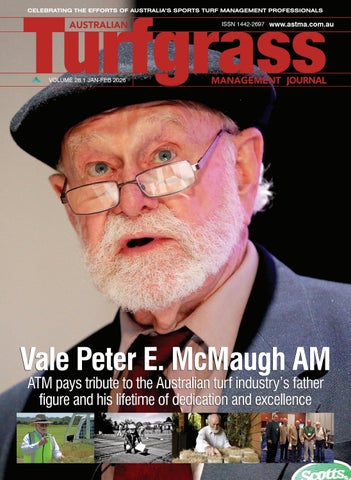
Vale Peter E. McMaugh AM

Vale Peter E. McMaugh AM

ATM pays tribute to the Australian turf industry’s father figure and his lifetime of dedication and excellence

ATM pays tribute to the Australian turf industry’s father figure and his lifetime of dedication and excellence

JOURNAL

Published by the Australian Sports Turf Managers Association (ASTMA)

Editorial

Brett Robinson (Editor)

Office: (03) 9548 8600

Mobile: 0434 144 779

Email: brett@astma.com.au

Nick Creely (Reporter) E: nick@astma.com.au

Advertising

Pam Irvine

Office: (03) 9548 8600

Mobile: 0402 069 489

Email: pam@astma.com.au

Art Direction & Design

Jo Corne

Printed By

Southern Impact Pty Ltd

Suite 1, Monash Corporate Centre

752 Blackburn Road, Clayton, VIC 3168

W: www.astma.com.au

ABN 96 053 205 888

ASTMA Board

PREMIUM PARTNERS

P: (03) 9548 8600 E: admin@astma.com.au

Chief Executive Officer

Mark Unwin

Mobile: 0438 320 919

E: mark@astma.com.au

Membership

Allison Jenkins

E: admin@astma.com.au

Finance Manager

Frank Joseph E: frank@astma.com.au

Events and Education

Simone Staples

E: simone@astma.com.au

Pam Irvine

E: pam@astma.com.au

RTO/Training

Albert Sherry (National Training Mgr)

E: albert@astma.com.au

M: 0437 064 726

Chris McCulloch (SA Training Mgr)

E: chris@astma.com.au

M: 0488 338 805

AGCSATech

Bruce Macphee (Senior Agronomist)

E: bruce@astma.com.au

Tim Fankhauser (Agronomist)

E: tim@astma.com.au

Amy Dingle (Agronomist)

E: amy@astma.com.au

Ben Tilley (Headland GC, president), Troy Jordan (MOPT, treasurer), Peter Lonergan (Coolangatta & Tweed Heads GC), Damian Hough (Adelaide Oval), Mark Findlay (Werribee Park GC) and Dennis Grounds (Royal Canberra GC)

ASTMA PREMIUM PARTNERS

PARTNERS

PREMIUM PARTNERS

PREMIUM PARTNERS

PARTNERS

The Australian Sports Turf Managers Association is indebted to the support of the following premium partner companies

PREMIUM PARTNERS

The Australian Sports Turf Managers Association is indebted to the support of the following premium partner companies

The Australian Sports Turf Managers Association is indebted to the support of the following premium partner companies

The Australian Sports Turf Managers Association is indebted to the support of the following premium partner companies

The Australian Sports Turf Managers Association is indebted to the support of the following premium partner companies

The Australian Sports Turf Managers Association is indebted to the support of the following premium partner companies

The Australian Sports Turf Managers Association is indebted to the support of the following premium partner companies

PLATINUM GOLD

PREMIUM PARTNERS

The Australian Sports Turf Managers Association is indebted to the support of the following premium partner companies

The Australian Sports Turf Managers Association is indebted to the support of the following premium partner companies

The Australian Sports Turf Managers Association encourages all members to support these companies who support your association

The Australian Sports Turf Managers Association encourages all members to support these companies who support your association

The Australian Sports Turf Managers Association encourages all members to support these companies who support your association

The Australian Sports Turf Managers Association encourages all members to support these companies who support your association

The Australian Sports Turf Managers Association encourages all members to support these companies who support your association

The Australian Sports Turf Managers Association encourages all members to support these companies who support your association

The Australian Sports Turf Managers Association encourages all members to support these companies who support your association

COVER STORY

VALE PETER E. MCMAUGH AM: A LIFETIME OF DEDICATION AND EXCELLENCE 8-25

The passing of Peter Edwin McMaugh AM shortly before Christmas bought to an end one of the most influential and pioneering eras in Australian turf management history. As an educator, researcher, breeder, advocate, inventor, author and presenter, Peter was, for more than 60 years, a leading light and a keystone in the development and progression of the Australian industry. Across three separate articles, ATM, with the help of Peter’s many friends and colleagues who worked alongside him, pay tribute to a unique individual whose vast achievements helped to lay the foundations for our modern day industry.

Cover: Peter McMaugh (1935-2025). Main image: Brett Robinson. Inset images: Turf NSW, Lawrie Greenup, Peter McMaugh

Farewell to a father figure

Where do you even begin to reflect upon the legacy that Peter McMaugh AM leaves behind following his sad passing last December. Just a few months after turning 90, Peter succumbed to a period of illness and in doing so the Australian turf industry lost one of its most brilliant minds and staunchest advocates. Peter’s contribution to our industry over more than 60 years was unrivalled and in this edition we pay tribute to him.

Peter was truly a unique character. Small in stature but a giant intellectually, he singlehandedly shaped our industry to what it is today. Whether it was through the breeding of such well known grasses as Wintergreen, Windsor Green and Sir Walter, his early research on endothal and glyphosate and later turfgrass mites, his consummate consultancy skills or the many friendships and collaborations he had with the world’s top turfgrass scientists, Australian turf managers past, present and future have benefited and will continue to benefit from Peter’s huge body of work.

Like many, I found Peter an imposing figure, but after sharing a red wine at the Wellington conference in 2018 and later that year having him come on board as a columnist for ATM, I quicky began to appreciate Peter’s incredible depth of thinking, his astute (and very dry) wit and the absolute passion he had for an industry that he long advocated for.

All up Peter would pen 40 columns for ATM, a mere drop considering the huge amount of papers and articles he authored across six decades, with his last coming in the SeptemberOctober 2025 edition. Such was his prolific nature, at the time of his passing there were still five that hadn’t been published! As an aside, it would be remiss of me not to give a special mention here to Peter’s wife Rae who played an equally important role in his columns. Being very much old school, Peter wrote all his columns by hand and would rely on Rae to type them up!

Contributors to Australian Turfgrass Management Journal Volume 28.1 (January-February 2026): Australian Golf Media/PGA of Australia; Gary W. Beehag; Martyn Black; Ryan Blackbourn (Manukorihi GC, NZ); Will Bowden (PGG Wrightson Turf, NZ); Dr Leah Brilman (DLF Seeds, USA); Cape Kidnappers Sanctuary, NZ; Cricket Australia; Rowan Daymond (The Grange GC); Alastair Dowie; Richard Forsyth (Royal Melbourne GC); FTMI Class of 2025/2026; Getty Images; Ben Gibson (The Toolbox Team); Graeme Grant; Lawrie Greenup; Damian Hough (Adelaide Oval); Steven Hewitt (13th Beach Golf Links); Dr Don Loch (University of Queensland); Dr Brett Morris (The R&A); Lindsay Murphy (Australian Racecourse Managers Association); John Neylan (Sporteng); David Nickson; Shaun Page (Southern GC); Robert Reynolds (Cazna); Graham Ross; Luke Stannard (Bexley GC); Ian Todd (Rosebud CC); Mark Unwin (ASTMA); Terry Vogel (Cobram Barooga GC); Prof. Robert Wallis (Federation University of Australia); Tim Warren (TMSA); David Warwick; David Worrard (Living Turf).

As I’m sure former TurfCraft International editor Alastair Dowie will concur – Peter was a longtime contributor to that magazine through his ‘Ask the Expert’ column – Peter’s writings certainly kept you on your toes. I think I managed to avert a couple of lawsuits over the years thanks to some judicious editing, but was always mindful of not detracting from the column’s intent. He was one to tell it like it was and at times was brutally and unapologetically frank, but it always came from a position of knowledge and intellect and wanting to better both practitioner and the industry. Looking back on his columns, Peter’s writings covered a huge array of topics from turfgrass breeding and genetics, renovation techniques and green construction methodology, soil science and testing, natural versus synthetic turf, new technologies and even ‘AI’. Although in his twilight years, Peter had the remarkable ability to remain abreast of the latest scientific literature and developments and their potential application in our industry, something which was a hallmark throughout his entire career.

His columns always made you think and carried a number of central themes which were prevalent across much of his work. The first and most prominent was the importance of acquiring knowledge and continual learning. Fittingly his final column last October was on that very topic. I loved this particular quote he used in one of his earlier columns pertaining to the topic: “When you reach the status of superintendent, there is inevitably a desire to put your individual stamp on the course. This is where you enter the snake pit. The best antidote for venom is knowledge.”

Scientific veracity and the need for rigorous data were also cornerstones of Peter’s writings, as was the critical importance of being observant and forming your own opinions. He had no time for the ‘snake oil salesmen’ peddling products with unsubstantiated claims, while he was at pains to stress that nothing in the world of turf will ever be solved by a ‘quick fix’ solution.

In somewhat of a sad footnote, in the months before Peter’s passing, John Neylan, Gary Beehag and I had started discussions to catch up with Peter in the New Year to reflect on his life and career. John had thoughtfully compiled a long list of questions which I sent off to Peter just five weeks before his passing. Peter responded, “John’s questions look like the framework for a book!” Given the mine of information Peter’s mind was, it could well have been. Alas, Peter’s deteriorating health beat our best intentions and we never got the opportunity to have that sit down. If there’s a moral to that story, then it’s ‘Don’t put off until tomorrow what you can do today’.

In this edition, we hope to encapsulate Peter’s remarkable career through a series of tributes penned by his many friends and colleagues. It’s not until you embark on such a process that you begin to fully appreciate what Peter did for our industry. I encourage those who didn’t know Peter to take the time to read and understand the critical role he played over many years.

Vale Peter – thank you for your extraordinary contributions across a pioneering career and the incredible knowledge and insight you provided. A glass of French red in your honour, sir…

THINKING WITH MARK UNWIN, CEO

Honouring a legacy and empowering the next generation

Over the past few months, our industry has been reminded of both its strength and its legacy. At the forefront of this reflection is the passing and commemoration of Peter McMaugh AM, whose contribution to turfgrass science and education in Australia is simply unparalleled.

In this edition you will see a fitting and detailed tribute to Peter’s life and work. For many in the industry, his influence has been both direct and profound – whether through his research, education, mentorship or his unwavering commitment to advancing turf management as a respected profession.

His legacy is not just in the body of knowledge he helped build, but in the standards we continue to uphold as an industry. As we look forward, it is incumbent on all of us to honour that legacy through continued advancement of our skills and knowledge, professionalism and a commitment to excellence.

Looking ahead, there is a growing sense of momentum as we approach the Australian Sports Turf Management Conference and Trade Exhibition (22-25 June). This year’s program is shaping up to be one of the most comprehensive and engaging that we have delivered. The breadth of topics reflects the complexity of modern turf management – ranging from agronomic advancements and environmental sustainability, through to leadership, workforce challenges and capability and the integration of new technologies into day-to-day turf operations.

A major highlight is the inclusion of Dr Doug Soldat, a globally recognised turfgrass scientist whose work continues to influence best practice internationally. Doug is a professor and turfgrass extension specialist in the Department of Soil Science at the University of Wisconsin-Madison and will deliver education sessions on ‘Organic Matter Management in Putting Greens’, ‘Understanding Wetting Agents’ and ‘Optimising your PGR program for cool- and warm-season turf’ across both days of our dedicated education streams.

Doug’s presence at the conference represents a significant opportunity for Australian turf managers to gain direct insight into cutting-edge research and its practical application. His sessions will be particularly valuable for those seeking to refine their approach to soil management, nutrient inputs and performance optimisation under increasingly challenging climatic conditions.

Doug’s announcement came as we also finalised the make-up of the Tuesday Plenary program which will see us join with members of the GMA for what is set to be a thoroughly entertaining and thought-provoking

day. We were delighted to confirm champion Paralympian Kurt Fearnley AO will close out the day’s sessions which also include presentations from previously announced keynotes Daniel Flynn, Liz Ellis, Dr Karl Kruszelnicki, Lindsey Leigh Hobson and Gary Pert. We are also excited to have worldrecord endurance athlete Sean Bell who will give the end-of-conference keynote address on the Thursday.

Beyond the headline speakers, the conference program has been carefully curated to ensure relevance across all sectors of our membership – from golf and sportsfields through to racecourses, schools and local government. Importantly, the conference also remains a critical platform for connection. In an industry where knowledge-sharing and peer networking are essential, the opportunity to come together, exchange ideas and challenge thinking is as valuable as the formal education sessions themselves.

I strongly encourage all members to review the program available on the ASTMA website for full details (www.astma.com.au/ conference/2025-conference-topics/). More announcements on sessions and speakers will be updated over the weeks and months ahead, with education content designed to support your continued professional development.

In parallel to that, we are now calling for nominations for the National Turf Industry Awards. These awards remain one of the most important ways we recognise excellence across our profession. Too often the outstanding work being delivered at club and facility level goes unseen beyond the boundary fence. The awards program provides a platform to showcase that excellence, celebrate innovation and acknowledge the individuals and teams who are raising the bar.

I would encourage all members to take the time to nominate – whether it be a colleague, a team or even your own facility. Recognition matters. Not only does it validate the effort and professionalism of those involved, but it also helps to elevate the profile of our industry more broadly. By telling these stories, we reinforce the value that skilled turf managers bring to sport, community and the environment.

Another significant milestone pending is the completion of the 2025/26 Future Turf Managers’ Initiative (FTMI) program, presented by ASTMA Silver Partner Jacobsen. Culminating with a two-and-a-half-day faceto-face seminar in Melbourne in late March, the FTMI program continues to be one of the association’s most impactful leadership and development initiatives, designed to identify and support up and coming industry leaders.

The calibre of participants this year has again been exceptional. Through a combination of formal learning, industry engagement and exposure to leadership concepts, they have demonstrated both the capability and ambition required to shape the future of our industry. What has been very encouraging is the variety of perspectives and experiences within the cohort, reflecting our industry’s evolving nature.

The long-term value of FTMI lies not just in the individual development of participants, but in the network it creates. As alumni continue to progress through their careers, they carry with them a shared experience and a commitment to collaboration that strengthens the industry as a whole. I am very much looking forward to working through the final component with the Class of 2025/2026 in Melbourne and to seeing the continued impact of this year’s cohort in the years ahead.

As we move into the next phase of the year, there is a clear sense that our industry is both honouring its past and investing in its future. From recognising the legacy of leaders like Peter McMaugh AM, to bringing global expertise to Australia through our conference, celebrating excellence via the awards program and developing future leaders through FTMI, we are collectively building a stronger, more connected profession. Thank you, as always, for your ongoing commitment to the industry and to the association.

on groundBest

ATM showcases some of the best social media posts and images from across the sports turf industry in recent times...

TOM ALDRIDGE

“2026 NZ PGA Championship. What a week with the lads, extremely proud of what this team was able to achieve over the last few months. We produced a course that we were truly proud of. Would like to thank all the staff and volunteers that contributed to this. Takes an army to be able to do this.” (In his first tournament in charge since taking over as just the fifth superintendent of Paraparaumu Beach GC in its 77-year history, superintendent Tom Aldridge @genuine.greenkeeper and his crew presented the course superbly for the club’s first major Tour event in 24 years.)

AARON VATNER

“A huge thank you to our incredible Avondale Golf Club Course Team for the outstanding job they did preparing and presenting the course for the 2026 Avondale Amateur, held last week… The condition and playability of the course drew widespread praise from players, officials and guests, and it was a true credit to the professionalism and pride this team brings to their work every day.” (Avondale general manager Aaron Vatner praises superintendent Robert Biddle, assistants James Barnes and Will Stratford and the Avondale crew as they battled 300mm of rain and 43-degree days in the lead-up to one of Australia’s premier amateur events in late January.)

LUKE HELM

“Some days certainly test us, especially when it’s a Friday! However, watching your team work together to problem-solve the issue, I find this the most rewarding part of my job.” (Just what the Meadowbrook Golf Club crew needed one Friday in February. As superintendent Luke Helm quipped in response to one of the comments on his post, “I think it’s a golf course trait to have pipes buried deeper than any other facility!”)

STURT FOOTBALL CLUB

“After 15 years of outstanding service, today we thank Matt Sampson as he finishes in his role as Head Curator with the City of Unley. Matt’s commitment to ensuring the Unley Oval surface was always presented in first-class condition is a credit to him... Sturt FC has valued the professional working relationship we’ve enjoyed with Matt and his team, ensuring Unley Oval could be enjoyed by all users.” (Appreciation post from reigning SANFL premiers Sturt, acknowledging the efforts of Matt Sampson who finished in February to take up a new role with Living Turf.)

GLENELG GOLF CLUB COURSE MAINTENANCE

“It’s not every day that a three-time major winner like Minjee Lee is on our practice fairway, fine-tuning her game ahead of the Women’s Australian Open at Kooyonga Golf Club this March.” (The Glenelg Golf Club crew, headed by superintendent Tim Warren, managed a quick group photo in between drills with Australia’s leading female professional golfer and multiple major winner.)

CAMERON SUTHERLAND

“Programmed Property Services Open Space WA has had a busy spring and summer completing over 100 hectares of sports field renovations for our valued clients, including the Fremantle Dockers.” (The Programmed team spreading the love at Cockburn Oval, Fremantle’s home training deck, as part of recent surface renovations.)

MALENY GOLF CLUB

“EXHIBIT A! This bunker was freshly raked by our greenkeeping team not long before this photo was taken. There’s a special place in golf purgatory for people who don’t rake bunkers…” (These are the opening two sentences of a 530-word missive posted on the Maleny Facebook page late February after one golfer did the unthinkable. Check out the full post, which also delves into the ‘unrepaired pitch mark’ and ‘unfilled divot’. It makes for hilarious reading!)

23 Oct 1935 - 22 Dec 2025

Peter McMaugh AM pictured in 2010 at Pennant Hills Golf Club in Sydney PETER E. M

The passing of Peter Edwin McMaugh AM shortly before Christmas brought to an end one of the most influential and pioneering eras in Australian turf management history. As an educator, researcher, plant breeder, advocate, inventor and author, McMaugh was, for more than 60 years, a keystone in the development and progression of our industry. With the help of Peter’s many friends and colleagues, across three separate articles in this edition we pay tribute to a unique individual and a brilliant mind.

For someone who, by his own admission, got into the turf industry “by chance”, the incredible career that Peter McMaugh AM would go on to forge would help lay the foundations of the modern day Australian turfgrass industry. Sadly, that influential chapter came to an end on 22 December 2025 when Peter succumbed to a period of ill health just a few months after celebrating his 90th birthday. True to Peter’s character he was still working up until his final days, such was his dedication and passion for an industry which he continually gave to across a remarkable 60-plus years.

At the request of wife Rae and Peter’s family, he was farewelled in a private service. As this edition was going to print, the turf industry was set to gather at Castle Hill Country Club in Sydney on Wednesday 18 March for a memorial dinner to celebrate the legacy of a man who one member of the industry labelled on social media was “the Don Bradman of the Australian turf industry”.

To pay tribute to and highlight the breadth of work that Peter amassed over a prolific career, Australian Turfgrass Management Journal has called upon those who knew and worked alongside him to provide some insight into the indelible legacy he leaves behind. As you will read across the next three articles, Peter’s achievements were many and his contributions incomparable.

In this first part we have recollections from five people close to Peter – agronomists Gary Beehag, John Neylan and David Nickson, and former superintendents David Warwick and Martyn Black, the latter of whom affectionately dubbed Peter ‘Papa Smurf’. Gary, who collaborated with Peter on many projects across their 50 years of friendship and who played a key role in nominating Peter for his Australia Day AM honour in 2019, begins our 18-page tribute to a man to whom the industry owes a significant debt of gratitude.

OUR FOREMOST AUTHORITY

Agronomist; NSWGCSA Life Member; ASTMA Distinguished Service Award (2024) Once in a lifetime a truly remarkable person emerges in most professions. Peter E. McMaugh AM was such a person and a

true trailblazer of the Australasian sportsturf industry. I first met Peter around 1975 and in the years since no other individual within our industry has righty gained so much recognition and been given so many awards by numerous organisations nor has been written about in so many journals, magazines and newsletters.

Peter was passionate about plant science and biology. Following his graduation from the University of Sydney in 1964, Peter became a lecturer in biology at the Sydney Technical College in Ultimo. Remarkably, one of Peter’s students at the time was Percy Wong!

Peter met Len Basser, a tutor in chemistry at the university, who was also a member of Dover Heights Bowling Club in Sydney. It was through Len that Peter, following his fulfilment of his teaching commitment, was appointed in

I

would like to thank all those people who have reached out to me at this time. Peter loved the sportsturf industry and he worked until the end. It was what kept him going. Peter was a clever, kind and good man generous with his time.

– RAE MCMAUGH, PETER’S WIFE

October 1964 to the Grass Research Bureau (GRB), the forerunner to the now-defunct Australian Turfgrass Research Institute (ATRI).

Peter entered the Australasian sportsturf industry during its embryonic period. Turfgrass cultural practices were relatively basic, mechanised equipment and irrigation systems were unsophisticated and the range of fertilisers and chemicals were limited. Turfgrass physiology and the biology of their fungal pathogens and pest species in Australia at the time were not well understood.

Peter spent many hours reading scientificbased papers about all things turfgrass. He once said a fellow employee at the GRB was critical of the time he spent reading. Peter realised the need to bring himself up-to-date with the science of turfgrass management. At the time, much of what was known about turfgrasses and their management was published in well-known American and English scientific journals. Peter, throughout his long career, remained an avid reader of the world-wide turfgrass literature and a critic of published information, always questioning its scientific credibility.

Peter engaged in numerous roles within the sportsturf industry and to a lesser extent in agriculture and horticulture. He was the consummate consultant, researcher and scientist, educator and teacher, turfgrass grower and breeder, equipment inventor and businessman. He was also authored numerous scientific papers and extension articles. At the time of his passing, Peter was in the epic process of writing his memoirs!

Peter’s professional side was serious and complex and at times confronting. He had no time for fools or imposters nor unsubstantiated claims about a turfgrass cultivar or a product’s performance. However, for those individuals taking the opportunity to learn from Peter by asking him intelligent questions, listening to his answer and wanting to understand his viewpoint, they gained ‘brownie points’ and his respect for next time. Peter became a mentor and confidant to many individuals and there were many over the years.

Peter also had a personal passion. He had a wine cellar and loved a good red wine, preferably French. Peter was most upset when he discovered termites had chewed their way through the corks, ruining many of his bottles!

Rae and Peter McMaugh at the 2000 Millennium Turfgrass Conference in Melbourne where Peter was bestowed the AGCSA Distinguished Service Award
PHOTO: ASTMA ARCHIVE

As the consummate consultant, Peter fully understood the meaning of ‘professional’. He remained ‘at arm’s length’ from his many clients when giving advice during ‘problemsolving’ consultancy visits. Of Peter, someone once said “If you did not want to know the answer, do not ask the question”. In other words, the answer may have been blunt which you may not have liked!

Peter was a true trailblazer, promoting turfgrass education from the early 1970’s. He understood the need and benefit of exposing the Australasian sportsturf industry to overseas ideas and developments in turfgrass science. Through his membership of the International Turfgrass Research Society (ITS), Peter invited Dr. James B. Beard (USA) to be a keynote speaker at the Fourth Turf Conference held in November 1976 on the Gold Coast. In subsequent years, Peter was instrumental in inviting many other well-known American and English turfgrass scientists to Australia.

Dr Beard once told me he would like Peter to come to the United States to be involved in turfgrass research, teaching and extension. On reflection, Peter would have undoubtedly changed the viewpoint among many Americans about their views on turfgrass management. Peter, ever promoting education, was consulted by Professor Craig Pearson of the School of Crop Science at the University of Sydney who wanted to establish a postgraduate Diploma/Master’s degree course in turfgrass management. The course was taught by Professor Peter Martin with Peter the chief external examiner for many years.

Peter McMaugh was unquestionably Australasia’s foremost authority on turfgrasses and their management. Receiving the Order of Australia at the level of Member of the Order (AM) in 2019 for his services to the Australian

sportsturf industry was recognition of Peter’s long and illustrious career.

NSW Governor Margaret Beazley presented Peter with his medal during a formal ceremony held at Government House in Sydney. I later asked Peter what the Governor said to him during the presentation. He replied “She said to me perhaps one day we should ask you to look at the lawns here. I replied, ‘Sorry, I do not do home lawns’”

The Australasian sportsturf industry has lost a human encyclopedia on all things turfgrass. Peter’s knowledge of the turfgrass literature in depth and breadth was truly remarkable. Sadly, Peter’s passing coincides with an emerging era in Australia of limited

funding for turfgrass research, a paucity of science-based information and few, truly independent consultants.

Peter will be long remembered by those fortunate individuals who met him and realise they are a much better turfgrass manager or consultant knowing how and where to find credible information and capable of making informed decisions about the science of turfgrass management. One thing for certain, the Australasian sportsturf industry will never witness another Peter E. McMaugh AM.

A BIG SOFTY

Former Avondale GC superintendent; ASTMA Distinguished Service Award (2021) While Peter’s career achievements are simply legendary and will be well documented by others in this edition, I wish to tell you more about the person.

I first came across Peter when I was an apprentice at Concord Golf Club. ATRI wasn’t far away so my encounters were frequent enough for me to very quickly realise that this white bearded, beret-wearing old man (he was probably in his early 50s at that time) was someone not to joke with. He came across as a very serious man with a gruff personality, which I’m sure most people would have encountered, and as a young apprentice I guess I was more scared of him than impressed by him.

Over the next 15 years or so I had minimal involvement with Peter. I, of course, would read his words of wisdom in industry publications and listened to many of his presentations at association days or the annual conference. By now I was a course superintendent and even then still scared of him at this stage, but at one of these industry events I summoned the courage to start a conversation with him.

I reintroduced myself to which he said in that trademark deep voice “I know who you are, you’re at Avondale.” That panicked me somewhat and I thought ‘Why the hell would someone like Peter know about me?’ He wanted to visit the course which, for me, was going to be like preparing for a tournament!

The day arrived and to say I was nervous is an understatement. We drove the course, inspected all the things we had been up to and I guess he was impressed as I was soon receiving calls for opinions and requests for trial work with him. Our relationship grew and the barriers were broken down (though I’ll admit I was still scared of him.)

Fast forward a few more years and we both realised we lived five minutes away from each other. I can’t recall how it happened or my first visit to his house, but it was an eyeopening experience to see Peter’s trial plots/ soil samples, microscopes and his book

McMaugh’s first foray into the turf industry came when he was appointed head of the Grass Research Bureau, the forerunner to the Australian Turfgrass Research Institute (ATRI), based at the Ryde School of Horticulture. McMaugh is pictured on the turf plots at Ryde
After moving out of the Ryde School of Horticulture, McMaugh helped to establish ATRI’s base at Concord West (pictured) which for many years was regarded as Australia’s foremost turf research facility
PHOTO: LAWRIE GREENUP

McMaugh was one of Australia’s first representatives to attend the International Turfgrass Society’s quadrennial International Turf Research Conference. His first was in 1973 when Virginia Tech (USA) hosted the 2nd ITRC on its campus. McMaugh is pictured back row, seventh from left – marked with a red ‘x’ – in the top image. Above, he is pictured sitting in between Dr James Watson (to his left) and Dr James Beard at the 1989 ITRC in Japan and, right, with US turf research giants Dr Jim Beard (dec.), Dr Paul Rieke, Dr Dick Schmidt (dec.) and Dr Joe Vargas (dec.) at what would be McMaugh’s twelfth and final ITRC in 2017

collection – OMG the books! As he was getting on a bit in years at this stage, I offered to assist moving some heavy foam boxes with different species of unreleased grasses in them. Upon leaving, I offered up any other assistance I could and that all he had to do was call me.

Well, that was it! I ended up mowing his lawns on a regular basis, even scarifying and fertilising them at one point (with Peter watching on, of course…), moving furniture and rearranging his garage (including his wellstocked cellar). It was during these visits that I got to know the real Peter and we would sit around for hours and discuss all things turf and, on many occasions, no turf talk at all, but often over a glass of red.

He was as sharp as a tack and well informed in every subject that ever came up. He would only ever offer his comments if he was certain. If he wasn’t, he would call later that day, or upon my next visit, to finish the topic off having conducted the required research. The visits extended to taking my wife Michelle around and sitting with both Peter and his wife Rae over a cuppa.

To all those that never got to know Peter the way I had the privilege, you missed getting to know a true gentleman. He was caring, extremely observant, considered, considerate and even funny. Once you cracked that gruff exterior and earned his respect, friendship followed. He was really a big softy. I’m going to miss him – I’ve lost a mentor and a mate.

THE EPICENTRE OF AUSTRALIAN TURFGRASS SCIENCE

Award (2014)

It was with great sadness that I heard of the passing of Peter McMaugh AM in late December 2025 after a prolonged period of illness. Peter was a mentor to many of us in the turfgrass industry, whether they be a turfgrass agronomist, superintendent, sportsfield manager or anyone interested in the science of turf. Peter was the epicentre of turfgrass science in Australia and was the leader in turfgrass research, education, turfgrass breeding and consultancy. Through Peter we

learnt about the importance of independent thinking, not accepting information at face value and researching the facts.

From a personal perspective I will miss his mentorship. About two weeks before Peter’s death, he rang me to discuss an article that I had written for Australian Turfgrass Management Journal. These phone calls were a regular occurrence. The article was on the importance of oxygen in irrigation water and its influence on plant health and how it related to nano-bubble technology. This was a topic that Peter was expert in and I had referenced his writings on the subject in my article.

The discussion we had related to the effects on plant physiology and he disagreed on one particular point that I had made and was unsure about another. It was a good discussion with sound reasoning and one where you feel better for the experience. Overall, I got a pass mark! This was the great thing about Peter in that he had a great depth of knowledge, he challenged you and was a great educator. He definitely made me a better turfgrass scientist and agronomist.

PHOTOS: PETER MCMAUGH; ITRC 2ND CONFERENCE PROCEEDINGS; JOHN NEYLAN

Peter was a great turfgrass breeder and developed arguably one of the world’s best couchgrasses (Cynodon sp.) in Wintergreen. For many years it was a staple for golf course fairways and tees and sportsfields throughout Australia. From my perspective, Wintergreen was for many years superior to any of the bermudagrasses being used in the US.

Peter then developed Windsor Green which was derived as an induced mutant from Wintergreen as a result of radiation treatment. Windsor Green was selected from 22 other mutants with superior density, colour and wear tolerance as well as lower seed head production. Windsor Green was the first vegetative Cynodon sp. granted Plant Breeders Rights in Australia (1994).

Peter continued to collect grasses, evaluate them and develop new cultivars until his final days. In recent years he subjected Santa Ana to radiation treatment and selected a new variety with short internodes and slow stolon growth. Peter saw this as a grass suitable for greens surrounds with less aggressive intrusion into creeping bentgrass.

Peter was well known and respected amongst the world’s leading turf scientists. This was never more apparent than at the opening ceremony of the 15th International Turfgrass Research Conference (ITRC) in Japan last year. One of the photos in the keynote presentation was from the 1989 ITRC held in Tokyo, with Peter seated with Dr. James Beard, Dr. Jim Watson and Dr. Wijik. Peter regularly attended the ITRC from 1973, he became an ITS Board member in 1981 and eventually ITS President in 1993 through until 1997 when Australia hosted the 8th ITRC.

Peter cultivated many friendships with the world’s leading turfgrass scientists including

Peter was ‘the’ leader in turfgrass research, education, turfgrass breeding and consultancy in Australia. Through Peter we learnt about the importance of independent thinking, not accepting information at face value and researching the facts. – JOHN NEYLAN “ “

those mentioned above as well as Dr. Joe Vargus (plant pathologist), Dr. Paul Rieke (soil and turfgrass management specialist), Dr. Bob Carrow (soil and water scientist), Dr. Richard Smiley (plant pathologist), Dr. Jeff Krans (plant breeder), Dr. Arden Baltensperger (plant breeder) and many others. These turfgrass scientists have written or contributed to the most definitive papers and books on turfgrass agronomy, plant pathology, soil science and nutrition, water and water management, weed management and plant breeding which are all still relevant today. The Australian turfgrass industry benefited greatly from these contacts as Peter encouraged them to visit our shores.

Peter was a great educator, however, his direct approach didn’t always resonate well with those that had fragile egos. As a new recruit to the Victorian Turf Research and Advisory Institute, my first experience of Peter’s style came at the 1984 National Turf Conference in Melbourne. Peter highlighted

the deficiencies in turf management on golf courses and he named several courses during his presentation. This was much to the embarrassment of one superintendent.

His style was definitely intimidating. However, to quote Peter, ‘I think I can say what I think provided it is objective and constructive’. As with everything related to Peter, his approach came from a genuine belief that those that were prepared to listen would become better turf managers and agronomists.

In the early 1980s Peter was a strong advocate for the use of couchgrass on golf course fairways in Victoria with two of the early examples being the use of Wintergreen at Metropolitan and Peninsula golf clubs. As couchgrass began to gain traction in Victoria, Peter hosted Ron McCartney and myself in Sydney to share his experiences of establishing and managing warm-season grasses. It was a true teacher-student moment.

When discussing couchgrass I remember observing the couchgrass row planter (essentially a modified vegetable seedling planter) in action at Peninsula. Developing a row planter for couchgrass was an initiative of Peter’s with the combined skills of Don Hunt, Steve Smythe and others and was a precursor to the line planters used today.

Peter had an incredible knowledge of weeds and weed control and pioneered the early work of endothal in Australia. This work extended into many years of work in controlling Poa annua in turfgrass and understanding the dynamics of Poa annua

Peter’s work goes back to the early use of a ‘new’ herbicide called glyphosate for the selective control of weeds in warm-season grasses. The outcomes of this work have greatly assisted me in better understanding the results of the recent research that I have undertaken using glyphosate to control Poa annua in Santa Ana couchgrass. I actually have some recently collected data that I would have liked Peter to review and to provide me with his perspective on what is happening.

Peter had a long-term interest in mites and the damage that they cause in warm-season grasses. An early lesson that Peter provided me was when I wrote an article on the association of mite damage on the regrowth in ERI disease affected turf. I used the wrong genus and an incorrect image of the mite!

Peter, in collaboration with Dr Don Loch and Danuta Knihinicki, undertook extensive work in identifying mites, the grass species affected and the potential control methods.

Peter’s knowledge was of use to me when I was faced with an interesting problem. A golf course architect shared with me that during the grow-in of a bentgrass green that a chemical salesperson had suggested that mites were coming from the adjacent Casuarina sp. trees and damaging the bentgrass! The prospect

McMaugh became a mentor and confidant to many across his 60 years, among them leading agronomist John Neylan. Here they are pictured together in 2024 inspecting Peter’s couchgrass collection at his Sydney home
PHOTO: GARY BEEHAG

seemed so outrageous, maybe it was true. I contacted Peter where, in quick time, he suggested that this was utter nonsense!

Peter McMaugh described himself as a problem-solver. As a turfgrass agronomist, the skill is having an understanding of all of the elements that affect turf growth and health, including turfgrass species and cultivars, soil physics and soil chemistry, weeds, turfgrass diseases, fertiliser programs etc., which very much sums up Peter’s skills. Peter stressed that the turfgrass agronomist has to have the ability to look beyond the surface symptoms and determine the true cause of the problem and not necessarily treat it as a ‘quick fix’.

In my discussions with Peter, we regularly spoke about the misinformation in the turfgrass industry, the lack of scientific rigour, the inability of the sports that benefit from turf to invest in research, the over-reach of the product supply industry and the lack of independent reading within the education system. While we and others of my age will be accused of being the “grumpy old guys” (Statler and Waldorf) from The Muppets, I like to think that I have learnt from Peter the importance of being an independent thinker. I personally will greatly miss Peter as a mentor and respected colleague.

THE BEST OF THEM

Fifty-one years ago I first met Peter McMaugh when my boss, the legendary Pennant Hills Golf Club superintendent Vince Church, told

me to go get the small walk-behind scarifying machine and a grass rake and to meet him at ‘the Tifdwarf green’. This small practice green was arguably the first Tifdwarf golf green in NSW and was the result of this fine turf species ‘marginally’ arriving in Australia after a trip to the USA by Vince and Cliff Meredith in 1968.

As I toiled away going across the green in several directions, these two ‘old blokes’ –Vince (65) and Peter (then 39) – stood in the shade and oversaw the operation. Once I had filled six hessian bags and dampened them down, I loaded them into Peter's small box trailer and off he went to a bowling club to the south of Sydney. Peter was obviously a good judge of this grass’s potential and more than half a century later it is still regarded as one of the best surfaces for bowls and some golf courses in the Northern Riverina area.

Over the years I got to know Peter much better and, like many discovered, if you were able to get past his gruff, intimidating exterior

A DEVASTATING LOSS

The recent passing of Peter was devastating for me. We were very close friends and spoke every week or so for more than 50 years and, of course, there were the numerous joint ventures, often with John Neylan involved. Our last conversation, under difficult circumstances, was just hours before he left us and I wish he could have been more comfortable in his final days. I owe Peter and his wife Rae a huge debt –life won’t be the same without him.

- David Nickson

and show him you were fair dinkum in your dedication to the industry he was more than happy to help you. This closer relationship led to me being invited to his home on a couple of occasions to discuss all things turf.

On one occasion, Peter (affectionately known by many NSW superintendents as Papa Smurf) asked myself and my fellow invitees, David Worrad and Peter Watts, what we thought was the most impressive product that entered the industry in our time. I instantly blurted out “Primo!” to which he replied in his distinctive gravelly voice, “You’re f****n’ right!” As usual, succinct and to the point.

When a good friend of mine exhibited at the 2018 Australasian Sports Turf Management Conference, Peter visited our booth where we had a simulation of our new Bunker Dry drainage device. When Peter arrived I was in the middle of explaining its operation to a Kiwi superintendent, so my mate, who is a hydraulic engineer and didn’t know Peter from a bar of soap, gave him the spiel about the device.

Peter listened intently and when my mate was finished I asked, “What do you think about that, Pete?” He turned, looked up at me and said in his commanding tone “It’s simple and it WORKS!” and then vanished! My mate asked “Who the bloody hell was that? He was terrifying!” I replied, ‘Don’t worry who that was, you just got the stamp of approval from the smartest bloke in the game. He is ‘THE MAN’”

Peter McMaugh – he could drink red wine with the best of them, he could swear with the best of them, as a turf and horticulture/ agriculture expert he was the best of them.

The father of Wintergreen and Windsor Green couchgrasses, McMaugh continued to collect grasses, evaluate them and develop new cultivars up until his final days

Peter McMaugh graduated with a Bachelor of Science in Agriculture in 1964 from the University of Sydney. He spent a short period as a teacher of biology at the Sydney Technical College (pictured) prior to joining the Grass Research Bureau which later became ATRI

The scientist who got his

hands dirty

Prolific doesn’t even begin to describe the manner in which Peter McMaugh AM cultivated and amassed a body of seminal work across more than six decades. ATM summaries some of Peter’s key achievements and industry involvement, while Dr Brett Morris, Dr Leah Brilman and Alastair Dowie reflect on their friendship with him.

On Australia Day 2019, Peter McMaugh was recognised for his many years of work and service to the Australian turfgrass industry when he was conferred The Order of Australia at the level of Member of the Order (AM). It added to an already impressive list of awards and honours that Peter collected across his time (read the full list on page 23) and in doing so he became the only member of the Australian turf industry to achieve such designation.

True to his character, Peter was deeply humbled when news broke of the honour and also somewhat taken aback. In what proved an almost military-like operation to keep it a secret, Gary Beehag and John Odell went through the painstaking task of nominating Peter for the award which included providing a comprehensive dossier of his achievements and how they had significantly benefited both industry and community. Peter’s wife Rae was also in on the months-long ruse, helping to furnish Gary and John with the

requisite information, even to the point of utilising a neighbour’s address for any mail correspondence relating to the award so as not to raise any suspicions!

“I am both surprised and deeply grateful,” Peter said at the time. “I see this award as recognition of the turfgrass industry and its special role in providing a safe, healthy environment for our survival into the future and of which I have been privileged to be a part.

“The citation for the award – ‘For significant service to horticulture through the development

PHOTO: RAE MCMAUGH

of Australian turf varieties’ – acknowledges a small, but very important, part of my career achievement. I have been fortunate to be the right person in the right place at the right time as a scientific pioneer in Australia. This has enabled me to have a major influence on the development of the industry over 54 years.

“During these years as scientific researcher, consultant, turfgrass breeder, commercial turf producer, educator and specialist machinery developer, I am the scientist who got his hands dirty at the coal face and learned a great deal in the process.

“I would like to say thank you to the many collaborators with whom I have worked over the years. Among them are the greenkeepers, farmers, scientists, secretaries and especially my wife Rae on whom I have relied for help and inspirations. Without them the body of work that was behind this award could not have been achieved.”

As mentioned in the first part of this edition’s tribute, Peter graduated with a Bachelor of Science in Agriculture in 1964 from the University of Sydney. His passion for botany and plant science, passed down by his university-educated mother, enabled Peter to have the distinction of being the first person in Australia with an agricultural degree to be appointed on a permanent full-time basis as a consultant/researcher in the turfgrass industry.

That same year Peter was employed by the now-defunct Grass Research Bureau

Peter’s legacy and approach to turf science continues to inspire us to pursue excellence in innovation, sustainability and, most importantly, scientific rigor.
– DR BRETT MORRIS, THE R&A “ “

(GRB/Australian Turfgrass Research Institute (ATRI) and was its director from 1975-1978. His unrelenting quest for knowledge for all things turfgrass and his acute understanding and practical application of plant science and physiology of grasses became unequalled in Australia and later recognised overseas. Peter was widely known throughout Australia and overseas as a turfgrass consultant (establishing Turfgrass Scientific Services in 1979), educator, researcher and turfgrass breeder. Unquestionably recognised as Australia’s foremost authority on turfgrass, Peter’s life-long devotion of turfgrasses and their management benefited so many people and organisations in the wider Australian turfgrass and amenity horticulture industries.

What follows is an overview of Peter’s achievements along with some select anecdotes from his keynote address – titled

A GOOD FRIEND AND A PROLIFIC CONTRIBUTOR

Ifirst came into contact with Peter McMaugh when I took the position as editor of TurfCraft International magazine in 1997. Peter wrote a column for the magazine under the title of “Ask the Expert” (pictured) – a very apt title.

In the handover from the previous editor, Peter was described as not an easy person to get on with and generally hard work. With that impression, I made meeting with Peter a priority and I very soon discovered that not only was he encouraging and knowledgeable in anything related to turfgrass, he was also keen to enhance the reputation of the magazine in general. Peter also took a more general interest in what I was doing as editor of TurfCraft and was always a great sounding board in relation to its direction and how it might better serve the turfgrass industry.

Peter was well known to have an opinion on a range of aspects of turfgrass breeding, management, production etc and was not afraid of providing that opinion even if it might differ from the general opinion.

I quickly learned that after asking him a question, you had to wait in silence for the carefully considered reply – and not jump in with another question. Although he spoke

‘Turfgrass – Yesterday, Today and Tomorrow’ –from the 24th Australian Turfgrass Conference in 2008 in Melbourne during which he reflected upon some of his early work in the industry…

AN EDUCATOR AND MOTIVATOR

One of Peter’s single, greatest legacies as a turfgrass educator was the exposure of the Australian turfgrass industry to notable, overseas turfgrass researchers and scientists by interacting and inviting them to speak at the national conferences in Australia. The results were two-way. Australian turfgrass managers benefited from a wider knowledge base and overseas persons engaged in turfgrass recognised the worth of the Australian industry.

In 1973, Peter travelled to the USA for the International Turfgrass Society’s (ITS) 2nd International Turfgrass Research Conference (ITRC), the first of 12 such conferences he would attend. Fourteen years later, in 1987, when he was then president of the ITS and hosting the ITRC for the first time in Australia, Peter noted in his presidential address on the opening day of the conference:

“When I attended the 2nd ITRC, I was the only active turfgrass scientist in Australia. I went with a sense of isolation and diffidence. When I returned it was with a sense of companionship and a confidence in my programmes, but with new dimensions…”

It was at the 1973 ITRC where Peter met the late great Dr Jim Beard who was then at

quietly and with a slight drawl, his mind was sharp and his answers spot on.

Peter became a close personal friend and even after the closure of TurfCraft in 2018, he continued to keep in touch to discuss what each of us was doing and he

took an interest in what my family was doing. I am proud to have been able to call Peter my friend and send my condolences to Rae and the family.

Alastair Dowie Former editor, TurfCraft International

Michigan State University before going on to Texas A&M University a few years later. The two would become lifelong friends.

What struck Peter at that conference, and which he recalled during his keynote address at the 2008 national conference, was that “Australia was on a par with the USA in turf research and perhaps a little ahead in the ability of our superintendents to produce excellence on slim budgets”. While Australia didn’t boast the college education system that the Americans had, he noted that “at a practical level we were right up there”.

To further promote the excellent work being achieved and to broaden the knowledge base of Australian practitioners, Peter encouraged his newfound cohort of overseas friends to visit Australian shores, thus sparking a trend which still continues with the national conference more than 50 years later. Among the first to make the trip Down Under was Dr Beard who attended the Fourth National Turfgrass Conference on the Gold Coast in 1976 alongside Warren Bidwell, then Manager of Golf Course and Grounds at Congressional Country Club in Maryland. In

the years that followed, Dr Beard would make many more visits, as would other luminaries such as Drs Richard Smiley, Jim Watson, Jeff Krans, Joe Vargas, Henry Indyk, Arden Baltensperger (all USA) and John Escritt (UK). At the 1986 conference on the Gold Coast, of Peter’s depth and breadth of knowledge of turfgrass literature, Dr Beard made his now famous comment “In Peter McMaugh you have here in Australia the only man I know who knows the turf literature as well as I do”

Reflecting in 2008 on bringing out these overseas experts, Peter noted: “It wasn’t easy. My Board would not support my efforts, so I did it anyway and got my ankles caned. Jim (Beard) brought new perspectives to our conferences and encouraged others, notably Jim Watson and Joe Vargas, to come and share their expertise.”

On a local level, understanding the importance of turfgrass education, Peter over many years devoted time as a member of the advisory committee of the then Hawkesbury Agricultural College (now University of Western Sydney) and member of the advisory committee of the Ryde School of Horticulture

JUST A FEW WORDS, BUT THE LESSON OF A LIFETIME

Like many, it was very sad to hear of Peter McMaugh’s passing. The turf industry has lost a real legend. I learnt a tremendous lesson from Peter in 2006 which I’ll never forget. I was completing my Master’s degree at the University of Sydney when it came time for our oral examination (viva voce) in which the two Peter’s – McMaugh and Dr Peter Martin (pictured right) – were the examiners. There were a variety of topics, but we drifted onto discussing high iron sulphate applications for Poa which had been theorised (and applied) in the industry over time.

I mentioned something along the lines of given the number of superintendents who had tried this method had done so because they likely had experienced some success with it. Peter (McMaugh) was sitting there quietly listening, not saying much, until he stopped me and simply said, “Brett, do you have any data to support that claim?”. I didn’t and thought to myself ‘I think I have a problem here.’ I knew I was on my own as when I turned and looked at Dr Martin he was quietly chuckling away to himself.

It was only a few words but they were enough to cut through and carry over the next 20 years of my career that if you want to work on a new product or stand in front of an audience and make a statement, then make sure you have good data to back it up.

Over the years we shared a number of conversations and when the phone rang and I looked at the caller and saw the name

(now Ryde TAFE, Sydney). He made a significant contribution with Mike Clune to the reconstruction of the greenkeeping syllabus and was also a guest speaker at the University of Queensland (Gatton).

Peter was also involved in the postgraduate Diploma/Masters course, sadly now defunct, taught by Professor Peter Martin of the University of Sydney for which he was the external examiner between 1994 and 2008. In wanting to further empower up and coming practitioners, Peter initiated the ‘Peter McMaugh Scholarship’ in 2010 with the NSWGCSA to cover tuition and expenses during the first year for successful candidates enrolled in the Master’s degree.

AN AGRONOMIST AND CONSULTANT

As the consummate turfgrass consultant, Peter was commissioned to consult on existing and new golf course, sportsground and racecourse projects throughout Australia and South East Asia across many decades.

During the golf course construction boom of the 1980s and 1990s, Peter consulted

‘Peter McMaugh’ on the screen there was always a sense of excitement about what we may be about to discuss. In recent years we would connect and it would then be my turn to sit and listen to what he had to say, which would usually end up on mites.

Who would have known that the final opportunity to chat was at the 2025 ASTMA conference in Sydney. He was still razor sharp and watching him move around the trade show he didn’t have to walk far before he was engaged again in conversation. Any opportunity to sit and mine that tremendous

database of a mind he had was exciting and I always left with new knowledge.

There will never be another Peter McMaugh. For those of us now in the research space, his legacy and approach to turf science continues to inspire us to pursue excellence in innovation, sustainability and most importantly, scientific rigor – even as we recognise that few will match the level of his contributions to the industry. He will be missed. Thank you Peter.

Dr Brett Morris M.Agr (Turf) Agronomist (APAC), The R&A

directly to notable golf course architects such as Graham Marsh, Jack Nicklaus, Robert Trent Jones Jr, Pete Dye, Reece Jones, Peter Thomson and Michael Wolveridge, Watson International and Michael Coate on projects in Australia and throughout South East Asia. Among some of his golf projects included Shah Alam (Malaysia 1990) for the Sultan of Selangor and Tuanku Jaafar Country Club (Malaysia 1990) for the King of Malaysia.

Outside golf, Peter was further involved in numerous elite sports and cricket grounds, polo fields and racecourses around Australia and in Singapore. He consulted to Consolidated Press (owned by the late Kerry Packer) on cricket wickets for the introduction of World Series Cricket at the then Sydney Showground in 1978. He originated the concept of drop-in wickets which are used everywhere today.

Peter also consulted to the MCG in 1981/82, the WACA for its cricket wicket re-construction and Homebush Stadium (now Accor Stadium, Sydney) in 1989 and the new Royal Agricultural Society Showground arena. Peter was also involved in the construction of Allianz and Parramatta stadiums in Sydney. Peter also grassed seven polo fields for the late Kerry Packer at Ellerston (read Dr Don Loch’s anecdote on this, page 21).

Peter was also responsible for the construction of Australia’s first sand-based oval – North Sydney Oval – in 1984. At the 2008 conference he furnished the audience with this wonderful anecdote about the project… “The first all sand profile on the east coast was North Sydney Oval, formerly known as “Concrete Park”. When I was building it, the council engineer became very agitated because I designed the drainage from the stands and surrounds to go back under the

playing surface to the large stormwater drain that ran through the middle of the site.

“We had a blazing row about the adequacy of the drainage on the site, with him storming off and threatening not to provide a DA for that stage, especially after I had asked him when was the last time someone had drowned on North Sydney Oval?!”

“That night a huge storm hit Sydney and North Sydney in particular went into gridlock with streets impassable due to flooding. Needless to say the oval’s drainage performed perfectly with no flooding whatsoever. We heard no more about DAs after that!”

A TURFGRASS DEVELOPER AND BREEDER

One of Peter’s greatest passions was improved turfgrass varieties and recognising the benefits of Australian ecotypes of buffalo grass and

couchgrass. Among Peter’s involvement in the selection and subsequent commercialisation of turfgrasses were Greenlees Park (early 1970’s), Wintergreen (1981), Windsor Green (1993) and Sir Walter soft-leaf buffalo (1996). Collectively, these four varieties represent the most widely grown and successful turfgrasses on turf farms throughout Australia.

Windsor Green couchgrass was the first couchgrass cultivar in Australia to be developed and commercialised through Plant Breeders Rights (PBR). Peter was also involved in assisting others in their development of other buffalo, couch and seashore paspalum varieties. Peter was engaged in 1996 as a ‘Qualified Person’ for PBR applications and continued to develop improved couchgrass varieties. During the 1980s and 1990s large quantities of his turfgrasses were exported to South East Asia and the Middle East.

PHOTO: RAE MCMAUGH
Peter was intimately involved in the design and development of several turf industry technologies, among them the Qualturf mechanical row-planting unit which provided a more economical way of planting and overplanting grasses

As John Neylan notes in his earlier tribute (see page 12), Peter continued to collect grasses, evaluate them and develop new cultivars up until his final days. In recent years he had subjected Santa Ana couchgrass to radiation treatment and selected a new variety with short internodes and slow stolon growth.

A TURFGRASS TECHNOLOGIST

Over the years Peter was intimately involved in the design and development of several turfgrass industry technologies. It was during the early 1970s that Peter provided technical assistance to Frank Forrest of Melbourne, then owner of the Ron Kaye-designed ride-on motorised bowling green rollers. Today, the Australian multiple-roller technology of bowling and golf green rollers is exported worldwide.

He also introduced the ‘Verti-Drain’ to the Australian turf industry, noting in his 2008 conference address: “In the early 1980s, Metropolitan Civil Contracts in Sydney purchased a Verti-Drain machine. The Australian agent was a sugar cane farmer in North Queensland who was doing nothing with this wonderful machinery line. In 1985, during a visit to France for the 6th ITRC, I went to Holland and tried to get the Australian agency. It took another few years before I finally got the NSW agency for this ‘prince of renovators’ which is often copied but never bettered.”

During the late 1970’s Peter also helped co-develop the tractor-mounted ‘Level Lawn’ with the “irrepressible” Charles JP Smith who, among other gadgets for turf, also invented the split blade hole changer and Turf Doctor. Not long before he left ATRI, Smith had arrived on Peter’s doorstep to discuss his new concept and the rough prototype that he had constructed.

“He was unhappy with the way it was working,” reflected Peter in 2008, “so I worked with him refining the angle of the blades and sorting out the linkages and the reversing of the machine. It revolutionised the spreading of top soil for ovals in the days before we saw the large soil spreaders that we have today.

One of Peter’s greatest passions was improved turf varieties and recognising the potential benefits of Australian ecotypes of buffalo and couchgrass

“Terry Head, a leading bowling green contractor, came to me one day with a problem. He had rotary hoed a green and then tried to level it. It was hopelessly out of level by as much as 30mm. I brought my small tractor with the Level Lawn on it, set it up and went to work on the green, working in a Union Jack pattern, just touching and cutting and filling. It took two hours to get the green back to less than +3mm and Terry was ecstatic!”

During the 1980s, Peter independently developed the Qualturf mechanical rowplanting unit which provided a more economical way of planting grasses and also overplanting existing surfaces with superior new grasses. This technology was largely borne from his involvement with Metropolitan Golf Club in Melbourne which had seconded him to help convert their fairways to couchgrass (read more in Graeme Grant’s tribute, page 22). Together with a horizontallyoriented, pressurised water-washing unit to wash sod, such inventions would go on to greatly benefit the turf production community.

GOOD FOOD, GOOD WINE AND GOOD DISCUSSIONS

Peter McMaugh was a good friend of mine and an advocate for turfgrass in Australia. I first met Peter when I came to Australia to promote SR 1020 creeping bentgrass for its improved heat tolerance for Australia. This was also when golf courses in Australia were starting to install USGA greens and we learned the sand specs were important – close enough did not work.

I visited Peter’s farm and we had discussions about the unique characteristics of Australian bermudagrass germplasm. Peter understood the importance of cool temperature growth and winter greenness

for the Mediterranean climate in much of Australia. Talking and working with Peter helped us improve products for Australia.

Peter was responsible for bringing the world’s turf scientists to Australia by his work with the International Turfgrass Research Conference. This expanded the reach of turfgrass research for the country.

I was very honoured when Peter, in a recent edition of this journal, saw fit to include me in his top 10 most influential turfgrass scientists of the past 75 years (ATM Volume 27.1 – Jan-Feb 2025). To be mentioned alongside names such as Drs

Peter was also involved in the development of a eucalyptus/leptospermum oil-based insecticide mixture. This was subsequently registered as the first organic-based insecticide for turfgrass application in Australia.

A TURFGRASS PRODUCER AND CONTRACTOR

From 1974 to 2005 Peter owned and developed the 40-hectare Qualturf farm at Richmond, NSW which grew his own turfgrass varieties. He served as honorary secretary for the NSW Turf Growers Association for over 15 years and was primarily responsible from 1998 to 2001 in making submissions to NSW Water on behalf of the association which ultimately saved turf producers’ water extraction rights from the Hawkesbury River.

The racecourse industry also benefited from his expertise in building and supervising horse racing tracks in Sydney, country NSW and Perth (read ARMA president Lindsay Murphy’s tribute to Peter on page 22).

A RESEARCHER

Peter’s involvement in turfgrass research began way back in the late 1960’s supervising research into plant-feeding nematodes in the Newcastle region. In 1967, while at the Grass Research Bureau, Peter was joined by plant pathologist Brian Stynes. They made a huge breakthrough when they found the cause of persistent problems with couchgrass greens in Newcastle – Heterodera nematode. At the time, it was a world first and a new species and would earn Stynes his Master’s degree.

In more recent years, Peter was team leader in the investigation of the occurrence and taxonomy of turfgrass mites in warmseason turfgrasses. This project was also the first of its kind ever conducted on turfgrass in Australia and is elucidated more by Dr Don Loch in his tribute on page 21.

In the early 1980s Peter was approached by Scotts to evaluate their slow release fertilisers for the Australian market. Peter had formed a strong relationship with

Glenn Burton, Reed Funk, James Beard and Marvin Ferguson – who were my mentors and idols – was very humbling. The number of people who remember them is decreasing everyday but you learned so much from them, as was the case with Peter.

Peter had two other passions I enjoyed sharing with him – good food and good wine. When you went out with Peter you knew the restaurant had been selected carefully. I will miss him. He retired many times but never really retired from turf.

Dr Leah Brilman Plant Breeder, DLF Seeds

PHOTO: GARY BEEHAG

Scotts through their support of the ITS. This evaluation work saw the eventual introduction of both their Methylene Urea and poly coat technology into Australia.

Peter’s contributions to weed control saw him conduct efficacy trials for the introduction

Peter reflected in 2008. “This extra slow result taught me some huge lessons and it is something that everyone working in turf needs to appreciate.

“Unfortunately because of pressure from clubs and players we are always looking for

many hats A man of

Whether across golf, bowls, racecourses, research, turf production or plant breeding, Peter McMaugh’s knowledge and expertise was sought by many across all sectors of the turf and horticulture industries. Long-time collaborator Dr Don Loch and eminent horticulturalist and gardening media personality Graham Ross bookend our final series of tributes to Peter as ATM pays homage to his wide-reaching legacy.

AUSTRALIA’S TURF GURU

University of Queensland, ex-QDPI/ Redlands Research Station

My first contact with Peter McMaugh was a phone call from him early in 1997. At the time, Peter was president of the International Turfgrass Society (ITS) and was seeking to maximise Australian attendance at the 8th International Turfgrass Research Conference

(ITRC) being held in Sydney in July that year While that event clashed with my overseas travel on a Churchill Fellowship study, we were soon back in contact courtesy of an enquiry from the Queensland Department of Environment and Heritage (QDEH) through the Department of Primary Industries (QDPI) Helpline for information about a new Australian native grass, Dryarna flavius, that had been shopped to QDEH.

I quickly checked with Prof. Wal Whalley (University of New England) and found that there was no such botanical species. Other information then led me to Sydney where I sought Peter’s advice and found out that this was a bogus scientific name used to re-badge Paspalum distichum. With Peter’s help, I was able to steer the QDEH away from this misinformation, however, southern consumers were not so fortunate. Peter told me much later that the grass in question had been planted on the shooting range for the Sydney Olympics and, unsurprisingly, it underperformed predictably and badly.

A few years later, I moved to set up the turf research group for QDPI at Redlands east of Brisbane. Peter was quick to help us and our frequent, often lengthy, discussions were invaluable in getting the new turf group up to speed. Our regular discussions covered a wide range of topics across turfgrass science and continued into my retirement and up to the time of his passing.

Peter was a man of many parts and interests based on his long, extensive and wide-ranging experience. Above all, Peter loved and valued the science behind the management and use of turfgrasses in modern society. He founded the Australian Turfgrass Research Institute (ATRI) and, as its first director and principal scientist, he became Australia’s first full-time turfgrass scientist.

PHOTO: TURF NSW

Following his years at the ATRI, Peter pursued interests in commercial turf production, breeding and consulting. He set up a turf production farm, Qualturf, in 1974, and from 1979 onwards ran a full-time consultancy, Turfgrass Scientific Services, which assisted numerous turf growers to increase their productivity and profitability and solved turf management problems for many professional turf managers and home owners.

Peter’s achievements have been many and varied, but invariably significant. While at ATRI in 1970, he oversaw the discovery and control of a new species of nematode that was devastating turf in the NSW Hunter Region. He was involved in developing the concept of drop-in wickets during the early days of oneday cricket, developed herbicides (notably Kamba® M) still widely used for broadleaf weed control in turf, and formulated Professor Mac’s 3-in-1, a combination fertiliser, wetting agent and organic insecticide using tea-tree oil that provides environmentally friendly and effective control of lawn army worm and African black beetle. He also developed innovative machinery to improve turf harvesting, washing and maintenance.

Peter had long been bothered by the lack of understanding about the negative effects of microscopic mites on turf growth and quality. No serious work on turfgrass mites had been done in Australia or overseas since the mid1970s, and the conventional wisdom, based in ignorance on old American research, was that we had a single phytophagous turf mite. So in 2010, Peter initiated our first research project on turfgrass mites with support from Horticulture Australia Limited.

In just eight years, our small team consisting of Peter and I (for field collections) and two acarologists (for identification) – the “legs” and the “lab” – recorded six different turfgrass mites in Australia – three in green couchgrasses, one in kikuyugrass and two (still undescribed) species in zoysiagrasses. We also published seven scientific papers in international scientific journals. Not surprisingly, when it came to describing and naming the kikuyugrass mite, we found that a number of the historical samples in institutional collections had been submitted by Peter.

Because of his scientific expertise, innovation and practical knowledge, Peter was commissioned to advise on the construction and drainage of the growing medium and on turfing options for many major and minor turf projects, particularly at sporting venues. Peter’s

typically straight-shooting response when the late Kerry Packer tried to tell him how to build a polo field for him is legendary. Peter came away with Packer’s respect and permission to do things his way, and went on to build not one but seven polo fields for him.

As a turfgrass breeder, Peter’s major achievement was Wintergreen couchgrass (Cynodon dactylon) which, while no longer a genetically uniform cultivar, became a mainstay of the Australian turf industry since its release in 1986. He followed up with Windsor Green (developed through irradiation) and though less successful than Wintergreen it is still grown and sold in Australia.

Peter also interacted with leading US turf breeders including Drs Glenn Burton (Georgia), Charlie Taliaferro (Oklahoma) and Arden Baltensperger (Arizona), all of whom benefited from superior Australian Cynodon dactylon germplasm that Peter had collected and shared with them. He valued a comment from Dr Burton along the lines of, “Peter, you

and I view the world through different eyes from those of other people”, a perception that the current brigade of test tube breeders could learn something from.

Internationally, Peter had been active since the late 1960s and was well-known and highly regarded throughout the turf world for his knowledge and ideas. He was an active member of the ITS dating from its formation during the first ITRC in 1969. With the exception of that first conference, he attended all 12 subsequent conferences from 1973 to 2017 at which he often asked awkward (but important) questions of the presenters. And on more than one occasion he had the temerity to remind American presenters, who were overly casual in their terminology, that they were talking to an international audience of their peers, not the local golf course superintendent or sportsfield curator!

Peter actively sought and obtained through friends the latest published research studies. He corresponded regularly with the late Dr

Peter McMaugh’s achievements in professional turfgrass research, development, breeding and application across six decades in the Australian sporting field is unparalleled.
Peter holding court during one of the many field days held at the Australian Turfgrass Research Institute in Concord, Sydney during the 1970s. These days were attended by many of the industry’s up-and-coming young greenkeepers and future industry leaders
Peter still holding court some 40-odd years later, this time at a turfgrass mites workshop in Sydney in 2016
PHOTO: GARY BEEHAG
PHOTO: LAWRIE GREENUP

Jim Beard, regarded as the leading US turf researcher from the 1960s onwards. Jim told me that he was constantly amazed at how well Peter kept up to date with the scientific literature, something that is relatively easy with library access through a university or public research institution, but very difficult for someone in Peter’s position as a private researcher and consultant.

So, to Peter McMaugh we say thank you and raise one final glass (red wine, of course) to Australia’s late turf guru.

VICTORIA’S COUCH CONVERSION

Former superintendent Kingston Heath, Golf Victoria Hall of Fame inductee (2025) I first came across Peter McMaugh during a turf conference in Sydney, around 1980, at Liverpool GC where he was preaching the virtues of coring three greens every Monday. As someone who shunned coring in order to minimise Poa annua invasion I was not impressed. However, my impression of Peter changed dramatically in late 1983 when I saw the result of the Atrazine he recommended be applied to the fairways at Metropolitan Golf Club in Melbourne.

Metropolitan had consulted Peter hoping that he could get the couch up for the Vic Open in February 1984. Although the course looked devastated in September, a closer look showed signs of the couch poking its head through. It continued to grow and surpass the fairways at other nearby courses. The limited amount of couch he started with meant the surface was not perfect for the tournament but it was streets ahead of what it would have been had Peter not been involved.

Prior to this, we in Victoria had relied on the heat of summer to burn out these coolseason grasses and allow the couch to provide a summer surface. By February, members would all be saying how well the couch was running! Not long after this the autumn rains would regenerate the Poa, ryegrass, Kentucky blue and bentgrasses which would provide the surface for the next eight months. We chased our tail every year. All this changed because of Peter McMaugh.

Although Metropolitan only wanted the couch in summer and took years to change, Peter’s efforts there gave me the means to embark on developing the pure couch surfaces I had long wanted to provide. Following the Australian Open in 1983 at Kingston Heath, I began experimenting with Atrazine and, in June 1984, I went into winter with pure couch. This was new to everyone and because of previously unknown poor quality couch varieties throughout the course I had to fight hard to continue what I’d started. The way to do that was to seek Peter’s advice, which he gave freely, and to begin

experimenting with overplanting Santa Ana and his Wintergreen.

There was a section across our 8th fairway that the members were convinced was sour ground, unable to support anything but weeds and poor quality grasses. I used Wintergreen sprigs here as an experiment and turned that area into the best quality turf on the course!

His trip to Metropolitan gave me a lot of grief in the beginning but more than just the quality of day-to-day surfaces for members, it enabled me to provide tournament surfaces that the players all agreed were world-class.

Many years later, once pure couch fairways were the accepted norm in Melbourne, I spoke with Peter and reminded him of what he had started. He didn’t need reminding but because I thought his contribution went unrecognised, I wanted him to know I was grateful and that the Melbourne Sandbelt and beyond had reaped the benefits of his knowledge.

A MARVELLOUS ALLY

There is no doubt that the passing of Peter McMaugh AM has left a huge void in the lives of all that knew him. Peter’s influence on the sports turf industry worldwide is certainly unparalleled. One area in particular where Peter will be greatly missed is the horse racing industry, where he left a great legacy that can never be replicated.

Over many years Peter was involved in most major projects, in particular track reconstructions, all throughout the country. The research and ability to think outside the square prior to these projects commencing was quite revolutionary at the time. This all led to the success of these new racetracks.

With his involvement, Peter would be called upon to present his ideas to various race club boards or committees. In nearly all cases, the people Peter was encountering had little or no understanding of the technical side of the work that was to be undertaken which led to some wonderful theatrical performances on his behalf. Peter really enjoyed this and treated it as a sport itself. Heaven forbid if any of these people challenged his thinking!

The success of these track reconstructions was also in the ongoing intensive monitoring and scrutiny that would be undertaken under his watch during the construction process. Continual analysis of all the materials being used ensured a consistent finish and a successful finished product.

If any different problems were encountered on any racecourse that the people managing these tracks couldn’t treat or even properly identify, Peter would make himself available at short notice and generally find a more than satisfactory solution, more often than not with his own homemade remedy. He would leave you saying that he would prescribe the medicine, but whether you took it or not was up to you. Very few didn’t take his advice –and for very good reason because he was generally right!

The performance of some tracks could be criticised from time to time with industry participants blaming factors that they really weren’t conversant with. Peter would then be called on to give an independent view on these issues. He never left anyone wondering and was a marvellous ally.

Over the years Peter would attend Australian Racecourse Managers Association conferences when he could. Sometimes he would present, which was always very well received. Other times he could be relied upon to spark up the conference if he did not agree with someone who would be presenting on a technical issue. He was happy to challenge all thinking.

Peter pictured with his AGCSA Distinguished Service Award (2000) and Greening China Award (2005)
Peter was inducted into the Turf Australia Hall of Fame in 2017 for services to the turf production sector

Peter was a great man who will be greatly missed by the Australian horse racing industry for his incredible contribution, but more so by all of us who had personal relationships with him. He has left a huge impression on all of us.

PROFOUND INFLUENCE

Director of Agronomy, Living Turf

I wouldn’t be writing this if it weren’t for Peter McMaugh AM. Nearly everything that makes life better for a turf manager in Australia today traces back in some way to Peter’s career in turf. I think it’s important for current turf managers to understand the gravity of what Peter did for the Australian turf industry. Nobody else in Australia comes close to matching his output and contribution. His influence on shaping this industry and defining the roles and success we all now enjoy is profound.

AWARDS AND HONOURS:

Peter McMaugh AM amassed a multitude of professional memberships and awards during his celebrated career. Among them were;

1970: Member of the Weed Society of NSW.

1973: Joined the International Turfgrass Society (ITS), serving on the Board of Directors from 1985-2000.

1981-83: Board member of The Musser Foundation (USA) established in memory of Professor H. Burton Musser who led the turfgrass research and teaching program at Penn State University for three decades.

1983: Co-organised the Turf Growers Association of New South Wales (now Turf NSW) and elected president in 1985.

1993-1997: Nominated as ITS president for the 8th International Turfgrass Research Conference held in Sydney in July 1997. The conference was attended by 268 delegates and included 168 papers.

2000: Recipient of the Australian Sports Medal and bestowed the AGCSA’s highest honour – the Distinguished Service Award, sponsored then by Scotts – at the Millennium Turfgrass Conference in Melbourne.

2002-2005: Foundation Board Member of Turf Producers Australia (now Turf Australia).

2003: Recipient of Life Membership of Turf Growers Association of New South Wales.

Over the last few years, I made a conscious effort to ‘get over myself’ and make regular contact with Peter. For many years, probably 30, I was totally intimidated by him. That was my bad because he was always prepared to share his knowledge and wisdom with anyone who asked. You just had to be prepared to listen. Having said that, he didn’t suffer fools, called out those who promoted ideas and products that weren’t backed by science and he had a healthy ego that almost made me feel unworthy.

He was unrepentant in calling it as he saw it. In a consultancy he did many years ago at a leading sports venue in Sydney, where the suited directors were in attendance, he is reported to have said, “The problem we have here gentlemen is that I am dealing with a bunch of uneducated f***wits”. I loved the way he regularly said to me in his low, gravelly voice, “Now, David, what you need to

understand…” and off he would go explaining the intricacies of whatever the turf issue was. It never ceased to amaze me the breadth and detail of his knowledge.

In talking about the sales repping side of our industry he was often scathing. Speaking about one turf rep he said, “He is a dangerous man”, and many years ago, referencing me, he explained to a golf superintendent, “They don’t make money selling ammonium sulphate you know”, as I had recently been promoting the latest controlled release technology.

Peter was a businessman. Much will be made of his contribution to the technical side of our industry, however, it took me a while to get my head around the fact he also had to ‘make a coin’. For example, one could argue the domestic turf market may never have had Sir Walter buffalo without Peter. He was the first to succeed with Plant Breeders Rights for Windsor Green that enabled the industry to

SIX DECADES OF DEDICATION AND EXCELLENCE

for contributions and assistance during the 1990s to set up turf farms in Tianjin, China.

2004: Recipient of Honorary Member of Turf Producers International (TPI); Became a Fellow of the Australian Institute of Agricultural Sciences and Technology (FAIAST).

2005: Bestowed Life Membership of the New South Wales Golf Course Superintendents Association (NSWGCSA); Recipient of the Greening China Award, honoured at a state lunch in Western provinces in China

2009: Recipient of the Graham Gregory Award for excellence in horticulture. Became the first person in the Australian turfgrass industry to receive Horticulture Australia’s highest honour.

2013: Recipient of the Medal of Excellence, Weed Society of NSW.

2014: Member of the scientific panel for the 3rd International Conference on Turfgrass Management and Science for Sports Fields (Brisbane); 2017: Inducted into the Turf Australia Hall of Fame.

2019: Conferred the Order of Australia at the level of Member of the Order (AM) for ‘significant service to horticulture through the development of Australian turf varieties’.

2023: Conferred the Australian Medal of Agricultural Science by Ag Institute Australia (formerly the Australian Institute of Agricultural Sciences and Technology) for his contributions to the advancement of the turf industry in Australia and internationally.

Above, Peter received the Graham Gregory Award, Horticulture Australia’s highest honour, in 2009.
Right, Peter receives his Order of Australia AM from NSW Governor General Margaret Beazley in 2019

really commercialise turf. He had interests in various commercial enterprises but retained a rare talent to successfully balance that with scientific credibility.

It’s important to remember Peter was an early director of what came to be the Australian Turfgrass Research Institute (ATRI). It and aligned bodies in ACT and Victoria introduced turf research and consultancy to our industry. Many of our finest university-qualified minds came from these organisations and include Jyri Kaapro, Trevor Siviour, Gary Beehag, Keith McIntyre, Peter Semos, John Neylan and many others. Sadly, most have or are nearing the end of their careers. Point being, without Peter’s drive to establish a science-based research and consultancy opportunity, many of these wonderful people may not have made the contributions they have.

On site, Peter would always ask “Tell me what you see” as he worked to get turf

managers to observe and think. Despite his occasionally gruff exterior, it was clear to anyone that he deeply cared about his industry and more importantly the people in it. He had an incredibly inquisitive mind. His interests were broad. His contributions covered sports field construction, soils and sands, mites, thatch, bent varieties, aeration and much more.

I think Murray Fraser put it well – “Peter undoubtedly did a lot of very good things for our industry and the turfgrass profession. He was quirky, disagreeable and of an era that we won’t see again now that scientific research, for the sake of science and understanding, is sadly a thing of the past.”

Finally, for those with an interest in Peter’s career, have a listen to Nadeem Zreikat’s ‘Behind the Turf’ podcast (Episodes 39 and 40) interview with Peter a few years ago. I was lucky to be involved in that and I hope Nadeem one day releases the unedited version!

Nobody else in Australia comes close to matching Peter's output and contribution. His influence on shaping the turf industry and defining the roles and success we all now enjoy is profound

A THIRST FOR KNOWLEDGE

ROBERT REYNOLDS

General Manager, Cazna Australia

Peter McMaugh AM will be remembered as a legend for his dedication, commitment and contribution of science, research and logic to the turf industry both here in Australia as well as in New Zealand and further afield. His lifelong thirst for new knowledge and application of his experience was evident in his international readings, writings and connections for novel problem solving and product solutions.

What is often not appreciated, was his work and involvement in other agronomic sectors including retail products for home gardeners as well as ornamental horticulture. More recently was his strong involvement in the emerging nano-bubble technology. He quickly identified the benefits that smaller particle size meant greater surface area, which in turn meant greater efficacy of oxygen, ozone and other inputs to improve and solve a variety of challenges for plants including grasses/ rootzones.

He was also instrumental in bringing new technologies with botanical extracts to provide alternatives to traditional chemistry, providing ‘organic’ solutions to a range of pests and disease for home gardens.

A mentor to many, one trusts his example of seeking and sharing of science and knowledge will continue by the next generations to follow.

A LIFETIME OF DEDICATION

BY GRAHAM ROSS AM, VMM FAIH Gardening media personality; Chairman and founder of the Australian Gardening Council

Peter McMaugh AM is the story of the Australian turf industry itself. As a teacher, researcher, turf breeder, academic, sports arena developer, professional turf expert and domestic lawn pioneer, Peter was always a leader and a mentor to those who asked.

I first met Peter as a student at the Ryde School of Horticulture in the early 1960s and later when I was Head Gardener (Parks Supervisor in today’s parlance) at Rockdale Council. I would often ask Peter for his advice on our A Grade cricket pitch and the greens on our two golf courses. This help was freely given to anyone who knew, respected or studied under Peter. He was already the ‘go-to man’ for assistance on what was still to many just ‘grass’, but was changing into ‘professional turf surfaces’ under his tutelage.

Once I had completed my Greenkeeping Certificate and Park Administration Diploma, in

PHOTO: BRETT ROBINSON

which Peter had been one of the many expert instructors, I become a full-time teacher at Ryde. He then became a colleague and friend.

All this time he was managing the independent turf research institute from a small laboratory at Ryde and had been instrumental in students and staff building a full-size bowling green. He later encouraged teachers and students to establish Australia’s first turf trial plots as an adjunct to their studies and the institute’s research into professional couch turf surfaces. Field days were attended by hundreds of up-and-coming young greenkeepers and future industry leaders.

Education and building a sustainable, professional, quality turf industry was his complete focus, building from the bottom up. Eventually his turf research, industry demands and opportunities saw the institute move offsite to Concord. His career then expanded rapidly as golf course development grew rapidly across Australia from Sydney to the Gold Coast and beyond, including globally. Peter was again at the forefront of international turf development believing Australians could be the best in the world.

His involvement saw qualified greenkeepers and their quality turf surfaces adding greatly to the Australian economy through sports, tourism, golf course and arena design, turf production, landscape construction, engineering, advanced horticultural skills and a vastly improved qualified employment base for thousands of Australians. Peter’s vision was coming true as demands for the highest quality turf and practitioners grew.

By 1980, when I retired as Acting Head of Division at Ryde, Peter was well established as Australia’s leading turf research expert, not only developing a range of commercial couchgrass varieties, but an advisor on every major sporting project where his superior expertise was vital.

These first-class sporting facilities included golf, bowling, international cricket and football

Whether through conferences and seminars, in the pages of industry journals or on site, Peter readily shared his extraordinary knowledge and wisdom

arenas and ultimately the highest standards for stadia at Olympic venues. He survived professional, International Olympic Committee and government bureaucratic and international sporting administration intervention. Peter’s focus, again, continued to be the turf result. His achievements in professional turfgrass research, development and application in the Australian sporting field is unparalleled

A BEACON OF THE INDUSTRY

The New Zealand Golf Course Superintendents Association wishes to send condolences to the McMaugh family and the Australian turf industry for the sad passing of Peter. We wish to acknowledge his immense contribution to the turf industry. Peter was a beacon of turfgrass science not only in Australia but the world over. Those of us who had the good fortune to listen to Peter speak at conferences and seminars will never forget his contribution to our industry.”

– Jason Perkins, NZGCSA president

in virtually 60 years of service. In the 21st Century he continued to research and breed new grasses for the expanding domestic lawn industry, breeding several new, improved, robust, climate-tough and disease resistant soft leaf buffalograsses for the burgeoning national home garden turf industry. His fingerprints were all over these new buffalo hybrids.

From 1980, now in the gardening media, I often turned to Peter for radio and television commentary for over two decades as we were both servicing an expanding domestic gardening community. My final close association with Peter was when John Gardiner wanted to promote one of Peter’s buffalos – ‘Kings Pride’ – and my son Kent’s marketing company established a campaign with me interviewing Peter for television commercials and promotional videos. It was a fun time working with Peter again who was ever the professional and ever ready with a sharp or critical comment and a dry wit.

Looking back over my 50 years of working with and observing Peter’s career I realise he hated sloppy turf thinking, inaccurate or misleading information regarding anything to do with professional turf and later domestic grass. He was often known for a sharp rebuke if those high standards he’d lived by in the broad world of horticulture slipped.

So many achievements, so many industrydefining moments passed through his hands. It was an enormous privilege to support, with others, Peter’s appointment in 2019 by the Governor General of his Membership of the Order of Australia for his lifelong service to our industry. I doubt we’ll see the likes of Peter again, but we all today, and future generations, will enjoy the results of his lifetime of dedication.

Editor’s Note: ATM wishes to sincerely thank all those who contributed to this edition’s tribute to Peter, especially Gary W. Beehag for his great assistance in helping collate them and sourcing many of the photos.

PHOTO: ASTMA ARCHIVE

up for the Test Adelaide Oval crew

CThe recent men’s Ashes Test series between Australia and England put the global spotlight on pitch curators in almost unprecedented fashion. ASTMA reporter Nick Creely chats with one of Australia’s best – Adelaide Oval head curator Damian Hough – about the meticulousness, passion and science behind preparing a patch of turf that can make or break sporting careers.

urating and delivering worldclass cricket pitches fit for international cricket standards is by no means a perfect science. Each curator has their different methods, intricacies and opinions on how best to prepare a patch of turf for a Test match. But ultimately, it is always going to divide public opinion regardless of the result and irrespective of the countless hours in the

hot Aussie summer curators and their staff are spending preparing the playing surface and surrounding areas.

Since taking up the post as head curator at the iconic and historic Adelaide Oval following its extensive redevelopment in 2013, Damian Hough knows better than anyone how much is at stake. His global reputation is beginning to see his work expand well beyond the manicured surface of Adelaide Oval, with his

passion for the venue, the art of pitch curation and the sports turf industry knowing no bounds.

However, Hough – an Australian Sports Turf Managers Association Board member – understands that working in the industry, and in particular on cricket pitches, comes with its level of scrutiny, much like that which elite athletes face when it comes to their own performance in their chosen sport.

“A Test cricket pitch has the most scrutiny out of any surface there is in the world, I do think,” Hough told Australian Turfgrass Management Journal. “The scrutiny on that 75 square metres is more important and intense than any other sports surface. You’ve got to look around the world and in cricket circles you just know that the pitch you put out there is going to be talked about, even before the first ball and even after the game is over.

“That’s one aspect for us curators and you want to execute at such a high level. There is pressure and a lot of hard work for a Test match surface to come together. It’s global so the difference with cricket I suppose is that it reaches millions of people globally and the Ashes is the pinnacle of that. You can’t get bigger than that for us as a team.”

A LOGISTICAL PROCESS

Hough’s dedicated team of Pete Foreman, Todd Heinrich, Marcus Kightley, Ben Emery, Dillon Burns, Sam Worley, Will Harvey, Liam Dowling, Ben Griffiths, Liam McKeough and Phoebe Lawrence each year have the iconic Adelaide Test during Australia’s summer pencilled in the diary so far in advance most sporting fans are still eagerly cheering on their teams in their respective winter codes. Adelaide Oval also brings in an extra hand each summer to assist, with Englishman Jack Collyer relishing the opportunity to work with the grounds team over the past two years.

The recently concluded Adelaide Ashes Test match, played between 17-21 December, was a brilliant game of cricket which saw the Aussies retain the urn across five engrossing

A resplendent Adelaide Oval on Day 3 of last December’s Ashes Test between Australia and England (left) and in the days leading up to it (above). The home side would end up winning by 82 runs to retain the coveted Ashes urn and take a 3-0 series lead

days. Australia recorded an 82-run win, spearheaded by centuries from hometown products Alex Carey (106 – first innings) and Travis Head (170 – second innings) to take an unassailable 3-0 series lead.

In the current landscape of Test match cricket and the evolution of the dominant T20 format which has swept the globe, five day matches – regardless of the quality of playing surface – has become a rarity such is the aggressive nature of how the game is now played. No more was that evident than in the first Test in Perth and the Boxing Day Test at the MCG which both finished inside of two days.

Whether curators need to, much like cricketers, adapt to the times and alter their methods, particularly when it comes to grass coverage, is another discussion, but it still reinforces that in Australia in particular groundstaff and curators are arguably the best in the world at their trade and adaptable to any situation.

The Adelaide Oval surface in December, which provided an even contest across all five days, allowed for spin to play a major part, pace bowlers to generate seam and bounce, but batters to dig in and make runs. In essence, a curator’s dream scenario.

But that didn’t come about by sheer luck. It was the culmination of Hough and his team’s dedication to the craft and pouring every resource and knowledge of turf management into the surface. Hough says selecting the surface for the Test match each year is all about timing, science, a slice of luck and a careful regime of precise turf management techniques.

Adelaide Oval has 10 playable drop-in wickets in total, with eight in the centre block at one time and two on the No.2 ground out the back of the stadium, plus training wickets set up for practice. The eight pitches which sat in the middle of Adelaide Oval during this past summer were Santa Ana couchgrass, with the remaining two Legend couchgrass. All are rotatable at any time.

Often by the middle of the AFL season, when Adelaide Oval is hosting either an Adelaide Crows or Port Adelaide match each week alongside concerts and other special

PHOTO: GETTY IMAGES/CRICKET AUSTRALIA
PHOTO: NICK CREELY

Adelaide Oval’s drop-in Test wicket is selected months in advance. Once placed in the middle, it is then all about careful management and utilising technology and rigorous data collection to ensure the timing is right for the surface to ping come the first ball

events, Hough and his team have already pre-selected the Test wicket to be featured in the summer. From there, it’s all about careful management and utilising technology to ensure the timing is right for the surface to ping in time for the city’s biggest summer sporting event.

Coupling this with the additional work being done by the expanded Adelaide Oval Turf Solutions team, which includes all ongoing turf management of GMBHA Stadium in Geelong (including its recent resurfacing), an international cricket and AFL facility, as well as overseas consultation at the Major League Cricket T20 tournament in the USA, it’s never a dull day for Hough and his team.

“We review every pitch as we use them and seek feedback all the time,” explains Hough. “We’ll identify which ones played well last year, which played up a bit for whatever reason and weren’t quite as good and work out why. If we have a really good pitch and it receives good feedback from the players, there’s a really good chance that’ll be the Test pitch the year after, but if the Test pitch plays well we might use that again.

“It’s something we work through every year. If we have one that maybe hasn’t played so well, with our data collection if there’s a bit more organic building up we might bring it out of rotation and freshen them up for a few years down the track.

“You’re constantly reviewing as you go and asking for feedback. We do our renovations as we go at the end of the year because we want to leave a certain amount of grass on them and normally in the middle of the year we’ll know if they’ve recovered.

“Every pitch has slight variances to them and the recovery is part of that. Organic matter throughout the profile is considered and by July we’re pretty confident where we’re going. Then we put the drop-ins in and then it’s about managing the grass heights, thatch and getting them to where we want them before we start the prep itself.”

RAMPING UP

Preparation to showcase a Test match pitch and outfield, alongside the other areas of the Adelaide Oval precinct, ramps up a week prior to the match itself and is a careful, logistical process.

Middle: “Our goal is to get an even contest between bat and ball – as curators that’s all we’re after.”

- Adelaide Oval head curator Damian Hough

and

PHOTO: GETTY IMAGES/CRICKET AUSTRALIA
Left: Hough
assistant Todd Heinrich chat with Pat Cummins about the wicket ahead of the Adelaide Test
PHOTO: GETTY IMAGES/CRICKET AUSTRALIA
PHOTO: NICK CREELY

With the Aussies and Poms beginning their match on 17 December (a Wednesday), the previous Wednesday (10 December) was when the work really intensified. Once the game itself starts, there’s very little the groundstaff can do. Aside from little bits and pieces of pitch and ground maintenance during the Lunch and Tea breaks and after each day’s play, it’s up to the players to ultimately decide the outcome itself. And that makes the preparation all the more critical.

“Preparation for us starts intensely seven days out from the game,” explains Hough. “We start those preparations the week before, things like cutting our block at a set height. That’s varied over the years, so right now we cut it at 8mm. Even in the off-season we’re tightening it up a bit. The products we use now ensure we can maintain colour and recovery the best we can but it can create a bit more thatch.

“Throughout the cricket season, it’s really rotating around what we’ve identified as the Test pitch. We had a lot of games over the summer and it was a busy start to the year. We had four Sheffield Shield games before Christmas which we’ve never done, certainly while I’ve been here, so we had to try and protect the Test pitch as much as we could.

“We’ve got to get the nutrients right and make sure the pitch is popping at the right time. We gave it a feed after the Metallica concert (on 5 November) and a really light

A Test cricket pitch has the most scrutiny out of any surface there is in the world, I do think. The scrutiny on that 75 square metres of turf is more important and intense than any other sports surface. “ “
– DAMIAN HOUGH, ADELAIDE OVAL HEAD CURATOR

groom just to manage the thatch level because you don’t want too much but not too little or it’ll be too flat.

“Ultimately our goal is to get the organic matter and the thatch right, and get the

moisture levels right. We are, in simple terms, after a deep water in the tray and across the profile have consistent water on the pitch, consistent grass density and a thatch layer across the wicket and really roll as heavy as we can without blackening it up.

“You start off with a lighter roller and then you get a heavy one – the old 3-Pin Imperial Roller, ‘Old Puffer’ we call it, which would be 70-years-old but it does such a great job with the compaction. We strategically bring her out for three to four days and then go back to the lighter roller and roll with them and try to get the timing exactly right. There’s a lot of data collection for a day one pitch to get it all right and then it’s over to the players to play the game.

“We cut, roll and mark the day prior to the game and during that process we slowly bring the height of the mower down. That won’t be below a six but it does depend on a few things like how it’s behaving during the rolling process. It’s not a textbook type pitch preparation by any means, there’s a lot of gut feel to it but data collection is a really important part of what we do.”

MOISTURE THE KEY

With Adelaide, like the majority of Australian capital cities during December, usually encountering relatively dry heat, Hough’s emphasis is heavily on maintaining the right moisture levels.

With more than 25 years’ domestic and international sports turf management experience, the Adelaide Oval Test match is what keeps Hough fronting up day in and day out with the same underlying passion which brought him into the industry in the first place

“Moisture is so critical for us, but it’s important to balance it out with the grass height and the thatch within the pitch,” he says. “The weather is important; it’s usually quite hot in Adelaide during December so we try and get the moisture levels to where they need to be. We test the pitch every day during the match itself, collect the data and couple that with the weather forecast for the next day and then we make an educated assessment on how we’re tracking.

“Our goal is just how to get an even contest between bat and ball and as curators that’s all we’re after. Each curator has their own techniques – are they taking grass off or are they leaving some on? We feel we’ve got our characteristics to bring that make the pitch shine.”

A TEAM EFFORT

Hough says his dedicated staff, which manages all areas of the Adelaide Oval precinct, continue to set a strong example of what can be done by a collective buy-in with a clear vision of what needs to be achieved.

One of the most eye-catching features of the 2025 Ashes clash at Adelaide was the stunning Village Green on the No.2 ground (see photos above) which saw the members area transformed into a vibrant space not seen by many sporting stadiums in the world. Colourful, perfectly manicured and a perfect place to socialise with a cold drink or two, it’s become synonymous with the Test match being played just metres away.

In Hough’s eyes, with more than 25 years of domestic and international sports turf experience, the Adelaide Oval Test match is

what keeps him fronting up day in and day out, with the same underlying passion which brought him into the industry in the first place.

“You want to present every event to the highest standard, but the Adelaide Test every year is the pinnacle of what we do in the turf industry, and when it comes to an Ashes match it gets no bigger than that,” he says.

“Everyone has their role to play and that’s looking after almost the entire precinct except the Pennington and Creswell gardens in the east (that’s council managed), but we do the entrances, No.2 ground Village Green area, northern parklands, the tennis courts still during the season plus the main ground itself.

“Whether it’s Pete Foreman or Dillon Burns on the main oval looking after the outfield; whether it’s Marcus on the state practice wickets; Ben or Sam on the No.2 ground; Will in the parklands or Liam on the tennis courts;

As well as the main oval wicket and outfield, the Adelaide Oval crew also spend just as much time ensuring the outside areas, like the popular Village Green area housed on the No.2 ground (pictured), are in top condition for the city’s biggest sporting spectacle of the summer

Ben Griffiths in the garden areas; or Todd Henrinch as assistant curator helping me on the main wicket area, everyone has a role.

“And we need to look after the turf the best we can do to get it back post-Test and pre-Test as quickly as possible. We want people to walk into the precinct and appreciate the effort that’s gone into getting it looking perfect.

“Outside of the playing surfaces on the main oval, the Village Green area for our members is a massive undertaking and a huge amount of work goes into presenting that. It takes a lot of work but we’re proud of what we achieve each year.”

Editor’s Note: Adelaide Oval received a ‘very good’ rating by the International Cricket Council (ICC) for its pitch and outfield for the Ashes Test match, the highest rating in the governing body’s assessment criteria.

Damian Hough (centre) with Adelaide Oval turf manager Peter Foreman (left) and crew member Dillon Burns five days out from the December Test

The Grange Ripper finale for

After three highly successful tournaments since LIV Golf Adelaide’s arrival in 2023, February’s fourth instalment saw The Grange Golf Club bid a fond farewell to an event which has etched a unique place in the club’s 100-year history. ATM editor Brett Robinson looks back on another huge week for course superintendent Rowan Daymond and his crew and what proved to be a perfect finish.

When LIV Golf Adelaide first landed at The Grange Golf Club in April 2023, course superintendent Rowan Daymond, like many, wasn’t quite sure what to expect. The club had been selected to host the Australian leg of the muchhyped breakaway league and with just five months before the opening tee shot was to be hit, Daymond’s thoughts were more centred around how he and his crew were going to get the course up than worrying about the tournament’s success or otherwise.

The tournament build, the likes of which Daymond had not witnessed before, gave

the first indication that this was going to be something very different. From a turf perspective, for the most part, preparations had gone to plan during the lead-in and the tournament’s composite course, which Daymond had played a hand in devising, got to the line and was ready to shine.

Although not overly nervous in the weeks beforehand, that changed the minute the gates opened on the first morning and Daymond saw the thousands of spectators flooding into the course. Until that point he hadn’t really comprehended how many people were going to turn up and what that would look like. That’s when the butterflies kicked in.

The atmosphere was next level and so too was the anticipation which was palpable. While most tournament crews will disperse after their morning shift and egg and bacon roll, pretty much the entire Grange crew hung around and made a beeline to the ‘Watering Hole’ to see the opening tee shots.

They took up a prime spot inside the ropes next to the green as thousands of fans filled the hospitality marquees and viewing platforms which ringed pretty much the entire par three hole. As Daymond aptly summed it up in ATM Volume 25.3, “the shackles were definitely off” and a new era of golf tournament had landed on Australian shores.

Fast forward nearly four years to February 2026 and the fourth (and final) instalment of LIV Golf Adelaide at The Grange, and any initial reservations that may have been had about the success of the event are but a distant memory. Each year the tournament has continued to grow and, without fail, delivered a string of marquee moments which have helped to elevate the tournament’s status and make it a firm fan favourite.

There were the now famous hole-in-ones – to Chase Koepka in 2023 and Patrick Read in 2025 – on the now iconic ‘Watering Hole’, while in 2024 Cameron Smith led Ripper GC to its first team win, on home soil and in the league’s first ever teams playoff. As if to complete the script and sign off while on top, this past February Ripper GC prevailed in the teams event again, while Anthony Kim claimed the individual title in one of the greatest comebacks the sport of golf has witnessed.

It was indeed a ‘ripper finale’ as The Grange bid farewell as LIV tournament hosts, with the event heading down the road to

Kooyonga Golf Club in 2027 before moving to the soon-to-be redeveloped North Adelaide Golf Club in 2028. And as a final exclamation point on its successful tenure at The Grange, this year’s tournament broke two attendance records. The 115,000-strong crowd across four days (the first year it had been played across 72 holes) meant it became the highest attended golf event in Australian history, while Saturday’s third round saw 38,500 patrons through the gates, the highest single-day figure in the league’s history.

As they had done across the past three iterations of LIV Golf Adelaide, Daymond, longserving assistant superintendent Jeff Gillies and a 56-strong Grange tournament crew again nailed the set up and presentation of the course which peaked perfectly on a warm Adelaide Sunday.

While not one to be overly sentimental, Daymond was nonetheless philosophical when asked to reflect on the past four years of hosting the event and the role he and his crew have played in helping deliver an event that has been voted the World’s Best Golf Event at the World Golf Awards three years in a row.

Daymond is one of nine Grange crew members to have experienced all four tournaments – the others being Gillies, Graham Coleman, Timothy Stewart, Jared Charlton, Jayden Pearce, Casey Clarke and course administration officer Rebecca Bott – and will take away many wonderful memories from both on and off the course.

“It has been quite the ride,” smiles Daymond, who has been Grange superintendent since 2017. “They’ve been a lot of fun, especially all the networking and meeting new people from around the country and overseas. Getting to have interactions and discussions with the top players – Cam Smith, Marc Leishman, Bryson DeChambeau – about the quality of the course was a real highlight.

“I guess what I’m most proud of is the way The Grange has played a major part in pushing the LIV Golf product and helping them

establish this as one of the best tournaments in golf. When you hear every year that it’s named the world’s best tournament it’s like, ‘Okay, wow, that’s pretty cool’. You always look back and feel proud of the role you’ve played in helping deliver that.

“If you had have asked me before it came along whether we were going to be in that position, I would have thought probably not. But the way the club, the fans and South Australia in general has got around it, the event has gone to another level and it’s great to see it staying here in Adelaide until 2031.

“On a personal level, having the tournament has helped me to grow as a superintendent. Due to the size of the event, I think the biggest part of me that has had to change is being able to delegate, because I simply had to. You can’t be everywhere at once, particularly with the size of the bump in. The saying ‘Don’t sweat the small stuff’ certainly got thrown around a bit with so much going on.

Across the past four LIV Golf Adelaide tournaments, The Grange Golf Club has helped to firmly put the LIV Golf product on the global golfing map thanks to huge crowd support, a plethora of unforgettable moments and a world-class golf course
PHOTO: LIV GOLF MEDIA
One for the lunch room! The Grange tournament crew together with Cam Smith, Marc Leishman, Lucas Herbert and Elvis Smylie celebrate Ripper GC’s team victory, their second home turf win at The Grange in four years
Apprentice Issac Smith handwaters the 10th tee

“It has been a good way for me to promote or enhance the senior staff to progress in their roles and gain some additional experience.

“I think the staff as a whole will definitely miss being able to prepare for a tournament year on year. The singular focus, attention to detail and camaraderie you build as a team around these events is not as easily replicated day-to-day.”

PRIMED AND PURE

It was the second year that the tournament was held in a February timeslot after LIV reshuffled its schedule ahead of the 2025 season (the first two LIV Golf Adelaide events were in late April). That put the tournament in the middle of what is always a hot and dry Adelaide summer which again delivered this year.

Despite a wet November which saw around 75mm (more than twice the historical average for the month), it effectively didn’t rain in Adelaide until a few weeks after the tournament had been run and won. The last decent rainfall event ahead of the tournament

recorded by the Bureau of Meteorology was on 29 November (18.8mm). December, January and February (with the exception of the last day in Feb) were effectively bone dry.

Temperatures were also hot. January’s mean temperature (32.8) was a couple of degrees higher than the same time 12 months ago, with six days over 40 degrees and a high of 44.7 on the 26th (Source: BOM). The period from 23-27 January saw a run of 36.4, 42, 36.7, 44.7 and 42.2. After a warm start to tournament week (37 on the Tuesday), thankfully conditions cooled off ahead of the opening round before ramping up to warm but manageable tops of 32 and 36 on the weekend.

“It was hot and dry but nothing that we aren’t already used to here in Adelaide,” says Daymond. “We had a couple of really hot spells about a month out and a lot of water was going out, but we were still focussed on maintaining good percentages and not going overboard.

“We managed to get through that well and once we did we were able to start to dry

Grange groundsman Dominic Jones leads the fairway crew down the 16th. Fairways were cut at 8mm

things down and prepare for the tournament. The cooler conditions during tournament week certainly helped. I couldn’t imagine going through that week with that sort of weather – it would’ve been chaotic.”

In addition to paying particular attention to moisture management and contending with their poor quality water, there were a few other key focal points for The Grange crew ahead of the tournament. On the back of the work they did with The R&A’s Sustainable Agronomy Service team leading into last year’s event (read more on their involvement later in this article), a few changes were made to fertility programs to ensure better density in the greens and to the playability of the approaches and surrounds.

“We have been having issues with density on the greens over the past four or five years and with our water quality issues we were finding we just couldn’t keep that density,” explains Daymond. “You’d get a warm spell of weather and then all of a sudden 400 golfers on a Saturday and Sunday and the place started to look a bit under the weather.

“We increased our greens fertility and went with a mainly granular program this year using ICL products and we had a good result. The density certainly improved and while it was great for normal member play, for the tournament it meant we had to work them a bit more to get our speeds to where we wanted. So far we’ve been happy and I think we’ll keep that program going forward, but maybe just tweak the types of products and their make up throughout the season.

“With the approaches and surrounds, we’d had a conversation with The R&A guys about having them play more similar to the greens. Last year we cut them at 8mm, but this year we brought the cutting heights down to 5mm. We knew that would provide a much firmer surface and more run and bounce. That’s what we focused on and we were really happy with how they presented for the tournament.”

For the second year in a row, The Grange greens were cut with Toro e-TriFlex 3360 triplex mowers as part of a wider shift away from using walk-behinds across the 36-hole facility. Height of cut on the A1 and A4 bentgrass greens was 2.6mm with most greens double cut every morning and select greens (such as 5, 9, 12 and 14) receiving just a single cut if needed.

“We don’t use hand-mowers on the greens anymore and we are finding we are getting a good result from our triplexes,” explains Daymond. “About a month out from the tournament we had a visit from Tom

Grange greenkeeper Brad Rayson triplex cuts the fairway on the par three 12th, the ‘Watering Hole’

For the second year, triplex mowers were used to cut The Grange greens as part of a wider club move away from walk-behind units. Pictured is Danish seasonal greenkeeper Hjalte Marckmann Hansen cutting the green on tournament 17

Stidder (from UK-based Turfcare Equipment Consultancy Services) who is an expert in mower and cutting unit set up. He came out about a month before the tournament and spent a day with our mechanic Brad (Doyle) and the mechanic from Kooyonga and went over mower set up.

“It was fantastic and we were able to get the greens heights down a little more than what we had last year. It’s quite a science and Tom’s philosophy is all about relieving downward pressure but increasing clip quality. The triplexes cut really well and I was very pleased with how the greens came up.”

TEAM EFFORT

One of the most pleasing aspects of all four tournaments for Daymond has been the way his crew and the volunteers have integrated each year and collectively stepped up and gone the extra mile to prepare the course.

During this year’s tournament, assistant Gillies ran the morning shifts, with foremen Jared Charlton and Jayden Pearce leading the hand-watering crew mornings and afternoons. Senior Grange staff Dominic Jones, Matt Kinge and Matt Barnes led the fairway crew (8mm), while Craig Mottram, Brad Rayson and Isaac Smith directed the 5mm crew which looked

The Grange crew was again strengthened with 25 volunteers who came from all over Australia and overseas. Victorian and Western Australian clubs were well represented, with the likes of Commonwealth, Eastern, Secret Harbour and Bunbury sending across two greenkeepers each.

Secret Harbour assistant superintendent Mitchell Clay made the trip along with crewmate Jamie Robertson who certainly racked up the miles over the summer after earlier volunteering at Royal Queensland for

Jonny Peers who will get to experience LIV Golf Adelaide on their home course next year. Oakes is currently in the second year of his apprenticeship through the ASTMA’s training division and joined with fellow apprentices and ASTMA students Billy Symonds, Brad Strapps and Isaac Smith (all The Grange) and Glenelg volunteer Jared Adamson as part of LIV tournament crew.

As it has done across all four LIV events, Toro assisted The Grange with the loan of a number of utilities and mowers, including nine

“It was great to give the volunteers that sort of exposure,” says Daymond. “They come in and go straight into that tournament mentality and you don’t notice any drop in standards. We have got a really tight-knit crew at the moment who are well versed in what they do. The volunteers all fitted in really well with our guys and did a great job.”

Travelling the furthest to be at The Grange for the week was Ryan Blackbourn who ventured across from Manukorihi Golf Club in New Zealand. Blackbourn, who switched to turf management just under two years ago after the best part of two decades as a car painter, is the sole greenkeeper in charge of the 18-hole parkland-style course located in the Taranaki region on the North Island’s west coast (north of New Plymouth).

In what was his first time volunteering at a major golf tournament, Blackbourn was blown away by the experience. While in town, he also took the opportunity to visit some of Adelaide’s other top sports turf establishments, including Royal Adelaide and Glenelg golf clubs and Adelaide Oval.

“It was thoroughly enjoyable,” says Blackbourn, who is one unit away from completing a mature-age apprenticeship through the New Zealand Sports Turf Institute. “The operation at The Grange was just first class and Rowan and the whole crew were so welcoming. Everything was so well organised and the scale of the tournament and build was mind-blowing.

“Rowan and Jeff were very good at rotating the volunteers through the various jobs for the week and I got to mow fairways, greens, collars and surrounds and did a lot of bunker and clean-up work. Funnily enough, I really enjoyed getting in the bunkers as they are so different to what we have back home – I always wanted to learn how to prepare a bunker in that Aussie Sandbelt style.”

THE R&A CONNECTION

For the second year running The Grange crew worked closely with The R&A’s Sustainable Agronomy Service team which was brought on board by LIV last season to assist with tournament agronomy at host venues outside

of the USA and Mexico. Having made the long journey Down Under last year, team members Richard Windows, Pablo Munoz and Eugenio Rezola were again on site in February and suitably impressed with the professionalism of The Grange crew and the set-up of the course.

In a slight change from last year, Rezola arrived midway through advance week to start their data collection process (green speed, smoothness, firmness, trueness, moisture) and provided a report for Windows and Munoz ahead of their arrival from LIV’s season opener in Riyadh, Saudi Arabia. Addressing the crew ahead of their Thursday afternoon shift, the trio were effusive in their praise of the team’s work and the high level of presentation.

“It has been absolutely brilliant to be here again,” Windows told the crew. “It was a real highlight for Pablo, Eugenio and I to be part of your team last year and we were certainly really excited to come back. And you haven’t disappointed us. The golf course is in absolutely fabulous condition and you should be incredibly proud of the standards you have achieved – certainly some of the best standards that I see in golf course conditioning around the world. You’ve nailed it again.

“The other thing that is amazing is the smile on your faces. You seem to all be really enjoying it which makes our life a lot easier. You are showing off the very best of Australian agronomy and greenkeeping by the golf course that you are presenting out there this week. The feedback from the players that we have received through the LIV Rules team has been incredibly positive – they love it out here and they love the conditions you’re presenting. Absolutely first class and you should all be very proud of yourselves.”

MOVING ON (AND AHEAD)

With The Grange era now officially over, the LIV Golf Adelaide chalice now passes to Kooyonga Golf Club (superintendent Richard James) which will host the 2027 event from 18-21 March in what is another change of tournament date, the third in five years. From 2028 the tournament will then relocate to the new Greg Norman-designed North Adelaide Golf Course, which South Australian Premier Peter Malinauskas disclosed would begin construction this April.

Speaking at a joint press conference with LIV CEO Scott O’Neil ahead of the opening round of the 2026 tournament, Premier Malinauskas stated: “We’ve worked really closely with the golf course designer and the

Ryan Blackbourn, pictured cutting the 4th approach, ventured across from Manukorihi Golf Club in New Zealand to volunteer at The Grange for the week
Eugenio Rezola (left) and Pablo Munoz from The R&A’s Sustainable Agronomy Service team collect data on the 13th green ahead of the opening round

golf course operator through the council and now the North Adelaide Golf Club, which has a portion of regular users there, to take them on the journey here. All works are set to start in April with a view of getting two growing seasons in in advance of the 2028 year. It’s ambitious, but everything thus far is on track and we’re really excited about it.”

In farewelling The Grange, O’Neil paid tribute to the club and its integral role in shaping the tournament and promoting the league and how he was now looking forward to it heading to Kooyonga and beyond.

“I just want to publicly thank The Grange and the leadership and the members. It is not always easy. We take over a course for about a month and there’s a lot of wear and tear that goes into the course for sure. We’ve been handled with class and dignity and hard work and in the true meaning of partnership, so thank you to the Grange for a wonderful experience here. You’ve set the tone and you made it happen and we’ll be forever grateful.

“We’re very excited about next year at Kooyonga and even more excited in 2028 and beyond as we go to North Adelaide. Kooyonga has a reputation of being one of the top courses in Adelaide. It’s spectacularly beautiful and we’re very excited about our time there. I had the good fortune to tour North Adelaide

As for The Grange, while the tournament will no longer be a focus for the crew there is the rather large prospect of the impending

redevelopment of the West Course which has been on the backburner for a number of years. The redevelopment will now gather momentum, with course architects OCM Golf in the final stages of drafting a masterplan. While no set date has been confirmed, Daymond is excited about the club’s next chapter, especially with OCM Golf guiding the works.

“It’s going to be interesting to see what they come up with,” says Daymond. “We have had a couple of walkarounds with Mike Cocking and Ash Mead and they’re pretty excited about what it could be. I don’t think the routing will overly change much and it’ll be mainly greens, tees and bunkers at this stage based off the conversations we’ve had so far.

“As part of that, for the past six months we’ve had some bentgrass trials set up on our nursery green. We’ve got seven different bentgrasses down – Pure Distinction, Dominant X-Treme, MacDonald, Piper, 007, 007XL and Tillinghast – which we will gradually begin assessing. They’ve just been ticking along, but with the tournament over we will start paying more attention to them. We’ll also look at doing some growing medium trials and hopefully continue the relationship that we have developed with The R&A team as part of that.”

with the Premier and it is a beautiful canvas. It’ll be a Greg Norman design and we’re really excited about that.”
Grange greenkeeper Casey Clarke sets the pin on 14

High-performing

teams

It was a busy start to 2026 for superintendents and their crews around the country, with multiple Challenger PGA Tour of Australasia events and major amateur tournaments taking place. ATM looks back on four key tournaments held during January.

AUSTRALIAN MASTER OF THE AMATEURS

SOUTHERN GOLF CLUB

Dates: 6-9 January

Superintendent: Shaun Page

A mixture of scorching heat and gusty winds made for a testing return for the Australian Master of the Amateurs in early January, but for the hard-working Southern Golf Club crew led by superintendent Shaun Page the course was in world-class condition for one of the world’s leading amateur events which boasts a berth at the Masters at Augusta National as its main prize.

The New Year is perhaps not the most ideal of times to be hosting a tournament. Managing staff across the festive season can be challenging at best with leave and family requirements needing to be catered for. Then there’s the weather.

In the case of Melbourne, summer finally decided to kick in by late December just as Page was ramping up his preparations to host the tournament for the fourth consecutive year. Indeed, come the second and final rounds of the tournament, the Southern crew were nursing the surfaces through respective days of 43 and 44 degrees, combined with strong winds which at one point registered 70kph on the weather station on Sunday.

“Our 13 staff were incredible with the challenging conditions and split shifts,” says Page. “They sacrificed time away from their families and missed the opportunity for leave over the Christmas period and for that I cannot thank them enough. Southern is a members club and the support which the crew and I have throughout the year through our volunteers, known as ‘Dads’ Army’, is a massive help. They, as well as additional

members who helped throughout the tournament, made the crew’s job a lot easier.

“It was a challenging week, with a large volume of members playing up until the Sunday before the first practice day on Monday (5 January). There was a lot of handwatering over the tournament as we tried minimising the use of overheads and instead took a lot of TDR readings in the morning and afternoons and used those results to manage moisture in the greens to get them through the hot and windy conditions.”

Southern’s greens were hand-mowed and rolled each morning of the tournament and on practice days, with fairways, tees and surrounds cut on the Sunday, Monday and Tuesday afternoon, as well as Thursday morning. Greens were cut at 2.5mm, fairways, tees and surrounds 7mm, while bunkers were broomed and raked each morning. Green speeds averaged 12’9” over the five days.

The tournament capped off a busy period for the Keysborough-based club but Page says his team was well prepared despite some difficult conditions leading in.

“It was challenging with the timing being so close to both Christmas and New Year and having so many public holidays,” reflects Page. “At the start of October we cored and renovated the greens. We also took a risk and scarified 12 fairways at the start of October as it had been such a dry winter. Our water storage was only 60 per cent.

“However, November produced our wettest month of the year with 167mm of rain and it quickly filled our dams to 100 per cent. The downside was that it was a cold spring and the couch fairways and tees did not fire up until

mid-December. In saying that, we felt that this year we went into the tournament in the best position we had than in other years.”

While it was again anything but a straightforward lead-in and tournament week, the crew rolled with the punches adeptly and Page could not have been more grateful.

“The one thing you know is that you cannot control the weather and you have to adapt,” says Page. “You can have the best of plans, but these can quickly be thrown out the window in such extreme weather events. The previous year we received 25mm of rain and cold overcast conditions on the last day with play delayed an hour. This year’s round four was played in 44 degrees with 70kph gusts!

“It was a big few weeks, but I am so lucky to have such an amazing team who go above and beyond to get the course looking as best we can. The volunteers also do an amazing job and do whatever is asked of them. It was a challenging week with the weather, but the course stood up to it and so did the staff.”

2026 VIC OPEN

13TH BEACH GOLF LINKS

Dates: 15-18 January

Superintendent: Steven Hewitt

Like their counterparts at Southern, the crew at 13th Beach Golf Links on the Bellarine Peninsula, led by course superintendent Steve Hewitt, tackled challenging conditions in the lead-up to and during the 2026 Vic Open. With the tournament held in January for the first time, it meant a few tweaks to their usual prep, especially with the tournament being so close to their busiest time of year – the Christmas and New Year holiday period. Hewitt led a crew of 23 for the week who tackled dry and windy conditions to present both the Beach and Creek courses at tournament standard.

“(It was) challenging for irrigation, for golfers and for staff,” reflects Hewitt, who celebrated his birthday a day after the tournament had concluded. “We had persistent southeast winds for the four days. Over the two-and-a-half courses (13th Beach also has a nine-hole short course) we were

getting between 500 and 640 rounds each day from Boxing Day which meant there were a lot of unrepaired pitch marks and traffic across the playing surfaces.

“Despite that, the greens held up well during the tournament and by the end of the week they had improved considerably. They were at 10’ on the Stimpmeter and by Sunday got to 10’10”-11’. Ten was slow but we had to have them there because of the wind. By Sunday the wind had reduced slightly and 11’ was near perfect.”

Greens were cut daily at 3mm for the week prior to the tournament and also each morning through tournament week. Due to its exposed location high on a sand dune, the 7th green on the Beach Course had to be specially managed during the tournament. It wasn’t cut on Friday night or both mornings on the weekend due to the winds, but did receive a cut Saturday evening.

Strong feedback from Tour officials on recent changes to improve the bunkers across both courses was a major positive for Hewitt: “In 2025 we completed a six-year program to improve and rationalise our bunkers, finishing off holes 7 and 9 on the Creek Course and 4 and 13 on the Beach Course (tournament holes 4 and 18). We have gone from 266 to 175 bunkers, with the larger Creek Course bunkers reducing in size considerably. We received good feedback on the recent

changes, particularly the Beach Course, with the fescue seedhead appearance providing a naturalised look which is what we have been working towards.”

Hewitt praised his staff for working diligently and professionally throughout the prep and during tournament week. “The staff were amazing,” states Hewitt. “We change the roles each year to provide variety and different levels of responsibility to different staff. They worked in a way that was like clockwork, everyone helping each other out and working in a wave so that no one was left behind.

“We do not use walk-mowers which helped to keep numbers down, but to prepare for an early four-tee start over two courses Thursday and Friday is a fine effort. Machinery was prepped well with no issues arising. Fraser Haggerty and Matt Lowday had all the equipment in great condition.

“I want to thank assistants James Widdowson and Ash Hobson for orchestrating the preparation in the lead-up to and during the tournament – their input is a big part of why the week ran so smooth. Thanks also to Toro and Dean Hill for providing additional mowers; to Andrew Boyle from Greenway Turf Solutions for providing shirts; and to Craig Molloy (Barwon Heads) for allowing summer casual Chris Wilson to help out for the week. We also had school student Miles Pauley and former employee Joseph Peck helping this year.”

Opposite: The Rosebud Country Club tournament crew celebrate with the winners of the Webex Players Series Victoria tournament held in late January
PHOTO: SHAUN PAGE
Southern GC hosted its fourth consecutive Master of the Amateurs tournament in the opening week of January
PHOTO: AUSTRALIAN GOLF MEDIA
The Vic Open was played in January for the first time in its tenure at 13th Beach. Pictured above is the tournament crew

WEBEX PLAYERS SERIES VICTORIA

ROSEBUD COUNTRY CLUB

Dates: 22-25 January

Superintendent: Ian Todd

For the sixth time, Rosebud Country Club on Victoria’s Morning Peninsula hosted the Webex Players Series Victoria tournament in late January, with Western Australian professional Jordan Doull claiming his second Challenger Tour of Australasia title after a four-hole playoff win over 2026 Vic Open champion Cameron John. Rosebud superintendent Ian Todd, assistant Damien Winsor and their crew again delivered a superb course which provided a dramatic stage for one of the most gripping finishes on Tour this season.

The lead-up to the tournament started during a very wet November period when the ‘countdown clock’ appeared on the maintenance facility whiteboard. After recording 114mm in November, December’s weather finally improved with some muchwelcomed warmer weather. However, after a decent drop of rain just before Christmas, that would effectively be it until the tournament.

Rosebud’s two courses – North and South – were jam-packed for most of the Christmas/

New Year holiday period, with full timesheets most days from 7am to 3pm. While great for business, logistically it made things a little challenging to prepare for the tournament. Adding a little more stress, there was no sign of rain, so water management became critical. Winsor did a great job organising the staff so that productivity was kept high and also to program applications outside of normal work hours due to the high playing numbers.

In between the 2025 and 2026 tournaments, Todd and his staff undertook some small changes to the course as part of the club’s ongoing Masterplan works. New bunkers were constructed on holes 14, 15 and 16 of the North Course (tournament holes 14-16), while a new forward tee was constructed on 14 to make it a better short par 4. Although only used once during the tournament, it was well received.

Tournament week presented its own challenges with no rainfall forecast, but thankfully the high winds of the previous week during the Vic Open had decreased. The Saturday forecast of close to 40 degrees proved interesting, especially trying to manage moisture content in the bentgrass/Poa greens and cool-season surrounds. The hoses were

out in force, while a little water was applied through the irrigation system on Friday night in preparation for the following day, which thankfully turned out to be not as extreme as forecast. Todd says it was interesting to note that the greens dried out the most on the first day of the tournament with temperatures in the low 20s but when there was a consistent southwest wind close to 30kph.

Greens were cut and rolled each morning to maintain a consistent speed of around 11’6”. This year the crew used a triplex mower on the greens rather than the usual hand mowers. During the tournament, Todd was grateful for the assistance of Cody Davis who came down from Yarra Bend GC and Billy Wain who came across from Moonah Links to help out Thursday and Friday. They were welcome additions to the club’s current staff of 16.

“The staff deserve all the accolades from the players as once again they stepped up admirably as a team to get the job done,” reflects Todd. “They were led fantastically well by Damien who always rises to every occasion. Thank you, sometimes, never seems enough!

“The tournament went off without a hitch, aside from the multitude of greenside sprinklers coming on for a period of time during one day’s play! A timely reminder to remember to turn the ‘rain-hold’ on after the morning’s preparations! Rookie error!”

WEBEX PLAYERS SERIES MURRAY RIVER

COBRAM BAROOGA GOLF CLUB

Dates: 29 Jan-1 Feb

Superintendent: Terry Vogel

Cobram Barooga Golf Club superintendent Terry Vogel and his crew had to battle extreme heat, wind and even fire to get the Old Course in shape for its fifth Webex Players Series Murray River tournament in late January. Despite the challenges and complexities in managing the course, they were able to once again put together months of hard work and, with the aid of volunteers, produce an event week which received plenty of praise.

Preparations began as far back as the previous August with greens renovations. All greens were hollow-tined and regularly dusted through until December. Vogel followed a nutrition program from Matt McLeod (Living Turf) which comprised of Matchplay liquid fertiliser on the greens fortnightly, giving a steady even growth rate.

The Old Course fairways, which are a mix of Wintergreen and common couch, were renovated differently. The Wintergreen fairways were scarified heavily in November, while the common couch ones were dethatched only. All fairways were spiked before being circle

PHOTO: AUSTRALIAN GOLF MEDIA
PHOTO: IAN TODD/ROSEBUD CC
Rosebud Country Club crew member Connor Bartlett cuts the first tee during the Webex Victoria tournament
The Cobram Barooga crew (superintendent Terry Vogel kneeling far left) celebrate with the Webex Murray River tournament winners after a long, hot week

cut at 8mm. Recovery was slow due to cool, dry and windy weather in spring and even by the tournament there were still some areas that hadn’t fully recovered. Tees – a mixture of multiple couches – were all dethatched, cored and circle cut at 6mm with excellent recovery.

Cobram Barooga registered just 250mm of rain for the whole of 2025, with the four months from the start of September to the end of December bringing only 50mm across eight rain events. The new year brought 4mm of rain, but with consecutive days of 44-plus degrees from 7-9 January, combined with strong northerly winds up to 70kph, the surfaces were truly put to the test.

Vogel made the decision not to mow any turf over those three days, with two threeminute syringe programs run on the greens and hand-watering hot spots in the afternoons. The scorching temperatures sparked fires just outside of the township and sadly they would consume the house of Cobram’s resident course mechanic.

Conditions were much better for the next week and preparations moved ahead, with the greens dusted each week and cut and rolled most days to create a smooth surface. In the week prior to the tournament, the greens were fertilised with Matchplay Enrich and Nourish for colour and strength, while all other surfaces

were fertilised with NUTRITE Fairway soluble and MATCHplay Enhance 12-0-0 + 12Fe combined with Primo Maxx.

Tournament week arrived and as forecast the surfaces (and crew) endured seven consecutive days in the mid-40s (see weather app graphic right). In an earlier meeting with the PGA, Vogel advised the tournament director that the course would need to be watered to get it through the week.

In the days prior to the tournament, a four-minute syringe was applied to the greens and most other areas received 6-8 minutes prior to the nightly watering schedule. Frustratingly, the wind would pick up every day around 4pm which made watering and cleaning up difficult. Nightly irrigation for greens was 12-15 minutes and most other areas 20 minutes. Fortunately for Vogel, the previous winter they had replaced all their old satellites with Toro Smart satellites and updated the Lynx control system.

turf was in good health it was able to handle the rigours of the tournament, even if they had to put out more water than normal. Despite that, green speed was still a healthy 11’ and above and while not as smooth as Vogel would have liked they still played well.

With the John Deere/Envu Women in Turf program moving on to the Australian Women’s Classic this year, Vogel sought the assistance of some third year apprentices from Wodonga TAFE. Edward Thomas (Benalla GC) and Conner Langley (Rich River GC) were welcome additions to the team across the full eight days and were outstanding.

Course set up for the tournament saw all surfaces cut daily, greens rolled and bunkers broomed and raked. Vogel was unsure whether mowing every day given the extreme heat was going to be possible, but as the

“I must acknowledge everyone involved in our club to deliver the event we do, and to my crew who always rise to the challenge of preparing the course for a Tour event,” says Vogel. “Each year their efforts always have our members feeling very proud when the players are complimenting them on our facility. A big thank you to Matt McLeod for being a sounding board throughout the year and assisting during the tournament, and to Dylan Taylor and Hutcheon Pearce for the breakfasts and tournament uniform.”

Nudgee Golf Club assistant superintendent Ray Lawrence is one of 24 FTMI participants in the 2025/2026 program. Lawrence, winner of the GCSAQ’s Assistant Superintendent Recognition Award in 2025, is pictured volunteering at the 2024 Australian PGA Championship at Royal Queensland

Getting their careers

up to speed

ATM profiles the latest Future Turf Managers’ Initiative cohort looking to upskill their turf management careers and take the next step up the ladder.

Every year since 2016, the Australian Sports Turf Managers Association (ASTMA), in conjunction with Silver Partner Jacobsen, has brought together some of the industry’s emerging leaders to be part of the Future Turf Managers’ Initiative (FTMI) program. Now in its 11th iteration, the FTMI has provided essential skills for hundreds of up and coming Australian and New Zealand sports turf managers across a variety of sectors, equipping them in their bid to progress their careers.

Working with professional trainers, industry-leading mentors, Jacobsen and ASTMA staff, each year’s cohort are provided training and knowledge outside of the traditional agronomic aspects of their role.

The FTMI has a particular focus on the areas of management and leadership, with

participants leaving the program with a clearer understanding of what the future holds, an understanding of the expectations that come with being a leader and practical skills to develop their career as a future industry leader.

The 2025/2026 FTMI program kicked off in late 2025 with the latest inductees initially meeting online. Twenty-four candidates have been drawn from across Australia and New Zealand, making it past a rigorous selection process from the more than 60 applications received. Since being chosen for this year’s program, the cohort have participated in a

series of online workshops and will converge on Melbourne in late March for a final, intensive three-day face-to-face meeting which will include further workshops and practical sessions.

The ‘Class of 25/26’ hail from a wide variety of organisations and comprises: Jack Besley (Southern GC, Vic); Alex Blakey (Brisbane GC, Qld); Kane Campbell (MRC, Vic); Luke Carroll (Burleigh GC, Qld); Bryan Dick (Royal Wellington GC, NZ); Matt Gates (Kooyonga GC, SA); Todd Heinrich (Adelaide Oval SMA, SA); Mike Holliday (The Hills GC, NZ); Steve Jahour (Chequers GC, WA); Jackson Lanning (The Lakes GC, NSW); Ray Lawrence (Nudgee GC, Qld); Jordan

Lucy (Peninsula Kingswood CGC, Vic); Harry Marshall (Cricket ACT, ACT); Solly Marshall (Kingston Heath GC, Vic); Brad Milne (Royal Melbourne GC, Vic); Anita Mitchell (Te Arai Links, NZ); Cory Salmond (Indooroopilly GC, Qld); Brett Stuesser (Strathallan GC, Vic); Joshua Wall (OOS Gov-Gen, ACT); Jack Wilkie (Barwon Heads GC, Vic); Brandon Williams (Royal Canberra GC); Shane Wilson (MCC, Vic); Matt Wolfe (HG Sports Turf, WA); and Sofia Zavalia (Remuera GC, NZ).

Like previous years, four mentors have been working alongside the 24 participants to help guide them through the program sessions. All mentors are past FTMI graduates themselves who have gone on to secure

major senior roles within their organisations and are therefore able to offer unique insights into their own career progression. This year, the FTMI participants have been mentored by Shaun Page (Southern GC, Vic), Matthew Oliver (Suncorp Stadium, Qld), Sam Davis (Queenstown GC, NZ) and Simon Blagg (Eastlake GC, NSW).

As Australian Turfgrass Management Journal does every year, we profile the current batch of FTMI participants, highlighting their rise through the industry and their achievements to date. We wish them all the best as they finetune their leadership and management skills and look forward to watching their careers progress in the coming years…

JACK BESLEY

Assistant superintendent | Southern GC Besley’s passion for golf was born in his early teenage years after growing up playing football, basketball and cricket with his mum a 15-time Southern Golf Club champion and dad a single figure marker back in the days. After finishing high school, Besley – who was born deaf but with the help of hearing aids has been able to do most things in life – pursued ambitions to become a professional golfer.

After travelling Australia and the world as an amateur, Besley landed a job at Southern Golf Club in his early 20s after emailing then superintendent Greg Rooke to see if they needed a hand. He instantly fell in love with working on a golf course and before he knew it was doing an apprenticeship where he quickly rose up the ranks to become

PHOTO: BRETT ROBINSON
Jack Besley is assistant superintendent at Southern GC

foreman. Completing a Diploma of Sports Turf Management after his apprenticeship, Besley now works under superintendent Shaun Page. Outside of work, Besley loves spending time with his wife Jess, his two-year-old Billy and Border Collie Rheagar.

ALEX BLAKEY

Asst. superintendent | Brisbane GC

A promising career in sports turf management began in Blakey’s early 20s under the tutelage of Richard James and Rowan Daymond at The Grange Golf Club in Adelaide before making the move to live in Brisbane. He was given the chance to work at Indooroopilly Golf Club after Ben Grylewicz moved into the Course Manager role in 2019 which allowed him to undertake an apprenticeship. After completing his studies, Blakey volunteered for the first ever LIV Golf Adelaide event at The Grange in 2023 where he reunited with Daymond to assist with course preparations.

Blakey connected with Justin Wells, the assistant at Brisbane GC at the time and before he knew it started at the club in early 2023. Since arriving at Brisbane he has been involved in plenty of projects and acted as superintendent before the club appointed Marcus Hartup in late 2024. He is currently an assistant as the club undertakes a greens replacement project and further course improvements.

KANE CAMPBELL

LUKE CARROLL

Assistant superintendent | Burleigh GC

Growing up in southern NSW on a sheep and wheat farm, Carroll was always destined to work in the great outdoors. He started his apprenticeship in the mid-90s at Wagga City Golf Club and from there took his skills to sporting fields, bowling greens, cricket wickets, golf and even a cemetery.

Having spent time across different sectors of the industry, including venues such as Marvel Stadium in Melbourne back when it was Colonial Stadium in 2000, Carroll has also spent 10 years working in the AFL in both NSW and Queensland respectively in the coaching and talent departments where he learnt the importance of team and relationship building.

Carroll returned to the sports turf industry post-COVID in 2021 working at Pelican Waters on the Sunshine Coast, Hope Island on the Gold Coast and currently at Burleigh Golf Club as assistant superintendent under Darryl Edwards. Outside of work Carroll enjoys attending Gold Coast Suns AFL matches, camping and outdoor activities.

BRYAN DICK

Greenkeeper | Royal Wellington GC, NZ

Assistant racecourse manager | MRC Campbell began his pathway to turf management through commercial landscaping, building parks and play spaces, before moving into demolition and later

commercial construction management where he took on complex projects across Victoria. Eventually his work led him to racecourse developments at Caulfield, Sandown and Cranbourne. It was then he landed an opportunity as a foreman at Mornington in 2023 and eventually assistant racecourse manager through the Melbourne Racing Club. The blend of technical skill, attention to detail and love of the outdoors made the transition to turf management a natural step for Campbell. “I thrive on the challenge of maintaining a dynamic venue with multiple stakeholders and high expectations,” says Campbell. “For myself, the reward lies in being part of a high-performing team that takes pride in presenting one of Victoria’s most picturesque racecourses and training facility at its best every day and racing season.”

After spending nine years living and working in Melbourne, the proud Kiwi returned home to Wellington to pursue a hands-on career that aligns with his passion for the outdoors and hasn’t looked back since. Dick enjoyed a successful career in sales and distribution management, where he was able to develop strong leadership, planning and communication skills before joining Royal Wellington where he has focused on developing his technical skills and contributing to the standard and playability of the course.

His talents haven’t gone unrecognised, receiving the Wellington Turf Apprentice of the Year Award in 2025. Outside of work, Dick is a proud husband and father of two, balancing family life with a career he enjoys. “My goal is to continue growing within the turf industry and to contribute to the ongoing excellence of Royal Wellington Golf Club,” says Dick. “I’m honoured to receive a spot in the 2026 FTMI.”

MATT GATES

Assistant superintendent | Kooyonga GC During his 15 years in the sports turf industry to date, Gates has achieved plenty and with much more to come. After starting at West Lakes Golf Club in 2010 as

Assistant curator at the Adelaide Oval, Todd Heinrich plays a leading role in the preparation of the wickets at the iconic venue
Solly Marshall, pictured during the 2024 Australian Open, has been part of the Kingston Heath crew since the days of his apprenticeship, rising up the ranks to be foreman

an apprentice, Gates’ talents were recognised early when he won the SAGCSA Graduate of the Year Award as the state's leading trainee.

Following his apprenticeship, Gates jetted off to the US to complete an 18-month internship through The Ohio Program, working on many different turf species while undertaking placements at Robert Trent Jones Golf Club (Virginia), Lake Nona Golf and Country Club (Florida) and Liberty National (New Jersey). He also volunteered for PGA tournaments at Isleworth Golf and Country Club, Congressional Country Club, Arnold Palmer’s Bay Hill Club and Lodge and Plainfield Country Club from 2014 to 2015.

Upon his return to Australia, Gates continued employment at West Lakes Golf Club until late 2018 when he decided to make the move across to Kooyonga as a qualified greenkeeper. Since then, Gates has served as leading hand and course foreman before finally moving into his current role as assistant superintendent from early 2025.

TODD HEINRICH

Assistant curator | Adelaide Oval Passionate and hard-working, Heinrich is a turf management professional with two decades of professional experience around the world. His work at one of the world’s most prestigious sporting venues, Adelaide Oval, has seen him deliver playing surfaces for national and international major events. Heinrich is well-known for his worldclass cricket pitch preparation skills and takes great pride in delivering wickets which reinforce Adelaide Oval’s global reputation.

After starting his career in 2001 as an apprentice at Murray Downs Golf and Country Club, Heinrich joined The Grange GC before travelling to London to play and work at Acton Cricket Club. Upon returning to Adelaide in 2012, Heinrich curated wickets for TK Turf Services (headed by SA curator Trent Kelly) and then got his first taste at Adelaide Oval with StrathAyr, working on the stadium’s redevelopment. He joined the stadium full-time in 2015 following a brief stint in New Zealand as assistant curator at Sky Stadium. Currently working under head curator Damian Hough, Heinrich has supported the stadium and its consulting arm, Adelaide Oval Turf Solutions, playing an integral role in delivering pitches in the USA for the 2024 ICC Men’s T20 World Cup.

MIKE HOLLIDAY

Denmark after that, discovering how low input turf management practices are optimised to promote a more sustainable industry.

Upon his return home, Holliday was fortunate enough to volunteer at the 2021 Open Championship at Royal St George’s and shortly after the DP World Tour’s ‘Made in HimmerLand’ event. It was in 2022 that Holliday arrived in New Zealand to work at The Royal Auckland and Grange Golf Club where he was exposed to the interaction between cool- and warm-season grasses in the transition zone.

During his time in New Zealand, Holliday completed his Level 4 Sustainable Turf Management qualification with GMA, a UK-based institution. After further stints at Pauanui and Napier golf clubs, Holliday recently accepted a position as irrigation technician at The Hills GC in Arrowtown, one of New Zealand’s most prestigious private clubs.

STEVE JAHOUR

perspective on the development of the golf course and the importance of the relationship between myself and the management team of the course. The challenge is large but the reward is too,” Jahour says.

JACKSON LANNING

3IC | The Lakes GC

Originally from Adelaide, Lanning spent 10 years in Sydney’s hospitality industry before making the move into sports turf management. After completing his apprenticeship at Killara Golf Club, he was promoted to assistant superintendent where he played a strong part in the club’s major redevelopment and construction project in 2018, gaining valuable experience in course construction, drainage, shaping and grow-in.

In 2022, Lanning received the NSWGCSA Vince Church Graduate of the Year Award, recognising technical skill and leadership within the industry. He volunteered at the 2023 Australian Open at The Lakes GC, where he is now employed at the prestigious championship course.

Since arriving there he has assisted in leading a high-performing turf team focused on delivering world-class playing conditions and sustainable course management. He is using his previous construction experience towards the ongoing course redevelopment at the club.

RAY LAWRENCE

Assistant superintendent | Nudgee GC

Lawrence began as a mature-age apprentice where he embraced the challenges of starting later in his working life with perseverance, adaptability and a strong commitment to learn. In 2006, Lawrence’s talents were recognised by being named the GCSAQ Apprentice of the Year.

In 2011, while working at The Brisbane Golf Club, Lawrence played a key role in the recovery and restoration of the course following the devastating floods which earned him the GCSAQ’s Assistant Superintendent Recognition Award. He eventually took on the role of construction superintendent, overseeing the development of Golf Central where he was later appointed superintendent.

Irrigation technician | The Hills GC, NZ Holliday’s career in the sports turf industry has spanned almost a decade, starting out in the UK at The Roehampton Club located in southwest London. He left for

Superintendent | Chequers GC Jahour’s first foray into greenkeeping was back in 1990 when he did a seven-week casual stint at Joondalup Country Club in Perth. It was by pure accident when he needed part-time work in 2014 that Jahour returned to greenkeeping at Chequers GC who were looking for someone. The job was close to home and different work to what he had been doing previously. Jahour has remained at the club ever since, becoming fulltime in 2017.

In 2021, Jahour was asked to take on the role as superintendent at the club and despite initial reluctance took on the challenge with open arms, enjoying the very steep learning curve. “This role has broadened my

Moving onto the recently redeveloped 36-hole Nudgee Golf Club, which has hosted the Queensland PGA Championship in recent years, Lawrence was again honoured with the GCSAQ Assistant Superintendent Recognition Award in 2025, an achievement that reflects his ongoing dedication to the sports turf profession. “This recognition reinforces my drive to push industry standards forward and continue contributing meaningfully to the future of golf course construction and management,” says Lawrence.

Matt Wolfe won the 2020 Toro National Sports Turf Graduate of the Year Award

JORDAN LUCY

Foreman/spray technician | Peninsula Kingswood CGC

Lucy’s career in turf management began in 2017 at the Dandenong City Council preparing wickets for the local cricket association. In the last two years of his apprenticeship he was able to work at Shepley Oval where he got exposure to high-level sporting clubs in Dandenong in the Victorian Premier Cricket competition and NAB League.

In 2021, Lucy joined Peninsula Kingswood Country Golf Club where he was quickly exposed to a wide range of turf management practices. In May 2025, he was offered the opportunity to become foreman and spray technician which has provided exciting and challenging opportunities to advance his career.

“Going forward I hope to continue my development at Peninsula Kingswood, working under some of our industry’s best leaders and learning everything I can from them to assist progressing my career further,” says Lucy.

HARRY MARSHALL

Lead groundsperson | Cricket ACT

Marshall’s turf career has been action-packed in the seven years so far since starting his apprenticeship as a 17-year-old at the famed Adelaide Oval. During his three years there Marshall completed his Certificate III in Horticulture and gained the knowledge of what goes into producing playing surfaces for elite sports.

After his apprenticeship, Marshall worked for Belair Turf Management for the 2021/22 summer before jetting over to England to work at the world-famous Marylebone Cricket Club (MCC) at Lord’s Cricket Ground before returning to Adelaide for another summer.

Marshall headed back to the UK for a second season at Lord’s and eventually moved to south London in November 2023 to work for Crystal Palace FC in the Premier League. He returned to Australia in March 2024 and is now employed by Cricket ACT in Canberra as lead groundsperson at Manuka Oval and Phillip Oval.

SOLLY MARSHALL

Foreman | Kingston Heath GC

Hailing from Nhill, a small country town in Victoria’s northwest, Marshall’s passion for machines and growing crops and grass came from his upbringing at his family’s generational broadacre cropping farm.

After taking up golf in his spare time, Marshall’s interests aligned and eventually he volunteered at the local golf course, mowing rough and fairways before departing for Melbourne to take up an apprenticeship at Kingston Heath, one of Australia’s leading golf courses in 2019 and hasn’t looked back since.

“With the job it has provided many life-long experiences and opportunities, within Australia and internationally,” says Marshall. Among those have been assisting course preparations at Kingston Heath for the 2022 and 2024 Australian Opens, while in 2025 he was one of five Australians to volunteer at the US Open.

BRAD MILNE

Senior greenkeeper | Royal Melbourne GC Milne has a big passion for sport and a love for being outdoors, so it was only natural a career in sports turf management was on the cards. Initially starting off at Whitford Park Golf Club in Auckland, NZ, Milne moved into The Ohio Program where he was placed at the Robert Trent Jones and Bay Hill golf courses.

During his time in the US, Milne had the opportunity to work at the PGA Championship at Bethpage in 2019, the Arnold Palmer Invitational and Hero World Challenge before helping with the construction and grow-in of the final nine holes at The Royal Auckland and Grange Golf Club.

Milne spent time at Windross Golf Club as foreman and assistant superintendent before making the move to Australia to join one of the world’s leading golf courses at Royal Melbourne. The Sandbelt club recently hosted the 2025 Men’s Australian Open, with Milne on back nine course set up for the week.

ANITA MITCHELL

Irrigation technician | Te Arai Links, NZ Mitchell’s journey into sports turf management began in the sand when she joined the construction team at Te Arai Links, helping build what would become two of New Zealand’s premier golf courses. After starting out on the South Course, Mitchell learnt everything from mowing and raking fairways to hydroseeding. When construction began on the North Course, Mitchell made the move across and has been a part of the team ever since.

Mitchell transitioned into the role of irrigation technician at Te Arai Links which she has held for the past two years. With a background in IT and brewing, the diverse experience from those industries have given her a unique problem-solving perspective. She has also recently completed an apprenticeship and earned the Certificate in Horticulture Services (Sports Turf). “I’m extremely honoured to be selected for the FTMI and excited to continue learning and developing my leadership skills through the program,” Mitchell says.

CORY SALMOND

Spray tech/assistant | Indooroopilly GC Salmond’s long association with Indooroopilly GC began in 2006 as a casual in the pro shop while studying animation and design at university. After spending time overseas and attending the 2010 FIFA World Cup in South Africa, he returned to Brisbane and built a career in design and marketing

Kiwi Brad Milne is part of the Royal Melbourne links crew and was on back nine set up for the Men’s Australian Open which returned to the club for the first time in 34 years last December

while pursuing his passion as a wildlife artist, which eventually became a full-time career.

In 2020, due to the COVID-19 pandemic and the inability to travel internationally as an artist, Salmond returned to Indooroopilly in 2021 as a casual in the golf shop and developed an interest in greenkeeping. Soon after, he accepted a mature-age apprenticeship.

It was a baptism of fire, coinciding with the 2022 Brisbane floods, but his journey has been packed with milestones including a nine-hole redevelopment, extensive bunker rebuilds and numerous course improvement projects. He also had the privilege of volunteering at LIV Golf Adelaide in 2024. Next, Salmond intends to complete his Diploma.

BRETT STUESSER

Superintendent | Strathallan GC

A career in the industry first blossomed in his home country of Canada at the age of 18 at Falcon Lake Golf Club where he worked and studied a Diploma of Turf Management at Red River College. During his diploma, he obtained work experience at Bridges Golf Club in Manitoba.

After graduating, Stuesser put his turf knowledge to use at Assiniboine Park, a large park, sports precinct and zoo in his home city of Winnipeg. Soon after he took a chance and moved to Australia, working at Sorrento Golf Club as a greenkeeper. After meeting his wife, he moved to Melbourne permanently, working at various courses and sporting stadiums before creating True North Turf and starting at Strathallan where he has been superintendent for seven years.

JOSHUA WALL

Greenkeeper | OOS Govenor-General

A love of the great outdoors, sport and travel has seen Wall establish a strong career as a greenkeeper. The father of two began his journey in the industry at Dunsborough Lakes in WA before making the move to Lakelands Golf Club on the Gold Coast where he completed his apprenticeship.

After a few years working at Lakelands, Wall left to travel the world before returning to Australia to pursue a career in the private sector, before a return to the golf industry at Mollymook GC on the South Coast of New South Wales. These days, Wall manages the lawns at Government House after making the move with his family to Canberra.

JACK WILKIE

Foreman/3IC | Barwon Heads GC

After beginning his apprenticeship in 2012 under then superintendent Adam Lamb, Wilkie has developed a strong foundation in golf course management and progressed steadily through senior roles. Over the years, Wilkie has contributed to a range of major course projects, including the Course Development Plan (CDP), which involved reconstructing two greens per year, upgrading irrigation systems and redesigning the surrounding bunkers.

Wilkie now works under superintendent Craig Molloy and continues to play a key role in delivering the next phase of Barwon Heads’ course improvement plans. “I’m passionate about high-quality course presentation, efficient team leadership and ongoing innovation in turf management practices,” Wilkie says.

BRANDON WILLIAMS

Greenkeeper | Royal Canberra GC

As a sports and racing lover, Williams has always had a deep connection to sport and it has led to a career in sports turf management. Williams began his career at Yowani Country Club in Canberra, completing his apprenticeship where he was taught the foundations of quality turf care and professionalism. After completing his apprenticeship, he joined Royal Canberra in 2022 where he took part in major projects such as the redevelopment of the practice facility with a new practice green and a tournamentstandard driving range, followed by the full turf conversion from bentgrass to Santa Ana couch across holes 1-18.

In 2023, Williams volunteered at the Australian Open at The Lakes GC which deepened his passion for the industry. “Being involved in such large-scale works has been an incredible learning experience and a highlight of my career so far,” says Williams.

SHANE WILSON

Arena supervisor | Melbourne Cricket Club Hailing from the western suburbs of Melbourne, Wilson’s journey in sports turf management started as an apprentice at the MCC in 2014 after being a domestic landscaper apprentice for two years.

Wilson has learnt his craft on the famous MCG for more than a decade and started out working on the practice wickets learning how to curate pitches in the summer before being put in charge of the practice wickets for three seasons. In 2021, Wilson left the practice wickets to work inside the arena in the summer to focus on the ryegrass outfield, which saw him promoted to arena turf supervisor in 2024.

A mad Western Bulldogs AFL supporter, one of Wilson’s highlights of his career was working at the MCG when the Bulldogs broke a 62-year premiership drought when they defeated the Sydney Swans in the 2016 Grand Final. “I’m looking to always better myself and get more tools on my belt,” says Wilson.

MATT WOLFE

Senior groundsperson | HG Sports Turf Wolfe’s career kicked off in country WA in Albany, a port city 400 kilometres from Perth, and did his apprenticeship under his dad Brett working on numerous sporting fields and cricket wickets. After graduating in 2020, Wolfe was named the Toro National Sports Turf Graduate of the Year and made the move to Perth to further his career and be closer to his partner whereupon he landed a job with Perth Racing.

Eventually, Wolfe returned to his passion for sporting fields with Green by Nature and he ended up 2IC at Marangaroo Golf Club in Perth for two years. Wolfe is currently employed at Optus Stadium in Perth as senior groundsperson for HG Sports Turf.

SOFIA ZAVALIA

Co-team leader | Remuera GC, NZ Zavalia’s work has taken her across the world from her home country Argentina, the US, Brazil and now New Zealand at Remuera Golf Club in Auckland as an agronomist with a Master’s degree in Landscape Architecture, specialising in turf management and sustainable golf course development.

Her journey began with two training sessions at The Minikahda Club in Minneapolis, a prestigious course that shaped her high standards. In 2015, Zavalia joined the team at the Rio 2016 Olympic Golf Course during its final construction phase and stayed on through the Olympics. From there, she developed her skills as an assistant irrigation technician before eventually succeeding to superintendent in 2020.

It was in 2023 that Zavalia moved to NZ with her husband and son and has been working at Remuera since, combining technical knowledge with leadership and a passion for golf. “I’m dedicated to sustainable practices, high-quality turf management and grateful to keep growing both professionally and personally in this beautiful part of the world,” Zavalia says.

browntop Breeding

Will Bowden, research and development agronomist with PGG Wrightson Turf, looks at the breeding of browntop bentgrasses in New Zealand and their growing relevance as the turf industry looks to reduce inputs and enhance environmental performance.

Nearly a century after its first use on golf greens, New Zealandbred browntop cultivars continue to lead international performance rankings. Understanding this success requires a look back at browntop’s unusual history.

In an era of rising operational costs and increasing environmental scrutiny, browntop’s strengths as a sustainable cool-season grass are no longer historical curiosities – they offer real, practical advantages. In the right climate and with the appropriate management, browntop can provide greenkeepers a flexible, resilient and high-performing turf option.

ADAPTATION TO NEW ZEALAND

In New Zealand, browntop bentgrass (Agrostis capillaris) has travelled a remarkable path from an uninvited pasture grass to a globally significant fine turf species.

It is believed to have first naturalised in New Zealand during the mid-1800s, when it was introduced inadvertently by a group of Scottish Presbyterians (from Nova Scotia) who settled in Waipu, north of Auckland. Bedding material from their voyage is believed to have introduced browntop seed to the land, where it thrived in the region’s immature and low-fertility soils.

By 1867, it had been described botanically and, by the early 1900s, it was established nationwide. Later confirmation by British botanist Sir Bruce Levy described how the New Zealand ‘Waipu browntop’ was botanically identical to the US ‘Rhode Island’ variety, further validating this account of naturalisation.

Despite its persistence, browntop became somewhat unwelcome among pasture improvers; Levy described “manuring out” browntop as being central to pasture

improvement, associating it with poor fertility and low productivity. For greenkeepers, however, those traits of stress tolerance, low nutrient requirements and density under close mowing hinted at its potential as a highperformance turfgrass.

PRE-COMMERCIAL USE AND A GLOBAL STAGE

During the 1920s and 1930s, browntop was specified on some of the world’s most prestigious golf greens, championed by designers such as Dr Alister MacKenzie for its relatively fine texture and resilience, which suited the low-input maintenance practices of the era.

A pivotal moment came during the MacKenzie-Russell redevelopment of Royal Melbourne Golf Club, when the greens were resurfaced using the ‘Suttons Seed Mix,’ which included a component of New Zealand

its proprietary

browntop seed. Around the same time, MacKenzie reportedly used a similar mix at Cypress Point, combining browntop, velvet bent and creeping bent types.

For the next decade, New Zealand browntop was imported to the US to supplement the local production of Rhode Island bentgrass, peaking at around 130 tonnes in the early 1930s, a ‘boom’ that was the result of the post-Great War trade gap between the US and Germany who had previously been importing the ‘South German Mix’ to supplement local US production.

The export market was short-lived, however, as US tariffs on imported browntop served to shift demand back to domestic Rhode Island bent. After this time, the established export of New Zealand browntop to northern Europe and the UK took priority.

NZ STEPS INTO BREEDING

Browntop breeding in New Zealand accelerated in the mid-20th Century when Grasslands scientists Dr Phil Rolston and Dr Bill Rumball, supported by modest government funding, began selecting varieties for commercial use in the residential turf market.

‘Grasslands Sefton’ browntop varieties which were bred in New Zealand in the late 1970s

Over 4000 plants from New Zealand and Australia were collected, leading to the release of two cultivars in the late 1970s – ‘Grasslands Dark’ (now ‘Egmont’) and ‘Grasslands Sefton’ (pictured above). ‘Egmont’, coarser and less dense, was suited to home lawns, while ‘Sefton’ was preferred for high-quality surfaces such as golf greens. These early cultivars demonstrated that browntop could be bred for both survival and performance.

The international significance of this work was recognised when ‘Grasslands Egmont’ was granted Plant Variety Protection (PVR) in the United States, representing a significant milestone for New Zealand turf breeding.

THE NEW ZEALAND-ROYAL MELBOURNE CONNECTION

In the early 1990s, PGG Wrightson turf breeder Keith Saulsbury (pictured top right), after whom the current browntop cultivar ‘Saulsbury’ is named, was commissioned by Royal Melbourne’s then superintendent Jim Porter, to identify the key constituents of the original ‘Suttons Seed Mix’ used on the greens.

This initiative reflected the club’s intent to preserve the agronomic and cultural heritage of the seed blend that had been originally selected by Dr Alister MacKenzie when the course was redesigned, and which had become synonymous with the greens’ playing characteristics and identity.

Saulsbury subsequently travelled to Royal Melbourne, where he surveyed the greens alongside Porter and collected approximately 250 turf cores for analysis at

the Kimihia Research Facility in Canterbury, New Zealand. These samples were grown out to identify the constituent species present. The investigation confirmed the dominance of browntop within the historic ‘Suttons Seed Mix’ and provided rare insight into the agronomic factors underpinning the greens’ long-term performance consistency.

As a result, PGG Wrightson Turf was commissioned by present-day Director of Courses Richard Forsyth to replicate the original blend, leading to an exclusive agreement under which the ‘Suttons Seed Mix’ (V.1) continues to be produced solely for Royal Melbourne’s greens. This seminal work reinforced the enduring influence of New Zealand-adapted bentgrass genetics on worldclass turf performance.

THE GROWER BEHIND THE GRASS

No discussion of browntop breeding is complete without recognising the contribution of seed growers. Early browntop seed yields in New Zealand averaged just over 100 kilograms per hectare. Through improved agronomy, cultivar selection and grower expertise, yields steadily increased.

Today, browntop seed yields commonly sit between 350-450kg per hectare. Around 350 hectares are grown in Canterbury under longterm grower contracts. These contracts allow for stability of supply and enable breeders and agronomists to focus on quality and consistency, while growers refine production techniques. The result is a seed supply system that underpins NZ's global competitiveness.

PHOTO: BRETT ROBINSON
Royal Melbourne Golf Club’s greens continue the browntop bentgrass legacy, with
Suttons Mix produced exclusively under agreement by PGG Wrightson Turf in New Zealand
PHOTOS: PGG WRIGHTSON TURF
Pictured top row – the original Suttons Seed Mix seed bag label (left) and plant breeder Keith Saulsbury selecting plants from Royal Melbourne. Pictured above are the original ‘Grasslands Dark’ (now ‘Egmont’), left, and

BREEDING FOR MODERN TURF REALITIES

Modern browntop breeding in New Zealand reflects the practical constraints faced by greenkeepers globally, where turf quality can no longer be defined solely by aesthetic criteria. Instead, traits such as disease resistance, particularly to Clarireedia spp. (dollar spot), drought tolerance and reliable performance under low-input management regimes have become increasingly critical and desirable.

Research at the Kimihia facility is focused on validating agronomist and end-user observations through quantitative assessment.

Root architecture screening and drought tolerance are being embedded as important selection criteria within the programme, reflecting the growing need for cultivars suited to low-input management systems.

In parallel, laboratory and off-site field trials are evaluating whether older ‘heritage’ browntop cultivars, including ‘Egmont’, ‘Sefton’ and ‘Manor’, exhibit enhanced disease resistance relative to the finertextured, drought-selected cultivars released over the past decade. Collectively, this work seeks to balance performance, resilience and sustainability in contemporary turfgrass breeding.

Left, browntop bentgrass being grown in Canterbury, NZ. Through improved agronomy, cultivar selection and grower expertise, yields have steadily increased and currently sit between 350-450kg per hectare. Above and below left, ongoing browntop research is focused on traits such as disease resistance, drought tolerance and reliable performance under low-input management

An important outcome of the current evaluation programme is that several of the oldest browntop cultivars remain among the most drought-tolerant, underscoring that genetic progress does not necessarily require replacement. Instead, historical germplasm continues to offer valuable traits for contemporary breeding. Moreover, turf quality does not consistently align with disease resistance ratings, reinforcing the need for breeders to balance visual performance with resilience, adaptability and long-term sustainability.

LOOKING AHEAD

Nearly 95 years after its introduction to elite golf greens, New Zealand remains a leader in browntop performance. Courses across the country demonstrate the species’ adaptability, while its success reflects long-term selection, collaboration between breeders and growers, and an understanding of turf performance under sustainable management.

As the turf industry faces growing pressure to reduce inputs and enhance environmental performance, browntop’s inherent strengths remain highly relevant. With an increased focus on screening new material for key sustainability traits such as disease and drought resistance, New Zealand browntop is poised to remain central to fine turf management for decades.

From a reluctant pasture resident to a global turf mainstay, browntop bentgrass stands as a defining Kiwi success story.

ACKNOWLEDGEMENTS

Will Bowden wishes to thank Mark Shaw, Dr Alan Stewart, Louise Carpenter and Keith Saulsbury (all PGG Wrightson) and Royal Melbourne’s Richard Forysth for their assistance in compiling this article.

PHOTOS: PGG WRIGHTSON SEEDS
One of New Zealand's top courses, The Hills Golf Club in Arrowtown is wall-to-wall browntop

Optimising Turf Management: Smart Solutions for Disease and Weed Control

Spray application windows are becoming limited, due to increased patronage

Tank mixing POSTERITY® and BARRICADE® enables single-pass disease and weed control as they are both required to be applied at the same time of year

POSTERITY® fungicide provides up to 28 days protection on Spring Dead Spot

BARRICADE® herbicide offers up to 6 months residual control for winter weed prevention

Both products are exempt from poison scheduling, requiring less PPE

Always read the label before use. Syngenta Australia Pty Ltd, Level 1, 2 Lyonpark Road, Macquarie Park NSW 2113. ABN 33 002 933 717.

®Registered trademark of Syngenta Group Company. All products written in uppercase are registered trademarks of a Syngenta Group Company. © 2026 Syngenta. SB 26-065.

success Sanctuary

Over the past 20 years, New Zealand’s Cape Sanctuary has demonstrated how a world-class golf establishment can work in harmony with the environment and play a major role in helping protect some of the rarest species of birds and reptiles on the planet.

It takes 20 minutes to drive from the entry gate at Cape Kidnappers to the clubhouse. If golfers aren’t staying at the resort’s luxury accommodation, the Rosewood Cape Kidnappers, they enter the property on the shores of Hawkes Bay before travelling four kilometres, climbing some 200 metres above sea level before eventually passing through something unique to world-class golf – a predator-proof fence.

It’s the fence – 2m high and 600mm below ground – that created the Cape Sanctuary, a 2500-hectare preserve founded in 2006. Today, its grounds are home to a world top-100 course, perhaps the finest lodgings anywhere in global golf, the planet’s largest gannet colony and a multitude of New Zealand’s most endangered bird and reptile species.

Cape Sanctuary is the largest privately owned and operated, predator-fenced sanctuary in New Zealand, and it celebrates its 20th anniversary in 2026. Without its 10km fence to protect them from non-native interlopers like feral cats, ferrets and stoats,

kiwis (the birds, not the country’s human citizens) couldn’t survive or safely leave their cute little tracks in the bunkers. Nor could the takahe, of which only around 550 exist on Earth, safely parade about the clubhouse grounds like big blue chickens – a hotly anticipated Sanctuary development in 2026.

“The takahe are a charismatic, curious and laidback species, which is one of the reasons they are so susceptible to introduced mammalian predators,” says Rachel Ward, who manages the Cape Sanctuary. “They’re not scared of much, which is the trouble. It also makes them such a privilege to be around – they are very visible and rarest of the rare.”

They say fences make good neighbours, but they also make such wildlife sanctuaries possible. What’s more, the Cape Kidnappers Golf Club is something more than a neighbour. It’s part of and a partner in the Sanctuary effort.

“With our nearest neighbour being around 10km away, we don’t have many (or any) neighbour problems really,” says Cape Kidnappers’ Australian superintendent Brad

The stunning Tom Doak-designed Cape Kidnappers course is housed within the 2500-hectare Cape Sanctuary in the Hawkes Bay region of New Zealand. The Sanctuary celebrates 20 years of operation in 2026

Sim. “But the clear distinction of pest numbers outside the fence to inside, the fence is still by far the best neighbour you could ever have!

“The wildlife seems to love the golf course and we love the sightings. Be it active kiwi wandering around an hour or so before daylight, or the countless tracks we see walking through the bunkers, it’s a blessing to be around them so often. Judging by the increasing sightings year on year, they seem to love being here too. The takahe will be a great addition to the family because they will be more visible to our guests.

“The 20-year anniversary is a great time to reflect, and we’ve been thrilled to be a part of the team effort that has produced such great results across the whole property.”

PERFECT MARRIAGE

Savvy golf travellers the world over have likely seen aerial images of the feted Tom Doak design that Sims looks after, with its magnificent chalk-white cliffs rising nearly 500 feet above Hawkes Bay and its elegant fingers

of fairway riven by steep, lushly vegetated gullies and canyons. It turns out that terrain is perfect for the preservation of flightless bird species, provided there’s proper fencing.

“That is the beautiful thing about the golf course being part of Cape Sanctuary,” Ward explains. “It really is a brilliant marriage of habitats where the needs of so many species are met. The kiwis, for example, love the gullies between holes, which stay wet compared to all other spots in a dry season, as they remain irrigated, though if you get out there before sunrise you’ll see kiwi running everywhere.

“Golf courses also tend to have large mature trees and forest corridors, meaning they’re really great for birds perching in the trees and the leaf litter aspect. The aesthetics of the golf course mean native trees and exotic species, gums or macrocarpa provide food and nest sites for flighted native birds like kaka. The kanuka (Kunzea ericoides) and manuka (Leptospermum scoparium), along with more bush-edge, scrubby trees, are important for bees and kakariki, those striking green parrots

with the red crown. As long as the area is predator-controlled, golf courses are generally a brilliant place for sanctuary species.”

Nothing about Cape Kidnappers is ordinary. The landform itself extends some 25km east of Napier and Havelock North, which sit on Hawkes Bay. American financier Julian Robertson acquired the entirety of Cape Kidnappers in the 1990s. He then teamed up with local businessman and landowner Andy Lowe to create the vision for Cape Sanctuary and, in 2006, bring it to life.

In the meantime, Robertson commissioned Doak’s first overseas design, which debuted in 2004. By the time the lodge opened in 2005, the course was ranked in the world top 50. Doak calls the Rosewood Cape Kidnappers “my favourite hotel on earth” and the folks at Conde Nast Traveller are similarly impressed.

To be clear, the golf course and resort lodge are located entirely within the Cape Sanctuary. As is a 2000ha working cattle and sheep ranch – and the famous gannet colony, located at the tip of Cape Kidnappers.

PHOTO: NICK
WALL, AIRSWING MEDIA
PHOTOS: JESSICA PAYNE
Some of New Zealand's unique and endangered bird species, such as takahe (top), kaka (middle) and kakariki (above), thrive in Cape Sanctuary's predatorfree environment

ENVIRONMENT

MAINLAND MODEL

On the one hand, New Zealand itself seems an unlikely place to find golf resort development and species preservation working together so closely and successfully. The country boasts some of the most stringent environmental laws in the world. The New Zealand government has also spent decades diligently protecting its vulnerable species from predators imported by 19th Century colonists. But the very need to protect predator-naïve and flightless, endemic species from introduced pest and predator species revealed a partnership made in heaven.

This “mainland island model” was first trialled in 1999 with the opening of Zealandia, a non-profit, fully-fenced ecosanctuary near the nation’s capital, Wellington. Sanctuaries around New Zealand sprung up based on this very successful model. Once Cape Sanctuary came online – pioneering the idea of golf inside the sanctuary confines – Taupo’s Wairakei International Golf Club followed suit. The predator-proof fence there measures 5.7km and was completed in 2010. Today the property is known as Wairakei Golf + Sanctuary.

At Cape Kidnappers, the unique landform made sanctuary fencing remarkably straightforward. Instead of encircling a protected area, the 10km fence (see photo below) stretches more or less straight across the peninsula from Hawkes Bay to the Pacific Ocean. This created a far larger sanctuary that includes not just the golf course but the

Rosewood, whose guests are eager to partake of sanctuary tours and nature walks.

“We have a permit for 100 takahe but we don’t have that many yet,” says Ward. “We need to find more space because the program here is going really well, with lots of breeding and happy, healthy birds.

“But it’s important to be clear about this – to make native species thrive, the habitat must be right. We are excited about the new group of birds being set up on the golf course because, as Wairakei have confirmed, they absolutely thrive in a golf course environment.”

Opened in 1970, Wairakei is one of the country’s top courses, but there is no on-site

accommodation. That Cape Kidnappers is home to a resort creates a built-in mechanism that delivers patrons to the Sanctuary.

Ward says that most visitors have a basic understanding of the kiwi being flightless and of how the introduced predators in NZ put them and other species at such great risk. What takes them by surprise, however, is just how naturally and practically Cape Sanctuary species, including humans, have been sharing the space these past 20 years.

“We humans prefer big open spaces and the birds tend to hang out on the forest edges, so we stick to the golf course itself and that separation works really well,” says Ward. “Evolving with avian predators, our native species are very aware of birds of prey, so they tend to stay close to the fairway edges and down in the gullies, which are damp down the middle with plenty of bugs.

“We’re very excited about the 20th anniversary as we have so much to celebrate –two decades of hard work beside landowners, businesses and communities, all of us working to drive conservation efforts that have restored more than 500 hectares of retired farmland.

“Today we’re in the midst of restoring around 1000ha of remnant coastal forest and dune systems, reducing mammal predators to negligible levels and restoring endangered species to the landscape that were previously locally extinct. That’s extraordinary for just two decades and we have other initiatives planned over the next year that will take the Sanctuary to the next level!”

PHOTOS: JESSICA PAYNE
Located at the very tip of Cape Kidnappers is one of the planet’s largest gannet colonies
PHOTO: CAPE KIDNAPPERS

curse Corella

The Australian Sports Turf Managers Association (ASTMA) recently ran a research program titled ‘Development of Guidelines for Wildlife Management Methods at Sports Turf Facilities’. The program aimed to provide turf managers with practical methods for managing problem wildlife, especially corellas and cockatoos, that can cause significant damage to golf courses. The ASTMA also published a note in its enewsletter The Cut that reported on a successful trial using wedge-tailed eagles to disperse flocks of pest corellas that had been damaging the playing surfaces at Ballarat Golf Club. This is but one method that has been used by turf managers to limit the damage caused by birds.

Full Flight Birds of Prey, which were employed by Ballarat Golf Club, have been testing the effectiveness of flying different species of raptors (birds of prey) over pest bird flocks for several years. The aim has been to scientifically assess when this technique works and when it is less likely to be effective in dispersing the birds.

Last year they were successful at receiving a grant from the Victorian State Government’s Corella Management Grants Program. The research had several aims:

l To survey golf club managers and turf managers/course superintendents in western Victoria to assess the frequency, nature and extent of damage caused by corellas;

Professor Rob Wallis, from Federation University in Ballarat, looks at their recent survey into corella damage on western Victorian golf courses and some of the measures clubs are taking.

l To provide guidelines to enhance the habitat around golf courses to encourage nesting of free-living raptors; and

l To see whether flying owls over corella roost sites at dusk can further disperse the problem birds.

SURVEY RESULTS

There are 60 golf courses with greens in western Victoria. Thirty-six (36) courses were randomly sampled with questionnaire responses received from 15. Turf managers from six other clubs were also personally interviewed, giving a 50 per cent response rate.

Only one club indicated they had not suffered damage from corellas over the last three years. The rest reported there were more than four occasions over the same time period when corellas caused damage (greater than four was the maximum option provided in the questionnaire).

Corellas and cockatoos can cause widespread damage to turf surfaces in quick time, requiring large remediation work which can impact play

When respondents were asked to provide a rating of the extent of damage on a scale of 0-5 (5 being the highest), a mean response of 3.8 was obtained with a range of 2-5. Most damage occurred on greens, followed by green surrounds, tees and fairways.

DISPERSAL METHODS AND DAMAGE CAUSED

Four clubs surveyed had not attempted any deterrent measures to the corellas. Most clubs, however, used visual deterrent measures (model snakes, owls, raptors on poles, mannequins, scarecrows, as well as laser lights and prisms). Several clubs used firearms to scare the birds away using the noise while others had permits to cull a small number of corellas.

One club had used Full Flight and their birds of prey to disperse the corellas. One club had resorted to netting its greens (presumably those greens were no longer accessible), while others used mothballs and pepper/chilli spray. Deterrent measures were rated at a mean score of 1.7 success. In other words, scare techniques had been largely ineffective.

In almost all cases, corella damage occurred in summer. About half the respondents indicated damage also occurred in spring and autumn, while only one course had damage in winter. Interestingly, some courses reported that corellas have only recently started damaging their courses –some as recently as a few years ago.

Most clubs reported more than 20 hours of staff time was needed to repair the damage over the seasons with a similar need for input from volunteers (more than 20 hours was the maximum option given). In some of the smaller clubs, only volunteers could be used.

Clubs that were surveyed by questionnaire spent on average $973 in materials each time to repair the damage, with costs ranging from zero to $5000. Interestingly, those who were personally interviewed believed the costs were much greater. One club’s costs were $17,000 in one year and $15,000 in the next. Two interviewees estimated costs at around $10,000 a year. Questionnaires were completed by either club managers or ground staff, but the interviewees were all ground staff with responsibility for course management.

Staff time was considered the most expensive part of damage repair. One club reported it cost over $1000 in one season paying staff to arrive early to check on corellas and frighten them away. One person who was responsible for course management at a small club reported “I rate the damage as severe, with over 2000 corellas present at times. Damage was to five greens and seven fairways. Some tee boxes also. Corellas began attacking the golf course eight years ago. The adjoining cricket ground was so badly affected, they lost five playing days.”

Most courses reported dissatisfaction by members and visitors to the damage, as greens were either closed or reduced in size. One club reported a loss of memberships directly as a result of the corella activity, while three clubs reported a distinct reduction in numbers of playing visitors.

OTHER OBSERVATIONS

Two interviewees were able to pinpoint where the corellas roosted each night and were keen to offer their courses for owl trials. Another noted that nearby habitat affected corella visits – there was a nearby grain storage and corellas used that as a main attractant and then flocked to the golf course.

Interestingly, a few respondents recognised that corellas are native birds and that they are protected. They were concerned with animal welfare implications of control measures and most were against non-permit poisoning and shooting.

Habitat around golf courses can be modified to encourage roosting and nesting by birds of prey, for example by retaining large trees with hollows or with high branches for roosting. Resident raptors can then be a natural deterrent to the corellas. Care also needs to be taken if rabbits have been

poisoned, as secondary ingestion of the poison can deleteriously affect birds of prey.

TRIALS CONTINUE

Two golf courses were used to see if flying owls over corella roosting sites were successful in dispersing the birds. The results were positive with the aim to continue the trials with not only owls but also other raptors to assess the best set of conditions to increase the efficacy of the hazing technique.

Variables to be tested include raptor species, how they are used, over how long a period and how often. Previous research has found the technique of using raptors to disperse corellas (and other ‘pest’ birds) works best when the damaged site is not widespread and when the period in which damage occurs is limited.

Golf courses have their own very special characteristics and different strategies work best at different sites. The technique can be expensive as raptor birds must be trained (they are trained not to kill the target species, only frighten them away) and their handler has to be skilled and experienced. However,

given corella damage is often confined to just a couple of holes and may only occur over a few months in the year, this technique can yield some effective results, especially when combined with other deterrents.

The current research using raptors to disperse flocks of target birds is licenced under a wildlife research permit from the Victorian State Government (10010819) and with the approval of Federation University’s Animal Ethics Committee (AEC 23-002). For more information on these trials, contact Rob Wallis, Federation University Australia (Ballarat) r.wallis@federation.edu.au or Graeme Coles from Full Flight Birds of Prey graeme@fullflight. com.au.

FURTHER READING

WALLIS, R., COLES, G. and BRENNAN, D. (2019). When can raptors be cost-effective in dispersing pest birds? International Pest Control 61(3): 158-160.

COLES, G., WALLIS, R. and BRENNAN, D. (2019). Using raptors to disperse pest birds in Victoria. Australian Field Ornithology 36: 132136.

Full Flight Birds of Prey have been testing the effectiveness of flying different species of raptors, like wedge-tailed eagles (pictured), over pest bird flocks for several years
Despite numerous deterrent measures, many clubs are still struggling to get rid of flocks of pest birds

Stannard Bexley a perfect fit for

ATM columnist Ben Gibson catches up with Bexley Golf Club superintendent Kane Stannard to reflect on a career which has taken him from the Gold Coast to London and, in recent years, Sydney.

Tackling blokes for a living or managing a golf course... For most, the two would be worlds apart, but for Bexley Golf Club superintendent Kane Stannard there’s a strange sort of synergy which he can fully appreciate.

While it may not be a 105kg prop or second rower lining him up after the restart like they were during his playing days, Stannard now finds himself combatting a different sort of challenge – ensuring that his defence mechanisms and game awareness are in place to keep his patch of turf thriving against the rigours imposed upon it.

Then there’s the team aspect. Having grown up playing a team sport week in week out, Stannard has been part of and led teams into battle on the rugby league field and learnt plenty in the process, win or loss. It’s much the same in turf management – bringing a team together to enact a plan, having each other’s backs, leading by example, celebrating the wins, learning from the losses.

And then there are the opportunities that can come your way. Just as elite sportsmen and women can ply their trade overseas, so too can a sports turf manager. Stannard is one to have grasped those and in doing so has amassed a rich and diverse CV over what is now a 26-year career.

Currently in charge of his own course –Bexley Golf Club in Sydney’s inner western suburbs – the 48-year-old (a young 48 he attests) is putting all those lessons and experiences into practice and we were lucky to catch up with him recently to reflect on them for this edition’s leadership profile…

How did you end up in turf? Did you choose turf or did it choose you? My brother was an apprentice at Coolangatta Tweed Heads Golf Club and always came home raving about his work and how good it was. At the time, I was a semi-professional footy player, bouncing around clubs and towns and even going interstate chasing contracts, so let’s just say career stability wasn’t exactly locked in.

KANE STANNARD – CAREER

2024 - present: Bexley GC, NSW

2023 - 2024: Northbridge GC, NSW

2021 - 2023: Boonie Doon GC, NSW

2020 - 2021: The Lakes GC, NSW

2018 - 2020: Ealing Golf Club, UK

2015 - 2018: Royal Wimbledon Golf Club & The Cottage at Fulham FC, UK

2010 - 2015: Ocean Shores GC, NSW

2006 - 2010: Royal Pines Resort, Qld

2001 - 2006: Club Banora GC, NSW

When I got signed back at my junior club, the South Tweed Koalas, I suddenly found myself without any work and a very empty weekday schedule. One day, a bloke approached me and said, “I hear you don’t have a job at the moment and I love how you play footy. If you can work the way you play, I’d love to give you a trial for a week. If you don’t like it, that’s fine but if you do, you can start an apprenticeship and get your trade with us at Club Banora Golf Club.” I figured I had nothing

After a couple of positions at other Sydney golf clubs since his arrival back from the UK, Kane Stannard has now been superintendent at Bexley Golf Club in Sydney’s inner western suburbs since 2024

to lose, other than maybe my pride if I was terrible at it, so I gave it a crack.

It turned out I loved that week. The early mornings, being outdoors, working with a crew and seeing the results of a hard day’s work all clicked for me straight away. I signed up for the apprenticeship and didn’t look back. I think my body probably now thanks me that I didn’t end up tackling blokes for a living!

Tell us about your journey in turf management that led to the opportunity of being the superintendent at Bexley GC? My journey in turf management has been a mix of passion, hands-on experience and a few unforgettable sporting moments. I’ve always loved working outdoors and being part of elite sports environments, so getting into turf felt like a natural fit.

Early on, it was all about learning the basics, how to read the grass, understand soil and get your hands dirty every day. Over time, I found myself working in some high-pressure settings that really shaped my approach.

Preparing courses for LPGA and USPGA qualifiers, international football friendlies like Australia v Colombia ahead of the World Cup and FA Cup fixtures taught me what it means to perform under pressure. Those moments weren’t just about the turf – they were lessons in teamwork, precision and resilience.

As I progressed, I moved into more senior roles, leading teams, managing projects and planning for long-term improvements. Each step taught me the importance of combining technical knowledge with leadership, guiding staff, making decisions under pressure and thinking ahead while still delivering day-to-day excellence.

When the opportunity at Bexley Golf Club came along, it felt like the perfect fit. I saw a course with enormous potential and a community-driven club culture. Since arriving, my focus has been on lifting presentation standards, building a motivated and capable team and planning for sustainable growth.

Looking back, every experience from early mornings on the mower to the intensity of major sporting events has prepared me for this role. Turf management isn’t just a job for me; it’s a lifestyle, a challenge and a passion that continues to drive me every single day.

What is at the top of your priority list as a superintendent? Course quality and consistency. Everything I do starts with ensuring the greens, fairways and surrounds are performing at their best for members and players. That means monitoring conditions closely, planning programs carefully and being

proactive rather than reactive, anticipating challenges before they arise.

Equally important is team development and culture. I want my staff to feel supported, confident and motivated. When the team is working well together, communicating clearly and taking pride in their work and having fun, it directly reflects in the quality of the course.

What size team do you have at Bexley? We have a team of five – myself, a mechanic, two apprentices and a groundsman. We are a bit thin and could do with two more, especially a couple of qualified greenkeepers.

What does great leadership mean to you? Great leadership means a lot to me. I’ve always headed toward leadership roles, whether being a sports captain at school or leading multiple first-grade rugby league teams. Those experiences have shaped the way I lead today.

To me, leadership starts with leading from the front – rolling up your sleeves when things get tough, setting standards through action, arriving before the day begins and being the last to leave when the team needs you. But great leadership goes beyond work ethic alone. It’s about earning trust, listening to your people, asking questions and genuinely valuing their input in decision-making.

I believe in being visible, approachable and consistent, giving people confidence that decisions are fair, expectations are clear and support is always available when required. Strong leaders create environments where people feel safe to speak up, take ownership and strive for excellence.

I also see leadership as developing others. Taking the time to mentor staff, delegate responsibility and help individuals grow into bigger roles ultimately strengthens the entire organisation. When individuals improve, the team improves.

“Leadership starts with leading from the front – rolling up your

when things get tough and setting standards through action.” – Kane

As Luke Diserens, superintendent at Northbridge Golf Club once told me, leadership is about building culture, one where people take pride in their work, hold each other accountable and feel connected to the bigger picture. When hard work, integrity, clear communication and genuine care for people come together, strong performance follows.

Who has influenced your career and how? Two people who have had the biggest influence on my career are Paul McLean and Sean Whipp. Paul was my superintendent early on at Royal Pines Resort on the Gold Coast (he is now superintendent at Maroochy River GC) and he played a huge role in shaping how I handle pressure and lead teams.

He created an environment that felt very much like a sports team – everyone had a role, everyone backed each other and there was a real sense of unity when the pressure was on. Working alongside him during major tournaments taught me how to stay calm, keep people focused and perform collectively at a high level.

He also encouraged me to think outside the box, particularly when it came to agronomy and chemical programs. Paul pushed us to question standard approaches, be creative with mixing strategies and adapt to conditions rather than simply follow routines. That mindset broadened my technical understanding and gave me confidence to problem-solve in challenging situations.

Sean Whipp (Royal Wimbledon GC, UK) influenced me in a different but equally important way. He was big on efficiency and structure, teaching me how to plan jobs properly, use time effectively and run an operation that worked smoothly day to day. He also encouraged me to really use my brain on the construction and development side of turf management, getting involved in projects like new bunkers, practice greens and net

A major highlight early in Stannard’s career was being part of the Royal Pines Resort crew preparing the course for the LPGA’s Ladies Masters. Stannard (kneeling) is pictured left with the 2011 tournament crew and then superintendent Paul McLean
sleeves
Stannard
“Turf management isn’t just a job for me; it’s a lifestyle, a challenge and a passion that continues to drive me every single day.” – Kane Stannard

facilities. That exposure helped me understand how design, build quality and long-term maintenance all connect.

Between both Sean and Paul I learned that great turf managers aren’t just outstanding agronomists – they’re strong leaders, planners and mentors. Their influence continues to guide how I operate today, both on the course and with my staff.

What do you feel your biggest career achievement is and why? I’d say one of my biggest career achievements was preparing the course for three LPGA Masters at Royal Pines. I was relatively young at the time and the pressure was intense, but I was also genuinely excited. I treated each tournament like it was my grand final, putting the same focus, preparation and care into every detail.

Having Paul guiding us was a huge part of the experience. He knew how to keep us relaxed, focused and confident under pressure, which made a massive difference. Those events taught me not only about course preparation and attention to detail but also about leadership, teamwork and performing at your best when it counts. Seeing the players walk onto a perfectly prepared course and knowing I had contributed to that experience was incredibly rewarding.

What is the biggest mistake you have made and what did you learn from it?

One of the biggest lessons I learned in my career came when I was working as a deputy superintendent in England during a major renovation project. It was a high-pressure period, everyone was busy and I was focused on keeping the operation moving efficiently.

After allocating the day’s jobs, I noticed one of the apprentices lingering, distracted on his phone. I reacted quickly and sharply, telling him to hurry up and get moving. Later that day I found out his partner had just left

him for someone else, it was his first serious relationship and he was struggling. Realising that I’d added to what he was already dealing with made me feel terrible.

That moment stuck with me. It taught me that you can’t treat every staff member exactly the same, especially when it comes to how you manage people under pressure. Everyone brings something different to work each day and sometimes behaviour that looks like poor attitude is really someone quietly going through a tough time.

Since then, I’ve made a conscious effort to pause before reacting. If someone seems off, slow or not themselves, I’ll pull them aside and simply ask if they’re okay. Often that small conversation makes a huge difference. It was a humbling experience, but one that shaped the leader I am today, reminding me that strong leadership isn’t just about standards and performance, it’s about empathy, awareness and understanding the people behind the job.

What do you feel are some of the biggest challenges facing the turf industry at the moment and what action is needed? One of the biggest challenges facing the turf industry right now is staffing. Across the board, there

simply aren’t enough people coming into greenkeeping and in some areas it feels like the profession is slowly shrinking. The work is demanding and when pay rates are compared to other industries it can be hard to attract and retain good people.

At the same time, member and stakeholder expectations have never been higher. Courses are expected to perform at elite levels year round, often with tighter budgets and fewer staff. When things go wrong, especially when weather plays a role, there can be very little understanding of the pressures turf managers are under. Seeing high-profile situations, like the criticism directed at the MCG curator during this past summer’s Boxing Day Test, can make people question why they would choose this career path.

That’s why I think the industry needs to do more to promote the positives of turf management – the lifestyle, working outdoors, being part of major sporting events and the pride that comes with presenting great surfaces every day. We also need to focus on making the profession more attractive through better pathways for young people, competitive remuneration, mentoring and genuine career progression.

Working at the likes of Fulham FC in London (above) and Bonnie Doon GC in Sydney (right), each role Stannard has held throughout his career has helped to teach him the importance of combining technical knowledge with strong leadership

Education is another big piece both for staff coming into the industry and for members and boards. Helping people understand agronomy, climate pressures and what it really takes to produce high quality playing surfaces can build trust and more realistic expectations. Ultimately, if we want the turf industry to thrive, we have to invest in people. Supporting staff, celebrating successes and creating positive working environments will be just as important as investing in machinery or infrastructure.

What is a job outside the turf industry that you have had and what did you learn from it? During COVID in England, I became a real estate agent! You probably wouldn’t pick me for that at first glance, but I actually did very well and sold a lot of houses and flats. What I learned, and why I was successful, is that everyone comes in thinking they know exactly what they want, but the real skill is listening carefully, reading people and helping them clarify what actually matters to them. It taught me how to negotiate under pressure, manage expectations, build trust quickly and stay calm in fast-moving situations, all of which now translate directly into leadership and decisionmaking in the turf industry.

How do you juggle the pressures of work, life and looking after yourself? It’s not easy, especially in summer. With a small crew, long days and the responsibility of learning a new course, switching off can be difficult, particularly when Mother Nature throws everything at you like it did this year. There were plenty of times when the grass was constantly on my mind, even when I wasn’t physically at work.

That said, I’ve learned how important it is to be intentional about recovery. I make an effort to stay fit, get to the gym when I can and spend time doing things that reset me, whether that’s getting in the water, going for a dive or

snorkel or heading off to the Gold Coast to visit family when able. Those moments away help me come back sharper and more focused.

I’m still learning and improving in this area, but I think that honesty is important. This industry demands a lot, particularly during peak seasons, and balance isn’t something you perfect – it’s something you work at constantly. Being disciplined about your health, leaning on your team and remembering to occasionally disconnect are what allow you to keep performing at a high level.

What do you do for fun? Staying fit is a big part of my life and I genuinely enjoy walking, playing any sport and training at the gym. I still push myself hard in my workouts, but I do miss playing rugby league, which was always my number one outlet. Outside the gym and the field, I love being in the water. Snorkelling and scuba diving are some of my favourite ways to explore and stay active but relaxing at the same time. I’m also a fan of road trips – hitting the open road, exploring new towns, hidden spots and amazing landscapes.

When the opportunity at Bexley GC came along, Stannard felt it was the perfect fit, seeing enormous potential with the course and a community-driven club culture

Finally, any advice for younger staff in the turf industry looking for their next opportunity or building their careers? Seeing amazing sunrises, working outdoors and being part of a lifestyle job that keeps you active are just a few of the things that make the turf industry so rewarding. My advice to younger staff looking to grow their careers is to fully embrace every opportunity, especially those in high-intensity, high-pressure environments.

Experiences that I’ve loved – preparing courses for LPGA and USPGA qualifiers, international friendlies before the World Cup or FA Cup games – aren’t just jobs they’re lessons in resilience, attention to detail and performing at your best when it counts.

Take every chance to learn from more experienced colleagues, ask questions and observe how others handle challenges. Be hands-on, get involved and don’t be afraid to take on responsibility early. The more you push yourself, the more you’ll develop the skills that make you indispensable.

Also, remember that building a career isn’t just about the technical side, it’s about attitude, teamwork and professionalism. Show up early, stay late when needed, communicate clearly and support your team. Those qualities, combined with a passion for the work and a willingness to learn, will open doors and create opportunities you might never expect.

Finally, enjoy it! There’s something incredible about seeing a course you’ve prepared at dawn, watching it perform under pressure and knowing you played a part in that experience.

If you stay dedicated, curious and enthusiastic, the industry can take you to amazing places both professionally and personally.

Since

a

arriving at Bexley, Stannard’s focus has been on lifting course presentation standards, building
motivated and capable team and planning for sustainable growth

ASTMA CERTIFICATION PROGRAM

The ASTMA Certification Program aims to formally recognise the skills of its members and the critical role they play in the sports and recreation industry. We congratulate the following members who have achieved certification and can proudly use the ‘Certified Sports Turf Manager’ designation after their name...

Tim Allen The National Golf, Belgium

Dean Bailey Rosanna GC, Vic

Shane Baker Mosman Park GC, WA

Brett Balloch Anglesea GC, Vic

Ed Barraclough Cardinia Beaconhills GC, Vic

Brenden Benad (Manly GC, NSW)

Nathan Bennett The Royal Adelaide GC, SA

John Berthon St Georges Basin CC, NSW

Justin Bertovic Burwood Council, NSW

Shane Bisseker Tablelands Council, Qld

Leon Blacker (Northbridge GC, NSW)

Robert Bloom Fernland, Qld

Andrew Boyle GTS, Vic

Justin Bradbury Camden GC, NSW

Nathan Bradbury Nuturf, NSW

Harry Brennan Dubbo City Council, NSW

Brendan Brown The Sands, Torquay Vic

Fraser Brown Lake Karrinyup CC, WA

Hamish Buckingham Metropolitan GC, Vic

Chris Burgess Yarrawonga Mulwala GC, Vic

Greg Burgess K&B Adams, Vic

Jason Bushell Rowes Bay GC, Qld

Aaron Cachia Toronto CC, NSW

Malcolm Caddies Kai Tak, Hong Kong

Brad Carey Riversdale GC, Vic

Patrick Casey Royal Perth GC, WA

David Cassidy The Cut, WA

Brian Cattell Wagga Wagga CC, NSW

Peter Cawsey Eastwood GC, Vic

Paul Chalmers Tamworth JC, NSW

Brenton Clarke Settler’s Run G&CC, Vic

Jeremy Collier Mars Stadium, Vic

Dan Cook GTS, NSW

Lincoln Coombes K&B Adams, Qld

Phillip Cooper GTS, NSW

Dion Cope Redland Bay GC, Qld

Mick Cornish Cazaly’s Stadium, Qld

Shaun Cross Toro Australia, NSW

George Crowe Sutherland Shire, NSW

Joshua Cunningham All Outside, NSW

Rowan Daymond The Grange GC, SA

Luke Diserens Northbridge GC, NSW

Nicholas Douglas Sandhurst Club, Vic

John Downes Regional Turf and Hort, Qld

Mark Doyle Hume City Council, Vic

Cameron Dunn Woolooware GC, NSW

Peter Dunn Federal GC, ACT

Tim Fankhauser ASTMA, Vic

Chris Fiadino Pymble GC, NSW

Peter Fitzgerald Belmont G&BC, NSW

Aaron Fluke Castle Hill CC, NSW

Matthew Foenander Keysborough GC, Vic

Jason Foster Hervey Bay GC, Qld

Jason Foulis HG Turf, Vic

Adam Fry Glenelg GC, SA

Jake Gibbs Elanora GC, NSW

Charlie Giffard Pacific GC, Qld

Cameron Hall City of Glen Eira, Vic

Gareth Hammond Terrey Hills GC, NSW

Brendan Hansard Kew CC, NSW

Dean Hardman Ventrac Australia, Qld

Nick Harris Wentworth Club, UK

Marcus Hartup Brisbane GC, Qld

Mitch Hayes Living Turf, Qld

Martyn Hedley Landscape Solutions, Qld

Matthew Heeps Evergreen Turf, Vic

Luke Helm Meadowbrook GC, Qld

Tony Hemming Element Sports Turf

Mark Hooker Royal Auckland & Grange GC

Tim Hoskinson NQ Turf Specialists, Qld

Ian Howell Bonnie Doon GC, NSW

Rhys Hunichen Atlas Golf Services Vic

Nick Jeffrey St Joseph’s College, Qld

Mark Jennings Racing Victoria, Vic

Steven Johnson Al Mouj Golf, Oman

Daimon Jones Living Turf, SA

Jason Kelly Gecko Contracting, WA

Nick Kinley Wembley GC, WA

Lance Knox Busselton GC, WA

Steve Lalor GTS, Qld

Nick Launer Keysborough GC, Vic

Ben Lavender Newington College, NSW

Jason Lavender Beenleigh RSL & GC, Qld

Matt Legge Brookwater G&CC, Qld

Dean Lenertz K&B Adams, NSW

Dean Lewis Thurgoona CC, NSW

Josh Leyland Box Hill GC, Vic

Nathan Lindsay Marrickville GSCC, NSW

Peter Lonergan CTHGC, NSW

Andrew Lothian Sanctuary Cove, Qld

Ben Lucas Tocumwal GC, NSW

Toby Lumsden STRI Australia

Bruce Macphee ASTMA, Vic

Stephen Mallyon Never Stop Water, NSW

Garry McClymont Twin Waters GC, Qld

Nick McClymont Twin Waters GC, Qld

Mick McCombe Maleny GC, Qld

Christopher McIvor Helensvale GC, Qld

Paul McLean Maroochy River GC, Qld

Peter McNamara Ashgrove GC, Qld

Brett Merrell Merrell Golf Consultancy

Daniel Metcalfe Beverley Park GC, NSW

Kieran Meurant North Sydney Oval, NSW

Jack Micans GTS, NSW

Ben Mills BASF, NSW

Craig Molloy Barwon Heads GC, Vic

Colin Morrison AIMU P/L, Vic

Damien Murrell Merewether GC, NSW

James Newell Magenta Shores G&CC, NSW

Kelvin Nicholson Global Turf

Luke Nowlan Oxley GC, Qld

Matthew Oliver Suncorp Stadium, Qld

Shaun Page Southern GC, Vic

Luke Partridge Nuturf, SA

Mick Pascoe Trump Int’l Malaysia

Ben Payne Peninsula-Kingswood CGC, Vic

Michael Pearce RACV Torquay GC, Vic

Stephen Pellatt Blackwood GC, SA

Jeff Powell Ballarat GC, Vic

Keegan Powell The Sands Torquay, Vic

Luke Primus Deakin University, Vic

Shaun Pritchard PEGS, Vic

Shaun Probert St. George’s Basin, NSW

Greg Puckeridge Turf & Landscape, Qld

Peter Rasmussen STRI, Hong Kong

Scott Reid TasTAFE

Lachlan Ridgewell Blacktown ISP, NSW

Marcus Saddington Greenlife Group, Vic

Brett Saggus BRG Legend Hill, Vietnam

Wesley Saunders Dreamland GC, Azerbaijan

Robert Savedra Wesley College, Vic

Cameron Smith Sanctuary Cove G&CC, Qld

Gary Smith Wodonga TAFE, NSW

Jacob Smith The Coast GC, NSW

Thomas Smith Waterford Valley, Vic

Mathew Soles NSW DPHI

Liam Somers Whaleback GC, WA

Clinton Southorn Troon International

John Spraggs Royal Wellington GC, NZ

Daniel Stack Windaroo Lakes GC, Qld

James Stewart Green Acres GC, Vic

David Sutherland The Ridge GC, NSW

Lee Sutherland St Michael’s GC, NSW

Shay Tasker Carnarvon GC, NSW

Aaron Taylor Cronulla GC, NSW

Heath Taylor Blacktown ISP, NSW

Shaun Taylor Warragul CC, Vic

Luke Telford North Ryde GC, NSW

James Thomas Bayview GC, NSW

David Thomson Bermagui CC, NSW

Colin Thorsborne Parkwood Village, Qld

Ben Tilley Headland GC, Qld

Dallas Voss Grass Up, Vic

Michael Vozzo Fertool, Vic

Bobby Wallace Barwon Heads GC

Earl Warmington Newcastle GC, NSW

Tim Warren Glenelg GC, SA

Trent Webber Ballina G&SC, NSW

Scott West Cheltenham GC, Vic

Hayden Westwood The Grange GC, NSW

Dayne Whalan City of Melville, WA

Shannon White Baileys Fertilisers, WA

Joshua Willard Oaks Cypress Lakes, NSW

Issac Wojewodka Camden GC, NSW

Simon Wood Sth Metropolitan TAFE, WA

Paul Wright City of Canning, WA

Tim Wright K&B Adams, Vic

Rob Young Liverpool GC, NSW

MARK JOHNSON TOPS TORO’S INTERNATIONAL SALES ACCOLADES AT GIS

Mark Johnson, Toro Australia’s National Account Manager, Key Accounts and Associations – Golf, has received one of The Toro Company’s highest global individual honours. At a private awards event held during early February’s Golf Industry Show in Orlando, USA, Johnson was announced as recipient of the 2025 Toro Master Salesperson –International Award. The award recognises long-term excellence in sales performance, outstanding customer focus and leadership across Australia.

Speaking about the recognition, Johnson says his motivation comes from the professionals he works alongside across the turf industry: “I’m particularly driven by the incredible work that my customers in golf course management do every day. My role with Toro has always been about supporting these professionals in their constant strive towards perfection. I learn from them every day.”

Having previously worked as a golf course superintendent, Johnson says that experience continues to shape the way he supports customers: “From day one, I based my approach on how I wanted to be treated when I was a superintendent. I want people to feel that when I’m at their facility they are getting the very best representation of the Toro company and who we are.”

Johnson also acknowledged the people who have supported him throughout his career: “I’ve been extremely fortunate to be surrounded by a great team at Toro, both here in Australia and in the United States, because you can’t be successful on your own. When I walk through the door at any facility, I have full confidence in the team around me. I’ve also had incredible support from my family and my partner, which makes it possible to do a role that often means time away from home.”

As part of the award, the team at Toro Australia produced a five-minute video paying tribute to Johnson which included cameo appearances from leading Australian superintendents and Toro customers Richard Forsyth (Royal Melbourne GC), Hayden Mead (Kingston Heath GC) and Steven Newell (Victoria GC). The video also included comments from ASTMA chief executive Mark Unwin and Johnson’s partner Katherine Spell.

Johnson’s career with Toro began in May 2007 as a territory manager for NSW – North, which saw him cover Sydney to Coffs Harbour and the west of the state. After five years in that role he was promoted to Senior Sales Manager for golf equipment, working with a team of nine territory managers and remarketing. Holding that role for a decade, following a company

restructure he became a Regional Manager for a year before transitioning into his current role as National Account Manager, Key Accounts and Associations – Golf which he has held for the past two years.

Johnson arrived at Toro after spending just short of two decades in various golf course maintenance and management roles around the Newcastle region. He started his greenkeeping career at Muree Golf Club, before stints at Karuah & District Golf Club and Nelson Bay Golf Club, the latter during the construction of their new nine holes. He then accepted the position of assistant superintendent at Newcastle Golf Club before taking over as superintendent at Hawks Nest Golf Club for a five-year period.

ADAMA RELEASES CONTRADO

ASTMA Bronze Partner Adama recently released Contrado insecticide (pictured) into the Australian market for the control of weevils, scarabs and caterpillars, adding to their already well-known suite of insecticide products. Contrado contains 200g/L chlorantraniliprole, one of the most trusted and effective insecticide active ingredients in the turf market.

“Our formulation is a high quality, Adamamanufactured product, not outsourced,” says Matt Holmes, Portfolio & Innovation Manager

– Non Crop. “With Contrado, you’re not just buying active ingredient, you’re buying formulation expertise, and that’s important for use and storage. Poor quality suspension concentrates can separate or precipitate over time, particularly in hot conditions such as chemical storage sheds and in hot trucks while being transported.

“Contrado is a global formulation and has seen popular use in the USA turf market for the last season, so it has street cred already. We are looking forward to helping turf managers in Australia get the same incredible results in their insect management programs without having to change all their favourite spray mixtures.”

Holmes says that with Contrado, Adama now has a cornerstone option for insect management in turf. He notes that utilising Contrado in rotation with other insecticides, such as Venom Pro 240 (bifenthrin – Group 3A) and Quali-Pro Twister (novaluron - Group 15, indoxacarb – Group 22A), turf managers can build a comprehensive season-long preventative program utilising different chemical groups to reduce the risk of resistance.

For more information about Contrado and Adama’s suite of turf protection products, contact your Adama distributor or visit www. adama.com.

HUSQVARNA, NUTURF SET TO ADVANCE ROBOTIC ADOPTION

ASTMA Bronze Partner Husqvarna has announced a strategic partnership with ASTMA Silver Partner Nuturf to accelerate the adoption of professional robotic mowing and batterypowered technology across golf courses, elite sporting facilities and municipal environments in Australia. Together, the partnership aims to combine global innovation with local expertise to support turf managers integrating automation into their operations.

“This partnership reflects Husqvarna’s long-term commitment to professional turf care and supporting industry evolution through innovation and sustainability,” says Samantha Fitzgerald, Professional Sales Manager at Husqvarna. “With proven technology operating successfully at more than 1700 golf courses globally, we see significant opportunity in Australia. Nuturf’s trusted relationships and industry expertise are key to helping professionals confidently adopt advanced robotic and battery solutions.”

“We’re really excited to team up with Husqvarna as we expand into the robotic mower space,” says Luke Furness, National

Toro Australia’s Mark Johnson (middle) receives his 2025 Toro Master Salesperson – International Award from The Toro Company’s Peter Moeller (left) and Greg Lawrence (right)

Equipment Sales and Development Lead at Nuturf. “Every day, we hear from turf managers who are looking for ways to work smarter and save time, and automation is key to making that possible. Nuturf is constantly on the lookout for innovations that genuinely help turf managers deliver better turf, so bringing Husqvarna’s world-class technology into our offering is a natural fit.”

HUSQVARNA PARTNERS WITH AUS WOMEN’S GOLF MAJORS

In other company news, Husqvarna has signed on as an Official Partner of the 2026 Australian women’s golf majors that will feature major championship winner Minjee Lee and Grace Kim (pictured right). A growing supporter of golf worldwide, Husqvarna will activate on and off the golf course at the backto-back weeks of elite women’s golf – the 2026 Women’s Australian Open at Kooyonga Golf Club in Adelaide (March 12-15) and the 2026 Australian WPGA Championship at Sanctuary Cove Golf and Country Club in Queensland (March 19-22).

The 2026 Women’s Australian Open at Kooyonga Golf Club will have a special milestone, becoming the first major championship event in Australia to utilise Husqvarna robotic mowers to support tournament preparation.

The Husqvarna technology will be used in collaboration with the club’s greenkeeping team, led by superintendent Richard James, positioning the tournament at the forefront of golf innovation and turf management. Off course, Husqvarna will deliver engaging on-site fan activations at both events, including live robotic mower demonstrations, enhancing

Husqvarna has signed on as an Official Partner of the 2026 Australian women’s golf majors that will feature the likes of leading Australian professional and Husqvarna brand partner Grace Kim

the experience for spectators throughout the tournament week.

Chief Commercial Officer at Golf Australia and PGA of Australia, Michael McDonald said Husqvarna’s global commitment to professional golf made them an ideal partner for the women’s major events in Australia.

“Husqvarna’s partnership with the Women’s Australian Open and the Australian WPGA Championship is a strong endorsement of women’s golf in Australia and the continued growth of our major tournaments and events. This partnership will also showcase how innovation can enhance the future of golf.”

Husqvarna’s Vice President Sales and Services – Pacific Region, Managing Director

INDUSTRY APPOINTMENTS AND ANNOUNCEMENTS

SYNGENTA RESTRUCTURES

Following the recent departure of Paul Jackson, ASTMA Gold Partner Syngenta has announced some changes to its team to enhance customer service and support to the industry.

Daniel Docherty (pictured top) has been appointed Business Manager, Turf, Landscape & OCLG and now leads an expanded portfolio covering current products and new innovations coming to the market.

Docherty will serve as the go-to for the management of the company’s existing Turf, Landscape, Ornamental and Consumer Lawn Garden sector, as well as bringing best-inclass innovation to the market as quickly as possible. Docherty can be contacted on 0419 266 878 or email daniel.docherty@syngenta. com.

National Sales Manager, Turf, Landscape & OCLG, Dean Mosch (pictured below Docherty, left) will now oversee all sales operations, ensuring customers receive consistent account management, competitive terms and support. Mosch will be active in any commercial discussions across these markets, as well as playing a critical role leading the sales and technical services team. Mosch can be contacted on 0427 259 826 or email dean.mosch@syngenta.com.

POSITEC APPOINTS DEKAZOS

Positec Australia P/L has announced the appointment of Con Dekazos (pictured) as Managing Director for Australia and New Zealand, a move that signals the company’s commitment to supporting trade partners and accelerating growth across its leading brands, including ASTMA Silver Partner Kress and WORX.

Australia Pauline Nilsson adds: “After the Husqvarna British Masters announcement, we’re thrilled to extend our golf commitment to Australia. With robotic mowing taking off across Australian homes and commercial turf, bringing it to elite women’s golf as an Australian first feels like the perfect fit.”

Australian star golfer and Husqvarna ambassador Grace Kim (pictured above) was thrilled to continue working as a brand partner with Husqvarna and to see their robotic mowers supporting the Kooyonga greenkeeping team at the Australian Women’s Open. “I’ve seen this technology in action over in Europe and here locally, and the results speak for themselves.”

Dekazos brings extensive experience in retail, trade and wholesale, with a strong track record of helping businesses expand, developing new markets and driving growth. During his tenure at Danks Ltd, Dekazos was instrumental in introducing WORX power tools and power garden products to the Australian market. He also played a key leadership role with Masters during its entry into the home improvement sector, creating new opportunities for trade partners to expand their product offering and attract customers.

His leadership experience spans major brands such as Forty Winks and Kent Removals, where he drove revenue growth, strengthened market position and enhanced customer engagement. Dekazos’ approach has always focused on innovation and differentiation, key drivers for profitable growth. For more information on Kress, visit www.kress.com/en-au.

AROUND THE TRADE

As Nilsson alludes to, the partnership with Australia’s two biggest women’s golf events comes on the back of Husqvarna’s signing of a multi-year agreement to become the new title partner of the British Masters, one of the world’s most historic golf tournaments. The 2026 Husqvarna British Masters will be staged at The Belfry on the iconic Brabazon Course in England, with Husqvarna also becoming the official robotic mowing partner of the DP World Tour.

With this elevated status, Husqvarna will showcase its products across DP World Tour channels throughout the season, and partner with greenkeepers and course managers to deliver consistent quality on the tournament courses. Recently, at the AIG Women’s Open at Royal Porthcawl in Wales, 15 Husqvarna CEORA robotic mowers maintained all 18 fairways during the tournament, marking the first time robotic mowers have maintained fairways live on the world golf stage.

CAMPEY’S SPEEDRESSER HELPS BOOST MUSTURF PRODUCTIVITY

Sydney-based turf producer and contractor Musturf has taken a significant step in enhancing its sports turf renovation operations by investing in Campey Turf Care System’s SPEEDRESSER 24H. Owned by Patrick Muscat, Musturf is a leading provider of premium warm-season turf and hydroponic grass in New South Wales and has expanded into sports turf renovations and rebuilds across Sydney, Newcastle and the Hunter Valley.

With growth came the need for more efficient, large-scale topdressing equipment. Muscat explains that their previous dresser required two people to process about 120 tonnes a day. In contrast, the SPEEDRESSER allows one person to manage between 180250 tonnes daily, resulting in substantial time and labour savings, as well as a vastly improved finish. Muscat purchased the unit after attending the Australian Sports Turf

The fully self-contained Tow and Fert Multi 500 unit offers a practical solution to the challenges of applying lime and calcium products – no dust, no settling, no striping and no blocking

Management Conference Trade Exhibition held in Sydney last year.

The SPEEDRESSER 24H is designed for fast, accurate topdressing, featuring twin 0.6metre spinners and a 3.5 cubic metre hopper for high output, with an adjustable spreader for consistent application. Its robust chassis ensures stability and even distribution, even on uneven surfaces.

For Musturf, this has meant cleaner, more precise results, typically applying 6mm-8mm of sand in a single pass and integrating the material into the turf rather than just spreading it on the surface.

Since acquiring the SPEEDRESSER, Musturf has used it extensively, increasing productivity and allowing the team to take on more projects without sacrificing quality. Muscat credits the machine with opening up new opportunities and future-proofing the business, describing it as a versatile and reliable investment that has significantly improved their service and results.

For more information on the SPEEDRESSER 24H, visit www.campeyturfcare.com or contact Rob Jenkins from Turfmate International, Campey’s Australian dealer.

TOW AND FERT’S MULTI 500

Tow and Fert, by Kiwi company Metalform, has released the Multi 500, a compact mixing and application system purpose-built for turf managers, golf course superintendents and sports field operators.

The fully self-contained unit is designed to tow behind an ATV or UTV, featuring a 500-litre tank engineered for high agitation. This allows ultrafine particles such as lime flour, micronised limestone, gypsum, calcium and micronutrients to remain evenly suspended throughout application. For turf managers accustomed to the challenges of applying lime and calcium products via conventional methods, the Multi 500 offers a practical solution – no dust, no settling, no striping and no blocking.

At the heart of the system is Tow and Fert’s patented recirculating single-nozzle boom, which delivers a spray width of up to eight metres while continuously circulating product through the system. This prevents dead spots and ensures uniform coverage across the spray pattern, with each load covering about 3-4 hectares depending on application rate.

The Multi 500 is powered by a Kohler 5.5HP petrol engine driving a stainless steel centrifugal trash pump with silicon carbide mechanical seal, built to withstand the demands of lime particles and biological applications. Tool-free, field-serviceable fittings minimise downtime and simplify maintenance.

With a compact footprint of 2.3m x 1.4m x 1.3m and a low centre of gravity, the unit is well-suited to golf courses and sports fields. The Multi 500 can apply up to 350kg of micronised limestone in a single load without dust or blocking, making it ideal for turf managers looking to move lime and calcium applications into a liquid delivery format. For more information, visit www.towandfert. com/turf, email sales@towandfert.com.au or contact Neil Parker on 1300 630 279.

The Campey Turf Care System’s SPEEDRESSER 24H is designed for fast, accurate topdressing, featuring twin 0.6-metre spinners and a 3.5 cubic metre hopper

MOWMASTER ER900 ON A ROLL

The MowMaster ER900 Electric Cricket Pitch Roller is quickly finding its place at leading sporting venues across Australia and around the globe. Following the Perthbased company’s first international export to Christchurch City Council in August 2024, global demand has continued to grow, establishing the ER900 as the new benchmark in elite cricket pitch preparation.

Building on the success of the company’s industry-defining WR660 petrol roller, which has dominated the international market since 2008, MowMaster has led the transition to an electric future with lithium-ion battery technology.

Sustainability is at the forefront of MowMaster’s electric range, with the ER900 featuring an integrated solar charging system and providing over 100 hours of continuous, vibration-free and silent operation.

“The introduction of our electric machinery has transformed expectations of what modern equipment can achieve,” says MowMaster General Manager Luke Harrison. “We are dedicated to reducing our carbon footprint

while continuing to deliver superior pitch quality. This innovation has been a game changer for curators worldwide, providing complete control while preparing first-class surfaces with precision and consistency.”

INDUSTRY APPOINTMENTS AND ANNOUNCEMENTS

BASF ELEVATED TO ASTMA BRONZE PARTNER

BASF has become a Bronze Partner of the Australian Sports Turf Managers Association (ASTMA) for 2026. A regular attendee of the annual Australian Sports Turf Management Conference, BASF has expanded its partnership with the ASTMA, one which encompasses association membership, advertising in Australian Turfgrass Management Journal and The Cut, as well as their presence at this year’s combined conference with Golf Management Australia in Melbourne.

“Our partnership with ASTMA demonstrates BASF’s strong commitment to the turf industry and our genuine enthusiasm for working together,” says Leigh Pronk, Head of Professional and Specialty Solutions. “By collaborating closely, we’re able to better support the industry with trusted solutions, shared expertise and a long-term vision for success.

“BASF is dedicated to investing in research and development to offer new technologies, to bring creative and bestin-class solutions to life for unmatched efficiency. Our Turf & Ornamentals portfolio is well-rounded for a complete quality offering, bringing to market unique and innovative

solutions, from weed, insect and disease control to the added extras of colourants.

“The goal is to focus on current and pressing challenges to help produce and maintain perfect turf as well as optimum quality ornamentals stock, whilst providing solutions that not only outperform current technologies, but also manage resistance, integrate with cultural and IPM programs and meet customers’ needs.”

BASF provides turf managers with a range of solutions for golf courses and sportsfields, council roads and parks to nurseries and protected crops. Among its recognised turf products are Lexicon, Maxtima and Xzemplar fungicides and Pylex, Drive XL, Freehand and Stomp Xtra herbicides. BASF recently appointed former Hawks Nest Golf Club superintendent of nearly 10 years Ben Mills as their new technical sales specialist. Mills can be contacted on 0455 432 324 or email ben.mills@basf.com.

TURFCARE APPOINTS RYDER AND CAVANAGH, SIGNS NEW TRIMAX DISTRIBUTION DEAL

Turfcare Australia has welcomed Wayne Ryder (pictured) to its Queensland team. Ryder brings extensive sales experience within the turf industry and is a familiar face to many across the state.

Most recently, he worked as Envu’s Queensland representative, supporting

The ER900 is currently in use at the likes of the Melbourne Cricket Ground, The Gabba and Adelaide Oval which recently hosted Tests during Australia’s Ashes Series victory over England, as well as Hagley Oval in Christchurch, NZ. MowMaster will be present at the 2026 Australian Sports Turf Management Conference Trade Exhibition in Melbourne (2425 June) where it will showcase a full range of electric machinery, including cricket pitch rollers, fine turf and renovation machinery and other specialised products.

For more information on the ER900 and all other MowMaster equipment, visit www. mowmaster.com.au, call (08) 9362 2755 or email admin@mowmaster.com.au.

INDIGO LAUNCHES AMIGO

Queensland-based Indigo Specialty Products has introduced Amigo 175EC to the Australian market, a new-generation plant growth regulator containing 175g/L trinexapac-ethyl and powered by an advanced

customers across a wide range of turf and amenity applications. He then returned to his grassroots at Pacific Harbour Golf Club, where he reconnected with his passion for turf, course presentation and practical, results-driven solutions. Ryder can be contacted on 0488 723 632 or email wayne.ryder@turfcareaus.com.au.

Turfcare Australia has also welcomed Dan Cavanagh to its NSW sales and logistics team, supporting customer service and dayto-day operations across the region. With extensive experience as a groundskeeper, farm manager and small business owner, Cavanagh brings practical, hands-on knowledge that will help ensure smooth order processing, reliable deliveries and clear communication for customers. Cavanagh can be contacted on 0423 609 738 or email dan.cavanagh@turfcareaus.com.au

In other news, Turfcare Australia is now distributing the Trimax Mowing Systems range throughout the country (excluding WA). “Trimax is well known for its durable, lowmaintenance commercial mower decks and we’re proud to bring this trusted brand into our offering,” says Turfcare Australia’s Shane Summerhayes. “Customers can now access the Trimax range through Turfcare, backed by local support and service.”

To learn more, visit https://turfcareaus. com.au and check out the Snake and Pegasus mower decks, designed to deliver reliable performance across golf courses, sports fields, and large turf areas.

The MowMaster ER900 electric cricket pitch roller is currently in use at the likes of the MCG, The Gabba and Adelaide Oval

AROUND THE TRADE

in-built adjuvant system that sets a new benchmark for turf growth management. The innovative formulation significantly improves uptake, boosts rainfastness and ensures more consistent distribution of the active ingredient.

Registered for safe use across a wide range of turf species, including common and hybrid couchgrass, bentgrass, kikuyu, buffalo, fescues, perennial ryegrass and Poa annua, Amigo 175EC has been purpose-built for versatility, confidence and premium turf presentation.

At the core of the formulation is a unique long-chain fatty acid adjuvant exclusive to Amigo. This component enhances the product’s affinity for the waxy leaf cuticle, enabling superior droplet spread and more efficient foliar absorption. By optimising deposition and uptake, Amigo 175EC delivers exceptional regulation even at lower active ingredient outputs.

Indigo says that trials conducted locally and internationally show Amigo 175EC outperforming traditional trinexapac-ethyl EC products – in many cases by up to 30 per cent, particularly under variable weather conditions. The product’s enhanced rainfastness and rapid uptake reduce environmental losses and help safeguard results when weather is unpredictable.

Amigo 175EC is fully water-soluble, lowodour and free from petroleum solvents, reducing handling concerns and skinsensitivity issues. Its excellent tank-mix compatibility with most turf fungicides, insecticides and liquid fertilisers further simplifies application programs.

“Amigo 175EC offers strong value for fairways, sportsgrounds and large turf areas by helping produce a finer, cleaner finish with fewer clippings and improved mowing efficiency,” says Peter Kirby, General Manager at Indigo Specialty Products. “It also promotes deeper colour, increased lateral growth and enhanced root mass, while reducing vertical growth to improve durability, density and overall turf quality.

“Amigo 175EC is rapidly absorbed through leaves and crowns – with most uptake occurring within the first hour – and moves acropetally through the xylem to reach growing meristems where it regulates cell expansion. The result is a more compact, resilient and aesthetically superior playing surface.”

Comparative imaging studies further highlight the advantages of using the product. Leaves treated with Amigo 175EC show markedly higher concentrations of trinexapac-ethyl at both one hour and 24 hours after treatment than those treated with a conventional EC formulation. Visit www.indigospecialty.com.au for further information, call 0491 201 694 or email enquiries@indigospecialty.com.

TURFCO’S CR-20 TOPDRESSER TO LAND IN AUSTRALIA

After its launch at the recent Golf Industry Show in Orlando, USA, Turfco has confirmed that its large capacity CR-20 topdresser and material handler will be available in Australia through Melbourne-based ADE Turf Equipment.

Boasting the largest capacity in its lineup, the patent-pending CR-20 from Turfco combines exceptional productivity with precise fairway topdressing and material handling to offer a comprehensive turf management and renovation solution. Its expanded capacity and versatility saves time and helps turf managers meet their agronomic goals effortlessly.

The CR-20 transforms the way fairways and open areas are topdressed, much like the WideSpin 1550 does for greens. It boasts an innovative side conveyor, which has a 40 degree operational range that pivots freely forward and back, ensuring material handling is placed exactly where it’s needed, without having to frequently reposition the machine.

It features a digital Smart Controller that allows superintendents and sportsfield managers to compute specific application rates and store them in eight customisable presets. Operators can seamlessly switch between these settings, on-the-fly, with a simple button click to optimise productivity without leaving their seat.

With edge-to-edge spread capability – the CR-20 evenly topdresses up to 13.7m wide – it ensures a uniform and precise application, reducing waste. For areas requiring more intensive treatment, like landing zones, adjustments can be made instantly. The CR-20 also serves as a versatile tool for construction and renovation projects. It can be used daily for tasks such as loading other equipment,

renovating bunkers, filling irrigation trenches and repairing washout areas.

For more information on the Turfco CR-20 large area topdresser and material handler, visit www.adeturf.com.au.

TURFBREED HOSTS EUROPEAN GROWERS

Premium turf genetics company TurfBreed, which through its network of growers supplies premier buffalo (Palmetto, Sapphire and Prestige), zoysia (Empire and Nara Native), kikuyu (Kenda) and hybrid couchgrass (IronCutter) turf to the Australia market, recently hosted a delegation of European turf producers.

Turf growers from Italy, Spain and Albania spent time in Australia visiting a range of turf production farms and iconic sports turf venues. As part of the tour, TurfBreed staff were able to show the delegation a number of different turf species and cultivars across four states and multiple venues. Among the sites visited included The Royal South Yarra Lawn Tennis Club in Melbourne, HG Turf’s Alexandra turf farm in regional Victoria (pictured below) and The Gabba in Brisbane.

The Turfco CR-20 large capacity topdresser and material handler evenly topdresses up to 13.7m wide

FORSYTH SET TO END TENURE AS ROYAL MELBOURNE SUPERINTENDENT

Less than a fortnight after successfully leading his crew for the 2025 Crown Australian Open last December, Richard Forsyth tendered his resignation as Director of Courses at Royal Melbourne Golf Club shortly before Christmas. In a letter to members sent on 18 December, Club Captain Ben Hasker confirmed the announcement, with Forsyth to remain in the role until the end of June 2026 or until a new Director of Courses is appointed. The letter to members read…

“I write to advise Members that Richard Forsyth has tendered his resignation as Director of Courses of The Royal Melbourne Golf Club. After 16 years of loyal service to the Club culminating in the recent and highly successful Australian Open, Richard has engaged in discussions with Council about his and the Club’s future. As a result of those discussions, Richard has advised Council of his decision to step down from his role. Council supports Richard’s decision, has accepted his resignation and thanks him enormously for his dedication, leadership, and significant contributions to the Club during his tenure.

“Council will now focus on commencing the search for a new Director of Courses and ensuring a smooth transition of knowledge and systems in relation to the management of the golf courses. Richard will continue in his role until 30 June 2026, or until a new Director of Courses is appointed, to ensure a comprehensive handover can be conducted

and the Sustainable Irrigation Project can be managed appropriately… On behalf of the Council and Members, we thank Richard for his significant service to The Royal Melbourne Golf Club and wish him the very best for the opportunities that lie ahead.”

The impending departure will bring another Royal Melbourne chapter to a close, with Forsyth just the fifth superintendent in the club’s history. Starting on 1 July 2009 and arriving after nearly 15 years in charge at Metropolitan Golf Club, Forsyth followed in the footsteps of Mick Morcom, Claude Crockford, Peter Williams and Jim Porter as being custodian of the Royal Melbourne links.

“Being a golf course superintendent for the past 38 years has been a dedication and passion that is a dominant part of my life,” Forsyth, a life member of the VGCSA and 2022 inductee into the Victorian Golf Hall of Fame, told the ASTMA’s electronic newsletter The Cut in early January. “The past 17 years as custodian of the Royal Melbourne and Sandringham courses has been a privilege and a responsibility that has been satisfying and rewarding. I am proud of the many achievements over the journey but particularly the talented and hard-working teams I have been involved with, some of whom are now leading golf course superintendents themselves.

“The opportunity to have managed the course preparation for the recent Australian Open and being part of the team to develop

Director of Courses Richard Forsyth, stimping greens at last December’s Australian Open, will finish up at Royal Melbourne GC in the first half of 2026

and commence the installation of the new irrigation and water infrastructure project are a nice way to exit my time at the club. I will be doing everything possible to assist in the smooth handover to the new Director of Courses to set them up for the next exciting era of management of the Club’s courses.

“I am looking forward to what opportunities may present in the future as I remain energised and enthusiastic for how I can continue my connection to golf course management in the years ahead.”

No sooner had Forsyth started at Royal Melbourne, he was immediately thrust into major projects, including the installation of the upgraded water transfer and treatment system, installation of the upgraded fairway irrigation system, stripping and reseeding (with Suttons Mix) of all greens, stripping and returfing of all green surrounds and approaches with fescue, spraying out and line planting of fairways and levelling and returfing tees with Santa Ana couch, all prior to the Presidents Cup in 2011.

Forsyth maintained and enhanced Royal Melbourne’s reputation for firm and fast playing surfaces, particularly the greens, via greater use of hand watering, using topdressing sand sourced from the property, reduced fertility inputs and developing Poa annua control regimes. The reintroduction of the periodic lifting of greens to remove organic matter, in preference to routine coring, was one of Forsyth’s early strategies to maintain consistent firm turf. This process has been very successful and integral to the performance of the famed Suttons Mix greens over his tenure.

In addition to the 2011 Presidents Cup, Forsyth also led preparations for the event’s return in 2019 as well as two Women’s Australian Opens (2012 and 2015), the World Cup of Golf and Australian Masters backto-back in 2013, two Asia Pacific Amateur Championships (2014 and 2023) and, most recently, the 2025 Men’s Australian Open which returned after a 34-year absence.

Forsyth was heavily involved in the ‘3P’s’ project completed in 2023 which comprised a major upgrade to the club’s practice, putting and parking facilities. A new underground car park was constructed, with a new putting green constructed over the top linking to upgraded practice facilities and a new pavilion. He also worked in conjunction with course architects OCM to deliver the upgrade to Sandringham Golf Links and was instrumental in the design, planning

Forsyth (second from left) and the 86-strong tournament crew celebrate with 2025 Crown Australian Open winner Rasmus Neergaard-Petersen

and delivery of the upgrade to the Links Maintenance and Machinery Facility in 2016.

Early in 2020, the Greens Committee and Council expressed a desire to reduce the use of fertilisers and pesticides and improve the playing surface of fairway turf. The need to introduce a more resilient grass to fairways was recommended by Forsyth and the overplanting with Wintergreen was undertaken in 2020 and 2021, which is continuing to improve fairway performance as the percentage of Wintergreen increases.

Managing and developing the Royal Melbourne links team has been a consistent strength of Forsyth’s tenure according to the club, with many staff now in senior roles at Royal Melbourne and others leading teams at other clubs. Hasker says that Forsyth has fostered a positive, high-performance workplace culture built on trust, accountability and respect, where people are supported to grow and perform at their best and that his leadership through major projects and difficult circumstances has been critical.

In a fitting way to finish his time at the club, for the past three years Forsyth has played a leading role in the planning of what is set to be one of the biggest infrastructure projects in the club’s history. This April the club will embark on the first stage of a two-year $14 million irrigation system upgrade that includes tapping into South East Water’s new Dingley Recycled Water Scheme.

Royal Melbourne is one of a number of Sandbelt golf clubs and sporting ovals to benefit from the new scheme which will supply recycled water to around 40 sites in the Bayside, Kingston and Monash Local Government Areas. The project will effectively droughtproof the courses, while a new Toro irrigation system has been specially designed to not only cater for the different water sources but to handle the club’s irrigation requirements.

The all-poly system will comprise two separate mainlines – one for greens and one for fairways. The new fairway mainline will be fed by water from the Dingley scheme which will be delivered straight into a new 3ML tank. A dedicated pump system will then push that water out at 170L/s, effectively enabling the club to apply 10mm of irrigation in an eighthour window across all 36 fairways.

Greens irrigation will also be on a separate system and will use treated stormwater from the club’s existing harvesting and storage infrastructure. The back nine East and West holes will be tackled first, with the Composite Course holes in the project’s second year.

Australian Turfgrass Management Journal congratulates Richard on his influential tenure at Royal Melbourne and unique place in the club’s history and wishes him all the best for his remaining time in the role and future endeavours.

CATHEDRAL COURSE IMPACTED BY VIC BUSHFIRES

Cathedral Lodge and Golf Club (pictured) in north-east Victoria came perilously close to being severely impacted by bushfires that ravaged parts of the state in early January. The Longwood bushfire, which ripped through upwards of 150,000 hectares and destroyed 193 houses and impacted 22 townships, licked the western side of the property and golf course during the height of the emergency.

The Thornton-based site, an 18-hole private golf course north-east of Melbourne on the Goulburn River, saw its entrance road and holes 16, 17 and 18 affected by the fire, which started on Wednesday 7 January due to a trailer throwing off sparks on a major highway during catastrophic fire conditions. The club’s non-irrigated rough, creek system including a pedestrian bridge and some mature trees were burnt. The bushland around the maintenance facility was also burnt.

Cathedral Lodge superintendent Rhys Hunichen from Atlas Golf said safety was always the priority for his team and the community when it became apparent the fire was expected to have a significant impact.

“We consider ourselves very lucky the shed is still standing,” Hunichen told the ASTMA’s enewsletter The Cut at the time of the fires. “The only piece of machinery lost was an old site truck parked behind the shed.

“It was decided to close the course at 1pm the Thursday before due to the catastrophic fire danger forecast for Friday. Staff either

ON THE MOVE…

THOMAS AYLMER: From 13th Beach Golf Links, Vic to assistant superintendent Ellerston Golf, NSW.

BRENDAN CLARK: After serving as superintendent at the club from 2011 to 2014, Clark has returned to Cairns Golf Club from Atherton Golf Club for a second stint.

SHAUN CROSS: After 23 years as course superintendent at Byron Bay Golf Club, award-winning Cross has departed to take on a territory sales manager role with ASTMA Platinum Partner Toro. During his tenure, Cross steered the club to the 2014 ASTMA Excellence in Golf Course Management Award which was bestowed at the Gold Coast conference.

SHANE GEORGE: From assistant superintendent The Australian GC, NSW to superintendent Ryde-Parramatta GC, NSW.

KENT LEAN: The Kiwi has been appointed as the new senior curator at Callaghan Park, home of the Rockhampton Jockey Club (RJC). Lean, who arrived after three years in a senior role with Waikato Thoroughbred Racing in NZ, took on the new role from

evacuated Thursday night or stayed home on Friday. A skeleton crew completed some preparedness tasks on the course and property early Friday morning before evacuating. An emergency fire warning shelter in place was issued at 11am Friday for the Alexandra, Thornton area. The fire impacted the property Friday night around 10pm.”

Hunichen said the community and crew banded together, working with local emergency authorities to ensure no further damage impacted the property and surrounds. “We were able to access the property early Saturday morning. Thankfully, no property, structures or infrastructure were lost or damaged. We were able to assist local CFA and DECCA units to extinguish any remaining fire in the burnt ground on course and around our shed. We also worked to maintain site safety by felling dangerous trees.”

Hunichen and his crew had the course back open within a matter of days, undertaking a large amount of tidy-up and course conditioning work before welcoming back golfers onto the Greg Norman-designed layout.

the third week of February. He will share it initially with track 2IC Rob Burnell before progressing to take on full responsibility later in year.

IAN MOORES and MAL GRUNDY: What is expected to be one of the most anticipated course openings in 2026, The Cliffs on Kangaroo Island, SA has made some key appointments to its course team. During 2025, Ian Moores took on the superintendent role for the final months of construction and grow-in, arriving after many years working at The Packer Family’s Ellerston course in the NSW Hunter Valley. He has been joined in recent times by former Murray Bridge Golf Club superintendent and The Grange Golf Club senior greenkeeper Mal Grundy who takes on the role of assistant superintendent. The course is expected to open in October.

BRENT ROBINSON: Appointed superintendent Ocean Dunes, Tas. KALLINA YAN: From assistant turf manager Australian Turf Club (Canterbury Park Racecourse, Sydney) to track manager Morphettville Racecourse, home of the South Australian Jockey Club.

PARKER, LANGFORD-JONES RECEIVE AUSTRALIA DAY HONOURS

Long-time Sydney Cricket Ground (SCG) curator Tom Parker received a Medal of the Order of Australia (OAM) in the Australia Day honours list for his unstinting service to sport as a greenkeeper in late January. Parker, pictured right in 2014 when the venue hosted a Major League Baseball event, was head curator from 1997-2017 after starting out in the sports turf industry nearly 45 years ago.

His career was launched as an apprentice greenkeeper from 1983-1987 at Birrong Bowling and Sports Club in Sydney before he joined the Bankstown City Council. During a distinguished stint at various sporting fields across the region, such as Bankstown Memorial Oval and Jensen Oval as curator and groundskeeper at Passive Parklands and Sporting Fields from 1987-1996, cricket-mad Parker landed the dream gig at the SCG where he was responsible for preparing the hallowed turf for two decades, made famous as being the most spin-friendly cricket pitch in Australia before resigning from his position in September 2017.

These days, Parker is a coordinator at Dixon Quarry Group/Firestone Sales and was previously sales account manager at Elite Sand and Soil from 2018-2025.

Parker’s son Jack (both pictured above right), who works at Blacktown International Sports Park as head groundsman after following his dad into the industry, posted a touching tribute to LinkedIn.

“This post is a bit different,” Jack noted. “Tonight, it was announced my dad Tom Parker received an Order of Australia Medal (OAM) for his service to sport as a greenkeeper... I couldn’t be happier for him. It wasn’t until I grew up and started working in the same industry that I truly understood and could see

TMSA

After a mild start to the season, summer well and truly arrived in South Australia. The state experienced a prolonged dry spell from December, culminating in record heatwave conditions in early February. Our thoughts are with all turf managers across the state who are facing the daily challenges these conditions bring, yet continue to deliver highquality playing surfaces for their facilities.

One such venue is The Grange Golf Club, where superintendent Rowan Daymond and his team had the course presented superbly for its fourth and final LIV Golf Adelaide tournament (read the full tournament wrap earlier in this edition – Ed). Likewise, Richard James and his team at Kooyonga Golf Club will have the course in pristine condition for the Australian Women’s Open, to be held from 12-15 March. Kooyonga has always been

only producing sports turf surfaces to such a high level but the impact on people in the industry.

presented to the highest standard and there is no doubt the crew will once again have the course at its very best come tournament time.

We congratulate Rowan and his team and wish Richard all the best for the Open.

Our TMSA Graduate Awards program for golf and sportsfields and grounds management is now open and we look forward to receiving another strong field of nominations

“While throughout his whole career all he ever tried to do was produce quality surfaces, it led to him becoming a mentor to so many, helping them move on and run stadiums of their own. I know I speak on behalf of the industry and honestly the average punter watching sport these days when I say thank you for all you did and congratulations!”

Long-time PGA tournament director Andrew Langford-Jones (pictured below left during the 2014 Australian Masters held at Metropolitan Golf Club) was also awarded an OAM for his service to golf. Well-known and regarded by golf clubs and superintendents all over the country, Langford-Jones has dedicated decades to the delivery and evolution of professional golf events in Australia, earning a reputation for his meticulous standards and calm leadership. He was particularly recognised as a key contributor to innovation in Australian tournament golf and driving new concepts to broaden appeal and modernise formats.

PGA of Australia CEO Gavin Kirkman praised Langford-Jones’ honour and acknowledged a career spent strengthening golf as a sport: “Andrew has been a steady hand and an outstanding leader in Australian tournament golf. His work behind the scenes has helped deliver world-class events, support players and volunteers and keep the game moving forward,” Kirkman said.

The pair were due to receive their OAMs at investiture ceremonies at Government House in their respective states in the month after the honour was bestowed. Australian Turfgrass Management Journal congratulates both Tom and Andrew on their respective acknowledgments and outstanding contribution to sport and the turf management industry.

– Nick Creely

across both categories. These awards are proudly sponsored, respectively, by Nuturf and Living Turf, with nominations set to close on 20 March.

The 4th TMSA Industry Golf Day will be held on Monday 11 May and we are delighted to be playing at The Pat GC (pictured) for the first time, with awards to be presented over lunch at the adjacent Westward Ho Club. We look forward to seeing what precinct superintendent Mike Bosley and assistant superintendent Jason Churchill have in store for the players. Please mark this date in your calendar, as numbers will fill quickly. Our industry golf days are always popular and demand is sure to be high once again.

the impact he had not

Turn static files into dynamic content formats.

Create a flipbook