CELEBRATING THE EFFORTS OF AUSTRALIA’S SPORTS TURF MANAGEMENT PROFESSIONALS
ISSN 1442-2697
www.astma.com.au
VOLUME 28.4 JULY-AUG 2026
2026 FIFA World Cup
Aussies on the world stage
Distinguished duo
Dr Percy Wong, David Worrad bestowed ASTMA top honour
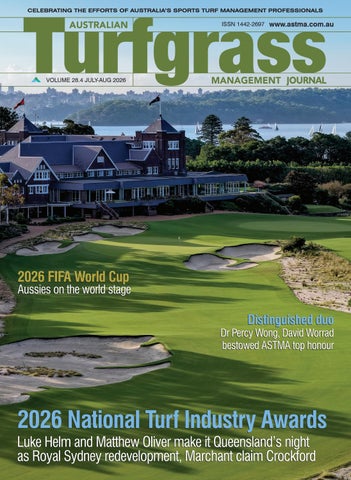
2026 National Turf Industry Awards
Luke Helm and Matthew Oliver make it Queensland’s night as Royal Sydney redevelopment, Marchant claim Crockford
PLATINUM PREMIUM PARTNERS
PREMIUM PARTNERS ASTMA PREMIUM PARTNERS PREMIUM PARTNERS The Australian Sports Turf Managers Association is indebted to the GOLD support of the following premium partner companies PREMIUM PARTNERS The Sports Association The Australian Australian Sports Turf Turf Managers Managers Association is is indebted indebted to to the the The Australian Sports Turf Managers Association is indebted to the support of the following premium partner companies support of the following premium partner companies support Sports of the following premium partner companies The Australian Turf Managers Association is indebted to the PREMIUM PARTNERS support of the following premium partner companies PLATINUM PREMIUM PARTNERS The Australian Sports Turf Managers Association is indebted to the PLATINUM support of theThe following premium companies PLATINUM Australian Sportspartner Turf Managers Association is indebted to the PREMIUM PARTNERS PLATINUM support of the following premium partner companies The Australian SportsSILVER Turf Managers Association is indebted to the GOLD JOURNAL
Published by the Australian Sports Turf Managers Association (ASTMA) Editorial Brett Robinson (Editor) Office: (03) 9548 8600 Mobile: 0434 144 779 Email: brett@astma.com.au Nick Creely (Reporter) E: nick@astma.com.au Advertising Pam Irvine Office: (03) 9548 8600 Mobile: 0402 069 489 Email: pam@astma.com.au Art Direction & Design Jo Corne
support of the following premium partner companies PLATINUM PLATINUM GOLD PLATINUM GOLD GOLD GOLD
Printed By Southern Impact Pty Ltd
Suite 1, Monash Corporate Centre 752 Blackburn Road, Clayton, VIC 3168 P: (03) 9548 8600 E: admin@astma.com.au W: www.astma.com.au ABN 96 053 205 888 ASTMA Board Ben Tilley (Headland GC, president), Troy Jordan (MOPT, treasurer), Damian Hough (Adelaide Oval), Mark Findlay (Werribee Park GC), Dennis Grounds (Royal Canberra GC) and Lance Knox (Busselton GC) Chief Executive Officer Mark Unwin Mobile: 0438 320 919 E: mark@astma.com.au Membership Allison Jenkins E: admin@astma.com.au Finance Manager Frank Joseph E: frank@astma.com.au Events and Education Simone Staples E: simone@astma.com.au Pam Irvine E: pam@astma.com.au RTO/Training Albert Sherry (National Training Mgr) E: albert@astma.com.au M: 0437 064 726
GOLD BRONZE GOLD SILVERSILVER SILVER GOLD SILVER SILVER SILVER
SILVER BRONZE SILVER The Australian Sports Turf Managers Association encourages all members to support BRONZE these companies who support your association BRONZE BRONZE BRONZE
BRONZE
Chris McCulloch (SA Training Mgr) E: chris@astma.com.au M: 0488 338 805
BRONZE BRONZE The Australian Sports Turf Managers Association encourages all members to support
AGCSATech Bruce Macphee (Senior Agronomist) E: bruce@astma.com.au Tim Fankhauser (Agronomist) E: tim@astma.com.au Amy Dingle (Agronomist) E: amy@astma.com.au
these companies who support your association The The Australian Australian Sports Sports Turf Turf Managers Managers Association Association encourages encourages all all members members to to support support The Australian Sports Turf Managers Association encourages all members to support The Australian Sports Turf Managers Association encourages all members to support these companies who support your association these companies companies who who support support your your association association these these companies who support your association The Australian Sports Turf Managers Association encourages all members to support these companies who support your association
www.facebook.com/TheASTMA www.linkedin.com www.instagram.com/the_astma Copyright © 2026
The Australian Sports Turf Managers Association encourages all members to support these companies who support your association The Australian Sports Turf Managers Association encourages all members to support The Australian Sports Turf Managers Association encourages all members these companies who support your association to support
The ASTMA believes that material sourced and produced for Australian Turfgrass Management is accurate, but gives no warranty in relation thereto, and disclaims liability for all claims against the ASTMA, its subsidiary companies, its employees, agents or any other person which may arise from any person acting on the materials contained within. No portion, in whole or part, may be reproduced without the written permission of the ASTMA
these companies who support your association The Australian Sports Turf Managers Association encourages all members to support JULY-AUGUST 2026
these companies who support your association
1
CONTENTS
10 LEAD STORY MEADOWBROOK’S MASTER HELM-SMAN
10
Meadowbrook Golf Club superintendent Luke Helm etched his name into the history books at the 2026 National Turf Industry Awards when he joined a rare group to have claimed two of the ASTMA’s major industry awards. Following on from the ASTMA Team of the Year Award in 2022, Helm topped a stacked field of superintendent finalists drawn from across the country to collect the ASTMA Excellence in Golf Course Management Award, sponsored by Envu. ATM editor Brett Robinson looks back on the body of work that Helm and his dedicated Meadowbrook crew have achieved in recent years and the key role they have played in the facility’s remarkable turnaround.
18
Cover: The new-look 18th at Royal Sydney Golf Club. Photo: Gary Lisbon/garylisbon.com.
42 FEATURES ALSO IN THIS EDITION… Foreword Thinking – Mark Unwin Best on ground – Melbourne 2026 pictorial ASTMA Education Update Around the Trade Association Reports/News Up the last... 2
4 6 56 60 66 72
Royal Sydney stays the course 18 Queensland’s pride 24 Distinguished duo 30 SACA’s turf spearheads 34 Graduates of the year 38 Pitching in on the world stage 42 Aussie expertise at the World Cup 46
AUSTRALIAN TURFGRASS MANAGEMENT 28.4
30
Going ‘A’ll ‘I’n
R
6 COLUMNS
JOHN FORREST KATE TORGERSEN
48 52
24 Contributors to Australian Turfgrass Management Journal Volume 28.4 (July-August 2026): Nathan Baker (Kingston Heath GC); Jake Carlaw (Australian Turf Club); Mark Doyle (STA Victoria); John Forrest (Forrest & Forrest Horticultural Consultancy); Luke Helm (Meadowbrook GC); Keith Johnson (QSTMA); Frank Joseph (ASTMA); Trent Kelly (SACA); Erik Kinlon (HG Turf Group); Adam Lamb (VGCSA); Justin Lang (Green by Nature); Steven Linskey (Meadowbrook GC); Gary Lisbon (garylisbon. com.au); Adam Marchant (Royal Sydney GC); Chris McCulloch (ASTMA); Matt McIntosh (Environmental Golf Solutions); Dave Meadows (Royal Adelaide GC); Tom North (Royal Hobart GC); Matthew Oliver (Suncorp Stadium); Tobey Phillips (Brisbane Racing Club); David Sandurski (The Gabba); Albert Sherry (ASTMA); Kate Torgersen (Environmental Golf Solutions); Mark Unwin (ASTMA); Tim Warren (TMSA); Dr Percy Wong; David Worrad (Living Turf).
emember when you used to chuck your name into Google to see what would come up? When my kids were younger they thought it hilarious to send me screenshots of photos they had discovered somewhere in the ether of me from 10-15 years ago – thanks, I know the years haven’t been kind! But have you tried doing that now using AI – ChatGPT, Claude and the like? I consider myself to be relatively tech savvy and like many I have been a keen observer as AI’s exponential rise impacts more and more on our personal and professional lives. It is certainly something that fascinates and, as an editor, is admittedly a tad scary as well given that one of AI’s abilities is to make everyone come across as a literary genius. I’m sure all superintendent reports to greens committees are now highly polished, professional pieces of prose and if not, well, they should be! One thing I can tell you straight off the bat, AI has revolutionised one of the most timeconsuming tasks of my role – transcribing and tidying up interviews. Game-changing! Back to my initial question… I put the following prompt into Open AI’s ChatGPT – “Tell me everything you know about Brett Robinson, editor of Australian Turfgrass Management Journal.” Within seconds it produced a 1990-word summation of my career which, despite a bit of repetition and a few date errors, was for the most part pretty accurate. Impressive. The only thing I took umbrage at was that it called my lengthy tenure as editor “unusual”. AI can be judgy it seems… In recent months, the topic of AI and how to harness it in a professional sense has featured at a number of sports turf industry events. At STA Victoria’s Annual Seminar in July, Tam Galahena, the founder of Enable AI, provided a great insight into just how rapid AI uptake has been and also provided a live demonstration of how quick and easy it is to combine multiple data sources to generate reports and using that process to teach AI to work for you going forward. An interesting suggestion he made for those dipping their toe into the AI pool for the first time was not to simply ‘ask AI’, but to ‘let AI ask you’, what he termed ‘reverse prompting’. He suggested the following: “Hey, you’re an AI expert. I would love your help and a consultation with you to help me figure out where I can best leverage Al in my life. As an AI expert, would you please ask me questions, one at a time, until you have enough context about my workflows, responsibilities, KPIs and objectives that you could make two obvious recommendations and two non-obvious recommendations for how I could leverage AI in my work.” It’s an intriguing exercise. If you are a follower of Penn State’s John Kaminski on LinkedIn you would have recently read his ‘Laid Bare & Well-Rolled’ missive where he asked AI to “run a golf course”. It’s a great read and goes through the resultant discussions and AI’s eventual solution… it fired the greens committee! Well, it termed the move an “organisational restructuring intended to reduce redundant decision-making and eliminate operational interference.” It seems AI has our backs! One local course superintendent who has been extremely proactive in the AI space in recent times is Andrew Anderson at Ranfurlie Golf Club in Melbourne’s southeast. As well as experimenting with automomous mower technology over the past couple of years, he has also deeply integrated AI into his daily course operations. Anderson is one of the real forward-thinkers of the industry and in the Winter 2026 edition of the VGCSA’s excellent quarterly newsletter ‘On Course’, he authored an article which described their set up, the collaborative AI workplace platforms they use, the benefits they bring and the lessons they are learning along the way. As he notes, “The more we put in, the more AI agents can draw on. It’s a bit like building our own internet, but with information specific to how we run.” The biggest shift, however, is that Claude (Anthropic’s AI assistant) now automates his monthly greens report. It collates all the data he and his staff collect across multiple platforms as the month goes by. Come the end of the month it generates a comprehensive, data-driven report, with Anderson only needing to proofread for accuracy and add in photos. The time it saves has been game-changing and allows him to spend his time far more productively. As a final thought on AI, three years ago in ATM Volume 25.5 (September-October 2023), the late great Peter McMaugh AM, at the ripe old age of 87, delved into the topic of AI. While his column was more about discussing AI’s potential in the scientific space, ever the pragmatist he sagaciously summed up his overall thoughts on the new technology… “AI is a tool. How you use it and the information you feed into it is the critical factor to making it work for you. The only danger that AI poses for the world is its potential misuse by the crackpot fringe of society to disseminate their conspiracy theories. Don’t ignore that, be very aware of it. But equally, don’t ignore its potential to help provide enormous benefits if we embrace it and use it intelligently and morally for the benefit of everyone.” Enjoy the read…
Brett Robinson, Editor JULY-AUGUST 2026 2025
3
FOREWORD THINKING WITH MARK UNWIN, CEO
Strong engagement, connections highlight Melbourne 2026
I
t has certainly been a busy and rewarding couple of months at the Australian Sports Turf Managers Association (ASTMA), highlighted by the successful delivery of the Australian Sports Turf Management Conference & Trade Exhibition at the Melbourne Convention and Exhibition Centre in June. For the ASTMA team, the conference represents the culmination of many months of planning and it was fantastic to see the industry come together once again. Held in conjunction with Golf Management Australia (GMA) for the third time since 2022, across the three days more than 2500 people from the golf and sports turf industry attended the event. It was another outstanding gathering of turf managers, industry representatives, educators, researchers and suppliers from across Australia and internationally. The strength of the conference has always been its ability to bring our industry together, particularly with the development of a combined event with GMA providing a platform for shared learning and engagement which will continue to lead to an increased understanding of the challenges and issues faced by course management teams. While the education program and exhibition remain central to the event, equally important are the conversations in the hallways, the connections made during the event and the opportunity to catch up with colleagues and friends from around the country. This year was certainly no exception and it was particularly pleasing to see such strong engagement throughout the week. The week kicked off with the ASTMA Golf Championship at the magnificent Woodlands Golf Club. The course provided an outstanding setting for the event and was presented in exceptional condition. Our thanks go to course manager Sam Langford and his team, along with everyone at Woodlands for their hospitality and for welcoming our members to such a wonderful venue. I would also like to acknowledge and thank ASTMA Platinum Partner Toro for their ongoing support of our national championships. Events such as these provide an important opportunity for members to connect in a relaxed environment before the conference gets underway, with Toro’s support helping to make that possible. Congratulations to 2026 victor Shaun Page from Southern Golf Club, his second Toro Red Jacket. Another important component of conference is the National Turf Industry Awards, which present an ideal opportunity to recognise outstanding achievements and the emerging professionals within our industry. In front of a record audience at the gala awards dinner held at Crown’s Palladium Ballroom, the evening saw Royal Sydney Golf Club director of grounds Adam Marchant bestowed the 4
industry’s highest environmental accolade – the ASTMA Claude Crockford Sustainability and Environment Award, sponsored by Gold Partner Syngenta. Matthew Oliver (Suncorp Stadium) won the ASTMA Excellence in Sportsfields and Grounds Management Award, sponsored by Toro, while the South Australian Cricket Association team, led by Trent Kelly, were recognised for their excellence in taking home the ASTMA Sports Turf Management Team of the Year Award, sponsored by Bronze Partner Repco Commercial. The awarding of the association’s longestrunning accolade, the ASTMA Excellence in Golf Course Management Award, sponsored by Silver Partner Envu, was a highlight of the evening, with Luke Helm (Meadowbrook Golf Club, Qld) announced as the 2026 winner. Nominees for the award are taken from each of the state superintendent association Excellence Award programs, making it a truly national award. We had a very strong field this year and congratulations go to the other finalists – David Stone (Pymble GC, NSW), Sam Smith (Willunga GC, SA), Anthony Toogood (7 Mile Beach, Tas), Rod Tatt (Mount Lawley GC, WA) and Leigh Yanner (The National GC, Vic). Graduate of the Year judging was also completed with all state winners present and in line to take home the national award. The quality of finalists continues to demonstrate that the future of our profession is in very capable hands. Our congratulations go to Nathan Baker (formerly Byron Bay GC, now at Kingston Heath) on winning the golf category
AUSTRALIAN TURFGRASS MANAGEMENT 28.4
and Tobey Phillips (Brisbane Racing Club) for winning the sportsfields and grounds category. To cap off a bumper night the ASTMA also recognised two stalwarts of the industry, with Dr Percy Wong and David Worrad bestowed the ASTMA Distinguished Service Award. You can read more about all our award winners later in this edition. This year’s conference also marked a significant milestone with the announcement of the inaugural recipients of the Peter McMaugh Scholarship. Peter’s contribution to turf management, research and education in Australia and internationally is difficult to overstate, with the scholarship providing an important way of continuing that legacy by supporting learning, development and innovation within our industry. Congratulations to recipients Tom North (Royal Hobart GC) and Jake Carlaw (Royal Randwick) and we look forward to following their development and seeing the knowledge and experiences generated through the scholarship shared across the broader turf community. Education again formed the foundation of the conference program, with an outstanding mix of Australian and international speakers sharing their knowledge and experience across a broad range of topics. From technical turf management and agronomy through to leadership, people management, innovation and the challenges facing our industry, the program provided plenty of practical information and new ideas for delegates to take back to their workplaces. While the conference has understandably occupied much of our attention in recent months, our focus now turns to the next range of industry programs and initiatives. One of those is the Future Turf Managers’ Initiative (FTMI), with applications now open. The FTMI, presented in conjunction with Silver Partner Jacobsen, has established itself as an industryleading management development program, designed to support turf professionals who are looking to further develop their leadership and management capabilities. The program provides participants with access to experienced industry leaders, practical management development, mentoring and the opportunity to build relationships with likeminded turf professionals. I strongly encourage all members who are looking to develop their leadership skills and prepare themselves for future management opportunities to consider applying. Likewise, for superintendents and senior turf managers, I encourage you to identify emerging leaders within your teams and support them in putting forward an application. Investing in the development of our people remains one of the most important things we can do to strengthen the future of our industry.
PHOTOS: BRETT ROBINSON
MELBOURNE 2026
1
Conference
connections ATM takes a pictorial look back at the highly successful 2026 Australian Sports Turf Management Conference and Trade Exhibition in Melbourne, the third combined ASTMA and Golf Management Australia event.
2 6
3 AUSTRALIAN TURFGRASS MANAGEMENT 28.4
PAGE WINS AT WOODLANDS Southern Golf Club superintendent Shaun Page collected his second Toro Red Jacket after claiming the 2026 ASTMA Golf Championship at Woodlands Golf Club. Page reprised his 2022 performance, securing the title on a countback from Sanctuary Lakes’ counterpart Josh Lacey who won the nett title. Page also anchored the Victorian team for its first state teams title in 23 years! Photos: 1. ASTMA Golf Championship winners (from left) Lacey, Page and stableford winner Steve Pellatt (Blackwood GC, SA); 2. International guest presenter Dr Doug Soldat (University of Wisconsin-Madison); 3. Former Australian netball captain Liz Ellis.
4
5
6
KURT FEARNLEY HEADLINES STACKED PLENARY SESSION Australian Paralympian great Kurt Fearnley (pictured right) capped off a diverse Plenary session on the opening day of the Melbourne conference. He was joined by the likes of Daniel Flynn, Liz Ellis, Dr Karl, Gary Pert and Lindsey Leigh Hobson, with leading sports journalist Neroli Meadows acting as MC for the day which was a combined session with GMA delegates. Fearnley’s powerful closing keynote presentation was one of the best of the week, during which he outlined his remarkable achievements as an athlete and disability advocate, including the inspiring story of how he crawled the Kokoda Trail in PNG. Photos: 4. Gary Pert; 5. Plenary MC Neroli Meadows; 6. Dr Karl Kruselnicki; 7. Lindsey Leigh Hobson; 8. Kurt Fearnley.
7
8 JULY-AUGUST 2026
7
MELBOURNE 2026
10
11 9 BUMPER TRADE EXHIBITION More than 130 companies and organisations servicing the golf and sportsfield industries exhibited across the two days of the 2026 Australian Sports Turf Management Conference Trade Exhibition. ASTMA and GMA partner companies combined to ensure this was one of the biggest exhibitions in recent times, with the show covering 6000 square metres of floor space which was sold out months in advance. Photos: 9. Northbridge GC superintendent Luke Diserens (CSTM); 10. Plenary speaker Daniel Flynn; 11. NT Cricket’s Jake Pavlich; 12. Settlers Run’s Brenton Clarke (CSTM) at the VIP Trade Exhibition opening; 13. Trade and tech guru Nadeem Zreikat (Campbell Chemicals) livestreams during the exhibition; 14. David Thomson and Brent Hull ready to tee off; 15. Flemington’s Liam O’Keeffe; 16. “Doctor” James Cronk; 17. All laughs and smiles at the Nuturf stand.
16 8
12
13
14
15
17
AUSTRALIAN TURFGRASS MANAGEMENT 28.4
STANDING ROOM ONLY The dedicated Golf and Sportsfield streams were fully subscribed across the Wednesday and Thursday of conference week as delegates once again enjoyed listening to their fellow colleagues speak on their facilities and the many projects they have been involved with over the past year. Due to a late influx of registrations in the final three weeks before the conference, there was standing room only in many of the Golf stream presentations. Photos: 18. Former Royal Melbourne now Metropolitan superintendent Richard Forsyth; 19: AGCSATech agronomist Amy Dingle; 20. Comedian Dave Thorton entertains at the National Turf Industry Awards dinner; 21. Thursday’s closing keynote Sean Bell; 22. Adam Marchant’s session on the Royal Sydney Golf Club redevelopment was very popular; 23. From left, GMA delegate David Burton and Kiwi delegates Dylan Griffin, Holly Kenyon and Andy Woods get called up on stage.
21
18
19
20
22
23 JULY-AUGUST 2026
9
NATIONAL TURF INDUSTRY AWARDS
Meadowbrook’s master
Helm-sman
At the 2026 National Turf Industry Awards, Luke Helm from Meadowbrook Golf Club was announced as winner of the ASTMA Excellence in Golf Course Management Award, sponsored by Envu. ATM editor Brett Robinson looks back at the body of work that he and his dedicated crew have achieved in recent years and the key role they have played in the Queensland facility’s remarkable turnaround.
L
uke Helm loves his cars. As you read this edition of Australian Turfgrass Management Journal, the Meadowbrook Golf Club superintendent will be sitting among hundreds of thousands of fans in the heaving stands of the Autodromo Nazionale Monza, the spiritual home of Italian motor racing and historic venue of the Italian Formula 1 Grand Prix. An unabashed, card-carrying member of the ‘Tifosi’ – Ferrari’s mad-cap, redclad global fan base – Helm will be shoulderto-shoulder with a passionate Prancing Horse brigade alongside his 15-year-old son Brock, a father-son bucket list trip if ever there was one. 10
As a teenager himself, Helm only ever had one goal in mind – to become a mechanic. He was obsessed with cars throughout his formative years in Sydney, a passion derived via osmosis from his dad Mark, a truck driver who was, by nature of his trade, a very adept mechanic also. Dad was a proud Ford man – a devotee of multiple Bathurst winner Allan Moffat – but his young charge would stake a claim in the Holden camp, much to his dismay.
AUSTRALIAN TURFGRASS MANAGEMENT 28.4
The young Helm idolised the great Peter Brock and it was therefore no surprise that when he became a father himself later in life that he named his son after two of the most influential figures in his life – ‘Brock Mark Helm’. Surprisingly, however, it would be his dad who would steer Helm down the path of greenkeeping. Although he got his son’s passion for cars, he thought the pay as a mechanic wasn’t great and felt he would be better off in another industry. It was around this time that Helm had started taking up golf and began noticing the work of the greenkeepers at his local course. He had always mowed the lawn at the family
Meadowbrook Golf Club has undergone a complete transformation since 2017 and is now regarded as one of Queensland’s highest-volume and most respected public golf operations Pictured inset: Superintendent Luke Helm receives the ASTMA Excellence in Golf Course Management Award and celebrates with general manager Steve Linskey (left) and apprentice Ethan Gale
PHOTOS: LUKE HELM AND BRETT ROBINSON
Pictured bottom: The Meadowbrook GC crew
home and thought working on a golf course looked pretty cool. When Helm mentioned it to his dad he was all for it. He started off by doing some work experience at Parramatta Stadium and Penrith Golf Club, before eventually landing an apprenticeship at Rum Corps Barracks Golf Club, a small nine-holer in Windsor. Until Helm was old enough to get his driver’s license, his dad would ferry him to and from work each day despite being unwell. Early into Helm’s apprenticeship, his dad had taken ill and sadly, in the months before he was due to complete, Helm lost the one person he looked up to the most and aspired to be like. Twenty-three years later and that loss is still acutely felt by Helm, but as he is quick to tell you, without his dad he wouldn’t be the man he is today. Fast forward to June 2026 and standing on the stage in Crown’s Palladium Ballroom at the National Turf Industry Awards and Helm was certainly thinking about his old man and how proud he would have been to see him in that moment. Having just collected the ASTMA Excellence in Golf Course Management Award, sponsored by association Silver Partner Envu, Helm was regaling the 340-strong audience with the story about how his dad had convinced him to eschew a career as a mechanic for a better paying job. The irony of that certainly wasn’t lost on his fellow greenkeepers and it drew one of the biggest laughs of the night. “Thanks to the ASTMA and Envu for the award and to my old man,” beamed Helm as he clutched the trophy. “I always wanted to be a mechanic, but dad said there wasn’t enough money in it… so I became a greenkeeper instead! He pushed me in this direction. I absolutely love this industry and it has made me who I am today as a man, and a dad, so thank you for being part of a very special occasion for me.” It was indeed an exceptional evening for Helm and Meadowbrook where he has been superintendent since 2017. In collecting the ASTMA’s longest-running award, Helm joined the elite of his profession, holding off a strong field of finalists drawn from across the country that included David Stone (Pymble GC), Sam Smith (Willunga GC), Anthony Toogood (7 Mile Beach), Rod Tatt (Mount Lawley GC) and Leigh Yanner (The National GC, Vic). It was also Helm’s second ASTMA Award in four years, having received the ASTMA Sports Turf Management Team of the Year Award with his crew alongside Sydney’s Lynwood Country Club at the 2022 conference. In the days after receiving the latest award, Helm took to social media, paying tribute to his course crew, Meadowbrook and his family for the key roles they have played in helping him achieve such recognition. JULY-AUGUST 2026 11
NATIONAL TURF INDUSTRY AWARDS “It has been a remarkable period of transformation for Meadowbrook and working alongside Luke throughout this time has been a privilege,” says general manager Steven Linskey, who was on hand in Melbourne to watch Helm collect his award. “What Luke has achieved during his time here has been extraordinary, particularly given the unique operational challenges of our business model. “As a privately operated facility managing extremely high golfer volumes across a 27-hole course, budgets and resources can be extremely tight. Despite these constraints, Luke has continually found innovative and economical ways to maximise available resources while consistently improving the presentation, playability and infrastructure of the golf course year after year. “The growth of the business during Luke’s tenure speaks volumes. Since 2017, we have increased green fee revenue by a remarkable 477 per cent, with the number of rounds expected to hit 150,000 in the coming 12 months. Those participation numbers create enormous pressure on turf management, course presentation, infrastructure and staffing, yet despite this Luke continues to present the golf course to an exceptionally high standard while delivering major in-house construction and improvement projects.” Meadowbrook is currently undertaking a long-term program to convert its 328 couchgrass greens to TifEagle. Ten of 30 greens have been completed, with the overall aim to improve surface performance and playability
COURSE MANAGEMENT AND CONSTRUCTION
“Since starting in the turf industry in 1999, it’s been an incredible journey full of challenges, growth and opportunities,” wrote Helm. “I feel very lucky to work in an industry I’m truly passionate about. A huge thank you to my incredible team at Meadowbrook Golf Club. Through floods, extreme weather, course improvements and everything else thrown our way, achievements like this are only possible because of the dedication and pride shown by the people around me every day. “Most importantly, thank you to my family and my three boys for their love and support throughout the journey. The early mornings, long days and challenges that come with this career make moments like this even more special. Thank you for this incredible honour.”
The past 12 to 24 months in particular have been among the busiest and most demanding the club has ever experienced, with record golfer participation, increased cart and foot traffic, major weather events and ongoing construction projects all running simultaneously. One of the core philosophies driving Helm’s management approach is completing as much construction and improvement work in-house as possible, significantly reducing costs while providing his small team with invaluable experience. “Despite operating with a team of six, including four apprentices, we have continued to deliver large-scale in-house projects while managing daily course presentation and member expectations at record numbers,” reflects Helm, who is a designated Certified Sports Turf Manager (CSTM) through the ASTMA’s Certification Program. “On the weekends we now exceed 400 golfers per day, with peak holiday periods reaching up to more than 550. Managing these volumes while also continuing to deliver capital improvement projects can be pretty challenging, but with good planning and a hard-working team we have been able to consistently achieve these.” Over the past year, the Meadowbrook team has completed three full green rebuilds, two additional greens drainage upgrades, the full
REMARKABLE TRANSFORMATION Having begun his career in Sydney, which included stints at Rum Corps Barracks, Ashlar Golf Club and Windsor Golf Club over a nine-year period, in 2009 Helm moved to the Gold Coast. He eventually landed at Colonial Golf Club (now Palmer Colonial) in mid-2010, working under experienced superintendent Mark Hauff and rising to be his assistant. That would ultimately help set him up for the next step in his career which came in 2017 when the superintendent role was advertised at the 27-hole Meadowbrook Golf Club. 12
In what was his first superintendent posting, Helm was employed by the Linskey family who had just taken over the long-term lease of the Logan-based facility with a view of turning it into a community hub. While Tom Linskey, a well-known teaching pro, and his son Steven had their work cut out from an operational point of view, as Helm quickly discovered he too was in for a huge challenge. The course was in poor condition and faced significant challenges from both an agronomic and infrastructure perspective, while it was also constantly at the mercy of the elements due to its proximity to the Logan River. Helm has lost count of the number of times the course has flooded during his tenure, but reckons it would now be upwards of 30. Through Helm’s dedication, leadership, innovation and agronomic expertise, the golf course has undergone a complete transformation in the years since and has helped drive the facility to become one of Queensland’s highest-volume and most respected public golf operations. The course now regularly accommodates upwards of 400 golfers per day alongside the driving range, mini golf, clubhouse and function facilities. Rounds have increased from 48,000 in 2018 to more than 132,000 rounds in the current year, with that number continuing to grow.
AUSTRALIAN TURFGRASS MANAGEMENT 28.4
NATIONAL TURF INDUSTRY AWARDS As well as greens conversion, Meadowbrook has undertaken multiple greens drainage upgrades where existing systems have failed
Greens drainage: In addition to the greens conversion, Meadowbrook has also undertaken multiple greens drainage upgrades where existing systems had failed. Completed in-house, new herringbone pattern systems were installed to improve water movement through the greens profile and provide quicker surface recovery after major rainfall events.
reconstruction of the 10th and 18th fairways and progressive irrigation communication upgrades. All these were delivered in-house, on budget and during one of the wettest construction periods in recent memory. The projects have included… Greens reconstruction and TifEagle transition: Meadowbrook is currently a third of the way through a long-term program to convert its 328 couchgrass greens across to TifEagle, with the overall aim to improve putting surface performance, consistency, firmness and long-term playability. Prior to the program, a number of the existing greens were becoming increasingly grainy and thatch-heavy, particularly during high-play periods and wet weather. This produced softer, less consistent surfaces demanding aggressive cultural practices to maintain acceptable playing conditions. TifEagle was selected for its ability to produce firmer, smoother, truer putting surfaces with significantly reduced grain and
thatch. TifEagle also offers improved disease resistance, lower chemical requirements and better year-round density. All works are being completed entirely in-house and is providing genuine construction experience across drainage, profiling and turf establishment for Helm’s young crew. “The transition to TifEagle has been highly successful and extremely well received by members and social golfers,” says Helm. “The feedback has been overwhelmingly positive and they regularly comment on the improved speed, smoothness, consistency and overall playability of the putting surfaces. “The most significant improvement is the TifEagle’s ability to maintain density throughout the cooler months and in high-traffic areas across the greens, which has historically been a major challenge with our older 328 greens. Having reduced grain and thatch has also significantly altered our practices, with far less aggressive and less frequent cultural work now required while still delivering superior playing conditions.”
Fairway reconstruction: Over the past year the 10th and 18th fairways were reconstructed. Both fairways sit directly in front of the clubhouse and are among the highest-profile areas on the course. Prior to reconstruction, significant wear, erosion and thinning turf coverage had built up due to extreme weather events, such as floods, and heavy traffic. All works, including sub-base grading, growing medium installation and Wintergreen couchgrass grow-in, were completed in-house. The result has been an improvement in turf coverage and surface consistency, enhanced playability and drainage performance and improved aesthetics. Irrigation infrastructure upgrades: Meadowbrook’s irrigation communication system is now more than 35 years old, with the original cabling becoming increasingly fragile and prone to failure. Helm has initiated a progressive upgrade of the communication network to improve system reliability and reduce operational issues. All trenching, installation and wiring has been completed in-house, helping to reduce contractor costs while building internal irrigation expertise. Fire ant suppression program: In recent years, Meadowbrook experienced a noticeable increase in fire ant activity across the property. Recognising the growing risk to course operations and community safety, Helm implemented a proactive suppression program in conjunction with the National Fire Ant Eradication Program. Two trained specialists educated Helm, his staff and around 15 club members on fire ant identification, treatment, suppression and monitoring, creating a dedicated inspection network that now actively monitors the course on a weekly basis. Such a program has seen a significant reduction in nest numbers across the property and created an ongoing community awareness culture about the issue, in addition to promoting stronger member engagement with their course and its care. Over the past year the 10th and 18th fairways were reconstructed to remedy wear, erosion and thinning turf coverage that had built up due to multiple flood events and heavy traffic due to increasing rounds
14
AUSTRALIAN TURFGRASS MANAGEMENT 28.4
RESILIENCE MATTERS In his first year in charge at Meadowbrook, Helm clearly recalls having to nurse the course through an extended period of drought, recording just 550mm for the year. Since then, however, it has pretty much been the exact opposite and Helm and his team have regularly contended with minor and major flood events and reinstatement of the course. Meadowbrook is a victim of its own location, residing on a floodplain within close proximity of the Logan River. Slacks Creek borders the club’s eastern boundary and heavy rainfall upstream in the Gold Coast hinterland often results in flood waters inundating the property. Among the worst was in March 2022 when the region experienced huge rainfall totals. That year’s event took to 10 the number of floods Helm had recovered his course from in a 14-month period. The past 12 months again saw Helm and his team face multiple flood events as well as a tropical cyclone. In March 2025, Alfred slammed into southeast Queensland and like many facilities Meadowbrook took a big hit. More than half a metre of rain fell in a few days leaving 23 of 30 greens submerged and large sections of the course inaccessible. Severe winds meant numerous trees were either damaged or completely lost, while the inundation left extensive silt deposits and debris across the course. Well versed in these sorts of events and having fine-tuned their clean-up processes, as soon as the floodwaters started receding Helm and his staff immediately began their recovery operations – debris and silt removal, surface clean-up, turf recovery treatments, drainage management and restoring safe access throughout the property. The golf course was returned to play quickly without the loss of
The past 12 months again saw Helm and his team reinstate the course after floods and Tropical Cyclone Alfred
turf or the playing surfaces, reflecting both the technical competence and genuine resilience of the entire team. “The way Luke manages Meadowbrook through multiple flood events each year is impressive,” says Linskey. “The resilience, organisation and calm leadership he displays during these events is remarkable. His ability to recover the golf course quickly and safely while maintaining standards and, more importantly, staff morale is something I have always greatly admired.”
LEADERSHIP AND ENGAGEMENT Aside from the ongoing course improvement works and unstinting efforts when needed to reinstate the course after major floods, a major focus throughout Helm’s tenure at
Meadowbrook has been the development of apprentices and the creation of a strong, positive team culture. Both of Meadowbrook’s current qualified senior staff – Lance Woodham and Jack Wojcicki – originally completed their apprenticeships under Helm’s supervision before progressing into leadership roles. Many former apprentices have also gone on to successful positions at other clubs throughout the industry. Leading by example, Helm has created a relaxed and supportive environment where staff enjoy coming to work, while maintaining clear standards of professionalism, respect, punctuality and accountability. Honesty, hard work, reliability and mutual respect are core values of everything the team does.
IMPROVING YOUR GAME
For almost four decades, Campey Turf Care Systems has provided customers with honest, practical advice and supplied market-leading, innovative turf care machinery worldwide, all backed by the highest standards of customer service and product support. We continually research new techniques and refine existing practices to help turf care professionals achieve perfection. For more information www.campeyaustralasia.com JULY-AUGUST 2026 15
NATIONAL TURF INDUSTRY AWARDS During his tenure at Meadowbrook, Helm has continually found innovative ways to maximise available resources while consistently improving the presentation, playability and infrastructure of course
FUTURE FOCUS
“One of the most rewarding aspects of my role is watching apprentices develop over time,” says Helm. “Seeing young people gradually evolve into qualified tradesmen and capable turf managers is genuinely one of the most enjoyable parts of the job. “The amount of in-house construction and improvement programs at Meadowbrook help to create learning opportunities for our apprentices. They gain real experience in drainage, irrigation, construction, turf establishment, machinery operation and course presentation which helps in building their skills and confidence and ensures they take pride in their work.” Adds Linskey: “One of Luke’s greatest strengths is his ability to lead and motivate people. The professionalism, pride and work ethic throughout his maintenance team are a direct reflection of his leadership style. “Luke has created an environment where staff genuinely enjoy coming to work. The development of apprentices and young turf managers under his guidance has been particularly impressive and is a credit to the time and effort he invests in mentoring his team.”
A crew highlight each year is preparing the course for the Greenkeepers Revenge Day, with all funds raised going to the Movember charity which raises awareness of men’s health issues. While it is a whole of club event, the reason behind Helm getting it up and running at Meadowbrook is extremely personal. It will be seven years this November that Helm lost his best mate Daniel after he tragically took his own life. The pair had been inseparable since the age of four and, like the passing of his father, the loss of his best mate still cuts deep. By supporting Movember, Helm is doing his little bit to raise awareness of mental health issues, while the Greenkeepers Revenge Day has morphed into one of the most popular events on the club calendar. Close to 100 golfers now participate each November in a fun afternoon of golf, featuring creative hole setups and fundraising activities organised by the course staff, and in the past three years has raised $30,000. “The day has become more than just a fundraiser,” states Helm. “It creates a genuine sense of community within the club, bringing members and staff together while supporting an important cause.”
With several major programs already well underway, Meadowbrook Golf Club is continuing to remain ambitious and has a number of well-structured plans for the coming years to continually improve its offering to members and the community. Over the next 18-24 months, the focus remains on infrastructure modernisation, with future plans including the progressive replacement of pumps, hydraulic infrastructure and pipework as part of a staged long-term strategy. The ongoing greens transition to TifEagle (10 greens have been completed to date) will continue at two greens per year, while concurrent fairway levelling and reconstruction projects will further improve drainage, presentation and playability throughout the property. Future construction works will include the redevelopment of practice facilities linked to the club’s new paddle court development, with new practice greens, bunkers and surrounding practice areas to elevate the overall golfer experience. Long-term planning and continuous improvement are central to Helm’s management philosophy and Linskey knows they are fortunate to have one of the industry’s best operators leading them into the next phase of their evolution. “Luke is one of the most dedicated, knowledgeable, hardworking and respected turf managers I have had the pleasure of working alongside,” says Linskey. “His commitment to excellence, leadership of staff, innovation, resilience under pressure and ongoing pursuit of improvement make him an extremely worthy recipient of the award. “From an agronomic perspective, Luke’s knowledge and practical expertise are world class. His understanding of all aspects of turfgrass management and golf course construction is exceptional, but it’s his ability to apply that knowledge under challenging realworld conditions that truly sets him apart. “Beyond the quality of the golf course itself, Luke has played a major role in the continued growth and reputation of Meadowbrook. The improvements made under his leadership have significantly enhanced the overall golfer experience and have contributed heavily to the club’s increased popularity and commercial success. The difference between where the facility stood in 2017 and where it stands today is truly night and day.” Over the past three years, Meadowbrook’s Greenkeepers Revenge Day has become a popular event on the club calendar, raising $30,000 for the Movember men's health charity
16
AUSTRALIAN TURFGRASS MANAGEMENT 28.4
The turf seed behind our nation’s greatest sporting events
Visit our website today pggwrightsonturf.com.au
NATIONAL TURF INDUSTRY AWARDS In the 18 months since opening its new Gil Hanse-designed course, Royal Sydney Golf Club has already achieved an incredible number of ecological and sustainability milestones
Royal Sydney stays the
course
The recent redevelopment of Royal Sydney Golf Club represented an environmental initiative delivered on an unprecedented scale in the Australian golfing landscape. It was therefore fitting that the club received the industry’s highest environmental accolade at this year’s National Turf Industry Awards.
“T
his is just the beginning.” You could feel the pride and sense of vindication in Adam Marchant’s voice as he addressed the audience at the National Turf Industry Awards in Melbourne this past June having just accepted the ASTMA’s Claude Crockford Sustainability and Environment Award, sponsored by Gold Partner Syngenta. Those who have followed the recent Royal Sydney Golf Club redevelopment will know that the road to get the project not only approved but then completed has been long and at times arduous. Indeed, a decade had effectively elapsed between Marchant receiving 18
Australian golf’s most coveted environmental accolade and when the club had first interviewed renowned architect Gil Hanse to reimagine its championship golf course all the way back in June 2016. Marchant was still assistant superintendent when, in August 2016, Royal Sydney officially announced Hanse as their man to head the redevelopment. Superintendent at the time was Kiwi Steve Marsden who had done a lot of the early groundwork and was a key driver
AUSTRALIAN TURFGRASS MANAGEMENT 28.4
in pushing for Hanse’s involvement. When he departed the club in 2018, Marchant was elevated to the top role which in time would change to ‘Director of Grounds’ to reflect the broad scope of his position. More than anyone else involved in the Royal Sydney project, Marchant has lived and breathed every aspect. Every committee and sub-committee meeting; every submission to council and court; poring over every in-ground schematic and architect drawing; every tree removed; every tree planted; the nearly 450,000 understorey plants that have gone into the ground to date; every ‘habitat log’ milled and placed around the course; every bunker shaped, lined and revetted; every
PHOTOS: GARY LISBON/GARYLISBON.COM
Left: Celebrating Royal Sydney’s Claude Crockford Award are (from left) Nicholas Robb, Des Mulcahy, Adam Marchant, Wendy Lloyd, Thomas Jones and Antony Wearne. Right: Marchant praised his team in his speech
roll of Santa Ana couchgrass sod laid; every Pure Distinction bentgrass green sown; and, overarching all of that, adhering to a strict and exhaustive Development Application, complete with 99 specific conditions, which always had the environment at the forefront. You can therefore garner some appreciation of what collecting the Crockford Award in front of his fellow greenkeeping cohort meant to Marchant. To prove what it also meant for the club, unbeknownst to Marchant, course superintendent Thomas Jones and biodiversity, safety and sustainability officer Wendy Lloyd were flown to Melbourne and together from the back of the room, standing alongside Royal Sydney director of golf Nicholas Robb and CEO Des Mulcahy, watched on as their colleague humbly accepted the award. “This project has meant the world to me,” Marchant told the more than 340-strong audience at Crown’s Palladium Ballroom. “I call it my ‘passion project’ and I’m excited to have been able to deliver it. Royal Sydney is such a progressive club and to withstand what we did, to fight the good fight and to be able to stand for what we are proud of has been extremely rewarding.
“We overcame a lot of hurdles to produce this end product and we couldn’t have done it without the support of the club, my team and the many consultants and contractors that formed part of the project. This is an award for Royal Sydney as a club, but also for my team who helped produce this project. “It’s something I’m extremely proud of. I’m grateful and humbled to be able to stand up here tonight and accept this award and I’m proud that we can be an advocate for the industry. This is just the beginning for Royal Sydney in the environment and sustainability space and I’m excited for what lies ahead.”
IMPROVING THE GROUND… Royal Sydney occupies one of the largest continuous green spaces within Sydney’s Eastern Suburbs, positioned within the Woollahra Municipal Council area in Rose Bay. Prior to the recent redevelopment, its championship course, host of multiple Australian Opens, was maintained in a traditional parkland style, characterised by extensive irrigated turf, limited understorey planting and relatively low ecological diversity. Such a landscape required significant water, fertiliser and chemical inputs to maintain
The stunning new par three 6th with its extensive plantings. As the course landscape flourishes, it offers the chance for seedbanking of these important native plant species
JULY-AUGUST 2026 19
NATIONAL TURF INDUSTRY AWARDS The project has resulted in a net increase of 1592 trees onsite, following the planting of 2187 new native trees. It has also created a thriving understorey, with 500,000 native plants going in-ground by 2027. Pictured is the 2nd and 3rd green sites
…WHILE STANDING THEIR GROUND
playability and presentation for Royal Sydney’s large and active membership base. The redevelopment has seen the course’s dramatic transformation to a native landscape which is in far greater harmony with the local ecology. The playing surfaces that Marchant and his team now maintain are integrated with extensive native vegetation zones, creating a more balanced environment that supports both high-quality turf performance and a far broader ecological function. Starting in late 2023 and completed in March 2025, the redevelopment, one of the largest golf course projects seen in Australia, has not only delivered a new Hanse-designed course (his first in Australia) but also provided a demonstration of a wider philosophy on purposeful use of golfing green space. A key motivation for the club was to make its grounds “one of the most significant sanctuaries of native flora and fauna” in Sydney’s Eastern Suburbs. Similarly, with its standing as one of Australia’s most historic and forward-thinking clubs, Royal Sydney knew it had a prime opportunity to redefine modern, sustainable golf course design and to demonstrate the mutually beneficial relationship that can exist between the sport of golf and the natural environment.
To achieve this, from the outset the club embraced goals from community and global organisations, including Woollahra Municipal Council’s Environmental Sustainability Action Plan and the United Nations’ Sustainability Development Goals (sdgs.un.org/goals.), in particular Goals 11 (‘Sustainable cities and communities’), 12 (‘Responsible consumption and production’), 13 (‘Climate action’), 15 (‘Life on land’) and 17 (‘Partnerships for the goals’) These formed the basis for decisions that were made in the project’s planning and delivery. “The project reflected a deliberate and long-term commitment by the club to environmental stewardship and best practice course management,” says Marchant. “From the outset, the club adopted a strategy to reduce the environmental footprint of the course while enhancing its ecological value. This included prioritising native landscape restoration, reducing high input turf areas and aligning the course with the natural systems of the local environment. “This commitment also extends beyond the delivery of the project, with the implementation of the Biodiversity Management Plan ensuring ongoing monitoring, conservation and active management of the landscape as a long-term environmental asset.”
Although principal construction of the new course took place over a 15-month period (between January 2024 and March 2025), planning and preparation for the project date all the way back to 2015 when Royal Sydney first identified a need for change on its historic, but ageing, golf course. That gathered momentum when Hanse, fresh off designing the Rio 2016 Olympic Course, was appointed as the club’s principal architect that same year. Hanse’s philosophy that a golf course should exist harmoniously with its natural environment, a key feature in many of his designs around the globe, resonated strongly with the club. To complement and fulfil this vision, the club also appointed Australian landscape architect Harley Kruse to oversee the creation of the project’s strategy for a natural, sustainable landscape. With the concept created, Royal Sydney worked with Cumberland Ecology to create its Biodiversity Management Plan (BMP). This comprehensive 217-page document detailed the crucial elements in delivering Royal Sydney’s environmental goals, including the specifications of 119 native plant species to comprise the landscape palate, planting patterns, landscape design methodology, wildlife habitat creation and regular, ongoing biodiversity monitoring and reporting. To ensure the club could deliver such a wide-reaching plan, early in the project’s development it identified a number of tree and plant nurseries to begin cultivating the native species that would inhabit the landscape. This allowed time for the nurseries to source the required species and begin their growth so that they could be planted in an alreadymatured state. The club also connected with La Perouse Local Aboriginal Land Council (with whom it had worked with previously) and consultants Coast History & Heritage to deliver an Aboriginal Heritage Management Plan. The club also performed an Aboriginal Cultural Heritage Assessment and archaeological test excavations before construction to help ensure indigenous history continued to be preserved onsite before, during and after the project. One of the club’s sustained focuses was ensuring the protection of onsite fauna during all phases of the project. Over the course of construction, consulting wildlife experts from The project ceded more than 14ha of mown turf to become native landscape areas. The creation of these areas and the endemic plant choices provides a 20 per cent reduction in water use. Pictured is the new 7th
20
AUSTRALIAN TURFGRASS MANAGEMENT 28.4
Cumberland Ecology conducted thorough documentation of animal habitats, as well as safe relocation of any animals potentially impacted. Regular wildlife monitoring and reporting will continue in the years ahead. Prior to construction, Royal Sydney also met with wildlife conservation organisations WIRES and Birdlife Australia to discuss opportunities for animal rehabilitation and habitation onsite. Of particular interest was providing sanctuary for injured and rescued wildlife offered within the newly created ‘Paperbark Wetland’ (more on this below). Although initially lodged in 2019, the project’s Development Application (DA) wasn’t approved until December 2022 after a NSW Land and Environment Court appeal ruling. In working extensively with the council and heeding the feedback of the community after the DA’s original lodgement, the club produced one of the most exhaustively detailed golf course renovation plans in Australian history, with the BMP a critical component of that. At more than 1000 pages, the DA included numerous expert reports on matters ranging from ecology and horticulture to flood planning and the extensive civil works involved. No stone was left unturned and was a testament to the club’s dedication and vision to providing an environmental initiative delivered at an unprecedented scale.
A NEW APPROACH In the 18 months since re-opening the new course, Royal Sydney has already achieved an incredible number of ecological and sustainability milestones. Perhaps the biggest outcome has been the fundamental shift in land management approach.
A ‘STOREY’ IN ITSELF
Floral diversity across the Royal Sydney site has quadrupled from 30 to 119 species, including critically endangered Eastern Suburbs Banksia Scrub
Rather than maintaining the entire site at a uniform level of intensity, the club has adopted a more deliberate model where land is managed according to function. High performance playing surfaces are prioritised, while non-essential areas have been transitioned to native landscape requiring significantly lower inputs. Overall, the project ceded more than 14 hectares of mown turf to become native landscape areas. The creation of these areas and the endemic plant choices provides a 20 per cent reduction in water use, saving up to 73 million litres annually, as well as a significant reduction in chemicals and fertilisers. It also has decreased mowing requirements, reducing energy and fuel consumption for turf maintenance machinery. “The project has allowed us to fundamentally rethink how we manage the turf here,” states Marchant. “By reducing maintained areas and investing in better infrastructure, we have been able to focus our resources where they matter most, resulting in improved playing surfaces with fewer inputs and greater long-term sustainability.”
Arguably one of the biggest components of the project related to trees and plants. The project has resulted in a net increase of 1592 trees onsite, following the planting of 2187 new trees of various native species. It has also created a thriving understorey, with 500,000 native plants going in-ground by 2027, with more than 445,000 completed as of August 2026. In order to satisfy the DA conditions, 250,000 of those had to be in the ground before the course could be opened, a huge undertaking. As part of their BMP, Royal Sydney has physically and digitally tagged each of the new trees planted (with existing trees already tagged). The tagging includes key information such as a unique identification number, species, when it was planted and the nursery from which it originated. The tagging data is inputted into geo-location software to create satellite mapping of all trees on the club’s property. This is then submitted to council and forms an important part of the club’s long-term biodiversity management. As a result of the significant plantings across the course, floral diversity has been quadrupled from 30 to 119. Many new species have been added, ranging from the largescale red bloodwoods to delicate flora such as fuchsia heath. Also included are numerous Eastern Suburbs Banksia Scrub (ESBS) species, listed as a ‘critically endangered ecological community’ in the NSW Biodiversity Conservation Act (2016). Importantly, as the championship course landscape matures and flourishes, it offers the chance for seedbanking of these important native plant species. Royal Sydney has already established relationships with three plant
A key motivation behind the Royal Sydney redevelopment was to make the site one of the most significant sanctuaries of native flora and fauna in Sydney’s Eastern Suburbs
JULY-AUGUST 2026 21
NATIONAL TURF INDUSTRY AWARDS Completed in March 2025, the redevelopment has seen the dramatic transformation of the course to a native landscape which is in far greater harmony with the local ecology. Pictured is the new 12th (old 13th) with the new 8.3ML irrigation dam in front of the new 16th tee complex
nurseries from across NSW – Apunga Native Nursery, Sydney Wildflower and Harvest Seeds & Native Plants – who regularly visit the club to collect seeds to help facilitate other native landscape restoration projects. Additionally, as a new 8.3ML irrigation dam was constructed as part of the redevelopment, the club took the opportunity to transform its old dam into a ‘Paperbark Wetland’ – the first of its kind in the local area. This included the planting of more than 200 paperbarks, creating a dedicated wetland habitat for a variety of fauna, particularly wetland birds. Among the wildlife now regularly seen in the wetland are Australian wood ducks and white ibises, as well as a wide array of amphibian and aquatic life. As well as the wetland, the project has greatly improved onsite biodiversity through the provision of wildlife corridors and restored bushland. Roughly 100 nesting boxes have been installed around the course to create homes for birdlife, while around 1000 ‘habitat logs’, repurposed from trees initially removed from the site, have been placed among grassy heath areas to provide habitats for reptiles, insects, amphibians and small mammals. The
club is also home to native bee habitats, which play a vital role in propagating the native flora. As now one of the most important sanctuaries of native flora and fauna in Sydney’s Eastern Suburbs, Royal Sydney aims to utilise the course for local biodiversity monitoring, native plant seedbanking and animal welfare programs, partnering with government and community organisations to achieve collective environmental goals. With an extensive floral diversity, unique animal habitats and the potential to safeguard rare and endangered flora and fauna, the course offers a rich array of potential ecological learnings. The club is already working with local schools to provide educational opportunities and has been approached by various TAFEs and universities to provide access for onsite case studies and research.
COLLABORATE, COMMUNICATE The redevelopment project was delivered within a highly engaged and scrutinised environment, requiring ongoing collaboration with council, community stakeholders and environmental experts across both the planning
and delivery phases. This played a critical role in shaping the final environmental and land management outcomes. The delivery of the project was shaped by a rigorous planning and consultation process, reflecting the increasing level of public and legislative scrutiny applied to environmental projects of this scale. From the outset, Royal Sydney undertook extensive engagement with its members, many of whom are local residents, to communicate the intent and environmental objectives of the redevelopment. As the approval process progressed, it became clear that a higher level of empirical data and environmental evidence was required to support aspects of the proposal, particularly in relation to existing tree conditions and landscape change. In response, the club undertook a more detailed and evidencebased approach, including comprehensive tree mapping, ecological assessment and the development of a formal BMP. The process also expanded to include broader community consultation and engagement with a wider group of environmental specialists. Through the formal planning pathway, including engagement with council and subsequent proceedings within the Land and Environment Court, the project was further refined. This process ultimately strengthened the environmental framework of the redevelopment, ensuring that outcomes extended beyond the course itself to deliver broader ecological benefit. Throughout the construction phase, the club maintained an open and transparent approach, regularly inviting council
The course redevelopment reflected a deliberate and long-term commitment by Royal Sydney to environmental stewardship and best practice golf course management
22
AUSTRALIAN TURFGRASS MANAGEMENT 28.4
representatives, community stakeholders and environmental experts to review progress and provide input. This engagement ensured that the project remained aligned with regulatory expectations and community interests. While a complex process, it was instrumental in shaping the final outcome and ensured that the course redevelopment is not only a high-quality sporting environment, but also a carefully considered and well-supported environmental initiative. Communicating that message was also a critical component. From early on, Royal Sydney conducted significant community engagement to share the project’s key learnings and opportunities. The creation of a dedicated website (https://royalsydney.club) provided a comprehensive background on the project and its ambitions and included regular videos, news and milestone updates and virtual tours for the wider community.
PASSION PROJECT While the redevelopment has been a collective effort, the exceptional environmental and golfing outcome delivered can be intrinsically linked to the leadership, dedication and passion of Marchant and his team. Marchant championed the project from its earliest planning stages and remained deeply committed to its long-term environmental
The club transformed its old irrigation dam into a ‘Paperbark Wetland’, the first of its kind in the area, creating a dedicated habitat for a variety of fauna
vision throughout every phase of consultation, approval, construction and establishment. Through a complex and often highly scrutinised process, Marchant’s resoluteness spoke volumes. He worked closely with contractors, consultants, environmental specialists and his own grounds team – led by senior staff Thomas Jones, Matt Broad, Christian Pink, Alistair Dunn, Kenny McNamee, Jerome Andrew, John Flaherty, Brandon Brightman and Wendy Lloyd – to help guide the project to completion. The result is a course that has not only delivered an exceptional experience for members and guests, it simultaneously established one of the most significant native landscape and biodiversity restoration initiatives undertaken within the Australian golf industry.
Importantly, the project remains ongoing. Under Marchant’s leadership, further planting (the remaining 55,000 plants will be in the ground by the year’s end), biodiversity monitoring and environmental refinement continue, ensuring the course continues to evolve as both a premier golfing environment and a long-term environmental asset. “We believe the new course provides a defining example of modern, sustainable golf course design and demonstrates the mutually beneficial relationship that can exist between the sport of golf and the natural environment,” says Marchant. “As part of that we are wanting to share the key learnings from what we have done and what we are doing to help inform similar initiatives undertaken by other clubs. “The course has only been open for 15 months yet people talk about it as though it has always been there and to me that’s the ultimate compliment. The architecture feels natural, the land feels settled and the course feels like it belongs. If a redevelopment can feel timeless after only a year then everyone involved has done a great job and as a club that is what we are most proud of.” Editor’s note: For more on the specifics of the Royal Sydney redevelopment, read ATM’s extensive coverage in Volumes 26.4 (JulyAugust 2024) and 27.3 (May-June 2025).
AGCSATech
Independent, Analytical, Diagnostic and Consultancy Services
l
EXPERT AGRONOMIC ADVICE
l
SOIL, PLANT AND WATER ANALYSIS
l
GOLF COURSE, SPORTSFIELD AND RACETRACK ASSESSMENTS
l
DISEASE AND NEMATODE ANALYSIS
l
COST EFFECTIVE NUTRITION AND MAINTENANCE PROGRAMS
l
WATER MANAGEMENT PLANS
l
l
AGCSATech
DESIGN AND CONSTRUCTION SPECIFICATIONS
DRONE DIAGNOSTIC I n dSERVICES e p e n d e n t , A n a l y t i c a ll , DPROJECT iagnostic and Consultancy Services MANAGEMENT AND AERIAL IMAGERY
The Australian turf industry’s leading provider of independent agronomic services.
CONTACT THE AGCSATECH TEAM (03) 9548 8600 Senior agronomist - Bruce Macphee bruce@astma.com.au 0409 183 710
Agronomist - Tim Fankhauser tim@astma.com.au 0422 418 038
Agronomist - Amy Dingle amy@astma.com.au 0498 852 063
www.astma.com.au/agcsatech JULY-AUGUST 2026 23
NATIONAL TURF INDUSTRY AWARDS
Queensland’s
pride
Suncorp Stadium grounds manager Matthew Oliver’s rise up the ranks is a culmination of hard work and a genuine love for the craft. The recent ASTMA Excellence in Sportsfields and Grounds Management Award winner opens up to ASTMA reporter Nick Creely about working at the iconic Queensland stadium.
N
o two days are ever the same in the world of sports turf management. Especially when it comes to managing the iconic turf of Australia’s busiest multipurpose sports and entertainment precinct. Suncorp Stadium grounds manager Matthew Oliver and his dedicated crew barely have time to blink these days, such is the intense nature of the Brisbane-based stadium’s relentless schedule. With around 60 or more major events annually, including domestic and international rugby league, rugby union, 24
football and major concerts, Oliver’s complex role requires careful planning, trust and composure often under extreme pressure. Oliver recently took out the Australian Sports Turf Managers Association’s (ASTMA) Excellence in Sportsfields and Grounds Management Award at the 2026 National Turf Industry Awards in Melbourne, a deserving recognition for a man dedicated to not only his craft but improving on and giving back to the industry through education and mentoring. The national award was first handed down in 2021 at the Gold Coast conference, with
AUSTRALIAN TURFGRASS MANAGEMENT 28.4
Oliver becoming the first Queensland-based sports turf manager to be bestowed the honour, which recognises excellence in turf management and operations at a sportsfield and ground facility. He joins a strong list of past winners including Peter Foreman (Adelaide Oval), Chris Hay (Tasracing), David Wark and Kris Charlton (Glenelg Oval), Marcus Pamplin (Ninja Stadium) and Matthew Cairns (Blacktown International Sportspark). It also nicely complements the ASTMA Sports Turf Management Team of the Year Award,
PHOTOS: SUNCORP STADIUM AND MATTHEW OLIVER
With around 60 or more major events annually, including domestic and international rugby league, rugby union, football and major concerts, Suncorp Stadium is Australia’s premier rectangular, multipurpose stadium
sponsored by Bronze Partner Repco Commercial, that Oliver and his team collected at the 2024 national conference in Brisbane. Sponsored by ASTMA Platinum Partner Toro Australia, the excellence award came as a “genuine surprise” for Oliver who paid tribute to his dedicated Suncorp Stadium team. “You never go chasing awards, you simply focus on preparing the best possible playing surface you can for every event, every time,” says Oliver. “To be recognised by your peers is incredibly humbling because they understand what goes into the job behind the scenes. “After having some time to reflect, I see it as recognition for far more than just myself. It’s a reflection of the entire team at Suncorp Stadium. We’re a relatively small group managing one of the busiest stadiums in the world and everyone plays a role. The award belongs just as much to them as it does to me. We take enormous pride in what we do, and it’s nice to see that recognised by the industry.” Adds Suncorp Stadium general manager Darren Burden, who together with the Stadiums Queensland team nominated Oliver for the national award: “Since joining Suncorp Stadium, Matthew has set a benchmark for excellence. His role is all-encompassing, Across four consecutive nights in February 2026, Suncorp Stadium hosted The Royal Edinburgh Military Tattoo which ended up winning the Event of the Year Award at The Stadium Business Awards 2026
JULY-AUGUST 2026 25
NATIONAL TURF INDUSTRY AWARDS
ALL IN A DAY’S (AND YEAR’S) WORK AT BRISBANE’S SUNCORP STADIUM
S
uncorp Stadium is Australia’s premier rectangular, multi-purpose stadium, hosting around 60 major events annually. The venue regularly accommodates 37-plus rugby league domestic and international fixtures (including NRL Magic Round), men’s and women’s State of Origin representative matches, 10-plus rugby union matches (including internationals) and 10-plus football fixtures, alongside a significant number of major concerts. Recent Queensland Government policy changes have increased the annual concert cap to 21, placing further demand on the playing surface. The stadium successfully hosted eight matches during the 2023 FIFA Women’s World Cup and looking ahead will play a major role in two other major international tournaments over the coming 15 months. It will host three matches during the 2026 Rugby League World Cup – an Australia v Fiji men’s pool match and the men’s and women’s finals which will be played as a doubleheader on Sunday 15 November. Suncorp will also host 10 matches as part of the 2027 Rugby World Cup, including six pool matches, two round-of-16 matches and two quarter-finals. The sports turf management program overseen by Suncorp Stadium grounds manager Matthew Oliver is intensive and highly responsive, designed to deliver a consistent, safe and high-performing surface regardless of event frequency or type. Key practices include: l High-frequency mowing, line marking and event setups; l Line marking removal and goalpost changeovers for event code changes; l Nutrition programs (up to twice weekly during peak demand); l Renovation programs (regular overseeding, aeration and topdressing); l Strategic turf replacement as required. In addition to field of play management, Oliver oversees a significant turf replacement program, coordinating regular turf replacement during the winter code season and major replacement works between concerts and sporting fixtures in the warmer months. This includes managing stock availability, turf health and performance, availability and visual quality of replacement turf at the farm, while navigating logistics to ensure seamless integration into tight event schedules. To address significant shade challenges at the northern end of the stadium, advanced grow lighting systems are deployed in conjunction with turf fans to regulate moisture and airflow. This integrated approach reduces disease pressure and maintains turf health in a challenging microclimate. The program’s overarching objective is to ensure optimal surface performance and player safety while 26
removed and the sand surface laser-graded to accommodate a drivable flooring system. Following the concerts, Oliver and his team led a rapid recovery operation involving: l 36-hour full bump-out of infrastructure; l Mill out and removal of 800m² of further damaged turf; and l Installation of 4200m² of new turf within 60 hours. This work was completed ahead of the Super Rugby Pacific Round 3 fixture between the Queensland Reds and Highlanders on Friday 27 February, with the match proceeding without issue. The surface performed exceptionally well despite the extreme time constraints and event load. In total, those eight event days (across 16 days) saw more than 252,400 fans through the Suncorp turnstiles.
QUADRUPLE-HEADER Oliver and his team oversaw the delivery of an historic quadruple-header event, featuring matches across four consecutive days in March – Broncos v Eels (NRL, Thursday 12 March), Brisbane Roar v Western Sydney Wanderers (A-League, Friday 13 March), Queensland Reds v NSW Waratahs (Super Rugby Pacific, Saturday 14 March) and Dolphins v Titans (NRL, Sunday 15 March). Each event required overnight surface transformation, including full line-marking removal, re-marking and goalpost changes. This event was particularly notable as it involved all four primary home tenant clubs across three different sporting codes – an extremely unique global occurrence. The surface was presented to a high standard for each event, with overwhelmingly positive feedback from all stakeholders.
IRRIGATION SYSTEM AND PERIMETER UPGRADE
Pictured from top down: Oliver and his match day team during this year’s NRL Magic Round; overnight surface transformation to cater for multi-code weekend events; and advanced grow light systems are deployed in conjunction with turf fans to address microclimate challenges at the northern end of the stadium
maintaining maximum field availability under one of the most demanding stadium event schedules globally.
TATTOO AND ED SHEERAN In preparation for the Royal Edinburgh Military Tattoo (three rehearsal days and four shows held across consecutive nights – 12-15 February 2026) and a major concert series by Ed Sheeran (three shows – 20-22 February 2026), around 3400m² of turf was
AUSTRALIAN TURFGRASS MANAGEMENT 28.4
Oliver and his team led this major project from inception, budgeting and installation which included an upgrade of the entire irrigation system as well as an enhancement to the artificial turf perimeter, increasing the flexibility for stadium operations. The installation of the Rain Bird IVM IQ4 state-of-the-art irrigation system gives greater control, efficiency and the ability to report on real-time water usage and is set against the stadium’s forecasted evapotranspiration rates. The artificial turf perimeter upgrade, which occurred as part of the irrigation works, increased the width of the perimeter to 3.6m wide giving greater flexibility for access to the field level while still adhering to international standards across multiple codes. The project was managed in a tight timeframe of three weeks between the NRL and the A-League seasons.
“
Suncorp Stadium means so much to me because I understand how much it means to Queenslanders. It’s folklore up here and everyone loves the place, so I see my role as a custodian of the field until it is time for me to move on and hand the baton onto the next lucky person.
with a strong focus on performance, safety and presentation of the field of play across all events. He leads and mentors a small yet high-performing team, including casual staff engaged during major events. “He maintains exceptionally high standards and approaches turf management with passion, precision, discipline and adaptability. His ability to pivot under pressure and implement contingency planning is a hallmark of his leadership. Matthew is an integral member of the team and extremely deserving of recognition for the excellence he shows in grounds management at Suncorp Stadium.”
“
PASSION IS EVERYTHING Regardless of his action-packed schedule, Oliver has never lost sight of why he entered the turf management industry in the first place and is a passionate collaborator among his fellow colleagues. A love for the industry, and it’s importance in the sporting landscape, underpins everything Oliver does on a dayto-basis, from minor repairs to major turf and irrigation upgrades. Every little bit matters in the overall scheme of things. “Suncorp means so much to me because I understand how much the stadium means to Queenslanders,” says Oliver. “It’s folklore up here and everyone loves the place, so I see my
role as a custodian of the field until it is time for me to move on and hand the baton onto the next lucky person. “From a turf perspective I’ve always loved the challenge of trying to produce the best possible surface, but what motivates me most is knowing the role our work plays in creating memorable moments. “For the athletes, the field is their workplace and where they show their skills and
– MATTHEW OLIVER
talents. For the fans, it might be the biggest event they’ll attend all year. If we can provide a safe, high-quality playing surface and present the stadium at its very best, then we’ve played a small part in making that experience special. “I also genuinely enjoy leading people, building a positive team culture and helping others develop. Seeing my team and individual members succeed is every bit as rewarding as seeing the field perform well.”
NEW
Discover gold on every green The new gold standard in Poa annua management, maintaining high quality playing surfaces for greens of envy. n New powerful active ingredient for aesthetic, uniform surfaces n Pre and early post-emergent weed management combined n Flexible & tailor-made application programs n Efficient weed management without compromising playability Scan here for more information Argold herbicide, visit turf-solutions.basf.com.au or contact your local BASF representative on 1800 558 399 ALWAYS READ AND FOLLOW LABEL DIRECTIONS. © Copyright BASF 2026 ® Registered trademark of BASF. BASFPS0045 0726
JULY-AUGUST 2026 27
NATIONAL TURF INDUSTRY AWARDS
The focus for Oliver and his team is simple – preparing the best possible playing surface for every event
The sports turf management program overseen by Oliver at Suncorp Stadium is intensive, highly responsive and geared towards delivering a consistent, safe and high-performing surface regardless of event frequency or type
LEANING ON EXPERIENCE
ADAPTING A KEY TO SUCCESS
GIVING BACK
Cutting his teeth as an apprentice in golf courses at the Sandhurst Club in southeast Melbourne in his early days, Oliver’s previous experience in sports turf management has guided him and given him the mentorship to take his career to the next level. Across stints with Marvel Stadium and Melbourne Grammar School in grounds, time overseas managing the new national football stadium of Papua New Guinea in Port Moresby, to a return to Melbourne to project managing the reconstruction of Ikon Park with the Carlton Football Club for two years, Oliver finally ventured up north in 2019 to take on a role at the Queensland Sport and Athletics Centre in Brisbane. But managing Suncorp Stadium, a role he has held since September 2022, has been a journey of self-discovery and continuous learning. Oliver says the multi-faceted nature to his role has been an eye-opener and requires a lot of different skillsets. “The biggest lesson for me has probably been that managing this stadium surface is about so much more than growing grass,” he says. “We are balancing agronomy, logistics, a packed event schedule, wet weather, managing staff fatigue, budgeting and stakeholder expectations, often all at the same time. It’s difficult sometimes to produce the perfect playing surface, but I can honestly say we put our best foot forward for every single event regardless of its stature. “One thing experience has taught me is to stay calm under pressure. No two weeks are ever the same at Suncorp and plans can change very quickly. You have to make informed decisions, trust your team and be prepared to adapt. “The learning never really stops because every event and every season presents a different challenge.”
Whether it be the unpredictable nature of Queensland weather, to altering cutting heights depending on sporting codes and regulations, turf wear or budgeting, Oliver says adaptability in the heat of the moment, as well as an overarching long-term vision and strategy, is important and go hand-in-hand. “On any given day you’re making decisions based on the weather, event schedules or the next project, but those decisions are all guided by a much bigger plan,” he says. “We map out renovation programs, lighting strategies, oversowing, resourcing and budgets many months in advance, and in some cases we’re planning years ahead around major events. For example, I have a turf replacement strategy which currently covers the next three years. “The challenge is having a long-term vision while still being flexible enough to respond to whatever tomorrow throws at you.” The past 12 months have been a whirlwind for Oliver and his team. Just in the last year alone, Suncorp Stadium has held the Royal Edinburgh Military Tattoo and Ed Sheeran Concert Series and a multi-code quadrupleheader event across four consecutive days. The Tattoo in particular received global recognition, winning the Event of the Year Award at The Stadium Business Awards 2026. Across four consecutive nights, Suncorp Stadium hosted 32,000 spectators each night for two hours, a complex logistical process which included approximately 3400m² of turf removed in preparation for the event and the sand surface laser-graded to accommodate a drivable flooring system. Oliver also led an irrigation system and artificial turf perimeter upgrade project within a tight timeframe of three weeks between the NRL and A-League seasons, a mighty effort. (Read more about these events/projects p26.)
With the 2032 Olympic Games six years away it is an exciting time in Brisbane, with Oliver set to continue to play a major role in managing one of the city’s most beloved sporting facilities. But his impact goes beyond just how his world-class surface looks for every sporting and entertainment event. Giving back to the next generation of sports turf managers – those who will continue carrying forward the industry with new and innovative ideas – makes Oliver tick. Across late 2025 and culminating with a two-day face-to-face meeting in March 2026 (a period of five months), Oliver was a mentor for the Future Turf Managers’ Initiative (FTMI), a world-wide program developed by ASTMA Silver Partner Jacobsen and run in conjunction with the association to deliver tailored education to the industry’s future leaders. The program has been running in Australia since 2016 and continues to grow in stature every year, with Oliver acting as a mentor for a third consecutive year. “It’s something I’m really passionate about,” states Oliver. “I’ve been fortunate throughout my career to learn from some outstanding people who were generous with their time and knowledge, so I feel a responsibility to do the same for the next generation. “Whether it’s mentoring through the FTMI, presenting at conferences or simply having conversations with people entering the industry, if I can help someone avoid a mistake I made or inspire them to stay in the profession, then it’s worthwhile. “The sports turf industry is incredibly collaborative. We all face similar challenges, and the more we share knowledge and support each other, the stronger the profession becomes. That’s something I hope never changes.”
28
AUSTRALIAN TURFGRASS MANAGEMENT 28.4
The Future of Soil Data Insights Delivering autonomous soil moisture, temperature and salinity data directly into GreenCast®Connect. Build your turf management strategy from the ground up. SPIIO™ soil sensors give you precision insights into crucial components of turf health beneath the surface, including soil temperature, moisture and salinity. Autonomous soil sensors gather site-specific data hourly and relay it to your dashboard, accessible on your smartphone or computer. Simply subscribe, connect and bury your sensors to start collecting actionable insights.
Scan QR code to learn more
Always read the label before use. Syngenta Australia Pty Ltd, Level 1, 2 Lyonpark Road, Macquarie Park NSW 2113. ABN 33 002 933 717. ®Registered trademark of Syngenta Group Company. ™Trademark of a Syngenta Group Company. All products written in uppercase are registered trademarks of a Syngenta Group Company. © 2026 Syngenta. DP 26-068.
NATIONAL TURF INDUSTRY AWARDS
T
he Australian Sports Turf Managers Association (ASTMA) recognised two stalwarts of the industry at the 2026 National Turf Industry Awards in Melbourne, with Dr Percy Wong and David Worrad bestowed the ASTMA Distinguished Service Award (DSA). In front of a large audience at the gala awards dinner held at the Crown Complex on Monday 22 June, Dr Wong and Worrad were honoured for the inedible mark they have left on the Australian sports turf management profession over a long period of time. The prestigious award, bestowed by the ASTMA Board, recognises individuals who have excelled in greenkeeping or sportsfield curating, research, education or representation of industry needs and whose efforts the industry owes a great deal of gratitude. It was the third time that the DSA has been awarded to two individuals in the same year. Respected sports turf management teachers Frank Dempsey and Phil Ford were honoured at the 2011 conference in Adelaide, while former course superintendents Doug Robinson and Peter Sawyer were recognised in 2002 for their years of service and efforts in facilitating the formation of the national association. Dr Wong and Worrad join an esteemed list of past recipients of the award which was first handed out in 1997. The first three recipients were iconic superintendents within 30
Distinguished
duo
The ASTMA bestowed its highest honour – the Distinguished Service Award – upon two long-serving and influential NSW members at the recent national conference in Melbourne. their respective states – Bill Powell (Victoria), Vince Church (NSW) and Neil Adams (WA) – with Peter McMaugh AM following at the 2000 Millennium Conference held in Melbourne. Both of this year’s recipients paid particular tribute to McMaugh, who sadly passed away last December at the age of 90, for having a profound impact on the development of their careers.
AUSTRALIAN TURFGRASS MANAGEMENT 28.4
A PLEASURABLE HOBBY Graduating with a Doctorate in Plant Pathology from the University of Sydney in 1973, in the years since Dr Wong has become one of Australia’s pre-eminent plant pathologists and mycologists specialising in soil-borne fungal pathogens. Employed by the NSW Department of Agriculture from 1972 to 2006 as a research scientist, his initial work primarily focused on the economically-important soil-borne diseases of cereals and pasture grasses, including damping off, kikuyu yellows and take-all. While based with the Department in Tamworth, Dr Wong was involved in the identification of the causal agent of kikuyu yellows disease (Verrucalvus flavofaciens), while part of his early research focused on the study of biological control of soil-borne pathogens using microbial antagonistic microflora including Trichoderma. It was during his time with the Department and also after his tenure concluded there that Dr Wong’s research interest in turfgrass diseases began, in particular with dampingoff, brown patch, fairway patch, spring dead patch and take-all patch, along with new emerging soil-borne fungal pathogens. Dr Wong had many breakthroughs, discovering several new patch diseases in Australia, New Zealand and the USA, isolating and identifying fungal pathogens some of which were new to
Opposite: At the 2026 National Turf Industry Awards held in June, Dr Percy Wong and David Worrad became the latest recipients of the ASTMA Distinguished Service Award
science on warm-season turfgrasses. Such groundbreaking work saw him frequently speak at national and international conferences and compile more than 60 peer-reviewed papers in research journals and on turfgrass disease in industry magazines, including Australian Turfgrass Management Journal. In 1999, Dr Wong confirmed the take-all fungal pathogen (Gaeumannomyces graminis var. graminis) as the causal agent of a patch disease on Tifdwarf putting greens at Ocean Shores Country Club in northern NSW. This identification represented the first time in Australia this specific take-all fungi was confirmed as the causal agent of disease on Tifdwarf couchgrass. Since 2002, Dr. Wong has been the key investigator in the identification of several new soil-borne fungal species of warmseason turfgrasses including Phialocephala bamuru (fairway patch), Gaeumannomyces wongoonoo (Wongoonoo patch), Wongi griffini and Magnaporthiopsis garrettii. This research resulted in the recognition and publication in scientific journals of the new diseases Adelaide patch, fairway patch and Wongoonoo patch and in the years since he has continued to isolate and identify further as yet unknown soilborne fungi from diseased turfgrass throughout Australia. More importantly, Dr Wong’s contribution extends far beyond his academic research. He has always been committed to ensuring that scientific knowledge is translated into practical outcomes and solutions and has shared his expertise with countless industry professionals across Australia and internationally.
In accepting the award, Dr Wong paid tribute to his early mentors, fellow researchers and sports turf managers and also gave special mention to wife Elizabeth (pictured top) for her steadfast support of his research career
Many of the disease management practices used throughout the Australian turf industry today have been influenced by Dr Wong’s research, advice and guidance. His work has helped protect the quality and playability of some of Australia’s most significant sporting venues and has contributed enormously to the professional development of generations of turf managers. In accepting the DSA, a humbled Dr Wong paid tribute to all those involved in his career, from his early mentors, fellow researchers and the many sports turf managers who had assisted with his extraordinary body of work. “It has been such a pleasure to work closely with people who have such a passion for growing grass for so many years and managing high-quality turf surfaces,” Dr Wong,
a Fellow of the Australasian Plant Pathology Society and a member of the Australasian Mycological Society, said on the night. “I’ve also had the good fortune to have outstanding and wise mentors in Peter McMaugh and Peter Martin. Peter McMaugh was my biology teacher at Sydney Technical College when I was doing my HSC and Peter Martin was my biology lecturer in my first year of agriculture at Sydney University. They continued to have a profound influence on my research career and I cannot thank them enough. It’s a great pity Peter (McMaugh) is no longer with us because he would have so enjoyed being here and sharing this occasion with one of his proteges. “I am also most grateful to my many colleagues in the industry for their generous
JULY-AUGUST 2026 31
NATIONAL TURF INDUSTRY AWARDS Across his career in both the technical and commercial sectors of the industry, Worrad has demonstrated considerable personal passion and technical intellect in relation to the preparation and presentation of highquality turfgrass surfaces
RIGHT PLACE AT THE RIGHT TIME
help and friendship over many years. Although I mainly work in laboratories and greenhouses, I have always treasured my time working with front line workers in the field, whether farmers or agronomists when I was with the Department of Agriculture or course superintendents and bowling greenkeepers, because they know so much about the plants and the environment that they care for. “They have kept me grounded in the real world which requires solutions to problems. Therefore my aim has always been to contribute solutions. I have often been in awe of superintendents who are so unflappable in the face of impending devastating situations like raging disease outbreaks just before a tournament. Their extreme dedication to their work, their innovation plus their dry sense of humour and camaraderie have made my own research work not like work at all but a pleasurable hobby. I have indeed been fortunate in my vocation.”
Dr Wong also paid special tribute to his wife Elizabeth and had the audience in rapturous laughter as he spoke of her steadfast support of his work and research over many decades. “In the early days of my research career, Liz uncomplainingly shared our kitchen fridge with diseased turf samples and agar plates containing turfgrass pathogens,” Dr Wong sheepishly admitted. “I hasten to add that I made sure that there was no crosscontamination with the diseased turfgrass samples and our food. Of course, these days I have another fridge where I can store these samples. “Some years ago, in appreciation for all her support, I suggested naming a new ERI fungus that I had discovered after her, perhaps with a name like Magnaporthiopsis elizabethiana. She graciously declined and said she wouldn’t have minded if it was a new callistemon or a new camellia.”
Joining Dr Wong in receiving the national association’s premier award was David Worrad whose career in the industry spans more than four decades and reflects a combination of scientific contribution, technical leadership, commercial innovation and mentorship. Worrad, who is presently director of agronomy with Living Turf, first became involved in the turf industry in 1982 after graduating with a Bachelor of Agricultural Science from the University of Sydney, majoring in genetics. Despite intentions of becoming a plant breeder, Worrad initially landed at the Australian Turfgrass Research Institute (ATRI) in Sydney where he worked under Trevor Siviour who had followed Peter McMaugh’s tenure as director. During this period, Worrad was involved in evaluating couch varieties and made the critical observation of Santa Ana’s cold tolerance which significantly contributed to its later success in the ACT. After a period working as a grain sorghum plant breeder, Worrad returned to ATRI as a full-time research officer. Recognising the need for financial sustainability, he built ATRI’s pesticide registration contract trial program, collaborating with major agrochemical companies. Products emerging from this era included Stomp, Barricade, Ronstar, Banner and Bayfidan, alongside early work on other products later deregistered for safety reasons. His research contributions during this time were numerous and included early work on Argentine stem weevil lifecycle and control, the first identification of billbug in Sydney, the first recorded fungicide resistance of dollar spot to Benlate and the development of spring dead spot and black helminthosporium control protocols for bowling greens. A keystone, research-based trial was conducted under the supervision of Dr Wong and involved fungicide-biological agent preventative treatments against take-all patch (Gaeumannomyces spp.) on creeping bentgrass. The results of this research were co-presented at the 10th National Turfgrass Conference held in Perth in June 1988. ATRI also operated a highly regarded diagnostic laboratory service under Worrad’s involvement, providing disease identification, nematode assays, weed identification and sand analysis. Importantly, the institute pioneered couch variety identification through gel electrophoresis, supporting Plant Breeder’s Worrad’s Living Turf and NSW superintendent colleagues were on hand in Melbourne to help celebrate his Distinguished Service Award win
32
AUSTRALIAN TURFGRASS MANAGEMENT 28.4
Rights and enabling the commercialisation of varieties such as Wintergreen. Following his time at ATRI, Worrad entered the commercial sector, initially taking on a role with Retec/Shirley’s Fertilisers. During his time there he developed expertise in controlledrelease fertiliser technologies, including IBDUbased products and Osmocote. In the early 1990s he joined Chemturf (now Nuturf) to lead the introduction of advanced controlled-release nitrogen technologies into Australia, particularly methylene urea products developed by The Scotts Company. Beyond product introduction, he helped implement a consultative selling model grounded in soil testing and technical interpretation. Worrad later co-founded Turforce with John Cooper. During this time he played a key role in introducing Primo to the Australian market, working closely with Bill Hopkinson and Tony Dobinson at Killara Golf Club to establish its value in fairway growth regulation which is now a standard practice. For the past 17 years, Worrad has been integral to the growth and development of Living Turf, working alongside Rob Cooper to grow the company. During that time he established the MyResults analytical and soil testing service platform, while his early recognition of MLSN (Minimum Levels for
In accepting the DSA, a surprised and humbled Worrad reflected on the people who had gone before him and also paid tribute to wife Kate for her years of support
Sustainable Nutrition), developed by Micah Woods and Larry Stoll, positioned Living Turf at the forefront of modern soil test interpretation. Through this work, Worrad has helped shift the industry towards more sustainable, datadriven nutrient management and a deeper understanding of soil health. Beyond products and protocols, throughout his career Worrad has influenced countless turf managers, colleagues, agronomists and sales professionals. Despite wearing a commercial hat, his ability to put aside those obligations and focus on helping practitioners has won him many admirers, challenging them to ask why and how, to think for themselves and further their knowledge and industry best practice.
In accepting the DSA in Melbourne, a surprised and humbled Worrad reflected on the people who had gone before him and also paid tribute to wife Kate who he had met while she was working for Bayer. “Those that know me well will know that it’s difficult for me to accept this award or recognition,” noted Worrad. “At the end of the day all I have really done is shown up and worked. A lot of my career has been a bit like Forrest Gump – I just happened to be in the right place at the right time. “I’ve been blessed to have been able to have a career where I have mixed with so many knowledgeable people, people like Percy (Wong) and Peter McMaugh. I wouldn’t be in the turf industry if it wasn’t for Peter McMaugh. I don’t think anybody is going to get the recognition that Peter has had for the work he has done for this industry. I like to think we are all humble enough to reflect that a lot of our careers wouldn’t have come to what they are today without the work that Peter did in research, extension and mentoring. We were blessed as an industry to have him. “But when it comes to things that give me the greatest pride it’s probably outside of this industry. Bringing up two girls with my wife Kate who are strong, capable, mature and caring kids is something I’m very proud of.”
JULY-AUGUST 2026 33
NATIONAL TURF INDUSTRY AWARDS
SACA’s turf
spearheads The South Australian Cricket Association’s Turf Management Team is well-known for producing world-class playing surfaces and developing a culture of excellence. Following a whirlwind past 12 months, the crew, led by head curator Trent Kelly, were rewarded at the recent National Turf Industry Awards.
T
here’s no doubting South Australian cricket, particularly at the elite level, is booming at the moment, with back-to-back Sheffield Shield titles at the forefront of a period of on-field success. But none of that would be possible without the dedicated South Australian Cricket Association (SACA) Turf Management Team at Karen Rolton Oval and Park 25 in the Adelaide CBD, whose team work, excellence and innovation have been transformative across the past year. Creating a world-class playing surface, maintaining standards and developing a 34
culture of team excellence is no mean feat. It requires strong leadership at the top and a crew with a willingness to learn and adapt among the varying challenges of working in the sports turf management caper. This embodies the SACA team, led by grounds manager Trent Kelly, who along with his crew were awarded the ASTMA Sports Turf Management Team of the Year Award, sponsored by Bronze Partner Repco Australia
AUSTRALIAN TURFGRASS MANAGEMENT 28.4
at the 2026 National Turf Industry Awards in Melbourne this past June. First handed down in 2021 at the Gold Coast conference, the national Team of the Year Award is designed to highlight teams who have delivered exceptional performance, presentation and management at a sporting facility. Kelly and the SACA crew became the first South Australian-based team to win the award, joining the likes of previous winners The National Golf Club (2025), Suncorp Stadium (2024), City of Boroondara (2023), Lynwood and Meadowbrook golf clubs (2022) and The Gabba (2021).
Ryan Schimanski and Patrick Dewhirst (top) were on hand to accept the ASTMA Sports Turf Management Team of the Year Award on behalf of SACA in Melbourne. Above, the SACA team celebrate South Australia’s long-awaited 2025 Sheffield Shield win
“I’d also like to thank agronomists Daryl Sellar and Daimon Jones, as well as David Egan, whose support and expertise are so invaluable. What makes this recognition all the more meaningful is that it honours a profession that so often works behind-the-scenes. We’re proud to play that role for cricket in South Australia and help raise standards across the industry.”
For Kelly and his team – 2IC Ryan Schimanski, Patrick Dewhirst, Dylan Fry, Glenn Lehmann and apprentices Boston Molzer and Cohen Reeves – it has been a whirlwind past 12 months. It therefore was fitting that the industry recognised their mighty efforts at Karen Rolton Oval and its surrounding parklands, helping transform the boutique venue into one of the most impressive and admired cricket grounds in Australia. Schimanski, who took over as Kelly’s 2IC following the departure of Jake Pavlich to NT Cricket in 2024, along with Dewhirst, accepted the award on SACA’s behalf at the gala dinner
held at Crown’s Palladium Ballroom and in doing so paid tribute to the team and Kelly for an outstanding year. “It’s very humbling to be nominated and I’m incredibly honoured to accept this award on behalf of SACA,” Schimanski said. “I’d like to acknowledge Trent Kelly’s leadership in setting the standard for excellence and the broader SACA team where everyone contributes and continues to improve and support one another. I want to thank SACA CEO Charlie Hodgson, SACA GM of Cricket Simon Insley and the organisation and stakeholders who work so closely with us.
CLOSELY ALIGNED PHOTO: SACA
Since its redevelopment in 2017, Karen Rolton Oval in Adelaide has become one of the country’s premier boutique cricket venues. The ground hosted the 2025 Sheffield Shield final (pictured) between South Australia and Queensland, the home side collecting its first title in nearly three decades
A former South Australian first-class cricketer, Kelly has served as grounds manager since 2017, overseeing its redevelopment early in his tenure. He says strong alignment across the SACA organisation, supported by clear structures and expectations, makes his role leading the grounds team and managing its day-to-day operations considerably easier. “I think it all starts from the top down in the high performance space,” states Kelly. “I report to Simon (Insley) who is our general manager and we work closely to try and collaborate with both the men’s and women’s programs and then all the pathway programs to meet all the needs of the players and the coaches. “We plan really well. We’ve worked on what we can and can’t provide, but we always try and find an alternative. That’s always been the starting point for us. JULY-AUGUST 2026 35
NATIONAL TURF INDUSTRY AWARDS what we want to do,” says Kelly. “The drop-in pitches that we introduced three or so years ago have had a significant impact on how Karen Rolton Oval functions during cricket season. “It’s brought consistency and flexibility with the guys at Adelaide Oval, so drop-in pitches are important. But we’re always experimenting with new ways, whether it’s more grass, less grass, nutrition programs, new formulas and learning from our mistakes. We always work closely with Daryl Sellar and Daimon Jones at Living Turf, as well as Dave Egan at Greenway Turf Solutions, using two or three agronomists who we trust. “We want to find that edge to be better from a cricket pitch preparation perspective and the surfaces we provide. We also work closely with the men’s and women’s programs, taking their feedback on board as to what they need to help us deliver better results.” The summer of cricket is when Kelly’s team is at its peak, delivering quality playing surfaces for the Women’s Big Bash League (WBBL) and Women’s National Cricket League (WNCL) matches in particular, while also hosting the occasional Men’s Sheffield Shield and women’s international fixtures plus any other representative games such as state 2nd XI or underage matches. The art of producing world-class multi-day cricket wickets for the Shield in recent years – in particular hosting the famous Shield decider in the 2024/25 season at short notice – is a testament to the SACA turf team’s ability to adapt and deliver under pressure. As reported in ATM Volume 27.2 (MarchApril 2025), Kelly and his crew hosted two Sheffield Shield fixtures – a round 10 clash and the final – in a matter of eight days. The final was moved from Adelaide Oval to Karen Rolton Oval after the AFL stepped in amid concerns over player safety due to the short turnaround between cricket and football at Adelaide Oval. Kelly and his team delivered a perfect stage at Karen Rolton Oval for the final, with South Australia claiming their first Shield win in nearly three decades.
A former Sheffield Shield cricketer himself, SACA grounds manager Trent Kelly (right) has played a key role in guiding his crew and instilling a culture of high performance. On the roller is SACA team member Dylan Fry
“As a grounds team we get great support from our CEO Charlie Hodgson and from the SACA Board. The best thing about the organisation is we’re really closely aligned with what we’re wanting to achieve, so it’s all going in a similar direction. “With my team, particularly with Ryan (Schimanski), I try to communicate their individual roles and be really clear on what we want to deliver. We’re just trying to provide a team-focused environment, be flexible with the staff and look after them personally or things they need to do outside of work. “But when it’s go time my team know they need to commit. It’s all about being clear on everyone’s roles and the standards they need to deliver on, but keeping them fresh from a management point of view. I suppose we all understand each other really well.”
A STEP AHEAD The technical capability of Kelly’s tightknit group has been on show from a
turf management perspective for years, delivering playing surfaces fit for elite cricket, domestic competitions, pathway programs and community users, despite increasing scheduling pressures and climatic variability. Karen Rolton Oval, named after the former Australian cricketer, is the home of women’s cricket in South Australia and a vital training and playing facility for the state’s professional teams. In the winter, the ground is used for Australian Rules football, with the Old Ignatians Football Club playing their home games in the Adelaide Footy League. It requires the crew to transition between codes, including the installation and removal of drop-in pitches. The ground, since being fully redeveloped in 2017, has strongly established itself as one of the best in the country and the strong team ethos instilled by Kelly ensures the overall operation of the precinct, while keeping an eye on the future, runs like a well-oiled machine. “We’re continuing to learn and find new ways of doing things in order to deliver on
BALANCE OF NEEDS
PHOTO: SACA
As is the case in all workplaces, trust also comes into play and is an important component of what creates a cohesive team, as well as being mindful of the interests and particular skill sets of each member of staff. Kelly says balancing the needs of his high performing team, whether professionally or personally, and still maintaining high standards is an ongoing challenge but one in which the SACA excels in.
36
AUSTRALIAN TURFGRASS MANAGEMENT 28.4
The technical capability of Kelly’s tight-knit group (pictured is 2IC Ryan Schimanski) has been on show for many years, delivering playing surfaces fit for elite cricket across domestic and international levels
FUTURE FOCUS It’s set to be an intense summer of cricket for the SACA team, with Karen Rolton Oval slated to host 14 professional fixtures spanning from men’s One Day Cup and women’s WNCL and WBBL. Kelly hopes the ground – which
PHOTO: GETTY IMAGES
“I try and make sure we’re meeting everyone’s needs from a professional development perspective,” explains Kelly. “Making sure that they’re genuinely enjoying what they’re doing is important first and foremost and knowing their roles. If someone wants to do more work on pitches, the outfields or nutrition programs, we want to provide those opportunities for them. That can be exposure to different conditions whether it be a secondment or working more with our agronomists, or an extra course to get better in a certain aspect of the industry. “Delegation around all the different tasks kind of comes naturally, as long as we are all aligned. Each day or week is just making sure each staff member knows what their role is and by also working together on things like covering and preparing practice pitches or moving nets. It’s all about getting to know and understanding your people. Relationships by far are the most important thing in a thriving working environment.”
Karen Rolton Oval is currently undergoing a $10 million transformation, including new lights and development of spectator terracing along the eastern embankment (pictured far side above), with works to finish next March
hosted its first ever international women’s match in February 2019 against New Zealand – can feature more high-level international cricket in the future, particularly once its latest redevelopment is finished. Karen Rolton Oval is currently undergoing a $10 million transformation, including the installation of new lighting and the development of accessible spectator terracing along the eastern embankment, with works set to be completed in March 2027. “At this stage we want to deliver high standards and be open to all opportunities
that come our way,” says Kelly. “We want to say yes to things and find a way to make it happen. Anything is possible and you’ve just got to be open to new opportunities. “In the past six months we have upgraded our lights to 1500-Lux which is the equivalent to Adelaide Oval. We’re probably three months away from competing our Eastern Mound development which will mean we can increase capacity by three to four thousand. It gives us more flexibility and scope to satisfy spectators and members and it’ll make for a more aesthetically pleasing ground.”
A trusted, Australian owned and operated company for over 57 years.
Exclusive distributors of ICL Turf Products in QLD, NSW, VIC, SA & TAS.
K&B ADAMS PTY LTD 1800 887 343 | info@kbadams.com.au
www.kbadams.com.au
K&B ADAMS ASTMA MAG AD NOV25.indd 1
14/11/20252026 5:02 pm JULY-AUGUST 37
NATIONAL TURF INDUSTRY AWARDS ASTMA Graduate of the Year recipient Nathan Baker spent six months in 2025 undertaking a placement at Crownwood Club in southern Sweden
Passion and
purpose
ASTMA Graduate of the Year Award winner Nathan Baker is building an impressive golf course management CV, but as ATM reporter Nick Creely discovers the Melbourne-based greenkeeper at Kingston Heath is ambitious and eager to keep learning.
38
N
athan Baker is combining his love for sport and the science behind producing elite playing surfaces into a fulfilling and impressive career in the industry. He follows a pretty simple but undeniably successful outlook – if you’re passionate about your work and enjoy doing what you’re doing, you don’t work a day in your life. “I was drawn to the industry from a young age, where I loved sports and grew up playing all kinds of sports on different turf surfaces,” reflects Baker (23). “It’s nice being able to give back to a sporting community and prepare some high-quality surfaces like those before me, and it’s something I find really fulfilling. “As my career progressed, I then found my passion and love for turf science and agronomy, which I love learning about. There isn’t a day I struggle to get out of bed doing something that I am really passionate about.” With a strong appreciation of sports turf, Baker’s hard work and endeavour was
AUSTRALIAN TURFGRASS MANAGEMENT 28.4
recognised at the 2026 National Turf Industry Awards held during the Australian Sports Turf Management Conference in Melbourne. Capping off a whirlwind few years, Baker collected the Australian Sports Turf Managers Association (ASTMA) Graduate of the Year Award, sponsored by Toro Australia. The coveted national award, which has been bestowed each year since 1996, recognises the country’s leading golf course management graduate. Baker was one of seven state and territory finalists who contested this year’s award, having previously been named the Queensland Sports Turf Managers Association (QSTMA) Graduate of the Year at the 2025 Queensland Golf Industry Awards last October. For the national award, all state nominees were judged by a panel of experts the day prior to the National Turf Industry Awards gala dinner held at the Crown Palladium Ballroom on 22 June. Baker was adjudged the top graduate and in doing so beat home a quality field of state finalists that included Harrison Allardyce (Busselton GC, WA), Max Clark (Kooyonga GC, SA), Jag Clarke (Coffs Harbour GC, NSW), Jess Maclaren (Devonport CC, Tas), William Savickas (Barwon Heads GC, Vic) and Brody Schofield (Gold Creek CC, ACT). “It’s a huge honour to be awarded ASTMA Graduate of the Year and it’s something that I’m really proud of,” says Baker. “I’ve put a lot of time and effort in and put myself in the
right opportunities and environments to grow and develop professionally as a sports turf manager. I also see the award as a reflection of those elite sports turf managers I’ve been lucky enough to be supported by and worked closely with throughout my journey.” Baker says it was an honour to engage with some of the brightest and sharpest minds coming through the industry during the Melbourne conference in June. As part of the awards program, all state graduate winners spent the week together, helping to foster new industry connections. “The conference week was great,” explains Baker. “Toro were outstanding with their hospitality. I know all of us took a lot away from the week. Not only being able to attend high-quality seminars, it was also a really good opportunity to network and meet superintendents and sports turf managers from across Australia. “Delivering our presentations in front of the highly-respected judging panel was a good challenge as well. It gave us valuable experience presenting in a professional setting, similar to presenting to a golf club board, which is a skill I look forward to developing. “It was also great getting to know the other graduates on a personal level. They’re the next generation of elite sports turf managers and I look forward to what they achieve in their respective careers.”
BAYSIDE GROUNDING Originally from Melbourne, it was at the picturesque Byron Bay Golf Club in northern NSW where Baker would cut his teeth in the industry. Taking on an apprenticeship under experienced course superintendent Shaun Cross, himself a winner of the 2014 ASTMA Excellence in Golf Course Management Award, Baker would go on to complete his Certificate III in Sports Turf Management at TAFE Queensland’s Grovely Campus. Since graduating in late 2024, Baker has continued to build an impressive CV and hasn’t been afraid to move around in order to further his skills. Having been a volunteer at the 2022 Australian Open at Victoria Golf Club (pictured right), in late 2024 Baker returned to his hometown again to undertake a placement at Kingston Heath for that year’s Open, the last of the combined national tournaments. A few months after that tournament, Baker jetted off to southern Sweden for a six-month placement at Crownwood Club, an exclusive private course under construction, where he contributed to the establishment and grow-in phase of the new facility.
“Byron Bay was where I learnt everything and I really fell in love with the industry from there. It had a great staff culture and some very highly skilled greenkeepers who have all been very beneficial to me and my career.”
SANDBELT LEARNINGS
“It’s a huge honour to be awarded Graduate of the Year and something I’m really proud of.” – Nathan Baker
The opportunity came up after Baker reached out to the superintendent on LinkedIn knowing that they needed staff for the grow-in. Having tracked the course's development on Instagram, Baker was keen to be involved and ultimately got that wish. While there, Baker gained valuable experience in construction, agronomy, adapting to different climates and developing his knowledge of C3 grasses. Upon his return, Baker has settled back into Kingston Heath permanently and will be part of the team for the 2026 Capital. com men’s Australian Open. But he says that without the opportunity to get his start at Byron Bay, a place close to his heart, his career wouldn’t have taken off in the manner it has. “That place means everything to me,” states Baker. “I was really fortunate to get an opportunity to do my apprenticeship there under Shaun Cross, who has been a key figure and mentor in my career. He instilled his passion across to me and I am forever grateful for him and everything he has done for me.
With the 2026 Australian Open just a matter of months away, Baker says the excitement is already obvious among the crew. It will be his third time involved at Australia’s flagship event. “It’s incredibly exciting to be a part of the agronomy team for the upcoming tournament,” says Baker. “It’s been really enjoyable to not only see what goes into the elite daily presentation, but also having a set ‘grand final’ week circled in the calendar and working back from that. (It’s exciting) executing our tournament agronomy program to ensure all the surfaces will be in really good order for the world’s best golfers.” Having the opportunity to work on the Melbourne Sandbelt under superintendent Hayden Mead is something not lost on Baker, who is enjoying learning about what makes the famed golfing region so unique. “One of my biggest learnings has been the philosophy of producing lean, firm and fast surfaces through low fertility and a strict moisture management program,” explains Baker. “It’s so unique.” Baker is a forward thinker, driven by his desire to become a superintendent in the future while continuing to develop his craft. He is hopeful of completing a Diploma in Sports Turf Management in the coming years. “The goal has been, from the very start of my apprenticeship, to be a superintendent,” states Baker. “I’ll continue taking the right next steps up the career ladder and taking opportunities to put myself in the right positions and have the experience to be able to reach that goal. That’s what motivates me every day and drives my career forward.”
Baker is building an impressive CV, which includes working at a number of Australian Opens (right) and his 2025 placement at Crownwood in Sweden (far right). He is currently on the crew at Kingston Heath which will host the 2026 men’s Australian Open
JULY-AUGUST 2026 39
NATIONAL TURF INDUSTRY AWARDS
Tobey’s track
I
transformation
t was through his lifelong passion for playing baseball that Tobey Phillips accidentally found his calling in sports turf management and is now among a host of up and comers in the industry to keep an eye on for the future. Hard work, dedication and a willingness to learn and evolve underpins everything Phillips values most in life and in his career in sport. And it’s why winning the Sportsfields & Grounds Graduate of the Year Award at the 2026 National Turf Industry Awards means so much. “To be completely honest it still hasn’t sunk in yet,” admits the 23-year-old. “When I started my apprenticeship in turf management it’s not something I ever thought I would even be competing for and to win even the QSTMA (state) award meant the world. To then receive the national award was incredible. I feel really privileged to be recognised for the hard work put in through my apprenticeship and very thankful for everyone who helped me along the way.” 40
Recently crowned Sportsfields & Grounds Graduate of the Year Tobey Phillips is relishing life at
Doomben Racecourse in Brisbane after discovering his passion for sports turf management as a talented baseball player.
Phillips, who did his apprenticeship for two years at the Brisbane Metropolitan Touch Association (BMTA) under grounds manager Rob Watkins, says winning the award after an extensive judging process the day before the awards night is one of the proudest moments
AUSTRALIAN TURFGRASS MANAGEMENT 28.4
of his career and forced him to step out of his comfort zone in front of industry experts. “The conference in Melbourne was an absolutely incredible experience,” reflects Phillips. “The judging process, while very scary at first, was a fantastic opportunity and provided me a chance to meet some very respected turf managers and present to them, something that couldn’t be done in any other setting. Having all the graduate finalists there and getting to meet them was fantastic and the friendships built during the week will always remain. Getting to spend the awards night with them was great and despite there being only one winner everyone still had a fantastic time.” Phillips’ award capped off a successful night for TAFE Queensland, with his fellow Certificate III in Sports Turf Management student Nathan Baker winning the golf Graduate of the Year Award, also sponsored by ASTMA Platinum Partner Toro Australia. Like Baker, Phillips was one of seven state finalists, having been named the QSTMA SF&G Graduate of the Year back in April.
Opposite: It has been a big few months for rising sports turf manager Tobey Phillips, first winning the QSTMA Sportsfields and Grounds Graduate of the Year Award in April (main image) and then the national equivalent in Melbourne in June (inset)
In winning the national award, Phillips beat home fellow finalists Kelly Fagents (Trinity College, WA), Toby Henderson (Department of Parliamentary Services, ACT), Jack Pearce (Burnie City Council, Tas), Matthew Reinhard (Melbourne Grammar School, Vic), Antony Wearne (Royal Sydney GC, NSW) and Sam Worley (Adelaide Oval, SA). In doing so he became the third Queensland graduate in four years to win the award, following Lachan Roache (then at The Gabba) in 2023 and Jon Marrett (People First Stadium) last year.
BASES LOADED Born and raised in Brisbane aside from a few years in the ACT, surrounded by sport and with a strong interest in livestock showing, Phillips’ natural gravitation to the outdoors meant a career in sports turf went hand-in-hand. A talented baseballer from the age of five, Phillips represented Queensland multiple times as a junior and also completed tours to the USA. A move to Canberra in 2015 for three years sparked a love for rugby union which he still plays these days now back living in Brisbane. But it was at his local ballpark, the Windsor Royals Baseball Club in Brisbane, where sports turf first became a reality. “I think similarly to most people my passion for sports turf was accidental,” explains Phillips. “For me it started because I was passionate about my baseball club and maintaining their surface to the best of my ability was important to me. It then only grew as I learnt more and met more people and still now people always mention how I’m always smiling whenever I’m talking about my work.” After being contacted about a potential apprenticeship under Watkins at the BMTA, Phillips didn’t hesitate to take the challenge head-on. During this period, he also gained
Phillips’ award completed a clean sweep for TAFE Queensland which claimed both Graduate of the Year awards
experience working on cricket wickets at The Gabba as a casual under David Sandurski. “My time doing my apprenticeship under Rob is really where most of the credit for the turf manager I am today goes,” says Phillips. “Due to the small team environment, Rob’s passion and knowledge is passed on so methodically yet so swiftly. “The BMTA and Rob really deserve a lot of credit for the confidence I’ve been able to build in this industry and I hope one day to be able to have a similar impact on apprentices in this industry that Rob had on me. Eddie Bennett from TAFE Queensland was also really important to my career and is a massive supporter of apprentices in Queensland.”
ON A DIFFERENT TRACK These days, Phillips is thriving as a Turf Services Attendant at the Brisbane Racing Club’s Doomben Racecourse as well as acting as a barrier attendant at race meetings there. Doomben is regarded as one of the premier racing surfaces in the country, hosting 43 metropolitan meetings annually. “The Brisbane Racing Club has been an incredible opportunity to diversify my sports turf management knowledge in a completely different environment,” says Phillips. “The racing industry is a world away from any other side of the industry and it’s the diversity of the week that draws me in. From trials to race days, every week is different and
Providing Innovative Product Solutions For Sportsturf and Landscape Managers.
the chance to be a part of race days as an attendant makes the job extremely exciting and rewarding. Getting to play a major role in the product we prepare our surface for is incredible and something only racing provides. “My role now is completely different. Kikuyu cut at 101mm and prepared for animals up to 600 kilograms in weight is a far cry from the touch football fields and cricket wickets I was used to. I have been able to learn so much more about turf management due to the unique challenges racing presents.” With an eye to becoming a track manager in the future, Phillips says the racing industry is where he ultimately wants to remain while also giving back to those coming through. “Moving forward I definitely feel as if racing is the world I want to stay in,” states Phillips. “I love everything about it and I hope soon to start moving up in the industry and one day be able to be a track manager somewhere in the world. It’s exciting the opportunities that this industry presents and I cannot wait to see what my future holds now. My range of knowledge is tested every day and that is what I love about sports turf – no day is ever the same. “I have a lot of goals moving forward in this industry, but I think most important is my aim to share this world with others. I hope one day my ever-expanding experience and knowledge can be passed on to apprentices under me and I can be a part of more people coming into the industry.”
CENTAUR AUSTRALIA
Scan to learn more ✉ info@centaur-asiapacific.com 🌐🌐🌐 centaur-asiapacific.com.au
JULY-AUGUST 2026 41
PHOTOS: ERIK KINLON/HG TURF
2026 FIFA WORLD CUP
F
ollowing their involvement delivering pitches at last year’s FIFA Club World Cup, Australian turf production company HG Turf Group was again selected to deliver three HERO hybrid turf pitches for the 2026 FIFA World Cup which was played across the USA, Canada and Mexico in June and July. HG staff Hamish Sutherland, Erik Kinlon and Josh Hanrahan travelled to North America in the weeks and months leading up to the tournament’s kick off to assist with the installation of their proprietary product at the Philadelphia, Los Angeles and Vancouver venues used during the World Cup. The three projects involved very different stadium environments and different approaches to temporary natural turf fields, requiring HG to work with established North American turf producers and local installation teams. HERO was the only carpet-type hybrid turf system utilised for the World Cup tournament installations. That milestone followed four years of research, development and testing conducted by the University of Tennessee and University of Michigan, where a range of pitch technologies were trialled and assessed.
PHILADELPHIA – LINCOLN FINANCIAL FIELD Lincoln Financial Field in Philadelphia is the home of the NFL’s Philadelphia Eagles 42
On the world
stage HG Turf Group worked alongside local turf production farms and stadium management teams in the USA and Canada to deliver three HERO hybrid turf pitches for the recent 2026 FIFA World Cup. franchise and one of the major sporting venues within the city’s South Philadelphia Sports Complex. For the World Cup, the open air stadium was converted from its normal American football configuration to accommodate FIFA’s pitch requirements. The pitch was grown by Tuckahoe Turf Farms, located about 40 minutes from the stadium. Tuckahoe had previously supplied
AUSTRALIAN TURFGRASS MANAGEMENT 28.4
HERO turf for the FIFA Club World Cup and used a former tournament back-up field for the 2026 project. The field underwent a complete renovation before production began, including vegetation removal and regrowth. From that point, the turf was managed through the grow-in period, with stadium staff, led by Head of Grounds Tony Leonard, heavily involved in its day-to-day maintenance at the farm. The relationship between the turf farm and stadium team was an important part of the preparation, with the pitch managed at the farm with the requirements of the eventual stadium installation in mind. The completed HERO field was installed by Tuckahoe Turf Farms over two days (4-5 June), with its first game held on 14 June between Côte d’Ivoire and Ecuador. Philadelphia hosted a total of six World Cup games, including the Round of 16 match between France and Paraguay on 4 July. Adding to the Australian connection in Philadelphia, The Gabba head curator David Sandurski was based there in the lead-up to and for the duration of the tournament. Working as a FIFA Pitch Venue Manager, Sandurski oversaw the pitch through each match and ensured that FIFA’s demanding timelines and presentation standards were met (read more on his involvement and that of fellow Australian sports turf manager Justin Lang in the next article, page 46).
Opposite: SoFi Stadium in Los Angles hosted eight games during the 2026 FIFA World Cup and was one of three venues which utilised a HERO hybrid turf pitch
VANCOUVER – BC PLACE The second project took HG Turf Group into a very different stadium environment. BC Place is located in downtown Vancouver and is home to the Canadian Football League’s BC Lions side and the Vancouver Whitecaps Major League Soccer franchise. It is also a major multi-purpose stadium, hosting a wide range of sporting and entertainment events. BC Place features a retractable roof that remains closed for much of the year. The venue’s regular playing surface is synthetic turf, with natural grass traditionally installed only temporarily over floor protection for major events. For the World Cup, however, the temporary natural grass solution had to meet significantly more demanding requirements. Like a number of the tournament venues, BC Place required a fully engineered temporary natural turf system that elevated the field profile by almost one metre. Construction involved installing a full Permavoid drainage cell system over a protective flooring, enclosed with a liner system. Vacuum-ventilation technology was incorporated within the profile (even within a roofed stadium environment) and above this sat a non-woven geofabric layer, a full irrigation system and a 250mm USGA-specification sand profile that was carefully consolidated prior to turf installation. To ensure FIFA-compliant field dimensions, sections of the stadium’s lower seating bowl were removed, while a synthetic perimeter system surrounding the natural turf surface was also installed. Construction works at BC Place were completed by Wilco Civil who then handed over to Bos Sod Farms and its associated delivery partners for turf installation. It would be the company’s first major stadium installation and first significant exposure to working with hybrid turf technology. To help facilitate that, earlier in the year five members of the Bos Sod team had travelled to Australia to assist HG with harvest and installation work at GMHBA Stadium in Geelong. That experience gave the Canadian crew direct exposure to the methods used by HG for harvesting, transporting and installing the HERO turf. Prior to the turf going in, Bos Sod organised a training and orientation day on 6 May, bringing together teams from Bos Sod, Bos Scapes, English Lawns, HG, Wilco and SIS. The session combined theoretical and practical training and ensured the 30-person installation crew was fully aligned before works began. Using two laying crews equipped with Magnum turf installers and SideKick turf
To host its six World Cup matches, Philadelphia’s Lincoln Financial Field, home of the NFL’s Philadelphia Eagles, was converted from its normal American football configuration to accommodate FIFA’s pitch requirements
seamers, the entire field was successfully installed over three days (7-9 May), with the weather providing favourable conditions for the operation. Turf was harvested the night prior to installation and into the early morning. Each turf roll was colour coded and tagged with a load number before being placed on pallets and loaded into temperature-controlled reefer trailers for transport to the stadium.
The installation process was closely observed by FIFA Pitch Venue Manager Harry Bradley of OBI Sports and Kevin Fowler of Chelsea Football Club, who was appointed to oversee pitch maintenance and tournament preparation. BC Place hosted a total of seven games, including the opening fixture of Group D which saw the Socceroos shock defeat of Türkiye 2-0. JULY-AUGUST 2026 43
2026 FIFA WORLD CUP
BC Place in Vancouver required a fully engineered temporary natural turf system to be constructed over its regular synthetic surface, elevating the field profile by almost one metre
LOS ANGELES – SOFI STADIUM HG’s third World Cup pitch installation was at SoFi Stadium in Inglewood, Los Angeles. SoFi Stadium is home to the NFL’s Los Angeles Rams and Los Angeles Chargers and forms part of the expansive Hollywood Park development owned and built by Rams owner Stan Kroenke, whose sporting portfolio also includes the Denver Nuggets (NBA), Colorado Avalanche (NHL) and Arsenal FC (EPL). SoFi is widely regarded as one of the most technologically advanced stadiums in the world. The venue features a permanent translucent roof structure and an incredible 360-degree halo video board suspended from the roof, weighing more than 200 tonnes. For the World Cup it hosted eight fixtures, including five Group matches, two Round of 32 games and the quarterfinal between eventual champions Spain and Belgium. As with BC Place in Vancouver, a temporary FIFA-compliant natural turf platform had to be constructed inside SoFi Stadium before the HERO pitch was installed. That
component of the works was delivered by BrightView Landscapes under principal contractor Clark Construction Group. Desert Green Turf (DGT), based in Moses Lake, Washington, secured the contract to supply the HERO turf for SoFi Stadium. Owned and operated by brothers Nathan and Curtis Cox, the company has established itself as a specialist stadium turf producer and contractor working across the United States and Canada. DGT had also been an early adopter of hybrid turf technology in North America and had previously worked with alternative hybrid systems, including supplying and installing the HERO pitch at Lumen Field in Seattle for the 2025 FIFA Club World Cup. In addition to providing the SoFi Stadium turf, DGT was also chosen to prepare an additional backup HERO pitch for FIFA, ready to be deployed at short notice should contingency requirements arise at any of the other World Cup tournament venues. The scale of the harvest and installation operation for SoFi Stadium was substantial.
Moses Lake is 24-plus hours by road from Los Angeles and as such the logistics of getting the turf there were considerable. Harvesting began at 1am, with the DGT team tasked with harvesting and loading 16 truckloads — effectively half a pitch — for transport to LA. Using a specially engineered harvesting frame, crews were able to roll and handle three turf rolls simultaneously, creating an efficient operation despite being labourintensive. As with the Vancouver project, the turf was loaded into temperature-controlled reefer trucks to start the long journey to LA. The logistics presented a significant challenge once the turf was on the road. The combination of a journey exceeding 24 hours, Los Angeles traffic congestion and Department of Transportation heavy-vehicle inspection operations meant that truck arrival times could not always be predicted precisely. For the installation team, this created an unusual situation in which the arrival of turf could not always be matched to the planned installation program. While there were delays, that enabled the crews to undertake snagging, detailing and finishing works on sections of the pitch already installed while they waited for the next delivery. The installation itself was scheduled for 13-15 May, with DGT assembling its crew on site the previous day. As at BC Place, two dedicated laying crews were used to maintain production and installation efficiency. By the end of the first day almost half the field had been successfully installed. The remaining turf installation was then completed over the following two days, with about 1200m2 remaining on the third and final morning. BC Place will forever hold special memories for Australian soccer fans after the Socceroos defeated Türkiye 2-0 in their opening Group D match, one of the upsets of the tournament
44
AUSTRALIAN TURFGRASS MANAGEMENT 28.4
As each section was laid and finalised, the turf and grounds teams immediately began post-installation presentation works, including brushing, mowing with Honda rotary mowers fitted with grooming brushes to stand the grass upright, irrigation cycles and deployment of supplementary lighting rigs. The last section was completed at about 10am on the third day, allowing the crews to move onto their final inspections and undertake any minor repairs before handover. The stadium operator appointed a former Tottenham Hotspur FC groundsman to lead the eight-person turf and grounds maintenance crew throughout the World Cup tournament preparation period. There were also several familiar Australian faces involved in the SoFi project. Former AAMI Park ground manager Justin Lang (now Green by Nature) was appointed as FIFA Pitch Venue Manager for the tournament, while former AAMI Park and Melbourne Cricket Ground turf specialist David Graham played a key role within FIFA’s Turf Department overseeing delivery standards across all the World Cup venues.
MAJOR MILESTONE For HG Turf Group, the three World Cup projects represented an international application of its HERO hybrid turf product and brought together teams and turf management expertise from different countries to successfully deliver world-class surfaces for one of the world’s biggest sporting events. For Kinlon, HG’s business development manager – elite facilities, there were a number of key takeaways from their involvement. “Seeing our product installed across multiple FIFA World Cup venues was an incredibly proud moment and another major milestone for the company on the world
The scale of the harvest and installation operation for SoFi Stadium was substantial. Turf was transported more than 24 hours from Washington state with considerable logistics required to meet tight timeframes
stage,” says Kinlon. “Our time over there reinforced just how serious North America is becoming about natural turf performance and stadium presentation. The investment into temporary pitch technology, lighting systems, vacuum and ventilation infrastructure and hybrid turf research is enormous. “What also stood out across the journey was the quality of the people. Everywhere we
travelled, we were welcomed with generosity, professionalism and genuine enthusiasm, whether it was the turf managers, contractors, truck drivers, stadium operators or suppliers. It reinforced how fortunate we are to work alongside such high-quality international partners and people who share the same passion for innovation, teamwork and producing elite world-class surfaces.”
DON‘T SETTLE FOR GOOD. GO Premium nutrition. Professional turf performance.
Discover the BEST range
→ www.greenwayturfsolutions.com JULY-AUGUST 2026 45
Aussie
expertise David Sandurski and Justin Lang both had front row seats to the 2026 FIFA
I
World Cup in their unique capacity as pitch managers.
f you had told David Sandurski a decade ago that he would be working at a FIFA World Cup as a freelance Pitch Venue Manager (PVM), he would likely have laughed at you. But as the sports turf industry has a habit of doing it can present some unique opportunities, and that has certainly been the case for The Gabba grounds manager over the past three years. While AFL and cricket have dominated the majority of his turf management career across roles at Allan Border Field, the MCG and now The Gabba, where he is coming up to his ninth year in charge, Sandurski grew up playing the round ball code, along with cricket in the summer. As he quips, he was too small and would get bashed up too easily playing rugby league, so at the suggestion of his Italian mates he switched across to the ‘world game’. Sandurski’s involvement in the 2026 FIFA World Cup this past June and July was 46
therefore something of a dream come true and over a seven-week period he got to live out a bit of a childhood fantasy playing a key role in one of the world’s largest sporting spectacles. And it purely happened by being in the right place at the right time some three years earlier. Before the 2023 FIFA Women’s World Cup, which was held across 10 venues in Australia and New Zealand, the PVM originally chosen by FIFA to be based at Suncorp Stadium in Brisbane had to withdraw late. Suncorp ground manager Matthew Oliver recommended Sandurski to FIFA as a replacement given his expertise and local knowledge and together they worked alongside each other for the tournament’s duration. As a result of that, Sandurski was invited to play a similar role at last year’s 2025 FIFA Club World Cup in the USA, which was effectively a dress rehearsal for the main event this past June. Sandurski was based at Lincoln
AUSTRALIAN TURFGRASS MANAGEMENT 28.4
WORDS AND PHOTOS: BRETT ROBINSON
2026 FIFA WORLD CUP
Financial Field in Philadelphia for its seven games and on the back of that was asked to return to the same venue in the same capacity for its six 2026 World Cup matches. Sandurski was one of a number of Australasian sports turf managers involved in this year’s tournament. Justin Lang (Green by Nature), Blair Christiansen (Eden Park, NZ) and Matt Fisher (Labosport) were also PVMs at the Los Angeles (SoFi Stadium), New York New Jersey (Metlife Stadium) and San Francisco (Levis Stadium) World Cup venues respectively. Also playing a key role across all venues was FIFA senior pitch manager David Graham (formerly MCG and MOPT in Melbourne), while HG Turf Group installed its HERO hybrid turf product at three venues – Philadelphia, Vancouver and Los Angeles (see previous article p42). At the STA Victoria Annual Turf Seminar in July, Sandurski, Lang and Kinlon were part of a World Cup panel, outlining their involvement in the tournament and some of their highlights. Lang’s involvement with FIFA events goes back more than a decade, having worked at the 2014 World Cup in Brazil, the U17 and Women’s World Cups in 2023 and last year’s Club World Cup. For that latter tournament, he was based at the Rose Bowl Stadium in Pasadena, California, but for the World Cup was PVM at SoFi Stadium. That venue would host the tournament’s first game on US soil, along with an elaborate opening ceremony, one of eight games that included a quarterfinal.
Opposite: David Sandurski (The Gabba), Erik Kinlon (HG Turf Group) and Justin Lang (Green by Nature) spoke about their involvement with the 2026 FIFA World Cup at STA Victoria’s annual seminar in July
UNIQUE EXPERIENCE As PVMs, Lang and Sandurski were charged by FIFA to work closely with local turf management teams to oversee pitch preparations at both the match day stadiums and training venues, ensuring FIFA’s demanding pitch standards were met. They would undertake regular assessments of the playing surfaces and compile daily reports which were fed back to FIFA’s senior pitch management team which included Graham and Alan Ferguson. Testing involved taking moisture, firmness, traction, ball roll and energy return measurements, with the reports also detailing mowing heights (the warm-season turf venues were mown at 16mm and coolseason turf venues at 22mm), irrigation, light rig deployments, line marking, rolling and any match day issues or repairs needed. The introduction of ‘hydration breaks’ for the tournament created a few challenges, especially around teams requesting pitch irrigation during the short three-minute breaks and the need to have a ‘live’ irrigation system throughout matches (pitches were also able to be watered at half time). While both the Philadelphia and LA venues had no dramas, their Boston counterparts did. During the half-time break in the Norway-Iraq Group match, a sprinkler situated on the edge of one of the penalty boxes malfunctioned, requiring 14 groundstaff to hastily rectify the break and repair the sodden surface. Although an open air field with an existing natural turf profile, Lincoln Financial Field, which is home to the NFL’s Philadelphia
Sandurski’s connection with the NFL’s Philadelphia Eagles is now a strong one having worked with the stadium crew at their home ground, Lincoln Financial Field, for both the FIFA World Cup and Club World Cup tournaments
Eagles, required a new surface for the World Cup due to FIFA’s requirements that all pitches be hybrid (natural turf with synthetic reinforcement). As had been done for the Club World Cup the previous year, HG Turf Group’s HERO product was grown at nearby Tuckahoe Turf Farms with a 100 per cent Kentucky bluegrass surface, which is in contrast to the usual non-reinforced Tahoma 31 couchgrass surface used for the NFL. Despite temperatures of between 35-40oC during the World Cup, Sandurski says the Kentucky bluegrass surface held up well, although irrigation was constant. Sandurski also explained that as soon as the World Cup was over the stadium removed the HERO surface (which had hosted just six games) as they readied the venue for a series of concerts. Once those concerts were over, a new Tahoma 31 surface was installed for the Eagles and that across the course of the five-month NFL season (effectively between eight and nine home games) the venue would go through two entire pitches. Even more remarkable, Tuckahoe Turf Farms has four spare pitches available at any one time for Lincoln Financial Field – two Tahoma 31 and two Kentucky bluegrass.
Despite pulling some extremely long hours – match days could be anywhere up to 18 hours and non-match days 12 hours – and with no days off in seven weeks, both Sandurski and Lang relished the opportunity to be involved in the World Cup. It enabled them to build personal and professional relationships with experienced international turf colleagues and work alongside them in the high pressure environment of a major global sporting event. For Sandurski, one of the highlights was getting the chance to again work alongside veteran Eagles head groundsman of more than 26 years Tony Leonard and his crew. Leonard, who is heading to Australia in 2027, gifted Sandurski an Eagles NFL helmet signed by the crew to go along with the Eagles jersey he received last year (see photos above). For Lang, his experience cemented his long-standing association with FIFA events. He also got his 15 minutes of fame when he was the subject of a media piece beamed across social media by TIME Magazine. Their senior sports correspondent Sean Gregory went behind the scenes in LA and interviewed Lang about what it took to construct and prepare the World Cup playing surfaces and the considerable logistics required.
ADAMA.COM
JULY-AUGUST 2026 47
JOHN FORREST
Beyond the
The Banksia woodlands of Perth’s Swan Coastal Plain are among Western Australia’s most distinctive and threatened natural environments. As ATM columnist John Forrest writes, for golf course managers, protecting these
T
fragile ecosystems requires careful management.
urf areas play an important role in environmental sustainability. Golf courses, parks and other green spaces provide communities with places to exercise, relax and connect with nature, contributing to both physical and mental wellbeing. However, the management of these spaces also carries an environmental responsibility, particularly where they contain remnant native vegetation. Managing natural bushland on a golf course presents a unique set of challenges. These areas may sit alongside fairways, tees, paths and other places regularly used by golfers, creating a need to balance public access and safety with the protection of native vegetation and habitat. These challenges are particularly significant in Western Australia, although many of the principles discussed in this article also apply to natural bushland management across Australia. 48
A UNIQUE ENVIRONMENT Australia has an extraordinary diversity of native plants and animals, with a very high proportion found nowhere else in the world. Cassis et al. (2017) noted that approximately 85 per cent of Australia’s plant species are endemic. Given this biological diversity, those responsible for managing land have an important role to play in protecting and sustainably managing the natural environment. Urban sprawl and infill development are placing increasing pressure on remaining areas of open green space. Decisions about how natural vegetation is managed can determine whether these areas continue to provide habitat for native flora and fauna, or whether the ecological values they contain are gradually lost. Perth is situated on the Swan Coastal Plain, where Banksia woodlands are the dominant vegetation community. These
AUSTRALIAN TURFGRASS MANAGEMENT 28.4
PHOTOS: JOHN FORREST
canopy woodlands are part of the Southwest Australian Floristic Region, one of Australia’s two internationally recognised biodiversity hotspots (Ritchie et al., 2021). The biodiversity hotspot designation reflects both the extraordinary level of plant diversity in the region and the extent of vegetation loss that has occurred. To qualify as a biodiversity hotspot, an area must contain at least 1500 endemic species and have lost at least 70 per cent of its original vegetation. This places considerable responsibility on local government authorities, land managers and golf courses located on the Swan Coastal Plain. Where remnant vegetation remains within their boundaries, there is an opportunity not only to protect it but, where practical, to improve its condition. Banksia woodlands are complex ecological communities comprising a range of canopy, mid-storey and understorey species. According to the Commonwealth of Australia (2016), medium-height trees that may occur within the community, and may be co-dominant with Banksia species, include Eucalyptus todtiana (blackbutt/pricklybark), Nuytsia floribunda (Western Australian Christmas tree), Allocasuarina fraseriana (western sheoak), Callitris arenaria (sandplain
Opposite: Once established, invasive grasses can develop extensive fibrous root systems and compete strongly for water and nutrients, placing additional stress on native plants, including Banksia species
cypress), Callitris pyramidalis (swamp cypress) and Xylomelum occidentale (woody pear). Emergent trees above the Banksia canopy can include Corymbia calophylla (marri), Eucalyptus gomphocephala (tuart) and Eucalyptus marginata (jarrah). The complexity of the Banksia woodland vegetation community means it is important when considering management decisions.
INVASIVE SPECIES Invasive species are among the greatest challenges facing anyone managing natural bushland. An invasion may begin with only a small number of plants, but prolific seed production can allow populations to increase rapidly. Once established among native vegetation, weeds become much more difficult and time-consuming to control, particularly where they have invaded the understorey. The understorey is especially important as it often contains many smaller native species that can be easily overlooked but are critical to the diversity and resilience of the woodland. One of the most difficult issues confronting managers is determining which vegetation should be retained and which should be removed. There is understandably strong community sentiment around tree preservation. A large, mature tree can have obvious visual appeal and provide shade, habitat and other benefits, but its presence does not automatically mean that it contributes positively to the ecological condition of a particular Banksia woodland. On the Swan Coastal Plain, there are several large Corymbia and Eucalyptus trees that are considered environmental weeds due to their impact on the structure and function
A number of trees and invasive woody shrubs and grass species can adversely impact Banksia woodland communities in WA. Among them are (pictured clockwise from top left) the spotted gum, Victorian/coastal tea tree, perennial veldt grass and Sydney golden wattle
of native vegetation. Dense canopies can change light availability, compete for water and nutrients, suppress natural regeneration and alter the composition of the understorey. Table 1 lists the ecological impact of those weed tree species (along with woody shrubs and corms – more on them below) which have been determined by the impacts observed in parks and on golf courses across the Swan
TABLE 1. INVASIVE SPECIES AND THEIR IMPACT Scientific Name Common Name Ecological Impact Invasiveness Trees Corymbia maculata Spotted gum High Corymbia citriodora Lemon-scented gum High Eucalyptus botryoides Bangaly High Eucalyptus camaldulensis River gum Medium Eucalyptus cladocalyx Sugar gum High Eucalyptus grandis Rose gum High Woody shrubs Acacia iteaphylla Flinders Range wattle High Rapid Acacia longifolia subsp. longifolia Sydney golden wattle High Rapid Gaudium laevigatum Victorian/ coastal tea tree High Rapid Corms Chasmanthe floribunda African flag, false Watsonia High Rapid Gladiolus caryophyllaceous Pink gladiolus, wild gladiolus High Rapid
Coastal Plain. Those with a ‘high’ rating can be devastating for Banksia woodland and cause biodiversity loss. While many do not believe in removing larger trees, retaining them may actually contribute to the gradual decline of the native vegetation beneath it. In some circumstances, therefore, a short-term reduction in canopy cover may be necessary to achieve a longterm improvement in ecological condition. Above all, the important consideration should be the health of the entire ecological community rather than the preservation of individual trees in isolation.
WOODY SHRUBS Woody shrubs can be particularly problematic. Although some are attractive and produce spectacular flowers, their ability to produce large quantities of seed allows them to spread rapidly through remnant bushland. Table 1 lists three particularly invasive species which, once established, can compete with native species and eventually dominate or smother the understorey. Early detection is therefore critical. Where individual plants are identified during routine inspections, they may be able to be removed relatively easily. Once established, woody JULY-AUGUST 2026
49
JOHN FORREST weeds may need to be cut close to ground level, followed by the prompt application of an appropriate herbicide to the exposed stump. Care is required when applying herbicide, whether by spraying or painting. Application should be restricted to the target plant to minimise the risk of damaging surrounding native vegetation. This is particularly important in dense, species-rich bushland.
CORMS Plants that reproduce through corms, bulbs or tubers can present a different challenge. These species (such as those listed in Table 1, previous page) may initially appear in small numbers, making them relatively easy to overlook. If they are not detected and controlled, however, populations can expand and become extremely difficult to manage. Control can be particularly time-consuming where individual plants need to be treated with a systemic herbicide. Treatment is often most effective when undertaken at an appropriate stage of the plant’s growth cycle, such as immediately before flowering. Brown and Brooks (2002) note that removing these plants by hand is not recommended, particularly where there is good vegetation cover. Disturbing the soil can provide an ideal environment for other weed seeds to germinate, while the corms can easily break off and germinate later.
GRASSES Introduced grasses are another major concern, particularly in areas where native vegetation is sparse. Common examples include blowfly grass (Briza maxima), perennial veldt grass (Ehrharta calycina), annual veldt grass (Ehrharta longiflora) and African lovegrass (Eragrostis curvula). These grasses can establish rapidly in disturbed or open areas. The seasonal rainfall pattern of Western Australia also favours their growth. Much of the region’s rainfall occurs during winter, providing the moisture required for seed germination and early plant growth.
Grass invasion is often most noticeable around the edges of bushland or in areas where the native vegetation has been disturbed or thinned. In contrast, relatively intact areas with a dense native understorey may contain very few introduced grasses.
WEED MANAGEMENT Managing invasive species is difficult without a plan. The first step is to understand the target species – how it reproduces, when it grows, when it flowers, how its seeds are dispersed and what stage of its life cycle makes it most vulnerable to control. Mapping is an important part of this process, particularly for grasses and species that reproduce from corms, tubers or bulbs. Recording the location of infestations allows managers to monitor progress and return to areas for follow-up treatment. When removing woody weeds, it is useful to mark the stump with an irrigation flag or another visible marker. In dense bushland, a freshly cut stump can be surprisingly difficult to locate later. This becomes particularly important when the stump needs to be treated with herbicide soon after cutting. Photographs of completed areas can also provide a useful record of work undertaken and assist with future monitoring. Planning the route used to remove cut vegetation is equally important. Carrying material through intact bushland can flatten native plants and disturb the understorey. Vehicles can cause even greater damage, particularly in pristine areas, and can also contribute to the spread of soil-borne pathogens. The objective should always be to achieve the required weed control while causing the least possible disturbance to the surrounding vegetation.
DIEBACK Dieback is one of the most significant plant disease threats to native ecosystems in Australia. Phytophthora cinnamomi is a soilborne pathogen capable of killing a wide
range of native plant species. Believed to have originated in southeast Asia, it has had a particularly significant impact on susceptible vegetation communities in Western Australia. The pathogen is more mobile in winter as it releases zoospores which have tail-like structures called flagella that enable them to move through water. This creates a difficult management issue for golf courses and other land managers because winter and early spring are often the periods when staff have the greatest opportunity to undertake bushland weed control. Good hygiene practices are therefore essential when working in bushland. Soil and plant material attached to boots, tools, vehicles and machinery can potentially move the pathogen from an infected area to an uninfected one. Equipment and footwear should be cleaned of visible soil and plant material with a stiff brush, followed by an appropriate disinfection procedure. Workers should have access to a dieback hygiene kit and understand the site’s hygiene protocols.
NATIVE BEES Bushland management is not only about plants. Australia is home to more than 2000 native bee species, with more than 800 found in WA. These insects play an important role in pollinating native plants and are an integral part of functioning ecosystems. Maintaining healthy native bee populations should therefore form part of the broader management of Banksia woodland. One way to better understand the site’s bee population is through a native bee audit. Establishing a baseline can identify which species are present, which plants they are visiting and where important nesting sites are located. This information can then help guide future vegetation management. For example, if particular native plants are regularly being visited by native bees, maintaining and increasing those plants may help support local pollinator populations. Conversely, information from nearby sites
Effective bushland management strategies help to promote a healthy environment for native species to thrive, such as these orchids at Harfield Country Club in Perth
50
AUSTRALIAN TURFGRASS MANAGEMENT 28.4
can identify native plant species that occur naturally in the region but are missing from the golf course. Where appropriate, these species could be considered for future revegetation programs. Identifying nesting areas is also valuable. Once important nesting sites have been identified, they can be incorporated into future management plans and protected from unnecessary disturbance.
removing what they considered to be a beautiful flowering woody shrub. From their perspective the removal appeared destructive when in fact it was an important step in protecting the native vegetation beneath and around it. The challenge for everyone is to take the bigger picture into account, take emotion out of the debate, especially when it comes to tree removal, and focus on what the research tells us in order to improve what we have.
THE BIGGER PICTURE The Banksia woodlands of the Swan Coastal Plain are part of an exceptionally diverse and threatened ecological environment. Protecting what remains is not a simple task, particularly in an increasingly urbanised landscape. For golf courses, parks and other land managers, effective bushland management requires more than simply retaining trees. It requires an understanding of the entire ecological community and the relationships between canopy species, understorey plants, weeds, insects, soil and disease. We must educate ourselves in these fundamentals but also, importantly, the community. As an example, during the week I was writing this article, I was volunteering at the golf course where I am a member. I was removing Sydney golden wattles that were in full flower,
REFERENCES
A hand-removed Flinders Range wattle sapling showing its long root system
along with two Flinders Range wattles that were spreading through some of the most pristine native vegetation remaining on the Swan Coastal Plain. To minimise disturbance, I parked outside the course and entered through the boundary fence to reach them. The following day, a neighbour complained about a worker
Cassis, G., Laffan, S. W., & Ebach, M. C. (2017). Biodiversity and bioregionalisation perspectives on the historical biogeography of Australia. In M. C. Ebach (Ed.), Handbook of Australasian biogeography (pp11-26). CRC. Brown, K., & Brooks, K. (2002). Bushland weeds: A practical guide to their management. Environmental Weeds Action Network, Perth, Western Australia. Commonwealth of Australia. (2016). Banksia Woodlands of the Swan Coastal Plain: A Nationally Protected Ecological Community. Ritchie, A. L. et al. (2021). A threatened ecological community: Research advances and priorities for Banksia woodlands. Australian Journal of Botany, 69, 53–84. Turner Review No. 26. https://doi.org/10.1071/BT20089.
JULY-AUGUST 2026
51
ENVIRONMENT Successful planting begins with a clear purpose, appropriate species selection, site preparation and an understanding of how the area will function and be managed over time
Reveg 101 From concept to completion, Kate Torgersen and Matt McIntosh look at the key steps to successfully undertaking a vegetation project.
B
iodiversity, nature, sustainability and revegetation are no longer just industry buzzwords. They are becoming part of everyday turf and land management across golf courses, racecourses, schools, councils and sporting facilities. Whether it is improving habitat, reducing maintained turf, planting indigenous species or managing land more strategically, these practices are increasingly part of modern course management. Many turf managers may be thinking ‘Where do I even start? I do not have the budget, the committee is not interested and I do not have the staff’. The good news is that some of the best vegetation projects begin with one small area, locally appropriate plants, a clear purpose and someone with the passion to drive the work forward. Start with an area 52
that makes sense, deliver a good outcome and let the results speak for themselves.
START WITH THE ‘WHY’ One of the most common mistakes when undertaking a project of this type is to begin with the plants. A nursery list, free tubestock or enthusiasm to improve an area can create momentum, but the first question should not be ‘What can we plant?’ Rather it should be ‘Why are we doing this?’ and ‘What does a successful outcome need to achieve?’ Vegetation work is not always driven primarily by biodiversity. It may begin with a practical need – an awkward area to mow, erosion on a bank, poor screening, excessive maintenance inputs, a construction interface or an opportunity to strengthen the character of the course.
AUSTRALIAN TURFGRASS MANAGEMENT 28.4
The best projects often solve more than one problem. A reduced-mown area may save labour, fuel and water while creating habitat. Indigenous planting can strengthen course character and plant diversity, while waterway vegetation may stabilise banks and improve presentation. These outcomes still need to be balanced with the primary function of the site. On a golf course, that means protecting playability, safety, ball visibility, maintenance access and important sightlines. The objective is not to plant every available space or remove turf simply for the sake of it. It is to identify where a different management approach can produce a better operational, landscape and ecological outcome.
THE RIGHT SITE The first vegetation project does not necessarily need to be the largest or most ambitious area on the golf course or property. Often, the best starting point is a manageable site where the benefits are easy to explain and the maintenance team has a realistic chance of achieving a good result. Look for areas that are difficult or inefficient to maintain, sit outside important playing corridors or could extend existing vegetation without affecting views or access. Boundaries, waterways, slopes and out-of-play turf can all present opportunities.
A newly planted area is not a completed landscape. It is the start of an establishment period involving watering, weed management, plant protection, replacement planting and monitoring
Think beyond how the area looks today. A planting that appears appropriate at installation may become problematic if mature shrubs block visibility, trees close an intended view or equipment can no longer access adjoining areas. Replacing maintained turf with vegetation also does not mean the area requires no management. It changes the type and timing of the work. Establishment watering, weed control, edge management and monitoring may still be required (but less effort and resources than mowing!). Understanding the site is important too. Existing vegetation, weeds, soils, drainage, exposure and irrigation will influence what can be achieved. There may already be indigenous plants beneath regularly mown or weeddominated vegetation. In some locations, changing the mowing regime and managing weeds may encourage natural regeneration; in others, substantial preparation will be needed. Future works matter too. Planting over irrigation, access routes or an area earmarked for change wastes time and resources. Understanding the site before choosing the treatment helps ensure the project responds to the conditions on the ground rather than applying a standard planting approach that may not be appropriate.
EXPERTISE AND KNOWLEDGE Many projects begin with a course superintendent or grounds manager recognising that an area could be managed differently. However, not every facility will have all the required knowledge internally. Identifying existing vegetation, understanding local plant communities, assessing weeds, selecting appropriate species and predicting how vegetation will develop can require specialist advice. Knowing when to ask for help is part of managing the project well. Additional input can be particularly useful where the work involves waterways, erosion, significant weeds, remnant vegetation, local provenance, major construction or complex relationships between vegetation, sightlines and playability. Advice should be proportionate to the project. A small site may need only an assessment, broad concept and suitable plant palette, whereas a larger program may benefit from mapping, staged delivery and monitoring. The purpose is to help the superintendent
make informed decisions, avoid costly mistakes and create an outcome the team can realistically manage.
LONG-TERM PLANNING Once the purpose and site are understood, the idea needs to be translated into a practical plan. Not every project requires a lengthy report, but there should be agreement on the boundaries, intended outcome, preparation, species, sightlines, planting logistics, establishment responsibilities and how success will be assessed. Even a simple map, species schedule and timeline can prevent confusion. Plan for how the area should function at maturity, not just how it looks on planting day. Overplanting can add cost and create a dense landscape that becomes difficult to manage. Species selection is also more than compiling a list of attractive native plants.
Mature size, growth habit, soil and moisture tolerance, maintenance access, habitat value and the relationship with the wider course landscape all matter. A shrub that works well along a boundary may be unsuitable beside a landing area. A tall grass may provide useful habitat but create ball-finding issues if positioned too close to play. The right plant is only right when it is in the right place for the right purpose.
SITE PREPARATION AND PLANTING Planting is the visible and rewarding part of the work. Site preparation receives less attention, but it often has the greatest influence on the result. Depending on the site, preparation may involve staged weed management, physical removal, decompaction, soil improvement, erosion control, irrigation changes or protecting existing indigenous vegetation.
Royal Queensland Golf Club is currently vegetating its new short course in partnership with Environmental Golf Solutions and course architects OCM
JULY-AUGUST 2026 53
ENVIRONMENT Some of the best vegetation projects, like the one which formed part of the recent Royal Sydney Golf Club redevelopment, begin with a clear purpose and planning and passionate people to drive the work
Some areas can be prepared quickly. Others may require work over several months or more than one growing season. Rushing this stage because plants are available or a date has already been set can create years of additional maintenance. Plant when the site is ready, rather than forcing the site to meet a predetermined date. The phrase ‘planting day(s)’ can suggest a large organised event involving staff, members, students, volunteers and photos. Occasionally that occurs and can help involve the wider club or community, but it is the exception rather than the norm. Most planting is undertaken by the turf team, contractors or a small group over several days or weeks, without a formal event or extensive publicity. Whether the work involves two staff members or 50 volunteers, planting should be the implementation of an established plan rather than the point at which planning begins. A newly planted area is not a completed landscape. It is the start of an establishment period involving watering, weed management,
plant protection, replacement planting, edge management and monitoring. Some species will perform better than others. Vegetation management is adaptive and later stages should respond to what the site is showing. Success should therefore be measured against the original purpose of the work. Plant survival is important, but so are reduced maintenance inputs, improved presentation, retained sightlines, stronger landscape character and habitat value.
DOCUMENT AND DEMONSTRATE Many vegetation projects are implemented gradually and absorbed into routine operations. Over time, the story of why the work was undertaken can be lost. Even a modest project should have a basic record showing where it occurred, the original condition, the purpose, what was planted or changed, when the work took place and how the area has been managed. Regular photos from consistent locations are especially useful. They do not need to be professional or part of a major communications
campaign. A small number of dated images can demonstrate change, preserve knowledge when staff or committees change and support future budget requests. This is not administration for its own sake. Golf courses and other sporting facilities often manage significant areas of open space and expectations are increasing for them to explain how that land is being managed and what value it provides. Good records help a facility move beyond saying it supports biodiversity, sustainability or responsible land management. They provide evidence of what was done, why it mattered and what changed.
TAKING THE FIRST STEP There is no need to transform an entire property at once. Identify one area where the purpose is clear and the work can be properly planned, prepared and managed. Consider playability, sightlines, access and ongoing maintenance from the beginning. Bring in additional expertise where it is needed and be realistic about the establishment period. The first project may be small and implemented by the course maintenance team, but what matters is that it is appropriate for the site, achievable for the team and capable of delivering a lasting outcome. Every established indigenous planting, reduced-mown area, habitat corridor or improved waterway edge began with someone identifying an opportunity. Turning that opportunity into a successful landscape requires a clear purpose, good planning and the right knowledge at the right time.
ITRI GLOBAL CARBON RESEARCH PROJECT EXPANDS INTO AUSTRALIA
T
he International Turfgrass Research Initiative (ITRI), a collaboration between The R&A, the USGA and the Scandinavian Turfgrass and Environment Research Foundation (STERF), is extending its global carbon research program into Australia, supporting the development of robust, science-based methods to quantify the full carbon balance of golf course systems. The Australian study, which began in late June 2026, will take a dual-focus approach, measuring both carbon sequestration within turf and soils, and operational carbon emissions associated with golf course maintenance practices. This integrated approach is designed to deliver a complete assessment of net carbon impact under real world playing and conditioning practices. As part of the emissions component, Dr Josh Friell – Chief Research Scientist for The
54
Toro Company – installed sensor technology on maintenance equipment at Royal Queensland Golf Club, enabling the capture of high resolution operational data linked to fuel use and machine activity. This, along with input from associated superintendents related to their maintenance activities, represents a significant step forward in quantifying maintenance-related emissions at a practical, course level scale. The research is being undertaken across a diverse group of participating clubs, including Royal Queensland, The Brisbane Golf Club, Cairns Golf Club and Gordonvale Golf Club, representing a range of subtropical and tropical environments. Sampling will be undertaken by researchers from both The University of Queensland and James Cook University. In total, golf courses across six countries are taking part in the project. Together,
AUSTRALIAN TURFGRASS MANAGEMENT 28.4
these sites provide important variation in turf systems, agronomic inputs and climatic conditions, strengthening the development of transferable carbon accounting methodologies for golf course management globally. “This study represents an important step forward in establishing a more complete and defensible understanding of golf’s carbon balance,” says Dr Brett Morris – Agronomist (APAC) for The R&A. “By integrating high quality field measurement of both emissions and sequestration, we are moving towards a more evidence-based framework that reflects the realities of day-to-day course management. “The value of this work lies in its ability to provide consistent, comparable data that can inform both operational decision-making and the wider sustainability dialogue across the game.”
EDUCATION The success of the sports turf industry depends on its ability to attract, train and retain quality staff
Pathway
progress
ATM looks at the recent expansion of the ASTMA’s training portfolio with the launch of its Certificate II course
T
and announces the inaugural recipients of the Peter McMaugh Scholarship.
he Australian Sports Turf Managers Association (ASTMA) has taken another step in developing the future workforce of the sports turf industry with the launch of its Certificate II in Sports Turf Management (AHC20919). The new qualification adds an important entry point to the association’s existing suite of nationally recognised-training programs and is specifically designed to introduce school-based trainees, apprentices and people considering a career in sports turf management to the skills and knowledge required to work in the industry. For an industry that relies heavily on skilled people to produce and maintain high-quality playing surfaces, establishing a clear pathway into the profession is critical. The Certificate II provides an opportunity to introduce students to sports turf management while they are still at school, giving them practical exposure to the industry and a foundation on which they can build their future careers. Delivered by the ASTMA, which has had Registered Training Organisation status since June 2023 (RTO #46011), the Certificate II course joins the association’s current training portfolio which includes the Certificate III in 56
Sports Turf Management (AHC31324), Diploma of Sports Turf Management (AHC51024) and the Agricultural Chemical Skill Set (AHCSS00074). Since beginning delivery of the Certificate III course into South Australia and Northern Territory in the second half of 2023, the ASTMA has had 13 students complete their qualification, with 58 students currently at varying stages of their apprenticeship. Similarly, the Diploma course, which is delivered wholly online and offered nationally, currently has 23 students enrolled with seven graduates. One of the most significant aspects of the new Certificate II is its potential to provide a genuine pathway for young people into sports turf management, as well as people seeking to start work in the industry. For a school student interested in golf course management, cricket, football, racing, tennis, bowls or other
AUSTRALIAN TURFGRASS MANAGEMENT 28.4
sports turf environments, the Certificate II can provide a structured introduction to the work, equipment, terminology, safety requirements and practical skills associated with maintaining sports surfaces. For golf clubs and other sports turf facilities, this pathway could also become an important recruitment tool. A student undertaking the Certificate II can gain exposure to the workplace and develop an understanding of what is involved in a career in turf management. That experience can then provide a foundation for progressing into an apprenticeship. Such a pathway is particularly important at a time when sports turf managers across Australia are competing for skilled employees and seeking to attract a new generation into the industry. Additionally, and importantly, the Certificate II course is also available to existing ground staff and others already working within the sports turf industry who are looking to develop their skills and knowledge without necessarily committing to the full Certificate III qualification. This provides a flexible upskilling option for industry employees while also creating a pathway for those who may choose to progress to further training in the future.
CORE COMPETENCIES The Certificate II in Sports Turf Management is delivered through a blended training model over 35 weeks, with weekly online tutorials supplemented by practical skills development at local sports turf facilities. The weekly tutorials (Tuesday afternoons) comprise short sessions designed to provide the knowledge and understanding of why particular sports turf tasks are undertaken, while students engage with local facilities to complete the practical components of the qualification. Sports turf management is a hands-on profession, meaning that the combination of theory and practical experience is important. Intakes for the Certificate II in Sports Turf Management will occur in January and July each year, with the course introducing students to the following fundamental principles across eight units of core competency.
is required, how a renovation project is planned and the effects of soil compaction, mat and thatch on plant health, infiltration and irrigation. Students will also learn the reasons for undertaking soil testing, reporting turf abnormalities and the influence of timing, weather and climatic conditions on renovation practices. The unit also covers equipment and machinery used for renovation, including aeration equipment, along with practices used to reduce organic matter. Students undertake pre-operational checks and learn about site safety, calculations involving ratios, areas and volumes, waste disposal and post-operation cleaning and reporting.
For a school student interested in sports turf management, the Certificate II course can provide an introduction to the industry while they are completing their secondary education
Unit 1 – Assist with soil or growing media sampling or testing: This unit introduces students to the fundamentals of soil and growing media assessment. The composition and health of the rootzone has a direct influence on turf performance and developing an appreciation of soil early in training provides an important foundation for later studies. Students learn how to collect representative soil samples, including selecting appropriate sampling equipment, the importance of hygiene and biosecurity when collecting and handling samples, as well as the information that needs to be recorded when samples are labelled. Students then examine the physical and chemical properties of soils. Topics include the components of an ideal soil, basic soil physical and chemistry property testing, methods for improving soil physical and chemical properties and soil pH.
between classroom learning and the work students may encounter at a sports turf facility. They learn how to prepare a site, follow instructions and identify and control workplace and environmental hazards. They are introduced to common turf assessments, warm- and cool-season turf species, biological factors affecting turfgrass and calculations such as surface area measurements. Equipment is another important component. Students learn about PPE, prestart checks, transporting equipment, reporting faults and maintaining safe worksites. The practical application becomes particularly relevant when students learn about how to mark out playing surfaces, golf course set up and meeting the regulations and requirements for various sports.
Unit 2 – Assist with the preparation of sports turf surfaces for play: The second unit sees students move directly onto the playing surface and provides an immediate connection
Unit 3 – Renovate grassed areas: This unit introduces students to one of the most important aspects of maintaining quality turf – renovation. The unit covers why renovation
Unit 4 – Support turf establishment: This unit provides students with an introduction to the principles of establishing new turf surfaces. It covers the equipment and machinery used to establish them, pre-operational and safety checks, workplace and environmental hazards and PPE. Students then move into preparation of the planting site, including weed control, area calculations, chemical use and application rates, soil texture types, pH requirements, consolidation and establishing final surface levels and the use of organics, fertilisers, soil conditioners and amendments. Planting and establishment topics include propagation methods for warm- and coolseason turf species, achieving uniformity and irrigation requirements for newly propagated or seeded turf. The final component considers post-establishment care, including protecting newly planted areas, rolling, mowing, topdressing, additional fertiliser and amendments, monitoring soil moisture and maintaining equipment. Unit 5 – Operate basic machinery and equipment: Operating maintenance equipment is an essential foundational skill for all sports turf management staff as is developing a strong safety and equipment
AGCSATech
Independent, Analytical, Diagnostic and Consultancy Services
l
l l
GOLF COURSE, SPORTSFIELD AND RACETRACK ASSESSMENTS EXPERT AGRONOMIC ADVICE CONSTRUCTION SPECIFICATIONS
l
l
DRONE DIAGNOSTIC SERVICES AND AERIAL IMAGERY SOIL, PLANT AND WATER ANALYSIS DISEASE AND NEMATODE DIAGNOSIS
AGCSATech l
l
l l
COST EFFECTIVE NUTRITION AND MAINTENANCE PROGRAMS WATER MANAGEMENT PLANS PROJECT MANAGEMENT
The Australian turf industry’s leading provider of independent agronomic services Independent, Analytical, Diagnostic and Consultancy Services
CONTACT THE AGCSATECH TEAM (03) 9548 8600 Senior agronomist - Bruce Macphee bruce@astma.com.au 0409 183 710
Agronomist - Tim Fankhauser tim@astma.com.au 0422 418 038
www.agcsa.com.au/agcsatech
Agronomist - Amy Dingle amy@astma.com.au 0498 852 063
JULY-AUGUST 2026 57
EDUCATION management culture. This unit begins with the responsibilities of the operator, hazard identification and control, working safely on slopes, PPE, pre-start checks and reporting damaged or faulty machinery. Students are also introduced to calculations such as fuel ratios. They learn about safe machinery operation, cutting principles, environmental considerations and reporting practices. Importantly, the training does not finish when the machine is switched off. Students learn correct shutdown procedures, post-operational checks, cleaning, storage, fault reporting and recordkeeping.
Unit 6 – Plant trees and shrubs: While turfgrass is at the centre of sports turf management, sports facilities also contain extensive landscapes, gardens and naturalised areas. This unit introduces students to the principles of planting and establishing plants, learning about planting instructions, climate and environmental influences, tools and equipment used, site marking and controlling competing plants and weeds. The unit also covers plant water requirements, planting checks, plant evaluation, fertiliser needs, dry and waterrepellent soils, plant stress and root treatments. Practical planting topics include excavation,
soil treatments and amendments, optimal planting times, backfilling, watering, staking, guards and ties and the importance of mulch. Unit 7 – Assist with pressurised irrigation operations: Irrigation is fundamental to the management of sports turf. This unit provides students with an introduction to irrigation installation, operation and maintenance. Students learn how to identify workplace and environmental hazards with the use of pressurised irrigation systems, locating underground services and the common tools and materials used, along with the use of treated water sources and their precautions.
NORTH, CARLAW NAMED INAUGURAL MCMAUGH SCHOLARSHIP RECIPIENTS
A
t the 2026 National Turf Industry Awards held on Monday 22 June in Melbourne, the Australian Sports Turf Managers Association (ASTMA) announced the inaugural winners of the Peter McMaugh Scholarship. Jake Carlaw (Australian Turf Club, NSW) and Thomas North (Royal Hobart Golf Club, Tas) became the first two recipients of the scholarship established by the ASTMA earlier in the year to honour the legacy of Peter E. McMaugh AM who sadly passed away last December. Unquestionably recognised as Australia’s foremost authority on turfgrass, McMaugh’s lifelong devotion to turfgrasses and their management has benefited so many people and organisations in the wider Australian turfgrass industry, whether in golf, cricket, bowling, racing and turf production. Through introducing a scholarship supporting continuing education, McMaugh’s legacy of advancing turf management research, practice and commitment can continue. The scholarship, valued at AUD$15,000 each, covers the full tuition cost of the Diploma of Sports Turf Management (AHC51024), with a standard course duration of between 12-24 months. It is hoped that the scholarship, which will be annoucned at the national conference every year, will encourage greater participation in higher-level qualifications, specifically the Diploma, while also recognising and developing emerging leaders within the profession and strengthen workforce capability. Carlaw (pictured above right) is currently employed as the assistant track manager at Randwick Racecourse in Sydney, having first joined the Australian Turf Club in 2016. Prior to getting into the racing industry he served as a greenkeeper at Castle Hill Country Club for five years. Carlaw is a previous winner of the prestigious Steriline Racing Scholarship in 2024 where he spent a week at the famous Hong Kong Jockey Club. During his time 58
there he learnt about the day-to-day turf management operations of the Sha Tin and Happy Valley racetracks in Hong Kong and also visited the impressive Conghua training facility and track in mainland China. North (pictured above left) is superintendent at Royal Hobart where he has led all aspects of the course maintenance team since February 2025. Prior to taking on that role he spent almost five years as the superintendent at the nearby nine-hole Llanherne Golf Club where he continued to hone has experiences in turf management, agronomy and construction. North, who initially served his apprenticeship at Royal Hobart, won the 2020 Tasmanian Graduate of the Year Award and went on to represent the state in the national final at the 2021 conference on the Gold Coast. In 2025, as Royal Hobart superintendent, he also won the Tasmanian Sports Turf Managers Association’s (TSTMA) Excellence in Sports Turf Management Award. Reflecting on receiving the scholarship and McMaugh’s legacy, North says he is hoping to embody the values the industry doyen so stringently promoted and advocated for during his 60-plus year career. “Peter’s legacy is defined by his strong commitment to research, innovation and the continual improvement of turf management practices,” says North, who is also a current
AUSTRALIAN TURFGRASS MANAGEMENT 28.4
member of the TSTMA committee. “His work reinforced the importance of making informed decisions, guided by research and a willingness to adapt. “I strongly relate to this mindset, particularly with the ever-evolving technology in turf management. New tools, equipment and techniques are constantly emerging and it is important not to become complacent with old ways of thinking. Peter’s legacy highlights the value of staying curious, open-minded and proactive in seeking better outcomes. “I apply these values daily at Royal Hobart. Working with a smaller crew means efficiency and smart decision-making are critical. I am always assessing our practices, making small adjustments and trialling new approaches to find what works best for our conditions and resources. This constant ‘tweaking’ allows us to improve performance without necessarily increasing inputs. “I also believe that sharing knowledge and learning from others is key to progressing the industry. By engaging with research and collaborating with peers, I can contribute beyond my own workplace. Ultimately, I aim to carry forward Peter’s legacy by embracing innovation, avoiding complacency and striving for improvement in everything I do.” For more information and to apply for the Peter McMaugh Scholarship, look under the ‘Education’ tab sat www.astma.com.au.
Unit 8 – Recognise plants: The final unit develops a student’s ability to identify common plants and understand the terminology used by horticultural and sports turf professionals. Students are introduced to botanical and common plant names and learn how to obtain advice when undertaking plant recognition. The unit includes identification of annuals, biennials, perennials, evergreen and deciduous trees and shrubs, groundcovers, climbers and monocots, as well as identifying plants from photographs and descriptions.
PHOTO: CHRIS MCCULLOCH
The installation component includes isolating water, determining sprinkler and pipe layouts, checking sprinkler coverage, trenching, preparing polyethylene pipe, electrofusion welding, swing arms, valves and bedding materials. Students then learn how to check new installations for leaks and blockages and how to report faults. Start-up and shutdown procedures cover pressurising systems, checking sprinkler efficiency and uniformity, making environmental adjustments, isolating zones and draining lateral lines. The maintenance component introduces common sprinkler and valve faults, irrigation output and coverage, low-voltage underground wiring, irrigation zones, pump requirements and recordkeeping.
The ASTMA has 58 students currently enrolled in the Certificate III in Sports Turf Management course
A FIRST STEP The Certificate II in Sports Turf Management course provides an opportunity to introduce young people to an industry that can offer diverse and rewarding career opportunities. For a school student, completing the qualification can provide a recognised foundation in sports turf management while still at school. For an employer, it provides an opportunity to engage with a potential future apprentice who has already demonstrated an interest in the industry and begun developing fundamental skills.
For students who decide that sports turf management is a career they want to pursue, the next step can be an apprenticeship and progression into the Certificate III in Sports Turf Management. From there, further education (Diploma) can lead towards higher levels of responsibility and management roles. For further information on the Certificate II course, and other courses offered by the ASTMA, look under the ‘Education’ tab at www. astma.com.au. You can also contact ASTMA national training manager Albert Sherry on 0473 064 726 or albert@astma.com.au.
JULY-AUGUST 2026 59
AROUND THE TRADE
NBT BREAKS INTO THE EPL WITH CHELSEA FOOTBALL CLUB INSTALLATION Chelsea has become the first EPL club to install NBT Technologies solutions at both its iconic Stamford Bridge stadium (pictured) and Cobham training facility
N
BT Technologies (NBT) has achieved a major milestone with the successful installation and commissioning of its nanobubble technology at both Chelsea Football Club’s world-renowned training facility and iconic Stamford Bridge stadium in London. The project marks NBT’s first installation within the English Premier League and represents a significant step in the company’s continued expansion. Chelsea FC selected NBT’s oxygen nanobubble technology to enhance irrigation water quality and support the maintenance of its elite playing surfaces. By increasing dissolved oxygen levels within the irrigation system, the technology helps create healthier growing conditions for turf, contributing to stronger, more resilient surfaces capable of withstanding the demands of year-round professional football. “Securing Chelsea FC as a customer is a significant endorsement of NBT’s technology and highlights the growing international recognition of Australian innovation in sports turf management,” says NBT Technologies consulting agronomist Ryan Fury. “It demonstrates the company’s ability to deliver practical, high-performance water treatment solutions for some of the world’s most demanding sporting environments.” The Chelsea installation came about through Fury getting in touch with Paul Burgess who is the Director of Global Playing Surfaces and Landscaping for the UK EPL giant, a role he has held for more than three years. Burgess, who has done work with ozone water treatment before, had been closely following NBT’s trial work at a stadium in Australia. With significant infrastructure works happening at both Chelsea’s practice 60
fields at Cobham, one of the largest and best training facilities in Europe, and at Stamford Bridge, the timing was right to employ NBT technology across their grounds. The project involved installations at two very different sites. Chelsea’s modern training facility allowed for a straightforward integration of the technology, while the historic Stamford Bridge presented a more complex engineering challenge due to the age of the infrastructure and the limited space available for new equipment. Working closely with the club and its irrigation contractors, NBT developed and delivered a tailored installation solution, with both systems now fully operational. “This is an important milestone for NBT’s rapidly growing sports turf division,” adds Fury. “We have experienced strong growth in enquiries, customer referrals and commercial opportunities over the past year as more golf courses, stadiums and sporting facilities seek sustainable ways to improve turf performance and irrigation water quality. The company looks forward to supporting more leading sporting organisations both in Australia and overseas as demand for advanced nanobubble technology continues to grow.” For more information on NBT’s oxygen nanobubble technology and solutions, visit nbtsportsturfsolutions.com.au or contact Ryan Fury on 0416 225 730 or email ryanfury@nanobubble.com.au.
LIVING TURF LAUNCHES MP MANGANITE ASTMA Silver Partner Living Turf has introduced MP Manganite to the Australian market, a new liquid manganese solution designed to support turf strength, metabolic function and stress tolerance, particularly where manganese availability is restricted.
AUSTRALIAN TURFGRASS MANAGEMENT 28.4
Manganese plays an important role in photosynthesis, enzyme activation and plant metabolism. It also contributes to lignin formation and stronger cell walls, helping turf maintain healthy roots and crowns while better tolerating environmental and biological stress. Manganese availability can be limited in high-pH, sandy, calcareous, organic-rich or compacted soils. Under these conditions, manganese may be present in the soil but converted into forms that are difficult for roots to access, resulting in a functional deficiency. This is particularly relevant in turf environments affected by ectotrophic root-infecting disease complexes, including take-all patch. Adequate manganese nutrition can support the plant’s natural structural and physiological defence mechanisms, helping to reduce disease expression and improve turf tolerance as part of an integrated turf health program. MP Manganite combines: l 11% manganese, supported by organic acid chelation technology to help maintain nutrient availability under restrictive soil conditions; l Copper and cobalt to support enzyme function and metabolic efficiency; and l Humic and fulvic acids to assist nutrient mobility, root activity and soil-plant interaction.
The liquid formulation can be incorporated into regular nutrition programs or applied strategically ahead of periods of increased stress. It is suitable for golf greens, fairways, sports fields and amenity turf. By supplying readily available manganese alongside complementary trace elements and organic acids, MP Manganite is designed to strengthen turf and support improved resilience, root health and overall plant performance. Find out more about MP Manganite at www.livingturf.com.au or contact a Living Turf sales agronomist.
AQUATROLS’ SUCCESSFUL DEBUT The Aquatrols Company has confirmed its commitment to the Australian turf market following a successful debut at the 2026 Australian Sports Turf Management Conference and Trade Exhibition held in Melbourne in June.
The show marked the company’s first appearance at the ASTMA conference, where the Aquatrols team introduced its range of hydration and nutrition technologies to Australian turf professionals. Over the two days of the trade exhibition, the stand welcomed a steady stream of superintendents and sports turf managers from across the country. “We’d like to thank the ASTMA and everyone who visited our stand,” says Alan Pierce – International Account Manager, The Aquatrols Company. “The welcome we received was fantastic and the level of interest and engagement exceeded expectations. Off the back of this, we’re delighted to confirm that Aquatrols is committed to the Australian turf market for the long term.” Aquatrols develops cutting-edge surfactants and other specialty technologies that maximise the effectiveness of water and inputs in the turfgrass and horticultural markets. Its products are used on golf courses and sports turf venues around the world. The company will share further news for the Australian market in due course. For more information, visit aquatrolscompany.com.
DAVID GOLF’S NEW CATALOGUE As ASTMA Bronze Partner David Golf celebrates its 70th year of operation, the company has released its new golf course
equipment catalogue (pictured above). Stretching to 128 pages, the comprehensive catalogue contains the entire David Golf range of products from tee markers and signage, flags and cups, driving range equipment, safety equipment and turf tools, through to the company’s iconic ball washer which kickstarted the company back in 1956. The new catalogue can be downloaded at www.davidgolf.com.au.
NEW ARBORTECH INNOVATIONS Following a successful outing at the 2025 conference, Arbortech has continued to evolve its unique ALLSAW BA200X multi-tool for turf and landscaping professionals. The company returned to the 2026 conference in Melbourne to showcase the growth and evolving capabilities of the BA200X, including the unveiling of new trenching blades.
The new blades (pictured above) have been built to make trenching faster, easier and more efficient for professionals on the job. Designed specifically for digging shallow trenches with minimum ground disturbance, it eliminates the need for manual shovelling or bigger machinery. The blades are ideal for laying irrigation pipe, running cable or doing light groundwork and offer a simple, cost-effective and troublefree solution that gets the job done. Arbortech also has a new extension pole currently (also pictured above) in the works. Engineered to integrate with the BA200X, this upcoming attachment is designed to eliminate back-breaking bending, improving comfort and productivity during long workdays. For information on the ALLSAW BA200X and the range of blade attachments, visit www. arbortechtools.com/au.
INDUSTRY APPOINTMENTS AND ANNOUNCEMENTS BRADBURY ELEVATED TO NATIONAL NUTURF ROLE Nathan Bradbury (pictured) has been promoted to the role of National Sales Manager with ASTMA Silver Partner Nuturf. Well-known and highly respected throughout the turf industry, Bradbury has been with Nuturf for the past four years and built strong relationships with customers, colleagues and industry peers. Bradbury joined Nuturf as a territory manager in June 2022 after spending nearly 12 years at Eastlake Golf Club in Sydney, including more than a decade as superintendent. During his time there he was recognised with the ASTMA’s Claude Crockford Sustainability and Environmental Award in 2021 and also served as president of the NSWGCSA. “Since joining Nuturf, Nathan has become a trusted leader within the business and made a significant contribution to both customers and colleagues,” says Jarrod Taylor, Commercial Director at Australian Agribusiness, Nuturf’s parent company. “Nathan brings a wealth of experience, deep industry knowledge and a genuine passion for helping turf professionals achieve success. This appointment reflects Nathan’s dedication,
professionalism and commitment to the industry and we look forward to his leadership as the business continues its next phase of growth and innovation.”
FORD TAKES ON SER BOARD ROLE Julian Ford has accepted the role of managing director of Silica Earth Resources (SER), part of the Sustainable Silica Industries Australia Group. SER forms the foundation of the group, supplying the mineral that underpins the continued growth of Mineral Magic, Net Zero Concrete Solutions, Net Zero Ag Solutions and future silica-based technologies currently under development. Ford brings an exceptional depth of knowledge and experience in the amorphous silica industry, having spent many years involved in the exploration, development, commercialisation and international marketing of naturally occurring amorphous silica resources. His technical understanding, industry relationships and commercial leadership make him uniquely qualified to lead SER through its next stage of growth. “Julian’s appointment represents an important milestone for the SSI Australia Group as we continue to build a fully integrated business around our Western
Australian amorphous silica resource,” says director Nick Clayton, who is also a director of SER, the mine that supplies Mineral Magic with all its amorphous silica. “Julian shares our long-term vision of positioning SER as a global leader in sustainable amorphous silica solutions and will focus on expanding our resource development, strategic partnerships and commercial opportunities both within Australia and internationally.”
STATEWIDE COMP WINNERS StateWide Turf enjoyed a successful week exhibiting at the Australian Sports Turf Management Conference and Trade Exhibition in Melbourne, using the event to officially showcase its expanding Victorian operations and connect with sports turf professionals from across Australia. As part of the exhibition, StateWide Turf conducted a prize draw for two Rain Bird Rain Ionic 6 Wi-Fi Enabled Controllers, with Nick Rennison (Kooyong Lawn Tennis Club) and Brett Thomson (Seymour Racecourse) the lucky winners. StateWide Turf wishes to thank everyone who visited Stand 27 and looks forward to continuing to support the Victorian turf industry through innovative solutions, strong partnerships and project delivery. JULY-AUGUST 2026
61
AROUND THE TRADE The VGR TopChanger XP uses high-pressure water injection to blend clean sand into the existing profile in a single pass
VGR TOPCHANGER XP SPARKS INTEREST AT TRADE EXHIBITION Interest in the VGR TopChanger XP continues to build following its appearance at the recent 2026 Australian Sports Turf Management Conference and Trade Exhibition. After first being introduced to the Australian industry at the 2025 conference, the TopChanger XP (pictured above) returned to Melbourne this year where it generated strong interest from golf course superintendents, sports turf managers, management personnel and local government representatives looking for new solutions to improve soil performance while minimising disruption to play. The technology was also highlighted during a conference presentation by Richard Forsyth, formerly the Director of Courses at Royal Melbourne Golf Club. As the first Australian superintendent to incorporate the TopChanger XP into his maintenance program, Forsyth shared his experience with the machine and the benefits it has delivered in improving soil structure, reducing compaction, aerating high traffic areas and enhancing drainage while maintaining excellent surface playability. The machine was used to help get the famed Composite Course ready in the lead-up to last December’s Australian Open. Unlike conventional renovation methods, the TopChanger XP uses high-pressure water injection to blend clean sand into the existing profile in a single pass, improving the rootzone without removing turf or creating lengthy recovery periods. Duramega Golf & Turf Products, the exclusive Australian distributor for VGR Equipment, reported significant interest throughout the exhibition. “Each year we’re seeing more turf managers looking for ways to improve soil health while keeping facilities 62
open and playable,” says Duramega’s Brent McPherson. “The response at ASTMA reinforced that the industry is actively searching for technologies that deliver measurable results with minimal disruption. With demonstrations already underway and further events planned nationally, the TopChanger XP continues to establish itself as one of the most talked-about new technologies available to the Australian turf industry.” For more on the VGR TopChanger XP, visit www.duramega.com.au or contact Brent McPherson on 0438 198 440 or email brent@duramega.com.au.
SUNDEW’S AUSTRALIAN-MADE SOIL WETTER PELLETS
applied using standard Underhill PelletPRO in-line hose-end and spray application equipment. Independent Australian research has demonstrated that Sundew-treated turf maintained higher volumetric water content following irrigation compared to the industry standard, helping maximise plant-available water during periods of heat and moisture stress. The range includes three solutions: l SUNDEW CORE is designed to improve water infiltration and restore uniform soil moisture in hydrophobic soils. l SUNDEW AMINO combines advanced wetting technology with amino acids to assist turf recovery during periods of heat and moisture stress. l SUNDEW ROOT+ has been formulated to support stronger root development, improved water uptake and improved turf resilience. “Australian turf presents unique challenges, so we developed a range specifically for our conditions rather than adapting overseas technology,” says David Priddy, CEO of Sundew Turf Solutions. “Having our products researched, developed and manufactured in Australia means customers can have confidence in consistent quality, dependable supply and technical support from a local team that understands the needs of the Australian turf industry.” The Precision Water Control range is available nationally through Ace Ohlsson, Fernland, Greenway Turf Solutions, Indigo Specialty Products, K&B Adams, Living Turf, Nuturf, Oasis Turf and Simplot.
YARRA YARRA GC’S HIGHEFFICIENCY UPGRADE
Australian turf managers now have access to a new locally-developed range of premium soil wetter pellets, with Sundew Turf Solutions officially launching its Precision Water Control range at the 2026 Australian Sports Turf Management Conference. The range has been researched and developed specifically for Australian turf conditions and is manufactured in Australia, ensuring reliable local supply. The Sundew range has been developed for elite sports turf, golf courses and highperformance playing surfaces, providing a practical pellet formulation that can be
AUSTRALIAN TURFGRASS MANAGEMENT 28.4
As energy prices continue to climb, improving the efficiency of pumping systems has become a priority for many irrigation-dependent facilities. At Melbourne’s Yarra Yarra Golf Club, a targeted pump system upgrade has demonstrated how modern motor technology can deliver substantial operating cost savings without sacrificing performance. Working with Victorian drilling and pump specialist Bore Down Drilling, the club sought to reduce the energy consumption of one of its irrigation bores while maintaining existing water flow rates. With annual electricity costs exceeding $35,000, the challenge was to justify the investment in a more advanced pumping solution through measurable long-term savings.
Following a site assessment, Bore Down Drilling recommended Franklin Electric’s High Efficiency System (HES), incorporating a permanent magnet motor, pump, variable speed drive and output filter engineered to operate as a single integrated system. By eliminating rotor losses and reducing current draw, the HES achieves energy savings of more than 21 per cent compared with conventional asynchronous motor systems, while also operating at lower temperatures. The installation, completed within six weeks of board approval, also included remote access and bore level monitoring to provide greater visibility and control of the club’s irrigation infrastructure. The results have been immediate, with annual electricity costs for the bore falling from $35,239 to $27,586, delivering savings of $7,652 per year and a payback period of less than 12 months. The success of the project has since led Yarra Yarra to upgrade two additional bores with the Franklin HES package. Together, the three installations are now delivering around $17,000 in annual energy savings, highlighting the potential for high-efficiency pumping systems to reduce operating costs while maintaining the irrigation performance demanded by premium turf facilities. For more information on Franklin Electric’s HES, visit www.franklinelectric.com.au.
ISP FEATURES PADRE, CURATOL Indigo Specialty Products attracted strong interest at this year’s ASTMA trade exhibition, showcasing two its latest innovations – ProForce Padre 270 PGR and ProForce Curatol 120 SC. Formulated in Australia, ProForce Padre 270 contains 270g/L maleic hydrazide and provides reliable suppression of bahia grass and kikuyu growth for up to 12-16 weeks. Designed for roadside verges, embankments and other hard-to-maintain areas, it reduces seedhead formation, extends mowing intervals and improves erosion control, offering councils and land facility managers a practical alternative to frequent mowing. Also featured was ProForce Curatol 120 SC, a specialist turf insecticide containing 120g/L spinosad that delivers control of Argentine stem weevil (ASW) adults and larvae. Registered for use on bentgrass, Curatol introduces a new mode of action to Australian turf management. It fits seamlessly into any ASW program, while providing an important rotational option for resistance management. The low-odour suspension concentrate offers rapid feeding cessation, strong environmental credentials and compatibility with integrated pest management (IPM) programs.
UV-C technology to complement integrated turf management programs. Following such a positive response, Allett is now working with ADE Turf Equipment to introduce the technology across the country. To suit a wide range of applications, the LEDMASTER is available in three sizes – a 70-centimetre model designed for walk-behind greens mowers, 100cm for stadium pedestrian mowers and a 150cm version for ride-on triplex mowers used on stadiums and golf courses. For more information on LEDMASTER, contact Jack Coram at ADE Turf Equipment on 0448 777 001 or jack@adeturf.com.au.
ECLIPSE 2 ELITE GOES GLOBAL The Allett LEDMASTER system mounts onto mowers and uses targeted UV-C LED technology to suppress fungal pathogens immediately after cutting
“ProForce Curatol 120 SC provides fast, reliable control while maintaining an excellent environmental and safety profile,” says Indigo Specialty Products general manager Peter Kirby. “The Indigo team was delighted by the enthusiastic response to both products and we look forward to returning to next year’s ASTMA conference.”
ALLETT SHOWCASES LEDMASTER UV-C TECH IN MELBOURNE UK turf equipment manufacturer Allett has reported strong interest in its new LEDMASTER UV-C disease management system following its debut to many Australian turf professionals at the recent Australian Sports Turf Management Conference. Designed to help sports turf managers reduce reliance on fungicides without adding labour or disrupting existing maintenance programs, the LEDMASTER (pictured above) integrates directly with routine mowing operations. The system mounts onto mowers and uses targeted 265nm UV-C LED technology to suppress fungal pathogens immediately after cutting, helping to reduce disease pressure before infections become established. Unlike conventional UV systems that use mercury lamps, the LEDMASTER utilises energy-efficient UV-C LEDs, providing a practical solution for stadiums, golf courses and other high-performance sports turf facilities seeking more sustainable disease management practices. The technology has had proven results in Europe, with recorded visible reductions in turf disease within three weeks of implementation. Clubs using the LEDMASTER have eliminated the use of chemicals to combat fungal disease, with the byproduct being greener, healthier turf. The LEDMASTER featured on the stand of Allett’s Australian distributor ADE Turf Equipment at the Melbourne show, with visitors expressing interest in the potential for
ASTMA Gold Partner Jacobsen has made the Eclipse 2 ELiTE walk-behind electric greens mower available worldwide, offering golf courses an additional electric option for greens management. The Eclipse 2 ELiTE uses Jacobsen’s ELiTE lithium battery, powered by Samsung SDI technology. The model is part of a growing range of electric turf maintenance equipment, reflecting wider adoption of batterypowered solutions within the industry. Electric equipment has become an increasingly important area of focus for golf course operators as organisations evaluate ways to reduce fuel consumption, lower emissions and explore alternative power sources. Lithium battery technology also eliminates the need for hydraulic fluid and supports quieter operation compared to internal combustion-powered equipment. Jacobsen’s expanded availability of electric greens mowers reflects ongoing innovation in the turf maintenance market, as manufacturers and facilities continue to evaluate new technologies to make golf more sustainable. Its newest release represents another step in the evolution of all-electric turf equipment.
Jacobsen’s Eclipse 2 ELiTE represents another step in the continued evolution of all-electric turf maintenance equipment
JULY-AUGUST 2026
63
AROUND THE TRADE
ENVU TURF EXPERT JYRI KAAPRO TO RETIRE AFTER 26 YEARS
INNOVATIVE CAREER Product research and development has been a constant throughout Kaapro’s career and it is the projects offering genuinely new approaches to existing problems that he remembers most fondly. “I guess the projects with real innovation are the ones that I most enjoyed,” reflects Kaapro. “Initiator and SilvaShield are two that come to mind. They showed a different way of tackling particular problems and they worked really well.” Another molecule with which Kaapro has had a particularly long association is indaziflam. In 2005, he and his family spent several months in North Carolina, USA, where he worked at the company’s research station, principally on a new molecule then known internally as ‘437’. Today, that molecule is known as indaziflam (the active ingredient in Envu’s pre-emergent herbicide Specticle), which Kaapro believes continues to provide significant value across turf management. For Kaapro, however, product development has always been about more than bringing something new to market. It is about developing the depth of knowledge needed to ensure a product can be recommended with confidence. “Our products are backed by in-depth research, and we have a good understanding of how they work and how they should be used. Good technical backup is important for the commercial team.” 64
PHOTOS: BRETT ROBINSON
A
fter more than 26 years working across turf, ornamentals, vegetation management and forestry, ASTMA Silver Partner Envu announced in late August that Technical Services Manager – Turf ANZ Jyri Kaapro is set to retire from full-time work. Kaapro’s career has spanned significant change in the Australian turf industry and the businesses behind it. Since joining Aventis CropScience in March 2000, and subsequently working through Bayer and Envu, Kaapro has built a reputation for technical expertise, rigorous product development and an understated approach that has earned the trust of colleagues and turf professionals across Australia and internationally. Kaapro’s foundations in turf began well before his commercial career. He completed a Masters degree at the University of Sydney, where he had the opportunity to learn from some of the formative figures in Australian turfgrass research, including Professor Peter Martin, Peter McMaugh AM and Dr Percy Wong, all later recipients of the ASTMA Distinguished Service Award. He then worked at the Australian Turfgrass Research Institute before an opportunity arose to join Aventis CropScience as a Research and Development Specialist in March 2000.
Across his 26 years with Envu and the company’s previous iterations, Jyri Kaapro has built a reputation for technical expertise, rigorous product development and an understated approach that has earned the trust of many
Over more than two decades, Kaapro has become widely recognised for the depth of his technical knowledge, but his approach to technical support has remained remarkably straightforward. “Trying to explain something in a way that people can understand I think is the key,” states Kaapro. “You can impart information, but if it’s not understood it’s not going to be implemented.” It is a philosophy he has applied not only to customers and the industry but also to mentoring and supporting other technical professionals throughout his career. His advice to somebody beginning a technical career today follows the same practical approach – “Be honest,” Kaapro advises. “‘I don’t know’ is a valid answer. Don’t make up something if you don’t know the answer.”
Kaapro discussing herbicide trial results at a turf industry research field day at Cobbity in 2014
AUSTRALIAN TURFGRASS MANAGEMENT 28.4
PEOPLE FIRST Despite a successful career being built around science and technical development, it is the people rather than the products that Kaapro reflects most fondly upon when asked what he will take away from his time with Envu. Those relationships have been built through decades working with turf managers, superintendents, researchers, distributors, colleagues and other industry professionals. Asked what he will miss most about his working life and his answer is immediate – “Definitely the people! I’ve made friends for life through the turf industry.” After a productive career in the technical sector, Kaapro is reluctant to nominate a legacy he would like the industry to remember. Instead, his answer reflects the scientific curiosity and willingness to keep learning that have characterised his career. “Any contribution I’ve made will be superseded with new technology and knowledge,” says Kaapro. “I hope people embrace those developments rather than remembering anything about what I did.” While retiring from Envu, Kaapro isn’t planning to leave the turf industry entirely. He intends to undertake some consulting work, increase his involvement in volunteering and devote considerably more time to family. “Jyri leaves Envu after more than 26 years with a contribution that can be seen across product development, technical research and support, and in the knowledge shared with generations of turf professionals,” says Envu’s Head of Commercial Operations Dave Ross. “More importantly, Jyri leaves with something that has endured through all the changes in companies and technology – friendships built across an industry and a career that he has enjoyed being part of. We thank him for his outstanding contribution and wish him and his family every success and happiness for the next chapter.”
AT JACOBSEN WE UNDERSTAND
THE ELECTRIC FUTURE IS NOW. Rooted in a rich culture and legacy, Jacobsen stands as a leader in the electrification space, dedicated to enhancing your turf’s integrity, reducing your operational costs, and fostering a greener tomorrow, today. Powered by ELiTE Samsung SDI Technology, Jacobsen’s lineup is second to none. With cutting-edge lithium mowing solutions for all your golf, sport, and commercial needs, the time to lead the charge is now!
SLF1 ELITE
ECLIPSE 2 ELITE
ECLIPSE 360 ELITE
HR3 ELITE
THE INDUSTRY EXCLUSIVE LITHIUM RIDE-ON FAIRWAY MOWER
ELITE PRECISION FOR ELITE PLAY
THE ELITE GREEN’S CHOICE
THE FUTURE OF ROTARY MOWING
TO LEARN MORE
about Jacobsen’s electrification initiative, scan this code.
LITHIUM BENEFITS ARE UNIQUE
Rooted in a rich culture and legacy, Jacobsen stands as a leader in the electrification space.
© 2025 Textron Specialized Vehicles
VIRTUALLY SILENT; 60% NOISE REDUCTION TO BYSTANDERS
LOW NOISE LEVELS ELIMINATE NEED FOR HEARING PROTECTION
45% VIBRATION REDUCTION COMPARED TO AN IC ENGINE
OVER 95% REDUCTION IN GREENHOUSE GAS (GHG) EMMISSIONS OVER ESTIMATED LIFESPAN
AS SOCIATION REPORTS/NEWS
STA VIC
S
TA Victoria hosted its annual Turf Seminar, sponsored by Kress, at the MCG on 22 July, with more than 330 delegates and exhibitors attending. One of the major highlights of the day was bestowing association life membership upon pioneering turf management educator Phil Ford who retired earlier this year after more than four decades in the industry. It was a great honour to be able to present Phil with his life membership. Like many others, I was lucky enough to be taught by Phil and have also had the added benefit of being able to call him a colleague in recent years. Over the past 41 years Phil has taught around 3000 students in turfgrass management and has left a lasting influence on the industry with his insight and professionalism. Phil completed a degree in agricultural science at Melbourne University in 1980 before taking up his first role in the turf industry with the Australian Turfgrass Research Institute in Sydney. After three years, he moved back to Melbourne and began teaching at Collingwood TAFE (now Melbourne Polytechnic). As well as teaching turf apprentices, Phil developed the first post-apprenticeship turf management courses in Australia – the Advanced Certificate in 1986 and Diploma in 1990. Phil was a member of the inaugural committee of TGAA Victoria (the precursor to the current day STA Victoria) in 1989. In 2005 he completed a Masters degree through the University of Sydney with his thesis on evapotranspiration rates in turfgrass. In 2008 Phil left TAFE to undertake a Ph.D. at the University of Ballarat which focused on the link between natural turf conditions and football injuries. He then worked for PGG Wrightson Turf for several years before returning to Melbourne Polytechnic where he taught turf management at the apprenticeship, Diploma and degree levels up until his retirement. In addition to his life membership and to further recognise Phil’s contribution to education, the STA Victoria board unanimously decided to name its Diploma scholarship after him. Each year the association awards up to two scholarships to assist students undertaking the Diploma of Sports Turf Management course and going forward it will now be known as the ‘Phil Ford Scholarship’. Those announcements capped off the STA Victoria AGM which was held prior to the seminar, with the only change in committee being Justin Lang who stood down after four years on the committee. We thank Justin for his time and efforts while on the committee.
STA Victoria president Mark Doyle (left) with newly anointed association life member Phil Ford
The full STA Victoria committee comprises: President: Mark Doyle (Hume CC) l Vice-president: Ant Lewis (Royal South Yarra LTC) l Treasurer: Daniel Strecker (City of Frankston) l Secretary: Nathan Tovey (TurfBreed) l General committee: Ash Duncan (Turf Group Australia), Steve Cole (Lilydale Instant Lawn), John Shannon (Melbourne Grammar School), Erik Kinlon (HG Sports Turf), Doug Agnew (Melbourne Polytech), Steve Vernon (City of Boroondara) and Josh Henry (MCC). Once again we were very pleased with the turnout for this year’s seminar which had a distinct football theme given the FIFA World Cup had concluded just a few days earlier. We were fortunate to have Justin Lang (Green by Nature), David Sandurski (The Gabba) and Erik Kinlon (HG Sports Turf) present on their involvement with the tournament, with former l
Socceroo great Craig Foster was guest speaker at the STA Victoria annual seminar at the MCG
66
AUSTRALIAN TURFGRASS MANAGEMENT 28.4
Socceroo great Craig Foster wrapping up the day as our guest speaker. Craig provided his perspective on what was an at times controversial tournament and his thoughts on where Australian soccer was at, in particular the evolution of the Socceroos and Matildas. Justin and David were among a number of Australasian sports turf managers who acted as pitch venue managers at the tournament, Justin based in Los Angeles and David in Philadelphia. Erik talked about HG Sports Turf’s extensive work with US-based turf farms to grow their proprietary HERO Hybrid surface before installing it at the Philadelphia, Vancouver and Los Angeles venues. Big thanks also to our other speakers on the day: Phil Ford, STRI’s Toby Lumsden, Kress GM Lachlan McDonald and Tam Galahena (Enable AI).
MARK DOYLE PRESIDENT, STA VICTORIA
QSTMA
T
he Queensland Sports Turf Managers Association (QSTMA) hosted a highly successful construction ‘walk and talk’ event at Royal Queensland Golf Club in late July. More than 160 attended, making it the largest gathering our association has held. Host superintendent Adam Mills and his staff provided a perfect setting, showcasing the exceptional standards required of a championship venue and offering attendees a firsthand look at the course that will welcome the world’s best golfers in six years’ time. Royal Queensland is currently undergoing a major transformation ahead of the 2032 Brisbane Olympic Games. The first stage of that is the construction of a new short course which is due to open in early 2027. Once that is finished, attention will then turn to the championship layout which course architect OCM has completed a masterplan for. In addition to minor design modifications and lengthening of some holes, the proposed works will likely include installation of bunker liners and a new irrigation system and potential re-surfacing. The day began with a presentation from consulting agronomist Paul Spencer (Greenway Turf Solutions) who discussed the agronomic factors considered for the new course rebuild. The presentation included a look back to the construction methods implemented during the last rebuild of the course in the mid-2000’s, what was learnt from this time and some of the unique challenges that Royal Queensland faces. This drove the agronomic objectives for the current course construction, with Paul explaining how these were reached and quantified through extensive testing.
There was a record turnout of around 160 for the QSTMA day at Royal Queensland Golf Club in late July
Following the presentation, the group made its way to the club’s spare hole adjacent to the maintenance facility which has acted as a trial site for the past couple of years. Adam explained the reasoning behind the testing of various fairway grasses, bunker lining systems and putting green surfaces, highlighting the importance of selecting the right materials to ensure long-term playability and course performance. The tour then continued to the short course where Adam talked about the design philosophy behind the project, explaining how each hole has been carefully crafted to encourage creativity, strategy and enjoyment for golfers of all skill levels. While the course promises to be great fun for the casual player, thoughtful design features ensure it can also provide a genuine challenge for more accomplished golfers. The short course boasts USGA-spec TifEagle greens, line-planted Tahoma 31 couchgrass fairways, tees and roughs and a new liner in the bunkers. At the time of the visit,
all holes had been shaped and green profiles installed, with the sub-base for the Himalayasstyle putting green also roughed in. Six greens had grass down at various stages as did five fairways, with a further three fairways under fumigation. The exceptional turnout for the event reflects the enthusiasm and commitment of sports turf professionals from across Queensland and a strong indicator of the success of the merger between STA Queensland and the Golf Course Superintendents Association of Queensland. Events like this continue to demonstrate the value of building connections across the profession, with greater opportunities for collaboration and knowledge sharing. The QSTMA wishes to extend its sincere appreciation to all who attended, Adam Mills and the team at Royal Queensland and Paul Spencer and Chris Chapman from GTS.
KEITH JOHNSON PRESIDENT, QSTMA
JULY-AUGUST 2026 67
AS SOCIATION REPORTS/NEWS
COMBINED VGCSA/NSWGCSA COUNTRY CONFERENCE HAILED HUGE SUCCESS
M
ore than 200 VGCSA and NSWGCSA members converged on Yarrawonga Mulwala Golf Resort in the first week of August for the inaugural three-day Country Conference, sponsored by John Deere and K&B Adams. Two years in the making, the combined event was the first time that the two largest state superintendent associations have pooled resources to deliver a major event, with the organising committee procuring a number of international speakers who presented across a full two-day education program. Headlining the conference was one of the longest-serving current day US superintendents – Bob Farren from Pinehurst – who was joined by agronomic experts Dr Scott McElroy (Auburn University) and Micah Woods (Asian Turfgrass Centre). Providing local expertise were Ben Gibson (The Toolbox Team), John Neylan (Sporteng), Gary Beehag, Henk Smith (Verdeon) and former SAS commander Matt Stevens. Steven Smith, host of The Golfing Greenkeeper podcast, was MC for the event. Topics and sessions included an update on local research into ERI patch diseases in couchgrass, strategic weed control, sand analysis and performance and harnessing AI in everyday course management operations. “The quality of the presentations, discussions and shared knowledge has set a new benchmark for future conferences,” says NSWGCSA president Leon Hennessy. “The indoor and outdoor trade exhibitions were informative and well supported... and the networking opportunities reinforced the strength and camaraderie of our community.” For Farren (pictured above), a 47-year veteran of the US industry, it was his first visit to Australia which came about through his connection with Kooringal Golf Club superintendent and VGCSA committee member Tay Wilson after they had met at
Pinehurst’s 25-year Director of Golf Course Maintenance and Ground Management, Bob Farren, chronicled the evolution of the iconic US facility and his involvement overseeing some of their major projects
the Masters tournament. Farren gave two presentations at Yarrawonga and was also involved in the panel discussions which concluded each day’s education component. His talks chronicled the evolution of Pinehurst as well as his near five decades of involvement, focusing on championship preparation, course restoration, sustainability, innovation and long-term stewardship. Drawing on his personal experiences as Director of Golf Course Maintenance and Ground Management, Farren explained how Pinehurst has balanced preserving its historic identity while adapting to the modern game and modern agronomic practices. Farren’s career in golf course management began in 1979 and it was in 1982 that he landed at Pinehurst as an assistant. At the time Pinehurst was in financial strife, but the subsequent buyout of the facility by Club Corp and the Debman Family in 1984 proved the
catalyst for a remarkable revival over the next four decades. In step with that transformation, Farren would become part of the fabric of the North Carolina institution and in 2001 he assumed his current role. Since then he has gone on to oversee a huge amount of course works and hosted many key USGA tournaments on the famous No.2 course, among them the 2005, 2014 and 2024 US Opens, the 2014 US Women’s Open (held back-to-back with the men’s event) and the 2008 and 2019 US Men’s Amateur (the latter also played across No.4). During his first presentation Farren spoke about his personal and professional philosophies and the importance of developing and maintaining strong relationships. “Faith, family and friends” were always his main priorities as well as obtaining a healthy worklife balance, noting “there is no badge of honour for working yourself and others into the ground.” Intentional gratitude, being “a mentor instead of a tormentor” and “leading with a servant’s head” were also cornerstones of his approach to being Pinehurst’s top turf man. Above all, he noted, “It is nice to be important, but even more important to be nice. It will serve you well.”
A US INSTITUTION Pinehurst is a massive facility and it will welcome an 11th course, designed by Bill Coore and Ben Crenshaw, to its enviable stable in 2027. The 11 18-hole courses comprise 324 hectares of turf surfaces, with the agronomy team also maintaining four hectares of ornamental turf and two hectares of landscape beds associated with four hotels, lawn sport areas and beach club adjacent to the 80-hectare Lake Pinehurst. Scott McElroy spoke on strategic weed control
68
AUSTRALIAN TURFGRASS MANAGEMENT 28.4
Farren provided an overview of the courses, including a breakdown of their respective layouts and playing surfaces, annual labour inputs and water consumption. Pinehurst registers 540,000 rounds of golf across all courses annually, with ‘The Cradle’ nine-hole par three course, designed by Gil Hanse and constructed in 2018, topping the stats with 70,000. The No.4 course, directly adjacent to No.2 and which was also reconstructed by Hanse in 2018, comes in second with 58,000 rounds, followed by No.1 (56,000), No.8 (51,000) and No.2 (50,000). To oversee the huge operation, Farren relies on an agronomic army underneath him. His leadership team comprises an experienced cohort of superintendents, headed by John Jeffreys on No.2. Also part of the team are Kyle Gentry (Nos.1 and 4), Chad Riley (Nos.3 and 5), Eric Mable (No.6), Steve Wilson (No.7), Kevin Lee (No.8), David Bowbliss (No.9), David Whisenant (No.10), Ronnie Russ (service superintendent), Jim Pies (irrigation superintendent), Chris Jones (grounds superintendent) and operations manager Kevin Robinson. Across his years at Pinehurst, Farren has led a number of major course projects, none bigger than the restoration of No.2. In 2010
VGCSA
I
n Victoria we’re moving into the time of year when daylight hours are heading in the right direction and stretching out, optimism is growing for better weather and increased soil temperatures and we hope to see our dormant turf wake from its slumber. Our June meeting at Keysborough Golf Club was a great day out, with content targeted to a room of 90-plus aspiring superintendents/course managers, hosted by superintendent and VGCSA committee member Nick Launer. Four superintendents rounded out the panel for a double session of insightful Q&As on all things turf management and career pathways, ranging from 30-year veteran Steven Newell (Victoria GC) to firstyear superintendent Ryan Thompson (RACV Healesville), alongside another two very experienced operators from regional clubs – Jarrod Castle (Rich River GC) and Tony Cooksey (Mansfield GC). Also presenting at the meeting was Ella Gallagher from Strathallan Golf Club who was our recently awarded scholarship program recipient (a partnership with John Deere and Brandt). She was joined by VGCSA Apprentice Award winner William Savickas and together they shared highlights from their trip to NZ and on their own careers and future aspirations. At the time of writing this report, we had just held the greatly anticipated inaugural
Micah Woods talked on sand analysis and performance
Coore and Crenshaw were selected to return it to its ‘Sandhills’ roots, which they did with spectacular results. Upwards of 16ha of managed Bermudagrass turf was returned to naturalised/ sandy areas, fairway widths were expanded from 24-30 yards to 40-50 yards, while irrigation heads were reduced from 1150 to 450. As Farren noted, “The success of the restoration completely changed our culture
of expectations, especially relating to winter overseeding. This culture changed all of the courses at Pinehurst and determined the future for many courses throughout southeast USA.” Between 2011 and 2016 Farren oversaw the gradual conversion of all Pinehurst greens from bentgrass to ultradwarf Bermudagrass, while 2018 saw the redevelopment of No.4 by Hanse and his construction of The Cradle and ‘Thistle Dhu’, a Himalayas-style putting course, an area which Farren says has become a real focal point for the Pinehurst community. Post-COVID, in 2021 the USGA selected Pinehurst as its first ‘anchor site’ for future US Open tournaments. The governing body has also established a second headquarters there which includes an equipment-testing and research facility, administrative offices and the World Golf Hall of Fame. That was opened in 2024, the same year that the No.10 course, designed by Tom Doak, was also unveiled. Looking ahead, Farren says their present focus is on completing the construction of the new No.11 course – turf was in the process of being laid while he was in Australia – with the next major tournament coming next August – the 127th US Women’s Amateur on No.2. As a US Open anchor site, No.2 is also slated to host the major in 2029, 2035, 2041 and 2047.
ON THE MOVE… Country Conference at Yarrawonga Mulwala Golf Resort (host superintendent Chris Burgess). We were very much looking forward to welcoming over 200 VGCSA and NSWGCSA members, along with interstate and international guests and sponsors, for a series of sessions headlined by some of the most prominent and respected names in international turf. Read the report opposite and I look forward to reporting on our thoughts and reflections in the next edition. The final VGCSA meeting ofor 2026 will be at Huntingdale Golf Club on 8 September (host superintendent Michael Freeman). Finally, well done to ASTMA for a fantastic conference in Melbourne. It was great to be the host city and to catch up with so many who made the trip down, up and across. We were also proud to co-host the Sports Turf Management Apprentice Day with STA Victoria on the Wednesday of the conference. Excellent work by Mark Doyle, Ant Lewis and the STA Victoria team for putting together the day. It was a great learning opportunity for the 100 apprentices who attended. We had two turf managers present from VGCSA and two from STA, with a tour of Marvel Stadium concluding the day.
ADAM LAMB PRESIDENT, VGCSA
HARRISON ALCORN: From assistant superintendent Noosa GC, Qld to superintendent Cooroy GC, Qld. BRAD CAREY: From assistant superintendent Riversdale GC, Vic to Sports Grounds Team Leader with the City of Boroondara, Vic SOLOMON FAINGAA: From assistant superintendent to superintendent North Ryde GC, NSW. BEN LORENZ: From 3IC to assistant superintendent Eastlake GC, NSW. JOEL MANSON: From assistant superintendent to superintendent The Sands, Torquay, Vic. MICK MCCOMBE: From superintendent/ GM Maleny CC, Qld to assistant superintendent Maroochy River GC, Qld. TIM MOORE: From assistant superintendent Devonport CC, Tas to superintendent Mowbray GC, Tas. KEEGAN POWELL: From superintendent The Sands, Torquay, Vic to superintendent Country Club Tasmania, Tas. TAYLOR WILLS: After just over three years as superintendent at Gailes Golf Club in Brisbane, the QSTMA committee member has headed back down the road to Brookwater Golf & Country Club as the new superintendent, having spent two years there as assistant prior to the Gailes role. JULY-AUGUST 2026 69
AS SOCIATION REPORTS/NEWS
TMSA
A
s we begin a new financial year, I’d like to thank our members, sponsors and industry colleagues for their continued support of Turf Management South Australia. We have another exciting year ahead, with a strong calendar of education, networking and industry events planned. A strong contingent of TMSA members and sponsors were in attendance at the Australian Sports Turf Management Conference and Trade Exhibition and the National Turf Industry Awards in Melbourne in June. The week provided an excellent opportunity to learn from industry experts, connect with colleagues from across the country, explore the latest products and technologies and celebrate excellence within our profession. We couldn’t be prouder of the South Australians who represented our state as finalists in the national awards: l ASTMA Excellence in Golf Course Management: Sam Smith (course superintendent, Willunga GC) l ASTMA Graduate of the Year – Golf Course: Max Clark (Kooyonga GC) l Graduate of the Year – Sportsfields & Grounds: Sam Worley (Adelaide Oval) I would also like to acknowledge the employers who nominated and supported these individuals, as well as our award sponsors, Living Turf and John Deere/ Metropolitan Machinery, whose ongoing commitment enables us to recognise and celebrate excellence across our industry. Congratulations also to the South Australian Cricket Association (SACA) on taking home the ASTMA Sports Turf Management Team of the Year Award. Patrick Dewhirst and Ryan Schimanski accepted the award on behalf of grounds manager Trent Kelly and the Karen Rolton Oval team (see full article on their award, page 34). South Australia was also well represented in the conference program, with two of our
Ryan Schimanski accepts SACA’s ASTMA Sports Turf Management Team of the Year Award in Melbourne
2025 TMSA and ASTMA award recipients presenting to delegates from across Australia: l Pete Foreman (turf manager, Adelaide Oval SMA): ‘More than a Sports Venue… Adelaide Oval – What We Do’. l Tim Warren (superintendent, Glenelg Golf Club): ‘Glenelg Golf Club Course Redevelopment – Inside the Process, Challenges and Learnings of a Unique Upgrade’. It is always pleasing to see SA professionals sharing their knowledge and experiences on the national stage. Congratulations to the ASTMA and the GMA on delivering another outstanding conference. The event once again provided exceptional content, featuring a diverse range of presentation topics that addressed current industry challenges and emerging trends. The high-quality speakers and discussions ensured many valuable insights and learning opportunities for all attendees. As this edition was going to print, our focus was turning to the 2026 TMSA Turf Seminar, to be held on Tuesday 18 August, at Adelaide Oval. Once again, we assembled an excellent program featuring leading industry speakers,
technical presentations, sponsor trade displays and valuable networking opportunities. Our Annual General Meeting will also be held during the Turf Seminar, providing members with the opportunity to hear about the association’s activities over the past year and the direction for the year ahead. Elsewhere, we will also be holding a Level 1 and 2 training day as part of the ASTMA’s Accredited Cricket Pitch Curator Program on 7 September at Adelaide Oval, which will be head by local experts Damian Hough and Trent Kelly. Nominations have also opened for the Golf SA Industry Awards – Excellence in Turf Management. This award recognises the outstanding achievements of South Australia’s superintendents, with the winner progressing to represent our state at the 2027 National Turf Industry Awards which will held as part of next year’s national conference on the Gold Coast. I encourage eligible members to nominate or consider colleagues who deserve recognition for their contributions to our industry.
Trade presentations were delivered by Michael Bradbery (Syngenta), Paul Wolosyzn (Rain Bird) and Nimanie Hapuarachchi (Living Turf), along with Nuturf and K&B Adams/ICL. Cootamundra Golf & Sports Club superintendent and former ACT Graduate of the Year winner Lachie Deep also presented about his rise up the ranks and taking on his first superintendent role at the regional course. The day included the ACTSTMA AGM with the following committee confirmed for the coming 12 months: l President: Peter Dunn (Federal GC) l Secretary: James Correll (QueanbeyanPalerang Regional Council)
l
TIM WARREN PRESIDENT, TMSA
ACTSTMA
T
he ACTSTMA continues to grow, hosting its biggest ever annual seminar on Wednesday 22 July, with members converging on Thoroughbred Park in Canberra for a full day of education and trade presentations. The seminar included a stacked line-up of speakers, with the likes of 2026 ASTMA Award winners Matthew Oliver (Suncorp Stadium) and Adam Marchant (Royal Sydney GC) headlining. Also making a welcome appearance was Kiwi superintendent Jason Laing who spoke about the development of Tieke Golf Estate which resides just south of Hamilton in the North Island. 70
AUSTRALIAN TURFGRASS MANAGEMENT 28.4
Treasurer: Adam Ayre (Thoroughbred Park) l General Committee: Ryan Stores (Royal Canberra GC), Scott Fogg (Living Turf), Andy Middleton (Canturf Lawns), David Mann (ACT Government Sport and Recreation), Cambell Griggs (Murrumbidgee CC), Simon Snedden (Gold Creek CC) and Jon Tait (CIT) The ACTSTMA wishes to thank event sponsors Living Turf, Hutcheon and Pearce/ John Deere, Rain Bird, Nuturf, K&B Adams and Syngenta and all who attended.
COMMITTEE, ACTSTMA
ASTMA CERTIFICATION PROGRAM The ASTMA Certification Program aims to formally recognise the skills of its members and the critical role they play in the sports and recreation industry. We congratulate the following members who have achieved certification and can proudly use the ‘Certified Sports Turf Manager’ designation after their name... Tim Allen The National Golf, Belgium Dean Bailey Rosanna GC, Vic Shane Baker Mosman Park GC, WA Brett Balloch Anglesea GC, Vic Ed Barraclough Cardinia Beaconhills GC, Vic Brenden Benad (Manly GC, NSW) Nathan Bennett The Royal Adelaide GC, SA John Berthon St Georges Basin CC, NSW Justin Bertovic Burwood Council, NSW Shane Bisseker Tablelands Council, Qld Leon Blacker (Northbridge GC, NSW) Robert Bloom Fernland, Qld Andrew Boyle GTS, Vic Justin Bradbury Camden GC, NSW Nathan Bradbury Nuturf, NSW Harry Brennan Dubbo City Council, NSW Brendan Brown Clifton Springs GC, Vic Fraser Brown Lake Karrinyup CC, WA Hamish Buckingham Metropolitan GC, Vic Chris Burgess Yarrawonga Mulwala GC, Vic Greg Burgess K&B Adams, Vic Jason Bushell Rowes Bay GC, Qld Aaron Cachia Toronto CC, NSW Malcolm Caddies Kai Tak, Hong Kong Brad Carey City of Boroondara, Vic Patrick Casey Royal Perth GC, WA David Cassidy The Cut, WA Brian Cattell Wagga Wagga CC, NSW Peter Cawsey Eastwood GC, Vic Paul Chalmers Tamworth JC, NSW Brenton Clarke Settler’s Run G&CC, Vic Jeremy Collier Mars Stadium, Vic Dan Cook GTS, NSW Lincoln Coombes K&B Adams, Qld Phillip Cooper GTS, NSW Dion Cope Redland Bay GC, Qld Mick Cornish Cazaly’s Stadium, Qld Shaun Cross Toro Australia, NSW George Crowe Sutherland Shire, NSW Joshua Cunningham All Outside, NSW Rowan Daymond The Grange GC, SA Luke Diserens Northbridge GC, NSW Nicholas Douglas Sandhurst Club, Vic John Downes Regional Turf and Hort, Qld Mark Doyle Hume City Council, Vic Cameron Dunn Woolooware GC, NSW Peter Dunn Federal GC, ACT Tim Fankhauser ASTMA, Vic Chris Fiadino Pymble GC, NSW Peter Fitzgerald Belmont G&BC, NSW Aaron Fluke Castle Hill CC, NSW Matthew Foenander Keysborough GC, Vic Jason Foster Hervey Bay GC, Qld Adam Fry Glenelg GC, SA Jake Gibbs Elanora GC, NSW Charlie Giffard Pacific GC, Qld
Cameron Hall City of Glen Eira, Vic Gareth Hammond Terrey Hills GC, NSW Brendan Hansard Kew CC, NSW Dean Hardman Ventrac Australia, Qld Nick Harris Wentworth Club, UK Marcus Hartup Brisbane GC, Qld Mitch Hayes Living Turf, Qld Martyn Hedley Landscape Solutions, Qld Matthew Heeps Evergreen Turf, Vic Luke Helm Meadowbrook GC, Qld Mark Hooker Royal Auckland & Grange GC Tim Hoskinson NQ Turf Specialists, Qld Celia Hourigan ACT Government, ACT Ian Howell Bonnie Doon GC, NSW Rhys Hunichen Atlas Golf Services Vic Nick Jeffrey St Joseph’s College, Qld Mark Jennings Racing Victoria, Vic Steven Johnson Al Mouj Golf, Oman Daimon Jones Living Turf, SA Nick Kinley Wembley GC, WA Lance Knox Busselton GC, WA Steve Lalor GTS, Qld Nick Launer Keysborough GC, Vic Ben Lavender Newington College, NSW Jason Lavender Beenleigh RSL & GC, Qld Matt Legge Brookwater G&CC, Qld Dean Lenertz K&B Adams, NSW Dean Lewis Thurgoona CC, NSW Josh Leyland Box Hill GC, Vic Nathan Lindsay Marrickville GSCC, NSW Peter Lonergan CTHGC, NSW Andrew Lothian Sanctuary Cove, Qld Ben Lucas Tocumwal GC, NSW Toby Lumsden STRI Australia Bruce Macphee ASTMA, Vic Stephen Mallyon Never Stop Water, NSW Garry McClymont Twin Waters GC, Qld Nick McClymont Twin Waters GC, Qld Mick McCombe Maroochy River GC, Qld Christopher McIvor Helensvale GC, Qld Paul McLean Maroochy River GC, Qld Peter McNamara Ashgrove GC, Qld Brett Merrell Merrell Golf Consultancy Daniel Metcalfe Beverley Park GC, NSW Kieran Meurant North Sydney Oval, NSW Jack Micans GTS, NSW Ben Mills BASF, NSW Craig Molloy Barwon Heads GC, Vic Colin Morrison AIMU P/L, Vic Damien Murrell Merewether GC, NSW James Newell Magenta Shores G&CC, NSW Kelvin Nicholson Global Turf Luke Nowlan Oxley GC, Qld Matthew Oliver Suncorp Stadium, Qld Shaun Page Southern GC, Vic Luke Partridge Atlas Golf Services, SA
Mick Pascoe Trump Int’l Malaysia Ben Payne Peninsula-Kingswood CGC, Vic Michael Pearce RACV Torquay GC, Vic Stephen Pellatt Blackwood GC, SA Jeff Powell Ballarat GC, Vic Keegan Powell Country Club Tasmania Luke Primus Deakin University, Vic Shaun Pritchard PEGS, Vic Shaun Probert St. George’s Basin, NSW Greg Puckeridge Turf & Landscape, Qld Peter Rasmussen STRI, Hong Kong Scott Reid TasTAFE Lachlan Ridgewell Blacktown ISP, NSW Marcus Saddington Greenlife Group, Vic Brett Saggus BRG Legend Hill, Vietnam Wesley Saunders Dreamland GC, Azerbaijan Robert Savedra Wesley College, Vic Cameron Smith Sanctuary Cove G&CC, Qld Gary Smith Wodonga TAFE, NSW Jacob Smith The Coast GC, NSW Thomas Smith Waterford Valley, Vic Mathew Soles The Toolbox Team, NSW Liam Somers Whaleback GC, WA Clinton Southorn Troon International John Spraggs Royal Wellington GC, NZ Daniel Stack Windaroo Lakes GC, Qld James Stewart Green Acres GC, Vic David Sutherland The Ridge GC, NSW Lee Sutherland St Michael’s GC, NSW Shay Tasker Carnarvon GC, NSW Aaron Taylor Cronulla GC, NSW Heath Taylor Blacktown ISP, NSW Shaun Taylor Warragul CC, Vic Luke Telford James Thomas Bayview GC, NSW David Thomson Bermagui CC, NSW Colin Thorsborne Parkwood Village, Qld Ben Tilley Headland GC, Qld Jason Vickery Fox Private, Vic Dallas Voss Grass Up, Vic Michael Vozzo Fertool, Vic Bobby Wallace Barwon Heads GC Earl Warmington Newcastle GC, NSW Tim Warren Glenelg GC, SA Trent Webber Ballina G&SC, NSW Matthew West Kew GC, Vic Scott West Cheltenham GC, Vic Hayden Westwood The Grange GC, NSW Dayne Whalan City of Melville, WA Shannon White Baileys Fertilisers, WA Joshua Willard Oaks Cypress Lakes, NSW Issac Wojewodka Camden GC, NSW Simon Wood Sth Metropolitan TAFE, WA Paul Wright City of Canning, WA Tim Wright K&B Adams, Vic Rob Young Liverpool GC, NSW
For more information on the ASTMA Certification Program visit www.astma.com.au
UP THE L AST...
MEADOWS’ MASSIVE MISSION TO HELP PEOPLE IN NEED
R
oyal Adelaide Golf Club foreman and ASTMA member Dave Meadows is a big believer that one simple act of kindness can go a long way and that through compassion someone can feel seen, valued and cared for. It’s why the Adelaide-based sports turf manager recently completed a 57-day, 7000-kilometre, 19-town road trip through Victoria, the ACT, NSW and Queensland, working to support local charities along the way. Meadows launched the ‘Smoke & Soul Project’ from mid-June to early August, firing up free community barbecues to feed people in need. The journey began in Adelaide, before heading to Hamilton, Mt Gambier, Bendigo and Albury. From there, Meadows continued through the heart of NSW and the ACT, visiting Wagga Wagga, Canberra, Dubbo, Tamworth, Coffs Harbour, Ballina and Tweed Heads, before travelling further north to Brisbane, Maryborough and then west through Toowoomba. The journey finished by travelling back down through Broken Hill and Port Pirie, before returning home to Adelaide. For Meadows, a committee member of Turf Management SA who has spent almost 12 years at Royal Adelaide, the message was simple: Food does more than fill stomachs – it starts conversations, builds connections and reminds people that somebody cares. “The inspiration came from years of seeing people doing it tough and wanting to do something practical to help,” explains Meadows. “Barbecuing has always been something that brings people together. “The biggest lesson I’ve learnt is that everyone has a story and homelessness doesn’t have one face. We’ve met people who have become homeless through no fault of their own. We’ve met women who have escaped domestic violence with nowhere else to go. We’ve met families who lost everything in natural disasters. We’ve also seen more women and families sleeping rough than I ever expected, which has been incredibly confronting. It’s a reminder that many people are only a few unfortunate circumstances away from finding themselves in the same position. “What continues to motivate me is seeing the happiness that a simple meal can bring. Watching someone smile, seeing them enjoy a hot barbecue, having a conversation and making them feel valued, even if it’s just for a short time, makes every kilometre we’ve travelled worthwhile. Those moments are what keep us going.” For the past several years, Meadows, his wife Cara and their two daughters have been running community barbecues and supporting outreach programs in Adelaide which provided the spark for the Smoke & Soul Project. 72
Across 57 days, Royal Adelaide foreman Dave Meadows, wife Cara and their two daughters, travelled throughout eastern Australia, cooking free community barbecues to feed people in need as part of the ‘Smoke & Soul Project’
“If I had to pinpoint one defining moment, it would be during a homeless barbecue we held in Adelaide in 2025,” recalls Meadows. “It was a freezing cold night and a young man came up asking if he could have something to eat. He had nothing but a pair of torn shorts, an old T-shirt, no shoes and a single shopping bag that contained everything he owned. “We were able to give him a hot meal, but also some donated clothes, shoes and other essentials. Watching him walk away reminded me that sometimes the smallest acts of kindness can mean the world to someone. That moment has stayed with me ever since, and it became one of the driving forces behind the Smoke & Soul Project.” Meadows hopes his project will inspire others to give back when they can and try and make a difference, no matter how small.
AUSTRALIAN TURFGRASS MANAGEMENT 28.4
“The goal was never about recognition or the number of meals we served. It was about inspiring others to make a difference,” says Meadows. “As a father, one of my biggest motivations has been to show my daughters the importance of kindness, compassion and giving back to the community. I hope they grow up understanding that helping others isn’t something someone else should do. It’s something all of us can be part of.” Meadows had a Go Fund Me page set-up throughout the journey to help them get around the country and to deliver the food service in each town at no cost to the communities. At the time of this edition going to print, donations had topped $34,000, with any funds left over to be divided evenly across the charities and community organisations they partnered with. – Nick Creely
Benefits:
Consistent performance wet or dry Stays drier in wet conditions; conserves moisture when its dry.
Time to reap the rewards. Education, Memberships & Shed Rewards From 1 August 2026 to 31 July 2027
HICURE® is the most potent amino acid and peptide biostimulant on the turf market.
Backed by science. Build Protect Recover
Always read the label before use. Syngenta Australia Pty Ltd, Level 1, 2 Lyonpark Road, Macquarie Park NSW 2113. ABN 33 002 933 717. ®Registered trademark of Syngenta Group Company. All products written in uppercase are registered trademarks of a Syngenta Group Company. © 2026 Syngenta. AD 26-195.
Proven to reduce % moisture content during wet periods & increase it when dry. Curative & preventative action with Penetrant + Retainer formulation. Can improve performance of soil active products. Improves water and nutrient use efficiency
For more information on QUALIBRA® or HICURE®, visit syngentaturf.com.au or contact your local Syngenta Territory Sales Manager