c/o Annual Reviews P.O. Box 10139 Palo Alto, CA 94303-0139
VOLUME 38, NUMBER 4
SEPTEMBER 2026 TM
ISSN: 1043-2094
“Linking Publishers, Vendors and Librarians”
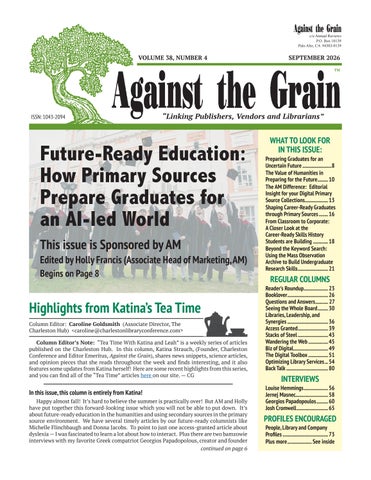
Future-Ready Education: How Primary Sources Prepare Graduates for an AI-led World This issue is Sponsored by AM Edited by Holly Francis (Associate Head of Marketing, AM) Begins on Page 8
Highlights from Katina’s Tea Time Column Editor: Caroline Goldsmith (Associate Director, The Charleston Hub) <caroline@charlestonlibraryconference.com> Column Editor’s Note: “Tea Time With Katina and Leah” is a weekly series of articles published on the Charleston Hub. In this column, Katina Strauch, (Founder, Charleston Conference and Editor Emeritus, Against the Grain), shares news snippets, science articles, and opinion pieces that she reads throughout the week and finds interesting, and it also features some updates from Katina herself! Here are some recent highlights from this series, and you can find all of the “Tea Time” articles here on our site. — CG
In this issue, this column is entirely from Katina! Happy almost fall! It’s hard to believe the summer is practically over! But AM and Holly have put together this forward-looking issue which you will not be able to put down. It’s about future-ready education in the humanities and using secondary sources in the primary source environment. We have several timely articles by our future-ready columnists like Michelle Flinchbaugh and Donna Jacobs. To point to just one access-granted article about dyslexia — I was fascinated to learn a lot about how to interact. Plus there are two bamzowie interviews with my favorite Greek compatriot Georgios Papadopolous, creator and founder continued on page 6
WHAT TO LOOK FOR IN THIS ISSUE: Preparing Graduates for an Uncertain Future..........................8 The Value of Humanities in Preparing for the Future.......... 10 The AM Difference: Editorial Insight for your Digital Primary Source Collections..................... 13 Shaping Career-Ready Graduates through Primary Sources......... 16 From Classroom to Corporate: A Closer Look at the Career-Ready Skills History Students are Building.............. 18 Beyond the Keyword Search: Using the Mass Observation Archive to Build Undergraduate Research Skills........................... 21
REGULAR COLUMNS
Reader’s Roundup..................... 23 Booklover.................................... 26 Questions and Answers............ 27 Seeing the Whole Board.......... 30 Libraries, Leadership, and Synergies.................................... 36 Access Granted........................... 39 Stacks of Steel........................... 43 Wandering the Web.................. 45 Biz of Digital............................... 49 The Digital Toolbox.................. 51 Optimizing Library Services.... 54 Back Talk..................................... 80
INTERVIEWS
Louise Hemmings...................... 56 Jernej Masnec............................ 58 Georgios Papadopoulos........... 60 Josh Cromwell............................ 65
PROFILES ENCOURAGED People, Library and Company Profiles........................................ 73 Plus more...................... See inside
Make federal funder compliance simple for your institution’s authors. Find out about institutional open access agreement options with ACS Publications Scan the QR code to learn more: link.acs.org/ OAagreements
Support interdisciplinary research and teaching with primary sources Scan to discover more about AM
AGAINST THE GRAIN – ISSUE HIGHLIGHTS Against the Grain (ISSN: 1043-2094), Copyright 2026 by the name Against the Grain is published five times a year in February, April, June, September, and November by Annual Reviews. Mailing Address: Annual Reviews, PO Box 10139, Palo Alto, CA 94303-0139. Subscribe online at https://www.charleston-hub.com/ membership-options/. Editor Emerita: Katina Strauch (College of Charleston, Retired) Editor: Leah Hinds (Charleston Hub) Manager: Caroline Goldsmith (Charleston Hub) Research Editor: Judy Luther (Informed Strategies) International Editor: Rossana Morriello (Politecnico di Torino) Contributing Editors: Glenda Alvin (Tennessee State University) Rick Anderson (Brigham Young University) Sever Bordeianu (U. of New Mexico) Todd Carpenter (NISO) Ashley Krenelka Chase (Stetson Univ. College of Law) Eleanor Cook (East Carolina University) Kyle K. Courtney (Harvard University) Cris Ferguson (Murray State) Michelle Flinchbaugh (U. of MD Baltimore County) Dr. Sven Fund (Fullstopp) Tom Gilson (College of Charleston, Retired) Michael Gruenberg (Gruenberg Consulting, LLC) Bob Holley (Wayne State University, Retired) Matthew Ismail (Charleston Briefings) Donna Jacobs (MUSC, Retired) Ramune Kubilius (Northwestern University) Myer Kutz (Myer Kutz Associates, Inc.) Tom Leonhardt (Retired) Jack Montgomery (Retired) Lesley Rice Montgomery (Tulane University) Bob Nardini (Retired) Jim O’Donnell (Arizona State University) Ann Okerson (Center for Research Libraries) David Parker (Lived Places Publishing) Genevieve Robinson (IGI Global) Steve Rosato (OverDrive Academic) Jared Seay (College of Charleston) Corey Seeman (University of Michigan) Bruce Strauch (The Citadel, Emeritus) Lindsay Wertman (IGI Global) Copy Editor/Proofreader: Marci Cohen (Boston University, Retired) Graphics: Bowles & Carver, Old English Cuts & Illustrations. Grafton, More Silhouettes. Ehmcke, Graphic Trade Symbols By German Designers. Grafton, Ready-to-Use Old-Fashioned Illustrations. The Chap Book Style. Publisher: Annual Reviews, PO Box 10139 Palo Alto, CA 94303-0139 Production & Ad Sales: Toni Nix, Just Right Group, LLC., P.O. Box 412, Cottageville, SC 29435, phone: 843-835-8604 <justwrite@lowcountry.com> Advertising Information: Toni Nix, phone: 843-835-8604 <justwrite@lowcountry.com> Send correspondence, press releases, etc., to: Leah Hinds, Editor, Against the Grain <leah@charlestonlibraryconference.com>
v.38 #4 September 2026 — © 2026
ISSUES, NEWS, & GOINGS ON Highlights from Katina’s Tea Time.................................................................... 1 Letters to the Editor........................................................................................... 6 Advertising Deadlines........................................................................................ 6
FEATURES Preparing Graduates for an Uncertain Future.................................................... 8 The Value of Humanities in Preparing for the Future...................................... 10 The AM Difference: Editorial Insight for your Digital Primary Source Collections....................................................................................................... 13 Shaping Career-Ready Graduates through Primary Sources............................ 16 From Classroom to Corporate: A Closer Look at the Career-Ready Skills History Students are Building.......................................................................... 18 Beyond the Keyword Search: Using the Mass Observation Archive to Build Undergraduate Research Skills........................................................................ 21 Back Talk — IFLA World Library and Information Congress Reflections.......... 80
REVIEWS Reader’s Roundup: Monographic Musings & Reference Reviews.................... 23 Booklover — Poetry in Translation................................................................... 26
LEGAL ISSUES Questions and Answers — Copyright Column.................................................. 27 Still Seeking Columnist for Legally Speaking Column!.................................... 29
PUBLISHING Seeing the Whole Board — From Authentication to Impact: Using the OpenAthens Reporting API for Library Assessment. ....................................... 30
TECHNOLOGY & STANDARDS AND TEACHING & LEARNING Libraries, Leadership, and Synergies — Dialoguing with AI: On Contexts, Human Domain Expertise, and Knowing What Questions to Ask.................... 36 Access Granted — Dyslexia: What Is It Like and What Can We Do?................ 39 Stacks of Steel — Feline Feedback for Librarians............................................. 43 Wandering the Web — Subcultures, Part II: Lifestyles.................................... 45
BOOKSELLING AND VENDING Biz of Digital — The Intersection of Health Sciences and Data Librarianship: Liaising to an Emerging Health Informatics Program.............. 49 The Digital Toolbox — How Students Discover, Engage & Learn from Digital Resources............................................................................................. 51 Optimizing Library Services — Reimagining the Future of Libraries in the Age of AI: A Case of Library-Publisher Collaboration............................... 54
ATG INTERVIEWS & PROFILES
Authors’ opinions are to be regarded as their own. All rights reserved. Produced in the United States of America. Against the Grain is copyright ©2026
4
Against the Grain / September 2026
Louise Hemmings — Executive Director of Publishing, AM............................. 56 Jernej Masnec — CEO, Underline Science........................................................ 58 Georgios Papadopoulos — Chairman and Founder, Atypon............................. 60 Josh Cromwell — Author, Institutional Repositories, Charleston Briefings Series....65 Librarian Luminaries — MacKenzie Smith....................................................... 69 Profiles Encouraged......................................................................................... 73
<https://www.charleston-hub.com/media/atg/>
Attending Charleston this November? Come raise a glass with APS! Join us for an evening of conversation, connection, and Lowcountry hospitality.
Ritual Restaurant 145 Calhoun Street November 3rd 5:30 p.m. - 8:30 p.m. Passed canapés
• Beer and wine
CAN’T ATTEND CHARLESTON?
Learn more about APS exclusive offerings Own the future of physics with Frontlist Perpetual Rights The Physics Archive: 120+ years of research with a single purchase Discover our librarian portal for usage statsistics, subscription information, and more
Letters to the Editor Send letters to <editors@against-the-grain.com>, or you can also send a letter to the editor from the Charleston Hub at http://www.charleston-hub.com/contact-us/. Dear Editor: Please change the font on your blog posts. There is very low contrast, which causes eye strain. Thank you, Rhonda Marker (she/her) (Head, Open Knowledge Strategies, Rutgers University Libraries) <rmarker@rutgers.edu> Dear Rhonda: Thank you for reaching out regarding font issues. Can you please let us know if it is the font used in our weekly blog email you received or the font used in the actual article itself on our blog that seems very low in contrast? Our front-end web developer has done an accessibility review on our site recently, and he didn’t find issues with our font, but your feedback on where you see an issue will be very helpful to relay to him.
Thank you, Caroline Goldsmith (Associate Director, Charleston Hub) <cgoldsmith@annualreviews.org> Hi Caroline: I’m pleasantly surprised to hear from you. Thank you so much. The article I was reading was https://www.charlestonhub.com/2026/07/wandering-the-web-finding-family-using-aitechnology-in-genealogical-research/. On a different computer and monitor (but still through Chrome), it looks better. (The text in the right-side column, e.g., Latest news, is still faint.) All best, Rhonda We’re happy to report that the font issue has been resolved! Thanks again Rhonda, we appreciate your feedback.
Highlights from Katina’s Tea Times continued from page 1 of Atypon and Jernej Masnec, CEO of Underline Science which has just been acquired by another favorite Annual Reviews!! And reverse kudos! There are also interviews with Louise Hemmings, Executive Director of Publishing at AM and Josh Cromwell which are fascinating tributes to hard work and ingenuity!! Normally in this column we would begin sharing tid-bits from my online column but this time I want to share a book review instead. But don’t worry, you can still read my tea times online on the Charleston Hub!
Review: How the Internet Disrupted Science, by Kent Anderson and Joy Moore This is must-read book for all in the business of information. Anderson & Moore masterfully address all the major changes and issues in the field of scholarly publishing. The primary focus of the book is how “publishor-perish” led to the rise of junk journals, unvetted science, and spurious data. It rings an alarm bell on the
AGAINST THE GRAIN ADVERTISING DEADLINES VOLUME 39 — 2027
Issue February 2027 April 2027 June 2027 September 2027 November 2027
Ad Reservation Camera-Ready 01/07/27 01/21/27 02/18/27 03/11/27 04/15/27 05/06/27 06/10/27 07/08/27 08/19/27 09/09/27
FOR MORE INFORMATION CONTACT Toni Nix <justwrite@lowcountry.com> Phone: 843-835-8604 6
Against the Grain / September 2026
corruption of scientific publishing and the dangers to academic integrity. I have been a librarian since 1972 when there was no internet. I began my career as an acquisitions librarian at a small liberal arts undergraduate college in Charleston, SC. I moved up to head of technical services, created the Charleston Conference and the journal Against the Grain. It was a rich and full career that I wrote about in my memoir Doing the Charleston. Over the years, I have seen every change, innovation, and fad that Kent & Moore write about. They are spot-on in their analysis. Chapter 15, “The Price of Free,” really resonated with me. I’m not sure where the much-quoted statement “information wants to be free” came from, but I remember well when it got a grip on the librarian world and became part of information scripture. This is exactly where terms like deals, indexing, IP registries, usage statistics, cost-per-use, bots, and the like were born. “Free information” will never exist. It has to come from somewhere and will have to be paid for. You need some sort of platform. The author wants a return for the effort, and that leads to copyright issues. Science has been lost in the gospel of technology. At risk is the public trust in not just science but all learning and higher education. This book is serious wake-up call. We’ll be featuring more highlights from “Tea Time” in upcoming issues of Against the Grain. You can read all of these articles (and see each new article posted every week) in their entirety here. Thanks, y’all!
<https://www.charleston-hub.com/media/atg/>
ESSENTIAL READING
Artificial Intelligence and the Digital Economy
Connect your readers with a curated gateway to IMF research on AI, fintech, digital currencies, tokenization, and the technologies reshaping finance and the global economy.
Fiscal Policy
Financial Markets
Financial Stability
Central Bank Digital Currency
Blockchain
Future of Money
EXPLORE THE COLLECTION Scan to access IMF Essential Reading and bring AI and the digital economy into focus. eLibrary.IMF.org/essential
Preparing Graduates for an Uncertain Future By Holly Francis (Associate Head of Marketing, AM) <Hollyf@amdigital.co.uk>
W
hat does it mean to prepare students for success in a world shaped by rapid technological change, evolving career paths, and an increasingly complex information landscape? As universities face growing pressure to demonstrate graduate outcomes, the answer may lie not in training students for a single profession but in equipping them with the skills to navigate change throughout their careers. According to CNBC, one in three Fortune 500 CEOs holds a degree in the liberal arts or humanities. Their career paths were shaped not by rigid technical training but by the ability to interpret nuanced information, think contextually, and ask the challenging questions. These are precisely the skills nurtured through engagement with primary sources. As we witness the rise of AI, the World Economic Forum predicts that by 2030 core skills such as analytical thinking, curiosity, and lifelong learning will be among the most in-demand globally. Across this special issue, a common theme emerges, that the enduring value of a humanities education and primary source learning is developing the capabilities that employers increasingly seek. Whether students are analysing original archival materials, constructing evidence-based arguments, interpreting competing perspectives, or communicating complex ideas to different audiences, they are building skills that extend far beyond the classroom. These experiences foster critical thinking, adaptability, ethical judgement, information literacy, problem solving, communication, and the confidence to work with uncertainty.
8
Against the Grain / September 2026
At a t i m e w h e n A I can retrieve, generate, and summarise information with increasing ease, the ability to question, contextualise, and evaluate information has become more important than ever. Primary sources provide a uniquely powerful framework for developing these habits of inquiry. They encourage students to engage with ambiguity, assess reliability and bias, recognise what is missing, and build meaning from incomplete evidence. In doing so, they help students understand not just what they know but how knowledge itself is created and interpreted. The articles in this issue explore these themes from multiple perspectives, from discussions with academics, librarians, and university leaders to examples of how primary sources are embedded into teaching and learning. And even through the experience of a humanities graduate reflecting on the workplace skills developed through historical study. Together, they make a compelling case that career readiness is not separate from a humanities education. Rather, it is one of its most important outcomes, preparing graduates not only for their first job but for a career of adaptability and change. Where core and fundamental skills provide the opportunities to translate across roles, sectors, and pathways.
<https://www.charleston-hub.com/media/atg/>
Supporting Libraries Can Have It All Add comprehensive coverage of University of Michigan Press to your discovery systems today
Unique Benefits DRM-free Access to 3,000 books All titles Unlimited Multiuser AI/TDM training rights included Whole ebook ILL permitted 80 new perpetual access titles a year
Invest in Open Access All income reinvested in open access 60 new open access books a year No author payments required Quantitative and qualitative stats Predictable commitment since 2021
Easy to Implement
Award-winning research Proven teaching texts Get More for Less To learn more, visit ebc.press.umich.edu to
Licensed through Lyrasis / Jisc Turn on in ExLibris, EBSCO, OCLC Enriched CC0 MARC records Benetech Certified Accessible COUNTER compliant + COUNTER API
ebc.press.umich.edu
explore how your library can get value-for-money while also advancing values-based scholarship
The Value of Humanities in Preparing for the Future By Laura Blomvall (Engagement Manager AM) <laurab@amdigital.co.uk>
A
s universities face growing pressure to demonstrate graduate outcomes, the humanities are often judged against narrow measures such as early-career salaries, direct vocational pathways, and short-term labour market data. Yet a more complete picture emerges when we look at what students actually learn during their humanities studies. Through close engagement with primary sources, humanities students practise the very skills that employers increasingly need: critical thinking, evidence-based judgement, ethical reasoning, communication, adaptability, and confidence in ambiguity. Primary source learning is not a niche academic practice. It is one of the foundations of career readiness. This was the central theme of a discussion facilitated by AM which brought together Dr James Robson from the University of Oxford, Professor Cathy Shrank from the University of Sheffield, and Dean Alain-Philippe Durand from the University of Arizona.
The Long View of Humanities Value Drawing on a large-scale University of Oxford study of more than 9,000 humanities graduates across a 20-year period, alongside interviews with graduates, students, and employers, Robson argued that the value of the humanities becomes clearest when careers are viewed over time rather than through a six- or 18-month snapshot. “The narrative that humanities degrees inevitably lead to economic disadvantage simply was not supported by the data,” he said. Graduates moved across finance, consulting, public service, education, technology, communications, the creative industries, and entrepreneurship. More importantly, they did not follow a single fixed route. Their careers were often nonlinear, shaped by strategic choices, personal values, and the ability to adapt. For Robson, this adaptability is not incidental. It is central to modern employability. Humanities graduates, he argued, develop the capacity to adapt because their education trains them to analyse complex material, identify what matters, construct and critique arguments, synthesise competing perspectives, and communicate persuasively.
Primary Sources Teach Students How Knowledge is Made Primary sources sit at the heart of this process because they ask students to work with evidence before it has been neatly interpreted for them. Letters, newspapers, images, diaries, oral histories, government records, pamphlets, ephemera, and other original materials rarely offer simple answers. They require students to ask who created it? For whom? In what context? What is present, what is absent, and what assumptions are being made? That kind of work is profoundly practical. It teaches students of all levels to evaluate credibility, weigh partial evidence, recognise bias, build arguments, and navigate complexity. It also moves students beyond passive information consumption. They learn that knowledge is constructed, contested, and situated, a
10 Against the Grain / September 2026
lesson that is increasingly important in workplaces shaped by data, digital tools, and AI-generated content. An AM and Library Journal research survey into primary source literacy trends underlines the scale of the opportunity. Of the librarians surveyed, 76% said only some or very few undergraduates understand what a primary source is when they begin their studies. That gap matters because, as the discussion made clear, primary source literacy is also a route into the transferable skills most closely associated with graduate confidence and employability. As one librarian quoted observed, “Once students understand what a primary resource is, why it’s so important, and understand how to find primary sources, their confidence in their own research skills vastly improves.” Their questions become “more specific and nuanced,” and they gain confidence applying primary source evidence not only to coursework but to future careers.
Skills and Knowledge Cannot Be Separated One of the strongest arguments made during the discussion was that employability could and should not be reduced to a checklist of generic competencies. Robson stressed that humanities graduates do not see their skills as detached from subject knowledge. Analytical ability, judgment and communication are shaped through disciplinary ways of thinking: historical awareness, ethical reasoning, close reading, and cultural understanding. Professor Cathy Shrank echoed this point through the lens of English. Her work with the English Association’s Skills for the Future of English project asked students and alumni to articulate what studying English had given them. Students valued English for widening perspectives, developing empathy, building confidence, supporting wellbeing, and strengthening communication with others. Alumni described how it equipped them for wide-ranging careers in public service, finance, policy research, international development, publishing, teaching, heritage, and the creative industries. For Shrank, these outcomes arise from the subject itself. English asks students to encounter diverse perspectives, synthesise complex material, develop evidence-based arguments, and defend those arguments. It also cultivates auracy: the ability to speak, listen, and engage respectfully with different viewpoints. As she put it, studying English is “not just that these transferable skills are an add-on.” They are developed through the study of the subject.
Why Primary Source Work Matters in a Post-AI Labour Market The rise of AI adds urgency to this conversation. If technology can generate text, summarise information, and automate routine tasks, graduates need more than the ability to retrieve content.
<https://www.charleston-hub.com/media/atg/>
NEW! About Katina Katina is a digital publication that uniquely addresses the value of librarians to society and elevates their role as trusted stewards of knowledge. Named after Katina Strauch, the visionary founder of the Charleston Conference, it is written by and for the international communities of librarians, vendors, and publishers. Katina’s mission is to improve library and information science and inspire a sense of fulfillment among its worldwide professionals. It delivers content that is easy to understand, engaging, informative, and accurate, covering key topics, emerging trends, and transformative technologies and products, while also exploring the ongoing evolution of library practice. It covers key topics, emerging trends, transformative technologies, and library resources, and offers guidance on career and organizational development. By celebrating librarian contributions to open science, scholarship, and the enrichment of society, Katina aims to provide a springboard for community discussion and engagement through three content sections.
KATINA IS PUBLISHING UNDER THE SUBSCRIBE TO OPEN (S2O) PROGRAM
Tiered institutional subscription pricing for 2026 is: $595 for MLIS schools and very high research output institutions $395 for all other PhD, Masters, and 4-year institutions $295 for 2-year institutions
Katina Features and Editors: Editor-in-Chief: Curtis Brundy Dean of University Libraries, University of Massachusetts Amhurst cbrundy@umass.edu The Future of Work: Offers practical insight into the technologies, skills, and strategies shaping library practice in a rapidly changing world. Interim Senior Editor: Curtis Brundy Katina-Work@Annualreviews.org Resource Advisor: Builds on the groundwork set by The Charleston Advisor to provide critical reviews of products and resources for the information industry. Senior Editor: Jill Emery Collection Development and Management Librarian, Portland State University Katina-Reviews@annualreviews.org Open Knowledge: Addresses the evolving roles of libraries and librarians and their contributions towards an open knowledge ecosystem. Senior Editor: Kate McCready Program Director for Open Publishing, Big Ten Academic Alliance Katina-Open@annualreviews.org Leah Hinds, Managing Editor and Executive Director, lhinds@annualreviews.org Elizabeth Weiss, Associate Managing Editor, eweiss@annualreviews.org
They need to interpret, challenge, and contextualise it. They need to decide what is reliable, what is missing, what is ethically appropriate, and what serves a human purpose. Robson argued that AI is sharpening the importance of humanities skills rather than making them obsolete. “The future of work will not simply belong to those who can build intelligent systems,” he said. “It’ll belong to those who can interpret these systems and can challenge them and contextualise them.” He added that AI-generated text still requires “judgment and knowledge to actually turn that into something that’s meaningful or usable.” Primary source learning provides exactly this kind of training. It builds habits of interrogation from checking provenance, comparing accounts, recognising silences, to questioning authority and understanding context. These are not only academic behaviours. They are workplace behaviours for a world in which information is abundant, persuasive, and often unstable.
From Humanities Classrooms to Career Pathways Dean Alain-Philippe Durand offered a practical example of how institutions can make this value visible. At the University of Arizona’s College of Humanities, majors have increased by 76% since 2018, supported by a deliberate strategy of data gathering, recruitment, alumni engagement, and interdisciplinary collaboration. Durand described the Bachelor of Arts in Applied Humanities, created through the Department of Public and Applied Humanities, as one of the fastest-growing majors on campus. The degree combines the key humanities skills of critical thinking, collaboration, adaptability, and communication along with professional emphases taught by partner colleges. These include business administration, engineering, medicine, fashion studies, and public health.
12 Against the Grain / September 2026
The message is deliberately direct, “humanities equal jobs.” But he also emphasised that institutions must collect their own data, tell their own stories, and work with partners beyond the humanities. Alumni, he argued, are “our best ambassadors” because they demonstrate the breadth of careers made possible by humanities study. This institutional work matters because students, parents, faculty, and employers need clear evidence of how humanities learning translates into future pathways. Primary source pedagogy can play a powerful role here. It gives institutions a concrete way to show how students develop the capabilities that underpin research, communication, ethical judgement, and career mobility.
Career Readiness Begins with Evidence What unites the speakers is a shared rejection of the idea that humanities education is separate from employability. On the contrary, the humanities prepare students for work precisely because they prepare them to think. Primary sources make that preparation tangible. They ask students to confront complexity, work with uncertainty, develop informed interpretations, and communicate those interpretations responsibly. Those are the habits that turn graduates into adaptable colleagues, thoughtful leaders, and responsible decision-makers. They are also the habits that help graduates move across sectors, respond to change, and continue learning long after their first job. As Robson concluded, humanities degrees “don’t simply prepare students for their first job, although they do that. But they also prepare them for a lifetime of navigating change.” Primary sources are one of the clearest ways that preparation happens through the disciplined, creative, and deeply human work of making sense of evidence.
<https://www.charleston-hub.com/media/atg/>
The AM Difference: Editorial Insight for your Digital Primary Source Collections By Rosie Threlfall (Publishing Manager, AM) <rosie@amdigital.co.uk>
B
uilding or migrating a digital primary source collection is an opportunity to bring archive material to new audiences. But it also requires time, capacity, and a broad mix of specialist skills. When internal library or archival teams are balancing large-scale projects with day-to-day priorities, the right support can make the process more manageable and effective. Developed by a dedicated in-house team of editorial and technology experts, AM Quartex is used by libraries and archives such as University of Delaware, Peabody Essex Museum, and Congregational Library & Archives, transform their digital archives into accessible sites that can reach a global audience or engage their local community. See University of Delaware Digital Collections image below. AM’s Site Creation team, which I oversee, works closely with this broad range of AM Quartex customers to help shape, build, and launch their own digital collections that are clearly structured, presented thoughtfully, and ready for researchers to use.
How the Site Creation Team Works with AM Quartex Customers to Build and Launch Digital Collections We work with our Customer Experience colleagues from the earliest stages of a build so we are involved from the point where a site is first taking shape. We start with site planning and structural design, working collaboratively to shape the overall site structure so that the end users will be able to navigate intuitively and find the content that matters to them. We handle metadata imports and transcripts, ensuring that descriptive information is consistent and maximised for discoverability, which is crucial for search performance, accessibility, and user experience (UX).
Against the Grain / September 2026
Alongside that, we bring an editorial perspective to the way a site is presented. Because we work on AM’s own digital collections, too, we are used to thinking about hierarchy, layout, and how best to surface material for researchers. It is about getting content into the platform in a way that feels coherent and useful. An important aspect of the service we provide ensures sites reflect best practice accessibility standards, making content available for all audiences. And throughout the build we work closely with stakeholders to incorporate feedback to prepare sites for a smooth and confident launch.
The Key Role of the Team When Working with Customers For our team, it is about helping customers turn an idea into something that really works in practice. We are there to implement, of course, but also to bring an editorial lens to the build. That means thinking about structure, clarity, and how the site will actually feel to use once it is live. That is really what sets the team apart. We have a lot of experience working with complex, multi-layered collections, so we are used to thinking about how different content types and hierarchies fit together. That matters when you are building a customer site because you want it to feel coherent and easy to navigate. We also bring a strong understanding of researcher behaviour and discoverability needs which informs all our design and editorial decisions: how users search, what they expect from digital collections, and how to reduce friction in their journey. See Perkins School for the Blind image on page 14.
<https://www.charleston-hub.com/media/atg/>
13
Importantly, these are the same skills we use to create AM’s award-winning digital resources. These skills come from years of creating hundreds of front-end sites for academic research; collaborating with international archives and top cultural institutions; and developing and testing tools, metadata models, and UX patterns that underpin the AM Quartex platform. In other words, the in-house expertise behind AM collections is the same expertise shaping our customers’ AM Quartex sites, and that’s really exciting.
The First Thing to do When Conceptualising a New Digital Collection for an AM Quartex Customer Our starting point is the user journey. Who is the site for? What are they likely to need? What are they trying to do when they arrive? Once you start there, the rest of the structure becomes much clearer.
14 Against the Grain / September 2026
We often look at other AM Quartex sites as a source of inspiration, especially where certain approaches have worked well. I also like to hear about what problems AM Quartex can solve for customers and reverse engineer it that way as well. Starting from nothing means that we don’t have to overcome any preconceptions. But we do still need to consider existing users and ensure continuity where required so they can easily find what they’re looking for in a new environment. At the same time, having a fresh start allows us to rethink things and be creative in how we shape the experience.
Supporting Complex Migrations This usually means complex hierarchies within metadata or a large volume of metadata. So that’s where we start, marrying up the metadata with the expected user experience and user pathways through the site. Then we help to map that to AM
<https://www.charleston-hub.com/media/atg/>
NE W
E P IS OD E S
E V E R Y
M O N DA Y
CHARLESTON-HUB.COM/MEDIA/PODCASTS/
Quartex and the site configuration, employing the many different content blocks and browsing and navigation pathways available. Because we work on AM’s own collections as well as customer projects, we are very familiar with the different types of metadata that can come from archives and cultural institutions. See Women’s Voices and Life Writing image on page 14. For example, an AM collection I published in my role as an editor, Women’s Voices and Life Writing, 1600-1968, brings together metadata from twelve different libraries and archives. One of the parts of that project I enjoyed most was finding a way to bring all that material together so users could browse across collections seamlessly while keeping the unique character of each. That meant working with a wide range of content, from oral histories to poetry and travel journals, and making sure it all felt connected and easy to explore without losing the context that makes each item meaningful.
A Favourite Aspect of Working on New Sites with AM Quartex Customers One of the things I most enjoy is thinking about how a site should feel when someone first lands on it. AM Quartex supports very different kinds of visual styles, and I always enjoy working out how a site can reflect the character of the material it contains.
Supporting Customers who Lack the Time or Specialist Expertise to Build a Digital Collection When customers don’t have the time, capacity, or specialist expertise to build a digital collection internally, AM can provide the practical support and experience needed to move the project forward. For some customers, that means support to plan, structure, and build the site with confidence. For others, it means drawing on AM’s knowledge across AM Quartex, accessibility, user experience, metadata, and editorial structure. In many cases, it is the combination of practical delivery and specialist insight that makes the difference. That knowledge helps customers make informed decisions about the shape of their site, from how content is organised to how users will navigate and discover it. The result is a digital collection that feels polished, intuitive, and sustainable. Customers also benefit from working with a team that contributes to the wider development of the platform and understands both the technical possibilities and the editorial judgement needed to make a site effective. The value goes beyond the build itself, giving customers confidence that the end result will be accessible, discoverable, and ready to support their long-term goals.
Often customers have amazing visual sources within their site, and it’s about lifting those up and showcasing them: inviting people in to discover and especially hooking in less seasoned researchers with visuals of the actual content rather than layers of text and metadata.
Against the Grain / September 2026
<https://www.charleston-hub.com/media/atg/>
15
Shaping Career-Ready Graduates through Primary Sources By Abi Cunningham (Marketing Manager, AM) <abigailc@amdigital.co.uk>
A
s universities respond to growing pressure around postgraduation employability and the responsible use of AI, primary sources are taking on renewed significance in undergraduate studies. No longer limited to specialist historical research, they are increasingly being recognised beyond humanities as practical teaching tools that help students build the critical, digital, and analytical skills needed for life beyond university. That was the central theme of AM’s webinar, Beyond Research: How Primary Sources Shape Career-Ready Graduates, which brought together library and teaching experts from Hong Kong Baptist University and the University of Newcastle, Australia to explore how primary source literacy can support students’ future success.
Why Primary Sources Matter Now Academic libraries are operating in a complex environment. Graduate employment is under pressure, students arrive with varying levels of confidence and preparedness, and institutions are being asked to demonstrate the value of arts and humanities education and investment more clearly than ever. At the same time, AI is reshaping how students find, interpret and present information. Against this backdrop, primary sources offer more than content for traditional humanities studies. They give students hands-on experience of working with complexity by comparing evidence, identifying bias, questioning authority, recognising uncertainty, and building reasoned arguments from incomplete or conflicting material. As Matthew Braisher, Regional Sales Executive at AM, explained during the webinar, working with primary sources helps students “move beyond accepting information at face value.” By comparing sources created by different authors, for different audiences and purposes, students learn a core skill in assessing “reliability, perspectives, and bias.”
From Research Skill to Workplace Skill The skills developed through primary source work map closely onto the capabilities employers increasingly value. Critical thinking, information evaluation, communication, adaptability, and evidence-based decision-making are all highly cited as in demand skills and competencies by graduate employers. Christopher Chan, University Librarian at Hong Kong Baptist University, described primary sources as uniquely valuable because they expose students to the “messiness of information.” He noted that answers are not always “presented to you in a nice package, ready to use” which is a reality that mirrors the challenges graduates will face in professional life. For Chan, this is especially important in the context of AI. In an age of misinformation and AI-generated content, students need to know how to verify claims and interpret material within its wider context. While AI tools can make information appear polished and complete, primary source analysis teaches students to question what is missing, whose perspective is
16 Against the Grain / September 2026
represented, and how narratives are constructed. “Ambiguity, incompleteness, bias is a huge issue,” he observed, adding that these are “real world challenges” students will face in the workplace.
Building Transferable Skills Across Disciplines It’s important to recognise that primary source literacy is not just a career-ready skill confined to the history department. Across disciplines, students can use original evidence to investigate problems, interpret data, understand context, and communicate findings. At Hong Kong Baptist University, Chan linked this directly to the institution’s emphasis on transdisciplinary education and learning that is grounded in real-world problems informed by multiple fields of knowledge. He explained that the university’s approach is designed to produce “future shaping students,” rather than simply “future ready” ones. This distinction is important. Career readiness is not just about adapting to existing workplaces, it is about preparing graduates to ask better questions, challenge assumptions, and contribute to solving complex problems. One example Chan discussed was the use of wartime newspaper material from Hong Kong during the Japanese occupation. By asking students to examine propaganda techniques, compare sources, and identify framing, omission, and bias, students practised skills directly transferable to professional contexts such as evaluating corporate communications, policy documents, and media narratives.
The Library as a Partner in Learning The role of the library is evolving, and institutions are not passive providers of primary source materials. Librarians are active partners in curriculum design, content integration, skills development, and student success. The challenge for many is to strengthen library partnerships with faculty, integrate primary sources more deliberately into curricula, and demonstrate their impact on career readiness. Reflecting on Hong Kong Baptist University’s current use of primary source collections, he said they are used “occasionally, but not systematically” across teaching. That challenge is shared across the sector. Librarians are well-placed to show how primary source work supports existing teaching goals. Examples include evaluating evidence, developing independent research questions, or communicating complex findings, and showing how primary sources can make those learning outcomes more tangible.
Embedding Workplace Skills through Coursework Jessica Davis, Teaching Liaison Librarian at the University of Newcastle, shared practical examples of how primary sources are being embedded into coursework and assessment. Her role focuses on helping teaching staff incorporate information and digital literacies into their courses while ensuring collections support current teaching needs.
<https://www.charleston-hub.com/media/atg/>
Davis connected this work directly to employability, explaining that strong information and digital literacy skills give students “a competitive edge in the local, national and international job marketplace once they graduate.” In one history course, students used online archives to identify an object, present it as a historical document, and build an argument around its significance in the modern world. The library supported students by teaching them how to search archives, understand the difference between archival discovery and standard library searching, and use digital tools to present their work. The result was a learning experience that developed both information literacy and digital literacy. Students learned how to find, evaluate, and interpret archival material then translate their findings into a digital presentation format with a consideration of their audience and effective communication.
Object-based Learning and Equitable Access Davis also highlighted the value of object-based learning, where students engage directly with rare books, archival materials, and physical artefacts. These sessions encourage students to observe closely, compare material features, ask questions, and understand how knowledge is preserved, mediated, and interpreted. At the University of Newcastle, object-based learning has been used in arts, humanities, and creative disciplines, including sessions where students explored book history, printing techniques, typography, and visual design. Davis described the goal as providing “a practical learning experience,” encouraging students “to think creatively” and to use primary sources as part of their learning journey.
Against the Grain / September 2026
Digital access is equally important. With students spread across multiple campuses and online programmes, Davis emphasised that digital archival materials help provide “an equitable experience for all students.” Online archives can extend the benefits of object-based and source-led learning beyond the physical reading room, ensuring more students can practise the same essential skills.
Preparing Students for Uncertain Futures The strongest case for primary sources is not that they prepare students for one specific career path. It is that they develop skills that are valuable across many possible futures. Curiosity, scepticism, persistence, contextual awareness, and the ability to build meaning from complex evidence are all vital skills in any scenario. Whether students go on to work in policy, education, business, law, media, technology, heritage, research, or creative industries, they will need to make sense of incomplete information, evaluate competing narratives, and communicate clearly. Primary source work gives them a structured way to practise those skills before they enter the workplace. Primary sources are not only records of the past. They are tools for developing the next generation of critical thinkers, a pool of graduates who can effectively question, analyse, debate, and contribute with confidence.
<https://www.charleston-hub.com/media/atg/>
17
From Classroom to Corporate: A Closer Look at the Career-Ready Skills History Students are Building By Lewis Goode (Graduate, University of Bristol)
W
hen I told people I was studying history at university, the most common reaction was, “Oh, are you going to be a history teacher then?” or, “Do you want to work in a museum?” While both of these are noble and exciting paths for any history enthusiast, studying history doesn’t limit you to just those two professions.
In the workplace, this ability to approach problems from different directions is a critical skill. It shows you can tackle challenges independently, think flexibly, and offer a fresh perspective on existing processes. New ideas and alternative ways of working are usually welcomed and highly sought after. Especially when they make someone else’s job easier!
I often rebutted their judgement by saying, “The value lies in the skills that you learn, alongside the knowledge.” This response often satisfied the dubious and dropped their interrogation. But as much as it is a good defence of the subject, I do believe it is true.
Turning Complexity into Compelling
I don’t say this to diminish the enormous cultural and societal importance that history and other humanities subjects have. Instead, I want to uncover the skills that sit beneath the knowledge we study. Skills that shine through in almost any role. In this article, I will look at four main workplace-ready skills that can confidently be highlighted in post-graduation interviews: patience and perseverance, problem solving, communication, and data management.
Good Things Come to Those Who Wait We’ve all been there: scrolling page after page through digital archives or ordering box after box of documents at a physical archive, just hoping that the next page will have the dream (or at least relevant) source to use in your research. Sometimes it comes quickly, sometimes it takes a while. After repeating this process over and over again, you then have to weave it all into your essay to form a convincing argument. It’s a long, often demanding process, but we learn to trust it and to be patient with it. This is where we develop one of their most valuable skills: patience and perseverance. These qualities are deeply admired in any workplace. They show future employers not only that you can tackle difficult, timeconsuming tasks but also that you have the determination to see something through even when the odds seem stacked against you. In interviews, talking about a difficult project and how you overcame those challenges through hard work and perseverance is a good way to show off your qualities in this area. It’s also a good chance to talk about the next skill that I am going to explore!
Putting Together the Pieces Historical research is a bit like a puzzle — except you don’t know where the pieces (sources) are or what the final picture (your argument) will look like. Your task is to find the pieces, fit them together, and create a convincing picture. Often the pieces aren’t where you expect them to be. You have to get creative, searching in unusual places, rethinking your approach, or experimenting with new ways of connecting evidence. Each project teaches you new angles, strategies, and shortcuts that make the next one easier.
18 Against the Grain / September 2026
Effective communication in history is fundamental. It is arguably one of the biggest skills historians develop during their studies. Our whole degree relies on being able to explain a topic clearly to a room of people who often have no prior knowledge of your topic or argument or as an essay to convince a specialist that you understand the topic too! Condensing a complex topic with many moving parts into a short, coherent keynote address takes real skill. Through doing presentations, essays, and seminars we get lots of chances to practise this firsthand. At the same time, we learn to understand other people’s opinions and interpretations of a subject and respond to them critically and constructively. In the workplace, communication skills are invaluable. Whether you’re explaining a project to a colleague, asking a client for details, or presenting slides to the board, effective communication can make all the difference and help you stand out in the room. Strong communicators make complex work feel manageable, build trust within teams, and help projects move forward smoothly. We’re also used to adapting our tone and approach depending on the audience. We know how to present our work differently when speaking in a lecture hall, to the general public, or to friends in a seminar. The same applies at work: you communicate with a client or customer differently than you would with a colleague or the CEO. This skill can help you be agile when situations change or misunderstandings arise or ensure that the right message reaches the right people. Understanding who you’re speaking to, the most effective way to convey information, and how to tailor your message is a skill historians should be shouting from the rooftops about. It’s one of the most powerful ways our academic training translates directly into the workplace.
Separating the Wheat from the Chaff Data management is another essential skill that runs through all the others and in its own right, too. Historical research generates huge amounts of information: primary sources, secondary readings, essay drafts, annotations, idea notes, and more. All of it needs to be organized, stored, and accessible so you can refer back to it when needed. But it’s also about working out what you need and what you don’t. You might find an interesting magazine article, but if it doesn’t serve your argument, it has to be cut. Historians constantly make decisions about a source’s relevance, reliability,
<https://www.charleston-hub.com/media/atg/>
November 2 - 6, 2026 Charleston, South Carolina, US
Register early and save!
Join thousands of librarians, publishers, and more for a week of presentations and networking. Thought-provoking plenaries, panels, lively discussions, posters, and workshops. In-person registration includes access to virtual week. Registration opens June 11
Vendor Showcase One day only, Nov 3, 10am 5:30pm Your chance to connect with librarian decision makers from around the world. Booth registration includes digital booth on the Whova app Registration opens June 9 spaces are assigned first come first served
and usefulness. Strategic decision making can help you identify priorities when working and help you become a more reliable and efficient team player. Similarly, we often work with vast collections of data. Over time we learn how to approach, store, and manage that data, which makes our lives a lot less cluttered and our essays a lot easier to read. We develop tactics to whittle down timeframes, quickly find references and source material, and to process all the information effectively. And while this skill naturally transfers to the workplace, whether dealing with statistics, customer information, or other metrics, it a skill that shapes the way we learn, think and solve problems. With the sheer amount of data companies handle and the volume of information available online, being able to stay organised, avoid becoming overwhelmed, and adapt confidently to different systems is a capability employers can value highly.
20 Against the Grain / September 2026
Remember it’s More than Just Knowing Dates So, when you next get asked what you are going to do with your degree, feel free to remind people that there’s a lot more than knowing the social and economic factors that influenced X event or important dates and people. Focus on the skills you’ve gained. Make sure to highlight these skills in interviews. Talk about how you overcame a challenge in your research, how you communicated a complex issue in a public history project, or how you persevered through a dense document full of information. Keep it relevant to the tasks you will be expected to do, but don’t forget to show off your niche interests or fascinating knowledge that you picked up along the way too! History equips us with a whole toolkit of skills that become second nature to us and hold real value in the workplace.
<https://www.charleston-hub.com/media/atg/>
Beyond the Keyword Search: Using the Mass Observation Archive to Build Undergraduate Research Skills By Jen Purcell (Saint Michael’s College, VT)
T
eaching at a small college in the Northeast United States, it can be challenging to access an archive that enables students to work with British sources. AM’s Mass Observation Online databases are invaluable to me for teaching twentieth century British history and research methods in the classroom. The scanned images in the database let students see and experience, as close as is possible, a physical document with original handwriting or typescript. Details on the page, which can be seen in an archive, such as added notes, underlining, drawings or written instructions, can also be seen on the scanned documents in the database. And AM has attempted to retain the organization of the material as one would approach it in the archive, which allows for connections and insights beyond the page.
The keyword — or the search/advanced search box — is where most students start, and I like to introduce Mass Observation (MO) to my students by allowing them time to use this “discovery” tool. Still, without scaffolding this “discovery” exercise, students are confronted with a myriad of data that may seem overwhelming. Indeed, if there are no constraints on the search they are likely to receive results from many different types of documents as the MO database includes diaries, qualitative questionnaires (called Directives in the MO world) and Directive responses. Equally, the search might return publications curating Observer responses by MO staff or topic collections of MO material. Knowing what each of these types of documents offer the researcher is important, and it’s worth requiring students to read about them in the AM introduction to the database before they begin the research process. It’s best to choose a type of document that suits the research assignment and use the advanced search function to narrow down the search. Directives are efficient ways to begin research, as they provide answers to specific questions. On the other hand, diaries offer wonderful insights into everyday life. Multiple directives or diaries and directives often complement one another as the research deepens. For instance, MO often repeated the same (or similar) questions on their directives over several years, allowing researchers insights into changes and continuities over time. Diaries can help researchers understand directive responses more deeply by providing detailed insights into an Observer’s day-to-day experiences, thoughts, relationships, or opinions. Diaries can also be used to introduce students to longitudinal study: try having students read diary entries by the same person over several years. Developing students’ curiosity is the best way into the material, and I cultivate curiosity during the “discovery” phase. This means attending to details and researching beyond the keyword. I have students share a document with the class, and I model curiosity by asking numerous questions about their texts: When was it written? What do we know about the Observer whose response it is? What is an event or who is a person mentioned in the response? Why did the Observer use this or that particular word? What does the word mean? I’ll often ask
Against the Grain / September 2026
students to look up words, events, or people if we haven’t already covered them in our class materials. This exercise doesn’t just promote curiosity for curiosity’s sake, but rather it models and develops curiosity in order to deepen knowledge, flex intellectual muscles, hone critical thinking skills, and build confidence in one’s abilities to think for oneself and to find answers for oneself beyond the keyword search or the AI answer. AI streamlines or over-simplifies critical thinking, whereas Observers’ qualitative responses often offer surprisingly complex insights into seemingly simple questions or topics, and carefully attending to the Observers’ words develops an appreciation for, and the ability to understand and analyse, the vast complexities and diversity of human thought, opinion, and experience. For instance, the following directive response to a question about feelings on the use of the atomic bomb in August 1945 from a woman living in Kent shows us her active thoughts and emotions about the subject. She describes the shifts of her thoughts as she answers this question, thus enabling the reader insight into how opinions and feelings evolve.
This example further encourages the reader to contemplate a surprising assessment of the use of the bomb, hopefully prompting a researcher to want to learn more about this particular Observer. Further digging into this Observer’s experiences illuminates her seemingly unconventional response once we research and learn that the area in which she lived in Kent experienced a significant amount of bombing during the war, and when we read her wartime MO diaries, we appreciate the emotional terror and trauma she reported as a result of the constant air traffic over her Kentish home. Exciting insights
<https://www.charleston-hub.com/media/atg/>
21
such as these might prompt students to use MO databases or other primary sources instead of relying on AI. When I show a handwritten document from the archive, students initially exclaim (or groan): while the extract above is relatively easy to read, cursive handwriting seems like a foreign language or hieroglyphics to most of them. As I lead students into the document, we puzzle together over letters and words and spend time in class practising how to read them. One of the best aspects of the database in this regard is that you can zoom in on a letter or letters — an ability I often wish I had when sitting in an archive. Through practice deciphering documents written in cursive, students very quickly learn the value of context (and further hone their critical thinking skills), as they must pick out clues to decode the mystery word: what are the other words around it and how might they help us figure it out? How does this person normally write s’s, b’s, t’s or a’s? What is the person saying, and does a possible word fit with the source? After a few in-class sessions and homework assignments, it becomes quickly apparent to students that there is far too much information in the database for them to read fully in the course of a week, a semester, a year, or even a lifetime! The main work then becomes how to manage the material and develop a research project that efficiently provides meaningful and significant insight into the past. We discuss various strategies
22 Against the Grain / September 2026
to approach the material — such as limiting their scope based on demographics or limiting their research to just one directive or a particular slice of a diary. Students then develop research questions and plans, providing a rationale for their plans, all of which are assessed before they begin their research. Engaging with primary sources in their entirety (a directive response or a day in a diary) exposes the tangles and knots of human experience — much like a microscope opens a world of complexity not seen with the naked eye. AI hasn’t curated the source for you or told you what to think about it, a scholar hasn’t picked out the most significant aspects of the source, the professor hasn’t lectured about its meaning. AI, scholarly works, webpages, professors — they all have their value: what we learn from them are our tools of interpretation and critical analysis. But with a primary source in an archive or a scanned primary source in a database brought up on your computer screen, it’s just you and the page. When students spend time with primary sources in this way, they develop important real-world skills such as problem solving, attending to detail when working with another individual or individuals, project management, and perseverance. Perhaps most importantly in this age of AI, they learn to think with the documents and to think for themselves.
<https://www.charleston-hub.com/media/atg/>
Reader’s Roundup: Monographic Musings & Reference Reviews Column Editor: Corey Seeman (Director, Kresge Library Services, Ross School of Business, University of Michigan) <cseeman@umich.edu> Visit him at https://www.squirreldude.com/ Column Editor’s Note: I find myself writing this column today in Austin, Texas on a very hot summer’s day. You might wonder why I am in Austin during the summer. I wonder the same thing myself. Once again, I am with Pam at the Barbie Convention. Technically, it is the “National Barbie Doll Collectors Convention.” If you thought that only ALA found the hottest places in the country for their summer conventions — I would venture the Barbie folks would invite you to hold their beer. Seems the hottest place in the country is wherever the Barbie Convention is. So when you have these high temperatures, you have to improvise and adapt. Since I am just a plus one and have few obligations, I have a great deal of free time while there. So much of it revolves around photography. If there can be an opportunity to expand my self-defined term “Squirrel Tourism,” I am all in. But if it is too warm, I have to be selective about where I go and when (during the day) I travel out. To d a y, m y o u t d o o r adventures ended at around 9:30 in the morning — but I did find some squirrels! And they were right across the street!
atg-readers-roundup. By the time this issue comes out, I will have completed a number of tasks, including generating a list of all reviewed titles and where they may be located. There will be links to all the columns and I will proactively email the publishers and reviewers when it is published and on my site. The last change is that I will have a brief and informal newsletter for the active reviewers. So they will be in the loop when I share new titles, report on what has been published and where we might be behind. Fingers cross that makes it easier to manage. And hopefully, we will have a wider variety of titles that will make this column more enjoyable and useful for the library community. As for the titles in this issue, we have three items: one database and two reference works. The one database ( B a k e r N e w Te s t a m e n t Bible Commentaries from Bloomsbury) made us consider that our column ratings chart did not work for these types of resources — so we crafted something new (you will see it in the ratings box). The other two reference works showcase workers in the performing arts (through 2023) and the important topic of wealth & income inequality. These would be great for librarians who are considering works to support the students and faculty at their institutions.
The very best thing about squirrels is how adaptive they are. They function in cold and hot temperatures. When its hot, they pancake on the cool ground to make it t h r o u g h t h e d a y. When they lose a tree Special thanks to our On the first morning in Austin, Texas, I met a friend at where their nest is, reviewers who take the Brush Square in the downtown area. Never let someone they figure out another time to explore these tell you Squirrel Tourism is not a thing. tree to move to. They works to see if they are are not only adaptive but also resilient. In my years of appropriate for libraries. Special thanks to my reviewers photographing squirrels and enjoying their exploits, I have for this issue: Carolyn Filippelli (University of Arkansas learned a great deal about change and how sometimes I need – Fort Smith), Jylisa Kenyon (University of Idaho Library), to adapt, even if it is more work than I wanted to do at that and Katherine Swart Van Hof (Calvin University). As always, time. I want to thank my reviewers for bringing this column together. All this talk about change was a good way to bring up the new things we are doing with this column. I have been doing If you would like to be a reviewer for Against the Grain, this column since November 2018 and it has been a learning please write me at <cseeman@umich.edu> or please fill out experience as I changed the way it operated a few times over the interest form on the website for this column — https:// these six years. Well ... I changed it again! We decided that www.squirreldude.com/atg-readers-roundup. If you are a we needed a clean slate and we are going to see how things publisher and have a book, database, or other library resource are going. So far, so good. you would like to see considered for review in a future column, please also write me directly. Everything about this column starts with documents found on my personal website — https://www.squirreldude.com/ Happy reading and be nutty! — Corey
Against the Grain / September 2026
<https://www.charleston-hub.com/media/atg/>
23
Baker New Testament Bible Commentaries. Theology and Religion Online (platform). Bloomsbury Publishing. 2026. Available as annual subscription or perpetual access. Price quote by request from publisher. Publisher website: https://www.bloomsbury.com/discover/bloomsbury-digitalresources/ Reviewed by Katherine Swart Van Hof (Collection Development Librarian, Hekman Library, Calvin University) <kswart20@calvin.edu> Baker New Testament Bible Commentaries is a new collection acquired by Bloomsbury Publishing for their Theology and Religion Online (TARO) platform. While TARO was a fairly niche product at its beginning, the product managers have met demand by adding access to many popular Bible commentary sets such as Anchor Yale and Eerdmans. Before 2026, Baker commentaries were nearly impossible to get electronically for unlimited, IP-authenticated users. The librarians for the seminary associated with my school (Calvin University in Grand Rapids, Michigan) were thrilled when Bloomsbury began adding electronic Bible commentaries. A need exists for more online Bible content as seminaries turn to distance learning and more remote students. In fact many seminary students expect the library to provide eBook versions of their favorite commentaries for easy access off campus (not to mention one student hogging a print commentary when others might also want to use it). Baker New Testament Bible Commentaries comprise 38 eBooks, including the popular Paideia commentary series (18 titles) and Touchstone Texts (4 titles). Sixteen standalone texts complete the collection. The commentaries are intended for both undergraduate religion students and seminarians at the graduate level. Alumni access is available as an add-on to the purchase, which allows schools to serve graduates who may have entered Christian ministry. From the TARO interface, students can select the Baker Commentaries collection and then browse the available eBooks. Clicking on a title takes the user to a landing page with the eBook’s bibliographic information, a cover image, abstract, and table of contents. Users may jump to a particular page number or select a chapter. The eBook text is all web based, which allows for continuous scrolling. PDFs or EPUB files are not available. Thus, the interface displays page number ranges at the top of each section rather than individual page numbers. While this may be frustrating if a professor assigns students to read a specific page number, most users will be grateful for at least a page range. Subject terms appear in the left sidebar while references (and many names and places) are hyperlinked within the text itself. Searching within the eBook is also an option. Recommended readings and references at the end of the chapters can be linked to your catalog via openURL link resolver. Bloomsbury is committed to making their products accessible and is working on making TARO content meet Web Content Accessibility Guidelines (WCAG). Currently, the desktop version meets or partially meets WCAG 2.1 and 2.2 A, AA standards, while mobile and tablet versions of the platform do not yet comply. For more details, see https://www.theologyandreligiononline. com/accessibility.
24 Against the Grain / September 2026
When asked, colleagues at my school reported their appreciation for the breadth of New Testament coverage this collection offers. Not only does it cover nearly the entire New Testament, but it also deals with specific issues and texts. The collection provides a range of commentary formats and represents diverse perspectives when it comes to methodology and theology, for example historical-critical research, literary and rhetorical analysis, theological interpretation, socialhistorical method, and reception research. For university and seminary libraries that already subscribe to TARO, this additional collection will certainly add value to their accessible online content. For users new to TARO, a trial of Baker New Testament Bible Commentaries could be a good introduction to the database. ATG Reviewer Rating: I need this in my library. (I am going to be happy showing this to others at my library and will be thrilled it is available.)
Derks, S. (2023). Working Americans, 1880-2023. Volume XIX, The performing arts (First edition). Grey House Publishing, Inc. ISBN: 978-163-7005545. Publisher website: https://www. greyhouse.com/ Reviewed by Carolyn Filippelli (Reference Librarian, Boreham Library, University of Arkansas – Fort Smith) <Carolyn.Filippelli@uafs.edu>. Volume XIX: The Performing Arts is another outstanding volume in the Working Americans, 1880-2023 series. Volume XIX: The Performing Arts highlights artists who excel in such diverse artistic forms as music, singing, dance, theater, improv, and voice acting. Included are sketches of people who vary a great deal in their notoriety. Among the names found in this work, you will find major composers such as Amy Beach and of many lesser-known artists such as Arthur Farwell, composer of Native American music, Sarah Washington, singer of spirituals, and Ethan David, performer with Cirque du Soleil. Biographical information is presented in sections including “Life at Home,” “Life at Work,” and “Life in the Community.” Following the arrangement of previous volumes in the series, Volume XIX includes standard categories such as “Historical Snapshot,” and “Selected Prices” for the year being highlighted. Of special interest are the inclusion of photos, newspaper clippings, song lyrics, poems, and prices of selected items for the year profiled. Advertisements for products such as cereals, toothpaste, Edison phonographs, radios, and soap are of historical and social interest. The material is well organized with details chosen to inspire further reading. This volume would be highly useful for students in the humanities, for survey courses in American history, and for recreational reading for anyone with an interest in popular culture. The section on “Further Reading” will likely result in additional investigations. ATG Reviewer Rating: I need this in my library. (I want to be able to get up from my desk and grab this book off the shelf, if it’s not checked out.)
<https://www.charleston-hub.com/media/atg/>
Reference Shelf: National Debate Topic, 2023-2024: Wealth & Income Inequality (95.03). Amenia, NY: H.W. Wilson, 2023. 200 pages. $75.00 Print. Subscriptions to the annual, 6-volume set are also available. Publisher website: https://www. hwwilsoninprint.com/. Reviewed by Jylisa Kenyon (Social Sciences Librarian, University of Idaho Library) <jylisadoney@uidaho.edu> Reference Shelf: National Debate Topic, 2023-2024: Wealth & Income Inequality is the third volume in the 2023 Reference Shelf series. This volume includes curated reprints of articles, blogs, chapters, reports, and government information on topics related to wealth and income inequality. Most sources focus on the United States, but some take a global view of wealth and inequality. These reprints are pulled from various venues including the Council on Foreign Relations, Pew Research Center, Forbes, the U.S. Census Bureau, The Conversation, the Brookings Institution, and the White House. All sources included in this volume were published between 2020 and 2023. This volume is organized into five sections: 1) The Distribution of Wealth, 2) The Income Spectrum, 3) Prejudice in Economics, 4) Policies and Causes, and 5) Extreme Solutions to Age-Old Problems. Each section begins with an introductory essay that provides background information, and a preface, bibliography, suggested websites, and an index are also included. All pieces in this volume provide readers with a firm grounding in this topic, but two stood out as particularly interesting because of their deep dive into topics that are often at the forefront of the news cycle. The first, “How the Racial Wealth Gap Has Evolved — and Why It Persists” (written by Lisa Camner McKay, Federal Reserve Bank of Minneapolis, October 3, 2022), reports on the findings of an Institute Working Paper, also published by the Federal Reserve Bank of Minneapolis. This article, and the associated report, discussed how the racial wealth gap changed between 1860 and 2020 and the factors that contributed to these changes. The working paper authors found that “[t]he wealth of the richest 400 Americans is approximately equal to that of 43 million Black Americans” (p. 100) and “unequal levels of wealth in 1870 are a major source of today’s racial wealth gap” (p. 98). As a result, a complimentary approach that combines wealth redistribution and a strategy for addressing disparities in wealth accumulation is required to address the racial wealth gap. The second piece, “How the Federal Reserve is Increasing Wealth Inequality” (written by Allan Sloan and Cezary Podkul, Pro Publica, April 27, 2021), discussed the unintended effect that the Federal Reserves’ low interest rates had on economic inequality. When this article was published in 2021, these ultra-low interest rates had stabilized the economy and reduced unemployment, but they also boosted the stock market, which largely benefited “the wealthiest 10% of Americans, who owned 89% of stocks and mutual fund shares held by U.S. households” (p. 121). Another outcome of ultra-low interest rates was that individuals who had their money in savings accounts or certificates of deposits only received meager interest returns each year, further widening the wealth inequality gap.
Guide to the ATG Reviewer Ratings The ATG Reviewer Rating is being included for each book or database reviewed. Corey came up with this rating to reflect our collaborative collections and resource sharing means and thinks it will help to classify the importance of these books and databases.
Book Ratings • I need this book on my nightstand. (This book is so good, that I want a copy close at hand when I am in bed.) • I need this on my desk. (This book is so valuable, that I want my own copy at my desk that I will share with no one.) • I need this in my library. (I want to be able to get up from my desk and grab this book off the shelf, if it’s not checked out.) • I need this available somewhere in my shared network. (I probably do not need this book, but it would be nice to get it within three to five days via my network catalog.) • I’ll use my money elsewhere. (Just not sure this is a useful book for my library or my network.)
Database Ratings • I need this database on my tablet. (This resource is so good; I will want to have it with me all the time.) • I need this on my desktop. (This resource is so valuable, that I want a shortcut on my computer desktop.) • I need this in my library. (I am going to be happy showing this to others at my library and will be thrilled it is available.) • I need this available somewhere in my shared network. (I might use it from time to time, but I would rather someone else pay the bill here.) • I’ll use my money elsewhere. (Just not sure this is a useful resource for my library or my network.)
the incorrect use of apostrophes. These inconsistencies are unfortunate but do not decrease the overall value of this work and the usefulness of having these reprinted pieces available in a single volume. ATG Reviewer Rating: I need this in my library. (I want to be able to get up from my desk and grab this book off the shelf, if it’s not checked out.)
Although the formatting quality of each reprinted piece is consistent, there are discrepancies in the introductory essays. These include inconsistencies in the use of quotation marks when directly quoting other sources, misspelled words, and
Against the Grain / September 2026
<https://www.charleston-hub.com/media/atg/>
25
Booklover — Poetry in Translation Column Editor: Donna Jacobs (Retired, Medical University of South Carolina, Charleston, SC 29425) <donna.jacobs55@gmail.com>
F
ourteen years ago, I confessed to the readership: “If you are a follower of this column, you know the difficulty I have with poetry in translation. Nevertheless, I began my internet search for an English version of Tranströmer’s (the 2011 Nobel Laureate in Literature) poetry.” Since that time not much has changed. Well maybe a few things have changed: 1) internet searches have become more fruitful;
fascinating. (Back to the difficulty and kudos to the translators: Jonathan Galassi for Montale, William O’Daly for Neruda, and T.S. Eliot for Perse for all their effort to bring these rhythms into the English language.)
2) the list of Nobel Laureates in Literature that are left to read has gotten smaller — the bucket list project that started this Booklover Column; and
Will these few verses selected to share with you illustrate the Nobel’s accolades?
3) The Sundown Poetry Series that runs at the Piccolo Spoleto Festival in Charleston, SC has moved from the idyllic courtyard setting next to the historic Dock Street Theater to Washington Park on Broad Street. Life moves forward.
Montale from “The Lemons”
Three poets were chosen at random for this column from the dwindling list of authors yet to explore and enjoy: Eugenio Montale, the 1975 Nobel Laureate, “for his distinctive poetry which, with great artistic sensitivity, has interpreted human values under the sign of an outlook on life with no illusions.” Montale’s country of origin is Italy. Pablo Neruda, the 1971 Nobel Laureate, “for a poetry that with the action of an elemental force brings alive a continent’s destiny and dreams.” Neruda’s country of origin is Chile. Saint-John Perse, the 1960 Nobel Laureate, “for the soaring flight and the evocative imagery of his poetry which in a visionary fashion reflects the conditions of our time.” Perse’s country of origin is France. Next the search for reading opportunities began with the obvious difficulty, stated at the beginning, of finding a poem in English translation. The Charleston County Public Library had books for Montale and Neruda. “I read a book The internet provided “Anabasis” one day and by Perse translated into English by my whole life T.S. Eliot, the 1948 Nobel Laureate in Literature. It is becoming a Nobel was changed.” family affair. — Orhan Pamuk,
from The New Life (2006 Nobel Literature Prize Winner)
Now this is where it becomes fun. All three offerings provided poems in the individual’s native language alongside the English translation. I have no facility with French or Italian and only a bit with Spanish. And yet it was captivating to see the poems published together in both languages. For some of the poems one could see the rhyme in the native language and then see where it didn’t quite make it into the English version —
26 Against the Grain / September 2026
Not sure. You decide. “Listen to me, the poets laureate walk only among plants with rare names: boxwood, privet and acanthus. But I like roads that lead to grassy ditches where boys scoop up a few starved eels out of half-dry puddles: paths that run along the banks, come down among the tufted canes and end in orchards, among the lemon trees.”
Neruda from “Many Thanks” “We have to walk a long way in the world to know the truth of certain things, certain laws of blue sunlight, and inherent rumor of pain, the precision of spring.”
Perse from “Anabasis” “...So I haunted the City of your dreams, and I established in the desolate markets the pure commerce of my soul, among you invisible and insistent as a fire of thorns in the gale. Power, you sand on our roads of splendour….‘In the delight of salt the mind shakes its tumult of spears…. With salt shall I revive the dead mouths of desire! Him who has not praised thirst and drunk the water Of the sands from a sallet. I trust him little in the commerce of the soul….’ (And the Sun is unmentioned but his power is amongst us.) Now onto the summer reading list.
<https://www.charleston-hub.com/media/atg/>
LEGAL ISSUES Questions & Answers — Copyright Column Column Editor: Kyle K. Courtney, Esq. (Executive Director, Social Law, Boston, MA) <kcourtney@socialaw.com> Column Editor’s Note: When recent court filings pulled back the curtain on Anthropic’s covert “Project Panama,” the internet took to its collective fainting couch. Internal memos revealed a massive, secretive warehouse operation to buy millions of print books, slice off their bindings, and destructively scan them for training data before shredding the remains. The resulting public outrage was immediate and apocalyptic, with headlines lamenting a corporate assault on human culture. But beneath the viral pearl-clutching lies a profound misunderstanding of property rights, digitization, and basic library practice. This month, we tackle questions from across our community to unpack what Project Panama actually revealed, separate romantic nostalgia from legal copyright reality, and look at the real path forward for preserving books. — KC QUESTIONS FROM A LIBRARIAN TALKING TO PATRONS: I recently read a column in “The Guardian” about Anthropic and their “Project Panama.” The author claims this artificial intelligence company is destructively scanning and destroying the world’s books to train its large language models. The public backlash has been massive. As a librarian, I am aware of weeding books from collections for a variety of reasons, so I am not nearly as outraged. However, what do we tell our patrons that ask about this? ANSWER: When patrons come to the reference desk asking about this with alarm, the most helpful response is to gently separate romantic sentiment from practical reality. Tell them that there is a lot of fake moral outrage happening right now, driven by an understandable emotional attachment to the printed page but rooted in a fundamental misunderstanding of library collection management and the economics of publishing. Remind your patrons that books are not inherently sacred or immortal objects. They are mass-produced consumer goods. In managing collections, librarians engage in a process called weeding all the time. Weeding is the standard, necessary practice of removing outdated, damaged, or redundant volumes to make room for new materials. Often libraries try to sell them at book sales, but sometimes they are simply recycled or disposed of in the trash. You can reassure them by explaining that this kind of public panic is practically an annual event in the library world. Every year, a well-meaning citizen spots a library dumpster filled with weeded discards, snaps a picture, and stokes a viral frenzy online about the alleged destruction of knowledge. Explain to your patrons that the books Anthropic shredded are not rare historical artifacts or unique manuscripts. They are mass-market
Against the Grain / September 2026
used books for which there are hundreds or thousands of identical copies still in circulation across the globe. No cultural heritage is being erased. QUESTIONS FROM A DIGITIZATION ARCHIVIST: Even if weeding is normal, the visual of destructive scanning feels like a malicious tech industry invention. They are slicing off the bindings and running the pages through high-speed scanners. Is this really a standard practice or something entirely new? ANSWER: It is absolutely not a new invention. Libraries, archives, and academic institutions have been actively disbinding and scanning books for years to preserve their contents digitally and expand access. While I was at Harvard Law, I worked on the Caselaw Access Project. Our goal was to scan all United States state and federal caselaw volumes and make them freely available to the world. To do this efficiently and accurately, the bindings had to be sliced off. This project freed the law from expensive commercial paywalls and dusty physical archives, making it accessible to anyone with an internet connection. Harvard ultimately chose to vacuum-seal the loose, scanned pages and store them, whereas Anthropic chose to shred them. But the core mechanism of destroying the physical binding to liberate the text is exactly the same. We have been doing this in the library and archive world for a very long time. QUESTIONS FROM A COPYRIGHT RESEARCHER: The authors involved in the recent lawsuits were outraged that their physical books were destroyed without permission. How does property law apply to a company buying up books just to shred them? Is it actually legal to destroy these works? ANSWER: Yes, it is completely legal. This gets down to a fundamental misunderstanding of the First Sale Doctrine, also known as the exhaustion rule. Newsflash for people taking to their fainting couches over destructive scanning: books are just goods for sale on the open market. They can be bought and destroyed by anyone at any time for any reason, or no reason at all. Once you legally purchase a physical book, the copyright holder’s control over that specific physical copy ends. The power granted to the buyer is absolute regarding the physical object. You own the paper, the ink, and the glue. You can read it, you can sell it at a yard sale, you can give it to a friend, or you can run it through a woodchipper. Judge William Alsup applied this plainly in his recent ruling, noting that Anthropic purchased its print copies fair and square. In fact, destroying the physical book after scanning it actually strengthened the fair use case for Anthropic. By destructively
<https://www.charleston-hub.com/media/atg/>
27
scanning the books and immediately discarding the original paper copy, they ensured they were not creating a surplus copy that could be distributed to the public to compete with the original authors. QUESTIONS FROM A FAIR USE ADVOCATE: The court ultimately ruled that this ingestion process was a transformative fair use. But if they are just shifting a book from a physical format to a digital one, how is that transformative under the law? ANSWER: Format shifting is not what makes a use transformative under the law. When we analyze fair use, we always look at the underlying purpose of the new use. What makes the ingestion of these texts transformative is that the materials are being used for a completely new and different purpose than the original. An author writes a novel or a textbook to be read by humans for entertainment or instruction. Anthropic is not selling these digital copies as competing electronic books for humans to read. They are using them as raw data to teach a computational model how to predict the structural patterns of human language. The output does not compete in the marketplace with the original book. It is true that a certain percentage of books do end up being recycled in some way, as paper does not always last forever. If a discarded copy of a software manual helps a large language model write better marketing prose before it meets its inevitable end, that is a win for everyone. QUESTIONS FROM A CATALOGER: One of the details driving the backlash involves the sheer volume of International Standard Book Numbers that Anthropic processed. People see lists of thousands of these numbers being destroyed and assume unique works are being wiped out. Are we losing unique cultural heritage here? ANSWER: This is yet another area where public ignorance about how the publishing industry actually works is fueling fake outrage. An International Standard Book Number is just a commercial supply chain tool. It is a product identifier used by retailers and warehouses to track inventory and sales. It is not a magical registry of unique cultural heritage. First, let us be clear about the law. There is no statute that says a book is protected from destruction just because it has an inventory number. Second, the public fundamentally misunderstands what these numbers represent regarding duplicates and overlap. They identify a specific edition or format of a book, not the underlying intellectual property. The hardcover, the mass-market paperback, the book club edition, and the tenth anniversary reprint all have the exact same text, but they all get different identification numbers. Furthermore, a single number represents thousands, if not millions, of identical physical copies printed in that specific run. When Anthropic built their dataset, they were likely using these numbers simply to cross-reference and deduplicate their training data to ensure they were not feeding their model the exact same text fifty times. They just used the number to hunt down the cheapest, most readily available physical vehicle for the text they needed. When people cry over a spreadsheet of destroyed inventory numbers, they are crying over the shredding of a barcode that represents just one of fifty thousand identical paperbacks sitting in thrift stores and basements.
28 Against the Grain / September 2026
QUESTIONS FROM A SPECIAL COLLECTIONS LIBRARIAN: Legal rights aside, what about the ethical argument? Antiquarian book dealers and historians argue that destroying a physical book destroys its unique history, including things like marginalia, inscriptions, or author signatures. Is there an ethical loss in erasing that artifactual history? ANSWER: First, yes, marginalia, signatures, and unique bindings do have historical and artifactual value. But let us be serious about what Anthropic was actually doing. They were not raiding the rare book rooms at our libraries or archives to feed signed first editions of Hemingway into a woodchipper. They were bulk-buying mass-market paperbacks, outdated textbooks, and used trade books by the pallet. In the library world, we draw a very clear line between special collections, where the physical artifact matters, and general circulating collections, where the book is merely a delivery device for the text. We preserve the former and we mercilessly weed the latter. Antiquarian dealers care about the ethics of preservation because they deal in unique historical artifacts. But applying the same ethical framework of a rare book dealer to a discarded copy of a decade-old mass-market mystery is a bit absurd. If a physical book actually has unique artifactual value, the market prices it accordingly, and dealers, collectors, or libraries protect it. People are taking the legitimate ethics of rare book preservation and weaponizing them to justify their outrage over the recycling of everyday commodities. QUESTIONS FROM A LITERARY HISTORIAN: This controversy inevitably touches on the concept of authorship itself. Beyond the scanning of old books, there is a fundamental fear about the output. Are people actually going to be interested in reading artificial intelligence generated text? And how does this reshape our understanding of what an author is? ANSWER: People asking if anyone will read generated text are suffering from a slight case of historical amnesia. The definition of authorship, and what the public is willing to consume, has always been a moving target. Whenever I teach the history of copyright, we look back at the eighteenth century and the rise of the English novel. When writers like Daniel Defoe published Robinson Crusoe or Samuel Richardson published Pamela, the literary gatekeepers of the time panicked. The novel was a disruptive, mass-market technology. What immediately followed was a massive, uncontrollable explosion of illegal editions, unauthorized sequels, abridgments, and pirated knockoffs. And the public absolutely consumed them! The legacy publishers back then went into a similar panic, claiming these unauthorized editions were destroying the pure, romantic concept of the author and ruining literature. The parallel to generative technology today is striking. The printing press and the early novel made the mass production of narrative possible. Modern computational models make the mass generation of narrative possible. Will people read it? Of course they will. Consumers do not read authorship. They read stories, they read information, and they read ideas. We saw this outrage play out just over a decade ago with the Google Books case. Google scanned millions of physical books to create a searchable digital database. The legacy industries sued,
<https://www.charleston-hub.com/media/atg/>
claiming it was mass theft that would obliterate the publishing industry and destroy the value of the book. The Second Circuit ruled that it was a highly transformative fair use, giving the public one of the most powerful research and accessibility tools of the modern era. The market did not collapse. It adapted. If the public is genuinely concerned about the preservation of and access to books, there is exactly one thing to consider doing: fund libraries! Why? Well, right now, technology companies are doing the heavy lifting of creating vast digital databases of works that might otherwise be lost. It would be infinitely better if
libraries were empowered to do this massive preservation work ourselves. And, in fact, it is part of our mission. If you think it is acceptable for publishers to force libraries to rent electronic books rather than owning a permanent preservation copy, you cannot complain when the last physical copy of a text ends up in the hands of a technology company you dislike rather than a research institution you trust. Want to hold on to our shared culture? Want to have access to rare books, or discover works that will likely never be published again? Want more access to world knowledge in a legal and ethical way? Fund libraries!
Still Seeking Columnist for Legally Speaking Column!
A
re you a law librarian, or do you have experience with legal issues in libraries? We’re looking for a new editor for the “Legally Speaking” column. In this role, the column editor would write on legal issues in librarianship and scholarly communication, solicit articles from other authors, or a combination of both. There are five issues per year (February, April, June, September, November) having these editorial deadlines. Please contact us at editors@against-the-grain.com if you’re interested in finding out more! Or if you have suggestions/nominations for someone else who would be a good fit. Thank you!
Against the Grain / September 2026
<https://www.charleston-hub.com/media/atg/>
29
Seeing the Whole Board — From Authentication to Impact: Using the OpenAthens Reporting API for Library Assessment. By Brian Erb (Director for Library Support and Training, Florida Virtual Campus) <BErb@flvc.org> and Shannon Dew (Director of Library Services, Florida State College at Jacksonville) <shannon.dew@fscj.edu> Column Editor: Kathleen McEvoy (Senior Policy Fellow, The EveryLibrary Institute) <kathleen.mcevoy@everylibrary.org>
D
emonstrating a direct impact on student success is vital for modern academic libraries. Historically, libraries relied on traditional operational metrics like circulation statistics, visitor gate counts, and other “nosecounting” metrics to justify their value. However, in an era of tightening higher education budgets and increased scrutiny over institutional return on investment, simple usage counts are no longer enough to secure critical funding and resources. If libraries can connect the use of library resources directly to key institutional performance indicators like grade point averages, semester-to-semester retention, and graduation rates, libraries can provide concrete, data-driven evidence of their value. This empirical proof not only protects library allocations during budget reviews but also allows librarians to strategically target outreach to maximize the impact of library resources and activities. For the libraries of Florida Virtual Campus — Library Services, OpenAthens is providing a key source of data for this kind of assessment as it allows libraries to analyze electronic resources usage activity against individual student success metrics. The Florida Virtual Campus (FLVC) is a state-mandated library consortium that provides centralized library services to the forty public academic libraries in the state of Florida. Its services include a statewide implementation of ExLibris’ Alma ILS and Primo Discovery layer, a statewide eResources collection and eResource opt-in program, and support for digital services and open educational resources. In 2020, FLVC licensed OpenAthens as a statewide electronic resources authentication system and in 2024 licensed the OpenAthens Reporting API for the use of FLVC member libraries. OpenAthens is a single sign-on (SSO) gateway that lets users log into all of the library’s digital subscriptions using their existing institutional username and password. It facilitates authentication through either a SAML Federation, a hosted Proxy, or via 1:1 SAML connections with publishers. Regardless of physical location and access point, users are presented with their campus SSO when they encounter a licensed electronic resource. This authentication installs a cookie in their browser that lasts for eight hours, thus eliminating the need for subsequent credential challenges. The first time a user authenticates to a licensed electronic resource via OpenAthens, an account is created for them in the OpenAthens admin dashboard, and that account is populated by whichever attributes the school’s identity provider sends. Let’s consider a hypothetical 2nd year Associate in Science student Robert Smith from Florida State College at Jacksonville.
30 Against the Grain / September 2026
Subsequent logins will update their account with any changes to their account in the campus identity provider. Librarians can then generate statistics based on a user’s authentication activity using any of these attributes as breakdown variables. The data that OpenAthens reports is the number of accessions to a given platform — that is, the number of times the platform authenticated a user on the platform. It does not count what a user does once they are on the platform. Let’s imagine a research session by our student Robert from the account above. 1. Robert clicks on Academic Search Complete from A-Z database list OpenAthens logs one accession to EBSCO 2. Robert clicks on CINAHL on A-Z database list OpenAthens logs a second accession to EBSCO 3. Robert clicks on a Wiley article in Primo OpenAthens logs an accession to Wiley 4. Robert finds an Elsevier article on the internet and clicks their “find your institution” button to login in via his SSO OpenAthens logs an accession to Elsevier In the research session described above, OpenAthens will log: • two accessions to EBSCO • one accession to Wiley • one accession to Elsevier For a total of four resource accessions.
<https://www.charleston-hub.com/media/atg/>
In addition, it can categorize that usage by any individual or group attributes associated with that user, so it also records: • Four total accessions by EMPLID 3771077 • Four total accessions by the 01 2 Year Alma Patron Group • Four total accessions by the Associate in Science Degree Alma Patron Classification All of this data can be visualized using the data dashboard included with your OpenAthens license and it lives in the OpenAthens Admin Dashboard.
Crucially, OpenAthens also has a Reporting API that allows you to push your OpenAthens data into a data warehouse. This greatly increases the utility of your data for a few reasons. First, more powerful dashboard software like Power BI or Tableau can be used to generate more user-friendly, complex, and shareable dashboards. FLVC used the API to push the OpenAthens accession data for all 40 of our schools into a local database. Our member libraries can use this dashboard to get statistics for any library or group of libraries in FLVC.
While centralized dashboards are great for seeing overall resource trends, they have a limit; FLVC doesn’t have access to student data from other campus systems.
Against the Grain / September 2026
To move from simply counting clicks (“Who used what?”) to proving value (“Why does it matter?”), libraries must connect this to local data about the student.
<https://www.charleston-hub.com/media/atg/>
31
Let’s look at Robert’s account again:
are reaching all student populations equitably and identify groups that may not be engaging with library resources. This allows libraries to develop targeted outreach strategies and intervene earlier to support student success. Beyond student success assessment, these data also support collection management and resource allocation decisions. Librarians can determine whether specialized databases, such as those supporting nursing programs, are being used by their intended audience. Likewise, they can identify underutilized resources that may need additional promotion or, in times of budget constraints, reconsideration for renewal.
Some Assessment Results from FSCJ By analyzing records in its data warehouse, FSCJ has begun gathering evidence about how library interventions influence student engagement with electronic resources.
Note the account includes the student’s EMPLID which was passed to their OpenAthens account from Peoplesoft. If an institution decides to send an individual user identifier to OpenAthens that is also used in other campus systems, librarians can make a variety of assessments about how electronic resource use intersects with various kinds of student demographic and student success metrics. This not only allows an institution to demonstrate library impact on student success but also lets them test and target library interventions that increase usage and, hopefully, see that usage translate into student success. Several FLVC schools have begun projects to do this kind of assessment. Florida State College at Jacksonville provides a useful example.
The Technical Pipeline To capture this data locally, FSCJ built a dedicated technical pipeline to populate their data warehouse: 1. Extract & Stage: A Python application running on a virtual machine automatically pulls raw data from the OpenAthens API every day. It loads it into a staging area inside an Oracle Autonomous Data Warehouse (ADW). 2. Model: The data is processed using a stored procedure in Oracle SQL Developer and built into semantic models within Oracle Analytics Cloud (OAC). Here, the OpenAthens data is linked directly to Student Enrollment tables via student IDs (EMPLID).
Do Classes With and Without Library Support Differ in Use of Electronic Resources? Using dashboard data, FSCJ can examine resource usage at the course and class level. This analysis revealed that some courses had high database usage despite having no direct library involvement. These courses present opportunities for librarians to meet with faculty and identify instructional practices that may be contributing to student engagement. However, some courses that received library instruction showed relatively low resource use. These findings raise important questions. Was instruction delivered too early in the semester, before students had a research assignment? Was the session conducted in a computer lab where students could practice searching, or was it delivered as a lecture-only presentation? The dashboard also allows the library to examine course modality and assess how students in synchronous online courses engage with library resources. Together, these findings can help improve library instruction practices. The graphs on page 33 compare ENC 1101 sections that received library support with those that did not. Sections receiving direct library support showed a higher percentage of high-resource-use classes and a lower percentage of lowresource-use classes. See graphs titled “Results – English Composition (ENC 1101), Classes With Library Support and Database Usage” and “Results – English Composition (ENC 1101), Classes Without Library Support and Database Usage.”
3. Share: OAC data visualization dashboards are built so staff can filter library use by various parameters.
Data such as these help identify where library services can have the greatest impact and provide evidence that library instruction can increase student engagement with electronic resources.
Sharing the Student Library Story
Librarian Instruction vs Embedded Modules
Now that institutions can capture online database accession data and connect it to existing student enrollment data, they can move beyond explaining what was used to explaining why that usage matters. FSCJ’s dashboard focuses on trends and usage patterns among student groups rather than on the behavior of individual students. This approach allows the college to generate meaningful insights while maintaining student privacy.
The dashboard also allows FSCJ to evaluate different instructional approaches, including one-shot instruction sessions, embedded librarianship, and asynchronous online research modules.
By linking resource usage data with enrollment records, FSCJ can analyze how library instruction influences online database usage and how that usage relates to GPA and student retention. Demographic data also help librarians determine whether they
32 Against the Grain / September 2026
The last graph on page 33 demonstrates the impact of these interventions in an upper-level Human Services (HUS) course. Faculty teaching the course reported that many students lacked the research skills expected at the upper-division level and partnered with librarians to develop a customized set of research modules embedded in the first course unit. See graph titled “Results – Intro to Human Services (HUS 3105).”
<https://www.charleston-hub.com/media/atg/>
Against the Grain / September 2026
<https://www.charleston-hub.com/media/atg/>
33
The results showed that both librarian instruction and embedded Canvas modules were associated with high levels of resource use among students in the course. Further analysis suggested that embedded research modules may have an especially strong impact when instructional methods are examined at a more granular level. These findings provide valuable evidence for improving library instruction strategies and scaling successful interventions. Further analysis revealed a particularly high impact for embedded research modules when the type of instruction was granularly considered. See graph above titled “Results – Type of Library Support.”
Identifying Gaps with Certain User Populations The library made an effort to improve engagement of dual enrollment students after some deficits were noted in their SACS accreditation, and OpenAthens data allowed them to
34 Against the Grain / September 2026
see the impact of these efforts. Moving forward, librarians can identify engagement gaps much earlier and proactively develop strategies to address disparities before they become significant concerns. See graph below titled “Results – Demographics.”
Electronic Resource Use and GPA The final pair of graphs (shown on page 35) compares GPA categories for students who accessed electronic resources with those who did not. See graphs titled “Results – Identifying GPA Trends With Library Use, Unique Users Accessing Resources” and “Results – Identifying GPA Trends With Library Use, Unique Users NOT Accessing Resources.” The results indicate that students who did not use electronic resources were more likely to fall into at-risk or below-average GPA categories. In contrast, high-achieving students were more likely to access library resources.
<https://www.charleston-hub.com/media/atg/>
While these findings do not establish causation, they do suggest a meaningful relationship between library resource use and student academic success. Such evidence helps demonstrate the library’s contribution to institutional goals and provides a foundation for future assessment efforts.
Looking Ahead FSCJ is already working on the next phase of this project, including updating their dashboards for better visualization, using the data to reach out to low-use academic departments, and applying this data warehouse model to track physical, inperson library sign-ins and research appointments and their relationships to student success.
Against the Grain / September 2026
The API for online usage provides only one piece of the student library story. Going forward, libraries can integrate additional engagement measures, including attendance at library programs, study session participation, computer use, and other forms of interaction, and examine how these activities relate to student success outcomes. By using the OpenAthens Reporting API to transform authentication data into evidence of student success, libraries can demonstrate to campus leadership that they are more than a budget line item. They are strategic partners in helping students persist, succeed academically, and graduate.
<https://www.charleston-hub.com/media/atg/>
35
Libraries, Leadership, and Synergies — Dialoguing with AI: On Contexts, Human Domain Expertise, and Knowing What Questions to Ask Column Editor: Antje Mays (Collection Analysis Librarian, University of Kentucky Libraries) <antjemays@uky.edu> Column Editor’s Note: This article offers excerpts from iterative AI prompts that assisted with building machinelearning analytics in support of complex collection decisions in a large research library system. The prompting excerpt illustrates the importance of grounding in background knowledge, domain expertise, human judgment and oversight, and purpose-driven strategy. — AM
Introduction: Purposeful AI and Structural Supports as Guiding Lights AI launches are most likely to succeed when driven by human expertise and aimed at a specific purpose with specific tools tailored to a clearly defined project or process, bolstered by leadership support. Challenges arise when AI parameters are vague and AI implementations lack structural support. Challenges: Despite widespread endeavors to incorporate artificial intelligence (AI) in a variety of workflows, 1,2 worldwide library and business studies indicate that over 80% of AI initiatives fail in advanced and emerging regions alike.3,4,5 What drives such high failure rates? Human factors include lack of leadership support, misalignment with operational needs, AI visionaries’ lack of workflow understanding, poor change management,6 and employee resistance due to fear of job displacement.7 Structural factors include limited expertise and insufficient training, high costs and budget constraints, lack of infrastructure, and integration with legacy systems,8,9 while over-reliance on AI can reduce employees’ creativity and motivation, risking erosion of skill levels and project setbacks.10 Data-related factors spawning AI failures include poor data quality, metadata inconsistencies, and inadequate data management practices.11,12,13 Ethical concerns encompassing data’s trustworthiness, societal trust, transparent and principled AI governance, and regulatory compliance are crucial in the context of libraries as stewards of knowledge.14 Success factors: Despite high reported failure rates, current research points to several key drivers of successful AI implementations: Human and cognitive factors include critical thinking, analytical thinking, empathy in guiding team members and users, adaptability to inform course corrections as needed, and continuous professional development.15,16,17 Technical and analytical competencies include AI literacy, data processing and management, predictive analytics, and practical AI applications,18,19 while domain expertise promotes deep understanding of the interplay between the work and its AI enhancement.20,21 Responsible AI use frames ethical reasoning, privacy protections, algorithmic bias detection, explainable AI, and evaluation of AI outputs. 22,23,24 Organizational factors include leadership support, financial resources and
36 Against the Grain / September 2026
technological infrastructures, and providing broad access to structured workplace training to support sustainable AI adoptions.25,26,27,28,29,30,31 An example of organizational support: The University of Kentucky strategically supports AI through broad access, training, and responsible experimentation, inviting students and employees to test AI’s usefulness against real learning, research, and workplace needs rather than mandating AI adoption for its own sake.32 This no-pressure environment encourages creative pursuit of workplace solutions — the following Copilot-assisted coding example’s prompting dialogue illustrates this nopressure approach in practice.
Dialogues With Generative AI: Prompting and The Invisible Hand of Human Expertise In the beginning — a purpose-driven premise: Complex collection decisions depend on the accuracy of decisionsupporting data. A recent project’s inconsistent raw data for its nearly 10,000 titles thwarted the needed comparisons and required complex analysis. Machine learning proved the most efficient solution for achieving the needed decision insights at scale. Setup-phase software obstacles jeopardized project timelines: Technical barriers thwarted installing SAS,33 SPSS,34 Python, 35 and running Python formulas in Excel, 36,37,38 the project’s scale quickly overpowered the PromptLoop39 subscriber version’s monthly LLM allotment. Copilot Analyst, the codingfocused generative AI assistant built into Microsoft Copilot,40 was then chosen for creating the needed machine-learning code for readily available software41 — first for Excel, then Google Sheets for its broader complexity tolerances.42 Establishing the prompting parameters: Preparations entailed uploading a working spreadsheet containing datacolumn definitions, logical relationships among fields, intended comparison outcomes, and a sample of manually evaluated records. The accompanying prompts explained the need to normalize inconsistent holdings statements and volume/ date notations, compare library holdings against comparator archives, assign controlled-vocabulary outcomes — full, partial, or no overlap — and identify any library holdings not covered by the comparator archive. The following interchange of Copilot Analyst prompts and follow-up dialogues is edited for brevity. Initial prompting thread: Several iterations of back-andforth fine-tuning between author and Copilot yielded the first set of formulas which were then entered into designated Excel cells and helper columns. Errors prompted further dialog, as shown in the condensed author-Copilot dialogues below. Dialogue 1. Author: The formulas returned #CALC! errors. Excel indicates that nested arrays are not supported. Could the reasoning be translated into helper columns so the same
<https://www.charleston-hub.com/media/atg/>
inference can be achieved step by step? Copilot Analyst: Yes. Nested dynamic arrays can trigger #CALC! errors in Excel. A helper-column approach can spread the logic across auditable steps while preserving the intended holdings-comparison reasoning. Outcome: Several Excel iterations followed. The formulas were adjusted to address multiple holdings strings in a single row, normalize inconsistent notation, and route final results into the designated destination columns. Despite these changes, the Excel version did not produce usable outputs. Dialogue 2. Author: The normalization still did not work. Returning to the array method: would this work better in Google Sheets? Copilot Analyst: Yes. Google Sheets is better suited to this version because it supports nested array logic, BYROW, MAP, LAMBDA, and regular-expression functions more flexibly than Excel. Outcome: The project moved from Excel to Google Sheets. Initial results remained diffuse, so the author added start year, end year, and year-span fields for both library holdings and comparator holdings as additional context for the model. Dialogue 3. Author: I have reworked the project and added start year, end year, and year span as background references for the holdings comparisons. Copilot Analyst: Those fields can help contextualize coverage and reduce reliance on brittle string matching. The formulas can now use nested arrays, normalize inconsistent volume notation, handle multiple holdings pieces per row, and produce both the overlap outcome and a list of missing library-held pieces. Outcome: The first Google Sheets formulas produced parse errors. Dialogue 4. Author: Both formulas returned formulaparse errors. Did syntax errors creep in? Copilot Analyst: Yes. The problem is Google Sheets syntax, not the underlying logic. The formulas need correction for Sheets-compatible syntax. Outcome: After syntax corrections, the formula for the overlap-finding column populated the intended controlled-vocabulary results. However, the formula intended to list library holdings not covered by the comparator archive returned a #REF! error. Dialogue 5. Author: The formula for Column R returned #REF! — Reference does not exist. Did a wrong reference or character enter the formula? Copilot Analyst: Yes. A failureprone construct in the Column R formula can trigger that reference error even though the comparison logic is sound. Outcome: The Column R formula was revised with more robust
normalization language. The formulas then returned results in the expected structure, but most titles were incorrectly marked as full overlaps. The problem was no longer syntax: the decision hierarchy gave start and end years too much weight, allowing broad date spans to override gaps visible in the detailed holdings statements. Dialogue 6. Author: The year fields should provide context only. The actual holdings details must remain the primary basis for deciding full, partial, or no overlap. Copilot Analyst: Correct. The logical hierarchy is the core issue. The revised model should treat holdings-detail coverage as the primary signal and use years only as secondary context. Final rules should cascade as follows: (1) all library-held pieces covered = full overlap; (2) some pieces covered = partial overlap; (3) no pieces covered = no overlap. The missing-pieces field should identify library holdings not covered by the comparator archive. Outcome: With the hierarchy corrected, the Google Sheets formulas produced the intended results. The formulas successfully populated the destination fields with AI-derived overlap determinations and missing library-held pieces, and the formulas were then applied across comparator-specific spreadsheets to complete this machine-learning phase of overlap verification.
What AI-Prompting Reveals about Human Skills, Organizations, and Success Factors Observations: The prompt dialogue illustrates background knowledge of library collections, analytical goals, and understanding of software structures and pitfalls. This librarian perspective combined with programmer’s technical knowledge and intuition steered the iterative prompting toward the desired code which ultimately produced the envisioned collectionsdecision analysis. Key skills for successful AI project implementation and systemization: Successful AI projects are rooted in effective human-AI collaboration, requiring a shift from tool-centered adoption to sustainable, human-centered AI practice. Adaptive organizational practices are essential to nurturing the necessary hybrid skill sets:43 AI competencies44 need accompanying soft skills spanning human judgment, ethical awareness,45 as well as a broad knowledge base and knowing what questions to ask46 in the pursuit of knowledge and the skills to bring AI projects through to successful fruition.
Endnotes 1. Iqbal Ahmad Ansari. “Use of Artificial Intelligence (AI) Tool in Libraries: An In-Depth Review.” Journal of Library and Information Communication Technology 15, no. 1 (2026): 85-101. https://doi.org/10.5958/2456-9399.2026.00007.9 2. Quincy McCrary. “A Qualitative Analysis of 54 Case Studies Finds That Financial, Infrastructure, and Skills Deficits Constrain AI Capability Across Libraries and Archives.” Evidence Based Library and Information Practice (Edmonton) 21, no. 2 (June 2026): 166-168. https://doi.org/10.18438/eblip31044 3. Pluralsight (2025). AI Skills Report. Westlake, TX: Pluralsight, LLC. Accessed October 15, 2025. https://www.pluralsight.com/ resource-center/ai-skills-report-2025 4. Asmaa Ibrahim. “The Trillion-Dollar Challenge.” In Making AI Work for People: A Framework for Designing and Building Impactful AI-Powered Applications, 1-24. Hoboken, N.J.: John Wiley & Sons, 2026. https://doi.org/10.1002/9781394406463.ch01 5. Gabriel Snyder. “What AI Really Can Do Now: 6 Lessons for Harnessing Artificial Intelligence.” Newsweek, 184, no. 21 (July 4, 2025): 26-35. 6. Ibrahim, “The Trillion-Dollar Challenge,” 1-24. 7. Güler Demir. “Artificial Intelligence (AI) and Robotic Technologies Implementation in Libraries: An Integrative Literature Review.” Bilgi Yönetimi 8, no. 1 (June 2025): 77-98. https://doi.org/10.33721/by.1645554
endnotes continued on page 38
Against the Grain / September 2026
<https://www.charleston-hub.com/media/atg/>
37
Endnotes continued from page 37 8. Ogagaoghene Uzezi Idhalama and Prisca Iheoma Nwachukwu. “Assessing the Application of Artificial Intelligence and Machine Learning Technologies in Library Services in Africa.” Library Management (Bradford) 46, no. 5 (June 25, 2025): 386–400. https:// doi.org/10.1108/LM-07-2024-0078 9. Snyder, “What AI Really Can Do Now,” 26-35. 10. McCrary, “A Qualitative Analysis of 54 Case Studies,” 166-168. 11. Ibid., 166-168. 12. Razea Sultana and Md Atikuzzaman. “Are Academic Libraries of Bangladesh Ready to Implement Artificial Intelligence? Finding Answers from LIS Professionals.” The International Information & Library Review (Amsterdam) 57, no. 4 (October 2025): 332–45. https://doi.org/10.1080/10572317.2025.2505886 13. Yi-Shuai Xu, A.M.K Yanti Idaya, and Muhammad Shahreeza Safiruz Kassim. “From Vision to Practice: Adoption of Artificial Intelligence in Libraries across ASEAN.” Malaysian Journal of Library & Information Science (Kuala Lumpur) 30, no. 2 (August 2025): 43–65. https://doi.org/10.22452/mjlis.vol30no2.3 14. Amrita Singh. “Impact of Data Governance on Artificial Intelligence Project Success.” Dissertation, Vysoká škola ekonomická v Praze [University of Economics in Prague], 2026. 15. Michal Müller, et al. “Exploring the Significance of Soft Skills Development for Addressing Challenges of AI-Driven Technological Society: A Veil of Ignorance Thought Experiment.” The Journal of Workplace Learning (Bradford) 38, no. 9 (December 2026): 102126. https://doi.org/10.1108/JWL-09-2025-0322 16. Rakesh Kumar Gupta, Rajneesh Mishra, Pranav Mishra, and Bhopendra Singh. “AI-Augmented Leadership: AI Role in Transforming Organizational Decision-Making.” 2025 International Conference on Computational Intelligence and Knowledge Economy (ICCIKE), Dubai, United Arab Emirates, November 27, 2025, 803–8. https://doi.org/10.1109/ICCIKE67021.2025.11318212 17. Ansari. “Use of Artificial Intelligence (AI) Tool in Libraries,” 85-101. 18. Ibid., 85-101. 19. McCrary, “A Qualitative Analysis of 54 Case Studies,” 166-168. 20. Omobolanle Olatoye and Efenwengbe Nicholas Aminaho. “Evaluating AI Competency in Project Management: Benefits and Challenges.” AI & Society (London) 41, no. 5 (May 2026): 4303-4314. https://doi.org/10.1007/s00146-025-02730-y 21. Snyder, “What AI Really Can Do Now,” 26-35. 22. Ansari. “Use of Artificial Intelligence (AI) Tool in Libraries,” 85-101. 23. Demir. “Artificial Intelligence (AI) and Robotic Technologies Implementation in Libraries,” 77-98. 24. Müller, et al. “Exploring the Significance of Soft Skills Development,” 102-126. 25. Ansari. “Use of Artificial Intelligence (AI) Tool in Libraries,” 85-101. 26. McCrary, “A Qualitative Analysis of 54 Case Studies,” 166-168. 27. Demir, “Artificial Intelligence (AI) and Robotic Technologies Implementation in Libraries,” 77-98. 28. Xu, Idaya, and Kassim, “From Vision to Practice,” 43–65. 29. Olatoye and Aminaho, “Evaluating AI Competency in Project Management,” 4303-4314. 30. Müller, et al. “Exploring the Significance of Soft Skills Development,” 102-126. 31. Lehong Shi. “Global Perspectives on AI Competence Development: Analyzing National AI Strategies in Education and Workforce Policies.” Human Resource Development Review (Los Angeles, CA) 24, no. 4 (December 2025): 447–76. https://doi. org/10.1177/15344843251332360 32. University of Kentucky CATS AI. Advancing Kentucky’s AI Future. [n.d.], accessed July 20, 2025. https://catsai.uky.edu/ 33. The SAS Institute. SAS. 2026, accessed July 20, 2026. https://www.sas.com 34. IBM. SPSS Statistics. IBM Product and Tutorials Page, [n.d.], accessed July 20, 2025. https://www.ibm.com/products/spss-statistics 35. Python Software Foundation. Python. 2026, accessed July 20, 2026. https://www.python.org/ 36. Microsoft. Get Started with Python in Excel. 2006, accessed July 20, 2026. https://support.microsoft.com/en-us/excel/python/ get-started-with-python-in-excel 37. Microsoft. Introduction to Python in Excel. 2006, accessed July 20, 2026. https://support.microsoft.com/en-US/Excel/python/ introduction-to-python-in-excel 38. Microsoft. Python in Excel Availability. 2006, accessed July 20, 2026. https://support.microsoft.com/en-US/Excel/python/pythonin-excel-availability 39. PromptLoop AI. Inference. PromptLoop Guides. Informational page. [n.d.], https://www.promptloop.com/docs/inference, accessed July 20, 2026. 40. Microsoft. Get Started with Analyst in Microsoft 365 Copilot. 2006, accessed July 20, 2026. https://support.microsoft.com/en-us/ microsoft-365-copilot/get-started-with-analyst-in-microsoft-365-copilot 41. Sudheekar Reddy Pothireddy. “AI-Powered Copilots Are Revolutionizing Low-Code Development in the Power Platform.” International Journal of Communication Networks and Information Security (Kohat) 17, no. 2 (January 2025): 86–115. 42. Thomas H. Cormen, Charles Eric Leiserson, Ronald L. Rivest, and Clifford Stein. Introduction to Algorithms. Fourth edition. Cambridge, Massachusetts: The MIT Press, 2022. 43. Olatoye and Aminaho, “Evaluating AI Competency in Project Management,” 4303-4314. 44. Leo Lo, et al. AI Competencies for Academic Library Workers. Association of College & Research Libraries, 2026. https://www. ala.org/sites/default/files/2025-10/acrl_ai_competencies.pdf 45. Müller, et al. “Exploring the Significance of Soft Skills Development,” 102-126. 46. Lou Shipley. “A Tech Founder Called Me ‘Uniquely Unqualified.’ 40 Years Later, I’m Convinced This Impractical Background Is the Ultimate AI Defense.” Inc. July 17, 2026.
38 Against the Grain / September 2026
<https://www.charleston-hub.com/media/atg/>
Access Granted — Dyslexia: What Is It Like and What Can We Do? Column Editor: Michelle K. Hahn (Disability Advocate and Librarian) <michellekhahn@gmail.com> with Jay Bird (Collaborative Author and Artist) Accessibility isn’t a checklist — compliance is only the floor, and disability inclusion means going beyond the minimum. This column explores how we get there, one win at a time.
A
s excited as I am about “Access Granted” as a whole, I’m especially excited about where this particular article is going to lead the column in the future — more on that toward the end. The most incredible things that come from becoming disabled are my connections to others. Recently, I got to visit one of my favorite doctors after several years to reunite for our continued journey. I have maintained meaningful friendships with some of the folks I advocated with in the past. And I’ve had engaging conversations with friends, new and old, that touched on aspects of disability that are still new or unfamiliar to me. This particular conversation will hopefully make you laugh a little, too!
What is Dyslexia Like, Inside and Out? One of my newest friends is dyslexic. As a recovering ableist, my only understanding of dyslexia was from being a kid who had heard about it but was only given an explanation that narrowed it to one manifestation: that letters in words looked out of order. In the not-too-distant past, I also heard about seeing the shapes of words. And in my final hours of writing this column, I learned that the thing I’d been picturing has a name, transposition, and that there are others I hadn’t pictured at all: letters flipped on an axis (reversal), and letters spun around (rotation). Of course, in reality, it’s a lot more than that. But never having experienced either manifestation myself, I could only imagine what that looks like.
made the switch in transmission, so I saved the assignment as a PDF, read it again to be sure Adobe didn’t do me dirty, and sent it with profuse apologies. His response? Nope. It’s still there. I still assumed the fault was mine. Unable to find the culprit, I took a screenshot of the title page to send, with apologies, to see if it was a system error. Surely it wasn’t him, was it? And yet, again, he confirmed that he saw “Erectile Dysfunction” when the screenshot, to me, still said “Executive Dysfunction.” In a last-ditch effort, I took a photo of the computer screen with my smartphone and sent it to him. I had become suspicious now that it wasn’t me, it was him. And by this point, maybe he had realized his mistake and had to stick to his story to save face. Sure enough … the same feedback. He saw “Erectile” and not “Executive.” When I recounted that story to my dyslexic friend and artist, Jay, he picked up on what had likely happened, informed by his lived experience: the professor saw a word that started with an E followed by the word Dysfunction (which started with a D; ED is well-known to stand for erectile dysfunction) and logically assumed the rest of the phrase. I learned in the moment that people with dyslexia use that kind of context clue to complete common words and phrases. But because I do not experience text the way Jay does, I was struggling to imagine what he sees when he looks at it. So, I commissioned a piece from him that turned his experience into something I could see, too. Image 1 is the result of that collaboration, showing what he sees and what my professor may have seen that led to the embarrassing academic exchange. Whether that’s what really happened or not, I’ll never know, but it’s a far more comfortable explanation than the alternative.
Anyway, I don’t think we were even talking about dyslexia in the moment, but I was reminded of the time during my second master’s degree — an asynchronous, online program — when my professor saw one word replaced by another throughout my assignment. Since this is a learned audience, I feel comfortable sharing the word replacement: “Erectile” for “Executive.” Image 1: Dysfunction Dysfunction, art by Jay Bird. I had written a mock project charter to develop a pharmacological therapeutic solution for Executive Dysfunction. When I submitted the assignment, I received feedback from my professor to watch out for an unfortunate typo before Dysfunction. Can you even imagine my embarrassment? To be a graduate student making that particular mistake! I dutifully read and re-read my assignment, and used the “find” function to root it out when I couldn’t locate it myself. I had no luck finding the place where I had typed “Erectile Dysfunction” instead of “Executive Dysfunction.” I thought maybe the submission system or Microsoft Word had somehow
Against the Grain / September 2026
As you can see from the artwork, the context clues are the first and last letters and the commonly recurring endings, “tive” and “tion.” The letters in the middle are not simply out of order; they become one, blurry shape and are not discernible. Jay told me that practice has taught him to read some words faster by their patterns: the first letter, the ending, and the shape of the whole. Though “Executive” and “Erectile” are different enough that the mix-up was reasonably unlikely, there are countless other words where the context clues provided by the surrounding words are critical.
<https://www.charleston-hub.com/media/atg/>
39
For example, consider this word: C_ _ch. Without the inner letters, do you know what it is? Maybe it’s missing: • at • in • oa • on • ou Look back at those combinations. The first two stand out: the “i” has its dot, the “t” its cross. But the rest blur together: “o”, “a”, and “n” share curved tops; “o”, “a”, and “u” share curved bottoms. When I told Jay I had been writing about coaching, he joked that it sounded like couching. It made me wonder what “coach” and “couch” looked like to him. He said that they looked the same and he didn’t know how they were spelled differently. When I said it was “oa” vs. “ou,” he said, “damn, yeah, there’s no way.”
But What Really is Dyslexia? The most established explanation centers on phonology, the system that links the sounds of spoken language to the letters of written language. The International Dyslexia Association (IDA) has long defined dyslexia as a learning disability marked by difficulty with accurate or fluent word recognition, spelling, and decoding, traced to a weakness in the phonological part of language.1 This suggests the trouble is often less about how the letters look than about connecting them to the sounds they represent. When the IDA revised its definition in 2025, it kept the phonology at the center while also naming morphology, the system that builds words from their smallest units of meaning, such as the root, the prefix, and the ending. Those recurring endings noted earlier (-tive and -tion) are examples of such units. The revision also described dyslexia as a continuum of severity rather than a single fixed condition caused by multiple mechanisms in combination.2
anything precise enough. The term is roughly 130 years old, coined to replace the even older “word-blindness.”4 Some have proposed retiring “dyslexia” in favor of “reading disability.”5 The words are still argued over. “Word-blindness” got attached to too many different things. “Dyslexia” has a lot of stigma attached. And “reading disability” lumps it in with other conditions, which makes it harder to get the targeted accommodations to address a specific need.
So What is it Like to be Dyslexic and Interact with a Library? I am sure I’m not the only one for whom the signage is one of the most important parts of a library. I’ll probably dedicate a column to it at some point. But for a dyslexic library user (or library user with dyslexia, if you prefer person-first language (PFL) for your identity), signage is a common source of distress. As I began to explore Jay’s experience with a library, I first asked about signage and reached for a terrible example: a restroom sign. One word, instantly recognizable. Useless, in other words, for illustrating difficult signage. So, I had to rescue my example by inventing a wordier one: a sign that read “The restroom is that way. Make a left at the small table, and it’s the second door on the right.” In trying to recover, I’d accidentally made up a great example. Lots of words just to find the restroom when one word and an arrow would do the trick. More on that arrow later. If it’s something you would expect to read quickly, like directional signage, the fewer words the better. It takes additional processing power to determine what each word is and then retain them all in the right order to begin interpreting meaning. When you are alone with the text and have time to
Beyond phonology and morphology, some researchers point to orthographic processing, the system that recognizes letters and whole word shapes on sight. Whether this is a separate source of difficulty or an effect of reading experience or exposure is genuinely unsettled (and something I love to debate!).3 As we talked through these explanations, it became clear that Jay is a living example of what the 2025 IDA definition revision describes: not one fixed condition, but several mechanisms in combination. He reads by pattern, recognizing words by their whole shape, the way Image 1 shows a word’s middle dissolving into something unreadable. He even recognizes those common endings, -tive and -tion, on sight, though by their shape as patterns rather than by their meaning. But that shape-based reading closes off another route. Take magic and magician. With the dissolving middle letters gone, they look like ma_ _c and ma_ _ _ian. A reader leaning on shape might know each word on its own, yet never see that the shorter sits inside the longer. The reason is one letter. The “c” that ends “magic” vanishes into the middle of “magician,” where the “gic” blurs into a single shape. The words are related, but the relationship hides exactly where it is hardest to look. As Jay put it, “the rules of language are beyond me.” For more than a century, the field has argued not only over what causes dyslexia but over whether the word itself means
40 Against the Grain / September 2026
Image 2: Collection of books below large format signage.
<https://www.charleston-hub.com/media/atg/>
work through it, there is less at stake. But in a public space, just the possibility of faltering amplifies the stakes of getting it right when you’re watched and judged in real time. Informational signage, the kind you might read at your leisure, should let the reader tell at a glance what’s essential and what can wait. However, it often appears as a single, dense block of text with nothing to mark what matters most. A dyslexic library user encounters the whole thing as if every word is required: a long stretch of text to decode in a public space with no signal that any of it could be let go to diminish the stakes. Then there’s instructional signage, meant to be followed, where the steps should be as easy to act on as they are to read. But textual instructions expect the library user to do two things at once: decode each step and take the action. A misread word is one thing, but when it leads to making the wrong move in a public space, it can’t go unnoticed.
What Can We Do to Better Accommodate Library Users, Such as Dyslexic Readers? Consider this example. There is nothing unusual about it, which is the point; signage like this is ordinary, everywhere, made to help. Image 2 shows a wall of text, both figuratively and literally. It contains informational and instructional signage. Image 3 is a closer look at the informational signage. The largest words are easy to read and enough to give anyone an idea of what it says. Beneath them sits a dense paragraph providing more detail, blurred in this case to anonymize, but it also portrays what it looks like to a dyslexic library user: a block of text to get through while others might judge your effort.
Image 4: Close-up of instructional signage. That instinct is included in Image 5. Each instruction becomes an icon that portrays what to do. Jay pointed to LEGO instructions as the best example. They show what to do instead of telling you. But the two do not have to compete. The strongest version keeps both: icons for anyone who reads the action faster than the sentence, and the words for anyone who needs them. This way, the same steps are available in multiple ways. As with the informational signage, the key is to provide multiple paths to the same content.
Image 3: Close-up of informational signage. The size difference between the heading and the paragraph serves a useful purpose. Just as headings are essential for blind and low-vision users to navigate web pages and documents, they are equally important for folks with reading disabilities to ease the pressure. The larger words are more easily recognizable and readable, conveying the essential message, and signaling that the smaller, denser text can be treated as optional rather than required — read the headline, understand the message, move on. For anyone who wants to know the rest, the full text is also available elsewhere. For example, a QR code could link to an enlarged or audio version, or a flyer could let them take it and read it later, on their own terms. Up close, the instructional signage in Image 4 is a short set of steps in text that tell a user how to engage with the books on the shelves. When I showed Jay the picture, I planned to tell him what it was and ask how he’d approach it. I never got the chance. Before I could, he was already describing what should be there instead: not words, but pictures. A few simple graphics, one per step, showing the action rather than spelling it out. He had seen this kind of sign his whole life, and the fix came faster than my question.
Against the Grain / September 2026
Image 5: Example of inclusive signage, icon concept and design by Jay Bird, dyslexic artist, and Heaven Herrold, Education Technology & Art Librarian, Ohio University. The same principle reaches past signage to the words themselves. Two free fonts are worth knowing about. OpenDyslexic gives its letters heavier bottoms and wider spacing, on the theory that distinct, weighted shapes are easier to tell apart. Lexend, developed with Google, takes a different bet, leaning on generous spacing and proportion rather than altered letter shapes. These dyslexic-friendly fonts are shown alongside the standard Arial font in Image 6. The evidence that special letterforms help is mixed at best; one study found no improvement in reading rate or accuracy with OpenDyslexic
<https://www.charleston-hub.com/media/atg/>
41
Endnotes
Image 6: The same three words in Arial, OpenDyslexic, and Lexend. compared with ordinary fonts.6 What does seem to hold up is that no single font works for everyone, and that letting a reader choose what suits them, or simply widening the spacing, can help.7 When I showed both fonts to Jay, he was struck that they existed at all.
Knowing Better, Doing Better In the last column (“What’s the Word?” v. 38 no. 3), I called myself out for misusing language. Dyslexic is another word that I have thrown around in the past as a slur for someone who mixed up letters in a word. As I admitted earlier, I was conditioned to believe that’s what dyslexia was. It’s only since becoming disabled myself and making a friend who is open about his dyslexia that I have learned otherwise. Now I know better, so I will do better, and so should you. As I’ve been doing this work, I found that knowing better and doing better with my language is only doing one thing better. Calling myself out, catching myself in the act, and actively changing the words I use is important. But now I’ve caught a different bias working. While redesigning the inclusive instruction sign, I set some, then all, of the text in OpenDyslexic and Lexend. To my eyes, they look weird and wrong.
1. International Dyslexia Association, “Definition of Dyslexia,” adopted by the IDA Board of Directors, October 22, 2025, https://dyslexiaida.org/definition-of-dyslexia/. 2. International Dyslexia Association, “2025 Definition of Dyslexia,” 2025, https://dyslexiaida.org/explanation2025-dyslexia-definition-explanation/; Jim Rose, Identifying and Teaching Children and Young People with Dyslexia and Literacy Difficulties (London: Department for Children, Schools and Families, 2009). 3. Marianna Boros et al., “Orthographic Processing Deficits in Developmental Dyslexia: Beyond the Ventral Visual Stream,” NeuroImage 128 (March 2016): 316-27, https:// doi.org/10.1016/j.neuroimage.2016.01.014. 4. Philip Kirby, “A Brief History of Dyslexia,” The Psychologist 31 (March 2018): 56-60, reproduced at The History of Dyslexia, University of Oxford, accessed June 9, 2026, https://dyslexiahistory.web.ox.ac.uk/brief-historydyslexia. 5. Julian G. Elliott and Elena L. Grigorenko, The Dyslexia Debate (New York: Cambridge University Press, 2014). 6. Jessica J. Wery and Jennifer A. Diliberto, “The Effect of a Specialized Dyslexia Font, OpenDyslexic, on Reading Rate and Accuracy,” Annals of Dyslexia 67, no. 2 (July 2017): 114-27, https://doi.org/10.1007/s11881-016-0127-1. 7. Shannon M. Sheppard et al., “One Font Doesn’t Fit All: The Influence of Digital Text Personalization on Comprehension in Child and Adolescent Readers,” Education Sciences 13, no. 9 (2023): art. 864, https://doi. org/10.3390/educsci13090864.
But that reaction is telling. The standard fonts look correct to me only because I read them effortlessly. The only version I liked was the one where just the icon labels used the new font, because there it read as a stylistic choice, which tells me my comfort, not the font, was doing the judging. If I had grown up seeing these fonts regularly, they would look as ordinary as any other font. The strangeness isn’t in the letters, but in their being new to me. I am mistaking my own fluency for a neutral standard and letting my aesthetic comfort override my use of a tool that isn’t for me. Knowing better, it turns out, is not the same as being free of the bias. It just means noticing it. Beyond the opportunity to work on this article with a friend, I was inspired to repeat the process in the future. I will dedicate the “Access Granted” column in the September issues of Against the Grain to focus on one disability, working with an individual willing to share how they experience a library with that disability. In doing so, I can show how libraries become more welcoming and inclusive for more people. If there is a particular topic you would like to see covered or you’d like to share an experience improving accessibility in your corner of the world, please get in touch! I could fill every issue with my own perspective, but that would miss the point. We’re all in this, whether disabled or temporarily able-bodied. So let’s make something incredible together.
42 Against the Grain / September 2026
<https://www.charleston-hub.com/media/atg/>
Stacks of Steel — Feline Feedback for Librarians Column Editor: Daniel L. Huang-Talbot (Library Resources Specialist, Lived Places Publishing; and Acquisitions Librarian, Lehigh University, Bethlehem, PA) <daniel@livedplacespublishing.com>
B
lack cats are commonly known in fiction as a witch’s familiar, often portrayed as assisting in some form of magical pharmacology. In real life, our black cat Sirius was the moral bedrock of Med Student Haus, the house occupied by himself and three third-year students from the St. Luke’s School of Medicine, where he provided emotional support through chirps, involuntary snuggling, and other feline qualities. He’s really the star of this column and at this moment in history he is providing post-hospital shift emotional support by curling up on my future wife Brianna’s chest, shedding silky and glossy black fur just about everywhere on the couch. Sirius was the wisest of medical cats, in a way knowing exactly when he had dispensed enough warmth and cat hairs to the benefit of his patient. He rose from his resting spot and did a panther-esque stretch and large pink and fang-displaying yawn before hopping onto the dining table to rub his chin on the top edge of Brianna’s laptop. Brianna herself did a sleepy yawn and stretch and groggily followed Sirius to the table and sat down in front of her laptop: time for evening studies. With a soft mew, Sirius stopped rubbing his chin against the screen and instead studied the screen wisely while Brianna tried to log into the school’s library databases. He turned and looked at me, squeezed his eyes and kept them narrow, as if chiding me, “See here, Mr. Librarian, I encourage the students to study in ways you cannot!” His presence always helped encourage others, especially in this case when Bri found yet another library authentication error message impeding her search. “I’ve tried all these different ways to log in! How am I supposed to look up the correct method to explain to a parent we’re going to involuntarily commit their child?” griped Brianna, who was currently on the inpatient psychiatry service at a hospital in Allentown, Pennsylvania and wondering how to ask the attending physician how he resolved such moral quandaries. Sirius turned his black head towards me and if you own a cat, you would understand the power of a cat’s judging stare, and in this case his eyes told me, “Foolish mortal! You are the librarian, are you not? Fix this!” One of the other residents of Med Student Haus happened past and asked Bri if she was finding the same problem he had earlier looking up something similar: how to handle the moral quandary of a patient leaving the hospital against medical advice and how to handle it in the heat of the moment. If you recall my previous column, I made reference to the mystery of the under-resourced hospital library, which made little sense since years before in my time at Lehigh University, I had often been on the phone with the very kind and extremely dutiful hospital librarian, filling interlibrary loan article requests via fax and mail (I understand that this dates me to what some consider a prehistoric era).
supplementary facility and their primary library was located over seventy miles away. The very helpful and detailed guide explained all the different login mechanisms required since these medical students were at the mercy of remote authentication methods due to their presence at what was essentially a satellite campus. When I explained to the young future neurosurgeon the solution to accessing the medical database in question, he shook his head and told me that it just would not work and was way too frustrating even if only during a somewhat stressful time. He felt a lack of confidence that even if he took the time to access the database, what assurance would he have that the database would address what he needed when his studies were stressful as is? And he was certain that someone would find a way to charge him something! Brianna chimed in, saying one might as well ask the attending physician since there was a high chance of the experienced doctor providing a thoughtful and empathetic response to such questions of ethics. After all, in her opinion, if the library needed such complex authentication to what should be freely accessible information, perhaps the library was part of the problem! The fact that it made sense for a library to operate in this fashion meant technology had to improve to make way for a more sensible setup.
Improving User Experience through Collaboration Sufficiently scolded by the ethically conscientious students, your column author had to lie down on the couch and hold Sirius in his lap while having an existential crisis about the role of libraries, open access, and more! You do have to admit that there’s a certain charm to the scent of Fancy Feast cat food while a cat gives you boops with his nose as you ponder your thoughts of, “No, wait. This isn’t my fault, it’s the publisher platform’s fault.” Sirius gave my nose one of his trademark whisker tickles and now I was armed with the mental clarity from his therapeutic presence. I concluded that librarians could do more to address the relationship and usability between vendor and library, for the sake of better outcomes for the library user.
The Mystery Resolved
The next time a chance to improve these usability outcomes began with the most unlikely of partners: Amazon Business and their physical book sales initiative. For the uninitiated to libraries, Amazon is often described as the Lord Voldemort of bookstores, the stuck in the past Christopher Plummer Klingon of physical media, or even worse — the Borg that will assimilate your library. Thus when Jared Gradecki, our Books Advisor for Amazon, wanted to meet with me about the technology solutions they were developing for libraries, as the kids say, I was “sus.” But with the chiding from cat and students fresh in my mind, I opened myself to the opportunity.
I pulled up their medical school library guide and began investigating. Aha, their library was technically the
Truly, I was impressed with the level of curiosity on Jared’s part. He listened carefully to the methods used by libraries to
Against the Grain / September 2026
<https://www.charleston-hub.com/media/atg/>
43
import order metadata into their library enterprise systems, immediately realizing that Lehigh University had developed an entire app (the Purchase Request Platform (PRP)) in some senses primarily for the purpose of creating a workaround for Amazon’s lack of integration with library systems. Jared correctly concluded that he had to bring in Moses Lai, the product manager and technical specialist for Amazon Books, to work on my proposed enhancements since other libraries had also mentioned struggling with the same issues. When I evaluated the result of Amazon creating a MARC order metadata solution, I realized that while the Lehigh PRP app was superior in terms of customization, if we ever lost access to our custom tool, Amazon could pick up the slack because of the level of sensible usability and flexibility built into their solutions. This continues to be important since we can no longer rely on the Coutts/Oasis monograph ordering infrastructure in the wake of the Clarivate announcement, even if Amazon’s intention wasn’t to take over the Oasis client base (in fact, they asked me why are library book jobbers desert-themed, having heard little of that corner of our library acquisitions world). As of the time of publication of this column, both Moses and Jared have informed me that even more thoughtful library-informed enhancements are taking place with Amazon and they have more user interviews to conduct. Other library suppliers have some catching up to do!
44 Against the Grain / September 2026
I have even been sent additional pictures of cats by Moses and others in moral solidarity regarding the benefits of cats influencing library technology. The lesson for both libraries and vendors here is that this is the time to invest in studying user experience. I have proposed to Jared and Moses that Amazon needs to consider the inequities in access to books through building linkages that connect students with the library’s acquisitions budget. If a medical student studying ethics in neurosurgery needs a book, searches on Amazon, and cannot afford it, their solutions should send the information regarding the need to their campus library staff. I know that librarians love purchasing books that are sorely needed and appreciated. In a forthcoming column, I want to begin addressing what I consider a workable model for libraries to evaluate UX and how to do so in an empathetic way that is conscious of lived experiences. In the Amazon example I mentioned, part of the efforts should be to go where the library patrons already are at their point of need instead of requesting they come to us. I greatly appreciated Moses and Jared for their people-centered approach, even if the solutions are out of reach for the time being. But for now, I will conclude with a question: I wonder if Jeff Bezos knows he has a cat and some small town medical students amongst the many people he should thank?
<https://www.charleston-hub.com/media/atg/>
Wandering the Web — Subcultures, Part II: Lifestyles By Jack Gilbert Montgomery, MLS (Librarian, Professor Emeritus, Western Kentucky University Libraries) Column Editor: Lesley Rice Montgomery, MLIS (Catalog Librarian II, Tulane University Libraries’ Technical Services Department)
Introduction Jack Montgomery is concluding his “Wandering the Web” series, providing unique online reference resources while expanding on the background histories and modern social trends relating to subcultures. In the April issue, he investigated the role of costuming in various subcultures. This month’s column focuses on groups as varied as bikers or the outlaw motorcycle subculture; bodybuilders; the art subculture of burlesque performers; so-called hippies of the late 1960s through mid1970s; tattoo aficionados who love to collect body art, also known as tattoo enthusiasts, ink aficionados or body art lovers; and speaking of body lovers, this article takes an unabashed look at the world of nudists and nudism as a lifestyle. Lastly, just in time for the Halloween season, Jack will complete his index of fascinating alternative subgroups with an exploration into the world of vampires. — Lesley
Author’s Introduction The “Wandering the Web” column was reawakened in the Against the Grain professional magazine a number of years ago in order to provide those of us who do reference work with some assistance on what vetted websites might be valuable to recommend to our patrons. Regarding this issue, Webster’s Dictionary defines the word lifestyle as “the typical way of life of an individual, group, or culture.” The same dictionary defines the term subculture as “an ethnic, regional, economic, or social group exhibiting characteristic patterns of behavior sufficient to distinguish it from others within an embracing culture or society.” These two terms are remarkably similar in that their meanings often overlap. The exotic subcultures in this section adopt and practice a lifestyle that makes them distinct and unique. — Jack
Bikers: A Cornucopia of Outlaw Motorcycle Subculture. In America, the biker subculture emerged post-World War II, largely driven by combat veterans seeking brotherhood, adrenaline, and rebellion against societal norms. While early 20th-century riding clubs focused on touring, the modern “outlaw” biker image solidified after the 1947 Hollister riot, creating a “one-percenter” culture defined by loyalty to clubs rather than to mainstream rules. An excellent article on the history of the American outlaw biker subculture entitled “How WWII Vets Helped Establish America’s Biker Clubs” can be found at History.com https://www.history.com/articles/motorcyclegangs-origins-wwii-veterans and at “The Biker Chronicles: How the Motorcycle Culture Began” by Dave Nichols on the Sturgis Rider news website located at https://www.buffalochip.com/ sturgis_rider_news/the-biker-chronicles-how-the-motorcycleculture-began/.
Against the Grain / September 2026
It must be noted that 99 percent of motorcycle clubs are law abiding groups who simply enjoy the sport and experience of riding motorcycles. Clubs are usually classified as formal associations with mission statements, distinctive outfits, and often are family oriented and even religious in focus. With regard to websites on the web, on the more refined side of two-wheeled riding, the average motorcyclist would want to examine the well-known site Cycle World https://www.cycleworld.com/ where the reader will find reviews of new motorcycles, buyer’s guides, and even a podcast series created by recognized authorities on a variety of topics. The site has a weakness in the drop-down menu, which is not as detailed as it could be, but it is functional. Access the American Motorcyclist Association, the leading general motorcyclist organization, whose mission is “to promote the motorcycle lifestyle and protect the future of motorcycling,” via their website, https://americanmotorcyclist.com/. To access information on the more socially edgy biker culture, see the excellent, well-organized yet commercial websites that market clothing, motorcycle parts, and accessories. Some examples of such websites include Bobber Brothers https:// bobberbrothers.com/ where one can find a blog section that provides articles on such things as types of motorcycles from sportbikes to “bobbers,” an article on biker slang, and multiple articles on the outlaw biker culture. Another site blog that has an extensive list of outlaw biker clubs and their patches is https://www.vikingbags.com/blogs/news/top-35-motorcycleclubs-in-america-their-badass-biker-patches. A detailed history of the outlaw biker phenomenon can be found at https:// frontstreetatlas.com/. It has a page entitled “Outlaw Nation: A History of the One-Percenter Motorcycle Clubs” that features individual histories of outlaw clubs such as the Hells Angels, the Outlaws and the Bandidos, as well as individual biker histories for notables like Ralph “Sonny” Barger, Maurice “Mom” Boucher, and Bernie Guindon. One unique resource found in “Outlaw Nation” is an extensive bibliography of titles on outlaw culture under “Sources” from which the information for the website is sourced. This site is highly recommended.
Bodybuilding: So Much More than Muscles. The bodybuilding subculture is a community focused on extreme muscle hypertrophy and aesthetic sculpting through intense resistance training, specialized diets, and often performance-enhancing drugs. Centered on “gym rat” culture, it involves immense self-discipline, shared terminology, and sometimes extreme dedication that transcends mainstream fitness. Its history reveals that from its 19th century beginnings, the sport of physical development has attracted both men and women for generations. The sport and culture of bodybuilding has also been the subject of both praise and controversy in the past. An
<https://www.charleston-hub.com/media/atg/>
45
interesting, well-researched 2014 article on the darker side of bodybuilding entitled “Muscle as Fashion: Messages from the Bodybuilding Subculture” by Anthony Cortese, PhD, can be found at the AMA Journal of Ethics website, https://journalofethics. ama-assn.org/article/muscle-fashion-messages-bodybuildingsubculture/2014-07. We also find a well-researched, annotated article on bodybuilding on the Grinnell.edu website “Subcultures and Sociology” — a pedagogical website created by Professor Ross Haenfler and his students. This site should be the starting point for any inquiry into the bodybuilding subculture. https:// haenfler.sites.grinnell.edu/bodybuilders So much of bodybuilding is concerned with muscular development but also with competitive events to highlight that development. This site is sponsored by The National Academy of Sports Medicine’s bodybuilding division, which has as its goal to train and certify professional sports trainers. One of these blog sites devoted to bodybuilding by Andre Adams, a professional athlete with the International Federation of Bodybuilding (IFBB), outlines the entire competitive structure of bodybuilding. Other blog postings discuss many relevant topics including diets, supplements, posing, and how to become a professional bodybuilder. This page, https://www.nasm.org/ resource-center/blogs, will provide someone new to the sport with responsible information from an acknowledged expert in the field and is highly recommended as a point of referral. The entire NASM site is valuable as a source of high quality, vetted sports information. Another source for excellent information on bodybuilding is to be found on the blog created by the gym franchise called West Coast Strength headquartered in Salem, Oregon and founded in 2011 by former bodybuilder Alex Whitaker. https://westcoaststrength.com/fueling-your-fitnesswith-post-workout-nutrition-9/ While there are many excellent resources, recommendations regarding any list of bodybuilding websites must include the site of the International Fitness and Bodybuilding Federation (IFBB), which was established in Canada in 1946 and now has affiliates in 204 nations. The IFBB, according to its introductory statement, “is one of the largest and most active international sport federations in the world.” https://ifbb.com/ This site is structured around drop-down menus that cover every aspect of the world of bodybuilding. If there was a single site to recommend, this would be it. Finally, in one of the most famous bodybuilding magazines of the past fifty years, Muscle and Fitness now exists in an online format. https://www.muscleandfitness. com/
Burlesque: A Body-positive Performance Art Subculture. Merriam-Webster’s Dictionary defines one type of burlesque as “theatrical entertainment of a broadly humorous, often earthy character consisting of short turns, comic skits, and sometimes striptease acts.” According to the website hosted by Grinnell College entitled “Sociology and Subcultures, Burlesque” located at the site https://haenfler.sites.grinnell.edu/neo-burlesque/, burlesque is a performing art that emerged in the mid-19th century in the United Kingdom and migrated to America after the Civil War and as a separate dance/performing art from the striptease shows, which were considered lewd entertainment. In his article entitled “A History of the Musical Burlesque” by John Kenrick for “Musicals 101.com: The Cyber-Encyclopedia of Musical theater, Film and Television,” the author states that, “Most people think that ‘burlesque’ means female strippers walking a runway to a bump and grind beat. But that only fits the form in its declining years. At its best, burlesque
46 Against the Grain / September 2026
was a rich source of music and comedy that kept American audiences laughing from 1840 through the 1960s.” https://www. musicals101.com/burlesque.htm Focusing on the use of elaborate costumes, a reliance on comedy and even political satire, musical themed routines, and an avoidance of total nudity, what now is known as vintage burlesque enjoyed considerable popularity as a part of the vaudeville live-entertainment universe. As live entertainment productions decreased in popularity when the motion picture industry and then television became dominant in the post-WWII period, burlesque tried to maintain itself but faded from the general popular narrative. In the mid-1990s, however, burlesque, now called “neoburlesque” emerged along two separate expressions: vintage and underground. These two expressions evolved a unique subculture that is probably more popular with the American public now than ever before. Burlesque is often seen by female fans as a celebration of women’s self-expression. Performers like Dita Von Teese have become internet stars, and performances command record ticket prices and are attended by as many women as men. There are several burlesque troops here in New Orleans that offer regular performances at major venues. A unique aspect of neo-burlesque is that it embraces all ethnic, racial, and body types for its performers. In addition, there are male called boylesque, as well. Often compared to strippers and exotic dancers, modern burlesque performers bristle at this comparison and insist that their performances are more sophisticated and that they attract a higher, more educated audience. To explore the history of traditional and neo-burlesque, the “Burlexe” website https://burlexe.com/ is a colorful, wellorganized website that lets you explore short articles about a wide variety of burlesque-related topics including makeup and costuming, performance advice, how to create a burlesque stage name, and many insightful interviews with performers and others involved in this performance art. An excellent site to explore the lives of performers would be the “Burlesque Hall of Fame” website https://burlesquehall. com/, “a nonprofit museum committed to preserving, sharing, celebrating, and inspiring the art of burlesque.” The Burlesque Hall of Fame is located outside Las Vegas, Nevada. Follow standard drop-down menus to direct you to topics like programs, a wide variety of articles about famous performers, classes, and museum exhibitions.
Hippies: From the Wandervögel to the Rainbow Tribe. “Far out!” We have all heard of the remarkable baby boomer subculture that appeared to develop out of the Haight-Ashbury section of San Francisco, California during the late 1960s when it was discovered by the national media outlets and swept up into popular culture via our television sets and our local radio stations. Would you be surprised to know that this subculture has its historical roots in 19th century Europe? The excellent, well-researched article entitled “Hippie Roots and the Perennial Subculture” at https://www.hipplanet.com/hip/activism/hippieroots-the-perennial-subculture/, written by Gordon Kennedy and Kody Ryan, traces various aspects of what became the hippie movement back to the mid-19th century Europe, with the Wandervögel, who were members of a popular back-to-nature German youth movement that started in 1896. This article is found in a well-organized site entitled “Hippyland: Home of the Hippies,“ https://www.hipplanet.com/hip/. It is a veritable online treasure trove of information about the subculture that
<https://www.charleston-hub.com/media/atg/>
still has remnants existing in various corners of the United States and the rest of the world today. Another excellent print source for historical insight is American Hippies by W. J. Rorabaugh, published by Cambridge University Press in 2015. Another place to research the hippie subculture from the British perspective is the Museum of Youth Culture (https:// www.museumofyouthculture.com/about/) located in London, which opened in 2025 and has as its mission, “to reset the narrative around young people, to give light to their untold history and inspire future generations.” Of particular value is an essay on the British hippie movement by John Street, a professor of politics in the School of Political, Social and International Studies at the University of East Anglia, entitled “Peace, Love and Hippies.” Although a commercial retail site founded in 1995, HippieShop.com is a family-owned online store. There are valuable historical insights to be found in the blog section of “HippieShop” at https://hippieshop.com/blogs/the-tribe/tagged/ history, in a series of articles created by the website’s creators called “The Tribe” including “7 Reasons the Hippie Movement Still Inspires Us” and “Eyes of the World: An Exploration into the Grateful Dead’s Perception.” Speaking of the Grateful Dead, this iconic “hippie band” created its own subculture called the Deadheads which developed its own lifestyle that arose out of being a fan of the band. Famous mythologist Joseph Campbell once referred to the Deadheads as a tribe. Deadheads comprise the fans of the famous California psychedelic rock/jam band the Grateful Dead. Known for following the band’s concert schedule, Deadheads formed their own unique subculture of drugs, music, and countercultural mores. The Dead, as they were known, disbanded after guitarist Jerry Garcia’s death, but the social impulse to follow a jam band evolved around another band from the University of Vermont called Phish, formed in 1983, and the subculture doubled and moved onward. The premier site on “The Dead” and their subculture is to be found at https://www.dead.net/ and the site https://guides. library.ucsc.edu/gratefuldeadarchive. The online archives for the Grateful Dead is located at the University of California, Santa Cruz in the McHenry Library. This searchable treasure trove of contracts, memorabilia, and photos is the result of thirty years of collecting. An excellent article on the Deadhead subculture is to be found at https://www.gratefulweb.com/articles/deadheadsthen-and-now-why-the-music-never-stopped/.
Nudists: A Lifestyle Subculture that Eschews Costuming All Together. I can remember several years ago while attending a regional library meeting when a group of us were at dinner and discussing our lives and work, one of the ladies who had just gotten married informed us that she and her new husband had become nudists and were attending various events at the local nudist resort. The table fell silent, as none of us knew what to say. Finally, one brave soul asked her what that lifestyle entailed. Our colleague explained what social nudism was and how it functioned in their lives. We all left the table that night better educated about this often poorly understood subculture. In truth, social nudism and naturism has been a fact of American life since the early 1920s, when it migrated from Europe where it was considered a practice for restoring one’s physical and mental health. I will not lay this subculture bare but will offer you at least some basic sites. Please note that the following sites may contain partial
Against the Grain / September 2026
or total nudity. Access these sites at your own discretion and according to the policies of your institution. https://www.aanr.com/ This is the leading organization in the United States that promotes social nudism, the American Association for Nude Recreation. It is an extensive, logically organized site with links to frequently asked questions, codes of ethics and conduct, articles on the history of naturism, philosophies, current events, and clubs. https://naturistsociety.com/ In existence for over four decades, the Naturist Society has a mission statement that asserts its purpose is, “to promote a culture of body acceptance through clothing-optional recreation, education, and community outreach.” The website is structured around basic drop-down menus revealing a variety of topics such as gatherings and events, special interest groups, and resorts. The focus is on familyoriented nudism.
Tattooing and Body Modification: Art that Gets Under Your Skin and Changes It. Although the roots of tattooing and body modification go back over five thousand years and span countless cultures, tattooing is enjoying yet another renaissance in our society. There is even a movement within tattoo called permanent makeup which is designed to give a permanent solution to those who tire of putting on their facial makeup. Whatever your opinion of the subject, it is a growing subculture with its own leaders, conferences, and dialect. For those clients who might be interested in becoming a tattoo professional, one could refer them to the “Ink Different” website where drop-down menus provide access to the profession of tattoo artist. https://tattooapprenticeships.com/alifetime-career-the-art-and-business-of-tattooing/ “The Vanishing Tattoo” makes the claim that it has an exhaustive series of articles on the history of tattooing. http:// www.vanishingtattoo.com/tattoos_history.htm This provides an excellent history with extensive links to related topics and is a useful source for students with a paper assignment.
Vampire Subcultures: It Resides in the Blood and the Power. Living in New Orleans sometimes puts you in direct contact with the vampire subculture that has grown here during the past fifty years. The modern vampire subculture is commonly believed to have morphed out of the Goth and BDSM subcultures and was inspired and popularized by the writings of author Anne Rice, as well as by television shows like The Vampire Diaries and True Blood and movies like The Twilight Saga series and Interview with a Vampire. Most recently, an excellent, well-researched book entitled Living Vampires: Modern Tradition, Magic and Practice by author and entrepreneur Sean Wilde was published by Lewellyn Publishing. This professionally written tome provides a comprehensive view of the ideas and practices by a noted member of this subculture and as such provides insights unavailable anywhere else. Regarding online resources, an overall scholarly website researched, created, and published by Grinnell College is https:// haenfler.sites.grinnell.edu/vampire-subculture/. This website is an excellent introduction to the vampire subculture because it is highly organized and researched. The site explores the
<https://www.charleston-hub.com/media/atg/>
47
intersection of fantasy, identity, and lifestyle choices, breaking down the social stigma and “moral panics” often perpetuated by mainstream media. The subculture studied by Grinnell generally breaks the subculture into several distinct groups: Sanguinarians: Individuals who consume small, consensual amounts of human or animal blood, often relying on willing “donors.” Psychic Vampires: Those who absorb “pranic” or lifeforce energy from their environment, crowds, or willing individuals. Lifestylers: People drawn primarily to the gothic lifestyle, clothing, history, and symbolism. Among these are the role players and non-vampire followers of the subculture who just like to associate with the lifestyle. The site is recommended for its organization, structure, accuracy of information and links to articles, books, media, and other online sources. Other notable sites on the vampire subculture include: Vamp Freaks: A long-running digital staple for goth, industrial music, and alternative subculture fashion and networking. https://vampfreaks.com/ Arranged by dropdown menus, its stated goal is to provide connections to “goths and alternative communities worldwide. Talk music, share dark aesthetics, and explore forums built for outsiders.” Vampire Realm: Headquartered in New York and launched in 1984, making it one of the oldest groups
48 Against the Grain / September 2026
associated with this subculture, Vampire Realm is an international network and information portal providing directories, lore, and resources for the global subculture. The website claims to have “the world’s largest vampire database” with links to a variety of other related websites and social media. https://vampirerealm.com/ Sadly, access to much of its content is by membership only, which limits its value to the casual observer. It does provide links to a host of associations and events like commercial publishers, media, and alternative culture conventions of all kinds. Vampires.com: An informational resource presented in a dramatic, colorful format featuring short articles on real-life vampire history, local community houses, and subculture sociology, can be found at https://www. vampires.com/. Father Sebastiaan’s Blog: Managed by a prominent figure in the modern vampire culture and founder of the Endless Night Vampire Ball and featuring community updates and insights is located at https:// www.fathersebastiaan.com/blog. In addition to being an author and impresario of vampire events, Father Sebastiaan is an accomplished “fangsmith” who creates prosthetic fangs for aspiring vampires. Topics covered include “Black Veils” which are philosophical guidelines and rules for modern practitioners and the vampire community, as well as articles on chaos magick and the vampire culture.
<https://www.charleston-hub.com/media/atg/>
Biz of Digital — The Intersection of Health Sciences and Data Librarianship: Liaising to an Emerging Health Informatics Program By CJ Gracia (Health Science Librarian, Creighton University Libraries, 3100 N. Central Ave., Suite 220, Phoenix, AZ 85012; Phone: 602-812-3148) <cjgarcia@creighton.edu> Column Editor: Michelle Flinchbaugh (Digital Scholarship Services Librarian, Albin O. Kuhn Library & Gallery, University of Maryland Baltimore County, 1000 Hilltop Circle, Baltimore, MD 21250; Phone: 410-455-3544) <flinchba@umbc.edu>
I
n the Spring of 2024, the Creighton University Libraries learned of a newly developed MS program in Health Informatics (MSHI). This fully online, asynchronous program needed an assigned liaison — a decision complicated by the interdisciplinary and emerging nature of the field, as well as by the newness of the program. Following several conversations, I was chosen, as our newest health sciences librarian, to be the liaison to health informatics. I was made liaison for a few reasons. In addition to my health sciences librarianship background, I have a strong background in research data management. Given the prominet data science focus of the MSHI program, I was well positioned to meet the needs of the program. Additionally, my (limited) programming knowledge did help me to understand the more technical, computer science aspects of the curriculum. I also had experience liaising with asynchronous online programs, so the particularities of virtual reference and instruction were not a challenge.
This capstone project was quickly identified by the program director as an opportunity for library engagement. Students might need help finding datasets, managing research data, conducting literature searches, and more. As students were also encouraged to disseminate the results of their capstone project, there was also an opportunity for the library to provide scholarly communication and research support.
As an emerging, multidisciplinary field, health informatics has not been well-studied as a liaison area in the LIS literature, nor are there the robust professional resources to lean on like those that you might find for medicine or nursing programs. As such, it often felt like I was developing a liaison program on the fly, learning what I could from professional organization websites, Google, and what LibGuides I was able to find from other institutions.
In addition to the LibGuide, I was embedded throughout the capstone process. My information was included in all capstone documents, I was cc’ed on all related emails, and the faculty directly referred students to me as appropriate. For the first run of the capstone course, the program required students to meet with me. However, there were some complications with this approach. First, depending on students’ project direction and prior knowledge, not all students needed an immediate consultation. Second, the asynchronous nature of the course made it difficult for some students to find time to meet with me. As a result, future iterations encouraged but did not require students to meet with me and prioritized asynchronous support that better matched the nature of the curriculum.
I also had to consider the program’s context within Creighton University — a mid-sized, R2, Jesuit institution. This was an entirely new, online program with few resources. At the time the program launched, there were only three enrolled students and two full-time faculty — one of whom left the institution before the first class began. Additionally, while Creighton University does offer some fully online programs, these are limited, and we do not have a robust support network for online instruction like other, larger institutions. As such, the director leaned on the library as a pivotal source of additional support. This proved to be a great boon for the library, as this laid the foundation for a strong relationship between the library and the health informatics program, turning it into a strong example of what embedded librarianship can look like for an online program. The program includes an extensive, real-world capstone program that requires students to put their skills to work at the end of the program. The capstone itself begins in the second year of the program, but students begin brainstorming ideas and approving their projects within their first semester. Since most students are working professionals, many choose to apply the skills they learn in the program directly to their current place of employment — demonstrating real, employable skills.
Against the Grain / September 2026
The first step to this integration was converting a series of Word documents with lists of data sources and resources into a LibGuide. This enabled the documents to turn into a living resource, gradually expanding as the faculty identified additional resources. They also directed students to the guide as part of their required coursework, creating greater student exposure to library resources and support services. This guide was also embedded in all Canvas courses in the program and linked in every syllabus, maximizing visibility and demonstrating program support for the library.
Over time, the guide became the go-to resource for expanding support for students. Given the asynchronous nature of the curriculum, the LibGuide was a favored way of getting information to students. As students progressed through the program, faculty noted several student skill gaps that there wasn’t room to address in the coursework. This included a lack of foundational digital literacy skills and a lack of data science and visualization skills. Consequently, the guide was expanded to include resources on these topics, and faculty shared these resources with students in need. In addition to the guide, I also collaborated with the program director to implement a library orientation to the introduction course. Rather than a static video, I proposed a simple digital scavenger hunt that walked students through the library website, introduced key resources, and demonstrated how to contact me. An answer key was provided to the course’s instructor of record and was implemented as a required, graded assignment. Feedback from both faculty and students has been
<https://www.charleston-hub.com/media/atg/>
49
positive, and the graded nature of the assignment again puts library resources front and center, demonstrating our value to the students. One of the more interesting aspects of being a liaison to a health informatics program is how it sits at the intersection of “traditional” liaison librarianship and data librarianship. As a data-heavy field and curriculum, being a liaison to these students required me to draw on my data services skills, as well as provided insights into how we can improve our data services university-wide. One major component of my support for capstone students is helping to find secondary datasets for reuse. For students without access to their own data through their employer, it is crucial that they have access to high-quality, real-world data to demonstrate their skills. While data discovery has typically taken a backseat to data management plans and data sharing in the library landscape, my university has seen an uptick in requests for data discovery, including my work with the health informatics students and dedicated instruction sessions for other programs. Working with the health informatics program to support data discovery has not only demonstrated our value in this area but helped the library refine how we teach these skills elsewhere in our work.
50 Against the Grain / September 2026
The library’s role in supporting the data work of the health informatics students caught the attention of the program’s director. She is a well-known figure on campus whom other faculty and staff often come to for help accessing, cleaning, and visualizing data. As we have worked together and our relationship has grown, she has come to be a library champion, frequently promoting us, connecting us to researchers in need, and making introductions to other people on campus working in the data landscape. This has led to increased visibility of our data services, an increased number of research data-related consultations, and new relationships formed with individuals across campus who we may never have met otherwise. While being a health informatics liaison was a new experience for me, it drew upon my expertise and interest areas and provided an excellent opportunity to develop relationships at the ground level of a new program. This relationship has grown into a strong partnership with embedded librarianship. While liaison and functional librarians often work in tandem, my experience has shown that by combining strong liaison relationships with specialty expertise, libraries can build even stronger relationships and demonstrate our value to our university communities.
<https://www.charleston-hub.com/media/atg/>
The Digital Toolbox — How Students Discover, Engage & Learn from Digital Resources Column Editor: Steve Rosato (Director of Digital Book Services for Academic Libraries, OverDrive, Cleveland, OH 44125) <srosato@overdrive.com> Column Editor’s Note: For this issue we’ve provided an infographic to be used as our column. All data reflects results from a national survey conducted in September 2025 by FINN Partners on behalf of OverDrive. — SR
O
ur infographic details how undergraduates increasingly seek flexible, engaging, and multimedia-rich learning experiences driven by digital tools. Based on a survey of 500 U.S. students, it shows that learners value dynamic
content formats, inclusive perspectives, and interactive approaches that move beyond traditional lectures. The findings emphasize the important role faculty play as well as peers in guiding discovery of digital resources, while also pointing to rising expectations for seamless, tech-enabled features. Overall, the infographic underscores a shift toward more personalized, accessible, and visually driven learning environments.
The Modern Student Playbook: What Undergrads Really Want in Digital Learning
Who We Surveyed
Sample overview: 500 students
MEET THE CLASS
School type
Class distribution
Gender
Geography
Top majors
Race/ethnicity
81% Four-year university
24% Freshman
50% Women
40% South
41% Science
69% White
Against the Grain / September 2026
19% Community college
24% Sophomore
24% Junior
24% Senior
48% Men
24% West
2% Non-binary
20% Midwest
20% Business
19% Black
13% Asian
18% Northeast
12% Arts
20% Hispanic/Latino
<https://www.charleston-hub.com/media/atg/>
The New Student Mindset
TODAY’S STUDENTS EXPECT DYNAMIC, INCLUSIVE LEARNING
51
The New Student Mindset The New Student Mindset
TODAY’S STUDENTS EXPECT DYNAMIC, INCLUSIVE LEARNING TODAY’S STUDENTS EXPECT DYNAMIC, INCLUSIVE LEARNING Top learning expectations: Top learning expectations:
84% 84%
90% 90%
85% 85%
expect dynamic learning beyond lectures expect dynamic learning beyond lectures
want course materials reflecting diverse voices want course materials reflecting diverse voices
89% 89%
want alternatives to essays (projects, portfolios, presentations) want alternatives to essays (projects, portfolios, presentations)
value using multiple media types (podcasts, videos, social content) value using multiple media types (podcasts, videos, social content)
87% 87% say films help them learn
88% 88%
value lively discussion and respectful debate value lively discussion and respectful debate
say films help them learn
How Students Discover Digital Tools FACULTY ARE THE GATEKEEPERS How Students Discover Digital Tools FACULTY ARE THE GATEKEEPERS
75% 75%
58% 58%
15% 15%
14% 14%
from professors from professors
from friends/classmates from friends/classmates
from librarians from librarians
from department heads from department heads
Student Learning Archetypes 5 STUDENT TYPES SHAPING THE Archetypes FUTURE OF LEARNING Student Learning 5 STUDENT TYPES SHAPING THE FUTURE OF LEARNING
The
Visual The Vlogger Visual Vlogger
37% 37%
The
The
35% 35%
19% 19%
Kinesthetic Textual The The Constructor Kinesthetic Traditionalist Textual Constructor Traditionalist
The
Auditory The Anchor Auditory Anchor
loves:
loves:
loves:
loves:
loves: 31%
loves: 32%
loves: 17%
textbooks
audio lectures
physical models
32% 22%
audio lectures
videos
31% labs 30%
textbooks e-books
audiobooks
videos
physical models
e-books
audiobooks
49% 46%
real-life examples
46% 25%
labs
30% 32%
22% 25%
17% 10%
10% 10%
diagrams
experiential learning
text summaries
text-to-voice
diagrams
experiential learning
text summaries
text-to-voice
25%
32%
25%
Feature The Finder Feature Finder
10% 10%
loves: 49%
real-life examples
The
10%
30%
want content 30% recommendations want content recommendations
35%
already use 35% AI summaries already use AI summaries
motto:
motto:
motto:
motto:
motto:
motto: "Show me, don’tme, "Show tell me." don’t
motto: "If I can't touch it, "If I can't I don’tit, touch trust it." I don’t
motto: "Just print the PDF and "Just print back away the PDF and slowly." back away
motto: "If I can listen while "If I can moving, I’m listen while winning." moving, I’m
motto: "I’m not lazy —not I just "I’m lazy optimize." — I just
tell me."
trust it."
52 Against the Grain / September 2026
Digital Tool Usage &
slowly."
winning."
optimize."
<https://www.charleston-hub.com/media/atg/>
The Streaming &
Digital Tool Usage & Digital Usage & FeatureTool Expectations Feature STUDENTSExpectations ARE POWER USERS
The Streaming & The Streaming & Multimedia Opportunity Multimedia Opportunity FILM AND VIDEO ARE
36% ✅ Offline access access 36% ✅✅ Offline Cross-device sync 32% sync 32% ✅✅ Cross-device Customizable display 35% Customizable display 35% ✅✅ Accessibility features 34% features 34% ✅✅ Accessibility AI summaries 35% 35% ✅ AI summaries
Only Only
OF DIGITAL FEATURES STUDENTS ARE POWER USERS OF DIGITAL FEATURES
CORE TOOLS FILMLEARNING AND VIDEO ARE CORE LEARNING TOOLS
44% 44%
of schools provide access to digital film/documentary tools of schools provide access to digital film/documentary tools
But But
87% 87%
Major opportunity: Major opportunity:
of students say film helps them learn of students say film helps them learn
want recommendation engines for books/content want recommendation engines for books/content
Videos are most used in LMS platforms (52%) Videos are most used in LMS platforms (52%)
30% 30%
How Instructors Actually Use Digital Tools FACULTY ARE ALREADY TEACHING THE WAYUse STUDENTS WANT TOTools LEARN How Instructors Actually Digital FACULTY ARE ALREADY TEACHING THE WAY STUDENTS WANT TO LEARN They make heavy use of:
They make heavy use of:
Pre-recorded lectures Pre-recorded lectures
Discussion forums Discussion forums
Tools are most often embedded into assignments and used during class Tools are most often embedded into assignments and used during class
Project-based learning Project-based learning
Interactive activities Interactive activities
Asynchronous content is king― reliability and device sync matter Asynchronous content is king― reliability and device sync matter
The Big Takeaways THE FUTURE OF LEARNING IS FLEXIBLE, VISUAL, AND PERSONALIZED The Big Takeaways
THE FUTURE OF LEARNING IS FLEXIBLE, VISUAL, AND PERSONALIZED
1 1 2 2 3 3 4 4 5 5
Students want multimedia-rich, hands-on learning.
Students want multimedia-rich, hands-on learning. Demand for diverse voices in content is nearly universal.
Demand for diverse voices in content is nearly universal. Discovery is the greatest opportunity: students want smart recommendations. Discovery is the greatest opportunity: students want smart recommendations. Digital features like offline access and AI summaries are now baseline expectations. Digital features like offline access and AI summaries are now baseline expectations. Students want learning that moves, speaks, and connects.
Students want learning that moves, speaks, and connects.
Against the Grain / September 2026
<https://www.charleston-hub.com/media/atg/>
All data reflects results from a national survey of 500 U.S. undergraduates conducted in September 2025 by FINN Partners on behalf of OverDrive.
All data reflects results from a national survey of 500 U.S. undergraduates conducted in September 2025 by FINN Partners on behalf of OverDrive.
53
Optimizing Library Services — Reimagining the Future of Libraries in the Age of AI: A Case of Library-Publisher Collaboration By Genevieve Robinson (Managing Director of Marketing, IGI Global Scientific Publishing) <grobinson@igi-global.com> and Nick Newcomer (Senior Vice President of Sales & Marketing, IGI Global Scientific Publishing) <nnewcomer@igi-global.com> and Tracy Elliott (Library Dean, Florida Gulf Coast University) and Rachel Erb (Director of E-Resources, Florida Virtual Campus (FLVC)) and Russell Michalak (Director of Library and Archives, Goldey-Beacom College) Column Editors: Melany Carrasco (e-Collections Specialist, IGI Global Scientific Publishing) <mcarrasco@igi-global.com> and Savannah Pecknold (Communication Coordinator of Open Science Publishing, IGI Global Scientific Publishing) <specknold@igi-global.com> Column Editors’ Note: In July 2026, at an IGI Global Scientific Publishing webinar, a new tool was showcased, and librarians served as panelists to discuss it. Tracy, Rachel, and Russel provided insightful feedback about how they anticipate this tool and others like it will change libraries. This article serves as a summary to that event and brings in some sources for additional context about how librarians are viewing this change. — MC
T
he advancement of technologies has continued to disrupt libraries’ policies and procedures. Today, there are researchers young enough that they may only know of a card catalog as a library relic due to the ubiquitous adoption of computers used to track and manage a library’s collection. The impact that Artificial Intelligence (AI) has had on libraries has been swift, and the problems it causes are largely still unsolved. These issues are compounded by declining budgets, shrinking staff size, and increased expectations of library staff. So how are librarians tackling the daunting task of continuing to support researchers in their search for publications that are peer-reviewed, relevant to their topics, and current? Modern researchers are turning to AI chat bots that can extract data from just about any source, often without properly citing or verifying the sources. Researchers are fed a variety of information that ranges from quality to complete misinformation or even hallucinations. Librarians are now being stripped of valuable usage data about their patrons’ interests, creating what has been labeled the “zero-click environment.” The teams at IGI Global Scientific Publishing asked the question, “What if we built a better tool?” “I think everybody realizes that…researchers, just average individuals on the web, librarians — everybody is engaging with content differently now. And it’s obviously through the AI tools, whether it be Gemini, ChatGPT, or Copilot.” — Nick Newcomer, Senior Vice President of Sales & Marketing, IGI Global Scientific Publishing We know that searchability and the way people interact and engage with content is completely different now than it was five years ago. With the introduction of widely available AI tools,
54 Against the Grain / September 2026
obtaining authentic research has become even more difficult for librarians, researchers, and students. Librarians have historically been the protective gatekeepers, guiding researchers to content obtained from quality sources, but the use of these online tools completely bypasses many of the guides they have in place. “I can tell you for the most part, our faculty and students haven’t been using our databases. They have been using Google Scholar or just Google, and clicking on DOI links.” — Tracy Elliott, Library Dean, Florida Gulf Coast University, United States Discovery systems are built to intentionally silo content exploration to available and vetted resources. However, many in the AI sphere are critical of “data silos,” blaming them for the 95% fail rate of enterprise GenAI initiatives.1 Nevertheless, these critiques cannot truly be applied to data that exists within a research content repository, as they are more applicable to proprietary company policies, procedures, etc. Research content that has already been vetted by a librarian as quality, non-duplicated, and valuable preserves the AI search tool’s functionality, especially if it is built specifically for the purpose of conducting research. This is why when the teams at IGI Global Scientific Publishing set out to create a tool that is both user-friendly and supports librarians, we pursued a siloed environment for the tool despite the critiques. “…What we tried to do with our tool, knowing that we have such a rich base of content within our eBook collection and within our open access journal articles, we wanted to develop a tool that mimics [the major AI tools]. It was how our tool is mimicking them and the way they react with the natural language models, but it’s siloed within our actual content, meaning the more content that the library subscribes to, or that [they] take ownership of, the more the tool is going to respond to prompts. Again, it’s a closed system, so we’re not training on anything outside of what IGI Global Scientific Publishing offers.” — Nick Newcomer, Senior Vice President of Sales & Marketing, IGI Global Scientific Publishing This new AI Assistant Research Tool was designed to automatically adjust its responses to the user’s level, whether they are a beginner at research or an advanced academician with a very specific need. Using natural language, the tool guides
<https://www.charleston-hub.com/media/atg/>
users directly to the content, and it can shift focus based on follow-up prompts that clarify the search, such as a request for sources that provide multiple perspectives or contradictory evidence. Each search result will provide direct links to the content within the library’s resources of IGI Global Scientific Publishing book and journal content, and it is trained to avoid drafting extensive summaries of the text. Each click into the reference links supports COUNTER reporting for the library’s data collection. This element was key for tackling the issue of the zero-click environment that most AI search tools create.
Scientific Publishing needed to be something that librarians could easily implement, control, and afford. Therefore, the launch of the tool was integrated into all existing eBook Collection customers’ access through our hosting platform. With the guidance of librarians, we also implemented the ability to independently toggle the tool on or off, depending on the institution’s policies and preparedness.
Conclusion
“COUNTER has developed a metric for these AI tools that are embedded in our content providers’ platforms. However, most publishers have not adopted it yet.” — Rachel Erb, Director of E-Resources, Florida Virtual Campus (FLVC), United States
In the age of AI, sometimes you need to “fight fire with fire” and think creatively to find a solution that supports all parties involved. Thanks to publisher-library collaboration, this will continue to be a tool that aids libraries and supports the access of librarian-vetted research content.
In June of 2026, COUNTER released an update to their Best Practice on Generative and Agentic AI usage2 metrics, which sets forward a path for publishers, libraries, and AI tool developers to capture even more data from AI users. IGI Global Scientific Publishing is working to continually update our tool with this guidance to ensure that library customers can effectively make decisions about their content development.
Column Editor’s End Note: For more information on the AI Assistant Research Tool, visit our newsroom (www.igi-global. com/newsroom/archive/mitigating-ripple-effects-usingacademic/6812/. For questions or assistance with our eBook collections contact eresources@igi-global.com.
“I think the hardest part is getting every single electronic resources person, the people who are dealing with licensing at higher education institutions to become familiar with language that they might not yet be familiar with, language which wouldn’t have been in contracts not too long ago.” — Russell Michalak, Director of Library and Archives, Goldey-Beacom College, United States With all of the complications that AI has brought to libraries, we knew that the AI Assistant Research Tool from IGI Global
Against the Grain / September 2026
Endnotes 1. https://devrev.ai/blog/break-data-silos-to-make-AI-work 2. https://www.countermetrics.org/code-of-practice/bestpractice/bp-ai/
<https://www.charleston-hub.com/media/atg/>
55
ATG Interviews Louise Hemmings Executive Director of Publishing, AM By Leah Hinds (Executive Director, Charleston Hub) <leah@charlestonlibraryconference.com> ATG: You’ve worked for AM for over 12 years now and became Executive Director of Publishing in January of 2025. Can you tell us about your career progression and how you arrived at this role? LH: I joined AM as Publisher in 2014, a point in time when AM’s publishing team and programme was expanding significantly. Initially, I oversaw a team of editors as well as commissioning and developing new digital resources myself, directly building partnerships with libraries and archives. Over the years, as my experience of AM and the wider academic library landscape has deepened, my role has stepped outside of developing individual resources into broader oversight of the overall product strategy at AM. My responsibility is to look to the future to ensure both our digital resources and technology are developing in the way that our customers and end users need to support their mission. I have taken over responsibility for the full production cycle of AM resources as well as contributing to wider commercial planning as part of AM’s executive team. ATG: What drew you towards academic publishing? LH: I have always been drawn to academic publishing because of the opportunity to directly shape and build content — academic publishing is quite singular because of the close relationship and symbiosis between students, academics, researchers, libraries, and publishers. This makes it especially fulfilling! I’m just as at home considering wider library strategies, funding priorities and commercial licensing plans for higher education as I am discussing emerging research themes, new subject areas, and evolving technologies — an inherent variety which does not always feature in other types of publishing.
encompass the impact of more linked data and richer metadata, which will open up library collections to be used in different ways. This is a significant impact for libraries and an exciting one, as researchers will want to ask increasingly complex questions across large collections and receive customized, contextualized responses rather than generic search results. Libraries will surely play an even more vital role in future in stewardship of content, provenance, and scholarly integrity. Perhaps the biggest shift will be that trust will become the most valuable feature in this new complex and blended content environment. There is some incredible work underway at libraries, influencing their wider institutions, focusing on information literacy, governance, and transparency around AI, and this work seems so important for libraries to succeed in this new era. So overall if I had to identify three developments with the greatest long-term impact for libraries it would be AI-powered discovery, richer metadata and interoperability, and a renewed focus on trust. ATG: Artificial intelligence is changing how researchers discover, analyze, and interact with information. Where do you see AI creating the most meaningful opportunities for libraries, and where do you think caution is warranted?
ATG: As Executive Director of Publishing, you’ve had a front-row seat to the rapid evolution of technology in scholarly publishing. What developments do you think will have the greatest long-term impact on libraries over the next five years?
LH: The chance for researchers to use AI-led technologies to make discovery a more natural and intuitive process, using semantic searching entity extraction, translation, pattern recognition across a large data corpus is hugely exciting. For libraries, using technology to allow users to fully and seamlessly explore their holdings is an immensely significant opportunity. Similarly, the ability for libraries to support teaching and research through helping users approach unfamiliar material more readily and confidently, breaking down vast amounts of material through this kind of natural interaction is another significant opportunity, and one which clearly could have a great benefit for libraries, publishers, learners and instructors.
LH: Academic publishing has been characterized by huge amounts of technological transformation for the last 20 years. In my own career alone I’ve had the opportunity to work on print monographs, print textbooks with accompanying CD-ROMs, to vast print and online encyclopedias through to digital resources powered by complex and varied technologies. Academic publishing has undergone this change in step with libraries, and it’s clear we are approaching an even more significant point of change.
However, particularly when thinking about primary sources, the need to protect copyright, to foreground provenance and not flatten historical complexity (or the original source) is vitally important. As a publisher, we are focused on our role as promoting critical thinking and engagement. This is clearly an important consideration for libraries, too, but this protection needs to be actively built and planned at a time of significant pace and proliferation of AI tools which absorb and aggregate content.
A huge shift must surely be the move for libraries providing access to information to help users navigate and analyze information at scale. Evolving AI technologies are a key part of that picture, but I think it goes beyond generative AI to
One of the aspects which I think is vital to the flourishing of academic publishing and higher education information provision is the reciprocal relationship between libraries, the academy, and publishers. This should continue to ensure that publishers and
56 Against the Grain / September 2026
<https://www.charleston-hub.com/media/atg/>
libraries work together to build sustainable and responsible AIpowered content which is responsive to researchers needs and equips students with the critical thinking skills and analytical powers they need to prosper beyond higher education. ATG: Primary source collections have traditionally been associated with historians and archivists, but they’re increasingly being used across many disciplines. What trends are you seeing in the interdisciplinary use of primary source content? LH: We have been hearing about an increased focus on primary sources from disciplines outside of the humanities for years now, especially in science and politics, sociology, environmental history, business, and gender studies. More recently we have witnessed a strong focus on science and empiricism outside of the arts and humanities, yet researchers are in parallel increasingly focused on questions about authority, voice, representation, and power as well as understanding migration, identity, and social trends. Primary sources are wonderful for providing these perspectives but also for helping to prompt the kind of critical thinking and experiential engagement I’ve already referred to. Now more than ever, we believe there is a vital role for primary sources in bringing authenticity and connection for users. We’ve witnessed some innovative teaching happening at institutions globally which prompts interdisciplinary study for undergraduates, blending digital humanities approaches to data analysis with rich, contextual insights from historical material. Our publishing programme always looks to foreground sources with interdisciplinary potential reaching out beyond history, and we’ve learnt of some great examples of interdisciplinary projects enabled through engagement with AM resources, such as the charting of climate change through missionary records. ATG: Digital publishing has made it possible to connect collections, metadata, and research in ways that weren’t feasible a decade ago. What innovations are you most excited about in helping researchers make unexpected interdisciplinary connections? LH: It is a truly exciting time for making connections across resources and collections. Metadata is becoming richer than ever before as we blend our long-established in-house expertise with evolving technologies and improvements in OCR and HTR transcriptions, pilot new approaches to named entity and subject tagging and in time transforming full text search for collections. These innovations for AM preserve context whilst enabling exploration and will help researchers move from a single item to a wider network of knowledge. For non-specialists in particular this makes the material much easier to navigate and find entry points, but the potential is even clearer for specialists working on interdisciplinary projects, which they are suddenly able to discover relevant source material in unexpected places. We are continually investing in our technology platform and believe there will be significant future potential for users to discover (or even rediscover) overlooked source material through this transformation, as well as drawing new semantic connections between collections which might have been separate due to format, geography, or chronology for example, creating an even richer, more extensive learning and research experience. ATG: As AI tools become more sophisticated, what role do you see primary sources playing in ensuring trustworthy scholarship and responsible AI-assisted research?
Against the Grain / September 2026
LH: Whilst there are so many future opportunities created by AI which should be embraced, primary sources have a role in future in offering an alternative, and possibly even a corrective viewpoint to a proliferation of synthetic secondary content amassing. Primary sources in their purest form offer evidence from the past and can provide the information needed to test, challenge, and certainly contextualize data being generated by AI for research purposes. We’ve also talked about how vital provenance and citation is and how this will increase — more than ever researchers will want to know where information emerged from, how it has been interpreted, and what else might be needed to draw a fuller understanding. For AM our mission is to provide primary source resources which offer transparent and critically framed contextualization — we feature authentic and often unique historical archives, which provoke debate and prompt deeper thinking, and which are ethically sourced and licensed. ATG: Libraries are balancing investments in emerging technologies while continuing to support traditional collections and services. How can they strike the right balance between innovation and stewardship? LH: I believe that AM shares many of the same considerations as libraries when considering how best to invest in emerging technology, whilst also acting as custodians of historical archives. AM considers that we have a duty to promote and foster engagement with digital technologies — similarly libraries will want to focus on broadening education and access to AI tools both in terms of infrastructure and discovery layers but also in their student success provision. It is integral to equip students with critical thinking skills and tools and, like all other organizations, librarians themselves will need to invest in confidence building and experience to both lead this user engagement but also to fully understand the potential and limitations of AI in their library context. This is vital both for engagement with the library community but also for active and positive engagement with publishers and the evolving ways in which users can interact with content. Libraries can balance innovation and stewardship by firstly not seeing these as mutually exclusive — using technology to preserve and widen access to collections responsibilities. We are learning of ways in which libraries are already wholeheartedly adopting AI technologies to key areas such as metadata and collection processing, improving accessibility and inclusive descriptions as well as shoring up long-term sustainability in doing so, freeing up more time for community-facing work and dissemination of collections to wider audiences. For AM, one of the key ways in which we serve to balance stewardship with innovation is to use a range of pilots carefully and transparently, to evaluate these frequently, and to ensure that humans always retain oversight. This is especially key where AI affects discovery and presentation and is likely to be even more pressing for libraries where AI-led technologies may impact interpretation and access. ATG: Looking ahead, what excites you most about the future intersection of technology, AI, and primary source publishing? What do you hope libraries will prioritize as these changes continue to reshape scholarly research? LH: I hope to have conveyed that I believe there is a huge amount to be excited for the future of primary source publishing and evolving AI technologies in future! Perhaps most of all I am optimistic about the future direction considering the successful continued on page 59
<https://www.charleston-hub.com/media/atg/>
57
ATG Interviews Jernej Masnec CEO, Underline Science Annual Reviews has announced the acquisition of Underline Science, expanding its ability to support scholarly societies and conference organizers worldwide. Against the Grain sat down with Underline CEO Jernej Masnec to discuss what brought the two organizations together, why this partnership made sense, and what it means for the future of conferences, scholarly communication, and the research communities they serve. In this conversation, Masnec shares his perspective on Underline’s next chapter within Annual Reviews, the opportunities he sees for innovation, and how the partnership can help extend the reach and impact of scholarly exchange well beyond the conference itself. ATG: Let’s start at the beginning. What first attracted you to the idea of joining forces with Annual Reviews, and what made this feel like the right home for Underline? Jernej Masnec: When we founded Underline in 2019, our goal was to help scholarly organizations deliver outstanding event experiences and extend their reach beyond the walls of a conference venue. Annual Reviews shares that instinct at its core — it has spent decades synthesizing knowledge and bringing research communities together, whether through its journals or through meetings like the Charleston Conference. What made this feel like the right home was the alignment of purpose: a nonprofit with deep, long-established ties to scholarly communities, where our capabilities can have greater impact than we could achieve alone. ATG: Underline has built a strong reputation for capturing, preserving, and enhancing scholarly conference content. How does becoming part of Annual Reviews accelerate that mission? JM: Capturing, preserving, and enhancing conference content only matters if it reaches the people who can use it. Annual Reviews brings audiences and relationships built over decades of service to research communities. By combining our event platform with that reach, the content we help organizers create can travel further and last longer, extending the impact of a meeting well beyond the days it takes place. ATG: Many people know Annual Reviews for authoritative review journals and nonprofit stewardship of scholarly knowledge. Where do you see the biggest opportunities for bringing Underline’s technology and expertise into that ecosystem? JM: Annual Reviews already brings people together through its meetings and reaches broad audiences through Knowable Magazine, Katina Magazine, and Knowledge Unlatched. Our technology adds a new dimension to that work: supporting virtual, hybrid, and in-person events, preserving conference video, and handling the practical machinery of ticketing, speaker
58 Against the Grain / September 2026
and attendee management, and onsite audiovisual services. The opportunity is to help organizations strengthen engagement with their stakeholders and reach new audiences — connecting the moment of a conference to the durable knowledge base AR is known for. ATG: Whenever an acquisition is announced, customers immediately wonder, “What changes for me?” What would you most like conference organizers, scholarly societies, libraries, and researchers to know about what changes, what stays the same, and what gets even better? JM: The most important thing for organizers, societies, libraries, and researchers to know is that the Underline team and operations remain in place, ensuring continuity for clients. What stays the same is the service you rely on. What gets better is what sits behind it: the backing of an organization with long-established ties to scholarly communities, and the ability to draw on AR’s audiences and expertise. Organizers can continue to use these capabilities in ways that reflect their own goals, values, and communities. ATG: You’ve spent years working at the intersection of conferences, multimedia, and research dissemination as you’ve led Underline from its early growth into this new chapter. How do you think scholars’ expectations for discovering and consuming conference content are evolving over the next five years? JM: Increasingly, scholars expect conference content to be as discoverable and durable as a published article — not a fleeting experience confined to a venue and a date. The line between attending an event and accessing its knowledge afterward is blurring. Over the next five years, I expect growing demand for content that is preserved, searchable, and connected to the wider body of research, so that a talk given once can continue informing the field long after. That is precisely the gap Underline was built to close, and being part of Annual Reviews positions us to close it at a greater scale. ATG: Annual Reviews has always been about helping researchers, librarians, informed citizens, and more make sense of the ever-growing body of knowledge, and now Underline is becoming part of that story. As you look ahead, what excites you most about Underline’s future within Annual Reviews, and what new possibilities do you think this partnership opens up for the scholarly community? JM: What excites me most is the possibility of connecting live scholarly conversation with the enduring knowledge of Annual Reviews stewards. Publishing review articles advances knowledge one way; fostering the conversations that move ideas forward is another — and now those two can reinforce each other. For the scholarly community, that opens up events that build relationships, extend reach, and contribute lasting value back to the fields they serve.
<https://www.charleston-hub.com/media/atg/>
ATG: Looking ahead a few years, what would success look like? When people look back on this acquisition, what do you hope they’ll say it made possible that wasn’t possible before? JM: I would hope people look back and say this made it possible for a conference to be more than a moment — that the ideas shared in a room became part of the lasting record of a field, accessible to researchers, librarians, and curious readers everywhere. Success would be scholarly organizations telling us their meetings reached further, built stronger relationships, and had greater impact because these two capabilities came together. ATG: The Charleston Conference has long been a place where the scholarly communication community comes together to exchange ideas, while Underline has focused on extending the reach and lifespan of those conversations through technology. As both organizations are now part of Annual Reviews, how do you envision those strengths coming together? JM: They fit together naturally. Charleston has built something you can’t manufacture — a trusted gathering where librarians, publishers, and vendors come together each year to work through the questions facing scholarly communication. That’s the community. What we bring is the means to capture it: preserving conference video, giving it DOIs so it becomes citable, and extending the conversation to people who weren’t in the room.
Together, that means a conference no longer ends when everyone flies home. The ideas that surface over a few days can become part of the lasting scholarly record and reach a far wider audience than any venue could hold. Charleston shows us what great convening looks like; we help it travel further and last longer. ATG: Is there anything else you’d like to share with our audience? JM: Just to say that on behalf of myself and my team, that we are delighted to be part of the nonprofit Annual Reviews organization. Editor’s Note: In the interest of transparency, readers should know that Against the Grain is published by Annual Reviews, the new parent organization of Underline Science. This interview explores the strategic vision behind the acquisition and its potential impact on scholarly communication. Jernej Masnec is an entrepreneur and business leader with extensive experience in academic events, digital publishing, and technology-enabled research communication. As the founder of Underline Science, he has worked with scientific societies and conference organizers worldwide to expand access to research through hybrid events, video content, and digital platforms.
ATG Interviews Louise Hemmings continued from page 57 partnerships developed between libraries and publishers because these are based on underlying intrinsic shared goals: improving access, supporting scholarship, protecting rights, and preserving the integrity of collections. For many years, we have relied on complementary expertise with our partnerships with archives and libraries: their deep knowledge of their collections and users, our ability to build and scale publishing, provide access to inaccessible material, and develop new technical capabilities. This deep understanding and shared expertise is a unique library and publisher advantage and will be vital to the future development of trustworthy, AIassisted research.
Against the Grain / September 2026
The next five years won’t just be about adopting new technologies for primary sources but will be about using them responsibly to make digital collections more discoverable, connected, and useful to a wider range of researchers. Helping researchers ask new and bigger questions of large complex collections will break new ground, but the priority should be thoughtful use, rooted in context. It would be wonderful to see libraries continue to prioritize digital confidence, to develop pragmatic frameworks for engagement and licensing, and to focus on collaboration with publishers to ensure that technological innovation strengthens the research ecosystem for future generations.
<https://www.charleston-hub.com/media/atg/>
59
ATG Interviews Georgios Papadopoulos Chairman and Founder, Atypon Interview conducted by Michael Upshall <michael@consultmu.co.uk> This is a lightly edited transcript of a conversation between Michael Upshall, Editor, Charleston Briefings and Guest Host for ATG the Podcast, and Georgios Papadopoulos. Georgios Papadopoulos is well known as the founder and former CEO of Atypon, a publishing platform used by many of the world’s scholarly journals. In this interview, he looks back over his education in Greece and remarkable career in the U.S. The full interview can be viewed at: https://www.charleston-hub. com/podcast/atgthepodcast-331a-conversation-with-georgiospapadopoulos-chairman-andfounder-atypon/
Michael Upshall: Georgios, thank you for joining. Let’s start with your background. Where in Greece were you born? Georgios Papadopoulos: I was born in Thessaloniki, and I studied there in the math department before I moved to the U.S. to get a PhD in computer science. My first degree was math, although when I was in school, I wanted to study astrophysics. But then I went to work in the summer before university. I worked in a camp, and I met a physicist who told me in the physics department they had a lot of mandatory classes and labs, and instead, the math department didn’t have any, and these math students never went to any classes. That’s when I switched to math. I took advantage of it liberally. I didn’t attend any classes at all the first two years of the math department. And the second year I didn’t even go to take the books. I went to take the books at the end of the year. We didn’t have semesters in Greece. We had whole years. And I took them a week before the exams. And somehow, I was always going pretty well. And then the third year there was a transformation when I had a professor who came from the U.S., and he taught two classes in a kind of computer science. One was numerical analysis, and the other was a computer language, and I was fascinated by it; I decided to become a computer scientist, which was of course impossible in Greece at the time, because we didn’t have a computer science department. That was back in 1983: the university had a mainframe, with five punched card machines. You would write the program, give it to the people, and the next day they would tell you that you a typo. You had to submit all over again. Eventually, I tried, with a friend of mine, to buy a computer of our own, which was too expensive at the time. But we found a computer in a physics lab, and we proceeded to learn first to type, because we didn’t even know how to type, and then to program little things. Then, in the fourth year of school, we went to this great professor from the university, from the U.S.,
60 Against the Grain / September 2026
and we asked him to design a class for us, which he did. It was pretty bold — never done before. And which he did! He designed a class for the full year. We only had to do six projects, six pretty tough projects, and he gave us no instruction, nothing, no help of any sort. But we discovered a stack of computer science books at this physics lab, which belonged to a professor who was previously a physicist at CERN. So we figured out the solution to the problems. And we took the GRE exam in order to come to the U.S. as a graduate student. We took the GRE (Graduate Record Examination) in computer science instead of taking it in math — we thought we would show them that we actually do know computer science, even though we had no computer science classes in our degree. We were accepted at NYU and we finished our PhD. When I started the company (Atypon), this other guy, who was my friend from forever, became my first employee. And he still works at Atypon, which is great. MU: So essentially, your whole degree was self-directed learning. GP: Yes, it was self-directed learning, and I think that’s the best way to do it. If you find your calling, then you devote your entire life onto it. I was leaving home at eight o’clock and returning at midnight, because we were programming all the time. That’s what we were doing, seven days a week. The university building was locked up during the weekends, and this professor, the physicist, who was also the dean, gave us the keys to the school, so that we could get in. By the way, we were protecting a secret, which is there was an available Apple IIe in his office. We were protecting it like gold because we didn’t want anybody else to take time on it. So, we would do all kinds of subterfuges to try to get into his office, because we didn’t want anybody to see us. It was quite a thing. Anyway, we came to the U.S., and we were pretty successful in our studies. We aced everything! MU: What was the subject of your PhD? GP: Well, the subject was interesting. I was fascinated by compilers, transformers essentially, compilers and data flow analysis. That proved crucial down the line, for the first journal that went online in a very strange way. So my PhD was in compilers, data flow analysis for logic programming languages. It was an interesting subject at the time. The computer language Prolog was supposed to be the AI engine of the future, of symbolic reasoning. I was early into that, and I was fascinated by making things efficient, because that was one of the problems of adopting symbolic computing. Of
<https://www.charleston-hub.com/media/atg/>
course, like every computer science graduate, even now I think, math and computer science, physics, they all write their theses in LaTeX, which was the second important thing that helped down the line. It’s very interesting, as Steve Jobs said, you can only connect the dots looking backwards. You don’t know whatever you’re doing at the time that is going to become important later in your life. So I had to do everything in LaTeX and then I was very good in programming during university essentially. And I was doing transformers. MU: At some point you won a scholarship? GP: Yes, the scholarship was from day one. I got a few scholarships. When I came into the country, I came as a Fulbright scholar, which had repercussions down the line for me afterwards. The Fulbright actually paid very little. It was just giving you $5,000 for the first year. It was more of an honorary thing that you were selected as one of the best that Greece basically has to offer. And the university, the computer science department, gave me a full research assistantship. I didn’t have any tutoring duties — that was because I was already doing research as an undergrad in logic programming back in the days. Then I got another full scholarship from the economics department. I was building multiplayer games for them, economics games. They needed to simulate different economic theories with real players in real time. They had a local network at the time and computers on the network, but there was no foundation or nothing really to program these multiplayer games at the time. So I created a platform, and I was simulating games, I was programming on top of the platform, whatever games they were asking us to do. That was important because they were spending real money. If there was a bug, they were out some money. MU: I believe your military service came after that. GP: Yes, one of the requirements of the Fulbright Scholarship for all the $5,000 that they gave us was that we had to go back for two years to our country to contribute to it. And in Greece, of course, we have military service, so I joined the Navy, or I was assigned to the Navy, which was great. I absolutely wanted that. I actually wanted to be in the submarines, but they didn’t allow any draftees to be in the submarines. I had, of course, a computer science PhD and a math degree. They put me as a secretary to the commander-in-chief of the Navy school and also teaching four hours a day of English because I also had a degree that in Greece would allow me to teach English! Teaching English was a great experience. Not so great for my students, unfortunately, because it was kind of harsh. In the Navy, if you don’t have certain grades, then you cannot go out — you have to stay in. All my students were staying in pretty much. But they did learn English! It was very important for them to learn English because all the manuals of the ships and stuff like that are written in English. MU: Did you enjoy your Navy career? GP: I was very bored because I was away from home, I was away from my family, I had just married, I was away from everybody. Because I was very bored, I was coming up with different things to take away the boredom. One of the things was finding out my limit of going out without sleep. As I was a petty officer, I didn’t have any guard duty, so to make myself stay awake, I would go and replace whichever guard was there. It’s always two hours. When the next one would come to replace me, I would say, no, no, go sleep, I’ll just stay here. Then, during the day, I was doing everything that I needed to do. The next night I would do exactly the same. I found out I could go out without sleep for 72 hours, for three days, for two nights and three days.
Against the Grain / September 2026
And then I would stop functioning. That’s an important detail later on for scholarly publishing. Interestingly enough, that was the most important detail of my Navy duty. I did other things, but that was probably the most extreme I had done. MU: Did the Navy give you any insights into how to manage organizations? GP: Yes, the Navy did tell me how not to manage, so it was a very interesting experience. The Navy taught me what not to do to motivate people. And perhaps some things that I should do, but of course, discipline is one thing that you learn. And I could understand why. I came from a family that always put very high value on discipline and duty and all these things. But the important thing was how did you actually motivate people to do things? And what happens when people are unmotivated? So, it was actually very important in terms of management and leadership skills. There are good commanders, obviously, and bad commanders; I think you learn a lot more from the bad ones, about what to avoid, because the good ones usually do things pretty well and you almost don’t notice. That’s pretty much what goes on with leadership. When things go well, everybody takes credit. They don’t realize that the person who was at top is doing what he’s doing, and everybody shares credit. And when things go badly, then the leadership weaknesses are revealed. I finished Naval service and then came back to the U.S. I had some ideas to start a business in Greece, but there was no financing back then. There were no VCs (venture capitalists) in 1994! I joined a new startup at the time, WAIS, founded by Brewster Kahle, who you also interviewed. At that time, the internet already existed in universities, but the Web was coming up, and WAIS was building these websites. I worked on several websites with Brewster and eventually came to work for the first scholarly publishing website. And it was kind of fortuitous because I had joined for less than a month, a month maybe, and I had already worked on a couple of websites. The thing that bothered me was that I’d never built a website by itself. I was always solving some particular problem about different things. So Brewster called me one day and he said, let’s go for a walk. Brewster had many good things as a manager, as a leader, I would say. So we went for a walk, and he said, well, we have this customer, which was Stanford University, who are doing a journal for a publisher. This is gonna be the first journal that goes online. I mean, everything that we were doing at the time was the first. I mean, we were doing Dow Jones with satellite data. I worked on the first Intel site that was using SGML. I worked on Encyclopedia Britannica, the New York Times, they were big sites. There were so many firsts! He said, well, you know, we put two teams on it: I put two guys that worked on it for six months but couldn’t do it. Then I put another two guys, and they couldn’t do it. And do you think you can do that? I said, okay, I’ll look at it. And he said, well, you know, they have a big conference, and we told them that it’s ready. Almost ready. Now, they are very excited to show it, to show the first journal online. And he said, you don’t need to do the whole journal, just a few articles, the whole issue, just a few articles, just to show them that we have something. Of course, the problem back then was that we had these old browsers, right? Mosaic, Netscape 0.9, I don’t remember now what they were. It was early ’95, I think, because my son had just been born. He said the problem is all these math symbols. And I said, OK, when is this conference? In three days. So, it’s in three days! I looked at what they had, and basically, they didn’t have much. They had just found a master’s thesis by a Greek student in UK in Leeds, if I remember, who was doing a transformation of
<https://www.charleston-hub.com/media/atg/>
61
HTML to LaTeX. It was not like that. We were getting HTML, so I had to write basically a transformer from HTML, or from SGML to LaTeX. I took his tool, but then I modified the LaTeX source code to output the images and create PNGs out of the formulas and symbols of math symbols, and stuff like that. Then I stuck them back into the HTML. I worked on it for three days, and two nights, and at the end, when I was just falling asleep on my chair, it was all done. I went to sleep. 24 hours later, my wife woke me up and said, some people from Stanford are calling you and they invited you to a dinner. What have you done? I’m like, I don’t know, I did this journal. Apparently, it was the first journal, the Journal of Biological Chemistry, the first journal that went online, with full text HTML. I continued supporting it, but a month later, Brewster sold the company to America Online, which wanted to shut down all the projects. I basically continued supporting it and started my own company, which is another whole story. Atypon started as a company that was doing transformations of the SGML we were getting from the publishers to full-text HTML but for scientific articles. I was the right person, at the right time, with all the right skills. I had the transformer. I could do transformers very, very fast. I knew LaTeX very well, and I could program for three days without sleep. That was basically how it worked out, and that’s how the first journal went online. And after that, the platform grew to become big: by the end, we had some 500 people, 350 product development engineers, and more than half the scholarly publications in the world being published on our platform. MU: So, from your very first software project you were involved in, you were offering a delivery date before you’d built the product. GP: Yeah, so we were doing only transformations, right? We weren’t doing the platform yet. I hired a salesperson with a little money that I was getting to get me more publishers to do transformations. We moved to typesetting files because the SGML we were getting was pretty low quality. I had only one customer at the time, Stanford (which became HighWire Press, by the way). And he arranged a meeting with Academic Press down in San Diego. The night before the meeting, I looked up their website, just out of curiosity. It was like, my God, it was horrible. So next morning, we fly down to San Diego, and we give a presentation about our services. At the end of the meeting, I remember Larry Alexander, was, Metzner was the big guy, VP at the time. Very nice guys. And I said, by the way, you know, can I tell you a few things about your website? He said, sure, go ahead, and I proceeded to tell them my vision of how a website should be made, should be done. I had already worked on websites using WAIS, and I had developed a vision. WAIS never went without. And I had also developed a tool back then, a prototype of what would later be known as XSL. Basically, for every website, we would take a piece of code, for example a registration login page. Everything was done using print statements inside the code, so to do another registration page for another site, you had to take that code and change it and combine it all over again and go through debugging. Every time you wanted to change something, you had to change code, which is crazy. So, I created essentially a templating system, but I had the vision of agent-based computing and distributed modules and all of these things. So I gave them that vision. I didn’t even have slides! This was less than slideware, total paperwork! They said, when are you leaving? I said, well, we have a flight in an hour, and
62 Against the Grain / September 2026
they answered, can you change your flight, go and have lunch and come back after lunch? We want to hear more about this. So we had the lunch, came back and they said, tell us more, tell us what you would do. I told them what I would do, and they said, by the way, we have an RFP out. We agree, our site sucks, and we want to change it. We sent the RFP to 32 organizations, companies. Are you interested in receiving an RFP? At the time, at Atypon we were like five people, including my salesperson. I had hired my friend, who was a PhD in computer science, I’d hired another PhD from NYU. And I don’t remember some other PhD as well. So it was four PhDs and another person, who also became a PhD in business eventually. This is crazy. MU: This goes against one of the fundamental rules of selling, that you don’t make sales by telling the organization what’s wrong with what they’re doing. GP: I guess it doesn’t work, but it did in this case: I guess they were eager to hear, and they liked the vision I was offering, especially about business models. So we received the RFP, we respond, we get through the first stage, the second stage, and at the end we were against IBM. And, of all “I didn’t attend the unlikeliest events, Atypon won. classes the Because we didn’t have the funding, first two years we basically built the first platform on Academic Press’s dollar. For of university. I which I will always be very thankful. just took the MU: Did you have any idea then that this platform could be replicated across many companies?
books at the end of the year and somehow managed to do quite well.” — GP
G P : No, I didn’t have an idea at the time that it would be applicable. The one thing I did have, and I couldn’t do it when I was doing with Academic Press, was an idea of software as a service (SaaS). Basically, when I created the transformation software, everybody wanted to license the software and pay me an annual fee for maintenance. I was against it because I realized that we need more steady revenue. So I switched: I told them I would just sell the software by the page. They were sending me documents; I would do the transformations and charge them by the page. I created essentially the SaaS model before there was one! The SaaS model came in around 2001 I think, but I had it in 1995 or 1996. Actually, it only became SaaS when Blackwell Publishing came along. Blackwell gave us the money to buy the hardware, because we didn’t have the money. We bought the hardware with the agreement that we would be able to use it for other customers. And that’s how we became a platform, in 2003, when we had our first other publisher. Crossref had already come as well, and we had Annual Reviews, who was one of the publishers who was the first to come onto the Atypon platform. That’s when the cataclysmic event happened, at the end of 2003: Academic Press was acquired by Elsevier, Annual Reviews came to Atypon, and HighWire basically ended our contract. So I lost 70 % of my revenue at the beginning of that year. I said to my employees, no problem. I mean, we were always kind of very frugal, putting all the money in the bank. I said, nobody gets fired. I gave up my and my wife’s salaries completely, and I had to find another way of growing and living with my family, basically by investment. We proceeded to grow the company and to grow it out of it, and by 2004 we were profitable again. It
<https://www.charleston-hub.com/media/atg/>
was an incredible story. It lasted until 2015, when Wiley came to ask us to acquire us, and eventually I agreed, at the end of 2016. MU: At the low point at 2003, how many staff did you have? GP: I had 12 — actually 13: I know, because I called my father, who was a small business person, and I asked him how many employees he had at his peak, and he said 12, and I said, I have 13. Actually, I never felt I surpassed him. True, true stories. I never felt I was able to surpass him, to do whatever he did. He was one of my models of business people. MU: You found yourself running a company, but you didn’t go through the standard sort of management training or MBA or anything like that. Did you feel you needed that kind of input? GP: No. I attended one class in business school because I had a friend who got me into Harvard to attend the class. No, I didn’t find it important, frankly. I understand how business is taught in business schools, and maybe I’m full of it, but I think you can learn everything on your own. Now, it doesn’t mean that I was a good business person. I had to grow, and I had to read a few books. I did find weaknesses in myself. I realized that I was the one holding the company back. I had hit all the points that some business people talk about, the points of growth that you hit: that you, the manager, the leader has to grow, in order to grow the company. I did hit all of those, but after the first one, which is 12 people by the way, because 12 people is the limit of what you can manage in a flat structure. After that point, you go up and down, you know, and it’s actually very interesting. After that point, I was aware, and I was able to grow, so the company would continue to grow. MU: At what point did you realize that it wasn’t your programming that was making the company grow? GP: Very early on — I mean, six months. It was very interesting: all these many years of computer science education, and I only programmed for two or three years in my life. It was very soon that I realized I was a better programmer than anybody I was finding, but the company needed more than that, and I could just do the other functions, including sales, but also product management, product development essentially, and architecture was more important than me writing code myself. So, I gave up on code very, very fast. Which was something I loved before, but I had to do it for the good of the company and for the good of the people who are working there. Once you have people working for you, you have responsibilities, you know, their wives and their mortgages are on top of you. Their spouses are also women employees. And their health incidents and their troubles, all of these things, you have to serve them. MU: Even though you started at a very fortunate time, the beginning of the internet, that still doesn’t explain your incredible success. How do you explain Atypon’s astonishing rise? GP: Yeah, that’s a good question. Because at every point, I was recognizing what was the problem and solving the main problem. I realized that basically, there are three things a company offers: efficiency, quality, and customer service. Efficiency is like low cost essentially. You can go with low cost, you can go with high quality, or you can go with great customer service. You can have two out of three, but you cannot have all three. So if you have high quality and high customer service, you cannot have a low price. That’s kind of difficult, let’s put it this way. It can be achieved eventually, but not right away: you have to know what to focus on. What I focused on in the beginning is quality of software and low price, how to make
Against the Grain / September 2026
everything very efficient. Not low price in terms of “I price my software lower.” I had margins, good margins, but the question for me was where did you put your focus? I put my focus on engineering, on more engineers. I created an administrative tool so that I didn’t have to do the customer service. Essentially, I outsourced the customer service back to my customers. That was the efficiency I created; it was also better for my customers, in the sense that they didn’t have to interact with the customer service person to do things on their behalf. How would you feel if, instead of using Microsoft Word to write the document, you tell somebody what you want to write, and then he writes it, and then you check if he wrote it correctly, and then you send the corrections, and then you have to review it again and again and all that loop. I put my resources, engineering resources, on creating better administrative tools and better technology. Although we were five people, when HighWire was 60 or 70, we were able to compete that way. When we grew, I realized the next problem was all the customer requests coming in: that’s the problem big platforms with many customers face: they’re getting all these requests for changes, and all of them are urgent. Of course, everybody wants you to do something different from all the others (all of them are different, by the way). And they all come, interestingly enough, in the last three months of the year because they have been allocated a budget, and they need to spend that budget in the last three months. So, I created essentially a dedicated services model that solved this problem. That was the problem that HighWire and other competitors of mine were hitting: everything was becoming so complex that they couldn’t move forward. They couldn’t improve the platform. I realized that I was hitting the same ceiling, so I created dedicated services. That took our revenues into years, and made life easier, more predictable, and more calm for the engineers and for the public. Finding the problem that hinders your growth and figuring out how to solve it is the important thing. There were other things I tried do because I realized that all the work we had done was not good for science itself. I tried to make amends, or basically change course, to create a better experience for the user. Up to that point, we were focused on how to take care of the needs of the publishers, but we never thought so much about the user’s point of view. How does the user want to use all these websites? Essentially what we created was a wrong thing. We created a balkanization of science: journals in publisher websites, all different, all with a different set of features, with different interfaces, with a different set of demands on the user, registration, authentication everywhere. If you want notifications from five different journals that belong to five different publishers, you have to register in all of them. I tried to create a suite of services, but the publishers, of course, would not allow any organization to aggregate their content. They were very much against it. I tried to create what the first CEO of Academic Press called “Distributed Aggregation.” Academic Press back in1998 was way ahead. Peter Bolman, the CEO of Academic Press, created the term distributed aggregation. He had already realized the problem of balkanization, and he said, we need distributed aggregation. The user has a smoother experience as he navigates from website to website. But of course, this diminishes the value of the individual websites, the value of what Atypon was building, right? Because you have now all these services done at a level above the websites. I was okay with that, but Wiley, not so much, so that vision never materialized. We did create the tools, but they didn’t have the internal support; they didn’t succeed.
<https://www.charleston-hub.com/media/atg/>
63
Generally, these tools, the distributed aggregation, with a few exceptions, has not succeeded. The exception is Google Scholar, for example. If you do a search, you search in Google Scholar. But there are few others; maybe Altmetrics is another one. But there are very few examples that have succeeded, and they don’t offer essentially enough value for the users. They don’t offer enough value on top of the website. If I could do things now, I would do them differently. The models of these exist in the world: look at music publishing, for example, like Spotify. There are many platforms for independent movies, especially in Europe. The situation in the movies here is not so clear, because it’s going towards balkanization. Disney doesn’t license its content to other platforms, and Warner will probably start doing the same. They are moving from licensing their content to these big platforms competing with each other with different business models, with different innovation and revenue, and different business models. Their move to balkanization is not helpful for the users. But most of all, it’s not helpful for scholarly users. It’s one thing to say, if I need to see a movie, I have to find the platform. I have to be sure I’m a subscriber to that platform to see that particular movie. It boggles the mind, but it’s okay. But in science, everything is interconnected through the references. You need to go to this other website and suddenly you’re in a totally different environment. The way I would do it is to create competing online libraries, and the publishers would license the content to these libraries. Right now is a good time for making this change in the publishing world. There is no place, in my view, for companies like Atypon in the future. MU: You mentioned Google Scholar, but of course there are two other areas where this kind of aggregation has taken place. And both of them with question marks over them. One is the of LLMs that are pulling together all sorts of content. The other is pirate sites like SciHub, doing exactly what you describe. GP: Yes, and it tells you that there is a need. It’s a proof of the need that exists. And preprints is another one, if you think about it. So there is a need out there. The business model right now is reverting. I think the reason the balkanization happened is because the publishers were the owners of the content, and reselling of the content was very important. Now there is, you know, publishers have become essentially service organizations to researchers and research organizations. Essentially, they are selling both author fees, selling services editorial and the brand of the journal, which is very important, and will continue being important. And other services of course, such as typesetting, all of these things, the menial things that they do, are also important. All these things that a publisher does are covered by author fees. Once they have the author fees, there is no incentive for the publisher to spend on putting things on a website. They might as well give it away for free for other websites to publish it and try to figure out how to make money out of it. The agreement would be, you have to give it away. Okay, it has to be presented, full text and then you figure out what kind of value you want to add, and then we’re out of this game. They’re spending good money on websites, not particularly huge money, but they could save that money.
64 Against the Grain / September 2026
MU: Do you think the trend towards open science, and away from publisher control of articles, is a good thing for scholarly publishing? GP: Yes. I think open science is a good thing: a lot of the things they’re talking about are absolutely a good thing. There is one thing I don’t agree with or I’m worried about, let’s put it this way: how it is assumed it will be financed. Who does the financing is, to me, the important thing. The implication in many of these presentations is that the government pays for it. It’s easy to fall into this trap because the government pays for research, therefore the government should pay for the publication of the research. But the government should not be running the publication of the business. Whoever is doing it shouldn’t be dependent on government revenue; it should be competing private organizations, because competition is the only way to ensure innovation. Once it goes into government, it withers and dies. Sorry, that’s what I’ve seen in all the examples. Otherwise, the Soviet Union would have been a superpower. You need private competition. So you need publishers, in my view. Publishers playing an important role, and they should be private, profit-seeking organizations. I believe in profit-seeking as a model for, and competition as a model for innovation. MU: Perhaps the closest equivalent that you described to this sort of aggregation model is Crossref, which is maybe not commercial, but certainly sustainable. GP: Yes, it can be owned by publishers. If, for example, there are no private organizations that are willing to pick it up as it is, it can be funded by publishers. They can fund two or three organizations, each doing different things and, let the best do well, and let there be an alternative. I don’t want government involved. Once government is involved, can be no private competition, because the government can copy you, can put any money into it. It’s not fair competition at that point. There needs to be a level playing field for competition. MU: We can’t have an interview without talking about GenAI. Are you using GenAI? Are you using LLMs? GP: Is there anybody not using them these days? I don’t know. I have a subscription to two of them, ChatGPT and Grok. I use Grok a lot more than ChatGPT; I find Grok better. I use it heavily, on a daily basis. I was trying to write, for example, an investment article, and I got all kinds of information from Grok. I learn about investment analysis, publishing trends and everything new. Right now, I am trying to build a house, and I’m learning all kinds of things from Grok. I have certain hobbies, like cars, for example — I don’t know if you know about restomods (restored classic cars), and I’ve designed using Grok — it has an imaging component. I tell it how to design it, and I see it before I build it. Whenever I’m bored, I just go to Grok, and learn about something new. MU: It’s been remarkable talking to you: your entire career has been about innovation, and you haven’t finished innovating now. I look forward to some more great innovations in the years to come. GP: Thank you very much, Michael. Honored.
<https://www.charleston-hub.com/media/atg/>
ATG Interviews Josh C. Cromwell Author, Institutional Repositories, Charleston Briefings Series Interview conducted by Michael Upshall <michael@consultmu.co.uk> This is a lightly edited transcript of a conversation between Michael Upshall, Editor, Charleston Briefings and Guest Host for ATG the Podcast, and Josh Cromwell, who is the author of the recently published book Institutional Repositories, the latest installment in the Charleston Briefings Series.
both education and research because my prior background was in history, so lots of time in libraries. This opportunity presented a way to merge both those worlds.
Josh C. Cromwell is scholarly communications manager at the University of Southern Mississippi, involved with Aquila, the university’s institutional repository, since its launch in January 2012, and its administrator since July 2013. He developed and coteaches an institutional repositories course for ALA Core and is lead organizer of the annual Southern Miss Institutional Repository Conference (SMIRC).
JC: Yeah, going on that this November it’s fifteen years.
The full interview can be viewed at: https://youtu.be/v_ usIDzZBlw
Michael Upshall: Hello and welcome to ATG the Podcast. I’m pleased to be talking today to Josh Cromwell, author of the new book, “Institutional Repositories” in the “Charleston Briefing Series.” Josh, you’re based at University of Southern Mississippi? Josh Cromwell: Yeah, I’ve worked with repositories since I’ve been at the library, but the initial job I applied for was actually a reference position. This was right at the time that the university was getting ready to launch the repository, so my position pretty quickly transitioned once I got here. MU: So your involvement with repositories is quite accidental? JC: Yeah, it really was. In fact, when going through that interview, I did not even know what a repository was. MU: Goodness me! And the repository was just starting, so presumably nobody had much of an idea about what was involved. JC: When I came on board, they had just hired an associate dean who had worked with a repository at a previous institution. The idea behind her coming here was to spearhead that process of launching a repository. She had some background; the rest of us really did not. I missed the initial planning phase, selecting a platform, all of that business, because I started in November 2011, and we launched in January 2012. So I did get in on the ground floor of the implementation, the rollout, promoting it to campus, that sort of thing. MU: Why join the library in the first place? What was the appeal? JC: I’ve always been passionate about education in general, and libraries merged two of my interests: it was a chance to do
Against the Grain / September 2026
MU: You’ve now been involved with repositories up to the present day — a good 14, 15 years?
MU: Your role at the beginning was uploading content? JC: At the beginning mostly that, uploading, doing a little bit of promotion, working with the faculty — a lot of the more nuts and bolts day-to-day operations at that point. MU: Over time, you’ve become involved in training; this is not your f irst book about repositories, and you’ve also set up a conference [the Southern Mississippi Institutional Repository Conference, known as SMIRC]. How did you move to disseminating and exploring the world of repositories? JC: I guess in July 2013, I became full administrator of the repository. That associate dean I talked about moved on to another position. Then, in 2014, ACRL hosted their scholarly communications roadshow at University of Mississippi in Oxford. During that workshop, which of course was scholcomm writ large, so a lot more than just repositories, but there was one chunk in the schedule they’d left open and then said, here’s a list of possible topics. Which of these would you like to know more about? The one that won the overwhelming audience vote was repositories. Looking around that room and hearing some of the different stories, I realized, we’re pretty much the only institution here that has an IR (institutional repository) at this point. Why aren’t we leveraging what we know to provide some training for these other institutions that are looking to get their own IRs going? That was the idea. Our first IR day (we called it back then) was in 2015, geared toward other institutions in the state to say, hey, a lot of you expressed that you’re interested in doing this. We’ve been doing it for a little while now. We’re still fairly new, but we’ve at least got some experience. What if we brought some folks in for us to learn from, but also for you to learn from, some of our experience, and help you as you progress down that road. It has just organically grown from there. MU: How many people did you get in the first year? JC: Maybe ten to fifteen — it was pretty much just our own state. MU: From the beginning, you said the idea wasn’t just to tell others what you did but to learn from what others were doing? JC: Yeah, absolutely. At that point we were still pretty new to the game as well. The first conference, the keynote speaker we brought in was Marilyn Billings from UMass Amherst, one of
<https://www.charleston-hub.com/media/atg/>
65
the leading folks in IRs in the U.S. at that time. She had lots of experience, lots of knowledge — we learned a ton from her, just as the attendees did. We weren’t saying, hey, we figured this all out, come learn from us. It’s hey, we’re still learning too. As we learn, come benefit from that as well. MU: The principle of IRs was established around the time that Open Access was founded, around 2002. But when did repositories really get going? JC: I would say for at least our area, probably about a decade later is where you really started seeing repositories start popping up pretty frequently. Most of the IRs, at least that I know of, were in the 2010s, I would say. We were founded in 2012. I know of several of other institutions around that were in the 2015-16 range. But there are still to this day new repositories popping up. One of the side projects I have is that I teach an IR course for ALA Core, and routinely we’ll have students there who will be taking the course because they’ll say, “Our institution’s getting ready to launch a repository for the first time, and we’re just trying to see what we can learn about them.” MU: But most institutions will have a repository today, don’t you agree? JC: Right, yes, at this point most institutions have them. Most of those exceptions I’ve run across are smaller institutions that maybe don’t have the resources available and so a little later to the game than some of the bigger schools. MU: Today, repositories are ubiquitous, not just in the States, but around the world. What do you think has been the reason for such a dramatic shift in library strategy? JC: There’s a couple of different levels I would point to. For one thing, the reason you’ve seen the growth take off the way it has is that it took some of the proof of concept from those early institutions to develop them, get them going, and for people to understand that this is feasible. In terms of the philosophy underpinning it, it’s that same issue we’ve all dealt with for years and years, which is that getting access to research, especially when it’s behind paywalls, has become financially unsustainable. If there are other ways we can get access, or provide access, to make that content that we as an institution are generating, to make that scholarship available, and make sure people can actually read it, use it, incorporate their own research, then that expands the institution’s profile. It’s a way for people to see what researchers are doing to benefit from that research in a way they can’t if all that knowledge is chucked behind a paywall. MU: Do you think it’s true to say repositories have fulfilled their intended purpose? JC: Yes and no, I would say. If you’re looking back at the initial promise of repositories, where the idea was that they’re going to become these complete collections of all of the scholarly output of institution and have that ready and freely available, certainly they’ve not fully achieved that goal because of copyright and all the different considerations there. But in terms of really showcasing what the institution can do and expanding beyond that initial vision to now, the fact that repositories are including things like theses and dissertations or other research outputs, gray literature, for example, that wouldn’t fit in some of the traditional publishing profiles, but still has a lot of scholarly and academic import, I would say in that regard, they’ve very much achieved the goal because they’ve become a home for valuable research, valuable scholarship that wouldn’t have a home elsewhere, that wouldn’t fit the profile of some of these other outlets. So yes and no. No if you’re going back to just that initial vision, I guess, but yes if you realize that
66 Against the Grain / September 2026
over time we’ve realized that the vision could be a lot broader and more expansive, and repositories have very much succeeded in meeting those needs. MU: That seems to be one of the differences between national styles because repositories developed in the States, as you say, with lots of gray literature, stuff that isn’t captured anywhere else, whereas in other countries, you sometimes get more of an insistence on green OA articles. Do you think there’s a lesson there for different countries? JC: I definitely think it’s a both-and situation, not eitheror. I don’t think that it has to be one approach or the other. I think that there are ways in the States that we could do a better job with green OA, and I think that perhaps there are ways that internationally the repository could be used more expansively than just maybe some of the green OA focus. If that makes sense. MU: Absolutely. Well, let’s talk about your new book. You don’t mince your words describing repositories and what works and what doesn’t work. In the first place, why did you write the book? JC: I’d just edited a book for ACRL a couple of years ago, called Rethinking Institutional Repositories [2024]. That was a collection of vignettes from different repository managers about some of the different projects and use cases they had done, going back to what I mentioned before. That notion of finding more expansive ways to use the repository to showcase and make available collections that maybe we hadn’t really thought about before. My book was a way to approach IRs from two standpoints, both the fundamentals, the basics of IR, the different considerations that go into building and growing the IR, leveraging some of my experience of doing this for a while. But then also trying to look a little bit at that global context and thinking about, okay, 20 years in from where IR started, where are we now, and where maybe could we be headed? How can we move towards a future that makes the IR even better than it is to this point. That’s kind of the idea, I guess, to look at both the local picture, the individual IR picture, what goes into building one, as a resource for folks who maybe are new to the space, like most of us that I’ve talked to, including myself, like we talked about before. I didn’t come into this role that I’m in now knowing anything about IRs. I had to learn it as I went along. Hosting SMIRC for several years. I’ve talked to many people who have come into the repository space almost accidentally. It’s, hey, the institution decides we need to have one, and they didn’t really know who to do it. So it fell to me to do this. And I had to kind of learn as I went along. So the goal is to for this conference to be a resource for people in that similar position, to have a good foundation: You’ve been tapped for this role now. You may not know a lot about it. What goes into an IR? What are the essentials that you need to know? And from that point, for the more experienced IR manager, you get into considerations like preservation or accessibility or looking at how we network these IRs globally. How do we make them play nicely together? How do we build these open systems that work better on a larger scale? That’s the second half of the book. MU: From your experience both as a trainer running courses and as a published author, what has surprised you most from the feedback you get? JC: Probably the thing I was just saying, the number of people who have ended up in this space almost by accident, who didn’t really start out down this road but have had to learn this themselves. That’s been the driving thing that’s led me toward this: I’m not the only one who has this story. A lot of us have
<https://www.charleston-hub.com/media/atg/>
very similar variations of the same story, where we didn’t go into this with a lot of advanced training or knowledge. It’s just, here you are, figure it out, go from here. Hearing how many people had similar stories, but then, once they got into that work, they have seen the value of an IR and have grown to enjoy and love that work and buy into the potential that exists with IRs, has been very encouraging to see. MU: The SMIRC Conference has been running for ten years. Is it free to attend? JC: It is, yes. MU: You must have put a lot of time and effort into IRs. Your book is published Open Access, which for you as an author and trainer means a lot of time and energy. You are paid for running a repository, but all the training and talking to people and writing the book is something you do off your own bat, as it were — that’s a lot of effort. JC: Sure, yeah. A lot of it stems from going back to what I mentioned before, my background and enjoyment of education. I just enjoy teaching, I enjoy that side of the process of academia in general. But it’s also having heard those stories, having heard how many people had my experience, and being able to hopefully alleviate some of that, to give them some skills, to give them some of my experiences or things from other people as well. Going back to the book I edited, there’s a lot of voices in that besides me. I don’t want to pretend I’m the one who’s figured all of this out; I’m just one perspective among many, but to take all those voices from peers and colleagues and be able to share that with others, and to hopefully make that transition into the world of repositories a little easier than it was for some of us who had to just figure it out as we went, is one of the big motivators. I’ve just wanted to help the next generation of IR manager so they’re not having to learn the hard way, the way many of us did. MU: In your book you say institutional repositories are central but underutilized. What do you mean by that? JC: I think that, at least in my experience, and in the experience of others we’ve talked to, a lot of faculty don’t fully understand what an IR is or understand the value it can bring to them. A lot of that just comes down to that in most institutions you’ve got very small teams working on IRs. You’ve got the nuts and bolts, day-to-day things that have to get done, and there’s trying to get the word out to everybody; it can become difficult to accomplish all of that. In a lot of cases, especially when you’re dealing with small teams that have a lot of work to do, the messaging doesn’t really get out to faculty, or to the campus community as a whole, about what the IR is, and the things that it can do to enhance and showcase their research. MU: It certainly seems repositories are a well-kept secret, in that not many people know about them outside the ones who actually work on them. How many people do you have in your team at Southern Mississippi? JC: Currently there are two of us: myself, and my colleague Jenny, who is the institutional repository coordinator. MU: What do you think is the future for the repository? In your book, you used the term “greenaissance.” What do you mean by that? JC: I see potentially the chance for a real resurgence or perhaps even, you know, greater than it was before in the use of repositories in general, but including institutional repositories, with some of the changing landscape of scholarly publishing right now. One of the things a lot of institutions are discovering
Against the Grain / September 2026
is that the initial promise of gold OA has not fully lived up to its potential because in a lot of cases all that’s happened really is price shifting. It’s still that same unsustainable cost you saw in the big deal models, where universities are paying large sums to get access to all these subscription journal packages. Now it’s that same process, except now, instead of paying for subscriptions, they’re paying for APCs. That’s becoming less sustainable. You’re seeing more and more funding agency grants saying we’re not going to pay for those APCs. You’re seeing that with federal policy in the U.S. You’re seeing that with things like Plan S. And so, all of a sudden, if researchers don’t have the finances to pay some of those large fees, they’ve got to find other ways to comply with mandates to make their scholarship open. In which case, I see the potential for repositories to stand here and raise their hands and say, “Hey, we’re over here. We’ve been doing this for a while. We can do this now as well. There’s no fee associated with us, so come talk to us, and let us help you.” I see some real potential, especially as those fees become more and more onerous. And as funders are more and more inclined to say, “Hey, we’re not going to foot the bill for that,” then I think there’s some real opportunity for repositories to leverage that, to help researchers comply with those mandates in a way that’s far more financially sustainable than the APC model. MU: And what about AI? Do you think the advances in AI over the last few years, particularly with genAI, make a difference to the way a repository should run? JC: For me, I think the biggest potential for AI with repositories is for some of those day-to-day tasks I was talking about before — especially some of the more repetitive tasks. I could see potentially AI being helpful for things like metadata, for example. I could see it even maybe for site design, or building out IR platforms, like the coding side. To me, that could have some real potential because that gets back into what I was talking about before, the issue of small teams with a lot of workload. If we’re able to offload some of those more repetitive tasks that don’t require high complexity to AI, that frees up more of the staff for things like the outreach that I talked about before or some of the top-level planning, things to help with networking IRs or making sure they’re interoperable, those sorts of things I’ve mentioned before. That’s where I would see the real potential, to offload some of those tasks. Accessibility is another one: there’s a potential for AIs to help with things like transcribing audio for lectures or recordings in the IR or even potentially doing alt text for images, or things of that nature that require a lot of manpower at this point to do. If you’re able to offload some of that and then dedicate your manpower to more of the outreach, more of the promotion, more of the really maximizing the IR’s potential, that could potentially be a very helpful thing. MU: One of the things I noticed from talking to repository managers is, as you say, the amazing amount of manual labor involved in getting individual articles into the system and tagging them, adding the metadata. Don’t you think one of the challenges is that trying to find a technical solution requires skills that perhaps repository managers themselves are unlikely to have? JC: Sure, absolutely. I think that’s one of the biggest barriers you come across. Or if someone does have those skills, then more often than not, they can find much higher paying jobs to use those skills outside of academia, right? Finding somebody that has both the skills and the passion for the work and is willing to accept that, “Hey, you’re not gonna make a fortune doing this work like you could in some other industries,” becomes hard to
<https://www.charleston-hub.com/media/atg/>
67
find. It’s almost like looking for a unicorn sometimes to find that merger of skill sets. MU: At the recent Open Repositories Conference, many of the speakers talked about the issue of their repository collection being scraped by AI bots. Isn’t this a fundamental issue with repositories: they were set up to make content available, and yet here’s content being accessed and they didn’t always like it. JC: Sure. Yeah, it is. But I guess my pushback at the same time would be to say that a lot of that content, especially if you’re dealing with published articles, that most of the large publishers at this point have signed agreements with these different AI companies to allow their content to be scraped. So it’s really happening one way or the other, whether through the IR or not. I do think there are some considerations to take with regard to AI and the IR for a couple of different things. Number one, I’ve heard instances of institutions who have basically had their platform being taken down at one point, just because the traffic from scrapers has overwhelmed the site. So obviously that’s a concern. There needs to be some ways to kind of manage that. The other thing is to understand where the traffic is coming from, because so much of the reporting around IRs looks at things like download counts, visits, or statistics, that kind of thing. Obviously, if those numbers are being heavily inflated by AI, that’s something we want to be able to identify so we can see what our usage is like in terms of actual human beings versus bots. But yeah, there’s some concerns there and some things we need to consider and think about how to address. But at the same time, those concerns are far more fundamental in the system beyond the IR itself. If your concern is, hey, these AI platforms are accessing my work, chances are if you published it, they already are. MU: Doesn’t the issue of genAI scraping content raise the fundamental purpose of the IR, which is to make content available? One of the things you raise in your book is that individual repositories themselves are not going to get huge amounts of traffic, but it’s vital they make content available. So, in a way, the creation of LLMs is exactly what institutional repositories were designed for. JC: Yeah, I mean in a real sense, yes, because it’s all built on that idea of making content available, right? And there’s a sense, too, that we come across quite a bit with genAI, the risk of lots of inaccurate information. Isn’t it better for those corpora, if they’re going to be used in that way? We can have bigger conversations about kind of the uses of genAI and that sort of thing. But if they’re going to be used by people to find information, isn’t it better that they’re being trained on solid scholarly research, as opposed to the wild west of whatever’s out there on the internet that could get into all sorts of unfounded theories or ideas or what have you? Isn’t it better that they’re at least getting access to some sound, peer-reviewed tested scholarship to hopefully provide more accurate information to users?
68 Against the Grain / September 2026
MU: Yes, I couldn’t agree more. I remember going to a conference where an academic said in the space of a few minutes she wanted access to all the world’s scholarly content, but she didn’t want her own articles to be available. It seemed a bit perverse. JC: I do hear a decent amount of that sort of “open for thee but not for me” idea: I want access to all your stuff, but no, mine needs to be behind this wall because of whatever, you know. MU: What next? Now you’ve completed the book, which is a major achievement, you still have the conference to look after, but what are your next plans? JC: One of the things that I’m looking at right now, and it stems back again to that education piece, is the state of IR and scholarly communication education as a whole. One of the things I’m trying to do currently is explore what sorts of courses are out there for library science students. Are they getting that background in their educational programs now? Or is it more things like the course I’m doing for ALA, or events like SMIRC or Open Repositories, where they’re going to be able to find that knowledge? How has the educational side of the profession met or not met that need for training in IRs or in scholarly communications for the librarians of the future? And if not, what are some ways to address that? MU: How much training did you get on repositories in your own library training? JC: Not a great deal. In fact, quite frankly, most of the time, whenever there are classes here covering IRs, they’ll bring me in as a guest speaker to cover that. I mentioned my background’s in history, so I actually worked in libraries for years before I actually ever got a library degree. I kind of did it in reverse order. MU: So you learned it on the job. JC: By the time I did that, I pretty much knew quite a bit about IRs, probably more than most of the faculty did, just because they’re not working with the IR on that level. I mean, they’re certainly familiar with the IR; they’ve used the IR. In fact, they publish a journal through our IR. But in terms of the nuts and bolts of running one, they wouldn’t have had that experience. That’s usually why I get called in to explain, that bit of it. MU: It sounds like a fascinating challenge, and I think much needed. It strikes me that repositories are a fundamental part of library activity and yet, as you say, few people know much about them, and today, as much as when they started, people have to learn about them for themselves. Let’s hope your book plugs that gap a bit and provides a much-needed introduction to the practice for people coming new to it. I look forward to seeing what you come up with next, Josh! Thanks very much for your time. JC: Sure. Thanks for having me.
<https://www.charleston-hub.com/media/atg/>
Librarian Luminaries — MacKenzie Smith University Librarian and Vice Provost of Digital Scholarship, UC Davis (retired) Column Editor: Caroline Goldsmith (Associate Director, The Charleston Hub) <caroline@charlestonlibraryconference.com>
A
cademic librarians and library staff are a bridge between the vast world of knowledge and the needs of students, faculty, and researchers. The “Librarian Luminaries” is a column which will feature a different librarian each month who has had a recent notable achievement, implemented a new idea or approach in their library, who is a trail blazer, or who is an overall exemplary model of service, scholarship and innovation. We’re happy to share this interview with MacKenzie Smith, University Librarian and Vice Provost of Digital Scholarship, UC Davis (retired), who was featured for our July 2026 Librarian Luminaries column! ATG: Hi, MacKenzie! Can you share a little bit with us about your background and education? MS: First, thank you for the invitation to do this. It made me contemplate my career from a new perspective, as a recent retiree. Something you can’t really do when you’re in the middle of it. I grew up and went to college in the Pacific Northwest, ending up with a degree in comparative literature. I was also the keyboard player in a local band, so I had an interest in computers and worked for a medical software company where I learned to program and fell in love with technology. That was in the ’80s when computers were just becoming available to ordinary people, and it was such an exciting time to work in that area, especially in the city where Microsoft had just launched. ATG: What made you decide to go to library school or drew you towards librarianship? MS: I had spent a lot of time using libraries but didn’t know it was a profession until I met a librarian who opened my eyes (and mentioned that librarians travel a lot) so I checked it out. I discovered that librarianship included information science, which perfectly combined my love of technology and libraries. I went to the University of Chicago’s School of Library and Information Science, where I focused on science and technology. My thesis advisor was Don Swanson, a renowned information scientist who developed the idea of “undiscovered public knowledge,” i.e., using data science to find previous unknown research connections. It was an amazing place to learn, and I worked in the library’s technology department with some very smart people, so I left with expertise that I could take in many directions. That’s something special about library science — it’s such a flexible career since the skills can apply to many industries. ATG: We’ve heard that from many people we’ve interviewed: a conversation with a librarian sparked their library origin story. You’ve enjoyed a long, distinguished career of over 40 years in the research libraries of MIT, Harvard, University
Against the Grain / September 2026
of Chicago and, most recently, UC Davis, before recently retiring. Can you tell us about the evolution of your role, and how you came to be University Librarian and Vice Provost of Digital Scholarship at UC Davis? MS: My first professional job was at the Harvard University Library in the Office of Systems Planning and Research. At first, I helped develop and manage their mainframe computer systems like the Integrated Library System (when they were still relatively new). But that was the time when technology was blowing up — the internet, the Web, XML, the list of innovations is endless. Since I had an insatiable appetite for learning new things, I was assigned to build a Gopher-based course catalog system, and it spiraled from there. In 1998, my department got some money from the university for a Library Digital Initiative “to build a first generation production infrastructure to support digital library collections.” My colleagues and I had the privilege of spending the next decade helping invent digital libraries, from data standards to digitization methods to building infrastructure, it was all new and exciting. Around 2000 I joined an advisory group for MIT’s new DSpace project, a collaboration with HP Labs to create an open source software platform for digital archives. Shortly after that, I became the MIT Library’s Associate Director for Technology, mostly focused on DSpace and its offspring. At MIT, I could collaborate with faculty on research projects, which was heaven. We had projects in digital preservation, online search, the brand new Semantic Web, and of course Open Access to scientific research articles, which MIT was a leader in promoting. Learning from that faculty how to develop a research program, get it funded, and deliver good results was amazing. But it’s one thing to develop technology for libraries and another to get it adopted in real life. I moved to UC Davis as the library director to get a chance to implement what I’d been working on for decades: improving technical services and search tools, hiring technology-savvy staff, adding data science programs, and centering Open Access. All things that require ongoing commitment and investment from library and university leadership. As a library director, I didn’t get to do much of the hands-on research and development that I loved, but I could build that ethos into the library, and it led to some great projects, especially in the areas of linked data in libraries, building library-based data science programs, and making the case for library-supported Open Access publishing. All things that have a real impact on library practice and how they’re viewed by their institution. ATG: The title “Vice Provost of Digital Scholarship” — can you tell us what this entails and what your job duties were? How do you define digital scholarship? MS: From the beginning of my tenure at UC Davis, I advised campus leadership and faculty on how technology could support
<https://www.charleston-hub.com/media/atg/>
69
teaching, learning, and administration. I got involved in projects outside the library in things like online education, data governance, high-performance computing, and research support systems. I was trying to show that library expertise is far more valuable than just operating the library (as critical as that is). So, when I came up for review, the Provost decided to embody that institution-wide role with the VP of Digital Scholarship title. ATG: Looking back over those 40 years, how have you seen the role of the University Library change, and what changes have been the most transformative? MS: Have research libraries really changed? I’m not sure. They use technology for operations and programs and adapted to students’ and faculty’s technology expectations but rarely set anything aside to make space for large-scale change. The technical services workflows that I experienced in the ’80s haven’t changed much except to outsource work to companies or consortia. If you ask a typical Provost what the library does, they might mention Open Access policies or a few novel services, but typically it’s the building and traditional research collections. Very few libraries have really broken through to be thought of as something different. ATG: You have developed and led numerous entrepreneurial programs, like DSpace at MIT which archives digital research and the UC Davis DataLab, that will leave a lasting impact not just in your library but worldwide beyond your retirement. Can you tell us about these initiatives and how they came to be? MS: My goal was always to build technology with practical value to research libraries, their institutions, and ideally research and teaching in general. The list of those things is quite long. For example, at Harvard, we had a project to work with journal publishers to help them move to online publishing, so to preserve digital articles, I suggested creating an XML schema. We hired Inera to investigate, and that led to JATS (Journal Article Tag Suite), the standard used by PubMed Central and publishers worldwide. Other examples of things I helped create that made a difference: ORCID, Freebase and OpenRefine, and the University of California’s Open Access program to transform scholarly publishing. With that goal, it’s not enough to have good ideas and technical skills. You need to work in a place that’s open to new ideas and experimentation with smart people who have different expertise and viewpoints, and you must have the tenacity to find the time, funding, and organizational support to see it through. I think that describes most successful researchers, so I just applied to the library. ATG: Which of your achievements are you the most proud of? MS: I spent most of my career on different aspects of Open Access — books and articles, software, all kinds of data and other content (3D models, images, technical standards, digital identifies, and more). DSpace was a huge effort. It was adopted by many different types of organizations and created a strong community (still thriving, nearly 25 years later). That project helped demonstrate the value and viability of open source software for libraries and proved that libraries were capable of creating and sustaining their own infrastructure. The University of California’s Open Access program was another huge effort, showing the community that it’s possible to change the faculty’s publishing behavior and institutional expectations.
70 Against the Grain / September 2026
The digital world is threatening everything we take for granted about access to knowledge. In the end, just having helped slow the privatization and commercialization of digital infrastructure and content is what I’m most proud of. ATG: Over the course of your career, you’ve witnessed great technological change in the library. What emerging technologies should libraries be paying the most attention to right now? MS: AI, of course, since it’s changing everything. Beyond that, I don’t believe in predicting the future. Who saw the Web coming in 1995? And who thought that 30 years later there would be more print books published than ever? Change is inevitable but unpredictable, so my approach is to embrace that, keep experimenting with new things, and always think Big Picture. ATG: What advice would you give now to an early career librarian or an LIS or MLIS student? MS: That is such a difficult question. Just as research libraries employ people who are not “librarians” but have relevant expertise, “librarians” can work in many places outside of libraries. They know how to find relevant information, manage and preserve large amounts of information (from books to bytes), legally and effectively share information and, hopefully, how to apply that expertise to any environment. Librarianship reminds me of statistics. It is an academic field (sort of) but its real impact is in how it’s applied to other fields, so it helps to know something about those fields. My library school was famous for interdisciplinary programs that combined library studies with business school, information technology, health science, etc. Having expertise in subjects in addition to library science distinguishes you and makes you more valuable. ATG: That’s interesting. We actually did an issue of Against the Grain last year on Non-MLS careers and what other backgrounds bring to libraries. What’s a major challenge you have faced in your role in librarianship and how did you overcome it? MS: My library career began in “technical services,” i.e., where technology intersects with library data, particularly for acquisitions and cataloging. AACR2 and other metadata standards were well-established, as was the MARC standard for encoding that metadata in “integrated library systems” to manage collections and support “discovery.” Those systems were clunky, confusing, and ineffective for users, and they required ridiculous effort by librarians, but it’s what we could do at the time. Fast forward forty years and almost nothing has changed. Everyone uses search engines, AI agents, and has the world wide web of information at their fingertips, but libraries offer them slightly snazzier versions of the same ILS they had in the ’80s. An important throughline of my career has been trying to disrupt, or at least jog, that ecosystem, to bring down library costs and give users a richer, modern way to search and interact with the library and its collections. We moved the data into Web-based standards (e.g., XML), applied Web-based standards (linked data and the semantic web), automated cataloging, provided full-text search, and so on. Everything worked, but nothing stuck. The library technology ecosystem is complexly interwoven, companies fight change (e.g., OCLC), and librarians are nervous about their expertise becoming obsolete. It’s no longer a technology problem; it’s a social problem. I never overcame that challenge, and if the library profession doesn’t figure out how, the AI agents are coming.
<https://www.charleston-hub.com/media/atg/>
Katina is a digital publication that addresses the value of librarians to society and elevates their role as trusted stewards of knowledge. Named after Katina Strauch, the visionary founder of the Charleston Conference, it is written by and for the international communities of librarians, vendors, and publishers and covers content across three core sections: Resource Reviews, which provides critical reviews of products and resources for the information industry. Open Knowledge, which addresses the evolving roles of libraries and librarians and their contributions toward an open knowledge ecosystem The Future of Work, which offers practical insight into library careers and organizational development.
www.katinamagazine.org
Sign up for our weekly newsletter:
Article Proposals Katina welcomes proposals from authors interested in contributing to any of our three sections We encourage prospective authors to familiarize themselves with the content of the publication before submitting a proposal. Our readership is broad and varied in their level of experience in the industry, from early career to advanced management level and beyond. Our goal is to provide easy-to-understand, engaging, informative, and accurate content that will be of general interest to the entire library and scholarly communications community.
Nominate a Reviewer
Suggest a Review
Propose an Article
ATG: What does “Librarianship Elevated” mean to you? MS: It means librarians as powerful advocates for a more “open” information ecosystem. That includes policies that ensure free public access to information and knowledge — everyone equally. Connecting people with that knowledge and how to find it themselves. It’s the mission we’ve always had but in a very different context than before. Everyone in the world should think of librarians as warriors for keeping knowledge and information flowing to anyone who needs it. ATG: “Librarians as Warriors.” I like that. Is there anything that we didn’t ask you about that you’d like to talk about here? MS: You didn’t ask what I worry about for the profession, and I do worry about the future of research library leadership, at least in the United States. Large organizations like the Library of Congress and National Archives are fighting for survival; consortia like the Association of Research Libraries and Council on Library Resources work on tactical issues and niche digital projects. Library-oriented companies like OCLC are laser-focused on their bottom line. Library and information science educational programs don’t consider it their purview. There are really interesting books and reports on what libraries should do, but they tend to sit on the shelf. We need to build bigger coalitions, take bigger risks, and think differently. At a time when collective action looks like the only way for research libraries to stay relevant, I don’t see much action.
72 Against the Grain / September 2026
ATG: Looking forward, what plans can you share with us about what you’ll be up to during your retirement? Do you plan to keep creating or stay involved within the scholarly communication and library world? MS: I keep up with the field and mentor here and there but, like many librarians, I have lots of interests outside libraries that I finally have time for — playing music, competitive rowing, learning languages, traveling, and volunteering in my community. That’s good, because I believe it’s important to make space for the next generation of library leaders. They need opportunities to figure out how libraries will thrive in the future without my generation looking over their shoulders. ATG: Thank you so much, MacKenzie, for taking the time to talk with us, and for sharing insight into your career and experiences. We really appreciate it! If you would like to nominate a librarian or library staff to be featured in this column, please reach out to us at info@charlestonhub.com.
<https://www.charleston-hub.com/media/atg/>
ATG PROFILES ENCOURAGED Daniel L. Huang-Talbot
Acquisitions Librarian; Library Resources Specialist, Lehigh University - Arts and Libraries Division; Lived Places Publishing <dlh4@lehigh.edu>; <daniel@livedplacespublishing.com> https://www.linkedin.com/in/daniel-huangtalbot-08277446/ BORN AND LIVED: I was born in Allentown, but the Billy Joel song was really about Bethlehem, PA where I was raised as a hyperactive Cub Scout. EARLY LIFE: My original background is in the museum field with a specialization in public history and Chinese-American military experiences. My favorite library experience was working for Lehigh’s Special Collections department cataloging photographs including one of the actor Don Most! PROFESSIONAL CAREER AND ACTIVITIES: I’ve worked in academic libraries for almost twenty years and was mentored by interlibrary loan technicians who instilled in me a deep respect for patron-centered access. During my time with the Pennsylvania Library Association as the Regional Chair, I learned much about the community-centered focus and efficiencies required for small libraries. My current research focus is on building those efficiencies for libraries of any size in a way that centers the patron as the library’s purpose. FAMILY: My wife and I live in the Pocono Mountains, a little bit southwest of where The Office is set. PHILOSOPHY: It’s better to be the technowizard geek who lives authentically rather than a life of regrets. Publishers are actually our esteemed colleagues who speak a very different techno-language. MOST MEMORABLE CAREER ACHIEVEMENT: I met my elementary school librarian at a library conference, and she was greatly pleased that I had gone into the business to help people learn. She asked if it was still my goal to read every book in every library and milk the Pizza Hut BOOK IT! program. If I should leave a legacy in libraries, I would want it to be that I read a lot and helped others read a lot about what spoke to their unique human spark. HOW/WHERE DO I SEE THE INDUSTRY IN FIVE YEARS: The academic book industry is headed for a collision with patron expectations where libraries will find themselves expected to provide books as a service rather than serving as a repository of books. The book “big deal” will give way to microtransactional purchases and highly niche publishers. Whichever current big player develops an SaaS option for facilitating these transactions and network-level collection collaboration will skyrocket to the top.
Kathleen McEvoy
Senior Policy Fellow The EveryLibrary Institute Riverside, IL 60546 <kathleen.mcevoy@everylibrary.org> www.everylibraryinstitute.org BORN AND LIVED: I was born and live in Massachusetts. I have lived in North Carolina; Washington, DC; Virginia; New Hampshire; and Illinois. EARLY LIFE: I am the second of four children. I went to high school at a small prep school and, after graduating with 90 people, I wanted to go far away and ended up at the University of North Carolina at Greensboro where I studied political science and communications. My last semester was spent at Georgetown University at the Institute for Political and Economic Systems where I interned at the Voice of America. PROFESSIONAL CAREER AND ACTIVITIES: I stayed in DC, and my first job was researching a book for a former Congressman at the Library of Congress at a desk overlooking the Reading Room. I interned at a local AM/FM combo radio station in Massachusetts and was hired as a reporter. I moved to a larger station in Manchester, New Hampshire where I had a two-hour airshift and covered local news and the statehouse as well as (what was at the time) the first in the nation presidential primary. New Hampshire’s size, news environment, and politics make it one of the hardest places for candidates to campaign. I was recruited to the station’s FM morning show, where I woke up really early, laughed a lot, and commented on popular and political culture. My husband took a job with a library vendor, and we moved to the Chicago area where our youngest daughter was born. When we moved back to Massachusetts, my friend from Georgetown and the Library of Congress, asked if I’d join his PR firm. I later followed my husband into the library space where I worked for a technology and content provider. I eventually focused on fighting claims of “pornography in schools” which led me to government relations and lobbying. Database-related legislation were subsumed into the larger book ban and censorship efforts that we are still experiencing. I began working with EveryLibrary, the political action committee for libraries and now work as a Senior Policy Fellow at the EveryLibrary Institute. I focus on the impact of public policy and legislation on academic libraries, scholarly research, and publishing. I also edit and contribute to a column for Against the Grain called “Seeing the Whole Board” which attempts to connect the dots between academic libraries and the larger world. This work dovetails with work I do in the AI governance space. I am a Senior Advisor at Bizcom Group, is a Toronto-based company led by my same Georgetown colleague. We are building tools and services that provide a connected view of AI governance efforts. In what can only be called a full-circle moment, our first pilot program is to bring the tools and governance framework to a Canadian university. My first question was, “Are you talking to the University Librarian?” FAMILY: I met my husband, Bob Schufreider, at that first radio station in Massachusetts, and we married and had two daughters. They are three of my favorite people. Bob has worked with libraries for more than three decades and handles government accounts for SpringerNature. Our daughter Hannah went to DePaul University and stayed in Chicago which is where my husband grew up. Hannah works in insurance compliance and has an amazing aptitude for this exacting work. Our daughter Grace
Against the Grain / September 2026
<https://www.charleston-hub.com/media/atg/>
73
moved to Los Angeles to attend Loyola Marymount University. She worked in film and television until coming back east to get a master of fine arts in creating writing at Boston University. She works at Boston University and is a published short story author who is finalizing her first novel. IN MY SPARE TIME: I read a lot. I love finding authors and reading their entire backlist. I followed my mother and her mother into the garden. They focused on flowers, and I focused on food and have been waging a lengthy battle against varmints. I now have what I call a food prison with fencing and netting. Bob calls it Alfalfatraz. FAVORITE BOOKS: I moved right from Little House on the Prairie to All the President’s Men, then to Robert Ludlum and Tom Clancy. I read mysteries and thrillers. I was just privileged to interview Karin Slaughter as part of EveryLibrary Live. If I am not reading the latest thriller, I am reading non-fiction about AI, governance, technology, communications, cult tactics, resistance history, and philosophy. I have a series of commonplace books, a common place where I collect quotes, book passages, new terms, and definitions. These commonplace books or jotters help me collect and connect ideas from various subjects, put a name to a phenomenon, or understand issues and policies. I love language and terminology — agnotology, androcentrism, necropolitics, epistemic trespassing, rage farming, colonial gaze, thought stopping cliches. They’re all in the book. PET PEEVES: I don’t like when people make their problems my problems or when the truth and the lie are given equal weight. I call it “talking point smarts,” but it is also called the illusion of explanatory depth. I’m from Massachusetts so I also have real feelings about my fellow drivers and what my friend’s husband calls the failure to merge. PHILOSOPHY: I try to see what happens as something that was done for me and not to me and I try to speak from the scar and not the wound which was an epigraph from a Karin Slaughter book. I asked her about it when we spoke, and she added “it’s not until you have some perspective that you can understand it.” Pollster Joshua Doss is someone I follow on Instagram. He once said, “truth became a ghost story. Facts and data used to build the world, now they just kind of haunt it … we traded accuracy for applause. We traded accuracy for engagement … If you say something loud enough, it doesn’t really matter if it’s true, you speak a lie like it’s scripture and sooner or later people stop asking if the altar is hollow.” I try to live up to my dad’s guiding principles which were to be of service to others and to do the right thing for the right reasons. My colleague Allison Jenning-Roche shared her favorite poem, Marge Piercy’s “To Be of Use,” and the line, “I want to be with people who submerge in the task…” speaks to me and my advocacy work. Philosopher Carissa Veliz has talked about duties as opportunities rather than burdens and once said, “sometimes in life you have to do what is right, whether you win or lose, there are battles that need to be fought, because the stakes are so high and you want to be on the right side of history.” MOST MEMORABLE CAREER ACHIEVEMENT: I was privileged to be part of a panel at Charleston In Between in 2025 where I was able to talk about tactics including semantic infiltration, which describes the use of democratic language to describe undemocratic groups. Walking past the East Gallery, the art installation born from the Berlin Wall, and then standing in what had been East Berlin and describing the use of the German Democratic Republic as an example of semantic infiltration was a real career moment for me.
or permanent whitewater. Artificial Intelligence will impact how and what we learn and how we receive and discern information. There is difference between what is hype — driven by the need for market capital — and what real technological advances can accomplish. It’s not getting to Mars; it’s solving the problems on earth. Academia needs to play to its strength — thinking thoughts, putting forth new ideas, doing research, and reinforcing the scientific method. AI literacy and understanding the importance of provenance, citations, legitimate sources, the humanities, and the value of human creation are vital. As machine-generated answers representing the best guess become what’s easiest to deliver, we should be setting new standards for archives and access. If permanent whitewater is represented by rapids and falls, we need to navigate. I look at where we want to be and work toward that state — a sort of reticular activating system for the future. People always declare what cannot happen, that it’s naive to think change is possible, and that too much money is aligned against real change. I believe that “the best way to change the world as just one person, is not to be just one person.” We are stronger in numbers, and it is an honor to work with smart, dedicated people who are dealing with some of the most difficult challenges of our time with gusto and a desire to know better and do better. Jack G. Montgomery, MLS
Librarian and Professor Emeritus (retired 2021) Western Kentucky University Libraries Phone: (270) 392-8406 (Mobile) <jack.montgomery@wku.edu> https://www.linkedin.com/in/jack-gmontgomery-635b7025a
BORN AND LIVED: Born in Columbia, SC. In 1978, I moved to Charlottesville, VA to attend UVA. As a librarian, I have lived and worked in Charlottesville, VA, Cincinnati, OH, Columbia, MO, Bowling Green, KY, Statesboro, GA, and finally retired to New Orleans, LA. EARLY LIFE: Spent my childhood and adolescence in Columbia, SC. I graduated from the University of South Carolina in 1976 with a major in religious studies and minors in psychology and anthropology. In 1978, I attended the University of Virginia, Charlottesville, Virginia, to pursue a master’s in religious studies with a focus on Hindu studies. GRADUATE SCHOOL: In 1982, I went to work for the UVA Law Library as a staff member where, in 1986, I participated in a university-sponsored program for library staff to pursue an MLS at the University of Maryland at the College Park campus. Upon graduating in 1987, I began my professional career at UVA Law School Library. PROFESSIONAL CAREER AND ACTIVITIES: Too many to list.
FAMILY: Spouse, Lesley R. Montgomery, MLIS, Librarian II and Catalog Librarian, Tulane University Libraries, 2022-present. We celebrated our 44th wedding anniversary in August 2026. IN MY SPARE TIME: My retirement so far has been quite active. I continue to pursue my writing and speaking on American folk healing traditions as well as my interest in recording and performing music professionally at various festivals and venues. In my spare time, I work out at the gym and walk at the famous City Park in New Orleans.
GOAL I HOPE TO ACHIEVE FIVE YEARS FROM NOW: I have a book I am writing, and I’d like to finish it.
FAVORITE BOOKS: As a child, I wandered the stacks and read extensively in our public library with a favorite book being The Wind in the Willows. Nowadays, being retired, I have rekindled my love of reading for pleasure. I have reread many of the classics from literature and have returned to my old love of reading philosophy, including the works of Martin Butler, Spinoza, Sartre, and Camus.
HOW/WHERE DO I SEE THE INDUSTRY IN FIVE YEARS: The pace of change is likely unsustainable and certainly destabilizing, it’s hypernovelty
PET PEEVES: People who make commitments and do not follow through with them.
74 Against the Grain / September 2026
<https://www.charleston-hub.com/media/atg/>
PHILOSOPHY: The author Henry David Thoreau once said, “You must live in the present, launch yourself on every wave, find your eternity in each moment. Fools stand on their island of opportunities and look toward another land. There is no other land; there is no other life but this.” In addition, the Chinese sage Lao Tse said, “He who knows he has enough is rich.” MOST MEMORABLE CAREER ACHIEVEMENT: My books, chapters, articles, and presentations at professional meetings. I am also honored to have spent over 20 years as a part of the conference team for the Charleston Conference. The Charleston Conference did more for my professional life than any other professional association, professional position, or event. GOAL I HOPE TO ACHIEVE FIVE YEARS FROM NOW: Continue to do the things I am doing now! HOW/WHERE DO I SEE THE INDUSTRY IN FIVE YEARS: Regardless of all the developments, technical and otherwise including AI, if librarians keep the ideal of competent and courteous service to their patrons foremost in their professional focus, the profession will evolve and yet still remain a viable part of our society. Lesley Rice Montgomery, MLIS
Librarian II and Catalog Librarian Tulane University Libraries, Cataloging and Metadata Howard-Tilton Memorial Library, 7001 Freret St. New Orleans, LA 70118 <lmontgomery1@tulane.edu> library.tulane.edu
PHILOSOPHY: I try to treat everyone with dignity and respect, no matter their socioeconomic status, age, race, ethnicity, gender identification, political beliefs, or religion. This has always included my interactions in the workplace, such as when I was working at a Special Collections reference desk at Western Kentucky University for several years. MOST MEMORABLE CAREER ACHIEVEMENT: Earning my MLIS while working a full-time library job from a Research 1 university — the University of Wisconsin-Milwaukee — in May 2022… and with no student debt upon graduation! GOAL I HOPE TO ACHIEVE FIVE YEARS FROM NOW: Continue to work at my current dream job!
HOW/WHERE DO I SEE THE INDUSTRY IN FIVE YEARS: Despite ongoing dire predictions — partially based on the AI infatuation — that there will not be a need for catalog librarians in the future, I contend that the industry will indeed continue to need and employ professionals who are experts in information organization, descriptive cataloging, and classification of resources, whether print or digital. Corey Seeman
Director, Kresge Library Services Stephen M. Ross School of Business, University of Michigan (Ann Arbor) 700 East University Avenue; Kresge Hall, 4th Floor East, Suite K4511; Ann Arbor, MI 48109-1234 Phone: (734) 764-9969 Fax: Seriously? <cseeman@umich.edu>
BORN AND LIVED: Dayton, Ohio (Father was earning advanced nuclear engineering degree while a lieutenant at Wright Patterson Air Force Base.)
Work Website: https://rossweb.bus.umich.edu/kresge-library/ For the rest of my life: https://www.squirreldude.com/
EARLY LIFE: Moved to Rockville, Maryland at age four. Moved to Hampstead, London, England for three years while father worked as a Scientific attaché at the American Embassy, Grosvenor Square. High school at Overseas School of London, completed at Herndon High after moving to Reston, Virginia. Attended University of Virginia, Charlottesville, Virginia, graduating with double majors in French & general linguistics and religious studies.
EARLY LIFE: I am a product of the Garden State (New Jersey) and lived there through high school. After freshman year at Syracuse University, I transferred to the University of Chicago (where I graduated with a history degree in 1986).
GRADUATE SCHOOL: University of Wisconsin-Milwaukee Graduate School, Master of Library & Information Science – MLIS, Information Organization Concentration; Academic Libraries Specialization – September 2018-May 2022 with a cumulative GPA in the A range (96100%). PROFESSIONAL CAREER AND ACTIVITIES: See LinkedIn site for latest career activities. https://www.linkedin.com/in/lesley-montgomery71626b87/ FAMILY: Husband: Jack G. Montgomery, MLS, Librarian and Professor Emeritus, Western Kentucky University (retired); celebrated our 44th wedding anniversary in August 2026. IN MY SPARE TIME: In my spare time, I enjoy fiber arts (knitting, crochet, sewing), landscape watercolor painting, and hunting in quaint antique shops for treasures to use in mixed media art pieces. FAVORITE BOOKS: J. D. Salinger’s books Franny and Zooey, Raise High the Roof Beam, Carpenters, and Catcher in the Rye; Harper Lee’s To Kill a Mockingbird; Hans Holzer’s books including Ghosts: True Encounters with the World Beyond; favorite children’s book is Norton Juster’s The Phantom Tollbooth; for art books, my favorite is the 1986 first edition Watercolor Handbook: Learning from the Masters by Ettore Maiotti, the renowned Italian painter, author and art educator. PET PEEVES: People who are self-absorbed and non-empathetic.
Against the Grain / September 2026
BORN AND LIVED: Yes, I’ve done both.
PROFESSIONAL CAREER AND ACTIVITIES: I stumbled into library work after graduating from Chicago with my first job at the Chicago Historical Society. My first real job (benefits and the like) was at the Historical Society of Western Pennsylvania in Pittsburgh. I moved from there to two years at the National Baseball Hall of Fame in Cooperstown. Family reasons made us move to Michigan (where my wife is from). I worked for Innovative Interfaces, Inc. as a training consultant for two+ years. I left that job for the Assistant Dean at the University of Toledo. Five years later, I took the associate director job at the Kresge Business Administration Library at Michigan. Three months after I started, my boss quit (I believe those two actions were independent). In October 2006, I became the permanent director at Kresge and have been there eversince! FAMILY: I am married to Pam Seeman (Holland) and we have two adult sons, Jeremy and Chris. Jeremy has a PhD from Penn State (statistics) and is married to Michael Jarvis and lives in Michigan. Chris has an BA (statistics) from Michigan and lives in Boston. Two kids with statistics degree … what are the odds. Pam and I have our beloved pets Runyon (a seven year old catahola mix dog) and his cat siblings Fred and Ginger (who are around three). I also spend a lot of money on seeds, peanuts, and corn for the birds, squirrels, and other wildlife who live near my house. IN MY SPARE TIME: It is likely that when I retire from the University of Michigan, there might be mention of 20+ years as a director. But the notice will quickly pivot to what I am best known for. I am an avid photographer of a wide variety of subjects that are all made available via flickr and my personal website. I have been participating in Project365
<https://www.charleston-hub.com/media/atg/>
75
(where you take a photo every day) since 2008. Among the diverse subjects I love to photography, you might find pictures of lighthouses, cruise travel, transportation, artistic performance, dance, birds, wildlife, cats, and dogs. In particular, I am best known as the most prominent photographer of the campus squirrels at the University of Michigan in Ann Arbor. During the past five years, I have been also spending a fair amount of time building up a series of talks on photography topics that I have given virtually and in-person at libraries across Michigan. For more information, please visit https://www.squirreldude.com/photographyprograms. Lastly, I am trying to learn German. I have been stupidly devoted to Duolingo and am finding it to be fun. Not sure how much I have learned, but it keeps me from doom-scrolling. AND WHEN I AM NOT DOING THESE THINGS, I am likely working on the Reader’s Roundup column of Against the Grain that I have edited since 2018 because Regina Gong (now at the University of San Diego) did not give me a choice! FAVORITE BOOKS: I am not as great a reader as I should be … but here are some fairly recent favorites. I loved Postcard America: Curt Teich and the Imaging of a Nation, 1931-1950 by Jeffrey Meikle (Austin: University of Texas Press, 2016) — which was instrumental in my understanding of the history of postcards and the wonderful Curt Teich company. A few years ago, I read Susan Sontag’s outstanding book of essays called On Photography (1977). Every photographer should have a copy to shove in their camera bag. And one other book I loved is open access (thanks
University of Michigan Press). Shipping Out: Race, Performance, and Labor at Sea by Anita Gonzalez (Ann Arbor: University of Michigan Press, 2025) is fantastic. As a person who loves cruise ship travel, this book is exceptional as it moves around the different people who travel and work on these ships. The book is available as an Open Access title (https://doi. org/10.3998/mpub.12123587).
PET PEEVES: I could do without the phrase “You can’t make this up.” I have many things that fit — that is all that comes to mind. PHILOSOPHY: I aspire to be a good person. This is true at work, at home, and with the animals that I see as I am out and about. MOST MEMORABLE CAREER ACHIEVEMENT: Had to be leading the transformation our our library from a traditional one to a virtual one back in 2014. I presented this at Charleston in 2014 as we were partially through it (see https://docs.lib.purdue.edu/charleston/2014/Users/9/). GOAL I HOPE TO ACHIEVE FIVE YEARS FROM NOW: Plan to transition into my retirement job — cruise ship enrichment speaker on the history and process of photography! If I have to be on terra firma, I will be presenting at your local library.
HOW/WHERE DO I SEE THE INDUSTRY IN FIVE YEARS: I honestly am not sure where we will be in five years. I anticipate pretty dramatic distruption in higher ed in the States will continue for years. One of the trends that I feel we are due for is a significant number of closures and mergers among higher ed instituitions. How that will impact our landscape will be the work of others.
LIBRARY PROFILES ENCOURAGED Kresge Library Services (Univ. of Michigan) 700 East University Ave. Kresge Hall 4; East K4511 Ann Arbor, MI 48109 https://rossweb.bus.umich.edu/kresge-library/
BACKGROUND/HISTORY: The Ross School of Business celebrated its centennial in 2024. As we were exploring the history of the school, we learned that one of the first staff members of the school was a librarian. The library operation (now known as Kresge Library Services) has been part of the Business School since the inception. The library was part of the Business School building until 1984, when a new building opened. Celebrating the lead gift from the Kresge Foundation (who also funded libraries at Oakland University, Wayne State University, and Notre Dame Law), our library was named the Kresge Business Administration Library. If you are interested in the history of the library and the school, please visit https://kresgeguides.bus.umich.edu/rosshistory/rossdocs and you will find a 1953 guide for students on our library. NUMBER OF STAFF AND RESPONSIBILITIES: 19 persons on the Kresge team, 10 librarians and 9 staff. OVERALL LIBRARY BUDGET: $3.5 million USD.
TYPES OF MATERIALS YOU BUY: We are an e-only library, focusing on the business information resources and databases desired and needed by our faculty, students, and staff. In addition, we purchase many resources collaboratively with the main University of Michigan Library. We support the business needs of the entire campus, though our budget comes from the Ross School of Business.
76 Against the Grain / September 2026
WHAT TECHNOLOGIES DOES YOUR LIBRARY USE TO SERVE MOBILE USERS? Our resources and pages will redraw to match mobile devices. Some of our databases are simply not that useful on a small screen. DOES YOUR LIBRARY HAVE AN ILS OR ARE YOU PART OF A COLLABORATIVE ILS? We no longer have our own ILS.
DO YOU HAVE A DISCOVERY SYSTEM? We use the University of Michigan Library Search to manage access to much of what we offer. DOES YOUR LIBRARY HAVE A COLLECTION DEVELOPMENT OR SIMILAR DEPARTMENT? Collection development is done collaborately among the ten librarians. The Library Director (Corey Seeman) handles the licensing and navigating it through Procurement. The Library also manages the purchase from the Tozzi Trading Center and the School’s Research Computing group — formerly part of Ross IT. One additional area we purchase for is the course material operation (think of Harvard Business School cases that are super popular in business education). IF SO, WHAT IS YOUR BUDGET AND WHAT TYPES OF MATERIALS ARE YOU PURCHASING? PRINT OR ELECTRONIC OR BOTH? The budget for Kresge Library databases is around $1.2 million dollars. The budget for the data resources used by the trading center is additional $200K. The budget for Research Computing is shared between a number of entities and is an additional $400K. 99% of all purchases are electronic. We rarely purchase print, and those materials are managed by the (main) University of Michigan Library. The course material operation (all as cost recovery) is around $900K WHAT PROPORTION OF YOUR MATERIALS ARE LEASED AND NOT OWNED? More than I would like….well….almost all of it. This is the bad deal of having a digital library. Purchase, shmurchase.
<https://www.charleston-hub.com/media/atg/>
DOING THE CHARLESTON My Personal History of Scholarly Communication Katina Strauch with Darrell W. Gunter
DOI: 10.3998/mpub.14621062 178 pages | 6 x 9 25 b&w illustrations Paper | 2025 | $24.95 U.S. ISBN 978-1-941269-61-9
In 1980, Katina Strauch started the Charleston Conference: Issues in Book and Serial Acquisition to bring together librarians, publishers, and vendors to discuss issues shared by the three groups. The meeting has continued annually and boasts over 3,000 attendees in person and virtually. This memoir is Katina’s diary and story of the Charleston Conference and its development concurrently with her career as a professional librarian. Over the last 45 years, there have been massive changes in scholarly communication, changes that Katina has been at the heart of. Where and what will the library and publishing professions develop next? The sky’s the limit to reimagining! Let’s go.
Open Access ISBN 978-1-941269-62-6 For information on bulk orders or discounts, please contact: Jamie Jones Director of Sales, Marketing, and Outreach at Michigan Publishing jojamie@umich.edu
Order online and save 30% with discount code charleston30
MICHIGAN PUBLISHING SERVICES
WHAT DO YOU THINK YOUR LIBRARY WILL BE LIKE IN FIVE YEARS? In five years, our library services unit could look like anything… well, except a traditional library. Back in 2014, we flipped from a conventional library to an ethereal one — I changed the name to Kresge Library Services. This was to let the community know that we have in fact changed a great deal. Just as when we made that change over ten years ago, our primary job is to serve the needs of the Ross School of Business. As they shift and pivot, so will the library. Much of what our library looks like will depend on what the Ross School of Business looks like. WHAT EXCITES OR FRIGHTENS YOU ABOUT THE NEXT FIVE YEARS? Little excites me, but a great deal keeps me up at night. I believe that the next cycle will be very difficult in higher education. Many schools will weather the storms, but many will not. The confluence of an administration in DC that is openly hostile to higher education, fewer international students, and the dynamics of Artificial Intelligence are a combination that will be too much for many. I was thinking of one of
my favorite scenes from the brilliant 1942 film Casablanca. Annina, the young newlywed who was looking for an exit visa for her and her husband to travel to the United States, comes to see Rick (Humphrey Bogart) in his establishment. She pleads their case and hopes for some clarity and/ or intervention. Rick excuses himself from their meeting and tells her “... everyone in Casablanca has a problem. Yours may work out.” We are in the same predicament. For libraries, there is no certainty, there is no clear path forward. Just the notion that our problems are not unique and it may (or may not) be OK. I think we should try 22 tonight. (NOTE: If you have not seen Casablanca, do so tonight. If you want a refresher to one of the greatest scenes ever filmed, visit this clip on YouTube: https://www. youtube.com/watch?v=xD_bKVAZJBw) IS THERE ANYTHING ELSE YOU THINK OUR READERS SHOULD KNOW? Be the reason why people want to work with the library. If we do that, then our path forward is secure.
COMPANY PROFILES ENCOURAGED Lived Places Publishing 47 Echo Avenue #1845 Miller Place, NY 11764 Phone: (201) 673-8784 • https://livedplacespublishing.com/ OFFICERS: David Parker, Publisher
KEY PRODUCTS AND SERVICES: Course readings on identity and place, delivered as print, eBook, and audiobook and available as a library collection. CORE MARKETS/CLIENTELE: Academic, Libraries, Faculty, Students. NUMBER OF EMPLOYEES: 5
HISTORY AND BRIEF DESCRIPTION OF YOUR COMPANY/ PUBLISHING PROGRAM: LPP was founded in July 2021 by David Parker and Chris McAuley. Chris is a recent emeritus faculty of Black Studies from UC Santa Barbara. David has a near-30-year career in publishing and library products, serving in roles at Pearson Education, Thomson Learning, Alexander Street, and ProQuest.
Chris and David founded LPP to deliver academically rigorous course readings that explore human lived experience through the lens of identity and place. LPP is focused on library collection delivery in order to support broad access by faculty and students at affordable per book pricing. The main library offering is Intersections: Identity and Place: https://livedplacespublishing.com/intersections/ which includes all of LPP’s titles. LPP collections number more than 25 and address interdisciplinary subjects ranging from Black studies, queer and LGBT+ studies, forced migration studies, disability studies, aging studies, Latinx studies, education studies, decolonial studies to many more. IS THERE ANYTHING ELSE THAT YOU THINK WOULD BE OF INTEREST TO OUR READERS? LPP is proud to partner with University of Michigan Publishing Services to deliver our library collection on the Fulcrum platform. 5% of our sales are set aside to fund Open Access titles. And we are honored to be the publishing services provider to Virginia Union University Press.
78 Against the Grain / September 2026
Offline Internet Consortium (OLI)
Website: https://www.offlineinternet.org Linkedin: http://linkedin.com/company/ offlineinternetconsortium
OFFICERS: Ann Okerson, Director (aokerson@gmail.com)
KEY PRODUCTS AND SERVICES: The Offline Internet Consortium (OLI) brings together and facilitates the work of over two dozen organizations from around the world who use technology to address gaps in access to the internet and internet-quality information. Up to 50% of the world’s population does not enjoy reliable (or sometimes any) internet access.
CORE MARKETS/CLIENTELE: Target populations include people who cannot afford broadband access, people who live in remote unserved or underserved locations, people who live in political environments that censor and restrict internet access, and people in post-conflict and disaster-recovery circumstances. The partner organizations are mainly not-for-profit and/or NGO, often with direct bases in and connections with the world of libraries. A lot of activity focuses on elementary and high school educational settings in emerging nations. HISTORY AND BRIEF DESCRIPTION OF YOUR COMPANY/ PUBLISHING PROGRAM: Inspired by a librarian’s presentation at the 2017 World Library and Information Congress in Wrocław, the consortium’s members have held two face-to-face summit meetings but mainly work distributed in their areas of geographical focus. The consortium per se works to support their communications and social media capacity as the partners remain focused on technology and content delivery. IS THERE ANYTHING ELSE THAT YOU THINK WOULD BE OF INTEREST TO OUR READERS? Connectivity and access to information cover a spectrum of capabilities, ranging from the most privileged to those who always or often or sometimes need the affordances of information delivered offline. Just as clean water and reliable electricity are still not universal privileges, so we have to assume that information access will continue to need a full range of technical modalities. Our white paper “The Power of Offline Internet: Beyond the Binary of Connectivity” connects those dots.
<https://www.charleston-hub.com/media/atg/>
Save the Date: The Charleston Conference at the Frankfurt Book Fair Friday, October 9, 2026 9:00 – 11:00 am Micro-conference in Hall 4.1 Innovation Stage This event will be free and open to all book fair attendees.
Back Talk continued from page 80 focused on more familiar but nonetheless evolving and urgent professional topics. I was particularly struck to learn of the work of the Global Resilient Information Network (GRIN) that kicked off this spring, bringing together national libraries, cultural institutions, and digital preservation organizations to look for ways to bring the broadest possible coordination and cooperation to the essential work of capturing and keeping alive the digital heritage of humankind. In 2018, at the Kuala Lumpur Congress, I had helped to organize the first meeting of an IFLA Library Publishing Special Interest Group (LIBPUB) that picked up on earlier IFLA meetings (including a pre-conference in Ann Arbor just before the 2016 WLIC in Columbus, OH) to bring attention to emerging ways in which libraries act to facilitate, support, and preserve targeted publishing activities. It’s clear there is an important zone of publishing activity that libraries can fill well. In this area, much has happened since Kuala Lumpur, including follow-up meetings held in Dublin, in Oslo (on the eve of COVID lockdown), and later in Den Haag. Jane Buggle, Librarian at the Institute of Art, Design + Technology in Dublin, Ireland, now Chairs the IFLA Library Publishing Committee, upgraded
Against the Grain / September 2026
this year to full standing committee status. In Busan, WLIC’s LIBPUB session — on, what else, “Integrating AI into the workflow of library publishing” — was the most thronged and program we attended, with presenters from Canada, China, the U.S., and Indonesia. The crowd was a sure sign of the current interest in this area. I’ve been attending the world congress for some years now, joining with colleagues in places as diverse as Buenos Aires, Durban, and (last year) Astana. Attendees always come away refreshed by the energy and imagination of librarians from around the world and warmed by the diversity and interconnectedness of the global profession. Next year’s IFLA Congress will be special: it will mark the 100th anniversary of the founding of IFLA and an opportunity for the Congress to return to where IFLA started: London, where enlightenment and collegiality will highlight a century of accomplishment. Last week in Busan, Randa Al-Chidiac (an old friend from her days in her native Lebanon and now head librarian at the American University of Dubai) and I didn’t need much prompting to get into next year’s London vibe ourselves!
<https://www.charleston-hub.com/media/atg/>
79
Back Talk — IFLA World Library and Information Congress Reflections Column Editor: Ann Okerson (Director, Offline Internet Consortium) <aokerson@gmail.com> Boogi is the official public outreach mascot for Busan, Korea, inspired by the city’s symbolic bird, the seagull. The name is a portmanteau of Busan and galmaegi (the Korean word for seagull). I’d like to say he greeted us as we came ashore on his beach not far from the convention center, but alas, seagulls are flighty critters, and so we were greeted instead by the first of many high-quality drivers of inexpensive taxis that show up after a minute once you summon them on the familiar Uber app. Busan is the second largest city in Korea, with quite a vibe. The population is over three million people, most of whom live in tower flats that march in rows up and down the hillsides of Korea’s largest port. If the name is unfamiliar, you might remember it as Pusan in stories of the Korean War, when it was the entry port and headquarters for the American and United Nations forces coming to the peninsula. There are older sections of town, but most often one sees ultra-modern skyscrapers (one offering an observatory on the 100th floor) and digital museums with dazzling visual displays and deafening audio. It feels like a young city and an excellent place for the International Federation of Library Associations (IFLA) to bring its annual World Library and Information Congress. And they were ready for us. Clearly, the Korean government and Korean civil society organizations were delighted to have the world’s librarians descend on the city, and they put on an extravaganza. The opening ceremony at WLIC is always a celebration of great local welcome, and this one was remarkable, with a parade of dignitaries giving warm speeches, including the nation’s first lady beamed in on video. For this CanadianAmerican, there was something truly wonderful about the way each dignitary speaker concluded their remarks and then stepped from behind the podium and did a full from-the-waist bow to show their respect for the audience. What would it be like to live in a country where politicians did that sort of thing! There were in fact 1,500 Korean librarian delegates at the Congress — just under half the total — and the enthusiasm
ADVERTISER’S INDEX 2
ACS Publications
77 Doing the Charleston
3
AM
7
5
American Physical Society
11 Katina Publication (About)
82 Against the Grain 15 ATGthePodcast 19 Charleston Conference 2026 79 Charleston Hub at Frankfurt
International Monetary Fund
71 Katina Publication (Article Proposals) 81 Knowable Magazine 9
Michigan Publishing
FOR ADVERTISING INFORMATION CONTACT
Toni Nix, Advertising Manger, Against the Grain, Charleston Hub <justwrite@lowcountry.com> • Phone: 843-835-8604 80 Against the Grain / September 2026
was palpable. This may have been the WLIC with the best and most welcoming exhibit area ever — clever AI-assisted photo booths supplementing the usual stands of major library vendors, both local and global. I wonder whether regular Charleston goers will recognize these, er, enhanced Congress-goers? They look happy, having just eaten a free cup of hot ramen noodle soup being handed out to all and sundry at a neighboring booth. Another AI-enhanced critter was Luka, the goggleeyed reading robot, who knows thousands of children’s books in several languages and is also able to read any new ones you select. Luka is apparently in advanced beta testing and almost ready to go internationally. He’d be a fabulous addition to the wonderful children’s room in
Reading Nation, and in Korea 20,000 Luka owls read 5 million picture books to children every year.
the Tempe Public Library here in Arizona. The Korea-themed beanie babies who came along to Busan were enthralled with Luka! His only visible challenge is choosing which of his multiple critter-themed costumes to wear. In 2026, Korea described itself as a
Of course, AI was a ubiquitous conference theme, from the keynote speaker who called for librarians to lead the way into the new AI world, to multiple program sessions on collections, public services, preservation, publishing, and more. I was struck that from session to session you didn’t know whether you were going to be attending an anxiety-management presentation (how to control and discipline the use of AI) or a bright futures exhortation. I’ll try to do a compare-and-contrast at the next WLIC to see how the conversations evolve. Other themes of the Congress were more inwardly-directed, as in sessions led by IFLA President Leslie Weir (national Librarian and Archivist of Canada) on themes of change management and collaboration for librarians, to other sessions continued on page 79
<https://www.charleston-hub.com/media/atg/>
Knowable Magazine Sound science, smart stories Free to read, free to republish
Explore the latest: knowablemagazine.org Lea en español: es.knowablemagazine.org
“Join us in our journey to continue linking Publishers, Vendors and Librarians!”
Against the Grain
wants your support! About Against the Grain
TO ADVERTISE IN ATG Contact Toni Nix at <justwrite@lowcountry.com>
Click the links below for information on how to
Subscribe, Submit Content, or Contact Us.
Against the Grain (ISSN: 1043-2094) is your key to the latest news about libraries, publishers, book jobbers, and subscription agents. Our goal is to link publishers, vendors, and librarians by reporting on the issues, literature, and people that impact the world of books and journals. ATG’s eJournal, with an open rate of over 48%, is published five times a year (February, April, June, September, and November) and distributed to ATG subscribers, Charleston Library Conference attendees, and registered members on the Charleston Hub. Find ATG on the Charleston Hub at
www.charleston-hub.com