Afro LifeStyle 02-20-2026

Page 1


FEBRUARY 21, 2026 - FEBRUARY 27, 2026

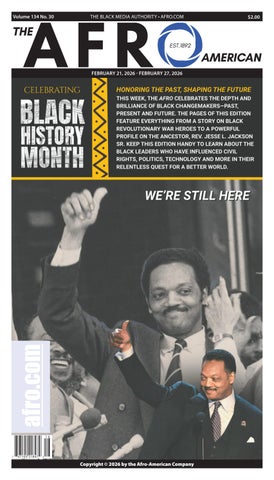
Civil rights leader Rev. Jesse Jackson Sr. dies at 84

Rev. Jesse Jackson Sr., the civil rights giant and founder of the Rainbow PUSH Coalition (RPC), has died at age 84. Family members made the announcement on Feb. 17.

The social and racial justice champion’s death follows battles with Parkinson’s disease and progressive supranuclear palsy (PSP), a rare neurological disorder affecting movement and balance. Jackson is survived by his wife, Jacqueline Jackson; their children Santita, Jesse Jr., Jonathan, Yusef and Jacqueline; daughter Ashley Jackson and grandchildren.

“Our father was a servant leader—not only to our family, but to the oppressed, the voiceless, and the overlooked around the world,” said the Jackson family in their Feb. 17 statement. “We shared him with the world, and in return, the world became part of our extended family. His unwavering belief in justice, equality and love uplifted millions, and we ask you to honor his memory by

continuing the fight for the values he lived by.”

Born in Greenville, S.C., as Jesse Louis Burns on Oct. 8, 1941, the man who came to be known as Jesse Jackson rose to prominence as a close aide of Dr. Martin Luther King Jr. during the Civil Rights Movement. The son of a teenage Helen Jackson and her married neighbor, Noah Robinson, Jackson later would change his name after being adopted by his stepfather, Charles Henry Jackson.

Upon receiving a football scholarship, Jackson found himself at the University of Illinois in 1959. While there, Jackson became a member of the Pi Psi Chapter of Omega Psi Phi Fraternity, Inc. in 1960. Ultimately, he would transfer and become a 1964 graduate of North Carolina A&T University, the historically Black college located in Greensboro, N.C. While still in college, Jackson began to appear in the AFRO Archives as a student leader and activist. He became a protégé of the Rev. Dr. Martin Luther King Jr., worked with the Southern Christian Leadership Conference (SCLC) in 1965

Your History • Your Community • Your News

The Afro-American Newspapers

Baltimore Office • Corporate Headquarters

233 E. Redwood Street 6th Floor, Suite 600G Baltimore, Maryland 21202

410-554-8200

Customer Service, Home Delivery and Subscriptions: 410-554-8200 customerservice@afro.com

Founded by John Henry Murphy Sr., August 13, 1892

Chairman of the Board/Publisher - Frances Murphy Draper

(Publisher Emeritus - John J. Oliver Jr.)

President - Benjamin Murphy Phillips IV

VP of Marketing and Technology - Kevin E. Peck

Director Digital Solutions - Dana Peck

Receptionist - Wanda Pearson - 410-554-8200, ext. 246

Director of Operations

Andrè Draper - 410-554-8200

Director of Finance Bonnie Deanes - 410-554-8242

Executive Director/Director of Advertising

Lenora Howze - 410-554-8271 - lhowze@afro.com

Director of Community & Public Relations

Diane W. Hocker - 410-554-8243

Editorial Managing Editor - Alexis Taylor - 410-554-8257

Editorial Assistant - Ama Brown-Parson Evening / Weekend Editor - Zenitha Prince

Archivist - Savannah Wood - 410-554-8277

Baltimore Circulation/Distribution Manager

Andrè Draper - 410-554-8200

Creative Design and Content Matthew McDonald

Washington Office 1140 3rd Street, N.E., 2nd Floor Washington, D.C. 20002-6723 202-332-0080

(Washington Publisher Emerita - Frances L. Murphy II)

Director of Operations - Andrè Draper - 410-554-8200

of the Rainbow PUSH Coalition. Jackson’s death at age 84 was announced on Feb. 17. Shown here, Jackson in Chicago, moments before walking onto the Democratic National Convention at United Center on Aug. 27, 1996.

and later created Operation PUSH in 1971, which focused on economic empowerment and expanding education, business and employment opportunities for Black communities.

In 1996, Operation PUSH merged with the National Rainbow Coalition to form the Rainbow PUSH Coalition, cementing Jackson’s legacy as a steadfast advocate for racial, economic and social justice.

Jackson made history as a political trailblazer, running for the Democratic presidential nomination in 1984 and 1988. His campaigns registered millions of new voters and inspired generations of Black political leaders. They also helped broaden the national conversation on civil rights and progressive policies from economic equity and labor rights to universal healthcare and anti-poverty

initiatives.

Throughout his career, Jackson also served as an international diplomat, negotiating the release of hostages and advocating for democracy and human rights worldwide. He was widely recognized with honors, including the Presidential Medal of Freedom from former President Bill Clinton in 2000, over 40 honorary doctorates and numerous awards for his work in

civil rights, nonviolent resistance and political activism. Just months before his death, Jackson was hospitalized for nearly two weeks at Northwestern Memorial Hospital in Chicago for observation related to the neurological disorder, PSP. During that stay, he spent several days in the intensive care unit. In 2013 it was disclosed that Jackson was living with Parkinson’s disease. His diagnosis was updated to PSP in April 2025.

In the wake of his death, leaders and community members have shared reflections on Jackson’s enduring impact and the legacy he leaves behind.

Chrissy Thornton, president and CEO for Baltimore-based Associated Black Charities (ABC), said Jackson’s example has served as a guiding force for generations of leaders, including herself.

“Rev. Jesse Jackson’s legacy stands as one of the fiercest reminders that the fight for civil rights is not only about changing laws, but about expanding the horizon of what Black people believe is possible,” said Thornton. “His leadership in the movement—from the frontline activism of Operation PUSH to the transformative vision of

Lessons from a voice that changed history

I never imagined Rev. Jesse Jackson Sr. would pick up the phone.

It was 2012.

On June 14 of that year, Adidas, the international shoe and sports apparel company, boldly unveiled a pair of sneakers that came complete with a pair of orange, plastic ankle bracelets. After public backlash to their audacity, the company canceled the release of the footwear which was already slated for release later that year.

A fresh-faced AFRO staff writer at the time, I received the go-ahead to do the article and immediately began searching for voices to speak in the piece. I was eager to deliver the best work possible to my editor at the time, the Rev. Dorothy Scott Boulware. Six months into my role, I had my usual tried and true voices I could reach out to, but, on whim, I decided to call the Rainbow PUSH Coalition (RPC) and ask for comment. What happened next I will remember for a lifetime.

I dialed the numbers to the RPC headquarters.

After a few rings … an answer from an oddly familiar voice.

To my absolute disbelief, the Rev. Jesse Louis Jackson Sr. had answered his own phone line.

We had a brief conversation about the shoes and the larger conversation sparked. Jackson had been instrumental in getting NBA players and officials involved in cancelling the release of the sneakers.

“Shackles were used in slavery times for 246 years and used on chain gangs. It conjures up the images of our

misery that are too serious to be trivialized and too painful to be trivialized,” Jackson told me. “One would not casually put a shoe with a swastika on it to be suggestive of such a painful period in Jewish history, so advertisements must be sensitive to the subliminal messages that they send.”

Before ending the conversation, he encouraged consumers to learn the implications behind the term “chain gang” before buying into the shoe’s hype.

The AFRO published the article and the daily grind of the news business moved on, but for me, those few fleeting moments stick to this day.

Interns will forever hear the story of how one summer day in June, a civil rights icon answered the phone for a budding journalist seeking to record just a bit of his legacy into the annals of time. That conversation has served as a reminder to always go the

extra mile, take chances and dare to go straight to the top when seeking an answer. That call flooded back to me years later, when I had the opportunity to be in the same room as Jackson. It was Feb. 28, 2022. While attending my first White House event, a Black History Month celebration, I tried my best to calm my nerves and take in the scene. In a room packed with notables from around the country, one figure stood out to me. There, in the East Room, as a crowd buzzed around him, Rev. Jesse Jackson Sr. sat quietly. I watched as different figure heads came up to shake his hand, speak and move along. Though I didn’t dare lose my spot in the press section, I knew it was likely the first and last time I would have the honor of being in such close proximity to the man who had significantly impacted the freedoms and rights I have enjoyed as

an African American. On Feb. 17 the world woke up to news that one of the leading civil rights activists of the 20th and 21st century was gone. Though the Rev. Jesse Jackson Sr. died at age 84, surrounded by his loved ones, his spirit and the breadth of his work live on through the AFRO Archives, where Black reporters, photographers, editors and publishers have ensured his legacy.

This week, I thank the AFRO News and Afro Charities team for such a beautiful Black History Month edition and invite all to take a walk through history and remember the contributions of the great Rev. Jesse L. Jackson Sr., the South Carolina-born boy who grew into a courageous international leader. Take a look at A7 of this week’s edition for an overview of what’s inside the AFRO Archives for Rev. Jesse Jackson.

AP File Photo/Ron Edmonds
Friends, family, mentees and activists worldwide are mourning the death of the Rev. Dr. Jesse Jackson Sr., the civil rights leader, Baptist minister and founder
AFRO Archives
In this May 1984 photo, flanked by supporters and an entourage of Secret Service agents and associates, Rev. Jesse Jackson moves the crowd gathered in downtown Baltimore at Hopkins Plaza.

Remembering Rev. Jesse Jackson Sr., the man who stopped

More than 40 years ago, in a crowded corridor in Nassau, Bahamas, I watched Rev. Jesse L. Jackson Sr. do something small that revealed something immense: he stopped.

My mother, Frances L. Murphy II—then publisher of the AFRO-American Newspaper—and I were attending a conference where he was the keynote speaker. The main ballroom was already humming with anticipation. He was making his way toward the session, surrounded by aides, press, admirers and well-wishers. Cameras flashed. Hands reached. Voices called his name.

I had no idea my mother knew him personally. Suddenly she said, “Walk faster,” gently pulling me forward. Then she called out, “Jesse!”

With all those people pressing in around him—and the demands of the moment pulling him toward the stage—he turned. He smiled. He greeted her warmly. And in that brief but generous pause, I was introduced to him.

He did not rush us. He did not look past us. For those few seconds, we were the only people who mattered.

Only later did I understand what I had witnessed.

That moment was Rev. Jackson’s ministry in miniature. It revealed what his famous declaration—“I am somebody”—truly meant. It was never only about the speaker. It was about the listener. The overlooked. The ordinary citizen. The people that history too often renders invisible. In the early 1970s, Rev. Jackson began carrying that affirmation into the national consciousness, transforming a simple declaration of dignity into a movement language of self-worth for Black children, poor communities and all who had been told—directly or indirectly—that they were less than.

But what made the words endure is that he did not merely teach people to say them. He lived them—by treating others as if they were, indeed, somebody.

Long before there was language like Black Lives Matter, Rev. Jackson carried that truth

into streets and sanctuaries, into workplaces and negotiating rooms, into international crises and local heartbreaks—insisting that Black life, poor life, working-class life and marginalized life are worthy of protection, investment and respect.

The Black Press understood that kind of leadership because it has always covered more than speeches—it covers stakes. The AFRO’s archives reflect that long view. In 1971, for example, its pages carried his sharp criticism of discrimination and harassment in the U.S. Postal Service—evidence of his willingness to confront not only headline injustices but the everyday indignities shaping Black working lives. He understood that justice must live in policy and paychecks as surely as in marches.

Yet the humanitarian core of his witness— sometimes overshadowed by the scale of his public leadership—was profoundly personal. Those who encountered him individually experienced it directly. He possessed the rare ability to see people inside crowds, to hear individual voices inside collective struggle, to affirm dignity in fleeting encounters.

So, when I reflect on Rev. Jackson’s life and legacy, I do not first see a rally or a podium. I see that corridor in Nassau—when a man surrounded by urgency chose presence instead.

He stopped. He turned. He greeted. He recognized.

In that small act lived the larger truth of his witness: justice begins with seeing one another fully.

Rev. Jackson helped bend the moral arc toward justice in public ways history will record. But he also did so in countless private moments history will never capture—moments when someone felt seen, valued and remembered.

I was one of those people.

Now, as the world marks the passing of Rev. Jesse L. Jackson, I hold gratitude above grief. For a lifetime of steadfast civil rights courage and humanitarian conviction—long before our present vocabulary caught up to his enduring witness—I give thanks.

the Rainbow Coalition—fundamentally reshaped how this nation understands multiracial democracy and economic justice. He pushed the country to reckon not only with racism, but with poverty, inequity and the structural barriers that keep communities from thriving.”

Thornton said she is reminded of his contributions every day as she carries out ABC’s mission of dismantling structural racism, expanding opportunity and advancing generational wealth.

“Rev. Jackson paved the road so that someone like me could be ready to pick up the mantle—to lead, to advocate, to fight for justice and to ensure that the movement he helped build continues with strength, clarity and unshakeable hope,” said Thornton. Faith leaders across the region are also reflecting on Jackson’s generational impact and the unique role he played in shaping modern social and racial justice work.

Longtime Baltimore-based activist Rev. Cortly “C.D.” Witherspoon said the reverend served as a bridge between architects of the Civil Rights Movement, like Dr. King and Whitney Young, and the leaders who followed.

“Because he sat at the feet of the elders he possessed insights and connections his contemporaries weren’t privileged to,” said Witherspoon. “In King, Rev. Jackson found Moses and in Rev. Jackson, Dr. King discovered Joshua.”

Witherspoon recalled Jackson’s ability to mobilize young people and connect national movements to local communities, pointing to a pivotal moment during the Iraq War. In 2003, he said Jackson came to Coppin State University (CSU) to help organize students for a protest in Washington, D.C. He helped assemble young people from CSU and Morgan State University for a march in the nation’s capital alongside civil rights leaders Andrew Young and Walter Fauntroy.

For Witherspoon, Jackson’s influence was both historical and deeply personal.

“I grew up reading about his work with King; his inspirational runs for the U.S. pres idency that cleared the way for the election of transformational leaders and ‘first Blacks’ all over the U.S.; and his hostage negotiation skills that made him not just a leader, but lib erator,” said Witherspoon. “Having the oppor tunity to meet him and be in his presence for even a relatively short time in my life was a memorable experience, which became etched into the crevices of my carnal heart.”

Rev. Al Sharpton, civil rights leader and president of the National Action Network (NAN), remembered Jackson as both a men tor and a moral compass, whose leadership shaped his own path.

“Today, I grieve not only a leader, but the steady voice that guided me when the road was uncertain. I am heartbroken. But, I am eternally grateful that God allowed me to walk beside a man who helped bend the arc of history and shaped the arc of my own life,” said Sharpton, in a Feb. 17 statement. “Today we mourn, but we do not retreat. We pray for the Jackson family to carry the torch. The greatest way to honor Reverend Jesse Jackson is not in memory alone, but in movement. He taught us to keep marching. He taught us to keep organizing. He taught us that justice is never given, it is demanded.”

Maryland Gov. Wes Moore extended his condolences to the Jackson family in a statement issued on Feb. 17. In it, he dubbed Jackson a “champion for the dignity of working people.”

“Of the many shoulders that we stand on, Jesse Jackson’s were amongst the broadest. He led with love and reminded all of us of our voice and our power. Reverend Jackson was a trailblazer who never waited for permission or to ask for a seat at the table—he insisted on it, and he widened that table for generations to come,” said Moore in the statement. “Reverend Jackson spent his life turning pain into purpose and protest into progress and organizing communities to make those promises real.”

Public observances for Jackson will take place in Chicago, with details about his celebration of life to be shared by the Rainbow PUSH Coalition on www.rainbowpush.org and www.jessejacksonlegacy.com.

For over 45 years, Broadmead has been more than a place to live — it’s been a warm and welcoming Life Plan Community where neighbors become friends, creativity flourishes, and every voice is valued. Now, we’re thrilled to invite you to be part of our next chapter: our first-ever off-site expansion, Broadmead at Ridgebrook.*

History in the Making at Broadmead… Curious to Learn

Visit Broadmead.org/Ridgebrook, or reach out to us at information@broadmead.org or

AFRO Archives
The Rev. Dr. Jesse Jackson Sr. is remembered as a valiant civil rights leader, Baptist minister and founder of the Rainbow PUSH Coalition. News of his death spread in the early morning hours of Feb. 17. He was 84 years old. Today, AFRO News Publisher Frances “Toni” Murphy Draper reflects on when she was first introduced to Jackson in Nassau, Bahamas.
Rev. Jesse Jackson

Then and now: Black History Month underscores the ongoing battle to protect the ballot

As discussion over voting rights and access increases across the nation, several lawmakers are championing legislation in the Maryland General Assembly this year in an attempt to safeguard civil rights at the state level. In this, they echo the heart and spirit of civil rights leaders of the 1960s and 1970s.

Though Maryland has long been a Democrat-controlled state, Delegate Gregory Wims (D-Md.-39) said House Bill (HB) 350, Senate Bill (SB) 255 and House BIll 219 aim to strengthen existing voting protections. He said the measure is intended to safeguard Maryland’s

“Voting rights is the right that makes every other right possible.”

election laws amid shifting federal policies and court decisions.

Delegate Stephanie Smith (DMd.-45), sponsor of HB 219, laid out what her bill in particular would do if passed. HB 219 is referred to as the Maryland Voting Rights Act of 2026.

“My bill is about not just saying that intimidation and harassment is wrong at polling places, it’s about ensuring there’s a legal cause of

Sen.

which seeks to strengthen voting protections and safeguard minority voters’ access to the ballot in Maryland.

action for you to sue because of that,” said Smith.

Smith further emphasized that determining something wrong is not the same as having the legal power to hold someone responsible for denying or interfering with your right to vote, which this bill would give Marylanders the right to do.

As of Feb. 13, HB 219 has been heard in the House Government, Labor and Elections Committee, but has not yet been voted out of committee. Each bill in the Maryland General Assembly must be introduced, approved in committee and by its chamber, then passed by the other chamber before going to the governor for a signature to become law.

“Voting rights is the right that makes every other right possible,” said Smith. “When we have a federal judiciary and a federal executive branch that are looking committed to weakening our federal Voting Rights Act, it’s incumbent upon the states to protect access to the ballot that every person in this state deserves to have.”

“We can’t get to the next conversations about how to protect people’s economic needs, health care access, all the things they want to make their lives better if they can’t rely on having access to the ballot,” she added.

Sen. Charles E. Sydnor III (DMd.-44) is lead sponsor of SB 255, which is the Senate version of HB 350. When bills are cross-filed in the Legislature it amplifies its support and chances of passing both chambers and making it to the governor’s desk to be signed into law.

Wims’ and Sydnor’s bills are referred to as the “Voting Rights Act of 2026.”

Their legislation complements HB 219 by creating state protections for minority voters in local elections. It

also allows the attorney general or other individuals to sue over practices that weaken voting power and authorizes courts to order remedies.

Though the courts can give redistricting map solutions, they cannot force local governments to completely change their election systems without agreement from said local government. This bill would also allow people to sue at the state level instead of having to go to the federal level, which would be more costly and time consuming.

For Wims, this fight is near and dear.

“Beside being president of the NAACP in the 1990s, I worked on Capitol Hill with the Congressional Black Caucus as an intern

Black tech leaders call for ownership, access and

This Black History Month, the AFRO spoke with three tech experts in the Washington, D.C., and Baltimore area about where tech has been and where it’s going.

Khalif Cooper is a self-taught software engineer who spends his days coding and organizing events for a group he founded, called Black Tech Connect. The organization is made up of Black technology professionals who support each other and share resources and ideas. Cooper says he

“If Black people aren’t in the rooms where these systems are being designed and being audited and being governed, then we’re not shaping how those decisions get made. We’re just really living with the consequences that come after it.”

built the space after not having one as he came up in the sector.

He says his goal is to “build unicorns” (experts with unique qualities)

who can continue to transform Baltimore into the tech hub he feels it can be. Cooper shared that there are already lots of biotech companies, but what’s missing is community.

“They need the grassroots communities to come support,” said Cooper. “If they have that, there will be another Silicon Valley.”

Jasmine Wooton is the founder of Sys2Win, an operations consultancy that works with tech consultants and coaches to help them streamline their creative processes. She echoed Cooper’s sentiments and believes that tech and its growth has to do entirely with resources.

“If you have access to the hardware and Wi-Fi, any place can be a tech hub,” said Wooton. “It doesn’t matter where it is– where there is creativity, there can be a tech hub, because you can use technology in so many different ways.”

Despite growing opportunities, excitement around technology is often met with hesitation in Black communities, especially as artificial intelligence (AI) becomes more

as we looked at discriminatory practices in voting nationwide,” said Wims. “Thirty years ago, I had no idea I would be an elected official.”

Wims said this legislative initiative is not a sure thing yet, but he will be working hard to rally the delegates to get the bill passed in the House and signed into law.

As of Feb. 13, HB 350 remains in the House Government, Labor and Elections Committee, while SB 255 has crossed over to the House of Delegates for consideration.

“We need everyone who is reading this to call their delegates,” he said. “Each voter has three delegates … contact all three delegates and tell them to vote.”

leadership

visible in everyday life and incidents of discrimination dominate headlines.

MarKeisha Snaith works in AI governance, which she says is the closest thing to having a seat at the table with AI. Those in AI governance decide things such as what data can be used and what risks can be tolerated. Snaith said that concerns of AI bias are valid, noting that AI has created “invisible infrastructure,” as it continues to be used for hiring, lending, healthcare and education.

“Power is protection,” Snaith said. “If Black people aren’t in the rooms where these systems are being designed and being audited and being governed, then we’re not shaping

how those decisions get made. We’re just really living with the consequences that come after it.”

Snaith said in general, it would help Black people to be more technical, and that skillset, if practiced, can make them stand out in a tough job market. She shared that MIT and Google have provided free AI courses.

Wooton shared that disengagement is what can cause barriers and lead people to be left behind as technology continues to advance.

“I would say to the people who are hesitant about AI that it’s okay to be hesitant,” said Wooton. “It’s not okay to freeze.”

Photo courtesy of Meta (Facebook)/Sen. Charles E. Sydnor III
Charles E. Sydnor III (D-Md.-44) is lead sponsor of SB 255,
Photo courtesy of Christian Oven
Delegate Stephanie Smith (D-Md.-45), left, and Delegate Gregory Wims (D-Md.-39) at a Feb. 11 press conference advocating for their package of voting rights bills.
Courtesy photo
MarKeisha Snaith is an expert in AI governance, which is what she calls the closest to having a seat at the table when it comes to shaping AI and how it behaves.
Courtesy photo Jasmine Wooton is the founder of Sys2Win, an operations consultancy that works with tech consultants and coaches to help them streamline their creative processes.

Black patriots of the Revolutionary War: Maryland’s forgotten soldiers

“The greatest part of those that have enlisted are free Negroes [and] Mulattoes,” a Maryland recruitment officer reported in 1780.

The statement, preserved in the Archives of Maryland, points to a largely untold story in our country’s history: Black men—many of them free—fought alongside White soldiers in Maryland during the Revolutionary War, helping secure the nation’s independence.

Historians like Dr. Walter Gill, a military veteran and commissioner on the Maryland Commission on African American History and Culture shared with the AFRO that the first group of Black soldiers from Maryland were organized in the summer of 1776 and were integrated with White soldiers and their families. Oftentimes they were used as laborers and fighting soldiers, with very few advancing past the role of private.

Gill told the AFRO that in terms of enslaved Black men, they were not recruited until shortly after 1778. They often replaced White men and their sons who were drafted.

“The people who owned enslaved people needed them for economic reasons and they weren’t too particular about giving their enslaved guns,” said Gill.

After the war, many enslaved soldiers were not granted the freedom that had been promised to them, though some in more progressive states, including Maryland and Pennsylvania, did earn land or pensions.

One notable Black patriot in Maryland history is Thomas Carney.

Dr. Steven Xavier Lee

has spent the last 30 years

“crusading for recognition of Maryland’s free Black enlistees in the revolutionary war.” He wrote a storybook about Carney and his contributions, which helped lead to the creation of a monument honoring Black patriots and their contributions that is expected to be unveiled in August.

Lee said it’s possible that thousands of Black men enlisted in the Revolutionary War, but only approximately 350 people have been identified.

“They have been completely left out of history, and a lot of people seem to find that hard to accept or believe, which I do not understand because today, we have a president who is trying to erase our history,”

said Lee. “So it shouldn’t be a mystery or hard to understand why we were left out of history 250 years ago.”

He also touched on the fact that if this history is not known, it does not change. Which means perspectives don’t change.

“Subconsciously, we’re trained to think that the battle for America was outside of our real experience because we were just slaves in the background,” said Lee. “That’s a false image. When you understand that there were many free Black men who enlisted it gives you a different sense of pride in your country, pride in your ancestors, and a different sense of entitlement.”

Stephani Juleeana Miller

has spent more than 20 years researching her Eastern Shore, Md. families. She is the fifth great-granddaughter of Revolutionary War patriot James Due of Hillsboro, Md., and a founding member of the Society of the First African Families of English America, a non-profit lineage organization that unites descendants of African ancestry who lived in English America prior to March 5, 1770. Through this organization she is working on a series of books about

forgotten patriots. Miller is a genetic genealogist, and it wasn’t until six years ago, while connecting with a White relative on ancestry.com, that she learned she was the descendant of a patriot. It wasn’t until she looked up census data that she realized Due was Black. She called it the “biggest find” of her career.

She called the discovery both “humbling and unsettling,” acknowledging that while her ancestor

played a role in the nation’s founding, many like him later faced enslavement and hardship. Still, Miller said she is proud to be American and considers herself a patriot.

“We were already here,” said Miller. We were here in the 1600s, we were here early in the 1700s so we were here before America became America. So we are American. This is our country. We have helped build this country from the very beginning.”

Historical Marker Database / Pete Skillman Shown here, a photo of the historical marker honoring Revolutionary War hero Thomas Carney.
Courtesy photo
Stephani Juleeana Miller is the fifth great-granddaughter of Revolutionary War patriot James Due of Hillsboro, Md.
Courtesy photo
Steven Xavier Lee is an independent historian and the author of “The Story of Mr. Thomas Carney: A Maryland Patriot of the Revolutionary War.”
Courtesy photo
Dr. Walter Gill is a military veteran and a commissioner on the Maryland Commission on African American History and Culture.

Black leaders highlighted in ‘Strong Men and Women in Virginia History’ exhibit

An attorney, a U.S. Army officer, a civil rights pioneer and a public health advocate are all honored in the 14th annual “Strong Men and Women in Virginia History” exhibit.

(Jan. 7, 1932 - Nov. 19,

the late U.S.

for his service at the Pentagon. In his final assignment as an active member of the military he served as chief of the Europe/Africa Division of the Defense Security Assistance Agency for the Department of Defense. Dillard was laid to rest at Arlington National Cemetery in 2024.

Presented by Dominion Energy and the Library of Virginia, the leaders were recognized this Black History Month alongside scholars who took part in the Student Creative Expressions Contest.

Each year African-American entrepreneurs and leaders who have paved the way for future generations are highlighted. Over the years, those celebrated have come from all walks of life, to include elected leaders, members of the medical community, teachers and more. Past honorees include John Wesley Cromwell (Sept. 5, 1846–April 14, 1927), the publisher of the People’s Advocate, who was born a slave in Portsmouth, Va., NASA astronaut Leland D. Melvin and Aline Elizabeth Black (March 23, 1906–Aug. 22, 1974), the woman who took on the fight for equal pay for teachers.

The 2026 class of honorees includes Chesapeake, Va. native Sharon Bowen, now a corporate attorney and chair of the New York Stock Exchange; William Hughes Dillard, the late U.S. Army Officer from Arlington County,Va.; Sheary Ann Darcus Johnson, a civil rights advocate from Harrisonburg, Va., and Florence Neal

Cooper Smith, the Richmond native who has lead efforts to improve sickle cell outcomes in public health.

“This year’s Strong Men and Women in Virginia History honorees exemplify courage and determination, leaving a lasting impact on their communities,” said Ed Baine, executive vice president of utility operations and president of Dominion Energy Virginia, in a statement.

“We proudly recognize these remarkable individuals who used their professional skills and talents to inspire progress and positive change for generations to come.”

Librarian of Virginia Dennis T. Clark, in a statement, said the 2026 honorees have “enriched the lives of Virginians.”

“This year’s honorees exemplify inspiring stories of perseverance and excellence, continuing legacies that uplift our Commonwealth,” said Clark.

A traveling exhibit will now celebrate the lives and legacies of the 2026 honorees as it moves throughout the state this year, informing the general public of how they improved life for all Virginians.

The exhibit looped in youths throughout the state

with a creative contest. Scholars were asked to highlight the story of a Black changemaker that often goes untold.

All of the finalists personally received an Apple MacBook Air laptop, while their individual schools were also supported with funds.

Vrinda Shah, of Maggie L. Walker Governor’s School in Richmond, Va., took the top spot in the student contest, with a website to honor the woman who laid the groundwork for modern day GPS systems, the late Dr. Gladys Mae West.

Photo courtesy of Houston Defender Sharon Bowen, a Chesapeake, Va. native, now serves as chair of the New York Stock Exchange.
Photo courtesy of James Madison University
Sheary Ann Darcus Johnson is the first Black graduate of James Madison University. She paved the way for those courageous enough to break the color line and seek higher education at predominantly White institutions.
Photo courtesy of the Library of Virginia William Hughes Dillard
2024),
Army Officer of Arlington County, Va., is remembered
Photo courtesy of Virginia Commonwealth University Florence Neal Cooper Smith is best known for her work in fighting sickle cell disease. She has dedicated her time, energy and resources to discovering ways to help those who suffer from the condition and in 1972 she helped create the Virginia Sickle Cell Anemia Awareness Program for the Medical College of Virginia Campus at Virginia Commonwealth University.

A look at the legacy of Rev. Jesse L. Jackson

In June 1963, Jesse Jackson, a college student at North Carolina A & T, speaks with AFRO Correspondent Cliff Mackay about demonstrations in Greensboro, N.C., held to show solidarity and support for the Black protestors attacked with police dogs in Alabama.

March 1993

Some of the earliest mentions of the Rev. Jesse Jackson in the AFRO Archives include a January 1963 announcement of his election to a leadership role within his beloved Omega Psi Phi Fraternity, Inc. Jackson pledged the Pi Psi Chapter of Omega Psi Phi Fraternity, Inc. at the University of Illinois Urbana-Champaign in 1960.

1972

In the Jan. 8, 1972, edition of the AFRO, readers learn more about Rev. Jesse Jackson’s split from the SCLC, and the creation of his own organization, Operation PUSH (People United to Save Humanity).

Shown

Dr.

and

In both 1984 and 1988 Rev. Jesse Jackson launches campaigns for president of the United States.

here, a February 2005 article by AFRO Editor Zenitha Prince, then a staff writer, on Rev.

AFRO Archives / T. Stockett In the July 14, 2006 edition of the AFRO, artist Thomas Stockett makes comment on Rev. Jesse Jackson’s crusade to boycott BP (British Petroleum) on the grounds that none of the company’s top-level executives or owners on the distribution side are Black. July 2006

Shown here, Congressman Kweisi Mfume (D-Md.-07) (left), with the Rev. Jesse Jackson and former Baltimore Mayor Kurt L. Schmoke.
After decades of service, the AFRO records the Rev. Jesse L. Jackson’s retirement from his leadership role at the Rainbow PUSH Coalition. July 2023
Shown here, Rev. Jesse Jackson on April 5, 1993, protesting outside of Baltimore’s Oriole Park at Camden Yards fairness in athletics. At the time, Jackson was leading a campaign to fight racism and sexism in the sports industry.
Shown
Jesse Jackson’s call for economic freedom. February
AFRO Archives / Roman Hankewyes
here, Rev. Jesse Jackson (center) with
John L. Crew (right), superintendent of Baltimore City Public Schools at the time,
Howard Murphy (left), AFRO board member, at Frederick Douglass High School on Feb. 9, 1977.

BALTIMORE-AREA

Delegate N. Scott Phillips (D-Md.-10) (left), chair of the Legislative Black Caucus of Maryland, speaks on 2026 legislative priorities with Sen. Charles Sydnor (D-Md.-44), Sen. Arthur C. Ellis (D-Md.-28) and

Black legislators outline 2026 priorities

tmcqueen@afro.com

The Legislative Black Caucus of Maryland (LBCM) released their 2026 legislative priorities on Feb. 12 in Annapolis, Md. Their legislative priorities span five key areas including health and environmental justice, education, justice and public safety, economic empowerment and housing justice and civil rights.

Key bills addressed during a press conference where they unveiled these priorities include a bill that would prohibit immigration enforcement agreements, a bill that aims to end appraisal biases and legislation ending the automatic charging of youth as adults.

Delegate N. Scott Phillips (D-Md.10), the new chair of the Legislative Black Caucus of Maryland, led the unveiling, sharing the caucus’ history and offering insight into how members selected this year’s key priorities.

“Since 1970, under the leadership

of Delegate Lena K. Lee, our caucus has really been focused on five decades of sponsoring legislation which impacts Black Marylanders specifically,” said Phillips. “We focus along the areas of social, cultural, and economic progress for Black Marylanders.”

Phillips pressed that the 2026 priorities were created not in isolation, but collaboration.

“They are the result of a deliberate process–input from members, a full caucus retreat, working sessions and legislation drafted by members themselves,” he said. “What we present today is not a wish list. It is a unified legislative agenda grounded in community and informed by policy expertise.”

Health and environmental justice

Within the health and environmental justice priority, the LBCM is focusing on legislation that aims to create a dementia service program and clinical toolkit and incorporates bills that aim to address perinatal

BEYA STEM Conference highlights role of HBCUs

The 40th annual Becoming Everything You Are (BEYA) STEM Conference kicked off at the Baltimore Convention Center on Feb. 12, assembling business leaders, experts, professionals and students in science, technology, engineering and mathematics (STEM) fields. Two of the day-one panels put historically Black colleges and universities (HBCUs) center stage.

The first explored how the institutions can play a strategic role in early exposure, advocacy and pipeline-building for artificial intelligence (AI) and national-security related careers.

“We need more talent. We need more hands on deck. We need to figure out how to upskill people not only to develop the AI technology, but also in what ways can we apply the AI technologies and how do we have the infrastructure, materials and resources?” said Talitha Washington, executive director of the Center for Applied Data Science and Analytics (CADSA) at Howard University (HU). “The talent doesn’t start at age 18, it can happen before that. Just having younger people in the pipeline— through hands-on engagement and experiences

that really resonate with them and give them agency, is urgent and paramount.”

During the discussion, panelists shared their strategies for engaging students before college. Anshu Arora, professor of marketing, AI and social robotics at the University of the District of Columbia (UDC), outlined initiatives that work directly with public high schools, including a robotics program that serves students with autism spectrum disorder (ASD) and other learning disabilities. The program uses social robotics and behavioral research to make AI education accessible and hands-on.

Amit Arora, professor of supply chain management and AI at UDC, highlighted summer academies at the HBCU, which bring current research students into the programs to help make lessons more approachable and relatable for high school participants.

“Through the summer academy, we got a few students who were really interested in doing some work in social robotics and national security projects that we have,” said Amit Arora. “Putting our current college students in direct contact with K-12 students really helps break down the barriers.”

Beyond highlighting points of K-12 engagement, the panel

Mayor Scott unveils new tax reform, relief efforts for local homeowners

Mayor Brandon M. Scott announced two efforts aimed at delivering tax relief to residents on Feb. 9. The first initiative seeks to reduce the effective property tax rate for residents below $2, and the second reforms the city’s annual tax sale, including creating payment plans for residents to settle overdue tax bills.

During the announcement, Scott emphasized that lowering property taxes is essential to attracting new residents and retaining existing Baltimoreans.

mental health conditions.

“What we know is that dementia is–particularly in the Black community–under-reported, but a higher incidence than it is for the general population,” said Sen. Malcolm L. Augustine (D-Md.-47). “This is an area where we know that we must do more to educate people, because there are actually some treatments that are available, and that’s what this piece of legislation does.”

Education Laws that the caucus has sponsored concerning education include a bill that would ensure children in foster care have can get a proper education while in group homes, Improve education around sickle cell disease and a bill about the school psychologist interstate licensure compact.

“Essentially what the School Psychologist Interstate Licensure Compact does is that it’s going to allow school psychologists from particular states to come into Maryland

also addressed two concerns surrounding AI: the potential for automation to replace existing jobs and AI’s environmental impact

Amit Arora said the conversation often comes up in his classroom. He emphasized that—like previous technological revolutions— AI is here to stay, but it can be embraced rather than feared.

Drawing parallels to the introduction of ATMs, he noted that technology often shifts human roles rather than eliminating them entirely, with employees taking on more skilled responsibilities alongside automation.

“People adopt the technology, and we get used to it. It’s the same thing now. AI is here, and there’s a little bit of fear,” said Amit Arora. “But, once that adoption rate goes up, we’ll understand that AI is here to help us. We need to use those tools to reach better productivity levels.”

Expanding on the idea that humans remain essential in an AI-driven workforce, Anshu Arora emphasized that understanding how to use AI is imperative to staying competitive in today’s job market.

“It’s not AI replacing our jobs, it’s people with AI replacing people without AI,” said Anshu Arora.

When it comes to the

“Live Baltimore released a study that showed our city could grow by more than 20,000 households over the next five years. We know the majority of the folks interested in becoming homeowners in our city are our current residents, including renters who want to move within the city,” said Scott.

“All of that is great news for us, and we’ve already taken action to make homeownership more attainable, especially for renters through downpayment assistance, our first time homebuyer incentive program, and the very successful, new Buy Back the Block program, but we know that our property tax rate is still a barrier to homeownership in the city.”

Scott said the city’s first step in providing tax relief will be revising the Homestead Property Tax Credit, which has not been updated since the 1990s.

Currently, the credit limits how much a homeowner’s property taxes can go up each year to 4 percent. The city is proposing to raise that limit to 6 percent, which would bring Baltimore in line with other Maryland cities.

The second step is to increase the Targeted Homeowners Tax Credit (THTC), bringing the effective tax rate below $2 in fiscal year 2027. Scott

said the boost will offset the change to the Homestead Property Tax Credit, providing overall tax relief for most homeowners.

The city is also launching a campaign to promote greater resident enrollment in state tax credits and working with state leaders to refresh Maryland’s Homeowners’ Property Tax Credit for the first time in decades.

Baltimore City Council Vice President Sharon Green Middleton, who is sponsoring a bill to change the city’s Homestead Property Tax Credit, praised the mayor’s collaborative leadership on these efforts.

“We are all aware that property taxes in Baltimore are excessively high. This situation not only discourages new residents from moving to Baltimore but it also drives current residents away. That’s why I’m proud to team up with Mayor Scott on this property tax relief strategy aimed at making Baltimore more affordable,” said Middleton. “In my 19 years on the city council, this is the first coordinated strategy we’ve had to reduce property taxes below $2.”

Tax sale reforms

Back in 2024, Maryland Legal Aid, a statewide nonprofit law firm, sued the city of Baltimore over its tax sale process, alleging that it was a predatory, unconstitutional system that does not provide just compensation to property owners. This year, the city reached an agreement with Maryland Legal Aid to stay the lawsuit for two years.

During this time, the city will begin making adjustments to the tax sale process, including offering payment plans and raising the minimum bid to match the property’s assessed value rather than the lien amount.

Vicki Schultz, executive director for Maryland Legal Aid, noted the efforts

environmental impact of AI, Washington noted that the technology relies on energy-intensive data centers and called for more efficient systems, renewable energy and thoughtful resource management to make AI development sustainable. She also proposed exploring synthetic materials as an alternative to mined resources, suggesting that repurposing, retooling and recycling could help meet the growing demand for AI hardware.

“People like AI technology. They like to use it for searches, and that machinery is done in a data center,” Washington. “So, how do we have eco-friendly data centers? How can we have algorithms that are more efficient? How can we have more efficient machinery? How can we use different sorts of energy

sources?”

Federal support for

HBCU innovation

The second HBCU-focused panel on day one highlighted federal research funding opportunities and how schools can position themselves as leaders in national security research and STEM innovation. Panelists represented the U.S.

Department of Navy (DON), the Defense Logistics Agency (DLA) and Department of Energy (DOE), each outlining programs designed to connect HBCU faculty and students with hands-on projects. Anthony Smith, director of the DON’s HBCU and Minority Institutions program, explained

AFRO Photo/Megan Sayles
Talitha Washington (left), a Howard University (HU) professor; University of the District of Columbia (UDC) professors Amit Arora and Anshu Arora, and UDC STEM program manager Kevin Norton, speak on a panel at the Becoming Everything You Are (BEYA) Stem Conference in Baltimore on Feb. 9.
AFRO Photo/Tashi McQueen
Delegate J. Sandy Bartlett (D-Md.-32)(right) at his side.

Tax relief

were a meaningful step forward in enhancing fairness.

“For too long, Baltimore residents have lost their homes over small tax bills and received far less than the value of their homes. Older homeowners and, specifically, Black homeowners have been hit hardest, losing not just a place to live but the chance to pass their home on to the next generation,” said Schultz. “By keeping people in their homes, we protect families, preserve generational wealth and strengthen neighborhoods. We commend Mayor Scott and his administration for entering into this agreement and recognizing that

housing stability benefits all Baltimoreans.”

Baltimore City Councilwoman Odette Ramos will be crafting legislation to create the payment plans, which the mayor said will be as straightforward as possible. Residents can visit: baltimorecity.gov/ propertypaymentplans to sign up for an alert when the applications go live.

“These payment plans, and this broader tax relief strategy add up to real impact for homeowners here in Baltimore and will help those who want to become homeowners achieve that dream,” said Scott. “Baltimore, our renaissance is here, and we want to make sure our residents are the first to benefit from the historic growth of our city.”

BEYA STEM Conference

that opportunities range from student internships to faculty fellowships.

“We try to encourage faculty to interact with the Office of Naval Research and Department of Navy program officers to ensure that the work they are doing is considered Navy-relevant,” said Smith. “The big focus going forward is ensuring your research will be related to a program of record for the Department of Navy— whether what you’re working on will benefit a sailor or Marine in a short time frame or be able to be used in a warfare environment for the Navy to better themselves.”

Robinson Pino, program manager in the DOE’s Office of Science, said he supports research in AI competition, neuroscience, advanced wireless, applied mathematics, hardware development and computer science in his role.

“We are the largest funder of basic research in the physical sciences, and we store 10 of the DOE’s national laboratories,” said Pino. “Our annual budget is just over $8 billion per year, which is 100 percent basic research.”

He noted that his office is in the process of creating funding opportunities as part of the recent launch of the

Legislative Black Caucus

Continued from B1 Continued from

a little more quickly,” said Delegate Bernice D. Mireku-North (D-Md.-14). “It allows the states to share licensing and background information and also allows Maryland to continue to exercise full authority of whoever gets a license regarding the scope of practice, discipline, standards for the profession as well.”

“Right now, in Maryland, there’s one school psychologist for every 1,053 students,” said Mireku-North. “The national preferred recommendation is one for every 500. We seek to benefit from that, especially with the school system that’s becoming more Black and Brown.”

“This legislative session, the Legislative Black Caucus of Maryland, will continue our efforts to combat housing discrimination and unfair housing practices,” said Delegate Kym Taylor (D-Md.-23). “In particular, we have reintroduced four bills that seek to address the issue of appraisal bias. The first is legislation that seeks to mimic the Veterans Administration’s Tidewater Initiative, which provides a reconsideration of the value process for home loans.”

Baltimore City Council Vice President Sharon Green Middleton (D-6) (front, left) and Mayor Brandon M. Scott (front, center) announce new initiatives to provide tax relief to local homeowners. The efforts seek to bring the effective property tax rate under $2 and to reform the city’s annual tax sale with payment plans and adjustments to the minimum bid.

Genesis Mission, a coordinated national effort to accelerate scientific discovery using AI.

Panelists also emphasized that HBCUs can strengthen their position by identifying their distinct research strengths, networking with program officers, attending workshops and partnering with federal labs or small businesses. These strategies can help the institutions ensure that faculty and students are ready to compete for grants and fellowships.

They also highlighted an April 2025 executive order from the 47th president, which directed federal agencies to expand support for HBCUs through increased funding, research opportunities and public-private partnerships. Smith stressed the institutions must determine a speciality to effectively leverage these opportunities.

“As government agencies, I think what we have to do is help HBCUs by finding their niche. Each school has something that they can offer,” said Smith. “What we do now is go to HBCUs to find out what they are really good at and then expand the opportunity to meet the needs that have been identified in the executive order.”

Justice and public safety

Under the justice and public safety category, the caucus will focus on reform laws around automatic youth charging, keep children out of adult detention facilities and prevent traffic stops for minor offenses.

House Bill (HB) 409 and Senate Bill (SB) 323, known as the Youth Charging Reform Act, would require most youth criminal cases to begin in juvenile court instead of being automatically charged as adults, expanding juvenile court jurisdiction.

Delegate J. Sandy Barlett (D-Md.32), chair of the House Judiciary Committee, further explained the Youth Charging Reform Act.

“This bill affects 14- and 15-year-olds who have been alleged to have committed a crime that would be punishable by an adult,” said Barlett. “It brings them to juvenile court jurisdiction first. The bill does not affect anyone who is charged with first-degree murder, first-degree rape, or armed carjacking.”

Economic empowerment and housing justice

Members of the LBCM will support a list of legislation that tackle economic empowerment and housing justice for Black Marylanders. They will include a bill on safe and stable housing for all and a package of bills that will fight against appraisal biases.

Taylor said the second bill would require newly constructed home sales to be entered into the Multiple Listing Service (MLS) or another public database so they can be used as comparable sales. She added that the Legislative Black Caucus is also advancing two bills aimed at increasing the number of Black professionals in the appraisal industry.

“Black appraisers make up less than 5 percent of the appraiser industry in the United States,” said Taylor. “We hope to drastically improve those numbers in Maryland by creating pipeline funding opportunities.”

Civil rights

The civil rights legislation includes a bill that would prohibit 287(g) agreements in Maryland and the Voting Rights Act of 2026. The 287 (g) bills, HB 444 and SB 245, have both passed from their respective chambers and have been sent to the governor’s desk for a signature. If Gov. Wes Moore (D) signs the bill, it would immediately go into effect.

“287 (g) agreements are voluntary agreements that local law enforcement can enter into with ICE (United States Immigration and Customs Enforcement),” said Delegate Nicole A. Williams (D-Md.-22).

Williams argued that 287 (g) encourages law enforcement to engage in racial profiling.

“The majority of individuals who are picked up under these agreements,” she said, “have either not committed any crime whatsoever [or] if they are charged with a crime, about 80 percent of them have been charged with low-level offenses, whether it’s loitering, busted taillight or really low-level misdemeanor charges.”

Photo by J.J. McQueen

Tre’ Johnson, former NFL offensive lineman turned high school history teacher, dies at 54

Tre’ Johnson, the former standout Washington offensive lineman who went on to become a Maryland high school history teacher, died Feb. 15. He was 54.

Johnson’s wife, Irene, announced the death in a Facebook post, saying he died during a short family trip.

“It is with a heavy heart that I inform

you that my husband, Tre’ Johnson, passed away suddenly and unexpectedly ... during a brief family trip,” she wrote. “His four children, Chloe, EJ, EZ and Eden, extended family, friends and I are devastated and in shock.”

Johnson played for the Washington Redskins, the team now known as the Washington Commanders.

After starring at Temple, Johnson was drafted by Washington 31st overall in 1994. He played for Washington

through 2000, spent 2001 with Cleveland and returned to Washington for a final year in 2002. The 6-foot-2, 328-pound guard was a Pro Bowl selection in 1999.

After football, he became a history teacher at the Landon School in Bethesda, Md. His wife said recent health issues had forced him to take a leave of absence.

This article was originally published by The Associated Press.

Rep. Glenn Ivey floats stripping police function from ICE

The Department of Homeland Security is in a partial shutdown over a funding standoff in Congress, and Democrats say they won’t approve more money for the agency without reforms to ICE along with it.

But Rep. Glenn Ivey, a Democrat from District 4 in Prince George’s County, might go one step further.

“It may be that you just have to strip out this law enforcement function from ICE entirely,” he said in an interview with Capital News Service as the shutdown was just beginning over the long holiday weekend.

One reform sought by Democrats would prohibit DHS officers from entering private property without a judicial warrant. But that wouldn’t stop them from carrying out enforcement altogether.

“If they can’t handle that level of responsibility, and

it’s clear that they [can’t],” said Ivey, “it needs to be taken away.”

Earlier this month, he wrote a letter to federal agencies — cosigned by 57 Democrats — demanding the release of evidence on the lethal January shootings of Alex Pretti and Renée Good by ICE and Customs and Border Protection agents. According to Ivey, there’s been no response to the letter, which was addressed to FBI Director Kash Patel, Secretary of Homeland Security Kristi Noem and Attorney General Pam Bondi.

“The key thing from my perspective is that the state, local prosecutors get the evidence they need,” Ivey said. “If they don’t contact me, but they send them the evidence, that’s fine.”

That hasn’t happened either, Minnesota Attorney General Keith Ellison said at a Senate homeland security committee hearing Feb. 12.

The same day, White

House border czar Tom Homan announced the conclusion of the immigration enforcement surge that saw the deployment of agents like those who killed Good and Pretti.

Despite the lack of federal cooperation, Ivey is confident that efforts to get justice for the victims will be “ultimately effective.”

“Something’s gonna happen,” he said. “One of these cases is gonna get taken before a grand jury — somebody’s probably gonna get indicted.”

On Feb. 13, Ivey and fellow Maryland Democrats in Congress wrote to Noem as well as to Acting Director of ICE Todd Lyons asking for transparency and information regarding ICE’s Baltimore field office. Detainees there have suffered “deeply disturbing” conditions, the letter said.

That office is “being run worse than a pet shelter,” Ivey told CNS.

Congress votes to repeal D.C. tax law

Congress voted to overturn tax law in Washington, D.C., a move local officials and advocates warn could disrupt tax season and cost the city hundreds of millions in revenue if signed by the president.

The U.S. Senate passed the bill along party lines via a 49-47 vote on Feb. 12 after it passed the House on Feb. 4 by a 215–210 vote, also along party lines.

According to Stasha Rhodes, a D.C. Vote, senior adviser, overturning the law could cost the District an estimated $700 million in revenue and put funding for schools, public safety, infrastructure and tax credits for families at risk.

H.J. Res. 142 passed both chambers of Congress and, as of Feb. 16, awaits the president’s signature. If enacted, it would nullify a tax measure approved by the D.C. Council on Dec. 20, 2025, which separated the city’s tax rules from parts of a Republican-led federal tax law known as the “Big Beautiful Bill.”

Supporters of the resolution, introduced Jan. 22 by Brandon Gill in the U.S. House of Representatives, argue that the D.C. law would raise taxes for local families.

“Last year, the Council of the District of Columbia passed its own legislative measure to decouple its tax code from specific provisions within the Working Families Tax Cut,” said Virginia Foxx, chair of the House Rules Committee, during a hearing on the bill on Feb. 2. “That measure would do more harm than good. The Council’s approach would rob D.C. residents of new tax cuts, thereby increasing taxes on families, seniors and small businesses within the District.”

Foxx’s committee voted Feb. 2 to advance the resolution to the full House in an

8-4 vote.

Opponents argue Congress’ action undermines the District’s authority and would create administrative problems in the middle of tax season.

“Nullifying a law passed unanimously from the D.C. Council, H.J. Res. 142 would force D.C. to freeze its tax season, rewrite guidance, update forms and coordinate changes with private tax preparers,” said U.S. Rep. James Walkinshaw during a House Rules Committee hearing.

Eleanor Holmes Norton, the District’s nonvoting delegate in Congress, called the effort an attack on D.C.’s autonomy.

“The D.C. law at issue did three straightforward things: It restored D.C.’s child tax credit, strengthened an existing earned income tax credit and decoupled the District’s tax code from selected provisions of the so-called One Big Beautiful Bill Act,” Norton said. “None of this is radical. None of it is unprecedented. Yet Congress has chosen to single out the District for punishment.”

In the

Minnesota, U.S. Rep. Glenn

reforms at Immigration and Customs Enforcement.

In 2025, at least 30 people died in ICE custody, the most in over two decades, according to Statista. January alone saw the deaths of six detainees, according to the American Immigration Council, putting 2026 on track to break last year’s record.

This article was originally published by Capital News Service.

AP Photo/Stephen J. Boitano
Tre’ Johnson (77), a former professional football player, is remembered for his tenacity on the gridiron and dedication in the classroom.
Photo courtesy of CNS via Giuseppe LoPiccolo/File Photo
wake of shootings in
Ivey (D-Md.-4) wants to see
Unsplash Photo/Ajay Parthasarathy Congress votes to overturn a locally passed D.C. tax law, with lawmakers and advocates warning the measure could disrupt tax season and threaten hundreds of millions in local revenue.

The 2026 Annual Mayor’s Ambassador Reception

On Feb. 11, Washington,

D.C.

the 2026 Annual Mayor’s Ambassador Reception at the

ing in Washington. Mayor Bowser

the time to greet each ambassador personally and thanked the leaders for their leadership. The reception is held annually to acknowledge the work of the ambassadors and to bridge a relationship with the mayor’s office and the international community in the nation’s capital. AFRO photos by

Mayor Muriel Bowser held
John A. Wilson Build-
took
Patricia McDougall
Howard University students Stanley Scott (left) and Caitlyn Hardaway enjoy a moment with Guy Djoken, from the Chinese American Museum Foundation.
Shown here, His Excellency Dr. Crisantos Obama Ondo (left), who serves as the ambassador of Equatorial Guinea to the U.S.; His Excellency Etoudi Essomba, ambassador of the Republic of Cameroon to the U.S.; and His Excellency Martial Ndoubou (right), the ambassador of Republic Central Africa to the U.S. at the Wilson Building in D.C.
Kimberly A. Bassett, secretary of the District of Columbia’s Office of the Mayor, speaking to ambassadors.
D.C.’s Mayor Muriel Bowser speaks to the ambassadors at the annual reception held by her office.
U.S. ambassadors from various countries join Mayor Muriel Bowser at her annual Mayor’s Ambassador Reception at the Wilson Building in D.C.

COMMENTARY

This is a sankofa moment: What are we learning?

In this season of Black History Month, it is not uncommon to assess where we have been as a people and where we are going. It is typical during this time to mark progress while also outlining the work that remains. This is Sankofa.

Sankofa is the practice of looking back to understand where we have been, with the intention of gaining insight for the future. The premise is we cannot move with purpose and intention without understanding where we have been. Our past can illuminate not only our future, but the strategies we utilize in the present and future.

In the spirit of Sankofa, to understand the current social and political realities, we must understand where we have been as a nation and as a people. For these reasons, I cannot look away in the face of rising attacks on persons suspected of being undocumented. While influencers may urge Black communities to “sit this one out,” in the context of advancing the cause of freedom and justice this is

an appeal we cannot accept.

To understand why, you must understand who we are as a people. I’ll elaborate using my own story and experience.

I am an organizer and leader of the grassroots organization SPACEs In Action. I am a sister, cousin, aunt, mother and granddaughter. The daughter of Caribbean immigrants (on my father’s side), and enslaved people (on my mother’s side), I understand that you cannot look at a person and immediately discern who they are or where they are from. But it shouldn’t matter where a person is from; every human being deserves dignity and respect. In the absence of this, no one is safe. History reveals as much.

I am clear that history is not abstract. It is connected to each of us in ways more resonant than we may appreciate. It lives in our bodies (epigenetically), in our families (via oral histories), and in our streets (through individual and collective memory). It shapes policy and often guides our practices.

In the practice of Sankofa, I understand current events by being

deeply grounded in history. You cannot speak about Immigration Customs and Enforcement (ICE) without the 14th Amendment immediately coming to mind.

The 14th Amendment was ratified after slavery to stop state violence. It was a direct response to the Black Codes, or laws that criminalized freedom and forced newly freed people back into labor. The 14th Amendment was intended to end the snatching of Black people from loved ones, and to prohibit states from seizing individuals and families without due process. It was designed to prevent fear from becoming policy. Resources such as DefendThe14th.org today share this history and educate on its importance.

The 14th Amendment was a remedy to Black Codes, which –coupled with the Fugitive Slave Act of 1850 – incentivized White people to see Black people as property to be subdued and managed.

When I think about that era, of Black people relentlessly asserting their humanity and right to live free, I sympathize with undocumented

men and women, children and youth. I don’t see them as foreign but rather in the same light that I see my Caribbean loved ones.

I cannot view the actions of ICE separate from the context of Black Codes or the Fugitive Slave Act. When I hear of masked men in unmarked cars snatching our neighbors from street corners, I imagine the position of my ancestors—they would not coddle dehumanization regardless of the recipient.

Moreover, these practices and policies of mass deportations, mass firings and mass hate will not move the nation forward. They are a costly distraction from the true work of governing for and by the people. Instead of funding ICE, our government should fund lifeline services that give children and families a true shot at thriving, not just surviving.

A thriving community looks like a safe one. It looks like fully funded child care, healthcare, affordable housing and access to nutritious food. It looks like a quality education, protection on the job and neighborhoods free from pollution. Thriving communities

look like spaces where no one fears walking down the street, or dropping their children at child care centers or schools.

While some may be tempted to say, this is not my fight, I offer the words of Martin Luther King Jr.: “Injustice anywhere is a threat to justice everywhere.” Today and every day, we should choose people over punishment; communities over cages; and investment over intimidation.

What the arrests of Lemon and Fort mean for Blacks Americans

Not to be immodest, but I’ve always felt a certain connection with the trailblazing journalist Ida B. Wells.

We were born 100 years apart — 1862 and 1962, at the dawn of the two most intense periods of the Black freedom struggle in American history. Wells grew up in the years following the end of slavery, as activists sought to establish a framework for Black equality; I grew up during the Civil Rights Movement, which sought to banish the vestiges of slavery that were still in effect a century later.

witnesses to injustice and how doing that can stoke white wrath.

The arrests of Don Lemon and Georgia Fort

The arrests on Jan. 30 of journalists

Don Lemon and Georgia Fort by federal officials had me thinking of Wells, the crucial role of Black journalists as

As a journalist, Wells’ great achievement was bearing witness. In routinely exposing the racial and humanitarian horrors of lynching — the great evil of her time — Wells was holding up a mirror to white America that it was loath to look in. Sometimes, white America erupted in vengeance. When Wells editorialized in her newspaper, the Memphis Free Speech and Headlight, that lynching was a reaction to consensual sexual relationships between black men and white women, a white mob burned down her office and warned her never to return. She didn’t, eventually relocating to Chicago. But she never stopped her work.

Lemon and Fort were indicted by a Minnesota grand jury and charged with conspiracy and interfering with peoples’ right to worship in the course of covering a protest that unfolded at a St. Paul church where a U.S. Immigration and Customs Enforcement official is a pastor. They were there as witnesses, as all journalists would be. But as Black journalists their bearing witness has specific, added significance, especially at a time when ICE agents carrying out President Donald Trump’s agenda are using the kind of brutal tactics against people of color that recall sheriffs in the 1960s South. The ICE raids are what the church protest, which Lemon and Fort covered, was about.

Targeting the press — and Black critique

Arresting two Black journalists is not just an affront to American democracy and its system of checks and balances — a free press is, after all, the only profession named and protected in the Constitution. But

it’s clear that these actions are about more than just attacking the press, they’re also part of Trump’s long-running antagonism towards Black people and their implicit (and of course, explicit) critiques of his racism.

Trump launched his political career by spreading the racist lie that the nation’s first Black president was not really born in the United States (on Feb. 5 he posted, then deleted, a racist video clip depicting Barack and Michelle Obama as apes); as president he has waged war on Black history and on the very idea of Black people as legitimately American. He has also continuously attacked the media and denigrated journalists at CNN and countless other outlets as “the enemy of the people.”

Small wonder that his administration, whose powers are increasingly being weaponized to carry out Trump’s personal vendettas, now targets Lemon, a former CNN anchor who has become a prominent Trump critic. Fort seems to have drawn the administration’s ire for being a journalist and a Black woman. The latter is a group Trump has gone

There are no ‘third world dictatorships’ in Maryland

Fundamentally, politics is an arena for the contestation of power and resources. And the American political arena is not the open and inclusive, deliberative democratic system that we are told it is.

Historically, White people have been overrepresented in seats of political and civic power. This has put Black people in a position primarily of resistance to the oppressive nature of the White supremacist power arrangement in American civil society. Demographic and political shifts in Maryland and around the country have resulted in the ascension of Black people to positions of power. It is my observation that the set of dynamics mentioned previously cause there to be clear differences in how White people have occupied positions of power, as opposed to how Black people occupy those same positions.

The late Democratic state senator of Maryland, Thomas V. “Mike” Miller, was the longest serving state senate president in the history of the United States, serving in that role from 1987 to 2018. He was notorious for presiding

over the senate with an iron fist. There are numerous examples that I could cite as evidence of this that would be too long to include in this commentary, but one easy example is the fact that he had the name of the Maryland state senate building named after him, while he was serving as senate president. I can’t imagine a Black elected official being able to have the government building that they preside over named after them while they are in office without being characterized as a dictator.

Donald Trump, particularly during his second term, has wielded power in the federal government in ways that if a Black person did would be characterized by Republicans as acting as a dictator. This dynamic has resulted in Black people being overly concerned with being seen as wielding power in a dictatorial fashion. We saw this during the Obama administration when the former president allowed Republicans to block his nomination of Merrick Garland to the Supreme Court, instead of aggressively wielding power in the way that MAGA has in order to blunt the Republican Party from seizing control of the court. Generally, White people are so

used to being in power and feel so entitled to it, that when Black people occupy positions of power and wield it aggressively where White people must be beholden to them, they experience this as oppressive. Even when Black people nominally wield their power in the face of White people pushing back against them, White people generally experience this as oppression. This was demonstrated on the Maryland State House floor on Feb. 3 when Republican Delegate Lauren Arikan (R-District 7) took issue with how Speaker Joseline Peña-Melnyk was presiding over the discussion regarding legislation that would curtail local law enforcement’s collaboration with ICE. Arikan taking issue and raising concerns about how the discussion was being presided over isn’t necessarily the problem. The issue is that the delegate said that the body was being run like “a Third World dictatorship.” This statement is astounding given the fact that, in my opinion, the Speaker has been overly gracious and accommodating of the minority party.

Just the mere fact of the Speaker asserting her authority to preside over the House floor proceedings as she sees fit being characterized as dictatorial

demonstrates deep-seated anxieties that White folks generally have about Black people wielding their power in ways that White folks have done historically.

The reference to “Third World dictatorships” is particularly problematic because it is racialized rhetoric that implies that developing nations, which are largely non-White, are inherently prone to propping up oppressive regimes. This omits the role that the U.S. has played in destabilizing governments that don’t acquiesce to American foreign policy interests, including the installation of puppet regimes, political assassinations and economic strangulation. I want to be clear that I am not calling Delegate Arikan “racist,” which is where many people would jump to in reading what I have laid out here. What I am saying is that her use of that phrase contributes to dominant narratives in this society that demonize the legitimacy of Black people wielding power.

I am not suggesting that Black people who occupy these positions should do so autocratically. Politics is about contesting for power. This means that when we do occupy positions of power, we must not prioritize benevolence to

out of his way to trash, belittle and threaten, from U.S. Rep. Ilhan Omar of Minnesota to Federal Reserve Gov. Lisa Cook to the thousands of Black women whose careers were disproportionately destroyed by the DOGE-led purge of federal workers last year.

A long history of violence against Black journalists

Black journalists nettle Trump because, as in Wells’ time, they call for accountability even when they’re simply covering facts. Wells wrote about lynchings in grisly detail to make sure people were forced to see extrajudicial murders that they preferred to ignore. Breaking through to mainstream consciousness was a tough job.The Black press was a product of segregation like so much else; however diligent their reporting, Black people had their narratives, whites had theirs. That segregation started to break down with the onset of the Civil Rights Movement, when mainstream press started covering race in earnest.

of public policy for Leaders of a Beautiful Struggle (LBS), a Baltimore-based grassroots think-tank. This week, he argues that accusations of “dictatorship” aimed at Black political leaders in Maryland reveal deep racial double standards about who is allowed to wield power.

our political opponents because they will never do that for us. When they are in power they prioritize their own interests, and they set and enforce the rules (sometimes break their own rules) in a way that favors them. We need to do the same. Otherwise, we will be appealing to the moral conscience of a people who will never sacrifice their core interests in the name of fairness. And our communities suffer when we are not forceful in our contestation for power.

Courtesy photo
LaDon Love is the executive director of SPACEs in Action. This week, she reflects on the current social and political climate and needs to happen next.
Courtesy photo
Erin Aubry Kaplan is an esteemed author and journalist. This week, she examines the persistent barriers to racial justice and opportunities for progress in an era of receding Black presence.
By Dayvon Love
Courtesy photo Dayvon Love serves as director

PROBATE DIVISION ADMINISTRATION

2026ADM000048

BAKER

THOMAS P. HARTNETT

PENNSYLVANIA AVENUE

SUITE 2006 WASHINGTON, DC 20003 Attorney Notice of Appointment, Notice to Creditors and Notice to Unknown Heirs INEZ ESTELLE BAKER whose address is 3600 SOUTHERN AVENUE SE, WASHINGTON, DC 20020 was appointed Personal Representative of the estate of LARRY BAKER who died on NOVEMBER 14, 2023 with a Will and will serve without Court supervision. All unknown heirs and heirs whose whereabouts are unknown shall enter their appearance In this proceeding. Objections to such, appointment shall be filed With the Register of Wills, D.C., Building A, 515 5th Street, N.W., 3rd Floor, Washington, D.C. 20001, on or before AUGUST 06, 2026. Claims against the decedent shall be presented to the undersigned with a copy to the Register of Wills or filed with the Register of Wills with a copy to the undersigned, on or before AUGUST 06, 2026 , or be forever barred. Persons believed to be heirs or legatees of the decedent who do not receive a copy of this notice by mail within 25 days of its publication shall so inform the Register of Wills, including name, address and relationship.

Date of first publication: FEBRUARY 06, 2026

Name of newspaper and/or periodical: Washington Law Reporter AFRO American Newspapers

INEZ ESTELLE BAKER Personal Representative TRUE TEST COPY REGISTER OF WILLS 02.06,02.13,02.20.26

SUPERIOR COURT OF THE DISTRICT OF COLUMBIA PROBATE DIVISION 2026FEP000010 MARCH 15, 2025

Date of Death LINDA V. HENDRICKS AKA LINDA VICTORIA HENDRICKS Name of Decedent

NOTICE OF APPOINTMENT OF FOREIGN PERSONAL REPRESENTATIVE AND NOTICE TO CREDITORS

VANESSA EDWARDS whose address is 5309 1/2 WAKEFIELD STREET, PHILADELPHIA, PA 191442311 was appointecd representative of the estate of LINDA V. HENDRICKS AKA LINDA VICTORIA HENDRICKS deceased by the ORPHAN’S Court for PRINCE GEOREGE’S County, State of MARYLAND, on OCTOBER 15, 2025, Service of process may be made upon DAVID DIXON 336 N. 16TH STREET, NE, WASHINGTON, DC 20002 whose designation as District of Columbia agent has been filed with the Register of Wills, D.C. The decedent owned the following District of Columbia real property 214 OKLAHOMA AVENUE, NE, WASHINGTON DC 20002.The decedent owned District of Columbia personal property. Claims against the decedent may be presented to the undersigned and filed with the Register of Wills for the District of Columbia, Building A, 515 5th Street, N.W., 3rd Floor, Washington, D.C. 20001 within 6 months from the date of first publication of this notice.

Date of first publication: FEBRUARY

COURT OF THE DISTRICT OF COLUMBIA PROBATE DIVISION ADMINISTRATION NO. 2026ADM00058 RICARDO FEATHERSTONE Name of Decedent Notice of Appointment, Notice to Creditors and Notice to Unknown Heirs ERNESTINE FEATHERSTONE

Bijan Robinson, Atlanta Falcons

WHERE THE MONEY

Thanks to the support of our players, the Maryland Lottery contributed $667.2 million to Maryland’s schools, public health and safety initiatives and other state programs in Fiscal Year 2025. We also paid more than $1.67 billion in prizes to players. Not bad. We’d like to think we generated a few million smiles as well. When you play, everybody wins.

CITY OF BALTIMORE DEPARTMENT OF PUBLIC WORKS OFFICE OF ENGINEERING AND CONSTRUCTION NOTICE OF LETTING

Sealed Bids or Proposals, in duplicate addressed to the Board of Estimates of the Mayor and City Council of Baltimore and marked for SANITARY CONTRACT NO. 1028R-Cleaning of the Outfall Interceptor will be received at the Office of the Comptroller, Room 204 City Hall, Baltimore, Maryland until 11:00 A.M on March 18, 2026. Positively no bids will be received after 11:00 A.M. Bids will be publicly opened by the Board of Estimates and can be watched live on CharmTV’s cable channel 25/1085HD; charmtvbaltimore.com/watch-live or listen in at (443) 984-1696 (ACCESS CODE: 0842939) from City Hall at Noon. The Contract Documents may be examined, without charge, at Contract Administration 4 South Frederick Street Baltimore, Maryland 21202 on the 3rd floor (410) 396-4041 as of February 20, 2026 and copies may be purchased for a non-refundable cost of 100.00 Conditions and requirements of the Bid are found in the bid package. All contractors bidding on this Contract must first be prequalified by the City of Baltimore Contractors Qualification Committee. Interested parties should call (410) 396-6883 or contact OBC at 4 S Frederick St., 4th Floor, Baltimore, MD 21202. If a bid is submitted by a joint venture (“JV”), then in that event, the document that established the JV shall be submitted with the bid for verification purposes. The Prequalification Category required for bidding on this project is G90129 –Large Diameter Sewer Cleaning. Cost Qualification Range for this work shall be $5,000,000.01 to $10,000,000.00

To purchase a bid book, please make an electronic request at: https://publicworks.baltimorecity.gov/dpw-construction-projects-notice-letting and dpwbidopportunities@baltimorecity.gov.

For further inquiries about purchasing bid documents, please contact the assigned Contract Administrator Amber Coles-Johnson (amber.coles-johnson@baltimorecity.gov)

**PLEASE EMAIL THE CONTRACT ADMINISTRATOR TO SCHEDULE

A TIME TO PURCHASE/EXAMINE BID DOCUMENTS**

A “Pre-Bidding Information” session will be conducted via Microsoft Teams. Vendor can call 1 667-228-6519 Passcode: 689032354# on March 4, 2026 at 10:00 AM. All bid inquiries must be emailed to amber.coles-johnson@baltimorecity.gov and carlos.stephenson@ baltimorecity.gov by the Q&A deadline of March 11, 2026. Questions received in writing and by the deadline will only be considered.

Principal items of work for this contract include, but are not limited to:

• Approximately 31,300 linear feet of cleaning and inspection of interceptor sewer CCTV and Sonar Inspection

• Approximately 7,000 tons of disposal of sanitary sewer debris

• Approximately 58 manhole inspections

The MBE goal is 12%

APPROVED

Clerk, Board of Estimates

The WBE goal is 6%

APPROVED: Matthew Garbark

Director Department of Public Works

City of Baltimore Department of Finance Bureau of Procurement

Sealed proposals addressed to the Board of Estimates of Baltimore will be Received until, but not later than 11:00 am local time on the following dates for the stated requirements. March 18, 2026

• CITYWIDE VIOLATION TOWING SERVICES RFQ-000783

• INTERNET SERVICE PROVIDER (SIP) for the CITY of BALTIMORE RFQ-000787

ENTIRE SOLICITATION CAN BE VIEWED AND DOWNLOADED BY VISITING THE WEBSITE: https://wd1.myworkdaysite.com/supplier/baltimorecity/SupplierSite

HOUSING AUTHORITY OF BALTIMORE CITY REQUEST FOR PROPOSALS MOVING SERVICES

RFP NUMBER: B-2054-26

The Housing Authority of Baltimore City (“HABC”) will issue a Request for Proposals (“RFP”) to request proposals from qualified firms (“Responder”) to provide a full range of moving services. The selected moving company will be contracted to move tenant’s belongings from their current unit to the designated newly renovated unit on site.

PROPOSALS WILL BE DUE no later than 2:00 p.m. Eastern Time on Friday, March 13, 2026

A non-mandatory pre-proposal conference will be held on Wednesday, February 25, 2026 at 10:00 a.m., which will be scheduled as a virtual meeting.

The entire RFP can be viewed and downloaded by visiting https:// habc.bonfirehub.com/projects on or after Monday, February 16, 2026.

Questions regarding the RFP should be directed in writing to the address and individual indicated below and must include the reference: HABC RFP Number B-2054-26.

Housing Authority of Baltimore City Division of Fiscal Operations, Procurement Department Attention: Mary Kate Gagliardi, Senior Buyer Tel: (410) 396-3105 mary.gagliardi@habc.org

CITY OF BALTIMORE

DEPARTMENT OF PUBLIC WORKS

OFFICE OF ENGINEERING AND CONSTRUCTION

NOTICE OF LETTING

Sealed Bids or Proposals, in duplicate addressed to the Board of Estimates of the Mayor and City Council of Baltimore and marked for SANITARY CONTRACT NO. 949RR-Stony Run Wastewater Pumping Station Upgrade and Brooklyn Wastewater Pumping Station Vacuum Priming System Modifications will be received at the Office of the Comptroller, Room 204 City Hall, Baltimore, Maryland until 11:00 A.M on April 15, 2026. Positively no bids will be received after 11:00 A.M. Bids will be publicly opened by the Board of Estimates in Room 215, City Hall at Noon. The Contract Documents may be examined, without charge, at 4 South Frederick Street Baltimore, Maryland 21202 on the 3rd Floor (410) 396-4041 as of February 20, 2026 and copies may be purchased for a non-refundable cost of $118.00 Conditions and requirements of the Bid are found in the bid package. All contractors bidding on this Contract must first be prequalified by the City of Baltimore Contractors Qualification Committee. Interested parties should call (410) 396-6883 or contact OBC at 4 S Frederick St., 4th Floor, Baltimore, MD 21202. If a bid is submitted by a joint venture (“JV”), then in that event, the document that established the JV shall be submitted with the bid for verification purposes. The Prequalification Category required for bidding on this project is E13003-Water and/or Sewer Treatment Plants and Pumping Stations. Cost Qualification Range for this work shall be $10,000,000.01 to $15,000,000

To purchase a bid book, please make an electronic request at: https:// publicworks.baltimorecity.gov/dpw-construction-projects-notice-letting For further inquiries about purchasing bid documents please contact the assigned Contract Administrator Latonia Walston, Lwalston@baltimorecity.gov

**PLEASE EMAIL THE CONTRACT ADMINISTRATOR TO SCHEDULE A TIME TO PURCHASE/EXAMINE BID DOCUMENTS**

A “Pre-Bidding Information” session will be conducted virtually via Microsoft Teams. Vendor can call 1-571-360-4685, Conference ID: 701 583 791# or Microsoft Teams Meeting ID: 266 364 695 939 83, Passcode: ef2Jz35t on March 3, 2026 at 10:00 AM. A Pre-Bid site visit will be conducted on March 4, 2026. All questions from bidders must be submitted in writing to the Project Manager, Antonio Johnson, Antonio.johnson@baltimorecity.gov by April 6, 2026 at 5:00 PM.

Principal items of work this project are:

• Provision of new pumping units

• Replacement of existing grinders, valves, and gates

• Station bypass

• Replacement and upgrade of HVAC equipment

• Replacement of electrical equipment

• Upgrades to the process controls

• Automation of the station

• Reconfiguration of the suction and discharge piping

• Miscellaneous work as shown on the Contract

2.

3.

BEER, WINE & LIQUOR LICENSE

Applicant: Ovenbird-Gough Street, LLC T/a Ovenbird Bakery - Nadire Duru Petition: New restaurant license requesting live entertainment, outdoor table service, and off premises catering Premises: 3925 Gough Street,

alcoholic beverages (Amended) Premises: 1718 Thames Street 21231 (City Council District: 1st; State Legislative District: 46th)

4. CLASS “BWL-VLF” CASINO VIDEO LOTTERY FACILITY LICENSE Applicant: CBAC Borrower, LLC

Turn static files into dynamic content formats.

Create a flipbook