
![]()


dwindle, federal workers say they’re holding on with ‘hopes and prayers’
By D. Kevin McNeir
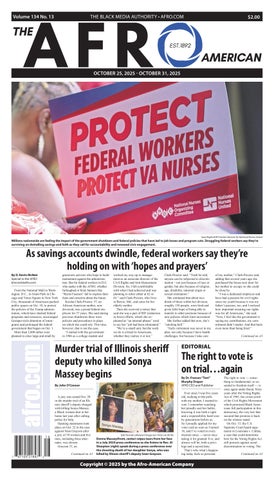
From the National Mall in Washington, D.C., to Grant Park in Chicago and Times Square in New York City, thousands of Americans packed public spaces on Oct. 18, to protest the policies of the Trump administration, which have slashed federal programs and resources, encouraged Gestapo-style detention of immigrants and prolonged the federal government that began on Oct. 1. More than 2,600 rallies were planned in cities large and small by
grassroots activists who hope to build momentum against the administration. But for federal workers in D.C. who spoke with the AFRO, whether furloughed or fired, banners like “Resist Fascism” fail to express their fears and concerns about the future.
Keisha Clark-Proctor, 57, an African-American mother, now divorced, was a proud federal employee for 37 years. She said during previous shutdowns there were policies and procedures in place on which she could rely. This time, however, that is not the case.
“I started with the government in 1986 as a college student and
By John O’Connor
worked my way up to management as an associate director of the Civil Rights and Anti-Harassment Division. So, I felt comfortable with what I had achieved and was planning to retire either at 62 or 65,” said Clark-Proctor, who lives in Bowie, Md., and cares for her elderly mother.
Then she received a notice that said she was a part of RIF (reduction in force) efforts, which she explained as “an internal phrase” used to say her “job had been eliminated.”
“We’re a small unit, but the work we do is critical to Americans, whether they realize it or not,”
Clark-Proctor said. “Truth be told, anyone can be subjected to discrimination – not just because of race or gender, but also because of religion, age, disability, national origin or sexual orientation.”
She estimated that about twothirds of those within her division, roughly 150 people, were fired and given little hope of being able to transfer to other positions because of new policies which limit movement.
She further added that now, she’s “catching hell.”
“Early retirement was never in my plan, not only because I have health challenges, but because I take care


By Dr. Frances “Toni” Murphy Draper AFRO CEO and Publisher
of my mother,” Clark-Proctor said, adding that several years ago she purchased the house next door for her mother to occupy so she could be close by.
“I was a dedicated employee and have had a passion for civil rights since my youth because it was my father’s passion, too, and I realized how important ensuring our rights was for all Americans,” she said.
“Now, I feel like the government is saying my contributions, my commitment didn’t matter. And that hurts even more than being fired.”
Ever since I was five years old, walking to the polls with my mother, I wanted to vote. I remember watching her proudly cast her ballot, knowing it was both a right and a responsibility hard-won by generations before us.
So I proudly applied for my voter card as soon as I turned 18, and I’ve voted in every election since — never once taking it for granted. It is, and always will be, both a privilege and a sacred duty.
That’s why what’s happening today feels so personal.
The right to vote — something so fundamental, so essential to freedom itself — is once again under threat. Sixty years after the Voting Rights Act of 1965, the crown jewel of the Civil Rights Movement which promised Black Americans full participation in this democracy, the very law that secured that promise is back on the witness stand. On Oct. 15, the U.S. Supreme Court heard arguments in Louisiana v. Callais, a case that could determine how far the Voting Rights Act still protects against racial discrimination in voting. The

Alpha Kappa Alpha Sorority, Inc. (AKA) the first sorority founded by African-American college women, has made history again. On Saturday, Oct. 18, 2025, the sorority chartered its first chapter in the U.S. territory of Puerto Rico. The name of the chapter is Alpha Delta Nu Omega, which was revealed before a gathering of family, friends and sorority members in San Juan for the extraordinary event. In addition to being the first AKA chapter chartered in Puerto Rico, Alpha Delta Nu Omega Chapter is also the sorority’s first chapter in a Latin American region where Spanish is the dominant language.
Twenty-five sorority members formed this new chapter. They are all highly accomplished in a variety of fields, including medicine, law, business, education and more. They have spent the last two years working with
women, children and families primarily in the community of Loíza, which is known for its rich Afro-Puerto Rican history and culture. Their work has included supporting families in crisis, delivering toys to children living in domestic violence shelters, delivering health screenings to senior citizens, offering career and educational resources to youth and women and more.
“We are thrilled to bring Alpha Kappa Alpha to Puerto Rico,” said International Regional Director Carrie J. Clark. The new chapter becomes part of the sorority’s International Region.
“These women are dedicated to Puerto Rico and Loíza. They have already made a significant impact on women, children and families on the island and that work will continue and expand in the years to come,” she added. The Puerto Rico sorority members have already planned their first service project as a chapter. They will create Childhood Hunger

Your History • Your Community • Your News
The Afro-American Newspapers
Baltimore Office • Corporate Headquarters
233 E. Redwood Street 6th Floor, Suite 600G Baltimore, Maryland 21202
410-554-8200 • Fax: 410-554-8213 afro.com
Founded by John Henry Murphy Sr., August 13, 1892
Chairman of the Board/Publisher - Frances Murphy Draper
(Publisher Emeritus - John J. Oliver Jr.)
President - Benjamin Murphy Phillips IV
VP of Marketing and Technology - Kevin E. Peck
Director Digital Solutions - Dana Peck
Receptionist - Wanda Pearson - 410-554-8200, ext. 246
Director of Operations
Andrè Draper - 410-554-8200
Director of Finance
Bonnie Deanes - 410-554-8242
Executive Director/Director of Advertising
Lenora Howze - 410-554-8271 - lhowze@afro.com
Director of Community & Public Relations
Diane W. Hocker - 410-554-8243
Editorial
Managing Editor - Alexis Taylor - 410-554-8257
Special Projects Editor - Dorothy Boulware - 410-554-8231
Editorial Assistant - Ama Brown-Parson
Archivist - Savannah Wood- 410-554-8277
Baltimore Circulation/Distribution Manager Andrè Draper - 410-554-8200
Creative Design and Content
Matthew McDonald
Washington Office 1140 3rd Street, N.E., 2nd Floor Washington, D.C. 20002-6723
202-332-0080 • Fax: 410-554-8213
(Washington Publisher Emerita - Frances L. Murphy II)
Director of Operations - Andrè Draper - 410-554-8200
Customer Service, Home Delivery and Subscriptions: 410-554-8200

Power Packs or AKA CHIPP weekend meals for students, along with hurricane preparedness kits.
“This is a strong start for our sisters as they keep ‘Soaring to Greater Heights of Service and Sisterhood,’which is our program initiative under our International President and CEO Danette Anthony Reed,” said Clark.
Alpha Kappa Alpha Sorority, Inc. is a 117-year-old organization founded in 1908 on the campus of Howard University in Washington, D.C. It is the first sorority established by African-American college women. Today, it has over 380,000 members in chapters around the world in 14 countries and territories, now including Puerto Rico. Alpha Kappa Alpha, and specifically the International Region, has a rich history that spans the world. In addition to the sorority’s launch of For Members Only Federal Credit Union, which is the first Black-owned,women-led, sorority-based, digital

banking financial institution in America, the sorority has completed several global endeavors. This includes working to reduce poverty in sub-Saharan Africa and building schools in post-apartheid South Africa. Most recently the sorority’s International Region members spent a week in Liberia engaging in multiple service activities to improve the lives of underserved women and children.
Alpha Kappa Alpha Sorority, Inc. is the oldest Greek-letter organization established by African American, college-educated women. Alpha Kappa Alpha Sorority, Incorporated is comprised of more than 380,000 initiated members in nearly 1,100 graduate and undergraduate chapters in the United States, Liberia, the Bahamas, the US Virgin Islands, Germany, South
as “America’s premier Greek-letter organization for African American women.” For more information on Alpha Kappa Alpha Sorority and its programs, visit www. aka1908.com
By Victoria Mejicanos AFRO Staff Writer
Philanthropist MacKenzie Scott has given a second donation to Morgan State University (MSU), this time donating $63 million, making it the largest in university history, beating her own record she set in 2020 when she first gave Morgan $40 million. On Oct. 15 MSU officials shared that Scott has invested $103 million into the university over the past five years.
Dr. David K. Wilson, MSU president, expressed his gratitude for the investment and credited the university’s continued growth.
“To receive one historic gift from Ms. Scott was an incredible honor; to receive two speaks volumes about the confidence she and her team have in our institution’s stewardship, leadership, and trajectory,” said Wilson. “This is more than philanthropy— it’s a partnership in progress.”
Scott’s donation has no limitations or restrictions, allowing the university to use it how they see fit.
“The $63 million will be

directed to further strengthen Morgan’s endowment, enhance and support student success, and advance initiatives that enhance Morgan’s role as an anchor institution in Baltimore and a Public Impact Very High Research University,” the university said in a press release.
Scott’s first donation allowed the university to establish its “Leading the World Endowment Fund, which
is the university’s first-ever unrestricted endowment. It also aided in the creation of the Center for Urban Health Equity (CUHE) and National Center for the Elimination of Educational Disparities (NCEED) according to the university.
“We are grateful for donors like MacKenzie Scott, whose groundbreaking vision through philanthropy has created sustained, generational
impact at Morgan,” said Endia DeCordova, vice president for institutional advancement and executive director of the Morgan State University Foundation in a press release.
“Our thoughtful stewardship of her initial gift has strengthened Morgan’s capacity to grow our endowment and create meaningful opportunities for our students while strategically investing in the University’s future.”

Continued from A1
her mother to occupy so she could be close by.
“I was a dedicated employee and have had a passion for civil rights since my youth because it was my father’s passion, too, and I realized how important ensuring our rights was for all Americans,” she said. “Now, I feel like the government is saying my contributions, my commitment didn’t matter. And that hurts even more than being fired.”
One married couple from Prince George’s County, Md., both in their 30s and Black, work for the federal government and are collectively dealing with being furloughed during
Continued from A1
justices have not yet ruled, but what’s at stake is clear: the strength of every American’s voice at the ballot box.
Let’s be honest: this fight isn’t about “color-blindness.”
It’s about power — who has it, who keeps it, and who’s being pushed aside.
A familiar pattern
We’ve seen this play before.
Wrapped in slogans about “election integrity,” lawmakers have quietly made voting harder for millions of Americans. They’ve closed polling places in Black neighborhoods, purged voter rolls, shortened early-voting periods and drawn districts that slice through our communities — dividing and diminishing our voice. Meanwhile, the Justice Department has stepped back from its role as the people’s lawyer, dropping cases that once protected voters from discrimination. That’s not neutrality. That’s abandonment.
And here’s the truth: this
the shutdown of government, which has now lasted more than 20 days.
“We received emails from our agencies –that’s how we found out,” said the husband, who requested their names be withheld.
“While I was disappointed and unaware of what to expect, I thought this would be shortlived, maybe a week. Now our commander-in-chief is saying even after the shutdown is over, we may not receive our back pay.”
“We have some money in savings which was planned for situations like this or unexpected hardships,” he said. “But that money will only go so far. I’ve been with the government since college and for me to find another job which
isn’t about protecting elections — it’s about protecting power. You can’t claim to love America while dismantling the very law that keeps it honest.
The cost of complacency
Black Americans pay taxes. We serve in the military. We educate children, serve communities, and help sustain America’s strength. Yet every generation faces new barriers to the ballot box.
After the Supreme Court’s 2013 Shelby County v. Holder decision ended federal review of voting laws in certain states, restrictive changes followed almost overnight. We remember the old tricks — from poll taxes and literacy tests to “How many jelly beans are in the jar?” — and we recognize their modern echoes today. Now Section 2 — the last major safeguard — is on the line. It may not look like the schemes of the past, but the intent feels all too familiar.
Why everyone should care
This isn’t just about Black
pays as well within the private sector and allows me to use the skills I have developed would be extremely difficult.”
The husband added that because of federal regulations to which he has agreed in his contract, the best he can do is to “sit home without pay and hope for the best.”
“We don’t go out anymore, we don’t order in anymore, and we assess our financial situation every day,” he said. “But it’s not just us who are being impacted. Federal employees spend money with local businesses. Those businesses are suffering too.”
As for the significance of demonstrations like the “No Kings” rallies on Oct. 18,

voters. It’s about what kind of country we want to be. If one community’s vote can be weakened, every community’s vote is at risk. If the courts and lawmakers ignore history, discrimination will find new ways to reappear—quieter this time, but just as corrosive. Protecting the right to vote
has never been someone else’s job. It’s ours. Whether by helping neighbors get to the polls, speaking up when we see injustice, or simply refusing to look away, each of us has a part to play.
Clark-Proctor said they “absolutely matter.”
“The only way we are going to be heard is to force the administration to hear us and see us,” she said. “Peaceful protests are among the cornerstones of America. Without the right to communicate our concerns, we are no longer a democracy.
“We’re at a crossroads now and the boxes for plans like Project 2025 are being checked off each day. So, protests are not enough,” she said. “People must show up at the polls, even if they don’t like any of the candidates. When we don’t vote, or when we allow ourselves to become disheartened and give up, we’ve already lost.”
Continued from A1
ex-Sangamon County Sheriff’s deputy, responding to a call about a suspected prowler, fired on the 36-year-old Massey in her Springfield home early on July 6, 2024, after confronting her about how she was handling a pan of hot water Grayson had ordered removed from her stove.
Massey’s killing raised new questions about U.S. law enforcement shootings of Black people in their homes and it prompted a change in Illinois law requiring fuller transparency on the background of candidates for law enforcement jobs.
Security was tight at the courthouse, including snipers on rooftops around the perimeter. A protest attracted demonstrators holding signs, some of which read, “The People Demand: End Police Terror” and “United Now Against Racial Violence.”
The jury chosen from four dozen prospects who were asked about their attitudes toward law enforcement. Sangamon County State’s Attorney John Milhiser probed potential jurors about whether Grayson’s status as a police officer would affect their ability to deliver a guilty verdict; a handful said it would.
No one raised a hand when Milhiser asked if police officers should be free to use unchecked levels of force. The defense likely will argue that Grayson was justified in his use of force because of the pan of hot water Massey held.
Defense attorney Dan Fultz gauged panel members’ comfort level in acquitting the officer and questioned their willingness to serve, their outside obligations and how those distractions would affect their focus.

By Mustafa Ali
Thirty years ago, I stood shoulder to shoulder with a sea of Black men on the National Mall, our presence a sermon stitched from hope and history. October 1995 — the Million Man March — turned pavement into sacred ground and silence into a thunderous hymn of purpose. Public Enemy’s “Fight the Power” pulsed through the crowd like a heartbeat, and in that rhythm we reclaimed an eternal truth: power belongs to us — until we surrender it.
Today, as we stand in the long shadow of that history, the need for that power feels even more urgent. We inhabit a moment where tyranny has learned to wear a suit and smile for the cameras, where the language of democracy is twisted to justify
undemocratic ends. The Trump era — both its first act and its bitter sequel — is defined not just by policies, but by a worldview: that power belongs to the few, that fear should silence the many, that the myth of a strongman is stronger than the will of a people. It is precisely in times like these that mass movements become not just resistance but lifelines.
Mass movements are the immune system of democracy. They are how we remind governments — and ourselves — that power flows upward from the governed, not downward from a throne. When thousands flood the streets for racial justice, when millions march for women’s rights, when workers walk out in solidarity, we are doing more than protesting. We are rewriting the story of who we are and who we refuse to become. Movements transform
despair into discipline, anger into architecture. They teach us that democracy is not a spectator sport; it is a collective act, repeated over and over, until power bends.
The “No Kings” movement, born from a rejection of authoritarian drift, is part of this lineage. It is not about party or politician — it is about principle. It is the insistence that America was not built for monarchs, that we are not subjects but citizens. When people gather under that banner, they echo the spirit of the marchers who faced down water cannons and dogs in Birmingham, the suffragists who chained themselves to fences, the elders who crossed the Edmund Pettus Bridge with nothing but faith as their armor. They carry forward the legacy of the enslaved who fled and fought, the laborers who struck, the dreamers who
refused to be silent.
And yet, movements do more than resist — they reimagine. They give us a glimpse of the democracy we could have if we dared to believe in our collective strength. The Million Man March was never just about showing up; it was about showing out for our families, our communities, our ancestors, and our unborn. It was about Black men pledging to love harder, build stronger, and heal deeper. It was a declaration that we were not broken beyond repair, that we could — and would — be architects of our own liberation. That kind of reimagining is the heartbeat of every powerful movement: it points beyond protest toward possibility.
It is tempting, in the face of relentless attacks on truth and justice, to feel small. To believe that the machinery of tyranny is too vast, too entrenched, too

indifferent to our cries. That is what those who hoard power hope for — our surrender. They want us to forget that no law is unchangeable, no system invincible, no leader beyond accountability when the people decide otherwise. History tells us over and over that the arc of change bends only when we push. From the abolitionists to the Freedom Riders, from Stonewall to Standing Rock, it has always been the many, not the mighty, who moved the needle of justice. See more on AFRO.com This commentary was originally published by Word in Black.
By Janet Allen
We are not lost—we are lodged. Lodged in the belly of a system that has consumed our labor, our neighborhoods, our legacy and called it progress. West Baltimore knows this belly well. It is lined with redline maps and absentee landlords, with food deserts and broken covenants. It is dark, but not silent.
Inside, we organize. We build. We remember. We name the pain not to dwell in it, but to disrupt it. Because pain left unspoken becomes policy. It becomes budget cuts and boarded-up homes. It becomes the quiet erasure of Black futures.
West Baltimore is a community with deep roots, rich culture and extraordinary resilience. Yet today, we face the harsh realities of long-term disinvestment, and the consequences are most visible and most painful.

Starbucks—despite strong local support. These closures stem from modern-day redlining, compounded by repeated theft, open-air drug activity and insufficient public safety coordination.
Families are left with no nearby place to buy medication, food, or basic goods. Children walk past drug corners every morning on their way to school, an unspoken reality that should never be normalized. In many neighborhoods, individuals struggling with addiction are more visible than law enforcement, often roaming the streets in search of money through panhandling or package theft.
reconstructing what was swallowed: our homes, our histories, our economic engines. And when we emerge, it will not be by miracle. It will be by design.
The city’s current approach to harm reduction, while well-intentioned, has unintentionally concentrated the crisis in neighborhoods already stretched thin. We need a more balanced strategy—one that centers residents, protects public spaces and creates pathways for healing, growth and opportunity.
homeownership
We’ve lost essential businesses—Rite Aid, Walgreens, Target, Family Dollar and
These desperate acts funnel directly into the hands of drug dealers stationed openly on street corners, creating a cycle that destabilizes our blocks and erodes public trust. Yet we are not defined by loss, addiction, or disinvestment. We are defined by our determination to rebuild—not from the margins, but from the marrow. We are
By Justin Nalley and Carlton Langford
In September, Sen. Tammy Duckworth D-Ill. and Rep. Katherine Clark (D-Mass.-05) reintroduced the Child Care Access Means Parents in Schools (CCAMPIS) Reauthorization Act to keep the program running through 2031 and increase its funding to $500 million annually. CCAMPIS is designed to help low-income student parents cover the cost of child care. It can fund on-campus or community care, after-school programs, and even financial counseling for students who are parenting while in college just like we did.
For Black student parents, higher education can feel like an obstacle course. The soaring cost of child care, inflexible class schedules, and limited campus support make staying enrolled a daily battle. It’s not just about managing responsibilities—it’s about doing so with minimal institutional support and even less societal recognition. When
other students are enjoying campus activities, many skip out.
Every fall, Historically Black Colleges and Universities (HBCU) campuses come alive during homecoming, pulsing with joy, legacy, and the celebration of Black excellence. In 2005, while our peers were reveling in the festivities, one of us was quietly holding his newborn son at the hospital for the very first time. During homecoming season two years later, the other could only take a single day of unpaid sick leave from his mailroom job before returning to work just three hours after his daughter was born.
Our challenges mirror those faced by the 21 percent of Black male students who are fathers while in college. Like us, many navigate the relentless grind of academics while raising children. We each completed our bachelor’s degrees, but 72 percent of Black male students who are fathers leave college without completing their degree or certificate.
The numbers tell a sobering story. Access to on-campus child care has
declined over the years. Between 2004 and 2019, the percentage of public academic institutions offering child care services dropped from 59 percent to 45 percent, with more alarming data from HBCUs. Only 21 percent of HBCUs provide on-campus child care, compared to 38 percent of public two-year institutions. This gap disproportionately affects Black student parents — 67 percent of Black fathers attend colleges that don’t offer on-campus child care. For us, this meant paying for child care out-of-pocket and using our support networks of family, friends, and even classmates when necessary. Sometimes, our children joined us in lectures, sitting quietly at our sides as we tried not to disrupt the class flow. It was a constant juggling act that required immense effort and support, which many Black student parents do not have.
There is a solution — and it already exists. However, despite its potential, CCAMPIS often falls short for Black student parents. Research
Disruption means refusing to normalize crisis. It means challenging policies that concentrate harm. It means rejecting the idea that West Baltimore is a problem to manage and insisting that it is a promise to fulfill.
We must disrupt the cycles that keep our blocks unstable and our families underserved. That means:
• Reimagining harm reduction strategies that center residents and protect public spaces
• Attracting and retaining middle-class

• Building economic engines that generate career-track employment, ownership and wealth Investing in safe corridors, strong public schools and the amenities that make neighborhoods thrive As president of Heritage Crossing Resident Association, I believe in building—not just surviving. We must build wealth that endures—not just for today, but for generations yet unborn. Our residents are ready to partner, ready to lead and ready to welcome investment that honors their lived experience. This is not a lament—it’s a blueprint. A call to disrupt our collective pain and replace it with collective power. With the right tools, partnerships and vision, we can transform the epicenter of neglect into a model of renewal.
Let West Baltimore rise—not from despair, but from determination; not from pain, but from purpose.

on legislation that helps low-income parents who are enrolled in a college or university afford child care.
from the Joint Center for Political and Economic Studies reveals a troubling gap: while 13 percent of community colleges have at least 40 percent Black enrollment, only six percent of CCAMPIS grants go to community colleges with substantial Black student populations.
To change this, we need to protect and reauthorize CCAMPIS to ensure it continues serving low-income student parents. In tandem, we must mandate accurate, detailed data collection on student parents
so resources can be directed where they’re needed most. Without robust, disaggregated data on student parents — especially by race and gender — policymakers can’t see the full scope of the challenge. And what remains invisible remains unaddressed. The program needs more funding so more colleges — especially those serving large numbers of Black students — can offer affordable child care.
See more on AFRO.com
By Tashi McQueen AFRO Staff Writer tmcqueen@afro.com
Families receiving Temporary Assistance for Needy Families (TANF) in Washington, D.C., are starting to see an increase to the child support payments they receive. According to Meridel Bulle-Vu, managing attorney for Legal Aid D.C.’s Family Law and Domestic Violence Unit, the D.C. Council law that became effective on Oct. 1 is a step in the right direction.
The increase means the portion of child support that the government returns to the family, known as the pass-through, is higher. This money is provided to the family in addition to their regular TANF cash assistance.

By Brandon Henry AFRO Intern
Councilmember Charles Allen (Ward 6) recently introduced a bill to give more transparency and precise timelines for when D.C. Water can begin to disconnect water services to District of Columbia homes.
for its critical services that keep our city running, property owners deserve more information, and tenants also need to know if their landlord hasn’t been paying the water bill and what to do next,” said Councilmember Allen. “This bill requires D.C. Water to better communicate about potential disconnections and tenants’ legal rights, creates a way for tenants to assume the bill in their name and incentivizes landlords to install submeters for each unit to help eliminate the risk of entire buildings losing water.”
“We already had a passthrough of $150 a month,” said Bulle-Vu. “The change makes it up to $200 a month—that’s an additional $50. It’s the first step towards correcting the cruelty of our cost recovery system that the federal government has imposed on states and the District of Columbia. It’s making sure that more money gets back to the children for whom that money was paid in the first place.”
Vulnerable families receiving TANF in Washington, D.C., will see an increase in financial support after a new law raised the monthly child support pass-through from $150 to $200.
TANF is a federally funded, state-run program providing temporary financial assistance to families in need across all 50 states,
D.C., Puerto Rico, the Virgin Islands and Guam, though implementation varies by state. In the District, the program supplies families with help in various ways, including monthly cash assistance, short-term
By Victoria Mejicanos
AFRO Staff Writer
vmejicanos@afro.com
This Halloween weekend, free Lyft rides will be offered throughout Washington D.C and select counties and cities in Maryland to prevent drunk driving as a part of Lyft’s Halloween SoberRide®program.
The program, in collaboration with the Washington
Regional Alcohol Program (WRAP), will operate from 4:00 p.m. to 4:00 a.m. on the nights of Friday, Oct. 31 and Saturday, Nov. 1, as a way to keep local roads safe from impaired drivers.
According to the National Highway Traffic Safety Administration, in 2023, 30 percent of all traffic fatalities involved an intoxicated driver.
Kurt Erickson, WRAP’s president, highlighted the
particular risk for young people.
“Halloween is of particular concern for younger drivers as NHTSA data shows that, in 2022, 54-percent of drunk driving crashes on U.S. roadways during Halloween that year involved drivers ages 21 to 34,” said Erickson.
During this high risk time, residents 31 and older in
By Gene A. Lambey Special to the AFRO
The college application process is an important time for students figuring out their future. While many students and their families think of college as the next step, others consider different pathways such as joining the work force, the military, law enforcement or taking a gap year.
Hamzat Saba, director of College Alumni Programs at Thurgood Marshall Academy (TMA) Public Charter High School in Southeast D.C. and Dr. Joel Siepierski, director of College Counseling at Sidwell Friends Private School (Sidwell Friends) in Northwest D.C., recently spoke with the AFRO about assisting
students in their college and career decision-making process.
“My job is just to make sure our team [works] with the seniors. We have a space dedicated to just the college-going process,” said Saba.
For TMA, there are weekly sessions that include group
meetings and one-on-one time with counselors where they discuss college goals, the financial aid process or any other tasks related to their college search.
Sierpierski says thinking about college is not a task exclusive to high school seniors

aid for specific needs such as buying a crib, and access to wraparound services like child care subsidies for before- and after-school care.
According to Annie E.
D.C. Water is facing an increasing balance of unpaid bills for water and sewer services it is providing, with the debt being north of $35 million. Due to this, earlier in the year, D.C. Water started service disconnections within apartment and other multifamily buildings among the District; from 2- or 4-plexes to large, market-rate buildings that house hundreds of people.
This has created an alarming problem for residents who have been faithfully paying rent, including a portion for water, only to receive a shutoff notice when their landlord has failed to pay the building’s water bill.
“Water is a basic human need, so disconnecting water service is very serious. While D.C. Water needs to be paid
In multiple bigger apartment buildings in D.C., dissimilar with electric service, lone apartment units do not have individual water meters, also known as a sub meter. It is only the individual “master” water meter that works for the entire building. The landlord receives water payments from their tenants and is completely responsible for the bill. For instance, if there was a property owner that fell behind on mortgage payments and ultimately
• 27 plans to fit your needs and budget
• Convenient and Easy Online Enrollment
• Expert Enrollment Help
• Essential Plans with FREE type 2 diabetes, heart disease, and stroke care; only $5 for pediatric mental health care, FREE HIV care
Casey Foundation’s Kids Count Data Center, 13,701 families were enrolled in TANF in Washington, D.C., helping 25,446 children. Those enrolled mainly live in Wards 7 and 8, which are majority Black areas of the city.
The cost recovery system
Bulle-Vu noted that D.C.’s child support system for TANF families is intricate and based on an approach referred to as cost recovery.
This system originated in 1996, when then-President Bill Clinton passed the Personal Responsibility and Work Opportunity Reconciliation Act (PRWORA) into law, effectively ending the Aid to Families with Dependent Children (AFDC) and replacing it with TANF. Along with the change came additional work requirements and time limits on welfare assistance, shifting it from a guaranteed income system to a temporary benefit with numerous conditions.
“The state had to require the family, when they
Continued from A5
at Sidwell Friends.
“We start at the beginning of their junior year, maybe earlier especially if they have certain circumstances,” said Siepierski, who is one of four full time counselors. “Our primary goal is to work with students and families through the process of finding a good fit. Our one-onone process begins during the junior year. Although we do have group meetings, we meet primarily one-on-one with our students.”
At TMA, both juniors and seniors have access to preparation for their SAT and ACT exams.
“We offer senior or junior boot camp where students come over the summer. There’s a SAT prep portion for our boot camp an hour a day, Monday through Thursday,” said Saba.
accept the TANF benefit, to cooperate with the state in going after the other parent for child support,” said Bulle-Vu. “There was this mistaken assumption that there was another parent out there who could have been supporting their child and because they weren’t, the state was doing it instead.”
Bulle-Vu explained that through this process the government could intercept those payments for cost recovery. When the state collects child support from the parent without custody of the child, the funds are required to go to the government to reimburse the state and federal government for the cost of the TANF benefits.
Advocates push for full pass-through TANF families can expect more legislation on this topic in the near future coming from the D.C. Council, which is working to make sure D.C’s most vulnerable children are getting the child support that is due them instead of it going to the city’s pockets. Advocates like Bulle-Vu are looking for

In Washington, D.C., Wards 7 and 8 account for the highest number of
with Ward 8 showing the greatest need.
the D.C. Council to implement a full pass-through, meaning TANF families will receive all of the child support money, even arrears.
To essentially eliminate the cost recovery system in D.C., it would cost the city $5 million to complete.
“We need to do more to
and
make sure that money from low-income parents is not going to fund our government and is not being sent to the federal treasury when kids in
Sidwell Friends does not offer “in-house” SAT preparation, however the school does offer the SAT exam for their students and assists with fees and testing plans.
“What I’ve found here at Sidwell is that a lot of our kids have already started their testing plan by the time we’re even encountering them. We have a lot of end of the year sophomores and early juniors already prepared to take the test,” said Siepierski.
The DC Policy Center’s most recent study put four-year graduation rates at 72 percent for Black students during the 20232024 school year, compared to 76 percent overall during that same time frame.
Postsecondary acceptance rates in D.C. are rising, with 56 percent of all graduating high school seniors enrolling into
In the fall, seniors have preparations included in their core classes as well as online sessions through resources like Khan Academy twice a week.
universities and colleges. For Black or African-American students, that number sits at 53 percent.
For many, the decision to go to college or into the workforce is purely financial.
TMA’s grant program is called the Alumni Mercy Fund, where a sum of money is set aside yearly. The sum of money, up to $500, can be used towards books, tuition or other resources to support the students in their college or university.
TMA recommends other programs outside of the D.C., Maryland and Virginia area that give funding as well, such as the North Carolina Promise which gives $500 per semester to students attending Western Carolina University (WCU), Fayetteville State University (FSU), University of North Carolina at Pembroke and Elizabeth City State University (ECSU).
Though many think they will
go to college, others know that another path is a better fit. TMA assists students towards alternate paths outside of college in resources such as local trade school programs with Union 5 and United Planning Organization, a local institution that offers workforce development training and economic support. Programs for TMA seniors interested in the D.C. police department or the fire department are also available. For students interested in military service, TMA offers resources in preparing for the Armed Services Vocational Aptitude Battery (ASVAB).
Siepierski concluded that seniors at Sidwell Friends who are interested in other paths outside of college and universities, such as ROTC or trade school, are encouraged to move towards that route.
Continued from A5
stopped paying the water bill to keep paying the mortgage–even for a little, residents would be clueless to being at risk of disconnection, even if they paid their bill. Residents would also be clueless as to their next course of action.
The D.C. Water Billing and Disconnection Modernization Amendment Act of 2025 shall bring more equity, clarity and accountability to D.C. Water’s billing and disconnection methods for property owners and tenants. Main provisions include:
• Setting consistent timelines regarding billing and disconnections, implementing a longer timeline for disconnections for the elderly and people living with disabilities Preventing shutoffs during extreme weather, whether heat or cold
potential disconnection
• Allowing tenants to transfer service into their own names if their landlord fails to pay, even when there is only one building-wide meter
Enforcing D.C. Water to create programs for amnesty and incentive to get landlords into good standing, also incentivizing installations of standalone water meters in every unit
the eligible areas can download the Lyft app and enter the SoberRide® code in the app’s Lyft Pass option to receive up to $15 in safe transportation home. The program is limited to one offer per user. The coupon code will be available on Oct. 31 at 3 p.m. at www. SoberRide.com.
“Lyft is dedicated to providing access to reliable and responsible rides, and we’re proud to partner with programs like WRAP to offer Lyft as an alternative to impaired driving,” said Kamillah Wood, director of public policy for community safety at Lyft in a press release. “Through our Roadway Safety Program and our partnerships with the public, we hope to empower our community
with the tools to protect themselves and those around them this holiday season.”
Last October, over 735 people in the area used WRAP’s Halloween SoberRide®program instead of driving drunk. In total, the program has provided 95,437 free safe rides home to would-be drunk drivers in the Greater Washington area since 1991.

• Requiring D.C. Water to notify the Department of Licensing and Consumer Protection when a property has overdue water bills, ensuring an accurate “clean hands” review process
• Mandating that tenants in every affected unit receive multilingual notice before a
• Requiring D.C. Water to submit monthly reports to the Council detailing disconnections, delinquencies, liens, as well as other enforcement methods to ensure better oversight on the disconnection process This legislation builds on Councilmember Allen’s earlier emergency and temporary measures, approved by the Council during the summer, which improved notice requirements, updated billing standards and expanded assistance for vulnerable households while giving District agencies time to intervene before disconnections occur. Councilmembers Robert White, Brooke Pinto, Janeese Lewis George, Matt Frumin, Trayon White and Brianne K. Nadeau co-introduced the measure.


care for children and adults.
By Tashi McQueen AFRO Staff Writer tmcqueen@afro.com
Baltimore City Council
President Zeke Cohen (D) and Councilmember Jermaine Jones (D-District 12) introduced the “Worker’s Rights in Baltimore City” resolution on Oct. 20, an official step toward establishing and advancing a labor agenda for the city.
The resolution reasserts Baltimore’s commitment to workers, outlining seven fundamental rights, including fair wages, safe working conditions, adequate work-life balance, collective bargaining and privacy in the artificial intelligence era.
According to the Mayor’s Office of Employment Development’s Baltimore City Workforce Dashboard, 286,147 people make up the city’s labor force, of which 95 percent are employed and 4.9 percent are unemployed, as of July. Cohen, in a statement, said the resolution is just the first step toward a stronger future for Baltimore’s working people.
By Tashi McQueen
AFRO Staff Writer
tmcqueen@afro.com
Baltimore’s Coppin State University (Coppin) recently celebrated their 125th anniversary with a lavish annual gala on Oct. 18, marking more than a century of providing education and opportunity to the Black community. Their institutional advancement team reported that they not only met their fundraising goal but exceeded it, bringing in a total of $25.5 million.
families. The university offers education within an array of disciplines including education, the arts and sciences and business.
Since its founding in 1900, Coppin has grown into a leading institution in northwest Baltimore, serving as a hub of progress for Black youth and
It also maintains deep community ties through initiatives such as the Coppin State University Community Nursing Center, a medical clinic that provides affordable health

Baltimore men and local leaders participate in a morning prayer and drum circle, kicking off the 30th anniversary celebrations of the Million Man March in Baltimore on Oct. 16. Shown here on his drum, Baba Djuann of the Xaala Mainama African Arts Ensemble, as organizer Ertha Harris (center) walks around the circle.
By Tashi McQueen AFRO Staff Writer
tmcqueen@afro.com
Men and women of all walks of life came together Oct. 16 to celebrate the 30th anniversary of the Million Man March. In Baltimore, community members, local and national leaders kicked off the day in Druid Hill Park at 6 a.m.
Though cold in the body, attendees were fired up in spirit, ready to continue the fight for unity, peace and equality started by more than nearly 1 million Black men three decades ago.
The Oct. 16, 1995, Million Man March was one of the largest gatherings of Black men in U.S. history. Men gathered on the National Mall in Washington, D.C., calling on Congress to address their needs and help combat
harmful stereotypes about Black men. The march was organized by Louis Farrakhan, leader of the Nation of Islam (NOI), and led by Dr. Benjamin F. Chavis Jr. Chavis shared why he decided to support Farrakhan in organizing the march, even though they were of different faith communities at the time.
“God Almighty put a vision and a word in the Honorable
Minister Louis Farrakhan,” said Chavis. “I heard that word coming out of the mouth of Minister Farrakhan. I heard the Minister Louis Farrakhan make that call. I said to myself, ‘Somebody needs to help the minister.’”
Chavis said the men who answered the call occupied the National Mall for 12

According to the University System of Maryland, during the fall 2024 semester approximately 83 percent of students enrolled at Coppin were Black, and 37 percent of students were from Baltimore City.
“The Worker’s Rights of Baltimore City is about dignity, safety and fairness for every working person,” said Jones, chair of the Baltimore City Council’s Labor and Workforce Committee, in a statement. “It declares that no one in Baltimore should choose between their health, family and paycheck. Our commitment is to lift the people who lift this city daily.”
“Over the next six to eight months, we’ll be rolling out a series of bills to improve worker safety, raise standards for city contractors and create fairer, more equitable workplaces,” said Cohen. “I’m proud to partner with Councilmember Jones and the working people of Baltimore to make sure this city delivers on its promise to value labor and protect every worker who keeps it running.” The resolution was formed in partnership with local labor unions such as the Service Employees International Union 32BJ (SEIU 32BJ) and the American Federation of Labor and Congress of Industrial Organizations (AFL-CIO).


By Megan Sayles AFRO Staff Writer msayles@afro.com
The city of Baltimore has lodged a lawsuit against MoneyLion, alleging that the fintech company runs a modern-day payday lending scheme that manipulates residents into taking out high-cost, frequent, small-amount, short-term loans known as “Instacash.”
The suit accuses MoneyLion of violating Baltimore’s Consumer Protection Ordinance (CPO) with misleading marketing and predatory interest charges.
Mayor Brandon M. Scott says the company’s actions have impacted some of the most financially vulnerable Baltimoreans.
“We’ve seen them prey on Baltimoreans, trapping the most vulnerable residents into these borrowing cycles that made it harder and harder for them to pay their bills and put food on the table for their families,” said Scott. “One of the main goals of this trial is asking the
court to invalidate these loans because we want to hold them accountable—as we’ve done for other big corporations, whether it be gun manufacturers or drug companies—for trying to take advantage of our residents.”
MoneyLion describes its cash advances, which allow individuals to access up to $500, as having no interest or mandatory fees. However, individuals who want funds immediately face transfer fees, and the app prompts users to provide optional tips that increase the overall cost.
According to city officials, these extra costs can amount to 10 times Maryland’s legal interest rate cap of 33 percent. As users continue to borrow and rack up costs, affording rent, food and utilities becomes more difficult.
A 2025 study by the Center for Responsible Lending found that using app-based payday lenders is associated with upticks in overdraft fees. It also discovered that 72 percent of users take out more than one loan in a twoweek period.
Continued from A7
hours, standing shoulder to shoulder, like a mighty army.
“The Million Man March helped us to see each other as part of one family,” said Chavis. “Prior to the Million Man March there was too much killing one another, self hatred [and] underestimating our own power.”
“The drums, and the prayer were not just heard on the mall, they were heard all over the nation’s capital,” said Chavis. Today, Chavis leads NNPA, the trade organization of the Black Press, which he says has been influential in carrying the message and goals of the Million Man March forward.
The civil rights legend wasn’t alone when it came to men who were at the original event. Kaleb Tshamba, 76, also reflected on his time at the Million Man March 30 years ago.
“There was no smoking marijuana, there was no drinking,” he said. “We were peaceful, and we were united.”
Tshamba highlighted that Black women were present too, supporting Black men.
“On that morning, as we men prepared and entered Baltimore Penn Station on our journey to the Million Man March in Washington, D.C., we were met with a breathtaking display of love and support from hundreds of Black women,” he said. “Their voices rang out in a powerful chant of appreciation. Each shout was a profound
In Maryland specifically, a survey from the Economic Action Maryland Fund determined that nearly 50 percent of respondents used one or more payday advance products— 89 percent of whom paid for immediate access to cash. The local economic justice organization issued a statement, applauding the city’s suit.
“As wages remain stagnant, the cost of living soars, and families struggle to make ends meet, some have resorted to using apps that promise help. Instead, many city residents find themselves paying more than 330 percent to have borrowed against their own hard-earned paycheck,” said the Economic Action Maryland Fund in a statement. “MoneyLion and similar companies have emerged to provide paycheck advances prior to payday. However, these products are simply dressed up versions of payday loans, which have been banned in Maryland for more than 20 years.”
For Baltimore officials, monitoring corporate practices
has become even more urgent under the 47th president, whose policies many argue favor big business over consumer protections. In March, Public Citizen, a consumer advocacy nonprofit, reported that his administration had dropped, withdrawn or paused investigations and enforcement actions involving over 100 corporations.
“Actions like these are unfortunately necessary to protect consumers from bad corporate conduct,” said Baltimore City Solicitor Ebony M. Thompson in a statement. “With the federal government now abdicating its responsibilities to consumers, states and localities must pick up the slack.”
Residents who’ve been impacted by MoneyLion’s practices can file individual complaints with the Maryland Attorney General’s Consumer Protection Division. Any Baltimorean, regardless of income, can also receive free, trusted advice from the city’s Financial Empowerment Center.


Continued from A7
“At a time when workers and their unions are under unprecedented attack by the current federal administration, Baltimore City is charting a bold and necessary course—one that champions the rights and dignity of working families,” said AFL-CIO President Courtney Jenkins in a statement. “With nearly 70 percent of Americans expressing support for unions, it’s clear that the public understands what history has already proven: strong unions create strong communities.
By breaking down systemic barriers and advocating for fair wages, safe workplaces and economic mobility, labor unions are essential to building a resilient local economy in Baltimore and across the nation.”
The AFL-CIO has 63 national and international labor unions representing approximately 15 million people. SEIU 32BJ has 175,000 members, mostly within the Northeast, including Massachusetts, New York, Maryland and Washington, D.C., and also represents workers as far as southern Florida.
reminder of our value and importance.”
Chavis praised Baltimore for their ability to keep the movement going.
“The determination, strength and perseverance of the people in Baltimore, quite frankly, helped to make the Million Man March successful 30 years ago,” said Chavis. He noted that many of the local groups that helped organize the original march have folded, but the Black men of Charm City have held strong.
“Baltimore is the only city that kept the local organizing committee alive for 30
Dr. Anthony L. Jenkins, the university’s current and eighth president, highlighted Coppin’s history and growth during an episode of The AFRO’s Chicken Boxx on Sept. 26.
“We started 2025 off walking into our 125th year of nurturing potential and transforming lives,” said Jenkins. “That’s what Coppin has been doing since 1900. What started off in the basement of a local high school as a one-room preparatory teacher program has, fast forward to today, become a leader in urban higher education.”
Coppin was founded by the Baltimore City School Board at Colored High School, which was eventually renamed Douglass High School, as a one year training course for Black elementary school teachers. By 1902, the program was broadened to a two-year Normal Department–a teacher training institution that teaches them to meet specific standards–within the high school.
In 1909, the program was split from the high school and assigned its own principal.
In 1926, the facility that housed the teacher training program was named after Fannie Jackson Coppin, an educator and former slave,who was a pioneer in teacher education. Fanny Jackson Coppin, after gaining her freedom from slavery, made it her priority to get an education and share her knowledge with others under the mission of uplifting Black America.
Fanny Jackson Coppin went on to shape two generations of young people as head principal of Institute for Colored Youth in Philadelphia. By 1938 the curriculum of the normal school extended to four years, they were given
years,” he said.
“Last night I drove around Baltimore and saw the progress that the city is making. A lot of times we underestimate our progress. A lot of people would point to what didn’t happen in 30 years. I’m pointing to what did happen,” Chavis told the AFRO. “We have a young brother who’s the governor of this state…a young brother who’s the mayor of this city. There are more opportunities today in 2025 than we had in 1995, but we have to keep pushing.”
the authority to grant the Bachelor of Science degree and the school was renamed Coppin Teachers College.
In 1950, Coppin officially became a part of the higher education system of Maryland under the State Department of Education and the name was changed to Coppin State Teachers College.
In 1952, Coppin moved to its current 38-acre location on West North Avenue. In 1963, the Board of Trustees decided that the institution’s degree-granting authority would no longer be limited to teacher education. Following this change, Coppin was officially renamed Coppin State College and in 1967 the first Bachelor of Arts degree was granted.
The college eventually became part of the University System of Maryland in 1988. On April 13, 2004, the college officially changed its name to Coppin State University. It is now accredited by the Middle States Association of Colleges and Schools in addition to numerous other accreditations.
A few alums reflected on the legacy of 125 years and the value of a Coppin State education on their lives.
“This campus has impacted a lot of families and people, including myself,” said Justin Eastman, a 2024 Coppin State graduate and photographer for President Jenkins. “I was a kid from New Jersey, came all the way to Maryland, and decided to go to Coppin State. I didn’t know much about Baltimore, but Coppin gave me a sense of belonging.”
Eastman said it’s especially important how Coppin gives students with low grades an opportunity to succeed.
“What we do is we take that kid that might

not have been the best student, might have had a 2.2 or 1.8 GPA, and we make them into great scholars,” said Eastman.
Turning to the present, Jenkins uplifted some of Coppin’s recent accomplishments that build upon their rich and evolving legacy.
“We have nationally ranked academic programs,” added Jenkins. “Students are coming to us from 40 states, the District of Columbia [and] 32 countries. We are in a place where there is a lot to celebrate here in Coppin.”
Out of 77 historically Black colleges and universities (HBCUs) rated, U.S. News and World Report currently ranks Coppin State at 29th-best in the nation, tied with Alcorn State University in Mississippi.
Jenkins said Coppin continues to see record-breaking growth.
“This year, we brought in over 1,000 undergraduate students,” he said. “We received nearly 18,000 applications this past year for enrollment into Coppin. Our freshman cohort increased from fall 2024 to this current fall by 60 percent. Our transfer students increased by 30 percent.”
Jenkins, who became president in 2020, said Coppin now boasts historic retention rates of 75 percent — up from 52 percent when he first arrived. The institution has also been extremely influential in revitalizing West Baltimore, specifically the West North Avenue corridor.
A few Coppin students shared with the AFRO what being a part of this legacy means to them.

“It’s a blessing to be a part of this legacy,” said Jordan Harvey, a 20-year-old sophomore majoring in psychology with a minor in cyber security. “When I first visited here, I knew it was home.”
Nandi Moyo, an 18-year-old freshman majoring in history at Coppin State, said she values the ability to immerse herself in Black culture like she never has before at Coppin. “I’m from an area where there weren’t a lot of Black people,” she said. “It’s nice that at Coppin I get to immerse myself with my community, my culture, the culture of Baltimore too.”


By Megan Sayles
AFRO Staff Writer msayles@afro.com
Tanya Myers and Ashley Price are on a mission to tackle divides in health care service delivery and access for Black women and girls. The duo founded Baltimore-based Shaping Health Equity (SHE) in 2020 after encountering firsthand the lack of culturally-responsive care and representation among health care providers.
“We knew about going to doctors and feeling like you’re not being heard, like expressing the things that you’re experiencing and trying to relay them to the provider just to be brushed off or told you’re fine,” said Myers, co-founder and director of SHE. “We had our own experiences with the health care system and that drew us to this path.”
According to the Pew Research Center, 71 percent of Black women ages 18 to 49 and 54 percent of those 50 and older report having at least one negative interaction with a health care provider.
Myers, herself, has worked in public health for nearly two decades, focusing on community outreach and health education. Over her career, she’s heard similar stories from the Black women and girls she’s served.

“Working in community outreach, I’ve heard from patients saying, ‘When I go to the doctors, I feel less than, I feel like people are looking down on me,’” said Myers. “We heard all sorts of things from patients, and we knew that there was definitely a need.”
Through SHE, Myers and Price are empowering Black women and girls to be advocates for themselves and their loved ones. The organization leads educational workshops covering topics, like sexual and reproductive health, maternal health, chronic disease prevention and mental wellness. It also refers Black women and girls to vetted health care providers and amplifies their experiences through storytelling events and the SHE Conversations podcast.
One of the major health care gaps that Black women encounter is a dearth of interventions and services specifically tailored to address their unique needs. Price, co-founder and co-director of SHE, said though Black women are disproportionately affected by a number of health conditions—like heart disease, diabetes and cervical cancer—they are often overlooked in the development of programs, research and policy responses for these conditions.

“This results in care that is not only insufficient but frequently fails to acknowledge the realities of our experiences. Further adding to this problem is the shortage of culturally competent providers, limited access to preventive and care services, underrepresentation in clinical studies and longstanding medical mistrust rooted in both historical and ongoing discrimination,” said Price. “To close these gaps, we need intentional investment in community-led
By Andrea Stevens AFRO Staff Writer astevens@afro.com
Congresswoman Lauren Underwood, representing the 14th District of Illinois, is advancing an ambitious mission to improve maternal health outcomes.
As founder and a board member of the new organization, Lifting Up All Families (LUAF), Underwood seeks to help families across the country, especially those too often overlooked by traditional systems of care.
“LUAF’s goal is simple but urgent,” says Underwood. “We want every mother and every family to have the care, dignity and support they deserve, no matter their race, income or ZIP code.”
The organization’s vision, according to Underwood, is grounded in the understanding that maternal health does not exist in a vacuum. Issues like housing insecurity, nutrition, mental health access and economic stability are all deeply intertwined with maternal outcomes.
At a recent LUAF roundtable, health care professionals, including Nichole Wardlaw, a certified nurse midwife with two decades of experience serving military families, discussed the pressing challenges faced by mothers, particularly Black women veterans.
“While they’re serving our country, we’re not really serving them,” said Wardlaw. “They’re isolated, away from family, and lack the support system they’d have back home. And a lot of them struggle with mental health. We assume they’re fine because they’re in the military, but they’re not always getting what they need.”
The Maternal Mental Health Leadership Alliance says, “If untreated, symptoms of Maternal Mental Health (MMH) conditions can last up to three years. Forty percent develop symptoms following childbirth, 33 percent develop symptoms during pregnancy and 27 percent enter pregnancy with anxiety or depression.”
Wardlaw’s work has centered on pairing pregnant veterans with doulas, providing both prenatal and postpartum support, and ensuring someone shows up when families feel alone in the process. For her, patient-centered care means more than clinical checklists. It means listening.
solutions, a more diverse and representative healthcare workforce and care models that are both culturally responsive and grounded in equity.”
Price emphasized that Black women and girls must be at the center of efforts to advance health equity rather than treated as an afterthought. For her, SHE has the power to contribute to a future where Black women and girls can thrive without being burdened by systemic barriers to health and wellness.
“In the long term, success means real and measurable change: improved health outcomes, expanded access to culturally competent care and greater economic stability for Black women and girls,” said Price. “It also means building a strong, collaborative network of leaders and organizations with Black women and girls not just included, but leading at every level of decision-making and systemic transformation.”

“You gain trust by centering clients in their care,” she said. “You give them information, help them make informed decisions, and treat them as the experts of their own bodies.”
One of LUAF’s foundational policy anchors is the Protecting Moms Who Served Act. The act expands VA maternity care coordination. Underwood noted that the stories shared by mothers at the launch affirmed just how critical that investment is.
“We want every mother and every family to have the care, dignity and support they deserve, no matter their race, income or ZIP code.”
As a nurse and policymaker, Underwood said her commitment is both personal and professional.
“I’ve seen families at their most vulnerable. I’ve seen how systemic inequities cut lives short,” she said.
“But I’ve also seen how the right solutions, rooted in equity and community voices, can save lives.”
LUAF is designed to be actionable, linking on-the-ground realities with legislative momentum. The organization plans to continue listening to mothers, aligning with proven policy tools and fostering collaboration among lawmakers, care providers and community leaders.
“I want a future where a woman’s race, income or veteran status no longer determines whether she survives pregnancy or childbirth,” Underwood said. “If we get this right, we won’t just change statistics, we’ll change lives for generations.”


By Tashi McQueen AFRO Staff Writer tmcqueen@afro.com
In Baltimore’s majority-Black neighborhoods, where grocery stores are few and access to healthy food is limited, grassroots organizations play a key role in filling the gap. Using education, urban farming and youth empowerment, initiatives are building community-led solutions to fight systemic food inequities. The Food Project and Black Yield Institute (BYI) are just two organizations leading the fight against food insecurity.
“We’ve come a long way, but we have a long way to go,” said Baltimore Mayor Brandon M. Scott (D) in an interview

with the AFRO. “A Hopkins study earlier this year showed that Baltimore had made and continues to make progress on this front, especially in Black communities. It’s important that food insecurity among Black residents dropped from 54 percent in 2023 to 37 percent in 2024, but that still is not good enough for me.”
“A lot of the kids that were on the street came to the food line and are now employed here and helping to give back to their community.”
The Food Project, created by UEmpower of Maryland, addresses food insecurity and youth unemployment in Southwest Baltimore. The nonprofit bridges gaps in employment, food access and youth programs.
“We’ve been in the community for 10 years,” said Michelle Suazo, executive director of the Food Project. “We started off doing street outreach. A lot of the kids that were on the street came to the food line and are now employed here and helping to give back to their community.”
“At the food line, there were so many kids coming out to feed themselves,” she added. “So many of them have parents in addiction.”


The program tackles issues like housing, acquiring necessary documents and literacy, with 45 percent of clients needing housing and 53 percent needing documents.
Tyree Johnson, 23, says he has received food and help with employment through the organization. Johnson is now
developing a music program for youth.
“There is always somebody out here to help you. You just have to speak up,” said Johnson. “Some people might not want to hear what you have to say, but there is always somebody that’s right there, that wants to hear what you have to say and that would love to be in your corner to help you.”
Suazo hopes youth like Johnson will take over in the future, keeping the organization community-led and tied to real needs of the community.
In Cherry Hill, BYI focuses on food sovereignty and education.
“What we do is responsive to what’s happening, not in any symbolic way, but in a very real way,” said Eric Jackson, servant director of BYI. “People say that we want this, we do it. It’s a part of our motto.”
“This year alone, we’ve contributed closer to 40,000 pounds of food and touched over 3,000 households,” Jackson added. “But, the real impact is the foundation we’re
laying for people to participate in food economy change.” When it comes to accessing fresh fruits and vegetables, transportation is a key factor. Mayor Scott pointed to city initiatives like expanding transit access to grocery stores.
“That was a big part of why I switched the Charm City Circulator route in South Baltimore to actually go into Cherry Hill,” he said.
Since June 23, 2024, residents have had better access to supermarkets, and in September alone, 18,919 people used the route.
Jackson emphasized that local organizing is key for addressing community issues, though partnering with outside organizations and individuals is important, while keeping residents at the helm.
“Our contribution moving forward is twofold: political education and knowledge production, and expanding Black Yield Farms and Marketplace to grow food options and collective organizing opportunities,” said Jackson.


By By Tashi McQueen AFRO Staff Writer tmcqueen@afro.com
Each year, on Oct. 10, World Mental Health Day arrives and serves as a time for the members of the community to focus on their mental and emotional health.
According to the World Health Organization (WHO), “the day provides an opportunity for all stakeholders working on mental health issues to talk about their work, and what more needs to be done to make mental health care a reality for people worldwide.”
The American Foundation for Suicide Prevention reports that “depression is the most common condition associated with suicide, and it is often undiagnosed or untreated. Conditions like depression, anxiety, and substance problems, especially when unaddressed, increase risk for suicide. Yet it’s important to note that most people who actively manage their mental health conditions go on to engage in life.”
Experts stress that family and community support can be lifesaving in preventing suicide, with simple acts like listening, showing up and connecting loved ones to care making all the difference.
When a person struggles with mental health challenges, a simple listening ear or consistent presence from family can be powerfully influential. Mental health experts Charde Hollins, Lontonia Bryant and Dorian Withrow Jr. emphasize this, highlighting the crucial role of family in suicide prevention and offering practical tips for supporting loved ones.
“Family, friends and community members are often the first to notice when something is off,” said Hollins, a licensed clinical social worker. “That makes them the front line of prevention—not because they have to ‘fix’ someone, but
because they have the power to respond rather than retreat.”
Hollins said the first way to intervene is simply to listen.
“When someone shares their struggle, they’re not always asking for a solution—they’re asking for safety,” said Hollins. “Your role is to hold space without judgment and to validate instead of minimize.”
She advised avoiding clichés such as “it’s not that bad” or “think positive.” Instead, she recommends open and direct language like “thank you for trusting me with this” or “I’m here, you don’t have to go through this alone.”
Hollins said a family member can also ask directly if someone is thinking about suicide.
“Say the word,” said Hollins. “It won’t plant the idea. It creates a lifeline.”
The next step is getting professional help.
“In my work training communities and organizations in mental health first aid and QPR (Question, Persuade, Refer), I’ve seen how everyday people can learn to spot warning signs, ask clear questions, de-escalate and connect someone to care,” said Hollins.
Hollins said the best support is knowing when to refer someone to a professional, rather than trying to rescue them on their own.
“Just because you know CPR doesn’t mean you skip the hospital afterward. The skills keep someone stable until professional help arrives,” said Hollins. “The same logic applies to mental health.”
She acknowledged medical distrust in the Black community is real and justified but emphasized the importance of not letting health issues go unaddressed.
“Look for culturally responsive providers, ask about their experience with Black clients, bring a support person if needed, and use telehealth if access is a barrier,” said Hollins.


counselor
of family and
navigate
“Mental health is health. Your best friend and support system can love you, but they shouldn’t be your only plan of care; it’s not sustainable.”
From 2018 to 2023, suicide rates in the U.S. rose significantly among Black and Hispanic individuals, by 25.2 percent and 10 percent, respectively, while declining 3.1 percent among White individuals, according to the Centers for Disease Control and Prevention (CDC). Bryant, a mental health
counselor, said family support can be monumental in the Black community.
“Family is the backbone of our community and is the safe haven for many,” said Bryant. “For some the family unit is a place of support without judgement, being heard, guided and sharing personal struggles. This is very important when things are overwhelming.”
If someone doesn’t have family to lean on, support from their community can be just as valuable.

In 2023, suicide was the second leading cause of death for U.S. youth and young adults ages 10-34. Licensed clinical social worker Dorian Withrow Jr. believes that being fully present and giving individuals genuine attention and support can help them feel seen and reduce the risk of suicide.
“It takes a village with love, support and guidance to form the circle of support that is needed to help our youth,” said Bryant. “When we come together as a community and can openly talk about different things affecting our youth, whether it is suicide, mental health or education, it lessens the silence.”
Suicide is a leading cause of death for children and young adults in the U.S. In 2023, it was the second leading cause of death for people ages 10 to 34, according to the National Institute of Mental Health.
Withrow, a licensed clinical social worker, said feeling invisible can lead to suicidal thoughts.
“Many people don’t believe anyone truly sees or cares about their problems,” said Withrow. “As a result, they begin to internalize the belief that no one will help which can lead to isolation, withdrawal and in some cases, antisocial behavior. That behavior may take the form of aggression, theft, destruction, or, tragically, self-harm or suicide.”
Suicide can be a desperate attempt to be seen.
“This is where family, friends and neighbors really matter,” said Withrow. “When we give someone our full attention— open, honest and present—it can be what pulls them from the edge of despair toward hope.”
and
Withrow added it’s not about saying all the right words but simply showing up.
“In our communities, we show up with food, rides and prayer,” said Hollins. “Keep doing that and add resources, boundaries and referrals. You don’t have to be a therapist, you have to be a bridge. Love and action can get someone through it.”
“When we give someone our full attention— open, honest and present— it can be what pulls them from the edge of despair toward hope.”
Only 5 percent of U.S. doctors are Black–Howard alumni are working to change that
By Megan Sayles AFRO Staff Writer msayles@afro.com
If you’re Black and looking for a doctor, it might be hard to find one who looks like you. The Association of American Medical Colleges (AAMC) estimates that just 5.2 percent of physicians are Black, despite African Americans comprising nearly 14 percent of the U.S. population.
The Howard University Medical Alumni Association (HUMAA) has stepped up to address this gap through Need More Black Doctors, a campaign designed to strengthen the pipeline of Black physicians by tackling the systemic barriers they face.
“Systemic racism is real— the historical exclusion from medicine; lack of access to medical training; lack of finance; lack of exposure at all ages to science education, resources, mentors and role models; and financial
indebtedness,” said Dr. Annette Bey-Shaw, president of HUMAA’s board of directors and 1984 graduate. “Even once a decision is made to pursue a medical degree the road to success is often uncharted for Black Americans.”
The AAMC reports that while Black applicants for medical school increased by 2.8 percent in 2024, there was a 11.6 percent decrease in the number of Black students who actually enrolled compared to 2023. This was the third consecutive year of declines, according to the AAMC.
HUMAA is hoping to stop this trend. Through Need More Black Doctors, the organization provides scholarship opportunities to aspiring physicians and deploys emergency grants to medical students experiencing financial hardships. It also hosts educational workshops, networking events and leadership training to prepare students for their future medical careers.
The organization’s larger objective is to expand awareness— both in the medical community and broader society— about the importance of representation in health care, including its impact on patient outcomes.
In a 2023 study published in JAMA Network Open, researchers found that U.S. counties with higher representation of Black primary care doctors had longer life expectancy and lower mortality rates among Black patients. Dr. Earl Thurmond, a 1987 graduate of Howard University College of Medicine, said this is, in part, due to a greater level of trust.
“Trust is the cornerstone of the physician-patient relationship, and there’s more trust based upon what people see, what people hear and what people understand about the culture of individuals,” said Thurmond.
He emphasized that Black doctors are also more likely to practice in underserved
communities, which face greater health disparities.
“Data shows that when you have more African-American physicians, they tend to practice in areas where African-American people are,” said Thurmond. “That brings health care closer to the population that’s in need.”
At present, HUMAA is working to expand the reach of the Need More Black Doctors campaign and to attract more donations to support scholarships and grants for students.
For students who are considering pursuing a medical career, Thurmond encouraged them to remain persistent and resilient in spite of the challenges.
“More, importantly, think of the impact you’ll have on the greater community in pushing yourself to greater heights. It’s a wonderful career,” said Thurmond. “We need more African-American young people to go into health care. It’s a public need.”

By Liz Courquet-Lesaulnier Word in Black
Black genius isn’t rare — it’s everywhere.
Look no further than the Oct. 8 announcement of the 2025 class of MacArthur Fellows for proof that Black folks are reshaping how we tell stories, protect the planet, build community and make music.
This year, five Black artists,
scientists, musicians, and activists are among the 22 recipients of what’s popularly known as the “genius grant,” an $800,000, no-strings-attached award from the nonprofit MacArthur Foundation. This year’s crop of Black geniuses is pushing the boundaries of creativity, innovation and ideas that change our world for the better.
This article was originally published by Word in Black.

The first Black woman to win Best Director in the Sundance Film Festival’s U.S. Documentary competition — for her documentary “Time,” which tells the stories of Black women in Louisiana who have incarcerated loved ones — Bradley is no stranger to accolades. Her work combines “elements of documentary, narrative and experimental cinema to explore questions of justice, public memory and cultural visibility,” according to MacArthur’s announcement. Her acclaimed installation, “America,” reimagines early Black cinema.

Archaeologists research the past, but Douglass digs into bygone eras to try to save our future. Her
engaged archaeology efforts in Madagascar includes local residents in her research team. Together, they investigate how people have adapted to climate shifts — and what Indigenous and descendant communities can teach us about survival and resilience.

Based in Brooklyn, Taborn is known for his genre-bending approach to music. “I like to be surprised and excited by what’s happening,” he says in the video above. Through his mastery of piano and electronic keyboards, he delves into jazz, classical, electronic, rock and hip hop. He “enhances musical collaborations and composition through his expansive exploration of sound, technique and instrumentation,” according to MacArthur.

Tonika Lewis Johnson
Photographer and Social Justice Artist, Chicago
A lifelong Chicagoan, Lewis Johnson uses photography and public art to expose the roots and realities of racial segregation. Her Folded Map Project pairs residents from the Windy City’s predominantly white North Side with those from the predominantly Black South Side to confront how policies shape folks’ lives. Her projects, Inequity for Sale and her latest, UnBlocked Englewood, document housing injustices and efforts to restore homes in need of repair.

Most folks have no desire to think about sewage, but Tarpeh believes it’s full of potential. The Stanford University-based chemical engineer is developing technologies to recover and repurpose pollutants like nitrogen and phosphorus from wastewater. His pilot projects in Kenya and California could transform how communities deal with pollution, fertilizer shortages and climate change. By reimagining waste as a solution, Tarpeh is creating a path to sustainability centered on environmental justice.

When it comes to mental health, Black men are struggling. The trend lines on a range of indicators — from increasing rates of depression and anxiety to rising suicide rates — are moving in the wrong direction, signs of an invisible crisis.
Yet the rising need for mental healthcare for Black men is running head-on into persistent gaps in services available in Black communities.
Grassroots programs to address the crisis are, however, turning to what are perhaps the most popular gathering spots — neighborhood barber shops — into a hub of much-needed help for Black men.
Across the country, barbershops in Black neighborhoods can help clients with their well-being, in addition to providing a fade or trim. Through partnerships with therapists and nonprofits, barbers are being trained to recognize signs of stress or depression and connect customers with free counseling or support services.
community engagement and health education, Fraser tells Word In Black.
“We go into beauty salons and barbershops to train trusted community leaders to speak with their clients about health,” Frasier says. “We recognize that they’re talking about a whole lot of different things. So why not incorporate health into that?”
The Ashe Institute’s program, “Barbershop Talk with Brothers,” has collaborated with more than 170 barbershops and salons to provide barbers and stylists with health education training. The goal is to address and help reverse rising rates of suicide, one of the leading killers of Black men.
The data underscores why.
Although they take their own lives at lower rates than White men, the suicide rate for Black men jumped almost 25 percent among Black Americans between 2018 and 2023, with especially sharp increases in teens and young adults. In 2023, roughly 15 percent of all suicide deaths were among Black people. Suicide rates declined among White people and other groups.
“We go into beauty salons and barbershops to train trusted community leaders to speak with their clients about health.”
Meeting people where they are
One organization supporting such efforts is the Arthur Ashe Institute for Urban Health, located in New York City. Dr. Marilyn Fraser, the Institute’s CEO, says it’s part of meeting Black men — and women — where they are.
When Ashe, the late tennis champion and humanitarian, founded The Institute in 1992, his vision was to address health inequities through a social justice lens by promoting
The stress of racism
Studies have linked racial discrimination, economic stress, and exposure to violence to symptoms of depression and suicidal ideation in Black men. In fact, research has found that simply the expectation of facing bigotry or discrimination can create enough stress to trigger a physiological reaction.
Yet researchers found that only about one in four Black men ages 18 to 44 who report daily anxiety or depression use mental-health services — a gap driven by stigma, structural
barriers and mistrust.
The connection between guns and suicide also can’t be overlooked. In 2023, about 55 percent of all suicides involved a firearm; among Black youth, the gun-related suicide rate for children ages 10 to 19 more than tripled since 2014. But, suicide rates declined among Whites and other groups.
Leadership through barbershops
In New York City’s Bedford-Stuyvesant neighborhood in the 1990s, Jerome Archer, owner of Platinum Cuts Inc., saw friends and neighbors fighting the same beasts ravaging other Black neighborhoods—drug addiction and HIV/AIDS.
“My parents met in this neighborhood, so my work is about legacy,” says Archer. Around 1999 or 2000, he said, after a client from The Institute showed him Brooklyn’s skyrocketing HIV rates, “I realized I had a role to play.”
Initially, Archer got involved in HIV prevention, distributing condoms and discussing the disease with clients. Over time, Archer’s shop evolved from an informal community hub to a resource center, addressing topics ranging from sexual health to mental wellness.
“It was a natural fit,” Archer says. “Barbershops are places where conversations are free, trust is deep, and people feel seen,” Archer adds.
The many ways to be ‘a head shop’
When the COVID pandemic hit, mental health concerns surged. Archer found that the longstanding trust between him and his clients made it easier for them to open up about depression, anxiety and stress. Like other barbers working with the Ashe Institute, Archer integrated mental health literacy, screening prompts and referrals into everyday conversations.
“The shift was organic,” Archer says. “Through Barbershop Talk with Brothers, we discussed men’s health, family and stress. I noticed many


clients were struggling silently. [T] hen a friend’s cancer diagnosis made it personal.”
With training and support from the Institute, Archer and other shop owners began helping clients access resources directly, often through a kiosk inside their shops. It allows patrons to privately search for programs that provide food, housing or counseling, and receive tailored resources or a follow-up from The Institute’s own community health workers.
“Arthur Ashe Institute offered me training and mental health
certifications that equipped me to care for others and myself,” says Archer. “Now I see cutting hair as healing work, too.”
If you or someone you know is dealing with mental health issues, call or text 988 (the Suicide and Crisis Lifeline) for immediate, free support.
For non-emergency help, consult a primary-care provider about screening and referrals, or contact community programs that partner with trusted neighborhood spaces.
This article was originally published by Word in Black.


By Anissa Durham
It can be challenging to find the right sort of help when you’re sick and navigating a complicated health care system. And if you need an organ transplant, that challenge can be even more daunting. The good news is there are a number of state and federal resources available if you find yourself in that situation.
Currently, there are more than 105,000 people on the national transplant waiting list. Of those, 92,000 are waiting for a kidney. Black Americans make up the second largest group of people on the list, with 32,000 on it.
Many of the patients in our “On Borrowed Time” series told us it’s a challenge to maintain health insurance coverage throughout the transplant process. But it’s also difficult to find legal resources, free or low cost food, and mental health support. So we compiled a short list of available resources to help you on your journey to transplantation.
Disability organizations
• The National Disability Rights Network is the nonprofit membership organization for the federally mandated protection and advocacy system and client assistance programs. Every state has its own P&A and/or CAP agency serving disabled people in the United States. Resources offered vary between each state agency, but generally these nonprofit organizations provide Medicaid, housing, education, and mental health resources. Some of the organizations offer fact sheets on how to apply for health insurance, ways to access health records, and legal support services. Check our directory below to find the P&A and/or CAP agency in your state.
• New Disabled South is a nonprofit advocacy organization focused on improving the lives of disabled people in 14 southern states. The organization created the Plain Language Policy Dashboard that breaks down complex legislation into plain language, making it easier to understand and making it more accessible.The dashboard uses AI to translate texts into plain language, which is followed by a thorough check for accuracy — at times, additional analysis is added to curb misinformation. The goal is to provide plain language versions of bills in states across the Southern United States. The states it follows bills in are Alabama, Arkansas, Florida, Georgia, Kentucky, Louisiana, Mississippi, North Carolina, Oklahoma, South Carolina, Tennessee, Texas, Virginia, and West Virginia.

According to the National Kidney Foundation, “33 percent of American adults are at risk for kidney disease.” That number is higher for Black or African American people, who “are more than three times as likely to have kidney failure compared to White Americans.”
The American Transplant Foundation offers grants to transplant recipients. The site functions two ways — you can donate to help someone, or you can apply for a grant, either as a transplant recipient or living donor. Both grants will become available in November, according to its website. Applications for transplant recipients can only be done post-surgery. The one-time grant is available for up to $500. And the application must be completed by a transplant center’s social worker or coordinator to be considered.
There are organizations in every state that offer free or low-cost legal services — especially helpful for folks who can’t afford to pay a lawyer. LawHelp.org connects people with pro bono attorneys and law firms in your state.
A few large cities may have their own legal aid organizations, like in Chicago, Philadelphia, Los Angeles, and New York. Check our directory below to find your state’s Legal Aid Society or another legal aid resource.
If you are covered through certain Medicaid or Medicare programs, people with disabilities may be

eligible for free home-delivered meals. Mom’s Meals offers free or discounted meals for folks living with a disability. If you don’t qualify for their free food program, the meals start at $7.99. On their website you can select your state and customize the medically tailored meals you want delivered.
• Feeding America has a directory of food pantries and food banks in every city across the country. Simply type in your zip code and the nearest available food bank will show up. Most of the locations listed detail the hours of operation, address, phone number and the type of distribution available.
Living with a chronic disease and trying to get on the transplant list is


exhausting. Add the time it takes to look for a therapist and it can easily feel overwhelming. But it doesn’t have to be that way. Therapy for Black Girls, Therapy for Black Men, Black Emotional and Mental Health Collective and Melanin and Mental Health are four different organizations who have built directories of hundreds of Black and culturally-competent providers in various cities and states across the
country. The easy-to-use directory allows folks to select gender, specialty, insurance, and type of therapy preferences.
This article is part of “On Borrowed Time” a series by Anissa Durham that examines the people, policies, and systems that hurt or help Black patients in need of an organ transplant. Read part one, two, and three. This story is copublished with The Markup and Word in Black.


SUPERIOR COURT OF THE DISTRICT OF COLUMBIA PROBATE DIVISION ADMINISTRATION NO. 2025ADM000886
DONNELL GREGORY MOORE AKA
DONNELL MOORE Name of Decedent Notice of Appointment, Notice to Creditors and Notice to Unknown Heirs
CHELNIE L. BAILEY, whose address is 48 BRYANT STREET NW, WASHINGTON DC, 20001 were appointed Personal Representative of the estate of DONNELL GREGORY MOORE AKA DONNELL MOORE who died on FEBRUARY 02, 2025 without a Will and will serve without Court supervision. All unknown heirs and heirs whose whereabouts are unknown shall enter their appearance In this proceeding. Objections to such, appointment shall be filed With the Register of Wills, D.C., Building A, 515 5th Street, N.W., 3rd Floor, Washington, D.C. 20001, on or before APRIL 10, 2026. Claims against the decedent shall be presented to the undersigned with a copy to the Register of Wills or filed with the Register of Wills with a copy to the undersigned, on or before APRIL 10, 2026 or be forever barred. Persons believed to be heirs or legatees of the decedent who do not receive a copy of this notice by mail within 25 days of its publication shall so inform the Register of Wills, including name, address and relationship. Date of first publication: OCTOBER 10, 2025 Name of newspaper and/or periodical: Daily Washington Law Reporter AFRO American Newspapers
CHELNIE L. BAILEY Personal Representative
10/17, 10/24/25
inform the Register of Wills, including name, address and relationship.
Date of first publication: OCTOBER 17, 2025 Name of newspaper and/or periodical: Washington Law Reporter AFRO American Newspapers
DANIEL VALENTINE Personal Representative TRUE TEST COPY REGISTER OF WILLS 10/17, 10/24, 10/31/25
SUPERIOR COURT OF THE DISTRICT OF COLUMBIA PROBATE DIVISION ADMINISTRATION NO. 2025ADM000862
STEPHEN ANTHONY WHATLEY AKA
STEPHEN A WHATLEY Name of Decedent ANDREW JACOBSON 1325 G ST NW, SUITE 500 WASHINGTON, DC 20005 Notice of Appointment, Notice to Creditors and Notice to Unknown Heirs
ANNIE PHILLIPS WHATLEY AKA ANNIE P WHATLEY, whose address is 1315 FERN ST NW, WASHINGTON, DC 20012 was appointed Personal Representative of the estate of STEPHEN ANTHONY WHATLEY AKA STEPHEN A WHATLEY who died on FEBRUARY 17, 2023 with a Will and will serve without Court supervi-
TRUE TEST COPY REGISTER OF WILLS 10/10, 10/17, 10/24/25
SUPERIOR COURT OF THE DISTRICT OF COLUMBIA PROBATE DIVISION ADMINISTRATION NO. 2025ADM000910 MILDRED RIVERS OVERBY Name of Decedent IZU I AHAGHOTU 3724 12TH STREET NE WASHINGTON, DC 20017 Notice of Appointment, Notice to Creditors and Notice to Unknown Heirs
CORDELL M. OVERBY, whose address is 147 HAMILTON ROAD LANDENBERG, PA 19350 was appointed Personal Representative of the estate of MILDRED RIVERS OVERY who died on MAY 11, 2022 with a Will and will serve without Court supervision. All unknown heirs and heirs whose whereabouts are unknown shall enter their appearance In this proceeding. Objections to such, appointment shall be filed With the Register of Wills, D.C., Building A, 515 5th Street, N.W., 3rd Floor, Washington, D.C. 20001, on or before APRIL 10, 2026. Claims against the decedent shall be presented to the undersigned with a copy to the Register of Wills or filed with the Register of Wills with a copy to the undersigned, on or before APRIL 10, 2026 or be forever barred. Persons believed to be heirs or legatees of the decedent who do not receive a copy of this notice by mail within 25 days of its publication shall so inform the Register of Wills, including name, address and relationship. Date of first publication: OCTOBER 10, 2025 Name of newspaper and/or periodical: Daily Washington Law Reporter AFRO American Newspapers
CORDELL M. OVERBY Personal Representative
TRUE TEST COPY REGISTER OF WILLS 10/10, 10/17, 10/24/25
SUPERIOR COURT OF THE DISTRICT OF COLUMBIA PROBATE DIVISION ADMINISTRATION NO. 2025ADM001006
MARGARET BERNICE POWELL Name of Decedent
HORACE LEE BRADSHAW JR 1644 6TH ST. NW WASHINGTON DC 20001 Notice of Appointment, Notice to Creditors and Notice to Unknown Heirs
BRIAN POWELL, whose address is 3422 SUMMIT COURT NE, WASHINGTON DC, 20018 was appointed Personal Representative of the estate of MARGARET
BERNICE POWELL who died on MAY 14, 20253 without a Will and will serve without Court supervision. All unknown heirs and heirs whose whereabouts are unknown shall enter their appearance In this proceeding. Objections to such, appointment shall be filed With the Register of Wills, D.C., Building A, 515 5th Street, N.W., 3rd Floor, Washington, D.C. 20001, on or before APRIL 17, 2026. Claims against the decedent shall be presented to the undersigned with a copy to the Register of Wills or filed with the Register of Wills with a copy to the undersigned, on or before APRIL 17, 2026 or be forever barred. Persons believed to be heirs or legatees of the decedent who do not receive a copy of this notice by mail within 25 days of its publication shall so inform the Register of Wills, including name, address and relationship.
Date of first publication: OCTOBER 17, 2025
Name of newspaper and/or periodical: Daily Washington Law Reporter AFRO American Newspapers
BRIAN POWELL Personal Representative
SUPERIOR COURT OF THE DISTRICT OF COLUMBIA PROBATE DIVISION ADMINISTRATION NO. 2025ADM001025 DARLENE JIMASON Name of Decedent Notice of Appointment, Notice to Creditors and Notice to Unknown Heirs
JAMES E. LEWIS whose address is 8007 FOX CUB CT., GLEN BURNIE, MD 21061 was appointed Personal Representative of the estate of DARLENE JIMASON who died on JANUARY 3, 2025 , without a Will and will serve without Court supervision. All unknown heirs and heirs whose whereabouts are unknown shall enter their appearance In this proceeding. Objections to such, appointment shall be filed With the Register of Wills, D.C., Building A, 515 5th Street, N.W., 3rd Floor, Washington, D.C. 20001, on or before APRIL 24, 2026, Claims against the decedent shall be presented to the undersigned with a copy to the Register of Wills or filed with the Register of Wills with a copy to the undersigned, on or before APRIL 24, 2026 or be forever barred. Persons believed to be heirs or legatees of the decedent who do not receive a copy of this notice by mail within 25
PUBLIC COMMENT PERIOD ON THE DRAFT VISUALIZE 2050 NATIONAL CAPITAL REGION TRANSPORTATION PLAN, THE FY 2026-2029 TRANSPORTATION IMPROVEMENT PROGRAM, AND THE RELATED AIR QUALITY CONFORMITY ANALYSIS REPORT
The National Capital Region Transportation Planning Board (TPB) is the metropolitan Washington region’s designated metropolitan planning organization (MPO), with responsibility for federally required regional transportation planning for the District of Columbia, suburban Maryland, and Northern Virginia. The TPB will initiate a 30-day public comment period on October 23, 2025, for the draft Visualize 2050 National Capital Region Transportation Plan, the draft FY 20262029 Transportation Improvement Program (TIP), and the draft Air Quality Conformity Analysis Report which will be available for review at http://visualize2050.org. This comment period will extend through Friday, November 21, 2025. These documents are scheduled to be approved at the December 17, 2025, TPB meeting.
The TIP includes all projects, programs, and strategies that the region’s transportation agencies plan to implement between FY 2026 and FY 2029. The air quality conformity analysis assesses the plan and program with respect to the air quality requirements under the 1990 Clean Air Act Amendments. The comment process on the TIP is being used to obtain comments on the region’s program of projects that are funded by the Federal Transit Administration (including projects funded by the Urbanized Area Formula Program) and the Federal Highway Administration.
For the FY 2026-2029 TIP, a public forum will be held on November 13, 2025, from 6:00-7:00 P.M. at the Metropolitan Washington Council of Governments, 777 N. Capitol St. NE, Suite 300, Washington, DC 20002. At the TIP forum, the TPB, the District of Columbia, Maryland, and Virginia DOTs, and the Washington Metropolitan Area Transit Authority (WMATA) will share information about projects with programmed funding scheduled for implementation in the National Capital Region over the next few years.
Visualize 2050 is the federally mandated metropolitan transportation plan for the National Capital Region. The plan is a milestone of an ongoing transportation planning process highlighting the region’s planned investments through the year 2050 to address transportation issues and achieve regional goals. The plan is developed in partnership with transportation agencies in the District of Columbia, the cities and counties in suburban Maryland and Northern Virginia, state, and local agencies, and WMATA. These partner agencies plan and fund transportation projects contained in the plan ranging from roadway construction to bus and rail transit service, to bicycle and pedestrian facilities.
Members of the public may submit comments on these three documents online at https://visualize2050.org, by email to TPBcomment@ mwcog.org, or by phone at (202) 962-3774. Written comments can be mailed to: TPB Chair, Metropolitan Washington Council of Governments, 777 N. Capitol St. NE, Suite 300, Washington, DC 20002.
The Metropolitan Washington Council of Governments (COG) operates its programs without regard to race, color, and national origin and fully complies with Title VI of the Civil Rights Act of 1964 and related statutes and regulations prohibiting discrimination in all programs and activities. For more information, to file a Title VI related complaint, or to obtain information in another language, visit www. mwcog.org/nondiscrimination or call (202) 962-3300.
El Consejo de Gobiernos del Área Metropolitana de Washington (COG) opera sus programas sin tener en cuenta la raza, el color, y el origen nacional y cumple con el Título VI de la Ley de Derechos Civiles de 1964 y los estatutos y reglamentos relacionados que prohíben la discriminación en todos los programas y actividades. Para más información, presentar una queja relacionada con el Título VI, u obtener información en otro idioma, visite www.mwcog.org/nondiscrimination o llame al (202) 962-3300.


Effective immediately, The Afro American Newspapers will require
accepted in the form of checks, credit card or money order. Any
BOARD OF LIQUOR LICENSE COMMISSIONERS FOR BALTIMORE CITY NOTICE – OCTOBER 2025
Petitions have been filed by the following applicants for licenses to sell alcoholic beverages at the premises set opposite their respective names. The real property for these applications will be posted on or about October 20, 2025. Written protests concerning any application will be accepted until and including the time of the hearing. Public hearings may be scheduled on or after October 30, 2025 at 10:30 AM in the Liquor Board Hearing Room, located at 200 St. Paul Place, Suite 2300, Baltimore, Maryland 21202. Please visit llb.baltimorecity.gov under the link for & Hearing Schedules & for confirmation of the date, time, and place for all matters being heard by the Board.
1. CLASS “B” BEER, WINE & LIQUOR LICENSE
Applicant: Hama Sushi, LLC T/a Trade Name Pending - Malcolm Stoll and Yongdeng Chen
Petition: New restaurant license requesting outdoor table service and off-premises catering Premises: 1101-03 W. 36 th Street 21211 (City Council District: 7th; State Legislative District: 40th)
Applicant: Selam Enterprise, LLC T/a Jano Ethiopian Restaurant and Lounge - Isaias Gebragziabher
Petition: Transfer of ownership with continuation of live entertainment
Premises: 34 S. Eutaw Street 21201 (City Council District: 11th; State Legislative District: 40th)
Applicant: Epic Nights, LLC T/a Trade Name Pending - Shamira Lemon
Petition: New restaurant license requesting live entertainment, outdoor table service, and delivery of alcoholic beverages
Premises: 1140 S. Paca Street 21230
(City Council District: 10th; State Legislative District: 46th)
Applicant: Helmand Group, LLC T/a Helmand Kabobi - Khaleeq Ahmad and Mohammad Farid Hemmat
Petition: Transfer of ownership requesting off-premises catering
Premises: 855 N. Wolfe Street, Suite D & E 21205 (City Council District: 13th; State Legislative District: 45th)
2. CLASS “B”, BEER, WINE & LIQUOR LICENSE (HOTEL-MOTEL)
Applicant: T Street Licensee, LLC T/a Sagamore Pendry Baltimore Hotel - Alan Jay Fuerstman and Parag Yeshwant Athavale Petition: Transfer of ownership with continuation of
HOUSING AUTHORITY OF BALTIMORE CITY
REQUEST FOR PROPOSALS
NSPIRE INSPECTION SOFTWARE TO BE UTILIZED BY HABC HOUSING INSPECTORS
RFP NUMBER: B-2052-25
The Housing Authority of Baltimore City (“HABC”) will issue a Request for Proposals (“RFP”) for interested and qualified and interested companies/professionals to provide NSPIRE inspection software to be utilized by Housing Authority of Baltimore City Housing Inspectors on tablets/laptops in the performance of their HABC development inspections.
PROPOSALS WILL BE DUE no later than 2:00 p.m. Eastern Time on Friday, November 28, 2025
A non-mandatory pre-proposal conference will be held on Wednesday, November 12, 2025 at 10:00 a.m., which will be scheduled as a virtual meeting.
The entire RFP can be viewed and downloaded by visiting https://habc. bonfirehub.com/projects on or after Monday, November 3, 2025. Questions regarding the RFP should be directed in writing to the address and individual indicated below and must include the reference: HABC RFP Number B-2052-25.
Housing Authority of Baltimore City Division of Fiscal

State Legislative District: 40th)
4. CLASS “C” BEER, WINE & LIQUOR LICENSE
Applicant: The Central Baltimore Partnership, Inc. T/a Central Baltimore Partnership - Ellen Janes, Michael Pokorny, and Lauren Kelly-Washington
Petition: New Class C license requesting live entertainment and delivery of alcoholic beverages
Premises: 405 E. Oliver Street 21202
(City Council District: 12th; State Legislative District: 45th)


