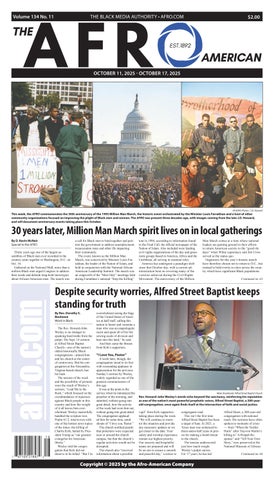
and will document anniversary events taking place this October.
30 years later, Million Man March spirit lives on in local gatherings
By D. Kevin McNeir Special to the AFRO
Thirty years ago one of the largest assemblies of Black men ever recorded in the country came together in Washington, D.C. on Oct. 16.
Gathered on the National Mall, more than a million Black men urged Congress to address their needs and debunk long-held stereotypes about African-American men. The march was
afro.com
a call for Black men to bind together and petition the government to address unemployment, incarceration rates and other ills impacting their community.
The event, known as the Million Man March, was conceived by Minister Louis Farrakhan, the leader of the Nation of Islam, and held in conjunction with the National African American Leadership Summit. The march was an outgrowth of the “Men Only” meetings held during Farrakhan’s national “Stop the Killing”
tour in 1994, according to information found in the Final Call, the official newspaper of the Nation of Islam. Also included were leading civil rights organizations of the day and grassroots groups based in America, Africa and the Caribbean, all serving in essential roles. America has undergone a paradigm shift since that October day, with a current administration bent on reversing many of the victories achieved during the Civil Rights Movement. The anniversary of the Million
Man March comes at a time where national leaders are gaining ground in their efforts to return American society to the “good ole days” when White supremacy and Jim Crow served as the status quo.
Organizers for this year’s historic march have therefore chosen not to return to D.C., but instead to hold events in cities across the country which have significant Black populations.
Despite security worries, Alfred Street Baptist keeps standing for truth
By Rev. Dorothy S. Boulware Word in Black
The Rev. Howard-John Wesley is no stranger to speaking hard truths from the pulpit. His Sept. 14 sermon at Alfred Street Baptist Church—one of the nation’s oldest historically Black congregations—placed him and his church at the center of controversy. But his congregation at the Alexandria, Virginia-based church, has his back.
The tension of the week and the possibility of protests were the result of Wesley’s sermon, “Lead Me to the Rock,” which focused on the overabundance of injustices against Black people in this country and how the weight of it all leaves him overwhelmed. Wesley masterfully handled the scripture text, Psalm 61:2, interwoven with one of the hottest news topics of the times, the killing of Charlie Kirk, hailed by President Trump as “our greatest evangelist for American liberty.” Wesley told the congregation that Kirk did not deserve to be killed. “But I’m
overwhelmed seeing the flags of the United States of America at half staff, calling this nation to honor and venerate a man who was an unapologetic racist and spent all of his life sowing seeds of division and hate into this land,” he said. And then came the threats from Kirk’s supporters.
“I Love You, Pastor”
A week later, though, the congregation stood to its feet with resounding applause in appreciation for the previous Sunday’s sermon by Wesley, widely regarded as one of the greatest communicators of this age.
It was at the point in the service when he introduced the preacher of the morning, and admitted, without going into great detail, how the activity of the week had worn him out, without going into great detail. The congregation applauded him for some time, amid shouts of “I love you, Pastor.”
The church notified people that protestors were expected near or around the church campus, but that the church’s regular activities would not be disrupted.
The church also “received information about a possible
Rev. Howard-John Wesley’s words echo beyond the sanctuary, reinforcing his reputation as one of the nation’s most powerful prophetic voices. Alfred Street Baptist, a 200-yearold congregation, once again finds itself at the intersection of faith and social
vigil” from Kirk supporters taking place during the week.
“We will continue to monitor the situation and provide any necessary updates as we get closer to the date. Your safety and worship experience remain our highest priority.
Our security and hospitality teams are prepared and will be on site to ensure a smooth and peaceful day,” a notice to
congregants read. This isn’t the first time Alfred Street Baptist has been a target of hate. In 2021, a Texas man was sentenced to three-and-a-half years in prison for making a bomb threat to the church. The tension underscored just how much weight Wesley’s pulpit carries. For 17 years, he has led
Alfred Street, a 200-year-old congregation with national reach. His sermons have often spoken to moments of crisis — from “When the Verdict Hurts” after Trayvon Martin’s killing to “A Rizpah Response” and “Tell Your Own Story,” now preserved at the National Museum of
All AFRO Photos / J.D. Howard
This week, the AFRO commemorates the 30th anniversary of the 1995 Million Man March, the historic event orchestrated by the Minister Louis Farrakhan and a host of other community
focused on improving the plight of Black men and women. The AFRO was present three decades ago, with images coming from the late J.D. Howard,
African
Meta (Facebook)/ Alfred Street Baptist Church
justice.
WHAT’S TRENDING ON AFRO.COM
Auntie Mo’Nique wasn’t wrong:
Leave the bonnets and pajamas at home
Love means telling the truth—our sisters deserve to step into the world prepared, polished and powerful
By Dr. Frances Murphy Draper
CEO and Publisher
I never thought I’d live to see the day when pajamas and bonnets became public attire. Yet here we are—women moving through airports, shopping centers and even job fairs dressed for the bedroom instead of the world outside. My grandmother would’ve raised an eyebrow at the sight, and so do I—not to tear anyone down, but because presentation still matters. That’s why I find myself shaking my head when I see young women—especially young Black women—strolling in pajama bottoms, fuzzy slippers and bonnets. And it’s not just the young. Some of
our older sisters have joined in too. Not just a quick dash out the door, but full-on public outings—in the downtown business district, in malls, strolling down busy main streets—dressed like they hit snooze and never changed. Sisters, what’s going on?
I’m not here to ridicule anybody. I understand the appeal. Pajamas are comfortable. And bonnets do protect hairstyles and keep the braids and curls in check. But hear me clearly: bonnets—satin or otherwise— were designed for the bedroom. There’s no version that works as a fashion statement in public. None. They are for sleeping, not for strolling. And I’m not the first to say it. Back in 2021, actress and comedian Mo’Nique— better known as “Auntie
Fax: 410-554-8213 afro.com
Founded by John Henry Murphy Sr., August 13, 1892
Chairman of the Board/Publisher - Frances Murphy Draper
(Washington Publisher Emerita - Frances L. Murphy II)
Director of Operations - Andrè Draper - 410-554-8200
Customer Service, Home Delivery and Subscriptions: 410-554-8200
Mo”—sparked a firestorm when she urged sisters to stop wearing bonnets and pajamas in airports and other public spaces. Some applauded her, others criticized her tone, but no one could deny she touched a nerve. Four years later, the trend hasn’t slowed—it’s gotten worse. Which means her message is still relevant, and maybe even more urgent today.
something serious?” Appearance isn’t everything, but it speaks louder than words, and it sets the tone for how others perceive your self-respect.
Our mothers and grandmothers tried to tell us this long ago. Remember the old line: “Make sure you’ve got on clean underwear—just in case you end up in the hospital”? It wasn’t really about the underwear—it was about
“Like it or not, the way you present yourself is often the way you are received.”
I also raise this as an employer who knows how quickly impressions are formed. You might just be grabbing food or walking down the street, but the truth is you never know who you will encounter. Opportunity has a way of showing up when you least expect it. You do not want your one shot at a mentor, future boss or potential business partner to be overshadowed by the memory of pajama bottoms—whether covered in cartoon characters, bold stripes, or colorful prints— and a bonnet that should have stayed in the house. This isn’t just about jobs or the workplace. It’s about relationships, too. I’ve heard so many young women lament how hard it is to find a good man. But what message are you sending if someone bumps into you and you look like you just rolled out of bed? Do men really find pajamas and bonnets attractive? Is that the energy that says, “I’m ready to build
self-respect, preparedness and never knowing when life might throw a surprise your way. The same principle applies here: You don’t want the world’s lasting impression of you to be that you looked like you rolled straight out of bed.
Here’s another hard truth: the world already places unfair judgments on Black women. We’re told we have to be twice as good, twice as polished, twice as ready. I don’t like the double standard but ignoring it won’t make it disappear. Why hand the world more excuses to dismiss you before you even open your mouth?
And no, I’m not suggesting you wear a business suit every time you step outside. No one is saying that. But surely there’s a middle ground between a blazer and bunny slippers. Throw on some jeans (without holes), leggings, or a casual dress— something that says you cared enough to get dressed for the day. Because like it
argues that while comfort and convenience explain why many women—especially Black women—wear pajamas and bonnets in public, the practice undermines selfrespect and opportunities. Citing Mo’Nique’s earlier critique, Draper stresses that presentation still matters, particularly in a world that already unfairly judges Black women, and urges sisters to show up polished, confident, and prepared.
or not, the way you present yourself is often the way you are received.
Dressing with pride isn’t just about how others see you. It’s also about how you see yourself. When you step outside with your head held high and your look put together, your confidence shifts. Your energy changes. You carry yourself differently, and that self-assurance can open doors that pajamas and bonnets simply will not.
So, to my sisters of every age, I say this with love: leave the pajamas and the bonnets in the house. The world is your stage, and every time you step outside, you are telling a story about who you are and who you want to be. Write a story that commands respect. After all, pajamas and bonnets are for sleep. Out here in the world, you are wide awake, walking purposefully into your future—so dress like it.
Support grows for 6888th Battalion Forever Stamp
By Victoria Mejicanos AFRO Staff Writer vmejicanos@afro.com
Support for the U.S. Postal Service (USPS) to issue a Forever Stamp in honor of the 6888th Central Postal Directory Battalion continues to grow, despite the USPS’ Aug. 28 decision to decline the proposal meant to honor the all-women Army unit deployed overseas in World War II.
On Sept. 27, the online signatures reached 6,888, the same number designated to the battalion. By Oct. 8, the petition had 7,839 signatures.
A signer of the petition, Judith Killien, shared her reasons for signing.
“I’m lending my voice because I am a Women’s Army Corp veteran,” she wrote on the petition’s website. “And although I was enlisted during the last leg I did get a feel of how women were accepted before they entered the regular army. Yet the true courage these women of color displayed is beyond amazing and worth telling.”
Another signer of the petition, Rhonda Phoenix, shared that she has a cousin named Fannie McClendon, who is still alive and the last of the Battalion at 105-years old. “ It would be amazing for her to see a stamp commemorating this historic time she experienced,” she wrote along with her petition signature.
This week, the AFRO encourages all readers to show support by signing the petition, titled “Honor the 6888th Central Postal Directory Battalion with a U S.
Forever Stamp” on Change.org.
In addition to signing the Change. org petition, advocates for the stamp are strongly encouraging supporters to write a letter and mail it in to the Citizens’ Stamp Advisory Committee, requesting the approval of a 6888th Forever Stamp. The only way to reach the committee is a letter via mail, as members of the Citizens’ Stamp Advisory Committee do not discuss requests via phone, email or text. They also do not consider requests made via social media. To send a written letter in support of the 6888th Forever Stamp, please
address it to the Citizens’ Stamp Advisory Committee, with the subject listed as “Letter of Support to honor the 6888th Central Postal Directory Battalion. The letter should be mailed to the following address: Stamp Development ATTN: Citizens’ Stamp
AFRO
Pexels / cottonbro studio
AFRO CEO and Publisher Dr. Frances Murphy Draper
President says Illinois governor and Chicago mayor should be jailed as they oppose Guard deployment
By Michelle L. Price and Sophia Tareen
President Donald Trump on Oct. 8 said the Illinois governor and Chicago mayor, both Democrats, should be jailed as they oppose his deployment of National Guard troops for his immigration and crime crackdown in the nation’s third-largest city. The officials said they would not be deterred.
The Republican president made the comment in a social media post, the latest example of his brazen calls for his opponents to be prosecuted or locked up — a break from longtime norms as the Justice Department traditionally has strived to maintain its independence from the White House.
Trump wrote on Truth Social that Mayor Brandon Johnson and Gov. JB Pritzker “should be in jail for failing to protect Ice
AP Photo/Nam Y. Huh
Officers!” It was a reference to the U.S. Immigration and Customs Enforcement. It was not immediately clear
Million Man March
Continued from A1
Rev. Mark A. Thompson, a veteran political activist and civil rights organizer, will spearhead activities in New York City. He spoke with the AFRO ahead of the anniversary events.
“We have volunteers who are planning and leading events in cities that include Baltimore, Washington, D.C., Philadelphia, Newark, Atlanta, Phoenix, Dothan [Alabama], Richmond, Dallas, Jacksonville, Cleveland, Akron, Canton [Ohio], Wichita, Chattanooga, Jackson, Detroit and Chicago,” said Thompson, who also serves the National Newspaper Publishers Association as global digital transformation director.
Thompson was present at the original march. He says the move to call Black men to show up to Million Man March anniversary events in their own areas was very strategic.
“All politics, all school boards, all election boards and all police departments are local. So, we’re following Malcolm X’s mantra–think globally and act locally,” Thompson told the AFRO. “The issues addressed and events that will take place will be germane to each locality, but will also include overarching issues impacting Black men throughout the country.”
Thompson said Black men will need to be resolute in their convictions and remember the pledge that they made 30 years ago.
“White men have set themselves up as victims and are recruiting Black men into today’s victimization culture,” he said. “But we are not victims. We weren’t 30 years ago, and we are not victims today. When we gathered in the millions in Washington, D.C., we stood up as men for atonement, reconciliation and to take responsibility as men. That was the spirit of the March and that’s what we must focus on once again.”
The esteemed scholar, professor of African studies, and the founder of Kwanzaa, Maulana Karenga, will serve as the convenor of activities in Los Angeles. Karenga, a key organizer of the 1995 Million Man March, helped to author the event’s mission statement and emphasized the need for Black men’s accountability and responsibility.
Remembering the first march
Though the march was for Black men, women played important roles in the event. Frances L. Murphy, II served as the treasurer.
Cora Masters Barry, former first lady of Washington, D.C., led voter registration efforts during the first march at the request of Farrakhan. She said it was a glorious day and hopes that those who participate in this year’s events will remember the history that was made then and what remains to be accomplished today.
“Our country has moved in such a way that we have little respect for marginalized communities, so the issues we face are broader than they were 30 years ago,” she said. “Yes, we need to recommit ourselves to the pledge, however, we also need to focus on protecting our rights and the freedoms we have been promised under the constitution.”
“It’s not just freedom for Black men and women, but freedom for all Americans,” she continue. “We’ve got to build coalitions and
what Trump was objecting to.
Johnson, in a post on X, said, “This is not the first time Trump has tried to have a Black man
understand that it’s not just those of us with more melanin – in America, the community of humans is under attack.”
Events are planned across the U.S. to celebrate the 30th anniversary of the Million Man March in October 2025. For more information on anniversary events, please visit millionmanmarch2025.com.
Million Man March 2025 Events
California
Los Angeles
Million Man March Reunion
Date: Oct. 16
Time: 1 p.m. - 3 p.m.
Location: Kenneth Hahn Park
4100 S. La Cienega Blvd
Los Angeles, CA 90008
The Los Angeles Chapter of the Million Man March is holding its 30th-year reunion to reinforce the bond of family and community.
Maryland
Baltimore
Sunrise Prayer at Druid Hill Park
Date: Oct. 16
Time: 6 a.m. - 7:30 a.m.
Location: Druid Hill Park
900 Druid Park Lake Dr
Baltimore, MD 21217
A sunrise meeting for prayer is set to bring together intention and focus for the days’ events which are sponsored by the Baltimore Local Organizing Committee.
30 Years Later – A Love Letter to the Million Man March
Date: Oct. 17
Time: 6:30 p.m. - 9:30 p.m.
Location: Coppin State University James Weldon Johnson Auditorium
2500 West North Avenue #2500 Baltimore, MD 21216
Coppin State University will host “30 Years Later – A Love Letter to the Million Man March” at the James Weldon Johnson Auditorium. This live storytelling event, directed by Marc Laveau, will commemorate the 1995 Million Man March and explore its lasting spirit, with co-sponsorship from the university’s Social Work department and the Dorothy Height Center.
Nevada
Las Vegas
The 1,000 Black Man March
Date: Oct. 11
Time: 12 p.m. - 1 p.m.
Location: Palacio Park
951 W Lake Mead Blvd
Las Vegas, NV 89106
The event aims to unite Black men and boys for inspiration and positive community impact. A rally will follow from 1 - 5 p.m. at the MLK Statue in North Las Vegas.
Pennsylvania Philadelphia Brotherly Action 5K Walk
Date: Oct. 26
Time: 8:30 a.m. - 12:30 p.m.
Location: LOVE Park
16th Street and JFK Boulevard Philadelphia, PA 19102
The Brotherly Action 5K Walk, organized
unjustly arrested. I’m not going anywhere.” Pritzker, also on X said, “I will not back down. Trump is now calling for the arrest of elected representatives checking his power. What else is left on the path to full-blown authoritarianism?”
White House spokeswoman Abigail Jackson, when asked what crimes the president believed Pritzker and Johnson had committed, failed to identify any, but she said they “have blood on their hands” and pointed to Chicago Police Department reports that at least five people were killed and 25 shot over the weekend.
“Instead of taking action to stop the crime, these Trump-Deranged buffoons would rather allow the violence
by the Philly Truce Foundation, includes a walk from North, South and West Philadelphia that converges at LOVE Park for the main rally. The tribute aims to carry the spirit of the original Million Man March forward and promote unity and community action.
The starting point for men coming from North Philly is Broad St. and Girard Ave. at 7:30 a.m.
The starting point for men coming from West Philly is 30th St. and Market St. The March will leave from that location at 7:30 a.m.
The meet time for the South Philly starting point, at Broad St. and Washington Ave., will also be 7:30 a.m.
The Million Man March 30th Anniversary Tribute Program will begin in Love Park at 10:30 a.m.
Washington, D.C. Lantern Peace Walk Across 11th Street
Date: Oct. 16
Time: 4 p.m. - 6:30 p.m.
Location: 1201 M. Street SE Washington, DC 20003
The walk begins at 1201 M. Street SE and ends at Union Temple Baptist Church in historic Anacostia, commemorating the path once taken by historical figures and highlighting commitments to faith, unity, atonement and community.
Revive the Spirit of the Million Man March and Beloved Unifest
Date: Oct. 18
Time: 7 a.m. - 4 p.m.
The event will take place at various community establishments in the Anacostia neighborhood including Union Temple Baptist Church and is a celebration of D.C. culture and community. It will feature food, music and speakers to honor the legacy and message of the original march, which emphasized unity, responsibility and atonement.
Sean ‘Diddy’ Combs gets 4 years in prison for case involving sex workers, violence and ‘freak-offs’
By Michael R. Sisak,
NEW YORK (AP) — Sean “Diddy” Combs was sentenced Oct. 3 to four years and two months in prison for transporting people across state lines for sexual encounters, capping a sordid federal case that featured harrowing testimony and ended in a forceful reckoning for one of the most popular figures in hip-hop. Combs, 55, was also fined half a million dollars. Since Combs has served a year in jail already, this sentence means he would be released in about three years. His lawyers wanted him freed immediately and said the time behind bars has already forced his remorse and sobriety.
He was convicted in July of flying his girlfriends and male sex workers around the country to engage in drug-fueled sexual encounters, a practice that happened over many years and in different locations. However, he was acquitted of sex trafficking and racketeering charges that could have put him behind bars for life.
“Why did it happen so long?” U.S. District Judge Arun Subramanian asked as he handed down the sentence. “Because you had the power and the resources to keep it going, and because you weren’t caught.” Combs showed no visible change of emotion as he learned his sentence, sitting in his chair and looking straight ahead as the judge spoke. He remained subdued afterward and appeared dejected, with none of the enthusiasm and smiles that accompanied his interactions with lawyers and his family earlier in the day. He said, “I’m sorry, I’m sorry” to his family right before leaving the courtroom.
In a final speech before sentencing, Combs made a plea for leniency.
“I ask your honor for a chance to be a father again,” Combs said, “a son again ... a leader in my community again ... for a chance to get the help that I desperately need to be a better person.”
He apologized to the people he hurt physically and mentally with his “disgusting, shameful” actions, and said the domestic violence was a burden he would carry for the rest of his life.
Earlier, Combs wept as his defense lawyers played a video in court portraying his family life, career and philanthropy.
His nearly two-month trial in a federal court in Manhattan featured testimony from women who said Combs beat, threatened, sexually assaulted and blackmailed them. Prosecutor Christy Slavik told the judge that sparing Combs serious prison time would excuse years of violence.
“It’s a case about a man who did horrible things to real people to satisfy his own sexual gratification,” she said. “He didn’t need the money. His currency was control.”
Combs was convicted under the Mann Act, which bans transporting people across state lines for prostitution. Defense attorney Jason Driscoll argued the law was misapplied.
During testimony at the trial, former girlfriend Casandra “Cassie” Ventura told jurors that Combs ordered her to have “disgusting” sex with strangers hundreds of times during their decade-long relationship. Jurors saw video of him dragging and beating her in a Los Angeles hotel hallway after one such multiday “freak-off.
“While nothing can undo the trauma caused by Combs,” Cassie’s attorneys, Douglas Wigdor and
The 47th president of the United States is calling for the jailing of Chicago mayor Brandon Johnson (above) and the governor of Illinois (not shown) for opposing the deployment of National Guard troops.
Larry Neumeister and Jennifer Peltz
The Associated Press
AP Photo/Kathy Willens, File
Sean “Diddy” Combs seen here at a 2017 NBA basketball game between the Brooklyn Nets and the New York Knicks, was sentenced Oct. 3 to a little over four years in federal prison for transporting people across state lines for sex.
All AFRO Photos / J.D. Howard
COMMENTARY
No wonder the right suppresses lessons on the Constitution
Each September, the federal government requires schools to observe Constitution Day.
Too often, it becomes a hollow ritual. Students memorize the preamble, hear a sanitized origin story and are taught to revere the Constitution as if it were a sacred text — rather than what it truly is: a document crafted by people with specific political goals and reshaped at different points in history through the pressure of mass social struggles.
However, this year, nearly 600 educators across the country broke from that script by joining the Zinn Education Project’s (ZEP) Teach Truth on Constitution Day campaign. Instead of pageantry, ZEP provided teachers with lessons and resources that invite students to not only know their constitutional rights, but also to question the Constitution’s origins, examine its omissions, and consider how rights have been won through struggle.
This kind of empowerment of students through critical engagement with history has drawn fire from the right.
What students took away The reflections from classrooms across the country — from Washington State to Washington, D.C. — reveal a clear theme: When students critically examine who created the Constitution and what rights it does and does not guarantee, they don’t retreat into cynicism or victimhood; they step forward as active participants in democracy.
Chelsea Freeman, a high school teacher in Tonasket, Washington, said her students were “amazed to learn that clean water, food security, and employment are not
“The United States still has a lot of work to do as a nation to guarantee its citizens’ well-being, and we need to play an active role in making sure our government upholds our rights.” Another added, “Today, many people are having their rights violated. This lesson helps us young people (as the future of the U.S.) to work towards solving these problems within our communities.”
Commentators on the right claim that when schools teach students a critical history of the United States, as one commentator wrote, it leads to “a climate of anger and division. Ironically, all facets of woke ideology instil [sic] a victim mentality which ultimately disempowers its adherents.”
efforts to persuade members of the legislative or executive branch at the federal, state, or local level to take specific actions by direct communication.”
rights guaranteed by the U.S. Constitution — and that perhaps they should be!” She explained that after researching and debating, her students began to imagine what rights a democracy ought to guarantee.
At School Without Walls in Washington, D.C., students in Ben Williams’ U.S. history class studied the lesson I wrote, “We the People: Whose Rights Does the Constitution Protect?” Instead of memorizing the preamble, students examined a list of 25 possible rights — from clean water to public education to health care, to speech and suffrage — and predicted which ones were guaranteed by the Constitution.
To uncover the answers, they took part in a lively “constitutional scholar mixer.”
Each student became a
specialist on one specific right and moved around the classroom, interviewing peers about the rights they represented to figure out which were in the Constitution, which were left out, and how those rights connected to struggles for justice past and present. By the end, the room buzzed with debate as students pieced together a bigger picture: what the Constitution protects, what it omits, and what values those choices reveal. Afterward, they compared the U.S. Constitution with those of other nations, debated why certain rights were not included that other countries found important to name, and reflected on what new rights should be added through struggle, organizing, and voting.
Their reflections speak volumes.
One student concluded,
But listen to students’ voices; they don’t sound like they are being trained to see themselves as helpless victims. They sound like young people discovering that history and struggles for democracy have always been contested terrain — and that they have a role to play in shaping its future.
What the right is afraid of
While the right publicly claims that teachers are turning kids into “victims,” they don’t actually believe that. What they really fear is that young people are learning how injustice is structured, understanding the long history of collective action against it, and identifying themselves as participants in today’s struggles for a more equitable and just society.
That’s why they work to ban books, censor curriculum, and pass laws that try to suffocate student activism. Take Texas. The state’s law on “civics education” reads:
“[A] teacher may not require, make part of a course, or award a grade or course credit . . . for a student’s . . .
Think about what that means: Lawmakers have made it illegal for teachers to encourage students to contact their elected representatives. In practice, these laws protect politicians from having to hear from the young people in their own districts — the very people whose futures their decisions will shape. As the Zinn Education Project explains, “Igniting young people’s desire to take action to transform society — whether through writing a legislator, testifying at a school board meeting, participating in a protest, or organizing a social media campaign — is one mark of truly democratic schooling. This is what the right seeks to suffocate.”
The stakes
This work is urgent because constitutional rights are under attack. Voter suppression laws are silencing Black, Brown, young, and poor voters. The Supreme Court has gutted the Voting Rights Act, and Donald Trump has vowed to end birthright citizenship, threatening to shred one of the Constitution’s most vital guarantees. Free speech is also under siege.
Students have been arrested for writing op-eds protesting Israel’s war on Gaza; gag laws forbid lessons on race, gender, sexuality, or empire. Equally urgent are the human rights not guaranteed in the Constitution that are also under attack — housing, healthcare, education, food, and clean water. These omissions are not abstract: They shape the lives of unhoused families, poisoned communities, and young people in
Democrats pour millions into White media, but continue to starve the Black Press
By Stacy Brown
One could make the case that Democrats lost the 2024 election in part because they abandoned the Black Press—the voice of Black America. Black voters, the backbone of the party, walked away in numbers unseen in modern times. At the very moment when all Americans—Black, White, Latino and others—are called to stand against authoritarianism, Democrats have shown not courage but cowardice, not gratitude but contempt for their own base.
The numbers tell the story. House Democrats proudly announced a $3 million ad blitz hitting Republicans over tariffs and the looming shutdown. The DNC spent big on a paid campaign blanketing Wisconsin newspapers to attack Elon Musk during a state Supreme Court election.
They rolled out a five-figure ad buy targeting Tennessee Republicans with Epstein-related attacks. The DCCC unleashed a national ad campaign aimed at Latino, Black and AANHPI voters, blaming Republicans for back-to-school prices, followed by another round of ads—its first national digital buy of the 2026 cycle—hammering Republicans for jeopardizing rural hospitals. Millions for consultants, millions for TV, millions for newspaper spreads in majority-White outlets. But when it comes to the Black Press of America—a network of 200 Black-owned newspapers and media companies, many run by Black women—Democrats turn their
pockets inside out.
This is no small network. The Black Press has the potential to reach more than 30 million readers, viewers, and subscribers every week through its newspapers, websites, social platforms, and daily broadcasts. It has never asked for handouts, only a fair shake. Yet, despite all their boasts of diversity, Democrats have invested nothing close to the millions they shovel elsewhere. And this betrayal comes at a historic moment: the Black Press is approaching its 200th anniversary in 2027.
Founded in 1827 by John B. Russwurm and Samuel Cornish with the bold declaration, “We wish to plead our own cause. For too long others have spoken for us,” the Black Press has carried that mission through every trial of Black America. Yet today, as it struggles financially to reach that milestone, the very party that owes its survival to Black voters has turned its back.
During the pandemic, Democrats flocked to the Black Press’ daily broadcast, “Let It Be Known.” They wanted to be platformed, wanted their voices carried into Black homes. But once they were elected, the same voices that begged for space disappeared. What remains is foul lip service, the kind that sounds no different from Trump’s contempt for diversity. The insult is deeper when measured against history.
Frederick Douglass thundered through The North Star. Ida B. Wells laid bare the horror of lynching through the Memphis Free
Speech. The Chicago Defender carried the voices of the Great Migration and showed the mutilated body of Emmett Till. The AFRO -American chronicled Jackie Robinson and Martin Luther King Jr.
When Tulsa burned, White mobs destroyed Black newspapers to smother the truth. When Dr. King wrote from Birmingham Jail, it was the Black Press that carried his words. When the Wilmington Ten were caged, it was the Black Press that refused to look away. And today, the torch is still burning. April D. Ryan is today’s Alice Dunnigan. Lauren Burke is today’s Ethel Payne. Sam P.K. Collins is a modern-day Marcus Garvey. HBCU students have both interned and currently work full-time with the Black Press. The Black Press is not dead history— it is a living force.
So, let the question be asked plainly: if the RNC wrote checks tomorrow to the Black Press, would Democrats call us sellouts? Would they smear us while continuing to funnel millions into papers and platforms that do not speak to our communities?
The truth is this: Democrats have betrayed the very institution that has carried them time and again. They can spend $3 million to flood swing districts, or blanket Wisconsin papers with anti-Musk ads, or pump cash into flashy social media buys—but they cannot find equity for the Black Press. That betrayal is why the party lost ground in 2024. And unless Democrats reckon with their disdain for the Black Press, they will learn
underfunded schools. To teach the Constitution as if it were timeless and settled is not just misleading; it’s dangerous. As Mary Beth Tinker, of the Tinker v. Des Moines Supreme Court free speech case said, “We are all needed in this moment to help shape the future toward a more equitable and peaceful world of true democracy, not just for ourselves, but for the whole planet. It is challenging, but the Court said in my case that schools should not be enclaves of totalitarianism, and . . . that without controversy, we don’t have education or democracy.”
The right may sneer that teaching hard truths about U.S. history makes kids “victims.” The evidence from classrooms proves otherwise. Students are not shrinking from the struggle for democracy — they are rising to it. From the sit-ins and Freedom Rides of the Civil Rights Movement to the Dreamers and climate strikers today, young people have always been at the center of movements for justice.
What these stories of students engaging with social justice lesson plans on U.S. history reveal is that when teachers invite students to confront contradictions — slavery alongside professed liberty, declarations of democracy alongside disenfranchisement, and amendments vital to freedom won through relentless struggle — they don’t withdraw. They lean in. They learn that injustice isn’t inevitable, that it has a history, and therefore that it can be undone. That’s exactly why the right tries to silence them. Teaching truth doesn’t make victims. It supports them to become changemakers. This commentary was originally published by Word in Black.
again in 2026 and 2028 what they began to taste already: abandonment at the ballot box, silence from the very people whose voices they have chosen to ignore. This commentary was originally published by the National Newspaper Publishers Association Newswire.
Meta (Facebook) / Stacy Brown Award-winning journalist Stacy Brown weighs in on the lack of funding for the Black Press from the Democratic Party.
By Jesse Hagopian Word in Black
Photo courtesy of Word in Black
Educator and activist Jesse Hagopian writes that teaching truth doesn’t harm kids — it prepares them to fight for justice.
Lt. Col. George E. Hardy, youngest Tuskegee Airman, dies at 100
By
Lt. Col. George Hardy, the youngest fighter pilot of the Tuskegee Airmen, the nation’s first Black military pilots, has died. He was 100. Hardy was the last surviving combat pilot of the Tuskegee Airmen who went overseas. He died in late September, according to Tuskegee Airmen Inc.
“His legacy is one of courage, resilience, tremendous skill and dogged perseverance against racism, prejudice and other evils,” Tuskegee Airmen Inc. said in a Facebook post.
Born in Philadelphia, Hardy was a dedicated student who dreamed of becoming an engineer and never planned on joining the military. He was intrigued after his brother
Chicago
Continued from A3
joined the U.S. Navy, but still pursued a bachelor’s degree in electrical engineering and a master’s degree in systems engineering from the U.S. Air Force Institute, according to the National WWII museum.
“It wasn’t until 1941 when the Army started opening the door for us to be pilots and whatnot. And we walked through the door and had a great opportunity, and we took advantage of it,” Hardy told AVI-8, an “aviation-inspired” watch manufacturer, in an interview.
Before World War II, Black Americans were not allowed to serve in the Air Force. But in 1941, the Tuskegee Airmen unit was established by the U.S. Army Air Corps as the 99th Pursuit Squadron based at the Tuskegee Institute in Alabama. The military pilots served in a segregated World
President for wanting to help make their city safe again,” Jackson said.
National Guard troops from Texas are positioned outside Chicago despite a lawsuit by the state and city to block the deployment.
The troops’ mission is not clear but the Trump administration has undertaken an aggressive immigration enforcement operation in Chicago.
Trump has called Chicago a “hell hole” of crime, even though police statistics show significant drops in most crimes, including homicides. Protesters have skirmished with agents outside a detention center in the village of Broadview, outside Chicago.
A woman in Chicago was shot by a Border Patrol agent over the weekend after she and a man were accused of using their vehicles to strike and then box in the agent’s vehicle. The agent then exited his car and fired five shots at Marimar Martinez, 30.
Martinez and Anthony Ruiz, 21, are charged with forcibly assaulting a federal officer and were ordered to be released Monday pending trial. Martinez’s lawyer, Christopher Parente, claimed body camera footage contradicts the federal government’s narrative of her actions.
Trump’s comment came as former FBI Director James Comey appeared in a Virginia courtroom, pleading not guilty in a case that has intensified concerns about Justice Department’s efforts to target Trump adversaries.
When Trump was campaigning for the White House in 2024 at a time he faced criminal and civil investigations, he told supporters, “I am your retribution.”
The Justice Department has also opened criminal investigations this year against California Sen. Adam Schiff, New York Attorney General Letitia James and former New York Gov. Andrew Cuomo, who is running for New York City mayor. The three, all Democrats, have all denied wrongdoing and say the investigations are politically motivated.
Pritzker, one of Trump’s fiercest critics, has called the president a “wannabe dictator,” comparing his leadership to that of Russian President
Sean ‘Diddy’ Combs
Continued from A3
Meredith Firetog, said in a statement, “the sentence imposed today recognizes the impact of the serious offenses he committed.”
Another woman, identified as “ Jane,” testified she was pressured into sex with male workers during drug-fueled “hotel nights” while Combs watched and sometimes filmed.
The only accuser scheduled to speak Oct. 3, a former assistant known as “Mia,” withdrew after defense objections. She has accused Combs of raping her in 2010 and asked
the judge for a sentence that reflects “the ongoing danger my abuser poses.”
Combs’ daughters Chance and D’Lila Combs cried as they spoke in court Oct. 3, with D’Lila saying she feared losing her father after the death of their mother, Kim Porter, in 2018. Six of Combs’ seven children addressed the judge.
“Please, your honor, please,” D’Lila said through tears, “give our family the chance to heal together, to rebuild, to change, to move forward, not as a headline, but as human beings.”
Outside the courthouse, journalists and onlookers
swarmed, echoing scenes from Combs’ trial. Sade Bess, a Combs fan from Brooklyn, left the court’s overflow observation room looking both sad and relieved.
“It’s devastating to see a pioneer of the Black community’s legacy nearly diminished,” she said. “But the judge showed mercy by giving him a second chance, while still honoring the victims.”
Guillaume in New York and Dave Collins in Hartford, Connecticut, contributed to this report.
War II unit, and their allBlack 332nd Fighter Group had one of the lowest loss records of all the bomber escorts in the war.
Several White leaders in the U.S. Army Air Forces tried to prevent Black pilots from combat duty and banned them from using their club spaces, spurring civil disobedience from Tuskegee Airmen.
Hardy was commissioned as a second lieutenant at 19 and flew his first combat mission before he had ever driven a car, he told AVI. He ultimately completed 21 World War II missions and also served in the Korean War and Vietnam War.
Brian Smith, president and CEO of the Tuskegee Airmen National Historical Museum, described Hardy as a “humble
Continued on A6
Vladimir Putin and joking that the Republican “doesn’t read” anything. The governor has suggested that Trump, who has threatened Chicago with apocalyptic force, suffers from dementia.
Pritzker, eyed as a potential 2028 White House contender, has strongly fought against any federal intervention along with Johnson, saying it is not wanted or needed in Illinois or Chicago.
“Certainly there’s a lot more going on in the world than for him to send troops into Chicago,” Pritzker told The Associated Press in August during a visit to a South Side neighborhood where a campaign videographer was also in tow.
“He ought to be focused on some of the bigger problems.”
Pritzker alleges that Trump is trying to militarize cities to affect the outcome of the 2026 election by impeding voting efforts in Democratic strongholds like Chicago.
The heir to the Hyatt Hotel fortune is seeking a third term as governor next year and has sidestepped questions about higher ambitions.
Pritzker was among the finalists considered as a running mate for Democratic Kamala Harris’ presidential run in 2024.
Trump has often singled out Chicago and Illinois because they have some of the country’s strongest immigrant protections. Both are “sanctuary” jurisdictions, which limit cooperation between police and federal immigration agents.
Johnson, a first-term mayor, has strengthened those protections even further with executive orders, including one that bars immigration agents from using city-owned land as staging areas for operations. He calls Trump’s actions unconstitutional.
Johnson has accused Trump of waging a war on Chicago and having an “animus” toward women and people of color. Nearly one-third of Chicago’s 2.7 million are Black and roughly onethird are Hispanic.
“He’s a monster,” Johnson told reporters in May. “Period.”
NOVEMBEr 5, 2025 5:30-8:30 PM Preston Hall 25 West Preston Street, Baltimore, MD 21201
Celebrating 45 years of honoring Distinguished Women leaders in Central Maryland
Associated Press writers Liseberth
Charlotte Kramon
The Associated Press/Report for America
Wikimedia Commons
Tuskegee Airman Lt. Col. George Hardy at the EAA AirVenture in Oshkosh, Wisc., on July 24, 2019.
Elizabeth Williams via AP
In this courtroom sketch, Sean Diddy Combs reacts as he makes a statement during his sentencing hearing in Manhattan federal court, Oct. 3, 2025, in New York.
Valerie Ashby, Ph.d. President UMBC Marie Hartman EVP & Co-FOunder Hartman Executive Advisors
Jennifer LAfrance Senior Director, Digital Marketing United Way Worldwide
Honorary Distinguished Woman honorable Ellen Moyer Former Mayor of the city of Annapolis
Stacy Percoski Division Vice President Whiting Turner Leslie Simmons COO & EVP Lifebridge health
Jazzy Summer Nights bids Baltimore farewell with a legendary Dru Hill finale
Baltimore City Hall was the epicenter of joy, nostalgia and hometown pride on Oct. 2 as thousands gathered for the farewell performance of Jazzy Summer Nights, a Baltimore cultural staple that has brought music, community and soul to the city for the past 25 years.
Founded in 2000 by LaRian Finney, Jazzy Summer Nights grew from humble beginnings at Hopkins Plaza into one of Baltimore’s most beloved traditions. For a quarter century, it united generations with its mix of jazz, soul and R&B — showcasing national acts, uplifting local artists, and transforming downtown into a vibrant gathering place filled with food trucks, vendors and unforgettable performances.
Over the years, the series welcomed artists like Kindred the Family Soul, Raheem DeVaughn, the Go-Go All Stars featuring The Queens of Go-Go, Lady Alma, and countless others who helped shape its musical legacy. And on Oct. 2, it ended its run with an unforgettable night headlined by none other than Baltimore’s own Dru Hill.
“Jazzy wasn’t just a concert series. It was Baltimore at its best. And tonight, Baltimore showed up to say ‘Thank you.’”
A block-long celebration
As the sun set, the line to enter wrapped around City Hall, a living testament to the impact Jazzy has had on the city. The weather was perfect, spirits were high, and the
lawn quickly filled with music lovers eager to witness history.
“It felt like the whole city showed up,” said Angela Thomas, who has attended nearly every season since 2000. “Jazzy Summer Nights has been my first Thursday ritual for 25 years. I can’t believe it’s over, but what a way to go out.”
Mayor on the turntables
In a twist no one expected, Mayor Brandon Scott kicked off the night as the special guest DJ — and he did not disappoint. His full set of oldschool Baltimore club music had the crowd dancing before Dru Hill even touched the stage.
“I never thought I’d see my mayor on the turntables,” laughed James Carter, attending with his wife and teenage son. “But he turned the party out! That set was Baltimore through and through.”
Throughout the years, Jazzy Summer Nights has also been fueled by the city’s top DJs who kept the energy alive long after the headliners left the stage. From DJ NO-ID, DJ Kenny K, DJ Keebee, DJ Supreme, DJ Farrah Flosscett, DJ Tanz and DJ Quicksilva, to finale spinners P Drama and DJ Flow, the series has always celebrated Baltimore’s DJ
culture as much as its singers.
Honoring the legacy
Longtime mistress of ceremonies and “vibe creator” April Watts kept the energy alive between acts, guiding the crowd through a night that was part concert, part family reunion, and part citywide block party.
In a heartfelt moment, elected officials joined the stage to present Finney and executive producer Derrick Chase with citations and proclamations honoring the cultural and economic impact of Jazzy Summer Nights. One of the most touching recognitions came from Shelley Forbes-Eford, the mother of Downtown Partnership President Shelonda Stokes, who filled the air with what attendees called her “momma spirit” as she presented Finney with his award.
Dru Hill brings it home
When Dru Hill finally took the stage, the crowd erupted. At first, a few members were missing, leaving fans wondering how certain classics would land. But then — to the delight of the audience — original member Jazz appeared, joining the group in a soul-stirring rendition of “Never Make a Promise.”
“It gave me chills,” said Latoya
Rivers, a first-time attendee. “I’ve never seen Dru Hill live before, and hearing them do that song with Jazz back on stage — it was everything I hoped for.”
Fan favorite Nokio performed solo hits, and of course, Sisqó closed the show with the inescapable “Thong Song.” As the opening notes played, thousands of voices rose in unison, turning City Hall Plaza into a karaoke moment that only Baltimore could produce.
A night of love and legacy
Former mayors Sheila Dixon and Stephanie Rawlings-Blake, along with Gov. Wes Moore and first lady Dawn Moore, joined LaRian Finney on stage to honor the legacy of Jazzy Summer Nights — a powerful moment that underscored the event’s significance to the city.
“Last night reminded me what I love most about Baltimore,” said Michael Greene, who has been attending since the early 2000s.
“It’s the sense of community, the togetherness. Everyone here came to celebrate, to smile, to dance. That’s Jazzy’s legacy.”
Finney’s farewell
When Finney finally took the mic,
his voice carried the weight of 25 years of memories, and a heart full of love for the city he holds dear.
“Baltimore, I love you so much. I did my best and gave you my all. I hope I made you proud,” he told the crowd.
“I’ve been coming here since I was in my 20s,” said Denise Hall, clutching her friend’s hand as the crowd began to disperse. “It breaks my heart to see it end, but I know something even greater is coming next.”
That “something” will be revealed in 2026, when Finney promises to launch a new cultural experience destined to become another Baltimore summer tradition.
A citywide standing ovation
As the final notes of Dru Hill’s set echoed off the walls of City Hall, there was no mistaking the emotions in the air — joy, gratitude, nostalgia and pride. Jazzy Summer Nights may have taken its final bow, but its legacy will live on in the hearts of Baltimoreans who danced, laughed and loved together for 25 years.
Or, as longtime attendee Robert Ellis put it best: “Jazzy wasn’t just a concert series. It was Baltimore at its best. And tonight, Baltimore showed up to say ‘Thank you.’”
man” with a passion for aviation. He was passionate about encouraging young people to become pilots, and up until recent years, he often attended air shows, Smith said.
“We always talked about the racism in World War II, but we also celebrated the progress America and the
world has made in accepting people of color,” Smith added.
The Tuskegee Airmen were spotlighted in a 1995 HBO film, “The Tuskegee Airmen,” and a 2012 feature film, “Red Tails.”
The men are commemorated in several states each year as a part of Tuskegee Airmen Commemoration Day, usually
on the fourth Thursday of March.
Amid President Donald Trump’s attempts to purge federal diversity, equity and inclusion programs, the Air Force removed training courses with videos of the Tuskegee Airmen and the Women Airforce Service Pilots, or WASPs, in January. They later restored them after
bipartisan criticism. Kramon is a corps member for The Associated Press/Report for America Statehouse News Initiative. Report for America is a nonprofit national service program that places journalists in local newsrooms to report on undercovered issues.
American History and Culture. That track record has made both his congregation and critics pay close attention when he speaks. For Alfred Street, the backlash is both a burden and a reminder of its calling. But with the way the congregation has Wesley’s back, it seems a church with such a long legacy of truth-telling is not going to let up now.
article was originally published by Word in Black.
By Ericka Alston Buck Special to The AFRO
Courtesy photo
Thousands gathered at City Hall Plaza to celebrate the 25-year legacy of Jazzy Summer Nights, enjoying music, community and hometown pride.
Courtesy photo
The homegrown stars of Dru Hill close out the final Jazzy Summer Nights concert in Baltimore with a memorable performance of their group and solo hits.
BALTIMORE-AREA
Clean Community Challenge rekindles Baltimore’s neighborhood spirit
By Andrea Stevens AFRO Staff Writer
astevens@afro.com
A new initiative has revived the spirit of a historic Baltimore City tradition while empowering residents to take ownership of the cleanliness of their blocks. The Clean Community Challenge, launched by Baltimore’s Department of Planning through its Clean Corps program, recently funded 27 community-led beautification projects across 24 neighborhoods, with the goal of restoring public spaces and strengthening local pride.
Clean Corps maintains public spaces in 42 Baltimore neighborhoods and hires local workers to clean alleys, maintain lots and improve street fronts year-round. The Clean Community Challenge is inspired by the AFRO Clean Block program, which was founded in 1934 by Frances Louise Murphy, and is a longtime staple in Baltimore’s community organizing history. Maddy Franeck, Clean Corps’ program manager said the most recent iteration of the AFRO
Clean Block initiative came from community requests.
Residents were seeking a program that would inspire community members to keep their neighborhoods clean.
“We attend a lot of community association meetings, and at several of them, residents brought up AFRO Clean Block and asked if we could bring something like it back,” said Franeck. “We listened. People wanted a program that would build pride and friendly competition. That’s how the Clean Community Challenge started.”
The Clean Community Challenge provides grants for residents and local leaders within those neighborhoods to lead their own summer projects.
“It’s been really inspiring to see people use this opportunity to transform long-neglected spaces,” said Franeck. “Some are turning vacant lots into gathering places. Others are paying people who have been cleaning on their own for years.
“It wasn’t just about cleaning up. It was about building a real community.”
The creativity is amazing.”
“We spread the word through our regular community leader meetings and by attending neighborhood
Courtesy photos/ Lisa Edmonds
The 2025 Clean Community Challenge is a program focused on improving Baltimore’s neighborhoods. Lisa Edmonds (left) won the “Best Community GloUp” award, Keysha Fearon accepted the “Youth Power Prize” award on behalf of the students of Forest Park High School, and the “Small But Mighty” award went to Janet Bailey.
association gatherings,” she said. “It was very grassroots and relationship-based.”
Each project was evaluated through a two-part process: a written narrative from the project coordinators and a scoring rubric co-designed by Clean Corps, Afro Charities and Be More Beautiful, part of the Environmental Control Board.
“In the narrative, we ask: How many volunteers did you work with? Were youth involved? What were your challenges and
accomplishments?” Franeck said. “It’s about telling the story of what happened this summer.”
The rubric added structure and scored projects on impact, creativity, youth leadership and long-term vision.
On Oct. 3, three winners for this year’s challenge were announced. The “Small But Mighty” award went to Janet Bailey. At the event, Keysha Fearon accepted the “Youth Power Prize” award
Maryland Democrats call out ‘No Moore’ PAC for racist AI content
By Tashi McQueen AFRO Staff Writer tmcqueen@afro.com
Maryland Gov. Wes Moore and members of the Maryland Democratic Party recently called out a political campaign for its use of photos and videos generated by artificial intelligence (AI) and disseminated via social media.
In recent months, the “No Moore” campaign, which is run by anonymous persons via social media and a website, has posted AI-generated photos featuring the first Black governor of Maryland dressed as a clown. The campaign also features AI- generated videos showing the Moore caricature speaking in what some perceive to be a stereotypical Black male voice.
“What we’re seeing from No Moore is what people hate about politics– a dark money, shadowy platform that relies
on lies and misinformation to grow their platform,” said Moore, in a statement sent to the AFRO by members of his press team. Moore was elected in 2022 and announced his bid for re-election on Sept. 9. The gubernatorial election will take place in 2026.
The No Moore group became a Political Action Committee (PAC) this month, meaning they can raise and spend money to support or oppose political candidates and policies. The campaign was launched on the day of the governor’s State of the State address on Feb. 5, bringing attention to and critiquing his record. Since that time, its posts have criticized initiatives that Moore has touted as successes and disparaged his proposed plans for economic growth.
“For months they’ve
By Alexandra
By Laurel Cemetery Memorial Project
Community members, descendants, elected officials, scholars and clergy gathered on Sept. 13 at 2401 Belair Road to restore the memory of a nearly erased past.
Laurel Cemetery—once the final resting place of tens of thousands of Black Baltimoreans—was honored with the unveiling of a new commemorative sign, now visible
from Belair Road and the shopping center that occupies the site. For more than a decade, the Laurel Cemetery Memorial Project has worked to document, research and piece together the stories of those buried there. The new sign stands as both a marker of truth and a reminder that history cannot be paved over.
Dr. Elgin Klugh, chair of
Marek
Photo courtesy of Gunpowder Riverkeeper
Days Cove Rubble Landfill, as seen from the water near Mariner’s Point.
AP Photo/Daniel Kucin Jr.
Maryland Gov. Wes Moore and members of the Maryland Democratic Party are calling out the No Moore PAC for using AI videos to promote their campaign agenda ahead of the 2026 election.
Maryland renewable energy projects face uncertain future
By Mary Burke
In August, the Trump administration revoked hundreds of millions of dollars in federal funding for Maryland renewable energy infrastructure projects.
The Maryland Offshore Wind Project and the Maryland Solar for All initiatives took significant blows after President Donald Trump cancelled grants for renewable projects across the nation.
Trump has described wind and solar as “expensive and unreliable energy sources,” seeking instead to promote domestic fossil fuel production.
Since the onset of his administration, Trump has signed 15 executive orders shifting federal policy away from renewable energy initiatives toward more traditional energy sources such as oil and coal.
Maryland Offshore Wind Project
On Sept. 12, the Trump administration filed a court order to reconsider approval of the Offshore Wind Project in its entirety. Despite a revocation of federal funding, Maryland Offshore Wind Project officials expect to win a legal challenge to the order.
“We intend to vigorously defend those permits in federal court, and we are confident that the court will uphold their validity and prevent any adverse action against them,” Nancy Sopko, US Wind’s vice president of external affairs, said in a statement.
The Trump administration order is just the latest setback to the project. On Aug. 25, the administration filed a court order to revoke the federal government’s approval of funding for a steel manufacturing plant in Sparrows Point in Baltimore County.
The factory would provide steel for projects Marwin and Momentum Wind, which are wind energy farms being constructed off Maryland’s coast. The projects represent the first two of three planned phases of implementing offshore
including nearly $50 million in federal funding for the nearly-completed wind turbine production facility in Maryland.
The Sparrows Point project and a dozen other wind projects lost federal funding due to a lack of alignment with the “goals and priorities of the administration,” according to a Transportation Department statement.
Secretary of Transportation Sean Duffy indicated that these funds likely would be redirected into supporting the domestic maritime industry.
As part of a larger Maryland Offshore Wind Project, US Wind established the manufacturing plant in Sparrows Point to supply materials for the in-state construction of wind turbines.
anticipated to be completed in 2029.
Maryland Solar For All
The Maryland Clean Energy Center, located in College Park, also saw a cancellation of over $62 million in EPA solar-related funding on Aug. 7. The grant was administered last year through the national $7 billion Solar For All program, which has since been cancelled.
EPA Administrator Lee Zeldin announced the end of the Solar For All program, stating that the “EPA no longer has the statutory authority to administer the program or the appropriated funds to keep this boondoggle alive.”
on behalf of the students of Forest Park High School and Lisa Murphy-Mitchell. The “Best Community Glo-Up” award went to Lisa Edmonds.
Janet Bailey set up a community refrigerator that she maintains with the help of local young men and grants from Clean Corp. Though the competition is over, she has high hopes that her initiative will continue to serve the community.
“We want to keep maintaining this — to continue the beauty and the cleanliness and make it feel safer, cleaner and better,” she said. “It brings more positive vibes and energy to a community. The best award isn’t the grants or the recognition, it’s having a clean community.”
Bernard Haynes, a community leader and participant in the Clean Community Challenge, led one of the projects through his organization The Community Group Inc.
“We found out about the Challenge at a community meeting with Maddy,” he said. “We knew right away we had to be part of it. It aligned perfectly with our mission of mentoring and empowering youth.”
Haynes said young people
“For months they’ve bent the rules to spread lies about a governor who has created over 100,000 jobs [and] helped bring down violent crime to historically low levels,” said Maryland Democratic Party Executive Director Karen Darkes.
The early days of the No Moore platform appeared to use more graphics, charts and press conference videos than AI-generated images to get
wind infrastructure in Maryland.
“The Bureau of Ocean Energy Management (“BOEM”) is in the process of reconsidering its prior approval of the Maryland Offshore Wind Project Construction and Operations Plan,” the suit states.
US Wind, the developer behind the offshore construction project, filed a counterclaim on Sept. 3, contesting the Trump administration’s environmental and economic concerns.
“Federal Defendants’ decision to vacate represents a drastic departure from their prior full-throated support and defense of the Project, and Federal Defendants have failed to acknowledge or offer a reasoned explanation for their about-face,” the filing in the U.S. District Court in the District of Maryland states.
The counterclaim also alleges that the revocation of US Wind’s permits was due to “political pressure…applied to the Federal Defendants’ decisionmakers.”
The Sparrows Point project is also slated to continue, according to Sopko.
On Aug. 29, the Department of Transportation announced that it would withdraw nearly $680 million from offshore wind projects,
In November 2023, the Department of Transportation’s Port Infrastructure Development Program (PIDP) awarded the $47 million in grant funding to help construct the factory.
Talks of constructing a Maryland wind farm began as early as 2010, when the federal Bureau of Offshore Energy Management put out feelers for interest in wind energy ventures off the East Coast.
In 2014, US Wind won a bid for the 80,000acre lease off the coast of Ocean City that would be the base for its Maryland Offshore Wind Project facilities.
The wind farm project was approved for construction by the National Oceanic and Atmospheric Administration in 2024. Overall, the project was expected to cost around $2.6 billion.
The Maryland Offshore Wind Project includes the construction of up to 114 wind turbines, along with four offshore substations and a meteorological tower. If completed, the wind farm would be able to power over 700,000 homes across the Delmarva Peninsula.
Many Ocean City officials and business leaders have long opposed the project, citing concerns that the turbines will disrupt tourism and wildlife and hurt property values.
Phase One of the project’s construction was
were central to the project’s success.
“We used this as a handson lesson about leadership
and responsibility. Watching them take initiative, work together and actually enjoy giving back—it was
“People wanted a program that would build pride and friendly competition. That’s how the Clean Community Challenge started.”
their point across. Now, they have turned to AI-generated content that could easily fool some voters.
Some Democrats are claiming that former Gov. Larry Hogan (R) may have ties with the PAC.
“If they’re so proud of their ‘grassroots’ movement, why not put a name beside the work?” asked Joe Francaviglia, who serves as deputy executive director for the Maryland Democratic Party.
“It’s because they know what they’re doing to Governor Moore is racist and wrong, and Larry Hogan’s team
The Solar For All program, created by the Biden administration in April 2024, aimed to provide resources for residential solar projects in low-income areas. The grant to the Maryland Clean Energy Center would have helped to fund around 1,000 solar projects, adding a projected 10,000 households to solar power infrastructure.
Trump has remained critical of solar projects’ impacts on farmland, disapproving of federal investment in such programs.
“We will not approve…farmer destroying Solar,” Trump said in a Truth Social post. “The days of stupidity are over in the USA!”
The Department of Energy earlier this month posted on X: “Wind and solar energy infrastructure is essentially worthless when it is dark outside, and the wind is not blowing.”
Critics pounced on the post as uninformed, pointing out that wind and solar systems use storage batteries.
California Democratic Gov. Gavin Newsom’s press office replied on X: “We’re excited for the Trump Admin to learn about BATTERIES (we have them here in California, and they’ve helped the Golden State shift to green, clean energy AND keep the lights on).”
The Maryland Clean Energy Center declined to comment for this story.
This article was originally published by Capital News Service.
powerful,” Haynes said. “It wasn’t just about cleaning up. It was about building a real community.”
“Some of our teens told us this was the first time they felt like they could make a real difference,” Haynes added. “That’s something they’ll carry with them.”
For Lisa Edmonds, another challenge winner, the experience has been just as personal.
“The Clean Community Challenge has been a great experience for me and my
on sprucing up their neighborhood decades ago.
entire family,” she said. “Miss Pauline Charles, our community leader and an official ‘guardian’ of Baltimore, asked if I had any suggestions for an empty lot at the entrance of our neighborhood. I remembered seeing ‘Flight of the Butterflies’ at the Maryland Science Center and offered that as a project. She loved the idea and said to run with it.” Franeck hopes this is just the beginning.
“These racist AI videos highlight what people hate most about politics–anonymous dark money that attempts to influence people by deceiving them.”
probably has their names all over it.”
The AFRO reached out to Hogan, but did not receive a response before publication.
Hogan teased a potential bid for governor via a Facebook post on Aug. 14, but has not yet officially confirmed that he will run.
Responding to an AFRO inquiry, Minority Whip State Sen. Justin Ready (R-Md.05) denied affiliation with the group but claimed that the Democratic Party is just trying to distract Marylanders from the governor’s failures.
“This seems like a classic attempt to distract from that record,” said Ready. The AFRO reached out to No Moore for comment but did not receive a response about the nature of their AI-generated content before publication. However, the campaign has responded to the claims against them via a series of social media posts
“This is our first year doing the Challenge, and we’d love to bring it back every summer,” she said. “It’s proof that when you give communities the tools and trust, they’ll build something lasting.”
accusing Democrats of silencing criticism.
“We’ve clearly got Gov. Wes Moore’s attention,” said No Moore in a post on Sept. 23. “Maybe instead of name-calling and smears, he should listen to the majority of Marylanders fed up with his reckless spending, higher taxes and endless fees.”
This issue regarding No Moore’s AI content illuminates heightened concerns around race-based political criticism directed towards Black elected officials and how technology could influence future elections.
Courtesy photo/ Lisa Edmonds
Shown here, the butterfly garden that earned Lisa Edmonds a 2025 Clean Community Challenge award.
AFRO Archives
The Clean Community Challenge is a new program inspired by the AFRO Clean Block initiative. Shown here, residents of the 1300 block of Gilmore Street as they work
Unsplash/ Justin Lim
The future of the Maryland Solar For All program is in peril after a $62 million cut in funding meant to bring solar access to low-income households.
the Memorial Project and professor at Coppin State University, welcomed those gathered, underscoring the solemn importance of remembering what development and neglect tried to erase.
“We are here so that Laurel is not forgotten—so that the names of those buried here are not lost forever,” he said.
Over the past 10 years, Dr. Ronald Costanzo of the University of Baltimore and other researchers have uncovered evidence that human remains still lie beneath the site. When they first visited the Belair Road property, a lone tombstone marked a small corner. Using ground-penetrating radar and archaeological excavation, Costanzo and his team confirmed the continued presence of burials. He emphasized that the current landowners, Coastal Equities and Belair Edison Investors, LLC, have fully cooperated with the research and commemorative efforts.
Philadelphia resident Sharon Haynie and her mother, Inez Penn Haynie Dodson, a lifelong Baltimorean, attended as descendants of those interred at Laurel. Dodson did not know where her grandmother was buried until they found a Laurel Cemetery deed. She was
Omar Session
Leaders of different organizations come together to commemorate the memorial
Today’s dedication affirms our commitment to truth and remembrance.”
Bradford also presented a citation on behalf of the Mayor’s Office, symbolizing the city’s acknowledgment of historical wrongs and its pledge to support efforts that preserve Laurel Cemetery’s legacy.
Chezia Cager, advisor to the Laurel Cemetery Memorial Project, encouraged attendees to explore the project’s website, which hosts a partial database of names that the group has identified through Baltimore City death certificates. She emphasized the importance of connecting descendants to their ancestors, noting that many Baltimore residents likely have relatives still resting beneath the pavement.
dismayed to find the cemetery site was the same location as the Two Guys Department Store where she had once shopped for her family.
“Every stone, every name matters,” Sharon Haynie said.
“This is about remembering who we are and who came before us.”
Gloria Porter of the Baltimore Afro-American Historical and Genealogical Society, also a board member of the Memorial Project, reported that more than 27,000 burials have been
confirmed, with many more yet to be identified.
Sen. Cory McCray (D - 45), delivered an inspiring message and a call to action while pledging his total commitment to the project’s success. He emphasized the importance of this memorialization project and how it is critical to acknowledge the shoulders on which we stand.
Matthew Bradford, chief of staff to the Baltimore City Law Department, delivered a candid account of Laurel Cemetery’s dismantling, painting a picture of decades of neglect and mismanagement. When the cemetery company declared bankruptcy in 1952, legal and legislative maneuvers set the stage for its sale. In 1957, Maryland lawmakers passed legislation that provided the legal justification for the sole shareholder of the defunct Laurel Cemetery Co. to sell the land to the McKamer Realty Co. for just $100 the following year. McKamer was founded by two employees of the Baltimore Law Department, raising questions about conflicts of interest, though an internal mayoral review found no evidence of wrongdoing.
The sale ultimately resulted in substantial profits for the owners after rezoning, while the cemetery itself was leveled.
Bradford described the chain of events as “abuses of power” and “betrayals of public trust,” emphasizing the lasting harm inflicted on the African American community.
“We cannot undo the past,” he said, “but we can and must face it with honesty.
“This is more than research — it’s about bringing awareness, restoring dignity and helping families reclaim their history,” Cager said. She also announced plans to enhance the site’s search tools, making it easier for descendants across Baltimore and beyond to locate ancestors and engage with this vital part of the city’s African American heritage.
The ceremony drew a significant presence of elected officials, including Sen. Cory M. McCray (D - 45), Del. Jackie Addison (D - 45), Del. Caylin Young (D - 45), former Del. Clarence “Tiger” Davis, and representatives from Councilman Anthony Glover’s office and the comptroller’s office. Gov. Wes Moore sent a citation to honor the event.
The ceremony was also a moment of spiritual reflection. Pastor Rashad A. Singletary of Mount Olive Baptist Church offered prayer, and The Sankofa Project performed drumming and an ancestral blessing—rituals that called back those whose names are still being recovered.
“Every stone, every name matters. This is about remembering who we are and who came before us.”
In the program’s closing remarks, Beverly Carter, founding board member of the project, invited guests to join them in furthering their mission to identify the names of the interred and to amplify their memories and to help connect them with their families.
As the commemorative sign was revealed, attendees gathered for personal prayers and libations. Representatives from
community associations from across Baltimore, including Anthony Weldon Jr., president of the Kenilworth Park Neighborhood Association; Nichole’ C. Gatewood, president of the Hillsdale Heights Neighborhood Association; Jay Gibson, 4x4 Community Association; Rita Crews, president of the Belair-Edison Community Association; and members of the Reservoir Hill and Waverly Improvement Associations, attended, affirming that this
history belongs to the entire city. Where once the cemetery was hidden beneath asphalt, Laurel now has a visible presence again. The commemorative sign stands as a testament to lives lived, history nearly erased and a community’s determination to honor its ancestors. For more information, or to support the Laurel Cemetery Memorial Project, follow on Facebook and visit the website, laurelcemetery.omeka.net/.
the state not renew the lease for this property.”
Marks is not the only one raising concerns about the permit’s impact on the community. Hundreds of residents and many county and state representatives attended a recent public hearing to oppose it. Speakers highlighted risks to the river’s recreational use, harm to local ecosystems and potential economic consequences.
Days Cove wants to increase its maximum discharge allowance per day due to the “treatment plant’s current setup and operational efficiency treating the leachate,” according to the factsheet.
Days Cove Rubble Landfill is an 83-acre rubble landfill located in White Marsh, Baltimore County, near the Bird and Gunpowder rivers. The landfill opened in 1991 and initially hauled leachate offsite to the Back River Water Treatment Plant, according to the Maryland Department of the Environment (MDE) factsheet. In 2023, the landfill began disposing of treated leachate into the watershed.
The landfill has a history of permit violations. From April 2023 to February 2025, the landfill exceeded its permit limits 20 times, according to the agency’s website. They were fined $15,000 by the Water and Science Administration Compliance Program for exceedances that occurred in 2023, according to the factsheet.
from Sept. 22 to Oct. 22. After review, the MDE plans to publish a comment response document and make a final decision on the permit.
“We encourage everyone who would like to provide comments to submit them to us in writing. We will carefully consider all comments as we make a final determination on this application,” said Jay Apperson, communications director of MDE.
Del. Ryan Nawrocki, (R), was one of the lawmakers to attend the hearing. He is concerned that the permit allows for “backsliding” and could lead to areas with low dissolved oxygen levels or “dead zones” in the river.
Days Cove Rubble Landfill did not reply to requests from Capital News Service to comment.
After its hearing in September the MDE pushed the period for public comment
“People on the far left to the far right and everywhere in between are saying this is not a good project. You don’t often get that in today’s world,” said Nawrocki.
Gardeur said he is concerned that the public notice for the permit application did not include key information, such as the presence of endangered species in the watershed and total amount of discharge allowed per day.
“It is important for people to understand that if endangered species are within the basin it would be reasonable to assume that the public notice would indicate that,” said Gardeur. “That should indicate stricter permit conditions, rather than looser permit restrictions.”
“The county government needs to take a position on this. There’s no benefit to Baltimore County…”
This article was originally published by Capital News Service.
Theaux Le Gardeur serves as the executive director of the Gunpowder Riverkeeper non-profit organization. The organization works to protect, restore and conserve the watershed through education, advocacy and environmental monitoring.
Photo courtesy of Gunpowder Riverkeeper
Elected officials are pushing back after applying for a permit that would allow more than double the runoff into the Bird and Gunpowder rivers.
Photo courtesy of
for Laurel Cemetery. Shown here, Chezia Cager (left), advisor to the Laurel Cemetery Memorial Project; Beverly Carter, Esq., Afro Charities board member; Dr. Elgin Klugh, Coppin State University professor of social science and anthropology; Dr. Ronald Costanzo, associate dean in the Yale Gordon College of Arts and Sciences and Beverly A. Cooper, vice president of The Reginald F. Lewis Foundation.
Photo courtesy of Omar Session
Maryland State Sen. Cory M. McCray (D - 45) addresses the crowd with a call to action.
Photo courtesy of Omar Session
Dr. Elgin Klugh (left), a professor of social science and anthropology at Coppin State University and chair of the Laurel Cemetery Memorial Project, accepts a city citation from Matthew Bradford, chief of staff to the Baltimore City Solicitor.
Photo courtesy of Omar Session
Sharon Haynie (left) speaks as her mother, Inez Penn Haynie Dodson, holds a receipt for the purchase of one lot of ground inside of the Laurel Cemetery. The two recently learned Haynie Dodson’s mother is buried on the property.
Clean Community Challenge celebrates summer of success
By AFRO Staff
The winners of the Clean Community Challenge were announced on Oct. 3 in an end-of-summer celebration that took place at the Lakeside Pavilion on Grove Road.
The Challenge was inspired by the AFRO Clean Block program, which was founded in 1934 by Frances Louise Murphy.
The Clean Community Challenge, launched by Baltimore’s Department of Planning through its Clean Corps program, funded 27 community-led beautification projects across 24 neighborhoods, with the goal of restoring public spaces and strengthening local pride. Clean Corps maintains public spaces in
42 Baltimore neighborhoods, and hires local workers to clean alleys, maintain lots and improve street fronts year-round. The Challenge provided grants for residents and local leaders within those neighborhoods to lead their own summer projects.
This year, Janet Bailey, of the Laburt Improvement Community Association, won the “Small but Mighty” award. The Forest Park High School community received the “Youth Power Prize” award and Lisa Edmonds, of Dolly Park, took the “Best Community Glo Up” award for the butterfly garden she and her family members created in their neighborhood.
AFRO Photos/ Nyame-
Kye Kondo
Akewi Barnes, of Bmore Rap Review, has a quick bite before documenting the festivities.
Rebuild Johnston Square Executive Director Audrey Carter (left); Clean Team coordinator Keith Hammond and community advocate Regina Hammond, fellowship with each other before the event officially begins.
Natasha Neal (left), of Clean Corps, enjoys the good food from Jerk Pit with her son, Keaton Satterfield.
Georgians Johnson makes an appearance at the Clean Community Challenge’s end-of-summer celebration.
Janet Bailey, of the Laburt Improvement Community Association, smiles with her “Small but Mighty” award.
Deyane Moses, director of programs and partnerships for Afro Charities, smiles with the parrot, Mr. Wilson, on her shoulder.
Lisa Edmonds, of Dolly Park, smiles with her “Best Community Glo Up” award. She and her family created a butterfly garden in their neighborhood.
Keysha Fearon, affectionately known as “Coach K,” represents the Forest Park High School community as she accepts the “Youth Power Prize” award on behalf of Lisa Mitchell.
The 47th president’s tariffs could send prescription drug prices out of reach
By Jennifer Porter Gore
Studies confirm it: one in three Americans can’t afford to take recommended doses of prescription drugs because of skyrocketing prices. Even the price tag for low-cost generic drugs has risen so much that some consumers are cutting their doses in half, or skipping them entirely, to stretch out a month’s supply.
Then, President Donald Trump took office and vowed to bring down prescription drug prices. But experts say his plan — threatening tariffs as high as 100 percent on drugs imported from China and India, the world’s leading pharmaceutical manufacturers — will make matters worse, hiking prices even higher and potentially triggering shortages at pharmacies.
That’s bad news for Black people, who have disproportionately high rates of chronic diseases that require daily medication, like heart disease and high blood pressure. Given that Black consumers already struggle more than White people to pay for prescription medication, any price hike could put some medications out of reach.
And because Black communities often are “pharmacy deserts” — neighborhoods where drug stores are few and far between — critical, potentially life-saving prescriptions could be not only more expensive but harder to find in some areas.
“[When] looking at major issues with hypertension, mental health, diabetes, and how these products are brought into the market, it’s staggering,” says Kathleen Jaeger, a spokesperson for the Indian
Black Americans, who are more likely to have to manage chronic diseases, are already struggling with high prices — and pharmacy deserts — when filling prescriptions.
Pharmaceutical Alliance, a coalition of generic drug manufacturers. “So, if there is no generic on the market, that actually pushes patients to buy the brand products, which are going to cost five to 10 times more.”
Managing chronic diseases will get dicier
In 2024, Americans’ spending on prescription drugs grew by $50 billion annually, an 11.4 percent increase from the year before. Approximately 90 percent of all prescriptions in the U.S. are filled with generic drugs, and policy analysts estimate that a tariff as low as 25 percent could increase U.S. drug costs by as much as $51 billion annually.
An estimated six in 10 American adults take at least one prescription drug, but one-quarter of them have problems paying for their medication. Roughly 30 percent say they already can’t afford to take their medication as prescribed. The same percentage said they had to cut their spending for food or clothing to pay for their prescriptions.
Yet while nearly half of all U.S.
adults have cardiovascular disease — a condition that usually requires daily medication — almost 60 percent of Black Americans live with this condition. Nearly 18 percent of Black people live with diagnosed or undiagnosed diabetes, which is typically managed with regular doses of insulin or other drugs; the same percentage manage chronic anxiety, another condition that is usually treated through a prescription. The same is true for depression: more than 22 percent of Black people struggle with the disorder.
The White House argues Trump’s tariffs on India and China are, in part, intended to promote domestic drug manufacturing, but the process of building a pharmaceutical factory in the U.S. could take years. Meanwhile, when the tariffs kick in, people with chronic illnesses will have to pony up for name-brand versions of prescription drugs — which can be double or triple the price of the generics.
For instance, Prinivil, a brandname drug used to treat cardiovascular disease, can cost as much as $347 for a month’s supply, but the price tag
What Black women should know about PCOS risks and treatment
By Victoria Mejicanos
AFRO Staff Writer
vmejicanos@afro.com
What is PCOS?
For many women, unexplained weight gain, irregular periods or fertility issues are often brushed off, but for many, these are signs of polycystic ovary syndrome (PCOS).
The AFRO recently spoke with doctors Nicola London and Bryanne Standifer-Barrett about what the condition is, how it impacts Black women and why it’s important to raise awareness. Although symptoms vary, it is a common hormonal problem among women. According to the World Health Organization, “The condition affects an estimated 6 to 13 percent of women of reproductive age, and up to 70 percent of cases are undiagnosed.” Additionally, the prevalence of the syndrome can be higher among people of color.
What happens if left untreated?
If left untreated, according to Dr. Nicola London, an OB-GYN at MedStar Health, PCOS can cause other health problems such as an increased risk of diabetes, infertility and development of uterine or endometrial cancer. She added that with diabetes and insulin resistance comes
Dr. Nicola London is an OB-GYN who helps women from the time they begin adolescence to post menopause. She emphasized the importance of seeking treatment, as many elements of PCOS can spiral into other conditions such as diabetes and stroke.
increased risk of heart disease and stroke. Research highlighted by the Endocrine Society echoes comments made by London. It stated that “Black women with PCOS have higher risk factors for heart disease, diabetes and stroke compared with White women.” The research highlighted that Black women with PCOS have higher insulin levels and are more likely to be insulin resistant which is a risk factor for diabetes.
Dr. Bryanne Standifer-Barrett, a board certified internal medicine physician explained that PCOS is more complex than irregular periods and inflamed ovaries. “It’s a connection between reproductive changes and metabolic changes, and it’s the perfect condition that shows you how everything interplays with each other.” said Standifer-Barrett. She also explained that although cystic is in the name, there aren’t really cysts on
“...if there is no generic on the market, that actually pushes patients to buy the brand products, which are going to cost five to 10 times more.”
for lisinopril — the generic version — is as low as $12.77 per month.
Another drug, Elavil, which treats mental health disorders, costs $71 for a 90-day supply of the brandname version, while the generic version sells for as little as $15 for the same amount, according to Jaeger’s organization.
If tariffs and shortages nudge a $10 to $20 generic prescription copay closer to a $30 or $40 copay — or force a temporary switch to a pricier, brand-name drug — that increases the likelihood a patient will skip a dose. That choice, experts say, can prolong a short-term illness or lead to a worsened health outcome for a chronic condition.
Price increases will hit Black Americans hardest
Still, bearing the pain of price increases at the drug store depends on whether there is even a pharmacy that can fill the prescription.
Research shows pharmacy closures disproportionately affect low-income and Black communities. Combined with higher drug prices, this problem also makes it harder to fill prescriptions or access vaccines, such as for the flu or COVID.
Some entrepreneurial businesses have stepped in to help low-income patients.
On Sept. 29, PhRMA announced that its AmericasMedicines.com will be available to consumers starting January 2026. The site is designed to
the ovaries, but rather an overproduction of follicles within the ovaries that produce too much androgen.
How can I manage symptoms?
Although the exact cause of PCOS is unknown and there is no clear cure, a variety of treatment options are available for women who want to manage their symptoms.
Both London and Standifer-Barrett prescribe various hormonal birth controls, such as the pill. Other medications can be given to manage insulin resistance and weight gain such as Metformin and GLP-1 drugs like Ozempic and Wegovy. Additionally, there are also medications like Spironolactone to help with excess hair growth and acne that sometimes appears with PCOS.
Standifer-Barrett is a medical advisor for Black Girl Vitamins, a Black owned supplement company that not only provides vitamins, but also hosts monthly webinars to educate women about various health issues. “We’re helping women advocate for themselves through empowering them with knowledge, and we’re able to reach so many people through this because we also know sometimes it might be hard to get into your doctor,” said Standifer-Barrett.
She mentioned the role that Black Girl Vitamins plays for care of her patients who
enable patients to purchase certain medications directly from drug manufacturers. But there are no details on which pharmaceutical manufacturers will participate and which specific drugs they will offer.
The next day, Donald Trump announced that Pfizer, a major pharmaceutical company, had agreed to lower the cost of prescription drugs for the Medicaid program. Pfizer also stated that it would participate in the Trump administration’s new website, which will enable consumers to purchase drugs directly from manufacturers at an average discount of 50 percent. As of Wednesday, reports indicate that Trump has backed down from imposing 100 percent tariffs on imported medicines since manufacturers say they are taking steps to lower prices. There’s no word on whether there will be lower tariffs on pharmaceuticals.
Discount services like GoodRx and The Mark Cuban Cost Plus Drug Company offer programs to help consumers afford the medications they need. GoodRx is a free service that lets consumers compare pharmacy prices and use coupons to lower their costs. Cost Plus sells medicines at the manufacturer’s price, plus a small fee. This is usually much lower than the retail markup, especially for generic drugs. This article was originally published by Word in Black.
Bryanne Standifer-Barrett specializes in internal medicine, and serves as a medical advisor for Black Girl Vitamins, a company that provides supplements and education to women about health.
prefer not to take certain medications or cannot tolerate them. “I just always tell people, just make sure your doctor knows what you’re taking, so that you’re not overtaking or that there are no medication interactions happening,” said Standifer-Barrett.
Black Girl Vitamins has a PCOS relief supplement that helps women with excessive hair growth and overall helps them feel better. They also sell an inositol supplement. According to Standifer-Barrett, studies suggest that inositol helps fight insulin resistance.
Given that many cases of PCOS go undiagnosed, and Black women’s additional health risks, Standifer-Barrett noted the importance of knowledge.
“You advocate for yourself
through knowledge,” said Standifer-Barrett. “I think knowing what the condition is, knowing that it’s ok to ask questions, but more importantly, if you’re in a situation and you can’t ask your doctor a question, knowing it’s also ok to change doctors if you’re not getting what you need.” Standifer-Barrett spoke on the stigma relating to women’s health and why she decided to work with Black Girl Vitamins and provide a safe space for women.
“I think the stigma will always be there,” she said.
“So no matter what, just as a woman in general, Black, White, otherwise, as a woman, there’s a lot of stigma, and I think it’s so important to have a safe space where you can just be, instead of being in survival mode all the time.”
Word in Black
Unsplash / Roberto Sorin
MedStar Health
Photos courtesy of bryannemd.com
Dr.
Creative Nomads honors the past and celebrates 10 years at annual ‘Jubilee Noir’ fundraiser
On Saturday, Sept. 27, dark clouds lingered over Clifton Mansion, but on its grounds the Baltimore-based arts advocacy organization, Creative Nomads, filled the space with light, joy and community as its annual fundraiser, titled “Jubilee Noir.”
Once a slave plantation, Clifton Mansion became, for one evening, a site of resilience and reclamation of legacy as Creative Nomads, which celebrates its 10th anniversary this year, reminded all in attendance of how Baltimore honors the past by healing through the arts.
Founder Kayenecha Daugherty said the location of the event had special meaning.
“Inside we have an altar to those enslaved people who worked here, because we wanted to make sure we honor them. We also wanted to ensure that joy exists on this land, because they toiled on it,” she said. “Now, we have the opportunity to celebrate, to be joyful, while remembering their sacrifices and their good work.”
Daugherty spoke on the future she envisions for the organization, which has grown over the years, with help of fundraisers like Jubilee Noir.
“We hope to expand our partnerships so that we can serve more people,” she told the AFRO. “We are truly nomads at the moment, but we want a base camp, a space we can own as a Black-led arts organization in Baltimore.”
For the past decade, Creative Nomads has provided opportunities for artists, offered workshops for Baltimore residents and beautified communities through mural projects. The Jubilee Noir fundraiser has supported this ongoing mission.
On Sept. 27 activities unfolding both inside the mansion and beneath a translucent tent on its lawn. Guests mingled over hors d’oeuvres and the sounds of DJ Mister Vershawn while exploring the interactive stations.
One standout was Garden of Nicola, a crown-making workshop where guests fashioned headpieces from fresh flowers and herbs. Led by artist Nicola Uatuva and her partner, Unique Robinson, director of MICA’s MFA Community Arts program, the activity became an important highlight of the night.
“It’s a wonderful crowning activity, allowing us to reflect on the James Baldwin quote, ‘Your crown has already been bought and paid for. All you have to do is wear it,’” Uatuva said. “We have fresh flowers, herbs and beautiful energy to celebrate Creative Nomads and all of the work they are doing in the community—and will continue to do.”
Robinson said she also appreciates the work done by the organization.
“I always respect the work they do,” she said. “I’m glad to see such strong support for a Black woman-led initiative.”
Nearby, guests added their own touches to a communal painting guided by Creative Nomads team member, Harmony Grady.
“I’ve been working with Creative Nomads for two years, and it’s been amazing,” Grady said. “It’s been nice to see families come together when we do events.”
As the evening shifted into its second half, attendees enjoyed a dinner, partner
acknowledgments and a live performance by Christen B. Taylor, also known as IAHIAL.
Her melodic voice and hypnotic beats reverberated across the mansion grounds.
“This event is such a beautiful combination of creativity, intention and support of artistry,” Taylor shared after her set. “It’s an incredible feeling to be in the space of so much love.”
AFRO photos / Nyame - Kye Kondo
By Nyame-Kye Kondo Special to the AFRO
Filmmaker Bri Haley is all smiles at the function.
Creative Nomads Founder Kaynecha Daugherty takes in the moment.
Ayanna Sharif (left) and Mothyna James-Brightful catch up.
Attendees of “Jubilee Noir” mingle inside and outside the Clifton Mansion grounds on Sept. 27.
DJ Mister Vershawn curates a smooth vibe for attendees.
Each year Creative Nomads holds their “Jubilee Noir” fundraiser, bringing together the community for a cause.
Minority-owned businesses shut out as loan denials soar
By Stacy M. Brown
The doors of opportunity remain locked for too many.
A recent analysis from LendingTree shows that Black entrepreneurs are struggling to procure loans for their businesses at a rate higher than their White counterparts.
High interest rates, inflation, and an unsteady job market have made banks wary. Community development financial institutions, often praised as a lifeline for underserved communities, turned down applicants 34 percent of the time. Large banks followed at 31 percent.
A new LendingTree analysis reveals that Black-owned businesses faced the highest rejection rate for financing in 2024, with 39 percent denied loans, lines of credit or merchant cash advances. Hispanic-owned businesses followed at 29 percent. By contrast, just 18 percent of White-owned businesses were turned away. The figures draw a map of inequality, where capital flows freely to some and is dammed up for others. The report shows that one in five businesses overall—21 percent—were denied financing last year, a number nearly unchanged from 2023. But beneath that flat surface lies a story of disparity: while White-owned companies hit roadblocks less often, Black and Hispanic entrepreneurs carried the brunt of rejection. Size and age also stacked the deck. Firms with just one to four employees were denied 26 percent of the time, five times the rate of larger firms. Startups fared poorly, but even businesses with three to five years under their belts faced the highest denial rate, at 29 percent. By loan type, SBA loans and lines of credit proved the hardest to secure, with nearly half—45 percent—rejected. The reasons mirror a harsh economy.
Gen Z’s credit scores are dropping–here’s what to do if yours is too
By
Gen Z has seen its credit scores drop more than any other generation over the past year, largely because of student loan debt, according to a new report out in September.
The total national average credit score dropped two points this year to 715, according to the report from credit scoring company FICO. But Gen Z’s average score dropped three points to 676, the largest year-over-year decrease among any age group since 2020.
A credit score is a mathematical formula that helps lenders determine how likely you are to pay back a loan. Credit scores are based on your credit history and range from 300 to 850.
The report found that 34 percent of Gen Z consumers have open student loans, compared to 17 percent of the total population, and the decline in credit scores is primarily due to the resumption of student loan delinquency reporting.
The U.S. Department of Education paused federal student loan payments in March 2020, offering borrowers relief during the economic chaos of the coronavirus pandemic. Though payments were set to resume in 2023, the Biden administration provided a one-year grace period that ended in October 2024.
Matt Schulz, LendingTree’s chief consumer finance analyst, said the trend is part of a larger retreat by lenders.
“Inflation, tariffs, high interest rates and a slow job market are making things tough on small businesses and the customers they’re trying to attract,” he said. “[With] this uncertainty, banks pull back—as they tend to do in
“Inflation, tariffs, high interest rates and a slow job market are making things tough on small businesses and the customers they’re trying to attract.”
risky, unpredictable times. Standards for lending to consumers and businesses have generally been tight for some time, and that’s unlikely to change soon.”
Between student loans, a tough job market and high inflation, young consumers are struggling to make payments on time, according to the report. A low credit score makes it more complicated or more expensive to obtain car loans, mortgages, credit cards, auto insurance, and other financial services.
“They’ve had so many different ongoing causes of economic instability that have really been with them as they’ve been growing up; those factors make it a lot harder for this generation to stay financially stable,” said Courtney Alev, consumer advocate at Credit Karma. However, younger consumers also have the advantage of having the most potential for score improvement, Tommy Lee, senior director at FICO.
If your credit score has dropped recently, here are some experts’ recommendations:
Don’t avoid knowing your score
It’s common to be afraid of checking your credit score, but it’s best not to avoid it,
This summer, the Trump administration restarted the collection process for outstanding student loans, with plans to seize wages and tax refunds if the loans continue to go unpaid. Roughly 5.3 million borrowers who are in default could have their wages garnished by the federal government.
Alev said. Knowing your current score, whether it’s good or not great, can help you make a plan for the future.
“You need to know where you stand to be able to take action,” Alev said.
Experian, FICO and Credit Karma are among the companies that let you check your credit score for free.
While your credit score is essential to keep your financial life healthy, it’s important to remember that it’s just a number and it doesn’t define you as a person, added Alev.
Pay on time
When it comes to the score calculation, one of the most critical factors is paying on time, whether that’s the minimum payment or the full balance.
“The one most important
factor in the FICO score calculation is whether you make your payments on time. And that’s about 35 percent of the score calculation,” Lee said.
If you’re juggling several credit card payments and other debts, Alev recommends that you set automatic payments. Keep your credit balance low
the percentage of the credit you’re currently using from across all your available credit.
While a low percentage is good for your credit score, it’s not recommended to have your credit utilization at 0 percent. Instead experts recommend you keep it between 10 percent and 30 percent.
“You need to know where you stand to be able to take action.”
Keeping your credit utilization low and avoiding acquiring new debt can help you increase your credit score. Credit utilization is
If you’re struggling to pay off the debt you currently have, it’s best if you don’t acquire more debt if you can avoid it.
Credit scores change as your financial behavior does,
so Lee recommends that if you’re not happy with your current credit score, you look to implement new habits in your financial life.
“The FICO score is dynamic. It changes based on how you make your payments. So your score, if you want to maintain it or improve it, you can do so by exhibiting good credit behavior,” Lee said.
This article was originally published by The Associated Press, which receives support from Charles Schwab Foundation for educational and explanatory reporting to improve financial literacy. The independent foundation is separate from Charles Schwab and Co. Inc. The AP is solely responsible for its journalism.
This article was originally published by the NNPA Newswire.
Unsplash / Cytonn Photography
Adriana Morga
Unsplash / Towfiqu barbhuiya
A new report shows that members of Gen Z are experiencing a credit score drop steeper than that of other generations when looking at data from the past year. Experts say knowing your score and paying bills on time can help get on the right path.
EDITORIAL
Once a fan, always a fan
By Dr. Frances “Toni” Draper AFRO Publisher and CEO
There’s no sugarcoating it — that 44–10 loss hurt. It was hard to watch and harder to explain. The Texans didn’t just beat us; they embarrassed us in our own house. It was the worst home loss of the John Harbaugh era, and it left many of us stunned.
Still, one thing hasn’t changed — we’re fans.
Real fans don’t disappear when things go bad. We don’t hide the jersey, stop talking football, or lose faith in the team we’ve supported through better days. Being a Ravens fan isn’t a hobby. It’s part of who we are.
Yes, the roster is banged up — badly. Lamar Jackson is out with a hamstring injury and may miss more time. Justin Madubuike, Marlon Humphrey, and Roquan Smith are among those sidelined, and there are many more. When that much experience and leadership are missing, it shows.
Even so, we expect a Ravens team to play with discipline, focus and heart. None of that was on display Sunday. The defense looked out of sync, the offense couldn’t protect the quarterback, and the Texans controlled the game from start to finish.
It was painful to watch, but it also reminded us how quickly momentum can shift — and how badly we need to get back to the kind of football that built this franchise: smart, physical, and relentless.
This week, the mood across the city
will be mixed. Some fans are discouraged, and understandably so. But when Friday rolls around, purple will still be everywhere — in schools, in shops, and on the streets. It’s what we do.
Purple Friday isn’t just a tradition; it’s an expression of pride. Win or lose, we show up. That’s Baltimore. We don’t quit on our city or our team.
A 1–4 record is not what any of us hoped for, but it’s not the end. Other teams have started this way and found their footing. The 2015 Chiefs, the 2018 Colts, and the 2002 Titans all dug themselves out of early holes and made the playoffs.
We’ve got 12 games left. That’s time to regroup, get healthy, and rediscover who we are. It’s time to tighten the defense, protect the quarterback, and reestablish our rhythm on offense. None of it will be easy, but nothing worth having ever is.
Baltimore has never been afraid of hard work or long odds.
Sunday’s loss was humbling, but it doesn’t erase everything this team has built. We can be disappointed and still be devoted. We can expect accountability without losing heart.
The Ravens have given this city more moments of pride than pain, and we know they’re capable of turning things around.
Next Sunday, I’ll be in the stands — not because the team is winning, but because they’re ours. I’ll be there to clap, to hope, and to believe. And if we don’t make the playoffs this year, I’ll still be a fan. Because once a fan, always a fan.
Morgan State alum launches platform to level NIL playing field for underrepresented athletes
By Megan Sayles AFRO Staff Writer msayles@afro.com
Since the NCAA lifted its ban on name, image and likeness (NIL) deals in 2021, the industry has grown to be worth nearly $1.67 billion, according to a report from Opendorse, a leading NIL marketplace and technology company. But, it’s far from a fair playing field.
Division I men’s basketball and football players earn the bulk of NIL dollars, while athletes in smaller programs or less visible sports struggle to benefit.
To close that gap, Morgan State University (MSU) alumnus Peter Iwuh launched Tykoon AI, an NIL platform designed to support underrepresented student athletes with the help of artificial intelligence (AI).
“There’s a huge need for representation for student athletes who look like myself,” said Iwuh. “There’s a huge, untapped market of underserved student athletes who are being looked over and have amazing talents and stories, but the resources are not available.”
Before launching Tykoon AI, Iwuh spent two years running Tykoon Sports, the first Black-owned NIL marketing agency. Through working with athletes, he noticed that many were focused on landing brand deals
but weren’t developing their own personal brands outside of their sport.
Tykoon AI collects insights about athletes’ lives both on and off the court, or field, to help them tell their stories, create content and grow their social presence.
The platform also connects athletes with brand deals and sponsorships and helps them to create and promote their own merchandise.
With checklist and reminder features, Tykoon AI keeps athletes accountable and on track with their NIL goals.
“Our AI evaluates several key data points using engagement trends, interests, audience demographics, posting consistency and even sentiment around the athlete’s content,” said Omogbolade Ajayi, chief technology officer (CTO) of Tykoon AI. “It then uses those insights to identify what type of content performs best for that athlete, which brands align with their image, and how they can grow their digital presence more effectively.”
Powered by machine learning, Tykoon AI becomes smarter the more athletes use it, offering increasingly personalized recommendations for content creation and brand building.
“Users have full control over their data, they can see what’s collected, how it’s used and manage their privacy settings at any time,” said Ajayi. “We believe trust is earned and that starts with protecting the very people our platform is designed to empower.”
Tykoon AI was not only created to democratize the NIL landscape, it was designed to be a one-stop shop for athletes with limited access to the resources they need to cultivate their brand, secure partnerships and monetize their personal image.
Iwuh believes it has the power to alter the future of college sports.
It also features built-in compliance management tools to ensure athletes abide by all NIL regulations. As the platform relies on athletes’ personal information, data security and privacy are top priorities for Tykoon AI. Ajayi said the app uses Amazon Web Services, which provides enterprise-level security, encryption and compliance standards.
“There’s a lot of platforms that support athletes in one specific aspect. You have platforms that focus specifically on apparel or on partnerships,” Iwuh. “Our platform is here to centralize all of those things.”
Tykoon AI is available for download on the Apple App Store and Google Play Store.
AP Photo/Nick Wass
Baltimore Ravens wide receiver Zay Flowers runs the ball during the first half of an NFL football game against the Houston Texans in Baltimore on Oct. 5.
Photo courtesy of Peter Iwuh
Peter Iwuh is the founder of Tykoon AI, a platform powered by artificial intelligence (AI) that was designed to help underrepresented athletes break into the name, image and likeness (NIL) market. The app helps athletes develop content, connect with brands and promote merchandise.
SUPERIOR COURT OF THE DISTRICT OF COLUMBIA PROBATE DIVISION ADMINISTRATION NO. 2025ADM000958 ANITA S SHORT Name of Decedent Notice of Appointment, Notice to Creditors and Notice to Unknown Heirs
SHALIS S. SHORT, whose address is 3804 HAYES ST N.E. WASHINGTON, DC 20019 was appointed Personal Representative of the estate of ANITA S SHORT who died on JANUARY 06, 2025 without a Will and will serve without Court supervision. All unknown heirs and heirs whose whereabouts are unknown shall enter their appearance In this proceeding. Objections to such, appointment shall be filed With the Register of Wills, D.C., Building A, 515 5th Street, N.W., 3rd Floor, Washington, D.C. 20001, on or before APRIL 10, 2026. Claims against the decedent shall be presented to the undersigned with a copy to the Register of Wills or filed with the Register of Wills with a copy to the undersigned, on or before APRIL 10, 2026 or be forever barred. Persons believed to be heirs or legatees of the decedent who do not receive a copy of this notice by mail within 25 days of its publication shall so inform the Register of Wills, including name, address and relationship. Date of first publication: OCTOBER 10, 2025 Name of newspaper and/or periodical: Daily Washington Law Reporter AFRO American Newspapers
SHALIS S. SHORT Personal Representative TRUE TEST COPY REGISTER OF WILLS 10/10, 10/17, 10/24/25
SUPERIOR COURT OF THE DISTRICT OF COLUMBIA PROBATE DIVISION 2025FEP000114 FEBRUARY 15, 2020 Date of Death
GLORIA VIVIAN ANDERSON Name of Decedent
NOTICE OF APPOINTMENT OF FOREIGN PERSONAL REPRESENTATIVE AND NOTICE TO CREDITORS
on or before MARCH 26, 2026. Claims against the decedent shall be presented to the undersigned with a copy to the Register of Wills or filed with the Register of Wills with a copy to the undersigned, on or before MARCH 26, 2026 or be forever barred. Persons believed to be heirs or legatees of the decedent who do not receive a copy of this notice by mail within 25 days of its publication shall so inform the Register of Wills, including name, address and relationship. Date of first publication: SEPTEMBER 26, 2025 Name of newspaper and/or periodical: Daily Washington Law Reporter
AFRO American Newspapers
JAMES I.KING JR. PIA P. KING Personal Representative TRUE TEST COPY REGISTER OF WILLS 09/26, 10/03, 10/10/25
KEVIN BARBOUR whose address is 9908 GRANDHAVEN AVENUE, UPPER MARLBORO, MD 20772 was appointed representative of the estate of GLORIA VIVIAN ANDERSON deceased, by the ORPHANS Court for PRINCE GEORGE’S County, State of MARYLAND, on JULY 28, 2020. Service of process may be made upon CHRISTINA TAYLOR, ESQ. 15 SHERMAN CIRCLE, NW, WASHINGTON, DC 20001 whose designation as District of Columbia agent has been filed with the Register of Wills, D.C. The decedent owned the following District of Columbia real property: 515 COLUMBIA ROAD, WASHINGTON, DC 20011 Claims against the decedent may be presented to the undersigned and filed with the Register of Wills for the District of Columbia, Building A, 515 5th Street, N.W., 3rd Floor, Washington, D.C. 20001 within 6 months from the date of first publication of this notice.
Date of first publication: OCTOBER 03, 2025 Name of newspaper, and/or periodical: Daily Washington Law Reporter AFRO-American
KEVIN BARBOUR Personal Reperesenative
TRUE TEST COPY REGISTER OF WILLS 10/03, 10/10, 10/17/25
SUPERIOR COURT OF THE DISTRICT OF COLUMBIA PROBATE DIVISION ADMINISTRATION NO. 2025ADM000862
STEPHEN ANTHONY WHATLEY AKA
STEPHEN A WHATLEY Name of Decedent ANDREW JACOBSON 1325 G ST NW, SUITE 500 WASHINGTON, DC 20005 Notice of Appointment, Notice to Creditors and Notice to Unknown Heirs
ANNIE PHILLIPS WHATLEY AKA ANNIE P WHATLEY, whose address is 1315 FERN ST NW, WASHINGTON, DC 20012 was appointed Personal Representative of the estate of STEPHEN ANTHONY WHATLEY AKA STEPHEN A WHATLEY who died on FEBRUARY 17, 2023 with a Will and will serve without Court supervision. All unknown heirs and heirs whose whereabouts are unknown shall enter their appearance In this proceeding. Objections to such, appointment shall be filed With the Register of Wills, D.C., Building A, 515 5th Street, N.W., 3rd Floor, Washington, D.C. 20001, on or before APRIL 10, 2026. Claims against the decedent shall be presented to the undersigned with a copy to the Register of Wills or filed with the Register of Wills with a copy to the undersigned, on or before APRIL 10, 2026 or be forever barred. Persons believed to be heirs or legatees of the decedent who do not receive a copy of this notice by mail within 25 days of its publication shall so inform the Register of Wills, including name, address and relationship. Date of first publication: OCTOBER 10, 2025
Name of newspaper and/or periodical: Daily Washington Law Reporter
AFRO American Newspapers
ANNIE PHILLIPS WHATLEY AKA ANNIE P WHATLEY Personal Representative
TRUE TEST COPY REGISTER OF WILLS 10/10, 10/17, 10/24/25
SUPERIOR COURT OF THE DISTRICT OF COLUMBIA PROBATE DIVISION
ADMINISTRATION NO. 2025ADM000880
BARBARA J. MINOR Name of Decedent EVELYN PARCHMENT ESQ. 7826 EASTERN AVE NW STE 410 WASHINGTON, DC 20012 Notice of Appointment, Notice to Creditors and Notice to Unknown Heirs
MARVELLA D. MINOR, whose address is 5340 C ST SE, APT 2, WASHINGTON, DC 20032 was appointed Personal Representative of the estate of BARBARA J. MINOR who died on MARCH 26, 2020 without a Will and will serve without Court supervision. All unknown heirs and heirs whose whereabouts are unknown shall enter their appearance In this proceeding. Objections to such, appointment shall be filed With the Register of Wills, D.C., Building A, 515 5th Street, N.W., 3rd Floor, Washington, D.C. 20001, on or before APRIL 03, 2026. Claims against the decedent shall be presented to the undersigned with
SUPERIOR COURT OF THE DISTRICT OF COLUMBIA PROBATE DIVISION
ADMINISTRATION NO. 2025ADM000959
MARY E HENDERSON AKA
MARY ELIZABETH HENDERSON AKA
MARY E HOWLEY Name of Decedent Notice of Appointment, Notice to Creditors and Notice to Unknown Heirs
PATRICIA L SCOTT, whose address is 3621 TEXAS AVE SE, WASHINGTON, DC 20020 were appointed Personal Representative of the estate of MARY E HENDERSON AKA MARY ELIZABETH HENDERSON
AKA MARY E HOWLEY who died on MARCH 09, 2025 with a Will and will serve without Court supervision. All unknown heirs and heirs whose whereabouts are unknown shall enter their appearance In this proceeding. Objections to such, appointment shall be filed With the Register of Wills, D.C., Building A, 515 5th Street, N.W., 3rd Floor, Washington, D.C. 20001, on or before APRIL 10, 2026. Claims against the decedent shall be presented to the undersigned with a copy to the Register of Wills or filed with the Register of Wills with a copy to the undersigned, on or before APRIL 10, 2026 or be forever barred. Persons believed to be heirs or legatees of the decedent who do not receive a copy of this notice by mail within 25 days of its publication shall so inform the Register of Wills, including name, address and relationship. Date of first publication: OCTOBER 10, 2025 Name of newspaper and/or periodical: Daily Washington Law Reporter AFRO American Newspapers
PATRICIA L SCOTT Personal Representative
TRUE TEST COPY REGISTER OF WILLS 10/10, 10/17, 10/24/25
AKA PATTIE HILL
Will and will
and
to
of Wills, D.C.,
3rd
In
SUPERIOR COURT OF THE DISTRICT OF COLUMBIA PROBATE DIVISION ADMINISTRATION NO. 2025ADM000910
MILDRED RIVERS OVERBY Name of Decedent IZU I AHAGHOTU 3724 12TH STREET NE WASHINGTON, DC 20017 Notice of Appointment, Notice to Creditors and Notice to Unknown Heirs CORDELL M. OVERBY, whose address is 147 HAMILTON ROAD LANDENBERG, PA 19350 was appointed Personal Representative of the estate of MILDRED RIVERS OVERY who died on MAY 11, 2022 with a Will and will serve without Court supervision. All unknown heirs and heirs whose whereabouts are unknown shall enter their appearance In this proceeding. Objections to such, appointment shall be filed With the Register of Wills, D.C., Building A, 515 5th Street, N.W., 3rd Floor, Washington, D.C. 20001, on or before APRIL 10, 2026. Claims against the decedent shall be presented to the undersigned with a copy to the Register of Wills or filed with the Register of Wills
SUPERIOR COURT OF THE DISTRICT OF COLUMBIA PROBATE DIVISION ADMINISTRATION NO. 2025ADM860 RONALD MILLER Name of Decedent ELIZABETH V. NOEL, ESQ. 10770 COLUMBIA PIKE- SUITE 250 SILVER SPRING MD 20901 Notice of Appointment, Notice to Creditors and Notice to Unknown Heirs BEATRICE MILLER BROWN, whose address is 7607 RED FOX TERRACE, CLINTON MD 20735 was appointed Personal Representative of the estate of RONALD MILLER who died on AUGUST 26, 2020 without a Will and will serve without Court supervision. All unknown heirs and heirs whose whereabouts are unknown shall enter their appearance In this proceeding. Objections to such, appointment shall be filed With the Register of Wills, D.C., Building A, 515
With
Washington, D.C. 20001, on or before APRIL 03, 2026. Claims against the decedent shall be presented to the undersigned with a copy to the Register of Wills or filed with the Register of Wills with a copy to the undersigned, on or before APRIL 03, 2026 or be forever barred. Persons believed to be heirs or legatees of the decedent who do not receive a copy of this notice by mail within 25 days of its publication shall so inform the Register of Wills, including name, address and relationship. Date of first publication: OCTOBER 03, 2025 Name of newspaper and/or periodical: Daily Washington Law Reporter AFRO American Newspapers
BURNICE HILL Personal Representative TRUE TEST COPY REGISTER OF WILLS 10/03, 10/10, 10/17/25
10/10, 10/17/25
Annapolis, Maryland ANNOUNCEMENT REQUEST FOR BIDS
On or after September 22, 2025, Plans and Specifications may be obtained from the Anne ArundelCounty Web Page at the following address: https://www.aacounty.org/departments/central-services/purchasing/P.O.R.T./bids/index.html .
Attention: Mary Kate Gagliardi, Senior Buyer Tel: 410-396-3105 mary.gagliardi@habc.org ANNE ARUNDEL COUNTY, MARYLAND
BALTIMORE CITY INVITATION FOR BIDS INDECCO APARTMENTS – WINDOW REPLACEMENT IFB NUMBER: B-2050-25
The Housing Authority of Baltimore City (“HABC”) will issue an Invitation for Bids (“IFB”) for interested and qualified vendors
BIDS WILL BE DUE no later than 2:00 p.m.
A non-mandatory pre-bid conference will be held on Monday, October 27, 2025, at 10:00 a.m., which will be scheduled as a virtual meeting.
The entire IFB can be viewed and downloaded by visiting https://habc. bonfirehub.com/projects on or after Monday, October 20, 2025. Questions regarding the IFB should be directed in writing to the address and individual indicated above and must include the reference: HABC IFB Number B-2050-25.
Housing Authority of Baltimore City Division of Fiscal Operations, Procurement Department 417 E. Fayette Street, Room 414 Baltimore, Maryland 21202
Comcast Flagship Lift Zone brings free Wi-Fi and digital skills training to Ward 8
By Megan Sayles AFRO Staff Writer msayles@afro.com
Ward 8 residents can now head to the Town Hall Education Arts Recreation Campus (THEARC) in Southeast Washington, D.C. for free Wi-Fi.
On Oct. 1, Comcast, in partnership with THEARC, celebrated the opening of its latest Flagship Lift Zone at the campus, which received a technology transformation thanks to a $750,000 investment from Comcast.
The funding also included a $45,000 grant to Computer CORE to provide handson digital skills training to
“I think all of us in this room know that if you’re trying to change your economic station in life these days that’s impossible without being connected to the internet, technology and resources.”
residents, further supporting THEARC’s established workforce development programs.
“I think all of us in this room know that if you’re trying to change your economic station in life these days
Advanced Technical Center opens, giving students new career and college opportunities
By Tashi McQueen
AFRO Staff Writer
tmcqueen@afro.com
D.C. Mayor Muriel Bowser (D), alongside Bloomberg Philanthropies, celebrated the new Ward 8 Advanced Technical Center (ATC) and the start of the city-wide D.C. Health Care Employment and Apprenticeship Link (D.C. HEAL) program on Oct. 2. The programs aim to help Career Technical Education (CTE) and other high school graduates gain practical apprenticeships in health care careers with high growth potential. Bloomberg Philanthropies, a charitable organization that invests in government innovation, education, public health, environment and the arts, invested $9.5 million in the ATC and D.C. HEAL programs.
“We set out to reimagine the high school experience,” said Mayor Bowser during the livestreamed event. “In so doing, we know that we keep kids engaged, hopeful and focused on their futures. A big part of that is the Advanced Technical Center.”
The Ward 8 ATC, which opened during the 20252026 school year, is located at the Whitman-Walker’s Max Robinson Center. The first class began in August with 59 students from 15 schools.
The ATC program is open to all students from public charter high schools and D.C. Public Schools. The District currently offers CTE programs at 32 public high schools, up from 22 in 2015. CTE
that’s impossible without being connected to the internet, technology and resources,”
said Dalila Wilson-Scott, executive vice president and chief impact and inclusion officer for Comcast Corp.
“That’s just one of the many
reasons we’re so excited to partner with THEARC on this incredible facility, which is the result of years of collaboration and collective investment and a commitment
Prince George’s County Council passes emergency support legislation for furloughed federal workers
By Dr. Deborah Bailey AFRO Contributing Editor
As word of the federal government shutdown spread across the nation on Oct. 1, many Americans outside the beltway followed the battle in Congress through the news or monitored the president’s response via social media.
Meanwhile, on the ground in Prince George’s County, Councilwoman Wala Blegay (D-Prince George’s County-06) and her colleagues listened to the concerns of federal workers and contractors who are more than nameless and faceless federal workers. They are neighbors and long-time friends who are now faced with bills to pay and families to raise in the midst of a federal shutdown.
On Oct. 7, nearly a week into the shutdown, the Council went into action, passing the Federal Workers Emergency Assistance Act of Prince George’s County. Blegay said it was up to the County Council to act.
“We have a lot of federal workers sitting in the audience. They are afraid to tell the stories, but we are here with you,” she said, as the council voted unanimously to
support the resolution. The resolution ultimately passed by council members offers priority hiring for fired federal workers who apply for county level positions, free workforce development and career training. The resolution also allows furloughed federal employees to obtain free food vouchers at local stores. The emergency assistance act will be shared with the State of Maryland for final approval to ensure consistency between county and state law. The council originally wanted to offer $1,000 checks and temporary property tax relief for impacted federal workers, but these provisions were removed from the final resolution. Blegay urged furloughed federal workers to contact individual council offices who can offer additional support for residents who live within their districts.
“What the federal government has done to this state, this region is beyond a shame,” said Council Chair Edward P. Burroughs III (D-Prince George’s County-08), who voted in support of the resolution, adding that federal workers in his area
‘Dr. Ohhh’ explores the benefits of juicing with thriving online business
By D. Kevin McNeir Special to the AFRO kmcneir@afro.com
Oluwatosin Oluokun, a first-generation Nigerian, wife, and mother of two young children, remembers the day when she first learned she had high blood pressure and accelerated cholesterol levels and would need to go on medication.
Her response, however, changed her life and set her on a path toward what has since become her life’s passion –healing through nutrition.
“About 10 years ago, a group of medical students volunteered to administer routine tests at my church, and I was shocked when my numbers showed that I had very high blood pressure,” said Oluokun, also known as “Dr. Ohhh,” who lives with her family in Bowie, Md.
“I was told that I would need to begin a series of low dose medications, but I was reluctant,” she said. “I contacted one of my best friends who is a pharmacist who said I might want to consider making dietary changes, like veganism and juicing, instead of using medication. I followed her advice and began both juicing and adhering to a plant-based, vegan diet for the
next year.”
One year later, she no longer suffered from hypertension. In fact, her blood pressure and blood glucose numbers completely reversed.
“I followed a routine that embraced plant-based veganism not just being a vegan because there are some people who eat meat and are actually healthier than vegans if they’re still ingesting processed food,” she said. “Plantbased diets fulfill our essential nutritional requirements and it’s easy to remember – at every meal, you should have a ‘colorful’ plate.”
Those around her, including her friends, co-workers, and of course, her family, noticed the differences in her health, energy and lifestyle. Some even wanted to get on board. At the same time, Oluokun wanted to know more about nutrition. She returned to school and completed advanced degrees which culminated in a doctorate focusing on nutrition and dietetics.
“I had friends asking me to prepare juices for them, but I didn’t really feel comfortable with that at first,” she said. “Instead, I invited a few to my home.”
Oluokun demonstrated how
Photo Courtesy Dr. Ohhh
Prince George’s resident and nutritionist, Dr. Ohhh (rights), stands with Montgomery County Councilmember Will Jawando during a recent community health event in Prince George’s County.
Photo courtesy of Comcast
Dalila Wilson-Scott, executive vice president and chief impact and inclusion officer for Comcast Corp., gives remarks at the ribbon-cutting for Comcast’s latest Flagship Lift Zone in Southeast D.C. The hub will provide access to free Wi-Fi and digital skill training.
Life Zone
Continued from D1
to the families and neighborhoods in Southeast D.C.”
Comcast’s Lift Zones are part of the company’s $1-billion commitment to expand internet access, supply digital skills training and promote economic mobility for communities across the country. They are intentionally placed in trusted community spaces like THEARC, where critical services are already being provided to surrounding residents.
In addition to free Wi-Fi, other upgrades to the Ward 8 facility include customized privacy pods for telemedicine visits and virtual appointments; a fully renovated community room with hybrid-learning technology and a 98-inch touchscreen display; and an updated gallery that features noise-canceling panels, a digital display and flexible furnishings for hybrid learning or local art exhibitions.
“We aim to invest in tools, resources and instruments to help people prepare for the future,” said Wilson-Scott. “Whether you’re coming in here to access a new skill set, find a new job or to connect with the community and other families, using technology is powerful in that, and we know that staying connected really matters to all of our communities.”
THEARC was started in 2005 by the nonprofit Building Bridges Across the River as a community center. It has since grown to house 14 nonprofits on a 230,000-square-foot campus. Its resident organizations include the Boys and Girls Club of Greater Washington, the Washington School for Girls, the Bishop Walker School for Boys and a children’s health center.
Comcast’s investment will also support Building Bridges Across the River’s workforce development programs, like the Skyland Workforce Center. Katherine Saunders, a 2023 graduate of the program, said she relied on the center while looking for new employment. She used its computers to update her resume, got connected with career fairs and skills training and entered a new profession.
“Through Skyland Workforce Center’s opportunities, I was introduced to various programs—one that launched my career in cybersecurity,” said Saunders. “With their support, I stepped into a new comfort zone and a new field.”
Apart from workforce development, the new Flagship Lift Zone will also support the health care access for Ward 8 residents. Currently, Howard University Hospital maintains a partnership with THEARC to host a weekly telehealth mental health clinic at the campus.
Ebony Caldwell, a doctor with the hospital, said the privacy pods could increase the number of patients they can see each week.
“We’ve been here, but the limitation is that we can usually only see one person at a time. Sometimes, we have to tell someone to come back or schedule them for the next week,” said Caldwell. “But, with the introduction of the Lift Zone and the pods, we can potentially see multiple people at one time by connecting them with providers at Howard, therefore, expanding our reach.”
By pairing world-class technology with vital community services, Comcast and THEARC hope that the Flagship Lift Zone will ensure residents of Ward 8 have the same opportunities to connect, learn and thrive as communities across the river.
Emergency support legislation
Continued from D1
“are now being treated as ‘less than.’”
Council member Wanaka Fisher (D-Prince George’s County-02) was more direct in her evaluation of the current federal administration and the shutdown.
“They are afraid to tell the stories, but we are here with you.”
“I’m just so tired of sugar coating this tyrant who lives at 1600 Pennsylvania Ave. who is trying to destroy the Black middle class in
Prince George’s County,” Fisher said. Council members said they hope to offer additional support for distressed federal workers living in Prince George’s County as they learn more about how to craft legislation in light of Maryland’s budget shortfall.
Prince George’s County has been especially hard hit in recent months by actions of the current administration to close down federal agencies and reverse decisions made in previous administrations that were favorable to the county.
The U.S. Department of Agriculture, headquartered in Beltsville, Md. plans to shutter offices, displacing 800 employees. A 2023 federal government decision to move FBI headquarters to Greenbelt was thwarted by Trump in March. In July, Congress backed the current federal administration’s decision to stop the move of FBI headquarters by eliminating billions of dollars already allocated for the move to Prince George’s County.
Dr. Oluwatosin Oluokun
Continued from D1
certain fruits and vegetables, when mixed with certain herbs and taken regularly, could be transformative for one’s health.
“It never occurred to me that it would lead to me becoming a public speaker, a business owner and a health consultant. But my husband, who was very supportive, told me that I needed to take things as far as they could go,” she said.
Oluokun is now the founder of Dr. Ohhh Juice. She has distinguished herself as a certified weight loss specialist and clinical nutritionist. She is a health consultant with expertise in functional nutrition and holistic wellness. But it’s her personal testimony of how she took control of her health naturally, turned to juicing and, through her carefully crafted blends, successfully reversed her diagnosis, that have helped to grow her business and client base.
“I was frustrated with the lack of flavorful, nutrient-dense
options in the market and so I began to develop my own recipes,” she said. “I wanted to show that ‘healthy’ can also taste delicious.”
Still, she’s aware that nutritionists differ on the pros and cons to juicing and juice cleansing, as indicated in a 2023 report by the Mayo Clinic.
“While juicing can provide some vitamins, minerals, and antioxidants it lacks the essential fiber and macronutrients (protein and fat) found in whole fruits and vegetables. And while juice can supplement nutrient intake, it should not replace whole foods and is generally considered less healthy because of the loss of fiber, the high sugar content in fruit juices, and the potential to disrupt beneficial gut bacteria,” the report summarized.
Oluokun said for her, juicing has made all the difference in her life, despite those who may disagree with its benefits.
Pandemic sparks increase in healthier lifestyles
When the Centers for Disease Control reported the first
laboratory-confirmed case of the 2019 Novel Coronavirus in the U.S. from samples taken on Jan. 18 in Washington state, it immediately activated its Emergency Operations Center to respond to the emerging outbreak.
Oluokun noted that the surging interest in health consciousness which occurred as the virus spread would prove fortuitous for her business enterprise.
“I had several close friends who gave me valuable advice because I didn’t have a business plan and knew nothing about shipping products on a nationwide level,” she said. “But people were concerned about their health, understandably and things just fell into place. I launched the business on Sept. 19, 2019, which was a significant date as my youngest child, my son, was born exactly one year later.”
Oluokun recently served as the keynote speaker for the Governor’s Office of African Initiatives in Maryland and said such opportunities are particularly important to her because of her family roots.
“Working with groups who focus on the health needs of African and African American communities allow me to make a real difference for those from the African diaspora,” she said. “I’m right at home when I share my expertise with them, and they continue to respond with enthusiasm. But I like to remind people that other women of color have gone before me.”
“Madeline M. Turner patented a fruit press in 1916 and significantly improved the efficiency of juice extraction in an assembly line process, so I stand [on] shoulders like hers,” said Oluokun. “She was a pioneering African American inventor whose work continues to influence the juicing and smoothie industry.”
Oluokun said she still has a lot of work to do and goals to accomplish. And while she’s grateful for how she has been blessed, she said has one goal she has yet to fulfill.
“I want to ‘juice’ the planet, one bottle at a time,” she said.
For more information about Dr. Ohhh, her products, or services, visit www.Drohhhjuice.com.
Photo Courtesy Dr. Ohhh
Courtesy photos
Council Chair Edward P. Burroughs III (D- Prince George’s County- 08) and Councilwoman Wala Blegay (D-Prince George’s County-06) are working hard on behalf of Prince George’s County residents currently experiencing the sting of yet another federal shutdown.
D.C. Council debates youth curfew, advances youth climate bill
By Tashi McQueen AFRO Staff Writer
The D.C. Council weighed two top issues concerning youth during their Oct. 7 legislative meeting.
Legislators debated the renewal of the now-expired summer youth curfew through the Juvenile Curfew Congressional Review Emergency Declaration Resolution of 2025 and the creation of D.C.’s first youth advisory council via the Youth Advisory Council on Climate Change and Environmental Conservation Establishment Act of 2025.
Juvenile Curfew Emergency Bill
The juvenile curfew bill, which applied to youth 17 and under, sought to extend the emergency legislation adopted in July for an additional three months. Several council members opposed continuing the curfew but supported gathering public input if the measure were pursued.
In a surprising turn, the bill failed by an 8-5 vote, as emergency legislation requires a two-thirds majority. However, toward the end of the meeting, the council unanimously voted to reconsider it.
Councilmember Brooke Pinto (D-Ward 2) ultimately withdrew the legislation during the session and plans to reintroduce it in the next legislative session on Oct. 21. Though Pinto is leading on the legislation, it came down from D.C. Mayor Muriel Bowser’s office.
“As a city, we work hard to build
“This legislation is about building intergenerational leadership to address the climate challenges ahead. With it, we send a message that young people in the District are not on the sidelines.”
and Environmental Conservation Establishment Act of 2025 was introduced, the council unanimously voted to move the bill to second and final reads.
“This legislation is about building intergenerational leadership to address the climate challenges ahead,” said Councilmember Charles Allen (D-Ward 6), who introduced the bill. “With it, we send a message that young people in the District are not on the sidelines. They are at the center of shaping a sustainable and resilient future.”
The bill would cost $132,000 in the District’s fiscal year 2026 budget and $545,000 over the four-year financial plan, according to a report by the Committee on Transportation and the Environment.
real safety by investing in young people and community based solutions,” said Councilmember Janeese Lewis George (D-Ward 4). “We have hard evidence that those tools work in our communities. Expanding curfew powers in this way raises concerns, especially given the recent federal actions in D.C. that have
enrollment has increased 90 percent since 2019, according to the mayor’s office.
“The workforce in the district is changing, but what isn’t changing is what you need to be able to support a family in D.C.,” said Bowser. “You need a couple of good paying jobs as a family, and so we want to make sure that our young people are ready, and this ATC does it.”
ATC students take dual-credit college courses from Trinity Washington University and the University of the District of Columbia and participate in paid internships with employer partners in health care and cybersecurity.
“Growing up, I spent a lot of time with my great grandfather and my grandmother as they spent time in and out of the hospital,” said Jevonte McCullom, a junior at Rob Brown College Preparatory High School and one of the first Ward 8 ATC students. “When they were home, I would spend my time taking care of them while my mother was in med school. That’s when I realized I wanted to be in a career where I can help other people and their families.”
Jevonte said through Ward 8 ATC, he’s on track to becoming an EMT and attending college.
His mom, Sheanna McCullom, highlighted the value of the program’s impact on their family and community.
“When I first heard about ATC coming to the southeast I knew I had to get Jevonte a spot,” she said. “As someone who works in nursing, I know it is important for our youth to learn about these types of careers early on. Now that the Ward 8 ATC is here, this opportunity is changing lives and opening the doors for our kids.”
These programs could largely benefit the more than 20,000 Black youth, ages 0 to 24,
undermined our home rule.”
Several legislators raised concerns about its potential impact on Black youth and public input being left out of the conversation around extending the curfew.
“I’m afraid expanding and extending the provision will be used as a
that live in Ward 8, according to D.C. Action.
D.C. Action is a non-profit organization that uses research and data to help ensure children have a fair chance at reaching their full potential.
“In just three years since the first ATC opened, more than 400 students have earned more than 4,600 college credits, saving families $3 million,” said Dr. Antoinette S. Mitchell, D.C. ‘s state superintendent of education. “Demand is growing so fast that this year there are more than 400 students on the wait list for this program.”
The first ATC in D.C., located in Ward 5, has graduated two cohorts and served around 400 students.
D.C. HEAL provides work opportunities for CTE graduates in careers like patient care technician, offering a one-year, fulltime apprenticeship with mentorship and a decent wage.
Launched in August with five health care employers and community health centers, the program equips students with technical skills and professional experience.
“This center shows what’s possible when public and private partners work together to expand access to meaningful career pathways,” said Eve Bois, career and technical education portfolio manager for Bloomberg Philanthropies. “Here, students will not only gain technical skills, they’ll earn credentials, they’ll build professional networks and gain real world experience in industries like healthcare.”
Through the District’s Comeback Plan, which includes investing in CTE, city leaders aim to boost the annual median household income of Black residents by $25,000, according to the D.C. Career and Technical Education State Plan 2024-2028.
Opportunities like these can empower young people to make informed choices
pretext to target Black and Brown youth who are already currently being targeted at this moment,” said George.
Youth Advisory Council on Climate Change
Nine months after the Youth Advisory Council on Climate Change
“It must be representative of the district’s diversity, including the voices of young people from disadvantaged communities most affected by climate change, environmental inequities and that environmental justice that you’re speaking to in wards 5, 7 [and] 8,” said Allen in response to Councilmember Kenyan R. McDuffie’s (Ind.-At-Large) concerns about proper representation for Black Washingtonian environmental concerns. “Partnering with our climate change commission that already exists, will help create a platform to be able to do that. I see environmental justice as a core part of what they will help advocate and lift up in ways that perhaps the adults don’t always do.”
about their futures—whether entering the workforce, continuing education or pursuing further training—while ultimately strengthening the local workforce.
• Expert Enrollment Help
Courtesy photo
D.C. Councilmember Kenyan R. McDuffie (Ind.-At-Large) is emphasizing the importance of intergenerational leadership when it comes to taking action against issues posed by climate challenges.
Courtesy photo
D.C. Councilmember Janeese Lewis George (D-Ward 4) is raising concerns about how extending the juvenile curfew could unfairly target Black and Brown youth.
Photo courtesy of Meta (Facebook)/Mayor Bowser Jevonte McCullom (left), a junior at Rob Brown College Preparatory High School, and his mother, Sheanna McCullom (right), attend the Ward 8 Advanced Technical Center launch. Shown here, Jevonte, sharing how the program is opening doors and changing lives, as his mother looks on.
Continued from D1
Black leaders come together for Day of Healing
By Patricia McDougall Special to the AFRO
The Congressional Black Caucus Foundation’s Day of Healing Prayer Breakfast was held on Saturday, Sept. 27, 2025 at the Walter E. Washington Convention Center in Washington, D.C.
Thousands packed the room and were inspired by the words and prayers that were shared. The keynote speaker, Dr. Howard-John Wesley, senior pastor of Alfred Street Baptist Church, lifted up each attendee with his words. All in the room left feeling full of life and full of hope for the future of the Black community.
All AFRO Photos / Patricia McDougall
Bishop Walter Thomas Sr. (left) takes a moment with Bishop Vashti Murphy McKenzie at the prayer breakfast, alongside AFRO CEO and Publisher Dr. Frances Draper and Andre Draper (right), director of operations for the AFRO-American Newspapers.
Thousands attend the Congressional Black Caucus Foundation’s Day of Healing Prayer Breakfast on Saturday, Sept. 27 at Walter E. Washington Convention Center in Washington, D.C.
Monica Turner Lee (left) and Dee C. Marshall, the CEO and managing partner of AI Training Plus, take time to shop after the prayer breakfast.
Dr. Talib M. Shareef, president and imam of the historic Masjid Muhammad, The Nation’s Mosque, in Washington, D.C., delivers remarks at prayer breakfast.
D.C. Mayor Muriel Bowser (left) and her mom, Joan Bowser, enjoying breakfast at the CBCF’s signature prayer event.
Cathy Adams (left), president of the Oakland African American Chamber of Commerce, with Usoma Okora, COO of Eco Alpha; Melanie Okora, CEO of ECO Alpha; and Cheryl Brownlee, CEO and founder of CB Communications.
Congressional Black Caucus (CBC) Chair Congresswoman Yvette D. Clarke (D-N.Y.) (left), shares a moment with the prayer breakfast’s keynote speaker, the Rev. Dr. Howard-John Wesley, the senior pastor of Alfred Street Baptist Church, and U.S. Sen. Angela Alsobrooks (D-Md.)
New York Assemblywoman Monique Chandler-Waterman (D-District 58), left; Charlene Gayle, executive director of the New York State Association of Black, Puerto Rican, Hispanic and Asian Legislators; (NYSABPRHAL), and Ann Marie Adamson-Serieux, assistant vice president of corporate and community engagement for Emblem Health, join in song at the Day of Healing Prayer Breakfast.