Volume 134 No. 40
THE BLACK MEDIA AUTHORITY • AFRO.COM
$2.00
$2.00
MAY 2, 2026 - MAY 8, 2026
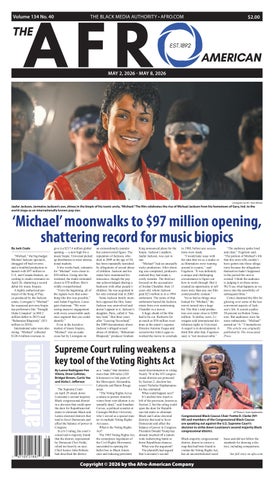
Lionsgate via AP / Glen Wilson
Jaafar Jackson, Jermaine Jackson’s son, shines in the biopic of his iconic uncle, “Michael.” The film celebrates the rise of Michael Jackson from his hometown of Gary, Ind. to the world stage as an internationally known pop star.
‘Michael’ moonwalks to $97 million opening, shattering record for music biopics
By Jack Coyle
afro.com
“Michael,” the big-budget Michael Jackson spectacle, shrugged off bad reviews and a troubled production to launch with $97 million in U.S. and Canada theaters, according to studio estimates on April 26, shattering a record debut for music biopics. A highly authorized portrayal of the King of Pop, co-produced by the Jackson estate, Lionsgate’s “Michael” far surpassed previous biopic top performers like “Straight Outta Compton” (a $60.2 million debut in 2015) and “Bohemian Rhapsody” ($51 million in 2018). International sales were also strong. “Michael” collected $120.4 million overseas, to
give it a $217.4 million global opening — a new high for a music biopic. Universal picked up distribution in most international markets. A few weeks back, estimates for “Michael” were closer to $50 million. Going into the weekend, the studio estimated closer to $70 million. But it wildly overperformed. “From the beginning, all of the signals were that something like this was possible,” said Adam Fogelson, Lionsgate chairman. “We were seeing massive engagement with every conceivable audience segment that you could identify.” Even in the lucrative market of music biopics, “Michael” was an audacious bet by Lionsgate on
an extraordinarily popular but controversial figure. The reputation of Jackson, who died in 2009 at the age of 50, has been repeatedly tarnished by allegations of sexual abuse of children. Jackson and his estate have maintained his innocence, though the pop star acknowledged sharing a bedroom with other people’s children. He was acquitted in his sole criminal trial in 2005. Some Jackson family members opposed the film. Janet Jackson was uninvolved and doesn’t appear in it. Jackson’s daughter, Paris, called it “fantasy land.” But three years after “Leaving Neverland,” the 2009 documentary about Jackson’s alleged sexual abuse of children, “Bohemian Rhapsody” producer Graham
King announced plans for the biopic. Jackson’s nephew, Jaafar Jackson, was cast to star. “Michael” had an unusually rocky production. After shooting was completed, producers realized they had made a costly mistake. The third act focused on the accusations of Jordan Chandler, then 13 years old, whom Jackson paid $23 million to in a 1994 settlement. The terms of that settlement barred the Jackson estate from ever mentioning Chandler in a movie. A huge chunk of the film had to be cut. Reshoots for as much as $50 million were done at the estate’s expense. Director Antoine Fuqua and screenwriter John Logan reworked the movie to conclude
in 1988, before any accusations were made. “I would take issue with the idea that we as a studio or as filmmakers were running around in a panic,” said Fogelson. “It was definitely a unique and challenging circumstance to figure out how to work through. But it created an opportunity to tell more story than any one film could possibly contain.” Yet as bad as things once looked for “Michael,” the movie turned into a huge hit. The film’s total production cost came close to $200 million. To defray costs, Lionsgate sold international distribution rights to Universal. A sequel is in development. A third film after that, Fogelson said, is “not inconceivable.”
“The audience spoke loud and clear,” Fogelson said. “The portion of Michael’s life that this story tells couldn’t have gotten into those allegations because the allegations themselves hadn’t happened in the period this movie existed. I think the audience is judging it on those terms. We’ll see what happens as we move into the possibility of subsequent films.” Critics slammed the film for glossing over some of the less convenient aspects of Jackson’s life. It scored a paltry 38 percent on Rotten Tomatoes. But audiences were far more enthusiastic. “Michael” earned an “A-” CinemaScore. This article was originally published by The Associated Press.
Supreme Court ruling weakens a key tool of the Voting Rights Act By Luena Rodriguez-Feo Vileira, Drew Callister, Bridget Brown, Curtis Yee and Aisha I. Jefferson The Supreme Court on April 29 struck down Louisiana’s second majority Black congressional district in a decision that could open the door for Republican-led states to eliminate Black and Latino electoral districts that tend to favor Democrats and affect the balance of power in Congress. In a 6-3 ruling, the court’s conservative majority found that the district, represented by Democrat Cleo Fields, relied too heavily on race. Chief Justice John Roberts had described the district
as a “snake” that stretches more than 200 miles (320 kilometers) to link parts of the Shreveport, Alexandria, Lafayette and Baton Rouge areas. “The Voting Rights Act as a means to protect minority voters from vote dilution is essentially dead,” said Jonathan Cervas, a political scientist at Carnegie-Mellon University who’s served as a special master in multiple Voting Rights Act cases. What is the Voting Rights Act? The 1965 Voting Rights Act, the centerpiece legislation of the Civil Rights Movement, succeeded in opening the ballot box to Black Americans and reducing persistent
racial discrimination in voting. Nearly 70 of the 435 congressional districts are protected by Section 2, election law expert Nicholas Stephanopoulos has estimated. What could happen next? It’s unclear how much is left of the provision, known as Section 2, but the ruling could open the door for Republican-led states to eliminate Black and Latino electoral districts that tend to favor Democrats and affect the balance of power in Congress. President Donald Trump has already touched off a nationwide redistricting battle to boost Republican chances. What was the argument? The plaintiffs had argued that Louisiana’s second
AP Photo/J. Scott Applewhite
Congressional Black Caucus Chair Yvette D. Clarke (NY09) and members of the Congressional Black Caucus are speaking out against the U.S. Supreme Court’s decision to strike down Louisiana’s second majority Black congressional district. Black-majority congressional district, drawn to correct a map that had been found to violate the Voting Rights Act, has an unconstitutional racial
Copyright © 2026 by the Afro-American Company
basis and did not follow the standards for drawing a district, including compactness. See full story on afro.com