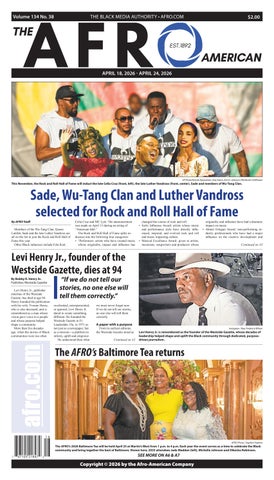
Sade, Wu-Tang Clan and Luther Vandross selected for Rock and Roll Hall of Fame
By AFRO Staff
Members of the Wu-Tang Clan, Queen Latifah, Sade and the late Luther Vandross are all on the list to join the Rock and Roll Hall of Fame this year.
Other Black inductees include Fela Kuti;
Celia Cruz and MC Lyte. The announcement was made on April 13 during an airing of “American Idol.”
The Rock and Roll Hall of Fame splits inductees into the following four categories:
• “Performers: artists who have created music whose originality, impact and influence has
Levi Henry Jr., founder of the Westside Gazette, dies at 94
By Bobby R. Henry Sr. Publisher, Westside Gazette
Levi Henry Jr., publisher emeritus of the Westside Gazette, has died at age 94. Henry founded the publication with his wife, Yvonne Henry, who is also deceased, and is remembered as a man whose vision gave voice to a people and whose purpose helped shape a community.
“If we do not tell our stories, no one else will tell them correctly.”
More than five decades ago, when the stories of Black communities were too often overlooked, misrepresented, or ignored, Levi Henry Jr. dared to create something different. He founded the Westside Gazette in Ft. Lauderdale, Fla. in 1971 as not just as a newspaper, but as a mission—a platform to inform, uplift and empower. He understood then what we must never forget now: If we do not tell our stories, no one else will tell them correctly.
A paper with a purpose From its earliest editions, the Westside Gazette stood as
changed the course of rock and roll.
Early Influence Award: artists whose music and performance style have directly influenced, inspired, and evolved rock and roll and music impacting culture.
• Musical Excellence Award: given to artists, musicians, songwriters and producers whose
originality and influence have had a dramatic impact on music.
Ahmet Ertegun Award: non-performing industry professionals who have had a major influence on the creative development and
AP Photo/Kevork Djansezian, Amy Harris, Kim D. Johnson, Elke Bruhn-Hoffmann
AFRO Photo / Stephen Hopkins
Madden (left), Michelle Johnson and Dikesha Robinson.
Instagram / Rep. Frederica Wilson
Levi Henry Jr. is remembered as the founder of the Westside Gazette, whose decades of leadership helped shape and uplift the Black community through dedicated, purposedriven journalism.
This November, the Rock and Roll Hall of Fame will induct the late Celia Cruz (front, left), the late Luther Vandross (front, center), Sade and members of Wu-Tang Clan.
WHAT’S TRENDING ON AFRO.COM
Supreme Court weighs future of 14th Amendment in historic citizenship case
By Ashlee Banks Special to the AFRO
The Supreme Court is expected to issue a landmark ruling by the end of June 2026 on the legality of President Donald Trump’s executive order ending birthright citizenship, a decision that legal analysts say could create disproportionate administrative and legal hurdles for Black and Brown communities.
U.S. Rep. Yvette D. Clarke (D-N.Y.-09) said in a statement that the president’s executive order is a “cheap intimidation tactic.”
“Donald Trump has never believed the constitution should come before his prejudices,” said the CBC chairwoman. “[His efforts are] borne of the same desperation and disrespect for the law that have defined his presidency since Day 1.”
Berenice Rodriguez, Georgia State Director with We Are CASA, told the AFRO, if birthright citizenship is eliminated, it will be a “roadway to chaos.”
“This would be an obstruction of justice and there will be a generation of [minority]
children that will become targets,” she stated. “I think the entire government system would collapse as we are directly attacking children that are born here as businesses. Parents should not be questioned on whether their child belongs in this country.”
On April 1, the Supreme Court justices heard arguments to determine if the executive branch has the authority to narrow the 14th Amendment’s citizenship clause, which has for more than 150 years guaranteed citizenship to nearly all children born on American soil.
If the court upholds the administration’s policy, the United States would shift from the principle of “jus soli,” or right of the soil, to a system based on parentage. Under new guidance documents from the State Department and the Social Security Administration, a birth certificate would no longer suffice as definitive proof of citizenship for newborns. Instead, parents would be required to provide original documentation of their own citizenship or legal immigration status to secure a Social Security number or passport for their children.
Your History • Your Community • Your News
The Afro-American Newspapers
Baltimore Office • Corporate Headquarters
233 E. Redwood Street
6th Floor, Suite 600G Baltimore, Maryland 21202
410-554-8200
Customer Service, Home Delivery and Subscriptions: 410-554-8200
customerservice@afro.com
Founded by John Henry Murphy Sr., August 13, 1892
Chairman of the Board/Publisher - Frances Murphy Draper
(Washington Publisher Emerita - Frances L. Murphy II)
Director of Operations - Andrè Draper - 410-554-8200
Civil rights advocates argue this shift will disproportionately impact marginalized communities.
According to briefs filed by organizations including the UCLA Latino Policy and Politics Institute, the requirement for parental verification is likely to trigger increased scrutiny of Hispanic and Latino families, particularly those in “mixed-status” households where one member may be a citizen and another a visa holder. Furthermore, historians have noted that Black Americans in the South, who historically faced barriers to formal birth registration during the Jim Crow era, may face unique difficulties in producing the ancestral documentation required to satisfy new federal inquiries.
The Trump administration has argued the order is a necessary tool to combat “birth tourism” and that the 14th Amendment was never intended to grant citizenship to the children of those in the country temporarily or without legal authorization.
During preliminary proceedings, Justice Brett Kavanaugh
questioned how the government intended to process parental status checks for the approximately 3.6 million babies born in the U.S. each year. Research conducted by the Empire Justice Center, Urban Center and New York Legal Assistance Group (NYLAG), point to the potential for systemic error, noting that the Social Security Administration’s own databases are known
to contain millions of inaccuracies regarding immigration status. For Black and Brown families already disproportionately affected by government surveillance and administrative delays, these errors could result in “statelessness,” leaving children born in the U.S. unable to access essential services like healthcare, public education or future employment.
Clarke said in a statement that the president’s efforts to erase birthright citizenship are likely to fail.
“Birthright citizenship emerged as a foundation upon which this nation could rebuild stronger and more whole than before,” stated the congresswoman. “It has faced legal challenges rooted in bigotry, fear, or both in the nearly two centuries since, and each time, it has endured.”
Haitians cut back on already scarce food and ask how they’ll survive rising fuel prices
By Evens Sanon and Dánica Coto
For a factory worker in Haiti, the war in distant Iran means he now has to walk two hours to work and the same distance home each day, because he can no longer afford public transportation.
On a recent morning, Alexandre Joseph, 35, fretted about his family’s future in a loud voice, attracting the attention of passersby in Port-au-Prince, Haiti’s capital.
“The government raised the prices of gasoline, diesel and kerosene, hitting my family. I now am unable to feed my two children on the salary I have,” he said.
The conflict in Iran has caused oil prices in Haiti to surge, disrupting critical supply chains, doubling transportation costs and forcing millions of undernourished people to cut back on already scarce meals.
Haiti, the most impoverished country in the Western Hemisphere, has been hit the hardest by rising oil prices that experts warn will deepen a spiraling humanitarian crisis.
‘One of the most fragile countries in the world’
On April 2, Haiti’s government announced a 37 percent increase in the cost of diesel and a 29 percent increase in the cost of gasoline.
“The consequences are huge,” said Erwan Rumen, deputy country director for the United Nations World Food Program in Haiti. “It’s one of the most fragile countries in the world.”
Almost half of Haiti’s nearly 12 million inhabitants already face high levels of acute food insecurity. In recent months, Rumen noted, about 200,000 people dropped from the emergency phase to the acute one, a significant milestone.
“What is a bit frightening is
to see that so many efforts could be basically wiped out by things that are completely out of our control,” he said. “This part of the population is extremely fragile. They’re on the verge of collapsing completely.”
Gang violence has exacerbated hunger, with armed men controlling key roads and disrupting the transportation of goods. An increase in food prices will only worsen hunger in a country where gangs easily recruit children whose families need food and money.
Emmline Toussaint, main coordinator of Mary’s Meals’ BND school-feeding program in Haiti, said that gas stations in some regions are selling fuel 25 percent to 30 percent higher than even what the government stipulated because of gang violence and difficulties with trucks trying to access certain areas.
She said the U.S.-based nonprofit is forced to use boats and take longer and multiple roads to feed the 196,000 children they serve across Haiti to avoid armed groups.
“The humanitarian crisis that we’re facing right now is at its worst,” she said. “So far, we are doing our best not to step back. Now, more than ever, the kids need us. … Most of them, it’s the only meal they receive.”
‘Everything will go up’
Fedline Jean-Pierre, a soft-spoken mother of a 7-yearold boy, sat under the shade of a tattered beach umbrella as she mulled increasing the prices of carrots, tomatoes and other produce she sells at an outdoor market in Port-au-Prince.
“People are not buying now because they don’t have money,” she said, noting she likely won’t have a choice but to increase prices to survive. “I have a child to feed.”
The 35-year-old mother said she and her son have lived for two years in a cramped and unsanitary shelter, among the record 1.4 million Haitians displaced by gang violence in recent years.
Street vendor Maxime
Poulard buys charcoal from suppliers to resell at a higher price.
Occasionally he sells two bags of charcoal a day, but he thinks he soon will only be able to afford to buy half a bag to resell.
“Traveling is expensive; eating is expensive; everything is expensive,” he said. “I’m not sure if I will be able to hold on much more.”
Nearly 40 percent of Haitians are surviving on less than $2.15 a day, according to the World Bank. Meanwhile, Haiti’s economy contracted for the seventh consecutive year, with inflation
reaching 32 percent at the end of fiscal year 2025.
Joseph, the factory worker, said he plans to sell soft drinks at night out of his home to try and earn more money, but even then, that won’t be enough: “We’re also going to reduce the way we normally eat.”
‘Impossible tradeoffs’
On April 6, Haitians dragged burning tires and other debris to block streets and protest the increase in fuel prices in Port-auPrince, of which an estimated 90 percent is controlled by gangs.
Marc Jean-Louis, a 29-yearold tap-tap driver, said passengers are increasingly bartering fares, but he can’t afford to offer discounts.
“All the money is going toward gas,” he said as he called on the government to reduce prices “so that everyone can breathe.”
Haitians fear more violence as the country’s poverty and hunger deepens.
Rumen, with the U.N.’s World Food Program, said they’ve been unable to reach 60,000 people in Haiti’s central region who are awaiting aid. A powerful gang recently attacked the area, killing more than 70 people, according to the U.N.
“We’re going to have more needs and less resources,” he warned.
Allen Joseph, program manager for Mercy Corps in Haiti, said rising oil prices are crushing the country’s fragile economy: “The families already spending most of their income on food will face impossible tradeoffs.”
He warned the increase will affect access to basic services, including potable water.
“This is not an abstract inflation,” he warned. “It will directly impact survival.”
This article was originally published by The Associated Press. Coto reported from San Juan, Puerto Rico.
AP Photo/AP Photo/Tom Brenner
Shown here, Nadine Seigler, 60, of Waldorf, Md. protesting in front of the Supreme Court on April 1.
AP Photo/Odelyn Joseph
A gas station advertises prices in Port-au-Prince, Haiti, April 7, 2026.
growth of rock and roll and music that has impacted culture.”
Celia Cruz, the legendary Cuban entertainer known for her hits “La Vida Es Un Carnaval” and “Quimbara,” will be inducted for her early musical influence alongside Kuti and hip-hop icons Queen Latifah and MC Lyte.
R&B crooner, Vandross, the man behind hits like “Never Too Much” and “If This World Were Mine,” is an inductee in the category for extraordinary performers. He is joined in the category by the band, Sade, led by Helen Folasade Adu, and the hip-hop collective, Wu-Tang Clan.
This year, history will be made as Kuti becomes the first African creative added to the Hall of Fame.
Though some of the 2026 inductees, like Sade, have been nominated before, others, like Vandross and WuTang Clan, are being inducted on their first nomination.
The group, Sade, first debuted in
Hall of Fame Henry
Continued from A1
a trusted voice for Broward County and beyond, covering the triumphs, the struggles, and the everyday lives of a people deeply rooted and determined not to be moved.
Under his leadership, the paper became a watchdog for justice and a champion for education and civic engagement.
Henry didn’t just print news—he cultivated awareness, built pride and inspired action.
November 1985. They went on to record two top 10 hits, “Smooth Operator” and “The Sweetest Taboo,” according to Billboard charts. Vandross won over the hearts of millions as his voice became the soundtrack to love stories around the world. Wu-Tang Clan, made a name for itself with the classic “Enter the Wu-Tang” album, which made an indelible impact on the rap and hip-hop communities.
All of the inductees have multiple culture-shaping singles, albums and performances, but in order to qualify for a nomination into the Rock and Roll Hall of Fame, an artist must also have a minimum of 25 years of work in the industry. And it’s a tough competition. For example, 2026 nominees Mariah Carey and Lauryn Hill did not make the induction list.
Though the induction ceremony will be in Los Angeles on Nov. 14 at the Peacock Theater, this year marks the last time the event will take place outside of the Rock and Roll Hall of Fame’s headquarters, which are located in Cleveland.
To watch the ceremony, tune in to ABC and Disney+ in December. An exact date has yet to be publicly disclosed.
Levi Henry Jr. was a man of quiet strength and unwavering conviction. His presence commanded respect, not through volume, but through vision. He believed in doing the work, standing on principle and letting truth speak louder than opinion. He was a devoted husband to Yvonne Henry, his partner in purpose and life, and together they laid the foundation for what would become a generational institution. His wisdom was not only spoken—it was lived.
A legacy that cannot be erased
Today, the Westside Gazette stands as a testament to his foresight and faith. Every headline, every photograph, every story printed carries the DNA of Henry’s original vision.
In an era where media continues to evolve, his mission remains constant: A positive paper for a positive people. His life’s work reminds us that Black-owned media is not optional– it is essential.
AP Photo/Chris Pizzello
MC Lyte will be inducted into the Rock and Roll Hall of Fame in November 2026.
AP Photo/Andre Penner
Though singers Mariah Carey and Lauryn Hill did not make the cut, singer Helen Folasade Adu, better known as “Sade,” will be added to the Rock and Roll Hall of Fame alongside her bandmates.
Photo by Evan Agostini
Over the years, Dana “Queen Latifah” Owens has proven herself to be a multi-faceted artist.
AP Photo/Laurent Rebours
Fela Kuti is the first African artist to be added to the Rock and Roll Hall of Fame.
COMMENTARY
Don’t like how our community is being portrayed? Turn it off. Cancel it. Stop giving it power.
By Dr. Frances “Toni” Draper AFRO CEO and Publisher
This is not a moment to be silent. At a time when Black life, Black leadership and Black progress are too often presented through a distorted lens, it is important to say plainly what many in our community already understand: how a story is told matters just as much as the facts it contains—and the context it leaves out.
What we are seeing in segments of local media coverage is deeply troubling. This goes beyond tone or emphasis; it reflects a pattern that distorts, diminishes and, at times, dehumanizes. That should alarm anyone who values fair and responsible journalism.
We have heard from readers through emails, texts, commentaries and op-eds, many raising important and valid concerns and, in some cases, deep frustration about how some local media coverage is shaped when it comes to Black life, Black political power, and reporting on leadership and decision-making in City Hall and in Annapolis. Some of those submissions have been pointed and, at times, deeply personal in how they name and respond to what is unfolding. Where appropriate, we will incorporate and adapt those voices in ways that reflect both the seriousness of the moment and the standards we hold for how that response is expressed. We will not engage in tit-for-tat exchanges with other media outlets or mirror the very approach we are calling into question. Escalation alone is not the answer—how and where we direct our attention and our dollars makes a difference.
An
In some local media coverage, the issue is not simply what questions are asked, but how those questions are constructed, what is omitted, and what too often reads as a steady drumbeat of unwarranted attacks, efforts to discredit and undermine, and innuendo suggesting that Black people are unqualified or unprepared.
At its core, this reflects an editorial bent that, to many, reads as a sustained effort to erode credibility—at times blurring the line between scrutiny and unfair characterization, often under the guise of investigative reporting.
Even when facts are technically accurate, they can be arranged, emphasized or stripped of context in ways that distort the full picture. That is not balance. That is framing.
This is not about oversensitivity; it is a recognition that some reporting has been relentless in its focus and uneven in its portrayal, particularly when it comes to Black leadership and decision-making in this state. At times, what is presented crosses a line. It reflects not just imbalance, but something more troubling that cannot be ignored.
To many, it also raises broader questions about intent—whether this reflects not just editorial judgment, but what appears to be a sustained, calculated and, at times, ruthless interest in shaping narratives that influence public perception, political outcomes and the flow of resources. Whether deliberate or not, the effect is the same: it concentrates attention, influences decision-making and, over time, shifts influence and control in ways that appear to benefit a narrow few rather than the broader public.
That distinction matters.
Framing is not neutral. Context is not optional. Stories presented without context, history or acknowledgment of disparity—and shaped in ways that discredit, shift influence, suggest the redirection or misuse of public resources, and feed assumptions about motives that are implied but rarely examined—do more than inform; they shape how people understand what they are seeing.
To many, what is unfolding does not feel incidental. It feels targeted and deliberate—less about informing the public than about exerting influence and control.
Over time, perception influences policy, priorities and decision-making. We have seen this before in different forms and in different eras.
For generations, Black progress has too often been reduced to a line item, while the centuries-long imbalance that made targeted investments in Black communities necessary is ignored. When the full story is not told—when wealth gaps, access and structural disparities are absent—what is presented as analysis begins to look more like narrative.
And that narrative is not new.
Outrage alone is not a strategy. But neither is silence.
There is anger—and it is justified. It reflects what we have been seeing and experiencing over time as a sustained pattern, not isolated incidents.
We are not in the business of attacking other media outlets or trading headlines. Escalation is not our role, and it is not what has sustained this institution for more than a century.
We are in the business of truth, context and responsibility—and of making deliberate choices. Coverage that distorts, diminishes or strips away context is not acceptable, and we will continue our work with clarity, context and a commitment to the kind of local journalism our community deserves. Because the most underappreciated power any reader, viewer or listener has is not what they say—it is what they support. These are not passive acts. They are endorsements.
If a news source consistently informs you, respects our community and reflects the full weight of our history—support it. If it does not, act accordingly. Turn it off. Change the channel. Cancel the subscription. Unfollow. Unfriend. Withhold your attention, your engagement and your dollars. Do not give power to what does not deserve it. And most of all, stop repeating, stop forwarding and stop talking about narratives that diminish our reality or disrespect our community.
open letter to the descendants of Charles Ridgely
Dear Ridgely Family of Baltimore County, The land remembers what people sometimes try to forget.
I was reminded of that 10 years ago while on a field trip to the Ridgely family estate at the Hampton National Historic Site. At the time, I was accompanied by youth from Orita’s Cross Freedom School, an African-centered educational program I started in Baltimore to examine Black history, culture, foodways, freedom and spiritual practices. Our Freedom School program often used Spring Break as an opportunity to teach Black children aspects of their history that we knew they would not be taught in the public school system.
On this particular trip during Spring Break 2016, we learned lessons about harsh chapters of slavery in Baltimore County on the once 25,000 acre Hampton Plantation owned by your ancestor Charles Ridgely and seven generations of his descendants.
On this plantation’s sprawling landscape, my students saw how chattel slavery unfolded right here in Maryland, and took note of the stark contrast between power and oppression.
While walking on the property, my students and I spotted the elaborate cemetery for members of your family. We even saw a cemetery for your ancestors’ pets. However, we did not see any marked cemetery for the Black people that your family enslaved. I was struck by the fact that your family’s pets were afforded something even in death that the enslaved Black people on your plantation were not.
Your family is one of many whose wealth was passed down for generations while the formerly enslaved on their land left the property or died with no investment, no retirement fund, no compensation for their labor and nothing to pass down to their descendants.
As Maryland residents confront its history and champion a growing reparations movement, the silence of families whose legacy is directly bound to slavery is striking and deeply ironic.
I am not asking you to carry the shame of your ancestors. I do believe, however, that those who inherited the benefits of such legacies should not remain hidden behind the veil of anonymity. There is a moral obligation to help join in this effort for repair in our state, to financially compensate the descendants of enslaved people on your family’s plantation and invest in the Black community in a way commensurate with your family’s wealth.
This open letter is an invitation to transform your family’s legacy into one that leads to reconciliation and healing through reparative action.
Your family’s public story need not end with slavery. You have a chance now to write new chapters that center healing and repair while aligning with the best of this state’s abolitionist legacy.
Your ancestors’ hands are not clean, but your conscience can be.
Will you join the effort to resolve this unfinished business?
The emotional economy of social media
By Stacy Sneed
How did we get here? And more importantly, where are we going? Will this fast-paced digital way of communicating continue to expand, or will we ever return to more meaningful connections like before?
Modern technology has transformed how people think about themselves and one another. Social media platforms offer both opportunity and risk. On one hand, they create space for creativity, connection and community. On the other hand, they can amplify comparison, pressure and emotional strain.
The speed of communication today is relentless. Posts, likes and comments travel across the world in seconds, leaving little room for reflection. Once something is posted, it can be captured through screenshots, reposted or forwarded before a person even realizes the impact. In this environment, the idea of going “viral” has become a powerful force. But what does virality truly offer? For some, it can open doors and bring recognition. For others, it can damage reputations overnight.
Social media has undeniably shifted the trajectory of society. Many feel pressured to chase visibility at any cost, sometimes sacrificing authenticity or emotional well-being in exchange for digital attention. The question becomes:
is this freedom of expression, or is it a trap pulling us deeper into a cycle of validation and comparison?
Everyone wants to feel seen — almost like a celebrity — yet not everyone wants to put in the years of dedication that real success often requires. The imbalance between followers and genuine connection creates a new kind of social hierarchy, where popularity can determine perceived value. Is this simply the evolution of human behavior, or has social media intensified something that already existed?
Is this feeling starting to become normal? Think about it — maybe it’s your birthday, a special celebration or just a night out. Do you feel compelled to keep that moment private and meaningful with the people around you, or have we become programmed to share everything for attention and validation?
Is this the new norm? Like any addiction, many of us are conditioned to chase the rush of “likes.” Watching the numbers grow and reading comments can pull us deeper into a cycle where we begin to post based on what others respond to most. If you really pay attention, you may notice how much time is spent checking who liked your post, who commented, and who didn’t. Try calculating that time throughout your day. And what happens when no one responds? That’s often when the mental cycle begins.
Questions like “Why?” start to surface, and people begin to doubt themselves or what they shared. In some cases, posts are removed simply because they didn’t receive the validation someone expected. This kind of programming can slowly shape how people see their worth and their purpose. If we don’t pause and question these patterns, they can become normalized — and that normalization can lead people into emotional spaces they never intended to enter. Programming should be examined, not blindly accepted.
Jealousy, anxiety and competition seem more visible than ever because we now witness each other’s lives in real time. Achievements, struggles, celebrations and failures are displayed instantly for the world to judge. This constant exposure can make it feel as though society is built on comparison rather than compassion.
Stepping away from social media is often harder than people admit. I remember taking a break myself, thinking I could simply pause and disconnect. Even though I never removed the apps from my phone, my finger would automatically move toward them without thinking — almost as if I had been programmed. That moment made me realize how deeply these platforms can shape our habits and our minds. When constant scrolling becomes routine, it can quietly contribute to emotional exhaustion, mental
Johns Hopkins University / Will Kirk
Dr. Frances “Toni” Draper serves as publisher and CEO of AFRO News.
health challenges and even depression. The fear of missing something — a post, a moment or a conversation — keeps many people tied to their screens, even when they know they need rest.
Courtesy photo
Stacy Sneed is a Maryland-based author, community advocate and founder of Women of Life Changing.
By Rev. Dr. Heber Brown III
Rev. Dr. Heber Brown III is founder and executive director of the Black Church Food Security Network.
Meet the pastor flipping Black Church tradition with poetry
By Rev. Dorothy S. Boulware Word In Black
With graduate degrees from St. Mary’s Seminary in Baltimore and Wesley Theological Seminary in Washington, D.C., the Rev. Dr. Wanda Bynum Duckett has traditional faith leadership credentials. Her career path affirmed it: she rose from itinerant ministry to serve as superintendent of the United Methodist Church’s former Baltimore Metropolitan District for eight years.
Then, she retired and rewired.
After years of preaching in a more traditional mode, Duckett now spits the gospel with the power and energy of a hip-hop artist or slam poet. That’s with good reason: Bynam Duckett, 64, is melding art forms found in nightclubs and coffee houses with scripture — a unique spiritual blend she calls “Sacred Slam”:
We are the ones…what are we waiting for?
We are the ones…open wide every door!
We are the ones
We can’t hear them from our shrines
Can’t see them through closed blinds
Can’t love them with closed minds.
Eternal life? Let’s get this right.
The world is waiting and We are the ones.
The combination is drawing them into the pews whenever Duckett preaches, and not just young people craving a spiritual message in a language they can relate to. Sacred Slam, she says, attracts the young and the young at heart. Her style has
including a wedding: “One bride walked down the aisle to a poem,” she says.
Duckett wants to introduce younger poets to the faith community, thereby encouraging them to embrace all the arts for worship. Her next plan also includes community gatherings, even in homes, much like the poetry salons of the Harlem Renaissance.
Word In Black interviewed Bynum Duckett to talk about “Sacred Slam.” Read below to learn more.
Word in Black: When did you first fall in love with hip-hop and poetry?
Wanda Bynum Duckett (WBD): I grew up the youngest of five. I had a brother who was a rock and roll, Led Zeppelin, Rare Earth guy. He was a hippie. I had another brother who was Temptations, Four Tops. And my sister, she’s Pointer Sisters, and was listening to Malcolm X on wax.
been so successful that she facilitates workshops and coaches others to find themselves in the art of poetry under the banner of Spoken by Duckett.
“I celebrate that God is the first spoken word artist,” Duckett told Word In Black in a recent interview. “In the beginning was the word. That’s a spoken word poem. And if you go back and listen to Rev. Jesse Jackson and some of the popular preachers we have, it’s poetry; the way they use imagery and repetition and alliteration.”
Extending her soul art, she says, has been a real blessing as well as a model for others to be authentically themselves. People began to ask her to perform in unusual places,
It was in the late ‘70s, and I heard [rap artists] the Sugarhill Gang. I was kind of in love then, but then when I heard, ‘Don’t Push Me, I’m Close to the Edge,’ I was like, ‘OK — I’m in.’
My mother’s James Cleveland, Mahalia Jackson, so I think in song and rhyme anyway.
Of course, we’ve got poetic preachers and in the tradition of even someone reading the scripture and the preacher preaching a while and then he’s rhyming and he’s riffing and he’s unpacking it. It’s poetry to me. It’s, like, the way the images and the words and the attitude of it all come together. All this stuff is in my head.
WIB: When did you first experience rhythm in scripture and prayer responses?
WBD: I really don’t know if I was aware until other people noticed it in my preaching. I think it was so much a part of the way I think, hear and speak that I didn’t realize. I would preach at Mount Calvary AME Church, and when the young adult choir was singing, they would snap their fingers when I made a point. I said, ‘What are they doing?’ I said to myself, ‘I’m not doing poetry,’ but that’s the way they heard it.
WIB: Did you need to summon courage to be non-traditional?
WBD: One of the first times I performed, I stood in the background with my hair tied up, like I was Maya Angelou or somebody. I thought I had to be Afrocentric. While I read from the background, out of sight, Rev. Stephanie Graham Atkins, one of my colleagues, did liturgical dance to the rhythm of my words and I got to hide.
It was another kind of gradual coming out.
WIB: Did you experience pushback? Did anyone say, ‘That’s not preaching. What’s she doing up there?’
WBD: It was actually the opposite. I found my tribe in the young adults. And people love when young people show up, right?
I give credit to a young lady named LaShonda. When I was in southwest Baltimore, my first church, I was doing a lot of real, gritty urban ministry. And then when I moved uptown to
Ashburton, I sat in the office and saw people and visited. She came into the office one day and said the young people had Googled me. They said, ‘Where is she? We haven’t seen her show up here.’ She called me out. She said they were excited for me to bring my “bop” as she called it. Out of that conversation came the poem, “I Decided to Be Myself.”
WIB: Can you say more about the baptism poem?
Bynum Duckett: It is dedicated to Trayvon Martin. He had a right to live. Remember that mantra? And it’s talking about how Jesus had the right to live, but he gave himself up for us. It’s a communion service. In the dissertation, it was the first time I had a chance to experiment with that to see what people said. And then I took a survey as part of the dissertation work. And the survey was, like, it’s cool. They said they liked it but weren’t sure about it being part of worship.
Some said they certainly didn’t know how they felt about it being used in the sacraments. And some people said stuff like, ‘Well, it’s kind of like hip hop. I don’t understand it because they talk too fast.’ So writing it down is helpful so people can read it at their own pace in their own way. But this one woman, who had been kind of on the edge, cried as I did a reaffirmation of baptism. She said it took her back to when she was confirmed, and she wasn’t one of those weepy people.
This article was originally published by Word In Black.
The AFRO’s Baltimore Tea to spotlight women in the C-suite
By AFRO Staff
The AFRO’s 2026 Baltimore Tea has already sold out, with more than 1,000
people expected to attend. The event will be held Saturday April 25, 2026 at Martin’s West, located at 6817 Dogwood Road.
Sponsors for the 2026 Baltimore Tea include Associated Black Charities; BGE Exelon Company, GBMC Healthcare; Public Justice Center; United
Janet S. Currie President, Bank of America Greater Maryland
Janet Currie is president of Bank of America, Greater Maryland, and the market executive for the Local Markets Organization with more than 30 year career in financial services.
As president of Bank of America, Greater Maryland, she is responsible for connecting banking and investment resources offered through the banks’ eight lines of business to people and companies across the region. She also leads the effort to deploy Bank of America’s resources to help advance economic mobility and build strong communities.
As the market executive, Currie leads Bank of America’s community opportunity work in the region, leveraging the capabilities of the company to help partners, people and communities more effectively address a wide range of issues.
Currie holds a Master of Science degree from New York University, Stern School of Business and a Bachelor of Arts degree from Spelman College in Atlanta.
Way of Central Maryland and Wylie Funeral Homes. Each year, the tea serves as a time for community members, leaders and elected officials to come together in their finest threads, hats and gloves.The event first took
place in 2017, with roughly 200 people in attendance. Now, it is one of most anticipated events in the Black community each Spring, complete with entertainment and a parade of hats open for all to join.
This month, the tea will take place under the theme of “Honoring Baltimore’s Leading Ladies: The C Suite,” with a special salute to the women executives of the region. Read more about this year’s honorees below.
Shannetta R. Griffin was appointed as the executive director and CEO of the Maryland Aviation Administration on April 4, 2025. She is responsible for overseeing the management, planning and operations of Baltimore/Washington International Thurgood Marshall Airport, Martin State Airport and the state’s regional aviation assistance program.
Griffin has more than 40 years of experience as a professional engineer within the transportation industry with an emphasis on aviation and aerospace.She received a Bachelor of Science in Civil Engineering from the University of Toledo. She is the proud mother of two children and a member of Alpha Kappa Alpha Sorority, Inc.
o p l e t o t h r i v e
A w o r l d t h a t p r i o r i t i z e s m e a s u r a b l e c h a n g e i n t h e l i v e s o f B l a c k p e o p l e a n d w o r k s a c t i v el y t o w a r d t h e e l i m i n a t i o n o f r a c i a l d i s p a r i t i
Shannetta R. Griffin Executive Director and CEO, Maryland Aviation Administration
Faith P. Leach Baltimore City Administrator
Robyn Murphy CEO, Create Baltimore
As CEO of Create Baltimore — Baltimore City’s designated arts council — Robyn Murphy is redefining how cultural investment fuels economic growth, civic engagement and collective well-being.
Murphy oversees a citywide portfolio that includes cultural institutions, artist studios and the region’s largest farmer’s market. Under her leadership, Create Baltimore administers Maryland’s largest direct funding to artists and arts organizations. She also serves as executive producer of Artscape, the largest free outdoor arts festival in the United States, where she continues to expand the festival’s impact as a platform for creativity, economic mobility and community connection.
President and Chief Executive Officer, Baltimore Gas and Electric Company
Tamla Olivier, a graduate of Cornell University’s School of Industrial and Labor Relations, is the president and chief executive officer of Baltimore Gas and Electric Company (BGE), a subsidiary of Exelon Corporation. Olivier and her leadership team oversee safety, reliability, customer service, financial performance and BGE’s commitment to delivering value to its customers while fostering an equitable energy transition. BGE is the nation’s first gas utility and is currently Maryland’s largest electric and natural gas utility, serving more than 1.3 million electric and 700,000 gas customers in central Maryland.
Shelonda Stokes
President and CEO, Downtown Partnership of Baltimore Executive director, Downtown Management Authority
Shelonda Stokes is a changemaker who leads with purpose and has built a body of work that is reshaping what is possible for Baltimore and for cities across the country. As president and CEO of the Downtown Partnership of Baltimore and executive director of the Downtown Management Authority, she leads two multi-million-dollar organizations with a unified mission to position Downtown Baltimore as a destination of choice where residents, businesses and visitors all have a stake in its success.
A proud electrical engineering graduate of Morgan State University and a current member of its Board of Regents, Stokes applies a rigorous, data driven approach to every initiative she leads. Under her leadership, Stokes and her team secured a catalytic 50 million dollar investment in the Central Business District, advanced the strategic relocation of 12 State of Maryland agencies into the urban core to stimulate economic activity and successfully advocated for transformational development throughout downtown, including the retention of CFG Bank Arena in the heart of the city. That sustained, coalition driven work has helped catalyze nearly 7 billion dollars in active and planned development across Downtown Baltimore.
Alicia Wilson Vice President, Civic Engagement and Opportunity, Johns Hopkins University
In this role, she leads and coordinates a broad range of strategic initiatives aimed at fostering community partnerships, economic growth and civic engagement in Baltimore and beyond. She spearheads efforts to integrate and strengthen relationships between Johns Hopkins and surrounding communities. Wilson plays a pivotal role in overseeing community and civic engagement initiatives, collaborating on high-priority public impact projects and advising on institutional matters of significance. A graduate of the University of Maryland Baltimore County (UMBC) and the University of Maryland Francis King Carey School of Law, Wilson has received numerous accolades for her professional and civic contributions.
and
Chrissy M. Thornton is the president and CEO of Associated Black Charities (ABC), a racial equity organization headquartered in Baltimore. She is also the founder of My Girl Power Matters, a women’s empowerment series.
A native New Yorker, Thornton is known for blending visionary strategy with hands-on execution, building professional pipelines, advancing digital inclusion and convening community dialogues that drive meaningful change. At the core of her work is a commitment to building trust, creating opportunity and advancing equity.
Karsonya “Kaye” Wise Whitehead, Ph.D.
Founding Executive Director, Karson Institute for Race, Peace and Social Justice
Karsonya “Dr. Kaye” Wise Whitehead, Ph.D., is the founding executive director of the Karson Institute for Race, Peace and Social Justice and a professor of communication and African and African American Studies at Loyola University Maryland. She is the host of the award-winning radio show “Today with Dr. Kaye” on WEAA, 88.9 FM, and the 30th national president of the Association for the Study of African American Life and History (ASALH).
Dr. Kaye is the author of five books and a sought-after keynote speaker. She received her BA in history from Lincoln University, an MA from the Kroc Institute for International Peace Studies at the University of Notre Dame and a Ph.D. from the University of Maryland, Baltimore County.
Dr. Kaye is a member of Delta Sigma Theta Sorority Inc. and lives in Baltimore with her husband and her family.
Nykidra “Nyki” Robinson Founder, Black Girls Vote
Nykidra “Nyki” Robinson is a values-driven leader, entrepreneur, visionary and motivator with a heart for people and a passion for changing the world.
Robinson, a Baltimore native, is a graduate of Randallstown High School and first-generation college student with a degree from Frostburg State University.
Robinson is an outreach specialist with over 17 years of project management, community engagement and organizing experience. Often labeled as a “millennial on the move,” Robinson’s life and work experience combined with her interest in politics was birthing ground for the delivery of her biggest project yet, Black Girls Vote, Inc. This non-partisan, grassroots organization focuses on encouraging and mobilizing African-American women to use their collective voting power to advocate for issues that impact African-American women and families.
In 2020, Robinson created the innovative Party at the Mailbox (PATM) campaign, one of the first COVID-proof voter education and engagement activations in the nation. PATM launched in April 2020 in Baltimore for the Primary Election. The program expanded to Detroit and Philadelphia for the General Election and in Atlanta for the 2021 run-off elections. PATM’s enormous success includes securing local, national and international supporters. Robinson is also overseeing the most extensive known randomized control trial evaluation focused on Black voters’ voter engagement.
Honored to lead, grateful to serve Maryland together.
Thank you to The AFRO for the honor of being recognized at this year’s AFRO High Tea. I am truly humbled to stand alongside such exceptional women whose leadership, resilience, and commitment continue to strengthen our communities. Each of you inspires me. Serving Maryland through BGE, an institution that has powered this city’s homes, jobs, and progress for more than two centuries, is a privilege I hold deeply. I’m grateful for this recognition and for the remarkable women sharing this moment.
Chrissy M. Thornton President
CEO, Associated Black Charities
Tamla Olivier
Tamla Olivier, President & CEO, BGE
Retirement while supporting young adult children or parents
By Victoria Mejicanos AFRO Staff Writer vmejicanos@afro.com
With the rising costs of living, economic pressures and longer life expectancy, many who are preparing to retire must think about what retirement would look like while still financially supporting legal dependents, young adult children or their parents.
According to experts who spoke with the AFRO, retiring with dependents has become either a choice or a necessity to help loved ones survive in the current economic climate.
According to a savings.
com report, which surveyed 1,000 parents who had adult children, 50 percent of parents are supporting a child older than 18.
For Rose Faye, a certified financial planner, conversations around retiring with dependents is not new, especially for clients of color, but it has changed in recent years.
“Children [are] becoming more and more prevalent in the conversations I have with clients,” said Faye. “It’s even not just in the traditional sense that they live with you. Now, it is how do you also give them an economic leg up, for example, help put down payment for homes, or supplement things like one vacation a year so they can have experiences.”
While financial planning can help people navigate these decisions, Dr. Sherida Santiago, a professor at Coppin State University’s College of Business, says this rising trend is a result of broader economic and structural factors. She noted that not only are more young adults living at home to save money, but older Black adults do not typically save for retirement.
“I think that when we think about generational oppression, over time, I would say commonly amongst African-American and Latino populations,
that if your family did not have the proper social and economic circumstance, then you’re generationally fighting your way out of that, which also puts a strain on the ability to have the proper retirement structure set up, and then that couple with trying to help others come up, it can be a bit of a challenge,” said Santiago.
The financial strain of supporting others while preparing for retirement can have long term consequences according to both experts, especially those who are behind on saving.
Santiago said taking additional financial responsibilities can accelerate how quickly retirees spend down their savings, which can lead to delayed retirement or returning to the workforce later in life–-especially as unexpected expenses, such as healthcare costs, pile up. Additionally, Santiago noted that these trends can limit generational wealth.
“If you spend it all taking care of others, it increases the risk that you could lose the thing that you would pass on to your children,” said Santiago. Examples she provided included homes or life insurance.
For Faye, success with retirement planning includes
clients being honest and realistic about how much they would need to save to support whoever they choose once they retire, and already adding that into their expenses prior to the transition to help create spending limits.
The advice is going to be to prioritize themselves,” said Faye. “You have to make sure that your own financial plan is sound, before you try to help the children’s financial plan. This way, the entire structure doesn’t topple just because you are over-extended.”
Overall, both experts emphasized communication within households about money, especially since the topic is generally avoided.
“People just assume you have [money],” said Faye. “And then they just expect it for you to give it. When the money conversation is had, most people–who do not want to take advantage of you–will understand that you have that limit and then make the adjustment. But we don’t have the conversations.”
For Santiago, addressing the issue requires a cultural shift toward better financial education and being more accepting of community support systems.
Santiago noted that people are taught how to budget, but
not invest long term.
“Financial literacy, and wealth management are not the same thing,” she said.
As seniors navigate retirement and the financial realities that come with dependents or long-term caretaking, experts say communication, planning and education are crucial. Without a plan, what is meant to be support for family members can quickly turn into a strain on personal resources and a risk to assets already owned.
Courtesy photo
Rose Faye
Courtesy photo
Dr. Sherida Santiago, a professor at Coppin State University’s College of Business, says the rising trend of retiring with dependents is a result of broader economic and structural factors.
4 tips on saving for retirement when you
By Mallika Mitra
As people live longer and the cost of living continues to increase, the price tag on retirement remains high. In 2025, Americans expect that they’ll need $1.26 million to comfortably say goodbye to their jobs forever, according to Northwestern Mutual’s 2025 Planning and Progress Study. That number can seem daunting — especially for people living paycheck-to-paycheck, or saving for other goals such as buying a home or continuing their education. But experts say there are ways to save for your golden years now, even if it doesn’t feel like you can.
This week, Current, a consumer fintech banking platform, shares six tips for saving for retirement when it feels like you can’t put any extra cash away.
1. Don’t forego a 401(k) match
When you feel like there’s very little wiggle room in your budget, it can be challenging to forego some of your paycheck now so that it goes directly to your 401(k) or other type of retirement savings plan offered by your employer. But many employers will match your contributions up to a certain amount, such as 50 cents for every dollar you put into the account on the first 6
percent.
Contributing up to at least an employer match is “a no-brainer decision,” says Josh Gallogly, a financial advisor and founder of Milestones Financial in Columbus, Ohio. “It’s an instant positive rate of return on your cash.”
Keep in mind that sometimes companies will require your contributions to “vest,” which means that you’ll have to wait a certain amount of time, such as three years, before you fully own the employer contribution.
2. Take advantage of the HSA
The 401(k) and similar retirement savings accounts — like the 403(b) — garner the most attention when it comes to employer benefits that can boost your savings. But don’t
overlook other options. Health savings accounts (HSAs) are “attractive options for a lot of people,” Gallogly says.
These accounts are designed to help you save for certain medical costs, and they’re triple-tax advantaged: Contributions can lower your taxable income, the money grows tax-free in your account, and you can withdraw the money for qualified expenses without paying federal taxes on it. Those tax advantages could certainly help you save more over the long term than simply putting that money in a savings account — and considering Fidelity’s recent Retiree Health Care Cost Estimate report found that a 65-year-old may need $172,500 on average in after-tax savings for health care costs, it makes sense to build up that nest egg now.
don’t think you can
Another perk? Once you hit age 65, you can withdraw money from these accounts for any nonmedical expenses (though you’ll be taxed on nonqualified withdrawals).
3. Automate your savings bumps
After initially setting up recurring contributions for your retirement accounts, you won’t have to do anything else to ensure that money goes straight to your retirement account. But Kiersten Peshek, a lead wealth advisor at Citrine Capital in Columbus, Georgia, says that you can also typically elect to have your contribution amount increase each year — and even a 1 percent boost can make a difference over the long term. If someone knows they typically get a 2 percent pay increase in April, for instance, they can set their contribution amount to increase by that much each April.
That way, you’re increasing your retirement plan contribution without majorly impacting your net cash flow.
“The upside of that is you really don’t feel it that much,” Peshek says. “I like that method because it helps folks slowly increase the amount they put away for retirement without causing undue stress.”
Automating your savings isn’t only a strategy you can implement in your retirement
savings accounts. Having a bank account that rounds up your purchases to the nearest dollar and adds the difference to your savings may seem small at first, but every little bit adds up in your savings over time.
4. Have a strong emergency fund
Financial advisors tend to recommend that you build up an emergency fund that could cover three to six months’ worth of expenses should the unexpected happen, like you lose your job, are hit with a surprise medical bill or need an urgent car repair. While that may seem separate from saving for retirement, having cash available when you need it means there’s less of a chance you’ll have to touch your retirement savings.
“The emergency fund is part of building a solid financial foundation,” Gallogly says.
You typically want to keep an emergency fund in a savings account that will earn a higher yield than what you’d see with a traditional bank, such as at an online or mobile-only bank, for example, which tend to offer much higher savings rates.
5. Increase your earning potential
Even if you feel like you can’t put more money away
now for retirement, you may be able to make moves that could increase your earning potential down the line. One of the best investments people can make is investing in their careers, Gallogly says. “For many people, the biggest asset in their financial portfolio is their human capital, which is their ability to use their skills, experience and human talent to earn income throughout their lifetime.”
Employers often offer training programs or will fund employees’ career growth by sending them to networking events or paying for their classes. While this may not be a direct way to save for retirement, taking advantage of these perks now could allow you to save more later.
6. Start small
If you feel overwhelmed by how much you may need to save for retirement, start small. Contributing just a small percentage of your overall income to a retirement savings account, or — if you’re already doing that — setting aside just $20 each week to contribute to an individual retirement account (IRA) on the side can help. Doing so early on can also help you develop good savings habits, Gallogly says. This story was produced by Current and reviewed and distributed by Stacker.
Unsplash / Janay Peters
Many retirees rely on Social Security— but confusion and delays can cost them
By Victoria Mejicanos AFRO Staff Writer vmejicanos@afro.com
According to organizations like the NAACP and the Center on Budget and and Policy Priorities, Social Security benefits are a critical part of income for Black retirees. Social Security funds can be used to address housing, healthcare and food. But experts say issues such as lack of clear guidance on when to claim benefits or missing paperwork can lead to a loss of income for many seniors when they can least afford it.
“Because these benefits are so important, it is essential that people understand their rights within the Social Security system,” Cornelia Bright Gordon, director of advocacy for administrative law at Maryland Legal Aid, wrote to the AFRO in a statement.
Understanding when and how to claim benefits is one of the most common challenges older adults face.
“Some people are not aware of the various options that they have—that’s a challenge people do experience,” said Pamela Massie, the State Health Insurance Assistance Program (SHIP) program manager at the Baltimore City Health Department. “I’ve seen some people say, ‘If I had known…if somebody had broken things down to me like that, then I would have operated differently.’”
Massie noted that every person’s
situation is unique, but that people often are unsure because they feel that they may need to claim earlier than retirement age, which is 67 for those born in 1960 or later.
According to Massie, those that retire early risk earning less on their monthly payments. For those that delay retirement, benefits may increase.
“Some people can’t afford to wait,” Massie said. However, she also noted that those who claim early can face a significant reduction to their monthly payments.
This can prove to be an especially difficult situation for Black Americans. According to a 2025 Retirement Confidence Survey by the Employee Benefit Research Institute, a nonpartisan organization that provides objective fact based research regarding employee benefits, Black retirees were more likely to retire earlier than planned and were more likely to have done so because of a health problem or disability.
Denials and delays and how to navigate them
According to a 2024 study from the Center for Retirement Research at Boston College, Black Americans get 19 percent less from Social Security during their retirement years than White retirees. To ensure that residents get the most benefit possible out of their retirement, Massie says it is best to have proper documentation such as a birth certificate, marriage and divorce
paperwork, banking information as well as military service paperwork if applicable.
“If you do not have those things to submit when you’re applying, those documents can delay and hold off the process,” said Massie.
Although denial is not common according to Massie, Gordon explained what to do if it does occur.
“One of the most important things people should know is that a denial of benefits does not have to be the final decision,” wrote Gordon. “The Social Security Administration (SSA) has a formal appeals process, and many applicants who are initially denied benefits are later approved after submitting additional documentation. Individuals who receive a denial should carefully review the notice they receive and pay close attention to reconsideration or appeal deadlines, which are typically 60 days from the date of the decision.”
Gordon added that delays often happen because of administrative issues rather than actual ineligibility. Missing documentation, a change of address or a new phone number are examples of simple things that can lead to a delay in benefits if records are not properly updated.
“It is also important not to ignore mail from SSA,” Gordon wrote. “What appears to be a routine notice could contain important information, such as an overpayment notice with a fast-approaching appeal deadline. SSA letters often contain several
Unsplash/Alexander Grey Experts say that organization and communication are key to receiving all the benefits possible.
pages, and individuals should keep all of them for their records.”
If someone receives a denial, experiences a significant delay in processing their application, or receives a notice they do not understand, that is often a good time to seek assistance from a legal services organization such as Maryland Legal Aid. Legal assistance can help individuals understand their rights, gather supporting documentation, and navigate the appeals process.
General advice
Both Massie and Gordon acknowledged that the system, however needed, can feel overwhelming.
“The Social Security system can feel complex and overwhelming, particularly for older adults who may also be managing vision challenges, health concerns, mobility issues, or financial stress. It is important for people to know that they do not have to navigate the process alone,” said Gordon. She encouraged people to
reach out to legal services organizations, community advocates, and trusted community partners.
Massie emphasized that getting accurate information early can make a significant difference.
“If you’re totally unsure, unclear, and you want to make sure you get the right information— and not from family and friends because everybody’s situation is different, my advice would be to call your local SHIP office,” Massie said.
Additional Resources
• The State Health Insurance Assistance Program (SHIP) in Baltimore City, contact number: 410-396-2273, ask for the SHIP Program.
• General contact number for SHIP offices in Maryland: 410-767-1100 or 1-800-243-343425
Maryland Legal Aid (main intake number) (888) 465-2468
Local Social Security Office Locator https://www.ssa.gov/locator
Learn More About Vibrant Senior Living!
• Ashby Ponds® Ashburn, Virginia
• Charlestown® Catonsville, Maryland
• Greenspring® Springfield, Virginia
• Oak Crest® Parkville, Maryland
• Riderwood® Silver Spring, Maryland
• The Grandview℠ Bethesda, Maryland
• Woodleigh Chase® Fairfax, Virginia
BALTIMORE AREA
Moore unveils Baltimore TransitOriented Development Plan
additional annual fare revenue.
By Tashi McQueen AFRO Staff Writer
tmcqueen@afro.com
On April 6 Maryland Gov. Wes Moore (D) unveiled the Baltimore Regional Transit-Oriented Development Strategy at the Rogers Avenue Metro Station in Baltimore. The Moore-Miller Administration hopes the effort will increase the state’s economy and lower housing prices.
Rogers Avenue Metro Station is located in Park Heights, a majority-Black neighborhood that experienced decades of disinvestment until recent years.
According to 2023 data from the Baltimore Neighborhood Indicators Alliance, 26.6 percent of homes in the city do not have vehicles. Investments in affordable and reliable public transportation have been shown to spur economic advancement in poorer neighborhoods by connecting residents to jobs and other opportunities.
“Today’s announcement really underscores the state’s commitment to Baltimore and our shared commitment to transit-oriented development giving residents the opportunity to live and work next to transit,” said Baltimore Mayor Brandon M. Scott (D). “For generations, restrictive housing and transportation policies were intentionally
used to limit opportunity and investment in many of our neighborhoods.
“Announcements like this one are about expanding access to our subway stations and turning underutilized spaces – like parking lots – into something that actually serves our residents and creates opportunity and housing for all,” he added.
The governor and officials from the Maryland Department of Transportation (MDOT) also announced the first step toward obtaining a development partner to build the North Parcel at the
“You cannot have a thriving state if your state’s largest city does not have a partner inside the work,” said Moore. “You cannot have economic mobility if you do not have physical mobility. You have to be able to invest in the way that people move, and if opportunity is not near transit then you’re just making their lives harder.”
The strategy is part of Moore’s broader effort to enhance regional mobility through transit investments. Other initiatives include the Maryland Transit
“You cannot have economic mobility if you do not have physical mobility.”
-
Gov. Wes Moore, Maryland
Rogers Avenue Metro Station. The site includes about 9 acres of state-owned land adjacent to the station that is currently used as a large and underutilized parking lot.
Under this plan, the site would generate more than 400 new housing units, over $120 million in state and local tax revenue and greater than $50,000 in
Administration’s (MTA) $1.4 billion Light Rail Modernization Program, upgrading the Baltimore Central Light Rail Line from Hunt Valley to BWI Thurgood Marshall Airport with new vehicles and station improvements.
During the event, officials took a
New Visit Baltimore CEO Kireem Swinton pledges to reframe Charm City’s story
By Megan Sayles AFRO Staff Writer msayles@afro.com
After serving as interim CEO and president since July 2025, Kireem Swinton is now the permanent head of Visit Baltimore, the city’s designated destination marketing and sales organization. Swinton, who previously served as vice president of sales and customer experience for the quasi-governmental agency, started the position on April 1.
Swinton’s selection follows recent strides for Baltimore’s tourism industry.
In 2024, 28.5 million people visited the city, spending $4.3 billion. In his role, redefining Baltimore’s national and global image will be a central focus.
“For me, my biggest thing is to make sure that we commit to telling the real, authentic story of Baltimore and not let anyone else paint the narrative for us,” said Swinton. “That’s super important to me because the underlying tone when you talk to everyone in the community
is: ‘We don’t like how everyone tells our story. We want to tell our story on our own.’”
Historically, Baltimore, like many urban areas, has been associated with violence, drug activity and poverty. These portrayals have permeated mainstream media and, at times, overshadowed the lived experiences of Baltimoreans.
This year, under Swinton’s leadership, Visit Baltimore launched its B-side campaign, giving residents a platform for sharing positive, overlooked stories about their city. Swinton said the campaign is particularly important given that half of Baltimore’s visitors reach out to a relative or friend to ask about the city’s offerings before visiting. Another priority for Swinton is increasing the number of meetings and conferences the city attracts. He emphasized that large-scale gatherings, like the Central Intercollegiate Athletic Association Men’s and Women’s
Maryland settles with owner and operator of ship that crashed into Baltimore’s Key Bridge
By Brian Witte
Maryland has reached a settlement with the owner and operator of the massive cargo ship that crashed into a Baltimore bridge two years ago, causing its deadly collapse, state officials announced April 9.
The settlement in principle was reached with Grace Ocean Private Limited and Synergy Marine Pte Ltd, owner and operator of the M/V Dali, Attorney General Anthony Brown said. The settlement resolves a portion of the state’s claims arising from the ship’s March 26, 2024, crash into the Francis Scott Key Bridge.
“For two years, Maryland workers, families, and communities have carried the weight of a disaster that should never have happened,” Brown said in a news release. It did not give details of the settlement.
The attorney general noted that the Dali’s crash into the bridge “disrupted the Port of Baltimore, devastated livelihoods, and sent economic shockwaves across our State that are still being felt today.”
“Our work is not finished, but this settlement is an important step toward making Maryland whole,” Brown said.
The companies confirmed in a joint statement that significant progress has been made in resolving claims. Within the past week, the statement said, they have reached “two pivotal settlement agreements with the State of Maryland and ACE American Insurance Company that underscore their commitment to a reasonable and structured outcome to this unfortunate incident.” The $350 million settlement with the insurance company matched the amount ACE paid to Maryland, an amount that represented the limit of the state’s policy.
“These agreements represent a significant step towards resolving the complex litigation surrounding this event and Owners and Managers remain open to negotiating in good faith to reach equitable settlements with other involved parties holding meritorious claims,” the joint statement said.
The Maryland Transportation Authority late last year estimated the price range of a new bridge alone to be between $4.3 billion and $5.2 billion, with an anticipated open-to-traffic date in late 2030.
The settlement does not
AP Photo/Stephanie Scarbrough
Attorney General Anthony Brown says a settlement with the owner and operator of the massive cargo ship that crashed into a Baltimore bridge two years ago is a major step in the right direction.
Baltimore City Office of the Mayor / J. J. McQueen
Baltimore City Mayor Brandon M. Scott (D) (front, left), Maryland Gov. Wes Moore (D) and State Del. Malcolm P. Ruff (D-Md.-41)
Photo courtesy of Visit Baltimore Kireem Swinton is the new permanent CEO and president of Visit Baltimore, the city’s official destination marketing arm. Swinton started the role on April 1.
The Food Project to host biannual Community Baby Shower to support local moms
By Tashi McQueen AFRO Staff Writer tmcqueen@afro.com
A non-profit organization based in Southwest Baltimore, The Food Project, will host its bi-annual Community Baby Shower on April 26 from 12-3 p.m. at 424 South Pulaski St. The free event is open to all and does not require sign-up.
“Last year, we had around 125 new moms come out,” said Michelle Suazo, executive director of The Food Project and the UEmpower of Maryland Resource Hub. “We will have everything from chef demos to resources like diapers and baby formula.”
The event will also provide baby clothes, CPR training for infants, healthy meal advice and other self-care items and gifts for mothers.
“Each time, we just keep working to make it better,” said Suazo. “We really listen to the moms, see what they need and try to make sure we have it available for them.”
lack of access to essentials such as bassinets and cribs, which help keep children safe at night.
This rate is nearly 2.4 times higher than the rate for White mothers, which is 4.0 per 1,000 live births.
“We really listen to the moms, see what they need and try to make sure we have it available for them.”
- Michelle Suazo, Executive Director, The Food Project
Suazo emphasized that high infant mortality rates are linked to insecure housing and
According to the 2025 March of Dimes Report Card for Maryland, the state’s infant mortality rate is 5.6 deaths per 1,000 live births. Babies born to Black mothers are disproportionately affected, with a mortality rate of 9.5 per 1,000 live births, 1.7 times the state average.
Leading causes of infant mortality in Maryland include preterm birth, low birth weight and Sudden Unexpected Infant Death (SUID), which can result from unsafe sleep practices.
To help address these challenges, The Food Project offers weekly baby supply drives every Wednesday from 10 a.m. to 2 p.m. They have been doing so for the past two years. Mothers can receive supplies they might otherwise be unable to afford, including bassinets, toys, diapers and formula.
New and expecting mothers are invited to attend the Food Project’s bi-annual Community Baby Shower on April 26 at 424 South Pulaski St. in Southwest Baltimore. Those who attend can receive diapers, formula, educational resources and other essential baby supplies.
Suazo said the drives are tailored to the needs of the community, funded by donations and partner organizations.
“We didn’t look at it as just like a networking opportunity, we looked at it as an opportunity to further build our community,” said Shana McIver, one of the founders
of New Way of Wellness, an outpatient mental health clinic in Baltimore. “Ultimately, our goal is to build a therapeutic community, like a one-stop shop.”
McIver said after discovering The Food Project, she brought flyers back to New Way of Wellness, created a sign-up sheet, and explained to parents how they could benefit from the baby supplies and related maternity classes.
Photo courtesy of Michelle Suazo
Expecting and new mothers attend an educational session on prenatal care and birth options led by Rachel Rothwel (left), a licensed clinical social worker, and Shari Moore (right), a certified medical assistant, from Ascension Saint Agnes.
Photo courtesy of Michelle Suazo
Shower
Continued from B2
She even provided a bus to connect them with the on-site services.
New mother Kayla Jennings, 34, said the baby supplies and educational
Moore
Continued from B1
ride on one of the new Metro Subway cars from Rogers Station to Charles Center.
The cars are part of a $400 million investment supported by Maryland’s congressional delegation to purchase 78 new rail cars and refine the communications system to improve reliability and ontime performance.
“In January, six brand new Hitachi Rail cars, built in Maryland by Maryland
resources provided through The Food Project’s partners are crucial as she struggles to stay afloat.
“Through resources like this, I am able to save on baby supplies so I don’t overspend and can set aside funds for other essential items I need to survive,” said Jennings.
workers, began serving our people in the Baltimore Metro,” said Moore. “By 2027, 78 new rail cars will be running across the system backed by more than a billion-dollar investment in Baltimore — a billion dollars invested in Baltimore’s Metro and light rail.”
Moore said 134 acres of state-owned land across the Baltimore region are ready for development, potentially supporting nearly 5,000 new homes and generating almost $1.4 billion in state and local tax revenue.
She encourages other mothers in the Baltimore area who may be struggling with making ends meet to “put their pride aside” and seek help through resources like those offered at The Food Project.
The Food Project is expected to host another Community Baby Shower in September.
“The Baltimore region transit-oriented development strategy is a roadmap for increasing investment and development around Baltimore’s metro subway and light rail system,” said Katie Thompson, MDOT secretary. “We look forward to fully utilizing our state-owned land around transit stations and transforming these areas into vibrant, connected communities.”
According to updated U.S. Census data from 2024, Black residents make up about 59.2 percent of the city’s population.
Bridge
Continued from B1
resolve any claims the state may have against the shipbuilder, Hyundai, the attorney general’s office said.
The ship was leaving Baltimore for Sri Lanka when its steering failed because of a power loss. Six men on a road crew, who were filling potholes during an overnight shift, fell to their deaths when the bridge collapsed.
The state’s claims, filed in federal court in Maryland in September 2024, alleged that the disaster was the result of negligence, mismanagement, and the reckless operation of a vessel that was not seaworthy and should never have left port.
The state sought damages on behalf of its agencies for the destruction of the bridge, harm to the Patapsco River and surrounding environment, lost revenues, and the wide-ranging economic losses sustained by Maryland and its residents.
The collapse brought shipping at the Port of Baltimore to a complete halt, disrupted the livelihoods of thousands of workers, rerouted traffic through communities already bearing disproportionate burdens, and triggered economic ripple effects still being felt across the state, the attorney general’s
Swinton
Continued from B1
Basketball Tournament, not only bring visitors who spend their dollars with local businesses, they generate jobs for residents.
Recently, the city hosted the National Society of Black Engineers Annual Convention for the first time, which brought more than 16,000 people to the city in March. However, in order to draw more major convenings, Swinton said the Baltimore Convention Center must be redeveloped—an additional objective for Swinton in his
permanent role.
office noted.
The bridge, a longstanding Baltimore landmark, was a vital piece of transportation infrastructure that allowed drivers to easily bypass downtown. The original 1.6-mile (2.6-kilometer) steel span took five years to construct and opened to traffic in 1977. It was particularly important for the city’s port operations.
This article was originally published by The Associated Press.
“Our work is not finished, but this settlement is an important step toward making Maryland whole.”
- Anthony Brown, Maryland Attorney General
Overall, the message that Swinton wants to convey is that Baltimore “is a vibe.” He said when people ask him what that means, he emphasizes the all-encompassing nature of the city.
“We have something that would excite anyone depending on any space you’re in,” said Swinton. “Whether it’s arts, culture, history, sports, culinary or wanting to be on the water, we have everything here for you.”
Baltimore Mayor Brandon M. Scott told the AFRO he’s excited to deepen his relationship with Swinton as the “two top storytellers and recruiters” for the city.
He noted that current anti-diversity, inclusion and equity sentiments across the social and political climate present an opportunity to attract travelers who are looking for welcoming destinations.
“It’s about working together, as we have done and continue to do, in rebranding the message we’re sending out to the world, especially to folks who look like us,” said Scott. “It’s about letting everyone know that you don’t have to give folks who don’t support your organization’s mission or your people your money; you can come to Baltimore where they do.”
AFRO Photo/Tashi McQueen
Mothers can pick up diapers, formula and other essential baby supplies during The Food Project’s weekly Wednesday baby supply drives, where items are available for families to walk in and take as needed.
Baltimore Symphony Orchestra hosts GospelFest in honor of Richard Smallwood
The Baltimore Symphony Orchestra hosted its 2026 “GospelFest” event in tribute to gospel legend Richard Smallwood on April 9 at the Joseph Meyerhoff Symphony Hall. The event gathered choirs from local historically Black colleges and universities (HBCU) in the area, including Bowie State University, Howard University, Coppin State University and Morgan State University.
The symphony, conducted by Jonathan Taylor Rush, featured musical selections by Darin Atwater.
“When working on the musical selection for this event, we knew that we could not do it alone,” said Rush. “Atwater put the program together from start to finish. Every single tune played tonight was written by Smallwood or inspired by him.”
Atwater’s connection to Smallwood began during his time at Morgan State University, where he received a call from the artist. Smallwood was inviting Atwater to travel with his choir. The two went on to collaborate for more than 30 years.
“The program is arranged in a specific order,” said Atwater. “It begins with praise, to worship, to celebration and lastly, adoration.”
Performances included Smallwood classics such as “My Everything,” “Calvary,” “Lord We Praise Your Name” and “Total Praise.”
“Total Praise,” inspired by Psalms 121, declares God as a source of strength. The hymn has been covered by artists such as Donnie McClurkin and Fred Hammond, and remains a staple in the African-American church.
“Being saved at the age of 17 and remembering hearing ‘Total Praise’ is truly moving,” said attendee Parris Jackson.“For all of these HBCU choirs to come together, it doesn’t get any better. Morgan’s choir alone is amazing but to bring in the other choirs and bring them together to this crescendo of an event—how could you miss this?”
Special guest performers included Maurette Brown Clark and Tabitha Brooks. Clark, an
award-winning gospel artist, is an original member of Smallwood’s group “Vision” and collaborated with him on the song “Angels.”
“We’re thankful to everyone who watched his funeral service and prayed for us during this time,” said Clark. “Richard wasn’t selfish. He was a cool guy. He shared his gifts and his talent for music.” Smallwood’s influence spans through generations, with written songs performed by Yolanda Adams, Whitney Houston, Karen Clark-Sheard and Destiny’s Child.
Rush also incorporated a personal touch, inviting his sister, Kymberli Joyeragin, to perform.
“One thing is, I’m a preacher’s kid,” said Rush. “ I have no problem with turning this place into a sanctuary.”
Brandon Felder led the choir from Bowie State University, with Kevin A. Carr leading Coppin State University. Reginald Golden guided the Howard
of
Gospel Choir
Howard University, while Dr. Eric Conway directed the renowned Morgan State University Choir.
By Kendra Bryant Special to the AFRO
Photos courtesy of Yaseen Jones / Baltimore Symphony Orchestra Maurette Brown Clark performs “Angels” during GospelFest.
Photos courtesy of Yaseen Jones / Baltimore Symphony Orchestra
Jonathan Taylor Rush conducts the Baltimore Symphony Orchestra (BSO) as soloist Tabitha Brooks performs with the Morgan State University Choir, the Bowie State University Concert Choir and the gospel choirs of Coppin State and Howard University for GospelFest 2026.
AFRO Photo Kendra Bryant
Parris Jackson attends the event to hear the late Richard Smallwood’s gospel song, “Total Praise.”
AFRO Photo / Kendra Bryant
Vicki Ballou-Watts (left) and Krystin Richardson enjoy the evening.
Photo courtesy of Yaseen Jones / Baltimore Symphony Orchestra Jonathan Taylor Rush takes a break from conducting the Baltimore Symphony Orchestra to address the GospelFest audience. Rush has been influential in bringing more Black culture to the Joseph Meyerhoff Symphony Hall in Baltimore.
WASHINGTON AREA
African American Mayors Association meets in
Black mayors from across the country met in Washington, D.C., for the 12th annual African American Mayors Association (AAMA) Conference.
The leaders came together to discuss best practices related to municipal management and to encourage their colleagues during these unprecedented days under the Trump regime.
Stacey Abrams urges Blacks to join her on the battlefield
On April 9, former Georgia House Minority Leader Stacey Abrams delivered the address to kick off the conference in a conversation entitled, “Leadership
nation’s capital
Beyond the Moment.” Her interview was led by AAMA’s outgoing president, Mayor Van R. Johnson II, of Savannah, Ga., who delivered his farewell speech later in the day.
Abrams said her first opportunity in politics came after former mayor of Atlanta, Maynard Jackson, offered her a job.
“I was a freshman at Spelman College in 1992, the year that the Rodney King decision came down and many Blacks were angry –so angry that some turned to violence,” Abrams said.
“I led a series of peaceful student protests and openly criticized the mayor for not effectively leading the city or taking youth seriously during a panel on which we both served. When I returned
to campus in the fall of my sophomore year, he offered me a job in the newly-created Office of Youth Services. So, it was a Black mayor who changed my life and who heard my pleas on behalf of young adults.”
Abrams said Black mayors remain essential in thwarting the plans of those who support authoritarianism in America. She said Black leaders are committed to taking action against efforts to destroy democracy.
“African-American mayors have been fighting against authoritarianism since we broke the glass ceiling in the 60s, even though many state leaders often refuse to recognize local leadership,” she said. “Black mayors are the antidote we need. They know the tactics
and have developed the skills required to survive in their jobs. People don’t care about politics, they care about having a reasonable and fair quality of life.”
Abrams said Black mayors are also vital in getting their respective residents to the ballot box.
“Black mayors are uniquely equipped to tell it the way it is and people will believe them,” Abrams said. “So, get your people registered to vote and aware of the candidates and issues on their local ballots. Voter fraud is a lie. But voter suppression – that’s real.”
Baltimore Mayor Brandon M. Scott echoed Abrams’ sentiments about encouraging the Black vote as Black leaders..
Dr. Faith Gibson Hubbard appointed interim president and CEO of Greater Washington Urban League
By D. Kevin McNeir
Special to The AFRO
The Board of Directors of the Greater Washington Urban League (GWUL) recently appointed Dr. Faith Gibson Hubbard as interim president and CEO. Hubbard replaces George Lambert, who retired earlier this year after 10 years of stellar service to the organization.
Under Lambert’s tenure, GWUL expanded education and empowerment programs, increased the impact of its workforce development initiatives, and broadened its role as a flagship organization in the Washington, D.C., Maryland and Virginia area.
Hubbard said she’s ready to get started and hopes to carry forward the legacy which Lambert leaves behind.
“He was a phenomenal leader for this affiliate which grew under his tenure,” she said. “And remember, he had
a significant role as part of Urban League movements with two other affiliates before taking over here in the District. My job is to continue our growth, increase our budget so we can offer more services, and to do more in the areas of policy and advocacy.”
In a statement, the Reverend Dr. Kendrick Curry, Board of Directors chair for GWUL, said Gibson Hubbard represents the kind of leadership that will move the organization toward even greater success.
“Dr. Gibson Hubbard is a trusted leader with deep relationships throughout the District and a strong commitment to advancing opportunity and economic development,” he said. “Her experience across government, policy, and community leadership, combined with her values-driven approach, make her exceptionally well
in 1836, Asbury marks 190 years of ministry in 2026 and represents the fourth-oldest African American church in the District.
Rev. Nontombi Tutu speaks at Asbury UMC’s annual Women’s Day Service
By D. Kevin McNeir Special to The AFRO
By her own admission, the Rev. Nontombi Naomi Tutu, daughter of the late Archbishop Desmond Tutu, struggled against accepting the call to ministry for most of her life.
But you couldn’t tell, based on the reactions of worshipers at Asbury United Methodist Church (UMC) on Sunday, April 2, in Washington, D.C., during the church’s annual Women’s Day Service.
During her sermon, “Empowered by Faith, Women Lived Courageously,” Rev. Tutu reminded Asbury women that they represent a legacy of devoted women who have been members of the church since its founding 190 years ago.
“I chose the account in the Gospel of John (19:25; 20:116) about Mary Magdalene because she believed, before anyone else, in Christ’s resurrection,” Rev. Tutu shared with the AFRO. “When the disciples ran away, hid, and doubted Jesus’ words, she returned to the empty tomb. Mary refused to be dehumanized by those in power. Women today must do likewise – and we have.”
“It was my grandmother who taught me that when I look in the mirror, I see God, because the Bible says we are created in God’s image,” Rev. Tutu said, adding that it was her grandmother, and not her famous father and recipient of the Nobel Peace Prize, to whom she turned when societal norms caused her to question her self-worth.
“When God was done with creating the world, God said, ‘It is good.’ So, we are as good as anyone else,” she told the congregation. “It’s faith in that belief that empowered women like Harriet Tubman, Sojourner Truth, and Albertina Sisulu.”
Sisulu was a South African anti-apartheid activist, often referred to as a “Mother of the Nation.”
Rev. Tutu said it’s only been God’s love for her that has helped her maintain her sanity – both during her formative years in apartheid South Africa and following her move to America.
“Apatheid in my home country and racism in America are kith and kin – they’re like friends, neighbors, relatives,” she said. “So, Blacks in both countries know what it’s like to have your communities demolished, your rights denied, and to be attacked by
The foundation of Rev. Tutu’s life as a human rights activist is rooted in her birth as a Black female in South Africa during the Apartheid era. She said those experiences taught her that the whole human family loses when we accept situations of oppression and division.
Photo courtesy Greater Washington Urban League
As the newly appointed Interim President and CEO of the Greater Washington Urban League, Dr. Faith Gibson Hubbard will focus on strengthening organizational stability and expanding services throughout the District, Maryland, and Virginia.
AFRO photo / D. Kevin McNeir
The Rev. Nontombi Tutu, daughter of the highly respected Archbishop Desmond Tutu, delivers the Women’s Day message at Washington, D.C.’s historic Asbury United Methodist Church on Sunday, April 12. Established
By D. Kevin McNeir Special the The AFRO
Photo courtesy African American Mayors Association
Black mayors from across the nation hold a press conference April 9 in Washington, D.C., on the first day of the 2026 African American Mayors Association annual conference.
“Voting in every election matters and we must show our people how those who are elected and the issues on which voters approve or reject have a profound impact on their daily lives,” he said. “Either you are at the table or you will get eaten. Black folks aren’t new to this. The stuff we’re seeing today is a repeat of history. We’ve been here before and we have survived. We cannot allow folks to take us backwards to the 1700s.”
On Friday, April 10, the second and final day of the conference, Scott was sworn in as the new AAMA presiden.
Scott spoke one-on-one with The AFRO about his vision for the AAMA and the issues he continues to face and address in this, his second term in office as the mayor of the City of Baltimore.
“I’m honored to lead the AAMA and to stand with Black mayors across this country as we fight for our residents’ futures,” Scott said, adding that AAMA members continue to excel in “driving lasting, equitable change for those we serve.” Scott, elected in 2020 as the 52nd mayor of the City of Baltimore and reelected in 2024, said he’s determined to push the narrative that Black mayors are making historical progress despite these being the darkest times in recent history for city leaders and Black communities.
Tutu
Continued from B5
Whites. It doesn’t matter whether the attacks are lodged by White nationalists, the military or the government. It all feels the same.”
Rev. Tutu said one reason for her reluctance to accept her calling, which she delayed until well into her 50s,
“Black mayors are setting the tone in cities like Atlanta, Mobile, Chicago, Oakland, Philadelphia and yes, in Baltimore,” he said. “When you look at cities where crime has been significantly reduced and where major housing policies and projects are underway, many of those cities are being led by Black mayors.”
“As members of AAMA, we are
was due to the way women in the church were routinely devalued in the church.
“The Anglican Church of England did not ordain women as priests until 1994, compared to the U.S. Episcopal Church which officially authorized the ordination of women in 1976,” she said. “So, I often asked myself where would I fit? Back home, the women
IS THE WAY
Because where there’s a need, women lead the way!
family, often talking to one another every day,” Scott continued. “Truth be told, it’s hard to be a Black mayor – it’s even harder for Black women.”
Scott expressed his respect and gratitude for the Black men and women who paved the way for today’s generation of leaders.
African Americans have made significant strides in local politics since
of our church once considered taking a Sunday off to illustrate that the many roles we play in the life of the church are essential. I wanted to do more than just help set up for communion, keep children from misbehaving, or assist the male priest. I wanted a voice in church governance.”
When asked about the possibility of a female U.S.
at
1967, when Carl Stokes and Richard Hatcher became the first Black mayors in America, representing Cleveland, Ohio and Gary, Indiana, respectively. Today, their numbers have grown to more than 641 men and women with leaders who continue to confront the status quo and find creative solutions to problems plaguing their cities – from public safety and economic development, to quality health and affordable housing.
president being elected in her lifetime, Rev. Tutu said she remains “cautiously optimistic.”
“I was surprised when Americans chose Donald Trump over Hillary Clinton in his first try for the White House,” she said. “Then, given the disastrous job he did, I was even more surprised when Americans returned Trump to office despite the differences in education, experiences and abilities that existed between him and Kamala Harris.
“I have a favorite T-shirt that I often wear which says, ‘if they had only listened to Black women.’ No matter what we have faced, Black women have always found a way to make our voices heard. I just pray that we will keep coming and keep speaking out. Eventually, the world will have no other choice but to heed our words.”
Hubbard
Continued from B5
As of 2026, records show that Black mayors have led all four of the country’s most populous cities, including New York, Los Angeles, Chicago and Houston. Of the nation’s 50 most populous cities, 14 are currently led by Black mayors.
positioned to guide the organization during this important transition.”
While the Board of Directors conducts a nationwide search for GWUL’s permanent president and CEO, Dr. Gibson Hubbard will continue to build on the organization’s highly regarded foundation while advancing its mission to empower communities and change lives.
And for the record, Dr. Gibson Hubbard, who currently serves as principal and CEO of FGH Strategies, a Black woman-owned consulting firm, is more than qualified.
With more than two decades of experience in advancing equity, strengthening community institutions, and building partnerships across government, education, philanthropy, and the nonprofit sector, she has also secured deep roots in Washington, D.C.
She said she’s been strongly influenced and mentored by two women, both well known within the region: D.C. Mayor Muriel Bowser, and former GWUL president and CEO, the late Maudine Cooper. Cooper led GWUL for more than two decades, retiring in November 2013. She died later that year in December.
“I learned a lot during my tenure as the director of the Mayor’s Office of Community Affairs,” Dr. Gibson Hubbard said. “But it was Maudine Cooper who was my mentor from afar. Her leadership was a great motivation for me and illustrated how women have often been standouts as the leaders of organizations while maintaining their empathy for others.
“I am a wife and a mother, and as a woman, we routinely mother our communities. Gender can seem like a challenge, but I see it as a great opportunity because we bring a different set of perspectives to the workplace,” Gibson Hubbard continued. “My family benefited from
education and empowerment programs and improving workforce development initiatives
services
when we needed community support and when we bought our first home. Now, I want to pay it forward to youth and families throughout the
Photo courtesy Office of the Mayor Baltimore City / J. J. McQueen
More than 641 men and women are members of the African American Mayors Association (AAMA), a nonprofit organization made up of Black leaders from around the country. AAMA members held two-day conference, April 9 and 10, in Washington, D.C. at the Reagan Building National Trade Center.
the
provided by GWUL, both
Greater Washington Area.”
AFRO photo / D. Kevin McNeir
Members of the Apola family render a moving arrangement of “Great is Thy Faithfulness.” Shown here, Gabriella (left) and Jana Apola.
Photo courtesy Greater Washington Urban League George Lambert is now in retirement, after leading the Greater Washington Urban League as president and CEO for 10 years. During his time in the role, Lambert was successful in expanding
in the Washington, D.C. area.
National Cherry Blossom Festival Parade returns
By
Students from University of the District of Columbia proudly represent the historically Black institution in the Cherry Blossom Festival Parade. Shown here Aliyah Carter (left), Anderson Hall, Michaele Sansbury, Mariah Mackie, Isiah King, Dr. Lee Brian Reba, Donte Brooks, Denise Slaughter, Tiffany Cartwell (back,left), Lauryn Massey, Tamara Phelps, Marvin Alexander, Kaniyah Washington and Cheyenne Barber.
On April 11 the National Cherry Blossom Festival Parade was held on Constitution Avenue in the heart of Washington, D.C. Big floating balloons, marching bands, celebrity singers and dancers entertained the crowd. People from all over the world lined the street to enjoy the event, which included performances from The Spinners and dancers from DANCE4LIFE School of the Arts & Training Institute in Delaware.
All AFRO Photos/ Patricia McDougall
Patricia McDougall Special to the AFRO
Alexander McDougall enjoys the parade with Kaiden Matthews Findley (top, left) and Lia Matthews.
Show here, students from the Creative and Performing Arts High School of Philadelphia: James Way (left), Mattingly Handy, Camille Ballard, Aafir Crawford and Elisha Julmice.
Nabila Mangun dons her soft pink for the Cherry Blossom Festival Parade.
Angie M. Gates (left), president and chief executive officer of Events DC, shares a moment with entertainer Raheem DeVaughn.
Dr. Steven G. Johnson, executive vice president of Events DC, enjoys the festivities.
Warner Sessions (left), Paige Lispcome and Pia Brown take in the Cherry Blossom Festival Parade from the Grand Stand in Washington, D.C.
Singer Anita Ward (left), Adena Maria Norwood and D.C. Secretary of State Kimberly A. Bassett enjoy the parade route via float.
Members of The Spinners, the internationally known rhythm and blues group, take to the stage as Dance for Life Delaware performers entertain the crowd at the Cherry Blossom Festival Parade in D.C. on April 11.
BALTIMORE CLASSIFIED
HOUSING AUTHORITY OF BALTIMORE CITY REQUEST FOR PROPOSALS NUMBER: B-2061-26 FOR CONSTRUCTION SERVICES UNDER JOB ORDER CONTRACT EJ50-HAE3229, EJ51-HAE3230, EJ52HAE3231 and EJ53-HAE3232
The Housing Authority of Baltimore City (“HABC”) will receive proposals on General Construction, Mechanical, and Electrical Job Order Contracts under this Request for Proposals (the “RFP”): B-2061-26 on Thursday, May 28, 2026. Proposals are due no later than 2:00 p.m. Eastern Time via Bonfire.
A Job Order Contract (“JOC” or “Contract”) is a competitively awarded, firm, fixed priced, indefinite quantity contract for a collection of tasks and related specifications that have established unit prices. The Contract is to be used for the accomplishment of repair, alteration, modernization, maintenance, rehabilitation, demolition and construction of infrastructure, buildings and structures on an as-needed basis by means of Job Orders issued by HABC under the Contract.
The Contract(s) awarded under this RFP will have the following values:
EJ50-HAE3229
Jr., Meltor, Inc., T/a Mug Shots, 31 E. Cross Street Class “B” Beer, Wine & Liquor License
(City Council District: 11th; State Legislative District: 46th)
11:30 AM – Darin Maslan, Thames Street Venture, LLC, T/a The Undefeated, 1704 Thames Street
Class “BD7” Beer, Wine & Liquor License
(City Council District: 1st; State Legislative District: 46th)
12:00 PM – Vasilios G. Tserkis, Admiral’s of Thames, LLC, T/a Waterfront Hotel, 1710 Thames Street
Class “BD7” Beer, Wine & Liquor License
(City Council District: 1st; State Legislative District: 46th)
12:30 PM – Bubodha Bilas Panta and Prabhat Jung Thapa, Surakshya, LLC, T/a Sweet Carolina Liquor, 309 S. Broadway
Class “A” Beer, Wine & Liquor License
(City Council District: 13th; State Legislative District: 46th)
CITY OF BALTIMORE
DEPARTMENT OF PUBLIC WORKS
OFFICE OF ENGINEERING AND CONSTRUCTION NOTICE OF LETTING
Sealed Bids or Proposals, in duplicate addressed to the Board of Estimates of the Mayor and City Council of Baltimore and marked for WATER CONTRACT NO. 1453-Repaving Utility Cuts and Sidewalk Restoration at Various Locations will be received at the Office of the Comptroller, Room 204 City Hall, Baltimore, Maryland until 11:00 A.M on May 20, 2026. Positively no bids will be received after 11:00 AM. Bids will be publicly opened by the Board of Estimates in Room 215, City Hall at Noon. The Contract Documents may be examined, without charge, at Contract Administration 4 South Frederick Street Baltimore, Maryland 21202 on the 3rd floor (410) 396-4041 as of April 17, 2026, and copies may be purchased for a non-refundable cost of 100.00 Conditions and requirements of the Bid are found in the bid package. All contractors bidding on this Contract must first be prequalified by the City of Baltimore Contractors Qualification Committee. Interested parties should call (410) 396-6883 or contact OBC at 4 S Frederick St., 4th Floor, Baltimore, MD 21202. If a bid is submitted by a joint venture (“JV”), then in that event, the document that established the JV shall be submitted with the bid for verification purposes. The Prequalification Category required for bidding on this project is A02602-Bituminous Concrete Paving. Cost Qualification Range for this work shall be $7,000,000.01 to $10,000,000.00. For further inquiries about purchasing bid documents please contact the assigned Contract Administrator amber. coles-johnson@baltimorecity.gov and dpwbidopportunities@ baltimorecity.gov
**PLEASE EMAIL THE CONTRACT ADMINISTRATOR TO SCHEDULE A TIME TO PURCHASE/EXAMINE BID DOCUMENTS**
A “Pre-Bidding Information” session will be conducted via Microsoft Team Meeting. Vendor can join via Microsoft Teams. Meeting ID: 299 215 655 193 03, PASSCODE: qf7Uf9rp or Vendor can call 667-228-6519 Phone Conference ID: 947915595# on April 24, 2026 at 10:00 AM.
Principal items of work for this contract include, but are not limited to: Prepare as required and repave, utility cuts performed by others, with bituminous concrete or portland cement concrete, milling and resurfacing, and installation of pavement markings, within Baltimore City streets, alleys, and roadways.
• Restoration of various size and types of concrete and masonry sidewalks, replacement of concrete curb, combination curb and gutter, and monolithic medians, at various locations in Baltimore City.
The MBE/ MBE goal is 21% The WBE/DBE goal is 7% APPROVED: APPROVED:
Clerk Matthew W. Garbark
Board of Estimates Director City Hall Department of Public Works
EJ51-HAE3230
EJ52-HAE3231 MECHANICAL
HABC reserves the right to award multiple contracts under a single Contract Number. If more than one award is made, each contract will be at the Maximum Contract Term Value. Each Contract will have a maximum term of up to five years consisting of one base term and up to four option terms at HABC’s sole discretion.
The entire RFP can be viewed and downloaded by visiting https://habc. bonfirehub.com/projects on or after Monday, April 27, 2026.
A non-mandatory pre-proposal conference will be held at 10:00 a.m., Wednesday, May 6, 2026, which will be scheduled as a virtual meeting. All prospective Responders are strongly encouraged to attend. Award of any contract will be subject to the Responder’s compliance with HABC’s policies for minority business enterprise utilization and providing economic opportunities to low income persons and businesses pursuant to Section 3 of the Housing and Urban Development Act of 1968, and the Responder’s submission of required payment and performance bonds.
CITY OF BALTIMORE
DEPARTMENT OF TRANSPORTATION
NOTICE OF LETTING
Sealed Bids or Proposals for the TR26012, RESURFACING HIGHWAYS AT VARIOUS LOCATIONS, NORTHEAST, SECTOR – I will be received at the Office of the Comptroller, Room 204, City Hall, Baltimore, Maryland until MAY 20, 2026 at 11:00 A.M. Board of Estimates employees will be stationed at the Security Unit Counter just inside the Holliday Street entrance to City Hall from 10:45 A.M. to 11:00 A.M. every Wednesday to receive Bids. Positively no bids will be received after 11:00 A.M. The bids will be publicly opened by the Board of Estimates in Room 215, City Hall at Noon. As of APRIL 17, 2026, the Contract Documents may be examined, without charge by contacting Brenda Simmons at brenda.simmons@ baltimorecity.gov or (443) 865-4423 to arrange for a copy of the bid book labelled “NOT FOR BIDDING PURPOSES” which can be electronically emailed to you. Anyone who desires to purchase a bid book in person may do so by appointment only for the non-refundable cost of SEVENTY-FIVE DOLLARS AND NO CENTS ($75.00) at the Department of Transportation located at 417 E. Fayette Street, Baltimore, Maryland 21202 made payable to the Director of Finance. Conditions and requirements of the Bid are found in the bid package. All contractors bidding on this Contract must first be prequalified by the City of Baltimore Office of Boards and Commissions, 4 South Frederick Street, 4th Floor, Baltimore, Maryland 21202. If a bid is submitted by a joint venture (“JV”), then in that event, the document that established the JV shall be submitted with the bid for verification purposes. The Prequalification Category required for bidding on this project is, A02602 (Bituminous Paving) and D02620 (Curbs, Gutters & Sidewalk). The Cost Classification Range for this project will be from $7,000,000.00 to $8,000,000.00. A “Pre-Bidding Informational Meeting” will be conducted via Microsoft Teams on MAY 1st ,2026 at 10:00 a.m. hosted by the Department of Transportation. Roll call will be taken at the beginning of the pre-bid meeting. By APRIL 30th , 2026 at 4 pm prior to the pre-bid meeting, email your contact information to include your name, company name, phone number and email address to uttam.khadka@baltimorecity.gov to receive an invite to the Microsoft Team (video conference meeting) Principle Items of work for this project are:. Superpave Asphalt 12.5MM and 19.0MM and Various Mix 24,700 Tons Curbs, Curbs & Gutters 11,000 Linear Feet Sidewalk 67,000 Square Feet. The MBE goal is 21%; The WBE goal is 9%- APPROVED: Celeste Amato, Clerk, Board of Estimates.
will be available at bbmr.baltimorecity.gov
Email budget@baltimorecity.gov or visit the Bureau of the Budget and Management website bbmr.baltimorecity.gov for more information.
CITY OF BALTIMORE DEPARTMENT OF TRANSPORTATION
NOTICE OF LETTING
Sealed Bids or Proposals for the TR26013, RESURFACING HIGHWAYS AT VARIOUS LOCATIONS, NORTHWEST, SECTOR – II will be received at the Office of the Comptroller, Room 204, City Hall, Baltimore, Maryland until MAY 20, 2026 at 11:00
The bids will be publicly opened by the Board of Estimates in Room 215, City Hall at Noon. As of APRIL 17TH , 2026, the Contract Documents may be examined, without charge by contacting Brenda Simmons at brenda. simmons@baltimorecity.gov or (443) 865-4423 to arrange for a copy of the bid book labelled “NOT FOR BIDDING PURPOSES” which can be electronically emailed to you. Anyone who desires to purchase a bid book in person may do so by appointment only for the non-refundable cost of SEVENTY-FIVE DOLLARS AND NO CENTS ($75.00) at the Department of Transportation located at 417 E. Fayette Street, Baltimore, Maryland 21202 made payable to the Director of Finance. Conditions and requirements of the Bid are found in the bid package. All contractors bidding on this Contract must first be prequalified by the City of Baltimore Office of Boards and Commissions, 4 South Frederick Street, 4th Floor, Baltimore, Maryland 21202. If a bid is submitted by a joint venture (“JV”), then in that event, the document that established the JV shall be submitted with the bid for verification purposes. The Prequalification Category required for bidding on this project is, A02602 (Bituminous Paving) and D02620 (Curbs, Gutters & Sidewalk). The Cost Classification Range for this project will be from $7,000,000.00
(City Council District: 1st; State Legislative District: 46th)
6. CLASS “C” BEER & LIGHT WINE LICENSE
Applicant: Coppin State University T/a Physical Education ComplexStephen R. Danik and Roger Wesley Avery, Jr. Petition: New Class “C” BW license requesting live entertainment Premises: 2500 W. North Avenue 21216 (City Council District: 7th; State Legislative District: 40th)
the Board of Estimates in Room 215, City Hall at Noon. As of APRIL 17TH , 2026, the Contract Documents may be examined, without charge by contacting Brenda Simmons at brenda. simmons@baltimorecity.gov or (443) 865-4423 to arrange for a copy of the bid book labelled “NOT FOR BIDDING PURPOSES” which can be electronically emailed to you. Anyone who desires to purchase a bid book in person may do so by appointment only for the non-refundable cost of SEVENTY-FIVE DOLLARS AND NO CENTS ($75.00) at the Department of Transportation located at 417 E. Fayette Street, Baltimore, Maryland 21202 made payable to the Director of Finance. Conditions and requirements of the Bid are found in the bid package. All contractors bidding on this Contract must first be prequalified by the
PURPOSES” which can be electronically emailed to you. Anyone who desires to purchase a bid book in person may do so by appointment only for the non-refundable cost of SEVENTY-FIVE DOLLARS AND NO CENTS ($75.00) at the Department of Transportation located at 417 E. Fayette Street, Baltimore, Maryland 21202 made payable to the Director of Finance. Conditions and requirements of the Bid are found in the bid package. All contractors bidding on this Contract must first be prequalified by the City of Baltimore Office of Boards and Commissions, 4