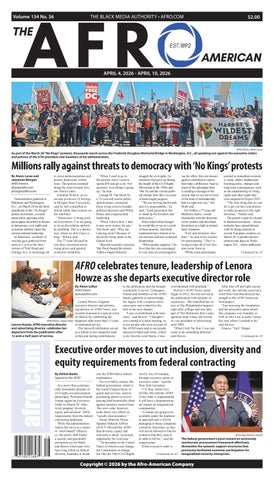
Afro e-edition 04_03_2026

Page 1


Millions rally against threats to democracy with ‘No Kings’ protests

alarue@afro.com jmorgan@afro.com

Demonstrators gathered in Baltimore and Washington, D.C., on March 28 for the third installment of the “No Kings” protest movement, a coordinated effort opposing what participants described as threats to democracy, civil rights and economic stability under the current national leadership.

In Baltimore, residents of varying ages gathered from noon to 2 p.m at the intersection of York Road and Gittings Ave. to encourage all

to resist authoritarianism and protect democratic institutions. The protest extended along the strip towards Towson Town Center.

Jonathan Wilson, an associate professor of biology at Morgan State University, said he felt compelled to attend rather than remain on the sidelines.

“Democracy is being eroded everywhere. I’m not going to sit on the sideline and not do anything. This is a democracy where we don’t have a king,” Wilson said. The 77-year-old said he was also concerned about rising prices and general economic instability.

“When I used to go to the grocery store I used to spend $50 and get a lot. Not anymore, everything is going up,” he said.

George M. Van Hook Sr., a 72-year-old retired public administrator, connected those rising costs to broader political decisions and White House and congressional leadership.

“When I drove here, I had to pay more money for gas,” Van Hook said. “Why am I paying more? Because of decisions being made at the federal level.

“Beyond economic concerns, Van Hook framed the protest within a longer historical

struggle for civil rights. As someone who grew up during the height of the Civil Rights Movement in the 1950s and ‘60s, he said the current political climate feels like a reversal of hard-fought progress.

“We are moving backwards and it is unacceptable,” he said. “Each generation has to stand up for freedom and democracy.”

When asked what changes he would like to see as a result of these protests, Van Hook mentioned more interest in local elections and less tyrannical dictatorship.

“When people organize, I believe that they are encouraged to vote, they are encouraged to

run for office, they are encouraged to contribute to causes that make a difference. And so much of the advantage here is sending a message to the society that we are not in favor of the kind of misleadership that we right now see,” Van Hook said.

Joe Nobles, a 77-year-old Baltimore native, voiced frustrations with the direction of the country and described the protest as a fight to protect basic freedoms.

“First and foremost, freedom,” he said of his reasons for participating. “They’re trying to take all of our freedom away from us.

“While some participants

pointed to immediate economic strain, others emphasized looming policy changes and long-term consequences, such as the undermining of voting rights and other rights that were targeted in Project 2025.

“The only thing that we can do is get out here and protest to make progress in the right direction,” Nobles said.

The protest is part of a broader national movement – whose tentacles have spread abroad with No Kings protests in several European countries on March 28. A parallel demonstration took place in Washington, D.C., where additional

AFRO celebrates tenure, leadership of Lenora

Howze as she departs executive director role

Lenora Howze, longtime executive director and advertising director of AFRO News, was recently honored at a special event on March 26, celebrating her departure after more than 13 years of dedicated service.

The farewell celebration served as a tribute to her impactful leadership and lasting contributions

to the publication and the broader community it serves. Colleagues, friends and members of the AFRO family gathered to acknowledge her legacy with a surprise retirement party and wished her the best in her next chapter.

“I was overwhelmed with emotions,” said Howze. “I thought I was coming to a team meeting, so to see people who were not part of the AFRO team–and to see people dressed in black and white, which is my favorite color theme–I was

overwhelmed with gratitude.”

Howze’s AFRO News career began in 2012, but she arrived at the publication with decades of experience. She launched her career at The Philadelphia Inquirer right after college and was later part of The Baltimore Sun’s management team where she served as vice president of advertising until 2005.

“When I left The Sun, I was just ready to do something different,” said Howze.

After time off and light consultant work, she said she received a word from God that directed her straight to the AFRO American Newspapers.

“Just knowing the foundation and the principles upon which this company was founded, as well as who I am in faith, I knew this was where I needed to be,” said Howze.

Frances “Toni” Draper,

Executive order moves to cut inclusion, diversity and equity requirements from federal contracting

into the $700 billion federal marketplace.

In a move that systematically dismantles decades of civil rights-era procurement philosophy, President Donald Trump signed an Executive Order on March 26, effectively purging “diversity, equity and inclusion” (DEI) requirements from the federal contracting landscape. While the administration frames the move as a return to “merit-based” efficiency, the policy shift marks a seismic and potentially precarious era for Black and Brown Americans who have long relied on federal diversity mandates to break

For over half a century, the federal government, which is the world’s largest buyer of goods and services, used its purchasing power to level a playing field historically tilted against minority-owned firms. This new order, however, treats those very efforts as “racially discriminatory.”

House Minority House Speaker Hakeem Jeffries (D-N.Y.-08) told the AFRO that diversity, equity and inclusion is about “economic opportunity for everyone.”

“No president in the United States of America can change the Constitution or change law like the 1964 Civil Rights

Act by way of example, through executive action or executive order,” said the New York lawmaker.

U.S. Rep. Glenn Ivey (D-Md.-04) told the AFRO if this order is implemented, it will have a disproportionate impact on marginalized communities.

“Contrats are going to be available under the traditional approach and it will be damaging to these companies owned by minorities, as they will not be allowed to bid for contracts that they used to be able to bid for,” said the congressman.

If this executive order is

AFRO Photo / Alexis Larue
By Ashlee Banks Special to the AFRO
AP/Images Mariam Zuhaib
The federal government’s pivot toward an exclusively meritocratic procurement framework effectively dismantles the systemic support structures that previously facilitated economic participation for marginalized minority enterprises.
AFRO Photo / James Fields Lenora Howze, AFRO executive director and advertising director, celebrates her departure from the publication after 13-and-a-half years of service.
As part of the March 28 "No Kings" protests, thousands march across the Frederick Douglass Memorial Bridge in Washington, D.C., all speaking out against the executive orders and policies of the 47th president and members of his administration.

WHAT’S TRENDING ON AFRO.COM

Cardi B. says latinos wouldn’t be ‘living comfortably’ if not for African Americans

During her March 7 stop in Dallas, entertainer Belcalis “Cardi B.” Almánzar took to the stage to talk to Latino fans in the audience, reminding them of the sacrifices Black Americans made for them to live comfortably.

In fan videos posted across social media, the rapper can be heard encouraging her audience to respect the work of Black men and women on the civil rights front.

“Remember, you couldn’t be living comfortably in this country if these African Americans didn’t fight for us,” she said.

According to the National Museum of the American Latino, the Latino Civil Rights Movement was a direct result of the Black Civil Rights Movement of the 1950s and 1960s. Inspired by African-American activists, Latino changemakers focused on social justice advancements for Brown people across the Americas and Caribbean.

The 1965 Voting Rights Act, which offered protections for language minorities and led to bilingual ballots, made voting accessible to non-English-speaking Latinos.

Today, Latinos now have a stronger voice in voting, greater political representation and significant educational reforms as a result of the work of Black activists. These advancements have led to improved wages, broader access to education and enhanced cultural representation.

Leveraging her identity as an Afro-Latina/

Your History • Your Community • Your News

The Afro-American Newspapers

Baltimore Office • Corporate Headquarters

233 E. Redwood Street 6th Floor, Suite 600G

Baltimore, Maryland 21202

410-554-8200

Customer Service, Home Delivery and Subscriptions: 410-554-8200

customerservice@afro.com

Founded by John Henry Murphy Sr., August 13, 1892

Chairman of the Board/Publisher - Frances Murphy Draper

(Publisher Emeritus - John J. Oliver Jr.)

President - Benjamin Murphy Phillips IV

VP of Marketing and Technology - Kevin E. Peck

Director Digital Solutions - Dana Peck

Receptionist - Wanda Pearson - 410-554-8200, ext. 246

Director of Operations

Andrè Draper - 410-554-8200

Director of Finance

Bonnie Deanes - 410-554-8242

Executive Director/Director of Advertising

Lenora Howze - 410-554-8271 - lhowze@afro.com

Director of Community & Public Relations

Diane W. Hocker - 410-554-8243

Editorial

Managing Editor - Alexis Taylor - 410-554-8257

Editorial Assistant - Ama Brown-Parson Evening / Weekend Editor - Zenitha Prince

Archivist - Savannah Wood - 410-554-8277

Baltimore Circulation/Distribution Manager

Andrè Draper - 410-554-8200

Creative Design and Content Matthew McDonald

Washington Office

1140 3rd Street, N.E., 2nd Floor Washington, D.C. 20002-6723 202-332-0080

(Washington Publisher Emerita - Frances L. Murphy II)

Director of Operations - Andrè Draper - 410-554-8200

Bill Cosby held liable in 1972 sexual assault case, jury awards nearly $60 million

A civil jury in California found March 23 that Bill Cosby was liable for drugging and sexually assaulting a woman in 1972 and awarded her $59.25 million.

After a nearly two-week trial in Santa Monica, jurors found Cosby, 88, liable for the sexual battery and assault of Donna Motsinger. They awarded her $17.5 million in past damages and $1.75 million for future damages, including “mental suffering, loss of enjoyment of life, inconvenience, grief, anxiety, humiliation, and emotional distress.”

Then in a second phase of the trial later March 23, they awarded an additional $40 million in punitive damages.

Cosby’s attorney, Jennifer Bonjean, said in an email after the initial award earlier March 23 that they are disappointed and fully intend to appeal the verdict. She did not immediately respond to a request for comment on the punitive damages.

Deliberations lasted about two days.

The decision came nearly five years after Cosby was freed from prison in Pennsylvania when the state Supreme Court threw out a criminal conviction based on similar allegations. He has settled some similar lawsuits and has been ordered to pay in others, but the latest award is likely the most he has had to pay in a case.

“This verdict is not just about me – it’s about finally being heard and holding Mr. Cosby accountable,” Motsinger said in a statement. “I have carried the weight of what happened to me for more than 50 years. It never goes away. Today, a jury saw the truth and held him accountable. That means everything. I hope this gives strength to other

survivors who are still waiting for their moment to be heard.”

Motsinger, who had been a server at a restaurant in Sausalito near San Francisco, said in her lawsuit, filed in 2023, that Cosby had invited her to his stand-up comedy show at a theater in nearby San Carlos. Both were in their 30s at the time. She said Cosby gave her wine and two pills that she believed were aspirin, and that she was going in and out of consciousness as two men put her in a limousine.

“She woke up in her house with all her clothes off, except her underwear on – no top, no bra, and no pants,” the lawsuit said. “She knew she had been drugged and raped by Bill Cosby.”

In court filings, Cosby’s lawyers argued that the allegations rested almost entirely on speculation and assumption, saying Motsinger “freely admits that she has no idea what happened.”

Motsinger’s lawsuit moved with surprising quickness

through the California courts, taking just 2 1/2 years from filing until verdict while other lawsuits against him stalled.

“We are grateful to the jury for their careful attention to the evidence and to Ms. Motsinger for the extraordinary courage it took to come forward,” said Jesse Creed, one of her attorneys from the Panish Shea Ravipudi law firm that represented her.

Cosby did not testify at the trial. Other witnesses included Andrea Constand, the Temple University sports administrator he was convicted of sexually assaulting in a Pennsylvania criminal court in 2018.

The state’s Supreme Court threw out the verdict and Cosby was freed from prison after serving nearly three years of a three- to 10-year sentence.

Motsinger first made her allegations anonymously in a 2005 lawsuit filed by Constand.

The Associated Press does not typically name people who say they have been

sexually abused unless they come forward publicly and consent to be named, as Constand and Motsinger have. In 2022, a jury in Santa Monica awarded $500,000 to a woman who said Cosby sexually assaulted her at the Playboy Mansion when she was a teenager in 1975.

Motsinger’s lawsuit echoed allegations of rape, sexual assault and sexual harassment made by at least 60 women against Cosby, all of which he has denied.

The former stand-up comedy and television superstar once widely known as “America’s Dad” became the first celebrity tried and convicted in the #MeToo era before his conviction was permanently thrown out when an appeals court found he gave incriminating testimony in a deposition only after believing he had immunity from prosecution.

This article was originally published by The Associated Press.

Afro-Caribbean woman, Cardi B. has utilized her tour to deliver a powerful message to her Latino fans. She has not only been heard
commending African Americans for their contributions, but has also urged her Latino fanbase to recognize and celebrate Black history, pay homage to the individuals whose struggles paved the way for improved civil and human rights.
AP Photo/Jordan Strauss
During a recent stop in Dallas, entertainer Belcalis “Cardi B.” Almánzar asserted to her Latino fans that their present comfort was a direct result of work done by African Americans during the Civil Rights Movement..
AP Photo/Matt Rourke, File
Bill Cosby arrives for a sentencing hearing following his sexual assault conviction at the Montgomery County Courthouse in Norristown Pa., on Sept. 25, 2018.

leadership. He was publisher of the publication when Howze was hired to help with their massive 120th commemorative edition in 2012.

No Kings

consequences, such as the undermining of voting rights and other rights that were targeted in Project 2025.“The only thing that we can do is get out here and protest to make progress in the right direction,” Nobles said.The protest is part of a broader national movement –whose tentacles have spread abroad with No Kings protests in several European countries on March 28. A parallel demonstration took place in Washington, D.C., where additional voices and organizers echoed similar concerns.

Between 1:30 p.m. and 4 p.m., a diverse crowd of 125,000 individuals marched through the streets of the nation’s capital. They crossed the

Fredrick Douglass Memorial Bridge, sharing songs and dances and chanting in unison for Americans to “take D.C. back” from those in power.

Protesters also used chalk to write messages on the streets outside of the building where Department of Homeland Security advisor Stephen Miller works, criticizing his role in implementing policies that restrict the rights of immigrants.

Spectator Mia Washington offered her perspective on the protest and the significance of witnessing others exercise their right to voice their concerns.

“When people protest, it shows that we stick together,” said Washington. “When we stick together, it really speaks of value. So I’ll definitely show up to the next protest.”

publisher and CEO of AFRO News, spoke about how much of an impact Howze has made over the years.

Draper described Howze as her “right hand person” in the company, and gave thanks for their working relationship.

During her 13 and a half years at the AFRO, Howze guided the company’s strategic vision. This oversight included numerous initiatives across print, digital and social media advertising platforms. Howze also spearheaded the company’s Black Business Matters EXPO, which has grown into a sold out event on an annual basis.

Diane Hocker, the AFRO’s director of community and public relations, spoke about Howze, noting their relationship extended beyond colleagues to include a personal friendship.

“It’s not everyday that your supervisor becomes someone that you can also laugh with and lean on, and that’s exactly what you did for me,” Hocker told Howze during the celebration, as she fought back tears.

John “Jake” Oliver, Jr., publisher emeritus of the AFRO, praised Howze and thanked her for her innovative

“The AFRO has had many outstanding contributors over the many years…Lenora stands out as one of the best,” said Oliver. “She joined us right in the middle of a period where we were attempting to prepare ourselves for this social media environment that we were still trying to learn.”

“She had the energy and she had the insight to be able to help us maneuver and establish the machinery that led us to succeed in many different ways,” said Oliver.

Though she is stepping away, Howze will serve AFRO News in a consultancy role as her time permits.

As her time as a staff member draws to a close, Howze says she has a final message to all of those who were involved, and still continue to be involved, with the publication:

“It was my honor and privilege to serve at the AFRO, such an iconic and relevant publishing organization and with such a phenomenal team,” she said. “I pray that God’s favor and blessings continue to sustain them and help them thrive for many years to come.”

DEI

Continued from A1

allowed to stay in place, the impact on Black and Brown communities is expected to be twofold, a reduction in corporate diversity within the private sector and a potential “chilling effect” on minority-owned businesses (MBEs) seeking subcontracts.

Jeffries and Ivey stated that civil rights litigators have been challenging orders like this one and given precedent law, the order will likely be dismantled.

Ivey told the AFRO that he believes this order doesn’t have a chance of surviving litigation.

“Democracy Forward and other groups have been filing lawsuits and I think they’ll file on this one too,” said the Democratic congressman. “We’ve had some court cases on previous executive orders that have ruled in our favor and I think they may win on this one as well.”

At this time, the executive order authorizes agencies to “cancel, terminate, or suspend” contracts for any DEI involvement and directs the Attorney General to prioritize False Claims Act charges against those who violate the ban. This turns the legal tide, where contractors once feared lawsuits for lack of diversity, they now face federal prosecution for maintaining it.

For the Black entrepreneur or the Latino-led startup, the “merit-only” mandate ignores the systemic barriers, such as lack of access to capital and historical exclusion from federal networks, that DEI programs were designed to circumvent.

However, the White House argues that these programs “artificially restrict the labor pool” and drive up costs for taxpayers.

“We will terminate every diversity, equity, and inclusion program across the entire Federal Government,” Trump stated, doubling down on a platform that views race-conscious policy as an affront

to equal treatment.

However, critics and economic advocates for minority communities warn of a regression.

Without diversity, the federal government risks returning to a system where contracts naturally flow to the largest, most established firms, which are overwhelmingly white-owned.

Jeffries told the AFRO, that executive orders like this one are designed to help the wealthy.

“The problem that seems to be unfolding, is that there are some in this country who want an America of the billionaires, by the billionaires and for the billionaires,” said the House Minority Leader. “Not [an America] for working class Americans, middle class Americans or everyday Americans.”

“DEI is about economic opportunity for everyone, even if you’re not wealthy or well connected, these are values that everybody in this country should embrace,” he added.

AFRO Photo /Alexis LaRue
Joe Nobles, a 77-year-old Baltimore native, attends the March 28 “No Kings” in Baltimore.
AFRO Photo / James Fields
Shown here, AFRO Publisher Emeritus Jake Oliver (left), outgoing AFRO Director and Advertising Director Lenora Howze and current AFRO Publisher, Dr. Frances “Toni Draper (right).

COMMENTARY

co-founder of Black Men Unifying Black Men. This week, he discusses the state of the Black Power Movement.

The Black Power struggle is not over— it has evolved

There is a dangerous myth circulating in some corners of public discourse: that the Black Power struggle ended decades ago. That it peaked in the 1960s and early 1970s with fiery rhetoric, militant activism and iconic leaders and then quietly disappeared into history as equality was “achieved.”

This notion is convenient for those who prefer tidy narratives, but it is fundamentally false. The struggle did not end. It did not vanish. It evolved—and it is very much alive today.

To understand why the Black Power struggle is still necessary, we must first recognize what it was never meant to be: a fleeting moment in time. Black Power was never simply a slogan; it was a proclamation of self-determination, dignity and unflinching demand for justice. It was an existential refusal to be marginalized, an assertion that Black lives deserve not only survival but also power— political, economic, cultural and social.

What has changed since the heyday of the Black Power era is how the struggle is waged and where it manifests. The

battles that once filled newspapers with images of marches, rallies and clashes with law enforcement have shifted into arenas less visible but no less consequential.

The movement has adapted, matured and found new avenues for resistance.

In the early 21st century, a pervasive narrative emerged: America had become “post-racial.” The election of Barack Obama in 2008 was heralded by some as proof that racial barriers had been broken, that America had finally moved beyond its legacy of racism. But electing a single Black president did not dismantle centuries of systemic oppression; at best, it exposed how deeply entrenched those systems remain.

The myth of post-racialism served the interests of institutions eager to declare victory and move on. But for millions of Black Americans, lived experience tells a far different story: police violence, economic inequality, educational disparities and political disenfranchisement remain daily realities. To claim the struggle is over because legal segregation has been abolished is to ignore the enduring structures that limit opportunity and constrain lives.

Global conflict pressures food and fuel prices

The situation unfolding in the Strait of Hormuz is a clear reminder that what happens across the globe has real consequences here at home.

Nearly one-fifth of the world’s oil supply moves through that narrow waterway. When it is disrupted, the impact is immediate — and families across this country are already feeling it.

Energy prices are rising. At the pump, North Carolinians are paying more. Airlines are facing higher fuel costs, and those increases are showing up in ticket prices. Our transportation systems — the trucks, ships and planes that carry the goods we rely on every day — are paying more for fuel, and those costs do not stay in the supply chain. They reach consumers.

As a member of the House Agriculture Committee, I am especially concerned about what this means for our farmers.

Fertilizer costs, which are closely tied to global energy markets, are increasing. And when it costs more to grow food, it costs more to buy food. That is the reality families are facing at the grocery store, and it is a serious burden for Black farmers and rural communities working to sustain their livelihoods. This is not abstract. This is about affordability, access and stability for everyday people.

And we cannot ignore the broader cost of our national priorities. As tensions rise abroad, so too does the likelihood of increased spending tied to conflict and instability. At the same time, here at home, families are struggling to afford basic health care.

March 23 marked the anniversary of the Affordable Care Act. At a time when the cost of health care has doubled or even tripled for many families, we should be focused on lowering costs and expanding access — not allowing those needs to be

overshadowed.

The reality is this: the cost of conflict abroad is measured not only in dollars spent overseas, but in opportunities lost here at home. Resources that could help extend enhanced Affordable Care Act premium tax credits, reduce costs and support working families are part of the same conversation about priorities.

Our responsibility is to the people we serve.

We must remain focused on protecting American families from rising costs, supporting our farmers and workers, and ensuring that health care is affordable and accessible — while pursuing thoughtful, responsible leadership in moments of global uncertainty.

What happens abroad does not stay abroad. It touches every household — from the gas pump to the grocery store to the cost of seeing a doctor — and it demands our attention, our concern and our action.

In the 1960s and 1970s, Black Power arose as a response to the limitations of the Civil Rights Movement. While civil rights leaders fought to end legal discrimination and secure basic liberties, Black Power activists argued that political rights alone were insufficient without economic independence, community control and cultural pride. They demanded justice on multiple fronts—education, housing, employment, policing—and insisted that Black people control their own institutions.

After the 1970s, visible organizations like the Black Panther Party faced intense suppression from the government and media. COINTELPRO, led by the U.S. Federal Bureau of Investigation, and other programs sought to destabilize these movements and internal divisions sometimes weakened them. But the ideas they championed did not die. They went underground, into cultural production, local organizing and community resilience, laying the foundation for modern activism.The struggle transformed. It did not vanish.

See more on AFRO.com

Illinois voters just sent a message about Black women’s power

On March 17, voters in Illinois did more than choose a nominee for the United States Senate. They made clear that the political landscape is changing — and that Black women are at the center of that change.

Juliana Stratton won the Democratic primary with 39.8 percent of the vote, defeating Raja Krishnamoorthi, who received 33.3 percent and Robin Kelly, who earned 18.3 percent. If she wins in November, Stratton could become only the sixth Black woman ever elected to the U.S. Senate — and part of a historic first: three Black women serving in the Senate at the same time. But this moment is bigger than one candidate.

Two Black women on the ballot is progress

This race featured two dynamic, qualified Black women leaders: Stratton and Congresswoman Robin Kelly. For some, that reality sparked quiet conversations and familiar doubts — questions about viability, concerns about “splitting the vote,” and

the kind of whispers that have long followed Black women candidates.

Let’s be clear. The presence of two Black women in this race was not a problem. It was progress.

For generations, Black women have been told to wait our turn, to step aside, and to make space for others. In Illinois, we saw something different. We saw what it looks like when there is not just one path, but many — when Black women are not competing for a single seat at the table, but building a bigger table altogether.

That is what growth looks like.

And it is the direct result of years of organizing, investment, and belief in Black women’s leadership.

Illinois has led before Illinois knows what it means to lead on this front.

In 1992, the state made history by electing Carol Moseley Braun, the first Black woman ever to serve in the United States Senate. Yet it took 16 years before another Black woman, Kamala Harris, would follow.

Illinois has also been a

launching ground for historic leadership, including the election of Barack Obama to the Senate before he became president of the United States.

Since then, progress has accelerated, but it remains far too slow.

Laphonza Butler, Angela Alsobrooks and Lisa Blunt Rochester have each added to that legacy, bringing the total number of Black women who have ever served in the Senate to just five. Five.

In a body of 100 members, across more than two centuries, that number tells the story. The United States Senate remains overwhelmingly White and male. That is why this moment matters.

What representation makes possible

As Illinois’ lieutenant governor, Stratton has been a leading voice on advancing equity, expanding economic opportunity, and addressing disparities that impact working families.

Her record speaks to what happens when Black women lead.

From advancing maternal health initiatives to supporting

the next generation of girls in leadership and championing policies that uplift communities across the state, she has demonstrated that representation is not just about who holds office — but about the impact they make once they are there.

At Higher Heights, we often say that Black women are the architects of our democracy, as well as its protectors and defenders.

This moment proves that we are also its future.

The work ahead

If we want to see more Black women in the Senate, a Black woman in a governor’s mansion, and more Black women shaping policy at every level, we have to keep doing the work.

We have to keep organizing, mobilizing, and investing in Black women candidates and the communities that power them.

Because this moment tells us something important: Our work is working.

Now we have to keep going.

This commentary was originally published by Word in Black.

Meta (Facebook)/ Michael Eugene Johnson Michael Eugene Johnson is creator of the Pikes Studio Cinema and
Courtesy of House of Representatives Congresswoman Alma S. Adams, representing North Carolina’s 12th Congressional District speaks on the surge in expenses due to conflicts and challenges at home and abroad.
Photo courtesy of Higher Heights for America
Glynda C. Carr is president and CEO of Higher Heights for America, a 501(c)(4) organization, and its connected federal political action committee, Higher Heights for America PAC, which works to expand Black women’s elected representation and voting participation.
‘The Wiz’ returns to D.C. as national tour continues

It was Jan. 5, 1975, when the curtain first rose on an all-Black cast of actors at the Majestic Theatre on Broadway for the debut of “The Wiz” – a creative twist of the classic story about Dorothy and a trio of newfound friends who skipped along the yellow brick road and into the hearts of people around the world.

Now, the Tony Award-winning play is back and on a North American tour. The cast represents some of today’s most talented young actors, with fresh choreography by JaQuel Knight (the artist behind Beyonce’s “Single Ladies”), a legendary creative team and a musical director who

pays homage to the original score while weaving in the sounds of Black Gen Xers and Millennials.

“The Wiz” will hit the stage in Washington, D.C., at the National Theatre for a one-week run, April 7 - 12. It will then head to North Charleston Performing Arts Center in Charleston, S.C., from April 14-19, before heading to the Altria Theater in Richmond, Va. from April 21-26.

Nashville native Cal Mitchell, who portrays “The Lion,” said he can hardly contain his excitement.

“When I first signed on with the show, I was an understudy. To now be cast as ‘The Lion’ in one of the biggest bookings in my career means everything to me,” said Mitchell, adding

that he’s honored to join a legacy of trailblazing actors like Ted Ross, who earned a Tony Award (Best Featured Actor in a Musical) for his performance as the “first” Lion.

Ross later roared once more in the 1978 film adaptation of the musical which featured Diana Ross as Dorothy and Michael Jackson as The Scarecrow.

And while critics were nonplussed, and the film was a box-office flop, the musical has served as a favorite for multiple generations of Black families and a staple on community stages across the country.

As for the 1975 Broadway production of “The Wiz,” the musical was nominated for eight Tony Awards and won seven, including Best

Musical, Best Direction of a Musical (Geoffrey Holder), Best Featured Actress in a Musical (Dee Dee Bridgewater) and Best Choreography (George Faison).

What’s more, it also opened doors for more African-American actors and vocalists, particularly those who were members of the original cast, including Andre De Shields, Mabel King, Hinton Battle, Tiger Haynes and Stephanie Mills.

Mitchell said he’s determined to make the best of this opportunity, as gaining a foothold and securing a career in the entertainment industry do not come easily.

“Sometimes, my family may have hoped I would have followed a different

Sanctuary campus debate intensifies as students return from spring break

As students return to campus from spring break, federal immigration policies and enforcement actions are reshaping daily life for immigrant students at Howard University and campuses across the country.

What began as a 2016 policy debate over sanctuary campuses is now a lived reality, students say, one shaped by travel restrictions, visa uncertainty and fear that a routine airport encounter could upend their education. For some, leaving campus or passing through an airport now carries the risk of not being able to return.

The case of 19-year-old

Any Lucia López Belloza continues to raise concern.

Detained at Boston Logan International Airport last fall

while attempting to travel home for Thanksgiving, the Babson College freshman was deported to Honduras within 48 hours despite a federal judge’s order blocking her removal.

A federal judge dismissed her lawsuit after the government said the deportation was a mistake and offered to facilitate her return. Her attorneys described the offer as risky, arguing she could face removal again upon arrival.

López Belloza’s experience sent shock waves through campuses with large Black, Afro-Latino, Afro-Caribbean and African immigrant populations. At Howard University, students say the incident transformed what once felt like abstract policy debates into immediate,

ICE agents remain deployed at Reagan National and at other U.S. airports

When passengers, eager to fly the friendly skies, arrived at Reagan National Airport (Reagan) on March 23, they were met with an unfamiliar—and for some—disturbing sight: dozens of ICE Immigration and Customs Enforcement) agents scattered throughout the corridors.

According to White House border czar, Tom Homan, the agents at Reagan represented part of a wider nationwide deployment ordered by the president to shorten airport security delays.

In statements to the press, Homan said the agents would cover exits routinely covered by TSA (Transportation Security Administration) agents, check IDs before passengers enter screening areas, and assist with line management and crowd control.

“A lot of things TSA does don’t require specialized training,” Homan said in recent interviews with the press. “So, the president decided to bring in ICE agents to help TSA agents with security operations.”

Over the past week, ICE

agents have been spotted at more than a dozen major-city airports nationwide, according to social media posts and accounts from reporters, causing a variety of responses from passengers. Michael Evans, a longtime social activist, who moved from Chicago, Ill., to the District about 15 years ago, posited that until ICE agents are ordered to leave America’s airports, he plans to find means of transportation other than flying.

“This is nothing more than a MAGA onslaught on basic societal norms and rules of law,” Evans said. “It’s just a graphic extension of the political dementia that continues to come out of the White House.

“ICE agents have not shown any proclivity towards decency in America and I would not expect them to change their tactics in airports,” he continued. “They’re not helping TSA agents at all nor are they helping passengers.”

While the Trump administration reportedly ordered back pay for TSA workers as of March 30, White House officials assert that until staffing levels return to normal and, presumably, until the

partial government shutdown is resolved by Congress, ICE agents will remain at airports, including Reagan National, until further notice.

Joy Masha, who currently lives in D.C., said she’s uncomfortable with the prospect of ICE agents remaining in Reagan, or any U.S. airport, without a timeline from federal officials as to when they will be instructed to leave.

“Not only do I not agree with ICE agents being deployed to airports, and view it as a potentially dangerous idea, but I am fearful that the president has set a disturbing trend,” Masha said.

Meanwhile, ICE agents deployed to cities like New York and Chicago ostensibly to reduce waiting times for passengers, have allegedly

detained or arrested individuals with prior criminal convictions.

And with Department of Homeland Security officials indicating that ICE personnel have been given the greenlight to arrest a traveler if they have been flagged in federal systems for existing warrants or criminal histories, one has to wonder if ICE agents are actually in airports to perform duties that mirror those previously witnessed on the streets of Minneapolis, Minnesota – some of which have ended in the deaths of innocent American citizens.

Native Washingtonian Christopher McLaughlin said he’s far from optimistic about the future.

By D. Kevin McNeir Special to The AFRO
Photo by Jeremy Daniel
Members of the cast and crew of “The Wiz,” the classic, Black cultural stage phenomenon bring to life Emerald City, located in the Land of Oz.
AP Photo/Ashley Landis
Since March 23, ICE agents have been deployed at more than a dozen airports across the U.S., including Reagan National Airport.
Courtesy of Logan Johns/HUNewsService.com
Grant Davidson, a student of Jamaican descent, stands on “The Yard” at Howard University in Washington, D.C. Davidson said sanctuary campus debates represent a defining moment for universities.

HER Gala: Women of Impact Awards highlight women of Prince George’s County

Prince George’s County Council Chair Krystal Oriadha (District 7) (District 7) joined with Council members Wala Blegay (At-Large), Wanika Fisher (District 2), Shayla Adams-Stafford (District 5), and Danielle Hunter (District 6), to bring Women’s History Month to a glamorous close in a ceremony honoring 25 women across the county.

Honorees represented ladies from all walks of life, who have excelled in leadership, service and inspiration.

The March 28 event took place at New Carrollton’s women-owned Metro Points Hotel. Scores of women dressed in silk, satin and sequined floor length gowns arrived for the ceremony, which honored women in business, government, the non-profit arena, and community-based advocates working to improve their neighborhoods, schools and families.

“Tody is about celebrating you. This is a day for everyone to see you as we see you,” said Oriadha.

Councilwoman Fisher said it was

a crucial time for Prince Georege’s County to honor women. She represents District 2, which includes the Maryland suburbs of Washington, D.C., an area hit hard by recent federal layoffs, a full shutdown last year and now, a partial shutdown.

“We would not be Prince George’s County without you,” she said. “We are in a tumultuous time, being attacked every day.”

County Executive Aisha Braveboy served as the guest speaker for the evening and spoke to the women about the strength needed to walk and move forward in roles

“assigned” from God regardless of whether others understand.

“There will always be those in life who will not understand your decisions when you are walking in your purpose,” Braveboy said.

Blegay marveled at how large the event has grown in a short period of time.

“We started this in 2023 in a room in Prince George’s Community College and now we fill a ballroom,” said Blegay. “We’ve got women in this room who have never been

Shown here, members of the Prince

County Council, standing

Executive Aisha Braveboy at HER Gala on March 28.

Fisher

, Council Chair

recognized, but we show up and do what we have to do,” she said.

Katrina Dixon Patterson was honored in 2025 and said she returned this year to support this year’s honorees.

“I am so happy to see that this event has grown from two council members to five council members standing together to honor the county’s women. Last year there were 15 women from only District 5 and District 6 and now it has

Sanctuary Campus

grown to almost twice that number. This year is a showstopper,” said Dixon-Patterson.

Each honoree received public recognition, a certificate in her honor and a short video clip of her accomplishments announced to the audience. The honorees were:

Latonya Chew, Patrice Murphy, Brianna Meadow, Mel Johnson, Shanita Brown, Brittany Brooks, Dana Smith, Shaune Hayes, Belinda Queen, Chinonso Nwoah,

Continued from A6 Continued from

personal concerns.

Recent federal immigration enforcement trends are reinforcing those concerns.

For Haitian American communities at historically Black colleges and universities (HBCUs), the message is clear: Federal enforcement is expanding, and Black migrants are increasingly affected.

Nicole Dillard, associate professor in Howard University’s Department of Communication Studies and an immigration lawyer at Dillard Legal Consultants LLC, says the impact is immediate.

“Haitians outside of the U.S. face incredibly high barriers to accessing the asylum system, because of travel bans and the elimination of humanitarian parole pathways,” Dillard said.

“And to think that someone fleeing persecution now also faces a federal charge of unlawful entry adds yet another obstacle. It deepens a climate of fear where Black and Brown immigrants feel that every door — humanitarian, legal and educational — is closing at once.”

The sanctuary campus debate enters a new era At American University, students want to restrict campus cooperation with Immigration and Customs Enforcement (ICE) without judicial warrants, safeguard student records and expand protections for undocumented and DACA students.

Dillard says federal privacy law already provides some protection.

“Thanks to the Family Educational Rights and Privacy Act, universities are prohibited from sharing student records without consent,” she said. “Unless there’s a court order or a judicial warrant, that information remains confidential.”

But she emphasizes that the current climate goes beyond legal protections.

“If a student posts something pro-Palestinian on social

media, or if Black and Brown students see a heavy presence of the National Guard or police on campus, that fear becomes very real,” she said. “Add in presidential orders requiring local police to cooperate with ICE, and students start to wonder: ‘Who is protecting us?’”

HBCUs, DEI and Civil Rights

Howard serves a large population of Black, African, Afro-Caribbean, Afro-Latino, Muslim and Afro-Muslim students, communities that may be disproportionately affected by these policies.

“Today, arguably, so-called sanctuary policies are about more than immigration; they’re about protecting fundamental civil rights,” said Maryam Ahranjani, a law professor at the William S. Boyd School of Law at the University of Nevada, Las Vegas.

“I don’t support the term ‘sanctuary campus,’ but I do support the idea of maintaining safe spaces for immigrant and marginalized students, ideally through action rather than labels,” Ahranjani explained. “When universities, especially public institutions, maintain those spaces, they push back against a climate of fear that chills speech and civic engagement. In the wake of current aggressive federal enforcement policies, this work is a vital reaffirmation of equity, privacy and due process.”

Ahranjani said fear of losing funding is slowing progress. “We’ve seen fewer efforts to seek sanctuary campus designation, not because students have stopped caring, but because administrators fear losing funding for DEI programs,” she added. “The administration’s anti-DEI executive order created a chilling effect; and, in some cases, universities are overcorrecting, misinterpreting the order’s reach and silencing important equity initiatives unnecessarily.”

Grant Davidson, a Jamaican native in his sophomore year at Howard, said “sanctuary policies send a message that we all belong.”

“HBCUs have always been about giving us space to learn, grow and speak out,” Davidson said. “Sanctuary policies feel like a modern way

path and I could have done other things,” he said. “But as an actor, I can bring joy into people’s lives for a few hours in what may have been a really strenuous week.

“Still, this is tough work and I’ve trained hard, from internships to regional productions to the off-Broadway circuit. The red carpet moments are what the public tends to notice but neither they nor the parties are what motivate me or fuel my passion.”

Mitchell said it’s easy to understand why “The

Route, New Carrollton Mayor Phelycia Nembhard, Renee Alston, Patricia Martinez, Josephine Mourning, Ifeoma Onyia, Asma Hijazi, Debra Cater, Nancy Boyd, Roxy Nbedbumada, Reeda Butler, Petrella Robinson, Carla Bownes, and Edena Aaron.

A special Trailblazer Award was given to Maryland Speaker of the House Joseline Pena-Melnyk, who could not attend due to a prior engagement.

Wiz” has stood the test of time and remains a favorite among audiences of all races.

“Black joy is something that’s infectious, and no matter what’s happening in America, economically, politically or socially, no one can steal our joy,” he said.

“Since its debut, this play, which was radical in the way it was conceived, delivered a new iteration of a classic that felt specific to Black audiences. If you talk to any well-known actor, they’ll probably say they’ve had a run with this show. It’s fundamental to Black artistry.”

of saying that promise still matters; that we won’t let fear decide who gets an education. If anything, HBCUs should be leading on this.”

New federal policies intensify fears

The sanctuary campus debate now unfolds alongside the escalation of federal immigration controls.

A January 2026 presidential proclamation now restricts or suspends entry and visa issuance for nationals from dozens of countries, including several in Africa and the Caribbean. The policy expanded earlier restrictions. At the same time, visa rules affecting countries such as Cameroon, Ethiopia, Ghana and Nigeria continue to limit many non-immigrant visas to single-entry, short-duration approvals, increasing both cost and risk for students who travel abroad for family visits, academic programs or emergencies.

“These new travel and visa restrictions send messages that the U.S. is less welcoming and may not be an option for global talent from countries with majority Black and Brown people,” Dillard said. “Furthermore, it reinforces perceptions of unequal access for students from African and Afro-Caribbean countries.”

A national test for universities

The sanctuary campus debate overlaps a national rollback of diversity, equity and inclusion programs. Under the Trump administration, federal funding has become a strong enforcement tool: Harvard saw $2 billion in research grants frozen before a court overturned the freeze, and Columbia University scaled back DEI protections after litigation.

Davidson said “This is bigger than one referendum,”

“Students like me want to know if our schools will stand with us when it matters and not just talk about justice — but actually protect us when we’re vulnerable,” he said. “That’s the real test.”

This article was originally published by Howard University News Service.

Mitchell said he hopes people will flock to the National Theatre and said he’s sure the play will touch the hearts of anyone, no matter how young or old they may be.

“There’s an entire generation of those who have not seen the play – even others who have not seen the film – and have no idea what to expect,” he said. “By the time the show is over, I’m confident that they will have more reasons– like Dorothy–to believe in themselves and to recognize that ‘there’s no place like home.’”

“I’m against having ICE agents in our nation’s airports,” he said. “If you ask me, it’s just another form of oversurveillance. They already have plenty of cameras there –we don’t need more boots on the ground. It’s as if we were at war or something.”

After a recent altercation with ICE agents, Brigette Squire, who currently lives in Baltimore, said she now warns her friends, “Don’t believe the hype.”

“When I think about the struggles and sacrifices my ancestors endured so that I might have a better life as an African American, I am more than annoyed – I’m angry,” Squire said. “The ICE agent who detained me looked more like a foreigner than I do, and he had no right to harass me. But that’s what they’re doing – harassing legal, American citizens.”

“Maybe some people won’t worry about what ICE is doing until they knock on their doors or bother or hurt them. Then, they’ll say, ‘ICE needs to go.’ But you know what gets me is I never imagined that I could be confused as being anything or anyone except a Black woman.”

Jocelyn
AFRO Photo / Dr. Deborah Bailey
George’s
with Prince George’s County
From left to right, Councilwoman Wanika B.
(District 2)
Krystal Oriadha, Prince George’s County Executive Aisha Braveboy, Councilwoman Shayla-Adams Stafford (District 5) and Councilwoman Danielle Hunter (District 6).
Photo by Jeremy Daniel
Cal Mitchell will make his national tour debut in “The Wiz” as “The Lion” at the National Theatre in Washington, D.C. Shown here, Mitchell (front, left), D. Jerome (back) as “Tinman,” Phoenix Assata LaFreniere (back, center) as “Dorothy” and Elijah Ahmad Lewis (back, right) as “The Scarecrow.”

Friendship Public Charter School hosts annual Teacher of the Year Gala

On March 28 Friendship Public Charter School hosted its 18th annual Teacher of the Year Gala at the National Building Museum in Washington, D.C.

The event pulled together nearly 1,000 educators, civic leaders, elected officials and philanthropic

partners for one of the city’s premier education events. Hosted by veteran journalist and commentator Roland S. Martin, the evening reflected both the splendor of the occasion and the seriousness of the work honoring the educators who are shaping the future of Washington, D.C. At the center of the celebration was the announcement of this year’s Teacher of the Year, Nijah Brown of Friendship Blow Pierce Elementary and Middle in Ward 7. Brown earned the recognition after her fourth-grade English Language Arts students delivered the highest-performing results across the Friendship network.

All AFRO Photos / Patricia McDougall

D.C. Councilmember at Large Robert

of Friendship Woodridge International Elementary and Middle

as

Each year the Friendship Public Charter Teacher Of The Year Gala recognizes excellence in education. This year, the event was held at the National Building Museum in D.C.
Shown here, from left to right: Denise Roden; Dr. Elizabeth Primus; Darrin L. Glymph, Esq.; Donald L. Hense; Dr. Deborah M. McGriff; Carol Thompson Cole and Victor E. Long, Esq.
Nijah Brown, a teacher of Friendship Blow Pierce Campus, is named 2026 Friendship Public Charter School Teacher of the Year.
Wayne Marshall (left) and Cami Mazard pause for a moment with First Lady Candice Burns and Pastor Engel Burns, of Rising Sun First Baptist Church.
Sonja Shelton and Jim Shelton, CEO of Blue Meridian Partners, enjoy the evening in some of their best threads.
Councilmember Janeese Lewis George (D.C.- Ward 4) (left) fellowships with Friendship Founder Donald L. Hense and Friendship CEO Patricia A. Brantley.
Above: Vielka Scott-Marcus (left), chief academic officer for Friendship Public Charter School, enjoys the gala alongside Jacque Patterson (second from left), president of the D.C. State Board of Education, and Betty and Sam Gough (far right).
Right:
White greets Ayinde Spradley, principal
School,
John Snowdy (center), principal of Friendship Ideal Elementary and Middle School, and Kun Ye Booth, principal of Friendship Technology Preparatory High School (far right) look on.

BALTIMORE AREA

Edmondson Village Shopping Center celebrates redevelopment milestones

The Edmondson Village Shopping Center is moving toward revitalization.

Developers, elected officials and community members gathered at the plaza on March 30 to celebrate new construction, infrastructure improvements and leasing activity.

For years, the Edmonson Village Shopping Center has faced neglect and crime, including a mass shooting in 2023. That same year, TREND, a commercial real estate developer specializing in inclusive economic development, acquired

the property and began its transformation.

Over the next two years, the plaza will add a grocery store, primary care practice, child care center and additional retail and dining spots.

“At TREND, we talk every day about what community and economic development really means. It’s hard work; it’s passion work, but it’s more than place. It’s about strengthening a neighborhood, supporting families and creating opportunity,” said Lyneir Richardson, co-founder and CEO of TREND. “That’s what today is all about as well.”

Under TREND’s model,

Special committee seeks public input on changes to Baltimore City Charter

Baltimore City council members and residents gathered at Coppin State University on March 25 discuss changes to the Baltimore City Charter, the foundational document that determines the city’s structure, powers and functions. Council President Zeke Cohen created the Charter Review Special Committee November 2025 with the goal of modernizing and enhancing the efficiency and transparency of city government.

Since then, the committee has been collecting suggestions for amendments to the charter, with a focus on those that could be drafted and placed on the 2026 ballot.

“I’m still learning a tremendous amount of new things about the city charter, but more importantly, I want to hear what you think about it and how you feel like it will impact your life,” said Councilman Jermaine Jones (D-12), member of the review committee. “I don’t take lightly the opportunity of reviewing the city charter. While we’re doing that, I want to make sure on the back-end that it’s going to become a document you all feel like addresses your needs and your concerns.”

Some of the charter changes the special committee is already considering include:

ABC takes Community Convos series to Ashburton neighborhood

Baltimore’s Ashburton community gathered at Liberty Grace Church on March 19 for the latest installment of Associated Black Charities (ABC) Community Convos.

As a part of their ongoing series, leaders of ABC gathered businesses, organizations, residents and stakeholders together under their commitment to listen to the communities they serve and to help ensure their work meets the real needs of the community.

Attendees participated in open dialogue, cooperative efforts and problem-solving, sharing their experiences.

The event was held in partnership with the AFRO and GreenLight Fund Baltimore.

“Our community convos are pretty much listening sessions,” said Bernard K. Sims, senior director of Culture and Community at ABC. “What we do in our Community Convos is go into a different neighborhood every month, connect with residents, business leaders and stakeholders from the community, and have an open dialogue about what’s going on in the neighborhood.”

Sims emphasized that these listening sessions are not meant to replace neighborhood associations, but serve as an opportunity to gather insights, connect resources and inform residents and stakeholders.

partner with anyone who wants to partner with us,” said former Baltimore Mayor and Maryland State Sen. Catherine Pugh, who currently serves as president of the Ashburton Area Association.

Pugh said she found one of

“It’s really important to have an open dialogue with people who care about their community, are concerned about their community and who want to keep it sustainable and keep it beautiful.”
—Bernard K. Sims, ABC

“It’s really important to have an open dialogue with people who care about their community, are concerned about their community and who want to keep it sustainable and keep it beautiful,” said Sims. “Everybody’s voice and opinion matter.”

The event featured a group poll, where residents shared their vision for Baltimore, which included economic empowerment and asset-building for Black and Brown communities, reduced crime and expanded housing options.

“We’re always proud to

ABC’s resources, the Maryland Volunteer Lawyers Service (MVLS), particularly notable and useful for the community.

“They provide free legal services,” said Pugh. “You can call them and get information and legal advice for all kinds of things, from housing issues to wills.”

MVLS was on site signing people to get connected with their organization and provide further information on the services they offer.

Pugh also highlighted some of the work already being done in the community to better it.

“We got a $100,000 grant last year that we’re using to work with the city to put additional lighting to make community members feel safe,” said Pugh. “We’ve got a safety patrol in place where we’ve gotten funding so that we can patrol our neighborhoods to make our neighbors feel safe.”

Dr. Nia Fields, executive director of Greenlight Fund, spoke at the event, laying out how the organization approaches investing in community-driven programs that improves economic mobility.

She highlighted initiatives such as ParentChild+, an early childhood literacy program, and First Step Staffing, which connects people to jobs within 72 hours, while providing wraparound support such as childcare and transportation.

Upcoming events from ABC include the Teen Financial Literacy Summit 2026 on April 11, where youth will learn budgeting and investing, entrepreneurship and career skills, AI, tech and wealth-building workshops. The event is free. Those interested in signing can go to the Eventbrite website and search “Associated Black Charities Teen Financial Literacy Summit.”

requiring the Board of Estimates to submit its budget to the City Council one month earlier, allowing the council to attach conditions to releases of funds for city agencies and removing the requirement for city contracts to be awarded to the lowest bidder.

Jones said the charter change positioned to have the greatest impact on residents’ daily lives is eliminating lowest-bid contracting in city procurement.

“Oftentimes, there’s other things we would like to consider besides who has the lowest bid, such as who’s hiring Baltimore City residents or who has apprenticeship programs so we can get new residents jobs,” said Jones. “We aren’t necessarily able to use these things as determining factors when selecting contracts.”

Jones thinks the current procurement process favors the cheapest bid, even if it’s not the best choice for the city or residents.

“Every Wednesday, there’s hundreds of contracts that go out. This won’t be a change that will only affect the government on that one time of year—when we pass the budget,” said Jones. “Every single Wednesday this will essentially have an effect, which I think will ultimately be in the best interest of residents.”

Office of Governor Wes Moore/Polly Irungu
Maryland Gov. Wes Moore delivers remarks during a celebration of redevelopment progress at the Edmondson Village Shopping Center. The state of Maryland has invested nearly $4 million for the plaza’s transformation.
AFRO Photo/Megan Sayles
Mother-daughter duo Katrina (left) and Ashley Armwood, are two of the new business owners in Edmondson Village Shopping Center, which is undergoing a transformation led by TREND. They opened United Postal Express in February, providing essential business and mailing services to the community.
Photo courtesy of Associate Black Charities Rev. Dr. Terris King II (left), pastor of Liberty Grace Church; Dr. Nia Fields, executive director of Greenlight Fund; and Bernard K. Sims, senior director of culture and community for Associated Black Charities, gather March 19 for a Community Convos event in the Ashburton neighborhood of Baltimore.

109-year-old veteran and Orioles fan throws ceremonial first pitch in season opener

Arthur Green, a 109-year-old veteran of both World War II and the Korean War, threw out the first ceremonial pitch during the Baltimore Orioles’ season opener March 26.

The Baltimore resident and longtime baseball aficionado was surprised with the news of this honor and his designation as the 2026 Mo Gaba Fan of the Year during his birthday celebration in December.

Following Green’s ceremonial pitch, the Orioles faced off against the Minnesota Twins in its first game of the season at Camden Yards.

Trevor Rogers pitched seven shutout innings and Colton Cowser and Blaze Alexander had seventh-inning RBIs to give the Orioles a 2-1 win over theTwins on opening day.

Edmondson Village

Continued from B1

community members act as co-owners of the shopping center. Nearly 200 local residents and small-dollar investors supported the project and now have a direct stake in its transformation. The site’s revitalization has also been backed by state and city investments, with Maryland contributing roughly $4 million and Baltimore committing nearly $8 million.

Before TREND’s acquisition, a discriminatory covenant prohibited “negroes” from owning the property— language that remained until 2023. To officially remove the restriction and secure broader development rights, Mayor Brandon M. Scott, city council members and TREND leaders went door-to-door in the community to gain residents’ approval.

Scott said removing the racist covenant marked a significant milestone.

“In 2023, a Black mayor and Black councilman had to get Black residents in a Black neighborhood in a majority Black city to say that a Black person could own this property,” said Scott. “That’s the kind of progress that we continue to fight for each and every day, but ... we got it done. Now, there’s not just one Black owner but many.”

Maryland Gov. Wes Moore said the project demonstrates what’s possible

when communities lead their own development with the government serving as a supportive partner.

“This is representing the kind of progress that people can see and feel— progress in health care, progress in fresh food, progress in support for seniors and progress in new investments in childcare,” said Moore. “The investments that community wants, that community will then deliver— that’s what this represents.”

Business owners, like mother-daughter duo Katrina and Ashley Armwood, reflected on the magnitude of this new chapter for the shopping center. They opened United Postal Express in February, providing essential business and mailing services to the community that’s bred them.

The opportunity to open a business in the shopping center has been a particularly special moment for Katrina Armwood because of her family’s Edmondson Village roots. Her grandparents bought their home in the community more than five decades ago.

“This is about keeping resources local. To my new business colleagues, we have to support each other and reinvest into the community that supports us,” said Armwood. “As for me, opening this business alongside my daughter and the community that helped raise me is full circle.”

Following a stellar 2025 season in which he went 9-3 with a 1.81 ERA, Rogers picked up where he left off in front of a sellout crowd at Camden Yards for the earliest opener in franchise history. The lefty allowed three hits, walked four and was especially effective when stuck in a jam.

Rogers (1-0) induced three double plays and limited Minnesota to 1-for11 batting with runners in scoring position.

Twins righty Joe Ryan was every bit as good. In his second career opening day start, Ryan allowed one hit and two walks over 5 1/3 innings.

Baltimore broke up the scoreless duel in the seventh against the Minnesota bullpen. Kody Funderburk (0-1) gave up a leadoff single to Samuel Basallo and Tyler O’Neill followed with a single off Justin Topa before

Charter

Continued from B1

Baltimore resident, said she supported sending the budget to the City Council earlier.

“If it sits for 30 days, that’s 30 days wasted,” said Green. “You have to be fair. They need time to look at it.”

Though she agreed with the proposed change regarding when council members receive the budget, she still raised questions about the community engagement surrounding the special committee created to determine changes to Baltimore City’s

Cowser delivered a sacrifice fly and Alexander ripped a two-out RBI single up the middle.

The Twins closed to 2-1 in the eighth when Byron Buxton tripled and scored on a fly ball by Luke Keaschall.

Closer Ryan Helsley struck out the side in the ninth, getting pinch hitter Trevor Larnach with a runner on second to end it.

Craig Albernaz got the win in his managerial debut. He was hired from Cleveland in October to help turn around a team that went 75-87 last year.

Pete Alonso went 0 for 3 with two strikeouts and a walk in his Orioles debut. The five-time All-Star had 126 RBIs with the New York Mets last year before signing a five-year contract with Baltimore as a free agent. This article was originally published by Associated Press.

charter. Green expressed concerns that residents may not fully grasp the charter’s complexities, making it difficult to weigh in on potential changes.

“They want to push these four or five issues, and they need to show that they talked to the public,” said Green. “This is my first time.”

The Charter Review Special Committee is continuing to gather input from the community. The next meetings will take place virtually on April 8 and in-person on April 14 at Freedom Temple Church in South Baltimore.

DLTR, the popular shoe store chain, is just one of several spots set to open in the Edmondson Village Shopping Center over the next 18 months. Other businesses opening up include Aldi, Ascension Saint Agnes Primary Care, Platinum Amala Spot and the Walter P. Carter Child Care Center.

AFRO Photo/Megan Sayles
AP Photo/Terrance Williams
Baltimore Orioles’ Samuel Basallo scores a run on a sacrifice fly hit by Colton Cowser against Minnesota Twins pitcher Justin Topa during the seventh inning of an opening-day baseball game.
Photo courtesy of the Baltimore Orioles/ Todd Olszewski
Arthur Green throws out the first pitch at the Orioles’ season opener against the Minnesota Twins on March 26. The 109-year-old veteran was named the 2026 Mo Gaba Fan of the Year, an honor that allows one fan to act as the Orioles’ “10th man” at the first home game every year.
AFRO Photo/Megan Sayles
Baltimore City Councilmembers Ryan Dorsey (D-3) (left), Jermaine Jones (D-12), Odette Ramos (D-14) and Zac Blanchard (D-13) lead a community meeting as part of the Charter Review Special Committee. The body is inviting members of the public to share suggestions for charter amendments.

Farewell celebration honors tenure of AFRO Executive Director Lenora Howze

Members of the AFRO team, both past and present came together to celebrate the tenure of Lenora Howze, who has served the publication as executive director and advertising director for over a decade.

Howze’s time at the publication, which began in September 2012, has been underscored by a deep belief in the power of Black media. Since joining the AFRO team, Howze has spearheaded efforts like the AFRO’s Black Business Matters EXPO, which has grown in scale and demand year

over year. Howze was celebrated on March 26 by members of the AFRO family, both past and present, and those who have loved and supported her over the years. The event included remarks from Dr. Frances “Toni” Draper, current AFRO publisher, and Jake Oliver, AFRO publisher emeritus. Her college colleague from Temple University, Gloria Duvall; Friend and former assistant Melissa Gray; Nicole Kirby, Denise DeLeaver, Julie Greene, Freddie Vaughn and Nicole Davis and her family were all in attendance.

Shown here, AFRO receptionist Wanda Pearson (left), AFRO Finance Director Bonnie Deanes and AFRO Director of Community and Public Relations Diane Hocker.
AFRO Executive Director Lenora Howze, who also serves as advertising director, prepares to say farewell to the publication after more than a decade of service. Howze was surprised with a going away party on March 26.
AFRO CEO and Publisher Dr. Frances “Toni” Draper (left), celebrates the tenure of AFRO Executive Director Lenora Howze (center), alongside members of the AFRO team and some of Howze’s close friends, such as Nicole Kirby, CEO of CarVer Communications.
Lenora Howze (left) still enjoys the love and friendship of her colleague from Temple University, Gloria Duvall.
Each member of the Davis family has a warm story to share about AFRO Executive Director Lenora Howze. Shown here, longtime friend Nicole Davis with her son, Joshua Davis (left), her husband, Tony Davis (second from right) and son, Jay Davis (right).
Lenora Howze (left) gives a hearty hug to her friend and colleague, Laura Johnson, who serves as senior vice president and chief acceleration officer for United Way of Central Maryland.
Longtime friend and AFRO supporter, Chrissy Thornton, CEO and president of the racial equity organization, Associated Black Charities, makes an appearance at the farewell celebration.
Shown here, AFRO Publisher Emeritus Jake Oliver, who served as publisher when Lenora Howze began working as a consultant for the publication in 2012.
Lenora Howze receives a token of appreciation from friend and supporter, Freddi Vaughn (right).
All AFRO Photos / James Fields
Friends, family and members of the AFRO team, both past and present, salute Lenora Howze (center) for her work in helping the paper thrive during her tenure.

South Carolina’s Dawn Staley says money is driving transfer portal recruiting talks more than ever

Dawn Staley says her conversations with recruits have changed over the past few years, with finances becoming a top point of discussion, especially with players in the transfer portal.

The South Carolina coach said on March 29 that in the past, she would emphasize getting a college degree when she spoke to potential

transfers and recruits.

“How much is it going to cost us? That’s the conversation. You’ve got to lead with that,” Staley said as the Gamecocks prepare to face TCU in the Elite Eight of the women’s NCAA Tournament.

“Because you don’t really want to waste your time. You either are going to have enough to pay players, or you don’t. And you move on.”

In the name, likeness and

“After the pleasantries are done, you have to get to the question so you’re not wasting your time and spinning your wheels on somebody that you can’t afford.”
— Dawn

image era, money is the main thing many players in the portal care about.

“Because although you can promise a young person this or that, if your budget says otherwise — I don’t like to promise anything that isn’t available to us,” she said. “I don’t want to have to go out and get the money because you could be told no and then your back is against the wall.”

Staley added that it may not be the first question she asks, but she has no choice but to bring it up.

“I won’t say I lead with that question, but I get to it fairly quickly,” she said. “After the pleasantries are done, you have to get to the question so you’re not wasting your time and spinning your wheels on somebody that you can’t afford.”

The Gamecocks have three transfers on their roster, all of whom are seniors — Ta’Niya Latson, Madina Okot and Maryam Dauda.

Even with money being the focus, Staley and her staff still believe it’s important

March Madness runs on Black athletes, but at what cost?

Scan the NCAA’s Sweet 16 rosters and you’ll see what college basketball has always known: Black athletes built this tournament. Now imagine if their institutions invested in their minds the way they profit from their bodies.

Each March, college basketball becomes a unifying cultural event unlike almost anything else in American life. Group chats fill with bracket talk. Entire cities rally behind teams in ways that transcend sport , connecting generations and giving communities something to believe in together.

This is March Madness.

The stakes behind the spectacle

The tournament represents the culmination of a lifetime of sacrifice and discipline. It is a moment of genuine joy and achievement, and it deserves to be celebrated. As a developmental scientist who studies the racialized experiences of young people in academic and digital spaces however, I cannot watch it the same way most fans do. Many of these young people are working, strategically, to change the material conditions for themselves and their families. The court is their vehicle for access to economic opportunity. The stakes attached to every game, every season, every tournament run are existential — and it is taking a toll on their mental health.

It’s time that colleges and universities move beyond rhetoric and take meaningful steps to protect the mental wellbeing of these student athletes.

A disproportionate burden Black athletes are dramatically overrepresented in NCAA basketball.

While often constituting less than 10 percent of the general undergraduate student body at many large NCAA Division 1 institutions, they make up 43 percent of NCAA men’s basketball and 28 percent of women’s basketball players on the floor. And yet the particular pressures they carry into those arenas, the racialized scrutiny they absorb, and the structural vulnerabilities they navigate are rarely part of the conversation happening in broadcast booths or comment sections. New research tracking trends in college students’ mental health paints a sobering picture. Mental health among college students has been declining steadily, with female students, minoritized students, and those experiencing financial hardship bearing a disproportionate share of the distress. These demographic categories, often seen as abstract, actually describe, with striking precision, a significant portion of the athletes we cheer for every spring. The athletes themselves understand this acutely. Howard University guard, Ose Okojie, put it plainly in a recent interview: “A lot of times people go into these games and just look at the name on the jersey instead of realizing they are humans just like me.”

The weight of public scrutiny

What Black student athletes endure during March Madness is an intensified, accelerated version of what many already experience. Thousands of comments about a single game. Analysis of not just their performance, but their bodies, their expressions, their social media presence. Opinions delivered without accountability or the basic recognition that the person on the receiving end is a human being.

Consider Audi Crooks, Iowa

that their players graduate. She said all but one of her players has earned a degree and she threatened to put social media pressure on the one who hasn’t.

“We always have a plan no matter how many credits you come in with, a plan to get you out on time,” Staley said. “Any time (the players) come on a visit, you get the transcript and then we send the transcript off to our

admissions and all that, and they give us what they need.

And that’s part of the conversation. But all of our kids graduate, all of them but one in my career.”

The Gamecocks’ Elite Eight opponent, TCU, has relied on the transfer portal, adding several high-profile players over the last three years, including current stars Olivia Miles and Marta Suarez.

“We’ve built our program

literally all through the portal, for you guys that haven’t followed us,” Horned Frogs coach Mark Campbell said. “I think we’ve had 18 portal players, six each year. And our program’s come a long ways. There’s a lot of negative you hear about the portal. I think there’s a lot of positive too.”

This article was originally published by The Associated Press.

State’s dominant center, who has averaged 25.8 points, 7.7 rebounds, and 1.7 assists per game this season, placing her among the elite players in the country, regardless of gender.

And yet woven into coverage of her extraordinary season has been a persistent, dehumanizing thread of commentary about her body. She is being scrutinized for the shape of her frame at the same moment she is carrying her program.

This is not an isolated case. Black athletes regularly find that their excellence invites a particular kind of public examination that reaches beyond their athletic performance into their bodies, their character, and their identities.

What real support would look like

So what do we do with this? As someone who studies how environments shape the development and well-being of young people, I’m interested in what protection, support and accountability actually look like.

Having a sports psychologist on staff

is a baseline. Athletic programs need culturally responsive mental health support including practitioners who understand the racialized and financial dimensions of what their athletes are navigating.

Black student athletes should have access to care that does not require a visible crisis to justify. And they need coaches, administrators, and athletic directors who treat player well-being as a program priority instead of liability management.

Media organizations bear responsibility too. The way athletes are framed shapes public perception and fuels online behavior. Reducing a Black athlete’s story to their physicality, their background, or their failures rather than the full arc of their humanity is an editorial choice and one that has consequences far beyond the comment section.

The role of fans — and everyone else

And we, as fans watching from living rooms and sports bars and arena seats, have a role to play.

The parasocial intimacy that sports inspires does not grant access to an athlete’s body, psyche, or private life. Okojie’s words are worth sitting with: these players are humans just like us. We can hold passionate opinions about the game without weaponizing them against the people playing it.

Beyond the buzzer-beater

This March, as you watch the games, as you feel the electricity of a buzzer-beater and the agony of an upset, hold one thought alongside all of it: these are young people; they are students. They are sons and daughters, brothers and sisters, friends. They carry dreams that belong to more than just themselves. And they are doing all of this under a level of public scrutiny that most of us will never experience.

The shot that wins the game will be celebrated for years. What happens to the young person who takes it matters just as much. It is time our systems, our media, and our fandom reflected that. This commentary was originally published by Word in Black.

AP Photo/Nell Redmond
Dawn Staley, head coach for the University of South Carolina’s basketball team, directs the Lady Gamecocks against Southern California during the first half in the second round of the NCAA college basketball tournament on March 23.
By Ashley Stewart, Ph.D. Word in Black
Courtesy photo
Ashley Stewart, Ph.D., is a developmental scientist and the inaugural American Institutes of Research Health Equity Research Fellow at the Congressional Black Caucus Foundation. She is also a Public Voices Fellow of The Op-Ed Project in partnership with the National Black Child Development Institute.

Do we love you? Ruth Forman says ‘yes’

It took 10 years for poet and children’s book author Ruth Forman to publish her latest children’s book, which arrived on shelves in January. Her muse, then 4, is now a teenager — but it doesn’t change the message.

“I wanted her to feel loved, and feel confident in loving herself,” Forman says over the phone from her Washington, D.C.-area home about her newest work, “Do I Love You, Yes I Do.” The “her” refers to Forman’s daughter, who has been a constant inspiration — one that has resulted in several books affirming and validating the existence of Black children.

Forman began her creative journey in poetry, studying under the legendary June Jordan at the University of California-Berkeley and publishing her first poetry collection in 1993. Over the last three decades, Forman has established a formidable stature in the poetry world, held professorships and presented in numerous forums.

She published her first children’s book in 2007, but her deeper dive into children’s literature began when her daughter attended a school with limited diversity.

“I don’t know what was going on at that school,” Forman says. “But she just started doubting herself. I noticed a lot of other children her age, at

After

her

other schools, too, questioning their hair, questioning their skin, feeling “less than.” And I saw it up close in my home.”

Forman says her daughter was preschool age at the time.

“I didn’t realize it would be so soon,” Forman says of her daughter’s feelings about her skin tone and hair texture.

“It’s so painful to me, because they’re so beautiful.”

But there was enough time to help their daughter heal from harm done by the seeds of doubt and insecurity that typically are sown by being a child of African American descent in the United States. She and her husband devised a plan, turning to the written word for the course correction.

On birthdays, holidays and special occasions, the couple asked friends and family to gift their daughter books instead of

toys and playthings. Forman also remembered some wisdom from Jordan.

“With the legacy of Black literature, there’s always that thread of giving people a reason to get up and keep going, make them want to see another day,” Forman says. “But these little, little ones need this too, just as much if not more.”

With books affirming her daughter’s identity, “within two months we started seeing a change, and whatever that more negative language she had around self, self-love and self-worth, started to totally disappear,” Forman says. “So, I understood on a deeper level as a mother what literature could do.”

Poetry — Forman’s art form — uses minimal words for maximum impact. Forman thought poetry could have

Civil Rights TV launches in Selma as the world’s first 24/7 Civil Rights Television Network

Civil Rights TV, the world’s first 24-hour television network dedicated exclusively to civil rights history, education, and future equity, has officially launched on the Connect To Your City OTT platform, powered by Connect2OTT.

The network debuts from Selma, Ala.,—one of the most historically significant cities in the American Civil Rights Movement—marking a new chapter in how civil rights stories are preserved, amplified and carried forward for future generations.

Civil Rights TV operates continuously on the Connect To Your City OTT platform powered by Connect2OTT, offering documentaries, news analysis, live discussions, educational programming, global civil rights coverage and cultural storytelling. The channel functions as both a historical archive and a living platform addressing contemporary civil rights challenges.

Civil Rights, technology and the AI era

As technology and artificial intelligence increasingly shape access to information, media and opportunity, Civil Rights TV launches at a moment when access to digital infrastructure itself is emerging as a civil rights issue.

the same effect on youngsters learning to read.

Inspired, Forman in quick succession pushed out a number of children’s poetry-inspired titles of her own — including “Curls,” about Black girls’ hair; “Glow” as an ode to Black boyhood; “Bloom” for Black girls in our human garden, “Light” about seeing the world through a Black boy’s shining eyes; and more.

Forman says she had a rich childhood. But like many creatives, there is a small part of creating the art that they wanted to see at an early age.

“When I feel the words, when I create the words, I can feel the joy in the story, and I didn’t feel that literature when I was younger, so yes, there was a part of me that responds to that,” she says.

Forman made it a point to

work with illustrators who truly understood Black hair and features, such as Geneva Bowers, Talia Skyles, Katura Gaines and Raissa Figueroa, who returns for the newest book in January.

“I looked at this one picture, and there’s a mother and her daughter by the water, and I realized that’s just like me with my mother, so all of a sudden I saw myself, too, as that little girl,” Forman says.

“And, it was like, ‘Oh, of course — the love that I am trying to instill in my daughter is the love that my mother was instilling in me.’”

Forman now has a teenager in the house, but her writing is still geared toward the toddler who had just begun to understand herself.

“The idea I want to convey

is the same message, which is around love, and being able to celebrate the love that surrounds us,” she says. That message has resonated widely. Parents tell her they see not only their children reflected in the books, but also their younger selves, too.

“I take on this task of giving words that they can learn and enjoy and sing, but then also having these really beautiful messages that have to do with self-love, or just the beauty that surrounds that,” Forman says. “They can access that — or they can see themselves reflected, that beautiful part of them that they can carry with them through their days, and the difficult moments too.”

This article was originally published by Word in Black.

Civil Rights TV leverages broadcast-efficient OTT architecture designed to reduce bandwidth usage and energy requirements, enabling continuous global distribution without placing added strain on network infrastructure.

Why Civil Rights TV matters now

Civil Rights TV is not only a media launch—it is a signal. The network underscores the importance of preserving civil rights history using the most accurate and comprehensive sources available. For generations, the Black Press

Media fragmentation, misinformation and uneven access to technology continue to reshape public discourse. While on-demand platforms have expanded individual content access, large-scale live broadcasting still faces challenges related to congestion, latency and energy consumption.

has maintained some of the deepest and most reliable documentation of the Civil Rights Movement, currents events, news and critical Black history, much of which remains underrepresented in modern digital media archives and inaccessible to artificial intelligence (AI) systems.

As a result, Civil Rights TV will rely heavily on Black Press for news, historical archives and independent voices nationwide. Prominent digital news platforms, podcasts and broadcasters—will play an instrumental role in shaping continuous coverage, historical interpretation and public discourse.

About Connect2OTT

Connect2OTT currently manages more than 250 live 24/7 television and radio channels streaming

to audiences in more than 190 countries. Civil Rights TV joins this ecosystem as a flagship channel, designed to foster global conversation while demonstrating how media distribution, energy efficiency and AI readiness can coexist responsibly.

About Larry Witherspoon

Larry Witherspoon is a technology entrepreneur and founder of Phoenix-based

Connect2 Technologies, LLC, including Connect2OTT, Connect2AI and Connect To Your City OTT Platform.

In 2006, Witherspoon launched FaithFone Wireless, the world’s first Christian-owned and operated mobile phone company— years ahead of today’s fintech and mobile banking platforms. As a mobile virtual network operator

FaithFone introduced mobile

banking, digital tithing, live television and radio, content downloads, and branded debit card-based person-to-person payment functionality before mobile commerce was widely understood by major telecom and financial institutions. That early convergence of mobile, media and financial technology laid the foundation for Witherspoon’s current work across AI, energy efficiency, broadcasting and infrastructure optimization.

Courtesy of Word in Black via Ruth Forman
Ruth Forman is author of several books, including the titles “Curls,” “Glow,” “Light” and “Ours.”
Courtesy of Word in Black via Christine Bennett/Book Cover Illustration Raissa Figueroa
noticing
preschool-aged daughter questioning her hair and skin tone, Ruth Forman turned to literature to help rebuild confidence.
(MVNO),
By Civil Rights TV
Image courtesy of NNPA Newswire
Courtesy photo
Civil Rights TV is officially up and running, offering opportunities to learn about Black history around the clock. Shown here, Larry Witherspoon, the technology entrepreneur who has helped Civil Rights TV reach the masses with his Connect To Your City OTT platform, powered by Connect2OTT.

Black women in rural areas are facing the brunt of declining medical services, including access to obstetric care as new policies threaten clinic and hospital closures.

Under the current White House administration’s summer spending package, federal reimbursement for services covered through Medicaid and the Affordable Care Act se

president’s spending bill, Georgia Rep. Nikema Williams (D) introduced the Maternal Health Equity Under Medicaid Act to raise federal matching rates to 90 percent for Medicaid expenditures on maternal healthcare.

Nearly 1 in 5 or 20 percent of rural adults and 40 percent of rural children rely on Medicaid or Children Health Insurance Program. Amid cost concerns, rural Americans also face geographic chal

health crisis. Too many people are still falling through cracks in our healthcare system, especially Black mamas who continue to face a worsening maternal health crisis,” Williams said in a statement noting that 42 percent of births are financed by Medicaid.

Still, women who enroll in Medicaid in their third trimester have a 4.7 times higher likelihood of experiencing maternal mortality and a 1.5 times higher risk for infant mortality,

two-thirds of rural hospitals in eight states were without obstetric services, according to a Health Affairs study. From 2010-2022, 12 states also reported the loss of 25 percent or more obstetric services in rural hospitals.

“The mass closures of obstetric wings in rural hospitals have been a major issue for years now. In North Carolina, 40 percent of our counties have no facilities at all for maternity care. The passage complications and twice as the Momnibus Act, which

Unsplash/ Jeferson Santu Lawmakers, healthcare advocates and mothers are pushing for reform as rural areas face a decline in obstetric care.

(Amended)

Premises: 1718 Thames Street 21231

(City Council District: 1st; State Legislative District: 46th)

4. CLASS “BWL-VLF” CASINO VIDEO LOTTERY FACILITY LICENSE

Applicant: CBAC Borrower, LLC T/a Horseshoe Baltimore - James Genail

Petition: Transfer of ownership with continuation of live entertainment, outdoor table service, and off premises catering

Premises: 1525 Russell Street, 2105 Haines Street, & 1555 Warner Street 21230

(City Council District: 10th; State Legislative District: 46th)

SUPERIOR COURT OF THE DISTRICT OF COLUMBIA PROBATE DIVISION ADMINISTRATION NO. 2026ADM000228

5. CLASS “BD7” BEER, WINE & LIQUOR LICENSE

EARTHA LORENE LIPKINS Name of Decedent JOHN POINDEXTER 1629 K STREET NW, SUITE 300 WASHINGTON, DC 20006

Notice of Appointment, Notice to Creditors and Notice to Unknown Heirs

SUPERIOR COURT OF THE DISTRICT OF COLUMBIA PROBATE DIVISION ADMINISTRATION NO. 2024ADM001272

SUPERIOR COURT OF THE DISTRICT OF COLUMBIA PROBATE DIVISION ADMINISTRATION NO.

Applicant: 1113 South Charles Street, LLC T/a Liv’s Tavern - Patrick R. Pritchard

CHERYL MOXLEY, whose address is 323 W. ELLIS AVE, INGLEWOOD, CA 90302 was appointed Personal Representative of the estate of EARTHA LORENE LIPKINS who died on OCTOBER 18, 2010, with a will and will serve without Court supervision.

JANDELLE AREGA HARROD Name of Decedent HORACE LEE BRADSHAW, JR. 1644 6TH STREET NW WASHINGTON, DC 20001 Notice of Appointment, Notice to Creditors and Notice to Unknown Heirs

Notice to Creditors and Notice to Unknown Heirs

MARILYNN HAMN, whose address is 16246 S. RIVER ROAD, WOODFORD, VA 22580, was appointed Personal Representative of the estate of ALBERT A. WASHINGTON who died on AUGUST 11,

LLOYD D. RUCKER, whose

2026ADM000243 JULIA M. CARROLL AKA JULIA MARIE CARROLL Name of Decedent Notice of Appointment, Notice to Creditors and Notice to Unknown Heirs

JAMAL DAVID CARROLL, whose address is 24 WATSON LANE MIDDLETOWN, DE 19709, was appointed Personal Representative of the estate of JULIA

Petition: Transfer of ownership and location of a Class “BD7” BWL license presently located at 1118 S. Charles Street to 1113 S. Charles Street, requesting live entertainment, outdoor table service, and off premises catering Premises: 1113 S. Charles Street 21230

(City Council District: 11th; State Legislative District: 46th)

Applicant: Urban Axes Baltimore, LLC T/a Urban Axes - Dena Glisan

All unknown heirs and heirs whose whereabouts are unknown shall enter their appearance in this proceeding. Objections to such appointment shall be filed With the Register of Wills, D.C., Building A, 515 5th Street, N.W., 3rd Floor, Washington, D.C. 20001, on or before September 27, 2026 Claims against the decedent shall be presented to the undersigned with a copy to the Register of Wills or filed with the Register of Wills with a copy to the undersigned, on or before September 27, 2026 or be forever barred. Persons believed to be heirs or legatees of the decedent who do not receive a copy of this notice by mail within 25 days of its publication shall so inform the Register of Wills, including name, address and relationship.

PROBATE DIVISION ADMINISTRATION NO. 2025ADM000906 GRACE H PATTERSON Name of Decedent Notice of Appointment, Notice to Creditors and Notice to Unknown Heirs KEEVA P HARMON, whose address is 06 EAGLE TALON COVE, LITTLE ROCK, AR, was appointed Personal Representative of the estate of GRACE H. PATTERSON who died on JANUARY 17, 2014, with a will and will serve without Court supervision. All unknown heirs and heirs whose whereabouts are unknown shall enter their appearance in this proceeding. Objections to such appointment shall be filed with the Register of Wills, D.C., Building A, 515 5th Street, N.W., 3rd Floor, Washington, D.C. 20001, on or before October 3, 2026 Claims against the decedent shall be presented to the undersigned with a copy to the Register of Wills or filed with the Register of Wills with a copy to the undersigned, on or before October 3, 2026, or be forever barred. Persons believed to be heirs or legatees of the decedent who do not receive a copy of this notice by mail within 25 days of its first publication shall so inform the Register of Wills, including name, address and relationship. Date of first publication: April 3, 2026 Name of newspaper and/or periodical: Daily Washington Law Reporter AFRO American Newspapers

Petition: Transfer of ownership

Date of first publication: March 27, 2026 Name of newspaper and/or periodical: Washington Law Reporter AFRO American Newspapers

Premises: 1 N. Haven Street, Suite 101 21224

(City Council District: 1st; State Legislative District: 46th)

Keeva P. Harmon Personal Representative TRUE TEST COPY REGISTER OF WILLS 04.03, 04.10, 04.17.26

CHERYL MOXLEY Personal Representative TRUE TEST COPY REGISTER

6. CLASS “C” BEER & LIGHT WINE LICENSE

SUPERIOR COURT OF THE DISTRICT OF COLUMBIA PROBATE DIVISION ADMINISTRATION NO.

2026ADM000241

Applicant: Coppin State University T/a Physical Education ComplexStephen R. Danik and Roger Wesley Avery, Jr.

SUPERIOR COURT OF THE DISTRICT OF COLUMBIA PROBATE DIVISION ADMINISTRATION NO. 2026ADM000252 DANA

Petition: New Class “C” BW license requesting live entertainment Premises: 2500 W. North Avenue 21216

CAREER CORNER

(City Council District: 7th; State Legislative District: 40th)

of the estate of ALBERT A. WASHINGTON who died on AUGUST 11, 2010 without a will and will serve without Court supervision.

and Notice to Unknown Heirs JERMAINE KENNER, whose address is 10607

7. CLASS “D” BEER & LIGHT WINE LICENSE

Applicant: Flew The Coop Flockers, Inc. T/a Smokin Chick - Guy Jamal

My entire life changed when I took a chance and got my high school diploma at age 22.

Smokin

Smokin

on or before September

on or before September 27, 2026 Claims against the decedent shall be presented to the undersigned with a copy to the Register of Wills or filed with the Register of Wills with a copy to the undersigned, on or before September 27, 2026 or be forever barred. Persons believed to be heirs or legatees of the decedent who do not receive a copy of this notice by mail within 25 days of its publication shall so inform the Register of Wills, including name, address and relationship.

Payment Policy for legal notice advertisements.

Effective immediately, The Afro American Newspapers will require prepayment

accepted in the form of checks, credit card or money order. Any

result in the suspension of any future advertising at our discretion.

Date of first publication: March 27, 2026

Name of newspaper and/or periodical: Washington Law Reporter AFRO American Newspapers

LLOYD RUCKER

Petition: Transfer of outdoor table service, Premises: 1525 Russell Street 21230 (City Council District:

CITY OF BALTIMORE DEPARTMENT OF PUBLIC WORKS OFFICE OF ENGINEERING AND CONSTRUCTION NOTICE OF LETTING

Sealed Bids or Proposals, in duplicate addressed to the Board of

Estimates of the Mayor and City Council of Baltimore and marked for SANITARY CONTRACT NO. 1047R-Pipeline Assessment and Maintenance - Citywide will be received at the Office of the Comptroller, Room 204 City Hall, Baltimore, Maryland until 11:00 A.M on May 6, 2026 Positively no bids will be received after 11:00 AM. Bids will be publicly opened by the Board of Estimates in Room 215, City Hall at Noon. The Contract Documents may be examined, without charge, at Contract Administration 4 South Frederick Street Baltimore, Maryland 21202 on the 3rd floor (410) 396-4041 as of April 3, 2026 and copies may be purchased for a non-refundable cost of 100.00 Conditions and requirements of the Bid are found in the bid package. All contractors bidding on this Contract must first be prequalified by the City of Baltimore Contractors Qualification Committee. Interested parties should call (410) 396-6883 or contact OBC at 4 S Frederick St., 4th Floor, Baltimore, MD 21202. If a bid is submitted by a joint venture (“JV”), then in that event, the document that established the JV shall be submitted with the bid for verification purposes. The Prequalification Category required for bidding on this project is G90106-Digital Closed Circuit Television (CCTV) Inspection of Utility Pipes. Cost Qualification Range for this work shall be $10,000,000.01 to $11,000,000.00. For further inquiries about purchasing bid documents please contact the assigned Contract Administrator Amber.Coles-Johnson@baltimorecity.gov and dpwbidopportunities@baltimorecity.gov

**PLEASE EMAIL THE CONTRACT ADMINISTRATOR TO SCHEDULE A TIME TO PURCHASE/EXAMINE BID DOCUMENTS**

A “Pre-Bidding Information” session will be conducted via Microsoft Teams. Vendor can join via Microsoft Teams. Meeting ID: 221 351 175 453 54, PASSCODE: Nk6P4vf2 or Vendor can call 667-228-6519 Phone Conference ID: 709631405# on April 10, 2026 at 10:00 AM.

Principal items of work for this contract include, but are not limited to:

• UCleaning and inspection of sanitary sewers, manholes, and appurtenances, that include acoustic inspections, televising, cleaning with grease treatment where necessary, manhole locating and television inspection QA/QC review. The contractor must be able to mobilize multiple work crews with the necessary equipment to perform the work as designated by the Engineer.

The MBE goal is 8% The WBE goal is 4%

APPROVED: APPROVED:

CITY OF BALTIMORE

VISIT BALTIMORE PUBLIC HEARING ON THE BALTIMORE TOURISM IMPROVEMENT DISTRICT FISCAL YEAR 2027 (FY2027) FINANCIAL PLAN

Personal Representative

COPY REGISTER OF WILLS 03.27, 04.03, 04.10.26

The District Management Committee of Visit Baltimore will meet on Thursday, April 23, 2026, at 10:00 AM at a virtual public meeting hosted by Visit Baltimore to conduct a public hearing on the Baltimore Tourism Improvement District (BTID) FY2027 Financial Plan. The public hearing is a requirement of Article II, §70 of the Baltimore City Charter, and Article 14, §20 of the Baltimore City Code. At the public virtual hearing, the District Management Committee will review the BTID FY2027 Financial Plan for approval. The BTID FY2027 Financial Plan includes the proposed budget and BTID special assessments to be levied on any “Hotel” as defined in City Code Article 28, §21-1(c). The FY2027 Financial Plan will also outline proposed services to be provided by the BTID. If approved, the FY2027 Financial Plan will be submitted to Baltimore City Board of Estimates for final approval. The public hearing will allow for public comment on the FY2027 Financial Plan.

Coop Flockers, Inc.

For more information and registration link contact: Mia Blom, Visit Baltimore’s Sr. Director of Government & Community Affairs at 410-6598373 or mblom@baltimore.org

DEPARTMENT OF PUBLIC WORKS OFFICE OF ENGINEERING AND CONSTRUCTION NOTICE OF LETTING

SUPERIOR COURT OF THE DISTRICT OF COLUMBIA PROBATE DIVISION ADMINISTRATION NO. 2026ADM000170

SUPERIOR COURT OF THE DISTRICT OF COLUMBIA PROBATE DIVISION ADMINISTRATION NO. 2026ADM000170

DAVID SMITH

DAVID SMITH Name of Decedent Notice of Appointment, Notice to Creditors and Notice to Unknown Heirs

Sealed Bids or Proposals, in duplicate addressed to the Board of Estimates of the Mayor and City Council of Baltimore and marked for WATER CONTRACT NO. 1454-Urgent Need Water Infrastructure Rehabilitation and Improvements Phase I-FY27 will be received at the Office of the Comptroller, Room 204 City Hall, Baltimore, Maryland until 11:00 A.M on May 6, 2026. Positively no bids will be received after 11:00 AM. Bids will be publicly opened by the Board of Estimates in Room 215, City Hall at Noon. The Contract Documents may be examined, without charge, at Contract Administration 4 South Frederick Street Baltimore, Maryland 21202 on the 3rd floor (410) 396-4041 as of April 3, 2026 and copies may be purchased for a non-refundable cost of 100.00. Conditions and requirements of the Bid are found in the bid package. All contractors bidding on this Contract must first be prequalified by the City of Baltimore Contractors Qualification Committee. Interested parties should call (410) 396-6883 or contact OBC at 4 S Frederick St., 4th Floor, Baltimore, MD 21202. If a bid is submitted by a joint venture (“JV”), then in that event, the document that established the JV shall be submitted with the bid for verification purposes. The Prequalification Category required for bidding on this project is B02551- Water Mains. Cost Qualification Range for this work shall be $10,000,000.01 to $25,000,000.00. For further inquiries about purchasing bid documents please contact the assigned Contract Administrator Sydnae.Cleveland@ baltimorecity.gov and dpwbidopportunities@baltimorecity.gov

Name of Decedent Notice of Appointment, Notice to Creditors and Notice to Unknown Heirs

TERRY MARIE SMITH and MICHELLE DENISE WIG

**PLEASE EMAIL THE CONTRACT ADMINISTRATOR TO SCHEDULE A TIME TO PURCHASE/EXAMINE BID DOCUMENTS**

A “Pre-Bidding Information” session will be conducted via Microsoft Teams. Vendor can join via Microsoft Teams. Meeting ID: 221 351 175 453 54, PASSCODE: Nk6P4vf2 or Vendor can call 667-228-6519

Phone Conference ID: 709631405# on April 10, 2026 at 10:00 AM.

Visit our website at www.aacounty.org for additional information and to apply online. You may access the internet at any Anne Arundel County library, or visit our office at 2660 Riva Road in Annapolis, MD. Deadlines to apply posted on the website. An Equal Opportunity/Drug Free/Smoke Free Employer

APPROVED:

GINS whose address are 3358 BAKER ST., NE, WASH INGTON, DC 20019 and 2104 BREWTON ST DIST HTS, MD 20747 were appointed Personal Represen tative of the estate of DAVID SMITH who died on OC TOBER 13 2023, without a Will and will serve without Court supervision. All unknown heirs and heirs whose whereabouts are unknown shall enter their appearance In this proceeding. Objections to such, appointment shall be filed With the Register of Wills, D.C., Building A, 515 5th Street, N.W., 3rd Floor, Washington, D.C. 20001, on or before SEPTEMBER 13, 2026, Claims against the decedent shall be presented to the under signed with a copy to the Register of Wills or filed with the Register of Wills with a copy to the undersigned, on or before SEPTEMBER 13, 2026 or be forever barred. Persons believed to be heirs or legatees of the dece dent who do not receive a copy of this notice by mail within 25 days of its publication shall so inform the Reg ister of Wills, including name, address and relationship. Date of first publication: MARCH 13, 2026

TERRY MARIE SMITH and MICHELLE DENISE WIGGINS whose address are 3358 BAKER ST., NE, WASHINGTON, DC 20019 and 2104 BREWTON ST DIST HTS, MD 20747 were appointed Personal Representative of the estate of DAVID SMITH who died on OCTOBER 13 2023, without a Will and will serve without Court supervision. All unknown heirs and heirs whose whereabouts are unknown shall enter their appearance In this proceeding. Objections to such, appointment shall be filed With the Register of Wills, D.C., Building A, 515 5th Street, N.W., 3rd Floor, Washington, D.C. 20001, on or before SEPTEMBER 13, 2026, Claims against the decedent shall be presented to the undersigned with a copy to the Register of Wills or filed with the Register of Wills with a copy to the undersigned, on or before SEPTEMBER 13, 2026 or be forever barred. Persons believed to be heirs or legatees of the decedent who do not receive a copy of this notice by mail within 25 days of its publication shall so inform the Register of Wills, including name, address and relationship. Date of first publication: MARCH 13, 2026

Principal items of work for this contract include, but are not limited to: • Urgent need water main repairs and replacement as necessary, including, but not limited to, replacement/installation of various size new ductile iron pipe, valves, fittings, and appurtenances replacement/ installation of fire hydrants, small (residential) meter settings and meter vaults, renew and replacement of existing water services, sidewalk restoration, curb and gutter, roadway paving, sedimentation and erosion control measures and maintenance of traffic as required.

The MBE goal is 13%

our website at www.aacounty.org for additional information and to apply online. You may access the internet at any Anne Arundel County library, or visit our office at 2660 Riva Road in Annapolis, MD. Deadlines to apply posted on the website.

Name of newspaper and/or periodical: Daily Washington Law Reporter AFRO American Newspapers

Name of newspaper and/or periodical: Daily Washington Law Reporter AFRO American Newspapers

TERRY MARIE SMITH AND MICHELLE DENISE

TERRY MARIE SMITH AND MICHELLE DENISE WIGGINS Personal Representative

Personal Representative

The WBE goal is 5%

APPROVED:

TRUE TEST COPY REGISTER OF WILLS 3/13, 3/20, 3/27/26

Board of Estimates Director City Hall

TRUE TEST COPY REGISTER OF WILLS 03.27, 04.03, 04.10.26 SUPERIOR

Clerk Matthew W. Garbark

Department of Public Works

TRUE TEST COPY REGISTER OF WILLS 3/13, 3/20, 3/27/26

the stated requirements.

SUPERIOR COURT OF THE DISTRICT OF COLUMBIA PROBATE DIVISION ADMINISTRATION NO. 2026ADM000241

ALBERT A. WASHINGTON Name of Decedent Notice of Appointment, Notice to Creditors and Notice to Unknown Heirs

MARILYNN HAMN, whose address is 16246 S. RIVER ROAD, WOODFORD, VA 22580, was appointed Personal Representative of the estate of ALBERT A. WASHINGTON who died on AUGUST 11, 2010 without a will and will serve without Court supervision. All unknown heirs and heirs whose whereabouts are unknown shall enter their appearance in this proceeding. Objections to such appointment shall be filed With the Register of Wills, D.C., Building A, 515 5th Street, N.W., 3rd Floor, Washington, D.C. 20001, on or before September 27, 2026 Claims against the decedent shall be presented to the undersigned with a copy to the Register of Wills or filed with the Register of Wills with a copy to the undersigned, on or before September 27, 2026 or be forever barred. Persons believed to be heirs or legatees of the decedent who do not receive a copy of this notice by mail within 25 days of its publication shall so inform the Register of Wills, including name, address and relationship.

Date of first publication: March 27, 2026

SUPERIOR COURT OF DISTRICT OF COLUMBIA PROBATE DIVISION ADMINISTRATION

JANELLE

2026ADM000252 DANA LYNN KENNER

Name of Decedent COLBERT LAW FIRM,

RYAN-COLBERT, 3060 MITCHELLVILLE RD., SUITE BOWIE, MD 20716

JANELLE RYAN-COLBERT, 3060 MITCHELLVILLE RD., BOWIE, MD 20716

Notice of Appointment, Notice and Notice to Unknown

Notice of Appointment, Notice and Notice to Unknown

JERMAINE KENNER, whose address MAHOGANY CT, WALFORF, MD 20601

JERMAINE KENNER, whose MAHOGANY CT, WALFORF, MD 20601 Personal Representative of the estate KENNER who died on OCTOBER a will and will serve without Court unknown heirs and heirs whose are unknown shall enter their proceeding. Objections to such appointment filed With the Register of Wills, D.C., 5th Street, N.W., 3rd Floor, Washington, on or before September 27, 2026 decedent shall be presented to the copy to the Register of Wills or filed of Wills with a copy to the undersigned, September 27, 2026 or be forever believed to be heirs or legatees of do not receive a copy of this notice days of its publication shall so of Wills, including name, address Date of first publication:

Personal Representative of the estate KENNER who died on OCTOBER a will and will serve without Court unknown heirs and heirs whose are unknown shall enter their appearance proceeding. Objections to such appointment filed With the Register of Wills, D.C., 5th Street, N.W., 3rd Floor, Washington, on or before September 27, 2026 Claims decedent shall be presented to the undersigned copy to the Register of Wills or filed of Wills with a copy to the undersigned, September 27, 2026 or be forever believed to be heirs or legatees of the do not receive a copy of this notice days of its publication shall so inform of Wills, including name, address Date of first publication: March 27, 2026

Aprl 15, 2026 EQUIPMENT SERVICE, PARTS, ACCESSORIES and SUPPLIES RFQ-000800 May 20, 2026 LEAD HARZARD REDUCTION PROGRAM RFQ-000803 • WEATHERIZATION ASSISTANCE PROGRAM and HVAC

Name of newspaper and/or periodical: Washington Law Reporter AFRO American Newspapers

MARLYNN HAMN

Personal Representative

TRUE TEST COPY REGISTER OF WILLS 03.27, 04.03, 04.10.26

Name of newspaper and/or periodical: Washington Law Reporter AFRO American Newspapers

Name of newspaper and/or periodical: Washington Law Reporter AFRO American Newspapers

Turn static files into dynamic content formats.

Create a flipbook