Volume 134 No. 35
THE BLACK MEDIA AUTHORITY • AFRO.COM
$2.00
MARCH 28, 2026 - APRIL 3, 2026
AP Photo/Amanda Andrade-Rhoades
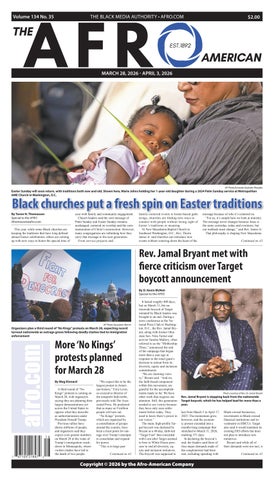
Easter Sunday will soon return, with traditions both new and old. Shown here, Marie Johns holding her 1-year-old daughter during a 2024 Palm Sunday service at Metropolitan AME Church in Washington, D.C.
Black churches put a fresh spin on Easter traditions
By Tavon N. Thomasson Special to the AFRO tthomasson@afro.com This year, while some Black churches are keeping the traditions that have long defined annual Easter celebrations, others are coming up with new ways to honor the special time of
year with family and community engagement. Church leaders said the core message of Palm Sunday and Easter Sunday remains unchanged, centered on worship and the commemoration of Christ’s resurrection. However, many congregations are rethinking how they carry that message to the next generation. From service projects and
family-centered events to home-based gatherings, churches are finding new ways to connect with people without losing sight of Easter’s traditions or meaning. At New Macedonia Baptist Church in Southeast Washington, D.C., Rev. Therm James Jr. said churches can introduce new events without watering down the heart of the
message because of who it’s centered on. “For us, it’s simple how we look at ministry: The message never changes because Jesus is the same yesterday, today and evermore, but our methods must change,” said Rev. James Jr. That philosophy is shaping New Macedonia Continued on A3
Rev. Jamal Bryant met with fierce criticism over Target boycott announcement By D. Kevin McNeir Special to the AFRO
AP Photo/Jacquelyn Martin
afro.com
Organizers plan a third round of “No Kings” protests on March 28, expecting record turnout nationwide as outrage grows following deadly clashes tied to immigration enforcement
More ‘No Kings’ protests planned for March 28 By Meg Kinnard A third round of “No Kings” protests is coming on March 28, with organizers saying they are planning their largest demonstrations yet across the United States to oppose what they describe as authoritarianism under President Donald Trump. Previous rallies have drawn millions of people, and organizers said they expect even greater numbers on March 28 in the wake of Trump’s immigration crackdown in Minneapolis, where violent clashes have led to the death of two people.
“We expect this to be the largest protest in American history,” Ezra Levin, co-executive director of the nonprofit Indivisible, previously told The Associated Press. He predicted that as many as 9 million people will turn out. “No Kings” protests, which are organized by a constellation of groups around the country, have been a focal point for outrage over Trump’s attempts to consolidate and expand his power. “This is in large part Continued on A3
It lasted roughly 400 days, but on March 11, the nationwide boycott of Target initiated by Black leaders was brought to an end. During a news conference at the National Press Club in Washington, D.C., the Rev. Jamal Bryant, along with former Ohio state Sen. Nina Turner and activist Tamika Mallory, often referred to as the “Mothership Three,” announced the end of the campaign that began more than a year ago in response to the retail giant’s decision to retreat from its diversity, equity and inclusion commitments. “We are claiming victory,” Bryant said. “And we, the faith-based component within this movement, are grateful for the accomplishments made so far. We have other work that requires our attention. Still, this generation needed to see victory because they have only seen settlements before today. They need to know there’s power in our voices.” The main, high-profile Target boycott was declared by Bryant as a 40-day, faith-led “Target Fast” that coincided with Lent after Target seemed to bow to White House pressure to end all diversity, equity and inclusion initiatives. The boycott was supposed to
Photo courtesy of Rev. Dr. Jamal Bryant
Rev. Jamal Bryant is stepping back from the nationwide Target boycott, which he has helped lead for more than a year. last from March 5 to April 17, 2025. The momentum grew, however, and the economic protest extended into a months-long campaign that stretched to March 11, 2026, marking 371 days. In declaring the boycott’s end, the leaders said three of four major demands made of the conglomerate had been met, including spending with
Copyright © 2026 by the Afro-American Company
Black-owned businesses, investments in Black-owned financial institutions and investments in HBCUs. Target also said it would maintain its existing DEI efforts but does not plan to introduce new initiatives. Bryant said while all of their demands were not met, it Continued on A2