Afro e-edition 03_06_2026

Page 1


Michael B. Jordan loves being Black. We

do too

Two acting awards in two days. Two weeks until the Oscars. Let’s go.

On Feb. 28, at the 57th NAACP Image Awards, “Sinners,” director Ryan Coogler’s epic love letter to the Blues, swept all film categories. Thirteen wins total, including Outstanding

Motion Picture. Outstanding Breakthrough Performance for Miles Caton. And Michael B. Jordan, the film’s star, won Outstanding Actor in a Motion Picture, which he dedicated to the late Chadwick Boseman — his “Black Panther” costar, who died six years ago at age 43.

“Our time on this planet is short,”

Jordan, four years younger than Boseman, said from the stage, voice catching. “I was watching the ‘In Memoriam’ and seeing how fast these careers go by and people’s lives go by, and what we do while we’re here on earth.”

He also talked about being 15, sneaking into the Image Awards

Lawmakers fast-track war powers resolution following strikes on Tehran

Lawmakers on Capitol Hill are moving toward a

high-stakes showdown with the White House following President Donald Trump’s Feb. 28 launch of “Operation Epic Fury,” a massive military campaign against Iran conducted without prior congressional authorization.

Bipartisan coalitions in both the House and Senate are fast-tracking war powers resolutions to mandate a cessation of hostilities.

The military action has reportedly targeted Iranian leadership, naval assets, and nuclear infrastructure, resulting in the death of Supreme Leader Ali Khamenei and several high-ranking officials.

Rep. Glenn Ivey (DMd.-4) told the AFRO that Black Americans should pay attention to the war in Iran because it could impact them economically and greatly impact those in the military.

“All American lives in the military are at risk, including African Americans who are in service,” said Ivey. “This war creates a real risk of us getting dragged into another one of these forever wars that lead to loss of life.”

“All American lives in the military are at risk, including African Americans who are in service.”

“This war could make everyone’s life more expensive … and it also diverts a lot of money that could be used to pay for the healthcare tax credit extension and Medicaid,” he added.

U.S. Sen. Angela Alsobrooks (D-Md.) told the AFRO in a statement that the president lied when he stated, “he would end

through the back door. Feeling seen there, welcomed, and loved in an industry that too often has none for Black folks.

And then the man who has spent most of this awards season watching the industry pass over his work closed with four words that landed like a benediction and a healing balm for us all:

“Man, I love being Black.”

This was never just about awards

For more than a year we’ve been living through a coordinated assault

Rev. Robert Turner completes a brief speech on Feb. 16 regarding the need for reparations

Rev. Robert Turner to take reparations fight nationwide after years-long protest

For 40 months, Rev. Robert Turner

Now, after his 40th walk, he says he’s ready to take the movement nationwide.

“I’m inspired by my faith,” Turner said. “And by the memory of our people who have given everything to this nation from our bodies, our minds, our talent, our resources and this nation has yet to repair the damage.”

Turner’s monthly journey

served as a public act of advocacy for reparations and remembrance. He says each walk was done to honor African Americans who “have never been paid, never been recognized, never received reparations for building this nation.” Some walks include a stop at the National Museum of African American History and

Courquet-Lesaulnier Word In Black
AP Photo/Chris Pizzello
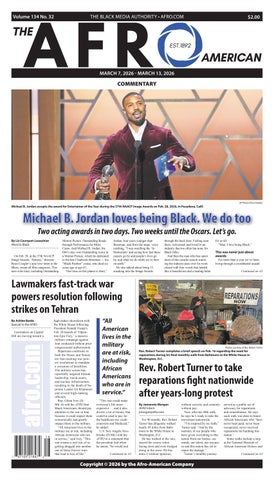
Michael B. Jordan accepts the award for Entertainer of the Year during the 57th NAACP Image Awards on Feb. 28, 2026, in Pasadena, Calif.
Photos courtesy of Rev. Robert Turner
Banks Special to the AFRO

WHAT’S TRENDING ON AFRO.COM

Maryland leaders request tariff reimbursement following Supreme Court decision

Gov. Wes Moore (D) and Maryland’s top fiscal officials on Feb. 27 sent a joint letter asking President Donald Trump to reimburse the state for economic harm they attribute to tariffs the Supreme Court has ruled unconstitutional.

The joint letter from Moore, Comptroller Brooke Lierman and Treasurer Dereck Davis comes about a week after a 6-3 U.S. Supreme Court ruling on Feb. 20 that found the Trump administration lacked authority under the International Emergency Economic Powers Act (IEEPA) to impose sweeping global tariffs. The officials are now

asking the administration to reimburse the state for the tariffs’ economic impact on Marylanders.

“As Governor, Comptroller, and Treasurer of Maryland, it is our duty to safeguard the fiscal interests of this state and to ensure that when unlawful government action causes economic harm to Marylanders, we pursue every available avenue of accountability and restitution,” the letter states.

Maryland officials describe the state as “built on trade, innovation, and hard work,” arguing its economy’s reliance on international trade left it vulnerable to the effects of the Trump administration’s tariffs.

“When your Administration imposed these tariffs, Maryland businesses were forced

to respond,” the officials wrote. “Companies that import goods paid directly at the border; those that rely on imported materials, equipment, and components absorbed higher input costs.”

The letter continued, “In both cases, those costs were passed along to consumers, raising prices for working families already confronting a difficult cost of living. Marylanders saw prices increase on a broad range of everyday goods, from groceries and household appliances to medical supplies and construction materials.”

Using U.S. Joint Economic Committee data, the letter estimates Marylanders’ financial burden at about “$4 billion in direct and indirect tariff-related costs during the

businesses and families affected by tariff-related costs.

period these unconstitutional measures were in effect.”

Moore and the state’s fiscal leaders argued tariffs took money out of Marylanders’ pockets–dollars that could have been spent or invested in growing businesses and supporting everyday household needs.

“If the federal government collected funds under an unconstitutional policy, it has a legal and moral obligation to return those funds to the people from whom they were taken,” the letter states.

As of publication, the

Trump administration has not responded to the

request, though state leaders said in the

they are willing to work with the administration on a

forward to support Maryland businesses and families impacted by the tariffs.

Maryland challenges federal detention expansion amid disproportionate impact on Black migrants

Your History • Your Community • Your News

The Afro-American Newspapers

Baltimore Office • Corporate Headquarters

233 E. Redwood Street 6th Floor, Suite 600G Baltimore, Maryland 21202 410-554-8200

Customer Service, Home Delivery and Subscriptions: 410-554-8200

customerservice@afro.com

Founded by John Henry Murphy Sr., August 13, 1892

Chairman of the Board/Publisher - Frances Murphy Draper

(Publisher Emeritus - John J. Oliver Jr.)

President - Benjamin Murphy Phillips IV

VP of Marketing and Technology - Kevin E. Peck

Director Digital Solutions - Dana Peck

Receptionist - Wanda Pearson - 410-554-8200, ext. 246

Director of Operations

Andrè Draper - 410-554-8200

Director of Finance

Bonnie Deanes - 410-554-8242

Executive Director/Director of Advertising Lenora Howze - 410-554-8271 - lhowze@afro.com

Director of Community & Public Relations

Diane W. Hocker - 410-554-8243

Editorial

Managing Editor - Alexis Taylor - 410-554-8257

Editorial Assistant - Ama Brown-Parson Evening / Weekend Editor - Zenitha Prince

Archivist - Savannah Wood - 410-554-8277

Baltimore Circulation/Distribution Manager Andrè Draper - 410-554-8200

Creative Design and Content

Matthew McDonald

Washington Office 1140 3rd Street, N.E., 2nd Floor Washington, D.C. 20002-6723 202-332-0080

(Washington Publisher Emerita - Frances L. Murphy II)

Director of Operations - Andrè Draper - 410-554-8200

Advocacy groups and members of the Maryland Legislative Black Caucus are raising alarms over the disproportionate impact that new warehouse-style detention centers will have on the state’s Black migrant communities. Statistically, Black migrants already face longer detention periods and higher rates of disciplinary action while in custody.

U.S. Rep. Glenn Ivey (DMd.-4) told the AFRO he is concerned that if this facility is constructed there will be “racial profiling.”

“We have a lot of African immigrants here; I want to make sure they don’t get targeted in the same way Somali migrants were targeted in Minnesota,” said the Democratic lawmaker.

“We want to make sure that ICE gets reined in. They need a total overhaul,” he added. “They also need a completely new leadership structure at the top.”

Members of the Maryland congressional delegation have intensified their efforts to block the federal government from establishing a mass detention center in a Washington County warehouse, citing reports of “inhumane” conditions and a lack of transparency.

On Feb. 10, Rep. April McClain Delaney (D-Md-06) introduced the Keep ICE Out of Washington County, Maryland Act, which seeks to prohibit the use of federal funds to operate or expand any immigration detention facility in the county.

The move follows the Department of Homeland Security’s $102.4 million purchase of an 825,000-squarefoot warehouse in Williamsport. Lawmakers, including Maryland Democratic Sens. Chris Van Hollen and Angela Alsobrooks, have expressed alarm over the facility’s design, noting it currently contains only four toilets and two water fountains for a projected population of 1,500 people.

Maryland Attorney General Anthony G. Brown filed a lawsuit on Feb. 23 to stop the construction of the ICE detention

Maryland’s top officials are mounting a multi-pronged legal and legislative challenge against the federal government’s move to repurpose commercial warehouses as detention hubs, a trend critics argue bypasses civil safeguards and poses a unique threat to the state’s Black immigrant population.

facility, alleging that DHS and ICE moved forward without the required environmental review, public participation or state consultation mandated by the National Environmental Policy Act (NEPA).

According to a 2025 report from the Thurgood Marshall Institute, while Black immigrants represent only 5.4 percent of the undocumented population in the United States, they account for more than 20 percent of those facing deportation on criminal grounds, a disparity fueled by heavy policing and the frequent use of discretionary traffic stops.

Data from the Deportation Data Project further reveals that in the first half of 2025 alone, over 1,500 African migrants were arrested amid a federal crackdown where more than 65 percent of those in ICE custody had no criminal convictions. This aggressive enforcement is compounded by a lack of language services for African dialects in immigration courts and the erosion of sanctuary protections, leaving many vulnerable migrants trapped in an overcrowded system where, as noted by the Black Alliance for Just Immigration (BAJI), they

face higher rates of solitary confinement and are significantly less likely to be granted parole.

Rep. Ivey told the AFRO that one of his constituents, Rabbiatu Kuyateh, a veteran nurse who escaped the Sierra Leonean Civil War three decades ago, had maintained a stable life in the U.S. and consistently attended her mandatory ICE check-ins. However, a routine appointment in July 2025 ended in her detention, setting off a months-long odyssey through Maryland and Louisiana facilities before she was shackled and flown to Ghana, a nation entirely foreign to her. Despite a judge’s earlier ruling that she faced a credible threat of torture in her homeland, she was held in Ghana for several days and eventually forcibly repatriated to Sierra Leone, leaving her son, Mohamed Alghali, to lead a vocal public campaign for her return and for systemic justice.

“What happened to Kuyateh was illegal,” the Democratic lawmaker continued. “We have to keep fighting to make sure we turn the tide … we can win these fights.”

“If you look up the numbers on the amount of people that are detained in the detention centers, a very small [number] of them have actually been convicted of a crime,” he said.

“This administration we’re dealing with is kind of irrational,” continued Alghali. “I just want [Democrats] to keep fighting and keep advocating for us like they have been and keep pushing the courts.” Congressional opposition has been further fueled by unannounced oversight visits to ICE’s Baltimore Field Office in February. U.S. Rep. Jamie Raskin (D-Md.-8) and other lawmakers reported witnessing severe overcrowding and detainees being held for days in windowless rooms originally designed for stays of less than 12 hours.

Raskin told the AFRO that citizens across the country are on “edge” about the presence of ICE agents and the unconstitutional acts that they have carried out in places like Minneapolis.

Alghali, Kuyateh’s son, told the AFRO that the Trump administration has put forth “false rhetoric” that immigrants are criminals.

reimbursement
letter
path
AP Photo/Allison Robbert
Gov. Wes Moore and Maryland’s top fiscal officers are seeking reimbursement for
AP Photo/J. Scott Applewhite

Michael B. Jordan

on Black America, orchestrated by President Donald Trump and the White House. Hundreds of thousands of Black workers laid off or fired. DEI programs gutted. A video of Michelle and Barack Obama as monkeys on Trump’s personal social media account. Through it all, most of the nation shrugged. Then came “Sinners,” a Black-made, Blackity-Black-centered film that became a box-office juggernaut. It’s a cinematic gift: our music, our joy, our spirituality, our seemingly-supernatural ability to survive, all wrapped up in a bow with its star, Mr. Michael B. Jordan. (Whenever I type his name I can hear the voice of one of my aunties saying “That man knows he fine… and he can act, too!”)

So of course Black folks claimed the film, and Jordan. Jordan has long been ours. He’s our play cousin, our brother and our uncle and the dude who lives across the street from our grandma. We see him. And of course when Hollywood spent months giving him and the film backhanded compliments, downplaying its success, it felt personal. Because it was.

Catharsis — and recognition

Let me tell you what it felt like to watch Viola Davis open that envelope for Best Male Performance in a Leading Role on March 1 during the Actors Awards. It was the deep breath before the plunge. Will this be the moment we win, or just another “almost?”

And then she read Jordan’s name. Correction: she screamed it.

It was real, pure joy and relief, from the gut. The well-heeled, jewel-bedecked audience of Hollywood stars packed into the Shrine Auditorium in Los Angeles leapt to its feet with applause.

Jordan turned first to Delroy Lindo — his “Sinners” co-star, the Black man who had stood beside him on the BAFTA Awards stage in London a week earlier while a racial slur rang out across a global broadcast — and pulled him into an embrace — before walking up to claim his trophy.

Watching from home, I screamed right along with Viola. Because it has been that kind of awards season. And lately it’s been that kind of existence for Black America.

War Powers Resolution

wars, not start them.”

“The American people have no reason to trust this man with the lives of our sons and daughters,” said the Democratic senator.

“The Constitution is clear, ‘The Congress shall have Power…To declare War,” she added. “Senators who still believe in the Constitution should join me in demanding we return to Washington and vote on Senator Kaine’s War Powers Resolution.”

In the Senate, Tim Kaine (D-Va.) and Rand Paul (R-Ky.) are pushing for a vote on S.J. Res. 104. A parallel effort in the House, led by Ro Khanna (D-Calif.-17) and Thomas Massie (R-Ky.-4), seeks to invoke the War Powers Resolution of 1973, which requires the president to withdraw forces within 60 days unless Congress declares war or grants specific authorization.

Minority Leaders Sen. Chuck Schumer (D-N.Y.) and Rep. Hakeem Jeffries (D-N.Y.-8) have denounced the strikes as unconstitutional and

pre-emptive, arguing that the administration failed to provide evidence of an imminent threat that would justify bypassing Article I, Section 8 of the Constitution.

The White House has invoked Article II of the Constitution and Article 51 of the UN Charter, citing self-defense. However, critics in Congress note that the president’s own statements, calling for “regime change” and a “friendly takeover,” suggest a scope of war that goes beyond immediate defense.

Ivey told the AFRO that the president is violating the U.S. Consitution because he “doubted” he could get “approval from Congress” to declare war on Iran.

“[The president] is not someone we can trust to make decisions on his own…he needs to be reined in,” said the democratic lawmaker. “This is the same guy who was talking about invading Greenland about two or three weeks ago.”

In a statement obtained by the AFRO, Rep. Summer Lee (D-Pa.-12) stated Trump’s attack on Iran shows that he “doesn’t care about the safety

Rev. Robert Turner

Culture, also known as the “Blacksonian.” There, he laid wreaths in a solemn ceremony.

“At a time when our history is being called negative or depressing,” he said, “I laid that wreath in solidarity with our history, to remind America that God has not forgotten what has happened to Black people.”

For Turner, the museum represents more than remembrance. It is spiritual symbolism.

“Where America seems to have forgotten what we’ve gone through,” he said, “God has not forgotten. And God will bring reparations.”

The monthly demonstrations, done in a single day, significantly impacted the faith leader’s mind and body. Rev. Turner is candid about the cost.

“With shoes on, I’m 6-foot-6,” he said. “I’m not a marathon runner. I don’t have a walker’s physique. It’s the most physically painful thing I’ve done–my knees, my feet, my back– it’s painful.”

The physical pain was one thing–but then came the emotional toll.

Turner endured racial slurs shouted from passing vehicles. Drivers intentionally splashed him with dirty puddle water. He has been struck by vehicles and faced criticism both from strangers and, at times, members of his own community.

Despite the hostility faced, Turner says the most powerful moments came from unexpected places.

There were White allies who limped alongside him in solidarity. Homeless individuals offered encouragement, and people from different races, religions and backgrounds took part in the walks.

“I walk with no weapon, no security detail,” he said. “Through some of the most dangerous areas in Maryland and D.C. And I’ve never had a problem from the people on the street. Ever.”

For him, that grassroots respect carries weight.

“When you get love from the street, from

“This was a cultural exhale, an affirmation in a moment when Black folks are under pressure that, at times, feels unbearable.”

Back in January, I wrote about the ritual of awards season — praising Black excellence while handing the trophy elsewhere. Timothée Chalamet won the Critics Choice Award for Best Actor and used his speech to shout out Jordan, calling his “Sinners” performance as twin brothers in the Jim Crow South “unbelievable.” Jordan got the kind words. Chalamet got the hardware.

Then Jordan was snubbed at the Golden Globes. Then the BAFTAs — which, with its ugly racism, became something else entirely. Was he going to be dissed all awards season or what?

This weekend changed everything. On Feb. 1, Jordan’s Hollywood peers recognized what the NAACP already knew. The Actor Award — historically the most reliable Oscar predictor for Best Actor — now belongs to him.

The trophies matter, sure. But this was a cultural exhale, an affirmation in a moment when

of Americans” or Iranians.

“If he did, he wouldn’t be risking the lives of American troops for the sake of another endless war or trying to turn Iran into a war zone,” the Pennsylvania lawmaker added. “From day one Trump has shown us his corruption and desire for regime change in multiple countries that he has no business being in.”

The House and Senate are expected to vote on the War Powers resolutions this week. While the measures may pass in the House due to a slim margin, they face a steep climb in the Senate. Even if the resolutions pass both chambers, they are subject to a presidential veto. Overriding such a veto requires a two-thirds majority in both the House and Senate, a threshold that current party margins suggest would be a challenge to meet.

Furthermore, some Democrats have broken ranks. Sen. John Fetterman (D-Pa.) has stated he would vote against the war powers resolution, describing the strikes as a necessary move against the Iranian regime.

Black folks are under pressure that, at times, feels unbearable.

A week ago, the thought of Jordan as Oscar frontrunner was easily dismissed; the momentum wasn’t there. Now it is, but the Oscars are almost two weeks away. Who knows what will happen between now and then. But after a year like we’ve had, with ICE raids and Black history erased from national parks and the N-word shouted at Jordan in a crowded theater on live TV, it feels so good to hope. To believe. To dream.

Michael, if you’re reading, we love being Black, too. And nothing — not snubs, not America doing what America does — can take that away from us.

This article was originally published by Word In Black.

The opinions expressed in this commentary are those of the writer and not necessarily those of the AFRO.

As the conflict in the Middle East continues, the primary focus of the House and Senate Intelligence Committees remains the assessment of “imminence.” Lawmakers are demanding to see the specific intelligence that led the president to

people who don’t know you, that means something,” he said. “It tells you somebody sees that they’re worth walking for.”

Turner argues that federal reparations legislation is essential to justice in America.

The bill would establish a federal commission to study the lasting impacts of slavery and systemic discrimination and explore potential remedies.

“We’ve had commissions to study everything,” Turner said. “We’ve studied 9/11.

We’ve studied outer space. But we’ve never had a commission to study America’s original sin.”

He lists slavery, Jim Crow, redlining, mass incarceration and the war on drugs as interconnected systems that have never been formally addressed through federal repair.

“H.R. 40 could help remedy a lot of the ills that we are inflicted with,” he said.

While Turner emphasizes federal policy reform, others see investment in the community as equally critical.

Ashley David, a student at Morgan State University, believes reparations are attainable but may require a focus on a broader definition of justice.

“Reparations such as policy reform have been done before,” David said. “But when it comes to slavery and systemic racism, everyone has a different perspective about what justice looks like.”

David said meaningful reparations should focus on community investment if there are any financial reparations.

“Money going toward a community instead

conclude that a pre-emptive strike was the only option to prevent a nuclear breakout.

of just an individual guarantees that it’s being spent on something important,” she said.

In addition, Rev. Turner revealed that his 40th walk to the White House will be his last monthly march.

He plans to continue the D.C. walk annually, but his next mission is larger.

“My goal is to walk to every state capital in the nation,” he said. “This is going nationwide.”

After completing 40 walks, symbolizing “40 acres” and justice deferred, Turner says he feels called to expand.Rev. Kevin Slayton, a Baltimore pastor who has joined portions of the walk, agrees that expanding the effort beyond Maryland - D.C. would elevate the movement.“Historically, this type of civic engagement has always had an impact, particularly for our community,” Slayton said. “By taking it beyond the state, it grants a higher profile and brings awareness to Black communities where nobody is really working on reparations issues.”RevSlayton noted that such movements don’t always produce results immediately but lays the foundation for it to grow significantly over time.

“People won’t always appreciate what he’s doing today,” Slayton said. “But further down the road, they will.”

Both Slayton and David said younger generations will play a vital role in the movement’s growth.

“The greatest role they can play is educating themselves,” Slayton said. “People don’t have to steal anything from you that you don’t know is yours. You just give it away.” David said social media can be a tool to amplify awareness.

“It gets the word out to others,” she said. “That’s how we connect nowadays.”

Even with plans to expand the cause, Turner makes it clear the walks have never been about publicity but for the people.

“They may not even live anymore, the people I’m walking for,” he said. “But I do it in their memory. It’s going to take more work, but I know God will provide.”

And now, after 40 journeys to Washington, his path is widening from one city to all 50 states.

Photos courtesy of Rev. Robert Turner
Shown here, Rev. Robert Turner arriving in the District on his 40th walk from Baltimore to Washington, D.C.
AP Photo / J. Scott Applewhite Bipartisan lawmakers, such as Rep. Hakeem Jeffries (D-N.Y.-8) (shown here) and Thomas Massie (R-Ky.-4), are seeking to fast-track resolutions to mandate a cessation of hostilities following the launch of America’s military campaign against Iran.

COMMENTARY

Corporate media consolidation endangers local news and communities of color

American democracy is under siege across the board in different industries. Diversity is good for business and diversity is good for American democracy. Exclusive corporate policies and regulations erode democratic principles.

Local journalism is indispensable to the protection of civil rights and equality for all Americans, particularly for Black American communities and other communities of color across the nation. Local-owned news media is crucial to community empowerment and civic participation.

Today we are facing another pivotal moment: huge corporate TV station groups seeking to weaken or eliminate the 39 percent national audience

reach cap, alongside Nexstar’s proposed takeover of TEGNA. The cap is set by Congress and is not the FCC’s to discard.

Media consolidation on this scale threatens the diversity of viewpoints, the independence of local newsrooms, and the public’s access to locally grounded information.

The National Newspaper Publishers Association (NNPA) and other local print and television news media organizations take an urgent exception to the current attempts by huge corporate consolidations to effectively silence local media voices and businesses. Millions of Americans rely on local TV stations and local community-owned newspapers as their most trusted news sources.

Consolidation among the big station groups has already led to: shrinking newsrooms,

fewer reporters, and worse working conditions; must-run corporate segments displacing locally-focused reporting; and word-for-word duplication of newscasts across stations held by the same owner. The steady erosion of localism means fewer culturally relevant perspectives, diminished investigative reporting, and weakened community accountability.

The growing devastation of the print journalism ecosystem offers a stark warning: corporate roll-ups prioritized margins over missions; local newspapers were hollowed out by distant ownership; and, communities lost vital watchdogs and trusted sources and valued generational businesses.

The same consolidation playbook is now being deployed in local television. The country cannot afford another collapse of local journalism—this time in local TV news, where so many families rely on freely accessible

information every day.

Absorbing TEGNA would give Nexstar control over 265 local TV stations reaching 80 percent of American homes. Such a combined entity would far exceed Congress’s 39 percent cap—making this not only a policy concern but also a legal one. This merger would trigger newsroom reductions, more content duplication, and a dramatic narrowing of editorial independence across dozens of cities.

Excessive consolidation gives a handful of corporate headquarters disproportionate influence over what the nation sees and hears. Communities of color are hit hardest when local storytelling disappears or when editorial direction is centralized far from the communities being covered. Local TV stations and other local journalism have long been essential entry points for young journalists of color; consolidation shrinks those pathways and reduces the diversity of the

newsroom workforce.

Consolidation reliably drives up retransmission fees—costs that cable and satellite subscribers ultimately bear. Retransmission fees have risen over 2,000 percent in the past 15 years. Nexstar has explicitly told investors that nearly half of its projected merger “synergies” come from raising retransmission revenues—effectively guaranteeing higher bills for millions of families without providing any new content or service. For households struggling with rising costs of living, these increases are especially burdensome.

The nation should not repeat the mistakes that allowed corporate consolidation to decimate local newspapers. Preserving strong, independent, community-rooted local print and television journalism is essential to democracy, equity, and civic life. The FCC should uphold the 39 percent cap, reject the

Nexstar–TEGNA

Stop co-opting #sayhername. It was made for Black women

Let’s set the record straight: “Say her name” shouldn’t be used for everyone who is unjustly killed at the hands of the state.

To be more specific, it ain’t for White folks. And yes, I meant to say “ain’t.”

The hashtag #SayHerName isn’t simply a one-off catchphrase. It is a social justice visibility movement that Dr. Kimberlé Crenshaw, a professor at UCLA Law School and Columbia University Law School, created to highlight law enforcement violence against Black women and girls within an anti-Black society. It shone a spotlight on the killing of Sandra Bland, the 28-year-old Black woman who died in Texas after allegedly assaulting a police officer during a traffic stop.

Since its creation in 2017, it has evolved into a rallying cry — one that has been used way too often for far too many Black women killed by law enforcement or found dead in official custody.

Now, White activists in Minnesota, angry at the federal Immigration and Customs Enforcement agents who killed Renee Nicole Good, are using #SayHerName in social media posts and shouting it in protests on the snow-covered streets of Minneapolis. And it’s not a good look.

#SayHerName to do it.

People have been saying Good’s name from the moment she was killed Jan. 7 inside her SUV while attempting to steer away from ICE agents confronting her on an icy residential street. The presence of ICE paramilitary troops is also responsible for the murders of Alex Pretti and Keith Porter Jr. in Los Angeles. Within hours of Good’s slaying, the news made national headlines, just like the murders of Heather Heyer, who was run down by a White supremacist during the 2017 “Unite the Right” rally in Charlottesville, Virginia, and Justine Damond, shot to death by a Black Minneapolis cop that same year. Good, Heyer, and Damond were all White women.

ICE, not invisibility, is the problem

Let me be clear: it’s outrageous that an ICE agent shot and killed Good, 37, without justification, at pointblank range, and illegally. The Trump administration made things worse when it branded her a terrorist, sent more immigration agents to the city, and declared it would not investigate her death. People in Minneapolis and across the country are right to demand accountability for her murder, and they are right to demand that ICE leave their city.

But protesters shouldn’t co-opt

Black women matter

But Bland’s death was just as outrageous. She was found hanging in a Walker County, Texas, jail cell three days after a heated confrontation with an officer during a routine traffic stop. A coroner ruled her death a suicide, but her family rejected that. Despite repeated demands, no one — not the aggressive cop who arrested her, nor the jail guards responsible for her safety — has answered for her death.

If it weren’t for the #SayHerName campaign, few people would know about Bland or the circumstances of her

senseless death. That’s not an accident. Studies show that the murders and disappearances of White women receive disproportionate attention in the news and public discourse, especially when compared to those of Black women. It’s problematic, which is why Crenshaw created #SayHerName in the first place. Before then, Bland was anonymous, and her death was a mystery. The campaign helped her be seen. More broadly, using the hashtag to protest Good’s killing is yet another example of White people co-opting Black language. The Trump administration has weaponized “woke,” is using the language of the civil rights movement to dismantle actual civil rights, and the far right used “say her name” to publicize the death of a Jan. 6 rioter. Usually, Whites talk like Black folks to make a profit, become relevant, become the center of attention, or mock Black people.

Co-opted and tone-deaf

It’s a fact that White people appropriate the everyday phrases and cadence of Black speech, too, not just what’s culturally significant; I see it all the time on social media. Unfortunately, I’ve also witnessed White folks do it at work, to sound cool or appear cool to Black people. It’s problematic, considering how Black language is stigmatized as uneducated or uncouth

Tariff whiplash and a rising Black recession

At the start of this year, the Joint Center for Political and Economic Studies released a report naming what many Black households and business owners were already living: signs of a Black recession. Not a metaphor, but a documented decline in living standards, marked by record Black unemployment, business contraction and the cumulative weight of a 2025 policy agenda that has targeted the predictability, programs and protections that Black economic participation depends on. That warning now looks prescient.

Hours after the Supreme Court ruled the president’s tariff policy unconstitutional on Feb. 20—a ruling that, whatever its complications, injected a measure of clarity into markets that have been starved of it—the president addressed the country and promptly injected further uncertainty, announcing he would impose different tariffs to offset those struck down. For most Americans struggling with affordability, this was another whiplash moment. For Black-owned

small businesses and the communities they serve, it was something more: the latest entry in a pattern of policy choices that have made planning, survival, and growth measurably harder.

Uncertainty is one of the most disruptive forces for a small business. Simply put, you can’t plan if everything keeps changing. If you own a clothing business and the price of fabric fluctuates wildly, it becomes nearly impossible to determine how to produce and price your goods. In that environment, simply knowing what fabric costs becomes the foundation upon which every other decision rests. That basic economic stability has been denied, and this past week’s deliberate reinjection of confusion is not a detour from the pattern. It is the pattern and increasingly appears to be a governing philosophy.

The Federal Reserve has been monitoring tariff policy carefully, and its officials have been unusually candid in response. Atlanta Fed President Raphael Bostic captured the moment plainly, describing how businesses are processing the whipsaw of tariff moves:

“We are all doing calculus now, trying to figure out sort of how this feeds through to our individual businesses, as well as to our partners, our suppliers, and then to consumers.” Bostic noted that businesses were already beginning to pass tariff costs on to consumers, and that he expects higher prices through the first half of the year. New York Fed research grounds that concern in data: 90 percent of the economic burden from 2025 tariffs fell on U.S. firms and consumers.

Small businesses are the country’s leading private sector employer, and when they contract, entire communities feel it. Black-owned small businesses face a compounding burden: the broad economic headwinds created by tariff uncertainty, and the targeted dismantling of the equity programs and administrative structures this administration has moved aggressively to eliminate.

The data is bearing this out. The Labor Department reports Black unemployment reached its highest level in four years in 2025, while tariffs have driven up both input costs for businesses and retail prices for household

staples. Small businesses with fewer than 20 employees, the size category that includes most Black-owned firms, have shed 62,000 jobs since January 2025. The Center on Budget and Policy Priorities has been direct: “The standard of living for Black households and small businesses faltered in 2025 due to a variety of targeted policies from the Trump Administration, including tariffs.”

This is what the Joint Center meant by signs of a Black recession. Conditions that, applied to the broader population, would meet the textbook definition of a recession. It is an accumulation of choices, and this past week was another one.

The Supreme Court’s tariff ruling last week represented a genuine, if narrow, opportunity; a moment where the policy environment might have offered some relief to businesses and households that have had very little of it. Instead, within hours, that opening was closed by the president’s decision to impose new tariffs.

in certain spaces.

Most importantly, the tone-deaf use of #SayHerName to protest Good’s killing ironically illustrates society’s collective failure to act on behalf of Black humanity, particularly after Black women spoke up.

A Black woman coined the hashtag to rally support for the end of law enforcement killing Black women, but it’s bigger than that. Historically, policy outcomes that benefit Black people typically benefit everyone. The Civil Rights Act of 1964 and the Voting Rights Act of 1965, making it easier for all people to register to vote, are evidence of that.

However, the warnings of Black women are often disregarded and dismissed. Maybe it’s because most folks aren’t Black women, or aren’t emotionally connected to Black women, or simply don’t care about Black women or Black lives in general. But they should.

To interpolate the famous poem, first they came for Black people, but no one spoke out because they weren’t Black women. Then, when they came for those who were silent, the silent found no one was left to speak for them.

Maybe, had they spoken up when Black folks sounded the alarm, laws would have been in place to prevent the murder of Renee Nicole Good.

This article was originally published by Word in Black.

for

Economic

Lawmakers and the administration still have a choice. Congress can reassert its constitutional authority over trade policy. The administration can acknowledge that the uncertainty it is generating has costs — measurable, documented costs borne disproportionately by communities that are not positioned to bounce back.

Courtesy photo Eric Morrissette is a senior fellow
the Joint Center for Political and
Studies.
Rann Miller Word in Black
Photo courtesy of American Consortium for Equity in Education Rann Miller is an educator, opinion columnist and author of “Resistance Stories from Black History for Kids.”
merger, and recommit to protecting localism, diversity, and the public interest. America’s airwaves belong to the people—not to a handful of corporate conglomerates.
This commentary was originally published by NNPA Newswire.
Courtesy photo
Dr. Benjamin F. Chavis Jr. is president and CEO of the National Newspapers Publishers (NNPA) and executive producer of the “Chavis Chronicles” on PBS Network.

BALTIMORE-AREA

‘Coppin

Chopped: The Black Table’ heats up homecoming with culinary showdown

Coppin State University held its 2026 Homecoming week Feb. 15- 22. The celebration of the historically Black institution in West Baltimore was filled with a plethora of events, including “Coppin Chopped: The Black Table.” Returning for its fourth

year, the event spotlighted the deep rooted connection between food, family and Black identity.

Based on the long-running cooking show, “Chopped,” each year “Coppin Chopped” gives alumni, current students, members of the community and faculty and staff the opportunity to compete for the coveted

home

the community

Baltimore inspector general challenges city over limited access to records

Baltimore City Inspector General (IG) Isabel Mercedes Cumming has filed suit against Mayor Brandon M. Scott and the Baltimore City Council after the city denied her office access to certain records and provided heavily redacted information in response to subpoenas. The suit seeks a court declaration confirming the Office of the Inspector General’s (OIG) independence and subpoena power under the Baltimore City Charter, as well as injunctive relief prohibiting interference with its investigations.

The action came on Feb. 24, weeks after the city of Baltimore announced that state confidentiality laws supersede local authority and limit the OIG’s access to certain records on Feb. 6. Cumming alleged that she had direct access to information from city offices since 2018. But, in June 2025, she

claimed the city abruptly restricted that access and asserted for the first time that OIG subpoenas must be treated as requests under the Maryland Public Information Act (PIA).

“My goal in this lawsuit is to merely require the city to do what it has done since I took office— provide the OIG with the information it needs to ensure taxpayer dollars aren’t being wasted by government officials,” said Cumming in a Feb. 24 statement.

Back in 2018, the Baltimore City Council approved a charter amendment establishing an independent OIG that would be overseen by an advisory board. Prior to that, the office was housed in the city’s Law Department. In 2022, Baltimore City residents voted to change the amendment so that the advisory board would be made up entirely of citizens, ensuring it was free from political influence.

The OIG is tasked with investigating complaints of waste, fraud and abuse in city

government. In order to do this, the office has subpoena power, allowing it to require testimony from individuals under oath and the production of documents, reports and other relevant information.

When the city of Baltimore announced that it would be restricting the OIG’s access to certain documents, it pointed to a Feb. 3 letter from Maryland Assistant Attorney General Shaunee L. Harrison to Maryland State Senator Antonio Hayes (D-40).

Responding to a query from Hayes about whether a local statute or charter amendment can give the IG access to records that are required to be kept confidential under the PIA, Harrison said that state law “preempts” any local provision that conflicts with the PIA, meaning a local law cannot require disclosure of records that state law protects.

He noted that PIA’s mandatory exceptions cover personnel files, medical information and financial records and apply even when an IG issues a subpoena. The city referred

Gov. Moore, Lt. Gov. Miller file for reelection ahead of Maryland primaries

Maryland Gov. Wes Moore (D) and Lt. Gov. Aruna Miller (D) filed for re-election Feb. 23 at the State Board of Elections headquarters in Annapolis, Md. They filed one day before the deadline.

Moore and Miller first announced their decision to seek a second term Sept. 9, 2025.

“Today, Lieutenant Governor Aruna Miller and I filed for reelection to continue the progress we’ve seen throughout Maryland to grow our economy, improve our public schools and double down on record drops in violent crime,” said Moore in a statement on Feb. 23. “While Trump’s reckless policies cost Marylanders their jobs and raise prices on everything, here in Maryland we are showing across the state and party lines that there’s a better way forward to make our economy stronger and everyday life more affordable.”

Moore continues to maintain a majority approval rating. According to a Gonzalez Research and Media Services poll of 808 Marylanders in January, Moore received a 51.7 percent job approval rating and a 41 percent disapproval rating. His ratings, however, are lower than his 64 percent approval rating in September 2024.

Republicans have criticized Moore’s record as he seeks re-election, particularly pointing to the state’s ongoing budget deficits and his spending priorities.

On the day Moore originally announced his re-election bid, the Republican Governors Association released a statement criticizing his handling of the state’s budget.

“Wes Moore’s record has been one of tax

to the letter as an

“official legal opinion” of the Maryland Attorney General’s Office, but Attorney General Anthony Brown characterized it as an advice letter— a routine form of guidance the office provides to state agencies and legislators.

He emphasized that the

Photo courtesy of City of Baltimore Mayor Brandon M. Scott asserts the IG’s restricted access is due to a conflict with the Maryland Public Information Act, which supersedes any local laws or charter resolutions.
AFRO Photos /Alexis LaRue
Shown here, Cheryl Bailey-Solomon and Donna Cypress, competitors on the event’s Community Team. Though they didn’t take
the top prize, the two women represented
well.
Photo courtesy of Association of Inspectors General Baltimore City Inspector General Isabel Cumming is suing Mayor Brandon M. Scott and the Baltimore City Council after being denied access to certain city records. The suit asks the courts to confirm her office’s independence and subpoena power.
AFRO Photos /Alexis LaRue
Christy Lyons, Hillary Bain and Marjani Carter beam with pride as winners of the 2026 “Coppin Chopped” event. Members of the team took home coveted Golden Spatula trophies.

Associated Black Charities hosts

‘Community Convos’ session and film screening in honor of Cherry Hill

The Associated Black Charities (ABC) and Youth Resiliency Institute hosted another installment of the “Community Convos” series with a film screening of “Termite” at MedStar Harbor Hospital Baum Auditorium in Cherry Hill on Feb. 19. The event sparked conversations centered on positive change and connecting residents to strengthen the community.

“During this time of people trying to erase Black history, it is important that the local community

come together and help fix the issues ourselves,” said Chrissy Thornton, CEO of ABC. “We know that sometimes we have to be the source of solving things within our community, which is why we bring out our own community resources.”

Local organizations including the Dyslexia Tutoring Program (DTP), Maryland Department of General Services, Maryland Volunteer Lawyers Service and GreenLight Fund Baltimore gathered at the auditorium to provide attendees with information on free assistance programs.

“Reading is, of course, a foundation of success,” said Jonathan Bramell, a member of DTP. “Even though we’re now climbing back up that ladder, there are still a lot of kids left behind. Our goal is to try and get as many kids in Baltimore City evaluated to screen for dyslexia style of learning and of course understand how to provide parents resources to see what they can do to help their child.”

According to the Every Library Institute, a nonprofit focused on library funding support, a lack of access to education is one of the major contributing factors to

Police body-cam shows shooting death of Dwight Hawkins

the AFRO tthomasson@afro.com

At a Feb. 28 press conference, the Baltimore Police Department (BPD) released body-worn camera footage tied to the fatal police-involved shooting of 37-yearold Dwight Hawkins.

In the roughly six-minute clip, BPD officers Arthur Fuog, Omar Rodriguez and Devon Yancy are seen entering a store in the 3600 block of Belair Road about 6:15 p.m. on Feb. 24, where they spot Hawkins and begin following him outside.

BPD Commissioner Richard Worley said during the conference that the officers were not dispatched to the liquor store and were in the vicinity “working crime suppression,” citing ongoing “violence and drug activity”

in the area.

As the video continues, Hawkins is seen running as Fuog, Rodriguez and Yancy pursue him, shouting repeated commands for him to stop and show his hands. He is then seen pulling out a handgun while moving closer to Fuog, before Fuog and Rodriguez fired their service weapons, wounding him.

The last moments shown in the recording depict both officers handcuffing Hawkins and securing a handgun. The video then cuts off. According to a press release from the Maryland Attorney General’s Office, the officers provided emergency medical aid until emergency medical services (EMS) arrived and Hawkins was taken to a nearby hospital, where he was later pronounced dead.

“The officers are doing exactly what we want them to

Limited access to records

Continued from A5

letter was general in nature and did not analyze the specifics of the IG’s records requests.

“This letter of advice did not do a factual analysis of what anybody was asking for under the Maryland Public Information Act,” said Brown. “This was a question designed for a member of the General Assembly to understand the scope of the Maryland Public Information Act and how local laws interact with it.”

When asked about concerns that restricting the OIG’s access limits transparency and oversight, Mayor Brandon M. Scott said that following state law is a form of accountability.

incarceration in the United States. Adults with low literacy skills are far more likely to be under-or unemployed, which increases chances of contact with law enforcement as other means to make money are sought.

Transitioning into a discussion of change, Thornton posed a question to better understand attendees’ needs and vision for the community.

“What are your dreams for the Cherry Hill community?” Thronton asked attendees.

Community members expressed a desire for church involvement to help bridge the gap between youth and elders through mentorship and guidance. Others emphasized teaching profitable trade skills, such as HVAC, to provide young people with career paths.

“A lot of these kids do not want to be on the streets,” said Sista-Q, comedian and community volunteer. “But they’re looking for ways to make money.”

During the session, attendees were able to learn about Cherry Hill community leader Kin “Termite” Lane Brown with the screening of “Termite: A Baltimore Story.” The documentary explores Brown’s battle with grief after the loss of her parents, the Muslim

faith and her more than a decade of community service.

“Growing up in Cherry Hill was amazing,” said Brown. “It is a community of love. Cherry Hill has been known to do amazing things. We’ve celebrated 365 days without a shooting or homicide–not two, but three times–in Cherry Hill.”

While locals celebrate reductions in crime, concerns about new developments to the area, such as the Baltimore Peninsula continue.

“You take the money, you take the developers, you take all of these people that don’t live in our community who are trying to make decisions for our community,” said Brown. “They’re trying to displace, remove and replace the community. In Cherry Hill, I’m telling y’all, you’ve got to stand for something or all y’all will be standing on the other side. That stands for everybody.”

Brown is a member of The Guardians of Baltimore, previously worked at the Patapsco Recreation Center and Safe Streets. She continues her 50-year legacy in Cherry Hill and plans to move into her new home next month.

ABC Charities plans to continue hosting community events in Cherry Hill to uplift and support the residents.

do. They’re going in there trying to get guns off the street,” Worley said at the conference. “Clearly, they were drawn to this individual, [and] they were extremely correct. He had a handgun.”

He continued, “Had he dropped the gun and just surrendered to the officers we wouldn’t be having this press conference. Unfortunately, he decided to run.”

This is not the first police-involved shooting involving officers Rodriguez and Yancy. Both were also involved in a June 17, 2025, incident that resulted in the death of well-known arabber Bilal Abdullah Jr.

Fuog and Rodriguez, who fired their weapons, remain on administrative leave. Yancy, who did not fire his weapon, is also on leave as the Maryland Attorney General’s Office investigation continues.

“No one is above the law, including the inspector general. State law is very clear, and we took action to comply with that state law,” Scott told the AFRO. “I have and will continue to say that my law department and I are ready to work with the board and the OIG to establish new protocols under the law.”

Scott said the city has maintained ongoing collaboration with Cumming despite the restrictions she faces. He also noted that other jurisdictions have similar procedures. Recently, Montgomery County IG Megan Davey Limarzi expressed that she’s also been denied access to certain information by county officials under the PIA.

“That shows there is a process for how the

information is requested versus having carte blanche access, which was the issue that we ran into here,” said Scott. “This isn’t about blocking her, it’s about protecting the city from liability and following state law, and we’re going to continue to do that.”

The debate over how state law intersects with local IG authority has prompted Cumming, Limarzi, Baltimore County Deputy IG Steve Quisenberry and Howard County IG Kelly Madigan to call on the Maryland General Assembly for an amendment to the PIA that would exempt local IGs.

“Fundamental to our work is having unrestricted access to all relevant records held by our local jurisdictions. Those records are

critical to our ability to fully and capably investigate allegations of fraud, waste, abuse and misconduct, as required by local laws,” wrote the IGs in a release. “As a result of the OAG’s letter, such records could be withheld from us in whole or redacted to the point that they are essentially rendered useless from an evidentiary standpoint. To be clear, once such records are in our possession, we have now and have always had the same responsibility as our employers— to not disclose to the public records that are otherwise protected.”

The dispute highlights a broader tension between state law and local oversight— one that could shape how IGs across Maryland access records in the future.

By Kendra Bryant Special to the AFRO
AFRO Photos / Kendra Bryant
Local organizations offer free resources to attendees at the Community Convos event in Cherry Hill, hosted by Associated Black Charities on Feb. 19. Shown here, representatives of the Dyslexia Tutoring Program (DPT), Josaiah Bonwell (left) and Jonathan Bramell.
AFRO Photos / Kendra Bryant
“Termite: A Baltimore Story’ highlights the 50-year legacy of community leader Kin “Termite” Lane Brown (left). In a fireside chat with Chrissy Thornton (right), CEO of Associated Black Charities, Brown addressed ongoing concerns about crime in Cherry Hill.
Baltimore Police Department / X
Baltimore Police Commissioner Richard Worley says he believes his officers were in the right when it comes to the Feb. 24 shooting death of Dwight Howard. Shown here, body cam footage of the scene after the shooting, recently released by officials.

Baltimore Development Corps aims to reimagine economic development with new leadership

The Baltimore Development Corp. (BDC) has a new senior leadership team after leading a national search, which attracted hundreds of candidates from across the country. Among the appointments are Jeremy Watson, senior vice president and chief real estate officer, and Roy Broderick Jr., senior vice president and chief business development officer.

The new executive team is a part of BDC’s broader effort to scale its functions, footprint and impact under Otis Rolley, who became CEO of the organization last June. In this next chapter, the leaders are being tasked with helping to reimagine BDC’s approach to

economic development.

“There’s a little bit of, ‘Let us reintroduce ourselves,’ that’s going on here locally. Across the leadership team, we’ve gotten to dive in and connect with folks. There’s certainly been an interest in seeing BDC on the scene but also some unfamiliarity with what we do and the products and services we offer,” said Watson. “One of the focuses for these first 90 days is a reintroduction to the city, but also, parallel to that, is BDC being a listening tool.”

A quasi-public nonprofit, BDC is Baltimore’s economic development agency. The organization leads the Baltimore Business Assistance and Support for Equity (BASE) Network, the Emerging Technology Center and Made In Baltimore. It also oversees the

Re-election

Continued from A5

hikes, an out of control deficit, and a horrific crime record with Baltimore ranking as one of the worst cities in the nation for crime and murder rates,” said Courtney Alexander, an RGA communications director. “Marylanders don’t want another four years of tax increases, runaway spending, and an agenda that has only taken Maryland backward.” With the governor’s fiscal year 2027 budget proposal under consideration in the Maryland General Assembly, voters have much to weigh ahead of the June 23 primaries, when Marylanders will choose their party’s nominee for governor and more. The General Election is scheduled for Nov. 3.

city’s five-year comprehensive economic development strategy known as, “Baltimore Together.”

In his new role, Watson said his focus centers on reconciling growth with stability, ensuring real estate development can advance without displacing long-standing residents.

“In my real estate lens, that means not just working and focusing on things downtown, but a large focus on what we’re doing in our neighborhoods,” said Watson. “That also means not just commercial real estate but also home ownership.”

Watson said part of his responsibility is determining strategies for transitioning more households from renting to home ownership, which includes ensuring they have access to wealth-building opportunities.

After 15 years of leading development and capital investment projects in the public and private sectors, he said he views real estate development as a component of economic development that can increase quality of life and improve residents’ and businesses’ perceptions of a city.

“One of the things that’s always interested me about this city is the proliferation of neighborhoods with different flavors and cultures,” said Watson. “I think we have an opportunity to tell great stories about that not only through the businesses that Roy works with, but particularly in my lane, through reimagining neighborhoods and corridors. That takes on

the ground work with people that live there and see it every day.”

As chief business development officer, Broderick is leveraging his expertise in brand strategy, consumer behavior and global market development to reshape how Baltimore is positioned as a place to invest, build and grow.

He said his approach is rooted in understanding how people interact with businesses and local institutions.

“What I know more than anything is consumers. I use that as my baseline when I approach the work—from a travel and tourism, creative industry and manufacturing standpoint,” said Broderick. “It all comes to a head for me because what I know to be true is that no business owner starts a small business

and wants to stay small. I use that as my North Star when we think about economic development.”

Broderick stressed that his role will focus on blending business attraction, brand narrative and inclusive growth into a unified strategy that drives long-term business development.

“We know cities that win in the next decade will be the ones that are connecting capital, culture and community with discipline,” said Broderick.

Equity, both leaders said, is central to BDC’s work and how it creates opportunities across the city.

Both Broderick and Watson affirmed BDC’s commitment to advancing the growth and prosperity of the city’s Black businesses and neighborhoods in particular. Given 60 percent

‘Coppin Chopped: The Black Table’

Continued from A5

Golden Spatula Award.

“This is an opportunity to build a sense of community. It’s building value. It’s tapping into the purpose, character and culture of who Coppin State University is,” said Dr. Anthony Jenkins, Coppin State University president.

Like the show, contestants were given a basket of blind ingredients to cook with, along with surprise items in the middle of the competition. Teams of three were given the opportunity to present their dishes in front of a panel of judges and were judged on presentation, taste, use of the surprise item and capturing the overall theme of the competition, which was “The Black Table.”

John Miles, a guest judge and executive chef for Thompson Hospitality, spoke about

the competition and what it means to not only come back for another year, but to also judge the work dished out in the competition.

“Coming back to this competition every year allows me to see how the bar is raised from last year,” said Miles.

“Seeing the passion, dedication and talent that these cooks pour into every plate is what it’s all about.”

Thompson Hospitality hosted the event, along with the African American History Committee and Business Services.

Alumnae Donna Cypress and Cheryl Bailey-Solomon, members of the Community Team for the event, spoke about the cultural significance of the dish, how they used their surprise item given during the competition and how it represents “The Black Table.”

“Our dish delved into the

deep culture of the South as well as Gullah culture,” said Bailey-Solomon. “We believe that combining both cultures, especially with this year’s theme, provided the judges with a different type of flavor palette.”

Cypress and Bailey-Solomon combined each of the flavors to create a compelling dish, infusing shrimp, grits, sautéed collard greens, fried sausage and even provided a vegetarian option by replacing the sausage with tofu. They weren’t the only team that brought the flavor.

Marjani Carter, Christy Lyons and Hilary Bain, all members of the Coppin Staff Team, ended up being the winners of the coveted competition, using just about every resource they were given in order to come out on top.

Their dish, a Southern jambalaya with black-eyed peas, impressed the judges. The team

managed to prepare the dish, including their surprise component without a crockpot, a tool that many competitors used. Despite this, they delivered on taste, flavor, and presentation, all within the hour-and-a-half time limit.

“We did what Black women came to do: We put it down,” said Bain.

When asked the key ingredient in their win, Carter’s answer was simple, yet poignant.

“It’s teamwork,” she said. “We all work with each other on a regular basis, we’re used to being in each other’s environments and spaces. It was easier to come together, as we all cook already too. It was good teamwork.”

All members of the winning team are planning a return next year to defend their coveted title as “Coppin Chopped” champions. The ladies have vowed to prevent any other team from taking their place next homecoming season.

of Baltimore’s population is African American, Broderick said BDC’s programming and their impacts must reflect that reality.

“Know that every action and every step we will take will have rationale that is measurable and really does have direct benefits for the communities we serve,” said Broderick. “We would not be doing our job should the majority of these benefits not be for Black people.”

In the coming months, BDC will continue filling out its leadership team, including selecting a chief economic development officer. Other new members on the senior executive team include Maggie McDonough, senior vice president and chief innovation officer, and De’Von Douglass, senior vice president and chief strategy officer.

“Today, Lieutenant Governor Aruna Miller and I filed for reelection to continue the progress we’ve seen throughout Maryland to grow our economy, improve our public schools and double down on record drops in violent crime.”
Photo courtesy of Baltimore Development Corporation
Jeremy Watson is the new chief real estate officer for the Baltimore Development Corp.
Photo courtesy of Baltimore Development Corporation
Roy Broderick Jr. is the new chief business development officer for the Baltimore Development Corp.
Photo courtesy of Carter Elliott IV
Maryland Gov. Wes Moore (D) and Lt. Gov. Aruna Miller (D) file for reelection, pledging to continue their agenda focused on economic growth, education and public safety.
AFRO Photos /Alexis LaRue Coppin State University’s homecoming serves as a time to celebrate Black culture, including creatives in the food space. This year, the highly competitive event, “Coppin Chopped: The Black Table” returned for its fourth year, featuring members of the community and members of the Coppin staff going head to head in the kitchen.

Furman L. Templeton Preparatory Academy hosts annual Excellence Gala

On Feb.12, Furman L. Templeton Preparatory Academy (FLT Preparatory Academy) held its Annual Excellence Gala. Teachers, students, parents and community partners gathered to celebrate a night of excellence, uplifting the legacy, leadership and commitment to the school’s community.

Ladaisha Ballard, principal of FLT Preparatory Academy, used the evening to celebrate the journey and growth that the school has gone through over the past few years.

“We are stronger together, and our children are worth every effort,” said Ballard.

The awards gala was a joyful celebration, highlighting the academic achievements of the honored children, much to the delight of their proud parents.

Rosalind Lockwood, executive director of FLT Preparatory Academy and organizer of the award ceremony, celebrated the honorees’ dedication before presenting the special Furman L. Templeton Award.

Lockwood said the award “honors individuals who lead with conviction; Who advocate for children without hesitation, and who strengthen our schools community not for recognition, but because it is necessary

“We’re not just presenting an award, we are affirming the legacy of Furman L. Templeton is alive in this very room,” she said, before bestowing the award upon Deyane Moses, director of programs and partnerships for Afro Charities.

Moses has spearheaded efforts to support students, families and the broader community around FLT Preparatory Academy as a community partner.

Deyane Moses addressed students, teachers, and parents at the event. Her remarks were encouraging as she discussed the life and legacy of Furman L. Templeton, as well as accepting the honorary award on behalf of Afro Charities.

“History is all around you, and the legacy lives through you,” Moses said. “Together, we are keeping Furman Templeton’s dream alive and well.”

The program featured students showcasing their diverse talents, including both dance and vocal performances. Among the performers, Jahzel Winkler delivered a beautiful rendition of Whitney Houston’s “Greatest Love of All,” alongside her duet partner, Junn Myers.

Myers was not just a performer on the gala stage, but she was also recognized as a student with

great academic achievement. She spoke about how inspired she was over the pin she had received, and how amazing it felt to receive this accomplishment.

“It’s really amazing and I really, really appreciate it!” said Myers. When speaking about her performance, her unwavering determination gave her the confidence to step up on the stage and perform, “I was really nervous at first, but I knew I could do it!”

Winkler, who wants to be a singer when she grows up, also spoke about her performance on the stage.

“I knew that If I stood up on the stage and sang, it would give me the opportunity to do the same in the future,” said Winkler.

Student awardees gathered on the gala stage towards the middle of the ceremony, accepting their awards with smiles on their faces and proud parents accompanying them.

Parents and staff were also recognized for their achievements.

Among those recognized was parent Shantell Brightful, who shared her feelings about receiving the honor alongside her son and what their awards meant to them,

“Me and his dad always try our best to make sure that he follows rules at home and at school, and it means a lot to be recognized,” said Brightful. This year was her son’s second year attending FLT Preparatory Academy and her first year as a parent volunteer.

“It’s great to be a part of a community, and I’m grateful to be a part of this community,” she said. The ceremony concluded with a heartfelt pinning ceremony, where parents gathered with their children to exchange carnations and special pins to honor the vital and supportive roles that families play in their children’s life.

Students Junn Meyers and Jahzel Winkler perform “Greatest Love of All” By Whitney Houstion at the Furman L. Templeton Excellence Gala.
De’Aandre Dingle’El shows off his Excellence Award.
Troy Smith beams with pride as he holds his Excellence Award next to Assistant Principal Randolph Scott.
Jameria Lewis addresses the crowd.
Deyane Moses, director of programs and partnerships at Afro Charities, discusses the need to uphold the legacy of Furman L. Templeton.
Furman L. Templeton Preparatory Academy Assistant Principal Randolph Scott (left) and Principal Ladaisha Ballard (right) congratulate Kyng Parker (center) for his hard work.
Brooklyn Pryor (front, left) accepts her Excellence Award from Principal Ladaisha Ballard, as Assistant Principal Randolph Scott (back, center) looks on.
Family and friends enjoy the program.
Deyane Moses (left) accepts an award from Furman L. Templeton Preparatory Academy Assistant Principal Randolph Scott (center) and Principal Ladaisha Ballard (right) for her work as an amazing community partner on behalf of Afro Charities. Moses serves as director of programs and partnerships for Afro Charities, the sister company of AFRO News that cares for and curates the AFRO Archives. The organization adopted Furman L. Templeton Preparatory Academy to foster community connections ahead of moving into the nearby Upton Mansion.

Prophetic D.C. minister, the Rev. Graylan S. Hagler, laid to rest

Activist

remembered as ‘consistent’ and ‘committed’ civil rights advocate

A funeral service was held on March 1 at Plymouth Congregational United Church of Christ (UCC) for the Rev. Graylan S. Hagler, the longtime Washington, D.C. pastor and advocate for justice. The church, located at 5301 North Capitol St, NE, is where Hagler was recognized as pastor emeritus.

A seminal figure in D.C.’s religious and social justice movements, Hagler died on Feb. 17, after a long and courageous battle with cancer. News of the death sent shockwaves from the local community and those who were familiar with the reverend’s work nationwide.

Hagler would have turned 72 years old on March 1. On March 2 he was laid to rest at Rock Creek Cemetery.

Hagler, a longtime pastor at Plymouth Congregational United Church of Christ, once sought political office as a D.C. Council candidate, was known as a powerful orator and a reliable presence at rallies for progressive causes.

Born March 1, 1954, Hagler spent 30 years as senior minister of Plymouth Congregational UCC before retiring in 2022. During his many years of

DHS is violating a court order that limits immigration arrests in D.C., new filing alleges

The Trump administration is still arresting immigrants in Washington, D.C., without warrants or probable cause despite a judge’s previous ruling that the practice was unlawful, a coalition of immigrant rights groups alleges in a recent court filing.

A federal judge ruled in December that the administration’s use of warrantless immigration arrests likely violated federal law and issued a preliminary injunction prohibiting such arrests without probable cause. The ruling was in response to a lawsuit filed by immigrant rights groups and four migrants who were arrested without warrants last year during President Donald Trump’s law enforcement surge in the capital. But federal immigration officials in D.C. are failing to comply with that order, continuing to make warrantless arrests “without the required probable cause determinations,” according to the Feb. 19 motion by plaintiffs.

The lawsuit alleges immigration authorities began operating under an “arrest first, ask questions later” policy to comply with arrest quotas imposed after Trump took office last year – and started to ignore the probable cause requirements under immigration law.

The plaintiffs accuse federal agencies of circumventing two statutory requirements its officers must meet before making a warrantless arrest: probable cause that the person being arrested is in the U.S. illegally, and probable cause that they are likely to escape before a warrant can be obtained.

“The court was clear in its December order: federal agents cannot carry out warrantless civil immigration arrests in D.C. without an individualized, documented probable cause determination that a person is a flight risk,” said Ama Frimpong, legal director at CASA, an immigrant rights group and plaintiff in the case.

“Yet, ICE and DHS agents continue to arrest individuals in D.C. without the individualized probable cause determination that federal law requires,” Frimpong said in a statement emailed to Capital News Service. “When agents rely on vague, boilerplate narratives instead of specific facts, they are violating the court’s order and unlawfully arresting D.C. residents.”

The Department of Homeland Security did not respond to a request for comment.

Warrantless immigration arrests in the capital spiked in August during Trump’s law enforcement surge, according to the complaint. Immigration and

Customs Enforcement officers, sometimes in cooperation with D.C. police and other federal law enforcement, arrested hundreds of immigrants they said were in the country illegally. Most of those arrested had no prior criminal record; some had pending asylum applications, according to the lawsuit.

Last week’s filing, which asks the court to enforce its previous order, includes accounts of several immigrants who were allegedly arrested in violation of the injunction.

Jose Argueta had recently reported his car stolen in Maryland when he received a call last December from someone claiming to be a D.C. police officer who told him his car had been found. He was told to pick it up at a police station in northeast Washington. But once he entered the station, Argueta said in a written declaration, he was arrested by officers “wearing normal clothes with vests,” one of whom had “ICE” on his shirt. The officers, who identified themselves as ICE, said they used information from his stolen vehicle report to determine he was in the U.S. illegally. Argueta said he spent about a month in ICE detention before being released on bond in January.

“They tricked me into coming to the station to arrest me. I was just trying to get my car back, but it was all a lie,” he said in the filing.

In another declaration submitted to the court, a Venezuelan man said a D.C. police officer pulled him over because the license plate on his motorcycle was expired. The officer then handcuffed him and took him to a police station, he said. According to the declaration, another official “wearing different clothes” was with the D.C. officer at the traffic stop. The man – who submitted his declaration under the pseudonym “Benito Lopez” out of fear of retaliation – said he had a pending asylum application and had been working as a delivery driver.

Lopez said he spent roughly three hours at the police station, before he was given a court date and told he was free to go. But as he was preparing to leave the station, two men wearing green vests – one of whom was the same man who was accompanying the D.C. officer earlier – approached and handcuffed him again, Lopez recalled. They told him they were with Homeland Security Investigations, a branch of DHS.

“I asked, ‘why are you arresting me again?’ They told me that ‘You are done with them but not with us,’” Lopez

Shown here, Sophia Dadas (left), Wells Fargo market growth and transformation executive; Mamoudou Diallo; Victor Burrola; Ben-James Brown; Ted Daniels; Bonnie Wallace, and Shane McLaughlin.
AFRO Photo / Alexis Taylor
Rev. Graylan S. Hagler is remembered as a brave fighter for civil and human rights. He was laid to rest on March 2 at Rock Creek Cemetery after a March 1 funeral service. Continued on B3

A century later, Black history scholars continue renovations to ‘The house that Carter G. Woodson built’

A century later, Black history scholars continue renovations to “The house that Carter G. Woodson built.”

On Feb. 28, under the theme of “A Century of Black History Commemorations,” several hundred people committed to the research, preservation and dissemination of information about Black life, history and culture, gathered in Washington, D.C., at the JW Marriott for an historic event.

With the spirit of the Father of Black History, Dr. Carter G. Woodson, clearly present, the leaders of the organization which he founded in September 1915 in Chicago, Ill., now known as the Association for the Study of African American Life and History (ASALH), hosted the 100th annual Black History Month Luncheon.

Sheila Fleming, former ASALH president, said the luncheon occurred at a critical moment in the lives of African Americans.

“We are in a state of emergency for Black people and for Black history,” said Fleming, who noted attacks on DEI, cuts in funding to historic Black colleges and universities and a rise in segregation and the wealth gap between Blacks and Whites as reasons to be alarmed.

Fleming concluded her statement of the occasion of the luncheon with the words of Woodson which underscored her belief in the critical need to document Black history to ensure the survival and progress of the race.

“As Woodson said, ‘If a race has no history, it has no worthwhile tradition, it becomes a negligible factor in the thought of the world, and it stands in danger of being exterminated,’” she said.

Dr. Lonnie G. Bunch, the first Black secretary of the Smithsonian Institution and founding director of the National Museum of African American History and Culture, emphasized that while the event represented a day of celebration, it also marked a sobering call to action.

“I am amazed with the audacity

of those who seek to erase or rewrite Black history, but as others today have noted, we have seen this before,” Bunch said. “But let me assure you that nothing has been removed from the Smithsonian despite those claims that would suggest otherwise.”

“We cannot ignore the reality that we are in a struggle, in a fight, at war. And we will continue to fight and to promote the good works established by Dr. Woodson so his legacy remains alive and well for another 100 years,” Bunch continued. “As for those who stand in our way, I can only, they can run but they cannot hide from the truth that is revealed in our stories which chronicle unredacted Black history.”

Prior to the keynote address, which was given by Karsonya Wise Whitehead, ASALH president, a special tribute was held in honor of Gladys Gary Vaughn, luncheon committee chair.

Vaughn, a member of ASALH’s executive council and former national program leader, the U.S. Department of Agriculture, is nationally recognized for her commitment to providing leadership opportunities for Black women in their communities, civic, social, and professional organizations and faith congregations.

After tributes were shared by spokespersons representing Delta Sigma Theta Sorority Inc.; The Links, Inc.; Metropolitan AME Church in Washington, D.C.; ASALH and others, Vaughn expressed her sentiments.

“I am deeply touched and thankful that the work I have done has added up to what has been described today,” Vaughn said. “But truthfully, I simply tried to solve a problem that I found existed within my community that I believed Black women could solve. And we did.”

Several noted historians then shared their thoughts about the significance of the day and importance of remaining committed to the study of Black life and history, including former ASALH president Daryl Michael Scott, and Joseph Harris, a pioneer in the study of the history of Africa and the African diaspora.

After the tribute, a powerful

Prince George’s County residents file lawsuit over selection process for vacant council seats

Between late December and January, a series of resignations and one district change has impacted a third of the Prince George’s County Council in a process that has raised concerns by some county residents. With three new seats being filled in less than two months, some county residents don’t feel the process to fill vacancies on the council has been inclusive enough.

Wala Blegay, former representative from Council District 6, was appointed by her peers on the Council in late December 2025 to fill a vacancy left by Calvin Hawkins, who resigned Dec. 22 to become assistant deputy chief administrative officer for economic development. Danielle Hunter, former director of appointments for County Executive Aisha Braveboy, was then

appointed on Jan. 9 to fill the District 6 post left vacant by Blegay. Finally, former Bowie mayor Timothy J. Adams was appointed to the District 4 seat on Jan. 23 to fill a vacancy left by Ingrid J. Watson, who resigned effective Jan. 16, to become CEO of Prince George’s County’s Office of Economic Development. All three of the appointments were conducted in accordance with the county’s charter which gives the County Council the job of appointing a replacement for any council member who resigns in the final year of their service. Hawkins, Blegay and Watson were all in the final year of a four-year term. The charter requires a special election if council members are replaced with more than a year remaining in their term. Each new appointment was announced in advance by Council Chair Krystal Oriadha, who called for nominations

message from the keynote speaker, Dr. Whitehead, was delivered under the theme, “the stronger the wind, the deeper the roots.” The address inspired the audience to its feet.

“When under attack, Black people have found a way to withstand the

storms and to grow, because we are like trees whose roots are planted in good soil,” Whitehead said. She implored the audience to teach Black children how to weather the storms that will inevitably occur in their lives.

from residents. Nominated residents were then given the opportunity to issue a statement and talk about their qualifications in a public session at a council meeting before new members were nominated. This process didn’t sit well with county residents who are concerned that the letter of the law has kept county citizens from weighing in more

“No one is saying the Council can’t make choices, or that they can’t make appointments to fill vacancies, but the way this process has been done sets a precedent that can be dangerous.”

substantively.

“It appears the County Council has created a loophole whereby they can create vacancies. It sets a bad precedent,” said Tonya Wingfield, an attorney who is named as a plaintiff in a lawsuit filed by Citizens for Accountability in Governance, a watchdog group dedicated to ethical leadership in Prince George’s County.

The group has filed a civil lawsuit against the Prince George’s County Council and Blegay requesting a judge overturn Blegay’s appointment to the at-large seat on the County Council. The lawsuit alleges that since Blegay was already a sitting member of the Council representing District 6, her appointment

“We have to help our children develop their talents, their treasures, and to respect the proper use of their time,” Whitehead said. “Only then, will they be prepared to go out on their own, following their own dreams and not be distracted by empty promises.”

to the at-large seat was invalid. They are charging that the charter never intended for open Council seats to be filled by way of appointments. The group is asking for a special election to be held to fill the at-large seat instead.

“We are confident in our position that this was never the intent of the language when it was placed in the charter. No one is saying the Council can’t make choices, or that they can’t make appointments to fill vacancies, but the way this process has been done sets a precedent that can be dangerous,” Wingfield told the AFRO

Blegay said she could not speak publicly about the charges filed against her.

County Council Chair

Krystal Oriadha, who oversaw each of the appointments, spoke to Blegay’s, Hunter’s and Adam’s qualifications to fill the remaining months of their respective council terms.

“We congratulate Mayor Adams and look forward to him joining us on the council,” Oriadha said, following Adam’s appointment.

Regarding Danielle Hunter, she added,“Her dedication, vision and commitment to our county is invaluable.”

The County Council held a review of the county’s charter March 4. Feedback from this session could not be included based on the deadline for this week’s edition and will be reported in next week’s copy of the AFRO

Photos courtesy of Prince George’s County Government
Krystal Oriadha (left) is chair of Prince George’s County Council and Wala Blegay represents one of two at-large seats. Both are named in a recent lawsuit filed by Citizens for Accountability, a watchdog group in Prince George’s County.
D. Kevin McNeir Special to the AFRO
Screenshot courtesy of Meta (IG) / ASALHBHM
Karsonya Wise Whitehead stirs the crowd during her keynote address at the 100th Black History Month Luncheon Program, sponsored by ASALH, on Feb. 28, in Washington, D.C.

D.C.’s String Queens reflect on women in music ahead of return to nation’s capital

As part of Women’s History Month, which highlights generations of women who have broken barriers and shaped arts and culture, the Washington, D.C.-based trio String Queens reflected in an AFRO interview on their role as Black women in music.

Violinist Kendall Isadore, violist Dawn Johnson and cellist Élise Sharp emphasized the importance of sisterhood, mentorship and representation in a field traditionally dominated by men.

“We’ve developed ourselves into very empathetic educators and musicians,” said Johnson, 40. “Building relationships with people from all walks of life contributes to our sound, our friendship and our camaraderie.”

Isadore, an only child, shared how their sisterhood works in

practice.

“Having big sisters is something I’ve always wanted. I can call each of them at any time of the day or night, and they can call me,” said Isadore, 38. “The bond is forever.”

From performing for former presidents to sharing stages with top artists and conductors, the String Queens’ nearly nine year journey has been as varied and vibrant as their arrangements.

Throughout their careers, as individuals and as a group, String Queens have had opportunities to collaborate with big artists such as Andra Day, Common and Jennifer Hudson, and worked with the late great conductor Mstislav Rostropovich.

They have also performed at a number of important events, including a special performance dedicated to Vice President Kamala Harris at the “We Are One” Presidential Inauguration Concert in January 2021. They

“Much of our repertoire pays homage to the people who have come before us.”

DHS

Continued from B1

said. He has since been deported, according to his declaration.

In their declarations, both Lopez and Argueta said they were never presented with a warrant or given an explanation of why they were being arrested.

The arrests also revived concerns about D.C. police cooperation with immigration authorities. After Trump declared a crime emergency last August and took temporary control over the local force, D.C. police officers frequently worked alongside federal agents making immigration arrests.

The federal takeover ended in September, but D.C. police officers continue to share information about people not in their

Hagler

Continued from B1

service, he emerged as a largerthan-life pastor whose ministry blended spiritual leadership, social activism and deep community care, the church said in an announcement. Hagler also co-chaired the D.C. Poor People’s Campaign and the Black Homeownership Strike Task Force – two causes that placed him in the forefront in the battle against systemic inequity in the District.

During Hagler’s homegoing service, his nephew, Jamal Hagler, shared a childhood

Wells Fargo

Continued from B1

“The Washington, D.C. area is a growing, diverse and vibrant community that we are heavily invested in. Wells Fargo launched the District-by-District Branch Transformation to modernize the branch network while reaffirming the role of branches as centers for financial guidance, relationship-building and

have also frequently appeared at the D.C. Jazz Festival and the Capital Jazz Fest.

All are current or former music educators in D.C. or Maryland and have earned top honors both individually and as a group, including the D.C. Jazz Festival’s 2022 Jazz Education Award and the Atlanta Symphony Orchestra’s Aspire Award in 2020. They continue to push boundaries, using their instruments to tell stories that resonate across generations.

Together, they are known for blending Baroque, Jazz Age and contemporary styles into performances that are both soulful and powerful.

Throughout their work they find intentional ways to honor the Black women that came before them and Black history.

“Everything is Black, Black, Black,” said Isadore. “Every song, every expression… so much of our repertoire pays homage to the people who have come before us.”

Johnson highlighted a song they perform called “A Woman’s Place is in the Groove,” previously played by notable Black women musicians such as jazz violinist Regina Carter, inspired by Ginger Smock and bassist Vivian Gary. Sharp, 52, said she feels

custody with immigration authorities, according to documents the department submitted to the D.C. Council this week as part of an annual oversight process.

But the extent of local police cooperation with immigration authorities remains unclear.

At a council hearing Wednesday, interim D.C. police chief Jeffrey Carroll said he didn’t know how many times officers had shared information with ICE, saying the department does not track that data.

Asked by the council about Argueta’s arrest, and D.C. police’s alleged role, Carroll said, “Obviously it sounds not good, but we need to investigate that to find out what happened.”

A police spokesperson declined comment, referring CNS to Carroll’s remarks at the council hearing.

memory that he said he has never forgotten.

“I went to school and told my teacher I was having a bad day. I had spent the previous day with my uncle at church and had kept hoping that he would stop preaching,” Jamal said.

“But he never stopped preaching. He used his voice to call attention to the needs of others. And even when his physical voice began to fail, his words remained powerful. Looking back now, I don’t think about how long he preached. I think about why he preached. And I am grateful that he never stopped.”

Dany Sigwalt, one of Hagler’s caregivers who spoke during the

personalized service alongside digital channels,” said Sophia Dadas, Wells Fargo market growth and transformation executive. “The goal is to refresh branches in waves, based on district-level needs and prior investments, rather than using a one-size-fits-all approach.”

Most recently, Wells Fargo celebrated the grand re-opening of its N. Washington Street Branch in Alexandria, Va. The unveiling included the presentation of a $500,000 grant

humbled to represent Black women in music.

“I’m honored to be a part of the conversation of Black influence,” she added. “Honored to be a part of a group like the String Queens and to be able to inspire and lend the talents that we have, the gifts that we have to uplift the next generation.”

Looking ahead, Johnson said

the trio plans to expand their reach internationally.

“We are very spiritual people,” she said. “The foundation of everything we do is rooted in our faith. It’s only up from here in the next nine years with continued faith.”

The group is currently touring with shows across the country, their next stops will be at the Miramar Cultural Center in Miramar, Fla., on March 10 and the Safe Shores 30th Anniversary Celebration on April 21 in Washington, D.C. Within that time, they hope to share their message of love, peace, inspiration and hope with audiences around the world, carrying forward the legacy of Black women in music.

Federal immigration agents continue to conduct enforcement operations in Washington, D.C., as immigrant rights groups allege the Department of Homeland Security, which oversees U.S. Customs and Immigration Enforcement, is violating a federal court order limiting warrantless arrests without probable cause. Sam Cohen/File Photo

Austin Rose, an attorney with the Amica Center for Immigrant Rights, said the involvement of D.C. police in arresting Argueta and Lopez appears to go against the city’s sanctuary law, which prohibits the department from

tribute service, said she believes she benefited more from their hours together than he did.

“I met Rev. Hagler in 2014 when I was hired to run his campaign for D.C. Council and I got to witness what a legend he was in real time,” she said. “Everywhere we went, someone knew him, someone hugged him, someone had a story. And he gave me the history, the context, and the real ‘T’ [truth] about who stood where and why.

“He taught us that justice is real, that it’s within reach, that it’s rooted in love, and that we’ve got to keep it going –keep the work going in pursuit of justice.”

to the Society for Financial Education and Professional Development (SFEPD), a Black-led, Alexandria, Va.based nonprofit that offers personal finance courses and workshops and career development resources.

The funds will support SFEPD’s efforts to advance financial literacy for students at historically Black colleges and universities (HBCUs).

In December 2025, Wells Fargo hosted a similar convening at its Georgetown branch

providing a detainee’s information, or allowing their transfer, to immigration authorities without a warrant.

The arrests, “in my view are pretty clear violations of specific provisions of the Sanctuary

Hamil Harris, a longtime member of the Black Press, recalled his first time meeting Hagler years ago.

“He was an activist minister in both his life and his words who challenged economic injustice in every city in which he lived – from Chicago, to Boston, to Washington, D.C.,” Harris said. “I will never forget how he stood by me when I was reporting on Barack Obama’s first presidential campaign during which Obama faced criticism for his support of the Rev. Jeremiah Wright.”

“Rev. Hagler said Black reporters had a job to do and he made sure that I was

in Washington, D.C. As part of its transformation, the branch now features an American Sign Language (ASL)-enabled tablet designed to improve accessibility and enhance the customer experience for ASL-speaking individuals.

“This initiative was brought to life with our customers and employees in mind. It is designed to strengthen Wells Fargo’s long-term presence in local communities by maintaining accessible branches that support financial guidance

Values Act,” Rose said. “They both involve information sharing seemingly between [D.C. police], or other bodies of the DC government, and ICE … and or transfers of custody from [D.C. police] into ICE custody, which

granted access to interviews with everyone I needed to finish my stories,” Harris continued.

“Hagler’s commitment went far beyond the walls of his church and he was always available.

He had a passion for his church members and his community.

Even as he began to visibly suffer from cancer, he continued to speak out and challenge the status quo – even when what he said was unpopular.”

D.C. community activist Phillip Pannell described Hagler as a “consistent voice for progressive causes.”

“Our paths crossed often because I am a member of Covenant Baptist UCC, which is

and relationship-building,” said Shane McLaughlin, Wells Fargo regional branch network executive for D.C. “The structure allows us to tailor investments to community needs and sustain ongoing engagement.”

As customers’ needs continue to shift in the digital age, the District-by-District Branch Transformation program is also a broader effort to balance access to physical branches with Wells Fargo’s expanding online and mobile services.

“There’s no denying that

I think is quite concerning.” Rose said immigration arrests in the city seem to have slowed significantly since the surge last summer. The federal government – which must report D.C. warrantless immigration arrests to Amica under the injunction – reported 30 such arrests last December, compared with 11 in January, he said. But Amica and the coalition of immigrant rights groups still want stronger enforcement of the court’s order.

“ At its core, this is about ICE detaining people to fill arrest quotas, essentially arresting people because they can, not because they should,” Rose said. A hearing on the motion is scheduled for March 11. This article was originally published by Capital News Service

a sister church to Rev. Hagler’s church, Plymouth Congregational UCC. I remember him as a prophetic voice who was very involved in the fight for justice, especially racial issues,” Pannell said. “I worked with him on D.C. statehood efforts and on LGBTQ issues as well.” Pannell said “One thing for sure – there was nothing ambiguous about Rev. Hagler. You always knew where he stood.” Hagler is survived by his daughter, Aziza Hagler Norouzi; brother, Dr. Nathaniel Hagler III (Royace); partner, Parisa Norouzi; and a host of other relatives, friends and parishioners.

people are increasingly turning to mobile and online banking, and we encourage that,” said Dadas. “However, many customers still value in-person engagement. Physical branches provide a trusted space for personalized advice, complex financial discussions and relationship-building that cannot always be replicated digitally. In-person banking is especially important for customers who want guidance, prefer face-toface support, or aren’t as comfortable using digital tools.”

Courtesy photo
String Queens—cellist Élise Sharp (left), violinist Kendall Isadore and violist Dawn Johnson—perform a blend of classical, jazz and contemporary music, honoring their roots and inspiring audiences through powerful storytelling.

Howard University students and faculty enjoy cultural exchange with Robie Kakonge, Ugandan ambassador to the U.S.

The visit included scholars from other local institutions, all looking to enjoy

an evening of culture, food, dialogue and shared reflection. Discussions centered on the importance of cross-cultural understanding. Those present highlighted a shared commitment to fostering connections that extend beyond borders and the event reaffirmed the necessity of enduring partnerships between academic institutions and communities worldwide.

On Feb. 28, Ugandan Ambasssador Robie Kakonge hosted a delegation of students and faculty from Howard University at her official residence in the Georgetown area of Washington, D.C.
Robie Kakonge, ambassador for The Republic of Uganda to the U.S. (right), with Dr. Phiwokuhle Mnyandu (left), assistant director for the Center for African Studies at Howard University.
Howard University students Amaya Johnson (left) and Candace Charles enjoy an evening at the Ugandan ambassador’s residence.
Students and faculty enjoy time at the residence of Ambassador Robie Kakonge (front, center), of the Republic of Uganda.
Winston Owens, a Howard University student, takes in the culture and history of Uganda.
Krista Johnson (left), director of the Center for African Studies at Howard University, shares a moment with Kadmiel Van Der Puije, CEO of the Voice of Africa Group, and his brother, Kemuel Van Der Puije, COO of the Voice of Africa.
Howard University students Sharif Nelson (left), Bineta Gueye and Dejahnay Davis use the dinner to expand their networks.

Alpha Eta Phi: The sorority changing life for women with multiple sclerosis

A few years ago, four women with multiple sclerosis (MS) met as part of a sorority for women with chronic illnesses. It turned out their entire 13-member line also had the autoimmune disease. The four women eventually left the sorority for different reasons, but they still yearned for a space where they could forge bonds with other women who could relate to their lived experiences.

Instead of searching for a new community, they created their own. Founded by Lekeia Conway, Angie Spence, Tiffany English and Jessica Michelle Hawk in 2021, Alpha Eta Phi is the first and only non-collegiate sorority dedicated to women with multiple sclerosis. The organization aims to reframe what it means to navigate life alongside the condition—promoting strength, perseverance and sisterhood.

“We wanted it to be a safe space and a supportive environment. We didn’t want women to feel that life stops just because they have MS because it doesn’t stop,” said Conway. “You can still go on, live your life and do the things you enjoy and want to do. You just may have some limitations.”

Alpha Eta Phi was also designed to raise awareness about multiple

the International Journal of MS Care revealed that African-American women’ s diagnoses were delayed because physicians initially attributed their symptoms to conditions more commonly associated with Black patients, such as lupus or sickle cell disease.

Through their advocacy, the women are also striving to reduce the share of Black women who go under- and misdiagnosed.

“We are a sorority, but on the other side of that, we still have MS. It’s important, especially for our community, because it’s starting to hit us more,” said Spence. “A lot of people don’t even know they’re walking around and don’t know they have it.”

Both Conway and Spence said they had limited knowledge of multiple sclerosis when they were diagnosed.

Spence was diagnosed in 2019, having only known of the disease through a few celebrities. Her symptoms began with vertigo that intensified quickly, leaving her unable to sleep on her right side without nausea.

multiple sclerosis. Conway said she experienced symptoms long before her diagnosis in 2011. As a college senior, she noticed leg pains and balance issues but brushed them off. After graduation, her symptoms worsened, culminating in vision loss in her right eye. At the emergency room, doctors diagnosed her with optic neuritis, a condition linked to multiple sclerosis. She spent a week in the hospital, underwent 10 spinal taps and later saw an optic neurologist who identified lesions on her brain and spine—telltale signs of multiple sclerosis.

“When you hear something like that, you automatically think: am I going to die? I felt an enormous amount of pressure,” said Conway. “I didn’t even have time to do the research or think about it, it was just pushed in my face.”

With Alpha Eta Phi, both Conway and Spence hope they can ease the challenges of navigating not only the health care system but also daily life.

sclerosis to the broader public, especially for Black women who often go underdiagnosed. A 2020 study in

Her first trip to the emergency room only resulted in anti-nausea medication, and several specialists failed to identify the problem. A friend eventually suggested she see a neurologist. While waiting for the appointment, her symptoms escalated to slurred speech, shaking and balance problems. An MRI ultimately confirmed she had

The sorority also makes a point to host programming that goes beyond multiple sclerosis. Its members have participated in cooking classes, information sessions on Social Security, entrepreneurship workshops, book clubs, make-up tutorials and karaoke nights.

Racial healing finds new voice in community poets

Poets and poet laureates across the country say creative expression helps people face grief, reclaim history, and imagine new paths forward

A short, rhyming kindergarten verse that ended with a simple “I love you,” was Kelvin “KJ” Marshall’s first step into poetry. Fifteen years later, Marshall, now 22, understands how that same art form is something deeper: a way to grieve, process and heal — both personally and within the broader Black community.

Marshall says he has “the privilege of being a student in the game, so I’m able to constantly learn.”

The role of the poet laureate

that have demeaned us – in a life that has hurt and broken us,” she says. “It’s also about wholeness, healing and confronting what we can’t be silent about.”

Through programs like ArtsXChange, which she leads in collaboration with the New Jersey Performing Arts Center, Johnson works to make art accessible at the neighborhood level, responding to residents’ desire for art experiences that reflect their lives.

historical pain directly and transforms it into power. Her poem “Black Blood Blackness,” featured in the “American Voices” exhibit at the Newark Museum of Art, is displayed beside a whip. It’s a pairing that encourages viewers to reckon with the legacy of slavery while imagining personal and systemic transformation.

“We want to build this organization up to the point that when we’re gone, it’s still going and doing what we intended for it to do—that is to advocate and educate people about multiple sclerosis,” said Spence.

“Hopefully by then, they’ve found a cure for it.”

As the sorority continues to grow, the founders are focused on fortifying its foundation and operations so that it can exist well into the future.

share.

In 2020, she completed a certification program as a listener poet, gathering stories from healthcare professionals and community members grappling with the COVID-19 pandemic and writing poems based on their experiences.

She also contributed to a new exhibit in a Newark park honoring Harriet Tubman. The outdoor installation replaced a statue of Christopher Columbus, a statement that Johnson says, signals “we are on the precipice of change.”

“Poetry has given me a chance to connect with others and explore different emotions.”

Now a community health worker from Newark, N.J., Marshall blends his work in the community with his love of poetry. His self-published book “Della’s Gospel,” written after the death of his aunt, explores faith, loss and the emotional weight many Black families experience when navigating systemic stress.

“Poetry has given me an outlet to explore different emotions, but it’s also given me a chance to connect with others,” he says.

Across the country poets like Marshall are turning verse into a tool for racial healing — creating space for reflection, storytelling, and collective understanding. Through community programs, workshops, and open mics, poetry is helping people better understand their lived racial experiences, challenge harmful racial narratives, and build connections across generations.

For Marshall, that work begins by focusing on themes such as social determinants of health, youth development and faith-based experiences. These issues typically stem from questions that arise in his mind as he reflects on the communities he serves.

As he shares his work with other artists at workshops and open mics,

Across the country, poet laureates are helping lead similar creative, healing-focused spaces that help communities process history and possibility together. Newark Poet Laureate Margie “Mia X” Johnson describes the role as “an ambassador for poetry and literacy.”

For Johnson, racial healing means finding love despite narratives that have harmed people of color. She has written numerous poems about the Black experience, confronting history and restoring dignity to people whose lives have been distorted or erased.

“Poetry is an effort to help us find and love ourselves inside of stories

Appointed by the city in 2024, Johnson carries forward a legacy shaped by late activist and poet Amiri Baraka, who served as New Jersey’s state poet laureate.

“As a poet who grew up reading and loving poetry, I always knew about poet laureates because it was something to strive for,” she says. Baraka’s radical, righteous poems inspired her and demonstrated poetry’s power to drive change.

Though New Jersey discontinued its state poet laureate program, Newark’s poet laureate role exists under the leadership of Mayor Ras J. Baraka, Amiri Baraka’s son.

Her work often confronts

“We’re in a Black and Brown-focused city. We have stories to tell,” she says. “I’m a keeper of the flame.”

Poetry as a bridge across communities

For Salaam Green, the inaugural poet laureate of Birmingham, Ala., “using poetry as a tool to show tangible, intentional, uniformed unity, without trying to make people do it or feel like they can’t do it,” is essential.

“I don’t ever come into the space with, ‘I’m a poet, and we’re going to learn poetry,’” she says, laughing. Instead, Green begins with comfortable conversations, slowly introducing writing as a way to reflect and

“Those poetic reflections were not perfect, or in any kind of formation,” she says. “They were written to support people in their everyday lives and promote resilience.”

The experience prepared Green for her role as poet laureate by grounding her work in community spaces and shaping how she approaches conversations about harm, healing, and truth.

In working with Birmingham’s diverse communities, Green says she encourages people to become both storytellers and truthtellers who use poetry to reflect honestly on their experiences.

Green acknowledges that not everyone is interested in professional poetry, but she says it can still be a useful tool for personal reflection and connection with loved ones.

As a racial healing facilitator working at community centers across the rural South, Green sees firsthand the harm and trauma that exists in many communities. She believes poetry creates space for racial healing by allowing people to see their full selves and dismantle hierarchies.

Her 2025 poetry collection, “The Other Revival,” addresses the horrors of slavery by reclaiming oppressed narratives and creating space for collective healing. For the book she brought together descendants of enslaved people and descendants of their enslavers.

“These very sensitive topics use poetry as an entryway into these conversations and give people an opportunity to see their full selves,” she says.

“We get to choose our personal revivals,” she says. “As we go through harsh times, we may not see what revival could be. All we have is this ancestral memory.”

This

article was originally published by Word In Black.
Photo courtesy of Alpha Eta Phi Multiple Sclerosis Sorority
Lekeia Conway serves as the president and co-founder of Alpha Eta Phi Multiple Sclerosis Sorority. The organization is the first, only non-collegiate sorority dedicated to women living with multiple sclerosis.
Photo courtesy of Alpha Eta Phi Multiple Sclerosis Sorority Angie Spence serves as the vice president and co-founder of Alpha Eta Phi Multiple Sclerosis Sorority. The organization empowers women living with the autoimmune disease and highlights sisterhood, perseverance and strength.
Word In Black
Through verse, poets like Margie “Mia X” Johnson, left; Kelvin “KJ” Marshall and Salaam Green are creating spaces for reflection, connection and racial healing in neighborhoods across the U.S.

Novartis settles with Henrietta Lacks’ estate over use of her ‘stolen’ cells to advance medicine

Novartis has settled a lawsuit by the estate of Henrietta Lacks that alleged the pharmaceutical giant unjustly profited off her cells, which were taken from her tumor without her knowledge in 1951 and reproduced in labs to enable major medical advancements, including the polio vaccine.

It’s the second settlement in lawsuits filed by the estate that accused biomedical businesses of reaping rewards from a racist medical system that took advantage of Black patients like Lacks. The settlement ends litigation between Novartis, one of the world’s largest pharmaceutical companies, and the estate of Lacks, a mother who died of cervical cancer at age 31 and was buried in an unmarked grave.

“HeLa cells became a cornerstone of modern medicine, enabling countless scientific and medical innovations, including the development of genetic mapping and even COVID-19 vaccines, but the Lacks family wasn’t compensated along the way … .”

Details of the agreement, which was finalized in federal court in Maryland in late February 2026, aren’t public.

The Lacks family and Swiss-based Novartis said in a joint statement that they are “pleased they were able to find a way to resolve this matter filed by Henrietta Lacks’ Estate outside of court” but aren’t commenting further.

The 2024 lawsuit had sought from Novartis “the full amount of its net profits obtained by commercializing the HeLa cell line,” which the complaint said had been cultivated from “stolen cells.”

Doctors at Johns Hopkins Hospital took Lacks’ cervical cells in 1951 without her knowledge, and the tissue taken from her tumor before she died became the first human cells to

continuously grow and reproduce in lab dishes. HeLa cells became a cornerstone of modern medicine, enabling countless scientific and medical innovations, including the development of genetic mapping and even COVID-19 vaccines, but the Lacks family wasn’t compensated along the way despite that incalculable impact on science and medicine.

Johns Hopkins said it never sold or profited from the cell lines, but many companies have patented ways of using them.

In 2023, Lacks’ estate reached an undisclosed settlement with the biotechnology company Thermo Fisher Scientific Inc. Lawyers for the family argued in that case that the company continued to commercialize the results long after the origins of the HeLa cell line became well known and unjustly enriched itself off Lacks’ cells.

There are other pending lawsuits by the Lacks estate. Just over a week after the estate settled the case with Thermo Fisher Scientific, attorneys for the estate filed a lawsuit against Ultragenyx Pharmaceutical in Baltimore federal court, the same venue as the previously settled case.

Litigation with Ultragenyx as well as Viatris, a pharmaceutical company, remains active.

Attorneys for the family have indicated there could be additional complaints filed.

Lacks was a poor tobacco farmer

from southern Virginia who married and moved with her husband to Turner Station, a historically Black community outside Baltimore. They were raising five children when doctors discovered a tumor in Lacks’ cervix and saved a sample of her cancer cells collected during a biopsy. While most cell samples died shortly after being removed from the body, her cells survived and thrived in laboratories. They became known as the first immortalized human cell line because

scientists could cultivate them indefinitely, meaning researchers anywhere could reproduce studies using identical cells.

The remarkable science involved — and the impact on the Lacks family, some of whom had chronic illnesses and no health insurance — were documented in a bestselling book by Rebecca Skloot, “The Immortal Life of Henrietta Lacks,” which was published in 2010. Oprah Winfrey portrayed her daughter in an HBO movie about the story.

‘Ghost’ Medicaid doctors leave patients in the waiting room

Roughly 1 in 3 doctors who are enrolled to treat Medicaid patients didn’t treat a single one between 2019 and 2021, according to new research.

At the opposite end of the spectrum, a third of enrolled health care providers saw more than 150 Medicaid patients each year, a workload experts say may be stretching them too thinly.

The doctors’ care load varied widely depending on their specialty and geographical location. A median of Cardiologists saw 81 Medicaid patients each year but primary care physicians treated 51 patients. However, the median for psychiatrists was just three Medicaid patients for the entire year. The vast disparity between socalled “ghost” doctors with untreated Medicaid patients and doctors who treat far more Medicaid patients than most primary care physicians is more than a statistical mismatch. It means that the millions of predominantly

low-income, disabled, and young enrollees’ health care access depend on a relatively small cadre of clinicians who accept Medicaid patients consistently.

Medicaid doctors in name only

And while the system appears robust on paper, covering roughly 96 million Americans, the findings — reported in Health Affairs, an online

journal — indicate the healthcare system for low-income people is far more fragile in practice.

That’s a warning sign for Black Americans, who make up just over 21.4 percent of adult Medicaid beneficiaries ages 19 to 64. Almost 22 percent of children covered by Medicaid or the Children’s Health Insurance Program are Black, and Medicaid covers more than half of sickle cell

disease patients nationwide.

Dr. Jane Zhu of Oregon Health and Science University, the study’s lead author, says that having a healthcare system that relies on a relatively small number of doctors to provide most of the care creates a problem that needs urgent attention.

“Low physician participation in Medicaid is a commonly cited reason for access gaps and unmet need in Medicaid,” she says. ‘If patients aren’t able to access the care they need, they may delay or forego care altogether, which is not only bad for patient outcomes but also bad for the health system overall.”

Researchers examined the most recent available Medicaid claims data. They analyzed administrative claims and provider enrollment data for primary care doctors and specialists in cardiology, dermatology, ophthalmology, and psychiatry.

The gap was especially pronounced in psychiatry: more than 40 percent of psychiatrists enrolled in Medicaid during that period didn’t treat any Medicaid patients.

Also, federal data shows doctors have been less likely to accept new Medicaid patients than new patients covered by Medicare — the government health plan for seniors — or privately insured patients. Separate data show that fewer than half of psychiatrists and dermatologists accepted new Medicaid patients, while just over 60 percent of internal medicine specialists did.

The situation worsens for low-income patients who need dental work, as only 1 in 3 dentists reported treating Medicaid patients.

Zhu said the lack of access increases the risk of poor health outcomes, which ultimately raises costs and worsens outcomes. Over the long term, she said, delaying or foregoing care can leave people sicker with more complex conditions that ultimately increase costs.

Limited access likely to be even more restricted

Separate research has found a racial element to the situation: Black

beneficiaries were less likely than white adult Medicaid beneficiaries to report having primary care visits and mental health care in the previous 12 months.

To treat Medicaid patients, physicians must enroll in their state’s program, meet licensing and credentialing requirements, and sign participation agreements to bill Medicaid. While the doctors gain access to a large pool of patients and steady reimbursement, they aren’t required to see a minimum number of Medicaid patients — or any at all.

In some cases, Zhu said, providers may be technically enrolled in Medicaid as part of their health system’s contracting or employment requirements. Or they have enrolled despite their clinical schedule being at capacity with patients covered by commercial insurance.

Created as part of President Lyndon B. Johnson’s Great Society program, Medicaid fills critical healthcare gaps for low-income people. For example, it covers more than 40 percent of births in the U.S., including more than half in Louisiana, Mississippi, New Mexico, and Oklahoma. It also pays out-of-pocket health costs for low-income retired Medicare recipients and provides nursing home and in-home care services for the elderly.

The Trump administration’s “One Big, Beautiful Bill Act” will cut Medicaid expenditures by almost $1 trillion. Experts say the cuts will force roughly 10 million Americans to lose their coverage.

“Maintaining access to care is a really big problem with increasing demand for services and workforce shortages,” Zhu said. “A clearer picture would help policymakers better spend public dollars on levers that meaningfully impact provider participation.”

Either way, she said it’s important for policymakers to assess the actual experience of patients who can’t get access to a health care provider — rather than relying on enrollment figures that may not reflect reality.

This article was originally published by Word in Black.

Georgios Kefalas/Keystone via AP, File
Swiss pharmaceutical company Novartis AG reached an undisclosed settlement with the estate of Henrietta Lacks over the use of her HeLa cells in medical research.
By Jennifer Porter Gore  Word in Black
Unsplash / Miguel Ausejo
A new study finds nearly one-third of physicians enrolled in Medicaid don’t actually treat Medicaid patients.

MD.

table service, and off premises catering

Premises: 3925 Gough Street, Suite 2 21224

(City Council District: 1st; State Legislative

46th)

Applicant: Slat and Lime, LLC T/a Salt and Lime - Maria Costello and Taja Monae Samuel

Petition: Transfer of ownership with continuation of live entertainment and outdoor table service, requesting delivery of alcoholic beverages (Amended)

Premises: 1718 Thames Street 21231

University T/a Physical Education ComplexWesley Avery, Jr. license requesting live entertainment Avenue 21216 State Legislative District: 40th)

(City Council District: 1st; State Legislative District: 46th)

4. CLASS “BWL-VLF” CASINO VIDEO LOTTERY FACILITY LICENSE

APRIL 1, 2026 at 11:00 A.M. Board of Estimates employees will be stationed at the Security Unit Counter just inside the Holliday Street entrance to City Hall from 10:45 A.M. to 11:00 A.M. every Wednesday to receive Bids.

Applicant: CBAC Borrower, LLC T/a Horseshoe Baltimore - James Genail

Petition: Transfer of ownership with continuation of live entertainment, outdoor table service, and off premises catering Premises: 1525 Russell Street, 2105 Haines Street, & 1555 Warner Street 21230

(City Council District: 10th; State Legislative District: 46th)

5. CLASS “BD7” BEER, WINE & LIQUOR LICENSE

Positively no bids will be received after 11:00 A.M. The bids will be publicly opened by the Board of Estimates in Room 215, City Hall at Noon. As of MARCH 6, 2026, the Contract Documents may be examined, without charge by contacting Brenda Simmons at brenda. simmons@baltimorecity.gov or (443) 865-4423 to arrange for a copy of the bid book labelled “NOT FOR BIDDING PURPOSES” which can be electronically emailed to you. Anyone who desires to purchase a bid book in person may do so by appointment only for the non-refund-able cost of SEVENTY-FIVE DOLLARS AND NO CENTS ($75.00) at the Department of Transportation located at 417 E. Fayette Street, Baltimore, Maryland 21202 made payable to the Director of Finance. Conditions and requirements of the Bid are found in the bid package. All contractors bidding on this Contract must first be prequalified by the City of Baltimore Office of Boards and Commissions, 4 South Freder-ick Street, 4th Floor, Baltimore, Maryland 21202. If a bid is submitted by a joint venture (“JV”), then in that event, the document that estab-lished the JV shall be submitted with the bid for verification purposes. The Prequalification Categories required for bidding on this project is, A02601 PORTLAND CEMENT CONCRETE PAVING & D02620 CURB, GUTTER SIDEWALKS. The Cost Classification Range for this project will be from $2,600,000.00 to $3,000,000.00; A “Pre-Bidding

Applicant: 1113 South Charles Street, LLC T/a Liv’s Tavern - Patrick R. Pritchard

Information” session will be conducted via Microsoft Teams on MARCH 4, 2026 @ 9:00AM hosted by the Department of Transportation. Roll call will be taken at the beginning of the pre-bid meeting. By no later than 3pm on MARCH 3, 2026 email your contact information to include your name, company name, phone number and email address to michael.donovan@baltimorecity.gov to receive an invite to the Microsoft Team (video conference meeting). Principle Items of work for this project are: 5” Concrete Sidewalk 240,000 SF; 5” Exposed Aggregate Sidewalk 6,500 SF; 7” Concrete

Petition: Transfer of ownership and location of a Class “BD7” BWL license presently located at 1118 S. Charles Street to 1113 S. Charles Street, requesting live entertainment, outdoor table service, and off premises catering

Premises: 1113 S. Charles Street 21230

(City Council District: 11th; State Legislative District: 46th)

Applicant: Urban Axes Baltimore, LLC T/a Urban Axes - Dena Glisan

LIGHT WINE LICENSE

Petition: Transfer of ownership

Premises: 1 N. Haven Street, Suite 101 21224

(City Council District: 1st; State Legislative District: 46th)

6. CLASS “C” BEER & LIGHT WINE LICENSE

Petition: New Class “C” BW license requesting live entertainment Premises: 2500 W. North Avenue 21216

Applicant: Coppin State University T/a Physical Education ComplexStephen R. Danik and Roger Wesley Avery, Jr.

(City Council District: 7th; State Legislative District: 40th)

7. CLASS “D” BEER & LIGHT WINE LICENSE

Applicant: Flew The Coop Flockers, Inc. T/a Smokin Chick - Guy Jamal

Turn static files into dynamic content formats.

Create a flipbook