Volume 134 No. 31
THE BLACK MEDIA AUTHORITY • AFRO.COM
$2.00
$2.00
FEBRUARY 28, 2026 - MARCH 6, 2026
All AFRO Photos / James Fields
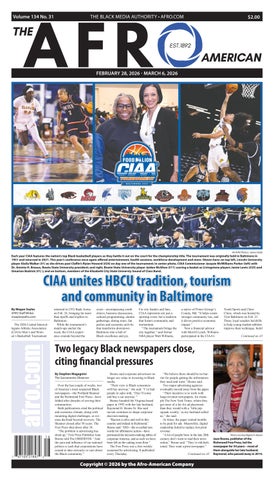
Each year CIAA features the nation’s top Black basketball players as they battle it out on the court for the championship title. The tournament was originally held in Baltimore in 1951 and returned in 2021. This year’s conference once again offered entertainment, health sessions, workforce development and more. Shown here: on top left, Lincoln University player Alaila Walker (#1) as she drives past Claflin’s Ryian Howard (#24) on day one of the tournament; in center photo, CIAA Commissioner Jacquie McWilliams Parker (left) with Dr. Aminta H. Breaux, Bowie State University president; and right, Bowie State University player Jaiden McGhee (#11) scoring a basket as Livingstone players Jamie Lewis (#25) and Omarion Bodrick (#1) ); and on bottom, members of the Elizabeth City State Universty Sound of Class Band.
CIAA unites HBCU tradition, tourism and community in Baltimore
By Megan Sayles AFRO Staff Writer msayles@afro.com
afro.com
The 2026 Central Intercollegiate Athletic Association (CIAA) Men’s and Women’s Basketball Tournament
returned to CFG Bank Arena on Feb. 24, bringing far more than tipoffs and trophies to Baltimore. While the tournament’s match-ups anchor the week, the CIAA experience extends beyond the
court—encompassing youth clinics, business discussions, cultural programming, alumni gatherings, dining tours, fan parties and economic activity that transforms downtown Baltimore into a hub of Black excellence and joy.
For city leaders and fans, CIAA represents not just a sporting event, but a tradition that fosters community and momentum. “The tournament brings the city together,” said former NBA player Walt Williams,
a native of Prince George’s County, Md. “It helps create stronger community ties, and it drives positive economic impact.” Now a financial advisor with Merrill Lynch, Williams participated in the CIAA’s
Youth Sports and Cheer Clinic, which was hosted by Visit Baltimore on Feb. 21. There, local coaches led drills to help young student-athletes improve their technique, build Continued on A5
Two legacy Black newspapers close, citing financial pressures By Stephen Magagnini The Sacramento Observer Over the last couple of weeks, two of America’s most respected Black newspapers—the Portland Skanner and the Richmond Free Press—have folded after decades of serving their communities. Both publications cited the political and economic climate, along with mounting digital challenges, as revenue declined beyond recovery. The Skanner closed after 50 years. The Free Press shut down after 34. “The problem is advertising has dried up,” Free Press Publisher Jean Boone told The OBSERVER. “And the aura and influence of our national politics is such that corporations have ceased to take seriously or care about the Black community.”
Boone said corporate advertisers no longer see value in investing in Black media. “Their view is Black consumers will buy anyway,” she said. “I’ve had people in sales told, ‘They’ll come and buy a car anyway.’” Boone founded the Virginia-based paper in 1992 with her late husband, Raymond H. Boone Sr. She said racism continues to shape corporate decision-making. “Racism is alive and well in this country and indeed in Richmond,” Boone said. “DEI—the so-called new words for affirmative action—have permeated the decision-making tables of corporate America, and as such we have been left on the cutting room floor.” The Free Press was a free weekly sustained by advertising. It published every Thursday.
“We believe there should be no barrier for people getting the information they need and want,” Boone said. Two major advertising agencies eventually moved away from the paper. “Their incentive is to work with large-revenue newspapers, for example The New York Times, where they get more of a fee for ad placement than they would with a ‘little pipsqueak weekly,’ as my husband called us,” she said. At times, the paper waited months to be paid for ads. Meanwhile, digital readership failed to replace lost print revenue. “A lot of people born in the late 20th century don’t want to read their news online,” Boone said. “They’re old-fashioned. They want a print newspaper.” Continued on A5
Copyright © 2026 by the Afro-American Company
Photo courtesy Regina H. Boone
Jean Boone, publisher of the Richmond Free Press, led the newspaper for 34 years—most of them alongside her late husband, Raymond, who passed away in 2014.