Magazine ...A Publication of The African Leadership Organization
Ken Giami Founder & Executive Chairman King Richard Igimoh Group editor King.richards@africanleadership.co.uk Associate Editor Blessing Ernest Staff Writers Blossom Ukoha Joshua Mohammed Solomon Obi Country Representatives Muna Jallow The Gambia & Senegal
Furo Giami Chief Operating Officer / Executive Director Alison Kingsley-Hall Group Head, Strategy & Partnerships Ehis Ayere Group General Manager Ngozi Nwokolo Executive Assistant to the Chairman Samuel M. Elaikwu General Manager Africa Office Happy Bension Director of Operations, North America
Meresia Aloo Kenya
Christy Ebong Head, Research & Admin - North America
Janet Abena Quainoo Ghana
Stanley Emeruem Head of Sale and Business Development
Editorial Board Peter Burdin London UK - Chair Nwandi Lawson Atlanta USA - Member Simon Kolawole Lagos Nigeria - Member Peter Ndoro SABC Editor Johannesburg - Member Frenny Jowi Nairobi Kenya- Member Brig. Gen. SK Usman Rtd Abuja Nigeria - Member David Morgan Washington DC USA- Member
Kembet Bolton Business Development Manager Oluwatoyin Oyekanmi Head, South African Bureau Benard Adeka Head, Nigeria SS/SE Simon Ugwu Group Head of Events Digital Media Team Abayomi Israel Alalade Deborah Olajuwon Gaawa Barivule God’slove Creatives & Graphics John Mutum Ayeni Victor Adegbola Adeiza Okatenwu
CORPORATE HEADQUARTERS
AFRICAN & REGIONAL REPRESENTATIVE OFFICES
3rd Floor, The News Building 3 London Bridge Street London SE1 9SG United Kingdom
Abuja ■ Accra ■ Atlanta ■ Banjul ■ Bujumbura ■ Freetown ■ Johannesburg ■ London ■ Monrovia ■ Nairobi ■ Washington DC
T: +44 20 3051 1883 E: info@africanleadership.com
....Identifying, Celebrating & Enabling Excellence in Africa
www.africanleadershipmagazine.co.uk
ISSN 2006 - 9332 While great care has been taken in the receipt and handling of materials, production and accuracy of content in the magazine, the publisher will not take responsibility for views expressed by the writer
JOIN THE CONVERSATION www.africanleadershipmagazine.co.uk
FOLLOW US ON SOCIAL MEDIA Facebook: African Leadership Magazine X: @AfricanLM Instagram: @Africanleadershipmag Linkedin: African Leadership Magazine Youtube: African Leadership Magazine
FROM THE PUBLISHER’S
Desk Dr. Ken Giami
Founder, African Leadership Magazine UK
AfCFTA Vs. United States of Africa There’s been renewed talk about a “United States of Africa.”
Right now, Africa has over 1.3 billion people and a combined GDP of about $3.4 trillion. We also have AfCFTA, the largest free trade area in the world. The potential is huge. But the numbers tell a different story. Only about 16% of Africa’s total trade happens within Africa. In Europe, that number is around 68%. In Asia, it’s about 59%
Before we talk about unification, let’s focus on something more urgent: how we treat each other, how we trade with each other, and how we work together. Right now, Africa has over 1.3 billion people and a combined GDP of about $3.4 trillion. We also have AfCFTA, the largest free trade area in the world. The potential is huge. But the numbers tell a different story. Only about 16% of Africa’s total trade happens within Africa. In Europe, that number is around 68%. In Asia, it’s about 59%. AfCFTA changes this. It cuts tariffs on up to 90% of goods. It reduces border delays. It pushes for easier movement of services and investments. If we follow through, World Bank data shows we increase intra-African trade by more than 100% and lift over 50 million people out of poverty by 2035. Incomes rise by nearly 9%. Women see even bigger wage gains than men.
This isn’t abstract. It means more factories, more farms feeding other countries, more services crossing borders. It means more jobs. More dignity. But none of that happens by accident. You need to break down old barriers. You need better roads, rail, and ports. You need fair policies that don’t punish cross-border businesses. You need to treat other Africans as partners, not competitors. Unity is not just a political slogan. It’s a daily practice of respect, trade, and collaboration. If we don’t trade with each other, how do we claim we are united? If we don’t care about each other’s growth, how do we talk about one flag? The question is not whether we form a single political union today. The question is whether you and I, as leaders, entrepreneurs, and citizens, will choose collaboration over isolation. Will we choose action over rhetoric? Africa has the tools. AfCFTA is one of them. Now you decide how to use it.
4 | African Leadership
www.africanleadershipmagazine.co.uk | 5
TABLE OF CONTENTS 08 South Africa’s Youth Unemployment Crisis: Has Anything Changed?
18 We are Building Akwa Ibom as a First Class Investment Destination - Gov. Eno
22
26 UK Export Finance Supports Africa’s Growth Potential
44 Africa’s Green Opportunity
48
38
Public-Private Partnership as a Critical Development Driver
60 The Next Superpower isn’t a Country, it is Africa’s Youth
76 6 | African Leadership
30
14
34 78 54 64
The Leasing Trap: Is Africa Selling Tomorrow to Build Today?
www.africanleadershipmagazine.co.uk | 7
| BUSINESS/ECONOMY FINANCE LEADERSHIP
SOUTH AFRICA’S YOUTH UNEMPLOYMENTAN APARTHEID LEGACY? By Dr. Corey Holmes
8 | African Leadership
BUSINESS/ECONOMY |
Dr. Holmes with students at a 2018 South African youth event in Tembisa, South Africa
The Persistent Challenge Thabo Mabena, 24, sits on a plastic chair outside a crowded employment centre in Johannesburg’s bustling central business district. It’s his third visit this week. “I graduated two years ago with a business degree,” he says, scrolling through job listings on his phone. “My parents sacrificed everything for my education, but here I am— still looking.” Thabo’s story is distressingly common in South Africa, where youth unemployment has remained a stubborn challenge despite the country’s position as one of Africa’s largest economies. In 2024, the youth unemployment rate hovered around 56 per cent—up from 52.5 per cent a decade earlier. The situation presents a stark paradox: How does a country with the continent’s most developed financial sector, world-class universities, and numerous entrepreneurial support programmes still struggle to provide meaningful work for its young people? A Crisis Decades in the Making South Africa’s youth unemployment crisis isn’t new—it’s a persistent challenge that has outlasted multiple presidential administrations and economic plans. The roots stretch back to the apartheid era, when systematic education inequality created vastly different opportunities based on race.
Thabo’s story is distressingly common in South Africa, where youth unemployment has remained a stubborn challenge despite the country’s position as one of Africa’s largest economies. In 2024, the youth unemployment rate hovered around 56 per cent—up from 52.5 per cent a decade earlier
“When we examine the unemployment statistics closely, we still see the legacy of apartheid educational disparity,” says Dr Nomalanga Khumalo, an economist at the University of Johannesburg. “The technical skills gap remains pronounced along racial lines, with Black South African youth facing the highest barriers to employment.”
www.africanleadershipmagazine.co.uk | 9
| BUSINESS/ECONOMY
the Gauteng Youth Employment Initiative. “From domestic violence to periodic xenophobic incidents, the frustration of joblessness manifests in troubling ways.” New Approaches for a New Decade What’s changed in recent years is how both government and private sector are approaching the problem. After decades of treating symptoms rather than causes, new initiatives are targeting the structural issues behind youth unemployment. Digital Skills Revolution
Post-apartheid South Africa has made significant investments in education. Government financial aid for higher education grew from R40 million supporting 40,000 students in 1995 to over R20 billion supporting more than 200,000 beneficiaries in 2024. Yet these investments haven’t translated into proportional employment gains.
Post-apartheid South Africa has made significant Beyond the Statistics investments The expanded definition of in education. unemployment in South Africa includes Government financial discouraged job seekers—those who have given up looking for work. This aid for higher presents a more complete but grimmer education grew picture than official statistics. from R40 million Many experts now recognise that supporting 40,000 the unemployment crisis has social students in 1995 consequences beyond economic to over R20 billion indicators. Gauteng Province—South supporting more than Africa’s economic powerhouse—has 200,000 beneficiaries seen these effects firsthand. in 2024 “There’s a clear correlation between youth unemployment and social instability,” says Sipho Nkosi, director of
10 | African Leadership
The pandemic accelerated South Africa’s digital transformation, creating new opportunities in the tech sector. Government-backed coding bootcamps have trained over 50,000 young people since 2022, with 65 per cent finding employment within six months of completion. “We’ve moved beyond basic computer literacy to teaching marketable skills like mobile app development, data science, and digital marketing,” says Lesedi Moloi, who runs a tech incubator in Soweto. “Young people who couldn’t find traditional employment are now freelancing for clients around the world.” Agricultural Renaissance Agriculture, once considered an unattractive career path for educated youth, is experiencing renewed interest thanks to technological innovation and climate-smart approaches. “We’re showing young people that modern farming isn’t just about physical labour—it’s about drones, precision agriculture, and sustainable practices,” explains Thulani Dlamini of AgriFuture SA. The organisation has helped establish over 1,000 youth-led agricultural enterprises since 2023. This shift aligns with continental trends. The African Union’s Agenda 2063
BUSINESS/ECONOMY |
identifies agriculture as a key driver for socio-economic transformation, with the sector’s market value projected to reach $1.5 trillion by 2030. Rethinking Education The #FeesMustFall movement of the late 2010s forced a national conversation about education accessibility. This has evolved into deeper questions about curriculum relevance. “We’re finally addressing the mismatch between what universities teach and what employers need,” says Education Minister Lindiwe Sisulu. Recent reforms have increased industry involvement in curriculum design and expanded vocational training options. Universities now offer more flexible credentialling, allowing students to earn stackable certificates rather than committing to full degree programmes that might not match market demands. Continental Collaboration The African Continental Free Trade Area (AfCFTA), fully operational since 2023, has created new possibilities for addressing unemployment through cross-border co-operation. “We’re seeing young South Africans collaborate with peers in Kenya’s tech sector and Nigeria’s entertainment industry,” notes economic analyst Mandla Ntombela. “This continental integration is creating opportunities that weren’t possible when each country operated in isolation.” Digital platforms now connect African talent with continental opportunities, allowing South African youth to work remotely for companies across Africa. Persistent Challenges Despite these innovations, significant obstacles remain. Economic growth has been sluggish, hampered by
energy challenges and global economic headwinds. The formal economy simply isn’t generating enough jobs to absorb the growing youth population. Gender disparities persist as well. Young women face unemployment rates approximately 8 per cent higher than their male counterparts, highlighting the need for gender-responsive employment solutions. “We still haven’t addressed the patriarchal dynamics that limit women’s economic participation,” says gender equality advocate Nomzamo Radebe. “Any solution to youth unemployment must specifically address the barriers facing young women.” Moving Forward What’s becoming increasingly clear is that no single approach will solve South Africa’s youth unemployment crisis. The most promising developments combine technological innovation, educational reform, entrepreneurship support, and social safety nets.
What’s becoming increasingly clear is that no single approach will solve South Africa’s youth unemployment crisis. The most promising developments combine technological innovation, educational reform, entrepreneurship support, and social safety nets
www.africanleadershipmagazine.co.uk | 11
| BUSINESS/ECONOMY
“The solution isn’t just about creating jobs—it’s about creating a society where young people can thrive,” says Thembinkosi Ncube, who runs a youth empowerment organisation in Alexandra township. For Thabo Mabena, still waiting at the employment centre, these broader discussions feel distant from his immediate reality. But he remains cautiously hopeful. “I’ve started an online course in digital marketing while I look for work,” he says. “My parents didn’t have these kinds of opportunities when they were young. Maybe that’s progress.” As South Africa navigates the complexities of the global economy in 2025, the question remains whether these new approaches will finally make meaningful inroads into a problem that
12 | African Leadership
has defied solution for generations. The answer will shape not just individual lives but the future of Africa’s most industrialised nation. Dr. Corey W. Holmes is a foreign affairs expert and educator with extensive experience in diplomatic relations, working with the Department of State, USAID, USAGM, and the House Foreign Affairs Subcommittee on Africa, Global Health, and Global Human Rights, where he drafted legislation and shaped policy communications. As a Fulbright and Boren alumnus, Dr. Holmes has also contributed to numerous publications, including the London School of Economics blog, and various South African magazines, newspapers, and academic journals. His writing style combines scholarly insight with practical wisdom, making complex ideas accessible and applicable to everyday life.
As South Africa navigates the complexities of the global economy in 2025, the question remains whether these new approaches will finally make meaningful inroads into a problem that has defied solution for generations
INTRA-AFRICA |
www.africanleadershipmagazine.co.uk | 13
| COVER FINANCE LEADERSHIP
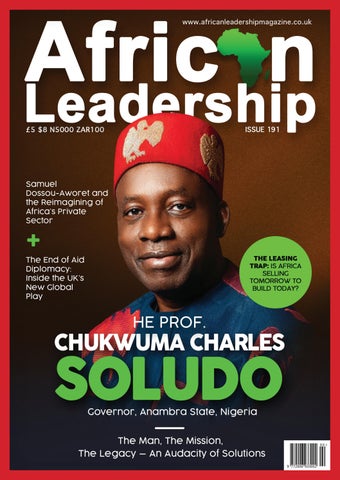
SOLUDO: THE MAN, THE MISSION, THE LEGACY — AN AUDACITY OF “SOLUTIONS” By Blessing Ernest
14 | African Leadership
COVER |
From the village of Isuofia in Aguata, Anambra State, emerged a man intent not merely on personal advancement but on reshaping public possibility. Prof. Chukwuma Charles Soludo CFR—economist, reformer, scholar, statesman—has forged a career that pairs technical rigor with a practical insistence on results. This account traces the arc of his life: formative years, monetary reform at the Central Bank of Nigeria, an extended public-policy role, and the experiment of governing Anambra State. Above all it assesses the measure of his work: are the solutions he proposes audacious—and do they endure? Soludo’s childhood was shaped by the dislocations of the Nigerian Civil War, including the loss of his mother at an early age. Born on 28 July 1960 in Isuofia, those early privations did not blunt ambition; they hardened a resolve to convert adversity into purpose. At Uga Boys High School he rose to senior prefect; at the University of Nigeria, Nsukka, he graduated with First Class Honours in Economics and completed a prize-winning doctorate. From the outset his interest was systemic: how institutions, rules and incentives distribute risk and reward across society. That analytic bend carried him quickly into international scholarly and advisory circles. He served as a visiting scholar at Cambridge, Warwick, Oxford and Swarthmore; consulted for the IMF, World Bank and UNECA; and advised national governments and technical committees. That blend of scholarship and practical counsel would prove central to his later roles. Appointed Governor of the Central Bank of Nigeria (CBN) on 29 May 2004, Soludo inherited a financial sector that many analysts described as brittle: a profusion of small, undercapitalised banks; low foreignexchange reserves; episodic inflation; and weak prudential standards. His approach was unapologetically structural—reshape institutions so they can perform under stress. A first, signature move was banking consolidation. Soludo mandated recapitalisation; smaller, undercapitalised banks merged or were absorbed, producing a leaner sector of stronger institutions. The policy aimed to reduce systemic fragility and limit contagion when shocks occurred. At the same time his administration strengthened oversight: risk-based supervision, improved governance practices, and a stricter approach to non-performing loans. Those changes were not purely technical: they recalibrated investor confidence and market expectations. On reserves and macro stability, his term coincided with a substantial accumulation of external reserves (from the order of US$10 billion toward higher levels by the end of the decade, per CBN reporting) and periods when inflation retreated into single digits. International recognition followed: awards and citations for central-bank leadership underscored that his reforms had both domestic impact and external credibility.
From the village of Isuofia in Aguata, Anambra State, emerged a man intent not merely on personal advancement but on reshaping public possibility. Prof. Chukwuma Charles Soludo CFR— economist, reformer, scholar, statesman— has forged a career that pairs technical rigor with a practical insistence on results. This account traces the arc of his life: formative years, monetary reform at the Central Bank of Nigeria, an extended public-policy role, and the experiment of governing Anambra State
That said, the consolidation and regulatory tightening were not without controversy. Critics argued that some measures were heavy-
www.africanleadershipmagazine.co.uk | 15
| COVER
handed and that consolidation had distributional effects on ownership and competition. A balanced appraisal must recognise both the stabilising outcomes and the legitimate questions about process and consequences. After leaving the CBN, Soludo did not retreat into academe alone. He remained active in national and continental policy circles— as chief economic adviser in various capacities; chair and member of planning, finance and trade committees; co-founder of initiatives such as the Africa Finance Corporation; and participant in UN and international commissions. His public voice combined technical prescriptions with an insistence that policy must translate into infrastructural and social outcomes—roads, schools, water systems—rather than remain an exercise in abstract modelling. T h i s p h a s e o f h i s c a re e r consolidated his reputation as a technocrat who believed in the politics of delivery: expertise without a demonstrated capacity to improve lives, he argued, is incomplete. That framing would become central to his later political platform. The Mission in Anambra: From Solving Problems to Building Legacies When Soludo contested and won the governorship of Anambra State in November 2021 (sworn in March 2022), the central question was practical: could the economist translate macro prescriptions into municipal realities? His People’s Manifesto—the Soludo Solution— set out five pillars: Security and Law & Order; Infrastructure and Economic Transformation; Human Capital and Social Agenda; Governance and Value System; and Environment and Urban Regeneration.
16 | African Leadership
Infrastructure and urban renewal. The administration moved quickly to prioritize roads and urban works: over 750 kilometres of projects were awarded and roughly 400 kilometres reportedly completed, including dual carriageways, flyovers (notably in Ekwulobia), and innercity dualisation in Awka, Onitsha and Nnewi. Slum-upgrading and targeted drainage works in dense settlements such as Okpoko aimed at immediate quality-of-life improvements. Utilities and environment. The state invested in rehabilitating water schemes to restore piped supply in several communities and deployed
large-scale solar streetlighting— more than 26,000 units—moving away from diesel-dependent fixtures. Waste-management initiatives and greening projects accompanied the utility works, while civic areas such as the Three Arms Zone received upgrades. Health, education and human capital. The administration introduced free education through senior secondary schooling, recruited more than 8,100 teachers and embarked on broad school rehabilitation. In health, new facilities were constructed and existing centres expanded, with an emphasis on maternal and antenatal care.
COVER |
Security and governance innovation. The “Agunechemba” security architecture, passage of the Homeland Security Law, efforts to dismantle criminal camps, and investment in technologyaided surveillance signalled a commitment to restore public safety. Administrative reforms—judicial automation, virtual hearing facilities and greater budgetary prioritisation of capital expenditure—sought to modernise governance and raise the share of long-term investment to the forefront (reported capital-torecurrent spending ratios of 70–77% were presented as evidence of this shift). Economic transformation. The launch of the Anambra Mixed-Use Industrial City (AMIC), logistics and SME hubs, and a Solution Innovation District for digital training reflect a strategic tilt toward industrialisation and job creation. Seed-capital schemes and investor facilitation efforts aim to convert human capital investments into employment. Across these interventions, an explicit policy choice stands out: the administration has sought to mobilise internal revenues and reallocate expenditure rather than rely on fresh borrowing. Delivering sizeable projects within that fiscal envelope is portrayed as a demonstration of discipline—and of a different path to subnational development. Evaluating legacy at this stage requires nuance. Soludo’s record contains durable strengths: institution-building in both the financial and subnational governance spaces; a demonstrated capacity to combine technical design with operational delivery; and a consistent rhetorical emphasis on accountability and planning. Where many leaders default to ad-hoc projectism,
Soludo has pushed long-range i n s t r u m e n t s — t h e 5 0 - Ye a r Development Plan being the most explicit example—that aim to link immediate works to generational outcomes. Equally important has been the attempt to fuse competence with ethics. Fiscal prudence, when paired with investments in education and health, suggests a governance orientation that treats public finance not as an end in itself but as the means to expand opportunity. His international engagements further allow him to translate local experience into broader policy lessons for the continent. Soludo’s experiment holds several practical lessons for other African leaders. First, fiscal discipline combined with targeted capital investment can yield visible outcomes without defaulting to unsustainable debt. Second, institutional reform—banking regulation, judicial automation, procurement discipline—is not technocratic trivia; it alters incentives and magnifies impact. Third, local engagement and services— schools, roads, water—are the glue of legitimacy. And finally, vision matters: a coherent medium- to long-term plan reduces the risks of political discontinuity and improves investor confidence. These lessons are not panaceas. They depend on context, political will, and administrative capacity. Yet they point to a pragmatic, evidenceoriented model of public leadership that privileges measurable outcomes over empty rhetoric. Prof. Chukwuma Charles Soludo CFR should be assessed on two registers: the ideas he has advanced, and the infrastructure of delivery those ideas have produced. From Isuofia to international forums, his career illustrates a conviction that leadership must generate both
frameworks and tangible public goods. His policies—whether at the CBN or in Anambra—have sought to marry intellectual clarity with operational realism. If posterity judges leadership by the durability of institutions and the quality of everyday life for citizens, then Soludo’s work merits careful attention. His audacity is neither theatrical nor purely ideological; it is an insistence that solutions must be designed to work in the world. That insistence, and the capacity to implement it, may be his most consequential contribution to contemporary African governance. Commander of the Order of the Federal Republic (CFR), scholar of international repute, economic architect, and elected governor: Prof. Chukwuma Charles Soludo remains a central figure in debates about how technical competence and public purpose can combine to change outcomes. From village origins to state projects and global podiums, his story is a working case for the audacity of solutions.
Newly commissioned 12.8 km Mmiata Anam - Nzam road in Anambra West Local Government Area
www.africanleadershipmagazine.co.uk | 17
| COVER FINANCE LEADERSHIP
PROFESSOR CHUKWUMA CHARLES SOLUDO CFR: AN AFRICAN GIANT RENEWED 18 | African Leadership
COVER |
Chukwuma Charles Soludo is a figure whose career bridges the technical and the political, the national and the global. An economist with deep expertise in macroeconomic management and development finance, he has moved with equal authority through the corridors of international institutions and the halls of Nigerian governance. From his years at the Central Bank to his leadership in Anambra State, Soludo’s work has been shaped by a conviction that African development requires both urgency and imagination—a willingness to confront entrenched challenges while designing systems capable of leapfrogging historical constraints. In his vision, governance is not merely the administration of public resources; it is the active creation of opportunity, the cultivation of human capacity, and the careful orchestration of change that can be sustained over time. At the International Forum on African-Caribbean Leadership / Global Power Forum in New York, Soludo’s recognition as African Governor of the Year signals a model of 21st-century African leadership: rigorous in thought, bold in imagination, steadfast in principle, attentive to the demands of governance, and attuned to the interplay between global engagement and local realities. African Leadership Magazine sat down with him during an exclusive interview to explore his approach to governance, the ambitious initiatives under way in Anambra, and his broader vision for African development. As a globally respected economist and former governor of the Central Bank of Nigeria, Soludo brings a wealth of experience into governance. Reflecting on his background, he said, “My background is multidisciplinary—macroeconomics, banking and finance, monetary economics, development economics, trade and
Chukwuma Charles Soludo is a figure whose career bridges the technical and the political, the national and the global. An economist with deep expertise in macroeconomic management and development finance, he has moved with equal authority through the corridors of international institutions and the halls of Nigerian governance
www.africanleadershipmagazine.co.uk | 19
| COVER
vigorous implementation of that plan gave Nigeria debt relief. A year later, I moved to the Central Bank, where we implemented a 30-point agenda, the most prominent being the consolidation of the banking system, which changed the history of banking in Nigeria.”
Human capital development has been another focus. Soludo detailed, “Within the first nine months, we recruited 5,000 teachers, followed by another 3,115, making a total of 8,115. We offer free primary and secondary education. Enrolment in our primary schools shot up by about 27%, giving Anambra the lowest out-of-school rate at 2.9% 20 | African Leadership
industrialisation. I spent quite a bit of my career traversing the world and consulting. I was a consultant for about 21 international organisations prior to getting into government in 2003. There are very few international financial and development institutions I did not consult for. I traversed 45 countries, lived in Ethiopia for 14 months at the UN Economic Commission for Africa, lived in the UK at Cambridge, Oxford, Warwick, and in the US, at Brookings, the World Bank, IMF, and was a visiting professor at Swarthmore College. My focus has always been African development, African economic transformation, trade, and finance.” Soludo’s entry into government was catalysed by a desire to apply this international experience to national and subnational transformation. “I was headhunted to join President Obasanjo first as his chief economic adviser, next as head of the National Planning Commission, under which I coordinated a team that produced the NEEDS— National Economic Empowerment and Development Strategy for Nigeria. The
When asked about applying this background at the subnational level, Soludo explained, “I knew there was work to be done here. I never initially thought about it until people said, ‘If you’ve flourished at the national level, why not offer service at the state level?’ Here I am today. Our vision has been transforming Anambra into a liveable and prosperous smart megacity. Over the last three and a half years, we’ve focused on five major programme areas: security, law and order; infrastructure and economic transformation; human capital and social development; reforming government through technology and institutional change; and environmental sustainability.” Asked to identify his most transformative achievements, Soludo was emphatic: “All of them. None can run sustainably without the other. When I came in, eight local governments were largely under the grip of non-state actors. We largely liberated the state and restored law and order. In terms of infrastructure, our roads were impassable; the state was unkempt. We now have over 850 kilometres of roads awarded, with more than 564 kilometres completed. We’re dualising over 150 kilometres and have mapped out trunk highways for the future. We are planning rail networks and enhancing water transportation. Urban regeneration is ongoing. Places like Ekwulobia and Okpoko, once desolate and chaotic, have been transformed with streets, flyovers, hospitals, and organised markets.” On economic transformation and agriculture, Soludo emphasised tangible empowerment: “We have distributed 2.6 million seedlings of improved palm and coconut varieties. This is designed to
COVER |
have social and economic impact. A poor household that gets 10 or 15 seedlings can be permanently lifted out of poverty. We are creating a new industrial ecosystem around agriculture. At the same time, we are investing in technology. The Solution Innovation District, a 30-hectare tech hub, will become Africa’s Silicon Valley. Already, over 30,000 youth have received training in coding and basic tech skills, and thousands are being empowered as entrepreneurs through our ‘One Youth, Two Skills’ programme.” Human capital development has been another focus. Soludo detailed, “Within the first nine months, we recruited 5,000 teachers, followed by another 3,115, making a total of 8,115. We offer free primary and secondary education. Enrolment in our primary schools shot up by about 27%, giving Anambra the lowest outof-school rate at 2.9%. In health, we have five brand-new general hospitals, free antenatal and delivery services including caesarean operations. So far, 169,000 women have benefited. The public sector now provides about 73% of health services, a dramatic shift from the previous 25%.”
He also highlighted governance reforms and technology deployment: “The land registry was chaotic. With the Anambra Geographic Information Service, what used to take eight months or more to transfer titles can now be done in days. Our target is 72 hours. We are systematically changing the way government operates and using technology to enhance efficiency and transparency.” Regarding welfare and citizens’ livelihoods, Soludo described a philosophy he calls “productive and sustainable stomach infrastructure.” He explained, “We don’t just give people fish; we teach them to fish. Training 5,000 youths, giving them start-up funds and mentorship, creates employers of labour, not lifelong dependants. Retirees owed years of gratuities have been paid; free education and healthcare put money back into households. When you implement initiatives like the palm and coconut distribution, employ thousands of teachers and health professionals, and maintain a massive construction agenda, you create economic activity and income for citizens. That is the kind of sustainable, productive welfare we are pursuing.”
Governor Soludo’s vision for Anambra is ambitious and longterm. “We want to turn Anambra from a departure lounge to a destination. We are building new cities, an industrial city, an aerotropolis with an airport, entertainment, trade, and housing. Onitsha is being reimagined as a sustainable commercial hub. We are intentionally planning for centuries to come, infusing life into dead cities, developing infrastructure, human capital, technology, and industrialisation simultaneously. This is the future we are delivering.” Throughout the interview, it became clear that Soludo views governance as both a science and a craft, informed by rigorous knowledge, global experience, and a sense of urgency. “Africa is a continent in a haste,” he says. “We need to run at a thousand kilometres per hour. Time is short, and lost generations cannot wait. We are intentionally leapfrogging on multiple fronts simultaneously, and the results are tangible and ongoing.”
Governor Soludo’s vision for Anambra is ambitious and long-term. “We want to turn Anambra from a departure lounge to a destination. We are building new cities, an industrial city, an aerotropolis with an airport, entertainment, trade, and housing
www.africanleadershipmagazine.co.uk | 21
| COVER FINANCE LEADERSHIP
BLACK BRITISH LEADERSHIP AND INSTITUTIONAL REPRESENTATION CHALLENGES By Blessing Ernest
22 | African Leadership
COVER |
At no other time in the history of Britain have the nation’s institutions, from the House of Commons to the House of Lords, from the bar to the wards of the National Health Service, witnessed such a visible presence of African heritage. These numbers, impressive as they are, only tell part of the story. On the far side of statistics, we see the possibility of what those who occupy the chambers of power signify for Britain’s moral imagination, and, perhaps most critically, for the younger generations of African descent looking on. Consider the optics. Where once Black Britons were absent, or present in a token and isolated fashion, today the seats of Parliament feature a cohort of Black MPs and peers, many of whom bring to bear the complex inheritance of their diasporic experience. Their presence radiates outward, refracting into the worlds of medicine, law, academia, and business, where African heritage professionals are increasingly assuming positions of responsibility and influence. Britain’s institutions, long the preserve of a particular hue, now reveal, however imperfectly, the many realities of a country transformed by migration and globalisation. But what does representation mean in practice? Here, caution is warranted. To celebrate representation without asking what it enables is to risk superficiality. The truer significance lies in how presence translates into power, how visibility opens doors not only for those who have already crossed the threshold, but for those waiting, watching, and wondering whether their dreams are legitimate. The symbolic dimension of representation cannot be overstated. A Black child in Birmingham watching Diane Abbott, David Lammy, or Abena Oppong-Asare debate on the floor of the Commons receives more than a civics lesson. She receives confirmation that the political sphere — that most hallowed of British institutions — is not off-limits to her. The sight of a Ghanaian-born barrister like Dame Linda Dobbs, the first non-white High Court judge, or a Nigerian-British public health leader like Professor Kevin Fenton, shatters centuries of social conditioning which whispered, insistently, that some spaces were not designed with Black bodies in mind. When Abbott became the first Black woman elected to the Commons in 1987, she broke a barrier that now allows successors like Florence Eshalomi or Bell RibeiroAddy to step forward without apology. Likewise, Paul Boateng’s appointment as Britain’s first Black Cabinet minister in 2002 and Baroness Valerie Amos’s trailblazing service both at home and in the United Nations widened the aperture of British leadership.
For Africa to capture more of the value from its natural endowment, governments and businesses must prioritise industrial policies and investments that push beyond resource extraction
Representation, then, functions as an imaginative catalyst. It legitimates aspiration. It permits the young African-British student to see himself as a possible judge of the High Court, or as a policymaker
www.africanleadershipmagazine.co.uk | 23
| COVERHIP
Zambia and the Democratic Republic of Congo (DRC), under a joint initiative, are exploring the creation of regional battery production hubs, an idea that could gain traction with strategic financing and partnerships
24 | African Leadership
shaping the levers of government. The wall of invisibility, once so high, is now fissured. To that extent, the present moment is nothing short of revolutionary.
Visibility, here, intersects with empathy: representation in these professions can catalyse changes in practice and policy that reverberate beyond the symbolic.
Yet it would be naïve to equate presence with power, or to confuse visibility with transformation. The deeper question is what those who now find themselves in these chambers do with their hardwon access. Representation becomes consequential only when it is married to responsibility: the responsibility to ensure that doors once closed remain permanently ajar; the responsibility to serve not only personal ambition, but communal uplift; the responsibility to translate symbolic breakthroughs into substantive policy and institutional reform.
At the same time, representation imposes a certain dual burden on its bearers. To be a Black leader in Britain today is to be asked, simultaneously, to represent the universality of the institution one serves and the particularity of the community from which one hails. It is to be called upon to speak for “all Britons” while never being allowed to forget one’s blackness. This tension is not easily resolved, but it must be navigated with wisdom. For in this very tension lies the possibility of forging a new, more expansive definition of Britishness — one that reconciles heritage with belonging, difference with solidarity.
History is replete with cautionary tales of elites who, upon entering the citadel, pull up the ladder behind them. If Britain’s Black leaders are to avoid this fate, they must resist the temptation to become merely decorative — tokens of a multiculturalism that flatters the national conscience while leaving structural inequities intact. Their task is weightier: to broaden the conversation, to advocate for those whose voices remain unheard, to insist on a Britain whose inclusivity is not cosmetic but structural. That responsibility is not confined to politics. In the law, for example, the increasing number of Black barristers and judges has the potential to shift the culture of British jurisprudence. The Black defendant in the dock, long accustomed to facing an all-white bench, may begin to feel, however subtly, that justice is not synonymous with whiteness. The pioneering presence of Dame Linda Dobbs created a precedent for others, such as HHJ Anuja Dhir KC, the first person of colour to become a judge at the Old Bailey. In medicine, figures like Professor Kevin Fenton, who played a key role in the UK’s COVID-19 response, demonstrate how Black professionals in senior positions can shape national health outcomes.
The broader society, too, has a role to play. Representation becomes meaningful only when it is recognised and received by the polity. The public must be prepared to embrace the legitimacy of Black authority, whether in Parliament, the courtroom, or the hospital ward. For representation to yield its full fruit, it must be met with a societal imagination capacious enough to accommodate it. Britain must learn not merely to tolerate Black leadership, but to expect and embrace it as normative. One must not underestimate the psychological dividend of the present moment for Britain’s African diaspora. For decades, the narrative of exclusion — of ceilings made of glass and doors made of oak — was the dominant story. Today, there exists a counter-narrative: of breakthroughs, of persistence rewarded, of institutions slowly bending toward inclusion. For the young man of Nigerian heritage contemplating a career in politics, or the Somali girl aspiring to the bar, the sense that these are realistic ambitions rather than fanciful dreams is itself transformative. Hope, that most fragile of political currencies, is replenished.
COVER |
And yet, hope without vigilance is perilous. For while numbers have increased, structural inequities remain. The rate of stop-and-search, the racial pay gap, the differential in health outcomes, the underrepresentation at the very apex of corporate boards — these are stubborn reminders that representation is not the same as justice. Indeed, one danger of celebrating representation is that it may become a substitute for the harder, slower work of reform. A handful of prominent Black figures in high places cannot be permitted to obscure the inequities that persist in the lives of ordinary Black Britons. So the challenge before Britain’s new generation of Black leaders is clear: to embody not just the possibility of representation, but the promise of transformation. To use visibility as a lever for change. To move beyond symbolism to substance. Their mandate is twofold: to serve as models for the young, and to act as advocates for the marginalised. Anything less would be to squander the historical opportunity that their presence signifies. The stakes could hardly be higher. If Britain can harness the talents of its Black citizens, not as anomalies but as integral to its institutional fabric, it will model to
the world a version of democracy and inclusivity that is both principled and pragmatic. If it fails, it risks entrenching cynicism among younger generations, who may come to see representation as a hollow spectacle rather than a genuine opening. In the end, the meaning of representation is not for the represented alone to determine. It is for all of Britain to answer. For the country’s institutions are mirrors: they reflect back to society its own sense of who belongs. Today, that reflection is more diverse than at any previous moment. The task now is to ensure that the reflection is not fleeting, but enduring; not cosmetic, but constitutive. The sight of Black Britons in the chambers of power is inspiring, but inspiration is only the beginning. The true test lies in whether those sights translate into new realities: fairer policies, more inclusive institutions, broader opportunities for all. For Britain’s Black leaders, the moment is ripe with promise — and heavy with responsibility. Their charge is nothing less than to convert representation into transformation, visibility into justice, presence into power. That is the task. That is the hope. And that, ultimately, is the responsibility of leadership.
As the clean energy revolution unfolds, Africa has a rare opportunity to industrialise in a way that avoids the environmental pitfalls of earlier economic transformations. By prioritising renewable energy, sustainable mining practices and energy-efficient technologies, African nations can build industries that are cleaner, more competitive and socially inclusive
www.africanleadershipmagazine.co.uk | 25
| DIPLOMACY FINANCE LEADERSHIP
UK EXPORT FINANCE SUPPORTS AFRICA’S GROWTH POTENTIAL 26 | African Leadership
DIPLOMACY |
Infrastructure is often the most visible sign of the UK Export Finance’s (UKEF) presence in Africa. From railways to power plants, ports to schools, the projects that the UKEF supports are often where the developmental or trade benefits are most important. By taking on that risk, UKEF helps unlock projects that can transform markets, deepen value chains, and create new opportunities. For example, the $5 billion green hydrogen facility in Tanzania, a major UKEF-backed project announced in 2024, might have remained aspirational without risk mitigation. Because UKEF stands behind it, private investors, both British and international, have the confidence to follow. Africans gain jobs. Tanzanian authorities gain infrastructure. UK firms secure contracts. The story changes from a one-way delivery of aid to shared investment in progress. Beyond these transactions, each UKEF project sends a strong signal of credibility. When UKEF supports a project, it communicates confidence in governance, contracts, and delivery. That assurance matters in countries where international financiers can be cautious. According to UKEF’s 2023 annual report, the agency committed £8.6 billion to projects in Africa, with infrastructure, energy, and transport representing over 70% of these investments. These figures illustrate how significant its footprint has become, not as a donor, but as a partner in enabling sustainable development. What sets UKEF apart from traditional aid is that it is not a grant. It is not charity. It is a form of risk-sharing. African governments, British banks, investors, and UKEF all share in the potential benefits and the potential challenges of each project. This shared exposure encourages governments to deliver, safeguard resources, and see projects through successfully. By comparison, traditional donor aid sometimes created situations where underperformance went unchallenged or governments treated funds as soft money. UKEF’s approach means Africa is actively engaging with its own development. That shifts incentives across governance, accountability, and policy planning. In Nigeria, for instance, a solar electrification project backed by UKEF in 2023 required the government to implement a transparent power-purchase agreement with reliable off-takers. These conditions provided structure and stability, not imposed externally, but built into the investment framework. The state retains agency, guided by market accountability. According to a 2024 report by the Nigerian Ministry of Power, the project helped electrify 1.2 million households, directly creating over 7,000 jobs in installation, maintenance, and logistics. This approach matters not just for Africa, but also for Britain. Globally, competition for influence in Africa is growing. Chinese state-tostate loans, Indian investments, and U.S. partnerships all compete for attention. UKEF gives Britain a unique advantage. It is not cheap money, nor is it a tool for domination. Instead, it shows that the UK can offer capital, confidence, and collaboration. While some African governments may be able to access cheaper loans elsewhere,
Infrastructure is often the most visible sign of the UK Export Finance’s (UKEF) presence in Africa. From railways to power plants, ports to schools, the projects that the UKEF supports are often where the developmental or trade benefits are most important.
www.africanleadershipmagazine.co.uk | 27
| DIPLOMACY
UKEF offers distinct value. Legal frameworks, contract enforcement, and a track record of balancing market discipline with development goals make a crucial differentiator, especially when projects must meet environmental standards and financial scrutiny. The broader history is instructive. Britain’s post-colonial relationship with Africa was long shaped by aid frameworks that sometimes reinforced dependency narratives. UKEF represents a conscious departure from that pattern. It positions financial support within a structure that respects African agency. This is critical in a world where Africa’s demographic and economic weight is increasing. According to the African Development Bank, the continent’s population is projected to reach 2.5 billion by 2050, creating enormous demand for energy, transport, and infrastructure solutions. Partnering in that development, rather than prescribing it, is strategically and ethically important. UKEF also contributes to a broader shift in Africa–UK relations, framing the relationship as one of equals. Aid language often implies dependency. Export finance highlights partnership. Africa is not a passive recipient but an active participant in development. In Kenya, a port expansion financed with UKEF support in 2022 is commonly described as “Kenya‑Britain collaboration” rather than “British aid.” This change in narrative is subtle, yet powerful. Finance becomes a tool of dignity, allowing African states to guide their development on their terms. This distinction matters, particularly to the growing middle class across Africa, who are increasingly demanding accountability and meaningful participation in national development.
28 | African Leadership
Of course, this is not without challenges. Critics point out that loans can create debt pressures if gover nments overextend. Projects must be well-managed to avoid financial strain. Yet the solution is not to reject UKEF, but to ensure it aligns with African debt sustainability frameworks, transparent oversight, and project feasibility. This is part of maturing responsible lending practices, not a weakness in the system. According to the International Monetary Fund, countries that paired development finance with robust debt management frameworks experienced 30% fewer defaults in comparable project cycles. Looking ahead, three priorities can strengthen the impact of UKEF: 1. Co-design: African stakeholders should have a leading role in shaping projects, especially in areas like green energy or climate-sensitive sectors. 2. T r a n s p a r e n c y : UKEF commitments and African government obligations should be publicly accessible, helping citizens track progress and fiscal exposure. 3. Capacity-building: Export finance is most effective when paired with local expertise in underwriting, contracting, and project management. UKEF should partner with African institutions to build these skills. B e y o n d i m m e d i a t e p ro j e c t outcomes, the long-term effect of this approach is profound. By engaging African governments as co-investors rather than passive recipients, UKEF fosters a mindset of shared responsibility. Governments plan more rigorously, investors gain confidence, and citizens experience tangible benefits. The shift from aid to agency is not just semantic; it transforms how development is
conceptualized and executed. The story of UK Export Finance in Africa is about more than the billions committed. It is about a shift from charity to agency, from intervention to collaboration, and from donor‑recipient dynamics to shared ownership of development. In a global economy where influence is contested and Africa’s future is shaped by those who engage constructively, UKEF offers Britain a credible platform that respects sovereignty, shares risk, and supports delivery. When managed effectively, UKEF is not just a financing mechanism. It is a new beginning, one where Africa drives its own development, and Britain participates as a partner bound by trust, contracts, and shared vision. This is a moment when UK finance stops talking down to Africa, and starts building with Africa. In that shift, both continents find not just growth, but the dignity of true partnership.
FINANCE BUSINESS/ECONOMY LEADERSHIP |
www.africanleadershipmagazine.co.uk | 29
| HEALTH FINANCE LEADERSHIP
THE NATIONAL HEALTH SERVICE NEEDS AFRICAN EXPERTISE 30 | African Leadership
HEALTH |
When people talk about the National Health Service (NHS), they often describe it as Britain’s “crown jewel,” a system that has shaped national identity since 1948. But what is rarely acknowledged is that this jewel has been polished and sustained for decades by people who were not born in Britain. Among them, Africans have played an especially critical role. Doctors from Nigeria, nurses from Ghana, midwives from Zimbabwe, and carers from Uganda are not just filling gaps; they are the very backbone of the NHS. Now, a new policy threatens to change that. NHS England has been instructed to reduce its reliance on doctors trained abroad, part of a wider drive to build a “self-sufficient” health workforce. On paper, this sounds logical. Every country wants to train enough staff to meet its own needs. In practice, however, it risks sidelining the thousands of African-trained professionals who have kept the NHS running in difficult times. According to NHS England workforce discussions, the aim is to reduce the proportion of doctors recruited from overseas — currently about 34% — to under 10%, with greater priority given to UK graduates. This debate is about more than staffing numbers. It raises big questions about fairness, recognition, and the future of Britain’s relationship with its African diaspora. Walk into almost any hospital or GP surgery in the UK and you will encounter African professionals at every level. Recent figures show that around one in eleven NHS doctors comes from countries on the World Health Organisation’s “red list,” meaning nations already struggling with shortages of health workers. Nigeria, Ghana, and Zimbabwe are especially prominent. According to NHS Digital workforce statistics from November 2024, about 9% of all NHS doctors in England were nationals of these red-list countries. For many British families, the African nurse who looked after a parent, or the doctor who performed a life-saving procedure, is their most direct experience of the NHS at its best.
When people talk about the National Health Service (NHS), they often describe it as Britain’s “crown jewel,” a system that has shaped national identity since 1948. But what is rarely acknowledged is that this jewel has been polished and sustained for decades by people who were not born in Britain. Among them, Africans have played an especially critical role
Yet this contribution is rarely acknowledged in public debate. Instead, the presence of African staff is often described in terms of “dependency” or “over-reliance.” Such language reduces real people to statistics and obscures the fact that without these professionals, the NHS would already have buckled under pressure. Data from NHS England shows that 35% of NHS doctors and 28% of nurses are non-UK nationals. Britain has long benefited from recruiting African-trained doctors and nurses, often at the expense of health systems back home. Critics rightly point out that when African countries lose skilled professionals, their own populations suffer. But Britain cannot wish away its dependence simply by turning off the tap. The World Health Organisation’s
www.africanleadershipmagazine.co.uk | 31
| HEALTH
2023 safeguard list highlights 55 countries, including Nigeria, Ghana and Zimbabwe, as facing critical health workforce shortages.
The current policy push risks creating a lose-lose situation. On the one hand, it dismisses the contribution of Africans already working in the NHS, sending a message that their role is temporary or disposable. On the other hand, it does nothing to strengthen African health systems, which continue to lose staff without adequate compensation or partnership in return
The current policy push risks creating a lose-lose situation. On the one hand, it dismisses the contribution of Africans already working in the NHS, sending a message that their role is temporary or disposable. On the other hand, it does nothing to strengthen African health systems, which continue to lose staff without adequate compensation or partnership in return. Africans find themselves caught in the middle, celebrated as heroes one day, portrayed as part of the problem the next. This inconsistency not only undermines morale but also raises deeper questions about belonging and respect. There is also a very practical side to this debate. The NHS is already short of tens of thousands of staff, especially in nursing. Waiting times are at record highs. Emergency departments are overwhelmed. Restricting recruitment from Africa and other countries without fixing domestic training bottlenecks would only make things worse. As of March 2025, according to official NHS workforce statistics, the service reported a 6.7% overall vacancy rate. Within registered nursing, vacancies stood at 25,632, about 6.0% of the nursing workforce, an improvement on the year but still a serious gap. Simply put, Britain cannot train enough doctors and nurses fast enough to meet demand. Attempting to do so by reducing the number of African professionals is not just unfair, it is risky for patients. NHS England performance data shows that as of June 2025, 7.37 million treatment pathways were waiting, representing about 6.23 million patients still awaiting treatment. A policy that seeks to reduce reliance on African staff without a clear alternative risks harming the very people the NHS
32 | African Leadership
exists to serve. Of course, the concern for African countries is real. Nations such as Nigeria and Ghana invest heavily in training medical staff, only to see many leave for better pay and conditions abroad. The result is a double loss: struggling hospitals at home and families forced to travel overseas for care they cannot access locally. Britain cannot ignore this. A health partnership that drains African systems without giving back is unsustainable and unjust. Yet cutting off African recruitment altogether would not solve the problem either. It would punish diaspora professionals already in Britain without addressing the structural shortages in African countries. What is needed is a more balanced approach, one that recognises Britain’s dependence on African talent while also investing in Africa’s capacity to train and retain its own health workers. If Britain wants a fair and sustainable solution, three steps are essential. The first step is to acknowledge the reality of African contributions. This goes beyond occasional praise. It means embedding African voices in NHS leadership, celebrating diaspora excellence, and teaching future generations that the NHS has always been a joint project between Britain and its global partners. Recruitment practices must change. Instead of drawing staff from countries that can least afford to lose them, Britain should invest in collaborative training schemes. For example, NHS-funded medical schools in Lagos or Accra could train doctors for both local and international practice, ensuring that both Britain and Africa benefit. This approach would align with recommendations in the WHO’s safeguards while respecting the NHS Long Term Workforce ambitions. Finally, Britain must do more to support African professionals once they arrive.
HEALTH |
Too many face discrimination, limited career progression, or glass ceilings in leadership. Creating fairer pathways for advancement and ensuring dignity at work is essential if Britain wants to keep the talent it depends on. Reports from the UK’s General Medical Council in 2024 highlight both the rapid growth in international medical graduates entering the NHS and the persistent gaps in workplace experiences for those doctors. For Africans in Britain, this debate is personal. It is about whether their parents’ and grandparents’ contributions will be remembered with respect or brushed aside. It is about whether their children will grow up knowing that their heritage is central to Britain’s most cherished institution. And it is about whether institutions like the NHS will treat them as permanent partners rather than stopgap solutions. The language of “self-sufficiency” risks sending the wrong message: that African professionals are useful only in emergencies, but ultimately unwanted. The diaspora cannot accept this framing. Their contributions are not provisional; they are foundational. The bigger question, of course, is what this debate says about Britain itself. Does the country see itself as an island that
can go it alone, or as a nation that thrives through global connection? The NHS, shaped by decades of African service, suggests the latter. Africans in the NHS are not just workers; they are bridges between continents. They remind Britain that its health is tied to Africa’s, and that the well-being of one cannot come at the expense of the other. It is tempting to frame this issue as a “quandary,” but that word implies paralysis. In reality, Britain has a choice. It can continue to talk about African staff as a problem to be managed, or it can embrace their role as partners in building a stronger, fairer health system. A true partnership would mean three things: valuing African professionals already in Britain, investing in Africa’s medical infrastructure, and reshaping recruitment so that both sides benefit. This would not only strengthen the NHS but also build trust with African nations and the diaspora.
A true partnership would mean three things: valuing African professionals already in Britain, investing in Africa’s medical infrastructure, and reshaping recruitment so that both sides benefit. This would not only strengthen the NHS but also build trust with African nations and the diaspora
The NHS is often described as a symbol of Britain’s best values. If that is true, then it must also reflect fairness, gratitude, and interdependence. Africans have earned their place in its story. The real test now is whether Britain is willing to write them into its future.
www.africanleadershipmagazine.co.uk | 33
| BUSINESS/ECONOMY FINANCE LEADERSHIP
SIDI OULD TAH: DRIVING AFRICA’S NEXT DEVELOPMENT LEAP 34 | African Leadership
BUSINESS/ECONOMY |
As the African Development Bank turns the page from one era to the next, the rhythm of Africa’s development heartbeat continues unabated. Leadership may change, but the continent’s ambitions do not. Africa’s premier development bank has a new face and a new style of leadership. Sidi Ould Tah, a Mauritanian economist who has spent decades at the intersection of diplomacy and finance, was elected in May 2025 to head the AfDB. His mandate is as vast as it is urgent: drive financing for infrastructure, climate resilience, and job creation. Filling the former President’s shoes demands both vision and pragmatism that will accelerate development finance at a scale capable of reshaping Africa’s future. Assuming office as President of the AfDB on September 1, 2025, he takes charge of an institution that has become Africa’s strongest financial voice and its most trusted development partner. His election (with 76.18% of the total vote and 72.37% of regional support) was not just a personal victory. It was an affirmation of confidence in his ability to lead the Bank, and by extension, Africa, into its next phase.. If Dr. Akinwumi Adesina was the reformer who brought bold vision and unmatched charisma, then Ould Tah comes as the consensusbuilder; a man shaped by quiet discipline, grounded in economics, and driven by the conviction that Africa’s sovereignty must rest on financial independence and collective strength. From Nouakchott to Abidjan, a Journey of Preparedness. Ould Tah grew up in Mauritania in 1961, a life that would come to balance deep learning with a commitment to service. After studying in Morocco and earning a PhD in economics from the University of Paris I Panthéon-Sorbonne, he paired academic rigour with a clear understanding of Africa’s everyday realities. A perspective that continues to guide his leadership today.
As the African Development Bank turns the page from one era to the next, the rhythm of Africa’s development heartbeat continues unabated. Leadership may change, but the continent’s ambitions do not. Africa’s premier development bank has a new face and a new style of leadership
www.africanleadershipmagazine.co.uk | 35
| BUSINESS/ECONOMY
Ould Tah now inherits a $318 billion institution with a hard-earned AAA credit rating and a reputation for transparency and effectiveness. But he also inherited an even greater responsibility: the expectations of 1.4 billion Africans and the hopes of a continent standing at a historic crossroads
36 | African Leadership
The new AfDB president’s public career consists of a decade in Mauritania’s government, where he held the positions of Minister of Economy and Finance and later Minister of Economic Affairs and Development from 2008 to 2015. During this period, he successfully navigated the country through global financial turbulence, balancing fiscal responsibility with targeted social investment. He previously served as an advisor to both the President and Prime Minister of Mauritania, giving him a deep understanding of governance, policy coordination, and institutional reform. Throughout his career, Ould Tah has also been recognised with numerous honours for his contributions to African development. These include the Knight of the National Order of Merit of Mauritania (2014), Officer of the National Order of Chad (2020), and Knight of the National Order of the Lion (2022). In 2015, he was appointed Director General of the Arab Bank for Economic Development in Africa (BADEA). Over the next decade, he expanded BADEA’s commitments to African economies by billions of dollars, financing infrastructure, agriculture, energy, and trade across the continent. During this time, BADEA not only widened its portfolio but sharpened its developmental focus, backing projects that made Africa more connected, more productive, and more resilient.
During his tenure, the institution’s capital base expanded by 376%, a dramatic increase that reflected both investor confidence and his ambitious vision for Africa’s development. Project approvals rose twelvefold, while actual disbursements increased eightfold, signalling a decisive shift toward more responsive, results-driven financing. BADEA funded more than $11 billion in development projects; more than double the amount disbursed in the previous forty years combined. Significantly, roughly 30% of these funds were allocated to climate-related initiatives, demonstrating an early and consistent commitment to sustainable development. The bank’s co-financing agreements also proved highly effective, mobilising an additional $4 for every $1 of BADEA’s funds, effectively generating over $6 billion in additional development investment across the continent. It was this track record of results and regional consensus that convinced 81 AfDB shareholders that Ould Tah was the right man to lead Africa’s most important financial institution. Ould Tah now inherits a $318 billion institution with a hard-earned AAA credit rating and a reputation for transparency and effectiveness. But he also inherited an even greater responsibility: the expectations of 1.4 billion Africans and the hopes of a continent standing at a historic crossroads.
BUSINESS/ECONOMY |
At his election, he emphasised three central priorities: •
•
•
Climate Resilience Financing – positioning AfDB as the premier partner for climate adaptation and renewable energy across Africa. Regional Integration – scaling up investments in cross-border infrastructure, energy grids, and trade corridors. Mobilising Capital Beyond Aid – unlocking partnerships with sovereign wealth funds, institutional investors, and the African diaspora to bridge Africa’s $200 billion annual financing gap.
These are not abstract goals. They are the foundations of a new development model, one that places African ownership and financial sovereignty at the centre. Africa today faces both extraordinary promise and pressing threats. By 2050, its workforce will be the largest on the planet, offering the potential to drive innovation, growth, and a new era of prosperity. Yet this promise comes with profound challenges: the continent will also face some of the harshest impacts of climate change, from the spreading deserts of the Sahel that threaten crops and livelihoods, to rising seas that put coastal communities at risk. Meeting these twin pressures will require solutions that are as bold and resilient as the continent itself.
He has also signalled that Africa’s destiny must not be hostage to global capital cycles, a message that resonates at a time when tightening credit markets often stall African progress. Expect his presidency to push new instruments for local capital mobilisation, risk-sharing, and regional financial resilience.
The weight of expectation goes beyond symbolism. His presidency will be measured by tangible results—a solar farm in Dakar, a road in Bamako, a credit line helping a young entrepreneur in Kigali or a digital infrastructure project connecting communities and businesses.
The symbolism of Ould Tah’s election is profound. For the first time, a Mauritanian economist will lead the AfDB. This reflects Africa’s commitment to diversity in leadership, showing that the continent’s most important institutions can be shaped by talent from across all corners of Africa.
With Sidi Ould Tah at the helm, the AfDB enters a new chapter. He represents the kind of leadership Africa needs for this new chapter, where vision must meet execution, and where resilience must underpin prosperity. If his past is any guide, Africa can expect a future where sovereignty and sustainability walk hand in hand, and where development is in dignity restored.
Ould Tah’s AfDB is expected to respond with a laser focus on; • • • •
Climate-smart agriculture to feed Africa sustainably, Renewable energy investment t o p o w e r g ro w t h w h i l e preserving the planet. Digital finance and innovation to give millions access to opportunity. Women and youth entrepreneurship through platforms like AFAWA and youth investment banks.
www.africanleadershipmagazine.co.uk | 37
| BUSINESS/ECONOMY FINANCE LEADERSHIP
SAMUEL DOSSOUAWORET AND THE REIMAGINING OF AFRICA’S PRIVATE SECTOR By Blessing Ernest
38 | African Leadership
BUSINESS/ECONOMY |
For more than four decades, Samuel Dossou-Aworet has been a central figure in Africa’s economic story. An engineer by training, a businessman of international repute, a respected advocate for Africa’s private sector, and a philanthropist deeply invested in education and human development, he stands as one of the continent’s most enduring voices for transformation. His life’s work reflects both the challenges Africa has faced and the remarkable possibilities that lie ahead.
and trade opportunities for our continent. This is not an abstract ambition; it is a practical roadmap that guides the work we do every day.”
From his early career in G a b o n ’s h y d ro c a r b o n s sector to his leadership roles within OPEC and the African Petroleum Producers Association, Dossou-Aworet has consistently found himself at the heart of Africa’s strategic industries. The founding of Petrolin Group in London in 1992 marked a new chapter, one in which he helped shape a Pan-African energy and infrastructure company with operations stretching across Africa, the Middle East, and Europe. Today, as Chairman of the African Business Roundtable (ABR), he continues to champion a vision of African-led growth rooted in partnership, inclusion, and long-term thinking.
Petrolin’s own projects exemplify this vision. The Backbone Project in Benin— an integrated rail, port, and airport corridor—goes beyond infrastructure. For DossouAworet, it is “about opening doors to new opportunities for every African entrepreneur and worker, wherever they are, and enabling them to compete and succeed with the tools and resources already within their reach.”
Speaking to African Leadership Magazine during an exclusive interview about ABR’s mission, DossouAworet is both direct and passionate: “Our central task is to strengthen Africa’s private sector in all its diversity, to foster genuine privatesector-led growth, and to build durable relationships with governments and global partners that can unlock both investment
This roadmap has taken visible form. Under his leadership, ABR has organised high-level forums in Abidjan, Abuja, and beyond, bringing together entrepreneurs, policymakers, and financiers to ensure that African businesses are not passive beneficiaries of the African Continental Free Trade Area (AfCFTA), but active architects of its success.
At the same time, he is cleareyed about Africa’s energy realities. While hydrocarbons remain central to industrialisation, he insists on a responsible transition. “Africa needs hydrocarbons to fuel its growth, but we must use them responsibly, adopting cleaner technologies, reducing waste, and building the infrastructure that ensures energy is both sustainable and accessible,” he explains. Financing remains another frontier, and here he calls for creativity and courage. “It is not enough to wait for international capital to come in. We must find ways of unlocking African capital for African-led projects, ensuring
that our young people and women have the financial tools they need to scale their ideas into businesses that serve communities and create wealth.” Beyond business, DossouA w o r e t ’s c o m m i t m e n t to education and social investment has been constant. Through Fondation Espace Afrique and other initiatives, he has established schools, supported universities, and created spaces where Africa’s youth can flourish. “Our youth remain our continent’s greatest and most renewable resource, and if we fail to equip them with the skills, mentorship, and confidence they need, then we risk squandering the single most decisive advantage Africa has in this century.” Asked about the principles that guide him, he returns often to three words: solidarity, discipline, and affection. “We have always believed that solidarity, discipline, and affection are not just slogans but a true philosophy of leadership. They allow us to collaborate beyond borders, to build trust across cultures, and to show the world that African businesses can be as ethical and as visionary as they are ambitious.” For Samuel Dossou-Aworet, Africa’s future is not a distant dream. It is being built in the present through infrastructure, entrepreneurship, education, and collective confidence. “We are already walking towards our future,” he reflects, “and what matters now is that our leaders, both political and economic, walk with the same confidence and sense of responsibility that our people deserve.”
www.africanleadershipmagazine.co.uk | 39
| BUSINESS/ECONOMY FINANCE LEADERSHIP
DELE ALAKE: THE MAN BETTING NIGERIA’S FUTURE ON SOLID MINERALS 40 | African Leadership
BUSINESS/ECONOMY |
When Dr. Henry Dele Alake speaks about Nigeria’s future, his conviction is unmistakable. For the veteran journalist, media strategist, and now Minister of Solid Minerals Development, mining is not just another sector, it is the backbone of Nigeria’s economic diversification journey. In his words, the vision is simple yet profound: transform mining from a raw material exporting industry into a globally competitive, value-added and sustainable driver of national prosperity. It is a mission that resonates with Nigeria’s urgent quest to move beyond oil dependence. With more than 44 mineral resources spread across the country, the sector’s potential has long been acknowledged but underutilized. Since his appointment in August 2023 by President Bola Ahmed Tinubu, Dr. Alake has wasted no time in turning that potential into progress. Dr. Alake’s career trajectory is as inspiring as it is impactful. Armed with degrees in Political Science and Mass Communication from the University of Lagos, he cut his teeth at the Lagos State Broadcasting Corporation before rising to become Editor of both Sunday Concord and National Concord in the 1990s. His involvement in pro-democracy struggles, particularly during the annulled June 12, 1993 elections, cemented his reputation as a principled advocate for justice and governance. When democracy returned in 1999, he became Commissioner for Information and Strategy in Lagos State under then-Governor Bola Tinubu, where he modernized the state’s entire information system. His strategic brilliance later played a pivotal role in the successful presidential campaigns of Bola Tinubu in 2023. Today, those same skills of vision, strategy, and communication are being deployed to rewrite the narrative of Nigeria’s solid minerals sector. Under his leadership, the ministry has rolled out a 7-point agenda designed to unlock Nigeria’s mining potential. A cornerstone of this strategy is the creation of the Nigeria Solid Minerals Company (NSMC), a dedicated vehicle to streamline governance and attract global investors. Complementing this is the Mines Marshal corps, a mobile security outfit tasked with securing mining environments and stamping out illegal operations. The results are already speaking volumes. Over 300 illegal miners, including foreign nationals, have been arrested, with nearly 200 facing prosecution. Ninety-eight illegal mining sites have been sealed. Beyond enforcement, the ministry is embracing innovation, deploying satellite surveillance to monitor mining sites in real-time and digitizing the licensing process through the Electronic Mining Cadastre (eMC+) system.
When Dr. Henry Dele Alake speaks about Nigeria’s future, his conviction is unmistakable. For the veteran journalist, media strategist, and now Minister of Solid Minerals Development, mining is not just another sector, it is the backbone of Nigeria’s economic diversification journey. In his words, the vision is simple yet profound: transform mining from a raw material exporting industry into a globally competitive, value-added and sustainable driver of national prosperity
To investors, this commitment translates to transparency and stability. The launch of the Nigeria Mineral Resources Decision Support System (NMRDSS) in May 2024 offers global investors oneclick access to geological data, mineral locations, and regulatory frameworks. It is the kind of reform that positions Nigeria as a serious contender in the global minerals market.
www.africanleadershipmagazine.co.uk | 41
| BUSINESS/ECONOMY
Yet, Dr. Alake insists that mining is not only about national revenue, it must also transform the lives of local communities. Within weeks of assuming office, he revised Community Development Agreement guidelines to strengthen the benefits for host communities. Consent from communities is now mandatory before licenses are approved, ensuring that development is inclusive.
From newsroom battles in the 1980s to democratic struggles in the 1990s, and now to the helm of a sector brimming with potential, Dr. Henry Dele Alake’s story is one of resilience, service, and transformation. In steering Nigeria’s mining renaissance, he is proving once again that true leadership is about vision, and the courage to turn it into reality
42 | African Leadership
His ministry has also encouraged states to actively participate in the sector. Through the Mineral Resources and Environmental Management Committees (MIREMCO), states like Nasarawa have already embraced lithium development, signaling a new era of cooperative federalism in resource management. Dr. Alake’s influence is not limited to Nigeria. In January 2024, his advocacy for beneficiation and local value addition won him unanimous election as the pioneer Chairman of the African Minerals
Strategy Group (AMSG) during the Future Minerals Forum in Saudi Arabia. This continental recognition underscores his vision of Africa not just as a supplier of raw minerals, but as a hub for refined, high-value products. For Dr. Alake, the enduring legacy he seeks is clear: to build a mining governance structure that will outlast political cycles and firmly position the sector as a major contributor to Nigeria’s GDP. “Our reforms are not just about today,” he emphasizes, “they are about laying a foundation that will benefit generations to come.” From newsroom battles in the 1980s to democratic struggles in the 1990s, and now to the helm of a sector brimming with potential, Dr. Henry Dele Alake’s story is one of resilience, service, and transformation. In steering Nigeria’s mining renaissance, he is proving once again that true leadership is about vision, and the courage to turn it into reality.
FINANCE LEADERSHIP |
www.africanleadershipmagazine.co.uk | 43
| BUSINESS/ECONOMY FINANCE LEADERSHIP
AFRICA’S GREEN OPPORTUNITY By Femi Akinrebiyo (Global Manager, Manufacturing Investment & Trade Supplier Finance, International Finance Corporation)
44 | African Leadership
BUSINESS/ECONOMY |
Africa sits atop an enviable wealth of minerals crucial for the world’s clean energy transition. Copper, lithium, cobalt, manganese, rare earth metals and graphite – essential ingredients for electric vehicle (EV) batteries, renewable technologies and decarbonisation of industrial processes – are plentiful across the continent. Meanwhile, Africa’s demographics offer an unmatched asset: a booming, youthful population poised to reshape the global workforce. The continent’s population is expected to reach 2.5 billion by 2050, up from 1.5 billion today, and its youth population, already the largest in the world, is forecast to double to over 830 million. By then, its working-age population (15–64 years old) will account for about a quarter of the world’s workforce. Theoretically, the foundations are in place for Africa to leapfrog into a sustainable industrialised future that provides more and better jobs. Yet the continent still exports vast quantities of raw materials while importing finished goods at a premium. That paradox must be reversed. Africa needs to push beyond resource extraction For Africa to capture more of the value from its natural endowment, governments and businesses must prioritise industrial policies and investments that push beyond resource extraction. By developing domestic industries – particularly within the green technology and battery manufacturing value chains – African companies can position themselves as linchpins of the global clean energy economy.
For Africa to capture more of the value from its natural endowment, governments and businesses must prioritise industrial policies and investments that push beyond resource extraction
The potential is immense, with the International Energy Agency (IEA) reporting that “global investment in EV batteries has surged eightfold since 2018 and fivefold for battery storage, rising to a total of $150 billion in 2023”. In a 2022 analysis, McKinsey Battery Insights projected that “the entire lithium-ion battery chain, from mining through recycling, could grow by over 30% annually from 2022 to 2030, when it would reach a value of more than $400 billion”. Africa’s future role in this arena could reshape its economies and lift millions out of poverty. Moving from extraction to industrialisation At present, Africa’s position is that of a supplier feeding distant manufacturers in Asia, Europe and the Americas. Raw materials leave African ports and return as high-priced electronics, batteries and EVs.
www.africanleadershipmagazine.co.uk | 45
| BUSINESS/ECONOMY
But a few countries like Morocco and South Africa are charting a new course. Morocco, leveraging its proximity to Europe, has begun attracting green investments such as GOTION HighTech’s $6.4 billion battery gigafactory. This project, expected to create 25,000 jobs, marks a shift towards Africa’s integration into advanced manufacturing. To replicate such successes, African nations need targeted policies that foster local value addition and industrial capacity. For example, incentivising domestic processing plants for minerals like lithium and nickel would enable African firms to capture more of the value chain before exporting. Zambia and the Democratic Republic of Congo (DRC), under a joint initiative, are exploring the creation of regional battery production hubs, an idea that could gain traction with strategic financing and partnerships. Investment and infrastructure are key to scaling Industrial ambitions, however, rest on the bedrock of infrastructure. Africa’s infrastructure deficit — power grids, reliable transport networks and ports
Zambia and the Democratic Republic of Congo (DRC), under a joint initiative, are exploring the creation of regional battery production hubs, an idea that could gain traction with strategic financing and partnerships
46 | African Leadership
— remains a stumbling block. Without reliable electricity, industrialisation sputters. Nearly half of the continent’s population lacks access to electricity, and those who do have access often contend with outages. Yet renewable energy offers a transformative solution. Hydropower in the DRC and Zambia already forms the backbone of their modest energy supply. Projects like the long-delayed Grand Inga Hydropower Dam on the Congo River, if revived, could unleash 40GW of electricity — enough to power large-scale industrial growth across the region. Smaller, decentralised renewable energy systems also hold promise. Solar, wind and energy storage technologies are becoming cheaper and more viable, particularly for rural areas. One standout initiative is the metrogrid model developed by Nuru. With the support of the International Finance Corporation, the project aims to provide electricity to 5 million people, making it the largest mini-grid system in SubSaharan Africa. By implementing the metro-grid model, the initiative strives to deliver reliable energy to urban communities across the country.
BUSINESS/ECONOMY |
For African nations to attract global manufacturers, they must ensure a reliable, clean energy supply while improving logistical efficiency. A greener, more inclusive future for Africa As the clean energy revolution unfolds, Africa has a rare opportunity to industrialise in a way that avoids the environmental pitfalls of earlier economic transformations. By prioritising renewable energy, sustainable mining practices and energy-efficient technologies, African nations can build industries that are cleaner, more competitive and socially inclusive. Investments should focus on marginalised communities, women, youth and rural areas, ensuring equitable access to jobs and opportunities. Africa’s vast resources, youthful population, and renewable energy capacity are assets that can build a stronger and more vibrant Africa. Investments in mining must go hand-in-hand with sustainable infrastructure, ensuring appropriate sustainable infrastructures to support the industry’s needs, such as clean energy and responsible water supply.
These efforts also hold great promise for positively impacting the region and the communities. Responsible and sustainable mining can drive long-term economic growth in host countries through increased exports and job creation. By capturing more of the clean energy value chain in a sustainable manner, the continent can lift living standards, reduce inequality, and chart a path towards economic self-sufficiency. The moment is ripe for Africa to seize its role as a vital player in the global clean energy revolution.
As the clean energy revolution unfolds, Africa has a rare opportunity to industrialise in a way that avoids the environmental pitfalls of earlier economic transformations. By prioritising renewable energy, sustainable mining practices and energy-efficient technologies, African nations can build industries that are cleaner, more competitive and socially inclusive
www.africanleadershipmagazine.co.uk | 47
| BUSINESS/ECONOMY FINANCE LEADERSHIP
PUBLIC-PRIVATE PARTNERSHIP AS A CRITICAL DEVELOPMENT DRIVER By Roland Kwame Akafia (Manager, Beyond Banking & Partnerships, Business and Commercial Banking, Stanbic Bank Ghana)
48 | African Leadership
BUSINESS/ECONOMY |
Public-Private Partnerships (PPPs) are collaborative agreements between governments and private entities designed to finance, build, and operate public projects. These arrangements have gained global prominence due to their ability to bridge the gap between limited public resources and the growing demand for quality infrastructure and services. PPPs offer an innovative approach to delivering sustainable solutions, particularly in developing economies like Ghana. Although PPPs have emerged in recent years as a procurement tool to improve the standard and value for money of infrastructure and government services, their uses can be traced back to the Roman Empire, when private partners were contracted to build and maintain public infrastructure, including postal stations and highway systems. Similarly, the British turnpike trusts of the 18th century allowed private investors to build and maintain roads, funded by toll collection. These early examples underscore the enduring relevance of PPPs in addressing infrastructure needs. In modern times, their use has been greatly expanded to include the procurement of all sorts of government infrastructure and services, such as water and sanitation, electricity, social services such as hospitals and schools, and roads and transportation infrastructure and services. PPPs, sometimes referred to as Private Finance Initiatives (PFI), have many definitions, however, certain key ingredients must necessarily be in place for a project to be considered a PPP. In Ghana, a PPP is a contractual agreement between a public entity and a private party to provide public services or infrastructure. The private party assumes some or all the risk and responsibility for the project over a set period. In exchange, the private party receives financial compensation.
PPPs, sometimes referred to as Private Finance Initiatives (PFI), have many definitions, however, certain key ingredients must necessarily be in place for a project to be considered a PPP. In Ghana, a PPP is a contractual agreement between a public entity and a private party to provide public services or infrastructure
There are varied forms of PPPs, starting with a simple service contract between a government entity and a private firm to maintain and operate a public facility to more complicated forms such as Design-BuildFinance-Operate (DBFO) which involves a private entity being responsible for the entire life cycle of a project, including design, construction, financing, and operation till the project is transferred to the public contracting entity at the end of the contract life.
www.africanleadershipmagazine.co.uk | 49
| BUSINESS/ECONOMY
Although various projects have been considered under the PPP programme, it is an unfortunate observation that there is not any significant project on the ground to be considered as a PPP project in its truest form. Perhaps the current challenging economic environment provides the new government a perfect excuse to re-activate the Ghana PPP Programme to drive its economic agenda
50 | African Leadership
It is always important to stress that PPPs are not outright privatisation since throughout the contract period, the public sector retains a stake or control over the project or service. PPPs, although they have their downsides, also come with lots of benefits including the use of private capital for public projects, deployment of private sector expertise, experience and efficiency to improve the quality of public projects, and the risk is shared with the party best suited to handle it, enhanced innovation through the involvement of different parties, attainment of value for money as PPP projects are expected to be delivered on time and within budget, among other benefits. PPP arrangements in Ghana are regulated by the Public Private Partnership Act, 2020 (Act 1039) at the direction of the Ministry of Finance. This PPP Act effectively replaced the National PPP Policy which was in place since 2011. Although various projects have been considered under the PPP programme, it is an unfortunate observation that there is not any significant project on the ground to be considered as a PPP project in its truest form. Perhaps the current challenging economic environment provides the new government a perfect excuse to re-activate the Ghana PPP Programme to drive its economic agenda. The main purpose of this article is to tease out how PPPs can be deployed in the procurement of large public infrastructure projects, and small to medium local government projects as well as drive the digital economy to spur economic development and also accelerate the achievement of SDGs, especially at this critical economic time for the country, particularly against the backdrop of lingering effects of the disruptions caused by COVID-19, the RussiaUkraine war, and most recently the Domestic Debt Exchange Programme (DDEP) undertaken by the government
in 2022 that led to Ghana signing onto the International Monetary Fund (IMF) programme for a financial bailout to help the country manage economic crises by restoring macroeconomic stability, debt sustainability, and inclusive growth. This requires that the government be innovative in how it delivers critical public infrastructure that could spur economic growth to dig itself out of the current economic challenges. This article is in no way indicating that PPPs are the silver bullet to solve Ghana’s economic challenges but merely pointing out that it is a viable option among others that should be considered to help deliver critical infrastructure and services to help stabilise the economy and provide the platform to accelerate economic growth. This can be done through three key areas including large infrastructure projects, local government projects, and innovation and entrepreneurship programmes to drive the digital economy: setting the country up nicely for the 5th Industrial Revolution. Large Infrastructure Projects: Various figures above several billion US Dollars have been quoted in various studies as what is needed to plug the country’s infrastructure gap. Despite the efforts of successive governments to close
BUSINESS/ECONOMY |
this gap, we are still saddled with a lack of critical infrastructure and where some exist, they are mostly ageing, poorly maintained, with poor quality of infrastructure services and are unreliable, adding to our economic woes. This is evidenced in every sector of the economy, from Energy, Road and Transportation, Communication, and other infrastructure projects critically required in the delivery of essential services that could spur economic development. Ghana has been struggling with the provision of stable power, water, and other vital public goods and services which has affected industrial growth for a long time despite various programmes over the years to arrest this phenomenon. It is therefore critical that the government considers revisiting and revitalising the Ghana PPP Programme by learning from other countries such as Australia, the Philippines, and Canada with successful PPP Programmes.
The government has in the past considered the use of PPPs for the development of various markets in the country to bring them up to modern standards to avoid the perennial fires that we experience across major market centres around the country, including as recently as this January. Conveniently, Ghana’s PPP Act makes provisions for various government entities including local governments to be able to use PPPs for procuring critical projects. Innovation and Entrepreneurship: Another critical area where PPPs can be effectively deployed is around innovation and digitalisation which has been identified as a catalyst for economic development; an area that holds immense potential for developing entrepreneurship among the teeming youth of the country. PPPs can play a significant role in achieving SDG 9, which focuses on building resilient infrastructure, promoting inclusive industrialisation, and fostering innovation. For example, partnerships
Innovation and Entrepreneurship: Another critical area where PPPs can be effectively deployed is around innovation and digitalisation which has been identified as a catalyst for economic development
This can be one of the solutions to putting critical infrastructure on the ground before the country is ready to return to the international capital market. This is not just a financing issue but also a quality and efficiency consideration in public infrastructure for economic acceleration. Local Government Projects: PPPs are useful procurement tools to spread development across the country through partnerships between the private sector and local governments to fund and complete critical infrastructure projects such as roads, bridges, hospitals, and even markets. The Philippines has been able to do this relatively well and can serve as a good example for Ghana. The result will be equitable distribution of infrastructure projects across the country that can spur economic development from the local government up, solving local problems with PPPs.
www.africanleadershipmagazine.co.uk | 51
| BUSINESS/ECONOMY
that fund renewable energy projects or technology hubs not only support economic growth but also contribute to environmental sustainability and job creation, directly aligning with multiple SDG targets.
PPPs can nurture innovation, support start-ups, and empower young talents as well as help solve the high unemployment mainly affecting the youth of the country. This is critical in stemming the unemployment among the youth that could be exacerbated in the coming years as more and more students complete high school because of the Free Senior High School policies introduced a few years ago
52 | African Leadership
PPPs can nurture innovation, support start-ups, and empower young talents as well as help solve the high unemployment mainly affecting the youth of the country. This is critical in stemming the unemployment among the youth that could be exacerbated in the coming years as more and more students complete high school because of the Free Senior High School policies introduced a few years ago. There are good examples around the world where PPPs have been deployed to drive innovation and entrepreneurship; a few that come to mind are Start-up India, a government-led initiative in India that promotes entrepreneurship and innovation; KIC InnoEnergy, a European PPP initiative focused on sustainable energy innovation; and Station F in France, which is a start-up campus located in Paris and considered to be
the world’s largest start-up campus, modelled through PPPs. Ghana should learn from these initiatives by combining public sector resources, expertise, and policies with private sector innovation, funding, and networks, creating fertile grounds for entrepreneurial growth, job creation, and technological advancements which will contribute significantly to spurring economic development and accelerating the achievement of the SDG Goals. In conclusion, considering Ghana’s current economic condition, there is no better time than now for the managers of the economy to seriously consider PPPs as a viable procurement tool to support the country’s economic development. Lessons from recent economic disruptions occasioned by COVID-19 and the Russia-Ukraine war are lessons for the government to deploy innovative ways to expedite public infrastructure and service delivery not only to reduce the impact of any potential disruptions but also to accelerate sustainable economic development.
FINANCE LEADERSHIP |
www.africanleadershipmagazine.co.uk | 53
| BUSINESS/ECONOMY FINANCE LEADERSHIP
THE LEASING TRAP: IS AFRICA SELLING TOMORROW TO BUILD TODAY? By Joshua Muhammed
54 | African Leadership
BUSINESS/ECONOMY |
As Professor Douglas Boateng, Africa’s first Professor Extraordinaire in Supply and Value Chain Management, insightfully observes, “Those who fail to learn from the mistakes of the past are doomed to repeat them.” In times past, invaders came armed with chains and muskets. Today, they come bearing contracts and investment proposals. Yet, the difference is stark, then. Africa resisted; now, it often consents. This modern wave of exploitation is not imposed through brute force but enabled through economic desperation and development ambitions. The continent’s eagerness to bridge its infrastructure deficit has opened the gates to a controversial trend: infrastructurefor-resources deals. These agreements, often with countries like China, France, and Russia, promise immediate development in exchange for long-term control of African resources. But at what cost?. Africa, endowed with vast natural wealth, has long fuelled global growth and industrial expansion, yet its own citizens are often sidelined from the dividends of this prosperity. The scars of colonial exploitation should have served as a lasting warning to guard the continent’s treasures. Instead, a new era of subtle dispossession is unfolding, less visible but no less damaging. Today’s exploitation is cloaked in diplomacy and trade agreements rather than conquest, yet the outcome remains eerily familiar: Africa continues to give more than it gains. Africa’s infrastructure gap is massive and urgent. According to the African Development Bank (AfDB), the continent requires between $130 billion and $170 billion annually to meet its infrastructure needs. Currently, there is a financing shortfall of about $68 billion to $108 billion every year. This gap affects nearly every facet of life: roads are crumbling, electricity is sporadic, ports are inefficient, and digital infrastructure remains insufficient for a 21st-century economy. This dire need has pushed African governments to seek creative and sometimes risky financing methods. One of the most prominent among these is the so-called “resources-for-infrastructure” model, where countries secure infrastructure development in exchange for the rights to extract and export natural resources like oil, copper, cobalt, or bauxite. In theory, this model offers a win-win: Africa gains roads, rails, and refineries, while its partners get access to raw materials. In reality, the execution has proven far more problematic. Debt, Dependency, and Disillusionment Take Angola as an example. During the 2000s, Angola entered into several oil-backed loans with China through its state-owned bank, China Eximbank. By the end of 2021, Angola had amassed over $42.6 billion in debt to China, largely secured against future oil revenues.
Africa, endowed with vast natural wealth, has long fuelled global growth and industrial expansion, yet its own citizens are often sidelined from the dividends of this prosperity. The scars of colonial exploitation should have served as a lasting warning to guard the continent’s treasures. Instead, a new era of subtle dispossession is unfolding, less visible but no less damaging
www.africanleadershipmagazine.co.uk | 55
| BUSINESS/ECONOMY
While infrastructure projects were indeed launched, such as housing units and railways, the repayments ate deep into Angola’s oil income, leaving the country vulnerable to price shocks and inhibiting its ability to fund social programmes.
While infrastructure projects were indeed launched, such as housing units and railways, the repayments ate deep into Angola’s oil income, leaving the country vulnerable to price shocks and inhibiting its ability to fund social programmes
Similarly, the Democratic Republic of Congo (DRC) signed a $6.2 billion agreement in 2008 with Chinese firms under the banner of “minerals-forinfrastructure.” In exchange for copper and cobalt concessions, Chinese companies were to build roads, hospitals, and universities. However, a 2023 IMF review found that only a fraction of the infrastructure had materialised, and questions remain about the transparency of the mining rights that were handed over. Zimbabwe, another cautionary tale, handed platinum and lithium mining concessions to Chinese firms in return for infrastructure like roads and a new parliament building. However, critics argue that these deals have largely enriched foreign corporations and local political elites, while local communities continue to live without clean water or electricity. Sovereignty on Lease? Beyond economics, these deals carry significant geopolitical weight. Through its Belt and Road Initiative (BRI), China has signed over 50 cooperation agreements with African nations. While the initiatives have transformed transport and energy sectors, they often grant Beijing long-term control over critical assets. The experience of Sri Lanka’s Hambantota Port, leased to China for 99 years after the country defaulted on loan repayments, serves as a cautionary tale. Djibouti, home to both a Chinese military base and major China-funded infrastructure projects, highlights another concern: the quiet militarisation of economic diplomacy.
56 | African Leadership
These arrangements are often cloaked in secrecy, making it hard for citizens to hold governments accountable. Civil society organisations have raised alarms about the opacity of these contracts, calling for legal reforms and institutional safeguards. The IMF and World Bank, while not opposing infrastructure-forresources outright, have emphasised the importance of debt sustainability analyses and transparent deal-making processes. But enforcement remains elusive. Development Aid vs. Infrastructure Deals Historically, Africa depended on development aid, which came with strict conditions on governance and accountability. These funds, whether from the IMF, World Bank, or bilaterals, were designed to be concessional and relatively low-risk. However, declining donor enthusiasm, coupled with Africa’s
BUSINESS/ECONOMY |
swelling needs, has made aid alone insufficient. I n f r a s t r u c t u re - f o r- re s o u rc e s arrangements, while alluring, represent a significant shift. They offer capital with fewer strings attached but often at the expense of long-term control. Unlike aid, which can be monitored and evaluated, these deals are governed more by commercial and geopolitical interests than by development goals. According to the World Bank, about 22 African countries are now at high risk of debt distress up from 8 in 2015. And much of this debt is commercial or collateralised by natural resources, leaving countries vulnerable to economic volatility and power asymmetry in international negotiations. The Long Road to Regret Beyond Angola, DRC, and Zimbabwe, several other African countries are entangled in similar pacts. Guinea, for instance, granted mining rights to Chinese firms in exchange for
infrastructure projects under a $20 billion agreement signed in 2017. But critics say the promised development has been slow, and Guinea’s mining towns continue to suffer from poor services. Meanwhile, in Ghana, bauxite-forinfrastructure deals with Chinese firms sparked controversy over the potential environmental damage to the Atewa Forest Reserve, a key water source for over 5 million people. Activists filed a lawsuit in 2020 to halt the mining, arguing that ecological damage outweighed the promised infrastructure. These cases reflect a pattern: opaque contracts, inflated costs, minimal local employment, and an imbalance in benefits that favours foreign entities over citizens. Towards Smart Infrastructure Financing Africa’s challenge is not just securing infrastructure but doing so without mortgaging its future. In 2023, the African Union announced the African
According to the World Bank, about 22 African countries are now at high risk of debt distress up from 8 in 2015. And much of this debt is commercial or collateralised by natural resources, leaving countries vulnerable to economic volatility and power asymmetry in international negotiations
www.africanleadershipmagazine.co.uk | 57
| BUSINESS/ECONOMY
Africa’s resources should be the foundation of its prosperity, not the bargaining chip in its struggle to modernize. The continent must resist the seductive mirage of quickfix development and instead invest in sustainable, inclusive, and sovereign growth
58 | African Leadership
Continental Free Trade Area (AfCFTA) Infrastructure Fund to coordinate and pool financing from within the continent. This initiative, alongside efforts by the African Finance Corporation (AFC), seeks to reduce reliance on external creditors and promote African ownership of development. There’s also a growing call for valueadded processing. Instead of exporting raw minerals, countries are being urged to build refineries, processing plants, and industrial zones. Rwanda’s gold and tantalum processing initiatives, as well as Zambia’s local copper refining plans, are early examples of how countries can move up the value chain and retain more wealth. More critically, African leaders must enhance regulatory frameworks, establish independent audit institutions, and empower civil society to demand transparency. Regional blocs like ECOWAS and the East African
Community (EAC) must create standard frameworks to evaluate and monitor cross-border infrastructure deals. Africa’s Future Should Not Be for Sale The irony is clear: a continent so rich in potential risks impoverishing its future by trading it for present comfort. Africa is not devoid of alternatives. With proper policy, inclusive governance, and strategic vision, it can build the roads, ports, and power grids it needs without surrendering its birthright. Africa’s resources should be the foundation of its prosperity, not the bargaining chip in its struggle to modernize. The continent must resist the seductive mirage of quick-fix development and instead invest in sustainable, inclusive, and sovereign growth. Only then can it ensure that the chains of the past are not replaced by the contracts of the present.
FINANCE LEADERSHIP |
ISSUE 17.3 | African Leadership Magazine |
81
www.africanleadershipmagazine.co.uk | 59
| DEVELOPMENT FINANCE LEADERSHIP
THE NEXT SUPERPOWER ISN’T A COUNTRY, IT IS AFRICA’S YOUTH
By George Asamani (Managing Director, Project Management Institute, Sub-Saharan Africa)
60 | African Leadership
DEVELOPMENT |
Africa, the cradle of humanity, is once again shaping the future, this time, as the cradle of skills. The continent is home to the youngest population in the world, a demographic trend that stands in stark contrast to the ageing and shrinking workforces in regions such as Europe, North America, and parts of Asia. By 2050, Africa’s workforce could be one of the most powerful economic forces globally, bridging labour gaps in ageing economies. However, to maximise this advantage, Africa must urgently invest in education, skills development, and strategic workforce planning to ensure its talent is valued globally. This must happen in a world where innovation is accelerating, redefining industries and economies, yet disruption—both technological and political—threatens stability. Without coordinated efforts, the continent risks missing out on a defining era—one that could determine whether its young workforce thrives or remains underutilised in a world that desperately needs its talent. The Future of Jobs Report 2025 by the World Economic Forum (WEF) highlights the shifting nature of work, emphasising the rising demand for skills in technology, engineering, artificial intelligence (AI), and project management, all areas where Africa’s young workforce can thrive if equipped with the right skills. One of Africa’s greatest challenges is not just unemployment, but a skills mismatch—where graduates enter the job market with qualifications that no longer align with industry needs.
The Future of Jobs Report 2025 by the World Economic Forum (WEF) highlights the shifting nature of work, emphasising the rising demand for skills in technology, engineering, artificial intelligence (AI), and project management, all areas where Africa’s young workforce can thrive if equipped with the right skills
This gap emerges because, by the time universities award degrees, three to four years have passed, long enough for industries to evolve,
www.africanleadershipmagazine.co.uk | 61
| DEVELOPMENT
Universities across Africa have embraced this approach, with several institutions in Kenya, Ghana, and Rwanda serving as Authorised Training Partners (ATP), ensuring that students gain globally recognised project management skills that align with industry needs
62 | African Leadership
technologies to advance, and employer demands to shift.
a formal pathway to professional competence.
As a result, many graduates find themselves lacking the latest skills, not because their education was inadequate, but because the world moved forward faster than their curriculum.
As part of this effort, governments should require that certain public projects, particularly in infrastructure, technology, and energy, be managed by certified professionals.
To address this, higher education must evolve. Universities must expand beyond traditional degrees to include industry-aligned training, professional certifications, and skills-based learning that prepare students for the real world.
By making certifications a standard for procurement, governments can improve project outcomes, create demand for skilled professionals, and align public sector projects with global best practices.
This presents a unique opportunity for universities to enhance their relevance by partnering with organisations to offer globally recognised certifications to students before they graduate.
This policy shift will not only enhance efficiency but also ensure that Africa’s workforce is globally competitive and prepared for high-stakes, high-impact projects.
Certifications are not “one and done” and are designed to adapt and evolve alongside industry changes. This ensures that certified professionals remain current, competitive, and aligned with the latest developments in their fields.
Another effective approach is for governments to subsidise or incentivise certification programmes, making them more accessible, particularly in highdemand fields such as AI, cybersecurity,
Universities across Africa have embraced this approach, with several institutions in Kenya, Ghana, and Rwanda serving as Authorised Training Partners (ATP), ensuring that students gain globally recognised project management skills that align with industry needs. The University of Johannesburg is one of the early pioneers in this space, serving as an ATP offering specialised training for candidates pursuing PMI’s Construction Professional (PMI-CP) certification. This model not only equips graduates with industry-relevant expertise but also strengthens their employability in highdemand sectors. However, for this transformation to be truly impactful, it must extend beyond individual institutions. To equip Africa’s workforce with future-ready skills at scale, certifications must be embedded into national education policies as
DEVELOPMENT |
renewable energy, project management, and advanced manufacturing. Beyond boosting national productivity, this approach strengthens the country’s skills pipeline, creating a workforce equipped for high-growth industries. A deeper talent pool not only meets immediate labour demands but also positions the economy for sustained growth and global competitiveness. Africa now needs action. Governments, universities, and businesses must break old models, invest in skills, and build a workforce that not only participates in but also defines the future. With strategic investments in skills development, education reform, and policy integration, the continent can transform its youth dividend into a global competitive advantage. The challenge is clear, but so is the opportunity.
With strategic investments in skills development, education reform, and policy integration, the continent can transform its youth dividend into a global competitive advantage
www.africanleadershipmagazine.co.uk | 63
| GLOBAL
AFRICA’S GREEN INDUSTRIAL FUTURE HINGES ON GLOBAL TRADE AND INVESTMENT REFORM By Maria Nkhonjera (Senior policy officer: public finance, African Future Policies Hub) and Shimukunku Manchishi (Senior policy officer: trade African Future Policies Hub)
64 | African Leadership
GLOBAL |
South Africa’s G20 presidency identified green industrialisation as one of its priorities for the Working Group on Trade and Investment. Africa faces a pivotal moment as climate-related trade measures tighten and the global economy reconfigures around decarbonisation. This framework supports the integration of developing countries in global green value chains. The continent has the resources, the demographic dividend and the ambition to lead in the emerging green economy, but without an enabling global trade and investment environment, we risk this opportunity slipping away. The G20, as the world’s most influential economic forum, must recognise that green industrialisation is not just an environmental imperative but a development strategy. The Africa Future Policies Hub’s recent paper for the G20 Working Group on Trade and Investment outlines the structural shifts, policy priorities and financial mechanisms needed to build a fairer and more sustainable global economy, one where Africa is not left behind. Green competitiveness for inclusive growth The global push toward decarbonisation is reshaping trade flows, production systems and industrial policy. From carbon border taxes, like the EU’s Carbon Border Adjustment Mechanism, to green subsidies and technology standards, countries are adjusting the rules of engagement in the name of climate action. But, if these changes are not matched with complementary support for developing economies, they could further entrench global inequality. Africa’s contribution to historical emissions is minor but many industries, some of which are carbon-intensive and still in their infancy, face new barriers to export. Instead of punitive trade measures that disregard the continent’s development realities, the G20 should champion an agenda of cooperative green competitiveness — one that recognises differentiated responsibilities, fosters innovation and builds productive capabilities across regions. Renewable energy and mineral value chains must be effectively leveraged to serve as a foundation for new industrial models. To realise these benefits, market shifts, coordinated policy efforts and global partnerships are needed. Inclusive green initiatives must be strategically targeted and embedded within strategic value chains that have the potential to expand industrial capacity. Existing regional initiatives can be harnessed to design pilot projects that are scalable. The scale and nature of financing mechanisms and investments play a crucial role in targeting and shaping green pathways. To be successful, there must be access to sufficient, highly concessional
South Africa’s G20 presidency identified green industrialisation as one of its priorities for the Working Group on Trade and Investment. Africa faces a pivotal moment as climate-related trade measures tighten and the global economy reconfigures around decarbonisation. This framework supports the integration of developing countries in global green value chains
www.africanleadershipmagazine.co.uk | 65
| GLOBAL
and patient capital, which is essential for a sustainable green industrialisation agenda. A path forward: Local strength, global partnership
Green industrialisation in Africa must begin with sectors where the continent has clear comparative advantages and potential for value addition: renewable energy, transition minerals, green fertilisers and lowcarbon construction materials like cement, for example. But building competitiveness in these areas is not simply a matter of targeting sectors; it requires deliberate investment in industrial ecosystems
66 | African Leadership
Green industrialisation in Africa must begin with sectors where the continent has clear comparative advantages and potential for value addition: renewable energy, transition minerals, green fertilisers and low-carbon construction materials like cement, for example. But building competitiveness in these areas is not simply a matter of targeting sectors; it requires deliberate investment in industrial ecosystems. This includes infrastructure; access to affordable and clean energy; skills development and strong institutions. It means creating industrial clusters where firms, technology providers and research institutions co-evolve around shared innovation. Public-private partnerships, as well as “climate-smart” PPPs, hold the potential to bridge technical and financial gaps in critical infrastructure and new industrial sectors.
At the same time, Africa cannot industrialise in isolation. The scale of transformation required depends on deep and equitable global partnerships with capital, technology and know-how flowing in ways that preserve sovereignty and generate mutual benefit. African countries must work together. Local development strategies must be aligned with regional trade frameworks like the African Continental Free Trade Area to scale up demand and anchor value chains within the continent. Cross-border cooperation holds significant potential to open up opportunities for advancing green industrialisation Financing the future One of the biggest barriers to Africa’s green industrial transformation is finance. Green investments, whether in grid infrastructure, hydrogen production or decarbonised manufacturing, are costly, risky and long-term. In a context of rising debt burdens and constrained fiscal space, few African governments can shoulder this alone. The G20 must prioritise reforms to the global financial architecture that unlock
GLOBAL |
concessional, patient capital for green industrial development. This includes expanding the mandates and capital base of multilateral development banks, enhancing their ability to take on earlystage risk and developing blended finance instruments that can crowd in private capital. Crucially, financial support must be channelled through platforms that align with country-led strategies. Models like the Türkiye Industrial Decarbonisation Investment Platform, driven by the EBRD and the World Bank, offer promising templates. Regional banks like Afreximbank also have a critical role to play in facilitating green trade finance and scaling African-driven solutions. From technology transfer to knowledge partnerships Technology needs to be approached differently. Traditional models of “technology transfer” often imply a onedirectional, donor-recipient relationship. But building green competitiveness demands a more collaborative approach. It is one where technology is co-developed, adapted to local contexts and accompanied by institutional and human capacity building. Initiatives like the Industrial Transition Partnership between India and Sweden, facilitated by the Leadership Group for Industry Transition (LeadIT), show how structured, multi-stakeholder collaborations can produce strategic decarbonisation projects that reflect shared interests. African countries should be supported to participate in — and lead — similar arrangements. Major economies that impose carbon pricing or border adjustment measures should channel a portion of revenues into co-innovation and green technology diffusion funds. These funds should be earmarked for developing countries. This would not only help mitigate trade imbalances but also build trust in global climate cooperation.
The G20’s responsibility For the G20, the challenge is clear — align global trade and investment rules with a just, inclusive green transition. That means putting developing countries, not just as aid recipients, but as equal partners in global production, at the heart of climate-compatible growth strategies. It means recognising that industrial development is not incompatible with climate goals; if done right, it’s the very pathway to achieving them. Green industrialisation can deliver cleaner economies and more resilient, diversified and dignified livelihoods across the Global South. Africa stands ready. But readiness without partnership is not enough. The G20 must rise to the moment by enabling the policies, incentives and institutions that allow all regions to thrive in the green economy, not just a few. The cost of inaction is not just lost opportunity, it’s deepening global fragmentation at a time when cooperation has never been more critical.
For the G20, the challenge is clear — align global trade and investment rules with a just, inclusive green transition. That means putting developing countries, not just as aid recipients, but as equal partners in global production, at the heart of climatecompatible growth strategies
www.africanleadershipmagazine.co.uk | 67
| BUSINESS/ECONOMY FINANCE LEADERSHIP
HOW AFRICA COULD HELP DIVERSIFY THE BOOMING GLOBAL SEMICONDUCTOR INDUSTRY By Nii Simmonds (Visiting Fellow, New America) and Nii Ahele Nunoo (Manager, Energy Mergers and Acquisitions, PwC)
68 | African Leadership
BUSINESS/ECONOMY |
The global semiconductor industry is undergoing rapid transformation, driven by rising demand, geopolitical shifts and the need for more diversified and resilient supply chains. The US, EU and Japan are all actively seeking to diversify their semiconductor supply chains and semiconductor manufacturing is now at an inflexion point as a result. Traditionally concentrated in East Asia and North America, new regions now have the potential to play a pivotal role in the industry’s future. With the right policies and investments, Africa could position itself as a key partner in these diversification efforts. Africa’s potential is driven by several key factors. The continent is rich in the critical minerals essential for semiconductor production, including cobalt, tantalum and rare earth elements. At present, these minerals are extracted in Africa and then typically refined and processed abroad. Developing local semiconductor facilities would enable African nations to capture more value from their natural resources and drive industrial growth. Africa also boasts a young, expanding workforce with a growing number of STEM graduates. Countries including South Africa, Nigeria, Egypt and Kenya are investing in technical education and innovation hubs, creating a talent pipeline for the semiconductor industry. With the right investments in training and infrastructure, Africa can emerge as a competitive player in advanced manufacturing. Finally, Africa’s strategic location enhances its appeal for global trade. Recent supply chain disruptions caused by geopolitical tensions and natural disasters have underscored the need for diversification of the semiconductor industry. Positioned between major markets in Europe, the Middle East and Asia, Africa offers a viable location for semiconductor manufacturing, reducing global supply chain vulnerabilities.
Africa’s potential is driven by several key factors. The continent is rich in the critical minerals essential for semiconductor production, including cobalt, tantalum and rare earth elements. At present, these minerals are extracted in Africa and then typically refined and processed abroad. Developing local semiconductor facilities would enable African nations to capture more value from their natural resources and drive industrial growth
www.africanleadershipmagazine.co.uk | 69
| BUSINESS/ECONOMY
Finding a strategic entry point for Africa Africa’s growing capabilities in semiconductor manufacturing, as well as assembly, testing and packaging (ATP) present a strategic opportunity to enhance supply chain diversification and support global technological progress.
Africa’s growing capabilities in semiconductor manufacturing, as well as assembly, testing and packaging (ATP) present a strategic opportunity to enhance supply chain diversification and support global technological progress
70 | African Leadership
Semiconductor fabrication (frontend manufacturing) is highly capitali n t e n s i v e , re q u i r i n g a d v a n c e d infrastructure and expertise. But ATP – which encompasses the final stages of semiconductor production including chip assembly, packaging and testing before distribution to end users – presents a more accessible entry point into the semiconductor supply chain for Africa. Four main factors make ATP a compelling opportunity for Africa: 1. Lower capital requirements Other parts of the semiconductor manufacturing process, such as wafer
fabrication, demand billions in investment and ultra-clean environments. ATP facilities are significantly more affordable to establish and operate. African nations could use ATP as a stepping-stone to gradually develop semiconductor design and fabrication capabilities in the future. 2. Labour-intensive operations ATP processes rely on a skilled yet costeffective workforce, making Africa’s large labour pool a strategic asset. Countries like Malaysia and the Philippines have upskilled their workforces to successfully leverage ATP as an entry point into the semiconductor industry, providing a model for African nations to follow. 3. Raw materials Many materials used in semiconductor packaging, including substrates, copper and silicon wafers, could be sourced locally in Africa – with the right investments in refining and processing infrastructure. 4. Support from global players As semiconductor firms seek alternative
BUSINESS/ECONOMY |
manufacturing locations to reduce reliance on a few concentrated regions, Africa has an opportunity to attract investment. Strategic partnerships between African governments and multinational semiconductor companies could accelerate ATP facility development and integration into global supply chains. Using Policy to attract investment Unlocking Africa’s potential for semiconductor manufacturing and ATP will require key policy and investment initiatives from African governments. Semiconductor ATP facilities require reliable energy, water and logistics infrastructure. African governments should prioritise building industrial parks with stable electricity grids, clean water access and efficient transportation networks. Public-private partnerships can play a crucial role in financing these projects. Creating a skilled workforce to match Africa’s semiconductor ambitions will mean expanding engineering and technical training programmes. This could happen in collaboration with global semiconductor firms and universities to build industry expertise. Vocational training in semiconductor packaging, testing and quality control will further strengthen the talent pipeline. African governments should use tax incentives, low-interest loans and special economic zones to attract multinational semiconductor firms. Clear and stable regulatory frameworks will further enhance investor confidence in Africa’s semiconductor industry, attracting longterm commitments. Building collaboration and creating partnerships Given the capital-intensive nature of semiconductor manufacturing, regional cooperation among African
nations could enhance the continent’s competitiveness. Establishing semiconductor clusters across multiple countries would create a unified ecosystem. The African Continental Free Trade Area (AfCFTA) provides a strong foundation for facilitating trade and investment in this sector. Collaboration with established semiconductor players will also a c c e l e r a t e A f r i c a ’s i n d u s t r y development. Governments should negotiate technology-sharing agreements, joint ventures and research partnerships with US, European and Asian firms to foster innovation and knowledge transfer. Global implications for the semiconductor industry Africa’s integration into global semiconductor supply chains could have far-reaching benefits. It would enhance supply chain resilience, reduce the overreliance on East Asia’s semiconductor industry and support long-term industry sustainability. More generally, as Africa industrialises, its role in advanced manufacturing will drive economic growth, create jobs and foster even more technological innovation. Expanding semiconductor manufacturing and ATP into Africa presents a transformative opportunity for both the continent and the global technology industry. By leveraging its mineral wealth, youthful workforce and strategic location, Africa can become a vital player in semiconductor supply chains. Targeted investments in infrastructure, workforce training and policy incentives will enable African nations to build a competitive semiconductor ecosystem, driving its industrialisation and economic progress.
Collaboration with established semiconductor players will also accelerate Africa’s industry development. Governments should negotiate technologysharing agreements, joint ventures and research partnerships with US, European and Asian firms to foster innovation and knowledge transfer
As the semiconductor industry evolves, Africa’s participation in this critical sector could help to shape the future of global technology manufacturing.
www.africanleadershipmagazine.co.uk | 71
| DIPLOMACY FINANCE LEADERSHIP
THE END OF AID DIPLOMACY: INSIDE THE UK’S NEW GLOBAL PLAY By Joshua Muhammed
72 | African Leadership
DIPLOMACY |
In an age where diplomacy is no longer anchored in top-down, aidheavy models, the United Kingdom has signalled a transformative shift in its engagement with Africa. Under the leadership of Foreign Secretary David Lammy, the UK is reimagining its relationship with the continent, moving beyond historical legacies and entrenched power dynamics toward a partnership rooted in mutual respect, shared prosperity, and collaborative growth. This redefinition emerges as part of a broader global pivot, where geopolitical realities, economic interdependence, and demographic shifts demand new paradigms of cooperation. Africa’s strategic relevance, as a hub of youthful population, emerging markets, critical minerals, and renewable energy potential places it at the center of any future-focused international engagement. According to United Kingdom Foreign, Commonwealth & Development Office, From November 2024 to May 2025, the UK embarked on a five-month consultative journey across 40 African nations and 11 international locations, engaging with 47 national governments, 25 multilateral institutions, and over 200 civil society, diaspora, academic, and business stakeholders. This unprecedented listening campaign, bolstered by 25 ministerial visits, showcased a strategic humility by the UK, prioritizing African voices to shape future cooperation. The response was overwhelmingly positive: stakeholders embraced the UK’s shift toward respect, adaptability, and shared ownership in development trajectories. The resounding message was clear: Africa wants a co-creator, not a commander. From Agenda 2063 to country-specific reforms, African leaders called for UK support tailored to context, avoiding a one-sizefits-all approach. The renewed partnership is thus grounded in the principle of “thinking with Africa, not doing for Africa.”
The United Kingdom has signalled a transformative shift in its engagement with Africa. Under the leadership of Foreign Secretary David Lammy, the UK is reimagining its relationship with the continent, moving beyond historical legacies and entrenched power dynamics toward a partnership rooted in mutual respect, shared prosperity, and collaborative growth
www.africanleadershipmagazine.co.uk | 73
| DIPLOMACY
Economic transformation is at the heart of Africa’s vision for development. African stakeholders stressed the importance of UK support in diversifying economies, enhancing value addition in manufacturing, agriculture, and services, and securing quality job creation. Calls for greater UK investment spanned infrastructure, telecoms, housing, education, energy, and creative industries
74 | African Leadership
Economic transformation is at the heart of Africa’s vision for development. African stakeholders stressed the importance of UK support in diversifying economies, enhancing value addition in manufacturing, agriculture, and services, and securing quality job creation. Calls for greater UK investment spanned infrastructure, telecoms, housing, education, energy, and creative industries. The UK’s existing mechanisms, such as the Developing Countries Trading Scheme and TradeMark Africa were applauded, but concerns remain about visibility and coordination. Stakeholders called for greater clarity and promotion of initiatives like the Growth Gateway and Manufacturing Africa, alongside addressing internal UK barriers like complex visa regimes. Moreover, African partners urged the UK to champion reforms in global financial institutions and advocate for debt relief to empower fiscal sovereignty.
As climate change intensifies across Africa, the UK is being called upon not just as a donor, but as a strategic partner in unlocking climate finance, promoting resilience, and fostering low, carbon transitions. Respondents highlighted Africa’s unique opportunity to leapfrog to green technologies, capitalizing on its vast natural capital and young, innovative population. However, trust must be earned. Some critiques pointed to inconsistencies in the UK’s climate stance, particularly around gas investments and market mechanisms. The call was for more coherent, long-term, and contextspecific approaches, ones that empower African countries to balance conservation with development imperatives. The UK’s leadership in climate finance and earlywarning systems was praised, but greater integration with peacebuilding and development goals is urgently needed.
DIPLOMACY |
Security and development are two sides of the same coin in Africa. Across the consultations, African leaders emphasized the right to sovereignty in shaping their security policies while recognizing the UK’s valuable experience and influence in international diplomacy and peacekeeping. From counterterrorism to maritime safety, the UK was urged to deepen defence collaboration while supporting Africanled regional frameworks such as the African Union, ECOWAS, and SADC.
(which reportedly exceed the inflows of FDI and aid), and ensuring financial transparency. Furthermore, democracy must deliver. Consultations stressed the importance of decentralization, digital governance, and empowering youth and women in political spaces. Despite the existence of anti-corruption frameworks, enforcement remains weak. The UK’s technical expertise in public finance and legal reform is seen as vital in buttressing these foundational systems.
Yet the pathway to peace is not solely paved with military cooperation. Stakeholders emphasized the need to address root causes of insecurity, youth unemployment, poor governance, gender exclusion, and weak institutions. The UK was called upon to align its support with community resilience, inclusive governance, and upholding humanitarian principles, especially in fragile states and post-conflict zones.
Though historically a respected development actor, the UK’s recent aid cuts have dented its reputation. Still, many African stakeholders expressed admiration for the UK’s impact in health, education, and rights advocacy. They urged renewed investment, especially targeting the continent’s youth bulge, where over 60% of the population will be of working age by 2050.
The strength of democracy in Africa hinges not only on electoral processes but on effective service delivery, accountable leadership, and public trust. Civil society groups reiterated the need for UK support in enhancing tax systems, reducing illicit financial flows
Education emerged as a game-changer, from early learning to tertiary education and vocational training. African partners called for long-term education alliances, STEM investments, and health system strengthening, all anchored in a mutual accountability model.
Education emerged as a gamechanger, from early learning to tertiary education and vocational training. African partners called for long-term education alliances, STEM investments, and health system strengthening, all anchored in a mutual accountability model
www.africanleadershipmagazine.co.uk | 75
| DIPLOMACY
Africa’s future will be written in code, data, and discovery. Across the continent, innovation is surging despite unequal access to digital infrastructure, weak intellectual property regimes, and gender gaps in financing
Migration emerged as both a challenge and an opportunity. Root causes such as conflict, climate shocks, and limited opportunities drive irregular migration. African stakeholders stressed that UKAfrican migration cooperation must balance border controls with investment in livelihoods, education, and legal migration pathways. The UK’s visa regime drew particular criticism, seen as a barrier to deeper business, academic, and cultural exchange. In sectors where face-toface collaboration is critical, such as science, innovation, and the creative industries visa restrictions hinder growth. Respondents also warned of brain drain in key professions like healthcare, calling for stronger intra-African mobility frameworks and better migration governance. From football fields to lecture halls, the UK’s soft power is widely respected across Africa. British universities, the English language, and global cultural icons such as the Premier League resonate strongly, particularly among youth. Yet this influence is increasingly contested as other global players expand their footprint.
African stakeholders urged the UK to reinvest in cultural diplomacy, expand university partnerships, and support satellite campuses and vocational education. The African diaspora in the UK, a dynamic force of entrepreneurs, scholars, and cultural ambassadors was described as an untapped “living bridge” to channel soft power into mutual prosperity. Africa’s future will be written in code, data, and discovery. Across the continent, innovation is surging despite unequal access to digital infrastructure, weak intellectual property regimes, and gender gaps in financing. The UK was asked to recalibrate its science partnerships toward equitable co-creation, long-term collaboration, and systemic capacity building. The UK’s Global Science Network and STEM investment were appreciated, but African stakeholders warned against piecemeal, short-term projects. Visas again emerged as a limiting factor for scientific mobility, just as collaboration is most needed in the age of AI, health innovation, and renewable technologies. The UK’s colonial legacy was not ignored. While some African voices called for open engagement on historical injustices, including reparations, others urged a focus on present-day challenges and opportunities. This generational tension underscores the importance of honesty, transparency, and forward-looking cooperation in any new partnership. In the tide of international negotiations, consistency of purpose is a form of strength. As African nations seek a redefined partnership with the United Kingdom, there is growing importance in standing firm on their core demands. The calls for mutual respect, equitable investment, and autonomy over development priorities reflect a shift not only in expectations, but in power dynamics. Africa must resist any temptation to
76 | African Leadership
DIPLOMACY |
dilute these demands in the face of diplomatic pressures, economic dependencies, or shifting donor rhetoric. Changing course now would risk undermining the credibility of this newly asserted voice and weaken the momentum toward a balanced partnership. African leaders must remember that the urgency of their development needs, in education, infrastructure, governance, and technology, demands not compromise, but conviction. Moreover, these demands are not excessive; they are rational,
evidence-based, and rooted in the continent’s lived realities. Holding the line is essential not just for Africa’s progress, but for building a world order that respects parity between nations. In the UK’s own consultative report, it acknowledged the value and validity of these African priorities. The onus now lies on African leaders to maintain a clear, united front to ensure that this new chapter is written on their terms. This renewed UK-Africa partnership, shaped by dialogue and driven by respect, arrives at a pivotal moment. Global economic realignments,
climate urgency, and demographic shifts demand bold, inclusive, and future-ready alliances. For the UK, this is a moment to match goodwill with strategy, and principles with policy. As Africa continues to rise, economically, politically, and culturally, the UK has an opportunity to be more than a partner. It can be an enabler, ally, and co-investor in Africa’s vision. The challenge now lies not in framing the rhetoric, but in translating this blueprint into meaningful and measurable action.
www.africanleadershipmagazine.co.uk | 77
| FINANCE LEADERSHIP
TURNING THE AFRICAN CONTINENTAL FREE TRADE AREA (AFCFTA) INTO A REALITY FOR SMALL AND MID-SIZED BUSINESSES IN AFRICA Nozipho Hlophe (Regional AfCFTA Analyst) and Ayumi Mine (Regional Programme Analyst on AfCFTA)
78 | African Leadership
BUSINESS/ECONOMY |
The African Continental Free Trade Area (AfCFTA) is poised to serve as Africa’s gateway to economic transformation. AfCFTA is already proving to be a pivotal force in reshaping the economic landscape of Africa. To date, the African continent has made significant strides toward economic integration through trade, despite challenges posed by tariffs and non-tariff barriers across its national borders. These barriers have historically hindered business competitiveness, particularly for smaller businesses with fewer resources to engage in international commerce. This reality is compounded by the fact that nearly half of the African Union’s member states have populations below 10 million, which means that many African countries have small domestic markets, limiting the scale at which businesses can grow. Without access to a larger, integrated market, firms—especially SMEs— struggle to achieve economies of scale, attract investment, and compete with larger global players. This fragmentation has historically increased transaction costs, reduced trade efficiency, and restricted economic diversification across the continent. Fortunately, AfCFTA is dismantling these challenges and barriers, unleashing the potential for intra-African trade to flourish, primarily through value-added products. (See here the UNDP The Futures Report 2021, Which Value Chains for a Made in Africa Revolution?). This creates a trade system that is in marked contrast to Africa’s traditional global export dynamic centred on commodities. As noted by the World Bank Group, effective implementation of AfCFTA could act as a catalyst for Africa’s structural transformation, tapping into a viable market driven by an anticipated African population of 1.7 billion by 2030.
The African Continental Free Trade Area (AfCFTA) is poised to serve as Africa’s gateway to economic transformation. AfCFTA is already proving to be a pivotal force in reshaping the economic landscape of Africa
Deliberate interventions are essential to make AfCFTA work for micro, small and medium-sized enterprises (MSMEs). In Africa, small and mid-sized businesses account for an estimated 80 percent of employment and half of overall production. Increasingly, a considerable number of MSMEs are exploring opportunities in regional and continental markets with a view of seizing emerging AfCFTA opportunities. The second AfCFTA business forum, Biashara Afrika 2024, held in October in Kigali, Rwanda, highlighted the critical role of MSMEs in what is being dubbed the “Made in Africa revolution.” The forum emphasised that African markets eagerly await goods and services produced on the continent.
www.africanleadershipmagazine.co.uk | 79
| BUSINESS/ECONOMY
Engagement with both public and private entities at Biashara Afrika 2024 and other forums throughout the year have suggested that deliberate, strategic support is crucial to make AfCFTA work for MSMEs so that they can successfully integrate into Africa’s vast market. Many smaller businesses face challenges, such as access to market information and understanding trade regulations, necessitating comprehensive efforts to simplify these complexities.
Harmonising AfCFTA rules with existing sub-regional agreements is essential. For example, a Ghanaian industrialist may need to understand the market entry rules for both the Economic Community of West African States (ECOWAS) and AfCFTA, in a way that doesn’t require significant changes to her manufacturing processes
80 | African Leadership
Harmonising AfCFTA rules with existing sub-regional agreements is essential. For example, a Ghanaian industrialist may need to understand the market entry rules for both the Economic Community of West African States (ECOWAS) and AfCFTA, in a way that doesn’t require significant changes to her manufacturing processes. Harmonisation of trade procedures under AfCFTA and aligning them with existing regional and global trade arrangements will go a long way to addressing persisting bottlenecks. AfCFTA’s online mechanism for Reporting, Monitoring and Eliminating Non-Tariff Barriers is an example of a continental system to address challenges businesses might encounter when they ship goods across borders. Medium- to long-term solutions to render Made in Africa goods competitive include: (i) digitalizing trade processes in line with the AfCFTA Protocol on Digital Trade and the WTO Trade Facilitation, including the adoption of paperless trading in Africa, as well as increasing e-commerce capabilities of MSMEs and investing in their digital skills (statistics on digital trade are available here); (ii) improving infrastructure and logistics (for instance, efforts by RwandAir and Ethiopian Airlines to reduce air freight costs along regional routes should be maintained); and (iii) promoting innovative financing mechanisms to facilitate access to affordable trade finance for MSMEs.
Products can be consolidated for export through ‘’groupage’’ to enable more MSMEs to trade efficiently. The concept of “groupage” is gaining traction in the AfCFTA context, offering a practical solution for MSMEs to lower trade costs by consolidating smaller shipments into larger cargo for export. This model is already demonstrating success, as seen in Ghana, where groupage has effectively targeted markets in Kenya under AfCFTA. Business support organisations (BSOs) play a crucial role in this by identifying suitable markets and streamlining supply chains. UNDP’s Business Supplier Development Programme, for example, support BSOs among other entities, to link small enterprises with large corporations, including buyers. Market access through trade fairs and digital marketplaces enriches business experiences. The value of supporting ‘’champion’’ small businesses, especially women and youth-led entrepreneurs, to connect to marketplaces and enrich their business-to-business (B2B) and business-to-customer (B2C) experiences cannot be overstated. Digital trade
BUSINESS/ECONOMY |
is a must. The connections between packaging production hubs, such as Egypt, Nigeria and South Africa, and the rest of the continent need to be improved. Peace and stability remain foundational to AfCFTA’s success. Ongoing instability and conflict, exacerbated by issues such as terrorism and political strife, pose significant challenges to cross-border trade. While AfCFTA holds the potential to foster peace by reducing inequities and creating wealth, including in border areas, achieving its objectives hinges on maintaining peace. Thus, safeguarding peace and fighting insecurity should remain at the top of Africa’s “behind-the-border agenda.” platforms provide businesses with unparalleled opportunities to showcase their products and capitalise on market prospects. Several physical and digital trade fairs are organised annually, offering valuable deal-making opportunities. The Intra-African Trade Fair (IATF) is a prime example, bringing together businesses, investors, and policymakers to facilitate trade and investment across the continent. Investments in packaging industries on the continent should be a priority. High packaging costs, often sourced from outside the continent, which can create a ‘’just-in-time delivery’’ challenge, contribute significantly to trade costs for businesses. The acquisition of packaging equipment and advanced technology is often financially inaccessible to small businesses. To address this challenge, in Chad and Ghana, UNDP and its partners are supporting the emergence of green packaging industries for the shea and edible oil sectors. Promoting an enabling environment that attracts investments in packaging industries on the continent by medium to large-sized businesses
UNDP remains committed to supporting an inclusive AfCFTA and unleashing the potential of women and youth in business. UNDP continues to pledge its support towards realising an inclusive AfCFTA that empowers everyone, including women and youth. Through partnerships with the AfCFTA Secretariat, UNDP initiatives have strengthened the capacities of national and regional institutions to deliver on AfCFTA promises while enhancing the trade readiness of MSMEs. From 2022 to 2024, UNDP and its partners supported over 12,000 MSMEs across 30 African Union member states. Many of these businesses are now breaking into new markets, such as Ghanaian agripreneurs exporting processed goods to East Africa or West African fashion entrepreneurs tapping into Southern African demand. These success stories highlight AfCFTA’s power to transform small businesses into regional champions, reinforcing the importance of continued investment in Africa’s trade ecosystem.
Peace and stability remain foundational to AfCFTA’s success. Ongoing instability and conflict, exacerbated by issues such as terrorism and political strife, pose significant challenges to cross-border trade. While AfCFTA holds the potential to foster peace by reducing inequities and creating wealth, including in border areas, achieving its objectives hinges on maintaining peace
www.africanleadershipmagazine.co.uk | 81
| FINANCE LEADERSHIP
CHRISTOPHER HUDSON: UNLOCKING AFRICA’S ENERGY FUTURE THROUGH GLOBAL COLLABORATION 82 | African Leadership
BUSINESS/ECONOMY |
With decarbonisation, population g ro w t h , a n d t e c h n o l o g i c a l disruption, energy has ceased to be a narrow industry question. It is now an existential one of how the world is powered and how billions of people — many of them in Africa — will access electricity, participate in industrialisation, and secure a stake in the 21st-century economy. This is where Christopher Hudson, President of DMG events, comes in. From his desk, Hudson oversees a vast portfolio of over 80 international gatherings that convene more than 650,000 participants each year, including ADIPEC (Abu Dhabi International Petroleum Exhibition and Conference), now widely regarded as the preeminent platform for energy dialogue. For Hudson, the stakes could not be higher. “Energy is one of the most dynamic and rapidly evolving sectors,” he notes, citing the International Energy Agency’s finding that global energy demand rose by 2.2% last year, nearly double the average increase of the past decade. Against this backdrop, 750 million people remain without access to electricity, and more than 2.1 billion people still lack clean cooking. The challenge, he argues, is not simply to produce more energy, but to do so equitably and sustainably. It is precisely this reality that shapes DMG events’ approach. “We emphasise inclusive and forward-looking programming by engaging global executives, policymakers and innovators through ADIPEC’s Executive Committee,” Hudson explains. “Their guidance allows us to identify the issues that truly matter, from scaling energy access in emerging economies to digitalisation and the rise of artificial intelligence. We also listen closely to exhibitors and attendees so that each edition evolves with new topics, technologies, and more impactful features.” That responsiveness is matched by a philosophy of collaboration. “What makes DMG events distinct is our commitment to building events with our partners and advisors,” Hudson stresses. “We work with global leaders, respected voices and trusted organisations — from governments and regulators to independent analysts and innovators — to ensure our content remains strategic, credible and relevant. ADIPEC, at its core, is designed to bring energy, intelligence, and innovation together, turning dialogue into delivery, and ambition into tangible progress.”
With decarbonisation, population growth, and technological disruption, energy has ceased to be a narrow industry question. It is now an existential one of how the world is powered and how billions of people — many of them in Africa — will access electricity, participate in industrialisation, and secure a stake in the 21st-century economy
www.africanleadershipmagazine.co.uk | 83
| BUSINESS/ECONOMY
harder for the continent to be treated as an afterthought. “Artificial intelligence is reshaping both global energy demand and the industry’s ability to respond,” he observes. The numbers are stark: data centres already consume around 1.5% of global electricity, and with AI workloads, that figure could more than double by 2030. Training a single advanced AI model, Hudson points out, can require as much electricity as 100 households use in a year.
Hudson is acutely aware that DMG events’ greatest strength lies in its convening power. “Our approach begins with listening,” he says. That means sustained dialogue with industry partners, advisory boards, and local stakeholders. The intelligence gleaned from this process is then channelled into designing events that are both timely and impactful.
If the industry is to deliver on its mounting responsibilities and evolve to meet the needs of a world in perpetual change, it requires clarity and realism,
Agility, he insists, is the lifeblood of the operation. Whether it is introducing themes like artificial intelligence and finance at ADIPEC, or experimenting with new formats to deepen debate, Hudson sees adaptability as non-negotiable. But there is also a deeper point: “DMG events is not just a convenor but also a partner, integrating diverse perspectives – from global policymakers and international energy leaders to innovators, financiers, and representatives from emerging markets.” This is particularly vital for Africa, where energy access and industrialisation remain central policy priorities. By ensuring African voices are embedded in the conversation, DMG events makes it
84 | African Leadership
But AI, he insists, is not merely a drain on resources; it is a tool for transformation. “AI requires enormous energy, but it can also optimise grids, cut waste, improve operational efficiency, and accelerate decarbonisation.” To that end, ADIPEC 2025 will feature an expanded AI Zone across five experiential areas, with more than 80 dedicated conference sessions. For Africa, Hudson sees immense potential. As countries simultaneously digitalise and expand power systems, AI could become a lever for lowering costs, enhancing reliability, and accelerating economic growth. The most urgent challenge, however, remains energy security. Here, Hudson’s rhetoric departs from the conventional discourse of “transition” to something more pragmatic. “If the industry is to deliver on its mounting responsibilities and evolve to meet the needs of a world in perpetual change, it requires clarity and realism,” he insists. He rejects the false binary between old and new, fossil and renewable. “While the necessity of decarbonisation is unquestionable and the appetite for energy has only increased, balancing these two realities cannot devolve into a debate between new and old, clean and
BUSINESS/ECONOMY |
carbon. Instead, we must come to terms with the complexity of modern demand and respond with pragmatism, using every tool and resource at our disposal to ensure the modern energy mix works for all.” The term he uses is telling: energy addition. In Hudson’s lexicon, the future lies not in substitution, but in s u p p l e m e n t a t i o n — h y d ro c a r b o n s alongside hydrogen, natural gas alongside renewables, LNG alongside decarbonisation technologies. If there is any doubt about the impact of such gatherings, Hudson is quick to provide the evidence. “Last year, ADIPEC generated more than US$10 billion in cross-sector deals through strategic partnerships, showing how face-to-face convening drives real-world outcomes.” With 205,000 attendees from 170 countries—95% of them decisionmakers, purchasers, or influencers—the event functions as both a marketplace and a policy laboratory. Importantly, DMG events’ reach extends well beyond Abu Dhabi. With over 40 energy-focused gatherings across four continents—including NOG Energy Week in Nigeria, the Egypt Energy Show (EGYPES), the Global Energy Show
in Canada, and India Energy Week— Hudson and his team are effectively stitching together a global energy community. Hudson is emphatic about Africa’s place in this conversation. “Africa is a core part of ADIPEC’s community,” he says. At ADIPEC 2025, delegations from Nigeria, Kenya, Uganda, Sierra Leone, Zimbabwe, Gambia, Equatorial Guinea, and Egypt will all be represented at the ministerial and executive level. This is no symbolic gesture. DMG Events is already the largest organiser of energy and infrastructure gatherings on the continent, with operations in Nigeria, Mozambique, Kenya, Ghana, Tanzania, South Africa, Egypt, and Morocco. That footprint gives Hudson a vantage point few others enjoy. “Africa holds some of the world’s largest reserves of natural gas, oil, and minerals, as well as enormous potential in renewables,” he says. “ADIPEC is committed to supporting this potential by convening African voices alongside global leaders, unlocking partnerships that can expand access, accelerate industrialisation, and strengthen Africa’s contribution to global energy progress.”
Artificial intelligence is reshaping both global energy demand and the industry’s ability to respond, he observes. The numbers are stark: data centres already consume around 1.5% of global electricity, and with AI workloads, that figure could more than double by 2030. Training a single advanced AI model, Hudson points out, can require as much electricity as 100 households use in a year
www.africanleadershipmagazine.co.uk | 85
O.DESIGN ©OCT2021
| FINANCE LEADERSHIP
LIBYA
MOROCCO
UNITED ARAB EMIRATES
MAURITANIA NIGER
YEMEN
TOGO
ETHIOPIA
CÔTE D’IVOIRE
BURUNDI
GHANA
KENYA
BENIN
TANZANIA
NIGERIA
ZAMBIA
GABON CONGO DRC MALAWI
ACTIVITIES Energy, Oil & Gas Infrastructures Business Aviation Real Estate, Hospitality & Telecom Media NGO
SOUTH AFRICA
MAURITIUS
INTERNATIONAL PARTNERSHIP FOR AFRICA PETROLIN, a pan-african group, is a catalyst for a number of key projects in Africa with strong international connections and first class local partners.
© O.Design 10.9.25
Solidarity, Discipline, Affection
WWW.PETROLINGROUP.COM
Mali
20M
FINANCE LEADERSHIP |
Chad
16.4M
Niamey
NIGER 24M
Dosso
Sokoto
27 M 7K
Burkina Faso
Kano
20.9M
Backbone Project
Kaduna
Nigeria 206M
73
4K
M
BENIN 12M
Parakou Abuja
Ilorin
Line Rehabilitation
651 KM
Togo 8M
An integrated infrastructure project The Backbone Project® is a large-scale infrastructure development program in Benin, conceived by the promotor Petrolin Group in order to ensure the economic development for the neighbouring countries. The Backbone Project® is integrated by many components namely Railway (won by an international bid round), Dry ports, Deep-water port, Airport as well as other auxiliary and ancillary infrastructures.
Ibadan
© O.Design 10.9.25
KM
Projet
ƩǫƭƲƩ ƨƳƘƶƥưƩ ƩǫƭƲƩ ƨƳƘƶƥưƩ
Line Ext ension
386
®
Lagos Badagry Lomé
RAILWAY
Cotonou
Sèmè
The railway entail the rehabilitation of the existing section between Cotonou and Parakou in Benin and the construction of an international standard gauge line linking Parakou to Niamey through Dosso in Niger for the transport of goods and people to neighbouring countries and to landlocked regions.
DRY PORT
The dry port of Parakou is a multi-modal platform located 430 km away from the deepwater port of Cotonou and it is close to the railway. It gives the Backbone Project® a strategic position for imports and exports to hinterland countries -Burkina Faso, Mali, Nigeras well as landlocked regions of Nigeria and Togo.
DEAPWATER PORT
The deep water port of Sèmè-Podji is an Oil, Mineral and Commercial deep water port, will be built on a land area declared as public utility covering 1006 hectares. Its main activities will be the flow of goods: container traffic, import and export of bulk and general loads, etc.
INTL. AIRPORT
The new airport in Benin will become an international platform and a Pan-African hub. This new airport is ideally positioned near the southern Benin-Nigeria border with the aim of serve southern Nigeria and Benin passenger and freight markets.
www.thebackboneproject.com
www.africanleadershipmagazine.co.uk | 87
| FINANCE LEADERSHIP
88 | African Leadership