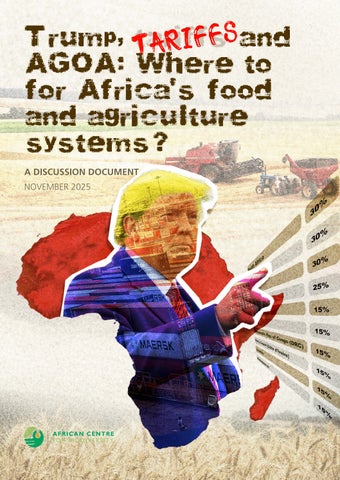
Trump, tariffs and S F F I R A T AGOA: Where to for Africa's food and agriculture systems? A DISCUSSION DOCUMENT NOVEMBER 2025
2
TRUMP, TARIFFS & AGOA: WHERE TO FOR AFRICA’S FOOD AND AGRICULTURE SYSTEMS? A DISCUSSION DOCUMENT
The African Centre for Biodiversity (ACB) The African Centre for Biodiversity (ACB) is committed to dismantling inequalities and resisting corporate industrial expansion in Africa’s food and agriculture systems.
© The African Centre for Biodiversity www.acbio.org.za PO Box 29170, Melville 2109, Johannesburg, South Africa. Tel: +27 (0)11 486-1156
A publication by the African Centre for Biodiversity Cover design and layout: Xealos Design Consultancy Acknowledgments The ACB gratefully acknowledges the financial support of several donors, though the views expressed may not necessarily reflect the views of our donors.
3
TRUMP, TARIFFS & AGOA: WHERE TO FOR AFRICA’S FOOD AND AGRICULTURE SYSTEMS? A DISCUSSION DOCUMENT
Table of Contents
S T N E CONT
Acronyms and abbreviations
4
Structure
5
Caveat
5
Introduction: the expiry of AGOA
7
US Trade Practices since WWI GATT and WTO
7 8
The WTO and the US general system of preference
12
Context and overview of the IEEPA
13
The legal status of Trump’s Tariffs under the IEEPA The power of economic reliance
The impact on South Africa Value of South African agriculture exports to its economy South African key export markets and products Consequences of US tariff increases for South African exports
13 14 18 18 19 20
End of AGOA and what’s next
22
The AfCFTA - more challenges than opportunities
23
Progress made towards realising AfCFTA Further concerns with AfCFTA
24 25
Further Opportunities?
31
Conclusion
32
4
TRUMP, TARIFFS & AGOA: WHERE TO FOR AFRICA’S FOOD AND AGRICULTURE SYSTEMS? A DISCUSSION DOCUMENT
Acronyms and abbreviations ACB
African Centre for Biodiversity
AfCFTA
African Continental Free Trade Agreement and Area
AGOA
African Growth and Opportunity Act
AGRA
Alliance for a Green Revolution in Africa
CPs
Contracting Parties to GATT
GATT
General Agreement on Tariffs and Trade
EU
European Union
GDP
Gross domestic product
GSP
US Generalized System of Preferences of 1975
IEEPA
International Emergency Economic Powers Act
ILO
International Labor Organization
ITO
International Trade Organization
SA
South Africa
SADC
Southern African Development Community
SSA
Sub-Saharan Africa
TWEA
Trading with the Enemy Act
UK
United Kingdom
UN
United Nations
UNDROP
UN Declaration on the Rights of Peasants and Other People Working in Rural Areas
UPOV
International Union for the Protection of New Varieties of Plants
US
United States of America
USAID
United States Agency for International Development
WTO
World Trade Organisation
WWI
First World War
WWII
Second World War
5
TRUMP, TARIFFS & AGOA: WHERE TO FOR AFRICA’S FOOD AND AGRICULTURE SYSTEMS? A DISCUSSION DOCUMENT
Structure This document is intended to stimulate discussion and analysis of the economic and geopolitical world order, primarily focusing on issues relevant to agriculture and trade on the African continent. First, we begin with a caveat because the issues raised are influenced by inter alia international and regional geopolitics and economics, which, in the current climate, are highly fluid. In essence, they are moving targets shaped by actions and pronouncements daily. Second, to give context to the topic under discussion, we briefly describe the expiry of the African Growth and Opportunity Act (AGOA) and set out the trade policies of the United States of America (US) since World War I (WWI). Third, we discuss briefly the history of the General Agreement on Tariffs and Trade (GATT) and the World Trade Organisation (WTO). We thereafter describe the above trade instruments in the context of the US Generalised System of Preference, and the US legislation that the Trump Administration used to impose the punitive tariffs on the world, with reference to the concept of “soft power”. Next, we briefly sketch the current legal status of the use of emergency powers legislation to impose those tariffs. Thereafter, we set out the history of AGOA and the power of economic reliance it promoted. Next, we look at the impact of Trump’s tariffs on South Africa (SA). We thereafter outline the value of SA agriculture to its economy. export markets and products, employment in the sector, and the impact of the tariffs on exports. Thereafter, we examine SA’s options, particularly regarding the African Continental Free Trade Areas Act (AfCFTA), and table our observations, concerns, and criticisms of the AfCFTA for discussion. We then briefly refer to other options and conclude with our observations and concerns.
Caveat We preface this discussion paper in a rather unusual manner, i.e., with a caveat. This is because a discussion of the topic is based on events that are highly dynamic and fluid, changing almost daily, like the ebb and flow of the tides. The paper has many components, though not all of which are necessary to weave the final web of issues that affect agriculture and food systems.
TRUMP, TARIFFS & AGOA: WHERE TO FOR AFRICA’S FOOD AND AGRICULTURE SYSTEMS? A DISCUSSION DOCUMENT
6
One needs only look at daily news reports of the actions and utterances of the leaders of the three major world powers, China, the US, and Russia, which impact global geopolitics and global trade and markets. Of late, and more particularly since the announcement of the imposition of new tariffs by the US on trading partners in April 2025, and counter tariffs in retaliation, international trade, geopolitics, and financial markets have been in turmoil, creating great anxiety and uncertainty in international trade.
There are numerous examples of such uncertainty and the turmoil it leaves in its wake, which are reported almost daily in the news media. Such examples include: •
Gold price reaching an all-time high at over US$4,000 an ounce,
•
China has completely ceased to purchase soya beans from the US, in favour of supply from Argentina and a BRICS1 member, Brazil, which adversely impacts US soya bean producers.
•
China also restricted the export of rare earth metals to the US in response to tariffs and trade restrictions imposed by the US.
•
US President Trump, on 10 October 2025, threatened to impose additional 100% tariffs on China’s exports to the US, which sent jitters across Wall Street, causing it to fall off sharply.2 This was despite Trump earlier agreeing to drastically reduce the steep tariffs imposed on China previously in the year.
The question that arises is
:
Is this complex web of turmoil in the global trading system a result of tariff corrections to protect the domestic US market against unfair competition or the flexing of soft power (backed by the threat of military might) to assert geopolitical dominance over global trade and geopolitics?
1 BRICS is an intergovernmental organisation initially comprising Brazil, Russia, India, China, and SA. Its primary purpose is promoting economic and geopolitical integration among its members, service as a counterweight to Western influence in global institutions. It has recently been expanded to 10 members and is now known as BRICS+ 2 The benchmark S&P fell by 2.7%, the Dow Jones Industrial fell 1.9% and the tech-focussed Nasdaq sank 3.6%. Similar declines were reported from the London Stock exchange. The Guardian.com https://www.theguardian. com/us-news/2025/oct/10/trump-china-tariffs). The value of the loss on the US exchange is estimated to be $2 trillion (CNBC- https://www.cnbc.com/2025/10/11/trump-post-costs-stocks-2-trillion-in-single-day.html)
TRUMP, TARIFFS & AGOA: WHERE TO FOR AFRICA’S FOOD AND AGRICULTURE SYSTEMS? A DISCUSSION DOCUMENT
7
Introduction: the expiry of Y R I P X E AGOA Although the focus of this paper is the expiry of AGOA and the recent tariffs imposed on SA by the US, the implications of the above caveat for Africa and SA – the focus of this discussion – cannot be ignored. The caveat should therefore be read in the context of the shift in US trade relations and policies towards Africa since the installation of the current Trump Administration. To better understand the cumulative implications for SA and Africa in general, of the expiry of AGOA and the unilateral imposition of tariffs by the Trump administration, we need to view these events in the context of US trade practices, policies and laws3 from the time of the First World War (WWI), the multilateral trading system, the General Agreement on Tariffs and Trade of 1947 (GATT), regulated by the World Trade Organization (WTO),4 and the Trading With The Enemy Act (TWEA) of the US.
US Trade Practices since WWI During WWI, the US Congress, in 1917, passed the Trading with the Enemy Act (TWEA), which was designed to regulate trade in times of war. The TWEA regulated US trade with “enemy powers.” In the 1930s, the US Congress expanded the Act and delegated extensive powers to US Presidents5 to declare national emergencies in peacetime and assume sweeping powers over both domestic and international trade. Between 1945 and the early 1970s, the expanded TWEA became the central mechanism by which the US imposed sanctions on countries, as part of the US Cold War strategy. The US has used the TWEA to: •
Seize US-based assets held by foreign nationals,
•
Restrict imports,
•
Modify laws to deter the hoarding of gold,
•
Limit foreign direct investments in US companies, and
•
Impose tariffs on all imports into the US.6
3 Such as Trading With The Enemy Act (TWEA) enacted on 6 October 1917 (40 Stat. 411, codified at 12 U.S.C. § 95 and 50 U.S.C. § 4301 et seq. and the International Emergency Economic Powers Act (IEEPA), Title II of Pub. L. 95–223, 91 Stat. 1626, enacted December 28, 1977. 4 The successor to GATT. 5 “Legal Problems of International Economic Relations, Cases, Materials and Texts”, John H Jackson et. al., 3rd ed., p 134. 6 https://www.congress.gov/crs_external_products/R/PDF/R45618/R45618.15.pdf.
8
TRUMP, TARIFFS & AGOA: WHERE TO FOR AFRICA’S FOOD AND AGRICULTURE SYSTEMS? A DISCUSSION DOCUMENT
GATT and WTO The GATT was signed on 30 October 1947,7 and officially entered into force on 1 January 1948. It was a product of the post-Second World War (WWII) negotiations on international economic cooperation, which became known as the Bretton Woods agreements, which also established the International Monetary Fund (IMF) and the International Bank for Reconstruction and Development (IBRD).8 At the time, it was believed that these Bretton Woods institutions should be complemented by an organisation that would deal with international trade relations between States.
Nations Sign Final Act of Havana Charter © UN Photos
This belief led to the negotiations of the Havana Charter of 1948 – The Charter for an International Trade Organization,9 which consisted of a series of commitments by governments on substantive issues of trade covering disciplines such as employment and economic activity. Although the Charter never came into effect, the negotiations produced the GATT10 and laid the foundation for the multilateral trading system and the establishment of the WTO some 50 years later.11 It also incorporated provisions for an International Trade Organization (ITO), founded largely on the views held by the US and the United Kingdom (UK), that trade liberalisation was essential to avoid the protectionism of the inter-war years and a repeat of the 1930s depression, which was detrimental to most economies of the world. The US, through such liberalisation, sought the end of British imperial preferences, while the UK was interested in seeing the lowering of high US tariffs.12 7 https://www.wto.org/english/thewto_e/minist_e/min96_e/chrono.htm 8 https://www.worldbank.org/en/who-we-are/ibrd. 9 https://treaties.un.org/doc/source/docs/E_CONF.2_78-E.pdf. 10 Adopted on 30 October 1947 and entered into force 1 January 1948 11 Havana Charter (1948), Giorgio Sacerdoti. https://opil.ouplaw.com/display/10.1093/law:epil/9780199231690/ law-9780199231690-e1529., and https://treaties.un.org/doc/source/docs/E_CONF.2_78-E.pdf. 12 General Agreement on Tariffs and Trade by Donald M. McRae. https://legal.un.org/avl/ha/gatt/gatt.html
9
TRUMP, TARIFFS & AGOA: WHERE TO FOR AFRICA’S FOOD AND AGRICULTURE SYSTEMS? A DISCUSSION DOCUMENT
Envisioned to be integrated into the ITO once it came into existence, the GATT was an agreement with economic objectives, reflecting the assumptions of the time about the economic benefits of trade. Negotiations for the GATT were led largely by the US and UK. Their common concern was the avoidance of discriminatory trade practices, although they differed on how best to achieve that goal. The GATT text was completed in October 1947 and entered into force on a provisional basis on 1 January 1948.13 The GATT was the only instrument that emerged from the negotiations of 1946-48, and its “provisional” nature continued for another 47 years. Although the Havana Charter, which was initiated to set up an international trade organisation, was completed in March 1948, it was never ratified by the US Senate and never entered into force. Until the negotiation of the WTO, no effort was made to transform the GATT into a permanent instead of a provisional one. The fact that the GATT was seen as provisional in nature (until the ITO came into being), had an impact on its implementation, functioning, and how it was perceived. It had no real institutional structure, which further served to hamper it. Its signatories were known as the Contracting Parties (CPs) and were administered by an “interim” secretariat, which was to be the secretariat for the future ITO.14 There were initially 23 GATT signatories. By the time it evolved into the WTO, there were 128 GATT CPs. Accession to the GATT was open not only to sovereign States, but also to governments “acting on behalf of a separate customs territory possessing full autonomy in the conduct of its external commercial relations,”15 e.g., Hong Kong became such a CP. The GATT is not only a set of obligations regarding what States could and could not do in regulating trade, but it was also a framework for tariff reductions. By the early 1980s, the volume and complexity of world trade had far exceeded the nature and size of trade during the formative years of the GATT. Trade in services, agricultural goods, textiles, international investment, intellectual property, and other prominent aspects of global trade were either covered inadequately by GATT or not covered at all.16 The GATT’s success in this regard was mixed and punctuated with several failures, including the failure of the Tokyo and Seattle Rounds of negotiations, the most dramatic of which was the Seattle Round. Right at the outset of the Seattle Round of negotiations, in December 1999, deep rifts between developed and developing countries were evident. Developing countries arrived with a clear message: they wanted genuine market access for their agricultural products. Countries like India, Brazil, and those in Africa had been watching wealthy nations preach free trade while maintaining hefty subsidies for their own farmers. “It was like being invited to a poker game where the house always wins – technically fair but practically rigged”.17 13 Encyclopaedia Brittanica. General Agreement on Tariffs and Trade. Meg Matthias, Editor. https://www.britannica. com/topic/General-Agreement-on-Tariffs-and-Trade. 14 https://legal.un.org/avl/ha/gatt/gatt.html. 15 Article XXXIII. 16 “GATT Rounds. Who, What When” Michael Unger, Hinrich Foundation. https://www.hinrichfoundation.com/ research/tradevistas/wto/gatt-rounds 17 “Seattle 1999: Unmet Expectations and the Struggle for Trade Liberalization” Mar 10, 2024. https://agriculture.institute/agricultural-policy/seattle-1999-trade-liberalization-struggle/
10
TRUMP, TARIFFS & AGOA: WHERE TO FOR AFRICA’S FOOD AND AGRICULTURE SYSTEMS? A DISCUSSION DOCUMENT
These developing countries demanded that developed countries reduce their agricultural subsidies and tariffs, which made it impossible for them to compete against American and European farmers, who were being subsidised by the US and European governments to the tune of billions of dollars annually. Developing countries, particularly in Africa and Asia, were also opposed to the inclusion of any new issues. Their opposition arose due to concern that uncontrolled foreign investment would not benefit them, and the track record of the WTO – whose previous agreements (on issues like agriculture and intellectual property rights) had been biased towards rich countries and worked against the poorer countries.18 But even before it could begin, the proceedings were disrupted by massive demonstrations. Central Seattle became a war zone – with tear gas and rubber bullets, and then a ghost town – with empty streets and boarded-up windows. The massive protests by thousands of demonstrators, estimated to be over forty thousand, marched in an anti-WTO protest. The forceful police response (which became known as the “Battle in Seattle”) overshadowed negotiations inside the Convention Centre. The deep divisions reflected in the streets were also present among trade officials. Delegates from poorer, less developed countries were angered at being excluded from key discussions but then pressured to agree to positions worked out by the richer nations. Disagreements between the richest countries, specifically the US and the European Union (EU), over the issue of agricultural subsidies, brought the talks down.19
WTO protests in Seattle, 1999 © Steve Kaiser | Wikimedia Commons
18 “The Battle in Seattle”. CAFOD Briefing. https://www.iatp.org/sites/default/files/Seattle_and_the_WTO_A_Press_ Briefing.htm#:~:text 19 See 17
TRUMP, TARIFFS & AGOA: WHERE TO FOR AFRICA’S FOOD AND AGRICULTURE SYSTEMS? A DISCUSSION DOCUMENT
11
The four reasons given for this comprehensive failure included: •
Opposition from civil society;
•
Conflict between developed and developing countries;
•
Disagreements amongst developed countries; and
•
Poor procedures.20
The “Battle in Seattle” wasn’t just about trade policy but about who got to decide how globalised trade is framed and unfolds. The civil society protesters argued that the WTO was too focused on corporate profits and not enough on people and the planet. They demanded transparency in trade negotiations and questioned whether unrestricted free trade was truly beneficial for everyone. A unique feature of these demonstrations was not just their size, but their diversity. Environmental groups, trade unions, student organisations, and even some farmers formed an unlikely coalition against corporate globalisation.21 These demonstrations and resistance are an emphatic display of the rejection of the neoliberal agenda of the globalisation of free trade under the framework of the WTO, which is neither people- nor nature-centric. These sentiments are evergreen in the sense that they are still held by civil society groups across the world today.
20 See 18. 21 See 17
WTO protests in Seattle, 1999 © J.Narrin | Wikimedia Commons
12
TRUMP, TARIFFS & AGOA: WHERE TO FOR AFRICA’S FOOD AND AGRICULTURE SYSTEMS? A DISCUSSION DOCUMENT
The WTO and the US general system of preference
US
A central principle of the WTO is that of Most-Favoured-Nation treatment (MFN), whereby countries agree to levy the same tariff (duty) on all member countries of the WTO equally, ensuring equality of treatment, and transparent and predictable trade. However, several provisions22 grant “developing” countries special rights. One such provision is an enabling clause that grants “developed” countries a legal basis to provide non-reciprocal preferential treatment, including zero duty or lower tariffs on imports from developing countries. This provision is the basis for the US Generalized System of Preferences of 1975 (GSP) and other non-reciprocal preferential trade arrangements. In 1975, the US, under the GSP, offered duty-free benefits to over 100 countries for over 3,600 products and additional duty-free treatment for 1,500 products from what was termed “least-developed beneficiary countries” (LDBCs).23
Mombasa Port, Kenya © Make It Kenya Photo / Stuart Price | Flickr 22 Special and differential treatment provisions. https://www.wto.org/english/tratop_e/devel_e/dev_special_ differential_provisions_e.htm#:~:text 23 https://ustr.gov/issue-areas/trade-development/preference-programs/generalized-system-preference-gsp
13
TRUMP, TARIFFS & AGOA: WHERE TO FOR AFRICA’S FOOD AND AGRICULTURE SYSTEMS? A DISCUSSION DOCUMENT
T X Context and E T ON C overview of the IEEPA Over time, the US Congress recognised the need for a more flexible framework to address economic threats during peacetime. This recognition led to the passage in 1977 of the International Emergency Economic Powers Act (IEEPA) (which evolved from the TWEA). The IEEPA gave US presidents sweeping powers to swiftly respond to “economic emergencies” by declaring a national emergency and to regulate trade and control financial transactions with foreign entities. In effect, it marked a significant relegation of those powers from Congress to the Executive and became a key instrument in the US sanctions arsenal, an element of US soft power. It is often invoked in response to international crises or threats to US national security, whether real or not.24
The legal status of Trump’s Tariffs under the IEEPA The legality of tariffs imposed by the Trump Administration by invoking the IEEPA was successfully challenged in the US Court of Appeals for the Federal Circuit in Washington. The Court ruled on August 29, 2025, that Trump overreached in invoking the 1977 IEEPA to impose the tariffs. The ruling stems from two challenges. One was brought by five businesses that import goods, including a New York wine and spirits importer and a Pennsylvania-based sport fishing retailer. The other was filed by 12 US states: Arizona, Colorado, Connecticut, Delaware, Illinois, Maine, Minnesota, Nevada, New Mexico, New York, Oregon, and Vermont. The Supreme Court also agreed to hear a separate challenge brought by a family-owned toy company. The Trump Administration has, however, appealed this ruling, which is yet to be adjudicated on by the US Supreme Court. Until then, the tariffs remain in effect.25 Enter the African Growth and Opportunity Act (AGOA).
24 The International Emergency Economic Powers Act: Origins, Evolution, and Use – Congressional Research Service. https://crsreports.congress.gov R45618; https://www.congress.gov/crs_external_products/R/PDF/R45618/R45618.15. pdf 25 “US Supreme Court to decide legality of Trump’s tariffs”, Times Live, September 10, 2025. https://www.timeslive. co.za/news/world/2025-09-10-us-supreme-court-to-decide-legality-of-trumps-tariffs/ and “What to know about the Emergency Law Trump Used to impose Tariffs”, New York Times, https://www.nytimes.com/2025/02/02/us/politics/ trump-tariffs-ieepa.html
14
TRUMP, TARIFFS & AGOA: WHERE TO FOR AFRICA’S FOOD AND AGRICULTURE SYSTEMS? A DISCUSSION DOCUMENT
Beyond Economics Tariffs and trade deals are not just about economics. They are instruments of soft power that are used to shape the global trade and geopolitical order in ways that are subtle but long-lasting. Too often, trade policy is framed in narrow terms like job protection, inflation control, or trade deficit reduction. What gets overlooked is how these policies create structural dependence and influence dependent countries’ policies and relationships. The US is economically and militarily one of the most powerful countries in the world and utilises soft power to enhance its global influence and leverage compliance by economically dependent countries.26 When countries’ economies rely on access to US markets or operate within Americancontrolled supply chains, they are not simply engaging in commerce but are entering into a system influenced and controlled by US priorities. Soft power has been an important tool for the US in achieving its geopolitical goals, from shaping global public opinion to fostering diplomatic ties using cultural influence, education, humanitarian aid, and international cooperation, and has helped the US entrench itself as a dominating force in global affairs. In its execution, soft power may differ from “hard power,” which encompasses military intervention or sanctions, but their end goals are similar.
The power of economic reliance Economic reliance on access to US markets has consequences. Countries reliant on US markets may have to adjust their foreign and domestic policies to be acceptable to the US to maintain that market access. Should they vote differently from perceived US interests in multilateral bodies or delay strategic alignments, they are likely to antagonise Washington and lose such access. This exertion of influence and pressure does not require troops, treaties, or public announcements. It operates through a web of agreements, supply routes, subtle threats, imposition of tariffs, sanctions, and quiet understandings.
AGOA is one such example of soft power in action and the weaponisation of trade relations. Despite many countries in sub-Saharan Africa (SSA) being eligible for preferential trade treatment under the US GSP, the US sought a new arrangement to foster a “more meaningful” partnership with Africa. This was based on the realisation that it offered few benefits to businesses in African countries wanting to export their goods to the US. This gave birth to AGOA, which had its roots in the 1990s (and was officially set to expire on 30 September 2025), and the US strategy to improve US-Africa relations.27
26 Trade as Soft Power: What We’re Giving Away April 7, 20252. https://www.baltimoretom.com/blog/trade-softpower 27 “What is AGOA, and could SA survive without it?” February 19, 2025 by Tshego Mphahlele. https://explain. co.za/2025/02/19/what-is-agoa-and-could-sa-survive-without-it/
15
TRUMP, TARIFFS & AGOA: WHERE TO FOR AFRICA’S FOOD AND AGRICULTURE SYSTEMS? A DISCUSSION DOCUMENT
AGOA was a US trade preference initiative for several SSA countries,28 which was launched in 2000, as part of broader legislation championed by then-President Clinton to strengthen US trade ties with Africa and the Caribbean. AGOA did not require SSA countries to lower their own barriers to US goods, though it was encouraged. The Clinton Administration believed the AGOA would bolster growth and democratic ideals across the African continent, while strengthening US influence and the US economy by opening African markets to American producers.29 The US declared seventeen SSA countries to be ineligible to participate in AGOA. These included Burkina Faso, Ethiopia, Mali, South Sudan, and Zimbabwe. Somalia formally requested to join AGOA only in 2023, while Sudan had not requested AGOA preferences. Eligibility is reviewed annually through an inter-agency review process. President Joe Biden removed the Central African Republic and Uganda for human rights violations, and Gabon and Niger for failures to protect political pluralism and the rule of law amid coups d’états. Mauritania, meanwhile, regained its eligibility status that same year for “measurable progress on worker rights and eliminating forced labour.”30 Under AGOA, beneficiary countries would enjoy additional benefits over and above those of the US GSP, including wider product coverage for duty-free treatment and trade-related support from the US. However, to benefit from this new market access, SSA countries had to meet certain eligibility criteria, which we will describe later.31 AGOA was renewed several times and, in 2015, was renewed for a final 10 years until the expiry date of 30 September 2025. Although the US GSP was already in place, AGOA changed the game by offering more benefits and incentives beyond those available to SSA countries under the GSP. It went further by offering preferential access to additional products to its 32 participating African countries. It also mandated the executive branch of the US to increase development assistance to SSA countries, in areas including agriculture, HIV/AIDS treatment and prevention. 28 Countries in SSA that are part of AGOA included the following: Angola, Botswana, Cabo Verde, Chad, Comoros, the Republic of the Congo, the Democratic Republic of the Congo, Côte d’Ivoire, Djibouti, Eswatini, The Gambia, Ghana, Kenya, Lesotho, Liberia, Madagascar, Malawi, Mali, Mauritius, Mozambique, Namibia, Niger, Nigeria, Rwanda, São Tomé and Príncipe, Senegal, Sierra Leone, Somalia, SA, Tanzania, Togo, and Zambia 29 See 27 30 “AGOA: The U.S–Africa Trade Program” by Mariel Ferragamo, Ivana Lefebvre d’Argence, and Helena KopansJohnson. https://www.cfr.org/backgrounder/agoa-us-africa-trade-program 31 “The End of AGOA” by Makena Maganjo. https://africasacountry.com/2025/06/the-end-of-agoa.
© Pexels
TRUMP, TARIFFS & AGOA: WHERE TO FOR AFRICA’S FOOD AND AGRICULTURE SYSTEMS? A DISCUSSION DOCUMENT
16
As mentioned, participation in AGOA was tied to various eligibility conditions set by the US. Such conditions required potential beneficiary countries to demonstrate that they promote, inter alia, •
Free market policies;
•
Upholding of the rule of law;
•
Elimination of barriers to US trade;
•
Protection of intellectual property;
•
Protection of human rights;
•
Political pluralism; and
•
Not engaging in activities that undermine US national security or foreign policy interests.
Upon meeting these conditions, AGOA allowed duty-free access32 to the US market for over 6,500 products. AGOA has shaped Africa–US economic engagement for the past two and a half decades. The conditionality for eligibility set by the US is a prime example of the exertion of soft power. Key African exports to the US under AGOA preferences included: •
Crude Oil from Nigeria, Angola, the Democratic Republic of Congo, and Ghana
•
Clothing apparel from Lesotho, Madagascar, and Kenya
•
Motor vehicles, citrus fruits, wine, organic chemicals, yachts, nickel products, iron and steel, and jewellery from SA
•
Ferroalloys, jewellery, and cocoa products from Ghana and Côte d’Ivoire33
Utilising the trade preferences under AGOA, SA grew its exports to the US. However, from early 2025, African countries have been faced with trade and economic challenges due to the Trump Administration’s policy changes. These changes primarily relate to the imposition of additional or punitive tariffs on countries, which, according to the Trump Administration have levied high tariffs on US imports into those countries or had a significant trade deficit with the US. The possible suspension, cancellation or non-renewal of AGOA in favour of America First Policies coupled with steep reductions in USAID funding and activities outside the US has hit African countries particularly hard.34 Armed with the powers conferred on him by the IEEPA, by invoking that Act in April 2025, President Trump introduced one of the most aggressive trade overhauls in recent memory. Trump imposed an across-the-board 10% reciprocal tariff on imports from most countries, as well as country-specific reciprocal tariffs (30% for SA), effective from 1 August 2025, escalating up to 50% (e.g. India and Lesotho) on countries that had trade surpluses against the US or whose policies the Trump Administration deemed unpalatable to the US. These 32 Tariffs are a form of tax applied on imports from other countries intended to help local businesses compete with cheaper imports. 33 2024 Biennial Report on The Implementation of the African Growth and Opportunity Act. https://ustr.gov/sites/ default/files/2024%20AGOA%20Biennial%20Report%206-27-2024%20PDF_0.pdf 34 “Impact Of Trump’s Tariffs & The Expiry of AGOA on African Countries” by Jitendra Bhonsle, May 7, 2025. https:// www.marineinsight.com/maritime-law/impact-of-trumps-tariffs-suspension-of-agoa-on-african-countries/
17
TRUMP, TARIFFS & AGOA: WHERE TO FOR AFRICA’S FOOD AND AGRICULTURE SYSTEMS? A DISCUSSION DOCUMENT
Textile factory, Lesotho © K. Kendall | Wikimedia Commons
tariffs are to remain in place unless and until each affected country concludes individual alternative negotiated agreements with the US.35 This was a departure from multilateralism in trade (which was a feature of WWII trade relations) to unilateral trade regimes. The tiny Mountain kingdom of Lesotho was initially hit with an astronomically high tariff rate of 50%, which was later modified in August 2025 to 15%. However, the original announcement of a 50% tariff generated both panic and confusion, leading to layoffs and uncertainty in Lesotho’s apparel sector. The World Bank in 2018 estimated that the impact of the lapsing AGOA benefits would cause Lesotho to suffer a 1% drop in income and a 16% drop in exports of apparel and textiles.36 These new tariffs overrode the benefits of AGOA while it was still in force. Countries exporting to the US would no longer enjoy duty-free market access and would instead have to deal with Trump’s duties. African economies, which had benefited from preferential access under the AGOA, now found themselves especially vulnerable. For them, the impact of the new tariffs and expiry of the AGOA is compounded by steep United States Agency for International Development (USAID) funding cuts, which, while not directly impacting trade, will, through their impact on humanitarian and social assistance programmes, place a drag on economic and financial stability, and growth in many African countries These tariffs, combined with US policy shifts, have created uncertainty in African trade relationships with the US. The impacts are likely to be most acutely felt by economies such as Kenya, SA, Ghana, Lesotho, and Nigeria, which have leveraged AGOA to diversify their exports and attract investments. Although imports from Africa account for roughly 2% of all imports to the US and appear negligible, they represent millions of dollars in revenue and hundreds of thousands of jobs in SSA as well as export opportunities through duty-free access to the US market. This loss will affect people’s livelihoods, businesses, education, health care, and more.37 35 “Impact of Trump’s Tariffs & Suspension of AGOA on African Countries” by Jitendra Bhonsle May 7, 2025. Maritime Law. https://www.marineinsight.com/maritime-law/impact-of-trumps-tariffs-suspension-of-agoa-onafrican-countries/ 36 “AGOA: The U.S.-Africa Trade Program” by Mariel Ferragamo, Ivana Lefebvre d’Argence, and Helena KopansJohnson. https://www.cfr.org/backgrounder/agoa-us-africa-trade-program 37 “The end of AGOA. A postmortem on the African Growth and Opportunities Act” by Makena Maganjo. https:// africasacountry.com/2025/06/the-end-of-agoa#:~:text
18
TRUMP, TARIFFS & AGOA: WHERE TO FOR AFRICA’S FOOD AND AGRICULTURE SYSTEMS? A DISCUSSION DOCUMENT
The impact IMPACT on South Africa The recent hostile disposition of the Trump Administration towards SA, which resulted in the imposition of punitive trade tariffs, the cut-off of USAID funding, coupled with the expiry of the AGOA, raises serious concerns and uncertainty about its future trade relations with the US.38 SA is amongst the hardest hit African countries by Trump’s tariffs and appears to have been specifically targeted by the Trump Administration due to its disagreements with the US on various issues. These include: SA’s membership of the BRICS bloc, its relationships with Russia and Iran, certain South African land and Affirmative Action policies and legislation which the Trump Administration believes discriminates against the minority white population, SA’s stance on Israel in the Gaza conflict and genocide, its trade surplus with the US and SA’s tariffs on imported US goods. Even before the expiry of the AGOA on 30 September 2025, Trump’s tariffs had nullified its practical value. The current Trump tariff levied on SA is 30%, as well as an additional separate 25% tariff on South African-made motor vehicles and steel. While some commodity exports, such as precious metals, are likely to be exempted from those tariffs, no such exemption exists or is likely for South African agricultural products or wine, which are likely to be further impacted by the diversion of US imports towards countries with lower reciprocal tariffs or policies more palatable to the Trump Administration. These tariff measures create risks to South African exports, undermining the competitiveness of key sectors and eroding the benefits of preferential access under AGOA.
Value of South African agriculture exports to its economy Recent geopolitics, the imposition of Trump’s tariffs, and the expiry of AGOA have brought SA’s trade and related matters into sharp focus, particularly for export-oriented sectors such as agriculture. The total value of primary agricultural production in SA was estimated to be R460 184 million in 2024, and its contribution to the gross domestic product (GDP) was approximately R182 181 million. The primary agricultural sector has shown an average nominal growth of 8,8% per year since 2013. This has resulted in an increase in agriculture’s value-added share of GDP from 1,8% in 2013 to 2,8% in 2024. Despite its relatively small share of the total GDP, primary agriculture is an important sector in the South African economy and remains a significant provider of employment in the country, especially in rural areas, and is a major foreign exchange earner.
38 “The agricultural sector can overcome the impact of potential AGOA exit” by Meluleki Nzimande and Megan Jarvis, partners at Webber Wentzel. https://www.polity.org.za/article/the-agricultural-sector-can-overcome-theimpact-of-potential-agoa-exit-2025-04-07
19
TRUMP, TARIFFS & AGOA: WHERE TO FOR AFRICA’S FOOD AND AGRICULTURE SYSTEMS? A DISCUSSION DOCUMENT
Agriculture’s prominent role in the economy is a function of linkages to other sectors. Purchases of goods such as fertilisers, chemicals, and implements form backward linkages with the manufacturing sector, while forward linkages are established through the supply of raw materials to the manufacturing industry. About 70% of agricultural output is used as intermediate products in the sector. According to the South African government, agriculture is therefore a crucial sector and an important engine of growth for the rest of the economy.39 Agricultural export revenue continued to increase, setting new records in 2021, 2022, 2023, and more recently in 2024, due to the efforts of farmers of all sizes nationwide to produce fruits, livestock, and grains, to mention only a few. Data from WTO, the United Nations Conference on Trade & Development, and the International Trade Centre (ITC) indicate that SA’s agricultural exports in 2024 reached a new record of US$13.7 billion, up 3.6% from U$13.2 billion, or R244.0 billion, the year before.40 Although SA is a major exporter of agricultural products, both into Africa and globally, it also imports some of its essential staples. The overall value of agricultural imports in 2024 was US$7.4 billion, which was 7.3% more than the US$6.9 billion in 2023.41
South African key export markets and products Citrus was one of the leading agricultural export commodities for SA during 2024. African countries were the primary destination for SA’s agricultural exports, accounting for 44% of total export value. Leading exports to African countries included maize, wheat, sugar, apples, pears, fruit juices, wine, and vegetable oils. Asia and the Middle East were the country’s second-largest agricultural export markets, making up a combined 21% of total exports, which included citrus, nuts, apples, pears, wool, berries, sugar, and beef. The EU followed closely, with a 19% share, comprising citrus, grapes, wine, avocados, fruit juices, and wool. Exports to the Americas (including the US) accounted for 6%, with citrus, grapes, wine, and nuts being the leading exports. The rest of the world, including the UK, comprised 10% of SA’s agricultural exports. Employment in agriculture in SA Q4, 2023, by region In the fourth quarter of 2023, approximately 243,000 South Africans residing in the Western Cape were working in the agriculture industry, marking a year-on-year increase of 11,000 people being employed. The provinces of KwaZulu-Natal and Limpopo revealed high numbers of people being employed within the industry as well, at 153,000 and 129,000, respectively.42 The percentage of women employed in agriculture (modelled International Labor Organization [ILO] estimate) in SA was reported at 19.77 % in 2023, according to the 39 “Economic Review of the South African Agriculture”, 2024. Department of Agriculture, Land Reform and Rural Development” p4. https://www.nda.gov.za/images/Branches/Economica%20Development%20Trade%20and%20 Marketing/Statistc%20and%20%20Economic%20Analysis/statistical-information/economic-review-of-the-southafrican-agriculture-2024.pdf 40 South Africa’s Agricultural Trade Performance in 2024. www.namc.co.za/south-africas-agricultural-tradeperformance-in-2024/#:~:text 41 Ibid. 42 https://www.statssa.gov.za/publications/P0211/P02114thQuarter2023.pdf
20
TRUMP, TARIFFS & AGOA: WHERE TO FOR AFRICA’S FOOD AND AGRICULTURE SYSTEMS? A DISCUSSION DOCUMENT
World Bank collection of development indicators, compiled from officially recognised sources.43 The expiry of AGOA, coupled with the Trump tariff regime, means SA could face a projected loss of more than 35,000 jobs in the citrus fruit sectors alone,44 adding to the already high unemployment rate in the country.45 Beyond the numbers, the expiry of the AGOA and punitive tariffs are setbacks for SA’s and Africa’s drive toward industrialisation, job creation, and inclusive economic growth. It also reverses momentum gained in building resilient value chains across the continent.
Weltevrede Farm, Prince Albert | © South African Tourism | Wikimedia Commons
SA, and the rest of the African continent, however, do not have to be passive bystanders on the sidelines of international trade and watch this economic dislocation unfold. The question that must be answered is, what options do they have to offset Trump's tariffs, changed policies, and the loss of AGOA? Consequences of US tariff increases for South African exports Apart from the impacts referred to above, a further concern for SA arising from the US tariffs and policy changes is that Chinese exporters, faced with high US tariff barriers on their exports, could redirect their US-destined exports to third-country markets. This would force South African manufacturers to compete against them in both SA’s traditional export markets in SSA as well as domestically.46 The imposed tariffs mean SA is staring at a potential loss, mainly to its automobile and agricultural annual exports, of approximately 0.3% of GDP. At a broader level, this will drive inflation, unemployment, and interest rates; weaken equity markets and the value of its currency; and disrupt supply chains that support the broader Southern African Development Community (SADC) region. 43 https://tradingeconomics.com/south-africa/employees-services-female-percent-of-female-employment-wb-data. html and “Employment in agriculture, female (% of female employment) (modelled ILO estimate) – South Africa” https://data.worldbank.org/indicator/SL.AGR.EMPL.FE.ZS?locations=ZA 44 “What’s next for US-Africa trade?” Martina Schwikowski / Bob Barry, September 29, 2025. https://www.dw.com/en/ africa-us-african-growth-opportunity-act-trade-trump-african-union/a-74167055 45 The expanded definition of unemployment, which includes those discouraged from seeking work, eased to 42.9% in Q2 from 43.1% in Q1. https://tradingeconomics.com/south-africa/unemployment-rate 46 “Policy Brief: The Consequences of United States Tariff Increases for South African Exports”, by Lawrence Edwards and Jing Chien. July 2025. Downloads//Policy+brief_US+Trade+Impact+on+SA+Export_Edwards+and+Jing_ July2025%20(1).pdf
21
TRUMP, TARIFFS & AGOA: WHERE TO FOR AFRICA’S FOOD AND AGRICULTURE SYSTEMS? A DISCUSSION DOCUMENT
Some countries, such as the UK, in the EU, Japan, Indonesia, the Philippines, and Vietnam, have reportedly made progress in negotiating separate trade deals with the US to reduce tariff rates imposed on them. While these separate deals do not directly impact SA, they have an indirect effect on the South African economy by reducing the competitive advantage of South African exporters in the US market.47 Since the inception of AGOA in 2000 and as of 2023, SA has exported more than US$7 billion (R125 billion) worth of agricultural products to the US (over 23 years). The Western Cape was the province that benefited most from AGOA trade preferences. Under the AGOA, two-thirds of SA’s agricultural exports to the US had tariff-free treatment. Modelling by the Brookings Institution48 estimated that a loss of preferential market access under AGOA on exports and GDP for SA’s total exports to the US would fall by about 2.7%, the biggest losses being in the food and beverage, transport equipment, and fruit and vegetable sectors. The modelling predicts that the loss of AGOA benefits would lead to a GDP decline of 0.06%, of which agriculture constituted a percentage. Nonetheless, while the effect as a percentage of total GDP loss might not be alarmingly large, it would affect provinces such as the Western Cape and Mpumalanga, where agricultural exports under AGOA were a significant source of income benefitting these provinces. According to figures from the National Agricultural Marketing Council, from 2018 to 2022, the Western Cape accounted for 49% of SA’s overall agricultural exports to the US in terms of value. Mpumalanga’s agricultural sector is AGOA’s second-largest beneficiary, accounting for at least 15% of SA’s total agricultural exports in 2022. Gauteng, Eastern Cape, and KwaZuluNatal round off the five provinces whose agricultural exports also benefited. © Pexels
47 “The Consequences of United States Tariff Increases for South African Exports”, ERSA Working Paper Series. Policy Brief 213, by Lawrence Edwards and Jing Chien. https://ersawps.org/index.php/working-paper-series/article/ view/226 48 A US based nonprofit research organisation. Quoted in Mail & Guardian, 8 April 2025 “Agricultural sector can overcome effect of an AGOA exit”, by Meluleki Nzimande & Megan Jarvis. https://mg.co.za/thought-leader/202504-08-agricultural-sector-can-overcome-effect-of-an-agoa-exit/
22
TRUMP, TARIFFS & AGOA: WHERE TO FOR AFRICA’S FOOD AND AGRICULTURE SYSTEMS? A DISCUSSION DOCUMENT
End of AGOA and what’s next NEXT For over two decades, the AGOA provided eligible SSA countries with duty-free access to the US market. While beneficial, the programme also underscored a deeper structural challenge for these countries, namely, that reliance on unilateral trade preferences reinforces extractive trade patterns rather than fostering sustainable, diversified economies. Under AGOA, African economies relied heavily on exporting raw materials while importing the finished products made from them. The recent supply chain disruptions and sudden tariff hikes, accompanied by the withdrawal of trade preferences from major trading partners, such as the US, underscore the risks of such dependency for African countries.49 Being dependent on external markets, the shift in US economic and geopolitical policies towards Africa could have economic and political consequences for Africa. Trump’s tariffs and loss of AGOA left SA and the rest of the continent at an economic crossroads. While this has been viewed by many with trepidation, it could potentially be a transformative opportunity for Africa to wrest its trade agenda from the neoliberal GSP and AGOA to a more just, people- and environment-centred one. It could be a strategic point that marks the moment Africa shifts from being a passive beneficiary of external trade concessions to becoming an active co-architect of a just, sustainable trade and economic regime and development. The post-AGOA era should not be the end of opportunity but rather the beginning of Africa’s economic sovereignty, in which food sovereignty and socioeconomic support and food sovereignty are guaranteed.
Mombasa Port © Make It Kenya Photo / Stuart Price | Flickr 49 “Trading with Ourselves: How AfCFTA Shields Africa from Global Tariff Turmoil” by Eric Gacuruzwa. August 14, 2025. https://furtherafrica.com/2025/08/14/trading-with-ourselves-how-afcfta-shields-africa-from-global-tariffturmoil/
23
TRUMP, TARIFFS & AGOA: WHERE TO FOR AFRICA’S FOOD AND AGRICULTURE SYSTEMS? A DISCUSSION DOCUMENT
The AfCFTA more challenges S E G N E L L A H C than opportunities The AfCFTA, which came into force in May 2019, is viewed by African leaders as offering an alternative path, shifting the centre of gravity from external preferences to building a robust, yet just and people-centred integrated African market. The AfCFTA aims to create the largest free trade area in the world, representing a market of 1.2 billion consumers, and commits countries to remove most tariffs and non-tariff barriers (NBTs) to improve the flow of goods and services across countries, with the intention to boost economic growth. Unifying 54 countries with a combined population of 1.4 billion and a GDP of US$3.4 trillion, which is projected to reach US$29 trillion by 2100, is viewed as an extremely lucrative prospect. In terms of tariffs, Member States have committed to eliminating tariffs on 90% of goods. It must be noted, however, that intra-African trade remains low, with only 10%–12% of Africa’s trade taking place within Africa, compared to 40% and 60% for North America and Western Europe, respectively. 50 As such, African countries trade more with the European Union than with each other. While the AfCFTA intends to strengthen intracontinental trade, we are concerned that this will inevitably cause greater inequalities in production, manufacturing, and transportation. Socio-political problems will likely be reinforced through the AfCFTA. Furthermore, it is questionable whether the AfCTFA can achieve its goals, due to the relative position of African countries within the current practices, programmes, and policies of the WTO, and in bilateral and regional FTAs. This vision will negatively affect the continent, taking into account the rise of neo-colonial agribusiness and a tendency to revitalise export-oriented agriculture, building on the priorities of regional economic communities, and essentially dissecting the continent along particular commodity crops, reminiscent of colonisation. At its core, the AfCFTA aims to deepen regional value chains. Rather than exporting raw materials, it envisages that African countries could collaborate to produce finished goods, enhance competitiveness, and expand employment. Key sectors such as textiles, processed foods, auto components, and pharmaceuticals, which had previously benefited from AGOA, could now be redirected to serve growing intra-African demand. Moreover, AfCFTA is seen as providing a framework for Africa to negotiate with its global trade partners from a position of unified strength51 and reinforces the continent’s ambition to define its trade agenda, based on shared prosperity, self-sufficiency, and strategic alignment. While such ideas may be well-intended, they nonetheless embrace a neoliberal agenda, as they fail to 50 “African regional trade agreements and intra-African trade”, 2018. Ngepah, N., & Udeagha, M. C., Journal of Economic Integration, 33(1): 1176- 1199. https://doi.org/10.11130/jei.2018.33.1.1176 51 “Agricultural sector can overcome effect of an Agoa exit.”by Meluleki Nzimande and Megan Jarvis. Mail & Guardian, 8 April 2025, https://mg.co.za/thought-leader/2025-04-08-agricultural-sector-can-overcome-effect-of-anagoa-exit/
TRUMP, TARIFFS & AGOA: WHERE TO FOR AFRICA’S FOOD AND AGRICULTURE SYSTEMS? A DISCUSSION DOCUMENT
24
adequately protect and promote the well-being of vulnerable groups, which, in the African context, include small-scale farmers and fisherfolk, women, youth, pastoralists, indigenous and marginalised groups, the urban poor, and people living in conflict areas.52 The overall contribution of small-scale farmers to food production in Africa has been estimated at around 70%. In 2023, the ILO estimated that in Africa, 50% of the total workforce, 52% of which are women, are employed in the rural agricultural sector which are small-scale in nature.53 The transition from AGOA to AfCFTA should not merely be about replacing one trade instrument with another, but, rather, reimagining Africa’s role in the global economy and how it promotes just and fair-trade practices and the achievement of inter alia, African food sovereignty.
Progress made towards realising AfCFTA Strides have already been made in the implementation of the AfCFTA, including: •
All 54 African Union countries have signed the agreement, with 49 ratifying it.
•
Four priority sectors: agro-processing, pharmaceuticals, automotives, and transportation & logistics have been earmarked for regional value chain development.
•
Protocols on Goods and Services, Investment, Competition Policy, Intellectual Property, and e-commerce have been negotiated and adopted.
•
Tariff schedules and rules of origin now cover 92% of traded goods. Textiles and automotive rules are nearing completion.
•
The Pan-African Payment and Settlement System (PAPSS) is operational, connecting over 20 central banks and 160 commercial banks to enable local currency settlements.
•
Visa-free entry for African citizens is now in place in seven countries, with 24 offering e-visas.
•
An AfCFTA Adjustment Fund comprising a Base Fund (for technical assistance), General Fund (for trade infrastructure), and Credit Fund (for small and medium-sized enterprises and private sector capacity building) has been launched to help countries transition and invest in trade-enabling systems.
SA has delivered its first exports (to Ghana) under the agreement, so there are promising signs of concrete action. On the continent, most South African exports of agricultural and other goods are value-added goods. Therefore, SA’s trade with its partners on the continent should be geared towards positive54 yet just economic and trade practices. AfCFTA, if adapted to promote just trade for all sectors, could be elevated from an aspirational vision to being a strategic shield against external shocks such as the current wave of global inward-looking protectionism, which have a destabilising effect on African countries.
52 African Human Rights Yearbook (AHRY Vol 7 pages 325 -352). https://www.ahry.up.ac.za/tiba-f 53 “Africa’s employment landscape”, ILO. https://ilostat.ilo.org/africas-changing-employment-landscape/ (accessed 6 September 2023). 54 “Africa’s Post-AGOA Trade Strategy: From Preference Recipient to Global Commerce Co-Designer”, by Ziad Hamoui, 12 August 2025. https://www.thehabarinetwork.com/africas-post-agoa-trade-strategy-from-preferencerecipient-to-global-commerce-co-designer
TRUMP, TARIFFS & AGOA: WHERE TO FOR AFRICA’S FOOD AND AGRICULTURE SYSTEMS? A DISCUSSION DOCUMENT
25
An example of another country that is implementing AfCFTA is Ethiopia, which has commenced trading under it, after a seven-year preparatory period since signing the agreement in Kigali in 2018. The country’s first shipments are destined for Kenya, with SA and Somalia expected to follow shortly. Over 40 Ethiopian exporters have registered under the AfCFTA framework. Exports will cover agricultural goods, including meat, coffee, fruits and vegetables, beans, edible oil, and selected manufactured products such as textiles. Ethiopia’s preparations included ratifying eight AfCFTA protocols covering conflict resolution, investment and property rights, competition policies, digitalisation, and women and youth-oriented policies. Ethiopia plans to eventually reduce tariffs to zero.55 Africa should seize this pivotal moment and elevate itself from a continent viewed as one relegated to beg for re-negotiated tariffs and the renewal of AGOA to one that asserts its agency. The continent’s future lies not in pleading for access, but in shaping the rules of trade itself through deepening regional integration, empowering local people and industries, and positioning Africa as a node of innovation and value addition in global and regional supply chains.
Further concerns with AfCFTA Expected benefits of a free trade model under AfCFTA have been discussed by Simola et al.56 While AfCFTA presents opportunities, this potential for increased trade as a harbinger of prosperity on the continent is not a foregone conclusion, nor does it adequately promote just trade practices. Regarding the AfCFTA, we ask the following questions: •
Will it lower costs, boost food availability, and ultimately food sovereignty?
•
How will it impact vulnerable groups, including small-scale farmers, small fishers, pastoralists etc?
•
To what extent will more imports displace local production and markets by smallholders and worsen hunger by eroding sovereignty?
•
Will policies that prioritise exports or imports over domestic farming reduce local control of food systems and increase reliance on foreign sources for food?
•
How would it promote and guarantee a people- and environment-centred approach to trade?
The research by Simola et al. reveals that: •
Food prices, and especially cereal prices, increased in most regions, negatively affecting food security.57
•
In some regions, food prices increased more than wages, resulting in food becoming less affordable for some consumer groups and having a significant impact on the poorest households. Hence, the potential negative impact of AfCFTA on the food systems of small-scale farmers and vulnerable groups cannot be ignored.58
55 “Ethiopia Targets Kenya and South Africa in First AfCFTA Exports”, by Mintesinot Nigussie, 7 October 2025. https:// birrmetrics.com/ethiopia-targets-kenya-and-south-africa-in-first-afcfta-exports/ 56 “Economic integration and food security: the case of the AfCFTA”. A Simola et. al. (2022) 35, Global Food Security. Referenced in African Human Rights Yearbook (AHRY Vol 7, pages 325-352). https://www.ahry.up.ac.za/tiba-f 57 Particularly of the lowest income households and households, employed by import-competing industries. 58 “Assessment of the potential impact of the African continental free trade area on the right to food security of small scale farmers and vulnerable groups” by A Simola et al. (2023). Quoted in HRY Volume 7, African Human Rights, pages 325-352, http://doi.org/10.29053/2523-1367/2023/v7a15
26
TRUMP, TARIFFS & AGOA: WHERE TO FOR AFRICA’S FOOD AND AGRICULTURE SYSTEMS? A DISCUSSION DOCUMENT
© jbdodane | Flickr
We note that the thrust of AfCFTA regarding agriculture is to build regional food value chains, and while this may be an improvement on current global food value chains, it fails to address critical factors of ecological sustainability and social equity. We are acutely aware that industrial food systems have devastating ecological and social impacts and therefore advocate that the thrust of AfCFTA, in respect of agriculture, should prioritise on building regional food value chains to reduce and, in time, replace high annual food importation for consumptive patterns. The AfCFTA is premised on the standardisation and industrialisation of agriculture and food systems along the lines of the outdated, socially unjust, and ecologically devastating Green Revolution paradigm that, in addition, promotes the troubling concepts of harmonisation and standardisation in agriculture and food systems, which leads ultimately to the corporatisation thereof. In this regard, we point out that the Alliance for a Green Revolution in Africa (AGRA) has established the Regional Food Trade Coalition with the intention of influencing policy regarding the AfCFTA to steer agriculture towards industrialisation and expand the role of global corporations. AGRA does this while remaining completely unaccountable to the continent’s citizens because AfCFTA lacks a democratic citizen-centred accountability regime. AGRA’s agenda ensconced in the AfCFTA would lead to increasing the wealth of corporations while at the same time increasing inequality and reducing the power of smallscale farmers, traders and distributors. We call on African countries to adopt people-centred food systems embodying the concepts of food sovereignty and promote agroecology, social and environmental justice. The general approach of agriculture should secure biodiversity and farmers’ rights, which the Green Revolution model seeks to undermine and destroy. We continue to be outraged that the African Regional Intellectual Property Organization (ARIPO), which is in strong support of intellectual property rights based on the International Union for the Protection of New Varieties of Plants (UPOV) 1991,59 was permitted to participate in developing the Intellectual Property Protocol for AfCTFA, as UPOV 1991 seeks to secure the rights of commercial breeders in respect of seeds and genetic resources at the expense of small-scale farmers and genetic diversity. We are concerned that AfCFTA is being manipulated and used by special interest groups to secure increased financial benefits for multinational seed companies by affording them stronger intellectual property rights while undermining farmers’ rights and age-old farming 59 UPOV is an international plant variety protection (PVP) regime. The 1991 version strengthens breeder’s rights and imposes new restrictions on farmers’ rights to save, use, exchange and sell seed of protected varieties. UPOV 1991 has long-term effects of monopolisation, corporate capture, diversion of seed and agricultural research and development in favour of extractive multinational markets, loss of biodiversity and loss of national and farmer sovereignty over genetic resources.
27
TRUMP, TARIFFS & AGOA: WHERE TO FOR AFRICA’S FOOD AND AGRICULTURE SYSTEMS? A DISCUSSION DOCUMENT
practices embodied in farmer-managed seed systems that form the backbone of seed, agriculture, and food systems on the continent. We are also concerned that the promises of AfCFTA are in part premised on its promotion of the digitalisation of various sectors of the economy of member countries. We once again raise our concern that digital agriculture is not adequately addressed in national and regional agricultural policies and that its introduction would disrupt traditional systems, which promote social cohesion and environmental stewardship. We are extremely cautious about the digitalisation of agriculture, which free trade and Green Revolution models encourage African states to pursue, since its far-reaching consequences include the entrenching and deepening of existing inequalities and creating new ones. Our concerns and criticisms are based on the fact that data from agricultural practices, which includes soil maturity, carbon content of soils, genetic/biological data, pest and disease outbreaks, production patterns, yields, use of inputs, etc., have become a new global commodity in the hands of multinational companies seeking to generate new economic value from data infrastructure and data gathering.60 We highlight that the digitalisation of African food and farming systems will reduce smallscale farmers to “data producers” for private companies to profit from the knowledge of farmers, their farms, and their relationships with the land and its resources. Therefore, we renew our call on African governments to promote “data justice,” in which “individual privacy”, community sovereignty, human rights, fairness, and equality are the bedrock on which data collection is framed, distributed, and used. By ensuring appropriate education and training systems are put in place to enable entry into the sector and bridge the digital divide (especially regarding spatial and gender bias), governments can avoid digitalisation from further marginalising already vulnerable groups and deepen inequalities.61 It is highly questionable whether the AfCFTA can be used as an opportunity to move from the industrialisation62 of food systems to systems that support people- and nature-centred food production based on the doctrines/philosophy of food sovereignty.63 An imperative driving AfCFTA is trade liberalisation through the elimination of tariff and non-tariff barriers between African countries and the industrialisation of economies, including agriculture. While these imperatives could result in prosperity for some, they could also bring about serious negative impacts for African countries, specifically for vulnerable groups. To ameliorate these negative impacts, the ACB proposed64 that the UN Declaration on the Rights of Peasants and Other People Working in Rural Areas (UNDROP) should guide the pursuit of a rights-based approach to agricultural and food systems, especially regarding seed saving, genetic diversity, traditional knowledge, benefit sharing, and intellectual property.65 This proposal has particular force because, in adopting UNDROP, no African country voted against its approval. Therefore, the recommendation should not prove contentious. 60 “The Rise of Digital Agriculture and Dispossession in Africa: Implications for Smallholder farmers” ACB. 30 August 2023. https://acbio.org.za/corporate-expansion/rise-digital-agriculture-dispossession-africa-smallholder-farmers/ 61 Ibid. 62 Ibid 63 “Food Sovereignty Now. A Guide to Food Sovereignty.” La Via Campesina https://viacampesina.org/en/wp-content/ uploads/sites/2/2018/02/Food-Sovereignty-A-guide-Low-Res-Vresion.pdf 64 “Commentary submitted to FAO discussion on the AFCFTA as it relates to food and agriculture”, ACB, June 2020. https://acbio.org.za/corporate-expansion/commentary-submitted-fao 65 UNDROP Article 19.
28
TRUMP, TARIFFS & AGOA: WHERE TO FOR AFRICA’S FOOD AND AGRICULTURE SYSTEMS? A DISCUSSION DOCUMENT
Our concerns regarding the implementation of the AfCFTA extend to its inability to restrain corporate power. In this regard, we question whether it contains Rules of Origin that are sufficiently strict and well-considered to prevent the further infiltration of non-African corporations into African food systems. Intra-African trade must be regulated in line with social and economic objectives, which are accompanied by democratically derived policies that are not subjugated by trade agendas and profits. We caution that the hasty removal of trade barriers in the agriculture sector, where most of the African agro-food sector is characterised by small-scale farmers, would open the way for powerful African agro-food corporations to displace them. As was shown by the Covid-19 crisis, the focus on food systems should, as far as possible, be localised, and stronger regionalisation of food systems simply for the sake of it will create long value chains that are more vulnerable to disruptions and shocks, consequently increasing the vulnerability of African food systems. A scaled approach, therefore, should be taken to food systems, where localisation is a key objective, and regional integration is about knowledge flows between farmers and people-centred food traders, distributors, and support for local food systems.
© Rawpixel
29
TRUMP, TARIFFS & AGOA: WHERE TO FOR AFRICA’S FOOD AND AGRICULTURE SYSTEMS? A DISCUSSION DOCUMENT
Our views are also echoed in a study by Shikha and Srinivasan,66 which examined the impact of liberalised trade on food inventory policies. They found that liberalised trade can lead to increased food imports and decreased food self-sufficiency. Unlike the WTO Agreement, the AfCFTA does not have a separate protocol for agriculture; instead, agricultural trade is governed by the overarching Protocol on Trade in Goods, and its annexes covering specific issues like sanitary and phytosanitary measures and Rules of Origin. The efficacy of dealing with major agricultural issues without a standalone and comprehensive agreement on agriculture is yet to be tested. We highlight that the AfCFTA aims to attract more foreign direct investment (FDI), new technologies, managerial expertise, and capital into Africa, which could help upgrade and modernise value chains. Expected increase of benefits in regional output, productivity, and redistribution of resources is, however, unlikely to be equally felt across all sectors and countries. Projections are that by 2035, under the AfCFTA, total production in Africa would be significantly higher in the services, manufacturing and natural resources sectors. However, agriculture is projected to decline in output, except for North Africa, which is shifting towards manufacturing and services under AfCFTA.67 A simulated study of the impact of AfCFTA in grains trade in the SADC region found that “AfCFTA will only lead to positive outcomes in four (Angola, the Democratic Republic of Congo, Madagascar, and Namibia) of the fifteen SADC countries, with the rest being unchanged”.68 It, thus, concluded that “as far as cereals and food security is concerned, the AfCFTA will add minimal value”.69 The implementation of the AfCFTA poses risks for marginalised populations across the continent. Smallholder farmers and vulnerable groups with limited resources are likely to face increased challenges to remain competitive as trade barriers fall. While increased trade flows can improve the availability and affordability of some foods, they can also lead to the displacement of small-scale farmers and the loss of local food systems, which in turn can exacerbate food insecurity, as large agribusinesses could simply buy out small-scale farmers and market forces force out small-scale farmers due to increased competition.70 In countries, such as Cambodia, trade liberalisation has displaced small-scale farmers and increased land concentration – particularly in countries where more land has been bought and sold – leaving farmers with inadequate or no land, exacerbating landlessness and inequality in land ownership. India has seen a decline in self-sufficiency in edible oils due to increased imports, and other developing countries have experienced a shift towards prioritising export crops over domestic food production, undermining food security and the ability of households to feed themselves.71
66 “Achieving food security in a cost-effective way: implications of domestic regulation and reform under liberalized trade.” Shikha, J and Srinivasan, PV. Quoted in Quoted in HRY volume 7: African Human Rights, pages 325-352. http://doi.org/10.29053/2523-1367/2023/v7a15 67 “The African continental free trade area: Economic and distributional effects”. World Bank. (2020) 5. https:// openknowledge.worldbank.org/server/api/core/bitstr eams/ef1aa41f-60de-5bd2-a63e-75f2c3ff0f43/content Quoted in HRY volume 7: African Human Rights, pages 325-352. http://doi.org/10.29053/2523-1367/2023/v7a15 68 “‘The effects of AfCFTA on food security sustainability: an analysis of the cereals trade in the SADC region”, by Pasara, MT & Diko, N. 2020 (12) Sustainability 1419. Quoted in HRY volume 7, African Human Rights, pages 325-352 http://doi.org/10.29053/2523-1367/2023/v7a15 69 Quoted in HRY volume 7, African Human Rights. pages 325-352. http://doi.org/10.29053/2523-1367/2023/v7a15 70 “The impact of trade liberalisation on food security and poverty”. J Madeley. https://www.iatp.org/sites/default/ files/Impact_of_Trade_Liberalisation_on_Food_Securit.htm 71 “Trade and people’s food sovereignty”, Friends of the Earth International. (April 2003) 2. https://www.foei.org/ wp-content/uploads/2014/12/newfinallowres.pdf (accessed 20 July 2023). Quoted in HRY volume 7, African Human Rights, pages 325-352. http://doi.org/10.29053/2523-1367/2023/v7a15
30
TRUMP, TARIFFS & AGOA: WHERE TO FOR AFRICA’S FOOD AND AGRICULTURE SYSTEMS? A DISCUSSION DOCUMENT
Trade policies that prioritise exports or imports over domestic food production are likely to lead to a loss of control over the food system and create dependency on foreign countries for food. While tariff reductions may make imported products cheaper, they come at a cost as they disincentivise domestic food production and create a reliance on imported food.72 The liberalisation of trade will open markets to competition from imported products and encourage crop growers to adopt industrial agriculture systems in the hope of maximising yields and profit. Industrial farming systems generally favour mechanisation, chemical inputs, and genetically modified organisms (GMOs), which would lead to the abandonment of traditional, small-scale farming practices passed down over generations.73 Moreover, farmers will be under pressure to produce more, faster, and reduce costs to continue competing, resulting in the potential loss of conventional farming knowledge, techniques, and biodiversity. We are further concerned that under the AfCFTA free trade model, intellectual property rights and seed saving (already contentious issues in trade agreements) will continue to protect the intellectual property rights of seed companies and other agribusinesses at the expense of vulnerable groups, especially small-scale farmers. This is particularly so regarding farming techniques and farmers’ ability to save and exchange seed, as they have done for generations, and will erode their traditional knowledge by them being forced to rely on patented seeds and farming practices. In this regard, it is important to note that small-scale farmers in SSA supply 80% to 90% of all the seeds planted in Africa, using their own inter-generational knowledge, experiences, and skills.74
© Rawpixel
72 “Institutionalising inequality: The WTO agreement on agriculture, food security, and developing countries’”, by Gonzalez, CG. (2002) 27 Columbia Journal of Environmental Law 474. Quoted in HRY volume 7, African Human Rights, pages 325-352. http://doi.org/10.29053/2523-1367/2023/v7a15 73 “Commentary submitted to FAO on the AFCFTA as it relates to food and agriculture” ACB. June 2022. https:// acbio.org.za/corporate-expansion/commentary-submitted-fao-discussion-afcfta-food-agriculture/ 74 “The real seeds producers: Small-scale farmers save, use, share and enhance the seed diversity of the crops that feed Africa”, GRAIN, 2018. https://grain.org/en/article/6035-the-real-seeds-producers-small-scale-farmers-save-useshare-and-enhance -the-seed-diversity-of-the-crops-that-feed-Africa, Quoted in HRY volume 7, African Human Rights, pages 325-352. http://doi.org/10.29053/2523-1367/2023/v7a15
31
TRUMP, TARIFFS & AGOA: WHERE TO FOR AFRICA’S FOOD AND AGRICULTURE SYSTEMS? A DISCUSSION DOCUMENT
Further Opportunities? Alternative markets for SA are being explored and deepened, particularly with BRICS fellow members. China recently welcomed South African citrus and wine and represents a potential area for growth. The other original BRICS members (Brazil, India, and Russia), together with the countries that were added to create BRICS+ in 2024 (Ethiopia, Indonesia, Iran, and the United Arab Emirates), have large markets and are attractive opportunities for SA to explore. However, in the pursuit of such opportunities, SA has the duty to ensure that it embraces a just trade agenda that places nature and people at its centre. Such initiatives must scrupulously protect and promote the interests of vulnerable groups and adhere to international and regional human rights and environmental instruments, as well as the South African Constitution.
President Cyril Ramaphosa at the 10th BRICS Business Forum I © Government ZA | Flickr
32
TRUMP, TARIFFS & AGOA: WHERE TO FOR AFRICA’S FOOD AND AGRICULTURE SYSTEMS? A DISCUSSION DOCUMENT
Conclusion To offset the economic impacts of Trump’s tariffs, the reduction of USAID-funded initiatives, and the expiry of AGOA, Africa should no longer allow itself to be held hostage in the geopolitical and trade wars by powerful economies, at the expense of sacrificing its sovereignty in respect of its laws, policies, trade relationships, labour, and environmental standards and safeguards The single market trade agenda across the continent, promoted in the AfCFTA and its unrealised promises, must be treated with extreme caution. The impact on the needs and continued existence of small-scale farmers and vulnerable groups must be considered with a view to ensuring just treatment for them. Through this discussion document, we have illustrated the risks, shortcomings, and complex trade-offs that accompany liberalised trade and greater economic unification across Africa. The challenge lies in trying to balance, with integrity, economic goals and the social welfare of vulnerable groups and environmental sustainability. Trade liberalisation and economic growth should not eclipse or be at the expense of inclusive development and sustainability. Through conscientious reforms centred around proactive and judicious policy measures that safeguard rural livelihoods and nutritional security, countries can promote collective prosperity and human dignity. To do so, land rights and access to resources for local farmers should be secured. More broadly, policymakers must prioritise upholding the right to food and food sovereignty. Economic growth objectives, while important, should be balanced with social and environmental protection. To ensure that no group is left behind, policymakers must provide adequate funding to promote biodiversity conservation, smallholder competitiveness, and programmes that support vulnerable communities. In summary, increased African economic integration poses great risks that must be considered and dealt with head-on by the collective of countries affiliated to the AfCFTA and other regional groupings. Failing this, it will forever remain under the imperial colonial capitalist model of the Bretton Woods Agreement, in which Africa played no part in its design but was compelled to adopt and adhere to, often to the detriment of traditional practices and knowledge of vulnerable groups.