
Feeding
Feeding
or feeding Africa?
How data centres threaten land, water and food systems
DIGITAL INFRASTRUCTURE: IMPLICATIONS FOR AFRICA’S ENVIRONMENT, AGRICULTURE, AND FOOD SYSTEMS June 2026
African Centre for Biodiversity (ACB)
ACB is committed to dismantling inequalities and resisting corporate industrial expansion in Africa’s food and agriculture systems.
© African Centre for Biodiversity www.acbio.org.za
PO Box 29170, Melville 2109, Johannesburg, South Africa. Tel: +27 (0)11 486-1156

Researched and written by Kavya Chowdhry and Neth Dano
Editorial oversight and input by ACB executive director Mariam Mayet
Design and layout by Baynham Goredema, Xealos Design Agency
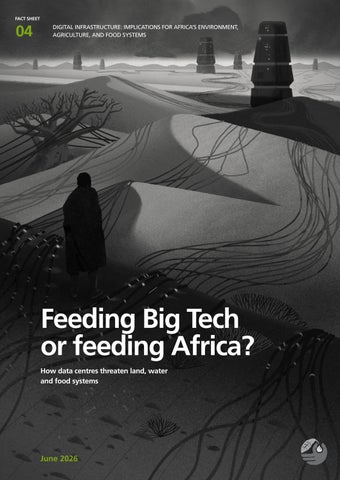
Cover art by Gerhard van Wyk
Acknowledgments
The ACB gratefully acknowledges the financial support of several donors, though the views expressed may not necessarily reflect the views of our donors.
AI Artificial intelligence
AWS Amazon Web Services
DRC Democratic Republic of Congo
ODCs Orbital data centres
SA South Africa
UAE United Arab Emirates
US United States
Africa is rapidly emerging as a new frontier for data-centre expansion, currently hosting only around 1% of global data-centre capacity despite accounting for a growing share of global data traffic and digital consumption. This expansion is being actively promoted by governments and technology companies as essential infrastructure for digitalisation, artificial intelligence (AI), and economic development. Yet the substantial land, water, and energy demands of data centres— and their implications for agriculture, food systems, and rural livelihoods—remain largely absent from policy and public discourse across the continent.
Africa has become a prime target for data-centre investment due to a combination of lower land costs, unmet infrastructure demand, weak or fragmented environmental regulation, and strong political incentives to attract foreign capital. Global technology companies are seeking to relocate or expand resource-intensive infrastructure beyond regions where environmental scrutiny and community resistance are intensifying. Thus, African countries are increasingly being positioned as sites where data centres can be developed with limited transparency and oversight.
Data centres are neither immaterial nor benign. Their operation requires:
- Continuous access to freshwater for cooling,
- Vast and reliable electricity supplies, and
- Large areas of land for buildings, security buffers, power systems, and future expansion.
In contexts already marked by water scarcity, land insecurity, energy instability, and climate stress, these demands compete directly with the basic needs of households, small-scale farmers, pastoralists, and food producers. The consequences are especially acute in rural and peri-urban areas, where agriculture depends on fragile water sources and customary land tenure provides limited protection against displacement.
Despite these realities, most national digital and AI strategies in Africa continue to treat data centres as neutral enabling infrastructure, failing to account for their material footprints and cumulative impacts on food production, water access, and environmental sustainability. In the absence of binding safeguards, transparency requirements, and meaningful consultation with affected communities, the rapid rollout of digital infrastructure risks undermining food security, rural livelihoods, and climate resilience—the very foundations on which sustainable development depends.
This fact sheet provides an overview of recent, ongoing, and projected data-centre expansion across Africa and examines its implications for agriculture and food systems. It highlights the urgent need for public disclosure of resource use, stronger regulatory frameworks, and decisionmaking processes that prioritise community rights and essential needs. Its purpose is to support policymakers, civil society, and development actors in ensuring that digitalisation strategies do not come at the expense of food sovereignty, environmental sustainability, and social justice.
As with the subsea cables that transmit data across oceans, data centres—the physical “brains” of digitalisation—remain largely invisible to most people. Hidden behind seemingly benign terms such as “the cloud,” which evoke a light, almost ethereal image, are vast industrial facilities that store, process, and manage the data generated by phones, tablets, computers, and countless digital devices. Yet the material requirements and real-world consequences of data centres— particularly their demands on land, water, and energy—are rarely discussed in the Global South, including in Africa, where much of this new infrastructure is currently being built, planned, or actively promoted.
Across the continent, governments are increasingly competing to attract Big Tech investment in data centres, with some countries, such as Kenya, branding themselves as leaders of Africa’s digital future and promoting narratives like the “Silicon Savannah” 1, 2 The expansion of data centres in Africa, often presented as models of shared digital infrastructure,3 is also envisioned as a means of closing the persistent digital divide that has left the continent with the lowest levels of connectivity, internet penetration, and mobile phone adoption globally.4
Drowned out by headlines celebrating billion-dollar Big Tech investments in Africa and promises of digitalisation as a universal technological solution to societal problems is the limited attention paid to the material footprints of data centres and their implications for agriculture and food systems. The massive demand for water and energy required to operate data centres is increasingly subject to public scrutiny, challenging both the companies that own them and the Big Tech firms that depend on them.
1 https://techafricanews.com/2025/03/26/kenya-unveils-ai-strategy-2025-2030-to-lead-africas-digital-future/
2 https://www.cbsnews.com/news/how-kenya-became-the-silicon-savannah-60-minutes/
3 https://www.weforum.org/stories/2025/04/how-shared-digital-infrastructure-can-bridge-the-gap-in-africa/
4 https://www.itu.int/dms_pub/itu-s/opb/pol/S-POL-BROADBAND.32-2025-PDF-E.pdf
As technology companies race to deploy innovations to protect the image of digitalisation and AI as climate-friendly solutions, data centres in Africa—including the growing number of largescale facilities under construction—are increasingly competing for scarce freshwater needed for human survival and food production, while simultaneously undermining climate-mitigation efforts through their enormous energy consumption.
For a continent that is home to 19% of the global population5 but holds only 9% of the world’s available freshwater,6 considerations of food production and environmental sustainability must be front and centre in policy discourse and decision-making on data centres. The aquifers and wells from which communities draw water for everyday use and crop cultivation are the same sources increasingly relied upon to cool the computers and operating systems in data centres.
Water crises are intensifying across major urban centres in Africa, with growing demands for improved water infrastructure and reliable supply. As a result, data centres are increasingly sited on urban fringes and in accessible rural areas, where they compete directly with local communities and food producers for limited freshwater resources.
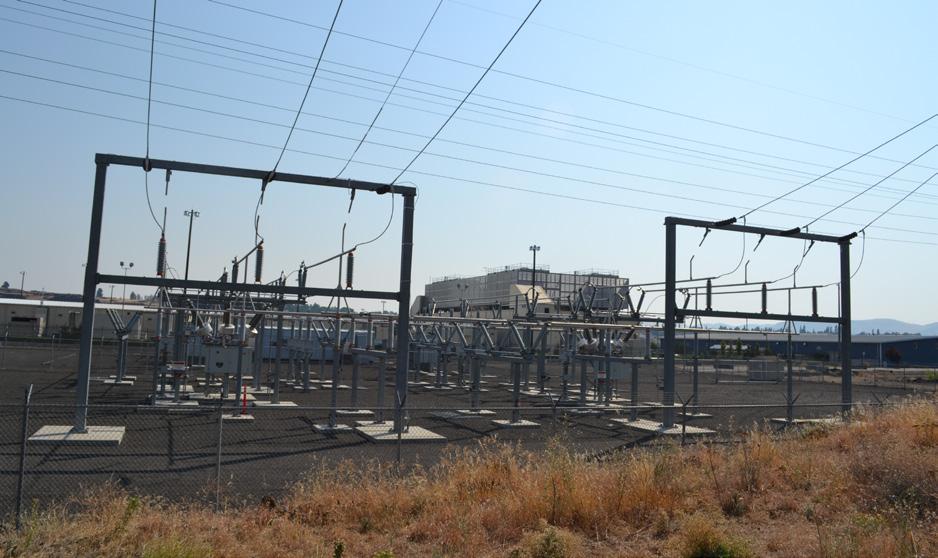
At the same time, aging and inadequate electricity grid infrastructure in many African cities is neither sufficient nor adequately “green” to meet the rapidly growing energy demands of data centres. The result is that new facilities are progressively being built near renewable energy sources or designed with dedicated on-site power generation. As African governments—often backed by financial and technical support from the Global North—commit to accelerating the transition to renewable energy, it is vital to reaffirm that a just transition should prioritise the fulfilment of people’s basic rights, including access to water, food, and energy, rather than ensuring the uninterrupted operation of energy-intensive data-centre infrastructure.
5 https://worldpopulationreview.com/continents/africa
6 https://unhabitat.org/sites/default/files/2021/07/375751eng.pdf
Protests and legal challenges against the climate and water footprints of data centres built, funded, or used by Big Tech companies have proliferated in industrialised countries in recent years, bringing into sharper focus awareness on how these facilities operate and their material impacts. As with earlier technologies rejected or constrained in the Global North due to environmental and public-health concerns, Big Tech companies are thus increasingly investing in data centres in the Global South, where many governments welcome these infrastructures as potential drivers of economic growth and as solutions to the so-called digital divide. As data centres become embedded in Africa’s development pathways, this is a critical moment for civil society to understand the risks they pose to agriculture and food systems and to act collectively to protect the interests of consumers, small-scale farmers, pastoralists, and indigenous peoples.
As of 2026, Africa hosts only 249 data centres across 40 countries, constituting less than 0.02% of the world’s more than 11,800 data centres.7 Several hyperscale data centres, including facilities dedicated to AI, are currently under construction or planned for major hubs across the region and are expected to become operational over the next few years.
Of Africa’s existing data-centre infrastructure, 42% is concentrated in just three countries: South Africa (SA), which hosts 61 data centres; Nigeria, with 25; and Kenya, with 19.8 (See Table 1 for the countries that host the most data centres). The first fully operational “AI factory” on the continent was launched in SA in October 2025,9 and the first data centre in Africa dedicated to AI is currently under construction in Uganda.10 There has been a huge leap over the past 15 years, since the first data centres for cloud services were built in East Africa in 2009-2011.
Data centres that host cloud servers play a central role in digitalisation, serving as the foundational infrastructure for data processing and interconnectivity. The “cloud” enables users to store, access, process, and analyse their data; manage databases; and run software applications, without having to maintain their own physical servers.11 These services are delivered for a fee, either via subscription to cloud services, access to a premium version of an AI model, or, more ubiquitously, by bombarding users with advertisements and enticements to consume more.
Currently, Amazon Web Services (AWS), Microsoft and Google account for 58% of data centre capacity globally.12 Major international cloud providers, including AWS, Microsoft Azure, Google Cloud, and others, have established a significant presence in Africa, particularly in SA, often in partnership with regional companies such as Teraco and Africa Data Services. Networks of terrestrial cables, towers, and poles extend from these data centres across locations and further inland, connecting users of internet services to global subsea cables.
7 https://energychamber.org/data-centers-could-be-the-spark-africas-power-sector-needs/
8 https://www.datacentermap.com/africa/
9 https://cioafrica.co/altron-launches-south-africas-first-ai-factory/
10 https://iafrica.com/africa-launches-first-ai-data-center-in-uganda-to-drive-digital-sovereignty-and-innovation/
11 https://www.africadatacentres.com/wp-content/uploads/2023/06/ADC-sustainability.pdf
12 https://www.crn.com/news/cloud/2025/hyperscale-data-centers-hit-1-300-with-aws-google-microsoft-leading-global-boom
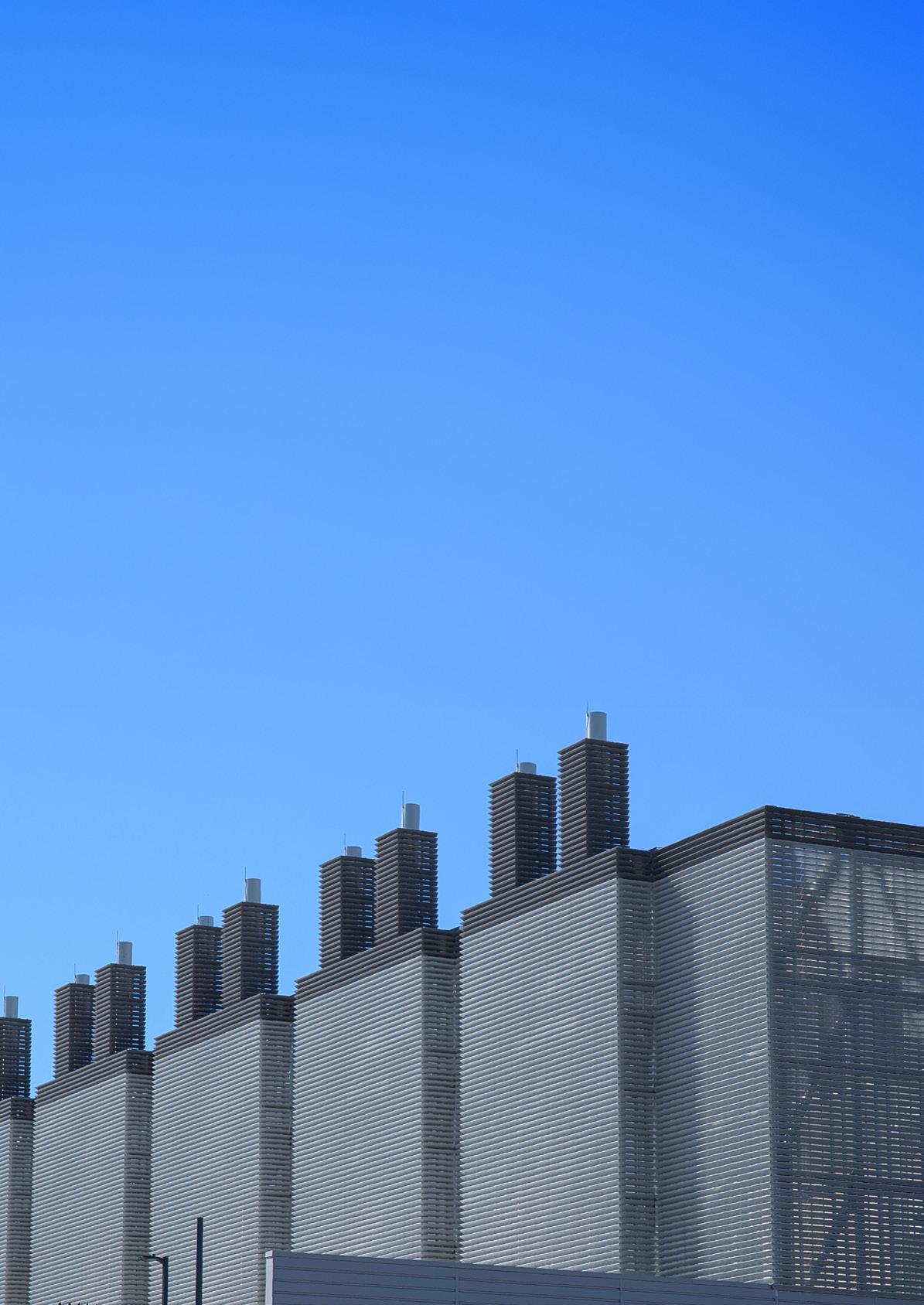
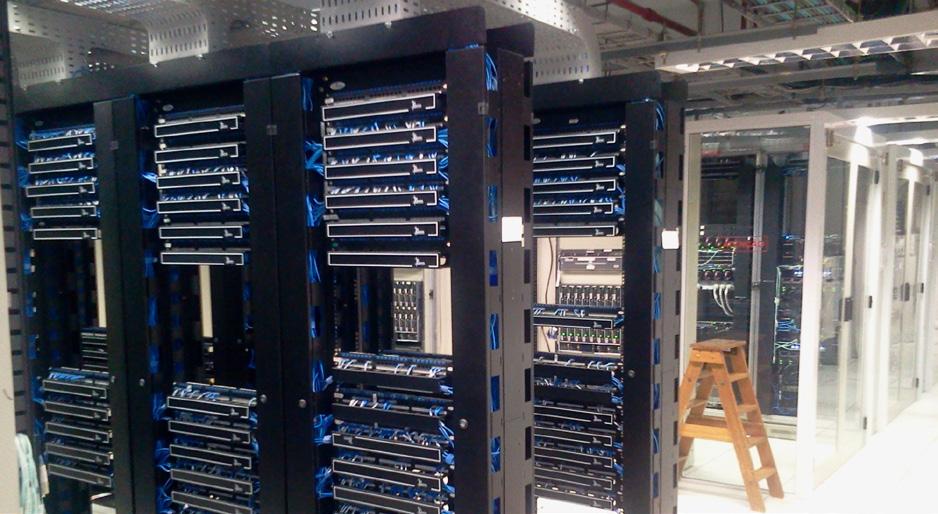
The size of data centres varies based on power capacity and the number of racks they can support, which can run into the thousands.13 Cloud servers are mounted in data-storage racks housed within cabinets designed for security and protection. Like all physical infrastructure, the hardware that underpins data-centre operations is vulnerable to natural, technical, and humaninduced hazards. Disruptions can compromise data traffic and system integrity, as demonstrated in a recent incident in South Korea, where a lithium-ion battery malfunction triggered a fire in a data centre, causing widespread interruption of digital services in one of the world’s most digitally advanced countries.14
Table 1. Leading data centre hubs in Africa

Source: Data Centre Map 15
Typical smaller data centres are reported to occupy at least 10 acres (approximately 4 hectares) of land. However, average site sizes have expanded significantly in recent years, reaching around 244 acres (about 98 hectares) since 2024, while hyperscale data centres can occupy up to 500 acres (approximately 202 hectares).16
Hyperscale data centres, or hyperscalers, have at least 5,000 servers, miles of network equipment, and can occupy millions of square feet of floor space.17 The land occupied by a data centre extends far beyond the actual floor space required to house racks and cabinets of
13 https://rpa.org/news/lab/the-rise-of-data-centers
14 https://eticaag.com/south-korean-data-center-fire-crashed-digital-services/
15 https://www.datacentermap.com/africa/
16 https://www.techtarget.com/searchdatacenter/feature/The-increasing-concern-of-data-center-land-acquisition#
17 https://www.ibm.com/think/topics/hyperscale-data-center
servers, computers, and storage systems. Much of this land is needed for auxiliary infrastructure, security perimeters, cooling systems, power supply, access roads, and future expansion. IXAfrica’s data centre built in Nairobi in 2021, for example, sits on a four-acre campus, with only around a third of the site currently used for its co-location facilities. The company was already acquiring an additional 11-acre tract of land in the city to build another data centre.18
Large areas of land are required to construct buildings housing vast numbers of servers and storage facilities, as well as to install and secure networking equipment, cooling systems, power supply infrastructure or generators, and extensive safety and security perimeters that enable efficient operation and future expansion. Studies show that data centre companies and investors have been actively acquiring hundreds of acres of land globally, a trend that Big Tech and its partners have identified as a strategic priority. This land acquisition is contributing to land speculation, which drives up land prices and risks marginalising local communities—competing with other land uses such as food production while aggravating environmental degradation.19
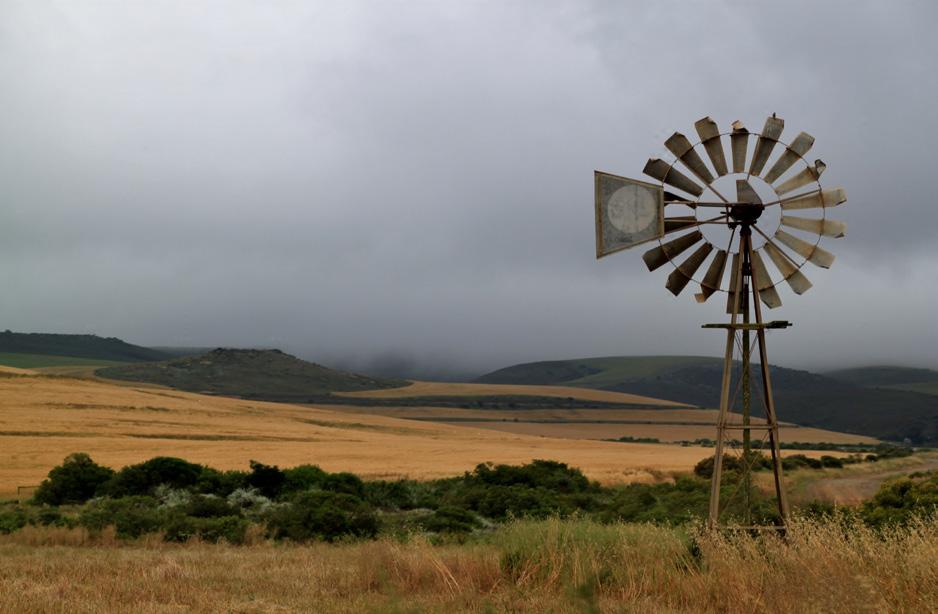
This is particularly alarming in Africa, where land cultivated, stewarded, and conserved by smallholders, pastoralists, and indigenous peoples is routinely overlooked in development narratives that portray arable land as abundant but largely unused.20 This myth has enabled the marginalisation of traditional and indigenous cultivators, many of whom lack secure access to land and tenure rights, leaving them deprived of legal recognition and control over the land they cultivate and other productive resources.21
© PxHere
18 https://www.datacenterdynamics.com/en/news/kenyas-ixafrica-secures-financing-for-20mw-expansion-to-data-center/
19 https://www.techtarget.com/searchdatacenter/feature/The-increasing-concern-of-data-center-land-acquisition
20 https://www.worldbank.org/en/programs/africa-myths-and-facts/publication/land-is-abundant-and-land-markets-arevirtually-absent
21 https://afsafrica.org/wp-content/uploads/2025/12/final-afsa-uwc-plaas-land-use-report-2025-web.pdf
There is scarce publicly available information on the actual amount of land occupied by data centres across Africa, as information on land use—as with water and energy consumption—is generally not disclosed by companies. What little information does reach the public domain, often through media reporting, is therefore worth close examination.
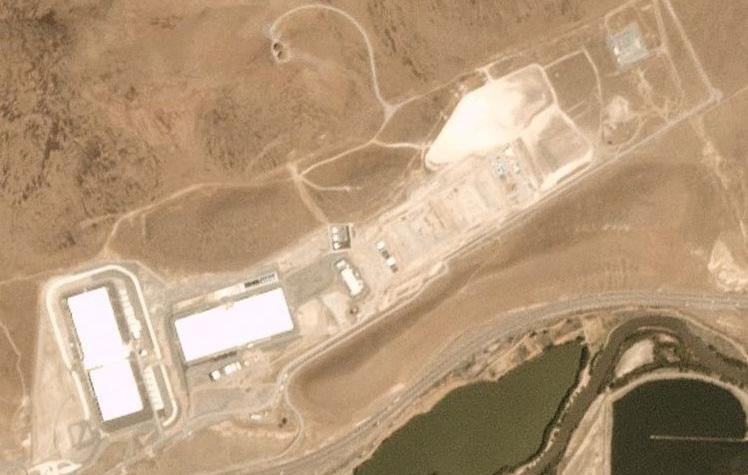
One example is the state-of-the-art data centre being built in the Free State, SA, by Johannesburg-based Teraco Data Environments, owned by the United States (US) company Digital Realty—the world’s largest provider of data-centre co-location and related services. The facility reportedly includes 7.5 hectares of usable area—commonly referred to as “white space”—to accommodate computing equipment, storage servers, and networking racks, an area that could comfortably fit 10 rugby fields.22
It is not clear from the limited information available whether this area already includes extensive security perimeters, such as high fences and buffer zones. “White space” may be configured vertically, across multiple floors of multi-story buildings—as is common in land-scarce contexts such as Singapore—or horizontally, on sprawling campuses such as those in the US. Land size matters profoundly in Africa, where most farmers are smallholders cultivating an average of fewer than five acres (about two hectares), primarily for subsistence. According to the World Bank, around 90% of rural land in Africa is undocumented and governed through customary arrangements, rendering it highly vulnerable to exploitation and to displacement by actors asserting formal legal claims or by government projects presented as being in the public or national interest.23
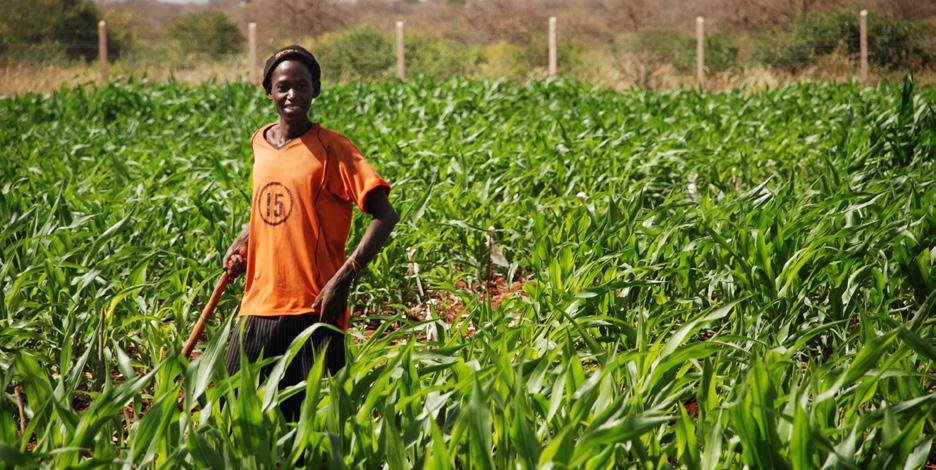
The threat of farmers, pastoralists, and indigenous peoples being displaced from their land is real since large data centres are built or planned in rural areas that are easily accessible to urban and industrial centres, where the primary users and generators of data are located. The Free State, for example, is widely regarded as SA’s “breadbasket,” producing much of the maize, soybeans, and wheat consumed domestically and exported abroad, largely on land owned or controlled by white commercial farmers and agribusiness enterprises.
22 https://mybroadband.co.za/news/cloud-hosting/619990-the-company-with-enough-data-centre-space-to-cover-10-rugbyfields-in-south-africa.html
23 https://www.worldbank.org/en/region/afr/publication/securing-africas-land-for-shared-prosperity
© Planet.com | Wikimedia Commons
The largest data centres in Africa are predominantly located in SA, Nigeria, Kenya, Morocco, Tanzania, Angola, and Mauritius. Notably, all major global cloud operators—AWS, Microsoft Azure, Google Cloud, Alibaba Cloud, Oracle Cloud, and IBM Cloud—maintain data-centre operations in SA.24 Most of the continent’s leading data centres are built either by home-grown firms or by companies established by African tech entrepreneurs whose headquarters are located in the United Kingdom or the US, or they operate through partnerships with major Big Tech corporations.25
The new state-of-the-art data centres currently under construction or in planning stages are backed by billions of dollars in investment from Big Tech, often in collaboration with regional partners that specialise in the design and construction of data-centre infrastructure. Data centres can be categorised by ownership structure and use, with different models often overlapping in practice. When companies build, own, and operate data centres for their own internal needs, these facilities are referred to as enterprise or private data centres. In contrast, co-location data centres are purpose-built facilities where operators rent out space, power, and network connectivity to businesses that run their own servers. Through hosting data-centre arrangements, providers manage storage and networking services for websites and applications, while under infrastructure-as-a-service (IaaS) models, providers offer on-demand digital infrastructure that allows clients to store data and scale operations as needed.
Hyperscalers are large-scale data centre operators—typically major technology companies—that build and manage extremely large facilities to support cloud computing, AI, big data, and global digital services. Globally, hyperscalers are increasingly shifting away from owning data centres towards leasing capacity, a model that enables rapid expansion while limiting capital expenditure on fixed assets.26
24 https://africadca.org/wp-content/uploads/2023/07/Title_Africas-Key-Data-Centre-Markets.pdf
25 https://datacentremagazine.com/news/2025-in-review-top-10-data-centre-companies
26 https://xenoss.io/ai-and-data-glossary/hyperscale-data-center
In Africa, too, hyperscalers are likely to operate as tenants in co-location facilities specifically designed to meet their requirements, rather than building their own data centres. Big Tech companies, however, may also be positioning themselves strategically on the continent by developing their own state-of-the-art facilities in partnership with regional actors, as illustrated by the billion-dollar investment by Microsoft and the United Arab Emirates (UAE)-based company G42 in Kenya.
Data centres dedicated to AI require significantly higher power than standard data centres due to the intense computational demands of training large language models and performing machine-learning tasks. These requirements typically entail larger land areas to site and secure specialised facilities and supporting infrastructure. High-performance computing (HPC) systems and massive storage facilities are needed to process and analyse vast volumes of data at high speed, supported by ultra-fast networking, specialised cooling technologies, and robust power systems—sometimes including dedicated on-site electricity generation to meet the exceptionally high and continuous energy demands of AI operations.27 Uganda’s Aeonian Project, described as the first sovereign AI factory in Africa and expected to begin operating its first phase in the second half of 2026, is being built within the 600 MW Karuma Hydropower Plant on the upper Nile River. Locating the facility inside a public hydropower complex obscures the actual land area occupied by the privately-owned AI infrastructure and complicates assessment of its full spatial and resource footprint.28
Data centres consume large volumes of water to cool servers and supercomputers and prevent overheating, with daily use estimated at up to 19 million litres per facility. Data centres dedicated to AI are even more water-intensive because training AI models relies on energy-hungry computing clusters that generate substantial heat and therefore require continuous cooling. In response to these pressures, major technology companies such as Microsoft have begun deploying newer cooling systems in recently built facilities, including liquid immersion cooling, direct-to-chip liquid cooling, and air-cooled mechanical systems (dry cooling), with the stated aim of reducing water use. Yet information on data-centre water consumption remains largely hidden from public view and typically surfaces only when disputes emerge during droughts or when surrounding communities experience water shortages. Without strict oversight and mandatory disclosure, the continued expansion of data centres risks worsening existing water crises and undermining the resilience of African communities and food systems, making it urgent for governments to adopt binding regulations that prioritise public water needs over corporate demand.
Water consumption by data centres is a serious concern for Africa, as it is the second-driest region in the world, after Australia. This is particularly true for water-scarce countries like SA that promote themselves as data-centre hubs. The continent has only 9% of the world’s available freshwater, concentrated in six countries in central Africa, which contains 54% of Africa’s freshwater resources.29 The largest concentration of freshwater is in the Democratic Republic of Congo (DRC), while only 3% is in northern Africa.30
27 https://hexatronicdatacenter.com/en/knowledge/the-evolution-of-data-centers-from-traditional-to-ai-powered
28 https://kenyanwallstreet.com/uganda-set-to-host-africas-first-ai-factory
29 https://unhabitat.org/sites/default/files/2021/07/375751eng.pdf
30 https://www.afdb.org/sites/default/files/documents/policy-documents/policy_on_water-18062021.pdf#
Freshwater is a finite resource, particularly in regions where the forests that sustain and replenish water sources are severely degraded. Africa has the highest rate of forest degradation in the world, especially in the Congo Basin and the DRC. The fact that only 5% of the continent’s freshwater resources are currently being exploited highlights how vital this resource is, even as water-intensive data centres require continuous cooling around the clock. This growing demand is likely to intensify competition over basic needs and rights across Africa, where only 58% of the population has access to safely managed drinking water.31In such a water-scarce region, the growing water demands of data centres are likely to become an increasingly contentious issue as digitalisation accelerates.
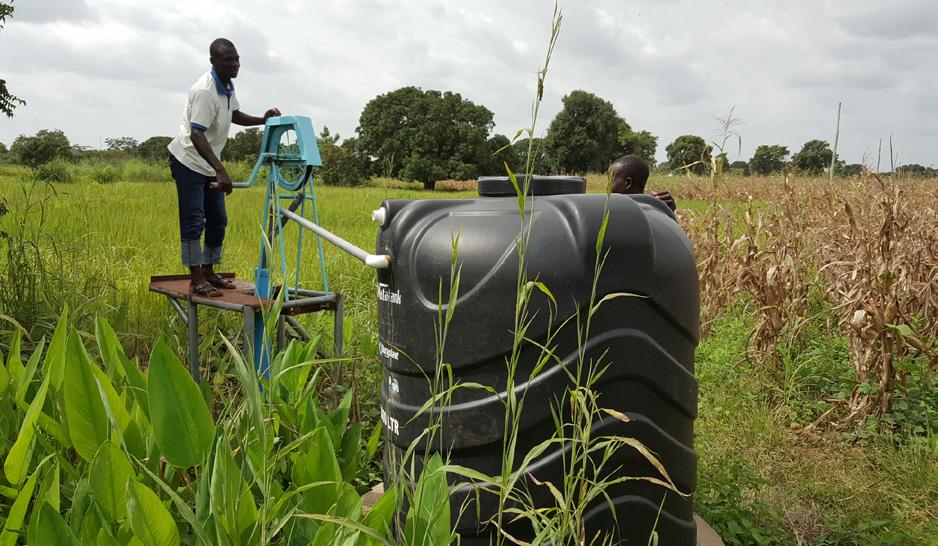
The impact of data centres on agriculture and food systems is frequently overlooked in debates on their water footprint. This is especially significant in a dry continent such as Africa, where agriculture accounts for up to 85% of freshwater use, compared with 10% for households and 5% for industry.32,33 Although agriculture consumes most of the continent’s available freshwater, less than 10% of agricultural land is irrigated, and around 90% of farms in sub-Saharan Africa depend on rainfall.34
Understanding who currently has access to irrigation, and which forms of farming benefit from it, provides a useful basis for anticipating how governments may prioritise the allocation of scarce freshwater resources. In Kenya’s Lake Naivasha, for example, which is well known for its cut-flower industry, as much as 98% of the water available for irrigation has been used to grow flowers for export.35 Cultivation of perennial fruit trees for export draws much of the
31 https://www.afdb.org/sites/default/files/documents/policy-documents/policy_on_water-18062021.pdf#
32 https://www.waterfootprint.org/resources/Africa_Country_WF_Profiles_briefing.pdf
33 https://water-for-africa.org/en/water-consumtion
34 https://www.researchgate.net/publication/383729949_Status_of_agricultural_water_management_practices_in_Africa_a_ review_for_the_prioritisation_and_operationalisation_of_the_Africa_Union’s_irrigation_development_and_agricultural_ water_management_AU-IDA
35 https://www.researchgate.net/publication/234137287_Mitigating_the_Water_Footprint_of_Export_Cut_Flowers_from_the_ Lake_Naivasha_Basin_Kenya
available freshwater in north-east SA, where there is a high concentration of privately–owned commercial farms.36 As investment in irrigation on the continent remains low, farmers mostly rely on renewable technologies and innovations in irrigation and water impoundment. These are inconvenient realities that could shape government policies on water requirements of data centres.
A market analysis projects that the rapid growth of smartphone use in SA alone will require a sharp increase in storage and processing capacity to manage rising data volumes.37 Of concern, is the country’s long-standing water crisis, driven by deteriorating infrastructure, poor management, and climate change. Johannesburg, where large protests over water shortages erupted again as recently as February, is also a major data-centre hub, hosting around 40 facilities. The analysis estimates that data-centre water consumption in SA stood at 17.94 billion litres in 2025 and could rise to 29.42 billion litres by 2030.38 Hence, pressure on already scarce water supplies is set to intensify further as AI applications and factories, which demand massive computational power, continue to expand. This is especially concerning in African megacities, where water supply and quality are already persistent challenges.
The same pattern is evident in other data-centre hubs across the continent, such as Lagos, which hosts 21 data centres and faces recurrent water crises driven by poor infrastructure and mismanagement.39 It remains unclear how much freshwater data centres in and around waterstressed megacities such as Johannesburg and Lagos are extracting from already limited supplies, and to what extent this competes with the population’s basic water needs and the requirements of food production. Some think tanks have raised concerns about the environmental impacts of data centres in Africa, particularly their water use,40,41 yet there are still no publicly available studies directly linking data-centre operations to the ongoing water crisis in SA, for example. Across the continent, operators continue to evade questions about the actual water use of their facilities, often greenwashing their operations through claims about recycling grey water, using boreholes, and deploying air-cooling technologies and ceramic components, even though none of these measures has yet demonstrated a significant reduction in freshwater consumption for data-centre cooling anywhere in the world. Synectics Technologies, the Kampala-based company building an AI factory inside Uganda’s Karuma Hydropower Plant in partnership with Schneider Electric and NVIDIA, has stated that it will use water from the Upper Nile for its cooling systems.42,43
Globally, scrutiny of the water footprint of data centres is increasing, even as companies continue to treat their actual water consumption as confidential business information. Academic research has shown just how water-intensive AI model training is, with total water demand projected to exceed the annual water withdrawal of a country such as Denmark by three to four times by 2027.44
36 https://www.sciencedirect.com/science/article/pii/S0048969722073636
37 https://www.mordorintelligence.com/industry-reports/study-of-data-center-water-consumption-in-south-africa
38 Ibid
39 https://www.scidev.net/global/scidev-net-investigates/data-centres-straining-water-resources-as-ai-swells/
40 https://nstf.org.za/wp-content/uploads/2025/05/25OpinionHiddenCostofCloud.pdf
41 https://www.africa.engineering.cmu.edu/news/2025/08/13-water-efficiency.html
42 https://nstf.org.za/wp-content/uploads/2025/05/25OpinionHiddenCostofCloud.pdf
43 https://www.africa.engineering.cmu.edu/news/2025/08/13-water-efficiency.html
44 Pengfei Li, Jianyi Yang, Mohammad A. Islam, Shaolei REN, “Making AI Less “Thirsty”: Uncovering and Addressing the Secret Water Footprint of AI Models, ArXiv, 6 Apr 2023, https://doi.org/10.48550/arXiv.2304.03271
Several municipalities and citizen groups in the US are suing Big Tech companies for contaminating and drying up water sources in areas surrounding data centres,45 and states such as California and New Jersey are demanding public disclosure of data-centre water use.46 Google’s plan to build a huge data centre in Uruguay was met with angry protests in 2023, amid the country’s worst drought in 74 years.47 In mid-2025, communities in central Mexico complained about long stretches of water supply disruption and frequent power outages since Microsoft built its data centre.48
Like the people who design and control them, data centres depend on both water and energy to function. Their electricity demand is immense, and it is even higher in facilities built for AI, which requires exceptionally large computing power.
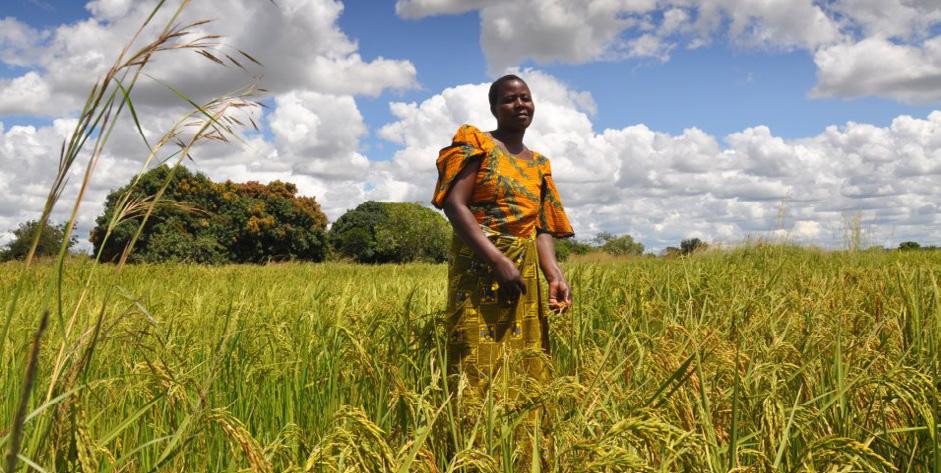
Every time a user submits a prompt to a generative AI system such as ChatGPT, Gemini, or DeepSeek, the server processing that request consumes about 0.14 kilowatt-hours of electricity to store, compute, and generate a response—roughly equivalent to powering 14 LED light bulbs for one hour.49 Just imagine the massive amount of energy needed to store and process the 2.5 billion prompts that ChatGPT alone claims to get every single day, which is equivalent to the energy needed to fully charge 14,000 electric vehicles daily.50
45 https://www.bbc.com/news/articles/cy8gy7lv448o
46 https://www.eenews.net/articles/states-push-to-end-secrecy-over-data-center-water-use/
47 https://www.theguardian.com/world/2023/jul/11/uruguay-drought-water-google-data-center
48 https://www.nytimes.com/2025/10/20/technology/ai-data-center-backlash-mexico-ireland.html
49 https://www.weforum.org/stories/2025/06/sustainable-data-centre-heating/
50 https://spectrum.ieee.org/ai-energy-use#:~:text=
Even without AI, data centres require large amounts of electricity to store, process, and analyse data across extensive arrays of storage racks, supercomputers, and servers. Energy is also needed to keep these systems running continuously, to cool them around the clock, and to treat the water used in cooling so that sensitive and costly equipment is protected.
Globally, data centres account for about 1.5% of total electricity consumption, a figure growing by roughly 12% each year and projected to double by 2030.51, 52 Their energy consumption accounts for roughly 45% of the total energy consumed across the African continent in 2024.53
For the roughly 240 data centres currently operating across Africa, there is still no publicly available information on their actual electricity consumption. What exists instead are company claims about installed or advertised power capacity, typically presented to attract potential co-locators and tenants, rather than transparent data on real energy use.54 Based on its announced power capacity, the massive 400 MW AI data centre being built in Durban with financing from South Korean investors is projected to consume about 25% of the city’s total electricity supply,55 while the four data centres under construction in Cape Town with combined 580MW power capacity will gobble up 34% of the city’s current supply.56 Industry sources estimate that data-centre capacity in Africa exceeded 400 MW in 2023, with a further 399 MW expected by the end of 2025 and another 1.3 GW projected by 2027, as the continent expands its digital economy and cloud infrastructure.57
Announced power capacity does not necessarily correspond to actual electricity consumption, particularly in countries where supply remains chronically unreliable because of aging infrastructure, underinvestment in the power sector, and high energy costs. In many cases, these capacity figures appear mainly in glossy promotional materials from data-centre companies and may bear little relation to what the grid or another power source can reliably deliver. In countries such as SA, where electricity insecurity is politically charged and can influence electoral outcomes, guaranteeing power to data centres could itself become a major political issue.58
Nigeria, whose power grid is notoriously inefficient and unstable, has data centres that partially rely on diesel generators to operate.59 To attract data-centre investment and pursue integration into the global digital economy, countries with chronically unreliable power grids may end up prioritising electricity supply to data centres over households and ordinary consumers. These pressures are likely to deepen as governments are urged to do more to realise ambitions of AI sovereignty in Africa and to position the continent not merely as a consumer of AI, but as a producer and developer of it, as promoted by data-centre operators grouped under the African Green Compute Coalition (AGCC).60 This vision is already beginning to materialise, along with its associated challenges. In June 2025, NVIDIA—the world’s most valuable company by market
51 https://www.nature.com/articles/d41586-025-01113-z
52 https://www.iea.org/reports/energy-and-ai/energy-demand-from-ai
53 https://ourworldindata.org/grapher/primary-energy-consumption-by-region
54 https://www.datacentermap.com/africa/
55 https://www.dailymaverick.co.za/article/2026-03-04-sas-biggest-data-centre-monster-set-to-consume-25-of-durbanselectricity/
56 https://www.dailymaverick.co.za/article/2026-04-28-new-data-centres-set-to-swallow-34-of-cape-towns-current-electricitysupply/
57 https://www.globenewswire.com/news-release/2025/03/19/3045348/28124/en/Africa-Existing-Upcoming-Data-CenterDatabase-2025-Africa-s-Digital-Infrastructure-Surge-56-New-Data-Centers-400MW-Capacity-Growth-by-end-of-2025.html
58 https://hir.harvard.edu/power-hungry-the-influence-of-south-africas-electricity-crisis-on-national-elections/
59 https://kenyanwallstreet.com/data-centers-could-spark-africas-power-sector-needs
60 https://www.weforum.org/stories/2025/12/investing-in-green-compute-in-africa/
capitalisation—announced a US$700 million partnership with Cassava Technologies, a UK-based tech group that presents itself as having African roots, to develop AI-ready data centres for applications in agriculture, healthcare, and fintech across the continent. The rollout is set to begin in SA before expanding to Egypt, Nigeria, Kenya, and Morocco.61
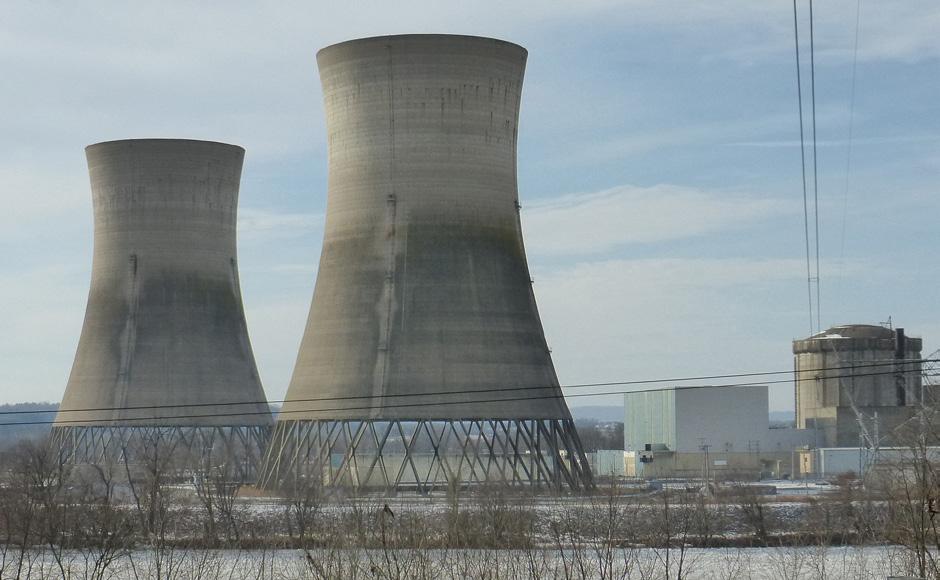
Unlike water, which is finite and geographically constrained, energy is a fungible resource that can be generated and expanded relatively quickly, as current developments in the US illustrate. New hyperscale data centres there are increasingly being built with dedicated power plants to secure a stable and sufficient electricity supply, rather than relying solely on the grid, thereby responding to public concerns about pressure on electricity availability and prices.62 Google is reportedly planning an initiative for data centres to Bring Your Own Clean Energy, under a catchy acronym BYONCE.63 The growing appetite of data centres for so-called climate-friendly power has already pushed cash-rich technology companies into controversial energy projects. Microsoft, for example, has invested in reviving the former Three Mile Island nuclear power plant in the US.64 Amazon has also partnered with a nuclear energy company in the US to develop dedicated small modular reactors, while other technology billionaires are investing in futuristic nuclear fusion.65
61 https://www.intelligentcio.com/africa/2025/11/27/nvidia-and-cassava-technologies-launch-700m-ai-data-centre-rolloutacross-africa/
62 https://www.wsj.com/business/energy-oil/ai-data-centers-desperate-for-electricity-are-building-their-own-power-plants291f5c81#
63 Mike Jacob’s, Union of Concerned Scientists, The Equation, 10 July 2025 , https://blog.ucs.org/mike-jacobs/power-hungrywhy-data-centers-are-developing-their-own-energy-sources-to-fuel-ai/#
64 https://www.reuters.com/markets/deals/constellation-inks-power-supply-deal-with-microsoft-2024-0920/#:~:text=Microsoft%20has%20also%20signed%20a,more%20details%20on%20the%20agreement.
65 https://www.wsj.com/tech/tech-billionaires-bet-on-fusion-as-holy-grail-for-business-9a48a2ac
As data centres expand rapidly across Africa and governments compete to attract Big Tech investment, questions of energy and water must be treated as central from the outset. Some analysts argue that rising electricity demand from data centres could help stimulate much-needed investment in power infrastructure across the continent, with possible co-benefits for millions of people who still lack access to electricity.66
It is often argued that the prospect of more data centres on the continent will attract much-needed investment in new or modernised energy infrastructure, with benefits that may eventually extend to the roughly 600 million people in Africa who still lack access to electricity. Yet this expectation rests on a familiar trickle-down logic that has historically done little for those at the bottom or at the margins. At the same time, African governments’ international commitments on climate action make renewable energy especially attractive, both as a pathway to meeting mitigation goals and as a source of stable, low-carbon power for technology investors. For cash-rich tech companies, building data centres with dedicated renewable energy supply—or locating them next to renewable infrastructure financed with public funds—offers a powerful way to “green” their image while securing reliable electricity for their operations.
As data centres demand ever larger amounts of electricity from already fragile grids, however, they do more than place additional strain on national energy systems—they risk diverting power away from households, clinics, schools, farmers, and food producers who depend on electricity for survival and livelihood. On a continent where millions still lack power, prioritising energyintensive digital infrastructure deepens inequality and undermines the rights to food, water, and dignified livelihoods. Unless governments address this imbalance through firm regulation and energy-justice safeguards, the push to power Big Tech’s cloud will come at the direct expense of the people who feed Africa.
Renewable energy is widely seen as a vital pathway for improving the lives of the roughly 600 million people in Africa who still lack access to electricity, by expanding social and economic opportunities and improving living conditions. The continent also holds the world’s greatest solar energy potential, which could be harnessed to support people-centred development, reduce dependence on fossil fuels, and contribute to addressing the climate crisis.67
Already, more than 55% of Africa’s energy consumption is derived from renewable sources, yet over a third of the continent’s population still lacks access to electricity. Investment in expanding renewable energy remains inadequate, despite the goal of halving the number of people without electricity access by 2030 and repeated pledges from multilateral actors.68
Set against the urgent need to extend renewable electricity to the millions of people across Africa who still live without power is the growing pressure on data centres to become “green.” In response to mounting concern over their climate footprint, many of the new data centres being built or planned in Africa—by those in the US and elsewhere—are being designed with dedicated power supplies drawn mainly from renewable energy sources. This model is especially attractive on a continent where many countries still have vast, untapped renewable-energy potential. It has also generated expectations that investment in self-powered data centres could
66 https://energychamber.org/data-centers-could-be-the-spark-africas-power-sector-needs/
67 https://static1.squarespace.com/static/657880dcd408ac495a5cc888/t/685d1a66e04e9216732b7ade/1750932151318/ African+Energy+Leadership+Report.pdf
68 https://unsdg.un.org/latest/stories/decoding-africa%E2%80%99s-energy-journey-three-key-numbers
spur the development of energy infrastructure capable of reaching populations that remain excluded from electricity access. Because these facilities rely on renewable sources, they can be presented as aligned with Africa’s decarbonisation goals, offering investors and technology companies a convenient way to portray themselves as climate and environmentally friendly.
SA and Kenya are at the forefront of offering data centres access to stable and reliable renewable energy—resources that should, in principle, be directed first toward meeting the needs of their populations.69 Africa Data Centres has partnered with Distributed Power Africa (DPA)—both part of the UK-based Cassava Technologies group—to develop an initial 12 MW solar farm in SA’s Free State province.70 Digital Realty subsidiary Teraco began construction in late 2024 of a 120 MW utility-scale solar photovoltaic plant in the Free State to supply electricity to its cloud and AI computing operations in the country’s data centres.71
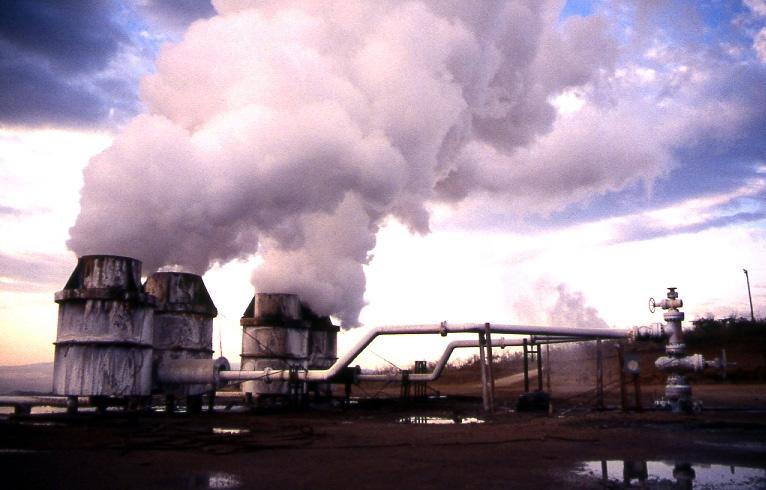
Kenya—where nearly 80% of the current energy mix comes from renewable sources—is set to host a planned 100 MW green data centre backed by a US$1 billion investment from Microsoft and G42. The state-of-the-art campus under construction in Naivasha, near Nairobi, will host Microsoft Azure’s East Africa cloud region and AI operations, run entirely on geothermal energy and incorporating water-conservation technology.72 Olkaria Geothermal Power Plant, which generates at least 800 MW—nearly half of Kenya’s renewable electricity supply—was the first geothermal station in Africa and began operating in 1981. The government is now seeking financing from international financial institutions to expand the Olkaria geothermal fields over
69 https://kenyanwallstreet.com/data-centers-could-spark-africas-power-sector-needs
70 https://www.africadatacentres.com/africa-data-centres-and-dpa-sa-breaks-ground-on-solar-farm-in-free-state/
71 https://www.teraco.co.za/news/teraco-commences-construction-on-120mw-utility-scale-solar-power-plant/
72 https://news.microsoft.com/source/2024/05/22/microsoft-and-g42-announce-1-billion-comprehensive-digital-ecosysteminitiative-for-kenya/#
the next five years and has invited US geothermal developers to invest in the project as part of its ambition to reach 100% renewable energy by 2030.73 The planned Microsoft and G42 data centre will, in effect, enjoy privileged access to Olkaria’s geothermal power, infrastructure built with public funds, even though about 24% of Kenya’s population still lacks access to electricity. G42, a UAE-based AI company, is controlled by a prominent member of the ruling emir’s family who also serves as the emirate’s national security adviser. The company and its Chinese chief executive have been linked to controversies involving Pegasus spyware and the TokTok surveillance app.74
Even in countries that currently host far fewer data centres, such as Senegal, investors are aligning their projects with national decarbonisation goals. Pan-African Internet Exchange (PAIX) Data Centres, for example, is building a facility in Dakar in line with its environmental commitments, including a target of powering its data centres with 100% renewable energy by 2030.75 This objective is consistent with Senegal’s own plan under the Just Energy Transition Partnership (JETP), supported by partners in the Global North, to raise the share of renewables in its energy mix to 40% by 2030.76 Uganda, meanwhile, has approved the construction of the Aeonian Project, a sovereign AI centre jointly owned by domestic and foreign companies, within the Karuma Hydropower Plant on the Upper Nile, in order to secure a stable and “green” electricity supply.77 Unless African governments reclaim renewable energy for people rather than profit, the rush to build “green” data centres will entrench a new form of energy colonialism, diverting publicly funded clean power to Big Tech while millions of households and farmers remain in the dark.
As researchers and engineers on Earth search for technological fixes to the growing concern over the immense carbon and water footprints of data centres—footprints that undermine claims that they are climate-friendly—the billionaire owners of Big Tech are already looking skyward in the race for AI dominance. Elon Musk, who was born in SA, is among the most vocal advocates of space-based or orbital data centres (ODCs), presenting them as facilities that could run on abundant solar energy and be passively cooled by the cold conditions of outer space.78
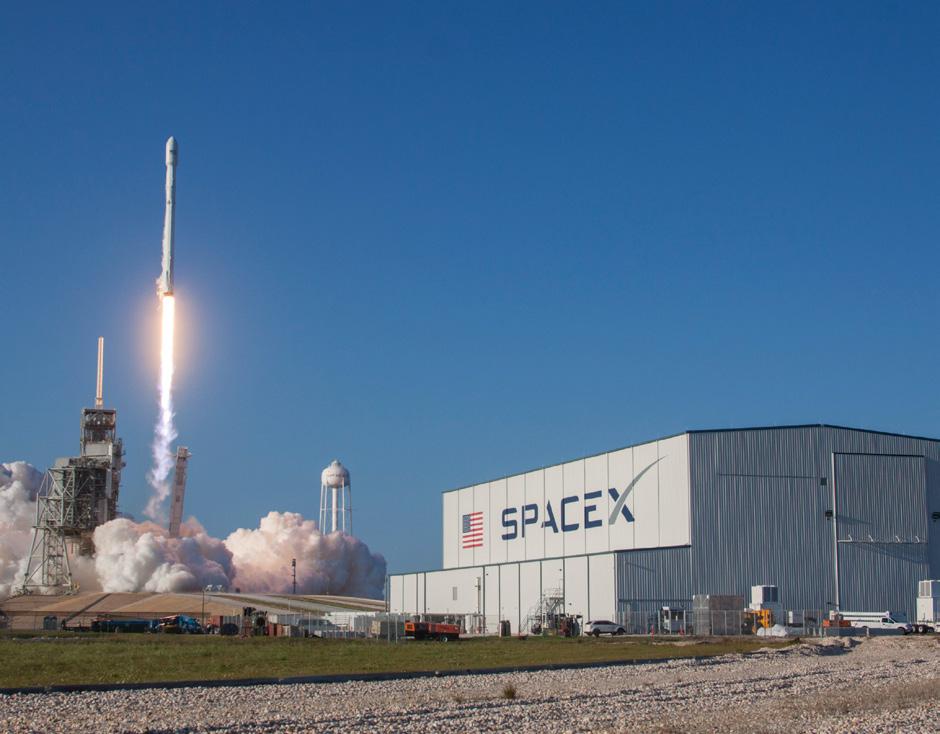
Despite serious concerns about the climate impacts of manufacturing and launching thousands of rockets and hundreds of spacecraft each year to send an estimated 10 million tons of hardware into space—while also worsening space pollution—SpaceX has already sought US regulatory approval to launch one million low-Earth-orbit (LEO) satellites designed to operate as ODCs.79, 80
73 https://www.trade.gov/market-intelligence/kenya-energy-announcement-18-billion-geothermal-expansion-electricity#
74 https://www.washingtoninstitute.org/policy-analysis/g42-and-china-uae-us-triangle
75 https://www.connectingafrica.com/data-centers/paix-to-build-data-center-in-senegal
76 https://resourcegovernance.org/articles/senegals-new-jetp-four-crucial-next-steps
77 https://www.ecofinagency.com/news-digital/1509-48701-synectics-schneider-to-build-ai-center-in-uganda-starting-2026
78 https://www.scientificamerican.com/article/data-centers-in-space/
79 https://www.scientificamerican.com/article/spacex-plans-to-launch-one-million-satellites-to-power-orbital-ai-data/#
80 https://spacenews.com/spacex-offers-details-on-orbital-data-center-satellites/
SpaceX recently acquired xAI, positioning itself to secure an early lead in the emerging ODC industry.81 Not to be outdone, Jeff Bezos’s Blue Origin is pursuing its own, more cautious and less ambitious initiative under the name “Project Sunrise”.82
Google’s “Project Suncatcher” remains at the conceptual stage, while NVIDIA is backing Starcloud, a US start-up seeking approval to launch thousands of satellites to operate as ODCs for AI applications using NVIDIA chips engineered for space use.83 This is yet another race among powerful technology billionaires to dominate a potentially lucrative frontier. As with the broader AI race, governments in both the Global North and South are largely reduced to the role of spectators—issuing licences and drafting regulations after the technology has advanced to a point far more difficult, and costly, to redirect or restrain.
Meanwhile, the AI race continues on Earth, where the rapid expansion of data centres is already affecting agriculture and food systems, particularly in the Global South, where regulation is either enabling these technologies or failing to constrain them despite mounting concerns about their concrete climate and water impacts. As Big Tech pushes its ambitions beyond the planet, the real danger is that these futuristic visions distract attention from the extractive digital infrastructure already reshaping land, water, and energy systems across Africa.
81 https://spacenews.com/spacex-acquires-xai-in-bid-to-develop-orbital-data-centers/
82 https://techcrunch.com/2026/03/20/jeff-bezos-blue-origin-enters-the-space-data-center-game/
83 https://interestingengineering.com/space/starcloud-orbital-ai-datacenter-satellites
As African countries continue to bear a disproportionate share of a climate crisis they did little to create, policies and programmes that promote the expansion of data centres—especially those designed to store and train machine-learning and AI systems—must be subjected to far more critical scrutiny, and in some cases fundamentally reconsidered. A review of 14 publicly available AI strategies adopted by African governments found that none meaningfully addresses the environmental impacts, energy demands, or labour exploitation associated with AI.84
Uganda’s AI Vision 2040, which sets out the country’s broad strategy to establish itself as a hub for AI, robotics, and digital transformation, makes no reference to the water, energy, or land implications of these technologies.85
Kenya’s National AI Strategy refers to “soft regulations” intended to balance innovation with safeguards, yet it does not acknowledge the environmental and climate footprints of AI or its implications for agriculture and food production.86 Failing to recognise these issues explicitly and to address them from the outset risks undermining African governments stated commitment to prioritising the basic needs of their people in the rush to join the AI bandwagon. Because land, water, and energy are existential concerns—directly shaping the ability of farmers, pastoralists, and Indigenous peoples to produce food—the environmental and climate impacts of data centres must be placed at the centre of all policies and decisions relating to this infrastructure.

84 https://www.techpolicy.press/africas-ai-policy-ambitions-ignore-energy-climate-and-labor-concerns/ 85 https://ugandaai2040.org/
86 https://ict.go.ke/sites/default/files/2025-03/Kenya%20AI%20Strategy%202025%20-%202030.pdf
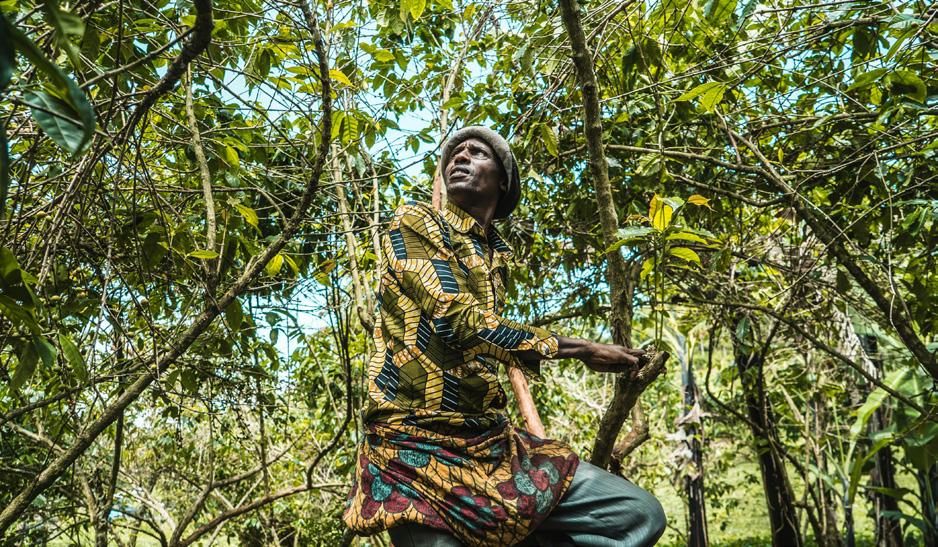
Considering these risks, African civil society should press governments to prioritise a set of fundamental measures to protect the interests of small-scale farmers, pastoralists, and Indigenous peoples:
Full disclosure of climate and environmental footprints
Existing, planned, and newly established data centres, regardless of size, should be required to disclose their actual and projected use of water and energy, including the sources of these resources, as well as the full extent of the land their facilities occupy or are expected to occupy in specific locations. Alongside economic, social, political, and security considerations, this information should form a central basis for decisions on whether to approve data-centre operations. Disclosure records should be publicly accessible to safeguard the public interest.
Requirement of free, prior, and informed consent by affected communities
The free, prior, and informed consent of people and communities living on lands and in areas where data centres are proposed must be obtained through democratic, inclusive, and transparent processes. Data centres should not be built on agricultural land, including land cultivated by smallholders without formal tenure protection, nor in forested areas, especially those inhabited by Indigenous peoples. Local governments and institutions responsible for assessing proposals involving large-scale water extraction or access to the electricity grid must ensure that potentially affected communities and sectors are meaningfully involved in decisionmaking through transparent and inclusive procedures.
Basic needs and food systems must take priority
As data centres compete for land, water, and energy, there should be no ambiguity that the basic needs of people and food systems must take precedence over these finite resources. Although most national constitutions protect these basic rights, such protections must be upheld in practice through laws, regulations, and public policy.
As Africa plays a leading role in the global energy transition, governments must ensure that renewable energy is developed in ways that directly improve people’s lives and support sustainable national development. Trickle-down approaches have repeatedly failed to deliver meaningful wellbeing or to reduce widening inequalities both within and between countries.
Regulation of data centres should align with development goals
As governments across Africa compete for investment to pursue digitalisation and seek not to be left behind in the so-called AI revolution, they must be reminded of their primary obligation to ensure decent lives for their citizens. Meeting the demands of data centres at the expense of people’s basic needs and rights is incompatible with their commitment to “leave no one behind.”
Behind the glossy promises of digital progress and Africa’s supposed place in the Fourth Industrial Revolution lies a new wave of extraction that threatens the foundations of life itself: land, water, and energy. The rapid expansion of data centres is not immaterial, neutral, or benign. It is being built through intensifying claims on resources that small-scale farmers, pastoralists, Indigenous peoples, and rural communities depend on for food production, survival, and dignity. While multinational technology corporations profit from these infrastructures, marketing them as “efficient”, “green”, and “inevitable”, communities are left to bear the consequences in the form of land dispossession, deepening water stress, rising energy competition, and widening inequality.
Digital development should not be allowed to reproduce a new form of digital colonialism. Claims about data sovereignty, AI leadership, or technological modernisation in Africa will remain hollow if governments fail to confront the environmental, social, and food-system impacts of the infrastructures that make these ambitions possible. Unless decisive action is taken now, Africa’s renewable energy potential, freshwater reserves, and productive lands will increasingly be redirected into a digital economy that serves corporate accumulation more than public need. The struggle for food sovereignty, energy justice, and climate resilience is therefore inseparable from the struggle to regulate data-centre expansion, defend community rights, and ensure that public resources serve public purposes.
The central question is no longer whether Africa can power and cool Big Tech’s infrastructure, but whether African societies will insist that land, water, and energy be used first to sustain life, livelihoods, and food systems. That is the political choice now at stake.