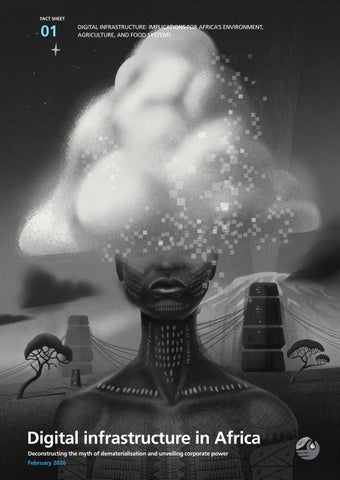
Digital infrastructure in Africa: deconstructing the myth of dematerialisation

Page 1


DIGITAL INFRASTRUCTURE: IMPLICATIONS FOR AFRICA’S ENVIRONMENT, AGRICULTURE, AND FOOD SYSTEMS

Deconstructing the myth of dematerialisation and unveiling corporate power

African Centre for Biodiversity (ACB)

ACB is committed to dismantling inequalities and resisting corporate industrial expansion in Africa’s food and agriculture systems.

© African Centre for Biodiversity www.acbio.org.za

PO Box 29170, Melville 2109, Johannesburg, South Africa. Tel: +27 (0)11 486-1156

Researched and written by consultants Kavya Chowdhry and Neth Dano

Editorial oversight and input by ACB executive director Mariam Mayet

Design and layout by Baynham Goredema, Xealos Design Agency

Cover art by Gerhard van Wyk

Acknowledgments

ACB gratefully acknowledges the financial support of several donors, though the views expressed may not necessarily reflect the views of our donors.

Acronyms

AI Artificial intelligence

CLS Cable landing station

DRC Democratic Republic of Congo (The)

Km kilometres

LEO US Low earth orbit United States

About this fact sheet

This fact sheet is the first in a series focused on digital infrastructure in Africa and its implications for the environment, agriculture, and food systems. It introduces the major components of digital infrastructure — including submarine and terrestrial cables, satellites, and data centres — and outlines their growing prevalence across the continent.

The fact sheet challenges the widespread belief that digitalisation is immaterial. Instead, it shows that every digital process relies on extensive physical infrastructure and the extraction of natural resources such as land, water, and minerals. These infrastructures are embedded in global economic, political, and legal systems that shape who benefits from digital expansion, and at whose cost.

This document also highlights the dominant corporate actors behind digital infrastructure in Africa. From Big Tech companies to telecommunications consortia, these actors wield significant power over connectivity pathways, infrastructure investment, and the data flows that underpin artificial intelligence (AI) systems.

The goal of the series is to expose the material realities of digitalisation, unpack the power relations behind it, and support civil society, communities, and movements in navigating and responding to the environmental and socio-political impacts of Africa’s rapidly expanding digital ecosystem.

Why digitalisation is not dematerialisation

Digitalisation is often assumed to reduce material use and lower carbon emissions. 1 Dematerialisation – moving away from physical entities to data – is regarded as an objective of deploying digital technologies to facilitate processes. Decarbonisation is expected to result from reduced production and use of physical materials, as well as construction of facilities, thereby reducing pressure on Earth’s resources and helping to address the climate crisis. Turning documents, records, and books into a digital format means they can be converted into data to be stored on a computer or in the “cloud”, not just saving physical space in libraries and filing cabinets but also easing the demand for materials and labour to produce them. The highly technical nature of digitalisation and the conveniences it offers have led to this widely held but misplaced conception of dematerialisation.2

2 In this regard, the African Centre for Biodiversity, takes responsibility of any errors contained in its report, https://acbio. org.za/corporate-expansion/financialisation-digitalisation-africa-agriculture/ © ECMWF | Flickr

1 Roger Fouquet, “The digitalisation, dematerialisation and decarbonisation of the global economy in historical perspective: the relationship between energy and information since 1850”, Environ. Res. Lett. 19 (2024) 014043, https:// doi.org/10.1088/1748-9326/ad11c0, available at: https://iopscience.iop.org/article/10.1088/1748-9326/ad11c0/pdf

Any information transformed into data and transmitted digitally from one device to another traverses a journey underpinned by resource-extractive, labour-intensive, and environmentally destructive infrastructure, embedded in economic, political, and legal regimes. Data transmitted via the internet is converted into electricity, interpreted by the receiving computer,3 and broken down into packets carried across a network.4 Data traffic relies on technologies that involve the construction and installation of a constellation of physical infrastructure. This spans:

• subsea and land-based cables that transmit data,

• cable landing stations (CLSs) that serve as a bridge between marine and terrestrial systems,

• data centres that store, manage, and process data,

• satellites that beam and amplify data using radio waves or lasers, and

• towers and poles that connect users to the system.

The entire digital ecosystem – from internet operations to data centres – relies heavily on energy, water, and land to function.

The demand for energy, water, and land increases exponentially as the hyperstition – the fiction that makes itself real – of a world shaped by and dependent on artificial intelligence expands. How this complex system works, the physical structures that enable it, and the material resources needed to build and maintain the technologies involved are often hidden behind the glossy future that digitalisation promises.

Africa, as the least connected continent, with approximately 35% of its population using the internet compared to 97% in Asia-Pacific,5 is a prime target of aggressive expansion of digitalisation and its enabling infrastructure.

The continent’s lack of connectivity has rallied support around bridging the digital divide and calls for digital transformation across diverse sectors and interests – most strongly from corporate players 6 Giant tech companies like Meta and Google, which view the yet-unconnected population of Africa as a massive business expansion opportunity and treasure trove of data, seek more users for their platforms to feed the insatiable large language models of their proprietary AI pet projects.7 A regional economic impact assessment commissioned by Google in 2021 recommended attracting investment in submarine cables, protecting and maintaining submarine infrastructure, and building terrestrial infrastructure to support digital expansion in Africa.8

3 https://www.cloudflare.com/learning/network-layer/how-does-the-internet-work/

4 https://www.cloudflare.com/learning/network-layer/what-is-a-packet/

5 https://datahub.itu.int/data/?e=1&c=4&i=11624

6 https://www.dw.com/en/fiber-optic-leap-bridges-african-digital-divide/a-69303528

7 https://restofworld.org/2022/google-meta-underwater-cables/

8 https://africapractice.com/wp-content/uploads/2022/08/Google-EIA-SA.pdf

Connecting Africa with submarine and terrestrial cables

Responsible for transmitting 95% of global data traffic, submarine cables are considered the backbone of the internet, yet this critical digital infrastructure is invisible to most people. Crisscrossing the globe underwater, the total length of active subsea cables worldwide in 2025 was 1.5 million kilometres (km).9 Approximately 200,000 km of new submarine cables were installed in 2024, and this figure is expected to grow over the next few years.10 This global network, laid on the seabed in deep areas and buried in shallow areas, could wrap around the Earth’s equator 37.5 times! According to an online submarine cable map, there are currently 597 cable systems and 1,712 CLSs that enable data transmission worldwide 11 Notably, there is no multilateral authority that monitors and regulates the number and locations of submarine cable systems and CLSs worldwide, which traverse national boundaries and international waters and involve mostly multinational actors.

9 https://www2.telegeography.com/submarine-cable-faqs-frequently-asked-questions

10 https://www.itu.int/en/mediacentre/backgrounders/Pages/submarine-cable-resilience.aspx

11 https://www.cloudflare.com/learning/network-layer/how-does-the-internet-work/

Several submarine cables connect Africa to other continents, owned and operated by consortia of regional and global telecommunication companies. The submarine cable Africa-1 is 10,000 km long with 11 landing points, owned by a consortium led by Telecom Egypt and Algerie Telecom with partners from the Middle East and Pakistan.12 The PEACE (Pakistan and East Africa Connecting Europe) cable system, which runs for 25,000 km, is owned by Peace Cable International Network Co. Ltd., a consortium led by telecoms companies from China partnering with a host of corporate partners from Kenya, Pakistan, Egypt, Qatar, Indonesia, and Hong Kong, and a United States (US)-based data centre company.13

In 2022, Google launched the subsea cable Equiano, which is its third international private cable and 14th subsea cable investment globally, with the investment amount undisclosed.14,15 It runs for 15,000 km with six landing points.

2Africa, which went live in 2023, is the largest subsea cable in the world, built by a consortium of telecommunication and technology companies led by Meta, China Mobile, and Saudi Telecoms. It is 45,000 km long and traverses 33 countries in three continents.16 Its extension, 2Africa Pearls, is still under construction and set to go live in 2026. These submarine cable systems are not just realising the connectivity dream for Africa but hold the promise of creating jobs in countries where these cables run. Equiano, for example, is expected to have indirectly created 1.6 million jobs in Nigeria, 180,000 in South Africa, and 21,000 in Namibia between 2022 and 2025, based on a Google-commissioned study.17

Independent researchers mapping submarine cable systems in Africa found that the routes along which fibre-optic cables are placed follow colonial slave routes and are based on the colonial logic of extracting data from the continent, while keeping countries in a treadmill of debt and bringing few benefits to people.18

Just as modern maritime trade routes broadly overlap with trans-Atlantic slave trade routes, fibreoptic cable systems are laid in sea lanes deemed most efficient and have long been regarded as less exposed to geological hazards and geopolitical conflicts. Google unapologetically named its largest submarine cable system connecting Southern Africa with Europe, Equiano, after a Nigerian-born writer and abolitionist who was enslaved as a boy.19 Undersea cable lines were historically constructed to connect European powers with their colonies. Colonial patterns of extraction are replicated through these undersea cables, as demonstrated by St. Helena Islands, which served as a transit slave port until the 1860s, and now serves as the main landing port for Google’s undersea cable between the Americas and Africa.20 The question that comes to mind is whether the multitude of projects underway in Africa, which are involved in the generation, analysis, and deployment of data across sectors, are at the same time focused on data capture and mineral extraction, and surveillance in the ilk of data colonialism, rather than building capacity towards ensuring data sovereignty.

12 https://developingtelecoms.com/telecom-technology/optical-fixed-networks/17584-telecom-egypt-and-asn-land-red-seasegment-of-africa-1-cable.html#:~:text=Africa%2D1%20is%20scheduled%20to,PTCL)%2C%20TeleYemen%20and%20ZOI

13 http://www.peacecable.com/

14 https://cloud.google.com/blog/products/infrastructure/introducing-equiano-a-subsea-cable-from-portugal-to-south-africa

15 https://edition.cnn.com/2022/08/07/africa/google-equiano-subsea-internet-cable-west-africa-spc-intl

16 https://www.submarinecablemap.com/submarine-cable/2africa

17 https://africapractice.com/wp-content/uploads/2021/10/Equiano-Regional-Economic-Impact-Assessment-6-October-2021. pdf

18 https://firstmonday.org/ojs/index.php/fm/article/download/13637/11600

19 https://cloud.google.com/blog/products/infrastructure/introducing-equiano-a-subsea-cable-from-portugal-to-south-africa

20 https://firstmonday.org/ojs/index.php/fm/article/download/13637/11600#p1

While tech giants invest in submarine cable systems connecting Africa to the rest of the world, a whole ecosystem of corporate players is involved in the manufacture, installation, and maintenance of fibre-optic cables. Due to the transnational nature of seabed cable systems and the complex regulatory and legal processes involved, owners of submarine cables are often a consortium of corporate telecommunications entities. Many of the national/regional telecommunication partners in submarine cable consortia are state-owned/controlled, i.e., Algerie Telecom and Telecom Egypt in Africa-1. More recently, however, the sector has been led by Big Tech, including Google, Meta, Microsoft, and Amazon, which provide the bulk of financial investments, including for the installation of massive subsea cable systems. The financial and political muscle of China has also opened doors for companies like HMN Tech (formerly Huawei Marine) to secure contracts to install subsea and terrestrial cables across Africa. This is done without oversight regarding security concerns, technology lock-in, and debt burden. Countries like Kenya are highly indebted to Chinese banks, which are financing fibre optic networks built by Chinese companies 21

Cable manufacturers, also referred to as “system integrator companies”, are key actors in this business ecosystem. System integrators not only manufacture cables but also design and deploy them. They are responsible for surveying cable installation routes that avoid geological hazards and human activities, including fishing and shipping, and minimising impacts on marine life and ecosystems. They also provide security measures to protect these cables from sabotage motivated by economic and political interests. There is no independent oversight of these surveys or of the actual installation of these submarine cables.

Present-day cables no longer rely on copper but on fibre-optic technology that transmits data as pulses of light through thin strands of glass, enabling ultra-high speeds over long distances. In 2021, US company SubCom, French firm Alcatel Submarine Networks (ASN), and Japanese firm Nippon Electric Company (NEC) collectively held 87% of the global market for submarine optical cables, with China’s HMN Technologies at 11% 22

21 https://china.aiddata.org/projects/95490/

22 https://www.pioneerconsulting.com/wp-content/uploads/2021/03 Pioneer_Consulting_Suppliers_Report_Executive_ Summary_Download.pdf

Another set of corporate players provides the ships that transport and lay submarine cables. Vital to the subsea cable infrastructure, cable ships are responsible for laying new cables, conducting repairs, and, in some cases, recovering old cables. Globally, 80 cable ships serve in maintaining and expanding the subsea cable infrastructure.23 Of these, Global Marine Systems Limited (United Kingdom-based) and Orange each account for 13.04% of the fleet, while SubCom accounts for 11.59% and ASN accounts for 10.14% 24 These four companies thus own approximately 48% of the global fleet.25

Subsea cables running thousands of kilometres are connected to CLSs, where the systems are terminated or initiated for international connections. CLSs are routinely located along coastlines, serving as bridges to transfer data from subsea fibre-optic cable systems to terrestrial facilities, such as data centres, via a network of land-based cables. CLSs are a crucial part of the infrastructure that ensures fast, secure data traffic. They are largely built and managed by national players, private telecommunications companies, and state-owned or controlled entities in the countries where the cables land, since they have the experience and networks needed to navigate local regulations.

The CLS hosts the specialised line terminal equipment (SLTE), located at both ends of submarine cable networks, which manages data transmission between undersea cables and land-based terrestrial networks by converting optical signals to electrical signals.

While the partnerships between public and private domestic and foreign players that underpin subsea cable systems are made public, the specific location of CLSs is mostly obscured – even intentionally kept secret – for security reasons. Meta’s 2Africa submarine cable system alone connects 46 cable landing stations in 33 countries, while Equiano has six landing stations, with three in Africa.26,27 These landing stations are operated by national or regional telecommunications companies while the state’s involvement is mainly limited to ensuring cable resilience, safety, and security.

Land-based fibre-optic cables connect the landing stations of submarine cables, located in ports or coastal hubs, to data centres further inland. This network carries data from submarine cables to data centres, where content is stored, processed, and routed, linking urban centres/landlocked areas to subsea connectivity. Communication towers host repeaters that spread signals to wider areas, and numerous towers and poles are built to amplify signals and connect areas farther from urban hubs via miles of fibre-optic cables that transmit data. As mentioned, terrestrial cables are crucial for last-mile services by connecting end-users in rural areas and far-flung communities to the nearest backbone network in an urban centre or area with good road infrastructure. The global market for fibre-optic cables overall, including for use in cables for subsea, various generations of networks, data centres, and other industrial uses, is dominated by the Prysmian Group (Italy), Corning (US), Fujikura (Japan), Sumitomo Electric (Japan), and Yangtze Optical Fibers (China).28

23 https://subtelforum.com/industry-report/

24 https://subtelforum.com/industry-report/

25 https://subtelforum.com/industry-report/

26 https://www.submarinecablemap.com/submarine-cable/equianon

27 https://www.submarinecablemap.com/submarine-cable/2africa

28 https://aimifiber.com/20-largest-fiber-optic-cable-companies-in-the-world/

Pie in the sky? Satellites, LEOs, and Musk

While there is much hype about satellites, they transmit only about 5% of global data, mainly to rural and remote areas that are underserved or inaccessible by land–based connections. Of global data traffic, at least 95% passes through submarine fibre-optic cables. Satellites beam and amplify signals, transmitting and re-transmitting data through radio waves or lasers for high-speed links focused towards relay stations on the ground. Transponders onboard these satellites transmit and process data, then beam it back to Earth at different frequencies using antennas. Globally, the satellite industry has transformed, with the rise of private firms giving way to a new satellite ecosystem that now includes startups, universities, and an increasing number of participating governments. Companies like SpaceX and Blue Origin are manufacturing satellites for commercial purposes.29

Most satellites for communications, navigation systems, remote sensing, and earth observation operate in medium earth orbit (MEO), low earth orbit (LEO), and highly elliptical orbit (HEO).30 Starlink, the satellite company founded and controlled by South African-born trillionaire Elon Musk, dominates the global market for LEO satellites that provide internet connectivity to Earth. As of December 2025, the company had launched 10,000 LEO satellites, accounting

29 https://www.bbc.com/news/articles/cn0yydwe89jo

30 J. Emeka Nwankwo (2025) Redefining competition and submarine cable ownership: Equiano, MainOne, and the making of middlemen, The Information Society, 41:5, 279-289, DOI: 10.1080/01972243.2025.2547676

for 65% of the total number of active satellites in Earth’s orbit.31,32 The company aspires to build a mega-constellation of thousands of LEO satellites to realise its goal of “connecting the unconnected” by offering its LEO services for a fee to underserved and remote areas and extending discounted rates to underprivileged communities and community-centred connectivity initiatives.33 Starlink satellites have a lifespan of five years, requiring constant replacement and launches. Over 1,300 of its LEO satellites have decayed or deorbited, some of which are contributing to space debris.

Of the 54 countries in Africa, 23 are currently covered by Starlink services.34 These countries have relaxed regulatory hurdles to entry for foreign players in telecommunications, allowing them to easily obtain long-term licenses to operate. Starlink wants to offer unconnected communities in South Africa paid access to its high-speed internet, but the government is stalling the process due to the ownership requirement under the Broad-Based Black Economic Empowerment Act. This requires 30% Black ownership for telecom licenses to promote inclusive economic participation.35

It appears that the state’s major role – where it wields some power – is limited to internet connectivity. This involves regulation of infrastructure construction and the granting of licences, both lucrative sources of revenue and avenues for corruption in government. Other aspects of regulation could entail requiring more affordable access to public institutions and local communities; ensuring no or minimal impact on the environment by these infrastructures; and requiring full transparency, including on the use of public infrastructures.

A key factor behind Starlink’s growth is the lack of competition – even China, despite its strong digital infrastructure presence in Africa, has not yet really entered the LEO market. With limited financial muscle to invest in satellite development, leading telecoms companies such as Vodafone and Airtel have partnered with Starlink to sell its internet services across Africa.36,37

Others, such as Orange Africa and Eutelsat, have banded together to bring satellite connectivity to remote areas in Africa and the Middle East using their own facilities.38 In contrast, China has constructed and launched satellites for various African countries using the Long March rockets operated by the China Aerospace Science and Technology Corporation (CASC), and Chinese companies have won approximately 20% of foreign satellite contracts in Africa.39

31 https://www.nytimes.com/2025/10/20/technology/ai-data-center-backlash-mexico-ireland.html

32 https://uk.finance.yahoo.com/news/elon-musk-now-controls-two-151932872.html

33 https://starlink.com/za/south-africa

34 https://spaceinafrica.com/2025/06/23/starlink-resumes-new-subscriptions-in-key-african-markets-after-capacity-expansion/

35 https://www.reuters.com/business/media-telecom/south-africa-not-giving-special-dispensation-musks-starlink-ministersays-2025-05-27/

36 https://spaceinafrica.com/2025/05/05/airtel-africa-and-spacex-partner-to-expand-satellite-connectivity-across-africa/

37 https://www.reuters.com/business/media-telecom/south-africas-vodacom-inks-internet-deal-with-starlink-2025-11-12/

38 https://newsroom.orange.com/orange-africa-and-middle-east-and-eutelsat-announce-a-strategic-partnership-toaccelerate-the-deployment-of-satellite-internet-in-africa-and-the-middle-east/

39 https://odi.org/en/about/our-work/global-china-2049-initiative/chinas-expanding-role-in-space-in-africa-geostrategicimplications/

Data centres: water-guzzling, energy-hungry

Back on Earth, data centres that host cloud servers play a central role in digitalisation, serving as the infrastructure for data processing and interconnectivity. The “cloud” enables users to store, access, process, and analyse their data; manage databases; and run software applications, without having to maintain their own physical servers, all for a fee. Currently, Amazon Web Services, Microsoft, and Google account for about 60% of global data centre capacity. Networks of terrestrial cables, towers, and poles extend from these data centres across locations and further inland, connecting users of internet services to global subsea cables. The size of data centres varies, based on power capacity and the number of racks they can support, which can run into the thousands.40 Cloud servers are mounted in these data storage racks, which are housed in cabinets for security and protection. As with any racks, cabinets, and servers used in daily life, physical hardware in data centres is vulnerable to natural, technical, and human–induced hazards. An incident could affect data traffic and integrity, as happened recently in South Korea, when a lithium-ion battery malfunctioned and caused a fire in a data centre, severely affecting digital services in a country known to be among the most digitally advanced in the world.41

Data centres need lots of water, which could run upwards of 19 million litres per day, to cool down servers and supercomputers, and prevent overheating.42 Information on water consumption by data centres is mostly kept under wraps by the companies that own and operate these facilities, until conflicts arise during droughts or when water taps in nearby communities run dry.

Several municipalities and citizen groups in the US are suing Big Tech companies for contaminating and drying up water sources in areas surrounding data centres,43 and states like

40 https://rpa.org/news/lab/the-rise-of-data-centers

41 https://eticaag.com/south-korean-data-center-fire-crashed-digital-services/

42 Miguel Yañes-Barnuevo, “Data Center and Water Consumption”, EESI, 25 June 2025, see: https://www.eesi.org/articles/ view/data-centers-and-water-consumption#:~:text=Data%20center%20developers%20are%20increasingly,energy%20 usage%20by%20data%20centers.

43 https://www.bbc.com/news/articles/cy8gy7lv448o

© Rawpixel

California and New Jersey are demanding public disclosure of data centre water use.44 Google’s plan to build a huge data centre in Uruguay was met with angry protests in 2023, amid the country’s worst drought in 74 years.45 In mid-2025, communities in central Mexico complained about long stretches of water supply disruption and frequent power outages since Microsoft built its data centre.46 Water consumption of data centres is a potentially volatile issue in Africa as digitalisation expands rapidly. A market analysis projects that rapid growth in smartphone use in South Africa alone will require a surge in storage and processing to handle the large volumes of data that data centres will consume, in a water-scarce country where protests have recently erupted over a water crisis.47

The energy consumption of data centres is enormous. Globally, they account for about 1.5% of total electricity consumption, which is expected to double by 2030.48 This is roughly equivalent to about 45% of the total energy consumption of the entire African continent in 2024.49 Currently, about 240 data centres are operational across 40 African countries; South Africa leads with 60, Nigeria has 22, Kenya has 20, and Morocco has 14.50

An analysis of 14 publicly available AI strategies of African governments (African Union, Benin, Egypt, Ethiopia, Ghana, Kenya, Lesotho, Mauritania, Mauritius, Nigeria, Rwanda, Senegal, South Africa, and Zambia) revealed that concerns and measures related to environmental impact, energy use, and labour exploitation related to AI are barely acknowledged in any of them.51

44 https://www.eenews.net/articles/states-push-to-end-secrecy-over-data-center-water-use/

45 https://www.theguardian.com/world/2023/jul/11/uruguay-drought-water-google-data-center

46 https://www.nytimes.com/2025/10/20/technology/ai-data-center-backlash-mexico-ireland.html

47 https://www.mordorintelligence.com/industry-reports/study-of-data-center-water-consumption-in-south-africa

48 https://www.nature.com/articles/d41586-025-01113-z

49 https://ourworldindata.org/grapher/primary-energy-consumption-by-region

50 https://www.datacentermap.com/africa/

51 Vincent Obia, Africa’s AI Policy Ambitions Ignore Energy, Climate and Labor Concerns, Tech Policy Press, 21 Oct 2025. https://www.techpolicy.press/africas-ai-policy-ambitions-ignore-energy-climate-and-labor-concerns/

Developers of African data centres do not even refer to their large carbon footprints. In Kenya and South Africa, they are vocal about efforts to increase the use of renewable energy in their facilities, yet refrain from divulging their total energy use.52 In the face of the worsening climate crisis that is disproportionately impacting Africa, most seriously sub-Saharan Africa and the Sahel, consideration of the energy use, water consumption, and environmental footprint of data centres across the continent needs to be front and centre. These issues will be further explored in forthcoming fact sheets.

Furthermore, establishing new data centres could require large tracts of land to accommodate facilities, ensure security, and enable future expansion. Studies show that data centre companies and investors have been actively acquiring hundreds of acres around the world, which is identified as a strategic priority by Big Tech and its partners, leading to land speculation that not only drives up land prices but could also marginalise local communities, compete with other land uses, such as food production, and aggravate environmental destruction.53 This is particularly alarming in Africa, where land cultivated and conserved by smallholders, pastoralists, and indigenous peoples is overlooked in narratives that portray arable land as abundant but largely uncultivated.54 This myth has enabled the marginalisation of traditional and indigenous cultivators, many of whom lack access to land and land tenure security, and are deprived of rights over the land they cultivate and other productive resources.

52 https://www.africadatacentres.com/wp-content/uploads/2023/06/ADC-sustainability.pdf

53 https://www.techtarget.com/searchdatacenter/feature/The-increasing-concern-of-data-center-land-acquisition

54 https://www.worldbank.org/en/programs/africa-myths-and-facts/publication/land-is-abundant-and-land-markets-arevirtually-absent

© Wirestock Creators | Shutterstock

Digitalisation, critical minerals, and rare earth elements

In addition to Africa being a potential market for digital technologies and a massive source of data for AI training, another feature that attracts Big Tech to invest in digital infrastructure is the continent’s rich deposits of critical minerals and rare earth elements needed for the global energy transition.

A paper published by the International Monetary Fund in 2024 posits that sub-Saharan Africa accounts for 30% of the world’s proven reserves of critical minerals, yet reaps only 10% of the benefits.55 Copper, cobalt, manganese, lithium, nickel, platinum-group metals, and various rare earth elements are essential components of servers, high-speed networks, storage devices, and other technologies integral to the expansion of digital infrastructure.

Africa holds 55% of the world’s cobalt reserves, 38% of manganese reserves, 70% of manganese resources, 80% of platinum, 62% of chromium, and 25% of natural graphite 56 Cobalt, a key component of high-performance batteries for smartphones, electric vehicles, and solar panels, is mostly mined in the Democratic Republic of Congo (DRC), which accounts for 70% of the world’s cobalt supply.

55 https://www.imf.org/en/news/articles/2024/04/29/cf-harnessing-sub-saharan-africas-critical-mineral-wealth

56 https://www.b20southafrica.org/wp-content/uploads/2025/11/Africa-at-the-Core-of-Critical-Minerals.pdf

The dangerous, exploitative, and inhumane conditions in cobalt mines and the environmental impacts of cobalt mining in the DRC are well documented, leading to public pressure on actors across the value chain to address these issues and adopt standards, without hampering the steady supply of the mineral.57 To a lesser degree, the rush for lithium in Africa’s “lithium triangle” – Zimbabwe, Namibia, and the DRC – has raised alarms regarding environmental and social impacts, and corruption.58 Lithium is key in the production of lithium-ion batteries used in uninterrupted power supply systems in data centres and demand for these batteries as a cheaper, more efficient option is being driven globally. Google alone has deployed 100 million lithium-ion cells to replace lead-acid batteries in its data centres worldwide.59

As digitalisation expands rapidly, the material reality of digital infrastructure in Africa needs to be exposed, and its implications for the continent’s environments, agriculture, and food systems need to be understood to inform the actions of civil society and grassroots movements. Alongside the financial and trade interests, geopolitical dynamics – and even military and security implications – need to be unpacked. Development blueprints of economic interests, including China’s Belt and Road Initiative (BRI) in Africa, may have been dissected, but closer scrutiny is required of how the associated Digital Silk Road is unfolding. Strategies and actions to address the challenges of digitalisation in Africa cannot be isolated from understanding these realities.

57 Siddharth Kara, “Blood Batteries; The human rights and environmental impacts of cobalt mining in the Democratic Republic of the Congo”, University of Nottingham Rights Lab, Aug 2025. https://www.nottingham.ac.uk/research/beaconsof-excellence/rights-lab/resources/reports-and-briefings/2025/august/blood-batteries.pdf

58 Global Witness, “A rush for lithium in Africa risks fueling corruption and failing citizens”, 14 Nov 2023 https://globalwitness.org/en/campaigns/transition-minerals/a-rush-for-lithium-in-africa-risks-fuelling-corruption-andfailing-citizens/

59 Georgia Buttler, “Google deploys 100 million Li-ion cells in its global data centers”, Data Centre Dynamics, 7 Mar 2025. https://www.datacenterdynamics.com/en/news/google-deploys-100-million-li-ion-cells-in-its-global-data-centers/

© Rod Allday | Wikimedia Commons

References

African Centre for Biodiversity (2023). Financialisation, dematerialisation, digitalisation & distancing of Africa’s agriculture. Available at: https://acbio.org.za/corporate-expansion/financialisationdigitalisation-africa-agriculture/ Africa Data Centres (2023). Africa Data Centres Energy and Carbon Report FY 2023. Available at: https:// www.africadatacentres.com/wp-content/uploads/2023/06/ADC-sustainability.pdf Africa Practice (2022). Google EIA SA. Available at: https://africapractice.com/wp-content/uploads/2022/08/ Google-EIA-SA.pdf

AIMI Fiber (n.d.) 20 largest fiber optic cable companies in the world. Available at: https://aimifiber.com/20largest-fiber-optic-cable-companies-in-the-world/ AidData China (n.d.) Project 95490. Available at: https://china.aiddata.org/projects/95490/ Blum, A., Baraka, C. (2022). Sea change. Available at: https://restofworld.org/2022/google-metaunderwater-cables/ Buttler, G. (2025). ‘Google deploys 100 million Li-ion cells in its global data centers’, Data Centre Dynamics, 7 March. Available at: https://www.datacenterdynamics.com/en/news/google-deploys-100-millionli-ion-cells-in-its-global-data-centers/

B20 South Africa (2025). Africa at the Core of Critical Minerals. Available at: https://www.b20southafrica. org/wp-content/uploads/2025/11/Africa-at-the-Core-of-Critical-Minerals.pdf BBC News (2025). ‘I can’t drink the water’ - life next to a US data centre. Available at: https://www.bbc. com/news/articles/cy8gy7lv448o CRN (2025). ‘Hyperscale Data Centers Hit 1,300 With AWS, Google, Microsoft Owning Over Half Of Global Capacity’. Available at: https://www.crn.com/news/cloud/2025/hyperscale-data-centers-hit-1-300with-aws-google-microsoft-leading-global-boom

Cloudflare (n.d.) How does the internet work? Available at: https://www.cloudflare.com/learning/networklayer/how-does-the-internet-work/

Cloudflare (n.d.) What is a packet? Available at: https://www.cloudflare.com/learning/network-layer/what-isa-packet/

CNN (2022). ‘Google Equiano: Internet giant bets big on Africa with latest megaproject’, 8 August. Available at: https://edition.cnn.com/2022/08/07/africa/google-equiano-subsea-internet-cable-westafrica-spc-intl

Deutsche Welle (2024). ‘Fiber optic leap bridges African digital divide’. Available at: https://www.dw.com/ en/fiber-optic-leap-bridges-african-digital-divide/a-69303528

Developing Telecoms (2024). ‘Telecom Egypt and ASN land Red Sea segment of Africa-1 cable’. Available at: https://developingtelecoms.com/telecom-technology/optical-fixed-networks/17584-telecom-egyptand-asn-land-red-sea-segment-of-africa-1-cable.html

Data Center Map (n.d.) Africa. Available at: https://www.datacentermap.com/africa/ E&E News (2025). ‘States push to end secrecy over data center water use’. Available at: https://www. eenews.net/articles/states-push-to-end-secrecy-over-data-center-water-use/ Etica AG (n.d.) South Korean data center fire crashed digital services. Available at: https://eticaag.com/ south-korean-data-center-fire-crashed-digital-services/ First Monday (2024). Mwema, E. and Birhane, A., ‘Undersea cables in Africa: the new frontiers of digital colonialism’. Available at: https://firstmonday.org/ojs/index.php/fm/article/download/13637/11600 Futura Sciences (2025). Starlink SpaceX surpasses 10,000 satellites. Available at: https://www.futurasciences.com/en/starlink-spacex-surpasses-10000-satellites-a-historic-record-in-space_21295/ Global Witness (2023). ‘A rush for lithium in Africa risks fueling corruption and failing citizens’, 14 November. Available at: https://globalwitness.org/en/campaigns/transition-minerals/a-rush-forlithium-in-africa-risks-fuelling-corruption-and-failing-citizens/ Google Cloud Blog (2019). ‘Introducing Equiano, a subsea cable from Portugal to South Africa’. Available at: https://cloud.google.com/blog/products/infrastructure/introducing-equiano-a-subsea-cable-fromportugal-to-south-africa

Hays, K. (2026). Bezos’ Blue Origin announces satellite rival to Musk’s Starlink. Available at: https://www. bbc.com/news/articles/cn0yydwe89jo

IBM (n.d.) Cloud computing. Available at: https://www.ibm.com/think/topics/cloud-computing

International Telecommunication Union (n.d.) Data hub. Available at: https://datahub.itu.int/ data/?e=1&c=4&i=11624

International Telecommunication Union (n.d.) Data hub. Available at: https://datahub.itu.int/ data/?e=1&c=701&i=11624

International Monetary Fund (2024). ‘Harnessing Sub-Saharan Africa’s Critical Mineral Wealth’, 29 April. Available at: https://www.imf.org/en/news/articles/2024/04/29/cf-harnessing-sub-saharan-africascritical-mineral-wealth

Information Technology and Innovation Foundation (2019). Submarine cables. Available at: https://www2. itif.org/2019-submarine-cables.pdf

Kara, S. (2025). ‘Blood Batteries; The human rights and environmental impacts of cobalt mining in the Democratic Republic of the Congo’, University of Nottingham Rights Lab, August. Available at: https://www.nottingham.ac.uk/research/beacons-of-excellence/rights-lab/resources/reports-andbriefings/2025/august/blood-batteries.pdf

Lemma, A. (2025). ‘Critical minerals, critical moment: Africa’s role in the AI revolution’, ODI Global, 10 February. Available at: https://odi.org/en/insights/critical-minerals-critical-moment-africas-role-inthe-ai-revolution/

Mordor Intelligence (n.d.) Study of data center water consumption in South Africa. Available at: https:// www.mordorintelligence.com/industry-reports/study-of-data-center-water-consumption-in-southafrica

Nadin,R., Kiryakova, E. (2025). ‘China’s expanding role in space in Africa: geostrategic implications’, ODI Global China 2049 Initiative. Available at: https://odi.org/en/about/our-work/global-china-2049initiative/chinas-expanding-role-in-space-in-africa-geostrategic-implications/ Nature (2025). Data centres will use twice as much energy by 2030 — driven by AI. Available at: https:// www.nature.com/articles/d41586-025-01113-z

New York Times (2025). ‘AI data center backlash in Mexico, Ireland’, 20 October. Available at: https://www. nytimes.com/2025/10/20/technology/ai-data-center-backlash-mexico-ireland.html

Nwankwo, J. E. (2025). ‘Redefining competition and submarine cable ownership: Equiano, MainOne, and the making of middlemen’, The Information Society, 41(5), pp. 279–289. https://doi.org/10.1080/0 1972243.2025.2547676.

New York Times (2025). ‘AI data center backlash in Mexico, Ireland’, 20 October. Available at: https://www. nytimes.com/2025/10/20/technology/ai-data-center-backlash-mexico-ireland.html

Orange Newsroom (2025). Orange Africa and Middle East and Eutelsat partnership. Available at: https:// newsroom.orange.com/orange-africa-and-middle-east-and-eutelsat-announce-a-strategicpartnership-to-accelerate-the-deployment-of-satellite-internet-in-africa-and-the-middle-east/ Obia, V. (2025). ‘Africa’s AI Policy Ambitions Ignore Energy, Climate and Labor Concerns’, Tech Policy Press, 21 October. Available at: https://www.techpolicy.press/africas-ai-policy-ambitions-ignore-energyclimate-and-labor-concerns/

Our World in Data (n.d.) Primary energy consumption by region. Available at: https://ourworldindata.org/ grapher/primary-energy-consumption-by-region

Peace Cable (n.d.) Home. Available at: http://www.peacecable.com/ Pioneer Consulting (2021). Suppliers of Undersea Telecommunications Systems: A Technology & Market Assessment Report: Executive Summary. Available at: https://www.pioneerconsulting.com/ wp-content/uploads/2021/03/Pioneer_Consulting_Suppliers_Report_Executive_Summary_ Download.pdf

Regional Plan Association (2025). The Rise of Data Centers in the Grid. Available at: https://rpa.org/news/ lab/the-rise-of-data-centers

Reuters (2025). ‘South Africa is not changing policy to suit Musk’s Starlink, minister says, 27 May. Available at: https://www.reuters.com/business/media-telecom/south-africa-not-giving-special-dispensationmusks-starlink-minister-says-2025-05-27/

Reuters (2025). ‘South Africa’s Vodacom inks internet deal with Starlink’, 12 November. Available at: https://www.reuters.com/business/media-telecom/south-africas-vodacom-inks-internet-deal-withstarlink-2025-11-12/

Space in Africa (2025). ‘Airtel Africa and SpaceX partner to expand satellite connectivity across Africa’, 5 May. Available at: https://spaceinafrica.com/2025/05/05/airtel-africa-and-spacex-partner-to-expandsatellite-connectivity-across-africa/

Space Foundation (n.d.) Types of orbits. Available at: https://www.spacefoundation.org/space_brief/types-oforbits/

Space in Africa (2025). ‘Airtel Africa and SpaceX partner to expand satellite connectivity across Africa’, 5 May. Available at: https://spaceinafrica.com/2025/05/05/airtel-africa-and-spacex-partner-to-expandsatellite-connectivity-across-africa/

Space in Africa (2025). ‘Starlink resumes new subscriptions in key African markets after capacity expansion’, 23 June. Available at: https://spaceinafrica.com/2025/06/23/starlink-resumes-new-subscriptions-inkey-african-markets-after-capacity-expansion/ Starlink (n.d.) Connect the Unconnected Across South Africa. Available at: https://starlink.com/za/southafrica

Subtel Forum (n.d.) Industry report. Available at: https://subtelforum.com/industry-report/

Tech Target (2025). ‘The increasing concern of data center land acquisition’. Available at: https://www. techtarget.com/searchdatacenter/feature/The-increasing-concern-of-data-center-land-acquisition The Guardian (2023). ‘Uruguay drought water Google data center’, 11 July. Available at: https://www. theguardian.com/world/2023/jul/11/uruguay-drought-water-google-data-center Yañes-Barnuevo, M. (2025). ‘Data Center and Water Consumption’, EESI, 25 June. Available at: https:// www.eesi.org/articles/view/data-centers-and-water-consumption

World Bank (n.d.) ‘Land is abundant and land markets are virtually absent’. Available at: https://www. worldbank.org/en/programs/africa-myths-and-facts/publication/land-is-abundant-and-land-marketsare-virtually-absent

TeleGeography (2025). Submarine Cable Map 2025. Available at: https://submarine-cable-map-2025. telegeography.com

TeleGeography (n.d.) Equiano cable. Available at: https://www.submarinecablemap.com/submarine-cable/ equianon

TeleGeography (n.d.) 2Africa cable. Available at: https://www.submarinecablemap.com/submarinecable/2africa

Yahoo Finance UK (n.d.) ‘Elon Musk now controls two thirds of all active satellites’. Available at: https:// uk.finance.yahoo.com/news/elon-musk-now-controls-two-151932872.html Yañes-Barnuevo, M. (2025). ‘Data Center and Water Consumption’, EESI, 25 June. Available at: https:// www.eesi.org/articles/view/data-centers-and-water-consumption

Turn static files into dynamic content formats.

Create a flipbook