
AframNews.com

.com
“Addressing Current & Historical Realities Affecting Our Community”

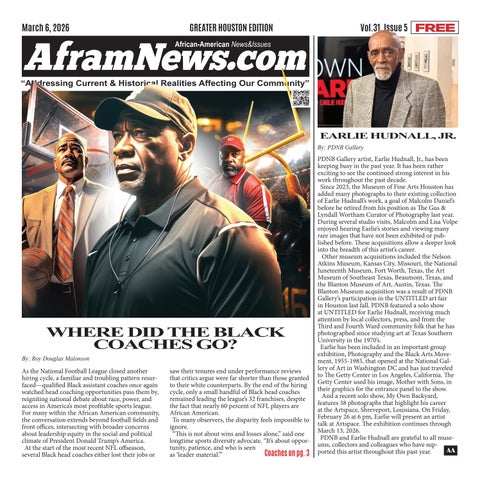
WHERE DID THE BLACK COACHES GO?
By: Roy Douglas Malonson
As the National Football League closed another hiring cycle, a familiar and troubling pattern resurfaced—quali ed Black assistant coaches once again watched head coaching opportunities pass them by, reigniting national debate about race, power, and access in America’s most pro table sports league. For many within the African American community, the conversation extends beyond football elds and front o ces, intersecting with broader concerns about leadership equity in the social and political climate of President Donald Trump’s America. At the start of the most recent NFL o season, several Black head coaches either lost their jobs or


saw their tenures end under performance reviews that critics argue were far shorter than those granted to their white counterparts. By the end of the hiring cycle, only a small handful of Black head coaches remained leading the league’s 32 franchises, despite the fact that nearly 60 percent of NFL players are African American.
To many observers, the disparity feels impossible to ignore.
“ is is not about wins and losses alone,” said one longtime sports diversity advocate. “It’s about opportunity, patience, and who is seen as ‘leader material.’” Coaches on pg. 3


By: PDNB Gallery

HUDNALL, JR.
PDNB Gallery artist, Earlie Hudnall, Jr., has been keeping busy in the past year. It has been rather exciting to see the continued strong interest in his work throughout the past decade.
Since 2023, the Museum of Fine Arts Houston has added many photographs to their existing collection of Earlie Hudnall’s work, a goal of Malcolm Daniel’s before he retired from his position as e Gus & Lyndall Wortham Curator of Photography last year. During several studio visits, Malcolm and Lisa Volpe enjoyed hearing Earlie’s stories and viewing many rare images that have not been exhibited or published before. ese acquisitions allow a deeper look into the breadth of this artist’s career.
Other museum acquisitions included the Nelson Atkins Museum, Kansas City, Missouri, the National Juneteenth Museum, Fort Worth, Texas, the Art Museum of Southeast Texas, Beaumont, Texas, and the Blanton Museum of Art, Austin, Texas. e Blanton Museum acquisition was a result of PDNB Gallery’s participation in the UNTITLED art fair in Houston last fall. PDNB featured a solo show at UNTITLED for Earlie Hudnall, receiving much attention by local collectors, press, and from the ird and Fourth Ward community folk that he has photographed since studying art at Texas Southern University in the 1970’s.
Earlie has been included in an important group exhibition, Photography and the Black Arts Movement, 1955-1985, that opened at the National Gallery of Art in Washington DC and has just traveled to e Getty Center in Los Angeles, California. e Getty Center used his image, Mother with Sons, in their graphics for the entrance panel to the show.
And a recent solo show, My Own Backyard, features 38 photographs that highlight his career at the Artspace, Shreveport, Louisiana. On Friday, February 26 at 6 pm, Earlie will present an artist talk at Artspace. e exhibition continues through March 13, 2026.
PDNB and Earlie Hudnall are grateful to all museums, collectors and colleagues who have supported this artist throughout this past year.


A Revival of God Consciousness
Bobby Mills, Ph.D.
THE DIXIECRAT GOP
EDITORIAL
stand. is is only a brief factual synopsis of the history of political partisanship in Texas. e reality behind the synopsis is simply the ugliness of ungodly institutional racism.


e Grand Ole Party of Abraham Lincoln has evolved into the Ole Dixiecrat Party of the Southern Confederacy. e key question is: what happened? Sadly, Texas has become the strongest GOP state in the nation. e question of questions is WHY? For over one hundred years the GOP was not a viable force in Texas politics, because Blacks controlled the GOP. Historically, Black Americans held signi cant in uence over the GOP and made up (90%) of the delegates at the rst Republican Convention held in Houston on July 4th, 1867. In attendance were (150) Blacks and (20) Whites. e Second State Convention was chaired by Norris Wright Cuney (1883-1887). In fact, Cuney Homes is named in honor of Norris Wright Cuney. In 1978, William P. Clements became the rst Republican Governor in over 100 years. In 2023, the GOP control all three branches of state government. In American politics, a political party philosophical ideological switch has occurred. e Republican Party of Lincoln has become the Southern Dixiecrat Party of the Southern Confederate States, and the Democrat Party has become the inclusive multicultural democracy party of Abraham Lincoln, because a nation divided against itself cannot
e truth behind the political switch-a-rue (changing of the guard) is simply the Civil Rights Act (1964) and the Voting Rights Act (1965). When these legislative Acts were passed President Lyndon B. Johnson emphatically declared that: “the Democrat Party has just lost the South”. America, President Lyndon Johnson did not lie! e Republican Party of Lincoln believed in freeing the slaves. e Trump MAGA-Cult-GOP believe in enslaving nonWhites. However, the true reasons for the Civil War were not slavery, but economic advantages and state rights. e Emancipation Proclamation Act of (1863) tragically became the basis for the political assassination of President Lincoln by a Southerner, John Wilkes Booth, in cooperation with Northern Sympathizers. e political assassination of President Lincoln was initiated and precipitated because the Vice President, Andrew Johnson, a southerner, did not believe in the Lincoln doctrine of preserving the Union. President Lincoln believed that a nation divided against itself cannot stand. President Andrew Johnson aimed to reconstruct the South, withdrew Union soldiers, and did not mandate reparations for Black individuals. Now, we know why the voting stronghold of the GOP is Southern states.


Roy Douglas Malonson, Publisher
SO MANY BLACKS & HISPANICS FOR TRUMP We Must Understand
In recent election cycles, one of the most discussed political shi s in America has been the visible increase in Black and Hispanic voters expressing support for President Donald Trump. For decades, conventional political wisdom suggested that these communities were rmly aligned with the Democratic Party. Yet polling data and voting patterns show a measurable movement, particularly among Black men and working-class Hispanic voters, toward the Republican candidate. is shi has sparked passionate debates at kitchen tables, barbershops, churches, and community meetings across the country. e central question many are asking is simple but loaded: What are they getting out of it?
Supporters within these communities o en point to economic messaging as a driving force. Some cite tax policies they believe bene t small business owners. Others highlight rhetoric around law enforcement, border security, or religious values that align with their personal beliefs. A number of Black entrepreneurs say they feel overlooked by traditional Democratic leadership and are open to alternatives that promise deregulation or fewer business restrictions. Similarly, segments of
Hispanic voters, especially those who identify as conservative Catholics or evangelical Christians, say cultural issues such as abortion and education policies in uence their choices more than party loyalty.
Yet critics argue that symbolism and slogans do not always translate into measurable gains. ey question whether federal investments, contract opportunities, or targeted programs are reaching Black and Hispanic neighborhoods at levels that match the political energy shown during campaign seasons. Some community leaders describe the outcome as “crumbs,” suggesting that photo opportunities and rhetoric have not resulted in sustained improvements in housing a ordability, healthcare access, or wealth-building opportunities in historically underserved communities.
Economic data paints a complicated picture. During di erent periods of Trump’s leadership, unemployment rates for Black and Hispanic workers reached historic lows before the COVID-19 pandemic disrupted the economy nationwide. At the same time, the pandemic exposed deep disparities in healthcare access, small business survival, and generational wealth. In ation and rising housing costs have continued to strain working families of all backgrounds. For many voters, the issue is not about loyalty to a political brand but about whether their daily lives feel more stable and prosperous.
Political analysts note that neither major
Coaches Cont.
e Rooney Rule—established in 2003 to require teams to interview minority candidates for head coaching and senior football operations jobs—was designed to address exactly this imbalance. Yet two decades later, critics argue it has become more procedural than transformational. Interviews are conducted, boxes are checked,
African American sports circles, frustration has been building for years, but the current political era has ampli ed the conversation. Under President Trump’s leadership, racial tensions across multiple sectors—from corporate boardrooms to federal courts—have been widely debated. While the NFL operates independently of federal hiring policy,
White House hires NFL coaches. But leadership in this country sets a cultural temperature. And right now, that temperature feels colder toward diversity.”
e perception has been intensi ed by high-pro le legal battles, including discrimination lawsuits led by Black coaches alleging biased hiring processes.
less likely to be placed in o ensive play-calling roles—the very positions most frequently feeding into head coaching hires. Without those résumé opportunities, the cycle of exclusion perpetuates itself.
mance-based and organization-speci c, pointing to the success of several prominent Black head coaches as evidence of progress.
But for many fans within the African American community, the numbers tell a different story—one that feels cyclical rather than progressive.
ing pipelines, with advocates calling for deeper NFL partnerships, funding, and scouting integration to develop future head coaching candidates from historically Black institutions.


but nal hiring decisions o en return to familiar networks historically dominated by white executives. Within

many community voices believe the broader national tone in uences corporate and institutional behavior, including professional sports.
“It’s climate, not command,” one HBCU athletic director explained.

“No one is saying the


ese cases, regardless of outcome, have fueled
of
public skepticism about whether equal opportunity truly exists at the league’s highest leadership level.


Civil rights leaders have drawn parallels between NFL hiring disparities and broader corporate America, where diversity initiatives surged publicly in the early 2020s but have since faced quiet pullbacks. Some advocates believe diversity fatigue, political polarization, and shi ing national priorities have slowed momentum for equity reform.
on the eld, they remain
Former players have been especially vocal. Many argue that while Black athletes dominate on the eld, they remain underrepresented in decision-making roles— head coaches, general managers, and team presidents.
“ e locker room is Black,” one retired Pro Bowl player said during a sports radio interview.


“But ownership and leadership still don’t look like the locker room.”

Economic power plays a role as well. NFL ownership remains overwhelmingly white, with franchise values


where historical exclusion has limited access for Black candidates.
Meanwhile, pipeline arguments continue to surface. Critics say Black coordinators are

Still, others caution against oversimplifying the issue through a purely political lens. League o cials maintain that hiring decisions are perfor-
Church groups, barbershop forums, and sports podcasts alike have turned the coaching gap into a wider conversation about leadership visibility. Representation, they argue, matters not only for fairness but for inspiration—showing young Black athletes that their futures can extend beyond playing careers into executive authority.
e issue has also sparked renewed support for HBCU coach- T:4.75"
As another season approaches, the question remains unresolved: Is the NFL’s leadership diversity problem improving, stagnating, or quietly regressing?
For now, many in Black America are watching closely—not just the scoreboard, but the sidelines—measuring progress not in touchdowns, but in trust, access, and equity. Because in a league powered largely by Black talent, the absence of Black leadership continues to echo far beyond the game.
LEGAL NOTICE
lions. Hiring decisions o en come down to trust, relationships, and long-standing
1980. e Miami race riots occur a er the acquittal of four Dade County police o cers who caused the death of Arthur McDu e during his arrest.
1982. President Reagan launches the War on Drugs, creating the O ce of National Drug Control Policy to coordinate drugrelated legislative, security, research, and health policy.
1986. Martin Luther King Jr. Day is rst celebrated as a national holiday.
1991. Anita Hill testi es against Clarence omas in front of the U.S. Senate Judiciary Committee.

1992. e Los Angeles riots, four days of rioting occur as a direct response to the videotaped beating of Rodney King and the subsequent acquittal of the LAPD o cers involved.
1994. O. J. Simpson is acquitted a er almost a year of litigation of the murders of Nicole Brown Simpson and Ronald Goldman.
1995. e Million Man March is organized by Louis Farrakhan to protest the disproportionate number of African Americans incarcerated.
HOUSTON

TEXAS TAKEAWAY

A 17-acre property that previously housed a commercial grain-processing facility is set to be redeveloped into an upscale residential tower and mixed-use complex. Houston-based Moody National Development has o cially launched construction on the multifamily project, called Silo Springs, located at 1235 Shadowdale Drive in west Houston.
THE WOODLANDS
e Woodlands is banking on its contemporary transit concept to take top honors in a competition and secure funding for a new transportation option. Beneath sections of the Las Vegas Strip, an underground tunnel system shuttles vehicles from place to place—something several Woodlands leaders traveled to Nevada to experience rsthand. A er visiting, o cials shared video footage with residents, expressing hope that a similar system could succeed in the Montgomery County community.
CORPUS CHRISTI
Nueces County has wrapped up close to $4 million in upgrades at Oil Belt Little League Park in the county’s northwest area, bringing signi cant improvements to a venue that supports more than 800 children annually through the Oil Belt Little League and Little Miss Kickball programs. e renovations included enhancements designed to improve safety, accessibility, and the overall experience for players and their families. County leaders say the investment ensures the park will continue serving local youth for years to come.
AUSTIN
e City of Austin is seeking feedback from residents as it develops a proposed $700 million bond initiative that may be placed on the November ballot. On Saturday, city o cials held a public open house at the Northwest Recreation Center, o ering community members the opportunity to review the plan and voice their top priorities.

GEORGE CARRUTHERS
George Carruthers was an American astrophysicist and inventor best known for developing the Far Ultraviolet Camera/Spectrograph used during the Apollo 16 mission in 1972, making it the first observatory placed on the Moon. His instrument captured ultraviolet images of Earth’s atmosphere and deep space, helping scientists better understand interstellar space and the upper atmosphere. A longtime researcher at the Naval Research Laboratory, Carruthers also mentored young students and advocated for greater diversity in science before his passing in 2020.
e 21st century GOP because of the Civil Rights Act and the Voting Rights Act is far more politically asinine and destructive to multicultural democracy. e Democratic Party in conjunction with the Dixiecrats, such as the KKK and other White Nationalists groups brought their racist talents to the MAGA-Cult GOP, and that alliance has brought absolute madness and chaos to Grand Ole Party (GOP). Presently, we are witnessing MAGA-Cult political leadership madness from e White House, the House of Representatives, and the Senate, because the GOP has no real multicultural democracy-oriented policies. ey only have theories and hypotheticals based upon alternative facts and White Privilege Autocracy. e Golden Escalator experience


of Donald J. Trump in 2016, only aerobated the existing socio-economic racial confusion in the GOP. e Trump Presidency has taken the GOP to the depths of midnight, and now the GOP is groping in spiritual and political darkness. America is currently mired in signi cant confusion due to the GOP’s inability to establish e ective checks and balances in governance. What a Shame! Even more disheartening is the spiritual fact that Christian Right Evangelicals are tra cking in alternative spiritual truths, boldly attempting to make God out of a liar. e Grand Ole Party (GOP) has become a political personality cult, without a moral conscience. White Militaristic Organizations believe wholeheartedly that all things


party has a permanent claim on any demographic group. Voting trends shi when communities feel unheard, undervalued, or economically squeezed. Some Black and Hispanic voters who support Trump say they are motivated by frustration with crime in urban areas, concerns about immigration policies a ecting wages, or a belief that entrepreneurship thrives under Republican economic policies. Others simply want to disrupt a political system they feel has taken their vote for granted. Still, skepticism remains strong. Grassroots organizers argue that true empowerment requires more than campaign outreach. It demands sustained policy commitments: equitable access to capital for minority-owned businesses, investments in public schools, fair criminal justice reforms,
and a ordable housing initiatives. ey caution that political alignment without policy accountability can leave communities with little to show a er election season ends. e broader conversation is not just about one candidate or one election cycle. It is about political leverage. When Black and Hispanic voters diversify their political a liations, some believe it increases bargaining power. If neither party can assume automatic support, both must compete more aggressively for votes with tangible policy proposals. In theory, that competition could lead to better outcomes. In practice, results depend on whether elected o cials follow through once ballots are counted.
At its core, this debate re ects a larger truth about American democracy: communities are not
monolithic. Black and Hispanic voters hold a wide range of economic statuses, faith traditions, immigration histories, and generational experiences. eir political choices re ect that diversity. e real measure of success, however, will not be found in headlines or social media arguments. It will be seen in household wealth, safer neighborhoods, thriving local businesses, and expanded opportunities for the next generation.
Whether supporters view their vote as a strategic shi or critics see it as settling for crumbs, one thing is clear: political engagement is evolving. e pressing question now is not who communities vote for, but what measurable gains they demand—and receive—in return.


NOTICE TO PROPOSERS


Request for Proposal will be received by Lone Star College for:


RFP #26-02-02 – Business Travel Accidental Death and Dismemberment Coverage. Electronic submittals due by 1:00PM, Wednesday, March 25, 2026.
Contact: janet.bradley@lonestar.edu or (832)813-6299. Must Register to Bid: https:// lonestar.ionwave.net/Login. aspx. If registered, please ensure your registration is up to date. For assistance with the on-line registration process, contact MCvendors@lonestar.edu.


e Houston Independent School District Purchasing Services Department located at 4400 West 18th Street, Houston, TX 77092 is soliciting Request for Proposals (RFP) via the District’s electronic bidding portal. Proposers may login to view speci cations and submit their responses at the following link https:// houstonisd.ionwave.net/ Login.aspx until 2:00 p.m. (CST) Tuesday, March 31, 2026, for the following solicitation: RFP 26-02-01 Employee Life Disability and Personal Legal, Voluntary Insurance Plans
Pre-proposal conferences via Microso Teams will be held in conjunction with this RFP. Information regarding dates, times, and instructions to receive a link to join the meeting can be located within the electronic bidding portal under the “Event Details” tab speci c to this solicitation.


LOCAL
MAJOR GENERAL ANTIONETTE GANT
By: Marie Herndon
Maj. Gen. Antoinette Gant is the Commanding General of the Joint Task Force–National Capital Region and U.S. Army Military District of Washington, Ft. McNair, Washington, D.C. Prior to this position, she served as the Chief of the Army Enterprise Marketing O ce (AEMO), Chicago, Illinois. In that role, she led the corporate marketing o ce for the United States Army and was responsible for developing, executing, and analyzing national level marketing campaigns leveraging data science, arti cial intelligence (AI), marketing expertise and commercial resources to directly support Army transformation. Transitioning from
generic campaigns to targeted messaging, AEMO has played a critical role in the Army’s recruiting success.
formation. Transitioning from


Maj. Gen. Antoinette Gant is a native of Port Gibson, Mississippi. She graduated from Prairie View A&M University in Texas as a Distinguished Military Graduate with a Bachelor of Science in Civil Engineering and a commission in the Engineer Regiment. Maj. Gen. Gant holds a Master of Science in Engineer Management from Missouri University of Science and Technology, Rolla, Missouri, and a Master of Science in National Resource Strategy from the Dwight D. Eisenhower School, National Defense University, Washington, D.C. She is also a certi ed Project Management Professional.

DR. ANNE LUNDY UNITES YOUTH & WORLDRENOWNED MASTERS
By: Kofi Taharka


abroad. She served as Division Commander, South Paci c of Engineers (USACE), San Francisco, California, leading a workforce of more than 2,500 service members and civilians, overseeing hundreds of construction projects valued at more than $8


Maj. Gen. Gant has served in a variety of command and sta positions for engineering units stateside and abroad. She served as Division Commander, South Paci c Division, U.S. Army Corps of Engineers (USACE), San Francisco, California, leading a workforce of more than 2,500 service members and civilians, overseeing hundreds of construction projects valued at more than $8 billion. She also served as commander of the South Paci c Border District from July 2020 to June 2021, as well as commander for both the Albuquerque and Louisville
Districts. Other key assignments include military assistant to the Assistant Secretary of the Army-Civil Works, Washington, D.C, and Chief of Operations for the Engineer Directorate, U.S. Army South, San Antonio, Texas. She has deployed in support of Operation Iraqi Freedom, Operation Enduring Freedom, and Operation Freedom’s Sentinel (OFS) where she served as the director for both Public Works and Installation Support directorates, Area Support Group-Kuwait; executive o cer for Special Troops Battalion, 4th Brigade Combat Team, 4th Infantry Division, Fort Carson, Colorado; and the combined joint engineer for the Resolute Support and OFS headquarters, Kabul, Afghanistan respectively.
A strong advocate for STEM, Maj. Gen. Gant has developed partnerships with agencies and organizations to promote science, technology, engineering and math initiatives and she has been recognized with several national and community awards.
Her military awards and decorations include the Army Distinguished Service Medal (2), Legion of Merit (3), Bronze Star Medal, Defense Meritorious Service Medal, and Meritorious Service Medal (7). She is also a recipient of the Army Sta Identi cation Badge, Recruiter Badge, and the Army Engineer Association Silver de Fleury Medal.
Maj. Gen. Gant is married to Leonard Gant of Kansas City, Missouri, and they have two adult children.


the late 1950’s and early 1960’s Georgianne Lundy became inspired watching
As a young child in Houston’s Settegast community during the late 1950’s and early 1960’s Georgianne Lundy became inspired watching the power of orchestras on television, but she did not see anyone who resembled her. at inspiration has led to generations of Houston’ s youth and adults being trained, as well as performing, and viewing orchestra music by Black composers. Dr. Anne Lundy has dedicated her life to ensuring that all people with a special focus on Black people are well represented in the eld of orchestra music.


Supported by her family and the Settegast community, over the decades she has earned degrees in music all the way up to her PhD (2015). She teamed up with the Community Music Center of Houston (CMCH) a 501 (c) (3) Non-Pro t in 1983. She stands on the shoulders of CMHC founders the late Ron Scales, Patricia Johnson, the late Reverend William Lawson, and Audrey Lawson of Wheeler Avenue
Baptist Church. CMCH was founded at Wheeler in 1979. cmchouston.org provides an in-depth history of the organization.
Currently, Dr. Lundy is the music director of the CMCH which includes conducting the Scott Joplin Chamber Orchestra (SJCO) and the William Grant Still String Quartet. Her life work has ensured that Black children and adults


Read more at aframnews.com
can see themselves excelling in the classical music space. While some Houstonian’s performing various genres of music may garner more attention, Dr. Lundy is no less iconic, o en weaving many musical styles into her orchestra concerts. e rst Black woman to conduct the Houston Symphony Orchestra in 1989, conducting the SJCO Orchestra as a part of Beyonce’s performance at Superbowl XXXVIII in 2004 are a few of her accolades. Equally as important is her daily commitment to teach and inspire current and future generations. She never fails to put “Community” into her creative collaborations. CMCH will host a diverse group of women musical masters from across the country on March 22, 2026, at 5:00 PM at St. James Episcopal Church 3129 Southmore Blvd. is free concert will celebrate Women’s History Month. e guest masters include Donna Weng Friedman, Steinway Hall of Fame pianist, Stefania de Kenessey, a leading gure in contemporary classical music: Dr. Jacqueline Pickett, master double bassist, and distinguished


