August 21, 2026
GREATER HOUSTON EDITION
Vol.31, Issue 29
FREE
“Addressing Current & Historical Realities Affecting Our Community”
NASSAU BAY HONORS NASA PIONEERS By: Andre Mitchell
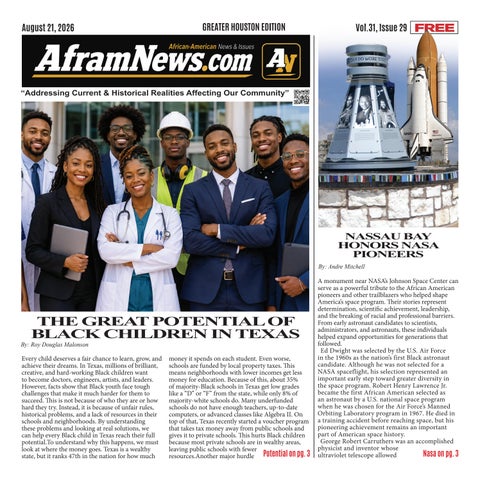
THE GREAT POTENTIAL OF BLACK CHILDREN IN TEXAS
By: Roy Douglas Malonson
Every child deserves a fair chance to learn, grow, and achieve their dreams. In Texas, millions of brilliant, creative, and hard-working Black children want to become doctors, engineers, artists, and leaders. However, facts show that Black youth face tough challenges that make it much harder for them to succeed. This is not because of who they are or how hard they try. Instead, it is because of unfair rules, historical problems, and a lack of resources in their schools and neighborhoods. By understanding these problems and looking at real solutions, we can help every Black child in Texas reach their full potential.To understand why this happens, we must look at where the money goes. Texas is a wealthy state, but it ranks 47th in the nation for how much
money it spends on each student. Even worse, schools are funded by local property taxes. This means neighborhoods with lower incomes get less money for education. Because of this, about 35% of majority-Black schools in Texas get low grades like a “D” or “F” from the state, while only 8% of majority-white schools do. Many underfunded schools do not have enough teachers, up-to-date computers, or advanced classes like Algebra II. On top of that, Texas recently started a voucher program that takes tax money away from public schools and gives it to private schools. This hurts Black children because most private schools are in wealthy areas, leaving public schools with fewer resources.Another major hurdle Potential on pg. 3
A monument near NASA’s Johnson Space Center can serve as a powerful tribute to the African American pioneers and other trailblazers who helped shape America’s space program. Their stories represent determination, scientific achievement, leadership, and the breaking of racial and professional barriers. From early astronaut candidates to scientists, administrators, and astronauts, these individuals helped expand opportunities for generations that followed. Ed Dwight was selected by the U.S. Air Force in the 1960s as the nation’s first Black astronaut candidate. Although he was not selected for a NASA spaceflight, his selection represented an important early step toward greater diversity in the space program. Robert Henry Lawrence Jr. became the first African American selected as an astronaut by a U.S. national space program when he was chosen for the Air Force’s Manned Orbiting Laboratory program in 1967. He died in a training accident before reaching space, but his pioneering achievement remains an important part of American space history. George Robert Carruthers was an accomplished physicist and inventor whose Nasa on pg. 3 ultraviolet telescope allowed