SOMALI WOMEN DRIVE BLUE ECONOMY
AFRICA BRIEFING News. Analysis. Comment.
www.africabriefing.com
September–October 2026 Vol.9 No.46
POWER PROMISED. PROGRESS DELAYED. Why Africa’s leadership still struggles to turn ambition into results The map that made Africa smaller
Cameroon: Trauma of Anglophone war
Peacebuilding: Give voice to those who matter most
Yours to Discover!
0303409180 • 0244958822 www.theroyalsenchi.com | info@theroyalsenchi.com
PUBLISHER’S NOTE
www.africabriefing.com
Power promised. Progress delayed.
Publisher Jon Offei-Ansah
A
Editor
FRICA has never suffered from a shortage of ambition. From independence-era declarations to Agenda 2063, from national development plans to continental integration projects, the vision has often been compelling. The difficulty has been turning that vision into results that ordinary people can see, trust and feel in their daily lives. That is the uncomfortable question behind this issue’s cover story: why does political power so often fail to produce the progress it promises? The answer is not simply that African leaders do not know what needs to be done. In many cases, the diagnosis is already clear. Governments know that stronger institutions matter, that education needs investment, that economies must create jobs, that regional trade should be easier, that corruption weakens trust and that young people need more than speeches about being “the future”. The harder problem is implementation.
Too many reforms remain trapped between policy documents and political reality. Institutions are weakened when they become subordinate to personalities. Accountability is celebrated in principle but resisted when it threatens established interests. Long-term development priorities are frequently displaced by short-term PUBLISHER’S NOTE Publisher political calculations. Jon Offei-Ansah Africa bucks global must be judged by more than intention. This is why leadership Editor economic The measuretrend of political authority is not how many strategies are launched,
Desmond Davies
summits or promises made. It is whether power improves lives. Can n 2018, sixattended of the 10 fastest-growing Deputy Editor economies in the world were in citizens find work? Do schools educate? Do hospitals function? Are public Africa, according to the World Bank, Angela Cobbinah with Ghana leading the pack. Withbusinesses operate without being suffocated by institutions trusted? Can GDP growth for the continent projected to Contributing Editor bureaucracy? Do governments explain failure as openly as they announce success? accelerate to four per cent in 2019 and 4.1
I
Stephen Williams per cent in 2020, Africa’s economic growth story continues Meanwhile, the World Bank’sThey 2019 Doing Business Index These are apace. not abstract questions. determine whether citizens Director, continue to Special Projects reveals that five of the 10 most-improved countries are in Africa, and one-third of believe that democratic institutions can deliver meaningful change. Michael Orji all reforms recorded globally were in sub-Saharan Africa. What the story more impressive and is that the growthAfrica is the world’s youngest Themakes leadership challenge is heartening also generational. Contributors – projected to be broad-based – is being achieved in a challenging global environment, bucking trend. of its political systems remain dominated by structures continent, yet the many Justice Lee Adoboe
Iloegbunam In the Cover Story of this edition, Dr. Hippolyte Fofack,Africans Chief Economist the that make renewal difficult. Young are atbuilding businesses, Chuks organising African Export-Import Bank (Afreximbank), analyses the factors underpinning this Joseph Kayira communities, challenging creating technology and shaping culture, performance. Two factors, in my opinion, governments, stand out in Dr. Hippolyte’s analysis: Zachary Ochieng trade between Africa and China and the intra-African cross-border investment and but they development. remain under-represented in many of the rooms where consequential Olu Ojewale infrastructure
decisions areand made. Much has been said written about China’s ever-deepening economic foray into Africa, especially by Western analysts and commentators who have been sounding Thatbells disconnect cannot continue alarm about re-colonisation of Africa, this timeindefinitely. by the Chinese. But empirical evidence paints a different picture.
Oladipo Okubanjo Corinne Soar Designer
But the solutionglobal is not simply replacing older leaders with younger ones. Youth Gloria Ansah Despite the decelerating growth environment, trade between Africa and China 14.5 per cent in first threegovernance. quarters of 2018, surpassing itselfincreased is nobyguarantee ofthebetter What matters is whether political Country Representatives the growth rate of world trade (11.6 per cent), reflecting the deepening economic systemsbetween allowtheideas, talent accountability to circulate. Africa needs institutions dependency two major tradingand partners. South Africa
Empirical shows China’s individuals domestic investment haspolitical become highly Walter strong evidence enough to that outlast and cultures confidentEdward enough to Byerley linked with economic expansion in Africa. A one percentage point increase Top Dog Media, 5 Ascot Knights tolerate criticism. in China’s domestic investment growth is associated with an average of 0.6 47 Grand National Boulevard Royal Ascot, percentage point increase in overall African exports. And, the expected economic Milnerton 7441, South Africa There are, important examples ofresource-rich progress across the continent. development and of tradecourse, impact of expanding Chinese investment on Tel: +27 (0) 21 555 0096 African countries, especially oil-exporting countries, is even more important.
Several countries have strengthened public institutions, expanded Cell: infrastructure, +27 (0) 81 331 4887
The resilience of African economies can also be attributed to growing intra-African Email: ed@topdog-media.net improved digitalandservices and demonstrated that determined leadership can produce cross-border investment infrastructure development. A combination of the two factors is accelerating the process of structural transformation in a continent Ghana measurable results. The point of critical analysis is not to deny those achievements. where industrial output and services account for a growing share of GDP. African Nana Asiama Bekoe corporations and industrialists which are expanding their industrial footprint across Kingdom It is and to globally ask why theytheare not more widespread and why gains so often proveConcept Co. Africa are leading diversification from agriculture into higher Tel: +233 243 393 943 / +233 303 967 470 value goods in manufacturing and service sectors. These industrial champions difficult to sustain. kingsconceptsltd@gmail.com are carrying out transcontinental operations, with investment holdings around the globe, with a strong presence in Europe and Pacific Asia, together account for more Nigeria That is the spirit in which we approach this cover story. than 75 per cent of their combined activities outside Africa.
Taiwo Adedoyin
A“Power survey of 30 leading emerging African corporations withisglobal and on an entire promised. Progress delayed.” notfootprints a verdict nor is3rd Floor MV continent, Noble, Press House, combined revenue of more than $118 billion shows that they are active in several 27 Acme Road, Ogba, Ikeja, Lagos it an argument that Africa uniquely burdened by poor leadership. It is a challenge industries, including manufacturing (e.g.,isDangote Industries), basic materials, Tel: +234 806 291 7100 telecommunications (e.g., Econet, Safaricom), finance (e.g., Ecobank) and oil to gas. those who toexercise authority — and the institutions that enable them — to taiadedoyin52@gmail.com and In addition mitigating risks highly correlated withto African economies, these emerging African globaldistance corporations between are accelerating the diversification of close the widening ambition and delivery. Kenya sources of growth and reducing the exposure of countries to adverse commodity Naima Farah terms of trade.
Africa already possesses many of the ideas it needs.
This makes me very bullish about Africa!
Room 22, 2nd Floor West Wing Royal Square, Ngong Road, Nairobi Tel: +254 729 381 561 naimafarah_m@yahoo.com
What it needs now is leadership prepared to make them work.
Africa Briefing Ltd 2 Redruth Close, London N22 8RN United Kingdom Tel: +44 (0) 208 888 6693 publisher@africabriefing.org
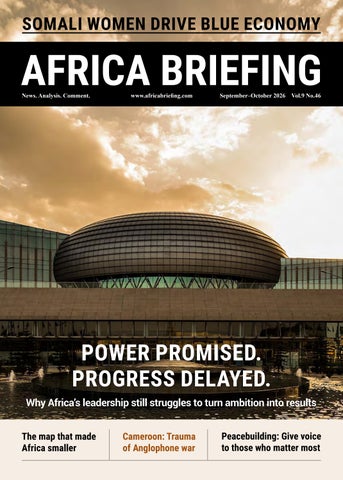
Desmond Davies Contributing Editors Prof. Toyin Falola Tikum Mbah Azonga Prof. Ojo Emmanuel Ademola (Technology) Valerie Msoka (Special Projects) Amanda Wilson (Caribbean) Contributors Justice Lee Adoboe Chief Chuks Iloegbunam Madalisto Kateta Zachary Ochieng Olu Ojewale Oladipo Okubanjo Corinne Soar Kennedy Olilo Gorata Chepete Designer Simon Blemadzie Country Representatives South Africa Edward Walter Byerley Top Dog Media, 5 Ascot Knights 47 Grand National Boulevard Royal Ascot, Milnerton 7441, South Africa Tel: +27 (0) 21 555 0096 Cell: +27 (0) 81 331 4887 Email: ed@topdog-media.net Ghana Nana Asiama Bekoe Kingdom Concept Co. Tel: +233 243 393 943 / +233 303 967 470 kingsconceptsltd@gmail.com Nigeria David Chukwuji 68, Femi Killa Street Ago Palace Way, Okota, Isolo, Lagos, Nigeria Tel: + 234 8039281669 Kenya Patrick Mwangi Aquarius Media Ltd, PO Box 10668-11000 Nairobi, Kenya Tel: 0720 391 546/0773 35 41 Email: mwangi@aquariusmedia.co.ke ©Africa Briefing Ltd 2 Redruth Close, London N22 8RN United Kingdom Tel: +44 (0) 208 888 6693 publisher@africabriefing.org Cover pic: The African Union headquarters complex in Addis Ababa
Contents
Vol.9 No.46 September–October 2026
LEADER
6
When powerful states decide the rules no longer apply
COMMENT
07
Taxing problem for Africa’s critical minerals boom
COVER STORY
08
Africa knows what to do. Why won’t it?
08
Paul Kagame, Thabo Mbeki, Hailemariam Desalegn and Naana Jane Opoku-Agyemang offered strikingly similar diagnoses of Africa’s development failures. Together, their arguments expose a deeper problem: political systems that struggle to turn ambition into results, writes Jon Offei-Ansah
SPECIAL REPORT
20
Peacebuilding must give voice to those who matter most
28
What is the essence of discussing communities without ensuring that they are part of the conversation and, more importantly, part of the decisionmaking, asks Kaltumi Abdulazeez in her reflections on the first annual UN Peacebuilding Week in New York in June
ANALYSIS
28
The map that made Africa smaller
Jon Offei-Ansah shows how Africa’s campaign to replace the familiar Mercator projection is about more than cartography: it is part of a wider struggle over representation, inherited systems and who gets to define the continent’s place in the world.
BUSINESS & ECONOMY
52
One currency, many economies
Jon Offei-Ansah argues that Africa’s single-currency ambition will be decided not by political slogans, but by whether governments can first build the economic discipline, payment systems and trust needed to share monetary sovereignty
56
When the debt comes home
Brendan Odoi examines how Africa’s booming local bond markets are doing more than delivering eye-catching investor returns: they are changing who finances African governments — and who carries the risk when public borrowing goes wrong
58 MINING
58
Can lithium break West Africa’s mining trap?
Mali is already shipping lithium and Ghana is preparing its first mine, but the real test is whether West Africa can keep more of the value at home rather than repeat the extractandexport model that has defined much of its gold industry, argues Jon Offei-Ansah
LEADER
When powerful states decide the rules no longer apply
T
HE US government has launched what it calls a campaign to dismantle the threat posed by the International Criminal Court, accusing the ICC of violating American sovereignty and claiming the authority to prosecute American servicemen and officials. Secretary of State Marco Rubio has promised a “whole-ofgovernment response” designed to disable the Court's ability to operate, target Americans or otherwise threaten US sovereignty. The US is even urging ICC member states to withdraw. This is not simply an argument about one court in The Hague. It is an argument about whether the world still believes in international justice. The ICC has responded by accusing the US of a “flagrant attack” on the independence of an impartial judicial institution. The Court says nine of its 18 judges, both deputy prosecutors, its former Prosecutor and a staff member have been sanctioned by Washington Its message is defiant: it will continue its work. But the question that should be directed not only at Washington, but at every government, is much more uncomfortable: is the world serious about international justice? Because the credibility of the international system is being destroyed from both directions. The US is attacking the Court because it rejects its jurisdiction over Americans. At the same time, several African governments are abandoning or preparing to abandon the institution after years of complaining that the ICC disproportionately targeted their continent. Russia, China and several other major powers have never accepted the Court's jurisdiction in the first place. So where exactly does that leave international justice? In all this, the Africa question cannot be ignored. The ICC's defenders are right to challenge the familiar accusation that the Court was created simply to prosecute Africans. But the history does not support such a simplistic argument. Indeed, some of the ICC's most important African cases came to The Hague because African governments themselves asked it to intervene. Uganda referred the situation in its country to the ICC in 2004. The Democratic Republic of Congo did the same that year. The Central African Republic referred its situation in 2004 and again in 2014. Mali referred its situation in 2012. These were not countries dragged unwillingly before an imperial court in Europe. Their own governments sought international intervention, generally because national justice mechanisms were unable or unwilling to deal effectively with alleged mass atrocities. Other African situations reached the ICC through the UN Security Council: Darfur and Libya. Then there were situations initiated by the Prosecutor, including Kenya and Burundi, which became the first country to leave the ICC in 2017 after years of confrontation with the Court.
For years, African governments were accused of resisting international accountability. Now some of those same governments are effectively saying: if international justice is not genuinely universal, why should Africa continue to participate? There is another uncomfortable truth. The ICC is not beyond criticism simply because Washington is attacking it. The Court has made mistakes. Some investigations have been painfully slow. Its dependence on governments to arrest suspects leaves it vulnerable. Its relationship with the UN Security Council creates obvious political tensions. Some cases have collapsed. Others have taken years to reach meaningful conclusions. The Court itself acknowledges shortcomings. Those weaknesses should be addressed. But there is a fundamental difference between reforming international justice and destroying it. The ICC is based on the principle of complementarity. National courts have the primary responsibility for dealing with genocide, crimes against humanity and war crimes. The ICC is intended to intervene when national authorities are unwilling or genuinely unable to provide justice. It is therefore difficult to sustain the argument that the Court has simply declared itself the supreme government of the world. The US has never ratified the Rome Statute. It is therefore entirely legitimate for Washington to question whether an international court should have jurisdiction over American nationals. But that argument becomes much less convincing when it turns into an attempt to prevent the Court from investigating anyone. A country can reject the jurisdiction of a court without demanding that the court cease to exist. It can dispute a prosecution without threatening the institution itself. And it can defend its citizens without asking the rest of the world to abandon the principle of international criminal accountability. This is why the US campaign matters so much. The world's most powerful military and economic power is effectively telling the international system: there are limits to the reach of international law when American interests are involved. The phrase “rules-based international order” has been repeated so often that it risks becoming meaningless. Rules only work when those with the power to break them choose not to. That is the uncomfortable lesson of the ICC crisis. There is now a dangerous question hanging over the international justice system: what happens when the most powerful countries decide that international law is for everyone else? If international law applies only to governments that lack the military, economic or diplomatic power to resist it, then it is not international law. AB It is the equivalent of the Wild West.
If international law applies only to governments that lack the military, economic or diplomatic power, it is the equivalent of the Wild West
6
AFRICA BRIEFING SEPTEMBER – OCTOBER 2026
COMMENT
Taxing problem for Africa’s critical minerals boom Desmond Davies
A
S the world races to secure cobalt, copper, lithium, graphite, manganese, nickel and rare earths – minerals essential to electric vehicles, batteries, renewable energy and advanced technologies – some African countries are consequently finding themselves at the centre of a new global scramble for resources. But there is a danger that the continent could repeat an old mistake: exporting its natural wealth while allowing much of the resulting profit to accumulate elsewhere. African governments must therefore look beyond the size of the investment cheques being offered by multinational mining companies. They must ask a more fundamental question: how much of the wealth generated from Africa's minerals will remain in Africa?
This matters because mining is particularly vulnerable to profit shifting. The value of a mineral can change dramatically between extraction, processing, marketing and final sale. Without the expertise and information to follow that value chain, African tax authorities can end up taxing only a small part of the wealth generated. African countries must also share information and cooperate more closely. A multinational enterprise operates across borders. African tax authorities cannot afford to remain confined within national borders. This is not an argument against foreign investment. Africa needs investment, technology, expertise and access to global markets. But investment should not mean surrender.
The unprecedented demand for critical minerals gives African governments an opportunity to negotiate from a position of greater strength. If Europe, America, China and other major economies want secure access to Africa's minerals, should insist on Development comes when countries governments transparent contracts, fair taxation, local processing, skills transfer and convert natural wealth into public greater domestic value addition.
Taxation is central to the answer. It is not enough to collect royalties and corporate taxes while sophisticated multinational structures move taxable profits across borders. The UN Conference on Trade and Development has noted that about $88.6 billion leaves Africa annually through illicit financial flight, including commercial and tax-related practices. Under-invoicing of commodity exports alone has been estimated to cost the continent tens of billions of dollars.
revenue, productive industries, decent jobs and better lives
The precise figures vary by methodology, but the scale of the problem is undeniable. Africa is losing resources at precisely the time its governments desperately need revenue for infrastructure, education, healthcare and industrialisation. Multinational companies do not necessarily have to break the law to exploit weaknesses in the international tax system. One major technique is transfer pricing. A mining company can sell minerals or services to another company within the same corporate group. If the price is manipulated, profits can be shifted from the African country where the mineral is extracted to a jurisdiction with lower taxes. There are other methods. A subsidiary may borrow heavily from a related company abroad, using interest payments to reduce taxable profits. Companies can charge African operations for management, technical, procurement or consultancy services supplied by related entities elsewhere. Complex corporate structures can also exploit differences between national tax systems and tax treaties. These transactions are not automatically illegal. The concern is aggressive tax avoidance and artificial profit shifting – arrangements designed to make profits appear where taxes are lowest rather than where the economic value is created. African governments must become much smarter about this. They need tax authorities capable of understanding multinational corporate structures, analysing transfer pricing arrangements and challenging transactions that do not reflect economic reality. The African Tax Administration Forum (ATAF) has already helped African tax administrations strengthen their capacity to tackle transfer pricing, aggressive tax planning and illicit financial flows. Its work in the mining sector has identified risks involving marketing arrangements, related-party debt, procurement and management services.
They should also be cautious about excessive tax holidays and investment incentives. There is little sense in attracting billions of dollars in mining investment only to discover that the host country receives a fraction of the economic value because profits have been shifted elsewhere. The ongoing UN negotiations on a Framework Convention on International Tax Cooperation could potentially reshape the rules of global taxation. For Africa, this is a historic opportunity to demand a system that better reflects the interests of developing countries. African governments should push for greater transparency, effective information exchange, stronger measures against profit shifting and a fairer allocation of taxing rights. Most importantly, countries where minerals are extracted and genuine economic activity occurs must have a meaningful right to tax the resulting wealth. Africa has heard promises about the transformative power of natural resources before. Oil, gas, gold, diamonds and copper have generated enormous wealth, yet too often the producing countries have struggled to turn that wealth into broad-based prosperity. The critical minerals revolution must be different. Minerals in the ground are not development. Foreign investment is not development. Export earnings alone are not development. Development comes when countries convert natural wealth into public revenue, productive industries, decent jobs and better lives. The world wants Africa's critical minerals. Africa should welcome the investment but make sure it gets a fair return. The continent must negotiate not as a desperate supplier of raw materials, but as the owner of resources that the global economy urgently needs. If African governments fail to strengthen their tax systems, the critical minerals boom could become another great giveaway. If they get it right, these minerals could help finance the industrial transformation that generations of Africans have been promised. This time, Africa must ensure that the wealth leaves the ground – but not the continent. AB
AFRICA BRIEFING SEPTEMBER – OCTOBER 2026
7
COVER STORY
Africa knows what to do. Why won’t it? Paul Kagame, Thabo Mbeki, Hailemariam Desalegn and Naana Jane Opoku-Agyemang offered strikingly similar diagnoses of Africa’s development failures. Together, their arguments expose a deeper problem: political systems that struggle to turn ambition into results, writes Jon Offei-Ansah
T
HE most striking thing about the conversation in Kigali was not that four senior African political figures identified weak institutions, dependency, poor leadership, rentseeking and failed implementation as major obstacles to the continent’s progress. It was that none of this was particularly new. Rwanda’s President Paul Kagame, former South African President Thabo Mbeki, former Ethiopian Prime Minister Hailemariam Desalegn and Ghana’s Vice President Naana Jane Opoku-Agyemang were speaking at the inaugural Africa Mindset
Reset Forum in Kigali on August 25. Between them, they have spent decades at the centre of power, governed very different countries under very different political systems and faced very different pressures. Yet they kept returning to the same basic problem: Africa often knows what needs to be done, but fails to follow through. Kagame put it simply: “We have to match what we say, want and do for us to match the results.”
Rwanda’s President Paul Kagame and Ghana’s Vice President Naana Jane Opoku-Agyemang at the Africa Mindset Reset Forum in Kigali, where African leaders debated the continent’s persistent gaps in leadership, governance, accountability and development delivery
8
AFRICA BRIEFING SEPTEMBER – OCTOBER 2026
COVER STORY That sentence could almost serve as a summary of Africa’s development dilemma. The continent is not short of plans. There is Agenda 2063, the African Continental Free Trade Area, national industrialisation strategies, regional integration programmes, infrastructure blueprints, agricultural transformation plans and endless declarations on jobs, energy, trade, technology and food security. The vision is usually ambitious, but the results are often far less impressive. The African Union itself has acknowledged the gap. Its assessments of continental integration have repeatedly pointed to slow implementation, low levels of intra-African trade, restrictions on the movement of people and inadequate progress in industrialisation and value addition. Africa has therefore spent decades imagining the future. The bigger problem is getting there. And that is where the Kigali discussion becomes more interesting. What if some reforms fail not because governments do not understand them, but because implementing them would upset people who benefit from the way things already work? That is a much more difficult question because it moves the argument away from familiar language about “capacity gaps” and forces us to look at power.
Hailemariam came closest to naming the problem directly. “Many African countries remain caught in a rent-seeking political economy,” he said, arguing that political power can become a route to resources rather than an instrument for productive development. He also warned that the continent needed to nurture a new generation of leaders, saying: “If we don’t cultivate a critical mass of future leaders, we cannot change Africa.” His point about leadership matters, but the rent-seeking argument goes deeper. It helps explain why governments can understand what is wrong and still fail to fix it. An inefficient port hurts exporters, but delays can create opportunities for people who profit from bureaucracy. Complex licensing rules discourage investment, but they also make access to decision-makers more valuable. Opaque procurement can waste public money, but it can also feed political networks. Protected industries may hurt consumers, yet they can enrich well-connected businesses. Dysfunctional state companies can drain public finances while providing jobs and contracts for political supporters. Border delays may undermine regional trade while benefiting those who profit from controlling movement. None of these problems survives because Africa lacks reports explaining how to solve them. They survive because reform creates losers, and those losers are often influential. That is why the language of a “mindset reset”, while useful, only goes so far. Mindset, confidence and agency all matter, as does Africa’s ability to design and own its development rather than constantly importing solutions from outside. Opoku-Agyemang made that point forcefully when she said: “We must move beyond implementing solutions designed for us towards building the capacity, institutions and expertise needed to address our own challenges.” It is a persuasive argument. Africa has spent too long being treated as a place where solutions are conceived elsewhere and delivered through donors, consultants and international institutions. But African ownership on its own is not enough. A policy does not become good simply because it was designed in Accra, Kigali, Abuja or Addis Ababa. Bad ideas can be home-grown too. African agency only matters if it is backed by institutions that can test policy, correct mistakes and hold leaders responsible for failure. That is where the Kigali conversation becomes more uncomfortable. Africa’s problem may not simply be that people need to think differently. Political systems also need to work differently. Weak institutions do not always remain weak because leaders do not know how to strengthen them. Sometimes weakness is useful. Rules that can be bent favour people with access. A weak regulator is easier to influence. A politicised civil service creates more opportunities for appointments. Opaque procurement gives officials greater discretion. Weak courts give executives more room, while dependent parliaments create fewer obstacles. In other words, weak institutions can be very convenient for powerful people.
Weak institutions can be very convenient for powerful people
AFRICA BRIEFING SEPTEMBER – OCTOBER 2026
9
COVER STORY
Former South African President Thabo Mbeki addresses the Africa Mindset Reset Forum in Kigali, where he stressed the importance of legitimate leadership, genuine elections and accountability to citizens
That leads to a better question than the one African development debates usually ask. Who loses if Africa actually does it? Take continental integration. Almost every African government says it supports AfCFTA. Leaders regularly talk about open markets, industrialisation and freer movement across the continent, yet implementation remains slow. Borders remain difficult, trade costs remain high and movement is still restricted. If everyone agrees that integration is good, why is it proving so hard? Because borders are not simply lines on a map. They are sources of revenue, political control and bureaucratic power. Protected markets help established businesses. Customs procedures create discretion. Restrictions can benefit governments and commercial interests that have learned how to operate within the existing system. Regional integration may make perfect economic sense while threatening domestic political arrangements. The problem is not always that leaders fail to understand integration. Sometimes they understand it perfectly well. The real question is whether they are willing to accept the political costs. Kagame’s own record makes this debate especially interesting. Rwanda has become one of Africa’s clearest examples of a state built around discipline, targets and delivery. Government programmes are closely monitored, officials are expected to perform and policy is not simply announced and forgotten. That gives Kagame unusual credibility when he complains about Africa’s failure to implement decisions. But it also raises another question: what does accountability mean in a system renowned for state effectiveness but where critics have repeatedly questioned the openness of political competition? According to Rwanda’s National Electoral Commission, Kagame won 99.18 percent of the vote in the country’s 2024 presidential election. Supporters point to stability, reconstruction, 10
growth and administrative competence. Critics have raised concerns about opposition politics and civic space. Those competing assessments sit at the heart of a bigger African governance debate. A state can be very good at getting things done and still leave open the question of how easily citizens can challenge those in power. Who holds the discipliner accountable? Mbeki brought that issue into sharper focus. He argued that leadership must be legitimate and that “that legitimacy will derive, in the first instance, from the fact of having been genuinely elected”. That sounds obvious, but in the African context it raises a difficult balance. The continent needs strong states, yet it also needs accountable ones. A government that can act but cannot be challenged can become coercive. A government that can be removed at elections but cannot deliver basic services can become irrelevant. Africa has seen both. The real challenge is building states that are capable enough to implement policy and accountable enough to prevent power from becoming unchecked. Mbeki went further. He suggested that an ordinary citizen should be able to confront a politician seeking re-election and ask what happened to the promises made five years earlier. That is what democratic accountability should look like. But elections themselves can also create bad incentives. Ghana is a useful example. It has one of West Africa’s strongest records of competitive elections and peaceful transfers of power, yet election cycles have repeatedly placed pressure on public finances. The political logic is easy to understand: governments are rewarded for what voters can see today, while the cost of overspending may arrive years later. That creates a temptation to prioritise short-term political gains over long-term economic discipline.
AFRICA BRIEFING SEPTEMBER – OCTOBER 2026
COVER STORY This does not mean elections are the problem. It means elections alone are not enough. A democracy can still reward poor decisions. That makes Opoku-Agyemang’s call for African agency even more important, but also more complicated. A country can have democracy, local expertise and political independence and still struggle to make difficult long-term choices. That is not necessarily a failure of intelligence. It is often a failure of incentives. And that is why Africa should be careful about placing too much hope in exceptional leaders. The continent has spent much of its post-independence history searching for the strong man, the visionary, the reformer, the technocrat or the leader who can somehow force the state to work through sheer will. But countries cannot depend forever on finding extraordinary individuals. Strong institutions matter because they make extraordinary leadership less necessary. A functioning civil service should not need a president personally pushing officials to do their jobs. Businesses should not need access to political leaders before contracts are respected. Anti-corruption bodies should not depend on the goodwill of the people they may have to investigate. Courts should be able to rule against governments. Development plans should survive elections. Public institutions should still work when leaders change. Otherwise, every election becomes another gamble on personality. Hailemariam’s own political history shows why that matters. He governed Ethiopia between 2012 and 2018, during a period when the country was often held up as an example of an
African developmental state delivering rapid growth. But unrest intensified and protesters demanded greater political and economic freedoms. Hailemariam eventually resigned, saying his departure would help advance reforms aimed at peace and democracy. His experience offers an important lesson: economic growth is not enough. Development without political legitimacy has limits. Mbeki’s experience offers a different lesson. He was one of the strongest advocates of the “African Renaissance” and helped shape a period of continental optimism around African-led development. Yet he left the South African presidency early in 2008 after losing the support of his own party. Whatever view one takes of that episode, the principle matters. Leaders must operate within systems capable of ending their time in office. Seen together, the four speakers in Kigali were describing different parts of the same problem. Kagame talked about execution. Mbeki talked about legitimacy. Hailemariam talked about political economy and leadership. Opoku-Agyemang talked about agency and ownership. Africa needs all four. Execution without accountability can become authoritarian. Democracy without delivery can become permanent frustration. Agency without capable institutions can reproduce failure. Leadership programmes without political reform can simply produce better-trained managers of the same broken systems. The continent’s governance record shows why this matters. The Ibrahim Index of African Governance has warned that overall
Who loses if Africa actually does it?
Former Ethiopian Prime Minister Hailemariam Desalegn speaks at the Africa Mindset Reset Forum in Kigali, where he warned that rent-seeking political economies continue to weaken development and called for a new generation of African leaders
AFRICA BRIEFING SEPTEMBER – OCTOBER 2026
11
COVER STORY
Containers at Kenya’s Port of Mombasa, a major gateway for East African trade. Africa’s development challenge is not simply building infrastructure, but creating the institutions, efficient borders and regional systems needed to turn trade ambitions into sustained economic transformation. Credit: MEAACT Kenya/Stuart Price via Wikimedia Commons
progress has stalled, with deteriorating security and democratic conditions in several countries offsetting gains made elsewhere. But this is also where sweeping claims about Africa become dangerous. There is no single African political story. Ghana is not Sudan. Rwanda is not Nigeria. Mauritius is not the Central African Republic. Botswana is not Mali. Any attempt to explain the experience of 54 countries through something as vague as an “African mindset” risks becoming meaningless. What many countries do share, however, is a familiar contradiction between what governments say they want and what their political systems actually reward. Governments promise to fight corruption while election campaigns require huge sums of money. They promise meritocracy while party supporters expect appointments. They promise competition while well-connected businesses demand protection. They promise fiscal discipline while elections reward spending. They promise regional integration while officials benefit from barriers. They promise independent institutions while executives dislike being constrained. And they promise economic transformation while powerful interests continue making money from economies that have barely changed. That contradiction may explain more than mindset ever can. People change their behaviour when incentives change. Political systems are no different. So perhaps the real reset Africa needs is not psychological but institutional. It is about making good performance more rewarding than political loyalty, making transparent procurement harder to manipulate, protecting professional civil servants from partisan
pressure and ensuring that losing an election does not mean losing everything. It is also about giving courts, regulators and watchdogs enough independence to challenge the people in power. Most of all, it is about accepting something political leaders do not always like to admit: serious reform always costs somebody something, whether in power, money, access, influence or protection. That is why implementation is so difficult. The Kigali conversation mattered because four people who know African government from the inside came unusually close to saying this aloud. But identifying the problem is still the easy part. Africa does not lack leaders who can explain the continent’s problems. It does not lack plans, summits or declarations. What it still lacks in too many places are political systems that make reform worthwhile for the people who have the power to deliver it. That is the argument beneath Kagame’s frustration with implementation, Mbeki’s insistence on legitimate leadership, Hailemariam’s warning about rent-seeking and OpokuAgyemang’s call for African ownership. Africa’s development crisis may no longer be mainly about knowing what to do. It may be about building political systems where doing it is rewarded — and where failing to do it carries a real price. Until that changes, the continent can produce another plan, another summit and another stirring vision of the future. Then, a few years later, its leaders may gather again and ask the same question. AB If Africa already knows what to do, why won’t it?
Africa’s problem may no longer be knowing what to do, but building political systems where doing it is rewarded
12
AFRICA BRIEFING SEPTEMBER – OCTOBER 2026
Shanghai Grand International Logistics Co., Ltd.
Established in 2002, Shanghai Grand International Co., Ltd. offers a variety of shipping and transportation options via air, sea and ground. Our company is based in Shanghai, China, with branches across the nation. Ranging from customs declaration, warehouse storage, containers and consolidated cargo shipping we have a large array of options to meet your needs. In addition to being approved and designated by the Ministry of Transportation of China as a First Class cargo service provider, we have also established excellent business relations with major
C.E.O President. Mr, Felix Ji
shipping companies including Maersk, CMA, ONE, SM line, and EMC over the past 15 years. In addition we have also built long term business relations with major airline cargo departments. In order to expand our global operation, we are looking for international partnerships to work together in this industry. Should you ever import any goods from Peoples Republic of China please ask your exporter and shipper to contact us. We will provide our best service to you.
Room 814, 578 Tian Bao Lu, Shanghai, Peoples Republic of China E-Mail: felix@grand-log.net phone: 86-13501786280
COVER STORY
The youth are present. Are they prepared for power? Jon Offei-Ansah turns from the question of why African governments so often fail to implement plans they already know they need to an equally awkward one: if young Africans are already shaping the continent’s present, why are so many still waiting outside the rooms where power is exercised?
T
HE second instalment of the Kigali conversation takes the argument about Africa’s failure to deliver in a different direction. If the continent’s problem is not a shortage of plans, resources or diagnosis, attention inevitably shifts to the people expected to carry those plans forward. That is where the language of youth becomes both inspiring and uncomfortable.
Former Ethiopian Prime Minister Hailemariam Desalegn had framed the Africa Mindset Reset Forum with a useful challenge: ‘We often tell young people they are the future. That is not quite true. They are the present.’ His point was that Africa’s entrepreneurs, researchers and public servants are already at work, and that older generations should build the continent with them rather than plan it on their behalf.
Young protesters in Lagos during Nigeria’s 2020 End SARS movement. Across the continent, younger Africans have increasingly turned to protest and digital mobilisation when conventional political channels appear unable — or unwilling — to respond to their demands. Credit: TobiJamesCandids/Wikimedia Commons, CC BY-SA 4.0
14
AFRICA BRIEFING SEPTEMBER – OCTOBER 2026
COVER STORY Yet African politics often does precisely the opposite. Young people are endlessly described as leaders of tomorrow, even where political leadership changes slowly and the routes into parties, parliament, public appointments and economic opportunity remain tightly controlled. Youth conferences flourish, leadership academies multiply and governments launch entrepreneurship schemes. The language suggests urgency, but the transfer of meaningful authority is much slower.
The question is not whether young Africans have enough ambition but whether institutions reward that ambition
That gap matters because Africa’s youth are not a marginal constituency. The continent has more than 400 million people aged between 15 and 35, and that number is projected to rise sharply. Yet opportunity has not kept pace. The ILO estimated that 70.9 million Africans aged 15 to 24 were not in employment, education or training in 2025.
This is the context in which President Paul Kagame’s appeal to young Africans should be heard. Speaking in Kigali, he urged aspiring leaders to ‘give your life a purpose and make a choice’, telling them to take risks, accept setbacks and ‘stay the course’. There is something bracing about that message. No serious change happens without people willing to act before success is guaranteed. But courage is not an economic policy, and purpose cannot substitute for access. A young graduate can be determined and still spend years looking for decent work. A young entrepreneur can have a viable idea and still be unable to secure credit. A talented public servant can discover that promotion depends as much on networks as performance. Young politicians can be energetic and popular yet find party structures dominated by people who have controlled them for decades. The question is not whether young Africans have enough ambition. It is whether institutions reward that ambition. That is where this second conversation connects directly with the first. The earlier analysis argued that Africa’s implementation problem is partly an incentives problem: reforms fail when those with the power to implement them benefit from the status quo. The same logic applies to generational change. Inviting young people into politics or business can threaten established networks and careers. Inclusion sounds harmless until it requires somebody already inside the room to give up a seat. Thabo Mbeki’s intervention gets closer to this institutional problem. ‘The leader that we want cannot drop from the skies,’ the former South African president said. He linked leadership to the experience and judgement of ordinary people, asking why a citizen who remains ‘hungry and poor’ should re-elect someone after five years in power if those conditions have not changed. That is a more demanding idea of leadership than simply finding better personalities. It says good leaders are produced by systems in which citizens can test promises against results and remove those who fail. For younger Africans, however, those systems do not always feel equally accessible. Afrobarometer’s multi-country research found that Africans aged 18 to 25 are far less likely to vote than older citizens, even though they are about as likely as their elders to join others in seeking government action, contact an MP, protest or express political views online. The picture is more complicated than the familiar claim that young Africans are apathetic.
A young Kenyan at work after completing secondary school. For millions of young Africans, the challenge is not a shortage of ambition but access to decent employment, finance and economic systems capable of turning skills into opportunity. Credit: Kay k237/Wikimedia Commons, CC BY-SA 4.0
Many are engaged. They may simply be unconvinced that conventional politics is where engagement produces results. That helps explain why young people across the continent have repeatedly organised outside traditional party structures,
AFRICA BRIEFING SEPTEMBER – OCTOBER 2026
15
COVER STORY
Delegates take part in an African Youth Forum at the African Union headquarters in Addis Ababa. The challenge facing Africa is no longer simply inviting young people into discussions, but ensuring that participation leads to genuine influence over policy and power. Credit: USAID in Africa via Wikimedia Commons
using social media, civilsociety networks and street mobilisation to force issues onto national agendas. It would be a mistake to romanticise protest or assume every youthful movement is democratic or progressive. Frustration can produce reformist energy, but it can also produce disengagement or attraction to anti-democratic alternatives. The challenge, then, is not simply to get more young people into politics. It is to make politics worth entering.
must move from talking about ‘the
A system that welcomes Africa we want’ to building ‘an Africa we work for’. The appeal young people only when is to responsibility rather than dependency, and it fits the forum’s they repeat the views of broader insistence that Africans cannot outsource their future. those already in charge But there is a danger in making sacrifice sound like a mainly is not transferring youthful obligation. African citizens have heard power. It is recruiting an appeals to patience and sacrifice for decades. Governments promise audience that today’s hardship will create
Ghana’s Vice President Naana Jane Opoku-Agyemang offered another useful phrase in Kigali when she argued that the continent 16
tomorrow’s prosperity. Sometimes that is unavoidable. But sacrifice becomes politically corrosive when those asking for it appear protected from its costs.
AFRICA BRIEFING SEPTEMBER – OCTOBER 2026
COVER STORY The representation gap remains striking. The InterParliamentary Union reported that only 2.3 percent of MPs in sub-Saharan Africa were aged 30 or under in its 2025 data, although the region performed better when the age threshold was widened to 40. That is a useful reminder that a continent with an exceptionally young population can still have decision-making institutions whose composition looks very different from the societies they govern. Economic representation is equally important. Afrobarometer found that 52 percent of Africans aged 18 to 35 would prefer to start their own business if given the choice, while young respondents identified job creation, education, training and access to business loans among their main priorities. That should make policymakers cautious about treating ‘entrepreneurship’ as a magic word. Entrepreneurs need affordable finance, reliable electricity, customers with purchasing power, predictable regulation, transport and digital infrastructure. Telling millions of young people to become entrepreneurs without fixing those conditions risks turning a structural employment crisis into an individual test of character. The same applies to leadership. Training matters, but leadership programmes cannot compensate for political parties that do not renew themselves, public institutions shaped by patronage or economies in which access matters more than ability. This is why Hailemariam’s word ‘trust’ may be more important than the familiar rhetoric about youth empowerment. Trusting younger Africans means allowing them to exercise authority before older generations decide they are completely ready. It means accepting that they will make mistakes and allowing them to disagree with the people who opened the door for them.
A credible generational compact must ask not only what young Africans are prepared to do, but what established elites are prepared to surrender. Are political parties willing to give younger candidates winnable seats rather than symbolic positions? Are governments prepared to open public procurement to new firms rather than familiar contractors? Are senior leaders willing to mentor successors without controlling them? And, perhaps most importantly, are people who have held office for decades willing to leave? These questions matter because youth itself is not a political programme. Africa has young politicians who reproduce patronage, intolerance and corruption as efficiently as older ones. A 35-year-old can defend a broken system just as enthusiastically as a 70-year-old. Replacing an ageing elite with a younger elite that behaves exactly the same way would merely refresh the faces of the problem. The deeper issue is circulation: whether institutions allow new people, ideas and interests to enter power and whether they make leadership change normal rather than traumatic.
A system that welcomes young people only when they repeat the views of those already in charge is not transferring power. It is recruiting an audience. Seen this way, the four voices in Kigali again illuminate different parts of the same problem. Kagame stresses purpose and persistence. Mbeki insists that leadership must answer to ordinary citizens. Opoku-Agyemang calls for Africans to build rather than merely imagine their future. Hailemariam says the young are already the present and must be trusted with it. All four arguments have merit. None removes the responsibility of those who currently control institutions. Africa’s young people do need skill, discipline, courage and a willingness to build. But the burden of transformation cannot be placed on a generation that is simultaneously told to take responsibility and asked to wait its turn. The first part of this analysis asked why Africa repeatedly fails to do what it already knows needs to be done. Part two points towards one answer: systems that resist change do not only block policies; they can also block people. If Africa’s young are already the present, the real test is no longer whether they are ready for power. It is whether power is ready to make room for them.
AFRICA BRIEFING SEPTEMBER – OCTOBER 2026
AB 17
COVER STORY
Beyond the colonial blame game Although Africa does not lack educated people, many of its institutions struggle to convert this human potential into sustained productivity because of the failure to use this talent effectively, writes Moses Onyango
F
OR decades, explanations of Africa’s development challenges have rightly focused on colonialism, resource extraction, arbitrary borders, unequal trade, debt, foreign intervention and global economic inequalities. These factors matter. Colonial rule profoundly shaped the institutions inherited by African states, and some scholars have shown how colonial institutional arrangements influenced postcolonial development. But history cannot explain everything forever. Africa must also confront a more uncomfortable question: what happens when Africans control the institutions they inherited but continue to make them weaker? This is not an argument for abandoning the colonial explanation. It is an argument for completing it. Institutions are not self-operating machines. They are continuously shaped by contemporary decisions: who is appointed, who is promoted, who controls resources, who is held accountable and whose competence is rewarded. This is where Africa's present development challenge lies. The continent does not lack educated people. It has scientists,
engineers, academics, entrepreneurs, professionals and capable administrators. Yet many institutions struggle to convert this human potential into sustained productivity. The problem is therefore not simply a shortage of talent. It is because of the failure to build institutions capable of using talent effectively. The American economist, Douglass North, had argued that institutions shaped incentives and therefore influenced behaviour. This provides a useful lens for understanding Africa's institutional crisis. Some institutions reward people who create value. Others reward people who know how to consume institutional value. The distinction is crucial. An institutional consumer is not necessarily a thief. The term describes someone who derives salary, status, influence, prestige or career advancement from an institution without contributing proportionately to increasing its productive capacity. The problem becomes particularly destructive when consumers of institutions become their leaders. Such leaders may inherit functioning organisations and gradually weaken them
The Great Hall at the University of Ghana, Legon. Universities illustrate the wider challenge facing African institutions: converting abundant human talent into stronger organisations through merit, accountability and effective leadership. Credit: Shannon Kwabi/Wikimedia Commons, CC BY-SA 4.0
18
AFRICA BRIEFING SEPTEMBER – OCTOBER 2026
COVER STORY while furthering their own careers. They may cultivate visibility without productivity, accumulate titles without results, build networks without systems and protect positions without developing people. Eventually, the institution pays the price.
A leader who suppresses What happens when dissent also loses information. Employees stop telling Africans control management what it needs to hear and start saying what they believe the institutions they management wants to hear. That institutional decay disguised as inherited but continue to isharmony. The problem is not uniquely make them weaker? African. Patronage, nepotism,
Consider two employees. One works hard, develops systems, attracts clients, mentors colleagues and produces measurable results. The other invests more energy in cultivating influential relationships and avoiding responsibility. If the second is promoted while the first is ignored, the organisation has delivered a powerful message: connections matter more than competence. The rational response is not to work harder. It is to develop better connections. That is how institutions destroy their own productivity. Meritocracy is therefore not merely a moral principle. It has economic consequences. Researchers have found that bureaucratic systems characterised by meritocratic recruitment and predictable professional careers were positively associated with economic growth. When merit matters, capable people have incentives to invest in their skills. When performance matters, employees have incentives to improve. When neither matters, people invest in survival. And survival is not productivity. The damage becomes especially severe when competent people leave. A skilled academic, engineer, manager, scientist or civil servant who exits because merit is repeatedly frustrated leaves behind more than a salary and job title. The institution may lose expertise, relationships, institutional memory and future leadership capacity.
corruption and elite capture exist elsewhere. But Africa cannot use that fact as an excuse for inaction. Nor can colonial history remain a permanent explanation for contemporary failure. Colonialism did not determine every modern appointment. It did not write every procurement decision. It did not force a university to promote an ineffective administrator or require a board to ignore declining productivity. These are contemporary choices. Colonial history helps explain the environment in which contemporary institutions develop. Contemporary leadership determines whether that environment is reproduced, reformed or transformed. This distinction matters because historical causes cannot be directly managed by today's leaders. Recruitment systems can. Promotion systems can. Performance evaluations can. Accountability mechanisms can. Succession planning can. Africa must therefore move from explaining institutional weakness to correcting it. The first requirement is merit. Appointments should be based on demonstrated competence rather than political loyalty, personal relationships or patronage. Promotion should reward measurable contribution. Leadership should not become a prize for those who are merely well connected.
Those who remain learn from what happened. They learn whom to please. They learn which questions not to ask. They learn that institutional performance may matter less than personal relationships.
The second requirement is accountability. Boards and councils must become genuine oversight institutions. Senior leaders should be evaluated against institutional outcomes, not public visibility.
Soon, mediocrity becomes self-reproducing. This is why leadership matters so much.
The questions should be straightforward. Did productivity improve? Did finances become more sustainable? Did talented employees stay? Did service quality improve? Did innovation increase?
A leader who marginalises competent people because they are independent, outspoken or professionally respected may believe they have eliminated a rival. In reality, they may have eliminated an institutional asset. Everyone else is watching. When employees see honest colleagues punished, they become silent. When loyalists are promoted despite poor performance, they become political. When senior officials appear protected while junior employees are disciplined, trust in institutional fairness collapses.
Did organisational systems become stronger? Did the leader develop capable successors? Would the institution be stronger if the leader left tomorrow? That last question may be the most revealing. A leader who makes an organisation dependent on personal relationships and individual influence may appear powerful while making the institution dangerously fragile.
Fear replaces candour. Loyalty replaces competence. Survival replaces innovation.
Good leadership creates systems that function beyond the personality of the leader. This is the essence of stewardship.
An organisation can therefore appear peaceful while becoming progressively weaker. This is one of the great paradoxes of destructive leadership: the leader may become more powerful while the institution becomes less capable.
A Vice-Chancellor does not own a university. A CEO does not own a company. A public official does not own the state. These are temporary positions of custodianship. The institution existed before the leader arrived. AB
Moses Onyango holds a PhD in Political Studies and is the Founder and Chairman of the Organic Leadership Agency (OLA) in Nairobi, Kenya AFRICA BRIEFING SEPTEMBER – OCTOBER 2026
19
SPECIAL REPORT
Peacebuilding must give voice to those who matter most What is the essence of discussing communities without ensuring that they are part of the conversation and, more importantly, part of the decision-making, asks Kaltumi Abdulazeez in her reflections on the first annual UN Peacebuilding Week in New York in June
B
EING at the UN in New York had always felt distant. Yet, somehow, I found myself there, with an opportunity to make my voice loud enough to represent not only myself, but the many local peacebuilders whose voices rarely make it into global spaces. As Peacebuilding Week began, I was full of excitement, curiosity and a sense of responsibility. I knew I was not simply attending as an individual. I was carrying with me the experiences of communities and local peacebuilders who are often at the centre of peacebuilding practice but remain at the margins of global policy conversations. Throughout the week, I participated in different events and conversations covering localisation, the Global South, locally led peacebuilding, civil society engagement and the future of peacebuilding.
However, I also experienced moments when I felt almost invisible. In several spaces, I was either the only local peacebuilder in the room or among the youngest participants. I listened to conversations about local communities, local actors, the Global South and localisation. Yet I kept asking myself: where are the people about whom they are talking? This became one of the most important reflections from my experience. How can we meaningfully discuss communities without ensuring that those communities are part of the conversation, and more importantly, part of the decision-making? Being invited into a room is important. But representation cannot end with presence. Local peacebuilders should not be invited only to speak after priorities, policies and strategies have already been determined.
United Nations headquarters in New York. Global peacebuilding forums increasingly speak of localisation and community ownership, but the harder challenge is ensuring that local peacebuilders influence priorities, financing and policy rather than simply being invited into rooms where decisions have already been made. Credit: Superbass/Wikimedia Commons, CC BY-SA 4.0.
20
AFRICA BRIEFING SEPTEMBER – OCTOBER 2026
SPECIAL REPORT
Participants at a Youth, Peace and Security in Africa dialogue. Younger and grassroots peacebuilders are increasingly present in international discussions, but meaningful localisation depends on whether that presence is matched by genuine influence over agendas, decisions and resources. Credit: Patrick Loch/US Africa Command
They should be involved from the beginning in agendasetting, decision-making, policy design, resource allocation, implementation and evaluation. The question is therefore not simply whether local actors have a seat at the table. It is whether they have enough influence on shaping what happens at that table. The experience also made me question how much the international system truly knows about the people it seeks to support. Our realities are not simply data points. Our ways of life, cultures, knowledge systems, identities, histories, relationships and experiences of conflict are deeply rooted in contexts that cannot always be understood from a distance. There is therefore a danger in speaking about communities without creating meaningful opportunities for communities to speak for themselves. This is why lived experience must be recognised as expertise. People who have experienced conflict, violence, displacement, exclusion and peacebuilding first-hand possess knowledge that cannot always be captured through academic research, technical frameworks, institutional reports, or externally designed indicators. Their experiences should not simply become stories used to strengthen proposals, reports, or fundraising narratives. Their knowledge should inform policy, programming, financing, decision-making and evaluation. I was also privileged to participate in the UN/Civil Society Organisation Dialogue: From Presence to Voice. I witnessed the intention and commitment within that small but powerful group of people. Yet, initially, I did not feel that my presence was recognised. That changed when I spoke. I shared a deeply personal experience from my work and reflected on why we cannot continue to overlook the everyday realities of local peacebuilders, people
who live within the communities they serve, who experience the consequences of violence first-hand and who continue building peace because their communities depend on it. That moment reinforced something important for me: sometimes, the people closest to the problem are the people whose knowledge is most needed in the conversation. Local peacebuilders are not simply beneficiaries of the global peacebuilding system. They are practitioners, knowledge holders, strategists, mediators and community leaders. There are many people with genuine intentions to contribute to peace. But good intentions alone are not enough. The peacebuilding sector needs the courage and strategy to move beyond traditional ways of working and genuinely localise. Localisation cannot simply become another term used in proposals, strategies, conferences and donor conversations. Localisation must mean a shift in power. This includes shifting decision-making power, financial resources, authority and ownership, risk, visibility and recognition, knowledge production, agendasetting and accountability. If international actors continue to determine priorities, control resources, define success, design the questions, collect the data and make the final decisions, then simply involving local organisations in implementation does not constitute meaningful localisation. Partnership must begin with trust. One example that stayed with me was the approach to partnership by Peace Direct, an international non-governmental organisation. Rather than establish country offices in the regions where it operates, Peace Direct works through relationships with local partners whom it supports and works alongside. This challenges the conventional architecture of international development and humanitarianism and demonstrates what
Local peacebuilders should not be invited to speak only after priorities, policies and strategies have already been determined
AFRICA BRIEFING SEPTEMBER – OCTOBER 2026
21
SPECIAL REPORT
Women involved in cross-border peacebuilding in East Africa. Local actors often possess the relationships, lived experience and community legitimacy needed to resolve conflict, yet they remain under-represented in the institutions that decide how peacebuilding priorities and funding are shaped. Credit: Tine Frank/USAID East Africa Regional
partnership can look like when local actors are treated as leaders rather than simply implementing partners. For me, it reinforces a simple principle: every meaningful relationship should begin with trust and respect. Once that foundation is established, co-creation becomes much more natural. International organisations and donors need to see local organisations as partners with expertise, not simply as implementing entities. The goal should be to move from working for communities to working with communities. The conversations during Peacebuilding Week also raised fundamental questions about the systems that underpin peacebuilding. One of the most important is the global financial system. Questions we need to ask are how can we reorganise global financing systems to allow small local organisations to succeed? Why are funding mechanisms often designed in ways that make them inaccessible to grassroots organisations? Can funding become more flexible, longer-term and responsive to local realities? How can local organisations receive not only project funding but appropriate core and institutional support? Many grassroots organisations do not lack knowledge, commitment, or community legitimacy. They are often constrained by funding systems built around complex applications, rigid reporting requirements, short funding cycles and externally determined priorities. If we are serious about locally led peacebuilding, then financing systems must also become locally responsive. Another critical question is: what do INGOs see as success, and how do they measure it? Another equally important question is: what do communities themselves understand as success or impact? Success cannot always be reduced to the number of people trained, meetings conducted, activities implemented, or reports submitted. Communities should have a meaningful role in defining what change looks like and determining how that change should be measured.
This requires moving from externally imposed indicators towards approaches where communities participate in defining outcomes, priorities and measures of success. Our approach to data also requires reconsideration. Too often, communities become sources of information. We enter communities, ask questions, collect data, analyse it and return to our institutions to produce reports. But what if communities had greater ownership of the process? What if communities could help determine what questions should be asked? What information is important? What issues should be prioritised? How should the information be interpreted? How should the findings be used? We need to move from extracting data from communities to building knowledge with communities. Data should serve communities, rather than communities simply serving data requirements. Throughout Peacebuilding Week there were many important conversations. But when the week ended, one question remained with me: what happens next? Do we continue going round the same circle, having the same conversations about localisation without fundamentally changing the systems that prevent it? Or are we finally prepared to decolonise the structures, practices and financing mechanisms that continue to make genuine partnership so difficult? The conversation does not end because Peacebuilding Week has ended. One week of dialogue was never going to be a panacea for the deeply embedded challenges within the peacebuilding ecosystem, but the first step is acknowledging that our systems need to change. Drawing from my experience and reflections during Peacebuilding Week, the following actions are necessary to move from conversation to meaningful change: • Move from representation to meaningful participation by involving local peacebuilders in agenda-setting, policy design, decision-making, implementation and evaluation. Move beyond
How much does the international system truly know about the people it seeks to support?
22
AFRICA BRIEFING SEPTEMBER – OCTOBER 2026
SPECIAL REPORT
A community dialogue in Kigali, Rwanda, on locally defined priorities. Genuine localisation means moving beyond consultation and giving communities a role in deciding what questions are asked, what success looks like and how knowledge and resources are used. Credit: UNDP/ Wikimedia Commons, CC BY-SA 3.0.
inviting local actors to speak after decisions have already been made and ensure that participation comes with genuine influence and decision-making power. • Make localisation a genuine shift in power by expanding decision-making authority, resources, risk, visibility and ownership. Ensure localisation is reflected in institutional structures and practices, not only in organisational language and strategies. • Treat lived experience as expertise by recognising conflictaffected people and local peacebuilders as knowledge holders. Integrate lived experience into policy, programming, research, financing and evaluation. Stop treating lived experience solely as a source of stories or qualitative data. • Move from working for communities to working with them by supporting them to identify their own priorities and design their own solutions. Make co-creation a genuine practice rather than a consultation exercise and allow communities greater ownership of decisions that affect their lives. • Build partnerships on trust and respect. Treat local organisations as equal partners with expertise and legitimacy. Replace transactional relationships with long-term, trust-based partnerships. Create conditions where co-creation and mutual accountability can flourish. • Reform global financing systems. Make funding mechanisms more accessible to small and grassroots organisations. Reduce unnecessary application and reporting burdens. Provide flexible, longer-term and context-responsive funding. Where appropriate, provide core and institutional support rather than only project-based funding. • Redefine success and impact. Ask communities what meaningful success looks like to them. Co-design indicators
and measurement frameworks with communities. Move beyond measuring activities and outputs towards understanding meaningful and sustainable change. • Transform data collection into community-owned knowledge. Involve communities in determining what questions are asked. Allow communities to identify which information matters to them. Strengthen community ownership of data interpretation, use and dissemination. Ensure data systems serve communities rather than primarily serving donor reporting requirements. • Create meaningful space for grassroots and younger peacebuilders. Address the structural barriers that exclude local and younger peacebuilders from global spaces. Avoid tokenistic representation. Create pathways for them to influence policy and decision-making beyond speaking engagements. • Transform institutional culture and structures. Examine organisational models that continue to centralise power and resources. Reform approaches to partnership, procurement, risk management, recruitment, financing, knowledge production and accountability. Recognise that genuine localisation requires institutional transformation. • Move from dialogue to measurable action. Every major localisation commitment should have clear actions, responsible actors, timelines, resources and accountability mechanisms. Global gatherings should create pathways for implementation rather than ending with statements and commitments alone. Track whether commitments made around localisation translate into changes in power and practice. Are we ready to share power? My experience at UN Peacebuilding Week reminded me that peacebuilding is not simply about having the right intentions. It is about having the humility to listen, the courage to shift power, and the AB willingness to relearn how we work.
Kaltumi Abdulazeez is a Nigerian peacebuilder, gender advocate and community development practitioner with over a decade of experience advancing women’s leadership, peacebuilding, democratic participation and locally led development. She is the Founder and Executive Director of Ladies Empowerment Goals and Support Initiative (LEGASI), where she leads initiatives supporting women, youth and conflict-affected communities across Nigeria. AFRICA BRIEFING SEPTEMBER – OCTOBER 2026 23
SPECIAL REPORT
Echoes from historic Sophiatown advance peacebuilding agenda South Africa’s democratic journey has been shaped by ordinary citizens, including women, who refused to accept exclusion and inequality; and building peace today requires many of those same values of courage, solidarity and collective action, writes Mwanja Ng’anjo
A
S South Africa observed Women’s Month in August and reflected on the enduring contributions of women to democracy, reconciliation and social transformation, women leaders, peacebuilding practitioners, faith-based actors, academics, civil society representatives and community organisers gathered in Sophiatown for the Gauteng Provincial Dialogue on Peacebuilding.
unique place in South Africa’s collective memory as a symbol of resistance, resilience and cultural diversity. Once a vibrant multiracial community, it became synonymous with the brutality of apartheid-era forced removals. Today, it stands as a reminder of both the injustices of the past and the possibilities of reconciliation, dignity and democratic renewal.
Sophiatown stands as a reminder of both the injustices of the past and the possibilities of reconciliation, dignity and democratic renewal
Convened by the Institute for Justice and Reconciliation (IJR) in partnership with the South African Women in Dialogue (SAWID), with support from the Embassy of Ireland in South Africa, the dialogue formed part of a broader national effort to strengthen community-based peace infrastructure, advance social cohesion and ensure that women’s voices help shape South Africa’s future. Held at the Trevor Huddleston CR Memorial Centre, the gathering carried particular significance. Sophiatown occupies a
The choice of venue was therefore fitting for a dialogue focused not only on peacebuilding but also on inclusion, participation and the unfinished work of social justice. For many participants, the location served as a powerful reminder that South Africa’s democratic journey has been shaped by ordinary citizens who refused to accept exclusion and inequality, and that building peace today requires many of those same values of courage, solidarity and collective action. Convened under the theme Building an Infrastructure for Peace: A Dialogue on Peacebuilding, the Gauteng dialogue
For participants at Women’s Month, sustainable peace is built through the commitment of ordinary people, especially women whose leadership continues to shape the future of South Africa
24
AFRICA BRIEFING SEPTEMBER – OCTOBER 2026
SPECIAL REPORT
A name deeply associated with resistance: the historic Trevor Huddleston CR Memorial Centre in Sophiatown, Johannesburg
formed part of IJR’s Ireland-funded project, Promoting the Women and Youth Peace and Security Agendas. The initiative seeks to strengthen conflict prevention, support community peacebuilding initiatives and create opportunities for women and young people to influence decision-making processes at local, provincial and national levels. Opening the dialogue, Felicity Harrison, Senior Practitioner at IJR, and Ndivhuho Sekoba, SAWID Gauteng Provincial Coordinator, emphasised the importance of creating spaces where women could engage meaningfully in conversations about governance, social cohesion, peacebuilding and democratic participation. They were highlighting the critical role women play in strengthening communities and responding to social challenges while often remaining underrepresented in formal peace and security discussions.
Over the past three decades, the country has faced recurring challenges that have tested social cohesion and highlighted the need for sustained investment in community-level peacebuilding. Episodes of political violence, service delivery protests, community unrest, criminal violence and growing socio-economic inequality have revealed that democratic institutions alone cannot guarantee peaceful and inclusive societies. One of the most significant challenges has been the persistent issue of migration and migration-related violence. Incidents of violence experienced in various parts of the country this year have demonstrated how easily tensions can escalate when communities feel marginalised, excluded, or unheard. For many peacebuilding practitioners, these incidents served as important reminders that sustainable peace requires more than the absence of direct conflict. It requires addressing the underlying social, economic and political conditions that create insecurity, mistrust and division. It also requires creating opportunities for dialogue across communities and strengthening civic platforms where grievances can be addressed constructively rather than through violence. Participants at the Gauteng dialogue reflected on the important lessons that have emerged from South Africa’s peacebuilding experience. One recurring lesson is that communities themselves must be central to building and sustaining peace. While government policies and national frameworks are important, lasting solutions often emerge from local leadership, community networks and citizen participation. Across the country, women have frequently been among the first responders during times of crisis. They have mediated neighbourhood disputes, supported vulnerable families, organised community initiatives and provided leadership in moments of uncertainty. Yet despite these contributions, women often remain excluded from formal decision-making spaces where policies affecting peace and security are developed.
Peacebuilding in postapartheid South Africa remains an ongoing project
Maeve McLynn, Deputy Head of Mission at the Embassy of Ireland, told the gathering: “We cannot take peace for granted.” Her remarks underscored the importance of inclusive dialogue, collective leadership and community-centred approaches to addressing the complex social and economic challenges confronting South African communities.
While South Africa is often celebrated internationally for its peaceful transition from apartheid to democracy, participants reflected on the reality that peacebuilding remains an ongoing project. The country's negotiated settlement and democratic transition in the early 1990s represented a remarkable achievement, preventing a descent into large-scale civil conflict and laying the foundations for constitutional democracy. The Truth and Reconciliation Commission became a globally recognised model for addressing historical injustice while promoting reconciliation and national healing. Yet peacebuilding in South Africa did not end with the first democratic elections in 1994.
AFRICA BRIEFING SEPTEMBER – OCTOBER 2026
25
SPECIAL REPORT The dialogue therefore sought to challenge traditional assumptions about who shapes peacebuilding processes and whose voices are heard. Participants argued that women should not merely be viewed as beneficiaries of peace interventions but as leaders, decision-makers and agents of change whose experiences and perspectives are essential to developing effective solutions. The programme centred on two substantive conversations designed to explore both the promise of South Africa’s democracy and the practical pathways towards a more peaceful and inclusive society.
resolution but as a broader process of creating conditions that allow all people to live with dignity, security and opportunity. The second discussion, Building Peace: Removing Obstacles to Contributing, Connecting and Equity, focused on practical strategies for strengthening social cohesion and fostering active citizenship. Participants shared experiences from across Gauteng, discussing challenges ranging from community insecurity and social exclusion to economic hardship and distrust between communities and institutions. They also identified examples of resilience, collaboration and local leadership that continue to strengthen communities despite difficult circumstances.
Women play a critical role in strengthening communities and responding to social challenges, but remain underrepresented in formal peace and security discussions
The first discussion, The Constitutional Vision Revisited, invited participants to reflect on the ideals of equality, dignity, justice and freedom enshrined in South Africa’s Constitution. More than 30 years into democracy, South Africa continues to possess one of the most progressive constitutional frameworks in the world. Yet participants noted that many citizens continued to experience conditions that undermined their ability to fully realise these rights. Persistent poverty, unemployment, gender inequality and unequal access to opportunities continue to shape the daily realities of many South Africans. For women in particular, these challenges are often compounded by gender-based violence, economic insecurity and barriers to participation in political and civic life. Participants explored how peacebuilding can help bridge the gap between constitutional aspirations and lived realities by strengthening trust, promoting inclusion and addressing the drivers of social fragmentation. The discussion highlighted the importance of viewing peacebuilding not simply as conflict
Central to the conversation was the concept of building an “infrastructure for peace” at community level. This approach recognises that peace is not maintained solely through formal institutions but also through networks, relationships and mechanisms that help communities prevent conflict, resolve disputes and build trust. These can include community dialogue platforms, mediation structures, faith-based initiatives, women’s organisations, youth groups and local peace committees. Many participants noted that South Africa possesses a rich history of community mobilisation and civic engagement that can be harnessed in support of peacebuilding objectives. From anti-apartheid activism to contemporary community development efforts, ordinary citizens have repeatedly demonstrated their capacity to organise, advocate and contribute to positive social change. Importantly, the dialogue emphasised the value of listening to communities directly affected by violence, exclusion and inequality. Participants argued that peacebuilding interventions
Challenging traditional assumptions: South African women display a poignant statement
26
AFRICA BRIEFING SEPTEMBER – OCTOBER 2026
SPECIAL REPORT
The Church of Christ the King in Sophiatown, Johannesburg, a community whose history of forced removal, resistance and eventual renewal gives particular resonance to contemporary conversations about reconciliation and social cohesion. The Gauteng peacebuilding dialogue drew on that legacy in asking how ordinary citizens — especially women — can help strengthen South Africa’s democracy. Credit: ShiningWolf/Wikimedia Commons
are most effective when those who experience challenges firsthand are given meaningful opportunities to articulate their needs and contribute to solutions. This question of voice and participation was particularly significant, given South Africa’s current National Dialogue process, which seeks to create broader opportunities for citizens to participate in discussions about the country’s future. Participants stressed that national conversations should be informed by local realities and community experiences rather than being confined to elite policy spaces.
The project draws on lessons from earlier initiatives supported by the Embassy of Ireland, including Women and Youth Peace Labs, engagements with women, church and traditional leaders, the Women’s Pre-National Dialogue and consultations through the Civil Society Peace Table. These initiatives have consistently demonstrated that when women and young people are included in decision-making processes, communities are often better equipped to prevent conflict, strengthen resilience and respond to shared challenges.
For peacebuilding practitioners, sustainable peace requires more than the absence of direct conflict
The Gauteng dialogue is the third in a series of provincial engagements following dialogues held in KwaZulu-Natal and the Western Cape. Together, these conversations aim to localise the Women, Peace and Security Agenda, strengthen provincial peacebuilding networks, identify drivers of conflict and social fragmentation and generate recommendations that can contribute meaningfully to national discussions on democracy, inclusion and social cohesion. The initiative also builds on a continuum of IJR’s work advancing the Women, Peace and Security and Youth, Peace and Security agendas. Anchored in UN Security Council Resolution 1325 and South Africa’s National Action Plan on Women, Peace and Security, these efforts seek to strengthen inclusive participation and ensure that peacebuilding processes reflect the realities and priorities of women and young people.
As South Africa marked Women’s Month, the Gauteng Provincial Dialogue served as a powerful reminder that peacebuilding is both a national responsibility and a community endeavour. The country’s journey since apartheid has shown that peace cannot be taken for granted, nor can it be sustained without addressing inequality, exclusion and social division. By gathering in Sophiatown, a place synonymous with resilience, activism and hope, participants honoured the legacy of those who struggled for freedom while contributing fresh ideas for a more peaceful, just and inclusive future. Their message was clear: sustainable peace is not achieved through institutions alone. It is built through dialogue, participation, empathy and the collective commitment of ordinary people, especially women, whose leadership continues to shape the future of South Africa.
Mwanja Ng’anjo is Head of Communications at the Institute for Justice and Reconciliation in Cape Town.
AFRICA BRIEFING SEPTEMBER – OCTOBER 2026
AB 27
ANALYSIS
The map that made Africa smaller Jon Offei-Ansah shows how Africa’s campaign to replace the familiar Mercator projection is about more than cartography: it is part of a wider struggle over representation, inherited systems and who gets to define the continent’s place in the world.
A
FRICA’S latest diplomatic victory at the United Nations is, on the surface, about a map. Look more closely and it becomes a much bigger argument about power, perception and the assumptions the world has carried for centuries. The UN General Assembly has overwhelmingly backed wider use of the Equal Earth projection, after a campaign led by Togo and supported by African states. The resolution passed by 164 votes to one, with six abstentions. The United States was the only country to vote against it. No borders have moved. No economy has become larger. Africa has not suddenly gained more votes in the institutions that shape global finance and security.
But something important has happened. African governments have persuaded most of the world that a familiar way of looking at the planet should no longer be accepted as neutral simply because generations have grown used to seeing it. At the centre of the argument is the Mercator projection, devised in 1569 for navigation. It became one of the world’s most recognisable map designs, despite never being intended to show the relative size of continents accurately. Because it enlarges landmasses towards the poles, Greenland can appear almost comparable in size to Africa, even though Africa is roughly 14 times larger. That distortion is mathematical. The argument surrounding it is political. For generations, children have looked at classroom walls and absorbed a picture in which Europe, North America and northern
Africa is not asking to appear larger than it is. It is asking not to appear smaller
Gerardus Mercator’s 1569 world map established a projection designed for navigation that went on to shape generations’ visual understanding of the planet. African governments are now challenging its continued use as the default way of comparing continents. Credit: Gerardus Mercator/ Wikimedia Commons
28
AFRICA BRIEFING SEPTEMBER – OCTOBER 2026
ANALYSIS
The United Nations General Assembly chamber in New York. African states turned a long-running debate over cartographic distortion into a diplomatic victory when 164 countries backed greater use of equal-area world maps. Credit: Mojnsen/Wikimedia Commons, CC BY-SA 4.0
Asia appear visually dominant while Africa seems smaller than it really is. Most people never stop to ask why the continents look the way they do. A map becomes familiar, and familiarity starts to feel like fact. Togo’s Foreign Minister Robert Dussey reduced the campaign to a simple line before the vote: ‘A fair world begins with a fair map.’ It is a neat diplomatic slogan, but it also captures why an argument that could easily be dismissed as cartographic trivia has acquired such force. Maps shape how people imagine the world. They influence our sense of distance, scale, proximity and importance. They can make enormous territories look modest and much smaller ones appear imposing. Repeated over decades in classrooms, television graphics, official publications and now digital platforms, those visual assumptions become part of the mental architecture through which the world is understood. The African campaign is not claiming that Mercator is useless. It remains valuable for navigation, the purpose for which it was created. No flat map can reproduce a spherical planet without distorting something. The real question is which distortion is appropriate for which purpose. If someone is navigating across an ocean, Mercator has obvious strengths. If a child is being taught how large Africa is relative to Europe, Greenland or North America, a projection that dramatically alters those relationships becomes much harder to justify as the default. Equal Earth, introduced in 2018, makes a different compromise. It preserves the relative area of countries and continents, even though shape, like every flat representation of a globe, must still be distorted to some degree. For Africa’s campaigners, that makes it more appropriate when the purpose is not navigation but understanding the world’s actual proportions.
The diplomatic victory is therefore real. The practical victory is far from assured. The UN resolution is not binding. It cannot order schools to replace their wall maps. It cannot force publishers to redesign atlases or require international organisations to change every graphic they use. Nor can it compel the technology companies whose products now determine how billions of people see the planet. That may be where the campaign becomes most interesting. Togo has said it intends to revise geography materials in its schools before the end of 2026, while Dussey has indicated that African governments and campaigners will engage companies involved in mapping, GPS and location technologies. A generation ago, changing the dominant world map might have meant persuading textbook publishers and education ministries. Today, much of the battle lies inside smartphones. People increasingly encounter geography through navigation apps, search engines, weather services, satellite imagery, television graphics, data dashboards and presentation software. A map projection that once spread slowly through printed atlases can now be reproduced billions of times through software. That raises a question much bigger than Mercator versus Equal Earth: who decides what the default picture of the world should be? When a technology company chooses one projection rather than another, the decision may be driven by technical requirements and usability. But once that image becomes the version of the world seen by hundreds of millions of people, the consequences are no longer purely technical. Moky Makura, executive director of Africa No Filter, has described the continent’s representation on conventional maps as ‘not just a cartographic error — it’s a narrative issue’. That is perhaps the most useful way to understand the campaign.
Familiarity and neutrality are not the same thing
AFRICA BRIEFING SEPTEMBER – OCTOBER 2026
29
ANALYSIS Africa has spent much of the modern era being represented through systems it played little role in creating. Its borders were largely imposed by colonial powers. Its economies were shaped around extraction and external demand. Its political influence in international institutions remains far smaller than the number of African states or the continent’s demographic weight might suggest. The map campaign arrives as African governments are challenging several of those inherited arrangements at once. They are demanding permanent representation on the UN Security Council, seeking greater influence in global financial institutions, questioning how sovereign credit risk is assessed and pushing for changes in climate finance. At the same time, African governments, intellectuals and campaigners are challenging narratives that continue to frame the continent mainly through poverty, conflict, dependency and scarcity. Seen against that backdrop, the fight over a world map begins to look less eccentric. It belongs to a broader argument about how much of the international order should remain untouched simply because people have become accustomed to it. Not every inherited convention is unjust, and historical origin alone is not enough reason to discard an institution. But familiarity and neutrality are not the same thing. That distinction increasingly runs through African diplomacy. The continent is no longer only asking for a larger place within institutions created elsewhere. In more areas, the question being asked is whether those institutions, rules and representations should themselves change. Sometimes that involves hard power: seats on the Security Council, debt restructuring, access to development finance or control over strategic minerals.
Sometimes it involves something that appears far softer: historical memory, cultural representation, names or the map hanging on a classroom wall. The mistake would be to assume that symbols are unimportant because they do not immediately alter material conditions. Replacing Mercator with Equal Earth will not create jobs, reduce public debt, settle conflicts or raise Africa’s share of global trade. A continent does not become more powerful simply because it occupies more centimetres on a poster. But Africa is not asking to appear larger than it is. It is asking not to appear smaller. That is an important difference. The campaign also offers an example of what coordinated African diplomacy can achieve. What began with advocacy organisations including Speak Up Africa and Africa No Filter gained African Union backing before being carried by African governments into the General Assembly. There it secured support from almost the entire international community. The issue was clearly defined, visually understandable and difficult to dismiss once the distortion was explained. That combination helped turn what might once have been considered a niche campaign into a continental diplomatic cause. The harder part begins now. Togo can rewrite its own school materials, and other governments can follow. International institutions can reconsider the maps used in their reports, conference halls and presentations. Publishers can revise atlases. Changing the digital world may prove harder. Technology companies make mapping choices according to navigation, screen design, convention and technical needs across enormous global markets. Persuading them that an equal-area projection should be used more widely could require a very different campaign from the one that delivered 164 votes in New York. That next stage will ultimately determine whether the UN victory changes anything beyond diplomacy. If Equal Earth and other appropriate equal-area maps become common in schools, public institutions and digital platforms, the campaign will have altered how future generations picture the planet. If little changes, the resolution may join the long list of international declarations whose symbolism exceeded their practical impact. Either way, Africa has already forced an unusually basic question into international debate: why does the world map look the way it does? Once that question is asked, another follows. Who decided it should? For Africa, neither question is really confined to cartography anymore. They form part of a wider debate about power, representation and the right of the continent to challenge systems that have too often defined it from the outside. Africa has persuaded 164 countries that representation matters. Now comes the harder task: persuading the institutions that actually draw the world. AB
The harder task now is persuading the institutions that actually draw the world
Africa is clearly visible in the Apollo 17 ‘Blue Marble’ photograph of Earth taken in 1972. Unlike any flat projection, a view of the globe avoids the fundamental problem at the centre of the map debate: translating a spherical planet onto a flat surface. Credit: NASA/Apollo 17 crew/Wikimedia Commons
30
AFRICA BRIEFING SEPTEMBER – OCTOBER 2026
For in-depth analysis on developments in a fast-changing continent
Testimonials from some of our online subscribers: We wish to compliment the Africa Briefing Magazine for its insight and value added stories from the Last Frontier. From a Scandanavian view the quality of material presented on time gives us the edge for investment and business purposes. Keep up the good work. Jon Marius Hoensi MD Marex Group, Norway. I write in conjunction with JIC Holdings and its CEO, Mark Anthony Johnson, to commend Africa Briefing on its coverage of the important political, economic and social news and events in Africa. Its coverage of a wide range of topics is very impressive. I look forward to future editions. David W Gouldman, Consultant, JIC Holdings, United Kingdom. Africa Briefing is an interesting new project. The publication helps fill the gap in business and economyNews, analysis and forecast focused African journalism. Africa Briefing combines a good news sense with crisp copy to the reader rapid immersion into what is important in economies across the continent. James Schneider, Editorial Director, New African Magazine, London, UK.
2 Redruth Close, London N22 8RN, United Kingdom
Phone: +44 (0) 208 888 6693
ANALYSIS
The backbone of Somalia’s blue economy Studies on gender and small-scale fisheries in the country point to women playing a vital role in post-fishing processing and marketing activities, despite their contributions often going unrecognised, writes Ikran Abdullahi Mohamed
A
T first light in Kismayo or Bosaso, fishing boats float back to shore, and men haul the night's catch onto the sand. To anyone watching from a distance, the day's work might look finished. For the women waiting at the landing site, it has only just started. They inspect the catch, haggle over prices, line up transport, sort fish by size and species, salt or dry whatever would not sell on the day and rush the rest to the market before the heat gets to it.
Women are not a footnote to the coastal economy; they are its post-fishing backbone. In the division of labour that shapes most Somali fishing communities, men bring the fish in and women take it from there, processing it, preserving it, selling it, moving it to where it is needed. Research into Somalia's small-scale fisheries backs this up: women make essential contributions to post-fishing processing and trade, even though that work rarely gets counted or credited the way it deserves. Studies on gender and smallscale fisheries in the country point to women playing a vital role in post-fishing processing and marketing activities, despite their contributions often going unrecognised.
Once the fish hits the shore, it is usually women who take on the stages where every hour counts
That scene captures something the maritime sector still struggles to see clearly. Conversations about Somalia's fisheries tend to focus on the fisherman, the boat, the size of the catch, and quietly skip the women who turn that catch into food, income and a functioning household.
The blue economy begins here: a boat pulled ashore, a catch unloaded and a supply chain that women will move into local markets
32
AFRICA BRIEFING SEPTEMBER – OCTOBER 2026
ANALYSIS
Woman fish seller: the backbone of Somalia's fish trade, turning the day's catch into income, food security and a livelihood passed down through generations
So, the Somali blue economy is not just what happens out on the water. It is also what women make possible once the boats are back. Any strategy that counts boats and ignores women's businesses is ignoring the sector the blue economy depends on to survive. Once the fish hits the shore, it is usually women who take on the stages where every hour counts. That starts with sorting – by size, species, freshness – and what the market will need that day. Anything for same-day sale must be cleaned, gutted, scaled and moved fast. Anything that would not sell in time gets salted, sundried, or smoked, providing enough shelf life to survive until the next buyer comes along. None of this is the kind of “invisible domestic labour” it is often filed under. It takes stamina, technical know-how, sharp market instincts and precise timing.
fishing communities to consumers, and their work that turns marine resources into income that reaches beyond the shoreline. The impact on the household is just as significant. Money from fish trading covers food, healthcare, rent and school fees – the essentials. In a lot of coastal households, a woman's earnings are what keep things steady when the catch is unpredictable or a husband's income cannot be counted on. So, the value of this work is not really measured in the price of a kilo of fish. It shows up in what children eat, whether they stay in school and how well a community holds together when times are hard. A recent study of women in Mogadishu's small-scale fisheries found that just under two-thirds, 66.25 per cent, fully contributed to household income, with many reporting monthly earnings in the range of roughly $100 to $300. That is one study, one sample. It should not be read as a national statistic.
But it is a solid indicator A woman who negotiates of just how much economic weight women's work is hard risks being called carrying. Strip their labour of the chain, and much of disrespectful; one who stays out the catch would spoil before reached a consumer. quiet risks being underpaid itTheevercoastal supply chain
A trader must gauge how much fish the local market can absorb, who is likely to pay on time, how long a batch can last before it goes off and whether it is smarter to sell now or preserve for later. In effect, these women are managing two kinds of risk at once: the biology of a perishable product and the unpredictability of local prices.
Many also work as micro-wholesalers and retailers. Some buy straight from fishers and resell to smaller traders, restaurants and households. Others transport fish inland to markets where demand, and prices, are higher. It is their networks that connect
production into income.
would lose the link that turns
But the uncomfortable part is that although women are recognised as the engine of this economy, it does not mean they are getting a fair cut of the value they create. Their labour holds the supply chain together, but too often it is done with second-rate equipment, no financial safety net and almost no say in how the sector is run.
AFRICA BRIEFING SEPTEMBER – OCTOBER 2026
33
ANALYSIS
At coastal markets like this one, Somali women anchor the blue economy, negotiating prices, building networks and sustaining households through the sea's resources
The same women preserving fish for the local market may have no ice to keep it cold, no credit to buy in bulk and no formal standing to grow what they have built.
steep interest and demand repayment on unforgiving terms. And without capital, women cannot afford to buy better equipment, take on bigger catches, or move into higher margin markets.
Fresh fish does not wait. Yet many women traders have no reliable access to ice plants, solar freezers, insulated storage, or refrigerated transport. That forces a sell-fast-or-lose-it dynamic, often at rock-bottom prices.
In some communities, fishing and the decisions around it are still treated as men's territory. Women can face pushback for owning a boat, travelling by sea, negotiating at the landing site, or simply speaking up firmly with male suppliers and officials.
When the market is oversupplied, or transport is delayed, a woman may be left choosing between a loss and watching her stock rot. It is a cycle where the cost of broken infrastructure lands squarely on the people least able to absorb it.
Younger, more educated Somali women are moving into areas of the blue economy that barely existed for women a decade ago
Banks generally want collateral, business records and formal accounts; paperwork many women simply do not have. When land, boats, or property are in a husband's or father's name, a woman with a decade of trading experience can still be treated as if she does not exist financially.
Without access to formal credit, a woman is left depending on savings groups, family loans, or informal lenders who can charge 34
A woman who negotiates hard risks being called disrespectful; one who stays quiet risks being underpaid. That is not just a matter of personal freedom. It is a direct brake on her ability to build capital and move into leadership.
This pattern shows up clearly among women's fisheries groups in Jubaland, where organisations reported challenges tied to financial resources, market access, unequal income distribution and social and political exclusion. These are not isolated complaints. They are the reason women stay
AFRICA BRIEFING SEPTEMBER – OCTOBER 2026
ANALYSIS That diversification changes the whole framing. Women are not just asking for a seat at an existing table; they are building new tables. Somalia's Women in the Maritime Sector initiative reflects that broader ambition, with a focus on education, leadership, employment, investment and women's participation in maritime governance. If there is one policy shift that would matter most, it is this: treat women's cooperatives as economic infrastructure, not a support group on the side. Organised properly, a cooperative can pool catches, share equipment, negotiate as a bloc, spread out risk and open doors to formal finance and bigger markets that no individual trader could reach alone. Members pooling regular savings or fees into shared working capital can provide the necessary requirements for the business. It can mean common standards for hygiene, sorting, packaging and quality, coordinated transport from landing sites to urban markets, hotels and retailers, collective market intelligence and price negotiation with fishers and buyers. Savings records help members prove creditworthiness to banks and microfinance lenders. Emergency funds cover illness, bereavement, equipment failure, or a bad season. Training covers bookkeeping, financial literacy, digital marketing, food safety and leadership. Representation on landing-site committees and in government consultations gives members a voice in decisions that affect them, and profits get reinvested into cold storage, equipment and business growth. Financial institutions have a role to play too. Developing Sharia-compliant financing, grants and equipment funds designed specifically for women's cooperatives can provide support that lets groups buy shared freezers, ice machines, hygienic processing units, solar equipment and access transport. clustered in low margin work despite doing the heavy lifting across the value chain. The next stage of Somalia's blue economy hinges on whether women can move from informal shore-side labour into formal, high-value maritime leadership. That shift is already underway, in women building structured enterprises, organising fellow traders and stepping into spaces long considered offlimits. Meanwhile, a younger, more educated generation of Somali women is moving into areas of the blue economy that barely existed for women a decade ago: maritime law, port logistics, marine environmental protection, fisheries governance, coastal tourism, aquaculture. Seaweed farming stands out. It opens income without requiring women to take on the most physically hazardous forms of offshore fishing.
Finance without training does not go far, though. Women also need support in meeting food-safety standards, keeping records and reaching higher-value domestic and export markets. Any specific claim about backing from Salaam Somali Bank should be checked against official documentation before it is presented as fact. Somalia can build a resilient blue economy by involving the women who process, sell and sustain its marine resources. Their work protects the value of every catch, feeds households, keeps kids in school and keeps coastal markets running day to day.
Framing women's empowerment in fisheries as charity, or a nice-to-have social programme, misses Framing women's empowerment the point entirely in fisheries as charity, or a nice-
to-have social programme, misses the point entirely. It is a strategic economic investment. Financing cooperatives, fixing the cold chain, expanding technical training and removing discriminatory barriers would lift productivity across the entire seafood AB value chain, not just for women, but for the sector.
Ikran Abdullahi Mohamed is a Gender Equality and Social Inclusion Specialist with over 10 years’ experience advancing genderresponsive programming across Somalia and the wider Horn of Africa. She currently serves as a Gender and GBV/SEA/SH Specialist and Gender Focal Point under the World Bank-funded Badmaal (Somali Sustainable Fisheries Development Project), supporting the Federal Ministry of Fisheries and Blue Economy to strengthen women’s participation, access and economic empowerment within Somalia’s fisheries and blue economy. AFRICA BRIEFING SEPTEMBER – OCTOBER 2026 35
ANALYSIS
South Africa’s unfinished narrative The recurring anti-immigrant mobilisation is best understood as the revival of a history of exclusion inherited from apartheid and left untransformed by the democratic transition, writes Linda Leogah Forkwa
S
INCE 1994, South Africa has experienced successive waves of collective violence directed at foreign nationals: from the 1998 incident in which three men were thrown from a moving train to the burning of Alexandra township in 2008; the mass displacements in Durban in 2015; the looting of foreign-owned shops in Gauteng townships in 2019; the citizen patrols organised under “Operation Dudula” in 2022; and most recently, the March 2026 “March and March” movement, which set a deadline for undocumented people to leave.
year, where economic precarity and rapid social change produce anxiety that is then projected onto the figure of the outsider. What distinguishes the South African case, however, is the historical archive from which practices of exclusion are drawn. Recurring anti-immigrant mobilisation is best understood as the revival of a narrative of exclusion inherited from apartheid and left untransformed by the democratic transition.
Under apartheid, cultural violence was codified through law and everyday practice
The routine explanation offered for each of these episodes has been material: unemployment, service delivery failure and competition for scarce resources. While these conditions help explain the timing of outbreaks, they do not adequately account for the form that the violence assumes. Anti-immigrant sentiment is not unique to South Africa. Similar patterns have been observed in the US after 2016, in the UK after Brexit and in Belfast in Northern Ireland, in June this
While the Truth and Reconciliation Commission (TRC) addressed political rupture, it did not dismantle the underlying infrastructure through which belonging and threat were defined. In the absence of deliberate public work to change that infrastructure, moments of socio-economic crisis have repeatedly reopened an old playbook with a new target. Under apartheid, cultural violence was codified through law and everyday practice. The Group Areas Act, pass laws and Bantustan policy functioned not merely as administrative
South Africans march against xenophobia on Jeppe Street in Johannesburg in April 2015. Repeated waves of anti-migrant mobilisation have kept questions of belonging, identity and exclusion at the centre of the country’s post-apartheid story. Credit: Dyltong/Wikimedia Commons, CC BY-SA 4.
36
AFRICA BRIEFING SEPTEMBER – OCTOBER 2026
ANALYSIS
An apartheid-era pass book displayed at Constitution Hill in Johannesburg. Pass laws were part of a system that controlled movement and belonging, leaving behind habits of exclusion that South Africa is still struggling to unlearn. Credit: Islahaddow/Wikimedia Commons, CC BY-SA 4.0
tools but, as South African sociologist Deborah Posel argues, as a “pedagogy of difference” that taught citizens how to identify threats, police boundaries and determine who could be legitimately excluded. The 1994 transition dismantled the legal architecture of apartheid, and the TRC provided an important pathway for confronting gross human rights violations. However, the mandate of the TRC was circumscribed. It sought reconciliation between the apartheid state and its citizens, but it did not set out to transform the collective stories through which community, citizenship and danger were defined. In trauma literature this is a familiar problem in that political settlements can end hostilities without resolving the underlying frameworks of identity and threat. Without a process of collective reworking of stories about who people are and how they relate to difference, societies tend to default to previously learned patterns under conditions of stress.
on an Al Jazeera panel where an ANC representative framed mobilisation as valid concerns about documentation, while two academic guests described the events as organised violent xenophobia explicitly linked to a culture of violence inherited from apartheid. Second, the selectivity of the target points to Afrophobia rather than generic xenophobia. The waves between 1998 and 2026 have overwhelmingly focused on African migrants. Human Rights Watch documented that since 2008 the dead included 11 Mozambicans, five Zimbabweans, and three Somalis. Earlier this year, Mozambique confirmed five citizens killed while Ghana repatriated 300 nationals.
The selectivity of the target points to Afrophobia rather than generic xenophobia
If anti-immigrant mobilisation was solely a function of economic scarcity, greater variation would be expected in both timing and form. Yet the empirical record reveals a disturbing consistency across five dimensions. First, in terms of spatial targeting, violence has repeatedly concentrated on spaza (home-based) shops, informal trading stalls, taxi ranks and migrant-dense residential blocks. This mirrors apartheid-era practices of spatial regulation, under which the state controlled who could inhabit and transact in particular spaces. After 1994, formal policing withdrew, but the cultural logic of rightful place remained. A 2008 pamphlet in Johannesburg stated: “Foreigners must go back to their countries. Our shops are for South Africans.” This was language echoing a 1986 National Party pamphlet warning of “uncontrolled influx into white areas”. The vocabulary of contamination and entitlement persists. During the protests in March this year, this contest was visible
In contrast, immigrants from Europe, North America and North Africa are rarely featured in these mobilisations. Instead, vigilantism plays out where African migrants and poor black South Africans compete directly for livelihoods. It is then safe to say that the violence reopens a specific apartheid visual and spatial logic in which threat was coded onto black bodies deemed to be in the wrong place. Under democratisation, the focus shifted from the black South African in white areas to the African migrant in a black South African township. For this reason, rights organisations and pan-Africanists now describe the violence as Afrophobia, and a 2026 report from the African Commission warned that such attacks are contrary to the principle of African solidarity. Third, media and political discourse have reproduced a lexicon of invasion. Themes such as “illegal foreigners,” “taking our jobs”, and “flooding our communities” appeared in 1998, resurfaced in 2008, dominated social media in 2019, and intensified again in 2026. This parallels apartheid’s swart gevaar
AFRICA BRIEFING SEPTEMBER – OCTOBER 2026
37
ANALYSIS (black danger) discourse and border control, where the object of threat has shifted but the narrative structure has not.
consistent with what trauma literature describes as unresolved collective trauma.
Fourth, data from 2026 provide clear early indicators. An analysis by Tales of Turning of a 10 per cent sample of X posts from users in South Africa in the month before the March and March protests found that anger was the most predictive emotion, spiking two weeks before June 30 and peaking in the week of the protest.
The TRC is rightly regarded as a landmark process, yet its design left a large part of the national narrative untouched. It focused on gross human rights violations and political violence and did not undertake a sustained public process on the everyday cultural logics of exclusion inherited from apartheid and Bantustan administration.
While overt hate speech dropped slightly in the week of the protest, possibly due to government warnings, threats to individuals increased, and there was a distinct lack of positive messaging in the weeks leading up to the protest. Indicating violence was not spontaneous and that the absence of counternarratives created space for hostility to grow.
The violence is not caused by migrants nor by South Africans but by an inherited story of exclusion that still decides who belongs
As a result, the transition changed laws and leadership but did not fully rewrite the story of who belongs, and that story gap is where xenophobic mobilisation repeatedly finds fuel. David Anderson Hooker, an American peacebuilding scholar and practitioner, notes: “People are not the problem; the problem is the problem.”
Fifth, each wave correlates with acute socio-economic strain: the 1998 recession, the 2008 financial crisis, the 2015 student protests, the 2019 elections and the 2023 to 2026 energy and municipal crises. Economic precarity acts as the trigger, but it does not determine the response, given that Ghana and Tanzania have faced comparable unemployment without producing the same patterned targeting of non-citizens.
The violence is not caused by migrants nor by South Africans themselves but by an inherited story of exclusion that still decides who belongs. Until that story changes, new policies will continue to collide with the same old logic.
The specificity of the South African response points to a culturally available playbook for channelling anxiety downward,
But it left little institutional space to address other forms of othering cultivated under apartheid, including attitudes toward
The limitations of the TRC are evident in three areas. Primarily, the Commission centred a binary of black victim and white perpetrator, which was historically necessary.
A spaza shop in Joe Slovo Park, Cape Town. Informal shops have repeatedly become flashpoints in South Africa’s anti-migrant tensions, where economic frustration and arguments over who has a rightful place to trade can collide. Credit: Discott/Wikimedia Commons, CC BY-SA 3.0
38
AFRICA BRIEFING SEPTEMBER – OCTOBER 2026
ANALYSIS
A ‘Say No to Xenophobia’ message at Harold Cressy High School in Cape Town. Breaking South Africa’s recurring cycle of exclusion may require more than policing and immigration reform — it also means teaching a different story about belonging. Credit: Helen Riding/Wikimedia Commons, CC BY-SA 4.0
non-South Africans. Foreign nationals were not a category of victim or perpetrator in the TRC, and as a result, the Commission could not model a national narrative that included the African migrant as part of “us”. Additionally, the TRC prioritised truth-telling over meaningmaking. Testimony made visible state brutality, but it did less to interrogate everyday practices that sustained apartheid, such as the language of purity, the policing of space and the moral hierarchies of belonging. These practices were de-institutionalised in 1994, but they were not publicly unlearned. Finally, constitutionalism was substituted for repair. The 1996 Constitution is an extraordinary document, yet as the American professor of peacebuilding John Paul Lederach argues, values must be rehearsed and performed to become cultural.
protest reflects democratic maturity rather than an unresolved discourse of belonging suggests that the TRC gap remains open. In trauma terms, this is the migration of the wound: when the original target of a violent system disappears, the underlying pattern seeks a new object, and in post-apartheid South Africa, the African migrant has become that object. In the end, recurring anti-immigrant mobilisation in South Africa cannot be reduced to unemployment. It is the afterlife of cultural violence. Apartheid taught a specific way of managing fear, which includes drawing a line, naming an “other” and justifying exclusion as protection. The 1994 settlement ended the laws but did not retire the pattern, and until that is named and addressed, each economic shock will likely produce another wave.
The tools for managing difference were never fully replaced
Without transformative public rituals of inclusion that explicitly address the habit of exclusion, constitutional ideals remain abstract during moments of crisis. State responses in 2026 continue to emphasise constitutional process.
This is not to imply that South Africans are inherently xenophobic, but rather that the tools for managing difference were never fully replaced. Chasing immigrants or pursuing job creation alone will only treat the symptoms.
President Cyril Ramaphosa himself made the point when he said pass laws were a reminder of why the authority to demand identification belonged to government law-enforcement officers acting within the Constitution, and not to private individuals.
What is required is practical public action, including visible and corruption-free immigration administration by the state so that frustration is not redirected at neighbours. Also needed are community conversations and school curricula that explicitly teach South Africa’s place in the region and practice inclusion as a daily habit; and media and government communication that provides positive narratives during periods of strain, since the 2026 data shows how damaging their absence can be.
Amnesty International and the International Commission of Jurists warned against a repetition of 2008 and urged the dismantling of vigilante networks. However, the insistence that
The question is no longer whether South Africa can afford such a process. Given the pattern of recurrence, the AB question is whether it can afford to ignore this.
Linda Leogah Forkwa is a Cameroonian researcher and African Union scholar. Her work focuses on governance, leadership, conflict transformation and systems change in Africa. AFRICA BRIEFING SEPTEMBER – OCTOBER 2026
39
ANALYSIS
The trauma of Cameroon’s Anglophone conflict The current crisis in the country reflects a problem that forces ordinary Cameroonians to remain trapped between a state that uses law to silence them and armed groups that use fear to enforce loyalty, writes Linda Leogah Forkwa
I
N January 2017, during the initial stages of the Anglophone conflict, the Cameroonian state severed internet access across the North West and South West (NWSW) regions for 93 consecutive days. Officials presented it as a temporary intervention to curb hate speech and preserve national security. The shutdown removed from an entire population the capacity to document and share accounts of its own experience at the precise moment when such accounts were most urgently needed. That decision did not occur in isolation, and it did not end when connectivity was restored, revealing how the government manages political crises by controlling the truth. Since that year, the Anglophone regions have lived through an intensification of violence that cannot be explained solely by reference to constitutional arguments about federalism or secession. What has emerged instead is an overlapping system of silencing voices whereby the state and armed separatist networks operate in parallel, each claiming to represent the people while denying them resources required to articulate suffering on their own terms. The central government has used courts, media regulators and security laws to suppress testimony and to enforce a master narrative of an indivisible republic. At the same time, radicalised separatists have built their own regime of control online and in communities, where ordinary people are harassed, peace advocates are branded as traitors, and any deviation from absolute loyalty is punished. Caught between these two realities, civilians experience double erasure. Their historical identity is denied by an assimilationist state that treats Anglophone distinctiveness as deviance; and their contemporary agency is denied by insurgent actors who demand conformity. The official narrative of Cameroon presents the nation as one and indivisible; a formulation that leaves no institutional space for the recognition of Anglophone historical memory. This narrative is not merely rhetorical, because it is embedded in regulatory bodies such as the Conseil National de la Communication (CNC) and in security legislation such as
the 2014 Anti-Terrorism Law, both of which have been deployed to punish journalists and activists who report on violence against civilians or who question official accounts. The Committee to Protect Journalists documented in 2021 how journalists at Anglophone media houses faced arrest, detention without trial and prosecution in military tribunals. The effect has been a pervasive culture of self-censorship in which editors replace local testimony with sanitised government statements. Language policy compounds this problem. Although the Constitution grants equal status to English and French, public administration, judicial proceedings and national broadcasting operate predominantly in French, which means that Anglophone citizens enter public life with a credibility deficit that is structural. The consequences of this state narrative extend far beyond the two Anglophone regions. During the opposition Mouvement pour la Renaissance du Cameroun (MRC) protests, for instance, the state deployed these same anti-terrorism provisions against Francophone demonstrators and detained reporters covering dissent in Yaoundé. This proves that the structure of silencing is national in design; the central government enforces its master script across the entire republic, even though its pressures fall most heavily on Anglophone communities that already face systemic and linguistic disadvantages While the state seeks assimilation, armed separatists demand secession. In doing so they have constructed a parallel system of control that mirrors the state’s in its intolerance of dissent. During the early phase of the conflict, digital platforms provided a channel for circumventing censorship and for broadcasting evidence of abuses. Yet that opening contracted quickly as armed groups and online activists began to monitor conversations, to dox individuals who expressed moderate views, and to enforce ideological conformity through threats and public shaming. Data compiled in 2025 by Asylo, an international organisation researching on asylum claims, described this pattern in detail. For
Southern Cameroons activists demonstrate in 2013, before the Anglophone crisis descended into armed conflict. The struggle over identity, political recognition and whose version of Cameroon’s history should prevail long predates the violence that followed the 2016 protests. Credit: Lambisc/ Wikimedia Commons, CC BY-SA 3.0.
40
AFRICA BRIEFING SEPTEMBER – OCTOBER 2026
ANALYSIS
The University of Bamenda in Cameroon’s North West Region, photographed through a perimeter fence in 2021. Education has become one of the Anglophone conflict’s contested spaces, as civilians, teachers and students navigate pressure and insecurity from both the state and armed separatist movements. Credit: Godsonmuluh/Wikimedia Commons, CC BY-SA 4.0. instance, those who openly called for schools to reopen or for dialogue were publicly accused of collaboration. Amnesty International and Human Rights Watch have recorded attacks on teachers as a means of enforcing compliance. The denial of voice has a direct psycho-social effect because communities that are prevented from narrating loss are also prevented from mourning, which then returns in destructive forms. Professor Vamik Volkan’s analysis of chosen trauma is useful here: that the Cameroonian state has consistently refused to address the foundational fractures of decolonisation and the unfulfilled promises of 1961, keeping a historical wound active in public life. When contemporary grievances are added to that unacknowledged history and are then silenced, the result is a cycle of which pain is neither processed nor shared. When a population’s testimony is penalised, it enters a victim cycle of isolation and shame that, if left to persist, drives segments of the population into aggression, where rigid narratives justify violence as necessary selfdefence.
to resolve difference through erasure. A convivial approach would not seek to replace the current unitary state with an equally rigid secessionist one, because that would simply reproduce the problem in a new form. Instead, it would create institutional and cultural space for both common law and civil law, for English and French and for regional and national histories to coexist without one being subordinated to the other. That requires courts that can operate bilingually, media that translate rather than flatter, and public rituals in which loss is acknowledged across communities. Repair will not come from administrative measures alone, because the core problem is not only institutional design but also the absence of credible processes for witnessing and acknowledgement. It requires a three-pronged shift: the state must stop criminalising journalism under security laws; separatist networks must end the violent policing of internal debate; and cultural spaces must be opened where civilians can speak without fear.
Cameroonians have continued to produce accounts of their experience through channels that lie outside state and separatist control
The judiciary illustrates this dynamic with clarity. After the 2016 protests by Anglophone lawyers, many defendants were transferred to the Yaoundé Military Tribunal.
Proceedings were conducted in French without adequate interpretation, which effectively removed their capacity to participate in their own defence. Human Rights Watch reported this practice in 2019, and it represents administrative violence that reinforces the broader pattern of erasure. In such conditions, political concessions, including proposals for decentralisation, cannot succeed because they address institutions without addressing the story that gives them meaning. Despite these constraints, silencing has never been complete, and Cameroonians have continued to produce accounts of their experience through channels that lie outside state and separatist control. Grassroots storytelling, church lamentation, local theatre and community radio have all served to carry testimony that cannot appear in official media, and in doing so they perform the work of keeping a shared humanity visible beneath propaganda. This practice aligns with Cameroonian academic Francis Nyamnjoh’s argument for conviviality, which proposes that justice in plural societies depends on the capacity to live with incompleteness rather than
This is a movement toward breaking free and reconnection, but it is necessarily slow because it asks people to deal with accounts that challenge their own. Yet without that movement, the conflict will continue to recycle, as each new incident is absorbed into an unchanged story of betrayal. Cameroon’s historical strength has been its plurality, and the current crisis reflects the transformation of that plurality into a threat. Reversing that transformation depends on rebuilding trust in the possibility of disagreement without erasure. In all, healing and politics alike depend on the simple ability to recount one’s own experiences and to have them recognised by those in power. The current crisis in Cameroon reflects a wider problem across the continent, where ordinary people are trapped between a state that uses law to silence them and armed groups that use fear to enforce loyalty. Technical reforms and political concessions will continue to fail until there is a genuine willingness to live with complexity and to allow multiple histories to inform a common future. Until that space is cleared, the silence will remain, and with it the cycles of trauma that always flow when ordinary human voices are rendered completely illegible.
AB
Linda Leogah Forkwa is a Cameroonian researcher and African Union scholar. Her work focuses on governance, leadership, conflict transformation and systems change in Africa. AFRICA BRIEFING SEPTEMBER – OCTOBER 2026
41
ANALYSIS
Water, power and the price of peace Across Africa, women often know first when wells are failing, grazing land is disappearing and competition over water is beginning to strain communities. Valerie Msoka examines why their knowledge and leadership must shape water governance before scarcity becomes conflict
A
CROSS Africa, a woman walks for water.
It is one of the continent’s most familiar images. A yellow container balanced on a head. A child walking beside her. A long road towards a borehole, river or communal tap. But the picture tells only part of the story. She may be walking farther because drought has dried the source nearest her home. She may be waiting longer because hundreds of people now depend on one functioning borehole. She may be sharing that water point with families displaced by conflict, or crossing territory where insecurity has turned an ordinary household task into a dangerous journey. Often, she will know long before any government department does when the well is failing, when grazing land is shrinking and when arguments at the water point are becoming more frequent.
Yet when decisions are made about the resource she understands most intimately, she is too often missing from the room. That contradiction is becoming harder for Africa to ignore. In August, the African Union and the Government of Burundi brought political leaders, peacebuilders, women and young people together in Bujumbura for the Fifth Continental Dialogue on Youth, Peace and Security and Women, Peace and Security. Its theme — ‘Water, Peace and Inclusive Leadership in Africa’ — reflected a wider shift in thinking. Water is no longer being treated simply as a development issue, a public-health concern or an infrastructure problem. It is increasingly being recognised as part of Africa’s peace and security challenge.
For millions of African women, fetching water remains part of everyday life. In communities where reliable supply is limited, the journey can also reveal the first signs of drought, scarcity and growing pressure on local resources. Credit: Knowledge and philosophy/Wikimedia Commons, CC BYSA 4.0
42
AFRICA BRIEFING SEPTEMBER – OCTOBER 2026
ANALYSIS
A woman lifts turbid water from an eroded stream in Karaga, northern Ghana. Environmental degradation, weak infrastructure and unpredictable rainfall are placing growing pressure on water sources across the continent. Credit: Suglo20/Wikimedia Commons
That does not mean scarcity automatically leads to conflict. Drought does not inevitably produce violence, nor does the disappearance of a river or borehole automatically send communities to war. The real danger lies in how scarcity is managed. Who controls the water, who gets access first and who decides where new infrastructure is built all matter. So does whether communities believe resources are being shared fairly. These are questions of governance as much as water supply. Africa’s pressures are already severe. The AU estimates that more than 400 million Africans lack water for their daily livelihoods, while more than 800 million lack basic hygiene services. Climate change is adding to that pressure through drought, flooding and increasingly unpredictable rainfall. Population growth, rapid urbanisation, ageing infrastructure, weak investment and poor governance make the problem harder still. By making water and sanitation a major continental priority in 2026, the African Union has effectively acknowledged that water security cannot be separated from food production, economic growth, climate resilience and stability. AU Commission Chairperson Mahmoud Ali Youssouf put the alternative simply when he described water as a potential ‘catalyst’ for bringing African states closer together and for peace.
Whether it becomes a source of cooperation or tension will depend largely on how it is governed. And that brings us back to the woman walking towards the well. Women and girls carry a disproportionate share of the burden when water is not available at home. In households that must collect it elsewhere, women and adolescent girls are overwhelmingly responsible for fetching it. so.
That burden is usually described in terms of time, and rightly
Hours spent searching for water are hours lost to school, paid work, enterprise, political participation and rest. Girls arrive late in class or miss lessons entirely. Women lose productive time that could otherwise support their families. But there is another side to this that receives far less attention. Responsibility also creates knowledge. The woman managing a household through drought understands scarcity in ways that cannot always be captured in official data. The pastoralist woman knows what happens when water points disappear and livestock must be moved farther. The farmer notices changes in rainfall and soil. Women organising communities often see tension building before it reaches a district office or appears in a security report.
AFRICA BRIEFING SEPTEMBER – OCTOBER 2026
43
ANALYSIS
Girls fetch water in South Sudan. When water is not available at home, the burden of collecting it falls disproportionately on women and girls, taking time from education, work and rest. Credit: Asunta Sura/Wikimedia Commons, CC BY-SA 4.0
This should not be romanticised. Women should not have to endure scarcity or walk for kilometres simply to earn political influence. But neither should governments ignore knowledge because it was gained outside formal institutions. The Bujumbura dialogue matters because it pushed beyond the familiar call to put more women in the room. The harder question is whether they have real authority once they are there. Lady Justice Effie Luhombo Owuor, co-chair of FemWiseAfrica, put the distinction sharply when she said the continent must move ‘from presence to influence’ and ‘from participation to leadership’. Those words deserve to outlive the conference itself. Too often, inclusion is measured by attendance: whether women were invited, whether young people were represented, whether a gender voice appeared on the panel. Those things matter. But the real test is whether women helped shape the outcome. Did their knowledge influence how resources were allocated? Were women peacebuilders involved before tensions became violence? Did grassroots experience reach the ministries, riverbasin authorities and regional organisations with the power to act? There is a world of difference between being consulted and being able to change a decision.
44
Sudan offers a brutal example of why that matters. In July, UN Women described conditions in El Obeid where women and girls seeking water faced an impossible choice. Drone strikes made water points dangerous in daylight. Waiting until night brought a different danger, with women and girls exposed to harassment, rape and other forms of sexual violence. There was, in effect, no safe time to fetch water. For a woman facing that choice, the neat categories of policymaking become meaningless. Water security, personal safety and the wider conflict are part of the same reality. El Obeid is an extreme case, but the lesson reaches much farther. When governments put water in one department, gender in another and security somewhere else, they risk missing the way these pressures collide in people’s everyday lives. Africa is beginning to connect those conversations. In February, African leaders placed water and sanitation at the centre of the continental agenda and launched the Africa Water Vision 2063 and Policy. In July, governments and regional institutions meeting at the African Water Forum in N’Djamena recognised water as fundamental not only to health and economic growth, but also to peace and sustainable development.
AFRICA BRIEFING SEPTEMBER – OCTOBER 2026
ANALYSIS Bujumbura moved the argument forward again by linking responsible resource governance directly to women’s participation in conflict prevention and peacebuilding. The challenge now is implementation. Africa does not suffer from a shortage of declarations. Its policy documents already contain much of the right language about women’s participation, youth inclusion, climate resilience and fair access to resources. What matters is what happens once the meeting ends. Women need meaningful roles in river-basin organisations, water-management authorities, local conflict-prevention bodies and transboundary negotiations. Women peacebuilders need access to early-warning systems, while grassroots organisations need clear ways of getting information from communities to those with the power to respond. And that needs to happen before crisis. The Women, Peace and Security agenda has understandably focused heavily on women caught in conflicts that have already erupted: women displaced by war, survivors of sexual violence, widows, refugees and those trying to rebuild shattered communities. Their participation in peace negotiations remains essential. But prevention requires an earlier question: what pressures are developing today that could become tomorrow’s conflict? A drying water source may be part of the answer. So may unequal access to grazing land, a badly managed irrigation
project, a disputed river allocation or a belief that one community is receiving preferential treatment. Not every argument over water will become violent, and climate change should never become a convenient explanation for conflicts rooted in politics, inequality, history or poor governance. But water can deepen pressures that already exist. Governments cannot make rainfall predictable or prevent every drought, flood or climate shock. What they can do is decide whether scarce resources are governed transparently. They can invest before systems collapse, strengthen institutions before competition turns into confrontation and make sure communities have a real voice in decisions affecting their survival. Above all, they can decide whose knowledge counts. For too long, the African woman carrying water has been presented mainly as an image of hardship — photographed, described and used as evidence of the continent’s development challenges. It is time to see her differently. She should not simply be the face of Africa’s water crisis. She should be one of the people shaping the response to it. Bujumbura has recognised that women belong in that space. The real test is whether Africa will move them from carrying the water to sharing power over how it is governed — AB before scarcity becomes conflict.
A woman collects water in Darfur, Sudan. In conflict-affected areas, the search for water can become inseparable from personal safety, displacement and the wider security crisis. Credit: Leonard Tedd/DFID/Wikimedia Commons, CC BY-SA 2.0
AFRICA BRIEFING SEPTEMBER – OCTOBER 2026
45
ANALYSIS
Trump takes fresh aim at birthright citizenship The renewed debate on American nationality has opened another major legal and political battle over a constitutional right that has been in existence for almost 160 years, writes Desmond Davies
P
RESIDENT Donald Trump is at it again. He has relaunched an assault on birthright citizenship with the administration portraying so-called “birth tourism” as an abuse of the US immigration system. Opponents argue that Trump is attempting to restrict a constitutional right that has been recognised in American law since the 14th Amendment was adopted on July 9, 1868. The controversy comes less than three months before the November mid-term elections and after the US Supreme Court dealt Trump a major setback in June, ruling that his earlier attempt to end birthright citizenship for children of undocumented parents and those temporarily living in the US violated the 14th Amendment.
of foreign government employees and people classified as enemy aliens. The administration says the new measures are consistent with the Supreme Court's ruling. Civil liberties groups disagree and have already returned to court to challenge them. The State Department has simultaneously established a Birth Tourism Prevention Task Force, saying it is examining visa holders around the world and working with the Department of Homeland Security to identify people who deliberately use visitor visas to travel to the US to give birth.
Birth tourism involves ‘nationals from countries spanning every region of the globe’
On August 6, Trump nevertheless signed new executive orders targeting what his administration describes as birth tourism, as well as other narrower categories involving children
According to the department, the task force has already revoked more than 600 visas belonging to foreign nationals in what it describes as a worldwide crackdown. “Citizenship is not a commodity to be acquired through the calculated exploitation of US immigration laws,” the State Department says.
President Donald Trump signs executive orders in the Oval Office on January 20, 2025. On the same day, he launched his second-term effort to restrict birthright citizenship, beginning a constitutional fight that has since returned to the courts. Credit: The Trump White House/Wikimedia Commons
46
AFRICA BRIEFING SEPTEMBER – OCTOBER 2026
ANALYSIS
The US Supreme Court in Washington. The constitutional battle over birthright citizenship has returned repeatedly to the courts, with judges confronting how far presidential power can reach into a right rooted in the 14th Amendment. Credit: Senate Democrats/Wikimedia Commons, CC BY 2.0.
It argues that birth tourism has become a “for-profit industry”, with facilitators advertising packages that can include visa coaching, accommodation, medical arrangements and assistance with childbirth in the US. The administration has cited several cases in which foreign nationals allegedly misrepresented their travel plans. In one case, officials said, a couple used conferences and holidays as cover for trips during which they gave birth to two children in the US. In another, a foreign government official obtained a visa for a one-week government assignment but remained in the country for three months and gave birth before leaving. The crackdown is not confined to one nationality or continent. The State Department says birth tourism involves “nationals from countries spanning every region of the globe”.
establish that the wider system of birthright citizenship is being systematically abused. At the centre of the dispute is the 14th Amendment to the US Constitution, ratified in 1868 after the Civil War. Its Citizenship Clause declares: “All persons born or naturalised in the United States, and subject to the jurisdiction thereof, are citizens of the United States.”
The 14th Amendment was adopted in the aftermath of slavery and was intended to establish the citizenship of formerly enslaved Africans and their children
Research also identifies women travelling from countries including China, Brazil, South Korea, Mexico, Nigeria, Taiwan, Turkey and Russia among those who have sought to give birth in the US. A 2025 study, for example, found that the US and Canada were major destinations for Nigerian women seeking childbirth abroad, with citizenship and access to healthcare among the reasons cited. Estimates of the scale of birth tourism in the US vary, partly because there is no comprehensive official system recording such births. The Center for Immigration Studies has estimated that between 20,000 and 26,000 women a year engage in birth tourism.
That figure, however, is tiny compared with the roughly four million births recorded annually in the US and does not by itself
The provision was adopted in the aftermath of slavery and was intended in significant part to establish the citizenship of formerly enslaved Africans and their children. But its language was deliberately broad and has subsequently been interpreted as guaranteeing citizenship to virtually everyone born on US soil, regardless of race or the immigration status of their parents. The Supreme Court gave the principle its landmark modern interpretation in United States v. Wong Kim Ark in 1898. Wong Kim Ark was born in San Francisco to Chinese parents and was denied re-entry to the US after travelling to China.
The Supreme Court ruled that he was an American citizen by birth. The decision established that the 14th Amendment applied broadly and was not limited by race or ancestry. Thus, the legal foundation for birthright citizenship is not a recent immigration policy. The constitutional protection dates back 158 years to 1868, while its application to children of immigrant parents was decisively affirmed by the Supreme Court 128 years ago, in 1898.
AFRICA BRIEFING SEPTEMBER – OCTOBER 2026
47
ANALYSIS “As of now, Congress has not done such legislation,” his opinion said in substance, concluding that Trump's executive order conflicted with existing federal law. Legal experts say that distinction is central to what happens next: whether Trump can make birthright citizenship illegal. The administration's current strategy is narrower than the sweeping order rejected by the Supreme Court. But it remains legally contentious. The American Civil Liberties Union (ACLU) and other groups filed a fresh motion in federal court on August 11 seeking to block the new orders. They argued that the administration was attempting to achieve through a narrower executive order what the Supreme Court had already rejected in broader form. The ACLU has repeatedly argued that the president cannot decide which US-born children deserve citizenship. “If this indisputable legal principle is up for grabs, so is anything in the Constitution and American law,” said Norm Eisen, co-founder and executive chair of the Democracy Defenders Fund, during the earlier litigation. SangYeob Kim of the ACLU's Immigrants' Rights Project said: “Our Constitution and the more than a century of court decisions on this topic are overwhelmingly clear.”
The first page of the 14th Amendment to the US Constitution. Ratified in 1868 after the Civil War, its Citizenship Clause declares that people born or naturalised in the United States and subject to its jurisdiction are US citizens — language now at the centre of Trump’s renewed challenge to birthright citizenship. Credit: US National Archives/Wikimedia Commons
There have historically been narrow exceptions, particularly children of foreign diplomats enjoying diplomatic immunity and children born to hostile forces occupying US territory. Trump's original executive order, signed after his return to the White House in January 2025, attempted to deny automatic citizenship to children born in the US when neither parent was a US citizen or lawful permanent resident in specified circumstances. The administration argued that children of people unlawfully or temporarily present in the country were not sufficiently “subject to the jurisdiction” of the US to qualify under the 14th Amendment.
The legal question will therefore turn partly on whether the courts accept the administration's argument that birth tourists fall within one of the historically recognised exceptions to birthright citizenship or whether they remain, as the Supreme Court has repeatedly held, “subject to the jurisdiction” of the US. Trump has also made it clear that he wants Congress to act. Republican lawmakers have already introduced legislation seeking to restrict birthright citizenship. In July, Rep. Greg Steube and other House Republicans introduced the Birthright Citizenship Limits for Aliens and Illegal Migrants Act of 2026, which was referred to the House Judiciary Committee.
The Supreme Court's June ruling effectively shifted much of the fight from the White House to Congress
The issue reached the Supreme Court in Trump v. Barbara earlier this year. On June 30, the court ruled 6-3 against Trump's order. Chief Justice John Roberts wrote that the children covered by the order were subject to US jurisdiction and therefore entitled to citizenship under the 14th Amendment.
The decision was particularly significant because it included conservative justices Brett Kavanaugh and Amy Coney Barrett in the majority. Justice Kavanaugh, while disagreeing with parts of the constitutional reasoning, made an important point: Congress could potentially amend the relevant federal statute, but Congress had not done so. 48
The ACLU's position is that the 14th Amendment does not give the president discretion to create new categories of people born in the US who are excluded from citizenship. The administration, by contrast, maintains that birth tourism is different from ordinary immigration and that people who deliberately enter the US for the purpose of obtaining citizenship for a child are exploiting the system.
Senator Jim Banks has separately introduced the Citizenship Act of 2026, which seeks to classify people entering the country without authorisation or for birth tourism as “invaders” and exclude their children from birthright citizenship. That Bill was referred to the Senate Judiciary Committee. But changing the Constitution is a much more difficult proposition, legal experts say. The Supreme Court's June ruling effectively shifted much of the fight from the White House to Congress. While Trump has argued that Congress could end birthright citizenship through ordinary legislation, constitutional scholars have disputed that interpretation, saying that the 14th Amendment
AFRICA BRIEFING SEPTEMBER – OCTOBER 2026
ANALYSIS itself would have to be amended to overturn the established constitutional principle. A constitutional amendment requires approval by two-thirds of both chambers of Congress and ratification by three-quarters of the states — a formidable political hurdle. There is also little evidence at present that Congress is close to producing such legislation. Analysts have said Congress is unlikely to act quickly on the Supreme Court's birthright-citizenship ruling, given its narrow political divisions and competing priorities. Is this about the November elections? The timing inevitably raises a political question. The new orders came on August 6, just weeks before the November 3 mid-term elections, after the Supreme Court had already rejected Trump's broader attempt to restrict birthright citizenship.
immigration controls despite the Supreme Court ruling, while forcing Democratic candidates to defend the existing interpretation of the 14th Amendment. For Republicans, the issue also connects with a broader election-year campaign around immigration, citizenship and election integrity. The question is whether that political message can be converted into law. For now, the answer appears to be no – at least not through presidential action alone. The Supreme Court has already rejected Trump's original attempt to rewrite birthright citizenship by executive order. The new orders are being challenged in court, while congressional proposals remain at the committee stage. And a constitutional amendment faces an exceptionally high political barrier.
Can the administration contrive to change one of the oldest and most consequential rules governing American citizenship?
Immigration has been one of Trump's defining political issues, and the language surrounding the new campaign – defending American citizenship, combating illegal immigration and attacking what the administration calls exploitation – fits squarely into the themes that have mobilised his political base. It would be difficult, however, to establish that the birth tourism initiative was introduced solely for electoral purposes. The administration has pursued restrictions on birthright citizenship since the beginning of Trump's second term, and the issue was already being litigated long before the mid-term campaign entered its final stages. Nevertheless, the political value is clear. Trump can present himself to supporters as continuing to fight for tighter
Trump's administration may therefore be able to continue attacking birth tourism, revoke visas and prosecute fraud involving the misuse of the immigration system. But abolishing or fundamentally redefining birthright citizenship for children born in the US would require overcoming a legal tradition that reaches back to the 14th Amendment of 1868, a Supreme Court precedent dating from 1898 and now, another Supreme Court ruling reaffirming the principle in 2026. The battle over birth tourism may consequently become less a question of whether the practice exists – the administration and its critics largely agree that it does – and more a question of whether the government can use that relatively small but politically potent phenomenon as the basis for changing one of the oldest and AB most consequential rules governing American citizenship.
The US Capitol in Washington. With presidential action constrained by the courts, the battle over birthright citizenship is increasingly turning towards Congress, where Republican lawmakers have introduced proposals to narrow who qualifies for citizenship at birth. Credit: National Park Service/Wikimedia Commons
AFRICA BRIEFING SEPTEMBER – OCTOBER 2026
49
ANALYSIS
Tunisia must let youth shape reform Tunisia cannot build its next chapter with institutions designed for another age. Giving young people genuine influence over decisions is now an economic and political necessity, writes Nizar Chaari
Young Tunisians take part in a digital training workshop in Metlaoui. Dr Nizar Chaari argues that the country's next generation must be given genuine influence over the institutions shaping its future. Credit: Houss 2020/Wikimedia Commons, CC0
T
UNISIA is approaching a turning point that cannot be understood only through the language of political crisis, public debt or institutional tension. Beneath those pressures, a deeper shift is already under way: a generation is moving faster than the structures meant to govern it. Young Tunisians are connected, outward-looking and comfortable with technology. They work across networks, learn new skills online and expect institutions to respond with greater speed. Yet much of the state still operates through hierarchy, paper trails and slow validation. That mismatch is becoming one of Tunisia's central political and economic problems. The issue is not simply that young people distrust government. Too many public institutions still function in ways that make initiative difficult. A young entrepreneur can have a strong idea and still spend months navigating approvals. A graduate can have the right skills and still find that seniority matters more than ability. A local association can understand its community and still struggle to influence decisions made far above it. Tunisia has educated, digitally capable young people, but many systems around them were designed for a slower, more centralised age. In too many places, information travels downwards more easily than ideas travel upwards. A ministry that treats digital reform as simply putting forms online reproduces old bureaucracy on a screen. An institution that equates competence with title or age will eventually lose talented people who know they can advance faster elsewhere. Tunisia does not lack human capital. It struggles to convert that capital into influence, opportunity and trust. This is why the migration debate also needs to change. Young Tunisians do not leave only because salaries are higher
50
elsewhere. Income matters, but many are also searching for something less tangible: a sense of trajectory. They want to know that effort can lead somewhere. A temporary job scheme may ease pressure, but it cannot convince a talented graduate to stay if that person believes advancement depends more on connections or patience than performance. Brain drain therefore becomes more than an economic problem. It becomes a measure of institutional credibility. When a skilled Tunisian decides that a career abroad offers a clearer route from effort to progress, the country loses future talent and leadership. Irregular migration sits at the most painful end of the same problem. It is often discussed mainly as a security or border-management issue. But when a young person accepts extraordinary risk because no path at home appears credible, we should ask what failed long before the coast was reached. Tunisia should not try to stop mobility. Young people should study, work and build networks abroad if they choose. The goal should be to make leaving a choice rather than an escape. That requires more than government programmes designed around young people. It requires a different way of governing with them. Governments across the region have become comfortable with the language of youth inclusion. There are youth forums, councils and consultations. But young people can tell when their presence is symbolic. Real participation begins earlier. If a municipality is setting development priorities, young people should be involved before budgets are fixed. If a ministry is redesigning a public service, users should help shape it before launch. If universities produce promising ideas, there should be a route for those ideas to be tested in public policy rather than praised at an event and forgotten.
AFRICA BRIEFING SEPTEMBER – OCTOBER 2026
ANALYSIS
The Tunis skyline reflects a country balancing inherited institutions with demands for change. Chaari says reform must create clearer pathways for young Tunisians to turn talent into opportunity and influence. Credit: IssamBarhoumi/Wikimedia Commons, CC BY-SA 4.0 That is the difference between consultation and co-creation. Co-creation means sharing part of the drafting process and accepting that expertise does not sit only inside government. The state must still govern. But modern institutions need to absorb intelligence from outside their walls. Tunisia's young professionals and civic organisers already possess knowledge the state needs. The question is whether institutions will use it. Declining public confidence cannot be fixed by better communication alone. No campaign can persuade an entrepreneur that a system is efficient if approvals still take months. No slogan about opportunity can reassure a graduate who sees no fair route into responsibility. The machinery itself has to improve. Tunisia should accelerate single-window digital services, open more public data and bring young technologists and professionals directly into administrative reform. Digitalisation should not mean turning a paper form into a PDF. It should mean removing steps that no longer serve a purpose. The same applies to public-sector careers. Transparent promotion criteria, fixed-term fellowships and secondments into real decisionmaking roles could help close the ‘trajectory gap’ that pushes younger professionals to look elsewhere. People are more likely to remain inside a system when they can see how they can move through it.
Tunisia also underuses one of its greatest assets: Tunisians abroad. The diaspora is often discussed through remittances. Yet Tunisians abroad also bring expertise, professional networks, investment knowledge and access to markets. Tunisia could connect diaspora professionals more systematically with universities, public projects and young entrepreneurs. Mentorship networks, investment vehicles and short-term public assignments could turn a loose relationship into a development asset. A country worried about brain drain should not think only about preventing departure. It should build systems that allow knowledge to circulate back. Migration does not have to end the relationship between a citizen and the country. Bad institutions can. None of these reforms will succeed if treated as isolated youth initiatives. The deeper change must be cultural. Tunisia needs institutions that are more comfortable with feedback, more willing to test ideas and less suspicious of initiative that comes from outside traditional hierarchies. That will be uncomfortable. Institutions built around control rarely change easily. But the alternative is to keep asking one of the country's most capable generations to adapt to systems increasingly detached from the way people live and work.
Tunisia's generational challenge is also geographical.
Young Tunisians are not rejecting their country.
Talent exists far beyond Tunis, but opportunity remains too concentrated.
Many are rejecting the feeling that nothing moves.
Young people in Sfax, Kairouan, Kasserine, Gafsa, Gabès, Tataouine and elsewhere should not have to conclude that ambition requires relocation to the capital or departure from the country. Regional development should be treated as a talent policy as much as an infrastructure policy. Universities can play a larger role. Student projects and research need clearer routes into municipal and regional programmes. Small pilot funds could allow promising ideas to be tested locally before governments decide whether to scale them. Local youth bodies should also have defined mandates and, where possible, modest budgets tied to measurable outcomes. If young people are asked to help solve a real problem — transport, waste, digital access, tourism or local enterprise — and are judged on results, they become partners rather than an audience.
That distinction matters because it means the situation is not hopeless. Frustration can still become participation if institutions create credible ways for people to contribute. Tunisia retains strong educational traditions, a vibrant civil society, entrepreneurial talent and an influential diaspora. What it needs now is the confidence to allow a new generation to help shape what comes next. The choice is not between experienced institutions and impatient youth. Tunisia needs both. Experience gives a country memory. Youth gives it movement. Tunisia's next chapter will be written one way or another. The wiser course is to make sure the people who will live longest with its consequences are not standing outside the room when the first lines AB are drafted.
Dr Nizar Chaari writes on governance, youth policy and institutional reform in Tunisia and Africa. He is the founder of EPIK Leaders and Groupe Tunivisions AFRICA BRIEFING SEPTEMBER – OCTOBER 2026
51
BUSINESS & ECONOMY
One currency, many economies Jon Offei-Ansah argues that Africa’s single-currency ambition will be decided not by political slogans, but by whether governments can first build the economic discipline, payment systems and trust needed to share monetary sovereignty
A
FRICA’S long-running dream of a single currency is back on the political agenda, carrying both the appeal of continental unity and a familiar problem: turning ambitious declarations into institutions that actually work. At its February 2026 summit in Addis Ababa, the African Union set September as the target for operationalising the African Monetary Institute, or AMI. The institute is meant to prepare the ground for an eventual African Central Bank and a common continental currency. That sounds like another major step towards an idea African leaders have discussed for decades. But the more revealing detail is that September 2026 is already a revised deadline. The AU had wanted the institute operational by September 2025. That date passed without it happening. The AMI is not supposed to print a new African currency next year. Its job is less dramatic, but more important: strengthen monetary cooperation, harmonise policy and help African economies move towards the convergence required before a viable currency union can exist. That distinction matters because the political appeal of a single African currency can easily outrun the economics. A common currency promises to reduce dependence on the dollar, ease cross-border commerce and give Africa greater collective weight in international finance. Former South African President Jacob Zuma captured that appeal in Accra in August 2025 when he declared: ‘One Africa, one currency, one destiny.’ His wider argument was that African governments should reduce external dependence, cooperate more deeply and take greater control of the continent’s financial future. African businesses still operate in a financial system where transactions between countries on the same continent can require conversion into dollars or another international currency before settlement. That adds cost and friction to trade and leaves businesses dependent on correspondent-banking relationships outside Africa. But reducing that dependence and creating a single currency are not the same thing. A monetary union is not created by choosing a name, designing a banknote and announcing a launch date. It requires countries to surrender a significant degree of national monetary independence. Interest rates and other decisions must begin to reflect conditions across the entire currency area rather than the immediate needs of one economy. That is where the project becomes difficult. Africa’s economies differ enormously. Inflation, public debt, fiscal deficits, foreign reserves and financial-sector development vary sharply from country to country. Some economies depend
52
The African Union headquarters complex in Addis Ababa. The AU has set September 2026 as the renewed deadline for operationalising the African Monetary Institute, an institution intended to prepare the continent for deeper monetary integration and, eventually, a common currency. Credit: Andrew Moore/Wikimedia Commons, CC BY-SA 2.0.
AFRICA BRIEFING SEPTEMBER – OCTOBER 2026
BUSINESS & ECONOMY heavily on oil, gas or minerals; others lean on agriculture, tourism, manufacturing, services or remittances. Those differences matter because countries do not experience economic shocks in the same way. A fall in oil prices may demand one response from an energy exporter while an agricultural importer next door is struggling with food inflation and needs something entirely different. A tourism-dependent island state may face problems that bear little resemblance to those confronting a large mineral exporter. With separate currencies and central banks, governments retain some ability to respond differently. Inside a monetary union, that freedom becomes much narrower.
This is why the AU’s convergence agenda matters more than the romance of a future African banknote. Countries would have to move towards compatible levels of inflation, debt, deficits and reserves before sharing monetary policy could become sustainable. The real political question is whether governments are prepared to accept the discipline that comes with that. African leaders frequently support integration when it remains an aspiration. The harder moment comes when integration begins to constrain national choices. A government approaching an election may want to spend more. Agreed fiscal rules may say otherwise. A country in recession may want a weaker currency to help exporters, but membership of a currency union would remove that option. A national central bank may want higher interest rates because inflation is surging at home, while conditions elsewhere in the union call for lower rates. In other words, monetary union requires governments not merely to cooperate but to accept limits on themselves. There are already hints of the sensitivities involved. South Africa and Egypt recorded reservations concerning Article 30 of the AMI statute. The published AU decision does not explain the substance of those reservations, so they should not be read as evidence that either country opposes African monetary integration. What they do show is that agreement over the existence of continental institutions does not automatically mean agreement over their powers. Creating an institute is one challenge. Building a continental central bank whose decisions carry consequences for national governments is considerably harder. Persuading countries eventually to give up national currencies would be harder still. That is why the most consequential part of Africa’s monetary integration may currently be happening away from the grand debate about a common currency. The Pan-African Payment and Settlement System, PAPSS, tackles a much more immediate problem: how Africans pay one another. PAPSS allows connected financial institutions to make crossborder payments using African currencies, reducing the need to route transactions through dollars or other outside currencies. That may appear less historic than announcing one African currency, but its effect on everyday commerce could be much more immediate. A Nigerian business buying from Kenya does not need the naira and shilling to disappear before trade becomes easier. It needs payments that are cheaper, faster and more predictable. A Ghanaian company selling elsewhere on the continent does not necessarily require a continental central bank tomorrow. It needs a financial system that does not routinely turn an African-to-African transaction into a dollar transaction. It also suggests that Africa may be able to reduce some of its dependence on external currencies without waiting for the far more complicated process of monetary union. The BRICS experience reinforces the point. Zuma linked his argument in Accra to de-dollarisation and the growing influence of BRICS, but BRICS has not created a common currency. Its more practical focus has been greater use of national currencies and improving cross-border payments.
AFRICA BRIEFING SEPTEMBER – OCTOBER 2026
53
BUSINESS & ECONOMY
Kenyan shilling notes. Africa’s single-currency debate ultimately concerns far more than payment convenience: countries would eventually have to decide how much monetary sovereignty they are prepared to surrender in exchange for deeper economic integration. Credit: Lewis Mutugi/Wikimedia Commons, CC BY-SA 4.0.
Financial independence does not require governments to abolish their currencies overnight. It can begin by making those currencies more useful. Africa is therefore pursuing two related but distinct tracks. PAPSS deals with a problem businesses face now. The AMI is intended to help build the institutions and economic convergence that might eventually make monetary union possible. Indeed, rushing towards a common currency before building those foundations would be a serious mistake. Europe offers useful lessons here, although Africa’s circumstances are very different and there is little value in treating the euro as a template to be copied. The broader point is simpler: when countries share money but retain different levels of productivity, indebtedness, fiscal strength and competitiveness, economic shocks can expose tensions that national exchange rates once helped absorb. For Africa, those differences are pronounced enough that convergence cannot become a bureaucratic exercise in meeting targets shortly before entry and then ignoring them afterwards. A sustainable currency union would need something deeper: confidence that fiscal rules matter, that political pressure will not dictate central-bank decisions and that countries experiencing severe shocks will not simply be left to cope alone. A well-designed common currency could eventually reduce transaction costs, improve price transparency, deepen continental commerce and strengthen the economic logic of AfCFTA. A large integrated monetary area could also give African economies greater collective influence in international finance. But all those benefits depend on one easily overlooked word: trust. 54
Governments would have to trust a continental central bank to make decisions professionally, including decisions they dislike. Citizens would have to trust the currency to preserve value. Investors would have to believe fiscal rules would be enforced rather than waived whenever a politically powerful government found them inconvenient. Smaller economies would need confidence that the monetary system would not simply reflect the priorities of the continent’s largest states. That is why the missed 2025 AMI deadline is worth remembering. It does not mean the project has failed, but it demonstrates that the real measure of integration is not how frequently new institutions are announced. It is whether agreed institutions are funded, staffed, empowered and allowed to work. If the AMI becomes functional, it will be an important achievement. But it will not mean an African currency is around the corner. It will mark the beginning of the hard work, not the end. For now, the most useful progress may come from less spectacular reforms: expanding PAPSS, making African currencies easier to use in African trade, strengthening centralbank credibility, improving fiscal management and gradually bringing economies closer together. Do those things well, and one day the argument for a common currency may stop sounding like a leap of political faith and begin to look like the logical conclusion of integration that has already happened. Do them badly, and a continental currency will remain what it has been for decades — a powerful symbol of unity searching for the economic foundations that could make it real. One currency may still be the destination. The harder work is building economies ready to share it. AB
AFRICA BRIEFING SEPTEMBER – OCTOBER 2026
SIERRA LEONE’S BIO PITCHES FOR BUSINESS
July-August 2019 Vol. 2 No.4
News, Analysis & Comment
SOUTH AFRICA’S BITTER IRONY GHANA: CONSTITUTIONALISM UNDER THREAT RESOURCE CURSE: ZAMBIA SHOWS THE WAY
CORRUPTION: WHERE ARE AFRICA’S BILLIONS? Eurozone 5 euros UK £3.00 North America $6.50 CFA Zone CFA2,600 Ethiopia R90 Ghana GHC12.00 Kenya KSh350 Rwanda RWF3,000 Sierra Leone LE20,000 South Africa R40.00 (inc. tax) Other Southern African Countries R35.10 (excl. tax) Tanzania TSh6,500 Uganda USh10,700 Zambia ZMK45
News, analysis and forecast 2 Redruth Close, London N22 8RN, United Kingdom Phone: +44 (0) 208 888 6693 Email: publisher@africabriefing.org
BUSINESS & ECONOMY
When the debt comes home Brendan Odoi examines how Africa’s booming local bond markets are doing more than delivering eye-catching investor returns: they are changing who finances African governments — and who carries the risk when public borrowing goes wrong
A
FRICA’S local-currency bond markets are having an unusually good year. High yields, stronger currencies in several countries and renewed investor appetite have produced returns that compare favourably with some of the world’s better-known emerging-market assets. By August 10, MCB Investment Management’s African Local Currency Bond Index had gained 5.9 percent in dollar terms since the beginning of 2026. Zambia stood out, with local government debt returning 32.3 percent in dollars, helped substantially by the strengthening kwacha. Nigeria delivered 14.7 percent over the same period.
The longer view is just as striking. MCBIM data based on Bloomberg indices suggest African local-currency government debt produced a cumulative dollar return of roughly 65 percent between December 2017 and August 2026, compared with about 23 percent for emerging-market local-currency government bonds and 25 percent for emerging-market hard-currency sovereign debt. It is easy to see why investors are paying attention. But the rally is only part of the story. Beneath it, a more important shift is taking place: African governments are increasingly borrowing from their own financial markets, in their own currencies and from their own banks, pension funds and investors. Annual domestic debt issuance across the continent has risen from about $150bn in 2010 to almost $500bn in 2024. Researchers behind the African Debt Database say domestic markets have become the largest source of new sovereign financing in Africa. For decades, African debt crises were largely about foreign creditors and foreign currencies. Governments borrowed in dollars or euros, then watched debt-service costs rise when their own currencies weakened. Borrowing at home changes that arithmetic. A government that borrows in cedis, naira, shillings or kwacha does not see the localcurrency value of that debt jump simply because the dollar strengthens.
It is also less exposed to sudden retreats by international investors when global financial conditions tighten. The IMF says most public debt in sub-Saharan Africa is now domestic. That can give governments a more stable source of finance, deepen local capital markets and reduce exposure to exchange-rate shocks. But the risk has not disappeared. Increasingly, it has moved into African financial systems themselves. That becomes clearer when looking at the yields driving the rally. MCBIM’s August snapshot put 10-year local-currency government bond yields at roughly 21.4 percent in Egypt, 17.2 percent in Nigeria, 16.2 percent in Zambia, 15.3 percent in Ghana and 13.4 percent in Kenya. Morocco was at about 3.3 percent. For investors, those yields can look extremely attractive. For finance ministers, they are the cost of borrowing. The IMF estimates that the median sub-Saharan African country issued domestic debt at an average interest rate of 8.8 percent in 2024, while other research puts nominal rates on many domestic bonds and Treasury bills in the 10–13 percent range. Governments are therefore reducing their exposure to foreigncurrency borrowing partly by relying more heavily on finance that can carry very high domestic interest costs. The trade-off may still be worthwhile. A local-currency bond does not expose a government to the same exchange-rate danger as a dollar Eurobond. But expensive domestic borrowing brings problems of its own, particularly when governments depend on short-term securities and must return repeatedly to the market to refinance them. As long as investors remain confident, that can work. Trouble comes when inflation rises, currencies weaken or public finances deteriorate just as large amounts of debt have to be rolled over. Ghana knows how uncomfortable that can become. After restructuring its domestic debt, the government relied heavily on Treasury
Inside a Nigerian stock-exchange trading floor. Africa’s domestic debt markets are becoming a much bigger source of government finance, drawing banks, pension funds and investors deeper into sovereign borrowing as more debt shifts from foreign creditors to local markets. Credit: S. Aderogba/ Wikimedia Commons, CC BY-SA 4.0.
56
AFRICA BRIEFING SEPTEMBER – OCTOBER 2026
BUSINESS & ECONOMY were all affected because so much government debt was held inside the domestic financial system. None of this means borrowing at home is a mistake. Africa needs deeper domestic capital markets, and there is value in African savings financing African governments and development rather than leaving countries dependent on whether investors in London or New York happen to want African assets. Domestic bonds can also help build financial markets by creating benchmark interest rates and giving pension funds and insurers longerterm assets. The problem is not domestic debt itself. It is what governments use the market for. There is a big difference between deliberately developing a domestic capital market to support long-term financing and repeatedly issuing short-term debt because other options have dried up. If borrowing mainly finances persistent deficits and refinances yesterday’s liabilities, a growing bond market can look sophisticated without necessarily making the economy stronger. That distinction also matters when looking at current returns. Zambia’s 32.3 percent dollar gain in 2026 was not simply the result of generous bond yields; a large part came from the strengthening kwacha. The same calculation can become painful in reverse. A bond yielding 15 percent can still produce a dollar loss if the local currency falls by 25 percent. High African yields should therefore never be mistaken for free returns. Investors are being compensated for inflation, currency and political risk, as well as doubts in some markets over debt sustainability. The current rally does not mean Africa’s debt problems have disappeared. It shows that the way those problems are financed is changing — and that change creates an important opportunity.
bills while trying to rebuild confidence. By the end of November 2025, the average maturity of its outstanding domestic debt was below three months. Ghana has since returned to longer-term domestic bond issuance in 2026 to spread repayments over a more manageable period. A healthy domestic bond market should do more than help governments survive from one Treasury bill auction to the next. It should allow them to borrow for longer and, over time, at lower cost. There is another issue that reaches beyond finance ministries: someone has to buy all this debt. In many African economies, domestic banks are among the most important buyers. The attraction is obvious. Government securities can offer high yields and fewer complications than lending to a private company whose finances must be assessed and whose survival is never guaranteed. When lending to government becomes too attractive, however, the wider economy can pay the price. A bank choosing between financing a manufacturer and buying a government bond yielding 15 percent may prefer the bond. That can leave less money available for companies wanting to expand, farmers seeking working capital or households trying to finance homes and businesses. This is how sovereign borrowing can begin to crowd out the private sector. It also creates a closer relationship between governments and banks — what the IMF calls the sovereign-bank nexus. The risk runs both ways. When banks hold large amounts of government securities, worsening public finances can weaken their balance sheets. If those banks then fall into difficulty, the government may have to support institutions already damaged by the state’s own financial problems. A sovereign crisis can become a banking crisis, which can then worsen the sovereign crisis. Ghana’s domestic debt restructuring showed how closely these risks can become intertwined. Banks, pension funds, insurers and local savers
Africa already holds large pools of long-term savings in pension funds, insurance companies and other institutional investors. Betterfunctioning markets could channel more of that capital towards roads, electricity, housing, transport and businesses capable of raising productivity. But government borrowing can absorb the same money. If finance ministries continually offer double-digit returns simply to fund recurring deficits and refinance old debt, local investors may have little incentive to finance the harder work of building the real economy. Africa could end up with deeper capital markets whose main purpose is lending money back to the state. Success therefore cannot simply mean that Treasury auctions are oversubscribed or that international fund managers are enjoying strong returns. Governments need to extend debt maturities, build fiscal credibility, broaden the investor base beyond banks and ensure that public borrowing leaves enough space for businesses and households to obtain finance. Most importantly, the money still has to be used well. Debt does not become sustainable simply because it is denominated in a local currency. Nor is a domestic creditor less important because they live in Accra, Lagos or Nairobi rather than London or New York. An African pensioner whose retirement savings are invested in government securities has every reason to care about fiscal discipline. Africa’s debt is unquestionably moving home. That can make governments less vulnerable to foreign currencies and sudden shifts in global investor sentiment while helping to build the deeper financial markets the continent has long needed. But bringing debt home does not remove the consequences of borrowing too much. It changes who carries them. The real question is whether domestic markets can finance the state without starving the economy around it. Get that balance right, and the rise of local-currency debt could become part of Africa’s move towards greater financial resilience. Get it wrong, and the continent will not have escaped its debt problem. It will simply have brought the problem home.
AFRICA BRIEFING SEPTEMBER – OCTOBER 2026
AB 57
MINING
Can lithium break West Africa’s mining trap? Mali is already shipping lithium and Ghana is preparing its first mine, but the real test is whether West Africa can keep more of the value at home rather than repeat the extractand-export model that has defined much of its gold industry, argues Jon Offei-Ansah
W
EST Africa built much of its modern mining reputation on gold. For decades, the region has supplied the world with enormous volumes of the metal, generated billions in export earnings and attracted some of the biggest names in global mining. Yet the uncomfortable question has always remained: how much of that mineral wealth has been converted into industrial power? Lithium is now giving the region another chance to answer it. This time, the commodity is tied directly to one of the defining economic shifts of the century. Electric vehicles, battery storage and renewable-energy systems are driving demand for minerals that barely registered in West African industrial policy a generation ago. The International Energy Agency says lithium demand has been rising rapidly, while global battery demand exceeded 1.5 TWh in 2025. Under current policy settings, lithium demand could more than triple by 2040. For West Africa, that creates an opportunity far larger than simply opening another mine. The real prize lies in what happens after the ore is taken out of the ground. Mali has already crossed the line from exploration promise to commercial production. At the Bougouni Lithium Project, Kodal Minerals reported more than 26,000 dry metric tonnes of spodumene concentrate produced in the three months to June 30, 2026, taking first-half output above 53,000 tonnes. By the end of June, completed exports had exceeded 69,000 tonnes, with another shipment leaving San Pedro in Cote d’Ivoire for China in July. That matters because West African lithium is no longer theoretical. Ships are moving, concentrate is being sold and revenue is being generated. The question is whether this becomes another story in which African countries export raw or semi-processed material while the most valuable stages of the supply chain develop elsewhere. That is where Mali’s experience becomes revealing. At Bougouni, Chinese capital is already deeply embedded in the project structure. Kodal owns 49 percent of Kodal Mining 58
Mining and processing operations at the Bougouni Lithium Project in southern Mali. Commercial production has turned West Africa’s lithium potential into an export industry, but the bigger challenge is capturing more of the value beyond spodumene concentrate. Credit: Kodal Minerals
AFRICA BRIEFING SEPTEMBER – OCTOBER 2026
MINING UK, while China’s Hainan Mining holds 51 percent and ultimate control. Kodal Mining UK, in turn, owns 65 percent of the Malian operating company alongside the state. At Goulamina, the scale is larger still. Ganfeng Lithium says the first phase has planned annual production capacity of 506,000 tonnes of lithium concentrate. Mali is entitled to a 35 percent stake in the operating company, while Ganfeng retains 65 percent and management control once the state participation is fully implemented. On one level, this is exactly what African governments have said they want: more state participation, more bargaining power and less passive dependence on foreign mining companies. But ownership alone is not transformation. A government can own a large stake in a mine and still remain at the lower-value end of the industrial chain. Both Bougouni and Goulamina process mined ore into spodumene concentrate before export. That is an important
form of local beneficiation and should not be dismissed. But spodumene concentrate is still an intermediate product. Much greater value can be captured further downstream through conversion into lithium carbonate or hydroxide, cathode materials, battery cells, battery packs and eventually finished products. That distinction is crucial. The difference between being a lithium producer and building a lithium industry is enormous. One primarily generates mineral production and export earnings. The other offers a much broader route into skills, technology, industrial capacity and supply chains that can endure beyond the mine. This is where the presence of companies such as Ganfeng and Zhejiang Huayou Cobalt becomes especially important. They are not simply mining companies. They operate across far broader parts of the battery value chain. Secure access to ore strengthens vertically integrated businesses that already operate across processing and downstream manufacturing. The challenge for African governments is whether they can use that interest to negotiate something larger than extraction. Ghana will soon provide another important test. Parliament ratified the mining lease for the Ewoyaa Lithium Project in March 2026, removing a major legal hurdle for what is expected to become the country’s first lithium mine. Atlantic Lithium reports a mineral resource of 36.8m tonnes grading 1.24 percent lithium oxide. Ghana has already tried to structure the project differently from the traditional mining model. Its lithium royalty regime now moves with the market. The rate starts at 5 percent when spodumene prices are at or below $1,500 a tonne and rises progressively to 12 percent when prices exceed $3,200. That gives the state greater exposure to price booms without imposing the highest burden during weaker market conditions. It is a more sophisticated approach than simply fixing a royalty and hoping for the best. But Ghana’s ownership story is becoming more complicated. In May 2026, Zhejiang Huayou Cobalt entered a binding agreement proposing to acquire Atlantic Lithium for about $210m. The deal had not been completed at the time of the source report and remained subject to conditions including shareholder approval. Separately, Huayou moved to acquire rights to a 22.5 percent interest in Atlantic Lithium’s Ghana portfolio and related spodumene offtake rights from Elevra Lithium, subject to approvals. The instinctive political response may be to frame this as another example of China tightening its grip on African minerals. That would be too simplistic. Chinese capital is neither automatically good nor automatically bad for West Africa. The real issue is what governments negotiate in return.
AFRICA BRIEFING SEPTEMBER – OCTOBER 2026
59
MINING
Lithium-bearing rock from Atlantic Lithium’s Ewoyaa project in Ghana. The country is preparing for its first lithium mine, but its larger opportunity lies in turning mineral production into processing, skills and lasting industrial capacity. Credit: Atlantic Lithium
If foreign capital finances mines, accepts commercial risk, creates jobs, pays taxes and helps build infrastructure, it can be immensely valuable. But if the result is a sophisticated new version of the old extractive relationship — ore out, higher-value processing elsewhere — then West Africa will have changed commodities without fundamentally changing its economic position. Ghana has at least begun experimenting with greater domestic participation. In April 2026, Ghanaian pension funds invested $5m in Atlantic Lithium, giving domestic institutional investors direct exposure to the company behind Ewoyaa. Earlier discussions had envisaged a broader investment framework, while the Minerals Income Investment Fund had also explored participation. That matters because mining wealth should not only appear on government balance sheets. Domestic pension funds, financial institutions and investors can provide another channel through which returns stay within the economy. Yet even this has limits. Local ownership of shares is not the same thing as building an industrial base. A country can own equity in a mine and still import most of the machinery, engineering services, chemicals and technology that make the operation possible. 60
This is why the debate has to move beyond ownership percentages. The IEA estimates that the market value of minerals produced in Africa could rise to around $120bn by 2040 under a highpotential scenario. Yet Africa currently captures less than 1 percent of the value generated from manufacturing clean-energy technologies and their components, despite supplying large quantities of several of the minerals that make those technologies possible. That gap should worry every mineral-rich African government. The continent is indispensable at the beginning of several global supply chains but almost invisible at the most sophisticated end of them. Lithium offers West Africa an opportunity to do something different, but only if governments resist the temptation to treat every mine opening as industrial success. The more ambitious strategy may have to be regional. Mali already has producing mines. Ghana could add Ewoyaa. Cote d’Ivoire is emerging as an exploration frontier and already serves as a transport corridor for Malian lithium through San Pedro. Atlantic Lithium is also exploring licences in Cote d’Ivoire.
AFRICA BRIEFING SEPTEMBER – OCTOBER 2026
MINING
That creates the beginnings of something larger. No single country necessarily needs to reproduce every stage of the battery supply chain. A more realistic regional strategy could see one economy specialise in chemical conversion, another in precursor materials, another in engineering services or logistics. Shared infrastructure, reliable energy and AfCFTA could potentially turn scattered mineral deposits into a regional industrial system. It is an attractive proposition, but it remains just that: a proposition. Such a strategy would require a level of coordination West Africa has often struggled to achieve. Reliable power remains a problem. Cross-border transport is expensive. Policy regimes change. Skills shortages remain serious. Financing industrial plants is harder than financing mines because the economics are more complex and competition is global. Mineral wealth alone solves none of those problems. That is why gold should remain the warning. West Africa has produced gold for generations. It has created world-class mines, export revenues and tax receipts. Yet gold has not automatically produced deep manufacturing economies around the mines. Mineral abundance and industrial transformation have never been the same thing. Lithium arrives at a moment when African governments appear more willing to challenge that old model.
States are demanding larger stakes. Royalty systems are becoming more sophisticated. Domestic institutions are investing. Governments increasingly talk about beneficiation, local processing and value chains rather than simply tonnes produced. That shift is significant, but the real test will come when the mines are operating at scale and governments face pressure to maximise immediate export earnings. If most West African lithium ultimately leaves the region as spodumene concentrate while chemical conversion, battery materials and advanced manufacturing remain elsewhere, the region will certainly earn money. It may even earn substantially more money than it did before. But it will still have left much of the opportunity further along the chain. The more difficult path is to use lithium as a platform for something bigger: skills, regional infrastructure, processing capacity, research, energy investment and competitive industries capable of surviving after commodity prices turn. That is what would separate lithium from the region’s long history with gold. West Africa’s success should therefore not be judged only by the number of mines opened, the tonnes exported or the billions of dollars of foreign investment attracted. Those figures matter, but the decisive measure is ultimately simpler: When the lithium boom is over, how much of the industry will still be standing in West Africa?
AFRICA BRIEFING SEPTEMBER – OCTOBER 2026
AB 61
ENVIRONMENT
Continent’s future being shaped in its drylands By recognising land as productive infrastructure, ecological capital and a foundation for social cohesion, Africa can transform its most fragile landscapes into engines of opportunity, writes Arona Soumaré
A
FRICA’S future is being shaped in its drylands. Desertification, land degradation and drought are undermining food systems, rural economies, water security and social cohesion. Yet restoring degraded land can become a powerful driver of resilience, prosperity and hope. Land restoration is therefore a strategic priority. It supports food production, conserves biodiversity, enhances carbon storage, creates rural jobs and stimulates local economies. Up to 40 per cent of the world’s land is already degraded, affecting more than 3.2 billion people. By 2050, drought could affect three out of every four people.
The African Development Bank will serve as the GEF implementing agency, while the Global Mechanism of the UN Convention to Combat Desertification (UNCCD) will act as the implementation partner. Together, they will support regional coordination, develop a costed investment plan and prepare bankable projects covering water, energy, ecosystems, resilient infrastructure, sustainable agriculture and inclusive development. With stronger coordination and a better-equipped Pan-African Agency of the Great Green Wall, the Initiative can become a flagship example of Africa-led green transformation.
In Africa, climate change, deforestation, overgrazing and unsustainable resource use are eroding the productivity of agricultural and pastoral systems. Yet every dollar invested in restoration can generate between $7 and $30 dollars in returns, making land restoration an investment that must be scaled up. The solutions are well known: assisted natural regeneration, agroforestry, sustainable rangeland management, water harvesting, climate-smart agriculture and participatory land-use planning. These approaches help retain water, protect soils, restore vegetation and reduce pressure on forests. At the continental level, this vision is embodied in the Great Green Wall Initiative. Originally conceived as a belt of trees stretching across the Sahel, from the southern edge of the Sahara to the Horn of Africa, it has evolved into a broader initiative promoting sustainable land management, ecosystem restoration, resilient livelihoods and green growth. Its ambition is to restore 100 million hectares of land, create 10 million green jobs and sequester 250 million tonnes of carbon by 2030. The African Union’s Great Green Wall Strategy and the UN Decade on Ecosystem Restoration provide the framework to translate these commitments into coordinated action and tangible results. Turning this promise into results requires more than ambition. Countries need predictable and sustained financing. This agenda aligns closely with the African Development Bank’s priorities, including resilient infrastructure, renewable energy, climate-smart agriculture, water security, value chain development and green competitiveness. The Bank is helping transform restoration priorities into bankable projects, mobilise capital and connect land restoration with investments in water, energy, agriculture and livelihoods. The Great Green Wall alone requires at least $33 billion by 2030. While commitments now exceed $19 billion, translating these pledges into accessible financing has been slow. Closing this financing gap requires well-structured projects, greater use of blended finance and financing instruments tailored to the realities of countries and local communities. In this context, the Southern Africa Great Green Wall Accelerator, approved by the Global Environment Facility (GEF), will support the Initiative across the 16 member states of the Southern African Development Community (SADC).
62
The transition between drylands and greener landscapes across Senegal, The Gambia and Guinea-Bissau, captured by the Copernicus Sentinel-2 mission. Restoring degraded land across Africa’s dry regions is increasingly being treated not simply as an environmental goal, but as an investment in food security, water resilience, rural livelihoods and long-term economic stability
AFRICA BRIEFING SEPTEMBER – OCTOBER 2026
ENVIRONMENT
Members of the Bago Women’s Association in northern Togo processing shea butter: the sector can become a catalyst for climate adaptation, income generation and women’s economic empowerment The Bank is contributing to strengthening the Agency’s institutional and technical capacity through technical assistance, monitoring systems and support for resource mobilisation. This assistance is designed to reinforce the Agency’s mandate, improve coordination among countries and partners, prepare bankable projects and accelerate implementation on the ground.
empowerment. The sector supports around 16 million women across 21 African countries and spans nearly 275 million hectares.
These priorities are already reflected across the Bank’s portfolio. The Gender-Transformative Resilience to Drought Project in Southern Africa’s Transition States, implemented in Madagascar, Mozambique and Zimbabwe, combines climate adaptation, gender equality and investment mobilisation to protect vulnerable communities.
For Africa, land restoration is simultaneously an issue of climate adaptation, food security, biodiversity conservation, job creation, gender equality, peace and sovereignty.
Support to the Pan-African Agency of the Great Green Wall, through the Transition Support Facility, is strengthening institutional capacity in Eritrea, Mali, Niger, Sudan and Chad. This work is complemented by Phase II of the Programme to Strengthen Resilience to Food and Nutrition Insecurity in the Sahel, supported by the Bank, which helps communities across the Sahel and West Africa increase agricultural productivity, strengthen value chains and adapt to climate change. Results have been significant, including more than 12,000 hectares of land rehabilitated, 176 water harvesting structures constructed, 35 nurseries established, over 512,000 seedlings produced, more than 2,000 hectares reforested, 1,228 kilometres of firebreaks created and over 7,000 improved cookstoves distributed.
The project is reducing the vulnerability of 7,500 women collectors and processors and more than 30,000 beneficiaries, while strengthening beekeeping, shea parklands, women’s cooperatives, energy-efficient practices, biodiversity conservation and landscape resilience.
These experiences must now help shape the global policy agenda. The time has come to move from commitments to implementation. The 17th Conference of the Parties (COP17) to the UN Convention to Combat Desertification, held in Ulaanbaatar, Mongolia at the end of August, formed part of a pivotal year for the three Rio Conventions, alongside the biodiversity COP in Yerevan and the climate COP in Antalya.
Restoring land means investing in communities, protecting nature and building a more resilient form of growth
Beyond financing instruments and projects, success will ultimately be measured in villages, watersheds, farms and grazing lands. Communities are not passive beneficiaries; they are the driving force behind restoration. Women’s land rights are particularly important. Women play a central role in natural resource value chains, yet they continue to face limited access to land, finance, technology and decision-making processes. The Towards Climate-Resilient Shea Communities in Burkina Faso and Togo project demonstrates how the shea sector can become a catalyst for climate adaptation, income generation and women’s economic
This convergence offers an opportunity to position land restoration at the heart of the nexus between Land Degradation Neutrality (LDN), the goals of the Kunming-Montreal Global Biodiversity Framework and countries' Nationally Determined Contributions (NDCs). The Riyadh–Ulaanbaatar Action Agenda provides a practical pathway to connect national priorities with the Great Green Wall, community-based solutions and innovative financing. The future of Africa’s land is not predetermined. Land degradation can deepen vulnerability, but restoration can create a pathway towards prosperity, stability and dignity. By recognising land as productive infrastructure, ecological capital and a foundation for social cohesion, Africa can transform its most fragile landscapes into engines of opportunity. Restoring land means investing in communities, protecting nature and building a more resilient form of growth. It is a choice for a stronger, greener and more confident AB Africa.
Dr. Arona Soumaré is the Chief Climate Change and Green Growth Regional Specialist for West Africa at the African Development Bank Group. A leading expert in environmental governance, he leads the Bank’s strategic engagement across the three Rio Conventions and the Great Green Wall Initiative. AFRICA BRIEFING SEPTEMBER – OCTOBER 2026 63
WOMEN & SOCIETY
Gloria Steinem, a sister-friend to Africa As Africa confronts unfinished battles over gender-based violence, child marriage, FGM and political exclusion, Gloria Steinem’s life offers a reminder that solidarity is strongest when it amplifies women already leading their own struggles, writes Valerie Msoka
A
FRICAN women have never needed permission to fight for their rights.
Long before ‘gender equality’ entered the language of international development, women across the continent were organising against colonial rule, apartheid, dictatorship, female /genital mutilation, child marriage and genderbased violence. They were building movements, protecting communities and forcing their way into political spaces designed to exclude them. That history matters when remembering Gloria Steinem, the American journalist, writer and feminist activist who died at her New York home on September 2, 2026, aged 92. Steinem should not be remembered in Africa as a Western feminist who arrived with answers for African women. The continent had its own activists, intellectual traditions and political struggles long before her name became globally recognised. Her importance lies elsewhere: she understood solidarity as standing beside women rather than speaking over them. That distinction runs through some of the most significant African connections in her life. In 1984, Steinem was arrested while protesting outside the South African embassy in Washington against apartheid. She later travelled to South Africa after apartheid and engaged with women entering the country’s new political order. She also campaigned against FGM and violence against women and used journalism and documentary storytelling to draw attention to child marriage and discrimination. Through her association with Equality Now, she supported campaigns against FGM, sexual violence and discriminatory laws.
One of the clearest examples of what that solidarity meant came through her relationship with pioneering Ghanaian-British anti-FGM campaigner Efua Dorkenoo. Naana Otoo-Oyortey MBE, executive director of FORWARD UK, recalled after Steinem’s death that she had been an early ally of Dorkenoo, who founded the Foundation for Women’s Health Research and Development. said.
‘Gloria Steinem was a key ally and strong voice against FGM,’ Otoo-Oyortey
She recalled that in the early 1980s, through the Frontline Women’s Fund, Steinem helped fund Dorkenoo’s advocacy. ‘Today we raise our voice to acknowledge the seeds that Gloria sowed to support the germination of FORWARD. May she rest in feminist peace.’ That history offers a useful model of international solidarity at its best. This was not the story of a powerful American activist rescuing African women. An African woman was already leading the struggle. Steinem used the access and resources available to her to strengthen that work. Dorkenoo went on to build an African women-led institution that continues working to protect women and girls. Solidarity is most useful when it does not attempt to own the cause. That lesson has particular resonance in Africa, where discrimination rarely arrives in isolation. A rural girl may experience inequality because she is female, poor and young. A woman displaced by conflict may face violence because of gender, ethnicity and displacement simultaneously. In war zones, rape and other forms of sexual violence
Gloria Steinem speaks at the Women Together Arizona Summit in 2016. The American journalist and feminist activist spent more than six decades campaigning for women’s equality and used her influence to support movements far beyond the United States. Credit: Gage Skidmore/Wikimedia Commons, CC BY-SA 3.0
64
AFRICA BRIEFING SEPTEMBER – OCTOBER 2026
WOMEN & SOCIETY
Liberian peace activist and Nobel laureate Leymah Gbowee speaks about the role of women in building peace in 2012. Her friendship with Gloria Steinem embodied the idea of ‘sister-friends’ — women standing alongside one another across different histories and continents without surrendering their own voices. Credit: Thomas Williams/Crossroads Foundation Photos/Wikimedia Commons, CC BY 2.0 can be used to terrorise communities, uproot families and enforce control. Progress therefore cannot be measured simply by counting how many women enter parliament, become ministers or sit on corporate boards. Africa has made important gains. Women have become presidents, prime ministers, judges, peace negotiators, journalists, entrepreneurs and civil-society leaders. The Maputo Protocol, African Union commitments and national legislation have created legal frameworks previous generations fought hard to imagine. Yet the gap between law and lived reality remains painfully wide. Gender-based violence is still widespread. Child marriage continues to cut short girls’ education and futures. FGM persists despite decades of campaigning. Women and girls displaced by war remain vulnerable to rape, exploitation and abuse. Economic inequality restricts choices, while women who enter public life frequently face harassment and intimidation. For every national promise to eliminate child marriage, there remains a community where poverty can push a girl towards early marriage. For every commitment to eradicate FGM, another girl remains at risk. For every Women, Peace and Security plan, women can still find themselves outside the room where peace is negotiated. That is why Steinem’s legacy should not be used to suggest that Africa now needs another Gloria Steinem. Africa already has its own. They are the women running shelters with too little money, documenting sexual violence in conflict zones, defending girls’ education and challenging governments when promises on equality are not kept.
That phrase may offer a better language for international feminism than the old categories of donor and beneficiary, teacher and pupil, Global North and Global South. A sister-friend does not erase difference. She does not pretend every struggle is the same. She stands alongside you while recognising that the struggle remains yours. Steinem also understood something journalists should never forget: movements need media. Before becoming one of the world’s best-known feminist activists, she was a journalist. She used reporting to expose discrimination and helped create Ms. magazine because women needed a platform where their concerns were treated as central rather than marginal. She later co-founded the Women’s Media Centre to expand women’s visibility and influence in journalism. That battle remains strikingly relevant across Africa. Who tells the story of a woman displaced by war? Who interviews survivors of sexual violence? Who decides whether child marriage is presented as a cultural curiosity or recognised as a violation of a girl’s rights? Who is in the newsroom when editors decide which lives deserve attention? Steinem understood that changing laws also required changing stories. Her death therefore leaves more than memories of marches, speeches and those unmistakable aviator glasses. It leaves a question about what the next generation will do with the space previous generations struggled to create. African women have answered versions of that question repeatedly.
They are the displaced mother rebuilding a family across a border, the survivor who turns trauma into advocacy and the girl who insists on staying in school.
From anti-colonial movements to anti-apartheid resistance, peace campaigns, anti-FGM activism and contemporary struggles against gender-based violence, women across the continent have turned private suffering into public action.
What they need is not an imported leader, but solidarity that respects their leadership.
There is no need to Africanise Gloria Steinem’s legacy or place her above Africa’s own feminist pioneers.
Perhaps the most moving expression of that principle came late in Steinem’s life through her friendship with Liberian peace activist and Nobel Peace Prize laureate Leymah Gbowee. Earlier in 2026, the two published Rise, Girl, Rise: Our Sister-Friend Journey, drawing on their different journeys into activism and encouraging another generation to challenge injustice. Speaking about Steinem in April, Gbowee said: ‘Everyone knows of Gloria, regardless of which continent you come from.’ The friendship carried its own symbolism. Gbowee helped mobilise Liberian women across religious divides to demand peace during a devastating civil war. Steinem came from a very different racial, political and geographical history. Yet the two described themselves as ‘sisterfriends’.
It is enough to recognise a fellow traveller. She marched against apartheid. She challenged violence and discrimination against women. She supported campaigners beyond her own borders. She used journalism to make women’s lives visible. And in the final year of her life, she joined an African Nobel laureate in telling another generation of girls to rise. Perhaps that is where Africa should leave her: not on a pedestal, but beside us on the long road towards equality. African women do not need her to lead them. But there is no contradiction in honouring our own heroines while saluting a woman from elsewhere who understood that the struggle for one woman’s freedom cannot be separated from another’s. Rest well, Gloria Steinem. The march continues.
AFRICA BRIEFING SEPTEMBER – OCTOBER 2026
AB 65
CULTURE & SOCIETY
After the applause, what remains? Dolly Parton showed that celebrity can do more than entertain: it can build schools, put books in children’s hands and sustain communities long after the spotlight moves on. Africa’s stars should ask what their own success might leave behind, argues Valerie Msoka
A
FRICA knows how to celebrate its stars.
We cheer when musicians fill arenas in London, New York and Paris. We celebrate the Grammys, the streaming records, the fashion campaigns and the global collaborations. We take pride when African actors command international screens, when footballers become household names and when creators build audiences of millions. And we should. For too long, African cultural influence was undervalued or consumed without proper recognition. Today, Afrobeats, Amapiano, Bongo Flava and other African sounds travel easily across borders, and African artists no longer need permission from the world to know they matter.
During the COVID-19 pandemic, she donated $1 million to research at Vanderbilt University Medical Centre, funding that contributed to work associated with development of the Moderna vaccine. Across education, health, disaster recovery and support for children, the philosophy remained remarkably consistent: if there is something useful you can do, do it. That is where Dolly Parton’s story becomes an African conversation.
But success creates another question: what happens after the applause? That is one of the more interesting lessons left by Dolly Parton. The American singer, songwriter and actor was loved for the music, the humour, the rhinestones and an extraordinary catalogue of songs. But behind the public image was something less glamorous and perhaps more important: a habit of turning personal success into practical help for other people. Parton did not treat philanthropy as an occasional cheque or a photograph taken at a charity event. She built it into her life. Her childhood gave her a place to begin. Raised in poverty in rural Tennessee as one of 12 children, Parton grew up with a father who could neither read nor write. Decades later, rather than allowing that detail to remain simply part of the mythology of her rise to fame, she turned it into an answer to someone else’s problem. In 1995, she established the Imagination Library, beginning with free books for young children in her home county. The idea was wonderfully simple: get books directly into the hands of children. It grew far beyond Tennessee. By the end of her life, hundreds of millions of books had been distributed through the programme. That is the difference between expressing concern and building something. Parton followed the same instinct elsewhere. Her foundation supported education and scholarships. After wildfires devastated communities in her home region in 2016, her My People Fund gave money directly to families who had lost their homes. When Hurricane Helene struck parts of Tennessee in 2024, she contributed personally to relief efforts while her businesses and foundation added further support. 66
Dolly Parton at Dollywood in Tennessee in 2014. The singer turned the success built from her rural roots into a sustained philanthropic legacy spanning literacy, education, disaster relief and health. Credit: Kris Harris King/Wikimedia Commons, CC BY-SA 3.0
AFRICA BRIEFING SEPTEMBER – OCTOBER 2026
CULTURE & SOCIETY The continent now has an entertainment economy with reach and influence that would have seemed improbable only a generation ago.
Imagine if some of the continent’s most successful entertainers committed themselves to one problem for ten years rather than ten days.
African musicians sell out arenas abroad. Actors appear in global productions. Footballers command enormous salaries. Digital creators can reach millions of people from a phone. A single post can sell a fashion line, launch a product or turn an unknown song into a global hit.
A musician might finance secondary education for girls from a community they know well. A footballer could support a shelter for survivors of gender-based violence. An actor could fund scholarships for girls displaced by conflict. A filmmaker might finance psychosocial support for children who have witnessed war.
That is power, and the question is what else that power can accomplish. There are already important examples. Nigerian DJ and philanthropist Cuppy has supported education and girls’ causes. South African-born actor Charlize Theron’s Africa Outreach Project has backed locally led organisations working with young people, including around sexual and reproductive health and gender-based violence. Nigerian superstar Tiwa Savage has used her platform to draw attention to violence against women and girls. These efforts matter and should not be dismissed. But Africa needs more than occasional celebrity advocacy. It needs sustained giving that outlives the campaign hashtag.
A celebrity does not need to create a giant foundation with their name above the door. Sometimes the better choice may be to strengthen organisations already doing the work. Fund the women’s rights group that knows the community. Support the shelter struggling to keep its doors open. Pay legal costs for women escaping abuse. Keep girls in school. Finance community radio programmes challenging child marriage. Support young women entering science, technology or journalism. The need is enormous. Across Africa, girls continue to face child marriage, interrupted schooling, gender-based violence, sexual exploitation and the consequences of war and displacement. Conflict makes existing inequalities worse. When communities collapse, girls may face trafficking, unwanted pregnancy, sexual violence and early marriage. Organisations working closest to them frequently know what needs to be done. What they often lack is reliable funding. Africa’s celebrity class cannot replace governments, nor should it. States remain responsible for schools, healthcare, security, social protection and the rights of their citizens. International organisations and development institutions also have obligations. But wealthy and influential Africans can become another serious source of social investment. And the lesson from Parton is that giving does not always have to be complicated. A child needs books? Send books. Students are dropping out? Help them remain in school. A family has lost its home? Help it rebuild. A community organisation knows how to protect girls but lacks resources? Fund it. There is something almost radical about the simplicity. Philanthropy can sometimes become so consumed by branding, bureaucracy and ceremony that the person with the actual problem disappears somewhere in the paperwork. Parton’s example reminds us that purpose matters more than performance. It also shows the power of connecting personal history to public good. Her father’s inability to read became books for other people’s children. The poverty she experienced became a reason to widen opportunity. The community that shaped her remained part of the community she served even after she became globally famous. Africa’s stars also come from somewhere, and many know what it means to grow up with very little. Some come from communities where girls left school because their families could not afford basic necessities. Some
AFRICA BRIEFING SEPTEMBER – OCTOBER 2026
67
CULTURE & SOCIETY
Nigerian DJ and philanthropist Cuppy Otedola has used her celebrity to support education and child-focused programmes. Her work offers one African example of how cultural influence can be converted into sustained social investment. Credit: EditorCuppy/Wikimedia Commons, CC BY-SA 4.0
watched mothers work extraordinary hours to keep households together. Others grew up around violence, displacement or limited opportunity. Those experiences do not have to remain stories repeated in interviews about how hard the journey to success was. They can become institutions. A childhood without books can become a library. A sister who struggled through school can become a scholarship programme for hundreds of girls. A neighbourhood affected by violence can become the reason a successful artist funds a survivor centre. A career built through music can become a fund that keeps community arts programmes alive for another generation. That does not mean celebrities owe society their fortunes. Giving must remain voluntary, and successful Africans should not be subjected to a moral standard that assumes wealth is somehow illegitimate unless it is constantly distributed. The point is different: influence creates possibilities. A superstar telling millions of followers that violence against women is wrong matters. A superstar helping finance the organisation sheltering those women matters in another way. Both have value, but one may still be working after the socialmedia post has disappeared. Africa has become rightly proud of its cultural power. The world listens to our music, wears our fashion, watches our films 68
and copies our dances. African creativity has broken through barriers that once seemed immovable. The next chapter should not be about feeling guilty for that success. It should be about understanding what success makes possible. Continue making the music, making the films, filling the stadiums, winning the awards, building the companies and creating wealth. But perhaps build something alongside it: a school, a scholarship, a shelter, a girls’ fund, a programme protecting women from violence, a lifeline for children surviving war. Something that remains when the spotlight moves elsewhere. Because eventually every stage goes dark, every microphone falls silent, every record is replaced by another record, and even the most famous name becomes part of history. Dolly Parton understood that fame was temporary but what you build with it need not be. Millions of children continued opening books because one famous woman decided that part of her success should belong to people she would never meet. Africa’s stars now have an opportunity to think about their own legacies in the same way: not just what they sold, what they won or how loudly the world applauded, but what was still AB standing when the applause stopped.
AFRICA BRIEFING SEPTEMBER – OCTOBER 2026
Subscribe to the digital edition on
magzter.com