Volume 3 issue no. 3
May-June issue 2019
Africa Automotive
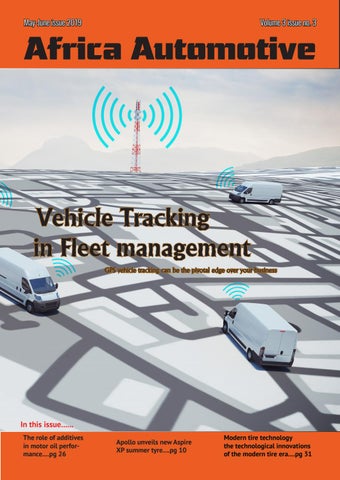
Vehicle Tracking in Fleet management GPS vehicle tracking can be the pivotal edge over your business
In this issue...... The role of additives in motor oil performance....pg 26 May-June issue l 2019
Apollo unveils new Aspire XP summer tyre....pg 10
Modern tire technology the technological innovations of the modern tire era....pg 31 Africa Automotive News l 2019 1
2
Africa Automotive News l 2019
May-June issue l 2019
Managing Editor Francis David
Contents
Editor-in-Chief
Augustine Rang’ondi
NEWS PG 4-9
INTERVIEW
Editor
Kenya suspends age limit law for imported second-hand cars
Vehicle tracking devices market in Africa
Dorcas Kang’ereha
Isuzu inks vehicle financing deal with Gulf African Bank
Writer
Violet Ambale Harriet Mkhaye Irene Joseph Innocent Momanyi
Sales Executives East Africa Jimmy Mudasia Lydia Kamonya Caiser Momanyi Vincent Murono Sheila Ing’ayitsa South Africa Paul Nyakeri Sean Masangwanyi Lisa Brown Thembisa Ndlovu Nigeria Emelda Njomboro Uche Maxwel
Published by:
Nailex Africa Publishing P.O. Box 10109, 00100 Nairobi, Kenya.
Big adoption curve in Auto safety technology
Auto-Springs East Africa opens factory in Limuru
FEATURES
KEBS bans import of used car parts
Importance of GPS (Cover story)
Mercedes-Benz has plans to expand C-Class production in SA
The role of additives in motor oil performance Modern tire technology
Component manufacturing demand
REVIEW AUTOSHOW PG 18-19
2020 Range Rover Gets Mild-Hybrid
AUTOEXPO Africa 2019
Toyota Kenya launchesfifth generation Rav4
Testing Expo China Autonomous Vehicle Technology Expo
Peugeot 3008 SUV Emerges ‘New Car Of The Year’ In Europe
SAFETY TIPS
PRODUCTS Apollo unveils new Aspire XP summer tyre
Regularly check your tire pressure and inspect your tire tread and sidewalls
CASE Construction Equipment unveils methane-powered wheel loader concept
Driving safety tips every driver should know
Continental’s Cutting-Edge Tyres
Also check Motorbike News pg 42-43
The Editor accepts letter and manuscripts for publication from readers all over the world. Include your name and address as a sign of good faith although you may request your name to be withheld from publication. We can reserve the right to edit any material submitted. Send your letters to: info@africaautomotivenews.com
Disclaimer: Nailex Africa Publishing makes every effort to ensure the accuracy of the contents of its publications, but no warranty is made to such accuracy and no responsibility will be borne by the publisher for the consequences of actions based on information so published. Further, opinions expressed on interviews are not necessarily shared by Nailex Africa Publisher.
May-June issue l 2019
Africa Automotive News l 2019
3
NEWS
Kenya suspends age limit law for imported second-hand cars
I
t was a relief for importers of second hand vehicles after the government suspended plans to cap the age limit for imported second-hand cars at five years from the current 8. While appearing before the Trade and Industries committee of the National Assembly, Trade CS Peter Munya the cap was a proposal. “It is still in its draft form and yet to undergo public participation,� said CS Munya. This was after the legislators aired concerns that the ministry was making policies without involving 4
them. They even termed CS Munya’s pronouncement as roadside declaration. He however assured the lawmakers that the status quo remains until all stakeholders are involved and the policy is passed in Parliament. The new set of regulations seeks to cap importation of used cars from 8 to five years starting this July. In 2021, the limit is proposed to be three years and finally zero by the year 2024.
of second hand vehicles of over 1500cc and exceeding five years from date of manufacturing. The plan has since been met by strong opposition from dealers who say the business is the economic mainstay for over 2 million people, directly and indirectly. Some even told off the Kenya Bureau of Standards KeBS technical team saying the proposed national automotive policy is punitive and inconsiderate of their grievances.
The Kenyan government further wants restriction on importation
Africa Automotive News l 2019
May-June issue l 2019
From Left: Isuzu EA CFO Charles Kariuki and Gulf African Bank MD Abdalla Abdulkhalik after signing the asset finance deal in Nairobi
Isuzu inks vehicle financing deal with Gulf African Bank
F
inancial deal has been signed between the Islamic lender Gulf African Bank and the Isuzu East Africa to finance customers’ purchase of a wide range of trucks sold by the Japanese motor vehicle dealer. Gulf African Bank Managing Director Abdalla Abdulkhalik said under the one-year deal the lender would provide up to 95% of funding while the customer would provide the remaining 5%. The financing arrangement targets both Muslim and non-Muslim clientele as Isuzu seeks to sell 1,000 units. “The financing is open to everybody, it is not limited to the Muslim faith but we are looking at May-June issue l 2019
the entire country to help people acquire the vehicles for their businesses,” said Mr. Abdulkhalik. Customers will enjoy a two-month grace period before they start making the monthly installments over a five-year duration to service the loans for the models that include Isuzu D-max, N series trucks and F series trucks. Increase sales Isuzu Finance and Strategy Director Charles Kariuki said the funds would be released within 72-hours of an application under the deal as the firm seeks to increase sales. Isuzu was the only major dealer
to grow sales in the first quarter ended March in what is attributed to special financing deals with lenders such as Co-op Bank. The dealer’s unit sales in the review period rose to 1,019 from 891 a year earlier while orders in the overall industry fell 14.5% to 2,741 units. Most dealers including Toyota Kenya and Simba Corporation recorded significant sales decline. Unit sales at Isuzu rose to 1,019 from 891 while those of Toyota declined to 672 from 812. Simba Corp’s sales also fell to 487 from 514.
Africa Automotive News l 2019
5
ization secretary Adan Mohamed. Mr. Mohamed said locally manufactured goods benefit local businesses, boosting the manufacturing sector’s contribution to the economy. The auto parts firm currently produces 150 tonnes of springs each month. It has set its eyes on hitting a monthly production of 450 tonnes, its maximum capacity. The says it is in advanced talks with Japanese manufacturer, Honda, to supply its local operations. About Auto Springs East Africa (PLC)
Auto Springs East Africa PLC newly opened factory in Limuru
Auto-Springs East Africa opens factory in Limuru
C
ar parts manufacturer Auto-Springs East Africa opens a new manufacturing plant in Limuru. The plant is set to create 600 additional jobs. The auto parts firm, which has moved its operations from Athi River to the new plant, already has about 200 employees on its payroll. The newly opened Sh.500 million plant will be hiring both skilled and semi-skilled workers. The new jobs projection is, however, partly dependent on the government’s resolve in implementing a legal notice that requires car manufacturers to source more than a third of their inputs locally. “If the government enforces Legal Notice 489 which requires automotive assemblers to have 40% local content in their vehicle assemblies, then we can increase our production to three shifts that would require a workforce of 800 persons,” said Kevin Kihara,
6
the Auto-Springs East Africa board chairman. The company produces wiring harness, leaf springs, bolts and nuts and agricultural machinery. According to the Economic Survey report, Kenya imported car parts and accessories worth Sh. 2 billion last year an increase from the Sh.1.7 billion purchased in 2016 but lower than the Sh.3.6 bn peak recorded in 2014. Its current market stretches across East, Central and Southern African countries of Uganda, Tanzania, Zambia and the Democratic Republic of Congo. Among its biggest customers are Isuzu and Mitsubishi who order wiring harness for both buses and trucks. Toyota Kenya is also on its clients list. Auto-Springs East Africa got funding for the expansion from Mauritius-based SME financier, SFC Finance. The expansion loan comes months after Ascent Rift Valley Fund, a private equity firm, acquired a majority stake in the company in February this year. “We are trying to reduce the level of imports of goods that can be made by companies like ASL without compromising on quality,” said Industrial-
Africa Automotive News l 2019
Auto Springs East Africa (PLC) is Kenya’s largest original equipment manufacturer to the Kenyan motor vehicle assembly sector. Auto Springs was established in the year 1979 and has been producing a wide range of products for motor vehicles specifically leaf springs, nuts and bolts (centre bolts, U bolts, wheel studs, shackle pins etc.) and wiring harnesses for various models of commercial vehicles. In addition to the above, the company manufactures a wide range of agricultural equipment including sugar Mill components. It is also involved in a wide range of chassis reinforcements, extensions and modification of springs to make them suitable for Kenyan roads. The factory is located in Limuru near the interchange of Kamandura Mai Mahiu Narok road and Eldoret Malaba road. The factory has modern and automated machinery to ensure quality and efficiency in production to meet the market demand. The factory has a strong technical team that is able to develop new products to meet the changes in technology in the motor vehicle industry. Our major customers in the assembly business are Isuzu East Africa, Simba Colt motors, Toyota Kenya and other industry players who distribute to garages and spare parts shops across the East Africa region.
May-June issue l 2019
KEBS bans import of used car parts
T
housands of second-hand motor vehicle spare parts dealers are staring at a bleak future after the Kenya Bureau of Standards (Kebs) moved to enforce a tough restriction on the importation of used car parts. The standards agency, in a notice sent out to pre-shipment cargo inspectors, has specified 17 categories of second-hand spare parts that are banned from entry into the country in a policy shift intended to rid the market of the used car parts. The policy change is part of the government’s agenda to gradually phase out second-hand vehicles with the ultimate aim of creating substantial demand for new, locally-assembled vehicles. The Ministry of Industrialisation has been developing regulations in the controversial National Automotive Policy intended to restrict import of used cars that are older than five years, arguing that this will boost local manufacturers and create high-quality jobs in the long run. The law currently allows import of second-hand vehicles that are up to eight years old. Kebs Corporate Communications Manager Phoebe Gituku said the restriction applies only to used car parts and does not put any barriers for importers of new spares. List of items The Kebs notice is pegged on the agency’s standard KS2190:2013. This requires that parts like tyres, tie-
May-June issue l 2019
rod-ends, bearings, spark plugs, clutch plates, brake pads, tubes, brake hose pipes, rubber bushes, filters, pressure plates, rack ends, ball joints, break and clutch cables among others are to be imported only as new. “The used motor vehicle spare parts are not to be imported. This is outlined in the Standard and implementation began in March 2018. Kebs has only restricted the used spare parts, not new ones,” said Ms Gituku. The move could be a blow to the hundreds of thousands of motorists who heavily rely on used motor vehicle spares, which are relatively cheaper and of better quality than new imports that mainly come from China, Taiwan, India and Indonesia. Tens of thousands of Kenyans are engaged in the used parts trade, mainly based in Nairobi’s Kirinyaga Road, Grogon and industrial areas with others scattered across major towns around the country. The used parts are mainly imported from Japan and Dubai. The Economic Survey 2019 shows that Kenyans spent Sh10.1 billion last year on importation of motor vehicle spare parts, most of which were second-hand, based on motorists’ preference.
and it will only deny motorists the ‘better quality’ used spares. Others saw the ban as a concealed effort to start implementing recommendations in the draft National Automotive Policy that is yet to be agreed on by all stakeholders. The Kenya Auto Bazaar Association secretary-general, Charles Munyori, said the proposal will unfairly punish users of second-hand spare parts. “I don’t think they are being genuine and you can see the whole conspiracy from the new motor vehicle dealers to take over the spares market as well. The government is not likely to achieve much because even the salvage motor vehicles still generate a significant portion of the second-hand parts. Some of the so called new parts are fake and break down very fast,” said Mr Munyori. A source within Kebs said the ban was originally intended to target parts with fast wear and tear but was expanded to target others that the government felt could be sourced locally. The Kenya Used Motor Parts Importers Association (KUMPIA), a lobby group of used car parts dealers, said members stand to suffer huge losses from the proposed policy changes.
Vehicle industry stakeholders Several motor vehicle industry stakeholders said the ban was retrogressive
Continue reading online www.africaautomotivenews.com
Africa Automotive News l 2019
7
Mercedes-Benz has plans to expand C-Class production in SA
A
fresh report suggests Mercedes-Benz is considering scrapping production of its C-Class in the United States, leading to speculation the German firm’s plant in South Africa could pick up the slack. The Stuttgart-based firm is mulling the end of C-Class sedan production in the US (despite having produced the model there for only the past five years), with a plan to build more SUVs instead. It quotes industry forecaster LMC Automotive as saying production 8
of the C-Class sedan in Alabama will cease in the final quarter of 2020. “The SUV has really expanded from a consumer standpoint,” said Jeff Schuster, president of global forecasting at LMC. “That’s where the volume is; that’s where the future is.” This could leave the door open for the automaker’s East London plant to increase its output (it apparently has 25% production capacity available), since the South African operation already produces the vehicle in right- and left-hand-
Africa Automotive News l 2019
drive form. In addition to Alabama and East London, the C-Class is built in Bremen (Germany) and Beijing (China). In June 2018, Mercedes-Benz announced the investment of an additional €600-million in the brand’s facilities in East London, effectively confirming the next generation of the C-Class would be built in SA. And in March 2019, the 500 000th W205-generation C-Class rolled off the assembly line at its East London plant.
May-June issue l 2019
Component manufacturing demand
A
fter 2021 South Africa’s automotive industry growth is set to be bigger when government policy demanding more than 50% local content kicks in. Promising growth in demand by vehicle manufacturers for South African made automotive components cannot hide underlying challenges faced by the local components industry. According to the National Association of Automotive Component and Allied Manufacturers (Naacam), South African component suppliers grew average rand sales by 10.7% in real terms between 2016 and 2018. This is well ahead of vehicle production growth. The top 25% of suppliers grew sales by 16.5%. Average job numbers grew 3.5% over the period. Among leading companies, the figure for 2018 alone was 6.4%. Average supplier operating profits rose 6.2% in 2017 and 4.3% in 2018. Productivity also improved. The problem with these positive numbers is that many of them lag behind growth rates in rival supplier industries in developed and developing markets. Put simply, these markets are improving faster than South Africa meaning local suppliers risk becoming less globally competitive. That’s not good news in an industry where component-sourcing decisions are taken in Europe, Asia May-June issue l 2019
a good sign for South Africa’s automotive industry
and the US. Michael Sacke, CEO of Commercial Vehicle Manufacturer Isuzu SA, said: “We are all part of global ecosystems and purchasing decisions are made elsewhere, for the good of the group.” Also concerning is that, according to the B&M report, fewer motor companies believe there are opportunities to increase purchases from current direct suppliers, or to commit to longer-term relationships. Despite this, Naacam Director Renai Moothilal said: “Opportunities exist in the areas of supplying more of current products, supplying additional products in the existing range, and supplying newly developed products.” Some good news The good news for South African suppliers is that, from 2021, the government automotive policy will require motor companies to increase the value of local content in their vehicles by at least 50%. The current industry average of 38% must reach 42% by 2023, then 60% by 2035. Some in the industry want this target to be imposed individually on each vehicle manufacturer. “Why should I have to exceed 60% and drag up the average because someone else is lagging?” said one MD – but Sacke said the idea is not feasible for his company, which bought the Port Elizabeth vehicle assembly assets of General
Motors when the US company divested at the end of 2017. Isuzu SA, which produces bakkies and trucks, expects to build about 24 000 vehicles in 2019, the smallest number, by some distance, of South Africa’s seven major manufacturers. “We simply don’t have the volumes that would make it feasible to undertake wholesale localisation,” Sacke said. “Realistically, we’ll never get local content above 30% to 40%.” He accepts this means Isuzu SA won’t receive some incentives from the updated Automotive Production and Development Programme (APDP). However, he says the company has an important role to play in the economy. “We employ 1 000 people in the assembly plant and another 4 000 in our dealer network. We support 430 service and component suppliers and spend billions of rand every year. We may be small in motor industry terms but we are a significant player in the economy, particularly in the Eastern Cape.”
Africa Automotive News l 2019
9
Product Apollo unveils new Aspire XP summer tyre
A
pollo is launching a brand-new summer tyre onto the market called the Apollo Aspire XP. Leveraging on the very latest developments in terms of construction and material technologies, the Aspire XP combines outstanding levels of on-road comfort with a high degree of safety. Featuring a total line-up of 52 SKUs, the Aspire XP replaces Apollo’s range of Aspire 4G and Apterra HP tyres. The brand is also increasing its market coverage in the 17”, 18” and 19” segment by adding 20 new sizes in both the car and SUV segments. Extensive research & development The new Aspire XP summer tyre ensures an outstanding driving experience for cars and SUV´s on both dry and wet roads. Safety and comfort were given an abso10
lute priority during the research and development phase. An improved silica tread compound enhances handling on wet roads by 22% compared to the Aspire XP’s predecessors, while braking distance in wet road conditions has been improved by 7%.
International Motor Show held from 8 to 18 March. The Apollo Aspire XP is being manufactured in Europe at the Apollo Vredestein plants in the Netherlands and Hungary
A similar picture emerges in terms of performance on dry roads. The Aspire XP’s stiffer outer shoulder blocks and central lane reduce the braking distance by 4% and ensure a higher degree of steering response accuracy. Superior comfort is also guaranteed: sipes placed on the inside shoulder of the tyre reduce interior noise and the use of more flexible sidewall materials has improved shock absorption. The Aspire XP will go on sale at the beginning of March and was first launched at the Geneva
Africa Automotive News l 2019
May-June issue l 2019
CASE Construction Equipment unveils methane-powered wheel loader concept
C
ASE Construction Equipment, a brand of CNH Industrial N.V. (:CNHI / MI:CHI) has announced an insight into a sustainable, connected and technologically advanced future of construction at the Bauma trade show in Munich, Germany, with the unveiling of its methane-powered wheel loader concept – ProjectTETRA. Jointly developed by the CNH Industrial international design and CASE engineering teams, this concept is a clear departure from anything seen to date in the construction industry. The concept reflects both the increasing importance of alternative fuels, and demonstrates their viability in the construction environment: the concept wheel loader is powered by a proven methane engine, produced by sister brand FPT Industrial, and delivers exactly the same performance as its diesel equivalent. This is combined with cutting edge May-June issue l 2019
styling and an advanced operator environment, which makes extensive use of touchscreen and voice control technologies. Furthermore, innovative safety features include biometric technologies together with an obstacle detection system, which is derived from CNH Industrial’s autonomous vehicle research and development program. CASE has demonstrated the feasibility of this concept in a range of real-world construction environments as well as proving the business case, in terms of sustainability, reduced overall total cost of ownership and operational viability. The CASE methane-powered wheel loader concept is testament to CNH Industrial’s longstanding commitment to alternative fuel technologies, and is further proof of the practicability and flexibility
of natural gas, demonstrating its viability in both on and off road applications. CNH Industrial N.V. (: CNHI /MI: CNHI) is a global leader in the capital goods sector with established industrial experience, a wide range of products and a worldwide presence. Each of the individual brands belonging to the Company is a major international force in its specific industrial sector: Case IH, New Holland Agriculture and Steyr for tractors and agricultural machinery; Case and New Holland Construction for earth moving equipment; Iveco for commercial vehicles; Iveco Bus and Heuliez Bus for buses and coaches; Iveco Astra for quarry and construction vehicles; Magirus for firefighting vehicles; Iveco Defence Vehicles for defence and civil protection; and FPT Industrial for engines and transmissions. More information can be found on the corporate website: www.cnhindustrial.com
Africa Automotive News l 2019
11
Continental’s Cutting-Edge Tyres
C
ontinental’s latest and most advanced passenger car tyres provide unparalleled safety and performance, according to the latest independent tyre tests conducted in Germany. In a recent summer tyre test conducted by German car magazine, Auto Zeitung, the PremiumContact 6 from Continental led the field by a comfortable margin compared to eight competitor summer tyres and one all-season tyre. The test was conducted using 235/45 R18 tyres, fitted to a Skoda Superb station wagon. Scoring a total of 277 points out of 300 and earning first place on the wet and dry road tests, the Continental tyre finished a clear 25 points ahead of its nearest rival. “Maximum safety, a high level of comfort and superior dynamic handling,” summed up the Auto Zeitung testers. The PremiumContact 6 is a passenger car and SUV summer tire for compact-class models and above. It is approved for speeds of up to 300 km/h. It is original equipment (OE) fitment for a wide range of vehicles and is
12
approved by numerous renowned automakers for fitting ex-works. The winning streak continued for the PremiumContact 6 in AutoBild magazine’s big summer tyre test, where it was awarded the top “exemplary” rating, as well as being named “Eco-Champion.” The journalists tested a total of 50 different 225/45 R17 tyres from European, American and Asian manufacturers fitted to a BMW 1-Series.
distances,” the magazine commented. While AutoBild Allrad accredited most of the models tested with good safety-relevant properties, there were critical words for one product from Asia: “Cheap tyre from the Far East with marked weaknesses in the wet. Understeer on dry and wet roads, dangerously long braking distances,” was the conclusion as the magazine handed out a “not recommended” rating.
The AutoBild experts from Hamburg described the PremiumContact 6 as “a premium tyre that offers balanced, safe handling on wet roads, short wet and dry braking distances, fuel-saving rolling resistance, high mileage and good economy.” Specialist 4×4 magazine AutoBild Allrad also praised the PremiumContact 6 based on the outcome of its test of 10 different 225/55 R 17 tyres, a size suitable for compact SUVs. Amongst the offerings from Europe, America and Asia, the Continental tyre scored the highest rating: “exemplary”. “Top handling properties on dry roads; short wet and dry braking
Africa Automotive News l 2019
set the benchmark for safety and performance May-June issue l 2019
Under the heading “Pitstop”, AutoBild Sportscars reported on its latest summer tyre test, which evaluated 11 tyres in the 245/45 R 18 size. Once again, the PremiumContact 6 from Continental was awarded the best possible rating: “exemplary”. “A balanced peak performer delivering impressive dynamic performance on wet and dry roads, steady and safe handling in the wet and dry, a precision steering response in the wet, and short wet and dry braking distances,” was how the journalists summed up their findings. The PremiumContact 6 recorded high scores for safety-relevant criteria in particular: In the dry braking, aquaplaning and wet handling tests, for example, it scored good and very good marks as it laid the foundations for the best rating that the magazine awards. The ultra-high-performance Continental SportContact 6 also earned the
May-June issue l 2019
highest accolades, winning the tyre test published by sportauto magazine by a substantial margin. The sports tyre from Hanover was the only one of nine contenders to score the top “highly recommended” rating. Responsible for delivering this fine result were the tyre’s balanced, sporty characteristics on wet and dry surfaces, as the Continental tyre turned in the best performance of all the products on test in both test segments. Summing up their verdict, the testers from Stuttgart wrote: “Shortest stopping distances and safe understeer in the wet; sporty, direct steering response and high dynamic stability in the dry; crystal clear feedback, outstanding directional stability and unequivocal vehicle reactions.” The test line-up included nine size 245/30 R 20 Y tires from European, American and Asian manufacturers. The test vehicle was a Honda Civic Type R. While the SportContact 6
scored the top “highly recommended” rating, one competitor was awarded “recommended” status and all the other products were rated “moderately recommended”. With the SportContact 6, Continental has a super sports tyre for the ultra-high-performance segment in its portfolio that demonstrates substantial improvements over its predecessor, primarily in terms of handling, precision steering response and highspeed capability. To put this tyre’s superior performance onto the road, Continental’s development engineers reformulated the chemical composition of the tread strip, redesigned the tread pattern, and revamped the construction of the tyre. The SportContact 6 is approved for speeds of up to 350 km/h and is fitted ex-works by numerous manufacturers of sports and super sports cars.
Africa Automotive News l 2019
13
Interview
Kassim Hassanali Operations Director NAJ TRACKING LIMITED
N
Vehicle tracking devices market in Africa
AJ Tracking Ltd, offers Fleet Tracking, Fuel management and 24Hrs vehicle recovery solutions. They are created by Family and corporate values, demonstrated by motor security personnel, 24Hrs surveillance solutions. Africa Automotive News conducted an interview with Kassim Hassanali, NAJ Tracking Ltd Operations Director in regards to tracking devices market in Africa. How is Naj Tracking Limited performance since its inventory? NAJ Tracking has grown progressively from car digital accessories enterprise to undisputed FLEET & FUEL TRACKING COMPANY, Bagging over 10 technology and innovation Awards in the last 2 years. And as the CEO I have won 3 awards including top 40 Under 40 MEN in Kenya.
14
How is the African market in regards to tracking devices and software development? Tracking in most African countries lags behind due to limited GSM/ GPRS coverage on which most devices relies on for data upload, but in countries with better coverage like Kenyan market where Tracking is picking up, Another important factor is software wise in terms of functionality & performance –The European developed software’s are still most preferred compared to locally developed Systems because of their prowess in Fleet reporting capabilities. As a car tracker developer, are there challenges in the market industry in Africa? The African market is being saturated with cheap, unlicensed poor perfor-
Africa Automotive News l 2019
mance software’s from Asia, which is affecting ability of offering African market with state of the art quality systems, other underlying issue is lack of access to software’s development tools, to allow developers to come up with a functional effective systems that are user friendly and on point. If yes, what do you think can be done to address the challenges? Critical Tracking information is held by these systems, with millions of automotive data fleet reports being generated, and thus the government should deal with quarks, operating as Vehicle tracking service providers. With unlicensed software’s used in transport industries to enhance Africa development of high quality systems. Any, considerations of partnership with other car tracking developers?
May-June issue l 2019
Yes, we are looking forward to partner with other developers mostly in our neighboring borders of Uganda, Tanzania and Rwanda; this is to give us a position to venture in the untapped market in these countries. In terms of developing products, what is your expansion strategy? Our number one priority is to have the very best products in the telematics industry today and especially maintaining our core in Fuel Management. Naj Tracking has also partnered with Banks & Asset finance institutions, Transport industries, Parastatals, vehicle leasing companies, Taxis and Tours companies. Having Branches has made it easier for our clients to get quality service country wide & establishment of mini control rooms within the East Africa region to monitor and recover vehicles fast and timely in motor security operations.
Fuel management by their European Technology. Since their establishment they have grown with branches county wide in Kenya. Success rate
•
Convenience-Naj Tracking Ltd strive best that their products are convenient solution to the function their customers are trying to meet.
Having partnered with the very best in Europe for Fleet & Fuel tracking hardware manufactures & software developers, their system enjoy a success rate of 99-100% accuracy, with an integrated system capability hence it can take over 30 add ons.
•
Design-Along the lines of experience, the product or service needs to be slick to make it relatively easy and intuitive to use. This include Android/ios Apps & web applications.
•
Compatibility– Through their Technical Support they try as much as possible to fabricate their product and make it compatible with other products their customer is already using
•
Performance– correct Fleet accurate performance enables their customers to achieve their goals and places their products are superior.
•
Efficiency-the key element in efficiency is to streamline an otherwise time-consuming process for their client through process automation.
Eg, Driver behavior & identification, driver rating, Sos panic buttons, voice monitoring, temperature sensors,GPS/ GPRS/Glonass satellite receiver capability with critical accuracy in Fuel tank, Fuel consumption, Refuel and Fuel theft in real time reports. Also their system offers Fleet management & maintenance capable of managing fleet events of next service, insurance expiry, spare parts & batteries warranties etc
Market coverage
NAJ Tracking Ltd: The award winning digital motor security company Uniquely pronounced with 10 awards, including the East Africa maritime awards in Vehicle tracking and Fuel management by their European Technology
T
he award winning digital motor security company, NAJ Tracking Ltd, offers Fleet Tracking, Fuel management and 24Hrs vehicle recovery solutions. They are created by Family and corporate values, demonstrated by motor security personnel, 24Hrs surveillance solutions. Uniquely pronounced with 10 awards, including the East Africa maritime awards in Vehicle tracking and
May-June issue l 2019
Outside Kenya NAJ Tracking Ltd is currently working with logistics companies in Uganda, Southern Sudan & Rwanda with their award winning NAJ PRO 4 Fuel Tracking system. Plans are in pipeline to venture into East Africa market.
Meeting customers’ needs Their sole responsibility is to listen, understand and identify the particular need of their Fleet customers thereafter offer them unique tailor made solution in terms of:•
•
Functionality-They need their products or services to function the way the customer need in order to solve their problem or desire. Price-Customers have unique budgets with which they can purchase a product or service. Thus they offer different varieties of products in Fleet and Fuel Tracking.
Product range In addition to products and services they are offering they are looking and in the process of expanding their operation but not limited to, Speed limiters, Dashcams With Gps, Container locking to make NAJ Tracking Ltd ,a one stop shop digital solution provider for logistics companies.
Africa Automotive News l 2019
15
David Paja, president of advanced safety, Aptiv
Big adoption curve in Auto safety technology
T
he European Union reached a decision to implement tougher safety regulations, which will have implications for vehicle connectivity technology. The so-called General Safety Regulation (GSR) still requires final approval by ministers of the 28 EU member states, but many automotive suppliers expect that, once it takes effect in 2022, advanced safety technology will quickly spread from mostly premium vehicles today to lower market segments as well. In an interview with automotive IT International, David Paja, President,
16
Advanced Safety and User Experience, at automotive supplier Aptiv, discussed the impact of the EU rules and the role of safety technologies in a changing industry. Paja’s division makes components and systems for infotainment and connectivity, body controls and security systems, as well as active and passive safety electronics and autonomous driving software. With autonomous vehicles likely to become the norm in the next 20 years or so, how long will we still need active safety technology? After all, these systems are designed to compensate for the shortcomings of a
Africa Automotive News l 2019
driver, who may not be at the wheel a few years from now? In many ways these are building blocks. In robo-taxis you won’t need these systems, but in Level 3 vehicles the driver still takes over control once in a while. Driver-assistance systems such as radar and cameras are building blocks toward full automated solutions. There will be a lot of re-use of these technologies in fully automated vehicles. Also, bear in mind that not all vehicles will become autonomous in the near future. From a business-case point of view, it makes more sense, for example, to automate
May-June issue l 2019
a taxi than a privately owned vehicle. 2. Is regulation a big factor in the adoption of safety technology? As a technology provider, we tend to stay away from judging political decisions. Instead, we focus on the technology. From our point of view, many technologies exist in premium vehicles that can be deployed in volume cars as well. Europe tends to be slightly ahead when it comes to regulation and that has been driving the adoption of driver assistance features at a bit faster pace than elsewhere, but it’s not a big difference. With the new Brussels regulations, we’re likely to see a slight acceleration in adoption.
whether a driver is distracted and we can monitor, for example, the way his head is pointed or the direction of his gaze. We use machine learning here, too. It’s important because half a second of improved reaction time prevents 60% of all accidents.
We have around 3,000 engineers in the active safety domain globally. That’s double the number two years ago. About 70% of those engineers are systems and software engineers, and that includes machine-learning and data experts.
5. You mentioned machine learning. How does Aptiv use artificial intelligence in general?
7. Do you have trouble hiring people with the digital skills that you need?
We are increasing our capabilities in this domain and use machine learning for sensing, classifying things and understanding what sensors see. We also use it in sensor fusion and in defining how a car should react to a particular situation.
There’s obviously a big fight for talent going one. It’s one of the reasons we acquired (autonomous driving specialist) nuTonomy in 2017. That company offered a way to get talent and expertise in robotics and more depth in machine learning.
6. How big is your team? 3. Automotive safety is a good area to be in for an automotive supplier. We started investing in this technology 20 years ago and there was no big revenue back then. But we’ve seen a big adoption curve in the last five years. Aptiv is committed to the space and we believe safety technologies bring value to the end customers. We’ve seen 60 percent annual growth in active safety sales over the past two years and we’re at 1 billion dollars a year today. We expect our sales volume to double by 2022. 4. You have a broad portfolio of safety technologies. Can you pick a few that you think are more important than others? First, I would mention our scalable Automated Driving Satellite Compute Platform, which allows you to do your computations away from the sensors in one safety controller. Each sensor now has its own control unit. Our technology is more cost-effective and allows the adoption of technology into entry-level vehicles. We first launched this on the Audi A8 three years ago and it’s now in several cars. The second technology is interior sensing and driver monitoring, which is being rolled out across BMW’s vehicle range. It’s important to know
May-June issue l 2019
Africa Automotive News l 2019
17
Auto Show T
AUTOEXPO AFRICA 2019
he rapid industrialization and modernization currently sweeping through many African countries has resulted in an increased demand for capital goods such as machinery, lubricants, spare parts, ball bearings and other automotive mechanical goods and accessories. The market for automobile spare parts, in particular, has been an attractive sector for global exporters, as Africa has witnessed a remarkable increase in imports by 30%. For 21 years, AUTOEXPO Africa has been chosen by global manufacturers and exporters as the precise platform to enter the market of the millennium Africa.
18
22st AUTOEXPO Africa – the largest automobiles, spares and accessories exhibition in the entire east African region is scheduled to be held from 18th – 20th July 2019. Celebrating its 22nd anniversary; the leading trade exhibition for automobile, truck and bus parts, equipments, components, accessories, tools, and services continues to bring world leading manufacturers, suppliers, and service providers in touch with one of the most important markets in the world.
TESTING EXPO CHINA 2019
I
f you need to reduce development time, increase quality and decrease product failures, you need to attend Testing Expo China – Automotive! The event is China’s largest vehicle and component testing and validation technology and services exhibition, featuring more than 400 exhibitors and attracting over 10,000 attendees. Visitors can expect to see the latest in vehicle and component development-tools such as ADAS
testing, NVH measurement tools, test rigs, simulation packages, durability testing technologies, crash testing know-how, dynamometers, emission measurement systems and dynamic assessment tools, as well as countless service providers such as proving grounds and test facilities. The path to reduced product development cycles, more efficiency and better durability starts at Testing Expo China – Automotive!
Come, be a part of progress in Africa!
Africa Automotive News l 2019
May-June issue l 2019
T
he Expo in Europe for advanced technologies for autonomous vehicle development – around 90 companies will showcase essential building blocks and systems, including AI learning and virtual environments, deep learning systems, validation of autonomous systems and more. As the event is co-located with Automotive Testing Expo (the world’s largest vehicle test and development technologies exhibition), visitors to Autonomous Vehicle Technology Expo will also see countless ADAS validation systems and service providers. Furthermore, the exhibition is co-located with Automotive Interiors Expo, which showcases everything from vehicle materials and fastening solutions, to lighting technologies, safety systems, and so
May-June issue l 2019
much more! Over 800 automotive exhibitors will participate in Stuttgart and those exhibiting exclusively at Autonomous Vehicle Technology Expo will only showcase systems that are specifically for ADAS technologies and the path towards autonomous vehicles.
So if you are working on A DA S technologies or fully autonomous vehicles, you need to attend A utonomous Vehicle Technology Expo!
Africa Automotive News l 2019
19
Features
Importance of GPS Vehicle Tracking in Fleet management
T
here is no smartphone, tablet or computer that is not integrated with GPS tracking technology. Nowadays, GPS tracking technology is widely used in personal households and businesses. The GPS tracking market is rapidly growing and has an amazing potential in the future. Many apps implement navigation systems for mapping and transport information, but also for fleet monitoring. GPS vehicle tracking can be the pivotal edge over your business competitors and therefore, investing in a good vehicle tracking device can help you monitor your employees, keeping track of your cargo thus ensuring timely delivery of your products and services. Vehicle tracking is defined as getting information about the vehicle on map, speed and distance traveled using internet or other software. In general GPS (Global Positioning
20
System) or GLONASS are used to locate the vehicle. The automobiles are provided with modernized feature which works to find the path of them. Other functions include vehicle tracking performance and maintenance, driver’s performance, but also facilitates fuel management and dispatching, sends alerts and notifications, prevents thefts and provides reports and enables analysis of these reports. More functionalities are possible, however, that depends on the company offering fleet management solutions. The role of GPS Tracking Vehicle tracking is defined as getting information about the vehicle on map, speed and distance traveled using internet or other software. STrack Kenya Limited highlights below the merits of tracking your vehicle.
Africa Automotive News l 2019
i). Security. Tracking devices come with an immobilizer meaning that in the unfortunate event that your vehicle is stolen you can stop it remotely through the click of a button or a simple SMS. ii). Quick recovery. It is crucial that a vehicle is found within 24 hours before it is disassembled. GPS devices always upload their location to servers in real time allowing the quick recovery of vehicles. iii). Diverse array of features. Through vehicle management platform customers can access a wide array of reports such as trips, distance, speed, parking/ idle time, fuel etc. iv). Alerts. Customers can also subscribe to SMS or Email alerts which will be triggered when a vehicle sets of an alarms. For example a customer
May-June issue l 2019
can get an SMS when their vehicle crosses the border of a given place, or when the vehicle is refueled or fuel is siphoned. v). Integration. System is built to be integrated with other systems for example courier companies can offer real time tracking to their customers. STrack specializes in provision of advanced vehicle tracking, fleet management and digital fuel monitoring services for motor vehicles, motorcycles, and assets using GSM/GPS technologies, supported by thoroughly tested and certified devices, online tracking, fleet and driver management software based on various online Maps and a Linux server environment for enhanced reliability and user security. The company is licensed by the Communications Authority of Kenya (CA) and is also a founding member of Kenya Automotive Security Association (KASA). “Tracking devices offers Fleet management & maintenance capable of
May-June issue l 2019
managing fleet events of next service, insurance expiry, spare parts & batteries warranties etc,” says Kassim Hassanali, NAJ Tracking Ltd, Operations Director. NAJ Tracking Ltd is an award winning digital motor security company, dealing with Fleet Tracking, Fuel management and 24Hrs vehicle recovery solutions. They are created by Family and corporate values, demonstrated bywww motor security personnel, 24Hrs surveillance solutions. Uniquely pronounced with 10 awards, including the East Africa maritime awards in Vehicle tracking and Fuel management by their European Technology. Since their establishment they have grown with branches county wide in Kenya. According to Trackimo, GPS has revolutionized our daily lives. GPS or Global Positioning System provides satellite tracking services that are useful in a variety of commercial and personal applications. Most companies now realize the importance of
GPS technology for achieving greater efficiency. And, thus provide better benefits to people. PEACE OF MIND. Trackimo represents a new GPS tracking device to locate the things that matter most from anywhere in the world. Trackimo devices are 3G, with 100% US coverage, most other GPS devices in the market are 2G with only 10% US coverage. Revolutionary, uses 5 different technologies to accurately Locate anything Worldwide Indoor & outdoor. Trackimo also has SOS panic button sending email and SMS text alerts. “It is important for vehicle owners to protect their vehicles from theft. Installing a car track device helps in the recovery of a vehicle in case of theft. Transport and Haulage companies can fit vehicle tracking systems in their fleet vehicles transporting goods and cargo worth millions and they can know where their vehicles as well as their prized goods are at any time from our phone tracking app or our online web based vehicle tracking
Africa Automotive News l 2019
21
platform. Car track not only tracks the vehicles but the transit goods as well,” says Anthony Waikwa, of Shield Car Track. Shield Car Track Fleet Tracking technology provides GPS+LBS tracking and asset management solutions tailor made to fit wide range of business customers from startup companies, to mid size companies and to the transport and haulage giants – our internet based fleet tracking system gives entrepreneurs full access, full control from anywhere in Kenya and from their phone and any computer that is connected to the internet. “Through Shield Car Track phone app or online vehicle tracking platform our customers can track their vehicle through their mobile phones, by using our vehicle tracking app or through our online GPS car tracking website. Our vehicle tracking technology updates the location of the tracked vehicle every 10 seconds so as to provide
22
24 hours vehicle surveillance,” adds Mr. Waikwa. Leon Mynhardt Technical Manager – South Africa Electronic Tracking Systems Ltd, says, apart from the obvious theft recovery aspect of using tracking devices, they have many other features through their telemetry information that make them essential in today’s commercial applications. Safety: By getting live GPS speeding reports from the system, fleet controllers can react immediately to speeding alerts generated, ensuring drivers are driving safely. Fleet Managers can also receive daily, weekly or monthly speeding reports with this information target and train repeat offenders ensuring the safety of the drivers and other road users. Reduce vehicle maintenance: Tracking devices give Fleet Managers vital driver behavior telemetry like harsh-braking, harsh-acceleration,
Africa Automotive News l 2019
harsh-cornering and excessive idling events. By monitoring these events live or historically thought reports, fleet owners can train specific drivers to reduce these events and as such reduce overall maintenance and fuel costs on their fleet. The system also provides for a driver scoring system based on these exceptions and makes it very easy to see who are the problem drivers and who might need additional training and in what areas they need help. Increase productivity: By being able to monitor the where about of your entire fleet live at all times is essential to make sure your vehicles are where they are supposed to be and are productive. There are also a whole host of reports which allows fleet managers to ensure their fleet is being utilized to its full potential and then identify possible problem areas that are affecting productivity. One example is our Zone Report, which details which vehicles have entered
May-June issue l 2019
which Customer Zones (customized polygon zones created by the client), when they entered, how long they are there for and then when they leave again. This makes it easy to see at a glance where there might be zones where the vehicles are taking too long to either pickup or drop-off. The processes at these zones can then be assessed and fixed to ensure productivity is increased. Mtrack provides world-class products, and a complete tracking and asset recovery service. Mtrack have two main product lines, MtrackFleet and MtrackWireless. MtrackFleet is focused on fleet management and assisting companies and fleet owners with their vehicle’s day to day operations. MtrackWireless focuses on asset management and recovery. Because the devices are completely wireless, they can be placed on to any asset which needs to be tracked. The growing number of commercial vehicles, such as trucks, buses, and vans, drive the market for GPS tracking devices. Vehicles engaged in the timely transportation of men, mate-
rial, machinery, or money-where on time delivery can make a significant difference in cost and productivity-are prompting players to adopt GPS tracking devices. School buses, city and state transport buses, cash vans, cargo vans, police petrol vans, radio taxis, courier pickup and delivery vans, and others are prospects for vehicle tracking systems. The increasing sales of commercial vehicles would increase the adoption of GPS tracking devices. Gerrie Van Wyk of Pulsit Electronics says that, “The transport and logistics industry has become a very competitive and lean industry which necessitates that fleet owners and operators aligns themselves with a tracking partner that understands their business, able to meet the demand for service and provide them with not only a dot on the screen but also real-time information and telemetry that has an effect on their bottom line as well as looking after their reputation by providing them with tools to protect their clients cargo in transit and prevent losses as a result of hijackings and theft.�
Pulsit Electronics is a South African based Telematics Solutions Provider established in 2002 with specific focus on Tracking, Fleet Management and Risk Mitigation Solutions in the transport and logistics industries. Pulsit is VESA/ABS Accredited and meets with SAIA (South African Insurance Association) standards. Pulsit works with TAPA (Transporters Asset Protection Association) a global organization that regulates standards and employ best practices for the protection of high value cargo in warehouse as well as in transit. According to International Organization of Motor Vehicle Manufacturers (OICA), sales of commercial vehicles is on an uptrend. By tracking and managing these vehicles in real time, enterprises can efficiently utilize their resources. GPS tracking devices also ensure the safety of vehicles. In case of an emergency, GPS devices help locate the ambulance and show the exact location from where a distress signal was received.
"
GPS vehicle tracking can be the pivotal edge over your business competitors and therefore, investing in a good vehicle tracking device can help you monitor your employees, thus ensuring timely delivery of your products and services."
May-June issue l 2019
Africa Automotive News l 2019
23
H
P NEOSYNTH 5W 30 is a high quality synthetic engine oil specifically designed for modern cars running on Petrol/Diesel/LPG/ CNG/Bio-Diesel. HP NEOSYNTH 5W 30 is manufactured from finest API Group III
24
base stocks and state of the art additive technology to meet the most stringent requirements of API SN, ACEA A5/B5 thus making it suitable for modern cars running on petrol or diesel fuels.
of Tata Motors, Maruti-Suzuki, Hyundai Motors, Renault, Nissan, Datsun, Chevrolet, Toyota, BMW, GM and Ford etc. requiring a 5W30 engine oil, running on Petrol/ Diesel/LPG/CNG/Bio-Diesel etc.
HP NEOSYNTH 5W 30 provides exemplary benefits in reduction of piston deposits, improved fuel economy benefits and after treatment compatibility. The product is also designed to exhibit improved performance in bio-diesel fueled vehicles.
Features and Benefits
Application
•
HP NEOSYNTH 5W 30 is recommended for various models
• •
Africa Automotive News l 2019
• • • •
High fuel efficiency Unmatched reduction in piston deposits Improved after-treatment compatibility Improved protection against Sludge Improved bio-diesel compatibility Low oil top-up Longer engine life
May-June issue l 2019
Meets or Exceeds Requirement Of • API SN • ACEA A5/B5-12
About HP Lubricants
H
P Lubricants is Hindustan Petroleum Corporation Limited’s (HPCL) umbrella brand for manufacturing and marketing various lubricants and specialty products. A vital part of HPCL, HP Lubricants is India’s largest lubricant marketer, which markets more than 350 grades of lubricants, specialties
May-June issue l 2019
and greases manufactured in stateof-the-art blending plants spread across India. The grades manufactured by HP Lubricants find applications in automotive, industrial, mining and construction, agriculture, fishing, defence and railways among others. HP Lubricants is especially dominant in industrial oils, and has the highest market share in this segment, comprising all industrial oil applications. HP Lubricants has a robust marketing network that spreads across the country through warehouses, distributors, CFAs and offices with highly qualified sales and technical personnel. These teams and offices make HP Lubricants a depend-
able brand providing energy and fuelling growth in every significant area of development in India. Innovative R&D and robust quality assurance are a hallmark of HP Lubricants’ processes which ensure development and consistent supply of world-class products to support this growth. Flagship brands such as Racer for two and three wheelers, Milcy for commercial vehicles (diesel engines), Neosynth for the passenger car segment and Enklo for hydraulic oils among other, make HP Lubricants a leading brand across all segments.
Africa Automotive News l 2019
25
The role of additives
O
il additives are chemical compounds that improve the lubricant performance of base oil. Manufacturer of many different oils can utilize the same base oil for each formulation and can choose different additives for each specific application. Nearly all commercial motor oils contain additives, whether the oils are synthetic or petroleum based, additives comprise up to 5% by weight of some oils. Oil additives are vital for the proper lubrication and prolonged use 26
of motor oil in modern internal combustion engines. Without many of these, the oil would become contaminated, break down, leak out, or not properly protect engine parts at all operating temperatures. Some of the most important additives include those used for viscosity and lubricity, contaminant control, for the control of chemical breakdown, and for seal conditioning. Some additives permit lubricants to perform better under severe conditions, such as extreme pressures and temperatures and high levels of contamination.
Africa Automotive News l 2019
Role of additives in motor oil Andrew Dziuba of UAB SCT LUBRICANTS says that, “The main role of additives is to reduce engine wear and increase fuel efficiency.� UAB SCT Lubricants is a leading manufacturer of high-quality engine oils and automotive fluids located in Klaipeda, Lithuania. “An additive is a chemical added in small quantities to a product to improve certain properties. Motor oil typically contains a PerforMay-June issue l 2019
in motor oil performance
mance Additive Package that can make up 5% to 15% of its composition. The remaining percentage is base oil. The additives help to enhance the performance and viscosity of the motor oil,” says Erik Vermeer, Commercial Director at RYMAX LUBRICATS. Rymax Products Rymax is an international lubricants brand from the Netherlands. The company specialize in automotive and industrial lubricants.
ing manufacturers of lubricants in UAE, additives help lubricants withstand extreme operating environments. Even the best base oil cannot protect as well against the effects of heat, shearing forces, chemical and water dilution, corrosion and wear particles. In short, additives make good base oils better. They give good base oils the performance benefits consumers expect, such as multi intervals and extreme-pressure performance. DANA Lubes
According to DANA LUBRICANTS FACTORY LLC, one of the lead-
“Additives help lubricants withstand extreme operating environ-
May-June issue l 2019
ments. Even the best base oil cannot protect as well against the effects of heat, shearing forces, chemical and water dilution, corrosion and wear particles. In short, additives make good base oils better. They give good base oils the performance benefits consumers expect, such as multi-grade performance, extended drain intervals and extreme-pressure performance,” says DANA Lubricants. Oliver Kuhn, Deputy Head of the Oil Laboratory at LIQUI MOLY GmbH, says, “Additives deliver the performance of the motor oil.
Africa Automotive News l 2019
27
Motor oil consists of two main components: base oil (the actual oil) and the additive composition. In the latest motor oils, the role of the base oil is more or less reduced to a carrier fluid for the additives. Even lubrication is provided rather by the additives than by the base oil.” Liqui Moly GmbH is a German company specializing in oils, lubricants and additives. Liqui Moly oil production “In former times, lubrication has been the main job of an engine oil. Today, there are lot of additional tasks an engine oil is required to do: it needs to keep the oil system clean by removing contaminants and transporting them to the oil filter. It needs to protect the oil system from corrosion by neutralizing acids which may form in the oil. It needs to keep the viscosity stable over a wide temperature range. It needs
28
to suppress foaming. It needs to remain liquid enough at low temperatures to quickly reach and lubricate moving parts after the engine is started. And it needs to be capable of overcoming even very high engine temperatures. It is the additive packages which take care of all these tasks. If you use motor oil without additives, i.e. just base oil, in a modern car, the engine would survive this only for a few kilometers,” adds Kuhn. Dmitry Tsyplyaev, Executive Director – Suprotec EU s.r.o. (ATOMIUM Brand) says, automotive additives and lubricants aim to protect car motor, to restore friction knots, to prolong the lifecycle of internal combustion engines, mechanisms, gear boxes. Atomium tribo-technology is unique, because the base of our Atomium products – is mineral
Africa Automotive News l 2019
(natural product) with neutral pH level and doesn’t affects on the oil and sealings, our products works only on the metal (friction pairs) and provides conditions to building up new surface on the friction pairs. By our products we are restoring the friction pairs of the cars units (engine, gearbox, hydraulic power steering unit, high pressure fuel pump). So, everywhere we have friction pairs and restore them to the new condition. And at the end – this provides all effects of application for Engine like increasing compression up to the nominal, reducing fuel consumption by 6-10%, reducing oil burning by 80%, decreases vibration and noise level, decrease CO/CH emission, protect during active driving, protect in extreme working conditions, restores and functionality of hydro-compensators, and what is more important prolong life-time of the engine. For
May-June issue l 2019
gearbox – gearshift facilitation, reduces noise and vibration, gearbox wear protection. Same effects for the other car units – for Reducer, HPS (hydraulic power steering), HPFP (high pressure fuel pump). So, everywhere we have friction pairs – our products works and prolong the life time of the cars units.
oil by oxygen in the air. It occurs at all temperatures all time but accelerates at higher temperatures due to presence of water, wear metals and other contaminants. under conditions of high temperatures in the engine, the motor oil can oxidize when reacting with oxygen. If that happens, the motor oil ages quickly, thickens and forms sludge. Antioxidants work to slow down this oxidation and the forming of deposits. They also help to keep the engine clean and prolong the life of the motor oil.
Atomium provide lubricants and motor oil additives, fuel additives, transmission oil additives, hydraulic liquid additives for cars and industrial equipment, designed for diesel, petrol and LPG engines, passenger cars, trucks and buses, motorbikes, and small technics. • The specific role of additives in motor oil are: •
Oxidation inhibitors. (antioxidants), Oxidation is the general attack of the weakest components of the base
May-June issue l 2019
Rust and corrosion inhibitors. These additives reduce or eliminate internal rust and corrosion by neutralizing acids and forming a chemical protective barrier to repel moisture from metal surfaces to protect lubricated
surfaces against rusting and corrosion. The internal parts of the engine can rust and corrode because of exposure to moisture and acids. These additives create a film over the parts and protect them against damage from these hazards. •
Anti-wear agents and/ or extreme pressure (EP) agents. These additives are typically used to protect machine parts from wear and loss of metal during boundary lubrication conditions. They are polar additives that attach to frictional metal surfaces. They react chemically with the metal surfaces when metal conditions of mixed and boundary lubrication to protect parts of the engine that are susceptible
Africa Automotive News l 2019
29
ized and more contaminant particles to stay suspended Anti-foam agents. The chemicals in this additive group possess low interfacial tension, which weakens the oil bubble wall and allows the foam bubbles to burst more readily. They have an indirect effect on oxidation by reducing the amount of oil air contact to reduce foaming tendencies. If the motor oil foams and forms bubbles, it is unable to coat all the important parts of the engine and keep it cool.
•
to high temperatures such as cylinder walls, piston rings, lifters and cams. These additives form a protective layer on these components and prevent the friction that can occur because of metal-to-metal contact. They also act as antioxidants and are used up over time. They also help protect the base oil from oxidation and the metal from damage by corrosive acids •
Demulsifiers to promote oil-water separation.
•
Viscosity Index (VI) Improvers are very large polymer additives that partially prevent the oil from thinning out (losing viscosity) as the temperature increases. The long-chain polymers help control the viscosity of multi-grade motor oils. They expand and contract as temperatures vary. High temperatures cause VI improvers to expand and reduce oil thinning; low temperatures cause VI improvers to contract and have little impact on oil viscosity. They are also responsible for better oil flow at low temperatures, resulting in reduction in wear and improved fuel economy.
ucts. These additives work to prevent the hardening of wax particles in the motor oil under cold conditions. As a result, the motor oil flows freely even at low temperatures and does not need the engine to work harder to pump it. In this way, the engine continues to function effectively despite fluctuations in the outside temperature. •
•
30
Pour-point depressants to lower the cold temperature fluidity of petroleum prod-
Detergents and dispersants. Detergents perform two functions, they help (clean) and neutralize acids that form in the oil. Detergents are primarily used in engine oils and are alkaline or basic in nature to keep hot metal components free of deposits and to maintain cleanliness of lubricated parts by taking care of the soot present in the lubricant. They are typically materials of calcium and magnesium chemistry. A detergent additive is normally used in conjunction with a dispersant additive. Dispersants are mainly found in engine oil with detergents to help keep engines clean and free of deposits. The combination of detergent/dispersant additives allows more acid compounds to be neutral-
Africa Automotive News l 2019
•
Tackiness agents. These additives increase the adhesive properties of a lubricant, improve retention, and prevent dripping or spattering.
•
Friction modifier. This additives alter coefficient of friction, and can be used to give oil more ‘slippery’ characteristics. In motor oils, friction modifiers are used to increase the oil’s lubricity for the purpose of reducing friction and improving fuel economy.
"
Oil additives are vital for the proper lubrication and prolonged use of motor oil in modern internal combustion engines''
May-June issue l 2019
Modern tire technology One of the most comprehensive technological innovations of the modern tire era is run-flat tire technology
F
rom the early days of the automobile until now, tires have seen many technological advancements. Improvements in raw materials and chemical compounds have led to tires that perform more effectively. Whether it’s compounds offering better grip in snow and ice or compounds providing improved wet handling, technology continues to enhance tire performance. Innovations in tread patterns, sidewall design and overall tire construction have made today’s higher-performing tires more reli-
May-June issue l 2019
able than ever before. Tire manufacturers work hand in hand with vehicle designers to engineer tires for the future. One of the most comprehensive technological innovations of the modern tire era is run-flat tire technology. Run-flat technology allows drivers who sustain air loss due to a puncture or cut in their tire to drive approximately 50 miles at 50 m.p.h. so they can reach a safe location to change the tire.
Elements contributing to modern tire technology Rubber is the main raw material used in manufacturing tires, and both natural and synthetic rubber are used. Natural rubber is found as a milky liquid in the bark of the rubber tree, Hevea Brasiliensis. The other primary ingredient in tire rubber is carbon black. Carbon black is a fine, soft powder created when crude oil or natural gas is burned with a limited amount of oxygen, causing incomplete combustion and creating a large amount of fine soot. So much carbon black is required for manufacturing tires that rail cars transport it and huge silos store the carbon black at the tire factory until it is needed. Sulfur and other chemicals are also used in tires. Specific chemicals, when mixed with rubber and then heated, produce specific tire
Africa Automotive News l 2019
31
characteristics such as high friction (but low mileage) for a racing tire or high mileage (but lower friction) for a passenger car tire. Some chemicals keep the rubber flexible while it is being shaped into a tire while other chemicals protect the rubber from the ultraviolet radiation in sunshine.
tires that can never go flat because they don’t contain air under pressure. One such non-pneumatic tire is simply one slab of thick plastic attached to the wheel rim. The plastic curves out from the rim to a point where a rubber tread is secured to the plastic for contact with the road. Such a tire offers
lower rolling resistance for greater fuel economy and superior handling because of a greater area of contact between tread and road. According to Mallesh Kumar at ZAFCO Low Rolling resistance, higher fuel efficiency, less carbon emission, low cost per kilo meter are among the elements contribut-
However, constant improvements in rubber chemistry and tire design are creating exciting new tires that offer greater mileage and improved performance in extreme weather conditions. Manufacturers now offer tires estimated to last up to 80,000 miles. Treads, designed and tested by computer, now feature unique asymmetrical bands for improved traction and safety on wet or snowy roads. Tire design engineers are also experimenting with non-pneumatic 32
Africa Automotive News l 2019
May-June issue l 2019
ing to the modern tire technology. Zafco Tires ZAFCO is one of the leading importers and exporters of automotive tires, batteries, and lubricants and operates internationally to cater the needs of hundreds of customers spread across all six continents. Tire challenges in the African roads When it comes to tires, the African continent is one of the fastest growing markets for the global tire industry. The rapid growth of the middle class in many African countries has pushed demand for automobiles to an all-time high – in turn creating a growing market for all kinds of tires: passenger car
May-June issue l 2019
tires, off-the-road tires, industrial tires, agricultural tires, truck, bus and trailer tires as well as motorcycle and bicycle tires. Even so, tire industry is faced with one great obstacle called roads. Africa’s roads are notorious and more than half of them are unpaved. This has greatly hinder tire growth in Africa given that manufacturing process improvements have largely been spurred on by environmental concerns. Moreover, growing demand has resulted in the setting up of new manufacturing units that are more capable of handling technology and new equipment. Automation advances have also helped to a significant extent. “Road conditions, terrain, main-
tenance practices, lack of surveillance on the health of tires,” says Mallesh Kumar highlighting major challenges in tire industry Overcoming these challenges. “Government authorities should have a periodic inspection on tires, tires more than five-year-old and with minimum tread depth (1.6mm for PCR) are not to be used, resale of old/used tires should not be encouraged, tires with cuts and injuries (which are not safe) are to be removed,” suggests Kumar.
“
When it comes to tires, the African continent is one of the fastest growing markets for the global tire industry.
Africa Automotive News l 2019
33
Review
2020 Range Rover Gets Mild-Hybrid
I
n a move meant to bring a breath of fresh air to the Range Rover lineup, Land Rover announced the availability of a new powertrain option for the American market. The 2020 model year Range Rover gets updated with the introduction of a new mild-hybrid 3.0-liter inline six-cylinder gasoline engine, which will come in two power outputs, namely 355 and 395 hp, and 406 lb-ft of torque. The new engine is capable of pulling the car from a standstill to 60 mph in 5.9 seconds, while giving 34
Africa Automotive News l 2019
May-June issue l 2019
it a top speed of 130 mph (209 kph. The two new powertrains will make their way into the P360 and P400 variants of the Range Rover, the latter being exclusive to the HSE trim level. Land Rover says the order books for the new engine options are already open. The P360 has become the entry level of the Range Rover lineup, priced from $90,900, while the P400 joins the list somewhere in the middle, priced from $96,150. With the addition of these two
May-June issue l 2019
new versions, the carmaker has increased the number of available Range Rover SUVs to twelve, including the Autobiography series. The most expensive Range Rover on the American market is the SVAutobiography LWB, priced from $209,500. Aside for launching the P360 and P400, Land Rover will refresh the 2020 lineup with the introduction of two new colors, Eiger Grey and Portofino Blue, replacing the current Corris Grey and Loire Blue. New 22-inch Gloss Black wheels are also available for
the SUV. The Range Rover is one of the British carmaker’s most important models in the U.S. On the American market, the nameplate enjoys above-average success in its segment, selling well in excess of 15,000 units per year since 2015, according to Car Sales Base. In 2018, 19,000 Range Rovers were sold in the States, making for the best year of the nameplate’s history there.
Africa Automotive News l 2019
35
Toyota Kenya launches fifth generation Rav4 Motor vehicle distributor, Toyota Kenya, has launched the fifth generation RAV4 in the Kenyan market. Speaking during the launch on Thursday, Toyota Kenya Managing Director Mr. Arvinder Reel said the new RAV4 offers customers an opportunity to try something new and to experience the joy of driving anywhere, anytime, and as far as they want. “The RAV4 has been a long-time market leader in the urban passenger SUV market and it remains one of our key mass production models. With the fifth generation of our RAV4 model, the vehicle has come full circle and we can confidently say that the all-new
RAV4 is indeed evolved and ready for anything that the future holds,” said Mr. Reel. The all-new 2019 RAV4 banks on its upgraded, more premium design paired with better performance and capability. Based on creating a “Robust Accurate Vehicle with 4 Wheel Drive,” the new RAV4 development concept blends the power and sophistication of an SUV, achieving top-class generous rear cargo space and outstanding driving performance realized by a new 4WD system. The new Toyota RAV4 comes
with a variety of updates including a stylish new look, a new engine and added safety and technolgy features. The fifth generation RAV4 also comes with a 2.5-liter engine that produces 207 horsepower. The vehicle’s new engine plus a lighter curb weight compared to previous versions help the new RAV4 achieve the most fuel-efficient performance among its peers. Styled with a sportier design, the RAV4 allows the driver to bravely take on the exciting roads at any time. Noting that customer safety plays a major role in the Toyota
The fifth generation RAV4 unveiled in the Kenyan market
business, the new vehicle comes equipped with Dynamic Torque Vectoring AWD system which automatically senses what the terrain the vehicle is on and how much torque is needed to wheels to ensure stability, achievement of high 4WD handling, stability, and 36
off-road performance and this resulting in improved fuel efficiency.
to help prevent the driver from losing control of the vehicle.
It also has Stability control which automatically senses when the vehicle’s handling limits have been exceeded and reduces engine power and/or applies select brakes
For passenger safety, the RAV4 comes with front-impact airbags, side impact airbags and overhead airbags as well. It also has a Security system and the vehicle is
Africa Automotive News l 2019
May-June issue l 2019
equipped with an ignition disable device that will prevent the engine from starting if the correct original manufacturer key is not used. The first-generation RAV4 debuted in 1994, when body-on-frame four-wheel drive vehicles were positioned as off-road vehicles. Since then, the RAV4 has played a pivotal role in the development of a new market for the passenger-friendly sport utility vehicle (SUV/crossover SUV). “The launch of the 2019 model is a show of Toyota Kenya’s continued efforts towards changing the SUV landscape in Kenya with better technology and increased driver comfort,” added Mr. Reel.
Toyota Kenya Managing Director, Arvinder Reel (right), explains to the motor dealer’s Chairman, Amb. Dennis Awori, new features of the fifth generation RAV4 shortly after it was launched at the Toyota Kenya showroom
May-June issue l 2019
Africa Automotive News l 2019
37
Peugeot 3008 SUV Emerges ‘New Car Of The Year’ In Europe
S
leek Peugeot 3008 Sports Utility Vehicle (SUV) has won the ‘New Car of the Year’ at the annual Auto Trader New Car Awards ceremony held in London recently. The accolade endorsed recently by over 63, 000 UK drivers who voted for the impressive SUV to beat key rivals in that segment is coming about one year after the assembler of Peugeot vehicles in Nigeria, PAN Nigeria Limited, unveiled the midsize people’s choice at a well-attended launch in Lagos. The win is the 66th award for the Peugeot 3008 SUV, making it one of Peugeot’s most successful models. Unlike many other awards which rely on editorial judging panels, the Auto Trader New Car Awards are decided by more than 63,000 real car owners who voted via a survey. Drivers review vehicles in 16 different criteria, ranging from reliability and performance to running costs, to give potential buyers a complete picture of ownership.
3008 SUV highly in a range of areas, including its design, interior practicality and its innovative tech, including the Peugeot i-Cockpit® infotainment system. Commenting on the win, Erin Baker, Auto Trader’s New Car Editorial Director, said, “The PEUGEOT 3008 SUV was a stand-out winner and has been highly commended for how comfortable and safe it feels when driving, as well as the quality of its interior and it’s good”.
Peugeot UK managing director, David Peel, said, “Certain awards stand out for us in the industry. Any award based on owner feedback is extremely important for us and it’s fantastic to see so many owners praise their PEUGEOT 3008 SUV. Our commitment to building vehicles that feature uncompromising quality, an instinctive driving experience and sharp design is clearly paying off.” The New Car of the Year award is just the latest in a range of accolades won by the Peugeot 3008 SUV, including Carbuyer’s ‘Best Medium SUV’, ‘Mid-Size SUV of the Year’ in the 2019 Fleet News Awards and ‘Best Mid-Sized SUV’ in the 2019 Driver Power survey.
"
Owners rated the Peugeot 3008 SUV highly in a range of areas, including its design, interior practicality and its innovative tech, inAccording to Baker, “Owners were quick to highlight the quality of cluding the Peugeot the technology that comes as stan- i-Cockpit infotain dard and its features and accesso- ment system ries. It’s a fantastic all-rounder and a wholly worthy winner of New Car of the Year.” In his remark,
Consumers are also asked about their overall satisfaction with their car and how likely they would be to recommend the model to others. Owners rated the Peugeot 38
Africa Automotive News l 2019
May-June issue l 2019
The Peugeot 3008 was officially unveiled to the local market by PAN Nigeria Limited at a launch held in Lagos in the first quarter of 2018, an event that attracted
May-June issue l 2019
crème-d-la crème of the nation’s automotive industry. Reacting to Peugeot 3008’s latest award, the Managing Director of PAN, Ibrahim Boyi, said the SUV’s string of honours is a confirmation that all the
attractive technological, safety and luxury features the company highlighted at the launch last year, were no marketing gimmicks, but true attributes of the car.
Africa Automotive News l 2019
39
Motorbike
developing a solution of great importance and quality, we wanted to work with a valued brand in the world of two wheels like Energica which, thanks to its experience and innovative approach, represents a partner of excellence to start out on this journey with the creation of the Smart Ride project.”
Samsung and Energicar evolutionize the world “We are proud to be at the side of two wheels of a global leader like Samsung in
I
nnovating to improve people’s lives, expand their experiences and support their passions by letting them do things that they could not do before. Setting out on a path that has not been explored to date, this innovation meets and revolutionizes mobility on two wheels. Samsung Electronics Italia, in collaboration with Energica Motor Company S.p.A., announces Smart Ride, a project that has as its aim a completely new riding experience. In Italy, a country where motorbike market is growing (with a 4.3% increase in registrations during the first half of 2018), urban mobility on two wheels is a crucial subject, not only with a view to reducing emissions and easing traffic, but also in terms of technological development for the introduction of innovative solutions for motorcyclists. The collaboration between Samsung and Energica, the first Italian manufacturer of electric motorbikes, fits into this scenario. This partnership originated from the companies’ shared values, such as great attention to quality, research and technological innovation. All these elements have allowed the development of a cutting-edge project, Smart Ride, which offers a new way of experiencing mo40
torbikes. It is a solution which perfectly reflects the Do What You Can’t philosophy of Samsung: at the service of people and their passions, innovation lets them achieve objectives which otherwise would be completely out of reach.
the Smart Ride project,” emphasizes Livia Cevolini, CEO at Energica Motor Company S.p.A. “Our corporate idea is firmly rooted in the well-known Italian Motor Valley: engines and innovation have always been in our DNA. Over the past few years, we have interpreted “At Samsung, we are aware that the market’s need by anticipating innovation can play a key role products and solutions that are because it enables revolutionary unique in the world. We have gone projects with direct impact on evbeyond the status quo offered by eryday life. This is exactly the reacurrent technology, creating a new son why we are committed to con- know-how. By creating innovatinue exploring new sectors, where tion. I hope that the Energica and ideas can be transformed into real Samsung visions connected in this projects thanks to technology,” new Smart Ride project can be an explains Francesco Cordani, Head inspiration for electric mobility in of Marcom at Samsung ElectronItaly and beyond its borders.” ics Italia. “With the objective of
Africa Automotive News l 2019
May-June issue l 2019
SMART RIDE: THE BOLID-E PROTOTYPE The prototype conceived by Energica Motor Company for Smart Ride has been designed starting from the electric old-style Eva EsseEsse9, the newly proclaimed Best Electric Bike of the Year 2018. The result is “Bolid-E”, a speed machine which exalts the concept of speed as an emotion: a futuristic motorbike in which Samsung technologies and Energica expertise come together. The logo takes up this concept, showing, in the second letter, the graphic design of the headlights which, with their hollow profile, emphasize the sensation of speed and getting permeated by the wind. Bolid-E is the evolution of the key concept of Eva EsseEsse9: an alchemy of passion and tradition projected towards future at high speed. SMART RIDE Smart Ride, a project managed and developed in all its phases in Italy by Samsung and Energica, aims at making possible the interaction – through NFC and Bluetooth connectivity – between Samsung Galaxy Watch and the Energica motorbike, guaranteeing a brand new riding experience. The Energica motorbike is also fitted with intelligent mirrors. The Head-up Displays consist of two Samsung Galaxy A series devices integrated into mirrors which, thanks to the videos generated by the two cameras – one rear and one front – on the motorbike, revolutionize road safety, analyzing images in real time and warning the rider of any hazards and obstacles ahead. FAR FROM THE MOTORBIKE Thanks to the interaction with May-June issue l 2019
the Samsung smartwatch through the dedicated “Energica” app, the rider can control her/his Energica motorbike via Bluetooth, checking battery level and related autonomy, and displaying the position of the bike on a map (based on the integrated GPS module on the vehicle). It is also possible to display in real time the average consumption, the power supplied, information on the journey such as total and partial (TRIP) odometer and performance of the vehicle (Speed, Torque, Power, RPM). Through the Horn function, riders can sound the horn directly from the Samsung smartwatch to be able to locate their bikes or as a deterrent for criminals. BEFORE SETTING OFF Samsung and Energica are also revolutionizing the way the motorbike is started: through the interaction (NFC) between the Galaxy Watch and the vehicle, a virtual key can be created which allows, merely by putting the smartwatch near the tank, starting the motorbike. In addition, owners can share their virtual key with a selection of contacts from their address book. Before setting off, you can also set your destination and start recording the journey.
more, while travelling it is possible to check the availability of AC or DC type charging stations nearby, thanks to the GPS module integrated in the Samsung Galaxy Watch. RELIVE EMOTIONS AND SHARE PASSIONS The Energica riding experience is characterized by speed and performance: by activating the Track Recording function, it is possible to virtually relive the emotions of the journey on your Samsung Smart TV thanks to videos recorded by the built-in cameras on the motorbike and data captured by the smartwatch. In addition, using Smart Ride, the Energica riders can share their passion with friends through the Track Sharing and Key Sharing features. With a view to guaranteeing safety that is as effective as possible, Samsung and Energica have implemented a remote monitoring system to track the motorbike when it is used by several people. It is possible to display on a map the current position of the user and her/his Energica motorbike, define a range within which the motorbike can be used and get notified when it goes too far away.
ON THE WAY Smart Ride is a project that not only aims at innovating the riding experience, but also at guaranteeing a high level of safety on the road. Thanks to the intelligent mirrors – the Samsung Head‑up Displays – it is possible to see, without any distraction, useful information on the journey, such as possible obstacles, the presence of vehicles in blind corners or pedestrians on the road. Further-
"
This partnership originated from the companies' shared values, such as great attention to quality, research and technological innovation.
Africa Automotive News l 2019
41
the United Nations Environment Chinese Assembly in Nairobi. firm set Jayson said that motorbikes will contribute to the reduction of to pilot carbon dioxide as part of efforts to eliminate greenhouse gas emiselectric sions. motorbikes He said the company that is collaborating with the UN EnvironProgramme (UNEP) will be in Kenya ment sending technicians to Kenya to help fix the equipment required.
C
The company that has plants in Chinese cities, including Dongguan, Wuxi, and Tianjin, plans to expand to Ethiopia and Uganda after setting base in Kenya. Anyang Nyong’o, Governor for Kisumu County welcomed the company, adding that the project will help reduce pollution in the city. Nyong’o said that such initiatives should be taken up as they help solve pollution and electricity
hinese electric vehicle manufacturer TAILG Group said that it is set to pilot electric motorbikes in Kenya as art of its entry in the local market. Jayson Huang, an official with the group, said that the introduction will take place in the western inland port city of Kisumu in July. “We intend to pilot 50 motorbikes in the city as part of our entry into the Kenyan market,” Jayson told journalists on the sidelines of the ongoing fourth session of
problems and keep people healthy. “The program comes at a time when we are working on a modern transport system that will help us decongest the city,” he added. Rob De Jong, head of mobility unit at UNEP, said that the UN agency is currently working on a project that aims at integrating electric two wheelers and three wheelers into existing urban transport modes in developing countries. “We are piloting and developing a comprehensive policy framework in Ethiopia, Kenya, Uganda, Philippines, Thailand and Vietnam,” he added.
42
Africa Automotive News l 2019
May-June issue l 2019
Upcoming electric motorcycle
P
une-based startup Tork Motorcycles introduced its first concept T6X a couple of years ago. It received tremendous appreciation, but it wasn’t until this year that Tork finally announced the launch of the much-awaited e-bike. With its launch expected this year, here’s what you should know about the Tork T6X. Tork T6X Engine As the T6X is an all-electric bike, it will be powered by a 6 kW or 8 BHP electric motor, which churns out a peak of 27 Nm of torque. This will be mated to an automatic transmission. Tork T6X Chassis May-June issue l 2019
The e-bike is built on the sturdy yet light-weight trellis frame, which incorporates its battery pack, among other electronics. It is also expected to have telescopic front forks and a monoshock at the rear.
tests are yet to be conducted. The bike is also equipped with Tork’s latest technology, TIROS (Tork Intuitive Response Operating System). This will allow the selection of riding modes that will alter the power delivery.
Tork T6X Range Tork T6X Pricing With a juiced-up battery, the Tork T6X has a claimed range of over 100 km. That coupled with a claim of up to 80% charging in just an hour, could be a severe threat to the current 200cc motorcycles. Tork T6X Performance
When the bike was first revealed as a concept, it was slated to be priced around the Rs 1.25 lakh mark. Now, though the company has maintained the price figures, it would be safe to assume that the after sales service and availability of spares would not be an issue.
As an 8 BHP motor powers the e-bike, it has a claimed top speed of 100 kmph, though actual roadAfrica Automotive News l 2019
43
Safety Tips
Regularly check your tire pressure and inspect your tire tread and sidewalls
a tire service professional during routine maintenance intervals such as oil changes and tire rotations.
tread and carefully remove them. They can cause serious problems if they are pushed farther into your tire as you drive.
WHEN INSPECTING YOUR TIRES, LOOK FOR:
Damaged areas – Cracks, cuts, splits, punctures, holes and bulges in the tread or on the sidewalls of the tire can indicate serious problems, and the tire may need to be replaced.
Uneven tread wear – This can include more wear on one tread edge than the other, a rippled pattern of high and low wear, or exposed steel wire. Uneven wear can be caused by problems such as under inflation, vehicle misalignment and improper balancing.
Slow leaks – Remember that tires lose inflation pressure when the air temperature gets colder (about 1 psi or 7 kPa for every 10°F drop in temperature). Tires may also lose a certain amount of inflation pressure due to their permeability (about 2 psi or 14 kPa per month). However, if you find that you have to add inflation pressure every few days, have the tire, wheel and valve checked by a tire service professional – and if necessary, repair or replace the tire. Valve caps – Those little caps on your tire’s valve stem keep moisture and dirt out, so make sure they are on all your tires. Also, when you have a tire replaced, have a new valve stem assembly installed at the same time.
I
n addition to maintaining proper inflation pressure, regularly inspect the tire tread and sidewalls for irregular tread wear, cracking, scrapes, bulges, cuts, snags, foreign objects or other damage resulting from use. Remove any stones, glass, foreign objects, etc. embedded in the tread to prevent further damage. Even minor damage can lead to further injury and eventual tire failure. Tires with excessive cracking on the tread or sidewall(s) should be removed from service. This is typically caused by under inflation, over loading, improper storage, and/or improper long-term parking. Consumers should check their tire tread and sidewall areas during monthly inflation pressure checks, looking for uneven or irregular tread wear or other conditions as noted above. It is recommended that tires, including the spare, be periodically inspected by
44
Shallow tread – Well worn or bald tires can result in hydroplaning, loss of traction and are more likely to be damaged by potholes and other road hazards. Replace tires when worn to 2/32 inch (1.6 mm) tread depth anywhere on the tread face. To help you see when the tread is worn out, tires have a built in “tread wear indicators.” These are narrow bars of smooth rubber that run across the tread. When the tread is even with the bars, a tire is worn down to 2/32 inch and the tire must be replaced immediately. You can also try the penny test: place a penny in the tire’s most worn groove with Lincoln’s head facing down. If you can see the top of Lincoln’s head, the tire should be replaced. Troublemakers – Check for small stones, pieces of glass, bits of metal and other foreign objects that might be wedged into the
Africa Automotive News l 2019
Driving on a damaged tire can be dangerous. If you see something you’re not sure about during your inspection, have it examined by your tire service professional. Any time you see damage to a tire, don’t drive on it – use a spare if you need to go somewhere. And finally, pay attention to the “feel” of your tires as you drive. A rough ride may indicate tire damage or excessive wear. If you notice vibrations or other disturbances while driving, and/or you suspect possible damage to your tire or vehicle, immediately reduce speed, drive with caution until you can safely pull off the road and stop, and inspect our tires. If a tire is damaged, deflate it and replace it with your spare. If you do not see any tire damage and cannot identify the source of the vibration, have the vehicle towed to a mechanic or tire dealer for a thorough inspection.
May-June issue l 2019
Driving safety tips every driver should know
W
hen you’re behind the wheel of a car whether alone or with passengers – driving safely should always be your top concern. We’re more distracted than ever, so it’s crucial to know the basics of safe driving and practice them every time you’re on the road. Here are some safe driving tips:
Be aware of what other drivers around you are doing, and expect the unexpected. Assume other motorists will do something crazy, and always be prepared to avoid it. Keep a 2-second cushion between you and the car in front of you. Make that 4 seconds if the weather is bad. •
Make a safe driving plan
Top 4 driving safety tips •
Focus on driving
Keep 100% of your attention on driving at all times – no multi-tasking.
Build time into your trip schedule to stop for food, rest breaks, phone calls or other business. Adjust your seat, mirrors and climate controls before putting the car in gear. Pull over to eat or drink. It takes only a few minutes.
Don’t use your phone or any other electronic device while driving.
•
Slow down. Speeding gives you less time to react and increases the severity of an accident.
Secure cargo that may move around while the vehicle is in motion.
•
Drive “defensively”
May-June issue l 2019
Practice safety
Don’t attempt to retrieve items that fall to the floor.
Have items needed within easy reach – such as toll fees, toll cards and garage passes. Always wear your seat belt and drive sober and drug-free. Don’t allow children to fight or climb around in your car – they should be buckled in their seats at all times. Too much noise can easily distract you from focus on the road. Avoid driving when you’re tired. Be aware that some medications cause drowsiness and make operating a vehicle very dangerous. Learn more about drowsy driving. Always use caution when changing lanes. Cutting in front of someone, changing lanes too fast or not using your signals may cause an accident or upset other drivers. Be extra careful while driving during deer season.
Africa Automotive News l 2019
45
Advertiser’s Index 1. 3M........................................................................................................................................................................................ Pg....IBC 2. Asuki Automobiles................................................................................................................................................. Pg....IFC 3. ARB Bearings................................................................................................................................................................ Pg....33 4. Castrol............................................................................................................................................................................... Pg....17 5. Globbat............................................................................................................................................................................ Pg....19 6. Good Year...................................................................................................................................................................... Pg....33 7. Hp Lubricants.............................................................................................................................................................. Pg....24 8. Mintex............................................................................................................................................................................... Pg....IBC 9. Motorol............................................................................................................................................................................ Pg...OBC 10. Voltronic.................................................................................................................................................................. Pg....28
Advertise on our site Build your company brand and expose your firm to a growing global audience. A cost effective way to advertising and authoritative information exchange Contact us: info@africaautomotivenews.com +254774288100 https://africaautomotivenews.com 46
Africa Automotive News l 2019
May-June issue l 2019
May-June issue l 2019
Africa Automotive News l 2019
47
48
Africa Automotive News l 2019
May-June issue l 2019