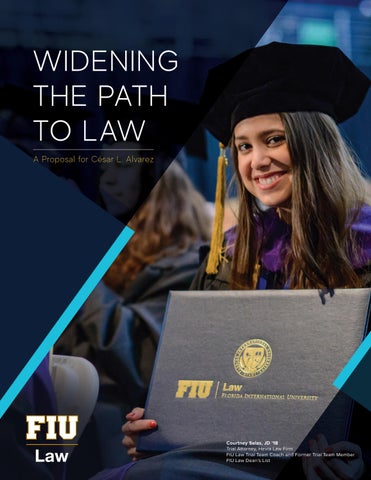
WIDENING THE PATH TO LAW
A Proposal for César L. Alvarez
Courtney Salas, JD ’18
Trial Attorney, Hevia Law Firm FIU Law Trial Team Coach and Former Trial Team Member
Dean’s List

Replica of the Statue of Liberty on the lawn beyond the FIU College of Law
OPPORTUNITY
The United States is home to more immigrants than any other country. It has long been a land of opportunity for the educated, industrious, enterprising, or lucky and a haven for those fleeing persecution. However, even with the diversity in our nation, many minorities continue to be denied equal access to opportunities, especially in the workplace.
In the legal profession, Miami law firms have done well to hire Hispanic associates (representing 37% of all associates) and elevate them to partner (now 24%). Access is still limited for Black/African American lawyers, who comprise only 6% of associates and 4% of partners (National Association for Law Placement, 2021 Report on Diversity in U.S. Law Firms).
Son of an exile from Cuba, César, your father sacrificed his legal career to escape communism, boarded the family on a ferry to Miami, never to return to the homeland that receded in the wake. Your parents started a dress shop so that their four young children could get an education and forge new paths across a wide terrain little traveled by Cubans in America. Your parents taught you that failure is not an option, that anything is possible through hard work, persistence, and an unrelenting drive to meet new challenges.
It is this philosophy that would take you from being the ninth lawyer to be hired at Greenberg Traurig in 1973, then a small business law firm, to becoming its CEO in 1997. A pioneer, you created a lane for yourself where one did not exist, paving the way for those underrepresented in the practice of law to access opportunity. Now Greenberg Traurig’s Senior Chairman, you have been lauded as chief architect of the firm’s national and global expansion and an ardent advocate for diversity and inclusion in the legal profession.
A CHAMPION OF PUBLIC HIGHER EDUCATION
A champion of affordable access to quality legal education, you helped found Miami’s only public law school at FIU. You recognized the need for a different type of lawyer in Florida. Through your visionary leadership and the persistence of many other community leaders, the Florida Legislature did something momentous in 2000—it approved law schools at two state universities, one a Hispanic Serving Institution that was the No. 1 supplier of Hispanic law school applicants in the nation and the other a historically Black university, healing an old wound: in 1965, the Florida Legislature had voted to close Florida A&M’s law school (established in 1949) and transferred funding to Florida State University’s new law school.
As a result of your efforts, today, FIU Law’s enrollment is 52% Hispanic. You have continued to advance FIU’s mission of serving this community as chair of the FIU Law Dean’s Leadership Council, member of the FIU Foundation Board of Directors, twice-appointed member of the FIU Board of Trustees, and member of the FIU CasaCuba Board of Advisors. Greenberg Traurig has hired FIU’s law graduates and invested nearly $300,000 in the people and programs of FIU, thanks to your support.

“No, Governor, I’m not here to tell you that you need more lawyers in Florida. What I’m here to tell you is that you need a different type of lawyer in Florida.”
— César Alvarez to Gov. Jeb Bush, advocating for the establishment of two public law schools, at FIU and at Florida A&M University
BARRIERS TO LAW SCHOOL ACCESS
César, through your leadership at FIU spanning more than 20 years, you have advanced our mission as a Minority Serving Institution and helped propel our rise. You know the day-to-day challenges our students must overcome to get to FIU and stay on the path to graduation.
As the Florida Bar has noted, minority lawyers are significantly underrepresented in the legal profession compared to Florida’s general population. Minorities are also likely to face challenges with hyper-competitive GPAs and LSAT scores, access to LSAT preparation, knowing where and when to apply to law school, and having the financial means to apply to several law schools, which can all become admissions barriers for prospective law students. A handful of robust pre-law programs have sprung up across the nation to lower these barriers. For three years, the FIU College of Law has delivered just such a program–the FIU Law Path–and it is starting to see successes.
We are looking for a committed partner who will support the sustainability of this critical pre-law program. We need a champion of diversity who will raise up other like champions in the legal community to support equitable access to legal education.
César, we invite you to join FIU in strengthening and widening the pathway from college to law school for minorities who are underrepresented in the practice of law.
White law school applicants made up 52% of the applicant pool* and had a 78% admission rate in 2020. Black/African American, Hispanic/ Latino, and Asian applicants made up over 41% of the pool, with admission rates of 45%, 57%, and 65%, respectively.
AccessLex Institute, 2021 Legal Education Data Deck
*Note: Applicants who identify as more than one race/ethnicity are reported in each.

Tremaine Hemans, JD ’19
Immigration Attorney, Jesus Reyes Law
Former Trial Team Member and President of the Black Law Students Association and the Caribbean Student Bar Association. First generation college student.
FIU LAW
FIU College of Law was established by the Florida Legislature to meet the need for a high-quality, accessible legal education in South Florida. The College admitted its inaugural class in fall 2002 with students who reflected the racial and ethnic diversity of this community. FIU Law continues to rise in the rankings and excel, offering a highly practical, rigorous legal education that prepares our graduates for careers with a local, national, or global impact.
For the third consecutive year, U.S. News & World Report ranked FIU Law among the top 50 law schools in the United States. We are now ranked No. 46 among public law schools and No. 88 overall--our highest ranking ever. In fall 2021, we welcomed one of the most diverse and accomplished incoming classes in the country, including 58% women.
Our resilient, hard-working students and alumni are breaking barriers every year with successes, such as achieving top bar-passage rates; securing partner, shareholder, and judicial positions; advancing nontraditional industries; making TIME Magazine’s 2019 100 Most Influential People; and receiving the MacArthur Foundation “Genius” award.
A VISION OF ACCESS REALIZED
César, you are among our law school founders whose vision and dedication have made so much possible:
#46
among public law schools and #88
overall – the highest rankings in the College’s history
U.S. News & World Report, 2021 Best Law Schools
#1 or #2
bar-passage rate in Florida every year since July 2015 #2
in the nation for overall bar-passage rate for outperformance of state’s average bar-pass rate for first-time takers in 2019 by at least 10% ABA, 2020 #6
Racially and Ethnically Diverse Law School in the nation
U.S. News & World Report, 2020 #10
Part-time Law Program among public law schools
U.S. News & World Report, 2021 #15
Best Value Law School for low student debt, high bar passage, and a promising job
The National Jurist, 2020
FIU Law is ranked a No. 6 Racially and Ethnically Diverse Law School in the nation.
U.S. News & World Report, 2020
–
WIDENING THE LAW PATH FOR MINORITIES
FIU Law is ranked No. 6 in the nation for diversity, providing access to excellence for a student body that is 63% minority, including 52% Hispanic and 7% Black/African American (2021). Still, FIU enrolls a higher percentage of minority undergraduates than FIU Law (81%), with student enrollment that is 64% Hispanic and 12% Black/African American (Fall 2021). Although the College of Law was established to expand access to legal education for the South Florida community, historically, many FIU students who have applied to FIU Law have had LSAT scores or GPAs that impede access. These same barriers in part account for historically lower law school acceptance rates for racial and ethnic minority applicants: Hispanic/Latino test-takers have an average LSAT score of 146, and Black/African American test-takers are at 142—7 to 11 points lower than the average for white and Asian test-takers, at 153 (LSAT Performance with Regional, Gender, and Racial/Ethnic Breakdowns: 2007–2008 through 2013–2014 Testing Years, 2015).
“FIU Law was approved by Florida’s State Legislature with the goal of increasing access, opportunity, and diversity. From our founding, we have proudly embraced and welcomed this responsibility. As South Florida’s only public institution, FIU Law is committed to providing curricular offerings and programming, tailored to meet the specific needs of our community. . . . FIU Law Path will play a central role in furthering our access mission and goals.”
— Dean Antony Page FIU College of Law


“The Florida Legislature and other community leaders understood the necessity and value of opening a public law school in South Florida. This was a unique opportunity to educate a broadly diverse population of students while also supporting the local community through pro bono service.
FIU Law Path was mindfully founded with these parallel goals. I am a first generation student. Education, access, and opportunity have made a fundamental difference in my life. My FIU Law colleagues and I are committed to assuring that students with similar stories have the tools they need to achieve their own professional dreams and ambitions.”
— Michelle Mason Senior Associate Dean and Founder, FIU Law Path
A PRE-LAW PROGRAM AT FIU
The costs of excluding underrepresented aspiring lawyers at the law school doors or losing them after the first year of law school are too high. To address this problem, the College of Law launched FIU Law Path in 2019. Thanks to a two-year grant totaling $124,850 from the AccessLex, FIU Law has been able to roll out its pipeline program–FIU Law Path–and it is starting to see successes. This pre-law program aims to increase law school enrollment and improve law student school performance among undergraduate students from South Florida who are traditionally underrepresented in the legal profession, including those who are Pell eligible, first generation, and racial and ethnic minorities.
César, over the years you have expressed an interest in opportunities for Black and Hispanic law students, and we truly believe that FIU Law Path is the key to creating that pipeline. To date, FIU Law Path has enrolled three cohorts totaling 116 students with funds received from a grant that ended in spring 2021. Since then, we have applied for state funding and received a few individual gifts. We need your support, and the backing of the Miami legal community, to maintain the level of resources provided and expand the number of students enrolled in FIU Law Path each year.
THE FIU LAW PATH
To be eligible for FIU Law Path, applicants must be enrolled undergraduate students with a 3.0 minimum cumulative GPA. Preference is given to students with at least two years left to graduate. Participation is free, and FIU Law Path collaborates with local community colleges and four-year universities to identify potential applicants.
FIU Law Path combines exposure to the traditional law school experience with a range of opportunities that help students strengthen their law school application and prepare for the rigors of law school. These include academic enrichment and critical skills development, intensive LSAT preparation, personalized counseling throughout the application process, and individualized mentoring by a member of the bench or bar. Students also gain access to the FIU Law community, with about 20 faculty members, staff, and Dean Antony Page delivering the curriculum and programming over a two-year period.
“Minority students are overrepresented in the group of students who withdraw between their first and second years of law school. In 2019, minority students comprised 31% of enrollment but made up 37% of withdrawals. In particular, students identifying as Hispanic/Latino, Black, and American Indian or Alaska Native, are overrepresented relative to their enrollment.”
AccessLex Institute, 2021 Legal Education Data Deck

FIU Law Path consists of the following:
Six-Week Summer Program
FIU Law Path begins with a six-week summer program taught by law school faculty and law students, where Scholars learn the fundamental components of the American legal system and the case method (Socratic) approach to studying law. Courses, including legal writing and analysis, help students develop the analytical and critical thinking skills expected of law students. This academic preparation aims to reduce attrition between the first and second year of law school.
Mentorship
During the fall of the academic year, what is typically the junior year for Law Path Scholars, students are assigned a mentor from the bench or bar. This is a critical component of the program, as Black and Hispanic/Latino students “tend to rely more heavily on mentors than other students” (Priming the Pump: How Pipeline Programs Seek to Enhance Legal Education Diversity, 2018).
Experiential Learning + Ethics and Professionalism
In the spring, students participate in experiential learning, including one of FIU’s many law clinics, and a series of FIU Law workshops focused on ethics and professionalism. This aspect of the program engages students in legal skill-building experiences that also contextualize ethical principles and rules of professionalism implicated in the practice of law.
LSAT Preparation and Law School Application Workshops
The second summer of FIU Law Path consists of an LSAT preparation course taught by national test specialists. Better LSAT preparation means better LSAT scores, which are essential to help underrepresented students compete in law school admissions. To give our Scholars every advantage, they receive pre-law advising about where and when to apply to law school and attend law school application workshops.
Law School Applications + LSAT Testing
Scholars take the LSAT in the fall and work on their law school applications with support from the Law Path team. To gain admission into the entering class in the fall following graduation from college, students apply for law school in the fall of their senior year.
“As a first generation high school graduate myself, it is nothing short of humbling and daunting to teach these incredibly brilliant young minds. Their promise and fortitude always energize and inspire me. Indeed, the program ensures doors of opportunity and change remain open, and the rhetoric of hope is effectuated.”
— FIU Professor of Law Ediberto Roman Law Path Faculty Member

FIU Law Path Scholars, Cohort 1
THE LAW PATH JOURNEY
To date, FIU Law Path has enrolled three cohorts. The first cohort of 28 students started in summer 2019, and many have started law school. The second cohort of 36 students started in summer 2020. The third cohort of 52 students started in summer 2021. Cohort 4 will begin in summer 2022.

“As a junior at FIU, I not only learned about the admissions process but also received a glimpse of what to expect once I started law school. I believe FIU Law Path prepared me immensely for law school.”
— Khaleel Martin ’16
Cohort 1. Khaleel graduated from FIU in 2016 with a BA in Recreation and Sports Management and now attends FIU Law.
Experiential Learning + Legal Ethics and Professionalism
Mentoring by Lawyers or Law Students
Program Start: 6-Week Program
Application to Law Path
Cohort 3 is engaged in experiential learning and ethics training
Cohort 4 begins the program in summer 2022
“The Law Path program provided me with all the tools I needed to competitively apply to law school. More than that, this program made me a better student.” LSAT Preparation Course + Law School Application Workshops
Students in Cohorts 1 and 2 are receiving law school acceptance letters
In 2021, FIU Law Path received the Association of American Law Schools’ Programmatic ChangeMaker Award.
Some in Cohort 1 have also started law school
— Shakira Brizuela ’21 Cohort 2. Shakira graduated from FIU in spring 2021 with a degree in Political Science and enrolled at FIU Law in fall 2021.

MAKING A DIFFERENCE
FIU Law Path has already seen some early successes:
Access Pipeline
Cohorts 1 through 3
Economically Disadvantaged First Generation
Scholar Diversity
Cohorts 1 through 3

• Scholar Diversity and GPAs - Approximately 95% of the 116 Law Path Scholars self-identify as racial or ethnic minorities, 53% are first generation college students, and 60% are Pell eligible, with a median estimated family contribution of $1,996. Cohort 1 entered Law Path with an average undergraduate GPA of 3.461, while Cohort 2’s and 3’s was 3.59. High undergraduate GPAs are a key factor in gaining law school admissions. The median undergraduate GPA of FIU Law’s 2021 first-year class (full-time) was 3.69, with a 25th percentile GPA of 3.40 and a 75th percentile GPA of 3.84.
• LSAT Scores - Of 88 students who took the LSAT Practice Test, the median score was 142. Of the 42 students who have so far taken the LSAT, 39 have improved their scores. The median score was 151, 9 points higher than the median LSAT Practice Test score --an improvement of roughly 30 percentile points. These successes increase the likelihood that Law Path Scholars will achieve admission into law schools like FIU Law and attract much-needed scholarship support. The median LSAT score of FIU Law’s 2021 first-year class (full-time) was 160, with a 25th percentile score of 158 and a 75th percentile score of 162.
• Law School Admissions - Currently enrolled Law Path Scholars are either waiting to hear back from the law schools to which they applied or enrolling in the LSAT preparation component for summer 2022. To date, 18 students have gained admissions to 21 law schools (see facing page), and 12 of those students have been admitted by FIU Law. Helping to buck the trend of minority enrollment being concentrated in a few law schools, 53% of admitting law schools have less than one-third minority enrollment.
“FIU Law Path offers a unique and invaluable opportunity for students to become acquainted with both the study and the practice of law. My early exposure to experiential legal education generated a journey and ignited a passion that I hope to pass on to each student I encounter. I encourage every student to take advantage of this opportunity to build a future in law – ‘The future belongs to those who prepare for it today.’”
— FIU Clinical Professor of Law (Judge) Phyllis Kotey Law Path Faculty Member
FROM UNDERGRADUATE DEGREE
COMPLETION
Undergraduate Institutions
Attended by Law Path Scholars
• Barry University
• Bethune-Cookman University
• Broward College
• Clark University
• Florida A&M University
• Florida Atlantic University
• Florida International University
• Florida State University
• Howard University
• John Jay College of Criminal Justice
• Keiser University
• Lafayette College
• Miami Dade College
• Nova Southeastern University
• Palm Beach State College
• Pontifical Xavierian University
• University of Central Florida
• University of Florida
• University of Miami
• University of Mississippi
• University of Puerto Rico
• Virginia Commonwealth University
TO LAW SCHOOL
Law Schools Admitting Law Path Scholars
(% Minority JD1 Enrollment, Highlighting Schools with Less Than One-Third Minority Representation)
• Barry University Dwayne O. Andreas School of Law (53%)
• City University of New York (CUNY) School of Law (52%)
• Florida A&M University College of Law (75%)
• Florida International University College of Law (58%)
• George Mason University Antonin Scalia Law School (21%)
• George Washington University Law School (20%)
• Indiana University - Bloomington School of Law (20%)
• Loyola Marymount University Law School (43%)
• Northeastern University School of Law (41%)
• Notre Dame Law School (25%)
• Rutgers Law School (32%)
• Stetson University College of Law (34%)
• St. Thomas University School of Law (75%)
• Tulane University School of Law (22%)
• University of Florida Levin College of Law (29%)
• University of Georgia School of Law (21%)
• University of Miami School of Law (44%)
• Washington and Lee School of Law (18%)
• Washington University in St. Louis School of Law (22%)
Source: Minority Enrollment, Standard 509 Information Report, 2021
In 2020, at least half of all underrepresented minority student enrollment was concentrated in a few law schools. For instance, 35 law schools (18% of all ABA-approved law schools) enroll at least half of all Hispanic/Latino students, and 37 law schools (19%) enroll at least half of all Black/ African American students.
AccessLex Institute, 2021 Legal Education Data Deck

General Counsel and Partner, Stonehaven, LLC
Member, FIU Board of Trustees
Former Vice President, FIU Alumni Association
Valedictorian, FIU Law
Executive Business Editor, FIU Law Review
Parliamentarian, H. T. Smith Black Law Student Association
Chanel T. Rowe, JD ’14

A SEAT AT THE TABLE
César, you have done so much to give racial and ethnic minorities greater access to legal education and the law profession. Your journey from Cuban immigrant to paragon in your field has inspired so many to press on, work harder, and break down barriers. Your servant leadership has motivated lawyers of all colors to achieve more than they ever thought possible. And with you backing our pre-law program, we know we can propel it to even greater heights.
As an inspirational example of the path that can be forged with hard work and perseverance, and as a leader in the legal profession and the Miami community, we ask you to consider a gift to name the Law Path program. With your legacy gift, we can expand the curriculum beyond LSAT preparation, law school admission guidance, and mentoring to include full scholarships for students to attend FIU Law.
Your investment in the FIU Law Path will also inspire support from attorneys, law firms, judges, professors, law students, community residents, and businesses that share your passion for supporting minority students interested in pursuing a legal education. These new champions can offer experiential learning opportunities to our Law Path Scholars, provide valuable in-kind support, and so much more. Your investment will also serve as a catalyst to attract funding for full scholarships for HBCU graduates to attend FIU Law.
Together, we will give unrepresented students a seat at the table in courtrooms, tribunals, boardrooms, and offices at the highest levels of government and influence here and around the world.