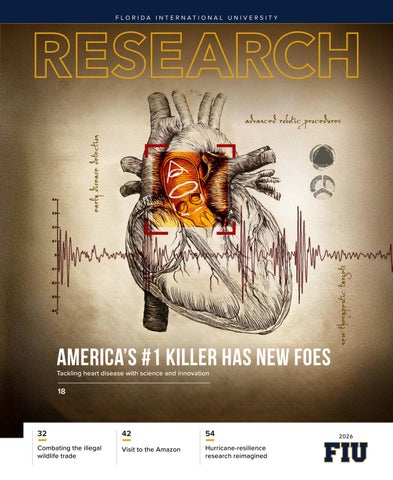
FIU Research Magazine 2026

Page 1


Cosmic Data

The details of the Trifid and Lagoon nebulae came alive for human observers in 2025 as never before, thanks to the Vera C. Rubin Observatory in Chile. Inside the facility sits the world’s most powerful digital camera, one that nightly captures more than 800 pictures of the dark sky. At 3,200 megapixels each, they are the largest ever recorded — and over the next 10 years will provide a time-lapse of the universe that tracks supernova explosions, asteroids, meteors, black holes, far-off galaxies and more.

Making possible the transmission of the photos and their all-important metadata from a mountaintop in South America to Menlo Park, California, is FIU. Its 16,000mile high-speed fiber optic network delivers the information, approximately every seven seconds for the duration of the camera’s daily activity, to SLAC National Accelerator Laboratory for processing and, ultimately, sharing with scientists and amateur stargazers around the planet. Developed over the course of two decades, the network builds upon infrastructure previously pioneered in the region by the university. FIU’s leadership, operation and oversight remain critical to fulfilling the observatory’s mission as a high-tech research tool that is revolutionizing how we explore worlds beyond our own.

Credit: NSF–DOE Vera C. Rubin Observatory

THE FUTURE OF ADDITIVE MANUFACTURING IS HERE

Supported by a $22.9 million investment from the U.S. Army Research Laboratory, FIU’s Cold Spray & Rapid Deposition (ColRAD) Laboratory is pushing the boundaries of additive manufacturing. Instead of waiting weeks or months for replacement parts, industries can now restore or build highperformance metal systems in hours, wherever they’re required — on a tarmac, aboard a ship or even in orbit. ColRAD researchers are also developing next-generation alloys and nanomaterialreinforced metals. Several of these innovations are already patented and licensed to aerospace partners.

“Our work is driven by close collaboration with aerospace, defense, maritime and manufacturing stakeholders who help us define and validate advanced processing routes for nextgeneration materials,” says Tyler Dolmetsch, a research assistant professor of mechanical and materials engineering. “These partnerships ensure our processing science translates into reliable, field-ready material solutions.”

Pictured: ColRAD researchers Anil Lama (foreground) and Denny John and Abhijith Kunneparambil Sukumaran.

A FUNDAMENTAL TRUTH

Partnerships between research universities and industry, government, peer institutions, and community organizations have been the engines behind some of the most transformative scientific advancements of the past century — from the Human Genome Project and the Hubble Space Telescope to GPS technology and CERN’s discovery of the Higgs boson. The collaborations central to these research discoveries underscore a fundamental truth: Consequential impact rarely emerges in isolation. Instead, it is forged at the intersection of ideas, expertise and shared purpose among collaborators.

At Florida International University, we’re achieving impact through partnerships that are moving research beyond the laboratory into the lives of people and communities —

WHERE IMPACT TRULY MATTERS

In this issue, we’ll introduce you to some of the FIU researchers, physicianscientists and cardiac surgeons who are saving lives in the operating room and, one day, will save lives in doctors’ offices through their innovations. You’ll learn about an ambitious national consortium of leading research universities in the United States whose scientists and engineers are working together to advance the science of extreme storm resilience. We take a look at the work of FIU researchers who are pioneering the science needed to fight illegal wildlife trafficking. And we also journey to the Amazon to document the conservation efforts of the Amazon Riverscapes team, one of many FIU projects expanding knowledge and conservation.

All of this work is emblematic of the power of our institutional partnerships. We are grateful to the organizations that invest their trust, resources and expertise in our work. These partnerships signal confidence not only in our research enterprise, but in the people behind it — our researchers, faculty, students and staff — whose curiosity, rigor and commitment drive discovery forward every day.

As we look ahead, we remain committed to partnerships that are impact-driven. Together with our partners, we will continue to ask bold questions, pursue ambitious solutions and ensure that research serves its highest purpose: advancing knowledge in ways that meaningfully improve the world we share.

We hope you enjoy these articles and this publication. Please be sure to visit researchmag.fiu.edu for videos and additional information that accompanies many of these stories.

Email: bejare@fiu.edu

Andrés G. Gil

Senior Vice President, Research and Economic Development

Dean, University Graduate School

Professor, Robert Stempel College of Public Health & Social Work

Email: gila@fiu.edu

FLORIDA INTERNATIONAL UNIVERSITY AND OFFICE OF RESEARCH & ECONOMIC DEVELOPMENT

Jeanette M. Nuñez

President

Elizabeth M. Béjar

Provost, Executive Vice President and Chief Operating Officer

Andrés G. Gil

Senior Vice President for Research and Economic Development Dean of the University Graduate School

William T. Anderson

Associate Vice President for Research

Tonja Moore

Associate Vice President for Research Strategic Planning and Operations

Robert Gutierrez

Associate Vice President for Research

David Driesbach

Assistant Vice President for Research

IN FOCUS

TAKING IT TO HEART

Cardiovascular disease is the leading cause of death in the U.S. Can we turn the tide?

SECRET CARGO, STOLEN LIVES

The illegal wildlife trade is a lucrative criminal enterprise. Proactive, data-driven science is helping disrupt and dismantle it.

STRONGER STORMS, SMARTER SCIENCE

A national coalition led by FIU is set to supercharge the research of extreme storm resilience.

IMPACT AT A GLANCE

AQUARIUS REEF BASE

The world’s only underwater research lab is reshaping ocean science.

Q & A: Natalia Soares Quinete Tracking “forever chemicals.”

VISIT TO: THE AMAZON Advancing science and conservation efforts in one of the most biodiverse places on Earth.

SPACE INNOVATION INFOGRAPHIC

Next generation materials, antennas and more.

ONE MORE QUESTION Cristina Palacios on how science and society can promote changes for better health. 16 30 42 48 50 52

ALUMNI SPOTLIGHT: DENISSE ARANDA

Safeguarding future missions to Mars and beyond.

FACULTY NEWS

RESEARCH ROUND UP

ARTIFICIAL INTELLIGENCE

‘Antidote’ to data poisoning

Data poisoning is a concern for all AI systems, especially those trained on content from across the web and social media.

ARTIFICIAL INTELLIGENCE SYSTEMS are only “intelligent” because of the extensive amounts of data they are trained on. If this treasure trove gets tainted — like when cyber attackers sneak small doses of poisoned data in the form of false information into these training sets — even once-reliable AI models can become erratic. Real-world ramifications go beyond chatbots speaking gibberish: Self-driving cars may ignore red lights, or critical infrastructure systems could malfunction. Cybersecurity researcher Hadi Amini and his lab at the Knight Foundation School of Computing and Information Sciences combined federated learning and blockchain as a bulwark against these types of attacks. Their approach, described in IEEE Transactions on Artificial Intelligence, uses multiple layers of verification to detect potentially poisonous data and remove it before it compromises the main model. The team hopes the technology will be ready for use in the next couple of years.

www.doi.org/10.1109/TAI.2025.3539258

Downburst winds can reach 150+ miles per hour, the strength of a Category 4 hurricane.

RESILIENCE I

Recreating downbursts at the Wall of Wind

N 2024, A STORM HIT Houston with a downburst so strong it blew out windows in high-rise buildings built to survive Category 4 hurricanes. Two months later, Hurricane Beryl hit Houston with similar wind speeds but left minimal damage to the downtown buildings. To understand why downbursts can be so destructive and what cities and building designers can do about it, engineer Amal Elawady simulated these winds at FIU’s Wall of Wind — the only full-scale test facility at a U.S. university capable

of generating up to 160 mph winds. While recent building codes address tornado resilience, the experiments show downbursts pose unique challenges because winds place uneven pressure on walls and roofs. Findings, published in Frontiers in Built Environment, aim to improve future design standards so buildings can withstand both hurricanes and downbursts. www.doi.org/10.3389/fbuil.2024.1514523

ENGINEERING HEALTHCARE

What’s the link between sleep, brain injury and epilepsy?

SLEEP IS MEDICINE for the brain. So, what happens when a person with a history of poor sleep experiences a traumatic brain injury (TBI)? Can it increase the chance of developing post traumatic epilepsy? It’s an important yet still understudied question.

Post-traumatic epilepsy is mysterious and unpredictable. Some people experience seizures immediately after injury, others don’t

until years later. Assistant Professor of Biomedical Engineering Oleksii Shandra is investigating if transcranial magnetic stimulation — a non-invasive treatment that uses magnetic pulses to stimulate neurons — can stabilize brain activity and improve sleep quality after a TBI and, in turn, prevent epilepsy. The findings may help protect those most vulnerable: military personnel, firefighters, athletes, truck drivers and more.

SCAN ME

CYBERSECURITY

Defending drones from cyber attacks

THE FEDERAL AVIATION Administration is moving to expand commercial drone use, raising new questions about safety in the face of increasingly sophisticated cyber threats. Because drones are essentially flying computers, they are subject to the same software and hardware exploitation as their land-bound counterparts. However, current drone-defense techniques fail to monitor all possible vulnerabilities. That’s why Mohammad Ashiqur Rahman — associate professor in the Knight Foundation School of Computing and Information Sciences — and

his cybersecurity research group developed a comprehensive framework called SHIELD. It detects subtle signs of malicious activity, identifies the type of attack and initiates a tailored recovery plan. In lab simulations, the team’s approach classified an attack in an average of 0.21 seconds and restored normal flight in 0.36. Findings were presented at the 2025 IEEE/IFIP International Conference on Dependable Systems and Networks.

www.doi.org/10.1109/DSN64029.2025.00070

Inset photo: FIU’s cybersecurity research group that developed SHIELD – from L-R: Jean Tonday Rodriguez, Mohammad Kumail Kazmi, Mohammad Ashiqur Rahman and Muneeba Asif.

MARINE BIOLOGY

Shark-eat-shark

MANY SHARKS HUNT SMALL, plentiful prey. Great hammerheads take a different approach: Eat other sharks. It’s an energy-intensive strategy, but one that pays off for this critically endangered species, according to Institute of Environment research. As part of her Ph.D. research, Erin Spencer — working alongside world-renowned FIU shark ecologist Yannis Papastamatiou — tagged great hammerheads off Florida’s coast

with special trackers equipped with video cameras, as well as speed and sonar sensors. The data helped build computer models comparing the energetic costs and rewards of different prey. The findings, published in Oecologia, were striking: When food is scarce, catching a single 55-pound blacktip shark about every three weeks can sustain a 250-pound hammerhead for up to two months.

www.doi.org/10.1007/s00442-025-05758-5

Understanding foraging behavior is key to guiding effective conservation strategies that ensure a species’ long-term survival.

MARKETING

This research isn’t for you

TELLING SOME PEOPLE not to buy a certain product may make it more appealing to the target customers. Jaclyn Tanenbaum, associate teaching professor of marketing and logistics in the College of Business, worked with colleagues at Georgetown University and the University of Alabama in Huntsville on several experiments involving products like coffee, mattresses and toothbrushes. Results, published in the Journal of Consumer Research,

suggest “dissuasive framing” can be more persuasive to people in the target group or market. For example, an ad stating, “If you don’t like dark roast coffee, this is not the coffee for you,” outperformed the typical “If you like dark roast coffee, this is the coffee for you” among dark roast fans.

www.doi.org/10.1093/jcr/ucaf034

ARTIFICIAL INTELLIGENCE

Realtime flood forecasting

FLOODS ARE AS UNPREDICTABLE as they are dangerous. Traditional physics-based flood models, though, can take hours to run — far too slow for today’s fast-moving storms. More real-time systems are needed. A collaborative research team developed one such system that not only simulates worst-case flooding scenarios but also recommends actionable strategies to either eliminate a flood event or drastically reduce it. Published in the Journal of Water Resources Planning and Management, the model was trained on decades of data collected by the South Florida Water Management District to recognize how rainfall, tides and storm surge interact. It can identify flood drivers, supporting rapid response and long-term infrastructure planning.

The team included Knight Foundation School of Computing and Information Sciences Professor Giri Narasimhan and doctoral student Jimeng Shi, along with Director of the Sea Level Solutions Center Jayantha Obeysekera.

https://doi.org/10.1061/JWRMD5.WRENG-6194

PUBLIC POLICY

Space governance

LATIN AMERICA is playing a growing role in the global space economy, fueled by rapid market expansion, increasing investments in satellite systems, telecommunications and more, as well as a burgeoning “NewSpace” startup scene. Space policy specialist Laura Delgado López, recently named Senior Fellow at the Jack D. Gordon Institute for Public Policy, is currently working on the methodology for a dashboard to map the region’s network of public and private space actors. Once completed, the tool will help identify governance gaps and strengthen international collaboration. It will be hosted on the institute’s Security Research Hub, which shares interactive dashboards that visualize security-related data across Latin America and the Caribbean.

QUANTUM COMPUTING

No prying eyes on private videos

AI-GENERATED DEEPFAKE videos are already a problem. Quantum computers of the future will make matters worse because the super-powerful machines will be able to crack current encryption methods in seconds, making private videos vulnerable to manipulation.

To prevent this, Distinguished University Professor S. S. Iyengar and his research group at the Knight Foundation School of Computing and Information Sciences developed a quantum-safe encryption system.

Designed to run on today’s computers — providing security against both traditional hacking methods as well as future quantum computer attacks — the method combines quantum encryption with secure internet transmission. It transports videos in a digital “lock box” and scrambles video data using cryptographic keys that only authorized users can unscramble. A study published in IEEE Transactions on Consumer Electronics suggests the method is more effective than comparable advanced encryption techniques.

www.doi.org/10.1109/TCE.2024.3473542

ENVIRONMENT

Aggressive seagrass discovered in Biscayne Bay

AN AGGRESSIVE SPECIES of seagrass, Halophila stipulacea, has been on a steady march across the world, taking over ecosystems beyond its native waters of the Red Sea, Persian Gulf and Indian Ocean. Institute of Environment marine scientist Justin Campbell has confirmed it has now reached the waters off the coast of Florida. As reported in Aquatic Botany, the species is growing in Crandon Marina and nearby areas of Miami’s Biscayne Bay. While it’s

unknown whether stipulacea provides similar ecological benefits as compared to native species, at least 19 Caribbean islands have reported this seagrass growing in nearby waters and, in some cases, overtaking meadows of native grass that serve as important nurseries for fish and provide food for turtles.

www.doi.org/10.1101/2024.09.02.610701

ECONOMIC FREEDOM

Bureaucracy’s outsized impact on medium-sized firms

MID-SIZE BUSINESS OWNERS aren’t imagining the burden of red tape, according to the Adam Smith Center for Economic Freedom’s 2025 Index of Bureaucracy. The report measures the time firms spend navigating regulatory procedures and shows how excessive bureaucracy undermines economic dynamism. Drawing on data from 21 countries across Latin America, the Caribbean and Europe, the study finds that opening a medium-sized company requires an average of 1,850 hours—about 231 workdays devoted solely to administrative steps. Annual compliance adds another 1,577 hours, or 76% of an employee’s working time.

Founding Director Carlos Díaz-Rosillo notes that medium-sized firms are often overlooked despite driving productivity, jobs and innovation. The findings underscore the urgent need for simpler processes to protect democratic freedoms and prosperity.

EDUCATION

Watch the launch of the Index of Bureaucracy 2025

Building preschoolers’ STEM skills is child’s play

WHAT DO PUZZLES, navigating a new city or doing a cartwheel have in common? They rely on mental rotation or the ability to visualize objects moving or turning in space without physically moving them. It’s a skill that can lay the foundation for doing well in school and developing an interest in STEM.

Center for Children and Families research, led by doctoral student Karinna A. Rodriguez, used eye-tracking technology to understand how a small group of children (ages 3–7) solved spatial puzzles. Most used an adult-like strategy, rotating the entire object mentally — rather than breaking it down piece by piece — meaning that even before they can read, young children can envision how objects move and turn in space in ways that are more advanced than expected. The findings, published in Infant and Child Development, suggest early play with puzzles and blocks can boost this important skill. www.doi.org/10.1002/icd.70018

SCAN ME
A study participant identifies rotated images on a screen while researcher Karinna A. Rodriguez from FIU’s Center for Children and Families guides her.

ECONOMICS

Weathering the storm

EXTREME WEATHER can have long-term ripple effects on the economy, according to College of Business research. Assistant Professor of Finance Florent Rouxelin — in collaboration with colleagues at Yale University and University of New South Wales — used a dataset of extreme weather events (the Australian Actuaries Climate Index) to analyze effects on key economic indicators. The results, published in Land Economics, show extreme weather events can hurt a country’s overall economic output or GDP — for up to two years — and lead to a spike in unemployment. Food and energy prices also rise. In response to these shocks, central banks typically lower interest rates to stimulate economic growth. This approach to studying economic impact provides valuable insights for policymakers and economists grappling with more frequent extreme weather events.

www.doi.org/10.3368/le.101.4.060723-0051R

Managing chronic pain

TRANSCUTANEOUS MAGNETIC STIMULATION (TMS) uses focused magnetic pulses to retrain the brain’s pain response. It’s already used to treat depression, OCD and hard-to-treat migraines. A new NIH-funded study will explore how it can also relieve posttraumatic and post-surgical chronic pain. Patients suffering with low back pain, osteoarthritis or injuries will undergo 30-minute TMS sessions. Before and after, researchers measure pain levels, anxiety, depression, vascular function, glucose levels and inflammation markers like endorphins and cytokines.

Herbert Wertheim College of Medicine researchers Dr. Patricia Junquera, chair of psychiatry and behavioral health, and Dr. Saurabh Aggarwal, associate professor and translational researcher, lead the study in collaboration with Dr. Eduardo Icaza, a comprehensive and interventional pain management physician at Baptist Health Miami Neuroscience Institute.

Dr. Saurabh Aggarwal and Dr. Patricia Junquera from the Herbert Wertheim College of Medicine preparing a patient for a TMS session.

Predicting preterm labor

What you see here, bursting with an exquisite rainbow-like shimmer of colors, is a mouse cervix viewed beneath a polarization-resolved second harmonic generation microscope. Jessica Ramella-Roman, a biomedical engineer in the College of Engineering & Computing, spent eight hours taking 81 images to create this detailed look at the web of collagen fibers that lend the cervix its impressive strength. During pregnancy, these fibers remain tightly packed together. For a baby to enter the world, though, they must loosen and become randomly oriented. In preterm births, this remodeling process happens before it should.

A world expert in optical imaging, Ramella-Roman uses advanced techniques to visualize this process and detect signs of premature remodeling that typically signal preterm labor. With premature births on the rise in the U.S., early detection is critical. However, few current diagnostic tools are available, limiting timely interventions.

A proof-of-concept study tested a similar polarization-sensitive imaging approach on pregnant patients at Jackson Memorial Hospital in Miami, Florida, in collaboration with Assistant Professor Nola Holness from the Nicole Wertheim College of Nursing & Health Sciences. More recently, Ramella-Roman’s lab has developed an easy-to-use, handheld cervical imaging device and completed the NSF Innovation Corps program to bring the invention to commercialization.

WORLD’S ONLY UNDERSEA RESEARCH LAB

IS RESHAPING THE FUTURE OF OCEAN SCIENCE

60ft. below the surface

Investing in Growth

ABOVE THE SHIMMERING TURQUOISE WATERS of the Florida Keys National Marine Sanctuary, the world feels familiar, accessible and vast. Just 60 feet below, a pressurized cylinder tethered to the ocean floor comes into view. Its signature yellow paint dominates the landscape.

Unknown to many, this is Florida International University’s Aquarius Reef Base — the centerpiece of FIU’s Medina Aquarius Program. It is the world’s only underwater research laboratory.

For decades, Aquarius has been a temporary home for aquanauts who spend days or even weeks living and working underwater. Its existence is a testament to human ingenuity, allowing scientists to bypass the crippling time limits of traditional scuba diving and immerse themselves in the mysteries of the ocean.

The story of Aquarius is set against a backdrop of sunken ambition. The 1960s ushered in a golden age of saturation diving, with more than 65 underwater habitats built and deployed across the world through the ’70s, ’80s and ’90s. But the ambition was fragile. One by one, those habitats were decommissioned, lost to budget cuts, technical failures or

the logistical challenges of maintaining a pressurized structure underwater.

Aquarius is the exception — thriving and evolving in the 21st century. Now, FIU and technology start-up Tekmara have teamed up to transform Aquarius and the future of underwater habitats. Aquarius will host Tekmara’s sensor technology, combining advanced artificial intelligence, integrated data solutions and marine robotics for intelligent, real-time environmental monitoring.

“This project brings together two of FIU’s priorities to help grow ocean exploration: environmental research and technology,” said FIU President Jeanette M. Nuñez. “What scientists learn at the Medina Aquarius Program will prove pivotal for the future of Florida’s tourism and economy. FIU will continue to lead the way in marine conservation and research.”

The advanced systems will also support improved safety and security for aquanaut teams and for Aquarius itself, according to Tekmara founder Todd Kleperis.

As the lead university research partner for the Florida Keys National Marine Sanctuary, this new insight will transform FIU’s research and help inform management of the protected region. The systems will largely be powered by renewable energy sources making the entire operation a model of sustainability.

The habitat’s continued, and now augmented, operation is a testament to the idea that underwater habitats are viable, logical investments that can dramatically improve ocean research and restoration, technology innovation and extreme environment training for the Navy, astronauts and more.

“Aquarius has long been a global asset for advancing scientific exploration, research and discovery,” said Mike Heithaus, FIU vice provost of environmental resilience. “With these new advances, our habitat is becoming more efficient and more equipped to support the amazing work being done by scientists and industry partners from around the world.”

The innovations are also informing FIU’s planning for Aquarius 2, which is designed to expand the scope and scale of human activity in the oceans. Fundraising is underway for this nextgeneration habitat that will have a modular design to accommodate scientific study, proprietary research, advanced training and community engagement.

Aquarius 2 renderings

TAKING IT TO HEART

A NEW ERA OF CARDIOVASCULAR SCIENCE BEGINS AT FIU

A hypnotic rhythm underlies your existence. It began before you were born. It continues, right this very moment, without a single conscious thought on your part. It will be with you until the end. Lay a hand to your chest. Feel it. Ba-bum Ba-bum Ba-bum. The heart is the muscle that works harder than any other. It contracts as if being squeezed then relaxes, over and over and over again, around 100,000 times a day. That’s roughly three billion times in an average lifespan. With each beat, the heart valves take turns opening and snapping shut in a perfectly timed, well-orchestrated dance to keep oxygen-rich blood flowing through the branching network of arteries and veins stretching from the top of your head down to your toes.

The heart’s job is relatively straightforward, even simple. The heart itself is remarkably complex. Its many marvels and enduring mysteries have been an endless source of fascination for millennia. Aristotle considered it the most important organ. French philosopher René Descartes saw it as a sort of engine. Leonardo da Vinci filled countless pages of his famous notebooks with intricately detailed ink-and-quill anatomical studies, in many cases hypothesizing correctly about its function. Beneath one such drawing, he wrote: “How in words can you describe this heart without filling a whole book?”

INDEED, HOW? EVEN

TODAY, researchers like Joshua Hutcheson — a biomedical engineer and Fellow of the American Heart Association who has studied the heart’s intricate mechanisms for the better part of a decade — can attest to the fact that understanding the heart remains an awe-inspiring journey into the unknown. In lectures, he shows students Leonardo’s drawings. On the wall of his Cardiovascular Matrix Remodeling Lab at FIU hangs a quote from Descartes. Both are nods to the origins of modern physiology as much as reminders to embrace the kind of curiosity that drove the great thinkers of history. Asking big, bold and daring universal

Joshua Hutcheson and researchers in his lab use cutting-edge engineering approaches to identify potential therapeutic targets and create new tools to detect cardiovascular disease in asymptomatic patients.

questions — the why and how of life — is almost a prerequisite when it comes to the heart. “That’s how you get to a place where you discover something completely new,” says Hutcheson.

Here’s one: Why does the heart work flawlessly throughout an entire lifetime for some and not for others?

Cardiovascular disease — an umbrella term encompassing a number of conditions, including coronary heart disease, heart failure, arrhythmias (i.e. atrial fibrillation), vascular disease, congenital heart defects and more — has been the nation’s leading cause of death for over a century.

The

American Heart Association estimates at least six in 10 U.S. adults

(more than 184 million people) will have some type of

cardiovascular disease by 2050.

The good news: Death rates have steadily declined over the decades, thanks in part to widely available medications that control blood pressure and artery-clogging cholesterol, as well as successful public health campaigns to stop smoking. The not-so-good news: The downward trend is stalling. An aging population — expected to drive a surge in cardiovascular disease burden — is on a collision course with a growing number of younger adults with risk factors such as uncontrolled blood pressure, diabetes and obesity.

At FIU and beyond, researchers like Hutcheson as well as physician-scientists and cardiac surgeons focus their life’s work around addressing this problem. In their labs and the clinic, they are leading major technological and life-saving therapeutic advances to gain a deeper understanding

of how cardiovascular disease happens and transform how it is prevented, detected and treated.

SILENT BEGINNINGS

There’s a lot about cardiovascular disease that’s vexing. Perhaps most frustrating is how it moves in stealth. “By the time symptoms appear, the heart has been irreparably damaged,” explains Hutcheson.

Atherosclerosis, the buildup of plaque in the arteries, is a major culprit of disease and slow-ticking time bomb. In fact, it can start in childhood.

Plaque — made up of cholesterol, inflammatory cells and other material — can collect inside artery walls. Over time, these fatty deposits narrow the artery, reducing blood flow. Problems happen when plaque becomes unstable and ruptures. Blood clots form at the rupture site. Those clots can block blood flow. If it happens in the heart, it causes a heart attack.

But rewind: How does this happen in the first place? Hutcheson initially set out searching for the earliest possible mechanisms behind this mineralization as a postdoctoral researcher at Harvard. After joining the lab of Elena Aikawa — a leading expert in cardiovascular calcification — Hutcheson created a series of models that mimicked vascular tissue

and arterial cells. Up close and in real time, he watched as nanosized membrane sacs resembling bubbles, called extracellular vesicles, began to bleb off the cells. One by one, they gathered in clusters. Then things got really interesting: They started “capturing” calcium and phosphate. The vesicles were not only major mediators of calcification. They were the instigators.

With funding from the NIH and Florida Heart Research Foundation, Hutcheson continues to lead far-ranging investigations into these vesicles to find ways to detect or disrupt this process. Cell culture experiments in his lab have had encouraging results: Epidermal growth factor receptor inhibitors, commercially available and FDA-approved for cancer treatment, successfully stopped the vesicles and prevented plaque formation.

Another project is probing the calcification paradox or why it is that the more abnormal calcification present in arteries, the less calcification and mineral development in the bone. Hutcheson and FIU colleagues — including chemist Francisco Fernandez-Lima, biophysicist Prem Chapagain and physicist Jin He — compare how vesicles form and function in bone cells versus artery cells. Early evidence suggests there’s some crosstalk between the two cell types, raising the possibility of coaxing calcium and phosphate from arteries back into bone.

Atherosclerosis causes arterial stenosis (narrowing of the artery) which reduces blood flow.

Would it be possible to make plaque completely disappear? Cholesterol-lowering drugs and lifestyle changes, like losing weight and quitting smoking, typically slow the formation of new plaque but don’t get rid of old buildup. Hutcheson’s research group, though, has shown activating a hormone called relaxin could be a step in the right direction. Preclinical mouse models and human cells in vitro demonstrated a small molecule — developed in collaboration with investigators from the National Center for Advancing Translational Sciences — significantly reduced and reversed late-stage vascular calcification.

“This is the dream,” Hutcheson says. “To find a way to reverse the pathology and return patients to a normal baseline.”

INNOVATING NEW HEART VALVE SOLUTIONS

The arteries are, of course, one place plaque appear. The valves another.

Daniel Chaparro spent his entire Ph.D. journey in Hutcheson’s lab studying these little one-way doors of the heart.

“Every time the valves close, I always say it’s like they are clapping for you,” he laughs. “They’re saying ‘Yea! You’re alive!’”

The “clapping” Chaparro refers to is actually audible through a stethoscope: Lub-dub When the heart contracts, valves between the upper and lower chambers of the heart snap shut (lub). As the heart relaxes, the other two valves that lead out of the heart close (dub) allowing the heart to refill with blood.

If valves don’t open properly, blood trickles through like water when you press a thumb against a hose. When valves fail to close correctly, the opposite happens: blood leaks backward into the heart, leading to congestive heart failure. Both problems can change the sounds of the heart.

On a computer screen, Chaparro pulls up a magnified image of an aortic valve. It’s made up of three separate flaps, called leaflets. Curiously, calcification doesn’t collect on each leaflet equally. One flap often fares far worse than the others. With a Florida Heart Research Foundation doctoral student grant, Chaparro used computational modeling and experimental planning to pinpoint the possible cell types responsible for these asymmetrical calcification patterns. It was a massive undertaking.

But he’s not quite finished with valves yet. Chaparro is now senior research engineer in the lab of physician-scientist Dr. David Kalfa,

a renowned expert in complex neonatal cardiac surgery and advanced pediatric valve repair.

“The times that there have been huge leaps forward, in terms of how we treat or diagnose diseases, is when a surgeon or clinician and engineer get together to find solutions,” Chaparro says. He mentions Dr. Albert Starr and hydraulic engineer Lowell Edwards whose pioneering collaboration produced the world’s first successful artificial heart valve.

Kalfa’s team has a similar, no less ambitious goal: Find innovative solutions for the estimated 40,000 children born each year with congenital heart defects.

“We still don’t have many good options in terms of heart valve replacement for children with congenital heart defects,” says Kalfa, chief of cardiovascular surgery and co-director of the Nicklaus Children’s Heart Institute, as well as professor in FIU’s departments of pediatrics and surgical sciences. Consider: A newborn heart is around the size of a large strawberry.

Dr. David Kalfa

“The options we do have either aren’t small enough or can’t grow with the baby or child. Each time we need to replace it, that’s another open heart surgery.”

Living allogenic valve transplantation (also called partial heart transplants) has emerged as a promising alternative. Because even if heart muscle is damaged or diseased, the valves can be in good working condition.

In 2023, Kalfa performed the world’s first domino infant partial heart transplant while at New York-Presbyterian Morgan Stanley Children’s Hospital: An 8-monthold received a full heart transplant, and the healthy valves from her old heart were donated to a 2-month-old baby. A year later, Kalfa did a split-root domino partial heart transplant that saved three children in 24 hours. It was an emotional experience, one he says will stay with him forever.

As with many things in life, logistics and timing have to align for partial heart transplants to be a success. That’s why Kalfa’s team is on a mission to extend the extracorporeal time of this precious tissue — and give it an extended shelf life, banking it much like blood is banked, until there is a child who needs it.

With an NIH R01 grant, they will be fine-tuning a unique time-buying approach. Here’s how it works: Tissue is stored in a custom-built bioreactor that closely replicates conditions inside the body, providing pulsing stimulation as a stand-in for a heartbeat. A special solution — patented by Kalfa’s team and proven to keep tissue alive for at least seven weeks — is added to ‘feed’ the tissue and supply essential nutrients.

“This is definitely a new, exciting frontier,” Kalfa says. “It could increase availability and the chance of having the right valve for the right patient at the right time — transforming the lives of children in South Florida, across the country and the world.”

HEARING HEART DISEASE

What else could prove life changing for patients? Earlier diagnosis.

In addition to looking at the underlying mechanisms of disease, Hutcheson is also developing low-cost, accessible diagnostic tools. He didn’t have to look far for inspiration. He found it close to home. Hutcheson’s wife is a classically trained opera singer. Healthy vocal cords stretch and contract to produce different notes. Damage or injury to these thin folds of tissue can drastically alter the rich resonance and sound of a singer’s voice.

Wait a second, Hutcheson thought, the heart isn’t all that different. When valve disease or calcification occurs, the lub-dub sounds change. Other sounds creep in. Clicks. Whooshes. Extra beats. Could it be possible to train an algorithm to detect the earliest acoustic signatures disease leave behind, even those too subtle for the human ear to hear?

Hutcheson shared the idea with Valentina Dargam, one of his graduate students at the time. The undertaking would be ambitious, a sort of DIY project. For starters, training an algorithm requires data. Lots of it. Dargam would need to collect thousands of heart sounds with a digital stethoscope, analyze the acoustic signals and validate the pre-clinical data against image scans of calcium buildup in the heart. Other people might have hesitated. Dargam didn’t.

“I honestly don’t know how I did everything,” she admits. “But I do know I need to have a vision of ‘Okay, how will this help people one day?’ That drives me.”

Between juggling the demands of the actual research, Dargam signed up for a few commercialization courses. She entered and won several pitching competitions. In 2020, preparing to apply to NSF’s prestigious

Dr. David Kalfa and his FIU research team are working on an approach to preserve and store living valve tissue, offering patients the first-ever off-the-shelf available living valve replacement option.

Innovation Corps (I-Corps) program, she took part in the regional I-Corps training program, interviewing 45 cardiologists and clinicians in the span of five weeks. Their responses were enthusiastic and feedback invaluable. Dargam and Hutcheson were then accepted into the national I-Corps and spent eight weeks ensuring the technology meets future patients’ needs.

Today, the AI-based diagnostic algorithm that Dargam trained is 95% accurate in classifying healthy heart sounds and nearly 85% accurate in differentiating between types of heart disease. It also picks up on disease before cardiac murmurs or structural changes appear. Clinical trials are on the horizon.

Dargam and Hutcheson will work with Dr. Tom C. Nguyen — internationally recognized minimally invasive heart surgeon, chief medical executive of Baptist Health Heart & Vascular Care and Barry T. Katzen Endowed Chair at Miami Cardiac & Vascular Institute — to test the technology in the clinic.

“This type of work is critical and the only way to advance medicine,” Nguyen says. “Physicians interact with patients on a daily basis and have a deep understanding of the clinical side of medicine. The team at FIU has a very strong foundation of cardiovascular research. Bringing the two together is a perfect marriage where we all complement each other.”

ROBOT IN THE OR

Relevant research that addresses realworld medical needs is at the heart of FIU’s strategic partnerships with Nicklaus Children’s Health System and Baptist Health South Florida. These collaborations have attracted world-renowned talent, including Dr. Makoto Hashimoto, an internationally acclaimed cardiac surgeon pioneering new approaches to robotic-assisted cardiac procedures.

Traditional open-heart surgery requires a six- to eight-inch incision down the center of the chest. The breastbone is cut and ribcage spread open. Recovery can be slow. Hospital stays long. Serious life-threatening complications like infection can occur.

Peek behind the scenes of a robotic-assisted procedure and the scene is dramatically different. Only a few small incisions are made. No bone is cut. A coordinated surgical team of nurses, technicians and an anesthesiologist remain beside the patient’s bedside. Across the room, Hashimoto stays seated at the console connected to a robotic system named after Leonardo da Vinci. He hardly moves, save for the slightest flutter of his fingers on the controller. Every subtle move of his hands is instantly captured, scaled for precision and mirrored by the robotic arms holding the micro-sized instruments and a 3D high-definition camera inside the patient’s chest and heart.

“The robot becomes part of my body during surgery,” says Hashimoto, FIU professor and director of robotic cardiac surgery who treats patients at Baptist Health Miami Cardiac & Vascular Institute. “It feels like an extension of myself.”

Because robotic surgery has many advantages — less pain, minimal scarring,

Research Assistant Professor Valentina Dargam trained an algorithm that pinpoints unhealthy heart sounds for earlier disease detection.

faster recovery — it’s becoming increasingly popular with patients. But widespread adoption is lagging behind other specialties. Few cardiac surgeons perform more than 20 robotic cases a year. Hashimoto, however, performs hundreds. With an ever-growing volume of cases, he’s leading Florida’s busiest and fastest-growing robotic cardiac surgery program.

Every surgery Hashimoto completes saves another life. It also helps move the field forward by providing much-needed evidence that demonstrates novel robotic techniques can be applied safely and effectively to various conditions that once required more invasive procedures. FIU medical student

Natasha Mazinani, one of Hashimoto’s mentees, is helping advance this important work.

“My grandfather had open heart surgery, so I always thought any heart surgery meant a big scar down your chest,” says Mazinani.

“It’s honestly mind blowing to see what Dr. Hashimoto does for his patients. There are no words.”

Mazinani has helped Hashimoto with case studies on complex conditions. One detailed how Hashimoto repaired a heart defect involving both a hole between heart chambers and a leaking valve (known as an atrioventricular septal defect with severe

mitral regurgitation). Another retrospective study compares his first 100 coronary artery bypass graft surgeries to his last 100 to explore the learning curve with this type of procedure.

“This research is essential because it’s how we get information out there for other surgeons to learn how to do it and bring these techniques to more patients,” Mazinani says. “I am so grateful to play a small role in advancing what we know about robotic procedures, because it’s a whole new realm. It makes me really excited as a future physician about what advancements are yet to come.”

Dr. Makoto Hashimoto in the OR with FIU medical student Natasha Mazinani.

NEW ERA OF CARDIAC RESEARCH

All this work at FIU continues, following a steady, consistent rhythm of its own.

Hashimoto is planning to expand his scope of research with scientists across the university. Nguyen was recently named chair of the newly formed Department of Cardiovascular Sciences in the Herbert Wertheim College of Medicine. Kalfa wants to establish a congenital heart defect research institute that spans basic science, translational research and clinical trials. Hutcheson, meanwhile, has taken on a new role: inaugural director of the FIU-Florida Heart Research Foundation Center for Innovation in Cardiovascular Health.

Established with $11.7 million from longtime supporter, the Florida Heart Research Foundation, the center is an investment in ongoing multidisciplinary collaborations. The initial group of center-affiliated researchers will come from across the university. Among them is Dargam. She’s launching her own lab with support from a junior faculty grant and will continue the digital heart sounds project while also focusing on a new line of inquiry: how exposure to heavy metals such as lead and cadmium (environmental toxicants found in various consumer products) contributes to the progression of heart disease.

“It’s a little scary, but also so exciting when you think about the fact I am going to be exploring an entirely new field,” she says. “But I know I can count on everyone who is part of the center. That’s why collaboration is so important. It’s how you advance really cool, important research.”

The center’s official home will, fittingly, be in FIU’s new Innovation Complex. Hutcheson cannot wait to see everyone together — each person essential, each bringing a different expertise and fresh curiosity, each supporting the same purpose.

“When you break down barriers and get a bunch of smart people together to ask a bunch of those fundamental questions, that’s when you start solving big problems,” Hutcheson says. “This is the right place and the right time and the right group of people. Our community and our country need this.”

SHAPING THE FUTURE

FIU-FLORIDA HEART RESEARCH

FOUNDATION CENTER FOR INNOVATION IN CARDIOVASCULAR

HEALTH

The Center for Innovation in Cardiovascular Health is an interdisciplinary research and education unit that brings together faculty and students from biomedical engineering, clinical medicine, biological sciences, public health, nursing and beyond — all working toward one goal: improving heart health. Together, teams are exploring the fundamental drivers of cardiovascular disease to uncover new therapeutic targets, create early diagnostic tools, and develop cutting-edge regenerative technologies.

Building the Next Generation

• Fellowships for graduate and undergraduate researchers

• Summer internships for high school students

• Pilot grants for innovative projects

• Nursing scholarships

• Start-up support for junior faculty

Research Focus Areas

• Heart health education and prevention strategies

• The biology and biomechanics of the heart, blood vessels, and valves

• Heart failure research

• Regenerative medicine and tissue engineering

• Early diagnostic technologies

• Next-generation medical devices

Harnessing stress to build mental strength + resilience

Marcelo Bigliassi

Stress has shaped humanity. The question now is: How can we use it to our advantage? If my work helps make someone mentally stronger and resilient so they can have a good, long, healthy life, that would be amazing.
— Marcelo Bigliassi

MANY PEOPLE STRUGGLE TO EXERCISE consistently. The reasons are often mental, not physical. The brain can sometimes perceive strenuous activities as a threat to be avoided.

Neuroscientist Marcelo Bigliassi is studying how small doses of stress can recalibrate the brain to become more resilient to future challenges — making it easier to stick to a regular workout routine. His research blends neuroscience, psychophysiology (the brainbody relationship) and data science. Using tools — like electroencephalography (EEG), functional magnetic resonance imaging (fMRI), functional near-infrared spectroscopy (fNIRS), electromyography (EMG) and heart rate variability — he uncovers how people respond to physical stressors like intense exercise or cold exposure.

A lifelong fitness enthusiast who has experienced the benefits of weightlifting and jiu jitsu, Bigliassi is fascinated at what the data shows: Even those who are minimally active can learn to handle the discomforts of exercise. His recent studies show brief exposure to physical stress helps form new ‘reference points’ of tolerance. This stress calibration makes future workouts feel more manageable, even enjoyable.

Bigliassi is now turning the insights gleaned from his research into real-world tools. He’s using AI to build personalized systems and apps that factor in age, fitness level, mood, sleep and more to deliver tailored exercise recommendations.

Drowning prevention for children with autism

CHILDREN WITH AUTISM ARE DRAWN to the sparkle, sound and soothing feel of water. They also have a tendency to wander off. This combination can end in tragedy. Drowning is the leading cause of death in autism — and children with autism are 160 times more likely to drown than their neurotypical peers.

Occupational therapists like Tana Carson help kids with disabilities develop everyday skills — from handwriting to riding a bike. But they aren’t trained to teach what may be the most lifesaving skill of all: swimming. To address this gap, Carson created an evidence-based program that prepares graduate students — future physical, occupational and recreational therapists — to teach swimming and water safety to children with autism.

Unlike traditional group classes, which can overwhelm and frustrate kids with sensory sensitivities and different learning styles, Carson’s approach offers individualized, one-on-one instruction. There’s lots of visual learning like flashcards showing step-by-step how to float or blow bubbles.

In partnership with the YMCA of South Florida’s Swim Buddies program, Carson and FIU recreational therapist Tania Santiago Perez are now leading a pilot study to track the children’s skills over time. They hope to expand the curriculum to universities nationwide. The ultimate goal is to help families everywhere to safely enjoy a day at the pool or beach.

of Occupational Therapy Nicole Wertheim College of Nursing & Health Sciences; Licensed clinician, Center for Children and Families

My dream is that by creating a curriculum to equip therapy and special education professionals with the skills to teach swimming and water safety, we can impact countless children and, hopefully, help save lives.

Scent detection + sniffer dogs

Lauryn

Bringing instruments and dogs together is the best way to go. The end goal is the same, but they get there in different ways. If they both say, ‘yes,’ that’s a much stronger yes.
— Lauryn DeGreeff

CHEMIST LAURYN DEGREEFF IS COMMITTED to making explosive and drug searching more effective and safer for detection dogs.

In her latest research, DeGreeff put bombsniffing standards to the test, investigating effectiveness of training and opportunities to improve outcomes. The study revealed a dog’s effectiveness is often tied to training resources, including the availability of practice substances and locations for training. But it’s not just about more is better. In some cases, dogs learned shortcuts in training to get rewards faster, so the training methods are also important.

In addition, DeGreeff is collaborating with the Naval Research Laboratory to improve fentanyl detection, including a new method that relies on technology to safely and accurately detect the potent drug. Her method is designed to address the challenges created by fentanyl’s low odor signature by focusing on a specific chemical compound that is detectable in fentanyl’s vapor signature. This work is funded by the National Institute of Justice.

DeGreeff and her students are also working to identify the chemical compound dogs are detecting when they alert to the presence of fentanyl, with the hopes of creating more targeted and efficient training strategies for canine fentanyl detection.

Next, she plans to expand her research to include other drugs, including cocaine, heroin, meth, ecstasy and xylazine. Combining methods that include improved canine detection and technological advancements could enhance detection accuracy across the board.

The epigenetic drivers of coral memory

CORALS CAN REMEMBER THE PAST. Not in the same ways people do, of course, but they do form a sort of memory at the molecular level — a record of the stressful times punctuated by periods of pollution and prolonged heating. This built-in ability to acclimate has brought a glimmer of hope to coral conservation. Until the complex underpinnings of the process are fully understood, though, stopping the loss of reefs may remain out of reach.

This is where environmental epigeneticist Jose EirinLopez comes in. With grants from the NSF and NOAA, he’s unpacking these mechanisms by studying epigenetics. Put simply, epigenetics looks at chemical markers on DNA that play a role in switching genes “on” or “off.” These markers quickly respond to stress. When water temperatures spike, for instance, epigenetic changes that activate defense genes can help coral respond and recover. Eirin-Lopez’s team confirmed this in their experiments.

Replicating real-world scenarios in the lab, like marine heat waves, they’ve successfully mapped the appearance of markers that mirror the stress patterns and pinpointed signatures that distinguish resilient coral from less-resilient ones. It’s an early, but promising, sign it could be possible to generate heat-resistant varieties.

Eirin-Lopez has also pioneered the development of novel epigenetic toolkits for endangered staghorn coral, as well as dolphins, sharks and rays — all part of his goal to leverage the power of epigenetics for real-time monitoring and more effective conservation strategies.

Professor of Biology, Institute of Environment College of Arts, Sciences & Education

Every living thing is a product of its environment. Epigenetics has the power to reveal how organisms respond to changing conditions. Our goal is to use epigenetic markers to find a strain of coral that can thrive in current and future ocean conditions.

Natalia Soares Quinete

Natalia Soares Quinete is an environmental analytical chemist and associate professor at the Institute of Environment. As principal investigator of the Emerging Contaminants of Concern Lab, she leads efforts to monitor the presence of PFAS across South Florida and pinpoint potential sources of pollution. Her research provides critical information policymakers need to safeguard public health and protect ecosystems that contribute billions to the state’s economy through tourism, recreation and real estate.

Q & A

PFAS, the “forever chemicals” that

are everywhere

What are PFAS?

A group of about 15,000 synthetic chemicals used for decades in many consumer and industry products — cosmetics, detergent, food packaging, nonstick cookware, water-repellent clothes and firefighting foams, to name a few. They were created to be virtually indestructible and tend to bioaccumulate in the environment and stick around for a long time, possibly centuries. That’s how they got the name “forever chemicals.”

Why is the persistence of these

pollutants so problematic?

Pollution never remains confined to one place in the environment. It spreads to living things. People and wildlife can ingest or inhale PFAS. Exposure has been linked to human health effects such as increased risk of some cancers, as well as developmental, reproductive and neurological disruption. That’s why strict near-zero limits are in place for some PFAS in U.S. drinking water.

Where does this leave us?

There’s a lot of hype and worry around PFAS. But the reality is that to completely get rid of them, we’d need to go back in time. We need to remember knowledge is the first step to tackling big problems. Right now, there’s still a lack of information about the occurrence, sources, fate, distribution and transport of PFAS. My lab is piecing together this larger picture, little by little, conducting science that can hopefully help inform real-world change.

What has your research shown so far?

With advanced analytical tools like high-resolution mass spectrometry, my research group detects PFAS at very low parts per trillion, including unregulated ones with unknown toxicity. We’ve found them in water — groundwater, drinking water, Miami’s canal system and Biscayne Bay — as well as marine life, including dolphins, oysters, black fin tuna and lobsters. PFAS have also shown up in our surveys of rain, air, e-waste and biosolids from wastewater treatment plants, suggesting widespread atmospheric and environmental distribution.

You’ve also found PFAS in more “pristine” environments?

Yes, I’ve collaborated with the Miccosukee Tribe of Indians of Florida who live in Everglades National Park. They were concerned about PFAS but lacked data. Our analysis showed PFAS in canals and marshlands throughout the reservation, which wasn’t surprising, but an important finding considering the Everglades is one of the major sources of Florida aquifers, supplying drinking water for eight million people.

What’s next?

I’m collaborating with Miami-Dade’s Environmental Resources Management on integrated watershed, monitoring and predictive modeling for PFAS transport in Biscayne Bay. This data can inform new guidelines or regulations for PFAS in surface water. I’m also working with researchers from FIU as well as national labs on PFAS remediation, including destruction techniques and novel materials like metal-organic frameworks for effective absorption and removal.

Secret Cargo, Stolen Lives

FIU researchers pioneer the science needed to fight illegal wildlife trafficking

A NONDESCRIPT CARRY-ON BAG hanging from the shoulder of an international traveler caught the attention of a customs officer at Miami International Airport. The bag itself was uninteresting. The passenger holding it, equally unremarkable. Yet muffled sounds, barely audible in the hustle of one of the United States’ busiest airports, caught the officer’s attention March 23, 2023.

A search revealed a freshly hatched bird alongside 28 unhatched eggs in an intricately designed incubator made to look, on the outside, like thousands of other carry-on bags passing through the airport that day. Traveling from Nicaragua en route to Asia, the traveler had no importation paperwork. He was arrested, and the hatchling and 28 eggs were seized.

The eggs gave no hints as to the birds inside. Some had names scribbled on them, likely those of poachers wanting to get paid. The precious cargo was handed over to U.S. Fish and Wildlife, but airport facilities are not set up to incubate so many eggs. The officers needed a plan, fast. In those early hours of discovery, only one thing was certain — these birds did not belong here.

Lives

The parrot chicks were cared for at the Rare Species Conservatory Foundation, a non-profit founded by FIU research professor Paul Reillo.

FRONTLINES OF WILDLIFE CONSERVATION

The hatchling and eggs represent a tiny fraction of the vulnerable wildlife exploited in illicit trade, both as live animals and as products. The illegal trade itself is staggering, said to be the fourth largest transnational crime globally. Against this multi-billion-dollar criminal enterprise, FIU researchers are pioneering a counterforce that could help dismantle it.

Working across interdisciplinary teams in FIU’s Tropical Conservation Institute, Global Forensic and Justice Center, Institute of Environment and the Jack D. Gordon Institute for Public Policy, researchers are providing impactful,

scalable solutions that include rapid species identification at international ports and tools for local communities to better protect wildlife in native habitats

For the hatchling and eggs, officers called Paul Reillo, FIU research professor and director of the Tropical Conservation Institute. They were transported to the institute’s program partner, the Rare Species Conservatory Foundation (RSCF), a non-profit founded by Reillo.

In total, 24 chicks hatched and survived. Without feathers yet, Reillo couldn’t pinpoint the species, but based on the size of the eggs and his experience with rare birds, he knew they were parrots. “In high demand as pets with high price tags on

their heads, parrots have become innocent victims of human greed,” Reillo said.

The survival of the 24 chicks depended on round-the-clock care, the kind only someone like Reillo can provide. For more than 30 years, he and his team have successfully bred endangered parrots and other wildlife to support their recovery in the wild.

FIU marine evolutionary biologist Heather Bracken-Grissom assisted in identification, coordinating with a third-party lab to conduct DNA testing, which confirmed the birds are parrots — three red-lored Amazons and 21 endangered yellownaped Amazons.

FIU Research Professor Paul Reillo and his team provided round-the-clock care for the young Amazon parrots rescued as part of a sophisticated wildlife smuggling operation.

The latter are threatened with extinction and prohibited from international trade. Their beauty, temperament and mimicking make them among the most illegally trafficked parrots, with more than 90 percent of wild nests poached for the illegal pet trade. Presented with the evidence, the smuggler pled guilty to wildlife trafficking, marking one of the largest parrot-smuggling busts in recent years.

Most poached parrots never get such justice because most animals in the illegal pet trade are sold in the countries where they are poached. The risk of international smuggling is typically reserved for rare species like the yellow-naped Amazon, according to Stephen F. Pires, associate chair of criminology and criminal justice. While charisma and beauty are big sellers, the pioneer in wildlife crime science says opportunity is the biggest factor in determining what gets poached.

“It’s often the easiest to get to,” Pires said. “The monk parakeet is highly trafficked in Bolivia. It’s pretty average with regard to beauty. But it’s the only species of parakeet that nests communally, so if you find one, you’ve just found hundreds. It’s an easy target.”

Stopping wildlife crimes at distribution points is critical, but Pires says the most important interventions are in natural habitats before poaching occurs.

Once an animal is trafficked, the damage is done. Mortality is high for live animals trafficked for the pet trade, but death is guaranteed for animals that are sold as derivatives.

FRAGMENTED MARKET

Few people have heard of pangolins. Scaly with absurdly long tongues, they look part anteater, part pinecone. They are secretive. They’re also the world’s most trafficked wild mammal, usually sold as derivatives. An estimated 250,000 pangolins move through illegal supply chains each year for their highly prized scales and meat.

FIU scientists are leading Operation Pangolin, a bold conservation initiative. Without global action, all eight species of pangolins likely face extinction, according to Matthew Shirley, project lead and FIU conservation ecologist.

Operation Pangolin is generating muchneeded data to inform conservation in Africa with plans to expand efforts into Asia, the only other continent with native pangolin populations. With corefunding support from the Paul G. Allen Family Foundation, the team is gathering biological data, working with local communities and developing AI-driven tools to predict trafficking behavior.

“We are trying to end the disconnect between data and decision-making for pangolins and in the process, develop tools that can be adapted to other illicit products such as elephant ivory, rhino horn and shark fins,” Shirley said.

“We are trying to end the disconnect between data and decision-making for pangolins and in the process, develop tools that can be adapted to other illicit products such as elephant ivory, rhino horn and shark fins,” Shirley said.

TRACING THE FIN TRADE

Fins are the single commodity driving decimation of many shark populations

worldwide. In sheer volume, more shark fins enter global markets illegally than any other animal product. Yet, before 2016, sharks were not a major focus of the Convention on International Trade in Endangered Species — an international agreement regulating trade of wild animals and plants.

For the past decade, research professor Mark Bond has been a pivotal force in increasing CITES protections for sharks and rays, including the recent passage of the most aggressive shark conservation legislation in history, covering more than 70 species. This builds upon previous efforts that added protections for nearly 70 other species of sharks and rays, which Bond helped champion.

Despite these protections, the global shark fin trade often operates in brazen defiance of international law. Marine biologist Diego Cardeñosa has the data to prove it.

He has genetically analyzed thousands of shark fin samples from markets, revealing massive, sustained illegal trade spanning continents and involving major fishing nations.

“DNA evidence clearly shows protected species are still entering the global market at alarming rates,” Cardeñosa said.

His research is guiding management strategies designed to protect vulnerable shark populations.

Sharks are not alone. For more than 40 years, earth and environment professor Joel T. Heinen has studied wildlife in Nepal, a major source and transit country for wildlife trafficking. His first trafficking study focused on the sale of fur coats to tourists in Kathmandu. Since then, he has published extensively on wildlife trafficking in the developing country, including tigers, bears and more. His latest research puts a spotlight on the very real bureaucratic challenges governments often face in implementing global environmental policy. In 1975, Nepal became the first Asian nation to join CITES, but challenges persisted for more than 40 years — lack of inter-agency coordination, funding, poor training, equipment shortages and little local awareness. Only recently have officials enacted the necessary legislation to enforce the treaty.

Heinen and his students have discovered similar issues in Kenya. Understanding these systemic policy failures in source and transit countries is critical to developing tools and data that can help overcome these challenges. For sharks, Cardeñosa has actually developed a rapid, low-cost DNA detection kit, enabling customs officials to quickly identify illegal shipments and catch traffickers in the act. He provides on-site training. He helps educate local communities. His collaborative work has even helped identify illegal shipments of Matamata turtles in Colombia and European eels in Hong Kong, demonstrating the power of data-driven solutions.

SILENT VICTIMS

The science is versatile because victims of wildlife trafficking are diverse. The same greed stripping sharks from oceans, pangolins from trees and parrots from their nests is also ripping rare plants from the land.

Orchids are heavily exploited for ornamental and medicine markets. Single rare blooms can fetch hundreds of dollars, and smugglers repeatedly return to the forests, depleting populations.

Nearly 30,000 species of orchids are known to science. All are protected by CITES in international trade. Yet, Hong Liu says widespread illegal trafficking is devastating some of the most vulnerable species. The earth and environment professor conducted the first-ever study of the wild orchid trade in southeast Asia, revealing many sold in markets are from Laos, Burma and Vietnam. When Liu and her team checked for import paperwork, they only found one record. Online sales are also a problem. Research by Liu found orchids sold online are sold to buyers, often with no CITES permits. Today, southeast Asia is working to improve its orchid conservation activities, which Liu’s research has helped guide.

Orchids are delicate sentinels for illegal trade. By contrast, California’s massive redwood trees tower like imposing giants in the forest, yet their situation is equally delicate. The two species of California

redwoods — one being the world’s tallest tree species and the other the world’s most massive by volume — only grow in California and nearby states. A century of aggressive logging and modern-day wildfires have decimated California’s redwoods to a mere 5 percent of their historical range. Today, they also face another threat — burl poaching.

This large, knotty outgrowth on a redwood’s trunk is prized by woodworkers for its unique, swirled wood grain patterns. Burls make beautiful tables, dashboards for luxury vehicles and more. A single, highquality redwood burl can sell for thousands of dollars. Buyers can legally acquire them from private lands, yet illicit black-market sellers slice protected trees in state and national parks to meet demand, according to Pires.

He mapped poaching sites and found the activity was – like most other wildlife poaching — opportunistic. Most illegal wildlife trafficking is not being conducted by organized crime, but Pires says the criminals are organized — usually loosely affiliated individuals. They are opportunistic and knowledgeable.

With news spreading about attacks on California’s redwoods, public pressure has helped quell burl poaching there. But other plants remain silent victims in illegal wildlife trafficking.

HOPE FINDS A WAY

Back at the Tropical Conservation Institute, the yellow-naped and red-lored Amazon parrots have moved on. After successfully rearing the smuggled eggs into fully feathered fledglings, Reillo secured the parrots a permanent wild, protected home where they are thriving. He continues to dedicate his days to the care of animals fighting trafficking and extinction.

Reillo, Cardeñosa, Shirley, Heinen, Liu and Pires are part of a growing network of FIU scientists delivering solutions to the destructive illegal wildlife trade. They are closing the gap between data and decision-making. They are transforming science into actionable, scalable solutions for law enforcement, local communities and policymakers worldwide. For wildlife completely unaware of their own vulnerability, these researchers are providing a lifeline of hope.

Coastal hazards + water conservation

While people are enjoying the comforts of this century, there’s a price we pay for it. I think in the decades to come, some of these changes will be more significant.

THE DEGRADATION OF OUR GREATEST NATURAL RESOURCE takes many forms: oil spills, chemical pollutants, microplastic contamination, to name a few. Berrin Tansel has devoted decades to revealing some of the worst threats faced by oceans.

Recognized by the American Academy of Environmental Engineers & Scientists in 2021, Tansel ranks among the most cited and productive researchers in the field, based on publications, and has used her work not just to highlight perils but to investigate mitigation opportunities and provide protocols and data that regulators and wastewater managers can use.

Starting as a practicing engineer, in the late 1980s she managed the transformation of Boston Harbor, then known as the dirtiest in America. In the early ’90s, she helped develop a water filtration system with the U.S. Army for use during the Gulf War, a project that NASA had her revisit years later to improve water recycling and conservation on the Space Shuttle.

In 2010, at the request of the National Academies of Sciences, Engineering and Medicine, Tansel studied the aftermath of the Deepwater Horizon oil disaster. In addition to national funding, Tansel has secured agreements into the millions of dollars with Miami-Dade County’s water department to test the efficiency of treatment processes and provide long-term solutions to leaks in older pipes.

Most recently, her examination of the “circular nature” of contaminants such as PFAS and heavy metals, which leach from landfills and sewers into soil and water, has shown their repeated re-introduction into the food chain. Relatedly, her studies of e-waste processing sites have raised concerns about potential environmental and human health risks.

Teaching AI to spot disinformation

THE BEST SPREADERS OF DISINFORMATION DON’T JUST LIE. They weave their information into convincing stories. Mark Finlayson is training artificial intelligence to understand how those stories work, giving analysts powerful new tools to identify coordinated disinformation campaigns before they take hold.

Finlayson, who received the U.S. Presidential Early Career Award for Scientists and Engineers in 2025, trains AI systems to detect the narrative patterns that make disinformation campaigns effective. His approach goes beyond simple fact-checking. Instead, he focuses on how adversaries structure their messaging with storytelling techniques that make false information compelling. With funding from the Department of Defense and Department of Homeland Security, Finlayson has developed tools that help intelligence analysts identify coordinated influence operations. His systems analyze how usernames hint at credibility; how cultural symbols carry different meanings across audiences; and how events get arranged within narratives to maximize persuasive impact.

One of his breakthroughs addresses a fundamental challenge in using AI to analyze stories: narratives often don’t present events in chronological order. To solve this problem, Finlayson created an algorithm that correctly extracts timelines from complex narratives — a capability that helps analysts track how disinformation evolves and spreads.

Rather than replacing human judgment, these AI tools find patterns and connections that would be nearly impossible to detect manually across thousands of social media accounts. The work brings computational precision to a critical national security challenge: protecting democratic discourse from sophisticated foreign manipulation.

A good story can change someone’s mind more easily than facts alone. That’s precisely what makes narrative such a powerful tool for those spreading disinformation.
— Mark Finlayson

AI, robotics + architecture

EVER HEARD OF ENVIRONMENTAL ROBOTICS?

This emerging field, advanced by researchers like Shahin Vassigh, uses robotic systems to monitor, collect data and analyze the performance and interactions of natural and built environments.

Through a project funded by the Environmental Protection Agency and supported by the FIU Institute of Environment, Vassigh and postdoctoral researcher Sara Pezeshk led an interdisciplinary team in developing innovative concrete tiles and blocks created for installation along Miami’s seawalls. These patterned designs bolster marine biodiversity and mitigate water pollution in coastal areas.

Some variations are equipped with sensors that capture water quality data, like salinity, oxygen and pH levels, temperature, as well as other vital data to monitor the health of important ecosystems like Biscayne Bay, which contributes $64 billion to the local economy.

Morningside Park, a neighborhood park in Miami with views of Miami’s Biscayne Bay, will pilot this innovative approach to coastal resilience. Vassigh also leads a team that has developed an AI-assisted learning platform for teaching industrial robotics in virtual reality. The NSF-funded project collects learner data to evaluate performance, provide feedback and personalize learning pathways, enabling more effective skill development and improved learning outcomes.

AI opens up a new area of research, and robotics allows us to do materials exploration like never before. These technologies offer us new pathways to increase the resilience of the built environment. This is the future of construction, architecture education and resilience.

Proton therapy to improve survival outcomes in glioblastoma

GLIOBLASTOMA IS THE MOST AGGRESSIVE AND DEADLIEST form of brain cancer. Most patients survive only about a year after diagnosis, and just 5% make it to five years. Dr. Minesh P. Mehta is leading the charge to improve these survival outcomes.

A nationally recognized expert in radiation oncology and neuro-oncology, Dr. Mehta is combining precision radiation technology, innovative clinical trials and new insights into the immune system to bring hope to patients who urgently need better options. Over his career, he has designed and led numerous national and international studies and secured major research support from the National Institutes of Health and the National Cancer Institute.

Dr. Mehta most recently led the Phase II clinical trial (NRG-BN001) with a national, multicenter team to explore whether higher-dose radiation delivered with proton therapy could improve outcomes for newly diagnosed patients. Proton radiotherapy is known to help spare healthy brain tissue — including immune cells called lymphocytes that help the body fight cancer — compared with traditional radiation.

Results were encouraging. Patients treated with proton therapy saw a 6.8% improvement in survival at two years and a 4.6% improvement at three years. This translated to a 19% reduction in the risk of death during the study period, along with fewer cases of lymphopenia, pointing to better immune preservation and safety. The study is now advancing to a Phase III trial to confirm whether this approach can become a new standard for glioblastoma treatment.

Herbert Wertheim College of Medicine Chief of Radiation Oncology and Deputy Director Baptist Health Miami Cancer Institute

These findings are encouraging, not only because they show a potential survival benefit, but because they underscore that we can improve outcomes without compromising quality of life. That is the future we are working toward.

Explore more

RIVERSCAPES INITIATIVE AMAZON

The Amazon River begins as capillaries of water trickling down the eastern slopes of the Andes. The waters flow, gathering sediments, nutrients and organic material, braiding into a vast hydrologic system that stretches over 4,000 miles across 40% of the South American continent – the equivalent of a river that stretched from Los Angeles to New York City and back again.

While the Amazon forest has benefited from significant gains in conservation, especially through increases in protected areas and the recognition of Indigenous land rights, the river has not been as fortunate. “Most freshwater systems, including the Amazon River itself, lack any formal protection or conservation status,” said Elizabeth Anderson, principal investigator of FIU’s Tropical Rivers Lab. Against this backdrop, scientists with FIU’s Institute of Environment are working collaboratively with communities that depend upon the river and other stakeholders to provide data to support and inform their decisionmaking and conservation advocacy.

In November 2025, FIU sent a team to document the efforts of the Amazon Riverscapes team, just one of many FIU research projects expanding knowledge and conservation of the Amazon region.

STORY: CARLOS BECK PHOTOGRAPHY AND VIDEOGRAPHY: TIM LONG AND CHRISTOPHER NECUZE

Tropical Rivers Lab: Amazon Riverscapes

The Amazon Riverscapes initiative emerged in early 2023 as an opportunity to build on strengths, assets and momentum of local freshwater stewardship in the triple border region of Colombia, Peru and Brazil along the Amazon River. Funded by the Gordon & Betty Moore Foundation, it focuses on an area that extends from Nauta, Peru, to Tefé, Brazil, which supports extraordinary biodiversity and Indigenous and local livelihoods.

Paulo Olivas, an assistant professor in the Department of Earth and Environment and researcher in the Institute of Environment, oversees the Colombian portion of the project. In Colombia, FIU’s Riverscapes initiative collaborates with local academic institutions (Universidad Nacional de Colombia), USA-based NGOs (Fieldkit. org), local NGOs and Indigenous communities. Together with FIU, these organizations form a network of conservation engaged in projects such as water quality and fish assessments and water level and local climate monitoring using open-source sensors and low-cost technologies.

“One of the major findings from the past three years is that we now know, empirically, how many communities are doing what, where and how in terms of freshwater conservation and management. Following that, we are working with them to co-produce data—not more colloquial information, or anecdotes—but scientific data, which can be helpful in advocating for freshwater conservation at local, national and international scales.”

— Paulo Olivas

The Amazon Riverscapes team is an interdisciplinary collaboration spanning earth and environmental science and social science. It includes faculty and students with FIU’s Department of Earth and Environment, including Clinton Jenkins, associate professor; postdoctoral researchers Juliana Laufer and Fiorella Briceño; graduate researchers LuLu Victoria-Lacy, Tania Romero Bautista and Juan Sebastian Lozano; and research assistant Juan Cruz. The team also includes graduate researcher Stephannie Fernandes from the Department of Global and Sociocultural Studies, with field coordination led by Andrea Buitrago in Colombia and Marta Lujan and Nataniel Marin in Brazil.

Fundación Grupo PROA

Camila Pérez, director of Fundación Grupo PROA, works at the river’s edge supporting a broad array of community organizations engaged in sustainable biocultural practices.

While working with PROA, Olivas and Buitrago identified organizations managing portions of the Amazon River around Leticia, Colombia. FIU established ecological monitoring stations and co-produced geographical maps and seasonal calendars based on local and Indigenous knowledge and scientific data while documenting the specific conservation practices of these groups.

“Ecological monitoring allowed us to translate [Indigenous and local] knowledge into a language other actors understand, without losing its essence,” Pérez said.

“Before, things were only spoken about, but now everything is recorded. That has helped a lot in defending the territory.” — Delfino Parente, president of TIKA

Asociación TIKA, comprised of members of seven Indigenous communities, was born from crisis. Fifteen years ago, in the Yahuarcaca lake system near Leticia, fish populations were collapsing, water levels were falling, and unregulated fishing was stripping the lakes of life. Antonio Docarmo, one of TIKA’s founders and a lifelong fisherman, recalls that before the fishing agreements, “We were going through many problems, first the use of poison, but also diminishing fish size, and high use of tiny nets. There were no fishing agreements. There was no control, there were no fish. You came to the lake and saw only water.” Today TIKA collectively protect its waters by establishing fishing agreements.

“Without FIU, we wouldn’t have as many materials or monitoring and training to move forward,” said Delfino Parente, TIKA’s president. In collaboration with PROA and FIU, TIKA has carried out monthly monitoring of fish and environmental conditions across roughly five square miles of the Yahuarcaca lakes. Together, they have created one of the region’s first continuous monitoring programs, recording over 5,500 individuals from 75 fish species and providing insight into the status of fish central to Indigenous livelihoods. These community fishing agreements are now being guided by scientific data generated in partnership with FIU researchers.

TIWA

Elder “Boni” Bonifacio, a Murui leader, tells the story of TIWA from within a thatched maloca, the traditional meeting place of Indigenous peoples of the Amazon. Forced from ancestral territories by economic precarity and violence, many Indigenous families arrived in Leticia carrying little but their knowledge and cultural practices of life lived on the Amazon River. From that loss, TIWA was formed as a cabildo, or governing council, dedicated to defending and caring for traditional knowledge across Murui, Yucuna and Miraña peoples. “The only thing we brought with us was our knowledge,” Boni said. “So, we organized with what we had.”

TIWA is a name formed from the three founding ethnic groups, with each word meaning “defender of cultural practices” in its respective language. Those practices take shape in initiatives such as Ijco, TIWA’s ecotourism project, which Luz Florez García, Murui, describes as a “nest,” where families share birding routes, lead craft workshops and have identified more than 165 bird species in recovering forest. “Birdsong keeps the universe alive,” said Jesús Negadeka, co-director of Ijco. Through efforts like these, TIWA carries out conservation of the lands and waters it manages while seeking state recognition of its rights to that territory.

Inside the maloca, community leaders display charts, graphs and maps that document birding routes and other key ecological data. These maps, which are based on FIU research that synthesizes Indigenous knowledge and environmental science, has enabled TIWA to develop more precise data about the wildlife and ecology of the lands they steward. By protecting and expanding this biocultural knowledge, TIWA, with the support of FIU, is creating a foundation that will sustain growing eco-tourism and allow future scientists to monitor conservation efforts and expand our knowledge of the Amazon River.

Curuinsi Huasi

“Together with Peruvian communities that support the turtle conservation program, we are carrying out a symbolic release of turtle hatchlings. It’s about sharing the responsibilities of stewardship with children.”

Nabil, leader of Curuinsi Huasi

The visit of the Amazon Riverscapes team concluded in Santa Sofia, a community nestled in a bend off the river, as neighboring, regional and international communities gathered to help Curuinsi Huasi inaugurate the Baweta Center for Interpretation. Curuinsi Huasi is an Indigenous organization formed to conserve the local turtle population after elders began noticing serious declines in the species they traditionally hunted. The museum documents Curuinsi Huasi’s conservation efforts through exhibits of art, history and culture.

FIU’s ongoing contributions to the initiative include consolidating information, creating maps and producing data that assist Curuinsi Huasi in tracking, monitoring and measuring the effectiveness of their conservation efforts. Results of the collaboration are promising.

During the 2025 season, 67 nesting turtle mothers were carefully protected along with 58 nests, ensuring that roughly 1,500 hatchlings reached Amazon waters. These efforts were powered by 80 dedicated volunteers from four communities in Colombia and Peru and supported by FIU scientists, turning local stewardship into a cross-border commitment.

Back at Baweta, hatchlings—coin-sized with pliable shells and frantic silver claws—were passed carefully into hands of visitors. Students from a Peruvian riverside school laughed and tried to slip turtles into their pockets only to be reminded by the elders that these lives belonged to the river.

Here, a story that spans the Amazon basin, of Indigenous knowledge, local stewardship and international science, comes into focus through ritual. One by one, the turtle hatchlings were named and released by organizers, children, tourists and FIU scientists, symbolically marking a shift from local stewardship to international conservation—sustaining biodiversity and livelihoods through community-led science and ecotourism.

WHAT’S THE CONNECTION BETWEEN ULTRA-PROCESSED

FOODS AND OBESITY?

An obesity researcher who studies the link between ultra-processed foods and weight gain calls upon colleagues across fields to examine how science and society can promote changes for better health.

ACOMBINATION OF FACTORS HAS CONTRIBUTED TO THE AMERICAN EPIDEMIC OF OBESITY —

among them increased consumption of nutritionally poor foods, decreased physical activity and environmental influences such as urban sprawl, not to mention genetics, insufficient sleep, stress and certain medications. Obesity negatively impacts life expectancy, quality of life and mental well-being while also being a substantial economic burden due to increased healthcare costs. While the national trend toward prescription weight loss drugs (GLP-1s) grows, combatting the health scourge holistically requires a multi-pronged approach.

Cristina Palacios recognizes the value of bringing together researchers across disciplines to tackle what has become a driver for other chronic diseases such as heart disease and stroke, type 2 diabetes and certain cancers.

As a lead on the university’s obesity research working group, Palacios has seen investigators from areas as diverse as landscape architecture and biomedical engineering join those in public health, nursing, medicine and psychology to work toward effecting change.

“To treat and prevent obesity requires many people at the table,” says Palacios, who is a professor of dietetics and nutrition at the Robert Stempel College of Public Health & Social Work. “You need different approaches, and we definitely need more policies around this as well as the food industry to also get on board.”

An expert in obesity prevention research, she consulted with the World Health Organization and the Pan-American Health Organization. She has also developed and validated food frequency questionnaires to evaluate intake and tested interventions in support of healthy eating through mobile apps, text messages and web platforms.

We already have plenty of evidence, crosssectionally and longitudinally, linking ultraprocessed foods with obesity and weight gain.
— Cristina Palacios

Her current work examines the association between consumption of ultraprocessed foods (UPFs) and obesity.

UPFs are produced with little to no whole foods and are high in sugar, salt, fat and artificial ingredients. They include soft drinks, packaged snacks and desserts, ready-to-eat meals and fast food. Lunchmeats, frozen pizza and many breakfast cereals fall into the category.

Manufacturers years ago hit on nutritionally nebulous, tastebud-pleasing goodies that research studies confirm to be addictive. “You cannot eat just one,” Palacios says of items such as spicy chips, crème-filled cookies and cheesy crackers.

She explains that chemical additives paired with high levels of sweeteners and sodium make industrially processed foods “hyper-palatable.” Another catch: Their convenience and availability make resisting in the face of hunger almost impossible.

Following multiple studies of diet and weight gain in college-going young people, Palacios is in the early stages of establishing a university-wide project that she hopes will have broad implications. She has started discussions with the campus vending machine operator about including healthier options – already soda vendors have chosen to stock more bottled water in response to consumer demand - and plans to devise a nutrition education campaign around evidence-based information.

The seasoned researcher forges ahead with optimism in light of the recent federal ban on Red Dye 3 and the announcement of a voluntary phase out of other widely used synthetic dyes. New policies in Texas and California that ban some processed foods or additives from school lunches also have her hopeful that more positive changes will follow.

Promoting choices and lifestyles that prevent disease, Palacios reminds us that the price of treating obesity, and its attendant ailments, is high. Beyond the costs associated with doctor visits, dietetic services, fitness training and medications, poor quality of life remains the greatest toll of all.

OBESITY-RELATED RESEARCH ACROSS DISCIPLINES

WEARABLES THAT FUNCTION FOR ALL BODY TYPES

Biomedical engineer Jessica Ramella-Roman leads a research team on an NSF-funded project to develop wearables that address challenges in monitoring the health of those with obesity. The primary objective is to design devices that use optical technology and can account for the physiological and anatomical differences in individuals with varying body mass indexes to produce accurate readings.

URBAN LANDSCAPES THAT PROMOTE FITNESS

Professor of landscape architecture Ebru Özer conducts research that demonstrates how thoughtfully designed landscapes can positively influence community health by promoting physical activity and overall health. Her study of naturebased playgrounds confirmed that such spaces encourage not only children but also parents, grandparents and caregivers to engage in exercise and explore natural habitats. Working with a collaborator, she applied these findings to the design of an award-winning project that spurs play and movement in a forest-like setting.

CHILDHOOD BRAIN STRUCTURE AS OBESITY RISK INDICATOR

Psychology professor Anthony Dick led a study utilizing restriction spectrum imaging to determine whether body fat was linked to brain microstructure changes in children ages 4-7.

Working with colleagues Paulo Graziano, also in the psychology department, and Catherine Coccia, in dietetics and nutrition, the team found higher BMI was associated with signs of increased cellular density in the brain’s reward centers. This may reflect early brain changes related to diet and inflammation, suggesting BMI is a strong early indicator of obesity-related brain differences and that imaging could help identify those whom prevention efforts might help.

SPACE INNOVATION

FIU is shaping the future of space exploration and the fast-growing space economy, projected to surpass $1.8 trillion by 2035. From next-generation materials and antennas to space governance, FIU researchers are addressing some of the biggest challenges standing between today’s technology and tomorrow’s missions.

SPACE-RESILIENT MATERIALS

Space is harsh — radiation and temperature swings can destroy a spacecraft. Engineers at FIU’s Cold Spray and Rapid Deposition Laboratory develop coatings and materials that shield spacecraft from such damage. Several FIU-patented technologies have already been tested on the International Space Station and at NASA facilities.

1-2 MILLISIEVERTS (MSV)

Amount of radiation in deep space per day. That’s 100–300 x higher than on Earth. ~ 0.3 NANOMETERS

Thickness of the 2D materials developed at FIU. A human hair is 80,000- 100,000 nm thick.

FIU integrates cutting-edge nanomaterials into sensors, optics and small satellites. These technologies boost the reliability of spacecraft electronics — and even wearable systems inside astronaut suits.

NANO TECH
Cold Sprayed Coating

T A K E S OFF

DEEP SPACE COMMUNICATION

Researchers at FIU’s Transforming Antennas Center develop secure resilient communication systems capable of sending massive amounts of data across interplanetary distances — critical for real-time data for various industries, global internet and more.

SPACE POWER

Researchers are designing ultralight, highly efficient solar devices built from novel semiconductor nanoparticles. These materials could capture twice the power of today’s commercial solar tech, helping fuel future lunar habitats and long-duration missions.

30 - 100

GIGAHERTZ

GHZ

Frequencies covered by several of FIU’s antennas. Most smartphones operate at one to six GHz

SPACE GOVERNANCE

Jack D. Gordon Institute for Public Policy is leading research on space governance, security and policy, exploring not only how space technologies work, but how they’re managed, shared and regulated for the benefit of society.

Mission: NG-2 ESCAPADE

Rocket: Blue Origin’s New Glenn

Objective: Investigate the interaction between the sun’s particles (solar wind) and Mars’ atmosphere to understand Mars’ climate evolution.

SAFEGUARDING FUTURE MISSIONS TO MARS

AND BEYOND DENISSE ARANDA:

NASA’S TWIN ESCAPADE spacecraft have successfully made it to space. On November 13, 2025, they launched aboard Blue Origin’s New Glenn rocket from Cape Canaveral Space Force Station in Florida. Their next stop: Mars.

Taking real-time measurements from two different locations at the same time, the spacecraft will show how the red planet reacts to space weather and blasts of solar winds — data critical to informing future robotic and human missions that can withstand Mars’ harsh conditions.

ALUMNA DENISSE ARANDA ’10 PLAYED A CRITICAL ROLE IN MAKING THIS MISSION POSSIBLE.

A principal space systems contamination control engineer at Blue Origin, Aranda is a Level 5 engineer — a distinction earned by fewer than 5% of the company’s engineers. Aranda leads the team responsible for keeping the New Glenn rocket and the cargo it carries as clean as they must be before, during and after liftoff. She oversees the end-to-end cleanliness plan for the rocket’s architecture and all associated flight hardware.

“The stuff we worry about is microscopic,” says Aranda, who graduated from FIU with her bachelor’s in mechanical and materials engineering.

“If there is just a little bit of debris from the tanks, it could affect everything. I look at ways we clean anything that could cause contamination, how to quantify it, model it and predict it. When you’re talking about systems that are so complex and precise like our rocket engines, even small quantities of tiny particulates at high speeds and extreme temperatures can make all the difference.”

Each mission requires a different level of cleanliness. Some payloads, especially those with optics such as star trackers or telescopes, like the James Webb telescope and deep-space observatories, tolerate almost no contamination. Even a thin layer of dust can scatter or block light, distorting measurements scientists rely on and potentially compromising years of work.

Microscopic particles can also change the course of an entire mission. For example, bad optical data, caused by contamination, can push a lunar lander outside a safe descent path and potentially crash land.

As part of contamination control, Aranda also oversees planetary protection measures — an area she considers one of the most fascinating parts of her job. Planetary protection involves making sure that microbes from Earth and space don’t cross-contaminate.

“We are protecting the planets and moon in our Solar System,” Aranda explains. “Essentially, we don’t want to get our Earth microbes, DNA and germs, and deposit them on other planets. That would be really problematic for the search of life in the universe.”

If spacecraft later gather samples of a planet’s microbes and discover Earthlike microbes, it could mistakenly lead scientists to believe that there are signs of life on other planets, when in reality it’s a contamination problem from an earlier mission.

Likewise, germs from other planets could impact the Earth’s ecosystem upon the spacecraft’s return if not properly cleaned. Aranda is one of the engineers working to make sure Earth and other planets remain safe from this kind of contamination.

Aranda’s journey started at FIU, where she says her mentors and hands-on research opportunities shaped her path. She credits mentor Leonel Lagos, of FIU’s Applied Research Center, as a major influence. As a student, she interned at NASA’s Glenn Research Center and Kennedy Space Center, as well as at the U.S. Department of Energy. After graduating, she spent nearly eight years at NASA’s Langley Research Center before joining Blue Origin where she is helping launch the next generation of space exploration.

I love everything about FIU.

Because of the research I did at FIU, I was able to get my first internship at NASA.

THE FUTURE OF RESILIENT COMMUNITIES

A house, center, lies toppled off its stilts after the passage of Hurricane Milton, alongside an empty lot where a home was swept away by Hurricane Helene, in Bradenton Beach on Anna Maria Island, Fla., Thursday, Oct. 10, 2024. (Credit: AP Photo/Rebecca Blackwell)
IF THE RISKS ARE EVOLVING, SHOULDN’T THE WAY WE STUDY THESE STORMS EVOLVE?

It’s a familiar dynamic we’ve seen play out across news organizations and social media platforms: A powerful storm makes landfall in a densely populated area of the United States. Full-scale disruption follows – to the built environment, natural systems, the rhythms of daily life. Lives are lost, families displaced. Communities and ecosystems are destabilized, sometimes irreversibly. The effects linger, shaping people and places for generations.

The Galveston Hurricane of 1900. The Great Miami Hurricane of 1926. The Labor Day Hurricane of 1935. Hurricane Andrew in 1992. Katrina. Ike. Sandy. Harvey. Maria. Irma. Ian. Helene. An infamous roll call, each name signaling a reckoning with vulnerability.

More than 125 years after the Galveston Hurricane killed an estimated 6,000-12,000 people in a single night making it the deadliest natural hazard-related disaster in U.S. history, the sequence of events surrounding extreme storms remains unsettlingly familiar. What is changing are the storms themselves. Weather patterns are intensifying; in some cases, storms are strengthening at unprecedented rates. Hazards are compounding. Wind, water and surge are converging in ways that increasingly strain existing infrastructure, ecosystems and emergency response systems.

If the risks are evolving, shouldn’t the way we study these storms evolve?

A team led by FIU of the nation’s top wind, wave and surge scientists and engineers thinks so. The goal: create a new scale of research that will shift the storyline of extreme storms from one of recurring disaster to one of informed resilience.

RESILIENCE SCIENCE GETS A MAKEOVER

AS STRONGER STORMS, rising costs and growing coastal populations reshape the nation’s understanding of risk, FIU is leading the most ambitious leap forward in resilience science in a generation.

With a U.S. shoreline population of approximately 131 million people (39% of the population), natural hazards now inflict more than $100 billion in damages annually – impacting homes, economies, infrastructure and national security. Amid these realities, FIU is spearheading the creation of the National Full-Scale Testing Infrastructure for Community Hardening in Extreme Wind, Surge, and Wave Events – or NICHE – a groundbreaking facility that, when built, will redefine how researchers study the forces behind extreme events. With its design supported by funding from the National Science Foundation, NICHE would be the world’s largest testbed for exploring the combined effects of extreme wind, storm surge and waves on fullscale structures and coastal processes. For the first time, scientists and policymakers would be able to quantify natural and built infrastructure response under conditions that mirror the power of hurricanes.

“The envisioned NICHE responds directly to one of the biggest societally driven challenges of the 21st century, addressing the vexing impacts from natural hazards to ensure communities, infrastructure and natural environments continue to thrive,” says Arindham Chowdhury, principal investigator of NICHE.

NICHE is being designed as a full-scale facility to solve problems of scaling. Conventional testing, for example, may produce inaccurate results when scaling down a coastal low-rise building to investigate hazard impacts or miniaturizing sand particles to study beach erosion. This is because a wooden beam or a nail or a window cannot be scaled down properly to investigate damage under wind and water, explains Chowdhury, just as a sand particle cannot be scaled down without losing its inherent properties that govern particle transport.

Designed to produce 200 mph winds and 16-foot waves, the facility would allow experts to evaluate structural performance and coastal processes in ways no laboratory has done before. Its immersive physical-digital visualizations, including regional simulation tools, would enable stakeholders to step inside simulated storms to understand their impacts on communities while determining the efficacies of innovative solutions to impart resilience. They’ll be able to test mitigation strategies and even preview how proposed building-code reforms might perform when extreme weather strikes, making it a decision-making platform for communities, industry and government.

“NICHE’s combination of full-scale testing capabilities and a robust Artificial Intelligence component will be unmatched when built, really setting this facility apart,” says Jack Puleo, associate vice president for strategic initiatives in coastal engineering and resilience at FIU.

WHEN BUILT, THE TESTING CAPABILITIES AND IMPACT OF NICHE WILL BE UNRIVALED ANYWHERE IN THE WORLD.
As stronger storms, rising costs and growing coastal populations reshape the nation’s understanding of risk, FIU is leading the most ambitious leap forward in resilience science in a generation.

“We need unscaled capability so that we can attempt to solve engineering problems as they exist in reality. AI can be used as a predictive tool, but importantly, AI is data hungry. Predictions are only as good as the data being fed to the learning algorithms,” he continues. “Thus, the AI aspect will be iterative as new physical simulations are conducted, leading to improved and never-before-obtained observations/data.”

NICHE promises meaningful economic impact. Advancing hightech building materials, accelerating product commercialization, strengthening the nation’s resilient construction sector and innovating nature-based coastal protection, the facility would help position the United States as a global leader in disastermitigation technologies. Its insights could influence insurance models, reshape policy discussions and ultimately support safer, stronger and more prosperous coastal communities.

A LEGACY THAT BEGAN WITH WALL OF WIND

NICHE is not an isolated achievement. It is the next chapter in FIU’s decades-long leadership in extreme-event engineering – a legacy anchored by the university’s internationally recognized Wall of Wind (WOW). Born in the aftermath of Hurricane Andrew, WOW grew from a two-fan prototype into a 12-fan, 157 mph hurricane simulator – the only university-based facility in the nation capable of testing full-scale structures in Category 5 winds.

Over the past 20 years, WOW has transformed how the world understands wind risk. Its research has informed building codes across the globe, strengthened roofing standards and shaped engineering guidance used by designers, insurers and regulators. Even before the inception of WOW, FIU’s International Hurricane Research Center discovered that ringshank nails dramatically improve roof performance, changing Florida’s building code.

WOW’s reach extends far beyond roofing. Researchers have tested solar panels, canopies, power systems, vegetation, elevated homes – even Milan’s famed Bosco Verticale towers. Its data have refined national risk models, contributed to ASCE 7 provisions and supported innovations like rooftop turbines that both mitigate wind load and generate clean energy.

Together, NICHE and the Wall of Wind position FIU as the epicenter of extreme-event research in the United States. With unparalleled tools and decades of expertise, FIU is charting a future in which communities – not storms – shape their own resilience.

Innovation and Product Development

Since 2013 WOW has hosted product testing from 29 private industry clients and research from 17 external academic institutions and 11 federal and state agencies. In that time, WOW has tested dozens of products including:

• Roofing products

• Tiles

• Pavers

• Decking

• Secondary water barriers

• Green energy products

• Solar panels

• Wind turbines

• Fenestration

• Windows

• Shutters

• Sliding glass doors

• Balconies

• Shade systems

• Structures

• Gazebos

• Canopies

• Vegetation & landscaping

PROPOSED NATIONAL FULL-SCALE TESTING INFRASTRUCTURE FOR COMMUNITY HARDENING IN EXTREME WIND, SURGE, AND WAVE EVENTS (NICHE)

Tractor Trailer Positioned to Illustrate Scale

560m long Wave Flume 18m wide x 16m deep

Pit where current injection will occur

The NICHE Team

The $12.8 million National Science Foundation grant to design the world’s most powerful wind-wave-surge testing facility brings together the nation’s leading subject-area experts:

WIND

Arindam Chowdhury, Ph.D.

Amal Elawady, Ph.D.

Ioannis Zisis, Ph.D. Florida International University

Kurtis Gurley, Ph.D. University of Florida

Franklin Lombardo, Ph.D.

University of Illinois-Urbana Champaign

Paul Vasilescu Aerolab

2-story Full-Scale Building Model

Modular Exit Design (allows open-circuit mode for destructive testing)

Pits will be sand-filled to investigate scour around pilings and/or geotechnical processes

18m wide x 15m high Wind Tunnel Cross Section

WAVES & SURGE

Jack A. Puleo, Ph.D.

Navid Tahvildari, Ph.D.

Florida International University

Herman Fritz, Ph.D.

Georgia Institute of Technology

Pedro Lomonaco, Ph.D.

Oregon State University

COMPUTATIONAL FLUID DYNAMICS

Catherine Gorle, Ph.D. Stanford University

WORKFORCE DEVELOPMENT & STAKEHOLDER ENGAGEMENT

John van de Lindt, Ph.D.

Colorado State University

Tracy KijewskiCorrea, Ph.D. University of Notre Dame

Kristin Taylor, Ph.D.

Wayne State University

My hope is a biomarker, like TSPO, could one day help deliver more personalized, tailored treatments that truly help people before they are too sick.

Daniel Martínez-Pérez

DEGREE:

Ph.D. candidate, Public Health

COLLEGE: Robert Stempel College of Public Health & Social Work

LAB: Brain, Behavior and the Environment

UNDERGRADUATE

EXPERIENCE:

University of Antioquia in Medellín, Colombia

FUN FACT:

Playing tennis and drums helps him relax

Early Alzheimer’s diagnosis

ALZHEIMER’S DISEASE CAN BEGIN DECADES BEFORE symptoms like memory loss appear. But diagnosis often comes too late, long after the brain is irreversibly damaged.

With 13 million Americans projected to have Alzheimer’s by 2050, Daniel Martínez-Pérez wants to change that. He studies a biomarker that could advance noninvasive, cost-effective methods to detect Alzheimer’s at its earliest stages and help slow or stall cognitive decline. Part of renowned neurotoxicologist Tomás R. Guilarte’s brain health research group, Martínez-Pérez published findings in Acta Neuropathologica showing that TSPO (translocator protein 18 kDa) is linked to disease progression and may be both an early biomarker and a therapeutic target.

Using advanced imaging software, he pinpointed where and when TSPO first rises in the brain: in the subiculum, a part of the hippocampus. It happens as early as six weeks in a mouse model — roughly equivalent to 18–20 years of age in humans — and five months before cognitive decline. TSPO concentrations were highest in microglia, the brain’s immune cells, clustered near amyloid plaques. This same pattern was observed in brain tissue from members of the world’s largest group with earlyonset familial Alzheimer’s in Antioquia, Colombia.

Martínez-Pérez is currently investigating if blocking TSPO halts disease progression and how it’s expressed at the different stages of Alzheimer’s. His ultimate goal is to develop a blood-based test as an additional diagnostic tool.

Voice-based concussion-detection tool

MORE THAN 50% OF CONCUSSIONS in the United States go undiagnosed, and about 70% occur in sports settings. Star players in pursuit of big wins often brush aside what might be serious brain injuries to stay in the game. On top of that, identifying a problem during a football or soccer match can be challenging. Typically, an athlete is asked a series of questions – Do you have a headache? Are you dizzy? – and a decision is made about whether to sit out and, usually later, whether tests such as CT scans should be ordered.

Rahmina Rubaiat has plans to make getting a concussion diagnosis fast and easy. She examined hundreds of audio recordings of players saying specific words and sounds before and during football

season. The collected data includes samples from participants who eventually experienced confirmed concussions and from uninjured control subjects. Voice changes imperceptible to the human ear but detected by artificial intelligence – in measures such as amplitude, frequency and vibration – were found to correlate with documented brain trauma.

Rubaiat is working to simplify the process with the goal of creating an app that would allow athletic personnel to capture one-word or single-sound baseline recordings and later, as needed, administer sideline tests. Results would include an indicator of degree – mild, moderate or severe concussion – to inform next steps and possibly prevent long-term cognitive impact.

Rahmina Rubaiat

DEGREE:

Ph.D. candidate, Computer Science

COLLEGE: College of Engineering & Computing LAB: Mobile Sensing and Analytics (MOSAIC) UNDERGRADUATE

EXPERIENCE:

Jahangirnagar University, Savar, Dhaka, Bangladesh FUN FACT:

Loves spending her free time with her 7-year-old daughter, Mahdiyaa

A severe concussion or back-to-back concussions can’t be ignored. After a few years, you may experience some other neurological impairments. So, it’s very important to figure out if you have concussion.
— Rahmina Rubaiat

FACULTY NEWS

FIU faculty are moving the needle on strategic areas and earning top honors in the process. Below is a sample of recent accolades of just a few researchers.

M. HADI AMINI, associate professor of computer science, was awarded the 2025 IEEE Big Data Security Junior Research Award by the Institute of Electrical and Electronics Engineers.

ELI BERACHA, director of the Hollo School of Real Estate, received the 2025 Crystal Ball Award from Pulsenomics for the most accurate U.S. home price forecast in the three-year horizon of its Home Price Expectations Survey.

JANKI BHIMANI AND ALEKSANDR KRASNOK, associate professor of computer science and assistant professor in the department of electrical and computer engineering, respectively, each were inducted as senior members of the Institute of Electrical and Electronics Engineers.

ALESSANDRO CATENAZZI, associate professor of biological sciences, was named as the Half-Earth Chair for the E.O. Wilson Biodiversity Foundation’s HalfEarth Project.

JASON CHANDLER, associate professor of architecture, won a design excellence award from the Florida Caribbean Chapter of the American Institute of Architects.

JONATHAN COMER, distinguished university professor of psychology, was named the 2025 recipient of the Florence Halpern Award by the American Psychological Association’s Society of Clinical Psychology.

NICOLE FAVA, associate professor of social work, was named Miami-Dade County’s 2025 National Association of Social Work’s Educator of the Year.

NATALIA GIORDANO, assistant clinical professor of social work, was elected as the 2025-2026 Vice Chair of the Miami-Dade County Community-Based Care Alliance.

TOMÁS R. GUILARTE, neurotoxicologist and dean of the Robert Stempel College of Public Health & Social Work, was ranked among the top nine researchers in the world studying lead neurotoxicology by ScholarGPS.

SUNDARARAJA SITHARAMA

IYENGAR, distinguished university professor and Ryder professor of computer science, received a 2025 Distinguished Career Award in Computer Science from the Washington Academy of Sciences.

DENNY JOHN, ARMIN MEHRABI AND SOHAIL MOHAMMED, postdoctoral associate of mechanical and materials engineering; associate professor of civil and environmental engineering; and postdoctoral associate of mechanical and materials engineering, respectively, were named senior members of the National Academy of Inventors.

AMIR A. KHODDAMZADEH, associate professor of earth and environment, was selected as one of nine science fellows for the U.S. Department of Agriculture’s E. Kika De La Garza Fellowship Program.

ZHENGUO LIN, professor at the Hollo School of Real Estate, was awarded the David Ricardo Medal by the American Real Estate Society.

DANIELLA LONG AND DAVID WERNICK, assistant teaching professor of public policy and teaching professor of international business, respectively, each received a 2025 Changemaking Education Award by the Returned Peace Corps Volunteers of South Florida.

MARILYS NEPOMECHIE, associate dean and distinguished university professor of architecture, was inducted into the Hall of Fame of the American Institute of Architects, Miami Chapter.

EBRU ÖZER, professor of landscape architecture, received a Contribution to the Profession Award from the UCTEA Chamber of Landscape Architects as part of the 2025 Turkish National Landscape Architecture Awards.

YANNIS PAPASTAMATIOU, associate professor of biological sciences, was named Shark Hero of 2025 during the 11th annual SharkCon.

ROBERTO ROVIRA, professor of landscape architecture, won the 2025 National Outstanding Educator Award from the Council of Educators in Landscape Architecture.

JOHN VOLAKIS, professor of electrical and computer engineering, was awarded the Distinguished Radio Science Award by the United States National Committee for the International Union of Radio Science for 2026. He was also awarded the 2026 Electromagnetics Award from the Institute of Electrical and Electronics Engineers.

LEADING INNOVATION

Academy of Science, Engineering and Medicine of Florida

The Academy of Science, Engineering and Medicine of Florida is committed to addressing key issues and challenges impacting Florida, including healthcare, sustainable energy, the environment and more. New members are considered for their potential to be inducted into the prestigious National Academies — the National Academy of Science, the National Academy of Engineering and the National Academy of Medicine.

2024-25 inductees include:

• Adam W. Carrico Robert Stempel College of Public Health & Social Work

• Dr. Juan C. Cendan Herbert Wertheim College of Medicine

• Todd Crowl Institute of Environment

• James W. Fourqurean Institute of Environment

• Sundararaja Sitharama Iyengar College of Engineering & Computing

Fulbright Program

• Heidi Mansour Center for Translational Science; Robert Stempel College of Public Health & Social Work; Herbert Wertheim College of Medicine

• Osama A. Mohammed College of Engineering & Computing

• Jeremy Pettit College of Arts, Sciences & Education

• Naphtali Rishe College of Engineering & Computing

• John Volakis College of Engineering & Computing

Rising Stars:

• M. Hadi Amini College of Engineering & Computing

• Ali Ebrahimian College of Engineering & Computing

• Ahmed Ibrahim College of Engineering & Computing

• Diana Sheehan Robert Stempel College of Public Health & Social Work

• Matthew Sutherland College of Arts, Sciences & Education

In the last decade, FIU has received designation as a top producer of Fulbright U.S. Scholars five times. Below are faculty and staff who received awards through the Fulbright program during 2024-2025:

Fulbright Scholars

• Deborah Goldfarb College of Arts, Sciences & Education

• John Kominoski College of Arts, Sciences & Education

• Angela Salmon College of Arts, Sciences & Education

Fulbright Specialist

• Maruthi Sridhar Balaji Bhaskar College of Arts, Sciences & Education

• Staci Bernhard College of Business

• Rob Guerette Steven J. Green School of International & Public Affairs

• Dileep Rao College of Business

Where there’s smoke

Vaping and hookah smoking have surged in the U.S. And there’s a misconception these options are less harmful than cigarette smoking, though evidence suggests otherwise.

Wasim Maziak’s Clinical Research Lab for Tobacco Smoking at FIU is leading research to inform regulatory and policy efforts to curb the tobacco epidemic. One of their studies found that menthol-flavored e-cigarettes significantly increased user satisfaction, enjoyment, puffing intensity and interest in future use compared with tobacco flavor. Another study tested e-cigarettes with lower nicotine concentrations and observed “compensatory” puffing that led to a small increase in toxicant emissions.

Maziak, who is a distinguished professor at the Robert Stempel College of Public Health & Social Work, is also focused on developing health warnings for waterpipe devices. His lab has found that placing pictorial warnings directly on hookahs resulted in fewer puffs and reduced carbonmonoxide exposure, compared with unlabeled devices. Together, these studies support expanding health warnings to waterpipe devices and restricting flavorings and nicotine salts in e-cigarette products as promising regulatory strategies.

Fieldwork

FIU BOARD OF TRUSTEES

Carlos A. Duart, Chair

Noël C. Barengo

Tila Falic-Levi

Alan Gonzalez

George Heisel

Jesus Lebeña

Patrick McDowell

Alexander M. Peraza

Nestor Plana

Yaffa Popack

Alberto R. Taño

Fred Voccola

Francesca Casanova

THE FIU RESEARCH MAGAZINE

covers groundbreaking, innovative research at Florida International University and is conceived and produced annually by the Division of Marketing and Strategic Communications. Portions of this magazine may be reprinted with permission. Opinions expressed in this publication do not necessarily reflect those of FIU faculty or administration. Send correspondence to researchmag@fiu.edu and visit us at researchmag.fiu.edu.

© Copyright 2026 Florida International University.

MARKETING AND STRATEGIC COMMUNICATIONS

Michelle L. Palacio

Senior Vice President for Marketing and Strategic Communications and Chief Marketing and Communication Officer

Anthony Rionda

Senior Associate Vice President, Strategic Reputational Growth

Karen Cochrane

Assistant Vice President, University News and Research Communications

Angela Nicoletti MS ’19

Editor and Lead Research Communicator

Christopher Necuze ’11, MS ’20

Assistant Director of Multimedia Production and Photo Editor

Carlos Beck

Research Communicator

Art Direction and Design

Oscar Negret

Art Director

Ashley Fornaris MBA ’18

Senior Graphic Designer

Contributors

JoAnn C. Adkins

Michelle Arean

Gina Congemi

David Drucker ’ 18

Alexandra Pecharich

Gisela Valencia ’ 15, MA ’19

Photography and Videography

Sophia Bolivar ’ 24

Margarita Rentis ’17, MS ’ 25

Genesis Ibarra ’ 25

FIU is among the TOP 50 best public universities and TOP 100 best national universities, which include both private and public institutions, according to the latest rankings published by U.S. News & World Report.

Turn static files into dynamic content formats.

Create a flipbook