THE WATER ISSUE
Drift Through the Everglades TRAVELERS WHO CARE
AFAR.COM
Sail the High Arctic
SUMMER 2026
Soak in the Hot Springs of Australia
Travel Deeper
There’s a moment when you realize you’re not just on vacation – you’re exactly where you’re meant to be. It happens all the time in Myrtle Beach, South Carolina. When summer hits, some of the most unforgettable moments happen on the water, from sweeping views of the coast to heart-pumping thrills in the deep sea.
Catch Sunset Color The Murrells Inlet MarshWalk is mostly known for seafood joints and live music, but you can also book a sunset cruise and catch unbelievable oranges and purples in the sky reflecting off calm estuary waters.
Flip the page to see more moments on the water
Experience Parasailing Zen If you can stomach the heights, parasailing 400 feet above the ocean surface with New Wave Watersports is a surreal, serene experience. Feel the wind on your face and take in the coast from a wildly new perspective.
Paddle Through the Lowcountry In Murrells Inlet, you can hop on a paddleboard and explore the salt marshes of the Intracoastal Waterway. Don’t be surprised to see ospreys, pelicans and even stingrays in the wild.
Glide by Dolphins Some might be surprised to learn that dolphins frequent Myrtle Beach’s waters, but you’re bound to see them on a Blue Wave Adventures tour. There’s nothing like seeing a pod of dolphins breaching calm ocean waters.
Scan to start planning your trip to The Beach. VisitMyrtleBeach.com
Dive Into Surf Culture At Village Surf Shoppe in Garden City Beach, SC, you can watch local legend Kelly Richards create custom surfboards by hand. Stop by and sign up for a surf lesson – the moment you stand on a wave is one you’ll never forget.
Fish in the Deep Sea Nothing tastes as good as a fish you pulled right from the ocean. The charters out of Little River, SC, will take you out for a day on the water in search of mahi-mahi, king mackerel and more. You better start growing your Captain Ahab beard now.
Kayak to an Untouched Island The only way to reach Waties Island, one of the last undeveloped barrier islands in South Carolina, is by kayak or horseback. Join a tour and knowledgeable guides will help you spot blue herons, loggerhead sea turtles and more.
MAKE YOUR
Plan Your Moment at VisitMyrtleBeach.com
DESIGNED FOR DISTINCTION
2026 Range Rover Autobiography with optional features. © 2026 Jaguar Land Rover North America, LLC
The Mediterranean
NOBODY DOES IT BETTER™ Spaciously Intimate All-Suite, All-Balcony Ships — Welcoming No More Than 822 Guests — Nearly One Dedicated Crew Member Per Guest — Exquisite Fine Dining, Wines and Spirits — Sailing the World with Over 3,400 Included Excursions — One All-Inclusive Fare
CRUISE IN ALL-INCLUSIVE, UNRIVALED LUXURY
TM
VISIT RSSC.COM | CALL 1.855.216.6932 | CONTACT YOUR TRAVEL ADVISOR
Table of Contents
Features DREAM STATE Limestone coastlines, farm stays, and a leisurely DIY culture are only a part of Gotland, Sweden’s summertime appeal. Contributing writer Lisa Abend sets off to define the island’s ineffable magic.
6
90
SWIM, SOAK, SCRUB, SIP Contributing writer Emma John takes a road trip along Australia’s Great Victorian Bathing Trail, stopping at seaside towns and spas in search of water’s curative properties.
102
EVER MORE From biodiverse bayous to mangrove forests, the Florida Everglades sustain an astonishing array of life. Photographer Vanessa Díaz spotlights the people stewarding one of the planet’s most vital ecosystems.
CHARLIE HAWKS
78
Caribbean Cay
South Coast
OPENING THIS WINTER
THE GREAT JAMAICA COMEBACK Jamaica’s ready to welcome you home. The next era of island living has arrived across three newly reimagined Jamaican resorts. Come back to new suites, fresh flavors, redesigned pools, and the island warmth that makes Jamaica impossible to forget.
Sandals.com 1-800-Sandals Contact Your Travel Advisor
Sandals® is a registered trademark. Unique Vacations, Inc. is an affiliate of Unique Travel Corp., the worldwide representative of Sandals Resorts. Renderings are for illustration purposes only and may be subject to change. 1068/0626
Montego Bay
Table of Contents
WA N D E R
44
BEHIND THE SCENES CAN YOU DIG IT? Once a prehistoric inland sea, Wyoming today is a top destination for fossil hunting. A paleontologist details what to expect on a dig.
49
21
ONE GREAT BLOCK LIMA, PERU In the vibrant Barranco district, you’ll find everything from chocolate tastings to Peruvian handmade ceramics and textile shops.
UNPACKED TIDES OF BELONGING Black beaches emerged as historically important spaces in the face of segregation and remain vital landmarks where identity and community continue to converge.
UUM MA NN AQ, G RE E NL AN D
26
STAY A SHORE THING Cape Town enjoys a hospitality boom, an iconic Big Island resort is reborn, and Charleston’s first waterfront hotel opens its doors.
39
52
CONNECT LESSON PLANS For writer Freda Moon, a trip to Indonesia with her family is about celebrating memories and forging new ones.
GOOD TRIPS POLAR PLUNGE While voyaging with Aurora Expeditions, a writer goes scuba diving into Antarctica’s hidden worlds. Plus, nine other cruises that embrace the cold.
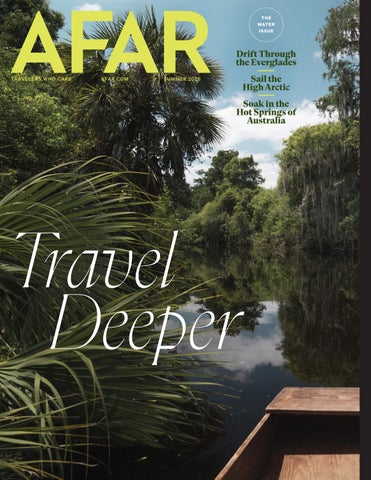
ON THE COVER A traditional skiff drifts through the still waters of the Florida Everglades, home to several communities.
DOWN BY THE BANKS From Omaha, Nebraska to Richmond, Virginia, American cities have invested in their riverfronts, creating new ways for travelers and locals to engage with the water.
Photograph by Vanessa Díaz
16
112
JUST BACK FROM THE CARIBBEAN Afar Editor in Chief Julia Cosgrove travels on the Explora I ship from San Juan, Puerto Rico, to Miami, Florida, biking island paths and taking dips in the sea along the way.
8
D E TR O I T I N TE R NAT I O NAL R IV ER FRON T, M I CHIGAN
ILLUSTRATION: LUCIE WIMETZ
VOICE FROM AFAR
PHOTOS, CLOCKWISE FROM TOP LEFT: ALONSO MUJICA; COURTESY OF HX EXPEDITIONS; SYLVIA JARRUS
59
CELEBRATING THE WORLD RECORD Turkish Airlines now holds the Guinness World Records™ title for The Most Countries Flown to by an Airline. We are proud to share this moment with you.
Table of Contents
DREAM STATE p.78
PETTER BÄCKLUND
Features
Friends often spoke wistfully about summers on the archipelago, mentioning the rustic houses, wild dewberries, midnight swims in the sea.
10
Why cruise when you can Cunard
®
For more than 185 years, Cunard® has carried generations across the oceans, sharing in the journeys that shaped a nation. As the United States celebrates 250 years of independence, Cunard continues that tradition – blending heritage and innovation with warm White Star Service,™ enduring design, and a spirit of celebration woven through every moment at sea. Contact your Travel Advisor, call (800) 728-6273, or visit Cunard.com/AFAR ©2026 Carnival UK Ltd. Ships’ Registry: Bermuda. The Cunard logo and logotype, Queen Mary 2, Queen Victoria, Queen Elizabeth, Queen Anne, and White Star Service are registered trademarks of Carnival UK Ltd, an English company trading as Cunard. All rights reserved in the United States and other countries.
S PA R K S O M E T H I N G E X T R AO R D I N A R Y AT H A N D - S E L EC T E D H O T E L S A N D R E S O R T S I N T H E W O R L D’S M O S T E N C H A N T I N G C O R N E R S, W H E R E I N F I N I T E P O S S I B I L I T I E S AWA K E N F R E S H PE R S PEC T I V E S.
Regent Hotels & Resorts presents
A
S T O R Y Like
BALI CANGGU
S A N TA M O N I C A B E AC H CHONGQING
No
CANNES
P O R T O M O N T E N EG R O
Other
H O N G KO N G BEIJING
SHANGHAI ON T HE BUND
TA I PE I
SHANGHAI PUDONG
PH U Q U O C
AFAR.COM @AFARMEDIA FOUNDERS Greg Sullivan & Joe Diaz
“I was smitten by how present water is everywhere in Hamburg, Germany. Next time I visit, I want to book a room at the Fontenay, set right on the edge of the Aussenalster, one of the city’s glorious artificial lakes.” —H.W.
EDITORIAL
SALES
VP, EDITOR IN CHIEF Julia Cosgrove EDITORIAL DIRECTOR
VP, PUBLISHER Bryan Kinkade
Billie Cohen @billietravels CREATIVE DIRECTOR Maili Holiman
EXECUTIVE DIRECTOR, BRAND PARTNERSHIPS
DIRECTOR OF PHOTOGRAPHY
EXECUTIVE DIRECTOR, BRAND PARTNERSHIPS
Michelle Heimerman @maheimerman DIRECTOR, PODCASTS Aislyn Greene @aislynj DIRECTOR, SOCIAL PLATFORMS Delia Barth @dbarthvader EXECUTIVE EDITOR Katherine LaGrave @kjlagrave
Laney Boland lboland@afar.com, 646-525-4035 SALES DIRECTOR Carly Sebouhian csebouhian@afar.com, 516-633-5647 GLOBAL DIRECTOR, BRAND PARTNERSHIPS David Read
SENIOR DEPUTY EDITOR
SALES, SOUTHEAST
Jennifer Flowers @jenniferleeflowers DEPUTY EDITOR Michelle Baran @michellehallbaran ASSOCIATE ART DIRECTOR Elizabeth See EDITORIAL PRODUCTION MANAGER Kathie Gartrell EMAIL MARKETING MANAGER Tarren Jessop SENIOR EDITORS Jennifer Hope Choi, Danielle Hallock, Hannah Walhout, Shayla Martin
Colleen Schoch Morell colleen@afar.com, 561-350-5540
SENIOR PRODUCER, PODCASTS
Nikki Galteland @nicollegalteland PHOTO EDITOR Charis Morgan ASSOCIATE SOCIAL EDITOR Kayla Brock PRODUCTION EDITOR Karen Carmichael @karencarmic PRODUCTION DESIGNER Myrna Chiu EDITOR AT LARGE Laura Redman @laura_redman CONTRIBUTING WRITERS
Lisa Abend @lisaabend, Chris Colin @chriscolin3000, Latria Graham @mslatriagraham, Emma John @em_john, Ryan Knighton, Peggy Orenstein @pjorenstein, Bonnie Tsui @bonnietsui8, Anya von Bremzen @vonbremzen COPY EDITOR Elizabeth Bell PROOFREADERS Alison Altergott, Jaime Brockway, Pat Tompkins FACT CHECKERS Sophie Friedman, Michelle Lau, Jill Malter, Ellen McCurtin SPECIAL CORRESPONDENTS
Nicola Chilton @nicolachilton, Fran Golden @fran_golden_cruise, Sally Kohn @sallykohn, Barbara Peterson, Paul Rubio, Victoria M. Walker
“One day I hope to snorkel in Puerto Rico’s bioluminescent bays and watch the water light up around me.” —A.P.
Where do you want to travel next to be close to the water?
bryan@afar.com, 646-873-6136 Onnalee MacDonald onnalee@afar.com, 310-779-5648
SALES, SOUTHWEST
Lewis Stafford Company lewisstafford@afar.com, 972-960-2889 REVENUE OPERATIONS MANAGER
Chrissy Schneider cschneider@afar.com ACCOUNT EXECUTIVE Olivia Wilkey owilkey@afar.com CARIBBEAN AMBASSADOR Barry Brown
AFAR MEDIA LLC CHIEF EXECUTIVE OFFICER Greg Sullivan @gregsul VP, COFOUNDER Joe Diaz @joediazafar VP, CHIEF OPERATING OFFICER Laura Simkins DIRECTOR OF FINANCE Julia Rosenbaum @juliarosenbaum21 HUMAN RESOURCES DIRECTOR
Breanna Rhoades @breannarhoades DIRECTOR OF AD OPERATIONS
Donna Delmas @donnadinnyc ASSOCIATE DIRECTOR, SEO & PRODUCT
Jessie Beck @wheresjessieb ACCOUNT MANAGER, AD OPERATIONS Vince De Re STAFF ACCOUNTANT Kai Chen EXECUTIVE DIRECTOR, CONSUMER MARKETING Sally Murphy ASSOCIATE CONSUMER MARKETING DIRECTOR Tom Pesik SENIOR PREMEDIA MANAGER Isabelle Rios PRODUCTION MANAGER Mandy Wynne
SUBSCRIPTION INQUIRIES MARKETING & CREATIVE SERVICES VP, MARKETING Maggie Gould Markey
@maggiemarkey, maggie@afar.com EXECUTIVE DIRECTOR, MARKETING AND SPECIAL PROJECTS Katie Galeotti @heavenk BRANDED & SPONSORED CONTENT DIRECTOR
Ami Kealoha @amikealoha EVENTS DIRECTOR Michelle Cast ASSOCIATE DESIGN DIRECTOR Christopher Udemezue
“After swimming with whale sharks in Baja California, I’ve longed to do it again. To bob alongside these gentle giants at Ningaloo Reef in Western Australia would be a wish fulfilled.” —O.M.
afar.com/service 888-403-9001 (toll free) From outside the United States, call 515-248-7680
“I’d love to do an expedition cruise to Easter Island, Alaska, or Antarctica. The complete remoteness is so appealing. And the animals!” —D.D.
MAILING ADDRESS P.O. Box 458 San Francisco, CA 94104
ASSOCIATE DIRECTOR, MARKETING ACTIVATIONS
Irene Wang @irenew0201 SENIOR INTEGRATED MARKETING MANAGER
Isabelle Martin @isabellefmartin SENIOR PAID MEDIA MANAGER
Courtney Rabel @court_rabel INTEGRATED MARKETING MANAGER Dheandra Jack SENIOR MARKETING ACTIVATIONS MANAGER
Maggie Smith @smithxmaggie MARKETING ACTIVATIONS MANAGER
Mary Cate McMillon @marycatemcmillon BRAND MARKETING MANAGER Alice Phillips @alicephillipz
14
“I’d go back to the Oaxaca coast, where I watched dolphins in the Pacific last year. It was so special seeing these beautiful creatures up close, like a Lisa Frank sketch come to life!” —C.U.
Afar ID Statement Afar® (ISSN 1947-4377), Volume 18, Number 3, is published four times a year by Afar, P.O. Box 458, San Francisco, CA 94104, U.S.A. In the U.S., Afar® is a registered trademark of Afar LLC. Publisher assumes no responsibility for return of unsolicited manuscripts, art, or any other unsolicited materials. Subscription price for U.S. residents: $24.00 for one year. Canadian subscription rate: $30.00 (GST included) for one year. All other countries: $40.00 for one year. To order a subscription to Afar or to inquire about an existing subscription, please write to Afar Magazine Customer Service, P.O. Box 6265, Harlan, IA 51591-1765, or call 888-403-9001. Periodicals postage paid at San Francisco, CA, and at additional mailing offices. POSTMASTER: Please send address changes to Afar, P.O. Box 6265, Harlan, IA 51591-1765.
AN OCEAN OF EXPERIENCES FORTY ISLANDS HUNDREDS OF BEACHES ONE TURKS AND CAICOS
GRAND TURK • PROVIDENCIALES • SALT CAY • NORTH CAICOS • MIDDLE CAICOS • SOUTH CAICOS • PINE CAY • PARROT CAY • AMBERGRIS CAY
www.visitturksandcaicos.com • info@turksandcaicostourism.com
Voice From Afar
A F E W M O N T H S AG O , after 19 hours of travel, I landed
in India at 2 in the morning—stiff, out of sorts, certainly tired. But instead of succumbing to sleep, I showered and left my Chennai hotel with a destination in mind for sunrise: Marina Beach, which curves along the Bay of Bengal for eight miles or so, making it India’s longest urban beach, and the second-longest in the world. I was not the only one with the idea. As vendors set up their food stalls, young men and women walked into the surf, posing for friends with the orange sky behind them. I was happy to welcome a new day, and a new trip, so close to the sea. Water has always been my favorite conduit for acclimating to a new destination—afloat, submerged, or just nearby. The experience of it is sensory, yes, but it also plunks you into a culture; after all, for centuries, places have been shaped by their relationship to water, whether there’s a lot of it or a little. In this issue, I’m excited to dive into the diversity of ways that water shapes our travels. 16
In good travel, K ATHERI NE LAG R AV E
Executive Editor
Chennai’s Marina Beach, a popular launching point for small fishing boats, is home to a lively seafood market.
MAHESH BALASUBRAMANIAN
Water Ways
On page 44, we hear from a paleontologist about how, every spring, heavy rain transforms Wyoming into one of the country’s top fossil-finding states. As part of our coverage celebrating the country’s semiquincentennial, we also highlight seven U.S. cities that are reclaiming their riverfronts—and making them, once again, the place to be (page 59). Elsewhere, contributing writer Lisa Abend gets to know Sweden’s go-to summer destination while touring the idyllic island of Gotland (page 78), and in Australia, contributing writer Emma John takes a road trip along the Great Victorian Bathing Trail, visiting spas, soaking in hot springs, and jumping into the ocean (page 90). Closer to home, Carrie Honaker reports on the people helping to protect the Florida Everglades (page 102) and how travelers can experience this special ecosystem. Wherever you read these stories, I hope they inspire you to think differently about water—and spark an idea for your next trip.
Mark the moment. Discover the wild. As we honor America’s 250th milestone, you’re invited to discover Alaska with Princess® — the #1 cruise line* in the region. Against the backdrop of breathtaking glaciers, our world-class dining, dazzling entertainment and renowned service inspire memories that will last a lifetime. Visit Princess.com or call your travel advisor to book your adventure today.
©2026, Princess Cruise Lines, Ltd. Princess®, MedallionClass®, and the Princess logo are trademarks of Princess Cruise Lines, Ltd. or its affiliates. All rights reserved. Ships registered to Bermuda. *More guests chose Princess in Alaska than any other cruise line based on highest number of guests in 2023.
CHARLESTON, by wa te r The Cooper River has long shaped the Charleston area—its harbor, its history, its neighborhoods, and its way of life. It carries the Lowcountry toward the Atlantic, passing storied streets, quiet marshes, waterfront parks, marinas, restaurants, hotels, and resorts that invite visitors to experience the destination from the water’s edge. From sunrise over the dunes at The Sanctuary at Kiawah Island Golf Resort or Wild Dunes Resort to cocktails with harbor views at Hotel Bennett or Charleston Harbor Resort & Marina, Charleston makes it easy to stay where the water is always within reach. Along the river, The Cooper and The Dunlin, Auberge Collection offer their own sense of riverside serenity, each reflecting a rare kind of Lowcountry luxury: graceful, deeply rooted, and inseparable from the tide. Here, days begin with river light and harbor breezes. Afternoons unfold by boat, by beach, or along the water. Evenings linger over fresh seafood, rooftop views, and stays that keep the coast close. In Charleston, the river is more than scenery. It is the current that connects it all—elegant, effortless, unforgettable.
You are always welcome here. History loves company.
CHARLESTON south carolina
@EXPLORECHARLESTON
EXPLORECHARLESTON.COM
STEP INTO RHYTHM
WITH THE U.S. VIRGIN ISLANDS From the moment you arrive, you will feel connected to the rhythm of our islands. St. Croix, St. John, and St. Thomas are home to rich culture, friendly people, pristine beaches, and diverse natural beauty. We can’t wait to warmly welcome you to America’s Caribbean Paradise.
VISITUSVI.COM
ONE GREAT BLOCK
|
STAY P.26 |
CONNECT P.39 |
BEHIND THE SCENES
P.44 |
UNPACKED P.49 |
GOOD TRIPS P.52
WAN DER CURIOUS TRAV ELERS O NLY
O N E G R E AT B L O C K
ALONSO MUJICA
Lima, Peru
With a newly upgraded airport and a wave of creative momentum, this city of 10 million residents is primed for the global spotlight. The sprawling metro area is best approached neighborhood by neighborhood—here’s a stretch not to miss in the bohemian seaside district of Barranco. ➜ by Katherine LaGrave
21
WA N D E R / O N E G R E AT B L O C K
1. Dédalo Arte y Artesanía
co Barrana, Lim Peru AV. AL MI RA NT
Modern Peruvian wares are on display at Dédalo, an arts and crafts store inside an old colonial home. The rooms are filled with ceramics, jewelry, glassware, handmade silver pieces, toys, and textiles from more than 700 artisans, all selected by founder María Elena Fernández. Av. Sáenz Peña 295
ÍN
2 1
AV. SÁ EN Z PE
3. Ciclos Café and El Cacaotal
ÑA
Occupying a bi-level space, Ciclos and El Cacaotal are devoted to Peruvian specialty coffee and craft chocolate, respectively. Founders Amanda Jo Wildey (pictured) and Felipe Aliaga offer English or Spanish tastings that highlight the important role of both ingredients in Peru. Email elcacaotalperu@ gmail.com to book. Jirón Colina 111
4. Demo
3
Though Demo’s interior design is the stuff of minimalist dreams, dishes here are best enjoyed outside on the terrace. Food at this all-day café (from chef Juan Luis Martínez, who runs a fine-dining spot, Mérito, nearby) blends Peruvian and Venezuelan influences. We’re partial to the cold brew–topped orange juice and the arepa benedictina, a reimagined eggs Benedict. Jirón Domeyer 282
R
5. Barranco Municipal Park
4
J
IRÓ
O ND
ME
YE
MA
5
AV.
PED
RO D
E OS
PACIFIC OCEAN
6
Inaugurated in 1898, the neighborhood park is still the place to see and be seen. Look for the heritage-listed coral-pink library, completed in 1922, on the southern edge, and Parroquia La Santísima Cruz to the north—legend has it that the historic yellow church stands on the site where Barranco, once a tiny fishing village, was founded. Between Av. Almirante Miguel Grau and Av. Pedro de Osma
6. Kjolle Chef Pía León founded Kjolle in 2018 and was named Best Female Chef in Latin America by the World’s 50 Best guide that same year. Her restaurant showcases the cultural and biological diversity of Peru through a ninecourse tasting menu. A standout dish, “Many Tubers,” features yuca, sachapapa, and ullucu—native root vegetables cultivated by Indigenous peoples in the Andes and Amazon for millennia. Av. Pedro de Osma 301
7. Pedro de Osma Museum
7
22
Pedro de Osma Gildemeister was a 20thcentury philanthropist and collector whose French-style mansion now displays art from Peru’s period of Spanish colonial rule. The collection includes everything from Jesuit religious paintings to llama figurines made by Inca metalsmiths. Av. Pedro de Osma 421
FROM 1 TO 7: SOFÍA LORES/DÉDALO ARTE Y ARTESANÍA; ALONSO MUJICA; KEN MOTOHASI; MICHELLE SIKIC/ASTRO STUDIO; EUGENIO FELIX/PEXELS; CAMILA NOVOA; MICHELL LEÓN/PROMPERÚ
Casual, charming Cordial serves natural wine in a dimly lit basement lined with shelves of bottles and vinyl records. DJs spin after sunset from Friday to Sunday, and events are announced on Instagram: @cordial_barranco. Av. Almirante Miguel Grau 810
AU
AV. SA N MA RT
E MI GU EL GR
2. Cordial
One surfer. One horizon. One stretch of coast where the Pacific still sets the pace. This isn’t just California. It’s the feeling that made California famous. Elevate your beachfront stay on the coast. Visit us at SurfCityUSA.com
ADVERTISEMENT
Maybe It’s Time for a Different Kind of Journey Explora Journeys reimagines luxury travel as something more fluid, deeply personal, and inspired by the Ocean State of Mind.
M
aybe luxury travel doesn’t need to follow the usual rules. Crowded schedules, fixed addresses, and familiar expectations aren’t requirements. A transformative experience can simply be about more space, a slower rhythm, and a different point of view. Explora Journeys invites you to consider a new way of traveling by sea— inspired by the ocean, guided by curiosity, and defined entirely by how it makes you feel.
A single check-in unlocks multiple destinations. From the celebrated coastlines of the Mediterranean to the dramatic fjords of Northern Europe, a gentler pace and deeper immersion create memories that last. Maybe the best journeys include nearly everything: distinct culinary experiences across multiple restaurants, dedicated wellness programs, unlimited beverages, and evenings enjoyed however you choose. Explora Journeys’
seamless experience allows for complete peace of mind, so you can be more present in the moment. This is the Ocean State of Mind— an unhurried, serene approach to exploration, where the ship itself becomes the destination. It’s a calmer, more expansive, and personal vision of luxury shaped at every turn by the sea. Begin your journey at ExploraJourneys.com
“Gone are many of the hallmarks of a typical cruise ship, in favor of a more boutique, tailored experience.” —Afar
WA N D E R / S TAY
A Shore Thing
New and renovated hotels arrive in some of our favorite coastal destinations, including a reborn architectural icon in Hawai‘i and a pair of openings in the Venetian Lagoon. Plus: A beloved Mexico City seafood restaurant expands stateside.
In Charleston, South Carolina, the Cooper’s rooftop infinity pool has some of the best harbor views in town.
26
THE COOPER
Edited by Jennifer Flowers and Hannah Walhout
ADVE RTISEME NT
What makes the Tasmanian landscape so incredible is its mind-boggling diversity. Waterways flow through ancient rainforests and vineyard valleys to coastal farms and white-sand beaches. Breathe in some of the world’s cleanest air and discover a culinary haven paired with a lifestyle custom-built for outdoor life. Alpine peaks overlook glacial lakes, old-growth trees, and grazing wombats in Cradle Mountain–Lake Saint Clair National Park, Tasmania’s best-known wilderness. Handcrafted pine kayaks cut across Dove Lake. Adventurers can hike the six-day Overland Track to Lake Saint Clair, Australia’s deepest lake.
Time your visit for Hobart’s Taste of Summer festivities (typically December 27–January 3) at Sullivans Cove during the Sydney Hobart Yacht Race. Food stalls and pop-up bars line the waterfront as yachts stream into Hobart’s harbor ahead of New Year’s Eve fireworks.
Map your adventure at DiscoverTasmania.com.au
Winding past vineyards famed for sparkling wine and long lunches, the Tamar River leads north to Launceston. From the city center, stroll to Cataract Gorge, where hiking trails, suspension bridges, and a scenic chairlift cut through dolerite cliffs and fern glades.
On the drive to Freycinet National Park, stop at Freycinet Marine Farm to pull on waders and pluck oysters directly from the water. You’ll learn what makes them so prized and wash your harvest down with a glass of local wine. Or you can simply linger over a fresh seafood lunch on-site.
WA N D E R / S TAY
On the Waterfront The Cooper, a new hotel overlooking Charleston Harbor, puts the city’s waterways in the spotlight.
28
From top: The Crossing, the Cooper’s signature restaurant, has a raw bar menu; hotel interiors were styled by New York–based Champalimaud Design. THE COOPER (2)
Charleston, South Carolina, is a place defined by water—but until recently, its hotel scene has been more focused on pastel facades and cobblestone streets than the city’s historic harbor. That changed in March with the debut of the Cooper, Charleston’s first luxury waterfront hotel, situated on the eastern edge of the French Quarter where the Cooper River pours into the Atlantic. The second property from the local Beemok Hospitality Collection, which also owns nearby Charleston Place, its 166 rooms and 25 suites are done up in Southern coastal style, with shiplap walls, natural textiles, and in many rooms, French doors opening onto private balconies or patios. The hotel has four dining venues, including the Crossing, a Mediterranean-inspired restaurant where chef Nick Dugan turns out whole grilled branzino and octopus with fava beans. Wellness is also a selling point: There’s a 7,000-square-foot spa, a rooftop pool, and an indoor-outdoor vibe. But the standout amenity is the on-site marina—a launching point for fishing trips or charters on the hotel’s 43-foot Hinckley yacht—which brings tidal creeks, barrier beaches, and layered maritime history into the traveler’s Charleston experience. From $850
LIFE PAUSED A place designed to slow everything down
EXPERIENCE A VACATION AS IT WAS MEANT TO BE RESORTS IN : CANCÚN
RIVIERA MAYA
PUNTA CANA
www.theexcellencecollection.com
MONTEGO BAY
SCAN TO LEARN MORE
Contact your travel advisor, call 1.888.928.0237 or visit amawaterways.com today.
WA N D E R / S TAY
At Tintswalo Summer House in Cape Town, the cheery yellow Citron Room is designed to be energizing and mood-lifting.
In South Africa’s “Mother City,” standout interior design is bringing color and creativity to the hotel scene.
MOREA HOUSE, AUTOGRAPH COLLECTION On a quieter section of the busy Camps Bay beachfront, the 90-room Morea House, which opened in December 2025, offers guests the best of both worlds: from the back of the property, views of Lion’s Head and the Twelve Apostles mountains, and in front, the Atlantic surf breaking on the shore just across the road. Interiors by Cape Town designer Tristan du Plessis make 32
ample use of natural materials; the wood- and marble-lined lobby features works from top South African artists, including portraits from the painter known as WonderBuhle. From the ceiling hangs a chandelier of bronze and stone “wildflowers,” custom made by ceramicist Jan Ernst. Also on the ground floor is Omri, an all-day Lebanese restaurant; the floor above has an outdoor pool and Morea Pool Restaurant, both with uninterrupted ocean vistas. From $900
In the affluent neighborhood of Sea Point, filled with art deco buildings, the Cole stands out with its signature sculptural curves. Also opened at the end of 2025, it’s the third hotel from local hospitality juggernaut Kove Collection, responsible for some of the city’s chicest restaurant hangouts. Each of the minimalist, champagne-colored rooms and suites (60 total) has an ocean- or mountain-facing balcony; other amenities include a small but serene spa and a rooftop pool. Adjacent to the pool is Figo, an indoor-outdoor restaurant that faces the ocean and specializes in Italian cuisine and seafood. The hotel’s ground floor hosts
a well-curated boutique and a secret star venue: Script, one of Cape Town’s finest lobby bars, serving imaginative cocktails in an eclectic midcentury modern– style space. From $440
TINTSWALO SUMMER HOUSE Navigating the sedate coastal suburb of Glencairn, about a 45-minute drive south of the city center, it’s hard not to notice the stately bright-pink facade of this landmark early-1900s hotel. Eleven years ago, Tintswalo, an esteemed family-run hospitality brand in South Africa, bought the former Glencairn Southern Right Hotel and has since transformed it into the colorful Tintswalo Summer House—a 12-room property envisioned by in-house
TINTSWALO COLLECTION
Cape Town Cool
THE COLE BY KOVE COLLECTION
100 WORDS ON . . .
Contramar Coming to the Strip The celebrated Mexico City restaurant opened its first U.S. outpost, Cantina Contramar, in March, taking its coastal cuisine to the Fontainebleau Las Vegas resort. Chef Gabriela Cámara shares what she hopes to bring to diners.
COURTESY OF STUDIOLANDT (ARTWORKS BY LORENZO PLAATJIES)
Mount Nelson’s new suite by designer Thebe Magugu (pictured) hosts a rotating art selection from local galleries such as Southern Guild.
designer Camlyn Johnston that opened in April 2026. No two rooms are alike, distinguished by chromatic themes: The Azure Room has cerulean bathroom tiles; the Noir Room is done up in subdued hues of black, white, and burgundy and features a muted floral-print headboard. The hotel also has a surf and turf restaurant, Summer House Eatery, and an outdoor pool. From $215
MOUNT NELSON, A BELMOND HOTEL Cape Town’s British-inspired grande dame has welcomed the world’s elite through its palmlined promenade since 1899. But thanks to South African fashion designer Thebe Magugu (who counts model Tyra Banks and singer Tyla among his fans),
Mount Nelson has also become a canvas for Afro-modernist luxury and storytelling. In March 2026, the property debuted an outpost of Magugu House, the Johannesburg-based gallery and concept store known for championing Black African artists. It coincided with the opening of the Thebe Magugu Suite next door, a two-story, townhouse-style accommodation that embodies Magugu’s blend of heritage and futurism. The designer handpicked everything inside, from the pendant light in the dining room—inspired by a hat form traditional to the region’s Sotho ethnic group—to several pieces by contemporary South African artists, such as Lorenzo Plaatjies and Zandile Tshabalala. From $1,200; suite price upon request —Travis Levius
“The convivial spirit at Cantina Contramar is driven by the kindness of the people who welcome you, and by food that isn’t uptight—the tuna tostadas, the pescado a la talla [grilled fish with adobo sauce]. I take pride in introducing many people to Mexican food, which has simple, direct flavors and many dishes that any person can enjoy. I really am excited to cater to a public that isn’t used to having Mexican food treated as comparable to Japanese, Italian, and French. I hope to entice people into tasting more Mexican food than they ever thought they would like.”
WA N D E R / S TAY
WH ICH STAY WI NS?
Serenissima Showdown In Venice, two new ultra-luxury hotels opened their doors to guests this spring. Here’s what to know—and how to choose.
ORIENT EXPRESS AIRELLES PALLADIO VENEZIA VENICE T H E LO CAT I O N
Set in residential Cannaregio, the city’s northernmost district, Orient Express Venezia is away from Venice’s heaviest foot traffic, but within about a 20-minute walk of most major sights. Arrival by water taxi to the entrance on the Rio de Noale canal adds a feeling of seclusion.
Airelles Palladio is located on the quieter island of Giudecca, which is accessible from the historic center only by boat. Con: You’ll have to catch a (quick) vaporetto to get to the heart of town. Pro: Many rooms have views of the Doge’s Palace and Piazza San Marco across the canal.
THE VIBE
Opened in April, the Orient Express is for design-minded travelers who want a classic Venice immersion and don’t mind forgoing some amenities (such as a swimming pool) to get a truer taste of local life. For those arriving or departing on La Dolce Vita Orient Express, it also extends the romance of the rails—and the train journey and hotel can easily be booked together. From top: Orient Express Venezia is the brand’s second hotel; Palladio is the first Airelles property outside France.
In tightly packed Venice, Airelles debuted in May with a more resort-style experience: four swimming pools, 2.5 acres of gardens, and an 18,000-squarefoot spa (the largest in town) by Guerlain. A music venue called Elton’s Club—a collaboration with part-time Venice resident Elton John—opens in September. There’s even a Kids Club, making it a solid choice for families.
THE DESIGN
The 47 rooms occupy the Gothic-style Palazzo Donà Giovannelli, a 15th-century structure designed by Venetian architect Filippo Calendario. Original details—the pink-andwhite stone facade, the frescoes and mosaics within—have been restored under architect Aline Asmar d’Amman, and interiors are rich with Venetian silk walls and Murano glass chandeliers.
This property has 45 rooms and suites spread across a cluster of historic buildings (including a church and convent), many of them attributed to the resort’s namesake, prominent 16th-century architect Andrea Palladio. Christophe Tollemer, the brand’s go-to designer, includes many nods to Venetian art and craft, such as handpainted frescoes and Rubelli textiles.
Chef Heinz Beck, whose Rome restaurant, La Pergola, holds three Michelin stars, oversees the culinary program. There’s his eponymous fine-dining spot (dishes include red prawns with Venetian Lagoon seaweed) as well as La Casati, a more casual, all-day venue. For cocktails, head to the Wagon Bar, an art deco–style space that evokes an Orient Express train car.
Airelles recruited several bigname chefs to bring their visions to Venice for the first time. The three restaurants on-site offer both global flavors—omakase from Nobu Matsuhisa, modern Mediterranean courtesy of JeanGeorges Vongerichten—and fine dining from Italian chef Norbert Niederkofler, whose “Cook the Lagoon” tasting menu highlights local ingredients.
THE PRICE TAG
From $1,200 34
From $1,640
FROM TOP: GIULIO GHIRARDI; VINCENT LEROUX
THE FOOD
HEAR THE SYMPHONY OF NATURE UP CLOSE.
THIS IS PARADISE IN EVERY SENSE
PLAN YOUR ESCAPE AT PARADISECOAST.COM
WA N D E R / S TAY
Aloha, Old Friend
From top: When it opened, Mauna Kea was considered the most expensive hotel ever built; the renovation honors its tropical-modernist roots.
With additional reporting by Tim Chester, Laura Rysman, and Catherine Toth Fox 36
For decades, Mauna Kea Beach Hotel set the standard for highend hospitality on Hawai‘i’s Big Island. Financier-conservationist Laurance S. Rockefeller encountered the site above Kauna‘oa Bay, one of the few white-sand beaches on lava-laden Hawai‘i, in 1960, and opened the resort five years later as the island’s first major luxury retreat. In 1967, the American Institute of Architects recognized its open-air terraced design—the vision of Skidmore, Owings, & Merrill—in its annual Honor Awards, citing the hotel’s “restrained detailing and fine spacial sequences in a completely contemporary idiom.” An extensive renovation has recently transformed much of the 1,800acre property, now a member of Marriott’s Autograph Collection, with a new 22,000-square-foot spa, updates to all 252 rooms and suites, and redeveloped menus with an emphasis on local producers (plus ingredients from a new half-acre garden). But many defining elements remain, including the original blue-tile floors of the lobby and the iconic circular family pool overlooking the ocean. The distinguished Rockefeller Art Collection also remains on-site, complete with an app that catalogs the more than 1,600 rare or historically significant works—basket-weave masks from Papua New Guinea, Hawaiian kapa cloth made from pounded bark—created across the Pacific Rim. From $1,199
FROM TOP: MAUNA KEA BEACH HOTEL ARCHIVE COLLECTION; MAUNA KEA BEACH HOTEL
The storied Mauna Kea Beach Hotel celebrates 60 years with a $180 million transformation.
“I turned into a child again when I saw my first iceberg.” Anne, Hampshire
Change the way you see the world *Cruise Industry News: 2025 Expedition Market Report
888-968-5583 | travelhx.com | Contact your travel agent ABTA: Y6835 | ATOL: 12642
WA N D E R / C O N N E C T
Lesson Plans
On a tiny Indonesian island, writer Freda Moon honors her late father—and ponders the legacy of a life-changing trip. Illustrations by Elfi Husniawati
39
WA N D E R / C O N N E C T
I
I WA S 1 0 W H E N my dad pulled me from my fourth-grade Northern
California classroom, along with a stack of independent study materials, to travel to Southeast Asia. He was a single father who’d just had a bad breakup with his then-girlfriend, a beautiful park ranger named Ann. Suddenly, he aspired to start a sailboat charter business as far from Mendocino, and Ann, as possible. During the two months abroad, Dad and I traveled through Micronesia, Japan, Hong Kong, Thailand, and the Philippines. I remember my awe at swimming among giant clams and reef sharks in Palau, and my dad marveling at the mega yachts and hover ferries in a Hong Kong bay. As we moved from place to place, my brain was a sponge in an ocean of newness. It sucked up what it found compelling: marine ecology, World War II history, how colonization influenced Filipino foods (spaghetti, fried chicken, ketchup). I learned how to learn on that trip—how to immerse myself in something that interested me, to ask questions, to study for fun. My dad never started the sailboat charter business. But our trip set the course for my life. It turned me into a traveler, yes, but also a journalist, and a person with a restless curiosity. I’m now in my mid-forties, with a 10-year-old daughter of my own, Roxie, and a seven-year-old son, Felix. In the 35 years since my first trip to Southeast Asia, I’ve never again seen underwater life as kaleidoscopic and vibrant as I did then. This year, with Roxie 40
on the cusp of middle school, I felt the urgency to see my own kids experience abundant marine life. My travels, it turns out, also made me the kind of parent who prioritizes international adventures over time in school. With that in mind, my husband Tim and I maxed out the kids’ independent study allowance and traded our credit card points for plane tickets to Singapore. From there, we would begin a monthlong trip through Malaysia and Indonesia, two countries new to all of us. On the 17-hour flight from our home in the Bay Area in January, Roxie curled up beside me. Her long limbs everywhere, she looked like an ostrich chick pushing against its shell. Staring at her as she slept, I thought of my dad—circa 1991—with his own gangly little girl. Then, I flashed to his ashes, carefully spooned into a Ziploc bag and pressed into a round, palm-size tin, tucked into my carry-on. It was just enough of him to sprinkle in a new patch of ocean, as I have again and again in the four years since he died.
I
“ I T ’ S A F I S H TO R N A D O,” Felix said, dropping
his line into the water. He stood stoically alongside local men in sarongs on Gili Air, one of three city-park-size islands off the northwest coast of Lombok, Indonesia. Below us, toothy teal-and-fuchsia parrotfish, prison bar–striped angelfish, and two-foot-long needlefish circled. They nibbled and batted at Felix’s stale bread but didn’t bite. There are no cars on Gili Air, so we rented sturdy bikes with thick tires for $2 a day and rode across the island’s two square miles. We filled our days idly, sprawled on a patch of sand, drinking magenta dragon-fruit juice between snorkeling sessions and card games. When the afternoon rains came, we flew through puddles as we raced back to our rental. On one of our rides, Felix found his place: the municipal dock, where fishermen gathered at dusk and dawn. He crouched at the edge, staring into water that glowed an iceberg blue beneath the nearby streetlights, desperate to join the action. He got lucky. Among the men there that evening was Idris, who ran the island’s fishing shop. Seeing Felix’s enthusiasm, Idris lent him a compact tackle box of lures and bobbers to use with his simple line. Each Gili island is small enough to circumnavigate in an hour or so. On the first morning Felix took me fishing with his new gear, he led the way, pedaling furiously along the island’s narrow alleys in the near dark, dodging residents returning from the predawn Ramadan meal of suhoor and the few tourists who remained after the start of the holy month—most of whom seemed to be catching a ferry to leave. Sleep deprived from waking with the call to prayer, I felt like a tipsy marlin weaving through the motorless traffic with a fishing pole balanced on my handlebars. Felix doesn’t eat “sea meat,” which was especially unfortunate in a country with some 17,500 islands. He threw back every small, flopping fish he caught, though there weren’t that many. Rather than fishing to provide for the family, he seemed drawn instead to the discipline of rising early, mingling among strangers and swapping tips across
a language barrier. With each cast, I saw him embedding himself in a place we were otherwise just passing through. And I watched him becoming the person he will grow into: someone with his own passions born of adventure, someone fast to make friends, someone who wants to be part of something.
R
experience that ocean of newness beyond their Bay Area suburb, to find themselves in the larger world in the way I had. But on Gili Air, I realized what I was seeking was something more: the concentrated, focused togetherness that only comes when we’re away from the busyness and overload of daily life. For our family, that time is found on and in the water. And for me, the intimate moment in the sea between Roxie and me and the turtle felt like
R OX I E , M E A N W H I L E , is semiaquatic. The number
of hours per day she can spend in the ocean sometimes seems limitless. One afternoon on Gili Air, she and I were far from shore when she paused to adjust her snorkel mask. I treaded water, waiting, until I felt something behind me. I turned. The largest sea turtle I’d ever seen was coming straight for me. I waved and spat garbled words to Roxie, “Tuuurtle, tuuuuuuurtle!” She shoved her face into the water just as the animal dipped and glided below me. It was so close, and so big, with a carapace nearly as long as me (at five-foot-five). I felt a rush of adrenaline, the distinct anxiety of being out of my element. We swam to shore without stopping, emerging silent and stunned. Unlike in the early 1990s, when dad and I encountered discarded turtle carcasses on Southeast Asian beaches, conservation efforts seemed to be everywhere, and successful. During this trip, Tim, the kids, and I spotted suitcase-size hawksbills camouflaged in the seabed and watched hundreds of clumsy baby turtles slosh like children’s bath toys before being released to the Indian Ocean. Prior to our time on Gili Air, I’d thought of this kind of trip—a childhood adventure to what feels like the ends of the Earth—as an education. I wanted Felix and Roxie to
I realized what I was seeking was something more: the concentrated, focused togetherness that only comes when we’re away from the busyness and overload of daily life. the reason we’d come all this way. It was storming on the day we left, and we nearly missed our ferry. We returned our bikes in the rain, then loaded a horse-drawn carriage with our bags, and that poor horse galloped, bells jangling, to the port. We arrived just in time to catch a dinghy to our ferry, itself too big to come ashore in the shallow waters. The ferry skirted Lombok’s steep, green coast before powering west across the strait. We were only a half hour into our four-hour transit to Nusa Lembongan, an island southeast of Bali, and Felix already looked queasy. I told Tim I needed a minute and lurched to the upper deck, where I was alone except for one mother and her son. The boat was rolling in the steep, irregular swells. I braced myself against the railing, watching the Gilis evaporate into the dark clouds, wind slapping my face as I carefully emptied dad’s ashes from their tin. As they blew out across the Indian Ocean, I thought, this is my inheritance—this unconventional life, this fierce love of family, this way that being at sea feels like home. Writer Freda Moon lives on a 50-foot boat in the Bay Area. Self-taught illustrator Elfi Husniawati is based in Indonesia.
A city where nature runs deep.
MotherNaturesCity.org
In the heart of this vibrant city lie 200+ miles of shoreline and 6,000 acres of lush parks, all yours to explore. From the snowcapped mountains surrounding it to the wildlife thriving within it, Seattle has the perfect blend of city and nature everywhere you look.
WA N D E R / B E H I N D T H E S C E N E S
Can You Dig It? Amateur paleontologists flock to Wyoming in the hopes of striking fossil gold. Casper College’s resident dino-whisperer shows them how it’s done. by Leilani Marie Labong
AT THE FIRST CLAP OF THUNDER in late spring, Jean-Pierre “JP” Cavigelli
dusts off his sturdy boots, wide-brimmed hat, rock hammers, and bristle brushes. The rainstorms that roll across the high plains of central Wyoming, where the paleontologist has led public digs for more than two decades, wash away surface sediment—exposing badlands and eroding outcrops and gullies. The fossils that emerge can date from 180 million years ago, when brontosaurus and other sauropods roamed the land, to around 66 million years ago, when Tyrannosaurus rex ruled. Cavigelli, 64, got hooked on fossils after finding remains of ancient mammals and turtles during a trip to South Dakota while on a break from college. But Wyoming, his home for the last 35 years, has the best digs in the country. Once a prehistoric network of rivers and coastal lowlands beside an inland sea, the state is one of the most fossil-rich in the U.S., ranking second (after California) in recorded discoveries. It’s where Cavigelli made his “legacy find” back in 2005: a specimen christened “Lee Rex” after the owner of the ranch where Cavigelli’s team unearthed it, and now the only Wyoming T. rex to have stayed in the state permanently after excavation. Lee Rex is housed at the Tate Geological Museum in Casper, where Cavigelli works as a collections specialist and leads a series of open-tothe-public digs each summer. The five-day expeditions (food and lodging included) bring travelers to sites on private ranches in Wyoming, where fossil hunters can spend dig-days kneeling in the dirt searching for teeth, bones, shells, and other fragments. “Our citizen scientists may not be entering data, but they are certainly contributing Clockwise from top left: to it,” says Cavigelli. Anything the group Alcova Reservoir, a popuunearths is brought back to the Tate’s prep lar dig site; paleontologist Jean-Pierre “JP” Cavigelli; lab for further study—or to be cleaned for Casper College’s iconic possible display. sculpture, Essence of Rex. Cavigelli has never seen the digs sell out so quickly as in 2026, when spots (limited to eight per trip) filled up in less than 24 hours. It may point to a burgeoning interest in citizen science experiences, a growing category in the travel industry—though Cavigelli also posits the success of the 2025 film Jurassic World Rebirth as a possible contributor. Still, he likes to manage any blockbuster-size expectations: “People always ask, ‘Will I find a claw? Will I find a tooth?’” he says. “And the answer is, ‘You might.’” But most days in paleontology are patient ones. What’s the rush, when you’ve got “deep time”—the 4.5-billion-year sweep of Earth’s history—on your side? The Tate Geological Museum will announce 2027 dig dates in January at caspercollege.edu/digs. Past trips have started at $1,350 per person.
45
THIS PAGE: CANDIDS WITH CAIT. OPPOSITE PAGE, FROM TOP: ZACH NAGY/CASPER COLLEGE PHOTO; CANDIDS WITH CAIT
ADVERTISEMENT
WHERE MAINE MEETS THE SEA A local coastal expert shares her picks for beach yoga, cliffside walks, fresh seafood, and more.
“We have thousands and thousands of miles of coastline… that’s pretty unique,” says Katie Giannakopoulos, a coastal dynamics research associate with the Gulf of Maine Research Institute who enjoyed childhood summers on Maine beaches. Many visitors don’t realize how easy it is to get out on the water, she says, whether riding the mail boat between five different Casco Bay islands, going on a sunset cruise, or renting a kayak to explore the shoreline coves. For an adventure, try guided whitewater rafting along the Penobscot and Kennebec rivers.
More relaxed options include tubing the Saco River, paddling Sebago Lake, and exploring a watercraft restoration center and learning about Maine’s lobstering industry at the Maine Maritime Museum. In southern Maine, her favorite destination is Scarborough’s Pine Point Beach, a four-mile stretch she says is less crowded and wider than some other southern Maine spots. There, Giannakopoulos starts her mornings with Scarborough Yoga’s summer beach yoga, followed by coffee at nearby Café Luna and a stroll around Portland Head Light at
Fort Williams Park. Another scenic walk in the area is Ogunquit’s cliffside Marginal Way with stunning views of the Atlantic Ocean and rocky coves dotting the seashore.
“the charm of a small town” and the energy of working ports woven throughout the beautiful seaside landscape.
Start planning at For post-beach meals, she turns to restaurants that primarily serve local seafood, like Luke’s Lobster, Eventide Oyster Co., and Luna Rooftop Bar. (Head to gmri.org, the Gulf of Maine Research Institute’s website, for its guide to fresh-caught fish.) Wherever you go in Maine, it’s easy to unplug and unwind, Giannakopoulos says, with
VisitMaine.com
CHEERS
TO SUMMER Fresh seafood by the ocean, handfuls of wild blueberries and sunset dinners on the farm. In Maine, summer flavors are best enjoyed outdoors.
VISITMAINE.COM
THE OCEAN NEEDS MORE FRIENDS
The Surfrider Foundation is dedicated to the protection and enjoyment of the world’s ocean, waves and beaches, for all people, through a powerful activist network.
Photo: Allegra Hutton
WA N D E R / U N P A C K E D
Tides of Belonging Across the United States, seaside spaces founded by Black Americans reveal a history of recreation, resilience, and refuge. by Latria Graham | Illustrations by Hayden Goodman
T H E S O U T H CA R O L I N A SA N D of Myrtle Beach, smooth as baby powder, coats the bottom of my feet as I make my way across it, deep in thought. I have come to this place, not far from where the Little River meets the Atlantic Ocean, to better understand where my body fits in U.S. history. Mere decades ago, my great-grandfather Moses Graham would not have been able to walk here as I do today. As a Black man in the 1940s, living under Jim Crow laws, Moses had only a four-block stretch of nearby Atlantic Beach open to him. In its heyday, this area was referred to as the “Black Pearl.” There were hotels, motels, and dance and music halls; Black artists touring on the Chitlin Circuit came through town because they could perform, dine, and stay at the same venue. Musicians such as Duke Ellington, Billie Holiday, and Little Richard played a little farther down the strip at a Black-owned entertainment space called Charlie’s Place.
49
WA N D E R / U N P A C K E D
Whether banned by law or social custom, Black folks made their own oases across the country.
50
Much has been written about the lack of Black visibility in our national parks, but less is reported about Black people’s historically restricted access to “blue spaces,” including lakes, beaches, and other waterways, as the result of slavery and segregation. That’s the problem with history that happens by the seaside—water doesn’t preserve evidence the way land can. I’ve spent much of the last decade investigating the larger question of who gets to recreate where. I’ve sought out why these exclusionary policies existed, and what’s left to mark this history. These inquiries have led me to places such as Highland Beach, Maryland—founded in 1893 by Major Charles Remond Douglass, son of abolitionist Frederick Douglass—and to American Beach on Amelia Island, Florida, established in 1935 by A.L. Lewis as a recreation space for Black Americans. There are sites such as Freeman and Seabreeze beaches in North Carolina, and lesser-known areas of major cities, like Chicken Bone Beach in Atlantic City, New Jersey, and Mosquito Beach on James Island, a short ride away from the cobblestone streets of Charleston, South Carolina. Whether banned by law or social custom, Black folks made their own oases across the country, from stretches in Manhattan Beach, California, to others on Martha’s Vineyard in Massachusetts. Each place stood in contrast to white-owned operations and the humiliation and denigration that came with being turned away from restaurants, hotels, and gas stations throughout the first half of the 20th century. Now, when I plan my trips, I ask: What is the history of this place, and where could historically marginalized people relax on a day off? Where do they go now? Understanding the specific context of lesser-known spaces means that I can find ways to mindfully engage with and support the local businesses at the heart of these communities and the organizations working to share their stories. Ahead of my travels, I search for recognized or proposed National Heritage Areas along the water like the Gullah Geechee Cultural Heritage Corridor, a stretch of coastal lands and islands from North Carolina to Florida. Designations like these are meant to preserve a region’s cultural traditions while promoting sustainable tourism and providing economic opportunities for locals. The African American Heritage Water Trail in Illinois, which highlights the stories of Black Americans who made their homes along its waterways, is another route. Today, Charlie’s Place in Myrtle Beach is a business incubator offering workspaces to entrepreneurs and a museum that gives weekly tours highlighting the venue’s role in American music. A mile away, the Myrtle Beach Colored School Museum and Education Center details the contributions of African Americans working to create better opportunities for the future. Guides such as the Martha’s Vineyard Black-Owned Business Directory spotlight where to eat, shop, and stay on the island, while the African American Heritage Trail of Martha’s Vineyard offers narrated tours. Through exhibits, museums like the Southampton African American Museum in Southampton, New York, illustrate the enduring legacy of a population that has called the area home for generations. Taken together, these cultural spaces are a testament to the Black communities who persevered despite policies and practices that limited their access to the nearby ocean. Over time, water reshapes everything in its path, for better and worse. But if you look closely, every landscape tells the story of the people who have passed through it.
LET’S GO FURTHER, TOGETHER
Stand Up To Cancer, with support from American Airlines, is charting a course toward cures. They bring together the best scientists and doctors to accelerate research leading to life-saving treatments. Because the ultimate destination is ending cancer once and for all. Learn more at StandUpToCancer.org/AA
Lily Collins Stand Up To Cancer Ambassador Roger Lo, MD, PHD SU2C Cancer Researcher Kimberlynn Customer Service Agent, Breast Cancer Survivor Photo by Elizabeth Viggiano Stand Up To Cancer is a 501(c)(3) charitable organization.
WA N D E R / G O O D T R I P S
Polar Plunge
To see the full extent of Antarctica’s surprisingly abundant ecosystem, you’ve got to go beneath the surface.
TYSON MAYR
by Alexandra Owens
52
In Antarctica, the seals and penguins on land are the tip of the proverbial iceberg—here, an estimated 90 percent of species live on the seafloor.
ONE OF YOUR BEST MEMORIES IS JUST AHEAD. Your 6 star slow luxury cruise doesn’t end at your destination – it keeps you company. With memories of unforgettable experiences, perfect moments, and luxurious time to yourself – on Europe’s most beautiful rivers.
I
in my mouth and inhale sharply—an involuntary reflex to both the frigid cold and my own nervous anticipation—before rolling myself backward into the Southern Ocean. Despite the protection of my dry suit, hood, and gloves, my face and hands begin to tingle almost immediately. Once submerged, I notice around me a wall of turquoise light, refracted by the surrounding ice like sun streaming through stained-glass windows in a cathedral. Most travelers who explore Antarctica do so from the deck of a ship or the edge of a Zodiac, craning their necks to see sprawling penguin colonies and calving glaciers. But Aurora Expeditions—a Certified B Corporation that in 1998 became the first cruise operator to offer scuba diving as an excursion—makes it possible for passengers to go deeper. At Barrientos Island, Recess Cove, and other stops on a 12-day March sailing aboard the Sylvia Earle, named after the renowned marine biologist, I followed my fellow divers down past the bobbing ice and into one of the leastvisited ecosystems on Earth. Thanks to a diver-to-guide ratio of roughly three to one, and a route that can be adapted constantly based on changing weather and ice, every one of our nine total descents felt impromptu and immersive. Antarctic diving is tightly regulated due to extreme conditions: Water temperatures vary from around 28 to 35 degrees Fahrenheit. Every plunge is an exercise in strength and pain tolerance, and we never last more than 30 minutes before the cold begins to feel like it’s burning our skin.
I P L AC E M Y R E G U L ATO R
54
To participate, you must have Advanced Open Water and Dry Suit Specialty diving certifications, demonstrate completion of at least 30 dry-suit dives, and bring your own freeze-protected regulator and other gear. In practice, more experience is recommended: With 300-plus dives under my belt, I was the least savvy member of our seven-person group, though I’d honed my dry-suit buoyancy in Wisconsin’s frozen lakes in preparation. (Many of Aurora’s Antarctica sailings also offer snorkeling excursions for guests who don’t meet the necessary dive qualifications, sometimes daily if the weather allows.) “In some places you’re diving where few, if any, divers have been before, which makes the experience incredibly powerful,” says Catherine Buckland, an Aurora activity guide specializing in polar scuba diving. But these dives aren’t about thrillseeking for the sake of it—rather, they’re an opportunity to gain a better understanding of the Frozen Continent, where roughly half the marine life is endemic. From top: Speedy “With the possible exception of a few gentoos are one mosses and associated organisms, the sea of seven penguin provides the sole foundation for Antarctic species in Antarctica and the subantarctic ecosystems,” says Graham Edgar, a marine islands; Aurora ecologist and the president of Reef Life Expeditions guests Survey, which works with Aurora to documight see them on a diving or snorkelment marine species. “Without seeing what ing excursion at Neko is happening under the sea surface a visitor Harbor, home to a will miss the true richness of Antarctic life.” thriving colony. The Southern Ocean around Antarctica is home to upward of 9,000 different species, including more than 35 types of starfish. I experience this exceptional biodiversity firsthand during each descent, trying (and failing) to keep up with penguins underwater, weaving through kelp forests where Technicolor invertebrates crawl along the seafloor. I dance playfully with a Weddell seal and gawk at sea spiders and isopods (crustaceans resembling roly-polies) that have grown larger than my hand due to polar gigantism, a phenomenon that allows them to thrive in the cold. On our final afternoon, I swim at a safe distance alongside a curious humpback whale—one of nearly 100 that have gathered to feed. In the sea around the Antarctic Peninsula, they gorge on krill before migrating north to breed; these nutrient- and oxygenrich waters are some of the most biologically productive on Earth. Back on board, the expedition team extends my lesson, showing me krill under a microscope in the Citizen Science Program lab and explaining that declining ice cover is putting the continent’s critical food web at risk. Traveling with Aurora, divers surface not just with awe, but with a new perspective on fragile polar ecosystems and the unique creatures that, against all probability, call Antarctica home. Scuba diving is available on select Antarctica sailings from Aurora Expeditions, including 10 that are currently scheduled for the 2027–2028 season. aurora-expeditions.com
FROM TOP: PETE SHAW; FIONA WARDLE
WA N D E R / G O O D T R I P S
Cold Enough for Ya? Cruising the world’s iciest places has never been hotter. Here, nine more experiences to book. —Hannah Walhout
GO DOG SLEDDING The eight-day “Arctic Circle Explorer” itinerary, new for 2028 from Hurtigruten, departs from Tromsø, Norway, and takes a looping journey along the coast of the country’s far north. Stops include Alta and Honningsvåg in Finnmark county, a stronghold of Sami culture, where guests can race across the tundra pulled by a team of huskies. hurtigruten.com
EXPLORE UNDERWATER In February 2027, on the 18-day “Fjords and Glaciers of Southern Chile and Patagonia” sailing from Scenic Luxury Cruises & Tours, travelers can spot orcas, penguins, and elephant seals with the Andes Mountains in the distance. For an extra fee, brave these icy waters more than 300 feet below the surface on Scenic’s own submersible. scenic.cruises
CLIMB FROSTY PEAKS On the 13-day “Antarctica Basecamp” voyage and other select Antarctica trips from Oceanwide Expeditions, guests can don their harnesses and crampons and head inland to traverse the glaciated terrain, ice axes in hand. There are options for both technical and beginner-friendly mountaineering, all available at no added cost. oceanwide-expeditions.com
SURF AND SKI Prefer traveling in private? In late 2026, luxury operator EYOS Expeditions will begin to offer charters in Iceland aboard a 12-passenger expedition ship (complete with a hot tub and sauna). Every itinerary is customizable, and stops could include heli-skiing or night surfing under the bright skies of the captivating aurora borealis. eyos-expeditions.com
WA N D E R / G O O D T R I P S
SPOT POLAR BEARS IN THE WILD Departing from Greenland, the 17-day “Polar Wilderness Quest” expedition yacht sailing from Atlas Ocean Voyages (new for 2027) continues to Canada, home to 60 percent of the global polar bear population. You may see the animals traversing ice floes in Nunavut or the pebble beaches of far northern Québec; guests disembark in Churchill, Manitoba, the world’s polar bear capital. atlasoceanvoyages.com
ENCOUNTER PREHISTORIC RUINS “Scotland to Spitsbergen: Puffins, Sea Ice, and Wildlife,” a 17-day trip launching in 2027 from Quark Expeditions, visits some of the best-preserved ancient ruins in the region—including 5,000-year-old Skara Brae, a Neolithic settlement in the Orkney Islands that’s now part of a UNESCO World Heritage site, and Viking-era longhouses and Iron Age homes in the isles of Shetland. quarkexpeditions.com
Skara Brae, Orkney Islands, Scotland
In late summer 2027, the tour operator Adventure Canada will bring aboard a curator from the McMichael Canadian Art Collection—an Ontario museum dedicated to the Group of Seven, a school of early 20th-century landscape artists—for its 15-day “High Arctic Expedition: Where Art Meets Land.” Stops around Nunavut (and nearby Greenland) will illuminate the stark, imposing forms that the painters worked to capture. adventurecanada.com
VISIT INDIGENOUS COMMUNITIES New for 2027, Azamara Cruises’ “Alaska Explorer Cruisetour: Denali, Talkeetna, Riverboat and Rail” (13 or 16 days, depending on departure) balances wildlife and nature with plenty of cultural encounters. Possible excursions include visits to the Tlingit towns of Saxman and Klawock; the Alaska Native Heritage Center in Anchorage; and Petroglyph Beach on Wrangell Island, dotted with ancient symbols carved into the rocks. azamara.com
GLIDE AMONG ICEBERGS
Alaska Native Heritage Center, Anchorage
56
Departing in July 2027, the 16-day “Grand Greenland—Mythical Lands of the North” voyage from HX Expeditions cruises up and down the Arctic island’s west coast, where you’ll find some of the northernmost settlements on Earth. To get a different perspective, reserve a kayak onboard—for either a guided excursion or a solo paddle. travelhx.com
THIS PAGE, FROM TOP: ROB NAW/SHUTTERSTOCK; COURTESY OF AZAMARA CRUISES. OPPOSITE PAGE: COURTESY OF HX EXPEDITIONS
SEE THE LAND IN A NEW LIGHT
Disko Bay, Greenland
Lexington, KY is home to more than 22,000 horses …
and they’re not going to pet themselves.
For more moments that make you stop and say “whoa,” go to VisitLEX.com/whoa
U.S. rivers are having a renaissance. Across the country, once-neglected waterfronts have transformed into epicenters for dining, outdoor recreation, and cultural life—which leads to even greater revitalization. “Some cities [that have revamped their waterways] find a real economic boom to their urban core,” says Gary Belan, senior director at the nonprofit American Rivers. From a Southern mill town to a Midwestern metropolis, these seven destinations offer visitors new ways to experience life on the water.
DANIEL WOODY/FRANK’S PADDLESPORTS LIVERY (INDIANAPOLIS)
BY IONA BRANNON
59
CLEANUP OF THE
WHITE RIVER, V I A DIGINDY S I Z E 28 MILES C O S T $2 BILLION C O M P L E T E D 2025
The InterContinental Indianapolis, which opened in 2025, is the city’s first luxury hotel in 20 years. Its 11 stories include a penthouse suite and Astrea, a rooftop bar with a panoramic view of Monument Circle, a gathering place at the heart of the city. W H E R E TO E AT
W H AT TO D O
Bluebeard has been championing Indiana agriculture in the neighborhood of Holy Rosary since 2012. The menu changes daily, with an emphasis on house-made pasta, locally grown seasonal vegetables, and hearthbaked bread from Amelia’s next door.
Race a qualifying lap around the Indy 500 with immersive simulators inside the reconceptualized Indianapolis Motor Speedway Museum. Then learn about the city’s hidden history on a Walk & Talk tour with Black-owned company Through2Eyes.
The 14-year DigIndy project included building a network of tunnels 250 feet below the city to help restore Indianapolis’s polluted White River. The refreshed waterways have seen the return of otters, osprey, softshell turtles, and eager local crowds. Frank’s Paddlesports Livery, based at Riverside Park, offers paddling trips (pictured above) that stop at islands along the way. The company also hosts a full moon float, where participants experience a moment of shared wonder as the skyline softens at dusk. “My goal is for the White River to become Indianapolis’s front porch. The place where the city can finally slow down and remember what we’ve got,” says Frank’s founder and river advocate Peter Bloomquist.
GRANT KINAST/FRANK’S PADDLESPORTS LIVERY
W H E R E TO S TAY
W H E R E TO S TAY
The Shinola Hotel (pictured below) is inspired by Detroit’s architecture and the timepieces and leather goods of its namesake brand. It encompasses five buildings with 129 rooms, a beer hall, a speakeasy, and chef Andrew Carmellini’s southern coastal Italian restaurant San Morello. W H E R E TO E AT
Ladder 4 Wine Bar, situated in a 1910 former firehouse, is about three miles west of downtown. Ever-changing dishes, such as the Hokkaido scallops with green almonds, ramps, and dry-cured ham, are as clever as the natural wine–focused bottle list. W H AT TO D O
RALPH C. WILSON JR. CENTENNIAL PARK S I Z E 2 2 ACRES C O S T $80 MILLION
FROM TOP: NADIR ALI; SHINOLA HOTEL
C O M P L E T E D 2025
Detroit Riverfront Conservancy spent more than 20 years developing its 100 acres of parks along with eight additional miles of greenways and riverwalk (pictured above); together they draw approximately 3 million visitors annually. The newest section, Ralph C. Wilson Jr. Centennial Park, affords views of Canada and the city’s downtown skyline. The multifunctional design addresses the wishes of Detroit residents, who requested basketball courts, barbecue grills, children’s playscapes, and a way to touch the water. Spend the afternoon with Diamond Jack’s River Tours, whose docents narrate Motor City’s industrial past. Or rent a bike for the day from Wheelhouse Detroit and cycle the 5.5-mile promenade from Ambassador Bridge to Belle Isle.
Husband-and-wife gallerists Anthony and JJ Curis converted a 1911 Romanesque revival church into a free arts space in the Little Village, a corridor spread across three historic neighborhoods. Admire the library showcasing artists of color, a Tony Hawk– codesigned skate park, and a sculpture garden with pieces by artist Charles McGee.
61
GRACO PARK S I Z E 9 ACRES C O S T $ 7. 5 M I L L I O N
Once a former lumberyard, Graco Park (pictured above) consists of a river landing, picnic tables, and a restored island where native mussels have been reintroduced. Bike the new riverside trail to Boom Island Park or sign up for a history lesson with Paddle Bridge Kayak Tours. South on the Mississippi River, at St. Anthony Falls, a multiyear Dakota Nation–led project broke ground in the spring, helmed by cultural and environmental advocacy nonprofit Owámniyomni Okhódayapi. The 5.2 acres of sacred land will be revived with native plant species grown from Indigenous-sourced seed and soil, replenishing a shoreline once obstructed for decades by concrete. 64
W H E R E TO S TAY
W H E R E TO E AT
W H AT TO D O
Hotel Ivy, a Luxury Collection Hotel, is equipped with 136 sleek rooms and suites; Edera, a Europeanstyle all-day bar; and Anda Spa, a wellness center with a sauna, heated whirlpool, and steam rooms.
Chef Sean Sherman has moved his awardwinning restaurant to the Guthrie Theater under the new name Indígena by Owamni. The menu focuses on precolonial culinary traditions and dishes from North America’s Indigenous diaspora.
The Meeting of Dante and Virgil, the largest Italian Renaissance artwork in the United States, is rarely shown due to its sensitivity to light. After recent conservation efforts, the tapestry is being exhibited until the end of January 2027 at the Minneapolis Institute of Art.
COREY GAFFER
C O M P L E T E D 2024
ADVERTISEMENT
The Hotel Oscar de la Renta Designed Is Having a Renaissance
local
TIP At Tortuga Bay Puntacana, golf carts whisk guests between beaches, dining, spa treatments, nature reserves, and the wider Puntacana Resort ecosystem.
Tortuga Bay Puntacana occupies a singular place in the Caribbean. The sole Dominican Republic member of the Leading Hotels of the World, the Punta Cana property is also the only hotel Oscar de la Renta ever designed. Today, the hotel—home to 13 beachfront villas as well as Ocean View and Ocean Front Junior Suites—is celebrating a new chapter. Dominican interior designer Jorge Brown Cott recently led a thoughtful renovation, approaching the redesign as a skilled tailor would. “Respecting [de la Renta’s] legacy was my first instinct,” he says. Known for blending tropical modernism, local artistry, and understated luxury in his atmospheric interiors, Brown Cott adds, “The goal was to find a balance between the classic and the contemporary.” Dotting the coastline, the villas offer two to four bedrooms; feature joyful, sun-washed yellow exteriors; and are bathed in tropical light. Natural materials, handcrafted Dominican details, and stylish furnishings allow the surrounding palms, sea, and sky to remain the visual focus, echoing de la Renta’s restraint—timeless elegance that never overpowers. It’s part of how the experience at Tortuga Bay Puntacana is effortless even before you arrive, with VIP immigration, private airport transfers, and personal ambassadors to orchestrate every detail of your stay. Plan your getaway at TortugaBayHotel.com/ Special-Offers.
design
TIP
“This was not only a renovation; it was an opportunity to honor Oscar’s legacy while adapting his essence to modern times.” —Jorge Brown Cott
DOCK STREET PARK S I Z E 5. 2 ACRES C O S T $ 4. 2 MILLION C O M P L E T E D 2024
W H E R E TO S TAY
W H E R E TO E AT
W H AT TO D O
With 73 playful white and blush-colored rooms, the Quirk Hotel (pictured right) stays true to its name, melding art and design in a bright, 1916 Italian Renaissance building.
Michelangelo’s David statuettes and dangling pendant lights decorate L’Opossum in the Oregon Hill Historic District. The restaurant has balanced a cheeky, offbeat flair with highcaliber French-inflected dishes since 2014.
Lewis Ginter Botanical Garden reopened in May 2026 after a two-year, $31 million renovation. Updates include a permanent interactive butterfly exhibition in the conservatory and Wick Lake’s expanded four acres of wildlife habitat.
66
FROM TOP: DOUBLE IMAGE STUDIO; QUIRK HOTEL
Richmond has permanently conserved more than five acres of the Dock Street waterfront, completing the final link of the 52-mile Virginia Capital Trail (pictured left), redirecting the path off the street and along the James River. From June to November, the Elegba Folklore Society leads tours that trace the Trail of Enslaved Africans, a route many were forced to walk from the river’s edge to the Shockoe Bottom auction houses. Sculptures and markers on the way honor figures such as Henry “Box” Brown, who in 1849 shipped himself from Richmond to a free life in Philadelphia. “In the lushness of the riverside, visitors can contemplate resilience, equity, how we got to where we are, and what to do next,” says Omilade Janine Bell, president and artistic director of the Elegba Folklore Society.
PROMOTION
Unpacked Minis
The travel world is complicated. We’re here to help you unpack it.
Sponsored by
Our podcast Unpacked by Afar answers all your tricky travel questions. It’s like chatting with a trusted friend—only much more helpful.
W H E R E TO S TAY
W H E R E TO E AT
The 205-room Kimpton Cottonwood occupies a centuryold landmark building in the city’s Blackstone dining district. Look for original historic details, including mosaic tile work and hand-carved terra-cotta columns.
Artisanal ice cream shop Coneflower Creamery is beloved for its “farm to cone” approach, featuring ingredients from Nebraska purveyors. There’s local root beer on tap for floats, and even the sprinkles are made in-house.
W H AT TO D O
The RiverFront (pictured below) connects three separate green spaces: Gene Leahy Mall, Lewis & Clark Landing, and Heartland of America Park. Across this stretch, which extends from downtown Omaha to the Missouri River’s edge, visitors can sunbathe at the urban beach, catch a concert, or interact with more than 125 exhibits at the glowing Kiewit Luminarium science center. Free year-round activities include admission to the skating ribbon and self-guided walks along the Bob Kerrey Pedestrian Bridge, where Nebraska ends and Iowa begins mid-river.
In 2024, the Joslyn Art Museum unveiled a splashy new pavilion from global architectural firm Snøhetta. Tour the pink-marble art deco building and see Native American beaded garments alongside works by Impressionist painter Mary Cassatt and Ho-Chunk artist Tom Jones.
THE RIVERFRONT S I Z E 72 ACRES C O S T $325 MILLION
VISIT OMAHA
C O M P L E T E D 2023
68
Lose yourself in the views. Find yourself on the water. Just east of Atlanta, and one flight from just about anywhere, Reynolds Lake Oconee has welcomed Members from around the country for nearly four decades. Whether a weekend cottage or a home for the generations, Reynolds has a special magic all its own. For those interested in Real Estate and Membership, preferred ® rates in our cottages or The Ritz-Carlton are available. reynoldslakeoconee.com/afar | 855.487.0938
8 GOLF COURSES
374 MIL E S OF SHOR EL INE
SPORTING GROUNDS
5 MARINAS
T H E R I T Z- C A R LTO N®
TENNIS & PICKLEBALL
11 RES TAUR A NT S
WELLNESS PURSUITS
Rates and availability are subject to change and excludes holidays. Club credit for promotional purposes only. Real estate and other amenities are owned by Oconee Land Development Company LLC and/or other subsidiaries and affiliates of MetLife, Inc. (collectively, "OLDC") and by unrelated third parties. OLDC is not involved in the marketing or sale of properties owned by third-parties. This is not intended to be an offer to sell nor a solicitation of offers to buy OLDC-owned real estate in Reynolds Lake Oconee by residents of HI, ID, NY, OR, or any other jurisdiction where prohibited by law. Access and rights to recreational amenities may be subject to fees, membership dues, or other limitations. For OLDC properties, obtain the Property Report required by Federal law and read it before signing anything. No Federal agency has judged the merits or value, if any, of this property. Void where prohibited by law. WARNING: THE CALIFORNIA DEPARTMENT OF REAL ESTATE HAS NOT INSPECTED, EXAMINED, OR DISQUALIFIED THIS OFFERING. An offering statement has been filed with the Iowa Real Estate Commission and a copy of such statement is available from OLDC upon request. OLDC properties have been registered with the Massachusetts Board of Registration of Real Estate Brokers and Salesmen in Boston, MA.
ADVERTISEMENT
THE SINGULAR LITTLE ISLAND AT THE EDGE OF THE U.S. Key West has a character entirely its own. Yes, you can see tropical fish while snorkeling along one of the world’s largest coral barrier reefs, but you might also cross paths with freeroaming chickens. Once a warm-weather retreat for U.S. presidents and a hub for the cigar and rum industries, the island is the southernmost in The Florida Keys chain, just 90 miles from Cuba. Despite its small size and remote feel, it’s a destination with a blend
of culture and coastal appeal that’s made it a tropical icon. Here’s how to enjoy a perfect day in Key West. In the morning, grab Cuban coffee in Old Town, famed for its gingerbreadtrimmed houses, and walk the Historic Seaport and scenic boardwalk. Nearby restaurants serve local dishes like conch fritters and grilled snapper—keep an eye out for snapper and tarpon swimming in the surrounding waters.
In the same neighborhood, the Hemingway Home and Museum is where Ernest Hemingway lived and wrote during the 1930s. It’s now home to some 60 six-toed cats, descendants of a feline given to the author by a ship’s captain, according to legend. For history mixed with nature, Dry Tortugas National Park, located 70 miles west and accessible via seaplane or ferry, is a snorkeling haven. You’ll find seven islands, crystalline waters, and a 19th-century fort.
At dusk, visit bustling Mallory Square to watch the sun dip below the Gulf horizon, a local tradition for more than 60 years. On the opposite side of the island, you’ll find the Southernmost Point Buoy facing the Atlantic Ocean. Round off your day on Duval Street, Key West’s main artery, lined with landmarks, art galleries, restaurants, and bars featuring live music; order a mojito, and toast to your trip.
Discover more at VisitFloridaKeys.com
The memories are all keepers.
For non-stop, action-packed days on the water, there’s no place like The Florida Keys & Key West. With warm, clear water, azure skies and an endless lineup of family activities and attractions. From fishing, diving and snorkeling to waterfront dining and a sunset cruise, The Keys has it all. VisitFloridaKeys.com 1.800.262.7284
BUFFALO BAYOU EAST S I Z E 41 5 A C R E S C O S T $310 MILLION RESTORATION ONGOING
Cypress-lined Buffalo Bayou Park has been Houston’s green spine since 2015, with miles of trails and kayak launches along the water. At dusk, more than 250,000 Mexican free-tailed bats emerge from crevices in the Waugh Bridge; visitors can see their flight on a guided paddling excursion with Buffalo Bayou Kayak Tours. Underground, the Buffalo Bayou Park Cistern, an 87,500-square-foot former drinking water reservoir built in 1926, hosts rotating history tours and art installations including Undercurrents, an audiovisual work connecting the space’s 221 columns (pictured left) by the Mexican Canadian artist Rafael Lozano-Hemmer. Completion of Buffalo Bayou’s east expansion, with new trails and enlarged parks, is targeted for 2032.
Hotel Daphne in Houston Heights is the latest outpost of Bunkhouse’s boutique collection of properties. The 49 rooms feature handmade tiles and retro textiles, blending earthy hues with bold jewel tones. W H E R E TO E AT
Agnes and Sherman serves inventive comfort food inspired by Gulf Coast and Asian American flavors. Dishes include crawfish egg foo young and savory scallion waffles with sambal honey butter. W H AT TO D O
The Ismaili Center, designed by architect Farshid Moussavi, is the first Ismaili civic complex in the U.S. The 150,000-squarefoot space is open to the public and aims to foster cross-cultural connection through exhibitions, terraced gardens, and events. 72
NICKI EVANS SIMPSON (ART INSTALLATION BY RAFAEL LOZANO-HEMMER)
W H E R E TO S TAY
NYC’s ULTIMATE CULINARY EXPERIENCE OCT. 15-18
FEATURING 300+ CHEFS, CELEBRITIES, SOMMELIERS & MIXOLOGISTS: BRYAN & MICHAEL VOLTAGGIO ESTHER CHOI ALEX GUARNASCHELLI BERT KREISCHER MARCUS SAMUELSSON MANEET CHAUHAN ANDREW ZIMMERN AND MORE
T I C K E T S O N SA L E AT HOSTED BY AND BENEFITING
OFFICIAL BANK
BENEFITING
OFFICIAL BEER AND WATER DISTRIBUTOR
DIAMOND
EXCLUSIVE PROVIDER OF WINE AND SPIRITS
OFFICIAL AIRLINE
HEADQUARTER HOTEL
NYC W FF.ORG PRESENTING PARTNER AND OFFICIAL ETF
TITLE
PREMIER
OFFICIAL HOSPITALITY PARTNER
PLATINUM
GOLD
MEDIA PARTNER
PRODUCED BY
Must be 21 or older with valid ID to consume alcohol. The Festival promotes responsible drinking. | Lineup subject to change. | Sponsors confirmed as of 6.26.26
UNITY PARK S I Z E 60 ACRES C O S T $66 MILLION
A century ago, the Reedy River powered textile mills while doubling as the dumping site for dye runoff, and residents stayed away. Today, the waterway connects a significant part of Greenville’s 400-plus acres of parks. In the West End Historic District, Falls Park (pictured above) features cascades that were hidden beneath a highway until 2002. The 32-mile Swamp Rabbit Trail Network runs by the waterfalls and north to Unity Park, the area’s most recent addition. The project opened in 2022 with pedestrian bridges, covered picnic tables, an event space, an ADA-accessible boardwalk, and a splash pad. The Commons food hall, home to nearly a dozen local purveyors, is joined by several breweries and restaurants steps from the river. 74
W H E R E TO S TAY
W H E R E TO E AT
W H AT TO D O
Grand Bohemian Lodge Greenville, Autograph Collection, overlooks Falls Park and offers 187 rooms, spa treatments, and a roaring lobby fireplace.
Less than a mile northeast of the Reedy River stands Scoundrel (pictured), a modern brasserie that earned Greenville its first Michelin star in 2025.
Sip cocktails and listen to live music at the Mockingbird, an intimate listening room and lounge at the revamped performing arts hub Peace Center.
VISITGREENVILLESC (2)
C O M P L E T E D 2022
B O U T I Q U E H O S P I TA L I T Y. B O U N D L E S S A DV E N T U R E .
TH I S I S W H E RE INTI MATE LUXU RY MEETS I MM E R S I VE EXP EDITI ON—Y EAR- R OU ND. Begin Exploring at atlasoceanvoyages.com
Call your Travel Advisor or Atlas at 844.573.2530
LEARN MORE
A collection of experiences handpicked by Afar to empower travelers to discover destinations through inspiring immersive outings and pursuing their passions.
Africa
Antarctica
©2 02 6 AT LA S OC EAN VOY AGE S
Arctic
Asia
Caribbean
Mediterranean
Northern Europe
South America
S H IP S ’ RE G I ST R Y : P O R TU G AL 50 82 6 .2 2. 26
BUILT BY BUFFALO.
ENJOYED BY EVERYONE.
We never saw a reason to choose between who we’ve been and who we could be. So we reimagined a waterfront where both belong—with zip lines in grain silos, a new concert venue in a former warehouse and bike trails on old canal towpaths. Turns out, when locals care this much about where they live, visitors tend to love it too. That’s Buffalo for you.
Come for the water. Stay for the city that’s making the most of it. VisitBuffalo.com
FEATURES
A r t by M O K S H I N I 77
DREAM STATE 78
ON THE ISLAND OF GOTLAND, CONTRIBUTING WRITER LISA ABEND FINDS THAT A SHORT SWEDISH SUMMER OFFERS A BLUEPRINT FOR LIVING WELL.
P H O T O G R A P H S BY P E T T E R B ÄC K L U N D
79
IT WA S M I D -A U G U S T on the Swedish island of Gotland when, after dinner, I followed a cobblestone street down to the sea, past houses whose sharp edges had been sanded by wind and time. On a promenade along the town of Visby’s medieval stone walls, an impromptu theater had formed. Young couples dangled their legs in the water. Clutches of middle-aged friends stretched out on wooden loungers, and a family grilled hot dogs in a firepit conveniently at snout level of a very alert chocolate Lab. All of them had turned their gaze to the same spectacle: the setting sun as it tinted sky and sea sherbet orange. In that moment, it felt as if every component—the illuminated faces, the scent of charred sausage, the gleeful cries of teenagers cannonballing off the pier into the lapping water—had coalesced into the very essence of summer. As someone who has lived in Scandinavia for the last 10 years, I’d long heard of Gotland’s mystique. The province’s proximity to the Swedish mainland, 60 miles into the Baltic Sea, coupled with more days of sunshine than any other spot in the country, holds obvious appeal. Friends often spoke wistfully about summers on the archipelago, mentioning the rustic houses, wild dewberries, midnight swims in the sea. From my research, I’d read about Gotland adopting Sweden’s most ambitious sustainability initiatives, and that the region was a magnet for artists (famed filmmaker Ingmar Bergman lived on one of its islets).
But there was something else—was it the light? The freedom?— that defied description. “It’s hard to explain,” my friend Per stated. “Gotland is just magical.” So, I hopped on a 30-minute flight from Stockholm to find out for myself. Over the course of a week, I’d circumnavigate the main island’s nearly 500-mile perimeter. Per furnished me with a list of highlights but recommended I experience Gotland and the season like a Swede: by wandering wherever my curiosities led me. Pages 78–79: Medieval buildings and meals at sustainable venues such as Salthamn are among Gotland’s many allures.
I B E GA N M Y E X P LO R AT I O N in Visby,
the portal to Gotland for most visitors. As home to 24,000 of the island’s roughly 61,000 permanent residents, Opposite page: The province it’s as close as the province gets to a has expanded walking, cycling, big city, though the narrow streets and and electric transportation adorable hollyhock-lined cottages give infrastructure in Visby (pictured) and across the rest of it the feel of a hobbit village. There are the island to meet its goal of vestiges, however, of a more glorious running on a fossil fuel–free past. In the Middle Ages, Visby was one system by 2030. of Europe’s most important trading hubs, and the sturdy stone warehouses that are occupied today by coffee roasteries and artist workshops, as well as the remains of Gothic churches rising over red-tiled roofs like dinosaur skeletons, testify to its former power. At Hotel Helgeand, situated in a roughly 800-year-old building, co-owner Tobias Lundgren told me that Visby’s rapid decline after its medieval heyday helped preserve its antique charms. “You feel the history beneath your feet,” he said. “I never get tired of it.”
Stockholm
SWEDEN BALTIC SEA
Visby
GOTLAND
81
For lunch that afternoon, I ventured eight miles north of town to Salthamn, an ecoretreat whose outdoor restaurant is imbued with a beachy, boho atmosphere. I struck up a conversation with newlyweds David and Johanna. They’d gotten married a few days earlier in Gothenburg, then packed up their four-month-old baby for a honeymoon on Gotland—a place where their own parents had vacationed in their pre-kid years. Already enamored, they were spending their days doing just what Per had advised. “We love just choosing a direction and driving,” Johanna said. “You see so many things on the side of the road that you want to explore. There’s so many people making things, so much creativity.”
This page, from top: In addition to sunflowers, Gotland has an abundance of wild orchids and more than 260 species of birds; Christer Mattsson, one of many local artists, turns spent glass bottles into whimsical tableware. Opposite page, clockwise from top left: Gotland’s limestone shores exhibit more than 400 million years of geological history; owners Andrea Guerra and Emma Serner at Långmyre Vineri embrace the island’s chalk-rich terroir to craft organic wine; open since 2012, the restaurant at Lilla Bjers serves produce harvested from its 47-acre farm south of Visby.
W H E N I S TA R T E D my own driving tour the next morning, I could hardly travel more than a couple miles along the western coast before spying roadside attractions: the candy-colored Villa Villekulla, where the Pippi Longstocking movies were filmed; ceramics studios; and treasure-filled loppis, the informal little flea markets that Swedes adore. I made my first stop at the organic farm Lilla Bjers, picture-perfect down to the red barn and matching apple orchard. Its shop teemed with vegetables so enticingly ripe I couldn’t help but purchase some, even though I had no kitchen where I could prepare them. I overheard a mom tell her tow-headed daughter, “They grow everything themselves here.” Having spotted one key sign, the girl made a beeline for the freezer. “Do they grow their ice cream too?” she giggled. Gotland’s agricultural richness continued as I drove south to Burgsvik, passing more farms and even a vineyard. I arrived midday at Sibbjäns, a boutique inn, restaurant, and farm that opened in April. Sibbjäns is co-owned by four friends, including Pontus and Susanna Rönn, Stockholmers from the film and fashion industries who vacationed on the island for decades before making their stay permanent. “We had a summer house here for 35 years,” Susanna said. “Gotland is our happy place, where we feel most relaxed and free. And we wanted to show it to the rest of the world.”
83
“ THERE’S JUST A SPECIAL ENERGY HERE, A SENSE OF FREEDOM THAT MAKES YOU MORE CREATIVE . . . PEOPLE HERE DREAM BIG.”
Family-run farm stay Sibbjäns offers guests an idyllic setting with modern amenities, such as shared electric bikes, a yoga barn, a wood-fired sauna, and a natural swimmming pool. 85
With their business partners Jonas Nordlander and Kina Zeidler, they transformed a 19th-century farm into the region’s most elevated accommodation, kitting out the property with contemporary art, vintage furniture, and prolific flower gardens that pop with color. Together, they are also trying to make sure that Sibbjäns embodies the sustainability valued throughout Scandinavia, but especially on Gotland, which is aiming to become climate neutral by 2040. The menu features the farm’s own vegetables, eggs, and meat, which are all produced regeneratively. High-tech showers and low-tech rain collection systems help conserve water, a necessity on an island that has become increasingly vulnerable to drought. Livestock help keep the soil fertile without chemicals, and none do it more fetchingly than the small flock of indigenous sheep that graze behind the swimming pool, flaunting long gray curls reminiscent of those fabulous silver-haired models who convince women to give up their hair dye. A F T E R A N I G H T E X P E R I E N C I N G the thoughtful curation at Sibbjäns, I couldn’t help but notice that Gotland also abounds in its wild opposite. Down the road, I visited the Holmhällar nature reserve on the island’s southeastern tip, where I trekked against the wind up grass-covered cliffs to gaze out at the churning sea. The light was extraordinary, crisper somehow, as if the colors on the spectrum were separated by discrete borders rather than bleeding into each other. And it was volatile, changing from sparkling one moment to brooding the next.
It was early afternoon when I pulled into Katthammarsvik, a bump of a town that juts into the sea. I moseyed by a pier, watched terns and gulls bobbing in the bay, and admired a honey shop that operated on the honor system. Judging by the crowd, Katthammarsvik’s biggest attraction was the old-fashioned smokehouse and restaurant whose front room is lined with cases of mackerel and herring cured into silvery planks. I joined the queue and before I knew it, I was precariously toting a steaming bowl of fish soup, redolent with saffron, to a table. The dining room was unpretentious (guests were expected to clear their own plates) and cozy, with stacks of board games for kids, water bowls for dogs, and candles on the communal tables for adults. The couple seated next to me was not surprised by the DIY setup. While their two boys raced around the restaurant, Martin and Line explained how cleaning up after themselves, as they did at the bring-your-own-bed-linen summerhouse their family rented each year, wasn’t merely about simplicity.
It was an important piece of the Scandinavian ethos. I’d noted something similar in Denmark; the concept janteloven teaches that no one should put themselves above another. But Martin translated it into the language of vacations: “Swedes like to think of ourselves as all equal. So it’s more relaxing for us not to have people waiting on us,” he said. I was met with more of that rustic equality after driving about half an hour north. When I checked in to Liste Gård, a former farmhouse dating to the 18th century, the owner Christina Sundkvist handed me a set of sheets and told me to make my own bed. Coupled with the shared bathrooms, the bare-bones room gave me serious youth hostel flashbacks. Yet whatever discomfort I felt was offset once I stepped into the surrounding flower garden. Riotous with frilly sweet peas and dahlias the size of dinner plates, it offered an opportunity rarer and, for me, far more luxurious than any high–thread count, premade bed—the chance to create my own bouquet.
Knowing it would not survive the drives to come, I resisted plucking and instead gave in to a more achievable longing: dinner. A little over six miles from the hotel, I found Krakas Krog, a tiny restaurant that friends had told me was one of the island’s best. The meal started with a refreshing glass of bird cherry soda beneath an apple tree. After a vivid series of small bites, the other 13 guests and I were ushered indoors, where waitresses in smart black frocks glided through the dining room bearing spectacular dishes, such as the clever “raviolo” made from nettle leaves wrapped around an egg yolk cream. The courses that followed, including a plate of the most flavorful heirloom tomatoes I have ever eaten, didn’t so much showcase local ingredients as shine a spotlight on them and hand them an Oscar. Owner and sommelier Ulrika Karlsson attributes the quality to the setting. “Gotland is unbelievably productive,” she said. “Restaurants everywhere like to say, ‘Oh, we have a farm right here,’ and I’m always like, ‘No you don’t, you have to go hours outside the city.’ But here, we bike to the farm every morning and pick [what] From left: The 22 rooms at boutique we serve that night.” hotel Sibbjäns in Karlsson then produced a bottle from Burgsvik have a mix Långmyre, the vineyard I’d admired on my of contemporary and vintage furnishings first day on the road, and poured me a glass. with a Nordic flair. The It proved crisp and surprisingly good, conproperty is 1.2 miles sidering we were in Sweden (where wine from the beach. production is a nascent pursuit at best). After a buttermilk dessert with tart blueberries and pine oil that tasted of the forest, she ushered us back out into the garden. Night had fallen, and blankets and bonfires staved off the chill. As I sat beneath the apple tree again, fairly humming with wellbeing, I asked the server what they did in case of rain. “Somehow, it’s never a problem,” she said with a smile so sincere it made me believe her. Even if it’s raining during the day, she added, “at dinnertime, poof, it just clears.” I S E T O U T early the next morning, eager to arrive at my final lodging.
But once again, I got distracted, this time by tree-lined boulevards around a medieval monastery’s ruins and a striking wooden church with handpainted interiors. (Inside, there was an altarpiece that would give the Monkey Jesus of botched Spanish restoration fame a run for its money.) Once I reached Lärbro on Gotland’s northern tip, a sign for Galleri Grönwall drew me in. Artist Sebastian Grönwall warmly welcomed me into his studio, where I immediately felt a sense of déjà vu: The rough walls of the barn were lined with captivating paintings of the moody landscapes I had been moving through. Grönwall, a Gotland native, moved to Stockholm for art school, but found the mainland rigid and conformist. With its romantic ruins and unspoiled nature, his island home had 87
Clockwise from top left: As Sweden’s sunniest region, Gotland offers ample opportunities for dining outdoors; farm shops all over the island sell everything from fresh vegetables to fine wool socks; medieval stone gate Sankt Göransporten provides passage through Visby’s 13thcentury ringmur, a defensive wall.
lured artists since the 19th century, and it pulled him back as well. His plein air painting practice has made him a fluent interpreter of the famously ineffable quality of Gotland’s light. To understand it, Grönwall suggested I look literally at the ground beneath our feet. “Limestone reflects—it makes the light bounce,” he said. “And we’re far enough north that the light comes in from the side, which is what creates those long shadows.” Yet not everything, he admitted, could be defined so scientifically. “There’s just a special energy here, a sense of freedom that makes you more creative,” Grönwall said. “People here dream big.” I too had dreamed big. When I’d booked my final accommodation, I’d hoped it would fulfill the Swedish ideal: simple, but comfortable enough to at least have indoor plumbing (less a Swedish requirement than a personal one), and surrounded by forest and sea. And of course, it had to be painted a classic countryside red. The cabin met all my hopes. Over the next two days, I woke to birdsong from the bed I made myself, then went for swims in the sea along a deserted sandy beach. I tromped through pine forests collecting berries and watched sheep graze from my window. I visited the haunting limestone stacks on the neighboring island of Fårö that had inspired so many artists, and I cooked dinner from the still-luscious tomatoes and zucchini I’d bought at Lilla Bjers. I even fulfilled what I couldn’t at Liste Gård, by picking wildflowers from the meadows. As I sat drinking wine on the back porch of my little summerhouse, I realized that my own fulfillment of the Swedish ideal was echoed by the island as a whole. Gotland, I now saw, was the perfect recipe. It started with the things Swedes love, like flea markets, moody coastlines, and handpainted churches. It added things that they admire about themselves, like their respect for nature and belief in equality. And to this mix, it stirred in all that they longed for, like better food, the freedom to create, and long, sunny days. Gotland was Sweden with a glow-up, a vision of what Sweden could be. But it was only when I returned to Visby the next day that the final piece fell into place. Again, I walked down to the sea. Although it had been only a week since that first sunset, the page had turned. The town was quieter, the evening now blustery and cold, and the sherbet sun a thin line on a horizon heavy with clouds. I recalled something that Hotel Helgeand owner Tobias had told me back at the beginning: High season lasts just six weeks. Maybe it’s that fleeting quality that makes summer in Gotland—that most idealized time of year in that most idealized of places—so sweet. As I turned to leave, I heard a gleeful yelp. In the distance, I could make out the silhouetted shapes of three boys cannonballing into the sea, one final burst of joy before season’s end. Contributing writer Lisa Abend traveled to Spain and wrote about the chefs helping to revitalize small villages across the country for Afar’s Winter 2026 issue. Photographer Petter Bäcklund is based in Stockholm.
88
THE AFAR GUIDE TO GOTLAND With its wildflower meadows, tranquil fishing villages, and staggering sea stacks, Gotland embodies the ideal Scandinavian summer escape. Hop on a leisurely ferry or quick flight from mainland Sweden, crossing the Baltic Sea to the town of Visby, a UNESCO World Heritage site. From there, traverse the island in the local spirit: meander wherever the mood strikes you to go, with overnights at revamped farm stays along the way. GETTING THERE
Visitors typically opt to travel via passenger ferry, boarding from Sweden’s eastern coastal cities Nynäshamn or Oskarshamn for the three-hour trip. Boats dock in Visby, renowned for a 13th-century wall encircling the town’s cobblestone interior. For a shorter journey, direct flights departing from Stockholm and Gothenburg land at Visby Airport in under an hour. WHEN TO GO
High season lasts from the end of June until mid-August. To avoid crowds, consider arriving in late September, when the sea is still warm and the beaches are quieter. WHAT TO DO
Many farms commemorate their harvest at the annual Gotland Taste Festival in Visby. During the September celebration, attendees mingle with chefs, producers, and food experts; shop the farmers market; and visit the Franciscan church ruins of Sankta Karin. A network of well-maintained bike paths across the island makes cycling a breeze, especially on the flat stretches around Visby. For a day trip, head to a bike shop such as Gotland Cykeluthyrning, which offers short-term rentals within walking distance of the port. Then make your way along the coast, pausing for a hike in Södra Hällarna nature reserve’s pine forests and limestone plains. Continue another four miles to enjoy a picnic lunch near clifftop lookout Högklint. To experience the entire island with ease, rent a car at the airport or ferry terminal. Head out on a loop, pit-stopping as you please at loppis
(flea markets), ceramics studios, and the headlands of quaint fishing villages along the western coast. On the island’s southern tip, Hoburg lighthouse has panoramic ocean views en route to Holmhällar, a pristine nature reserve dotted with dramatic rock formations known as rauks. Sandy beaches such as Åminne and Ljugarn line Gotland’s eastern side. And in Kräklingbo, tasting menus at the farm restaurant Krakas Krog begin with petit fours in the garden. The neighboring islets in greater Gotland province are well worth exploration, including uninhabited Stora Karlsö, the second-oldest protected nature area in the world. To witness the surreal, moonscape desolation canonized in Ingmar Bergman’s films, take the free, sixminute ferry to Fårö and drive to the edge of the island. Boats depart from and arrive at Gotland proper’s northeastern port of Fårösund. WHERE TO STAY
Writer Lisa Abend checked into several accommodations, including Hotel Helgeand, a renovated 13thcentury building located inside the Old Town walls of central Visby. Its 20 rooms feature inlaid stone masonry, deep window niches, soaking tubs, Gotland heartwood pine floors, and thick limestone walls painted in a palette inspired by 18th-century Swedish farms. Fifty miles from Visby is Sibbjäns. Owners Pontus and Susanna Rönn opened Gotland’s first upscale boutique hotel in the spring of 2025, with Rönn’s background in film and fashion informing every detail, from the mudroom shelves stocked with stylish rain boots for guests to the inviting fireplace in the barnturned-dining-room. The restaurant is supplied largely by Sibbjäns’s own farm, and the infrastructure— including water-recycling Orbital showers—reflects the owners’ strong environmental values. Bucolic Liste Gård, on the east coast of central Gotland, has 10 light-filled rooms, a heated indoor pool, and a self-pick flower field. Operated by the Sundkvist family, the rehabilitated 1780 farm retains elements from its former life, paired with modern textiles. In line with the Swedish egalitarian spirit, guests clean their own rooms. (There is an additional fee for housekeeping.) A well-equipped kitchen, bathrooms, and a firepit are shared, as is the orangery, where visitors can relish an afternoon fika break with coffee and baked goods from the café. —Jennifer Hope Choi
S WI M,
S
a k,
, B U R P I SC S
P
y Cha aphs b r g o t o h
rlie Ha
wks
ile 0 -m 6 5 ly l, near ng Trai the s ’ a i i l to ra th Aust rian Ba sitors in g n o i Al t Victo ites v ay. Grea stop inv erent w e ac h r i n a d i f wate
a John by Emm 91
I
I’m standing beside the Yarra River as it carves through Melbourne beneath skyscrapers shimmering in the January sun. Except it’s not the Yarra. My guide, Rob Hyatt, explains that in the Wurundjeri language Yarra simply means “flowing river,” which colonial surveyor John Helder Wedge mistook for its place name. This waterway is properly called Birrarung—river of mists and shadows. “Until colonization, this was all wetlands and lagoons,” says Hyatt, a Wotjobaluk man who runs experiences at the Koorie Heritage Trust, a First Peoples cultural center in downtown Melbourne. Waterfalls offered fresh water separate from the salt water of Port Phillip Bay, “and it was crystal blue—you could see to the bottom.” I peer at the surface and see only my reflection. In Australia, a continent that’s 70 percent arid, water has always been a vital resource, both for the people indigenous to the land and the settlers who appropriated it for their flocks and herds. Since the 1960s, when the country began promoting its coastline to international tourists, its surf and its wide white beaches have been obvious draws for travelers. But the water experiences I’m here for are less about surfing and suntans: I’ve come to follow the Great Victorian Bathing Trail, which opened in 2024 to connect natural springs, spas, and sea pools. Victoria, the second-smallest state in Australia (after Tasmania), is home to most of the country’s mineral springs, and their waters have long been believed to have beneficial effects, whether you swig them or soak in them. Several springs along the trail were once sacred sites to their traditional custodians. “We know the Aboriginal people here would have known about them, but we don’t know how they would have used them,” Hyatt says. Other stops include bathing sites that date back to more than a century ago, the time when immigrants first established European-style bathhouses here. Some are even more recent, with contemporary facilities for soaks, salt floats, and contrast therapy, alternating between cold and hot water immersion. The Bathing Trail stretches almost 560 miles between Portland in the west and Mount Hotham in the east. I’ll follow a portion of it as it curves around Port Phillip Bay, heading southeast from Melbourne to the Mornington Peninsula, then crossing the bay and circling back up to the Daylesford area northwest of the city, the fountainhead for 80 percent of Australia’s natural mineral water. For some people, the idea of a spa break that involves 250 miles of driving might be less than appealing. But
holing up for a week at a wellness retreat has never been my thing. I love to be in water, but all that herbal tea and tinkly background music makes me feel like I’m pretending, playing the part of someone on vacation. To truly relax, I need to be on the go. Perhaps this bathing trail, which presents the opportunity to try out a wide variety of waterbased activities, might help me appreciate an approach to wellness I’ve long overlooked.
H
92
Heading out of Melbourne, I’d planned to stop for a swim. But in the seaside town of Dromana, on the Mornington Peninsula, the wind thwarts my plans, conjuring a dangerous swell—even a walk along the sand is a battle with invisible forces. A long row of colorful beach huts fronting the dunes suggests this is a popular spot, but I see only a couple of determined dog walkers, hoods up. “Normally, this is the calmest beach,” one of them assures me. He even shows me pictures on his phone to prove it. As I begin my drive inland, the peninsula’s charms become more obvious. After a steep ascent up Arthurs Seat, a landmark 1,000-foot granite hill with views over Port Phillip Bay, I strike out along the main ridge in the direction of the southern coast. Much of Mornington is a national park; wending through Cape Schanck, with its red-capped lighthouse and low cliffs furred with vegetation, I can see why. By early afternoon, I’ve arrived at Alba Thermal Springs & Spa, where everything seems purposefully designed to slow you down. I’m told, in peaceful, elongated tones, that there are 25 pools here of different sizes and shapes, and the
This page, from left: Beyond outdoor soaking pools (pictured on page 91), Alba Thermal Springs & Spa includes 22 treatment rooms, steam rooms, and relaxation lounges; Victoria has some of the shortest coastline in Australia but the highest concentration of mineral springs.
Opposite page: Rob Hyatt guides public walking tours for the Koorie Heritage Trust, a Melbourne–based arts and culture organization that dates to 1985 and invites visitors to discover Aboriginal Victoria.
The Mornington Peninsula attracts visitors for its indoor– outdoor dining at restaurants such as Pizza Luna in McCrae (pictured, top); colorful beach huts; shallow waters; and the opportunity to swim with dolphins, thanks to a year-round population of the mammals.
water is naturally heated in underground aquifers to temperatures ranging from 98.6 to 109.4 degrees Fahrenheit. Geothermal activity was first recorded on the peninsula in 1979, although the Bunurong people, the land’s traditional owners, have long had a cultural connection to the waters of this region. Around 40,000 years ago, during the last Ice Age, the hot springs must have been welcome to the migrant humans walking the land bridge between here and Tasmania. Alba, which opened in 2022, is just a mile away from Peninsula Hot Springs, created 20 years ago when a pair of brothers drilled a 2,000-foot bore into the earth to channel the underground flow into artificial pools; Alba’s water today is sourced from a geothermal aquifer that same distance underground. For someone not accustomed to a spa break, Alba is an advanced place to start. The low-lit interior presents like a futuristic space station. What appear to be walls are actually automatic doors; sculpted stone benches might be teleportation platforms. I manage to get lost in the short distance between the changing rooms and the exit to the pools, which are arranged along a terraced hillside. I find that most of the pools at Alba are occupied by people in pairs, and I’m too shy to slide in next to them. Eventually I spot an empty one: a shallow circular basin that looks like a birdbath for humans. I wriggle down until I’m covered to my neck in pleasantly warm water. The naturally occurring minerals—sulfur, magnesium,
calcium, and potassium—are believed to have relaxing and restorative benefits when absorbed through the skin, loosening tight muscles, boosting skin health, and improving lymphatic flow. But the first thing I notice as I close my eyes are my thoughts: Is this what other people call calm? If not, what is? How do I relax more quickly? Over the course of the afternoon, I hustle from bath to bath, dunking myself like an overused teabag. I spot a group of young women who are clearly regulars and ask them how to achieve a more zen-like state; they tell me to “go with the flow.” It’s helpful advice when I’m in Alba’s elegant restaurant that evening, given that I’ve never dined in public in a robe before.
T
The next morning, my limbs are tired to the marrow. Is this the work of the nutrients? In my discombobulated state, the small seaside town of Sorrento, where I’ve headed to catch the ferry, feels like a hallucination. Its architecture is a mix of European styles, from Swiss chalet to French château. At Amalfi-style cafés, residents and travelers sit under lemoncolored parasols. After I drive onto the ferry and park my car on the ship deck for the 40-minute journey to the Bellarine Peninsula, I stand at the passenger rail, watching beachgoers race each other into the surf. As we hug the coast, the clear turquoise water rolls gently toward a row of fantastical houses, each with a private jetty and motorboat (and the occasional helicopter). Then a shuffle of passengers indicates a new sight on the other side. I follow and see a pod of a half-dozen dolphins, surfing and spinning in our foamy waves, embellishing the performance with occasional arcing leaps. We disembark in the town of Queenscliff, population 1,516, and I cross its narrow spit of land to the hamlet of Point Lonsdale, only slightly larger, with 3,788 residents. Near the point itself, at the end of a driveway fringed with alliums, stands a farmhouse repurposed as Lon Retreat & Spa, where guests like me can bathe in the mineral waters that run through the limestone beneath our feet. With just seven rooms, the Lon is a boutique affair. For an entire afternoon I have the place to myself. I spend my time under a Swedish “soak bucket”—filled with freezing cold water you can tip over your head with the pull of a cord—dousing myself with its short, sharp shock before I set out, invigorated, on the nature trails that wind around 95
the grounds. The surrounding farm has been worked by seven generations of the same family, and there are still handsome black cattle grazing on the land, vegetables in the kitchen garden, and olives ripening in the groves. But I turn away from all of that to a location on the map marked “Moonah Forest.” For 20 minutes, I work my way around a field, encountering only flies, snakes, and errant balls from the neighboring golf course. A peculiar smell turns out to be the sweet, briny aroma of a vast salt marsh, where a black swan swims back and forth. The forest itself is just a narrow strip of woodland, and yet its Moonah trees are as enchanting as their name. Twisting, twining limbs that might have been drawn by a Disney illustrator lean in as if in welcoming embrace. Trunks creak like swings in an empty playground, while wind whistles through foliage. The flies have been replaced with butterflies the size of my fingernail, and a long-tailed lizard crosses my path for a few panicked steps before seizing up in the vain hope of camouflage. Here comes an epiphany: I want my water treatments with a real-Earth experience like this one—not something so separate, sanitized, perfumed. The next morning, I drive a half-hour west to Geelong. With 189,239 people, Victoria’s second-largest city may have only a fraction of the population of Melbourne, but it has been a destination for sea bathing since the mid-19th century, when men and women were expected to take to the water in separate enclosures. Enriched by the Victorian gold rush of the 1850s, Geelong’s Eastern Beach waterfront was gradually developed into a public leisure destination; the art deco bathing complex that stands here today, complete with a 1927 brick pavilion, was the last of many such spots created around Port Phillip Bay and is the only one to have survived. I need no sign to find it. The vast, semicircular boardwalk that delineates the ocean pool—painted in red and blue strips—is visible from the road at the top of the cliff. Within its shark netting you could happily accommodate several battalions of swimmers, although at the moment it’s just a few kids cannonballing from diving platforms while their parents use the structures to sunbathe. I run across the sand into the water without noticing if it’s warm or cold. Teenage boys gather at the top of the 32-foot board, their talk fluttering across the water as they promise backflips their bodies will never attempt.
S
Salty and satisfied, I dry myself off and point my car north. Hepburn Springs, some 60 miles from Geelong, lies in the country of the Dja Dja Wurrung people, who were the first to draw on its healing waters. The tiny town became the epicenter of the state’s spa culture in Victorian times, when 96
Geelong’s Bollard Trail Walk along the Eastern Beach waterfront is lined with more than 100 painted wooden posts that represent the town’s history.
How to take this trip Australia’s Great Victorian Bathing Trail stretches more than 550 miles along Victoria’s southern coast, linking hot springs, spas, and more. Unless you have more than a week, it’s best to focus on a single part of the route, which is divided into three sections: West, North, and East. Or, as contributing writer Emma John demonstrates, you can loop around it from Melbourne. Here’s how. Begin in Melbourne, Victoria’s capital. The 257-room Ritz-Carlton is located in the central business district and has panoramic views of the surrounding city and Port Phillip Bay. In the Southbank neighborhood, Hannah St Hotel opened in late 2025 with a 66-foot pool and 188
boutique rooms and suites. A 60-mile drive south brings you to Alba Thermal Springs & Spa on the Mornington Peninsula. Raise your pulse on a section of the peninsula’s 62-mile walk, or lower it at Alba, where 25 geothermal pools and a full menu of hydrotherapy treatments make a convincing argument for staying on the property. Continue eight miles west to Sorrento, a port town with a distinctly European feel. From its waterfront, board the Searoad Ferry to the small town of Queenscliff on the Bellarine Peninsula; the 40-minute crossing runs hourly, year-round. Located five miles southwest of the ferry port in Queenscliff, Lon Retreat & Spa occupies a sleek
sandstone farmhouse where guests can enjoy a sauna, cold plunges, holistic spa treatments, and private mineral baths. The boutique sevenroom hotel is a member of Small Luxury Hotels of the World. Continue to Victoria’s secondlargest city, Geelong, roughly 19 miles northwest. It offers many ways to enjoy the waterfront, from strolling the Bollard Trail Walk, lined with more than 100 painted sculptures, to swimming at Eastern Beach, home to a 1927 brick bathing pavilion that now houses a restaurant. Travel 60 miles north to Hepburn Springs, long the heart of Victoria’s spa country. Its free-flowing waters
rise from underground aquifers, and signs throughout the town detail the mineral content and purported benefits. The Hepburn Bathhouse & Spa—Australia’s first, opened in 1895—is still in operation, while the original bathing space is now a café. Daylesford, a mile south, is known for its eponymous lake. In between swims, stroll to the 100-foot Sailors Falls, hike 6-million-yearold Hanging Rock, and fuel up at Clify’s Emporium, a historic general store and diner opened in the 1950s. From here, it’s just 70 miles back to Melbourne. —Katherine LaGrave
Portland
This page: Hepburn Bathhouse & Spa offers mineral baths alongside treatments such as a seasonal body scrub and wrap with chai and maple. Opposite page: Beyond its bathing culture, Geelong is also a gateway to the nearby Great Ocean Road, a 151-mile scenic coastal route that winds past attractions including the Twelve Apostles limestone stack formations.
98
GREAT VICTORIAN BATHING TRAIL WEST
Swiss-Italian immigrants recognized the therapeutic qualities of the natural mineral waters and, in 1865, established Australia’s first reserve to protect them from mining activity. Today, they are still free to drink, hand-cranked straight from underground aquifers via pumps dotted across the town’s park. Each pump comes with a board listing its mineral content and properties. I start by filling a cup at the Soda Spring; it tastes like seltzer that’s gone flat, but the sodium bicarbonate will supposedly help to balance the pH of my bloodstream. The water from the Locarno Spring, just a short walk away, is fizzier, and contains higher levels of calcium (good for bone density) and magnesium (key for muscles and kidneys). At the Sulphur Spring, the water’s rotten-egg stench nearly makes me gag, but I hold my nose and swallow anyway, mindful of its detoxification benefits. It’s a short stroll to the Hepburn Bathhouse & Spa, whose receptionist promises me that it’s not only gullible tourists who sip from the park fountains. “We’ve got regulars here who swear by them,” she tells me. “They won’t drink anything else—they’re here every week to fill up their bottles and their drums.” I’ve already passed the spa’s original 1895 bathhouse, a pretty pavilion with an octagonal roof and stained-glass windows that now operates as a café and event space. Another historic bath, built in the art deco style in the 1920s, is a relaxation area. A $1.2 million renovation in 2025 included updates to the existing magnesium salt pool and steam room
Hepburn Springs
Mount Hotham
Hepburn Bathhouse & Spa Daylesford
GREAT VICTORIAN BATHING TRAIL NORTH
Melbourne Lon Retreat & Spa
Victoria, Australia
EMMA JOHN’S ROUTE PORT PHILLIP BAY
Geelong
GREAT VICTORIAN BATHING TRAIL EAST
BELLARINE PENINSULA
Queenscliff Sorrento
MORNINGTON PENINSULA
Alba Thermal Springs & Spa
Bass Strait
This page, clockwise from top left: Aaron Schembri and Risa Kadota run their restaurant Kadota out of an 1860s building; known for its breakfasts, Cliffy’s Emporium maintains signage from when it opened in the 1950s; Daylesford (pictured) and Hepburn Springs have 80 percent of Australia’s springs. Opposite page: Near the town of Daylesford, Hepburn Regional Park is home to walking trails that pass waterfalls, including the popular Sailors Falls.
and the installation of a salt-wall sauna. I’m booked for a 90-minute pass and am delighted to discover that the glass-walled baths look out onto a creek lined with eucalyptus trees. With heavy discounts for locals, families bathe en masse in the communal spaces; parents tell their kids to keep one eye on the window and shout when they spot a wallaby. A couple of regulars see me struggling with the submerged couches in the jet pool and show me how to hook my legs, so I don’t keep floating away. Before I know it, we’re in the hammam scrubbing each other’s backs with peppermint-scented salts, and Helen—whom I’ve just met— is sharing her life story. The venting of the steam muffles all but the occasional word—“husband . . . Oslo . . . education . . . Lombok . . . chef . . . Beijing”—so I discover very little. But I learn that Helen is an adventurous woman, and that spas don’t have to be a lonely experience just because you arrive at them alone.
H
Hepburn Springs has 368 residents, the neighboring country town of Daylesford almost eight times that, but even
there everyone seems to know each other. In the early evening, I pass by an ornate piece of aquatic architecture, the three-tiered Wills Square Fountain, on my way to dinner. Kadota, the Japanese fine dining restaurant, is a local’s recommendation. Chef-owner Aaron Schembri grew up here, and when he was young, Daylesford still had a hippie vibe, with lots of communal parties where his jazz singer mother would perform. He spent a decade travelling as he learned his craft—including a year working in a Michelin-starred kitchen in Japan—and returned with his wife Risa Kadota (now the restaurant manager) to a “far more polished” place. As I sip on house-made tea at Kadota, the couple stops by my table to ask how I’m doing. I tell them I’m well—before realizing, in a spasm of self-reflection, that I truly am. It’s not just that I’m full of exquisite kingfish sashimi or sunchoke custard. I also feel calm, rested, content. Aaron recognizes these symptoms; he’s a frequent visitor at the Hepburn Bathhouse, where he likes to sit and think. He also tells me he gets the water he uses for brining fish and simmering vegetables from Daylesford. My final stop before heading back to Melbourne is Lake Daylesford, created in 1929 to add to the burgeoning spa town’s appeal. Two of the area’s most accessible mineral springs are located near the lake, to the south of town; miners uncovered them as they searched for gold. It is indeed a beautiful place, but not without blemish. Often, engineering work blocked or polluted the springs—you can still find remnants of their mine shafts and machinery in several of the creeks—and the land’s traditional owners, the Dja Dja Wurrung, had already been dispossessed by settlers. Around the lakeshore, educational boards reveal the stories of Daylesford’s different communities. One shows an Indigenous artwork that demonstrates the fishing and weaving that previously took place here; another quotes a Dja Dja Wurrung elder speaking of the fields of edible daisies that once made this land so resource rich. Elsewhere, black-and-white photographs show well-to-do tourists in fur coats and feathered hats. I lower myself into the lake from the grassy bank and push off. There’s a thrilling sensation as my arms break the warm surface, while my legs plumb the water’s cooler depths. The voice of a child paddling in the sandy shallows reaches me like a mantra, a well-earned message of the new ways I have seen and felt wellness on this trail: “The more we do it, the more fun it is!” Moving slowly through the water, I say a zen amen. Contributing writer Emma John wrote about Door County, Wisconsin, for Afar’s Summer 2025 issue. Originally from Wyoming, photographer Charlie Hawks lives and works in Melbourne.
101
102
E vE R M OrE T H E F L O R I D A E V E R G L A D E S has long captured travelers’ imaginations with its remarkable biodiversity and flooded expanses—but for a small population who have built their lives on these waters, it’s also home. BY C A R R I E H O N A K E R | P H O T O G R A P H S BY VA N E S S A D Í A Z
A Opposite page: “This is my safe space,” says Jack Shealy of his home in Florida’s Big Cypress National Preserve. A member of the region’s Gladesmen community, Shealy has made sure the perspective of these Everglades residents is brought into county meetings, state conversations, and planning rooms. He also shares the story of the Gladesmen through his ecotourism company, Everglades Adventure Tours. The National Park Service recognizes the Gladesmen as a standalone culture within the Everglades and has added historical information about their way of life to the park website. Pages 102–103: On the coast of the Everglades, where freshwater meets the sea, algae, seagrass, and mangroves (pictured) form the base of a food chain that ripples outward into the Gulf and beyond.
C Y P R E S S P O L E P U S H E S silently through tannin-dark water as Jack Shealy navigates his skiff forward, the hull slipping through the Turner River and deeper into Big Cypress National Preserve. Waterlogged prairies give way to shadowed bayous where alligators and turtles bask along banks, unmoving in the heat. A green heron balances on a floating log; above, an osprey nest stirs. “That osprey’s been in those trees for 25 years,” he says, watching it spread its wings and tilt toward the sky. This is the Everglades, the largest subtropical wilderness in the United States, and one of the most biologically extraordinary places on Earth. Sprawling across more than 1.5 million acres of southern Florida, it encompasses Everglades National Park, Big Cypress National Preserve, the Miccosukee Indian Reservation, the Big Cypress Seminole Indian Reservation, and a mosaic of saw grass prairies, mangrove forests, and cypress swamps that together form a slow-moving, shallow river flowing quietly toward the Gulf of Mexico. Visitors come from around the world to wade through or glide across these wetlands, hoping to catch glimpses of Florida panthers, manatees, and both alligators and crocodiles—in the only place on Earth where the two reptiles share the same wild water. But for those who grew up here, the Everglades is something harder to name. “People think nobody lives here, but this place is part of our identity,” Shealy says. “When I’m here, I’m at home.” For generations, people have lived in rhythm with this water: the Miccosukee and Seminole, whose homeland has centered on this part of South Florida for centuries; and Shealy and his fellow Gladesmen, a historic community descended from the self-sufficient settlers who carved out lives in the swamps well before the region was mapped or managed. There are also the fishers and traders who have long worked the Gulf’s unruly mangrove edges, reading tides and seasons the way others read clocks. But development and water management, including draining and clear-cutting projects that lasted through the mid–20th century, have altered the landscape. The Everglades has since lost nearly 70 percent of its tree islands—elevated patches of dense, biodiverse land that yield dry ground for nesting birds, native hardwood trees, and, for the Miccosukee, generations of farming and ceremony. “We used to hunt for deer and rabbits. We used to grow pumpkins and squash. We used to harvest medicinal
plants, before wildlife thinned and water quality declined,” says Betty Osceola, Miccosukee Tribe member, environmental advocate, and guide with the Indigenous-owned Buffalo Tiger Airboat Tours. “We’re taught each generation is put here to be caretakers of the landscape, to leave it better than how we inherited it.” Osceola’s activism focuses on healing the ecosystem: replanting native species, restoring habitats, and pushing toward models that nourish the environment instead of controlling it. “When I go out on my airboat, sometimes alone, I’ll just park and look,” she says. “This is God’s church.” Shealy grew up and still lives in the swamps of Big Cypress—frogging at night, fishing at first light, eating what the land and water provided. These long-held Gladesmen practices, too, are becoming harder to maintain. Regulations and environmental shifts have changed what can be hunted, caught, or gathered on federal lands, and rising costs have forced many families to leave. Through his nonprofit, the Gladesmen Heritage Foundation, Shealy is trying to chart a culture that risks disappearing, not for nostalgia, but as something still lived. The foundation partners with museums on exhibits, runs youth workshops, and hosts cultural tours. “It’s always been about adapting,” Shealy says. “Whatever it takes to stay.” Farther south, in the intertidal estuaries of the Ten Thousand Islands archipelago, the Smallwood Store offers a window into the region’s human past—still visible to visitors who know where to look. “Everybody came here by boat,” says Lynn Smallwood McMillin, whose grandfather, Ted, founded the Chokoloskee Island trading post in 1906. For decades, Indigenous families, settlers, and anglers convened at the store, exchanging goods and conversation in a place where watery roads merged. Now a museum, it echoes with the stories of the old Everglades—a region that Smallwood McMillin says is “still more like Florida than any other place in the state.” In February, the new Marjory Stoneman Douglas Visitor Center opened in nearby Everglades City, at the national park’s Gulf Coast entrance, replacing a facility destroyed by Hurricane Irma in 2017. It’s named for the activist whose 1947 book The Everglades: River of Grass transformed public perception of this unique ecosystem and drummed up a movement to protect it. From there, visitors can head out to the Ten Thousand Islands by kayak or tour boat—or venture inland, deeper into the wetland labyrinth. 105
When a bear passes through her historic Miccosukee village, or a bird crosses the sky, Betty Osceola is reminded that she is sharing space—not owning it. The Miccosukee, an Indigenous people of the Everglades, resisted forced removal and were recognized as a sovereign nation in 1962; today an estimated 640 members live within Big Cypress National Preserve and surrounding lands, their culture kept alive through language, open-fire cooking in the communal chickee hut (a style of thatch-roofed shelter), and life on the water. Osceola, a member of the Panther Clan, shares the Miccosukee perspective as a guide with Buffalo Tiger Airboat Tours.
106
Everglades National Park, which covers less than half of the broader Everglades region, hosts 750 native varieties of seed-bearing plants, including more wild orchid species than any other national park in the continental United States. Visitors may see ghost orchids and swamp lilies (pictured) blooming in the harshest weeks of summer, bromeliads anchoring themselves to bark, or tiny wildflowers threading yellow through the undergrowth.
GUTTER CREDIT
The Everglades encompasses nine distinct habitats, including wooded areas such as pine rocklands; the dry forest ecosystem known as “hardwood hammocks”; and cypress trees draped in Spanish moss (pictured), their aerial roots (called “knees”) rising through the water’s surface like sentinels. Elsewhere, the scenery lies lower in freshwater sloughs and coastal prairies, plus mangrove forests so vast they form the largest protected stand in the Western Hemisphere.
In the late 1800s, C.S. “Ted” Smallwood moved south from his birthplace in Georgia, eventually arriving at the coastal edge of the Everglades—teaching himself Spanish and Muscogee to communicate with the region’s diverse traders. In 1906, he opened a general store and post office on Chokoloskee Island. For many, says Ted’s granddaughter, Lynn Smallwood McMillin, it “was the only place to get what you needed to survive.” The Smallwood Store, closed in 1982, is open to visitors today as a museum and also offers history-focused boat tours.
109
From left: Aaron Tabor (pictured, at right) grew up on Chokoloskee Island; with his husband, David Ardelean (left), he now runs HavAnnA Café, a gathering place where older folks congregate over Cuban coffee and younger people find refuge on karaoke and drag nights. The pair also owns the nearby Parkway Motel & Marina—Chokoloskee’s first fishing camp, built by the Smallwood family in the 1950s. For Ardelean, a transplant, the draw of the landscape is a force equal to his love for the community. “I see baton-rouge lichen growing on trees, a great blue heron wiggling its neck to catch a fish, water filled with bioluminescence in August—there is nowhere else with this ecosystem.”
Randolph, a photographer and ethnobotanist who leads swamp walk ecotours at the Clyde Butcher Big Cypress Gallery in the national preserve. But this ecosystem has shrunk as dry periods grow longer; in spring 2026, wildfires exacerbated by severe drought burned more than 20,000 acres.
In the Everglades, rainwater collects and moves slowly across the land, providing habitat for semiaquatic reptiles such as alligators and crocodiles (pictured). “Out here, water is life,” says Scott
The Everglades is home to more than 360 bird and 40 mammal species, including roseate spoonbills (pictured), great egrets, white-tailed deer, manatees, and the occasional Florida panther.
The Smallwood Store’s heritage-listed stilted structure has outlasted hurricanes that sometimes flattened everything around it. Lynn Smallwood McMillin purchased the building after her mother’s passing; today, its shelves are laden with patent medicines, rattlesnake skins, and a shotgun once used for hunting alligators, helping to tell the story of the past century.
Writer Carrie Honaker lives in the Florida Panhandle and is the author of Florida Cocktails (Cider Mill Press, 2025). Vanessa Díaz is a Colombian photographer based in Miami. 110
When to Go
HOW TO
E X PER IENCE THE
EV ERGL A DE S Everglades National Park makes for a rewarding day trip during a beachy vacation in South Florida. But the greater Everglades ecosystem—which stretches across 18,000 square miles of protected land—can also be the main focus of your itinerary. Here’s what travelers should know.
The most comfortable time to visit is dry season, which typically runs November through April. In these milder months, temperatures usually stay within the 50s to 70s, with lower humidity (and fewer mosquitoes). The negligible rainfall and receding water also mean better opportunities for spotting wildlife, including alligators, manatees, and waterbirds.
How to Get There Most out-of-state visitors will fly into Miami International Airport, just 30 miles from the national park’s main entrance; it’s a terminus of the Tamiami Trail (U.S. 41), one of two major highways that cross the Everglades. The other, Alligator Alley (I-75), is easily accessible from Fort Lauderdale–Hollywood International Airport. Southwest Florida International Airport near Fort Myers, about 70 miles from the park’s Gulf Coast entrance, is also a good option. Rent a car, as getting to the Everglades by public transit
is difficult and rideshare services are not reliable in remote areas. Everglades National Park has three land entrances, which are not interconnected within the park itself due to limited road systems. The main entrance is Homestead, on the east side; in this area, you can spot wildlife on nature walks through marshes, pinelands, and habitats known as “hardwood hammocks.” Also worth a trip is the Gulf Coast entrance in Everglades City, less than an hour’s drive from Naples—it’s the gateway for fishing, kayaking, and beach walks in the Ten Thousand Islands archipelago. Park passes can be purchased on site at the Homestead and Shark Valley entrances (cash not accepted) or online at recreation.gov. No fees are required to enter Big Cypress National Preserve, but you’ll need a permit for camping or off-roading. There are two visitor centers along the Tamiami Trail in the southern part of the preserve. Miccosukee and Seminole reservation lands are off-limits for those who aren’t tribal members, except for
certain areas designated for tourism (find more info at visitflorida.com).
How to Do It Approved companies can arrange a multiday experience in and around the national park. The wildlifefocused operator Tour the Glades offers 3- and 4-day private trips out of Everglades City. For something longer, Sierra Club Outings’ 8-day “Everglades Eco Adventure” group tour includes swamp walks, kayaking, and a couple of nights of beach camping. More intrepid travelers can kayak-camp along the Gulf Coast on a private backcountry trip with Breakwater Expeditions. Even on a short visit, it’s worth spending a few hours out on the water with a local guide. Everglades Adventure Tours offers a variety of tours in Big Cypress, including some by pole boat or swamp buggy (a local variety of off-road vehicle); the company is owned by the Shealy family, members of the region’s Gladesmen community, the descendants of early swamp settlers. On the Miccosukee
Indian Reservation at the national park’s northern boundary, Indigenous guides (including environmental activist Betty Osceola) lead private or group excursions through a Miccosukee lens with Buffalo Tiger Airboat Tours. For a more self-directed trip, the conservation nonprofit Friends of the Everglades (founded by Marjory Stoneman Douglas) has a national park guide at everglades.org.
Where to Stop Visit the Seminole-run Ah-Tah-Thi-Ki Museum, where a boardwalk winds between traditional buildings, or see artifacts and craft demonstrations at the Miccosukee Indian Village Museum. The Clyde Butcher Big Cypress Gallery displays pieces from the namesake photographer (known for his Florida landscapes and conservation work), and offers naturalist-led ecotours. In Everglades City, the Museum of the Everglades explores more than two millennia of regional history; the Smallwood Store, just across a bridge on nearby
Chokoloskee Island, is a monument to the city’s era as a frontier town.
Where to Stay The only hotel within the national park itself is Flamingo Lodge, opened in 2023, which has 24 rooms and an on-site restaurant. It’s adjacent to the park’s southernmost visitor center and marina, which also serves as a fourth park entrance for those arriving by water. Near the main eastern entrance, Homestead and Florida City have a variety of budget hotels—or book a stay in nearby Miami, especially if you want something higher-end, such as the recently reopened Delano Miami Beach. On the Gulf side, Everglades City has plenty of comfortable, nofrills options, including the 1950sera Parkway Motel & Marina on Chokoloskee. For a little more luxury, look to the Naples area, where you’ll find the beachfront Ritz-Carlton, Naples and its sibling golf resort, the Ritz-Carlton Naples, Tiburón, which will debut a renovation this fall. —Hannah Walhout
The Suite Life
by Julia Cosgrove, Afar Editor in Chief I N JA N UA RY, I joined Afar’s executive team in San Juan, Puerto Rico,
to board Explora I, a 461-suite ship bound for Miami, with stops in four Caribbean ports along the way. Thus kicked off my Year of the Cruise. I hadn’t sailed in a few years, and given the exponential growth of the sector, as editor of this very magazine, I wanted to experience several itineraries and vessels firsthand in 2026. Explora Journeys is the MSC Group’s relatively new luxury cruise brand that positions itself as akin to a traveling version of a high-end European hotel. My spacious suite-away-from-home was stocked with books in English, French, and Italian, and my private deck was furnished with a chaise lounge for reading and dozing, plus a table and chairs made for alfresco breakfasts of sliced fruit, muesli, and poached eggs. The dining options onboard were vast, with six restaurants as well as a gelateria and crêperie. I enjoyed Illy espresso multiple times a day at Crema Café and dinners of fettuccine with ragu sauce prepared to order at the Emporium Marketplace. 112
During the week, I did as much or as little as I pleased, while abiding by the mission-critical rule (be back onboard before “sail away”). In St. Bart’s, I lingered over a seafood lunch at Rosewood Le Guanahani resort. On Virgin Gorda, I spent the day swimming and eating spiny lobster at the laid-back Bitter End Yacht Club. On Antigua, I pedaled around the island’s parishes with local guides from Fat Tire Electric Bike Tours. Then for that whole afternoon, I floated in the Caribbean Sea’s 80-degree, cerulean water with a glass of rosé in hand. As an independent-minded traveler with a penchant for overplanning, it was a relief to just go with the flow. The cruising adage “Unpack once, wake up somewhere new every morning” is true, and there is nothing that banishes stress like starting your day on the water. I liked the trip so much that I’m writing this while drifting down the Seine River in France with Viking Cruises, headed for artist Claude Monet’s peony-filled Giverny gardens and the beaches of Normandy, without a single logistical worry in mind. A r t by L U C I E W I M E T Z
JULIA COSGROVE; COURTESY OF BITTER END YACHT CLUB (HAMMOCK, SEAFOOD); IR STONE/SHUTTERSTOCK (SCENERY); COURTESY OF EXPLORA JOURNEYS (SHIP)
Just Back From The Caribbean
N OW
O PE N