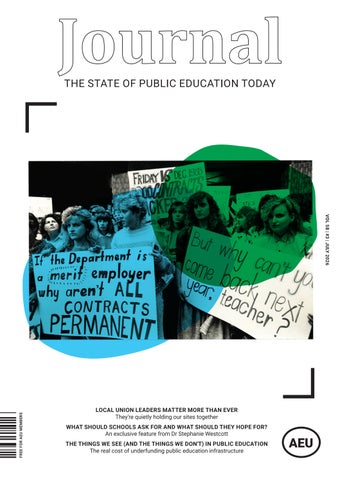
LOCAL UNION LEADERS MATTER MORE THAN EVER They're quietly holding our sites together WHAT SHOULD SCHOOLS ASK FOR AND WHAT SHOULD THEY HOPE FOR?
An exclusive feature from Dr Stephanie Westcott THE THINGS WE SEE (AND THE THINGS WE DON'T) IN PUBLIC EDUCATION The real cost of underfunding public education infrastructure
Get Information & advice from the Information Unit
Authorised by M.Cherry, Australian Education Union (SA Branch), Kaurna Country, 163 Greenhill Road, Parkside SA 5063.
What’s in this issue?
If
They're
An
The
Pull-out
Sustaining
What
The
Toileting
Remembering
Dive into free professional development this
WHAT YOU NEED TO KNOW
+ The changes needed in public education must be addressed from multiple angles
+ State and Federal lobbying work alongside enterprise bargaining to secure holistic and meaningful improvements
+ But these changes can only be achieved with the strength of every public educator joining together through their union
The future of public education
Public education is the lifeblood of a healthy, democratic society. It opens opportunities, strengthens communities, and helps shape informed, engaged citizens. Public educators, then, are not simply part of that system; they are foundational to sustaining and strengthening our democracy.
Whether we work in a school, preschool or TAFE, we know that right now there are broad, systemic pressures making it harder to focus on our core purpose: educating and supporting learners.
Workload continues to grow; administrative demands compete with time for teaching and learning; workplace health and safety concerns remain unresolved; and recruitment and retention challenges place additional strain on sites and teams. Too often, educators are expected to absorb these pressures simply because they care deeply about the colleagues, students, and children they work with. These challenges are neither inevitable nor unsolvable.
Some require coordinated campaigning beyond our state. Through our work with the Federal AEU, we continue to push for the investment public education deserves - modern, fit-forpurpose infrastructure and a funding system that addresses the longstanding and unacceptable inequities between public and private education.
Many of the changes members want most, however, must be secured through enterprise bargaining.
The conversations we’ve had with members throughout the year will shape our claims, but we already know the priorities are clear: reducing excessive workloads, cutting unnecessary administrivia, improving workplace health and safety, strengthening conditions, and delivering remuneration that properly values the profession.
We’ve watched members in Victoria achieve significant outcomes through collective action and it’s understandable that members in South Australia want to see similar progress.
But those outcomes didn’t happen because the arguments were stronger. They happened because educators stood together in greater numbers. This is the challenge and opportunity in front of us.
“If we want meaningful change, we need to grow our union. "
Enterprise bargaining outcomes are shaped not simply by the merit of our claims, but by the strength of the membership standing behind them. A union that represents more educators has greater bargaining power, greater influence, and a stronger mandate to pursue the scale of change our profession needs.
Growing membership isn’t about numbers for their own sake. It’s about building the collective strength required to secure sustainable workloads, safer workplaces, and conditions that allow educators to stay and thrive in public education.
When educators are properly supported, students receive more attention and better learning conditions, families experience stronger connections with schools and preschools and communities benefit from stable, thriving public education systems that can meet local needs now and into the future.
The future of public education won’t be handed to us. It will be built by every public educator acting together.
MATTHEW CHERRY, BRANCH SECRETARY
Local union leaders matter more than ever
Every school, preschool, and education site has people who quietly hold things together.
The colleague who knows how to navigate a difficult issue, who checks in after a tough meeting, who notices when workloads shift or pressures start building. They’re the person others turn to for advice, support, or to ask, ‘What do we do about this?’ Across public education, those people are often union leaders.
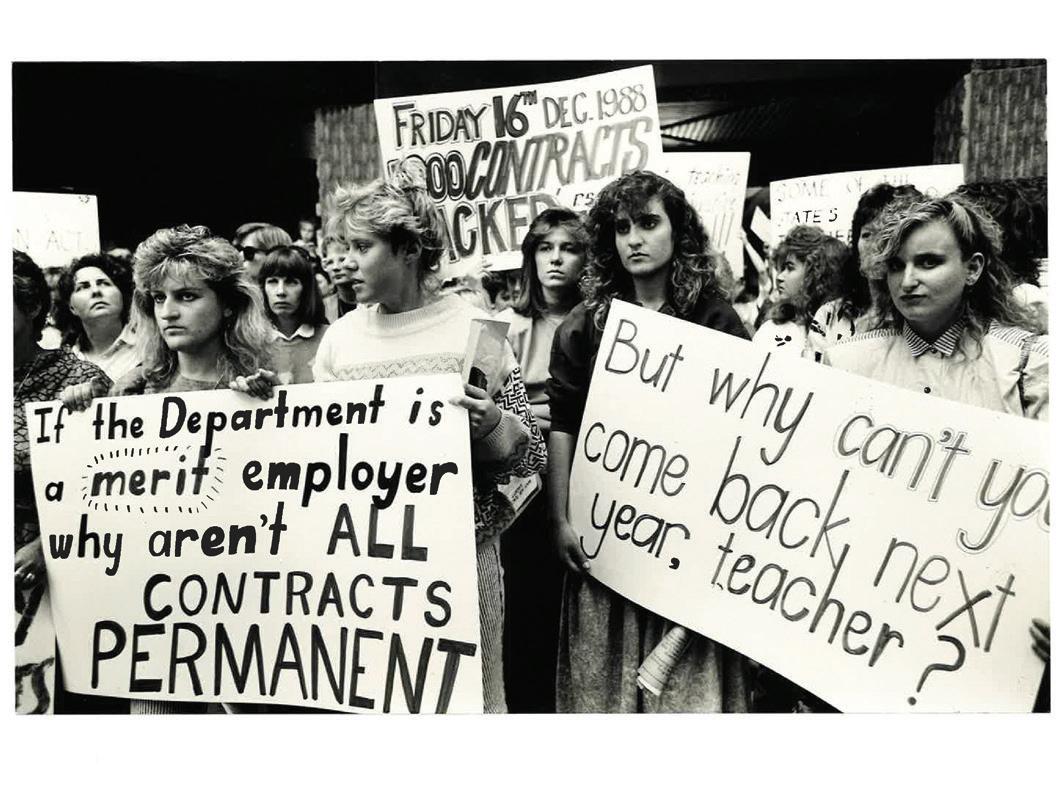
Sub-Branch Secretaries, Women’s Contact Officers, Health and Safety Representatives, PAC Representatives, and elected AEU representatives do work that rarely appears in position descriptions or formal reporting. Yet their contribution shapes workplaces every day. They create opportunities for members to participate, help colleagues understand their rights and responsibilities, and make sure concerns raised in staffrooms don’t stay there. Union leadership is about turning individual experience into collective action. As we move toward EA27, that work becomes even more important.
Enterprise bargaining can sometimes feel distant from day-to-day working life. Negotiations happen in meeting rooms, and formal processes can seem removed from classrooms, preschools, and education sites. But bargaining doesn’t begin in the negotiating room. It begins with members, and union leaders are often the people who help members find their voice.
Responses to the EA27 survey paint a clear picture of a profession under unsustainable pressure. Members aren’t questioning their commitment or capability - they’re asking whether a system can continue relying on extraordinary effort as its normal operating model, and what that means
for retention, attraction, and the long-term strength of public education. The EA27 survey helped identify those pressures - now members must decide what to do about them.
That’s where union leadership becomes critical, because democratic unionism doesn’t happen automatically. Health and Safety Representatives keep workplace safety visible in conversations about conditions and change. Women’s Contact Officers create space for issues that might otherwise go unheard. PAC reps strengthen member voice and participation. Sub-Branch Secretaries bring members together to discuss, challenge and determine collective priorities. Together, union leaders make participation possible. They help members move from identifying problems to shaping solutions.
That matters because bargaining always involves choices. No union can pursue every issue with equal intensity, and no agreement delivers every outcome immediately. Progress depends on members deciding where energy, effort and bargaining power should be focused, and those decisions are strongest when they come from informed, engaged workplaces.
As we move towards EA27, the role of union leaders isn’t simply supporting the process. It’s to help members see themselves in it. To help members understand how survey responses become priorities, how priorities become claims, and how claims become the agenda that shapes the future of the profession.
Every improvement we inherited was won by members who stood together. What comes next will depend on union leaders helping members do the same.
JENNIE-MARIE GORMAN, PRESIDENT
What should schools ask for and what should they hope for?
Ambitions for the Second Action Plan and the role of educators in preventing violence against women and children
What is the role of the school in Australia’s endemic rates of violence against women? As established by the federal government’s National Plan to End Violence against Women and Children 2022-2023 (The Plan), schools are essential to prevention, early intervention and response (DSS, 2022).
Ambitiously articulated, The Plan, in which the nation’s vision to ‘end violence in one generation’ (p. 14) is outlined, makes the important point that violence against women and children ‘is not inevitable’ (p. 15). We are not condemned to live in a world where one woman is murdered every few days by a man known to her— we can influence the ‘social cultural, political and economic factors that drive this gendered violence’ (DSS, 2022, p. 15).
The fact that many of these factors are encountered in and through
education would necessitate the specific involvement of school settings in this prevention plan. But questions remain around the extent to which this involvement has been clearly articulated, supported and resourced, and what kinds of challenges remain for understanding the place of violence prevention within education settings.
Presently, as the Australian Government begins its consultation period to inform its Second Action Plan, led by Minister for Social Services, Tanya Plibersek, it is crucial for educators to consider what our role is and how we might insist on our inclusion and resourcing in the national effort to end violence against women. The following piece outlines some considerations for government and educators in considering the place of education in this next phase.
DR STEPHANIE WESCOTT, MONASH UNIVERSITY
THE SCHOOL AND ITS ROLE/S
Recent research undertaken with my colleague Steven Roberts has exposed new expressions of misogyny and sexism within school settings and the profound harm they cause (Wescott et al., 2024; Wescott & Roberts, 2026). Although we contextualise these within the rise of the manosphere—influential misogynistic content creators who dominate boys’ and young men’s feeds via deliberate algorithmic design—we acknowledge that gendered violence has long been a feature of classrooms and education settings (Robinson, 2000; Willis & Kenway, 1986).
In this way, schools occupy a challenging dualistic position. They are places where gendered violence occurs at startling rates, and, much of the time, is met with problematic, lacklustre or entirely absent institutional responses (Wescott & Roberts, 2025). At the same time, they are tasked with the complex role of contributing in multifaceted ways towards the undoing the known drivers of this same violence and its broader manifestations (DSS, 2022). And, in the shadow legacies of the organised attacks on other prevention curriculum, such as Safe Schools (Ward, 2020; Wescott, 2020), we face a challenging predicament in reconciling what is required and what is expected of schools by their communities.
The place of schools as places of specialist support and response, intervention and prevention of future violence, or indeed, the role of the school in contributing to the government’s significant task at hand, is not well conceptualised or understood. Although we have had versions of Respectful Relationships Education for decades (Pfitzner et al., 2024) we know there are various problems with its implementation, especially around resourcing for training and upskilling (Pfitzner et al., 2022).
We also know that conversations around gender and violence in classrooms can be interpreted as controversial or contentious (Pfitzner et al., 2022). And yet,
schools are assigned significant responsibility and a central role in efforts
(DSS, 2022).
This responsibility is essential, but it is also appropriate: in education’s ongoing presence in children’s and family’s lives, in its commitment to bettering life outcomes, in the instilling of values, visions and hopes for the young people who move through schools, education also has the moral obligation to respond to the greatest social and political challenges in their lives. But, to do this well, we need to ask specifically for what educators need to do this work well and ensure that the government is willing to provide it.
PROBLEMS OF RESOURCES, PROBLEMS OF THINKING
Recently, leading femicide researcher Professor Kate Fitz-Gibbon and national expert Matt Tyler published a piece in the ABC acknowledging the central role of schools in providing both safety and healing after intergenerational violence. They write:
'When a young person is experiencing family violence, schools are sometimes their only safe place’
(Tyler & Fitz-Gibbon, 2026).
Further, drawing on data from the Adolescent Family Violence in Australia (AFVA), researchers found that not only does violence impact young people’s educational achievement, but that their capacity to seek help from within their schools is inhibited by resourcing and structural problems. The paper concluded that ‘comprehensive support systems within schools to address not only the academic but also the socioemotional and safety needs of students’ are required (Stewart et al., 2026, p. 83).
It is irrefutable that schools are places that encounter the devastating effects of violence daily. When students arrive each morning, educators draw on expertise, relationality and care to assess their mood and wellbeing. They are trained to notice signs of abuse and violence, and are legally required to report suspicions or evidence of harm. What educators often lack, is specialist knowledge in how the harm that comes into classrooms can be prevented, not only in its present manifestations in
young people’s lives, but in its future likelihood.
To do this work in ways that effectively, there is an essential set of considerations that are yet to be reckoned with as the role of school evolves within the landscape of violence prevention. For example, to what extent do we conceptualise the work we do in schools as violence prevention? We are aware, and comfortable, when we take on this work that this is explicitly what we are contributing to? Do we have follow-up support as all specialist, front-line family violence workers do (and should)? And, is our own safety in the context of increasing misogyny and gendered violence in school settings taken seriously, and are preventative measures being implemented?
Considering the ongoing consultation that will shape the Second Action Plan, these questions should inform the government’s thinking around how schools are positioned, and resourced, in its next iteration.
There is much work to be done in how the role of education might be conceptualised and resourced in the second National Plan if it is to meaningfully fulfil its potential to shift the trajectory of gendered violence.
First, it must be acknowledged that schools are currently experiencing a surge of misogyny and gendered violence, and that this violence is yet to be adequately acknowledged or responded to do a serious workplace hazard and a significant psychosocial harm. In positioning schools as key sites where young people who are harmed by violence are supported, it is important to establish that young people are also demonstrating dangerous attitudes and behaviours towards women and girls in schools, and that this represents a significant challenge to the government’s own plan to prevent violence from occurring in the future.
Second, educators and school workers must be adequately trained, resourced and supported if they are to be positioned as frontline gender-based violence workers. From teaching violence prevention curriculum, to recognising the signs of gendered violence and intervening appropriately, to facilitating schools as places of healing,
an education system that is already under-funded is simply not structurally capable of enacting what is expected.
Finally, if education is to be afforded such a prominent role in the National Plan, we must, in both the public imagination and in our own, critically examine how this role is defined and enacted. The goals and aims of schooling and education should not only be to prepare young people for future flourishing in a world where violence is imagined as a scourge that can eventually be eradicated. Rather, they must align with our understanding of education as an emancipatory and empowering project—one that equips young people not only to think and act critically, but also to navigate their relationships and social worlds in conditions of safety, care and dignity.
The things we see
(and the things we don't) in
Families often make decisions about preschools and schools based on first impressions. But while buildings, grounds and facilities are immediately visible, educational quality often takes longer to see. As educators, we know that the features that most influence student outcomes are often harder to spot.
Speaking to our leader members, I hear time and again how difficult it is to meet the expectations of families on preschool and school tours when access to even simple repairs and upgrades can feel permanently out of reach. Leaders are often meeting with families who have toured more than one site: one with a modern entrance, landscaped grounds and new facilities; another with ageing buildings but highly experienced staff and strong community relationships. Unfortunately, leaders often have only a brief window in which to showcase the subtle but invaluable things their site has to offer.
Though some families understand that the quality of their child’s education and the health of their school community aren’t determined by the appearance of a classroom, many form impressions based on what they can see.
Infrastructure has become a competitive advantage in education marketing and, while new facilities don’t automatically deliver a great education, they do shape first impressions and play a powerful role in the everyday experiences of educators and students. Infrastructure isn’t the most important ingredient in educational quality, but it does matter.
Infrastructure inequality has widened over time, with many public education
sites facing growing maintenance and renewal pressures. The complexity of current systems for both new builds and upgrades has contributed to uneven outcomes across the sector. Funding decisions made today shape learning environments for decades. Ageing classrooms require significant upgrades. Temporary buildings become long-term solutions. Deferred maintenance accumulates across schools, preschools and TAFE campuses. Access to specialist spaces and modern facilities can vary dramatically between sites. In turn, the issue continues to compound.
Educators know the difference a functional learning environment can make: classrooms that stay cool in summer and warm in winter; accessible spaces that support students with disability; specialist facilities that expand learning opportunities; staff areas that allow educators to collaborate and recharge. These things influence wellbeing, participation, and the conditions in which teaching and learning occur.
Infrastructure isn’t separate from educational quality, but it isn’t the whole story either. When investment becomes uneven, leaders are placed in an increasingly difficult position: delivering exceptional educational outcomes while managing environments that don’t always reflect the quality of the work happening inside them.
Educational quality extends far beyond physical assets. Families don’t immediately see the educator who notices a child becoming disengaged
public education
and quietly adjusts their approach. They don’t see the hours spent supporting a family through a difficult period, or the expertise involved in adapting learning for students with diverse needs. They may not see the inclusive classroom where every student is welcomed, or the strong preschool–family partnership that helps children thrive from their earliest years. They may not see the TAFE educator helping an adult learner build confidence and begin again. Relationships, expertise, and inclusion shape student success.
These things are difficult to photograph, difficult to market and difficult to capture in a first impression, but they’re often what families remember years later. Great education can happen in imperfect buildings, but educators and students shouldn’t be expected to thrive despite their environment.
Public education has a unique responsibility: to educate every child and young person. Public schools, preschools, and TAFE sites don’t choose who they serve. They welcome students with different backgrounds, experiences,
Public schools would have needed $38 billion extra over the last decade just to match private school investment
The capital funding gap between public and private school students has doubled in just three years
2021 gap: $1,031 per student
2023 $2,068gap: per student
aspirations, and support needs. Inclusion isn’t an optional extra or a point of difference - it is a core public purpose and a commitment that strengthens communities.
Public education creates spaces where students learn alongside people different from themselves, where communities remain connected, and where opportunity is not determined by postcode or circumstance. Public schools and preschools serve all families. TAFE creates pathways for learners of all ages and stages of life. That work deserves to be recognised and properly supported.
Public education shouldn’t have to choose between strong teaching and strong infrastructure. Educators, students, and communities deserve both.
In South Australia:
Some “temporary” classrooms date back to the 1950s
1261
Statistics taken from: The building divide in Australian schools: how capital funding fuels educational inequity, Australian Education Union (Federal Branch), 2006
10%nearly
demountable buildings
installed in the 1950s
Share your thoughts on public education infrastructure
Public schools are already running out of space + 38.2% of principals say they don’t have enough classroom space + Average need: 5.5 additional classrooms per school + Equivalent to 14,076 extra classrooms needed nationally by 2030
installed before 1970
KENDALL PROUD VICE PRESIDENT
Term 3 Planner
EA27 MEMBER FORUM: WOMEN'S LOG OF CLAIMS (REPEAT)
EA27 MEMBER FORUM: WOMEN'S LOG OF CLAIMS (REPEAT)
FORUM: MOUNT GAMBIER
EA27 MEMBER FORUM: METRO NORTH EA27 MEMBER FORUM: METRO WEST
ONLINE EA27 MEMBER FORUM: ONLINE AREA MEETINGS AREA MEETINGS
Securing our SSOs
SSOs are an essential part of every school. They support students, assist teachers, help families navigate school life and systems, and keep our sites running every day. But responses to our EA27 survey make clear that the volume and complexity of SSO work have grown significantly.
SSO members described taking on increasing responsibility for supporting students with disabilities, managing challenging behaviours, delivering intervention and wellbeing programs, and responding to increasingly complex classroom needs.
What stood out most was members’ commitment to supporting students and helping children succeed. But alongside that commitment was a clear message: the value and complexity of SSO work is not being matched by current classifications, pay, job security, or recognition.
Throughout the survey, four issues consistently emerged: pay, classification, career pathways, and secure employment.
Members spoke about wanting sustainable careers rather than relying on annual top-ups to hours. They called for recognition of qualifications, clearer pathways to reclassification, and opportunities to progress without having to leave the work they do best.
Pay also emerged as a major concern. Many SSOs do not work full-time hours despite wanting to. Members described working multiple jobs, relying on partner or family income, or simply living below the poverty line. We also heard about experienced SSOs leaving education for more stable and secure work elsewhere.
CLASSIFICATION
SS01
16% loading over 52 weeks
SS02
16% loading over 52 weeks
DISABILITY SUPPORT
SCHADS Level 1
RETAIL AWARD
Level 1
$27.46/hour
$34.58/hour
$26.30/hour + loadings
For many members, the concern isn’t just pay levels. It’s that comparable wages can often be found in other sectors that offer more secure employment and clearer pathways. Retaining skilled and experienced SSOs is critical to the future of public education, but retention depends on offering conditions that reflect the importance of the role. Without change, we risk losing decades of educationspecific knowledge and expertise.
Importantly, this wasn’t only an SSO concern. Teachers, leaders and support staff consistently identified increasing support staff numbers as one of the clearest practical solutions to improve student outcomes, reduce teacher workload, and strengthen wellbeing across school communities.
SSOs are doing more than ever. If we want them to continue supporting students, assisting teachers, helping families and keeping schools running, employment structures, classifications and conditions must reflect the reality of the role.
And if we want the future of the profession to be shaped by the people doing the work every day, we need more voices involved in the conversation. That means talking with colleagues who aren’t yet members and ensuring support staff help shape EA27.
$26.55/hour + loadings AGED CARE AWARD Level 1
FAST FOOD AWARD
Level 1
$26.51/hour + loadings
$26.55/hour + loadings
SADIE GENT VICE PRESIDENT
EA27 SURVEYSUPPORT STAFF DATA
Support staff survey respondents were predominantly schoolbased SSOs, primarily SSO1 and SSO2 classifications, with most identifying as permanent employees and having more than five years’ experience. The top priorities were:
1. PAY AND CLASSIFICATION
The strongest message was that members feel their pay no longer reflects the work they perform. Common concerns included working above classification, limited progression opportunities, and qualifications and experience not being recognised.
2. SECURE WORK
Members repeatedly raised concerns about unpaid holiday periods, spreading pay across the year, and ongoing reliance on insecure work arrangements. Many described needing second jobs or greater certainty through permanency.
3. MORE SUPPORT STAFF IN SCHOOLS
One of the most consistent solutions proposed was increasing support staff numbers. Members linked this directly to better student outcomes, reduced teacher workload, and improved staff wellbeing. Members called for greater classroom support appeared across schools, preschools, and specialist settings.
4. BEHAVIOUR, VIOLENCE, AND COMPLEXITY
Members described increasing student complexity and more challenging workplace conditions. Responses referenced violence, burnout, and insufficient support to meet growing student needs. A consistent message emerged: inclusion must be properly resourced.
5. CAREER PATHWAYS AND RECOGNITION
Members want clearer progression pathways, easier reclassification processes and recognition of specialist skills without needing to leave frontline work.
JAKI HEIM WOMEN'S OFFICER
Passion doesn't compensate for poor conditions
‘It’s a calling, not a job.’ ‘Remember your why.’ ‘They go above and beyond for the kids.’
These phrases are deeply embedded in the culture of education. They’re thrown around like buzzwords in a PD session. On the surface, they might sound positive. But underneath them sits an unsustainable expectation: that passion should compensate for poor conditions.
Most educators enter the profession because they care deeply about children and young people. Passion matters. It helps sustain the emotional complexity of working every day with diverse student needs, increasing behavioural challenges, and growing administrative demands.
But passion doesn’t reduce excessive workloads, nor provide smaller class sizes, additional support staff, or adequate resources. It doesn’t create safer workplaces or protect educators from burnout.
Culturally, our work is framed similarly to motherhood: selfless, endlessly giving, and fuelled by love. Educators are praised for sacrificing their own time, wellbeing, and emotional energy for others. The expectation becomes not simply that educators care, but that they will continually cover the gaps left by underfunding and understaffing because they care. But using care to justify systemic overwork has real consequences for educators and students alike.
We rarely see this narrative applied to male-dominated industries. Tradespeople, engineers, and other professionals aren’t routinely told that the ‘real reward’ is simply the satisfaction of helping others. Their expertise is recognised as skilled labour requiring investment, resourcing, and fair compensation. When governments and systems rely on educators’ goodwill to hold education together, it masks what students and schools actually need to thrive. It creates the illusion that public education can continue functioning without meaningful investment in staffing, specialist support, and improved working conditions. It normalises the idea that educators should keep giving more of themselves. And educators end up feeling guilty when they can't plug the gaps.
Educators should be able to love their work without sacrificing their wellbeing. They should be able to leave work safely, both physically and psychologically. They should be properly remunerated for their expertise. They should have workloads that are sustainable and professionally respectful. And they should have the time and resources needed to make a difference for students without burning out.
Care is not a replacement for resourcing. Devotion is not a substitute for funding. Passion alone can’t sustain a system that continues to demand more while providing less.
WHAT YOU NEED TO KNOW
+ Like most feminised professions, educators are expected to do more for less compensation and poorer conditions
+ Your passion is taken advantage of when you’re covering increasing gaps left by underfunding
+ It’s time for that to change. Educators are skilled professionals and should receive conditions and renumeration reflective of that
WHAT YOU NEED TO KNOW
+ Some people would have the community believe that public education is all chaos and disruption
+ But we know that public education is about building a strong and supportive community
+ With every member event, that community is strengthened
Public education is about hope
I remember the first time there was a fire in my classroom.
I’m a proud graduate of three fantastic public schools. I started at Whyalla Town Primary School, then moved to Coromandel Valley Primary, and completed my schooling at Blackwood High.
But it wasn’t until I became a teacher that I experienced my first classroom fire.
Before anyone worries, I was teaching Home Economics. A student’s tea towel accidentally caught fire during a practical lesson. Quick as a flash, she put it out safely, let me know, and got straight back to her task. Just like we’d practised.
I tell that story because some folks would have the community believe public education is all chaos, danger and disruption. But that’s never been what public education looks like to me.
What I remember from that moment isn’t the fire. It’s what happened next: preparation, calm, and people looking after each other.
This is how Jane Caro describes public education: “Public schools, by their very nature, are actually about hope. They're about hope that we're a good, decent society, that every child can learn, that…we’re gonna give everybody an opportunity.”
That rings true for me. Because hope in public education isn’t abstract. It’s something we build together.
In my work as Union Education Director at the AEU, I get to support member education that helps build that hope every day.
I see it in sub-branches learning and acting together.
I see it at AEU events like the New Educators Conference, SSO Conference, and Country Member Conference. I see it when members use accredited training and step into representative roles on merit selection panels and PAC.
Every day, members create safe, welcoming and hopeful places for students, families, and workers while navigating the very real challenges that come with education.
Public education does involve unexpected moments. But it also relies on preparation, skill, care, and collective action when those moments happen.
That’s what gives me hope.
SAM LISLE-MENZEL UNION EDUCATION DIRECTOR
Organiser update
A quick check-in with our team of passionate and hard-working Organisers.
It's been great to meet members in my new areas and support them over term two. Area meeting engagement has been high, and members are keen to be productive ahead of EA27. Thanks to all the amazing members who’ve contributed to the EA27 campaign so far, it’s promising to be an exciting round of bargaining. I'll be leaving the AEU before term three kicks off to return to the Department. If you need any support, get in touch with the Info Unit.
OSCAR JOLLY Organiser, New Educator Specialist oscar.jolly@aeusa.asn.au
As I travelled around the state meeting hundreds of passionate reps and members last term, what became clear is that the momentum around enterprise bargaining is starting to accelerate. We're having important discussions and bringing both new and more experienced voices into the fold. Our new educator members have met for the second time this year and further cemented their voice in the enterprise bargaining process, while strengthening their unique professional community.
During term two, I met with members across the state who described increasing challenges in delivering inclusive education. Educators reported rising enrolments of students with complex behavioural, wellbeing, and learning needs, alongside growing demands on staff and resources. Members identified delayed funding, insufficient support staff hours, and increasing workload pressures as key issues.
Despite these challenges, educators remain committed to meaningful inclusion. However, current conditions are impacting student engagement, learning outcomes, and staff wellbeing. This is why member voices are critical in shaping the EA27 log of claims as we campaign together for improved staffing, resources, and working conditions.
LISA SIGALLA Organiser, Support Staff Specialist lisa.sigalla@aeusa.asn.au
Term two saw some exciting developments at many of my sites. It was wonderful to support the election of new subbies and help build Workplace Organising Committees with passionate Women’s Officers, SSO Contacts, and more. A highlight of term two was our flourishing area meetings, where I met with so many passionate members ready to organise around EA27.
ROWAN SIMS Organiser, Country Education Specialist
rowan.sims@aeusa.asn.au
Across our country and remote sites, members consistently raise workload, administration, cost-of-living pressures, and support needs for complex learners. What stands out most, however, is their unwavering commitment to students and the extraordinary goodwill they bring to public education every day.
VANESSA WOOD Organiser, TAFE Focus
vanessa.wood@aeusa.asn.au
My term two focused on establishing contact with our passionate TAFE members and hearing about the issues most important to them. As enterprise bargaining continues and with National TAFE Day and the TAFE Photography Competition on the horizon, this promises to be another busy term.
EA27: Members leading the campaign
Over the first half of 2026, AEU members across South Australia have been doing something powerful: shaping our next enterprise agreement and helping define the future of our profession.
EA27 covers more than 30,000 employees across more than 600 public schools, preschools, and education sites. From day one, this campaign has focused on listening to members, identifying workplace priorities, strengthening networks, and growing participation across our union.
Thousands of educators completed the EA27 survey, sharing their experiences and identifying the issues that matter most in workplaces across the state. Those conversations have done more than inform the bargaining platform - they’ve helped build the collective strength we need to win change.
Across South Australia, AEU organisers have been meeting with members in workplaces, supporting local organising, and helping identify workplace leaders. A key priority has been ensuring every site has an EA27 contact to keep colleagues informed, connected and involved. Combined with a focus on growing membership, this work is building a stronger union and a stronger campaign.
In recent weeks, members have taken the next step by holding sub-branch meetings to vote on their priorities for EA27. Those priorities have now been submitted from across the state and will help shape the draft claims members will review at term three forums.
While every workplace is different, clear themes have emerged. Members are calling for action on cost of
What you need to know
+ Thousands of members across hundreds of sites have completed the EA27 survey and submitted motions
+ This crucial data will form the basis of the EA27 bargaining platform
+ Now, let’s focus on building our numbers and power to secure a strong outcome
living pressures and pay, workload and administrative burden, more time to plan and collaborate, improved staffing and student support, safer workplaces, stronger support around student behaviour and wellbeing, and greater job security and permanency.
This process matters because better outcomes are never just handed over. Earlier this year, educators in Victoria showed what’s possible when members organise, grow their union, and take collective action. With an increase of more than 20,000 new members and strong workplace participation, Victoria’s campaign secured major improvements and showed the power of strong workplace participation and union growth. It’s a reminder that meaningful change happens when educators stand together.
The next phase of EA27 will continue building momentum as members refine claims, grow support, and show the government that educators are united and ready to push for change.
The message is simple: the AEU is its members. The strength of this campaign comes from educators getting involved, backing each other, and standing together.
That’s how we win improvements for ourselves, our colleagues, our students, and the future of public education in South Australia.
MATT COFFEY, LEAD: ORGANISING AND GROWTH
SSO, did you know?
Did you know you may be entitled to a toileting allowance?
Clause 6.5: South Australian School and Preschool Education Staff Enterprise Agreement 2024
SSOs who support students with toileting may be eligible for an allowance. You’re entitled to this payment if:
+ You’re supporting students with toileting is included in your role statement; and
+ you have primary responsibility for students with a recognised continence plan.
The allowance is paid pro rata for part-time employees. From the first full pay period on or after 1 May 2026, the annual allowance is $656 per year.
Looking for extra hours?
Clause 2.2: South Australian School and Preschool Education Staff Enterprise Agreement 2024
If you’re a permanent part-time SSO and want to work more hours, there are rules about how extra hours must be offered.
Any vacancy of 15 hours or less per week, whether permanent or temporary, must first be offered to permanent part-time SSOs already working at the school.
If the hours can’t be filled internally, they must then be offered to permanent part-time SSOs at nearby schools. Additional hours are allocated based on merit.
If you’d like extra hours, make sure your Teacher Representative and Non-Teaching Staff Representative on PAC know. They may not be aware that these opportunities must be offered to eligible permanent part-time SSOs first.
It’s also helpful to have a copy of your enterprise agreement on hand when having these conversations. You can find an easy to navigate copy on the AEU (SA Branch) website.
LISA SIGALLA, ORGANISER: SUPPORT STAFF SPECIALIST
If you think you meet these criteria but aren’t receiving the allowance, speak with your Business Manager, contact your AEU Sub-Branch Secretary, or call the AEU Information Unit on 8172 6300.
You can contact me at vanessa.wood@aeusa.asn.au
Hitting the ground running
A word from our new TAFE Organiser, Vanessa
While enterprise agreement negotiations continue, I’m looking forward to settling into the role throughout term three and getting out across campuses to meet both existing and new members.
One thing that’s already clear is that while we’re all employed by the same organisation, our day-today work can look very different depending on our programs, teams, and campuses. That’s why these conversations matter. Hearing directly from members helps us understand the issues that are having the biggest impact and identify practical ways to tackle them together.
A big part of my role will be making sure members are supported to access the full benefits of union membership: not just representation when issues arise, but opportunities to shape outcomes and strengthen our collective voice.
I’ll also be working closely with our Vice President, Kendall Proud to grow Health and Safety Representative (HSR) coverage across campuses, particularly in workgroups where employee representation is limited. Just as importantly, we want to make sure both new and existing HSRs feel supported through training, networking, and opportunities to stay connected through initiatives like HSR Connect.
Strengthening union structures across sites will be another key focus. That means building active delegate networks, so every workgroup and campus has strong member representation. When members are connected and organised, communication improves, participation grows, and we’re in a stronger position to influence workplace decisions.
We’ll continue building member leadership by filling vacancies on the TAFE Women’s Committee and creating opportunities for members to step into advocacy and leadership roles. Developing the next generation of union leaders is an important part of building a strong and sustainable union.
Through all of this, my goal is simple: to help both existing and new members feel connected, supported, and confident that they have a strong voice at work. Because when members are involved, informed, and organised, we’re in the strongest position to meet the challenges ahead.
VANESSA WOOD, ORGANISER: TAFE FOCUS
Brain Breaks
Quick breaks that help you refocus and return to work feeling centered.
DESIGN YOUR OWN AEU HOODIE
Snap a photo of your hoodie design and email it to us. The winner will receive their hoodie, and the winning design will be available for purchase through our online shop!
TO ENTER
Draw your design in the template above then send a photograph to newsletters@aeusa.asn.au
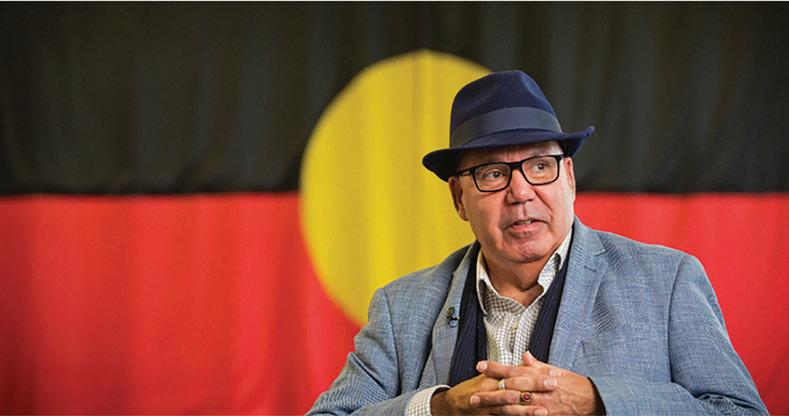
Vale Professor Peter Buckskin AM, PSM, FACE
Professor Peter Buckskin was a visionary educator, academic, community leader and proud Narrunga man whose influence shaped Aboriginal education in South Australia and across the nation.
A valued friend of the AEU, Professor Buckskin’s wisdom, generosity, and steadfast commitment to Aboriginal education touched countless lives. His legacy endures through the communities, educators, and students he championed over more than four decades of service.
Educated in Western Australia, Professor Buckskin began his teaching career in remote Kimberley communities before returning to South Australia to reconnect with family and community.
Upon returning to South Australia in 1980, Professor Buckskin joined the AEU (SA Branch), then SAIT. Encouraged by union leaders of the time, Professor Buckskin began a lifelong commitment to advocacy and collective action. He never forgot that support and went on to work closely with union colleagues to advance Aboriginal education, including helping secure the first industrial award recognising Aboriginal Education Workers.
Alongside leaders including Paul Hughes and Pat Buckskin, Professor Buckskin helped establish nationally significant foundations for Aboriginal education policy and recognition. Their work shaped approaches to selfdetermination, community voice, and reconciliation that influenced state and national education bodies for decades to come.
Appointed a Superintendent at just 29, Professor Buckskin was widely respected for his encouragement of educators and communities, particularly in regional South Australia. He later served as Chief Executive of the South Australian Department of Aboriginal Affairs and Reconciliation and as Dean of the David Unaipon College of Indigenous Education and Research at the University of South Australia.
Professor Buckskin’s leadership extended nationally through his work with the National Aboriginal and Torres Strait Islander Education Corporation and initiatives including What Works and Dare to Lead, which helped
transform educational leadership and strengthen outcomes for Aboriginal and Torres Strait Islander students.
He championed communityled and culturally grounded approaches to education and remained unwavering in his belief that governments must be accountable for delivering meaningful outcomes.
Reflecting on this work in 2009, Professor Buckskin said, “There is no lone champion in this. We are all champions together, and everyone is a hero.”
Professor Buckskin’s life demonstrated the power of education to create lasting change and that he combined vision with humility, leadership, with service.
We extend our deepest condolences to Professor Buckskin’s family, friends, and all who worked alongside him.
Photo by David Williams of Gilimbaa creative agency
Professional learning & union training
Access a wide range of values-based professional learning to develop your practical skills and grow as an educator.
The sessions are in real time and allow you to work with other professionals to gain insight and grow as an educator.
TRAINING IS FREE FOR MEMBERS UNLESS OTHERWISE NOTED
HSR
Connect
+ Tues 28 Jul, 4:30pm - 5:30pm
+ For: AEU member Health and Safety Representatives
HSR Connect is the AEU’s dedicated network for elected Health and Safety Representatives across public schools, preschools, and TAFE. We connect, upskill, and support HSRs to exercise their role with confidence and collective strength - because safe workplaces don’t happen by chance, they’re organised.
Know your rights, Whyalla
+ Wed 29 Jul, 5:30pm - 7:00pm
+ For: All members
Get to know your rights at work as an educator at this practical and informative session.
PAC training
+ Mon 3 Aug, 2:00pm - 5:00pm
+ For: All members
Learn to access, investigate, and discuss the enterprise agreement and other documents in relation to PAC decisions.
Women's Contact Officer training
+ Thur 6 Aug, 9:15am - 3:30pm
+ Fri 7 Aug, 9:15am - 3:30pm
+ For: Elected Women’s Contact Officers
This two-day course looks at the responsibilities of and possibilities for Women’s Contact Officers within their sub-branch.
Clear, predictable classroom routines
+ Thur 6 Aug, 4:30pm - 5:30pm
+ For: All members
Classroom routines are the process for how a classroom operates. When taught explicitly, they support students through creating a sense of security and predictability. This allows them to focus their abilities more towards the learning at hand.
Build your own AI escape room
+ Thur 13 Aug, 4:30pm - 5:30pm
+ For: All members
Learn how to use AI tools to design your own escape room experience. You'll learn simple ways to build puzzles, craft storylines, and set challenges that get people thinking and working together. By the end, you'll have a prototype escape room ready to roll, with plenty of ideas to bring into your classroom or workplace.
Check out the AEU SA website regularly for more dates and courses at aeusa.asn.au/upcoming
Building effective teams
+ Thur 20 Aug, 4:30pm - 5:30pm
+ For: All members
Great leaders are only as effective as the teams around them. Michelle Rangelov shares her extensive leadership experience and will provide participants with a range of approaches to create defined goals, foster collaboration, and build and encourage open communication.
Wellbeing leadership: managing change and staff wellbeing
+ Thur 20 Aug, 6pm - 7pm
+ For: All members
Change can be tough - especially when it's constant. This session looks at how change impacts staff wellbeing and what leaders can do to help. It's a chance to think about how we support each other when things shift, and how to lead in a way that keeps people feeling steady and supported.
New Union Representatives (Level 1)
+ Thur 27 Aug, 9:15am - 3:30pm
+ Fri 28 Aug, 9:15am - 3:30pm
+ For: newly elected AEU leader members (e.g. Sub-Branch Secretaries, Health and Safety Representatives, Women’s Contact Officers, PAC Representatives)
This participatory course works with you to ensure you know what your rights and responsibilities are as an election union representative.
Women in Leadership Development (WiLD)
+ Wed 2 Sep, 9:15am - 3:30pm
+ Thur 3 Sep, 9:15am - 3:30pm
+ Fri 4 Sep, 9:15am - 3:30pm
+ For: WiLD participants
WiLD is a professional and personal development program for AEU women, non-binary, and gender diverse members interested in building leadership skills and a future in union leadership.
Women in leadership: pathways to leadership
+ Thur 3 Sep, 4:30pm - 5:30pm
+ For: women and non-binary members
Despite movements forward, data indicates there are still barriers to women attaining leadership positions in schools. Katie will share her own pathway into leadership and how she overcame the barriers till faced by many women in education.
Merit selection training
+ Fri 24 July, 4 - 6pm
+ Tues 8 Sep, 4 - 6pm
+ Mon 21 Sep, 4 - 6pm
+ Wed 30 Sep, 10am - 12pm
+ For: All members
A two-hour retraining session for AEU members who last attended merit selection training in 2022 or AEU Members who want to be an AEU Representative on merit selection panels.
New Educators Conference
+ Fri 11 Sep, 9:15am - 3:30pm
+ For: members in their first three-years of educating
In your first three years of teaching? Register for this hands-on, community-building conference. You'll leave armed with a practical understanding of your rights at work, a clear sense of purpose for the upcoming enterprise bargaining campaign, and a strong network of like-minded educators.
SSO Conference
+ Tue 29 Sep, 9:15am - 3:30pm
+ For: SSO Members
SSOs from across SA are invited to our beloved annual conference. We'll be celebrating SSO wins, planning for EA27, and organising around the issues impacting you day-to-day.
Country Member Conference
+ Thur 1 Oct, 9:15am - 3:30pm
+ For: remote and regional members
At our first annual Country Member Conference, we'll focus on building activism and community between AEU SA members working in regional and remote South Australia. Travel and accommodation support are available.
Aboriginal Members Conference
+ Thur 8 Oct, 9:15am - 3:30pm
+ For: Aboriginal and Torres Strait Islander members
Come together with mob from across the state to hear from leaders, plan how to make change for the good, and share your vision for the future of Aboriginal and Torres Strait Islander education.
Understanding and supporting neurodiverse girls
+ Thur 8 Oct, 4.30pm - 5.30pm
+ For: All members
Neurodiverse girls often fly under the radar, but their needs are equally important. Our presenter will shine a light on a variety of neurodivergent profiles in girls, how to recognise masking, and how to support them in their learning. It's all about awareness, inclusion, and ensuring that noone slips through the cracks.
Trauma and adversity in education
+ Thur 8 Oct, 6pm - 7pm
+ For: All members
The experiences of students outside of school can heavily impact their learning. Megan will lead participants in recognising the signs of trauma in their students and towards making a difference in students' lives through connection, understanding, and care.
Wellbeing leadership: embedding staff wellbeing throughout the school
+ Fri 9 Oct, 4:30pm - 5:30pm
+ For: All members
In schools, staff wellbeing is all too often an afterthought. Healthy, happy, and fulfilled staff positively impact school culture and student outcomes. This course will focus on implementing realistic initiatives that support staff wellbeing in schools.