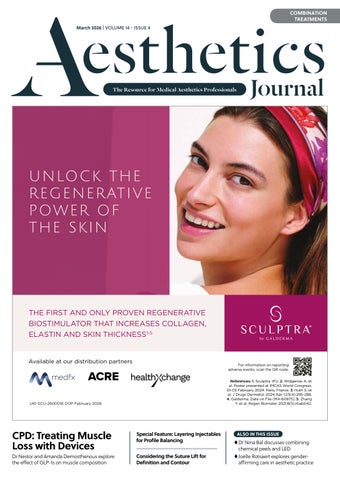
March 2026: Combination Treatments

Page 1


UKI-SCU-2600016 DOP February 2026

For information on reporting adverse events, scan the QR code.

References: 1. Sculptra. IFU. 2. Widgerow A, et al. Poster presented at IMCAS World Congress. 01-03 February 2024. Paris, France. 3. Huth S, et al. J Drugs Dermatol. 2024 Apr 1;23(4):285-288. 4. Galderma. Date on File (MA-60875). 5. Zhang Y, et al. Regen Biomater 2021;8(5):rbab042.

 Dr Nina Bal discusses combining chemical peels and

 Joëlle Rotsaert explores genderaffirming care in aesthetic practice

REASONS TO CHOOSE BOCOUTURE

• Results seen as early as 7 days, lasting up to 4 months in upper facial lines1

• A well characterised safety profile1

• Convenient – no refrigeration needed prior to reconstitution1

Scan the QR code to access BOCOUTURE UK and Ireland Prescribing Information

1.BOCOUTURE Summary of Product Characteristics. Merz Pharmaceuticals GmbH: https://www.medicines.org.uk/emc/product/600/smpc (Last accessed January 2026).

Date of Preparation: January 2026

Access complimentary training resources

Adverse events should be reported. Reporting forms and information for United Kingdom can be found at https://yellowcard.mhra.gov.uk/. Reporting forms and information for Republic of Ireland can be found at https://www.hpra.ie/homepage/about-us/reportan-issue. Adverse events should also be reported to Merz Aesthetics UK Ltd by emailing UKdrugsafety@merz.com or calling +44 (0) 333 200 4143.

Merz Aesthetics Exchange (MAX) is a promotional website developed and funded by

Merz Aesthetics UK & Ireland.

Contents • March 2026

The latest product and specialty news

16 Aesthetics attends IMCAS 2026

The IMCAS Congress showcases the latest advancements

17 News Special: Ban on High-Risk Procedures

Aesthetics explores the Women and Equalities Committee’s call for a ban on non-surgical Brazilian butt lift (BBL) and high-risk procedures

CLINICAL PRACTICE

19 Event Preview: Key Challenges in Aesthetics

Your checklist for conquering challenges in aesthetics at ACE 2026

23 Special Feature: Layering Injectables for Profile Balancing

Practitioners achieve profile balance through combined injectables

27 Sculptra for All: Regenerative Benefits Across Age Groups

Unlock natural, long-lasting beauty with Sculptra

29 CPD: Treating Muscle Loss with Devices

Practitioners explore the effect of GLP-1 on muscle composition

33 Cutera® Experts Map Out Laser Aesthetics Landscape

Leading Cutera® clinicians explore energy-based technologies

37 Considering the Suture Lift for Definition and Contour

Mr Sukhwinder Randhawa investigates suture lifts with PRP

41 Managing Breakout-Prone Skin with Topical Exosomes

Julie Scott considers treating congested skin with exosomes

45 Layered Approaches To Skin Rejuvenation

Dr Nina Bal discusses approaches for combining chemical peels and LED

49 The Role of Skincare for Best Surgical Results

Dr Georgina Williams explores skincare with surgical outcomes

52 Maintaining GLP-1 Weight Loss Through Body Devices

Dr Marwa Ali examines body devices in GLP-1-associated weight loss

56 Addressing GLP-1 Related Skin Laxity with Sofwave

An FDA-Cleared, non-invasive solution for face and body

57 Abstracts

A round-up and summary of the latest clinical studies

IN PRACTICE

58 Gender-Affirming Care in Medical Aesthetics

Joëlle Rotsaert explores gender-affirming care in aesthetic practice

60 Lessons in Leadership and Growth from Necker Island

Rick O’Neill shares lessons learnt from Sir Richard Branson

62 Data Protection and Cyber Resilience in Aesthetic Practice

Charlotte Staples examines healthcare data protection and security

65 In Profile: Dr Ahmed El Houssieny

Dr Ahmed El Houssieny shares his work as a complications expert

66 The Last Word: Is Social Media Damaging?

Eleanor Hartley debates if social media is a positive or negative force

News Special: Ban on High-Risk Procedures

Page 17

Special

Feature:

Layering

Injectables

for Profile Balancing

Page 23

Clinical Contributors

Dr Nestor Demosthenous is an aesthetic physician and clinical leader based in Edinburgh. Founder of The Mayfield Clinic. He lectures internationally, contributes to research and guidelines, and serves as a Trustee of the British College of Aesthetic Medicine.

Amanda Demosthenous is an aesthetic nurse prescriber with over a decade of experience. She is also a trainer, speaker, and board member for the British Association of Medical Aesthetic Nurses (BAMAN).

Mr Sukhwinder Randhawa is a GMC-registered practitioner with surgical experience across general surgery, urology and orthopaedics. He is also policy lead for the British Association of Cosmetic Surgeons.

Julie Scott is an independent nurse prescriber. Scott also sits on the Aesthetics Reviewing Panel for the Aesthetics Journal, is a Board member for DANAI, a Faculty Member of Allergan Medical Institute and an Ambassador and KOL for the JCCP.

Dr Nina Bal is a cosmetic dental surgeon and facial aesthetics practitioner with more than 15 years’ experience in advanced non-surgical rejuvenation and facial harmony. Dr Nina’s work combines advanced medical aesthetics with dental facial analysis. Dr Marwa Ali graduated in medicine from St George’s, University of London. She also completed her Postgraduate Diploma in Clinical Dermatology at Queen Mary University of London. Dr Ali is a member of the British Cosmetic Dermatology Group.

March is always one of the biggest months in the aesthetics calendar, with ACE and The Aesthetics Awards bringing the specialty together. This year, it also marks a new chapter for the Aesthetics Journal. It is a pleasure to announce that, from the next issue, I will be handing over the editorship of the journal to Holly Carver, our current deputy editor and content manager. I won’t be going far though! I will be taking on a new role as publisher and event director, focusing on the events side of the brand and continuing to support the wider development of the journal. This means I will still be involved with our community, and our strategic direction – just in a slightly different capacity.

I have had the privilege of working closely with Holly over six years now, and know the journal will be in exceptionally safe hands. I have every confidence that she will not only maintain rigorous standards but also bring fresh ideas and new energy to the role.

It has been an honour to serve as editor, and I am excited to remain part of this journey with you. See you at ACE and The Aesthetics Awards!

Clinical Advisory Board

I am incredibly proud and excited to be taking on the role of editor of Aesthetics. Having worked in aesthetics for the past six years, I have developed such a love for this specialty – not only for the innovation and constant learning it demands, but above all for the people who work within it. I want to thank Shannon for her outstanding leadership over the last few years. I feel very fortunate to be building on such strong foundations.

My goal as your editor is for Aesthetics to remain a place where the community is represented, informed and inspired. Your feedback, ideas and contributions will play a huge part in shaping what we do next. If there are topics you would like to see covered, debates you think we should be having or if you are interested in writing or getting more involved, I would love to hear from you.

I cannot wait to see many of you at ACE and the Awards, and I am excited for this new chapter together!

Leading figures from the medical aesthetic community have joined the Aesthetics Advisory Board to help steer the direction of our educational, clinical and business content

Sharon Bennett is the former chair of the British Association of Medical Aesthetic Nurses (BAMAN), UK lead of the BSI committee for aesthetic non-surgical standards and member of the Clinical Advisory Group for the JCCP. She is a trainer and a registered university mentor in cosmetic medical practice, and is finishing her MSc at Northumbria University. Bennett has won the Aesthetics Award for Nurse Practitioner of the Year and the Award for Outstanding Achievement.

Sharon Bennett, Clinical Lead

Mr Naveen Cavale has been a consultant plastic, reconstructive and aesthetic surgeon since 2009. He has his own private clinic and hospital, REAL, in London’s Battersea. Mr Cavale is the national secretary for the ISAPS, president of the Royal Society of Medicine, and vice-chair for the British Foundation for International Reconstructive Surgery.

Miss Elizabeth Hawkes is a consultant ophthalmologist and oculoplastic surgeon. She is the lead oculoplastic surgeon at the Cadogan Clinic, specialising in blepharoplasty and advanced facial aesthetics. Miss Hawkes is a full member of the BOPSS and the ESOPRS, and is an examiner and fellow of the Royal College of Ophthalmologists.

Mr Adrian Richards is a plastic and cosmetic surgeon with over 30 years’ experience. He is the clinical director of the aesthetic training provider Cosmetic Courses and surgeon at The Private Clinic. He is also a member of the British Association of Plastic and Reconstructive and Aesthetic Surgeons and the British Association of Aesthetic Plastic Surgeons.

PORTFOLIO MANAGEMENT

Shannon Kilgariff • Publisher & Event Director

T: 0203 196 4351 | M: 07557 359 257

shannon.kilgariff@easyfairs.com

EDITORIAL

Holly Carver • Editor and Content Manager

T: 0203 196 4427 | holly.carver@easyfairs.com

Amer Saleh • Journalist

T: 020 3196 4270 | amer.saleh@easyfairs.com

Mia Sawyer • Journalist

T: 020 3196 4242 | mia.sawyer@easyfairs.com

Sophia-Fai Roche • Journalist

sophia-fai.roche@easyfairs.com | T: 0203 196 4391

DESIGN

Dean Murphy

• Creative Design Manager

Aimee Bish • Senior Graphic Designer

Hannah Gosain • Graphic Designer

Dr Mayoni Gooneratne (MBBS, BSc, MRCS, MBCAM, AFMCP) was an NHS surgeon before establishing The Clinic by Dr Mayoni and founding Human Health – an initiative combining lifestyle with traditional and functional medicine to provide a ‘cell-up’ regenerative approach to aesthetics. She is also the co-founder of The British College of Functional Medicine.

Jackie Partridge is an independent nurse prescriber. She is the clinical director and owner of Dermal Clinic in Edinburgh and a KOL for Galderma. She holds an MSc in Non-surgical Aesthetic Practice and a BSc in Dermatology. Partridge is a stakeholder group member with Scottish Government/HIS, Honorary BACN member and JCCP Fitness to Practice Nurse.

Dr Souphi Samizadeh is a dental surgeon with a Master’s degree in Aesthetic Medicine and a PGCert in Clinical Education. She is the founder of the Great British Academy of Medicine and Revivify London Clinic. Dr Samizadeh is a Visiting Teaching Fellow at University College London and King’s College London.

Callum Benyon • Junior Graphic Designer

Aaron Smyth • Graphic Design Intern

ADVERTISING & SPONSORSHIP

Judith Nowell • Head of Sales

T: 0203 196 4352 M: 07765 407629

judith.nowell@easyfairs.com

Charlotte Norville • Senior Sales Executive

T: 020 3196 4418 | Charlotte.norville@easyfairs.com

MARKETING

Susana Burguera

• Senior Marketing Manager

T: 020 3196 4281 | susana.burguera@easyfairs.com

Ella Carey • Marketing Executive

T: 020 3196 4410 | ella.carey@easyfairs.com

Lydia Glanville • Marketing Executive

T: 020 3196 4387 | lydia.glanville@easyfairs.com

If you are interested in contributing to the journal, get in touch...

Email: editorial@aestheticsjournal.com

Dr Sophie Shotter is the founder & medical director of Illuminate Skin Clinic in Kent and Harley Street, London. Her passion is for natural treatments delivered with utmost attention to safety. She works closely with Allergan as part of their UK and International Faculty.

Dr Anjali Mahto is one of the UK’s leading consultant dermatologists. She is a Fellow of the Royal College of Physicians, member of the Royal Society of Medicine and a spokesperson for The British Skin Foundation. In 2023 Dr Mahto opened Self London, a dermatology and lifestyle clinic aimed at managing skin conditions holistically.

Dr Stefanie Williams is a dermatologist with a special interest in adult acne, rosacea and aesthetic medicine. She is the founder and medical director of multi-award winning EUDELO Dermatology & Skin Wellbeing in London, and creator of Delo Rx skincare. She is the author of three books and has published more than 100 scientific articles, book chapters and abstracts.

ARTICLE PDFs AND REPRO

Material may not be reproduced in any form without the publisher’s written permission. For PDF file support please email, contact@aestheticsjournal.com

© Copyright 2026 Aesthetics. All rights reserved. Aesthetics is published by Aesthetics Media Ltd, which is registered as a limited company in England; No 9887184

Holly Carver

Talk #Aesthetics

Follow us on Instagram @aestheticsjournaluk

#Event

Dr Aggie Zatonska @atelier.dr.aggie

Behind the scenes at the Beauty Triangle Festival! It was a pleasure to be on the same panel as some of the UK’s most sought-after wellness practitioners.

#IMCAS2026

Galderma @Galderma

Our CEO Flemming Ørnskov and GAIN faculty united to share clinical expertise at our symposium Menopause in the Mirror, Aesthetic Challenges, Science and Solution.

#Collaboration

Philippe Snozzi @schopenhauer212

We kicked off the academy season with an exceptional group of delegates from Asia Pacific. The energy, curiosity and level of exchange was truly inspiring.

#Training Nurse Natalie Haswell @nurse.natalie.vittarra

Truly grateful to be a part of the UK Allergan Aesthetics UK&I faculty and training team. Thank you for another great two days of learning!

#International Ofir Artzi @profofirartzi

As president of the 6th SCARS Congress, it was a true pleasure to host our gala evening in Milan, surrounded by exceptional food, music and wonderful company.

Regulation

Scottish Parliament backs Non-Surgical Procedures Bill

Members of the Scottish Parliament have voted in favour of the Non-Surgical Procedures and Functions of Medical Reviewers (Scotland) Bill.

Under the proposed legislation, which is currently at Stage 2 after first being introduced on October 8, non-surgical cosmetic procedures for under-18s would be banned, with controls imposed on procedures such as dermal fillers, laser treatments, chemical peels, microneedling and cellulite treatments.

The Bill would also stipulate that treatment must only be carried out in premises registered with Healthcare Improvement Scotland (HIS) such as GP surgeries, dental practices, pharmacies and registered private clinics. Treatments must also be overseen by a healthcare professional, such as those registered on the General Medical Council (GMC), Nursing and Midwifery Council (NMC), General Dental Council (GDC) and the General Pharmaceutical Council (GPhC).

If approved, the Bill would hold individuals within organisations personally liable for offences and authorise the Scottish Government and local authorities to introduce further restrictions, including requirements on who may provide procedures and the training or qualifications they must hold.

During the debate in Scottish Parliament on February 5, Members of the Scottish Parliament (MSP) from all major parties expressed broad support for the principles of the Bill, enabling it to pass Stage 1 with little opposition.

Injection Guidance

JCCP issues advisory on PCC injection usage

The Joint Council for Cosmetic Practitioners (JCCP) has issued an advisory warning against the use of phosphatidyl choline (PPC)based products for cosmetic purposes, explaining that its use is limited to medically diagnosed indications, such as the treatment of lipoma.

The JCCP shares that PCC is not authorised for cosmetic use in the UK, according to confirmation from the Medicines and Healthcare products Regulatory Agency (MHRA).

This advisory therefore applies to all individuals who use or supply these products, as well as those responsible for regulating or investigating practitioners or organisations, including local authority officers, according to the organisation. As a result, the JCCP has requested all JCCP registrants to cease using these products for cosmetic purposes or promoting their use in any circumstances.

Andrew Rankin, JCCP acting joint chair, commented, “This advisory makes it clear that, to comply with medicines legislation, practitioners must not use these PPC-based products for cosmetic purposes. We hope that this advice serves as a reminder to all practitioners to consider carefully the products they use and how they obtain them. We also expect it to assist enforcement officers in their duties, and to inform the ongoing development of a framework of licensing.”

The JCCP is speaking at ACE at the Association Theatre this month on March 13-14.

Aesthetics Portfolio

ACE and The Aesthetics Awards take place this month

The Aesthetics Conference & Exhibition (ACE) returns to London on March 13-14, bringing together the latest product launches, innovations and clinical updates for the UK medical aesthetics specialty.

The event will present clinical content across five stages, including one dedicated to Headline Sponsor Allergan Aesthetics, an AbbVie company, alongside the brand new Cutting-Edge Theatre. Delegates will also be able to network and reconnect with colleagues throughout the exhibition, including the Lumenis Chill Out Lounge.

Following two-days of education, The Aesthetics Awards will take place on March 14 at Hilton, Park Lane, marking the most glamorous night in the aesthetics calendar. The ceremony will recognise excellence across 25 categories, celebrating outstanding practitioners, clinics, organisations and products from across the UK and Ireland.

The evening will be supported by key specialty partners, with Healthxchange sponsoring The Networking and After Party, Church Pharmacy sponsoring The Photobooth, DermaFocus as Awards Favours Sponsor and Best Dressed supported by the British Skin Foundation. Accolades for the 2026 ceremony include The Derma Institute Award for Best Aesthetics, Wellness and Longevity Clinic, The Evolus Award for Aesthetic Nurse Practitioner of the Year, The Lumenis Award for Best Clinic London, and The InMode Award for Best Clinic Ireland and Northern Ireland. Allergan Aesthetics will also sponsor the Best Clinic Team category. Together, ACE and The Aesthetics Awards promise an unmissable few days of education, innovation and celebration for the medical aesthetics community.

Turn to p.21 to register now.

Advertising

ASA bans affiliate-linked ads for weight loss drugs

The Advertising Standards Authority (ASA) has banned a series of social media advertisements promoting prescription-only weight-loss medicines (POMs) via affiliate and referral links.

These rulings mark the ASA’s first formal action against posts of this kind. The decisions concern content on Instagram, TikTok and Facebook promoting weight-loss injections, including Tirzepatide, often accompanied by discount codes and referral links for online pharmacies such as MedExpress, Voy, Zava and the prescribing service UK Meds Direct. The ASA notes that affiliate schemes reward individuals who share links or codes, meaning members of the public may unknowingly promote POMs without realising strict advertising rules apply.

The banned posts were found to promote POMs by naming the medicines, showing images of injection pens, using related hashtags and encouraging followers to start their weight-loss “journey,” often with incentives. Both the companies running the affiliate schemes and the individuals involved were held responsible for compliance, as the companies controlled the schemes.

Catherine Drewett, investigations manager at the ASA, commented, “These rulings send a clear message that affiliate marketing is not a loophole and that promoting prescription medicines through social media, whether as a brand, influencer or customer, is against the law and our rules.”

The ASA is speaking at ACE at the Association Theatre this month on March 13-14.

Vital Statistics

Out of 4,300 women, more than 50% learnt about the effects of menopause on their skin through personal experience (Galderma, 2026)

Of the 500 patients surveyed, 62% said they give less than 24 hours’ notice when cancelling appointments (Fresha, 2026)

A survey of 2,000 adults in the UK found that 58% oppose NHS funding for corrective surgeries following procedures performed abroad (Longevita, 2026)

Nearly one-third of nurses, midwives and nursing associates (32%) reported witnessing compromised patient safety or quality of care (Nursing and Midwifery Council, 2026)

A study of 200 individuals aged 18-25 found that nearly 45% of women experience symptoms consistent with Seasonal Affective Disorder, compared with 28% of men (IJGMH-IPACT, 2026)

Research featuring 1,124 UK doctors found that 86% said childcare difficulties had influenced them to change their role, specialty or career plans (Doctors.net.uk, 2026)

Events diary

13th-14th March 2026

Aesthetics Conference & Exhibition (ACE)

14th March 2026

The Aesthetics Awards

17th-19th April 2026

Wigmore Presents 2026

2nd May 2026

BCAM Conference

24th-25th September 2026

BAMAN Autumn Aesthetic Conference

1st-2nd October 2026

Clinical Cosmetic Regenerative Congress (CCR) & Medical Longevity Summit (MLS)

IN THE MEDIA

What’s trending in the consumer press

Loose Women debate over NHS covering failed overseas surgeries

ITV’s Loose Women referenced that botched cosmetic surgeries carried out overseas are costing the NHS up to £19,549 per patient. Presenters Jane Moore, Kaye Adams, Coleen Nolan and Brenda Edwards debated whether it should be the NHS’s responsibility to cover the cost of correcting dangerous procedures performed abroad. Moore argues while the NHS should assist in life-threatening cases, non-critical issues should be addressed by the initial surgeons. She said, “If the outcome isn’t what you expected and there’s no health risk, patients should return to their original provider.”

This Morning raises awareness for lipoedema

ITV’s This Morning host Josie Gibson has spoken candidly about her lipoedema diagnosis and subsequent surgery in an effort to raise awareness. She explained that lipoedema is a medical disorder that causes painful, symmetrical fat deposits, typically in the lower limbs, that are resistant to diet and exercise. She said, “The specialists I saw told me that even if I trained seven days a week, I wouldn’t be able to get rid of lipoedema fat – it’s a different kind of fat.” As a result, Gibson underwent surgery involving liposuction combined with VASER ultrasound energy to help break down the fat and promote skin tightening.

AI Misuse

HCPs impersonated in AI-generated wellness ads

A British charity has uncovered a series of artificial intelligence (AI) generated deep fake videos circulating on social media that impersonate doctors and academics to promote wellness products.

Full Fact, which monitors and corrects online misinformation, uncovered pre-existing videos of healthcare professionals that had been digitally manipulated to promote Wellness Nest, a US-based supplements company.

Among those targeted was Professor David Taylor-Robinson, whose footage from a Public Health England (PHE) conference was altered to make it appear he was discussing menopause instead of his original topic of the north-south health divide.

Full Fact warns that doctors who appear on popular health podcasts are particularly vulnerable to being misrepresented in such deepfake content. The charity said that TikTok eventually removed the video and informed Full Fact that it had not taken action sooner due to a moderation error.

The charity added that the issue is not confined to TikTok; Full Fact also identified similar deep fakes promoting the Wellness Nest website on Instagram and Facebook, as well as comparable content advertising similar products on YouTube.

When contacted by Full Fact, Wellness Nest said, “These affiliate accounts are 100% unaffiliated with Wellness Nest.”

Ashton Collins, director at Save Face, commented, “I am deeply concerned by reports of companies using AI - generated deepfake videos to exploit the public’s trust. It is becoming harder to distinguish what is real and what is AI - generated on social media, and it is unacceptable that some businesses are abusing the trust people place in medical professionals to mislead and mis-sell products.”

She continued, “These fabrications blur the line between evidence - based medicine and dangerous marketing, creating false endorsements for products that are at best completely ineffective and at worst potentially harmful.”

Event Education

BCAM introduces new regional events

The British College of Aesthetic Medicine (BCAM) has unveiled details on a series of in-person regional events in 2026.

Open to BCAM members as well as doctors, dentists and nurse prescribers practicing medical aesthetics, the events aim to provide clinicians with the opportunity to explore the scientific and clinical factors that influence aesthetic outcomes.

The organisation explains that each regional workshop includes a round-table component, designed to be interactive and peer-led. Small groups of practitioners will discuss practical challenges, emerging trends and shared experiences, facilitated by experienced professionals to create a collegial environment for professional reflection and problem-solving, according to BCAM.

Chief operating officer at BCAM, Sadie Van Sanden Cooke, commented, “These regional events are about more than education – they’re about building a strong, supportive community for our members and the wider aesthetic profession. Bringing clinicians together in person to share experiences, discuss challenges and learn from one another is central to maintaining safe, ethical and evidence-led patient care.” BCAM is exhibiting at ACE this month on March 13-14.

Become a member today

Partnership

BAMAN collaborates with Wigmore Presents

The British Association of Medical Aesthetic Nurses (BAMAN) will host a nurse-led educational event on April 19 at Wigmore Presents.

This event – organised in collaboration with the Association for Prescribers and The British Dermatological Nursing Group – will feature a comprehensive educational agenda, shares BAMAN. The morning session will focus on prescribing updates, including guidance on delegation, specialist prescribing in women’s health and demonstrating competence in medical aesthetic prescribing.

In the afternoon, sessions will cover dermatology topics relevant to medical aesthetic practice, such as perioral dermatitis, skin lesion identification and referral pathways in private practice.

Raffi Eghiayan, CEO of Wigmore Medical, commented, “We’re delighted to partner with BAMAN at Wigmore Presents and welcome the addition of their agenda, which – like the wider conference – champions clinical excellence, professional development and best practice within a collaborative and supportive environment.”

BAMAN is exhibiting at ACE this month on March 13-14.

Acne Report

Face the Future releases 2026 report

Skincare retailer Face the Future has launched its ‘Acne at Every Age’ 2026 report.

According to the company, the aim is to challenge outdated perceptions of acne and highlight the emotional, financial and educational gaps surrounding acne across various stages of life. In an independent OnePoll survey of 2,000 UK adults, 79% feel overwhelmed by products claiming to ‘fix’ acne. Additional metrics display that 66% worry their acne won’t clear, 33% often experience low mood because of acne and 40% believe adult acne is not emphasised enough in skincare marketing.

Julia Thompson, owner and director of Face the Future, commented, “Acne is one of the most misunderstood and most emotionally charged skin conditions our patients approach us about at Face the Future. This report was created to highlight the reality of acne in the UK today, but also to show where education and expert-led guidance can make a meaningful difference.”

Leadership

The Institute of Trichologists announces new president

The Institute of Trichologists (IOT) has appointed consultant dermatologist Dr Sharon Wong as its new president.

The institute shares that Dr Wong brings more than 15 years of clinical experience, sector leadership and advocacy to the role. IOT adds that her appointment reflects the institute’s commitment to raising professional standards, strengthening recognition of trichology and ensuring patients receive informed, ethical and evidence-based care.

Dr Wong commented, “I look forward to working with a dynamic and dedicated team of board members and registrants who share a common vision. By collaborating more closely across the specialty, we can help streamline the patient journey and ultimately deliver better outcomes for those we support.”

BAMAN UPDATES

A round-up of the latest news and events from the British Association of Medical Aesthetic Nurses

BAMAN X THE A-LIST

BAMAN and professional conference The A-List are delighted to launch a two-day Cadaveric Dissection and Facial Anatomy Masterclass Course at The Royal College of Surgeons of Edinburgh, Scotland, led by internationally recognised aesthetic nurse practitioner Julie Bass Kaplan, taking place June 12-14, 2026.

This immersive course offers BAMAN nurses the opportunity to study facial anatomy at surgical depth and translate learning directly into aesthetic practice. Delegates will spend two days in laboratories on June 13-14, with a maximum four to one delegate-to-specimen ratio.

BAMAN

X WIGMORE

PRESENTS

BAMAN is also thrilled to announce our first nurse-led educational collaboration as part of Wigmore Presents, with a dedicated BAMAN agenda. For more details, please see the news story on the left of this page.

COLLABORATING WITH THE AFP

BAMAN members are now also able to watch the recent webinar ‘Prescribing with Confidence: Regulation, Responsibility and Protecting Your Practice,’ in partnership with The Association for Prescribers (AFP). Nurse practitioner Tracey Jones delivered the webinar for independent prescribers, focusing on current regulatory requirements and professional responsibilities. The discussion covered how regulation underpins safe prescribing, where risks most commonly arise and practical steps prescribers can take to safeguard themselves and their practice. This is available via The Association for Prescribers website. Please contact BAMAN HQ to be put in touch.

MEET BAMAN AT ACE 2026

BAMAN will be at the Aesthetics Conference and Exhibition (ACE) 2026, and we would love to see you there! Please come and visit us at Stand G26. It is a chance to meet the team and connect with colleagues. This column is written and supported by BAMAN

14 March 2026, Hilton Park Lane, London

Event Spotlight: Celebrating the Best in Medical Aesthetics

Winner of Rising Star of the Year 2025, Dr Jordan Faulkner explains why The Aesthetics Awards are the pinnacle of the specialty

Why is The Aesthetics Awards such an important specialty event?

It feels like the pinnacle of the calendar for the specialty, particularly because of the credibility it has. Everyone knows what it means to win an Aesthetics Award because of the hard work and dedication over an extended period of time that goes into creating an entry. All of that work culminates into this one evening. It’s also super fun!

Events like the Awards are so important for the specialty because as medical practitioners we work day in day out to balance clinical expertise and business acumen. Our jobs involve spinning multiple different plates and wearing multiple hats, as well as often working ungodly hours. This is really the chance for everyone to be able to let their hair down, relax and celebrate the best aesthetics has to offer!

How can The Aesthetics Awards benefit practitioner and team spirit?

Coming to the Awards with your team or peers is a great way to recognise staff efforts and to build morale. I view it as a better version of a Christmas party – it’s the best way to celebrate and round off the last 12 months looking at everything you have all achieved. How can the Awards be beneficial for creating a network?

Even if you’re not a Finalist, the Awards are invaluable for networking. It’s a great way to meet new people and develop relationships, whether it’s with other practitioners, brands, manufacturers or distributors Everyone is there with the same growth mindset and is in such high spirits.

Celebrating with other people who have the same vision as you is invaluable!

Scan the QR code to purchase your Aesthetics Awards tickets now. Specific seats are available on a first come-first served basis.

Technological Development

Croma Pharma launches new device for PRP

Aesthetic pharmaceutical company Croma Pharma has unveiled Exprecell designed for the preparation of autologous platelet-rich plasma (PRP).

The MDR-approved system enables the efficient production of autologous blood concentrates without the use of anticoagulants. According to the company, this process results in the formation of fluid platelet-rich fibrin, a biologically active concentrate that retains the regenerative properties of platelets and leukocytes while remaining liquid for a defined period.

Vikki Baker, commercial director at Croma Pharma UK for the Netherlands and Nordics, commented, “We are delighted to announce the addition of Exprecell to our portfolio. This launch represents Croma’s continued mission to provide healthcare professionals with state-of-the-art tools that support clinical performance, efficiency and quality of care.”

Croma Pharma is exhibiting at ACE this month on March 13-14.

Skincare

ZO Skin Health unveils Neck Complex

Skincare company ZO Skin Health has released its Neck Complex product aiming to address the accelerated ageing of neck skin. The company shares the complex is designed to firm, tighten and visibly improve crepey texture, horizontal neck lines and uneven tone. Featuring the brand’s ZPRO complex, the formula also features pichia ferment lysate and lysine polypeptide to enhance the skin’s natural radiance and provide firming and lifting benefits.

Michael Marcano, chief marketing officer at ZO Skin Health, commented, “Neck skin presents unique challenges-thinner dermal tissue, reduced sebaceous activity, repetitive movement patterns-that facial protocols simply weren’t designed to address. With Neck Complex, we set out to fill that gap.”

Wigmore Medical is exhibiting at ACE this month on March 13-14.

Technology

Lynton Lasers reveals TORO at ACE 2026

Aesthetic device company Lynton Lasers will be debuting a new multi-wavelength laser platform called TORO at the Aesthetics Conference & Exhibition (ACE) 2026.

The company shares that TORO is designed for tattoo removal, pigment correction and skin renewal, combining 532 nm, 785 nm and 1064 nm wavelengths with both picosecond and nanosecond pulse durations. Lynton Lasers further explains the laser can treat semi-permanent makeup, uneven skin tone and texture, as well as melasma, acne scarring and other complex indications.

Hayley Jones, commercial director at Lynton Lasers, commented, “TORO is among the only platforms to unite pico and nano pulse technologies within a single device. It’s powerful and intelligently engineered, setting a new standard in multi-technology laser performance.”

Lynton Lasers is exhibiting at ACE this month on March 13-14.

Skin Regeneration

Beautyeurope.eu UK releases injectable bioregeneration system

Exclusively distributed across the UK by Beautyeurope.eu UK, pharmaceutical company 303Pharma is launching MEC Regenerate.

MEC Regenerate is a microparticles injectable delivery system is designed to support the skin’s natural renewal rhythm, according to the distributor. BeautyEurope.eu UK shares that each active ingredient, polycaprolactone, carboxymethylcellulose, type I collagen and pro-elastin amino acids, activates at the appropriate biological phase after injection, initiating a cascade of tissue repair processes.

Faculty member of the Beauty Europe Aesthetic School, Dr Cemal Kavasogullari, commented, “MEC Regenerate represents a shift from simple biostimulation toward matrix guided regeneration. Rather than relying solely on inflammatory stimulation, it aims to influence how the extracellular matrix rebuilds itself.”

BeautyEurope.eu UK is exhibiting at ACE this month on March 13-14.

Product Launch

Ivanmed introduces Exo Fusion range

Ivanmed has announced the release of the Juliette Armand AMESON Exo Fusion Range in UK.

Launching at the Aesthetics Conference & Exhibition (ACE) 2026, the range features a mesotherapy formulation combining exosomes and polydeoxyribonucleotide (PDRN) polynucleotides, which Ivanmed shares are designed to support skin regeneration. The company further notes that the exosomes aim to act as cellular messengers, stimulating collagen and elastin synthesis, while the PDRN polynucleotides are designed to enhance hydration and tissue repair. The company adds that the range is compatible with professional microneedling protocols.

Simon Ringer, sales director at Ivanmed, commented, “Its unique dual-exosome and PDRN polynucleotide formulation delivers exceptional clinical results, while its compatibility with microneedling and strong treatment margins makes it an outstanding addition for practices focused on growth and patient satisfaction.”

Ivanmed is exhibiting at ACE this month on March 13-14.

Wellness Supplement

Dr Shirin Lakhani debuts new sleep supplement

Women’s health specialist and aesthetic practitioner Dr Shirin Lakhani has launched sleep supplement Somniveve.

Co-founded with supplement manufacturer, Colin O’Donnell, Dr Lakhani shares that the formula is designed to support relaxation, calm mental overactivity and promote improved sleep quality. According to the company, each capsule of Somniveve contains ashwagandha extract, amino acid L-Theanine, magnesium L-threonate and a precursor to serotonin 5-hydroxytryptophan (5-HTP).

Dr Lakhani commented, “Sleep is the foundation of physical health, emotional resilience and hormonal balance. Somniveve represents a smarter, science-led approach to restoring deep, restorative sleep without sedation. It supports the nervous system so people can wake clear, energised and truly renewed for the demands of today.”

Dr Vanita Rattan, founder and formulator of Dr Vanita Rattan Skincare

Why launch the world’s first facial formulated for skin of colour – the Dr V Glow Facial Treatment – now?

I have treated over 40,000 cases of hyperpigmentation in skin of colour and I saw a critical gap. Most protocols in clinic are still ‘modified’ Caucasian treatments –diluting acids, guessing with lasers – and hoping they are safe on Fitzpatrick types IV–VI. That guesswork can lead to complications, burns and loss of patient trust.

So I went back to first principles and engineered a protocol specifically for skin of colour. In one treatment we target hyperpigmentation, acne, fine lines, texture and dullness simultaneously – with safety built into every step.

How is this an improvement on standard peels, microneedling or hydroquinone?

Standard treatments often trigger inflammation – and in darker skin, inflammation equals pigmentation. Hydroquinone is also cytotoxic; although results can look good initially, hyperpigmentation tends to rebound in darker skin tones.

We engineered a specific sequence to bypass the skin’s alarm system:

Lymphatic cupping with no steam

Radiofrequency

Glow serum–infused microneedling

Tyrosinase-inhibitor Glow Peel

Cryotherapy with a stem cell Glow Mask

During exfoliation, we infuse DNA repair enzymes and inhibit pigment production using mandelic, phytic, kojic, ascorbic and ferulic acid. This allows us to treat the dermis aggressively, yet safely, for Fitzpatrick IV–VI.

What is the return on investment for clinics partnering with you?

In a word: confidence and traffic. By joining our directory, clinics gain territory exclusivity and immediate visibility to our 3.5 million followers. A £3,300 investment typically generates around £13,000 in revenue from just 13 patients.

We also secure your retention: our aftercare range is cheaper in your clinic than on our website.

Conference Report

Revanesse

hosts annual masterclass

Dermal filler brand Revanesse, owned by aesthetic device company Alma, hosted the Revanesse Redefine Conference 2026. The conference welcomed more than 130 practitioners to London’s Ham Yard Hotel on February 2. Led by international plastic surgeon Dr Arthur Swift, sessions highlighted anatomy-based injection techniques, including management of complex cases such as volume restoration in GLP-1 patients, shares the company. Combination therapies were also explored, with dermatologist Dr Patricia Ogilvie presenting multimodal protocols integrating HA fillers and laser technologies according to Alma.

Aesthetic practitioner Dr Johanna Ward delivered a live demonstration on lip and perioral treatments, emphasising proportion, structural support and natural enhancement. The conference was hosted by aesthetic practitioner Dr Marcus Mehta, with additional insights from nurse prescriber Sharon Bennett. Dr Mehta commented, “The Revanesse Redefine Conference was one of the UK’s most exciting aesthetic education events. Featuring global faculty, inspiring lectures and live injection demonstrations, it captured the direction of our rapidly advancing specialty.”

Alma is exhibiting at ACE this month on March 13-14.

Autologous Regenerative Therapy (ART)

ART uses the patient’s own microfragmented adipose tissue, rich in SVF, adipose-derived progenitor cells and growth factors to promote tissue regeneration.

Trichology and Dermatology as an adjuvant in the treatment of androgenetic alopecia.

Inclusivity

New facial for SOC debuts

Aesthetic practitioner Dr Vanita Rattan has developed the Glow Facial Treatment designed for skin of colour (SOC) patients.

According to Dr Rattan, the facial aims to address ageing, pigmentation and texture concerns, and uses low-irritation techniques intended to work from the dermis to the surface while minimising inflammation.

She adds that the 50-minute treatment combines 12 formulations, including a peel, serum, sheet and jowl mask, alongside techniques such as gentle microneedling, mild chemical exfoliation, radiofrequency and lymphatic cupping.

According to Dr Rattan, all products in the treatment are pH-neutral and free from denatured alcohol, fragrance and essential oils.

Dr Rattan commented, “SOC behaves very differently to Caucasian skin at a biological level. Melanocytes are larger and more reactive, meaning even low levels of inflammation, heat or trauma can trigger excess melanin production and lead to post-inflammatory hyperpigmentation. This is why I designed the facial treatment to prioritise inflammation control, barrier support and melanocyte regulation.”

Ace Medicine is exhibiting at ACE this month on March 13-14.

Education

Future Patient Congress and MiP commences

Educational events Future Patient Congress and Menopause in Practice (MiP) were held on February 5-6 at the Grand Connaught Rooms, London.

Hosted by mBody Media, the inaugural Future Patient Congress commenced on February 5, with conference talks emphasising the themes of healthcare, functional medicine and gut health.

The speaker lineup featured aesthetic practitioner and advisory board chair of Future Patient Dr Mayoni Gooneratne, alongside molecular biologist Dr Nichola Conlon, aesthetic practitioner Dr Nima Mahmoodi and many more specialists.

Gynecology to promote spontaneous regeneration in the female genital region, and for the treatment of genitourinary syndrome of menopause (GSM).

Plastic,  reconstructive, vascular surgery, orthopedics, dermatology, urology, ENT, cardiology and related specialties for tissue repair, regeneration, inflammation control and joint pain reduction.

Aesthetic Medicine for anti-aging treatments of the face and body. info@esaestheticsolutions.com

ES Aesthetic Solutions Ltd. Scan for more information

The following day featured MiP, an affiliated event also hosted by mBody Media and headline-sponsored by Roseway Labs. The programme presented a comprehensive schedule of talks, workshops and discussions led by top specialists in gynaecology, dermatology, endocrinology and medical aesthetics. Speakers included aesthetic practitioners Dr Shirin Lakhani, Dr Sophie Shotter and Dr Catherine Denning.

Charlotte Body, founder and managing director of mBody Media, commented, “Following the success of our inaugural Future Patient Congress, it’s clear healthcare is ready for a new kind of conversation. The event was defined by a passionate community sharing knowledge and challenging the status quo. MiP 2026 exceeded expectations, with an audience that was highly engaged – asking questions, connecting with exhibitors and investing in learning. The strong sense of shared purpose and community was exactly why MiP was created.”

Event Highlights

Phorest hosts annual Salon Owners’ Summit

Aesthetics attended Phorest’s Salon Owners Summit 2026, held on January 25-26 at the Royal Convention Centre in Dublin.

Phorest welcomed 750 attendees and spotlighted the unveiling of its new digital feature, the Phorest AI suite, designed to support and enhance the capabilities of clinic teams. Phorest AI, developed with salon and clinic owners, aims to tackle common challenges including team management, operational control and client expectations, by automating administrative tasks.

The conference opened with a welcome address from Phorest founder and CEO Ronan Perceval. This was followed by a keynote talk from beauty specialist and aesthetics ambassador for the British Beauty Council, Caroline Hirons, who encouraged salon owners to confidently lead clients through clarity myth-busting and ethical recommendations. Day one also featured a session on how aesthetic businesses can deliver compliant and personalised patient journey, covering consultation, treatment planning, documentation and aftercare. Concluding the first day of the summit, anthropologist Lollie Mancey demystified AI ethics, explaining how transparent and responsible AI can enhance personalisation, efficiency and trust.

Day two featured a programme of masterclasses and hands-on learning, with delegates exploring the salon management app PhorestGo and learning how to maximise the impact of the Phorest marketing suite, a built-in set of tools designed to help businesses plan, create, send and measure marketing campaigns. The final keynote of the weekend was delivered by TV personality and activist Katie Piper, whose session focused on cultivating personal and professional resilience, overcoming challenges and maintaining a clear, focused business vision.

Perceval commented, “Phorest AI isn’t just a tool; it’s an evolution in partnership. By automating admin, we empower our community to move from surviving the daily grind to truly thriving as creative entrepreneurs. The energy in the room this year was electric. Seeing our community grow this year proves that as our numbers increase, so does our ambition.”

Phorest is speaking at the ACE In Practice Theatre as Associate Sponsor on March 13-14.

Press Event

AlumierMD launches

IntelliRET 0.3+

Aesthetics attended skincare company AlumierMD’s press event to celebrate the release of the company’s new retinol serum.

Hosted at the Rosewood London hotel on February 4, the morning featured talks from Dan Hopkins, CEO of AlumierMD, Giselle Curcio, chief brand and innovation officer at AlumierMD and Mr Ash Soni, plastic surgeon and global ambassador for AlumierMD.

Introducing IntelliRET 0.3+, Mr Soni explained that the product contains 0.3% retinol and is designed to work within the skin’s retinoid receptor environment. The company states it also includes a botanical booster, niacinamide to support barrier function and reduce sensitivity and hyaluronic acid for hydration. Additionally, palmitoyl tripeptide-38 is included to support dermal matrix components, according to the company.

Hopkins commented, “We’re anchoring our approach around oxidative ageing defence, which patients are increasingly seeking to understand in order to achieve their skincare goals.”

News

in Brief

Dr Jordan Faulkner debuts post-workout facial spray

Aesthetic practitioner and co founder of Myokine Dr Jordan Faulkner has launched Myokine Refresh, a designed-for-purpose post-workout facial restoration spray. The product was developed to address post-exercise gap, when conventional skincare routines are often impractical, according to Dr Faulkner. He shares that the product can be used as a standalone solution directly after training or integrated into a full post-workout skincare routine after cleansing but before serum and SPF.

The Beauty Triangle hosts annual event

Educational event The Beauty Triangle took place on January 24. The event showcased treatments and products from the world of wellness, alongside an expert-led panel discussions, ranging from skin health and biohacking, to longevity and women’s health. Founder of The Beauty Triangle and health and beauty editor at large for Tatler, Francesca Ogiermann-White, commented, “The Beauty Triangle Festival 2026 was a huge success with over 40 brands present, 95 practitioners in speaker and consultation roles and over 500 attendees over the course of the day.”

Derma Institute has launches Longevity Medicine Certification

According to the company, the certification is a comprehensive training pathway for healthcare practitioners and prescribers in medical aesthetics. Led by course director and aesthetic practitioner Dr Rosmy Barrios, the CPD-accredited programme spans foundation to expert level and focuses on evidence-based longevity medicine, lifestyle-led care, diagnostics and advanced clinical protocols, according to Derma Institute. Modules combine theory, clinical case examples and frameworks, aiming to respond to demand for medically led longevity services.

Hydrafacial announces new country manager

Hydrafacial has appointed John Campbell as country manager for UK, Ireland and EMEA. With nearly 20 years’ experience across medical aesthetics, pharmaceuticals and beauty, Campbell aims to deliver both scientific credibility and commercial expertise. Hydrafacial shares that Campbell has extensive experience across injectables, devices and clinic partnerships, including global commercial excellence strategy development.

Aesthetics attends IMCAS 2026

The International Master Course on Aging Science (IMCAS) Congress returned to the Palais des Congrès in Paris from January 29-31, showcasing the latest advancements within the specialty

Drawing 21,700 attendees from across the globe, the conference offered a diverse programme covering regenerative medicine, injectables, surgical procedures, anatomy, skin therapies and economic developments.

Key trends this year included the impact of glucagon-like peptide-1 receptor agonists on skin health, regenerative medicine and longevity approaches, as well as hair and scalp health. Dr Hugues Cartier, dermatologist and scientific director for IMCAS, commented, “IMCAS is a congress brimming with incredible energy. It is science, innovation and people from all around the world. This edition was marked by new trends, with artificial intelligence and medical imaging making a sensational debut in the world of aesthetics.”

Celebrating 30 years of aesthetic innovation, pharmaceutical company Galderma launched, ‘Wake up to Restylane,’ designed to meet rising demand for subtle, natural results. This campaign builds on new clinical data presented at IMCAS, highlighting Restylane’s efficacy and versatility across multiple facial areas and the décolletage, according to the company.

One of the highlights was a session hosted by Allergan Aesthetics, an AbbVie company, on January 30. The panel featured Professor Sebastian Cotofana, plastic surgeons Dr Mustafa Narwan and Dr Marcel Vinicius De Aguiar Menezes and dermatologist Dr Sylwia Lipko Godlewska. The session included a live demonstration exploring the use of Juvéderm dermal filler to enhance lower-face definition and contouring.

Galderma debuts global patient survey at IMCAS 2026

The Aesthetics Journal attended IMCAS 2026 in collaboration with pharmaceutical company Galderma. Journalists were joined by aesthetic specialists – consultant dermatologists Dr Doris Day and Dr Sabrina Fabi, and consultant plastic surgeon Mr Ash Soni – ahead of Galderma’s educational symposium,

Mark Wilson, senior vice president and head of international commercial at Allergan Aesthetics, commented, “IMCAS 2026 was another fantastic opportunity for Allergan Aesthetics to engage with the global aesthetics community. This year, our focus was on advancing the conversation around combination treatments, showcasing new scientific data and strengthening medical education. Through our scientific posters and global medical symposium, we highlighted the latest data across our facial injectable portfolio and pipeline, reinforcing our commitment to expanding existing product categories and exploring new ones.”

Pharmaceutical company Merz Aesthetics hosted a focused symposium on January 31, which spotlighted hormonal changes in skin during menopause, innovative body treatment tools, age-related technique adaptations and managing weight-loss in ageing patients. Catching up with the company, Aesthetics spoke with Gonzalo Mibelli, president of Merz Aesthetics EMEA. Mibelli noted, “Our portfolio is backed by science, and that is why we attend IMCAS each year – to share data and the latest clinical approaches, while also keeping pace with emerging trends.” Reflecting on this year’s congress, he added, “I’ve really enjoyed IMCAS – it’s very vibrant. You need to invest a lot of energy yourself, but you are recharged through the interactions.”

Aesthetic manufacturer Teoxane presented a new injection technique for skin quality at this year’s congress. Two scientific posters and a dedicated symposium detailed the new babyGLOW technique, a standardised, anatomy-based subdermal injection

‘Menopause in the Mirror: Challenges, Science and Aesthetic Solutions,’ on January 30.

Galderma unveiled findings from a global survey of 4,300 peri- and post-menopausal women aged 45-60 across nine countries. Results showed that over half of respondents only learnt about menopause-related skin changes through experience.

approach designed to support consistent product distribution while avoiding facial danger zones.

In terms of networking, the week kicked off with Dermapenworld’s launch event at the Eiffel Tower on January 28, celebrating upcoming product innovations. Dr Andrew R. Christie Schwarz, aesthetic practitioner and Dermapenworld’s clinical director and global medical trainer, described IMCAS 2026 as, “A cornucopia of information that is truly innovative. We’re seeing new concepts and protocols, with an exceptionally captivated audience this year, allowing for further education and in-depth conversations.”

The Aesthetics team valued the opportunity to connect with colleagues and specialty partners at the Aesthetics and CCR stand, and, in keeping with tradition, at the annual Aesthetics Journal drinks reception held at Le Meridien Hotel on January 29.

Skincare company SkinCeuticals hosted an exclusive gathering on January 30, offering attendees a chance to reflect on the congress and network in a relaxed setting with live music, cocktails and canapés.

Michelle Cochrane, head of education and strategic partnerships at SkinCeuticals UK&I, commented, “I’m delighted to be here with our global team at IMCAS 2026, as the number one medical aesthetics skincare brand leading in integration. This year, we are showcasing our latest innovations around the A.G.E. Interrupter Ultra Serum and its relevance to rapid weight loss.”

The next edition of the IMCAS World Congress will take place on January 28-30, 2027, in Paris.

Alongside the survey, Galderma announced plans to incorporate menopausal status into all injectable aesthetic clinical trials. With around 85% of aesthetic patients being female, the company intends to leverage its dermatology expertise to advance awareness and treatment approaches for menopause-related skin changes.

Government Committee Calls for Ban on High-Risk Procedures

Aesthetics explores the Women and Equalities Committee’s call for a ban on non-surgical Brazilian butt lift (BBL) and high-risk procedures

The Women and Equalities Committee (WEC) is calling for high-risk procedures, such as non-surgical BBLs, to be banned immediately without further consultation.1

The report, published on February 18, states that the Government is not moving quickly enough to introduce a licensing system for non-surgical cosmetic procedures.1 This comes after reports of procedures reportedly being performed in precarious locations such as Airbnbs, garden sheds and public toilets by non-healthcare professionals (HCPs).1

The report recommends that procedures deemed high risk and which have already been shown to pose a serious threat to patient safety should be restricted to appropriately qualified medical professionals immediately.1 However, the report notes that, given the lack of willingness among medical professionals to perform high-risk procedures such as non-surgical BBLs and liquid breast augmentations, these measures will likely act as a de facto ban in all but the most essential cases.1

Sarah Owen, chair of the WEC and Labour MP, commented, “During our inquiry, the Committee heard a powerful and shocking testimony from a woman who developed sepsis after having a non-surgical BBL. Her experience and those of many others should act as an urgent wake-up call to the Government for change.”

Regulatory context

On August 7, 2025, the Department of Health and Social Care (DHSC) confirmed plans to introduce a national licensing scheme for non-surgical cosmetic procedures in England.2 Under the proposed framework, practitioners offering high-risk procedures – including non-surgical BBLs, thread lifting and hair restoration surgery – would be required to be qualified HCPs operating from Care Quality Commission (CQC)-registered premises.2

The initial consultation outlined a traffic-light tiered system, which labelled the breast, genitals or buttocks treatments as high risk and therefore red-light procedures.2 Once introduced, practitioners who breach regulations for the highest risk procedures would be subject to CQC enforcement and financial penalties.2 However, the public consultation on which procedures

should fall under each risk tier has not yet been published.2

Understanding the clinical risk

Aesthetic practitioner, Clinical Advisory Board member for Aesthetics Journal and president of the British College of Aesthetic Medicine (BCAM), Dr Sophie Shotter has worked within aesthetics for 14 years, but she explains she has never offered non-surgical BBL’s due to the potential complications. Dr Shotter explains, “It is not just the embolisms that can occur but also the risks of tissue damage, infection and ultimately death. For me, those risks simply do not align with the aesthetic benefit, particularly when safer alternatives for body contouring are available.”

Consultant plastic, reconstructive and aesthetic surgeon Mr Dalvi Humzah, who has acted as a medico-legal expert in a number of BBL cases, explains that his primary concerns in regard to these high-risk procedures span the entire patient journey. He highlights inadequate patient assessment, from a psychological aspect and consent processes to a lack of appropriate cooling-off periods. He also raises concerns about practitioners’ clinical ability and the often-substandard environments in which procedures are performed. Mr Humzah notes, “In some instances, the materials used are not specifically intended for body contouring, with non-approved products frequently used. Large volumes may be injected in a single session, and post-treatment care, follow-up and management are very poor.”

Role of aesthetic practitioners

The report suggests that the Government work with devolved administrations to ensure regulatory alignment across all UK nations.1 Recognising the pivotal role practitioners play in shaping safe and ethical practice, Andrew Rankin, acting chair of the Joint Council for Cosmetic Practitioners (JCCP) emphasises the importance of proactive engagement with regulatory change. He highlights, “Practitioners can advise their patients individually and make the best use of their social media channels to engage more widely. Practitioners should also engage with and support the activity of organisations like the JCCP, the professional

associations and others that work to influence positive change.”

Dr Shotter highlights that patient safety does not depend on regulation alone, saying, “It requires greater consumer awareness, professional accountability and strong ethical leadership.” Dr Shotter explains that practitioners can do this by committing to ongoing education, prioritising informed consent, changing unsafe speciality norms and having clear complication protocols.

Mr Humzah said practitioners must critically reflect on their training and ongoing competence to ensure patient safety and effective complication management is in line with current guidelines.

Impact on aesthetics

A strong regulatory crackdown, Dr Shotter argues, could strengthen the professionalism of the aesthetic medical sector, essential for its long-term credibility. She adds, “Regulating high-risk procedures need not be complex. If they are restricted to specific HCPs, existing regulatory frameworks, such as oversight by the General Medical Council and CQC, a separate system would not be required.”

Mr Humzah acknowledges the recent WEC report marks a positive step in acknowledging the scale of the problem but warned that implementation must now move faster. “It is worth remembering that in 2013 the Keogh Report described the UK aesthetics sector as a ‘crisis waiting to happen’, highlighting that non-surgical treatments were almost entirely unregulated – and here we are in 2026,” he reflects.4

Rankin adds that the JCCP would welcome assurance that enforcement officers will have sufficient powers to impose meaningful restrictions in the inevitable instances of noncompliance. He says, “We believe that the Government is taking a measured approach to achieving proportionate regulation in a highly complex environment. However, the JCCP would support any reasonable means to expedite this process.”

Rankin believes practitioners should engage with local councils when the opportunity arises. “Wolverhampton have launched a Cosmetic Compliance Scheme as a pre-emptive measure in the lead up to licensing. Kent council have organised online stakeholder meetings allowing all practitioners to engage with experts and share information about cosmetic practice and regulations,” he concludes.5

REGENERATIVE SKINCARE

ON A WHOLE OTHER LEVEL

Regenerating Skin Nectar face serum with TriHex Technology® Reduce downtime. Improve patient outcomes.

Navigating Five Key Challenges in Aesthetics

How ACE 2026 can help you conquer five real-world challenges in medical aesthetics

Whether you are a doctor, dentist, nurse, surgeon or clinic team member in medical aesthetics, you are juggling the same combination of pressures: keeping pace with new techniques, operating safely within an evolving regulatory landscape, running a sustainable business, growing the right network and choosing products that genuinely deliver for your patients. The Aesthetics Conference & Exhibition (ACE) on March 13-14 is not just another date in the aesthetics calendar; it is two tightly focused days designed to help you step out of day-to-day firefighting and work on your practice, not just in it.

Across six free-to-attend conference theatres, you will hear from leading aesthetic experts, watch live demonstrations and take part in practical sessions that translate directly into what you do in clinic the following week. On the show floor, you can meet the teams behind the brands you already use or want to get to know, discover evidence-backed innovations and interrogate the data and protocols before you commit. Structured networking, mentoring opportunities and association-led education means you are never far from someone who has already solved the challenge you are facing.

Think of this preview as your personal checklist for ACE 2026: five real pressure

points that frustrate almost every aesthetics practitioner, paired with specific theatres, spaces and sessions to prioritise on-site.

1. “I want to feel more clinically confident with complex cases”

Begin in the Allergan Aesthetics Auditorium. Renowned for excellence and innovation, Allergan Aesthetics will deliver dynamic sessions filled with valuable insights for practitioners at every stage of their career. Their expert faculty will guide attendees in refining their techniques through injectable demonstrations and engaging, thought-provoking discussions, including:

· Understanding the Impact of Pharmaceutical-Induced Weight Loss on All Facial Layers with Dr Jonquille Chantrey

· Expert Opinion in Approaching Face and Neck Aesthetics Treatments after Weight Loss with Mr Taimur Shoaib

· Injection Demonstration: Addressing Skin Quality & Facial Volume Loss After Weight Loss with Mr James Olding

And much more! Other speakers for Allergan across the two days include Julie Scott, Dr Apul Parikh, Dr Nestor Demosthenous and Alice Henshaw.

For even more practical insight, move to the Aesthetics Mastery Theatre, sponsored

by DermaFocus, where live injectable demonstrations reinforce the Auditorium’s theory, letting you observe technique and aftercare protocols in real time. The Aesthetics Challenge, chaired by Mr Dalvi Humzah and Dr Beatriz Molina, will spotlight safe cannula protocols, will gain valuable insight into technique variation, clinical decision-making, and how seasoned practitioners adapt in real time.

2. “I need to stay safe and accountable in a changing regulatory landscape”

Between the evolving Medicines and Healthcare products Regulatory Agency framework, the UK Government’s aesthetics

Making the two days count

1. Start with your five challenges

Before you travel, write down which of the five pressure points (clinical confidence, regulation, business structure, networking, products/devices) matters most to you this year. Use that to decide where you spend most of your time.

2. Build a ‘must not miss’ shortlist

Pick sessions per day that you absolutely want to attend (for example, a specific Allergan Aesthetics Auditorium block, an In Practice session, and one mentoring slot). Treat everything else as a bonus so you do not end up rushing between theatres.

3. Walk the floor with a theme

Choose a single theme for each floor walk (for example, “skin boosters only” or “software systems”). This stops you collecting random brochures and helps you compare like with like.

4. Capture actions, not just notes

After each session or conversation, write one practical action you will take in the next month (change a form, trial a protocol, contact a mentor). A smaller list of real commitments is more valuable than pages of unfiltered notes.

5. Use the Awards as a lens

If you are attending The Aesthetics Awards, pay attention to which clinics, practitioners and products are being recognised, and ask yourself why. It is a useful way to benchmark your own standards, patient experience and outcomes for the year ahead.

licensing proposals, and heightened insurer scrutiny, governance can feel like quicksand. ACE’s answer sits in the Association Theatre. Associations at the event include:

· The Advertising Standards Authority (ASA)

· ACE Group World

· British Skin Foundation (BSF)

· British Association of Medical Aesthetic Nurses (BAMAN)

· British College of Aesthetic Medicine (BCAM)

· British Medical Laser Association (BMLA)

· Association of Dentists in Aesthetic Practice

· Joint Council for Cosmetic Practitioners (JCCP)

· The Nurses Network (TNN)

· The Medicines and Healthcare products Regulatory Agency (MHRA)

· Irish College of Aesthetic Medicine (ICAM)

· British Association of Hair Restoration Surgery (BAHRS)

These associations and bodies take the stage to unpack the latest policy shifts, present key trends and guide you through paperwork that stands up to legal and insurer audits. Because the content is delivered by the very bodies lobbying policymakers, you receive early intelligence and pragmatic checklists rather than rumour.

3. “I know my clinical skills are strong, but my business needs structure”

Brilliant treatments do not automatically translate into profit, especially when marketing algorithms shift weekly and patients demand concierge-level service. The In Practice Theatre exists precisely for this gap. At this theatre, you will hear Veronica Donnelly narrate Dr Sophie Shotter’s landmark VAT case, Dr Manav and Yogeeta Bawa discuss a guide to purchasing high-cost devices, Dr Alison Colville present a consultation blueprint for long-term treatment plans, as well as a masterclass looking at a 90-day action

plan to boost efficiency, patient conversion and sustainable growth, chaired by Rick O’Neill.

The show floor then becomes your test lab. Rather than drifting aimlessly, plan a route round the In Practice Zone that focuses on business infrastructure: booking systems that integrate AI triage, marketing agencies specialising in medical aesthetics, CQC support providing evidence-based advice to navigate your registration process, or training providers that can suggest the best pathway for improving your clinic offering. By the time you leave, you will know which tools align with your current turnover and growth ambitions, saving months of trial and error.

4. “I am tired of shallow networking – I want useful conversations”

ACE is refreshing the way practitioners connect through a defined Networking Trail, supported by Dermapenworld. You can follow a curated map of interactive installations, designed for meaningful dialogue, pairing you with practitioners facing similar patient demographics or clinic models.

Friday – March 13

· 11:00 – 12:00 – Doctors, Nurses & Dentists Networking Hour at the BCAM & BAMAN stands

· 14:00 – 15:00 – Lunchtime Takeover Networking drinks at the DermaFocus stand

· 15:30 – 16:00 – Aesthetics Journal Member Drinks at the Aesthetics Lounge

· 16:00 – 16:30 – Aesthetics Industry Networking Drinks at the Aesthetics Lounge

· 16:00 – 17:00 – In Practice Zone Networking Drinks

· 17:00 – 19:00 – Official ACE networking drinks, at the Dermapenworld Cafe

Saturday – March 14

· 11:00 – 12:00 – Doctors, Nurses & Dentists Networking Hour at the BCAM & BAMAN stands

· 14:00 – 15:00 – Lunchtime Takeover Networking Drinks at the DermaFocus stand

· 14:00 - 15:00 – Aesthetics Journal Membership Drinks at the Aesthetics Lounge

· 14:00 – 14:30 – Aesthetics Awards Finalists drinks at the VIP Lounge

· 14:30 -15:30 – VIP Happy Hour Drinks Reception

Across the two days there is also opportunities to have one-to-one conversations with some on the specialty’s biggest names, during the Aesthetics Mentoring sessions. Whether attendees are

looking to refine their business strategies, enhance their clinical expertise, or navigate the evolving landscape of medical aesthetics, these mentoring sessions provided direct access to leaders who offer invaluable insights.

In a field that can be isolating – especially for those running solo or small clinics – these opportunities are more than a social extra. They are often where you pick up the practical, experience-based insight that does not make it into formal lectures: how colleagues have navigated licensing changes, handled a complaint, priced new treatments, or managed burnout. A small, trusted network also becomes a safety net for second opinions, complication support and shared protocols throughout the year, long after the event is over.

5. “I don’t want to waste time on the wrong products and devices”

Product due diligence is one of the most time-consuming tasks for clinic leads, especially when launches outpace your ability to test everything. ACE solves this by clustering innovation into dedicated environments. The Innovation Forum, sponsored by Dermapenworld, highlights major product debuts on the stage, so you can see comparative data, watch technique tweaks, and ask pointed questions. The Cutting Edge Theatre is brand-new for 2026 and pushes the conversation further by focusing on next-generation science.

There are more than 100 exhibitors on the show floor, giving you ample opportunity to explore what’s new, ask detailed questions, and see how different products, devices and services could fit into your own clinic.

The Platinum Hall brings together the fields leading brands in an intimate, more focused setting, making it easier to hold detailed conversations about evidence, indications and implementation without the distraction of the main floor. Companies include:

· Allergan Aesthetics, an AbbVive company

· Alma

· ACRE

Acclaro Corporation

· DermaFocus

· IBSA UK

Med-Fx UK

· Revance

Keep the momentum alive

Held on March 14 after the second day of ACE, The Aesthetics Awards is widely regarded as the most established and prestigious celebration in UK medical aesthetics, bringing together practitioners, clinic teams, manufacturers and suppliers each year to recognise excellence across the specialty.

For delegates who have spent two days learning and debating at the conference, the ceremony offers a different but complementary space: an evening to reflect on achievements, see how peers are raising standards and connect with the wider community in a more relaxed environment.

For more information and to buy tickets head to p.12.

Before you travel, list the categories you need to review (for example: hyaluronic acid fillers, skin boosters, energy-based rejuvenation, clinic software) and allocate time blocks to visiting the companies that are best suited to answer your questions and make sure to collect the key information. This disciplined approach means you can evaluate multiple solutions without bloating your diary later, dramatically reducing the risk of expensive purchasing mistakes.

Make sure to keep an eye out for stand seminars, taking place on exhibitor stands across the two days. This allows you to see products and protocols in action, hear directly from clinical and technical teams, and compare different approaches in a focused, time-efficient way.

Register now

ACE is not a generic event; it is engineered as a working session for aesthetic professionals who want progress without the fluff. Arm yourself with this checklist, build your itinerary around the challenge areas and you will leave with sharper insight, a cleaner compliance roadmap, smarter business tactics, purposeful relationships and a procurement shortlist you can act on confidently.

Discover the wonder of polynucleotides

Layering Injectables for Profile Balancing

Practitioners reflect on restoring facial proportions through a layered injectable treatment strategy

Profile balancing has become an increasingly important focus within contemporary aesthetic practice.1,2 Rather than pursuing isolated correction of individual features, practitioners are adopting multimodal injectable strategies to address proportion, structure and contour in a comprehensive manner.1,2 Neuromodulators, hyaluronic acid (HA) dermal fillers, biostimulators and regenerative treatment options each play distinct roles within this approach, enabling practitioners to refine facial balance, restore volume and improve tissue quality in a layered and patient-specific way.3-7

Neuromodulators can soften excessive muscular pull and rebalance facial movement, while HA dermal fillers provide immediate structural support and contouring to areas such as the chin, jawline and mid-face.3-7 Biostimulators, in contrast, offer progressive collagen stimulation and long-term improvements in skin density and firmness, supporting the underlying framework required for sustainable aesthetic outcomes.8,10

In this feature, dental surgeons and aesthetic practitioners Dr Yusra Al-Mukhtar and Dr Emma Ravichandran, and independent nurse prescriber Julie Scott, reflect on the various approaches to combining injectable treatments for profile balancing.

Drawing on recent studies

Dr Al-Mukhtar highlights the importance of considering the “big picture” of profile harmony, as she spotlights an anatomical review by Guo Y. et al., published in Aesthetic Surgery Journal 11 The study emphasised a holistic, panfacial approach – particularly the relationship between mid-face support and lower-face structure.11 She explains, “This reinforces the idea that effective profile balancing is fundamentally about the proportions and relationships between features, rather than isolated augmentation of individual areas.” Further research underscores the potential benefits of combination injectable protocols for facial harmonisation. A systematic review published in Aesthetic Plastic Surgery, highlights that biostimulators such as poly-L-lactic acid (PLLA) and calcium hydroxylapatite (CaHA) – when integrated with other modalities including dermal fillers

and energy-based devices – can contribute to improvements in skin texture, elasticity and contour.12

A contemporaneous open-label study published in Aesthetic Surgery Journal, reported that combined use of PLLA and HA mid-face fillers produced significant enhancements in facial volume, contour and skin quality.13 Another prospective clinical study published in Aesthetic Plastic Surgery evaluated the efficacy and safety of a multimodal injectable approach combining HA dermal filler with botulinum toxin type A (BoNT-A) for the treatment of the mid-cheek groove.14 The authors reported significant improvement in groove depth and aesthetic appearance, with results maintained for up to six months.11-14

Patient selection and profiling

Dr Al-Mukhtar explains that injectable layering begins with understanding the underlying drivers of a patient’s aesthetic concerns. “I always evaluate whether the issue is muscular, skeletal or a combination of both,” she says. Dr Al-Mukhtar notes that mandibular retrognathia and chin retrusion can make the nose appear more prominent and the lips seem relatively protrusive.15 “Often, it’s the under-projected chin driving the imbalance,” Dr Al-Mukhtar explains. She adds that vertical microgenia, age-related loss of lower-face height and mentalis strain may introduce both functional and structural concerns, stating, “In these cases, a multi-layered approach is often needed to recreate support and restore harmony across the profile.”16

When asked which patients benefit most from a layered injectable strategy, Scott shares, “The simple answer is everybody.” She notes that this approach is particularly valuable for patients with multifactorial profile concerns, which she groups into four categories.

The first is disproportion among the nose, lips and chin. The second is skeletal retrusion, where “bone sets the tone,” particularly around the chin and pre-jowl region.17 Combined with soft tissue laxity, these factors can significantly affect profile harmony.17 The third category involves dynamic muscle activity, as Scott notes, “muscle movement can exaggerate those first two categories.” Finally, she describes

patients with an imbalance between facial volume and skin quality, someone may have adequate volume but poor laxity, or vice versa, presenting distinct challenges.17

Building on Scott’s classification, Dr Ravichandran addresses gender-specific aesthetics for informed decisions. “Male profiles often require stronger lateral definition and more structural projection, whereas female profiles benefit from softer transitions and controlled contouring,” she says.18 Dr Ravichandran also notes that younger patients typically need conservative structural enhancement, while mature patients may require both projection and dermal optimisation.19

Dr Ravichandran identifies common concerns that prompt a layered injectable approach, including chin retrusion, reduced lower facial height, mandibular angle deficiency, pre-jowl hollowing and perioral volume loss.19 “However, these are rarely isolated volume issues – structural imbalance, muscular activity and soft tissue quality often coexist,” Dr Ravichandran notes.20 “Once a clear diagnosis is established, treatment may involve support across multiple anatomical planes, allowing for a more natural and balanced outcome in complex profile cases,” she says.

Dr Ravichandran highlights the importance of careful patient selection. “Active infection, unrealistic expectations, untreated systemic conditions or significant skeletal discrepancies may contraindicate treatment or require referral for alternative management,” she says.21,22

Scott reinforces the central role of managing patient expectations when layering injectables. She adds, “If a patient presents with a retrognathic chin, they may require referral, as injectables alone cannot achieve the same impact as surgical intervention for profile balancing.”22

Assessment and consultation

Scott emphasises that, during assessment, practitioners should begin with a clear diagnostic question, ‘Where does the imbalance originate?’ “I evaluate patients in lateral view, looking at both the convexity and concavity of the face,” she explains, noting her use of the Ricketts’ E-line guide.23 Scott considers perioral support, noting, “Factors like mandibular resorption, poor gum health or missing teeth can all affect how the lips sit. Even if the bone is well-positioned, inadequate perioral support or a weak mentalis can cause upward pull and sinking of the perioral area, affecting overall profile balance.”24

Scott stresses careful psychological assessment, particularly in younger patients who are not yet experiencing age-related changes, and highlights the importance of reviewing treatment history to ensure

Product selection and technique

When designing a multimodal injectable plan, clinicians should consider different techniques, treatment stages and product types.

Dermal fillers

product compatibility, noting that proceeding without this knowledge may increase complication risk.21,25

Dr Ravichandran similarly places strong emphasis on skeletal assessment, particularly the relationship between the maxilla and mandible. She explains, “Any deviation from a Class I skeletal balance requires further evaluation to determine whether the issue stems from maxillary deficiency, mandibular retrusion or excess projection.”16 Dr Ravichandran considers dental support and incisor position, noting that tooth projection strongly influences lip posture, perioral fullness and overall facial convexity. “These underlying factors often explain what patients describe as a weak profile or recessed chin,” she says.

Correct patient positioning is fundamental to accurate assessment, Dr Ravichandran stresses, “The head should be in a neutral, natural position, with the Frankfurt plane parallel to the floor.26 Without this, assessment can be misleading and may result in over- or under-correction,” she explains.

Dr Al-Mukhtar expands assessment to include both static and dynamic balance. “I assess the face both at rest and in animation, because balance is not purely static,” she says. With the head in a neutral position, she evaluates key sagittal landmarks including forehead convexity, the nasofrontal angle, nasal dorsum and tip projection and the nasolabial angle. She also compares subnasal projection to the soft tissue pogonion and assesses the cervicomental region to understand lower-face height and muscular influence.27

Dr Al-Mukhtar pays close attention to facial thirds, the mentolabial angle and lip position relative to soft tissue reference lines.23,27

“Static perfection can fall apart with expression,” she notes. “I assess smile mechanics, nasal tip pull, mentalis activity, lip competence and depressor anguli oris (DAO) or platysma tension affecting the jawline,” she concludes.22

Considering the role of skin quality

Scott highlights that skin quality is a critical, and often underestimated, component of injectable layering. “When patients reflect on balancing, they typically assume balance and bone, but skin quality is a limiting factor in profile refinement.” She considers that even well placed product, such as dermal fillers, can appear very unnatural if the overlying skin is lacking in quality.28

Scott suggests, “When adopting a multimodal approach in patients with poor skin quality, the skin should be assessed and treated first, starting with a pinch test. This can be achieved through skin-focused biostimulators and skin boosters to improve hydration, stimulate fibroblast activity and increase aquaporin-3 uptake.”28 She explains that used alongside, rather than as a replacement for, structural treatments, these layered interventions can create a more harmonious facial surface and more seamlessly integrated results.28

Dr Ravichandran notes that injectable selection depends on anatomical plane, tissue behaviour functional movement, sharing that Belotero is her product of choice.23 “For structural resuspension and projection, I use firmer, high G-prime HA dermal fillers at the supraperiosteal level,” she says. “This is particularly effective for the chin, mandibular angle and midface, providing controlled lift and stability while respecting facial proportions,” Dr Ravichandran notes.22 For contour refinement, she prefers softer fillers in the subcutaneous plane – such as in the nasolabial folds, marionette region and jawline transitions. “In the perioral area, submucosal placement can improve lip support and definition,” she adds.20 She stresses technique, explaining, “I favour staged treatments rather than large-volume correction in a single session, as this allows reassessment and reduces risk of adverse events.”29

2: Patient before and after four weeks of treatment including Belotero Volume, Belotero Intense, Belotero Balance and Belotero Shape. Additionally, Bocouture and Radiesse was used. Images courtesy of Dr Ravichandran. Before After

Scott prefers HA products with a lower elastic modulus, such as Skinvive, as she believes this allows the filler to integrate more naturally into the dermis.30 She adds that the formulation is intended to support hydration and elasticity in the skin.30 Scott describes its administration via small micro-depot injections in the superficial dermis, which she says is intended to provide even coverage.

Dr Al-Mukhtar explains that for structural augmentation, she uses high G-prime HA dermal fillers placed supraperiosteally. “This is essential for the chin, pre-jowl area and mid-face, where controlled lift and projection are required,” she notes, sharing that Restylane Lyft is her preferred product for these areas due to its stability and support.26

Collagen stimulation

Dr Ravichandran points to the use of collagen-stimulating injectables, specifically hyperdiluted calcium hydroxylapatite (CaHA), as part of a profile-balancing approach, sharing that her preferred product is Radiesse. Placed subdermally using a cannula fanning technique, this treatment is intended to address lower-face laxity, soften the jawline and improve perioral dermal thinning by enhancing collagen production and overall contour definition.

Scott notes that collagen biostimulating injectables can play an important role within a multimodal approach to profile balancing by providing gradual structural support and improving tissue quality over time. When used alongside HA dermal fillers and neuromodulators in an injectable layering strategy, they contribute to enhanced facial harmony through both immediate volumisation and longer-term collagen regeneration. Pointing to her product of choice, she states, “HArmonyCa has a firm rheological profile with a supportive elastic modulus (G’), which allows it to resist compression in the deep subcutaneous plane.”30

Figure
Figure 1: Patient before and after six months of treatment including Sculptra, Restylane Lyft, Restylane Defyne and Restylane Volyme. Images courtesy of Dr Al-Mukhtar.

For contour refinement, Dr Al-Mukhtar places low G-prime in the subcutaneous plane, using micro-aliquots to smooth transitions along the jawline, pre-jowl and chin. “I select Restylane Refyne or Defyne from the OBT range, depending on tissue quality, to ensure natural movement and integration,” she notes.24 Once structural support is established, she adds biostimulatory treatments, such as Sculptra, to enhance dermal quality and reduce the need for repeated volumisation.30

Botulinum toxin

Scott cites the use of BoNT-A for profile balancing, explaining, “BoNT-A is used selectively to address muscle activity that can affect the profile, particularly areas of downward pull. Relaxing these muscles helps the treatment last longer and maintains overall harmony.”28 She confirms Botox is her product of choice, injected intramuscularly, with doses tailored to the patient’s muscle strength and facial dynamics.

Dr Ravichandran states that neuromodulators are essential when muscular imbalance affects the profile, using Bocouture for targeted dynamic modulation of the mentalis, DAO, platysma and occasionally upper lip elevators. “Addressing muscle activity enhances and stabilises structural correction,” she explains.

Also addressing neuromodulators, Dr Al-Mukhtar says that in her practice neuromodulators are incorporated when muscular imbalance affects the profile. She explains, “I favour Reflydess, a fully liquid, protein-free product, to modulate hyperactive muscles safely and precisely.”

Layering injectable modalities across anatomical planes

Dr Ravichandran highlights treatment is staged according to diagnosis, with structural support addressed first, followed by muscular modulation and then soft tissue contouring. “This multiplane approach allows precise correction across skeletal, muscular and soft tissue layers for safe, proportionate and natural results,” she says.31

Scott outlines her most common layering sequence for profile enhancement, featuring neuromodulators, HA dermal fillers and biostimulators. “With neuromodulators, I aim to optimise muscle balance and reduce compensatory downward pull,” she explains. “HA dermal fillers then provide structural support, projection and contour. Finally, biostimulators improve tissue quality and offer long-term reinforcement – they are really the ‘icing on the cake’ for injectable layering,” Scott states.30

Scott explains that treatment timing should be individualised, noting, “Some modalities can be performed on the same day, such as deep volume replacement and neuromodulators.

However, I generally stage treatments.” She emphasises that limiting the amount done in a single session reduces the risk of complications and is less stressful for the patient.29 Scott also discusses her typical sequence, explaining, “After administering neuromodulators, I usually bring the patient back in two weeks to reassess. If no adjustments are needed, deep structural support can then be placed. I prefer to let this settle for at least a month, ideally six weeks, before introducing biostimulators.”

Conversely, Dr Al-Mukhtar notes, “Soft tissue laxity-dominant profiles represent an envelope problem as well as a structural deficit.”26 She also highlights dynamic imbalance as another key category, explaining, “Movement problems often require neuromodulation first. BoNT-A is administered and reassessed after two to three weeks to allow muscular forces to stabilise before any volumetric correction. This prevents overcorrection once dynamic strain is addressed.”26

Safety considerations and procedural precautions

Dr Ravichandran emphasises that safety is paramount when working across multiple anatomical layers. “A detailed understanding of vascular anatomy is essential, particularly in high-risk areas such as the forehead, nose and chin, where vascular compromise can have serious consequences,” she says.30 On injection technique, she adds, “Aspiration, slow delivery, appropriate product choice and awareness of anatomical danger zones are fundamental. Advanced procedures in high-risk areas should only be performed by clinicians with proper training and anatomical knowledge.”29,31

Dr Al-Mukhtar also notes the importance of staging and sequencing, noting that treating various areas in the same session can increase the likelihood of bruising, swelling, vascular events and potential patient dissatisfaction.29 “High-risk regions, such as the nose, should be limited within a single session, and treatments staged to distinguish true structural outcomes from temporary swelling,” she explains.29

Regarding vascular occlusion, Dr Al-Mukhtar advises, “Clinicians must have a clear protocol, immediate access to hyaluronidase and a rapid escalation pathway.29 Early recognition of HA-related vascular compromise, particularly with risk of visual loss, is essential and widely emphasised in Complications in Medical Aesthetics Collaborative (CMAC) and Aesthetic Complications Expert Group (ACE) World guidelines.”32

Considering the theme of maintenance within injectable layering, Scott explains that maintenance is usually a staged process. She shares that patients are reviewed at six to nine months to assess collagen response, filler retention and muscle activity. Scott continues, “Follow-up treatments are usually conservative, focused on preserving balance rather than rebuilding the initial correction.”

Integrating a layered approach

Injectable layering for profile balancing is most effective when guided by comprehensive assessment, addressing skeletal, muscular and soft tissue factors. By combining various injectables, such as neuromodulators, HA dermal fillers and biostimulators, in a staged, multiplanar approach, clinicians can restore support, projection and contour while preserving natural movement.

Figure 3: Patient before and after nine months of multimodal treatment, incorporating Botox, HArmonyCa and Skinvive. Images courtesy of Scott.

Sculptra for All: Regenerative Benefits Across Age Groups

Unlock natural, long-lasting beauty with Sculptra – the biostimulator that enhances skin quality and supports natural, youthful looking skin

As patient expectations in medical aesthetics continue to evolve, there is a growing demand for treatments that go beyond short-term correction. Today’s patients are seeking natural-looking, long-lasting results that enhance skin quality, restore structure, and support healthy ageing. For healthcare professionals (HCPs), this has placed regenerative aesthetics firmly at the forefront of treatment planning – and Sculptra has become a key choice in this space. Sculptra is the first proven regenerative biostimulator designed to work with the body’s natural processes. Rather than providing immediate volumisation alone, it stimulates the skin’s own collagen production, supporting gradual, authentic-looking rejuvenation that lasts for more than two years.

A regenerative approach to youthful skin

At the heart of Sculptra’s appeal is its ability to improve overall skin quality while addressing multiple signs of ageing. Backed by robust clinical data, Sculptra has been shown to deliver a 66.5%1 increase in collagen after three months, alongside a 34%2 improvement in elastin quality at three months. Over time, these regenerative effects translate into tangible structural benefits, including a 26.1% increase in skin thickness after nine months.2

This progressive stimulation of collagen helps restore firmness, improve skin texture and enhance radiance – outcomes that align closely with modern patient goals. The results develop gradually, supporting a natural aesthetic that avoids the over-treated appearance many patients are keen to avoid.

One product, many possibilities

Sculptra’s versatility makes it a valuable tool for practitioners treating a wide range of patients and concerns. With a single product, clinicians can address multiple aesthetic objectives, including:3,4,5

· Improving overall skin quality

· Enhancing youthful flow and facial harmony

· Restoring natural volume

· Providing a subtle lifting effect

This adaptability allows Sculptra to be tailored across different age groups, from younger patients seeking early intervention and skin quality enhancement, to more mature patients requiring structural support and rejuvenation. Treatment protocols typically involve one to three sessions,

depending on individual needs and treatment goals, enabling practitioners to create personalised, long-term treatment plans

Clinical insights

Dentist and aesthetic practitioner Dr MJ Rowland-Warmann adds, “As a general guide, I use a maximum of one vial of Sculptra per decade of life. A patient in their 50s will usually require around five to six vials in total. I’m very clear with patients that the number of sessions is often more important than the absolute number of vials. I typically structure treatment plans to start with two vials in the first session, followed by either single or dual vial treatments depending on the patient’s response, expectations and budget. Every patient is different, and one of the advantages of Sculptra is how flexible it is from a treatment-planning perspective.”

Supporting patient experience and expectations

Beyond clinical outcomes, Sculptra also plays a role in enhancing the overall patient experience. The gradual onset of results allows patients to see steady, believable improvement over time, reinforcing trust in both the treatment and the practitioner. This regenerative journey often aligns well with patient expectations around subtlety, longevity, and authenticity.

Dr Rowland-Warmann explains, “Patients are also much more attuned to long-term treatment planning now. They understand that meaningful, natural change happens gradually. Patients are often surprised by how Sculptra makes them feel, not just how they look. The feedback I hear most frequently is about improvements in skin quality and overall freshness, rather than dramatic visual change. It’s not about looking different, it’s about subtle, natural enhancement.”

A strategic choice for modern practices

As regenerative aesthetics continues to shape the future of the specialty, Sculptra offers HCPs a scientifically proven, versatile solution that fits seamlessly into contemporary practice. Its ability to deliver durable results, improve skin quality and address multiple concerns with one product makes it a compelling option for clinicians looking to expand their regenerative treatment portfolio.

By choosing Sculptra, practitioners can offer patients a treatment that supports natural beauty, long-lasting rejuvenation and a personalised approach to ageing – all underpinned by strong clinical evidence.

Take the next step

To find out more about incorporating Sculptra into your practice, reach out to your Galderma Account Manager for further information, training opportunities and clinical support.

Disclaimers

GB-SCU- 2600007 DOP Feb ’2026

Adverse events should be reported. For the UK, reporting forms and information can be found at www.mhra.gov.uk/yellowcard or via the Yellow Card app. For Ireland, suspected adverse events can be reported via HPRA Pharmacovigilance at www.hpra.ie. Adverse events should also be reported to Galderma (UK) Ltd: medinfo.uk@galderma.com | Tel: +44 (0) 300 3035674

References available upon request.

Dr MJ Rowland-Warmann is a KOL for Galderma. This advertorial is sponsored by Galderma.

Treating Muscle Loss with Devices

Dr Nestor Demosthenous and aesthetic nurse Amanda Demosthenous explore the impact of GLP-1 receptor agonists on muscle composition

Skeletal muscle is a dynamic, metabolically active organ essential for maintaining health throughout the lifespan. Beyond providing strength and locomotion, muscle regulates glucose metabolism, supports immune signalling and contributes to endocrine communication through the secretion of myokines.1 A decline in muscle mass and function, known as sarcopenia, represents one of the most clinically significant hallmarks of ageing and is associated with frailty, metabolic dysfunction, reduced mobility and diminished quality of life.2

In modern clinical practice, muscle health must be reframed as a therapeutic priority rather than an incidental outcome of exercise. The rapid adoption of pharmacological weight-loss therapies, particularly glucagon-like peptide-1 (GLP-1) receptor agonists, has intensified the importance of preserving lean tissue.2 While these medications provide unprecedented metabolic benefits, emerging evidence demonstrates that a substantial proportion of total weight loss may derive from non-fat mass, including skeletal muscle.3,4

Muscle preservation influences glucose homeostasis, insulin sensitivity, inflammatory burden and functional independence.5,6 Protecting skeletal muscle during ageing and therapeutic weight loss represents a critical frontier in preventative and metabolic medicine.

The physiology of muscle loss

The physiology of muscle loss through ageing is multifactorial and reflects a convergence of hormonal, neurological and cellular changes. Sarcopenia and dynapenia typically emerge from the fifth decade of life, progressing at approximately 1% annual loss of muscle mass and 2-3% annual reduction in strength.7 These rates accelerate in sedentary individuals, those experiencing chronic disease and patients exposed to prolonged caloric restriction.

A central feature of ageing muscle is anabolic resistance: a diminished ability of skeletal muscle to respond to dietary amino acids and mechanical loading.8 Even when protein intake appears adequate, older muscle demonstrates blunted activation of muscle protein synthesis pathways.8 This reduced responsiveness shifts the balance toward net protein breakdown and gradual tissue attrition. The phenomenon is compounded by reduced physical activity, which further suppresses anabolic signalling and accelerates fibre atrophy.9

Type II muscle fibres, responsible for explosive strength and rapid force production, are preferentially lost with age.10 Their degeneration compromises balance, gait stability and protective reflexes, contributing to increased fall risk and injury.2 At a cellular level, ageing muscle exhibits mitochondrial dysfunction, impaired satellite cell activity and elevated inflammatory signalling. These changes collectively impair regenerative capacity and energy efficiency, making recovery from illness or injury slower and less complete.2 Importantly, sarcopenia is not an unavoidable consequence of ageing but a modifiable condition. Resistance exercise and targeted nutritional strategies consistently demonstrate the ability to slow or reverse muscle decline.11,12 However, these interventions are rarely embedded systematically into clinical care. Muscle loss is often recognised only after functional impairment becomes visible, at

which point reversal is more difficult. A preventative framework that treats muscle preservation as a primary therapeutic objective is therefore essential.8,11,12

What GLP-1 receptor agonists are and how they work

GLP-1 receptor agonists are pharmacological analogues of GLP-1, an incretin hormone that enhances glucose-dependent insulin secretion and suppresses appetite. Agents such as semaglutide and tirzepatide act centrally on hypothalamic appetite pathways while delaying gastric emptying and improving glycaemic regulation.13

These mechanisms create sustained caloric deficit and facilitate significant weight reduction.

Different GLP-1 variations differ in receptor affinity, duration of action and dual hormonal activity.14 They differ across five clinically meaningful axes, molecular design (exendin vs. human analogue); half-life and dosing frequency; relative gastric vs. central appetite effects; presence or absence of dual incretin activity (tirzepatide); and finally, magnitude of weight reduction.14

Tirzepatide additionally activates glucose-dependent insulinotropic polypeptide pathways, potentially amplifying metabolic effects.15

While these agents were originally developed for diabetes management,16 their weight-loss efficacy has expanded their use into broader obesity and lifestyle medicine.

The emergence of GLP-1 receptor agonists introduces a new dimension to the clinical management of muscle. Rapid calorie deficit creates a physiological environment in which muscle protein breakdown may exceed synthesis. Research indicates that 25-39% of total weight lost during GLP-1 therapy may originate from lean tissue rather than adipose stores.17

Loss of skeletal muscle reduces resting energy expenditure and impairs glucose disposal, paradoxically undermining some of the metabolic benefits achieved through weight reduction. Patients may appear healthier by scale weight while experiencing silent deterioration in tissue quality. Furthermore, weight regain following discontinuation of GLP-1 therapy disproportionately restores fat mass rather than muscle,18 worsening body composition relative to baseline and increasing the risk of sarcopenic obesity.19

GLP-1 therapy must therefore be conceptualised not as isolated pharmacology but as part of a broader metabolic intervention. Protecting skeletal muscle is essential for ensuring that weight loss translates into functional improvement rather than physiological compromise. Clinics that ignore lean tissue dynamics risk achieving cosmetic weight reduction at the expense of long-term resilience. The challenge for clinicians is to develop structured protocols that integrate pharmacological therapy with muscle-preservation strategies. These protocols must be practical, measurable and adaptable across diverse patient populations. Muscle health cannot remain an abstract concept discussed in theoretical terms; it must become an operational target embedded into everyday clinical decision-making.

Patient suitability

Not all patients respond to GLP-1 therapy in the same way. Individuals with low baseline muscle mass, sedentary lifestyles or age-related anabolic resistance are particularly vulnerable to disproportionate lean tissue loss.2 Aesthetic patients seeking rapid body transformation may prioritise weight reduction without appreciating functional consequences.

Clinicians should consider baseline strength, nutritional habits and activity levels when advising patients. Those with pre-existing sarcopenia or mobility limitations require intensified preservation protocols from the outset. Muscle monitoring should be presented as a safety measure rather than an optional enhancement.

Gastrointestinal intolerance, nausea and early satiety may impair nutritional adequacy, particularly protein intake.20 Rapid weight reduction may also exacerbate fatigue, orthostatic symptoms and functional weakness. In patients with insufficient resistance training, these effects can compound lean tissue loss.13

Contraindications include a history of medullary thyroid carcinoma, multiple endocrine neoplasia syndromes and certain gastrointestinal disorders.21 Clinicians must evaluate medical suitability alongside aesthetic goals. Muscle-preservation strategies cannot compensate for inappropriate pharmacological use.

Relevance in medical aesthetic practice

In medical aesthetic practice, clinicians are uniquely positioned to identify early signs of sarcopenic change. Patients frequently seek treatment for volume loss, fatigue or diminished physical tone without recognising the underlying muscular component. Integrating muscle assessment into aesthetic consultations reframes treatment from purely cosmetic correction toward physiological preservation. Protecting skeletal muscle aligns aesthetic goals with long-term metabolic health and positions clinics as leaders in responsible body-composition management.

A practical muscle-preservation framework begins with recognising skeletal muscle as a measurable clinical variable rather than an invisible background tissue. In the context of GLP-1 therapy and ageing populations, clinicians must treat lean mass in the same way they monitor blood pressure or glycaemic markers: as a core determinant of patient outcomes. This shift requires systematic assessment protocols that move beyond simple scale weight. Clinical evaluation of muscle health should encompass three domains: tissue quantity, strength and functional performance.11 Each domain provides distinct but complementary information. Body composition analysis using dual-energy X-ray absorptiometry or high-quality multi-frequency bioelectrical impedance enables estimation of total lean mass and appendicular skeletal muscle.22 While DEXA remains the gold standard, repeatable in-clinic impedance systems provide a practical alternative for longitudinal monitoring. Two reputable brands are InBody and Hume. Baseline measurement prior to initiating GLP-1 therapy is essential, with reassessment every eight to 12 weeks during active weight reduction. Trend analysis is more clinically meaningful than single measurements; progressive lean mass decline relative to total weight loss signals disproportionate muscle catabolism.23

Strength testing offers an additional layer of insight into neuromuscular integrity. Handgrip dynamometry is inexpensive, reproducible and strongly associated with frailty risk, hospitalisation and long-term mortality.11 A reduction of approximately 5% or greater over a monitoring interval should prompt intervention. Functional assessments such as sit-to-stand performance, gait speed and timed mobility testing add ecological validity by measuring real-world muscular competence.2,24 These tests correlate closely with independence and fall risk, particularly in older adults.

When interpreted together, these metrics allow clinicians to distinguish healthy body recomposition from sarcopenic weight loss. A patient who loses total mass while maintaining strength and functional capacity is likely preserving muscle. Conversely, declining performance despite scale improvement indicates physiologically unfavourable tissue loss.23

Monitoring protocols during GLP-1 therapy must be explicit and structured. Patients should receive early counselling that muscle preservation is an integral therapeutic objective. Appetite suppression frequently reduces protein intake unintentionally, while rapid caloric restriction accelerates muscle protein breakdown. Without targeted intervention, the physiological environment strongly favours lean tissue depletion.

Clinicians should track lean mass trends, strength markers, dietary protein adequacy and resistance exercise adherence at every follow-up. Lean mass exceeding approximately one quarter of total weight loss signals clinically significant muscle depletion and warrants escalation of intervention.22 This threshold represents a practical trigger point rather than an absolute rule, but it highlights patients who are drifting toward sarcopenic obesity.

Resistance exercise remains the cornerstone of muscle preservation. Mechanical loading is the most potent stimulus for muscle protein synthesis and cannot be replaced by pharmacology alone.8,9 Even modest training volumes provide protective benefit when applied consistently. Clinicians should prescribe structured programmes involving two to four resistance sessions per week, progressive overload targeting major muscle groups and performance to moderate fatigue. Referral to a local personal trainer experienced in resistance training is best. Exercise prescriptions should be written with the same clarity as medication instructions. Vague recommendations to “be more active” fail to produce measurable outcomes.

Nutritional optimisation acts synergistically with mechanical loading. Older adults and individuals in caloric deficit require elevated protein intake to overcome anabolic resistance.8,9 Current evidence supports daily protein intake of approximately 1.2–1.6 g/kg body weight, distributed evenly across meals to maximise muscle protein synthesis.25 High-leucine protein sources stimulate mTOR signalling and enhance anabolic responsiveness.25 In patients struggling to meet targets through whole foods, supplementation may be clinically appropriate.

Adjunctive nutrients such as omega-3 fatty acids and vitamin D support neuromuscular function, mitochondrial health and inflammatory regulation.26,27 While not substitutes for resistance training or adequate protein, these interventions contribute to an anabolic environment that favours tissue preservation. The most effective nutritional strategies are those translated into practical behavioural anchors: protein-first meals, structured meal timing and post-exercise amino acid intake. Referral to a local nutritionist can help patients design a nutritional programme where they ‘eat with intent’.

Aesthetic treatments

Muscle stimulation technologies provide an additional therapeutic pathway, particularly for patients unable to perform sufficient voluntary resistance training. Neuromuscular electrical stimulation (NMES) and high-intensity focused electromagnetic modalities generate supramaximal contractions capable of recruiting deep motor units and inducing hypertrophic signalling.28-30 These technologies are not replacements for exercise but valuable adjuncts in mobility-limited populations, post-surgical recovery or severe deconditioning.

NMES has been evaluated across immobilisation, critical illness and orthopaedic rehabilitation contexts. In mechanically ventilated ICU patients, early NMES attenuated quadriceps atrophy compared with

standard care, demonstrating preservation of muscle cross-sectional area during disuse.31 Similarly, in older adults and mobility-limited populations, it has been shown that NMES improves muscle strength and functional performance, particularly when voluntary contraction is insufficient.32 It has been shown that NMES improves quadriceps strength recovery and functional outcomes compared with exercise alone.33 Mechanistically, electrically evoked contractions recruit high-threshold motor units non-selectively, bypassing central inhibition and generating sufficient mechanical tension to stimulate hypertrophic pathways.

Early integration of stimulation protocols in high-risk GLP-1 patients may mitigate rapid lean tissue loss. Beyond physiological benefits, visible improvements in strength and tone can reinforce behavioural adherence, creating a feedback loop between measurable progress and patient motivation.34 Clinics that combine resistance training, nutritional guidance and device-assisted stimulation create a multimodal environment that supports muscle preservation from multiple angles.

A structured clinical implementation framework is required to translate muscle-preservation theory into daily practice. Without operational systems, even well-informed clinicians struggle to apply evidence consistently. The rise of GLP-1 therapy has created a patient population in which lean tissue monitoring is no longer optional but essential. Clinics must therefore adopt a repeatable model that integrates pharmacology, exercise physiology and nutritional science. This would involve baseline risk stratification as discussed above, scheduled lean tissue monitoring and a standardised muscle prevention protocol (resistant training prescription, protein strategy, adjunctive neuromuscular stimulation).

Special considerations

Age-related anabolic resistance amplifies the risk of muscle loss during caloric restriction.8,9 Older adults require stronger mechanical stimuli and higher protein intake to achieve equivalent anabolic responses. Ageing muscle demonstrates anabolic resistance – a diminished stimulation of muscle protein synthesis in response to amino acids and resistance exercise – due to impaired mTORC1 signalling, reduced amino acid sensitivity and neuromuscular alterations. Consequently, older adults require higher per-meal protein doses and stronger mechanical stimuli to achieve hypertrophic responses equivalent to younger individuals.35 Clinicians managing ageing patients on GLP-1 therapy must therefore apply more aggressive preservation strategies.

Resistance training intensity is a key determinant of adaptation.12

Older adults are capable of significant strength gains when appropriately supervised. Muscle stimulation technologies provide additional value in this demographic by delivering high-intensity contraction without excessive joint loading.28,29

Behavioural adherence and patient engagement represent the final and often most underestimated pillar of muscle preservation. Physiological strategies fail without sustained behavioural execution. Patients frequently equate treatment success with scale weight alone; clinicians must actively reorient expectations toward body composition, strength and functional capacity.7,8 This reframing is not cosmetic language but a clinical necessity.

Educational discussions should emphasise skeletal muscle as a protective metabolic organ rather than an aesthetic feature. Muscle influences longevity, glucose regulation and resilience to illness. When patients understand that muscle loss carries measurable long-term risk, adherence to resistance training and protein intake improves substantially.8 Behavioural change becomes easier when the rationale is physiological rather than purely visual.

Lack of long-term data and prevention strategies

Despite widespread enthusiasm for GLP-1 therapy, long-term

studies examining muscle outcomes remain limited. Most trials focus on weight reduction and glycaemic control rather than body composition quality.36 The absence of extended follow-up data raises important questions regarding sustained muscle health and functional ageing.

Prevention strategies must therefore operate ahead of definitive evidence. Resistance training, protein optimisation and muscle stimulation represent low-risk interventions with established benefits independent of pharmacology.11,12

The next evolution of metabolic care

Muscle health is a determinant of longevity, independence and metabolic stability. Ageing and pharmacological weight loss both threaten skeletal muscle integrity through mechanisms that accelerate protein breakdown and impair anabolic signalling.37 Clinicians must reframe muscle as a core therapeutic endpoint. Preservation of lean tissue is not secondary to weight loss; it is central to sustainable metabolic health.38

Test your knowledge!

Complete the multiple-choice questions and email memberships@aestheticsjournal.com to receive your CPD certificate!

Questions Possible answers

1. What percentage of total body mass does muscle typically account for?

2. At what rate does muscle mass typically decline per year after age 50?

3. What proportion of total weight loss from GLP-1 agonists can come from non-fat mass?

4. How much daily protein is generally recommended for older adults to maintain muscle mass?

5. What is one of the key physiological effects of muscle stimulation technology?

a. 20-30%

b. 40-50%

c. 60-70%

d. 10-20%

a. 0.2-0.5%

b. 0.8-1%

c. 1.5-2%

d. 3-4%

a. 5-10%

b. 15-20%

c. 25-39%

d. 50%

a. 0.6 g/kg

b. 0.8 g/kg

c. 1.0-1.5 g/kg

d. 2.0-3.0 g/kg

a. Reduces insulin sensitivity

b. Causes fat cell injury

c. Promotes muscle hypertrophy

d. Inhibits myokine release

Answers: B,B,C,C,C

Dr Nestor Demosthenous is an aesthetic physician and clinical leader based in Edinburgh. Founder of The Mayfield Clinic, he lectures internationally, contributes to research and guidelines and serves as a Trustee of the British College of Aesthetic Medicine.

Qual: MBChB, MSc (Distinction), BSc Neuro

Amanda Demosthenous is an aesthetic nurse prescriber with over a decade of experience, she combines clinical precision with a genuine passion for patient care, tailoring each treatment to enhance confidence while maintaining individuality. She is also a trainer, speaker and board member for the British Association of Medical Aesthetic Nurses (BAMAN).

Qual: PG Dip Aesthetic Medicine, RGN, INP, MBA (Dist.)

Do you have the energy?

Cutera powers results across the most in-demand skin concerns — with versatile technology trusted by leading practitioners.

Vascular LesionsUnwanted Pigment

Effectively treat superficial and deep vascular concerns with advanced solutions for vascular and pigment issues, designed for safe use across all skin types.

Correct sun damage and uneven skin tone with gentle yet powerful face and body treatments, delivering visible results in as little as one session.

Skin Revitalisation & Remodelling Active Acne

Improve texture and tone while enhancing overall skin quality, stimulating collagen for smoother, healthierlooking skin with minimal downtime, suitable for all skin tones.

Treat acne at the source by targeting and suppressing the sebaceous gland, delivering long-lasting results in three 30-minute sessions, suitable for all skin types.

Photos Courtesy of Southface Dermatology, MD. Patient results may vary.
Photos Courtesy of Dr Tatiana Mandavia. Patient results may vary.
Photos courtesy of MediZen. Patient results may vary. Before After 6 excel V+ TXs
Photos courtesy of S. Mohan, MD & S Karim, MD. Patient results may vary. Before After 2 enlighten TXs
Photos courtesy of Jeff Hsu, MD. Patient results may vary. Before After 4 Laser Genesis TXs
Photos courtesy of Base Skin. Patient results may vary. Before 7 Weeks after 1 xeo+ TX

Acne, Vascular, Pigment: Cutera® Experts Map Out the 2026 Laser Aesthetics Landscape

Leading Cutera® clinicians explore how energy-based technologies are shaping customised treatment pathways across acne, texture, tone and pigmentation

In 2026, laser aesthetics will focus less on single treatments and more on structured pathways built around complementary technologies and customised patient journeys, addressing concerns from acne and texture to tone and pigmentation. To explore how this shift is unfolding in practice, we spoke with members of the Cutera® faculty about integrating energy-based devices into comprehensive treatment plans.

Energy-based acne management: A new patient conversation

For Dr Nestor Demosthenous, AviClear® introduces an energy-based treatment option for mild to severe inflammatory acne by targeting the overactive, oil-producing sebaceous glands.

In his clinic, AviClear® is positioned as a treatment series alongside skincare, lifestyle support, and, when indicated, adjunctive clinician-directed measures. Rather than promising immediate transformation, he emphasises progressive improvement over several months and reinforces that laser treatment is one component of a broader management plan.

The defining trend for 2026 is choice. Acne patients are increasingly seeking alternative treatment options. AviClear® offers a localised, non-invasive approach with minimal downtime1 – an option patients are actively choosing.

CO₂ around the eyes: Surgical versus non-surgical pathways

When it comes to the periorbital rejuvenation, Dr Rishi Mandavia sees 2026 as the year patients truly understand there is a spectrum between topicals and the operating theatre, and sitting powerfully in the middle is CO₂ resurfacing with Secret™ PRO.

He uses Secret™ PRO CO₂ as a non-surgical way to address crepiness, etched lines and texture around the eyes. Rather than claiming it replaces surgery, he presents it as a skin-focused alternative that can complement or delay surgical intervention. Patients are counselled about downtime, aftercare, and realistic goals. The trend, he notes, is towards more personalised “eye plans” where fractional CO₂ is taking centre stage.

Ablative vs non-ablative: Laser Genesis™ and long-term skin health

“Laser Genesis™ is the most popular non-injectable treatment in my clinic by volume – and often serves as a patient’s first step into their aesthetic journey,” states Dr Ben Taylor-Davies.

This non-ablative, micropulsed 1064 nm Nd:YAG treatment induces collagen stimulation via controlled dermal heating (45-60°C) without epidermal disruption. Bulk heating reduces diffused erythema,2 improves texture, pore appearance and background redness, often described as more than a simple glow.

Using Cutera’s xeo®+, Dr Taylor-Davies integrates Laser Genesis™ into ongoing skin health programmes. Its repeatability and minimal downtime2 make it ideal before more intensive ablative treatments.

For greater remodelling, fractional CO₂ resurfacing with Secret™ PRO is introduced. Yet he maintains that in 2026 non-ablative treatments like Laser Genesis™ remain the backbone of modern practice, sustaining patient engagement throughout the year.

Glass skin with less downtime: Precision treatments for modern lifestyles

Dr Tatiana Mandavia identifies the 2026 trend as patients seeking glass skin outcomes with minimal downtime. Secret™ DUO’s fractional 1540 nm erbium glass laser, paired with RF microneedling creates controlled microthermal zones in the dermis while preserving the epidermal barrier.

This non ablative fractional approach supports collagen remodelling and surface refinement with little to no downtime.3 Dr Mandavia highlights the erbium glass laser’s customisable energy delivery across all skin types, enabling protocols ranging from superficial refreshment to deeper dermal restructuring.

In 2026, patients increasingly value treatments that fit seamlessly into busy schedules while delivering the clear, luminous complexion associated with glass skin aesthetics.

Picosecond precision for pigmentation and skin of colour

Pigmentation management, particularly in skin of colour, requires careful technology selection. Dr Tego Kirnon-Jackman utilises Enlighten® SR, combining dual wavelengths with ultra-short picosecond pulses for controlled pigment fragmentation while supporting overall skin quality.

For diverse populations, this allows more nuanced discussions around melanin related concerns, including solar lentigines, post inflammatory hyperpigmentation and mixed pattern presentations.

Her protocol prioritises cautious parameter selection, appropriate patch testing and close monitoring. Treatments are often combined with pigment-conscious skincare and, where suitable, Laser Genesis™ to support both pigment improvement and skin rejuvenation.

The 2026 direction is clear: a shift from uniform pigment strategies toward carefully constructed protocols that respect individual skin biology.

Mapping the 2026 laser landscape

Collectively, the Cutera® KOL insights illustrate a broader and more adaptable laser ecosystem:

· Sebum-targeted 1726 nm energy for acne management

· Fractional CO₂ as a non-surgical periorbital intervention

· Non-ablative Laser Genesis™ sustaining long-term skin health demand

· Erbium glass 1540 nm combined with RF for glass skin outcomes

· Picosecond precision for pigment, particularly in skin of colour

For clinics, the opportunity lies in curating these technologies into coherent, realistic pathways rather than isolated procedures. For patients, it offers something increasingly valuable: structured progression from acne to pigment, from texture refinement to tone optimisation, delivered through tailored laser strategies aligned with individual goals and lifestyles.

Join your community on March 13 & 14 at the Business Design Centre, London

Aesthetics Mentoring

Gain insights from the experts

Meet the Mentors...

★ Alexandra Mills

★ Amy Bird

★ Claire Newman

★ Dr Ahmed El Houssieny

★ Dr Ana Mansouri

★ Dr Beatriz Molina

★ Dr Bhavjit Kaur

★ Dr Jeremy Isaac

★ Dr Lara Watson

★ Dr Manav Bawa

★ Dr Rashpal Singh

★ Dr Steven Land

★ Yogeeta Bawa

Located in the

★ Dr Zainab Al-Mukhtar

★ Julie Scott

★ Natalie Haswell

★ Rachel Wainwright

★ Sadie Van Sanden Cooke

The unknown can feel intimidating, but it’s often where growth begins. Mentoring is for everyone and regardless of your experience, having a mentor is fundamental to always elevate yourself, and have a trusted person to ask questions, learn and navigate challenges with.”

Mentor Yogeeta Bawa, Co-Founder, Time Clinic

Sessions include:

Build your support network

Grow your business Mastering combination treatments

Suture Lift

Considering the Suture Lift for Definition

Randhawa explores suture lifts with PRP combination

Across contemporary aesthetic practice, many patients seek meaningful facial rejuvenation without invasive surgery.1 Common concerns include early-to-moderate skin laxity, softening mid-face support, reduced jawline definition or a general loss of youthful contour.1 Facial lifting techniques generally fall into two categories; mechanical lifting and collagen stimulation.2 Mechanical approaches provide immediate tissue repositioning, while collagen-stimulating methods promote neocollagenesis for gradual tissue improvement.2 Suture suspension lifts combine both mechanisms, offering immediate structural support alongside a biological collagen response for sustained rejuvenation and enhanced tissue stability.2

The suture lift uses mechanically precise tissue repositioning by anchoring mobile tissue to fixed tissue, without barbed threads, dermal fillers or implants.3-5 Unlike thread lifting, which relies on barbed, cogged or cone-based devices to pull tissue, suture lifting employs smooth surgical sutures along carefully planned needle pathways.3-5 Lift is achieved through controlled vector placement and tissue-to-tissue anchorage, reducing foreign-body load, traction forces and implant-related complications.3,4 Outcomes can be enhanced with regenerative therapies like platelet-rich plasma (PRP), which stimulate collagen types I and III, elastin and vascularity, supporting healing and long-term stability.6

Suture lifting emerged in the 1990s with Mr Marlen Sulamanidze’s introduction of non-absorbable APTOS threads.7 Early permanent sutures offered substantial repositioning but carried risks of visibility, migration, extrusion and infection.7-9 Soluble sutures such as polydioxanone (PDO), poly-L-lactic acid (PLLA), polycaprolactone (PCL) and polyglyconate gained prominence in the 2000s, reducing foreign-body complications.10-14 Modern suture lifts employ reverse-loop needle pathways and blunt, curved needles to anchor tissue precisely while preserving

natural expression, minimising entry points and enhancing long-term stability.3-5,15

Patient suitability and assessment

Most patients who enquire about a suture lift fall into a similar clinical profile; they are beginning to notice early-to-moderate laxity, a softening of mid-face volume or a loss of jawline definition, but do not want, or yet meet, the threshold for a surgical lift.1 Ideal candidates therefore have good tissue quality, mild to moderate laxity and realistic expectations.10 Patients seeking overly dramatic results should be guided toward more appropriate surgical alternatives, such as rhinoplasty or a surgical face lift. As with all lifting techniques, suture lifts are not suitable for every patient. Individuals with significant laxity requiring surgical excision, severely heavy or immobile tissues, active infection or unstable medical conditions are generally unsuitable.8 Significant laxity is characterised by persistent skin redundancy despite adequate repositioning, poor elastic recoil and advanced facial ageing. Contraindications for the suture lift procedure include skin infection, active herpes zoster (shingles), a history of keloid scarring and diabetes with renal failure.16-18 Patients with very thin or fragile dermis may have reduced tissue-holding capacity, increasing the risk of irregularity. Those taking anticoagulant or antiplatelet therapy have an increased risk of bruising, and treatment is contraindicated during pregnancy and breastfeeding.8

Typically, the most successful outcomes occur when patient goals, tissue characteristics and the mechanical capability of the suture lift are well aligned. This alignment allows for a refined and durable lift that preserves natural movement while avoiding complications such as dimpling, unevenness and asymmetry often associated with more aggressive lifting techniques.8

According to the Care Quality Commission (CQC), procedures involving the insertion of instruments or equipment into the body, including all forms of thread lifting, are classified as regulated activities; therefore, where such procedures are performed by a healthcare professional, the provider must be registered with the CQC in order to operate legally.19

Performing the suture lift

A suture lift uses medical sutures – sterile surgical threads traditionally used to approximate or support tissues – to create controlled internal loops. Both poly-filament (multiple-strand) and mono-filament (single-strand) sutures are available, with the choice determined by

the skin type being treated. Poly-filament can provide higher tensile strength and knot security than mono-filament sutures. 20-22 The technique can be applied to several areas of the face and body, including the mid-face, jawline, neck, breasts and buttocks; however, outcomes across all treatment areas are dependent on the volume and extent of tissue requiring mobilisation. 22

The number of sutures needed varies depending on the patients’ concerns, which is guided by the patient’s presenting concerns – usually one for each facial area, three to six for breasts and one to three for buttocks. 22 From experience, a face or neck procedure will take 30-45 minutes, while a breast or buttocks procedure will take approximately one hour.

Following pre-procedural planning, vectors are marked according to the anatomical area being treated and the intended aesthetic outcome. Pre-positioning and skin preparation are performed in line with standard surgical protocols. The procedure is carried out under local anaesthesia (lidocaine and epinephrine) using small 2-3mm entry points, the number and placement of which vary depending on the treatment area (e.g. chin, cheek, eyebrow or nose).

A specialised reverse-loop needle is then used to create internal circular or oval suture loops, anchoring mobile tissue to mobile tissue and elevating structures along natural anatomical lines. As facial and body regions differ in shape, size and tissue characteristics, treatment planning and execution are fully individualised for each patient.

Once the loops are positioned, gentle tension is applied to refine contours. The sutures are then secured to adjacent fixed fascial structures appropriate to the treatment area, anchoring them within stable anatomical planes to achieve the desired lift. 23

Integrating PRP into the lifting procedure

The suture lift is highly effective on its own, however, adding PRP can strengthen the biological environment by boosting collagen, elasticity and healing to enhance results.1,26,27 PRP contains concentrated growth factors, including platelet-derived growth factor (PDGF), transforming growth factor-beta (TGF-β), vascular endothelial growth factor (VEGF) and insulin-like growth factor 1 (IGF-1). These factors stimulate fibroblast proliferation, increase collagen and elastin production and promote neovascularisation, leading to strengthened dermal and subdermal tissues, helping to stabilise the

Collagen. A New Chromophore.

The world’s only laser to directly target collagen, powered by a breakthrough 675nm wavelength.

Prejuvenation starts here with RedTouch Pro.

Chin / jawline

Cheek / midface

Eyebrow / temporal

Supero-posterior; vertical chin

Supero-lateral; vertical malar; oblique NL

Supero-lateral; vertical medial brow

Nose Vertical; superoposterior; midline

Breast Supero-medial; vertical NAC

Buttocks

Supero-lateral; vertical

SMAS/deep dermis → mandibular periosteum/fascia

Malar fat/SMAS → temporal fascia/zygomatic periosteum

Brow tissue → temporal fascia

LLC/fibrofatty → septal/dorsal support

Parenchyma/Cooper’s → pectoral/clavicular fascia

Subcutaneous/fascial septa → gluteal fascia/ilium

repositioned structures during early healing.26-31

Clinical studies have shown that PRP can improve dermal elasticity, accelerate soft-tissue repair and enhance the quality and organisation of collagen during remodelling, supporting smoother and more uniform tissue recovery.27,28 PRP has also been associated with reduced inflammation and more efficient wound healing, which may contribute to shorter periods of swelling and more predictable refinement of contours following aesthetic procedures.26,27

Mental

Inferior labial; submental

Infraorbital; facial Facial artery and vein

Supraorbital; supratrochlear

Avoid deep medial passes; subdermal–SMAS

Avoid deep medial tracks; lateral fixation

Sentinel Entry ≥1–1.5 cm above rim; subcutaneous

External nasal Angular; columellar

Intercostal (T3–6)

Sciatic; posterior femoral cutaneous nerve

Following a suture lift, wound healing progresses through predictable biological phases. The initial inflammatory phase (zero to seven days) is characterised by haemostasis, oedema, cytokine-mediated inflammation and mechanical tissue instability.32 This is followed by an early proliferative phase (one to three weeks), during which fibroblast migration, angiogenesis and early type III collagen deposition occur, with gradual gains in tissue strength.32 From approximately three to four weeks onward, the remodelling phase predominates, marked by collagen maturation, reorganisation and transition to type I collagen, resulting in progressive improvements in tensile strength and elasticity.32

PRP is therefore optimally administered after three to four weeks, once acute inflammation has resolved and the tissue milieu favours regenerative rather than reactive healing.32 Following the initial series, maintenance treatments can be performed every six months and then annually, depending on the patient’s response and long-term goals.32

For patients needing additional regenerative support, biostimulators or polynucleotides (PNs) may be used.33 These are suited to mild or moderate laxity, thin or compromised skin, or reduced dermal collagen, where mechanical repositioning alone is insufficient. 33 Biostimulators (e.g. CaHA, PLLA) stimulate neocollagenesis and improve dermal strength, while PNs enhance fibroblast activity, angiogenesis and tissue repair without volumisation.33 Radiofrequency may also be considered for mild, diffuse laxity or as maintenance, promoting collagen remodelling via controlled thermal stimulation.34

From a physiological perspective, adverse reactions to PRP are unlikely, as it is an autologous product derived from the patient’s own blood, providing biological durability beyond the immediate mechanical effect of the lift.26,27 Contraindications include active infection or local inflammation, uncontrolled diabetes or immunosuppression, inability or unwillingness to follow post-procedure care and psychological conditions affecting informed consent or realistic expectations.26-29 The current evidence base is limited, and suture lifting with PRP should be considered an emerging technique rather than an established standard.

Lateral thoracic; IM perforators

Superior and inferior gluteal

Strict midline; avoid lateral depth

Avoid parasternal depth

Superficial plane only

Considering results and aftercare

A suture lift delivers immediate improvement by repositioning tissues along planned anatomical vectors, producing a natural, refreshed appearance without the rigidity sometimes seen with implants.18,35-37 It is not intended to replace implants or extensive surgery but offers an alternative for carefully selected patients, and in some cases may replace temporary fillers in the cheeks, chin, or nose, providing structural lift lasting three to four years or longer.35-38

Mild redness and swelling are common in the initial days as growth factors are released.39 Improvements in skin tone, hydration and texture appear over one to two weeks, with collagen maturation between three and 12 weeks resulting in firmer, smoother skin.39-41 By anchoring mobile tissue to fixed structures, the technique relies on intrinsic support rather than degradable implants, offering more stable long-term results.42-45 Maintenance treatments (e.g. PRP, PNs, nano fat grafting) may enhance dermal health but do not alter the structural lift.44-47 Outcomes are primarily influenced by tissue quality, skin condition and accuracy of vector planning.38 Aftercare is manageable because the reverse-loop technique causes minimal trauma. Entry points usually need no closure, swelling is mild, and most patients return to social activities within 24-48 hours.14 Patients should keep entry sites clean, avoid pressure and strenuous exercise and follow sleep modifications to protect sutures.14 Back sleeping with head elevation is advised for facial procedures, while breast and buttock lifts require longer positioning adjustments.14 Antibiotics and mild analgesia may be used.14

Moving towards tissue-respecting rejuvenation

The suture lift offers an anatomy-led option for patients seeking natural rejuvenation without surgery or implants. When combined with regenerative therapies such as PRP, outcomes are enhanced through improved dermal quality and collagen remodelling.

Mr Sukhwinder Randhawa is a GMC-registered practitioner with more than 15 years’ surgical experience across general surgery, urology and orthopaedics. Specialising in minimally invasive facial and body aesthetics, he is also policy lead for the British Association of Cosmetic Surgeons.

Qual: MBBS, BSC Honours

Table 1: Vector planning and neurovascular considerations in suture lift procedures. 24,25

Boost your patients’ collagen production to work against skin ageing from within

RADIESSE is an injectable dermal filler used to enhance the facial area and back of the hands. RADIESSE is available for smoothing moderate and severe wrinkles of the décolleté. Actual RADIESSE® patient.

Scan the QR code to speak to an Account Manager for more information

Adverse events should be reported. Reporting forms and information for United Kingdom can be found at h ps://yellowcard.mhra.gov.uk. Reporting forms and information for Republic of Ireland can be found at h ps://www.hpra.ie/homepage/about-us/report-an-issue. Adverse events should also be reported to Merz Aesthetics UK Ltd by emailing UKdrugsafety@merz.com or calling +44 (0) 333 200 4143.

©2026 Merz Aesthetics UK Ltd – All rights reserved. MERZ AESTHETICS and RADIESSE logos are trademarks and/or registered trademarks of Merz Aesthetics UK Ltd in the United Kingdom. Registered in England No. 14506945. Merz Aesthetics UK Ltd. Ground Floor Suite B, Breakspear Park, Breakspear Way, Hemel Hempstead, Hertfordshire, HP2 4TZ. www.merz-aesthetics.co.uk.

M-RAD-UKI-0570 Date of Preparation: February 2026

Managing Breakout-Prone Skin

Nurse prescriber Julie Scott shares a case study treating the skin with exosomes

Inflammation and congestion are two common concerns patients present to clinic with, especially in those with breakout-prone or compromised skin.1-3

In recent years, interest has grown in gentler, regenerative treatment options such as exosome-based treatments. These cell-derived vesicles support intercellular communication and repair, helping to calm inflammation, improve skin texture and restore balance.4-8

Typical acne treatment options

The current clinical guidelines for moderate acne typically recommend a combination of the following modalities:

· Topical retinoids promote keratinocyte turnover and prevent comedone formation.9 However, they often cause peeling, dryness, erythema and barrier disruption, particularly in patients with sensitive skin.⁷

Topical antimicrobials such as benzoyl peroxide reduce Cutibacterium acnes but can trigger contact dermatitis, irritation or post-inflammatory hyperpigmentation (PIH), especially in Fitzpatrick types III–VI.¹³

· Oral antibiotics target microbial overgrowth and inflammation but are associated with gut dysbiosis, resistance development, photosensitivity and, in some cases, systemic intolerance such as GI upset or haematological issues.10,11

· Hormonal therapies modulate androgen levels but are unsuitable for all patients and require close monitoring.⁵

Aesthetic in-clinic interventions

Several non-pharmaceutical treatments are also used, especially in the aesthetic setting:

· Microneedling stimulates dermal remodelling and may improve post-acne scarring. However, it can exacerbate active breakouts and is contraindicated in patients with pustular or nodulocystic acne.12

· Chemical peels exfoliate the skin and reduce sebum but can induce temporary erythema, peeling and PIH, particularly in darker skin types.13

· Light-emitting diode therapy (blue or red) offers anti-inflammatory and antibacterial effects with minimal downtime, but requires multiple sessions and has variable efficacy.14

· Advanced facials offer immediate improvements but may aggravate inflammation if not performed carefully.15

Exosomes

Exosomes offer a biologically active but gentle alternative. These nanoscale vesicles facilitate intercellular communication by transporting proteins, lipids, cytokines and RNAs between skin cells. They exert regenerative effects by:

· Modulating inflammation through immunoregulatory cytokines and microRNAs16,17

· Stimulating fibroblast proliferation and collagen synthesis16,17

Promoting angiogenesis and keratinocyte migration for wound healing17

· Supporting barrier repair and hydration via hyaluronic acid and growth factor delivery18

While exosomes have traditionally been applied via microneedling to enhance penetration, this case uniquely explores their effectiveness when used topically, without any invasive delivery method.

Though still an emerging field, early evidence comparing topical exosome therapy to standard treatments is encouraging. In clinical contexts, the topical application of exosomes following fractional CO2 laser therapy has been shown to accelerate the improvement of acne scarring compared to laser treatment alone.12

Similarly, applying exosomes topically in conjunction with needle radiofrequency has led to superior outcomes in moderate-to-severe acne compared to radiofrequency alone.19 Preclinical and early-phase clinical data also demonstrate that bovine colostrum-derived exosomes, when applied topically, can stimulate collagen synthesis and reduce inflammation in models of damaged or aged skin.16,18

Although no large-scale head-to-head trials have yet compared topical exosomes directly to oral antibiotics or retinoids, the favourable safety profile, rapid visible improvement and absence of common side effects make them an increasingly attractive adjunct or alternative.

Case study

Patient assessment

The patient is a 19-year-old female with skin type II on the Fitzpatrick phototype scale.19 Prior to her A-levels and university applications, this patient had very clear skin, however, around this stressful period she developed perioral acne; specifically closed comedones, open comedones and papules,

accompanied by increased redness in her skin. This persisted and gradually worsened over a two-year period and was likely exacerbated by stress, with baseline acne severity graded as moderate (Investigator’s Global Assessment (IGA)10 score 3; Global Acne Grading System (GAGS) ≈ 22).20

Treatment plan

Initially, the patient pursued a traditional dermatology route, topically applying 0.02% tretinoin and 0.1% Differin to the affected area, accompanied by 100mg of oral doxycycline taken once a day. This combination is widely recognised in clinical guidelines as a first-line approach for moderate acne, targeting both comedonal and inflammatory lesions through a dual mechanism. Retinoids normalise follicular keratinisation and enhance cell turnover, while oral antibiotics reduce Cutibacterium acnes colonisation and modulate inflammation. Oral antibiotics are typically used in combination with topical treatments for six to 12 weeks to prevent resistance and should be tapered once the inflammation is controlled.21-23

This method, however, was found to be unsuitable for this patient due to side effects. As a result, the topical application of Purasomes Skin Glow Complex (SGC100+) was introduced to the patient’s treatment plan.

SGC100+ is a topical formulation designed to support skin regeneration, barrier repair and hydration – particularly in skin affected by environmental damage and inflammation. Its active components include exosomes ethically sourced from bovine colostrum, known for their structural stability and regenerative potential, particularly in addressing UV-induced skin damage.16

The complex is compromised of: 200mg of 20 growth factors; 20 billion exosomes; 50mg of high molecular weight hyaluronic acid (HA) (1100-1400kDA); 55mg of low molecular weight HA (80-100kDA); plant-derived seed stem cells; antioxidants; and peptides.18

Bovine-derived exosomes have been shown to stimulate fibroblast activity, enhancing collagen production and skin quality.24 Their content includes micro-RNAs, lipids, cytokines and immunomodulatory proteins, which together help regulate immune response, reduce inflammation and promote tissue repair. These bioactive components also encourage cell turnover and angiogenesis.17,25,26

The most common way to apply this product has historically been through microneedling.27 However, this case study aims to evaluate the efficacy of the topical application of SGC100+ in improving skin appearance and barrier function, specifically through the reduction of inflammation and congestion. The decision not to microneedle the patient’s skin was based on not wanting to exacerbate the patients active acne, as well as the clinic looking to test exosome efficacy for this condition. In my experience, topical application is generally better tolerated, especially in patients with sensitive or inflamed skin, making it a suitable alternative to microneedling in this case.

Methodology

The full treatment protocol was conducted over a three-month period, where the patient applied 0.5ml (per application) of SGC100+ topically every day for the first month. SGC100+ was applied both in the morning and the evening onto clean, dry skin. For the first week, SGC100+ was used alongside topical tretinoin and Differin, after which both were discontinued due to skin sensitivity. doxycycline was also stopped following a recent diagnosis of anaemia. Although rare, tetracyclines such as doxycycline have been associated with haematological adverse effects including haemolytic and aplastic anaemia, particularly in individuals with underlying blood disorders.10,11 Given the potential risk of progression to aplastic anaemia, the decision to discontinue doxycycline immediately was made in conjunction with the patient’s dermatologist. After the first month, the patient reduced the application of 0.5ml (per application) of SGC100+ to four days per week for two months, and then to two days per week until the three-vial course was completed. Although the product was well tolerated, this reduction was not due to adverse effects; rather, it reflected the patient’s

significant early improvement, allowing for a tapered regimen while maintaining

Throughout her time using SGC100+, the patient retained her skincare routine of three simple products: an exfoliating ZO Skin Health cleanser containing jojoba esters and vitamin E; an oil-free AlumierMD moisturiser containing anti-microbial and anti-redness peptides, mushroom stem cells and HA; and a broad-spectrum oil-free SPF. This streamlined regimen was selected to complement the exosome treatment while minimising the risk of irritation or ingredient overload. The cleanser provided gentle exfoliation and antioxidant protection, while the oil-free moisturiser was chosen initially to avoid exacerbating congestion or contributing to comedonal activity. However, after the first two weeks of applying SGC100+, the patient experienced mild dryness – likely due to increased cell turnover and the barrier-repairing activity of the exosomes. In response, the oil-free moisturiser was replaced with a more emollient option to improve hydration and restore comfort without compromising the anti-inflammatory effects of the treatment.

Results

The outcome of this treatment was incredibly encouraging.1 The results were assessed using photographic evidence utilising an Observ 520X skin analysis which was captured at baseline and subsequent intervals, alongside clinical evaluation and patient self-assessment to gauge improvement in skin condition. After beginning to apply SGC100+, the patient demonstrated a clear and steady improvement in both active acne and overall skin condition. By week four, there was a noticeable reduction in inflammation, redness and lesion count. On the patient’s eighth week of applying SGC100+, the skin had visibly cleared with only a few areas of residual pigmentation remaining. In addition to fewer breakouts and reduced inflammation, the patient’s skin demonstrated improved texture and visible fading of post-inflammatory pigmentation.

Potential side effects

Topical exosome therapy is generally well tolerated, particularly when compared to conventional acne treatments such as retinoids or benzoyl peroxide.⁷ However, as with any biologically active formulation, potential side effects and contraindications should be considered.

The most commonly reported side effect is mild dryness or tightness during the early stages of treatment. This may be due to the increased cellular turnover and regenerative activity triggered by exosomal growth factors and cytokines, which can transiently

disrupt the skin’s moisture barrier.16,28 Although rare, other potential side effects may include temporary erythema, sensitivity or mild purging, particularly in patients with a history of reactivity or impaired barrier function.29

Topical exosomes should be used with caution or avoided in the following scenarios:

· Active infections

· Open wounds or uncontrolled inflammatory dermatoses

· Known allergies to any of the formulation’s components

· Immunocompromised patients, unless cleared by a medical professional30

Ethical considerations

Exosomes can be derived from various sources, including human stem cells, animal colostrum (such as bovine) and even plants. Bovine colostrum-derived exosomes are often favoured for their scalability, structural integrity, and safety profile in cosmetic applications.16,18

Human-derived exosomes, typically harvested from mesenchymal stem cells (MSCs), have shown potent regenerative effects in preclinical and early clinical settings.31,32 However, in the UK, the use of human-cell-derived exosomes in cosmetic products or non-prescription treatments remains highly restricted. The Medicines and Healthcare products Regulatory Agency (MHRA) may classify such products as advanced therapy medicinal products (ATMPs) if they are intended for therapeutic purposes, thereby subjecting them to strict clinical and manufacturing oversight.²⁵

An emerging treatment

In conclusion, the topical application of exosomes may act as a promising alternative or additional treatment for acne, in particular for patients seeking high efficacy without the irritation which frequently accompanies stronger actives. These findings suggest that topical exosome therapy may offer a valuable addition to the aesthetic practitioner’s toolkit, particularly for patients seeking effective yet gentle solutions for inflammatory skin concerns.

Julie Scott is an independent nurse prescriber and trainer with more than 30 years of experience in plastics and skin rejuvenation. She has won The Aesthetics Awards ‘Aesthetic Nurse Practitioner of the Year’ in both 2022 & 2024, and ‘Best Clinic South of England’ 2023. Qual: RGN, NIP, PGDip(Aes)

Before After
Figure 1: Patient before and three months after topical application of Purasomes SGC100+.

SMART DESIGN. PRECISE CONTROL.

SAME TRUSTED FORMULA.

Introducing the NEW BELOTERO Syringe. Now available for BELOTERO Balance, Intense and Soft. Created to enhance your BELOTERO experience, it features an improved design for optimised precision during injection, while retaining our trusted formula.

Non-detachable rubberised finger and thumb grip.

Colour coding for intuitive ease.

Improved Security and Safety Design

Integrated Luer-Lock for secure needle attachment.

Automated production with tamper-evident and anti-counterfeit safeguards for improved authentication and streamlined handling.

Premium Jewel

Box Design

Enhances brand experience, aids product identification.

Adverse events should be reported. Reporting forms and information for United Kingdom can be found at https://yellowcard.mhra.gov.uk. Reporting forms and information for Republic of Ireland can be found at: https://www.hpra.ie/homepage/about-us/report-an-issue. Adverse events should also be reported to Merz Aesthetics UK Ltd by emailing UKdrugsafety@merz.com or calling +44 (0) 333 200 4143.

2026 Merz Aesthetics UK Ltd – All rights reserved. MERZ AESTHETICS and the BELOTERO logos are trademarks and/or registered trademarks of Merz Aesthetics UK Ltd in the United Kingdom. Registered in England No. 14506945. Merz Aesthetics UK Ltd, Ground Floor Suite B, Breakspear Park, Breakspear Way, Hemel Hempstead, Hertfordshire HP2 4TZ. www.merz-aesthetics.co.uk

Date of Preparation January 2026 All BELOTERO products referred to in this infographic contain lidocaine, as BELOTERO without lidocaine has been discontinued, with the exception of BELOTERO Revive designed without lidocaine. For your information, BELOTERO lidocaine and non-lidocaine share the same product specifications with the key di erence being the inclusion (or absence) of lidocaine.

Scan the QR code to speak to an Account Manager for more information

Layered Approaches To Skin Rejuvenation

Dr Nina Bal discusses approaches for combining chemical peels and LED

Over the past decade, aesthetic practice has gradually shifted away from volume-centric approaches towards strategies that prioritise skin quality and long-term tissue health 1-5

This has led to a rise in the popularity of regenerative treatments alongside other well-established, evidence-based treatments that address complementary aspects of skin physiology.6-10 However, this evolution has renewed interest in treatments with a long-standing evidence base, favourable safety profile and broad applicability across skin types and indications.11-20,21-28 Chemical peels and light-emitting diode (LED) photobiomodulation (PBM) remain among the most widely performed non-invasive skin treatments globally, owing to their versatility, minimal downtime and compatibility with regenerative and combination protocols.11-20,21-31

Why integrated skin treatments are gaining momentum

Skin ageing is a complex, chronic biological process that affects all cutaneous layers, including the epidermis, dermis and subcutaneous tissue.32-39

Ageing does not occur uniformly within a single tissue compartment.9,33,36 Structural and functional changes affect the epidermis, dermis and subcutaneous fat simultaneously, alongside alterations in microcirculation and immune signalling.32,33,36

This has reinforced a more conservative approach to volumisation and heightened interest in treatments that improve intrinsic skin health.1-5,32,40 Combination protocols allow clinicians to address multiple pathogenic pathways simultaneously, optimise outcomes and improve treatment longevity, while aligning with these evolving patient expectations.41,42

Mechanisms of action

Chemical peels work by inducing controlled chemical exfoliation of the epidermis, accelerating keratinocyte turnover and stimulating epidermal renewal.11-20 This process also triggers secondary dermal responses, including fibroblast activation, collagen synthesis and improved extracellular matrix organisation.11,43

The depth of penetration depends on the type of acid used, its concentration, formulation, pH and application time.11,12

· Superficial peels: Typically using alpha-hydroxy acids (AHAs) such as glycolic or lactic acid, they act within the epidermis and are effective for acne, dyschromia and textural irregularities.11,14,44 Superficial peels are typically associated with minimal downtime, such as mild redness for one to three days, and epidermal regeneration within three to five days.11,12 This makes them suitable for repeated use and combination protocols.43-45

· Medium-depth peels: Often involving trichloroacetic acid (TCA) combinations, extend into the papillary dermis and stimulate collagen synthesis and pigment normalisation. They require greater caution and patient selection.11-12,45 Deep peels: Most commonly involving high-concentration phenol-based formulations, deep peels penetrate into the reticular dermis.11 They are associated with substantially increased risk and prolonged downtime, including infection, scarring, pigmentary alteration, delayed wound healing and systemic toxicity.

Indications and acid selection

Chemical peels can be tailored to a wide range of aesthetic indications, including:

· Acne and congestion: AHAs and beta-hydroxy acids reduce follicular hyperkeratinisation, normalise desquamation and reduce Cutibacterium acnes proliferation.13

· Pigmentation and melasma: Agents such as tranexamic acid and lactic acid influence melanogenesis and inflammatory pathways while preserving barrier integrity, making them particularly valuable in pigment-prone skin.46

· Photoageing: Repeated superficial peels improve epidermal thickness, collagen density and fine lines, contributing to improved texture and radiance.11

Patient selection and contraindications

Appropriate patient selection is critical to minimise risk and optimise outcomes.11,14 Peel depth should be determined by Fitzpatrick skin type, barrier integrity, inflammatory tendency, medical history and lifestyle considerations such as sun exposure and

ability to tolerate social downtime.14,20,47 Patients with impaired barrier function,14,45 active inflammatory dermatoses,11,14 recent isotretinoin49,50 use or autoimmune disease51-52 require cautious assessment. Post-inflammatory hyperpigmentation (PIH) remains a key risk across all chemical peel depths, although the incidence and severity increase with medium-depth and deep peels.17 The risk is higher in patients with darker Fitzpatrick phototypes (V-VI),17 reinforcing the importance of conservative protocols, appropriate acid selection and thorough pre-treatment preparation.11,17,53,54

LED photobiomodulation

LED PBM delivers non-thermal light energy to the skin, producing biological effects without ablative injury.21-28

Unlike lasers or intense pulsed light, PBM does not rely on chromophore-mediated thermal damage. Instead, photons are absorbed by mitochondrial chromophores – most notably cytochrome c oxidase – leading to increased adenosine triphosphate (ATP) production, modulation of reactive oxygen species (ROS) and activation of cellular repair pathways.23,27,28 Research has demonstrated that specific wavelengths of light can enhance wound healing, reduce inflammation and stimulate collagen production.26,55-56

Wavelength-specific effects

· Blue light (415 nm): Demonstrates antimicrobial activity through photoactivation of bacterial porphyrins, generating ROS that selectively target acne-causing bacteria. This makes blue light particularly effective for inflammatory and non-inflammatory acne.25,28,61,62

· Red light (633 nm): Penetrates the dermis, stimulating fibroblast proliferation, collagen synthesis and angiogenesis. These effects support photoageing treatments and post-procedural recovery.24,25,28,60-62

· Near-infrared light (830 nm): Penetrates deeper tissue layers, modulating inflammation, improving microcirculation and reducing oedema, making it valuable for post-procedure healing and inflammatory skin conditions.28,58

Combining wavelengths for enhanced clinical outcomes

The ability to combine multiple wavelengths within a single treatment session enhances the therapeutic potential of LED PBM by addressing multiple pathological processes simultaneously.23,26,28,58-59 Blue light can be used to reduce microbial burden and surface inflammation, while red and near-infrared wavelengths support deeper tissue repair, collagen synthesis and

inflammatory modulation.23,28Clinical studies have demonstrated that combination wavelength protocols produce superior outcomes compared with single-wavelength treatments, particularly in conditions such as acne, photoageing and post-procedural recovery. 28,60-62 This multi-targeted approach aligns with the broader shift in aesthetic practice towards layered treatment strategies that address skin ageing across multiple anatomical and biological levels.

Safety profile

LED PBM is non-ablative, non-thermal and suitable for all Fitzpatrick skin types. 26,28 It is generally well tolerated, including in sensitive or inflammation-prone skin. However, treatment may be contraindicated or require caution in a small subset of patients, including those with known photosensitivity disorders, active malignancy within the treatment area, uncontrolled epilepsy or those taking photosensitising medications. 26,59

Adverse effects are rare and typically mild, most commonly including transient erythema, warmth or tingling. 26,59 The modality is well tolerated even in sensitive or inflammation-prone skin, making it a valuable adjunct across a broad patient population.59

Combining peels and LED therapy

Chemical peels intentionally create a controlled epidermal injury to initiate regeneration. However, excessive or prolonged inflammation can delay healing and increase the risk of complications.11,14 LED PBM complements this process by modulating inflammatory mediators, enhancing mitochondrial function and accelerating tissue repair. 28,56,57

Clinical studies demonstrate that PBM applied post-procedure reduces erythema and shortens healing time by accelerating inflammatory resolution, with

improvements observed several days to weeks earlier than standard care or no-treatment controls. 28,61-63

Indications and consultation

Indications well suited to combined peel-LED protocols include:

· Inflammatory and post-inflammatory acne: Chemical exfoliation to reduce follicular hyperkeratinisation and microbial burden, with LED PBM supporting antimicrobial activity, inflammation control and accelerated lesion resolution.11,13,25,61-63

· Epidermal and mixed-type hyperpigmentation: Chemical peels to enhance epidermal turnover and pigment dispersion, with LED PBM supporting inflammatory modulation and reducing PIH risk.11,43,53-55,61

· Photoageing and textural irregularities: Superficial peels to stimulate epidermal renewal and collagen remodelling, combined with red and near-infrared LED to support fibroblast activity and dermal repair.11,19-21,28,60-62

· Post-procedure recovery and barrier repair: LED applied following chemical exfoliation to reduce erythema, modulate inflammation and accelerate tissue repair. 26,28,55,56,61-63

Protocol design and safety considerations

Clear communication is essential, as patients must understand that skin remodelling is cumulative and requires a course-based approach rather than a single treatment session.

Sequencing and timing

When combining modalities in a single session, chemical exfoliation is typically performed first, followed immediately by LED therapy. This sequencing takes advantage of the transient increase in skin

permeability following exfoliation, while ensuring that PBM is delivered during the early inflammatory and proliferative phases of wound healing. 27,28,58

The frequency of chemical peels within combination protocols should be determined by peel depth, formulation, skin type and individual tolerance. Superficial chemical peels are most commonly delivered as a structured course at intervals of two to four weeks, allowing adequate time for epidermal renewal, restoration of barrier function and resolution of subclinical inflammation before subsequent applications.11,45 This spacing aligns with normal keratinocyte turnover and helps minimise the risk of cumulative irritation, PIH or prolonged erythema, particularly in pigment-prone or sensitive skin types.11,35,40,53,54

LED PBM may be delivered immediately post-peel and repeated between peel sessions to maintain therapeutic support. 22,59 Following superficial peels, treatment is typically performed weekly or fortnightly, while after medium-depth or deeper peels, LED PBM may be used more frequently – often two to three sessions within the first seven to 14 days –to support recovery, before transitioning to maintenance. 27,64

Clinical studies indicate that LED treatment sessions of approximately 10-20 minutes are sufficient to stimulate mitochondrial activity, collagen production and inflammatory modulation, without conferring additional benefit from longer exposure times.63,65

Case study

Patient profile

A 40-year-old female presented with concerns relating to early signs of skin ageing, uneven skin tone, enlarged pores, mild sun damage and low-grade rosacea. Her primary goals were to improve overall skin quality, clarity and radiance while maintaining a natural appearance with minimal downtime.

The patient reported moderate perceived stress levels (6/10), exercised regularly and followed a generally healthy diet. She worked as an aesthetic assistant and had a history of higher ultraviolet exposure during her late teens and twenties, with minimal exposure currently. She reported daily use of broad-spectrum SPF 50. Previous skincare use had been inconsistent, with no targeted active ingredients for pigmentation control or rosacea management.

Consultation and assessment

A comprehensive consultation was undertaken, including a full medical history, lifestyle review and discussion of previous

Figure 1&2: A 40-year-old female before and immediately after one session of AlumierMD Radiant TXA and Dermalux Tri Wave MD.
Before After

skincare use, sun exposure and skin sensitivities. Patient expectations were explored in detail, with a clear preference expressed for non-invasive treatments and avoidance of prolonged recovery.

Clinical assessment identified mild photoageing characterised by superficial pigmentation irregularities and early textural changes, enlarged pores affecting the cheeks and nasal area, and diffuse erythema consistent with mild rosacea. The skin barrier appeared compromised, with increased sensitivity and reactivity noted, though no active inflammatory acne lesions were present.

Treatment rationale and planning

Given the patient’s sensitivity, rosacea tendency and preference for minimal downtime, a conservative, non-ablative approach was selected. A combination of a tranexamic acid-based chemical peel and LED PBM was chosen to address pigmentary concerns, early signs of ageing and inflammation while supporting barrier function and recovery.

The in-clinic protocol combined a tranexamic acid peel (AlumierMD Radiant TXA) to target uneven pigmentation, early photoageing and pore refinement, with LED phototherapy (Dermalux Tri Wave MD) to reduce inflammation, support cellular regeneration and

enhance post-procedural comfort. A tailored medical-grade homecare regimen was prescribed to support barrier repair, pigmentation control and long-term maintenance.

Treatment protocol

The skin was cleansed using a gentle medical-grade cleanser, followed by application of a peel preparation solution to ensure even penetration. The tranexamic acid peel was applied in controlled layers, with targeted focus on areas of pigmentation and enlarged pores.

Rosacea-prone regions were treated conservatively. The patient experienced minimal tingling and no excessive erythema during treatment. Neutralisation was performed in accordance with protocol.

Immediately following the peel, Dermalux LED phototherapy using red and near-infrared wavelengths was delivered to calm inflammation, reduce erythema and stimulate cellular repair pathways. The treatment was well tolerated, with no adverse reactions reported.

Outcomes and follow-up

Immediately posttreatment, the patient exhibited minimal transient erythema and returned to normal daily activities the same day. At short-term follow-up, improvements

were observed in skin clarity, overall tone uniformity and pore appearance, alongside a visible reduction in background redness. The skin appeared brighter, calmer and more resilient.

An ongoing treatment plan was agreed, incorporating maintenance LED sessions, strict photoprotection and continued use of prescribed medical-grade skincare to support long-term results.

Clinical perspective

Combining a tranexamic acid peel with LED PBM offers a non-thermal, non-ablative approach for early photoageing, pigment irregularities and sensitive skin, enabling gradual, sustainable improvements without downtime.

Dr Nina Bal is a cosmetic dental surgeon and facial aesthetics practitioner with more than 15 years experience in advanced non-surgical rejuvenation and facial harmony. Based at her private Chelsea clinic, Facial Sculpting by Dr Nina, her work combines advanced medical aesthetics with dental facial analysis. Qual: BDS (Hons)

The Role of Skincare for Best Surgical Results

Dr Georgina Williams, a plastic, reconstructive and aesthetic surgeon and co-founder of Montrose London, shares insights into the vital role skincare plays in achieving the best surgical outcomes.

How important is skin preparation before surgery, and when might surgery be postponed?

Pre-surgical skincare is not mandatory for every patient, but surgery may be delayed if the skin is compromised. Active acne or inflamed skin increases the risk of surgical site infection (SSI).1,2,3 In these cases, skin optimisation is recommended. For some patients, it can involve the use of topical medications such as salicylic or glycolic acid. For others, they may require a more complex regimen – possibly including oral agents such as Isotretinoin (Roaccutane) which would be managed in conjunction with a dermatologist. Patients will also enjoy the results of their surgery if their skin is in better condition.

Are there any skincare ingredients that patients should stop using in the run up to surgery and if so, why?

Traditional surgical and dermatological guidance advises against performing surgery while a patient is taking isotretinoin and recommends discontinuing the medication for a period before surgery due to concerns about impaired or abnormal wound healing. However, more recently this dictum has been challenged and there is a growing belief that it can be used safely except in deep resurfacing.4 Topical retinol and retinol derivatives can dry and irritate the skin and therefore whilst there is no consensus on the management of these agents perioperatively, like many others, I recommend discontinuing them at least two weeks prior to surgery when they are being applied to the area undergoing the procedure.

If the patient has vitamin A products in their current GetHarley skincare regime, we revise their skincare regime well before surgery and GetHarley ensures they receive it at the right time.

What skincare approach is generally recommended in the weeks leading up to surgery?

In the weeks pre-surgery, patients should focus on maintaining a strong skin barrier and I advise them to avoid active ingredients such as retinols or vitamin A derivatives. This is important because antiseptic solutions used to prepare the skin for surgery, surgical tape and adhesives can cause skin irritation.5,6. The care routine should include, at a minimum, gentle cleansing, a suitable moisturiser and daily SPF product. For patients who are at risk of hyperpigmentation after laser treatments, I routinely prescribe a pigmentation-suppression regimen including hydroquinone to mitigate this risk as much as possible.

Why is post-surgical skincare critical, and what does it involve?

Post-operative skincare adherence is essential for optimising aesthetic outcomes of facial surgery where factors such a fine lines and pigmentation are at play. Post-surgical care includes antibacterial ointments, careful wound management and scar treatment using Kelo-Cote UV for 23 hours a day over three months once stitches are removed to facilitate scar maturation and to prevent post-inflammatory hyperpigmentation. Active ingredients should only be reintroduced in the weeks after wounds have healed. For patients of mine who are having intense laser treatments at the same time as surgery, I lean towards using a specific combination of skincare products, including those from the Alastin skincare line, to expedite skin healing and comfort. Through GetHarley, we ensure they have a post-procedure kit, and only once skin is healed and assessed, do we then put together a new daily skincare regime for them on the platform.

How do combined procedures affect surgical outcomes?

Healthy baseline skin does not dramatically change healing capacity as highlighted before it can prevent surgical site infections, and comfort whilst healing.1,2,3 As such a good skincare regime is important for the best results. A facelift alone does not address surface texture, wrinkles or pigmentation. Therefore, facelifts are increasingly combined with ablative laser treatments and followed with active, topical products to improve skin quality, particularly for deep perioral wrinkles and periocular skin quality.7 Oftentimes, this is performed at the same time as the surgery, so the patient can consolidate their downtime.

How are pigmentation risks and long-term skin health managed after surgery?

For patients prone to hyperpigmentation (skin type IV and above) who are having laser as part of their surgery, hydroquinone is used cautiously, starting at least two weeks before laser treatment and continuing for 12 weeks afterwards, with mandatory breaks to avoid rebound hyperpigmentation. For post-surgical scars, silicone gel, as mentioned before, ideally with SPF 50 within it, can help scars to mature more quickly and avoid post-inflammatory hyperpigmentation (PIH). Long-term outcomes are optimised through consistent SPF 50 use, smoking avoidance, personalised skincare including the use of active products such as retinol derivatives e.g. Tretinoin, regular laser treatments and neuromodulators such as botulinum toxin for dynamic wrinkles.

Miss Georgina Williams is a Consultant Plastic Surgeon at Imperial College London, NHS Healthcare Trust. She also holds a first-class degree from the University of Brimingham Medical School, with an intercalated degree in neuroscience. Georgina became a Fellow of the Royal College of Surgeons (Plast) in 2018. She earned a place on both the St Mary’s and the Charing Cross Hospital Microsurgical Reconstruction fellowships, and has undertaken aesthetic training at the London Clinic and The Cromwell Hospital amongst other

This advertorial was written and supplied by

Interested to join GetHarley? Book a demo https://www.getharley.com/book-demo

A BREAKTHROUGH MULTI-TECHNOLOGY CACI SYSTEM FOR THE ADVANCED AESTHETIC MARKET

SKIN CLEANSING OXYGENATING POD

SKIN TIGHTENING RADIO FREQUENCY

MUSCLE TONING MICROCURRENT

SKIN REJUVENATION FOCUSED PULSED LIGHT

SERUM DELIVERY INFUSION ATOMISATION

Maintaining GLP-1 Weight Loss Through Body Devices

Dr Marwa Ali examines the role of body devices in GLP-1–associated

weight loss

The use of glucagon-like peptide-1 (GLP-1) receptor agonists, such as semaglutide and tirzepatide, has grown rapidly in medical weight management.1 With patients achieving significant weight loss and improvements in metabolic health, many seek ways to maintain their new shape and skin quality. While GLP-1 therapy reduces adipose tissue, it can also adversely affect skin quality and structural support.2 Reduced subcutaneous support can result in laxity, soft-tissue deflation and altered contours, particularly in the face, neck, abdomen and extremities.3

GLP-1 body weight loss

In clinical practice, GLP-1-driven weight loss often presents with characteristic patterns of tissue change.4 Patients may report that weight reduction has occurred relatively quickly, with visible loss of subcutaneous fat in areas such as the face, neck, abdomen, arms and thighs. Mild laxity presents as early skin looseness, reduced firmness and softened contours, where the skin retains some recoil and structural integrity.5 More pronounced laxity is characterised by visible skin redundancy, tissue deflation and contour irregularity, with reduced elastic recovery, particularly in areas with thinner dermal support or long-standing fat deposits.6

Compared to conventional weight loss achieved through lifestyle modification alone, changes associated with GLP-1 therapy may manifest earlier and appear more pronounced relative to total weight loss, reflecting both the speed and extent of adipose tissue reduction.7 These presentations differ from post-bariatric surgery patients, who often demonstrate more extensive skin excess due to larger absolute weight loss, but share similar underlying mechanisms related to loss of subcutaneous support.8

A report surveying 174 dermatology clinics, plastic-surgery practices and other aesthetic providers found that 61% of patients presenting for aesthetic treatment after GLP-1–mediated weight loss had lost 11-30% of their body weight, most commonly seeking improvement in skin laxity and loss of fullness.⁹

The rationale for supportive aesthetic intervention

Energy-based devices (EBDs) address tissue changes by inducing controlled thermal stimulation that promotes collagen contraction and long-term remodelling.10

HIFU

High-intensity focused ultrasound (HIFU) delivers acoustic energy deep into the dermis and superficial musculoaponeurotic system (SMAS), stimulating neocollagenesis and neoelastogenesis at deeper structural levels.11 This deep targeting underlies its ability to achieve meaningful lifting and contour improvement with minimal downtime, typically limited to transient erythema, mild oedema or tenderness, allowing immediate return to normal activities, compared with radiofrequency (RF) alone, which primarily heats more superficial dermal layers and is generally used for improving firmness and texture rather than deep structural lift. Measurable improvements have been demonstrated in skin laxity and contour with HIFU, with combined RF and HIFU approaches offering synergistic effects across tissue layers.12 HIFU is not contraindicated immediately after weight loss, but for most GLP-1 patients, initiating treatment once weight has stabilised for three to six months leads to more predictable, durable and appropriately tailored outcomes.13,14 Side effects are generally mild and transient, most commonly erythema, oedema, tenderness or mild discomfort, with serious adverse events being rare when performed correctly.12

Radiofrequency

RF energy heats the dermal and subcutaneous layers while preserving the epidermis, triggering immediate collagen denaturation followed by remodelling and new collagen formation, which can improve firmness and elasticity.15 When combined with microneedling, RF microneedling induces controlled microinjury that enhances collagen synthesis and structural remodelling, and has been used effectively to treat mild-to-moderate skin laxity, including post-weight-loss cases.16,17

Appropriate candidates for energy-based skin tightening and contouring typically have preserved healing capacity, meaning they would not have conditions that impair wound healing, such as active systemic disease, poorly controlled diabetes, smoking or immunosuppression.18,19 Side effects are generally mild and transient and include erythema, oedema, tenderness, warmth, pinpoint bleeding, bruising and a temporary sunburn-like sensation, typically resolving within a few days. Rare complications such as post-inflammatory hyperpigmentation, prolonged swelling, scarring or infection can occur, particularly if device parameters are excessive or patient selection is inappropriate.18 Contraindications include active skin infection or inflammation, pregnancy, implanted electronic devices, impaired wound healing and a history of hypertrophic or keloid scarring.20

Alternative modalities

Other non-surgical modalities include fractional lasers, electrical muscle stimulation (EMS) and ultrasound cavitation techniques, which complement EBDs in addressing post-weight-loss tissue changes. Fractional lasers create microthermal zones that promote collagen remodelling and improve skin texture, fine lines, crepiness and mild laxity.21 They are most suitable for patients with mild-to-moderate laxity, preserved healing capacity and realistic expectations, with caution recommended in Fitzpatrick skin types IV-VI to minimise pigmentary complications.22

EMS delivers targeted electrical impulses to underlying musculature, enhancing muscle tone and regional contour.23 It is suitable for patients with mild subcutaneous or muscle laxity, but is not a primary skin-tightening modality. Ultrasound cavitation uses low-frequency ultrasound to disrupt subcutaneous fat cells, improving localised contour irregularities.24 This modality is best suited for patients with mild localised adiposity and good skin elasticity; it is not recommended for patients with severe laxity or poor dermal support.25 Contraindications include pregnancy, malignancy infection in the treatment area and pacemaker use.23,24 In addition to these non-invasive options, surgical body contouring procedures (such as abdominoplasty, brachioplasty or lower body lifts) remain an important alternative for patients with pronounced skin excess or laxity that does not respond adequately to energy-based therapies. Surgical approaches directly remove redundant tissue and reposition soft tissues, providing more definitive correction when non-surgical modalities are insufficient.26

Combining modalities

Post-weight-loss tissue changes typically affect multiple anatomical layers, making combination treatment modalities advantageous for addressing both deep structural laxity and superficial skin quality.27 This layered approach is particularly relevant for patients undergoing rapid fat loss through GLP-1 therapy, where laxity may manifest across dermal and subcutaneous compartments.28

EBD results can be synergistically amplified with injectables such as poly-L-lactic acid (PLLA), skin boosters or platelet-rich plasma (PRP), particularly for patients with post-weight-loss laxity. EBDs remodel the dermal matrix and tighten skin, while these injectables restore volume, improve hydration and provide additional regenerative stimuli, resulting in more comprehensive, non-surgical improvement.29

Integrative devices combining HIFU with RF microneedling have become increasingly prevalent in clinical practice. For example, the Lynton Focus Dual has been utilised in patients undergoing GLP-1 therapy, employing a dual-modality approach that combines high-intensity focused ultrasound with RF microneedling.9 This technique enables concurrent treatment of both the deep structural layers and superficial dermal tissues within a single session.27 Zemits Skyfrax Pro Fractional RF Microneedling provides a fractional RF microneedling system used to induce collagen and elastin production, improving skin texture and tightening superficial to mid-dermal layers.30

A prospective randomised, split-face clinical study found that combining microfocused ultrasound (MFU) with microneedle fractional radiofrequency (MFR) for facial rejuvenation produced superior improvements in skin texture, wrinkles, pores and overall aesthetic scores compared with the control side treated with a single modality. The combined approach was also safe and well tolerated, demonstrating benefits of addressing multiple tissue layers in a single session.27 Complications include localised skin burns, redness, swelling, bruising or temporary numbness, as well as delayed wound healing in patients with impaired skin quality or comorbidities such as diabetes.31

Patient suitability

Key considerations for patient suitability include the degree and distribution of skin laxity, quality of subcutaneous and dermal tissue, overall health, nutritional status and metabolic stability.32

GLP-1 receptor agonists can reduce appetite and overall caloric intake, so clinicians should specifically screen for adequate protein intake and common micronutrient deficiencies (such as iron, vitamin B12,

vitamin D and zinc) that may impair tissue repair and collagen synthesis.33 Identified deficiencies should be corrected prior to or alongside aesthetic intervention to support optimal healing and device response.34

Another important dimension of suitability assessment is ethnic and skin type variation. Patients with higher Fitzpatrick skin phototypes (SPT III-VI) have a different risk profile for energy-based treatments compared with lighter skin types.35

Meta-analyses of non-ablative laser and EBD studies show that while the overall adverse event rate is low, PIH remains the most common risk in SPT IV–VI, and its incidence correlates with higher skin phototype and delivered energy.35,36 Conservative settings, tailored parameters and device selection can help minimise these pigmentary complications.37 Additionally, RF-based modalities and microfocused ultrasound have been shown to be relatively safe and effective in darker skin types (Fitzpatrick IV-VI) when appropriate settings and protocols are used, though clinical experience and careful technique remain important.38

Key contraindications include active skin infections, recent use of oral isotretinoin and unmanageable systemic diseases.39,40 Patients with implanted cardiac devices or who are pregnant should also avoid these treatments for safety.41

Indications

In patients with mild-to-moderate skin laxity, where structural support of the dermis and subcutaneous tissue is largely preserved, EBDs such as HIFU can induce thermal coagulation points in the deep dermis and superficial musculoaponeurotic system (SMAS), stimulating neocollagenesis and tissue contraction.42 When laxity is limited, targeting deeper structural layers alone can improve lift, firmness and contour with a single modality, reducing treatment time and procedural risk while producing meaningful aesthetic improvement.43 Patients with moderate-to-severe laxity or significant soft-tissue deflation affecting both deep structural layers and superficial dermal tissue are more likely to benefit from staged or combination treatment approaches addressing multiple tissue planes.44 In contrast, pronounced laxity, redundant skin or severe tissue deflation may necessitate surgical options such as abdominoplasty, brachioplasty or lower-body lifts.45

Assessment

During consultation, clinicians should perform a comprehensive physical assessment of skin and soft tissues using validated clinical skin-laxity scales and physical measures, including visual grading and palpation of elasticity and subcutaneous

thickness, to characterise the degree and distribution of laxity and inform treatment planning accurately.5,43 Photographic documentation, patient-reported concerns and lifestyle factors such as activity level, resistance training and nutrition help guide individualised treatment planning. Post-treatment assessment, typically at three to six months, enables documentation of treatment outcomes, evaluation of patient satisfaction and objective comparison with baseline measures, ensuring that gradual tissue remodelling and collagen synthesis are optimally captured.

Non-surgical treatments may be performed alongside ongoing GLP-1 use, provided the patient is medically stable and tissue quality is appropriate. In patients with mild laxity, early conservative intervention during active weight loss may help support collagen remodelling.46 For those with more pronounced changes, treatment is often best timed once weight has stabilised to allow tissues to adapt fully to fat loss and ensure predictable outcomes.47 Clinicians generally recommend waiting until a patient’s weight has been stable, with fluctuations of less than about 2kg, for at least three to six months before definitive contouring or tightening interventions. This period allows natural soft tissue recoil to occur and helps avoid the negative impact of further weight change on aesthetic results.48,49

Ensuring patient satisfaction

While GLP-1 receptor agonists have transformed weight management, non-surgical body devices, including those that combine HIFU with RF, offer evidence-based tools to support tissue integrity, preserve contour and help patients get the results they want.51 By integrating these technologies into personalised care plans and supporting broader lifestyle strategies, practitioners can deliver holistic, educational and patient-centred outcomes.

Dr Marwa Ali is a London‑based aesthetic doctor and graduated in medicine from St George’s, University of London. She also completed her Postgraduate Diploma in Clinical Dermatology at Queen Mary University of London. Dr Ali is a member of the British Cosmetic Dermatology Group and serves as the principal consultant and resident aesthetic doctor at The Wellness Clinic in Harrods, London. Qual: MBBS PGDipDerm

GLP-1 Weight Loss Body Devices

GO BEYOND

WITH ADVANCED PERFORMANCE

39% of patients see results from day1†1-3 UP TO

Not in head-to-head studies.

71% preferred Relfydess™ compared to previous neuromodulators they’d been treated with*4

75% of patients saw sustained results through 6 months**1-3

Relfydess™ gives confidence beyond the mirror *5

Model imagery is of a real patient. For UK HCPs who are eligible to prescribe neuromodulators.

Relfydess™ is indicated for the temporary improvement in the appearance of moderateto-severe glabellar lines (GLs) at maximum frown and moderate-to-severe lateral canthal lines (LCLs) at maximum smile alone or in combination, in adult patients under 65 years, when the severity of these lines has an important psychological impact on the patient

† 39% of patients treated for GLs (n=223) and 34% of patients treated for LCLs (n=230) saw an onset of effect by Day 1, as estimated from a Kaplan-Meier analysis of patient diary card response for the first seven days following treatment. Median time to onset was 1-2 days.1,2

* Based on the Subject Treatment Questionnaire completed by all ITT patients treated with Relfydess™ in the RELAX study (n=99). Patients agreed or strongly agreed with the statement ‘I prefer to be treated with this study product than with other neuromodulators I received in previous treatments’.4 FLTSQ, Facial Lines Treatment Satisfaction Questionnaire; GL, glabellar line; ITT, intention-to-treat; LCL, lateral canthal line.

** 75% of patients treated for GLs (n=212) and 64% of patients treated for LCLs (n=189) did not return to baseline within 6 months, as estimated from a Kaplan-Meier analysis of patient diary card data of time to return to baseline on concurrent scales at 169 days.

Investigator assessment of ≥1-grade improvement for GLs was 58.1% at 6 months and for LCLs was 35.9% at 6 months1-4

††Based on the percentage of patients treated with RelfydessTM for moderate-to-severe GLs present at the Month 1 visit (n=98) of the Phase IIIb RELAX study who ‘somewhat agreed’ or ‘definitely agreed’ with the individual questions in the FACE-Q Social Function questionnaire related to feeling confident at Month 1.5

References: 1. Shridharani SM, et al. Aesthet Surg J. 2024 June. Epub ahead of print. doi: 10.1093/asj/sjae131. 2. Ablon G et al. Dermatol Surg 2024;00:1–7 http://dx.doi. org/10.1097/DSS.0000000000004470. 3. Galderma. Relfydess™ Summary of Product Characteristics. July 2024. 4. Galderma. Data on file. REF-24764. 5. Moradi A, et al. Poster presented at IMCAS 2025, 30 Jan–1 Feb, Paris, France.

This medicinal product is subject to additional monitoring. This will allow quick identification of new safety information. Healthcare professionals are asked to report any suspected adverse reactions.

Social confidence 1 month after Relfydess®††5

96%

“I feel confident when I meet a new person”

93%

“I feel confident when I participate in group situations”

91%

“I feel confident in new social situations”

Percentage of patients who ‘somewhat agreed’ or ‘definitley agreed’ with the statement (%)

85%

“I feel confident when I walk into a room full of people I don’t know”

Step into the future of neuromodulation with a natural look

Addressing GLP-1 Related Skin Laxity with Sofwave

Addressing GLP-1 Related Skin Laxity with Sofwave: An FDA Cleared, Non-Invasive Solution for Face and Body

The rapid rise in GLP-1 medication has fundamentally shifted the aesthetic treatment landscape. As more patients experience significant and sustained weight loss, practitioners are increasingly encountering a new set of concerns centred on skin laxity, reduced firmness and changes in muscle tone across both face and body. While pharmacological weight loss delivers clear metabolic benefits, it also accelerates volume reduction in the skin and underlying support structures. This has created growing demand for tightening solutions that can restore skin quality and support tissue firmness without adding risk, downtime or further volume loss.

At the forefront of this evolving clinical need is Sofwave, an FDA-cleared1, ultrasound-based skin-lifting technology designed to deliver predictable, non-invasive lifting and tightening outcomes across the face and body.

A shifting treatment paradigm post GLP-1

UK consultant oculoplastic surgeon Dr Jenny Doyle has highlighted the scale of this shift within clinical practice:

“There’s been a huge shift in aesthetics following the rapid rise of GLP-1 medication usage. We’re seeing a significant decline in traditional body contouring treatments such as cryolipolysis as patients lose weight pharmacologically, so the unmet need now is skin tightening.”

For many patients, surgical intervention remains inappropriate due to cost, downtime, scarring or medical risk. This has placed renewed emphasis on device-led tightening technologies that deliver visible results while maintaining a strong safety profile.

This depth control is central to its safety profile and is particularly relevant for patients already experiencing volume depletion. 3

Dr Jenny Doyle comments, “One of the key advantages of Sofwave is its safety profile and consistency. The technology does not penetrate deeply enough to affect fat or cause scarring, which makes outcomes more predictable and reduces the risk of complications. Clinically, Sofwave treats a large surface area in a single session, allowing for meaningful lifting and tightening without the variability in depth seen with RF microneedling.”

This predictability is increasingly valued by clinicians seeking to minimise adverse events, particularly in light of recent regulatory scrutiny surrounding other energy-based modalities, such as RF microneedling.4

Indirect differentiation in a crowded tightening market

While RF microneedling and aggressive thermal technologies continue to play a role in aesthetic practice, concerns around depth variability, post-inflammatory pigmentation and operator-dependent outcomes have become more prominent, particularly in patients with compromised skin quality.

Sofwave offers a needle-free alternative that avoids epidermal disruption and significantly reduces the risk of pigmentary change, making it suitable across a wide range of skin types and anatomical areas.3

For practitioners, this means greater confidence when treating high risk areas such as the jawline, neck, periorbital region and body zones including arms, abdomen and thighs, where post-weight loss laxity is often most visible.

FDA clearance as a clinical reassurance marker

In an environment where patients are increasingly informed and cautious, FDA clearance remains a powerful marker of both safety and credibility. Sofwave’s FDA clearances reinforce its clinical validation and support informed consent conversations with patients who are navigating complex post GLP 1 treatment decisions.5

For medical professionals, this regulatory backing provides reassurance when integrating Sofwave into treatment plans that prioritise long term skin health rather than short term aesthetic gain.

A versatile solution for face and body skin lifting

Why safety and predictability now matter more than ever

As practitioners adapt treatment pathways for post weight loss patients, the margin for error narrows. Patients presenting after GLP-1 use often have reduced fat pads, altered skin density and heightened sensitivity to aggressive or poorly controlled technologies.2

Sofwave’s ultrasound technology is designed to treat the mid dermis with precision, stimulating neocollagenesis without penetrating deeply enough to affect fat or muscle.

Sofwave is used to address mild to moderate skin laxity across multiple areas, including the face, neck, jawline, arms and abdomen. Treatments are typically delivered in a single session with no downtime, making it an attractive option for patients seeking subtle, natural looking improvement that aligns with their weight loss journey.

This advertorial was written and supplied by Sofwave

For further information about Sofwave, or to discuss clinical integration and education opportunities, please contact the team direct at marketing@sofwave.com

A summary of the latest clinical studies

Title: Filler-Induced Lymphatic Compromise: In Silico Modelling of Facial Safety Thresholds and Injection Techniques

Authors: Eqram Rahman, et al.

Published: Aesthetic Plastic Surgery, February 2026

Keywords: Hyaluronic acid, Injection safety, Lymphatic drainage Soft tissue fillers are central to facial rejuvenation, but their impact on lymphatic drainage is poorly quantified. A multiscale finite element model was built in the AesthetiSIM™ platform to simulate filler-tissue-lymphatic interactions. Seven facial regions (tear trough, malar, nasolabial fold, lips, chin, jawline, and temple) were represented as layered tissue blocks with embedded lymphatic collectors. Hyaluronic acid (HA) was modelled as a hygroscopic hydrogel and calcium hydroxylapatite (CaHA) as a stiffer, non-swelling suspension. Outputs included external pressure on lymphatic collectors, lumen collapse, interstitial flux, and a 24 h oedema index. Three reproducible volume thresholds emerged across the population: (1) lymphatic flow perturbation above 0.20 mL, (2) structural compromise with 25-30% lumen narrowing above 0.40mL, and (3) critical obstruction near 0.93mL. Tear trough and malar regions were more vulnerable, with HA obstruction at 0.54mL and CaHA at 0.41-0 43mL. CaHA produced earlier, sharper pressure peaks due to higher stiffness, whereas HA caused delayed, swelling-driven collapse. Posture and injection depth altered risk: dependent positioning increased early collapse in chin and jawline, and supraperiosteal placement concentrated stress on superficial collectors. Long threading tracks reduced peak pressure but widened areas of moderate compression.

Title: Stem Cell-Derived and Plant-Derived Exosomes: Promising Therapeutics for Skin Healing and Regeneration

Authors: Xue Wang, et al.

Published: Molecular and Cellular Probes, February 2026

Keywords: Plant exosomes, Skin regeneration, Stem cell exosomes

Stem cell-derived and plant-derived exosomes are emerging as promising therapeutic agents in cutaneous repair, regeneration, and rejuvenation. They facilitate wound healing and skin revitalization through multifaceted mechanisms, including immunomodulation, promotion of cellular differentiation, and stimulation of angiogenesis. Consequently, exosome-based therapies show promise for a range of conditions, from challenging wounds and skin aging to pigmentary disorders, hair loss, certain immune-mediated dermatoses. To ensure a comprehensive and unbiased synthesis of the current evidence, this systematic review was conducted following a structured methodology, encompassing a search across multiple major databases over a defined 20-year period. This review systematically outlines the roles and applications of commonly employed plant exosomes and stem cell exosomes in recent years’ advancements in skin repair and cosmetic dermatology. By synthesizing the current understanding of their mechanisms and clinical potential, this review aims to highlight viable therapeutic strategies that bridge the gap between medical dermatology and aesthetic medicine.

Title: Combined Renuvion and Endolift Therapy Suggests Enhanced Skin Tightening Compared to Monotherapy in Upper Arm Rejuvenation: A Case Report

Authors: Mohammadali Nilforoushzadeh, et al.

Published: Case Reports in Dermatology, February 2026

Keywords: Combination therapy, Non-surgical rejuvenation, Radiofrequency

Energy-based devices like Renuvion (helium plasma/radiofrequency) and Endolift (1,470nm diode laser) offer minimally invasive tightening, yet their combined efficacy remains underexplored. This study evaluates synergistic effects of Renuvion and Endolift through an intra-patient comparison. A 44-year-old female with moderate upper arm laxity underwent Renuvion alone on the right arm and combined Renuvion + Endolift on the left. Endolift (6 W, 50 ms ON/ OFF pulses, 600 μm fiber) delivered 4,000J - 5,000J per arm via subdermal scraping. Outcomes were assessed via laxity scoring, circumferential measurements, blinded practitioner evaluations, and patient feedback at 8 weeks. The combination arm demonstrated a higher reduction in circumference (34.3% vs. 28.8%) and superior practitioner ratings (3/3 vs. 2/3), indicating enhanced skin tightening. Blinded practitioners rated the left arm’s improvement as “marked” (score 3/3) vs. “moderate” (score 2/3) for the right. Patient satisfaction aligned with objective metrics, citing the left arm as “tighter” and “more contoured”. Combining Renuvion and Endolift enhanced skin tightening compared to Renuvion monotherapy, which may suggest synergistic subdermal remodeling. This dual-modality approach may optimize outcomes in fibrous anatomical regions, though larger controlled studies are warranted.

Title: Enhanced Patient Retention With Formal, Structured Facial Assessment and Treatment Planning: A Multi-Clinic Real-World Analysis

Authors: Andreas Fox , et al.

Published: Journal of Cosmetic Dermatology, February 2026

Keywords: Patient journey, Retention, Satisfaction

Practitioner trust and satisfaction drive patient retention. The impact of structured consultation frameworks remains underexplored and has not been systematically evaluated at scale. Patients were categorized as pre- or post-implementation of the clinic’s structured assessment plan, introduced in March 2022. Six-month retention, as a surrogate for patient satisfaction, was estimated using Kaplan-Meier methods. Time-dependent Cox proportional hazards models with start-stop structure were fitted to evaluate the impact of post-plan exposure, adjusting for age, sex, and assessment frequency. The analysis population comprised 14 916 patients. Overall six-month retention rates were high in both groups (Pre-plan: 84.72%; Post-plan: 70.81%). Post-plan initiation was associated with a 2.5-fold higher chance of six-month retention (HR: 2.532, 95% CI: 2.426, 2.642; p < 0.0001). Structured assessment and planning improved patient retention across treatment types. Large-scale, multi-clinic databases provide a robust and novel platform for identifying opportunities for quality improvement in aesthetic medicine.

Gender-Affirming Care in Medical Aesthetics

Marketing consultant Joëlle Rotsaert explores how gender-affirming care is emerging as a core component of aesthetic practice

Inclusivity is increasingly recognised as a marker of quality within healthcare, and medical aesthetics is no exception.1 As the specialty continues to mature, practitioners are being asked not only to deliver technically proficient treatments but also to demonstrate ethical awareness, cultural competence and patient-centred decision-making.2 One area receiving growing attention is gender-affirming care, particularly as transgender and gender-diverse patients become more visible across healthcare settings.

This article explores how gender-affirming and inclusive principles can be integrated into everyday clinical practice. From consultation and communication to treatment planning and aftercare, while also considering the business implications for modern aesthetic clinics.

Why gender affirming care matters to aesthetics businesses

Gender-affirming care carries distinct business implications in medical aesthetics because treatments alter visible characteristics closely tied to identity and social perception. As elective, appearance-focused interventions, patients are highly selective about providers. Clinics that fail to demonstrate psychological safety and respectful, non-assumptive communication, risk losing patients regardless of technical skill. In a sector driven by reputation, discretionary spending and repeat treatments, inclusivity becomes a commercial differentiator rather than a moral add-on.

Clinics that implement inclusive intake forms, pronoun options and staff training often see increased repeat bookings and community referrals.3 Conversely, misgendering or insensitive consultations can trigger immediate disengagement and negative reviews. In a digitally amplified specialty, even isolated incidents can damage brand perception.

Although aesthetic-specific mandates are still evolving, national frameworks including NHS England’s Equality, Diversity and Inclusion Improvement Plan, the General Medical Council’s (GMC) Good Medical Practice and British Medical Association guidance increasingly position inclusive, non-discriminatory care as a professional standard.4,5 As expectations rise, clinics that fail to align with inclusive, patient-centred standards risk reputational damage and competitive disadvantage.

From a risk perspective, affirming care strengthens consent, reduces misunderstandings and aligns with equality standards. In practice, it centres on four elements – inclusive communication, structured documentation, staff training and environment design. It is defined not by specific treatments, but by embedding clarity and respect throughout the patient journey, reducing complaints and strengthening regulatory defensibility.

How to implement gender-affirming care

Clinics can implement gender affirming care into everyday workflows by improving staff training, patient interactions and documentation.

Training and education

Clinics may be exposed or underperforming if training is informal or reactive. Many clinics rely on assumed goodwill or ad hoc conversations rather than structured education. Without onboarding protocols and refreshers, staff confidence in gender-affirming care varies widely. This increases the likelihood of miscommunication, awkward corrections or visible uncertainty, all of which can erode patient confidence in an appearance-focused setting.

Effective training should be structured, repeated and embedded into governance rather than delivered as a one-off session. Inclusive communication training should be part of staff onboarding and refreshed at least annually, with six-month refreshers in larger teams or high-volume clinics to reinforce consistency. Training should cover respectful, assumption-free communication, confirming names and pronouns and knowing what to do when unsure. As well as managing mistakes calmly without defensiveness, maintaining privacy and confidentiality in shared spaces and recognising when patients feel uncomfortable or distressed – with clear escalation protocols.

Some clinics may also engage with external providers specialising in inclusive healthcare or hospitality training, such as Queer Destinations, to formalise standards and support audit-ready frameworks.7

Communication

A clinic may update its website to reference inclusivity, yet fail to amend intake forms, practice management software or consent documentation. This creates friction points, reception staff may default to titles, preferred names may not populate correctly on clinical screens, or documentation may revert to clinician-defined terminology. The result is a fragmented experience that undermines trust despite positive intent.

Best practice begins with asking rather than assuming. Intake and booking forms should allow patients to record their preferred name and, if they choose, their pronouns without making this the focal point. Reception teams should use neutral language and confirm details discreetly to protect privacy. If the wrong pronoun is used, a brief correction is sufficient before moving on, as over-apologising or explaining at length can unintentionally shift emotional responsibility back onto the patient.

Staff interactions and environment

Front-of-house staff, as the first point of contact, play a critical role in shaping the patient’s initial experience. Calm, neutral, assured communication reinforces dignity and inclusion, while inconsistent or awkward interactions can undermine trust. In some clinics, diversity within front-of-house teams, including members with lived experience of gender diversity, further strengthens staff understanding and signals that inclusivity is embedded in clinic culture rather than treated as a policy requirement.

Clinical environments should support privacy and dignity as standard practice. For transgender and gender-diverse patients in particular, confidentiality and discretion are not simply preferences but safety considerations. Research and professional guidance consistently highlight that previous experiences of discrimination or stigma within healthcare can heighten anxiety around disclosure of personal information.2,6 Clinics can strengthen privacy by avoiding discussing of sensitive details in open reception areas, using first names unless titles are requested, offering digital or written check-in options, ensuring preferred names are clearly displayed in practice systems and providing discreet ways for patients to correct information without drawing attention.

Where feasible, clinics may also consider staggered appointment times for patients who request additional discretion or providing access to quieter waiting areas.

Privacy and environmental adjustments are not about signalling ideology; they are about reducing friction points in the patient journey. In elective, appearance-driven healthcare, where emotional safety influences decision-making, these operational details materially affect patient retention, reputation and complaint risk.

Consultation and documentation

During consultation, clinicians should focus on the patient’s goals rather than assumptions about gender. Open-ended questions such as “What would you like to change?” or “How would you like to feel after treatment?” support collaborative planning and reduce pathologising language. Where relevant, factors such as hormone therapy are considered when planning treatment, including timing, dosage and whether a staged approach may be more appropriate. Body-neutral framing is key. For example, rather than stating, “We can masculinise the jawline,” a clinician might say, “We can increase projection and definition – how strong or subtle would you like that to appear?” The treatment may be identical, but the framing invites the patient to define the aesthetic outcome.

Documentation should reflect the patient’s own words and explicitly link planned interventions to their stated goals. Consent discussions must address both physical risks and the emotional impact of change, particularly where treatment relates closely to identity. Follow-up’s should assess healing and aesthetic outcome alongside how the patient feels about the result.

Saying no during a transition

Hormone therapy is a key differentiator in gender-affirming care. Oestrogen may increase skin hydration and fragility, while testosterone can increase sebum production and pore size, and oestrogen or anti-androgens may gradually redistribute facial or subcutaneous fat.8

As such, some clinicians may want to delay patient treatment until they have reached a stable hormonal baseline, typically six to 12 months, before finalising volumising plans, as well as the inflammatory and healing phase.

It is important that when saying no to initial treatment, practitioners are aware of how to communicate this sensitively. Importantly, these conversations should be framed around optimisation rather than postponement. A clinician might say:

“Your features may continue to change over the next several months as your hormone therapy stabilises. We can absolutely start treatment now, but I’d recommend a staged approach so that we refine the result once those changes settle. That way, we avoid overcorrection and give you a more predictable long-term outcome.”

These decisions are not universal rules but are made collaboratively with the patient as part of shared decision-making, supported by clinical judgement rather than ideological framing.

Post-treatment support and patient experience

Aftercare is a critical yet sometimes overlooked component of affirming practice.9 Follow-up interactions provide an opportunity to assess physical outcomes and emotional adjustment, which can include highs and lows, particularly after procedures related to identity. Targeted questions, such as “How have you been feeling about your treatment results overall?” help normalise emotional responses, reinforce trust and prepare patients for post-treatment adjustment.

Check-ins do not need to be lengthy or clinical; they can be in person, by phone or digitally, addressing both practical and emotional needs. Framing emotional adjustment as a routine part of care begins before treatment during consent and pre-procedure discussions.

For more invasive or permanent procedures, additional psychological support may be appropriate. With patient consent, liaison with an existing psychologist can help align goals and readiness. If patients lack support, referral should be optional and framed as supportive rather than a treatment requirement. Clinics may offer referrals to therapists experienced in body image or identity-related adjustment when needed. Clear documentation of emotional readiness discussions, along with defined pathways for managing post-procedural distress, ensures support without creating unnecessary barriers.

Encouraging non-judgemental feedback allows clinics to identify issues early and improve care. These can be offered in person, digitally or anonymously, letting patients choose the safest way to respond and reducing the risk of complaints.

Closing thoughts

Gender-affirming care represents a natural extension of ethical, patient-centred aesthetic practice. By prioritising respect, individualisation and clinical seriousness, practitioners can improve outcomes for transgender and gender-diverse patients while simultaneously raising standards for all.

As patient expectations evolve and the specialty matures, inclusive practice is becoming inseparable from clinical excellence and long-term sustainability.10 Clinics that embed gender-affirming principles into their everyday practice are better positioned to deliver safe, trusted and future-ready aesthetic care.

Joëlle Rotsaert holds a Bachelor of Business Administration in International Business and Management from the Amsterdam School of International Business at Amsterdam University of Applied Sciences. She also holds a Bachelor’s degree in Fashion Technology, specialising in International Fashion Management. She is the co-founder of Injectual, where she combines her lived experience of gender dysphoria with her experience building a UK brands to deliver inclusive, medically led aesthetic care.

Lessons in Leadership and Growth from Necker Island

Digital marketing consultant Rick O’Neill shares the lessons he learned from spending a week with Sir Richard Branson on Necker Island

In the summer of 2025, I travelled to Necker Island in the British Virgin Islands to take part in a private business retreat hosted by entrepreneur Sir Richard Branson.

Within medical aesthetics, the themes of purpose, leadership, culture and networking are no longer optional, but essential foundations for building resilient, future-focused practices.

In this article, I will share the key leadership and business lessons I gained from the experience and how I have applied them within my own company in the time since, offering practical and actionable insights for clinic owners and aesthetic business leaders.

Overcoming imposter syndrome

I was fortunate enough to be invited to Necker Island by renowned dermatologist and entrepreneur Dr Felix Bertram, the owner of SkinMed in Switzerland and a judge on the television series Shark Tank Switzerland. Dr Bertham invited me after I spoke at his 2024 Inner Circle event on scaling with structure, where I emphasised the need for strong lead management, engineered conversion processes, retention strategy and clear departmental ownership.

However, before arriving on the Island, I was suffering from imposter syndrome. Despite having grown my aesthetics marketing agency, LTF, into a business of which I am deeply proud, the prospect of spending a week with Branson on his private island – alongside fellow entrepreneurs, surgeons, technology leaders and participants from the Shark Tank – left me questioning whether I truly belonged among such accomplished peers. My anxieties about not measuring up simply disappeared the moment I arrived. Standing there, with a broad grin and wearing nothing but his usual sports attire, was Branson. He reached out, helped me up onto the dock, then placed his arm around me as if we’d known each other for years.

Replacing hierarchy with approachability

Early on I realised this experience wasn’t about net worth, company size or any of the typical hierarchy dynamics. It was about energy, potential and purpose.

For clinic owners, this reinforces the importance of creating cultures where hierarchy is replaced with approachability, particularly in high-pressure clinical environments. Positive, team-oriented and inclusive cultures correlate with improved safety outcomes and staff engagement.1

I noticed that Branson made everyone feel genuinely welcome, seen and valued – a key component of a good leader and promoted a culture of support and recognition. Research analysed data from 25,285 employees and found that recognition significantly increases employee engagement.2

In practice, creating cultures where hierarchy is replaced with approachability can be achieved through implementing regular, short team huddles and post-clinic debriefs where all staff are

invited to raise concerns, observations or suggestions without fear of judgement.

Making these forums routine, normalises speaking up and reduces perceived power distance as well as promoting psychological safety and better patient outcomes.

Considering your wider impact

The line that still rings loudest in my head is when Branson said, “Rick, you’ve not realised what you’re capable of. You’re not thinking big enough.” Hearing this from a founder who has scaled multiple global brands reframed how I approach ambition within my own business. It’s something I still think about most weeks, and it influences my decision-making and appetite for risk.

I realised that although I had built something significant, I was still thinking in terms of incremental growth rather than true category leadership.

What changed was a fundamental shift in perspective. My ambition shifted from focusing solely on revenue to prioritising impact. I stopped asking, “How do we grow LTF?” and began asking, “How do we shape the aesthetics specialty globally?” That reframing expanded the scale of my decisions and the level at which I wanted to operate.

I also became far more comfortable with visible positioning. Instead of staying behind the business, I leaned into thought leadership, public speaking, brand authority, publishing and strategic partnerships, recognising that influence at scale requires visibility. At the same time, I began taking bigger and more deliberate strategic bets. I expanded LTF’s positioning beyond being a digital marketing agency and moved toward establishing it as a specialty authority by building education platforms, proprietary frameworks and global partnerships. We launched initiatives such as LTF Leg Up and invested in international expansion, including growth in the United Arab Emirates.

Limiting beliefs can hold back practice owners, but if they stand back and realise that if you think bigger, you achieve bigger – as growth stalls when your ambition does. A practical way clinic owners can do this is by writing down their current goals, such as increasing revenue, expanding services or increasing patient numbers, and then multiplying each by 10.

Delegation and scale

I asked Branson how I could start extracting myself more from my business, so I could still lead and guide without being stuck in the trenches. He gave me a straightforward framework he’s used across the Virgin Group called ‘I Do, We Do, They Do.’ It’s about shifting responsibility in stages – first you do it, then you do it together, and finally they own it, leaving you as the guide. Owners who struggle to delegate become the bottleneck to scale. For me, this took shape once I had key heads of department in my agency, starting with a highly skilled operations director to delegate tasks without losing standards.

In the first phase, “I Do,” I personally defined the standards, built the frameworks, led the strategy and made the key decisions. This wasn’t about control; it was about creating clarity, setting the benchmark and establishing direction at a high level.

The second phase, “We Do,” was where real transfer began. I worked alongside department heads, co-created systems with them and transferred judgment, not just tasks. I explained the reasoning behind decisions so they could develop commercial thinking, not just operational competence. This is where many founders fail. They delegate activity but retain decision-making, which keeps them stuck.

The final phase, “They Do,” marked the shift to true ownership. Department heads became accountable for performance, made decisions independently and owned outcomes without requiring my constant input. I moved into oversight and strategic direction, focusing on vision and long-term growth rather than day-to-day execution. That transition allowed the business to scale beyond founder dependency and helped us build a genuine leadership culture.

Many clinic owners feel personally responsible for maintaining standards, which often makes delegation uncomfortable. The fear is that if they step back, quality will drop. However, the data suggests the opposite, as effective delegation is not a threat to performance, it is a driver of it.

A Gallup study found that leaders who delegate successfully generate 33% higher revenue than those who do not. 3 Yet delegation remains a widespread weakness as 75% of entrepreneurs were found to have limited-to-low levels of delegator talent, restricting their ability to build strong teams and scale effectively.4

Networks, proximity and strategic rooms

During my trip I had several conversations with the Virgin Group leadership team from the managing director of Virgin StartUp to the co-founder of Virgin Atlantic and the Virgin Group’s brand director as well as the chief marketing officer of Virgin Voyages.

From these conversations I gained a far deeper understanding of how brands are built and sustained. The first lesson was that branding is behavioural, not visual. A brand is not a logo or a colour palette; it is consistency in decision-making. Every leader spoke less about design and more about experience, energy, emotion and story. The brand lives in how people behave, how decisions are made and how customers feel at every touchpoint. I also saw that presentations at that level are performances. They are rehearsed, simplified and stripped of clutter. Complex ideas are made accessible, not impressive for the sake of sounding clever. A consistent pattern emerged which was that clarity beats cleverness, stories beat data and confidence beats perfection.

Creativity, I learned, is not left to chance. It is actively encouraged through psychological safety. Ideas are tested openly, challenge is welcomed and failure is normalised as part of progress rather than punished as incompetence.

Perhaps most powerfully, culture and brand are inseparable. Internal culture always mirrors the external brand. If a clinic claims to stand for premium care, innovation and patient-first values, but internally staff feel stressed, systems are chaotic and communication is reactive, the brand inevitably fractures. What is promised externally must be experienced internally. The biggest takeaway was simple but profound – bold brands are built intentionally.

Bold marketing in practice

Branson also gave a deeply personal talk on all the stunts he’s done over the years to promote Virgin, from ballooning to speedboat records. It was emotional and raw, and a real reminder of what’s possible if you’re willing to take risks.

In aesthetics, most brands default to playing it safe. Campaigns tend to feel polished but predictable, compliant but forgettable. Yet boldness, when it is aligned with the brand and executed strategically, can be incredibly powerful.

Clinics can move far beyond traditional before-and-after marketing and seasonal promotions. There is space for creative, attention-grabbing activations that still feel premium and intentional.

For example, imagine extending clinic branding beyond the walls of the practice and into unexpected local touchpoints, such as partnering with neighbourhood bakeries and applying branded packaging with provocative, thought-starting questions and a QR code that drives to a campaign landing page. Carried out correctly, this type of stunt creates curiosity, conversation and memorability. Bold marketing is not about being loud for the sake of it; it’s about being strategically different in a way that reinforces positioning. In a maturing and increasingly competitive aesthetics market, safe is often invisible, whereas well-executed bravery is remembered.

The driving force of purpose

Observing Branson’s consistent emphasis on purpose-led leadership demonstrated that sustainable impact is not a by-product of success, but a driver of it. When purpose is embedded at the core of decision-making, it aligns teams, strengthens culture and accelerates meaningful outcomes. To keep purpose at the centre of decision-making, leaders need simple, repeatable disciplines rather than abstract statements.

One effective approach is to use a purpose filter before major decisions, asking whether the choice genuinely advances the organisation’s purpose, who it benefits and whether it would still feel right without short-term financial gain or public validation. Teams can also guard against purpose drift by using the ‘five whys’, which helps uncover when decisions are being driven by ego, trends or external pressure rather than meaning.

Throughout the conversations, there was a consistent emphasis on impact, community, lifting others and using business as a force for good. It made me reflect on LTF, as if the business only exists to grow revenue, it will always feel commercially driven but limited. If it exists to elevate people, it becomes meaningful and meaning scales differently. That realisation directly influenced the creation of the LTF Leg Up Foundation. Rather than approaching contribution as a visibility exercise, sponsoring something for brand exposure, we chose to build a structured initiative designed to genuinely support clinics, back young entrepreneurs, create access for those without opportunity and contribute to the specialty beyond marketing. It aligned brand, values and action in a tangible way.

There is a clear lesson here for clinic owners. Define a purpose that extends beyond revenue. That might centre around women’s confidence, scar recovery, post-cancer reconstruction support or mental health advocacy. But it cannot live only on a website, it must be embedded operationally. That could mean treatment scholarships, free consultation days, charity partnerships or structured staff volunteering.

Most importantly, make it visible as shared stories demonstrate impact. Align marketing with meaning as patients increasingly choose values over price. Purpose is not a soft concept; it is a strategic one.

What clinic owners can take from this

Sustainable growth requires the ability to let go of control and delegate effectively, as well as the discipline to think bigger to achieve bigger outcomes. At the same time, successful leaders take calculated risks, ensuring the upside is pursued while the downside is carefully managed and protected.

Rick O’Neill, founder of LTF Digital, is a leading international speaker and consultant in medical aesthetics and dental digital marketing, with 25+ years’ experience. Author of Black Belt Digital, he delivers practical strategies for clinics and global brands, driving patient enquiries, conversions and long-term growth across the UK, Europe and US.

Data Protection and Cyber Resilience in Aesthetic Practice

Data specialist Charlotte Staples examines the practical realities of healthcare data protection and security

The growing use of digital tools for bookings, payments and follow-ups increases exposure to cybercrime and data misuse.1 Strong data protection frameworks not only mitigate risk but also streamline operations, reduce duplication and improve data accuracy, supporting better insight, innovation and sustainable growth.

The UK Government’s 2025 Cyber Security Breaches Survey found that just over four in 10 UK businesses, out of 612,000 surveyed, reported a cyber breach or attack in the past year, with health and social care organisations among those most likely to maintain formal incident response plans.2 Globally, healthcare remains the costliest specialty for data breaches, with an average breach cost of approximately GBP £5.9 million in 2025.2,3

In an era where 82% of 14,009 consumers report walking away from businesses due to concerns about data security, robust data protection has become a marker of quality and professionalism.4 Patients increasingly view robust data practices –including transparency about how personal data is used and stored, and the security of the digital devices they rely on – as integral to clinical excellence, discretion and trustworthiness.

How the risk landscape has changed

In November 2025, more than a year after a ransomware attack by the Russian cybercriminal group Qilin, London-based pathology provider Synnovis began notifying organisations whose data had been compromised.5,6 The incident caused widespread disruption, halting operations, delaying thousands of patient blood-test results and leading to the cancellation of elective treatments. In one case, delayed results contributed to a patient’s death.5,6 The financial impact has been estimated at £32.7 million.7,8

Two days later, amid growing concern over similar cyberattacks, the Cyber Security and Resilience (Network and Information Systems) Bill received its first reading in the House of Commons.9 Alongside the Data (Use and Access) Act passed in June 2025, this adds further complexity to the UK data protection framework.9 Once enacted, clinics deemed essential service providers to the NHS will face stricter cybersecurity

standards. Although aesthetic clinics are not directly within NHS frameworks, suppliers, insurers and software providers operating across both sectors are increasingly adopting higher security requirements, creating indirect compliance pressures.6

Over the past two decades, clinics have moved from paper records to electronic health systems, cloud platforms and digital consent tools, often relying on numerous third-party providers, each a potential cyber entry point. At the same time, personalised care has expanded the volume and sensitivity of patient data collected. Under UK General Data Protection Regulation (UK GDPR), serious breaches can lead to fines of up to 4% of annual turnover or £17.5 million, alongside operational disruption, lost revenue and legal claims.10

Why aesthetic clinics are attractive targets

Healthcare data is extremely valuable, with complete medical records selling on the dark web for up to 250 times more than basic identifiers. Clinics are 67% more likely to experience a cyber attack than physical theft, making them prime targets for organised cybercriminals seeking identity theft, fraud or extortion.11,12 While large providers such as the NHS operate under strict regulatory oversight, smaller and mid-sized aesthetic clinics often lack comparable defences despite holding equally sensitive data.

The threat extends beyond resale. In 2020, Transform Hospital Group suffered a ransomware attack in which patient images, including intimate before-and-after photographs, were accessed and criminals threatened public release unless a ransom was paid.13 The breach caused significant patient distress, immediate operational disruption, regulatory scrutiny and media attention. Long-term, Transform Medical Group faced serious financial difficulty and was reported to be on the brink of administration by 2022.14 Class action legal advertisements also emerged, encouraging patients to claim compensation for distress.15 Clinics treating high-profile patients or maintaining a strong social media presence are particularly vulnerable, as cybercriminals anticipate higher ransom potential and reputational leverage.7 Increased visibility without robust security controls can invite

attempted breaches. Internal risks are also significant, such as misdirecting an email containing patient information or inadvertently granting unauthorised external access to the patient management system, remain leading causes of healthcare data breaches.16,17 In the UK health sector, more incidents are reported to the Information Commissioner’s Office (ICO) than in any other field, with human error consistently cited as the primary factor.16,17 Nationally significant attacks in the UK increased from 89 to 204 in a single year, highlighting the escalating severity of cyber threats.16,17

It’s also important to note the rising prevalence of artificial intelligence (AI) and digital health tools in aesthetic practice, clinics with robust cybersecurity foundations will be best positioned to adopt these technologies safely, maintaining patient trust while evolving their services.18

Common risk areas in practice

While each clinic’s cyber-risk profile is unique, several challenges recur consistently across the aesthetic sector.

Phishing and cyber-attacks

Phishing remains the most common method by which cybercriminals gain access to personal data. These attacks typically involve fraudulent emails or telephone calls designed to appear legitimate, often impersonating suppliers, regulators or trusted service providers, with the aim of deceiving staff into disclosing credentials or sensitive information.17

In response to this threat, clinics must prioritise staff awareness alongside robust technical safeguards. At a minimum, teams should receive annual training on appropriate handling of patient data, common attack vectors and warning signs of phishing attempts. To support smaller organisations, the ICO provides free data protection and cyber-awareness resources.19

More tailored training may be delivered through specialist e-learning providers or external consultancies with sector-specific expertise, such as those working exclusively within aesthetics. These programmes can address the particular risks faced by clinics, providing assurance that staff understand their responsibilities in a clinical and commercial context. Beyond formal training, cyber awareness should be reinforced regularly through team meetings, encouraging discussion of good practice and emerging threats.

Clinics may also choose to align with recognised cyber-security frameworks. Options range from the internationally recognised ISO27001 standard to the UK National Cyber Security Centre’s Cyber Essentials and Cyber Essentials Plus schemes. The Cyber Assessment

Framework, adopted by the NHS, is expected to apply more widely to NHS service providers once the Cyber Security and Resilience (Network and Information Systems) Bill becomes law.20-24 While aesthetic clinics are not currently mandated to comply, adherence to these frameworks provides a structured approach to strengthening cyber resilience.

Marketing compliance

Marketing activity is a frequent source of cyber and data protection risk, as it involves storing, transferring and using personal data across email platforms, CRM systems and third-party providers. Poorly controlled marketing can expose clinics to patient complaints, legal claims and investigation by the ICO. In practice, issues most often arise where clinics:

Allow external marketing companies access to social media accounts or clinic systems without clear limits or supervision. Even where third parties are involved, the clinic remains responsible for how patient information is handled.

· Use before-and-after images in advertising without ensuring patients have clearly agreed and understand they can withdraw consent at any time.

· Communicate through informal messaging apps such as WhatsApp without informing patients in advance, creating security risks where images are stored on personal devices or retained longer than necessary.

Taken together, these practices increase the risk of avoidable breaches, loss of patient trust and regulatory action. Staff and third parties must understand how personal data can be used lawfully for marketing, including when consent is required, how preferences are recorded and how insecure use is avoided.

Marketing compliance is also a major focus of enforcement. The ICO has issued more fines in this area than any other, most commonly for sending marketing communications without valid consent via SMS, WhatsApp, email or telephone.19 Under UK GDPR, consent must be freely given, specific, informed and unambiguous, usually requiring an active opt-in mechanism such as a clearly labelled tick-box.19

Adoption of new technologies

New technologies are often adopted faster than their data protection risks are fully understood, particularly where AI, cloud-based platforms or patient-facing applications are involved. Clinics require staff who can identify privacy and security risks at an early stage, rather than after personal data has been exposed or misused.

High-risk technologies, including AI systems that process patient information, can cause unintended harm if not properly assessed. Clinics must therefore review how personal data is used and identify processing activities that may pose a high risk to individuals.25 Because AI tools are new and rapidly developing, introducing AI will often require a Data Protection Impact Assessment (DPIA), even where the tool does not directly handle patient data.25

A DPIA is a structured risk assessment used to identify, evaluate and mitigate data protection risks before processing begins.25 Its purpose is to minimise patient harm and reduce the likelihood of non-compliance with data protection law.25

Other high-risk activities common in clinics include storing large volumes of sensitive medical information in patient management systems, collecting biometric data through skin-analysis devices and operating CCTV. Where such risks arise, completing a DPIA is a legal requirement.25

Third-party suppliers

Even when reputable software providers are used, clinics remain legally responsible for patient data as data controllers under data protection law.11 Software providers typically act as data processors, processing personal data only on the clinic’s instructions. The data controller retains primary responsibility for compliance with the UK GDPR.11 Clinics are therefore required to conduct due diligence on suppliers to ensure appropriate safeguards are in place and that a formal data processing agreement governs the relationship.12 When completing supplier due diligence reviews, evidence of recognised security standards, such as ISO27001 certification, can provide reassurance that patient data is adequately protected. Hosting data within the UK or European Economic Area may also reduce risk, as hosting providers are subject to GDPR obligations. More specific controls such as encryption, the use of back-ups and role based access control can also provide comfort that the supplier is putting adequate resources towards keeping data safe. The depth of supplier assessment should reflect the sensitivity of the data involved and the level of access granted. A skilled Data Protection Officer (DPO) can provide valuable oversight by evaluating third-party risks and advising on compliance. Where a DPO is not appointed, detailed guidance is available from the ICO to support clinics in managing this critical area of risk.19

Meeting legal obligations

Managing data risk begins with understanding the core legal framework. All UK aesthetic clinics must comply with the UK GDPR and the Data Protection

Act, alongside newer legislation such as the Data (Use and Access) Act 2025.13 Where personal data is used for electronic marketing, additional rules apply under the Privacy and Electronic Communications Regulations.16

Compliance requirements vary depending on clinic size, the volume and sensitivity of patient data processed, storage arrangements and the purposes for which data is used. Larger clinics are more likely to meet the threshold for appointing a Data Protection Officer (DPO).27 However, even where a DPO is not legally required, assigning clear internal responsibility for data protection is strongly advisable given the sensitive nature of aesthetic patient information.28,29

Once obligations are understood, clinics can implement proportionate frameworks aligned to their services, IT infrastructure and risk profile, supported by regular policy review and ongoing risk assessment.30

Considering the bigger picture

Data protection in aesthetic practice is not only a technical requirement but also a governance issue. Clinics that delay investment in cyber security due to cost pressures may remain unnecessarily exposed, whereas a phased, risk-based approach can strengthen resilience over time. Free guidance from the ICO and the National Cyber Security Centre can support early improvements.19

Reputation is also closely tied to how clinics respond to incidents. Prompt action, transparent communication and having a documented breach response plan help maintain patient confidence and reduce long-term harm.

Integrating cyber security into clinic

Integrating cyber security into aesthetic clinics means embedding it into daily operations, not treating it as an afterthought. Strong cyber practices protect patient trust, ensure regulatory compliance and safeguard the long-term reputation and resilience of your clinic.

Charlotte Staples is the founder of Tygo Consulting and works as a specialist data protection officer supporting the medical aesthetics sector. With nearly two decades of experience, she helps clinics prioritise digital patient safety and turn their data protection strategies into a strategic advantage. Qual: CIPP/E, CIPM

“It’s not about treating ageing lines it’s about addressing the emotion behind them”

Dr Ahmed El Houssieny shares his holistic approach and work as a recognised complications expert

Growing up in Dubai, aesthetic practitioner

Dr Ahmed El Houssieny was influenced by the strong medical presence at home. His father, a dentist, had hoped he would pursue the same path, but Dr El Houssieny chose to carve out his own journey. “He tried his best to convince me,” Dr El Houssieny recalls, “but I had a passion for medicine, for biology and the human body itself.” Determined to pursue a career in medicine, Dr El Houssieny moved to Egypt in his early 20s to attend medical school at Alexandria University and later graduated with a Bachelor of Medicine and Surgery in 1999. In 2000, he relocated to the UK, where he spent the next 15 years working as an anaesthetist within the NHS. Despite enjoying being an anaesthetist, Dr El Houssieny craved a change. It was during this period of reflection that he was first introduced to the world of aesthetics. “I started hearing about treatments like botulinum toxin,” he explains. “But at the time, there wasn’t much information available, and it wasn’t clear how you could pursue a career in the field.”

A turning point came when Dr El Houssieny met aesthetic practitioner Dr David Taylor. “He invited me to come along and see what was involved – what happens day to day,” he says. “That’s where my interest began.”

Dr El Houssieny explains that when he first entered the field, training pathways were far less structured than they are today. As a result, he spent considerable time observing and assisting in established clinics, learning by shadowing experienced practitioners and gradually refining his skill set.

Dr El Houssieny was also fortunate to meet renowned plastic surgeon Dr Arthur Swift early in his career. Observing his injection techniques, meticulous attention to detail, depth of knowledge and confidence made a lasting impression on Dr El Houssieny. Alongside this hands-on experience, he trained with pharmaceutical company Allergan Aesthetics, an AbbVie company, over the years, attending frequent masterclasses with them to help hone his skill.

In 2014, Dr El Houssieny decided to transition into aesthetics, renting clinic rooms from colleagues as he began to establish himself.

The desire to treat the patient as a whole, rather than focusing on a single procedure, became the foundation of his clinic philosophy. After opening his clinic, Bank Medispa in Cheshire in 2020, Dr El Houssieny initially focused on botulinum toxin and dermal fillers. However, it quickly became clear that patients were seeking more than individual procedures. They wanted a comprehensive, full-face approach – one that addressed the visible signs of ageing but also the changes occurring beneath the skin. “What I was offering at the time wasn’t enough to fully meet my patients’ needs. I wanted a more holistic approach – one that combined injectables with advanced skincare and body treatments,” he explains. In response, he expanded his expertise into lasers and a broader range of treatment modalities, including microneedling, chemical peels and advanced facials.

Dr El Houssieny shares that he was privileged to be mentored by aesthetic practitioner Dr Mauricio de Maio after he had expanded his portfolio, to help refine his skills and support the delivery of his vision in teaching and training. “He spoke a lot about the emotional attributes of the face,” Dr El Houssieny says. “Patients rarely come in just because of a line or a wrinkle. It’s usually deeper than that – they feel they look sad, tired or even angry. It’s not about treating

the lines, it’s about addressing the emotion behind them.”

Beyond his clinic work, Dr El Houssieny is deeply committed to education. Working closely with Allergan Aesthetics, an AbbVie company, he actively teaches across a range of formats – from one-to-one mentoring and small group sessions to masterclasses and comprehensive product training. He is also regularly invited to deliver national presentations on emerging trends and new treatment approaches within medical aesthetics. He has also presented at the Aesthetics Conference & Exhibition (ACE) and the Clinical Cosmetic Regenerative Congress (CCR) on injectables and skin brands, as well as business consultations and considerations.

Dr El Houssieny is also one of only three recognised complication experts in the UK for Allergan Aesthetics. As part of the company’s duty of care, practitioners who encounter complications related to Allergan Aesthetics products can seek support through the pharmaceutical company. These cases are then referred to Dr El Houssieny, allowing him to offer guidance and clinical support to colleagues nationwide. “This is deeply fulfilling for me, as I’m part of an international team that shares knowledge, discusses complications, and explores new ways to manage and prevent them,” he says. Looking ahead, Dr El Houssieny believes practitioners have a far deeper understanding of the ageing process. As a result, treatment approaches across the sector are becoming more refined and biologically driven. He says, “I believe the future is in regenerative treatments – being able to inject products that stimulate your own collagen production. Alongside that, there is still a place for subtle dermal filler support. It’s about combination treatments, not relying on one modality alone.”

If you could choose a career outside the medical field, what would it be?

I have started learning how to fly, so if I could go back I would be a pilot.

What’s the most recent treatment you’ve added to your clinic and why?

Sofwave, which complements my injectable treatments beautifully. What would you say your favourite holiday destination is?

The Maldives for its natural beauty.

In Profile
Dr Ahmed El Houssieny

Is Social Media Damaging the Aesthetics Field?

Aesthetic nurse practitioner Eleanor Hartley debates whether social media is a positive or negative force for the aesthetics specialty

Medical aesthetics has long represented the interface of art and science. Today the digital landscape increasingly blurs entertainment and aesthetic theatre. In an attention economy, social media has become the billboard, consultation room and the surgical suite for practitioners and businesses alike. We are fighting for regulation in a famously unregulated field, yet many of our own social channels reflect the unethical behaviour we claim to stand against, turning medicine into a performance.

Today, our digital footprint shapes public trust far more than our credentials or certificates. The risk is not social media itself, but how we as clinicians choose to behave within it. We cannot campaign for better regulation while undermining our own moral ground in the pursuit of client acquisition or social engagement. It is socially, and professionally, unacceptable.

Education

over engagement

Social media in aesthetics is central to patient education, brand visibility and is responsible for the exponential growth of our specialty worldwide.1 Digital marketing offers immediacy, visibility and access to vast audiences who actively seek conversations around ageing, wellness and self-improvement. In many ways it has democratised medical aesthetics, giving patients unprecedented insight into treatments, results and the nuances of practitioner personality.2

Social media delivers behavioural insights, allowing patients to choose practitioners based on perceived relatability, aesthetic alignment and communication styles. It satisfies the psychological need for familiarity, building this parasocial trust is powerful, and can be harnessed with integrity to build a loyal and engaged patient base.

Educated explanations of anatomy, risks, downtime or mechanisms of action supports health literacy, elevates patient understanding and fosters more thoughtful decision making. We know that clinicians who focus on education, rather than sales, attract a more informed and stable patient cohort.

Used responsibly, social media can correct misinformation, elevate standards and position practitioners as credible sources in a crowded digital landscape. The question is not whether we should use social media. Today's patient expects it. But how do we do so without compromising our clinical standards?

Performative aesthetics

There’s a fundamental tension between our medical professionalism and our drive for commercial growth, recognition and, dare I say it, ego. We know that platforms reward the most dramatic, clickable and provocative click bait, not the most clinically accurate or compelling. Social media trivialises medical interventions into consumable aesthetics, compressed within a 30-second ‘glow up,’ paired with erratic trending audios and misleading before and afters. But where the algorithm disregards ethics, informed consent and patient safety, we as medical professionals must not.

Well regarded professionals and well known clinics are falling foul of this tension, and when I started my research, the culprits surprised me. Blatant advertising of prescription-only medications, TikTok trends trivialising treatments, suspect lighting, camera angles and FaceTuned imagery. The strategic smoke and mirrors from leading specialty figures, teachers and mentors who I once looked up to and learnt from, reduced to dancing doctors and slandering celebrity faces. It is not just the non-medics making a mockery of our field. We cannot condemn non-medical cosmetic providers for poor standards while simultaneously participating in the same market-driven distortions. When a patient books based on a filtered before and afters, or an inauthentic user-generated reel, they are buying into fiction. When they later feel disappointed with reality, the harm is not simply superficial. It leaves a physiological and a psychological imprint.

Influencer collaboration

Arrangements framed as ‘collaboration’ or ‘content creation’ represent a transactional exchange of medical intervention for marketing reach, which might just be the most ethically corrosive trend being normalised by medical professionals in our field. When treatments are discounted or provided free of charge in exchange for posts, tags or testimonials, the therapeutic relationship is compromised at its core. They are no longer engaging as a patient, but as a marketing asset. Consent becomes contaminated by expectation, outcome is tied to performance and the clinician’s duty of care is diluted by commercial incentive. This is not ethical grey space, it is a fundamental breach of professional boundaries.3 The Advertising Standards Authority outlines that if you give an influencer a payment, any posts then promoting or endorsing the brand or its products/services become subject to consumer protection law. In addition, if the influencer is making a claim, you must ensure it is able to be substantiated.4

In no other area of medicine would trading free treatment for Instagram exposure be acceptable, so medical aesthetics cannot be exempt from the same ethics just because we operate so closely with consumer culture.

Maintaining standards

Some may perceive me a hypocrite, as I have built my business on consumer engagement using social media and public profile to establish a community of patients, peers and followers. Social media is not the problem. Our behaviour on it is. This is not about censorship. I strongly believe in maintaining standards, working within frameworks set out by our professional regulators and applying the same ethics we uphold in our clinics to our digital and social footprint.

As our specialty continues to call for tighter regulation, licensing and public trust, we cannot afford to drive the social media hypocrisy. We cannot claim to be clinicians while trading in social capital. If we truly want to champion patient safety and professional regulation, then our online presence must reflect the ethics we claim to stand for.

Eleanor Hartley is an NMC-registered aesthetic nurse practitioner and founder of Hart Medical Clinic in London. With an MSc in Clinical Dermatology and postgraduate training in aesthetic medicine, she specialises in skin health, ageing and women’s health.

Qual: MSc,PG-Dip, BSc, BA

Brand Directory

Your guide to the unmissable companies at the Aesthetics Conference & Exhibition (ACE)

Key

Key Sponsors

Awards Finalist

Platinum Brands

3D Aesthetics

4T Medical

Acclaro Corporation

ACE Group World

Ace Medicine Ltd

ACRE

Aesthetic Medical Partnership Ltd

Aesthetic Web

Allergan Aesthetics

ALLSKIN | MED

Alma

Amory London Ltd

Arthrex Ltd

Beautology Laser & IPL Services Ltd

BEAUTYEUROPE.EU CO UK Ltd

British Association of Medical Aesthetic Nurses (BAMAN)

British College of Aesthetic Medicine (BCAM)

BTL Aesthetics

CACI International

Candela (U.K.) Ltd

Cathedral Insurance Solutions

Cellcosmet

CHAEUM PHARMA

Church Pharmacy

Cosmeditech Limited

Cosmetic Courses

Croma Pharma UK

Cutera

Dermafocus Ltd

Dermapenworld

Elenzia Limited

Energist Ltd

Evolus

Fotona UK

Explore the products at ACE 2026:

Galderma (UK) Ltd

Genefill UK

Halo IV

Harley Academy

IHarpar Grace International Ltd

Hawksley Regenmed

Healthxchange

Hydrafacial

HYPO21

IBSA Derma UK & Ireland

IDENEL

iiaa

IMCAS

Initial Medical

InMode / Cure Medical

Inspire to Outstand

Interface Aesthetics

IVANMED

JCCP (Joint Council Cosmetic Practitioners)

John Bannon Pharmacy

Journal Of Aesthetic Nursing

K-Laser UK

Klira

Laboratoires Fillmed

LPG Systems UK

Lumenis

Lynton Lasers Ltd

Med-Fx UK

Medicines & Healthcare products

Regulatory Agency (MHRA)

Merz Aesthetics

Neauvia

Neunova Biotech

Novus Medical UK

Opatra

Pabau

Phorest

EMA Aesthetics Ltd

PRP PURE LTD

PT DERMIS LABS SOFTWARE

Pure Tone Aesthetics

Quad Aesthetics

REGEN LAB SA

Revance

Revolve Medicare

S.THEPHARM CO.,LTD.

Sciton UK

Sculpt Pro Aesthetics

Seriderm UK & Ireland

Shire Leasing PLC

Silhouette Dermalift

skinade

SkinCeuticals

Smart Medical Group

SOFWAVE

SOOVIA CARE LTD

Spring Thread UK

SuneKOS by AestheticSource

Teleta

The Glow Group

Totally Derma

TSK Laboratory UK

Vivacy Laboratories UK

Wigmore Medical Limited

You Can Clinic Ltd.

Zenoti

Zero Gravity Skin

ZO Skin Health

WHAT IS YOUR OLD DEVICE REALLY COSTING YOU?

If your equipment is underperforming, unregulated, or just plain tired, it’s not just your profits taking a hitit’s your results, your reputation, and your clients’ trust

AT ALMA, WE’RE MAKING IT EASIER THAN EVER TO UPGRADE.

READY TO SEE WHAT YOUR TRADE-IN IS WORTH?

SCAN THE QR TO FIND OUT. You might be just one click away from boosting your clinics revenue.

Trade in any old device (yes, even the fakes) and upgrade to the latest Alma technology with exclusive trade-in pricing.

Turn static files into dynamic content formats.

Create a flipbook