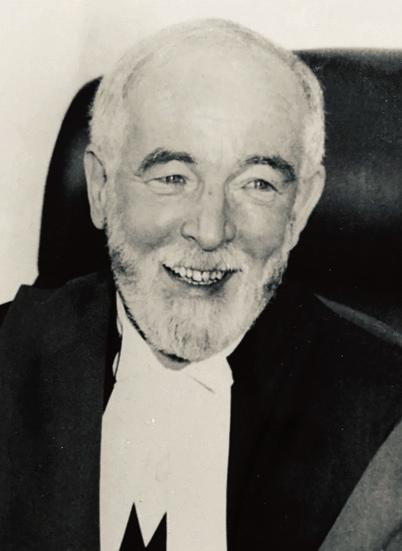
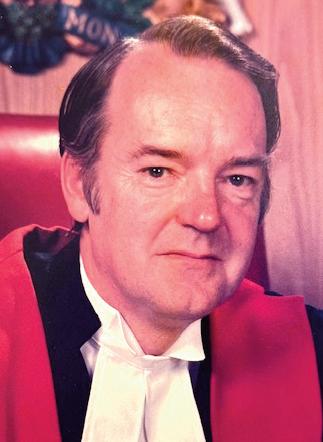
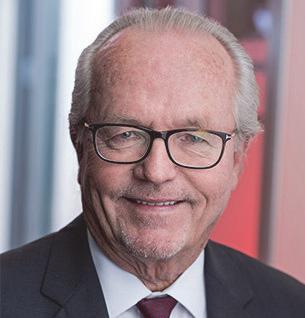
•21-year judicial career: 9 years on the BC Court of Appeal, 12 years as a Supreme Court Judge.
•Presided over all manner of cases including criminal, civil and family claims.
•27 years as a leading litigator, has appeared in all courts of British Columbia and the Supreme Court of Canada.
•Effective and respected decision-maker.
Immediately available to assist with arbitration, mediation, and other forms of dispute resolution with an emphasis on commercial and insurance disputes.
Richard Goepel, K.C. 604.642.5651 | rgoepel@watsongoepel.com
MOVE FORWARD WITH CONFIDENCE watsongoepel.com
OFFICERS AND EXECUTIVES
LAW SOCIETY OF BRITISH COLUMBIA
Thomas L. Spraggs, K.C. President
Michael F. Welsh, K.C. First Vice President
Katrina Harry, K.C.
Second Vice President
Gigi Chen-Kuo
Chief Executive Officer and Executive Director
BENCHERS
APPOINTED BENCHERS
Simran Bains
John James Greschner
Michèle Ross
ELECTED BENCHERS
Nazanin Aram
Aleem Bharmal, K.C.
Tanya Chamberlain, K.C.
Christina J. Cook, K.C.
Cheryl S. D’Sa, K.C.
Tim Delaney, K.C.
Katrina Harry, K.C.
Tanya Heuchert
Sara K. Hopkins
Ravi Hira, K.C.
James A.S. Legh
Benjamine Levine
Jaspreet Singh Malik
David Allan Perry
Natasha Tony
Kathleen Ruth Wittenberg
Marcia D. McNeil
Jay Michi
Arun Mohan
Georges Rivard, K.C.
Gurminder Sandhu, K.C.
Nicole E. Smith
Thomas L. Spraggs, K.C.
James Struthers
Karen Tse, K.C.
Michael F. Welsh, K.C.
Kevin B. Westell
Michael Zimmerman
BRITISH COLUMBIA BAR ASSOCIATIONS
ABBOTSFORD & DISTRICT
Jasdeep Gill-Kahlon, President
CAMPBELL RIVER
Ryan A. Krasman, President
CHILLIWACK & DISTRICT
Nicholas Cooper, President
COMOX VALLEY
Michael McCubbin, President
Shannon Aldinger, President
COWICHAN VALLEY
Jeff Drozdiak, President
FRASER VALLEY
Michael Jones, President
KAMLOOPS
Jeanine Ball, President
KELOWNA
Tom Fellhauer, K.C., President
KOOTENAY
Karen K.L. Tse, K.C., President
NANAIMO CITY
Kristin Rongve, President
NANAIMO COUNTY
Lisa M. Low, President
NEW WESTMINSTER
Paul Pietrusinski, President
NORTH FRASER
Lyle Perry, President
NORTH SHORE
Adam Soliman, President
PENTICTON
Ryu Okayama, President
CANADIAN BAR ASSOCIATION
BRITISH COLUMBIA BRANCH
BOARD OF DIRECTORS
Patricia Blair
President
Connor Bildfell
First Vice President
Sarah Klinger
Second Vice President
Dan Moseley
Finance & Audit Committee Chair
Cherolyn Knapp
Equity, Diversity and Inclusion Representative
Martin Bühler, K.C.
Aboriginal Lawyers Forum Representative
Anwar Mujtabah
Young Lawyers Representative
Dimple Kainth
Director at Large
Randolph W. Robinson
Director at Large
Rebecca L. Darnell
Director at Large
Laurel D. Hogg
Director at Large
ELECTED MEMBERS OF CBABC PROVINCIAL COUNCIL
PORT ALBERNI
Christina Proteau, President
PRINCE GEORGE
Marie Louise Ahrens, President
PRINCE RUPERT
Bryan Crampton, President
QUESNEL
Karen Surcess, President
SALMON ARM
Dennis Zachernuk, President
SOUTH CARIBOO COUNTY
Angela Amman, President
SURREY
P.G. Kent, President
VANCOUVER
Executive
Joey Levesque President
Daniel Babcock Vice President
Spencer Malthouse
Secretary Treasurer
Sean Gallagher Past President
VERNON
Kelsey Wheelhouse, President
VICTORIA
Sofia Bakken, President
CARIBOO
Coral D. Atchison
Nathan Bauder
Jon M. Duncan
KOOTENAY
Jamie Lalonde
Christopher W. Trudeau
NANAIMO
Phil Dwyer
Menaka Giri
Benjamin D. Kingstone
PRINCE RUPERT
Emily Beggs
VANCOUVER
Connor Bildfell
Erica Chow
Joseph G. Cuenca
Rupinder Gosal
Jennifer Khor
Tina Parbhakar
Sonali Sharma
Leena (Ronak) Yousefi
Brian Yuen
VICTORIA
J. Berry Hykin
Cherolyn Knapp
Anwar Mujtabah
WESTMINSTER
Grace Cleveland
Rebecca L. Darnell
Manpreet K. Mand
Natasha S. Nair
Gurjit Kaur Tiwana
YALE
Laurel D. Hogg
Nika Pidskalny
Aachal N. Soll
CANADIAN ASSOCIATION OF BLACK LAWYERS (B.C.)
Cecilia Barnes, President
FEDERATION OF ASIAN CANADIAN LAWYERS (B.C.)
Jennine Punzalan, President
INDIGENOUS BAR ASSOCIATION (B.C.)
Drew Lafond, President
SOUTH ASIAN BAR ASSOCIATION OF BRITISH COLUMBIA
Hardeep S. Gill, President
ASSOCIATION DES JURISTES D’EXPRESSION FRANÇAISE DE LA COLOMBIE-BRITANNIQUE
Sandra Mandanici, President
ADVOCATE
“in the interests of an independent bar”
Published six times each year by the Vancouver Bar Association
Established 1943
ISSN 0044-6416
GST Registration #R123041899
Annual Subscription Rate
$36.75 per year (includes GST)
Out-of-Country Subscription Rate $42 per year (includes GST)
Audited Financial Statements Available to Members
EDITOR: D. Michael Bain, K.C.
ASSISTANT EDITOR: Ludmila B. Herbst, K.C.
EDITORIAL ADVISORY BOARD:
Anne Giardini, O.C., O.B.C., K.C.
Carolyn MacDonald
David Roberts, K.C.
Peter J. Roberts, K.C.
The Honourable Mary Saunders, K.C.
The Honourable Alexander Wolf
CONTRIBUTING EDITORS:
Peter J. Roberts, K.C.
The Honourable Jon Sigurdson, K.C. Lily Zhang
BUSINESS MANAGER: Lynda Roberts
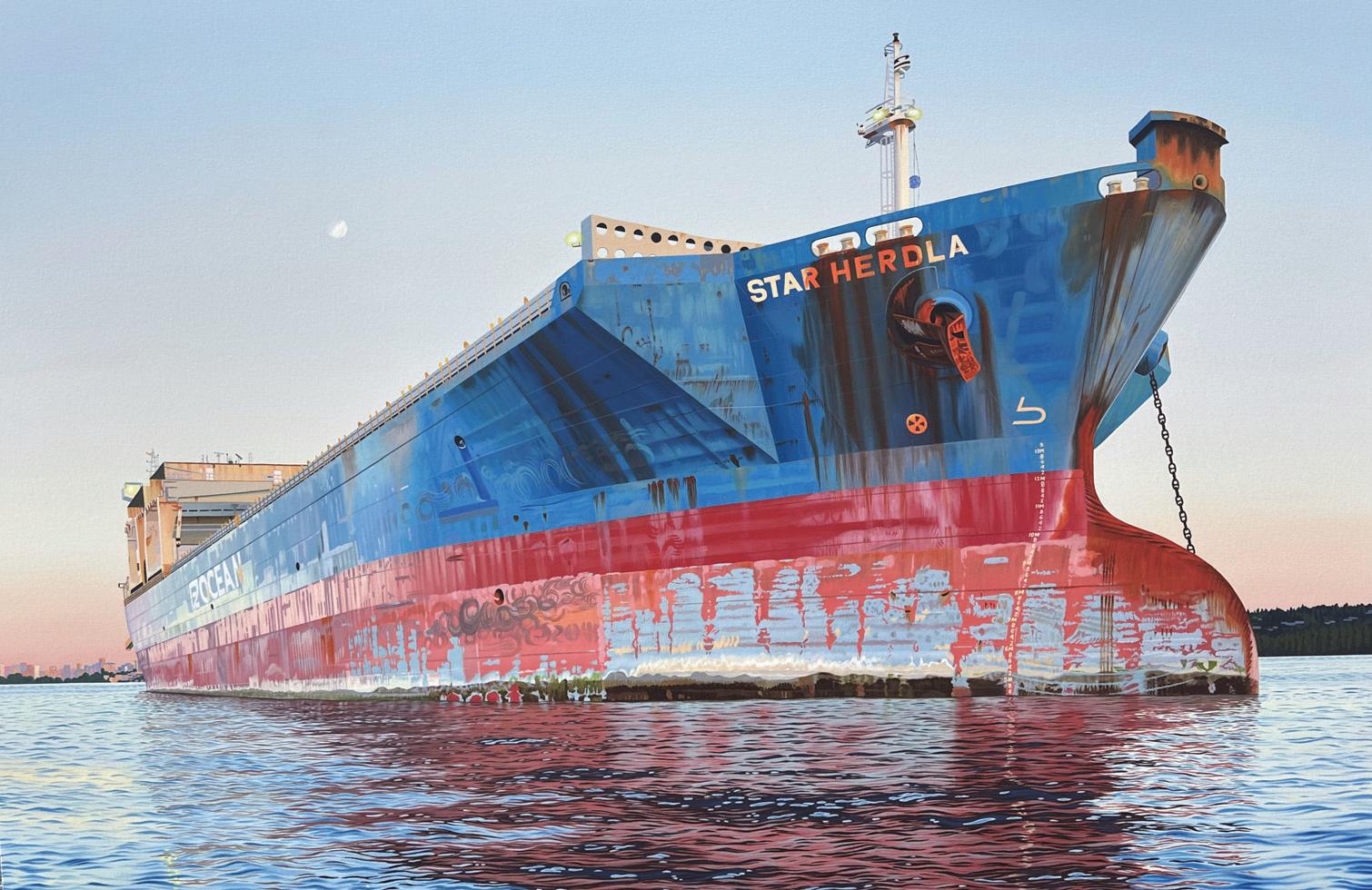
COVER ARTIST: David Goatley
COPY EDITOR: Connor Bildfell
EDITORIAL OFFICE: #1918 – 1030 West Georgia Street Vancouver, B.C. V6E 2Y3 Telephone: 604-696-6120
E-mail:
<mbain@hhbg.ca>
BUSINESS & ADVERTISING OFFICE: 709 – 1489 Marine Drive West Vancouver, B.C. V7T 1B8 Telephone: 604-987-7177
E-mail: <info@the-advocate.ca>
WEBSITE: <www.the-advocate.ca>
VOL. 84 PART 2 MARCH 2026
Entre Nous .
On the Front Cover: The Honourable Mary Saunders, K.C. By the Honourable Patricia Janzen
Take Me to the River: A Lawyer Goes Off the Grid in the Canadian North – Part III
By Allison Render
The Doctrinal Shift Beneath British Columbia’s Arbitration Act
By Michael A. Mulroney
Cowichan Tribes v. Canada (Attorney General) – Misinformation, Fearmongering and the Erosion of the Public’s Trust in the Courts
By Emily Dishart
The Foundations of Canadian Policy in World Affairs Delivered January 13, 1947
By the Right Honourable Louis St. Laurent
Speech to the World Economic Forum in Davos, Switzerland Delivered January 20, 2026
By the Right Honourable Mark Carney
Preparation is the Mediation: Why Serious Advocacy Begins Long Before the Joint Session By Marco Abruzzi
ON THE FRONT COVER
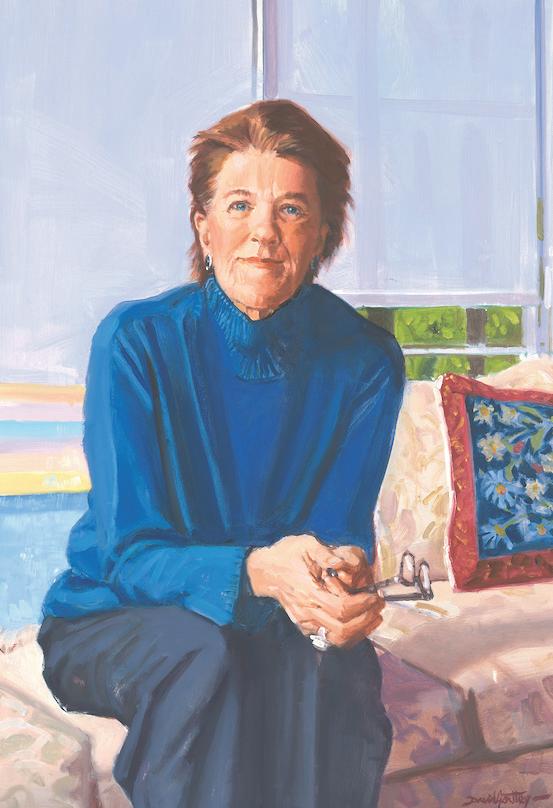
The Honourable Mary Saunders, K.C., graces this month’s cover. Learn of her mathematical journey via the Nicola Valley to B.C.’s top court at page 177.
Daum Terpkosh Valuations
Patti Daum CPA, CA, CBV
Lucas Terpkosh CPA, CA, CBV
Veronika Kyjonka CPA, CBV
Rebecca Hobbs CPA, CBV
Chanittha Vesboonchu CPA, CBV
ENTRE NOUS
Fellow members of bench and bar, we face something that is unprecedented in most of our direct experience: the possibility that a foreign power—or, at least, its unhinged leader—seeks to bring our country under its control, whether economically, politically or militarily.
The Advocate was established in 1943, during World War II. Half the B.C. bar was, at that time, in the armed forces. The Advocate was intended to serve as a means of keeping those members of the profession serving abroad connected with events at home.
As the time of writing, no new war involving Canada has broken out. However, storm clouds continue to gather. Today the Advocate is a forum for us to discuss what the legal profession can do to defend the country and values we want to survive and thrive.
When they first arose over one year ago, threats of annexation seemed mystifying, rude and transitory. We exchanged puzzled glances with our colleagues, had a few moments of envisioning ourselves as members of a militia, cancelled trips to the United States, made efforts to shop for Canadian goods, and then put our heads down and continued with our regular work. To call more attention to the topic of U.S. imperialism as directed toward Canada, much less to suggest we needed to do something about it, seemed alarmist and unnecessary. Our view on this has changed as these threats have persisted and the U.S. executive has brandished the country’s economic power and military force both domestically (inflicting economic pain even on some Democrat-inclined regions within the United States) and abroad.
At this point the rules-based international order that Canada enjoyed after the end of World War II (discussed in the 1947 speech of Louis St. Laurent reproduced starting at page 209 of this issue) is fading, at best. In the
recent Davos speech reproduced starting at page 221 of this issue, current Prime Minister Mark Carney pointed to “the rupture in the world order, the end of a nice story and the beginning of a brutal reality where geopolitics among the great powers is not subject to any constraints”. Disengaged middle powers would be “on the menu”.
Prime Minister Carney’s speech rightly received a rare standing ovation in Davos. We hope that on our side against U.S. aggression, in any form, would be people like those who applauded Carney, either the many goodhearted Americans there are or our other friends around the world.
However, we should be realistic and recognize that we need to be prepared, as Canadians, to stand our ground on our own. People are all too ready to appease the more powerful. President Trump also received a standing ovation at Davos, simply by entering the room in which he was to deliver his rambling address.1 The repercussions of standing up to a crazed regime may be too fearsome in the short term for a single person or country to be expected to do so on behalf of another—as much as, ultimately, united opposition would benefit us all.
From within Canada what can we do, as lawyers and judges, to strengthen Canada’s position? We have some suggestions below, though these are clearly not exhaustive. We invite all of you to spend some time thinking about the options and engaging with colleagues, including on the pages of the Advocate, on these important topics.
Resolve the unaddressed domestic problems whose persistence may tempt Canadians to search for external solutions
The United States may well try to convince Canadians that it has better solutions to our existing domestic problems than we do. We do not want to be a sitting target for U.S. propaganda that seeps into our country through social media and television. We need to use our skills and roles to address those problems—including drugs and street crime—so that inaction does not leave a disaffected pool of potential converts to a U.S. set of solutions. As lawyers and judges, we are well suited to identifying or implementing solutions, full or partial, to some of those problems. Those knowledgeable in criminal law can suggest legislative reforms and educate—including on the pages of the Advocate—other colleagues about those possibilities. Those in positions to expedite judicial processes can do so even without waiting for wider reforms.
The United States may also try to convince Canadians that through it lies greater prosperity than we presently enjoy. The United States may even now be attempting to bolster its argument by first making our economic situation worse—the hole we wish to escape deeper, and its own apparent
heights relatively more lofty—through imposing tariffs or by funding domestic-seeming opposition to our own governments’ policies or wider projects. We must try to fend this off and make our country more resilient, as our federal and provincial governments are now seeking to do. The lawyers among us should consider how we can help to develop and implement more effective consultation and assessment processes that allow Canadians to benefit, responsibly, from the vast natural resources located within this country’s borders. We recognize and respect there are marked differences of opinion in how this can be done, which projects to pursue, and which values to prioritize in determining next steps.
Recognize that U.S. solutions are not better
To the extent problems within Canada persist, we must also use our analytical and communication skills to ensure that Canadians do not believe the lie that the United States is addressing the same problems we face more effectively. For example, though it may look tantalizingly more decisive than any Canadian equivalent, blowing up motorboats that may or may not have had anything to do with drugs is not a drug policy. It is a distraction from the fact the U.S. president pardoned, at the same time, an ex-Honduran president convicted of trafficking 360 tonnes of cocaine.
We also need to reaffirm and explain the importance of law, whether domestic or international, and of compliance with it. Without respect for law, matters could descend into a Hobbesian reality where life is nasty, brutish and short. Even from a self-interested perspective, worthwhile ends do not justify unlawful means: using such means erodes the protections that in other circumstances we all enjoy.
Supporting Americans fighting authoritarianism
Our foe at the moment is not the United States as a whole, but a corrupt and unhinged administration. If that administration is curbed or replaced, it will be to Canada’s benefit.
We should support our legal colleagues in the United States who are fighting to keep in check the abuses of its present administration. We should also support the media organizations that, in face of threats of defamation lawsuits or raids on journalists’ homes, fight to unmask the administration’s flaws and to tell the truth about what it has done. Subscribe to The New York Times or other newspaper or website that still does actual journalism.
That work, to the extent it reaches the eyes and ears of U.S. voters, may ultimately aid in the regularization of the U.S. government—back to one that does not threaten Canada and that does not engage in other triggerhappy behaviour that could otherwise lead to a world war.
The media’s work also allows us to assess our chances more accurately should threats of military aggression against us arise while the present U.S. administration is in power. The media has exposed that the United States first blew up a motorboat using a plane disguised as a civilian aircraft, which is not something that reflects great military prowess or self-confidence. Note as well that while all fans of action movies were no doubt stirred by the sight of military helicopters over Caracas or claims that a “discombobulator” weapon was used to knock out Venezuelan defences, media reporting in the United States and elsewhere has let us know that members of the Venezuelan leadership communicated with the United States, in advance of the raid, about cooperation should Nicolás Maduro be removed. We should at least pause to wonder if the U.S. military would similarly have triumphed—or, indeed, made its attempt—without some insider support.
Protesting U.S. wrongs
Although the present U.S. administration shows disdain for global and regional institutions, we should put submissions before them to chronicle and “out” transgressions. To the extent we do not already do so, those of us who are familiar with international public or trade law should consider supporting other countries or peoples to put forward their cases.
Civility and connection
Polite is not passive.
We should redouble our efforts at civility and to form bonds with each other, both in the legal profession and beyond—we are stronger together than as individuals. Take advantage of the opportunities we have in this profession to meet one another and discuss issues. Not only may this generate more ideas about how to resist U.S. threats, but we may find the support we need to weather these challenging times, and give us the strength to fight back against external enemies. Many of us and our family members are experiencing unprecedented levels of stress on top of the day-to-day issues that all of us face.
We should never tolerate in our professional dealings or in Canadian politics the behaviour that members of the U.S. executive engage in. We should call out inaccuracy, crassness or potentially conflicted or corrupt conduct where it occurs (and, so far, it appears that this is uncommon in our country), so that persons engaging in any of the above conduct do not find themselves in positions of authority. If they were to be allowed to reach positions of authority, they might welcome a U.S. incursion led by persons of similar character, or might at least lack the competence to handle Canada’s defence. In contrast to the delays that occurred in the United States
between Trump administrations, in Canada we need to prosecute wrongdoing expeditiously so that persons alleged to have engaged in it are not left free to obtain positions of power.
Educating ourselves
If worst were to come to worst and we were to face incursion—as profoundly insane as it would have seemed not long ago to broach such a subject—we need to know what to do.
The Advocate’s editorial staff have no military expertise. Some of you do— ideas on what we could feasibly band together to do if we were to see the U.S. military on the horizon are welcome. The rest of us did at least get through law school, and there must be something we could plan for to make it profoundly difficult for an attempt to take over this vast country to succeed.
If all went terribly badly and we ended up with foreign rulers, assuming some semblance of due process would remain we would need to know how to defend fellow citizens whom masked agents may also wish to pull from Canadian streets. Criminal lawyers (and educators): the rest of us could probably use a refresher on the first principles that might still count even if the Canadian documents in which fundamental rights were codified get supplanted.
What else could or should we do in face of the threats that have been made? We have been very fortunate for so many years in this country not to need to answer such questions, but that good fortune also means that certain answers we now need are not readily discernable. It is time to start thinking about them.
ENDNOTE
1. Admittedly, at least part of the riled-up crowd may simply have been people who felt, as did one British executive, that “seeing Trump in the wild is like a
zoological experience”: Ishaan Tharoor, “Trump Dominated Davos. But Canada’s Carney Was the Star”, The Washington Post (23 January 2026).
ON THE FRONT COVER
THE HONOURABLE MARY SAUNDERS, K.C.
By the Honourable Patricia Janzen
Even those who know Mary Saunders, K.C., well may be surprised to learn that she was born in Vancouver, not somewhere else, anywhere else, in B.C. Mary spent her earliest years in Valemount in the Rocky Mountains. She attended and completed public school in Merritt, a mining, lumbering and ranching town in the heart of the Nicola Valley.
Responding to the circumstances of the Great Depression, Mary’s father left school early. He continued his education through reading and by thoughtfully applying the lessons he learned from life experience. Mary’s mother Blanche grew up in South Vancouver. She attended UBC, graduating with a bachelor of arts degree at age 19. Well-educated and discerning, Blanche married Lyle and they moved to Victoria where their son Nathan was born. With a fine mind, a strong work ethic and plenty of daring-do, Lyle Saunders started up and developed two successful sawmilling businesses, the first at the end of World War II, when the family moved into a log house built by Lyle just south of Valemount in the Rockies.
In 1955 the family, now including Mary, moved to Merritt where Blanche became a much-loved and well-respected math and English teacher. In addition to her teaching responsibilities, Blanche actively participated in and brought her skills to the family businesses. Mary’s parents were brave. They set audacious goals and accomplished them. They believed in the importance of thinking and acting independently and that belief was instilled in Mary from a young age.
Mary’s childhood was a happy one, sheltering under the watchful eye of older brother Nathan. She formed close ties with classmates and with their
families from diverse backgrounds, vocations, abilities and perspectives. In Merritt she learned not only to get along with a wide variety of people, but also to respect and value them. Through frequent trips to Merritt and the Nicola Valley for more than 50 years she has maintained many of these friendships and her connection to her small-town roots. In Merritt Mary also learned the importance of a job—to an individual’s self-worth, autonomy and connection with community.
Her beloved father died suddenly in a plane crash in 1967 while piloting his own plane in a search and rescue mission. The airfield in Merritt is called Saunders Field in his memory. His early death brought profound grief to Mary’s otherwise happy life.
Mary was one of few classmates who went on to university. In the fall of 1967, soon after her father’s death, Mary moved to Vancouver to attend UBC. At the same time, Blanche, now retired from teaching, moved to Vancouver and then constructed the home on Nicola Lake that became the locale of family delight.
Mary obtained a B.Sc. degree from UBC, majoring in mathematics— entranced by numbers and the opportunity math provided to solve intriguing puzzles. While Mary’s mind was rigorously logical, she learned to trust her subconscious to solve the most complex, or what she called the “trickiest”, problems. She often said that she needed to stop thinking and let her brain do the work.
While Mary’s formal education was in mathematics, she was just as entranced by words. She has always read broadly and appreciated a wellturned phrase. She can quote verbatim from poems and passages from Shakespeare that she has committed to memory. She regularly consults an enormous Random House dictionary that took pride of place in her chambers. She delights in utilizing the most precise word possible in her writing, particularly if that word is rarely used.
Mary did not go to university with the dream of becoming a lawyer. She did not know any lawyers. In second term of fourth year, she confronted the dilemma of what to do with a major in mathematics. It was suggested to her that law could be a good choice for a person who enjoyed thinking rationally. She applied for law school and was accepted. When Mary applied, only two per cent of the UBC Law graduating class was female. Women represented ten per cent of the UBC Law class in Mary’s year. Two years later, women made up fifteen per cent of the UBC Law class. The times were changing rapidly.
An observer wrote on the Advocate’s article about Mary’s appointment to the Supreme Court of British Columbia that “[i]t never dawned on [Mary] …
that others would exclude her, or provide her less opportunity, or treat her poorly, or that progress in the profession would be slowed by her gender. In large measure, those she worked with in the legal profession lived up to her expectations of opportunity and openness.” When on occasion they did not live up to her expectations, Mary refused to think of herself as a victim and took care to ensure that she was never seen in that way.
While Mary intended to return to the Interior and practise law in Kamloops, near Merritt, she was unable to secure articles there despite graduating in the top ten per cent of her class. Instead, she articled at Farris, Vaughan, Wills & Murphy and was kept on as an associate in 1975. At Farris, she had the opportunity to practise labour law at the time when a new Labour Code was enacted. That transformative legislation provided opportunities for very junior lawyers to argue precedent-setting cases and make new law.
Mary found the practice of labour law in the seventies and eighties very much to her liking. The legal problems involved people and their jobs; the legal principles were under development; the processes were flexible; the solutions were practical and creative; the decisions had significant impact on the lives of British Columbians; and the labour bar was a small community of young, lively and bold practitioners. The pace was fast and Mary often joked that labour law was suited to lawyers with short attention spans.
Mary primarily practised labour and employment law from 1975 until her appointment to the Supreme Court of British Columbia: at Farris & Company (1975–1979), Barbeau McKercher (1979–1980), Ladner Downs (1980–1985) and Campney Murphy (1986–1991).
Mary considered herself very lucky to have found work that was so interesting and paid so well and, as a result, was committed to volunteering her time and talent to support her profession and the broader community. She served as a member of the executive of the labour section of the CBABC in the 1980s and has contributed to numerous continuing legal education programs throughout her career.
Mary was one of three appointees to the 1986 Industrial Inquiry Commission that inquired into collective bargaining issues in dispute in the B.C. forest industry. From 1989 to 1990 Mary was a member of the Premier’s Advisory Council on Native Affairs.
From 1985 to 1991 Mary served on the British Columbia Police Commission and as acting complaint commissioner from 1989 to 1990. While a member of the Police Commission she sat as a commissioner on two royal commissions of inquiry into injuries sustained by individuals while in the custody of municipal police and participated in the preparation of several
reports on police practices and regulations. She served on the RCMP External Review Committee from 1984 to 1991.
Mary was a member of the board of the Justice Institute of British Columbia from 1984 to 1991.
In 1989 Mary was appointed as Queen’s Counsel (now King’s Counsel). And in 2009 she received the Anthony P. Pantages, Q.C. Medal from the Justice Institute of British Columbia for contributions to improvements in criminal justice in British Columbia.
In December 1991 Mary was appointed to the Supreme Court of British Columbia. She was translated to the Court of Appeal for British Columbia and the Court of Appeal for the Yukon Territory on June 30, 1999. With her intense interest in people and her love of the law as a tool to solve problems, Mary very much enjoyed the job of trial judge, but when invited to join the Court of Appeal less than eight years later she immediately recognized that such an opportunity probably comes around only once. It was a good decision—for her, for the bar and for the people of British Columbia. Mary was described as a dedicated, hardworking and collegial Court of Appeal judge who thought deeply about the proper development of the law for British Columbia and who wrote with great care and precision. Throughout her judicial career, she was determined to never forget about the parties before the court and she sought to ensure that her “judgments landed softly”.
Mary is devoted to her small but very close-knit family: brother Nathan who lives at Nicola Lake, his daughter Avery (a partner with Clark Wilson and an accomplished long-distance runner), Avery’s husband Shane and Avery’s two much loved stepchildren. While Avery was inspired by the example set by her aunt, Mary took care to encourage Avery to follow her own path in law.
In the 1980s Mary met Noel Larkin. Their friendship deepened into love and Mary and Noel enjoyed 16 magical years together that ended with Noel’s untimely death in 2003. Noel was the love in Mary’s life and she deeply grieved his passing.
Mary has a large circle of close friends to whom she is unfailingly loyal, kind and generous. Her visit will often be accompanied by a bouquet of roses from her garden, a freshly baked pie or a seasonal tin of shortbread or mince tarts. As Mary’s then new friend in 1977, we regularly got together at the Bon Ton pastry shop on Granville Street where we would engage in ferocious political debate over a lunch of French pastries selected from a tiered cake plate. I quickly learned two things about Mary: that she has a sweet tooth, and that she had already mastered the art of disagreeing without being disagreeable.
Mary is a talker. By that I mean she has always been an avid student and practitioner of the art of conversation. She is as likely to strike up a conversation with the plumber, the Uber driver, or the guy who has just re-heeled her shoes as with a fellow judge or lawyer. She usually values more highly and recounts the conversations she has enjoyed with those whose life experience is different from her own.
Mary contains multitudes. She was a skilled curler and is a member of UBC’s Block Club. As a young woman she pursued painting as a hobby. One of her paintings is framed and is not out of place in her home alongside work by professional artists. She loves fabric and sews beautifully. She has made dresses, tailored suits and coats for herself and garments for Avery. Mary is an accomplished baker with a sophisticated repertoire of pastries and cakes. I am told that she plays the piano—and plays it quite well. She is a keen golf, baseball and tennis fan.
In 2022 while sitting supernumerary, Mary was appointed to chair the three-person Federal Electoral Boundaries Commission charged with determining the boundaries of federal ridings in British Columbia for the next ten years. This appointment suited her perfectly because it combined several of her lifelong passions. She had the opportunity to meet with citizens across British Columbia and determine how to best balance their sense of belonging to a community of interest in their riding with the principle that every riding should comprise an equal number of voters. She had an essential role to play in a cornerstone of Canada’s system of democratic government. And she was engaging in an intellectual exercise that she compared to a very complex jigsaw puzzle.
In 2024 she reached the age of mandatory retirement for judges. While Mary has many friends and diverse interests to keep her busy in retirement, all who know her predicted that she would not stay retired for long. In February 2025 she came out of retirement to accept a role as an advisor and mentor at Harris & Company, a mid-sized firm of litigators and labour lawyers, including several she worked with at Campney Murphy. In her new role she provides advice to the firm’s lawyers in the crafting of an argument that strips away the flotsam and jetsam of a file and focuses on the central puzzle in the case. Mary has always cared deeply about the skilled and ethical practice of law and the development of junior lawyers. She has been a supportive and effective mentor to a legion of law clerks (33), many of whom remain her friends, and so she brings vast experience to the mentoring role. The lawyers at Harris & Company will benefit from her wisdom.
As Mary enters this new chapter in her professional life, she can look back with pleasure on an exceptional career in service to the people of the province she loves so dearly.
Regulatory & Business law Lauren Frederick practices regul providing advice on transactiona for financial institutions and com
T: (604) 661-1027
E: lfrederick@ekb.com
atory and business law, l and day-to-day activities mercial clients.
Lauren has been with EKB since 2 a summer articling student. Laur Univerrsity of Victoria, where she of British Columbia Gold Medal.
019, when she began as en obtained her JD from the received the Law Society
ekb.com
TAKE ME TO THE RIVER: A LAWYER GOES OFF THE GRID IN THE CANADIAN NORTH
PART III*
By Allison Render
On a long wilderness trip, the rules of city life break down. You stop worrying about your dirty fingernails, unshaved legs and smelly shirts. Your oily hair slides into braids that come undone through a long day. You wash your underwear in the river and hang it on a clothesline for all to see.
Yet when we left the canyons, we knew we had to prepare for civilization. After running the Nahanni’s final rapid at Lafferty’s Riffle, First Canyon tapered down to nothing, and our canoes shot into the foothills. Only a few lonesome peaks poked out of the plain. We followed our noses to the river’s right shore, where sulphurous steam announced our first warm bath of the trip.
* Part I of this article, about the author’s trip to the Nahanni National Park Reserve in the Northwest Territories, was published at (2025) 83 Advocate 859, and Part II was published at (2026) 84 Advocate 33. A single canoe drifts through First Canyon
Kraus Hotsprings trickle out of the riverbank and into a hand-dug pool just large enough for our group of eight. The area around the spring is the former homestead of Gus and Mary Kraus, who lived here for decades. Grassy fields extend from their cabin to the shore, while lush vegetation and rich berry bushes crowd the forest all around. In the summer sun, I could see why early explorers called the Nahanni a “tropical” valley in the far north.
As I donned my bathing suit and slipped into the warm water, my tight muscles released. The water cradled my tired shoulders as I leaned against the rocks and looked back upriver towards the canyon’s mouth.
While the hot springs were luxurious, rinsing off was anything but. Getting the sulphur smell out meant a dip in the icy Nahanni. A plunge in the river made me gasp. While my feet went numb in seconds, the blazing sun burned my exposed neck.
Below First Canyon, the Nahanni sprawls across her floodplain. More than a kilometre wide in some places, the Splits are a maze of wandering channels and a dumping ground for Nahanni’s detritus as she marches south. Driftwood piles up in great sucking strainers. Gravel islands grow and vanish with every flood. Submerged mud bars suddenly rise to scrape canoe hulls.
My uncle warned me about the Splits, and our guides repeated the warning: stay together. If your boats get separated in this labyrinth, you’ll be separated for hours. As we paddled, we kept to the widest, deepest channel and away from the trees that leaned out over eroding banks. Even here, the current was strong enough to push an unwary canoe into trouble.
Nahanni Butte reflected in the calm waters of the Nahanni, just above its confluence with the Liard
BEYOND THE PARK
Nahanni Park ends at kilometre 524, where the river rounds Twisted Mountain and turns to the southeast. The only marker is a sign high on shore, half-hidden by trees. The Nahanni remains wild and lonely to its end. Beyond the park boundary, the river’s many braided channels gradually funnel back into one.
By this point, exhaustion set in. I could see the peak of Nahanni Butte, opposite our takeout point, but we would not reach it until the next day. Rivers are deceptive: you can travel towards a landmark, think you’re getting close, then suddenly swing away from it as you enter a long bend.
Once the Nahanni dumps its load in the Splits, only a little gravel remains. The last good campsite on the Nahanni sits about twenty kilometres above the takeout point, where the river slows down and enters its slow, snakelike final loops. Here at Last Chance Gravel Bar, we found a welcome surprise: people. Two self-guided groups, one from British Columbia, the other from Wakefield, Quebec, were already camped on the gravel bar. After several days alone in the canyons, we had neighbours.
Neighbours means river gossip. While we lounged at the Falls, watching it rain for an entire day, our new neighbours had been in the canyons. The river, they said, rose between four and eight feet overnight (depending on who you asked). The B.C. group lost a paddle and a PFD. One of the Wakefield group’s tents became an island amid the rising water. In the morning, they said, entire trees were rushing down the river and through the Gate, where we’d seen only fast but clean water. Bookshelf Falls, cold and clear when we arrived, was spewing mud and gravel.
Canoeing beneath Nahanni Butte
But any woe came with a wink and a laugh. Their hands waved and their smiles widened as they told the tale. There was a strange yet familiar glee in their eyes. It was the glee of a good story. Sunshine in a storm.
Through this conversation, I thought of the beaded moosehide keychain I wore as a zipper pull on my vest. The blue and green seed beads sparkled, and the moosehide still smelled faintly of tanning smoke.
Beaded keychains
At the trip’s start, rain and clouds had delayed our float plane flight by three days, stranding us in the small gateway town of Fort Simpson. On our third night in Simpson, just when the weather seemed hopeless, we attended a beading workshop. While local ladies stitched moccasin uppers, Tonya, a young Dene woman, taught our group to make these little tubes. The morning after the workshop, our flight took off. From then on, we always seemed to avoid the worst weather. We hit the Cirque in sunshine. We had shelter when it rained. We dodged the floods in the canyons. Call it a Nahanni good-luck charm.
Though exhaustion pressed upon me like a heavy pack on my shoulders, I couldn’t turn in right after dinner. The sound of a strumming guitar drifted down the gravel bar from the Wakefield crew’s kitchen. We drifted over with
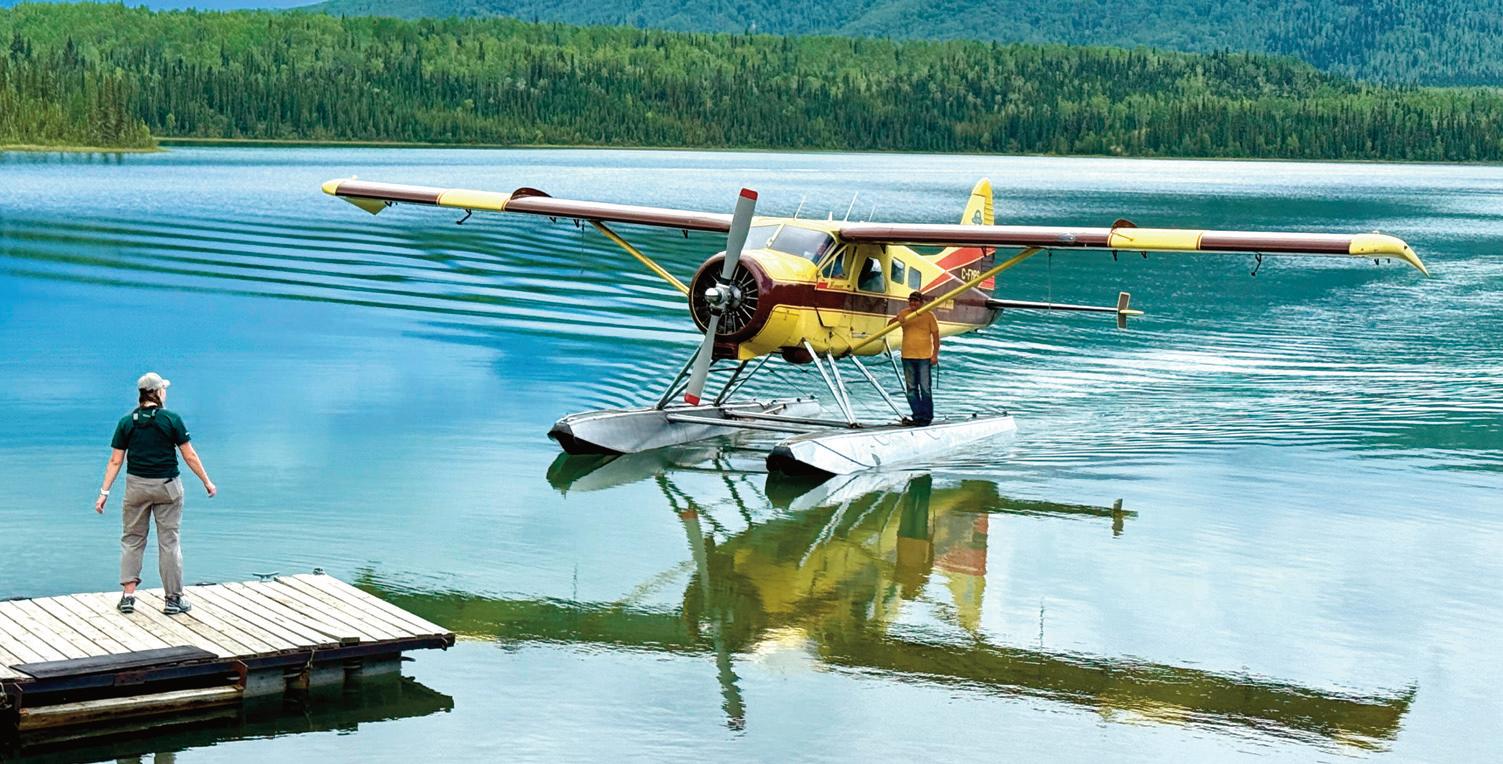
Float plane landing on Rabbitkettle Lake
our chairs and snacks. The B.C. crew brought their last drops of alcohol. And we sang. Folk. Country. Rock. Some I knew; many I didn’t. We turned that campsite into Last Chance Party Bar.
With the midnight sun glowing above the trees and no neighbours to bother, the concert could have gone on forever. But all things must end. They packed up the guitar. We said our goodbyes. And we retreated to our tents for one last night.
THE COST OF ADVENTURE
There’s freedom on the river. Even now, with national park rules and topo maps and the rigid schedule of a guided trip, there’s freedom. But that freedom is hard. A Nahanni trip isn’t most people’s idea of a vacation. I lifted and hauled, paddled and portaged, cooked and cleaned. I slept on rocks, went without showers, and peed in the woods. Every little task is longer and harder in the wilderness, from getting water to going to bed at night. Every step is more dangerous than it is at home. You’re at the mercy of the weather. Your schedule will survive only as long as a paper airplane tossed over the Falls.
And I paid that cost—a fraction of what the old explorers paid—for a glimpse of what once was across this great continent.
Without all those impersonal mediators of modern life, you rely more on yourself, but also on those around you. Your team. You and your team gather firewood. Fetch water. Set up the kitchen shelter. Haul the boats up from the riverbank. When your boat swamps, your team is your only rescue. And, when you sing around the campfire, they’re both your audience and your choir.
On our last day, we paddled the long, slow loops to the Nahanni’s confluence with the Liard. Shortly before the village came into view, we spotted something huge and brown moving across the river. The enormous beast clambered onto shore as we approached, water dripping from its hide: a wood bison. He frowned at us, giving a long stare as we drifted by, then
Taken with a telephoto lens. Do not approach bison
lumbered into the forest. Later, we saw a group of five bison cross the river while we waited for our pickup in the village of Nahanni Butte.
The Nahanni has changed since the days of old explorers. It’s more visited, but it’s also more protected. R.M. Patterson spent months on the river, believing it to be unspoiled country, but never mentions bison. Though native to the Nahanni area, by 1927, bison were nearly extinct from overhunting. In 1980, they were reintroduced, along with hunting restrictions. Now, bison are so common in the Nahanni lowlands that signs on the nearby Liard Highway warn drivers of the hazard.
It’s easy to romanticize the Wild West world of lawless freedom and endless resources, but it only existed for a moment, and only for those few who paid the cost. The power of modern technology, of the railroad and rifle, the automobile and the airplane, destroyed it. They shrank the world. And they allowed prospectors and settlers to run roughshod over the landscape and the people who lived there before them.
Few among us would give up modern comforts and the wealth they bring. But to see the Nahanni, you must give up a few comforts, for a little while. My Nahanni adventure was only possible because a prime minister once paddled the Nahanni and said, “we must preserve this”. The same restrictions that keep Nahanni wild, the same restrictions that make it hard—the lack of roads, the lack of facilities, the ban on motorboats—are also what keep people out. If Nahanni saw even one-tenth of Banff’s 4 million visitors per year, it would never be the same.
Few visit the Nahanni. And those who do visit don’t want it to be easy. “Everything was easy and beautiful” isn’t a good story. A good story needs hardship. Grit. Trials overcome and lessons learned and rewards earned instead of bought. The darkness of the storm makes the sunshine brighter.
We say we came to the Nahanni for the natural beauty. But we really came to find our story. Those other paddlers who survived the Nahanni flood got their story. And I got mine.
As we left Nahanni Butte, I stared down the river and wondered. If I only had the time and supplies, I could continue. The Nahanni flows into the Liard at Nahanni Butte. The Liard flows into the Mackenzie at Fort Simpson. And the Mackenzie, Canada’s longest river, flows past the Arctic Circle, past the treeline, until it empties into the ice-choked Beaufort Sea.
PS: What about the bears? Although we saw scat and diggings and even woke to find fresh bear tracks in our Second Canyon camp, we never saw a bear in the park. A group of eight makes enough of a racket to drive most bears away. But on the drive back to Fort Simpson, a black bear scampered across the highway ahead of our van. Even where the north has been developed, it’s still wild.
THE DOCTRINAL SHIFT BENEATH BRITISH COLUMBIA’S ARBITRATION ACT
By Michael A. Mulroney
Acentral issue requiring resolution for domestic commercial arbitration in the common law provinces is whether “correctness” or “reasonableness” generally governs appeals on questions of law. This issue arose when the Supreme Court of Canada (“SCC”) held in Vavilov that an “appeal” mechanism in an administrative law statute generally signals an appellate standard,1 casting doubt on the authority of its earlier holding in Sattva, which it reaffirmed in Teal Cedar, that reasonableness generally governs statutory appeals from commercial arbitration.2 In Wastech, a majority of the SCC decided to “leave [this issue] for another day”.3 The B.C. Court of Appeal (“BCCA”) has likewise deferred,4 while courts in other provinces have taken divergent paths.5
The law reform reports that shaped domestic commercial arbitration statutes, which are not mentioned in Sattva or in Teal Cedar, point to correctness as the intended standard of review. The Alberta Court of King’s Bench, for example, held in Esfahani v. Samimi that the Uniform Law Conference of Canada’s reports, which inform legislation in most common law provinces other than British Columbia, support an appellate standard.6
Based on the Law Reform Commission of British Columbia’s (“LRC”) 1982 Report on Arbitration (the “LRC Report”), an earlier article that I wrote (“Escaped Attention”) reaches the same conclusion for British Columbia’s unique legislation.7 Yet, in an article that appeared in the July 2025 issue of the Advocate, 8 Gerald Ghikas, K.C., relying on the same LRC Report, reasons that British Columbia’s current Arbitration Act (the “Act”) envisages reasonableness for extricable questions of law.9
The divergence turns on a doctrinal premise that is easy to overlook. The Act’s alternative leave provisions cannot be properly understood without recalling that, at the time of the LRC’s work, contractual interpretation was classified as a question of law. That premise was unsettled decades later in Sattva, where the SCC recast contractual interpretation as generally a mixed question of fact and law, ironically in the very case interpreting this appeal provision. While Mr. Ghikas correctly observes that the purpose of the “miscarriage of justice” requirement in s. 59(4)(a) of the Act was to impose a
more deferential threshold for appeals falling under this provision, his analysis extends that requirement beyond its intended role by applying it to extricable questions of law. Once the historical classification of contractual interpretation is restored, the Act’s scheme is clear: correctness for questions of broader precedential significance, and a deferential miscarriage-of-justice threshold only for genuinely “one-off” determinations.
The discussion that follows traces the origins of the Act’s appeal provision, the LRC’s reliance on then-current legal classifications and language, and the tension between that design and subsequent doctrinal and terminological change.
ENGLAND & WALES’ ARBITRATION ACT 1979 AND PIONEER SHIPPING
Commentary and citations in the LRC Report provide critical context for the proper interpretation of the alternative leave provisions that remain in s. 59(4) of the Act. The LRC’s proposed right of appeal “on any question of law arising out of the award” originates from England and Wales’ then-new Arbitration Act 1979 (the “1979 English AA”).10 Early judicial interpretations of this legislation cited in the LRC Report clarify the meaning behind British Columbia’s own legislation.11
In Pioneer Shipping Ltd v. BTP Tioxide Ltd (The “Nema”), 12 Lord Diplock affirmed categorically that “any question of law” within the meaning of the 1979 English AA included contractual interpretation. He acknowledged that the rationale for treating contractual interpretation as a question of law was “a legacy of the system of trial by juries who might not all be literate” and was no longer relevant. Nevertheless, he determined: … it is far too late to change the technical classification of the ascertainment of the meaning of a written contract between private parties as being ‘a question of law’ for the purposes of judicial review of awards of arbitrators or decisions of administrative tribunals from which an appeal to a court of justice is restricted by statute to an appeal on a question of law 13
This was an application of a well-established “presumption against alterations in the common law.”14 Parliament legislated against a settled doctrinal backdrop when it chose to permit an appeal on “any question of law” such that reclassification by a reviewing court would risk undermining the statutory design.
However, the House of Lords (“UKHL”) concluded that leave should generally not be granted to appeal a commercial arbitrator’s interpretation of a non-standard contractual clause. The 1979 English AA imposed no express restriction on when the High Court could grant leave to appeal “any question of law arising out of the award” other than that “the determination of
the question of law concerned could substantially affect the rights of one or more of the parties.”15 Nevertheless, in England and Wales’ Court of Appeal, Lord Denning, M.R., held that the High Court ought not to grant leave to appeal an interpretation of a “‘one-off’ clause in a ‘one-off’ contract[, t]he interpretation of [which] is unlikely ever to arise again.”16 On further appeal to the UKHL, Lord Diplock clarified that leave to appeal such questions should be granted only in exceptional circumstances, including where “it appear[s] on perusal of the award either that the arbitrator misdirected himself in law or that his decision was such that no reasonable arbitrator could reach.”17 This deferential approach, he explained, rested on the “cumulative effect of [various] indications of Parliament’s intention to promote greater finality in arbitral awards” found throughout the 1979 English AA 18 Importantly, Lord Diplock grounded his holding in judicial discretion rather than any jurisdictional limit.
Pioneer Shipping prescribed a different approach for “any question of law” with precedential value. Lord Diplock found that the 1979 English AA’s appeal provision reflected the public interest of promoting “as high a degree of legal certainty as it is practicable to obtain” in respect of the proper interpretation of standard contractual terms.19 Lord Roskill’s determination that the High Court could grant leave to appeal in relation to a one-off legal question where it found the arbitrator “to have gone wrong in law and not to have applied the right legal test” confirmed that extricable legal errors attracted an appellate standard.20 Together, these statements underscore the UKHL’s view that questions of law with broader significance warranted correctness review.
THE LAW REFORM COMMISSION’S 1982 REPORT ON ARBITRATION
The LRC Report proceeds on the premise that contractual interpretation is a question of law. For example, it expressly characterizes a matter “strictly and purely one of construction of an agreement” as a “specific question of law”,21 which accords with contemporary Canadian authority.22 This premise also aligns with Lord Diplock’s judgment in Pioneer Shipping, which the LRC quotes extensively.23
This classification informed the LRC’s drafting choices. The LRC aimed to “reduce the disadvantages of arbitration”,24 including that its use “could inhibit growth of the common law in particular fields of business and retard the process whereby standard terms in contracts acquire a settled interpretation.”25 In recommending that British Columbia adopt a right of appeal available either by agreement or with leave based on the 1979 English AA, 26 the LRC proposed that “alternative criteria for granting leave should be
specified in the legislation.”27 Its draft provisions stipulated that the B.C. Supreme Court (“BCSC”) could only grant leave “on any question of law arising out of an award” where:
a)the importance of the result of the arbitration to the parties justifies the intervention of the court and the determination of the point of law may prevent a substantial miscarriage of justice,
b)the point of law is of importance to some class or body of persons of which the applicant is a member, or
c)the point of law is of general or public importance.28
The second provision evidently advanced the LRC’s goal of promoting consistent interpretation of contractual clauses commonly used in a particular industry. Therefore, “any question of law” and a “point of law” included questions regarding the construction of an agreement.
The first leave provision permitted appeals in relation to “one-off” questions, such as interpretations of contractual clauses unique to the parties’ agreement or determinations on whether a contract was frustrated.29 These issues need not have been relevant to any particular “class or body of persons” or be of “general public importance.”30 The LRC clearly contemplated that the BCSC could grant leave to appeal in relation to such determinations by an arbitrator where they were sufficiently consequential to the parties and if intervention could potentially “prevent a substantial miscarriage of justice”.
The “substantial miscarriage of justice” requirement was an explicit but archaically-worded prescription of a deferential threshold for judicial intervention.31 The common law at the time afforded an arbitrator considerable deference in relation to a determination that was “the very thing referred for arbitration”,32 while correctness applied to a judge’s construction of an agreement.33 While courts could intervene in an arbitration on the basis of an irregularity if satisfied that it may have caused a “substantial miscarriage of justice”,34 the LRC recommended a separate remedy to set aside or remit an award for “failure to observe the rules of natural justice”. This requirement in the first provision of the leave section therefore did not operate as a general procedural fairness safeguard.35
Instead, the phrase captured the threshold for appellate intervention in relation to an unreasonable decision. At the time, judicial intervention in an arbitration could also be available on the basis of an evidentiary error affecting the outcome, which courts were just beginning to refer to as “palpable and overriding” errors,36 or a plainly wrong outcome.37 Contemporaneous appellate and judicial review jurisprudence sometimes characterized such errors in the reasoning process, or such untenable outcomes, as giving rise
to a potential substantial miscarriage of justice.38 The LRC thus contemplated an analogue to modern reasonableness review,39 but for determinations now classified as mixed questions of fact and law rather than “pure” questions of law.
The LRC’s second and third leave provisions allowed for appeals in relation to legal questions of precedential value. A “point of law [that] is of importance to some class or body of persons of which the applicant is a member” could include the interpretation of a CCDC provision to a contractor or the meaning of a forestry regulation to a timber harvesting company. Questions “of general or public importance” encompass, among other things, the interpretation of standard clauses in consumer contracts or extricable questions of law.
For such broadly relevant legal questions, the LRC intended a correctness standard. This approach advanced its goal of promoting “systematic development of the common law”, including “settled interpretation” of standard contractual terms.40 In this respect, it reflected Lord Diplock’s view that it was in the public interest for appeals to promote “as high a degree of legal certainty as it is practicable to obtain” for commonly used clauses.41 The LRC proposal of a general requirement that arbitrators apply the law, subject to an agreement to the contrary, would provide “a degree of certainty that would not necessarily exist if they were not so bound.”42 The recommendation that waivers of appeals, which entailed acceptance of “the risk that the arbitrator’s decision might be incorrect in law”,43 only be enforceable if made after commencement of arbitral proceedings strongly implies correctness to be the standard for extricable legal questions. Correctness also accorded with the common law for seeking judicial intervention in relation to an “error of law on the face of the award”,44 and with Lord Roskill’s holding regarding errors in legal principle.45 Finally, the absence of a “substantial miscarriage of justice” constraint supports a presumptive appellate standard for such “appeals”.46 The “final and binding” clause did not inform standard of review, but rather “only expresses that which would otherwise be implied in any event,” namely that issuance of an award renders the arbitrator functus officio, gives rise to estoppel inter partes, and establishes enforceable rights.47
THE COMMERCIAL ARBITRATION ACT, DOMTAR AND BCIT
Appellate courts have struggled to interpret British Columbia’s alternative leave provisions. The 1986 Commercial Arbitration Act (“CAA”) adopted the LRC’s proposed leave clauses nearly verbatim, 48 which remained unchanged in the statute as revised in 1996 (the “Former AA”).49 The lone
difference is the omission of the word “substantial” before “miscarriage of justice” in the legislation. The writer has found no recorded explanation for this omission, which may simply reflect an effort to avoid implying an unduly onerous threshold. Appellate courts have also not relied on the LRC consistently or closely when interpreting the alternative leave conditions. While statutory wording has not changed in nearly four decades, judicial interpretations have varied considerably.
Writing for the BCCA in Domtar Inc. v. Belkin Inc., 50 an early decision interpreting British Columbia’s alternative conditions for granting leave in the CAA, Lambert J.A. found the wording of the first provision did little to constrain the BCSC’s power to grant leave. Following Pioneer Shipping, he treated questions of contractual interpretation as questions of law.51 In his view, this first provision merely required “either that the point of law must be one that affects the result, or that the correct determination of the point of law, and only the correct determination of the point of law, will bring about a just result, or both”: a condition “likely to be present in every case”.52 Thus, he concluded that “the real question of whether leave should be granted or refused [pursuant to this first provision] must rest with the residual discretion of the court.”53 While acknowledging that the LRC intended a more ample right of appeal than the 1979 English AA, he considered that intent to be reflected in the second and third provisions rather than the first.54 In further reliance on Pioneer Shipping , he concluded that leave ought not to be granted unless “the decision of the arbitrator … is so obviously wrong that he cannot have reached his decision on a matter of substance by a considered decision-making process.”55 This standard captures outcome unreasonableness but not reasoning defects, and does not link it to the “miscarriage of justice” requirement.
In BCIT (Student Association) v. BCIT, a five-justice division of the BCCA affirmed Lambert J.A.’s interpretation of the words of the first provision but significantly relaxed the threshold for leave.56 In a unanimous judgment, Saunders J.A. agreed that the potential to prevent a miscarriage of justice in the Former AA required that the alleged error of law needed to go the heart of the decision.57 However, she determined that residual discretion to grant leave should not be restricted to circumstances where an applicant could demonstrate that the award was obviously wrong. Instead, the applicant merely needed to demonstrate “more than an arguable point” of “sufficient substance to warrant the appeal proceeding” in order for leave to be granted.58 BCIT does not refer to the LRC Report and reflects minimal deference at the leave stage, signalling a markedly more interventionist approach than the LRC contemplated.
SATTVA, TEAL CEDAR AND THE NEW ARBITRATION ACT
In Sattva, the SCC established a markedly more restrictive approach to appeals from commercial arbitration. Writing for a unanimous court, Rothstein J. recognized that “[t]he legislature has sought to restrict appeals” from commercial arbitration by confining them to questions of law in the Former AA 59 It is therefore surprising that he did not consult the LRC Report when interpreting the statute’s appeal provision, despite having relied on it the year before to interpret an interest provision in the same legislation.60 Rather than engaging with the legislature’s intended meaning of “any question of law,” Rothstein J. instead relied on the court’s own recent jurisprudence defining questions of law.61 The outcome is precisely what Lord Diplock cautioned against: judicial reclassification that disrupts a legislative scheme.62 Accordingly, the SCC held that an arbitrator’s construction of an agreement could only be appealed where it is possible to identify an extricable question of law.63
This doctrinal shift sits uneasily with the SCC’s pronouncement that “respect for legislative intent is the ‘polar star’ of judicial review.”64 The principle of stability in the law presumes that a legislature “is deemed to know the existing law and is unlikely to have intended any significant changes to it unless that intention is made clear”.65 The court has emphasized that “[w]ords that have a well-understood legal meaning when used in a statute should be given that meaning unless [the enacting legislature] clearly indicates otherwise.”66 Despite recognizing the recency of a “shift away from the historical approach” to the classification of contractual interpretation,67 Sattva does not reflect consideration of how that pre-existing doctrine shaped the meaning of legislation enacted decades earlier.
Sattva further departs from legislative intent by imposing deference where the legislature sought to promote consistency. Consistent with Domtar and BCIT, Rothstein J. held that the “miscarriage of justice” requirement is met where “the point of law on appeal is material to the final result and has arguable merit.”68 Yet, he concluded, based on the premise that parties select arbitrators for their expertise, that reasonableness would most often apply to questions of law.69
The SCC and the legislature have both maintained their positions regarding the meaning and use of “any question of law”. The SCC reaffirmed in Teal Cedar that contractual interpretation is generally a mixed question and an arbitrator’s construction of an agreement is immune from appellate review absent an extricable error of law. 70 The legislature nonetheless retained identically worded leave criteria when it adopted the current Act
in 2020 and provided that appeals should proceed in the BCCA rather than the BCSC.71 The tension between Sattva’s reclassification and the common law foundations of the Act renders the standard of review opaque.
CONCLUSION
Archaic language and reliance on the historical doctrine belie a modern appellate logic behind the Act’s alternative leave provisions. A “point of law” for which leave may be granted pursuant to the first provision includes a determination regarding the meaning of a contractual clause unique to the parties’ agreement but that is material to the result and sufficiently unreasonable that appellate intervention could “prevent a miscarriage of justice”. Questions of broader relevance, either for specific classes of persons or the public, fall instead under second or third provisions, which permit appeals on a correctness standard that promotes consistency in the common law. Thus, the LRC envisaged a standard of review for commercial arbitration dependent on precedential value, consistent with the approach affirmed by the SCC in Ledcor decades later,72 at a time when contractual interpretation was subject to a correctness standard at common law.
The LRC Report ultimately contains a definitive answer to the pressing question of the standard of review intended for appeals under British Columbia’s domestic commercial arbitration legislation. That answer—“correctness”—is hiding in plain sight, discernible only by recognizing that the historical classification of contractual interpretation fundamentally informs the meaning of British Columbia’s appeal provision. This, in turn, requires confronting the extent to which the SCC overlooked legislative reliance on that classification when it imposed and then reaffirmed a doctrinal shift in construing these very provisions. In this light, one can understand why the issue has remained a question for another day.
ENDNOTES
1. Canada (Minister of Citizenship and Immigration) v Vavilov, 2019 SCC 65 at para 17 [Vavilov].
2. See Sattva Capital Corp v Creston Moly Corp, 2014 SCC 53 at para 106 [Sattva]; Teal Cedar Products Ltd v British Columbia, 2017 SCC 32 at paras 74–76 [Teal Cedar]; and Jennifer K Choi & Thomas A Cromwell, “A Question for Another Day: Vavilov and Appeals From Commercial Arbitration” (2022) 3:1 CJCA 42.
3. Wastech Services Ltd v Greater Vancouver Sewerage and Drainage District, 2021 SCC 7 at para 46 (majority), but see para 121 (Brown and Rowe JJ, concurring, finding correctness).
4. See e.g. Nolin v Ramirez, 2020 BCCA 274 at para 39; Escape 101 Ventures Inc v March of Dimes Canada, 2022 BCCA 294 at paras 98–102.
5. See e.g. Northland Utilities (NWT) Limited v Hay River (Town of), 2021 NWTCA 1 at para 44; Esfahani v Samimi, 2022 ABKB 795 at paras 26–85 (correctness); Buffalo Point First Nation v Buffalo Point Cottage Owners Association Inc, 2025 MBCA 72 at para 51 [Esfahani] (reasonableness); Ontario First Nations (2008) Limited Partnership v Ontario Lottery and Gaming Corporation, 2021 ONCA 592 at para 37 (not deciding the issue).
6. Esfahani, supra note 5 at paras 37–48, 77 (Marion J), citing Alberta Institute of Law Research and Reform, Proposals for a New Alberta Arbitration Act, Report No 51 (Edmonton: October 1988); Uniform Law Conference of Canada, “Proceedings of the Seventy-First Annual Meeting” (1989) 71 Unif L Conf Proc 1; Uniform Law Conference of Canada,
“Proceedings of the Seventy-Second Annual Meeting” (1990) 72 Unif L Conf Proc 1.
7. See Michael Mulroney, “Escaped Attention: The law reform reports that shaped arbitration legislation but were overlooked in Sattva” (2024) 8 MJDR, 2022 CanLIIDocs 4678 at 21–25 [Escaped Attention], citing Law Reform Commission of British Columbia, Report on Arbitration, LRC 55 (Vancouver: LRCBC, May 1982) [LRC Report].
8. Gerald W Ghikas, “The ‘Miscarriage of Justice’ Test and the Reasonableness Standard of Review under Section 59(4)(a) of the Arbitration Act” (2025) 83(4) Advocate 525.
9. Arbitration Act, SBC 2020, c 2 [Act].
10. Arbitration Act, 1979, c 42 (England & Wales) [1979 English AA].
11. In Escaped Attention, supra note 7 at 6–17, the writer provides a more detailed review of the history behind the modern domestic commercial arbitration of British Columbia and other common law provinces.
12. Pioneer Shipping Ltd v BTP Tioxide Ltd (The “Nema”), [1981] 2 All ER 1030, [1982] AC 724 (UKHL), aff’g [1980] 3 All ER 117, [1980] QB 547 (EWCA) [Pioneer Shipping].
13. Pioneer Shipping (UKHL), ibid at 1035 [emphasis added].
14. Peter St J Langan, Maxwell on Interpretation of Statutes, 12th ed (London: Sweet & Maxwell, 1969) at 116 [Langham, Statutes], cited in Tzu-Tsai Cheng v Governor of Pentonville Prison, [1973] AC 931 at 954, [1973] 2 All ER 204, [1973] UKHL 8, and in R v T (V), [1992] 1 SCR 749 at 763–64 (SCC) [T(V)].
15. 1979 English AA, supra note 10, s 1(4).
16. Pioneer Shipping (EWCA), supra note 12 at 124.
17. Pioneer Shipping (UKHL), supra note 12 at 1041.
18. Ibid at 1039.
19. LRC Report, supra note 7 at 81, quoting Pioneer Shipping (UKHL), supra note 12 at 1040.
20. Pioneer Shipping (UKHL), supra note 12 at 1047 (Lord Roskill).
21. LRC Report, supra note 7 at 65–66.
22. See Bell Canada v Office & Professional Employees’ Union (1973), [1974] SCR 335 at 349 [Bell]; and Volvo Canada Ltd. v UAW, Local 720 (1979), [1980] 1 SCR 178 at 216–217 [Volvo]; citing Government of Kelantan v Duff Development Co Ltd, [1923] AC 395 at 409 (UKHL) [Kelantan].
23. See Pioneer Shipping (UKHL), supra note 12 at 1035 (Lord Diplock); LRC Report, supra note 7 at 79–82. The LRC did not cite Lord Diplock’s “categorical affirmation” specifically but undoubtedly considered it.
24. LRC Report, ibid at 5.
25. Ibid at 4.
26. See ibid at 76–77; 1979 English AA, supra note 10, s 1(2).
27. LRC Report, supra note 7 at 82.
28. See ibid at 82 and 94, draft s 40(b)(i)-(iii). See also Commercial Arbitration Act, SBC 1986, c 3, ss 31 (2)(a)–(c) [CAA]; Arbitration Act, RSBC 1996, c 55,
ss 31(2)(a)–(c) [Former AA]; and the Act, supra note 9, s 59(4)(a)–(c). The Former AA retained the name Commercial Arbitration Act until 2013.
29. See Pioneer Shipping (UKHL), supra note 12 at 1035 (Lord Diplock) and 1047 (Lord Roskill).
30. LRC Report, supra note 7 at 82.
31. See Vavilov, supra note 1 at para 33.
32. Kelantan, supra note 22 at 409, cited in Bell, supra note 22 at 349 and Volvo, supra note 22 at 216–17.
33. See King v Operating Engineers Training, 2011 MBCA 80 at para 20, cited in Sattva, supra note 2 at para 43. See also e.g. Jager v Liberty Mutual Fire Insurance Co, 2001 ABCA 163 at para 14, citing Canada Trust Company v Maritime Life Assurance Company, 1994 ABCA 150 at para 9.
34. E Rotheray & Sons, Ltd v Carlo Bedarida & Co, [1961] 1 Lloyd’s Rep 220 at 224 (QB), cited e.g. in Greenlees Piledriving Co v Eurocan Pulp & Paper Co, 1972 CanLII 1035, 24 DLR (3d) 725 at 731 (BCCA); Anthony Walton, Russell on Arbitration, 19th ed (London: Stevens & Sons, 1979) at 460.
35. LRC Report, supra note 7 at 76–77. But see Green Light Solutions Corp v Kern BSG Management Ltd, 2025 BCCA 408 at paras 67–68, finding overlap between right of appeal and set aside remedy.
36. See e.g. Arbitration between Super-Valu Stores (BC) Ltd (Re), 1960 CanLII 554 (BCSC); Gordon v Gordon, 1980 CanLII 3616 (ONCA), 23 RFL (2d) 266 at 268 [Gordon]; Menzies v Harlos, 1989 CanLII 2760 at paras 22, 31 (BCCA).
37. See e.g. Arbitration between Super-Valu Stores (BC) Ltd (Re), 1960 CanLII 554 (BCSC); Pioneer Shipping (UKHL), supra note 12 at 1041.
38. See e.g. McWhirter v University of Alberta, 1979 ABCA 225 at para 41; Gordon v Gordon, 1980 CanLII 3616 (ONCA), 23 RFL (2d) 266 at 268.
39. Vavilov, supra note 1 at para 101.
40. LRC Report, supra note 7 at 4 and 82.
41. Ibid at 81, quoting Pioneer Shipping (UKHL), supra note 12 at 1040.
42. Ibid at 23.
43. Ibid at 86.
44. See e.g. Canadian National Railway Company v Canadian Pacific Limited, 1978 CanLII 1964 (BCSC), 83 DLR (3d) 86 at 87–91 and Volvo, supra note 22 at 188–89, 216–19, citing Kelantan, supra note 22 at 409, and F R Absalom Limited v Great Western (London) Garden Village Society, Limited, [1933] AC 592 at 607–08 (UKHL).
45. Pioneer Shipping (UKHL), supra note 12 at 1047 (Lord Roskill).
46. See Vavilov, supra note 1 at para 44.
47. LRC Report, supra note 7 at 42.
48. CAA, supra note 28, ss 31(2)(a)–(c).
49. Former AA, supra note 28, ss 31(2)(a)–(c). While s 31(2) of the CAA and s 31(2) of the Former AA differ slightly, the words of paras (a)–(c) to those subsections are identical.
50. Domtar Inc v Belkin Inc, 1989 CanLII 238 (BCCA).
51. Ibid at 7.
52. Ibid at 11.
53. Ibid at 12.
54. Ibid at 12.
55. Ibid at 16.
56. BCIT (Student Association) v BCIT, 2000 BCCA 496.
57. Ibid at paras 26–28.
58. Ibid at para 30.
59. Sattva, supra note 2 at para 54.
60. British Columbia (Forests) v Teal Cedar Products Ltd, 2013 SCC 51 at paras 14–15. See also Seidel v TELUS Communications Inc, 2011 SCC 15 at para 104 (LeBel and Deschamps JJ, dissenting). In Escaped Attention, supra note 7 at 30–44, the writer explores how the parties’ and interveners’ submissions, which largely ignored the LRC Report, shaped the SCC’s decision.
61. See Sattva, supra note 2 at paras 46–50, citing, inter alia, Canada (Director of Investigation and Research) v Southam Inc, [1997] 1 SCR 748 at para 35, and Housen v Nikolaisen, 2002 SCC 33 at para 26.
62. Pioneer Shipping (UKHL), supra note 12 at 1035; Sattva at paras 50-53.
63. Sattva, supra note 2 at para 53.
64. Vavilov, supra note 1 at para 33, citing CUPE v Ontario (Minister of Labour), 2003 SCC 29 at para 149.
65. R v DLW, 2016 SCC 22 at para 21, citing e.g. T(V), supra note 14 at 763–64.
66. Ibid at para 20, citing e.g. Will-Kare Paving & Contracting Ltd v Canada, 2000 SCC 36 at para 29.
67. Sattva, supra note 2 at para 46.
68. Ibid at para 79.
69. Ibid at para 106.
70. Teal Cedar, supra note 2 at paras 41–47, 53–66.
71. While s 31(2) of the Former AA and s 59(4) of the current Act differ slightly, the words of paras (a)–(c) to those subsections are identical.
72. Ledcor Construction Ltd v Northbridge Indemnity Insurance Co, 2016 SCC 37 at paras 24, 36 [Ledcor].
COWICHAN TRIBES V. CANADA (ATTORNEY GENERAL) –MISINFORMATION, FEARMONGERING AND THE EROSION OF THE PUBLIC’S TRUST IN THE COURTS
By Emily Dishart
On August 7, 2025, the Supreme Court of British Columbia released reasons for judgment for Cowichan Tribes v. Canada (Attorney General). 1 This 3,728-paragraph tome immediately shook British Columbia’s public and the legal community. The decision, among other things, recognizes Aboriginal title as a senior interest in land vis-à-vis the fee simple titles derived from Crown grants.
The reactions were predictable. A lengthy, technical judgment was reduced to alarming headlines about the end of private property in British Columbia. The decision became an ideal talking point for fear-based narratives portraying reconciliation as an existential threat to property rights and economic stability. In the process, public confidence in the courts was undermined—not by what the court decided, but by how the decision was characterized. The result: another hit to the rule of law and a real risk of panic-induced economic instability.
THE DECISION
Cowichan was the result of a 513-day trial in which the Cowichan Tribes sought a declaration of Aboriginal title to their traditional village of Tl’uqtinus on the south arm of the Fraser River, and to its surrounding lands and submerged lands. They also sought a declaration of an Aboriginal right to fish the south arm of the Fraser River for food.
The decision itself involves a great deal of historic evidence and legal analysis, which I do not summarize here. Many others, however, have published thorough and useful summaries of the decision.2 The court summarized the decision at paragraph 7 of the reasons.3
The portion of the decision that has garnered international attention4 is the court’s recognition of Aboriginal title as a senior interest in land vis-à-
vis the fee simple titles derived from Crown grants. The court declared that the question of what remains of Aboriginal title after the granting of fee simple title to the same lands should be reversed. In the court’s view, the proper question is: what remains of fee simple title after Aboriginal title is recognized in the same lands?5
The court found that private owners, including innocent good faith purchasers with valuable consideration, cannot automatically be granted entitlements in relation to Aboriginal title land without weighing the consequences of these actions for Aboriginal peoples.6 The court rejected the submission that the Cowichan’s Aboriginal title was permanently displaced when the provincial Crown grants of fee simple were issued and found that the Cowichan’s Aboriginal title burdens the land over which the Crown grants of fee simple interest were issued.7
Justice Young wrote:
I also find that, as Aboriginal title and Crown title coexist, it follows that Aboriginal title and fee simple can coexist, as the latter is a derivative of Crown title. In Guerin, Justice Dickson explained Crown title was burdened by the pre-existing legal rights of Aboriginal people who occupied and used the land prior to European arrival: at 377– 379. I find that the Cowichan’s Aboriginal title, which is grounded in the prior occupation of the Cowichan’s ancestors, and a constitutionally protected interest in land, is a senior interest in land vis-à-vis the fee simple titles which derive from the Crown grants 8
This statement was premised on the court’s determination that Aboriginal title is not inferior to other rights and interests in land and uncertainty on this issue should not cause courts to prioritize fee simple interests over Aboriginal title.9
The court found that the Cowichan’s Aboriginal title burdens the land over which the Crown grants of fee simple interest were issued,10 but clarified that Aboriginal title does not necessarily defeat fee simple title. Rather, where Aboriginal title and fee simple interests exist in the same land, the respective interests must be addressed within the broader framework of reconciliation. According to the court, this is an exercise which engages the Crown and which must be done with regard to the particular circumstances and interests at play.11 Further, the infringement/justification inquiry with regard to any fee simple-related infringements permits a principled reconciliation of Aboriginal rights with the interests of all Canadians.12 Put simply, the Aboriginal title analysis contains its own checks and balances to protect individual property rights.
Ultimately, the court made a declaration of Aboriginal title with the following comments:
The fee simple interests do not displace Cowichan Aboriginal title. Aboriginal title is a senior, constitutionally-protected interest in land. However, the Cowichan have not challenged the validity of the private fee simple interests and those interests are valid until such a time as a court may determine otherwise or until the conflicting interests are otherwise resolved through negotiation. As a result, as I explained in Part 6.1, the Cowichan’s exercise of their Aboriginal title is constrained by the existing fee simple interests to the extent it is incompatible with the fee simple interests This finding will provide some certainty for the Cowichan and the Crown with respect to the private landowners’ continued fee simple interest rights. These interests may be resolved through negotiation, challenged in subsequent litigation, purchased, or remain on the Cowichan Title Lands. That is not a matter for this Court to address. BC and the Cowichan should be afforded space to reconcile these competing interests. It is an issue for the Crown and not the private landowners to resolve.13
Finally, the court noted that going forward British Columbia owes fiduciary obligations to the Cowichan Tribes, including in respect of those lands encumbered by private fee simple interests,14 clearly shielding private landowners from being responsible for resolving the conflict between their fee simple land rights and the Cowichan’s Aboriginal title.
QUICK, PANIC!
Does Canada Still Have Private Land Rights?
To say the reactions to Cowichan were extreme is an understatement. Journalists, lawyers and politicians were quick to criticize the decision and opine on its consequences.
On October 19, 2025, the City of Richmond issued a notice to registered owners enclosing a map with the Cowichan lands and warning, “for those whose property is in the area outlined in black, the Court has declared aboriginal title on your property which may compromise the status and validity of your ownership.”15 Unsurprisingly, the letter sparked fear among private landowners in the claim region and outside. One owner told Yahoo News that the land her family owns cannot be taken away: “That was then, this is now. You can’t waltz back and say this used to be ours.”16
The City of Richmond held an information session where property owners were able to ask questions. The session furthered the confusion and fear in some residents:
We don’t get the full impact of what’s really happening. How serious. Yeah, and I was at the meeting and, yeah, we found out some things and some not, yeah. There was a lot of anger flying around.17
Richmond city councillor Alexa Loo claimed that an unnamed local company was refused financing for what she says was a $100 million project
because of uncertainty over their site due to the decision.18 However, the lender clarified that the Cowichan decision was not a factor in the decision not to finance the project.19
There is also the ever-cited mystery owner whose mortgage renewal was denied by the bank as it is unclear whether he still has title to his land.20 However, no major news organization has identified this man or confirmed his story.
In December, many news outlets reported that an Ontario company pulled out its offer to buy a luxury hotel in Richmond because of uncertainty related to the Cowichan decision.21 As the sources themselves pointed out, however, the luxury hotel is not within the Cowichan lands and is not threatened by the decision.
David Frum of The Atlantic declared that “commercial-property values have collapsed in the city of Richmond because of uncertainty over titles”, without citing a source.22
By December, the issue had garnered international attention. The Wall Street Journal’s article, “Canada’s $1 Billion Question: Do Property Rights Still Exist in British Columbia?”, contained many of the same points covered by the local media. The article states that Harry Hogler, who owns property in the Cowichan title region, in October received “the shock of a lifetime: He is going to have to share ownership of his land.”23 This misleading statement, and the article’s title itself, reveal a problematic international view of Cowichan, one that will only contribute to the panic and subsequent economic fallout.
Fact or Fearmongering
There is no doubt that Cowichan poses substantial legal questions that, if left unchanged on appeal, could transform how Aboriginal land rights are understood in Canada. That precedent would undoubtedly affect property rights, investment and economic development in Canada. But we are not there yet.
Despite the inflammatory headlines, the major banks and credit unions told Premier David Eby that their lending policies remain unchanged.24 The Ministry of the Attorney General has also maintained the position that “there is no change to property sale procedures. It is important that people continue to be able to buy and sell freely and access mortgages.”25
If there are circumstances where purchases or leases have fallen through as a result of the decision, which I do not deny there are, it is not the effect of the decision that caused them—it is the fear of the potential effects of the decision. There may well be foreign investors who decide not to purchase property in Canada because of an “instability” of private land rights
allegedly created by Cowichan. But I am doubtful that those making those business decisions are driven by a thorough professional analysis of the decision and its effect, or lack thereof, on private property rights in British Columbia and Canada. Rather, I would wager that any such decisions are driven by fear and a perceived risk involved with investing in British Columbia.
Importantly, the courts are not and should not be constrained in their decision-making by the pressures of fear-driven economic instability. It is fundamental to the rule of law that they maintain legal independence in the face of such irrational reactionism.
DON’T PANIC!
It’s Not Over Until It’s Over
As it appears that some have forgotten, there are three courts in British Columbia: the Provincial Court, the Supreme Court and the Court of Appeal. The B.C. superior courts consist of the Supreme Court and the Court of Appeal.
Of course, the Supreme Court is the province’s superior trial court. The Court of Appeal hears appeals from the Supreme Court of British Columbia. Appeals from the Court of Appeal go to the Supreme Court of Canada in Ottawa.
This system is constitutionally created and serves to grant Canadians access to multiple levels of courts to hear and decide their legal disputes. It is also fundamental to maintaining the rule of law.
Cowichan has been appealed by the City of Richmond,26 Tsawwassen First Nation,27 Musqueam Indian Band,28 federal government and provincial government.
Niki Sharma, Attorney General, released the following statement about the decision and the appeal:
We disagree strongly with the decision. British Columbia will be filing an appeal and seeking a stay to pause implementation until the appeal is resolved.
We respect the court’s role in our justice system, but given the significant legal issues raised in the recent decision in Cowichan Tribes v. AG Canada et al., we believe it must be reconsidered on appeal. This ruling could have significant unintended consequences for fee simple private property rights in B.C. that must be reconsidered by a higher court.29
The Attorney General’s statement recognizes the crucial role that the courts will play in clarifying any uncertainty from the decision. The complex questions that have arisen out of the Cowichan decision will be
resolved by the courts. Unfortunately, getting the answers will require some patience, which is unhelpful to those looking for sexy headlines and fuel for a political fire.
The Decision Is a Long Time Coming
As stated by Indigenous law lawyer Kate Gunn, the Crown has been on notice for decades that the issue of Indigenous land rights in British Columbia must be resolved. The Supreme Court of Canada has repeatedly advised Canada and the province to engage in good faith negotiations with Indigenous groups to address this issue.30
A failure of good-faith negotiations has led to litigation, including the action started by the Cowichan Tribes. It is what got us here in the first place. Since the inception of s. 35(1) of the Constitution Act, 1982, the courts have developed precedential legal tests and guidelines to recognize and limit Aboriginal rights.
Cowichan is the latest in a string of B.C. decisions on Aboriginal land rights, but that does not mean it is the be-all and end-all of Aboriginal land rights in Canada. Far from.
In December 2025, the Court of Appeal of New Brunswick released its reasons in J.D. Irving, Limited v. Wolastoqey Nation, where the court found that Aboriginal title cannot co-exist with fee simple land rights:
In Tsilhqot’in Nation, the Supreme Court of Canada ruled the framework for the application of s. 35, which recognizes and affirms existing Aboriginal rights, contemplates a principled reconciliation of Aboriginal rights and the interests of all Canadians. In my view, a declaration of Aboriginal title over privately owned lands, which, by its very nature, gives the Aboriginal beneficiary exclusive possession, occupation, and use would sound the death knell of reconciliation with the interests of non-Aboriginal Canadians.31
This is just one example of conflicting case law that will be considered by the B.C. Court of Appeal when the Cowichan appeal is heard. Ultimately, it may fall on the Supreme Court of Canada to settle the question of reconciling fee simple ownership with Aboriginal title.
ANOTHER LOSS IN THE RULE OF LAW FIGHT
In addition to warning of severe economic downturn and a loss of private property rights, many responses to Cowichan criticize and accuse the court of conducting judicial activism. This is dangerous, both for the rule of law and reconciliation.
Public support for Canadian courts has been on a decline since the 2000s.32 Trust in the courts is crucial to the health of modern democracies and maintaining the separation of powers.
David Frum of The Atlantic, writing in response to the Cowichan Tribes’ push not to add personal property owners as defendants in the action, states, “in the name of justice for historical misdeeds, the judge decided it was acceptable to deny Canadian landowners basic due process before depriving them of their rights.” Frum continues by calling the decision “an extreme but logical extension of an unresisted political revolution.”33
The political revolution he speaks of is reconciliation, which he sees as a failed liberal agenda. According to Frum, Cowichan is a manifestation of historical guilt and “now, in a generous impulse to share Canada’s wealth with First Nations, courts appear poised to destroy the systems that created the wealth in the first place.”34
For Frum, Cowichan is the court inventing new obstacles to development:
This bout of judicial activism justifies itself as reconciliation. In reality, it’s a formula for division, resentment, and backlash. Canada is moving in a dangerous direction when it can least afford such misjudgments and mistakes.35
Some have gone so far as to say that treaty lands are not safe from the Cowichan decision and judicial activism:
But can anyone truly assure property owners throughout Canada that activist judges will not deem the treaties to be invalid because the Crown, in the judges’ minds, have not lived up to their side of the agreements, even though the federal government now spends $32 billion a year on Indigenous programs and benefits?36
This conversation moves past the fearmongering and misinformation surrounding Cowichan. This is an attack on the court and judicial independence as a whole. And it is dangerous.
Any effects that property owners and developers in British Columbia have felt from the decision are not driven by the decision. They are driven by fear of a loss of all private property rights and a feeling that the B.C. courts are pushing an unstoppable reconciliation agenda.
It is not only media and rogue journalists that are propagating the fearmongering. There is a disappointing amount of discourse between lawyers discussing the effects of Cowichan and the assumed “devastation” it will reap on the economy. This discourse is often without reference to nuanced legal analysis that underpins the decision or the appeal process. This only contributes to the public’s panic.
Of course, I am not the first to notice this concerning discourse. In a press release from the Indigenous Bar Association (“IBA”) on the decision, IBA president Ajay Winterburn warned that “fear-based narratives undermine public confidence in the rule of law and erode the hard-won progress of
Indigenous peoples toward justice. True reconciliation requires courage in the face of transformative decisions.”37
The Cowichan Tribes released their own press release on the decision, clarifying that “the Quw’utsun Nation’s court case regarding their settlement lands at Tl’uqtinus in Richmond has not and does not challenge the effectiveness or validity of any title held by individual private landowners.”38 The Cowichan Tribes criticized Richmond and British Columbia’s negative and erroneous messaging that provoked unnecessary fears, stating that the approach is inconsistent with the court’s decision and is contrary to reconciliation.
The Cowichan Tribes and the IBA are alive to the destructive effect that the fearmongering surrounding Cowichan will have on the reconciliation conversation as a whole, even if the decision does get significantly reversed on appeal.
Fearmongering and reactionism do nothing to resolve the uncertainties created by Cowichan. They only serve to activate the public, harm reconciliation and fuel the attack on judicial independence in Canada.
CONCLUSION
Court decisions are and should be scrutinized. That is how the common law evolves and modernizes. Cowichan is no exception. The decision raises significant legal questions and, if left unchanged, may result in a cascade of additional litigation.
The discourse surrounding the decision, however, can and should remain measured. Fearmongering serves no purpose, other than to fuel political fires and erode the public’s trust in the judiciary. Further, a constant warning of economic downturn and a loss of fee simple rights in British Columbia may be the cause of any such economic downturn. It is easy to see why one would be hesitant to buy land in the Cowichan claim area if the only information they had on the decision was the headlines discussed above.
The media narrative cannot be controlled by members of the bar, but to the extent the public turns to the opinions of lawyers in the aftermath of Cowichan, we have a responsibility to steer clear of fearmongering, misinformation and perpetuating a distrust in the judicial system. It is the least we can do.
ENDNOTES
1. 2025 BCSC 1490 [Cowichan].
2. See Cassels Brock & Blackwell LLP, “Aboriginal Title Supersedes Fee Simple: Landmark Ruling in Cowichan Tribes v Canada (Attorney General) Creates Significant Uncertainty for Private Landowners in BC” (2025), online: <cassels.com/insights/ aboriginal-title-supersedes-fee-simple-landmarkruling-in-cowichan-tribes-v-canada-attorneygeneral-creates-significant-uncertainty-for-privatelandowners-in-bc/>; Mandell Pinder LLP, “Cowichan Tribes v Canada (Attorney General), 2025 BCSC 1490: Case Summary” (2025), online: <www.mandell pinder.com/cowichan-tribes-v-canada-attorneygeneral-2025-bcsc-1490-case-summary/>; and
OKT Law, “The Historic Cowichan Decision: Aboriginal Title Declared to Fee Simple Land” (2025), online: <www.oktlaw.com/the-historic-cowichandecision-aboriginal-title-declared-to-fee-simpleland/>.
3. Cowichan, supra note 1 at para 7.
4. Vipal Monga, “Canada’s $1 Billion Question: Do Property Rights Still Exist in British Columbia?”, Wall Street Journal (21 December 2025), online: <www. wsj.com/world/americas/canadas-1-billionquestion-do-property-rights-still-exist-in-britishcolumbia-6e38df2a>.
5. Cowichan, supra note 1 at para 2193.
6. Ibid at para 2181.
7. Ibid at para 2188.
8. Ibid at para 2189 [emphasis added].
9. Ibid at para 2182.
10. Ibid at para 2188.
11. Ibid at para 2190.
12. Ibid at para 2194.
13. Ibid at para 3588 [emphasis added].
14. Ibid at para 3591.
15. City of Richmond, “Letter to Property Owners Regarding Cowichan Decision” (2025), online: <www.richmond.ca/__shared/assets/letter77872. pdf>.
16. Gordon Hoekstra, “‘It’s Scary’: Uncertainty’ Hangs Over Richmond Homeowners After Cowichan Decision”, Yahoo News Canada (2025), online: <ca. news.yahoo.com/scary-uncertainty-hangs-overrichmond-150015361.html>.
17. Richard Zussman, “New Property Sale Procedures Introduced Following Cowichan Land Ruling”, Global News (2025), online: <globalnews.ca/news /11505545/property-sale-procedures-bc-govtrichmond-homes-cowichan-land-ruling/>.
18. Richard Zussman, “Cowichan Land Title Case Explained: Why It Matters Across BC”, Global News (2025), online: <globalnews.ca/news/11502751/ cowichan-land-title-case-bc-richmond-explainer/>.
19. Nono Shen & Darryl Greer, “Cowichan Case Blamed for Sinking BC Property Deals, Including Luxury Hotel Purchase”, CityNews (11 December 2025), online: <vancouver.citynews.ca/2025/12/11/ cowichan-case-blamed-for-sinking-bc-propertydeals-including-luxury-hotel-purchase/>.
20. Lorne Gunter, “Cowichan Tribes Land Ruling Sparks Property Rights Debate”, Yahoo News Canada (2025), online: <ca.news.yahoo.com/guntercowichan-tribes-land-ruling-191630022.html>.
21. Nono Shen & Darryl Greer, “Cowichan Case Blamed for Sinking BC Property Deals”, Business in Vancouver (2025), online: <www.biv.com/news/cowichancase-blamed-for-sinking-bc-property-deals-including -luxury-hotel-purchase-11609525>.
22. David Frum, “Good Intentions Gone Bad: How Canada’s ‘Reconciliation’ With Its Indigenous People Went Wrong”, The Atlantic (27 December 2025), online: <www.theatlantic.com/international/2025/ 12/canada-indigenous-land-court/685463/>.
23. Monga, supra note 4.
24. Michael Williams, “Banks Tighten Lending Following Cowichan Ruling”, CityNews (17 December 2025), online: <vancouver.citynews.ca/2025/12/17/ richmond-bc-cowichan-ruling-aboriginal-titlebanks-lending/>.
25. Amy Judd & Paul Johnson, “‘No Change to Property Sale Procedures’ B.C. Gov’t Says of Richmond Homes in Cowichan Land Ruling”, Global News (31 October 2025), online: <globalnews.ca/news/ 11505545/property-sale-procedures-bc-govtrichmond-homes-cowichan-land-ruling>.
26. City of Richmond, “Appeal Filed in Response to Cowichan Ruling” (4 September 2025), online: <www.richmond.ca/city-hall/news/2025/appeals ruling04sep2025.htm>.
27. Tsawwassen First Nation, “Tsawwassen First Nation Appeals Cowichan Court Decision to Protect Treaty Rights” (2025), online: <tsawwassenfirstnation. com/tsawwassen-first-nation-appeals-cowichancourt-decision-to-protect-treaty-right/>.
28. Musqueam Indian Band, “News Release on Cowichan Decision” (5 September 2025), online: <www.musqueam.bc.ca/news-release-09-0525/>.
29. British Columbia, Ministry of Attorney General, “Government Response to Cowichan Decision” (2025), online: <news.gov.bc.ca/releases/2025 AG0041-000758>.
30. First Peoples Law, “Correcting Misconceptions: The Cowichan Tribes Decision” (2025), online: <www.firstpeopleslaw.com/public-education/blog /correcting-misconceptions-the-cowichan-tribesdecision>; Shannon Rupp, “The True Threat to Private Property Is Ignoring Indigenous Title”, The Tyee (18 August 2025), online: <thetyee.ca/Analysis/ 2025/08/18/True-Threat-Private-PropertyIgnoring-Indigenous-Title/>.
31. JD Irving, Limited v Wolastoqey Nation, 2025 NBCA 129 at para 192.
32. Andrea Lawlor & Erin Crandall, “Public Support for Canadian Courts: Understanding the Roles of Institutional Trust and Partisanship” (2022) 37:1 Can J Law & Soc 91 at 92.
33. Frum, supra note 22.
34. Ibid
35. Ibid.
36. Gunter, supra note 20.
37. Indigenous Bar Association, “Indigenous Bar Association Cautions Against Fear-Mongering Following Landmark Cowichan Decision” (2025), online: <www. indigenousbar.ca/press-releases/indigenousbar-association-cautions-against-fear-mongeringfollowing-landmark-cowichan-decision>.
38. Cowichan Tribes, “Press Release: Cowichan Tribes Respond to Public Commentary on Title Decision” (27 October 2025), online: <cowichantribes.com/ tribes-governance/press-releases>.
“Broken Islands, The Inner Group” by Sandra Harris, Acrylic on Canvas, 48'' x 48'', 2026
Available at Kurbatoff Gallery, 2435 Granville St., Vancouver
Visit the website: kurbatoffgallery.com
THE FOUNDATIONS OF CANADIAN POLICY IN WORLD AFFAIRS DELIVERED JANUARY 13, 1947
By The Right Honourable Louis St. Laurent, Secretary of State for External Affairs
No one can fail to be affected by the poignant circumstances in which this Lectureship has been established nor by the symbolic significance of this occasion in the life of our country. I need hardly say how deeply moved I am at having been asked to inaugurate it, and how great a responsibility I feel rests upon me to start on the right course a series which I am confident will be one of great moments in the academic calendar of this University.
I am sure that, as the occasion of the Gray Lecture recurs, it will take on an ever-increasing significance in the life of this institution. It will remind you, in the first place, of a great act of faith on the part of one of your members, John Gray. He was called upon to give his life in one of the darkest episodes in history. He so firmly believed in the future of mankind that he made provision for others to continue the life of scholarship which he had been called upon to surrender.
You will be reminded also of the faith which the Gray family has had in the future of this country. I should like to say in the very beginning to Mr. George Gray that the interest which his two sons, Duncan and John, showed in their fellow Canadians of French origin was entirely worthy of the commemoration he has given it. The actions of this family are symbolic of the determination of an ever-increasing number of individual Frenchand English-speaking people in Canada to live together as one nation. John Gray, in particular, set himself the task of learning the language and the traditions of both cultural groups, and he sought also to know the ways of his countrymen of French extraction where they live simply in their own homes.
* * *
From what we know of Duncan and John Gray it is clear that they had a high ideal for this country. So also did the thousands of young men from this and other universities who turned aside from the peaceful and constructive pursuits which are the normal interests of our youth and went
willingly to war. I think we must now inquire what it is in the life of this nation which they cherished so greatly and which we must protect and nourish in our policies. In particular, we must consider the role in world affairs which they would wish us to play. During the war in which they fought, there was won for this nation an enviable reputation as a military power. There now rests with us the opportunity to show the same degree of competence, the same readiness to accept responsibilities, the same sense of purpose in the conduct of our international affairs.
For this reason I propose to make this lecture an enquiry into the foundations of Canadian policy in world affairs. I think this is in keeping with the purposes of the Gray Lectureship. We in Canada, of English and French origin, have embarked on the joint task of building a nation. One aspect of our common enterprise is our external relations. The subject is one of special interest to me because of my present responsibilities in the Government. The founder of this Lectureship has said: “If we discover and dwell upon what binds us together, we shall accept our differences as the members of a true family accept their differences without losing sight for a moment of the things which hold them together in a vital unity.” It is in keeping with this spirit that I propose to discuss the background of our external policy.
A policy of world affairs, to be truly effective, must have its foundations laid upon general principles which have been tested in the life of the nation and which have secured the broad support of large groups of the population. It is true that differences of opinion about foreign policy must continually be reviewed in discussion and debate inside and outside of Parliament. Such discussions, however, can result in constructive conclusions only if they take place against the background of a large measure of agreement on fundamentals.
It may be objected that we are not old enough as a nation to have worked out such agreed principles. But let us not forget that much which forms the basis of our agreement in that respect is the result of circumstances over which we have had little if any control. The century-old struggles between France and England, their rivalry in the New World, the Battle of the Plains of Abraham, the Treaty of Paris of 1763, the revolt of the Thirteen Colonies, the wave of more liberal thinking unleashed by the French Revolution, the geography, the climate, the kind of natural resources of our country, all tended to create conditions for our ancestors and tend to create conditions for our own generation which lead to almost inevitable results. They have forced French-speaking and English-speaking men and women to live side by side as members of the same community. They have inspired them to
work together to obtain an ever-increasing measure of self-government; they have tempered the resistance of the metropolitan government to this healthy development; they have made natural and easy the creation of an economy productive of large surpluses of certain kinds of commodities and lacking in certain other kinds and thus dependent in an extraordinary degree upon exchange and trade to get some benefit out of the surpluses and to secure the commodities not available from our own production.
We are now within close range of two significant anniversaries in the life of this nation. It is almost exactly a century since the decision was taken that the affairs of this part of the world should be conducted upon the principles of responsible government. For a hundred years, therefore, Frenchspeaking and English-speaking people living in the valley of the St. Lawrence River and the Great Lakes, together with their fellow countrymen elsewhere across this continent, have been engaged upon the experiment of building, on their own responsibility and under their own direction, a modern nation. It is, as it had to be, a nation constructed on the foundation of two cultures and two languages. A century ago the Canadian people in winning responsible government staked their future on the political principles which had been defined in Lord Durham’s famous Report. They staked their future equally on a denial of Durham’s assertion that the country could not survive with two cultures. They said that this could be a free country, notwithstanding that it had also to be a country with both English and French culture. For a hundred years now they have been shown to be right.
The second anniversary of which I would remind you is that of Confederation, eighty years ago. It was then that the challenge was accepted to build into a single state the scattered communities which stretched across the northern half of this continent. We have therefore been working together on this task of nation building for some considerable time. It is not too soon to look back and determine what principles have had to be and have become generally acceptable throughout this country in the conduct of our relations abroad. When we have defined these principles, we may examine the manner in which we have habitually embodied them in our relations with other states where our associations are especially close. We may also consider them with respect to the international organizations of which we are or have been members.
THE BASIC PRINCIPLES
The first general principle upon which I think we are agreed is that our external policies shall not destroy our unity. No policy can be regarded as wise which divides the people whose effort and resources must put it into
effect. This consideration applies not only to the two main cultural groups in our country. It applies equally to sectionalism of any kind. We dare not fashion a policy which is based on the particular interests of any economic group, of any class or of any section in this country. We must be on guard especially against the claims of extravagant regionalism no matter where they have their origin. Our history has shown this to be a consideration in our external policy of which we, more even than others, must be perpetually conscious. The role of this country in world affairs will prosper only as we maintain this principle, for a disunited Canada will be a powerless one.
Second among the ideas which shape our external policy I will place the conception of political liberty. This is an inheritance from both our French and English backgrounds, and through these parent states it has come to us from the whole rich culture of western Europe. It is a patrimony which we ourselves have enlarged by working out on our own soil the transition from colony to free community. These are days in which the vocabulary of political thought has been so debased that there are many familiar coins that one hesitates to lay on the counter. I make no apology, however, for speaking to a Canadian audience of political liberty because I know that this phrase has content for us. I know, also, that we are all conscious of the danger to our own political institutions when freedom is attacked in other parts of the world. In the complex series of events which twice in a generation has led us into war, we have been profoundly influenced in our decisions by the peril which threatened the democracies of western Europe. From our joint political inheritance, as well as from our common experience, we have come as a people to distrust and dislike governments which rule by force and which suppress free comment on their activities. We know that stability is lacking where consent is absent. We believe that the greatest safeguard against the aggressive policies of any government is the freely expressed judgment of its own people. This does not mean that we have ever sought to interfere in the affairs of others, or to meddle in situations which were obviously outside our interest or beyond our control. It does mean, however, that we have consistently sought and found our friends amongst those of like political traditions. It means equally that we have realized that a threat to the liberty of western Europe, where our political ideas were nurtured, was a threat to our own way of life. This realization has perhaps not been comprehended or expressed by every group and every individual in the country with as much clarity and coherence as, looking back on the events, we should like. I have no doubt, however, that for the young men of our universities who fought in this war, it was a part of our national inheritance which they well understood.
In the third place respect for the rule of law has become an integral part of our external as of our domestic policy. The supremacy of law in our own political system is so familiar that we are in constant danger of taking it for granted. We know, however, that historically the development of this principle is a necessary antecedent to self-government. The first great victory on the road to freedom was the establishment in early modern times of the principle that both governments and peoples were subject to the impartial administration of the courts. Only then could the further step be taken by which the people gave their consent to the laws by which they were governed.
Within the past decade we have been reminded by the hideous example of the Fascist states of the evil which befalls a nation when the government sets itself above the law. Beneath the spurious efficiency of such a state, we have perceived the helpless plight of individuals who have been deprived of the primary right of an impartial administration of the law.
We have seen also the chaos which is brought to world affairs when lawlessness is practised in the field of international relations. The development of an international code of law is still in its early stages. The past decade has done much to delay and distort this growth. I feel sure, however, that we in this country are agreed that the freedom of nations depends upon the rule of law among states. We have shown this concretely in our willingness to accept the decisions of international tribunals, courts of arbitration and other bodies of a judicial nature, in which we have participated. There can be no doubt that the Canadian people unanimously support this principle.
No foreign policy is consistent nor coherent over a period of years unless it is based upon some conception of human values. I know that we live in an age when it is fashionable to speak in terms only of hard realism in the conduct of international affairs. I realize also that at best the practice of any policy is a poor approximation of ideals upon which it may be based. I am sure, however, that in our national life we are continually influenced by the conceptions of good and evil which emerged from Hebrew and Greek civilization and which have been transformed and transmitted through the Christian traditions of the Western World. These are values which lay emphasis on the importance of the individual, on the place of moral principles in the conduct of human relations, on standards of judgment which transcend mere material well-being. They have ever influenced our national life as we have built a modern state from east to west across this continent. I am equally convinced that on the basis of this common experience we shall discern the same values in world affairs, and that we shall seek to protect and nurture them.
There is a fifth basic principle which I should like also to mention before considering the background of our relations with particular countries. That is willingness to accept international responsibilities. I know that there are many in this country who feel that in the past we have played too small a part in the development of international political organizations. The growth in this country of a sense of political responsibility on an international scale has perhaps been less rapid than some of us would like. It has nevertheless been a perceptible growth: and again and again on the major questions of participation in international organization, both in peace and war, we have taken our decision to be present. If there is one conclusion that our common experience has led us to accept, it is that security for this country lies in the development of a firm structure of international organization.
I have been speaking of certain general principles which I think underlie the conduct of our external policy. These are principles which have been defined and articulated in the practice of relations with other countries over many decades. In this application of our principles, too, we have reached certain general conclusions on which we are all agreed, and which serve as a guide to policy.
THE PRACTICAL APPLICATION
We have never attempted to define in precise terms our relations with the British Commonwealth of Nations. They are nevertheless a basic consideration in the external policy of this country. In discussing them I will recall two aspects of this relationship concerning which I am sure there will be no disagreement. In the first place, the Commonwealth is a form of political association which is unique. There has never been anything like it before in history. There is no parallel to it in the contemporary world. It is the only case on record of a colonial empire being transformed to an association of free nations by experiment, by compromise, by political evolution. I have no doubt that, whatever its future, it will be regarded by the historians of another age as one of the great constructive political achievements of our time. The other fact that I would call to your mind is that the Commonwealth is in a very real sense an achievement in which Canadians can take special pride. We Canadians, perhaps more than any other of its members, have contributed to its development. We have regarded it as an instrument which, in co-operation with like-minded people, we could use for our common purposes. It has, therefore, the vitality of a living, functioning organism which has been, and which can continue to be used for good, according to the wisdom and foresight of our policies.
It is now only twenty years since the term “Commonwealth” came into popular use as a result of the Declaration which was adopted by the Confer-
ence of 1926. Even in that short period the meaning of the word has changed. There are already important differences between the Commonwealth of today and that described in Lord Balfour’s famous statement. Even while this change was taking place, however, there has been a further compelling demonstration of the fact that we are members in an association of free nations, capable of common action in an emergency, greater and more striking than that of any formal military or diplomatic alliance that the world has ever known.
Even though they are not precisely defined, the principles on which we act in regard to the Commonwealth may be clearly discerned. We seek to preserve it as an instrument through which we, with others who share our objectives, can co-operate for our common good in peace as in war. On the other hand, we should continue to resist, as in the past, efforts to reduce to formal terms or specific commitments this association which has demonstrated its vitality through the common understanding upon which it is based. We should likewise oppose developments in our Commonwealth relations which might be inconsistent with our desire to participate fully in the task of building an effective international organization on a wider scale.
Within the Commonwealth, our relations with the United Kingdom have, of course, a very special value and significance. We shall not forget the imaginative collaboration of British and Canadian leaders in our history, who, a century ago, laid the political foundations for the modern Commonwealth. Nor can we fail to be influenced by the fact that our political institutions are those of the British Isles, and that we now share with other parliamentary democracies the responsibility for preserving and developing this system. We shall not forget either the peril in which we shared, together with other Commonwealth countries, but especially with the United Kingdom, during the dark days of 1940. This was an episode which threw in dramatic relief the measure to which we have common interests and the degree to which we are alike concerned in the establishment of a world order based on principles of freedom.
It is not customary in this country for us to think in terms of having a policy in regard to the United States. Like farmers whose lands have a common concession line, we think of ourselves as settling, from day to day, questions that arise between us, without dignifying the process by the word “policy.” We have travelled so much of the road together in close agreement that by comparison the occasions on which our paths may have diverged seem insignificant. There has, however, been more to our relations with the United States than mere empirical neighbourliness. For the century during which we have been building this nation, we have kept company with an
adjoining state vastly more powerful, more self-confident, more wealthy than we. It is a state with purposes and ambitions parallel to ours. One by one, the major areas of disagreement have been reduced. Our common border has long since been defined to our mutual satisfaction. The people of this country have taken a final decision to remain outside the United States. There is no longer any body of opinion in this country which looks towards annexation. The people of the United States, on their part, have come to a parallel conclusion that they will not extend their boundaries beyond their present limits on this continent. On both sides the fact has been accepted that there shall be a free and independent federation in the northern part of this continent. None of this has been achieved, however, without reflection and forethought, nor will it be maintained without constant watchfulness. I do not say this because I think there is the slightest intention on either side to move away from the present happy state of our relations. I say it merely because even the simplest relationship between human beings requires the constructive action of both parties. The relationship between a great and powerful nation and its smaller neighbour, at best is far from simple. It calls for constant and imaginative attention on both sides.
Defined more precisely, our policy in regard to the United States has come with the passage of years to have two main characteristics. On the one hand, we have sought by negotiation, by arbitration, by compromise, to settle upon the basis of mutual satisfaction the problems that have arisen between us. As I suggested a moment ago, this has been far more than the unimaginative clearing away of parochial questions. It has succeeded precisely because it is based on the determination of both nations to conduct their affairs, as a matter of policy, on this basis. The other aspect of our relations with the United States which I shall emphasize is our readiness to accept our responsibility as a North American nation in enterprises which are for the welfare of this continent. In support of this assertion, there is a long and creditable record of joint activity. In making it, however, I might add that it has never been the opinion of any considerable number of people in Canada that this continent could live unto itself. We have seen our own interests in the wider context of the Western World. We have realized also that regionalism of any kind would not provide the answer to problems of world security. But we know that peoples who live side by side on the same continent cannot disregard each other’s interests, and we have always been willing to consider the possibility of common action for constructive ends.
With France also our relations rest upon principles that have emerged clearly from our history. We have never forgotten that France is one of the
fountainheads of our cultural life. We realize that she forms an integral part of the framework of our international life. We have so much in common that, despite the differences between the French political system and our own, we cannot doubt for a moment that our objects in world affairs are similar. We in this country have always believed in the greatness of France, even at times when her future seemed most obscure. During the war, we were confident that France herself would play a major role in her own liberation. We gave our support to those leaders of the French people whom the French themselves were prepared to follow. We are aware of the heavy burden which invasion twice in a generation has laid upon France. We shall support her recovery not merely out of sympathy, but because we know that her integrity is a matter of great consequence to us.
I shall not endeavour to discuss in detail the question of our relationship with other states. Rather, I shall turn now to our attitude towards international organizations. As I suggested when I was discussing the general principles which underlie our policy, we have been ready to take our part in constructive international action. We have, of course, been forced to keep in mind the limitations upon the influence of any secondary power. No society of nations can prosper if it does not have the support of those who hold the major share of the world’s military and economic power. There is little point in a country of our stature recommending international action, if those who must carry the major burden of whatever action is taken are not in sympathy. We know, however, that the development of international organizations on a broad scale is of the very greatest importance to us, and we have been willing to play our role when it was apparent that significant and effective action was contemplated.
We have already given good evidence of this willingness by the record of our international activities since the war. We sent a strong delegation to the Conference at San Francisco, and I had every reason to be gratified with the delegations which accompanied me to the first part of the General Assembly in London and the second part in New York. We were elected to membership on the Economic and Social Council, and have tried to show by the attention we have paid to that body the measure of importance we attached to its creation. We have taken part in the formation of the World Bank and Fund, of the Provisional International Civil Aviation Organization, of the World Health Organization, of UNESCO, of the International Refugee Organization, of the Food and Agriculture Organization, and of the projected International Trade Organization. We have continued to support the International Labour Organization, as we did before the war. We have played a prominent part in the work of the Atomic Energy Commission and
of the Peace Conference in Paris. This list is not exhaustive, but it indicates the measure of our activity. We have not found it easy to provide delegates and advisers for all the conferences which the task of creating a new structure of world organizations has required. I think, however, that we may take pride in the work of our representatives, and that if you had observed them at any of these gatherings, you would have seen them doing competent, energetic and constructive work. I think you would find, also, that they had regularly won the respect and confidence of their colleagues from other countries.
In economic as well as political affairs we have put our shoulder to the wheel of post-war reconstruction. Our contribution to UNRRA was more than 150 million dollars, and Canadian food and equipment have been shipped into devastated areas all over the world. We supplied goods freely to our allies during the war under Mutual Aid Legislation, and we have since provided export credits on a vast scale to help in rebuilding the economic life of Europe and of China. We have done this as a matter of policy, because we believe that the economic reconstruction of the world must go hand in hand with the political reconstruction. We are aware, too, that economic revival is a matter of great importance to us. We are dependent on markets abroad for the large quantities of staple products we produce and cannot consume, and we are dependent on supplies from abroad of commodities which are essential to our well-being. It seems to me axiomatic, therefore, that we should give our support to every international organization which contributes to the economic and political stability of the world.
Seen in the light of these historic developments, the recent expansion of the diplomatic service of this country is a natural development. We are preparing ourselves to fulfil the growing responsibilities in world affairs which we have accepted as a modern state. We wish the Commonwealth to be an effective instrument of co-operation, and we have, therefore, appointed High Commissioners in the capitals of every Commonwealth country. I am glad to say that within recent weeks this process has been completed with the appointment of a High Commissioner to India. I earnestly hope that through his mission there and through the High Commissioner for India in Canada, who will soon be appointed, we may experience the same informal and helpful co-operation which has been characteristic of our relations with the Commonwealth countries.
We have also multiplied rapidly our diplomatic representation in foreign countries. Before very long, we shall have provided ourselves with diplomatic representation in the capitals of every major country in the world. We have not taken this step merely through a desire to follow a conventional
practice, or to advertise ourselves abroad. We have done so because our geography, our climate, our natural resources, have so conditioned our economy that the continued prosperity and well-being of our own people can best be served by the prosperity and well-being of the whole world. We have thus a useful part to play in world affairs, useful to ourselves through being useful to others, and to play that part we must have our own spokesmen among our neighbours.
It is not only in our foreign service that this expansion is taking place. We are trying also to construct a department in Ottawa which will build upon the activities of our representatives abroad. Our own national interests compel us to take a creditable part in the international conferences which are now determining the nature of the post-war world. We are, therefore, constructing a service which can provide strong and well-informed advisers for the delegations which we must send to these gatherings. This is no easy task. It will, of course, make demands upon our financial resources. I am strengthened, however, in my determination to recommend the continuation of this policy because it is no transitory experiment. It is the natural result of a long historic process, and I feel that it will be supported by all sections of our people. And that is as it should be. Canadian policy in its external relations should not be allowed to become a matter of party political controversy at home. Of course the government in office must take full responsibility for each one of its actions in Canada’s external relations as well as in the conduct of purely domestic Canadian affairs. But in its external relations the government in office should ever strive to speak and to act on behalf of the whole of Canada and in such manner as to have the support of all the Canadian peoples regardless of party affiliations at home.
CONCLUSION
A few moments ago I said that we must play a role in world affairs in keeping with the ideals and sacrifices of the young men of this University, and of this country, who went to war. However great or small that role may be, we must play it creditably. We must act with maturity and consistency, and with a sense of responsibility. For this reason I return in conclusion to the point at which I began. We must act as a united people. By that I mean a people who, through reflection and discussion, have arrived at a common understanding of our interests and our purposes. In this Lectureship you have at your disposal an instrument which can help us greatly to achieve this end. You may be confident that, as you plan the Gray Lecture from year to year, you will be contributing to that mature conception of our national interest which is the characteristic of a united people.
A former High Commissioner for the United Kingdom in Canada, Mr. Malcolm MacDonald, speaking to a Canadian audience before his departure, referred to Canada as “a unity, a harmony, a nation—a people with national sentiment pursuing national aims.” He added these words: “there is a sanity, a wisdom, a true statesmanship about the Canadian outlook and policy in international affairs which is uncommon.”
These are words of great praise. In repeating them to you may I add a comment about them which I have made previously: “May Canada never be less deserving of them than she has been during these few recent troubled years.”
“Kootenay” by Marie-France Boisvert, acrylic on canvas, 48'' x 60''
Available at Kurbatoff Gallery, 2435 Granville St., Vancouver
Visit the website: kurbatoffgallery.com
ЖЖЖ
SPEECH TO THE WORLD ECONOMIC FORUM IN DAVOS, SWITZERLAND
DELIVERED JANUARY 20, 2026
By the Right Honourable Mark Carney
It’s a pleasure—and a duty—to be with you at this turning point for Canada and for the world. Today, I’ll talk about the rupture in the world order, the end of a nice story and the beginning of a brutal reality where geopolitics among the great powers is not subject to any constraints. But I also submit to you that other countries, particularly middle powers like Canada, are not powerless. They have the capacity to build a new order that embodies our values, like respect for human rights, sustainable development, solidarity, sovereignty and territorial integrity of states.
The power of the less powerful begins with honesty.
It seems that every day we’re reminded that we live in an era of great power rivalry. That the rules-based order is fading. That the strong can do what they can, and the weak must suffer what they must. This aphorism of Thucydides is presented as inevitable—as the natural logic of international relations reasserting itself. And faced with this logic, there is a strong tendency for countries to go along to get along. To accommodate. To avoid trouble. To hope that compliance will buy safety. It won’t.
So, what are our options?
In 1978, the Czech dissident Václav Havel, later president, wrote an essay called The Power of the Powerless. And in it, he asked a simple question: How did the communist system sustain itself? And his answer began with a greengrocer. Every morning, this shopkeeper places a sign in his window: “Workers of the world, unite!” He doesn’t believe it. No one does. But he places the sign anyway to avoid trouble, to signal compliance, to get along. And because every shopkeeper on every street does the same, the system persists. Not through violence alone, but through the participation of ordinary people in rituals they privately know to be false.
Havel called this “living within a lie”. The system’s power comes not from its truth but from everyone’s willingness to perform as if it were true. And its
fragility comes from the same source: when even one person stops performing—when the greengrocer removes his sign—the illusion begins to crack.
Friends, it is time for companies and countries to take their signs down.
For decades, countries like Canada prospered under what we called the rules-based international order. We joined its institutions, we praised its principles, we benefited from its predictability. And because of that we could pursue values-based foreign policies under its protection. We knew the story of the international rules-based order was partially false. That the strongest would exempt themselves when convenient. That trade rules were enforced asymmetrically. And we knew that international law applied with varying rigour depending on the identity of the accused or the victim.
This fiction was useful. And American hegemony, in particular, helped provide public goods: open sea lanes, a stable financial system, collective security and support for frameworks for resolving disputes. So, we placed the sign in the window. We participated in the rituals. And we largely avoided calling out the gaps between rhetoric and reality. This bargain no longer works. Let me be direct: We are in the midst of a rupture, not a transition.
Over the past two decades, a series of crises in finance, health, energy and geopolitics have laid bare the risks of extreme global integration. But more recently, great powers have begun using economic integration as weapons. Tariffs as leverage. Financial infrastructure as coercion. Supply chains as vulnerabilities to be exploited.
You cannot “live within the lie” of mutual benefit through integration when integration becomes the source of your subordination. The multilateral institutions on which middle powers have relied—the WTO, the UN, the COP—the very architecture of collective problem solving, are under threat and as a result, many countries are drawing the same conclusions— that they must develop greater strategic autonomy: in energy, food, critical minerals, in finance and supply chains. This impulse is understandable. A country that cannot feed itself, fuel itself or defend itself has few options. When the rules no longer protect you, you must protect yourself.
But let’s be clear-eyed about where this leads. A world of fortresses will be poorer, more fragile and less sustainable. And there’s another truth: if great powers abandon even the pretence of rules and values for the unhindered pursuit of their power and interests, the gains from “transactionalism” will become harder to replicate. Hegemons cannot continually monetize their relationships. Allies will diversify to hedge against uncertainty. They’ll buy insurance, increase options in order to rebuild sovereignty—sovereignty that was once grounded in rules, but will be increasingly anchored in the ability to withstand pressure.
This room knows, this is classic risk management—risk management comes at a price. But that cost of strategic autonomy—of sovereignty—can also be shared. Collective investments in resilience are cheaper than everyone building their own fortresses. Shared standards reduce fragmentation. Complementarities are positive sum. The question for middle powers, like Canada, is not whether to adapt to the new reality—we must—the question is whether we adapt by simply building higher walls or whether we can do something more ambitious.
Canada was amongst the first to hear the wake-up call, leading us to fundamentally shift our strategic posture. Canadians know that our old, comfortable assumptions—that our geography and alliance memberships automatically conferred prosperity and security—that assumption is no longer valid. Our new approach rests on what Alexander Stubb has termed “values-based realism”—or, to put another way, we aim to be principled and pragmatic. Principled in our commitment to fundamental values: sovereignty and territorial integrity, the prohibition of the use of force except when consistent with the UN Charter and respect for human rights. Pragmatic in recognizing that progress is often incremental, that interests diverge, that not every partner will share our values. So we’re engaging broadly, strategically, with open eyes. We actively take on the world as it is, not wait around for a world we wish to be.
We are calibrating our relationships so their depth reflects our values. And we’re prioritizing broad engagement to maximize our influence, given the fluidity of the world order, the risks that this poses, and the stakes for what comes next. We are no longer relying on just the strength of our values, but also on the value of our strength. We are building that strength at home.
Since my government took office, we have cut taxes on incomes, on capital gains and business investment. We have removed all federal barriers to interprovincial trade. We are fast-tracking a trillion dollars of investment in energy, AI, critical minerals, new trade corridors and beyond. We are doubling our defence spending by the end of this decade and we’re doing so in ways that build our domestic industries and we are rapidly diversifying abroad.
We’ve agreed a comprehensive strategic partnership with the EU, including joining SAFE, the European defence procurement arrangements. We have signed 12 other trade and security deals on four continents in six months. In the past few days, we have concluded new strategic partnerships with China and Qatar. We’re negotiating free trade pacts with India, ASEAN, Thailand, Philippines and Mercosur.
We’re doing something else. To help solve global problems, we are pursuing variable geometry—in other words, different coalitions for different issues based on common values and interests. So on Ukraine, we’re a core member of the coalition of the willing and one of the largest per-capita contributors to its defence and security. On Arctic sovereignty, we stand firmly with Greenland and Denmark and fully support their unique right to determine Greenland’s future. Our commitment to Article 5 is unwavering.
So we’re working with our NATO allies—including the Nordic-Baltic Eight—to further secure the alliance’s northern and western flanks, including through Canada’s unprecedented investments in over-the-horizon radar, in submarines, in aircraft and boots on the ground. Canada strongly opposes tariffs over Greenland and calls for focused talks to achieve our shared objectives of security and prosperity in the Arctic.
On plurilateral trade, we’re championing efforts to build a bridge between the Trans-Pacific Partnership and the European Union, which would create a new trading block of 1.5 billion people. On critical minerals we’re forming buyer’s clubs anchored in the G7 so the world can diversify away from concentrated supply. On AI we’re co-operating with like-minded democracies to ensure we won’t ultimately be forced to choose between hegemons and hyperscalers.
This is not naive multilateralism. Nor is it relying on their institutions. It’s building coalitions that work, issue by issue, with partners who share enough common ground to act together. In some cases, this will be the vast majority of nations. What it’s doing is creating a dense web of connections across trade, investment, culture on which we can draw for future challenges and opportunities.
Middle powers must act together because if we’re not at the table, we’re on the menu. But I’d also say that great powers can afford, for now, to go it alone. They have the market size, the military capacity and the leverage to dictate terms. Middle powers do not. But when we only negotiate bilaterally with a hegemon, we negotiate from weakness. We accept what’s offered. We compete with each other to be the most accommodating. This is not sovereignty. It’s the performance of sovereignty while accepting subordination.
In a world of great power rivalry, the countries in between have a choice: compete with each other for favour or to combine to create a third path with impact. We shouldn’t allow the rise of hard power to blind us to the fact that the power of legitimacy, integrity and rules will remain strong—if we choose to wield them together.
Which brings me back to Havel. What would it mean for middle powers to “live the truth”? First it means naming reality. Stop invoking “rules-based
international order” as though it still functions as advertised. Call it what it is: a system of intensifying great power rivalry where the most powerful pursue their interests using economic integration as a weapon of coercion. It means acting consistently, applying the same standards to allies and rivals. When middle powers criticize economic intimidation from one direction but stay silent when it comes from another, we are keeping the sign in the window.
It means building what we claim to believe in. Rather than waiting for the old order to be restored, it means creating institutions and agreements that function as described.
And it means reducing the leverage that enables coercion. Building a strong domestic economy should always be every government’s immediate priority. And diversification internationally is not just economic prudence—it is the material foundation for honest foreign policy. Because countries earn the right to principled stands by reducing their vulnerability to retaliation.
So Canada has what the world wants. We are an energy superpower. We hold vast reserves of critical minerals. We have the most educated population in the world. Our pension funds are amongst the world’s largest and most sophisticated investors. In other words, we have capital, talent, we also have a government with the immense fiscal capacity to act decisively. And we have the values to which many others aspire.
Canada is a pluralistic society that works. Our public square is loud, diverse and free. Canadians remain committed to sustainability. We are a stable and reliable partner in a world that is anything but. A partner that builds and values relationships for the long term. And we have something else: we have a recognition of what’s happening and a determination to act accordingly. We understand that this rupture calls for more than adaptation. It calls for honesty about the world as it is.
We are taking the sign out of the window.
We know the old order is not coming back. We shouldn’t mourn it. Nostalgia is not a strategy. But we believe that from the fracture, we can build something better, stronger, more just. This is the task of the middle powers. The countries that have the most to lose from a world of fortresses and the most to gain from genuine co-operation.
The powerful have their power. But we have something too—the capacity to stop pretending, to name reality, to build our strength at home and to act together. That is Canada’s path. We choose it openly and confidently. And it is a path wide open to any country willing to take it with us.
Visit the website: artworksbc.com
“Life Journey – Humbled By Love” by Sue Daniel, Oil on Canvas, 48'' x 36''
PREPARATION IS THE MEDIATION: WHY SERIOUS ADVOCACY BEGINS LONG BEFORE THE JOINT SESSION
By Marco Abruzzi
REFRAMING WHAT “MEDIATION” REALLY IS
Mediation is frequently misunderstood as a discrete event during which the parties gather in a room and attempt to settle a dispute. Under this conception, preparation is often compressed into a mediation brief prepared shortly beforehand, a cursory client meeting and a general sense of the case’s strengths and weaknesses. This framing is not merely incomplete; it is actively counterproductive. In significant commercial disputes, mediation is not defined by the joint session. Mediation is the process that begins well before the parties meet and continues until the dispute is either resolved or definitively returns to adjudication. Preparation, in this sense, is not preliminary to mediation: it is mediation.
Much of the most consequential work in a successful mediation occurs outside the mediation room. The internal analysis undertaken by counsel and client, the quality of information exchanged between the parties, the alignment of decision-makers and the deliberate design of the mediation process itself frequently determine whether resolution is possible. When these elements are neglected, even a skilled mediator will struggle to move parties beyond entrenched positions. Conversely, when preparation is thoughtful and disciplined, mediation can succeed even in cases marked by hostility, complexity or high stakes.
This reality stands in contrast to a persistent misconception within segments of the bar: that mediation, because it is non-binding, carries little downside risk and therefore warrants only limited preparation. That conclusion is misplaced. While mediation does not produce a binding determination unless agreement is reached, the strategic consequences of a poorly prepared mediation can be significant. Parties may reveal weaknesses prematurely, harden the opposing side’s resolve, lose credibility with the mediator or squander an opportunity for early resolution that will not reappear once litigation or arbitration momentum builds. Preparation for mediation, no less than preparation for trial, requires intentional investment of time, attention and judgment.
Mediation often represents the most direct opportunity to control outcome, cost and timing. Yet that opportunity can only be realized if the client understands that mediation is not a passive exercise delegated entirely to counsel. It demands engagement from decision-makers, clarity about objectives and a willingness to confront risk honestly. Counsel, in turn, must be prepared to explain why early investment in preparation is not inefficiency, but strategy, and why withholding information reflexively, on the assumption that it may later emerge in litigation, often undermines rather than enhances negotiating leverage.
MEDIATION AS A TWO-TRACK PROCESS: RISK AND RESOLUTION
Effective mediation advocacy requires counsel to operate simultaneously on two distinct but interrelated “tracks”. The first is familiar to any experienced litigator or arbitration counsel: a disciplined assessment of adjudicative risk. The second is less instinctive for lawyers trained in adversarial processes, yet often more decisive in mediation outcomes: the identification and pursuit of a preferred resolution to the dispute. Successful preparation depends on understanding both tracks clearly.
The first track focuses on what would happen if the dispute were resolved through litigation or arbitration rather than agreement. This analysis forms the backbone of any credible settlement discussion. It requires counsel and client to evaluate the legal merits of the claims and defences, the reliability and credibility of anticipated witnesses, the strength of documentary and expert evidence, the likely procedural path of the dispute and the probable range of outcomes. Cost, delay and enforcement risk must also be considered. Without this analysis, mediation lacks an anchor; parties negotiate in a vacuum, untethered from the realities of the situation as a whole.
Yet mediation advocacy that stops there is incomplete. The second track asks a different question: assuming even that a party’s legal case is strong, is adjudication still the best way to resolve the dispute to finality? This inquiry shifts the focus to prospective problem-solving. It invites counsel and client to consider whether there is a negotiated outcome that better serves the client’s broader interests than a favourable judgment obtained after years of expense, distraction and uncertainty. In many disputes, the answer is yes.
This second track is where mediation’s distinctive value emerges. Unlike courts or arbitral tribunals, mediators are not confined to binary outcomes or legal remedies. They can, for instance, facilitate agreements that restructure commercial relationships, allocate future risk, preserve confidentiality and address operational concerns that fall outside the scope of adjudication. A
mediated solution may allow parties to disentangle themselves efficiently or, in some cases, to recalibrate a relationship that remains economically valuable despite the dispute. These possibilities cannot be meaningfully explored unless counsel deliberately makes space for them during preparation.
Confusion between these two tracks can be a common source of mediation failure. When parties conflate legal strength with negotiating entitlement, they and their clients may resist reasonable solutions on the assumption that “winning” later justifies delay. Conversely, when business interests are pursued without a firm understanding of legal risk, parties may concede too much too quickly. This distinction is particularly important in managing client expectations. Clients often arrive at mediation with a binary mindset shaped by litigation: win or lose, succeed or fail. Preparation must reframe the discussion. Counsel should explain that mediation does not require abandoning confidence in the legal case, nor does it demand capitulation. Rather, it offers an opportunity to evaluate whether a negotiated outcome might produce a better overall result than the most optimistic adjudicative scenario, once cost, time, uncertainty and business disruption are taken into account.
Mediators frequently assist parties in navigating these parallel tracks, but they cannot do so effectively unless counsel has already done the foundational work. A mediator can reality-test assumptions, challenge overconfidence, and explore creative options, but only within the boundaries established by the parties’ preparation. Where counsel has not clarified the difference between litigation risk and business preference, mediation discussions tend to oscillate unproductively between positional arguments and unfocused brainstorming.
Seen in this light, preparation for mediation is not about choosing one track over the other. It is about ensuring that both are fully developed and consciously integrated into the negotiating strategy. When counsel and client are prepared to engage on each track deliberately, mediation becomes a structured, strategic process rather than a reactive one. The result is not only a higher likelihood of settlement, but a settlement that is informed, intentional and aligned with the client’s true interests.
INTERESTS, THE REAL DRIVERS OF SETTLEMENT
While legal rights frame a dispute, they rarely explain why it persists or how it will ultimately be resolved. Mediation preparation that focuses exclusively on claims, defences and remedies risks overlooking the forces that actually drive decision-making. Effective mediation advocacy, therefore, requires counsel to move beyond a rights-based analysis and engage seri-
ously with the underlying interests of all parties. These interests often exert a more powerful influence on settlement outcomes than the legal merits themselves.
Interests encompass the practical, commercial and human considerations that motivate parties’ behaviour. For business clients, these may include strategic priorities, operational constraints, financial reporting concerns, market positioning, regulatory exposure, confidentiality or the desire to preserve or definitively exit a commercial relationship. For individuals, interests may include reputation, validation, control or emotional closure. These considerations are not peripheral to mediation; they are central to it. A settlement that aligns with a party’s core interests is far more likely to be accepted and honoured than one that merely reflects a compromise on legal positions.
A rigorous interest analysis begins with the client. Counsel should work systematically to identify what the client truly needs, rather than what the pleadings demand. This inquiry often reveals that stated positions, such as a particular monetary figure or declaratory outcome, are proxies for deeper needs or concerns. For example, a demand for damages may mask a need for certainty in future cash flow, protection of intellectual property, or reassurance to stakeholders. Clarifying these interests enables counsel to evaluate settlement options with greater precision and creativity.
Equally important is an informed assessment of the opposing party’s interests. This requires disciplined perspective-taking rather than speculation or caricature. Counsel should ask what pressures the other party is facing, what risks they are seeking to avoid and what outcomes they must justify internally. In many cases, the opposing party’s interests are not symmetrical with the client’s, which creates opportunities for value creation. A concession that is costly for one party may be relatively inexpensive for the other, and vice versa. These asymmetries are the raw material of negotiated resolution.
Interest analysis also helps identify why mediation may be particularly attractive in a given case. Disputes that threaten ongoing commercial relationships, disrupt supply chains, impair employee morale or impede strategic initiatives are often poorly suited to prolonged adjudication. Similarly, where confidentiality is paramount, mediation offers protections that litigation cannot reliably provide. Recognizing these dynamics allows counsel to frame mediation not as a retreat from strength, but as a strategic response to business reality.
Focusing on interests also reshapes the tone and substance of negotiation. When discussions are framed exclusively around rights, parties tend to
defend positions and contest narratives. When interests are made explicit, the conversation shifts toward problem-solving. This does not require abandoning firm advocacy. Rather, it enables counsel to advocate more effectively by linking proposals to what matters most to the decision-makers involved.
Ultimately, mediation succeeds when it resolves not only the dispute on paper, but also the concerns that gave rise to it. Preparation that integrates interest analysis alongside legal risk assessment equips counsel and client to engage in mediation with clarity, flexibility and purpose. It transforms mediation from a contest over entitlements into a structured effort to design an outcome that works, practically, commercially and sustainably, for all concerned.
NEGOTIATION STRATEGY, BATNA AND COGNITIVE TRAPS
At the centre of effective mediation preparation lies a disciplined approach to negotiation strategy. Too often, parties arrive at mediation having planned little more than an opening demand and a hoped-for endpoint. This reactive posture leaves counsel vulnerable to impasse, miscalculation and concession driven by fatigue rather than judgment. Serious mediation advocacy requires a structured negotiating plan grounded in alternatives, informed by risk analysis, and resilient to the psychological distortions that routinely affect decision-making.
The starting point is a clear understanding of the client’s Best Alternative to a Negotiated Agreement (“BATNA”) and Worst Alternative to a Negotiated Agreement (“WATNA”). These concepts, long embedded in negotiation theory, remain among the most powerful tools available to counsel. A welldeveloped BATNA defines the threshold above which settlement should be accepted; a clearly articulated WATNA guards against capitulation driven by pressure or fear. Together, they provide a reference frame against which every proposal can be evaluated. Without this frame, negotiation becomes impressionistic and reactive.
Developing a meaningful BATNA and WATNA requires more than abstract labels. Counsel must work with the client to translate adjudicative risk into practical outcomes, timelines and consequences. This includes assessing not only likely legal results, but also cost, delay, enforcement risk and business disruption. A party with a strong BATNA negotiates from a position of confidence; a party that misunderstands its alternatives risks either overplaying its hand or settling on unfavourable terms. Equally important is assessing the opposing party’s BATNA. Understanding what happens if the other side walks away, financially, operationally or reputationally, can illuminate negotiating leverage and inform strategy.
Beyond defining alternatives, preparation must account for the cognitive traps that distort judgment in negotiation. Decades of empirical research confirm what mediators observe daily: parties and their lawyers are not neutral processors of information. They are subject to predictable biases that skew risk perception and settlement decision-making. One of the most pervasive is loss aversion. Parties experience the pain of perceived loss more acutely than the satisfaction of equivalent gain. As a result, plaintiffs often reject reasonable certainty in favour of speculative upside, while defendants may gamble on litigation to avoid the psychological impact of payment. Recognizing this dynamic allows counsel to reframe proposals in ways that reduce resistance.
Overconfidence and confirmation bias present additional hazards. Lawyers and clients alike tend to overestimate the strength of their own case and discount information that contradicts their preferred narrative. This bias is reinforced over time as pleadings are filed, positions are defended, and sunk costs accumulate. Mediation preparation must therefore include deliberate efforts to stress-test assumptions and confront uncomfortable facts. A candid discussion of weaknesses is not disloyal advocacy; it is responsible counsel.
Other biases operate more subtly. Hindsight bias leads parties to view past events as more predictable than they were, distorting assessments of fault and foreseeability. Certainty bias leads parties and their lawyers to express undue confidence in probabilistic predictions of trial outcomes. Reactive devaluation prompts parties to discount proposals simply because they originate from the opposing side, regardless of their objective merit. Each of these tendencies can derail productive negotiation if left unchecked.
A thoughtful negotiating plan anticipates these dynamics. It maps possible offers and counteroffers, identifies rationale to support movement, considers the strategic value of the first credible move and outlines responses to likely impasses. It also contemplates how to work with the mediator, not merely through the mediator, to reframe positions, test assumptions and facilitate movement. While flexibility is essential, preparation provides the structure within which flexibility can operate intelligently.
Ultimately, negotiation in mediation is not an improvisational exercise. It is a strategic process shaped by alternatives, informed by risk and influenced by human psychology. Counsel who prepare with these realities in mind equip their clients not only to negotiate effectively, but to decide wisely. When BATNA and WATNA are clearly understood and cognitive traps are acknowledged, mediation shifts from a battle of wills to a disciplined exercise in judgment.
GETTING TO SETTLEMENT READINESS
Parties who arrive at mediation without having thought through the mechanics of settlement often find themselves negotiating in the abstract, only to stall when agreement appears within reach. Preparation should therefore extend to anticipating the terms of a potential resolution. This includes identifying standard provisions, releases, confidentiality, non-disparagement, costs and any dispute-specific terms that may be required. Where non-monetary elements are contemplated, such as amendments to existing agreements or future performance obligations, drafting proposed language in advance can prevent last-minute uncertainty from derailing progress.
In complex or multi-issue mediations, it is often prudent to prepare draft term sheets before the mediation begins. This exercise forces counsel and client to confront practical questions that might otherwise be overlooked: who must approve the settlement internally, how implementation will occur and what contingencies must be addressed. It also accelerates the transition from conceptual agreement to binding resolution, reducing the risk that momentum will be lost once the parties adjourn.
Settlement readiness is ultimately a function of discipline. Parties who prepare thoughtfully for confidentiality and documentation signal seriousness and credibility. They demonstrate respect for the process and for the other participants. In doing so, they increase the likelihood that when agreement becomes possible, it can be captured, formalized and implemented efficiently.
CONCLUSION
In practice, the effectiveness of mediation advocacy depends on preparation, judgment and realism. Counsel who approach mediation as a discrete event risk turning a strategic opportunity into a procedural detour. Those who prepare deliberately, anchoring negotiation in risk, interests and disciplined planning, give their clients the best chance of resolving disputes on their own terms.
Paul & Company, LLP (Barristers and Solicitors)
David A. Paul, K.C. (B.GS, LL.B., LL.M. (Dispute Resolution), RRM)
MEDIATOR
RESPECTED BY PEERS • TRUSTED BY CLIENTS • PROVEN THROUGH RESULTS
With decades of experience, David brings practical insight and balanced judgment to every mediation.
Deliver the outcomes your clients deserve—without litigating— with mediation that works.
In-person and virtual services tailored to meet the needs of you and your clients, wherever you are.
To book a mediation, please contact Arlene: Call (250) 828-9998 local 104 or email arlene@kamloopslaw.com
Learn more: www.kamloopslaw.com
THE WINE COLUMN
By Michael Welsh, K.C.*
Stealing things is a glorious occupation, particularly in the art world.
—Malcolm McLaren
THE GREAT BORDEAUX BURGLARY
Apparently stealing fine wine also has its appeal, particularly but not exclusively for an enterprising baker’s dozen of thieves in the Bordeaux region who accumulated some 4,000 bottles of the top French wines from Bordeaux and Burgundy before the French gendarmerie caught up to them.
Known as the “Grand Cru Gang”, their often-delayed trial has garnered significant attention in the wine world.
As with anything valuable, wine has been the subject of various frauds and thefts. Several years ago, I wrote about two famous wine frauds: the “Jefferson wine” involving very convincing fake bottles of Bordeaux wine identified as belonging to Thomas Jefferson, and “Dr. Conti” and his fake famous Burgundies. No recent instances of fraud on a similar scale have hit the news, and instead matters have devolved into outright thefts.
Back to the Grand Cru Gang. In 2020 French authorities reported the arrest of 13 people in the Loire and Dordogne areas suspected of stealing over €5 million of Bordeaux and Burgundy wine in a series of heists. The wines were all top quality, so the thieves clearly had discriminating palates.
* Michael Welsh, K.C., carries on a litigation and ADR practice in the South Okanagan and is a bencher. He has been a BC VQA wine judge for more than 25 years. The views expressed here are his own and not those of the Law Society.
They included varying quantities of Château Petrus, Château Cheval Blanc, Château Margaux, Château Mouton Rothschild, Château Haut-Brion, dessert wine from Château d’Yquem and from Burgundy, Domaine de la Romanée-Conti. Included and later recovered were some 1979 Lafite Rothschild and 1929 Château Talbot. In the two years or so the gang operated, it also caused another €2 million in damages breaking into vans, warehouses and depots in the early morning hours.
According to police gang members were clearly professionals who knew how to get through security measures such as alarms, cameras and motion sensors. The thefts were from négociants (wine merchants) across the Bordeaux region, and the customers were from restaurants around Paris, with a substantial amount also shipped into mainland China where such wines are sought-after collectables, and so have unsurprisingly disappeared. Five of the accused are Chinese nationals. The ringleader is a 34-year-old man from the Gironde region with a lengthy criminal record (some 20 convictions), but clearly having good taste. He claimed to have been merely an intermediary, but according to the prosecution, wiretaps suggest he is “the mastermind” with, according to the prosecution, at least one element linking him to each of the 13 burglaries, most notably a substantial number of the stolen bottles being found at his home.
In a bit of a twist he has also been charged with aggravated assault and armed robbery of a couple of his Chinese co-accused. Apparently there is no honour amongst thieves. The “receiver” who funnelled the wine into restaurants and abroad is a 60-year-old restauranteur also from Gironde.
During the prolonged trial that has followed, one defence lawyer was quoted, spreading the net:
For one of the defence lawyers, the secondary market for the goods (following the group’s arrest in 2020, police conducted a major operation across shops and restaurants in the greater Paris area which saw additional arrests linked to the case) is a key aspect of the case.
“The main issue in this trial is to understand how, over several years, prestigious wines could have been stolen and shipped internationally,” he said, saying the focus has not been on those who commissioned the raids. “We haven’t focused enough on the massive disappearance of these bottles in China,” he added.1
That trial is now proceeding, following several years of delays linked to procedural issues. Earlier hearings were postponed due to administrative complications concerning the transfer of the case to an appeals court. These delays allowed investigators to refine their understanding of the network and its operation. The prosecution is seeking substantial prison terms, especially for the violent “mastermind” (some eight to ten years) and the
restaurant “receiver” who moved the wine (6 years and a €25,000 fine). The rest of the gang faces sentences from suspended sentences to prison terms of two to three years.
This daring series of thefts has been a wake-up call for these négociants with their warehouses in multiple locations around Bordeaux filled with aging wine. While, as noted earlier, Bordeaux has long dealt with cases of counterfeit wine on the international market, large-scale thefts of this nature have been less common. But Bordeaux is not alone in the face of this recent trend.
Also reported recently are similar thefts in Denmark from well-stocked restaurants. The largest was from Michelin-starred Formel B in Copenhagen, which saw the culprits get away with a lucrative haul, including some of the world’s rarest and most expensive wines, again including superstar Domaine de la Romanée-Conti, along with Romanée-Conti Grand Cru, Romanée-Saint-Vivant, Richebourg and La Tache. The wine was valued at around €200,000 but to the restaurant owners was irreplaceable, being the product of years of collecting.
The thieves were clearly aware of the wines the restaurant held and of their value. They broke into a neighbouring wine merchant, and through a wall into Formel B’s cellar to access the wine. They took nothing from the wine merchant, which must have been a bit of blow to its owner’s pride.
Five days later another Copenhagen restaurant was similarly hit, with the owner lamenting that the theft was the work of "someone who unfortunately knows about wine, and knew what to take”.2
Similar restaurant thefts have been occurring in France and in the United States.3
The news of late has been of woes in the wine world of too much wine and too few customers leaving the equivalent of lakes of unsold wine and diminishing values of winery properties, including in Bordeaux.
When I was young, the milkman brought bottles of milk to our door in the early morning, and we had to be prompt to get it or birds would land, peck through the cap and drink the cream in the bottle’s neck. So if there is moral, it may be that even in such a wine glut situation, the “cream rises to the top” and those who make and store the “top” wines still need to be ever on the watch for predation of their stock.
And now to a few wines that, while not cream of the crop, are from legitimate sources (the BC LDB and the wineries) and offer good value for their relatively modest prices. I have added a number in the white and red Bordeaux style and some in a Burgundy style to honour the thieves who showed a preference for them. But first an outlier:
IS THIS IT? DANUBIANA GRÜNER VELTLINER, 2024
Pannon, Hungary #443047 $16.99
This is a terrific bargain on a grape variety that is often overlooked and from a country whose wine is also often overlooked. Grüner is the most widely planted white grape in Austria and Hungary and is increasingly showing up in B.C. vineyards. Its wines are generally refreshing and zippy. This wellmade example, pale gold in colour, has a fragrant honeyed nose showing red apple, white peach and lemon rind citrus, with some lemongrass and white pepper. Its flavours on the slightly effervescent palate are again of lemon with greener apple and peach and some mineral notes on a medium full and zesty finish. It will go well with Japanese food (like ramen) or Chinese or South Asian food and with various seafood dishes such as lobster or crab, or a white fish such as sole or haddock, and with hard cheeses.
JACKSON TRIGGS WHITE MERITAGE 2022
BC VQA Okanagan Valley #206516 $25.99
I generally pass on wines from the domestic conglomerates, but white Bordeaux and even a local white Meritage are relatively hard to come by in our B.C. liquor system aside from the time of each Bordeaux release. From its Grand Reserve line, this is a blend of Sauvignon Blanc and Semillon. After crush, it had six to eight hours of skin contact and so has a bronze/gold colour. It was cold fermented, and the Semillon then aged in oak for three months before being blended with the Sauvignon Blanc. It is refreshingly only 12 per cent alcohol and on the fragrant nose has notes of herbs and grass, mixed into grapefruit and lemon curd with a bit of green pineapple and mango. The flavours are on the citrusy and grassy side from the predominance of Sauvignon Blanc, softened with the barrel-aged Semillon that adds a bit of a nutty component. It displays some green apple, lemon and wet stone and has a decently long tart finish. The same seafood recommendations apply, along with pasta primavera, seafood salads, and chicken breast and mushrooms in a white wine sauce.
ROCHE CHARDONNAY 2021
BC VQA Naramata Bench, Okanagan Valley #736470 $39.00 (approx.)
This winery on Upper Bench Road has developed a good reputation for Burgundy-style wines and this Chardonnay reflects that style. It was fermented in lightly toasted French oak barrels, with a complete malolactic fermentation to follow, and then was aged on the lees for eight months before racking and bottling. A pale lemon yellow, it has lifted fruit forward aromas of lemon and white peach, with vanilla notes from the barrel aging and a bit
of white blossom. The flavours are again of lemon citrus and peach, mixed with pear, some light pineapple and a touch of wet stone, with wood and nutmeg spice on a mid-range palate leading to a lifted finish with a streak of minerality. across a creamy, nutmeg-kissed palate. The winery suggests having it with roasted chicken, grilled salmon or a bowl of popcorn (always a good choice with nutty chardonnays in particular). It will also pair well with scallops, lobster and white fish with butter or cream sauces, or cream of asparagus or cauliflower soup, which will balance the wine's acidity. Buy in person or online from the winery or at Legacy Liquor or Broadway Wine Shop in Vancouver or Government Street Liquor in Victoria or online at MyWine Canada.com.
REINO DE ALTUZARRRA CABERNET SAUVIGNON, 2021
D.O. Navarra, Spain #326692 $19.99
From a French grape transplanted to Spain and made at the oldest winery in the Navarra region, this wine rated 93 points on Wine Enthusiast and is another terrific bargain. A deep violet, this is a lighter weight Cabernet with bright aromas of red cherry, red currant, raspberry and a bit of ripe fig, mixed with notes of ash and vanilla. The ripe flavours on the mid-weight palate are again of that red fruit with some tobacco leaf, light chocolate and black olive tapenade. Given that profile have it with hard cheeses and tapenade and crusty bread, or with a roast chicken or pork loin or roasted salmon.
MARANTIQUA PINOT NOIR, 2024
Patagonia, Argentina #275779 $19.99
Thanks to global warming the Patagonia regions of both Argentina and Chile are becoming a producer of fine Pinot Noir (along with Malbec and whites like Sauvignon Blanc and Chardonnay) This Pinot Noir is good example of the type being produced in northern Patagonia, home to a growing number of vineyards and wineries that have adapted to the regions sometimes harsh (very hot or very cold) climate (still only about two per cent of Argentine wine production). The Latin of this wine name honours an ancient lost sea that covered the lands where the winery sits some 200 million years ago. Typical of the region’s Pinots it has a deeper colour intensity than that found in many Pinot Noirs, along with a fuller body and higher alcohol content (fourteen per cent), somewhat akin to the profile of some California Pinot. The aromas are of dark red fruit, currant, cherry and a bit of strawberry, mixed with some notes of violets, ash and vanilla. There are full tannins on the palate, with raspberry, currant and more cherry plus cigar box and some toasty notes on its full finish. Again, it will do well with
roast chicken, or with pork chops or a tenderloin, or a roast duck or mushroom risotto.
STONEBOAT VINEYARDS PINOT NOIR 2022
BC VQA Okanagan Valley #498170 $29.99
The winery is located along the Okanagan Channel slightly north of Lake Osoyoos and its vineyards are on a gravel bar. It is named after the stoneboat used to clear the large rocks on site decades ago. It took a gold medal and 90 points at the International Wine & Spirits Competition. Lighter and nimbler than its Patagonian counterpart, it is a pale crimson (a good thing in a Pinot Noir that can too easily be too heavily extracted) and on the nose, it offers aromas of bright raspberry, rhubarb, some cranberry and Queen Anne cherry mixed with some green tobacco. The medium light palate displays loads of red fruit, including ripe red berries and red plum, with more green tobacco, smooth integrated tannins and a medium acidity on long finish. It is a Pinot in the classic style. Good food choices are a steamed pink salmon, seared tuna, trout almondine, seafood or mushroom risotto, a French lentil salad, or soft cheeses and smoked salmon. Or go vegan with a grilled asparagus and avocado salad with toasted almonds or pine nuts.
CHÂTEAU PEY LA TOUR 2020
AOC Bordeaux Supérieur, France #442392 $29.99
Château Latour is First Growth Bordeaux well out of my price range and among wines worth stealing. So I went with this somewhat similar namesake that rates 90 points from Wine Enthusiast and 91 from James Suckling. It is a Grand Vin de Bordeaux from this winery between Bordeaux and St. Émilion. Inky purple, it is still young in profile. The nose shows black fruit (plum and currant in particular) along with cocoa powder, some bell pepper and a bit of vanilla. The somewhat austere but well-structured palate has the same dark fruit with some black tea tannins and cigar box tobacco. After decanting and leaving it for an hour, it opened up showing more fruit and softer tannins, so I recommend you do the same. Pair it with a beef stew or lamb shanks, or again a roast duck. Also good will be a selection of cured meats, olives and hard cheese or a steak.
MASCOTA UNÁNIME 2020
Uco Valley, Mendoza, Argentina #814822 $29.99
This Argentine red Meritage receives its name from Latin, meaning people who express the same view and are in harmony or accord (unanimity). It is
fifty per cent Cabernet Sauvignon, thirty per cent Malbec, fifteen per cent Cabernet Franc, and five per cent Petit Verdot and is aged in French oak for 20 months. James Suckling gives it 95 points. I see why. It is a rich and complex wine, with aromas of dark cherry, plum and blackberry with overtones of fragrant herbs and black pepper. The full and lively palate had the same rich fruit along with blueberry, leaving a lingering mix and cherry, chocolate and vanilla on the finish, a good thing. That finish is long, smooth and slightly spicy. The wine is fully drinkable now but will continue to age well for several more years. Similar food pairings to the Bordeaux apply.
ENDNOTES
1.Oliver Styles, “Grand Cru Gang Finally Faces Trial”, Wine Searcher (30 November 2025), online: <www wine-searcher.com/m/2025/11/grand-cru-gangfinally-faces-trial>.
2.Don Kavanagh, “Wine Thieves Target DRC in Restaurant Raids”, Wine Searcher (28 February 2020) online: <www.wine-searcher.com/m/2020/02/ wine-thieves-target-drc-in-restaurant-raids>.
3.See ibid
“Broken Islands, The Outer Group” by Sandra Harris, Acrylic on Canvas, 48'' x 72'', 2026
Available at Kurbatoff Gallery, 2435 Granville St., Vancouver
Visit the website: kurbatoffgallery.com
Available at Kurbatoff Gallery, 2435 Granville St., Vancouver
Visit the website: kurbatoffgallery.com
“Old Pal” by Jane Bronsch, acrylic on canvas, 48'' x 36'', 2023
NEWS FROM BC LAW INSTITUTE
By Edward Wilson*
The BC Law Institute (“BCLI”) always strives to be responsive to contemporary issues of public concern that raise questions about the adequacy of the existing state of the law. In January 2026, BCLI issued the Study Paper on Access to Neighbouring Land and Airspace for Construction-Related Purposes, which deals with a subject that used to attract virtually no controversy, but which has taken on a much higher profile recently in the context of rapid urban redevelopment and the drive to increase the availability and affordability of housing.
The study paper examines the law surrounding disputes about construction cranes swinging over land and buildings that do not belong to the developer and about access to property neighbouring a construction site for purposes of shoring and underpinning.1 The study paper also examines better ways to resolve these disputes. When negotiations over easements to provide the needed access to land and airspace are unsuccessful, the impasse has occasionally prompted acts of self-help amounting to trespass on the ground and in the air.
The permissions a developer needs for crane swing, shoring and underpinning are typically contained in an agreement granting temporary easements for these purposes. Developers are now finding they are having to pay higher amounts to their neighbour in return for granting easements than they formerly did. Sometimes developers can avoid the need for access to neighbouring properties by employing less convenient and often more expensive construction techniques that do not require access to neighbouring land if they are faced with demands that they are unwilling to meet to obtain an easement. In either case, the increased cost will ulti-
* Edward Wilson is the chair of BCLI.
mately be passed on to the end user of the housing or commercial space. Sometimes the access is vital, and then an inability to obtain it except at an impractical cost could prevent a building project from going forward.
If there is any doubt about the current relevance of these matters, here is a sampling of some recent headlines:
•“Vancouver condo owners sue developer over crane allegedly swinging above their homes” Jamie Makan, Business in Vancouver (21 August 2025)
•“Crane ‘repeatedly left’ hanging over Vancouver home caused ‘considerable anxiety,’ lawsuit claims” Alyse Kotyk, CTV News (14 June 2024)
•“Construction crane left hovering over Vancouver neighbours causing fear: lawsuit” Susan Lazaruk, Vancouver Sun (10 June 2024)
The issue of access to neighbouring land and airspace for constructionrelated operations is by no means limited to residential construction, but much of the tension surrounding it is connected with the construction of high-rise housing developments in residential areas.
The fixed-base latticework construction cranes (properly called “tower cranes”) that are commonly seen in the urban landscape are vital in the construction of high-rise buildings because of the heights they can reach. Often the jib (“boom” in common parlance) of a tower crane must swing over land and buildings outside the boundaries of the building site itself. It is not feasible to limit movement of a tower crane jib because it must be able to “weathervane” (rotate 360 degrees) in high winds for safety reasons when the crane is idle. When the land within the full radius of the crane’s swing is not entirely in the developer’s hands, the consent of the other landowners is needed for the crane’s jib to move through their airspace.
Swinging a crane jib through airspace over private land without the surface owner’s consent has been characterized in British Columbia, as elsewhere, both as a mere nuisance and as a trespass. The difference between the two causes of action is significant in terms of the availability of injunctive relief. In a trespass action, a successful plaintiff has a presumptive right to an injunction without proof of damage, while in nuisance claims damage in some form needs to be proven. In 2016, the B.C. Supreme Court leaned strongly toward classifying the intermittent passage of a crane jib as a mere nuisance in Janda Group Holdings Inc. v. Concost Management Inc. (“Janda”), relying on Alberta and Ontario case law. 2 The Janda court refused an interim injunction to prevent a tower crane from overswinging a building on the basis that an award of damages, if ultimately made in the action,
would be an adequate remedy for the harmless intrusion into airspace regardless of the proper characterization of the claim.
In 2020, however, the B.C. Supreme Court held in OSED Howe Street Vancouver Leaseholds Inc. v. FS Property Inc. (“OSED”) that intermittent overswing of a tower crane amounted to trespass, and granted an interim injunction to stop the activity in question.3 The facts in OSED were significantly different from those in Janda. Rather than the unloaded jib of the crane passing over a parking lot and the roof of a building, as in Janda, it was the counterjib bearing 10,600 pound concrete weights passing over a terrace that was used for recreation by occupants of the neighbouring building. The defendant developer and the plaintiff owner of the neighbouring building had a prior agreement about the hours in which the crane’s counterjib could overswing the terrace, but when the neighbour declined the defendant’s request to amend the agreement to remove the limits, the defendant ignored them and used the crane continuously. In OSED, the court was unpersuaded by the authorities cited in the Janda decision, preferring to rely on U.K. and Nova Scotia cases characterizing an airspace intrusion by a swinging crane jib as trespass. Reliance was placed on an Ontario appellate decision more recent than the Ontario authority cited by the Janda court in which the presumptive right to an injunction in a trespass action was reaffirmed.
OSED was followed in 2023 in a third B.C. decision, Witmar Holdings Ltd. v. Stober Construction Ltd. (“Witmar”), where a tower crane was operated without an agreement in place to allow it to swing over a rooftop recreational space.4 An interim injunction was granted to restrain the overswing for a four-month period to encourage the parties to resolve the dispute by negotiation.
An injunction preventing the efficient use of a tower crane holds serious implications in terms of delay and cost in a construction project, and in some cases could render a project non-viable. The possibility that an interlocutory injunction could be obtainable in the absence of agreement provides landowners with a potent source of leverage in negotiations with developers. If injunctive relief is unavailable, however, the balance swings a considerable distance in the opposite direction.
Developers maintain that after the OSED and Witmar decisions, landowners began to demand compensation at levels that developers consider exorbitant in return for granting construction-related easements. Workarounds that would be needed in the absence of access easements, such as use of mobile cranes (if even feasible) in place of a tower crane and shoring using piles in lieu of the generally preferred technique of inserting anchor rods
into the adjacent subsurface, would contribute to delay and increased cost that would be passed on ultimately to purchasers, raising the cost of housing in the midst of a crisis in relation to its affordability and supply.
A further industry complaint is that the current state of the law provides an opportunity for last-ditch NIMBYism to obstruct developments after they have received all necessary approvals in a public process.
Those representing landowners’ interests maintain that until the recent past, developers were able to obtain access rights for minimal compensation due to greater bargaining power and lack of knowledge and sophistication on the part of residential landowners. In the interregnum between Janda and the OSED and Witmar decisions, the case law strongly favoured developers over the interests of neighbouring landowners. Amounts paid to landowners to obtain rights of access to their properties are a small fraction of the overall costs of a construction project and are also small in relation to the profits derived by developers. For these reasons, in their submission it is only just that landowners be compensated adequately for the use of their property on terms that safeguard their interests appropriately.
BCLI conducted a fruitful three-hour roundtable discussion in early November 2025 involving lawyers who act for landowners and developers, a local government official, a representative of the property development industry, BC Crane Safety (a crane safety and licensing body) and the Condominium Homeowners Association. Concerns of both the landowner and developer sides and various ways of addressing them were aired. BCLI is grateful to all who participated in the roundtable. Much illuminating information was gleaned from it.
The BCLI study paper discusses a spectrum of potential ways of resolving disputes over construction-related access other than through standoffs, stalled construction projects, trespasses and injunction applications. Some of these involve no legal change, some involve changes in substantive law, and others are alternative dispute resolution-based. The theme common to all of them is that both the interests of owners who are actively developing their property and those of neighbouring owners who are not doing so at a given point in time need to be protected and a balance struck between them.
One potential solution examined in the study paper is to extend the jurisdiction of the Surface Rights Board to construction-related access issues and empower that board to grant access and set the terms and amount of compensation when parties have not reached agreement.5 Another is to follow the Australian and New Zealand example of empowering a superior court to make an order on summary application granting access to private land
for a construction-related purpose on terms that protect the interests of both the landowner and the developer, including setting the compensation payable, if the parties have not reached agreement regarding access and the court finds the order is appropriate in the circumstances.
Unlike BCLI law reform reports, study papers do not contain recommendations or take any stance on the relative merits of one reform proposal over another. Instead, the different aspects of a legal problem are analyzed and options for reform are explored. As far as BCLI is aware, the Study Paper on Access to Neighbouring Land and Airspace for Construction-Related Purposes is the first analysis of the problem of access to land and airspace for crane swing and shoring from the viewpoint of legal and public policy published in British Columbia. As with all our publications, we trust it will be a significant contribution to public debate and a useful resource for legislators and policymakers.
ENDNOTES
1. Shoring consists of reinforcing the sides of an excavation to prevent cave-ins. Underpinning may be required when an excavation at the construction site is deeper than the footings of neighbouring buildings. It is done to protect them from damage from settling due to withdrawal of lateral support as a result of the nearby excavation.
2. 2016 BCSC 1503. The court relied heavily on an Alberta Court of Appeal decision, Didow v Alberta Power Limited, 1988 ABCA 257 [“Didow”], that dealt with a permanent overhanging structure that the court classified as a trespass. While Didow contained an exhaustive analysis of case law about encroachments by overhanging structures, the com-
ments by the Alberta Court of Appeal that intermittent overswing by a crane would amount only to a nuisance were made in obiter
3. 2020 BCSC 1066.
4. 2023 BCSC 1378.
5. The Surface Rights Board is empowered under Part 17 of the Petroleum and Natural Gas Act, RSBC 1996, c 361 and several other Acts to grant a right of entry to the surface of privately owned land to holders of tenures and permits authorizing the extraction of subsurface resources from those lands, and to set the terms of a surface lease when the permit holder and surface landowner have failed to agree on a surface lease.
“Flow From Love” by Stephanie Fehrenbach, Oil on Canvas, 48'' x 48'', 2026
Available at Kurbatoff Gallery, 2435 Granville St., Vancouver
Visit the website: kurbatoffgallery.com
NEWS FROM CLEBC SOCIETY
By Adam Simpkins*
RECENT CLEBC PUBLICATION UPDATES ACROSS CRIMINAL, CORPORATE AND CIVIL PRACTICE
For nearly five decades, CLEBC publications have supported lawyers, judges and legal support professionals with practical, carefully curated guidance grounded in Canadian law and day-to-day practice. As CLEBC marks its 50th anniversary in 2026, three recently updated titles reflect that continuing commitment to clarity, reliability and service to the profession.
Canadian Criminal Jury Instructions (“CRIMJI”) remains a cornerstone resource for criminal jury trials. Developed by a cross-Canada editorial board and authored by experienced members of the bench and bar, CRIMJI translates complex criminal law into clear, adaptable jury instructions. The publication is edited by CLEBC legal editor Jennifer Thorne. This recent update reflects significant developments across the Criminal Code, including guidance on proof beyond a reasonable doubt, eyewitness and voice identification, sexual offences, homicide, mental disorder and impaireddriving-related offences. With more than 150 model instructions supported by case law commentary and cautions, CRIMJI continues to assist judges and counsel in preparing jury charges that are legally sound and accessible to jurors.
The British Columbia Company Law Practice Manual, edited by CLEBC legal editor Edie Ryan, addresses the procedural complexity of corporate transactions under the Business Corporations Act and the Societies Act Authored by leading corporate law practitioners, the manual is structured to follow the legislation itself and provides step-by-step guidance from incorporation through to dissolution. This new update expands analysis on
* Adam Simpkins is the marketing manager at the Continuing Legal Education Society of British Columbia.
governance, securities, arrangements, shareholder rights and remedies, and societies, reflecting recent legislative amendments, registry practices and evolving case law. More than 125 forms and precedents support efficient and compliant corporate practice.
The Public Guardian & Trustee Handbook, edited by CLEBC legal editor Allison Cartier, addresses the recurring involvement of the Public Guardian and Trustee in civil files. The latest update provides practical guidance on adult services, child and youth matters, estate and trust administration, and class proceedings. Updated commentary reflects recent legislative and case law developments, as well as changes to accessing the Public Guardian and Trustee’s resources and online systems. Sample forms and procedural guidance assist counsel and staff in managing these files with greater confidence.
Each of these updates reflects the substantial work of the many contributors who author and revise CLEBC publications, ensuring they remain current, reliable and responsive to practice needs. All three titles are available in print and through online subscriptions, allowing practitioners to access this guidance in the format best suited to their work.
To find out more about these titles, visit <www.cle.bc.ca/publications>.
LAPBC NOTES
By Leen Hamdi*
WORKING WITH IMPOSTER SYNDROME AND NOT AGAINST IT1
Throughout my career, I have had several moments in which I have thought “Everyone knows what they are doing, except me. I’m a fraud.”
In reflecting on my experiences, I often found myself wondering if I was alone in feeling this way. I was reticent to explore this further at first for fear of feeling even more isolated, but it has been the exact opposite. Learning more about imposter syndrome has been incredibly enlightening and has helped me realize that I am, in fact, not alone in this journey. This understanding has enabled me to accept my feelings rather than resist them, which has increased my sense of ease and has been my key in being able to thrive at my work without further jeopardizing my mental health.
According to Encyclopedia Britannica, imposter syndrome is “a persistent unjustified feeling that one’s success is fraudulent”, and often accompanies doubts in one’s abilities despite evidence of achievement and includes a fear of having one’s unworthiness exposed. Although imposter syndrome is not classified as a disorder in the Diagnostic and Statistical Manual of Mental Disorders, it can be extremely challenging for those who experience it. Individuals with this condition often deal with feelings of inadequacy and a constant fear of being revealed as frauds. They tend to overlook their accomplishments and attribute success to luck rather than skill.
My imposter syndrome manifested through intrusive thoughts, internal dialogue and a fear of being exposed. When the intensity and frequency of these thoughts and feelings heightened, I would spiral into overworking or procrastination as ways to calm myself, but neither were effective. I would overdo it or feel stuck and procrastinate, which meant I had to rush to meet the deadline. Either way, I would beat myself up about the process, dismiss
* Leen Hamdi, MPCC, BA, RTC is a clinical counsellor who has been working at LAPBC since 2023.
my accomplishments and ignore positive feedback. The “truth” I was holding was that I was a fraud, and I believed that the only way to keep it a secret was to keep feeding the cycle of being hard on myself.
As a counsellor, I know that “hiding” the parts, the thoughts and the feelings without being able to share has the ability to take a toll on one’s mental health and well-being and has the potential to impact one’s personal and professional relationships. I became curious around the stories and videos of other people that talked about their experiences and their challenges around feelings of not being good enough or being fake. These people were successful authors and motivational speakers and they spoke around feelings of being an imposter. I consumed this information with great interest but was not yet able to see it in myself.
I had an opportunity to be present with a group of counsellors who were discussing imposter syndrome. As people shared, I was surprised: these esteemed professionals also had thoughts of being a fake and not knowing enough. Yet, still, I did not allow myself to share. I had somehow convinced myself that while these other folks may feel like frauds, I was the only “real” fraud in the group—I had imposter syndrome about my imposter syndrome.
Soon after, I experienced the power of showing vulnerability around trusted peers. I began to share more thoughts and feelings. This resulted in deeper connections with others. In these moments, I also began to share
Figure 1. Diagram illustrating the Imposter Cycle based on Clance (1985). The cycle begins with the assignment of achievement-related tasks.
my mistakes and to challenge myself to share my accomplishments and there was validation and normalization present in these interactions.
Further research has drawn my attention to the “Impostor Cycle” by Dr. Pauline Clance, a clinical psychologist. She demonstrated in her diagram the pattern I had been practising for several years. How validating was that for myself, to know that “this is real”? According to Dr. Clance, imposters also hold fixed beliefs that accomplishment through hard work does not reflect true or real ability.
After careful work, I have started to challenge the cycle. I have worked on ways to ground myself when feelings of being overwhelmed come up or when procrastination starts setting in. I have begun to celebrate my efforts and my achievements upon completion of tasks whether they are big or small, some of which have become my sparkling moments.
Lastly, I have worked with and not against my imposter syndrome through self-acceptance. I am aware that I am not alone in my experience and that I have made deeper connections with others through conversations and vulnerability. Allowing myself to write this has given me an opportunity to normalize this experience. In any profession or line of work we choose, struggles and self-doubt can arise, and in knowing that, I am kinder to myself. There is also a sense of belonging and connection in such. I am at a place where the imposter syndrome can sometimes creep in and I am not as “stuck” in the experience.
Imposter syndrome can be a challenging experience and can get an individual to feel that they do not belong or that achievements are a result of luck. By listening to others discuss their journeys, we can start to catch and challenge our negative self-talk, reminding ourselves that we have earned our place at the table. Embracing our unique contributions and revisiting our “sparkling moments” can shift our perspective, allowing us to accept ourselves more fully.
ENDNOTE
1. For further reading, see: Stephen Eldridge, “Imposter Syndrome”, Encyclopedia Britannica (updated 11 December 2025), online: <www.britannica.com/
topic/imposter-syndrome> and Valerie Young, Impostor Syndrome Institute, online: <www.impostor syndrome.com/valerie-young/>.
LAPBC is an independent organization of members of the legal community (lawyers, judges, families and support staff). We provide peer support and referral services to help people deal with personal problems, including alcohol and drug dependence, stress, anxiety and depression. We are volunteers and staff committed to providing confidential, compassionate and knowledgeable outreach, support and education. We seek to foster collegiality among our peers and to promote health and well-being in our community. You can reach LAPBC by telephone at 604-685-2171, toll-free at 1-888-685-2171 or via the LAP website: <www.lapbc.com>.
ima when m C an you i an a ? ue al c u ne a d alagi cr ay y
622 a w T 2 comb f oreverguardi a n.c a
ANNOUNCING THE 2026 ADVOCATE SHORT FICTION COMPETITION
ELIGIBLE CONTRIBUTORS
Any person who is now, or has been, a member of the Law Society of British Columbia (including lawyers, judges and masters) or who is an articled student. Contest judges and the “staff” of the Advocate are ineligible to contribute.
ELIGIBLE FICTION
A fictional work, written in English, to a strict maximum of 2,500 words that deals, if only incidentally, with legal subject matter and that includes at least two place names in British Columbia other than Vancouver or Victoria. The contributor must be the author of the work, which must be entirely original and must not ever have been published or submitted for publication or consideration in a writing competition elsewhere.
DEADLINE FOR SUBMISSIONS
The close of business on Friday, September 4, 2026. Submissions will not be returned, so authors should maintain copies of their work.
FORMAT FOR SUBMISSIONS
Two double-spaced, typed manuscript copies, each with a separate cover sheet bearing the work’s title together with its author’s name, address, daytime telephone number and a word count. The author’s name should not appear anywhere on or in the manuscript itself, as all submissions will be judged anonymously, strictly on literary merit.
ADDRESS FOR SUBMISSIONS
Advocate Short Fiction Competition
c/o D. Michael Bain, K.C., Editor
The Advocate #1918 – 1030 West Georgia Street Vancouver, B.C. V6E 2Y3
JUDGES
David Roberts, K.C., Anne Giardini, K.C., and Peter Roberts, K.C. The decisions of the judges as to the literary merit of the contributions shall be final.
PRIZES
First prize:$400 gift certificate at a local book store and publication in the Advocate
Second prize:$250 gift certificate at a local book store and possible publication in the Advocate
Third prize:$100 gift certificate at a local restaurant and possible publication in the Advocate
Winning entries will be selected by, at the latest, February 12, 2027. Contest judges may award fewer than three prizes if, in their judgment, they consider it appropriate.
All submissions, including winning entries, will also be considered for possible publication by the Vancouver Bar Association or an independent publisher in a selection of “legal fictions” to be released at a later date.
TRANSFER OF RIGHTS
In consideration of having their fiction reviewed for:
(a) possible selection as winning entries;
(b) possible publication in the Advocate; and
(c) possible inclusion in a selection of submissions to be published in book form;
contributors agree upon submitting their work that the Vancouver Bar Association (publisher of the Advocate), or its licensee, shall have the sole and exclusive right, in Canada and for a period of 15 years, to print, publish and sell their work in such form or forms as the Vancouver Bar Association may in its discretion consider appropriate, such right to revert automatically to all contributors whose works of fiction are not selected as winning entries or for inclusion in the selection of submissions to be published.
Contributors further undertake, if required by the Vancouver Bar Association, to execute both a written assignment in order to confirm the transfer of rights described above to the Vancouver Bar Association and a waiver of the moral rights attached to their work, should their work be selected for publication in the Advocate as a winning entry or for inclusion in a selection of submissions to be published in book form. All proceeds or royalties, if any, from the sales of such a selection will be paid to the benefit of the Vancouver Bar Association, a non-profit organization.
PETER A. ALLARD SCHOOL OF LAW FACULTY NEWS
By Heidi Wudrick*
JUSTICE SELWYN ROMILLY HONOURED IN NAMING OF ALLARD LAW PROFESSORSHIP HELD BY DR. IREH IYIOHA
A professorship based at Allard Law has been named in honour of Justice Selwyn Romilly: The Hon. Selwyn Romilly UBC Professorship in Race and Access to Justice.
“We’re proud to announce the naming of this professorship in honour of Justice Romilly and the remarkable legacy of his life’s work,” says Dean Ngai Pindell.
Allard Law Professor Dr. Irehobhude (Ireh) Iyioha, an expert on human rights, jurisprudence, and health law and policy, is the inaugural holder of the professorship. Funded through a historic gift from the Law Foundation of British Columbia, the professorship will increase capacity for the law school’s teaching, research and advocacy efforts in the areas of race, access to justice and the law.
Justice Romilly, who passed away in September 2023, was a historic figure in the Canadian legal system. He was one of the first Black graduates of Allard Law and the first Black person appointed to any court in British Columbia, serving on both the Provincial Court of British Columbia and the B.C. Supreme Court. He decided more than 700 cases and was known for his many contributions to the development of law in British Columbia. A number of his decisions also informed and were upheld by the Supreme Court of Canada.
Throughout his 40-year career, Justice Romilly was also a dedicated mentor and role model for many Black law students and lawyers. As part of his commitment to building a more representative legal system, he helped cre-
* Heidi Wudrick is the communications manager at the Peter A. Allard School of Law.
ate the first entrance award at Allard Law in support of Black Canadian law students in 2021, together with Judge David St. Pierre and several other Vancouver-based lawyers.
“Those who knew Selwyn Romilly knew that he was a humble man, legitimately unaware of the oversized space that he occupied in vastly different communities,” reflects Judge St. Pierre. The naming of this professorship illustrates how Justice Romilly’s “trailblazing, friendships, mentorship, advocacy, support and kindness” have advanced legal jurisprudence, the diversity of the bench and bar and the development of young lawyers, says Judge St. Pierre. “When institutions and societies progress toward a measure of real inclusivity, someone has to be the first. The many that have followed stand on his broad shoulders.”
Dr. Iyioha says that Justice Romilly had a “discerning understanding of the real-world effects of law on ordinary, everyday people, and the heightened impacts of law, legal institutions and legal processes on racialized people.” Throughout her professorship, Dr. Iyioha aims to “model the values that animated Justice Romilly’s life’s work.” She is focusing on a number of critical issues, including procedural and systemic limits to accessing justice and exploring new theoretical frameworks for assessing the effectiveness of access to justice practices and innovations.
Among her current projects, Dr. Iyioha is exploring the impact of gatekeeping access to human rights tribunals for racialized individuals. She is also working on several cross-disciplinary projects to better understand the impact of costly legal disputes on vulnerable community members.
“Questions about whether laws, programs and processes are working effectively and for whom are at the core of my research,” notes Dr. Iyioha. “What are enduring structural barriers to accessing justice? Are access to justice initiatives and programming functioning optimally?”
As part of her work to break down barriers to accessing justice through Canada’s human rights system, Dr. Iyioha organized a high-level international conference at Allard Law focused on human rights reform in early February: The Future of Human Rights: International Conference on Race and Access to Justice in Canada.
Patricia DeGuire, Chief Commissioner of the Ontario Human Rights Commission, delivered the conference’s keynote address. It was in the late 1990s that she first met Justice Romilly. She describes him as a man of great humility, with a fine analytical mind, a deep commitment to social justice and unimpeachable ethics. “He had this sense of humanity and dignity that wove through his very personhood,” she says.
Justice Romilly was also deeply committed to the rule of law and its stewardship. “The law was his purpose and that purpose was driven with pas-
sion,” says Chief Commissioner DeGuire, who notes that Justice Romilly not only enriched the rule of law, but also the communities and people he was committed to serving. “He personified the Ubuntu philosophy umntu ngumntu ngabantu – I am because we are,” reflects Chief Commissioner DeGuire. “He sought not to empower himself, but to empower his community,” and he took on the responsibility of addressing inequalities for both the Black community and for everyone, she adds. “He was a pillar of strength.”
Through his life’s work, his impact on his community, and now through the Hon. Selwyn Romilly UBC Professorship in Race and Access to Justice, Justice Romilly’s legacy continues.
“It’s a privilege to be associated with the legacy of the Honourable Justice Selwyn Romilly, and more importantly, to be chosen to advance the type of thoughtful inquiry embodied in his life’s work,” says Dr. Iyioha. “I look forward to continuing the work my team and I are already doing through this professorship, and to carrying forward the spirit of Justice Romilly’s commitment to equity and justice.”
“Star Herdia” by Valerie Raynard, Acrylic on Canvas, 40'' x 60'', 2026
Available at Kurbatoff Gallery, 2435 Granville St., Vancouver Visit the website: kurbatoffgallery.com
UVIC LAW FACULTY NEWS
By David Murphy*
NEW UVIC INDIGENOUS LAW INITIATIVE: NEXT STEPS
In November 2025, UVic Law announced its latest research initiative: Next Steps: Rebuilding Indigenous Law (“Next Steps”).
The initiative is dedicated to rebuilding five entire Indigenous legal orders across Canada, focusing on all areas of law—a global first that has not been attempted before at this scale.
Next Steps is working with Indigenous partners to revitalize and comprehensively restore their own legal traditions to respond to today’s realities.
“This is about creating a bigger legal imagination for Indigenous peoples and for Canada,” said Val Napoleon, Law Foundation Chair in Indigenous Justice and Governance and the founder and academic lead for Next Steps, speaking at the project launch on November 26, 2025.
As Indigenous communities continue the work of revitalizing legal traditions, strengthening relationships and shaping legal futures rooted in Indigenous thought, language and worldview, Next Steps supports this momentum by creating space, tools and partnerships where Indigenous legal orders can thrive and contribute to a more equitable and inclusive Canadian society.
The November 26 launch of Next Steps brought together Indigenous law experts, local Indigenous community members, Elders and researchers from the Secwépemc Nation, which is the first of the five to start rebuilding their legal orders.
The Secwépemc Nation was the first community selected based on their previous work building a strong foundation for revitalizing Secwépemc legal orders, both independently and in collaboration with the Indigenous Legal Research Unit (“ILRU”).
* David Murphy, Communications, is with UVic Law.
“There is an established body of Secwépemc law research over the past 16 years: Secwépemc lands and resources, rebuilding ’ Kwséltkten and Secwépemc-kt (citizenship laws and governance), and Stsmémelt and ’ Kwséltkten (children and family matters). The Secwépemc Legal Order initiative is collectively led by Secwépemc for Secwépemc in partnership with UVic,” said Bonnie Leonard, Secwépemc Associate Research Director.
“Our Secwépemc Nation research and compilation is already underway— because there’s so much work that has gone ahead. So many ancestors have done it, past and current. We are excited to continue to build capacity and create a ripple effect into future generations,” said Racelle Kooy, Secwépemc Associate Research Director.
And Next Steps’ work can have groundbreaking consequences, says Napoleon. She says the process of rebuilding Indigenous legal orders reaffirms Indigenous laws as living systems that can help solve today’s problems, in communities and beyond.
“Indigenous Peoples have vibrant, sophisticated legal systems that have governed our lands and relationships from before time. Rebuilding these systems is the foundation for a just future for Indigenous Peoples and for Canada,” said Napoleon.
Ultimately, the aspiration is for Next Steps to serve as a model for Indigenous self-determination that can inspire similar initiatives worldwide.
But Next Steps aims to not only rebuild Indigenous legal orders; it hopes to shape futures where Indigenous legal orders stand alongside Canadian law, creating a multi-juridical society based on respect, reciprocity and justice.
Executive Director of Next Steps Lana Lowe explained that the initiative enables Indigenous societies to rearticulate legal principles and processes, navigate tensions, cultivate healthy relationships through research, make decisions collaboratively, and create space for law to emerge through inclusive, community-led research.
“It is our hope that, by approaching the research as a process of law-building, we are supporting the development of communities of practice that will continue shaping and applying Indigenous law long after this initiative ends,” said Lowe.
Next Steps is the latest Indigenous-led and community-driven initiative from UVic Law.
It builds on previous initiatives, including the Akitsiraq program, which trained Inuit lawyers in Nunavut; the ILRU, which collaborates with communities to recover and revitalize Indigenous laws; the J.D./J.I.D. joint degree program, which prepares students to work with Indigenous legal orders and Canadian law; and, most recently, the opening of the new
Indigenous Law wing, a space for national and international dialogue, research, education and training on Indigenous law.
“We have a growing international reputation in research and teaching Indigenous law,” said UVic Law Dean Freya Kodar. “I am confident that, like all our Indigenous law initiatives, Next Steps will influence governance, strengthen communities and inspire generations.”
Next Steps is an example of UVic’s commitment to the teaching of Nəc əmaat kʷənsceʔi | ˊ C / ANEUEL OL | Work together, one of four Laws and Philosophies that guide UVic’s university-wide Indigenous Plan.
“UVic is in the forefront of a profound shift in how education and research can be done—with Indigenous Peoples as co-creators and leaders,” said Qwul’sih’yah’maht, Robina Thomas, acting president and vice-chancellor of the University of Victoria.
“Next Steps not only represents a model of collaboration rooted in respect, reciprocity, and Indigenous sovereignty, it is our committed response to the Truth and Reconciliation (TRC) Calls to Action,” she said.
Next Steps is in alignment with and furthers the goals and principles of TRC Calls to Action, the United Nations Declaration on the Rights of Indigenous Peoples, the Missing and Murdered Indigenous Women and Girls’ Calls to Justice, the federal United Nations Declaration on the Rights of Indigenous Peoples Act, and the provincial Declaration on the Rights of Indigenous Peoples Act
The Next Steps initiative is supported through a $10 million contribution by the Law Foundation of British Columbia. This remarkable commitment builds on the foundation’s long-standing partnership with UVic Law to support innovative legal education and lift the revitalization of Indigenous legal orders, ultimately driving meaningful societal transformation.
“The Residents” by Soizick Meister, Acrylic on Canvas, 20'' x 24'', 2025
Available at Kurbatoff Gallery, 2435 Granville St., Vancouver
Visit the website: kurbatoffgallery.com
TRU LAW FACULTY NEWS
By Ryan Gauthier*
FEDERAL COURT JUDGES VISIT TRU LAW
From November 10 to 12, 2025, TRU Law welcomed Justice David Stratas of the Federal Court of Appeal. Justice Stratas appeared as a guest lecturer for the Administrative Law and Constitutional Law classes. In Administrative Law, Justice Stratas led a discussion on the impact of the Vavilov decision (Canada (Minister of Citizenship and Immigration) v. Vavilov, 2019 SCC 65). In Constitutional Law, he spoke on the principles of judicial restraint and the role of judges under the Charter
On November 14, TRU Law welcomed Justice Guy Régimbald of the Federal Court. Justice Régimbald held a remote hearing from TRU Law for an immigration matter. Following the hearing, Justice Régimbald made time to meet with students to discuss the work of the Federal Court. We are grateful to the Federal Court for this opportunity for our students to observe the court in action.
ENGAGEMENT WITH THE LEGAL PROFESSION
Professor Robert Diab received the 2025 Fodden Award as part of the Canadian Law Blogs Awards (Clawbies). The Fodden Award has been the Clawbies’ top honour for Canadian legal commentary, recognizing a single, outstanding author or publication. Professor Diab received the award for his Substack, which explores constitutional law and digital freedoms in Canada and abroad, and his Slaw column, which explores artificial intelligence in the legal profession and law school. The committee noted that “Robert speaks to both these issues with incisive clarity and first-hand experience,
* Ryan Gauthier is an associate professor at the TRU Law Faculty of Law. He does not use “Generative AI” to draft these updates, or any of his writing. His writing is just naturally bland [the editorial staff do not agree!] and littered with emdashesm [that we can concede].
giving both practitioners and students important insights into two rapidly developing areas of law.”
Associate Professor Kirsh Maharaj spoke to the B.C. Court of Appeal on October 8, 2025. His talk was titled “What Does a Good Faith Claim Actually Require?” His presentation covered recent developments and an emerging divide in jurisprudence regarding the actionability of the duty of honest performance and the duty to exercise contractual discretion in good faith. Professor Maharaj highlighted several questions ripe for appellate clarification, along with the merits of the available options.
On November 6, the TRU Law and Aging Research Group presented a seminar titled “Understanding Motivations and Outcomes in Intergenerational Transfers of Wealth”. The keynote speaker was Dr. Teresa Somes from the University of Technology, Sydney. Her keynote address was followed by four papers: (1) “COVID-19 and Access to Justice for People with Disabilities: Implications for Older Adults with Disabilities in Long-term Care, Assisted Living and Mental Health Hospitals” by Ruby Dhand (TRU Law), Tess Sheldon (Windsor Law) and Dipesh Prema (TRU); (2) “Disability Rights Discrimination and Clinical Triage Orders” by Roxanne Mykitiuk (Osgoode Hall); (3) “Examining the Impact of Part 3 of British Columbia’s Adult Guardianship Act: An Intersectional Analysis” by Ruby Dhand (TRU Law); and (4) “Recent Cases on Law and Aging: Analysis and Discussion” by Margaret Hall (SFU).
On November 17, Cassandra Staats and Alana Hughes spoke to the Truth and Rebuilding Canadian Indigenous Legal Relations course. They spoke about residential school litigation, drawing on their years of advocacy for survivors. The talk reminded students that trauma-informed practice requires humility, patience, compassion and a deep commitment to supporting vulnerable clients with care.
TRU Law’s Judge in Residence, Judge Chris Cleaveley, facilitated visits to the Kamloops Regional Correctional Centre. We thank Judge Cleaveley for his time at TRU Law and his engagement with our students.
Everyone deserves equitable access to the legal services they need, where and when they need them. For too many people, this is not the reality—we must continue to work hard to improve our justice system to meet the needs of all people in the province.
Indigenous Peoples continue to be over-represented in the criminal justice system, due to longstanding systemic racism and the impacts of intergenerational trauma from residential schools. In British Columbia, Indigenous Peoples comprise approximately five per cent of the population, yet they account for approximately thirty per cent of the provincially incarcerated population. A key part of making communities safer is addressing why people come into contact with the justice system in the first place so this may be prevented.
Our government is committed to addressing this over-representation by transforming our legal systems and healing broken relationships.
As part of this work, the Province is working with the BC First Nations Justice Council to implement the BC First Nations Justice Strategy (the “Strategy”), which advances 43 transformative lines of action along two tracks to change lives and outcomes for Indigenous people. We are advancing work on two tracks of this Strategy—reforming the existing justice system—while providing a foundation to support the restoration of First Nations legal traditions, systems and structures.
A foundational element of the Strategy is the network of Indigenous Justice Centres (each an “IJC”) located throughout the province. During my time as Attorney General, I have been proud to oversee the expansion of
* The Honourable Niki Sharma, K.C., is British Columbia’s Attorney General and Deputy Premier.
this network of IJCs to 15 locations across British Columbia: Burns Lake/Hazelton, Chilliwack, Cranbrook, Fort St. John, Kamloops, Kelowna, Merritt, Nanaimo, Port Hardy, Prince George, Prince Rupert, Surrey, Vancouver, Victoria and Williams Lake. These 15 locations are supported by a Virtual IJC, which provides services to people who are otherwise unable to access an in-person centre.
The IJCs aim to help Indigenous people involved in the justice system address the root causes of their involvement and offer supports to help prevent future interactions with police and the justice system. Recognizing that justice issues do not exist in isolation and should be addressed holistically, the IJCs facilitate connections to supports such as Elder and Knowledge Keepers, as well as wraparound services. These services include warm referrals and connections to housing, mental health and addictions treatment and employment services.
The Province provides primary funding for the network of IJCs, a critical component of the Strategy and a principal investment by the Province toward safer communities. Through ongoing collaboration with Canada during the process, Justice Canada has also been an integral funder to the IJCs over the past five years. In addition, the Law Foundation of BC has provided support to the BC First Nations Justice Council that has enabled the organization to grow quickly to deliver the IJCs and provide Gladue services in the province.
Each IJC is unique, but they share a common service model built around the whole of the person approach to justice. Legal counsel provide full representation for criminal and child protection matters and clients are supported by resource and support workers who support access to wraparound services and supports to help resolve contributing factors to the client’s involvement with child protection or criminal systems.
The BC First Nations Justice Council is also piloting an Aunties Program in three IJCs. This program draws on the traditional community role of Aunties to support Indigenous clients involved in Family Law Act matters. Aunties advocate for and protect clients as they navigate administrative and legal processes, helping them through intimidating steps and reducing the risk of re-traumatization when accessing health, legal and social services.
Under the BC First Nations Justice Council’s leadership, the IJCs aim to reduce the incarceration of Indigenous people through facilitating access to Gladue reports; promoting and facilitating community support for accused at trial; seeking greater use of restorative justice in sentencing; and seeking reduction of conditions which unnecessarily increase the likelihood of reincarceration on breach.
This fiscal year, 2025/26, is the first full year that the network of 15 IJCs has been operating. During this year, the IJCs are on pace to provide full representation legal services to approximately 600 people, comprising over 800 legal matters. The clients are supported by resource and support workers providing wrap-around supports and referrals to other necessary services to support the client.
IJCs are a key part of the Province’s commitment to implement the BC First Nations Justice Strategy and advance reconciliation under the Declaration on the Rights of Indigenous Peoples Act Action Plan. We will not stop until we have created a justice system that is fair, accessible and culturally responsive for everyone.
Available at Kurbatoff Gallery, 2435 Granville St., Vancouver Visit the website: kurbatoffgallery.com
“The Boat Chandlers House” oil on canvas, 36'' x 48''
We have lost our beloved colleague Liz Edinger, who died on October 28, 2025.
Liz was part of the UBC Law family since 1964, when she started her studies here. Liz graduated with her LL.B. in 1967, without missing a beat, having given birth to David in February 1966. She may not have been the first, but Liz was still one of the pioneers: she was one of only a handful of women in law school at the time, and one of only two women in a graduating class of approximately 100 students. She took time to raise David, gave birth to Ben in June 1969, and then in the early 1970s Liz began teaching part-time at UBC Law, starting with criminal law. Liz held a couple positions as research assistant in those early years as well. Particularly important in that regard was her work with Professor Barry Slutsky. Liz always afterward remained very close to and protective of Barry, who died in April 2025. Many of us remember Barry and Liz frequently conferring together in her office, usually with great mirth. We were fortunate enough to hire Liz on a full-time basis in 1978, and she taught at UBC until her retirement in June 2021, when she became professor emerita.
Liz was from the Island and was always proud of that. Liz was born in Duncan on June 2, 1943, and raised on Nagle Street, next to Duncan Elementary School. She grew up next to family. Her cousins were next door, through a well-used communal gate in the fence. She attended Queen Margaret’s School as a day girl in a yellow tie (St. Gabriel’s House). Liz then went to Victoria College for a year before transferring to UBC to finish her B.A.
Liz did her B.C.L. graduate law degree at Oxford where she was at Wadham College. She was one of a number of Canadian scholars who benefitted from—and spoke highly of—the Peter Carter approach to learning at Wadham. In 1977, she completed the then-normally two-year B.C.L. within one year. It was at Oxford that she branched out from criminal law. Liz was particularly influenced at Oxford by Peter North, a scholar in private international law, who fired her enthusiasm for and approach to the subject of the conflict of laws. She always spoke warmly of his guidance. Students who took the Conflicts course will recall her mastery of the subject and her memorable lectures on that subject.
While her colleagues valued Liz’s wisdom and energy, doubtless her countless students over the years were her biggest fans. There are some professors who are simply adored by the students because they sense that that professor not only knows her stuff, but also really cares about them as budding professionals and as people. We all know of countless students who have mentioned that they had “gone to see Liz” about this or that issue, both academic and personal. If a student had not already spoken to Liz before coming to one of us, it was often understood or even expressed that she was the next stop. She imparted not only wisdom but also a genuine sense that the students mattered to her. Students returned her affection. All of us have encountered the situation where we meet former students after decades; some of the students will live in far away places. It is usually the case that they ask about Liz.
Part of Liz’s approachability came from her famous open-door policy. If she was in the law school—or even anywhere on campus—her office door would be open. This caused some angst among administrators concerned about security, though nothing untoward ever happened. Her open office door, when she was not present, meant that she would be back and that whoever it was should try again later. Few people actually made appointments with Liz, as it was just understood that she was always available for a chat. When in her office, there was almost invariably someone there talking with her. We all remember her invariable position, legs crossed at the ankles and feet up on the desk. Except in the latter years, she would be attired in a shortish “pencil” skirt.
It was not only the students who profited from her care and wisdom. When we were young professors, Liz passed along a great deal of helpful comments and suggestions about teaching. She never forgot how nervewracking it can be at first to teach students who are not much younger than oneself. She stressed the fact that many students will not be naturally inclined toward or even gifted in a particular subject, but that those students were just as important as those who thrived in the subject. That said,
she warned against overly cossetting students or accepting self-serving excuses for students’ not having prepared properly. She expected that students should reach for their own high standards. She had that expectation of her colleagues as well, and set a great example by her own efficiency and energy. She was never behind with anything, and never had to make excuses. Liz made a point of reaching out to new faculty members to see how they were doing. We remember well, Liz walking along the corridors of the Curtis building, with her very distinctive loping walking style, checking to see if anybody was in an office and available for a chat.
Liz was disinclined to accept recognition and praise. She is famous for walking away from student applause at the end of courses. She declined nominations for the faculty teaching prize, though she was finally willing to accept a nomination for the Killam Teaching Excellence Award, which she duly received in 2000. She also famously refused to be considered for faculty merit money for many, many years.
While it cannot be said that Liz was one of life’s great optimists, she had a wicked sense of fun and humour. It was certainly not only when Barry Slutsky was in her office that jollity was there too. She was never a gossip, but she loved discussing some of the absurdities, preciousness and puritanism that develop from time to time in an academic institution, the law school certainly not excluded. She had a healthy skepticism that some developments along these lines would stick and she could therefore have a laugh about it. Liz was firmly of the view that human nature would see itself through in the end. She also loved more organized fun events, especially for the students whom she knew needed to unwind from time to time in order to be well adjusted. She was regularly in attendance at the Friday afternoon student beer-ups, when those were still permitted, and she was heavily involved in the student Law Revue and the Guile Debate, again in the days when those were permitted. When the latter was banned as being “unsafe”, Liz was of the view that an alternative should be organized away from the law school.
Liz served as associate dean for nine years, in two parts: 1988–1992 and 1997–2002. We remember how smoothly she managed our affairs. Liz was never one to like bureaucracy or inflexible procedures. She took to task any colleague who was complicit—in her eyes—in a dirigiste university policy. She understood that people—faculty members, students and staff—all make missteps from time to time and the best recourse is usually to have a good sit-down chat to ensure that people hear and are heard. It would be rare for anyone to leave Liz’s office feeling that they had been scolded. Liz’s sound advice was often sought by associate deans ever afterward. She would caution against too many certainties or presumptions and in some cases against permanent records.
The balance, fairness and common sense in Liz’s approach to matters at the law school were reflected in the subjects she taught and in the way she taught them. We have already mentioned Conflict of Laws. She is probably best remembered by her students for that course and for Constitutional Law (Federalism) and Creditors’ Remedies. She had the knack of turning what could be dry subject matter into interesting lectures, in large part because she had a very solid grasp of the law and the interesting fact scenarios that have arisen in the cases. Liz always lectured spontaneously. Interviewed in 2012 for the Allard Law History Project and asked about her approach to teaching, she said: “I just talk. I don’t have a teaching philosophy.” She never forgot that the law school owes its separate existence as a faculty to the fact that we are a professional school and our students pay for and rightly expect that we will educate them in what is important to be lawyers or others associated with the legal profession.
Toward that end, her writing was always on topics that would be useful to the profession. Her scholarly work tended to be on constitutional matters and on issues to do with remedies. She was a firm believer in the importance of continuing education and so was involved in many ways with CLE projects. She was proud (in her understated Liz-like way) of the fact that she had for about three decades been editor of the case notes section of The Advocate, something she began in 1975. This formidable work is described in “On the Front Cover” (2004) 62 Advocate 173, where Liz was featured. Liz was a devoted supporter of the UBC Law Review and was for decades a faculty advisor for that journal. She had, as a student, been editor of the Law Review. Whenever asked by a student board to weigh in as a faculty advisor on a given matter, she was never less than forthright, but always graciously accepted when the students decided otherwise on that matter. She was a fount of wisdom and memory for the students involved in the Law Review, and she wholeheartedly supported the independence of that journal from the faculty. She had a profound belief that that independence along with the work on the Law Review itself were of enormous importance in forming great lawyers, able not just to know the law but also to know how to run a business.
Liz’s forthrightness also characterized her contributions to discussions at the faculty. She never went along with a consensus where it appeared wrong-headed to her. She often disagreed with decisions that were made at faculty council. Deans (and associate deans) always knew where she stood. That said, while all of us disagreed with her on some issues at some time, Liz always remained on good terms with us. Her positions were always informed by her views on what was best for the students and for the profession. Although she typically preferred teaching courses in lecture rather than seminar format, Liz loved nothing better than working with individual stu-
dents to build their skills. Every year, for decades, she was supervisor of one of our longest-running competitive moots, the BC Law Schools Moot. It started as the UBC-UVic Moot not long after UVic began, and has been a three-way contest since Thompson Rivers law school came on-stream. Because that moot is on private law, which (aside from Conflict of Laws) Liz did not specialize in, she recruited a succession of co-supervisors (Joost Blom for the last decade before he retired in 2017) to provide input on the substantive law. Liz managed the procedural side of UBC’s participation with her usual efficiency, and she was a marvellous coach. Her critique of a draft of a factum was so forthright and unsparing that some students must have been dismayed at first. But Liz knew how to reassure and inspire as well as critique. Without a doubt, for the second- and third-year students on the UBC moot teams during Liz’s years as supervisor, the experience transformed their understanding of professionalism in advocacy.
Along the way, Liz raised her family, about whom she always spoke with fondness. She took her boys, and sometimes their teammates, to soccer, baseball, basketball, cricket games and practices. She was, herself, a fantastic athlete. This passion started early in life. At school, Liz excelled at field hockey and tennis. There being no organized baseball for girls, she played baseball with her brothers, who were fair players themselves. She did not spare anyone she was playing against in any sport. At the law school, Liz was well known for her love of playing tennis and swimming. She encouraged students to be involved in physical activity of some sort—rugby, hockey or even the Trike Race—as she understood that that, like humour, is good for morale as well as health. That said, she was always careful not to diminish the (lack of) abilities of those of us who were not so, shall we say, athletically inclined. Liz also gardened everywhere including on her deck and on the rocks in West Vancouver, sewed, hosted friends and family at her home and read, read and read some more.
Her younger brother Jack Philpot, her son David and her grandchildren Matthew and Grace Edinger remain beneficiaries of Liz’s approach to life. Liz was pre-deceased, early in 2025, by her older brother, Fred Philpot, and, in 1993, by Ben.
So, we salute our departed colleague. Liz would not want much by the way of overt sadness, though we are sad. She would not even like the fact that a tribute such as this article is being made. Nonetheless she was the most tribute-worthy of colleagues. A couple generations of students and faculty members have benefitted from her presence and help and we miss her.
Joost Blom, Keith Farquhar, Bruce MacDougall, Bob Paterson, Dennis Pavlich and Bruce Woolley, with the assistance of David Edinger
Rosemarie Wertschek, K.C.
By the time Rosemarie Wertschek began law school in 1972, she had had more life experience than most of us have had in our entire lifetimes. Rosemarie was born in a camp for displaced persons in an old army barracks near Linz, Austria. Her parents, who came from Croatia, had suffered untold hardships and dislocation in the war but came together at the camp and began to plan a new life in the new world. Rosemarie’s father was a skilled carpenter and found work in Linz; her mother Eva was a seamstress, and kept geese for their feathers to fill pillows that could be sold in the local market. When the family heard that Canada was taking immigrants, they began the long process of waiting and hoping.
When Canada finally accepted their application (after more than five years of waiting in the camp), Mr. Wertschek had to go first (to Winnipeg) and demonstrate that he could support a family. A year later, Rosemarie’s mother (Eva), Rosemarie herself and her little brother John boarded a ship to follow. They were housed on the very bottom deck and their space was not at all salubrious. The experience left Rosemarie with an absolute dread of going aboard a ship—even a B.C. Ferries vessel. To my knowledge, she overcame this dread only once, when she had to travel to Victoria for a high school competition.
Rosemarie often recalled starting school in Winnipeg in a one-room schoolhouse with one teacher and seven grades. Many of her classmates were also learning English—a task that Rosemarie and her brother mastered by the end of grade 1. They also helped their parents with English, and eventually all four of them were able to switch back and forth between Croatian and English without even realizing it.
Eventually, the family moved to the west coast and settled in Richmond. Rosemarie and John graduated together from Richmond High School in 1967, and with the support of their parents they began their studies at UBC. While standing in the lineup on the first day, Rosemarie met Mary Newbury and the two of them became fast friends. Both entered the history department, Rosemarie becoming a star in medieval economic history. Near the end of her undergraduate year she was offered both a Woodrow Wilson Scholarship for study at Yale and a Commonwealth Scholarship for study at Cambridge. She chose the latter and set off to work towards a Ph.D. at Girton College.
But fate had other plans. Although she enjoyed her year at Cambridge (especially the May Ball at the end), she began to wonder if life as an academic in some obscure U.S. college (as she imagined) was really what she wanted. Academic jobs were scarce in the 1970s and in the United Kingdom, coal strikes and electricity shortages began to grate. Meanwhile, Mary Newbury was writing to her from Vancouver about how terrific the study of law was. Screwing up her courage, Rosemarie told the Commonwealth Scholarship people she was relinquishing her prize. She returned home, Dean McLean admitted her to the Faculty of Law in the late summer and she was able to start the next chapter of her life at UBC in September.
Well, the rest is history, as she said. Rosemarie sailed through law school. She especially enjoyed the clarity of thought demonstrated by Professors Pavlich and Blom. But she was shy and had no idea what the practice of law would entail. Fast forward to her decision to join the small and newish firm of Shrum, Liddle and Hebenton, which was more willing than most to accept female articling students. The firm had some real estate developers (one a new company called Daon) as clients and their need for tax advice had grown as the federal government became involved in using tax law as a means of encouraging or discouraging particular types of real estate development. The firm realized it needed a tax lawyer. At first, Rosemarie would not have seemed a likely candidate: she often recalled that during her articles, Mitch Gropper instructed her to call a particular client for some information. A few days later, he asked if she had done so. “No,” she replied. “Why not?” he asked. “Well, I haven’t been introduced to Mr. X!” Mitch told her in no uncertain terms that if she was going to practise law, she would have to get over her quaint European manners, and so she did.
To assist her in reading corporate financial statements, the firm seconded her for a year in 1976 to Coopers and Lybrand, where she made many friends, including Eric Andrew and John Kay, with whom she shared an office. As Eric recalls, she worked her days at Coopers and then usually returned to Shrum Liddle to work in the evenings.
Once she came back to Shrum Liddle (which later merged with McCarthy Tétrault), it became clear that Rosemarie was an exceptional lawyer. She differentiated herself from most tax lawyers by her strong foundation in all areas of business law and legal drafting, and in her involvement in the implementation of tax transactions. She believed that problems with the Canada Revenue Agency often began with the documentation of a tax plan rather than the plan itself, so she looked at everything through the lens of a CRA examiner in order to give the CRA nothing to attack. She could be tedious at times and her approach was not inexpensive, but her results were tremendous. People who regularly worked with her could not remember a
time when one of her transactions was successfully challenged by the CRA. Over time she developed such a strong reputation with the CRA that when dealing with her they often started with the presumption that she was right.
When it came to opining on a proposed tax plan Rosemarie was fearless. She did not give her clients a 60/40 type of answer or tell them they would have a good filing position—she would tell them to do something or not to do it. The result was an ever-increasing group of loyal clients.
Rosemarie was not a feminist who loudly advocated for gender equity and the end of sexism in the practice of law. But she challenged gender stereotypes and through her achievements inspired many of the women lawyers who followed her. It was not uncommon for young women lawyers to go to her for advice or simply to tell her they appreciated what she had done for women in the firm. She did not suffer fools gladly, and could be intimidating, but once she knew you were willing to work hard, she was a loyal supporter.
Among her many achievements, she was appointed a Q.C. in 1999, honoured as a “Leading Woman Lawyer” with a Lexpert Zenith Award in 2009, and shortlisted as the only Canadian nominee for a Euromoney America’s Women in Business Law award in Tax Disputes Resolution in 2013.
While all this was going on, Rosemarie built a beautiful house and garden for herself and her parents in the Southlands area of Vancouver. Sadly, her father died shortly after they moved in, but her mother was with her until she died in 2016. Eva showered warmth and good food on all of Rosemarie’s friends (one could not refuse food!) and her wisdom, expressed in simple Croatian style, was always a source of inspiration to Rosemarie. They were able to take several trips to Europe together, including to the small village where Eva was born.
When the time came for Rosemarie to retire, she did so with clear resolve. She had worked hard and now it was time to enjoy her life and to participate in her community in other ways. A strong Roman Catholic, she provided invaluable advice and assistance to the Church in Vancouver.
In the last few years, health challenges began to limit her activities, but she always accepted the realities of her situation. She was, as she liked to say, a “tough cookie”. To the last, she wanted to be at home with her brother. Sadly, she died in hospital on November 6 just before she was to be taken home.
From an army barracks in Austria to her lovely rose garden in Vancouver, Rosemarie was a unique person of strength and principle. Our profession will miss her.
The Honourable Mary V. Newbury, with assistance from Trevor Bell, Eric Andrew and Sabine Eiche
Jeffrey Alan Rose, K.C.
Jeff Rose was a Vancouver boy—born and bred. He grew up in the Oakridge area and attended Annie B. Jamieson Elementary School, followed by Sir Winston Churchill Secondary School from which he graduated. From there, Jeff went on to the University of British Columbia, where he completed his undergraduate degree in Chinese politics, and then a master’s degree in counselling psychology.
Like many who were still searching for their calling after undergraduate studies, Jeff was drawn to the law. He began law school at Osgoode Hall, but after one cold Toronto winter, he decided to return home to complete the remainder of his education at UBC. Jeff graduated from law school in 1983 and was called to the bar in 1984. He articled with Edward Mortimer, Q.C., whose mentorship profoundly shaped Jeff’s early professional life. After his call, Jeff continued to practise alongside Ed Mortimer, eventually becoming his partner in the firm of Mortimer & Rose. Following Mr. Mortimer’s passing, Jeff carried on their practice with the same rigour, integrity and commitment that had earned its longstanding reputation.
Jeff was a highly respected barrister and a longtime member of the British Columbia legal community. His distinguished career and generous mentorship left a lasting impact. He passed away at the age of 72 after a courageous battle with lymphoma.
Jeff practised family law for over 36 years. In 2017, he joined Hamilton Fabbro as senior counsel, where he quickly earned the admiration of the firm’s all-female lawyers. Initially welcomed as an experienced litigator, Jeff soon became a trusted mentor, advisor and loyal friend. In 2020, on retiring from the active practice of law, Jeff accepted a position as practice advisor with the Law Society of British Columbia where his judgment, pragmatism and collegiality were much appreciated.
Jeff was a leading family lawyer—widely regarded as one of the very best in British Columbia. As counsel in some of the province’s most difficult cases, he was among the rare few able to combine fearless advocacy with exceptional class and civility, qualities he readily credited to the influence of his former partner. Jeff was also known for his graceful humour, which he deployed skillfully to de-escalate conflict and bring perspective to emotionally charged proceedings.
Jeff made extraordinary contributions to the family law bar in British Columbia. He co-chaired and contributed to more than 70 family law courses and conferences and served on the editorial boards of the BC Family Practice Manual, Financial Issues in Family Law, and the Family Law Sourcebook. He also spoke at or chaired more than 65 continuing legal education conferences for CLEBC, including the Biennial Family Law Conference from 1999 through 2021. In 2011, CLEBC recognized Jeff’s more than 20 years of prolific contributions by awarding him the Leaders in Learning Award.
More recently, Jeff also formed a close professional friendship with Philip Epstein, one of Toronto’s renowned family law practitioners and a nationally admired scholar and advocate. In recognition of Philip’s standing in the profession, Jeff invited him to present at several continuing legal education conferences Jeff chaired in Vancouver. Following Philip’s passing, his firm established the Philip M. Epstein Award for Excellence in Family Law. In a fitting full-circle moment, Jeff was selected as the inaugural recipient of this national award in 2024, supported by letters from colleagues across the British Columbia bar.
During the major rewrite of British Columbia’s family law statute in 2012–2013, Jeff also played a meaningful role in legislative reform. He helped organize and chair a CLEBC touring faculty in conferences across Vancouver, Kelowna and Victoria to introduce and explain the new legislation prior to it coming into force. Feedback from these well-attended conferences was conveyed to the legislature and ultimately informed amendments that corrected problematic wording and unintended consequences.
Jeff was deeply committed to access to justice. He volunteered extensively with Access Pro Bono, participating in numerous consultations providing summary legal advice to individuals unable to afford legal services. From 2017 to 2019, Jeff also volunteered at Rise Women’s Legal Centre, where he not only continued giving pro bono legal advice but also mentored the young lawyers on ethics and professionalism in family law. In his personal time, Jeff was also known to regularly mentor junior counsel, seeking to extend to others the same guidance he himself had benefited from early in his career.
In recognition of his excellence in practice, contributions to legal education, and commitment to pro bono service, Jeff was appointed Queen’s Counsel, now King’s Counsel, in 2005. In Jeff’s case, being His Majesty’s Counsel Learned in the Law was a complete understatement. True to his nature, Jeff was humbled by the appointment, though quietly proud.
Outside the law, Jeff was known for his love of restaurants—and for knowing everyone in them. He seemed acquainted with every maître d’ and
manager in town. Reservations? Never necessary when with Jeff. He always managed to find a table, though his favourite spot was often standing at the bar. Whether he was already friends with the staff or simply charming them in the moment was sometimes unclear—though many female servers certainly noticed his charisma and flirtatious humour.
That changed in 2012, when a solicitor named Vyvyan Tsui (now Vyvyan Rose) entered Jeff’s life. They first met through a professional matter, when one of Vyvyan’s clients sought Jeff’s assistance in a family law case. Restaurants were never quite the same after that. Jeff remained friendly and engaging, but his interest was now focused elsewhere. The world had gradually shifted.
Jeff and Vyvyan moved in together in 2021, following one final act of resistance: Jeff visited an allergist to determine whether he might be allergic to Vyvyan’s cats. To his dismay, he was not. The cats moved in too, and the once-confirmed bachelor finally embraced commitment—and, to everyone’s surprise, became a feline lover as well.
Jeff and Vyvyan married on June 18, 2022. Jeff had never seemed happier. While Jeff was easing into retirement, Vyvyan was going full-blast with her real estate practice. Together, they travelled to some lush destinations around the world. Their beautiful memories and adventures were lovingly captured through Vyvyan’s photography and her keen eye for storytelling on Instagram.
Jeff had many cherished friends in the legal community, including Wally Oppal, K.C., Dinyar Marzban, K.C., and others. Anyone who knew them knew exactly where to find Jeff and Wally most mornings before court was in session—over coffee at Bel Café, a familiar and routine pre-court ritual. Jeff also maintained deep, lifelong friendships outside the law. One friend in particular was Mark Jackson, whom Jeff had known since the age of six, when the two raised toads together as children. Mark was part of a larger group of childhood friends spread across the country known as “The Posse”.
Jeff and Mark studied counselling psychology together at UBC, played tennis, took ski lessons and in 1972 took a gap year to travel. They bought a VW van for $400 and spent the next four months driving from Los Angeles to Panama, where the van was sold before they flew home.
Jeff Rose was truly a lawyer’s lawyer—committed to mentorship, integrity and excellence in family law. Above all, he was a loyal friend, a devoted partner and a uniquely charming, generous soul. He is deeply missed by all who knew him and was taken from us far too soon.
Grant C. Taylor, K.C.
The Honourable Harry Boyle
The long life’s journey of the remarkable Harry D. Boyle, who presided in our Provincial, County and Supreme Courts from 1974 to 2001, ended on December 9, 2025 (he was 99).
Harry grew up in Penticton where, in 1921, his father Harry H. Boyle founded Boyle & Company, the law firm that still bears his name.
Although Harry was not interested in following his father into law, his brief but colourful time as a journalist paved the way for a second career that has left a mark in the judicial history of our province.
In 1954, after a stint as a reporter at the Kamloops Sentinel, Harry bought the Whitehorse Star, a long-established (1900) Yukon weekly.
Gwen, Harry’s gifted wife, kept the payroll and the accounts, while Harry managed everything else (an archival photo shows him shovelling snow off the Star’s sidewalk). In 1960 Harry acquired a second-hand offset press, and the Star began publishing twice weekly.
A local writer observed that the Star took on a new personality reflecting Harry’s “puckish, original wit”. Another writer said: “his tongue-in-cheek headlines convulsed or shocked the town,” citing Harry’s description of visiting parliamentarians as “Better class of drinkers in town.”
Because many (if not most) of Harry’s editorials were controversial, he eventually gave in to “small town politics” (his term) and sold the Star
As mentioned, Harry’s earlier journalistic experience was at the Sentinel, in Kamloops. There, he had a momentous “setup mishap” that he often recounted with a smile.
The passing of a well-known Kamloops matriarch called for a front-page article (with portrait) which Harry dutifully researched and wrote. But the night before Harry’s article was published, a decrepit building in downtown Kamloops burned to the ground, and Harry’s “matriarch” article had to be consigned to page three. Although the next day’s headline was appropriately changed, the typesetters messed up (Harry suspected they were hungover) and the matriarch’s portrait, still on the front page, appeared under the new headline: “Old Eyesore Finally Gone”. Harry managed to escape the building before irate family members arrived.
But neither his Kamloops experience nor his Whitehorse disappointment dampened Harry’s enthusiasm for journalism, and Harry, Gwen and young
Christopher moved to Prince George, where Harry edited The Citizen for two years, and where daughter Melanie was born.
However, Prince George is where Harry decided on a career change. While enjoying an after-work “cold one” with a friend, local mining activity was mentioned, prompting Harry to suggest: “Maybe I should study geology?” Harry’s friend scoffed: “Harry you’re too dumb to be a geologist, go into law!” So, Harry went to the phone, called UBC and returned to the table with an interview date.
Harry graduated with the class of 1970, and the esteemed Thomas Berger was Harry’s first choice for articles. The respectful connection between student and principal continued after Harry’s call and admission.
When Thomas Berger was appointed to the Supreme Court in 1972, he believed that there were many family law issues in need of reform, and in 1973 the provincial government appointed him to chair the Family and Children’s Law Commission. At the top of Berger J.’s list was creation of Canada’s first Unified Family Court—a project supported by Chief Justice Nemetz and Chief Judge Brahan. When Berger J. insisted that Harry Boyle was the best person to be the court’s first judge, the Attorney General immediately agreed, and Harry’s judicial career was launched.
Although the new court was a project with uncertain long-term prospects, Harry realized that he had a key role to play in fostering the collaborative tone that Berger J. wanted. Harry fulfilled that role through his interactions with both the outstanding counsellors the Commission hired and the County Court judges who participated in the project.
After his time in the unified court, Harry served in the Vancouver Family Court until 1980, when he was the first Provincial Court judge appointed as district registrar of the County and Supreme Courts, a position he shared with the redoubtable Gordon Turriff (later treasurer of the Law Society).
In 1982 Harry was appointed to the New Westminster County Court (which Advocate readers will know merged with the Supreme Court in 1990) where he earned universal respect from counsel, and genuine affection from staff, sheriffs and admiring colleagues.
As one would expect from a former journalist, Harry’s writing was clear and concise. His reasons were always interesting—crafted carefully, by pencil, on lined paper, eschewing computers because, he insisted, he had to think hard about facts, without getting caught up in “electronic processes”.
Harry also thought hard about the effect of his reasons on litigants and witnesses and ensured that no one was ever diminished by what he wrote.
Although invariably kind, Harry could also find pointed ways to drive home a message. Famously (somehow the press obtained access) he slightly
altered a Shakespearean soliloquy (Richard III) when ordering a Vancouver tycoon to return his estranged wife’s snow tires “in her winter of discontent”.
Aside from Harry’s “required” writing, his correspondence was especially interesting and, at times, entertaining. He loved to write letters.
While he was still publishing the Star, the first U.S. satellite rounded Earth with a chimpanzee called “Ham” on board. That epic journey prompted Harry to write to NASA, offering “Ham” presidency of the “Sourdough Press Club”. To Harry’s delight, a letter of “acceptance” came from Cape Canaveral, containing an “autographed” photo of “Ham”.
During his tenure editing the Prince George Citizen, Harry suffered an unexpected hitch with his usually reliable VW Beetle. He cracked the windshield while opening a beer, using the gap between the de-frost vent and the windshield to gain leverage. Predictably, that initiated an exchange with Volkswagen that went on and on. The upshot was Harry’s receipt of a Westclox alarm clock, sent “in lieu” (the company said) of the gold watch Harry hoped he would eventually “earn” as a long-time Volkswagen owner.
Harry’s unique letter-writing skills were also demonstrated in his correspondence with Frank Maczko (later Maczko J.), executive director of the Legal Aid Society. Harry’s practice was exclusively legal aid defence, and letters that accompanied the paltry (even by ’70s standards) accounts that he sent to Frank Maczko were brief, often amusing, and always revealing.
When one “experienced” client skipped bail, the note Harry sent with his account said: “I understand that his friends got together and bought him a ticket to New Zealand, which is his home, and where all concerned hope that relatives will take over and see he is provided with psychiatric care. I have not yet informed the court that the bird has flown, but plan to do so in the hope that they will agree that his flight is the best possible answer to the problem … I can’t help feeling it is another comment on the system when the best possible solution is a one-way ticket out of town.”
Harry’s family meant everything to him, and this remembrance would not be complete without reference to the modest Point Grey home where Harry and Gwen raised Christopher (now a university professor in London, United Kingdom) and Melanie (an artist residing on Cortes Island). Like their parents, the Boyle children (and four grandchildren) are kind, gentle and friendly people.
Gwen, who studied sculpture at the Vancouver School of Art while Harry was at law school, performed most of the renovations that mature houses often need—using finishing skills that would shame many cabinetmakers. Harry loved the house but played only a minimal role in its upkeep (he was not handy with tools). That aside, he was just too busy judging and running.
Harry ran long and hard, and in a Monday-morning phone chat he laughed about being bored with his usual Sunday runs through Pacific Spirit Park. So that weekend he just headed down Point Grey Road, crossed the Burrard and Lions Gate bridges and when he reached the North Shore was enjoying his new route so much that he continued east to the Ironworkers’ Bridge, then home. A knee injury (he was struck in a crosswalk) ended his tough running, but he jogged into his eighties.
Alzheimer’s assailed Harry, then Gwen, and while it was heartbreaking that two people who adored one another could no longer say so, the love that they received from their children, their four grandchildren, and their caregivers was precious.
Harry’s friend and former colleague, the Honourable Mary Humphries, affectionately captured Harry’s essence in these words: “Many adjectives to describe Harry come to mind, only scratching the surface. He was humble, self-deprecating, compassionate, principled, insightful, thoughtfully observant, and blessed with a wonderful sense of humour.”
Harry will be fondly remembered.
ЖЖЖ
The Honourable Duncan Shaw, K.C.
The Honourable Ross Collver
Duncan Shaw died on March 24, 2025 after a full and productive life.
His parents, Gladys and Keith Shaw, welcomed his birth in Vancouver in 1932. He was the youngest sibling to Lois and Jim. After attending Shaughnessy Elementary he graduated from Prince of Wales High School in 1950.
Duncan attended the University of British Columbia and graduated in the class of 1956. While at university he joined the Royal Canadian Air Force University Reserve Training Plan (“URTP”) and learned to fly, which became one of his great passions. He became a member of the reserves, a proud member of the 442 and 443 Squadrons, and flew every weekend for many years. After graduation from law school, he travelled by freighter
through the Panama Canal to England where he met up with a friend and her roommate, Flight Cadet Pat Gardner, who were both serving with the URTP.
Duncan and Patricia were married on April 1, 1961 in Aylmer, Ontario. The couple returned to Vancouver and Duncan started articling in 1957 at Davis and Co. and worked there for almost 30 years until his appointment to the Supreme Court of British Columbia in 1987.
Duncan was a terrific lawyer, colleague and mentor. Not surprisingly, he was a great father and grandfather. First, Duncan as a lawyer. Ross Ellison describes his career at Davis and Co. this way: “Duncan would take on any case—like so many great litigation lawyers, he cut his teeth on criminal cases in his early years without regard to how remunerative they were. He did much of his own research, he was creative and nobody outworked him on a case.”
As the years went on, he became the head of a growing litigation group and became the “go to” litigator for the firm’s biggest clients. He scored some big career-making wins for major clients like MacMillan Bloedel, Utah Mines, Sumitomo Minerals, the Canadian Imperial Bank of Commerce and others. He had a reputation for being fearless in advancing his clients’ cases but always being courteous to the other side. He always told us that the opposing lawyer was your opponent, not your enemy.
Davis and Co. was known as a fun place to work and Duncan was considered an important part of the cultural glue. He loved mentoring younger lawyers and treated junior lawyers as equals, not subordinates. The firm and the partnership were important to Duncan and he understood the importance of participating in meetings and events because they kept the firm cohesive and made it an enjoyable place to work. The athletic adventures included baseball and the firm golf tournament.
We approach the subject of golf with caution. Duncan was a skilled athlete—described as a competent first baseman, a man with the dexterity to fly an airplane and, as this article will later show, also a man with a superb understanding of physics. But when these skills in this remarkable man came together in one of his true passions—golf—well, we have to turn it over again to Ross Ellison: “Something foreboding and sinister overcame Duncan when he set foot on a golf course. Remember, this was a guy who had the dexterity to fly airplanes and competently play first base into his 50s. The dexterity he displayed in flying an airplane or hitting a softball totally vanished when he stood over a golf ball. Duncan was a student of physics, which he tried to apply to his golf swing. The result was what we golfers refer to as ‘paralysis by analysis’. Coupled with his very erratic swing
was a temper that only those of us who played golf with him ever saw. With a bad shot, gone was the poised, mature senior partner and judge that others knew, and there appeared a totally different person.”
But that transformation was always temporary—let us return to the real Duncan Shaw. Duncan became a senior partner at Davis and Co. during which time he was appointed Queen’s Counsel and a Fellow of the American College of Trial Lawyers. He participated widely in bar activities and was actively involved as a volunteer in the creation of the Legal Services Society, an amalgamation of the Legal Aid Society which provided advice and representation and the Legal Services Commission, which provided education and funding to community agencies engaged in delivering legal services. After a distinguished career at the bar, Duncan was appointed to the Supreme Court of British Columbia where he served with great distinction for 20 years.
A personal highlight of his time on the bench was mentoring his law clerks, in whose lives and careers he took immense interest. As one clerk put it: “we were welcomed into a life-long mentorship. He took an interest in our lives, both personal and professional, and he was always available to talk, to listen and provide advice”. Every year, Duncan hosted a Christmas lunch to which all his clerks were invited. At first it was a relatively small group but over the years the size of the group grew, until Zefferellis became the spot to meet for more than two decades.
Duncan was also committed to mastering the French language, and he became one of the few B.C. judges fluent enough to preside over cases in French. On retirement from the court, Duncan returned to his old law firm in the role of counsel, and initiated an informal weekly meeting known as Duncan Donuts.
Following his final chapter at Davis, he rediscovered his youthful fascination with theoretical physics. He published multiple peer-reviewed papers, visited the CERN Large Hadron Collider in Switzerland and attended international academic conferences. While he continued to attend weekly French lessons, he also read an entire library’s worth of books about physics. For him, it truly was never too late, as his daughter reminded us from Tennyson, “To follow knowledge like a sinking star, beyond the utmost bound of human thought.” When he died, he was working on a lengthy essay about the origins of the universe through the phenomenon of supermassive black holes.
Duncan was truly dedicated to his family. Notwithstanding his dedication to the law, the endless quest for the perfect golf swing and enduring fascination with physics, the case can be made that Duncan found his greatest
joy in his grand-parental persona known as grand-père, or GP. With the arrival of Genevieve (Gigi) and Raven in 2005, Duncan’s playful side found its fullest expression.
Duncan is survived by Pat, his beloved wife of 64 years, daughter Madeleine (Tim) and their daughter Gigi, son Keith (Kat) and their son Raven. He will be greatly missed by his sister-in-law Daphne Shaw and is greatly missed by members of the extended Shaw, Weld, Rain, Gardner and Roddick families.
“Contemplation In A Chaotic World” by Sue Daniel, Oil on Canvas, 48'' x 60'' Visit the website: suedaniel.com
Ross Ellison, Madeleine Shaw and Michelle Isaak
• Offices tastefully furnished
• Receptionist
• Xerox, Postage, Supplies
• Secretarial station
• Full boardroom with Balcony
URGENT COURT ACTION
When your client needs to move now and you don't have the capacity. We handle time-sensitive litigation and extraordinary remedies on short notice.
For client referrals,: contact us at: (778) 374-6078 support@adamoliman.ca
• Filing your Court Order at the Court House
• Executing all Court Orders
• Telephone system with separate telephone number
• Staff lunchroom
• Separate identity and telephone answering
IF YOU ARE INTERESTED IN THIS UNIQUE OPPORTUNITY
CALL (604) 315-4377 (Office Manager)
SOUTH OKANAGAN PARTNERSHIP OPPORTUNITY
Live and work in the beautiful sunny Okanagan! Associate position(s) with definite partnership potential available in the south Okanagan with a well established and award winning two person practice. If Interested PLEASE CONTACT PAT@BELLJACOE.COM
Stephens and Holman is seeking an experienced estate planning and probate lawyer to join our practice on a fee-sharing basis. This is an excellent opportunity for a lawyer who wants to focus on practicing law without the burden of overhead.
WHAT WE OFFER: Office space provided at no cost • A steady flow of estate and probate files generated through our extensive marketing • Flexible, independent practice within an established firm
THE ARRANGEMENT: In exchange for office space and some support services, we receive a percentage of fees on files we originate.
IDEAL CANDIDATE: Experienced in wills, estate planning, trusts, and probate matters • Ability to manage files independently • Interested in a collaborative but autonomous practice structure
PLUMERIA CONSULTING INC.
Your Partner in Seamless Business Operations & Professional Excellence
Providing cost-effective virtual and in-house office management and senior paralegal services to support your practice at every level.
With Plumeria Consulting as your partner, your office gains stability, confidence, and a foundation for long-term growth.
JOANNE CAN BE REACHED AT: Cell: (604) 970-2779
Email: joanne@plumeriaconsulting.com
Please visit website: www.plumeriaconsulting.com for further details.
CENTRAL CITY LAW FIRM
PRACTICE FOR SALE — NORTH SURREY
Live and work close to home in this three lawyer storefront office situated in Central City mall on the Skytrain – North Surrey – White Rock Transportation Corridor, enjoy an enviable real estate and elder law practice with over 15,000 wills in storage.
Joanne E. Singleton Owner
LETTER TO THE EDITOR
By R.C. Tino Bella*
Dear friends and colleagues, Re: Probus Clubs
Retired or about to be? After dedicated years of providing professional service to your clients, you might be wondering what you will do with all those hours on your hands. The Probus Clubs can help by offering you the opportunity for both intellectual and social stimulation by joining one of the many fellow clubs throughout the province. These organizations provide excellent opportunities to meet new friends and socialize with existing ones. Probus is a portmanteau from the words “professional” and “business”, and the clubs have many members from medicine, the law (including lawyers and judges), accounting, business, academic scholars, researchers, writers and others with a variety of interesting backgrounds.
Typically the Probus Clubs have regular monthly meetings at which
they invite a guest speaker to present a fascinating topic of notable interest. One of the key purposes of Probus is to encourage continued intellectual stimulation for active retirees. Additionally, Probus sponsors a wide range of other activities for various special-interest groups including book clubs, an investment group, annual tennis tournaments, bridge, wine tasting, organized trips to destinations of special or historical significance, and social group lunches and pub meetings. There is much to keep you interested and occupied. A complete description of all the activities of the Probus Club of Vancouver is available on the website <www.probusvancouver.com>.
Thank you for considering joining us and we invite you to come as a guest to one of our meetings to see if you might like to do so.
Bill Hooker Vancouver
* Letters to the editor may be e-mailed to <mbain@hhbg.ca>. Letters published do not necessarily reflect the views of the Advocate or its staff. We encourage a diversity of voices and views in our pages.
•
FROM OUR BACK PAGES
By R.C. Tino Bel
ARCTIC SOVEREIGNTY AND THE NORTHWEST PASSAGE†
By J. Bruce McKinnon*
Arctic sovereignty resurfaced as a major Canadian concern when the United States sent a coastguard icebreaker, the Polar Sea, through the Northwest Passage in August 1985. Sixteen years previously, a similar public concern had been generated by the voyage of the Manhattan through these same waters. Although most of the voyages through the Northwest Passage have been made by Canadian ships, these two American transits were not the first to be made by foreign ships. The Norwegian explorer, Roald Amundsen, began the first complete voyage through the Northwest Passage in 1903; the trip took three years to finish. More recently, a Swedish passenger liner, the Lindblad Explorer, in 1984 made what has been the only truly commercial voyage by a foreign ship. Altogether, 44 publicly recorded transits have been made through the Northwest Passage.
As a direct result of the voyage by the Polar Sea, the Canadian government issued a major policy statement and announced a number of measures to reinforce Canada’s claim over the waters in the Arctic archipelago.1 Effective on January 1, 1986, the Territorial Sea Geographical Coordinates
* Mr. McKinnon is a member of the bar of British Columbia.
† Reprinted from (1986) 44 Advocate 633.
(Area 7) Order established straight baselines around the perimeter of the Canadian Arctic archipelago;2 the official purpose of this regulation is to confirm that the waters in the Arctic archipelago are under the absolute control of Canada. A second legislative step was the introduction of the bill for the Canadian Laws Offshore Application Act. 3 This statute will have the effect of clarifying and extending the application of federal law and certain provincial laws to offshore areas; it will also create a mechanism for expressly incorporating the waters of the Arctic archipelago into the Northwest Territories. These two pieces of Canadian legislation will be given full domestic legal effect by Canadian courts; but they will be opposable against foreign states only if they are valid under international law.
Before turning to the international validity of Canada’s maritime claims in the Arctic, it may be useful to examine briefly the geography of the area as well as the nature of Canada’s policy concerns in the Arctic archipelago. The Arctic islands extend nearly 1,000 miles north from the coast of continental Canada. They divide into a northern and southern group, separated from each other by a wide body of water called the Parry Channel. This channel begins in the east with Lancaster Sound and ends in the west with M’Clure Strait. These two bodies of water are linked by Barrow Strait and Viscount Melville Sound. For much of its length, the Parry Channel ranges from 40 to 70 miles in width; however, Barrow Strait contains several small islands which reduce the navigable channel to 15.5 miles at one point. Despite the considerable width of M’Clure Strait, ships have frequently been unable to use it because of heavy ice, even in the summer months. The usual route in the western part of the Northwest Passage is therefore through the much narrower Prince of Wales Strait (10 miles), which separates Banks Island from Victoria Island. Ships then enter the Beaufort Sea via Amundsen Gulf. Although there are other routes through the Arctic archipelago, they are too shallow for use by large tankers.
Why is Canada concerned about what happens in the waters of the Arctic? Perhaps the most obvious reason is a desire to protect the environment. The Arctic ecosystem is fragile and extremely susceptible to oil pollution. In addition to the danger of a blow-out from an oil well or a spill from a damaged tanker, there is also the less dramatic problem of the pollution caused by the ordinary operation of any ship.4
Closely related to the desire to protect the maritime environment in the Arctic is the wish to allow the Inuit to maintain their way of life. Hunting on the sea ice is an important aspect of Inuit culture. When the sea is frozen, the Inuit establish temporary camps on the ice and use them as bases for hunting and fishing. This activity occurs in much of the Arctic archipelago,
including the eastern half of the Northwest Passage.5 Unfortunately, the government’s desire to protect the Inuit way of life is in direct conflict with a further government policy: the encouragement of commercial shipping in the Arctic. Any use of the Arctic waters for shipping clearly poses a threat to the traditional Inuit use of the sea ice.
Another policy concern in the Arctic is national security. If the waters of the Northwest Passage are territorial sea rather than internal waters, foreign warships may have a right of innocent passage. These ships would unquestionably have free passage through the Northwest Passage if it were an international strait. No coastal state likes foreign warships operating in close proximity to its land mass; this is especially true where, as in the Arctic, the sea cuts hundreds of miles into the land domain.
A further policy interest in the Arctic concerns utilization of the natural resources. Canada wants to preserve the living resources of the Arctic waters and to retain for Canadians the economic benefits of both the living and non-living resources.
The voyages by the Manhattan and the Polar Sea both revealed that many Canadians (perhaps unthinkingly) assume that the waters in the Arctic archipelago are inherently part of Canada. The depth of this feeling was probably underestimated by the American government when it decided to send the Polar Sea from Thule in Greenland through the Northwest Passage to the north coast of Alaska. But this Canadian sentiment was clearly recognized by External Affairs Minister Joe Clark when he opened his policy statement to the House of Commons on September 10, 1985: Sovereignty can be a very emotional issue in this country, and that is quite understandable, since sovereignty involves the identity and the very character of a people. . . . Since it came to power this government has shown a keen interest in the sovereignty issue ... 6
Although the political desire to assert sovereignty over the waters of the Arctic archipelago is not usually referred to in writings on the Arctic,7 it clearly has a very important influence on the type of control which any Canadian government wishes to exert over the Arctic waters.
What legal steps has Canada taken in order to achieve her policy objectives in the Arctic archipelago? Canada’s title to the islands in the archipelago has been undisputed for more than 50 years. In addition, her exclusive right to exploit the mineral resources on the continental shelf surrounding the islands is unchallenged.8 The dispute therefore involves only the waters in the Arctic.
The crux of the disagreement concerns the location of Canada’s territorial sea and internal waters (if any) in the Arctic. Before examining the
details of this disagreement, it is worth looking at the legal steps which Canada has taken to exert jurisdiction over the Arctic waters which do not form part of her territorial sea or internal waters. The desirability of being able to designate the waters between the Arctic islands as territorial sea or internal waters can be properly appreciated only in the light of Canada’s other jurisdictional powers in the Arctic.
As mentioned previously, one of Canada’s primary concerns in the Arctic has been to protect the maritime environment. Shortly after the voyage by the Manhattan in 1969, Parliament enacted the Arctic Waters Pollution Prevention Act (“A.W.P.P.A.”).9 This statute was a major innovation in that it sought to impose stringent pollution prevention measures on any ship operating in the Arctic within 100 miles of Canadian land. These measures include design and construction requirements as well as a variety of operational requirements. The Act may well have been contrary to international law when it was passed in 1970;10 the United States certainly voiced a strong opinion that the statute was in breach of international law.11 The difficulty for Canada was that, beyond the territorial sea, the traditional regime of the high seas gives exclusive jurisdiction over a ship to the country where the ship is registered (the flag state). In 1970, Canada extended the breadth of her territorial sea from three to twelve miles. This increase in the size of the territorial sea provided some added protection for Canada, but an oil spill 12.1 miles from shore clearly could still create major environmental problems at the shoreline and in areas of the sea which were incontestably Canadian. As a result, Canada also felt impelled to assert a 100 mile pollution jurisdiction around the Arctic islands. Fortunately for Canada, international law now appears to accept the validity of special pollution prevention powers for coastal states with ice-covered areas of the sea near their coast.12 The Oil Pollution Prevention Regulations13 made under the Canada Shipping Act14 provide a weaker range of pollution prevention powers which cover, inter alia, the areas of water and ice extending from the outer limit of the A.W.P.P.A. 100 mile zone to the 200 mile limit from land.
In addition to the pollution zones in the Arctic, Canada has a 200 mile fishing zone.15 This zone is similar to those on the east and west coasts of the country. Like the 200 mile pollution zones under the Shipping Act, the exertion of an extensive fisheries jurisdiction is valid under the doctrine of the exclusive economic zone (“EEZ”) which has developed under international law since the mid-1970s. Although Canada has not declared a formal EEZ, the two key components of an EEZ are a fisheries and a limited pollution prevention jurisdiction. It is important to note that the assertion of a limited jurisdiction or policing power is not a claim to sovereignty.16 After
many years (or indeed centuries) of debate, international law now clearly recognizes that a state may exercise limited control (imperium) over an area of sea without necessarily also asserting sovereignty or ownership (dominium).
The legislation referred to above, together with the legislation on Canada’s continental shelf rights,17 deals effectively with Canada’s policy concerns for protecting the maritime environment and for ensuring that the natural resources of the region are reserved for the benefit of Canada. As a result, some of Canada’s policy objectives in the Arctic are satisfied by those measures which she has taken in areas of Arctic water beyond her territorial sea or internal waters. But what measures are necessary in order to achieve Canada’s other policy concerns: protection of the Inuit way of life, development of commercial shipping, national security, and the sentiment of many Canadians that the waters between the Arctic islands are part of Canada? The steps needed to encourage commercial shipping (e.g. navigational aids, icebreakers and commercial opportunities) do not require the assertion of any legal claims by Canada. The other three policy objectives do require, however, the assertion of some form of legal control over the waters within the Arctic archipelago. In order to determine what form of control is necessary, one must first examine the juridical nature of the territorial sea and of internal waters
International law traditionally divided the oceans into three juridical zones. As noted previously, the flag state is the only country able to exercise jurisdiction over a ship on the high seas. The other two traditional areas of ocean are the territorial sea and internal waters. Both areas are under the sovereignty of the coastal state and form part of its territory.18 A crucial difference exists, however, between the legal regimes for these two areas of the sea. In the territorial sea, foreign ships have a right of innocent passage. This fact means that a coastal state, such as Canada, cannot interfere with the passage of a foreign ship through its territorial sea provided that the passage remains innocent. There is not complete agreement on the precise meaning of innocent passage, but it is generally considered to mean passage which is not prejudicial to the coastal state.19 In any event, minor pollution caused by routine operational discharges does not render a passage non-innocent.20 The right of innocent passage may be suspended by the coastal state, but only temporarily and only for security reasons. The right of innocent passage probably extends to foreign warships; however, a submarine must navigate on the surface unless the coastal state authorizes it to submerge. Connected with the right of innocent passage in the territorial sea is the possibility that an international strait could theoretically exist
through the Northwest Passage if the waters in the Arctic archipelago are territorial sea, rather than internal waters.21 If an international strait did exist, then foreign ships would have a non-suspendable right of passage through the Northwest Passage.
This brief comparison of the powers of a coastal state in its territorial sea and in its internal waters clearly reveals that Canada’s policy objectives can be met only if the waters in the Arctic archipelago are internal. In order to protect the Inuit way of life, to protect Canada’s national security and to satisfy the feeling held by many Canadians that Canada has full sovereignty over these waters, Canada must have an unrestricted power to regulate or prohibit maritime activity in the archipelago. This power is available only if the waters are internal.
By drawing straight baselines around the Arctic archipelago, Canada seeks to reinforce her claim that the waters are internal. But is this claim recognized as valid under international law? One way of approaching the question is to determine where the principles of international law allow Canada to locate her territorial sea in the Arctic.22 The baseline, or inner limit, of the territorial sea is usually the low water mark along the coast of the mainland and any islands.23 This means that the territorial sea begins at the shoreline and extends seaward, in Canada’s case, for 12 nautical miles. But there are a number of circumstances where a territorial sea baseline need not follow the low water mark. If it departs from the low water mark, any waters landward from it are internal waters.24
The most obvious situation where a baseline may depart from the low water mark involves a bay which meets the criteria for having a closing line. Although perhaps more restrictive than the customary law criteria, the treaty law criteria for bays include the requirement that the bay must be a well marked indentation and that the line closing the bay must not exceed 24 miles in length.25 If a closing line is used as the territorial sea baseline, it will usually connect points on opposite shores at the mouth of the bay. The results of using such a line are that the enclosed waters become internal waters and that the territorial sea now covers more of the open ocean, since it no longer has to curve inward to follow the coastline where the bay cuts into the land. International law also allows a coastal state to draw a closing line across the mouth of a river flowing into the sea.26 Neither of these examples, however, provides any significant assistance in the Arctic archipelago.
The other two major examples of where a territorial sea baseline may depart from the coastline occur first where the waters are historic internal waters and secondly where international law allows a coastal state to use
straight baselines, independently of historic title or the existence of a bay meeting the criteria alluded to above.
The official reason for the recent establishment of straight baselines in the Arctic is to delineate the outer limits of Canada’s historic internal waters.27 But has Canada satisfied the requirements for an internationally valid claim to historic internal waters? For such a claim to exist, the coastal state must historically have treated the water as internal and foreign states must have acquiesced in this claim. Canadian governments have over the years made a variety of comments about the legal status of the waters in the Arctic archipelago. Yet the first unequivocal and official claim that the waters were internal did not occur until 1975 when the Secretary of State for Foreign Affairs spoke before the Parliamentary Standing Committee on External Affairs and National Defence.28 The only prior government pronouncement that the waters were internal was a slightly ambiguous statement by Prime Minister Trudeau in 1969.29 The first legislative claim that the waters were internal did not occur until the establishment of the straight baselines on January 1, 1986. Unfortunately for Canada, the problematic strength of these comparatively recent claims is not increased by any enforcement or administrative activity which would reflect a claim to internal waters as distinct from a territorial sea. It is true that Canada has enforced fishing and whaling regulations in the Arctic, but a coastal state may undertake this activity in its territorial sea. This particular enforcement activity therefore cannot be used to support a claim to internal waters, Likewise, Inuit occupation of the islands and sea ice off the Arctic from time immemorial is of limited assistance to the Canadian claim, which has been espoused in the international arena, at the very earliest, only since Prime Minister Trudeau’s statement in 1969. An additional difficulty in relying on Inuit occupation is the fact that international law almost certainly does not recognize physical occupation as the basis for a claim to sovereignty over sea ice. Canada therefore has great difficulty in satisfying the requirement that she must have historically treated the waters as internal. Moreover, even if Canada could satisfy this requirement, she must face the further difficulty caused by the American refusal to acquiesce in Canada’s internal waters claim ever since it was first clearly enunciated. Although Canada probably cannot rely on historic title as justification for her straight baselines in the Arctic, international law provides an additional legal basis for the use of straight baselines. In the Fisheries Case,30 the International Court of Justice held in 1951 that Norway was entitled to use a system of straight baselines along part of her coastline. The criteria enunciated by the World Court were incorporated, with a few modifications, into the
1958 Territorial Sea Convention (Article 4) and the 1982 Convention on the Law of the Sea (Article 7).31 Canada is a party to neither treaty, however, so it is necessary to examine only the customary law as originally formulated by the International Court of Justice and as possibly altered by subsequent state practice.
The first requirement for a valid system of straight baselines is that there must be an irregular coastline. The northern coast of Norway has a fringe of islands and many deep fjords. Although the Arctic archipelago is much larger, it has a similarly rugged or irregular coastline.
The second criterion is that the individual baselines must follow the general direction of the coast. Despite contrary arguments, it seems clear that in Canada’s case the baselines need follow only the general direction of the outer coast of the islands. They do not need to follow the general direction of the mainland coast.32
Both the International Court of Justice and subsequent state practice provide assistance in determing whether Canada’s baselines adequately follow the general direction of the outer coast of the islands. The court stated that small scale charts should be used; this means that one should examine a large portion of the coastline, not just an isolated segment, when deciding whether a particular line follows the general direction of the coast. The three Arctic baselines most open to question are those closing the entrances to the Northwest Passage. The baseline closing the eastern entrance (Lancaster Sound) is 54.5 miles. The baselines closing the two western entrances are 103.5 miles (M’Clure Strait) and 93 miles (Amundsen Gulf).33 However, Canada is not alone in having a number of long baselines. In the Fisheries Case,34 the longest single line considered by the International Court of Justice was 44 miles, but this particular line was connected by a drying rock (e.g. a rock submerged at high tide) to another line which ran in almost precisely the same direction. The combined length of these lines was 62 miles. Since 1951, many states have adopted straight baselines for part of their coastline and many have lines over 50 miles in length. Indeed, a few countries use lines longer than any which Canada has. In the light of the court’s decision and of subsequent state practice, it appears that none of Canada’s Arctic baselines deviate from the general direction of the coast.
The third requirement for a straight baseline system is that the waters enclosed by the baselines must be “sufficiently closely linked to the land domain to be subject to the regime of internal waters.”35 The court noted that this requirement should be applied liberally.36 Before considering the application of this criterion to the waters of the Arctic archipelago, one should note that some additional assistance was given by the International
Court of Justice. It stated that “economic interests peculiar to a region, the reality and importance of which are clearly evidenced by a long usage” must also be taken into account when determining whether particular baselines are acceptable.37 This requirement can in some circumstances soften the otherwise strictly geographical criteria used for establishing straight baselines. The waters in the Arctic archipelago are frozen for most of the year. If one takes into account the traditional Inuit use of the sea ice as a surface upon which to travel and establish hunting camps, it seems likely that the waters enclosed by the straight baselines are sufficiently closely linked to the land domain. This conclusion is supported by national security concerns created by the enormous distances which the Arctic waters cut into Canada’s archipelagic land domain. The geographical extent of this intimate relationship of land and sea occurs nowhere else on the globe. Canada’s straight baselines in the Arctic are consequently valid, with the result that international law recognizes the waters of the Arctic archipelago as internal waters under Canadian sovereignty.
What is the practical effect of Canada’s sovereignty over the waters of the Arctic archipelago? The normal rule for internal waters is that foreign ships do not have a right of innocent passage. But both the 1958 Territorial Sea Convention and the 1982 Convention on the Law of the Sea contain provisions stating that where straight baselines drawn under the treaty enclose waters which were formerly territorial sea or high seas, a right of innocent passage continues to exist through these newly enclosed waters.38 Canada, however, is a party to neither treaty and can therefore rely on customary law, which does not appear to provide a right of innocent passage for foreign ships.39
The United States rejects Canada’s claim to exercise full control over the Northwest Passage and maintains that it is an international strait. If the American position were correct, Canada’s claim to sovereignty would be largely empty since foreign ships would have a non-suspendable right of passage through these waters.40 But the American claim has at least two serious weaknesses. If, as has been suggested, the Northwest Passage consists of internal waters, it is very unlikely that an international strait could exist through it. On the other hand, if the Northwest Passage consists of territorial sea, and perhaps also areas of high seas, then an international strait could theoretically exist. Although the Northwest Passage clearly meets the geographical criterion for an international strait since it links two parts of the high seas, it does not meet the second, or functional, criterion. Before a geographical strait becomes an international strait, it must have been used for international navigation.41 The Northwest Passage has been insufficiently used by foreign ships for it to be an international strait.
In conclusion, the recent steps taken by Canada to assert full sovereignty and control over the waters in the Arctic archipelago are probably recognized as valid under international law. Canada therefore has the legal basis necessary in order to achieve all her policy objectives in the Arctic.
ENDNOTES
1.Statement by the Secretary of State for External Affairs: Canada, House of Commons Debates (September 10, 1985), p 6462.
2.SOR/85-872.
3.Bill C-104, 33rd Parliament, 1st Sess.
4.E.g. operational discharges, air pollution and alteration of the surface of sea ice caused by the passage of a ship. A large proportion of all maritime oil pollution is caused by operational discharges (cleaning tanks, etc.): See D P O'Connell, Law of the Sea, Vol 2 (Oxford, 1984), p 986.
5.See the chart in Donat Pharand, Northwest Passage: Arctic Straits (Dordecht, 1984) p 135.
6. Supra, note 1.
7.But see L C Green, Canada and Arctic Sovereignty (1970), 48 CBR 740.
8.Geneva Convention on the Continental Shelf, 499 UNTS 311, art 2 and the United Nations Convention on the Law of the Sea, art 77. These treaty provisions accurately reflect customary international law on the nature of a coastal state’s rights over its continental shelf. Canada’s continental shelf extends westward into the Beaufort Sea until it reaches the boundary with the American continental shelf extending north from Alaska.
9.RSC 1970 (1st Suppl.), c 2.
10.The statute was not proclaimed into force until 1972.
11.United States, Department of State. Press Release (1970), 9 International Legal Materials 605.
12.See United Nations Convention on the Law of the Sea, art 234. Although this treaty will not come into force for several years, article 234 probably reflects existing customary international law.
13.CRC 1978, c 1454.
14.RSC 1970, c S-9.
15.Fishing Zones of Canada (Zone 6) Order, CRC 1978, c 1549 made pursuant to the Territorial Sea and Fishing Zones Act, RSC 1970, c T-17 as amended.
16. Contra, Green, op cit, note 7 at pp 763–4.
17. Canada Oil and Gas Act, Stats Can 1980-81-8283, c 81 (note the definition of “Canada lands” in s. 2(1)); Oil and Gas Production and Conservation Act, RSC 1970, c 0-4, s. 3 as am by Stats Can 198081-82-83, c 81, s 76.
18.See the Geneva Convention on the Territorial Sea and Contiguous Zone (1958) 516 UNTS 205, art 1 and the United Nations Convention on the Law of the Sea, art 2. (Subsequently referred to as the Territorial Sea Convention and the Convention on the Law of the Sea.)
19.See Territorial Sea Convention, art 14; Convention on the Law of the Sea, articles 18 and 19; and D P
O’Connell, The International Law of the Sea, vol 1 (Oxford, 1982), pp 263-274.
20.CF Convention on the Law of the Sea, art 19(2)(h). The pollution prevention powers granted to a coastal state in art 21(1)(f) must be read in the light of art 19(2)(h).
21.The question of an international strait in the Arctic will be discussed below.
22.Although a coastal state unilaterally declares the boundaries of its territorial sea, these boundaries are valid only if they are in compliance with international law: Fisheries Case (United Kingdom v Norway), ICJ Reports 1951, p 116 at p 132.
23.Territorial Sea Convention, articles 3 and 10; Convention on the Law of the Sea, articles 5 and 121.
24.Territorial Sea Convention, art 5(1) and Convention on the Law of the Sea, art 8(1).
25.Territorial Sea Convention, art 7 and Convention on the Law of the Sea, art 10. For a discussion of the customary law and treaty law requirements for a closing line on a bay, see O’Connell, op cit note 19, pp 381-384 and 389-390.
26.Territorial Sea Convention, art 13 and Convention on the Law of the Sea, art 9.
27. Supra, note 1 at p 6463.
28.Proceedings and Evidence of the Standing Committee on External Affairs and National Defence, 1st Sess, 30th Parliament, Issue No 24, at p 26 (May 22, 1975).
29.Canada, House of Commons Debates (May 15, 1969), p 8720.
30. Supra, note 22.
31.Canada has signed but not yet ratified the Convention on the Law of the Sea. The treaty will not come into force until 12 months after the 60th ratification (article 308).
32.In the Fisheries Case, supra, note 22, the International Court of Justice treated the outer coast of the Norwegian Islands as the relevant coastline when it considered whether particular baselines followed the general direction of the coast.
33.The distances were calculated by the author using Canadian Hydrographic Service charts.
34. Supra, note 22.
35.Fisheries Case, supra, note 22 at p 133.
36. Ibid, see also at p 142.
37. Ibid, see also at p 133.
38.Articles 5(2) and 8(2) respectively.
39.See the Fisheries Case, supra, note 22.
40.For a discussion of the nature of this right of passage, see O’Connell, op cit, note 19, pp 327-331.
41.The Corfu Channel Case, I.C.J. Reports 1949, p 4 at p 28.
“Body-Mind-Spirit #48” by Grace Qian Xiao, Mixed Media on Canvas, 48'' x 42'', 2026
Available at Kurbatoff Gallery, 2435 Granville St., Vancouver
Visit the website: kurbatoffgallery.com
BENCH AND BAR
The Ides of March are coming as this issue goes into circulation. In this new age of imperialism, we look back on these pages at empires of the past, and also examine whether all roads taken by our colleagues at bench and bar lead to Rome … or, perhaps, just to different parts of Canada.
Benjamin (Ben) E. Roizes moves to McEwan Partners from tax law services at the Department of Justice. Joining him at McEwan Partners is Alexa Biscaro who was previously with Norton Rose in Ottawa. Nash Johnston merges with Singleton Reynolds resulting in Gregory J. Nash, K.C., Brent R.H. Johnston, Alexander G. Little, Auke Visser, Dana C. Duncan and David Yule all trekking up Burrard Street to new offices at 925 West Georgia. Sabrina K. Sandhu completes articles at Mathews Dinsdale in Toronto and moves west to join Crawford Munroe Thomson. Ivo Martinich Marulanda leaves the Mitha Law Group to join Crawford Munroe Thomson. Catherine Dauvergne, K.C., joins Hunter Litigation Chambers. Kinji C. Boucher, K.C., is now at Cassels Brock & Blackwell, moving from Fasken. Lisa M. Stewart takes on the role of senior legal counsel at Seabridge Gold Inc., moving from Bennett Jones to do so. Asha N.L.Y. Young leaves UniUni as legal counsel to move to Cochrane Sinclair. After several years in Ottawa with the Department of Justice, Milica (Millie) Palinic moves to join Farris. Andrea F. Raso moves to Miller Thomson from Clark Wilson. Reed Smith bends his career path to go in-house with Lululemon and leaves Lawson Lundell. Zaira Petruf is now with MLT Aikins having left Fasken. Shayla Hardy McAndrews also joins MLT Aikins after working as senior legal counsel at Thunderbird Entertainment.
Lawyers who have moved their practices should e-mail details of their past and present circumstances to Peter Roberts, K.C., at <benchandbar@the-advocate.ca> to ensure an appearance in “Bench and Bar”. Note that we do not report changes in lawyers’ status within their firms (from associate to partner, for example) other than in cases where persons formerly articled have been hired as associates.
Elizabeth R. Janzen moves uptown to join Hunter Litigation Chambers, leaving Sugden, McFee & Roos. By way of merger with the Mitha Law Group, Naz Mitha, K.C., Erin S. White and Jamie L. LePard all move to Mathews, Dinsdale & Clark. Andrea C. Akelaitis moves from Letcher Akelaitis to Farris. Connie Do jumps from Guild Yule to join Fasken. U. Rachel Abrahams leaves McCarthy Tétrault to join Dennis Dawson James Aitkens. Kaan Derek Alkin moves from Watson Goepel to Boughton Law Corporation. Aneka Jiwaji leaves McEwan Partners to join Jiwaji Law with Afshaan Jiwaji Kapasi. Heidi B. Granger leaves her post of city solicitor with the City of North Vancouver and moves up Lonsdale to become municipal solicitor to the District of North Vancouver. Jennifer Musyj moves from Narwal Litigation to DWF. Emma Gibson leaves Borden Ladner Gervais to join Lawson Lundell.
Britannica defines “empire” as a “major political unit in which the metropolis, or single sovereign authority, exercises control over territory of great extent or a number of territories or peoples through formal annexations or various forms of informal domination”.
“The Holy Roman Empire was, in the words of Voltaire, ‘neither holy, nor Roman, nor an empire.’ Franois Marie Arouet de Voltaire, Essai sur les Moeurs et l’Esprit des Nations 70 (1769). It was effective nonetheless”: Mfs Securities Corp. v. New York Stock Exchange, Inc., 277 F.3d 613 (2d Cir. 2002).
Somehow we missed this then-breaking news in our January issue: Julie K. Gibson, formerly of the Ministry of the Attorney General of British Columbia in Victoria, was appointed a judge of the Supreme Court of British Columbia in Victoria. Justice Gibson replaced Justice G.R.J. Gaul (Victoria), who elected to become a supernumerary judge effective July 29, 2025.
“No doubt the fact that there is a large and well-managed hotel at Victoria” (the Empress Hotel) “tends to increase the traffic on the [Canadian Pacific Railway’s] system”, but nonetheless “regulation of the hours of work of those employed in this hotel is within the exclusive legislative authority of the Legislature of the Province of British Columbia”: Canadian Pacific Railway v. British Columbia (Attorney General) (1949), [1950] A.C. 122 (U.K. J.C.P.C.).
The Provincial Court added to its complement of judges with the addition of Michael D.E. Lefebure, who will sit in Chilliwack, Christina S. Proteau, who will sit in Nanaimo, and Tina-Marie Bradford, who will sit in Pentic-
ton. Also bolstering the provincial bench as new judges are Charles B. Hutchinson, Jodi A. Michaels and Micah B. Rankin, K.C., who will sit in Prince George, Dawson Creek and Victoria, respectively. Judge Paul Dohm was reappointed as an Associate Chief Judge through April 2027.
A frustrated trial judge remarked, in a case where “[t]he extent of prevarication and mendacity that permeated the testimony would have made the Court of Caligula blush”, that the fact that “a person is cloaked with the title of ‘judge’ and wears a black robe, does not turn that person into a human lie detector or infuse he or she with flawless wisdom”: as quoted in Taylor v. Taylor, No. 84A05-0611-CV-634 (2007).
Donna M. De Baie was appointed as a judicial justice on a part-time basis for a fixed term of ten years.
“Julius Caesar followed the rule, ‘While in Rome, do as the Romans do’, and when I sit on circuit, I do as that Circuit does”: Bank of America National Trust and Savings Association v. United States of America, 552 F.2d 302 (9th Circ. 1977).
History.com’s list of seven influential African empires includes the Mali Empire, described as follows:
The founding of the Mali Empire dates to the 1200s when a ruler named Sundiata Keita—sometimes called the “Lion King”—led a revolt against a Sosso king and united his subjects into a new state. Under Keita and his successors, the empire tightened its grip over a large portion of West Africa and grew rich in trade. Its most important cities were Djenné and Timbuktu, both of which were renowned for their elaborate adobe mosques and Islamic schools. One such institution, Timbuktu’s Sankore University, included a library with an estimated 700,000 manuscripts.
The Mali Empire eventually disintegrated in the 16th century, but at its peak, it was one of the jewels of the African continent and was known the world over for its wealth and luxury.
One legendary tale about the kingdom’s riches concerns the ruler Mansa Musa, who made a stopover in Egypt during a 14th-century pilgrimage to Mecca. According to contemporary sources, Musa dished out so much gold during the visit that he caused its value to plummet in Egyptian markets for several years.
Eric M. Regehr was reappointed as a vice chair of the Civil Resolution Tribunal on a full-time basis for a term of five years.
“Genghis Khan may have found it fair and reasonable to offer his opponents the option of surrender or annihilation. Litigation has evolved since those days”: Fram Elgin Mills 90 Inc. v. Romandale Farms Limited, 2016 ONSC 174.
Chinese emperor Wudi, who reigned for 54 years until 87 BCE, became known as the “Martial Emperor”. Britannica notes that he “vastly increased the authority of the Han dynasty and extended Chinese influence abroad. He made Confucianism the state religion of China.”
The U.S. District Court for the District of New Jersey remarked as follows in Trump v. Caesars World, Inc., 645 F. Supp. 1015 (1986): “The decor of Caesars Palace is informed by a so-called ‘Greco-Roman’ theme….There was some confusion in the testimony whether one of the statues [at the site] represented Julius Caesar, Caesar Augustus or Marcus Aurelius, but while Nero or Caligula might better represent the spirit of the enterprise, Caesar, Caesar Augustus and Marcus Aurelius are each indisputably Roman”. The court noted, “Harder to conceptualize is the linkage of the Chinese restaurant to ancient Rome. [A deponent]…made a valiant effort, testifying, ‘We have a story in the menu as to the connection, the ancient connection between trade between China and the Roman Empire using Marco Polo as the interlock,’…No matter that the interlock Marco Polo and his uncle commenced their journey from Venice to China 800 years after the fall of the Western Roman Empire.”
Another empire on History.com’s list of Africa’s most influential, known as “The Great Zimbabwe”, also engaged in trade. The empire is described as follows:
One of the most impressive monuments in sub-Saharan Africa is the Great Zimbabwe, an imposing collection of stacked boulders, stone towers and defensive walls assembled from cut granite blocks. The rock citadel has long been the subject of myths and legends—it was once thought to be the residence of the Biblical Queen of Sheba—but historians now know it as the capital city of an indigenous empire that thrived in the region between the 13th and 15th centuries.
This kingdom ruled over a large chunk of modern-day Botswana, Zimbabwe and Mozambique. It was particularly rich in cattle and precious metals and stood astride a trade route that connected the region’s gold fields with ports on the Indian Ocean coast. Though little is known about its history, the remains of artifacts such as Chinese pottery, Arabian glass and European textiles indicate that it was once a well-connected mercantile center.
The fortress city at Great Zimbabwe was mysteriously abandoned sometime in the 15th century after the kingdom went into decline, but in its heyday, it was home to an estimated 20,000 people.
Stephanie L. Fabbro, K.C., was appointed as a member of the Judicial Council of the Provincial Court of British Columbia for a term ending December 31, 2027.
“Recognizing that the conduct may also amount to public nuisance would distort the boundaries of legal principle, and alter the foundations of compensation for wrongdoing. Public nuisance would risk becoming the emperor of all wrongs”: Valeant Canada LP/Valeant Canada S.E.C. v. British Columbia, 2022 BCCA 366.
Simran Bains, Natasha H. Tony and Michèle A. Ross were all reappointed by the Lieutenant Governor in Council as benchers of the Law Society of British Columbia. Also appointed as benchers are John James Greschner, David Allan Perry and Kathleen Ruth Wittenberg.
“A cardinal principle of professional conduct on the part of lawyers, which has been rigidly enforced over the centuries, is that a lawyer must never act where he or she is placed in an actual or perceived conflict of interest situation. A lawyer, like Caesar’s wife, must be above suspicion”: O’Dea v. O’Dea, 1987 CanLII 5105 (Nfld. S.C.).
Pompeia Plotina was the much-respected wife of the Roman emperor Trajan. She was known for advocating for the people’s interests. Britannica notes: “During the ceremony of Trajan’s accession, she is supposed to have turned around as she climbed the palace steps and addressed the crowd, saying that she desired always to be the same as she was then. One of her accomplishments was to curb the excesses of the procurators, the state’s revenue agents”.
The Surrey Bar Association held its annual meeting in December 2025 at which the following individuals were elected to the executive: President –Paul Kent (for a second term), Vice President – Sarah Grewal, Treasurer –Joshua Krueger, and Secretary – Raj Nagra. Elected as directors were: Gord Kabanuk, Peter Buxton, Zain Ali, Navdip Chhabra, Soleman Hashmi, Sonya Bertrand, Altamish Khaki, Arica Tuscano, Raman Kandola and Anisha Sahota
The Ottoman Empire was created by Turkish tribes and lasted for more than 600 years, ending only in 1922. As Britannica describes: “At its height the empire encompassed most of southeastern Europe to the gates of Vienna, including present-day Hungary, the Balkan region, Greece, and parts of Ukraine; portions of the Middle East now occupied by Iraq, Syria, Israel, and Egypt; North Africa as far west as Algeria; and large parts of the Arabian Peninsula. The term Ottoman is a dynastic appellation derived from Osman I…, the nomadic Turkmen chief who founded both the dynasty and the empire about 1300.” [And presumably the footstool. – Ed.]
“The Emperor Marcus Aurelius reflected long ago that, ‘It is the king’s part to do good and be ill spoken of’”: American Creek Resources Ltd. v. Teuton Resources Corp., 2014 BCSC 2214.
“Physical exhibits (‘demonstrative evidence’) are a very powerful form of evidence, in some cases too powerful, as we learn in Julius Caesar from Anthony’s masterful demagogic use of Caesar’s blood-stained toga and slashed body to arouse the Roman mob”: Finley v. Marathon Oil Company, 75 F.3d 1225 (7th Cir. 1996).
Jonathan H. Chaplan was appointed as a member of the Financial Services Tribunal for a four-year term.
Britannica describes the “Empire of Japan” as the “historical Japanese empire founded on January 3, 1868, when supporters of the emperor Meiji overthrew Yoshinobu, the last Tokugawa shogun. Power would remain nominally vested in the imperial house until the defeat of Japan in World War II and the enactment of Japan’s postwar constitution on May 3, 1947.”
The Attorney General’s office recently announced the appointment of 31 lawyers as King’s Counsel for their exceptional contributions to the legal profession in British Columbia. Congratulations to the following newly minted K.C.s: Efrat Arbel, Anita Atwal, Keith Bergner, Martin Bühler, Cynthia Callison, Karen Carteri, Tanya Chamberlain, Candace Cho, Robert Deane, Timothy Delaney, Michelle Fuchs, Kimberly Henders Miller, Georald Ingborg, Michael Kleisinger, Emily Lapper, Kamaljit Lehal, Anthony Leoni, Kevin MacDonald, Val Mann, Heidi McBride, Denise McCabe, Lee Nevens, Daniel Porte, Chantelle Rajotte, Banafsheh Sokhansanj, Hilton Sue, Chris Tollefson, Mark Tweedy, Gib van Ert, Jill Yates and Rosalie Yazzie.
Canadian Pacific Steamship Company was a shipping company founded in Vancouver, British Columbia in 1887. In 1891 a mail service between Britain and Hong Kong was serviced by three specially designed “Empress” liners: RMS Empress of China, RMS Empress of India and RMS Empress of Japan. The ships carried mail, passengers and freight for over half a century. In 1906 two vessels were built in Scotland: RMS Empress of Britain and RMS Empress of Ireland . These vessels transported many immigrants from Europe to Canada.
Three different ships were named RMS Empress of Canada in 1920, 1928 and 1961. The last of these vessels became the first vessel owned by Carnival Cruise Lines in 1971 when she was re-christened Mardi Gras. On her final sailing in 1971 from Liverpool to Montreal under the name RMS Empress of Canada, one of her passengers was the editor of this publication.
In case you wanted to know, there is now judicial authority on the test to be met if you wish to appear in court with a support animal that happens to be an albino ball python named “Rico”. In Parker v. King, 2025 ONSC 6813, Justice C. MacLeod granted an application brought by Michelle Parker to prevent her former partner, Daniel King, from attending future court hearings in the company of his support serpent Rico. Mr. King had done so at earlier court hearings, knowing that Ms. Parker had a phobia about snakes. Justice MacLeod was:
. . . satisfied on the evidence that Rico is not a service animal within the meaning of any applicable standard or legislation. While the court recognizes that various types of service animal may be required by individuals with physical or mental disabilities, there is no evidence before the court that the Respondent suffers from a disability or that the only way to accommodate that disability is the use of a snake as a service animal. Moreover, when the animal in question interferes with the administration of justice or negatively impacts other participants in the justice system, the use of the service animal in the court room may be prohibited.
The weight of this judicial authority may be diminished somewhat by the fact Mr. King and Rico did not attend the application.
Quetzalcoatl (the Nahuatl term for “Feathered Serpent”) is an Aztec deity.
The Aztec were Nahuatl-speakers who, in the 15th and early 16th centuries, ruled a substantial empire in what became central and southern Mexico.
“It does not help establish justiciability to pose hypotheticals of outrageous behaviour by a coordinate branch …. If the Senate should ever be ready to abdicate its responsibilities to schoolchildren, or, moved by Caligula’s appointment of a horse as senator, to an elephant from the National Zoo, the republic will have sunk to depths from which no court could rescue it”: Nixon v. United States of America, 938 F.2d 239 (D.C. Cir. 1991).
Nicholas II was the last Russian emperor. He was killed with his family in 1918 after the October Revolution. Ingrid Bergman won an Academy Award in 1956 for her portrayal of one of the women who was, at various times, reported to be a surviving daughter (Anastasia).
Norman M. Tarnow, Jeffrey A. Hand and Daphne E. Stancil were all reappointed, as members, to the Environmental Appeal Board, the Forest Appeals Commission and the Energy Resource Appeal Tribunal.
In 1980 the Empire struck back by chopping off a rebel’s hand.
Somehow omitted from our January issue was that Donald L. Richards was appointed vice chair of the B.C. Labour Relations Board for a term of four years.
Claudius was a Roman emperor who ruled from 41 to 54 AD. He was the first Roman emperor born outside Italy (in what became Lyon, where his father was a military legate). He was the uncle of Caligula and became emperor on Caligula’s assassination. Wikipedia describes him as having “a personal interest in law” and both presiding over public trials and issuing edicts on a daily basis. Nero succeeded Claudius as emperor.
Speaking of Nero … “Rudimentary justice requires that those subject to the law must have the means of knowing what it prescribes. It is said that one of Emperor Nero’s nasty practises was to post his edicts high on the columns so that they would be harder to read and easier to transgress. ..... Predictability, or as Llewellyn put it, ‘reckonability’ is a needful characteristic of any law worthy of the name”: Antonin Scalia, “The Rule of Law as a Law of Rules” (1989) 56 University of Chicago Law Review 1175, as quoted in R. v. Hughes, 2020 NUCA 15. Likewise associated with unknowable laws is the emperor Caligula: “Words which are vague and fluid…may be as much of a trap for the innocent as the ancient laws of Caligula”: United States v. Cardiff, 344 U.S. 174 (1952).
Justice Muldoon stated in Fibreco Pulp Inc. v. Canada, 1994 CanLII 19343 (F.C.):
Although one rarely dares to ask questions about the state of the emperor’s clothing, one must really wonder if senators and M.P.s do in fact earn their pay by understanding what it is which they inflict on their fellow citizens by solemn enactment. Given the difficulties experienced by the courts and the incidence of appeals allowed, and then sometimes subsequently reversed, given the incidence of judicial commentary and complaint about the mind boggling complexity of the Income Tax Act, one finds it easy to conclude that the legislators do not understand the legislation which they enact. They and the Minister of the day apparently rely on the statute-crafters in the public service and the tax-law bar whom they consult, all seemingly with an interest in keeping it complex, to express the statutory provisions which the Senate and House of Commons respective majorities dutifully enact.
In a much lighter context than one usually hears of Nero, the United States District Court for the Eastern District of New York has observed that “though viscerally associated with modern refrigeration techniques, ice cream – as we understand it – was likely crafted by Europeans in the 1600s and also has ancient forbears enjoyed by King Solomon, Alexander the Great and Emperor Nero”: Duncan v. Kahala Franchising LLC, CV 22-7841 (2024).
Johann Strauss composed Kaiser-Walzer (Emperor Waltz) in 1889, to mark a visit of Emperor Franz Joseph to German Emperor Wilhelm II.
Bing Crosby and Joan Fontaine starred in a 1948 musical called The Emperor Waltz, about an American gramophone salesman trying to sell a gramophone to Emperor Franz Joseph.
“The phrase ‘cross the Rubicon’ is a reference to Julius Caesar’s army’s crossing of a shallow river in northeastern Italy from the Province of Gaul into the Province of Rome, an act of insurrection from which ‘there was no return.’”: R. v. Reisner, 2013 ABPC 103.
Rajwant (Raji) Mangat, K.C., was appointed as a director of the Legal Services Society for a term of three years.
“While some calendars, such as the Hebrew, go back to the borders of prehistory, others are relatively modern. The Gregorian calendar has its origins in the Roman calendar, which came into use following the foundation of the City, conventionally by Romulus and Remus in 753 BC, or year 1 AUC (ab urbe condita)….The Roman calendar was reformed by Julius Caesar in 46 BC, in his role as Pontifex Maximus, the pontiff or chief priest of pagan Rome, with effect from 1st January 45 BC”: Habte v. The Minister for Justice and Equality, [2019] IEHC 47.
Komagata Maru Remembrance Day has been proclaimed as May 23, 2026.
Nepali Heritage Day is set for May 29, 2026.
Laura Iris Wilson was reappointed to the board of the Architectural Institute of British Columbia, for a term ending February 1, 2029.
Wikipedia explains that the term “Potemkin village” “comes from stories of a fake portable village built by Grigory Potemkin, a field marshal and former lover of Empress Catherine II, solely to impress the Empress during
her journey to Crimea in 1787. Modern historians agree that accounts of this portable village are exaggerated.”
“The affidavit is the Potemkin Village of today’s litigation landscape. Purported adjudication by affidavit is like walking down a street between two movie sets, all lawyer-painted façade and no interior architecture”: Addendum to United States of America v. The Commonwealth of Massachusetts, No. 1:2009cv11623 - Document 134 (D. Mass. 2011).
Thankfully, there are not many emperors in British Columbia. There is only one peak and a falls. Emperor Peak (2,830 m) is southwest of Invermere and was named so for its stately appearance and after Beethoven’s Emperor Concerto. That concerto is in E-flat and the peak’s name may be a nod to the nearby B-Flat Peak (2,569 m), itself named for the prominent snow formation on the southwest face that resembles a musical note. Meanwhile, Emperor Falls can be found southwest of Berg Lake in Mount Robson Provincial Park. They are the largest falls in the peak at 43.2 meters.
Sharleen L. Dumont was appointed a member of the British Columbia Financial Services Tribunal for a term ending December 11, 2029 and a member and chair of the Yukon Hospital Privileges Appeal Board for a term ending April 2, 2028.
A Caesarian section is “the operation for removal of a foetus from the uterus by an abdominal incision, so called from the legend of its employment at the birth of Julius Caesar”: Taylor v. Gray, [1937] 4 D.L.R. 123 (N.B.C.A.).
“When I was a practising barrister it was my experience in the Toronto region that like the Loch Ness monster and the Emperor’s new clothes, the ‘Speedy Trial list’ has been illusory for years”: Jimenez v. Romeo, 2009 CanLII 68472 (Ont. S.C.).
Jason Zachary Murray was reappointed as a member of the Vancouver Police Board for a term ending December 31, 2027.
Emperor penguins are found only in Antarctica and breed only on sea ice. They are the largest of the 18 species of penguin and can dive to depths of over 500 m and stay there for up to 28 minutes. Despite the fact they can endure temperatures of -50 degrees C and winds of up to 200 km/h, they are currently listed as Near Threatened (the Red List) by the International Union for Conservation of Nature, largely due to the declining presence of sea ice. It is illegal in Canada to own, trade or keep these magnificent birds.
“Although the Code of Civil Procedure favours proportionality in the pursuit of justice, it does not go so far as to recognize the Mozartian plea of ‘too many defendants’ as a ground for dismissing an action [“Echoing the nowclassic complaint of ‘too many notes’ by Emperor Joseph II of Austria in Amadeus after he heard The Marriage of Figaro for the first time”].” Rather, “[w]here a person has committed a fault that caused damage to another, Quebec law allows the victim to sue that person for compensation, even if other persons were also guilty of faults causing the same damage….Thus, in rejecting this ground here, the Court must reply, as did Mozart to the emperor: ‘just as many as necessary’”: Option Consommateurs c. Kaisha, 2020 QCCS 3601.
David R. Paterson, K.C., was appointed as a member of the board of directors of the Royal British Columbia Museum for a term ending July 31, 2028.
The first Ming emperor was Hongwu. He reigned for 30 years, until 1398, and made military, administrative and educational reforms that concentrated power in the emperor.
Jeffrey Schnoor, K.C., was appointed commissioner under the Members’ Conflict of Interest Act
“Ethiopia had long been ruled by emperors, until the Marxist military dictatorship of Mengistu Haile Mariam”: X (Re), 2015 CanLII 109009 (CA IRB).
“Rastafarianism as a religion began in Jamaica in the 1920s and 1930s. Rastafarians worship the late Emperor Haile Selassie I of Ethiopia, under his pre-coronation name Ras (or Prince) Tafari, considering him divine, the Messiah and the champion of the Black race. The religious texts upon which Rastafarianism is based include the Old and New Testaments and The Holy Piby. However, as indicated in the applicant’s evidence before me, much of the belief system of Rastafarianism is not written down but is based on an oral tradition and the teachings of the elders of the faith”: Barker v. St. Elizabeth Health Care, 2016 HRTO 94.
“The legislative omission here is so large and so glaring that it goes beyond any permissible doctrine of reconciling ambiguities or of construing words susceptible of a double meaning or of merely substituting one word for another to achieve a sensible result and avoid absurdity, or by the use of similar interpretive crutches so often leaned on by our courts …. The legislature failed to legislate what it meant. If the result still be absurd we can
only say that absurdity is sometimes relative, and perhaps it might be even more absurd for us to sit here and solemnly declare that we behold in this status what is not there to be seen, much like the worshipful populace admiring the naked emperor’s new clothes in the old fairy tale”: Ross v. Fisher, 352 Mich. 555 (1958).
Empire Pizza & Steak House is a restaurant in Port Coquitlam, B.C. Empire Donuts is a donut shop in Victoria, B.C. Empire Seafood Restaurant is a Chinese restaurant in Vancouver, B.C., Empire Dental is a dentist office in Kamloops, and B.C. Empire Abatement Services provides asbestos testing in Kelowna, B.C. For all of your supplement needs, you might choose Supplement Empire in Cranbrook, B.C.
Andrea R. Jones was reappointed as a public representative to the Drug Benefit Council for a term ending December 31, 2026.
“Justinian’s Digest consists of excerpts from existing legal literature collected by a commission of scholars and practitioners into 50 books, themselves divided into titles according to subject. Justinian’s Institutes was an elementary text book of Roman law prepared by three scholars. Although posterity credits him with both works, the Roman Emperor Justinian actually wrote neither of them. A Roman jurist, Tribonian, did most of the work”: State of Oregon v. Couch, MI01-0414; A119570 (2004).
As Britannica describes, the Inca “ruled an empire that extended along the Pacific coast and Andean highlands, from the northern border of modern Ecuador to the Maule River in central Chile.”
“French Emperor Napoléon Bonaparte also known for his epic wars believed in an equal and unified justice for French citizens”: R. v. Trépanier, 2008 CMAC 3.
Empress Maria Theresa led the Habsburg dynasty from 1740 to 1780, ruling territory that included Austria, Hungary, Bohemia, Moravia, Croatia, Dalmatia and much beyond. Wikipedia notes, in connection with her reign, that “[t]he centralization of the Habsburg government necessitated the creation of a unified legal system. Previously, various lands in the Habsburg realm had their own laws. These laws were compiled and the resulting Codex Theresianus could be used as a basis for legal unification.”
“It may be appropriate to recall the words which have been attributed to the Roman Emperor Justinian: ‘If accusation were proof, who would be safe?’”:
United Brotherhood of Carpenters & Joiners of America, Local 83 v Hanias & Son Ltd., 2008 CanLII 92043 (N.S.L.R.B.).
The Mauryan Empire was the first empire to include most of the Indian subcontinent. Emperors included Ashoka, who ultimately converted to Buddhism. His various edicts were inscribed on stone pillars. The empire lasted from approximately 321 BCE to 185 BCE.
Elisabeth (Sisi) was married to Franz Joseph I and, as such, was Empress of Austria and Queen of Hungary. They married in 1854 and she was assassinated (by an Italian anarchist) in 1898 in Geneva.
“Legislation concerning Lord’s Day observance is not new; it may be traced back to a very ancient date. As early as the year B.C. 321 a constitution of Emperor Constantine enacted that all courts of justice, the citizens of the cities and the workshops should be at rest on Sunday (venerabili die Solis); however, an exception was made for those engaged in agriculture. The canonical laws followed the lines traced by the Roman law; the same prohibitions are to be found in Gregory’s Decretals. One exception was made for works of necessity, like in the case of perishable materials and when the time for fishing was pressing, but with the condition that a proportion of the gain be given to the church or to the poor”: R. v. News Pulp and Paper Co., 1917 CanLII 1089 (Q.C.C.Q.).
Thought du mois:
“If you must break the law, do it to seize power: in all other cases observe it.”
—Gaius Julius Caesar, Roman general and statesman, 100 BC – 44 BC [and we all know how it ended for him – Ed.]
UNIQUE JOB OPPORTUNITY
The Advocate is looking for a Business Manager. Our current manager is leaving at the end of May 2026 and we hope to find someone to join our small team by early May to allow time for training.
The job is unique and the duties are varied, suitable for someone willing and able to work independently, take initiative and manage a wide variety of duties and responsibilities. The Business Manager’s contribution to the health, growth and advancement of the Advocate is central to the Advocate team.
In addition to interacting with members of bench and bar as well as other subscribers and advertisers, the position requires that the candidate is not only proficient in business communication and bookkeeping but is also comfortable with basic clerical duties and working within deadlines.
Applicants should be familiar with Quickbooks Online (QBO) and Microsoft Office (WORD, OUTLOOK and EXCEL).
The job is considered part time, averaging 25 - 30 hours per week, and the salary is commensurate with experience.
All members of the team work remotely as the Advocate does not have a central office. The Business Manager is responsible for arranging their own workspace and can work from home. Travel to the Vancouver Law Courts or to attend meetings may occasionally be helpful, but we welcome resumes from across the province.
Those interested or with questions should contact Ludmila Herbst, K.C., the assistant editor, at Farris LLP. Resumes should be sent to lherbst@farris.com.
CONTRIBUTORS
Marco Abruzzi is a full-time mediator and arbitrator and founder of Accordance Dispute Resolution LLP. He resolves business, family, estates and workplace disputes.
The Right Honourable Mark Carney is an economist from Fort Smith, Northwest Territories. He has honourary doctorates in law from the Universities of Manitoba, Alberta and Toronto. A former governor of the Bank of Canada and the Bank of England, he is Canada’s 24th prime minister.
Emily Dishart maintains a broad litigation practice with a focus on construction disputes at Jenkins Marzban Logan LLP in Vancouver. When not working, Emily can be found skiing, hiking or waking up ridiculously early on a Sunday morning to watch Formula 1 [Very sensible – Ed.].
The Honourable Patricia Janzen spent most of her career as a labour, employment and human rights lawyer at Russell & DuMoulin (later Fasken) and more briefly at Harris & Co. until her appointment to the Provincial Court in 2012. She reached mandatory retirement age for judges and retired in June 2025. She met the Honourable Mary Saunders, K.C., at Farris in 1976.
Michael A. Mulroney practises civil litigation and dispute resolution in Victoria, with experience in commercial, estate, tax and arbitration matters, drawing on a background in business. Away from the office, he is active in federal politics and enjoys spending time outdoors with his partner, young children and dog.
Allison Render is an employment and litigation associate at Farris LLP in Vancouver. Outside of work, Allison enjoys exploring the outdoors, writing fantasy fiction and blogging about storytelling and adventure.
The Right Honourable Louis St. Laurent was a lawyer and politician who ultimately became Canadian prime minister (1948–1957). As a lawyer, he was at one time the president of the Canadian Bar Association and argued before the Judicial Committee of the Privy Council. He reportedly twice declined offers to be appointed to the Supreme Court of Canada.
A portion of each ticket price includes a tax receipt which will be issued to the buyer in June/July 2025 following the production run.
● EARLY BIRD TICKETS, Zone B: ends Feb 28, 2026 at 11:59PM
$75+ service charges | Tax receipt $40
● REGULAR TICKETS: $85+ service charges | Tax receipt $45
● MATINEE: $65 + service charges | Tax receipt $35