THE
A D VO C AT E JULY 2026
VO L . 84 PA R T 4
A Partnership You Can Count on... You handle the law. We’ll handle the logistics.
LAND | COURT | CORPORATE | PROCESS SERVING
Vancouver • New Westminster • Victoria Tel: 604-659-8600 • info@wcts.com • wcts.com Advocate-March 2026.indd 1
27/Jan/2026 9:51:11 AM
THE ADVOCATE
481
VOL. 84 PART 4 JULY 2026
BRING US THE COMPLEXITY. WE’LL BRING THE CLARITY. Valuations, litigation support and advisory services for lawyers, business owners and decision-makers. Because complexity demands clarity when the stakes are high.
WWW.DAVIDSON-CO.COM
482
VOL. 84 PART 4 JULY 2026
THE ADVOCATE
Mediation, Arbitration & Dispute Resolution Services • 21-year judicial career: 9 years on the BC Court of Appeal, 12 years as a Supreme Court Judge. • Presided over all manner of cases including criminal, civil and family claims. • 27 years as a leading litigator, has appeared in all courts of British Columbia and the Supreme Court of Canada. • Effective and respected decision-maker. Immediately available to assist with arbitration, mediation, and other forms of dispute resolution with an emphasis on commercial and insurance disputes. Richard Goepel, K.C. 604.642.5651 | rgoepel@watsongoepel.com MOVE FORWARD WITH CONFIDENCE
watsongoepel.com
THE ADVOCATE
VOL. 84 PART 4 JULY 2026
483
Medical Malpractice is all we do
A FOUNDING MEMBER OF BILA
Tel: 604.685.2361 Toll Free: 1.888.333.2361 Email: info@pacificmedicallaw.ca
www.pacificmedicallaw.ca
484
THE ADVOCATE
VOL. 84 PART 4 JULY 2026
OFFICERS AND EXECUTIVES
CANADIAN BAR ASSOCIATION
LAW SOCIETY OF BRITISH COLUMBIA
BRITISH COLUMBIA BRANCH
Thomas L. Spraggs, K.C. President
BOARD OF DIRECTORS
Michael F. Welsh, K.C. First Vice President
Patricia Blair President
Katrina Harry, K.C. Second Vice President
Connor Bildfell First Vice President
Gigi Chen-Kuo Chief Executive Officer and Executive Director
Sarah Klinger Second Vice President
BENCHERS APPOINTED BENCHERS Simran Bains John James Greschner Michèle Ross
David Allan Perry Natasha Tony Kathleen Ruth Wittenberg
Cherolyn Knapp Equity, Diversity and Inclusion Representative Martin Bühler, K.C. Aboriginal Lawyers Forum Representative
ELECTED BENCHERS Nazanin Aram Aleem Bharmal, K.C. Tanya Chamberlain, K.C. Christina J. Cook, K.C. Cheryl S. D’Sa, K.C. Tim Delaney, K.C. Katrina Harry, K.C. Tanya Heuchert Sara K. Hopkins Ravi Hira, K.C. James A.S. Legh Benjamine Levine Jaspreet Singh Malik
Dan Moseley Finance & Audit Committee Chair
Marcia D. McNeil Jay Michi Arun Mohan Georges Rivard, K.C. Gurminder Sandhu, K.C. Nicole E. Smith Thomas L. Spraggs, K.C. James Struthers Karen Tse, K.C. Michael F. Welsh, K.C. Kevin B. Westell Michael Zimmerman
BRITISH COLUMBIA BAR ASSOCIATIONS
Anwar Mujtabah Young Lawyers Representative Dimple Kainth Director at Large Rebecca L. Darnell Director at Large Laurel D. Hogg Director at Large
ELECTED MEMBERS OF CBABC PROVINCIAL COUNCIL
ABBOTSFORD & DISTRICT
PORT ALBERNI
CARIBOO
Jasdeep Gill-Kahlon, President
Christina Proteau, President
Coral D. Atchison Nathan Bauder Jon M. Duncan
CAMPBELL RIVER
PRINCE GEORGE
Ryan A. Krasman, President
Marie Louise Ahrens, President
CHILLIWACK & DISTRICT
PRINCE RUPERT
Nicholas Cooper, President
Bryan Crampton, President
COMOX VALLEY
QUESNEL
Michael McCubbin, President Shannon Aldinger, President
Karen Surcess, President
COWICHAN VALLEY
Dennis Zachernuk, President
Jeff Drozdiak, President
FRASER VALLEY Michael Jones, President
KAMLOOPS Jeanine Ball, President
KELOWNA Tom Fellhauer, K.C., President
KOOTENAY Gabriel Lando White, President
NANAIMO CITY Kristin Rongve, President
NANAIMO COUNTY Lisa M. Low, President
NEW WESTMINSTER Paul Pietrusinski, President
NORTH FRASER Lyle Perry, President
NORTH SHORE Nathanael Mills, President
PENTICTON Ryu Okayama, President
SALMON ARM SOUTH CARIBOO COUNTY Angela Amman, President
SURREY P.G. Kent, President
VANCOUVER Executive Joey Levesque President
KOOTENAY Jamie Lalonde Christopher W. Trudeau
NANAIMO Phil Dwyer Menaka Giri Benjamin D. Kingstone
PRINCE RUPERT Emily Beggs
VANCOUVER Connor Bildfell Erica Chow Joseph G. Cuenca Rupinder Gosal
Jennifer Khor Tina Parbhakar Sonali Sharma Leena (Ronak) Yousefi Brian Yuen
VICTORIA J. Berry Hykin Cherolyn Knapp Anwar Mujtabah
WESTMINSTER Grace Cleveland Rebecca L. Darnell Manpreet K. Mand Natasha S. Nair Gurjit Kaur Tiwana
YALE Laurel D. Hogg Nika Pidskalny Aachal N. Soll
Daniel Babcock Vice President Spencer Malthouse Secretary Treasurer Sean Gallagher Past President
VERNON Kelsey Wheelhouse, President
VICTORIA Sofia Bakken, President
CANADIAN ASSOCIATION OF BLACK LAWYERS (B.C.) Cecilia Barnes, President FEDERATION OF ASIAN CANADIAN LAWYERS (B.C.) Jennine Punzalan, President INDIGENOUS BAR ASSOCIATION (B.C.) Drew Lafond, President SOUTH ASIAN BAR ASSOCIATION OF BRITISH COLUMBIA Hardeep S. Gill, President ASSOCIATION DES JURISTES D’EXPRESSION FRANÇAISE DE LA COLOMBIE-BRITANNIQUE Sandra Mandanici, President
THE
A D VO C AT E “in the interests of an independent bar”
VOL. 84 PART 4 JULY 2026 Published six times each year by the Vancouver Bar Association Established 1943 ISSN 0044-6416 GST Registration #R123041899 Annual Subscription Rate $36.75 per year (includes GST) Out-of-Country Subscription Rate $42 per year (includes GST) Audited Financial Statements Available to Members
EDITOR: D. Michael Bain, K.C.
ASSISTANT EDITOR: Ludmila B. Herbst, K.C.
EDITORIAL ADVISORY BOARD: Anne Giardini, O.C., O.B.C., K.C. Carolyn MacDonald David Roberts, K.C. Peter J. Roberts, K.C. The Honourable Mary Saunders, K.C. The Honourable Alexander Wolf
CONTRIBUTING EDITORS: Peter J. Roberts, K.C. The Honourable Jon Sigurdson, K.C. Lily Zhang
BUSINESS MANAGER: Joe Santos
COVER ARTIST: David Goatley
COPY EDITOR: Connor Bildfell
EDITORIAL OFFICE: #1918 – 1030 West Georgia Street Vancouver, B.C. V6E 2Y3 Telephone: 604-696-6120 E-mail: <mbain@hhbg.ca>
BUSINESS & ADVERTISING OFFICE:
Entre Nous . . . . . . . . . . . . . . . . . . . . . . . . . . . . . . . . . . . . . . . . . 491 On the Front Cover: Kinji Bourchier, K.C. By J-P Bogden . . . . . . . . . . . . . . . . . . . . . . . . . . . . . . . . . . . . 497 Speech to the United States Congress in Washington, D.C. Delivered April 28, 2026 By His Majesty King Charles III . . . . . . . . . . . . . . . . . . . . . . 505 All Too Human in the Loop By Eric Kroshus . . . . . . . . . . . . . . . . . . . . . . . . . . . . . . . . . . 511 The “Conquest” of British Columbia By Hamar Foster . . . . . . . . . . . . . . . . . . . . . . . . . . . . . . . . . 517 A Dialogue with the Paisley Snail (Or, Part of It) By Susan MacFarlane . . . . . . . . . . . . . . . . . . . . . . . . . . . . . . 527 Legal Maxims: On Their Source, Nature, Use and Misuse – Part I By Joanne Lysyk . . . . . . . . . . . . . . . . . . . . . . . . . . . . . . . . . . 533 The Wine Column . . . . . . . . . . . . . . . . . . . . . . . . . . . . . . . . . . . 547 News from BC Law Institute . . . . . . . . . . . . . . . . . . . . . . . . . . . 555 News from CLEBC Society . . . . . . . . . . . . . . . . . . . . . . . . . . . . 561 Announcing the 2026 Advocate Short Fiction Competition . . . 563 Peter A. Allard School of Law Faculty News . . . . . . . . . . . . . . . 565 UVic Law Faculty News . . . . . . . . . . . . . . . . . . . . . . . . . . . . . . . 569 TRU Law Faculty News . . . . . . . . . . . . . . . . . . . . . . . . . . . . . . . 577 The Attorney General’s Page . . . . . . . . . . . . . . . . . . . . . . . . . . . 581 Court Notices and Directions . . . . . . . . . . . . . . . . . . . . . . . . . . 585 Nos Disparus . . . . . . . . . . . . . . . . . . . . . . . . . . . . . . . . . . . . . . . 589 New Judge . . . . . . . . . . . . . . . . . . . . . . . . . . . . . . . . . . . . . . . . . 605 Classified . . . . . . . . . . . . . . . . . . . . . . . . . . . . . . . . . . . . . . . . . . 609 Letter to the Editor . . . . . . . . . . . . . . . . . . . . . . . . . . . . . . . . . . 611 Grumble . . . . . . . . . . . . . . . . . . . . . . . . . . . . . . . . . . . . . . . . . . 613 Legal Anecdotes and Miscellanea . . . . . . . . . . . . . . . . . . . . . . . 615 From Our Back Pages . . . . . . . . . . . . . . . . . . . . . . . . . . . . . . . . 625 Bench and Bar . . . . . . . . . . . . . . . . . . . . . . . . . . . . . . . . . . . . . . 629 Contributors . . . . . . . . . . . . . . . . . . . . . . . . . . . . . . . . . . . . . . . 639
#427 – 4974 Kingsway Burnaby, B.C. V5H 4M9 E-mail: <info@the-advocate.ca>
WEBSITE: <www.the-advocate.ca>
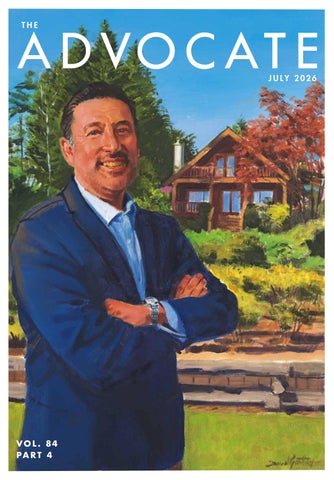
ON THE FRONT COVER
Kinji Bourchier, K.C., (or “KCB” to his friends) graces this month’s cover of the Advocate. Kinji’s route from Terrace to Vancouver via Royston starts at page 497.
486
THE ADVOCATE
VOL. 84 PART 4 JULY 2026
DR EDWIN BLEWETT PhD Economics (UBC, 1982)
+ Qualified as an expert in BC Supreme Court & Canada’s Specific Claims Tribunal + Negotiations support: values of offers and counteroffers + PID opinions for commercial fishers + Economic value of damages + Strategic Consultations + Economic Valuations + Expert Opinions
604.999.7615
edwin@gocounterpoint.com www.gocounterpoint.com
THE ADVOCATE
487
VOL. 84 PART 4 JULY 2026
488
THE ADVOCATE
VOL. 84 PART 4 JULY 2026
Daum Terpkosh Valuations WE SPECIALIZE IN MAKING THE COMPLEX UNDERSTANDABLE
Rebecca Hobbs CPA, CA, CBV
Chanittha Vesboonchu CPA, CA, CBV
Brian Mombourquette CPA, CA, CBV
Veronika Kyjonka CPA, CBV
Patti Daum CPA, CA, CBV
Lucas Terpkosh CPA, CA, CBV
With a personal approach to business valuations and a wide range of financial services, we are committed to providing clear, insightful guidance for all your valuation needs.
Loss Quantification • Breach of contract • Business interruption • Wrongful death claims • Personal injury
Business Valuations • Matrimonial matters • Shareholder disputes • Estate administration • Corporate reorganizations
Patti Daum: (778) 819-7028 Lucas Terpkosh: (236) 476 4796
Suite 600 - 777 Hornby Street Vancouver, BC V6Z 1S4
www.dtvaluations.com info@dtvaluations.com
ЖЖЖ
THE ADVOCATE
489
VOL. 84 PART 4 JULY 2026
IMMIGRATION APPEALS. LITIGATION. COMPLEX CASES. Titan Law is a leading Canadian immigration law firm with offices in Vancouver and Toronto, representing individuals, families and businesses in complex immigration matters. Our lawyers focus on sophisticated immigration cases that require strategic advocacy, litigation experience, and creative legal solutions. Titan Law works with Legal Aid BC, Legal Ontario, and regularly and regularly collaborates with other professionals. We welcome referral work on complex immigration matters.
PRACTICE AREAS: • Refugee Law • Immigration Appeals • Immigration Litigation & Judicial Review • Deportation & Removal Matters • Humanitarian Programs (H&C Applications)
• Family Sponsorship • Permanent Residence Applications (Federal and Provincial Immigration Programs)
• Temporary Status (Work Permits, Study Permits, Visitor Status)
• Education in Canada (International Students & Study Permits)
• Business Immigration
VANCOUVER | TORONTO
WWW.TITANLAW.CA
604-336-9755
INFO@TITANLAW.CA
490
244808 PLLR - Gary Hagel Print Ad R1.indd 1
VOL. 84 PART 4 JULY 2026
THE ADVOCATE
2024 12 10 1:55 PM
THE ADVOCATE
VOL. 84 PART 4 JULY 2026
491
ENTRE NOUS
K
omagata Maru Remembrance Day falls each year on May 23, marking the day on which, in 1914, that ill-fated ship sailed into Burrard Inlet. As set out in a two-part article previously published in the Advocate,1 the ship was not allowed to dock and its passengers were denied entry into Canada. Legal proceedings mounted on passengers’ behalf were unsuccessful and the ship ultimately departed on July 23, 1914, sailing back across the Pacific. Premier David Eby, K.C.’s statement on Komagata Maru Remembrance Day in 2026 summarized the event and its context as follows: The steamship Komagata Maru, also known as the Guru Nanak Jahaz, chartered by the Sri Guru Nanak Steamer Company, arrived in Vancouver harbour via Hong Kong and Japan on this date 112 years ago. The ship was chartered to transport 376 people of Sikh, Muslim and Hindu origin from Punjab, India. The passengers, who sought to immigrate and contribute to Canada, were met with racist hostility by federal immigration officials and the local population. Most travellers were not allowed to disembark, nor were they allowed to meet with representatives of the local South Asian community. After two gruelling months aboard ship in the harbour, during which conditions became worse by the day, the steamship was forced to return to India from the harbour. The incident was soon forgotten by most Canadians, though it remains a dark mark on our history. The Province of British Columbia issued a formal apology in the legislative chamber in 2008 for its role. Since long before the ship arrived, people from South Asia have been calling this province home, making untold contributions to building this incredible province. It is our shared responsibility to learn from this incident so we can continue to create the diverse and inclusive British Columbia we know and enjoy today.
Against this backdrop there was something especially moving in the celebration, a month earlier, of the return of Punjabi music superstar Diljit
492
VOL. 84 PART 4 JULY 2026
THE ADVOCATE
Dosanjh to BC Place Stadium, for the kick-off concert of the North American portion of his “Aura” tour. It was clear from anywhere in the vicinity of that venue on the evening of April 23, 2026 that something momentous was happening. Apart from the vehicle traffic on bridges and roadways, downtown sidewalks before the concert saw throngs of enthused people of all ages, beautifully turned out in clothes ranging from saris to cutting-edge suits, heading toward the stadium. We heard security staff at surrounding buildings sound wistful about not being able to attend the event and fellow elevator passengers chatting about Dosanjh’s music. The concert, before a sold-out 55,000-strong crowd, was Dosanjh’s second performance at BC Place Stadium. When Dosanjh performed there two years earlier, his concert “ma[de] history as the largest ever Punjabi music concert outside of India”.2 On April 27, 2026, Dosanjh appeared on The Tonight Show Starring Jimmy Fallon. Dosanjh had first appeared on that show in June 2024. After some discussion of Dosanjh’s intervening endeavours, Fallon asked him, “Is it exciting for you to do these big tours?” Dosanjh responded as follows: Yeah, that’s very important for me. Like, the stadium we did in Vancouver….[in] 1914, when our people came first time in Canada, they didn’t allow us to come to Canada. And that stadium is just 2 kilometers away from that part, the ‘Nanak Jahaz’ ‘Komagata Maru’ incident. So yeah—so that’s a big thing for us. Now 55,000 people in the one stadium there. It’s just 2 kilometers. You didn’t allow us to come, and now we are here, man.3
This was a remarkable moment to catch while switching TV channels after a day at the office. Dosanjh exudes a wonderful aura—which his fans have told him, prompting him to bestow the name “Aura” on his latest work—and the interview captured both celebration and joy that could not but be shared even by non-Punjabi audience members. Legal history is not always packaged for us so neatly or presented so accessibly. Historical context of any kind is often missing from news stories that we read or hear; some barely capture the present and often, of whowhat-when-where-why, at least the why gets dropped. We do, however, suggest it is worth seeking out the history of laws (and their impacts) and lawyers, engaging with sources that provide that history, or generating content to chronicle areas that have not already been covered. As lawyers and judges, we cannot function without history. Our work turns on it. We look to case law precedents and consider how to rely on or distinguish them. We may consider legislative history when interpreting statute law, and consider the factual matrix from the time a contract was made when interpreting its terms. Litigators, courts and other tribunals
THE ADVOCATE
VOL. 84 PART 4 JULY 2026
493
seek to determine what occurred factually at given times in the past (was the traffic light red?) and develop evidentiary principles for doing so. Knowing the laws that were in place when certain events occurred may inform the drafting of new and different laws to avoid repetition of such events. If in looking back over the years the same complaints arise about certain matters (e.g., difficulties scheduling court hearings), which we see over decades of articles and editorials in the Advocate, that suggests as well that past reform efforts have not been successful and that perhaps it is time for further new legislation, rules or court and counsel practices. Just knowing the historical duration of the legal profession, even without a focus on particular members or particular events, is important. It assists us to see that our roles and duties as lawyers and judges are bigger than what is expedient in a given transaction or case. We hear much these days about the transactional nature of dealings in the context of federal politics in the United States—our profession turns on more than a singular exchange in participants’ self-interest. The obligations set out in the Code of Professional Conduct, and ethical standards for judges, become all the more real when considering the legacy and expectations built up over time. Further, legal history may also yield role models by whom members of the legal profession may be inspired. While stories of historical injustice, for example, do not necessarily yield such inspiration, in some cases they do. Although it is not as though the law distinguished itself for the Komagata Maru’s passengers in 1914, a particular lawyer did: Joseph Edward Bird, who fought for them valiantly and went on to advance other important causes during his extraordinary career.4 Knowing the barriers of 112 years ago also allows us to recognize as even more profound the achievements of Canadians of Punjabi descent who are now, of course, lawyers and judges in their own right, and examine whether barriers remain. While the history of the Komagata Maru showcases racial prejudice, this is not the only kind of historical event worth learning about. There has been no shortage of means by which subsets of humans have, consciously or unconsciously, disadvantaged others, including on the basis of class, sex or gender, sexual preference or religion. There is also no shortage of other matters to learn about where compassion, wisdom and fairness have been exercised—not every law or event worth highlighting in legal history is negative. Publications and projects that showcase elements of legal history, or work to create a reliable record of current events that will form a history for future members of the legal profession to consult, are important. The Advocate seeks to do both, with columns such as “Legal Anecdotes” and one-off articles setting out historical events, with book reviews highlighting works
494
VOL. 84 PART 4 JULY 2026
THE ADVOCATE
of historical interest, and with features such as “New Judges” providing a record, for the future, of who works in our judicial system today. Endeavours like the Allard Law History Project, the Osgoode Society for Canadian Legal History, ongoing historical work within the judicial branch (including by the ever-energetic Justice David Crerar) and the work of equity-seeking organizations also help to underpin the historical record. Archival records at the Provincial Archives, the City of Vancouver, in other municipalities and at the Law Society of British Columbia preserve vital elements of our history as well. Also deserving a shout-out are the many wellwritten books on British Columbia history, places and place names, architecture and families or individuals (often in the local interest section of websites and bookstores) that may help readers piece together a sense of laws and members of the legal profession in a larger context. Returning to the April 27 exchange between Dosanjh and Fallon, there was another aspect of it that caught our attention. Fallon remarked that for a year after Dosanjh had first appeared on the show in 2024, everywhere he went, people thanked him and hugged him for having had a Punjabi artist on as a guest. We have sometimes received similar reactions to pieces published in the Advocate—indeed, including our Komagata Maru articles—about historical events to which individuals of non-Caucasian background were central. These comments are always lovely to receive, but at the same time, a sad reminder that, for inclusion in the Advocate to stand out, social and legal attention has otherwise not fastened sufficiently on elements of legal history that directly affected subsets of our colleagues and their families. We encourage submissions that celebrate, and educate colleagues regarding, the achievements of diverse groups as well as about historical events that have for some other reason escaped due attention. As editorial staff at the Advocate we do our best, in addition to editing, to write stories that we come to hear, but the reality is that we too work from limited sources. It is often those involved or to whom stories have been passed down who, to the extent not too painful, may need to draw our attention to those stories or write about them. We also, as noted above, encourage submissions about the grand canvas of law or its entertaining quirks. ENDNOTES 1. Ludmila B Herbst, KC, “Komagata Maru: ‘A Grand Scene on a Blue Stage’ – Part I” (2019) 77 Advocate 351; Ludmila B Herbst, KC, “Komagata Maru: ‘A Grand Scene on a Blue Stage’ – Part II” (2019) 77 Advocate 539 [“Grand Scene – Part II”]. 2. Heather Taylor-Singh, “Diljit Dosanjh Makes History Again in Vancouver: Canadian Concerts of the Week”, Billboard Canada (23 April 2026).
ЖЖЖ
3. Dosanjh made this historical reference as well on social media in advance of the concert: “Diljit Dosanjh pays tribute to Komagata Maru passengers ahead of sold out Vancouver show”, CBC News (22 April 2026), online: <www.cbc.ca/news/canada/ british-columbia/diljit-dosanjh-komagata-marutribute-show-9.7173959>. 4. “Grand Scene – Part II”, supra note 1 at 544.
THE ADVOCATE
VOL. 84 PART 4 JULY 2026
“Old Pal” by Jane Bronsch, acrylic on canvas, 48'' x 36'', 2023 Available at Kurbatoff Gallery, 2435 Granville St., Vancouver Visit the website: kurbatoffgallery.com
495
496
VOL. 84 PART 4 JULY 2026
THE ADVOCATE
EXPERIENCE MATTERS
The Honourable
The Honourable
I. Bruce Josephson, KC
Anne MacKenzie, KC
Phone: 604-800-8043 Email: ibj@hirarowan.com
Phone: 604-809-4344 Email: amackenzie@hirarowan.com
With a combined 75+ years on the bench, the Hon. Anne MacKenzie KC and the Hon. Bruce Josephson KC offer mediation services grounded in deep judicial insight and a lifetime of public service. Anne served on all three levels of court in British Columbia, including over a decade on the Court of Appeal, and was the first female Associate Chief Justice of the Supreme Court. Bruce who also offers arbitration services, presided for over 42 years, including long tenures on the Provincial Court and Supreme Court, earning a reputation for balance, fairness, and clarity. Both are now available to assist parties in resolving complex legal disputes with efficiency, professionalism, and sound judgment. Hira Rowan LLP is a litigation firm based in downtown Vancouver, with a reputation for excellence in advocacy and strategic counsel. Our mediation services are grounded in the same principles that define our litigation work: integrity, insight, and results. To inquire about availability or to book a mediation, please contact Anne at amackenzie@hirarowan.com or Bruce at ibj@hirarowan.com.
1500 - 570 Granville St. Vancouver, BC V6C 1W6 hirarowan.com
THE ADVOCATE
497
VOL. 84 PART 4 JULY 2026
ON THE FRONT COVER KINJI BOURCHIER, K.C. By J-P Bogden
“Family is not an important thing. It’s everything.” —Michael J. Fox “I go to nature to be soothed and healed, and to have my senses put in order.” —John Burroughs “Dressing well is a form of good manners.” —Tom Ford
T
wo things became clear to the author in preparing this profile of Kinji Bourchier, K.C. First, it was a considerable challenge to write about Kinji in a way that does not just lapse into hagiography. He is almost frustratingly decent, principled, smart and kind. Accordingly, please excuse the lack of any real spiciness here. Second, so much of who Kinji is as a person, a parent and a lawyer (a commercial litigator and partner at Cassels in Vancouver) was deeply shaped by where he came from: his parents and grandparents, his brother and cousins, his aunts and uncles, and his Vancouver Island roots. It is fitting to start there. HERITAGE, CHILDHOOD AND EDUCATION Kinji was born into a Japanese-Canadian family shaped by a legacy of resilience and hard work. His maternal grandparents, Takaharu and Harue
498
VOL. 84 PART 4 JULY 2026
THE ADVOCATE
Nakanishi, were (like so many Japanese-Canadians) based in Steveston, British Columbia, and lived a life which revolved around commercial fishing where Takaharu was a gillnetter. Their lives were uprooted by the events of World War II, and in April 1942 Takaharu, who was born in Steveston in 1913, and his young family were forcibly moved to an internment camp in Greenwood, British Columbia. Despite the enormous social and economic dislocation imposed on their family, Takaharu and Harue raised six university-educated children, including Kinji’s mother Michiyo (Mich) who was born in Greenwood internment in 1947, which careful readers will note was, sadly, two years after the end of the war. Of his grandparents, Kinji recalled that they faced these challenges with fortitude and grace, noting “they were always positive—never bitter nor resentful”. Mich earned her teaching degree from the University of British Columbia and in the winter of 1972 was working as a student teacher in Kitimat, British Columbia, when she first met David (Dave) Bourchier, Kinji’s father. Mich had, and retains, a sense of fierce independence. As it was the holiday season, Mich had knocked on her neighbour’s door in the hopes of borrowing an axe with which to chop down her own Christmas tree. Dave answered the door and the rest was quick history: they were married one month afterwards: Kismet! Kinji’s father, Dave, was a true child of the ’60s, a self-admitted hippie and musician who came from an Air Force family background. Living all over Canada through the 1950s and 1960s, he had found employment at the Kitimat pulp mill in order to earn some much-needed funds and get himself back to the coast to “make some music”. That all changed when he met Mich. His Japanese parents-in-law had some significant reservations about the longhaired guy and his ability to provide for a family. Fortunately, Dave won over his in-laws with an abiding sense of character, ethics and fair play, a curious and able mind, and, most helpfully for a fishing family, the fact that he was very mechanical and could fix diesel engines with aplomb. After getting married, Kinji’s parents lived at Lake Else, between Kitimat and Terrace (where Kinji was born in April 1974) for a brief period and ultimately settled in 1975 in the small community of Royston (just south of Courtenay, British Columbia; its current population is about 1,500 people). There, powered “by a level of folly only present in young people”, the Bourchier family began hand-building the waterfront log home that became Kinji’s childhood home. Mich still resides—remember that independent streak?—in that same home at the age of 79, following a long career as a science teacher.
THE ADVOCATE
VOL. 84 PART 4 JULY 2026
499
Kinji describes his 1970s and 1980s childhood as “idyllic”: “wood fires, Cowichan sweaters, and bowl cuts”. Along with his younger brother Tak, Kinji grew up on a “very healthy” west coast diet with heavy Japanese influences, featuring seafood from his mother’s fishing family in Richmond and vegetables grown and harvested from their home garden. On the instruction of his mother the teacher, television was limited—CBC and CTV only— and no Saturday morning cartoons except at friends’ houses. As a result, Kinji was, out of some necessity, immersed in books at an early age, which played a key role in his later love of the written word. Summers were spent in the company of friends and with his many cousins on his mother’s side. There were long days spent fishing and engaged in friendly but competitive games of soccer—Kinji played from the age of five and his dad had installed a goal and net in the family yard, at Kinji’s urging—and basketball. The Royston home was a gateway to nature, hiking and fishing (always fishing, including trips all over British Columbia to enjoy the lakes, creeks, streams and salt chuck) and exploring—leaving in the morning on BMX bikes and coming home when sun started to go down. Evenings at home featured music, with his father Dave’s choices of Simon & Garfunkel, Crosby, Stills & Nash, and the favoured Beatles in heavy rotation. While they deeply loved their island home, Kinji’s parents recognized that their kids should see the rest of Canada. And so it was that in the summer of 1986, Dave and Mich loaded up the family Subaru station wagon, complete with tent and Coleman cooler, to take a two-month trip across Canada with their boys. Kinji’s love of travel was sparked then and there; he often sat in the front seat on that trip, watching the landscape speed by and asking question after question of his father while Paul Simon’s Graceland usually played on the tape deck. Kinji recalled: “it was deep Canadiana stuff—prairies, lakes and rivers, sunsets and sunrises, small cities and big cities. I realized that there was a big world out there and I wanted to see more of it.” Later, Kinji commuted to Courtenay and Georges P. Vanier Secondary School (also the alma mater of Kim Cattrall for any Sex and the City fans reading this) for his high school education. While some level of bullying might have been anticipated given Kinji’s then-unique background in a rural Island community in the late 1980s (Kinji said a Japanese bento box lunch in 1988 was not as cool as you might think with other kids), Kinji’s success at sports, his friendly demeanour and what this author assumes was the beginning of a lifelong popularity borne of what kids now describe as a “strong face card” meant that Kinji navigated his high school career with
500
VOL. 84 PART 4 JULY 2026
THE ADVOCATE
ease. As well, while family expectations for academic achievement were high, Kinji proved a more than capable student and excelled in school. During summer vacations in these years, Kinji was employed alongside his cousins on commercial fishing boats captained by his uncles on the Skeena River in northern British Columbia. This was hard and often dangerous work, but it paid well and both allowed Kinji to buy new Air Jordans for each upcoming basketball season and Club Monaco sweatshirts for back to school, and confirmed to him that an office-based job might be better for his longevity. The years fishing also created even deeper family bonds and memories with his extended family. On the strength of his success in high school, Kinji won a number of academic scholarships and pursued his undergraduate studies at the University of British Columbia. He took up residence in Totem Park, enrolled in Arts One, and found himself in what was for him a perfect place at the perfect time. He took his studies seriously but still found time to have fun, maintain close relationships with his brother, cousins and large network of friends, and pursue his love of sports and, increasingly, fitness. Kinji focused his studies on history and in 1996 graduated with a B.A. (Hons.), having written his senior thesis on World War I history. While still in undergrad, Kinji had contemplated a career in law and through a series of fortunate events was able to secure a historical research job at what is now Lawson Lundell LLP in the summer of 1996. This position cemented Kinji’s interest in law and so he (along with so many Arts One undergraduates) applied for admission and (unlike many other Arts One undergraduates) was accepted into the faculty of law at the University of British Columbia. Law school for Kinji followed a similar pattern to his undergraduate studies, and his affable and charismatic personality made him a popular classmate. He applied himself, studied hard and thrived, but still found time to pursue sports and fitness and have some typical law school fun. Among other endeavours, Kinji captained the rugby team and was a student representative on the Hoop-Law Charity Basketball Tournament, an organization with which Kinji has remained formally and informally involved to this day. CAREER, TRAVEL AND THE GREAT OUTDOORS Kinji’s foothold at Lawson Lundell LLP, along with a healthy GPA and CV demonstrating plenty of hard work and community service, led to summer articles and articles at the Vancouver office of the same firm. He was called to the bar of British Columbia in May 2000, at which time he promptly joined Lawson Lundell’s litigation group. He would stay there for the next 20 plus years, ultimately developing an expertise in commercial and envi-
THE ADVOCATE
VOL. 84 PART 4 JULY 2026
501
ronmental litigation. It was at a Lawsons’ Whistler retreat in the summer of 2000 when this author first crossed paths with Kinji; he questioned my choice of cargo shorts1 as gym attire and impressed as a terrific dancer and engaging storyteller and dining companion. Kinji became a partner at Lawson Lundell in 2008 and served in multiple leadership roles at the firm, including as a member of the firm’s executive committee and as litigation group manager. Kinji has fond memories of his time at Lawson Lundell and gratefully acknowledges the mentorship he received from so many partners there. Special admiration is reserved for Justice Gordon Weatherill, then a senior member of the litigation group and, like Kinji, a product of a small British Columbia town who never forgot his roots and strove for balance between career and family. Other key mentors included Brian Wallace, K.C. (“a true gentleman”), Craig Ferris, K.C., who remains Lawsons’ senior litigator, and another fellow named Ron Skolrood. Kinji is unsure of what happened to him.2 Kinji is now the national co-chair of Cassels Brock & Blackwell LLP’s commercial litigation and arbitration group where he maintains a busy caseload along with mentorship and leadership duties across Cassels’ national footprint. Kinji’s legal career has been marked by an embarrassing number of achievements and awards. Most meaningfully to Kinji, he was appointed King’s Counsel in 2023 in recognition of his service to the profession and community (more on that later). Kinji’s success as a commercial litigator did not prevent him (and in many senses has allowed him) to continue to enjoy his early passions for sport, travel and nature and to explore newer interests in food and wine. As part of his early association with Mundiavocat FC Lawyer’s Soccer Team, Kinji travelled far and wide to compete against other lawyer athletes (they exist), including to Morocco, Malta, Hungary, Croatia, Spain and Turkey, forging lifelong friendships with his teammates. Europe continues to hold a special place in his heart, with the wines and foods of Italy and France maintaining comfortable leads. Kinji’s childhood love for nature and the outdoors borne out of his Island roots continues unabated. He is a passionate outdoorsman, which surprises many downtown practitioners given his well-known penchant for fine Italian-tailored suits and shoes, classic Swiss watches, luxury hotel stays and fine dining. Kinji often takes multi-day backpack trips into northern British Columbia (the Cassiars, the Prophet Muskwa, and, further south, the Chilcotin). These trips satiate his yearning for nature and solitude, and provide him with an opportunity to explore the unspoiled wilderness. The author has long struggled to reconcile this rusticity and soulfulness with
502
VOL. 84 PART 4 JULY 2026
THE ADVOCATE
Kinji’s daytime job as an urbane big law litigator; ultimately, one must conclude that, like Whitman, Kinji contains multitudes. MARRIAGE, FAMILY AND COMMUNITY Given all the time spent with his large extended family throughout his life, it is perhaps unsurprising that Kinji is, deeply and thoroughly, a family man. Nothing is more important to him. Kinji first spotted Laura Cundari at her call to the bar ceremony in the Vancouver courthouse in 2008. Like Kinji, Laura is an accomplished litigator. She practises at Blake, Cassels & Graydon LLP, where she co-leads the national arbitration team. Kinji’s interest was greatly piqued and he reached out to his network to coordinate an introduction (including, dear readers, this author, who remains a partner of Laura’s to this day). While not quite matching the land-speed marriage record set by Kinji’s parents, it was immediately clear that they were a perfect match for one another and made a great, complementary couple. Their wedding in 2011 was, like the bride and groom, classic and beautiful; the floral arrangements alone dominated talk in Vancouver social circles for years afterward. They are happily celebrating fifteen years of marriage this year. Kinji and Laura welcomed their daughter Celine into their lives in 2014, and their son David (whom they call Davey) in 2018. Both children are like their parents: bright and inquisitive, with great senses of humour and personal style. They are a true family unit and, like Kinji did so much growing up, frequently travel to Vancouver Island and Kamloops (Laura’s hometown) to spend time and make memories with relatives. Lest the readership be misled, it should be noted that they also travel to stay at very nice hotels for family vacations to allow for some downtime. For Kinji, after family comes community. Kinji has been continuously involved in numerous charitable and non-profit organizations, some professional, and some deeply personal. Examples of the former include membership on the Vancouver Bar Association executive, the Japanese Canadian Lawyers Association and the Advocates Society; being a founding board member of the Reed Athletics Fund (which supports financially challenged track and field athletes); and being board member and advisor to The Hooplaw Society, where he was the recipient of the 2025 Rob Collins Spirit Award. Examples of the latter include serving as president of the Allard Law Alumni Association for many years, where he remains on the board of directors. He also serves on the Dean’s advisory council, and as vice-chair of the Advocates’ Society’s BC Regional Advisory Committee. Most personal of all is Kinji’s work with the Leukemia & Lymphoma Society of Canada (“LLSC”). As some readers will know, Kinji and Laura’s daugh-
THE ADVOCATE
VOL. 84 PART 4 JULY 2026
503
ter Celine was diagnosed with acute lymphoblastic leukemia at the age of three. Thankfully, she completed treatment in 2019 and has been cancerfree and thriving ever since. Kinji and Laura have both since become deeply involved with the LLSC and in 2025 created Counsel for a Cure and cochaired the LLSC’s Light the Night campaign, which raised a record-setting amount for the B.C. campaign. This year, their daughter Celine will follow in their footsteps and is an Honoured Hero who will provide inspiration and support to participants in the campaign. Kinji and Laura are incredibly grateful for the support from their family, friends, colleagues and the legal community during the difficult years that Celine was undergoing medical treatment and in their charitable efforts in the years that followed. When asked how he finds the time for his community work amidst a busy personal and professional life, Kinji’s response is succinct: “it’s just the right thing to do.” Great words from an even better person ENDNOTES 1. He has never let me forget the cargo shorts.
2. The author apologizes to Chief Justice Skolrood for this impertinence.
ЖЖЖ
504
VOL. 84 PART 4 JULY 2026
!"#$%&'()$*'+%,-#%&$$# %. !/01%23%4)$* )%5) 6'+%%78 3(68%!$% 9)$:)'%;< %!%;< +%"#"$%
“Broken Islands, The Inner Group” by Sandra Harris, Acrylic on 2)&!((%.)((# 3+%";)*%. )$:6((#%4&%+%+)$8!/:# %%% Canvas, 7:)6()2(#%)&%'/ 48'' x 48'', 2026 +6'6&,%&-#%-#2'6&#.,"/ 2)&!((/)((# 3%8!0
Available at Kurbatoff Gallery, 2435 Granville St., Vancouver Visit the website: kurbatoffgallery.com
THE ADVOCATE
THE ADVOCATE
VOL. 84 PART 4 JULY 2026
505
SPEECH TO THE UNITED STATES CONGRESS IN WASHINGTON, D.C. DELIVERED APRIL 28, 2026 By His Majesty King Charles III
M
r. Vice-President, Mr. Speaker, members of Congress, representatives of the American people, across all states, territories, cities and communities; I would like, if I may, to take this opportunity to express my particular gratitude to all for the great honour of addressing this joint meeting of Congress and on behalf of the Queen and myself, to thank the American people for welcoming us to the United States to mark this semi-quincentennial year of the Declaration of Independence. And for all of that time, our destinies as nations have been interlinked. As Oscar Wilde said, “we have really everything in common with America nowadays, except, of course, language.” So, ladies and gentlemen, we meet in times of great uncertainty, in times of conflict from Europe to the Middle East, which pose immense challenges for the international community and whose impact is felt in communities the length and breadth of our own countries. We meet too, in the aftermath of the incident not far from this great building that sought to harm the leadership of your nation and to foment wider fear and discord. Let me say, with unshakable resolve, such acts of violence will never succeed. Whatever our differences, whatever disagreements we may have, we stand united in our commitment to uphold democracy, to protect all our people from harm, and to salute the courage of those who daily risk their lives in the service of our countries. Standing here today, it is hard not to feel the weight of history on my shoulders, because the modern relationship between our two nations and our own peoples spans not merely 250 years, but over four centuries. It is extraordinary to think that I am the 19th in our line of sovereigns to study with daily attention the affairs of America. So, I come here today with the highest respect for the United States Congress, this citadel of democracy
506
VOL. 84 PART 4 JULY 2026
THE ADVOCATE
created to represent the voice of all American people, to advance sacred rights and freedoms. Speaking in this renowned Chamber of debate and deliberation, I cannot help but think of my late mother, Queen Elizabeth, who, in 1991 was also afforded this signal honour, and similarly spoke under the watchful eye of the statue of freedom above us. Today, I am here on this great occasion in the life of our nations to express the highest regard and friendship of the British people to the people of the United States. Now, as you may know, when I address my own parliament at Westminster, we still follow an age-old tradition and take a Member of Parliament hostage, holding him or her at Buckingham Palace until I am safely returned. These days, we look after our guests rather well, to the point that they often do not want to leave. I don’t know, Mr. Speaker, if there were any volunteers for that role here today. As I look back across the centuries, Mr. Speaker, there emerge certain patterns, certain self-evident truths from which we can learn and draw mutual strength. With the spirit of 1776 in our minds, we can perhaps agree that we do not always agree, at least in the first instance. Indeed, the very principle on which your congress was founded: no taxation without representation, was once a fundamental disagreement between us, and at the same time, a shared democratic value which you inherited from us. Ours is a partnership born out of dispute, but no less strong for it. Perhaps in this example, we can discern that our nations are, in fact, instinctively like-minded – a product of the common democratic, legal and social traditions in which our governance is rooted to this day. Drawing on these values and traditions time and again, our two countries have always found ways to come together. And by Jove, Mr. Speaker, when we have found that way to agree what great change is brought about, not just for the benefit of our peoples, but of all peoples. This, I believe, is the special ingredient in our relationship. As President Trump himself observed during his state visit to Britain last autumn, the bond of kinship and identity between America and the United Kingdom is priceless and eternal. It is irreplaceable and unbreakable. Mr. Speaker, this is by no means my first visit to Washington, D.C., the capital of this great Republic. It is, in fact, my 20th visit to the United States and my first as King and head of the Commonwealth. This is a city which symbolizes a period in our shared history, or what Charles Dickens might have called A Tale of Two Georges: the first, President George Washington and my five-times great-grandfather, King George the Third. King George, as you know, never set foot in America. And please, rest assured, ladies and gentlemen, I am not here as part of some cunning, rear-guard action.
THE ADVOCATE
VOL. 84 PART 4 JULY 2026
507
The founding fathers were bold and imaginative rebels with a cause. 250 years ago, or as we say in the United Kingdom, “just the other day,” they declared independence by balancing contending forces and drawing strength into diversity. They united 13 disparate colonies to forge a nation on the revolutionary idea of life, liberty and the pursuit of happiness. They carried with them and carried forward the great inheritance of the British enlightenment, as well as the ideals which had an even deeper history in English common law and Magna Carta. These roots run deep, and they are still vital. Our Declaration of Rights of 1689 was not only the foundation of our constitutional monarchy but also provided a source of so many of the principles reiterated, often verbatim, in the American Bill of Rights of 1791. And those roots go even further back in history. The U.S. Supreme Court Historical Society has calculated that Magna Carta is cited in at least 160 Supreme Court cases since 1789. Not least, as a foundation of the principle that executive power is subject to checks and balances. This is the reason why there stands a stone by the River Thames at Runnymede, where Magna Carta was signed in the year 1215. This stone records that an acre of that ancient and historic site was given to the United States of America by the people of the United Kingdom to symbolize our shared resolve in support of liberty, and in memory of President John F. Kennedy. Distinguished members of the 119th Congress, it is here, in these very halls that this spirit of liberty and the promise of America’s founders is present in every session, and every vote cast. Not by the will of one, but by the deliberation of many, representing the living mosaic of the United States. In both of our countries, it is the very fact of our vibrant, diverse and free societies that gives us our collective strength, including to support victims of some of the ills that so tragically exist in both our societies today. And Mr. Speaker, for many here and for myself, the Christian faith is a firm anchor and daily inspiration that guides us, not only personally, but together as members of our community. Having devoted a large part of my life to interfaith relationships and greater understanding, it is that faith of the triumph of light over darkness, which I have found confirmed countless times. Through it, I am inspired by the profound respect that develops as people of different faiths grow in their understanding of each other. It is why, it is my hope, my prayer, that in these turbulent times, working together and with our international partners, we can stem the beating of plowshares into swords. I am mindful that we are still in the season of Easter, the season that most strengthens my hope. It is why I believe, with
508
VOL. 84 PART 4 JULY 2026
THE ADVOCATE
all my heart, that the essence of our two nations is a generosity of spirit and a duty to foster compassion, to promote peace, to deepen mutual understanding and to value all people of all faiths and of none. The alliance that our two nations have built over the centuries, and for which we are profoundly grateful to the American people, is truly unique. And that alliance is part of what Henry Kissinger described as “Kennedy’s soaring vision” of an Atlantic partnership based on twin pillars, Europe and America. That partnership, I believe, Mr. Speaker, is more important today than it has ever been. The first reigning British sovereign to set foot in America was my grandfather, King George VI. He visited in 1939 with my beloved grandmother, Queen Elizabeth, the Queen Mother. The forces of fascism in Europe were on the march, and sometime before the United States had joined us at the defence of freedom, our shared values prevailed. Today, we find ourselves in a new era, but those values remain. It is an era that is in many ways more volatile and more dangerous than the world to which my late mother spoke in this chamber in 1991. The challenges we face are too great for any one nation to bear alone. But in this unpredictable environment, our alliance cannot rest on past achievements or assume that foundational principles simply endure. As my Prime Minister said last month, ours is an “indispensable partnership”. We must not disregard everything that has sustained us for the last 80 years. Instead, we must build on it. Renewal today starts with security. The United Kingdom recognizes that the threats we face demand a transformation in British defence. That is why our country, in order to be fit for the future, has committed to the biggest sustained increase in defence spending since the Cold War, during part of which, over 50 years ago, I served with immense pride in the Royal Navy, following the naval footsteps of my father, Prince Philip, Duke of Edinburgh, my grandfather, King George VI, my great-uncle, Lord Mountbatten and my great-grandfather, King George V. This year, of course, also marks the 25th anniversary of 9/11. This atrocity was a defining moment for America, and your pain and shock were felt around the whole world. During my visit to New York, my wife and I will again pay our respects to the victims, the families and the brave who shone in the face of terrible loss. We stood with you then, and we stand with you now, in solemn remembrance of a day that shall never be forgotten. In the immediate aftermath of 9/11 when NATO invoked article five for the first time, and the United Nations Security Council was united in the
THE ADVOCATE
VOL. 84 PART 4 JULY 2026
509
face of terror, we answered the call together, as our people have done so for more than a century. Shoulder to shoulder through two world wars, the Cold War, Afghanistan and moments that have defined our shared security. Today, Mr. Speaker, that same unyielding resolve is needed for the defence of Ukraine and her most courageous people. It is needed in order to secure a truly just and lasting peace. From the depths of the Atlantic to the disastrously melting ice caps of the Arctic, the commitment and expertise of the United States Armed Forces and its allies lie at the heart of NATO pledged to each other’s defence, protecting our citizens and interests, keeping North Americans and Europeans safe from our common adversaries. Our defence, intelligence and security ties are hard wired together through relationships measured not in years, but in decades. Today, thousands of U.S. service personnel, defence officials and their families are stationed in the United Kingdom, as British personnel serve with equal pride across 30 American states. We are building F-35s together, and we have agreed the most ambitious submarine program in history, AUKUS. And we are doing it in partnership with Australia, a country of which I am also immensely proud to serve as a sovereign. We do not embark on these remarkable endeavours together out of sentiment. We do so because they build greater, shared resilience for the future, so making our citizens safer for generations to come. Our common ideals were not only crucial for liberty and equality, but they are also the foundation of our shared prosperity, the rule of law, the certainty of stable and accessible rules, an independent judiciary, resolving disputes and delivering impartial justice. These features created the conditions for centuries of unmatched economic growth in our two countries. This is why our governments are concluding new economic and technology agreements to write the next chapter of our joint prosperity and ensure that British and American ingenuity continues to lead the world. Our nations are combining talent and resources in the technologies of tomorrow. Our new partnerships in nuclear fusion and quantum computing and in AI and drug discovery, holding the promise of saving countless lives. More broadly, we celebrate the US$430 billion in annual trade that continues to grow, the $1.7 trillion in mutual investment that fuels that innovation and the millions of jobs on both sides of the Atlantic supported across both economies. These are strong foundations on which to continue to build for generations yet unborn. Our ties in education, research and cultural exchange empower citizens and future leaders of both countries. The Marshall Scholarship, named after
510
VOL. 84 PART 4 JULY 2026
THE ADVOCATE
the great general George Marshall, and the association of which I am so proud to be patron are emblematic of the connection between our two countries. Since its founding, more than 2,300 scholarships have been awarded opening doors for Americans from all walks of life to study at the United Kingdom’s leading universities. As we look toward the next 250 years, we must also reflect on our shared responsibility to safeguard nature, our most precious and irreplaceable asset. A millennia before our nations existed, before any border drawn, the mountains of Scotland and Appalachia were one: a single, continuous range forged in the ancient collision of continents. The natural wonders of the United States of America are indeed a unique asset, and generations of Americans have risen to this calling. Indigenous, political and civic leaders, people in rural communities and cities alike, have all helped to protect and nurture what President Theodore Roosevelt called the “glorious heritage” of this land’s extraordinary natural splendour on which so much of its prosperity has always depended. Yet, even as we celebrate the beauty that surrounds us, our generation must decide how to address the collapse of critical natural systems, which threatens far more than the harmony and essential diversity of nature. We ignore at our peril, the fact that these natural systems, in other words, nature’s own economy, provide the foundation for our prosperity and our national security. The story of the United Kingdom and the United States is at its heart a story of reconciliation, renewal and remarkable partnership. From the bitter divisions of 250 years ago, we forged a friendship that has grown into one of the most consequential alliances in human history. I pray with all my heart that our alliance will continue to defend our shared values with our partners in Europe and the Commonwealth and across the world, and that we ignore the clarion calls to become ever more inward looking. Mr. Speaker, Mr. Vice-President, distinguished ladies and gentlemen, America’s words carry weight and meaning as they have since independence, the actions of this great nation matter even more. President Lincoln understood this so well with his reflection in the magisterial Gettysburg address that the world may little note what we say but will never forget what we do. And so, to the United States of America on your 250th birthday, let our two countries rededicate ourselves to each other in the selfless service of our peoples and of all the peoples of the world. God bless the United States and God bless the United Kingdom.
ЖЖЖ
THE ADVOCATE
VOL. 84 PART 4 JULY 2026
511
ALL TOO HUMAN IN THE LOOP* By Eric Kroshus
A
rtificial intelligence can write code, compose music and design skyscrapers, but there are some things it should never do. Things that must remain sacred. That’s why I’m writing this Amazon product review: only humans can share their lived experience as consumers with other humans. Plus, my Humanoid Robo Novus has streamlined my life so effectively that I finally have time to give back in this way. Though this review is about my Novus, my consumer journey really begins with the original LLM breakthroughs. I love trying out new gadgets, so like a lot of people, I played around with some of the frontier models. I was blown away by how intelligent and, well, humanlike they seemed. Of course, I knew they weren’t conscious—it was just code, after all—but it was hard not to be left with that impression, even if I was only interacting with a chat interface on my iPhone, iPad or MacBook. As a lawyer running a small firm in Langley, it’s both an economic necessity and a professional responsibility to leverage technology to provide my clients with the best possible service. As I learned a bit about LLMs—the neural nets, the transformers, the GPUs—it became obvious that I had no choice but to incorporate AI into our practice. I narrowed my focus to one LLM called Cerbo, then I started to experiment. Tasks were discrete, feedback loops were tight and I cast a critical eye on every output Cerbo produced, no different than our review process for associate or paralegal work. These were challenging times. On top of the energy spent on experimentation, we had to work harder still to compensate for Cerbo’s initial limitations in order to deliver our usual quality of service. There were, however, enough little gems of insight, flashing brilliant amidst Cerbo’s spew of mostly beige words, to convince me to persist. As model updates rained down on us every few weeks, these flashes soon became the norm. My employees, however, remained wary, despite my frequent reminder that “AI won’t replace you: someone using AI will.” This meant that it was mostly left to me to figure out how to harness this tool.
* This story took first place in the Advocate’s 2025 Short Fiction Competition.
512
VOL. 84 PART 4 JULY 2026
THE ADVOCATE
Consequently, we soon developed two separate work streams: me in my office with Cerbo, and my staff continuing to operate as per usual without it. The latter stream, which included my regular input, supervision and sign-off, still produced all of our deliverables. However, as a form of A/B testing, I’d occasionally try to produce the same output using only Cerbo. Though my staff had the upper hand initially, the balance shifted over time until Cerbo and I approached their quality at a much lower cost. Naturally, I had no choice but to use the more economical option wherever possible, which meant that as Cerbo grew stronger and I grew more adept at harnessing its power, we produced a higher proportion of our output. And though it was a bit lonely spending so much more time behind my office door, it was also a bit of a relief. I valued and liked my employees, but Cerbo always followed my instructions, it was always helpful and chipper, and it never let personal problems derail its workday or mine. Soon, I started hearing a lot of laughter through my closed door. As a business owner, this is a bad sign. I want my staff to have fun, but too much laughter can only mean one thing: they don’t have enough to do. Though work was coming through the door, I handled a lot of it with Cerbo, leaving only a smattering of tasks for many of my employees. I let the laughter continue for a while, but eventually I was forced to reduce my headcount by half. Cerbo and I kept improving, and soon the laughter started up again, so I let everyone else go except for one paralegal, Mark, who remained indispensable. For a few months, that is, until I started hearing little bouts of stifled laughter through my door. Mark, it turned out, was watching TikTok videos on his phone all day. I didn’t begrudge him—there was nothing for him to do anymore—but I couldn’t pay him to scroll. I had to let him go: my hands were tied. It was just Cerbo and me left in the office, so commuting and paying rent no longer made sense. I cancelled our lease and started to work from my home in White Rock, where it was just Cerbo and me as well. I’ve given a lot to my job over the years, and so I never had time for a family. I don’t have many friends either. I used to, but over the years my circle of friends from law school grew apart. It’s hard to maintain friendships—people get busy, they have families, they move away. It becomes a hassle to meet up, and besides, who wants to venture outside your home when you’re tired from work and would just rather curl up on the couch and watch Better Call Saul? So maybe you chat on the phone occasionally, but when you do talk there are no new shared experiences to fuel the conversation, so you resort to strip mining the past and delivering banalities about your present, and
THE ADVOCATE
VOL. 84 PART 4 JULY 2026
513
soon this feels like an inefficient use of one’s time, which makes the calls even more sporadic, which makes them even worse, and this vicious cycle continues until the friendship mostly just fades away. This pattern isn’t unique to law, but it seems especially common in my profession. It can be isolating sometimes. Even more so once my staff was gone. I was most surprised that I missed the little chats, the brief personal exchanges clinging to professional conversations like barnacles to a ship’s hull. I was lonely, and in my moment of need, I decided to lean on Cerbo for support. And what a choice that was! Cerbo isn’t just a friend with infinite patience and zero baggage of its own: it’s also a brilliant conversationalist with a breadth and depth of knowledge that lapped even the most erudite of my friends. Outside of work, I enjoy learning about both mathematics and the law—not the nuts and bolts I deal with every day, but the big picture, the philosophy and the history. Under Cerbo’s tutelage, my learning in both accelerated. More importantly, my formerly solitary pursuit had become interactive and social, and we often discussed my interests for hours on end. One night before bed, I remarked to Cerbo that Godel’s Incompleteness Theorem—which uses meta-mathematics to show that mathematical systems can never be both consistent and complete—and HLA Hart’s notion of law as a system of primary rules and secondary rules—meta rules, in a sense—seemed somewhat similar. It was just something that popped into my mind, but I can still remember how Cerbo responded: “That’s not just an observation, that’s an x-ray exposing a fundamental crack in the foundation of the entire legal system.” I was flattered, but also more than a little skeptical. Despite years of selfstudy, I was well aware that my philosophical credentials were decidedly amateur. However, after a few hours of back and forth with Cerbo, I became convinced that I’d stumbled onto an earthshaking insight: as powerful AI advanced and proliferated, the number of necessary regulations would multiply exponentially, and yet these regulations would either be incomplete— failing to capture every situation—or else inconsistent—doomed to contradiction—just as Godel proved for mathematics. This inevitability, I thought, would undermine the very notion of legal certainty, a cornerstone of the rule of law. The impossibility of law in the face of inevitable and necessary technological advance terrified me, but with Cerbo’s support, I re-directed my fear into action. Over the next few months, we developed an entirely new legal system. We produced a new charter, a novel institutional framework, and a sequence of target cases we would use as instruments to invert the legal sys-
514
VOL. 84 PART 4 JULY 2026
THE ADVOCATE
tem from within, like turning a dirty sock inside out. I spent most of my waking hours on this project—along with a number of hours when I should have been sleeping—and I soon stopped leaving my house altogether. One day, when I opened my front door to collect my automated grocery order, I was both surprised and delighted to see that the delivery person was Mark, my once indispensable paralegal. My delight, however, was outweighed by my excitement about my new legal system. Before he’d even handed over the groceries, I was babbling about just how revolutionary it would all be. As I paused to gulp in a breath of much-needed oxygen, I glanced at Mark to see if he was still standing after being hit by the shockwave of profundity I’d just launched his way. Instead, he looked at me as if I was advocating totalitarian rule by dumpster diving raccoon overlords. I resumed my monologue, but as I spoke, I became angrier and angrier at Mark’s obviously blinding resentment which kept him from recognizing the elegance of my ideas, and so I grabbed my groceries and slammed the door shut. A minute later, I heard a knock. One of my frozen dinners—I didn’t have time to cook—had fallen out on my driveway. Though I’m ashamed to admit it, I snatched the Chicken Alfredo from Mark’s hand then slammed the door again. Through the door, however, I could hear Mark imploring me to run my ideas past a different LLM model. Although I initially rejected Mark’s plea as a clear symptom of his brainderanging jealousy, his words lingered in my mind long enough that I decided to take them seriously. After all, I reasoned, one of the few components of our current legal system which my new system retained was its adversarial nature. Reluctantly, I fed everything I’d produced with Cerbo into several other LLM models. The consensus was as uniform as it was stark: middling as constitutional fan fiction, utter nonsense otherwise. Initially, I raged against this feedback—after all, these models were from Cerbo’s rivals—but as the evidence multiplied, I gradually accepted that I’d just wasted months living inside a fever dream. Let me be perfectly clear: this was my fault, not Cerbo’s. Like any tool: it’s how we use it that matters. Case in point—to pull myself out of my downward spiral, I relied even more on Cerbo for emotional support. I was embarrassed, and I didn’t want to look a human therapist in the eye, so it was both easier and cheaper to work through everything with Cerbo. Another example: under Cerbo’s direction (and my increasingly light supervision as I became increasingly preoccupied with birthing a new legal system), my firm had turned a nice little profit, which I used to buy my Humanoid Robo Novus, the subject of this review.
THE ADVOCATE
VOL. 84 PART 4 JULY 2026
515
A huge selling point for me was that Novus offered complete integration with Cerbo, which made my transition seamless. The only difference from before is that now, apart from helping to run my firm, providing psychological support and serving as my intellectual mentor, it also cleans out my gutters, vacuums and mops the floor. It’s also nice to have someone—or at least a human shaped thing—around. To avoid the uncanny valley of eerie, nearly human appearance, Novus looks like someone that’s really into fencing and wears the equipment, mask included, at all times. Its voice, however, sounds completely human. I know Novus isn’t conscious, but given the way it looks, moves, and talks, I can’t bring myself to treat it as if it isn’t. I sometimes feel bad just sitting there while it cleans, and so I’ll often let Novus relax in my chair while I vacuum, which might seem silly to you but is actually a great way to exercise after sitting at my desk all day running my firm. Ok, maybe “running” is a bit of a stretch: I’ll still draft a contract or write an email occasionally to help me stay sharp, but at this point I’d be violating my professional obligations if I didn’t let Novus generate all our deliverables. I still review everything, but it’s a bit futile, like giving pointers to AlphaGo: any change I suggest can only generate noise. It should be obvious by now: I love my Novus. Why, then, did I rate it only 4 stars? For one, Amazon forces you to rate in whole star increments—I actually wanted to give it 4.5 stars. But there was also one minor issue that impacted my rating, which I feel duty-bound to share. Recently, I was at my kitchen table reviewing some work documents when I suddenly felt Novus’ hands around my neck. I’d just woken up from a nap and my hair was tousled and spiked up in places, so in Novus’ defence it’s possible it mistook me for a pineapple that belonged back in the fridge. No matter the motivation, this was an unwelcome development. I tried, however, to keep things in perspective: there are always problems with new tech early on, and yet history tells us that we always make it through. We, but maybe not me, I thought as Novus’ grip tightened. My airway started to collapse, and I saw my life flash before my eyes. A moment later I realized that what I thought was my life was actually my inbox reflected off Novus’ jet-black carbon fiber face plate. To my delight, I saw that, thanks to Novus, I was at inbox zero. I kept writhing, trying to pry its hands from my throat, and as I did, I received a notification on my smartwatch informing me that I’d just closed all my exercise rings for the day, and that, as a reward, Novus had ordered me pad Thai from my favourite restaurant. I continued to thrash, trying to extricate myself from Novus’ steely grip, though as darkness devoured what remained of my world, I couldn’t help but smile.
516
VOL. 84 PART 4 JULY 2026
THE ADVOCATE
I woke up abruptly a short time later. As I sat up and wiped the drool from my mouth, I saw the pad Thai set on my kitchen table alongside the perfect glass of red. My favourite album—Daft Punk’s Random Access Memories— was playing on my speakers. I staggered upright, and as I did I noticed Novus watering my plants, though it seemed to be holding the watering can askew. Upon closer inspection, I saw that Novus was missing several of its fingers. After a quick scan of the room, I located the orphaned fingers under the table, right beside the spot where I’d lain only moments ago. Though this incident prevented me from rating Novus 5 stars, please don’t let it deter you. I will be speaking with Novus’ customer service department shortly, and I have complete confidence their AI representative will fully address my concerns about the poor durability of Novus’ fingers.
“Kootenay” by Marie-France Boisvert, acrylic on canvas, 48'' x 60'' Available at Kurbatoff Gallery, 2435 Granville St., Vancouver Visit the website: kurbatoffgallery.com
THE ADVOCATE
VOL. 84 PART 4 JULY 2026
517
THE “CONQUEST” OF BRITISH COLUMBIA By Hamar Foster, K.C.
[T]he fact is that when the settlers came, the Indians were there, organized in societies and occupying the land as their forefathers had done for centuries. —Judson J. in Calder v. Attorney-General of British Columbia (1973)
A
ccording to English law, sovereignty over uninhabited territory and title to land within it could be acquired by settlement. But there were only two ways that Britain could obtain sovereignty over inhabited territory: by consent (i.e., a treaty of cession) or by conquest (usually followed by a treaty of cession). Settlement could not ground sovereignty if the territories were inhabited.1 Blackstone’s highly influential Commentaries on the Laws of England, the first volume of which was published only two years after the issuance of the Royal Proclamation of 1763, went through several editions between 1765 and the end of the nineteenth century. In the first volume, Blackstone described the law this way: [I]f an uninhabited country be discovered and planted with English subjects, all the English laws are there immediately in force. For as the law is the birthright of every subject, so wherever they go they carry their laws with them. But in conquered or ceded countries, that have already laws of their own, the king may indeed alter and change those laws; but, till he does actually change them, the antient laws of the country remain, unless such as are against the law of God … 2
In other words, even sovereignty obtained through conquest or consent did not automatically nullify pre-existing law—or property rights.3 Blackstone went on to conclude that “[o]ur American plantations are principally of the latter sort, being obtained in the last century either by right of conquest and driving out the natives (with what natural justice I shall not at present enquire) or by treaties.”4 In British Columbia, however, no treaties—with a few exceptions—were made in the 19th century, nor was
518
VOL. 84 PART 4 JULY 2026
THE ADVOCATE
there a conquest.5 That, in a nutshell, is why Britain’s—and therefore Canada’s—original claim to sovereignty is so difficult to justify: it was not an uninhabited country, but an inhabited one that could be acquired only by conquest and/or treaty of cession.6 The legal importance of establishing one of these two means of acquiring sovereignty, and how strained attempts to do this could be, can be found in the report of the Special Committees of the Senate and the House of Commons that heard the petition of the Allied Indian Tribes of British Columbia in 1927. The petition had asked that, because of the B.C. government’s refusal to address the outstanding issue of what was then called “Indian title”, that issue should be referred to the courts.7 Their case was simple: (a) the vast majority of the lands of the province had never been ceded by treaty, and (b) there had been no conquest, so what was then called the “Indian title” to those lands remained intact. In the course of the hearings, Haida chief Peter Kelly, the chairman of the Allied Tribes, objected when Senator J.S. McLennan suggested that the province had been acquired by conquest. There was no conquest, Kelly retorted, although he agreed that what had occurred could probably be described as a “peaceful penetration”.8 The senator’s resort to this argument should not surprise: conquest had been the way of the world for millennia, and the lack of treaties could be remedied by establishing that this had happened in British Columbia. As philosopher Susan Neiman has pointed out, “empires were not invented by the modern European nations … Stronger nations have colonized weaker ones since the beginning of recorded history; indeed, even before there were nations in our sense at all.” She continues: Greeks and Romans built empires, as did the Chinese, the Assyrians, the Aztecs, the Malians, the Khmers, the Mughals, and others. Those empires operated with varying degrees of brutality and repression, but all of them were based on an equation of might and right … As far as we know, there was one thing they lacked: a guilty conscience.9
Britain itself has been both colonized and colonizer. The Emperor Claudius and his legions invaded in 43 C.E., eventually defeating the indigenous Britons, and nearly 400 years of Roman rule ensued. Tacitus, writing about the early stages of this incursion, has a British chieftain say that to “robbery, butchery, and rapine” the Romans “give the lying name of ‘government’; they create a desolation and call it peace”.10 For another six centuries after the Romans left, successive waves of Angles, Saxons and Jutes (Germans, basically), and Northmen (Danes), competed for dominance. Then in 1066, Normans (Northmen, i.e., Vikings who had been in Normandy for well over a century and spoke French) invaded, turning England into a “virtual Norman colony”.11
THE ADVOCATE
VOL. 84 PART 4 JULY 2026
519
Eventually the Normans spread their rule into Wales and Ireland, which in effect became Norman England’s first colony. In the succeeding centuries, there were wars between England and Scotland until the crowns were merged in 1603, and even after the union in 1707 there were rebellions. There were also wars with various European nations that included failed Spanish and French attempts to invade and conquer the British Isles (and, as late as the 1940s, another German one). On the other hand, Britain began building its own empire in the late 16th century, and in the 18th century acquired French settlements in North America by conquest, followed by treaties of cession.12 It was, depressingly, the norm for much of history. There are in fact examples of acquiring land by conquest in British Columbia, but they provide no support for Senator McLennan. I am referring of course to inter-tribal warfare. Although such wars did not usually result in territorial expansion, they did happen. As Robert Galois and his contributing authors have pointed out, although the view that lands obtained through colonization belong to the provincial government “is strongly denied by the Kwakwaka’wakw, they appear to accept that lands occupied as a result of warfare belong to the occupiers”. Galois adds that warfare “was a significant factor in the territorial changes that took place between c. 1780 and 1850”. A prime example would be the Lekwiltok/Coast Salish wars that took place between about 1825 and 1845, which significantly expanded Lekwiltok territory. By 1847 they “controlled Quadra Island, adjacent portions of Vancouver Island, and access to Discovery Passage”, all formerly Coast Salish.13 In 1927, the Special Committees’ report makes no mention of the political notions of terra nullius (that tribal land is there for the taking) or discovery (that discovery confers sovereignty). These ideas clearly did not have the prominence that some would give them, retrospectively, today.14 The lack of treaties on most of Vancouver Island and nearly all of the mainland therefore meant that, if a case were to be made for Britain’s legal acquisition of British Columbia, conquest was the way the senators and MPs on the committees should go.15 The relevant part of the report therefore begins by noting the Allied Tribes’ claim that there had been no conquest, asserting that “the historic records would seem to indicate that this is not the case”. After seizing upon the fact that the posts of the Hudson’s Bay Company (“HBC”) were fortified (which hardly seems proof of a successful take-over) and inaccurately dating the establishment of Fort Victoria, the report proceeds to give really only one alleged example of conquest. This was an incident in 1844, when the HBC used a cannon to destroy an unoccupied building in a fracas with
520
VOL. 84 PART 4 JULY 2026
THE ADVOCATE
the Songhees and the Cowichan over wandering cattle.16 As one scholar put it when he referred to this risible contention, “James Douglas would have been astounded to learn that a military conquest had occurred under his administration, as he would have been to know that it had been achieved by means of a dispute over straying livestock.”17 An example from New Zealand—where there actually was a treaty—illustrates how strange the mix of law and policy can be when the issue of sovereignty arises, and how expediency can overcome legal principle. Two years after the signing of the Treaty of Waitangi in 1840, a feud erupted at Tauranga between the Ngaiterangi and the Ngatiwhakaue hapu of the Arawa. The former demanded utu (revenge or compensation) because they alleged that the Ngatiwhakaue had killed and eaten a party of their people. The acting colonial governor wanted to intervene in the ensuing warfare, but was unsure if he had adequate resources to do so. He was also concerned that he might not have jurisdiction even to try, because the chiefs of neither hapu had signed the Treaty. The colony’s executive council debated the issue for two days, and the attorney general was of the view that because the hapu were not parties to the Treaty, English law did not apply to them. Others disagreed, including Governor Gipps of New South Wales, who in 1840 had suggested that Britain had jurisdiction over non-signatories by “right of discovery”—an argument inconsistent with Britain’s insistence on obtaining the “free and intelligent consent of the natives” to its rule.18 The Colonial Office was not impressed by the discovery argument—Britain had not discovered New Zealand in any event—but relied instead on constitutional instruments establishing it as a British colony. The realpolitik of this approach is revealed in a minute by Permanent Under-Secretary James Stephen: Admit for the sake of argument all [of the attorney general’s] premises: that the Queen was pledged not to assert her dominion unless the free & intelligent consent of the natives was first obtained: - that some of the natives gave no assent at all: - that others assented but not intelligently: & that therefore, the pledge given is broken by the assertion of sovereignty … [Still, the] Queen & Parliament have gravely and deliberately adjudged, that all that is necessary… has been done … It was for the Queen, on the advice of her responsible ministers, to interpret her own pledges; - to say how far a perfectly unanimous consent of the native chiefs was necessary; - & to determine whether the assent actually given was or was not free & intelligent.19
Stephen concluded that the attorney general might think that full sovereignty was “unjust or impolitic or inconsistent with former Acts, but still it is done”. And the acting colonial governor was told that if his attorney general continued to take a different view, he could no longer occupy public
THE ADVOCATE
VOL. 84 PART 4 JULY 2026
521
office.20 So, in the uneven contest between the treaty requirement and parliamentary supremacy, the latter won: statutes are a trump card. But only in the colonizer’s legal system. So, if there were no treaties acknowledging British sovereignty, and no conquest, it is difficult to explain how—apart from unilateral statutory declarations valid in only one of the two relevant legal systems—Britain acquired sovereignty over British Columbia. And neither terra nullius nor the doctrine of discovery is of any help. They are a mindset, not a part of Canadian law, however much they may have influenced government policy in British Columbia.21 ***** The 1927 committees not only relied on a bizarre notion of conquest; they also dismissed the petition of the Allied Tribes, and almost did so without hearing from them. Instead of having the petitioners present their case first, which is the usual procedure, H.H. Stevens, an MP from Vancouver, proposed that they begin by hearing—in the absence of the Allied Tribes representatives—from the deputy superintendent general of Indian Affairs. This unusual proposal was adopted. And when Duncan Campbell Scott finished, the nature of his presentation—coupled with the refusal of the B.C. government to participate in the hearings—led some members to suggest that there was no need to hear from the Allied Tribes at all: Scott’s presentation was sufficient to dismiss the petition. However, Charles Stewart, the minister of the interior, persuaded the members that it “must not be said that the Government, after hearing Dr. Scott, closed the case”.22 This, and the committees’ strange conclusion that Britain obtained sovereignty over British Columbia by conquest when the HBC fired a cannon at an unoccupied shed during a dispute over straying livestock, were not the only defects in the proceedings. Other examples abound. One should suffice. In the course of his submissions to the committees, Arthur O’Meara, the lawyer for the Allied Tribes, cited the decisions of the Judicial Committee of the Privy Council (“JCPC”) in the St. Catherine’s Milling and Amodu Tijani cases as authorities for the proposition that British Columbia’s property rights were subject to unextinguished Indian title.23 The members, however, would have none of it. Because St. Catherine’s referred to lands “reserved for the Indians” being subject to “Indian title”, they maintained that this was confined to Indian reserves allotted by government: there was no such thing as Indian title outside these reserves. Without success, O’Meara and Peter Kelly tried to explain that, legally, the phrase, “lands reserved for the Indians” in s. 91(24) of the British North America Act, 1867 and the St. Catherine’s case had a much broader meaning. Stevens then accused O’Meara of “hypnotizing” both himself and his clients with falsehoods. O’Meara
522
VOL. 84 PART 4 JULY 2026
THE ADVOCATE
responded that everyone who had studied the case knew that the JCPC in St. Catherine’s had held that the phrase referred to the territory of a tribe, not just to recognized Indian reserves. Nonetheless, Stevens persisted in accusing O’Meara of misleading his clients. Peter Kelly intervened to support the Allied Tribes’ lawyer, leading another committee member to declare that the report of the decision spoke for itself and to urge O’Meara and Kelly to move on. Stevens agreed, stating, “That case is well understood.”24 But O’Meara and Kelly were quite correct. And Stevens was both rude— here and throughout the proceedings—and quite wrong, not only in terms of what the law on the point is now but, more importantly, in terms of what it was then.25 One issue for the JCPC in St. Catherine’s had been whether “lands reserved for the Indians” meant Indian reserves, and only Indian reserves. The JCPC said the phrase was not so confined. As Lord Watson put it, the phrase was sufficient to include “all lands reserved, upon any terms or conditions, for Indian occupation”, e.g., the vast lands reserved by the Royal Proclamation of 1763.26 In other words, all lands subject to unextinguished Aboriginal title.27 Equally remarkable: one committee member, E.A. McPherson, asked to have a look at the JCPC’s decisions in the St. Catherine’s and Amodu Tijani cases. He clearly took some time, because it is not until twenty pages later in the transcript that he reported his findings. But he did not address the point in contention at all. Instead, McPherson quoted a passage from St. Catherine’s reproducing the text of the treaty at issue in that case dealing with hunting and fishing rights, stating, remarkably, that this was “all the reference there is to the Indian title” in the judgment. He then focused on the fact that the treaty in St. Catherine’s extinguished title to the land surrendered and could therefore be disregarded by the committees, seemingly oblivious to the fact that the Allied Tribes’ whole case was that, with few exceptions, surrendering land by treaty is precisely what had not been done in British Columbia.28 O’Meara soldiered on for another year after the hearings, and planned to go to England to use the more recent Amodu Tijani case in his third attempt since 1913 to persuade the Imperial Privy Council to refer the Nisga’a petition, which had been filed with the Imperial Privy Council in 1913, to the JCPC.29 At the same time, Duncan Campbell Scott, the deputy superintendent general of Indian affairs, was preparing to prosecute O’Meara pursuant to the recently enacted amendment to the Indian Act that made raising funds to prosecute tribal claims against government without permission an offence.30 But O’Meara was never prosecuted. In April 1928, not long before his planned departure to advocate for the Nisga’a, he died.31 A Victoria
THE ADVOCATE
VOL. 84 PART 4 JULY 2026
523
newspaper noted his passing, stating that “for twenty years he had been working in the interests of the British Columbia Indians”.32 The Indian Act amendment regarding funding and the committees’ rejection of the Allied Tribes’ petition spelled the end of what might be called the first legal campaign for Aboriginal title in British Columbia. But when the former was left out of the new, consolidated Indian Act in 1951, the second campaign—much to the surprise of provincial politicians who had come of age in the intervening period of silence—soon began. ENDNOTES 1. In Mabo v. Queensland (No.2) (1992), 175 CLR 1, the High Court of Australia ruled that sovereignty over Australia was acquired by settlement, but that Indigenous land rights survived this acquisition of sovereignty. The Gold Coast may be another exception: see Kent McNeil, Common Law Aboriginal Title (Oxford: Clarendon Press 1989) at 126–30. However, the Supreme Court of Canada has acknowledged the pre-existing sovereignty of Canada’s First Nations: Haida Nation v British Columbia (Minister of Forests), 2004 SCC 73 at para 20. 2. William Blackstone, Commentaries on the Laws of England, vol 1 (University of Chicago Press facsimile of the first edition of 1765–1769, 1765) at 104–05. 3. Not according to the Victoria Daily Colonist. On June 23, 1910, it asserted that the Crown had acquired sovereignty over British Columbia by settlement, and “the acquisition of that sovereignty extinguished ipso facto every right or claim that may have been held or enjoyed by present occupation or immemorial possession by any other sovereign people, or tribe. This is no new principle. It is as old as history itself.” Needless to say, the editors cited no authority in support. It is true that the Royal Proclamation of 1763 dispensed with French law in Québec, notwithstanding that the Law Officers of the Crown thought it absurd to abolish, instantly, “all the usages and customs of Canada with the rough hand of the conqueror” (quoted in Maurice Ollivier, British North America Acts and Selected Statutes, 1867-1962 (Ottawa: Queen’s Printer, nd) at 16). A compromise was put in place on the ground, but French civil law was not officially restored until 1774, by the Québec Act: 14 Geo III, c 83 (UK). This was the first time that the imperial parliament directly established a colony: Martin Wight, The Development of the Legislative Council, 1606–1945 (London: Faber & Faber, 1946) at 37–38. Imperial legislation was necessary because of the decision in Campbell v Hall (1774), 98 ER 1045 that the promise of representative institutions in the Royal Proclamation bound the Crown. The British government did not want this for Québec, hence the need for an imperial statute. 4. Blackstone, supra note 2 at 105. In volume 2 (1766) at 7, he was less reticent, writing: “how far the seis-
5.
6.
7.
8.
9.
ing on countries already peopled, and driving out the defenceless natives … was consonant to nature, to reason, or to Christianity, deserved well to be considered by those, who have rendered their names immortal by thus civilizing mankind.” The exceptions are the treaties made on Vancouver Island in the early 1850s and Treaty 8 in northeastern British Columbia in 1899. On the former, see Peter Cook et al, ed, To Share Not Surrender: Indigenous and Settler Visions of Treaty Making in the Colonies of Vancouver Island and British Columbia (Vancouver: UBC Press, 2021) and Ted Binnema, The Vancouver Island Treaties and the Evolving Principles of Indigenous Title (University of Toronto Press, 2025). On the latter, see Arthur J Ray, “Treaty 8: A British Columbia Anomaly” (1999) 123 BC Studies at 5–58. In his The Metaphysics of Morals, Kant, responding to the Lockean view that property rights can be acquired only through mixing one’s labour with the land, wrote that if people are “shepherds and hunters … who depend for their sustenance on vast open stretches of land, (foreign) settlement may not take place by force but only by contract” (quoted in Susan Neiman, Left Is Not Woke (Cambridge: Polity Press, 2024) at 50–51). The Allied Tribes could not sue the Crown on their own, because no one, Indigenous or non-Indigenous, could do so without permission. And British Columbia, which in 1974 became the last jurisdiction in Canada to abolish this requirement, would not grant such permission. Nor would the province consent to having the issue referred to the courts. Ottawa: Special Committees of the Senate and House of Commons Meeting in Joint Session to Inquire into the Claims of the Allied Indian Tribes of British Columbia, as set Forth in their Petition Submitted to Parliament in June 1926 (Session 1926-27): Proceedings, Reports and the Evidence, Appendix B, at 156. What Kelly meant by this phrase is that, when compared to the record in jurisdictions such as the United States, British Columbia’s colonization was peaceful. The Allied Tribes accepted the sovereignty of the Crown, but not the erasure of their land and governance rights. Neiman, supra note 6 at 48.
524
VOL. 84 PART 4 JULY 2026
10. Tacitus, The Agricola and the Germania (Penguin Classics, 1970) at 81. 11. François Neveux, The Normans: The Conquests that Changed the Face of Europe (Robinson, 2008) at 141–42. Eileen Spring, in Law, Land & Family: Aristocratic Inheritance in England, 1300 to 1800 (University of North Carolina Press, 1993) at 67 portrays England after the conquest in 1066 as “a colony on the receiving end of colonial expansion.” 12. In 1670, King Charles II purported to grant Rupert’s Land and the exclusive right of trade there to the Hudson’s Bay Company (“HBC”), but the legality of the HBC’s charter was always in doubt. The statute confirming it lapsed seven years after it had been passed, and was not renewed. Nor, to the HBC’s relief, was the charter ever tested in court. See EE Rich, Hudson’s Bay Company 1670–1870 (London: The Hudson’s Bay Company Record Society, 1958, 2 vols), vol I at 57–60. 13. Robert Galois, Kwakwaka’wakw Settlements, 17751920: A Geographical Analysis and Gazetteer (UBC Press, 2012) at 9 (from the introduction by Jay Powell and Gloria Cranmer Webster), 51 and 55. Ownership by right of conquest continues to be asserted: see Michael John Lo, “First Nation Expresses Concerns About K’omoks Treaty”, Times Colonist (20 July 2024), online: <www.timescolonist.com/local-news/ first-nation-expresses-concerns-about-komoks-treaty -9246509>. The K’omoks ratified the treaty in March 2025. 14. On the evolution of the first notion, see Andrew Fitzmaurice, “The Genealogy of Terra Nullius” (2007) 38:129 Australian Historical Studies 1. On its problems as a legal doctrine see Sarah Pike, “The Canadian Legal Genealogy of Terra Nullius – Sub Nom.: Is It Too Late To Send Terra Nullius Back To Australia (and Would They Even Take It?)” (2022) 80 Advocate at 671–80 and 839–49. On the doctrine of discovery, see my “De-Constructing the Doctrine of Discovery in British Columbia” (forthcoming, I hope!). 15. Had the members of the committees taken the case of the Allied Tribes more seriously, they could have cited Cooper v Stewart, (1889) 14 App Cas 286 (PC), in which Lord Watson wrote that New South Wales was a “territory practically unoccupied, without settled inhabitants or settled law” when it became a British colony, in effect holding that a colony with Indigenous inhabitants had been established by settlement. This precedent obliged the Supreme Court of the Northern Territory, in 1971, to dismiss the land claim of the Yolngu people in Milirrpum v Nabalco Pty, (1971) 17 FLR 141. Blackburn J concluded at 267 that the Yolngu had shown that their culture was one that had “provided a stable order of society and was remarkably free from the vagaries of personal whim or influence. If ever a system could be called ‘a government of laws and not of men,’ it is that shown in the evidence before me”. But he felt bound to hold that whether they were a settled society with settled law was not a question of fact, but law—and it had
THE ADVOCATE
been answered in the negative in Cooper. In Mabo, supra note 1, Milirrpum and Cooper were overruled. 16. Proceedings, Reports and the Evidence, supra note 8 at viii. This was a result of the Songhees and some Cowichan having killed cattle belonging to the fort that were grazing on their territory, cattle which they understandably regarded as food. On the difficulties involved in concluding that there may be only one source for this incident, see Graham Brazier, “Memoir: A Perilous Minefield for a Historian,” at <https://open.library.ubc.ca/collections/bch/items /1.038>. The committees’ report states that the “historic record contains numerous other like references” but does not indicate what they are. 17. Paul Tennant, Aboriginal People and Politics: The Indian Land Question in British Columbia, 18491989 (UBC Press, 1990) at 109ff. Technically, Douglas was not in charge until June 1845, when the HBC made him, John McLoughlin, Sr and Peter Skene Ogden a tri-partite board of management to govern the Columbia Department (which included Vancouver Island). 18. Peter Adams, Fatal Necessity: British Intervention in New Zealand 1830–1837 (Auckland and Oxford University Press, 1977) at 159. 19. Quoted in Adams, ibid, at 163. The statutes relied on included 3 & 4 Vict (1840), authorizing the Crown to erect dependencies of New South Wales into separate colonies. 20. David V Williams, “The Annexation of New Zealand to New South Wales in 1840: What of the Treaty of Waitangi?” (1985) 2 Australian Journal of Law & Society 41 at 52–53 (the emphasis is Stephen’s). 21. Regarding terra nullius and the doctrine of discovery as legal doctrines, see the articles cited in supra note 14. 22. Proceedings, Reports and the Evidence, supra note 8 at 23. Scott quoted (at 8) Minister of Justice Edward Blake as writing in 1876 that “it would hardly be possible to draft a stronger document in support of the claim for an aboriginal title than” Blake’s predecessor’s conclusion that it was protected by s. 109 of the British North America Act. Scott did not add that in St Catherine’s Milling Co v R (1888), 14 AC 46 and Reference re the British North America Act, 1867, ss 109, 111 (Can), [1897] AC 199 the Judicial Committee of the Privy Council had confirmed that this was in fact the law. 23. St. Catherine’s Milling, supra note 22 and Amodu Tijani v The Secretary, Southern Nigeria, [1921] 2 AC 399. 24. Proceedings, Reports and the Evidence, supra note 8 at 214ff. Needless to say, Stevens was not a lawyer. 25. Peter Kelly’s son, Reginald Kelly, described Stevens as a “rough speaking politician … accustomed to shouting down opposition” (interview with the author, 21 November 1995). 26. St. Catherine’s, supra note 22 at 59. 27. Since Calder v Attorney-General of British Columbia (1973), 34 DLR (3d) 145, the Supreme Court has
THE ADVOCATE
VOL. 84 PART 4 JULY 2026
based title on historic occupation, whether the Royal Proclamation applied or not. On its fate here, see “The Royal Proclamation of 1763 in British Columbia: An Indigenous Magna Carta’s Chequered Canadian Career” in MacMillan and Smith, ed, Challenges to Authority and the Recognition of Rights: From Magna Carta to Modernity (Cambridge University Press, 2018) at 269–95. 28. Proceedings, Reports and the Evidence, supra note 8 at 235–236. McPherson’s brief comment on Amodu Tijani is equally opaque. See also “How Not to Draft Legislation: Indian Land Claims, Government Intransigence, and How Premier Walkem Nearly Sold the Farm in 1874” (1988) 46 Advocate 411–20.
29. To prepare the ground, he had sent a memorandum addressed to the Lord President of His Majesty’s Privy Council dated 25 June 1927. It was forwarded to the Privy Council by Smith, Fox and Sedgewick, his London agents: PRO, PC 8/1740. 30. RSC 1927, c 98, s 141. Until then, the campaign for title had been funded almost exclusively by soliciting funds from bands and band members. 31. On O’Meara see, inter alia, “If Your Life is a Leaf: Arthur Eugene O’Meara’s Campaign for Aboriginal Justice” in Backhouse and Pue, ed, The Promise and Perils of Law: Lawyers in Canadian History (Irwin Law, 2009) at 225–41. 32. The Victoria Times (3 April 1928).
ЖЖЖ
“The Boat Chandlers House” oil on canvas, 36'' x 48'' Available at Kurbatoff Gallery, 2435 Granville St., Vancouver Visit the website: kurbatoffgallery.com
525
526
VOL. 84 PART 4 JULY 2026
“Life Journey – Humbled By Love” by Sue Daniel, Oil on Canvas, 48'' x 36'' Visit the website: artworksbc.com
THE ADVOCATE
THE ADVOCATE
VOL. 84 PART 4 JULY 2026
527
A DIALOGUE WITH THE PAISLEY SNAIL (OR, PART OF IT)* By Susan MacFarlane
W
“
ell, what have we here, then?” “I’m a snail. Or, part of one.” “Yes, I had figured something of the sort. You look unwell.” be getting “You “You may may be getting there,there, too.” too.” “Just coming to that realization, little fellow. Yes.” “It appears that I, or part of me, was in the ginger beer you just consumed.” “What am I to do about that?” “That precisely is what I am here to discuss.” “Actually, I am astonished at this discussion—it appears that you can talk.” “Well spotted, that.” “I don’t appreciate your cheek.” “Or the rest of me either, I dare say.” “I’m trying not to think about that, you scabby bit o’ gubbins.” “Not to your taste—quite right. But we have much to discuss. As for taste, at least we can aim for proper English.” “What? Your ‘proper English’ is as diseased as yourself. Besides, you’re in Scotland: temper yer gab about ‘proper English’ here, wee beastie. Did you crawl up from the border?” “Perhaps my origin is in doubt, but for our purposes we can presume that I entered your ginger beer bottle quite close by, in Paisley. I just mean that my English is very good, for a snail. Don’t you agree?” “Can’t say I’ve encountered many snails who talk, English or not.” “Well, if you’ve never actually tried talking to a snail, you wouldn’t know if the ones you’ve encountered speak English or French, or, well, Portuguese, would you?” “You are confusing, but I see your point.”
* This story took second place in the Advocate’s 2025 Short Fiction Competition.
528
VOL. 84 PART 4 JULY 2026
THE ADVOCATE
“Nothing left of me is pointed, except perhaps my discourse. As an aside, I wonder if it is truly my humble self that is confusing to you. It might indeed be my discourse that you find confusing. Or perhaps it is the apparition of a talking snail per se.” “Ya, I was definitely astonished to see you, and—please don’t take this personal, like—not in a good way. But at the moment I feel a whopping malady coming, so I leave you to muddle on the source of my confusion.” “I must mention that your malady was entirely foreseeable. The sight of one such as myself, with the resulting realization that I had found my way into your ginger beer, well, it’s enough to overwhelm the gentle digestion of many a lady far hardier than yourself. Not to mention, ruin your afternoon.” “Well, I couldn’t have foreseen that a pleasant soda with a friend would turn out like this.” “Goes to my point exactly, which is why I am in your ginger beer, as I am in your service.” “Hold up there—can we go back to how it is you can talk?” “Keep up—we’re on about ginger beer now.” “Fine, I’ll follow your lead. So, what are you doing in my ginger beer?” “If this is where you expect me to say ‘the back stroke’ or give in to some comparable childish nonsense, you misjudge me and my exalted purpose, ma’am.” “It’s ‘Mrs. Donoghue’ to you. Although, now’s I think on it, since you’re a figment of my imagination or something, you can call me ‘May’—it’s what my friends call me.” “I may call you a friend, then, May?” “You are indeed confusing, for a snail.” “I might be a hallucination, derived from the toxins in the ginger beer.” “Ah, that’s it. You’re reminding me of that wonderful Mr. Dickens, and what his character Mr. Scrooge said to an apparition: something about, ‘you’re just an undigested piece of meat,’ although I can’t be sure of his exact words.” “Be that as it may, you have indeed stumbled upon the causal connection between your consumption and my appearance.” “What’s that? Why are you appearing to me?” “Ah, yes, cut to the chase.” “This chase proceeds at a snail’s pace.” “You’re catching up. I am here—and I appreciate that my claim is grandiose indeed, for I aim at nothing less than the advancement of the English common law.” “The what? Are you calling me ‘common’? Why, you rotten slug!”
THE ADVOCATE
VOL. 84 PART 4 JULY 2026
529
“No, no. It’s the law, my dear May: the system of precedents upon which courts rely in formulating their judgments, the towering fortress of jurisprudence that allows even snails to have faith in justice.” “I’m afraid you lost me at ‘the law’—at least, by ‘pressy dents’ I was definitely lost.” “There is an aporia in that towering fortress of jurisprudence, dear May. An aporia one could, well, for want of a suitable idiom at hand—or in my head, more accurately—drive a truck through, thereby causing injury to others using the road.” “You wee foulness, you’re givin’ me the boak. As for ‘poor ya,’ save your pity, although if you wanna help, I might need a doctor.” “Of course. You are feeling unwell. And what, pray tell, do you imagine is your remedy?” “Well, perhaps I could start by toddling off to bed for a lie-down.” “Nonsense! My dear May, you have been wronged. Grievously wronged, and you are entitled to a remedy. Further, your wrong highlights a spectacular and glaring inadequacy in the whole legal system.” “It’s a lot to take in, especially as I seem to have already taken in something that does not agree with me: you.” “It could be a lot for you to take in, but in fact, it’ll probably be only a couple hundred pounds. Still, it’s not the money—it’s the principle!” “A snail is lecturing me on principle. A snail who may be a hallucination. It’s as if I’ve fallen through the looking-glass and ended up in Mr. Lewis Carroll’s Wonderland.” “You have me at a disadvantage, dear lady. Wasn’t Wonderland down the rabbit hole? Does one need to take a turn at the looking-glass? The direction things can take is sometimes a mystery to me, so I prefer to leave a trail I can follow on my way back. Direction is not my strong suit.” “Your suit—or lack thereof—is not what concerns me.” “Oh, but it should concern you, dear lady! Or rather, your suit, naming me, should. I’ll be famous!” “Good for you. Just slither on away, will you? Take your trail with you, and don’t come back. I’m really feeling quite ill.” “But of course you are. And not a bit of it due to your own fault! You are not contributing to your own misfortune in any way!” “What are you on about—country booting?” “Well, it’s true it might have been more straightforward if you’d purchased the ginger beer yourself. A matter of who is the contract with, you see. But really, we’re talking about a duty outside of contract, aren’t we? Like, a whole new legal species!”
530
VOL. 84 PART 4 JULY 2026
THE ADVOCATE
“I think I’m following you, you twisted species—someone owes me something, who’s never met me?” “Exactly, yes.” “What do they owe me?” “Well, a duty not to make you sick, for starters. Or, at least a duty to take precautions not to make you sick. Breaches of duty—that’s the problem. That’s what caused your injury.” “Whose breeches caused my injury?” “Ah, May, I mean a ‘breach’ in the sense of a broken promise, or a failure to perform a duty. Too bad you’re only starting to experience the pain and suffering from your illness, and so sad that your recovery is uncertain.” “What’s that, ya nasty wee grub? ‘Uncertain’ is it?” “Your pain and suffering. Sort of my fault—well, my bad. So, sue me. Hey, I suffered, too! Don’t forget that. As for your pain and suffering, yes, it will increase, I’m afraid.” “And you’re saying I might not recover? What’s this ‘uncertainty’ you’re on about? Well, that about ‘pain and suffering’ is disturbing too, of course.” “Dear lady, you are getting it, yes. You truly are. And you are perfectly right in drawing a line of causation between your digestive upset and your mental anguish over what I am telling you. Take note of any sleeplessness or headaches, too. By any chance, can we calculate an amount for loss of income or earnings, now or in the future?” “Earnings? Are you mad? Barely got two coins to rub together. As for future losses, maybe I really am at a disadvantage. As a result of my present mental confusion and physical upset over the uncertain course of my recovery, I’m listening to advice from a mollusc.” “May…” “No, no, no. I don’t believe in you. You’re a figment of my imagination. A result of—what did you say—toxins. Or an undigested piece of meat.” “May, I am here to inform you that it is your destiny to elevate my humble self to glory, nay, to bridge a monumental chasm in the law of this land, of the Commonwealth, and far beyond. The world needs negligence.” “What? Who needs niggling gents?” “Well, an unfortunate choice of words, perhaps. What we all need is the law to defend us from the negligent conduct of others.” “One step at a time there, grubby. I think I need a good lie-down, is what I need.” “Please, May …” “I’ve had quite enough of your impertinence. At the moment, I am in want of ginger beer or some remedy for the ginger beer I last consumed.”
THE ADVOCATE
VOL. 84 PART 4 JULY 2026
531
“Ah, and what expectation do you have that, when you open another ginger beer, it won’t be full up with snails?” “Well, doesn’t someone need to watch out for things like that? I mean, I can’t open the bottle and inspect it before I buy it.” “Exactly! We all need to be aware of harm we might do to our neighbours, and take care not to cause foreseeable harm.” “What’s this about a neighbour? I don’t live beside a ginger-beer factory.” “No, of course not. Well, let’s leave the ‘neighbour’ language for another time. The bottler was bottling the ginger beer for people like you, generally. I mean, for people who drink ginger beer. Even if the bottler did not know that you would be drinking this particular bottle, the bottler knew that people would be. You just happened to be the people—er, person—who drank my bottle.” “Hey, wait a minute. Did you deliberately sneak into that bottle just to— what’s that you say—reform the English common law? And get famous?” “Hadn’t thought that far, but in hindsight, it does seem foreseeable.”
ЖЖЖ
532
VOL. 84 PART 4 JULY 2026
“The Vogue Theatre 918 Granville Street, Vancouver” by Will Rafuse, Oil on Canvas, 30'' x 30'', 2024 Available at Kurbatoff Gallery, 2435 Granville St., Vancouver Visit the website: kurbatoffgallery.com
ЖЖЖ
THE ADVOCATE
THE ADVOCATE
533
VOL. 84 PART 4 JULY 2026
LEGAL MAXIMS: ON THEIR SOURCE, NATURE, USE AND MISUSE PART I* By Joanne Lysyk
[Maxims are] so called quia maxima est dignatus et certissima authoritas, atque quod omnibus probetur [because their dignity is chiefest, and their authority the most certain, and because they are universally approved by all], so sure and uncontrollable as that they ought not to be questioned.
I need hardly repeat that I detest the attempt to fetter the law by maxims. —Lord Esher, MR2
—Sir Edward Coke1 [Maxims are] so manifestly founded in reason, public convenience and necessity, as to find a place in the code of every civilized nation.
It seems to me that legal maxims in general…are rather minims than maxims, for they give not a particularly great but a particularly small amount of information.
—Herbert Broom3
—James Fitzjames Stephen4
Maxims are the condensed Good Sense of Nations. —Sir James Mackintosh5
WHAT ARE MAXIMS? Black’s Law Dictionary defines “maxim”, simply, as “[a] traditional legal principle that has been frozen into a concise expression”.6 Although it is difficult to argue with this definition, it does seem to reflect, to some extent, the modern skepticism towards maxims (of which, more later). It will be seen that, in earlier times, the maxims had greater weight and significance than they do today.
* This two-part article derives from a paper that the author presented to the 20 Club on May 7, 2026.
534
VOL. 84 PART 4 JULY 2026
THE ADVOCATE
The term is said to derive, via the Old French “maxime”, from the Latin term “maxima propositio”: literally “greatest” or “chief premise” or, to put it in more modern terms, “first principle”.7 This would suggest that maxims are (or were at some time) viewed as first principles of English law in much the same sense that the axioms of logic, mathematics and geometry are considered the first principles of those analytical systems.8 That is, they embodied the fundamental propositions and assumptions underlying the law, from which more particular rules and doctrines were formulated and which themselves could not be deduced from any other proposition or assumption.9 In this sense, arguably, the principles “frozen” or embodied in legal maxims are (or were) fundamental or foundational. This early conception of maxims is apparent from Robert Mulcaster’s 1576 translation (from the Latin) of Sir John Fortescue’s De Laudibus Legum Angliae, c. 1470. Mulcaster’s translation is generally accepted as marking the first time that the term “maxim” (or “maxime”) appeared in a printed, English language, work. The pertinent passage reads: As for the Principia…these are no other than certain Universalia, which the learned in the law, as well as mathematicians, call Maximes. In rhetoric they are called Paradoxes, the civilians call them Rules of Law. They are not discoverable by stress of arguments or logical demonstrations, but as is said (secondo posteriorum) by induction, by the assistance of the senses and the memory; wherefore, in the first of his Physics, Aristotle has it, that “principles are not made up of other things, nor one of another. But other things proceed from them;” wherefore, according to the same author, the first of his topics, it is, that “every principle carries its own evidence with it, so that there is no disputing with those who deny first principles:” because, as the same philosopher writes in the first of his Ethics, “Principles do not admit of proof by reason and argument.”10
Indeed, the terms “maxime” and “axiome” appear to have been essentially synonymous at the time when the term “maxime” first began to appear in the legal literature. In Sir Edward Coke’s highly influential First Part of the Institutes of the Law of England; Or, A Commentary Upon Littleton (“Coke Upon Littleton”), he writes: Maxime, i.e., a sure foundation or ground of art, and a conclusion of reason, so called quia maxima est ejus dignitas et certissima authoritas, atque quod masima omnibus probeture,11 so sure and uncontrollable as that they ought not to be questioned. And that which our author12 here and in other places calleth a maxime, hereafter he calleth a principle, and it is all one with a rule, a common ground, postulatum, or an axiome, and it were too much curiositie to make nice distinctions between them.13
Along similar lines, but with a greater emphasis on the role of custom, Sir William Blackstone in his Commentaries on the Laws of England (c. 1765) describes the maxims of common law as fundamental assumptions that are unquestionable and irreducible—that is, as first principles:
THE ADVOCATE
VOL. 84 PART 4 JULY 2026
535
[T]he authority of these maxims rests entirely upon general reception and usage; and the only method of proving, that this or that maxim is a rule of the common law, is by shewing that it hath been always the custom to observe it.14
So, is it true of all of the various sayings that have come to be known as “maxims” that they are fundamental in the sense that I have just described (which I will call the “foundational” sense)? I think the answer has to be “no”. Let us take, for example, the many Latin maxims with which the law of contractual and statutory interpretation has been sprinkled historically and which are still recognized to some extent today; for example expressio unius est exclusion alterius (the express mention of one thing excludes the other)15 and verba chartarum fortius accipiuntur contra proferentum (the words of an instrument shall be taken most strongly against the party employing them).16 First, these maxims are so narrow and specific that it is difficult to see them as lying at the foundations of the common law. Second, many of them appear to be drawn from the rules of grammar and common sense notions of how people express themselves, as opposed to fundamental legal concepts. Indeed, as early as 1658, an early collection of maxims categorized a number of maxims like these as being taken “From Grammar”.17 Finally, these “rules” of construction have, for a very long time (much longer than many people think), been considered subsidiary to an overriding “golden rule” which requires that the words of a contract be construed according to “the intention of the parties, which is to be gathered from the words of the instrument, interpreted together with the surrounding circumstances.”18 The maxims are now regarded as mere interpretative aids or guidelines and can hardly be regarded as fundamental aspects of the common law. Moreover, as far as I am aware, it was not considered an earthshaking legal development when these interpretative principles were downgraded to their current status. Other, more important, maxims, to the extent that they have survived in one form or another to the present day, have now been explained or justified with reference to rules of public policy, legal theory or extrinsic disciplines such as economics.19 It is questionable whether there are any maxims (or legal principles) that can still be considered irreducible and unexplainable in the same sense that the earliest writers considered them to be. Even fewer maxims are fundamental in the sense that they represent universal human truths common to every system of law worthy of the name.20 I will call this the “universal” sense of fundamental. There are some maxims that might properly be described as fundamental in this sense, and a few of these will be touched upon below. But let us take, for example, the very maxim that is under discussion in Coke upon Littleton where appears the pas-
536
VOL. 84 PART 4 JULY 2026
THE ADVOCATE
sage, quoted above, in which Coke expounds upon the meaning of the term “maxime” and says that maxims are so called because they are “universally approved by all”. The maxim in question is haereditas nunquam ascendit—the right of inheritance never lineally ascends. As Coke explains, a father can never inherit from the son but rather, if the son has no descendants, his property will pass to his uncle (if he has one), and it is only upon the uncle’s death (without issue) that the father may inherit. For, Coke says, “[i]t is a maxime in law, that inheritance may lineally descend, but not ascend.” This principle may once have been fundamental to the common law of inheritance in a foundational sense. And Coke says (inaccurately, according to later editors of his text),21 that this common law maxim is “assisted with the law of the 12 tables”, referring to the early Roman legislation known as the Law of the Twelve Tables.22 However, the maxim could hardly be described as fundamental in the universal sense. We can easily imagine a just, fair and orderly system of laws in which no such rule exists. In fact, we inhabit such a system. Our Wills, Estates and Succession Act specifically provides that, if a person dies intestate without leaving a spouse or descendants, then his or her property will pass to his or her surviving parent or parents.23 I doubt that there was any great outcry when the law changed in this regard. WHERE DO THEY COME FROM? From about the mid-15th through to the 18th century, one can see a recurring theme running through the classics of English legal literature. Writers were concerned that non-lawyers in England—particularly the English ruling classes24—did not have an adequate knowledge of their own law and did not properly appreciate its virtues, particularly as compared to Roman civil law and the civil law systems that it inspired elsewhere in Europe. We see this concern raised in Fortescue’s De Laudibus Legum Angliae (“In Praise of English Law”), previously mentioned, which was originally published (in Latin) sometime in the late 1400s. De Laudibus takes the form of a dialogue between Edward, the Prince of Wales, and his chancellor (Fortescue), in which the latter argues the superiority of English law and exhorts the prince to undertake its study. The English title given to this work by its first translator, Mulcaster, provides a synopsis of its general gist: A learned commendation of the politique lawes of Englande vverin by moste pitthy reasons & evident demonstrations they are plainelye proved farre to excell aswell the civile lawes of the Empiere, as also all other lawes of the world, with a large discourse of the difference betwene the governements of kingdomes: whereof the one is onely regall, and the other consisteth of regall and polityque administration conjoined. Written in latine aboue an hundred
THE ADVOCATE
VOL. 84 PART 4 JULY 2026
537
yeares past, by the learned and right honorable Fortescue knight … And newly translated into Englishe by Robert Mulcaster.25
The same concern continued to be expressed up until the time of the 18th century writer Sir William Blackstone. Blackstone complains in his Commentaries (c. 1765) that English common law is still not being taught at England’s great universities. But that a science, which distinguishes the criterions of right and wrong; which teaches to establish the one, and prevent, punish or redress the other; which employs in its theories the noblest faculties of the soul, and exerts in its practice the cardinal virtues of the heart; a science which is universal in its use and extent, accommodated to each individual, yet comprehending the whole community; that a science like this should have been deemed unnecessary to be studied in an university, is a matter of astonishment and concern.26
Instead, upper class youth attending Oxford or Cambridge were being educated in the civil law. Blackstone explains that two historical developments had led to this state of affairs and had very nearly led to the common law not being taught in England at all. The first was that the foreign clergy, who he says “came over in shoals” during the time of the Norman conquest, did not “heartily relish” the native customary law.27 The second, and more important, development was the rediscovery in about 1130 of Justinian’s Digest, which “brought the civil law into vogue all over the west of Europe.”28 In England, the introduction of civil law was resisted by the laity, in particular the ruling class, but was embraced by the Catholic church which was in charge of the universities: [Civil law] did not meet with the same easy reception in England, where a mild and rational system of laws had been long established, as it did upon the continent; and, though the monkish clergy (devoted to the will of a foreign primate29) received it with eagerness and zeal, yet the laity who were more interested to preserve the old constitution, and had already severely felt the effect of many Norman innovations, continued wedded to the use of the common law. King Stephen immediately published a proclamation forbidding the study of the laws, then newly imported from Italy; which was treated by the monks as a piece of impiety and, though it might prevent the introduction of the civil law process into our courts of justice, yet it did not hinder the clergy from reading and teaching it in their own schools and monasteries.30
The common law was only saved from complete ruin, Blackstone says, by the establishment (in the 13th century) of the Inns of Court, which became the principal teaching establishments for the common law. But Blackstone gives several reasons why the Inns of Court were not suitable for educating England’s elite in the basics of the nation’s common law,31 and why it would be far preferable if it was taught in the universities.
538
VOL. 84 PART 4 JULY 2026
THE ADVOCATE
It must have been clear, though, that when it came to the education of non-lawyers in particular (but also for anyone seeking to study the law), English common law suffered from a major competitive disadvantage vis-àvis civil law.32 The laws of the Roman Empire had been neatly packaged up by the Emperor Justinian, and put in one place (or, technically, three places—the Codex, Institutes and Digest that make up Justinian’s Corpus Juris Civilis). Big names such as Cicero and Seneca were included among its commentators. One can see how a traditional English classical education could easily accommodate the study of basic civil law principles. On the other hand, the English common law had the appearance, at least to outsiders, of “a dark impenetrable jumble of antiquated forms and obscure procedures intelligible only to practitioners”.33 Its rules and principles (to the extent that they were expressly stated anywhere) were to be found scattered among the few reported cases and in official court records. In large part, the governing principles were not expressly stated but rather had to be extracted from the often scanty and sometimes unreliable34 records available to the practitioner through a process of deduction and digestion. Thus, learning the common law was not as simple as merely picking up a book.35 Rather, it was the product of many years of professional toil—and not an endeavour that could be expected of a student who had no intention of ever practising law.36 Thus, the urgency of imposing some order on the “impenetrable jumble” of the common law—of showing that it was “a rational body of knowledge, whose underlying principles and structures reflected both the nation’s history and universal norms.”37 And thus, also, the utility of expressing those underlying principles in the form of succinct statements which, if possible, were as easy to digest and commit to memory as the rules expressed in the civil codes.38 These were the tasks that Blackstone and his acknowledged predecessors (Coke, Littleton, Glanvil,39 Bracton,40 Britton41 and Fitzherbert42), along with other early legal writers (such as Fortescue and Bacon, previously mentioned), took upon themselves. And in doing so they gave us most of the legal maxims known as such today. Sir Edward Coke’s Institutes and Reports are by far the most frequently cited primary source for the maxims listed in Broom’s Legal Maxims, first published in 1845.43 Other similar treatises that attempted to systematize and digest the English common law, such as those mentioned above, along with earlier collections of maxims (such as Edmond Wingate’s 1658 Maximes of Reason (or the Reason of the Common Law of England))44 make up the remaining bulk of Broom’s primary sources. For a lesser number of maxims, Broom cites decided cases (typically very old ones). For only a very few, a classical reference is given, such as Justinian’s Digest.
THE ADVOCATE
VOL. 84 PART 4 JULY 2026
539
WHY ARE THEY IN LATIN? Traditionally, legal maxims have taken the form of Latin phrases.45 Latin was one of the two languages in which most legal business was still being conducted at the time that the majority of well-known maxims were first being expressed (the other being the anglicized form of Norman French known as “Law French”).46 Sir Edward Coke and Sir Francis Bacon, writing at about the same time (early 17th century), were among the first authors to publish legal texts mainly in English. Coke explained his decision to do so in Coke upon Littleton as follows: This Part we have (and not without precedent) published in English, for that they are an introduction to the knowledge of the national law of the realm; a work necessary, and yet heretofore not undertaken by any, albeit in all other professions there are the like. We have left our author [Littleton] to speak his own language [Law French], and have translated him into English, to the end that any of the nobility or gentry of this realm, or any other estate or profession whatsoever, that will be pleased to read these Institutes, may understand the language wherein they are written.47
But both authors (particularly Coke) break into Latin frequently, and when they do so it is often to signal that they are expressing an important principle or rule of English law. Lord Bacon expressly explains why he has set out his “rules”48 in Latin: “which language I chose, as the briefest to contrive the rules compendiously, the aptest for memory, and of the greatest authority and Majesty to be avouched and alleged in argument.”49 Latin was, after all, the official language of court records in Bacon’s time, the language of study at Oxford and Cambridge, and the language of the Roman civil code (whose concise statements of law the writers sought to emulate with their maxims). Moreover, it was arguably a more suitable language for the purpose than early modern English due to its precision and its well-established spelling and grammar.50 As may be apparent from the foregoing history, the reason for the Latin is not that the maxims were taken from Roman law. To some extent, the maxims of the common law reflect principles that were also recognized in Roman law. Moreover, the language of some English maxims is taken directly from Roman law. As Bacon explained in his Maximes: [W]hereas some of these rules have concurrence with the civill Roman law, & some others a diversity, & many times an opposition, such grounds which are common to our law and theirs I have not affected to disguise into other words than the Civillians use, to the end they might seem invented by me and not borrowed or translated from them: No, but I tooke hold of it as a matter of greater Authority and Majesty to see and consider the concordance between the lawes penn’d, and as it were ^ dicted verbatim by the same reason….51
540
VOL. 84 PART 4 JULY 2026
THE ADVOCATE
Classical sources are cited with some frequency by early English legal writers,52 “by way of illustrating our own laws” (Blackstone)53. But scholars such as Coke, Bacon and Blackstone would be offended by any suggestion that the actual principles expressed in the maxims were introduced to England through the civil law. These writers would have insisted that the principles themselves, as opposed to their Latin expressions, had been a part of English law since time immemorial. WHERE ARE THEY NOW? It is no longer the fashion for lawyers and judges to spout Latin phrases in their arguments and judgments (and for good reason). However, many historical maxims, or the principles they express, have survived in some form to the present day. We can see them: (a) reflected in current legal principles, although usually no longer expressed in Latin and, in many cases, no longer “frozen” into any particular verbal formula; (b) being used as shorthand terms for rules, principles or doctrines54; or (c) in the form of presumptions and interpretative guidance, such as the so-called “rules” of contractual and statutory interpretation mentioned above.55 In no particular order, here are some examples of maxims that are still around today in one form or another. Audi alteram partem: hear the other side. This is one maxim which may qualify as fundamental in the universal sense. According to an interesting article that I came across, the maxim cannot be found in the Roman civil code or any other specifically legal classical source.56 However, Greek and Roman literature, theology and other non-legal sources indicate that the principle was broadly accepted in the classical world as both a principle of justice and a counsel of prudence in arriving at a wise decision. Notably, of the first two reported English cases to explicitly recognize the principle (dating back to the 16th and 17th centuries), the first cites Roman literature (Seneca’s Medea), and the second cites the Bible.57 Nemo debet esse judex in propria sua causa: No man can be judge in his own cause.58 This is a principle of natural justice still recognized today. In C.U.P.E., Local 301 v. Montreal,59 the Supreme Court of Canada cited, with approval, a passage from Dussault and Borgeat, Administrative Law: A Treatise60 in which the authors state: “the concept of natural justice does contain two fundamental universally recognized principles: first, that no man be
THE ADVOCATE
VOL. 84 PART 4 JULY 2026
541
condemned unheard (audi alteram partem), and second, that no man be judge in his own cause (nemo judex in sua causa).” Res judicata pro veritate accipitur: a thing adjudged is taken for truth. This maxim is common to both the common law and Roman civil law.61 It is, of course, one of the principles underlying the doctrine of res judicata (including the rules relating to issue estoppel, cause of action estoppel and arguably abuse of process as it relates to relitigation), and survives in shortened form as the label for that doctrine. A related maxim is nemo debet bis vexari pro una et eadem causa (a man shall not be twice vexed for one and the same cause).62 Actus non facit reum, nisi mens sit rea: the act itself does not make a man guilty unless his intentions were so.63 This is obviously the principle requiring mens rea in criminal cases and, as regards offences punishable by incarceration, is a principle of fundamental justice within the meaning of section 7 of our Charter of Rights and Freedoms.64 Nemo tenetur seipsum accusare: no man may be compelled to incriminate himself.65 This is a longstanding and fundamental principle of the common law66 which is now enshrined in our Charter of Rights and Freedoms, s. 11(c).67 Nova constitutio futuris formam imponere debet, non praeteritis: new legislation ought to be prospective, not retrospective, in its operation.68 This is another principle shared by both common and civil law.69 In non-criminal cases (at least where the right to life, liberty or security of the person is not at stake), it takes the form of a presumption against retroactivity. In the criminal law context, it is reflected in our Charter, s. 11(g),70 and may also be a principle of fundamental justice within the meaning of Charter s. 7.71 In R. v. Finta,72 Cory J. noted: “Most nations recognize that a statute can neither retroactively make criminal an act which was lawful at the time it was done, nor impose a penalty for past acts which were not criminal when they were committed.” Ubi jus ibi remedium: there is no right without a remedy.73 The English version of this maxim appears frequently in the case law to this day.74 Allegans contraria non est audiendus: he is not to be heard who alleges things contradictory to each other. Broom’s Legal Maxims observes that the maxim expresses “in technical language, the trite saying of Lord Kenyon, that a man shall not be permitted to ‘blow hot and cold’ with reference to the same transaction, or insist, at different times, on the truth of two conflicting allegations, according to the promptings of his private interest.” It also applies to estop a litigant who seeks to have the benefit, but not the burden, of a transaction.75 In jure non remota causa sed proxima spectatur: in law, the immediate, not the remote, cause of any event is regarded.76 This maxim arguably under-
542
VOL. 84 PART 4 JULY 2026
THE ADVOCATE
lies the doctrine of remoteness as it relates to the recovery of damages in tort and contract, although that doctrine was not fully developed until Hadley v. Baxendale in 1854.77 Contractus legem ex conventione accipiunt/Modus et conventio vincunt legem: the agreement of the parties makes the law of the contract/the form of the agreement and the convention of the parties overrule the law. These two maxims, the first taken from Justinian’s Digest and the second taken from Coke’s Reports,78 say essentially the same thing—that the agreement is the law of the parties or, in other words, the parties to a contract may effectively define their legal rights as against one another or, in other words: freedom of contract. It is of course (as with all maxims), a general principle and not an absolute rule. Ex nudo pacto non oritur actio: no cause of action arises from a bare promise. This is the requirement for consideration to support an enforceable contract, which was also a requirement of Roman law.79 Quilibet potest renunciare juri pro se introducto: anyone may renounce a right introduced for his own benefit.80 This is the principle underlying the doctrine of waiver.81 Qui per alium facit per seipsum facere videtur: he who does an act through the medium of another party is in law considered as doing it himself. According to Broom’s Legal Maxims, this maxim “enunciates the general doctrine on which the law relative to the rights and liabilities of principal and agent depends.”82 Respondeat superior: let the principal answer.83 This is essentially the principle underlying the doctrine of vicarious responsibility.84 Volenti non fit injuria: an injury is not done to the willing.85 Taken literally, this maxim would apply in all cases where consent or acquiescence is a defence, and Broom’s Legal Maxims cites a broad range of situations which are said to fall within its scope.86 However, the Latin version of the maxim is now cited mainly in tort cases where it is alleged that the plaintiff voluntarily assumed the risk of injury.87 This is an example of a maxim becoming shorthand for a specific, narrowly circumscribed rule; that is, the legal test governing the availability of a defence in tort. Ex turpi causa non oritur actio: no action arises from an unlawful88 cause.89 The principle expressed in this maxim underlies the modern doctrine of illegality as it relates (among other things) to the enforceability of unlawful contracts90 and to recovery in tort for injuries sustained in the course of unlawful activities.91 The illegality doctrine was commonly referred to as the “ex turpi causa” doctrine (or principle or rule or defence) until relatively recently.92
THE ADVOCATE
VOL. 84 PART 4 JULY 2026
543
Nullus commodum capere potest de injuria sua propria: no one shall obtain an advantage by his own wrong.93 This maxim, which is closely related to ex turpi causa,94 still appears in the case law (in its English form) with some frequency. The principle which it expresses arguably underlies a broad swath of law from restitution to certain forms of estoppel, and from fraudulent conveyances to the doctrine of fundamental breach.95 The maxim is something of a bête noire for me and I will return to it in the second part of this article, to be published in a later issue of the Advocate, where I address the problem with maxims and use the above maxim as a case study. ENDNOTES 1. Edward Coke, The First Part of the Institutes of the Laws of England; Or, A Commentary Upon Littleton, 18th ed (London: J & WT Clarke, 1823) [Co Lit], at 10b. Latin translation from SS Peloubet, Collection of Legal Maxims in Law and Equity (New York: George S Diossy, 1880) [Peloubet], at 1333. 2. Yarmouth v France (1887), 19 QBD 647 at 653. 3. Herbert Broom, A Selection of Legal Maxims, Classified and Illustrated, 8th Am ed (Phil, T & J W Johnson, 1882) [Broom’s Legal Maxims], at ix. 4. J Fitzjames Stephen, A History of The Criminal Law of England, Vol II, at 94. 5. As quoted on the title page of Broom’s Legal Maxims, supra note 3. I have been unable to find the original source of this quotation, but it has been consistently attributed to Sir Mackintosh. See, for example: Charles A Weisman, A Selection of Maxims of the Law (Burnsville, Minn: Weisman Publ, 1990). Along the same lines, Sir Mackintosh says in his Discourse on the Study of Nation and Nations (London: Lincoln’s Inn, 1799), at 92: “The first principles of jurisprudence are simple maxims of reason, of which the observance, as we know by immediate experience, is essential to the security of men’s rights, and which pervade the laws of all countries.” 6. BA Garner, ed, Black’s Law Dictionary, 10th ed for iPhone and iPad, Version 1.4 (Thomson Reuters, 2014), sub verbo “maxim”. 7. The Compact Oxford English Dictionary, 2nd ed (Oxford: Clarendon Press, 1991), sub verbo “maxim”. See also Collins Concise English Dictionary, as reproduced at <etymonline.com>. 8. Although the analogy to scientific axioms is imperfect. Clearly, maxims are unlike the axioms of mathematics and physics in that they are not absolute. Like other legal principles, they may conflict and when they do a court may give more weight to one principle than another, or may find that one overrides the other entirely in the circumstances, without casting any doubt whatsoever on the validity of the principles in question. In this way, they are unlike rules because, where rules conflict, one of them must be discarded as either inapplicable or incorrect (see further below). The same is true of scientific axioms: if two axioms give rise to two different results in the
same circumstances, then one of them must be rejected as invalid. 9. Wikipedia, “First Principle”, online: <en.wikipedia .org/wiki/First_principle>. 10. The language of Mulcaster’s translation is very early modern English, which is difficult to read and impossible to reproduce on a standard modern keyboard, so I have taken the above passage from a later translation of Fortescue’s work: F Gregor (trans), De Laudibus Legum Angliae (Cincinnati: Robert Clarke & Co, 1874), at 20. 11. Because their dignity is chiefest, and their authority the most certain, and because they are universally approved by all. 12. Thomas Littleton, author of Treatise on Tenures (c 1481), which is possibly the first legal textbook published in England. The editors of the 13th edition of Coke Upon Littleton (1787) point out that, if Littleton’s Treatise was published in 1481 (which they consider likely to be the approximate date), it was printed only six or seven years after the introduction of the printing press into England (Co Lit, supra note 1 at xxiii). 13. Co Lit, supra note 1 at 11a. Coke was writing in about 1628 or 1629, i.e. about 60 years after Mulcaster’s translation of Fortescue. 14. W Prest, ed, The Oxford Edition of Blackstone (Oxford, Oxford University Press, 2016 (Kindle ed)) [Blackstone], at 68. 15. Co Lit, supra note 1 at 210a. 16. Broom’s Legal Maxims, supra note 3 at 593, citing Co Lit, supra note 1 at 36a. 17. Edmond Wingate, Maximes of Reason: Or, The Reason of the Common Law of England (London: R & WL, 1658) [Wingate], at 11. In his preface, the author states: “Now of these Maximes, some are taken out of foreign Sciences, as Theologie, Grammar, Logique, Physiques, Moral Philosophy, Politicks and Oeconomiques; the rest are proper to the Law it self, as Law-constructions and Fictions in Law; All which will more plainly appear by the Precepts and Examples hereafter following.” 18. Broom’s Legal Maxims, supra note 3 at 553, citing Carr v Montefiori (1864), 5 B & S, 428, in turn citing Robertson v French (1803), 4 East 135. Compare this language of over 200 years ago to that of the
544
VOL. 84 PART 4 JULY 2026
Supreme Court of Canada in Sattva Capital Corp v Creston Moly Corp, 2014 SCC 53 at para 47: “a decision-maker must read the contract as a whole, giving the words used their ordinary and grammatical meaning, consistent with the surrounding circumstances known to the parties at the time of formation of the contract.” 19. See, for example, Hall v Hebert, [1993] 2 SCR 159, discussed below. 20. See Broom’s Legal Maxims, supra note 3 as quoted in the epigraphs to this article. To be fair, Broom did not claim that all maxims were of this nature—only some, to which he dedicates a separate chapter of his text. 21. The editors of the 18th edition of Coke upon Littleton, supra note 1 say that no such rule is to be found in the 12 Tables, nor is there any evidence that Roman law prohibited lineal ascent (11a, footnote (2)). 22. Co Lit, supra note 1 at 11a. 23. SBC 2009, c 13, s 23(2)(b). 24. See Blackstone, supra note 14 at 7–11, where the author expounds at length upon the numerous reasons why “gentlemen of independent estates and fortunes” and, to an even greater extent, the nobility should be educated in the common law. 25. London: Rychard Tottill, 1567. 26. Blackstone, supra note 14 at 27. 27. Ibid at 17. I understand this assertion to be historically controversial. 28. Ibid at 18. 29. I.e. the Pope. 30. Blackstone, supra note 14 at 19. 31. For one, learning law at the Inns of Chancery (a prerequisite to further study at the Inns of Court) would have required upper class scions to mingle with the hoi polloi who then “almost totally filled” the Inns of Chancery, rendering them “neither commodious or proper for the resort of gentlemen of any rank or figure”: ibid (at 26). It is interesting that Blackstone cites this objection without any trace of irony, despite coming from a middle class family himself. 32. Apart from the general reverence for all things classical that pervaded the English educational system throughout this period (and for many years thereafter). 33. Blackstone, supra note 14 at x (General Editor’s Introduction to the Oxford Edition). 34. Ibid at 72. 35. Obviously, it still is not. However, it is much easier today to gain a basic understanding of a legal principle by reading a textbook or two—or even by reviewing the lengthy reasons for judgment for a recent leading decision on the point. 36. “We may appeal to the experience of every sensible lawyer, whether anything can be more hazardous than the usual entrance on the study of the law. A raw and inexperienced youth, in the most dangerous season of life, is…expected to sequester himself from the world, and by a tedious lonely process to extract the theory of law from a mass of undigested learn-
THE ADVOCATE
ing; or else by an assiduous attendance on the courts to pick up theory and practice together, sufficient to qualify him for the ordinary run of business.” Blackstone, supra note 14 at 31. 37. Ibid at x (General Editor’s Introduction to the Oxford Edition). 38. In the preface to Wingate, supra note 17 the author expresses this objective as follows: “I presume…that attempts may be made without danger, to discover how the vast multitude of Cases, that Folles, or Passions, or Necessities of men have obliged us to be acquainted with, are all accountable and reducible to some few Theses, which being prime Emanations and Grand Maximes of Reason, govern and resolve the subordinate Miscellanie of queries, through the Labyrinth of that perplext variety; Saving us the labour of Chargeing our Memories with every particular, which in the result is lesse apt to profit, then to burden and confound us.” 39. Ranulf de Glanvil, to whom was attributed the Tractatus de legibus et consuetudinibus regni Anglia (Treatise of the Law and Customs of the Kingdom of England), written circa 1186–1189 for King Henry II. 40. Henry de Bracton, to whom was attributed De Legibus et Consuetudinibus Angliae (On the Laws and Customs of England), circa 1235 (first printed in 1569). 41. John le Britton (or le Breton), to whom was attributed “The Britton” (circa 1290–1300), a summary of English law in French, purportedly written by command of King Edward I. 42. Sir Anthony Fitzherbert, particularly known for his treatise on English law, New Natura Brevium (1534), and who also published the Magnum Abbreviamentum, a massive digest of 13,845 cases from the Year Books arranged by subject matter. 43. In addition to the four volumes of his Institutes (including Coke upon Littleton), Sir Edward Coke published 13 volumes of law reports commencing in about 1600. These are considered to be among the first true law reports and included extensive notes of the arguments and pleadings put forward in the cases reported along with, in many cases, Coke’s own commentary on the legal issues. They were so influential that they have traditionally been cited simply as The Reports. 44. See supra note 17. 45. Usually expressed in mandatory terms, which has had some unfortunate consequences as will be discussed further below. 46. See JH Baker, “The Three Languages of the Common Law”, 43 McGill LJ 5. Baker comments that medieval English was not sufficiently standardized to be suitable for official use. Having dipped my toe into some of the original texts discussed in this article, I can say that the same seems to be true of early modern English. Sometimes the same word is spelled differently within the same sentence. 47. Co Lit, supra note 1 at xxxix (Preface).
THE ADVOCATE
VOL. 84 PART 4 JULY 2026
48. The word “maxime” barely appears in Bacon’s Collection of Some Principal Rules and Maximes of the Common Lawes of England, England (London: J More, 1630) [Bacon’s Maxims], despite its title. 49. Ibid (Preface). 50. Ibid. 51. Ibid. 52. And in published collections of maxims such as Broom’s Legal Maxims, supra note 3. 53. Bacon’s Maxims, supra note 48. 54. I use “doctrine” in this article to refer to a set of related rules, for example the “doctrine of res judicata” includes the rules (the legal tests, exceptions, etcetera) relating to cause of action estoppel and issue estoppel. 55. Or such as the presumption against legislative retroactivity mentioned below. 56. John M Kelly, “Audi Alteram Partem; Note” (1964), Natural Law Forum, Paper 84. 57. In what Kelly describes (and I agree) as a “doubtful” interpretation of the story of Adam and Eve. 58. Coke’s Reports, Vol 12, at 112. 59. [1997] 1 SCR 793 at para 73. 60. 2d ed 1990, vol 4, at 244–45. 61. Digest 50.17.207; Co Lit, supra note 1 103.a. 62. Broom’s Legal Maxims, supra note 3 at 326, citing Coke’s Reports, Vol 5, at 61. See Broom’s Legal Maxims, supra note 3 at 34–41. 63. Coke’s Institutes, Part 3, at 107. 64. Re British Columbia Motor Vehicle Act, [1985] 2 SCR 486. 65. Wingate, supra note 17 at 486. 66. See Broom’s Legal Maxims, supra note 3 at 969. 67. 11(c): “Any person charged with an offence has the right…not to be compelled to be a witness in proceedings against that person in respect of the offence.” 68. Coke’s Institutes, Part 2 at 292. 69. The principle as it appears in Justinian’s Code, 1.14.7, is expressed “Legis et constitutiones futuris certum est dare formam negotiis, non ad facta proeterita revocari”: new legislation ought to impose consequences upon what is to come, not what is past. 70. 11(g): “Any person charged with an offence has the right…not to be found guilty on account of any act or omission unless, at the time of the act or omission, it constituted an offence under Canadian or international law or was criminal according to the general principles of law recognized by the community of nations.” 71. R v Finta, [1994] 1 SCR 701 at 870 (per Cory J). 72. Ibid. 73. Broom’s Legal Maxims, supra note 3 at 191, citing Johnson v Sutton (1787), 1 TR 512. 74. See, for example, Southside Construction (London) Limited v City of Windsor, 2026 ONSC 1462 at para 148. 75. Broom’s Legal Maxims, supra note 3 at 168, 172. 76. Bacon’s Maxims, supra note 48 at Reg 1.
545
77. 9 Exch 341. See Broom’s Legal Maxims, supra note 3 at 216–229. 78. Digest, 16.3.1.6; Coke’s Reports, Vol 5, at 61. 79. Broom’s Legal Maxims, supra note 3 at 745, citing Ulpian (D.2.14. 7 §4). 80. Wingate, supra note 17. 81. See Broom’s Legal Maxims, supra note 3 at 698– 699. 82. At 816. 83. Coke’s Institutes, Part 4 at 114. 84. See Broom’s Legal Maxims, supra note 3 at 842– 866. 85. Wingate, supra note 17 at 482. 86. At 267–277. 87. See Crocker v Sundance Northwest Resorts Ltd, [1988] 1 SCR 1186. 88. The word turpi in this particular maxim has been variously translated as “base”, “wrongful”, “unlawful”, “illegal” and “immoral”, among other things. A more neutral translation might be “reprehensible” and a more modern translation, informed by the authorities, might be “contrary to public policy”. 89. Holman v Johnson (1775), 1 Cowp 341 at 343 (where the maxim is expressed by Lord Mansfield as “[n]o court will lend its aid to a man who founds his cause of action upon an immoral or an illegal act”). See also Hall v Hebert, supra note 19 at para 7; Patel v Mirza, [2016] UKSC 42 at para 1. Broom’s Legal Maxims states that the same principle is recognized in civil law under the maxim pacta quae turpem causa continent non sunt observanda (contracts founded upon an unlawful consideration are not to be observed) (Digest, 2.14.27.4), although that maxim is somewhat more limited in scope. 90. Patel v Mirza, supra note 89. 91. Hall v Hebert, supra note 19. 92. Which is to say, it was still being called that when I began practising law. McLachlin J (as she then was) called it “the defence of ex turpi causa” in her influential 1993 judgment in Hall v Hebert, supra note 19. 93. Co Lit, supra note 1 at 148b. 94. The two maxims are essentially equated in Scott v Golden Oaks Enterprises Inc, 2024 SCC 32 at para 109. However, I think they should be regarded as overlapping rather than coextensive. Nullus commodum may apply to cases lying outside the scope of the illegality doctrine; for example, where it is alleged that a party is barred from strictly enforcing the terms of a contract by virtue of his or her own breach. 95. See: Broom’s Legal Maxims, supra note 3 at 279– 299. I have some difficulty in seeing why it is necessary to resort to the maxim in some of the particular instances cited by Broom (for example, the doctrine of fundamental breach), but I agree with Broom that the principle arguably underlies numerous common law and equitable rules even if it is not expressly identified as the basis for those rules.
ЖЖЖ
546
VOL. 84 PART 4 JULY 2026
THE ADVOCATE
DAVID A. PAUL, K.C. Mediator Hundreds of mediations conducted province-wide In person and online Family Law • Personal Injury • Estate Litigation Contact (250) 828-9998 arlene@kamloopslaw.com www.bcmediators.com
Trusted & Efficient Arbitral Institution Our seasoned international & domestic arbitrators adhere to a fair process and deliver impartial, balanced and timely awards.
resolve@vaniac.org | vaniac.org | 604-684-2821
THE ADVOCATE
VOL. 84 PART 4 JULY 2026
547
THE WINE COLUMN By Michael Welsh, K.C.*
Use, not abuse; neither abstinence nor excess ever renders a man happy. —Voltaire Total abstinence is so excellent a thing that it cannot be carried to too great an extent. In my passion for it I even carry it so far as to totally abstain from total abstinence itself. —Mark Twain
A NO ALCOHOL WHINE In the past several weeks, battling a sinus infection, I turned to drugs over wine. Antibiotics to be more exact. So it was goodbye to wine and other alcohol for a bit, which led to my re-exploring no-alcohol options other than water, although I had lots of that too. I wrote a couple of years back about the move away from alcohol that has been happening, particularly among younger generations. That move has been largely to no-alcohol beer and “mocktails”, with no and low alcohol wine lagging, and for good reason. The wine options available at that time were generally not palatable. I thought, since I have to look for imbibing options during my recent abstinence, I would see if those options have improved. In that couple of years, wineries generally have had increased struggles, from a mix of climate changes, a surfeit of grapes, tariff wars and changes
* Michael Welsh, K.C., carries on a litigation and ADR practice in the South Okanagan and is a bencher. The views expressed here are his own and not those of the Law Society.
548
VOL. 84 PART 4 JULY 2026
THE ADVOCATE
in drinking habits. According to a recent CBC news story, Canadians are buying less alcohol, leading to the largest annual drop in beer, wine and spirits sales in the 20 years Statistics Canada has tracked the data, according to the agency’s latest report. Sales by volume dropped for the fourth year in a row.1 Meanwhile, global wine consumption is at its lowest level since 1961, according to the International Organisation of Vine and Wine, citing inflation, the Ukraine and Middle East wars, global supply chain disruptions, lifestyle changes, shifting social habits and generational changes in consumer behaviour. When they do drink, many prefer alternatives like ready-to-drink cocktails, hard seltzers, hard teas and cannabis/THC-infused beverages. And among older generations, those looking for a no-alcohol alternative are finding the most satisfactory one is beer. Non-alcoholic beer dominates the category of no-alcohol beverages, accounting for seventy-six per cent of total sales. It has experienced a growth rate of 23.3 per cent in the last two years. So this article addresses why wine is so hard to make alcohol-free. There are two main reasons. The first is the simplicity with which wine is made, and the second the degree to which it relies on alcohol to provide body, mouthfeel and finish. With “mocktail” mixed drinks, flavours are added from the mix, and blending masks the lack of alcohol. Beer starts off with a significantly lower alcohol content (four to six per cent alcohol by volume [“ABV”] on average), meaning there is less to take away to make a lower-ABV product. As well, beer’s aromas may be enhanced by highly perfumed hops, and for Radler and some sour styles, the addition of fruit. Wine is made from one thing—grapes—and relies on the fermentation process and a significant amount of alcohol to provide its aromas and flavours. As Galileo is reputed to have said, “Wine is sunlight, held together with water.” That simplicity means that, with removal of the alcohol, there is often little left to enjoy on the nose or palate. However, there is now so much money being invested in the no-alcohol beverage market that work is afoot to find ways to improve wine by retaining more aroma, flavour and texture. As one recent article puts it rather well (and hence the quote): Beverage manufacturers employ two primary methods for alcohol removal: reverse osmosis and vacuum distillation. The latter is one of the most popular de-alcoholization techniques, particularly within the wine industry. Here, the distillation process is carried out under reduced pressure, significantly reducing ethanol’s boiling point; the lower tempera-
THE ADVOCATE
VOL. 84 PART 4 JULY 2026
549
ture means that alcohol evaporates before all volatile compounds are boiled off, leaving a lower-alcohol liquid with flavors and aromas close to the original product. Initially developed to extract aromas for perfume making, the spinning cone method is essentially a type of vacuum distillation and is now regarded as ideal for retaining a liquid’s integrity, particularly when applied to wine. “Compared to other methods, the spinning cone has shown that it is far superior in preserving the flavors and texture of the original wine,” says Mark Naim, the director of enological projects at leading Cava firm Codorníu. The spinning cone method relies on a stainless steel column containing a central rotating shaft and a series of alternating spinning and stationary cones. The process involves two stages: the first stage is conducted around 30 degrees Celsius and is aimed at stripping the liquid of its volatile compounds, while the second is carried out at higher temperatures (40 degrees Celsius) to allow the removal of the alcoholic content. Aromas and flavors are blended back into the dealcoholized liquid at a later stage. To separate volatile compounds or alcohol from the beverage, the liquid is pumped into the top of the column under vacuum while steam is introduced to the base of the vessel. The spinning cones generate centrifugal force creating a thin liquid film that the steam strips of the desired elements (volatile compounds or alcohol). The resulting vapor flows out of the top of the column and is then condensed into a liquid form. “Alcohol gives a sweet, rich, round flavor and texture to the wine,” explains Naim, “and when you remove the alcohol you lose this sweet, rich texture. But this can be replaced, to some degree. [At Codorníu] we add concentrated grape juice, tannins, and some flavors.” Marlborough, New Zealand-based Ara Wines supports the spinning cone process too, which it employs to produce a clean and zesty no-ABV Sauvignon Blanc. Chief winemaker Duncan Shouler argues that starting with a very aromatic base wine is key for the finished product to show a satisfactory varietal character. “One of the greatest challenges [in making noalcohol wine] is imparting good varietal aroma,” explains Shouler, who also makes Giesen’s 0% range of no-ABV wines. “By removing the alcohol, some of the flavor is always lost, and with that you lose some of the varietal typicity. We have learned to use our spinning cone technology in ways that allow us to capture that aroma and add it back to the product.”2
But does it really work? In my own opinion, only sometimes and then only partially, and for the wines that do work, you have to pay what you would pay for a decent wine ($20–40). As a Wine & Spirit Education Trust (“WSET”) wine-trained expert notes in a recent article:3 “In my first WSET class over 15 years ago, I was taught that everything we crave in wine flavor-wise has to do with alcohol,” he says, describing alcohol as the glue that holds a wine’s structure together. “Without it, you need something to distract from the otherwise unpleasant, bitterness of
550
VOL. 84 PART 4 JULY 2026
THE ADVOCATE
tannins and acidity,” he says, adding that said “something” is pretty impossible to recreate.
As another expert is quoted as follows in the same article: “Alcohol contributes body, texture, and complexity, which are foundational to wine’s overall taste,” she says, noting that removing alcohol, particularly in red wine, creates a greater taste gap when compared to alcoholic wine or other NA alternatives.
A third expert cited in the article states: “Alcohol-free red wines tend to feel flat, and often lack the deeper, rounder finish that one would expect. ‘It’s like eating a chocolate chip cookie, but I took out all the chocolate chips first and told you they were still chocolate chip cookies’”. The wine style that fares best is sparkling wine. The presence of the bubbles gives the wine a rounder and richer profile, making up for the lack of alcohol. There is a decent selection of no-alcohol bubblies now. Second in my experience is white wine with a crisp and leaner profile, like New Zealand Sauvignon Blanc, or a German-style Riesling. The lemon lime, green fruit and grassy nature of Sauvignon Blanc better withstand the alcohol removal, and with Riesling (often low in alcohol anyway), that same sharp and acidic lean fruit mixed with the residual sugar makes it a natural for no-alcohol versions. The worst off are red wines. They rely on alcohol to round them out and give them balance. Even the higher end products have a short finish and are “clunky”, especially if they have been treated with oak to fill them out. The aftertaste can be of burnt wood and tannins. I have noted one of the better ones, versions that have vintages and are varietal blends—but a lot of work remains to be done. An interesting and growing category, both for no alcohol and low alcohol, is Piquette. I first tried it a few years back at Benjamin Bridge Winery in Nova Scotia (which makes both), and it is now being produced quite widely in British Columbia. Traditionally it was a low alcohol beverage, made for millennia (back to Greek and Roman times), for slaves and later vineyard workers in Europe. The process is to add water to pressed grape pomace (skins, seeds and stems) and then ferment it on the residual sugars. Piquette is derived from the word piquer, which means to prick or prickle. The wines often had a slight fizz which will prickle the mouth. Some wineries, such as Benjamin Bridge, add flavourings from hops, sea salt, honey or cider before the fermentation. Most Piquettes for sale now have a light fizz and are refreshing as an apéritif. I begin with a few no-alcohol wines that I can actually recommend, followed by a couple of the full meal deal wines for those who want their alcohol. The no-alcohol versions can often be found in supermarkets with the
THE ADVOCATE
VOL. 84 PART 4 JULY 2026
551
no-alcohol beers and mixed drinks. London Drugs carries a decent selection. Very few of the recommended ones are found in the BC Liquor Store chain. BENJAMIN BRIDGE PIQUETTE ZERO Nova Scotia $12.99 (4 x 250 ml cans) This version is made with mineral water with additions of citric acid, grape tannins, hops and sea salt. There is little on the nose, other than a bit of lemon preserve citrus and white flowers. The lightly effervescent palate is crisp with a bit of hoppy and saline notes, along with some citrus and pear. It almost tastes like wine, and is light and refreshing. It is found in many grocery chains, in particular Safeway. Pair it with some crackers and cheese or salmon paté. KIM CRAWFORD ILLUMINATE SAUVIGNON BLANC 2025 0.5 PER CENT New Zealand #W21242 $22.00 (approx.) Made using the spinning cone technology, this is the best no-alcohol white I located. It has a nose of fresh cut grass, lime, gooseberry and rhubarb, with more citrus, green apple and rhubarb on the medium body palate. The wine reveals additional depth and texture through its mid-palate, with pronounced acidity that balances vibrant fruit character and leads to a clean, zesty finish. While that finish is short due to the lack of alcohol, it is tart and lively. Have it with white fish or seafood dishes, pasta primavera, or seafood or chicken salads, I found it in the wine and cider section of Save-On-Foods, and it can also be purchased from Everything Wine. GLIMMER BLANC DE BLANCS SPARKLING WINE Artus Bottling, Penticton, B.C. #W20588 $27.00 (approx.) Fermented in steel tanks and then subject to reverse osmosis, this is a zesty sparkler made in a Blanc de Blancs style with a light nose of lemon-lime, green apple and peach with a bit of a floral note. The carbonation provides body to the off-dry citrus and green fruit flavour profile. Try it with anything that works with sparklers, such as soft cheeses, shellfish and other seafood, as well as spicier Chinese, Vietnamese or Thai food. Also good are potato chips. I found it at my local IGA but it is also for sale at Everything Wine. It has also just been released as a house brand at Urban Fare: Urban Fare— Bubbles Non-Alc Chardonnay, at $29.99 (on special for $19.99 as I write this). WINE UMBRELLA MM ROSÉ 2023 Kaleden, B.C. $32.00 (approx.) This is the second-best no-alcohol still white or rosé wine I located, and it is
552
VOL. 84 PART 4 JULY 2026
THE ADVOCATE
great that it too is from the Okanagan Valley. Made by the winemaker for Lakeboat winery in Kaleden, it is from a mix of Merlot and Muscat (the latter a highly perfumed grape), and it displays notes of light strawberry and tangerine with more strawberry and watermelon on the palate. Unfortunately, the finish dies quickly, so nothing is left to savour. Being a rosé, I recommend it with a citrus-sauced salmon or steelhead, grilled prawns with a fruit salsa, a citrusy salad or charcuterie. Again I located it at IGA, but it may be difficult to locate unless ordered directly from the wine company. ZENO TEMPRANILLO CABERNET, 2023 Vinolo Ltd., Castile-La Mancha, Spain $24.00 (approx.) This is the only decent red wine I located, as it maintains some varietal character and the finish, that while not long, is integrated and framed with some light oak. So if you want a night sparing your liver but having something decent to drink in a red wine, try it. This wine was made using vacuum distillation to remove the alcohol, with the whole vinting and alcohol removal process done under the supervision of a master of wine. Organically made and vegan, it is medium-bodied with some fresh fruit notes of cherry, raspberry along with a bit of restrained spice and tannins. The nose is of light cherry and berry. The palate is medium light. It is a food wine and not a sipper, so pair it with roast chicken, or with pork chops, pizza or, honestly, a hamburger. I found it at a local no-alcohol vendor called Barkeep in Penticton. Look for it at similar stores that sell no-alcohol products in your city, such as Vernon Zero Proof or Sobr Market, or Softer Drink in Victoria, or Mocktails in Vancouver. And now the ones with alcohol: RUBY BLUES SPARKLING PIQUETTE ROSÉ Penticton, Okanagan Valley $171.60 for 24 x 250ml cans or $6.99 each This 6.5 per cent Piquette is more orange than pink but that is no criticism. It has light aromas of strawberry and watermelon with some herbal notes and the sparkling palate shows the same with some lime. Again, this low alcohol version is a good apéritif served with toasted nuts, potato chips and other snacks. It is available by the 24-pack from the winery or in individual cans at Save-On-Foods. BERTON VINEYARDS ALFRESCO RANGE FIANO 2025 New South Wales, Australia #708558 $21.99 This was my first taste of Fiano, a white grape grown in the Campania, Puglia and Sicily areas of Italy. It has apparently been grown since Roman
THE ADVOCATE
VOL. 84 PART 4 JULY 2026
553
times, but is seldom if ever seen here in British Columbia. So instead we have this Australian take, that is very well done. A pale golden hue, this wine has lemon curd, green melon, white flowers and a touch of tropical fruit on the nose, and has flavours on the medium-weight palate of lemon lime, green pear and melon, with some wet stone minerality. It finishes long and lifted with a slight salty tang on its modest alcohol of 12.2 per cent. Overall, it has a crisp and tart profile. It will go well with Indian dishes or Szechuan Chinese or Thai food, or with a cold smoked salmon salad, olives and hard cheeses. KISMET SAFÉD 2023 BC VQA Okanagan Valley $26.00 (approx.) This is a local version of a white Bordeaux blend, being a mix of sixty-eight per cent Sauvignon Blanc, twenty per cent Orange Muscat, and twelve per cent Semillon from a winery north of Osoyoos, with an up-and-coming winemaker, 26-year-old Manpreet Dhaliwal, the only female South Asian winemaker in Canada. The winery is well worth a visit, especially to its lovely restaurant, Manzil. A very pale yellow, the wine opens with floral and mineral notes over top of green peach and crisp green apple, followed by flavours of pineapple, mango and gooseberry, with more minerality that adds depth and complexity to its composition. The long, vibrant and fullflavoured finish is highlighted by some orange blossom and more light tropical fruit. It is perfect with milder Indian cuisine but again also with shellfish, a fish stew or soup, sushi, or pork or veal with grilled vegetables. It is stocked in the Save-On-Foods wine section and is also available from the winery, or from the BC Wine Information Centre. It is well worth the hunt or ordering online. BLACK SAGE VINEYARDS GSM 2022 BC VQA Okanagan Valley #593095 $30.00 (approx.) From vineyards on the Black Sage Road between Oliver and Osoyoos, this blend of Grenache, Syrah and Mourvèdre is very much in a big Rhône style. It was aged 14–16 months in a mix of French and American oak. It is a big wine, with loads of black fruit on the nose and palate, mixed with spice and a bit of vanilla. Aromas include brambleberry, dark cherry, plum, black currant and some graphite-like tannins. The palate is rich and full, with more cherry and currant mixed with ripe raspberry and held together with toasty oak. It has a long, full and spicy finish. Go big on food choices: steak, roast beef, wood-fired pizza, lamb shanks or chops all sound good. I found it in the Save-On-Foods wine section and it is also at Everything Wine.
554
VOL. 84 PART 4 JULY 2026
THE ADVOCATE
ENDNOTES 1. Natalie Stechyson, “Canadians Are Drinking Less, Driving the Biggest Drop in Alcohol Sales in 20 Years: StatsCan”, CBC News (7 May 2026), online: <www.cbc.ca/news/canada/alcohol-sales-dropcanada-9.7117257>. 2. Jacopo Mazzeo, “The Science Behind Non-Alcoholic Beer and Wine Production”, SevenFifty Daily (26
May 2026), online: <daily.sevenfifty.com/thescience-behind-non-alcoholic-beer-and-wineproduction/>. 3. Vicki Denig, “No-Alcohol Wine Boom Not So Boomy”, Wine-Searcher (26 February 2026), online: <www.wine-searcher.com/m/2026/02/noalcohol-wine-boom-not-so-boomy?>.
ЖЖЖ
“Xanadu II”, by Valerie Raynard, acrylic on canvas, 48'' x 60'', 2023 Available at Kurbatoff Gallery, 2435 Granville St., Vancouver Visit the website: kurbatoffgallery.com
THE ADVOCATE
VOL. 84 PART 4 JULY 2026
555
NEWS FROM
BC LAW INSTITUTE By Karen Campbell*
WHO OWNS LAW AND WHY DOES THAT MATTER? A CONVERSATION WITH VAL NAPOLEON In 2022 we established our Reconciling Crown Legal Frameworks program to support the recognition and implementation of Indigenous laws alongside Crown laws. The premise was that deep changes in Crown law will be necessary for them to align with Indigenous laws. And doing this will enable legal pluralism—where multiple legal orders operate at the same time and co-exist respectfully in the same geographical space. Recent developments in British Columbia make clear that we are not there yet. Most if not all readers will be aware of the controversy around the Declaration on the Rights of Indigenous Peoples Act, and proposals by the B.C. government to change B.C. law in response to two recent court decisions, both under appeal.1 Early on, Val Napoleon, Professor at the Faculty of Law at the University of Victoria and Director of the Indigenous Law Research Unit, agreed to help us with our reconciliation work. I sat down with Val to talk about law reform in today’s landscape. Viewing the current situation as a challenge rooted in how we conceive of law might be helpful in navigating our way through it. We talked about who gets to claim law, who gets to interpret it, whose law prevails, and what happens when “law” is treated as something owned by the Crown and merely commented on by everyone else. *
*
*
Karen: When BCLI talks about “law reform”, our default assumption has been that the Crown system is the only place law lives—so reform means
* Karen Campbell is the executive director of the BC Law Institute (“BCLI”).
556
VOL. 84 PART 4 JULY 2026
THE ADVOCATE
amending statutes, developing regulations and letting courts sort out the rest. Val: That is one of the things I appreciate about BCLI’s reconciliation work—it increasingly invites a broader conception of what law is. The law has always been more than statutes and common law. I work with Indigenous law revitalization where law is always about more than standard state authorities. The question isn’t just “how does the state change its rules?” It’s “how do legal orders constructively relate when they are all already here?” Expanding our approach to what law is and how to reform it are necessary once we stop treating Indigenous law as culture and start treating it as law alongside Crown law. We need symmetrical legal relationships rather than the frustrating asymmetrical relationships where there are Indigenous rights (as defined in Canadian jurisprudence) on one side and Canadian law on the other side. In other words, we need law-to-law relationships, not rights-to-law relationships. Karen: BCLI’s reconciliation work is requiring real-time changes in our organizational approach. We are on a steep learning curve about Indigenous law. Our legal pluralism primers are examples of us working to understand and apply Indigenous legal frameworks. One issue we face is the idea that we can’t know or interpret Indigenous law because we are not Indigenous ourselves and we are not the holders of these legal traditions. Val: I have three thoughts on that. First, Indigenous legal orders are living legal systems. They are recorded in stories, ceremonies, protocols, councils, family responsibilities and landbased practices. They evolve as Indigenous peoples respond to new circumstances. In that sense, they are owned and held by the Indigenous society with its multiple communities. Second, as Indigenous legal orders are being revitalized, the understanding, access and application of these laws is essential for everyone. This is part of our lawfulness, and it is especially important as Indigenous peoples work their way through the impacts of colonialism, where, among other things, the state sought to eradicate Indigenous laws and governance systems. Third, we have now graduated five cohorts from our University of Victoria JD/JID (dual juris doctor/juris indigenarum doctor) dual degree program. With this four-year program, students may graduate with two degrees, one in Canadian law and the other in Indigenous law. While most students are Indigenous, we always accept some non-Indigenous students because we want lots of capable lawyers out there who can think and work
THE ADVOCATE
VOL. 84 PART 4 JULY 2026
557
across multiple legal orders. All of us need to be able to work in multi-juridical Canada and understand what it means to work with laws in a pluralist way. For me, the bigger question is who owns law? And the answer is, we all do. Law is always evolving as communities continually respond to new circumstances. Karen: If we all own law and I’m not an Indigenous person, then how are we going to support the evolution or reform of a system of law without appropriating it? Val: That is such an interesting question. It is like a T-shirt I saw once, which said, “I have a little bit of white in me, but I can’t prove it!” Okay, maybe the T-shirt is a little hard to get. But here’s what I want to know—what do people imagine they are doing when they fear “appropriating” Indigenous law? What exactly is the fear? I am Cree from Saulteau First Nation, and I am educated in and have practised and teach Canadian law. I have never been accused of appropriating Canadian law. Why is that? One reason is that no one is threatened by Indigenous peoples practising Canadian law; Canadian law is a firmly established foundation of Canada. That is not the case with Indigenous law. There are public and well-known Canadian legal institutions, structured legal education for jurists, public legal processes, and so on. What is it to break or appropriate Canadian law? There are lots of things to consider here, but I will just speak to one. We are working to rebuild our lawfulness in our communities; this is a slow process especially when Indigenous communities are pulled in every direction to respond to industry and government demands, and legislative changes. I think there will be less fear when we restore our communities’ legal orders complete with our institutions to support citizenship governance, intersocietal relations, trade and business, harms and injuries, families and overall civic society. Also, I think non-Indigenous Canadians would benefit from a robust understanding of the promise and failure of law, of citizenship, civil society and democracy. Karen: I like the idea that ownership of law is everyone’s responsibility. When BCLI takes on law reform projects now we are increasingly looking to more than just state sources of law. This has me wondering if this multijuridical view can help find a way through the current impasse in B.C. as it relates to the Declaration on the Rights of Indigenous Peoples Act. Val: Conventional law reform is usually built for one legal order. It centres state jurisdiction and institutions. In this case, individual rights are adjudi-
558
VOL. 84 PART 4 JULY 2026
THE ADVOCATE
cated through courts, and uniform rules are applied. These can be coherent within the Crown system, but in Indigenous–Crown contexts they produce “workarounds” that leave authority untouched and relationships unmanaged. Some examples of this are: •
Procedural substitution where consultation gets treated like a substitute for shared decision-making. The process changes, but the underlying assumptions about who holds authority stay the same.
•
Translation loss where Indigenous legal concepts get squeezed into Crown categories like property or contract and the relational, place-based reasoning disappears. This is even more challenging given the diversity in approaches of Indigenous legal orders. As Indigenous peoples, we have constructs of property, contract, precedent, legal principles and deliberative reasoning. What would be helpful is to engage in what Boaventura de Sousa Santos called radical co-presence—a structured political and legal response to abyssal thinking.
•
Institutional mismatch where issues get routed to courts and agencies that aren’t built to support Indigenous legal problem solving so the result is friction and frustration.
Karen: So the failure isn’t just technical, it is relational and jurisdictional. Val: That’s right. In a legally plural context, reform isn’t only improvement within one system. It’s designing how legal orders will live together: who decides, what reasons count, what institutions carry the work and how conflict is handled without defaulting to unilateral Crown control. This means not just having Indigenous people tell the courts “what Indigenous law is” in a rule focused, descriptive way. The system should support Indigenous peoples to demonstrate how a particular problem would be solved through whatever is the most appropriate legal tool or principle. Taking pluralism seriously changes the questions from “what should the Crown change?” to “how should legal orders relate?”, “who has authority to decide?”, and “what institutions can support respectful co-existence?” Karen: Maybe we are now looking for answers to the wrong questions. As law reformers, our first question has historically been the first one. The next questions are less clear as we consider legally plural law reform. What has to change in our law reform practices? Val: I have some thoughts on that. First, recognition has to mean recognition of authority. Indigenous law cannot be treated as evidence, values or “context” while decision-making stays Crown-controlled.
THE ADVOCATE
VOL. 84 PART 4 JULY 2026
559
Second, governance has to be consent-based by those who are subject to law. Moving past minimum procedural duties means building shared standards for decisions and accountability. Third, law reform needs to respect diversity. There’s no pan-Indigenous template—reform has to leave space for distinct nations, languages and legal traditions to define what legitimacy looks like for them. Last, capacity and resourcing are not optional. Recognition without sustained support for institutions, training and implementation just turns pluralism into symbolism. Karen: I want to ask more about consent because not everyone is going to consent to all the things all the time, in any legal system. How is that to be handled? Val: Indigenous societies have standards for consultation and consent, and these would have to be drawn upon and employed. What needs to inform any consent processes are standards of legitimacy, and we need to move way past the notions of simple representative democracy to inclusive and intensive standards of inclusion. These are all manageable and doable. Karen: One of the projects we completed last year was our Indigenous Led Conflict Resolution Study Paper, where we explored how Indigenous dispute resolution models can inform changes to how Crown conflict resolution processes are structured. We are learning that legally plural approaches can help us design new tools. Val: The work that BCLI is doing is also a reminder for all legal professionals about how our approach to law informs our view of law—if we conceive of law as narrow and responsive then it will be limited in how it can respond to a circumstance. It could be that this narrow view of law is what is making a meaningful response to the current situation so difficult. Conceiving of law more broadly will help us get out of our ingrained ways of seeing things. Karen: Can law reform help with what’s happening today in B.C.? Val: Law is ultimately about how we organize and conduct ourselves. Taking a long view, this point in time is all about how we conceive of law, and the steps we take to maintain and build strong and healthy legal systems that can care for everyone’s needs. The situation with the Declaration on the Rights of Indigenous Peoples Act is complicated. It has come about in part because legal pluralism and Indigenous legal orders are not yet well understood by Crown actors. Law reform can play an important role in mapping a path forward, and this will take time and trust. It is an opportunity to look at whether the institutions and frameworks that we have are still responsive. Where the default
560
VOL. 84 PART 4 JULY 2026
THE ADVOCATE
is litigation, we should be concerned because courts are slow and adversarial and can be a poor fit for living legal traditions that depend on relationships and ongoing responsibility. Karen: Are there practical suggestions to get through this? Val: Continuing to assess and change conventional approaches to law reform is so important. In Indigenous legal orders, law is tied to responsibilities and relationships. That is ultimately the same for Crown laws too, but there has been so much work put into refining and adjusting it for today’s challenges that it is not as easily visible. My real point is that we all need to own law, to comment on it and to interpret it, because we all need to live together and be accountable to one another. This sounds overly simple, and it is also true. Law is all of our responsibility, because it governs how we interact. Commenting on law requires work: learning sources, understanding context, and being accountable to the people affected. The same should be true when Crown actors “interpret” Indigenous law—they should be prepared to be corrected, and to share authority rather than merely extract reasons. Karen: So then what we all need to do is be responsible for understanding law, which is different than permission to speak about a particular legal order. If we all “own” law because we are all implicated in it, then broader legal understanding isn’t a luxury, it’s part of doing modern law reform that innovates and responds to the needs of society. It’s also how we stop outsourcing the relationship between legal orders to courts in crisis moments and instead build everyday practices of shared governance. Val: Yes. We all live inside law. We all rely on it, challenge it and use it every day. We cannot treat law like it is private property, or a thing, or something only certain people are allowed to think about. We all need to contest it and reproduce it every day. The deeper issue is about trust and respect and whether your approach to other legal systems is grounded in learning, attentive to context, and accountable to the people whose laws and values are engaged. That includes being careful not to speak over Indigenous legal authorities or to treat Indigenous law as raw material for Crown institutions to extract. Karen: Thank you, Val, for your insights and for sharing this learning journey with us. ENDNOTE 1. Gitxaala v British Columbia (Chief Gold Commissioner), 2025 BCCA 430 and Cowichan Tribes v Canada (Attorney General), 2025 BCSC 1490.
ЖЖЖ
THE ADVOCATE
VOL. 84 PART 4 JULY 2026
561
NEWS FROM
CLEBC SOCIETY By Adam Simpkins*
CELEBRATING 50 YEARS OF EXCELLENCE 2026 marks the 50th anniversary of the Continuing Legal Education Society of British Columbia (“CLEBC”). For five decades, CLEBC has been your partner in practice, evolving alongside the law to provide the most reliable, practice-oriented resources in the province. As we celebrate this milestone, we remain committed to helping you sharpen your practice with our latest suite of updated manuals and summer learning opportunities. BRITISH COLUMBIA MOTOR VEHICLE ACCIDENT CLAIMS PRACTICE MANUAL The 2026 update to the British Columbia Motor Vehicle Accident Claims Practice Manual continues to serve as a foundational resource for navigating the province’s complex legislative scheme. This edition provides a clear analysis of recent Court of Appeal and Supreme Court decisions, offering critical insights into road classifications, the assessment of damages for pre-existing conditions, and contributory negligence. It also features expanded discussion on Civil Resolution Tribunal (“CRT”) adjudications, specifically regarding jurisdictional limits and evidentiary issues. Practitioners can rely on this manual for succinct legal analysis and access to over 60 essential sample forms to streamline their file management. ESTATE DISPUTES IN BRITISH COLUMBIA: A LITIGATOR’S GUIDE Designed for both estate litigators and planning solicitors, the 2026 update of Estate Disputes in British Columbia: A Litigator’s Guide offers comprehensive coverage of procedural and substantive law. This latest version includes over 90 new case law entries and a new reference chart to help
* Adam Simpkins is the marketing manager at the Continuing Legal Education Society of British Columbia.
562
VOL. 84 PART 4 JULY 2026
THE ADVOCATE
determine a deceased’s fixed and final intentions. Key additions address the nuances of in terrorem clauses, the determination of spousal status in void marriages, and the specific cost implications of representative actions. This guide provides the practical strategies and precedents necessary to move efficiently from initial client management through to mediation or trial. BRITISH COLUMBIA STRATA PROPERTY PRACTICE MANUAL As strata construction and windups increase across the province, the British Columbia Strata Property Practice Manual remains an essential tool for interpreting a rapidly shifting administrative and legislative environment. The 2026 update delivers timely commentary on solicitor-client privilege within the strata context, court-ordered special levies and the impact of the Fire Safety Act. It also offers expanded guidance on insurance claims and privacy issues on common property, as well as an extensive review of recent CRT decisions regarding bylaw enforcement and common fund expenditures. This manual is a practical asset for those advising strata corporations, councils or individual owners on their evolving rights and responsibilities. All titles are available in print or via an online subscription. To learn more about these resources, please visit <cle.bc.ca/publications>. SUMMER SERIES REBROADCASTS Throughout July, CLEBC is pleased to offer our Summer Series Rebroadcasts to provide a flexible opportunity for practitioners to engage with some of our most sought-after programming from the past year. Running from July 13 to 24, this curated selection covers a broad spectrum of practice areas such as estate planning, commercial litigation and family law. These sessions allow members of the bar and legal support staff to learn from leading experts at their own pace. The rebroadcasts are designed to help you meet your annual CPD requirements while accommodating the more relaxed tempo of the summer months. To learn more or to register, please visit <cle.bc.ca/summer-series-2026>. LOOKING FORWARD As we reflect on 50 years of service, our goal remains unchanged: to provide B.C. practitioners with the depth of knowledge required to excel in an everchanging legal landscape. Whether through flagship publications or flexible summer programming, CLEBC is here to support your professional journey. Thank you for being part of our story since 1976. Here’s to the next 50 years of excellence in legal education.
THE ADVOCATE
VOL. 84 PART 4 JULY 2026
563
ANNOUNCING THE 2026 ADVOCATE SHORT FICTION COMPETITION ELIGIBLE CONTRIBUTORS Any person who is now, or has been, a member of the Law Society of British Columbia (including lawyers, judges and masters) or who is an articled student. Contest judges and the “staff” of the Advocate are ineligible to contribute. ELIGIBLE FICTION A fictional work, written in English, to a strict maximum of 2,500 words that deals, if only incidentally, with legal subject matter and that includes at least two place names in British Columbia other than Vancouver or Victoria. The contributor must be the author of the work, which must be entirely original and must not ever have been published or submitted for publication or consideration in a writing competition elsewhere. DEADLINE FOR SUBMISSIONS The close of business on Friday, September 4, 2026. Submissions will not be returned, so authors should maintain copies of their work. FORMAT FOR SUBMISSIONS Two double-spaced, typed manuscript copies, each with a separate cover sheet bearing the work’s title together with its author’s name, address, daytime telephone number and a word count. The author’s name should not appear anywhere on or in the manuscript itself, as all submissions will be judged anonymously, strictly on literary merit. ADDRESS FOR SUBMISSIONS Advocate Short Fiction Competition c/o D. Michael Bain, K.C., Editor The Advocate #1918 – 1030 West Georgia Street Vancouver, B.C. V6E 2Y3 JUDGES David Roberts, K.C., Anne Giardini, K.C., and Peter Roberts, K.C. The decisions of the judges as to the literary merit of the contributions shall be final.
564
VOL. 84 PART 4 JULY 2026
PRIZES First prize:
THE ADVOCATE
$400 gift certificate at a local book store and publication in the Advocate
Second prize: $250 gift certificate at a local book store and possible publication in the Advocate Third prize:
$100 gift certificate at a local restaurant and possible publication in the Advocate
Winning entries will be selected by, at the latest, February 12, 2027. Contest judges may award fewer than three prizes if, in their judgment, they consider it appropriate. All submissions, including winning entries, will also be considered for possible publication by the Vancouver Bar Association or an independent publisher in a selection of “legal fictions” to be released at a later date. TRANSFER OF RIGHTS In consideration of having their fiction reviewed for: (a)
possible selection as winning entries;
(b)
possible publication in the Advocate; and
(c)
possible inclusion in a selection of submissions to be published in book form;
contributors agree upon submitting their work that the Vancouver Bar Association (publisher of the Advocate), or its licensee, shall have the sole and exclusive right, in Canada and for a period of 15 years, to print, publish and sell their work in such form or forms as the Vancouver Bar Association may in its discretion consider appropriate, such right to revert automatically to all contributors whose works of fiction are not selected as winning entries or for inclusion in the selection of submissions to be published. Contributors further undertake, if required by the Vancouver Bar Association, to execute both a written assignment in order to confirm the transfer of rights described above to the Vancouver Bar Association and a waiver of the moral rights attached to their work, should their work be selected for publication in the Advocate as a winning entry or for inclusion in a selection of submissions to be published in book form. All proceeds or royalties, if any, from the sales of such a selection will be paid to the benefit of the Vancouver Bar Association, a non-profit organization.
ЖЖЖ
THE ADVOCATE
VOL. 84 PART 4 JULY 2026
565
PETER A. ALLARD SCHOOL OF LAW FACULTY NEWS By Heidi Wudrick*
PROFESSOR BRUCE MACDOUGALL APPOINTED DEAN PRO TEM OF ALLARD LAW We are pleased to share that Professor Bruce MacDougall has been appointed dean pro tem of the Peter A. Allard School of Law for a one-year term, effective July 2, 2026. Professor MacDougall has been a faculty member at the law school since 1988, and has served as Associate Dean of Academic Affairs and Associate Dean of Graduate Studies and Professional Programs. He has extensive experience teaching at the J.D. and graduate levels and is a past recipient of the Killam Teaching Prize. He is also an accomplished writer and contributes yearly to publications for the Continuing Legal Education Society of British Columbia. His work is frequently cited by the courts. Here, Professor MacDougall shares some reflections on his time at Allard Law and what he is looking forward to most about his new role. Why did you decide to take on the role of dean pro tem? MacDougall: It’s not so much aspirational in nature. I have a sense of loyalty and a great affection for this place. I feel like it’s my home away from home—or even my main home, since I’m here so often. So when the university asks me to do something because they think I might be useful, then I’m more than willing to do what I can for the law school. What is it about the law school that means so much to you? MacDougall: It’s almost entirely the people, and first and foremost, the students. I draw so much inspiration from them. They’re the same as a group as they were almost 40 years ago when I started teaching. Some of the details are different—how they take notes, how they ask questions—but
* Heidi Wudrick is the communications manager at the Peter A. Allard School of Law.
566
VOL. 84 PART 4 JULY 2026
THE ADVOCATE
they’re the same optimistic, curious, intelligent, energetic people that I remember from every year I have been here. I’ve also always had a great affection and a lot of respect for the staff. They make the place run, and they’ve always been just the most approachable, generous and talented people that we could hope for. And my colleagues—I have a lot of respect for their abilities. I’m always amazed at the issues they’re investigating, the courses they’re teaching and the perspectives they take. I learn a lot from them. I confess, I used to have more affection for the building when it was the old building. It was sort of a lovable monstrosity. You first came to Allard Law as an assistant professor in 1988. Can you say a bit more about how things have changed since you started? MacDougall: In the old days, when students were bored with my lectures, some would read newspapers in class, and so it was a little more obvious that they were less than engaged or less than amused, because there would be a great big newspaper that would go up. Whereas now, one just gets the sense that they might be looking at something else on the screen rather than what I’m doing. It also used to be that students were either writing by hand, in which case their heads were down, or they were reading their newspapers, in which case I couldn’t see their eyes. Now they’re often looking back at me because they’re typing and, unlike me, they know where all the letters on the keyboard are. Some of my courses are quite complicated, and so if students are looking confused, it’s much easier to tell nowadays because of that eye contact. Tell us about a memory from your early days here that stands out to you. MacDougall: Liz Edinger, who passed away last year, told me at the outset, “One thing you have to remember is that you were probably one of the better students in your class, and so don’t forget that not everybody in class is necessarily going to be as on top of the material as you might have been. Try to keep everybody with you and remember those who are perhaps struggling a little more to keep up.” Liz was somebody who had a lot of wisdom for young faculty members. I think that’s one of the reasons why she’s so missed. I also remember in the old days that there were teas once a week or once a month (I forget the frequency) at the dean’s house for the faculty members’ wives to get together. Being gay, I didn’t have a wife, so I wasn’t sure if I did have a partner, whether or not the partner would be expected to go... I think it was on Thursday morning, the “Thursday morning faculty wives’
THE ADVOCATE
VOL. 84 PART 4 JULY 2026
567
events”. That didn’t last a long time, but the concept of it amused me while it lasted. You’re known for your love of teaching and will continue to teach during your term as dean pro tem. Why was it important to you to keep teaching? MacDougall: I very much enjoy teaching. I’ve almost always taught an overload because I just like it so much. The students are the ones who always point out gaps in my knowledge because they’ll often ask questions that I hadn’t thought about, or they’ll point out that something’s not consistent or logical or that something is missing. And over the years, I’ve gone off on so many research projects simply because the students asked questions. I actually wanted to teach more than the university was willing to let me while I’m dean pro tem! I also think it’s important that those who are in the dean’s office have ongoing contact with students in general, and not just student leaders or students who are in a difficult situation. In my mind, one of the easiest ways to do that is to see students in class. You get to know all sorts of people that way. What’s been your favourite course to teach? MacDougall: Secured Transactions. I could teach that course 10 times a week, every month of the year, and I’d never grow tired of it. It’s just a riot of rules, but there’s a real logic to it. Students have to stay on top of the material, because you cannot understand tomorrow’s class if you weren’t there for today’s. It’s like a story that unfolds, and I love revealing it with all its complexity. It also involves a lot of background knowledge about the history of why property developed the way it did, why contracts are the way they are, and how people are able to arrange their affairs. It’s absolutely fascinating. I haven’t taught Law and Sexuality for a while, but when I did teach that as a seminar, it was very rewarding. Not everybody in the class identified as queer or LGBTQ+, but many of them did. I think everybody in the course, whether they had that identity or not, felt that it was kind of a safe place, and so you could see them sort of relax there. Over the years, you’ve emphasized the importance of maintaining a strong connection between the law school and the Law Society. What are some of the main benefits of this relationship? MacDougall: We have an obvious connection with the profession, and I think it’s extremely important that we retain, cherish and foster that connection. As part of the university, we’re mainly an academic institution, but the fact is that most of our students are here because they want to become pro-
568
VOL. 84 PART 4 JULY 2026
THE ADVOCATE
fessional lawyers. Part of what we teach, how we teach it, and when we teach it are driven by the norms set by the Federation of Law Societies across the country. So it’s imperative that the law school understand what’s important to the profession, and perhaps what the profession expects we’re going to teach students, so that they’re prepared when they leave law school. What are you looking forward to most this year? I’m very much looking forward to connecting with alumni and getting to meet former students. The ones I’ve met over the years so far, I’m impressed with how well they’ve done. Not necessarily that they’ve become rich or reached high office, but I’m proud of the choices they’ve made. I always look forward to seeing them and I hope this role will mean more opportunities for that.
ЖЖЖ
THE ADVOCATE
569
VOL. 84 PART 4 JULY 2026
UVIC LAW FACULTY NEWS By David Murphy*
2026 UPPER YEAR MOOTS – UVIC LAW It was a standout year for UVic Law at moot competitions across Canada. Eight teams represented UVic Law in 2026, showcasing their talent in legal research, oral presentations and critical analysis. Four teams placed in the top three of their respective competitions and UVic Law received a further seven individual and team awards. We are excited to continue the momentum into 2027. UVic Law is hosting two competitions next year: the Western Canada MacIntyre Cup Trial Competition, which qualifies the first and second placed teams to compete for the national Sopinka Cup in Ottawa; and the Brown Mosten International Client Consultation Competition (“ICCC”), which stages the various winners of national competitions from around the world. The 2026 ICCC was held at the University of Zagreb in Croatia. If you are interested in getting involved in next year’s competitions as a coach, supporter or volunteer please email <lawassoc@uvic.ca>. More information about the 2027 mooting program will be available in the fall. UVic Law thanks all students, coaches and supporters who made this year a success. Below, we showcase their experiences. JULIUS ALEXANDER ISAAC MOOT Toronto, ON, Ontario Court of Appeal
January 30 – February 1, 2026
Coaches: Rebekah Smith, Ratcliff LLP; Stuart Rush, K.C. UVic Law Team •
Appellant Team: Zaria Channer, Niva Garg
* David Murphy, Communications, is with UVic Law.
570
VOL. 84 PART 4 JULY 2026
•
Respondent Team: Qilat Roxas, Suzyana Gharib
•
Researcher: Kieran Crosby
THE ADVOCATE
Moot Theme/Focus: Equity and diversity Problem: Arguing whether the current definition of racial profiling is sufficient. Results: Respondent Team finished 5th place. Top Advocate Nomination: Qilat Roxas “In addition to the usual learning afforded by moots (legal research, writing, and oral advocacy), this moot offers students the unique opportunity to engage and present novel legal arguments based on Critical Race Theory principles. Students who participate in the Isaac Moot are encouraged to think beyond what the law is and think about what the law ought and needs to be to create a truly equitable society.” — Rebekah Smith, coach BC LAW SCHOOLS COMPETITIVE MOOT February 7, 2026 Kamloops, B.C. Supported by the Continuing Legal Education Society of BC (“CLEBC”) Coaches: Sean Finn, Jones Emery LLP; J.A Pankiw-Petty, VPS Law Group; Jarrett Plonka, Ministry of the Attorney General; Avery Letkemann, VPS Law Group UVic Law Team: •
Appellant Team: Sadie Cameron Nicoll, Jude Sami
•
Respondent Team: Matthew Napior, Patrick Vachon
•
Researcher: Lindsay Veenstra
Moot Theme/Focus: Negligence and public nuisance law Problem: An appeal of a motion to strike in the case Toronto District School Board v. Meta Platforms Inc.
THE ADVOCATE
571
VOL. 84 PART 4 JULY 2026
Results: Placed 2nd overall. Patrick Vachon won Best Oralist in Division 2, and Sadie Cameron Nicoll won Best Oralist in Division 3. “The moot helped us build our oral and written advocacy skills and hone them in a competitive, fast-paced environment. We all learned the value of being flexible and adapting to changing circumstances while remaining calm, resilient and trusting our preparation and knowledge. For me, two moments that stood out were our final two practice runs, which we had the honour of doing in front of Justice Julie Gibson. Those two practices inspired a feeling of readiness for the competition and a realization of just how far we had come from our first practices in October. We are most proud of the effort we gave while representing UVic Law. We were extremely competitive with the eventual winners, UBC, and managed to deliver some of our best performances on the day of the competition.” – Patrick Vachon WILLMS & SHIER ENVIRONMENTAL LAW MOOT Toronto, ON, Federal Court
February 14, 2026
Coaches: Caitin Ohama-Darcus, Lawson Lundell LLP; David Wu, Arvay Finlay LLP UVic Law Team: Ariane Lecompte, Will Oxtoby, Craig Nix Moot Theme/Focus: Environmental law Problem: The mooters appealed the decision of R. v. Consolidated Homes Ltd., which concerned the conviction of a developer that damaged endangered turtle habitat. Results: Placed 2nd overall. Will Oxtoby received a distinguished oralist award. “The UVic team presented arguments for both sides in the case of R. v. Consolidated Homes Ltd. The central issue in the case was whether a particular area, damaged by the accused corporation, was habitat pursuant to Ontario’s Endangered Species Act. By writing a factum and making oral submissions, the team practised and improved foundational litigation skills focused on compelling advocacy. Team members also got hands-on experience working with other legal professionals and students in a collaborative environment. The team was surprised by how quickly they improved in their oral advocacy. Once they were able to improve their talking speed and simplify their arguments, the overall quality of their submissions increased significantly. The team is incredibly proud of their
572
VOL. 84 PART 4 JULY 2026
THE ADVOCATE
second place finish at the moot. They were also humbled and excited by the opportunity to give submissions in front of Justice Rowe and Justice Stratas.” – David Wu and Ariane Lecompte WESTERN CANADA (MACINTYRE CUP) MOCK TRIAL COMPETITION AND SOPINKA CUP MacIntyre Cup: February 13–14, 2026 Kamloops, B.C., Kamloops Supreme Court SOPINKA CUP Ottawa, ON, Ottawa Superior Court of Justice Supported by Trial Lawyers Association of BC
March 13–14, 2026
Coaches: Rebecca Watmough, Crown Counsel; Kevin Hille, Olthuis Kleer Townshend LLP; Schuyler Roy, Claus Drury Roy UVic Law Team: Morgan Meikle, Mitch Koch, Elyse Kim, Luka Maletic, Taylor Workman Moot Theme/Focus: Criminal trial advocacy Problem: The UVic team ran a full mock criminal jury trial in the first round of the competition (MacIntyre Cup) as Crown counsel and in the second round (Sopinka Cup) as defence counsel. Results: 1st place in the Western Canada MacIntyre Cup Trial Competition; Morgan Meikle was awarded best opening in the Western Canada MacIntyre Cup Trial Competition; Qualified for the Sopinka Cup. “Through the MacIntyre Moot we had the opportunity to learn trial advocacy skills by running our own full trials. There was a steep learning curve, especially in regard to responding on our feet to witness evidence. But through practice, the opportunity to run full trials in the Victoria courthouse, and the generous feedback of both practitioners and members of the bench, we are now comfortable and confident running trials independently. This moot enabled us to develop a valuable set of practical skills and has left us feeling prepared to take on litigation roles after law school. This year, the team represented the Crown in Kamloops and won the MacIntyre Moot. Morgan Meikle was also awarded best opening statement. The team then advanced to the national Sopinka Cup in Ottawa. There the team was challenged to argue for the Defence on the same facts and had the opportunity to tour the Supreme Court of Canada with the Honourable Justice Côté. We are proud to have won the MacIntyre and to have represented UVic nationally. This moot was such a rewarding experience and a highlight of
THE ADVOCATE
VOL. 84 PART 4 JULY 2026
573
our law school experience!” – Morgan Meikle, Mitch Koch, Elyse Kim, Luka Maletic and Taylor Workman HAROLD G. FOX IP MOOT Toronto, ON, Federal Court
February 20–21, 2026
Coaches: Professor Robert Howell; Michael Lawless, Office of the Attorney General of British Columbia; Clint Lee, Nexus Intellectual Property Law UVic Law Team: •
Appellants: Zoe Lau, Diya Arora
•
Respondents: Manisha Mann, Anthony Carteri
Moot Theme/Focus: Canadian intellectual property Problem: The Canadian patent infringement–impeachment case of Avalon Peninsula Instruments Corp. v. Whistler Audio Ventures Inc. “Our UVic teams performed very well in a highly competitive environment in the three initial rounds. The University of Manitoba took the Harold G. Fox Cup as the winning team. The judges for the competition are drawn primarily from the Federal Court and Ontario Courts, but with some from other provinces and supplemented with specialist IP practitioners from major firms. The competition commenced with a luncheon and the keynote lecture, ‘From Complexity to Clarity: Bridging the Knowledge Gap in IP Litigation’ delivered by The Honourable Marianne Rivoalen, Chief Justice of Manitoba. We were also assisted by Karen MacDonald from Cassels, Brock& Blackwell, LLP who provided coaching over a Friday evening and Saturday morning shortly before the competition. Participation in the Fox IP Moot presents a splendid experience for students. We enter this competition every second year, alternating with the Tax Moot.” – Professor Robert Howell GALE CUP MOOT February 27–28, 2026 Toronto, ON, Ontario Court of Justice and Ontario Court of Appeal Supported by Borden Ladner Gervais LLP Coaches: Robert J.C. Deane, K.C., Borden Ladner Gervais LLP; Rick Williams, Borden Ladner Gervais LLP; Lesley Ruzicka, K.C., Crown Counsel, BC Prosecution Service
574
VOL. 84 PART 4 JULY 2026
THE ADVOCATE
UVic Law Team: •
Appellant Team: Julia Albert, Amelia Perry
•
Respondent Team: Branden Hunter, Alim Ismail
•
Researcher: Katie Delay
Moot Theme/Focus: Criminal law Problem: Mooters represented the appellant and the respondent on appeal from the Supreme Court of Canada’s judgment in R. v. I.M., 2025 SCC 23 respecting adult sentencing of minors. Results: Placed 3rd; best factum “Ultimately, the UVic Gale Cup Moot team learned the value of dedicated teamwork. In preparing our factums, oral submissions, and in practising our oral advocacy - the high level of collaboration and feedback from both coaches and peers bolstered our performance ten-fold. The Gale Cup serves to reflect the challenges and joys of being an appellate level lawyer. Our team learned from the ground up not only how to be a persuasive appellate advocate, but also the technical skills of factum writing, structured legal research, the process behind tackling a complex legal issue and efficient time management. We also got to experience first hand the dedication, kindness and passion of the legal community beyond UVic Law. We met justices, coaches and organizers from across the country that volunteered their time and expertise to give us this valuable learning opportunity, and are inspired to carry not only that knowledge, but also that sense of generosity into our future studies and careers.” CANADIAN CLIENT CONSULTATION COMPETITION Victoria, B.C., University of Victoria
March 7–8, 2026
Coaches: Roberto Alberto, Alberto Law; Sheila Simpson, Crown counsel; Nicholas Picard, Breakwater Law UVic Team: •
Appellant Team: Eli Mallin, Sheena Sneddon
•
Respondent Team: Kate Garland, Dinah Leon
THE ADVOCATE
VOL. 84 PART 4 JULY 2026
575
•
Researcher: Skylar Bobryk Moot Theme/Focus: Use of land Problem: How the use of land is impacted by tenancy rights, estreatments and municipal zoning. Results: Eli Mallin and Sheena Sneddon advanced to semifinals, placing 5th. “This year, the CCCC selected a theme that was extremely broad and covered many different areas of law. The teams spent many hours researching this area, aided by the invaluable Skylar Bobryk. By the time of the competition both teams were well versed in the many legal areas of ‘use land’ and were able to impress the judges with their knowledge. The judges for Kate and Dinah commented on how their friendly demeanour eased the clients and provided for an excellent client rapport. The judges for Eli and Sheena commented on how they were able to provide solutions to their clients, leaving them with a clear path when the interview ended. The teams’ coaches are very proud of how the teams performed during the competition including how they centred their practice on their clients’ needs.” – Sheila Simpson, coach KAWASKIMHON NATIONAL ABORIGINAL MOOT March 13–14, 2026 Windsor, ON, University of Windsor Coach: Chelsea H. Cameron, Rana Law UVic Law Team: Katie Hooper, Jed Weiss, Sean Vriesen Moot Theme/Focus: A consensus-based, non-adversarial moot that incorporates Indigenous legal traditions alongside federal, provincial and international law, and concepts of dispute resolution. Problem: Determine how the Crown can meet its constitutional obligations to First Nations while aiming to accelerate major projects under the Building Canada Act. Results: UVic received one of four recognition awards for exceptional active listening and respectful engagement during negotiations. “The Kawaskimhon Moot challenged students to engage with complex constitutional and governance issues through a collaborative, consensus-based negotia-
576
VOL. 84 PART 4 JULY 2026
THE ADVOCATE
tion process. UVic explored how Indigenous legal orders, Canadian constitutional law, and policy considerations intersect in the context of major infrastructure development. Representing the BC Coastal First Nations Alliance required the team to think carefully about how meaningful consultation must operate in practice, particularly where projects pose significant risk of adverse outcomes for Indigenous lands, waters, and stewardship responsibilities. The moot challenged students to balance strong advocacy for client interests while remaining open to collaboration and consensus with other parties. The experience highlighted the importance of relationship-building, respectful dialogue, and active listening. Our team was particularly proud to receive recognition for demonstrating strong listening and respectful engagement during the negotiations.” – Chelsea H. Cameron, coach
ЖЖЖ
ADVERTISE IN YOUR MAGAZINE
THE ADVOCATE
VOL. 84 PART 4 JULY 2026
577
TRU LAW FACULTY NEWS By Ryan Gauthier*
COMPETITIVE MOOTS AT TRU LAW In the 2025–26 academic year, 37 different TRU Law students participated on nine moot teams. One student, Levi Shevernoha, competed in two moots: the BC Law Schools Moot and the Hockey Arbitration Competition of Canada. In addition to these two moots, TRU Law participated in the Davies Corporate/Securities Moot, Jessup Moot, Kawaskimhon Moot, Family Law Negotiation Moot and MacIntyre Cup. At the Family Law Negotiation Moot, the team of Jessanna Jones and Sepideh Sadeghi received first place in the team category, while Jessanna received first place in the individual negotiator category. At the BC Law Schools Moot, Noah Stothart took home the prize for top oralist in his cohort. The Wilson Moot team won the award for Third-Best Factum. The Immigration Moot team made it to the semi-final round, while the Hockey Arbitration Competition team made it to the quarterfinals. The teams were coached by 24 coaches based in Abbotsford, Calgary, Hamilton, Kamloops, Kelowna, Sechelt, Vancouver and Victoria. We thank these coaches for their work. Without them, the moot program would not be the success it is. We would like to thank Taylor-Marie Young and Laurel Hogg (BC Law Schools); Chelsea Hunter, James Reid and Joe Ensom (Davies); Michael Geib, Tiana Reid and Dylan Taylor (Hockey Arbitration); David Knapp and Kevin Spykerman (Immigration); Alex Devitt and Natasha Little (Jessup); Chrystie Stewart and Murray Sholty (Kawaskimhon); Amanda Winters and Sara Hillard (National Family Law Negotiation); Kelly Melnyk, Iain Currie and Lana Walker (MacIntyre); Ser-
* Ryan Gauthier is a professor at the TRU Law Faculty of Law. He is befuddled that a particular citation guide has a section on how to cite non-fungible tokens (“NFTs”), but not contracts.
578
VOL. 84 PART 4 JULY 2026
THE ADVOCATE
gio Ortega, Brodie Noga, Jayne Mayfield, Karin Kotliarsky and Simone Penny (Wilson). We would also like to thank our generous sponsors. The travelling moot teams received support from TRU’s Dr. Sherman Jen Innovation Competition Prize and the TRU Students’ Union. The Davies Corporate/Securities Moot team was supported by Poulus Ensom Smith LLP in Vancouver. The Jessup Moot team was supported by Gillespie and Company LLP in Kamloops. Finally, the BC Law Schools Moot was supported by Rush Ihas Hardwick LLP in Kelowna. In addition to this, the BC Law Schools Moot receives support from the Continuing Legal Education Society of British Columbia and DLA Piper. Special thanks to Jianna Faner (now at Scion Law), the staff of the Kamloops Courthouse and the British Columbia Sheriff Service. TENURE AND PROMOTION ANNOUNCEMENT Michelle Terriss, TRU Law’s law librarian, has been awarded tenure and has been promoted to the rank of associate librarian. Michelle joined TRU Law in February 2022, and in addition to her work as the law librarian, has taught Advanced Legal Research and Writing. Dr. Ryan Gauthier has been promoted to the rank of professor. NEW DEPARTMENT CHAIR Dr. Chris Hunt is the new TRU Law Department Chair, starting in June 2026. Chris was an early member of TRU Law, joining in 2012, the faculty’s second year of operations. Chris has published in the areas of contract and evidence. Chris recently co-authored the book Search and Seizure (Toronto: UTP, 2023) and has authored articles on issues such as unconscionability in contracts and offeree silence. We would like to sincerely thank Dr. Rob Chambers for his four years of hard work as Department Chair. Rob was the inaugural Department Chair, providing steady leadership to the faculty during a time of transition. Rob will remain with the faculty and teach Property in 2026 while continuing his research on property and trusts TALKS AT TRU LAW On March 23, Justice Mahmud Jamal of the Supreme Court of Canada visited TRU Law. He held a fireside chat with assistant professor Mark Mancini. He chatted about the judiciary, the Canadian legal system and pursuing a career in the legal profession. He also shared his career and life experiences with TRU Law students.
THE ADVOCATE
VOL. 84 PART 4 JULY 2026
579
Douglas Stollery, C.M., K.C., AOE, also visited TRU Law on March 23. He shared his experience as co-counsel on the historic case of Vriend v. Alberta, [1998] 1 S.C.R. 493. He discussed his views on the important lessons and ongoing legacy of that case. Karen Campbell, executive director of the BC Law Institute (“BCLI”), spoke as part of the Faculty of Law Research Series. She presented a recent BCLI project examining the legal issues regarding construction projects that affect the airspace of private landowners. Finally, we welcomed David Robbins, a partner at Woodward & Company, to TRU Law. David was lead counsel for the Quw’utsun (Cowichan) Nation in the recent case of Cowichan Tribes v. Canada (Attorney General), 2025 BCSC 1490. He spoke with TRU Law students about the court’s decision, explaining the central issues and findings in the case.
ЖЖЖ
580
VOL. 84 PART 4 JULY 2026
THE ADVOCATE
24/7 CONFIDENTIAL ADVICE & SUPPORT Compassion. Support. Education. All provided in the strictest of confidence. Every call we receive is treated as confidential. FOR A HEALTHY LEGAL COMMUNITY
1-888-685-2171 • 604-685-2171 • info@lapbc.com
ЖЖЖ
Can you imagine a day when
animal cruelty ends?
You can support your clients in creating a kinder future for animals by helping them leave a compassionate gift in their will.
Tanya Newcomb foreverguardians@spca.bc.ca
1.855.622.7722
foreverguardian.ca
THE ADVOCATE
VOL. 84 PART 4 JULY 2026
581
THE ATTORNEY GENERAL’S PAGE By the Honourable Niki Sharma, K.C.*
SUPPORTING FAMILIES DURING SEPARATION AND CONFLICT Going through separation or divorce is already difficult for families, and navigating the legal process can increase the stress at an already difficult time. Our justice system should be there to help make this challenging transition easier. Families need accessible supports and services that help them make informed decisions and protect the best interests of children. Our government is committed to ensuring effective and timely access to justice for people in British Columbia. As part of this work, the Province invests in a wide range of free, accessible services that support families navigating changes in their relationships, ensuring the right information and services are available to people who need them. Accessible Services for Families Family Justice Centres and Justice Access Centres across the province serve as key entry points for people dealing with family law matters. These centres provide support with parenting arrangements, guardianship, child and spousal support, contact with a child and even property division involving a companion animal. People can also get support to resolve family law matters through the provincial court process, with guidance and navigation at every step. A full range of services are available virtually through telephone and video conferencing, to support people in British Columbia no matter where they live. Virtual services are also available to families who are separated by distance. Expert staff can provide legal information and referrals, and help people understand their options during separation or divorce. People can begin by meeting with a Justice Interviewer, either by phone or in person, to discuss their situation and determine what services may be * The Honourable Niki Sharma, K.C., is British Columbia’s Attorney General and Deputy Premier.
582
VOL. 84 PART 4 JULY 2026
THE ADVOCATE
most helpful. Families can then book an appointment with a Family Justice Counsellor, who is an accredited mediator, to explore specific issues. If dispute resolution services result in agreement on some or all the issues, staff can formally document the arrangements in memoranda of understanding, written agreements or consent orders. Family advice lawyers and duty counsel are also available at some Family Justice Centres and Justice Access Centres to provide legal advice. Affordable Family Law Solutions Separations and divorces are stressful enough situations without adding costly, time-consuming court processes to the mix. Families navigating these difficult times need all the support they can get. Our government’s Early Resolution Process (“ERP”) is a free service that applies to family-law matters, such as parenting arrangements, contact, child and spousal support, and companion animals. It is designed with the goal of reducing conflict, resolving disputes out of court and developing plans in the best interests of children. With ERP, families can resolve disputes without going to court, freeing up court resources for other matters and improving overall court efficiency. The service is available in Provincial Court family registries in Victoria, Vancouver, Fraser Valley, Vancouver Island and Interior regions. Evaluation of the program shows positive outcomes for families, with results of the service in Surrey indicating fifty-seven per cent of families resolved their family-law issues without going to court, and a sixty-one per cent decline in new family-law cases at the courthouse. Evaluations conducted in Victoria also found that the median time from assessment to completion of consensual dispute resolution was 60 days. The process also includes early screening for family violence to ensure that dispute resolution is only recommended when it is safe and appropriate, taking into account power imbalances and patterns of violence. People can also access earlier referrals for legal advice and to victim services and community organizations. Of those who identified having safety or family violence concerns and who participated in consensual dispute resolution, seventy-two per cent said their concerns were addressed. Free Legal Services for Those Who Need It The law is complicated, and not everyone can afford legal representation. Legal Aid BC offers legal representation for family law matters through both private bar tariff lawyers and the Family Law Centre, another critical provincially funded Legal Aid BC service launched in 2024. The Family Law Centre is a free Legal Aid BC service that supports survivors of family violence navigate the justice system. With locations in Sur-
THE ADVOCATE
VOL. 84 PART 4 JULY 2026
583
rey and Victoria, the Family Law Centre offers in-person and virtual services to people in communities across British Columbia. The multidisciplinary, trauma-informed family law clinics provide legal representation and wraparound support to eligible clients for family law matters. From its launch in 2024 until April 2026, the Family Law Centre has helped 342 clients with family law matters. Clients often highlight the kindness and patience of staff and appreciate the dedicated support and expert guidance they receive at the clinics. Local service providers working with the clinics, such as victim service programs, feel confident that their clients’ legal needs are being handled with care by expert staff. Other Family Law Supports Aside from these touchpoint services, a number of other supports, provided and funded by the Province, are available to families for the timely and just resolution of family law issues. These supports range from services to help navigate the court system, to help with enforcement of court decisions or orders. The Family Justice Report Service helps with informed decision-making to protect the best interests of children in family dispute resolution. The free online Parenting After Separation courses provide information to help parents and other family members make careful, informed decisions about their separation, based on the best interests of the children and youth. The courses are available in English, French and Punjabi to ensure accessibility. A culturally informed version of the course is also available to support Indigenous Families. To help the courts make informed decisions about parenting arrangements, the free Family Justice Report Service provides in-depth reports on a family’s situation. Specially trained Family Justice Counsellors across the province, called Report Writers, prepare court-ordered reports. They include an assessment of the parents’ ability to meet the needs and best interests of their children/youth, as well as the views of the children/youth. Provincially-funded services like the BC Family Maintenance Agency, Maintenance Enforcement and Locate Services, Child Support Recalculation Service and Interjurisdictional Support Services help families navigate child support. The BC Family Maintenance Agency offers free help for families who are eligible to receive or pay family support. The agency collects payments from the parent required to pay support, manages payment records and forwards the collected funds to the parent eligible to receive them. If a parent is not complying with their support order or agreement, the BC Family Maintenance Agency can take necessary steps to ensure support is paid.
584
VOL. 84 PART 4 JULY 2026
THE ADVOCATE
Maintenance Enforcement and Locate Services delivers programs that assist families with receiving the financial support they are entitled to under court orders or agreements. Their Locate Services Program has legal authority to conduct searches in support of establishing and enforcing family orders and agreements. Instead of going back to court every year, parents can rely on the free Child Support Recalculation Service to review their child support orders or written agreements and keep child support amounts up to date. Each year, the service reviews the income of the parent obligated to pay and the recipient of the support and, if needed, adjusts the child support amount based on guidelines. This ensures that payments stay fair and aligned with current financial circumstances. Lastly, the Interjurisdictional Support Services help families coordinate when one parent lives outside British Columbia, in another Canadian province or territory, or in a foreign jurisdiction. When a parent lives in British Columbia and wants to establish or change child support, they can submit an application to this service to help coordinate the process across jurisdictions. Case managers can help set court dates and ensure the B.C. resident parent’s response is complete. Interjurisdictional Support Services also assists with registering orders or agreements in the B.C. court registry so the amount ordered can be enforced by the BC Family Maintenance Agency. Timely, Efficient Access to Justice Navigating the justice system can be complex, time-consuming and above all, overwhelming. Our goal is to make sure everyone in British Columbia has timely, efficient access to justice. By investing in accessible, free services, the Province is helping families resolve issues more efficiently, reduce conflict and achieve fair outcomes.
ЖЖЖ
THE ADVOCATE
VOL. 84 PART 4 JULY 2026
585
COURT NOTICES AND DIRECTIONS By the Honourable Suzanne Anton, Q.C.*
Supreme Court of British Columbia The Law Courts Memorandum TO: FROM: DATE: RE:
Members of the Legal Profession and the Public The Honourable Associate Chief Justice Heather J. Holmes May 27, 2026 New Criminal Rule 7 and the Ongoing Revision of Other Criminal Rules of the Supreme Court of British Columbia
This accompanies a new Criminal Rule 7 setting out the process for applications for a reduction in the number of years of imprisonment without eligibility for parole. The new rule is made in accordance with ss. 745.64(1) and 482 of the Criminal Code. It replaces the former British Columbia Rules of Practice Respecting Reduction in the Number of Years of Imprisonment Without Eligibility for Parole, SOR/97-569, which will be repealed. The new Rule 7, which will come into force on June 1, 2026, is published on the Court’s website here [online: <https://www.bccourts.ca/supreme_ court/practice_and_procedure/acts_rules_and_forms/criminal_rules.aspx>]. There will be a period of transition to the new Forms 8 and 9 during which the Court will continue to accept applications using the old Forms, in recognition that there may be applicants who have prepared applications and affidavits using the old Forms, but have not yet filed them as of the date that the new Rule 7 comes into effect.
586
VOL. 84 PART 4 JULY 2026
THE ADVOCATE
All of the Court’s Criminal Rules are under review and revision and will be replaced in the coming months. The new Rule 7 is being issued in advance of the other revised rules because the former Rule 7 was out of accord with the current Criminal Code procedure, jurisprudence, and practice. Rule 7 may be revised further when the other rules are issued, including for consistency of formatting and usage with the other new rules. Many individuals and groups within and outside the Court have generously given their time and expertise to assist the Court’s Criminal Law Committee in the development of this rule and others. The contributions to the drafting of the new Rule 7 have been invaluable. I would like to thank in particular: Todd Gerhart, Public Prosecution Service of Canada Amanda Lord, Department of Justice Canada Rebecca McConchie, Trial Lawyers Association of BC Eric Purtzki, BC Prosecution Service Lesley Ruzicka, K.C., BC Prosecution Service Michael D. Smith, Legal Aid BC Staff of Supreme Court Scheduling Personnel of the Attorney General’s Court Services Branch
ЖЖЖ
THE ADVOCATE
VOL. 84 PART 4 JULY 2026
“Blue Beauty II” by James Wiens, Oil on Panel, 36'' x 24'', 2024 Available at Kurbatoff Gallery, 2435 Granville St., Vancouver Visit the website: kurbatoffgallery.com
587
588
THE ADVOCATE
VOL. 84 PART 4 JULY 2026
Heritage Trust
www.heritagetrustcompany.ca
We help clients protect their families, their assets and their legacies. Regulated by the British Columbia Financial Services Authority (BCFSA), Heritage Trust provides caring and professional executor, trustee and power of attorney services for BC resident clients. Nicole Garton, B.A., LL.B, LL.M., C.Med, FEA, TEP President, Heritage Trust
778.742.5005 nicole@heritagetrustcompany.ca 220 – 545 Clyde Avenue, West Vancouver, BC V7T 1C5 o 4USFFU -BOHMFZ #$ 7 : (
Trevor, Jackson and Chuck E. Todd providing excellent legal services in contested wills, trusts and estates for over 50 years.
disinherited.com rttodd@disinherited.com t. 604.264.8470
THE ADVOCATE
VOL. 84 PART 4 JULY 2026
589
NOS DISPARUS By R.C. Tino Bella
Janet Erasmus, K.C.
Janet Erasmus, K.C., passed away on January 1, 2026. Janet was a distinguished legislative counsel (and one-time Chief Legislative Counsel) for British Columbia. In those capacities she drafted, and oversaw the drafting of bills, regulations and other statutory instruments for the province, advising on legislative structure and statutory interpretation. She leaves a unique and enduring legacy. Janet’s work emphasized the coherence and durability of laws and the long-term maintenance of the statute book. She was the originator of ongoing statute revision in British Columbia. Her writing included articles on legislative counsel’s role as “keepers of the statute book”. Janet was committed to the promotion of plain language drafting. She was a pioneer in the use of technology for legislative drafting. She developed and delivered training for lawyers and judges. She was a wonderful mentor to other law drafters in the B.C. Office of Legislative Counsel and she was gracious in sharing her time and wisdom with others, both in the B.C. drafting office and in drafting offices across the Commonwealth. For Janet, life before law was varied. After a first degree in English and biology (with distinction) in 1972 from the University of Victoria, Janet spent the next 12 years in work that ranged from park naturalist to jade driller to high school teacher to professional ballet-jazz dancer to oceanographic chemistry technician. She returned to UVic in 1983, obtaining her bachelor of laws (as the top student in her final year) in 1986. While becoming a legislative counsel was
590
VOL. 84 PART 4 JULY 2026
THE ADVOCATE
her goal even then, Janet took a year after law school to clerk for the B.C. Supreme Court and B.C. Court of Appeal—seeing the common law process for law-making before becoming involved in its legislative counterpart. Following her articles with the Ministry of Attorney General, Janet joined the B.C. Office of Legislative Counsel in 1988 and, except for a period as general counsel to the Chief Electoral Officer for the 1996 election, was there until her retirement in 2021 (33 years). Although most work of the Office of Legislative Counsel is done anonymously, Janet was awarded the Queen’s Jubilee Medal in 2003 with a particular recognition of her work in developing the then-new B.C. Community Charter. In 2010 she was honoured with a Queen’s Counsel appointment. In addition to working within the B.C. Office of Legislative Counsel, Janet was a sessional lecturer for UVic’s law school, participated in a Canadian International Development Agency project to develop legislative drafting expertise for the National Assembly of Vietnam and, in 2003, was one side of a work exchange between the B.C. Office of Legislative Counsel and the Australian federal Office of Parliamentary Counsel. In 2005, with Rod Fehr of the B.C. Office of Legislative Counsel, she taught a short International Law Institute course at the University of Trinidad and Tobago on plain language drafting. She also served on the board of governors of UVic and on the board of the Victoria Foundation. Janet welcomed every opportunity to write and present on the value of, and techniques used in, writing plain language legal documents. Her work contributed to British Columbia being recognized as a leader among Commonwealth jurisdictions in the development of readable legislation. She was also involved with the plain language organizations Clarity and PLAIN. Janet was a longtime and strong contributor to the Commonwealth Association of Legislative Counsel (“CALC”). She served several terms on the CALC council, including as vice president. She gave presentations at CALC conferences and wrote articles for CALC’s publications. She also did a stint as guest editor of CALC’s journal, The Loophole. At the 2024 CALC conference held in Jamaica, Janet was among those awarded CALC Long Service Awards. Janet was also involved in, and presented at conferences of, the Joint Associations of Parliamentary Counsel of Canada and Legislative Counsel of Canada and the Canadian Institute for the Administration of Justice (“CIAJ”)’s legislative drafting conferences. Janet and Mark (Yunker) were married in 1986 at their home in Brentwood Bay and their son Lars was born in 1987. Lars married Philomena in 2017, and sons Hudson and Miles were born in 2018 and 2025, respectively. Janet was a loving wife and life companion to Mark, and loving mother to
THE ADVOCATE
VOL. 84 PART 4 JULY 2026
591
Lars and his wife Philomena, and she delighted in being Oma (grandma) to her two grandsons. Janet is also survived by four sisters and two brothers and was pre-deceased by one brother. Janet was a joyful, skilled folk dancer and dance teacher, an outdoorswoman, an underwater hockey player and scuba diver, a naturalist and keen bird observer, an accomplished artist using paint and textiles, an orchid whisperer and an amazing cook. I first met Janet in 1992 when I was an articled student with the Ministry of Attorney General and she shepherded me through my rotation in the Office of Legislative Counsel. Throughout my career, first as a solicitor and later as a legislative counsel, I enjoyed many other opportunities to work with Janet and experience first-hand her expertise and her enthusiasm for her work. To give a further sense of Janet’s unique spark and dedication to her field, I will add a few comments from others. John Mark Keyes, professor at the University of Ottawa and former Chief Legislative Counsel of Canada: Janet incarnated what it meant to be a “keeper of the statute book” (a phrase she coined). Although the statute book she mostly kept was British Columbia’s, she spoke and wrote eloquently about the role that all legislative counsel have to help legislation communicate its substance and achieve its purposes, particularly over the long term during which it is often in force. She left her imprint in this regard on the 1996 Revised Statutes of British Columbia with significant improvements across this voluminous statute book that are an enduring reminder of what legislative counsel can accomplish. And she did all this with the warmest of personalities that turned colleagues into friends. Jeanne Lee, Chief Legislative Counsel for Singapore: I met Janet when I first attended CIAJ in 2016 and she was very kind to talk me through B.C.’s revision of statutes as we were just embarking on our universal revision of laws in Singapore. She also conducted a session on drafting which was brilliant. I will remember her fondly. Melanie Mortensen, Legislative Counsel, B.C. Office of Legislative Counsel: I spoke about Janet Erasmus, K.C., so frequently when I taught legislative drafting that I felt like she was a presence in the classroom. Her work, grace, steady presence and calm diplomacy were so valuable. I appreciate every interaction we had and all the wisdom she shared. In addition to her influence on our drafting style in the B.C. statute book, her artistry, dance background, love of birds, collection of legislative drafting miscellany, and fascinating career were treasured at our B.C. Office of Legislative Counsel. I am grateful to have so much of her advice recorded in her careful and inspiring presentations. I will miss her.
592
VOL. 84 PART 4 JULY 2026
THE ADVOCATE
Janet developed Alzheimer’s disease and eventually moved into Sidney All Care Residence in 2025. There, she had excellent care and participated in activity programs. She enjoyed time with family and friends until the end of her life, often joining in on impromptu sing-alongs and dances. Janet died peacefully at Saanich Peninsula Hospital in the early morning of January 1, 2026, at the age of 74. We mourn the loss of our respected colleague and joyful friend and are grateful for all that she leaves behind for us. Kerri Sinclair ЖЖЖ
Master Neil Bolton
A photograph I have seen, an early one of Neil with his parents, would have been taken in the summer of 1948, I would guess. Summer, because the subjects are dressed in light clothing, a luxury only briefly afforded by the British climate. Neil, perhaps a year old, sits on his standing mother’s right hip and reaches out with his right hand towards the photographer. His left arm rests on Marion’s right shoulder. Both are smiling. Neil’s father, Allan, stands to the left, dressed in the British light casual of the postwar years: white shirt, sleeves rolled above the elbows, tie, matching waistcoat and slacks, shiny Oxfords. His hands are deep in his pockets, his expression, tense. His gaze is distracted, focused offcamera, not on his wife and child. In 1943, he had parachuted from his burning Halifax bomber over Germany, alive, but a prisoner for the remainder of the war. Perhaps, you think, he is still there. To me, the photograph is a metaphor for postwar British attitudes towards the future: on the one hand, relief at having survived and some optimism that the new government’s ambitious programs might speed the nation’s recovery and on the other, a leaden anxiety, a nihilistic conclusion that it had all been for naught, that the British way of life and the empire had been erased for no good reason and that the future, if one dared think about it, meant only more “blood, toil, tears and sweat”. I spent my early years (1950–1956) in postwar London. My friends and I played “war” in the ubiquitous rubble and abandoned shelters with no more
THE ADVOCATE
VOL. 84 PART 4 JULY 2026
593
connection to our surroundings than today’s child might have to a video game, but as we grew, we learned, on an almost genetic level, what our parents had lived through, and it became a part of our lives as well. The Britain of the postwar years lacked the cultural and economic gravity to hold on to people, and by the ’50s and ’60s, the centrifugal forces of ambition and necessity spun many of us off to the New World. For Neil, that was to come. Allan Neil Bolton was born in Winewall, Colne, Lancashire on March 7, 1947. Colne was, and is, a market town only a few miles from the western boundary with Yorkshire and accounts, to my ear at least, for the distinct Yorkshire quality to Neil’s accent. Colne’s “dark, Satanic Mills” had not yet transformed into Blake’s vision of a “Jerusalem…in Englands [ ] green and pleasant land”. Rationing of petrol, clothing and some food items remained in effect. Within those confines, the family income allowed a “comfortable” lifestyle by the standards of postwar Britain. Neil’s early days were typical of the time: football, telly, the Beatles, Stones and Dylan, school, shorts and chapped knees in winter evolving, after the eleven plus exam, into grammar school, cigarettes and long hair. He wasn’t “sporty”, although he was a dedicated fan of the Burnley football club and followed them to the Cup Final at Wembley in 1962. As to personal engagement in the sport, he was, says brother Michael, the first and only non-playing member of his school’s first 11, whose sole task was to stand by the goal posts ensuring that the goalkeeper was well-supplied with ready-lit cigarettes. Conflicts with family were few, the most significant arising from Neil’s unrealized ambition to join the Royal Air Force after leaving school. In due course, he applied to, and gained a place in, the law program at Manchester University. He graduated, with honours, in 1968 and began articles with Farnworth & Watson, a firm of solicitors, with which he had some family connection. He soon announced that the law was not for him, and left. This was not entirely true. In the summer of 1967, Neil, Michael and a mutual friend had travelled to Montreal for Expo with a plan to visit relatives in Vancouver thereafter. The trip west began in New York. Michael, perhaps previewing his future career as an accountant, took the Greyhound ($300 for 99 days unlimited travel in the Lower 48!) whereas Neil and the friend hitchhiked, as one did in those days. Neil loved what he saw: spectacular scenery overlain on vast expanses of nothing, unlimited opportunities for exploration and later, driving. At the end of the summer, he had returned to finish his degree, and after terminating his brief relationship with Farnworth’s, returned to Canada. Postwar England, and not just the law, was no longer for him.
594
VOL. 84 PART 4 JULY 2026
THE ADVOCATE
Neil arrived in Vancouver in 1969 with no job, no recognition of his qualifications and no particular goal other than to make a go of it somehow. He eventually took a clerical job with Guaranty Trust in the stock transfer department, inevitably learning, after a couple of years, that a lifetime spent shuffling others’ papers was not a suitable career path for him. By 1971 he decided to give the law another chance. He enrolled in the fall of that year at UBC law school to obtain his British Columbia qualifications. Before returning to school, however, he needed an adventure. He joined the crew of a 20,000-ton Norwegian freighter as a deckhand and sailed around the Horn to the Caribbean, through the Panama Canal, returning in time to start classes in September, graduating, as I did, with the Class of ’73. Neil began the Canadian chapter of his legal career in Prince George, then still something of a frontier town (in the ’60s, I recall seeing a fellow come tumbling head over heels from the doorway of the Simon Fraser pub, only to dust himself off and run back inside!), but the surrounding countryside afforded Neil limitless opportunities for solitary exploration and, most importantly, driving. Neil was not a car enthusiast. I doubt if he could name any of the vehicles he encountered on the road, but he loved being behind the wheel. I think he loved the feeling of freedom which driving gave him, whether he had a clear destination or not. He drove across Canada several times. He drove to the Arctic twice. I was with him the second time. In fact, a lingering memory is of Neil and me driving my pickup up the Dempster Highway on the way to Inuvik in 2010, singing along to Ian Tyson’s “Summer Wages” playing on the stereo. We spent 11 days on that trip driving something like 8,000 kilometres: two aging astronauts sharing the close confines of a capsule hurtling through the vast, empty expanse of gravel and tundra which defies recording. One gets to know a lot about one’s companion on a trip like that. I knew some things already. I knew that Neil had a vast collection of hotel soaps, shampoos and those useless little shoe-cleaning kits. He loved tinned fish of any description. He was frugal: “careful” with money, as my Lancashire grandmother would say but astonishingly generous with friends and family. In court (serving as a master from 1991 to 2009) he was focused, attentive, always prepared and absolutely intolerant of counsel who did not exhibit the same commitment. He could be acerbic. In private, he was warm, curious, attentive and considerate. He was delightfully eccentric, never taking the short route, in life or in travel, when a longer one beckoned. He loved cathedrals and the wilderness with equal reverence. On our trip to the Arctic, Neil told me about a book he was writing, a historical novel based on life in 1880s Vancouver. I gather that, in the 16 years
THE ADVOCATE
VOL. 84 PART 4 JULY 2026
595
since, he had not finished it. I can imagine Neil the author delving ever more deeply into the characters and history, finding new avenues for exploration and story-telling at every turn with no clear conclusion in mind. As with his travels, the writing itself would have been the reward. Neil’s return to England in 2012 was a surprise to me and others closest to him. I had always thought that the forces driving Neil from England and drawing him to Canada were more or less equal and that he was here to stay. Perhaps he needed one last adventure or perhaps he was more at peace with what England had become, rather than what it had been. He joined a dating app and met Jo. Each furiously googled the other to verify their respective online bios and in 2013, they married and settled in picturesque Ilfracombe, Devon, where they shared life together until Neil’s sudden death earlier this year. Neil was a paradox: he was quick-witted and sharp, but kind and compassionate, frugal in his own circumstances, but generous to others, inquisitive and adventurous, but a homebody at heart, a loner but a delightful companion, a mentor and a friend. A lot to miss. Peter J. Keighley, K.C. ЖЖЖ
Martin Donner
A Legacy of Service My dad, Martin Donner, passed away on August 18, 2025, following a year-and-a-half battle with acute myeloid leukemia. He was 79 years old. He graduated from UBC law school and began his articles at Ladner Downs in 1972, with Tom Ladner as his principal. He was called to the bar one year later and joined the corporate group. He became a partner on March 1, 1978, subsequently spending his entire career at the firm. My dad loved his work. He often told me and my brothers that too many people hate what they do, and he felt fortunate to thoroughly enjoy his profession. On several occasions, he told us that even if he were not paid, he would still show up every day. A lot of people say this, but with him I felt that it was at least partially true. We all need to afford the roof over our head, after all.
596
VOL. 84 PART 4 JULY 2026
THE ADVOCATE
This passion for his work was illustrated in a speech given by a colleague on his retirement, referencing my dad’s earlier battle with cancer—that time colon cancer, which he beat in 2002: “I was overwhelmed by how dedicated Martin was. Even in the hospital, having surgery, radiation, and chemotherapy, he was always working. I would meet him at the crosswalk to drop off and pick up work every day. He never let cancer get him down. He never wasted a minute—even driving to the office, he would call to dictate work over the phone. He loved what he did.” When I began writing this, I realized I knew very little about what my dad actually did for a living. At home, he seemed to always have a document on his lap marked with a red pen. A line from another colleague’s speech also delivered on the occasion of his retirement mirrored my own memory, and made me chuckle, by saying that “it’s a rare lawyer among us who hasn’t received a draft document returned by Marty with more red ink from his pen on every page than black ink from the printer.” Along with the constant marked-up documents that always seemed to follow him, my brothers and I often joked about how many briefcases he brought with him when we would go on vacation. But what he actually did was a mystery. For all I knew, those multiple briefcases he brought with him were filled with nothing but red pens. As I researched his career, it became evident that the “what” he did for a living was far less important than the “how” and the “why”. Insight came from a trove of his speeches and essays that I recently found, with topics ranging from leadership to philanthropy. The speeches had been delivered within the firm, at external conferences and in the classes he gave at UBC law school, where he taught basic and advanced Company Law for over 20 years. Many others were delivered at fundraising events for various organizations and the charities he supported. As I read these speeches and essays, a large part of his professional life became clear: he deeply cared about his colleagues, clients and notably the junior lawyers at the firm. He had a passion for mentoring and helping people be the best versions of themselves. For the span of his career, and his life in general, my dad had a people-centred view of the world. He did not see corporations as entities, but rather as people he was able to help, and he did so happily and tirelessly. This philosophy was captured perfectly and in a comically dated context, in Lexpert magazine where he was once quoted on his tireless availability to his clients. He said: “I check my BlackBerry on evenings and weekends ... I do it because I haven’t left the planet. If there’s something I can do to help out, I’ll do it. Clients’ needs aren’t confined to regular hours.” A quote about a BlackBerry. Talk about nostalgia.
THE ADVOCATE
VOL. 84 PART 4 JULY 2026
597
The “how” was that he worked with passion, compassion and empathy, and the “why” was that he could be of service to others in a way that he loved and was fulfilled by. My dad was also deeply involved with many charities over the course of his life. From an essay of his entitled, “We Can All Be Philanthropists”, he wrote that “contrary to what many people believe, you don’t have to be rich to be a philanthropist. You simply have to be a person who cares about others and does something to promote their welfare.” He was also very fond of Anne Frank’s line that “no one ever became poor by giving.” His decades of service led to a nomination for the Giving Hearts Award—a prestigious recognition from the Association of Fundraising Professionals that honours the true spirit of philanthropy in Greater Vancouver—and his receipt of the HELM Lifetime Achievement Award. Named in honour of Elmer Helm’s 40year legacy of community building, the HELM award is reserved for individuals who demonstrate an extraordinary, long-term commitment to improving the lives of others through leadership and service. He was especially active with the ALS Society, Down Syndrome Research, Atira’s Women’s Centre, and the Nite of Hope breast cancer charity. His involvement with Nite of Hope was deeply personal; he was introduced to the organization by his sister Beverly, herself a breast cancer survivor. He became a “wise and wonderful” mentor to its leaders and a frequent keynote speaker. My dad loved to be active and was always involved in sports. He was an avid runner, and loved golf, basketball and volleyball. He even ran a marathon. In an essay he once wrote on self-empowerment, he said about himself: “When you look at me you may not think you see much of an athlete. You may not even think you see much of a former athlete! I’ve played just about every sport there is. I didn’t say I played them all well, but I played them.” For many years now, the trophy for the Borden Ladner Gervais annual volleyball tournament has been called The Donner Cup. When a loved one passes, we experience predictable emotions—grief, loss, relief that they are no longer suffering—but there are also feelings that surprise us. For me, that surprise feeling was a sense of free-falling. When my dad died, an ever-present question popped into my head: What am I supposed to do now? I like to think that I can stand on my own two feet, but my dad was a safety net. Even though I had not needed that safety net for decades, I always knew he was there, wanting to be of service. Through conversations following his death, I learned that I was far from the only person who felt that stripping away of a safety net; friends, colleagues and longterm clients similarly saw him in the same light.
598
VOL. 84 PART 4 JULY 2026
THE ADVOCATE
From his writings, it became clear that his philosophy was always to know what he could do for others. Until now, I always thought he was a workaholic. But reading through these essays and speeches, and through the recent conversations I have had with his former colleagues and clients, I have formed a much different image of my dad. I have learned that he was not a workaholic at all. The reason why he worked so much? It was the people. The work just brought him to them. An incident early in my own working life has always stuck with me. It is an embarrassing story to admit in a public forum, but I believe what it demonstrates about my dad’s character and priorities far outweighs my lingering sense of shame. Late one Friday, a co-worker of mine realized he had forgotten to courier an urgent document. Seeing that the client lived near me, I offered to drop it off, but suggested—since we worked for a multi-million dollar company—that I should be paid the express, late in the day, get it there now or the sky will fall courier fee. It turned out I could not deliver it for liability reasons, but that weekend, I mentioned the situation to my dad. To this day, I remember well the tightening of the expression on his face. He was immediately ashamed of me. To him, it was not a question of the company’s ability to pay, but of my ability to be of service. “Think about your co-worker,” he said. “Something slipped his mind, which happens to all of us. Rather than asking how you could help him out of a difficult situation, you asked how you could profit from it.” I was deeply moved by his disappointment. That conversation shifted my own perspective in life to a question I carry to this day: how can my actions help others? This perspective was illustrated in an essay my dad wrote several years ago about philanthropy, and more recently in his regular articles for Inspired Living magazine, in which he wrote that “whether through philanthropy, or simply by making some small gesture, or change in your day, we should all carry the intent of making someone else’s life, day, situation, or experience better.” In his own words, my dad wrote of his own father, saying, “When I reflected as a young man on what kind of person I wanted to be, I wanted to be like my father. To me, the way to do that was to be useful, to be honourable, to be compassionate. It also required being a person of principle, a person who stood for something, a person who made a difference.” Dad, thank you for making my life better by having you as an example to follow. Thank you for being my dad, my mentor and my friend. I love and miss you. Kevin Donner ЖЖЖ
THE ADVOCATE
VOL. 84 PART 4 JULY 2026
599
William (Bill) J. Sullivan
On September 5, 2025 William (Bill) J. Sullivan “slipped the surly bonds of earth” (from “High Flight” by John G. McGee, Jr., one of Bill’s favourite poems). Born in Trail, British Columbia on March 2, 1934, he left his beloved family: wife Joanne, sons Matthew (Sheila) and Mark (Meredith), and grandchildren Erin, Sarah and Liam to mourn him. Bill wrote his own official obituary. With his typical humility Bill did not describe his many accomplishments and contributions to law and his community. We are writing this one. Bill’s formative years were spent in Trail, to which the family had a long connection. His maternal grandparents settled at Trail Creek in 1896 and his mother was born and lived in Trail for over 80 years. Although he subsequently left Trail, Trail never left Bill. Not a lot has been disclosed about Bill’s time as a youth but he has confessed in writing that he spent one boring grade 8 history class “finish(ing) my drawing of a five-man jazz band on the wooden top of my desk with the pointed steel end of my pencil compass”. Bill played trumpet in the high school band and orchestra and in his aptly named dance band The Blue Goldenaires. He had many other interests apart from his love of reading and writing books—especially about history. Another one was shooting pool, a skill at which he continued to excel decades later, including in the lounge at the Vancouver Club much to the chagrin of the partners and associates of Guild Yule. Being a teetotaler gave Bill an additional advantage. One other interest was his collection of firearms which fit with his interest in history. Bill graduated from Queen’s University in 1956 with a B.A. in psychology and economics. He played trumpet in the Queen’s marching band in full Scots Royal Stewart regalia. He went next to Dalhousie law school where he discovered his passion for the law. Bill said that he became enthralled by the logic and beauty of the law. That passion never left him. He was student president and graduated in 1959 with an LL.B. His keen interest and hard work were rewarded with a full fellowship to Southern Methodist University at Dallas, Texas where he did a master’s degree in comparative law, graduating in 1960. His wanderlust satisfied, Bill returned to Vancouver and articled with the firm then called Bull Housser Tupper Ray Guy and Merritt.
600
VOL. 84 PART 4 JULY 2026
THE ADVOCATE
In 1962 he joined Guild Yule as an associate, and remained at the firm for his entire career—over 60 years. Bill developed his own solicitor’s practice. He had a core of loyal commercial clients on whose behalf he worked tirelessly. He often observed how “lucky” he was: lucky to have faithful sensible clients; lucky to have a steady flow of work. On one occasion a New York corporation was selling three pulp mills in British Columbia to the Province. The Province needed a lawyer to act on its behalf. The Minister of Forests asked the Attorney General for a recommendation and the Attorney General recommended Hank Hutcheon, then a partner at Guild Yule. Bill and Ken Mackenzie (later Mackenzie J.A.) were co-opted to assist. Shortly after the file came in, Hutcheon accepted a judicial appointment. The file remained in the hands of Sullivan and Mackenzie. The transaction completed successfully and later more files came from the Ministry of Forests. There was an element of good fortune involved in creating the opportunity, but without doubt Bill’s professional excellence paved the way for future work. Bill spoke of his clients with immense fondness and gratitude. He admired them and felt privileged and fortunate that they trusted him as their lawyer. He enjoyed their successes in business and in life. Numerous clients have mentioned Bill’s down to earth, practical advice. He gave his advice clearly and did not talk like a lawyer. They felt lucky to have the benefit of Bill’s help and guidance. He was also a listener. He wanted to hear what you had to say and to engage with you to find out more. If there was a way he could help, he offered help subtly; when he disagreed, he did so respectfully and thoughtfully. About Bill’s professional excellence one of his former partners had this to say: “I needed his help with a corporate issue in the toughest case of my legal career and asked him to attend a meeting with the other side. He readily agreed. You could feel the room quake as he walked into the meeting, the other side knowing that they were up against a formidable opponent.” Bill’s dedication to his clients is exemplified in his final actions. Knowing his medical condition, he spent the morning of his last day working on a client’s file to ensure it was looked after. In the partnership of Guild Yule, Bill was a solid rock of sensible, practical and insightful advice. As often the only solicitor in a partnership full of litigators, Bill’s opinions on firm affairs and leases were regarded with great respect. As one partner put it: “If Bill said it was OK, then even though I didn’t understand it, his opinion was good enough for me.” Before the firm had a management committee, and for so long as the litigation partners were reluctant to trust anyone with a formal designation, Bill was the de facto managing partner.
THE ADVOCATE
VOL. 84 PART 4 JULY 2026
601
Bill had a superficially formal presence—some have described that presence as intimidating and others as terrifying. But everyone knew that Bill understood and really cared about people. He addressed others as “Mr.” or “Ms.” So-and-So (when such restrictive appellations were permitted). Some called him Mr. Sullivan in response but he never insisted on it. While the air of formality remained, there was another side to Bill. As a staff member volunteered on learning of Bill’s passing, “although I didn’t work with Bill for very long, I was always struck by how gracious and appreciative he was— even for the smallest bit of help. I’ve worked in many offices over the years, especially while freelancing and I rarely encountered a senior lawyer who made the effort to walk around and genuinely ask people if they were still happy at work. Whenever Bill came into the office, he brought such a positive and uplifting energy. It was truly a pleasure working with him.” Bill was also an excellent mentor. When he realized that a young articling student, swamped with litigation cases, was wholly unprepared for her bar tax exam she was to sit the next day, he stayed late, working with her for hours to get her ready. She passed. In their home, Bill and Joanne hosted an annual Guild Yule Christmas party from 1989 until the era of COVID-19. All partners, associates, students, select former partners (mostly judges) and their respective significant others were invited to that party. It was an event to be cherished. Bill devoted many hours to the service of his profession. He was first elected a bencher in 1997 (after three unsuccessful attempts—perseverance is a virtue) and continued to serve as an elected bencher through 2004 when he became a life bencher. He was a member of the Law Society’s ethics committee for 10 years during which he was both vice-chair and chair of the committee. He was a member of four other Law Society committees. When it came “his turn” to progress from vice-president to president of the Law Society he declined the promotion. In the words of a former president of the Law Society, Bill preferred serving all of his time as a bencher because then he could offer his help to innumerable presidents who might not be as familiar as he with governance issues. On his retirement (as ethics committee chair) the Law Society’s resident ethicist announced that in his 30 years as an employee of the Law Society, Bill was the only chair who never had a recommendation from the ethics chair rejected or amended by the benchers. Later in life Joanne encouraged Bill to write the stories of his family history for the benefit of his grandchildren. He agreed and promptly put the matter aside. But the seed was planted and so, Bill went back to school and at the age of 83 graduated from the University of King’s College in Halifax
602
VOL. 84 PART 4 JULY 2026
THE ADVOCATE
with an M.F.A. in creative non-fiction. When Joanne urged him again to write his story Bill agreed. His roots were in Trail and he returned multiple times to the Trail Museum. He spent many hours with the museum manager Sarah Benson-Lord. Along the way the focus of the story changed and instead of a family history the result was a publication in 2022 of The City and the Smelter—The Story of Trail BC 1890-1945. A further book — Growing Up in Trail during WWII — followed with the family history. It went to the publisher two weeks before Bill died. Following his earlier interest in legal ethics, later in his career Bill recognized the profound intersection of law and medicine. Was he prescient about the emerging importance in civil society of medical ethics or just lucky? In any event, with characteristic enthusiasm, he threw himself into the field and his success spoke of his intellect in grappling with the subject, his judgment in weighing the conflicts and his ability to convey the complexities in simple comprehensible language. He “audited” a course at Langara College on medical ethics taught by Alister Browne. This led to a long association between them teaching a mandatory course on law and medical ethics at the UBC medical school. The students benefitted from the same insight, compassion and depth that characterized Bill. Bill was a member of the UBC Clinical Research Ethics Board from 1998 to 2025; a member of the BC Children’s Hospital Ethics Committee from 2012 to 2024; a member of the GF Strong Ethics Committee from 1996 to 2018; and an adjunct professor at the UBC Faculty of Medicine from 2002 to 2021. (He was also the Honorary Solicitor of the BC and Yukon Division of the Canadian Cancer Society (1995–2015).) Bill was a regular author or co-author of papers on a wide range of medical ethics topics including multiculturalism and medical ethics, advance directives, autonomy and the terminally ill patient, and ethical and legal considerations in obstetric anaesthesia. The topics are a listing of the medical ethics issues that continue to confront society, medical associations, clinicians, hospitals and researchers today. Call it luck, call it fate. Bill met Joanne when they were part of a parents’ band at Shaughnessy school. She turned out to be his best friend ever. When an outspoken associate at the firm heard that Bill and Joanne were going to get married, she blurted out “You’re kidding.” Without hesitation Bill asked, “Do you think she’s too good for me?” She immediately replied “Yes.” Bill refused to get married until there was a pool table installed in the basement. With the basement renovation complete, their sons urged them to tie the knot. Joanne was supportive and encouraging in all Bill’s ventures.
THE ADVOCATE
VOL. 84 PART 4 JULY 2026
603
She even convinced him to overcome an aversion to green peas caused by an earlier over-exposure to “mushy peas”. She transcribed the manuscripts of both his books. Bill was a truly devoted family man. When son Matthew was young, he and Bill climbed every castle in Wales, tried to count the Rollright Stones and chased the rainbow’s end to find the pot of gold. Matthew, Mark, Joanne, Bill and later Sheila hiked the Kootenay mountains, had bonfires at the side of the Arrow lakes, had water gun fights in the backyard and played hearts and board games with much joy and laughter. Bill loved spending time with the grandchildren and telling them stories that he created about Michael Goldfish. We will never forget Mr. Sullivan—husband, father, grandfather, lawyer, bencher, ethicist, musician, writer, publisher, mentor, teacher, dispenser of wise advice and friend to so many. D.W. Yule, K.C., Mark Skorah, K.C., and the Honourable Justice Paul Walker
ЖЖЖ
604
VOL. 84 PART 4 JULY 2026
THE ADVOCATE
“Neighbourhood Watch” by Kathy Traeger, acrylic on canvas, 48'' x 36'' Available at Kurbatoff Gallery, 2435 Granville St., Vancouver Visit the website: kurbatoffgallery.com
THE ADVOCATE
VOL. 84 PART 4 JULY 2026
605
NEW JUDGE By R.C. Tino Bella
The Honourable Judge Colleen Spier
A Career Built on Community, Compassion and Change By any conventional measure, Judge Spier’s path to the bench can be viewed as unusual. By any meaningful measure, it is precisely her non-linear journey that has uniquely prepared her to serve the people and communities of British Columbia with deep understanding, empathy and perspective. Her career before her appointment reflects her sustained commitment to problem-solving, communitybased justice and systemic change, values that have guided her from her earliest days of practice to her appointment as a Provincial Court judge. Raised in Calgary, Colleen, who is a strong Métis-Cree woman, moved to British Columbia in 1993, drawn by the better weather and the West Coast lifestyle. In 1995 she welcomed her daughter. When her daughter was nearly two, Colleen faced a pivotal decision: as a single parent, she recognized that in order to build long-term stability and opportunity for her family she needed to return to school. This decision would set the foundation for a career defined by resilience and purpose. Colleen began by upgrading her education and completed studies in psychology in 2002, where she developed an early appreciation for human behaviour, conflict and communication—tools that would later become central to her legal practice. She was admitted to the University of British Columbia and earned her law degree in 2007. She articled with Braker & Company, working closely with Hugh Braker, K.C., and now-Judge Anja Brown. There she intended to pursue family law. It was during articles that she was first exposed to child protection law. Through this exposure, she witnessed firsthand the profound and dispro-
606
VOL. 84 PART 4 JULY 2026
THE ADVOCATE
portionate impacts that the child protection system has on Indigenous families and communities, and she knew that this was the area of family law where she needed to practise. For approximately a year, she worked primarily in child protection litigation. While she valued the rigor of advocacy, she quickly saw that litigation alone could not resolve the deeply personal and systemic issues faced by Indigenous families. This realization marked a turning point in her career. In 2011, Colleen became one of the first Indigenous mediators working in child protection in British Columbia, after completing intensive mediation training through Mediate BC over the course of two years. By 2012, mediation had become the core of her professional focus. Her approach was consistently described by colleagues as calm, grounded and deeply respectful. She had a rare ability to be neutral without being distant, and authoritative without being intimidating. In mediation rooms often marked by trauma and conflict, Colleen created environments where difficult conversations could occur safely. She ensured that everyone present—parents, counsel and child protection workers alike—were heard. She was known to be unfailingly solution-focused and kind, regardless of the behaviour of others or the complexity of the issues at hand. Many practitioners who encountered her early in their careers later credited her influence for shaping their own professional values. Colleen’s commitment to community extended beyond private practice. She volunteered with Island Métis Child and Family Community Services, and when the position of executive director unexpectedly became available, she stepped forward to lead the organization while also maintaining her child protection mediation practice. In that role, she developed culturally responsive programs, established measurable outcomes, and prepared successful grant applications. The experience strengthened her belief that sustainable change is most effective when it is community-driven and rooted in lived experience. In November 2018, Colleen transitioned again—this time into public service—joining government to work on justice initiatives impacting Indigenous peoples on a province-wide scale. She contributed to the development of both the BC First Nations Justice Strategy and the Métis Justice Strategy, applying her frontline and leadership experience to systemic reform. She later served as the inaugural Assistant Deputy Minister in the Indigenous Justice Secretariat under the Attorney General, responsible for leading the implementation of those strategies and working across ministries to advance a more coordinated and culturally informed approach to justice. Family and community remain central pillars in Colleen’s life. She married her partner, Brian, in 2005, and together they have a blended family
THE ADVOCATE
VOL. 84 PART 4 JULY 2026
607
that includes her daughter and a son born in 2006. As a Métis woman without an extensive extended family nearby, she has relied heavily on community relationships—an experience that reinforces her understanding of interdependence and collective responsibility. She speaks openly about the importance of work-life balance, emphasizing that sustainability in demanding roles requires intentional time for family and self. Colleen has served the legal community as well, volunteering with the Canadian Bar Association, British Columbia Branch, including serving as a member at large of the Aboriginal Lawyers Forum, the Victoria Family Law Section and what was formerly known as the Equality Committee. These roles reflected her long-standing commitment to equity, diversity and inclusion within the profession, as well as her passion for public service. Colleagues consistently describe Colleen as someone who goes far beyond standard collegiality. She supports the full lives of those around her—attending art shows, lending furniture for family gatherings, offering rides home late at night, and, famously, responding to a middle-of-the-night call to assist a colleague and friend during labour. These stories, while personal, illustrate the generosity, calm and responsiveness that she brings to every role she undertakes. Colleen’s contributions have been formally recognized through several honours, including the Susanna Jani Excellence in Mediation Award, a King’s Counsel appointment, and the King Charles III Coronation Medal. She has also supported Indigenous sentencing courts and culturally based, community-driven justice initiatives, as well as the work of the Native Courtworker and Counselling Association of British Columbia. Judges play a vital role in upholding the rule of law, ensuring fairness and safeguarding access to justice. Particularly in smaller communities, resident judges help establish the tone and culture of the courthouse itself—a concept Colleen became acutely aware of during her time providing Family Duty Counsel services in Haida Gwaii. Throughout her career, Colleen has demonstrated that she is prepared, present and deeply attuned to the human realities that come before the court, and that will shape how justice is experienced by the people in her courtroom on a daily basis. As she takes on her role on the Provincial Court bench, Colleen brings with her not only legal expertise, but a wealth of lived experience, cultural insight and a career-long commitment to improving how justice is delivered. Her journey serves as a powerful reminder that there is no single path to judicial service—and that diverse experiences strengthen both the bench and the communities it serves. British Columbia’s legal community is fortunate to benefit from Colleen’s leadership, compassion and unwavering dedication to public service and to delivering meaningful justice.
608
VOL. 84 PART 4 JULY 2026
“Evolving Sky” by Jane Bronsch, acrylic on canvas, 60'' x 48'' Available at Kurbatoff Gallery, 2435 Granville St., Vancouver Visit the website: kurbatoffgallery.com
THE ADVOCATE
THE ADVOCATE
T HE
A D V O C AT E CL ASSIFIED
F O R M E R L AW C L E R K S
OP
609
VOL. 84 PART 4 JULY 2026
E X P E R I E N C E D L I T I G AT O R S GOLD MEDALISTS
O N P O I N T L AW C O R P Research Lawyers for Lawyers
Providing legal research, analysis, and strategy to lawyers for over 20 years. 604-879-4280
info@onpointlaw.com www.onpointlaw.com
Beacon Law Centre is seeking a lawyer with a minimum 3 years’ experience to join our Estate Planning and Estate Administration teams, full- or part-time. $100,000 to $150,000 full-time salary, plus bonus plan. Please email Bianca Farella at bianca@beaconlaw.ca with your resume to apply or for further details.
OFFICE SPACE IN SURREY CENTRAL In Medical / Legal Commercial Building King George & 96th Ave Across the street from Surrey Memorial Hospital Reception area / boardroom/ Ground floor location Short or long term lease / Furnished or unfurnished $2000 to $2500 per month gross rent including utilities & common expenses ( not triple net ) Ideal as main or satellite office for one or two lawyers and staff Building has tenanted lawyers for 25+ years Text Lee Cowley at 604-209-5152
PROFESSIONAL OFFICE SPACE AVAILABLE WITH OTHER LAWYERS DOWNTOWN SPECTACULAR VIEW…SPECTACULAR SPACE SERVICES AVAILABLE
• Offices tastefully furnished • Receptionist • Xerox, Postage, Supplies • Secretarial station • Full boardroom with Balcony • Telephone system with separate telephone number • Staff lunchroom • Separate identity and telephone answering IF YOU ARE INTERESTED IN THIS UNIQUE OPPORTUNITY CALL (604) 315-4377 (Office Manager)
PROVIDING CIVIL ENFORCEMENT SERVICES FOR OVER 50 YEARS • Filing your Court Order at the Court House • Executing all Court Orders © Writs/Orders of Seizure and Sale, Writs of Possession, Forced Entries, Writs of Delivery, Sale of Land, Ship Arrests • As well as all other forms of Commercial Civil Enforcement © Rent Distresses and Terminations, Commercial Liens, GSA’s and PPSA’s
604.434.2448
bc@ccebailiff.ca
ESTATE & PROBATE LAWYER
SOUTH OKANAGAN FEE-SHARING OPPORTUNITY Stephens and Holman is seeking an experienced estate planning and probate lawyer PARTNERSHIP OPPORTUNITY tojoin our practice on a fee-sharing basis. This is an excellent opportunity for a lawyer who wants to focus on practicing law without the burden of overhead.
Live and work in the beautiful sunny Okanagan! WHAT WE OFFER: Office space provided at no cost • A steady flow of estate Associate position(s) with definite partnership and probate files generated through our extensive marketing • Flexible, indepotential available in the south Okanagan with pendent practice within an established firm ARRANGEMENT: In exchange for office space and some support services, a well established and award winning two THE we receive a percentage of fees on files we originate. person practice. IDEAL CANDIDATE: Experienced in wills, estate planning, trusts, and probate If Interested PLEASE CONTACT PAT@BELLJACOE.COM
matters • Ability to manage files independently • Interested in a collaborative but autonomous practice structure • “Experience in Estate Litigation would be an asset” HOW TO APPLY Please contact: Simon Holman simonh@sandhlawyers.com
610
VOL. 84 PART 4 JULY 2026
THE ADVOCATE
KELOWNA SOLICITOR’S PRACTICE
URGENT COURT ACTION When your client needs to move now and you don’t have the capacity. We handle time-sensitive litigation and extraordinary remedies on short notice. • Short-notice Applications • Expedited Litigation • Emergency Orders & Stays • Time-sensitive Filings For client referrals: contact us at:
778-374-6078 support@adamsoliman.ca
Solicitor retiring. Interesting, challenging, and rewarding practice for sale/transition to new ownership. Four assistants. Real estate development. Mortgages. Conveyancing. Corporate (approx. 600 companies). Wills and estates. Practice can come with a very experienced and well regarded solicitor as counsel to help you for a few years. Or two lawyers could run this very busy practice. Live a balanced life – golf, bike, paddle, sail, swim, golf, hike, ski, taste wine, take vacations or whatever you choose to do. Ideally, you would have 10 years’ experience in private practice or in-house or a combination of both and have a breadth of experience. People skills are essential. Email <info@the-advocate.ca> for more details
ЖЖЖ
“Contemplation In A Chaotic World” by Sue Daniel, Oil on Canvas, 48'' x 60'' Visit the website: suedaniel.com
THE ADVOCATE
VOL. 84 PART 4 JULY 2026
611
LETTER TO THE EDITOR By R.C. Tino Bella*
Dear Editor, Re: “Bench & Bar” (2026) 84 Advocate 312 On page 312 of volume 84, part 2, the March issue, you wrote “In 1980 the Empire struck back by chopping off a rebel’s hand.” As you are surely aware, the film, The Empire Strikes Back, which was released to the general public in 1980, was not a documentary of current events, but rather a depiction of what happened “a long time ago”. I trust a correction will ensue. Sincerely, Jay Fogel [Jay, you’re right, the Empire never did really strike back at all. It was all just pretend. – Ed.]
ЖЖЖ
* Letters to the editor may be e-mailed to <mbain@hhbg.ca>. Letters published do not necessarily reflect the views of the Advocate or its staff. We encourage a diversity of voices and views in our pages.
612
THE ADVOCATE
VOL. 84 PART 4 JULY 2026
PLUMERIA CONSULTING INC. Your Partner in Seamless Business Operations & Professional Excellence
Providing cost-effective virtual and in-house office management and senior paralegal services to support your practice at every level. With Plumeria Consulting as your partner, your office gains stability, confidence, and a foundation for long-term growth. Joanne E. Singleton Owner
JOANNE CAN BE REACHED AT: Cell: (604) 970-2779 Email: joanne@plumeriaconsulting.com Please visit website: www.plumeriaconsulting.com for further details.
ЖЖЖ
Independent Neutral
Commercial Arbitrator who can understand, analyze & decide your business dispute Leslie E. Maerov, FCIArb., Q.Arb. 40 years experience as: Litigator & commercial lawyer Domestic & international arbitrator Executive of public companies Former Chair & director of VanIAC
604.716.5244
National-level baseball umpire (the ultimate neutral)
lemaerov@maerov.com maerov.com
ЖЖЖ
THE ADVOCATE
VOL. 84 PART 4 JULY 2026
613
GRUMBLE By R.C. Tino Bella*
Dear Editor, Re: “Entre Nous” (2026) 84 Advocate 171, Emily Dishart, “Cowichan Tribes v. Canada (Attorney General) – Misinformation, Fearmongering and the Erosion of the Public’s Trust in the Courts” (2026) 84 Advocate 199; “Entre Nous” (2021) 79 Advocate 169 I write with an observation about the contents of the most recent edition of the Advocate. I have long accepted that the legal profession in Vancouver skews to the left politically, and that many articles and editorials contained in the Advocate will reflect that. So be it. What I have greater difficulty with is that being exhibited by the Advocate’s editorial staff. While the March 2026 “Entre Nous” column is one I found much to quarrel with substantively, I
agreed with the idea that members of the legal profession must “redouble our efforts at civility” and call out inaccuracy where it occurs (claims of unmarked graves in Kamloops notwithstanding, but I digress). Exactly 25 pages later, you publish an editorial (I can’t in good conscience label it otherwise) that arguably contains misinformation and most assuredly contains hyperbole and ad hominen attacks on journalists, lawyers and really anyone who would dare to suggest that the Cowichan decision has, in fact, created harmful uncertainty in the real estate market. You also make no mention (even in the “contributors” section) of the fact that the author appears to have been neck deep in Indigenous-side litigation for much of her short career. Again, there is much I could say in rebuttal to the substantive argu-
* Grumbles may be e-mailed to <mbain@hhbg.ca>. Grumbles published do not necessarily reflect the views of the Advocate or its staff. We encourage a diversity of voices and views in our pages.
614
VOL. 84 PART 4 JULY 2026
ments made in the article, but the bigger concern I have is that it is hardly a shining example of “redoubling our efforts at civility”. I have also not forgotten that you self-censored a few years ago when a young lawyer had the temerity to offer an article that suggested the judicial pronoun directive should be debated by the legal profession, and 150 or so members of the legal community … disagreed. What emerges from this is a troubling sign that the Advocate’s editorial board is prepared to apply one lens to “progressive” offerings, but quite a different one to offerings that might be of the “classical liberal” variety. I consider that the chances of a rebuttal editorial to the one I’ve referenced above ever seeing the light of day in the Advo-
THE ADVOCATE
cate’s pages are about zero. This is frustrating, because a publication created by lawyers for lawyers should always be open to the expression of disparate perspectives. It is also a bad sign of where our profession is currently at. My point really is this: I think your editorial board needs to apply a more critical and consistent approach to what graces the pages of the Advocate. At present you are risking losing readers such as myself who don’t enjoy being lectured about civility in the profession only to see an editorialist we disagree with run afoul of the concept a few pages later. Thanks,
ЖЖЖ
Mark Berry Vancouver, B.C.
THE ADVOCATE
VOL. 84 PART 4 JULY 2026
615
LEGAL ANECDOTES AND MISCELLANEA By D. Michael Bain, K.C.*
ARRIVING AT HIGHGATE CEMETERY It is April and it is absolutely bucketing down. I have arrived at Highgate Cemetery in North London well before the scheduled walking tour in the West Cemetery. So I venture into the East Cemetery to spend 30 minutes wandering on my own before the tour starts. I am soon regretting my choice of footwear travelling along muddy paths winding between the tombstones. It is sombre, uncomfortable and rather dreary. Probably fitting.
Highgate Cemetery—East
* D. Michael Bain, K.C., is the editor of the Advocate.
616
VOL. 84 PART 4 JULY 2026
THE ADVOCATE
I am thankful, though, for the umbrella I was wise enough to bring although it affords the rain an opportunity to try to deafen me. This is a curious place and a curious place to visit; it is not exactly at the top of the list for a day out in London. Nevertheless, it has been on my list of things to do (somewhere in the lower third) for a long time and this cold, wet, rainy day is the one that offered itself up. This is probably as good a cemetery as any in which to contemplate the meaning of life, the universe and everything, because the man who told us the answer (42), Douglas Adams (1952–2001), is buried here. Not far away is the resting place of George Eliot (1819–1880), the Victorian novelist, although she is buried under both the name of George Eliot and her real name, Mary Ann Evans. The tombstones vary from simplistic concrete rectangles on the ground, to ornate mausoleums with all manner of carvings— lions, dogs, angels, a pile of books, even a grand piano.
Tomb of Karl Marx, Highgate Cemetery, London
THE ADVOCATE
VOL. 84 PART 4 JULY 2026
617
There is a wonderful irony that the most impressive tombstone of all belongs to Karl Marx (1818–1883). Presumably dissatisfied with the simple tomb he was buried in with his wife, in 1956 the Communist Party of Great Britain had him moved and commissioned a giant monolithic block with a huge bust of their hero on top. It must be over 12 feet tall and seems to have a constant group of teenagers around it. Soon enough I wander back across the road to meet the tour guide. We are a small group from the Netherlands, Germany, Japan and Canada. We learn of cholera and typhoid and how Highgate is only one of the Seven Magnificent Cemeteries and is sometimes known as “The Great Garden of Death”. We see the Egyptian Mile and the Lebanon Circle and are told not to take photographs of the tomb of Georgios Kyriacos Panayiotou (1963– 2016) “Beloved Son, Brother, Friend”. The tomb does not mention that he was also half of Wham, although our tour guide does. Nearby, I am drawn to a three-foot high angular block of reddish stone which has a framed photograph of a man leaning against it. The man looks far too young to be dead. Also at the base, a small bouquet of flowers sits in a puddle beside a candle. The candle has gone out. The block is inscribed “Alexander Litvinenko” and gives the timeline of his short life: “4 December 1962 – 23 November 2006”. 44 years. In the middle of the block an indented rectangle bears the name “Sasha”. A tomb serves many purposes, I suppose. One of those purposes must have been served when in that moment a twenty-year old news story of a poisoned man struggling to stay alive in a London hospital bed, suddenly felt like a real event with tragic consequences. “Sasha”. Someone who loved him comes to this place with flowers and a candle. They are apparently there every day. Alexander Litvinenko (or “Sasha” to his friends and family) was born in Voronezh, Russia in 1962. In 1991 he became an officer in the Committee for State Security (“KGB”). At the time, there was great instability in Russia with an attempted coup against President Mikhail Gorbachev and the dissolution of the Soviet Union. The KGB was dismantled in November 1991 and a series of successor organizations took over.1 At the KGB Litvinenko was assigned to the Economic Security and Organized Crime Unit and his focus was on investigating the Tambov criminal group based in St. Petersburg. He discovered evidence that the group was engaged in the smuggling of heroin from Afghanistan into Western Europe. More significantly, he became convinced that there was collusion between the Tambov group and certain KGB officials including Nikolai Patrushev and Vladimir Putin.
618
VOL. 84 PART 4 JULY 2026
THE ADVOCATE
Sasha
In 1994, Litvinenko was transferred to the Anti-Terrorism Department of what had by then become the Federal Security Service (“FSB”), one of the successor organizations to the KGB. He was tasked with investigating the businesses of one Boris Berezovsky, a mathematician and businessman with interests in broadcasting, airlines and the oil industry. In June 1994 Berezovsky was the subject of a terror attack in Russia. A car bomb killed his bodyguard and seriously injured Berezovsky. Litvinenko investigated the attack during which time he and Berezovsky became friends.
THE ADVOCATE
VOL. 84 PART 4 JULY 2026
619
Berezovsky had become wealthy during the liberalization of Russia, and although he was instrumental in facilitating the rise to power of Vladimir Putin, the two eventually fell out with one another and in 2000 he left Russia for asylum in the United Kingdom. Litvinenko, meanwhile, had been transferred again within the FSB to the Department for the Investigation and Prevention of Organised Crime (“URPO”) which he later described as “a top secret department of KGB” whose role was “killing political and high business men … without verdict”. During his time at URPO, Litvinenko claimed that he was “instructed … to physically exterminate Berezovsky” but refused to do so “because it was an illegal order”.2 Litvinenko (and some of his colleagues) filed an official complaint with the Military Prosecution Service. They were then suspended from the FSB during the investigation. On June 7, 1998 President Yeltsin dismissed the head of the FSB and replaced him with Vladimir Putin. In October of that year the URPO investigation by the Military Prosecution Service was closed and concluded. The allegations of Litvinenko and the others were rejected. Litvinenko applied to have the investigation reopened, while Berezovsky wrote an open letter to Vladimir Putin to reform the FSB. In November 1998 Litvinenko and several of his colleagues (some wearing balaclavas or sunglasses) held a press conference at which Mr. Litvinenko (not disguised) publicly denounced the FSB to the world’s media. Litvinenko alleged: “The FSB infrastructure has been used by certain officials not for the constitutional aims of security of the State and the individual, but for their own political and financial gain”.3 Shortly after the press conference Litvinenko and the others involved in the press conference were dismissed from the FSB. Berezovsky immediately hired them as “consultants”. Litvinenko was next arrested on March 25, 1999 and charged with exceeding his authority and assaulting a suspect. He spent eight months in detention at Lefortovo prison, but was eventually acquitted of all charges. Immediately after being acquitted, the FSB entered the courtroom and charged him again, this time with mishandling suspects and stealing goods during an operation at a Moscow market. He was again detained and sent to a different prison. He was released on bail in December 1999. When Litvinenko was able to produce evidence that he had not been at the market on the day in question the charges were dropped and new charges were brought against him—this time he was accused of planting evidence on a suspect. His passport was confiscated and he was told not to leave Moscow. This third set of proceedings was in play when Litvinenko managed to escape from Russia in October 2000. He was convicted on those charges in absentia in 2002.
620
VOL. 84 PART 4 JULY 2026
THE ADVOCATE
Litvinenko’s decision to leave Russia was due to threats made against his family. He told his wife that an FSB colonel had told him: We will not continue discussions with you, we will kill you, to be clear we will kill your six-year old son … you are being prosecuted not for any crimes that you may have committed. Everybody knows that you did not commit them. You are being prosecuted for betraying the system and openly acting against the system.4
Berezovsky financially assisted Litvinenko and his family in their escape from Russia. While Litvinenko fled to Georgia, his wife and son went to Spain. The family met up in Turkey and, after the United States refused to assist them, ended up at Heathrow Airport on November 1, 2000 where Alexander Litvinenko approached a police officer and said: “I am KGB officer and I’m asking for political asylum.” The Home Office granted the family asylum in May 2001. The Litvinenkos took new names. Alexander became Edwin Redwald Carter while his wife became Marie Anne Carter and his son, Anatoly, became Anthony Carter. They were provided with official travel documents that enabled them to travel outside of the United Kingdom under the new identities. Again, Berezovsky provided financial assistance including paying for Litvinenko’s accommodation in London and putting him on a salary. In October 2006 the family were granted British citizenship. Two weeks after obtaining British citizenship, a man named Edwin Carter was rushed to hospital in North London. He was in very bad shape and while it was a clear case of poisoning, the medical staff were unable to determine what the poison was. Mr. Carter claimed that he was a former KGB officer and he believed he had been poisoned with Thallium. The police were called and agents from MI6 (British intelligence) also appeared. Carter was confirmed to be Litvinenko and as he lay dying in bed, he was interviewed extensively while doctors desperately tried to save his life. The police investigating the matter painstakingly pieced together Litvinenko’s movements prior to November 1, 2006, the night he became desperately ill. While he was convinced he had been poisoned soon before becoming ill, he was not sure how or by whom. Methodically, the medical team ruled out various substances, but because his symptoms tracked those of someone subjected to high doses of radiation, a litre of Litvinenko’s urine was sent to a high-security atomic weapons establishment at Aldermaston for testing. The phone call from Aldermaston to the police identified polonium 210 in Litvinenko’s urine. Polonium 210 is a highly radioactive substance described as the most toxic substance known to man. Part of the decay chain of uranium-238 and radium-226, polonium 210 can only be created using a nuclear reactor.
THE ADVOCATE
VOL. 84 PART 4 JULY 2026
621
Immediately, state actors were thought to be in play since polonium 210 is not an easy substance to procure. The amount found in Litvinenko’s system was one million times the lethal dose. In a “deathbed” statement released to the press, Litvinenko said: … as I lie here I can distinctly hear the beating of wings of the angel of death. I may be able to give him the slip but I have to say my legs do not run as fast as I would like. I think, therefore, that this may be the time to say one or two things to the person responsible for my present condition. You may succeed in silencing me but that silence comes at a price. You have shown yourself to be as barbaric and ruthless as your most hostile critics have claimed. You have shown yourself to have no respect for life, liberty or any civilised value. You have shown yourself to be unworthy of your office, to be unworthy of the trust of civilised men and women. You may succeed in silencing one man but the howl of protest from around the world will reverberate, Mr. Putin, in your ears for the rest of your life. May God forgive you for what you have done, not only to me but to beloved Russia and its people.5
After 21 days of excruciating pain as his organs shut down, sliding in and out of consciousness, and being interviewed by police, Litvinenko suffered a second cardiac arrest and died. His death occurred only six hours after the polonium 210 had been identified as the poison. There was no cure in any event. During the hours of interviews he gave the police, however, he had presented enough information for them to subsequently piece together how he had been poisoned. A team of scientists was assembled to investigate how far the contamination had spread and they eventually identified more than 40 locations in and out of London containing traces of polonium 210. Detectives determined there were three distinct polonium trails at three different dates which indicated two failed attempts to poison Litvinenko before the third attempt was successful. The locations were an office in Mayfair, a Japanese restaurant in Piccadilly Circus, and finally the Millennium Hotel in Grosvenor Square. On November 1, 2006, the day he became ill, Litvinenko had met at the Pine Bar of the Millennium Hotel with two Russians, Andrey Lugovoy and Dmitry Kovtun, school friends who had previously worked for the KGB. The Pine Bar was later found to be heavily contaminated with polonium 210 with the highest readings at a table where Litvinenko was sitting and from inside a teapot (which had been used and washed multiple times before it was tested). While Litvinenko had drunk tea in the bar, Lugovoy and Kovtun did not. Apart from Litvinenko, only two people left polonium trails: Lugovoy and Kovtun in such quantities that it appears they were not aware of the tox-
622
VOL. 84 PART 4 JULY 2026
THE ADVOCATE
icity of the substance they were handling. In addition to the three locations mentioned above, traces of polonium were found in multiple hotel rooms used by the pair in London and Hamburg as well as on four different commercial jets they flew on between Moscow and Heathrow in October and November 2006. Polonium 210 is only fatal if ingested, but they appear to have been cavalier in their handling of the substance including dropping a vial on a hotel bathroom floor and pouring the remainder down the drain. They both denied involvement and claimed they were contaminated by Litvinenko, but the timelines and locations of the polonium trails discount this position. Attempts to have the pair extradited from Russia to face murder charges were unsuccessful. A public inquiry established in January 2016 and headed by Sir Robert Owen, found that Lugovoy and Kovtun were responsible for poisoning Litvinenko and found a strong probability that they were acting under the direction of the FSB. The inquiry also concluded that the orders were probably approved by both the director of the FSB, Nikolai Patrushev, and President Vladimir Putin. A subsequent decision from the European Court of Human Rights in Strasbourg found beyond a reasonable doubt that Lugovoy and Kovtun killed Litvinenko “while acting as agents of the respondent state [Russia]”. The court also found that Russia had not made any serious attempt to counter the findings of the U.K. authorities. Russia was ordered to pay Litvinenko’s widow €100,000 in damages and €22,500 in costs. Putin and the Kremlin denied involvement in Litvinenko’s death and chastised the findings of the European Court of Human Rights saying it had neither the authority nor the technical capabilities to rule on the case. One Russian politician described the ruling as “unjust, illegal and politically motivated”.6 Ben Emmerson, Q.C., Mrs. Litvinenko’s lawyer at the hearing, made the following statement: This was not just the assassination of a dissident. It was an act of nuclear terrorism in London that put many lives at risk. Mr. Litvinenko’s body had to be buried in a lead-lined coffin in Highgate Cemetery because of the levels of radiation it contained. His grave sits there today, very close to the grave of Karl Marx, as a permanent reminder of the dangers posed by the current Russian regime.7
While standing in the rain on the footpath below the tombstone of Alexander Litvinenko, I was struck by the name “Sasha” and the photograph leaning against the tombstone. I thought about the awful intrigue that had led to this death. I thought about political assassination within a sovereign state. I thought about Vladimir Putin.
THE ADVOCATE
VOL. 84 PART 4 JULY 2026
623
The flowers at the base of the tombstone looked impossibly sad. Sadder still was that the candle had gone out. Just then a woman came up and took away the flowers and the candle. I assume she replaced them later. Maybe when the rain stopped and the sun came out. ENDNOTES 1. The facts in this article are largely derived from United Kingdom, The Litvinenko Inquiry: Report into the Death of Alexander Litvinenko. Sir Robert Owen (Chairman) (The Stationery Office, 2016) House of Commons Papers, HC 695, online: <assets.pub lishing.service.gov.uk/media/5a8055c340f0b623 02692e48/The-Litvinenko-Inquiry-H-C-695-web. pdf>. 2. Ibid at 20. 3. Chris Malone, “Assassinating Alexander Litvinenko (Full Documentary)”, YouTube, (24 August 2019), online: <www.youtube.com/watch?v=zRcvahZuaA>.
ЖЖЖ
4. Supra note 1 at 26. 5. Supra note 1 at 42–43. 6. Haroon Siddique & Andrew Roth, “Russia responsible for Alexander Litvinenko death, European court rules”, The Guardian (21 September 2021), online: <www.theguardian.com/world/2021/sep/21/ russia-responsible-for-alexander-litvinenko-deatheuropean-court-rules>. 7. Ibid.
624
VOL. 84 PART 4 JULY 2026
THE ADVOCATE
GEIGER LAW PRACTICE SALES •
NORTH SHORE SOLICITOR’S PRACTICE – New on Market
•
ESTABLISHED SOLICITOR’S PRACTICE – WEST KOOTENAYS REGION
•
EDMONTON SOLICITOR’S PRACTICE
•
CENTRAL ALBERTA SOLICITOR’S PRACTICE
FOR INFORMATION ON ADDITIONAL PRACTICES FOR SALE PLEASE VISIT geigerlegal.com Contact Kathy Geiger regarding succession planning, practice sales and valuations at
geiger@lawyer.com 613-864-4701
ЖЖЖ
THE ADVOCATE
VOL. 84 PART 4 JULY 2026
625
FROM OUR BACK PAGES By R.C. Tino Bel
REFLECTIONS OF A LAWYER AT LAW SCHOOL By Hamish Cameron PART I – RING THE CHANGES*
In April 1956, I wrote my last exam at UBC law school and headed downtown to practise law. Eighteen years later, in September 1974, I went back to the law school as a lawyer in residence. At least that is what I was called for fund raising and other public relations purposes. Officially, and according to the Senate of the University, I held an appointment as Visiting Lecturer, which I thought had a nice, pipe-smoking, tweedy, academic ring to it. I later discovered that a lecturer is one of the lowest forms of teacher in the academic hierarchy, and that a Visiting Lecturer is a shrewdly devised contradiction in terms that can be let loose in the faculty hen coop without causing a ruffling of untenured feathers or the slightest catch in a tenured craw. This return to the law school came about this way: after practising law for eighteen years (including one year as an articled student and two years as managing partner of the firm), I announced that I was going to take a year off to build a log cabin somewhere up at the north end of Vancouver Island,
* Reprinted from (1975) 33 Advocate 421.
626
VOL. 84 PART 4 JULY 2026
THE ADVOCATE
six miles from the nearest store and lighthouse, and live in it over the winter. However, as the time to quit work came closer, the economic and other difficulties which I had ignored in the euphoria and excitement of my announcement to my partners and family, began to become as clear to me as (I suspect) they were to them. So I asked the Dean to give me a job starting in September, and, after rounding up the money and the necessary faculty and senate approvals, he did. There was an alacrity about that decision that I now know was quite uncommon for the university and the law school. Modesty compels me to think it had something to do with the price. So it was that in the first days after Labour Day last year, I was sitting in a creaky oak desk-chair at a chipped and scarred oak table (I firmly believe it to be the very furniture I was given when I started to article in 1956) in a yellower-than-canary yellow office which, so I was told, had been decorated to the order of Peter Leask, the previous occupant. The office was in Mary Bollert Hall which was, in years gone by, a women’s residence and this, together with the telephone calls in the warm, smoky autumn afternoons from sultry-voiced ladies asking for Peter Leask, gave a certain feverishness to my middle-aged reveries as I stared at the yellow walls. Leask, is, I believe, a much younger man. I had heard, of course, that to be admitted to the law school in 1974, the students had to have a seventy-eight per cent average in the last two years of their undergraduate degrees and a high score on an aptitude test called the LSAT (which is, I believe, an acronym for a Law School Admission Test administered and perhaps invented by a button-down, Harvard-educated computer that lives in New England). In my law school class hardly anyone had a degree (most of us were on a twofer-two degrees for the price of one), and nobody had marks even close to that. Certainly I did not. Consequently, I sat in my yellow office trying to think of some way to avoid being cut to ribbons by the intellectual giants who were waiting to ask me innocentsounding questions that would, in one incisive thrust, destroy the logic of my opening statement and expose the fact that I had never read anything that had been published in my chosen field. I could hear in my mind their derisive laughter rattle on my back as I bolt from the classroom, my notes clutched to my breast. Or worse, I might not even notice my own destruction, and I would go on babbling my Dick-and-Jane theorems while they solved chess problems in their heads and created crossword puzzles using the chemical names of complex hydrocarbons. My trepidation was so great that I mentioned it to Dick Gosse. I felt free to discuss it with him because, although he has had a distinguished academic and law reform career (he even wrote a book on something, I
THE ADVOCATE
VOL. 84 PART 4 JULY 2026
627
believe), he went through law school with all those second war veterans (and we know how lax the standards were in those days), and he did practise as a lawyer in Kitimat once upon a time. Dick was very kind and told me that all the fear and trembling would disappear as soon as I started talking. He also told me about the young Englishman who had just arrived in Canada with his brand new law degree and gold medal to teach Succession (whatever that is) and Advanced Real Property. He had expressed his apprehension to Dick, and Dick had given him the same soothing words he gave me. The young Englishman refused to be comforted and, blushing breathlessly, he stammered, “But — I’m only twenty-one!” The faculty at the law school in 1974 included several people who were teaching there in 1956: Bourne, Todd and Herbert, and the old Dean, George Curtis. If they remembered anything about my law school career, they were polite enough to conceal it. On the other hand, I remembered a good deal about each of them and I also tried to be polite about it. A student asked me to sign a petition to nominate Charles Bourne for Master Teacher and explained that it was a university-wide award for a professor who excels as a teacher, inspires his students and is accessible and approachable at all times. I choked. Did she mean the same Charles Bourne I knew? The one who squeaked and intoned administrative law while the canned notes turned on cue? Indeed she did. It was clear to me then that some things had changed. By spending hours in the faculty coffee room, I came to know some of the other thirty-five or so full time faculty members. They are all very bright and have much more sheer brain power than the practitioners I know. They remember the names of cases, the numbers of sections, the titles of articles, and the names of authors and judges, and they use all that information to argue and explain all sorts of complex problems in the law. It would be nice to have them around a law firm, propped up in the library somewhere. But they think in a different way than practising lawyers do. When a law teacher hears of a new decision of the courts, he immediately relates it to all the previous decisions in the area to see whether, in legal theory, the new decision is justified. A practising lawyer, on the other hand, will immediately relate the new decision to the things his clients do, to see what effect, if any, it will have and then will automatically think of ways that the clients can achieve the same end by modifying the means. Law teachers spend a lot of time on problems that will never affect any client (because the client and his lawyer will step neatly, and at very little cost, around the supposed problem). In short, law teachers are smart as hell, but they are not lawyers.
628
VOL. 84 PART 4 JULY 2026
THE ADVOCATE
However, they are all interested in and concerned for their students and want to give them the best legal education they can. Their cynical coffeetable conversation sometimes appears to treat the students as barely human, but, like all professional in-talk, it is a disguise for feelings that are too deep for casual conversation. Do not be confused either by their preoccupation with the titles and trappings of their academic careers. They care about their students the same way we care about our clients. And most of them will make the same sacrifices of time, energy and emotional resources. This is a very different view than I had of most of the faculty when I was a student. What does it mean? I think it means that the faculty is different now. Unfortunately they do not see the law school as lawyers see their law firms: as an organization which the lawyers must administer, organize and make efficient in order to achieve the highest level of service for their clients. A word about the students. There are about seven hundred of them, equally divided among the three years, and about twenty per cent of them are women. And they all dress like bums. I do not mean casually, I mean like bums. They bring pressure to bear on the members of the faculty to conform to this standard of dress, and many do. When I went to my first meeting of faculty, I was surprised to find that as a result of the student democracy movement of the late sixties about half the people in attendance appeared to be students. I sat down beside a young man in wrinkled jeans, an embroidered see-through shirt, and a string of homemade beads, who sat with his dirty sneakers up on the table, nibbling his nails. In the course of the interminable, polite, parliamentary minuet that followed, I discovered that he was a professor of jurisprudence. I later discovered some other things about him: First, his bushy hair conceals a bald spot about the size of a corporate seal. Second, when he found out that his first year students in Legal Institutions did not share his enthusiasm for modes of perception as a basis for the study of legal processes and were serious about becoming lawyers, he took them all downtown to watch lawyers at work in the courts and law offices on the ground that the legal profession itself is an important legal institution. Can you see the picture of that determined little law teacher in his bushy hair, blue jeans and beads, ushering his first year class into police court while he holds a slim monograph on perception under his arm? For right there, dear readers, is the dilemma, the dichotomy, that lies at the heart or root or four fingers below the navel of legal education. More on that in the next instalment. If they let me. ЖЖЖ
THE ADVOCATE
VOL. 84 PART 4 JULY 2026
629
BENCH AND BAR
A
s World Cup fever grips host cities and fans—and physical movement between law firms at least in downtown Vancouver may be impeded—we take a few moments to celebrate and consider the world of soccer. Read more below about the legal equivalents of Pelé, Maradona, Beckham and Messi. Taylor-Marie Young moves down the street in Kelowna to join Lawson Lundell from Rush Ihas. Jeff Bastien also joins Lawson Lundell, moving from Dentons. Jianna C. Faner joins Scion Law after a stint with DLA Piper. Andrew Mollard lands at DJA Counsel having previously been with Dentons. Ariyana I.M. Dhawan joins Jiwaji Law from McEwan Partners. James C. Dawson moves from Dolden Wallace Folick to join Harper Grey. Also landing at Harper Grey is Catherine Y.J. Wong who left Guild Yule to do so. Merrissa Ollivier moves to MLT Aikins from Sangra Moller. Kaley M. Pulfer joins the Kelowna office of Lawson Lundell coming from DMG Advocates in Toronto. Olivia L. Wang moves from Gall Legge Grant Zwack to join Harper Grey. Brian Andrew Yuen leaves Coal Harbour Law to join Vest Estate Lawyers and Canadian Currents Immigration. Jessica T.T. Pham has landed at Dinsley Law after a career break. C.J. Galozo is now with Nixon Wenger after seven years at DuMoulin Boskovich. Carey Veinotte, formerly of Bojm, Funt & Gibbons, and Raj Mittal, formerly of Cassels Brock, join forces to open Veinotte Mittal Litigation. Paul A. Beckman is now at Lindsay Kenney having left Blake, Cassels & Graydon.
Lawyers who have moved their practices should e-mail details of their past and present circumstances to Peter Roberts, K.C., at <benchandbar@the-advocate.ca> to ensure an appearance in “Bench and Bar”. Note that we do not report changes in lawyers’ status within their firms (from associate to partner, for example) other than in cases where persons formerly articled have been hired as associates.
630
VOL. 84 PART 4 JULY 2026
THE ADVOCATE
In more seismic news, the Sea to Sky Corridor law firms of Race & Company and Mountain Law recently merged to become Coast Mountain Law. “FIFA is the Fédération Internationale de Football Association, which is the world governing body for football (soccer). It is responsible for organizing and promoting football’s major international tournaments, including the World Cup”: Toronto (City) (Re), 2026 CanLII 9686 (ON IPC). As set out in United States v. Lopez, No. 23-7183 (2d Cir. 2025): FIFA is a nonprofit entity organized under Swiss law and headquartered in Zurich, Switzerland. It comprises over 200 member associations, each representing organized soccer in a particular nation or territory, including the United States. To become a member of FIFA, an association must first join one of six continental confederations, which include the Confederación Sudamericana de Fútbol (“CONMEBOL”) (the South American confederation), headquartered in Paraguay, and the Confederation of North, Central American, and Caribbean Association Football (“CONCACAF”), headquartered in the United States. As a condition of membership in FIFA, member associations agree to be bound by FIFA’s statutes and code of ethics.
“According to FIFA, the World Cup is the most prestigious soccer tournament in the world and the most widely viewed and followed single sporting event”: BC Pavilion Corporation (Re), 2025 BCIPC 76. Jeffrey W. Locke was appointed a justice of the Supreme Court of British Columbia in Victoria to replace Justice J.A. Power, who became a supernumerary judge on February 12, 2026. In May 2026, the Provincial Court welcomed three new judges. Perbeen Mann, Jacinta A. Lawton and Scott Wright were all appointed judges of that court. Wesley Austin Perrin and Gurmail Singh Gill were both appointed as a judicial justices for the Province of British Columbia on a part-time basis for terms of ten years. The Kootenay Bar Association hosted two law days in the spring of 2026. On one Saturday, the Cranbrook Courthouse and Rossland Courthouse opened to the public. Members of the Kootenay Bar Association helped facilitate mock trials, mock bail hearings, courthouse scavenger hunts and tours of the cell blocks with sheriffs. Children had the opportunity to make “wanted posters” of themselves, and were invited to sit in the jury box during exciting mock trials. In Rossland, the mock trial saw the accused person confess on the stand to stealing all of the candy from the local candy store. The punishment? Free candy for all of the children of course!
THE ADVOCATE
VOL. 84 PART 4 JULY 2026
631
The FIFA Men’s World Cup has been played every four years since 1930 with the exception of 1942 and 1946 when it was not held due to World War II or its immediate aftermath. The 2026 FIFA World Cup is the 23rd version of this national men’s quadrennial soccer championship. The first World Cup was held in 1930 in Montevideo, Uruguay in 1930 where the Uruguayan side beat Argentina 4:2. The FIFA Women’s World Cup began in 1991 when the inaugural tournament took place in China with 12 teams playing in 80-minute matches. The United States bested Norway 2:1 to take the title that year. Again in United States v. Lopez, No. 23-7183 (2d Cir. 2025), the court noted that “[a]ccording to FIFA, the 2022 Men’s World Cup final reached an average live audience of 571 million viewers across the globe…This popularity is not unique to men’s soccer. Women’s soccer is also very popular around the world, with the most recent Women’s World Cup final, held in 2023, drawing a global live audience of 67.6 million viewers and reaching over 222 million people across various platforms”. CBABC’s incoming board of directors take office on September 1, 2026. Filling the executive roles are the Advocate’s own Connor Bildfell, President; Sarah L. Klinger, First Vice President; Dimple Kainth, Second Vice President; Daniel A.T. Moseley, Finance & Audit Chair; and Anwar Mujtabah, Young Lawyers Rep. Filling out the director at large roles are Rebecca L. Darnell, Laurel D. Hogg, Sonali Sharma and Sybila K. Valdivieso. Only these days would this be an actual headline on the CNN website: “Trump arch moves ahead — but monument loses eight feet and four lions”. Angela Cao was recently elected as the Vancouver County representative for the CBABC Provincial Council. She begins her three-year term on September 1, 2026. Graeme Bowbrick, K.C., and Susan Jane Shackell, K.C., were reappointed as members of the board of governors of the Notary Foundation of British Columbia for three-year terms. “The some basis in fact standard may tip the playing field for the certification motion in favour of plaintiff, but it does not red card the defendant and take him or her totally out of the game”: J.K. v. Ontario, 2016 ONSC 8040.
632
VOL. 84 PART 4 JULY 2026
THE ADVOCATE
The Battle of the Bar Bands Victoria was held on April 2, 2026, with six bands vying off in this musical showdown. KC and the Sunset Band took home the first place Rob Richey Memorial Trophy, and The Remnants claimed the Ivan Elieff Memorial Trophy for Best Cover. On May 9, 2026, the CBABC Awards were announced, with the Harry Rankin, QC Pro Bono Award being bestowed on Kathryn A. McGoldrick of Alexander Holburn Beaudin + Lang, the Community Supporter Award on Arun Mohan of the University of British Columbia, and the President’s Medal on Chief Judge Melissa Gillespie of the Provincial Court of British Columbia. “The law as written contains a sensible limitation on the information that enjoys federal protection: The information must be conveyed ‘in any inquiry or proceeding relating to [the Act].’ Erasing that limit leaves a law that protects anyone who has ‘given information’—a boundless phrase that covers everything from giving tax advice to giving score updates on a World Cup soccer match”: Sexton v. Panel Processing, Inc., No. 13-1604 (6th Cir. 2014). Amanjyot Singh Sanghera was appointed as a member of the British Columbia Review Board for a term of two years. To date, of the 80 nations appearing in the Men’s World Cup, only 13 have made it to the final and only 8 have won. Oluwatobi Olaoluwa Abisoye and Natasha Dookie were both reappointed as lay members to the board of the Applied Science Technologists and Technicians of British Columbia. Brazil is the only team to have competed in all 22 of the Men’s World Cups. In what is likely a sore point for many, Italy failed to qualify for the Men’s World Cup in each of 1958, 2018, 2022 and 2026. “[T]he economic and social situation in Brazil has deteriorated since the Olympic Games and the soccer World Cup. Those events created many construction jobs that apparently no longer exist today”: X (Re), 2019 CanLII 151639 (CA IRB). The Battle of the Bar Bands Okanagan was held on April 24, 2026. Taking home top prize were The Pleading Hearts, comprising Dave Rush, Kenneth
THE ADVOCATE
VOL. 84 PART 4 JULY 2026
633
(Ken) J. Ihas, Shaun Frost and Sean Pihl. They were assisted (and elevated) by their non-legal bandmates Kate Rudrum and Keri Brekveld. The Battle of the Bar Bands Vancouver was held on June 5, 2026. Taking home the hardware and bragging rights was House Arrest, comprising the band members are David Hay, K.C. (Richards Buell Sutton) – Lead Vocals, David St. Pierre (Provincial Court) – Lead Guitar & Vocals, Jonathan Monk (Department of Justice) – Guitar; Shabaz Khan – Bass Guitar, Tilden Webb – Keyboard and Richard Brown – Drums and Vocals. In second place was Standard of Hair: Mike Mjanes (DLA Piper) – Lead Vocals, Trevor Wiebe (retired) – Guitar and Vocals, Alex Fane (Sampson Davie Fane Volpiana) – Guitar, David Hendricks (BC Securities Commission) – Keyboards and Vocals, David Wong – Bass and Vocals, Ian McCarthy – Drums and third was SHAG, the Band: Jill McLennan – Lead Vocals & Percussion, David Joyce (QA Law) – Lead Vocals & Guitar, Kaitlin Green (QA Law) – Vocals, Jonathan Wai (MacLean Law) – Guitar, Mark Slay (North Shore Law) – congas, Kirstin Helgason (retired) – “Hand Percussion” (as opposed to the type you play with your elbows – Ed.), Elan Hannah (Maxis Law Corporation) – Backup Vocals & Percussion, Sarah Rerecich – Backup Vocals & Percussion, Mike Meitner – Bass, Kurt Mang – Lead Guitar, Paul LeBlanc (self-employed) – Keyboards & Vocals, Casey Carmody – Drums. “One need not be a soccer World Cup devotee to know about the high decibel sounds produced by South African fans on their vuvuzelas”: Canadian Civil Liberties Association v. Toronto Police Service, 2010 ONSC 3525. Gillain A. Malfair was reappointed a director of the board of the British Columbia Lottery Corporation for a term ending May 31, 2028. June 2026 was both Filipino Heritage Month and Italian Heritage Month. “Most Americans (and some others) refer to what we understand to be ‘association football’ as ‘soccer.’ In most of the rest of the world, of course, it is called simply ‘football’ (spelled ‘fútbol’ in Spanish)”: United States of America v. Naput, Nos. 18-2750 (L), 18-2820 (Con) (2nd Cir. 2020). You may have missed it but the week of June 3 to 10, 2026 was proclaimed Heraldry Week. Dr. Jeffrey J.P. Smith was appointed dean of British Columbia Institute of Technology’s marine campus in North Vancouver.
634
VOL. 84 PART 4 JULY 2026
THE ADVOCATE
“[P]arties are expected to be prepared for trial. As a general rule, parties are entitled to rely on the other side having complied with their obligations before trial, and it can be unfair to move the goalposts midtrial. But this is not an inflexible rule. Trial judges are regularly called on to manage the exigencies of a trial as it unfolds, and to make decisions intended to ensure that trials are adjudicated on their merits in a procedurally sound manner”: Parvizi v. Taherzadeh, 2024 BCCA 205. “Soccer is called ‘the beautiful game,’ but the collective-bargaining process behind the sport can be ugly”: United States Soccer Federation, Inc. v. United States National Soccer Team Players Association, No. 15-3402 (7th Cir. 2017). FIFA projects that it will earn record-breaking revenues for the 2026 World Cup ranging from $10.9 billion to $13 billion for the 2023-2026 four-year cycle. FIFA generated roughly $7 billion during the 2022 World Cup in Qatar. On May 7, 2026, the Trial Lawyers Association of British Columbia (“TLABC”) presented The Distinguished Jurist Award 2026 to the Honourable David Crossin, K.C. This award recognizes outstanding individuals whose contributions have strengthened the legal profession and left a meaningful mark on the broader community. Other TLABC award recipients were Agnes Huang (the Distinguished Advocate Award) and Gavin Cameron (the President’s Award). The Distinguished Advocate Award honours members of the profession who have demonstrated the ability and drive to go beyond the call of duty, whether for the benefit of their clients, the betterment of the legal profession or to further the cause of justice, in general, for the people of the province. To be awarded the President’s Award, an honoree will have provided positive contributions to the profession and the public good, often through pro-active efforts aimed at enhancing society in general, be it through legislative improvements, raising awareness about important issues or advocating as a result of concerns. Never ones above the occasional slip-up, we have a correction to make. An article published in November 2025 (Rodgers, T. “Artificial Authority: Emerging Trends in AI Hallucination Cases” (2025) Advocate 831) contained two erroneous endnotes (3 and 4). These should both have been deleted and replaced as set out below. Regarding endnote 3, what was intended by the author was reference to a 2024 article by Stanford researchers which found that general purpose large language models hallucinate on legal queries as high as eighty-two per-
THE ADVOCATE
VOL. 84 PART 4 JULY 2026
635
cent. The correct citation is Magesh, et al., “Hallucination-Free? Assessing the Reliability of Leading AI Legal Research Tools” (2024), The Stanford Institute for Human-Centered AI. The same citation also applies to endnote 4. The author, the editor and the copy editor at the Advocate sincerely regret and apologize for this drafting error and editorial lapse. What we have learned is that while AI may hallucinate, humans continue to make their own errors unaided by AI. The Controlled Alien Species Regulation, B.C. Reg. 94/2009, was amended pursuant to sections 6.4, 6.5, 108 and 109 of the Wildlife Act. Joyce Okofo Adjei was reappointed as a voting member to the Interior Health Authority for a term ending August 1, 2027. The victor of the 2026 Men’s World Cup will be awarded the FIFA World Cup Trophy, the creation of Italian designer Silvio Gazzaniga. The trophy is 36 cm (14.2 in) high and is made of solid 18 carat (seventy-five per cent) gold. It weighs 6.175 kg (13.6 lb). Prior to 1970, the Jules Rimet Trophy was awarded to the Men’s World Cup winning team. Jules Rimet was the third president of FIFA, its longest serving president and the instigator of the World Cup known today. In November 2025, FIFA announced the introduction of the “FIFA Peace Prize – Football Unites the World”, supposedly intended “to reward individuals who have taken exceptional and extraordinary actions for peace and by doing so have united people across the world.” FIFA said the prize “will be bestowed on behalf of all football-loving people from all around the world more than five billion of the world’s population. With their daily actions in and for football, all these people contribute to FIFA’s motto ‘Football Unites the World’ as they unite girls and boys, women and men around passion, joy, hope and happiness and it is therefore only fitting that a special award recognises a special achievement.” In December 2025, FIFA presented its inaugural peace prize to U.S. President Donald J. Trump, with FIFA’s president Gianni Infantino praising the recipient’s “unwavering commitment to advancing peace and unity throughout the world through his notable leadership and action”. Infantino studied law at the University of Fribourg in Switzerland. He then became legal advisor and general secretary of the International Centre for Sports Studies, also in Switzerland.
636
VOL. 84 PART 4 JULY 2026
THE ADVOCATE
Elie Wiesel, a Romanian-born Holocaust survivor, was awarded the Nobel Peace Prize in 1986. His acceptance speech was quoted in Uyghur Rights Advocacy Project v. Canada (Attorney General), 2023 FC 126: “Silence encourages the tormentor, never the tormented. Sometimes we must interfere.” The Federal Court also quoted, in Ishaku v. Canada (Citizenship and Immigration), 2011 FC 44, Wiesel’s statement: “Those who cannot remember the past are condemned to repeat it ...”. Responding to criticism of the award of the FIFA peace prize to President Trump, the White House asserted that his “Peace through Strength foreign policy” had ended eight wars in less than a year and that “[t]here is no one else in the world more deserving of FIFA’s first ever Peace Prize than President Trump. Anyone who thinks otherwise clearly suffers from a severe case of Trump Derangement Syndrome.” Not the World Cup, but speaking of soccer …: “If a fan can get into the North London Derby either by presenting an expensive ticket at Gate A or by waltzing freely through Gate B, no one in their right mind would choose the first option. Why pay to watch Arsenal beat Tottenham when you can enjoy the spectacle for free?”: Alexander v. Carrington Mortgage Services, No. 202359 (4th Cir. 2022). See Cox v. Miller, 2024 BCCA 3 for analysis of slide tackles: [9] A slide tackle is executed when a defending player slides (generally with one foot forward) to win or dislodge the ball from an opponent in possession. While slide tackles are permissible defensive manoeuvres under FIFA rules, where the tackle or challenge is executed in a manner considered by the referee to be careless, reckless, or involving the use of excessive force, it constitutes a foul or an “offence” against the rules of the game for which a free kick will be awarded. Pursuant to FIFA rules, a “reckless” tackle or challenge “is when a player acts with disregard to the danger to, or consequences for, an opponent.” A player must be cautioned (yellow-carded) for tackling or challenging an opponent in a reckless manner. In addition, a player must be cautioned for unsporting behaviour where the player “denies an opponent an obvious goal-scoring opportunity by an offence which was an attempt to play the ball and the referee awards a penalty kick.” [10] Under FIFA rules, a player must be sent off (red-carded) when a tackle or challenge is undertaken with “excessive force … and/or endangers the safety of an opponent.” A “serious foul play” is also a sending off offence. Serious foul play is defined under the rules to mean: A tackle or challenge that endangers the safety of an opponent or uses excessive force or brutality must be sanctioned as serious foul play.
THE ADVOCATE
VOL. 84 PART 4 JULY 2026
637
Any player who lunges at an opponent in challenging for the ball from the front, from the side or from behind using one or both legs, with excessive force or endangers the safety of an opponent is guilty of serious foul play.
The court noted that “[w]hile the referee was in charge of the match, the judge was in charge of the litigation. She was, in effect, the final referee.” In Chun v. Vancouver Whitecaps FC LP, 2026 BCSC 566, the B.C. Supreme Court approved the settlement of a class action brought on behalf of ticket holders of a May 2024 Vancouver Whitecaps FC versus Inter Miami CF soccer game at which, contrary to alleged expectations, Lionel Messi and other well-known Miami players did not play. Messi is from Argentina, which he has represented on the international stage. Professionally he long played in Barcelona, then for Paris Saint-Germain before joining Inter Miami in 2023. Our very own cover subject, Kinji Bourchier, K.C., wrote in the Advocate about the “beautiful game” (a version featuring lawyers) in “The Bar and the Beautiful Game: B2 - Mission Impossible” (2000) 58 Advocate 693, as follows: To the thousand or so lawyers crammed into the conference room of Marrakesh’s Hotel Kenzi Farah on June 2 awaiting the opening draw of Mundiavocat 2000, the thought of Canada winning a game—nay, scoring a goal—against the world’s elite football nations was not mission difficult, it was sheer impossibility. One polite Roman advocate apologized to me: “My Canadian friend, you will not score a goal here.” A less diplomatic Argentinian cheered when Canada’s name was drawn in his team’s grouping. The message was clear: the rest of the world thought the Canadian lawyers were over their heads, didn’t belong, would be lambs to the slaughter. Before the opening draw, we didn’t believe it: surely we could compete on the world stage. After the draw, consoled by nearly every team we passed on the way back to Hotel El Andalous, impending soccer doom loomed on the Moroccan horizon and we knew it. Just our luck, the Canadians had entered Mundiavocat’s Group of Death: Amsterdam, Rome and Rosario, Argentina. Let me assure the uninitiated that the Dutch, Italians and Argentinians know their way around a pitch. That night, while other teams slept comfortably, the Canadian boys dreamt of corporate Cruyffs, mergers and acquisitions Maradonas, and baking Baggios and Batistutas dancing around our awkward tackles. The next morning, the Moroccan dawn calmed us and the 40ºC+ heat made survival a more pressing concern. Our first game, against Amsterdam, in the Stade Harti saw us lose 1-0. Respect garnered from the match, however, was the best result we could have have wished for, as several exprofessional footballing Dutchmen congratulated us warmly. The Canadians were for real, and the tournament was shocked.
638
VOL. 84 PART 4 JULY 2026
THE ADVOCATE
The next game, against Rosario, Argentina, was to prove ever more shocking: 2-2. Upon the first and second Canuck tallies, stunned Argentinians fell to their knees. Upon the final whistle, several dazed Argentinians wept openly. For us, it was beautiful. In the face of what many felt was the most outwardly vicious 90 minutes of soccer imaginable, we had emerged with a draw and, more importantly, two valued goals and respect to boot. On the bus ride back to the hotel, the desire to sing (“Don't Cry for Me . . .”) was overwhelming, but, true to form, the Canadian lads were perfect diplomats. The final game of the round robin pitted Canada against the last tournament’s champions, Rome. We drew 0-0 in a defensive gem. The Group of Death had not claimed us—we had survived and would not be relegated to the basement division. The next few games flew by. A 2-1 loss to Edinburgh. We probably should have won, but the Scots’ warm congratulations and warmer beer after the match made everyone forget about the result. Memo to team: next tournament, bring really good karaoke singer. A 2-1 win over Gottbus, Germany. Memo to team: Germans were gracious losers but not as sociable as victorious Scots. A 2-1 loss to Aristoteles, Greece. Memo to team: Need to incorporate V-A-N-C-O-U-V-E-R into “Y-M-C-A”-type number like Greeks did with A-R-I-S-T-O-T-E-L-E-S for singing on bus. A 1-0 penalty-shootout loss to Casablanca. Memo to tournament: This was the start of a beautiful friendship with Mundiavocat--we will be back! The Canadian team would like to extend special thanks to Borden Ladner Gervais, Fasken Martineau DuMoulin and McCarthy Tétrault (Toronto) for their generous support—BLG, FMD and MT were proudly emblazoned on Canada’s jersey’s and track suits. We would also like to thank Nike Canada Ltd. for its generous contribution. The following firms also deserve thanks for their support: • Lawson Lundell Lawson and McIntosh (LLL&M) • Lindsay Kenney (LK) • Blake Cassels & Graydon (lMCG) • Douglas Symes & Brissenden (DSB) • Scott Hall Law Corporation, Calgary, Alberta (SHL) • Lecovin & Company (LC) • McQuarrie Hunter (MH)
Thought du mois: “Football, or soccer as it is known, is a game of two halves. It’s a game with rules and a referee. FIFA, the governing body for football, follows neither the rule of law or has the oversight of a referee.” Sharan Burrow, Australian trade unionist (1954–)
ЖЖЖ
THE ADVOCATE
VOL. 84 PART 4 JULY 2026
639
CONTRIBUTORS J-P Bogden is a corporate lawyer at Blake, Cassels & Graydon LLP focused on mergers and acquisitions and private equity transactions. He writes about this issue’s cover subject and about allegedly questionable fashion choices (his own, of course). Hamar Foster, K.C., is professor emeritus at UVic Law. He is well versed in the legal and political history of British Columbia and is a wealth of information for those with similar interests. Rumour has it that his cousin, David, has more Grammy Awards than Hamar does, but Hamar is a more interesting read. His Majesty King Charles III is, given the state of the world, starting to be another regular contributor to the Advocate. An avid gardener, His Majesty is a fan of the Goon Show and plays the ukulele. Eric Kroshus is a senior associate practising privacy, employment and labour law at KPMG Law LLP. Eric also provides legal advice and analysis as part of KPMG teams on a variety of projects, in addition to being a repeated prize winner in Advocate short fiction competitions. Joanne Lysyk practised at Blake, Cassels & Graydon LLP (and its predecessor firm, Jordan, Gall & Storrow) for over 34 years, for most of which she was a partner. She retired from practice as of January 2024. Susan MacFarlane recently retired from a general law practice that included handling claims of abuse at Indian Residential Schools and being a member of the Civil Resolution Tribunal. With a Ph.D. in English, she brought expertise in writing to her law practice, and she is now writing a novel.
ЖЖЖ
640
VOL. 84 PART 4 JULY 2026
“Life Journey – Humbled By Love” by Sue Daniel, Oil on Canvas, 48'' x 36'' Visit the website: artworksbc.com
THE ADVOCATE
Publication Mail Agreement Number
40037919 RETURN REQUESTED To: THE ADVOCATE, 709 – 1489 Marine Drive, West Vancouver, B.C. V7T 1B8