THE
A D VO C AT E JANUARY 2026
VO L . 84 PA R T 1
a
Vancouver • New Westminster • Victoria Tel: 604-659-8600 • info@wcts.com • wcts.com
b
THE ADVOCATE
VOL. 84 PART 1 JANUARY 2026
1
Celeb brating Ou ur N Ne ext xt Chap pter of Leeaderrsh ship We cele ebrate our newly p promoted le eaders and d the momentum creat c ed by our m merger with Buckley ey Dodds CPA. A bold new year ar begins no now w. So does our fre resh new loo ook k.
Our Newest Partners
TOM PROTHEROE, CPA
JUNAID HASS SAM, CPA, CA* *Joining us from Buckl ey Dodds
O N Our Newestt P Principals i i ls
JOHN HE HE, CPA
DESMOND MAK MAK, CPA
SPENCER MANN MANN, CPA FRANCIS QUINLAN QUINLAN, CPA
WWW.DAVIDSON-CO.COM
1
2
VOL. 84 PART 1 JANUARY 2026
THE ADVOCATE
Mediation, Arbitration & Dispute Resolution Services • 21-year judicial career: 9 years on the BC Court of Appeal, 12 years as a Supreme Court Judge. • Presided over all manner of cases including criminal, civil and family claims. • 27 years as a leading litigator, has appeared in all courts of British Columbia and the Supreme Court of Canada. • Effective and respected decision-maker. Immediately available to assist with arbitration, mediation, and other forms of dispute resolution with an emphasis on commercial and insurance disputes. Richard Goepel, K.C. 604.642.5651 | rgoepel@watsongoepel.com MOVE FORWARD WITH CONFIDENCE
watsongoepel.com
2
THE ADVOCATE
VOL. 84 PART 1 JANUARY 2026
3
Medical Malpractice is all we do
A FOUNDING MEMBER OF BILA
Tel: 604.685.2361 Toll Free: 1.888.333.2361 Email: info@pacificmedicallaw.ca
www.pacificmedicallaw.ca
3
4
THE ADVOCATE
VOL. 84 PART 1 JANUARY 2026
OFFICERS AND EXECUTIVES
CANADIAN BAR ASSOCIATION
LAW SOCIETY OF BRITISH COLUMBIA
BRITISH COLUMBIA BRANCH
Thomas L. Spraggs, K.C. President
BOARD OF DIRECTORS
Michael F. Welsh, K.C. First Vice President
Patricia Blair President
Katrina Harry, K.C. Second Vice President
Connor Bildfell First Vice President
Gigi Chen-Kuo Chief Executive Officer and Executive Director
Sarah Klinger Second Vice President
BENCHERS APPOINTED BENCHERS Simran Bains Michèle Ross
Natasha Tony
ELECTED BENCHERS Nazanin Aram Aleem Bharmal, K.C. Tanya Chamberlain Christina J. Cook, K.C. Cheryl S. D’Sa, K.C. Tim Delaney Katrina Harry, K.C. Tanya Heuchert Sara K. Hopkins Ravi Hira, K.C. James A.S. Legh Benjamine Levine Jaspreet Singh Malik
Marcia D. McNeil Jay Michi Arun Mohan Georges Rivard, K.C. Gurminder Sandhu, K.C. Nicole E. Smith Thomas L. Spraggs, K.C. Barbara Stanley, K.C. James Struthers Karen Tse, K.C. Michael F. Welsh, K.C. Kevin B. Westell Michael Zimmerman
BRITISH COLUMBIA BAR ASSOCIATIONS
Dan Moseley Finance & Audit Committee Chair Cherolyn Knapp Equity, Diversity and Inclusion Representative Martin Bühler Aboriginal Lawyers Forum Representative Anwar Mujtabah Young Lawyers Representative Dimple Kainth Director at Large Randolph W. Robinson Director at Large Rebecca L. Darnell Director at Large Laurel D. Hogg Director at Large
ELECTED MEMBERS OF CBABC PROVINCIAL COUNCIL
ABBOTSFORD & DISTRICT
PORT ALBERNI
CARIBOO
Jasdeep Gill-Kahlon, President
Christina Proteau, President
Coral D. Atchison Nathan Bauder Jon M. Duncan
CAMPBELL RIVER
PRINCE GEORGE
Ryan A. Krasman, President
Marie Louise Ahrens, President
CHILLIWACK & DISTRICT
PRINCE RUPERT
Nicholas Cooper, President
Bryan Crampton, President
COMOX VALLEY
QUESNEL
Michael McCubbin, President Shannon Aldinger, President
Karen Surcess, President
COWICHAN VALLEY
Dennis Zachernuk, President
Jeff Drozdiak, President
FRASER VALLEY Michael Jones, President
KAMLOOPS Jeanine Ball, President
KELOWNA Tom Fellhauer, K.C., President
KOOTENAY Karen K.L. Tse, K.C., President
NANAIMO CITY Kristin Rongve, President
NANAIMO COUNTY Lisa M. Low, President
NEW WESTMINSTER Paul Pietrusinski, President
NORTH FRASER Lyle Perry, President
NORTH SHORE Adam Soliman, President
PENTICTON
SALMON ARM SOUTH CARIBOO COUNTY Angela Amman, President
SURREY P.G. Kent, President
VANCOUVER Executive Joey Levesque President
KOOTENAY Jamie Lalonde Christopher W. Trudeau
NANAIMO Phil Dwyer Menaka Giri Benjamin D. Kingstone
PRINCE RUPERT Emily Beggs
VANCOUVER Connor Bildfell Erica Chow Joseph G. Cuenca Rupinder Gosal
Jennifer Khor Tina Parbhakar Sonali Sharma Leena (Ronak) Yousefi Brian Yuen
VICTORIA J. Berry Hykin Cherolyn Knapp Anwar Mujtabah
WESTMINSTER Grace Cleveland Rebecca L. Darnell Manpreet K. Mand Natasha S. Nair Gurjit Kaur Tiwana
YALE Laurel D. Hogg Nika Pidskalny Aachal N. Soll
Daniel Babcock Vice President Spencer Malthouse Secretary Treasurer Sean Gallagher Past President
VERNON Chelsea Kidd, President
VICTORIA Sofia Bakken, President
CANADIAN ASSOCIATION OF BLACK LAWYERS (B.C.) Cecilia Barnes, President FEDERATION OF ASIAN CANADIAN LAWYERS (B.C.) Jennine Punzalan, President INDIGENOUS BAR ASSOCIATION (B.C.) Drew Lafond, President SOUTH ASIAN BAR ASSOCIATION OF BRITISH COLUMBIA Hardeep S. Gill, President ASSOCIATION DES JURISTES D’EXPRESSION FRANÇAISE DE LA COLOMBIE-BRITANNIQUE Sandra Mandanici, President
Ryu Okayama, President
4
THE
A D VO C AT E “in the interests of an independent bar”
VOL. 84 PART 1 JANUARY 2026 Published six times each year by the Vancouver Bar Association Established 1943 ISSN 0044-6416 GST Registration #R123041899 Annual Subscription Rate $36.75 per year (includes GST) Out-of-Country Subscription Rate $42 per year (includes GST)
Entre Nous . . . . . . . . . . . . . . . . . . . . . . . . . . . . . . . . . . . . . . . . .
11
On the Front Cover: Thomas L. Spraggs, K.C. By Kristin Gardner . . . . . . . . . . . . . . . . . . . . . . . . . . . . . . . .
17
Practice Before the British Columbia Utilities Commission By Jim Quail . . . . . . . . . . . . . . . . . . . . . . . . . . . . . . . . . . . .
25
Take Me to the River: A Lawyer Goes Off the Grid in the Canadian North – Part II By Allison Render . . . . . . . . . . . . . . . . . . . . . . . . . . . . . . . . .
33
Audited Financial Statements Available to Members
Liability in an AI World By Khaleela Skinner and Gurminder Sandhu, K.C. . . . . . . . .
45
EDITOR:
The Wine Column . . . . . . . . . . . . . . . . . . . . . . . . . . . . . . . . . . .
55
News from BC Law Institute . . . . . . . . . . . . . . . . . . . . . . . . . . .
61
Ludmila B. Herbst, K.C.
News from CLEBC Society . . . . . . . . . . . . . . . . . . . . . . . . . . . .
67
EDITORIAL ADVISORY BOARD:
News from Japanese Canadian Lawyers Association . . . . . . . .
71
Announcing the 2026 Advocate Short Fiction Competition . . .
75
Peter A. Allard School of Law Faculty News . . . . . . . . . . . . . . .
77
D. Michael Bain, K.C.
ASSISTANT EDITOR:
Anne Giardini, O.C., O.B.C., K.C. Carolyn MacDonald David Roberts, K.C. Peter J. Roberts, K.C. The Honourable Mary Saunders, K.C. The Honourable Alexander Wolf
UVic Law Faculty News . . . . . . . . . . . . . . . . . . . . . . . . . . . . . . .
81
TRU Law Faculty News . . . . . . . . . . . . . . . . . . . . . . . . . . . . . . .
85
Peter J. Roberts, K.C. The Honourable Jon Sigurdson, K.C. Lily Zhang
The Attorney General’s Page . . . . . . . . . . . . . . . . . . . . . . . . . . .
87
Court Notices and Directions . . . . . . . . . . . . . . . . . . . . . . . . . . .
93
BUSINESS MANAGER:
Nos Disparus . . . . . . . . . . . . . . . . . . . . . . . . . . . . . . . . . . . . . . .
95
New Judges . . . . . . . . . . . . . . . . . . . . . . . . . . . . . . . . . . . . . . . .
117
CONTRIBUTING EDITORS:
Lynda Roberts
COVER ARTIST: David Goatley
Classified . . . . . . . . . . . . . . . . . . . . . . . . . . . . . . . . . . . . . . . . . . 127
COPY EDITOR:
Legal Anecdotes and Miscellanea . . . . . . . . . . . . . . . . . . . . . . . 129
Connor Bildfell
EDITORIAL OFFICE: #1918 – 1030 West Georgia Street Vancouver, B.C. V6E 2Y3 Telephone: 604-696-6120
From Our Back Pages . . . . . . . . . . . . . . . . . . . . . . . . . . . . . . . . 139 Bench and Bar . . . . . . . . . . . . . . . . . . . . . . . . . . . . . . . . . . . . . . 147 Contributors . . . . . . . . . . . . . . . . . . . . . . . . . . . . . . . . . . . . . . . 159
E-mail: <mbain@hhbg.ca>
BUSINESS & ADVERTISING OFFICE: 709 – 1489 Marine Drive West Vancouver, B.C. V7T 1B8 Telephone: 604-987-7177 E-mail: <info@the-advocate.ca>
WEBSITE: <www.the-advocate.ca>
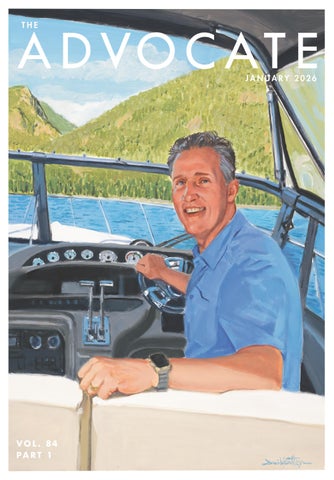
ON THE FRONT COVER
Thomas L. Spraggs, K.C., obtained his law degrees upside down in Australia. Find out how he righted the ship at Spragg Law and keeps things afloat as president of the Law Society at page 17.
5
6
THE ADVOCATE
VOL. 84 PART 1 JANUARY 2026
DR EDWIN BLEWETT PhD Economics (UBC, ( 1982) + Qualified as an experrt in BC Supreme Court & Canada’s Specific Claims C Tribunal + Negotiations support: r values of offers and counteroffers + PID opinions for commer m cial fishers + Economic value of damages + Strategic Consultations + Economic Valuationss + Expert Opinions
604 4 999 7615 4.999.7615
edwin@gocounterpoint.com ww ww.gocounterpoint.com
Paul & Company, LLP (Barristers and Solicitors) David A. Paul, K.C. (B.GS, LL.B., LL.M. (Dispute Resolution), RRM)
MEDIATOR RESPECTED BY PEERS • TRUSTED BY CLIENTS • PROVEN THROUGH RESULTS
With decades of experience, David brings practical insight and balanced judgment to every mediation. Deliver the outcomes your clients deserve—without litigating— with mediation that works. In-person and virtual services tailored to meet the needs of you and your clients, wherever you are. To book a mediation, please contact Arlene: Call (250) 828-9998 local 104 or email arlene@kamloopslaw.com Learn more: www.kamloopslaw.com
6
THE ADVOCATE
7
VOL. 84 PART 1 JANUARY 2026
,(J :8:D=!#4(J !F-&J =:@@-8 J J#=-8+@JF!4D!#5(J <=!$B-$!4J-8@.+,B@J!=-@.8+J*>:6J,.@J1D&-$-!5J$!=((=J !8&J:F(=J JH(!=@J:*J4-B.+!B.:8J<=!$B-$(J>(<=(@(8B-8+J $4-(8B@J!BJB=-!4J!8&J!<<(44!B(J4(F(4@ J!@JG(44J!@J#(*:>(J !&6-8-@B=!B-F(JB=-#D8!4@ J J*(44:GJ:*JB,(J 6(=-$!8J =.!4J !GH(=@J @@:$-!B-:8J!8&J B,(J 8B(=8!B-:8!4J :$-(BHJ:*J !>=-@B(=@ J,.@J#!$3+>:D8&J -8$4D&(@J>(@:4F-8+J$:66(>$-!4J&.@<DB(@ J!&F-@-8+J !8&J=(<=(@(8B-8+J!J=!8+(J:*J=(+D4!B:=HJ:=+!8.I!B-:8@J #:B,J.8J!8&J:DBJ:*J$:D>B J!@JG(44J!@J!$B-8+J-8J$=-6-8!4J 6!BB(=@ J#:B,J:8J#(,!4*J:*JB,(J =:G8J!8&JB,(J&(*(8$( J
'%?;AA/9 '2"%;E9A)5 %;7J
0?)%C J J J
7
8
THE ADVOCATE
VOL. 84 PART 1 JANUARY 2026
Daum Terpkosh Valuations WE SPECIALIZE IN MAKING THE COMPLEX UNDERSTANDABLE
Chanittha Vesboonchu CPA, CBV
Rebecca Hobbs CPA, &$ CBV
Veronika Kyjonka CPA, CBV
Patti Daum CPA, CA, CBV
Lucas Terpkosh CPA, CA, CBV
With a personal approach to business valuations and a wide range of financial services, we are committed to providing clear, insightful guidance for all your valuation needs.
Loss Quantification • Breach of contract • Business interruption • Wrongful death claims • Personal injury
Business Valuations • Matrimonial matters • Shareholder disputes • Estate administration • Corporate reorganizations
Patti Daum: (778) 819-7028 Lucas Terpkosh: (236) 476 4796
Suite 600 - 777 Hornby Street Vancouver, BC V6Z 1S4
www.dtvaluations.com info@dtvaluations.com
ЖЖЖ
8
THE ADVOCATE
VOL. 84 PART 1 JANUARY 2026
9
6TWUVGF 'HƂEKGPV #TDKVTCN +PUVKVWVKQP Our seasoned international & domestic arbitrators adhere to a fair process and deliver impartial, balanced and timely awards.
resolve@vaniac.org | vaniac.org | 604-684-2821
9
10
VOL. 84 PART 1 JANUARY 2026
THE ADVOCATE
¾» ÅÄÅËÈ·¸Â»
¾» ÅÄÅËÈ·¸Â»
Ɣ È Ë ¹ » Å É » ƾ É Å Ä Ƒ
Ä Ä » · ¹ » Ä Ð ¿ » Ƒ
¾ÅÄ»Ɠ ʽʷʻƖʿʷʷƖʿʷʻʺ ÷¿ÂƓ ¿¸Àʤ¾¿È·ÈÅÍ·ÄƔ¹ÅÃ
¾ÅÄ»Ɠ ʽʷʻƖʿʷˀƖʻʺʻʻ ÷¿ÂƓ ·Ã·¹Á»Äп»ʤ¾¿È·ÈÅÍ·ÄƔ¹ÅÃ
¿Ê¾ · ¹Åø¿Ä»º ʾʼ̊ Ï»·ÈÉ ÅÄ Ê¾» ¸»Ä¹¾Ƒ ʾ» ÅÄƔ ÄÄ» ·¹ »Äп» ·Äº ʾ» ÅÄƔ È˹» ÅɻƾÉÅÄ Å¼¼»È ûº¿·Ê¿ÅÄ É»ÈÌ¿¹»É ½ÈÅËĺ»º ¿Ä º»»Æ À˺¿¹¿·Â ¿ÄÉ¿½¾Ê ·Äº · ¿¼»Ê¿Ã» ż Æ˸¿¹ É»ÈÌ¿¹»Ɣ ÄÄ» É»ÈÌ»º ÅÄ ·Â ʾȻ» »̻ÂÉ Å¼ ¹ÅËÈÊ ¿Ä ȿʿɾ ÅÂËø¿·Ƒ ¿Ä¹Â˺¿Ä½ ÅÌ»È · º»¹·º» ÅÄ Ê¾» ÅËÈÊ Å¼ ÆÆ»·ÂƑ ·Äº Í·É Ê¾» ¼¿ÈÉÊ ¼»Ã·Â» ÉÉŹ¿·Ê» ¾¿»¼ ËÉÊ¿¹» ż ʾ» ËÆȻû ÅËÈÊƔ È˹» ;Š·ÂÉŠż¼»ÈÉ ·È¸¿ÊÈ·Ê¿ÅÄ É»ÈÌ¿¹»ÉƑ ÆȻɿº»º ¼ÅÈ ÅÌ»È ʻʹ Ï»·ÈÉƑ ¿Ä¹Â˺¿Ä½ ÂÅĽ Ê»ÄËÈ»É ÅÄ Ê¾» ÈÅ̿Ĺ¿·Â ÅËÈÊ ·Äº ËÆȻû ÅËÈÊƑ »·ÈĿĽ · È»ÆËÊ·Ê¿ÅÄ ¼ÅÈ ¸·Â·Ä¹»Ƒ ¼·¿ÈÄ»ÉÉƑ ·Äº ¹Â·È¿ÊÏƔ Åʾ ·È» ÄÅÍ ·Ì·¿Â·¸Â» ÊÅ ·ÉÉ¿ÉÊ Æ·ÈÊ¿»É ¿Ä È»ÉÅÂ̿Ľ ¹ÅÃÆ»Π»½·Â º¿ÉÆËÊ»É Í¿Ê¾ »¼¼¿¹¿»Ä¹ÏƑ ÆÈż»ÉÉ¿Åķ¿ÉÃƑ ·Äº ÉÅËĺ À˺½Ã»ÄÊƔ ¿È· ÅÍ·Ä ¿É · ¿ʿ½·Ê¿ÅÄ ¼¿Èà ¸·É»º ¿Ä ºÅÍÄÊÅÍÄ ·Ä¹ÅËÌ»ÈƑ Ϳʾ · È»ÆËÊ·Ê¿ÅÄ ¼ÅÈ »Î¹»Â»Ĺ» ¿Ä ·ºÌŹ·¹Ï ·Äº ÉÊÈ·Ê»½¿¹ ¹ÅËÄÉ»ÂƔ ËÈ Ã»º¿·Ê¿ÅÄ É»ÈÌ¿¹»É ·È» ½ÈÅËĺ»º ¿Ä ʾ» ɷû ÆȿĹ¿ÆÂ»É Ê¾·Ê º»¼¿Ä» ÅËÈ Â¿Ê¿½·Ê¿ÅÄ ÍÅÈÁƓ ¿ÄÊ»½È¿ÊÏƑ ¿ÄÉ¿½¾ÊƑ ·Äº È»ÉËÂÊÉƔ Å ¿ÄÇË¿È» ·¸ÅËÊ ·Ì·¿Â·¸¿Â¿ÊÏ ÅÈ ÊÅ ¸ÅÅÁ · ûº¿·Ê¿ÅÄƑ Æ»·É» ¹ÅÄÊ·¹Ê ÄÄ» ·Ê ·Ã·¹Á»Äп»ʤ¾¿È·ÈÅÍ·ÄƔ¹Åà ÅÈ È˹» ·Ê ¿¸Àʤ¾¿È·ÈÅÍ·ÄƔ¹ÅÃƔ
ʸʼʷʷ Ɩ ʼʾʷ È·Ä̿» ÊƔ ·Ä¹ÅËÌ»ÈƑ ʽ ʸ ʽ ¾¿È·ÈÅÍ·ÄƔ¹ÅÃ
10
THE ADVOCATE
VOL. 84 PART 1 JANUARY 2026
11
ENTRE NOUS
A
t the end of 2025 there was a baffling confluence of art and life with the Nuremberg trials back in the spotlight. After a world premiere at the Toronto International Film Festival in September, the Hollywood film Nuremberg was released in November (albeit to mixed reviews). The film stars Russell Crowe as Hermann Göring, Adolf Hitler’s second-in-command,1 facing assessment by U.S. Army psychiatrist, Douglas Kelley (played by Rami Malek) before and while being tried for war crimes. The film depicts Göring’s arrest on May 7, 1945, psychiatric assessments, and, of course, the trial itself. While events are somewhat conflated one of the historical realities depicted is the rejection of the “Nuremberg defence” (so named because it was employed by so many of the Nuremberg defendants at the original and subsequent trials). The Nuremberg defence is the plea that an individual cannot be guilty of crimes ordered by a superior officer. This is sometimes referred to as the “I was only following orders” defence. In November 1943, the Moscow Declaration issued by the Soviet Union, United Kingdom and United States warned Nazi leadership that high-ranking Nazis who had committed crimes in several countries would be dealt with jointly by the Allies while others would be tried where they had committed their crimes. Prior to World War I, captured war criminals were tried under the military laws of their captors; however, at the end of the war, they could only be sent home and prosecuted under the laws of their own countries. This arrangement often did not result in consequences for soldiers who had committed atrocities. The Moscow Declaration suggested a different approach for the highest-ranking Nazis although quite what should be done with them was yet to be the subject of some debate. Initially, Churchill and Stalin held out for summary execution, whereas Roosevelt felt that due process in the form of a trial should precede punishment. Happily, for the rule of law, Roosevelt’s view prevailed.
11
12
VOL. 84 PART 1 JANUARY 2026
THE ADVOCATE
Justice moved quickly in those days. The Second World War ended in Europe in May 1945 and within three months (August 2, 1945) the London Agreement and Charter had been prepared. Churchill and Stalin had been won over. The documents, drawn up by the United States, Great Britain, France and the Soviet Union, created an international military tribunal empowered to deal with Nazi Germany and the war crimes committed against various European countries and millions of European civilians. The Charter held that “to prepare, incite, or wage a war of aggression, or to conspire with others to do so … [was] a crime against international society.” It also became an international crime for the first time “to persecute, oppress, or do violence to individuals or minorities on political, racial or religious grounds in connection with such a war.” Before the word “genocide” was coined, Churchill described it as “a crime with no name” and “one of the greatest and most horrible crimes ever committed.” The Nuremberg trials were, as the opening remarks of the U.S. chief prosecutor, Robert H. Jackson stated: “the first trial(s) in history for crimes against the peace of the world.” The trials provided a foundation of international criminal law: holding individuals (rather than sovereign states) responsible for violations of international law for the first time. On November 20, 1945, just over six months after Germany’s surrender, Hermann Göring found himself in a specially built courtroom in Nuremberg—so chosen as it was a key location for Nazi rallies—on trial for, inter alia, crimes against peace, and crimes against humanity. Strictly speaking, he did not advance a classic “Nuremberg defence”: as he was second-incommand, there was really only one “superior” he could take orders from. Instead, he took an assertive stance, admitting his role in major policy decisions and the planning of an aggressive war. However, he framed his involvement within the context of his general duty to the German state and to Adolf Hitler. He insisted that everything he had done was the result of German patriotism and that to defy the court was a way to protect Germany’s reputation and maintain loyalty to Hitler. At a later Nuremberg trial, the Nuremberg defence was adopted and proclaimed by Rudolf Höss, commandant at Auschwitz: Don’t you see, we S.S. men were not supposed to think about these things; it never even occurred to us. ... We were all so trained to obey orders without even thinking that the thought of disobeying an order would simply never have occurred to anybody, and somebody else would have done just as well if I hadn’t. ... I really never gave much thought to whether it was wrong. It just seemed a necessity.
The judges at Nuremberg rejected the defence outright and found instead that when an individual follows an order that is illegal under international
12
THE ADVOCATE
VOL. 84 PART 1 JANUARY 2026
13
law, it is the individual who is responsible for that choice except under specific circumstances. For instance, if the individual was able to establish ignorance of the fact that the order was illegal, responsibility would not follow, neither would an individual be culpable if ordered to follow an illegal order on threat of physical harm, torture or death. However, the judges at Nuremberg maintained that it would have been impossible to not know that murdering civilians is both illegal and immoral. Under Article 92 of the Uniform Code of Military Justice and the U.S. Manual for Courts-Martial, service members must obey lawful orders and disobey unlawful orders. The inference of lawfulness for military orders “does not apply to a patently illegal order, such as one that directs the commission of a crime.” One would imagine that such statements are not controversial. So, when 80 years after the Nuremberg trials started, in mid-November 2025, a group of U.S. Democratic lawmakers (all of them former service and intelligence members) posted to social media, a video reminding members of the military and intelligence communities they are required to refuse unlawful orders, how could such an action invite criticism? The 1:30 video spliced together a message from six senators and representatives and included the following: We want to speak directly to members of the military and the intelligence community who take the risks each day to keep Americans safe. We know you are under enormous stress and pressure right now. Americans trust their military but that trust is at risk. This administration is pitting our uniformed military and intelligence community professionals against American citizens. Like us, you all swore an oath to protect and defend this Constitution. Right now, the threats to our Constitution aren’t just coming from abroad, but from right here at home. Our laws are clear. You can refuse illegal orders. … You must refuse illegal orders. No one has to carry out orders that violate the law or our Constitution. We know this is hard and that it’s a difficult time to be a public servant. But whether you’re serving in the CIA, the Army, our Navy, [or] the Air Force, your vigilance is critical, and know that we have your back. Because now, more than ever, the American people need you. We need you to stand up for our laws, our Constitution, and who we are as Americans. Don’t give up the ship.2
The reaction of the U.S. administration to this admittedly political statement was, frankly, repugnant. In a series of social media posts, the President of the United States declared (caps and punctuation in the original posts): It’s called SEDITIOUS BEHAVIOR AT THE HIGHEST LEVEL. Each one of these traitors to our Country should be ARRESTED AND PUT ON TRIAL.
13
14
VOL. 84 PART 1 JANUARY 2026
THE ADVOCATE
This is really bad, and Dangerous to our Country. Their words cannot be allowed to stand. SEDITIOUS BEHAVIOR FROM TRAITORS!!! LOCK THEM UP??? President DJT. SEDITIOUS BEHAVIOR, punishable by DEATH!
He also reposted a statement that said: “HANG THEM GEORGE WASHINGTON WOULD !!” When shocked journalists asked the White House Press Secretary about the posts and whether the President wanted to execute members of Congress, she responded with unbridled gaslighting bombast: No. Let’s be clear about what the President is responding to. You have sitting members of the United States Congress who conspired together to orchestrate a video message to members of the United States military, to active duty service members to members of the national security apparatus encouraging them to defy the President’s lawful orders … and if they hear this radical message from sitting members of Congress, that could inspire chaos and it could incite violence and disrupt the chain of command.3
What a load of twaddle. The press secretary unashamedly flipped the truth on its head and lied about what the video said. She then left the stage while journalists attempted in vain to correct her misstatement. Since this repulsive display, the FBI has announced an investigation into those who made the video. Meanwhile, according to the Washington Post the U.S. Secretary of Defence (or as he would have it “Secretary of War”) Pete Hegseth is being investigated for issuing unlawful orders to “kill everybody” after a U.S. missile strike on a Venezuelan vessel that may or may not have been smuggling drugs. Hegseth denies making the order. Refusing unlawful orders is something most people on active duty probably never imagine themselves having to do. Indeed, members of the military are trained to follow orders. At times it may not be clear whether an order is lawful or not. Active duty personnel may well find themselves facing a confusing dilemma. The legality of an order is a question of law; how is a lay person supposed to make what might be a lightning quick decision in a highly stressful situation to disobey an unlawful order? Nevertheless, an order to “kill everybody” when survivors are clinging to wreckage in the water would indeed be an unlawful order. Someone choosing to follow this type of order would not later have recourse to the Nuremberg defence. Failing to follow the order, on the other hand, may well be a career-ending choice. What then, are military people charged with obeying orders meant to do? Given the oath they have undertaken, they are to put other interests before their own. An oath to the U.S. Constitution is a pledge to something beyond
14
THE ADVOCATE
VOL. 84 PART 1 JANUARY 2026
15
self and self-interest. A commitment to upholding institutions of democracy and the principles on which they are founded, is a commitment to the rule of law itself. Tom Bingham holds accountability as one of the nine principles of the rule of law. He expresses it as a proposition that the government and individuals must be held accountable for their actions and cannot act outside the law. A related principle is that of the limitation of power— namely, that discretionary power should be limited and must not be absolute or arbitrary. When an order is arbitrary and outside the law, it is correct to say that it must be disobeyed because it violates the rule of law. Chaos is not inspired by warning people to disobey unlawful orders. Order is maintained. When the narrative is turned on its head, and individuals are accused of saying the opposite of what they said, that is chaos. It is within the current amplified political mess that U.S. service men and women must attempt to navigate their responsibilities and commitments to ideals beyond themselves and quite beyond the governing administration of the day. ENDNOTES 1. At least until he sent Hitler a telegram on April 23, 1945 asking for permission to assume leadership of the crumbling Reich. Hitler received the telegram as evidence of Göring’s intent to launch a coup d’état. He responded on April 25, 1945 accusing Göring of high treason and “illegally attempting to seize control of the state” and presenting Göring with the option of resigning from all offices in exchange for his life. Göring resigned, whereas Hitler, prompted by Göring’s telegram, dictated his last will and testament which (just to be sure) dismissed Göring from all offices, cancelled his rights of succession and
expelled him from the Nazi Party. Hitler committed suicide on April 30, 1945. 2. The speakers were Senator Elissa Slotkin, former CIA officer; Senator Mark Kelly, former captain in the United States Navy; Representative Chris Deluzio, former Navy officer; Representative Maggie Goodlander, former Navy officer; Representative Chrissy Houlahan, former Air Force officer; and Congressman Jason Crow, former paratrooper and Army ranger. 3. Available online at: <www.youtube.com/watch?v=iQW5VUwjlE>.
ЖЖЖ
15
16
VOL. 84 PART 1 JANUARY 2026
THE ADVOCATE
16
THE ADVOCATE
VOL. 84 PART 1 JANUARY 2026
17
ON THE FRONT COVER THOMAS L. SPRAGGS, K.C. By Kristin Gardner
I
t is no accident that Tom Spraggs is our incoming Law Society president. His work ethic is unmatched, and he does not back down from a challenge. Yet, his achieving this honour was not necessarily inevitable. Frankly, in the early days of his career, many might have thought he would not achieve much at all. There may have even been some who actively tried to ensure it. But Tom was focused and did not let that bother him much. He is a problem solver who thinks outside the box. At the heart of it, Tom believes in being tough on issues, but soft on people. It is his enduring perseverance and optimism that have led him to where he is meant to be. Tom’s father, Tom Spraggs Sr., grew up on a farm in Armstrong, B.C., and was one of six children. The family did not have much, but Tom Sr. was bright and ambitious. When military spending increased during the Cold War, Tom Sr. snapped up the opportunity for a farm kid like him to get a university education. He traded eight years of military service for an undergraduate degree. He had hoped to follow in the footsteps of one of his brothers, who had become a Canadian Air Force pilot. Regrettably, the military had other plans for Tom Sr. He studied civil engineering and was put to work building and testing military equipment. His service took him all over the world, where he played a role in an assortment of classified projects. After returning to civilian life, Tom Sr. pursued his passion for flying and got his pilot’s licence. He also continued his academic education, graduating from UBC law school in 1970. He met his wife, Diane, whose parents had immigrated from Scotland to Moose Jaw, Saskatchewan. Diane had a love for languages and found her calling as a high school French teacher.
17
18
VOL. 84 PART 1 JANUARY 2026
THE ADVOCATE
Together, Tom and Diane settled in Port Moody, where they raised five children. Tom is the second child, the oldest son. In 1971, Tom Sr. founded Spraggs & Co. Law Corporation. He developed a deep sense of pride from taking on difficult cases and helping people in trouble. He passed his love for the law on to his children, each of whom has either become a lawyer or married someone in the legal field (or both). Diane was undoubtedly busy with five kids, but she kept everyone organized. She had an educator’s mindset, and her parenting was exemplified by patience and persistence. She taught Tom not to give up when he encountered setbacks, but to try again, do something new and look at the problem from a different perspective to find potential solutions. She also passed on her knowledge of French, in which Tom developed bilingual fluency. One of Tom’s early pastimes was swimming in his backyard pool, and by the time he was 12, he was racing competitively. He particularly enjoyed the camaraderie and thrill of relay racing but also excelled in sprint freestyle and backstroke. He broke pool records and consistently ranked in the top three for his age group. In grade 9, Tom transferred to St. Thomas More Collegiate. This transfer facilitated his demanding swimming schedule, given the school’s proximity to the Canada Games Pool. His mom got him to the 5 a.m. practices, and his dad attended the weekend swim meets. Tom recalls often swimming to the point of exhaustion, up to 60 kilometres per week. But he also discovered that by pushing himself to his limits, he could achieve excellence. In 1991, Tom was regarded as the top high school swimmer in the province. Attending St. Thomas also benefited Tom in other unexpected ways. He received meaningful instruction in morality, personal ethics and decision making. He was encouraged to reflect on what kind of person he wanted to be and how to be intentional about being the most authentic version of himself. However, his biggest takeaway was the importance of being of service to others. Tom is grateful for these valuable lessons and says they have helped shape his character immeasurably as he moves through the world. Initially, Tom wanted to follow in his father’s footsteps—not necessarily as a lawyer, but as a civil engineer. As fortune would have it, while preparing his engineering school applications, Tom discovered it was possible in some countries to attend law school directly out of high school. He and his dad shared a laugh over the fact that he was not particularly good at math anyway, and so he set off to find a law school with a good swim team. This took Tom to Bond University on Australia’s Gold Coast. At the time, it had an excellent reputation for academics. Just as importantly, Tom would have the opportunity to compete with some of the fastest swimmers in the world. He did not waste that chance and says swimming there was a fantastic experience.
18
THE ADVOCATE
VOL. 84 PART 1 JANUARY 2026
19
Tom knew he might face some obstacles returning to Canada with a foreign law degree. While considering his options, he stayed on at Bond to complete his Master of Laws with a focus on dispute resolution and dispute systems design. Tom thought about staying in Australia but ultimately decided to take his chances at returning to Canada. His journey to become accredited took him to the University of Alberta, where he challenged the law school exams. It was a gruelling year-long process, but he succeeded and was called to the bar in Alberta. Unfortunately, British Columbia did not recognize that equivalency process and had its own exam-heavy requirements, so he decided to just stay in Edmonton for a while. These temporary setbacks put Tom in the right place at the right time. He was hired at James H. Brown & Associates, where he found an incredible mentor. Of even greater significance, he met his future wife, Jessica. Tom’s co-worker introduced them, and they immediately hit it off. Jessica says Tom was confident without being cocky, and Tom was charmed by Jessica’s unmistakable brilliance, kindness and ability to stay calm under pressure. They had deep conversations about mutual interests, like law and politics. By only their third date, Tom knew she was the one, and they were married within a few months. In 2002, Jessica started law school at UBC. This offered Tom the chance to work with his dad, so he got to work on getting called to the B.C. bar. Spraggs & Co. had grown into a busy personal injury boutique. Once called, Tom ran several trials with his father, learning the practical skills that law school just cannot teach. He watched senior lawyers in action, how they navigated courtroom etiquette and procedure and were able to serve their clients’ best interests within the strict bounds of ethics. Tom also saw the collegiality his father enjoyed with opposing counsel, despite their often diametrically opposed legal positions, a lesson he took to heart. Tragically, Tom Sr. was involved in a serious motor vehicle accident in 2004. It soon became apparent that he could no longer run the business effectively. At the age of 29, Tom was forced to take over the practice far sooner than anyone anticipated. Tom Sr. had enjoyed a reputation for being a fierce advocate and not backing down from the formidable institutional insurer responsible for paying out his clients’ claims. As a result, many of his files went to trial. When Tom took over the practice, he had several difficult tasks: convince his clients that he could and would fight just as hard as his father had to get them the result they deserved; convince ICBC that he could endure its pressure to settle files for less; and convince the judges that he deserved their respect in court, despite his relative inexperience. He had very big shoes to fill, and it was not going to be easy.
19
20
VOL. 84 PART 1 JANUARY 2026
THE ADVOCATE
Tom relied on the values imparted on him from an early age: to work hard and never give up. At one point, he spent nine months in back-to-back trials, during which time his first child was born. He felt the full weight of the burden to provide for his young family. But he kept putting one foot in front of the other, never forgetting to do it with a smile. I pause here briefly to provide my own perspective and experience working with Tom. I knew Jessica first. We clerked together at the Court of Appeal and became fast friends. After deciding I was not a good “fit” where I articled, I quit after my first year without any real plan. I found myself unemployed… and pregnant. I seriously considered the possibility that my law career might be over before it really began. At Jessica’s suggestion, I contacted Tom, expecting a possible short-term position. He hired me without reservation and put me right to work. I had never been to trial, but he trusted me to prep witnesses and conduct direct examinations in court. He treated me as equal co-counsel. I drafted factums, attended chambers, appeared at the Court of Appeal and was brought into every client meeting. Tom took me under his wing and made me feel like an invaluable member of the team. I ended up working at the firm for 12 years and gained a lifelong friend in the process. Where many lawyers and law firms would have seen an inexperienced, pregnant woman as a liability, Tom saw only potential. He invested in me, something for which I am forever grateful. That said, working at the firm in those early days with Tom at the helm is best described as controlled chaos. There was no document management system, and so it was an office full of paper. Even the master trial schedule was handwritten on one of those large desk calendars. But everyone in the office worked incredibly hard and knew that their roles were equally important to achieving the common goal of survival. Tom was the responsible lawyer for every single client, and he knew each of their stories. He dictated and signed every letter that went out, conducted every client meeting, attended every mediation and was lead counsel on every trial. Luckily, he has a freakishly good memory. The sheer volume of work would have buried most people, but Tom accepted that he had to play the cards he was dealt. He would not let the firm go down. To succeed, Tom realized he had to forge his own path. He turned to technology. He invested in computer software and new servers, hired IT specialists (including one of his brothers), and hung a smartboard in his office. He used technology to improve client satisfaction, developing structured strategy meetings to explain the claim process, timelines and how he was going to maximize their claims. He started video recording client interviews, at first just for the file as an aide-mémoire. He soon recognized they
20
THE ADVOCATE
VOL. 84 PART 1 JANUARY 2026
21
could do more, and he built a studio to film professional-level video interviews, sending them with settlement proposals to personalize his clients for adjusters and defence counsel. He also co-founded a technology-based platform to provide online legal advice. In 2016, the Canadian Bar Association awarded Spraggs & Co. with the “Innovative Workplace Award”, recognizing Tom’s work in rethinking how legal services are delivered. Cultivating a collaborative culture and effective teamwork has also been important to Tom. He held daily all-staff morning meetings, each one with a different presentation he created about the day’s priorities, incorporating tips and tricks, and encouragement, along with a dash of humour. He also brought in experts like Michael Lomax to provide staff training on dealing with high-conflict people. To facilitate understanding of different work and communication styles, Tom encouraged the office to take the True Colors Personality test. Lawyers are often primary “green” personalities, characterized as analytical, logical and efficient problem solvers. However, to the surprise of absolutely no one, Tom is “orange”: outgoing, spontaneous, risk-friendly and always seeking opportunities to push the boundaries. While perhaps “atypical”, these traits have distinguished him in his career. In addition to investing in technology and the people around him, Tom invested in himself. He read countless biographies and books about business strategy and self-improvement, regularly imparting nuggets of knowledge on colleagues and clients. He learned to speed read, which not only shortened his trial preparation time, but also allowed him to get through a book of authorities in record time to provide comprehensive reply submissions in court. Tom believed in the power of speed reading so much that he started teaching the technique to interested staff and co-workers. Over the years, he has also offered to teach clients, colleagues, former judges and countless others he has encountered. This desire to share his knowledge and skills is another example of Tom’s generosity. Somewhat frustrated by the limitations of self-learning, Tom decided to make an even more substantial investment in himself. He went back to school full-time to earn his master of business administration degree. By this time, Jessica had joined the firm, managing its operations side. Tom also had several associates to help manage some of the day-to-day client communications. Nevertheless, Tom was never truly absent from the practice, while also juggling school and his role as an active father to three (soon to be four) young children. Unsurprisingly, Tom graduated at the top of his class. Through steady iterations, Tom did not just right the ship; he grew the firm and it has thrived more than ever. He remains committed to creating value wherever he can and focuses on finding reasons for success, rather
21
22
VOL. 84 PART 1 JANUARY 2026
THE ADVOCATE
than excuses for failure. He also relies on his Christian faith, which gives him peace in knowing that everything will work out the way it is supposed to. At the same time, he is determined to never be outworked, and this has earned him respect from both the courts and his peers. Justice Bruce Josephson notes that Tom was one of the first lawyers to hire him as a mediator after his retirement from the bench. In that context, he says Tom displays “uncommon abilities as an advocate”, bringing “remarkable people skills, energy, innovation, and wisdom to the table”. When rumblings began about potential changes to British Columbia’s vehicle insurance scheme, Tom did not panic. He saw it as a new adventure. He rebranded the firm as Spraggs Law and started exploring potential new practice areas. Jessica had prior experience in real estate law and was interested in employment law. Other associates expanded into wills and estates. Spraggs Law now also offers services in business law and general civil litigation. Tom is now further expanding the Spraggs Group, leveraging his passion for technology and innovation to provide multidisciplinary business consulting services. Rooted in the spirit of service instilled in high school, Tom is dedicated to giving back to his community. He has served on the council for his church and on the board of a faith-based independent school. He was appointed to the British Columbia Law Institute board of directors in 2012, serving on several committees and two terms as chair. He co-founded a TriCities/New Westminster civil litigation section for the CBABC and sat on Provincial Council for several terms. He participates in Continuing Legal Education conferences and contributes articles to The Verdict. In 2019, Tom was elected as a Law Society bencher. He is currently the chair of the Finance and Audit Committee, co-chair of the Truth and Reconciliation Advisory Committee, and a member of the Discipline Committee and Executive Committee. Usually preferring to stay behind the scenes, Jessica has remained a grounding presence in Tom’s life. She provides unwavering support and sound advice, while also pursuing her own professional endeavours and maintaining a loving home for their four children. She says that Tom is an awesome parent—patient, loving and never too busy to be present for his kids. Together, Tom and Jessica make a formidable team. This article would be incomplete without mentioning the cover portrait of Tom on his boat. He has always enjoyed being on the water, and he really loves that boat. It originally belonged to Tom Sr., and Tom was thankful to acquire it after his dad passed in 2013. He has spent an untold number of hours working and playing on his boat, and he derives immense pleasure
22
THE ADVOCATE
VOL. 84 PART 1 JANUARY 2026
23
from sharing it with his family, friends and colleagues. It is delightful to watch him navigate his most cherished toy. Tom’s energy seems limitless, and his enthusiasm for life is contagious. He laughs often and without reservation. Always on the lookout for ways to live life to the fullest, he tries trends like cold plunging, eating kimchi or sardines, and drinking apple cider vinegar. He declares even the most mundane meal as “delicious”, because he finds joy in the little things. But behind any seemingly blind optimism, Tom’s wheels are always turning, a plan always forming for improvement and growth. I would be remiss not to acknowledge the crossroads currently facing the legal profession in British Columbia. Tom could possibly be our last Law Society president. While the path forward is potentially rocky, Tom is exceptionally well suited for this leadership role. His dedication to the core values underlying an independent bar will be invaluable. His long-time colleague, David O’Neill, remarks that Tom is “always able to see the forest for the trees, even when he dives deep into the details, he always has the bigger picture and narrative in mind, and how the information fits together into an overarching goal”. We could not be in better hands.
ЖЖЖ
23
24
THE ADVOCATE
VOL. 84 PART 1 JANUARY 2026
BRITISH COLUMBIA CHAPTER NAME
BASED IN
PHONE
Frank Borowicz, K.C.
Vancouver
(604) 351-7755
;
Joseph Boskovich
Vancouver
(604) 669-5500
;
Hon. Mary Ellen Boyd
Vancouver
(604) 639-3172
;
Barb Cornish, K.C.
Vancouver
(604) 639-3174
;
Paul D. Godin
Victoria
(778) 587-4499
;
Jeffrey A. Hand
Vancouver
(604) 449-3830
;
Janice F. Hansen
Victoria
(250) 216-2420
;
Bryce Jeffery
Langley
(604) 530-3141
;
Rose Keith, K.C.
Vancouver
(604) 895-2911
William E. Knutson
Vancouver
(604) 684-0727
;
Dean P. J. Lawton, K.C.
Victoria
(250) 381-7188
;
Richard Lindsay, K.C.
Vancouver
(604) 639-3171
;
John Logan, K.C.
Vancouver
(604) 681-6564
;
Elizabeth Lyall, K.C.
Vancouver
(604) 639-3171
;
Simon Margolis, K.C.
Vancouver
(604) 639-3173
;
Vincent R. K. Orchard, K.C.
Burnaby
(604) 240-8589
;
Carol Roberts
Vancouver
(604) 915-5222
;
Alan Schapiro
Vancouver
(604) 221-1660
Kerry Short
Vancouver
(604) 639-3175
;
Scott Snider
Vancouver
(604) 281-4808
;
Mark L. Tweedy
Vancouver
(604) 341-8980
;
James D. Vilvang, K.C.
Vancouver
(604) 661-9262
;
Gaynor Yeung, K.C.
Vancouver
(604) 891-7236
;
CALENDAR
Expedite mediation scheduling, free at
www.BCMEDIATORS.org Visit the Academy’s national roster at www.mediators.ca
24
THE ADVOCATE
VOL. 84 PART 1 JANUARY 2026
25
PRACTICE BEFORE THE BRITISH COLUMBIA UTILITIES COMMISSION By Jim Quail
E
nergy utility regulation before the British Columbia Utilities Commission (“BCUC”) is a compact niche of legal practice. Its regular bar would fit in a medium-size elevator. It is an exceptionally interdisciplinary field, loaded with baffling acronyms, smudging boundaries between law, aboriginal rights, policy, engineering, economics and accounting. There has never been a continuing education program from any provider for its practitioners. Its only standard textbook has been out of print for decades.1 However, with the escalation of the climate crisis and corresponding intensity and complexity of energy law and policy from all levels of government, and the duty of regulators to enforce the Crown’s obligations to First Nations, the elevator is getting a bit more crowded. Recently, the level of participation by municipalities, First Nations, businesses of various sorts and community-based organizations has increased and we are seeing more counsel plunging into the deep unfamiliar waters of utility law. In this article I will briefly describe the underpinnings and mechanics of energy utility regulation in British Columbia. I will argue that the needs of our time raise large questions about how to better meet the critical imperatives that are bearing down on us, our communities and our world. The rules governing how we used energy resources while we were wrecking the earth’s climate may not help us find solutions. THE DISTANT PAST The roots of utility regulation in North America are buried deep in the ancient English common law. The core principles are still recognizable from those early beginnings beneath a large overlay of rules and process. However, their adaptation to the urgent needs of our times has been hesitant and piecemeal. Major rethinking is overdue. The Utilities Commission Act2 traces back to medieval rules governing “common carriers”—operators of ferries, carriages for the regular transport
25
26
VOL. 84 PART 1 JANUARY 2026
THE ADVOCATE
of goods and passengers, and so on. They were obliged to provide service “without discrimination” to all comers on equal terms. Similar rules applied to “common callings” like innkeepers, for example. These rules imposed order and stability on services that people depended on to get around and conduct commerce. As you can see, the BCUC and the BC Human Rights Tribunal are distant cousins. Both trace their lineage back to the basic common law prohibition of discrimination in the provision of services, though in highly divergent terrain. TWENTIETH-CENTURY MONOPOLY REGULATION The late 19th century saw the emergence of capital-intensive infrastructural services that were critical to the development of modern society and its economy, including railways and telephone networks. Their large capital cost made them “natural monopolies”: laying a parallel set of train tracks or telephone lines along the same routes was not a practical option, and early competition quickly consolidated into large rapacious monopolies. Early in the 20th century, electric and gas utilities also began to grow. Monopoly service providers have both the space and the incentive to maximize profits by charging as much as the market will bear and spending as little as they can get away with. The solution adopted for critical natural monopolies was to impose a proxy for competitive markets in the form of regulatory tribunals. The U.S. Mann Elkins Act of 19103 was the prototype for North American monopoly regulation, bringing rates and services under control and striking more balance between the interests of railway and telephone system owners and those of the public. The law of common carriers was reformulated as the “regulatory compact”. Utilities must provide adequate service without discrimination in return for an opportunity to earn a fair return on their invested capital. Rates that properly balance the interests of consumers and shareholders are deemed “fair and reasonable”. British Columbia’s referee for this trade-off is the BCUC. Regulated utilities do not make a profit from the actual energy or services they deliver to customers. They earn a regulated rate of return on their capital, which includes enormous infrastructural investments. The total capital base on which they are entitled to derive a return, and which is one of the main elements of the rates they charge customers, is known as their “rate base”. This creates a perverse incentive to “gold-plate” their systems—to overinvest in capital to maximize shareholder dividends. The remedy for this hazard is regulatory oversight of their capital investments, via a mechanism arcanely known as the “certificate of public convenience and necessity”. The traditional paradigm approaches each regulated monopoly essentially as a siloed, self-sufficient entity, where the main task was to ensure
26
THE ADVOCATE
VOL. 84 PART 1 JANUARY 2026
27
that the public had fair access to reliable service from the company at reasonable rates, and in return its shareholders received reasonable, and not excessive, returns on their investments. It is often said that utility tribunals are “economic regulators”, although that phrase is generally used as though it meant mere financial regulators, which are different things. Tools like resource planning (which we will get to in a moment) enable them to claim a fuller range of economic regulatory oversight. The inherited mechanisms, grounded in a relatively stable, steady-state world of gradual and linear incremental change and evolution, are becoming obsolete. In practice, they may present obstacles to the project of preparing our energy infrastructures to meet the challenges coming our way. BCUC The Utilities Commission Act is our local realization of the regime for monopoly regulation, overseen by the BCUC. The BCUC is an expert tribunal with offices in Vancouver across Howe Street from the B.C. Supreme Court. It consists of a chair and chief executive officer (currently Dr. Mark Jaccard), twelve commissioners (six of whom are full time), and a large staff spanning a wide range of skills and expertise. It has wide-ranging powers to oversee utilities within the jurisdiction of the province, including the approval of rates and of rate-structures, allowed return on capital, terms and conditions of service, energy purchase contracts, the construction and maintenance of utility assets, and so forth. The over-riding principle that governs many key processes is the undefined “public interest”. The BCUC’s authority has its limits. It can set rates and terms of service and approve the construction of dams and laying of pipes, but it cannot settle into the armchairs of management and decide how to run the business. However, if management spends the money that it collects from ratepayers to run its business “imprudently”, the BCUC can disallow the utility’s recovery of that cost. It was long assumed that there is a presumption of “prudency” and that the burden is on the party challenging a management decision after the fact, but the Supreme Court of Canada ruled that this is not correct, and the regulator is entitled to apply the benefit of hindsight to evaluate the prudency of utility expenditures.4 But the most significant limit to the BCUC’s regulatory authority is provided in s. 3 of the Utilities Commission Act, which empowers the provincial Cabinet to issue orders-in-council called “directions” which override the rest of the statute and essentially permit the government to take hold of the steering-wheel. There is a large array of mandatory directions affecting
27
28
VOL. 84 PART 1 JANUARY 2026
THE ADVOCATE
many dimensions of the regulatory mechanism, including the level of BC Hydro’s dividends diverted to the provincial treasury, rules and standards for energy conservation measures, and BC Hydro rate increases. British Columbia’s campaigning opposition parties commonly promise to pull back from this interference and restore the independence of the BCUC but quite universally abandon these plans when they form government. UTILITY CUSTOMER RATES Utility rates are subject to approval by the BCUC, and here lies the heart of the “regulatory compact”. Section 59 of the Utilities Commission Act provides that rates must not be “unjust, unreasonable, unduly discriminatory or unduly preferential”. They must not charge “more than a fair and reasonable charge for service of the nature and quality provided by the utility”, but at the same time must be “[sufficient] to yield a fair and reasonable compensation for the service provided by the utility”. However, in 1960 the Supreme Court of Canada ruled, essentially, that the utility’s ability to earn a fair rate of return is absolute and trumps cost-pressure on utility customers.5 RATE-SETTING: REVENUE REQUIREMENT Periodically, utilities apply to the BCUC to recalibrate the total amount of revenue they are entitled to extract from their customers, including the cost of generating or acquiring the energy they deliver, the cost of the delivery system and their allowed rate of return. These can be very large and complex proceedings with a host of significant issues. There are diverse mechanisms for adjusting utilities’ revenue requirement, generally following a spectrum from annual or biennial granular full-body-scan “cost of service” reviews to multi-year, loose-leashed, incentive-based regimes grounded in formulas that are reviewed and adjusted annually to take account of inflation, interest rates, system growth and other factors. RATE-SETTING: RATE DESIGN The starting point to decide how to divvy up the revenue requirement from customers is to divide them into rate classes. In British Columbia, and in most jurisdictions, we have three principal rate classes: industrial, residential, and “general service” or commercial (which includes schools and hospitals and other facilities as well as grocery stores). Different kinds of energy customer may have widely differing energyconsumption characteristics that call for different ways to set the rate they must pay. For example, large industries generally receive their electricity
28
THE ADVOCATE
VOL. 84 PART 1 JANUARY 2026
29
supply directly from the high-voltage transmission system and make no use of the vast infrastructure that steps the power down to household voltage and delivers it into neighbourhoods. As a result, they are not expected to contribute to the cost of that distribution system. Some customer classes use energy at a relatively constant level through the year, the week and the day. Others’ consumption is highly seasonal and fluctuates from hour to hour. Providing service to the latter (which includes households) is more expensive because the system has to be built up to a scale that can meet their needs on the coldest night of the year. An industry that uses power on a more constant level uses the energy system more efficiently and is cheaper to serve, per unit of energy, than a typical residential customer. Hence the need for “rate design”. If revenue requirements measure the size of the utility’s financial pie, rate design determines how large a slice is the responsibility of each class of customers. This inherently arbitrary process involves a series of rules and procedures that crystallize into the tariffs that are approved by the BCUC and that provide the framework for our energy bills. RESOURCE PLANNING Resource planning is a periodic process where the utility (a) presents projected levels and types of demand for energy and services under various scenarios over the planning time-frame, taking into account measures to curtail demand (conservation, or in utility-speak, “demand-side measures”/“DSM”) and (b) sets out options and strategies to meet that demand. This analysis is used as a kind of roadmap to evaluate proposed system enhancement, energy acquisition and other utility applications going forward. It demonstrates that the utility has an adequate strategy to meet looming challenges, that the lights will stay on, and that homes and businesses will be heated. Resource planning is the most important departure from the U.S. Railway Rate Act paradigm of the regulatory compact, grafted onto the old regimes in the 1990s and early 21st century. In British Columbia, it was almost literally “grafted on” as it took an amendment to the Utilities Commission Act to legislatively overrule the B.C. Court of Appeal,6 which in a very conservative 1996 judgment characterized resource planning as a regulatory usurpation of management authority. Section 44.1 was plunked into the Act and there has been no comprehensive overhaul to modernize the Act. Despite its being legislatively reversed, utility counsel often cite the 1996 decision of the B.C. Court of Appeal, British Columbia Hydro and Power Authority v.
29
30
VOL. 84 PART 1 JANUARY 2026
THE ADVOCATE
British Columbia (Utilities Commission), in their efforts to encourage regulatory restraint. Resource planning is the critical tool in the hands of the regulator faced with the immensely complex task of shepherding our energy infrastructures in a sector where enormous and accelerating changes are coming at us, including the impacts of climate change on energy policy and on the physical security of energy systems. Resource planning looks up from the short-term nitty-gritty of the old regulatory compact and rate-setting to conduct a longer-term strategic perspective. It surveys the overall trajectory where things are headed and provides for course-correction to ensure that the energy sector lands on its feet through the transformations that continue to gain speed and intensity. From its inception, regulated utility resource planning was plugged into the time-honoured mould of 20th century monopoly oversight. Utilities were treated as autonomous self-contained entities, and filed updated resource plans at the BCUC every five or more years for review and approval. In a context where perhaps the largest single imperative is decarbonization, shifting our reliance away from fossil fuels toward electricity, it has become vital that the regulator has a coherent handle on how all of the elements that are being set in motion are faring. Our metaphor has been that of a high-altitude trapeze act without a safety net: it is essential that the performer who is about to spin into the void can be caught by their partner across the circus ring. The reduction in fossil fuel consumption has to be caught by the expansion of the electrical and renewable energy systems. The context is changing so rapidly that nowadays, utility resource plans are obsolete even before the BCUC can complete its hearing process and adjudicate them. As counsel practising before the BCUC, I have argued for several years for a fundamental realignment of resource planning. Instead of massive, periodic set-piece applications that move through the system like supertankers through a long canal, we should have “evergreen” plans—plans that are maintained and refreshed to course-correct as changes arise and remain perpetually useful and adequate. Further, while the electric and gas utilities do not need to consolidate their planning processes, they need to communicate intensively enough so that they understand each other’s assumptions and forecasts so that where their assessments differ, the regulator is able to see on what basis this is so. Without that, the BCUC risks making contradictory findings on issues the utilities have in common, and cannot satisfy itself that the sector is on a viable track, from a comprehensive perspective.
30
THE ADVOCATE
VOL. 84 PART 1 JANUARY 2026
31
We are well on our way to achieving these reforms. The BCUC now requires BC Hydro and the FortisBC gas utility to analyze common sets of planning scenarios and comment on each other’s results. BC Hydro has now embraced evergreen resource planning and FortisBC is moving in that direction with much more frequent and shorter-lived plans (which I see as a step on the road to fully reformed planning). WHAT WE NEED NOW The next step in updating our regulatory processes to better equip us to meet a disruptive future lies in the arena of rate-setting. Even the more flexible mechanism of incentive-based rate regulation that arose late in the 20th century is premised on looking backward to chart the future. Projections from the past are becoming less and less useful to meet emerging needs. Evergreen resource planning—large-scale road-mapping for the journey ahead—needs to be paired with a more evergreen rate-adjustment process— packing our bags for the trip. Inadequate coordination of longer-term planning and rate-setting is already giving rise to large, unsolved problems. The greatest is the dilemma posed by a natural gas system near its peak as electric heat pumps replace gas furnaces and municipal governments block new homes from connecting to the gas system. What really complicates the task of absorbing a looming contraction of the gas customer base is a risk ominously known as “utility death spiral”. A shrinking base of customers would bear all of the cost of an underused system, including the return that shareholders are entitled to earn on all of the pipes and compressors. The self-reinforcing cost pressure on the remaining cohort of customers would generate a vicious circle that accelerates the shift to electricity, which in turn intensifies the burden on the diminishing corps left behind. Utility death spiral is like a financial black hole where all of the customary rules and assumptions, including the hoary regulatory compact, break down. This “event horizon” is the scenario that keeps energy utility regulators up at night. There are no easy answers. Gas utilities can mitigate the problem by accelerating the diversification of their products and services away from fossil gas, but we cannot be certain that strategies like this will make the problem go away. Rate-setting, asset depreciation and other tools need to be brought to bear to help ease our communities through long-term transitions that are gathering speed. Bullets need to be bitten. Tough choices and trade-offs will have to be made. Postponing them will only make them worse. But the reg-
31
32
VOL. 84 PART 1 JANUARY 2026
THE ADVOCATE
ulatory compact, including the absolute right of utilities to recover a solid return on all of their capital assets, stands in our way. The old arithmetic simply does not add up any more. We need to re-design our regulatory tools to equip the BCUC with the powers it needs to engineer a smooth transition of the energy sector, so that the lights stay on, homes and hospitals remain heated through the coldest winter nights, the right hand is aware of what the left is up to, we can grow a more diversified and sustainable energy landscape, and there is a fair and open framework for some difficult decisions to be made. ENDNOTES 1. James C Bonbright, Principles of Public Utility Rates (Columbia University Press: 1961). 2. RSBC 1996, c 473. 3. Online: <en.wikipedia.org/wiki/Mann%E2%80% 93Elkins_Act>. 4. ATCO Gas and Pipelines Ltd v Alberta (Utilities Commission), 2015 SCC 45.
5. British Columbia Electric Railway v Public Utilities Commission, [1960] SCR 837. 6. British Columbia Hydro and Power Authority v British Columbia (Utilities Commission), 1996 CanLII 3235 (BCCA).
ЖЖЖ
“Light on Ocean’s Edge” by Jane Bronsch, Acrylic on Canvas, 36'' x 60'', 2025 Available at Kurbatoff Gallery, 2435 Granville St., Vancouver Visit the website: kurbatoffgallery.com
32
THE ADVOCATE
VOL. 84 PART 1 JANUARY 2026
33
TAKE ME TO THE RIVER: A LAWYER GOES OFF THE GRID IN THE CANADIAN NORTH PART II* By Allison Render
L
ate afternoon in the Cirque, the bright blue skies turned an ominous grey. The temperature dropped as I picked my way down from the upper lobe, through car-sized boulders and over glacial creeks, back to camp. By the time I arrived, the rain was falling, the Gore-Tex was out and the guides were packing up the kitchen rock that had served so well on our first night. We all squeezed into a narrow cave formed between two boulders the size of shipping containers—the remains of some long-ago landslide—for dinner.
Paddling across Glacier Lake
* Part I of this series, about the author’s trip to the Nahanni National Park Reserve in the Northwest Territories, was published at (2025) 83 Advocate 859.
33
34
VOL. 84 PART 1 JANUARY 2026
THE ADVOCATE
There’s a strange thing about outdoor people: they can find sunshine in any storm. As we peered through the entrance at the downpour, cool but dry, we laughed and smiled. We dubbed the grassy, mossy area outside the cave’s rear entrance, wedged between two boulders but open to the sky, the “Atrium”. If we shed any tears, it was not for us, but for the rock climbers we feared were still on the Cirque’s towers (we later learned they descended safely). So it was throughout the trip. Blazing sun? Swimming weather. Cloudy? Pleasant paddling. Wind? Anchor the tents properly, and we’re set. Rain? At least we have a cave or a tarp to huddle under. Near freezing? Hope you brought your toque. Complain about conditions to an outdoor person, and prepare to hear how they did twice the distance, upriver, with a broken paddle, in a hailstorm. All delivered with a gleeful smile. So when we finally had to leave the Cirque on a clear, cool, bright morning, we dreamed mostly of what lay ahead.
Rabbitkettle Lake
THE RABBITKETTLE ˛. ˛. Just downriver from the Cirque is Rabbitkettle Lake (Gahnihthah Mie—gahknee-the me-ay), a popular starting point for Nahanni trips and one of the few designated landing places in the park. The Cirque and the Ragged Range frame the lake’s clear blue waters, but the Tufa Mounds are the showstopper: travertine hills deposited by a hot spring. The Nahanni Tufa Mounds are the largest in Canada and the only ones in the world on permafrost terrain.
34
THE ADVOCATE
VOL. 84 PART 1 JANUARY 2026
35
The Dene believe the Tufa Mounds are the home of the horizon walker, Yamba Deja, who created Dene law. Visits require a Parks Canada guide, who led us down one of the few properly maintained trails we saw in the park and helped operate the cable-car ferry needed to cross the Rabbitkettle River.
The Tufa Mounds
At the mounds, clear water tumbles over creamy terraces. After making an offering of tobacco, we walked barefoot through the lukewarm pools to the three-metre-wide vent, where the spring’s source plunges a kilometre or more into the earth. It is said that Yamba Deje once cooked rabbits in the spring’s vent—giving the nearby lake its name. As always on this trip, we found the sunshine. Bad weather had delayed our trip start. But a flood had also closed the Tufa Mounds trail, which reopened the day we arrived. Had we been on the original schedule, we would have missed the Mounds. Then, as we left Rabbitkettle, another rainstorm blew in. Rather than set off immediately, we huddled under the kiosk—one of the few man-made shelters on the river—and sang to the tune of the lead guide’s guitar as the rain washed our lunch plates. DRIFTING TO THE FALLS Below Rabbitkettle, the river turned languid, meandering in great S-bends that moved so slowly, we could have been on a lake. When we hit rare
35
36
VOL. 84 PART 1 JANUARY 2026
THE ADVOCATE
stretches of fast current, we grabbed onto each other’s boats to form a raft that drifted lazily in the sunshine. Often, we’d go silent when we floated. Some napped. The rest listened to the hiss of the silty water against our hulls. As we approached the Falls, the forests grew drier and the banks steeper. The mountains closed in on the river, their feet covered in scrawny trees and grassy undergrowth. Here and there, we saw our first cliffs: jagged, squared-off faces of exposed rock along one side of the river, where the current would turn choppy and fast.
The top of Sluice Box Rapids, above Virgina Falls, at sunset
A few kilometres above the Falls, we snuck our canoes into a narrow, nearly invisible snye that led up from river left. Fringed by dense rushes and overhung by willows, the silent waters were mirror-bright and clear as glass. Suddenly, the snye opened into the long, narrow Oxbow Lake. An old bend of the river, cut off by the same erosion that delivered driftwood and piled up gravel, its clear waters were warm as Ontario cottage country. We stripped down to our underwear, hooting as we clambered over the gunwales into the shallow water. Who could have known that we’d be swimming north of the 60th parallel—and enjoying it? THE RIVER’S RAGE If you have seen one picture of the Nahanni River, it was probably of Virginia Falls. Here, the river’s lake-like meanders abruptly turn to white horses that race through the unrunnable Sluice Box Rapids and over a 90metre cliff. Mist soaks the rocks around the Falls, including the unreachable
36
THE ADVOCATE
VOL. 84 PART 1 JANUARY 2026
37
Virginia Falls, with Mason Rock in the middle
pillar of Mason’s Rock, which divides the raging torrent like the world’s strongest thumb. On the river’s left side, there’s a little rock beach, just above the Falls, known as Last Chance Harbour (because, if you fall in, it’s your last chance to survive). There, I stared at the crashing, metres-high waves that carved the rock and contemplated the enormous power of nature. In the 1970s, industry looked at the river’s power and saw opportunity. A proposed hydroelectric dam would have changed the river forever. But after then-Prime Minister Pierre Trudeau (father of Justin Trudeau) paddled the river, the federal government established a national park. In 2009, the park expanded. Now, Nahanni Park and the adjacent Nááts’ ˛. ihch’oh (nats-ee-choh(n)) National Park Reserve protect nearly the entire South Nahanni watershed. Virginia Falls is the park’s most popular destination, with nearly all visitors to the park—including flightseers on day trips— passing through for a glimpse. After the isolation of the upper river, the Falls campground felt like a city—an empty one. Boardwalks wound through the forest to campsites that boasted tent pads and picnic tables. Yet bad weather in the park and wildfire smoke in Fort Simpson kept other trips grounded, so we had the campground to ourselves on our second night. When the skies finally cleared on
37
38
VOL. 84 PART 1 JANUARY 2026
THE ADVOCATE
Sluice Box Rapids above the Falls
our third morning at the Falls, floatplanes buzzed overhead as though the river were a runway at Vancouver International Airport. We took off to escape the crowd. Here, finally among other travellers, we became acquainted with the Nahanni River grocery store, a.k.a. bargaining and booty. I’ll trade my cherries for your wine. My cheese for your bacon. Forgot your food in the bear bins? Don’t worry, we’ll eat it for you. After the Cirque hike, the Falls presented the trip’s second greatest challenge: hauling all our canoes and gear down the portage trail into Fourth Canyon. Canoe tripping is, by wilderness standards, luxury camping. Unlike backpacking, there’s no need to be strict about weight, so our gear included everything from canned meat to wine. But nothing makes you wish for freeze-dried food so much as hauling 60 pounds of vegetables on your back. At least we sent out the guitar and the backpacking gear on the resupply plane. INTO THE CANADIAN GRAND CANYON Below the Falls, the current races around a tight S-bend, first turning left, then swinging hard to the right. The moment my boat launched, I was paddling hard against the current to ferry into the middle of the channel, shoulders and core blazing with the effort. When my bow tipped downriver again, I had only a moment to catch my breath before I hit the rapids! The rapids of the lower Nahanni probably aren’t what you’re imagining. You’re picturing rock-dodging and ledge-dropping on a shallow river full of exposed boulders. The Nahanni is too deep for that. Instead, imagine pad-
38
THE ADVOCATE
VOL. 84 PART 1 JANUARY 2026
39
dling a narrow ocean channel with a powerful tide. In a storm. Standing waves, some two metres high, rise and crash from one sheer canyon wall to another, while the current drives you on. Your bow climbs the first hill as you paddle with all your strength—then drops into the trough. If you steer and time it right, if your stern is heavy and your bow light, if you keep paddling even when your arms are screaming, you’ll climb the next wave before it crashes over your bow. If not, you’ll get wet. My paddling partner was skilled in the stern. Though we sat less than two metres apart, she needed to shout like a drill sergeant over the roaring river. Power! Power! More power! Draw! My heart raced as we climbed the swell and stopped as we slid into the trough. At one point, a wave threatened to hit our broadside and send us swimming. But we carried straight through and stayed (mostly) dry.
The Falls, viewed from the portage trail landing in Fourth Canyon
The start of Fourth Canyon, viewed from above the Falls before the rainstorm
39
40
VOL. 84 PART 1 JANUARY 2026
THE ADVOCATE
When we finished Fourth Canyon Rapids, our lead guide told us he’d never seen bigger waves in the canyon. All the rain—including a full day’s soaking while we sat at the Falls, waiting for our food resupply plane—had the river running high. How high it got, we wouldn’t learn until we left the park. In hindsight, waiting for that plane turned out to be more sunshine in a storm. Why was Fourth Canyon first? The first Europeans travelled upriver and numbered the canyons in that order. Meanwhile, since most modern trips paddle downriver, the canyons appear to be labelled in reverse. Each canyon is unique. Fourth Canyon is the most colourful and has the most whitewater. Third is the longest. Second has more vegetation and, instead of sheer walls, scree slopes that angle down to the river. First Canyon is the deepest and most impressive. Due to weather delays earlier in the trip, we had only two full paddling days to run the canyons. My one regret of the trip is having so little time to explore this area.
The Gate in Third Canyon
Still, we stopped to marvel at the Gate, where Third Canyon narrows to only a few canoe lengths wide before opening into a broad, lake-like bowl with walls that drop straight into the water. We showered in ice-cold Book-
40
THE ADVOCATE
VOL. 84 PART 1 JANUARY 2026
41
View of Second Canyon and our island campsite
shelf Falls, named for the layers of exposed slate that surround the thin white cascade. We hiked up the dry channel of Headless Creek to a viewpoint that looked back on Second Canyon and onward to the dense, ominous forests of Deadmen Valley, where R.M. Patterson built his trapping cabin and the McLeod brothers lost their heads. We saw no one in Deadmen Valley that day. We saw no one in the canyons at all. Another consequence of all that bad weather! Still, the Valley offered a reminder of just how many people had come down the Nahanni since Patterson’s day. Upstream from the Deadmen Valley ranger station is an old cabin stuffed to the brim with memorabilia. Paddles carved from driftwood and marked with paddlers’ names dangled from the ceiling like wind chimes. The dates of their trips went back decades. Some wrote their names on the walls and door, including former Prime Minister Justin Trudeau (son of Pierre), who paddled the river in July 2003. A relentless grating accompanied our visit. A brown squirrel had entered through a broken windowpane and, heedless of the humans all around him, gnawed on a moose antler someone had left on the table. Even when I drew within arm’s length to take a picture, he just stared me down, as if trying to say, “Over my dead furry body!” After running the rollercoaster of George’s Riffle—despite the name, the biggest waves we saw on the trip—we drifted through First Canyon. These
41
42
VOL. 84 PART 1 JANUARY 2026
THE ADVOCATE
The (former) PM was here, I have receipts
Our furry friend Steve in the paddle cabin
The Paddle Cabin in Deadman Valley
chasms give “awesome” its original meaning: worthy of awe—and apprehension. My neck grew stiff as I gawked at the soaring walls. First Canyon is more than a thousand metres deep. The trees on the plateau above looked like pinpricks. Here and there, we spotted an old, abandoned arm of the river. One had left behind a vast island of rock, now separated from the mountain by a dry channel a hundred metres above the present river level.
42
THE ADVOCATE
VOL. 84 PART 1 JANUARY 2026
43
Just above our final canyon campsite, we stopped at Whitespray Springs to collect the clearest water in the park. After filtering through limestone, the spring pours down the canyon wall in a gushing torrent powerful enough to shove untethered boats into the main flow. We sipped the spring water by Lafferty Creek that night, in the shadows of the cliffs, and stared at the far canyon wall, whose layers of rock sloped steadily down to the floodplain.
George’s Riffle guards the gates to First Canyon
The end of First Canyon, viewed from our campsite beside Lafferty Creek
43
44
VOL. 84 PART 1 JANUARY 2026
THE ADVOCATE
“Nootka Island III” by Sandra Garris, Acrylic on Canvas, 40'' x 30'', 2025 Available at Kurbatoff Gallery, 2435 Granville St., Vancouver Visit the website: kurbatoffgallery.com
44
THE ADVOCATE
VOL. 84 PART 1 JANUARY 2026
45
LIABILITY IN AN AI WORLD* By Khaleela Skinner and Gurminder Sandhu, K.C.
T
he growing presence of artificial intelligence (“AI”) technology in society brings with it significant legal challenges. These challenges span the law of privacy, the rules of evidence, human rights law, legal ethics, the practice of advocacy and more. AI is also changing the way we think about liability, specifically, liability in negligence. The authors acknowledge the insightful submission by Mary Ppasiou in the November 2025 issue of the Advocate, which addresses duties of care in light of AI technologies.1 This submission expands on AI and negligence, discussing some of the theoretical and evidentiary difficulties in giving effect to a duty of care. Given such difficulties, the authors of the present article also canvass several proposed approaches to AI and negligence law, as well as strategies to mitigate AI-related liability. The approach that would be best suited to AI-related negligence litigation is the one that addresses the conceptual and evidentiary difficulties posed by AI and that meets the criteria of reasonableness, proportionality and cost effectiveness. The existence of a duty of care without more to accommodate this emerging technology could render a duty of care hollow. AI AND TORT LIABILITY Applying the Concept of Fault The use of AI poses several issues which complicate the application of the traditional negligence framework. Foremost among them is the application of the concept of fault to situations involving AI systems. Liability for negligence rests on an analysis of a person’s fault in a particular situation. But AI tools are not legal persons. Although they mimic human intelligence and produce results autonomously, an AI system cannot itself be liable for harms arising from its “acts” or “omissions”. Although organizations use AI tools to provide services, only legal persons can act as an “agent” of another, and only legal persons can act as “employees” in a
* A version of this paper was originally prepared for the Continuing Legal Education Society of British Columbia’s Insurance Law Conference 2025 (November 17, 2025), a webinar originating from Vancouver, British Columbia.
45
46
VOL. 84 PART 1 JANUARY 2026
THE ADVOCATE
way that would ground vicarious liability.2 As such, with whom does liability rest when harm results from the use of AI, and to what extent? Characteristics of AI programs, including autonomy, unpredictability, complexity and opacity, introduce difficulty into the current liability framework. Although tort law has in the past adapted to accommodate new technologies, the high levels of and potential for complete autonomy of AI systems, as well as their complexity, differentiate them from previous technologies. Determining which of the many actors and components involved in an AI system is responsible for a particular harm, or apportioning fault between them, can be difficult, if not impossible. As the authors of the British Columbia Law Institute Report on Artificial Intelligence and Civil Liability (“BCLI Report”) frame it: “… was it the algorithm, the input data, or the way the system was operated? As autonomy increases, attribution of fault to particular humans or corporations becomes more tenuous.”3 A major barrier to the fault analysis is the “opaque” characteristic of AI systems. Broadly, the opacity of an AI system refers to the barriers in understanding its inner workings. The opacity of AI tools has been broken down into three “layers”: “intentional”, “illiterate” and “intrinsic”.4 Developers of an AI tool may add an “intentional” layer of opacity in an effort to protect intellectual property, preventing a plaintiff from accessing and understanding the tool that appears to have caused them harm.5 The “illiterate” layer of opacity refers to the fact that individuals affected by an algorithm and those involved in AI litigation tend to lack the technical expertise to make sense of the underlying code or technical dimensions of the system.6 Thus, even where, for example, the fine details of an AI system are accessible, it may be difficult, if not impossible, for individuals to understand and meaningfully engage with it in litigation. The “intrinsic layer” of opacity, often described as the “black box problem”, refers to the fact that a particular algorithm may not be explainable by its very nature. This concept is most relevant to machine learning systems, where no amount of legal access to the algorithm or its underlying data and no amount of technical expertise (even that of a developer) can fully explain how an AI system arrived at a determination.7 Further, the unpredictability of certain AI systems, because their internal processes may be hidden from developers, operators and users, complicates the foundational concept in tort law of reasonable foreseeability of harm. An understanding of what is foreseeable in the context of a given AI tool may not be easily attained, given its possible autonomy, relative novelty, opacity and dependence on and processing of data which may not be known to the developer or user.8 This difficulty holds particular relevance
46
THE ADVOCATE
VOL. 84 PART 1 JANUARY 2026
47
in relation to machine learning-based AI systems, which may produce unintended results based on recognition and replication of patterns that are not accessible or foreseeable by humans.9 For example, machine learning screening tools used to hire employees or assess loan eligibility have arrived at biased results based on unintended categories of analysis such as race or sex.10 In light of these difficulties, some suggest that reasonable foreseeability be framed in terms of the risk of a system acting unpredictably rather than a system acting to produce the particular outcome which has caused the plaintiff harm.11 Practical and Procedural Barriers to AI-Related Liability Procedural and evidentiary difficulties Obtaining and presenting evidence in the context of AI litigation entails several barriers. The discovery process in civil litigation can be complicated by the three layers of opacity described above. Information about the workings of the AI system may be proprietary, it may not be intelligible to the receiving party or a court, and it may not even be intelligible to developers or experts themselves. Further, in the context of civil litigation, disclosure is informed by the concept of proportionality.12 Accessing and assessing evidence must not be disproportionate to the amount involved in the proceeding, the importance of the issue in dispute, and the complexity of the proceeding. Where an AI system is complex, the difficulties involved in sifting through, analyzing and adjudicating technical information may be so cumbersome as to render the process disproportionate. In SecurityInChina International Corp. v. Bank of Montreal, disclosure of a bank’s algorithms in a claim for negligence was not ordered on the basis that it was disproportionate in the circumstances.13 The risk of making the bank’s proprietary algorithm public was significant and outweighed any need to examine the algorithm in the circumstances of the case. That said, proportionality necessarily differs with the circumstances, and a claim where an algorithm’s output is a more central to the claim may warrant disclosure. In AI-related litigation, expert evidence will be needed to help a judge or a jury make sense of how AI generally functions as well as the particular features of the AI tool at issue.14 However, as described above, the opacity of an AI system may pose problems in that regard, as can the data-dependent nature of certain systems. Further, experts are expensive. The potential costs of extensive and complex expert evidence may be significant. Practical and access to justice barriers Complications around assigning fault for AI-related harms could deter a person from pursuing a claim, possibly leaving them without redress for
47
48
VOL. 84 PART 1 JANUARY 2026
THE ADVOCATE
harms suffered. The difficulty involved in understanding and unpacking where fault may lie may result in significantly higher upfront costs and longer legal proceedings. Additionally, the complexity of an AI system can put plaintiffs at a disadvantage in litigation as the defendants (likely the developers or operators of the AI system) possess greater familiarity with the system.15 The mere question of jurisdiction may also pose difficulty, considering the many actors involved in making the AI system available for the plaintiff, further increasing the barriers of pursuing an AI-related claim.16 In their chapter on the legal implications of automated decision-making, Presser et al. also raise “big picture” practical concerns in AI litigation, such as determining whether our existing legal system and body of law are suited to challenging an AI tool and, if not, whether law and/or policy reform efforts are needed and managing the roles of being both advocate and ally, to move in the direction of making meaningful, substantive change for clients and wider communities affected by algorithmic decision-making.17 These barriers suggest the need for a liability regime that addresses not only substantive liability issues, but also the associated policy and access to justice concerns arising from the growth of AI technology. CURRENT APPROACHES TO AI-RELATED LIABILITY Several approaches have emerged to address the challenges of AI-related liability. Strict Liability One widely suggested model is a strict liability regime whereby a plaintiff need only establish causation and damage, not fault, to hold an AI developer or operator liable. This approach would circumvent some of the difficulties in assigning fault for AI-related harms. More specifically, strict liability has been adopted for “high risk” AI use, which, in jurisdictions such as Brazil, encompasses applications relating to critical infrastructure, autonomous vehicles, health care, public security, biometrics and decisionmaking in education, employment and access to essential services.18 Product Liability Legal scholars have also suggested using product liability approaches to address harms arising from AI, as existing legal principles support a duty of care on the part of manufacturers and others involved in the design and creation of a product toward persons affected by the product who can be foreseen to be at risk of injury or damage.20 In fact, the BCLI Report recommends that product liability principles should guide the framework of AI-related liability.21
48
THE ADVOCATE
VOL. 84 PART 1 JANUARY 2026
49
To overcome some of the evidentiary obstacles mentioned above, the BCLI Report suggests a modified liability analysis which introduces a rebuttable presumption of fault and causation. Once a plaintiff proves that an output of an AI system produced loss or damage, the defendant must then show they exercised reasonable care to prevent the likelihood of the system causing harm. Where a consideration of all the evidence cannot establish reasonable care, a rebuttable inference of fault would arise where the lack of reasonable care can be said to be causally linked to the harm suffered by the plaintiff.21 Graded Agency A graded agency model takes the idea that “legal persons… are liable for the use of AI systems to the extent that they permit such systems to act on their behalf” to propose a shifting standard of liability depending on the extent to which a person delegates their legal responsibilities to an AI tool.22 Where a person delegates all of their decision-making to an AI system, such as to a fully autonomous vehicle, a strict liability approach would apply. Where a human remains the ultimate decision maker in an AI-assisted process, the traditional negligence framework would apply. Professionals who employ AI in the provision of services would fall under this category.23 Sliding Scale of Modified Liability A sliding scale of modified liability means that liability would depend not only on the delegation of agency to an AI tool, but on the level of transparency and autonomy of the AI tool itself. A traditional negligence analysis would apply to situations where a human must be involved in AI-assisted decision making. But where a system acts autonomously, liability would turn on the degree of transparency of the system and the constraints the creators or users placed on the system, as well as the extent of monitoring of the system.24 The foreseeability analysis would not centre around whether the particular harm itself was reasonably foreseeable, but whether harm was a foreseeable consequence of allowing the tool to function autonomously.25 Legal Neutrality As AI technology increasingly performs tasks that humans do, some propose an approach of “legal neutrality”, whereby the law should treat an AI system like a person. Under this approach, where AI replaces a human actor, the AI system’s acts or omissions would be assessed on the same standard of care that would be applied to a human, instead of seeking to trace the acts or omissions of the humans and corporations behind it.26
49
50
VOL. 84 PART 1 JANUARY 2026
THE ADVOCATE
Duty of Care to Select and Supervise AI Systems Zuroff suggests the creation of a duty on the part of an operator to properly select and supervise AI systems under their control, representing an extension of an employer’s duty to properly hire and retain employees, a rare but recognized theory of liability.27 This theory would treat AI systems as being economic agents of the operator, but avoid issues of legal personhood, since an operator would not be held vicariously, but rather directly, liable for the selection and supervision of AI systems. The analysis of foreseeability of harm would focus on whether reasonable tests and validations of the AI system were performed.28 Tribunal approaches In Moffatt v. Air Canada,29 a chatbot on the Air Canada website gave the user, Jake Moffatt, incorrect information regarding Air Canada’s bereavement fare policy, which Moffatt relied on to purchase airline tickets. The Civil Resolution Tribunal (“CRT”) found Air Canada liable in negligent misrepresentation on the basis that it failed to take reasonable care to ensure that its chatbot gave accurate information.30 Although the chatbot response linked the webpage with the correct policy, the CRT found that it was reasonable for Moffatt to rely on the chatbot’s information.31 Air Canada attempted to argue that it could not be held liable for information provided by one of its agents, servants or representatives, including a chatbot.32 The CRT rejected the suggestion that the chatbot was a separate legal entity responsible for its own actions, attributing the chatbot’s misrepresentations to Air Canada.33 The facts of Moffatt are not extensive, and not all arguments and avenues were explored, such as contractual defences or the responsibility of parties other than Air Canada (such as the chatbot developer).34 However, it does provide a starting point to establish that organizations will be held responsible for representations of their chatbots. MITIGATING AI-RELATED LIABILITY Contracts Organizations that develop or use AI in their services may limit their exposure to liability by allocating risks associated with AI technology through contract.35 Contracts for digital technology often include exclusions, waivers of liability, and limitation of liability clauses. As yet, no clear law has developed to apply specifically to contracts involving AI technology. There may be public policy considerations which justify statutory restrictions on waiver or limitation of liability, given the risks of AI.36 A party’s
50
THE ADVOCATE
VOL. 84 PART 1 JANUARY 2026
51
ability to avoid liability through contract may also be affected by common law concepts of unconscionability and public policy, for example.37 As with the broader conversation on AI liability regimes, any such reform must also consider the effects on AI innovation if developers and operators of AI systems cannot adequately reduce their exposure to liability. Disclaimers In the case of generative AI tools such as chatbots, organizations may use disclaimers to reduce exposure to liability. However, the effectiveness of such disclaimers is not certain. According to Wills, the current line of case law tends to favour more fair and equitable results instead of strict application of disclaimers.38 Further, in a case comment on the Moffatt decision, St.Hilaire suggests that even express warnings should not preclude liability for businesses that invite users to interact with a chatbot, as a requirement for a user to verify information provided by a chatbot would defeat the purpose of inviting a user to use a chatbot in the first place.39 Insurance for AI-Related Harms The insurance world is also evolving as AI developers proliferate and organizations increasingly employ AI tools. Some lawyers project that insurers may begin to exclude AI-related risks from their coverage, to avoid courts interpreting vague or unclear clauses which limit coverage against insurers.40 Other insurers have developed AI endorsements in their policies, which are intended to clarify the scope of coverage applicable to AI-related incidents.41 Some insurance companies have gone to such lengths as to offer entirely AI-specific coverage policies to protect AI companies and companies that use AI in the provision of their services, with available policies covering areas such as AI errors and omissions, intellectual property infringements, cyber liability, product liability, warranties and more.42 The availability of insurance for AI risks would also foster innovation in AI technology, for example in sectors such as health care and the legal system.43 Thomasen notes that the more widespread availability of AI-related insurance coverage, could increase development of and access to useful and socially beneficial technologies.44 Stern et al., discussing the context of AI tools in health care, suggest that a market for AI insurance could result in a virtuous cycle of innovation and uptake of AI products: where insurers are more keen to underwrite demonstrably reliable AI programs, the cost of AI insurance policies would decline, resulting in broader adoption of AI and liability insurance for the use of AI.45
51
52
VOL. 84 PART 1 JANUARY 2026
THE ADVOCATE
CONCLUSION The features that make AI unique among other technologies make it difficult to fit AI harms into the existing negligence framework, which relies on the identification of a particular defendant playing a particular causal role in a plaintiff’s harm. Though there may be recognized duties of care applicable to the actors involved in the development, operation and dissemination of AI programs, applying the remainder of the negligence framework is not only fraught with conceptual difficulties, but also with evidentiary hardships in establishing a case. The authors support the recommendation of the BCLI Report that product liability principles be shaped to accommodate AI-related litigation. Such a proposal is a reasonable application of recognized legal principles. Further, it addresses evidentiary imbalances and reduces a plaintiff’s burden of proving exactly how an AI system has technically caused harm, and whether that harm was reasonably foreseeable. Requiring a defendant to show reasonable care prevents a plaintiff having to unpack the intricacies of an AI system, giving effect to the ideals of proportionality and cost effectiveness. It is reasonable that the finer details of causation need not necessarily be exhaustively litigated, but rather defendants, in a better position to explain their design or use of an AI system, may speak to their reasonable care. On a broader scale, this approach could have the effect of bettering standards over time and encouraging responsible innovation in the AI space. For the time being, developers, operators and deployers of AI systems may look to contract and insurance to avoid the negative effects of this unsettled area of law. But individuals harmed by AI will continue to be disadvantaged unless the law responds to the difficulties present in the current liability framework. ENDNOTES 1. Mary Ppasiou, “‘You Can’t Hide Behind Your Finger’: Liability for Autonomous Systems in Canadian Tort Law” (2025) 83 Advocate 823. 2. Peter Wills, “Care for Chatbots” (2025) 58:2 UBC Law Review 525 at 586, 588; Isabelle St-Hilaire, “Case Comment: Lying Chatbot Makes Airline Liable: Negligent Misrepresentation in Moffatt v Air Canada” (2025) 58:2 UBC L Rev 591 at 621. 3. British Columbia Law Institute, Report on Artificial Intelligence and Civil Liability, 2024 CanLIIDocs 2510 at 30, online: <canlii.ca/t/7nghr> [“BCLI Report”]. 4. Jill Presser, Jesse Beatson & Kate Robertson, “AI as Decision-Maker” in Presser et al, eds, Litigating AI (Toronto: Emond, 2021) 230 at 232. 5. Ibid. 6. Ibid. 7. Ibid; BCLI Report, supra note 3 at 18.
8. Wills, supra note 2 at 540; BCLI Report, supra note 3 at 31. 9. BCLI Report, supra note 3 at 67, 91; Wills, supra note 2 at 540; Alan Morantz, “AI Bias: When Antidiscrimination Laws Turn Sour” (28 June 2022), online (blog): <smith.queensu.ca/insight/content/ AI-Bias-When-Antidiscrimination-Laws-Turn-Sour. php>. 10. Ren Bucholz & Andy Yu, “Tort and Contracts” in Presser et al, supra note 4, 348 at 358. 11. BCLI Report, supra note 3 at 69. 12. Supreme Court Civil Rules, BC Reg 168/2009, r 13(2). 13. SecurityInChina International Corp v Bank of Montreal, 2019 ONSC 7183. 14. Cole Pizzo, Richard Lizuis & Adam Goldenberg, “Explaining AI to a Court: Practical Considerations for AI Disputes” (8 January 2025), online:
52
THE ADVOCATE
VOL. 84 PART 1 JANUARY 2026
<www.mccarthy.ca/en/insights/blogs/techlex/ explaining-ai-court-practical-considerations-aidisputes>. 15. BCLI Report, supra note 3 at 55. 16. Kristen Thomasen, “AI and Tort Law” in Florian Martin-Bariteau & Teresa Scassa, eds, Artificial Intelligence and the Law in Canada (Toronto: LexisNexis Canada, 2021) at 15. 17. Presser et al, supra note 4 at 231. 18. BCLI Report, supra note 3 at 33; Daniela Atanovska & Lejla Robeli, “Brazil’s AI Act: A New Era of AI Regulation” (26 February 2025), online: <gdprlocal. com/brazils-ai-act-a-new-era-of-ai-regulation/>. 19. BCLI Report, supra note 3 at 34–35, 44. 20. Ibid at 65. 21. Ibid at 66. 22. Bucholz & Yu, supra note 10 at 348. 23. Ibid at 349. 24. BCLI Report, supra note 3 at 38. 25. Ibid. 26. Ibid at 37. 27. Richard Zuroff, “Recognizing Operators’ Duties to Properly Select and Supervise AI Agents – A (Better?) Tool for Algorithmic Accountability” (2023) 19:1 Can J Law & Tech 93 at 98 [“Zuroff”]; Wilson v Clarica, 2002 BCCA 502. 28. Zuroff, supra note 27 at 101. 29. Moffatt v Air Canada, 2024 BCCRT 149 [Moffatt]. 30. Ibid at para 28. 31. Ibid at para 29. 32. Ibid at para 27. 33. Ibid. 34. Meghan Bridges, “Whose Responsibility Is It Anyway? Chatbots and Legal Issues in Moffatt v Air Canada” (21 February 2024), online: <litigate. com/MeghanBridges?utm_source=mondaq&utm_ medium=syndication&utm_content=articleauthorby line&utm_campaign=article#/whose-responsibility-
53
is-it-anyway-chatbots-and-legal-issues-in-moffatt-vair-canada>. 35. Charles E Gluckstein, “AI Negligence: When Is a Company Liable For Damages” (18 March 2024), online: <www.gluckstein.com/news-item/ai-negli gence—when-is-a-company-liable-for-damages>; Lisa R Lifshitz, “Managing Key Risks in AI Licensing Deals” (25 July 2023), online: <www.torkin.com/ insights/publication/managing-key-risks-in-ailicensing-deals>. 36. BCLI Report, supra note 3 at 51. 37. Ibid; Wills, supra note 2 at 565. 38. Ibid at 565–66. 39. St-Hilaire, supra note 2 at 602. 40. Lydia Savill, Matt Steven & Erin Davies, “Insuring AI Risks: Is Your Business (Already) Covered?” (23 June 2025), online: <www.hoganlovells.com/en/publi cations/insuring-ai-risks-is-your-business-alreadycovered>; Jasmine De Guise & Maria-Christina Sorbo-Mayrand, “Underwriting, Claims, Liability: Building AI into Your Insurance Policies” (10 June 2025), online: <www.millerthomson.com/en/in sights/commercial-litigation/underwriting-claimsliability-building-ai-into-your-insurance-policies/>. 41. De Guise & Sorbo-Mayrand, supra note 40. 42. Axis Insurance, “Artificial Intelligence Insurance” (visited 2 October 2025), online: <axisinsurance. ca/commerical-insurance/artificial-intelligenceinsurance/>; Armilla Insurance, “AI Insurance” (visited 2 October 2025), online: <www.armilla.ai/ ai-insurance>. 43. Thomasen, supra note 16 at 15; Ariel Stern et al, “AI Insurance: How Liability Insurance Can Drive the Responsible Adoption of Artificial Intelligence in Health Care” (2022) 3:4 New England Journal of Medicine Catalyst at 7. 44. Thomasen, supra note 16 at 15. 45. Stern et al, supra note 43 at 3.
ЖЖЖ
53
54
VOL. 84 PART 1 JANUARY 2026
THE ADVOCATE
“Gilt Fox” by E. Andrea Klann, Oil on Canvas, 48'' x 36'', 2025 Available at Kurbatoff Gallery, 2435 Granville St., Vancouver Visit the website: kurbatoffgallery.com
54
THE ADVOCATE
VOL. 84 PART 1 JANUARY 2026
55
THE WINE COLUMN By Michael Welsh, K.C.*
Garrigue is both a poetic and tangible concept, deeply rooted in the Mediterranean landscape and culture. When you encounter the scent of garrigue in a wine, it’s like being instantly transported to the heart of southern France. —Gérard Bertrand, winemaker
THERE’S GARRIGUE IN MY TERROIR The descriptions given to the aromas and flavours of wine often lead those who are unfamiliar with winemaking to assume that the cherry, raspberry, peach or pineapple described has been added to the wine. It can be confusing for a wine novice. However, there are elements that enter the wine grape or techniques in winemaking (such as use of oak barrels) that do change the aroma and flavour profile of a wine. Those that occur in the vineyard are the focus of this article. The accumulation of these factors is often called terroir, a term that is difficult to define. It is a French term, meaning “sense of place”, and is used as a shorthand for how the specific growing conditions of a geographical region impart a distinctive quality to the final product, making it difficult to replicate elsewhere even with the same grape varieties. Commonly included aspects include soil composition, climate, temperatures and topography. So, for instance, in the northern Rhône, with vineyards often
* Michael Welsh, K.C., carries on a litigation and ADR practice in the South Okanagan and is a bencher. The views expressed here are his own and not those of the Law Society.
55
56
VOL. 84 PART 1 JANUARY 2026
THE ADVOCATE
on steep granite rock hillsides overlooking the river and warm days and cool nights with the Mistral winds, certain aroma and flavour profiles of the grapes grown (Syrah, Grenache and Viognier being the most well known) are expected, with a backbone of flint, minerals and acidity in the whites and tannins in the reds that ready them for aging well. Another local example is the Naramata Bench in the Okanagan where the deep clay soils, temperature moderating winds from Lake Okanagan and long sunny days in the growing season allow for well-ripened reds with good tannins and acidity and rich, racy whites from southern French, Spanish and Italian varieties. But this analysis just scratches the surface. Within those facets of terroir are other specific influences, whether in the soil itself or in what other plants are growing around the vineyards. One of the better-known examples comes from the south of France, Languedoc, Provence and the southern Rhône: garrigue. Garrigue comes from the Provençal word garriga, referring to a type of scrubby indigenous vegetation found on limestone soils, exclusive to the Mediterranean region. Garrigue encompasses a family of scrubs that includes wild-growing native aromatic plants, herbs and trees like juniper, lavender, olive, rosemary and thyme that thrive in its hot and dry climate. It is a shorthand term for the herbaceous and peppery aromas and flavours the plants impart to the wines. Similar imbuing of flavours and aromas of local native plants is found in many winegrowing regions. In South Africa, the counterpart term used is fynbos (Afrikaans word for fine-leaved plants) referencing a diverse and fragrant shrubland located in the southern coastal area of the country. Key plants include the herbal and citrusy buchu (a fragrant traditional medicinal plant), wild rosemary, proteas and rooibos (famous in its own right as a type of tea). One winery whose wines can be found locally is named Proteas, in honour of that local goblet-shaped flowering plant, one that is paradoxically highly poisonous. The influence of these local shrub plants is said to be apparent in wines that reflect herbal, floral and earthy nuances. Wines made from grapes cultivated around fynbos can deliver aromas of wild rosemary and subtle, tealike herbal tones, with earthy, mineral nuances and a floral and savoury complexity. The Matorral region in Chile, which encompasses a roughly 250-acre strip from the Andes Mountains to the Pacific Ocean, is another example of local plant influences. The Matorral contains plants like espino (a hawthorn), romerillo (desert broom), jarilla (a resinous flowering shrub) and retamilla (a miniature broom species)—all medicinal plants that thrive in
56
THE ADVOCATE
VOL. 84 PART 1 JANUARY 2026
57
dry-farmed areas. The plants are said to lend fresh and vibrant aromas to the wines, particularly in reds such as Cinsault, Carignan and País, enhancing the grapes’ aromatic character and imparting notes of dry herbs and rosemary. Have you ever noticed that some Australian Cabs or Shiraz have a bit of a minty note on the nose? Research has shown it is an effect from the vineyards being in proximity to Eucalyptus groves. These trees contain essential oils in their leaves (and so are often found in skin creams, gels, fragrances and other cosmetic products). The main one is a volatile compound called 1,8-cineole, commonly known as eucalyptol. It has been found in certain Australian wines in amounts exceeding the sensory threshold, giving those wines descriptors such as camphor or mint. So, depending on the winemaker’s preference, vineyard locations are close or not so close to Eucalyptus trees (the dividing line being some 50 metres away).1 In British Columbia, we find similar herbal influences in the southern Okanagan and Similkameen valleys from the local wild black sage and highly aromatic rabbit brush. Both areas are at the northern edge of the greater Sonoran desert, and further south in the United States and Mexico, the term used for this influence is Chaparral, and it again imbues wines with a distinct herbal quality on the nose and palate. Then there are the soils. In a recent column I wrote of the influence of volcanic soils in the Campania and Sicily regions of Italy and the strong minerality they lend to wines. Earlier in this column I mentioned the granite rock in which northern Rhône vineyards grow and its effect and that of the clay soils of Naramata Bench. Another famous example is the clay soils of the right bank in Bordeaux. Those soils influence wines by retaining water and nutrients, keeping the soil cooler and slowing grape ripening. This results in the area’s Merlotdominant wines with their rich body, velvety texture and dark fruit flavours. This is ideal for Merlot because its cooler temperatures prevent over-ripening and maintain acidity and structure. So, while much of what can be described as the features of a particular wine come from our imaginations and experiences, there are elements that very much reflect the wine’s place and time and give it a distinct identity that cannot be replicated elsewhere even with the same grape varieties. Back to garrigue. It is said that in France garrigue means much more than flavour. It is, like terroir itself, a sense of history, culture and place. The same can be said for many wine regions whether they have a long history or others including our own in British Columbia, although they are centuries younger. Each has its own imprint.
57
58
VOL. 84 PART 1 JANUARY 2026
THE ADVOCATE
There is a world of options, but here are just a few that reflect their locales. TERRE BRULÉE CHENIN BLANC 2021 WO Swartland, South Africa #182934 $24.99 This is one of my “go-to” wines in a Chenin Blanc, a product of a talented winemaking couple from the Loire, Tania and Vincent Carême. Interestingly, the name means “scorched earth”, not something I would choose for a wine. It scores 90 points in the Wine Spectator. The vines are over 40 years old and are grown in granite sand soils. A lovely golden colour, it has a vibrant nose of lemon curd, peach and yellow plum, with some buttery notes and a bright minerality. The rich and full palate displays more lemon citrus and peach and red apple, with tropical notes and spice leading to a long crisp finish. Enjoy with a seared salmon, halibut or tuna, or a seafood pasta in a mushroom sauce. PHANTOM CREEK ESTATES PINOT GRIS 2023 BC VQA Okanagan Valley #58485 $31.99 The spectacular winery is perched above Black Sage Road north of Osoyoos, with its extensive vineyards spread around it. Harvested in mid-September 2024 from those vineyards this Pinot Gris was aged in Austrian oak casks for additional complexity. The winemaker is from Alsace and it shows in the style of this wine. Scoring 91 points in Wine Enthusiast, it has a nose of lemon and ripe peach with some flinty notes and some herbal piney undertones. The flavours are a citrus marmalade (lemon and orange), more peach mixed with ripe apple, and good acidity. With a part of the wine undergoing malolactic fermentation and oak aging, it is rich and full, with a long and balanced finish. Have it with Thai, Chinese or Vietnamese dishes, Moroccan or milder Indian foods, or a cracked crab. Other ideas can include smoked salmon, oysters, Vongole or other seafood pasta or soft-ripened cheese. DOMAINE LAFAGE CENTENAIRE 2024 AC Côtes Catalanes, Languedoc, France #570390 $26.99 Scoring 92 points from wine critic James Suckling, this white Grenache and Roussanne blend is from a mix of vines, some over 100 years old. Pale gold, it has a rich nose of peach and pear mixed with lemon rind and light herbal notes. The flavours are again stone fruit with some light tropical overtones and notes of almonds and more herbs. It has a very bright, clean and lingering finish displaying more of that peach and tropical fruit. It also has had the complexity of a partial malolactic fermentation and some older oak
58
THE ADVOCATE
VOL. 84 PART 1 JANUARY 2026
59
aging. The winery suggests pairing it with fish, poultry and cheeses, according to the back label. I suggest pairing with a roast chicken or pan-fried white fish like halibut or haddock in lemon butter, or as we did, with a Gremolada, small new potatoes and grilled vegetables. MAS DE SAINTE CROIX TENDRESSE D’UN CLIMAT 2022 AC Côtes du Rhône Villages, France #253110 $23.99 Staying in southern France, we move to the northern Côtes du Rhône for this wine that James Suckling also loves, giving it 91 points. The back label says it was “born in pebbly marly soils”, a catchy phrase. This is a blend of Grenache from 50-year-old vines mixed with Syrah. It has rich full aromas of red currant (cassis), ripe raspberry and light cherry with lashings of vanilla and a touch of spice and green tobacco. On the medium palate are more bright berry fruit with a backing of Mediterranean herbs, thyme and rosemary in particular. The finish has soft but noticeable tannins and a lift at the end. If it were summer I would pair it with grilled meats, such as pork chops or lamb. In winter, try coq au vin or a cassoulet. SANTA ANA LA MASCOTA CABERNET FRANC 2022 Mendoza, Argentina #236406 $18.99 You do not see much Cabernet Franc released as a varietal from Argentina, so I had to try this very reasonably priced one when I saw it in a local Angry Otter outlet. I later learned it is in BC Liquor Stores as well. The grapes are from the La Mascota vineyard in the Cruz de Piedra region of Maipú province. The winemaker, Rodolfo Sadler, has a lovely statement on the label: “Ils sont témoins de ma passion et gardiens de mes souvenirs” (“They are witnesses of my passion and guardians of my memories”). At fourteen per cent alcohol it has a full and warm body. Deep purple, it has aromas of dark cherry, cassis and raspberry, some minty herbs and a bit of graphite mixed with pepper and vanilla notes. The full but crisp palate shows more dark cherry/berry fruit and peppery spice with some minerality and full but relatively gentle tannins on the well-balanced finish. Still young it will develop well over the next three to four years. Recommended food pairings are a pork tenderloin with cherry compote, grilled sausages with roasted potatoes, or a bean or lentil stew. Privately it can also be found at Everything Wine. PIRRAMIMMA CABERNET SAUVIGNON 2022 McLaren Vale, Australia #608182 $29.99 Pirramimma was founded in 1892, owned and operated by the Johnston
59
60
VOL. 84 PART 1 JANUARY 2026
THE ADVOCATE
family who arrived in Australia in about 50 years before, and have passed it through four generations since. The name derives from an Aboriginal phrase meaning “the moon and the stars”. The vines for this wine are some of the oldest in the vineyard, and the wine is aged in French oak for two years. Again James Suckling is all over it, giving this one 93 points, and saying: “Saline nose of anise, cassis, sage, saltbush and black olive tapenade. The mid-palate is expansive and layered by better oak tannins, firm and juicy. Finish is tight, but not harsh.” I say of this inky black wine, that the full and pungent nose has huge black plum and black currant, black tea and a hint of mint. On the palate it has structured but not harsh tannins and more black fruit that I agree is “juicy” framed with oak and a bit of vanilla with a firm long finish. It is still very young and, if your patience lets you, can be laid down for years to come. Food choices are the usual suspects for a Cab—namely, steak, roast beef, lamb shanks or osso buco, or on the vegetarian side, eggplant parmesan or a mushroom ragu. And of course, dark chocolate. ENDNOTE 1. Australian Wine Research Institute, “Eucalyptus Character in Wine” (updated March 2019), online:
<www.awri.com.au/wp-content/uploads/eucalyptus _character_in_wine.pdf>.
ЖЖЖ
60
THE ADVOCATE
VOL. 84 PART 1 JANUARY 2026
61
NEWS FROM
BC LAW INSTITUTE By Ed Wilson*
INSIDE BC’S PENSION DIVISION Q&A: PERSPECTIVES FROM THE PROJECT ADVISORS The 1996 book Questions and Answers about Pension Division on the Breakdown of a Relationship in British Columbia has been a trusted guide for navigating the complexities of pension regulation and family law in British Columbia for close to 30 years. Serving both professionals and the public, it offers clear, detailed answers to technical questions about pension division. In this article, we share our conversation with Beatrice (Bea) McCutcheon of Murrell & Ittah and Colin Galinski of Galinski Pension Benefits and Law with their thoughts on this project. We are grateful to them both for volunteering their time to guide the development of the fifth edition of this resource. The work of the BC Law Institute (“BCLI”) supports better laws and better practices for legal professionals, and this guide is an example of that. We rely on the expertise and insight of practitioners such as Bea and Colin to enable us to do our work, and we thank them. This resource has been refreshed to reflect recent legal developments, including the May 2023 passage of Bill 17, which amended part 6 of the Family Law Act (and implemented recommendations from BCLI’s 2021 Report on Pension Division: A Review of Part 6 of the Family Law Act). This important work was originally authored by Thomas (Tom) G. Anderson, K.C. Tell us about your background in law practice Bea: I’ve been interested in family law since before law school. I articled at a firm that specialized in that area and my practice has remained focused on family law. Over time, I focused more on property division and drafting different kinds of agreements. That’s how I met Tom Anderson, who was
* Ed Wilson is the chair of BCLI.
61
62
VOL. 84 PART 1 JANUARY 2026
THE ADVOCATE
instrumental in developing and implementing the pension division system in B.C. He encouraged my interest in that area of drafting, which led me to specialize further. Now, my practice is divided between general family law and the more specific pension division work within family law. Colin: My path to the pension division world was guided by Tom Anderson. I’m a pension and benefits lawyer in private practice, with a practice focused entirely on that area. Most of my clients are boards of trustees for large pension and benefit trusts, and it’s very rewarding, nuanced work. I entered the family law and pension division world after meeting Tom in 2010. Although we had separate practices, we collaborated closely—cochairing CLEBC conferences, working on publications and editing projects together. Tom was a generous and patient mentor, and as he transitioned into his much-deserved retirement, I became more involved in the pension division space. Since then, I’ve had the privilege of working with hundreds of family law lawyers across B.C., supporting them from the pension and technical side. I started my own firm in 2014, where I continue my work today. How did you get involved with BCLI, and what led you to take part in the project? Bea: I had an earlier role as a reviewer for the previous Pension Division: Questions and Answers edition. But my first major involvement with BCLI was a member in the project committee for the Report on Pension Division – A Review of Part 6 of the Family Law Act. Colin: It began with Tom, who was authoring the earlier versions, reaching out and asking me to be a reviewer. I had previously worked with a few BCLI lawyers on different pension issues, mostly informally, helping out behind the scenes. So, Bea and I started this journey as reviewers of this publication. I was also honoured to chair the BCLI committee for the Report on Pension Division – A Review of Part 6 of the Family Law Act, to help identify areas for legislative reform (many of which are now in force). It was a very proud moment in my career, and becoming a project advisor afterward felt like a natural next step. The Pension Division Q&A is in its fifth edition. Why do you think it was important to release a new edition now? Bea: The British Columbia Family Law Amendment Act, 2023 (Bill 17) was passed and received Royal Assent in 2023. Some of the changes came into effect in May 2023 upon Royal Assent, but the bulk of the pension-related changes came into effect on January 1, 2025. It was very important to keep this resource current, which is why we undertook this update.
62
THE ADVOCATE
VOL. 84 PART 1 JANUARY 2026
63
Pension division does not arise in all family law matters, but it is an important issue for many people going through separations in B.C. The Q&A helps create consistency in how these divisions are administered. While working on the pension division report, Colin and I identified several areas where further clarification or guidance in an updated Q&A would be helpful. We also had input from a group of peer reviewers, who revised an early draft of the fifth edition of the Q&A. This group was made up of people working in the pension field. It’s the only publication I know of that focuses specifically on pension division while being designed for a broader audience. The Pension Division Q&A is a very comprehensive guide on a highly specific area of law. How do you make sure the answers are accurate and reliable? Colin: We make sure the answers are accurate and reliable by drawing heavily on our real-world experience in our practices. We liaise, represent and work alongside hundreds of family law lawyers. But really, it’s not about me or Bea. It’s about our peer-review group, a highly collaborative and generous group of volunteers. Our peer-review group is inclusive, and is comprised of pension stakeholders from provincial government, actuarial services firms, family lawyers and pension administrators. Many of these individuals also served on the project committee that examined part 6 and made recommendations for its reform. We identified all the key stakeholders in the pension industry—not just those involved in pension division, but the pension industry as a whole. We created a visual map of the industry taking into account discrete groups like regulators and actuaries. From there, we reached out to knowledgeable, capable professionals we’ve worked with and asked them to volunteer their expertise. The strength of this project, and of the legislative review work that preceded it, comes from these capable professionals and the multiple different perspectives they bring. Has the project gone the way you expected, or were there surprises along the way? Bea: I’d say the project has reminded me just how much great content was already in the Q&A. The depth of information and the quality of the updates weren’t surprising, but it was a good reminder of how much work had gone into the publication before us, and how we’ve been able to build on that foundation. Colin: It’s humbling to realize how much work has gone into the Q&A over the years, not just from contributors like Tom Anderson, but also from BCLI for identifying it as a priority and committing resources to make it happen.
63
64
VOL. 84 PART 1 JANUARY 2026
THE ADVOCATE
Nothing in the process really surprised me. I was already familiar with the expert BCLI team and how effectively they apply their expertise to the project. They make life easier for us by anticipating needs, planning ahead, and contributing just as much value as the content itself. Our work really couldn’t be done without that team supporting our efforts. Were there any developments in pension division law or practice that you found especially interesting as you worked on the update? Bea: The funny thing is that most of the changes in pension division law came from recommendations made by the earlier project committee we were part of. What I did find interesting was seeing how pension division has become so standard over time. Looking back at earlier versions of the Q&A, many of the issues discussed then were completely new. What was once novel 25 or 30 years ago is now normal. Now, there’s almost universal understanding of B.C.’s pension division law, and the focus has shifted to refining the details of how divisions are administered. Colin: Some of the bigger-picture developments involved moving certain provisions from part 5 to part 6 (like incorporating LIRAs—that is, life income retirement accounts and life income funds) and those broader structural changes have shaped how part 6 operates today. I’d add that the original reason for changing the law to require pension plans themselves to administer divisions was to ensure consistency, equitable treatment, and transparency for all parties involved in a pension division. When that shift happened (from the Rutherford days to planadministered divisions), there were some resistance and compliance challenges. But it ultimately led to what I think is the most fair, transparent and intelligible pension division system in Canada. From your perspective, why should other legal professionals consider getting involved with BCLI’s work? Bea: Looking at legal issues in pension division, the support and guidance from BCLI have deepened my understanding of the area and made working in it even more enjoyable. It’s been fascinating to see high-level committee discussions translate into legislation, and then think through how that affects divisions in practice, and how we can address that through the Q&A. Colin: BCLI has a strong reputation in B.C. and across Canada as a thought leader in law reform, and being part of that work is both a privilege and a learning opportunity. Volunteering with BCLI allows you to collaborate with really accomplished professionals, and contribute your own experience, no matter what stage you’re at in your career. Everyone brings some-
64
THE ADVOCATE
VOL. 84 PART 1 JANUARY 2026
65
thing valuable to the table. It’s the chance to learn from leaders from the legal industry and develop your own skills. It is also an opportunity to increase your network by meeting lawyers from different backgrounds. This is really a rewarding use of my time. Why is independent law reform important on the legal landscape in B.C.? Colin: From a pension industry perspective, BCLI’s independence is especially important. It’s not driven by commercial or private interests. Many aspects of the multibillion-dollar pension industry have strong profit-driven or shareholder-driven initiatives, and we are insulated from that. It is refreshing to focus on intellectual and academic exercise of studying an existing system and identifying ways to improve it for the betterment of all those that are impacted by the law. We’re here to benefit the experience of pension plan members and spouses with interests in the pension benefits. Independent law reform organizations are crucial because they combine expert content with strong project management. From the start, BCLI staff’s planning and management skills ensured the project stayed on track— delivering great content on time and meeting all timelines. Without that level of expertise in managing the process, the project simply wouldn’t have been possible. Bea: From a family law perspective, having an organization willing to tackle these complex and technical issues makes a real difference. Pension division isn’t an area with abundant resources, and many in family law shy away from it. BCLI’s independent, law-reform approach allows us to provide resources that wouldn’t necessarily be created by anyone else. Building on that, the BCLI team was also instrumental in engaging stakeholders and ensuring their contributions were coordinated effectively. One of the standout features of the Q&A is its accessibility: it’s designed not just for lawyers, but also for people with no legal training who work in pension administration, government, actuarial firms, consulting or family law offices. That broad reach is a unique and valuable aspect of the publication. The updated 5th edition of the guide will be available at the end of 2025 and will be accessible at <www.bcli.org>.
ЖЖЖ
65
66
VOL. 84 PART 1 JANUARY 2026
THE ADVOCATE
“Life Journey – Humbled By Love” by Sue Daniel, Oil on Canvas, 48'' x 36'' Visit the website: artworksbc.com
66
THE ADVOCATE
VOL. 84 PART 1 JANUARY 2026
67
NEWS FROM
CLEBC SOCIETY By Adam Simpkins*
NEW CLEBC RESOURCES FOR PRACTITIONERS CLEBC continues to expand and update its publications to support lawyers across a range of practice areas. Recent releases include the new online resource Business Defamation Law and updated editions of Practice Before the Registrar and Commercial Leasing: Annotated Precedents, both available in print and online. Each provides clear, practical guidance and up-to-date analysis to help you manage files effectively and with confidence.
Business Defamation Law — New Online Resource When a business—rather than an individual—is the subject of a defamation claim, the issues can be complex and nuanced. Business Defamation Law offers practical guidance on both the substantive law and the procedural steps for bringing or defending these cases, along with insights on strategy and alternatives. Key features include: •
Flowcharts outlining the claim process and anti-SLAPP applications under the Protection of Public Participation Act
•
Sample pleadings, a demand letter and other precedents to support efficient file preparation
•
Checklists highlighting key considerations
•
Searchable case and statute tables for quick reference
The publication also explores strategic issues, such as identifying unknown publishers, pursuing alternatives to defamation claims and managing summary trials and appeals.
* Adam Simpkins is the marketing manager at the Continuing Legal Education Society of British Columbia (“CLEBC”).
67
68
VOL. 84 PART 1 JANUARY 2026
THE ADVOCATE
CLEBC extends its appreciation to Jake Cabott and Sarah Péloquin for their authorship, and to Justice David Crerar for his editorial oversight. Edie Ryan, CLEBC legal editor, provided invaluable editorial guidance to ensure the publication’s clarity, authority and practicality. Available online only. Learn more and read a sample at: <www.cle.bc. ca/822>.
Practice Before the Registrar — 2025 Update Appearing before a registrar can be unfamiliar territory—even for experienced counsel. Practice Before the Registrar provides clear, step-by-step guidance from current and former registrars and experienced practitioners on what to expect and how to prepare. Covering hearings before both the Supreme Court and Court of Appeal registrars, it offers practical commentary, sample forms and procedural direction to help you advocate effectively. The 2025 update reflects changes to the law and procedure, including: •
Enhanced discussion of affidavit evidence at registrars’ hearings
•
Rule changes for virtual hearings and new requisition requirements
•
Updated procedures for pre-hearing conferences and hearing records
•
Expanded discussion of urgent and remote applications before the Court of Appeal registrar
•
New case law across appellate, family, estates, bankruptcy and Legal Profession Act matters
CLEBC thanks Registrar Meg Gaily, Associate Judge Scott A. Nielsen and Greg Palm for their contributions and expert guidance as members of the editorial board, and Joy Tataryn, CLEBC legal editor, for the editorial oversight. Available in print and online. Learn more and read a sample at: <www.cle.bc.ca/753>.
Commercial Leasing: Annotated Precedents — 2025 Update Practitioners working in commercial leasing can now access a comprehensive collection of sample leases and related agreements drawn from some of British Columbia’s leading commercial lawyers. Each precedent is supported by expert annotations explaining the purpose and implications of key clauses from both landlord and tenant perspectives. The 2025 update includes:
68
THE ADVOCATE
VOL. 84 PART 1 JANUARY 2026
69
•
Over 20 new cases and updated annotations
•
An expanded First Nations lease form with new commentary
•
Discussion of Competition Act amendments on restrictive covenants and exclusive use agreements
•
New forms for lease registration
This resource helps you interpret the clauses you encounter every day, strengthen your negotiating position, and draft with precision and confidence. CLEBC extends its appreciation to Sarah Batut, Catherine Gibson and Scott D. Smythe for their expertise and leadership as members of the editorial board, and to Jennifer Thorne, CLEBC legal editor, for her editorial oversight. Available in print and online. Learn more and read a sample at: <www.cle.bc.ca/782>. Reliable, Practical and Current Each CLEBC publication delivers trusted legal analysis and practical tools to help you advise clients, prepare filings and manage complex matters with confidence. Whether accessed online or in print, these resources reflect the experience and insight of British Columbia’s legal community— keeping you current and well-prepared in your practice.
ЖЖЖ
69
70
VOL. 84 PART 1 JANUARY 2026
THE ADVOCATE
“Connections” by Soizick Meister, Acrylic on Canvas, 36'' x 30'', 2025 Available at Kurbatoff Gallery, 2435 Granville St., Vancouver Visit the website: kurbatoffgallery.com
70
THE ADVOCATE
VOL. 84 PART 1 JANUARY 2026
71
NEWS FROM
JAPANESE CANADIAN LAWYERS ASSOCIATION By Caitlin Ohama-Darcus*
Onaji kama no meshi o kuu (Japanese proverb, meaning “To eat from the same rice pot”)
RICE AS METAPHOR: INTRODUCING THE JAPANESE CANADIAN LAWYERS ASSOCIATION As is the case for many Asian Canadians, rice has particular significance for many in the Japanese Canadian community. For some, like my mother—a third-generation Japanese Canadian, born and raised on a potato farm in southern Alberta—rice was and remains a kind of portal to the land and culture of her grandparents. Something familiar but also something distant. For others, including more recent immigrants to Canada, rice can invoke a strong sense of home. Its stickiness, its subtle smell and taste, the act of washing, the act of cooking. A pot of rice is both a comfort food, a staple, and a symbol of quiet reverence, family, connection and community. With that introduction, it brings me great pleasure to introduce the Japanese Canadian Lawyers Association (“JCLA”). Founded in 2024, JCLA is a grassroots organization aimed at connecting the many generations of Japanese Canadian lawyers, judges and other legal professionals who practise and work throughout British Columbia and Canada. Our community is a small but diverse one, including members who were trained and educated in Japan, issei (first generation immigrants), nisei (second generation), san-
* Caitlin Ohama-Darcus is a partner at Lawson Lundell LLP and a fourth-generation Japanese Canadian of mixed Irish Canadian heritage.
71
72
VOL. 84 PART 1 JANUARY 2026
THE ADVOCATE
sei (third generation), yonsei (fourth generation), hapas (of mixed descent) and others with connections to Japanese language and culture. Much like our membership, the history of Japanese people in Canada has multiple dimensions. As one of Canada’s early minority populations, many Japanese Canadians faced years of systemic racism, including voting bans, job restrictions, the internment of families and the seizure of property. Despite these hardships, by about 1949, the Japanese Canadian community had begun to regain some of key legal rights that were stripped away during the Second World War. In 1958, the first Japanese Canadian lawyer, George Fujisawa, was admitted as a member of the Law Society of British Columbia, and from about 1967 onward, a new wave of skilled immigrants began to arrive from Japan, further expanding the community and contributing to our nation and profession’s cultural landscape. Within the Japanese Canadian legal community, we take particular pride in the work and achievements of our trailblazers: lawyers, judges and others who have forged new paths in the legal profession. One such trailblazer is retired Justice Maryka Omatsu, who in 1993 became the first judge of Japanese Canadian descent (and the first woman of East Asian descent) to be appointed to a Canadian court. In 2025, Justice Omatsu was recognized as an honouree of the 2025 Margaret Brent Women Lawyers of Achievement Award, presented by the American Bar Association (“ABA”) Commission on Women in the Profession. Many years earlier, Justice Omatsu also played an important role in founding the Federation of Asian Canadian Lawyers (“FACL”), an organization that has since grown to more than 850 members in the FACL British Columbia chapter alone. Another trailblazer is Justice Scott Morishita. In October 2024, JCLA was proud to celebrate the appointment of Justice Morishita to the Supreme Court of British Columbia. Prior to his appointment, and in addition to his legal practice, Justice Morishita served as president of the Canadian Bar Association, British Columbia Branch, as a board member of the Continuing Legal Education Society of British Columbia, and as a Law Society appointee to the Transitional Board of Legal Professions BC. Now as a justice of the Supreme Court of British Columbia, Justice Morishita follows in the footsteps of other leaders in our legal profession, including Justice David Masuhara, appointed to the Supreme Court in October 2002, and Justice Dennis Hori, appointed to the Supreme Court in February 2019. On behalf of JCLA’s Executive Steering Committee, I wish to express our sincere thanks to the legal profession for welcoming and supporting our new association. I also wish to extend a warm welcome to all members of
72
THE ADVOCATE
VOL. 84 PART 1 JANUARY 2026
73
the profession who may be interested in connecting or learning more about JCLA and our Japanese Canadian community. Underpinning Japanese Canadian identity are themes of perseverance, justice and preservation of heritage. These are themes that our community shares in common with many others in Canada, and themes that have driven, and continue to drive, the championing of minority and human rights by lawyers, law firms and other legal professionals. For my own part, I sometimes find myself reflecting on the concept of nations—and on a smaller scale, our legal profession—as cultural “melting pots”. As a litigator, for example, I have wrestled with the temptation of modelling myself and my style of advocacy based on an imagined, homogenous ideal. But instead of a melting pot, I suggest that a rice pot may be a better metaphor for us all: a symbol to celebrate both our differences and all of our connection and shared diversity. To learn more about the Japanese Canadian Lawyers Association (JCLA), or to join our membership, please visit our website at <www.jcla.ca>. JCLA recently hosted its second-annual social gathering in Vancouver, British Columbia, with support from McMillan LLP, including honorary guests Consul General Yoshiaki Takahashi, Deputy Consul General Satomi Okagaki, Justice Morishita (Supreme Court of British Columbia), Justice Masuhara (Supreme Court of British Columbia), Judge Kasamatsu (visiting on exchange from Japan), and Jennine Punzalan (FACL). Our executive committee consists of eight members: the author, Kinji Bourchier, K.C., Connor Hasegawa, Janice Fujikawa, Yuji Matson, Aki Kamoshida, Naoki Hasegawa and Shiori Uchida.
ЖЖЖ
73
74
VOL. 84 PART 1 JANUARY 2026
THE ADVOCATE
ЖЖЖ
Tanya New ew wcomb fforeverguardians@spcca ca.bc.ca
1 855 622 1.855.622 2 7722 2.77
foreverguarddian.ca ca
74
THE ADVOCATE
VOL. 84 PART 1 JANUARY 2026
75
ANNOUNCING THE 2026 ADVOCATE SHORT FICTION COMPETITION ELIGIBLE CONTRIBUTORS Any person who is now, or has been, a member of the Law Society of British Columbia (including lawyers, judges and masters) or who is an articled student. Contest judges and the “staff” of the Advocate are ineligible to contribute. ELIGIBLE FICTION A fictional work, written in English, to a strict maximum of 2,500 words that deals, if only incidentally, with legal subject matter and that includes at least two place names in British Columbia other than Vancouver or Victoria. The contributor must be the author of the work, which must be entirely original and must not ever have been published or submitted for publication or consideration in a writing competition elsewhere. DEADLINE FOR SUBMISSIONS The close of business on Friday, September 4, 2026. Submissions will not be returned, so authors should maintain copies of their work. FORMAT FOR SUBMISSIONS Two double-spaced, typed manuscript copies, each with a separate cover sheet bearing the work’s title together with its author’s name, address, daytime telephone number and a word count. The author’s name should not appear anywhere on or in the manuscript itself, as all submissions will be judged anonymously, strictly on literary merit. ADDRESS FOR SUBMISSIONS Advocate Short Fiction Competition c/o D. Michael Bain, K.C., Editor The Advocate #1918 – 1030 West Georgia Street Vancouver, B.C. V6E 2Y3 JUDGES David Roberts, K.C., Anne Giardini, K.C., and Peter Roberts, K.C. The decisions of the judges as to the literary merit of the contributions shall be final.
75
76
VOL. 84 PART 1 JANUARY 2026
PRIZES First prize:
THE ADVOCATE
$400 gift certificate at a local book store and publication in the Advocate
Second prize: $250 gift certificate at a local book store and possible publication in the Advocate Third prize:
$100 gift certificate at a local restaurant and possible publication in the Advocate
Winning entries will be selected by, at the latest, February 12, 2027. Contest judges may award fewer than three prizes if, in their judgment, they consider it appropriate. All submissions, including winning entries, will also be considered for possible publication by the Vancouver Bar Association or an independent publisher in a selection of “legal fictions” to be released at a later date. TRANSFER OF RIGHTS In consideration of having their fiction reviewed for: (a)
possible selection as winning entries;
(b)
possible publication in the Advocate; and
(c)
possible inclusion in a selection of submissions to be published in book form;
contributors agree upon submitting their work that the Vancouver Bar Association (publisher of the Advocate), or its licensee, shall have the sole and exclusive right, in Canada and for a period of 15 years, to print, publish and sell their work in such form or forms as the Vancouver Bar Association may in its discretion consider appropriate, such right to revert automatically to all contributors whose works of fiction are not selected as winning entries or for inclusion in the selection of submissions to be published. Contributors further undertake, if required by the Vancouver Bar Association, to execute both a written assignment in order to confirm the transfer of rights described above to the Vancouver Bar Association and a waiver of the moral rights attached to their work, should their work be selected for publication in the Advocate as a winning entry or for inclusion in a selection of submissions to be published in book form. All proceeds or royalties, if any, from the sales of such a selection will be paid to the benefit of the Vancouver Bar Association, a non-profit organization.
ЖЖЖ
76
THE ADVOCATE
VOL. 84 PART 1 JANUARY 2026
77
PETER A. ALLARD SCHOOL OF LAW FACULTY NEWS By Heidi Wudrick*
SHAPING LAW AND LEGAL EDUCATION FOR THE FUTURE Artificial intelligence (“AI”) has been heralded as a potentially revolutionary force for both legal practice and access to justice. At the same time, numerous lawyers and self-represented litigants have been making the headlines for inadvertently citing bogus case law hallucinated by generative AI chatbots, such as ChatGPT. As the development and adoption of artificial intelligence continues to accelerate, law schools face the challenge of preparing students to respond to new opportunities and risks posed by AI, as well as other emerging technologies. Launching this fall, a new Allard Law initiative focused on technology, law and society will advance the law school’s work to future-proof legal education. The initiative will provide support for teaching, research and multidisciplinary collaboration. “This timely new initiative builds upon Allard Law’s strengths in law and technology, and will ensure we have the capacity to respond quickly to future technological changes,” says Allard Law Dean Ngai Pindell. Jon Festinger, K.C., an expert on law and tech who has taught courses on topics including digital media and video game law at Allard Law since 1992, will oversee the initiative’s activities. This year, he is launching a course on AI and the Law as part of the new initiative. Festinger’s course will explore the impact of AI on law and society, issues in regulating AI and the use of AI in legal practice. But while AI is currently the hottest topic in tech and will be an initial focus for the initiative, the overall scope will be broader. “We don’t want to limit ourselves,” says Festinger. “As hard as it is to imagine, there is some-
* Heidi Wudrick is the communications manager at the Peter A. Allard School of Law.
77
78
VOL. 84 PART 1 JANUARY 2026
THE ADVOCATE
thing beyond AI that we haven’t seen yet. The rule of law is the long game.” MORE SUPPORT FOR TEACHING LAW AND TECH The initiative is launching amid strong student demand for more courses and opportunities related to technological developments and the law, says Dr. Graham Reynolds, who helped shape the new program during his recent term as Allard Law’s Associate Dean, Research and International. Plans are underway to expand on the law school’s current offerings to create new courses exploring the legal and policy implications of technological change, with the potential longer-term goal of launching a new specialization in technology, law and society. “This will position us as leaders in law and technology,” says Reynolds. “We have so many faculty members doing so much incredible work in this area.” The law school currently offers numerous courses at the intersection of law and tech, including courses focused on AI and criminal justice, intellectual property law, e-commerce, cyberspace law and video game law. Dr. Moira Aikenhead (LL.M. 2015, Ph.D. 2022), a lecturer at Allard Law, applies a technology lens in all her courses, drawing examples from her own research on technology-facilitated gender violence, including abuses facilitated by social media. In her Evidence course this spring, Aikenhead will also be teaching her students about challenges courts increasingly face when dealing with digital evidence, which is likely to include an increasing amount of AI-generated content in the future such as “deepfake” video and audio recordings that can appear highly authentic despite being created by AI. “Much of the recent case law dealing with the authentication and weight of digital evidence demonstrates how counsel and judges often fail to consider and apply mandatory legislation and rules of evidence, often admitting and considering digital evidence without any robust analysis of whether that evidence is genuine,” says Aikenhead. “There is a significant need for a proactive approach to dealing with digital evidence as AI technologies become more accessible and convincing.” Recognizing the emerging challenges AI poses, in 2024, Allard Law Professor Benjamin Perrin launched the UBC AI & Criminal Justice Initiative, which includes an upper-year seminar exploring the promise and perils of AI in the criminal justice system. He is also leading a research project on police uses of AI. Perrin says privacy, automated bias against marginalized communities, Indigenous data sovereignty, and the intersection of AI and mental health
78
THE ADVOCATE
VOL. 84 PART 1 JANUARY 2026
79
are just a few of the major issues that future legal professionals will increasingly need to address—all of which will require increased collaboration between technology and legal experts. “Everyone has a stake in these discussions, but many people feel intimidated by gaps in their knowledge,” says Perrin. “We need to be bringing people to the table who have an interest in making sure that important questions about the future of criminal justice are not decided solely by Silicon Valley.” A HUB FOR INNOVATION AND COLLABORATION Another goal of this initiative is to build on and expand the range of interdisciplinary collaborations involving Allard Law faculty and students. Allard Law faculty members are currently involved in numerous multidisciplinary projects focused on emerging technologies. For example, Dr. Cristie Ford, an expert on innovation and regulation, lends her expertise to UBC’s TrustML (Trustworthiness of Machine-Learning-Based Systems) Research Cluster, supporting the development of machine learning systems that are reliable, secure and ethical. Through a collaboration with UBC’s Emerging Media Lab, Festinger and Professor Nikos Harris, K.C. (LL.B. 1995) developed a moot simulator last year. This year, they are developing a prototype AI tool for student legal clinics, designed to help students develop legal reasoning and analytical skills. Building on these strengths, the initiative presents “a huge opportunity to spur greater interdisciplinarity,” says Festinger, and Vancouver is the ideal place for this work. “The video game, film and music industries—it’s all here in Vancouver, and that really allows us the freedom to create courses and do research that’s relevant to these industries and the legal community.” In the works are plans to host community events that bring together academics and the legal and tech communities. In future, Festinger also hopes to see a multidisciplinary course for graduate students from law and STEM programs and an externship program that will give law students the opportunity to work directly with tech companies. In addition, a proposed new course for legal professionals, in conjunction with UBC Extended Learning, would teach participants how to design AI workflows to support legal practice. “The idea is to show you how to design an AI that works for you,” explains Festinger. Festinger notes that there are also plans to bring in additional expert guest lecturers and visiting scholars who will offer courses and deliver public lectures, complementing the ongoing work within the faculty. Allard Law is already a hub for speakers whose work focuses on law and tech. This
79
80
VOL. 84 PART 1 JANUARY 2026
THE ADVOCATE
year, speakers include UBC Okanagan professor Dr. Wendy Wong, author of We the Data: Human Rights in the Digital Age, and University of Melbourne law lecturer Dr. Megan Prictor, an expert in law and health technologies. LOOKING AHEAD As the new initiative begins to take form, remaining flexible and attuned to new developments in law and technology will be key to its success. That will mean working closely with the broader legal and tech communities. If you are interested in learning more or contributing to the initiative, you are warmly invited to reach out to Jon Festinger. Allard Law’s new initiative on technology, law and society has been made possible thanks to a gift of $3.5 million in support from Gordon B. Shrum (LL.B. 1958). Gordon B. Shrum (1931–2018) was a creative and innovative thinker who left nearly all of his estate to charity. A renaissance man whose interests spanned the arts, justice, science and innovation, Gordon took an unconventional path to law school. Before enrolling in law at UBC, he studied fine arts at UC Berkeley and the Vancouver School of Art (now Emily Carr), and then applied his interest in the arts and new technologies in the graphics department of the then-fledgling CBC. Gordon excelled in law school, graduating as a gold medalist with the highest marks in his class. He went on to co-found Shrum, Liddle & Hebenton, which was known for attracting some of the brightest young minds in the city and became a founding member of McCarthy Tétrault. “He built this place that attracted people of great ability,” says Jon Festinger, who will oversee the initiative. He describes Gordon’s firm as a “hothouse” for new ideas. As our law school’s new initiative on technology, law and society launches this fall, the aim is to foster that same spirit of creativity and innovation here at Allard Law. In addition to this significant gift, Gordon’s philanthropy has supported numerous advancements in health, education, the environment and social wellbeing, including substantial gifts leading to the formation of the UBC AI and Health Network and the BC MS Cell Therapies Translational Research Network. UBC has honoured his legacy of generosity by naming the Gordon B. Shrum Building—home of the School of Biomedical Engineering and Canada’s first purpose-built biomedical engineering facility—in his honour.
ЖЖЖ
80
THE ADVOCATE
VOL. 84 PART 1 JANUARY 2026
81
UVIC LAW FACULTY NEWS By David Murphy*
CELEBRATING 50 YEARS OF UVIC LAW The Faculty of Law at the University of Victoria marked its 50th anniversary on October 24–25, 2025 with a weekend of celebration, including an open house, memorabilia rooms, a Deans’ BBQ featuring alumni speeches, and a formal dinner. While there was much to reflect on, the prevailing sentiment was clear: over the past five decades, UVic Law has established a distinguished reputation in social justice, public law, Indigenous rights and law, environmental law and policy, legal history and theory, and more. We are proud of a history that has pushed the boundaries of legal education. UVic Law’s founding dean, Murray Fraser, created a mission statement in 1975 based on three ideals we continue to strive for today: 1.
Teaching, scholarship and service that contributes to social and legal justice;
2.
Legal education with a policy-oriented focus that treats law as a dynamic process best understood in its social context; and
3.
Educating graduates who are highly competent and ethical, who exhibit a humane professionalism, and who reflect and serve the diversity of Canadian society.
It is clear these ideals are the common thread that flows through our students, faculty and alumni. Continuing this momentum, however, is no easy feat in the face of the complex challenges facing our society and the planet, as well as the expectations of a legal education,from a learning, teaching and research perspective. Embracing these complex challenges is how we continue Dean Fraser’s vision and sets us apart.
* David Murphy is head of communications at the UVic Faculty of Law.
81
82
VOL. 84 PART 1 JANUARY 2026
THE ADVOCATE
For example, UVic leads transformative programs such as the Law Centre, the Environmental Law Centre (“ELC”), and the J.D./J.I.D. program, the first of its kind worldwide. These unique programs are situated on the territory of the Lək’ wəən (Songhees and Xwsepsəm/Esquimalt) Peoples, grounding our purpose in shared values and place. These ideals and programs attract the brightest minds. Recent graduate Ashley Wehrhahn applied to six law schools across Canada—each offered her admission. The J.D./J.I.D. program was the hook that decided it. During her time at UVic she volunteered and worked at the ELC, the Indigenous Law Research Unit, the Indigenous Law Students Association and UVic Law Students for Harm Reduction and Decriminalization, to name a few. It is these opportunities for growth, coupled with a unique pedagogical approach, that has made UVic Law a standout option for decades, and cultivates leaders like Ashley. And bespoke learning from UVic Law clearly resonates well beyond graduation. Through an alumni profile project, we asked former students: “How has your education at UVic influenced your career?” The overwhelming response from those still working in the legal profession—some who have served in the highest courts of the country, and others who have earned appointment as King’s Counsel—highlighted the pivotal role of the collegial experience in shaping their professional perspectives and practices. And, in a recent survey of UVic Law alumni (2005–2024) Professor Gillian Calder asked former students to reflect on the teaching and assessment methodologies they had encountered during their law degrees and to draw connections between the ways they were taught and the skills and competencies they draw on in their work today. The breadth and depth of the responses offer powerful insights for UVic Law, which remains actively engaged in key questions of curricular development and innovation. In presenting the results of the study, Calder teases out recurring themes including creativity and imagination, problemsolving and critical thinking, marginalization and inclusion, and experiential learning. Alumni also reflected generously on clinical, field school and other forms of embodied learning. Summarizing those responses Calder says: “asking students to step into the frame of their learning enables them to enhance their ethical imaginations and to develop critical skills of empathy, creativity and anti-oppression that are rarely fostered at law school yet are so important in the practice of law.” Calder refers to the lifelong learning in the process of law. Carrying the torch of these shapeshifting pedagogical concepts are, among others, for-
82
THE ADVOCATE
VOL. 84 PART 1 JANUARY 2026
83
mer students and current faculty members such as Bradley Bryan, Associate Dean Patricia Cochran, Deborah Curran, Alan Hanna, Dean Freya Kodar, Robert Lapper, Michelle Lawrence, Darcy Lindberg, Associate Dean Sarah Morales, Val Napoleon, Associate Dean Andrew Newcombe, Janna Promislow, Tim Richards and Chris Tollefson. A meaningful way to continue our unique tradition and pass the torch to current and future law students is through a new initiative launched during the 50th anniversary celebration: 50 for 50: A Scholarship Campaign for UVic Law’s 50th Anniversary. 50 for 50 honours five decades of leadership and learning by investing in the next generation of legal professionals. The campaign’s goal is to create or enhance 50 scholarships that will ensure a diverse range of talented and deserving students have access to a world-class legal education, regardless of financial barriers. The response has been extraordinary. In its quiet phase, the campaign has secured commitments for 34 scholarships, representing more than $3.16 million toward the future success of UVic Law students. To learn more about the initiative, visit <uvic.ca/law/news-and-stories/ stories/50-for-50.php> or contact the faculty’s senior development officer Liz Eby to contribute: <elizabetheby@uvic.ca>.
ЖЖЖ
83
84
VOL. 84 PART 1 JANUARY 2026
THE ADVOCATE
“Magic Door” by James Postill, Oil on Canvas, 40'' x 30'', 2025 Available at Kurbatoff Gallery, 2435 Granville St., Vancouver Visit the website: kurbatoffgallery.com
84
THE ADVOCATE
VOL. 84 PART 1 JANUARY 2026
85
TRU LAW FACULTY NEWS By Ryan Gauthier*
KICKING OFF THE 2025/26 SCHOOL YEAR The 2025/26 school year kicked off with advice from bencher Jay Michi, a proud TRU Law alumnus from the class of 2014. Jay provided practical advice to the incoming students revolving around the importance of doing readings, engaging in class and making the most of one’s time in law school (with a particular emphasis on social events). LANCE FINCH MEMORIAL ADVOCACY LECTURE On October 17, 2025, TRU Law hosted the second annual Lance Finch Memorial Advocacy Lecture. We had over 90 attendees, including students, faculty, Provincial Court judges and members of the bar. This year’s speaker was Eugene Meehan, K.C., of Supreme Advocacy. Eugene’s talk provided five pieces of advice for advocates, each delivered with a mix of humour, poignancy and grace. On the same day, TRU Law hosted the Chris Harvey Q.C. Advocacy Workshop. Eugene led the workshop along with Greg Pun, K.C. During the workshop, titled “Strategic Legal Writing”, Eugene and Greg provided TRU Law students with practical tips on how to elevate their legal writing and improve the persuasiveness of their arguments. TRU Law thanks Eugene for taking the time to come to Kamloops and for his generosity with our students. TRU LAW HOSTED PROVINCIAL COURT JUDGES B.C. On October 17, 2025, TRU Law also hosted the B.C. Provincial Court’s Judges’ Regional Interior Conference. We welcomed judges and judicial case managers to our campus for the day. Professor Robert Diab addressed the conference attendees with a talk on search and seizure. * Ryan Gauthier is an associate professor at the TRU Law Faculty of Law. He recently discovered a board game where you organize your books to charge your “social battery”, so you can leave your house…to buy more books. He has never felt so seen.
85
86
VOL. 84 PART 1 JANUARY 2026
THE ADVOCATE
RESEARCH PRESENTATIONS Although it feels as though the academic year has just begun, TRU Law has been pleased to host various research presentations across a variety of topics. On September 18, 2025, Megan Vis Dunbar of the BC Law Institute delivered a talk titled “Navigating Shared Waters: A Study Paper on IndigenousLed Conflict Resolution”. The talk addressed implementation of the UN Declaration on the Rights of Indigenous Peoples, and how conflict resolution will increasingly be shaped by treaties and self-government. On October 3, 2025, Victor Dudas of McMillan LLP delivered a session titled “The Impact of Technology on the Legal Profession”. The discussion brought Victor’s experience with process improvement, knowledge management and the responsible use of generative AI to the TRU community. On October 16, 2025, new TRU Law faculty member Jack Nelson delivered a talk titled “Houston, We Have a…Solution? Space Law Tackles Space Debris”. He spoke of how space debris threatens humanity’s access to space, and the problems with the non-binding guidelines on how to address this debris. He outlined the possibility of linking the guidelines to the Outer Space Treaty using rules of treaty interpretation, and how a recent advisory opinion by the International Court of Justice regarding climate change can make this possible. And, on October 17, 2025, Dr. Laverne Jacobs of the Windsor University Faculty of Law delivered a talk titled “Disability Equality as an Ethical Project of Inclusion”. Her talk addressed the history of legal decisions and legislative developments related to disability equality, and their varying levels of success. She then proposed that many governmental efforts to achieve equality would benefit from centring disability equality not simply as a legal right, but also as a broader ethical project of inclusion. STUDENT COMMUNITY INVOLVEMENT In September, TRU Law sent a team to the annual Hooplaw tournament. TRU Law received the trophy for the top fundraising team. Further, the TRU Law Run Club had a strong contingent at the Kamloops Terry Fox Run. In conjunction with the broader Kamloops bar, the club helped Kamloops raise a record level of donations for the Marathon of Hope. On October 4, 2025, TRU Law hosted the Western Canadian Law Rugby Championship. The Legal Beagles TRU Rugby Club represented TRU Law well. Seventy TRU Law students joined another fifty law students from three other law schools in various rugby events. TRU Law students took home the prize for women’s touch rugby, while “Team BC” won the men’s contact rugby match. Various individual awards were presented at a banquet.
86
THE ADVOCATE
VOL. 84 PART 1 JANUARY 2026
87
THE ATTORNEY GENERAL’S PAGE By the Honourable Niki Sharma, K.C.*
As we start the new year, I would like to reflect on the significant progress we have made and share some of the priorities guiding our work ahead. The last year was a very productive and reform-focused year for my ministry, as we led transformative work to uphold justice, protect the public and strengthen legal systems across British Columbia. From holding wrongdoers accountable and expanding access to legal services, to advocating for small businesses and consumers, the Ministry of Attorney General has remained focused on fairness and safety for all. In partnership with the federal government, British Columbia has also championed significant reforms to bail and sentencing laws—ensuring that our justice system better reflects the values and needs of our communities. As we look ahead to 2026, these priorities continue to guide our efforts to build a more responsive, equitable and trusted legal system. TAKING ON WRONGDOERS 2025 was a landmark year for British Columbia in our fight to hold bad-faith actors accountable for the harm they cause people by ensuring they—not taxpayers—pay to fix the damage. In March 2025, the Ontario Superior Court of Justice approved a $32.5-billion settlement between three tobacco manufacturers and various Canadian governments. This was a long-awaited, just and fair conclusion to a nearly 30year journey that British Columbia initiated to recover the cost of treating tobacco-related diseases. We received the first payment of nearly $1 billion (of the total $3.6 billion owed to the province) in August and will continue to receive annual payments going forward until the full amount is paid.
* The Honourable Niki Sharma, K.C., is British Columbia’s Attorney General and Deputy Premier.
87
88
VOL. 84 PART 1 JANUARY 2026
THE ADVOCATE
Separately, the B.C. Supreme Court certified our two class action lawsuits against opioid manufacturers and distributors, and against consulting firm McKinsey & Co., in January and June respectively. Every province and territory, as well as the federal government, is actively participating in these court proceedings under British Columbia’s direction. Our goal is to hold these companies accountable for worsening the opioid epidemic in Canada through their deceptive practices. We are now applying this tested model to other wrongdoers, first with the Vaping Product Damages and Health Care Costs Recovery Act, which will enable legal action against companies that cause public harm through misleading promotion of vaping products. We are also exploring introducing similar legislation targeting manufacturers of per- and polyfluoroalkyl substances (also known as “PFAs” and “forever chemicals”). We will continue to advocate for the people of British Columbia and ensure that large corporations cannot get away with prioritizing profit over people. EXPANDING ACCESS TO JUSTICE AND GOVERNMENT Another of our key priorities was streamlining court processes to benefit people and ensure minimal disruption to their daily lives. To that end, we expanded the early resolution process in Provincial Court family registries beyond Victoria, Surrey and Port Coquitlam, to Abbotsford, Chilliwack, North Vancouver, Pemberton, Richmond, Sechelt, Vancouver and New Westminster. With this free process, more families—many self-represented—are supported through the often distressing and complex family law system. We have seen encouraging results. In Surrey, fifty-seven per cent of families resolved issues without having to go to court, and for those who did have to, fewer issues arose. We also saw an improvement in court efficiency, with a sixty-one per cent decline in new family cases and a fortyfive per cent decrease in total court time. In 2025, we expanded the legal system’s capacity to deliver timely and efficient access to justice by appointing one new associate judge to the Supreme Court of British Columbia, as well as ten new judges to the Provincial Court. We also welcomed 85 new B.C. sheriffs to courthouses in Victoria, Nanaimo, Penticton, Oliver, Quesnel, Dawson Creek, Terrace, Fort St. John, Nelson, Prince George and the Lower Mainland. In February, we hit another milestone with the opening of six new Indigenous Justice Centres (“IJCs”) in Kamloops, Williams Lake, Cranbrook, Port Hardy, Fort St. John and Burns Lake-Hazelton. They join the
88
THE ADVOCATE
VOL. 84 PART 1 JANUARY 2026
89
existing virtual centre and the nine physical centres in Chilliwack, Kelowna, Merritt, Nanaimo, Prince George, Prince Rupert, Surrey, Vancouver and Victoria. This satisfies the Province’s commitment under the BC First Nations Justice Strategy to establish a network of 15 IJCs throughout British Columbia and a virtual centre. IJCs play a crucial role in eliminating systemic barriers faced by Indigenous Peoples in the justice system by offering culturally appropriate legal advice, representation and referrals to local support services directly to Indigenous people at the community level. We also opened a new fully equipped Supreme Court registry at the Port Coquitlam courthouse to serve the Tri-Cities region. We continued to improve individuals’ and groups’ access to government through amendments to the Lobbyists Transparency Act (“LTA”) that came into force in May 2025. The changes were informed by concerns from smaller organizations, such as non-profits, about the administrative burden of complying with the LTA’s reporting requirements. A special legislative committee is conducting the mandatory review of the LTA to identify further areas of improvement, so that citizens can see who is attempting to influence government decisions and smaller organizations can continue to communicate openly with government. Legal professionals and people representing themselves will benefit greatly from the new Statutes Act and amendments to the Regulations Act that make online versions of British Columbia’s laws official for evidentiary purposes. This means people no longer have to obtain printouts of laws from the King’s Printer when referencing a law in a court setting. ADVOCATING FOR CONSUMERS AND SMALL BUSINESSES In 2025, we made significant progress on our plan to reform consumer protection laws in British Columbia. In the first phase (Bill 4, 2025, which received Royal Assent on March 31, 2025), we amended the Business Practices and Consumer Protection Act to crack down on predatory sales practices and ensure people are better protected when making new purchases. Thanks to these amendments, businesses will be required to provide important contract terms up front and notify consumers about automatic subscription renewals, and consumers are now able to seek damages via the Civil Resolution Tribunal for a contract breach, among other provisions. Phase 2 (Bill 28, 2025, introduced to the legislature during the fall session) focuses on protections against credit-related fraud and supports confident financial decision-making. The amendments allow consumers to
89
90
VOL. 84 PART 1 JANUARY 2026
THE ADVOCATE
access credit reports and scores monthly for free and create new tools, including security alerts and credit freezes, to help prevent identity and credit fraud. We also recently enacted a new statute regarding prompt payment for the construction industry to ensure that contractors and subcontractors are paid promptly for the work they do. This will help keep projects on track, boost job security and support small businesses—strengthening our economy. CHAMPIONING CRIMINAL CODE REFORMS TO PROTECT BRITISH COLUMBIANS It is clear that Canada’s bail and sentencing laws need adjustments to address the current challenges we are experiencing and better ensure public safety. Over the last year, I shared policy proposals to amend the Criminal Code with federal Justice Minister Sean Fraser that I felt would help keep people safe and hold repeat and violent perpetrators accountable. I was pleased to see many of my proposals included in the federal government’s Bail and Sentencing Reform Act legislation introduced in October. I was particularly encouraged by the introduction of reverse onus bail provisions for serious offences, tougher sentencing tools for repeat offending and extortion, and stronger protections for victims of sexual assault and intimate partner violence. The inclusion of a reverse onus following offences involving choking, suffocation or strangulation will make a real and meaningful difference to victims of intimate partner violence. We will monitor these reforms closely to ensure they work as intended and continue to push for stronger protections where needed. We remain committed to collaborating with Ottawa to ensure these changes translate into safer communities and a justice system that works for everyone. LOOKING AHEAD This is just a small snapshot of the excellent work my ministry has done over the last year. We will continue working on all these fronts and more to ensure our justice system works for everyone and treats everyone with respect. Here are some of our priorities for this coming year: •
Implementing recommendations from Dr. Kim Stanton’s independent report to improve how sexual and gender-based violence victims are treated in British Columbia’s justice system. A crossministry committee will continue to guide implementation, and collaboration with federal partners will support harmonization of
90
THE ADVOCATE
VOL. 84 PART 1 JANUARY 2026
91
legal protections across jurisdictions. These reforms signal a pivotal moment for the legal community in British Columbia—one that demands thoughtful engagement, professional accountability and a shared commitment to justice for survivors. •
Addressing delays caused associated with an increase in demand for forensic reports and other vital assessments in courts through a newly established working group focused on improving production and delivery processes.
•
Reviewing workflows related to search warrants, production orders and sealing orders, following a forty-eight per cent increase in search warrants after the Supreme Court of Canada’s 2024 decision requiring warrants for IP addresses.
•
Supporting Legal Aid BC’s enhanced family law services for individuals experiencing family violence, backed by $29.1 million in provincial funding over three years. These enhancements include expanded financial eligibility, improved intake capacity, and a new trauma-informed family law clinic.
•
Continuing collaboration with the federal government on criminal law improvements, building on the successful inclusion of British Columbia’s proposals in federal legislation.
•
Finalizing regulations to bring remaining sections of the Business Practices and Consumer Protection Amendment Act (Bill 4) into force, including contract requirements and direct sales provisions, informed by stakeholder consultations held in fall 2025.
Looking back, 2025 was a year of significant progress that reflects our shared commitment to a justice system that is fair, accessible and responsive to the realities of today. In the year ahead, we will build on this foundation by implementing federal bail and sentencing reforms, introducing further protections for victims of intimate partner violence and continuing work on modernization initiatives that make access to justice more efficient and culturally safe. For the legal profession, these developments will bring new challenges and opportunities—and your expertise will be critical in shaping how these reforms work in practice.
ЖЖЖ
91
92
VOL. 84 PART 1 JANUARY 2026
THE ADVOCATE
“Blue Beauty II” by James Wiens, Oil on Panel, 36'' x 24'', 2024 Available at Kurbatoff Gallery, 2435 Granville St., Vancouver Visit the website: kurbatoffgallery.com
92
THE ADVOCATE
VOL. 84 PART 1 JANUARY 2026
93
COURT NOTICES AND DIRECTIONS By the Honourable Suzanne Anton, Q.C.*
Federal Court Launch of a New Online Form for Immigration Proceedings (November 5, 2025) The Federal Court is pleased to announce the launch of a new online version of Form IR-1* for commencing applications for leave and judicial review in immigration matters. This web-fillable form is designed to make completing the required information easier and to make this first step more accessible for litigants. It will be available as of November 10, 2025. Key features of the new form include: •
A simplified and more user-friendly design, with built-in guidance to help prevent errors or omissions.
•
Enhanced data collection to help the Court better understand trends in immigration proceedings.
This initiative is part of the Federal Court’s ongoing efforts to modernize its services and improve access to justice through digital solutions. As of November 10, 2025, the online IR-1form will be available on the following page: <https://www.fct-cf.ca/en/pages/online-access/ir-1>. Litigants may also choose between the new online form or the form in RTF format by searching “IR-1” on the website page for Forms, under “Online Access.”
* Form IR-1 in the Federal Courts Citizenship, Immigration and Refugee Protection Rules.
93
94
THE ADVOCATE
VOL. 84 PART 1 JANUARY 2026
Heritage Trust
www.herita . getr ustcompany.ca .
We help p clients p protect their families,, their assets and their legacies. g Regulated byy the British Columbia Financial Services Authorityy (BCFSA), Heritage Trust provides caring and professional executor, trustee and power of attorneyy services for BC residentt clients. Nicole Garton, B.A., LL.B, LL.M., C.Med, FEA, TEP President, Heritage Trust
778.742.5005 nicole@heritagetrustcompanyy..ca 220 – 545 Clyde Avenue, West Va Vancouver, BC V7T 1C5 o 4USFFU -BOHMFFZZ #$ 7 : (
Trevor, Jackson and Chuck E. Todd providing excellent legal services in contested wills, trusts and estates for over 50 years.
disinherited.com rttodd@disinherited.com t. 604.264.8470
94
THE ADVOCATE
VOL. 84 PART 1 JANUARY 2026
95
NOS DISPARUS By R.C. Tino Bella
Barry Slutsky
Barry died on April 12, 2025 at Louis Brier Home and Hospital (“Louis Brier”) in Vancouver. His ending, according to his niece, was comfortable. He enjoyed a beautiful Shabbat dinner the night before his passing. Barry remained true to his religion in his final days. Louis Brier is a long-term care residence that provides traditional Jewish celebration and cultural activities, Kosher food and professional care rooted in the values of Judaism. The nursing staff called him “Professor”. Shalom, Professor Barry. Barry was born in 1941. He attended Talmud Torah school in his early days followed by King Edward High School. He often played the lead in school plays and had a wonderful voice. I have a special picture of Barry when I was in law school, around 1977, with Barry participating in what was then called, I believe, the Gong Show. Barry is singing his heart out, alongside Beverley McLachlin (later Chief Justice of Canada), both of them being part of the law school faculty at the time. [Later, in 1998, after a long absence from the boards, Barry appeared in a Law Revue Star Trek parody skit as “Captain Slutsky”. His former classmate and faculty colleague, Liz Edinger, appeared as second in command, Commander Spock. Edinger appeared pointed ears and all, while Slutsky fended off all challenges to his authority as the Captain. The pair faced off in a battle over the proper “division of powers” in the “Constitutional Class” starship they found themselves aboard. When Spock used the Vulcan neck pinch to incapacitate a raging Klingon (played by Professor Karin Mickelson), Captain Slutsky remarked: “you’re going to have to show me how to do that some time.” – Ed.]
95
96
VOL. 84 PART 1 JANUARY 2026
THE ADVOCATE
Barry earned his bachelor of arts degree from UBC in 1964. He earned his LL.B. from UBC law school in 1966, graduating as the gold medallist. He was known by many faculty as one of the most incredibly brilliant law students at UBC law school. He earned his Ph.D. from the London School of Economics (“LSE”) in 1969 and was called to the bar of British Columbia in 1974. Barry joined the law faculty in 1969 as assistant professor. His main areas of teaching were company law and torts. In his first year, he also taught creditors’ remedies. Bob Diebolt remembers Barry as his professor. During that first year of teaching, Barry had to rewrite his Ph.D. thesis from LSE, which he did successfully. Bob remembers that when the LSE degree was finally issued, it was in the name of Barry “Victory” Slutsky, perhaps a future omen for Barry Victor Slutsky. Barry was an admired professor—popular with students, witty, cool, brilliant, irreverent at times and mysterious. He was a great storyteller in class. He was so popular that students vied to get into his classes. Mysterious applied not only to his relationship with some students, but also to many of the faculty. Barry could look at you with his intense blue eyes and you were not always sure what he was thinking. He apparently had a photographic memory, which at times could be disconcerting but certainly helped in his excellent classroom lectures. The law was at his fingertips. According to a colleague, Barry was one of the best corporate law professors ever, along with Leon Getz and David Huberman. A former student of Barry who graduated in 1989, Martha Sandor, remembers taking company law from Barry. She says he was witty, like so many remember him, and very popular with students. After Martha graduated, Barry stayed in touch with her in the early years of her practice and often acted as mentor. He also became a friend of Martha and her family, which was of great importance to Martha. As the years went by, they lost touch, but they reconnected when Barry took up residence at Louis Brier. Barry was an avid sports fan. His favourite team was the Toronto Blue Jays. It is too bad Barry did not live to see his team do so well this past year. Barry was a director of the legal research and writing program and also a coordinator of the competitive moot program. For many years he was the faculty member responsible for the corporate securities moot. He was a hard taskmaster to the students, but they appreciated his dedication and involvement. UBC was a very successful team for many years. He was awarded a University Teaching Prize from the law faculty in 1991. In 1994, he received the William Paul McClure Kennedy Memorial Award, a national award for law teaching excellence, from the Weir Foundation of Queenston, Ontario.
96
THE ADVOCATE
VOL. 84 PART 1 JANUARY 2026
97
I spoke to some faculty who had great memories, but many faculty members who knew Barry are sadly gone. Liz Edinger was a close colleague of Barry. Liz died in October 2025, and in her upcoming “Nos Disparus” tribute the authors note: “While it cannot be said that Liz was one of life’s great optimists, she had a wicked sense of fun and humour. It was certainly not only when Barry Slutsky was in her office that jollity was there too.” Barry retired from the law faculty in 2004 as an associate professor. Postretirement, he served as a professor in the Far East, including Hong Kong and Vietnam. There is an online YouTube video of Barry’s funeral at which his family spoke. They held him in high regard and were deeply saddened by his passing. So were his colleagues and many students. Shalom, Professor Barry. Bruce Woolley ЖЖЖ
The Honourable Bryan Williams, K.C., LL.D.
Bryan Williams died on September 4, 2025, in West Vancouver, leaving behind a legacy of advocacy, leadership and humanity that touched countless lives across British Columbia, throughout Canada and internationally. Bryan was born on September 14, 1932 in Ogden, Alberta, now a suburb of Calgary. His family moved to the Courtenay–Comox communities in British Columbia when he was four. At 18, Bryan went to UBC to study commerce and after three years went to law school at UBC graduating in 1959. He joined the Andrews & Swinton firm and remained there for his entire career as a lawyer. Bryan met Audrey Downie on a ship returning from a trip to Europe in 1956 and they married in 1958. Audrey died on May 23, 2022. Bryan is survived by his children Lori (Holly), Jordan (Audra), Todd (Louise) and Shannon (Anthony) and his grandchildren Evan, Graham, Jett, Noah, Gracie, Robyn, Elyse and Juliet. Audrey was an accomplished figure skater and in 1967 became an international figure skating judge. She judged the women’s figure skating competition at the 1994 Olympic Winter Games in Lillehammer, Norway. Audrey was inducted into the BC Sports Hall of Fame and the SkateCanada
97
98
VOL. 84 PART 1 JANUARY 2026
THE ADVOCATE
BC/Yukon Branch Hall of Fame. After being appointed to the bench, Bryan said that the “senior judge in this family is Audrey”. Most readers will know Bryan as a judge of the Court of Appeal and Chief Justice of the Supreme Court of British Columbia. He also had a remarkable career as a lawyer, becoming Queen’s Counsel in 1982, serving as both B.C. and national president of Canadian Bar Association (1986–1987), chair of the BC Law Reform Commission and a member of the Canadian Human Rights Tribunal. Bryan was my mentor, friend and former law partner. He was also a mentor to many others—he had to be. As a lawyer he handled so many matters simultaneously that they necessitated several teams working with him to get the jobs done. Bryan taught by example—calm under pressure, fair in judgment and always willing to listen. He inspired colleagues and students alike to aim higher, to build bridges and to never lose sight of the human dimension in every legal battle. He always cared about the people involved in every legal problem. Let me mention one aspect of his legal career that led to significant prison reform. In 1974, UBC Law Professor Michael Jackson approached the Legal Aid Society for approval to advance a major constitutional challenge to solitary confinement in federal prisons. The leadership of the Legal Aid Society (Allan McEachern, Frank Maczko and Brian Ralph) approached Bryan, as a senior member of the bar and me, as a junior with experience in corrections and constitutional challenges, to take on the case. The plaintiffs included men regarded by the prison authorities as among the most dangerous in the Canadian penitentiary system. Between 1970 and 1974, these seven had spent almost 12 years combined in solitary confinement, with the longest individual continuous periods being 754 and 342 days. McCann et al. v. The Queen and Dragan Cernetic1 resulted in a declaration that the solitary confinement of the plaintiffs amounted to the imposition of cruel and unusual treatment or punishment contrary to s. 2(b) of the Canadian Bill of Rights. Bryan stressed that the success of public interest litigation is not measured alone by winning or losing the case. The McCann case was “won”, but very little changed in the use of solitary confinement. However, an important message on access to justice (for even society’s most reviled) was delivered and the public became aware of abuses perpetrated in our name, possibly influencing the fact that only seven years later, Canadians found it prudent to enact s. 12 into the new Canadian Charter of Rights and Freedoms, providing that: “Everyone has the right not to be subjected to any cruel and unusual treatment or punishment.”
98
THE ADVOCATE
VOL. 84 PART 1 JANUARY 2026
99
Bryan and I were called upon to assist in the negotiations for the release of hostages taken at the penitentiary in June 1975. Because of his contacts with senior government officials in Ottawa. Bryan played a significant role in the negotiations involving government leaders when various peaceful alternatives to resolve the hostage-taking were discussed. Tragically, the crisis ended with Classification Officer Mary Steinhauser being fatally shot by prison guards responding to a breakout attempt by some of the hostages. A great deal of misinformation about this incident exists, which I will not address in this note. In 1976 a Citizens Advisory Committee (“CAC”) was created by the Canadian Penitentiary Service for the British Columbia Penitentiary. It was unique because of its size and because it included representatives of each political party in British Columbia, in some cases the party leader personally. Bryan and I were members of this committee. A riot took place on September 27, 1976 and the CAC was called into the penitentiary to “referee the riot”. Many cells in the three wings of the prison were destroyed and two hostages were held. Bryan played a significant role in the functions of the CAC, and the role of the committee concluded with no fatalities and the hostages being released. John Conroy, K.C., who in 1977 represented one of the three prisoners involved in the hostage taking that resulted in the death of Mary Steinhauser, describes the ongoing legacy of Bryan’s focus on prison reform: Bryan in his role as president of the CBABC and then national CBA president contributed substantially to the establishment of a Committee on Corrections and Institutions in British Columbia and then the Special Committee on Imprisonment and Release nationally that continues today as a committee of the national Criminal Justice section. These committees played a significant role in multiple submissions and appearances before various parliamentary and Senate committees on the modernization of corrections legislation throughout Canada and the involvement of many more lawyers in trying to ensure “that the Rule of Law runs behind penitentiary walls” and the establishment of BC Prisoners’ Legal Services and similar organizations across Canada and ultimately the creation of the Canadian Prison Law Association now consisting of several hundred lawyers dedicated to providing peaceful remedies instead of more hostage takings.
Bryan also represented North Vancouver lawyer Don Jabour, who in 1978 faced disciplinary proceedings by the Law Society for advertising his legal services. Mike Mangan, who acted as junior counsel with Bryan in the Supreme Court of Canada, spent much of his articling year researching the Jabour case’s issues and wore his robes for the first time in Canada’s highest court. Mangan recalls what it was like to work with Bryan and his tremen-
99
100
VOL. 84 PART 1 JANUARY 2026
THE ADVOCATE
dous energy. In a typical day, Bryan would breakfast early with a client or community leader, then rush to the office to meet with his legal teams before he was off to a court appearance or hearing. After court, he would return messages, meet with clients and issue instructions to the various lawyers helping him with his numerous cases. Then in the evening Bryan would leave for dinner with another community leader or notable. The next day, he would do it all again. The Jabour case was lost in the Supreme Court of Canada2 but public interest in the issues raised by the case influenced positive changes in the advertising practices of the legal profession. Jabour lost but won the issue as opposed to McCann, where the case was won but nothing changed. Murray Rankin, K.C., a former Member of Parliament and Member of the British Columbia Legislative Assembly, describes Bryan’s public interest advocacy as follows: Bryan believed with conviction that law could be a tool for fairness and reconciliation. His legal work spanned some of the most important public interest cases of his time. In Mia v. Medical Services Commission3 he successfully represented young physicians whose rights were at stake. Perhaps most famously, in 1993 he argued Delgamuukw in the BC Court of Appeal, alongside the late Joe Arvay Q.C.—a case that fundamentally reshaped Canadian Aboriginal rights jurisprudence. These efforts were never easy, but Bryan had a gift for “making it work”: blending a natural mediator’s instinct with the persistence of a true advocate.
In 1980, Murray Rankin worked to persuade the BC Law Foundation to establish the BC Public Interest Advocacy Centre (“BC PIAC”), an organization with a mission to harness legal tools to help the poor in our province. Rankin notes that Bryan was instrumental in advocating for BC PIAC and that it was Bryan’s characteristic energy, vision and steadfast support that helped the BC PIAC take root and endure. Today, BC PIAC remains a cornerstone of public interest law in British Columbia. Rankin stresses how Bryan’s wit, warmth and quirks served justice well. He recalls the 1991 federal-provincial ferrochromium inquiry that Bryan chaired, where Rankin served as commission counsel. Bryan had to endure colourful challenges to his authority, including a proponent’s claim that he was being besieged by a “coven of witches”, and sessions in Port Hardy punctuated by that same proponent reading Alice’s Adventures in Wonderland upside down. Bryan met it all with good humour and patience. None of this should be surprising given Bryan’s background in Courtenay and Comox. As a child, his family ran the Island Rooms with rented rooms for loggers (meals included), and then a grocery store, which included rental rooms and four rental cabins. Bryan experienced the challenges of
100
THE ADVOCATE
VOL. 84 PART 1 JANUARY 2026
101
running a family business and learned a great deal from the renters he encountered, most of whom earned their livings from the seas, forests and natural resources of British Columbia. He learned to understand, appreciate and respect the widely differing individuals that he interacted with daily. Understanding the viewpoints of others stood him in good stead in his career as lawyer, mediator, arbitrator and judge. Bryan’s experience in Courtenay–Comox with those who made a living from the environment resulted in a passion for the environment. He was an avid fly fisherman who loved the cast and the catch. He was on the executive committee of the World Wildlife Fund Canada, and a member of the BC Roundtable on the Economy and the Environment where he chaired the Sustainable Development Strategy Core Group. He volunteered countless hours to preserve and protect the wilderness in British Columbia. Bryan was the special commissioner on an inquiry to create a master plan for Cypress Provincial Park in West Vancouver, chaired the Special Provincial Government Commission on BC Wilderness Land Allocation and was a special advisor for Canada on environmental matters for the North American Commission for Environmental Cooperation (NAFTA 1995). Another significant early influence on Bryan was his exposure to First Nations culture and his close friendship with the Wilson family. The Wilson family included Bill Wilson, a hereditary chief of the Kwakiutl First Nation and the father of Canada’s justice minister and attorney general, Jody Wilson-Raybould. Bryan encouraged Bill Wilson to attend law school, and Bill graduated from UBC law school in 1973. Bryan also encouraged the legal education of Bill Wilson’s wife, Bev Sellars, the chief of Xat’sull First Nation (and author of the book They Called Me Number One), who earned a law degree from UBC. In the early 1990s Bryan represented the 15 bands of the Chilcotin, Shuswap and South Carrier Nations as counsel before the Cariboo-Chilcotin Justice Inquiry. In 1998, as Chief Justice, Bryan used his experience with the Cariboo-Chilcotin First Nations to successfully judicially mediate a complex residential school litigation case against the Catholic church and the federal government. Although Bryan, because of his involvement as counsel for the CaribooChilcotin First Nations, would not have sat as a judge trying the residential school case, all parties to the litigation agreed that it would be appropriate to involve Bryan, then the Chief Justice, as a judicial mediator. The mediation, on the eve of a scheduled lengthy trial, achieved a settlement. Sean Tupper, then the federal government’s senior policy adviser on Indigenous issues, was quoted as saying: “The bottom line is that all the parties were
101
102
VOL. 84 PART 1 JANUARY 2026
THE ADVOCATE
able to find some common ground so that we can get on with the healing of the victims. We want to allow these guys to get on with the closure they seek.” The settlement included a financial payment to the plaintiffs, apologies from the Catholic church, Oblate Brothers and federal government and an agreement that the parties would take part in a healing circle, which was held at the same time as the official blessing of Alkali Lake’s newly renovated Catholic church. The healing circle and church blessing condition were insisted on by the collective decision-making process of the plaintiffs. Given the horrors of the abuse, I was surprised at this demonstration of good will and forgiveness by the plaintiffs. Their attitude was, however, similar to the reconciliatory approach from Bryan that guided the parties through the mediation. This was the first settlement in Canada of a residential school abuse case. At the time of the settlement, there were more than 1,600 lawsuits against the federal government and the various Christian denominations that ran Canada’s 130 residential schools. This settlement, achieved by Bryan’s mediation skills, started the process of resolution of many of these disputes. Bryan loved Indigenous art and started collecting pieces as a young man. Bryan and Audrey supported local young artists and created a wonderful collection of jewelry, masks and paintings over the years. Bryan and Audrey became friends with Bill and Martine Reid. This friendship led to what I consider to be an enduring memorial to Bryan—the presence of the “The Spirit of Haida Gwaii” sculpture at Vancouver International Airport. This is a story of legal warriors being launched by Bryan for the “little guy” (Bill Reid) triumphing over the (mindless) bureaucrats of eastern Canada who knew nothing of West Coast First Nations art or Bill Reid. After designing the Canadian embassy in Washington, D.C. in 1985, Vancouver architect Arthur Erickson commissioned his friend, the sculptor Bill Reid, to build a statue for the front atrium of the embassy. In 1991, Reid’s massive original bronze sculpture, “The Spirit of Haida Gwaii”, was installed at the Canadian embassy in Washington. It became affectionately known as “The Black Canoe”, referencing the glossy black patina covering the bronze core. A problem arose when the bodies responsible for determining the value of the cultural property (which becomes the value of the charity tax receipt) determined a value of The Black Canoe at less than half of the anticipated value. Bill Reid asked Bryan for help in solving the problem and Bryan tasked his then law partners Mark Chartrand and Ken Burnett with the job.
102
THE ADVOCATE
VOL. 84 PART 1 JANUARY 2026
103
Bryan and his legal team were shocked to learn that the low valuation was based on costs of production only, with no value given to the fact that the sculpture was a work of art by Reid, who was by then considered to be peerless among Northwest Coast Aboriginal artists. In what I regard as a stroke of advocacy genius, Chartrand came up with a way to educate the cultural property adjudicators who had stated that they had never even heard of Reid. Chartrand discovered that an art historian and author on Vancouver Island, Robert Bringhurst, was writing an entire book on the sculpture. The unpublished book was used to provide evidence of the added value to the sculpture attributable to Reid because of Reid’s already legendary status in the art world. These submissions were successful and the valuation of the cultural value of The Black Canoe was increased to an appropriate level. This led to Bryan and his team conducting further negotiations with the government of Canada for Reid to have the right to create a single full-scale replica of the original sculpture. After some arguments over the right of Reid to have this version of the sculpture in a jade-green patina (as suggested by Martine Reid), in 1996, the Jade Canoe was installed in the international departure lounge at the Vancouver International Airport. I think of Bryan every time I see it there and admire the beauty of the sculpture. I hope that readers of this tribute will do the same. Bryan felt strongly about showcasing the beauty of Indigenous art and used his influence as chair of the YVR (Vancouver Airport) Art Foundation to ensure that it was front and centre for tourists arriving in British Columbia and to continue the support of Indigenous artists. After Reid’s death, Bryan was instrumental in establishing the Bill Reid Gallery in Vancouver, which houses an impressive collection of Indigenous art and is a tribute to Reid’s work. Let us all remember Bryan for his many achievements in a life well lived. Don Sorochan, K.C. ENDNOTES 1. (1976), 29 CCC (2d) 377. 2. Jabour v Law Society of British Columbia, [1982] 2 SCR 307.
3. Mia v Medical Services Commission of British Columbia, 1985 CanLII 148 (BCSC).
ЖЖЖ
103
104
VOL. 84 PART 1 JANUARY 2026
THE ADVOCATE
Robert G. Ward, K.C.
Robert G. Ward, K.C., died at home on February 18, 2025, surrounded by his loved ones. He was born in Wilmslow, Cheshire, England in 1944. Robert (as he was then known) was welcomed to the world by his mother Rye, his father Sherwell and his big sister Carol. Robert was a fun-loving and playful child. He especially liked playing cowboys with his six guns on his hips. Robert was four when he travelled with his family to Canada on the Aquitania. The family settled in Markham, Ontario. Bob recalled trying to fit into Canadian ways. He worked hard to “speak Canadian”, ditched his short pants and later decided he wanted to be called Bob. Bob’s intelligence was evident from an early age, as were his attraction to distraction and penchant for hijinks. His high school peers noted in his grade 10 yearbook that Bob would most likely be a lawyer but also “Al Capone’s advisor”. As he grew up, these hijinks often involved a car. This continued into adulthood as those of you know who were asked to defend him in traffic court for some form of ticket or another. He received his B.A. degree from Western University in 1965. Longtime friend Paul Taberner met Bob one fateful night in their shared first-year residence. Everyone on that floor was awakened at 2 a.m. by a very loud flapping sound—Bob practising sweeping his (straw) curling broom down the hallway! Bob graduated from Western’s Law School in 1968 and immediately sought articles in Vancouver to escape the cold London, Ontario winters. He articled with Clark Wilson and recalled that part of his job was taking the “General’s” laundry to the drycleaner! After his call in 1969, he joined McLeod, Small & Bray where he met his wonderful mentor and friend Ronald C. Bray. In 1971, Bob and Ron joined Edwards, Kenny & Bray (“EKB”) and Bob practised there for 45 years before retiring in 2016. He continued to devote his skills and experience as a mediator and as an adjudicator for the Mutual Fund Dealers’ Association. During his time at EKB he acted as senior counsel on many complex commercial litigation matters. He appeared in all levels of the B.C. and Yukon courts and in the Supreme Court of Canada. One remarkable thing about his case list was the breadth of complex topics he handled in multiple
104
THE ADVOCATE
VOL. 84 PART 1 JANUARY 2026
105
business sectors including tax, product liability, aviation, international mining disputes, professional negligence, breast implants, personal injury and even family law. He was able to quickly learn about the client’s business and interests and adapt to the context. He was a skilled negotiator. In the early 1990s, he acted as lead counsel for Coopers & Lybrand, Trustee for the Teachers’ Investment and Housing Cooperative, and led the way to what was believed to be the largest settlement in B.C. history up to that time. While Bob was honoured to be appointed as K.C. in 2009, he was most proud to receive the Peter S. Hyndman Mentorship Award in 2011, which recognized his skills and generosity as a mentor to his many juniors. His speech was published in the March 2012 edition of the Advocate. The best way to describe the impact of Bob’s devotion to his younger colleagues is to allow them to speak directly: Angela Folino: Bob practised with integrity, honesty and civility. He was extremely humble and never bragged about his accomplishments or his skills. Bob gave credit where it was due and took the blame for mistakes even if they weren’t his, fostering a deep sense of loyalty in those who were lucky enough to work with him. Bob knew that removing the self-doubt that many young lawyers suffer from is vital to their success. His belief in the lawyers that he mentored allowed them to thrive. He never belittled or embarrassed any of them, knowing that would not make anyone a better lawyer or a stronger person. He instilled confidence by making his juniors an integral part of his team and by being open to hearing (and expecting them to provide) their suggestions on file strategy. Bob was fair but tough and intelligent yet practical. He only fought over issues that mattered and let irrelevant things go. Bob showed his juniors that they can take positions with opposing counsel and the court without making fools of themselves and without fear of ridicule. Bob laid out his advice simply and eloquently, making it easy for clients to decide on a way forward. He had great respect for the academic side of the law, but was especially fond of helping his clients find practical solutions to their problems that aligned with the factual and legal aspects of their case. This was freeing to his juniors and showed that they could be creative in the solutions that they proposed. Critical thinking and a thorough knowledge of the facts and the law is vital to success. Bob lived this by always preparing well in advance of a discovery or hearing. He left time for unanticipated issues or questions and to enable him to best absorb the details of the case. Bob believed that it was important to debrief after a hearing or an examination for discovery over burgers (easy on the lettuce) and beer but that the debriefing should be, well, brief. There was no sense in beating oneself up over how they could or should have performed. Most mistakes were not fatal, but an opportunity to learn and grow. He taught his juniors
105
106
VOL. 84 PART 1 JANUARY 2026
THE ADVOCATE
not to be afraid that making a misstep is devastating or something that should be a permanent blow to one’s ego. Refreshingly, Bob showed that being a lawyer could be fun. He knew how to crack a joke at just the right time, and that one should not take oneself too seriously. He was the lawyer his juniors wanted to emulate. He made them believe that they could be—and already were—great lawyers. He was not only a mentor to many, but a true and trusted friend.
Dave Turner: The first words Bob ever said to me were “don’t freak out”. I was in my first week of summer articling with EKB and my first assignment for Bob was for an appeal. The topic of my research? Mere puffery. In hindsight, the irony is significant. In every sense, Bob’s personality, style, and soul were the farthest thing from puffery. Bob was one of those very few who had both an exceptional emotional intelligence but also was a straightshooter, who would never sugar coat answers or advice for you. The appeal went well and we went for a victorious lunch to the lobby bar at the Hotel Vancouver. Bob had the burger, of course, and while I can’t recall what I had to eat, I recall it was the start of a long journey learning from Bob about relationships with clients, business promotion, and all the things they don’t teach you about the practice of law in law school. We had many cases together. I was amazed by how much Bob trusted his young associates and even pushed them at times to take more responsibility. An early 18A summary trial saw Bob split the submissions with his junior, Andrea Akelaitis. In the widely reported Richmond Gardens1 case, Bob sat second chair to a first-year lawyer, Louise Kim, at the Court of Appeal. My most notable example was a referral from one of many of Bob’s friends in Calgary. It was a commercial matter, but it involved a high profile member of the NHL. It was not a complex case, and the only reason it would not go to a junior lawyer is because a senior lawyer may want the publicity. Not Bob. While he was always available to strategize with, he let me have the case. When we got the case dismissed at summary trial, Bob took none of the credit. A “well done” with a pat on the back from Bob was the greatest reward a junior lawyer could ask for. I won’t forget how Bob showed us the value of sitting quietly and digesting a problem, often responding with a gentle “shhhhhh” to an overeager student hoping to show he knows something. Nor will I forget how all new students were cautioned that if they were to work with Bob, he would first ask them one question on which he would judge their entire legal education: what is the rule in Hadley v. Baxendale? (I was tipped off in advance, but I don’t think Bob really cared if you had forgotten it.)
Bob had many passions outside of the law. At the top of the list was his family. He married Kathi in 1983 and David and Samantha were born in quick succession. They totally stole his heart and he was a devoted father to both. In 2003, he became a loving husband to Kari and a patient and caring stepfather to Kirsten and Rebecca.
106
THE ADVOCATE
VOL. 84 PART 1 JANUARY 2026
107
Angela Folino: Bob’s dedication and hard work as a lawyer never detracted from his first priority, which was his children. He always had his cell phone on and never ignored a call from his kids. Whether he was in an internal meeting with colleagues, or in a boardroom with clients or opposing counsel, if his phone rang, he would cheerfully answer, “Hi, Dave!” or “Hi, Sam!” whenever his son or daughter would call. Without fail, he would end every call with “Love you!” Bob was extremely proud of his kids and would share their latest accomplishments with excitement.
He was musician Dave’s biggest fan and attended almost all of his shows including those in Seattle late in his illness. Dave Turner: One of Bob’s lessons was that law needn’t be all encompassing. Friends, family and outside interests were critical for a balanced life. If Dave Ward, Bob’s son, had a concert nearby, Bob would often invite anyone from the office who wanted to go. Burgers before the show would often accompany the invite. Nothing would keep Bob from going to Dave’s shows, even though he was 20 to 50 years older than the venue’s average guest. I had no doubt at all that Bob was the “cool” dad to all of Dave’s and Samatha’s friends.
Bob’s primary passion was boating, particularly as captain of Louisa cruising in Desolation Sound and the Gulf Islands. Dave Turner: On the return trip from a firm retreat on the island Bob told me the story of his encounter with a humpback whale. The whale swam right under the boat and Bob went to the side to take a better look. The whale surfaced and then stopped. For about 30 seconds, Bob and this behemoth of the sea held each other’s gaze. Then the whale silently slipped back under the water. Although Bob might have called this mere puffery, I imagine this scene as two great masters sizing each other up, nodding respectfully and passing by.
He was a skilled athlete. In addition to excelling at curling (always followed by beer with his teammates in the Senior Men’s league at Vancouver Curling Club), he played baseball and coached Dave’s and Sam’s teams, was a runner and swimmer and played a solid game of tennis. He enjoyed travelling, particularly to Mexico’s west coast. His love of music, and the Rolling Stones in particular, was legendary. He attended at least seven of the Stones’ concerts including the Vancouver show in July 2024. He had an incredible memory—he could dictate from memory case citations including the volume of DLRs and page number. He remembered phone numbers right to the end. He had a gift of words (if only you could read his handwriting!).
107
108
VOL. 84 PART 1 JANUARY 2026
THE ADVOCATE
Bob suffered from the continuous losses of progressive supranuclear palsy for almost ten years. Still, he never complained and was always up for new experiences and enjoying life as much as he could. Since 2020, he and Kari enjoyed six cruises; multiple road trips to the United States, Okanagan and Vancouver Island; Dave’s and Sam’s weddings; and many other family events. We will all miss the mischievous twinkle in his eye, his wry sense of humour and his generosity. He made us all better people. “You have the sun, you have the moon, you have the air that you breathe – and you have the Rolling Stones!” —Keith Richards ENDNOTE 1. Allman v Amacon Property Management Services Inc, 2007 BCCA 141.
ЖЖЖ
The Honourable Mary Frances Southin, K.C.
Sometimes the noblest of trees comes down. Such happened in British Columbia’s legal forest on September 24, 2025, when Mary Frances Southin slipped away, surrounded by people dear to her. She was 93. In retirement she preferred to be known as Miss Southin, and this article generally takes that style. Miss Southin will be deeply missed by her cherished family and friends. Her gracious home with a garden, apple tree, swimming pool and enormous library will not have their comings and goings any longer. But this article is not about the private life essential to Miss Southin’s peace and satisfaction. Instead, it celebrates her as pre-eminent counsel and judge, as befits a woman who contributed broadly to the legal profession and this professional journal, recognizing that she is widely and rightly considered one of British Columbia’s great legal figures. It is now more than 19 years since Miss Southin’s retirement from the Court of Appeal for British Columbia and the Court of Appeal of Yukon,
108
THE ADVOCATE
VOL. 84 PART 1 JANUARY 2026
109
marked by a grand dinner in the Great Hall of the Law Courts. The dinner was attended by lawyers, judicial colleagues past and present, family and friends. Proceeds from it endowed The Madam Justice Mary Southin Lecture on (variously) the Law of Equity or Legal History, subjects dear to her legal heart, in that way acknowledging her specialized knowledge and keen interest in both subjects. The lecture alternates between the Allard Law School at the University of British Columbia and the Faculty of Law at the University of Victoria, and its name reflects the time when all female justices were “Madam”, perhaps reminding us that no woman had acquired that title in British Columbia when Miss Southin was called to the bar. She took, to borrow words of Robert Frost, “a road less traveled by, and that … made all the difference”. It is a given that Miss Southin had a formidable intellect bolstered by expansive erudition (law, Latin, poetry and history). These attributes, joined by wit, clear expression, nimble reasoning, courage, integrity, honour, steadfastness and unquenchable independence, marked her as an exceptional counsel and judge. Miss Southin took delight in a good story, enjoyed a little push-back in the courtroom and was kind to the core— although sometimes acerbic. She was, for over 50 years, a gift to the legal community. In retirement she took an interest in the big themes of the day, relating them to the law as she still knew it. Up front, one must acknowledge that Miss Southin had a reputation as being a sometime stickler who insisted on proper professional conduct in practice and compliance with court etiquette. She was deeply committed to the ethical and knowledgeable delivery of legal service to clients and maintenance of court regularity, on the view that carelessness in small matters could lead to carelessness in large ones. Such carelessness, she reasoned, would detract from respect owed to the administration of justice and regard for the rule of law, both of which act against chaos in our daily lives. Also acknowledged must be her staunch refusal to whinge about any adversity experienced in what was then, truly, a man’s world. If ever she noticed adversity, she did not deign to say so. She chose instead to rise to the challenge, which she did in the most satisfactory way by being very good at what she did. Miss Southin never saw herself as a ground breaker for women, although her record as pre-eminent counsel establishes her influence. She preferred to place herself in the whole of the profession—to lead in the whole of the profession, not a subset of it. Yet, for a certainty, the fact she went before was to the benefit of women of my generation. Chief Justice Finch affirmed this statement at the special sitting on October 13, 2006, to mark her retirement:
109
110
VOL. 84 PART 1 JANUARY 2026
THE ADVOCATE
There are many lawyers and judges today who know that their track was smoother, faster and broader because [she] went before us with excellence, displaying all the finest traditions of the bar.
Where did this remarkable woman come from? Born in Vancouver in 1931 in the depth of the Great Depression as the youngest of three girls, Miss Southin had the benefit of a strong family. Her mother was a teacher with a degree obtained in Montreal from McGill’s Royal Victoria College who, as a young woman, travelled from her urban home to teach in Bella Coola. Her father was an engineer who had been gassed at the Second Battle of Ypres, invalidid home to Ladysmith and then returned to battle at Vimy Ridge, where he was injured. When the Depression left him without employment, Mr. Southin took a position as power plant superintendent of Copper Mountain Mine at Allenby, British Columbia (ten miles south of Princeton), operated by Granby Consolidated Mining, Smelting and Power Company. There, as an eight-year-old, our friend learned to play bridge in order to make a foursome for adults. It is said she excelled at the game in no time. The family’s time in Allenby left Miss Southin with an abiding fondness and sympathy for small town British Columbia and an appreciation for mining’s contribution to families and the province. A favourite story described her family’s motor trip to join Mr. Southin in Allenby. Mrs. Southin drove her three girls up the Fraser Canyon (there being no HopePrinceton highway at the time), on the legendary road built in part with cribbing in a cantilevered design that hung the wooden one-lane road to sheer rock faces above the Fraser River. From Spences Bridge the route went south-east to Princeton. The trip left our young friend with a strong affection for the province’s various landscapes and a curiosity that prompted later exploration as an adult. The Southin family eventually relocated to Vancouver where Miss Southin completed her public schooling. She graduated from school at age 16, dripping scholarships and prizes, and by 1949 at age 17 had enrolled in law school at UBC, in its fifth class. Miss Southin was by far the youngest in her class, which comprised mainly veterans—men—returning to civilian life after military service in World War II. Miss Southin absorbed lessons from her classmates and developed the approach, compatible with her quick mind, of cutting to the chase and letting the small points go. Respect for her classmates, her father’s war experience, and Canada’s outsized contributions in the two world wars took Miss Southin to Victory Square on Remembrance Day every year as long as she was able to attend. Miss Southin had a long friendship with her former law partner David Roberts, K.C., for years the editor of the Advocate. He has chronicled Mary
110
THE ADVOCATE
VOL. 84 PART 1 JANUARY 2026
111
Southin’s legal life in items published in the Advocate, including in Vol. 43, Part 3, May 1985, from which I have taken, with gratitude, many of the following details of her years practising law. Miss Southin graduated from law school in 1952, age 20. By then she had served on the UBC Law Review, and had won the graduating prizes in wills, conflict of laws and mortgages. She missed the gold medal by less than a hair’s breadth. Miss Southin articled to David Tupper at the firm then known as Bull, Housser, Tupper, Ray, Guy and Merritt. She was called to the bar in 1953 and practised with Isaac Shulman, Arthur Fouks and Harold Tupper for five years. Miss Southin then joined Graham Ladner in partnership and practised with him until he was appointed to the bench in 1966. Although Miss Southin had just made a decision to cease practising law, she stayed in the firm for another few months, concerned that the disappearance of two partners from a five-member firm was too drastic for the remaining three to bear. When the three merged with Harry and Robert Spring to form Spring, Roberts, Spring, Brammall and Ladner, she departed. Miss Southin had intended to take up economics but first she took an extended holiday which included a cross-Russia trip to see “whether what was said about Russia was true”. On her return, she gave up the economics idea and returned to practising law with her former partners. In 1973 the firm moved from the Bank of Canada Building to join McRae Montgomery, but she preferred to stay where she was. Swinton & Company took over the premises and Miss Southin then practised in association with that firm until her appointment to the Supreme Court of British Columbia in 1985, bringing to an end her career as a leading counsel. In 1988, Madam Justice Southin was translated to the Court of Appeal for British Columbia and the Court of Appeal of Yukon. Mr. Roberts described the practice of Miss Southin in the 1985 article: In these days of growing specialization Southin J. stubbornly maintained a general practice of very wide nature. Although in recent years she had not done much criminal work, she did so in the early years of her practice and when the Provincial Court found its trial list hopelessly congested as a result of a Court staff strike, she was one of a group of members sworn in temporarily as Provincial Court Judges to clean up the list in the summer months. One American citizen who pleaded guilty to possession of a handgun, will not soon forget her brief tenure as a Provincial Court Judge. When he was obviously expecting a fine, she sent him to jail for a month, explaining firmly to him that as a foreigner she wanted him to remember, if he ever returned, that the carrying of arms was not only unnecessary in Canada but also a crime. Her frequent representation of unions and union members led her to become involved in what was known as “the bugging inquiry” presided over by His Honour the late Judge Ray Sargent. She represented Orville
111
112
VOL. 84 PART 1 JANUARY 2026
THE ADVOCATE
Braaten, the business agent of the newly formed Canadian Ironworkers’ Union. Judge Sargent committed Mr. Braaten to jail for contempt, causing the occasion of the last use in Canada of the old prerogative Writ of Quo Warranto. Her practice varied from family relations litigation to complicated commercial cases. She is more skilled than most in the conduct of litigation over wills and trusts.
Miss Southin immersed herself in the affairs of her profession. Mr. Roberts recounted her rise as a bencher of the Law Society: In 1969 she was appointed a Queen’s Counsel. She was elected a bencher, for the first time, in 1971. She became treasurer of the Law Society in 1977 [the first woman to head a Law Society in the Commonwealth]. She became, in the due course of events, a life bencher and to the consternation of the benchers, resigned to run as a bencher again. It was decided that she was entitled to do so although it had never been done in the past. In 1982 she resigned in protest against the decision of the benchers to ask the Attorney General to amend the Legal Professions Act to provide for the appointment of lay benchers. She felt that such a radical change in the Constitution of the Society required the benchers to consult the members by referendum, which they had declined to do.
Mr. Roberts wrote also of our friend’s other interests in public life, contributions to the profession and attitude to the conduct of litigation: Madam Justice Southin was a conservative in politics. She was for a number of years on the National Executive of the Progressive Conservative Party. She ran in the Federal Election in 1963… She lost. She ran again in 1965 … She lost again…. She was editor in chief of the British Columbia Law Reports, which started publication in 1977. She has strong views, particularly about how litigation should be conducted. Those who expect to appear before her might do well to read an article entitled “Reflections on Chaos in the Courts” which appeared in serial form in the November 1983 and January 1984 editions of the Advocate. She has never been reluctant to express her strongly held views and tact has always taken second place to clarity of expression. She once appeared before Verchere J. in a complicated dispute involving the rule in Allhusen v. Whittell (1867) L.R. 4 Eq. 295. Halfway through her argument the judge said “I am sorry Miss Southin, you have lost me.” To which she promptly replied “Yes, My Lord, I thought I might.”
Miss Southin’s experience as counsel took her into issues of great moment in the community. She had, for example, an early role in the management of claims of thalidomide victims and as noted above took part in the Royal Commission into Invasion of Privacy (the “bugging inquiry”) inquiring into the bugging of one union’s meeting by a competitor union. The outcome of the inquiry is said to have been an influence on Parliament’s enactment of Part VI, Invasion of Privacy, of the Criminal Code
112
THE ADVOCATE
VOL. 84 PART 1 JANUARY 2026
113
establishing wiretap procedures. In a case famous to the British Columbia bar, Leask v. Cronin (1985), 18 C.C.C. (3d) 15 (subsequently circumscribed 35 years later in R. v. Cunningham, 2010 SCC 10), Miss Southin succeeded as counsel for the intervener Law Society in obtaining an order in the nature of prohibition finding the Provincial Court had no right in law to order counsel to continue to represent an accused. The reasons of Mr. Justice McKay adopted Miss Southin’s submission that was based on the principles of contract law, recognized the role of an independent bar and observed that disciplining lawyers lay with law societies, not the court. Miss Southin’s Advocate articles are wide ranging, often provocative but never without substance. In “The Forgotten Man”, Vol. 40, Part 3, April 1982 she pleaded the financial cause of witnesses and in 1984 addressed her ideas for improvements needed in the justice system in “Reflections on Chaos in the Courts” referred to by Mr. Roberts. Her article on “What Is Good Character”, is described by Ms. Herbst, K.C. as being, in the Law Society’s view, “[t]he starting point of most discussions” about the application of s. 19 of the Legal Profession Act, and “[p]erhaps the most influential discussion of the meaning and scope of the expression ‘good character and repute’”: Vol. 76, Part 2, March 2018. Both Miss Southin’s forthright approach and scholarship survived her appointment to the bench. In August 1985, shortly after her appointment, Madam Justice Southin heard an application for an injunction to restrain Canada from testing an unregistered herbicide in the Skeena area by spraying the herbicide over two islands in the Skeena River and an area at the confluence of the Skeena and Kasiks Rivers. This plan was over the objections of the local Kitsumkalun Indian band. She found that, absent the support of the attorney general, the existing law did not allow for a permanent injunction. Then, by way of relief she ordered an extension of an existing temporary injunction for a period long enough to permit the filing of a notice of appeal, calling the spraying plan “shabby and mean-spirited” that would expose members of the band as “guinea pigs in this experiment”. In 1994 she suggested reframing the issue from “The Prevention of Crime” to “The Prevention of Criminals” Vol. 52, Part 6, Nov. 1994, p. 871. Madam Justice Southin considered the nature of a fiduciary in Giradet v. Crease & Co. (1987) 11 B.C.L.R. (2d) 361, 362, approved by Justice La Forest in Lac Minerals Ltd. v. International Corona Resources Ltd. (1989) 2 S.C.R. 574, and adopted by Lord Justice Millett in Mothew v. Bristol & West Building Society, [1996] 4 All ER 698 (C.A.): The word “fiduciary” is flung around now as if it applied to all breaches of duty by solicitors, directors of companies and so forth. But “fiduciary” comes from the Latin “fiducia” meaning “trust”. Thus, the adjective, “fidu-
113
114
VOL. 84 PART 1 JANUARY 2026
THE ADVOCATE
ciary” means of or pertaining to a trustee or trusteeship. That a lawyer can commit a breach of the special duty of a trustee, e.g., by stealing his client’s money, by entering into a contract with the client without full disclosure, by sending a client a bill claiming disbursements never made and so forth is clear. But to say that simple carelessness in giving advice is such a breach is a perversion of words.
Stories of Miss Southin abound. In 1980 she acted as a sole arbitrator of a grievance filed in response to the dismissal of a mechanic, the grievor, at the pulp mill in Gold River. The mechanic was said to have stolen a jack, misconduct likely warranting the dismissal. Her decision was prompt and succinct—substitution of a lengthy (three plus months) suspension in place of dismissal. She understood the knife edge of ruin on which this, and many other families, live in communities with few alternatives for employment and, understanding the havoc that would be wrought on the household in the event the dismissal stuck, she explained: During the argument I said to counsel that if [the grievor] were a bachelor and not the father of two children aged five and seven who had just started school and we were in Vancouver and not Gold River I would not hesitate to uphold the dismissal. … What [has] weighed with me was the economic hardship which a dismissal casts upon a man and his family in a one-industry town, … I took into account in doing so the work history of the grievor and my assessment of him that he is not a bad chap and that he is capable of learning from this experience and will not repeat it.1
At her swearing-in ceremony in 1985 this story was offered by Mr. Little: There is the famous General Clark story, a trial some years ago. I believe the present Chief Justice was acting on the trial and General Clark kept interrupting counsel. He made the mistake of interrupting Madam Justice Southin and she said “Sit down, General, I am not in your army.”
In 1993 our friend wrote a letter to the editor of the Vancouver Sun in response to a headline referring to Chief Justices as “The Boss” of judges: “nobody is the boss of me” she declared in defence of her independence, and of what she considered calumny of the Chief Justices who had not stepped—and would not step—beyond their proper role. So many stories, so many corners of a free and well-lived life, so many adjectives. Many in the bar will have their own words to describe their experiences in her presence. Mr. Ian Mulgrew, in an extensive article at canada.com, described her as “never shy”, “leaving a great hole”, having “an outsized career”, cutting “a formidable figure”, with “strong opinions” that “she expresses … pointedly”, “an outspoken trailblazer”, “always willing to challenge convention”, “always full of surprises”, and possessing “a Wildean
114
THE ADVOCATE
VOL. 84 PART 1 JANUARY 2026
115
wit”. Chief Justice Finch put all of this in perspective, remarking on the occasion of her retirement: It is the content of Her Ladyship’s utterances that is more important than the manner of their expression. Madam Justice Southin’s pronouncements reflect broad learning in history, literature and the law. That learning is brought to bear on the subject of the day by her powerful intellect and a truly remarkable memory. Her decisions reflect a commitment to justice, according to law, and a devout dedication to the fundamentals of professionalism and legal principles.
As were the best of the veterans she went to school with, Mary Frances Southin was cool under fire, loyal to her principles, a person of substance. She made a difference. The standards lauded by the Chief Justice, one hopes, will continue to be appreciated and emulated, and her kindness and understanding remembered. She will be missed. The Honourable Mary Saunders, K.C. ENDNOTE 1. Tahsis Company Ltd and Pulp, Paper and Woodworkers of Canada, Gold River Local No 11, A-
260/80, Counsel Ian Donald Esq (later Donald JA) for the union; Peter F Parsons, Esq for the company.
ЖЖЖ
115
116
VOL. 84 PART 1 JANUARY 2026
THE ADVOCATE
“Winchel Sea I” by Magdalena Johnson, Acrylic on Canvas, 36'' x 36'', 2025 Available at Kurbatoff Gallery, 2435 Granville St., Vancouver Visit the website: kurbatoffgallery.com
ЖЖЖ
116
THE ADVOCATE
VOL. 84 PART 1 JANUARY 2026
117
NEW JUDGES By R.C. Tino Bella
The Honourable Judge Ariana Ward
After nearly 30 years with the British Columbia Prosecution Service, Ariana Ward was recently appointed to the Provincial Court of British Columbia. Over these years, Ariana has become known for her deep knowledge of criminal law, her ability to quickly distill complex legal issues and her balanced, practical approach to resolution. As a prosecutor, Ariana consistently focused on resolution, approaching each file not merely as a question of law but also as an opportunity to find a just outcome—balancing the rights of the accused, the safety to the public and the integrity of the justice system. She brings with her a proven professionalism, a wide-ranging compassion and a demonstrated humility to the bench. Beyond professional merit, Ariana’s life experience and family have formed the kind of character the public expects of those who make judicial decisions. Ariana was born in Boston to Persian parents and lived her early years with them in Iran. Sadly, however, Ariana lost her mother at age seven, so she returned to the United States to be raised by an aunt in Dallas. In Texas, Ariana experienced firsthand what it is like to be an outsider as she negotiated her adolescent years without her parents and within a predominantly white community. These formative years resulted in a ready resilience and an enduring empathy. Her hard-won awareness of what it means to feel excluded or be misunderstood would later inform her work with those navigating the justice system. Ariana’s immigration to Canada as a teenager marked a turning point as she embraced the True North, made life-long friendships at her North Vancouver high school and at Queen’s University, and continued to nurture her adventurous and curious spirit.
117
118
VOL. 84 PART 1 JANUARY 2026
THE ADVOCATE
One of those adventures was meeting her (now) husband, David. Midway through university, Ariana wanted to explore what it was like to work in a law office, so she walked into one and asked for a summer job. Instead of encouragement, she was told, “Go, do something fun first!” So, she worked at the local YMCA as an adventure guide—and there she met David as they led a group on a hike to the Black Tusk. They were married a few years later. Having done something fun, Ariana then pursued her law school education at the University of British Columbia. Ariana began her career in civil litigation, working with lawyer John Shields. She began to sense the joy and understand the responsibility of a legal career. She had always wanted to contribute to her community in a meaningful way and to use her life (and life experiences) in service to others. As a young lawyer, Ariana began to see how practising law could accomplish both. She often remarks that every person before the court carries a unique story. She knows that legal proceedings are not only about statutes and rules but also about people, families and communities. She speaks openly about the dangers of overly punitive approaches and the need to resist perpetuating systemic inequalities. Her decisions as a prosecutor consistently reflected a sensitivity to broader social contexts, an approach she will carry with her to the bench. By combining intellectual rigour with a deep sense of empathy, she earned the trust of colleagues and the respect of the communities in which she served. Teaching was a natural extension of Ariana’s work. She taught multiple courses in the Criminology Department at Douglas College, including Indigenous People and the Law, Administrative Law, and Introduction to Criminal Law. Students described her as “caring, knowledgeable, and engaging”, qualities that made her classroom both academically rigorous and personally motivating. As a teacher, she bridged theory with reality; she encouraged students to see the law not as abstract rules but as a living system that directly affects individuals and communities. She often brought in guest speakers: judges, defence lawyers, prosecutors, sheriffs, Indigenous court workers and victims’ service workers, in order to provide students with an understanding of the network of people involved in making the justice system function successfully. Through teaching, she fostered curiosity, critical thinking and a respect for justice in the next generation of professionals. One of Ariana’s most significant contributions has been her dedication to reconciliation and her work in Indigenous justice. She has long recognized the over-incarceration of Indigenous people and the racial disparities that persist in the criminal justice system. She sought out opportunities to learn from Indigenous perspectives, including from elders whose teachings deepened her understanding of justice and community. She incorporated these insights
118
THE ADVOCATE
VOL. 84 PART 1 JANUARY 2026
119
into both her professional practice and her teaching. When assigned to the Indigenous Court, she approached the work with humility, openness and the recognition that reconciliation requires not only knowledge but also respect and care. Her commitment to reconciliation is also grounded in her life experiences—as someone who has known loss, adversity, the challenges of exclusion and the possibility of change. Although Ariana’s experience is predominantly in criminal law, her appointment to the bench will benefit the court across all areas. Her personal and family values, combined with her awareness of societal issues, make her particularly well-suited to handle family law matters with patience, empathy and fairness. Her resolution-oriented mindset, clarity under pressure and ability to anticipate the wider consequences of decisions will ensure she is equally effective in civil cases. While Ariana’s professional record is impressive, her personal life is equally rich. She and her husband have been married for 30 years, raising three children who reflect the same values of commitment and resilience that mark her career. Her eldest recently graduated from Georgetown Law and he has started working at a firm in the United States. Her middle child is a professional athlete whose discipline and determination mirror her mother’s drive. Her youngest daughter is currently pursuing a degree in nursing at university. Family remains central to Ariana. She credits her husband and children with grounding her and bringing her joy during the busiest periods of her career. Ariana enjoys a good challenge, and when combined with her adventurous spirit, she has found herself running the Boston Marathon, kayaking around Haida Gwaii, biking the Gulf Islands and skiing down Grouse’s Purgatory Trail. With almost boundless energy, she often is the one initiating new activities, suggesting new places to travel, or finding new ways to connect with those around her. Ariana embraces life with enthusiasm, positivity and resilience. Even a recent flip over the handlebars has not been enough to keep her off her bike! The appointment of Ariana to the bench is cause for optimism and confidence. In a time when confidence in institutions matters more than ever, she embodies what society expects judges to be: principled, thoughtful and evenhanded. Her broad life experience gives her perspective, allows her to be compassionate and keeps her grounded in order to exercise sound judgment in difficult circumstances. Her appointment strengthens the judiciary not only in expertise but also in spirit. For lawyers, judges and students alike, Ariana’s career serves as a reminder of the profession’s highest ideals. She will no doubt meet the responsibilities of judicial office with wisdom, humility and a steadfast commitment to justice.
ЖЖЖ
119
120
VOL. 84 PART 1 JANUARY 2026
THE ADVOCATE
The Honourable Justice Richard Fowler
Richard Fowler, K.C., was appointed to the Supreme Court of British Columbia on February 28, 2025. The son of a member of the Royal Air Force, Richard was born at the RAF base in Akrotiri, Cyprus. Eighteen months later, Richard and his older sister, Sarah, returned to England with their parents. When his father was eventually stationed in Germany, Richard remained in England and attended boarding school. As a young student, Richard had a burgeoning interest in the arts. He took up the violin and, in an early display of his mischievous nature, was cast as the Artful Dodger in his school’s production of Oliver Twist. Reviews of both performances were mixed, and some have observed that it is fortunate that his passion for the orchestra was short-lived. Richard’s early athletic pursuits were similarly abbreviated: when he grew too tall for his role as the coxswain on the school’s rowing team, he quickly changed tack to support the team by running the house bar, brewing spirits in the bathroom and secreting the stock under his dorm bed. After graduation, Richard enrolled in medical school at the University of Birmingham. Fortunately for the legal profession, his medical studies went the way of his violin practice, and he eventually changed course to embark on the study of psychology, earning a Bachelor of Science from the University of Birmingham in 1989. His degree in hand, Richard went to work at youth prison, an experience he credits as the first spark in his interest in criminal law. Richard moved to Montreal in 1990, and although it was intended as a sojourn before returning to his studies in clinical psychology, a chance encounter one evening with an LSAT practice exam at a friend’s house led to his application to McGill University’s law school, where he started his legal studies in September 1991. During law school Richard began to hone the innovative litigation skills he would later master. While participating in a moot, he brought an application to have the instructor who was judging the competition recuse himself on the grounds that he had argued the case on which the facts of the moot were based before the Supreme Court of Canada. The instructor gave him a choice: he would recuse himself, in which case Richard would fail, or he would carry on hearing the case. Richard, wisely, abandoned the motion.
120
THE ADVOCATE
VOL. 84 PART 1 JANUARY 2026
121
Richard graduated from McGill in 1994 and moved to Vancouver to article with David Gibbons, Q.C., at Harrop, Phillips, Powell & Gibbons. Richard continued with the firm after his articles and practised with Dave Gibbons until his passing in 2004. He has always spoken with gratitude about the mentorship he received from Dave, and how much he admired him as a gifted trial lawyer, excellent teacher and remarkable person. Richard has defended countless accused persons across the province with vigour and determination. He was part of the defence team in the Air India case, and he and Dave Gibbons defended former premier Glen Clark on breach of trust charges. During the investigation of the latter, Richard was present in his client’s home during the police execution of a search warrant. This was a high-profile event, with reporters stationed outside the home photographing the execution of the warrant from the street. The next day, photos were published in the local newspapers, identifying Richard inside the home as an “unidentified female” because of his longstanding, and arguably iconic, former hairstyle. After Dave’s passing, Richard continued the firm of Gibbons Fowler, sharing chambers on the 13th floor of the Marine Building for many years with a rotating cast of colleagues that included, among many others, Peter Ritchie, K.C., Marilyn Sandford, K.C., the late Tom Berger, Q.C., the late Joe Arvay, Q.C., Murray Smith, K.C., David Layton, K.C. (now Justice Layton), Matthew Nathanson, Cameron Ward, Don Rosenbloom, the late Jim Aldridge, K.C., and Margie Rosling. He eventually formed the firm of Fowler and Smith with his wife, Lyndsay Smith, where they practised together until her appointment to the Provincial Court, at which time the firm became Fowler and Blok. Richard and his other colleagues eventually moved together to 1111 Melville Street to form Melville Chambers in 2018, where Richard practised until his appointment. Richard was omnipresent in the office. He could always be counted on to let counsel in on a Saturday morning if they forgot their keys. He also sometimes provided them with an afternoon snack, as he maintained a healthy supply of imported gourmet chocolate, which he was unfortunately forced to store in his office safe as his colleagues were not trustworthy. Richard’s practice spanned the breadth of criminal law. He took on all types of criminal cases throughout his career, ranging from legal-aid referrals for Provincial Court matters to serious Supreme Court files and complex appeals. Richard shepherded his often-vulnerable clients through the criminal justice system with an empathetic common-sense approach and a deep knowledge of the criminal law. He took on hard cases, despite the
121
122
VOL. 84 PART 1 JANUARY 2026
THE ADVOCATE
emotional toll of such work. No matter how difficult the subject matter, Richard treated his clients with compassion and dignity and defended them zealously. Colleagues and opposing counsel describe Richard as a courageous and fundamentally principled advocate. One colleague recounts that Richard taught him the most important lesson that every defence lawyer must learn is “to fearlessly fight for every client, no matter how unpopular or how dire the odds.” He was counsel on scores of murder cases, many involving jury trials, and argued cases at all levels of court in British Columbia and in the Supreme Court of Canada. Richard was appointed Queen’s Counsel in December 2014. Richard’s commitment to mentorship and continuing education has been a constant throughout his career. He never refused a meeting with young counsel or declined a request to provide advice to others on difficult issues. He fielded many harried calls from colleagues mid-trial who had queries about how to handle tricky ethical or tactical decisions, or sought his take on legal questions or complex expert evidence issues. One colleague has expressed the view that while Richard would become deeply immersed in his own cases, he seemed to enjoy even more delving into problem-solving in the cases of other counsel. He has the uncanny ability to quickly hone in on the true issues in a case, a skill that will no doubt serve him well on the bench. In addition to these informal contributions to the profession, Richard has been a frequent speaker at conferences and continuing legal education events, and served as an adjunct professor at UBC’s Allard School of Law. Throughout his legal career, Richard worked tirelessly to improve access to justice by advocating for improvement to legal aid, and was passionate about the important role that legal aid plays in the administration of criminal justice. He undertook this work first as a member of the Legal Aid Committee of the Law Society of British Columbia, and later as a founding member of the Association of Legal Aid Lawyers where his devotion to the cause was critical in achieving the 2022 boost in legal aid funding in this province, the first such increase in many years. He also served for a time on the board of the Trial Lawyers Association. Outside of work, Richard may often be found seeking out new restaurants and, more recently, barber shops. His favourite pastime is road cycling, and he is so committed to the endeavour that he once made it most of the way through a ten-day cycling trip through the Alps, undeterred by a nagging stomach pain, right up until the point when he was hospitalized in a French seaside town to have his gallbladder removed.
122
THE ADVOCATE
VOL. 84 PART 1 JANUARY 2026
123
Despite all his success in the law, it is Richard’s family that he is most proud of. He is the father of sons Sam and John and stepfather to Jake and Julia, and never misses an opportunity to tout their many accomplishments. Richard’s appointment is a profound loss to the criminal bar, but his friends, family and former colleagues have no doubt that it will only serve to benefit the many members of the public and profession who will now have the opportunity to appear before him as a justice of the Supreme Court of British Columbia. ЖЖЖ
The Honourable Judge Dennis Isaac Ferbey
On May 1, 2025, Dennis Isaac Ferbey (“Isaac”) was appointed a judge of the Provincial Court of British Columbia. He is sitting in Kelowna and other locations in the Interior region. Isaac, the middle child to Patricia and Dennis Ferbey, was born in Edmonton and raised in Victoria. From an early age, Isaac was ambitious and industrious, holding one job or another since he was 11 years old. Whether that involved delivering a stack of newspapers that weighed more than he did or learning to multitask and work under pressure at the Victoria institution Sam’s Deli, he was always doing something. After graduating from high school a half-semester early and taking that opportunity to travel in Asia, Isaac enrolled in a co-op program at the University of Victoria before graduating with a B.Sc. degree in environmental science from Royal Roads University. He took a job working for the federal government as an analyst with the Federal Treaty Negotiation Office, where he was so impressed by the lawyers he worked with that he decided to enroll in law school himself. After an LL.B. at the University of Victoria and completing his articles at Stern and Albert in Surrey, Isaac practised criminal law as a sole practitioner for about five years. On his own, but not alone, he was supported by the collegial Surrey bar who mentored Isaac in the early years of his career. In 2013, he formed an associate partnership with Georgia Docolas (as she then was, now Judge Docolas). In this practice, Isaac developed a reputa-
123
124
VOL. 84 PART 1 JANUARY 2026
THE ADVOCATE
tion as strong counsel who was caring, responsive and helpful to his many clients, who were often difficult and demanding. He was widely recognized to be, above all else, a lawyer with a strong sense of integrity. Isaac built a strong working relationship with Crown counsel and the court as a lawyer whose word could be relied upon. He did not take shortcuts or sacrifice candour in making representations for his clients, and was never afraid to take difficult positions. Whether he was representing his own clients, acting as an agent for another lawyer, or stepping up to assist a struggling self-represented litigant, Isaac was a fearless advocate who understood and took seriously his obligations to his clients and the court, even when doing so was a thankless and unpaid task. In 2018, Isaac took things in a completely different direction. He traded in his little BMW sports car for a big 4x4 with winter tires, his small suburban house in Delta for a semi-rural property in upper-lower Rossland (population of 4,140), and, in an effort to improve his work/life balance and start saving for retirement, signed on as an agent lawyer for the Public Prosecution Service of Canada (“PPSC”) in the Kootenays region. Aside from the major lifestyle change, this transition from defence counsel in the Lower Mainland to federal Crown in the interior was a complete about-face in terms of his legal practice. It is by no means unprecedented for a lawyer to cross the aisle. What is remarkable is that Isaac made this leap from defence into the deepest end of the Crown pool. He took that leap without realizing that there is a very high demand for lawyers in the Kootenay region. He joined the firm of Thompson, LeRose & Brown in nearby Trail (population of 7,920), just as that firm became the contracting agent for the federal Crown in the entire Kootenay region. One thing led to another, and what was intended to be part-time work became a full-time job, and then got even busier. From his first day at Thompson, LeRose & Brown, Isaac was the most senior PPSC agent in the region. He worked at an office that sometimes staffed one other criminal lawyer, but usually he was the only one. He travelled throughout the East and West Kootenays, often to remote locations, accompanied only by his trusty sidekick, Chips. (Author’s note: Chips was a large black pitbull that Isaac adopted from a rescue shelter in Richmond. Chips loved chew toys, belly scratches, skiing, table scraps, cuddles and attention of any kind. He did not provide much legal mentorship or sound advice on any of Isaac’s files, but he was the best boy and the most thoroughly loved dog this writer has ever met. Chips passed away in 2022, and we all miss him very much.) The kinds of files that Issac dealt with were hard. They were complicated and technical, with Charter issues, warrant challenges, confidential inform-
124
THE ADVOCATE
VOL. 84 PART 1 JANUARY 2026
125
ants and no shortage of mid-trial surprises. Harder still can be understanding how to navigate the role of the Crown. Despite not having direct oversight by anyone located within a 500-kilometre radius, Issac developed the same reputation as a Crown that he had as defence counsel. He navigated that complicated and fraught balance between an advocate and a minister of justice, taking difficult positions when needed, always being impeccably prepared and fair, and above all else, conducting himself with integrity. This helped him to develop a strong working relationship with the court, defence counsel and local police. In his personal life, as in his work life, Issac has a wide variety of juxtaposing passions. Coming into Isaac’s home in Rossland, one of the first things you would notice is that he has not one or two, but five different pairs of skis hanging on the wall in the entrance. In addition to the standard two sets of downhill skis (one set for good days, one set for great days), there are classic cross-country skis, fast cross-country skis and the “cabin skis” for exploring the Rossland range, skiing with dogs, often skiing at night on a remote logging road with a headlamp on. To say nothing of the snowshoes alongside, this speaks to not only the breadth of his love for nature, snow and adventure, but his wide range of interests and passions. Between his love of being in the backcountry in the dead of winter, his newfound passion for dirt bikes, and the pride he takes in finding and cutting down his own Christmas tree each year (after printing the requisite licence, of course), you might be surprised to learn that Isaac also has a refined taste for the finer things in life. Isaac is not only a connoisseur of classical music but also an avid classical pianist who took lessons through his 40s (after he moved to Rossland, his lessons were over Zoom). Isaac is a consummate and generous host and an excellent chef. If you are ever lucky enough to be treated to a meal prepared on his charcoal barbecue, be sure to ask about his homemade pickles and salsa. The salsa in particular was a prize-winner at the prestigious Rossland Golden City Days Fall Fair. Isaac has the ideal temperament to be a Provincial Court judge. Not only will he always be the most prepared person in the room, but he will also have the patience and respect to hear and truly consider whoever is before him and will put fairness and the search for truth above all else. The Kelowna legal community is lucky to have gained Judge Ferbey.
ЖЖЖ
125
126
THE ADVOCATE
VOL. 84 PART 1 JANUARY 2026
We are moving to Vancouver Centre II In March 2018, our firm opened its doors at 980 Howe Street. Since then, we’ve built a dynamic commercial litigation practice with a strong client base, complex and fascinating cases, and an exceptional team of dedicated advocates. To keep up with our expanding practice and to make room for more top-tier law yers and professionals, we’re pleased to share that we have leased the 15th f loor of Vancouver Centre II. We expect to be moving in the spring or early summer of 2026. m c e wa np ar t n e r s . c om
ЖЖЖ
! וٖגאzIX(0zÁX n (àX!0 ۭ ³È¨¨ «Á !ȒȅȵƏɀɀǣȒȇِ ³ɖȵȵȒȸɎِ 0ƳɖƬƏɎǣȒȇِ ǼǼ ȵȸȒɮǣƳƺƳ ǣȇ Ɏǝƺ ɀɎȸǣƬɎƺɀɎ Ȓǔ ƬȒȇǔǣƳƺȇƬƺِ 0ɮƺȸɵ ƬƏǼǼ ɯƺ ȸƺƬƺǣɮƺ ǣɀ ɎȸƺƏɎƺƳ Əɀ ƬȒȇǔǣƳƺȇɎǣƏǼِ I « R0 nÁRç n0J n ! xxÈzXÁç
ى ואٮדזהٮגה ى ואٮדזהٮזזזٮǣȇǔȒ۬ǼƏȵƫƬِƬȒȅ
126
THE ADVOCATE
127
VOL. 84 PART 1 JANUARY 2026
FOR SALE BC Law Reports
T HE
bound BCRs Vols 1 to 63 A D VO C AT E Fully (1867 to 1946) $2,000 or best offer. Would look great in a new office!
CL ASSIFIED
Please Call
604-925-2506 FFO ORRM MEERR LLAAW W CCLLEERRKKSS EEXXPPEERRIIEEN NCCEED D LLIITTIIG GAT ATO ORRSS GOLD GOLD MEDALISTS MEDALISTS
OP
O N P O I N T L AW C O R P Research Lawyers for Lawyers
Providing legal research, analysis, and strategy to lawyers for over 20 years. 604-879-4280 info@onpointlaw.com www.onpointlaw.com
SOUTH OKANAGAN PARTNERSHIP OPPORTUNITY Live and work in the beautiful sunny Okanagan! Associate position(s) with definite partnership potential available in the south Okanagan with a well established and award winning two person practise. If Interested PLEASE CONTACT PAT@BELLJACOE.COM
PROFESSIONAL OFFICE SPACE AVAILABLE WITH OTHER LAWYERS DOWNTOWN SPECTACULAR VIEW…SPECTACULAR SPACE SERVICES AVAILABLE
• Offices tastefully furnished • Receptionist • Xerox, Postage, Supplies • Secretarial station • Full boardroom with Balcony • Telephone system with separate telephone number • Staff lunchroom • Separate identity and telephone answering IF YOU ARE INTERESTED IN THIS UNIQUE OPPORTUNITY CALL (604) 315-4377 (Office Manager)
PROVIDING CIVIL ENFORCEMENT SERVICES FOR OVER 50 YEARS • Filing your Court Order at the Court House • Executing all Court Orders © Writs/Orders of Seizure and Sale, Writs of Possession, Forced Entries, Writs of Delivery, Sale of Land, Ship Arrests • As well as all other forms of Commercial Civil Enforcement © Rent Distresses and Terminations, Commercial Liens, GSA’s and PPSA’s
604.434.2448
bc@ccebailiff.ca
ADVERTISE IN YOUR MAGAZINE
127
128
VOL. 84 PART 1 JANUARY 2026
THE ADVOCATE
GEIGER LAW PRACTICE SALES •
SEA TO SKY CORRIDOR SOLICITOR’S PRACTICE
•
LOWER MAINLAND – 10 LAWYER FIRM FOR SALE
•
ESTABLISHED SOLICITOR’S PRACTICE – WEST KOOTENAYS REGION
•
TAX LAW AND ESTATE PLANNING PRACTICE
•
LOWER MAINLAND FAST-GROWING FULL SERVICE FIRM
•
SEVERAL ALBERTA PRACTICES AVAILABLE – Contact Ms. Geiger for more details
FOR INFORMATION ON ADDITIONAL PRACTICES FOR SALE PLEASE VISIT geigerlegal.com Contact Kathy Geiger regarding succession planning, practice sales and valuations at
geiger@lawyer.com 613-864-4701
ЖЖЖ
128
THE ADVOCATE
VOL. 84 PART 1 JANUARY 2026
129
LEGAL ANECDOTES AND MISCELLANEA By Ludmila B. Herbst, K.C.*
LEGISLATING CITY BOUNDARIES: VANCOUVER’S EVOLUTION1
City of Vancouver History of Political Growth, City of Vancouver Archives: COV-S445-3-: LEG1201.1
* Ludmila B. Herbst, K.C., is the assistant editor of the Advocate and a lifelong resident of Metro Vancouver.
129
130
VOL. 84 PART 1 JANUARY 2026
THE ADVOCATE
When the City of Vancouver was incorporated in 1886, many of the geographic areas that we now associate with the city (including the areas that developed into the neighbourhoods of Hastings-Sunrise, Collingwood, VictoriaFraserview, Kerrisdale and West Point Grey) did not fall within its boundaries. Under its incorporating statute, the body politic and corporate named “The City of Vancouver” simply comprised those inhabitants of the tract of land “commonly known as the Town of Granville” and vicinity.2 From Burrard Inlet and English Bay, the city limits stretched south to 16th Avenue, between Nanaimo Street to the east, and what is now Alma Street to the west. Provincial legislation played a central role in Vancouver’s eventual growth. Hastings Townsite Beyond Vancouver’s original eastern boundary at Nanaimo Street3 was a government townsite reserve that had been surveyed by the Royal Engineers in 1863. In 1869, the townsite became known as “Hastings Townsite”, named in honour of a visiting rear admiral, George Fowler Hastings, of the British Navy. From 1866 to 1869, Hastings was the commander-in-chief of the Pacific station, at Esquimalt, before returning home on his elevation to vice admiral. To the east of Hastings Townsite was Boundary Road, the border with Burnaby from the time of that municipality’s incorporation, by letters patent, in 1892. To the south was 29th Avenue. Somewhat improbably from today’s perspective, Hastings Townsite included a fashionable resort on Burrard Inlet, near what is now New Brighton Park (close to the later-built Ironworkers Memorial Bridge). From the late 1860s, it attracted many who wished to swim, boat and dance, including residents of New Westminster (until 1866 the mainland colony’s capital city) who travelled to the area by stagecoach, as well as residents of Moodyville and Gastown. Hastings Townsite also became the site of other forms of recreation. In 1888, Vancouver council requested the provincial government to grant it land in Hastings Townsite—despite being outside Vancouver’s own municipal boundaries—for a park.4 In 1889, the Province of British Columbia acceded to this request, granting approximately 162 acres of land in Hastings Townsite to the City of Vancouver on a trust for the use, recreation and enjoyment of the public.5 In doing so, the provincial government invoked s. 201 of the Municipal Act, 1889,6 which provided that “[i]t shall be lawful for the Lieutenant-Governor-in-Council from time to time to grant and convey any public park or pleasure ground set apart or reserved out of any Crown lands of the province for the recreation and enjoyment of the public to the municipal council or corporation of any city or town within the province
130
THE ADVOCATE
VOL. 84 PART 1 JANUARY 2026
131
upon trust to maintain and preserve the same for the use, recreation and enjoyment of the public, and any such corporation to whom such grant or conveyance shall be made shall have power to hold the lands thereby conveyed upon the trusts and for the purposes aforesaid.”7 The land granted to the City of Vancouver in trust was, of course, Hastings Park. By 1892, a portion of that land became a horse racing track. This new track was intended to replace horseracing activities then sited, rather excitingly, near the intersection of Howe and Nelson Streets in what is now downtown Vancouver.8 Subsequently “[l]ocal residents began lobbying for more wholesome activities such as tradeshows for dairy farmers, loggers, and horticulturists”.9 This resulted in the first incarnation of an annual agricultural fair—now the Pacific National Exhibition—at Hastings Park in 1910. Later in 1910, voters in Hastings Townsite cast their ballots on whether or not to join the City of Vancouver. According to a local newspaper at the time, all registered landowners, including women and “Anglo-Saxons, Orientals, Hindoos and Africans alike”, could vote, as could corporate landowners through authorized representatives.10 The vote in favour of joining the City of Vancouver was an astonishing 1,200 to 1. The amalgamation of Hastings Townsite into the City of Vancouver officially occurred on January 1, 1911. In that year, provincial legislation amending the City of Vancouver’s incorporating statute confirmed that “the boundaries and limits of the City of Vancouver are declared to be and are extended in the manner, and so as to include… the lands and territory described and known as Hastings Townsite…”, and that “all of the said additional lands and territory form, and are declared to form, part of the City of Vancouver, and are, and are declared to be, subject to all Statutes, laws, bylaws, rules, and regulations relating to, in force in, or of, or passed, or made by the City of Vancouver.”11 The northern half of what had been Hastings Townsite was mainly developed in the 1920s and is now known as Hastings-Sunrise. The other half of the former townsite’s area (south of First Avenue) was chiefly developed in the 1940s. District Lot 301 Perched to the south of one part of the City of Vancouver’s original southern boundary (16th Avenue) was District Lot 301. This was land that a wealthy New Westminster merchant named Henry Edmonds (the same Edmonds after whom the Burnaby-Edmonds neighbourhood is named) had preempted in the 1870s, and then bought for $1.00 per acre in 1881. He subdivided the area in 1890.12
131
132
VOL. 84 PART 1 JANUARY 2026
THE ADVOCATE
District Lot 301 was an area bounded by Main Street to the west and Knight Street to the east, and 16th and 25th Avenues to the north and south respectively. District Lot 301 was the northern half of a neighbourhood called Hillcrest, with the southern half of that larger neighbourhood stretching to 33rd Avenue.13 Until 1911, District Lot 301 was under the control of the provincial government, and sometimes referred to as a “No Man’s Land”14 or “tax haven”.16 It had a school, but relatively limited services. “[N]eed[ing]…sewers and water”, its residents were “anxious to be linked with Vancouver”.16 In 1909, provincial legislation amended the City of Vancouver’s incorporating statute to provide the groundwork for District Lot 301’s amalgamation into that city.17 In particular, the amending legislation provided that the city’s boundaries would be expanded to include District Lot 301 on certain conditions, including votes of city council and city electors, and “the consent of the owners of more than one-half in value of the land to be included within the boundaries of the proposed extension affected thereby and who are entitled to petition for incorporation as a Municipality”. The necessary conditions were evidently satisfied or waived. In 1911, the same amending legislation that had confirmed the inclusion of Hastings Townsite within the City of Vancouver’s boundaries18 also confirmed that “[n]otwithstanding anything contained in the ‘Vancouver Incorporation Act, 1900, Amendment Act, 1909,’ or any other Act or law in force in the Province of British Columbia, the boundaries and limits of the City of Vancouver are declared to be and are extended…so as to include [District Lot 301].” As with Hastings Townsite, District Lot 301 was said to “form, and [is] declared to form, part of the City of Vancouver” and to be “subject to all Statutes, laws, by-laws, rules, and regulations relating to, in force in, or of, or passed, or made by the City of Vancouver.” South Vancouver The District of South Vancouver was incorporated by letters patent in April 1892. When incorporated, South Vancouver encompassed most of the Burrard Peninsula from Boundary Road to the tip of Point Grey, with the exception of the City of Vancouver, Hastings Townsite and District Lot 301. In other words, the District of South Vancouver included the geographic areas, among others, now known as the neighbourhoods of Collingwood, Cedar Cottage, Fraserview, Marpole, Dunbar and West Point Grey.19 For some time after incorporation, the District of South Vancouver’s council meetings were held in the City of Vancouver. Justice Brodeur, dissenting at the Supreme Court of Canada in a case where this practice was called into question, noted somewhat sympathetically that South Vancouver was a “rural
132
THE ADVOCATE
VOL. 84 PART 1 JANUARY 2026
133
municipality” with “just a few houses here and there”, and that “[t]he communications between those different settlements were rather difficult, though all of them had an easy access to Vancouver”.20 This sympathy was evidently not felt by Justice Idington, who noted that “[t]he discharge of [councils’] duties at home, in some chosen seat there, is implied in the legal history of [municipal] corporations” and that meeting outside the municipality was part of “a long course of illegal conduct” by the district.21 At some point, the District of South Vancouver’s council started to meet in South Vancouver itself, at first around a tree stump or boulder that served as a table. The district’s first municipal hall was built in 1898, near the intersection of Fraser Street and 43rd Avenue—a central commercial hub at the time. Much more recently, it is known for its proximity to the Lapu Lapu Day Festival tragedy. Residents of South Vancouver tended to be suspicious of their district incurring debt, and consequently various of them did much of the labour on roads, in payment of their taxes. At a pinch, residents also were known to prefer bad roads and no sidewalks to going into debt. This frugality (together with issues regarding to which portion of the district the limited funds for services should be directed) created tensions with the western portion of the municipality. As described in more detail below, that western portion split off into its own municipality (Point Grey) in 1908. In 1911 or so, with South Vancouver having been truncated, consideration was given to South Vancouver joining the City of Vancouver. In that year, voters in both South Vancouver and the City of Vancouver endorsed annexation of South Vancouver by Vancouver. However, the provincial government declined to enact legislation that would allow for this, concerned that servicing within the City of Vancouver’s existing limits was already a sufficient challenge for that city.22 Into the 1910s, South Vancouver itself, despite its frugal reputation, incurred financial obligations that required the provincial government to step in, in 1918. The management and control of the affairs of South Vancouver were vested in a commissioner appointed by the Lieutenant Governor in Council,23 until in or about 1922.24 By the late 1920s, however, South Vancouver had seemingly recovered financially—to the extent that, when amalgamation with both the City of Vancouver and Point Grey was considered, South Vancouver was concerned about its residents being made to bear the burden of the other municipalities’ debts (incurred by them to carry out improvements).25 On amalgamation in 1929, South Vancouver “contributed assets which compare favourably with any other part of the greater city”.26
133
134
VOL. 84 PART 1 JANUARY 2026
THE ADVOCATE
Point Grey As described above, Point Grey was part of the District of South Vancouver when that district was incorporated in 1892. However, property owners in the western portion of South Vancouver grew unhappy with the lack of improvements in the west. By 1906, the west-siders considered themselves the have-nots, with the Daily Province reporting that those residents felt that “the residents of, say, Collingwood[27]…can have no possible interest in the affairs of Point Grey, and therefore the claims of the latter district are likely to be slighted”.28 Among those seeking the establishment of Point Grey as a separate municipality was realtor Charles Trott Dunbar, who marketed the Dunbar Heights subdivision. In 1907, a provincial statute called the South Vancouver Division Act was enacted, providing that it would be lawful for the Lieutenant-Governor in Council by letters patent under public seal to incorporate a district municipality under the name of the Corporation of Point Grey.29 (Some westsiders had wished instead for the area to be known, understandably enough, as “West Vancouver”.) On January 1, 1908, Point Grey was formed. Its eastern border was Cambie Street. This was after somewhat of a tussle, with Granville and Ontario Streets having been other contenders. Point Grey’s civic hub was in the developing Kerrisdale area.30 Its municipal hall was on West Boulevard, between 42nd and 43rd Avenues, where a community centre is now found. Much had to start afresh in the new municipality, including with the purchase of road-grading machinery and the purchase of a set of handcuffs for its original two police officers. In 1922, Point Grey passed Canada’s first zoning bylaw.31 A pamphlet advertising municipally owned properties for sale in Point Grey in around 1925 described it as a “cosmopolitan municipality” that is “Vancouver’s finest suburb”. Town planners noted that “[t]he South Vancouver Area, like the Point Grey Area, may be classified as one of the dormitories of the City of Vancouver” as “[t]his suburban territory is an area consisting chiefly of homes”.32 As an important aside, not all land on Point Grey fell within the control of the municipality. In 1910, the western end of Point Grey was selected as the site for the proposed University of British Columbia, and the British Columbia University Site Act33 took for this purpose about 175 acres of land “from the territory embraced within the boundaries of the Municipality of Point Grey”, which after the passing of the Act would “not be within the limits of any municipality”. Further, after initially seeking to aid the new university by the reservation of vast provincial lands in the interior and north of the province,34 the province realized that the income those lands would generate would not
134
THE ADVOCATE
VOL. 84 PART 1 JANUARY 2026
135
provide sufficient financial support.35 As such, in 1920, that reservation was cancelled and the province substituted for it about 1,200 hectares of land near the university (part of the Colonial Admiralty Reserve that had been transferred to the province in 1912), as “[i]t was felt the development of these lands for residential purposes would provide a surer, safer and earlier return for an endowment fund”.36 Those lands became known as the “University Endowment Lands”, with the University Endowment Lands Administration Act following in 1925. While some consideration had been given to administration by the municipality of Point Grey, provincial administration was provided for following disputes about how roads, sewers and other infrastructure would be paid for.37 (Not Quite a Separate) Shaughnessy In 1907, the Canadian Pacific Railway (“CPR”) proposed “development of an exclusive and prestigious residential area that would lure the city’s elite from the West End”: Shaughnessy. “By 1914, there were 243 houses in Shaughnessy and 80 per cent of the homeowners were listed on Vancouver’s social register.” 38 CPR took such “great pains to protect Shaughnessy’s exclusive character, and the value of its lots” that in 1914, it sought to establish Shaughnessy “as a municipality separate from Point Grey.”39 The provincial government was petitioned to divide out of the municipality of Point Grey for this purpose “an area from 16th to 25th, between Oak Street to what is now around Arbutus Street” (that is, the area of First Shaughnessy).40 The new municipality was to be called the Corporation of the District of Shaughnessy. The provincial government either refused, or ultimately did not have the need, to provide for this division. Instead, those who had petitioned for division and the council of Point Grey reached a settlement of whatever issues had prompted the petition. That settlement was captured by provincial legislation called the Shaughnessy Settlement Act (whose preamble said it was “expedient that the terms of the said settlement should be made enforceable”), restricting development in the First Shaughnessy area to single-family homes except for lots with a frontage on Oak Street.41 In 1922, the province also enacted the Shaughnessy Heights Building Restriction Act, covering a broader area and “prohibiting the subdivision of lots and limiting construction to one single-family dwelling per lot.42 Amalgamation of Vancouver, South Vancouver and Point Grey By the late 1920s, there was a push toward amalgamation of Vancouver, South Vancouver and Point Grey. A central proponent of amalgamation was Louis Denison Taylor, who was the City of Vancouver’s mayor in the leadup to amalgamation and owned the Vancouver World newspaper (headquar-
135
136
VOL. 84 PART 1 JANUARY 2026
THE ADVOCATE
tered in what is now known as the Sun Tower). In his view, “[t]o the outside world, Vancouver with a population of over 200,000 [to which the population would be boosted through amalgamation] would be an entirely different city than Vancouver with 128,000.”43 Indeed, after amalgamation, Vancouver passed Winnipeg to become Canada’s third-largest city. Proponents of amalgamation also hoped it would bring efficiencies, including in crime detection and crime suppression (through centralized policing) and better fire protection.44 One commentator hoped, as well, that amalgamation “may eliminate some of our little politicians from the arena of our civic affairs. The bigger city is going to require bigger men than some of our present representatives.”45 In March 1927, the Greater Vancouver Amalgamation Enabling Act was assented to, allowing the councils of each of Vancouver, South Vancouver and Point Grey to submit at any time for the opinion of their respective municipal electors a plebiscite on the question of whether they favoured amalgamation.46 The vote in South Vancouver, in late June 1927, provided “the largest majority ever accorded a plebiscite in the history of the municipality”.47 Voters in the other municipalities also agreed to amalgamate. The Greater Vancouver Act was, in turn, assented to in March 1928, providing for the mechanics of what the preamble recognized as “desirable”, namely that “the inhabitants of the Corporation of The District of South Vancouver and the Corporation of Point Grey, and the respective areas thereof, should be included within the City of Vancouver”.48 For anyone interested in legislative drafting, the media coverage leading up to passage of this legislation was gratifyingly detailed. The Vancouver Sun reported on its front page, in the lead-up to introduction of the bill in the Legislative Assembly, that “[t]he bill, which covers 32 typewritten pages is the result of the joint efforts of G.E. McCrossan, corporation counsel, Dugald Donaghy, South Vancouver solicitor, and A.G. Harvey, Point Grey solicitor”.49 The Greater Vancouver Act contained various specific provisions regarding such matters as property assessment, and provided as well that “[t]he Mayor of and for the Greater City shall be nominated and elected at large, and the term of office of such Mayor to be elected at said election shall be for two years beginning the first day of January, 1929, and from that time onward until his successor shall have been elected.”50 At least one councillor had instead favoured selection of the first mayor of the amalgamated city from existing councillors, by that group, but others pushed back on that as being undemocratic.51 In October 1928, voters chose William Harold Malkin to be the first mayor of the amalgamated Vancouver (the Malkin Bowl in Stanley Park was named after his wife, Marion).
136
THE ADVOCATE
VOL. 84 PART 1 JANUARY 2026
137
On amalgamation, city hall initially continued to be where Vancouver’s had been since 1924: the Holden52 Building at 16 East Hastings. The structure, a ten-storey “Chicago-style” office building, had been designed in 1911 by the same architect who had designed the Sun Tower.53 The building still stands but, on its refurbishment in 1988, become a seniors’ residence known as Tellier54 Tower. Vancouver’s present city hall opened in December 1936, at 12th Avenue and Cambie Street. The site for this permanent location, favoured over other candidate sites including at Victory Square, was chosen “to strengthen links with the newly annexed South Vancouver and Point Grey” (as it was near the “point of convergence”), making Vancouver “the first Canadian city to locate its city hall outside of its downtown core.” 55 The actual building project also functioned as a make-work project during the Depression.56 The city’s growth is not necessarily finished. At times there has been discussion of inclusion within city limits of the University Endowment Lands, and even of various amalgamations between existing Metro Vancouver municipalities. For the moment, however, these are stories that will still need to be developed, for inclusion perhaps in another “Legal Anecdotes” many years into the future. ENDNOTES 1. This piece is based on sources including Harland Bartholomew and Associates, A Plan for the South Vancouver Area – City of Vancouver British Columbia (1929) [“Bartholomew”]; “Vancouver Heritage Foundation Weekly: Original Border of Vancouver” (31 January 2014), online: <www.vancouverisawe some.com/events-and-entertainment/vancouver-her itage-foundation-weekly-original-border-ofvancouver-1928235>; Chuck Davis, “City Expanded by Leaps and Bounds”, The Province (25 January 1981) at A8 [“Davis”]; Lisa Smedman, “Point Grey of Contention”, Vancouver Courier (3 November 2006) [Smedman]; Bronwyn Smith, “When Is a City of Vancouver By-law not a City of Vancouver By-law?”, online: <www.vancouverarchives.ca/2023/04/20/ when-is-a-city-of-vancouver-by-law-not-a-city-ofvancouver-by-law/>; and the other sources described later in these endnotes. 2. 49 Vict Chap 32. 3. Perhaps as a holdover from this earlier period when Nanaimo Street was the eastern boundary of Vancouver, various streets that now cross Nanaimo Street near East Hastings Street (e.g., Parker, Napier, William and Charles) are not fully aligned as between west and east. There is much else of interest regarding the streets of Hastings Townsite itself. Various of the streets in the old townsite that lie to the north of East Hastings Street are named after universities or colleges (McGill, Oxford, Trinity). Various of the streets in Hastings Townsite running north-south
were named after mining towns (Slocan, Kaslo, Cassiar, etc.). 4. “Hastings Park Race Course”, online: <placesthat matter.ca/location/hastings-park-race-course/> [“Race Course”]. 5. Hastings Park Conservancy v Vancouver (City), 2008 BCCA 117. 6. SBC 1889, c 18. Section 3 of the Pacific National Exhibition Enabling and Validating Act, 2003, SBC 2003, c 76, in turn deemed each of Order in Council 234/1889, infra, the grant and conveyance of Hastings Park effected by the Crown grant, and the trust condition (contained in the Crown grant, that Hastings Park be maintained and preserved by the City of Vancouver and successors for the use, recreation and enjoyment of the public) to have always been in compliance with s 201 of the Municipal Act, 1889, and any other subsequent enactment of similar intent or effect. 7. By Order in Council 234/1889. 8. “Race Course”, supra note 4. 9. “Hastings-Sunrise”, online: <vancouver.ca/newscalendar/hastings-sunrise.aspx>. 10. John Mackie, “This Week in History: 1910 Hastings Townsite Joins Vancouver”, The Vancouver Sun (9 December 2016), online: <vancouversun.com/news /local-news/this-week-in-history-1910-hastingstownsite-joins-vancouver>. 11. An Act to Amend the Vancouver Incorporation Act, 1900, SBC 1911, c 75, s 21.
137
138
VOL. 84 PART 1 JANUARY 2026
12. Donna McCririck, “Opportunity and the Workingman: A Study of Land Accessibility and the Growth of Blue Collar Suburbs in Early Vancouver [18861914]” (MA thesis, Department of Geography, UBC, 1981) at 114. 13. Ibid at 88–90. 14. Ibid; Mount Pleasant Early Days: Memories of Reuben Hamilton Pioneer 1890 (Vancouver: City Archives, 1957) at 25. 15. Sam Sullivan, “Vancouver’s Three Cities: A History” (7 November 2016), online: <youtu.be/hx8DrSJf MPA>. 16. “Make Live Issue of Greater Vancouver”, Vancouver Daily Province (10 October 1910) at 15. 17. An Act to amend the Vancouver Incorporation Act, 1900, SBC 1909, c 63, s 1. 18. SBC 1911, c 75, s 21. 19. “Sunset”, online: <vancouver.ca/news-calendar/ sunset.aspx>. 20. Anderson v Municipality of South Vancouver (1911), 45 SCR 425 at 464. 21. Ibid at 429–430. 22. Davis, supra note 1. 23. Corporation of the District of South Vancouver Administration Act, SBC 1918, c 82. 24. Corporation of the District of South Vancouver Administration Act Amendment Act, 1921, SBC 1921, c 57; Corporation of the District of South Vancouver Powers Re-establishment Act, SBC 1922, c 69; Corporation of the District of South Vancouver Administration Order in Council Validation Act, SBC 1922, c 67; Corporation of the District of South Vancouver Powers Re-Establishment Act, 1922, Amendment Act, 1923, SBC 1923, c 80. 25. “Discuss New Phase of Union: South Vancouver Councillors Concerned About Point Grey’s Improvements”, The Daily Province (11 November 1927) at 10. 26. Bartholomew, supra note 1, “History and Growth of South Vancouver” at 9. South Vancouver had also by that time progressed far in the building of streets and creation of parks. Particularly in the 1925–1929 period, South Vancouver dedicated many blocks to public parks when they came to be under municipal ownership through non-payment of taxes. 27. Collingwood (sometimes known as Collingwood-Renfrew) is near Kingsway and the home of what is now the oldest school in Vancouver, Sir Guy Carleton. See “Renfrew-Collingwood”, online: <vancouver.ca/news -calendar/renfrew.aspx>. 28. Smedman, supra note 1. 29. SBC 1907, c 38. 30. “Kerrisdale”, online: <vancouver.ca/news-calendar /kerrisdale.aspx>. 31. “West Point Grey”, online: <vancouver.ca/newscalendar/point-grey.aspx>. 32. Bartholomew, supra note 1 “Introductory” at 1. 33. SBC 1911, c 53, s 2. 34. University Endowment Act, 1907, SBC 1907, c 45. This legislation allowed the Lieutenant-Governor in Council to “set apart by way of endowment to the
THE ADVOCATE
University of British Columbia lands in the Province of British Columbia, not exceeding two million acres, in aid of higher education in this Province.” 35. “UBC, the UEL, and How They Got that Way”, online: <archives.library.ubc.ca/2022/06/21/ubc -the-uel-and-how-they-got-that-way/>. 36. British Columbia University Loan Act, SBC 1920, c 50; HL McPherson, “The Planning of the University Endowment Lands, Vancouver, British Columbia” (1926) 5 Town Planning: The Journal of the Town Planning Institute of Canada 5. 37. SBC 1925, c 58. 38. “Shaughnessy”, online: <vancouver.ca/news-calendar /shaughnessy.aspx> [“Shaughnessy”]. 39. Ibid. 40. SBC 1914, c 96. 41. Ibid; “Shaughnessy”, supra note 38. 42. Ibid; SBC 1922, c 87. 43. Davis, supra note 1. By 1928, Vancouver’s population was estimated to be 149,262, South Vancouver’s 46,000 and Point Grey’s 18,024: John Mackie, “This Week in History: 1931: Vancouver becomes Canada’s third-largest city”, Vancouver Sun (11 August 2018), online: <vancouversun.com/news/ local-news/this-week-in-history-1931-vancouverbecomes-canadas-third-largest-city>. 44. “Fusion Will Be Rushed”, Evening Sun (17 January 1927). 45. “No Nonsense About It”, The Daily Province (31 December 1927) at 6. 46. SBC 1926-27, c 26, s 2. 47. “Reeve Pleased with 30 to 1 Vote in South Vancouver”, Evening Sun (27 June 1927). 48. SBC 1928, c 17. 49. “To Make Canada’s 3rd City”, Vancouver Sun (16 December 1927). See also “Two Assessors Named By Joint Fusion Committee”, Vancouver Daily Province (28 January 1928) [“Two Assessors”]. 50. Section 13(1). 51. “Two Assessors”, supra note 49. 52. “The building’s original owner, William Holden, was a real estate agent and investment broker, and one of Vancouver’s wealthiest capitalists. He was known as ‘the man who built Granville Street’”: Canada’s Historic Places, “Holden Building”, online: <www. historicplaces.ca/en/rep-reg/place-lieu.aspx?id= 7982> [“Holden Building”]. 53. Ibid; “Original City Hall Sites”, online: <placesthatmatter.ca/location/original-city-hall-sites/> [“Original City Hall Sites”]. 54. This is in honour of Gerald Tellier, “a merchant seaman and trade unionist who worked in the relief camps for the unemployed in the 1930s. He helped to organize the unemployed and was one of the founders of the ‘On to Ottawa’ trek”: “Holden Building”, supra note 52. 55. “Original City Hall Sites”, supra note 53. 56. “Architecture of City Hall”, online: <vancouver.ca/ news-calendar/city-hall-architecture.aspx>.
ЖЖЖ
138
THE ADVOCATE
VOL. 84 PART 1 JANUARY 2026
139
FROM OUR BACK PAGES By R.C. Tino Bel
THE SOLUTIONS* By Mary F. Southin, Q.C.
W
hen I say “solutions” I do not mean solutions that will work for all time. Every system ultimately decays. One can illustrate this truism by considering the proposal made by Bouck J. for a trial brief. When I was a young lawyer I was taught that the issues were elucidated for the parties and the Court by pleadings, the openings of Counsel and their arguments. There were no such things as Books of Authorities. Counsel read from the reports and the Judge was expected to grasp by listening to what had been decided in other cases if he did not know the law on the point. Not only does every additional requirement for a piece or pieces of paper add to the cost of litigation but also, although I rarely hear this point discussed, it contributes to denuding our forests. How many millions of pieces of paper have been used, for instance, to make up Books of Authorities that have ended in the rubbish bins of the profession in British Columbia? The sections of the Judicature Act of 1873 relating to pleadings intended them to simplify and elucidate the issues. Unfortunately, in this jurisdiction at least, most pleadings are next to useless for the purpose for which they were intended. In my view the Bench, which has not in recent years thought pleadings mattered very much, has been responsible for letting lawyers who do not
* Reprinted from (1984) 42 Advocate 15. We have left the original capitalization unchanged.
139
140
VOL. 84 PART 1 JANUARY 2026
THE ADVOCATE
know how to plead get away with the most atrocious pleadings. Instead of being statements of material facts many pleadings now are a mere narrative of events. I long ago gave up bringing applications concerning pleadings because the Bench was not sympathetic to them and considered such applications a waste of time. I still work hard over my own pleadings and rarely draw a Statement of Claim without consulting a book. I do not think this necessarily assists my client but I cannot bring myself to the kind of shoddiness that is acceptable. The Examination for Discovery, meant to get at the root of the issues, has become a dreary, long-winded, expensive process, and the modern approach to Discovery of Documents intended to prevent trial by ambush also enables rogues to make up stories. I therefore make these proposals only in the hope that if they were adopted they might for a generation or two bring litigation under control: (1) Only conservative Judges should be appointed. This use of the word "conservative" has nothing to do with political persuasion. On the one hand, the late Mr. Justice Munroe, Tory though he had been, was in my view a dangerously activist Judge. I heard him say twice at Calls to the Bar that the duty of the profession was to do right, whatever that means. What it means in practice is that the Judge’s personal sense of right often overcomes the law. On the other hand, I can think of some members of the Judiciary who were Liberals in politics who are conservative in their approach to the law. No political persuasion has a monopoly on self-restraint. (2) Judges should specialize. Thus, the Supreme Court of British Columbia should be divided into divisions and the Court of Appeal should, perhaps, be divided into two Courts — a Court handling civil appeals and a Court handling criminal appeals and, perhaps, constitutional and administrative law appeals. Frankly, I do not care into what divisions anything is divided. We can all learn to live with the division. I think, however, it is an absurdity to have Mr. or Madam Justice X presiding today over a criminal conspiracy trial and tomorrow over an esoteric question of the interpretation of a trust instrument. This very difficulty was discussed in England after the passage of the Judicature Act in issues of The Law Times of 1882: There is one matter for congratulations about existing judicial arrangements — there seems to be no limit to the powers of locomotion on the part of the judges. If law and equity are not fused they ought to be, and if judges do not become versatile lawyers (at whose expense is immaterial) it will be remarkable. Common law judges are at Lincoln’s-inn, equity lawyers are on
140
THE ADVOCATE
141
VOL. 84 PART 1 JANUARY 2026
circuit, and one, Mr. Justice Field, is interchangeable at present between the Division Court at Westminster and Mr. Justice Kay’s Court. The consequences of this state of things may sometimes be peculiar, judging from an unopposed appeal disposed of by the Court of Appeal on Tuesday, and which we reproduce here. We are sure it will be appreciated by our readers: Re Cottrell-Woods v. Cottrell The action in this case, which was by specific legatees for an ordinary administration order, was tried by Mr. Justice Manisty, sitting for Mr. Justice Kay, on the 21st of January last. The learned Judge made an order directing, among other things, that the trusts of the will, so far as they related to the legacies, should be carried into execution by the executors; that the specifically-bequested funds should be transferred to the trustees of the will; that the receiver who had been appointed should do no further act; and that until one of the plaintiffs (who were infants) attained 21, any of the parties should have liberty to apply. And his Lordship refused to order the administration of the testator’s real and personal estate. Mr. Rigby, Q.C., and Mr. E. Widdrington Byrne appeared in support of the appeal on behalf of the plaintiffs; the appeal was not opposed. The Court discharged the judgment appealed against, and in lieu thereof gave the ordinary judgment for administration as at the suit of specific legatees providing for the transfer into Court of the funds specifically bequeathed, and for the continuance of the receiver. Lord Justice Brett asked where the case had been tried. Mr. Byrne — At the Rolls Court. Mr. Justice Manisty was sitting for Mr. Justice Kay, who was sitting for Mr. Justice Chitty at the time. Lord Justice Brett — Where was Mr. Justice Chitty? Mr. Byrne — He was on circuit at Manchester. It is singular that the Master of the Rolls is not reported to have said anything. (15th July, 1882, p.189) In the Equity Courts the arrears are no doubt, relatively speaking, serious, and this is of course in a great measure due to the fact that most of the judges of that division have now to go circuit. Nothing could well be more unfortunate than the present system under which several of the equity judges have to be replaced whilst on circuit by judges of the Queen’s Bench Division — a system under which, while three of the former have been engaged in trying criminal cases, Mr. Justice Field and Mr. Justice Manisty have been presiding in courts at Lincoln’s-inn. When this sort of thing happens, and judges of the Queen’s Bench Division, however excellent they may be in the practice with which they are familiar, have to decide equity cases, the only result can be, that at best such cases as come before them must take longer in hearing, whilst in all probability a great hardship may be involved on suitors in having to carry their cases to the Court of Appeal, when, if they had been decided by an equity judge, nothing of the kind would ever have been necessary. The fusion of law and equity will never be advanced by an attempt, like this, to put round men into square holes. (12th August, 1882, p.261)
141
142
VOL. 84 PART 1 JANUARY 2026
THE ADVOCATE
(3) A new Court of Civil Appeal for Canada should be established. Now that the Supreme Court of Canada has been given broad political functions by the new charter it seems to me that that Court should be left to perform the political function of the Courts and a further Court of Civil Appeal for Canada or at least the nine common law Provinces should be established to which appeals may go as of right from the Provincial Courts of Appeal. It is one of the peculiarities of history that whereas up to 1949 one could take an appeal from trial to the Court of Appeal to the Supreme Court of Canada and to the Privy Council and thereby have in the course of events the opinions of probably fourteen Judges (even though the Council delivered a single opinion), today one has very little chance of having the opinions of more than four Judges. A litigant may have a case of great importance to him which raises very serious questions of law and have to be satisfied with what is, in effect, a 2/2 split. If he is unlucky and one of the two on his side is the trial Judge he may be forgiven for thinking that the system is goofy. One has, after all, to be realistic. Some very able lawyers do not become Judges of the Court of Appeal and some Judges of the Court of Appeal are, in fact, no abler than the trial Judges from whom appeals are taken to them. As matters now stand the Supreme Court of Canada has precious little time for the niceties of private law. It refuses to hear cases which it would have had to hear until 1975. A perusal of Supreme Court reports from the abolition of appeals to the Privy Council to the introduction of the leave provisions causes one to wonder how many judgments of various Provincial Courts of Appeal reversed in those years would not now be dealt with by the Court at all. Lest anyone should ask how a system of two final Courts of Appeal would work in a case in which there are issues both of private and of public law, I reply that we could adapt the system used in the United Kingdom for matters coming within the Treaty of Rome. The Treaty of Rome itself requires that the House of Lords must refer questions under the Treaty to the Court of the Community. See for an explanation of this system Bulmer v. Bollinger.12 (4) There should be some reform of the law, particularly that of evidence. When I first came to the Bar marathon conspiracy trials concerning drugs were unheard of. As I do not practise in the criminal Courts, I do not consider myself qualified to suggest what reforms by way of evidentiary presumptions ought to be introduced. I am mindful in thinking about this of the dangers, for instance, of changing the rule that an accused has a right to stay silent. It may be that the rule, for instance, should be changed in these criminal conspiracy cases concerning drugs
142
THE ADVOCATE
VOL. 84 PART 1 JANUARY 2026
143
but left untouched for all the rest of criminal law. Perhaps something should be done about the wiretap evidence problem. What I do know is that no legal system can long survive a series of trials which last a year. Yet, society cannot survive if it abandons prosecuting criminal activity simply because the prosecution is lengthy and complex. That would mean that extremely clever criminals committing complex acts go free and the rigours of the criminal law would be visited only upon the perpetrators of simple crime. (5) The number of lawyers should be reduced. There are too many lawyers. It is only human nature if one has not very much to do to make a big thing out of little and I fear that that must be happening. When I say that we should limit the number of lawyers what I really have in mind is that we should limit the number of Counsel. That can either be done by stopping entry into the profession or by a system which leads to the not very good falling soon by the wayside. I think we should split the profession. Alternatively, I think for those who choose to practise in the Courts there must be some system of specialization. I am mindful of the cost of this and the difficulty of it. It may be that if the Bench is split into divisions there will be a natural specialization of Counsel because it will be necessary before a Judge who really knows his subject to know one’s subject oneself or suffer the indignity of being told that one knows nothing. In sum we must: (a) stop expansion of the base of litigation; (b) improve the intellectual capability of those who administer the system. One of the curiosities of the last decade is that a large proportion of those who are engaged in matters legal no longer refer to the legal system but refer to the “justice system”. In my view, justice is a word which has different meanings to different people. It is like the word “fair”. It all depends upon your point of view. What we need is a legal system. It does not matter, I think, at present, what the law is so long as we all know what it is and are able to give to our clients sound advice, thereby reducing the number of cases that are heard and the length thereof. I end, if I may, with a request that no one shall take these remarks as embodying any personal criticism of anybody, especially of anyone now on the Bench. With very few exceptions, and happily the exceptions are dead, the Judges of British Columbia have been and are decent, honourable men and women doing their best.
143
144
VOL. 84 PART 1 JANUARY 2026
THE ADVOCATE
We have arrived at this state of chaos not as a result of the inadequacies of anybody in particular but as a result of many forces working within the nation’s legal system. A cure is not to be found in mere administrative changes or changes in the rules of Court and, with the greatest of respect to the Chief Justice and to the Attorney-General, if that is what they think they and we shall be disappointed. ENDNOTES 1. 2. 3. 4. 5. 6.
RSBC 1979, chapter 121. Hansard (BC) 3rd Session, 31st Parliament, p 2677. Hansard (BC) 3rd Session, 31st Parliament, p 2679. RSBC 1979, chapter 209. [1980] 2 SCR 834. [1975] 1 SCR 423.
7. (1979) 16 BCLR 223. 8. 27th June, 1983, p A14. 9. [1982] 3 WLR 477; 3 All ER 201. 10. [1898] AC 309; 67 LJQB 470 at 473. 11. [1980] 1 All ER 556. 12. [1947] 2 All ER 1226 (CA).
ЖЖЖ
“West Coast Flow” by James Postill, Oil on Canvas, 36'' x 48'', 2025 Available at Kurbatoff Gallery, 2435 Granville St., Vancouver Visit the website: kurbatoffgallery.com
144
THE ADVOCATE
VOL. 84 PART 1 JANUARY 2026
145
UNIQUE JOB OPPORTUNITY The Advocate is looking for a Business Manager. Our current manager is leaving at the end of May 2026 and we hope to find someone to join our small team by early May to allow time for training. The job is unique and the duties are varied, suitable for someone willing and able to work independently, take initiative and manage a wide variety of duties and responsibilities. The Business Manager’s contribution to the health, growth and advancement of the Advocate is central to the Advocate team. In addition to interacting with members of bench and bar as well as other subscribers and advertisers, the position requires that the candidate is not only proficient in business communication and bookkeeping but is also comfortable with basic clerical duties and working within deadlines. Applicants should be familiar with Quickbooks Online (QBO) and Microsoft Office (WORD, OUTLOOK and EXCEL). The job is considered part time, averaging 25 - 30 hours per week, and the salary is commensurate with experience. All members of the team work remotely as the Advocate does not have a central office. The Business Manager is responsible for arranging their own workspace and can work from home. Travel to the Vancouver Law Courts or to attend meetings may occasionally be helpful, but we welcome resumes from across the province. Those interested or with questions should contact Ludmila Herbst, K.C., the assistant editor, at Farris LLP. Resumes should be sent to lherbst@farris.com.
145
146
THE ADVOCATE
VOL. 84 PART 1 JANUARY 2026
146
THE ADVOCATE
VOL. 84 PART 1 JANUARY 2026
147
BENCH AND BAR
L
unar New Year falls on February 17, 2026 and marks the beginning of the Year of the (Fire) Horse. Read on to learn who is galloping from one firm to another, chomping at the bit or jockeying for position.
Kailey L. Hubele moves from Borden Ladner Gervais to join Roper Greyell. Also new to Roper Greyell are Rachel Schechter, from Harris, and Rebecca Klass, from NVA Canada in Toronto. Jeffrey (Jeff) S. Glasner moves his tax expertise from Boughton to Farris. Carolyn K. MacDonald moves her tax expertise from KPMG Canada to Deloitte. Svetoslava (Svet) S. Savova starts a new post as general counsel at Conwest Developments having previously been general counsel with Chard. Silvia Purcarin moves from Northpoint Legal to join Brownlee LLP. Jessica M. Babineau joins Waterstone Law Group after a stint with RBC Wealth Management. Anand Soma joins Harper Grey, having previously been with Guild Yule. Veronika (Nika) Pidskalny moves from Lawson Lundell in Kelowna to join MLT Aikins in Kelowna. Julian A.F. Dollak joins DollakLaw after completing articles with Acumen Law. Cook Roberts in Victoria welcomes Layne M. Hellrung who moves from Cassels Brock & Blackwell. Suzy Flader moves from the Department of Justice to join Harper Grey. Mallory K. Hogan joins Rice Harbut Elliott following a hiatus from KazLaw. Shoshanah F. Webber moves from Dentons to Bennett Jones. Eric J. Lundberg is now Associate Counsel with Innovative Legal Solutions, moving from Alexander Holburn. Lori A. Massini leaves her role as general counsel to Thunderbird Entertainment to join A&W Food Services of Canada Inc. in the same capacity.
Lawyers who have moved their practices should e-mail details of their past and present circumstances to Peter Roberts, K.C., at <benchandbar@the-advocate.ca> to ensure an appearance in “Bench and Bar”. Note that we do not report changes in lawyers’ status within their firms (from associate to partner, for example) other than in cases where persons formerly articled have been hired as associates.
147
148
VOL. 84 PART 1 JANUARY 2026
THE ADVOCATE
Benedict Parkin recently retired from WorkSafeBC and joins Howard Employment Law. Alexander J. Swabuk is now with Cozen O’Connor moving from Miller Thomson. Elisabeth A. Sadowski is now at Hammerco Lawyers having departed Parsons Corrin. Donald (Don) Eng is the new Senior Corporate Counsel at Vancouver Airport Authority, having previously been in-house with Peterson Group Properties (Canada) Inc. Anand Soma joined Harper Grey from Guild Yule. Whitelaw Twining LLP is now part of the international firm DWF. Campbell Brooks moves to Lindsay Kenney from Cassels Brock & Blackwell. Also departing Cassels Brock & Blackwell is Shauna K.H. Towriss who lands at Dentons. Chloe Stone has joined Harper Grey, having previously been with McCarthy Tétrault. Nash Johnston folds itself into Singleton Reynolds, which sees Greg Nash, K.C., Brent R.H. Johnston, Frank S. Borowicz, K.C., David K. Yule, Alex C. Little, Auke Visser and Dana C. Duncan all moving up the street to 925 West Georgia. “In Greek mythology, Pegasus, the winged horse, was the mount of the hero Bellerophon when he rescued the kingdom of Lycia from the fire-breathing monster Chimæra”: Schaller Telephone Co. v. Golden Sky Systems, Inc., 139 F.Supp. 2d 1071 (N.D. Iowa 2001). The Honourable Michael Brundrett was appointed to Court of Appeal to replace Justice P.M.E. Abrioux, who became a supernumerary judge effective April 25, 2025. The Honourable Amy D. Francis was appointed to the Court of Appeal to replace Justice L. Fenlon, who became a supernumerary judge effective July 1, 2025. In serving a 54-page factum without first securing an order permitting the party to do so, the party (though ultimately not ordered to file a shortened factum) had “put the cart before the horse”: Murray v. 8165246 Canada Inc., 2020 ONCA 832 (Chambers – Brown J.A.). The Supreme Court of the State of Idaho wrote, in Streamline Builders, LLC v. Chase, No. 50953-2023 (2024): “Although the legal arguments on the issues may be refined, ‘in fairness to the district court and the opposing party, [this Court] cannot usurp the district court’s role by deciding new legal issues in the first instance. In other words, ‘[a] groomed horse is expected on appeal, but a different horse is forbidden.’…” The Honourable Gregory W. Koturbash, a judge of the Provincial Court of British Columbia in Penticton, is appointed a judge of the Supreme Court of
148
THE ADVOCATE
VOL. 84 PART 1 JANUARY 2026
149
British Columbia in Kelowna. Justice Koturbash replaces Justice D.A. Betton, who resigned effective April 19, 2024. Kate Saunders, K.C., and Lorne D. Lachance, both formerly with the Ministry of the Attorney General of British Columbia, were appointed justices of the Supreme Court of British Columbia in Victoria and New Westminster, respectively. Justice Saunders replaces Justice B.M. Young, who became a supernumerary judge effective October 18, 2025. Justice Lachance replaces Justice S.C. Fitzpatrick (Vancouver), who elected to become a supernumerary judge effective June 30, 2025. In Pendree v. C.L. Farms Ltd., 2004 SKPC 149, the court noted: All witnesses, including Mr. Kratchmer, were of the view that horses in particular would be unlikely to consume moldy hay. The proof was in the pudding, so to speak, when the plaintiff’s horse from the outset would have nothing to do with this alfalfa when normally it loved such feed, according to the plaintiff. Perhaps given the amount of evidence required by its human counterparts to establish what the horse knew from the outset, namely, it was just bad feed, underscores the value of “horse sense.” Accordingly, apart from the statutory breach of implied fitness as found above, there was a complete failure of legal consideration, meaning simply that the plaintiff did not receive what she bargained for.
“I know there are judges available who are chomping at the bit to conduct more e-trials. Paper must vanish from this Court and, frankly, the judiciary cannot let the legal profession or our court service provider hold us back”: Bank of Montreal v. Faibish, 2014 ONSC 2178. Mr. Justice Christopher Grauer, an avid Advocate reader, retires from the bench on January 8, 2026, six days before his 75th birthday. He reports that he shall not be entering the world of mediation. “[T]he power to set aside an arbitration award in s 45(1) [of Alberta’s Arbitration Act] is not a Trojan Horse for an appeal on the facts”: Singh v. Modgill, 2022 ABQB 369. The Provincial Court of British Columbia had four recent appointments. Judge Diba B. Majzub will sit in the Fraser region with chambers in Port Coquitlam. Judge Megan M. Olson will sit in the Northern region with chambers in Smithers. In addition, Janine L. Main and Joanna Nefs were both appointed as judicial justices. In Selmon v. Hasbro Bradley, Inc., 669 F. Supp. 1267 (1987), the U.S. District Court for the Southern District of New York noted, in a copyright infringe-
149
150
VOL. 84 PART 1 JANUARY 2026
THE ADVOCATE
ment claim, that “the concept of combining two animal forms is hardly novel or unique. Pegasus, the winged horse, was a product of Greek mythology. It may not have been the first such character, and it certainly was not the last. We note, for example, the Griffin, often depicted in crests, which combines an eagle with a lion. The point, however, is that defendants have no more ‘stolen’ plaintiffs’ idea than have plaintiffs ‘stolen’ the idea from Greek mythology….” The advice “I fear the Greeks, even when bearing gifts” “comes from Virgil’s Aeneid and is addressed to the men of Troy concerning the fabled ‘Trojan Horse.’ In modern rendition one might say ‘When your opponent appears friendly, watch out.’”: R. v. Legris, 2008 CanLII 64386 (Ont. S.C.). The Law Society held bencher elections in November 2025 which saw the following people elected (or re-elected) in the following districts: District No. 1 Vancouver: Cheryl D’Sa, K.C., Kevin B. Westell, Tim Delaney, Christina J. Cook, K.C., Aleem Bharmal, K.C., Ravi Hira, K.C., Tanya Chamberlain, James Struthers, Michael Zimmerman, Nazanin Aram, Tanya Heuchert and Arun Mohan. District No. 2 Victoria: Marcia McNeil and James A. S. Legh District No. 3 Nanaimo: Nicole E. Smith District No. 4 Westminster: Gurminder Sandhu, K.C., and Jaspreet Singh Malik District No. 5 Kootenay: Karen Tse, K.C. District No. 7 Cariboo: Benjamine Levine and Georges Rivard, K.C. (both re-elected by acclamation) District No. 8 Prince Rupert: Sara K. Hopkins District No. 9 Kamloops: Jay Michi (re-elected by acclamation) For those interested, District No. 6 Okanagan is not in the above list because under Law Society Rule 1-5(4), the president, and first and second vice-presidents, continue to serve as benchers without further election until completing their terms as president. Because 2026 first vice-president Michael F. Welsh, K.C., is from the District of Okanagan, that reduced the number of benchers to be elected from that district from one to none. “Where rehabilitation is appropriate, the panel must still satisfy itself that there is adequate evidence that the offender is amenable to such an approach. We all know the limitations of leading a horse to water. Similarly, little purpose is served in sending a member on a professional development
150
THE ADVOCATE
VOL. 84 PART 1 JANUARY 2026
151
course, if that member’s attitude is that he or she could be teaching such a course”: The Nova Scotia Barristers’ Society v. Whitehead, 2012 NSBC 5. At the third annual CBA In-House Lawyers | Mondaq Canadian In-House Counsel Celebration on October 9, 2025, Samson K.Y. Chan, Associate General Counsel with London Drugs Limited, was given the In-House Counsel Up & Comer Award. The Vancouver Bar Association held its annual general meeting on November 20, 2025 and elected new members to its executive. Those individuals are Candace L. Formosa, Liam Y. Babbitt, Brenna J.L. Fahey, Nazanin (Naz) Khodarahmi, Makaela Peters and Jennifer Wong. They join the following individuals now serving their second term: president Joey Levesque, vice president Daniel Babcok, secretary/treasurer Spencer Malthouse, past president Sean Gallagher, and Sabrina Chang, Natasha Cooke, Roy Lou, Debbie Preston, Shirley Yan and Alan Yuen. Special thanks to the outgoing VBA board members for their efforts: Heather Doi (past president), Zachary Murphy-Rogers (secretary/treasurer), Allyse Cruise, Jeffrey Hernaez, Neal Parker, Cory Song and Rachel A. Wollenberg. The U.S. Court of Appeals for the Fourth Circuit explained, “1938 was not only a watershed year for competition in the marketplace; it was also the year of ‘the greatest horserace in history’ when an ‘undersized, crookedlegged race horse’ named Seabiscuit became a national hero by trouncing the legendary War Admiral….Ironically, early on, Seabiscuit seemed uninterested in racing. But during one training session, after he caught sight of another horse on the track, he took off with the ferocity and determination that propelled him to success and fame. His trainer, Tom Smith, at that moment remarked ‘sometimes they just hanker for a little competition.’”: Benitez v. The Charlotte-Mecklenburg Hospital Authority, No. 19-2145 (2021). “[I]n terms of sheer irrelevancy of questions asked on discovery, counsel for both parties were in more or less a dead heat”: Sackman v. The Queen, 2007 TCC 455. Whitehorse is named after the White Horse Rapids in the Miles Canyon area of the Yukon River, which gold rush stampeders thought resembled the manes of charging white horses. The Court of Appeals of the Eighth District of Texas noted: “A motion for reconsideration may not be used as a Trojan horse to bypass the Rules of
151
152
VOL. 84 PART 1 JANUARY 2026
THE ADVOCATE
Appellate Procedure and present new arguments or evidence to the trial court”: State of Texas v. Barron, No. 08-1200245-CR (2014). Bill Sundhu of Kamloops completed six years of service on the board of governors of the University of British Columbia and was recently appointed to the board of directors of the Insurance Corporation of British Columbia. “Horse is the 7th animal in the 12-year cycle of the Chinese zodiac signs, coming after the Snake and before the Goat.…According to Chinese astrology, Horse is confident, agreeable, and responsible, although they also tend to dislike being reined in by others. They’re fit and intelligent, adoring physical and mental exertion; they’re decisive but also easily swayed and impatient”. Further, “They should avoid black and blue colors, 1 and 6, north and northwest, and keeping any pet rodents” (the latter seems like good advice more generally). “Best careers” are architect, business executive, entertainer, entrepreneur, and “travel vlogger”. The “worst” include data analyst, executive assistant, research scientist and government official: <https://chinesenewyear.net/zodiac/horse/>. A competing list of good career choices for horses names “publicist, sales representative, journalist, language instructor, translator, bartender, performer, tour operator, librarian, or pilot”: <https://www.chinahigh lights.com/travelguide/chinese-zodiac/horse.htm>. Kaitlin A. Cooper, Kasthurie (Kas) Pavanantharajah and Sherry Shir were all appointed as vice chairs of the Labour Relations Board for terms of four years. Rene-John B. Nicolas was reappointed as a vice chair of the Labour Relations Board for a term of five years. “Just like one can lead a horse to water only to watch it adamantly refuse to drink, I can only urge a party to a Board proceeding to make an effort to agree on facts that are not in dispute. I cannot force that party to do so”: Labourers’ International Union of North America, Local 183 v. Furfari Paving Co. Ltd., 2017 CanLII 11822 (Ont. L.R.B.). Horses and the Law is a thing. For example, there is a website called The Horse (thehorse.com) which has a page dedicated to “Horses and the Law”. It notes that “equine lawyers don’t sue horses” but the page promises to provide “an in-depth look at the important legal issues affecting horse owners and exhibitors today, including liability, sales and bloodstock agents, contracts and other business concerns, taxes, the animal rights vs. animal welfare debate, and legislation.”
152
THE ADVOCATE
VOL. 84 PART 1 JANUARY 2026
153
Andi Sheasby was appointed to the board of the British Columbia Law Institute. “Technicalities and rules of interpretation aside, applying, ordinary common or ‘horse’ sense, the intelligent lay citizen who buys potatoes marked ‘Canada’ would automatically conclude that they were grown in that country and not elsewhere”: Rex v. Porters Ltd., 1940 CanLII 605 (N.B.K.B.). A dressage horse is “a horse that has been trained to perform precise movements in response to signals from its rider”: Ford v. Niemi, 24-CV-81585ROSENBERG (2025 S.D. Fla.). Michael M. Macaulay and Dominic A. Petraroia, K.C., were appointed to the City of Kelowna’s Community Task Force on Economic Prosperity. “Lawyer Ron” was a thoroughbred racehorse named after Ron Bamberger, a lawyer who had acted for the horse’s owner until the owner’s death (by drowning—it was not the fault of the horse). The lawyer also managed the horse’s racing career. Ryan S. Goldvine and Brandon M.W. Mewhort were both reappointed as members to the Employment Standards Tribunal. It is arguable that the pack horse (or more properly all the pack horses) that trudged throughout our province at the behest and urgings of their masters are the most consequential to our history. For many years, the pack horse was the only way to move goods and materials through the challenging and varied landscape. We do not see pack horses much anymore, but they are remembered throughout the province in the names of many lakes, mountains, passes, canyons, bluffs, ponds, ranges and gulches. There are geographic features named after bucking horses, dead horses, lost horses, wild horses, racehorses, war horses, stray horses and, yes, pack horses. Perhaps the most famous of these historical beasts of burden is the unnamed pack horse whose antics on August 29, 1858, led to the naming of the Kicking Horse River and Kicking Horse Pass. On that date, Dr. James Hector, a geologist with the Palliser expedition, was trying to regain control of his horse at the river’s edge near Waptu Lake (near Field, B.C.) when it kicked him in the chest and knocked him senseless. He was laid out for a few days. Thereafter, the men of the expedition referred to the river they were travelling as the “Kicking Horse River”.
153
154
VOL. 84 PART 1 JANUARY 2026
THE ADVOCATE
“The losing party must be discouraged from harassing the winner. There is virtually always a right of appeal and when that has not been exercised or has been exercised unsuccessfully then the loser must be strongly discouraged from ‘beating a dead horse’. One way that the Court can do that is through an order of costs. In my view that is the appropriate way to send the message in this case”: McCorkill v. Streed, Executor of the Estate of Harry Robert McCorkill (aka McCorkell), 2013 CanLII 88176 (N.B.K.B.). “If anything that will take you across a state line is an ‘instrumentality of commerce,’ then there is justification for Congress to regulate anything done on a bicycle or, for that matter, on foot. The Framers traveled to Philadelphia on horseback or by horse and carriage. Can it be imagined that in constructing the Commerce Clause they intended to regulate and punish horse stealing?”: United States v. Cortner, 834 F. Supp. 242 (M.D. Tenn. 1993). William A. Duvall was appointed a director of the board of the British Columbia Hydro and Power Authority for a term ending July 31, 2028. The “Canadian” is a recognized horse breed from Canada. The breed was first introduced to Canada in 1665 and is a descendent of the French stock of Louis XIV. The National Horse of Canada Act, S.C. 2002, c. 11 (all of two sections) formally recognizes the Canadian horse as the national horse of Canada. The legislation was passed in 2002 and acknowledges the breed’s historical significance and celebrates its qualities of strength, endurance, intelligence and resilience. “It is common knowledge that a barking and pursuing dog is one of the most dangerous and most annoying things that drivers [of carriages] upon highways meet with and too frequently suffer from”: Birdsall v. Merritt, 1917 CanLII 540 (Ont. C.A.). Terrence J.B. Schmaltz was reappointed as a lay member to the board of the Association of Professional Engineers and Geoscientists of the Province of British Columbia for a term ending October 31, 2027. Observing that the parties did not seem at present to have “an appetite for settlement”, the court noted that “[a]ny order I might make to ‘facilitate the settlement’ of their dispute would be akin to leading a horse to water and then realizing you are powerless to make it drink”: K.L.K. v. E.J.G.K., 2013 BCSC 2030.
154
THE ADVOCATE
VOL. 84 PART 1 JANUARY 2026
155
Horsefly is a small unincorporated community in the Cariboo east of Williams Lake. Originally known as Harper’s Camp, the towns folk voted to rename it Horsefly in 1920, a name derived from the nearby Horsefly River and Horsefly Lake. As one might expect, the name had nothing to do with horses, flying or otherwise. Rather, the name comes from the numerous horseflies and mosquitoes present during the summer months, perhaps explaining why the community remains small in population. The U.S. Court of Appeals for the Sixth Circuit has noted that horseracing “comes with risk. Racing a dozen or more jockeys atop large horses around a mile or more track, all with prize money and gambling positions at stake, creates plenty of danger. Over the last seventy years or so, fatal accidents for jockeys during horseraces have exceeded that of drivers in NASCAR races….Faring no better, almost 500 thoroughbreds died in 2018 alone due to racing injuries”: State of Oklahoma v. United States of America, No. 22-5487 (2023). Brenda L. Edwards was reappointed as a member of the British Columbia Review Board for a term of one year. “Although the modern inclinations of teenagers and adults have become somewhat unpredictable, the natural propensities of children of tender years continue to be reasonably foreseeable. Their instincts have been too repeatedly observed over the ages to elude common knowledge. Their responsiveness to allurement has existed before the day of the Trojan horse; their proclivity to climb is old enough to have been a contributive factor to the conception of the Darwinian theory; and, as Lord Sumner put it, they are little barbarians who in the wantonness of infancy are prone to trespass”: Diglio ex rel. Diglio v. Jersey Central Power & Light Co., 39 N.J. Super. 140 (1956). The Court of Special Appeals of Maryland noted in Pahanish v. Western Trails, Inc., 517 A.2d 1122 (1986) that “[i]t has been said that the horse is the ‘noblest conquest man has ever made.’ The horse was placed at its master’s side in the tombs of the pharoahs and in the graves of Scythian kings. Since the Stone Age, it has occupied an important place in the realm of art. From Bucephalus to Roan Barbery to the Byerly Turk, the horse has been a symbol of the potency, and power, and passion of man. It has borne him through his travels, labors and military adventures”. This said, the court explained that the case before it “concerns a horse (named ‘Noble’) in a somewhat less than noble or heroic moment” when a rider was injured.
155
156
VOL. 84 PART 1 JANUARY 2026
THE ADVOCATE
Amrik M. Narang was reappointed as a member of the Abbotsford Police Board for a term ending December 31, 2028. The U.S. Court of Appeals for the Tenth Circuit explained in United States of America v. Jenkins, No. 19-6014 (2020) that “[t]hough “a ‘man’s house is his castle,’” … not all castles are impenetrable. Under the Fourth Amendment, officers do not need a Trojan Horse or a trebuchet to breach a citizen’s home—all they need is a warrant supported by probable cause.” Alison J. Carstairs was reappointed as a member of the Port Moody Police Board for a term ending December 31, 2027. “Mobil, one of the world’s largest corporations, manufactures and sells a vast array of petroleum products to industrial consumers and to the general public. Since 1931, Mobil has made extensive use of its well known ‘flying horse’ symbol—representing Pegasus, the winged horse of Greek mythology—in connection with its petroleum business”: Mobil Oil Corporation v. Pegasus Petroleum Corporation, 818 F.2d 254 (2d Cir. 1987). Are you a horse (in the zodiac sense)? Then consider wearing red in the Year of the Horse: “Red is one of the luckiest colors in Chinese culture, standing for prosperity, loyalty, success, and happiness. Red can drive away bad luck and evil spirits. Therefore wearing red during your zodiac year will bring you good luck and give you a good year. You can wear a red belt, red socks, red shoes, or red clothes, and red underwear is highly recommended during your zodiac year.” However, for those wishing to rely on the option of red underwear, there is an awkward twist: “there is a rule that you need to pay attention to, or the red won’t ward off bad luck. You cannot buy, for example, the red underwear yourself. It should be bought by a spouse, family member, or friend”: <https://www.chinahighlights.com/travelguide /chinese-zodiac/horse.htm>. “The community’s concern with the treatment of animals, especially domestic animals, is not new. Generations of children (and adults) have read Black Beauty (Anna Sewell, Black Beauty (London: Jarrold & Sons Ltd., 1877)), and Beautiful Joe (Margaret Marshall Saunders, Beautiful Joe: The Autobiography of a Dog (London: Jarrold & Sons Ltd., 1893)). These classics of literature raised public consciousness of the suffering of domestic animals from cruel and callous treatment by humans….”: Josan v. R, 2025 SKKB 108. “At common law, an innkeeper had a lien upon the horse and carriage of a guest not only for goods furnished for the person of the guest but also for
156
THE ADVOCATE
VOL. 84 PART 1 JANUARY 2026
157
the food of the horses and servants of the guests”: Re Rauf, 1974 CanLII 459 (Ont. S.C.). In Jimenez v. Romeo, 2009 CanLII 68472 (Ont. S.C.), Master Short invoked Charles Dickens’ Bleak House, quoting the following description of a longstanding suit in the Court of Chancery: Jarndyce and Jarndyce drones on. This scarecrow of a suit has, in course of time, become so complicated, that no man alive knows what it means. The parties to it understand it-least; but it has been observed that no two Chancery lawyers can talk about it for five minutes without coming to a total disagreement as to all the premises. Innumerable children have been born into the cause; innumerable young people have married into it: innumerable old people have died out of it. Scores of persons have deliriously found themselves made parties in Jarndyce and Jarndyce, without knowing how or why; whole families have inherited legendary hatreds with the suit. The little plaintiff or defendant, who was promised a new rocking-horse when Jarndyce and Jarndyce should be settled, has grown up, possessed himself of a real horse, and trotted away into the other world. Fair wards of court have faded into mothers and grandmothers: a long procession of Chancellors has come in and gone out; the legion of bills in the suit have been transformed into mere bills of mortality; there are not three Jarndyces left upon the earth, perhaps, since old Tom Jarndyce in despair blew his brains out at a coffeehouse in Chancery Lane; but Jarndyce and Jarndyce still drags its weary length before the court, perennially hopeless.
Ede & Ravenscroft, established in 1689 and fittingly located on Chancery Lane in London, advertises on its website a “Horsehair Bar Wig” for £582.50: “Made in England by our wig makers using the same hand method patented by Humphrey Ravenscroft in 1822. The traditional style of wig is the horsehair bar wig. The peaked front horsehair bar wig is a variation on the traditional style with a slight peak at the centre of the forehead. The frizz top horsehair bar wig has frizzed hair on the top of the wig rather than the traditional looped hair.” For £600, you can purchase from Evess Group a “Vegan Barristers Wig Humane Courtroom Alternative”: “The modern barrister doesn't only think about their clients but also fights for their own causes. Our iconic courtroom look is upheld with the most recognisable item being the barrister's wig. You’ve worked hard to defend your clients, so feel empowered every time you place your barrister's wig upon your head.” This is a bargain next to that supplier’s £2000 “Traditional Judges Full Bottomed Wig - UK - Grey and White”, though the attributes that wig bestows may make the price worth it: “Become the morally courageous judge you have worked hard to become
157
158
VOL. 84 PART 1 JANUARY 2026
THE ADVOCATE
with your professional full bottomed wig making the decisions needed to enforce the laws of the county, country and the world. Our English made Full Bottom Wigs are handmade from 100% pure horsehair ensuring that you look your best, ready to take on any case. Made with the traditional grey/white colouring bestowed by all UK judges, your wig is made in the UK, for use in the UK.” A former editor of the Advocate once sought out a traditional style horsehair barrister’s wig while on holiday in London. Having gained entrance into a shop dedicated to barrister and judicial attire, he did not see any wigs on display. He immediately came under the suspicion of a rather snooty clerk in the shop. “May I help, sir?” he asked. “Yes, I was hoping to have a look at some barrister wigs.” The man looked upon his Canadian inquisitor with some disgust and remarked “we don’t keep them on the shelves as so many tins of salmon, sir.” The Ohio law firm of Bieser & Geer explains on its website: As Trial Lawyers, it is our job to know the law, prepare claims or defenses, and produce as much relevant evidence (exhibits and testimony) as possible to support those claims or defenses so that we can recreate history as seen through our client’s eyes when a case is presented to a Judge or Jury. Like a sport or a horse race, you do everything you can to train yourself and prepare your case so that you have the best possible chance to win on behalf of your client. Trial Lawyers are competitive by nature and enjoy being advocates for their clients. Like a jockey riding a horse, a Trial Lawyer does everything possible, within the rules, to win the horse race. A good Trial Lawyer knows that not only does he or she have a duty to be the best advocate for his or her client, one must also professionally evaluate that client’s chance of winning or losing a case. This requires a Trial Lawyer to step back and change gears. Not only do they have to advocate and present the facts through their client’s eyes, they must also evaluate the facts through the eyes of the Judge or Jury as presented by all sides and inform their client what their odds are of winning or losing. So, in essence, they are acting as a bookie and informing their client how to bet on the race that the client has entered.
Thought du mois: “The Englishman walks before the law like a trained horse in the circus. He has the sense of legality in his bones, in his muscles.” —Maxim Gorky, Russian writer (1868–1936)
ЖЖЖ
158
THE ADVOCATE
VOL. 84 PART 1 JANUARY 2026
159
CONTRIBUTORS Kristin Gardner is Vice Chair, Escalations, at the Civil Resolution Tribunal. She was appointed to this tribunal in March 2020. She previously practised general civil litigation, then plaintiff-side personal injury law. Jim Quail founded and is now Senior Counsel at Allevato Quail & Associates. Since his call to the B.C. bar in 1980, he has had a varied career in progressive legal work, including before the British Columbia Utilities Commission. He also enjoys spending time with his grandchildren, playing and composing tunes for Irish fiddle, and rambling in the forest with his dog. Allison Render is an employment and litigation associate at Farris LLP in Vancouver. Outside of work, Allison enjoys exploring the outdoors, writing fantasy fiction and blogging about storytelling and adventure. Gurminder Sandhu, K.C., is a trial lawyer specializing in commercial, family and insurance litigation. He is an elected Law Society bencher for Westminster County and as of January 2026 is Associate Counsel at KSW Lawyers. In 2025 he was awarded the Harry Rankin, QC Pro Bono Award by the CBABC. Khaleela Skinner obtained her J.D. from Allard Law in May 2025 and is an articled student at Hamilton Duncan. Her hobbies include running and enjoying being outdoors (perhaps encountering, depending on location, Allison or Jim!).
ЖЖЖ
159
160
VOL. 84 PART 1 JANUARY 2026
THE ADVOCATE
“Mirrors of Dusk” by Jane Bronsch, Acrylic on Canvas, 60'' x 40', 2025 Available at Kurbatoff Gallery, 2435 Granville St., Vancouver Visit the website: kurbatoffgallery.com
160
When You Choose West Coast Title Search Ltd... You know your trust is well placed
Vancouver • New Westminster • Victoria Tel: 604-659-8600 • info@wcts.com • wcts.com
c
Publication Mail Agreement Number
40037919 RETURN REQUESTED To: THE ADVOCATE, 709 – 1489 Marine Drive, West Vancouver, B.C. V7T 1B8
d