PRODUCED BY THE OFFICE OF ADVENTIST MISSION VOLUME 14 • NUMBER 3
STORIES FROM AROUND THE WORLD
4 Mission in the War Zone 14 I Just Want My Teddy Bear 20 Pulling Teeth Out(reach) 23 Eric B. Hare: The Man Behind the Stories 26 Just Before the Poison
Editorial
I
find the Foreign Missionary Cemetery in Seoul, South Korea, a profoundly inspiring place. There, Protestant Christians lovingly preserve memorials to foreign missionaries who served the Korean people through the years. With great respect, they honor the selfless sacrifices of those who gave their lives in service to Korea. Among the memorials are those dedicated to prominent Seventh-day Adventist missionaries such as Dr. George Rue and his wife, Mae. Mae died in Korea in 1924 at the age of 36; she never went home. This cemetery is a memorial to lives wholly devoted to mission. Many of these missionaries gave everything because of their burning passion to share the love of Jesus. French missionary Henri Kempf pioneered Adventist work in West Africa. When he and his family entered the nations of Togo and Burkina Faso, there were no Seventh-day Adventists. “To open a new mission is a very exciting experience,” he wrote, “but a hard task.” That statement strikes me as a remarkably humble understatement. Yet it captures the very heart of Global Mission. Today, Adventists around the world love singing the hymn “We Have This Hope.” At the
2
2025 General Conference Session, thousands from around the world sang, “We are united in His love. Love for the waiting people of the world, people who need our Savior’s love.” That blessed hope united us in love for a world longing to know Jesus. Does that same fire burn in your heart? When you support Global Mission, you help send church planters to places where there is no Adventist presence—places where no one is sharing God’s last-day message. Global Mission pioneers introduce thousands to Jesus, many of whom have never even heard His name. Your support helps people become His disciples, join a worldwide family of believers awaiting His return, and in turn share His love with others. In this issue of Mission 360°, you’ll read some of these pioneers’ stories and discover how your gifts are helping to plant new churches and change lives for eternity.
Gary Krause
Director, Adventist Mission
VOLUME 14 NUMBER 3
Contents
4 Mission in the War Zone 7 Hugging Kids and Holding Babies 10 Haley, Hard Work, and Hawaii 12 Through a Pioneer’s Lens 14 I Just Want My Teddy Bear 16 Listening Between the Lines 18 Where Hands Talk
From the Office of Adventist Mission
Chairman: Rick McEdward Editor: Laurie Falvo Consulting Editor: Gary Krause Communication Director: Rick Kajiura Senior Editorial Assistant: Victoria Mills Editorial Advisors: Petras Bahadur, Wayne Boehm, Jose Cortes, Jr., Oleg Elkine, Daniel Wang Xin Jiao, Fidelis Kyuma, Bledi Leno, Sylvia Mendez, Silas Muabsa, Shpylchuk S. Mykola, Umesh Nag, Josiah Chijioke Nwarungwa, Joni de Oliveira, Ricardo Palacios, Florian Ristea, Saeng Saengthip, Reinaldo Siqueira, Eul Sub Song, Zhan Taraniuk, Samuel Telemaque, Joel Flores Vidarte
20 Pulling Teeth Out(reach)
Design: 316 Creative
23 Eric B. Hare: The Man Behind the Stories
Mission 360° is a quarterly magazine produced and copyrighted ©2026 by the General Conference Corporation of Seventh-day Adventists. All rights reserved. The contents may not be reproduced in whole or in part without written permission from the publisher.
26 Just Before the Poison 28 No Stones at SonRise 30 A Girl Named TMI
12501 Old Columbia Pike Silver Spring, MD 20904-6601, USA Telephone: (301) 680-6005 Questions? Comments? Email us at Questions@adventistmission.org. Adventist® and Seventh-day Adventist® are the registered trademarks of the General Conference of Seventh-day Adventists®.
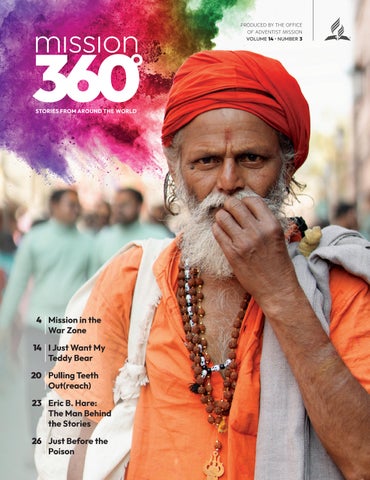
About our cover photo PHOTO BY CALEB HAAKENSON
While Caleb was filming for Mission 360° TV in Varanasi, India, this man noticed the camera and invited him to snap his photo. Explore Caleb’s stories of frontline mission workers around the globe at m360.tv.
Unless otherwise noted, Bible verses are quoted from the King James Version.
Photo for illustration only 4
Mission in the War Zone Caught in a brutal war, a missionary family faces life-or-death decisions
The Middle East and North Africa Union
Alicia Worley Palacios
is communication administrative assistant for the Middle East and North Africa Union Mission (MENAUM).
G
unfire cracked through the air in sharp, echoing bursts. Samir Torres* pulled his family deeper into the hallway of their apartment, away from the windows and the threat of stray bullets. When will the rescue team get here? Samir wondered. He scrolled urgently through incoming texts, hoping for word that evacuation efforts were underway. Finally, a message came, but its contents were crushing: the crossfire in their zone was too intense for the extraction team to reach them. Help wasn’t coming. What now? The unspoken question weighed heavily on the family. From the beginning of the war, Samir had encouraged his family to focus on the promises of God’s deliverance. But now there was no avoiding the possibility that they might die. With that realization came unexpected peace. Despite the disappointing message, they knew without a doubt that they were where God wanted them to be. He had called them there, and with every step of their journey, they had chosen to follow His leading. Eight years earlier, Samir and his wife, Eva, had arrived in another Middle Eastern country to serve. They felt called to share the gospel with people who might never hear it except through personal connection. “We were on fire,” Eva recalls. “We came with ideas, willingness to try new things, and eagerness to mingle with our neighbors. But even though we made some friends and had some valuable interactions, there were obstacles we couldn’t get around.” Government restrictions made meaningful relationships difficult. Then a church leader
approached them with another possibility: move to a different region where they could interact more freely with local people. After fasting and prayer, the answer felt unmistakably obvious. Now, years later and trapped in a war zone with no apparent way out, neither of them regretted that decision. Nevertheless, trusting God in that hallway became its own battle. Lola, the couple’s daughter, tried to burn nervous energy by climbing the hallway walls, pressing her feet against opposite sides, and inching upward. She also read books, but her parents found that the best way to calm her fear was to recall how God had led them in the past. One by one, moments of providence surfaced, and Lola began writing them down. The family had relocated twice to stay near Lola’s school. When the school moved again, they felt impressed to stay where they were. Now they understood why. The neighborhoods where they had previously lived—and the school’s newest location—had been devastated in the fighting. Another gift they recognized was simply being together. Samir had been scheduled to attend a church meeting, but the taxi had arrived late, keeping the family together when violence suddenly erupted in the city. Then there was the shopping trip. Only days before the conflict began, they had stocked up on supplies. Later, those supplies helped them survive and gave them enough to share with others. As the fighting intensified, Samir and Eva desperately searched for a way out. The Spanish consulate had announced plans to evacuate nationals using military aircraft, and the couple each contacted their respective embassies to ask whether the consulate could arrange for their evacuation as well. They were told that efforts would be made to include them. Then another possibility emerged. The Adventist Development and Relief Agency (ADRA) director called to say the Torreses could join a humanitarian convoy, but they would need to make their own way to the meeting point. VOLUME 14:23 5
“We have a plan,” Samir told them. “And we have given our lives to Jesus, trusting that He will be with us—even if we die.” Samir and Eva weighed their options carefully. Driving through the city meant crossing active combat zones. But remaining in the apartment waiting for a rescue that might never come carried its own risks. “If only we could get something definite from the Spanish embassy,” Samir said. The family knelt in prayer, pouring out their fears and asking for wisdom. When they rose from their knees, each one shared the same conviction: they believed they should wait for the Spanish evacuation. When the ADRA director called again with the departure time and location, Samir shared their decision. “Are you sure?” the director asked. “Foreigners are being targeted. There are kidnappings. Militia are breaking into homes.” Samir didn’t waver. “We believe this is the path God wants us to take,” he said. Events the next morning tested that conviction. The ADRA convoy had already departed, and the Spanish embassy, which had promised to keep in touch, was silent. Had they misunderstood God? Had they made the wrong decision? (MENAUM) officers stayed in close contact with the family throughout the crisis. “We have a plan,” Samir told them. “And we have given our lives to Jesus, trusting that He will be with us—even if we die.” At 7:00 am, Samir sent another text to the Spanish embassy. “Do you remember us?” he asked. “Are we still part of your plan?” To his great relief, the response came immediately.
Global Mission reaches the unreached for Jesus in the 10/40 Window, which includes the Middle East and North Africa. Please support Global Mission in this region with your prayers and financial gifts at gmSDA.org/Give7. 6
“Don’t worry,” a woman replied. “You’re on the list. Today is the day. You need to be at the ambassador’s house by noon.” When she gave them the address, Samir and Eva recognized God’s provision again: it was only two blocks away. Grabbing their backpacks, the Torreses fled their apartment. Within minutes, they reached the house and descended into a crowded basement packed with evacuees. There, they waited for hours while the sounds of gunfire echoed through the building above them. Around 3:00 pm, someone finally shouted, “It’s time!” The group rushed toward a cluster of unarmored vehicles. But just as the convoy prepared to leave, news came that another embassy convoy had been caught in crossfire and someone had been shot. Everyone was ordered back to the basement. For three more hours, they waited. Then, near sunset, the evacuation resumed. The Torres family climbed into a van with an elderly man and another family, placing Lola on the floor where she would be less exposed if bullets shattered the windows. Fear and relief mixed inside the van as the convoy set out on the two-and-a-half-hour journey. Samir continued texting updates to church leaders, watching through the window as plumes of smoke rose in the deepening twilight. The streets were eerily quiet as militia escorted them through the city. Eventually, the convoy reached a bridge, and the escort dropped back. Vehicle lights were switched off as they crossed slowly in the darkness. On the other side, military forces took over, guiding them through checkpoint after checkpoint until they finally reached an airbase. And there, waiting, were the military planes. Hundreds of evacuees crowded into a military hangar before boarding the cargo aircraft. The Torres family found space on the floor inside the plane’s cavernous interior and sat shoulder to shoulder among strangers fleeing the same nightmare. Then the engines roared. The aircraft lifted into the darkness. And for the first time in days, they felt safe. God had been with the Torreses through every moment of the crisis—from the cramped hallway to the night sky above the war zone. In surrender, they found peace—not in knowing the outcome, but in knowing that God was with them and that He remained in control. *Names have been changed.
Kaylee Cushing,
from the United States, is a sophomore at Southern Adventist University, where she is earning her degree in elementary education. Bangladesh
Hugging Kids and Holding Babies
I
f you’ve ever been to a Student Missions Vespers at Southern Adventist University, you probably haven’t forgotten what it was like. The parade of flags from different countries, inspiring music playing in the background, colorful traditional outfits, and testimonies from former volunteers make it the perfect setting to decide to be a student missionary. For Kaylee, it confirmed what she was already hoping to do. Kaylee wants to be a teacher, and mission has always been a possibility in her mind, not just for short mission trips here and there, like the ones she took in high school, but also long-term. She’d traveled to Costa Rica, Bolivia, and the Dominican Republic in high school, and she knew she wanted to take a year off to serve as a volunteer when she came to Southern.
Kaylee spending time with some of her Bangladeshi “sisters” VOLUME 14:3 7
God eventually made it clear that He wanted her in Bangladesh, so she signed up, excited about what He had planned. When she arrived at Bangla Hope Children’s Home, it was overwhelming at first. Everyone was trying to talk to her and touch her. “I had kids latch onto my hands, my shoulders, and my arms,” she said. “There were kids everywhere.” The morning after arriving, Kaylee went to speak with the principal to introduce herself and share some of her expectations. He said he would speak to the teachers and, a few minutes later, he called her back to his office. She recalls, “He told me I was going to teach in about two hours! I was like, ‘I just got here less than 24 hours ago, and they’re already putting me in a classroom?’ I was so scared.” Kaylee prayed and made a rough lesson plan of some games she could play with the kids. “It was definitely a little test of faith, but it was also such a cool moment of being like, ‘All right, God, we’re doing this,’” she says. “It made me really happy, because it’s something I’d been wanting for so many years. Relying on Him was what I was craving before I even got there. So
Kaylee making memories on a walk with some kids and a baby goat! 8
I went to the classroom, and I started learning the kids’ names.” One of her students really challenged her. She would stand right in front of Kaylee after class or around campus and not let her pass until Kaylee gave her a hug. “I didn’t want to hug her,” she said. “Because she was acting so entitled. It was frustrating. “One day, we were going to lunch, and she was standing right in front of me. Every time she had asked me for a hug before, I just gave her a quick little squeeze. But this one day, when all I wanted to do was eat my lunch, I thought, ‘Fine.’ So, I wrapped my arms around her for that quick little squeeze, and I couldn’t let go. I hugged her more and more and told her, ‘Girl, you know that I love you.’ In that moment, I felt so filled with the Holy Spirit. For a split second, I felt like God gave me the ability to see her through His eyes and to see how valued she was. It made me feel really bad for those times I had only given
her a quick hug, and I decided to ask Him to fill me with His love every day.” Another profound experience Kaylee had was when a staff family adopted a five-day-old baby. The kids came up to her to show her the baby, and she hesitated. “Babies kind of scared me, just because they’re so fragile,” she
A service of the Seventh-day Adventist Church, VividFaith is an online platform connecting people with service opportunities. To learn more, visit VividFaith.com.
says. “I said I’d wait to hold him until he was a little older, but when we walked in, he was so beautiful, so precious and valuable. I’ve been to the Bolivian Salt Flats. I’ve been to the Grand Canyon and other national parks, but never in my life have I been more in awe of God’s creation than the moment I was holding that sweet, little, five-day-old baby. God put so much work into him. He put so much work into me and into each one of those kids. “God changed my mindset, and I realized the value and worth of each child,” she adds. “I couldn’t love them on my own; I had to draw that love from God. Now that I know that, I think I’m going to be able to love a whole lot better.”
Kaylee holding the five-day-old baby
Kaylee’s last Sabbath with her Bangla Hope family VOLUME 14:3 9
Haley, Hard Work, and Hawaii
Mission 360° magazine recently caught up with Haley to ask her some questions about her volunteer mission service.
M360°: You weren’t originally planning on serving in Hawaii. So how did that happen? Haley: I was planning to go pretty much anywhere in the world except Hawaii, but I think God had other plans for me. A friend who had turned down the Hawaiian Mission Academy position mentioned my name to the principal, Marshall Freitas. He reached out, saying, “I heard you’re interested. Do you mind if we call and talk about it?” I said, “Sure,” even though at the time, I was thinking, there’s no way I’m going to do this. But after interviewing, I thought it might be a
good place for me. The next day they said they wanted me to come. I thought, Ok, that’s my answer; that’s the answer to my prayers. M360°: How did your experience as a student missionary differ from your expectations? Haley: While I did learn to rely on Jesus a lot more, it wasn’t in the way that I expected. It’s not like I was running out of water, and He provided it for me; I had to rely on Him for my happiness and my contentment. I expected to witness these cool, awesome God moments, and I did, but they were internal rather than external. M360°: What were your days like? Haley: I was one of the assistant deans. I would sit at the desk to make sure that the students were checking in and out of the dorm and doing their chores. And in the mornings, I helped in the cafeteria with cooking and washing dishes. I did a lot of dishes. Also, because there were so few kids in the co-ed dorm, the other volunteers and I were the ones who drove them everywhere. Pretty much every Sabbath we went to a different church, and we would help with the service. Our principal, who we called “Uncle Marshall,” would usually bring food for potluck.
United States
Haley Soper,
from mainland United States, served as a student missionary at Hawaiian Mission Academy on Oahu, Hawaii, for the 2023–2024 school year. She is studying to be a physical therapist assistant at Southern Adventist University. 10
Haley paddleboarding on a day off
Photo for illustration only
M360°: What were some things that you did for fun on the island? Haley: We’d do what we call “dawn patrol,” which means surfing at sunrise. Other times, we’d just go and watch the sunrise. We went paddleboarding a lot. We would take kids on hikes—sometimes to see waterfalls—and things like that. We went to get half-price frozen yogurt almost every Saturday night, and it was the best thing ever. We would go to the beach that was five minutes away and just sit on the sand in the middle of the dark, eating our fro-yo. It was amazing, I loved it. M360°: What did you learn about mission while you were serving? Haley: It’s hard work. It’s hard to feel so separated from all your family and friends. There were so many little things I missed while I was in Hawaii, like walking on the promenade at school with a backpack on. I missed wearing a sweater and seeing maple trees. I missed thunderstorms. It’s hard sometimes to feel like a successful missionary when you have all these longings. You feel like you’re no longer in the missionary mindset. But that’s not the case. Just because you miss something doesn’t mean that you’re not fulfilling your purpose. At the end of the day, it comes down to the simple fact that you’re living with a group of people. You’re learning about their way of life, their culture and worldview. You’re discovering what they like to do for fun, what they like to eat, what they do for work, and what they do in their free time. And you just live the best life you can in your relationship with God, and eventually, they’ll start asking questions—they’re going to want to know what makes you different.
Haley, right, at a Hawaiian Mission Academy banquet with students
M360° Did you have any meaningful interactions with students that you remember? Haley: I had to drive a student back early from church one Sabbath. We got in the car, and I expected her to get on her phone and not really interact with me. But almost immediately, she turned to me and said, “Haley, I have a question for you. How do you make church more interesting?” And we talked about it the entire way back—we had this really good conversation. She was crying by the end of it, and she said she’d been praying about this a lot and had needed to talk to somebody about it. And it was an answer to my own prayer, too, because I had been praying the night before that God would help me realize why I was there. It was such a special moment.
Haley participating in a service project at the He’eia Fishpond with students
A service of the Seventh-day Adventist Church, VividFaith is an online platform connecting people with service opportunities. To learn more, visit VividFaith.com. VOLUME 14:3 11
Through a Pioneer’s Lens Global Mission pioneer Paulo
Veiled Area
Ricky Oliveras
is a video producer for the Office of Adventist Mission 12
T
here’s a moment before many photographs are snapped: a smile, a nod. Global Mission pioneer Paulo discovered that those small moments could open conversations on the island where he served. When he first arrived, Paulo quickly understood something: trust would matter there. Relationships developed slowly and only when people felt safe. Instead of trying to gather crowds, Paulo looked for a way to meet people one at a time. “It was the Spirit of God who gave me the vision of working through the camera,” Paulo says. Paulo’s invitation to take photos gave people a reason to stop and pose. But it wasn’t the photographs that mattered most; it was what happened afterward. Conversations stretched
longer each time, and trust began to grow. Paulo’s circle of friends widened. “This camera has really helped me reach so many people,” Paulo shares. People who might never have spoken to Paulo before now felt comfortable asking questions—not about the camera, but about more personal things, such as his faith. “They asked me a lot of questions, Paulo says, “and I took a lot of time to carefully answer them.” The camera wasn’t the only way Paulo connected with people. As relationships grew, neighbors began to trust him in practical ways. When a child in the community was seriously injured and there was no ambulance available, Paulo used his car to help get the child to the hospital. He didn’t ask for anything in return. He simply helped.
Paulo didn’t do this work alone. His wife, Mfarijo, served alongside him, welcoming people into their lives. “I thank God because His Spirit guides me,” she says, “and I only want to do His work.” Through their care, Paulo and Mfarijo built strong connections within their community. When you give to Global Mission, you help create opportunities for relationships such as the ones Paulo and Mfarijo built—one photograph at a time. Thank you for supporting Global Mission.
Search for this story on AdventistMission.org
Global Mission pioneers start new groups of believers in unreached areas or among unreached people groups. They’re paid a small stipend and, where possible, work among their own culture. Please support their ministry with your prayers and financial gifts to Global Mission.
Paulo sharing the gospel with a new friend
Ways to Give ONLINE Make a secure financial gift easily by scanning this QR code or visiting gmSDA.org/Give7
PHONE Call 800-648-5824
MAIL In the United States: Global Mission, General Conference 12501 Old Columbia Pike Silver Spring, MD 20904-6601 In Canada: Global Mission SDA Church in Canada 1148 King Street East Oshawa, ON L1H 1H8 Transform lives, one month at a time; join our recurring donor family! Please remember Global Mission in your will and trusts. Visit GMsda.org/PG or call 800.648.5824.
VOLUME 14:3 13
I Just Want My Teddy Bear Lebanon
Jennifer Stymiest
is the director of digital for ADRA International. She wrote this story with ADRA Lebanon.
S
even-year-old Rami should be thinking about his homework, playing football with his friends, and choosing which colored pencil to use in his notebook. Instead, he’s learning what it means to flee home in fear. Rami lived with his parents and his three siblings in a modest home where life was never easy. When the bombing intensified in Lebanon in early March, 2026, Rami’s family made the difficult decision to leave their home in Douris. They sought safety in Deir Al-Ahmar, a town about a 40-minute drive away. For the adults, it was a painful but necessary choice. For Rami, it felt as though the world he knew had suddenly disappeared. “I was very afraid of the bombing sound,” Rami says quietly, his small voice trembling as he remembers the night they left. “It was very loud.”
In the rush to escape, Rami had little time to gather his belongings. He left behind some of the things that mattered most to him, including his school bag. Inside were his notebooks, pencils, and something even more precious—a small teddy bear. The teddy bear wasn’t just a toy. It was a reward his teacher at the Adventist Learning Center had given him for solving a difficult math equation. For Rami, that teddy bear represented pride, encouragement, and the warm feeling of belonging in a classroom filled with friends. “I want peace,” he says. “I want to go back to my normal life and see my friends again.” Even amid fear and uncertainty, Rami still carries hope in his small heart. He dreams of returning to a life where the only challenge he faces is solving the next math equation on the board.
Lebanon at a Glance
ADRA Lebanon’s Response
Lebanon has faced years of overlapping crises. An economic collapse that began in 2019 pushed many families into poverty, while the 2020 Beirut port explosion caused widespread devastation and loss. The country also continues to host one of the largest refugee populations per capita in the world. In recent months, renewed insecurity and airstrikes SYRIA in parts of the country have forced many LEBANON families to flee their homes once again. Humanitarian organizations report that more than 1.3 million people have been recently WEST GAZA BANK displaced in Lebanon, including approximately 300,000 children.* ISRAEL Humanitarian agencies, including ADRA JORDAN Lebanon, are responding by providing essential supplies for families who have been forced to leave their homes.
“ADRA Lebanon has distributed a total of 432 hygiene kits, dignity kits, and water distributions to displaced families in collective shelters,” said an ADRA Lebanon representative. “We quickly saw how critical hygiene is for children and their families, especially in overcrowded places where conditions are poor and access to basic cleaning supplies is limited. “Children’s needs are often different and urgent, including diapers and baby food. That is why ADRA Lebanon is now activating cash- and voucher-based assistance to help ensure every child receives exactly what they need.” ADRA Lebanon’s response is being coordinated closely with Adventist volunteers from the Adventist Learning Center and Adventist Community Center. Because of the generosity of donors and supporters, ADRA can provide essential assistance to those forced to flee their homes. Guided by a commitment to justice, compassion, and love, their work reminds families such as Rami’s that they’re not forgotten.
14
*This information was accurate as of May 18, 2026. The numbers are expected to increase.
About ADRA The Adventist Development and Relief Agency is the international humanitarian arm of the Seventhday Adventist Church, serving more than 120 countries. Its work empowers communities and changes lives around the globe by providing sustainable community development and disaster relief. ADRA’s purpose is to serve humanity so all may live as God intended. To learn more about ADRA’s global mission, visit ADRA.org.
Rami Photo Credit: Nikolay Stoykov
When you give to the mission offering during Sabbath School, a portion of that offering helps fund ADRA’s ministry around the world. Thank you for your generous support. VOLUME 14:23 15
Listening Between the Lines
online. The center is organized into four teams: Connect, Disciple, Influence, and Reach. Team Disciple was responsible for Zoom Bible studies, and Team Reach created social media content for various accounts. Team Influence maintained the digital missionary app and ensured it was accessible to church members. Julie was part of Team Connect. “We were responsible for answering messages from YouTube, Facebook, Instagram, and other Filipino social platforms,” she says. Julie remembers one girl the team communicated with online. She was challenging to share the gospel with, always seeming to need reassurance. “It reminded me that sometimes people don’t come to us to know Jesus, but they come to us for presence,” she says. “They come to us for some kind of healing. If we listen enough, we will know how to reach the core of what is aching in their life and present Jesus at that moment. I don’t know if this person gave her heart to Jesus, but I know that we planted a seed.” During her time in the Philippines, Julie had the opportunity to go on two training mission trips. The first was for a youth congress, where Julie presented the advantages and disadvantages of social media. “I shared how in CDE we tried to use social media platforms and technology to bring the gospel forward,” she says. On the
Julie at the Center for Digital Evangelism office, connecting with people through social media
Philippines
Julie Thésée,
from Mauritius, served as a volunteer at the Center for Digital Evangelism in the Philippines. She now teaches English and French at the Instituto Adventista Brasil Central in Brazil. 16
J
ulie wasn’t satisfied. She was teaching fulltime in her home country of Mauritius, but she wanted to work in the mission field. She had always been interested in mission, so when one of her friends sent her a Facebook post about Adventist World Radio’s (AWR) Center for Digital Evangelism (CDE) in Silang, Cavite, Philippines, she felt it was the perfect time to leave her job and pursue what she really wanted to do. After she applied, she was convinced she wouldn’t get the position. “I wasn’t really positive at that point in my life,” she says. “But I told myself that I would never know if I didn’t try.” Everyone she told encouraged her along the way, and she was accepted! She felt God leading her in this direction, telling her, “Don’t get discouraged; we’ll get there, just keep on, keep on.” Julie arrived in the Philippines in November of 2022 and remained there until August of 2024. CDE was a unique mission experience. Instead of working directly with local people, CDE missionaries communicate and share Jesus Julie and a friend recording music in the center's studio
Julie giving a worship talk
second mission trip, she drew on her experience working in the CDE call center to train her listeners to be professional, use the right tone of voice, and respond to callers appropriately. CDE was an incredibly diverse program. At one point during Julie’s time there, missionaries from more than 20 countries were represented. All of them lived in the same dorm—women on one side, men on the other. “We ate breakfast together, lunch together, worked together, and had dinner together,” says Julie. “It was bonding that was almost like family for me.” But, of course, families have their ups and downs. “I learned to suspend judgment,” she says, “because it’s so easy to see something that differs from your own culture, family setting, and society and to think, ‘They’re wrong, and I’m right.’ But suspending judgment first and trying to listen and understand made things easier for me.” She also learned the importance of loving one another. “At CDE, we were so close to each other that if you didn’t love one another, it was very difficult,” she remembers. But God gave
her love, compassion, and tolerance, helping her know when to stay silent and when to speak. “God’s guidance is premium; it’s really topnotch!” she says. Even though living and working with such a diverse family had its complications, Julie says the people were her favorite part of her mission experience. She doesn’t think she’ll ever experience an environment quite like CDE. “From the South Americans to the Filipinos to the Africans and our German boss, there was genuine sharing and giving,” she says. “I learned a lot about myself and about other people. I always thought missionaries go to bring something, but I received so much more in return.”
A service of the Seventh-day Adventist Church, VividFaith is an online platform connecting people with service opportunities. To learn more, visit VividFaith.com. VOLUME 14:3 17
Where Hands Talk Kenya
Ricky Oliveras
is a video producer for the Office of Adventist Mission.
18
I
n rural western Kenya, worship at the Kakima Adventist Church brings together deaf and hearing believers in a spirit of unity and belonging. Spoken language and Kenyan Sign Language are used side by side, every member is valued, and worship is characterized not by sound, but by connection. The speaker on the day I visited the church was a deaf pastor whose sermons in sign were interpreted aloud for the hearing members. Watching the congregation worship together, it was clear that communication reaches beyond words. The church has become a place where all are seen, included, and encouraged to grow together in faith. The church is closely connected to a school for deaf children, a project that began years ago when Global Mission helped establish it by sending four Global Mission pioneer teachers.
One of those pioneers, Lydia, still serves as a teacher today. “I thank God because I’ve seen His mighty hand working in this institution,” she says. Through this school, families from the com munity are encountering God in surprising ways. Emily learned that her son, Jabulani, was deaf when he was three years old. She searched for a school that would accept him, but she was often turned away. Eventually, she brought him to the Kakima Adventist Special Needs Centre, hoping that he could receive an education. Emily arrived at the school with Jabulani on her back, his hands wrapped tightly around her neck. He looked around for a couple of minutes, then jumped down and began running around excitedly. This was something he had never done at any of the other schools. “He was so happy,” Emily recalls. “I told my parents, ‘This is the school!’” For the first time, Jabulani seemed completely at ease. At Kakima, he began discovering joy, belonging, and faith through his learning at school and at church. “I love going to church!” he says. Emily and Jabulani weren’t Adventist, but one weekend after returning home from school, Jabulani insisted that they attend church on Sabbath, the day he had been learning about in class.
Lydia, a former Global Mission pioneer, still teaches at the Kakima Adventist Special Needs Centre
Search for this story on AdventistMission.org
Global Mission pioneers start new groups of believers in unreached areas or among unreached people groups. Please support their ministry with your prayers and financial gifts.
Ways to Give ONLINE Make a secure financial gift easily by scanning this QR code or visiting gmSDA.org/Give7
PHONE Call 800-648-5824
MAIL In the United States: Global Mission, General Conference 12501 Old Columbia Pike Silver Spring, MD 20904-6601
Emily and her son Jabulani
Curious, Emily began going to church on Saturdays to better understand what her son was experiencing. As she worshiped, built friendships with church members, and studied the Bible for herself, she felt God leading her. Week by week, her interest deepened. In time, she embraced Adventist beliefs and chose to be baptized. What began with a child’s simple conviction became a life-changing journey for his mother. “I knew I was a changed person and that my life would never be the same again,” she says. Along the way, Emily found more than faith. She found friendship, forming a close bond with Lydia, the former Global Mission pioneer who had helped nurture the school and church community. Stories like theirs are part of what makes Kakima special. It’s a place where deaf and hearing members grow together in faith and where families encounter the love of God together. Your financial gifts helped make the Kakima Adventist Special Needs Centre possible, and your continued support will enable similar projects around the world. More leaders will be trained, more families will be reached, and more lives will be touched by the love of Jesus.
In Canada: Global Mission SDA Church in Canada 1148 King Street East Oshawa, ON L1H 1H8 Transform lives, one month at a time; join our recurring donor family! Please remember Global Mission in your will and trusts. Visit GMsda.org/PG or call 800.648.5824.
Jabulani participating in a group activity with sign language
VOLUME 14:3 19
Pulling Teeth Out(reach)
Brent and Laura at a recent outreach
20
Malawi
Laura Sherwin
serves as a dentist at Malamulo Adventist Hospital in Malawi with her husband, Brent, a physician, and their two young children. Follow their blog at thesherwinpost. wordpress.com.
W
hen I was 19, I served as a student missionary in Peru. It was the most life-changing year of my life. I met my future husband, Brent, another student missionary, and we both experienced how amazing it was to serve others through dental and medical mission. Every two months, our group spent a week providing free medical and dental care in jungle villages. Those clinics were my favorite. Brent and I worked in the dental area each day, helping the many patients who lined up for care. Because dental services were limited in the region, many people came from far away to receive treatment. As I assisted each person, I began to realize the potential impact dental care could have on someone’s life. Beyond relieving physical pain, it gave me opportunities to share a glimpse of Christ’s love and compassion with each patient. This was my first real exposure to combining mission and dental care. To me, it was the gospel in real-life practice: sharing Jesus’ love through action. Rather than just preaching about it, I was experiencing what it meant to live it out. During those nine months, God planted a seed in my heart. I wanted to learn more about dentistry so that one day I could return to a mission setting and serve people in need. Fast forward 13 years. After getting married and completing many more years of education and training, Brent and I,
Laura extracting a tooth
along with our son, moved to Malamulo Adventist Hospital in Malawi. It was a surreal moment— our prayers and goals to become dental/medical missionaries were finally coming to fruition. After helping to establish a dental clinic at the hospital, I wanted to get back to where my passion for dentistry started: the local village. So last year, after prayer and discussion with hospital and community leaders, we launched a monthly dental outreach. Once a month, our dental team visits a village to provide free extractions and oral health education. In my time at Malamulo, I’ve realized that one of the greatest challenges many people face, besides the daily struggle for survival, is a lack of education. Good education can transform lives! Providing dental extractions fixes a specific problem for a short time, but oral health education can equip people to prevent problems from starting in the first place. This year, Brent joined the outreach, too. Trained as a general surgeon, Brent works hard to provide surgical care for those suffering. He also serves as the Malamulo Program Director for PAACS (Pan-African Academy of Christian Surgeons), a training program for African doctors who want to share the love of Christ with their patients. Each month, Brent brings two surgical residents to the outreach. They present practical information about common health issues facing Malawians and address many of the
VOLUME 14:3 21
misunderstandings that surround disease. The surgical team also offers free health screenings for anyone interested. As we drove home along the bumpy, muddy roads after a recent outreach, I reflected on how God had once again led us to minister together. Even the setting of our outreach reminded me of Peru, with its rundown buildings, dim lighting, leaking roofs, and crowds of curious children peering through the windows. Yet there are stark differences, too. Today, we are far better trained and prepared to provide dental and surgical care. Our work reflects years of education, experience, and confidence. Most of all, God is the constant in our mission journey. This hasn’t been an easy road to follow. Challenges and discouragements have often threatened to smother the seed He planted in our hearts so many years ago. Yet God has faithfully carried us through every difficulty, performing miracles and arranging divine appointments that have led us to this point. I love that God provides opportunities for reflection, giving us flashbacks of yesteryear to remind us how far we have come and to encourage us to trust Him in the future. It’s a reminder that God loves us and that He is faithful.
22
Brent and Laura with Peruvian locals at a dental outreach
Your generous and systematic mission offerings help support the ministry of hundreds of missionaries. Thank you for giving!
Laura gives an oral health talk at a dental outreach
Eric B. Hare The Man Behind the Stories
E Lester Devine
is a director emeritus of the Ellen G. White/ Adventist Research Center in Avondale, Australia. This story is adapted from a biographical article he wrote for the online Encyclopedia of Seventh-day Adventists. Visit encyclopedia. adventist.org to enjoy more stories about Adventist missionaries.
ric Burnham Hare was the second son of Pastor Robert and Henrietta Hare, born in Hawthorn, Victoria, Australia, on October 12, 1894. He graduated from the missionary course at Avondale in 1911 and the biblical-academic course in 1913. In the summer of 1911, he began his denominational service as tent master for E. B. Rudge and Harold Lukens in Port Pirie, South Australia. “Brother Rudge and Brother Lukens did the preaching, and I gave the Bible studies,” he said later. “All I had to do was to sweep and dust the tent, distribute the handbills, play the organ, and lead the music.” At the end of 1913, Eric was appointed to work in the Victoria Tasmania Conference and joined J. W. Kent and J. H. Woods conducting a tent evangelistic campaign in Richmond. By June 1914, he was at the Sydney Sanitarium, enrolled in the nursing course. Just one year later, at a special session of the Australasian Union Conference Committee held June 8–22, 1915, he was appointed as a missionary to Burma (now Myanmar). On June 24, Eric married Agnes Fulton, daughter of pioneer missionaries to the South Pacific and Asia, Pastor and Mrs. J. E. Fulton. Agnes had been born in Bishop, California, on November 9, 1893. Before leaving for Burma, Eric continued with his nursing course at the Sydney Sanitarium, and Agnes also took nursing training for three months.
Into the Jungle Mission Field The couple left Sydney on Thursday, September 23, 1915. After they arrived in Burma, their first two years were taken up with language study and the beginnings of their health work. Eric and Agnes proved to have an aptitude for language, both receiving more than 90 percent in their Karen examinations. In fact, the examiner told Eric that he had received the highest marks of any missionary he had ever examined.
Eric Burnham Hare, 1941 Courtesy of the General Conference of Seventh-day Adventists Archives
A gifted musician, Eric soon established a brass band, which was a considerable novelty, attracting the interest of the people. He had visited churches across Australia and New Zealand, collecting brass instruments for the band. He used the band to create opportunities for evangelism and community building. Eric and Agnes’ first child, Rosalind Agnes, died on June 23, 1917, just 19 days after birth, and was buried in Rangoon, Burma. Shortly afterward, they were visited by Agnes’ parents and their daughter Jesse. Fulton was at that time the president of the Southern Asia Division. The Hares were located on the Salween River at Kamamaung in northeastern Burma, near the border with Siam (Thailand). Fulton described the isolation of the mission station, “The thick jungle abounds in wild animals. Last night we could hear the monkeys in one part and the little barking deer in another. Every night fires are kept burning in the shed or the mission bullock-pen to keep the tigers away. Tiger tracks are sometimes seen right through the mission ground, and even under the house.” The early years in Burma were difficult. The division secretary-treasurer, C. L. Torrey, wrote after visiting the mission station in VOLUME 14:23 23
The Hare family (back row from left): Ivan Higgins; his wife, Eileen; and Leonard (front row from left): Peter, Anges, Verna May, and Eric Courtesy of the General Conference of Seventh-day Adventists Archives
1934, “Brother Hare reviewed to us the early beginnings of his work, and recalled how discouraged he became during the first three years of his labours at Kamamaung and in the outlying districts, struggling along during this time without a single baptism. He baptised his first convert the following year. After that, the number increased year by year.” In 1919, at the division meeting in Ranchi, India, Eric was ordained to the gospel ministry. Taking part in the service was his father-in-law, Pastor Fulton, still president of the Southern Asia Division. Their continuing service saw Pastor and Mrs. Hare using the training they had received at the Sydney Sanitarium. Along with Harold and Dorothy Baird, they established several dispensaries serving the Karen people. Four more children were born into the Hare family while they were in Burma: Eileen Nita, Leonard, Verna Mae, and Peter. Eric and Agnes and their children continued their outreach to the Karen until 1934, when, after more than 18 years, they were invited to relocate to the Northern California Conference in the United States, where Pastor Hare was appointed as the Missionary Volunteer and Sabbath School secretary. The transfer provided a much-needed opportunity for their youngest daughter, Verna Mae, to receive assistance for her severe hearing deficiency. They departed from Burma on April 12, 1934, leaving behind an established church with a membership of 122 and eight Sabbath Schools with a membership of 340. After some years in San Francisco, Pastor Hare was appointed as the Sabbath School secretary of the Southern California Conference in Glendale, California, a position he held for a short time before accepting an invitation 24
Eric B. Hare captivating a large audience with his mission stories Courtesy of Adventist Heritage
Eric and Agnes Hare Courtesy of Lester Devine
to return to Burma in 1941. There, the Hares continued their pioneering work for the Karen people, this time in Rangoon, until the Japanese bombing in 1942 forced their evacuation. Having been evacuated to India by steamer from Burma, Agnes and the children waited there for Pastor Hare’s evacuation. During this time Pastor Hare and several fellow workers made a hazardous overland journey to safety. After many dangers and miraculous escapes, he was finally reunited with his wife and children, and the family returned to America. Back in America, Pastor Hare was called to head the Youth Department of the Southern California Conference and then the Sabbath School Department at the Pacific Union Conference. Then in 1946, at the General Conference session, he was called to serve as an associate secretary of the Sabbath School Department at the General Conference of the Seventh-day Adventist Church. Shortly after Pastor Hare took this appointment, Eileen, their eldest daughter, died in a road accident in Van Horne, Texas. She and her family were on furlough from
their appointment in India when the accident occurred. While holding his responsibilities at the General Conference, Pastor Hare gave specific attention to the role of the Sabbath School in child development and spirituality. His work was a forerunner of the Children’s Ministries Department. Pastor Hare continued his work at the General Conference until his retirement in 1962. He passed away in Washington, D.C., on June 1, 1982. Agnes died on April 25, 1983, in Berrien Springs, Michigan.
A Lasting Legacy Well-known worldwide for his remarkable ability to tell character-building stories, Eric B. Hare authored 13 books and wrote and recorded hundreds of articles and stories for children. Through his stories, generations learned about mission service, faith, and sacrifice. For citations, please see the original article at encyclopedia. adventist.org/article?id=D7WZ&highlight=Eric|b|hare
More than 4,000 articles and 11,000 photographs, featuring Adventist missionaries, evangelists, institutions, events, and beliefs.
encyclopedia.adventist.org VOLUME 14:3 25
Just Before the Poison Kenya
Vyacheslav Demyan
is the president of Hope Channel International. 26
O
n a Sunday afternoon in Mombasa, Kenya, Gladys finished washing the dishes and scrubbed the floors. She laid out clean clothes for her three children, helped them shower, and cooked their favorite meal. The house was spotless; the little ones were full and drowsy. Outside, she set a stool in the shade, whispered what she believed would be her final prayer, and lifted a glass mixed with rat poison to her lips. Grief had stalked her for months. Her husband had died suddenly in a road accident while delivering a vehicle to a client in Nairobi. After the funeral in their home, her in-laws sent her and her children away. Back in Mombasa, in an unfinished house, she tried to hold life together for her two boys and daughter. When a man promised to help her through the insurance process, she desperately accepted. He asked for her bank details “to invest” the payout. Then he disappeared, taking all her savings, her family’s future, and what remained of her courage. Bills were due. Food was running out. Shame pressed down on her like a weight. If she left now someone kinder might take the children in. They at least might remember a clean house, full stomachs, and a mother who tried. She looked at the glass. This, she told herself, was the only option left. Then a small voice interrupted. “Mom, come see!” Her seven-year-old tugged her inside. On television, Hope Channel Kenya was airing the first episode of Storyline, a series about widows—a program that tells stories about people society often overlooks. The woman on screen shared how, after losing her husband to cancer, she used the only tool in her kitchen—a blender—to make fresh juice. With persistence, she put three children through university. As the story unfolded, the knot in Gladys’ chest loosened.
She walked outside, poured the poison into the pit latrine, and dialed the number on the screen. Hope Channel Kenya welcomed her, listened to her story, prayed with her, and later invited her to share her testimony on air. Gladys brought her daughter to evangelistic meetings and grew closer to Jesus. Then, in 2025, she opened her home during a Hope Channel Kenya evangelistic series so her neighbors could gather and watch together. A theology student helped lead Bible studies. Night after night, they watched the broadcasts, prayed, and discovered the gospel. By the final Sabbath, 37 people from Gladys’ living room were baptized—37 new brothers and sisters beginning a life with Jesus because one mother heard a story of hope just in time. Scripture describes this holy pattern: “He comforts us in all our tribulation, that we may be able to comfort those who are in any trouble” (2 Corinthians 1:4, NKJV). God rescues us—and then sends us to rescue others. Gladys was saved, and then God used her to help save others. This is what happens when the gospel meets real life through media: one story becomes many.
Hope Channel exists to help people such as Gladys—those searching for hope, healing, and Jesus. Eighty-four Hope Channels around the world are reaching people through life-changing content, offering Bible studies and connecting seekers with Christ. To learn more about Hope Channel, visit hopechannelinternational.org.
When you give to the mission offering during Sabbath School, a portion of that offering helps fund Hope Channel’s worldwide ministry. Thank you for your generous support.
Photo for illustration only VOLUME 14:3 27
United States
Gabriela Phillips
is the Adventist Mission director for the North American Division, where she served as the Adventist Muslim Relations Coordinator for more than 10 years.
T
he candlelit room and a deep voice transport us to the Passion Week’s final scenes. Beside me sit my friends, Mohammad and Khadija, refugees from Iraq, whom I’ve invited to the SonRise Resurrection Pageant at Southern Adventist University. A student portraying Mary Magdalene steps from the shadows. She explains how the Jesus she knew wasn’t a detached preacher of truth. He saved her life by writing in the dust and commanding that “those who are free from sin cast the first stone.” As we leave the church and walk to the next station of the pageant, Khadija clasps my hand and says, “We all need to live by the words of Isa, alyahi salam” (Jesus, peace be upon Him). And for the next few minutes, she imagines a world ruled by Jesus, a world where no one throws stones and sins are forgiven. Both Khadija and I feel drawn to Him as we reflect. A little later, as the Gethsemane scene unfolds, Mohammad wonders aloud who Jesus is praying to. Underneath his question lie many layers of theological debris, resulting from centuries of Christian-Muslim misunderstandings. I’ve told Mohammad before that I believe
No Stones at SonRise
28
Jesus is God. “So, is God praying to Himself?” he asks. I could launch into a detailed explanation of the Trinity, but I don’t want to interrupt the Holy Spirit’s influence. “Jesus is praying to his beloved Father,” I answer simply. Over the years, I’ve learned that truth that is not presented in the context of a relationship seldom moves the heart. So, I add, “Just before coming to the garden, Jesus prayed for all who would one day follow Him. He was thinking of us all.” Next, we approach the court of Pilate. Mohammad hears voices calling for Jesus to be crucified and is confused. “Why would anyone wish to crucify Jesus, who is the purest of prophets?” he asks. He reflects on current events in the Middle East and the need to return to Jesus’ example. I’m curious to hear more of his thoughts, but our group is moving toward the crosses, and our conversation lags. Muslims view the crucifixion differently. In their story, God demonstrates His power by rescuing Jesus and taking Him to heaven before He dies. This interpretation upholds justice— Jesus’ innocence is vindicated and someone who is truly guilty is crucified in His place. For Christians, the cross represents God’s love through His willingness to die for humanity.
As we stand at the scene of the three crosses, I explain to Mohammad what makes Jesus’ death different from that of the thieves beside Him: “In Jannah (paradise), God gave Adam and Eve everything they needed to live an abundant life because He loved them. He told them that their lives would continue forever if they didn’t sin, but that the consequence of sin was death. They chose sin, and ever since, we have all been subject to sin and death. Everyone except Jesus, who was sinless, which the Qur’an affirms. The only way death could touch Jesus was if He gave up His life. I believe He died on the cross, as prophesied in the Torah, and that He did so voluntarily to show His love. He was the Adam that didn’t sin. Death came into the world by the first Adam; deliverance from it came from the second one.” Mohammad listens quietly, while I pray for God to reveal Himself to us afresh. Finally, we move to the last scene of the pageant, where music about our risen Lord moves me to tears. “Brother,” I say, “this is the heart of my faith: because Jesus carried the sins of each sinner, we can be purified with the purity of Jesus, but death could not hold Him in the grave. On the third day, He was raised
back to the right hand of God, where He rules with love. Soon, He will return as a just judge and will break open all the graves, for he is the resurrection and the path to eternal life.” Mohammad is also moved; this version of Jesus is full of hope. His response surprises me: “We Muslims need to return to Jesus, not the Jesus of Islamic scholars and traditions, but the real Jesus. We keep telling Christians with our mouths that we also love Jesus, that he is one of our prophets, while collecting stones with our hands. We need to listen again to Jesus, for he is peace for us too.” I left the scene sensing that Jesus not only had ministered to our needs, but He had also won our confidence, and now it was time to follow Him.
Six Global Mission Centers operated by the Office of Adventist Mission help Seventh-day Adventists build bridges of understanding and friendship with people from major world religions and worldviews. To learn more, visit globalmissioncenters.org.
VOLUME 14:3 29
A Girl Named TMI Burundi
Illustrations by Diogo Godoy 30
I
n the green hills of Burundi, in the heart of Africa, lives a six-year-old girl named TMI. She loves singing, smiling, and telling people how much she loves Jesus. TMI stands for Total Member Involvement, a special Seventh-day Adventist program that invites church members to share Jesus with someone. Around the time TMI was born, many people in Burundi were joyfully telling neighbors, friends, relatives, and even strangers about Jesus. A lot of people gathered to learn more about the Bible and many gave their hearts to Jesus and were baptized. Churches across the country were filled with excitement. Families prayed together. Friends invited neighbors to church. Children learned songs about Jesus. Everywhere, people were sharing hope from God’s Word. TMI’s father and mother were happy to join in sharing Jesus with others. Then one wonderful day, they had a baby girl. Because so many people were inspired by Total Member Involvement, they decided it was the perfect name for their daughter. As a baby, TMI reminded people about sharing Jesus. Whenever they called her name, they remembered that God wants everyone to tell others about His love. As TMI grew older, she began to understand the special meaning of her name. She wanted other people to know about Jesus, too. She especially loved to sing about Him, and singing made her happy. Sometimes, she sang at home. Sometimes she sang as she walked to church with her family. The more she sang, the more she wanted her songs to help others think about Jesus. When TMI was 4 years old, she prayed for a good voice to praise Jesus. “Dear God, please help me to be able to sing well for You,” she prayed. TMI prayed the same prayer the next day and the next. About that same time, TMI joined the children’s choir at church. One church member noticed her sweet voice and suggested that she sing by herself sometimes. The first time TMI
sang alone at church, people listened carefully and were blessed. Soon, people began inviting TMI to sing during Sabbath worship services and at special church programs. Church members even helped her record six songs in a music studio. TMI’s parents were delighted that she was singing for Jesus. Before long, TMI started first grade in a public school. Some classmates asked the teacher whether TMI could sing for them. They had heard her singing at church and wanted their own little concert. The teacher agreed, and TMI began to sing at school. The classroom became very quiet as TMI sang. Her classmates smiled and listened closely to the music. Some had never heard those songs before, but they liked the joy they heard in her voice. When some of her classmates heard her sing, they began going to church with her on Sabbath. They asked whether they could join the church’s children’s choir. Then the children went home
and asked their parents to come to church with them the next Sabbath. In this way, a little girl named TMI became a living example of Total Member Involvement by using her voice to share Jesus with others. TMI was only a little girl. She didn’t preach sermons or travel far from home. But God used her songs to help children and their families learn more about His love. How can you share Jesus with others?
Search for this story on AdventistMission.org
More Children’s Mission Stories Find dozens of inspiring mission stories for children at AdventistMission.org/ mission-awareness/mission-quarterlies/ children/articles TMI
VOLUME 14:23 31
General Conference of Seventh-day Adventists 12501 Old Columbia Pike Silver Spring, MD 20904
“I’d be dead if it wasn’t for a Global Mission pioneer” –Kgosana Xase
Kgosana Xase’s face looks so joyous, it’s hard to imagine him brawling in a bar with a knife and almost dying. But this is the new Kgosana, the one who gave his heart to Jesus because a pioneer named Ishmael came to his village in Botswana. Meeting a Global Mission pioneer can be a matter of life and death for someone. Please scan this code or visit gmsda.org/Give7 to give them that opportunity.
gmSDA.org/Give7