PRODUCED BY THE OFFICE OF ADVENTIST MISSION VOLUME 14 • NUMBER 2
STORIES FROM AROUND THE WORLD
4 The Street Singers’ New Song 6 Upended 14 Stuck in a Sweaty Oven 22 Hope Comes Riding 29 Only Four Yams
Editorial Hi everyone! I’m Victoria Mills, the new editorial assistant for Mission 360°. I’m so excited to be working on this magazine. I grew up hearing mission stories every day. For morning and evening worship, my mom would read us books such as Nyla and the White Crocodile by Norma Youngberg. I especially remember Dark Night, Brilliant Star, by Eileen E. Lantry, about pioneer missionary Abram La Rue. My sister and I would listen to cassette tapes of Eric B. Hare telling us about “Pip-pip the Naughty Chicken” or “Silver and the Snake.” I also remember hearing my dad tell us about his own mission experiences. When he was two years old, he, his parents, and his brother moved to Ethiopia, where they lived for the next three years. He remembers sitting on Emperor Haile Selassie’s knee and hearing his lions roaring at night in Addis Ababa. The emperor also happened to fall in love with my grandma's pumpkin muffins. As I got older, I started reading some of the many mission magazines we received in the mail for myself. In Mission 360°, I discovered an article called “Lessons from a Prostitute” by Amy Whitsett. It was a beautiful story about unselfishness and kindness transcending assumptions, and I’ve never forgotten it. Jesus is in all these stories; He’s in the humor of them, in the sadness, in the miracles, in the joy. And I think He loves hearing them just as much as we do. It’s been a joy to work at the Office of Adventist Mission, to read stories from all around the world, and to know that our missionaries are experiencing adventures just like the ones I grew up hearing. Thank you for reading, and please continue to pray for our missionaries as they share Jesus with people around the world.
My dad and his mom playing in the snow in Ethiopia
My dad and his brother in Sabbath School, second row, far right
Victoria Mills,
senior editorial assistant, Office of Adventist Mission.
2
My dad and his brother playing in the backyard
VOLUME 14 NUMBER 2
Contents
4 The Street Singers’ New Song
From the Office of Adventist Mission
Chairman: Rick McEdward Editor: Laurie Falvo
6 Upended
Consulting Editor: Gary Krause
8 The Clinic That Feels Like Home
Senior Editorial Assistant: Victoria Mills
10 To Our Very Doors 13 Seeds That Multiply 14 Stuck in a Sweaty Oven 16 When God Connects the Dots
Communication Director: Rick Kajiura
Editorial Advisors: Petras Bahadur, Wayne Boehm, Jose Cortes, Jr., Oleg Elkine, Daniel Wang Xin Jiao, Fidelis Kyuma, Bledi Leno, Sylvia Mendez, Silas Muabsa, Shpylchuk S. Mykola, Umesh Nag, Josiah Chijioke Nwarungwa, Joni de Oliveira, Ricardo Palacios, Florian Ristea, Saeng Saengthip, Reinaldo Siqueira, Eul Sub Song, Zhan Taraniuk, Samuel Telemaque, Joel Flores Vidarte
18 Prepared
Design: 316 Creative
20 How to Grow Your Church
Mission 360° is a quarterly magazine produced and copyrighted ©2026 by the General Conference Corporation of Seventh-day Adventists. All rights reserved. The contents may not be reproduced in whole or in part without written permission from the publisher.
22 Hope Comes Riding 24 Breaking the Light Through 26 Charles Marshall Kinny 29 Only Four Yams
12501 Old Columbia Pike Silver Spring, MD 20904-6601, USA Telephone: (301) 680-6005 Questions? Comments? Email us at Questions@adventistmission.org. Adventist® and Seventh-day Adventist® are the registered trademarks of the General Conference of Seventh-day Adventists®.
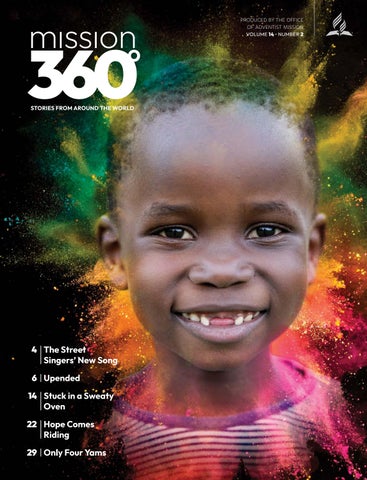
About our cover photo PHOTO BY RICKY OLIVERAS
I recently visited Mwata Adventist School for the Deaf in Kiisi, Kenya, on a filming trip. During playtime, the students raced across the schoolyard, their laughter filling the air. This boy, curious about my camera, paused to look before allowing me to capture his joyful smile.
Unless otherwise noted, Bible verses are quoted from the King James Version.
Astinah sings a hymn for Global Mission pioneer Ferdinand
The Street Singers’ New Song Indonesia
Joshua Sagala
is a video producer for the Office of Adventist Mission. 4
F
erdinand, a Global Mission pioneer serving in Indonesia, had no idea that stopping for a simple meal would lead to a life-changing encounter. As he ate, he noticed an elderly woman singing for spare change. Her voice, though weathered by time, carried a gentle, melodic warmth. Ferdinand had passed by many street performers before, but something about this moment felt different. He sensed a quiet prompting in his heart—an unmistakable urge to stop and speak with her. “I started the conversation by asking, ‘Can you sing a church song?’” Ferdinand says. “It was a spontaneous question. I hadn’t even considered whether she might not be a Christian. But she replied, ‘Oh yes, sir, I can.’” As the woman sang softly in her local dialect, Ferdinand felt deeply moved. Afterward, he
introduced himself and learned that her name was Astinah. Sensing the Holy Spirit’s guidance, he asked whether he could visit her at home the next day. To his delight, she agreed. In the weeks that followed, Ferdinand visited regularly. Through shared prayers, Bible study, and conversation, he and Astinah formed a friendship. Over time, members of the local church became involved, welcoming Astinah and her husband, Pujiarto, with open arms. Astinah and Pujiarto make a living by going from house to house, singing songs for a small amount of money. Many people reject them, making it difficult for the couple to believe that anyone can truly care. “I often get visited by people from church,” Astinah says. “Honestly, I’m amazed. I don’t understand how people can be so kind to someone like me. Even though my house is
small and dirty, they still come. On Saturdays, they pick me up to go to church. I’m grateful; I feel touched by how caring they are. Even my own relatives never visit me.” Initially, Pujiarto showed no interest. But through the simple, consistent kindness of Ferdinand and the church members he began to open his heart. “When I joined the church, I felt peace in my heart,” Pujiarto says. From singing popular songs on the street to lifting their voices in worship, the couple now uses their talents to praise God. Their journey is a testimony to the power of compassion and presence. Christ’s methods still prevail. When we put aside our differences and meet people where they are—forming real connections and responding to their needs—doors once closed begin to open. “We make friends with everyone, regardless of their profession,” Ferdinand explains. “Because of this, some of the people we’ve met continue to have meaningful relationships with us.” Just like Ferdinand, we never know how God will use us when we wake up each morning. Please pray for our Global Mission pioneers in Indonesia and around the world, and for the people they serve, so that even more hearts will be drawn closer to God. Watch this story at m360.tv/s26211.
Global Mission pioneers start new groups of believers in unreached areas or among unreached people groups. Please support their ministry with your prayers and financial gifts.
Ways to Give ONLINE Make a secure financial gift easily by scanning this QR code or visiting gmSDA.org/Give7
PHONE Call 800-648-5824
MAIL In the United States: Global Mission, General Conference 12501 Old Columbia Pike Silver Spring, MD 20904-6601 In Canada: Global Mission SDA Church in Canada 1148 King Street East Oshawa, ON L1H 1H8 Transform lives, one month at a time; join our recurring donor family! Please remember Global Mission in your will and trusts. Visit GMsda.org/PG or call 800.648.5824.
Ferdinand studies the Bible with his new friends Astinah and Pujiarto
VOLUME 14:2 5
Upended
Egypt
Jackson Robison,
from the United States, is a former volunteer to Egypt. He is currently pursuing a bachelor’s degree in nursing at Southern Adventist University. 6
I
’ve always been fascinated by office curios, the bric-a-brac of professional life strewn across the workspace, laid out to testify to a life lived well. It was January of 2022, and I was observing my custom, slowly running my eyes over the curiosities in the office of Steven Manoukian, the former mission director for Southern Adventist University. I was in an interview that would change my life, the interview in which I decided to become a student volunteer in Egypt. My decision came with stipulations, however. I had no interest in what I viewed as the boring “busy work” of serving in the field. I wanted to see and experience the nooks and crannies of the world; I wanted to be Livingstone, free from the tyrannical chains of a day job. Thus, my only requirement for Mr. Manoukian was that I desperately did not want to teach English. But this request, as readers familiar with the Lord’s character and humor could predict, became my destiny. Upon my arrival in Egypt, the wheels of my best-laid plans began to fall off quickly. I was soon informed that the money I had raised wasn’t sufficient to support my work in Egypt as no stipend was available for my position. I was also informed that my anticipated “Medical Volunteer/Pathfinder Leader” position was more accurately described as “English Teacher.” This new financial stress, along with the sudden change of vocation, sent me reeling. I allowed myself to doubt everything, and all sorts of questions ran through my mind: Did God really call me here? What if I’m not meant for this service life? This was not what I signed up for. Surely God would understand if I called it off and returned to the comforting porch swing of my Florida home. Those doubts, those feelings, are what I like to call the missiological fight-or-flight response: the moment when someone decides whether to give up their own will and agency to Christ or cling to their best-laid plans and bow out of the
arena. I faced that dilemma, the choice between what felt familiar, safe, and comfortable, and a future in which I had no hand in writing. It was a powerless feeling; I felt betrayed by God, or as though He didn’t care. I’ve never felt temptation like that immense pressure to leave. It was only through the grace of God and the wise counsel of my father that I chose to stay. That one decision changed my life. Once I decided to stay and teach English, I set about violently upending the couch cushions of my mind, searching for the skills and patience I needed as if they were loose change. Slowly, my anxious thoughts receded as I gave up my own plans and trusted that God was guiding my steps. Soon, He provided a stipend that allowed me to stay in Cairo. I began teaching at an urban center of influence,* where I was genuinely surprised to discover that I loved teaching English. I loved sharing my language, my culture, and my faith with students—many of whom became friends. More importantly, I discovered that faith in Jesus could move my mountains. I learned that life with Jesus was an adventure, no matter the job or place. Cairo, the city that once made me feel homesick, became one of my favorite places in the world. Despite all its dust, cigarette smoke, and busy streets, it was the place where I learned to trust Jesus. * Small urban hubs for practicing Christ's model of ministry, building relationships within city communities, and starting new groups of believers.
A service of the Seventh-day Adventist Church, VividFaith is an online platform connecting people with service opportunities. To learn more, visit VividFaith.com.
A camel taking a much-needed break from ferrying tourists up Mount Sinai
Jackson in the courtyard behind the Church of St. George, one of his favorite places in Cairo
Jackson at the pyramids of Giza
VOLUME 14:2 7
The Clinic That Feels Like Home
E Tanzania
Ricky Oliveras
is a video producer for the Office of Adventist Mission. 8
ach time Khadija makes the walk to the Zanzibar Seventh-day Adventist Dispensary, she knows what to expect. The path, the building, the voices that greet her—all are woven into the rhythm of her life. She has been coming here for years, through different seasons and circumstances. There were visits marked by worry and others by relief, appointments that felt routine and others that carried urgency. Yet the dispensary itself has remained steady. For Khadija, it’s not simply a place to receive treatment but a space shaped by relationships built on trust, consistency, and the assurance of being heard. In Zanzibar, healthcare is available through a variety of facilities, both public and private. Still, many patients continue to return to this small Adventist dispensary. Their reasons go beyond prescriptions and diagnoses. Here, people are known by name. Conversations come before consultations. Patients are treated not as cases to be processed but as individuals whose stories matter. On any given day, mothers arrive carrying children whose fevers have lingered too long. Pregnant women attend routine checkups to help ensure safe deliveries. Others seek care for respiratory illnesses, stomach problems, diabetes, or high blood pressure—conditions that require regular monitoring and long-term support. In a low-income community like this one, consistent access to care can mean the difference between early treatment and tragedy. Minor illnesses left unattended can quickly become life-threatening. The dispensary serves as a vital bridge, offering stability and continuity in a setting where both are often scarce. Inside the dispensary, Dr. Geoffrey Mabula moves from room to room with steady purpose. He listens carefully, examines thoroughly, and treats each patient with dignity and respect. “The main reason our patients return is that we care about them,” Dr. Mabula explains. “We work for them, and we offer something more than medical services—love for the patient.”
This love is not expressed only in words, but in time spent, questions answered, and follow-up visits encouraged. Over months and years, something rare has been built here: trust. Patients return sooner when something feels wrong. They follow treatment plans more closely. They come back, not out of obligation, but because they believe they are safe and valued. The dispensary’s physical structure, however, is one of strain and limitation. When seasonal rains arrive, water leaks through the aging roof. Electrical and plumbing systems are worn and outdated. Temporary repairs keep the doors open, but they can no longer meet the demands of a growing community. To continue providing quality, compassionate care, the dispensary needs more than patchwork solutions. It needs renewal. Funds from the upcoming Thirteenth Sabbath Offering will help support a full renovation of the Adventist dispensary, transforming it into a space that enhances safety, improves efficiency, and allows trusted relationships to continue and expand. “When we rebuild this facility,” Dr. Mabula says, “our services will increase. The love people expect from us, and the good services we provide, will make them come in greater numbers and get adequate services.” Thank you for giving to the Thirteenth Sabbath Offering. Because of your generosity, hope can remain present and active in the lives of the people of Zanzibar.
Zanzibar at a Glance A popular tourist destination, Zanzibar is a sovereign state within the Republic of Tanzania, consisting of two main islands, Unguja and Pemba. Cradled by the turquoise water of the Indian Ocean, they are home to 1.9 million people.
Why this project matters The nearly 2 million people of Zanzibar are almost all Muslim. The Adventist community numbers some 2,000 members. The ongoing ministry of the Zanzibar Seventh-day Adventist Dispensary is crucial for sharing the love of Jesus.
Watch “The Clinic That Feels Like Home” at m360.tv/s2622.
To support the Thirteenth Sabbath Offering, visit adventistmission.org/donate.
Patient Khadija walks with Dr. Geoffrey Mabula at the Zanzibar Seventh-day Adventist Dispensary
VOLUME 14:2 9
To Our Very I Doors
discovered that God has brought refugees to this country so that we can empower them to reach the unreached with the gospel,” says Terri Saelee, coordinator for Adventist Refugee and Immigrant Ministries (ARIM) in the North American Division (NAD). A few years ago, NAD hosted its Church Planting Bootcamp in Florida, where church lay leaders and pastors gathered for sessions on church planting and revitalization. Terri served as a keynote speaker for the Refugee and Immigrant Ministries track. Upon arriving, she noticed that many attendees in the track were refugees and immigrants themselves. She prayed that God would help her communicate what these leaders needed to hear. “In the context of our mission to reach every nation, kindred, tongue, and people,” says Terri,
United States
Victoria Mills
is the senior editorial assistant for the Office of Adventist Mission. 10
Photo for illustration only
“I shared that there are approximately 7,000 unreached language groups, which represent 43% of the world’s population.” Terri brings a strong legacy of experience to her work. She served as a student missionary in Thailand and later returned to the United States to continue her studies at Weimar Institute (then Weimar College). She spearheaded outreach programs for Hmong refugees, involving Hmong leaders in planning and providing for their needs. During this time, Terri met Ko Saelee, a young Hmong pastor. They fell in love and got married. “I like to tell people neither he nor I knew how much I would need him,” she says. “I believe it’s providential that I’m married to him, because there’s a lot I wouldn’t see if I were just looking from the outside in. But being married to one of these visionary church planters, I see it from this perspective, too.” Terri and Ko planted a Lao church and a Hmong church in California, then planted more Hmong churches in Wisconsin and Minnesota during the next few years. In 2008, Terri recalls lying awake many nights, unable to get a question out of her mind: What if God is bringing other language groups here and none of us are aware of who they are, where they are, and how to reach them? An idea formed: NAD needed someone to research incoming language groups and help local churches prepare to reach them. Initially, Terri didn’t think she was that person, but God made it clear a few months later when she was called to become the first ARIM Coordinator for NAD. ARIM directs the work of more than 18 language-specific refugee and immigrant groups in North America through church planting consultants. Terri explains that the division-wide ministry is based on the following quote by Ellen White: As I have testified for years, if we were quick in discerning the opening providences of God, we should be able to see in the multiplying opportunities to reach many foreigners in America a divinely appointed means of rapidly extending the third angel’s message into all the nations of earth. God in His providence has brought men to our very doors and thrust them, as it were, into our arms, that they might learn the truth, and be qualified to do a work we could not do in getting the light before men of other tongues (Evangelism, p. 570). This quote “screams the word refugee to me,” Terri says. She believes those who come to the
NAD seeking new homes are perfectly equipped to share God’s love with their language groups. Since its founding in 2009, ARIM has grown significantly. In preparing a 10-year report for NAD, Terri discovered that the number of reached language groups had doubled, refugee congregations had quadrupled, and tithe and annual baptisms had grown by 800 percent. Terri’s message resonated strongly with the bootcamp attendees. Refugee and immigrant pastors approached her immediately afterward, sharing the names of unreached people groups—many of which Terri had never heard of. They told her, “We want to discuss, we want to strategize, we want to plan how to reach the unreached.” Terri learned that believers could reach not only their own language groups but also related groups they’ve encountered on their refugee journeys. As a result of the discussions at the bootcamp, the Falam* language group, previously unreached by the church throughout the world, now has three active church plants in North America. A Falam community in Australia has also watched an online evangelistic series posted by ARIM's Falam church-planting consultant and requested that he help them plant a church. Terri is grateful to serve refugees and immigrants in NAD. “Reaching every nation, kindred, tongue, and people is right in the core of our mission statement,” she reminds us. “And I love that our church is dedicated and focused on that.” Please pray for ARIM and refugee and immigrant church leaders as they continue to reach the unreached. * Falam refugees are originally from Myanmar (Burma)
Global Mission has church planting projects in numerous countries. In 2024 a church was established every 2.8 hours—a record year for church planting. “The Church will only continue to grow if we keep our focus on the importance of starting new groups of Seventh-day Adventist believers in unentered areas and among new people groups”—Gary Krause, director of Adventist Mission. To support church planting around the world, visit gmsda.org/Give7 VOLUME 14:2 11
J. N. Andrews
12
Seeds That Multiply
I
Gary Krause
is the director of the Office of Adventist Mission.
n 2024, the Seventh-day Adventist Church commemorated the 150th anniversary of J. N. Andrews’ arrival in Switzerland, the first missionary to be sent outside North America to share the Adventist message. I use the word commemorated because there really was nothing to celebrate. If he came back to life today, I think he would be shocked and disappointed that we’re still here. Following Andrews’ pioneering work came a golden era of Adventist mission. Missionaries crisscrossed the globe, taking the good news of Jesus wherever they went. More than 100 years later, in the 1980s, the church refocused its mission. As leaders looked at the world map, they saw clearly that while the Adventist Church was strong in some areas, it was weak in others—and in many places, it didn’t exist at all. From that realization, Global Mission was born. At the General Conference Session in Indianapolis in 1990, Global Mission was officially voted into existence by the world church. It was a groundbreaking moment. For the first time, we began thinking not only in terms of geography, but also in terms of people groups. We focused not only on reaching other Christians, but also people of other world religions. The emphasis was entirely on starting new groups of believers following Christ’s method of ministry. This has been the work of Global Mission for the past 35 years. We praise God for what has happened since Global Mission began. Thousands of new churches have been planted. Many new people groups have been reached. Entire countries that once had no Adventist presence now have a growing witness. I think of India, where two Global Mission pioneers were rejected in the city they entered. Undaunted, they started worship groups in two nearby towns. Later, they returned to the first city and, this time, were able to start a church. That church started a school and planted four new worship groups. Each of these new groups planted even more groups. In this way, the gospel work multiplied. We see this multiplication happening all around the world. Since Global Mission began,
nearly 128,000 new churches and companies have been established. These aren’t just statistics on a page; these are millions of real-life people who have found hope in Jesus Christ. Of course, the mission still remains daunting. Consider the three Mission Refocus Windows that confront us:
The 10/40 Window The 10/40 Window is an area located between 10 degrees and 40 degrees north of the equator, stretching from North Africa through the Middle East and into Asia. It’s home to some 60 percent of the world’s population, most major religions, and the poorest people. Most here have never heard the name of Jesus.
The Urban Window The Urban Window represents numerous cities with more than a million residents that still have no Adventist presence. This is where the majority of people now live. They remain a vast and urgent mission field.
The Post-Christian Window The Post-Christian Window includes Europe, Australia, New Zealand, and, increasingly, North America—regions that can no longer be considered Christian and are steadily moving away from Christian values. Yes, the mission is daunting. But it’s God’s mission. He’s invited us to participate with Him in that mission to start new groups of believers and make disciples for Him. Please pray for the millions living in the 10/40 Window, Urban Window, and Post-Christian Window, and help us reach the entire world for Jesus.
To give, scan this QR code or visit gmSDA.org/Give7. VOLUME 14:2 13
Stuck in a Sweaty Oven
Zambia
Sarah Hasel
served as a volunteer missionary in Zambia. She now works as a nurse in Weimar, California. 14
I
t was our second full day on the road, and we were exhausted. The dirt road was riddled with potholes, but the Land Rover bounced over them with surprising ease. The night before, we had stopped at a gas station just to hunker down and survive the night. There were six of us in the back of the vehicle, and somehow, we maneuvered ourselves like sardines, lying sideways, trying to get any sleep we could. Mosquitos buzzed in our ears. We had to keep the windows open for ventilation or the car would have turned into a sweaty oven. None of us slept well. We kept telling ourselves, hopefully, tonight will be better. We were on our way to a village in the Zambian bush for a four-week trip during my volunteer mission year, and so far, it wasn’t going well. As we bumped along the road the next morning, I noticed smoke drifting out of the engine. Not a good sign. Sure enough—we broke down on the side of the road in the middle of the African bush. Stranded. Barely any food. Running low on water. We weighed our options. The local man driving us knew of a small town about three hours away where we might find the replacement part we needed. So, we waited. And waited. We sat in 99° heat with no air conditioning, rationing water. But while we waited, something happened. People from a nearby village began to gather around the vehicle. They stared at us with wide, curious eyes. Kids climbed onto the back of the Land Rover and pressed their faces against the windows, making expressions and laughing. Many
wore tattered clothes. Only some had shoes. A few parents stood back watching cautiously, while others came closer, just as curious as the children. In that moment, I felt like an animal in a zoo exhibit—fascinating, strange, and unfamiliar. Two completely different worlds had collided on the side of a dirt road. For five hours, none of us knew what to do except look at each other. That was only day two of a three-day journey to the remote village in Zambia—and my first real glimpse into life there. We spent one more night on the road, eating small snacks we had picked up at gas stations. Then, after a long boat ride, we finally reached our destination—a small village called Chipwa, nestled along a river. This would be our home for the next four weeks. We unloaded our supplies and pitched our tents in a field just outside the village. Immediately, people began gathering. Many had never seen white people before. Children crowded around us, shouting, “Muzungu! Muzungu!” (White people, white people!) Some cautiously came up and grabbed my arm, rubbing my skin to see whether I was really that color. During the day, we ran a dental clinic, and at night, we held evangelistic meetings. We quickly realized that the medical need was overwhelming, so we also opened a small general clinic. Word spread quickly; people traveled for hours to be seen. The local clinic was often neglected, and some villagers had turned to witch doctors out of desperation because they felt they had no other option. Infection, untreated wounds, chronic illness—problems that would be minor back home—became serious here simply because help wasn’t available. So, we worked. Day after day. Showering in tents. Washing clothes by hand. Praying over patients. Serving nonstop. That month opened my eyes to how vast the medical need is in much of the world—not because solutions don’t exist, but because resources and workers are scarce. I kept thinking of the words from the Bible: “The harvest truly is plenteous, but the labourers are few” (Matthew 9:37–38). When people ask me about my mission year in Africa, I still answer the same way: it was a character-growing experience. And I mean that. It was the hardest year of my life—but also the most rewarding. Because with sacrifice comes something greater than comfort: purpose. And there is no greater reward than seeing lives touched for eternity.
The missionaries’ view from the back of their broken-down Land Rover
A service of the Seventh-day Adventist Church, VividFaith is an online platform connecting people with service opportunities. To learn more, visit VividFaith.com. Curious observers peering at the missionaries
VOLUME 14:2 15
When God Connects the Dots 16
Photo for illustration only
The Middle East and North Africa Union
This story was provided by the Middle East and North Africa Union.
O
ne cold January night, my husband and I huddled around a bonfire with a group of people we had recently met on a bike ride. As I looked around at their faces, my eyes met Diana’s.* She was a short woman in her twenties with brown, curly hair and a bashful smile that invited connection. We didn’t speak each other’s language, but we exchanged a few words through a translation app and shared phone numbers. I had no idea how important she would become in our lives— or how thirsty she was for Jesus. My husband and I teach English in a large city in the Middle East. So, we were excited when Diana contacted us to join our class. I was surprised to learn that she—against all social norms—had moved to the city on her own to become the owner of a small shoe store. Diana applied the same determination to learning English that she brought to managing her store. She was always enthusiastic and eager to learn. But one day, she entered the classroom with a heavy, sad expression. I planned to approach her after class, but as soon as it ended, she rushed out the door. I sent Diana a message, offering to help with whatever she was going through. To my surprise, she replied instantly, admitting that she felt miserable. She explained that the country’s financial crisis had plummeted sales in her store, and she had decided to close it. “I’ll have no income or project of my own,” she wrote. “It feels like my reason to get up in the morning is gone and that things always go wrong.” I couldn’t do much for Diana’s business, but I was certain she needed Jesus. I remembered that our small group had invited a special speaker for the following day and invited her to attend. She agreed without hesitation. Diana arrived on time and listened attentively to the speaker. That day we reflected on the story of Jesus saving the woman who was about to be stoned after being caught in sin. I could see that Diana was deeply moved, as if the forgiving eyes of Jesus had rested on her. That evening, Diana learned that she was infinitely loved and valued by her Creator. During the following months, as she continued attending our worship meetings, I watched the darkness in her life give way to the light and hope of Jesus. Diana progressed quickly in her English skills and eventually became our receptionist. We grew close through working, eating, worshiping, and studying the Bible together. Before long,
Diana accepted the Sabbath and began keeping it with us. One day, while Diana and I were exercising together, she shared that she was moving to a larger city to attend college. I was sad but wanted to support her desire for personal and spiritual growth. My husband and I arranged for her to finish her Bible studies with our friend Hana, who worked in the same city Diana was moving to. “Please pray that I can find a job that doesn’t require me to work on Sabbath,” she asked. “Of course,” I replied. I prayed both for her employment and that she would soon choose to give her life to Jesus through baptism. The Lord didn’t delay His answer—He had already been working in her heart. During a Sabbath lunch before she left, Diana announced her desire to be baptized. I was thrilled! After Diana moved, she completed her Bible studies with Hana. Then Hana asked Diana to become her store manager—an answer to prayer for both women! A few weeks later, on a cold December evening, Diana entered the baptismal waters. It was a joyful day for all of us. We welcomed a new sister in Christ who was eager to face her life holding His hand. Diana is thriving in her new job, and we thank God every day for hearing our prayers. *Names have been changed.
Global Mission reaches the unreached for Jesus in the 10/40 Window, which includes the Middle East and North Africa. We do this in various ways, through the service of Global Mission pioneers, urban centers of influence, and tentmakers who use their careers to share Christ. Please support Global Mission with your prayers and financial gifts at gmSDA.org/Give7 VOLUME 14:2 17
Prepared Republic of Palau
Elijah Parks
wrote this story while serving as a student missionary in the Pacific at Palau Mission Academy. He currently studies theology and business administration at Southern Adventist University.
18
G
ood morning, Mr. Parks!” A group of energetic juniors bursts into my classroom. It’s 8:00 AM on another school day. I sigh and smile at the same time. Some days it can be tough knowing I’ve got many hours, days, and weeks of teaching still ahead. But I smile to myself too, knowing it’s all part of the adventure God’s taking me on. After all, He’s helped me, a college student, successfully complete a semester of teaching high schoolers. On this particular morning, I know exactly what I plan to do for each class. First period is US history. I’ve reviewed the day’s material on the origins of World War I, created a teaching plan, outlined questions for students, planned an activity, and found a video to introduce the topic. I’m glad that today I feel well-prepared. After a devotional and prayer, I start the video. Click! Oh no, the power’s out! There goes my video. Fortunately, because I’ve prepared my other material, I can easily transition to an interactive lecture on the factors that pulled nations into war and tie it to a moral lesson about building up versus tearing down relationships. I conclude with an activity: students pick a side of the room
depending on whether the statement I read is true or false. Then I ask them why they picked that side, and they recall information from the lesson to explain their choice. The bell rings. First period is over! As the second-period students enter the classroom for World History, I smile to myself again. God is with me, and He will keep working things out. Just five more periods of teaching left today! As I look at the semester ahead, I realize that preparation is imperative. Here are four lessons I’ve learned about preparation since I began teaching in Palau. 1. Preparation for the expected is a defense against the unexpected. As I described above, the unexpected happened, but being well-prepared made it possible for me to handle it. 2. Confidence comes naturally from preparation. Fear dissipates and is replaced with surety. On the days I haven’t prepared well enough for class, it’s at least five times harder to be confident, clear, organized, and engaging. 3. Every day matters. Some days it feels like I’m building the pyramids of Giza; does
Elijah with his sophomore students
placing one more stone really make a difference? But no matter how big or complex a task seems, consistent effort turns the tide. And if yesterday didn’t go well, I still have today. Consistency means asking myself, “How can I glorify God today?” 4. I can only prepare so much; at some point, it simply must just happen. Last semester, pretty regularly, I must admit, I wanted my lessons to be so information-packed, spiritually nourishing, and attention-gripping that I went to sleep later and woke up far earlier than what was sustainable. I realize now that my lessons will never be perfect, no matter how much I prepare. Perfection isn’t God’s requirement for me, faithfulness is. The Bible tells us of something else to prepare for. “Therefore be ye also ready: for in such an hour that ye think not the Son of man cometh” (Matthew 24:44). I’ve sometimes made the mistake of thinking that class prep shrinks into unimportance when compared to preparing for the Second Coming. While it’s true that Jesus’ return will be the greatest event the world has ever witnessed,
“Mr. Parks” showing the location of the Ottoman Empire
everyday activities are exactly how we prepare. It’s the things that seem so ordinary, like teaching, working on a project, encouraging a friend (or stranger), and morning prayer that are the massive determiners of our preparation for Jesus’ coming in glory. Do I do all that I do for King Jesus? Do I live with a kingdom mindset, believing that every word, thought, and action in my seemingly ordinary days is a stone in the great pyramid God is building? I choose to be prepared. I choose to be faithful in the “little” things. I choose Jesus. “His Lord said to him, Well done, good and faithful servant: thou hast been faithful over a few things, I will make thee ruler over many things: enter thou into the joy of thy lord” (Matthew 25:21).
A service of the Seventh-day Adventist Church, VividFaith is an online platform connecting people with service opportunities. To learn more, visit VividFaith.com.
VOLUME 14:2 19
How to Grow Your Church Sri Lanka
Victoria Mills
is the senior editorial assistant for the Office of Adventist Mission.
20
H
ow do you rebuild a struggling church? And how do you sustain growth once you have a functional congregation? Hyosu Jung, president of the Ceylon Mission of Seventh-day Adventists, was tasked with revitalizing the struggling churches of his new mission upon his arrival in Sri Lanka in 2024. In order to help, he had to know why help was needed. After enduring more than 400 years of colonization, a civil war broke out in 1983 between two Sri Lankan groups: the Sinhalese and the Tamils. This conflict lasted until 2009. Before the war, the church membership in Sri Lanka was 8,000. After the war, it dropped to 600. “The majority of our members left the country,” Jung said. “So, the Sri Lanka church became very weak; it couldn't function well without support from the outside.” When Jung first arrived in the country, he began to realize the extent of the damage. It was considerable. One church had a broken roof that was letting in rainwater and causing mold to grow, but the congregation didn’t have the means to fix it. Most of the churches were in similar situations. “The majority of our members are tea plantation workers who work in high mountainous areas.” Jung explained. “They are very poor. Even to come to church is a very big sacrifice, because they can’t go to work, they can’t earn money, and
they have to pay for transportation.” It’s difficult to invite others to a church you’re hesitant to attend yourself. Jung started strategizing to overcome this challenge. “We tried to do something to rebuild the church.” As part of their rebuilding plan, Jung and his team settled on five areas to focus on: mission motivation, property management, children’s ministry, pastoral leadership education, and self-support. The past year has seen growth in all these areas, especially in mission motivation. “Because I am Korean, I tried to connect our Sri Lankan churches with Korean churches,” Jung said. “One Korean church supports one Sri Lankan church.” Active Korean congregations provide financial, spiritual, and evangelistic support to their expanding Sri Lankan counterparts. Multiple teams from Korea visit throughout the year to host evangelistic programs and support the churches through a sisterhood relationship. The Ceylon Mission is also strengthening through small group evangelism, a result of partnering with the Northern Asia-Pacific Division. “This small group evangelism is different from the normal public evangelist meeting,” Jung said. “We asked all the churches to organize small groups. We don’t preach. We don’t want to put pressure on the small group leaders because most of them are laypeople, and they don’t have any educational background.” With icebreakers, short video sermons, and plenty of discussion and prayer time, a small group “festival” was a great success. “The first night we had around 1,600 people participating and the last day, we had around 2,200 people. Our members were really surprised. They really enjoyed it.” As a result of the festival the churches have many Bible study contacts lined up and
Worshiping in a freshly renovated church
requests for the small groups to continue. Jung and his team are developing similar materials for them to use in the future. One woman was especially blessed during the festival. Pastor Jeevakumar of the Sooryakantha Church shared a deeply moving story with Jung. “Sister M. S. Dhamika came to me and said, ‘Pastor, only my family and I know how satisfied I have been these four days.’ When I gently asked why, her answer was heartbreaking: ‘Pastor, for these four days, I have eaten dinner every night. My stomach was full. My two children ate their fill. Only my children and I know what it means to be satisfied like this.’ “I asked her why she had only been eating these four days. With tears in her eyes, she explained: ‘My husband has left me for another woman, and my relatives have abandoned me. No one cares if my children and I eat. But because of your meetings, we have eaten well for these four days. Not only our stomachs, but also our hearts are full. I had never truly worshipped Christ. Yet during these four days, I have seen how the Lord has taken care of me.’” Jung asks you to remember Sri Lanka in your prayers. He’s excited and thankful for how the mission is growing. “It is a great blessing for me to enjoy the blessings of the evangelism here in Sri Lanka.”
Jung (top left) and a Sri Lankan/Korean-American church team
Mission Offerings Your mission offerings, given at Sabbath School, help support the mission ministry of our church. Thank you!
The small group festival
A cooking workshop with a sister congregation
VOLUME 14:2 21
The “I Will Go Bike for PNG” team
Hope Comes Riding
A
Papua New Guinea
t the edge of two nations, where the road disappears and the jungle takes over, entire communities live unseen and unheard. Most people will never set foot here. But it’s exactly where Pastor Obed Yamasombi began his journey— on two wheels. In 2022, he had an opportunity to visit a border community between his country, Papua New Guinea, and neighboring Indonesia.
Joshua Sagala
is a video producer for the Office of Adventist Mission. 22
Pastor Yamasombi, coordinator for “I Will Go Bike for PNG”
“There are no government services there, especially infrastructure like road, hospitals, clinics, and schools,” says Yamasombi. “It’s challenging for the people. They’ve been marginalized and forgotten by their countries.” This situation touched Yamasombi’s heart. He knew he couldn’t just walk away. He had to do something. “I felt sorry for them,” says Yamasombi. “And that’s why I mobilized the boys to reach out to
the unreached villages along the border areas.” Yamasombi gathered his friends and told Watch this story in action at m360.tv/s2626. them about the needs at the border. They wanted to help in a way that combined their passion for ministry and their love for biking. So, they decided to use their bikes as instruments The I Will Go initiative is a rallying cry for total member involvefor mission. With prayer and excitement, they ment. It’s a call for every church member to become actively packed up and started riding, determined to involved in reaching the world for Jesus, using their God-given reach the unreached along this border. It was an spiritual gifts in witness and service. Explore the I Will Go plan adventure filled with purpose and blessing. and find your place in this global movement! “When we passed through the villages along the borders, we greeted the villagers and shared iwillgo.org Bibles and other Christian literature with them. Then we talked to them about Jesus. If we had any lollies [lollipops], we gave them to the children to brighten their day because they’re cut off from the outside world.” Feeling neglected and isolated, the villagers’ hearts were touched by the bike team’s demonstration of love and concern. “When we arrived in the villages, the people welcomed us into their communities with tears streaming down their faces,” says Yamasombi. “They fed us, and we sang for them. They asked us to build a church on their land and open a school in their village.” The “I Will Go Bike for PNG” team rode through thick jungles and savannas and up steep hills. They carThe team carrying their bikes through one of the many swamps they encountered ried their bikes over swamps and rivers. It was extremely challenging. Yet Yamasombi and his team pressed on, facing every obstacle with courage and faith. They knew the risks, but chose to go anyway, trusting God to lead the way. Yamasombi asks that you please pray for the people the team ministered to, that the hearts of their brothers and sisters in this “no man’s land” will become part of the family of God. Thank you for supporting mission. Your prayers and contributions bring hope, love, and the message of Jesus to the farthest places Villagers warmly welcome the bike team on earth. VOLUME 14:2 23
Students with albinism take part in an ADRA Africa initiative designed to promote self-care, build confidence, and support their full inclusion in school and alongside their peers
Breaking the Light Through
Tanzania
Jennifer Stymiest,
director of digital for ADRA International, with ADRA Tanzania. 24
B
reaking stereotypes is never easy. But change always begins the same way— with someone choosing to see another person for who they are inside. In the East African country of Tanzania, the sun rises bright and unrelenting each morning. For most, its warmth signals the start of a new day. But, for people living with albinism, that same sun can bring danger. Tanzania has one of the highest rates of albinism in the world: about one in every 1,400 people. Tens of thousands of Tanzanians live with fragile skin, impaired vision, and risks that extend far beyond physical health. Many carry the heavier weight of fear, stigma, and misunderstanding. For generations, people with albinism have struggled with difficult obstacles. Some have been excluded from society. Others have suffered from violence. Too many, especially women and children, have learned to stay hidden, pushed to the edges of their communities simply because they look different. Even school, which should be a place of safety and possibility, can be filled with silent difficulties. Many children with albinism struggle with bad eyesight and can’t see what is written on the blackboard. Text in books blurs. Bright sunlight streaming through classroom windows strains sensitive eyes. Without proper support, these challenges often lead to frustration, falling
behind, or eventually dropping out. Limited education narrows future opportunities, reinforcing cycles of poverty and dependence. These people need justice. They need active compassion. They need love. Through the Action for the Rights and Inclusion of Children with Albinism (AFRICA) project, the Adventist Development and Relief Agency (ADRA) and its partners are walking alongside families in Tanzania, choosing presence over indifference and dignity over neglect. With support from ADRA Denmark and Danmarks Indsamling, a charity fundraiser in Denmark, the project focuses on 400 children with albinism and their mothers or guardians, addressing urgent needs while laying foundations for lasting change. The work often begins unobtrusively, in classrooms and community spaces. Teachers are trained to support children with low vision. School health clubs use music, dance, and drama to teach inclusion. Environments are created where children can learn, play, and belong without shame. Children learn how to protect their skin and eyes, and their peers learn what it means to live alongside someone who is living with albinism. Awareness begins to replace fear. Teachers are also guided in simple but meaningful adjustments, such as seating children closer to the front of the class, enlarging learning materials, and encouraging classmates to share
notes. These small acts of intentional inclusion help ensure that children with albinism are not merely present in school but truly participating. Reshmi is ten years old and in the fourth grade. She lives with albinism and asthma. Some days, the simplest tasks require extraordinary effort. Seeing the blackboard is difficult. Reading small print can be exhausting. Yet she continues to show up each day, determined to learn. “I feel encouraged by my fellow students, friends, and teachers,” she says. “They love me, care for me, and show me support at school. When the teacher gives assignments, my fellow students share their notebooks so I can copy class notes. I’m able to do my assignments well.” In a classroom where understanding is growing, Reshmi is not defined by what she can’t see, but by what she can become. Through the AFRICA project, ADRA also supports mothers. By forming savings groups and supporting income-generating activities, the project helps women build sustainable livelihoods. When mothers are strengthened, entire families grow stronger. Dignity is restored and dependence reduced, allowing families to better support their children’s education and health. Reshmi’s mother, Naomi Andrew Mhadisa, knows this journey well. She is a mother of three, two of whom live with albinism. For years, healthcare was a constant worry, an unanswered
prayer. But through the AFRICA project, her children received health insurance cards, opening doors to timely treatment and care. “I thank ADRA,” Naomi says. “The groups for mothers bring hope and unity. When a woman is supported, she will take care of her family.” In Tanzania, ADRA is helping communities break the stigma of albinism. They’re showing how to see people not through fear or ignorance, but in the light of justice, compassion, and love.
About ADRA The Adventist Development and Relief Agency is the international humanitarian arm of the Seventh-day Adventist Church, serving more than 120 countries. Its work empowers communities and changes lives around the globe by providing sustainable community development and disaster relief. ADRA’s purpose is to serve humanity so all may live as God intended. To learn more about ADRA’s global mission, visit ADRA.org. When you give to the mission offering during Sabbath School, a portion of that offering helps fund ADRA’s ministry around the world. Thank you for your generous support. VOLUME 14:2 25
Charles Marshall Kinny Founder of Black Adventism
Charles Marshall Kinny. Photo courtesy of the General Conference of Seventh-day Adventists Archives 26
Early Life and Conversion
United States
Trevor O’Reggio
is chair of the Church History Department at the Seventhday Adventist Seminary of Andrews University in Michigan. This story is adapted from a biographical article he wrote for the online Encyclopedia of Seventh-day Adventists. We invite you to visit encyclopedia. adventist.org to enjoy more stories about Adventist missionaries.
When Charles Marshall Kinny accepted the Adventist message after attending meetings in Reno, Nevada, in the summer of 1878, no one could have guessed the weight his decision would carry for generations to come. He would soon become a pioneer in a movement that had yet to imagine its future among African Americans. His journey—from obscurity to leadership, from isolation to vision—would shape the foundations of Black Adventism in the United States. Born on April 1, 1855, Kinny spent his early childhood in the slave state of Virginia. Whether he was enslaved or a free person of color remains unknown. After 1870, Kinny and members of his family settled in Reno, Nevada, in search of better opportunities. In Reno, Kinny attended evangelistic meetings led by J. N. Loughborough. During the series, Ellen White preached on the love of God—an experience Kinny never forgot. At the age of 23, he accepted the Adventist message, becoming the only Black member of the Adventist church in the city. Kinny quickly became active in church outreach. By 1882, he was serving as secretary of the Nevada Tract and Missionary Society. Though the Nevada membership was small, the position carried significant responsibility. Reports published by Kinny in The Advent Review and Sabbath Herald reveal a zealous worker. He corresponded widely and distributed literature across the country. “A colored teacher in Richmond, Va., has accepted the truth,” he reported in 1881, “and others are interested.”
Mission to Kansas Impressed with Kinny’s dedication and ability, church leaders helped him pursue further education at Healdsburg College in California. In 1885, he began evangelistic work in Kansas, a major destination for Black migrants from the post-Civil War South. Kinny faced strong resistance. Black ministers from other denominations opposed his efforts, and on one occasion, he publicly defended the seventh-day Sabbath before a crowd of hundreds. Aware of the deeply rooted religious traditions of the communities he served, he focused on personal evangelism—house-tohouse Bible studies and distribution of Adventist literature. His work in Kansas, and later Missouri, resulted in a small but committed group of Black Sabbath-keepers.
Racial Conflict in St. Louis In St. Louis, Kinny encountered a challenge that would shape the rest of his ministry: racial prejudice within the church. Less than a year after Kinny left the city, Ellen White felt similar tensions there firsthand and wrote of having experiences “that I can never think of without a feeling of dread.” She addressed the issue headon in her 1891 talk to church leaders entitled “Our Duty to the Colored People.”
Foundations of the Black Work As his ministry took him farther South, Kinny would be compelled to grapple with the color line as never before. Under assignment from the General Conference Committee, he arrived in Louisville, Kentucky, in June 1889, to strengthen a small group of Black believers. That fall, he attended a major church council in Nashville, Tennessee, convened by R. A. Kilgore, superintendent of General Conference District No. 2 which covered the South. At the council, Kinny became the first African American ordained as a Seventh-day Adventist minister. The Nashville council also set a precedent for the Adventist Church’s grappling with prejudice. It was suggested that white people who otherwise might have been interested refused to attend a recent Nashville camp meeting because of reports of race-mingling on the grounds. In his report on the council in The Advent Review and Sabbath Herald, Kilgore asserted that those experienced in Adventist work in the South realized that any effort “to break down the distinction between the races, thus ignoring the popular prejudice, is simply fanatical and unwise.” Kinny addressed the council directly. He pointed out that separating the races at general meetings tended to destroy the unity of the Third Angel’s message and caused “great embarrassment and humiliation not only to me, but to my people also.” He did not want “the colored people” to be “driven from the truth by our position on this question.” At the same time, he acknowledged that “the very presence of the colored people in church relations and in our general meetings” hindered the message from reaching many white people. He then set forth propositions to resolve the dilemma. While Kinny believed in the power of the gospel to change lives, he accepted the sociological reality of living in a racist society and viewed his proposals as the best way to adapt without harming the church’s mission to either VOLUME 14:2 27
race. Though he did not believe in segregation, he was willing to work within its narrow confines for the ultimate good of the church. Where integrated worship was impossible, he reasoned, separate churches and meetings were preferable to second-class participation. Black congregations should develop their own churches and, eventually, conferences—fully equal within the denomination’s structure. Though far ahead of its time, Kinny’s vision laid critical groundwork. He continued traveling throughout the South, raising up churches, encouraging small companies of believers, and urging the denomination to invest more intentionally in work among Black communities. Progress was slow. Appeals for funding and staffing often met resistance, yet Kinny persisted. At the 1891 General Conference Session, he spoke candidly about the challenges facing the Black work and called for additional support. Ellen White strongly endorsed his appeal. Her son, Edson, soon devoted himself to missionary work among Black communities in the South, helping advance the cause Kinny had long advocated.
More than 4,000 articles and 11,000 photographs, featuring Adventist missionaries, evangelists, institutions, events, and beliefs.
encyclopedia.adventist.org 28
After 1898, Kinny spent several years in largely self-supporting missionary work, traveling widely despite limited resources. He married schoolteacher Viola in 1902 and later returned to salaried ministry, though ongoing family health challenges limited his activity. He lived to see the church he helped shape grow far beyond its fragile beginnings. Kinny died in 1951 at the age of 96. Reflecting on his legacy, historian Ronald Graybill called Kinny the “Founder of Black Adventism,” noting that no one else faced the lonely task he carried. Others would later make more converts, but none laid a foundation under more difficult circumstances. By the time of Kinny’s death, Black Adventist membership in the United States had grown to more than 26,000, and the separate conferences he envisioned decades earlier were finally taking shape—testimony to a legacy built patiently, faithfully, and against overwhelming odds. For citations, please see the original article at encyclopedia. adventist.org/article?id=CJFR
Only Four Yams Vanuatu
M
y name is Stacey. I come from Vanuatu, a country made up of many islands in the South Pacific Ocean. When I was little, I lived in Beverly Hills—not the famous Beverly Hills in the United States—but a small neighborhood in my country. I grew up surrounded by my family, friends, and church. I’m now in twelfth grade at Epauto Seventh-day Adventist Secondary School. School isn’t always easy, but I’ve learned to trust God. Every Sabbath, my family and I went to church. My mum helped with the children’s classes, and I always joined Sabbath School. I loved singing, learning Bible stories, and going
especially when I must make a tough choice. One of the biggest choices I ever made was to be baptized. I wanted to give my life to God because He had always been there for me. I also joined church clubs such as Adventurers and Pathfinders. Now, I’m part of a club for older children. These clubs helped me learn about teamwork, service, and God. I enjoyed the learning time with my friends. Then, something bad happened that tested my faith. In 2024, an earthquake damaged our home. The small kitchen where my mum cooked food to earn money was destroyed. It felt like everything we needed was gone. We didn’t know what to do.
out with other church members to visit people. We would pray with them and share messages of hope. It made me feel happy to help others. As I got older, I began to understand more about God. I saw how my mum always prayed—before we left the house, before we ate, and before making big decisions. Her example helped me grow in faith. Now, I also pray,
So, we prayed. Every day, we asked God to help us. That same week, our church was having special meetings each night. One evening, before going to the church, I looked in the fridge. We had only four yams. I cooked one, and we saved the rest. That night at church, a woman came up to us with a big bundle of island cabbage.
Maika Tuima
is the creative media producer for Hope Channel in the Trans Pacific Union.
Illustrations by Diogo Godoy
VOLUME 14:2 29
Two days later, another woman gave us a bag of rice. Later, a family from church surprised us with a shopping bag filled with things we needed such as sugar, rice, soap, and washing powder. Other people brought bananas, fish, and more. One man even gave us money. You know what’s amazing? Many of the people who helped us were children my mum 30
had cared for years ago while their parents were studying. All of this showed me something important: when we trust God, He finds ways to care for us—even using people we don’t expect. My faith grew so much during that time. I learned that God never forgets His children. He always finds a way to help when we need Him most.
Part of a Thirteenth Sabbath Offering in 2013 helped provide 15,000 Bibles and reading guides for children in the South Pacific islands, so
Stacey
children like Stacey could learn more about Jesus. Thank you for your Thirteenth Sabbath Offering.
See this story in action at m360.tv/s2613.
More Children’s Mission Stories
Find dozens of inspiring mission stories for children at AdventistMission.org/ childrens-mission-quarterly. VOLUME 14:2 31
General Conference of Seventh-day Adventists 12501 Old Columbia Pike Silver Spring, MD 20904
Help Global Mission pioneers wear out more shoes. Gift, a pioneer serving in South Africa, wore out three pairs of shoes every year reaching people for Jesus.
Gift’s actual shoes.
gmSDA.org/Give7