
Adventist Review - March 2026

Page 1


SUPERSTITION

AIN’T ThE WAy

ET CETERA, ET CETERA, ET CETERA

What the repeated lists of Daniel 3 point to JUSTIN KIM

While dating my wife, I wrote old-fashioned love letters. I bought high-end textured paper, special inks, and wax seals, and used my very best handwriting to convey the emotions of a single lonely man in love. Because the paper was expensive (as were international postal rates), every word was intentional, every inch of space was used thoughtfully, and the content was poignant. These features are not common today, as the digital space has made communication flow freely without worry of space or cost.

Scripture follows the love letter model in which biblical writers had to be mindful

motif is also seen in the mention of religious/ cultic leaders: magicians, astrologers, sorcerers, and the Chaldeans (Dan. 2:2, 10, 27; 4:7; 5:7, 11). Why so many lists?

At face value the instruments do not seem important. But these instruments were from religious contexts—some were to be played only before the Babylonian gods. Further, the instruments were not from one empire, but derived from every part of the ancient world. They point to an international coalition of multireligious elements.

Not only is what the story is saying important, but also how the story is written.

of their writing utensils, medium, and real estate, in addition to the spiritual, theological, and logistical content they were trying to convey. Each word matters. Daniel 3 is no exception. Of course, there is the story that every good Adventist has heard—the three boys that stand up for God no matter the consequences. But then there are the lists. Did Daniel really have to write all the lists in this chapter? And it’s not just one list—multiple lists are mentioned multiple times! He either had lots of paper, ink, and postal resources, or he had something more profound in mind.

The first list is of secular leaders: satraps, administrators, governors, counselors, treasurers, judges, magistrates, and all the officials of the provinces (Dan. 3:2). This list is repeated in Daniel 3:3 and partially in verse 27 and Daniel 6:7. The second list is of the musical instruments: horn, flute, harp, lyre, and psaltery (Dan. 3:5, 7, 10, 15). The third list is of people groups: peoples, nations, and languages (Dan. 3:4, 7, 29; 4:1; 5:19; 6:25; 7:14). Although not found in chapter 3, the list

Daniel, being a student in Babylon, probably picked this common writing style of repeated lists from his education. But it was also a form of emphasis.* Not only is what the story is saying important, but also how the story is written. God, through Daniel and his three friends, is taking on not only one secular leader, but all of them; not only one religious leader, but all of them; not only one region of religious instruments, but all of them; and not only one group of people, but every known people group of that known world. Poetry, if you will.

The lists are there to show the comprehensive and superior power of God over every secular and religious entity from every part of the world. God is above all. Daniel 3 is not only a local patriotic account of three Hebrew boys triumphing over a Babylonian king. The repeated lists systematically showcase God’s universal victory over every natural and supernatural power. No wonder the boys weren’t afraid of fire, even it was seven times hotter.

To save time and space, I could have written “et cetera, et cetera, et cetera.” But if I had, would I be married today? Daniel could have written the same, but would we grasp the beauty of the fact that God is above all?

* Peter W. Coxon, “The ‘List’ Genre and Narrative Style in the Court Tales of Daniel,” Journal for the Study of the Old Testament 11, no. 35 (1986): 107.

150,000

The amount of U.S. dollars that were invested in the new children’s center that recently opened in Pakistan. The new building is designed to care for approximately 50 children without parental care. The center was dedicated on December 11, 2025, during the union’s annual Executive Committee meeting of the Pakistan Union Section. Church leaders say they expect the new building to become a new phase in local mission ministry.

“As

a church and as a district, we understand that ministry is not limited to preaching. It includes the social responsibility of caring for people, feeding those who are hungry, encouraging those who feel forgotten, and helping individuals regain dignity through simple but meaningful acts.”

—Chad Goolaman, pastor of the Maranatha District of the Seventh-day Adventist Church in the Caribbean island of St. Lucia. Led by Evangelism for St. Lucia, the outreach recently provided showers, meals, clothing, and personal support to some of the island’s most vulnerable residents, including many homeless people.

“Service isn’t limited to youth; it’s a lifelong journey. Older adults bring experience, wisdom, and perspective that can greatly enrich mission efforts. Through Adventist Volunteer Services, they can explore service opportunities that fit their season of life.”

—Rose Miranda, manager of Adventist Volunteer Services in the South Pacific Division. Miranda said that a new initiative seeks to support people of all ages in finding opportunities for service. Thanks to the leaders’ renewed efforts, she said, local church members connected to Adventist university communities in the South Pacific will soon have easier access to local and international volunteering opportunities.

D O yOU ThINk ChRISTIANS mAy gO TO WITCh DOCTORS?

Church members were asked whether they thought that in some cases Christians may go to witch doctors.

1,200

The number of people who benefited from an initiative to prevent skin cancer in Campo Grande, Mato Grosso do Sul, Brazil. Services included consultations, diagnoses, minor surgeries, and guidance on skin care and prevention, with an emphasis on early detection. According to the country’s health officials, skin cancer is the most common type of cancer in Brazil, accounting for about 30 percent of all malignant tumors, something that, church leaders said, made the initiative even more relevant.

“There needs to be a culture shift in our leadership. Youth need to be at the table, not just informed of a decision, not just handed a promotional flyer for an event meant for them but not planned by them.”

—Jamal Franklyn, Allegheny West Conference Youth and Young Adult Ministries director in Ohio, United States, who as part of Pentecost 2025 led a multilingual, multicultural creative youth evangelism initiative in his region. Under the missionaries’ tutelage, children, youth, and young adults preached about law, grace, the Sabbath, judgment, and the Second Coming. As a direct result of the young people’s efforts, dozens were baptized.

“Because Jesus has shown compassion toward us, there will be people from all backgrounds in heaven, and that reality should inspire us to live with compassion toward one another already today.”

—Mia Orgla, a Newbold College of Higher Education theology student who received international recognition for a sermon exploring compassion as a core response to end-time prophecy. She was awarded second place in the Haddon W. Robinson Biblical Preaching Award, organized by the Evangelical Homiletics Society, for her sermon “A Case for Compassion,” based on Revelation 7:9. The award attracts entries from theology students and emerging preachers from around the world.

The total number of inmates who were baptized across the prisons served by the Central Malagasy Conference during the last quarter of 2025. Church leaders said the individuals baptized had studied the Bible for six months, with additional instruction reinforced through a multiday conference led by local Seventh-day Adventist pastors. At the same time, 650 inmates received one ton of rice, three bags of sugar, Bibles, three bags of flour, and other essential items.

Do you want to keep up with what is happening in our church? If you want to receive our weekly newsletter that features news, inspirational stories, videos, and more, sign up today.

Jamal Franklyn, Allegheny West Conference’s Youth and Young Adult Ministries leader, prays during the Youth Pentecost series. Photo: courtesy of Jamal Franklyn

FROm IRAN TO gOD’S UlTImATE FREEDOm

She fled from fear to discover the God of love.

her escape from Iran was not a carefully planned journey. It was a desperate attempt to survive. For years she had lived under the weight of domestic violence, religious control, and a fear that shapes the daily lives of many women in her homeland. At last she made a decision: to risk everything in search of safety for herself and her son.

She did not know where they were going. One airport after another, hurried layovers, sleepless nights, tickets bought wherever a flight was still possible. Thus began a journey toward freedom that, quite unexpectedly, ended in Poland. Straight from the airport they were taken to a refugee center—exhausted, disoriented, carrying little more than a few belongings and a heart heavy with uncertainty.

One day a pastor visited the center. He carried a Bible and spoke about a God of love—a God who does not control, intimidate, or strip people of dignity, but who seeks them where they are.

For Raha,* it was a revelation. In the religious tradition she had known since childhood, God appeared primarily as a strict judge, and women held lesser value—socially and theologically. Now, for the first time, she heard about a God who sees pain, knows names, and bends toward human stories.

Not long afterward, Raha and her son were transferred to another refugee center. Her first question upon arrival was whether there was anyone there who read the Bible. At that center was a volunteer

named Ania—a Seventh-day Adventist who was working with a local foundation. When she heard that an Iranian refugee was asking to meet someone from the church, she agreed immediately. Their meeting quickly became a conversation that touched them both.

Raha did not ask about doctrines. She asked about God. About who He truly is. After several meetings she asked quietly whether she might attend a worship service.

IT WAS THEN THAT SHE HEARD WORDS THAT WOULD FOREVER CHANGE THE WAY SHE THOUGHT ABOUT GOD. “YOU DO NOT HAVE TO EARN GOD’S FAVOR,” SHE WAS TOLD. “HE IS THE ONE WHO COMES— TO FIND YOU AND INVITE YOU TO HIMSELF.”

That Sabbath several congregations gathered for a joint service in a rented convention hall. Among hundreds of people, right at the entrance, Raha met Marek Micyk—a pastor she had never met before. After the service, everyone gathered at Ania’s home to continue the conversation.

Raha spoke some English, but to express her thoughts precisely, she spoke with Micyk through her cell phone, carefully translating sentence by sentence into Farsi. It was then that she heard words that would forever change the way she thought about God. “You do not have to earn God’s favor,” she was told. “He is the one who comes—to find you and invite you to Himself.”

The words moved her deeply. After a moment of silence, she said she wished she had a giant megaphone aimed at all of Iran, so she could tell people what she had just discovered about God.

From that moment on, regular online conversations about God’s plan of salvation began. Eventually a pastor from Germany was found who studied the Bible with Raha and her son in Farsi. For months he prepared them for baptism.

At last, a baptismal date was set. It was a Sabbath, outdoors by a river—beautiful, though the sky was overcast and rain began to fall. And, as many had witnessed before, when the candidates stepped into the water, the clouds parted and the sun appeared.

“Raha’s story is a reminder that God often works quietly—beyond the spotlight, in refugee centers, in conversations mediated by a phone translator, in the hearts of people who fled fear and found hope,” Micyk said. “It is also a story of a church that is present wherever someone begins to ask questions about God—and that answers not with theory, but with love.” * The name of

Polish Union Conference, for Adventist Review
Iranian refugees Raha and her son were baptized into the Seventh-day Adventist Church after providential encounters that led them to get to know the God of the Bible. Photo: Joanna Slonecka-Micyk

SmAll ACTS OF kINDNESS ChANgE lIvES AlONg ThE ThAI-CAmbODIAN bORDER

This is what churches did when war uprooted families in a war-stricken region.

In July 2025 tension between Thailand and Cambodia escalated along the border near the Isan region. The dispute, rooted in long-standing territorial disagreements, suddenly turned violent. Villages near the conflict zone were affected. People fled their homes. The deafening sounds of gunfire and bombing replaced what used to be peaceful days.

Running for Their Lives

No one was ready for it. In just a short time, families were forced to leave behind everything and escape with their lives. Children cried with fear, not knowing what was happening. Parents hurried to pack valuables and household items that they could carry. Some escaped without shoes; others still had their farm clothes on their backs. Some just drove away without directions, not knowing where to go.

The escape caused havoc on roads leading out from the border in all directions. Roads that were normally near empty on regular days suddenly became gridlocked with lines of cars as far as the eye could see. People were driving in panic, trying to find safety. It was a scene of confusion and desperation everywhere.

As in all wars, many lives have been lost, not only soldiers but also innocent civilians who were just going about their daily routines, shopping and farming. In one tragic incident a rocket fell directly on a convenience store at a gas station.

It instantly killed 13 people and injured several others, some seriously.

In Search of Protection and Safety

By late summer the war had displaced more than 140,000 people on the Thailand side. On the Cambodia side, Seventh-day Adventist church leaders have also taken care of refugees affected. “In this time of great need, we continue to pray and extend love to those who are suffering, hoping for peace to return soon,” leaders said.

“YOUR SYMPATHY EXPRESSED IN YOUR GENEROUS DONATIONS HAVE ENABLED US TO DO OUR PART IN CARING FOR THE NEEDS OF THE REFUGEES EFFICIENTLY AND IN A TIMELY MANNER.”

Among those who escaped from the fighting they were many Adventists. Many of these Adventists chose to take refuge in Adventist churches. Some had no other choice than to take refuge with other people in government-organized locations, as Adventist churches were too far for them to reach. As it was for Daniel and his friends in Bible times, life for Adventists at the government centers posed some

challenges, as they were offered unclean foods. At the same time, not only church members went to Adventist churches; relatives and friends of Adventists came along with them. Many were Buddhists who had never heard of Jesus. Yet no one asked what they believed. Adventist volunteers simply showed up, listened, and cared.

Church Members Step Up to Help

The situation provided opportunities for church members to show love and care to our fellow believers and others. Almost immediately after the evacuation was ordered and refugees arrived at our churches, we received help from donors in Thailand. Then after I reported the incident many of my friends in Australia sent in their donations. Some shared our reports with their friends across the globe. As a result, we were contacted by someone from Mauritius: a church there had taken an offering to help our refugees in Thailand.

“Your sympathy expressed in your generous donations enabled us to do our part in caring for the needs of the refugees efficiently and in a timely manner,” regional church leaders said.

In Det Udom we helped nine people at the church and 20 people at our members’ houses. Among them were small groups from various villages, and we were able to help them all. Each person had their own story. Each of them was searching for peace and safety.

Khamsay Phetchareun and Apolle Creles Bohol, Southern Asia-Pacific Division, and Adventist Review

In Sisaket seven people found comfort through our help. Some of them were Filipinos from another faith who were far from home and had nowhere else to turn. They were thankful someone saw them and cared. In Horn Gai nine more lives were touched. And in Fang Thoeng a group of 24 people received help.

Reaching Out to People From Other Faiths

One of our staff members had family from Buriram and Nam Yuen. When the fighting got worse, their relatives came running to them for safety. These families are Buddhists. They did not expect anything from us. But they received something more than food and shelter. They received genuine love and care. This changed their attitude toward Christians and broke down barriers.

“We didn’t come with big answers. We came with small acts of kindness—a meal, a mat, a mosquito net, a listening ear, and,

of course, a prayer,” leaders reported. “We believe that even such simple things as acts of kindness can be a bridge—a bridge that connects people to hope, a bridge that brings them closer to the heart of God.”

We know that we might not have been able to help all the people affected. There are still many who have been hurt and are still hurting. Many are waiting for help. But we thank God that even in our smallness, He allowed us to reach some. And even if we could not reach every hand, we chose to reach the ones near us. Because every life matters.

Bridges to Evangelism

Leaders shared that they called the initiative Bridges to Evangelism. “But it wasn’t just a project. It was our calling,” they explained. “It was a way to show that the church is not only for Christians. It is for anyone who is hurting. Anyone who needs help. Anyone searching for light in a dark time.”

They added, “We may not have ended the war. But we believe love speaks louder than fear. Compassion reaches deeper than pain. And when we open our arms to those around us, especially those who don’t yet know Christ, we are building something that lasts—a bridge, a connection, a living testimony of God’s love. Even in broken times His love continues to build bridges through us. And we will keep building.”

Regional church leaders also called church members around the world to keep praying. “Let us pray so that this war ends and peace finally comes. Let us pray for families to be restored. And that one day, even those who are still far from God will see His love through the bridges we have built today.”

Editor’s note: This story recounts events from 2025. Since then, renewed fighting has displaced more people and claimed additional lives. The Seventh-day Adventist Church in Thailand continues its relief and outreach efforts, as needs in the region persist.

A recent escalation of hostilities between Thailand and Cambodia provided opportunities for church members to show love and care to their fellow believers and others. Photos: Southern Asia-Pacific Division News

SUPERSTITION

UPERSTITION

AIN’T ThE WAy

When fear disguises itself as faith

“I need to get baptized.”

These were the words of a complete stranger. He had entered our church, found our office manager, and told her he desperately needed to see a pastor. He sat in my office, looking a bit worse for wear, asking me for baptism.

Now, I have preached evangelistic series before. I know how much work they are. So far be it from me to complain about walk-in baptisms. Yet something made me uncomfortable about this man’s request. I decided to press him for more details about his story. He responded with a tale of woe and misfortune that he ended with an even more intense “I need to get baptized.”

I thought for a moment and then asked him a question: “You know there is no magic in the water, right? It’s a symbol of giving our heart to Jesus, dying to self, and being reborn. It’s not going to suddenly make all your problems disappear.”

“Oh . . .” he said, looking dejected. Then he thanked me for my time, stood up, and left.

In his song “Superstition,” secular musician Stevie Wonder reflects on all the superstitious practices that make people nervous. He sings of walking under ladders, the number 13, and broken mirrors. The chorus contains the memorable lines: “When you believe in things that you don’t understand, then you suffer. Superstition ain’t the way.”1 Christians are those who follow Jesus, “the way, the truth, and the life” (John 14:6). Yet sometimes the way of Jesus becomes laced with the way of superstition. When that happens, fear abounds, which leads to suffering.

So how can we tell if our faith contains superstition?

Faith Versus Superstition

The difference between faith and superstition is full of tension. After all, to someone unfamiliar with faith, the turning off of a television at sundown Friday night might look like superstition. While many Adventists would note that such an act has to do with honoring sacred time to engage in other activities, it’s complicated by some in the faith who attach divine displeasure or possible misfortune to not turning off the television.

Another confusing scenario might be the practice of not setting anything on top of a Bible. For people who want to maintain respect and reverence for God’s Word, this is a simple practice that serves as a gentle reminder. Yet for others, seeing something placed atop a Bible might conjure a superstitious fear of negative repercussions.

Social scientists have a variety of definitions for superstition. In Eva Delacroix and Valérie Guillard’s research on superstition, they point out, “Most authors agree on the fact that superstitions are beliefs or behaviours that are contrary to rational norms within a specific society.”2 They note that in China the number eight is considered good luck, so many product prices end with an eight rather than a nine, as is common in the United States. They share how consumers in such places as Taiwan would rather buy something at a higher price that ends with an eight than something cheaper ending with a seven—or worse, a four, which is bad luck. Some people may find this funny, until the cashier at the store rings up their order at $6.66 and quickly asks if they want to buy some gum to prevent some unknown evil from taking place.

For Christians all over the world, the ideal is to have our worldview and cultural norms shaped by the Bible. The Bible translates only one word as superstition and only in the King James Version. It occurs twice in the New Testament, the most relevant instance in Acts 17:22. Here, Paul sees an altar made to an “unknown god.” This is because “the townspeople were careful to ensure the favor of the gods, living in constant fear of their anger and seeking to appease them.” 3 The Bible says, “Then Paul stood in the midst of the Areopagus and said, ‘Men of Athens, I perceive that in all things you are very religious’ ” (Acts 17:22). King James renders the word religious as superstitious . The Greek term is deisidaimōn , made up of deilos (to dread) and daimōn (often translated “demon”). On the surface it looks like the fear of demons.

But deisidaimōn is complex. In the ancient world it can mean piety or a perversion of piety. Monique Cuany’s exploration of the word reveals a variety

of meanings. In general “the ancients simply described it as the ‘fear of the gods.’ This definition seems to prevail until the end of the second century C.E.”4 In Paul’s context and many others, it means “an emotion or a disposition of fear of incurring divine hostility or retribution.”5 Finally, “deisidaimonia thus refers to the concern or fear—admittedly with different degrees of anxiety—of having made the gods enemies and thus incurring their hostility, wrath, and retribution.”6 Simply put, it’s an unhealthy anxiety and fear about supernatural punishment.

As the early church grew and theologies solidified, the Latin term superstitio was used to describe what we now call superstition. Several thinkers chronicled the church’s wrestling with superstitio among believers. In The City of God Augustine responds to Varro’s promotion of Roman civil religion. He calls Varro out on his argument that civic religion is needed, even if some of it is false and rooted in superstition, which pertains to people being told falsehoods to keep them fearful.7

Other scholars echo Augustine’s observations and add that superstitio was an insulting term for those not practicing official state religion. “In the late Republic and early Empire, superstitio [which originally seems to have meant prophetic ability!] generally referred in a contemptuous way to the beliefs and practices of popular religion, especially the popular religion of the countryside.”8 Superstitio was used to describe “alternative views of the relation between this world and the other world to the limbo of peasant silliness.”9

For some Protestants, superstition became associated with Roman Catholic rituals such as praying to saints, Mass, and indulgences to secure one’s soul or help someone else in purgatory.10 As Christianity has grown, some elements of older pagan worldviews, such as animism, have fused with those professing faith in Jesus. Mensah Adinkrah, in his exploration of witchcraft in Ghana, observes, “Conversion to Christianity does not necessarily mean the complete abandonment of traditional beliefs” such as “animism, ancestor veneration, witchcraft, ghosts, and other supernatural forces.”11

This kind of reactionary fear response is rooted in superstition, not in confidence in a loving God who watches over us.

Adventist missiologists have written about the “witchcraft mentality” in parts of the world that “blames misfortune . . . and almost every kind of problem on witchcraft.”12 In other words, instead of seeing natural cause-and-effect relationships when bad things happen, there’s always assumed to be a supernatural agent working.

I remember attending a General Conference session years ago when we sat next to a family with a wiggly toddler. Instead of a loving approach understanding the reality that toddlers are, by nature, wiggly creatures, the grandmother loudly declared that the child had the devil in her. It was very upsetting to those around, most of all the child. Could this kind of reactionary fear response be rooted in superstition, rather than confidence in a loving God who watches over us, even when we can’t sit still on a Sabbath morning?

It’s this same fear that leads us to knock on wood when speaking of a possible misfortune, hang crosses over doorways to stop evil from entering, view an owl (one of God’s creatures) as a bad omen or a demon, or believe demons inhabit certain rhythms or films (though we should be wise in what we consume). This isn’t to deny real evils in the world; it is to fight back against one of evil’s most formidable weapons: fear.

We find evidence of a cosmic conflict in the Bible, but part of the enemy’s tactic is to make us scared of the wrong thing. The fear of a thing can magnify it, giving it more power over our hearts and minds than the One whose “perfect love casts out fear” (1 John 4:18). The prophet Jeremiah, noting people’s fearful reactions to the “customs of the peoples” and to the manufacture of idols, reminds God’s people, “They are upright, like a palm tree, and they cannot speak; they must be carried, because they cannot go by themselves. Do not be afraid of them, for they cannot do evil, nor can they do any good” (Jer. 10:5). God is more powerful than idols and inanimate objects.

While the apostle Paul cautions us to be culturally sensitive to those steeped in idol worship, he also reminds his readers not to approach inanimate objects with fearful superstition: “Therefore concerning the eating of things offered to idols, we know that an idol is nothing in the world, and that there is no other God but one. For even if there are so-called gods, whether in heaven or on earth (as there are many gods and many lords), yet for us there is one God, the Father, of whom are all things, and we for Him; and one Lord Jesus Christ, through whom are all things, and through whom we live” (1 Cor. 8:4-6). We need to be mindful but not place undue fear and agency on idols, which might lead us to engage in practices steeped in superstition rather than faith.

Biblical faith is contrasted with superstition in several places. One of the most striking is Hebrews 11:1: “Now faith is the substance of things hoped for, the evidence of things not seen.”

Notice that faith is placing confident trust in God for things we hope for, not fearful anticipation and assurance that the forces of darkness will ruin our lives.

Motivated by Love, Not Fear

Renowned New Testament scholar N. T. Wright has pointed out that the most frequent command in the Bible is “Do not be afraid.”13 Jesus has noted that the mark of a disciple is our love for one another (John 13:35). I would put forth that any practice motivated by fear is at the root of superstition, whereas practices motivated by love for God and humanity are characteristics of faith. Certainly, there is a place for fear. It often keeps us alert and alive in the face of real danger. Operating in a constant fear of divine retribution or of demons taking over our lives is, however, closer to ancient pagan superstition and animism than the way of Jesus. There are dangers in the world, but often these have to do with how our hearts and motivations are oriented rather than with physical places or practices.

In other words, our religious practices should be driven by connection to God, not protection from Him.

There are some practical ways we can assess whether we are behaving superstitiously or faithfully. As we think through our spiritual practices and traditions, it’s good to ask, “Where did this practice come from?” and “What is motivating me?” Is it done out of love, respect, or a tradition that reminds of a loving Savior—or have we attached a magical quality to the practice, rooted in a fear of divine retribution if we don’t do it? In other words, our religious practices should be driven by connection to God, not protection from Him.

Second, we should emphasize grace over performance. When we see someone else engaging in a practice that makes us fearful, we can remember a couple things. First, Jesus reminds us not to judge other people by “mere appearances” (John 7:24, NIV). Second, we can ask ourselves what the probable reason is that our brother or sister is doing or not doing something. A superstitious, bad-faith attitude would assume the worst; a good-faith attitude refuses to assign nefarious motives to people we haven’t taken the time to understand.

Third, while Christianity is “intensely practical,”14 we should be wary of turning faith into formulas. For example, prizing morning devotionals as having greater spiritual yield than evening ones, or assuming certain orders of worship service are more blessed than others, or believing that eating or avoiding certain foods guarantees perfect health, or even thinking that certain prayers must be worded just right. All these represent attempts to take personal control of outcomes rather than trusting in a personal God to take care of us.

Conclusion

All of us are immersed in our respective cultures. All of us have the potential to swirl our beliefs around with superstition. In The Desire of Ages Ellen G. White writes: “There are Christians who think and speak altogether too much about the power of Satan. They think of their adversary, they pray about him, they talk about him, and he looms up greater and greater in their imagination. It is true that Satan is a powerful being; but, thank God, we have a mighty Saviour, who cast out the evil one from heaven. Satan is pleased when we magnify his power. Why not talk of Jesus? Why not magnify His power and His love?”15

It’s good from time to time to rebaptize our understanding by exploring God’s Word to ensure the fears and anxieties that haunt the way of superstition haven’t become confused with the love, peace, and joy that characterize the way of Jesus.

1 Stevie Wonder, “Superstition,” Talking Book (Tamla, 1972).

2 Eva Delacroix and Valérie Guillard, “Understanding, Defining, and Measuring the Trait of Superstition,” paper presented at the IAREP/SABE World Meeting, January 2008.

3 Ángel Manuel Rodríguez, ed., Andrews Bible Commentary (Berrien Springs, Mich.: Andrews University Press, 2020), p. 1517.

4 Monique Cuany, “Early Christianity and Greek Philosophy: The Argument of Acts 17:16-34 in Light of the Philosophical and Religious Debates of Early Post-Hellenistic Times” (Ph.D. diss., University of Cambridge, August 2018), p. 61.

5 Ibid., p. 84.

6 Ibid., p. 86.

7 Augustine of Hippo, The City of God, Book 6.

8 Mary Beard and John North, eds., Pagan Priests: Religion and Power in the Ancient World (Ithaca, N.Y.: Cornell University Press, 1990), p. 237.

9 Ibid., p. 238.

10 Jean Delumeau, Sin and Fear: The Emergence of a Western Guilt Culture, 13th–18th Centuries (New York: St. Martin’s Press, 1990), p. 542.

11 Mensah Adinkrah, Witchcraft, Witches, and Violence in Ghana (New York: Berghahn Books, 2015), p. 46.

12 Bruce L. Bauer, “Cultural Foundations for Fear of Witchcraft in Africa,” Journal of Adventist Mission Studies 13, no. 1 (2017): 9.

13 N. T. Wright, Following Jesus: Biblical Reflections on Discipleship (Grand Rapids, Mich.: Eerdmans, 2014), p. 68.

14 Ellen G. White letter 2a, 1892.

15 Ellen G. White, The Desire of Ages (Mountain View, Calif.: Pacific Press Pub. Assn., 1898, 1940), p. 493.

Seth Pierce is a pastor in Portland, Oregon, United States, and an adjunct professor of religion at Walla Walla University. He hosts the Adventist Learning Community-sponsored podcast Beast & Bible. You can connect with him on Instagram and TikTok @professorpierce.

OvERWhElmED bUT NOT OvERCOmE

How Jesus handled difficult emotions

most of us tend to fall into one of two emotional habits when dealing with such challenging emotions as sadness, anxiety, grief, and anger. Either we avoid our emotions—minimizing them, pushing them down, distracting ourselves so we don’t have to feel; or we indulge our emotions— letting our feelings dictate our decisions, behaviors, and the stories we tell ourselves about our lives.

But Jesus shows us a third way. In John 12:27, 28, a week before His crucifixion, we get an honest look at how Jesus handles emotional weight. It’s deeply human and practical for our everyday lives.

Jesus Names What He Feels

“Now my soul is troubled” (John 12:27).

Before anything else, Jesus simply says what’s true. He’s unsettled. He’s distressed. He’s anxious, and He doesn’t pretend otherwise. As the sinless Savior, He shows us that there is nothing sinful about experiencing emotion. Our emotions are not moral failures; they’re God-given signals—messengers, if you will—that invite us to pay attention.

This is the opposite of emotional avoidance. And it’s striking because many of us grow up believing that strength means acting unbothered. Yet Jesus, fully aware of what is coming, speaks plainly about His internal experience of distress.

Naming a feeling doesn’t solve it—but it does bring clarity. It keeps emotions from running in the background unrecognized, influencing us anyway.

Jesus Notices the Story He’s Telling Himself

Right after naming His troubled soul, Jesus says: “What shall I say? ‘Father, save me from this hour’?”

That question reveals what His emotions are pushing Him toward—the urge to pull back, step away, avoid what feels overwhelming. In simple terms, He feels bad, and He wants to feel better. He speaks the temptation out loud. This is emotional awareness at work: recognizing not only the feeling but also the direction it’s nudging Him. And this matters for us. Strong emotions always come with a narrative attached, a story that we tell

ourselves: “I can’t handle this.” “This is too much.” Sometimes the story is helpful; sometimes it’s not. Jesus doesn’t pretend these thoughts aren’t present. He acknowledges them without assuming they’re accurate.

This is where many of us get stuck—we assume that our feelings are giving us the whole truth, or we assume that our tempting narrative means we’ve already failed. Jesus treats His feelings as information, not as commands.

Jesus Chooses His Purpose Despite His Difficult Feelings

“But for this purpose I came to this hour.”

And then He immediately prays, “Father, glorify Your name” (verse 28).

This is a crucial detail. Jesus isn’t working through His emotions in isolation or running an internal script of self-talk. His whole internal processing is happening before the Father. Verse 28 shows that His emotional honesty naturally flows into prayer.

His response to His feelings shows that He doesn’t wait until He feels calm. He doesn’t wait until the distressed feeling disappears. He chooses clarity and direction in the middle of emotional tension.

This is a more realistic picture of emotional maturity: not pretending that hard feelings aren’t there, but not letting them steer the ship, either. Jesus makes a purposeful decision while still feeling the conflict inside Him.

You can feel unsure and still move forward with courage. You can feel afraid and still choose what’s right. You can feel conflicted and still choose to stay aligned with your values and with where God is leading you.

This is what it looks like to honor our emotions while remaining anchored in purpose.

David Buruchara, M.Ed., LPC-R, is a couples therapist passionate about the intersection of mental health, relationships, and faith. He and his wife, Callie, reside in Virginia, United States.

Our emotions are not moral failures; they’re God-given signals— messengers, if you will— that invite us to pay attention.

lAvIShED WITh gRACE

Ephesians 1 and a message for parents

Conflict seems an inevitable reality when parenting. Conflict between me and one of my children. Conflict between the two children. Conflict between one or both children and another child. I find myself, more often than I would like, sitting in my bathroom, head in my hands, fingers gripping my hair, trying to decide whether to scream or cry. In such moments my prayers are not profound. They are offered up piecemeal: “Help!” “Why me?” and “God, what now?” As a parent, what I really want is wisdom and perseverance—the wisdom to know how to articulate the issue to my children or apologize if I am wrong, and the perseverance to hold the line and continue discipling them.

Looking for Wisdom and Assurance

There is no book in the Bible dedicated solely to parenting young children. Not even Proverbs—full of such addresses as “My son, do not forget my teaching”—touches on all the issues, although it contains the most directly relevant material. And for all its merits, Proverbs is not what I would call a “comforting” book. Full of wisdom, yes, but personally, it’s not the first book I read when locked in a battle of wills with a 7-year-old. So where can I turn for comfort and hope when I am in the thick of it?

I know that I am looking for something specific to meet a spiritual need. I don’t open my Bible randomly. I’m not looking for a narrative account of a disobedient child or a conflict between parents and children—those are often between adult children and parents and sometimes end badly. What I need is assurance, not that I am right in my parenting style, but in my worth and my children’s worth in the eyes of God.

I don’t think it is cherry-picking to go to a specific author or book of the Bible based on your situation or even your mood. Of course, we should all read every book in the Bible. There is wisdom to be gleaned from every book, even on parenting young children. But sometimes

one biblical author communicates in a way that feels like a salve on an open wound. Since all Scripture is inspired and profitable for teaching, I lean into this when the need arises. For me, that author is Paul.

Paul and a Word for Parents

Ephesians 1. Not the parenting manual you might expect, but there is hidden fruit here that gives hope to my often-panicking mother’s heart. “Blessed be the God and Father of our Lord Jesus Christ, who has blessed us in Christ with every spiritual blessing in the heavenly places, even as he chose us in him before the foundation of the world, that we should be holy and blameless before him” (Eph. 1:3, 4, ESV).

As a believer, I claim the promise that He has blessed me with every spiritual blessing. And if I believe that for myself, why shouldn’t I believe that for my children also? He chose us, which includes my children. That we should be holy and blameless. Well, that part is a work in progress. But when we accept His forgiveness, we become holy and blameless in His sight. That extends to my children, too.

“In him we have redemption through his blood, the forgiveness of our trespasses, according to the riches of his grace, which he lavished upon us, in all wisdom and insight making known to us the mystery of his will, according to his purpose, which he set forth in Christ as a plan for the fullness of time, to unite all things in him, things in heaven and things on earth” (verses 7-10, ESV). Singing songs about redemption took on new meaning after the birth of my children. It wasn’t just me that Jesus died for. He died for them, too. And that seemed infinitely more important. Of course I want to spend eternity with Jesus. But my children, my babies—my longing for their salvation is intense.

When I am reminded that God’s wisdom is available for the asking and that there is hope, even hope I have been called to, a weight lifts off my soul.

My son, at the age of 3, began asking questions about Jesus and why He had to die. He did not understand what sin was or why sin caused death. He did not yet know that his urge to destroy things—a developmentally normal part of being a 3-year-old—could become a habit if left unchecked and could result in real harm to the creatures and people around him. He did not know that he had inherited a sinful nature. But he did grasp that whatever it was Jesus did on the cross, He did it for him: for John Edmund James Burton.

To unite all things in Him. Sometimes I just want us to all get along, to stop arguing, and to agree. Usually that means

Photo

Lavished With Grace

I want them to agree with me, and, as the parent, I’m usually right. But there is Someone greater who unites our family. It isn’t up to me or my expectations of how our family should behave; it is Jesus who unites us. Paul is speaking cosmically here, but the cosmic includes my family. We are part of the people on earth, members of the body of Christ, and the unity He promises is not just between church members—it is between family members also. It is between my children and between my children and me.

If Paul can pray this for the Ephesians, I can pray this for myself and my children. I can ask for wisdom, for knowledge, and for heart-sight to see the hope He has called us to.

“I do not cease to give thanks for you, remembering you in my prayers, that the God of our Lord Jesus Christ, the Father of glory, may give you the Spirit of wisdom and of revelation in the knowledge of him, having the eyes of your hearts enlightened, that you may know what is the hope to which he has called you” (verses 16-18, ESV). Paul is writing to the Ephesians about what he has heard about their faith, and promises that he is praying for them. He then tells the Ephesians what he is praying: that Jesus will grant them “the Spirit of wisdom and of revelation in the knowledge of him” and that they will see with their hearts “the hope to which he has called” them.

If Paul can pray this for the Ephesians, I can pray this for myself and my children. I can ask for wisdom, for knowledge, and for heart-sight to see the hope He has called us to. I do not have to do this alone. The God who made my children, who knows them better than I do, who knows their hearts, their quirks, their tenden-

cies, their gifts—He can give me wisdom to love and disciple them well.

Does this mean I shouldn’t educate myself by reading parenting books? Absolutely not. God gives me wisdom, and that wisdom tells me I need to learn all I can about the most effective and beneficial ways to communicate with my children in ways that are tailored to their individual needs. God has also given His wisdom to other parents, child-behavior specialists, and therapists I can learn from.

Recipients of Grace, Called to Hope

When I am reminded that God’s wisdom is available for the asking and that there is hope, even hope I have been called to, a weight lifts off my soul. The gospel is for me. It is also for my children. The Man on the cross who redeemed me redeemed them, too.

I do the hard work of discipling them—disciplining them for harmful behaviors, talking through conflict, answering questions, trivial and cosmic in proportion. But I do this in a framework that actively acknowledges and requests God’s wisdom, knowledge, and faith in the hope He calls me to. This framework also acknowledges that my children are recipients of the same grace I have been given and are therefore of the same infinite value to God. They have been lavished with the riches of His grace. As whole human beings, they are worthy of my respect.

There is hope beyond the tantrums, the whining, the arguments, the howls of frustration. I see it when my daughter offers my son a treat from her special dessert box. I see it when my son lets my daughter push the button to close our van’s electric door. I see it when they curl up together in my lap in the morning, when they stand up for each other against bullying behavior, when they take flowers to an elderly neighbor, and when they ask questions about Jesus and the resurrection and what heaven will be like. And even when I don’t see it, I know it’s there. I see it with God-gifted eyes of hope.

Sarah Gane Burton is a freelance writer and copy editor based in Berrien Springs, Michigan, United States, where she lives with her husband and two children.

Photo by Jacob Wackerhausen

God’s Care

god with us” is the surety of our deliverance from sin, the assurance of our power to obey the law of heaven.

Christ sought to teach the grand truth so needful for us to learn, that God is always with us, an inmate of every dwelling, that He is acquainted with every action performed on earth. He knows the thoughts that are framed in the mind and endorsed by the soul. He hears every word that falls from the lips of human beings. He is walking and working in the midst of all our transactions in life. He knows every plan, and He measures every method.

God Sees Me

“Thou God seest me” (Gen. 16:13, KJV).

God is a vigilant observer of the actions of the children of men. Nothing occurs in earth or heaven without the knowledge of the Creator. Nothing can happen without His permission. He on whom the fate of an empire may depend is watched over with a vigilance which knows no relaxation by Him who “giveth salvation unto kings,” to whom belong “the shields of the earth.” And the poor man is as tenderly watched over as the monarch upon his throne.

God is constantly at work for the good of His creatures. . . . Times without number God has interposed to avert death, to keep men, women, and children in safety when Satan purposed a result wholly disastrous. . . .

This world has been signally blessed by God. Human beings are the recipients of countless mercies. Providence watches over and shields them. Upon them are poured the choicest gifts in heaven’s treasury.

How sweet it is to be reminded of God’s love and care.

God knows you by name. He knows every action of your life.

God knows every thought, every purpose, every plan, every motive. . . . As the artist transfers to the canvas the features of the face, so the features of each individual character are transferred to the books of heaven. God has a perfect photograph of every man’s character.

The Lord is in active communication with every part of His vast dominions. He is represented as bending toward the earth and its inhabitants. He is listening to every word that is uttered. He hears every groan; He listens to every prayer; He observes the movements of every one. . . .

God has always had a care for His people. . . . Christ taught His disciples that the amount of divine attention given to any object is proportionate to the rank assigned to it in the creation of God. He called their attention to the birds of the air. Not a sparrow, He said, falls to the ground without the notice of our heavenly Father. And if the little sparrow is regarded by Him, surely the souls of those for whom Christ has died are precious in His sight. The value of man, the estimate

This world has been signally blessed by God. Human beings are the recipients of countless mercies. Providence watches over and shields them.

God wants you to recognize the divine presence. His peace and comfort and grace and joy will change the shadow of death into bright morning and blessed sunshine. . . .

God Cares for Me

“Fear thou not; for I am with thee: be not dismayed; for I am thy God: I will strengthen thee; yea, I will help thee; yea, I will uphold thee with the right hand of my righteousness” (Isa. 41:10, KJV).

God places upon him, is revealed in the cross of Calvary. . . .

God’s mercy and love for the fallen race have not ceased to accumulate, nor lost their earthward direction.

Seventh-day Adventists believe that Ellen G. White (1827-1915) exercised the biblical gift of prophecy during more than 70 years of public ministry. This excerpt was taken from My Life Today, pages 290-292.

RESCUED FROm ThE mIRE

One homeless woman’s redemption story

Jenni’s car was everything to her, and now it was gone. Stolen, she knew. Now she was homeless and out on the streets with nothing—everything ripped away. She knew who had done it. In fact, when she saw the thief, that was also the first time she met Connie.

AN UNLIKELY FRIENDSHIP

“She found me chasing the thief around the Salvation Army parking lot. As I yelled at him, Connie ran after me, shouting for me to stop,” Jenni tells me. “Finally she caught me, and we had a good talk. She said, ‘OK. I get it. I know how you feel. You’ve got a lot of anger right now, but there are ways we can deal with this.’ ”

Their relationship began there in the Salvation Army parking lot, Jenni shouting furiously and Connie listening. It continued a week later when Jenni came back, found Connie, shook her hand, introduced herself properly, and poured out her life story—a story that sounded a lot like Connie’s own.

Connie listened, threw a blanket of love over Jenni, and prayed.

“I wish she could have plucked me off the streets in that moment, but I still had many years to go,” Jenni says, tears gathering. “I didn’t know how to separate myself from the people I was out there with. The longer you’re with them, the more you bond. Most of the time our stuff is wet, cold, and moldy. We don’t have changes of clothes. We don’t have blankets. So we work together as a team, keeping each other safe and warm and fed . . . and drugged. It’s a network, and I hate to say it, but I was part of it.”

Connie kept her eyes open for Jenni, encouraging her and hoping that the moment would come when Jenni was “ready” to change. Jenni became a regular at the supper

kitchen, helping serve food and receiving extra food in return. She swept floors and helped where she could. Time passed, and though hope flickered, recovery was still far away.

A CRY FOR HELP ON A COLD NIGHT

Jenni describes the winter of 2017 with a shiver. “I was fighting, trying to get clean from the drugs, but I just couldn’t. Then one night we were in a foot of snow. I was trying to sleep in a tent that wasn’t winterized, and the water was pouring in. I was so very cold! I tied my backpack and my bicycle to myself and slept with my shoes on so they wouldn’t get stolen. I was in pain, hopeless, mad at the whole situation! How did I get here? Why am I still here?”

That night Jenni burst out of her tent, determined to check into the hospital’s drug detox unit where it would be warm and where they would give her fruit snacks, coffee, and a blanket. She didn’t have any plan beyond that, nor did she think about finding someone to help her with the hard conversations once she got sober. She just wanted to be warm and dry.

“I came barreling out of my tent, nothing in my way, and fell to my knees in the snow, screaming at God.

“ ‘God, please, all I want is to be warm, to be clean, and I just want my family back!’ ”

Jenni managed to get on her bicycle and ride frantically toward the hospital. But when she reached the restaurant parking lot, her bike chain slipped off. As she knelt to fix it, a police officer pulled up and asked what she was doing there, in deep snow, at 3:00 a.m., in the parking lot.

“I’m going to check in at detox!” Jenni shouted angrily.

“Sure you are,” the officer responded.

Jenni looked up—and recognized her. This was the same officer who had cited her for sleeping in the park, and the same one who could arrest her now for missing her court date and not paying the fine.

“I really am.” Jenni tried to sound believable. “I’m done. I stink. I’m going!” “Do you need some help?” the officer asked. “Yeah.”

The officer got out of her patrol car, used her flashlight to help Jenni fix the chain, and asked, “What are you doing after detox?” Jenni had no answer.

“How about this?” the officer said. “What if I take you to jail right now? You’ll get five days of hot showers, dry clothes, and blankets. You’ll be in drug court, so they’ll help you really get your life together.”

Fifteen minutes later Jenni was in the loosest set of handcuffs she had ever worn. At the jail the guards noticed immediately that something was different about Jenni this time. Change had begun.

THE “EMERGENCY CHRISTIAN”

“One day in the jail”—Jenni smiles when she tells this part of her story—“an ‘emergency Christian’ with a pocket Bible came up to me and tried to tell me that my story was in her Bible. I laughed and told her my story wouldn’t be in her book. No way!”

The “emergency Christian” opened to Psalm 69 and read aloud.

“Save me, O God!

For the waters have come up to my neck. I sink in deep mire, Where there is no standing; I have come into deep waters, Where the floods overflow me.

“I am weary with my crying; My throat is dry; My eyes fail while I wait for my God. “Those who hate me without a cause Are more than the hairs of my head; They are mighty who would destroy me. . . .

“But as for me, my prayer is to You, O Lord, in the acceptable time; O God, in the multitude of Your mercy, Hear me in the truth of Your salvation.

“Deliver me out of the mire” (Ps. 69:1-4, 13, 14).

Jenni memorized Psalm 69 during the 21 days she spent in jail. When she was released, she began a rehab program and quickly reconnected with Connie and the supper kitchen.

“I was well known on the streets,” Jenni says. “I was friendly. I wasn’t a thief or anything like that. I was part of the team. But when I got clean, that didn’t mean they wanted me to stay that way. I had to set boundaries so I could live my new life. Connie’s wisdom and support were crucial.”

SEVENTY-SEVEN DAYS OF HOPE

Then, on the night of her twenty-eighth day clean, she had the dream.

“I dreamed I was standing on a street corner, telling everyone how many clean days I’d had,” Jenni remembers. “So on my thirtieth day of being clean from all drugs, I ran to my old soggy tent, grabbed the cardboard that was still there under my bed, and wrote on it: I HAVE 30 DAYS CLEAN!”

Jenni took her new cardboard sign and ran to a busy street corner in Port Angeles, Washington. She stood there for nine hours that day, waving her sign and shouting hope, just as she had in her dream.

About two hours in, a police officer drove slowly through the intersection, stopped, got out, handed her a black Sharpie, and said, “This is the coolest thing I’ve seen in my entire life! Let’s make it easier to read.” He even added a police sticker to the sign.

Jenni updated that cardboard sign every day through day 77.

“Something awesome happened every day on that street corner, not only for me but for our entire community,” she says. “People needed to see success. They would drive by, honk, pull over, and give me a hug. Some tried to give me money, but I told them I wasn’t panhandling. I just needed to share my testimony, my special story. I can’t change my past, but God has promised to change my today and my tomorrow. I pray that my testimony will be loud enough to save another person’s life.”

If you visit Port Angeles (PA) today, you can meet Jenni, now an active leader in the outreach ministry of the Port Angeles, Washington, Seventh-day Adventist Church. She and her husband were baptized on June 7, 2025. You would also meet her daughter Kati, the church’s 12-step recovery group, Pastor Jay, and the volunteers who lead PA Hot Meals. Though Connie has passed, her smile continues to glow through Jenni’s life of generous love and acceptance.

Dick Duerksen is a pastor and storyteller living in Portland, Oregon, United States.

Top: Jenni (left) and Connie (right) celebrate God's deliverance.
Bottom: Jenni and her friends stand at the corner with their signs of encouragement. Photos: Dick Duerkson

City LivinG, revisited

Being where the mission is

Afew years ago, while we were getting ready to move from Bangor, Maine, to Portland, Maine, United States, for my new position, a good friend approached me with a concern. We had decided to try living right in the city of Portland itself, rather than in a surrounding town, believing it would be the best way to serve and minister to its people. He was worried about this, though—both because of the low quality of life he thought we might experience, as well as our failure to follow divine counsel to live outside of the city.

Never mind the fact that Portland, despite being Maine’s largest city, has a population of less than 70,000. And never mind the fact that, as it turns out, we ended up moving to a neighborhood in the city that is more suburban than urban—and is actually more rural than where we lived in Bangor (which is Maine’s third-largest city).

What I found challenging is the narrow way we often approach and read inspired writings—and how this ultimately undermines our willingness and ability to participate in the big and beautiful mission God has invited us into.

First, let’s be clear: there were times Ellen White discouraged people from living in cities. Thus, in 1899, she noted that “as God’s commandment-keeping people, we must leave the cities. As did Enoch, we must work in the cities but not dwell in them.”1 But there were also other times, as I will explain further below, including after 1899, that she encouraged people to continue living in cities so they could reach them more effectively.

We must understand her counsel in its historical context. She wrote during a liminal period in American history, marked by massive urban growth, partly a result of rapid immigration. This led to urban crowding, high levels of poverty, and skyrocketing crime rates. Similarly, she wrote long before the invention of the internet and smartphones—so the only way most people could encounter many of the vices she warned about was by entering the heart of a city. Now, a person in 2026 can just as easily indulge in those very vices via their smartphones, while being in a tent in Alaska, as someone who was sitting in a brothel in San Francisco in 1900.

Perhaps just as important, Ellen White always wanted people to utilize her writings by employing “common sense” and to take their cues primarily from Scripture. And in the specific case of evangelism, she urged people to “study the field” to understand the best way to reach it.2

Seeing both our twentyfirst-century context and Jesus’ example, we must come alongside people if we hope to reach their hearts and lead them in faith.

Her Counsel in Context

Seeing both our twenty-first-century context and Jesus’ example, we must come alongside people if we hope to reach their hearts and lead them in faith. This is, after all, what Jesus did in the Incarnation. John tells us that the “Word became flesh and dwelt among us” (John 1:14). Or, as The Message puts it, Jesus took on flesh and “moved into the neighborhood.”3 Especially in a world that’s become increasingly skeptical of Christianity, and the slick salespersons who seem to be peddling it, it takes a long time to gain people’s confidence and trust— and therefore a long time before the majority of city dwellers will be open to hearing our convictions. We must first come alongside them, live beside them, and earn the right to share Jesus with them.

The truth is, very few people are as open to drive-by evangelism as they once were. And in this age of artificial intelligence (AI), when people are becoming increasingly skeptical of the veracity of what they see on a screen, nothing beats the power of “skin-to-skin” connection, fostered over time.

Fortunately, within Seventh-day Adventist history we are not without beautiful and powerful examples of this. As George Knight has noted, this is precisely what Adventist stalwart Stephen N. Haskell, along with his wife, Hetty, did in 1901 at the age of 69. They moved to Manhattan, renting a sixth-floor apartment at 400 West 57th Street, just a few blocks from Central Park, and went about the work of discipling their neighbors. Hetty explained the advantage of living in the city, noting

that they “could hold two readings in an afternoon . . . when they only have to go across the street. . . . They could hardly hold one if they had to drag across the city to give it.” After 15 months of labor, they were able to report that 50 or 60 people had joined the faith, which led to the start of a new Adventist congregation.4

Haskell wanted to know what Ellen White thought about all this, of course, especially since she had just given counsel a few years before about the importance of Adventists not living in cities. “Brother Haskell,” she assured him, “the Lord has given you an opening in New York City, and your mission work there is to be an example of what mission work in other cities should be. You are to show how the work should be carried forward, sowing the seed, and then gathering the harvest. . . . Your work in New York has been started in right lines. You are to make in New York a center for missionary effort. . . . And nothing is to be allowed to interrupt the work.”5

Not everyone is called to live in a city, of course, and every person must count the cost of doing so. But if we want to reach people with the gospel, we need to be where they are. We also, as a denomination, need to recognize the financial cost of living in a city, and think of creative ways to help fund missionaries who feel called by God to live in such expensive places— but that’s a conversation for another day.

The bottom line is that if we are going to be serious about truly participating in God’s mission in the world, then we need to pursue “best practices” in our efforts. And in 2026 the best way to reach people in a city, it seems to me, is to live beside them in the city, patiently earning their trust and then pointing to the Spirit who has made us trustworthy people.

1 Ellen G. White, Evangelism (Washington, D.C.: Review and Herald Pub. Assn., 1946), p. 77.

2 Ibid., p. 125.

3 From The Message, copyright © 1993, 2002, 2018 by Eugene H. Peterson. Used by permission of NavPress, represented by Tyndale House Publishers, a division of Tyndale House Ministries. All rights reserved.

4 See George R. Knight, “Another Look at City Mission,” Adventist Review, North American Division Ed., December 2001, pp. 25-29.

5 E. G. White, pp. 385, 386.

Shawn Brace is an author, pastor, and church planter in Portland, Maine, who is also pursuing a D.Phil. in Ecclesiastical History from Oxford University.

Sex Offenders and the Church

How to balance safety and grace

The presence of a known sex offender within a church congregation raises ethical, theological, and practical challenges for religious institutions. Churches are places of healing, forgiveness, and community, and they hold a sacred responsibility to protect members, especially vulnerable populations. Navigating this issue requires a balance of grace and accountability, implementing practices that safeguard the vulnerable while giving everyone, including offenders, the opportunity to participate in Christian community.

The duty to minister to a sex offender is an act of “careful grace,” balancing our mandate of reconciliation with the need to protect the vulnerable. Ministry focuses on the offender’s spiritual accountability and recovery, keeping all interactions outside the boundaries of the congregation and their families. This is carried out through one-onone, closed-door meetings, with the registered sex offender (RSO)’s consent to: (1) full, honest disclosure of their offense history; (2) ongoing participation in court-mandated professional offender treatment (e.g., cognitive behavioral or relapse prevention programs) with a licensed, certified therapist; and (3) a signed release of information allowing the pastor to communicate directly with the offender’s supervision officer or treatment provider to verify compliance and assess risk factors.

This ministry involves hard truths: challenging the offender on their patterns of denial and minimization, holding them to the church’s covenant of noncontact, and providing discipleship tailored specifically to their spiritual brokenness, such as repentance, humility, and seeking forgiveness from God, while never promising unconditional acceptance back into the broader church community or positions of trust. Many pastors may feel inadequate for this role. It is important to acknowledge these feelings and consider partnering with a minister with different training and experience to accomplish the goal. Whether an offender is ever “redeemed and safe” again in a practical sense is complex and must prioritize safety over promises. All individuals are capable of spiritual redemption through faith. The consensus among sex offender treatment experts is that the tendency for sexual

offending is best seen as a chronic, long-term condition needing ongoing management, not a disease that is “cured.” Research on recidivism indicates that even those who complete treatment can still have unacceptably high rates of sexual reoffense. The inherent risks in sex offenses—which are often underreported—mean that unmonitored access to vulnerable people remains unacceptable as a matter of reasonable care. Therefore, while a church must offer hope for spiritual redemption and a path toward spiritual health, it must also recognize the ongoing, clinical reality that the offender’s highrisk status requires lifelong, nonnegotiable restrictions as outlined here to protect the community.

Recidivism, Risk, and the Breadth of the Problem

There is a well-known axiom that states, “The best predictor of future behavior is relevant past behavior.” The core issue is the risk of recidivism, or an offender’s tendency to reoffend. With sensational media reports claiming 100 percent on the one hand and statistics from the U.S. Department of Justice showing

24 percent on the other, this presents a serious and unacceptable risk to vulnerable populations in such high-trust environments as churches and schools.

The secretive nature of sexual misconduct means that observed recidivism rates are lower than the actual reoffense rates, making it harder to assess genuine danger. Churches are at higher risk because they strategically and missionally create an environment of welcome, trust, and kindness—precisely the qualities sexual offenders exploit for grooming and gaining access to victims.

The decision to allow an offender to attend begins by prioritizing the safety and well-being of children and survivors in the congregation. An offender’s mere presence can harm his own victims and cause significant trauma to survivors, while also triggering fear and disunity among members. This is not just a matter of hospitality; it is a safeguarding issue with legal ramifications for a church that fails to exercise reasonable care in protecting its members.

The decision to allow an offender to attend begins by prioritizing the safety and well-being of children and survivors in the congregation.

Denominational and Theological Treatment

Approaches to offender attendance differ among denominations, but most responsible organizations have shifted away from the extreme options of either unrestricted access or complete exclusion in favor of a conditional, structured approach. The challenge of balancing these choices focuses on the church’s dual mission of redemption and protection.

First, we are called to embody a gospel of forgiveness and restoration: No one is beyond God’s love. The church is a “hospital” for sinners (see John 6:37). This supports a ministry of reconciliation for the offender, guiding them toward genuine repentance and healing.

Additionally, our commission involves safeguarding and protecting the flock: Church leaders are called to protect the vulnerable sheep.

“Be on guard for yourselves and for all the flock among which the Holy Spirit has appointed you as overseers, to shepherd the church of God which he obtained through the blood of his own Son” (Acts 20:28, LEB).*

“But whoever causes one of these little ones who believe in me to sin, it would be better for him that [a large millstone] be hung on his neck and he be drowned in the depths of the sea” (Matt. 18:6, LEB).

Photo

This perspective highlights the reality of risk and the importance of setting clear boundaries to protect vulnerable people. Most denominations, including the Seventh-day Adventist Church, adopt a conditional approach, consulting with legal and insurance advisors and supported by comprehensive written policies. These include:

Disclosure: The offender should voluntarily inform church leadership of their status. Other informal methods of determining offender status can also initiate the process.

Risk Assessment: The church may perform a formal background check (with the offender’s written consent) and communicate with the offender’s probation officer or treatment provider (if applicable). Exclusion might be the only option for high-risk offenders, those with particularly notorious crimes, or if a victim attends the church.

A Formal Contract: The offender must sign a conditional participation agreement or attendance contract that outlines strict, nonnegotiable boundaries.

Conditional Participation Agreements and Chaperoning Contracts

A conditional participation agreement (or attendance contract) is the foundation of a safe, structured ministry to an offender. It is a legally informed document detailing the specific behavioral and physical boundaries the offender must follow while on church or school property or at church or school events. Violating this contract results in the immediate and permanent loss of the privilege to attend.

Key Components of a Participation Agreement:

Disclosure and Cooperation: The offender agrees to cooperate with church leaders and law enforcement or probation officers, including signing a release to allow communication between the church and any supervising authority.

Exclusion From Ministry and Youth Areas: The offender is barred from holding any trust position (volunteer or staff), entering designated children’s or youth areas, or being near minors at any time. This includes avoiding lingering in hallways, attending children’s programs, or transporting minors.

Physical Limitations: Specific seating requirements are common, such as sitting on the aisle or in a designated area away from the children’s section.

Mandatory Chaperoning: The offender must be under the direct, constant supervision of an approved chaperone or accountability partner whenever on church property.

The Chaperoning Contract

The chaperoning contract is an important part of the main agreement, outlining the logistics of ongoing supervision. The chaperone is an adult, trained member of the congregation or leadership team, not a family member of the offender. Chaperone responsibilities include: Meet and Escort: The chaperone meets the offender at the church entrance and escorts them to their vehicle.

Continuous Supervision: The offender must remain within the chaperone’s direct line of sight at all times during attendance, including during services, classes, and restroom breaks.

Accountability and Reporting: The chaperone must immediately report any breach of the attendance contract to a designated elder or pastor.

Failure to handle this issue properly has cost our church millions of dollars. More important, those failures have resulted in new victims, which could have been prevented.

Challenges With Implementation, Especially in Small Churches

The conditional attendance model is an excellent system. In practice, it presents significant implementation challenges, especially in small churches.

1. RESOURCE STRAIN FOR SMALL CHURCHES

Smaller congregations often lack the infrastructure and personnel needed to enforce a strict chaperoning policy.

Volunteer Pool Limitations: Finding dedicated volunteers who are willing to serve as full-time, one-on-one chaperones for an offender is challenging. The role is stressful, requires extensive training, and demands a significant time commitment. In a small church the pool of trusted nonfamily members is limited.

24/7/365 Requirement: The offender’s participation extends beyond the worship service; they might attend small groups, Bible studies, or fellowship meals. The church must ensure a qualified and dependable chaperone is present at every event. For a small church with only a handful of active volunteers, this can be an overwhelming burden.

Because of these limitations, many small churches may, after careful consideration, decide that exclusion is the only practical option. The church’s inability to provide proper supervision means the risk to vulnerable members cannot be kept at a manageable, reasonable level, thereby increasing the church’s potential liability for negligence.

2. THE EMOTIONAL AND RELATIONAL TOLL

Implementing a strict contract can cause relational tension within the church.

Stigma and Isolation: The need for a visible chaperone indicates the offender’s status, which can cause social isolation and hinder the offender’s spiritual growth and recovery. The church must

The church must balance public safety with compassionate, confidential pastoral care.

balance public safety with compassionate, confidential pastoral care.

Chaperone Burnout: The person designated as a chaperone bears a significant emotional and spiritual burden. They require their own strong support system and regular relief to avoid burnout.

Congregational Conflict: Disagreement often arises among members who oppose the policy and practice—either feeling the offender should be unconditionally welcomed or that they should be completely banned. Leaders need to clearly communicate the theological and legal reasons for the chosen policy.

3. TRAINING AND EXPERTISE DEFICIENCIES

Church leaders, especially in small settings, often lack the specialized training needed to fully understand the dynamics of sexual offending, grooming behavior, and risk assessment. An uneducated attempt to minister to an offender, even if well intentioned, can lead to serious mistakes that endanger child safety. Training is necessary for the response team, elders, and the chaperones themselves. Failure to handle this issue properly has cost our church millions of dollars. More important, those failures have resulted in new victims, which could have been prevented with careful management.

Application in the School Setting: Parental Attendance

The principles of safety, accountability, and conditional access used in church offender policies can be directly applied to school environments, especially when an offender is a parent or family member of a student. Schools bear an even greater responsibility to protect students. Schools establish similar, nonnegotiable restrictions to manage parental attendance at school events.

School Guidelines for Sex Offender Parents

No Unscheduled Campus Access: The offender, even if a parent, is prohibited from entering school grounds during school hours or when other children are present. This prevents the offender from walking their child to school, dropping them off, or loitering.

Conditional Communication and Meetings: Communication with teachers or administrators is limited to telephone, email, or regular mail. If an in-person meeting (such as a parent-teacher conference) is necessary, it must be scheduled after hours when all other children are off campus, with the principal’s written approval.

Exclusion From Events: Offenders are not allowed to attend any school events where other children are present, such as school plays, sports games, field trips, or concerts. The risk of accidental contact or perceived normalization of their presence is too high.

No Volunteering: Offenders are not allowed to volunteer, work, or serve in any capacity at the school or related events.

The school’s policy focuses on maximizing the offender/parent’s legal right to access their child’s education records while limiting their physical access to the broader school community. This reflects the church’s philosophy: grace and accountability for individuals, but strict safety for the community. The restrictions are even more rigorous in the school setting because the primary goal is education and safety, whereas the church’s mission includes both safety and spiritual care.

Conclusion

Navigating the challenge of sex offenders in the church setting requires a church to move beyond simplistic notions of welcome and forgiveness and adopt a cautious approach grounded in grace. This is a policy framework based on the theological call to offer hope while upholding a strict standard of safety and accountability.

The Conditional Participation Agreement and the Chaperoning Contract are necessary tools in this process, providing the structure needed for a known offender to participate. But the practical challenges of implementing chaperones—especially the resource burden and ongoing security logistics faced by smaller churches—are why some institutions may have no choice but to exclude the offender to maintain a reasonable standard of care.

Ultimately, a church must prioritize the protection of its most vulnerable members, ensuring that their decisions are both theologically sound and legally defensible.

To access some of the resources mentioned in this article, visit https:// adventistrisk.org/en-US/Safety-Resources/Topics/Child-Protection.

*Scripture quotations marked LEB are from the Lexham English Bible. Copyright 2012 Logos Bible Software.

James Winegardner is an ordained pastor, attorney, and the CEO and president of Adventist Risk Management.

Photo by Pearl / Lightstock

gORy gOD?

Addressing the Old Testament wars of extermination

Why is there so much violence in the Bible?

This question comes up frequently, especially in connection with the wars of extermination in the Old Testament (see, for example, Deut. 20:1618) and the idea of an eternally burning hell (as some interpret Rev. 14:9-11). To many honest observers, passages like these appear to make God out to be little more than an omnipotent Hitler and a moral monster. Who could worship a god like that?

So how are we to understand hard passages like these? Undeniably, the Bible tells some rather shocking stories, most of which are the tragic consequences of evil in the world. But what we may call “genocidal” passages seem to lay the responsibility directly at God’s feet. How can we reconcile such pictures with the Bible’s claim that “God is love” (1 John 4:8), that “righteousness and justice are the foundation” of His throne (Ps. 89:14)?

Regarding God’s command to exterminate the Canaanites, we need to notice what else the Bible says about that situation. The preceding verses show that the Israelites were to avoid war whenever possible and, should war arise, to spare women and children (Deut. 20:10-15). Also, the nations of Canaan could have been incorporated into Israel had they, like Rahab, repented of their evil. Some of the heinous Canaanite practices included burning children alive as sacrifices to their gods, temple prostitution, incest,

and bestiality. Unfortunately, although they were given 400 years to abandon the worship of their gods of sex and violence and turn to the God of Israel (Gen. 15:16), they refused, and fought against Israel. If they remained in the land, it would have hindered God’s plan for Israel to be a light to the nations. Both history and archaeol-

perish in the coming Flood. Read rightly, the Bible indicates that the wicked will be totally destroyed, that the alternative to eternal life is not an eternity in burning torment but “death” as “the wages of sin” (Rom. 6:23)—what it elsewhere calls “the second death” in the lake of fire (Rev. 21:8). More amazing still, the Bible describes God

Read rightly, the Bible indicates that the wicked will be totally destroyed, that the alternative to eternal life is not an eternity in burning torment but death.

ogy reveal how the people that remained in Canaan constituted a persistent source of temptation and apostasy.

God says, “I have no pleasure in the death of the wicked, but that the wicked turn from his way and live” (Eze. 33:11). He is “not willing that any should perish but that all should come to repentance” (2  Peter 3:9). “All” means all. That includes not just the Canaanites but every person who has ever lived or will live. In Noah’s day God’s Spirit appealed to earth’s inhabitants for 120 years to repent so as not to

as willing to lay Himself on the altar of sacrifice, dying on the cross to save us sinners (John 3:16). It is only to purge evil from the universe forever that God ultimately consents to extinguish in the fires of hell those who continue to cling to sin. There are many voices today trying to tell us what is just and good and right. But despite what critics may allege, only the God of the Bible perfectly reflects these ideals.

Clinton Wahlen is an associate director at the Biblical Research Institute.

This section features original art created by Seventh-day Adventist artists from around the world. Featured art is curated by Jonathan Walter, assistant editor of the Adventist Review. Visit adventistreview.org/art for more original Adventist art.

ADVENTIST ART

“Th E CA ll ED ”

Sometimes I think I have to be  Perfect for God to use me; I think I have to know it all, Never stumble, never fall. I focus on all my inadequacies  Instead of what Christ can do through me; I forget to trust, and I can’t quite see . . .

That God doesn’t call the qualified; He qualifies the called.

And He’ll supply your every need When you choose to give Him all.

Oh, you can be too big for God to use

But you’ll never be too small.

’Cause God doesn’t call the qualified; He qualifies His called.

There is no one too young to serve, No one too old . . .

No clay too hardened for our Father to mold. He has a place designed for you  That no one else can fill.

And He will give you what you need  When you choose to do His will.

’Cause God doesn’t call the qualified; He qualifies the called. And He’ll supply your every need

When you choose to give Him all.

Oh, you can be too big for God to use

But you’ll never be too small.

’Cause God doesn’t call the qualified; He qualifies His called.

So don’t hinder God

With what you say you can’t do. Just be willing and ready to be used; Go where He leads

With a heart that is willing . . . No telling what He’ll do through you.

The original lyrics were written in English and can be accessed by scanning this code.

Matt and Josie Minikus are singersongwriters and recording artists. For 16 years they have shared the love of Jesus as full-time “musicianaries.” They are the parents of a lovely daughter, Eliza, who travels and sings with them. | Website: mattandjosieminikus.com

“And He’ll supply your every need When you choose to give Him all.”

To submit any type of original Adventist art (poetry, music, painting, drawing, film, photography, sculpture, etc.), please contact art@adventistreview. org. Submission does not guarantee publication. Creative works showcased do not imply an automatic endorsement of all works by featured artists.

Photo:

ShOW—

D ON’T TEll

What the unity between heaven and earth can look like

This article was written as a reflection on the Sabbath School lesson for March 28, as part of the Sabbath School Reflections series available weekly at adventistreview.org Editors

There they are again—those verses that we tend to merely peruse. Coming to the closing remarks of the letter to the Colossians (4:7-18), it is tempting to quickly glance at them and move on. After all, they are just names, greetings, and references to matters we’re not part of.

Well, if we read the Bible merely as a textbook, extracting instructions, principles, and the “rules of life,” then verses like these will frustrate us (or at least bore us). The Bible, however, is not a mere textbook— the stories, hymns, and letters are a window into life itself! It is a realistic depiction of what life is like, including its rough edges and tragic blemishes. Yet it is also an awe-inspiring and hope-filled depiction of what life can be through Christ, not just once in heaven, but already here on earth.

When reading Colossians 4:7-18, something intriguing stands out: Compared to Paul’s other letters, it is noteworthy how unusually long and in-depth his closing remarks are (only the letter to the Romans has a similar epilogue). This fact has prompted many to probe these verses for deeper insight. Countless pages have been filled with potential biographies of the names listed, as well as extracted strategies we can glean from Paul’s missionary network. As tempting as it may be to jump in, dissect, and look for biographies or “mission strategies,” it might be wise to resist that temptation . . . at least for a moment.

A WINDOW INTO THE CHURCH AS THE BODY OF CHRIST

This, of course, is not to say that Paul and the church didn’t strategize. On the contrary, they were quite intentional, as seen, for example, in the letter to Titus. But Paul’s remarks offer deep insight into his life, and, by extension, the early church’s life. As such, his remarks here resist the idea that all of this was mere strategy—it almost seems to come naturally to Paul. Albeit “naturally” here implies a born-again follower of Christ, since what the early church exemplifies here is not at all “natural” in this world.

Rather than a show of strategy, this paragraph offers insight into how the church works when members are impacted and driven by Christ’s work (maturity, true relationships, bonds between all walks of life, persevering intercession, transparency regarding struggles, grace, and responsibility). At the same time, it gives insight into how the church operates when the members are driven by something else (e.g., tensions with Mark, division with Demas).

Of course, one might argue that Paul does that in all his letters. Nevertheless, there is a difference between intentionally painting a picture and actually living it. Gallons of ink, telling people what it should be like and what they have to do, will never have the same impact as actually living the example. It boils down to “show, don’t tell”—and Paul, here in the fringes of his letter, is showing, not telling. In these closing remarks in Colossians, Paul shares something that opens a window into what the church looks like as the body of Christ. Let me just highlight three aspects that stand out to me.

MUTUAL DEPENDENCE

First, let’s be blunt: Surprise, surprise, Paul does not work alone! This is one of the instances where the lie of the “self-made man” falls apart. Paul invests in relationships, and his entire ministry pulses with the conviction that maturity

Salvation is individual, but being saved is communal.

in Christ is never an individual endeavor. God advances his kingdom through the body of Christ, not through isolated heroes running solo missions.

Ministry is inherently relational. In Colossians 4 the whole network (Paul, Epaphras, Nymphas, Mark, Luke, the churches in Laodicea and Hierapolis, and many more) depend on each other (shared labor, concern, and encouragement). Paul is genuinely interested in the well-being of these churches and the individuals within them. They, in turn, are deeply invested in him. Their exchange is not merely a polite “How’s it going?” but a real partaking in each other’s lives.

These greetings, updates, commendations, and requests are not filler material at the end of the letter—they reveal a community that believes spiritual growth happens in the messy, mutual, ordinary work of walking together. Paul demonstrates a remarkable connectedness: authority that never turned cold, leadership that never stifled affection. His friendships were real, not calculated, and their warmth still reaches us today. He reminds us that we need people in the same place, sharing life side by side (not in the safe distance of our digital habits).

And then comes the uncomfortable question: How am I in this regard? How do I respond when brothers and sisters share testimonies, mission reports, the joys they can’t contain, and the frustrations they wish they didn’t have? How do I respond when they share the annoying, the boring, the bothersome details of their lives? Do I see these as real invitations into genuine fellowship? Or do I treat them as background noise to be endured?

MUTUAL TRANSFORMATION

Second, we can see how these people are being transformed into the image of Christ. Something we often overlook, though, is that this transformation is never primarily for its own sake. Christian maturity and steadfastness are inherently others-oriented in their transformation.

In the letter to the Philippians, Paul lifts up the self-emptying Christ (Phil. 2:6-11) and calls

the church to share “the same mind,” a mind expressed not in theory but in humble service. In Colossians 4:7-18 we see that mind lived out: Tychicus encourages weary hearts (verse 8), Onesimus joins him in bringing personal updates so the church can genuinely know how Paul is doing (verses 7-9), Mark and Justus stand with Paul as a comfort in imprisonment (verses 10, 11), Luke remains faithfully at his side (verse 14), and Epaphras agonizes in prayer “that you may stand perfect and complete in all the will of God” (verse 12).

These are earthly acts animated by heavenly realities. The gospel that unites heaven and earth is not abstract; it travels through friendship, hospitality, written words, embodied presence, and the hard work of intercession. While this (mutual) transformation is expressed through our interactions with each other, it is shaped by God’s Word, which nourishes whole communities rather than merely isolated individuals. As such, it is strengthened by the ongoing interplay of grace and responsibility (God does His part; we do ours).

“celebrities”), or am I even tempted to become one? Am I willing to serve in whatever corner God assigns, trusting that humble obedience and passionate faithfulness carry eternal weight? Where am I headed?

HONEST AND REAL—NO VARNISH

Paul’s friendships were real, not calculated, and their warmth still reaches us today.

And so a second question presses: How am I in that regard? Am I letting others shape me, and do I offer myself as well, so that Christ can form, strengthen, and steady my brothers and sisters through me? Where would any of us be without others being God’s hands and feet to us?

MUTUAL DIRECTION

Last, this epilogue exemplifies the biblical understanding of the “body of Christ.” In God’s economy every calling matters, and Colossians 4:7-18 makes that unmistakably clear. The closing lines of the letter reveal a network of believers whose faithfulness is in focus, not their role, prominence, or public influence.

Some of these names echo across the pages of Scripture (cf. Paul, Mark, Luke, and even Onesimus through Philemon); some are mentioned elsewhere (cf. Archippus, Tychicus, Epaphras, or Aristarchus). In contrast, others appear only here (cf. Justus or Nympha). Even though we can resort to some valuable educated inferences about these names, in the end much remains speculation. We simply don’t know these people—but Paul and the churches did. Yet there is no indication of hierarchy, no implicit ranking, no suggestion that visibility equals value. In the body of Christ, the specific ministry might differ, but their significance does not. After all, we’re all heading the same way—toward Christ and His kingdom. Faithfulness, not fame, influence, or recognition, is the measure God delights in.

And that brings a third question uncomfortably close: How am I in that regard? Am I drawn toward the “big names” (and yes, even we Adventists have

It should be noted how all of this is framed: Paul is remarkably transparent and realistic. We don’t find a glorified, polished, and idealized report. Rather, Colossians 4:7-18 portrays believers faithfully serving God amid imperfection, frailty, and human conflict. Faithfulness involves navigating fights, faults, and the painful realities of relationships and ministry. The early church did not hide these realities. Here, Paul names them, but we also see a model for perseverance and the invitation into a shared life of growth, accountability, and transformation. This transparency reminds us that God’s work flows through imperfect people, and that steadfastness, humility, and reliance on His Spirit are what sustain us as we pursue maturity and service in Christ together.

WHAT COULD BE

Compared to other “holy” texts, the Bible is uniquely rooted in history. It’s not just sharing knowledge and “how-to’s”—it’s sharing life! Life as it really is and life as it can be. True, salvation is something deeply personal—a matter between God and me. Yet God always grafts members into His body! Salvation is individual, but being saved is communal. Hence, Colossians 4 shows (not tells) us what it looks like when a community lives between heaven and earth. The cosmic reconciliation achieved by Christ (heaven → earth) empowers the church to stand mature in God’s will (earth → heaven). This divine grace becomes tangible in mutual dependence, mutual transformation, and a mutual direction. What we find in the closing remarks of Paul’s letter to the Colossians is not a “how-to”! (For that, dive into the content of Paul’s letters to the Colossians and Philippians, among others.) For us, this is a window into what life as a Christian community could be like. Interested? Great! Because Paul’s remarks share the hope of what can be, even in our church today. Christ’s work (unifying heaven and earth) results in this hope and awe-inspiring reality, despite the strains the ongoing great controversy still entails.

Roman Wiens served as a pastor in Germany before becoming a Ph.D. student at Andrews University. His greatest joys are the Word of God and his wife, Julia.

How smaLL we are—

How great the work before us

Imagine compressing the entire world population into a cube. Mathematicians have calculated that all 8 billion people stacked could fit inside a cube measuring about one kilometer on each side.1 Humanity, with its history and complexity, could be contained within a square block smaller than many neighborhoods. This image is so surprising it prompts reflection. Physically we take up almost no space, yet our impact and legacy extend far beyond measurable volume.

From the beginning, God gave humanity a role bigger than its size. “Let them have dominion” (Gen. 1:26) is about stewardship, not privilege. We are created to shape life, care for creation, and protect the beauty given to us. History demonstrates the seriousness of this duty. What Adam and Eve protected was lost through disobedience. Noah saw a world reshaped by violence (Gen. 6:11). Abraham witnessed the cost of moral decay. Today society faces the cumulative effects of choices that erode the planet, distort values, and diminish hope.

and culture. The everlasting gospel addresses this with clarity, relevance, and grace. It is not optional; it is God’s remedy for a planet that has forgotten its origin and lost sight of its destiny. Ellen White said, “Every soul is as fully known to Jesus as if he were the only one for whom the Saviour died.”2

The world feels overwhelmed by crises, yet remains reachable through love.

If Christ sees each person with that level of devotion, then the church cannot define its mission by statistics, budgets, or geography. Every life is priceless. A movement that believes this becomes a source of healing in a broken world. Our mission gains strength because it is rooted in Scripture, centered on Christ, and empowered by the Spirit. A church grounded in the Bible and focused on the mission serves as a witness of hope where despair has taken hold.

Founded 1849. Published by the General Conference of Seventh-day Adventists, Northern Asia-Pacific Divison

PUBLISHING BOARD

Erton Köhler, chair; Pierre E. Omeler, vice chair; Justin Kim, secretary; Audrey Andersson, G. Alexander Bryant, Zeno CharlesMarcel, Sabrina DeSouza, Paul H. Douglas, Mark A. Finley, James Howard, Leonard Johnson, Mario Martinelli, Richard E. McEdward, Magdiel Perez Schulz, Artur Stele, Alyssa Truman, Ray Wahlen, Karnik Doukmetzian, legal advisor

MANAGEMENT BOARD BASED IN SEOUL, KOREA Soon Gi Kang, chair; Justin Kim, secretary; Karnik Doukmetzian; SeongJun Byun; Toshio Shibata; Tae Seung Kim; Ray Wahlen Ex-officio: Paul H. Douglas; Erton Köhler; Richard E. McEdward

EDITOR Justin Kim

ASSOCIATE EDITORS Shawn Boonstra, Sikhululekile Daco

ASSOCIATE DIRECTOR Greg Scott

ASSISTANT EDITORS Hannah Drewieck, Beth Thomas, Jonathan Walter

EDITORS BASED IN SEOUL, KOREA Jae Man Park, Hyo-Jun Kim, SeongJun Byun

NEWS CORRESPONDENT Marcos Paseggi

FINANCE MANAGER Kimberly Brown

DIRECTOR OF SYSTEMS INTEGRATION AND INNOVATION Daniel Bruneau

ART DIRECTION AND DESIGN Brett Meliti, Ellen Musselman/Types & Symbols

CUSTOM TYPEFACE DESIGN RK Type

LAYOUT TECHNICIAN Fred Wuerstlin

COPY EDITOR James Cavil

EDITORIAL ASSESSMENT COORDINATOR Marvene Thorpe-Baptiste

KIDSVIEW DESIGN Merle Poirier

SENIOR ADVISOR E. Edward Zinke

AD SALES Glen Gohlke

DISTRIBUTION Sharon Tennyson

WEBSITE: www.adventistreview.org

TO WRITERS: Writer’s guidelines are available at www.adventistreview.org at the footer. For further correspondence, email manuscripts@adventistreview.org.

The biblical narrative doesn’t succumb to decline. Scripture lifts us beyond collapse and calls us to purpose: “The earth is the Lord’s, and all its fullness” (Ps. 24:1). Creation remains His possession, and He calls His people to restore the relationship—not through coercion, but through testimony. Jesus affirmed the dignity of our calling: “You are the light of the world” (Matt. 5:14). We are meant to illuminate, not leave the world unchanged.

The Advent movement exists because, in a world one cubic kilometer in size, 8 billion stories long for hope. No achievement or policy can satisfy the hunger of every language

This hour requires more than just observation. It calls for devotion, discernment, and courage. The world feels overwhelmed by crises, yet remains reachable through love. The planet suffers from decisions that diminish life, but it can still be renewed through lives surrendered to Christ. Our stewardship includes not only the earth beneath our feet but also the people around us. As we deliver the Advent message to every nation, tribe, tongue, and people, a new horizon begins to emerge beyond the old one. The call has never been clearer. The time has come for a church that shines, serves, and proclaims. Maranatha.

1 See Phil Plait, “The Human Cube: The Volume of Humanity,” Syfy Wire, Oct. 14, 2018, https://www.syfy.com/syfy-wire/the-human-cube-the-volumeof-humanity, and Carson Chow, “The Mass of Humanity,” Scientific Clearing House, June 26, 2009, https://sciencehouse.wordpress.com/2009/06/26/ the-mass-of-humanity/. 2 Ellen G. White, The Desire of Ages (Mountain View, Calif.: Pacific Press Pub. Assn., 1898, 1940), p. 480.

Erton C. Köhler is the president of the General Conference of Seventh-day Adventists.

Unless otherwise noted, Bible texts in this issue are from the New King James Version. Copyright © 1979, 1980, 1982 by Thomas Nelson, Inc. All rights reserved. Bible texts credited to NIV are from the Holy Bible, New International Version. Copyright © 1973, 1978, 1984, 2011 by Biblica, Inc. Used by permission. All rights reserved worldwide. Bible texts credited to NRSV are from the New Revised Standard Version of the Bible, copyright © 1989 by the Division of Christian Education of the National Council of the Churches of Christ in the U.S.A. Used by permission. Scripture quotations marked ESV are from The Holy Bible, English Standard Version © 2001 by Crossway, a publishing ministry of Good News Publishers. ESV Text Edition: 2016. Used by permission. All rights reserved. Scripture quotations marked NASB are from the New American Standard Bible, copyright © 1960, 1971, 1977, 1995, 2020 by The Lockman Foundation. All rights reserved.

The Adventist Review (ISSN 0161-1119) is the general paper of the Seventh-day Adventist® Church. It is printed simultaneously around the world in Argentina, Australia, Austria, Brazil, Germany, Indonesia, Korea, Mexico, South Africa, and the United States. It is published monthly by the General Conference of Seventh-day Adventists®, 12501 Old Columbia Pike, Silver Spring, MD 20904, U.S.A. The Korean editorial and business offices are located at the Northern Asia-Pacific Division, 67-20 Beonttwigi-gil, Paju-si, Gyeonggi-do 10909, Republic of Korea. Copyright © 2026, General Conference of Seventh-day Adventists®.

Turn static files into dynamic content formats.
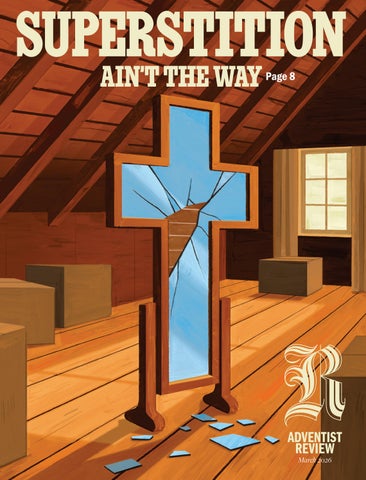
Create a flipbook