Visit our website, sign up for our newsletter, follow us on social media, watch Adventist videos, subscribe to our podcast, and read on WhatsApp. adventistreview.org/connect
Visit our website, sign up for our newsletter, follow us on social media, watch Adventist videos, subscribe to our podcast, and read on WhatsApp. adventistreview.org/connect
How Daniel 2 points higher than the stars
JUSTIN KIM
The good news is that “bad” stuff is decreasing—alcohol use, drug abuse, premarital sexual behavior, for example. But one thing that is soaring is astrology. Whether it is because of postmodern malaise, dissatisfaction with the seeming tyranny of science and reason, or a so-called primal call to paganism, we are witnessing a modern-day resurrection of astrology. According to a 2014 National Science Foundation survey, 40 percent of those aged 18-34 believe that astrology is indeed scientific. A United States survey found that 80 percent of Gen Z and younger millennials “believe in astrology,”1 and the Pew Research Center reports that 60 percent of American millennials believe in at least one aspect of New Age spirituality.2

years, resulting in major venture capitalist investments.4 AI is now calculating planetary positions with real-time NASA data, and finding new astrological revelations that were previously unknown and are supposedly more accurate, with chatbots giving the results. All this free and instantaneous.
The earliest evidence of astrology was first found in ancient Babylonian records. One familiar narrative is Daniel’s conversation with Nebuchadnezzar about biblical prophecy. The same restlessness and anxiety of the king is found in today’s generation. Accordingly, it looks to magic, sorcery, and astrology for answers.
We are witnessing a modern-day resurrection of astrology.
Because of global uncertainty resulting from volatile economies, exponentially increasing natural disasters, unending and inconclusive wars, and a general distrust of social and political institutions, a new generation is looking to old sources such as the position of the solar bodies to predict matters on, yes, love, war, money, and death. Younger generations are already on their journeys to discover and develop self. But add increasing isolation, a lack of direction, meaning, and purpose, and the de-emphasis of commitment. The result is heightened anxiety, at unseen levels, over the present and future. Astrology falsely promises wholeness, harmony, definition, refinement, and organization of the chaos around them. This resurgence in astrology is beyond crystal balls and zodiacs. The new incarnation has married astrology with technology, traversing memes, videos, reels, apps, and even artificial intelligence. As of January 2025 TikTok has housed more than 4.5 million videos on astrology. One popular astrology app rocketed from 7.5 million global users to 30 million.3 Spending on apps and other related products is projected to rise in the next five
Armed with Danielian faith and humility, Adventists are called at this time, not to ridicule, ignore, or disdain the astrology movement, but to point to those suffering from modernity to real answers found in biblical prophecy. There indeed is a God in heaven who reveals the deep and secret things (see Dan. 2:22). Not in the planetary bodies of the heavens or the extracted blood of livestock; the future lies with the God of heaven.
As Daniel 2 points to the God of heaven revealing secrets and mysteries (in Hebrew, raz) in seven verses (verses 18, 19, 27, 28, 29, 30, 47), Bible prophecy points to four incontrovertible conclusions that astrology cannot provide: there is a God who rules and reigns with order and righteousness; Scripture is reliable and infallible; the past can be explained and future foretold; and the revealed secrets of God provide true direction, meaning, purpose, and conclusive destiny, even in such topics as love, peace, blessings, and life.
It’s good that many are looking up. But let’s direct them even higher to the prophecies of Jesus and the Jesus of prophecy.
1 In Chas Newkey-Burden, “Gen Z and Astrology: Written in the Stars,” The Week, Jan. 23, 2025, https://theweek.com/tech/gen-z-and-astrology-written-in-the-stars 2 Claire Gecewicz, “ ‘New Age’ Beliefs Common Among Both Religious and Nonreligious Americans,” Pew Research Center, Oct. 1, 2018, https://www.pewresearch.org/short-reads/2018/10/01/new-age-beliefscommon-among-both-religious-and-nonreligious-americans/ 3 James Emery White, “Gen Z and the Rise of Astrology,” Church & Culture, June 12, 2025, https://www.churchandculture.org/blog/2025/6/12/gen-z-andthe-rise-of-astrology 4 Erin Griffith, “Venture Capital Is Putting Its Money Into Astrology,” New York Times, Apr. 15, 2019, https://www.nytimes.com/2019/04/15/style/

“We don’t want people to study the Bible on their own and then just stay somewhere where we wonder where they are. So we decided to use technology to get nearer to people, to go into their neighborhoods.”
—Ivana Kostadinović-Gigić, director of Hope courses for Hope Media Europe, explaining how her team is working to bridge the gap between Adventist media ministries and local churches. In her presentation during the 2025 Global Adventist Internet Network (GAiN) Europe convention in Pravets, Bulgaria, Kostadinović-Gigić showed how Hope Media Europe is now connecting viewers with local Adventist mentors across Germany, with very positive results.
d o you T hink T haT
T o R eceive g od’s gR ace, you musT live by g od’s Rules?
Church members were asked whether they thought that in order to be recipients of God’s grace, they should first live by God’s rules.
“I understood that when you focus on what you don’t have, you waste your time. God reminded me of everything I did have.”
—Gibdel Wilson, a visually impaired Adventist physician who for 25 years has been serving communities in need in Costa Rica and around the world. Despite the hurdles he had to face, Wilson has been not only a physician but also a lecturer, air rescuer, and volunteer doctor in international organizations. He even launched OneLife, a ministry that provides free medical care, assists indigenous communities, and supports the upkeep of guide dogs across Costa Rica.
Do you want to keep up with what is happening in our church? If you want to receive our weekly newsletter that features news, inspirational stories, videos, and more, sign up today.

“We are going everywhere because we are living in the last days and the gospel must be preached. Sitting and not telling the world about Jesus means we are against Him.”
—Harrington Akombwa, president of the Southern Africa-Indian Ocean Division, during the launch of Impact Mozambique 2026 in Maputo on November 29. The evangelistic initiative seeks to motivate church leaders and members to preach at multiple sites during May 2026. The campaign will receive additional support from global church leadership, with General Conference president Erton Köhler scheduled to preach at one of the sites.
The number of passengers that the new mission boat Luzeiro XXXII can carry, including up to 30 people who can sleep on hammocks. Unlike previous Luzeiro boats, the new craft is designed to carry full volunteer groups, reducing the need to rent additional vessels and lowering overall mission costs. It is expected the boat will continue a 95-year tradition of bringing care and hope to riverside communities in the Brazilian Amazon.
“It is truly remarkable and inspiring to see institutions from Korea and Bangladesh join hands to advance the mission and contribute to the global mission.”
—Soon Gi Kang, president of the Northern Asia-Pacific Division, in celebrating the signing of a financial support agreement, through which funds from Busan Adventist Hospital in Korea will support Bangladesh Union Mission’s plans for the construction of a new branch hospital in that South Asian nation.
The year church member Bruno Amah was imprisoned in Togo in what many believe was a sham accusation. On November 14 a delegation of Seventh-day Adventist Church leaders conducted a pastoral visit to the prison where he is held. The visit brought renewed solidarity, spiritual encouragement, and strengthened advocacy on behalf of a man whose unwavering faith is inspiring, church leaders reported. “My presence here has a purpose, and I live each day to fulfill it,” said Amah, who keeps ministering to other inmates.
The number of dinosaur footprints at the Carreras Pampa tracksite in Bolivia. Recently the Geoscience Research Institute (GRI) of the General Conference announced the publication of a landmark study by Raúl Esperante, senior scientist at GRI, in the open-access journal PLOS One. Esperante’s field-based research contributes to the Adventist Church’s ongoing efforts to carefully explore the natural world, engage with questions of origins from a biblical perspective, and support believers who value both faith and scientific discovery.
ReMindEdTM provides easy-to-access content to trigger relevant conversations.
an initiative that Adventist Health Ministries (AHM) from the General Conference launched in 2021 to provide resources on mental health keeps growing and improving, Seventh-day Adventist Church leaders recently reported. The ReMindEdTM initiative, which seeks to underpin the church’s global efforts for its members and the public to enjoy better mental health, is increasing its footprint as more people become aware of the resources available, leaders said.
On November 15, during the 2025 Global Adventist Internet Network (GAiN) Europe convention in Pravets, Bulgaria, Adrian Duré, producer and director of documentaries and coordinator of network projects for Hope Media Europe, provided an update on ReMindEdTM and shared about the next steps.
To introduce the discussion, Duré showed several questions to help convention attendees think and reflect on the issue of mental health in the Adventist Church and around the world. “How has the Adventist Church addressed mental health issues so far?” he asked; and “What is the reality of mental health in your culture?” Then Duré brought the topic to a more personal level. “Are you brave enough to be vulnerable?” he asked.
Duré explained that discussing such topics as suicide (or suicidal ideation) makes us extremely vulnerable. “It fills us
ReMindEdTM is a service of the Health Ministries Department of the General Conference. Image: General Conference Health Ministries

with fears, so we find it very difficult to talk about it in our churches, our institutions, and even with our friends,” he said.
With this in mind, Duré explained how Hope Media Europe has been partnering to produce resources for people to use and share, including some short films and documentaries. “Most of the content on ReMindEdTM are human-centered stories,” he reported. It includes films, animations, documentaries, and articles on addiction, anxiety, attachment, and burnout, as well
as discussions on loneliness, resilience, suicide, and trauma. It also includes articles of general interest on topics related to mental health and its challenges.
Duré shared some video snippets of the kind of material offered; these zero in on various mental health challenges.
“I had felt that I was a shadow of myself; I didn’t really recognize myself anymore,” a young woman shared in a video. “It’s not just a thought; it’s not just a fear. Your heart is pounding, you’re sweating. . . . Maybe you are nauseous or have a headache. You start thinking, Now I’m going to gain a lot of weight; I’ll never weigh this again. You even feel it’s morally wrong . . . to eat food.”
After the brief video, Duré emphasized that it is certainly “time to start walking alongside people and break the stigma. This is one of the goals that we have—to open the conversation, to create spaces,” by beginning to talk about it.
Duré also explained that ReMindEdTM is like a table on which you put all your content and many resources. It’s a place to encourage openness, which allows people in need to ask for help. ReMindEdTM also seeks to bring the discussion of mental health to churches, schools, and communities, he said.
At the same time, Duré emphasized, “ReMindEdTM is not a clinic . . . a hospital . . . [nor] a mental health provider. It’s not a self-help kit, but just a platform. It’s not a multimedia project to introduce specific beliefs or doctrines.”
Duré shared that among the developments for the next few months, there are plans to launch an application and to include content in languages other than English. He also mentioned exclusive content to be shared on social media channels, and the plan to include topics that haven’t yet been covered.
The ultimate goal, Duré said, is that as people get information and listen to stories of others who have struggled with various mental health challenges, they might feel motivated to seek help. “They might be doctors, therapists, psychologists, pastors, or friends, but seeking help is the first step,” he said.
In Lebanon the Adventist Learning Center is giving purpose to young refugees.
Reemas was just 9 days old when her parents, fleeing from the insidious bombardment of their home village in Syria, crossed the border into Lebanon as refugees. Growing up in the immigrant and refugee neighborhood of Bourj Hammoud in Beirut, her options for getting an education were rather limited. That was until her family found out about the Adventist Learning Center (ALC), a new school that welcomed with open arms everyone who desired an education.
Now as a seventh-grade ALC student, Reemas communicates well in English and sings in the school choir, as she herself explains with a wide smile. Beside her stands her classmate and friend, Farida, a second-generation Kurdish who grew up in Bourj Hammoud. And with them, Ahmad K. and Ahmad A., also Syrian refugees and ALC students.
“Education has given these refugees an opportunity to find a way to overcome their challenging childhoods and thrive,” local church leaders explained. “Instead of roaming the streets with no purpose, these kids are set to eventually become professionals and make a positive contribution to society.”
The ALC began more than a decade ago as an initiative to help newly arrived Syrian refugees overcome their war-related trauma and get an education, school principal Alexis Hurd-Shires explained. With the steady support of Adventist
Mission, the Middle East and North Africa Union Mission (MENAUM), local stakeholders, teachers, volunteers, and donors, the school, which recently moved to a new building, is changing young lives from hopelessness to hope, leaders said.
“EDUCATION HAS GIVEN THESE REFUGEES AN OPPORTUNITY TO FIND A WAY TO OVERCOME THEIR CHALLENGING CHILDHOODS AND THRIVE.”
On November 21 a special dedication ceremony of a new school building brought together church leaders, some students and teachers, and other stakeholders to thank God and supporters, listen to former students’ testimonies, and pray for everyone involved in the initiative. Special visitors included Rick McEdward, General Conference (GC) secretary and former MENAUM president; GC vice president Leonard Johnson; GC Education director Lisa Beardsley-Hardy; GC associate treasurer German Lust; and Global Mission Centers director ChanMin Chung.
During her opening remarks Hurd-Shires used the image of how the ocean turns sea glass smooth and beautiful little by little
to emphasize that ALC students “are very different from the students that came to us in 2013 with their lives destroyed by war, with their families broken apart. They were hurt, and they were in pain.” She explained that at the ALC, teachers “got an opportunity to step into their lives, surrounding them like the sea, to strengthen them, to brush off their rough edges, and to put them in a place where they can go and be part of something beautiful. . . . Every child who walks through our doors is changed.”
Inspiring Stories
During the November 21 dedication program several students shared their experiences and provided a window into the role the ALC had in their early lives and education. These included Ezzidine Jaafar, who studied from grades 1 to 8 at the ALC and graduated in 2021. “It’s an honor for me to stand here and share my experience,” he said confidently in English.
Jaafar shared that when he arrived as a Syrian refugee, he didn’t know anyone. “But the ALC became my family; it is now part of me,” he shared. “I was surrounded by kind people, and I found a safe place to express my feelings with people who really cared about me and really loved me.”
For Reem Al Mahmoud, who graduated in 2024, “the ALC stepped up with their wonderful teachers to provide an education [for me],” she shared. “Here I learned to express what I felt, to stand up for myself. [Teachers] didn’t only teach; I

learned more about how to become what I want . . . and I learned to dream big.”
Al Mahmoud added that one of the most important lessons she learned at the ALC is that “no matter what my past is, what matters is my future. That’s what I should think about, and that’s what I should look forward to.”
A final testimony showcased the story of Osman Hassoun, who arrived with his family as Syrian refugees in 2012 after managing to escape from civil war in his native country. Hassoun shared how during the war he was saved twice from dying. In one instance he and his dad hid under a grocery store shelf as bombs fell around them. “That moment changed me forever,” Hassoun shared as he recounted leaving their hiding to find relatives, friends, and neighbors maimed and dead all around him. “These are sad memories, and I still feel the weight of them,” he said.
But against all odds, Hassoun shared, at the ALC he learned that resilience, determination, and willingness to ask for help lead to success. After graduation he kept
studying and volunteering at the ALC as a physical education teacher. In 2022 Hassoun enrolled at Middle East University, where he is hoping to graduate in a year with a degree in business administration. “God has saved my life twice, and I believe He has a purpose for me,” he said.
As ALC vice principal, Luis Hurtado explained that he’s always hoping “for souls who are looking to have a meaningful life in a very complex area of the world. . . . The ALC is for people who want to have a meaningful life.”
Hurtado went on to explain the rationale and the theology behind the ALC initiative: “We know that in the end, everyone will confess that God is fair. And because God is fair, and God is love, He has allowed us to have a place like this, a place that shows God’s love, not only to those who are [benefiting] from this education but to those who hear about it.”
At the end of the testimonies, McEdward delivered the inaugural address. “This has been a journey of mission, sacrifice, dedication, and God’s provision,” he said.
“Let me say this clearly: God has provided for families in this ministry all through the years in ways we did not expect. And God continues to bless.”
McEdward shared about the first time he visited the ALC in an old building, to find out that it was “one of the happiest places he’d ever been.” He recounted how “kids were coming up to me with these giant smiles, and they were speaking to me in perfect English.”
He also reminded those attending the ceremony that the ALC “does not stand alone. It comes with the backing of our world [Seventh-day Adventist] Church . . . and the regional headquarters here in Beirut.”
McEdward told students that this shows that the church “cares about each one of you and your experiences because we want to do something significant for your life.”
After McEdward, East Mediterranean Region director Darron Boyd led a dedication prayer on behalf of students, teachers, and all those connected to the ALC. Pastors present raised their hands in a circle around them. “The Lord has a plan for this place and these young people,” leaders emphasized. “Thank You for allowing us to be part of Your plan.”
OFFICIAL NOTICE
Meeting of the Members Andrews University
Please take notice that a quinquennial meeting of the members of the Andrews University Corporation (commonly known as a “constituency meeting”) will take place on Tuesday, March 3, 2026, beginning at 3:00 p.m., in the Garber Auditorium of Chan Shun Hall on the campus of Andrews University in Berrien Springs, Michigan. At the meeting, the members will receive reports from Andrews University administration, elect a portion of the Andrews University Board of Trustees, and consider minor amendments to the bylaws.
Cindy J. Hill Secretary of the Corporation
When being healthy didn’t keep me from getting sick
Emily Gibbs
iwas just beginning my second year in college when a friend asked me to organize a sequence of health nuggets for an evangelistic series. At the time, I was confused.
Why me?
I had only recently given soymilk a second chance after my childhood days of tan-hued shelf-stable soymilk, and my willpower for outdoor exercise was apt to lessen each year with the seasonal drop in temperatures. I had even gained my “freshman 15” (the proverbial 15 pounds [seven kilograms] students gain in their first year of college) along with everyone else.
I remember thinking, Is he asking me because I eat big salads?
But the change my friend was affirming ran much deeper than my new love for tofu or the early-morning gym sessions. I had stopped letting my health happen to me and had decided to set in place habits that would shape the rest of my life.
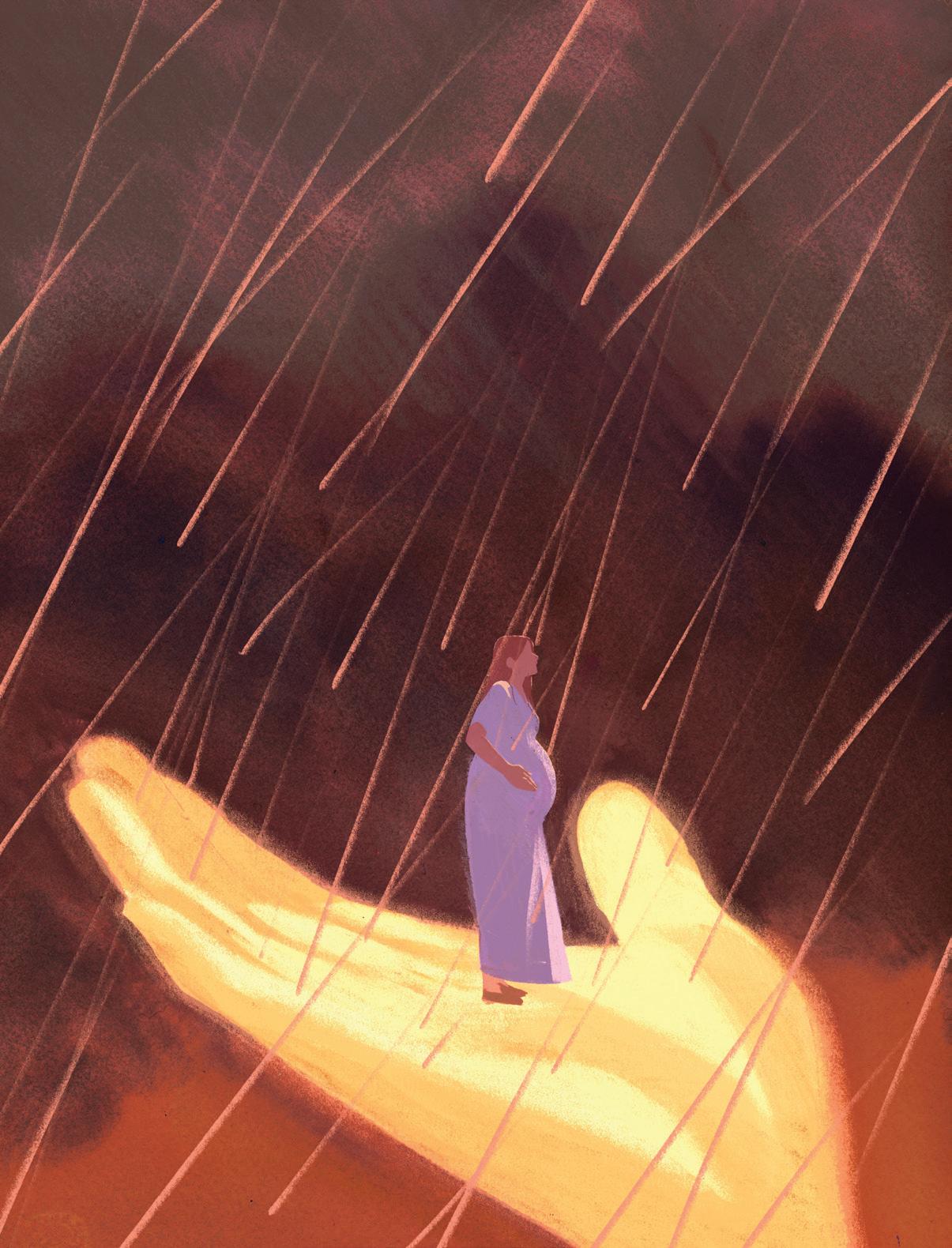
Fifteen years later I was going strong. Married, a mother to a toddler, and pregnant with our second child, I had just stepped away from a dozen years of teaching and had chosen to both stay at home with our littles and become part of the health ministries team for my local church. In addition to leading out in a monthly plant-based cooking class, I was walking every day in rain or shine or wind or snow or dark, sweating through pregnancy workouts in my
living room, and guzzling green smoothies for breakfast. I had an app on my phone to track my nutrient intake; I was drinking nearly a gallon of water most days; and if I happened to get sick, there was always hydrotherapy, or a handful of charcoal tablets, or an immunity-boosting concoction I could try. I had even embarked on a rest reform, thanks to the conviction I had found in Matthew Walker’s Why We Sleep. Armed with an arsenal of natural remedies and guarded by a host of lifestyle practices, I was confident in my ability to handle my own health challenges.
And then I started to lose my hearing and balance.
At first I assumed that the dizziness and tinnitus were because of the pregnancy, and I mentioned my complaint briefly at my 16-week prenatal visit. My obstetrician was unconcerned and suggested merely that I begin taking an allergy medication.
But when a few weeks later the left side of my face fell with what appeared to be a sudden onset of Bell’s palsy, I could feel my self-assurance faltering. For perhaps the first time in my life I began to doubt whether alternating an ice pack and a hot water bottle against my afflicted cheek would do any good.
My doctors were just as puzzled as I was when I returned home early from a vacation with a rapidly deteriorating body. According to their records, I had never had allergies. I hadn’t taken any sort of prescription medicine since a bout of bronchitis nearly a decade before. My blood pressure was normal. My weight was appropriate. My baby’s heart was ticking along predictably. My diet was exceptional. My activity level was above average. In fact, my 34-year-old health status was such that my physician dismissed me with the advice that I pick up a powerful inflammation-fighting steroid on the way home and try to relax.
When I sought out a second opinion the next day, however, my new physician was the one to address the full extent of my difficulties. I was practically deaf in my left ear, the entire left side of my face was paralyzed and partially numb, and I couldn’t pass the most basic of balance
God hadn’t needed to deliver me from my pain, because He had walked alongside me through it.
tests. Something had damaged three of my cranial nerves—and I needed an urgent MRI of my brain.
No Ram in the Thicket
The revelation that I had a tumor in my skull base came as a shock. At the same time, it represented both a validation of my concerns and an explanation for my month of losses.
But why me?
If it was difficult to break the news of my illness to myself, my family, and my closest friends, it was nearly unbearable for me to explain to the members of my cooking class why someone else would be leading out for the foreseeable future. Actually, I was downright embarrassed. What was this? The episode in which the healthy girl got brain cancer? Why hadn’t my beliefs and practices protected me?
Throughout the initial months of my diagnosis with primary central nervous system lymphoma, I did everything I could. In the aftermath of a craniotomy, I underwent a week of rehab to learn how to walk again. Between the five treatments of proton-beam radiation I received to “buy time” for the development of our baby, I continued to work on my physical therapy exercises. Upon returning home, I downed a potent two-quart mixture of cancer-fighting vegetable and fruit juices each day until my glucose levels became too elevated to continue—and I had grown a second tumor in less than a month anyway. In the week that elapsed between the urgent delivery of our healthy newborn at 35 weeks and the scheduled beginning of my chemotherapy regimen, I chased after alternative-care programs until, one by one, each denied my case as too risky.
It didn’t make sense. I had given God every opportunity to orchestrate something big. I had claimed His promises and waited eagerly and trustingly to see what He would do. I had prayed for every interaction with my surgeons, nurses, therapists, technicians, and oncologists, and I had watched Him arrange potentially life-changing conversations with many of them. Hadn’t I passed the test yet? Could I be healed now? Could I be released to go on with my life?
But although God continued to guide me to more and more scriptural assurances of deliverance and restoration, there was no ram in my thicket (see Gen. 22:13). There was just more suffering.
Not From, but Through
Twenty-four days after I entered the hospital for an autologous stem cell transplant, I returned home to my children and husband as a shrunken, bald,
weakened-but-cancer-free version of myself. My cheeks were gaunt and blotchy. My hands and chest were dotted with an engraftment rash and peeling. My jeans sagged dangerously if I put my cell phone in my back pocket.
But I was alive. And to my care team’s amazement, I wasn’t even in a wheelchair. Why me?
I had heard plenty of the other kind of stories within the posts of my online support community. I knew what could have happened.
Instead, I was still here. And there was the undeniable evidence that God had preserved me and sustained me during my dark nights and desolate days. I hadn’t contracted any infections or fevers while immunocompromised. There had been no allergic reactions. No feeding tubes. No severe illnesses. No relapses.
No, there hadn’t been one miracle—there had been a continuous string of them.
God hadn’t needed to deliver me from my pain, because He had walked alongside me through it. He had given me words of hope to share in the hallways. He had taught me empathy for others facing trauma. He had entreated me to trust Him despite my circumstances, to cling to Him when there seemed to be nothing else, so that I would retain my hold on Him more tightly when I was restored. And He had inspired me to tell others of what He had done.
Maybe living according to the laws of health did prevent me from experiencing worse—and that’s why I’m going to continue to follow them. Maybe I have survived in part because of my vitality beforehand—and so I’m endeavoring to rebuild that strength. But maybe that’s missing the point entirely.
Perhaps the purpose of my story is less about me and less about deciphering the reason for my part in it, and much, much more about bearing witness to the divine love that has enveloped me, upheld me, and saved me.
Emily Gibbs is passionate about sharing the lessons God has been teaching her through her roles as a wife, mother, and cancer survivor.
Live

What if the health message isn’t the point?
John Shin
This is a shortened version of the article. The full version is available online.—Editors.
There are some patient stories that stay with you. At the Mayo Clinic in Minnesota, United States, I cared for a woman with acute myeloid leukemia, and we believed she was going to die. She rapidly developed respiratory failure and was transferred to intensive care. A partial chemotherapy dose nearly killed her, forcing us to stop. Her condition worsened, and we told her family there was little hope. But as they prayed, she suddenly improved. A repeat bone marrow biopsy showed she was in complete remission—a modern-day miracle! This experience led her and her family on a spiritual journey, affirming that God loves them. She exhibited that perfect peace that comes from trusting God completely (Isa. 26:3).
Sadly, her leukemia recurred after two years, and this time it was unstoppable. Nothing we tried helped. When I visited her to discuss hospice care, she consoled me, took my hand, and said she was ready to die. She was grateful for the two extra years and looked forward to meeting her Savior. Her story’s beauty was that she learned to love and trust God through good and bad times, and her faith was not dependent on circumstances.
I shared this story at a gathering of Adventist medical professionals, and afterward a woman asked whether I had recommended the health message and whether the patient had adopted a plant-based diet. I explained that because of her frailty and weight loss, I didn’t feel comfortable restricting her diet further. The woman said, “If only she had gone plant-based, she might have lived.” Her comment surprised me. Knowing that the patient was miraculously healed the first time without lifestyle change and that her spiritual journey brought her God’s peace, I wondered: Did God withhold a second healing because she didn’t go plant-based? I told the story to show God’s loving
My focus was on extending his life, but God’s focus was on saving him for eternity.
providence and His desire for us to develop faith beyond outcomes. But this woman’s take-home message was that the patient died because she didn’t eat a plant-based diet.
Our church is blessed with the health message, but its true purpose can easily be overlooked. Ellen White received her first major health vision in 1863, when her husband, James, was very ill. In vision she received counsel to help her address her husband’s health, and she was also shown that “health reform is one branch of the great work which is to fit a people for the coming of the Lord. It is as closely connected with the third angel’s message as the hand is with the body.”1 Ellen White was made to understand that “the great object of hygienic reform is to secure the highest possible development of mind and soul and body. . . . Obedience to [all the laws of nature—which are the laws of God] . . . will aid us in a preparation for the life to come.”2 Therefore, the ultimate purpose of the health message is to prepare us for Jesus’ return.
How does the health message accomplish this? According to Sister White, God designs that “the great subject of health reform shall be agitated, and the public mind deeply stirred to investigate; for it is impossible for men and women, with all their sinful, health-destroying, brain-enervating habits, to discern sacred truth.”3 Physical health is vital because it impacts our ability to discern spiritual truths that lead to eternal life. The corollary is that poor health makes it more difficult to hear and obey God’s voice. “Anything that lessens physical strength enfeebles the mind and makes it less capable of
discriminating between right and wrong. We become less capable of choosing the good and have less strength of will to do that which we know to be right.”4
That is why we are told that “health should be as sacredly guarded as the character”5 and that “the body is the only medium through which the mind and the soul are developed for the upbuilding of character.”6
Seen this way, we understand that the health message is a means to an end, not the end itself. Its goal isn’t just prolonging life but helping people hear God’s voice and embrace spiritual truths that lead to salvation. God’s mission includes restoring His image in us. Jesus’ healing focused on spiritual health, with physical healing opening the way to the heart (see Luke 5:18-25).
A distorted version of the health message has become widely accepted—one that makes physical health the ultimate goal. This is essentially the health message without God, a counterfeit whose aim is to be as healthy and happy as possible for as long as possible. Longevity and happiness become idolized, and health becomes a bridge to nowhere.
I once cared for a breast cancer patient who was exceptionally health-conscious. When we discussed the benefits of a whole-food, plant-based diet and exercise, she became enthusiastic and said, “Dr. Shin, I’m so glad I met you, because we are totally on the same page!” She then revealed that she was not only plant-based but a raw, organic vegan. She wore power crystals, took supplements from a holistic biochemist, and received Reiki therapy from a practitioner 2,000 miles away. Though she had no religious background, she was deeply spiritual and believed we are all connected through energies. Yet despite everything, she felt something was missing and planned to visit a guru in India for more advanced “spiritual truths.” I realized her view of health’s ultimate purpose fundamentally differed from mine, even though we agreed on many principles.
Today’s culture favors health messages without God, often promoting plantbased diets and exercise better than our church has. Rather than competing, our health messaging should point to the Source of life (John 14:6).
Reflecting on that patient, I see Adventists also risk distorting the health message. Many members share remedies, supplements, herbal mixtures, or alternative therapies they believe can cure cancer. Some of these have evidence, but most do not. Many trust the treatment more than God’s providence. Like the woman who was convinced my patient would have survived if she had gone plant-based, many claim faith in God, yet insist on a regimen that will “truly” heal. With anecdotes and confidence in natural methods, they share their discoveries. When someone follows the regimen and has a poor outcome, blame falls on compliance rather than the protocol. I understand this mindset because I too once had it when my father was diagnosed with brain cancer in 2008.
For much of my life I believed there were only two ways to heal: God’s way and humanity’s way. God’s way involved natural remedies and gentle, nontoxic lifestyle changes. Humanity’s way involved synthetic drugs and invasive procedures that caused adverse effects and often did more harm than good. Because of this, when my father was diagnosed with brain cancer I had no doubt how we would treat him: We would do it “God’s way.” I was so committed to this belief that I did not allow him to meet with a medical oncologist to hear their recommendations. The fact that I am a medical
oncologist today is the greatest irony, and it took years for God to teach me that He can heal through both conventional medicine and natural approaches.
I prayed earnestly for God’s healing and researched natural remedies, alternative treatments, and naturopathic protocols, convinced that a cure existed. While wary not to trust everything online, I believed I just hadn’t found the remedy yet.
Despite our efforts and prayers, my father’s health worsened, testing my faith. We tried every diet, juicing regimen, and supplement, consulting naturopaths and missionaries, but nothing helped. Desperate, we took him to an Adventist lifestyle center praised for helping cancer patients (it is now closed). Upon arrival, I was disappointed—they recommended nothing new, and I wondered whether enrolling him had been a mistake.
As the program began, the physician addressed his physical and spiritual needs, discussed his depression and fears, and, at each visit, knelt at his bedside, holding his hands and praying for him and our family. These visits deeply moved us. He also spent hours giving presentations on the true purpose of health reform as shown in the Bible and the Spirit of Prophecy. He stressed that health was about discerning God’s voice, not just extending life. These talks profoundly affected us and seemed to transform my father.
As the physician continued to minister to him, my father experienced a spiritual reawakening and decided to be rebaptized, wanting to rededicate his life to God. Sadly, the day before his rebaptism, he suffered a grand mal seizure, was hospitalized, and passed away. Despite the heartache, I felt grateful. God had answered my prayers for healing on a much deeper level than I had expected, and I found comfort knowing I would see my father again someday.
Through my father’s illness God taught me that practicing the health message doesn’t guarantee health. Despite being a strict vegetarian, exercising regularly, and avoiding harmful habits, he developed brain cancer at 54. The injustice was highlighted
The goal of the health message isn’t just prolonging life but helping people hear God’s voice and embrace spiritual truths that lead to salvation.
during a hospital visit from an obese coworker who joked, “Hey, Kenton, no offense, but I think I’ll stick with my Philly cheesesteaks [a steak- and cheesestuffed sandwich].”
We live in a fallen world in fallen bodies, with DNA far removed from the tree of life. Even if we follow all health principles perfectly, we can still develop cancer or other illnesses through no fault of our own. Many genetic and environmental factors that we can’t always control or identify contribute to disease. Devout Adventist patients often feel guilt when diagnosed with cancer, thinking they did something wrong. They believe that perfect adherence to health principles would have prevented their disease. While lifestyle influences health—and poor choices can lead to poor health—following health principles doesn’t guarantee good health any more than obeying traffic laws prevents all accidents.
Another lesson God taught me was that He is willing to sacrifice the body to save the person. I assumed from the outset that God wanted to heal my father physically and that the only barrier was our lack of faith. My focus was on extending his life, but God’s focus was on saving him for eternity. It did not occur to me then that if my father lived another 30 years but never developed a saving relationship with Christ, he would gain nothing. Only after his death did I realize that losing 30 years of earthly life but gaining Jesus meant gaining eternity and losing nothing.
Unless the Lord returns in our lifetime, no matter how healthfully we live or what we do to slow aging, we will eventually die. Therefore, the ultimate purpose of life is not to try to obtain more time, but to use whatever time we have to know and love God. If we accomplish this, it does not matter how long we live.
C. S. Lewis wrote in The Problem of Pain, “God whispers to us in our pleasures . . . but shouts in our pain: it is His megaphone to rouse a deaf world.” God used my father’s illness to awaken him spiritually and reveal his need for Christ. Sometimes, as with the paralytic at Bethesda, this awakening leads to life. Other times, as with my father, it leads to death. But whether in this life or on the resurrection morning, God’s providence always results in healing.
I tell my patients that winning the battle against cancer is about, not how long you live, but how well you live whatever life you have left. This is true not only for cancer patients but for all of us. God has blessed us with His health message so we can live our remaining life as fully as possible. He gives us the gift of health and time to help us hear His voice and fall in love with Him. Let us never forget this as we embrace the health message and seek to relieve physical suffering. No matter the method, my prayer is that our pursuit of health will always be centered on seeking Jesus and leading others to Him.
1 Ellen G. White, Testimonies for the Church (Mountain View, Calif.: Pacific Press Pub. Assn., 1948), vol. 3, p. 161.
2 Ellen G. White, Christian Temperance and Bible Hygiene (Battle Creek, Mich.: Good Health Pub. Co., 1890), p. 120. (Emphasis supplied.)
3 Ellen G. White, Counsels on Diet and Foods (Washington, D.C.: Review and Herald Pub. Assn., 1938), p. 70. (Emphasis supplied.)
4 Ellen G. White, Christ’s Object Lessons (Washington, D.C.: Review and Herald Pub. Assn., 1900, 1941), p. 346.
5 Ellen G. White, Medical Ministry (Mountain View, Calif.: Pacific Press Pub. Assn., 1932), p. 77.
6 E. G. White, Counsels on Diet and Foods, p. 73. (Emphasis supplied.)
John Shin is a medical oncologist at Loma Linda University and president of the Adventist Medical Evangelism Network (AMEN), with advanced training from Loma Linda, the Mayo Clinic, and the National Cancer Institute. His research focuses on immunotherapy and lifestyle interventions in cancer treatment.
“No matter how hard I try I will never create anything as beautiful as this ripple of water cupped in a purple cabbage leaf.”
Campbell McGrath1
Though the text “Let him who thinks he stands take heed lest he fall” (1 Cor. 10:12) has been long smelted into my soul, after 46 years as a believer I can unabashedly declare that the reality not just of God, but of a loving God, is the most obvious truth that I know. Aside from the miracle of our rippled existence on a planet spinning and orbiting at supersonic speeds through a cosmos toxic a mere few miles up, or from the neuron-knotting complexity of a dust mite or of the medulla oblongata in a hagfish, God’s love so dramatically pours out from nature that it’s frightening that not everyone sees it.
For example, according to my wife, the bowl of breakfast cereal cupped before me contained (in various manifestations) soy, almonds, oats, cashews, blueberries, gogi berries, flaxseed, dates, apples, pumpkin seeds, cinnamon, and nutmeg.
And all these (what?) supposedly arose from tiny pellets (blueberry seeds are about 0.06 inches [1.5 millimeters] long) that grow out of dirt (dirt?) and expand into plants or bushes or trees brimming with herbs and nuts and fruit so beautiful and so tasty and so healthy for humans? Are you kidding me? If people didn’t see plants and trees and bushes—each bearing their own seeds—grow out of dirt, there is no reason they should believe it. But because they do see it, and so often too, they’re hardened to the over-the-top extravaganza of love that each life form from the dirt represents—a hardening varnished over by the scientific worldview, which teaches that “nature is nothing but shifting spatiotemporal arrangements of fundamental physical entities.”2
To believe that cashews, oats, dates, apples, cinnamon (or broccoli, or asparagus, or plums, or avocados, or melons, or whatever) resulted from the mindless shifting of “fundamental physical entities”—when it is screechingly obvious that
these were created by a loving Creator for our good—is blindness, willful blindness, and inexcusable, too (and if you don’t believe me, believe Paul [Rom. 1:20]).
“Oh, how thankful I am,” explained Goethe’s young Werther, “that my heart can feel the simple, harmless joys of the man who brings to the table a head of cabbage he has grown himself, and in a single moment enjoys, not only the vegetable, but all the fine days and fresh mornings since he planted it, the mild evenings when he watered it, and the pleasure he felt while watching it grow.”3
A bit over the top for a head of cabbage, yes. But still, I so get his point.
I asked ChatGPT, “How many different kinds of edible fruit, grains, nuts, and vegetables are there?” And it answered: “The number of distinct edible fruits, edible nuts, edible grains/seed-crops, and edible vegetables is in the thousands to tens of thousands collectively.” Even if 1,000 only (only?), nothing is believable about any of it. The dogma that a tomato plant or a cashew tree or a grapevine or a cabbage grows by chance, by natural selection, or by luck, out of dirt into what’s so lovely, tasty, and healthy for us, is a tragic commentary on how ideology can turn the obvious into the absurd.
What is logical and sensible is that thousands of “edible fruits, edible nuts, edible grains/seed-crops, and edible vegetables” sing, like C-flats and arias, about the love revealed at the cross.
My bowl of cereal does not, of course, prove that Jesus died on the cross, but unmistakably echoes the love that led Him to it.
1 Campbell McGrath, Fever of Unknown Origin: Poems, p.
2
3
Classic, 1962), p. 43.
Clifford Goldstein is the editor of the Adult Bible Study Guide. His latest book is An Adventist Journey, published by the Inter-American Division Publishing Association (IADPA).

I can unabashedly declare that the reality not just of God but of a loving God is the most obvious truth that I know.

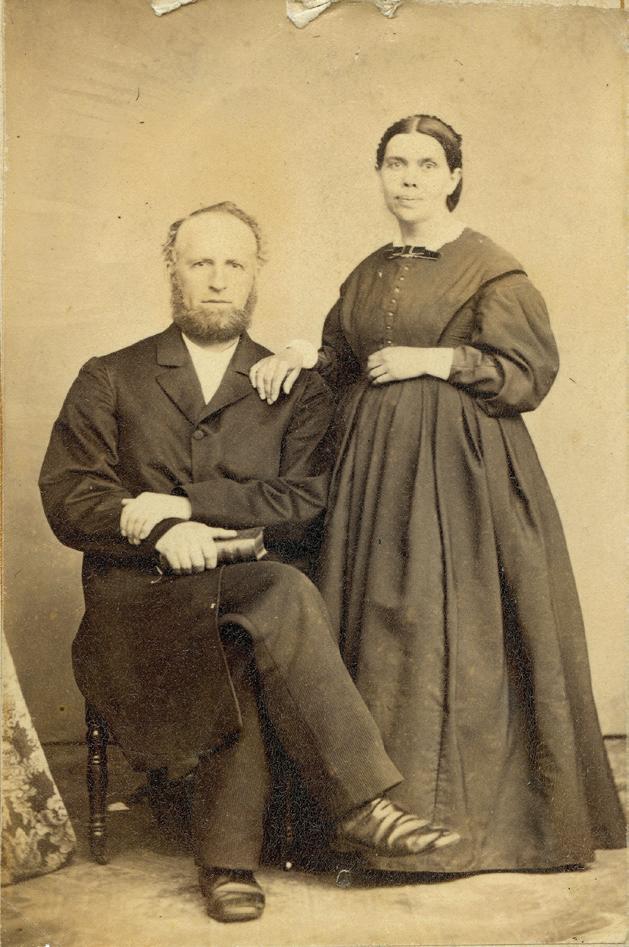
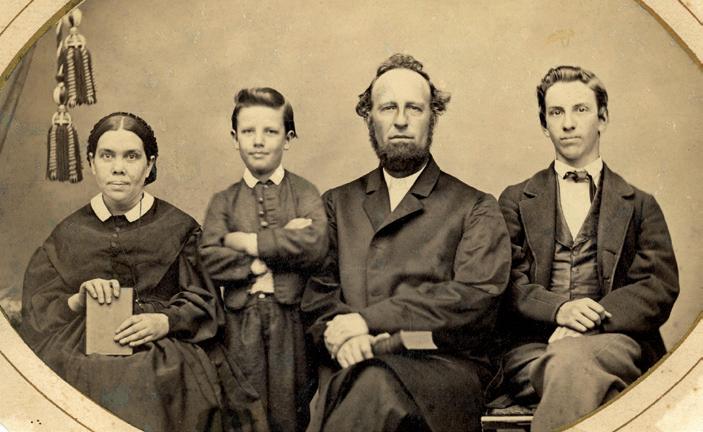
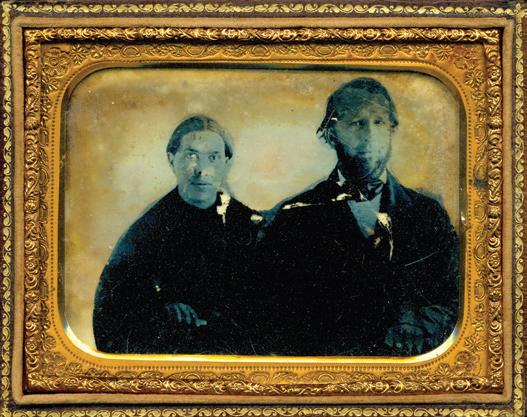
James White and Ellen Harmon’s marriage reflected a blend of spiritual dedication, mutual respect, love, and personal sacrifice that endured despite poverty, illness, heavy burdens, and different personalities. They played a fundamental role in the founding of the Seventh-day Adventist Church and were deeply committed to their shared faith and ministry.
James and Ellen met in 1845 after the Millerite Disappointment. Though discouraged, they remained committed to the belief in Christ’s imminent return. James soon recognized Ellen’s prophetic calling and chose to support her ministry, joining the group that traveled with her. Unpleasant rumors about Ellen journeying with a young man reached her mother, who urged her to come home. The false reports distressed Ellen because they grieved her mother, damaged her reputation, and prevented her from sharing her visions.
At first the nearness of Christ’s second coming left no room for thoughts of marriage. Later James realized that they could do greater work together and proposed to Ellen about a year after they met. Their mutual respect
and love had already grown deep. They were married on August 30, 1846, in Portland, Maine. James was 25, and Ellen was 18. Though young, both had already settled the two greatest decisions of life: to follow God’s Word and to dedicate themselves to mission.
They began their life together poor in means but rich in the conviction of spreading the Sabbatarian Adventist message. “We entered upon this work penniless,” remembered James, “with few friends, and broken in health.”1 James often labored manually to support his family, and despite physical challenges, his testimonies reveal gratitude, resilience, and a deep sense of calling.
The couple had four sons: Henry Nichols (1847), James Edson (1849), William Clarence (1854), and John Herbert (1860). Because of their constant travel, James and Ellen had to leave their first two sons with trusted friends—a decision Ellen called “the greatest sacrifice” she was “called to make.”2 It was painful for both parents, yet they found peace in serving God. When the family reunited permanently in 1851, they expressed deep gratitude to those who had cared for their boys.
James and Ellen often traveled together, but when separated, they expressed homesickness and deep affection for each other. In 1859, while away, Ellen wrote, “I have felt so homesick on the journey.”3 “There is no place to be so dearly prized as home,” she exclaimed after returning.4 Once when James was away, she affectionately penned: “The thought you are doing the will of God helps me to bear the loss of your company.”5
James expressed similar tenderness. While away, he penned: “I love my family and nothing but a sense of duty can separate me from them.”6
The Whites loved their children, and their primary concern was their salvation. Despite frequent absences from home, they urged their sons to seek God and live obediently. “We, your father and mother,” Ellen wrote, “feel a deep interest for you. You may sometimes think that your parents are too strict, that they watch you too closely; but, dear boys, our love for you is great. We have dedicated you to God.”7
A family friend, Adelia Patten, summarized their family life well: “The affectionate parents have often felt grieved that their pilgrim life has obliged them to be absent from their children so much. And while at home it has ever been their aim to educate them for usefulness, and to bring them up in the fear of the Lord. When away, the children have received by letter numerous tokens of the anxiety of their parents for their welfare.” 8
Illness, overwork, and emotional strain tested their faith, yet their marriage modeled endurance and spiritual commitment.
At the same time, the Whites also had to bear the devastating loss of two sons. In December 1860 John Herbert died when he was a 3-month-old infant. Then their oldest boy, Henry, died three years later at the age of 16. The family was devastated, but lived with the hope of the resurrection.
“A heavy blow has fallen upon us,” James wrote. “Our dear Henry sleeps in Jesus. . . . We are remarkably sustained under this affliction. God is good.”9 Ellen painfully wrote, “We feel the loss of our dear Henry very much. We miss him everywhere. The youngest and the oldest branches of the family tree have been broken off. We . . . [are] wounded but not comfortless. . . . Our hope is not in this world. If it were, we should be inconsolable.”10
Their surviving sons, Edson and Willie, also caused concerns for the parents, particularly Edson’s disobedience and stubbornness as a young man. From time to time they would reprove him, but always cautious to do it with love and affection. Thus, the Whites’ parenting demonstrated discipline and compassion. Though not perfect, they did what they thought was best to raise children who loved God.
The final 16 years of their marriage (1865-1881) were the most difficult yet spiritually mature. It was a period marked by illness, leadership burdens, and family trials. After James’s first stroke in August 1865, Ellen cared for him ardently. Although his health improved somewhat, his inability to rest and tendency to overwork led to recurring strokes throughout the 1870s.11 James continued to hold leadership roles, serving several terms as General Conference president and overseeing health, publishing, and educational institutions.
James’s illness also affected his relationship with Ellen. Their correspondence during that time reveals moments of marital tension, anger, and physical separation—followed by reconciliation and reaffirmed mutual commitment. They both acknowledged frustrations
and sought forgiveness. Their letters provide rare insight into their private world, exposing how faith and duty shaped their communication and coping mechanisms.
The Whites’ marriage was not free of hardships, but it was rich in devotion. Illness, overwork, and emotional strain tested their faith, yet their marriage modeled endurance and spiritual commitment. For James, Ellen was his “crown of rejoicing,”12 while Ellen described James as the man “whose large affections” sustained her through 36 years of ministry. She called him “the best man that ever trod shoe leather.”13 Their marriage was indeed a partnership of affection, sacrifice, and mission.
1 Ellen G. White and James White, Life Sketches of James White and Ellen G. White (Battle Creek, Mich.: Seventh-day Adventist Pub. Assn., 1880), p. 127; cf. Ellen G. White, Testimonies for the Church (Mountain View, Calif.: Pacific Press Pub. Assn., 1948), vol. 1, p. 75.
2 E. G. White, Testimonies for the Church, vol. 1, p. 101; cf. vol. 1, pp. 87, 581; Ellen G. Whiter, Spiritual Gifts: My Christian Experience, Views and Labors in Connection with the Rise and Progress of the Third Angel’s Message (Battle Creek, Mich.: James White, 1860), vol. 2, pp. 107, 108.
3 Ellen G. White, “Diary,” manuscript 5, Jan. 21, 1859.
4 Ibid., Jan. 26, 1859.
5 Ellen G. White to James White, letter 10, Oct. 12, 1860.
6 James White to Ellen G. White, Nov. 1, 1860; quoted in Arthur L. White, Ellen G. White (Washington, D.C.: Review and Herald Pub. Assn., 1985), vol. 1, p. 427.
7 Ellen G. White to Henry White, J. Edson White, and William C. White, letter 7, Aug. 1861.
8 Adelia P. Patten, “Brief Narrative of the Life, Experience, and Last Sickness of Henry N. White,” in An Appeal to the Youth (Battle Creek, Mich.: Steam Press, 1864), p. 18, quoted in Arthur L. White, Ellen G. White (Washington, D.C.: Review and Herald Pub. Assn., 1986), vol. 2, p. 62.
9 James White to Ira and Rhoda Abbey, Dec. 12, 1863.
10 Ellen G. White manuscript 13, Dec. 1863.
11 Gerald Wheeler, James White: Innovator and Overcomer (Hagerstown, Md.: Review and Herald Pub. Assn., 2003), pp. 162-169.
12 Ellen G. White and James White, Life Sketches, p. 126.
13 Ellen G. White, “Mrs. White’s Address,” in In Memoriam: A Sketch of the Last Sickness and Death of Elder James White, Who Died at Battle Creek, Michigan, August 6, 1881, Together With the Discourse Preached at His Funeral (Battle Creek, Mich.: Review and Herald Press., 1881), p. 42; “Interview With Mrs. E. G. White Regarding Early Experiences,” Ellen G. White manuscript 131, Aug. 13, 1906.
Gerson C. Rodrigues has served as professor of Adventist history at Andrews University since 2005. Before that, he spent 13 years as a teacher and as director of the Ellen G. White Research Center at the Seventh-day Adventist Theological Seminary of Northeast Brazil Adventist University in Bahia, Brazil.

wives, submit yourselves unto your own husbands, as it is fit in the Lord. Husbands, love your wives, and be not bitter against them” (Col. 3:18, 19).
How much trouble and what a tide of woe and unhappiness would be saved if men, and women also, would continue to cultivate the regard, attention, and kind words of appreciation and little courtesies of life which kept love alive and which they felt were necessary in gaining the companions of their choice. If the husband and wife would only continue to cultivate these attentions which nourish love, they would be happy in each other’s society and would have a sanctifying influence upon their families. They would have in themselves a little world of happiness and would not desire to go outside this world for new attractions and new objects of love. . . .
Many women pine for words of love and kindness and the common attentions and courtesies due them from their husbands who have selected them as their life companions. . . . It is these little attentions and courtesies which make up the sum of life’s happiness. . . .
Every couple who unite their life interest should seek to make the life of each as happy as possible. That which we prize we seek to preserve and make more valuable if we can. In the marriage contract men and women have made a trade, an investment for life, and they
Timeless words of advice and encouragement from a modern-day prophet
Ellen G. White
should do their utmost to control their words of impatience and fretfulness, even more carefully than they did before their marriage, for now their destinies are united for life as husband and wife, and each is valued in exact proportion to the amount of painstaking effort put forth to retain and keep fresh the love so eagerly sought for and prized before marriage.
“Let the husband render unto the wife due benevolence: and likewise also the wife unto the husband” (1 Cor. 7:3).
Husbands and wives should feel it their privilege and their duty to reserve for the privacy of each other’s society the interchange of love tokens between themselves. For while the manifestation of love for each other is right in its place, it may be made productive of harm to both the married and the unmarried. There are persons of an entirely different cast of mind and character, and of different education and training,
who love each other just as devotedly and healthfully as do those who have educated themselves to manifest their affection freely; and there is danger that by contrast these persons who are more reserved will be misjudged, and placed at a disadvantage. While the wife should lean on her husband with respect and deference, she can, in a wholesome, healthful way, manifest her strong affection for and confidence in the man she has chosen as her life companion. . . . It is the high privilege and the solemn duty of Christians to make each other happy in their married life. . . . Kind words, looks of sympathy, expressions of appreciation, would be to many a struggling and lonely one as the cup of cold water to a thirsty soul. A word of sympathy, an act of kindness, would lift burdens that are resting heavily upon some shoulders. . . . Every word or deed of unselfish kindness to souls with whom we are brought in connection is an expression of the love that Jesus has manifested for the whole human family.
Seventh-day Adventist believe that Ellen G. White (1827-1915) exercised the biblical gift of prophecy during more than 70 years of ministry. This excerpt is taken from In Heavenly Places, pp. 206, 207.


in some segments of contemporary society there is growing skepticism about the veracity of scientific reports, the integrity of scientists, and the honesty of corporations that use science to sell their products. Some individuals and groups vociferously object to science itself because of mistrust fueled by legitimate concerns. Social media debates, conflicting studies, and hidden financial interests have only deepened this mistrust. Yet skepticism toward science is not new—and should not surprise us.
Science is a profoundly human pursuit—noble yet imperfect—driven by our desire to uncover truth despite our flaws. Its progress depends on testing, failing, correcting, and refining, so discoveries are often wrong before they are right. Human weakness means that some will distort data or exaggerate results for personal gain, but this reflects moral failure, not scientific untrustworthiness. The proper response is not cynicism but discernment—the wisdom to separate truth from deception. Cultivating discernment in this realm requires appreciating what science truly is and is not, what it legitimately claims, and how easily it can be led astray when humility and integrity are lost.
At its best, science is not a collection of facts but a disciplined way of seeking truth through honest observation and testing. This approach—known as the scientific method—provides a structured means of asking questions and evaluating answers. It begins with careful observation, followed by a hypothesis, a testable explanation predicting what should occur if the idea is correct. Experiments are then performed to gather data supporting or refuting that prediction. Other researchers repeat or challenge the findings, and only through consistent results do conclusions gain strength. The power of this method lies in its humility and self-correction: each stage minimizes bias, applies statistical scrutiny, and rewards replication, ensuring that knowledge becomes progressively clearer even as uncertainty is never entirely erased.
Biblical faith and true science begin with the belief that reality is coherent and that truth can be discovered.
Medical research utilizes the scientific method extensively to evaluate natural and synthetic therapeutic interventions. A good example can be seen in the study of vitamin D and diabetes. Years ago physicians observed that people with lower sunlight exposure seemed to have higher rates of type 2 diabetes. This observation led to the hypothesis that vitamin D, produced in the skin by sunlight, might help regulate insulin and blood sugar. Researchers then tested this idea in laboratory studies, animal models, and clinical trials. Some early studies suggested dramatic benefits, while others showed only modest or no effect. Instead of dismissing the question, scientists refined their methods—accounting for differences in genetics, diet, and baseline vitamin D levels. Larger randomized trials followed, reducing the role of chance and revealing that adequate vitamin D does play a supportive—
though not magical—role in metabolic health. The lesson was not just about vitamins but about how systematic testing corrects early enthusiasm, separates coincidence from cause, and produces balanced truth.1
At its core, science is a disciplined habit of humility—a commitment to say, “This is what we know so far, and we are willing to change our minds when better evidence appears.” It is not arrogance in knowledge but reverence for truth, ever open to correction. The word scientia, Latin for “knowledge,” originally referred to the ordered pursuit of understanding. Over the centuries it has come to signify a careful and methodical search for truth that deepens comprehension of the natural world. In modern times “science” usually means knowledge confirmed by evidence—data gathered, analyzed, and tested through transparent, repeatable methods that allow others to verify results. Yet historically the term had a wider reach: any disciplined, reasoned way of knowing counted as science. Theologians once spoke of “the science of virtue” or “the science of happiness,” expressing the same intellectual rigor applied to moral and spiritual truth. Whether exploring the cosmos or the conscience, science is a quest for understanding— anchored not in pride but in the humility to keep learning. Ellen G. White used the term in this rich, classical sense. She wrote, “The science of redemption is the science of all sciences; . . . the science that will be the study of God’s redeemed throughout endless ages.”2 To her, science—whether of atoms or of salvation—was about discovering the laws and patterns that reveal the character of the Creator. The same God who designed gravity also designed grace. The physical universe runs on principles of order and balance; the moral universe runs on the same divine consistency. Both can be studied, though one by experiment and the other by experience.
Biblical faith and true science begin with the belief that reality is coherent and that truth can be discovered. So rather than being adversaries, they become companions in the search for truth. Both demand integrity, honesty, and humility before evidence—whether the evidence is written in the stars or in Scripture. The scientist studies God’s world; the believer studies God’s Word and God’s world. Each reads different chapters of a book written by the same Author. When we look for pattern and purpose in the natural world, we step intellectually onto holy ground, for order itself is divine handwriting. “The things of nature are an expression of God’s character.”3
Ellen White often spoke about true science, false science, and what she called “science falsely so-called.”4 True science, she said, is humble and harmonious with God’s revealed truth—it begins with reverence and ends in
To test the claims of science or theology by the Spirit is not to distrust knowledge but to sanctify it.
wonder. “All truth, whether in nature or in revelation, is consistent with itself in all its manifestations.”5 True science does not compete with Scripture; it complements it. Every genuine discovery—from gravity to genetics—simply reveals more of God’s creative wisdom.
False science, by contrast, is pride in disguise. It takes the tools of reason and turns them against their Maker, claiming that human intellect is the final judge of truth. It can build machines but not morals; measure galaxies but ignore grace. False science “has captivated and enslaved the minds of many.”6
Then there is what Scripture calls “science falsely so called” (1 Tim. 6:20, KJV)—knowledge that looks scientific but is not. It is speculation dressed in the language of expertise. It borrows the vocabulary of research but not its honesty. Such “science” is confident where evidence is weak and dismissive and where mystery remains. It pretends to know, but it refuses to learn. It is, in short, the counterfeit of knowledge. This counterfeit knowledge has long been placed at odds with divine truth. Ellen White observed, “Science, so-called, and religion will be placed in opposition to each other, because finite men do not comprehend the power and greatness of God.”7 True science welcomes correction; false science resists it. The counterfeit borrows the form but denies the spirit of truth-seeking. Genuine science is transparent, testable, and humble; false and so-called sciences are manipulative, biased, or self-serving.
That is why godly discernment is indispensable. The discerning person does not reject reason; rather, he or she joins reason to revelation. The apostle Paul commended the Bereans because when they heard new teaching, they “searched the Scriptures daily to find out whether these things were so” (Acts 17:11). They did not accept blindly, nor did they dismiss arrogantly—they tested. Their faith was rational, and their reasoning was spiritual.
True discernment follows that Berean pattern. It listens, investigates, and measures every claim—scientific or spiritual—by two lights: the Spirit of truth and the principle of sound reasoning. Both lights come from the same Source. To be “spiritual” without rational thought is credulity; to be “rational” without spiritual

discernment is arrogance. The balanced mind holds both together, weighing evidence with integrity and judging all things by the character of God revealed in Christ and in creation.
In chapter 58 of Patriarchs and Prophets Ellen White implies that the study of science brings the student face-to-face with the Creator of the universe.8 In such a case, discernment is not suspicion—it is worship informed by reason. To test the claims of science or theology by the Spirit is not to distrust knowledge but to sanctify it.
In practical terms, how should a thoughtful believer respond when a headline announces, “New Study Proves . . .”? The Berean model gives us a clear guide: pause, test, and pray.
First, pause before reacting—and pray. Not every discovery is as new—or as true—as it sounds. Science corrects itself constantly; today’s headline may be tomorrow’s retraction. Resist both the impulse to believe everything labeled “scientific” and the temptation to dismiss everything that isn’t familiar.
Second, prayerfully and carefully test the claim. Ask questions:
• Who conducted the research?
• Was it reviewed by trustworthy, impartial peers, or funded by vested interests?
• Does it fit with what we already know from consistent evidence?
• Does it align with the inspired truth?
In other words, apply both sanctified reason and spiritual prudence. The God who calls us to love Him with all our mind (Matt. 22:37) invites us to think critically, not cynically.
Finally, pray for discernment. The Holy Spirit is the Spirit of truth. He may not supply new data, but He refines our judgment to recognize integrity when we encounter it. He softens arrogance and sharpens perception. Under His guidance, reason and faith become allies.
A believer who practices the prayerful approach of pause, test, and pray will not be naive, gullible, or fearful. Like the Bereans, they will welcome truth from every trustworthy source, acknowledging that all genuine light flows from the same divine Source. Whether we examine nature through a microscope or Scripture through prayerful meditation, the goal remains the same—to know the reality of God and to live in harmony with it. True science, then, does not exclude God; it reveals His consistency and faithfulness in creation. So when new discoveries arise, pause, test, and pray. Ask if they reflect truth’s hallmarks—honesty, coherence, and humility. Discernment doesn’t reject inquiry; it redeems it, transforming every search for knowledge into a step toward the Creator.
1 Current recommendations related to vitamin D and type 2 diabetes: Vitamin D supplementation shows promise for individuals with type 2 diabetes, as it may improve blood sugar control, increase insulin sensitivity, and reduce inflammation. Evidence regarding its ability to prevent type 2 diabetes in those with prediabetes, however, is mixed, with some large trials showing no significant preventative effect, while others suggest potential benefits. It is important for individuals to talk to their doctor to determine if supplementation is appropriate and to get their vitamin D levels checked with blood tests.
2 Ellen G. White, Education (Mountain View, Calif.: Pacific Press Pub. Assn., 1903), p. 126.
3 Ellen G. White, Testimonies for the Church (Mountain View, Calif.: Pacific Press Pub. Assn., 1948), vol. 8, p. 263.
4 See, for example, Signs of the Times, May 18, 1882.
5 Ellen G. White, Patriarchs and Prophets (Mountain View, Calif.: Pacific Press Pub. Assn., 1890, 1908), p. 114.
6 E. G. White, Testimonies for the Church, vol. 4, p. 584.
7 Ellen G. White, Evangelism (Washington, D.C.: Review and Herald Pub. Assn., 1946), p. 593.
8 E. G. White, Patriarchs and Prophets, p. 599.
Zeno L. Charles-Marcel, a board-certified internist, is the director of Adventist Health Ministries at the General Conference.

This article draws upon Michael W. Campbell’s biography of Ratu Ambrose and Milton Hook’s account of Adventism in Fiji, both published in the Encyclopedia of Seventh-day Adventists (ESDA), available at encyclopedia.adventist.org. It was prepared by Dragoslava Santrac, ESDA managing editor.—Editors.
adventist missionaries from North America and Europe traveled far to share the gospel, often enduring great hardships and even risking their lives. Still, their work would not have succeeded without the help of local converts who served as a bridge between cultures and carried the gospel to their own people. One of the first Fijians to do this was Ratu Ambrose, a high chief whose influence changed how his country saw the new faith. For a long time Adventism seemed foreign and distant. But when this respected leader accepted it, hearts began to open, and the gospel found a home in Fiji.
The story of the Adventist message in Fiji began on the rolling blue waters of the South Pacific with a missionary ship named Pitcairn. On August 3, 1891, its sails caught the winds that carried the gospel to Suva, Fiji’s harbor town. John and Hannah Tay, two of the first Adventist missionaries to arrive, stayed in Suva to sell books to Europeans and to plant a seed of faith that they would sadly not live to see blossom. John Tay, the first to dream of a mission base in Fiji, succumbed to influenza just months later, on January 8, 1892. Yet his vision would not die with him.
The Pitcairn returned to Fiji on its second voyage in August 1893, this time with Dr. Merritt Kellogg on board. As he traveled through the islands, Kellogg noticed something special: the people seemed ready to hear the gospel. “We ought by all means to place workers on the Fiji Islands,” he wrote. “I have great hopes of the native people.”1 Those words proved prophetic. John and Fanny Cole answered the call in 1895, transferring from Norfolk Island to Levuka, the old capital of Fiji. After a year they moved to Suva and were joined by John and Susie Fulton on July 18, 1896. Their task was immense: spreading a new faith across a scattered archipelago where travel was perilous and roads were nearly nonexistent. To reach the villages tucked behind the reefs, they acquired a tiny boat they
In a society in which rank and dignity defined identity, the sight of a royal chief kneeling before a child echoed the very image of Christ washing His disciples’ feet.
called The Loughborough. It was the first Adventist mission boat permanently stationed in the South Pacific.
Eventually The Loughborough was replaced by a larger boat called Cina, or “Lamp,” which showed their hope that Christ’s light would reach all of Fiji. The missionaries learned the language, printed tracts, translated hymns, and preached wherever they could. Still, the gospel’s greatest breakthrough did not come through foreign voices but through the transformed life of a Fijian chief.
In 1899 two Fijians stood at the forefront of a spiritual awakening: Pauliasi Bunoa, once a Wesleyan missionary, and Ratu Ambrose, the hereditary tui (king) of Suva. Their conversions marked a new chapter for the Adventist message in Fiji.
Bunoa had read a tract on the Sabbath by John Fulton (“Adventist Apostle to the Fiji Islands”) and could not rest until he obeyed the conviction of his heart. Ambrose was drawn by the witness of Bunoa’s faith. A high chief and governor of the islands, Ambrose had a lineage that could be traced directly to Fiji’s royal house. His mother, Adi Elenoa Mila, was a sister to King Cakobau, who had ceded Fiji to Britain in 1873. His father descended from Ratu Tanoa, Cakobau’s father. By birth and influence, Ambrose was a man of immense power. He had married Adi Kelera, daughter of the Vunivalu of Rewa, uniting two of Fiji’s most powerful clans. As a chief, he oversaw 13 villages. To his people, he was a man of prestige and authority. To God, he would become a humble servant.
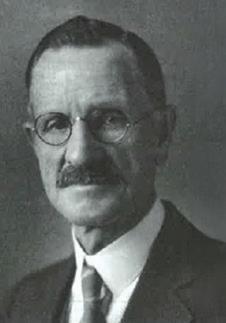
Once known as “the biggest rogue in Fiji,” Ambrose died a forgiven man, humble, devoted, and at peace with his Creator.
Ambrose first felt the tug of divine grace through Bunoa’s quiet testimony. One Sabbath evening Ambrose visited Bunoa’s home. As they prayed, something broke inside the proud chief. He began to weep deeply, and said he “was desirous of being a Christian.”2 “He . . . cried out, ‘I am a sinful man; what must I do to be saved?’ ”3
Beside him, his wife, Adi Kelera, listened in astonishment as her husband’s heart melted before God. She urged him to worship with the missionaries. And so they did. Soon after, Ambrose gathered his people and declared that no one had pressured him to change his faith, that “he knew it was right, and would stand with it.”4
That year, 1899, Ratu Ambrose and Pauliasi Bunoa were the first Fijians to join the Adventist Church through baptism by immersion. It was a simple service, but to those who witnessed it, it marked the dawn of a new era.
Soon after his baptism Ambrose took part in his first Communion service. John E. Fulton later described it as one of the most moving moments of his ministry. “A week ago last Sabbath we observed the ordinances of the Lord’s house,” Fulton wrote. “That was a blessed day. The ordinance of humility was new to our Fijian brethren but was greatly enjoyed.”5
The next moment surprised everyone. “Ratu Ambrose, who is one of the highest chiefs of Fiji,” Fulton recorded, “washed a young boy’s feet.”6 In a society in which rank and dignity defined identity, the sight of a royal chief kneeling before a child echoed the very image of Christ washing His disciples’ feet. Many could hardly believe their eyes.
Fulton was touched by what he saw. He said, “[Ambrose] is a high chief and much respect is shown him. But he seemed to enjoy bowing down as did his Saviour to show his love for his inferiors.”7
Some people thought Ambrose would lose his social status by following Christ. There were rumors that the missionaries had paid him to keep the Sabbath. But Fulton knew better. He wrote, “People say he was the biggest rogue in Fiji, and that we must have paid him a
big sum of money to keep Sabbath. I remember when he came to church one Sabbath morning, he prayed and broke down and cried. He invited us to the town and gave us land. . . . It seemed too good to be true, and we all cried with him for joy.”8
That gift of land became the foundation of the Adventist mission in Fiji. Ambrose donated property and resources that allowed the missionaries to establish a permanent base. Through his generosity the mission gained a home that continues to serve the church even today. Within a year 29 church members worshipped in Ambrose’s village. What a remarkable beginning for the Adventist movement in Fiji!
Ambrose’s conversion also gave the new faith legitimacy. In a culture in which the word of a chief carried spiritual weight, Ambrose’s embrace of Adventism encouraged many others to take the message seriously. His influence bridged the divide between foreign missionaries and local communities. In every sense, the gospel had found a Fijian voice.
Together with Fulton and Bunoa, Ambrose helped take the gospel to other islands. In February 1900 the three men set sail aboard Cina on an exploratory trip through Batiki, Ngau, Nairai, and Vanua Levu. Later Bunoa voyaged south to Kadavu, distributing literature. When a storm wrecked their cutter on the reef, the setback only deepened their resolve. Another vessel, the Andi Suva (“Queen of Suva”), soon replaced it by late 1903.
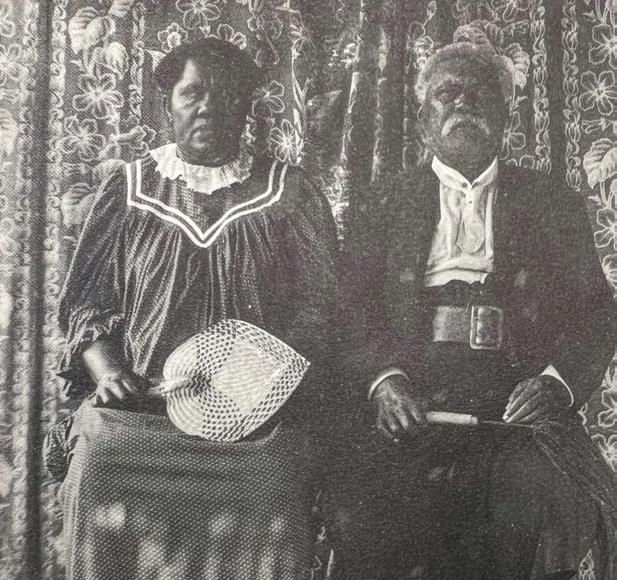
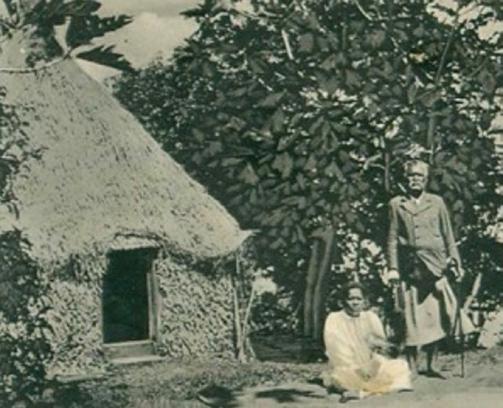
Meanwhile, Adventist work expanded to the Lau Group in eastern Fiji. Calvin and Myrtle Parker, another missionary couple, joined the effort, enduring difficult living conditions and illness. Yet the flame that Ambrose helped kindle would not die out. Churches began to rise, hymnbooks were translated, and tracts printed in the Fijian language spread across the islands. Fulton even published Na Rarama (“The Light”), the first Adventist periodical in the South Pacific. Cole abridged and translated The Great Controversy, titled Nai Tukutuku ni Veigauna, a 1903 edition of 2,000 copies printed by Avondale Press.
Though Ambrose had traded royal privilege for Christian discipleship, he continued to use his influence for the gospel. He met some of the leading Adventist pioneers of his time. In 1899 he welcomed General Conference president George A. Irwin to Fiji, calling him Qase Levu kei Vuravura (“the big man of all the world”). Later, in 1907, he hosted Dr. Daniel Kress and Septimus Carr. Kress recalled, “We all sat down on the floor in a circle and carried on a pleasant conversation. . . . Brother Ambrose and his family were so genteel and polite that we soon forgot [we were sitting on the floor], and felt we were in the presence of friends.”9
In 1910 Ambrose traveled beyond Fiji to attend the Australasian Union Conference session, accompanied by another early Fijian convert, Alipati Rainima. It was a momentous occasion and proof that the message once brought by foreign missionaries had taken deep root in Fijian soil.
Life’s final years were not without hardship. Around 1911 or early 1912 Ambrose suffered a terrible accident
while fishing with dynamite, losing his right hand. Even so, he remained steadfast. When typhoid fever struck the following year, it became clear that his life’s journey was nearing its end.
On December 10, 1912, Ratu Ambrose fell asleep in Christ. He was approximately 65 years old. Those who were with him in his final hours heard him speak words that echoed his deep faith: “I have no fear at all, for I am trusting in the Lord. Today I look to my Saviour on the cross. It is He that separated me from the world and brought me into this clean church. I know I have been a bad man, but He has forgiven me.”10
His testimony was not one of perfection, but of redemption. Once known as “the biggest rogue in Fiji,” Ambrose died a forgiven man, humble, devoted, and at peace with his Creator.
The missionary journey that began with the Pitcairn and the vision of John Tay found its fulfillment in the faith of a chief who knelt like his Savior. More than a century later the story of Ratu Ambrose remains one of the most moving chapters in the history of the Adventist Church in Fiji. His conversion transformed how his people viewed the gospel. Through him the Adventist faith took on a Fijian face and became a living experience of grace rooted in the islands’ soil. From his royal home to the shoreline where he prayed, from his gift of land to his final words of faith, Ratu Ambrose’s story stands as a testimony to the transforming power of Christ. The chief who once ruled by decree became the servant who ruled by love.
Because of his surrender, the light that once flickered on a small mission ship now shines across the Pacific. Na Rarama, “The Light,” still burns in the hearts of Fijian believers today.
1 M. G. Kellogg, “News From the Pitcairn,” The Bible Echo, Nov. 15, 1893, p. 366.
2 Myrtle G. Parker’s letter cited in “Union Conference,” Australasian Union Conference Record, July 17, 1899, p. 4.
3 C. H. Parker, “Mission Studies: Fiji,” Australasian Union Conference Record, May 31, 1909, p. 7.
4 M. G. Parker’s letter.
5 J. E. Fulton, “Progress in Fiji,” The Missionary Magazine, April 1900, p. 169.
6 C. H. Parker.
7 Fulton.
8 J. E. Fulton, “The Work in Fiji: Evening After Sabbath, July 12,” Australasian Union Conference Record, July 22, 1901, p. 22.
9 Daniel H. Kress, “Leaving Australia, and Our Trip to Fiji,” Australasian Union Conference Record, May 13, 1907, p. 8.
10 “Obituaries,” Australasian Union Conference Record, Jan. 20, 1913, p. 7.
Michael W. Campbell, Ph.D., serves as director of Archives, Statistics, and Research for the North American Division and has authored multiple works on Adventist history.
Milton Hook, Ed.D., is a retired Australian pastor, educator, and missionary whose writings include several volumes on Adventist heritage.

The brown muddy waters of the Ucayali River swirled around the Auxiliary II, a mission boat, as it slowly worked its way against the current. Two cousins, Joanna, 18, and Naomi, 14, stood at the front of the boat, watching with wide eyes the unfamiliar scenery creep by them.
“Oh look! Did you see that?!” exclaimed Joanna, “I think I just saw a freshwater dolphin!”
Naomi smiled. “Isn’t this experience just amazing? There are so many things to see! Did you notice that dugout canoe loaded down with bananas that passed us just a little while ago? I’m surprised at how much fit in that little boat!”
Joanna and Naomi were traveling with their Aunt Jessica and Uncle Guillermo and their cousins up the winding Ucayali River to bring medical attention to the remote villages scattered along its bank. The people who lived on this river lived a long way from hospitals.
The mission boat began to turn toward a small village somewhat hidden by the dense jungle.
“This must be our first stop. Let’s go see if we can help Aunt Jessica organize the medicines,” suggested Joanna.
After helping their aunt organize and carry all the medical supplies into the village, they set up the temporary clinic
under some mango trees. The people crowded around, curiously watching their every move. In the evening after the clinic was over, they held a children’s event where they sang songs, told Bible stories, and played some games. Before they realized it, the time had come to travel to the next village.
That night the girls were tired and ready to lie down on their bunk beds. Their room was at the back of the boat with their little cousins. After saying their prayers, they crawled under their mosquito nets and fell fast asleep.
The days quickly flew by as the little group traveled from one village to the next, helping wherever they could. Before they realized it, the time had come to return to the mission base. They stopped at a certain village on their return trip for the night. After having a short meeting with the villagers, the tired group went to bed.
Naomi slept fitfully until she heard her aunt’s voice saying, “I think they have a gun!” At once Naomi was wide awake. What was happening? Aunt Jessica answered the question. “Children, we are about to be robbed. There are men on the boat right now. Don’t be afraid, God will take care of us. In fact, let’s pray right now.”

Uncle Guillermo and Aunt Jessica knelt and prayed a short but earnest prayer. Almost as soon as they were through, two armed men entered the room. One of the men began questioning Aunt Jessica. They wanted to know who was in the room. After she told them, they ordered her and Uncle Guillermo out of the room. Then they began to systematically go through all the belongings that were stored in makeshift dressers and duffel bags. Naomi and Joanna sat quietly on their bunks. Their little cousins huddled on the bottom bed beneath Joanna’s bunk. One of the men came over to Naomi’s bunk. “Where do you keep your guns?” He asked in Spanish. Naomi shook her head. “I don’t understand you,” she replied.
The robber lifted a gun and shone his flashlight on it. “Do you have one of these on this boat?” he asked again. Naomi answered quickly, “No, we don’t have any guns on this boat.”
The man turned away, and Naomi glanced across the small room at Joanna’s bunk. “I wonder how she is doing,” Naomi thought to herself. From the dim light in the room, Naomi could see Joanna sitting quietly in her bed. “Dear Jesus, please be with us now, help us, we are in a lot of danger.” Naomi prayed silently. At once peace and reassurance flooded over her, and she knew that whatever happened, Jesus was in control.
Once again, the man came over to the bunk bed. “Where is all your money?” he asked. Naomi thought hard. She tried to remember where the money was kept, but her mind was blank. “I don’t know.” The man walked away again. “That was strange,” Naomi thought, “I know that Uncle Guillermo just showed me where the money was hidden in case of an emergency. But for the life of me, I can’t remember right now. Thank you, Jesus, for taking that from me so I wouldn’t be tempted to tell a lie!”
The men continued to rummage through their belongings, gathering up cameras, watches, and all the electronics they could find. After what seemed a long time to the girls, the two men left the room and rejoined the rest of their band as they transferred all their loot to their small boat.
Naomi slept fitfully until she heard her aunt’s voice saying, “I think they have a gun!”
The girls stayed in their bunks until Aunt Jessica came into the room. “It’s ok, they are gone now; why don’t you all come into the big room where we can talk?” The children slid from their beds and followed their aunt into the main room. “First let’s pray and thank Jesus for keeping us all from harm.” They all joined hands in a circle and each offered up a short prayer of thanks.
After prayer Naomi looked around the room. Her eyes widened in surprise. “Why didn’t they take that generator? It’s something they would have been able to sell for a good price!”
Aunt Jessica smiled. “They tried to take it several times, but each time they got ‘distracted’ by something and put it down! They also tried to take the television that we use to show Bible videos to the villagers, but for some reason they couldn’t fit it out the door! I’m sure God’s angels were here keeping watch and protecting us.”
Joanna smiled. “Yes! God’s angels were here! I saw two of them!”
“What?! Where?! When?!” Naomi exclaimed.
“While the two robbers were in the room with us. I saw two angels, one was standing at the foot of my bed and the other was standing at the foot of your bed! They were very bright, so bright I couldn’t see their faces very well, but their brightness didn’t illuminate the room. They had their wings spread over us as a barrier from the robbers. After I saw them, I wasn’t afraid anymore; I knew that God was in control.”
Naomi’s eyes filled with tears of thankfulness. “God is so good to us! I will always remember this. God does send His angels to watch over His children. And He does cover us with His wings to protect us! Praise His Holy Name!”
Naomi’s story is a wonderful reminder that no matter what difficult circumstances or dangers you find yourself in, God sends His angels to be with you. “For He shall give His angels charge over you, To keep you in all your ways” (Ps. 91:11).
Julie Clayburn is president of Your Story Hour, a ministry that produces family-friendly radio dramas based on the Bible, historical heroes, and true-to-life adventures. Your Story Hour is based in Berrien Springs, Michigan.

Why didn’t God immediately destroy Satan when he rebelled? Wouldn’t that have saved a lot of suffering?
This is a very important question. It’s easy to think that if God had destroyed Satan immediately, there would not have been sin and suffering through the ages. But if God had done that, other angels would have doubted God’s goodness and feared they might be next. We could also suggest some additional reasons the path God chose was the better way.
From the beginning God established a universe based on love, which flows from who He is (1 John 4:8). Love cannot exist without freedom, because true love can never be forced. Intelligent beings are therefore always free to choose a different way. But why then did God not simply create beings He knew would remain faithful? Had God done that, there would be only the appearance of freedom. He could not remain true to Himself while pretending
Love cannot exist without freedom because true love can never be forced.
First, God did not create Satan. He created Lucifer (Isa. 14:12), whose name in Hebrew means “shining one.” He was a bright, shining angel who was privileged to stand nearest the throne of God as a “guardian cherub” (Eze. 28:14, ESV). God described him as “full of wisdom,” “perfect in beauty,” and “blameless in your ways from the day you were created, till unrighteousness was found in you” (Eze. 28:12, 15, ESV). Sadly, Lucifer’s heart became so filled with pride (Eze. 28:17) that he coveted God’s throne (Isa. 14:13, 14). By harboring envy and jealousy in his heart, Lucifer made a devil out of himself.
freedom exists but knowing it was a sham (2 Tim. 2:13). Instead God foresaw that the only way to address rebellion by the highest angel in heaven—so that sin would never arise again—was to allow the consequences of sin to play out while more fully revealing His love, despite the heart-wrenching sacrifice and infinite risk that involved.
In Eden, Satan insinuated that God was withholding something good from His creatures. Through the serpent he told Eve that by eating the forbidden fruit,
“your eyes will be opened, and you will be like God, knowing good and evil” (Gen. 3:5). He told a similar lie to the angels in heaven, saying God did not have their best interests in mind, His law was needlessly restrictive, and angels had enough wisdom to guide themselves (cf. John 8:44). Had God destroyed Satan immediately, it would not have addressed these lies, but might even have made them seem credible. Instead, time would be required for the results of Satan’s evil course to be made manifest so all might recognize the terrible consequences of following one’s own selfish way rather than God’s way of love. Christ’s death on the cross not only reveals God’s amazing love and willingness to do everything possible to save us; it also establishes the justice of His law and government, unmasking the devil’s lies, and proves forever that God’s way is always the best way.
The prophet foretold a different kind of crisis. “ ‘Behold, the days are coming,’ says the Lord God, ‘that I will send a famine on the land, not a famine of bread, nor a thirst for water, but of hearing the words of the Lord’ ” (Amos 8:11). This message describes our time. Voices are multiplying, yet the art of listening is fading. Information is increasing, but wisdom remains rare. Humanity has a deep hunger for meaning, peace, and truth.
Reliable signals reveal this spiritual emptiness. The World Health Organization reports that one in six people worldwide experience loneliness, causing measurable harm to health and well-being. The United Nations notes a historic level of forced displacement, with more than 117 million people displaced by mid-2025.1 Yet a remarkable opportunity lies before us. Wycliffe Global Alliance states that as of August 1, 2025, 544 of the world’s 7,396 living languages still await the start of Bible translation.2 In recent years both progress and needs have grown rapidly. The world is hungry. The table is being set.
confusion rules, Scripture must speak. Therefore, we press on—grounded in the Bible and focused on the mission.
The counsel is clear and urgent. “A revival of true godliness among us is the greatest and most urgent of all our needs. To seek this should be our first work.”3 Revival is not a flash of emotion. It has Scripture at its center, Christ exalted in all things, prayer sustained, and witnessing taking place with intentionality. It is households opening the Bible daily, congregations becoming disciple-making communities, and leaders aligning time and resources with the Great Commission. Never forget that the final message is a revelation of God’s heart.
Mission is the answer to this famine.
“The last rays of merciful light, the last message of mercy to be given to the world, is a revelation of His character of love.”4 A starving world doesn’t need louder noise—it needs the clear, gracious, and transforming truth of Jesus lived and proclaimed. Let us meet this moment with open Bibles, kneeling hearts, serving hands, and voices that invite every person to the Bread of Life. “The entrance of Your words gives light” (Ps. 119:130). Maranatha!
Founded 1849. Published by the General Conference of Seventh-day Adventists, Northern Asia-Pacific Divison
PUBLISHING BOARD
Erton Köhler, chair; Pierre E. Omeler, vice chair; Justin Kim, secretary; Audrey Andersson, G. Alexander Bryant, Zeno CharlesMarcel, Sabrina DeSouza, Paul H. Douglas, Mark A. Finley, James Howard, Leonard Johnson, Mario Martinelli, Richard E. McEdward, Magdiel Perez Schulz, Artur Stele, Alyssa Truman, Ray Wahlen, Karnik Doukmetzian, legal advisor
MANAGEMENT BOARD BASED IN SEOUL, KOREA Soon Gi Kang, chair; Justin Kim, secretary; Karnik Doukmetzian; SeongJun Byun; Toshio Shibata; Tae Seung Kim; Ray Wahlen Ex-officio: Paul H. Douglas; Erton Köhler; Richard E. McEdward
EDITOR Justin Kim
ASSOCIATE EDITORS Shawn Boonstra, Sikhululekile Daco
ASSOCIATE DIRECTOR Greg Scott
ASSISTANT EDITORS Hannah Drewieck, Beth Thomas, Jonathan Walter
EDITORS BASED IN SEOUL, KOREA Jae Man Park, Hyo-Jun Kim, SeongJun Byun
NEWS CORRESPONDENT Marcos Paseggi
FINANCE MANAGER Kimberly Brown
DIRECTOR OF SYSTEMS INTEGRATION AND INNOVATION Daniel Bruneau
ART DIRECTION AND DESIGN Brett Meliti, Ellen Musselman/Types & Symbols
CUSTOM TYPEFACE DESIGN RK Type
LAYOUT TECHNICIAN Fred Wuerstlin
COPY EDITOR James Cavil
EDITORIAL ASSESSMENT COORDINATOR Marvene Thorpe-Baptiste
KIDSVIEW DESIGN Merle Poirier
SENIOR ADVISOR E. Edward Zinke
AD SALES Glen Gohlke
DISTRIBUTION Sharon Tennyson
WEBSITE: www.adventistreview.org
TO WRITERS: Writer’s guidelines are available at www.adventistreview.org at the footer. For further correspondence, email manuscripts@adventistreview.org. Unless otherwise noted, Bible texts in this issue are from the New King James Version. Copyright © 1979, 1980, 1982 by Thomas Nelson, Inc. All rights reserved. Bible texts credited to NIV are from the Holy Bible, New International Version. Copyright © 1973, 1978, 1984, 2011 by Biblica, Inc. Used by permission. All rights reserved worldwide. Bible texts credited to NRSV are from the New Revised Standard Version of the Bible, copyright © 1989 by the Division of Christian Education of the National Council of the Churches of Christ in the U.S.A. Used by permission. Scripture quotations marked ESV are from The Holy Bible, English Standard Version © 2001 by Crossway, a publishing ministry of Good News Publishers. ESV Text Edition: 2016. Used by permission. All rights reserved. Scripture quotations marked NASB are from the New American Standard Bible, copyright © 1960, 1971, 1977, 1995, 2020 by The Lockman Foundation. All rights reserved.
The Adventist Review (ISSN 0161-1119) is the general paper of the Seventh-day Adventist® Church. It is printed simultaneously around the world in Argentina, Australia, Austria, Brazil, Germany, Indonesia, Korea, Mexico, South Africa, and the United States. It is published monthly by the General Conference of Seventh-day Adventists®, 12501 Old Columbia Pike, Silver Spring, MD 20904, U.S.A. The Korean editorial and business offices are located at the Northern Asia-Pacific Division, 67-20 Beonttwigi-gil, Paju-si, Gyeonggi-do 10909, Republic of Korea.
Mission answers this famine. “Man shall not live by bread alone, but by every word that proceeds from the mouth of God” (Matt. 4:4). Faith grows through hearing the Word (see Rom. 10:17). The everlasting gospel is for “every nation, tribe, tongue, and people” (Rev. 14:6). Where uncertainty arises, identity must remain strong. Where pain spreads, compassion must act. Where
1 https://www.unhcr.org/refugee-statistics/insights/explainers/forcibly-displaced-pocs.html, accessed Nov. 12, 2025.
2 Wycliffe Global Alliance, “2025 Global Scripture Access,” https://wycliffe.net/ global-scripture-access, accessed Nov. 12, 2025.
3 Ellen G. White, Selected Messages (Washington, D.C.: Review and Herald Pub. Assn., 1958, 1980), book 1, p. 121.
4 Ellen G. White, Christ’s Object Lessons (Washington, D.C.: Review and Herald Pub. Assn., 1900, 1941), p. 415.
Erton C. Köhler is the president of the General Conference of Seventh-day Adventists.
Copyright © 2026, General Conference of Seventh-day Adventists®.