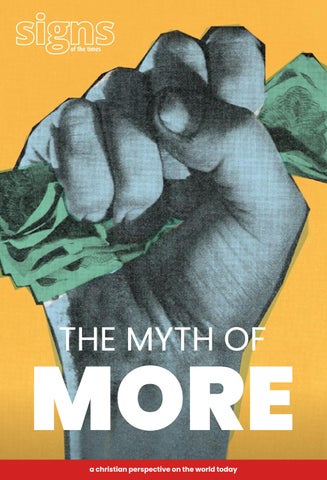
THE MYTH OF
MORE a christian perspective on the world today
In this issue September 2025 WHAT IN THE WORLD 04 THE SIGNATURE 12 Should we expect to find God within the known universe?
THE MYTH OF MORE 18 The paradox of generosity—and the lies that trip us up.
RAISING FUTURE GENTLEMEN 24
HOW MR ROGERS MADE KINDNESS COOL Kindness isn’t innate—it’s a daily choice.
PAGE 06
HOW ONE MAN’S MINDSET REDEFINED HUMAN LIMITS 26 Think your limits are fixed? Roger Bannister disagrees.
ASK PASTOR JESSE 38 A SONG FOR EVERY STORM 40 How an ancient book carried me through pain.
WHEN NEW DADS STRUGGLE 44 When new dads struggle, their kids’ health can, too.
HOPE IN THE BACKYARD 52 SIRENS 54 What if fantasy stories are glimpses of a greater reality?
FATHERHOOD THROUGH A TODDLER'S EYES What she's taught me about God.
PAGE 32
FIND US ON SOCIAL MEDIA 2
SIGNSMAG.COM • SEPTEMBER 2025
WHOLEGRAINS MAY REDUCE THE RISK OF HEART DISEASE 60 SUDOKU AND CROSSWORD PUZZLE 62
@SIGNSMAG
If necessary, use words Recently, I found a letter my dad wrote me when I was nine. He had printed out an article on friendship—why it matters, how to be a good one, tips for making new ones— and jotted a note to me at the bottom that said, "I really appreciate the way you make friends and the way you share your time with others." Though his words were kind, I don't think I came into the world instinctively knowing how to do this. If anything, I'd say it's something I learned from him. See, I’ve watched my dad be a good friend for as long as I can remember. I’ve seen him stick up for friends in difficult situations, write their names in his birthday book, and tend to a number of friendships he's had since school. His letter reminded me that the most powerful lessons aren’t always spoken—they’re lived. Apart from this note, I can’t remember a time my dad sat me down to teach me how to be a good friend. He simply showed me through the way he made time for and remained loyal to his own. In many ways, that’s what being a parent is all about—living out the lessons you hope your children will carry forward. This issue dives into a range of admirable virtues worth emulating: kindness (p06), generosity (p18), courage (p26), grace (p32), humility (p44) and compassion (p50). While this edition is dedicated in part to the dads, it also honours the quiet inheritance of character we all receive from those who have loved us well—without needing to say a word. Whether you’re celebrating a father or grieving one, giving thanks or longing for what you never had, take a moment to notice the good that’s been passed on to you. May that inspire you to become the kind of person from whom others learn what truly matters in life. As Mahatma Gandhi once said, "Your life is your message." ZANITA FLETCHER Assistant Editor
VOL 139 NO 8
ISSN 1038-9733 EXECUTIVE PUBLISHER Brad Kemp EDITOR Jarrod Stackelroth ASSOCIATE EDITOR Jesse Herford ASSISTANT EDITOR Zanita Fletcher COPYEDITORS Melody Tan Tracey Bridcutt GRAPHIC DESIGN Theodora Pau’u Talia Valderrama PHONE +61 2 9847 2222 EMAIL info@signsmag.com WEBSITE signsmag.com ADDRESS Adventist Media PO Box 1115, Wahroonga New South Wales 2076 SUBSCRIPTIONS Kelli Geelan PHONE +61 3 5965 6300 Australia/New Zealand, $A28/$NZ30; South Pacific countries, $A41; Other countries $A51 Published since 1886, Signs of the Times is printed 11 times a year by the Seventh-day Adventist Church and is registered as a periodical. Seventh-day Adventist Church (SPD) Limited ABN 59 093 117 689 NOTE The inclusion of a person or their image within does not imply their endorsement of the Seventh-day Adventist Church or its beliefs. Unless otherwise stated, Bible verses are from the Holy Bible, New International Version®, Anglicised. Copyright © 1979, 1984, 2011 by Biblica, Inc®. Used by permission of Hodder & Stoughton. All rights reserved worldwide. COVER IMAGE: CSA Images
SEPTEMBER 2025 • SIGNSMAG.COM
3
WHAT IN THE WORLD Perpetual stew Content creator, Annie Rauwerda, sparked a community movement in New York by cooking a perpetual stew that simmered in a neighbourhood park for two months. Strangers were invited to bring an ingredient to add to the crockpot in exchange for a bowl of soup. Thought to date back to medieval times, perpetual stew was once a humble peasant dish that provided sustenance in leaner times. But in this case, it was less about the stew and more about the gathering. Many came for soup yet left with friends.—The New York Times
Tuvalu’s ticket out TUVALU
Scientists fear that Tuvalu is set to be uninhabitable in 80 years as rising seas threaten the Pacific nation’s shores. As a result, Australia is offering visas to 280 Tuvalu citizens each year under a climate migration deal Canberra has billed as “the first agreement of its kind anywhere in the world”. Nearly a third of Tuvaluans have already entered a ballot for the first batch of climate visas that would allow them to live in Australia.—ABC News 4
SIGNSMAG.COM • SEPTEMBER 2025
KRATKYJAROMIR, ABOODI VESAKARAN, NATHANDUMLAO, ALAN BOWMAN—UNSPLASH, WELLNESS GALLERY CATALYST FOUNDATION—PEXELS
UNITED STATES
Dadding differently UNITED KINGDOM
Fatherhood scientist, Oliver Balch, has been tracking the rise of more involved dads and has discovered that millennial fathers are spending, on average, triple the amount of time with their children compared to dads in the 1960s. Parenting is a complex juggle for many, but the shift in roles has been profound, with children and society benefiting.—Positive News
Singing to remember UNITED STATES
Dementia affects some 55 million people worldwide, but some are finding hope in an unexpected therapy: music. In Minnesota, “memory choirs” are helping participants reconnect through song. While dementia can erode speech and memory, musical ability often endures. Singing familiar tunes lifts moods, sparks memories and builds connections between patients and caregivers. Now, researchers are exploring music’s potential as a form of treatment.—National Geographic
Fart walks: the latest trend AUSTRALIA
Fart walking is the latest digestive health trend going viral on social media. A short stroll after meals can help alleviate issues like acid reflux, bloating and constipation. Walking stimulates the natural contractions of the intestinal muscles, helping move food and waste through the gut. Movement after a meal may also be beneficial for blood sugar management and increased metabolism. Experts recommend a light 10–15 minute walk within 30 minutes of eating.—Healthline SEPTEMBER 2025 • SIGNSMAG.COM
5
HOW MR ROGERS MADE KINDNESS COOL Kindness isn’t something you’re born with—it’s something you choose every day. Few people chose it more deliberately, or more effectively, than Fred Rogers. EMMIE WILLIS
6
SIGNSMAG.COM • SEPTEMBER 2025
WIKIMEDIA COMMONS
SEPTEMBER 2025 • SIGNSMAG.COM
7
8
SIGNSMAG.COM • SEPTEMBER 2025
the name calling as his tormentors get closer. Finally, he can stand it no longer and breaks into a sprint, running the rest of the way home. While he is with his parents, he forgets how he doesn’t have any friends, but when he is alone, the tears come. Loneliness is a difficult burden to bear. A few years later and Fred was now in high school. Still at the bottom of the social ladder, things are not looking good for him. He heard that a football player from his school, Jim Stumbaugh was in hospital after he was injured during a game. Jim Stumbaugh was popular, always hanging out with a crowd of friends. It would have been easy to harbour bitterness towards the person who embodied all Fred was not—healthy, popular, known—it isn’t fair that Fred can’t have any of that. He hasn’t done anything to deserve
AUSTRIAN NATIONAL LIBRARY—UNSPLASH
A
child is heading home from school, walking casually, grateful he was healthy enough to attend school that day. It has been a great source of frustration that he not only has severe asthma, but also seems to catch all kinds of illnesses and has spent way too long sick at home. He is especially frustrated, since being bedridden has kept him from being as active as most boys his age and as a result, he holds some extra weight which makes him stand out in an unfortunate way. As he continues home, he notices some boys from school are following him. His stomach drops but he knows better than to show any emotion, even when they start calling out to him, “Fat Freddy!” The name reminds him of how alone he is and how hard he has found fitting in with his peers. It is increasingly difficult to ignore
the sicknesses or the bullying. Even if he didn’t have the anger, it would be easy to justify ignoring the popular jock in hospital since his crowd of friends would have visited. Why would he visit? He’d just embarrass himself. But Fred is made of sterner stuff and has learned the value of kindness. Fred realises that none of his friends had thought to take Jim his homework—homework Jim needs to keep his grades up if he wants to continue playing football. With that in mind, Fred takes the time to pick up Jim’s homework and visit him in the hospital. During the visits, Jim sees a side of Fred no-one else had and when he returns to school, he and Fred have formed enough of a bond that Jim takes Fred under his wing. Fred learns how to be confident from the popular football player and that confidence helps Fred have a good high school experience.
the TV era
Once the mandatory schooling years were over, Fred went to Rollins College, Florida, where he studied musical composition. One day, on a visit home to his parents, he saw a new technology: television. Fred was concerned because the people on the TV were throwing pies at each other: not a good example of behaviour for children. He wondered whether there was something better that could be done with this new invention that would soon find its way into the homes of most people in
Rogers first and foremost wanted everyone to know that they are special and unique America—and many other countries. With this in mind, Fred Rogers began to pursue a career in television. His first job was as an assistant and floor manager of the music programs for NBC in New York City. It isn’t long before an opportunity presented itself and he moved back to the area where he had grown up to help found WQED in Pittsburgh—the first community-supported educational TV station in the country. There he became a co-producer, puppeteer and organist for a show called The Children’s Corner. Fred still felt he needed to reach a little further, so he began attending a Seminary where he obtained his divinity degree as well as graduate studies in child development. When he was ordained as a Presbyterian minister, he was given a special charge to serve children and their families through television.
making history
In 1963, shy Fred Rogers moved to Canada where he stepped in front of the camera for the first time SEPTEMBER 2025 • SIGNSMAG.COM
9
WIKIMEDIA COMMONS
10
SIGNSMAG.COM • SEPTEMBER 2025
to become the host of a children’s program. Then in 1966, he returned once more to live close to where he grew up and launched the show for which he is best known: Mr Rogers’ Neighborhood. The show was such a success that it aired nationally in 1968. It was here that he truly found the career he had always wanted—a place where he could help children and influence people from all walks of life to be kinder to each other. Rogers’ show felt like a talk with a good friend. Rogers first and foremost wanted everyone to know that they are special and unique—not simply worthy because of their potential, but exactly as they were. In a time in American television where diversity was not embraced, Mr Rogers demonstrated that everyone was equally valuable by hiring a diverse cast, as well as inviting guests of different ages, genders and ethnicities. This was done in the same gentle way that he did everything else. Rogers didn’t want it to be a big spectacle; he simply wanted to include the people whose talents would best suit the show. It didn’t matter to him whether society saw them differently. Rogers was a great believer in leading by example, but he also felt that it was important to be able to talk about all kinds of things. There were easier topics such as curiosity—ensuring children know that it is a perfectly natural thing to feel and can lead to some wonderful things. But, also that curiosity without caution can lead to danger.
But Rogers didn’t stop there. He also talked about heavier subjects such as death and sickness—subjects that were often not spoken about with children in those days. Each topic the show covered, whether happy or sad, light or heavy, was treated with equal care and thoughtfulness so that it could reach and teach as many people as possible.
Fred's legacy
Fred Rogers retired at age 73 after hosting all 895 episodes of his show and composing more than 200 songs. From a young age, he chose to practice kindness on purpose and lived that principle throughout his career. Rogers’ legacy was of teaching others how to live kindness. Toward the end of his life, he made a simple statement that summed up who he was and how he will forever be remembered: “I’d like to be remembered for being a compassionate human being who happened to be fortunate enough to be born at a time when there was a fabulous thing called television that could allow me to use all the talents that I had been given” Emmie Franks is an avid student of literature; always looking for new ways to describe the impact of God’s love in her life.
If you’ve ever struggled to "forgive and forget", take this course at <lnk.bio/s/a3d7a> and discover the power that healed Fred Rogers—and can heal you too.
SEPTEMBER 2025 • SIGNSMAG.COM
11