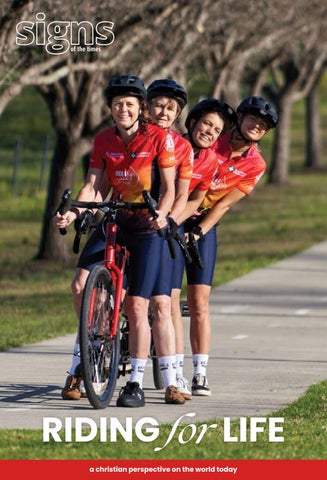
RIDING for LIFE a christian perspective on the world today
In this issue October 2025
WHAT IN THE WORLD 04 LET’S TALK ABOUT SEX 06 It doesn’t have to be awkward.
STOP CHASING SUCCESS. START LIVING ON PURPOSE. 12 Your purpose is bigger than material gain.
FURTHER UP AND FURTHER IN: LESSONS FROM NARNIA’S FINAL CONFLICT 18 The last battle we each have to fight.
TRAUMA, TRANSFORMED 24 How trauma can actually be your friend.
FOUR WOMEN. ONE BIKE. 4000KM FOR LIFE.
KINDNESS CARNIVAL 30 Giving back to their community.
Raising money for suicide prevention.
PAGE 32
FROM JUDGEMENT TO CONNECTION 38 The secrets of nonviolent communication.
THE HIDDEN DANGER IN CALLING YOUR CHILD SHY 44 It could do more harm than good.
THE MONK WHO MADE THE MODERN WORLD 46 And you, too.
ASK PASTOR JESSE 52 Are Christians really persecuted?.
DON’T FLY YOUR KITE LIKE THAT! God’s “pesky” laws are actually there for our benefit.
PAGE 54
FIND US ON SOCIAL MEDIA 2
SIGNSMAG.COM • OCTOBER 2025
WHY BREAKFAST MATTERS FOR KIDS 60 Get the good stuff in!
SUDOKU AND CROSSWORD PUZZLE 62
@SIGNSMAG
Fighting your final battle The Last Battle, the final book of CS Lewis’s The Chronicles of Narnia series, is a story of pain. In it, a faithful few struggle to stand firm while everything around them falls apart—a parable for our times if ever there was one. The characters in The Last Battle don’t get to choose the timing of their trial—but they do get to choose how they respond. We may not be facing Narnia’s end, but each of us lives in our own battleground of choices, pressures and opportunities. Each of us has our own Last Battle we will one day need to face. Whether it’s your mortality or the end of all things, each of us will find ourselves there one day. The only question is, are you ready for it? That readiness looks different for each of us. For some, it’s joining a long-distance bike ride to raise funds for suicide prevention (p32). For others, it’s creating a kindness carnival that lifts spirits and builds community (p30). Sometimes, readiness is forged in private through God’s work of turning trauma into growth (p24). It can mean recognising the beauty of God’s Law in a culture that questions it (p54), or choosing not to box in a child with labels that stifle their God-given courage (p44). The Last Battle is coming for each of us. But between now and then, there are a thousand tiny battles we all must face daily. These little battles we fight today are all preparation. Like a strict training regimen, they are designed to hone our character—our patience, endurance, kindness, love for our fellow humans. May you “fight the good fight” as you draw your sword—and may you be ready to face your own Last Battle one day.
JESSE HERFORD Associate editor
VOL 139 NO 9
ISSN 1038-9733 EXECUTIVE PUBLISHER Brad Kemp EDITOR Jarrod Stackelroth ASSOCIATE EDITOR Jesse Herford ASSISTANT EDITOR Zanita Fletcher COPYEDITORS Melody Tan Tracey Bridcutt GRAPHIC DESIGN Theodora Pau’u Talia Valderrama PHONE +61 2 9847 2222 EMAIL info@signsmag.com WEBSITE signsmag.com ADDRESS Adventist Media PO Box 1115, Wahroonga New South Wales 2076 SUBSCRIPTIONS Kelli Geelan PHONE +61 3 5965 6300 Australia/New Zealand, $A28/$NZ30; South Pacific countries, $A41; Other countries $A51 Published since 1886, Signs of the Times is printed 11 times a year by the Seventh-day Adventist Church and is registered as a periodical. Seventh-day Adventist Church (SPD) Limited ABN 59 093 117 689 NOTE The inclusion of a person or their image within does not imply their endorsement of the Seventh-day Adventist Church or its beliefs. Unless otherwise stated, Bible verses are from the Holy Bible, New International Version®, Anglicised. Copyright © 1979, 1984, 2011 by Biblica, Inc®. Used by permission of Hodder & Stoughton. All rights reserved worldwide. COVER IMAGE: Nathaniel Ginn
WHAT IN THE WORLD Rewriting genetics JAPAN
More people have access to social protection than ever WORLD
A record number of people worldwide now have access to social protection, including pensions, disability benefits and cash payments. A recent World Bank report shows these safety nets help more people than ever “manage crises, escape poverty, navigate transitions and seize employment opportunities”. Still, around 2 billion people remain “uncovered or inadequately covered” by social protection.—World Bank Group 4
SIGNSMAG.COM • OCTOBER 2025
RDNE, SHVETSA, COTTON BRO, ALEX GREEN, MART PRODUCTION—PEXELS.COM
Japanese scientists are exploring gene editing to remove the extra chromosome that causes Down syndrome in human cells. Published in Cell Discovery, the study showed that targeting chromosome 21 in labgrown cells could “silence” or entirely remove the third copy responsible for the condition. While not a cure and far from clinical use, the breakthrough opens new possibilities for understanding and potentially treating genetic conditions caused by extra chromosomes— offering improved quality of life for people living with Down syndrome.—Sci Tech Daily
Can I copyright my face? DENMARK
Denmark is moving to give people copyright control over their faces and voices. A new bill would make sharing fake images, videos or audio of real people without consent illegal, with severe fines for platforms that don’t comply. The law affirms everyone’s right to their own body and voice. Officials say existing laws don’t adequately protect against digital imitations but this amendment aims to offer stronger protection against AI identity misuse.—The Guardian
Fish milk? INDONESIA
Indonesia is milking fish to compensate for its drastic cow shortage. This “milk” is mixed with chocolate or strawberry flavours to improve taste. Some experts remain sceptical, noting it is ultra-processed and contains sugar and artificial sweeteners.—Wall Street Journal
Pacific drug highway FIJI
Fiji has become a trafficking hotspot for meth and cocaine. International cartels are using the Pacific as a “drug highway” to funnel drugs into Australia and New Zealand—but they’re also spreading into Fiji and nearby island countries. Underresourced ports are easy targets, and drugs are now seeping into local communities with children as young as 10 using. Fiji’s Home Affairs Minister says, “It’s affecting our youth in a big way. We fear for their future.”—ABC News OCTOBER 2025 • SIGNSMAG.COM
5
Let’s talk abo
6
SIGNSMAG.COM • OCTOBER 2025
Talking about the birds and the bees doesn’t have to be scary. MIKAELA MATTHES OCTOBER 2025 • SIGNSMAG.COM
MIDJOURNEY
out sex
7
’ve put significant thought into how to approach the topic of sex with you. It’s likely that it will bring up a range of reactions—discomfort, confusion, fear, anxiety, overwhelm, curiosity or even shame. It’s a sensitive subject and although sensitive conversations are within my wheelhouse, I still feel some apprehension about broaching it— how ironic! Conversations about “the birds and the bees” are important with regard to learning about science and procreation. However, they involve intimacy and some of us can be uncomfortable with this. I know not everyone has difficulty having these conversations but if you’re reading this, I assume you want some pointers—or are at least curious. I want to preface that my considerations here come from my experience as a psychologist working with children and adolescents, and as a lecturer studying and teaching about
8
SIGNSMAG.COM • OCTOBER 2025
their behaviour, wellbeing and how to communicate with them. I am not a parent. At this point, some of you may abandon this article, but I encourage you to see my input as a sort of translator. I will be honest with you: I didn’t understand adolescents even when I was one, so this area of work sneaked up on me, but I see my role as an advocate for young people as we navigate the language barrier that naturally seems to develop between them and adults. There is no “one size fits all” approach to sex so take my suggestions as broad considerations.
naming discomfort
When talking about sensitive topics, it is helpful to consider your own comfort level. If you feel uncomfortable, your child will likely pick up on that. Think about your experience of these conversations as a young person and this might tell you where your discomfort comes
RDNE, SHVETSA, COTTON BRO, ALEX GREEN, MART PRODUCTION—PEXELS.COM
I
Openness is the antidote to shame
from. It could be valuable to name the discomfort—to acknowledge that while the topic may feel awkward, these are important conversations to have with the right people. Silence, visible discomfort or dismissiveness when a child brings up a sensitive topic can unintentionally send the message that the subject is taboo. What we want to avoid is convey shame around natural curiosity or the desire to ask questions. This is going to be more common from children and if they learn from the outset that their parent is the best person to talk to about these things, they may be more likely to continue these conversations as an adolescent. Young people are wired to be curious. Adolescents are actively constructing their understanding of themselves, others and the world. They will encounter—or seek out— information on sensitive topics. It’s crucial that they have safe, trusted adults they can turn to with their questions and reflections. Developmentally, adolescents are also beginning to expand their primary support network. They will naturally begin to rely on peers more for input and they may be more receptive to another adult on some things. Their friend’s parent might say the exact same thing as you, but it sounds different to your teen.
don’t be vague
Specificity is also important. While this is often the most uncomfortable
part, vague language or metaphors can leave young people confused. Historically, the Church has not always handled conversations about sex in the most helpful way. I recall a story that came up every year in the teen ministry I was part of: a girl gave a petal of her flower to every boy she had sex with and eventually was left with a flower she could not put back together. While it aimed to communicate the importance of boundaries around sexual intimacy, it mostly perpetuated shame. What constituted “giving away a petal” was unclear, but the underlying message was that the girl was irredeemable. These metaphors create shame around something that God designed for good in the right context. These illustrations also tended to focus more on girls rather than boys, which creates further imbalance.
give them dignity
When we want to promote abstinence, we can become afraid of saying too much—worried that it might “plants ideas” or undermine our message. But in truth, openness is the antidote to shame. Information empowers young people. Whether we like it or not, young people will sometimes make choices we disagree with or won’t always follow the boundaries set for them. It’s essential that conversations around these topics cover all aspects, especially consent—a piece often missing from messages framed solely around “sex is for marriage”. Consent OCTOBER 2025 • SIGNSMAG.COM
9
is important for several reasons: 1. Some young people may choose to engage in sex outside of marriage anyway. The next best thing is that they do so safely. 2. Consent is still deeply relevant within marriage. 3. Consent also applies to any kind of contact—physical touch and even communication. This has been an area of concern with young men. It is important that everyone understands how to express and understand consent. While there is a crisis in Australia of violence from men towards women, we must not convey to our young boys that they are the problem. They are the solution. Let’s ensure our young people are informed, can make healthy decisions and that we are alongside them to talk and support them no matter what. To get you started, here are some tips for having these difficult conversations with young people.
empathy
Ask about how your child is
10
SIGNSMAG.COM • OCTOBER 2025
feeling. Showing empathy helps you connect with them and validates their experience. Even if they disagree with the boundary you are setting, empathy communicates that their voice matters.
humour
A balance of lightness and sincerity can make the conversation more approachable—but still highlight its importance. We don’t want to make light of the topics, just to communicate in a normal and relaxed way.
prepare
Think about how you want to phrase things and which topics make you feel uneasy. Practise with your partner or a friend. Use supporting materials such as books so your child can take in the information at their own pace. Then follow up to check in, ask what they think and answer any questions.
place and time
Consider who needs to be present. If you have children close in age, you may choose to talk to them together. Depending on their personalities,
know your child
Tailor the information that needs to be shared to your child’s age, maturity level and context.
encourage questions
Some children need time to think before asking, while others may initiate conversations themselves. Invite questions after you’ve shared information. This helps you understand their knowledge level and what else they may have been exposed to through peers or media. If they ask something you don’t know how to answer, it’s perfectly fine to say, “That’s a great question—I’ll get back to you on that.”
connection and space
Make sure the conversation has an end point. Allow your child to
move on to another activity or have some space. Take responsibility for following up later—check in about how they’re feeling and whether they have more questions or thoughts.
seek help
If you’re unsure, reach out to a professional for support. If the need for the conversation arises from a difficult, problematic or traumatic experience, it’s especially important to involve a counsellor or psychologist. This gives your child a safe, non-judgemental space to process and ask questions with someone trained in these conversations. It also lays the groundwork for a lifelong openness to seeking help—building a broader network of trusted adults. Having these conversations may feel uncomfortable, but leaning in with honesty, empathy and openness lays the foundation for trust, safety and lifelong connection. See, that wasn’t so hard, was it? I think we’ve bonded now. Mikaela Matthes lives and works in the Lake Macquarie region. She works as a psychologist in private practice and is a counselling and psychology lecturer at Avondale University.
UGURHAN—GETTYIMAGES.COM
this may increase or decrease comfort. Ensure you are all in a good headspace and a private space. Some people find conversations easier during movement like walking and sometimes talking in the car creates ease being side-by-side. Choose your moment intentionally.
To learn more about biblical principles on family and relationships, take this course: <biblestudy.com.au/ family-and-relationships>.
OCTOBER 2025 • SIGNSMAG.COM
11