
Adopted by Love

JUSTIN KIM
nebuchadnezzar is a household name in any Adventist home that has studied the book of Daniel. To historians, he is Nebuchadnezzar II. To history, he is Nebuchadnezzar the Great. But to his contemporaries, he was known for his brutality, cruelty, and tyranny. As if tearing out the eyeballs of King Zedekiah of Judah wasn’t enough (Jer. 39:7), the Babylonian did it right after executing Zedekiah’s sons in front of him so that it would be his last visual memory. Nebuchadnezzar was the one who destroyed Solomon’s temple, threatened to kill all the wise men if they couldn’t interpret

His faithful to reach various classes, spiritual and professional excellence often catch the attention of the social elite. In fact, God blesses them to bring about their distinction.
Daniel 2 marks God introducing a need to the king that only Daniel can meet. The king unsuccessfully turns to astrology and other sources of authority for answers. Nebuchadnezzar sees God’s power to reveal secrets, set up kings, and bring them down. He is still a polytheist and does not have the full picture of God. Yet God places opportunities, natural and supernatural, for His people to interact with those in higher positions and to, potentially, meet specific needs.
The Nebuchadnezzar chapters of Daniel are a testimony of God’s saving grace through His people to all people.
his own dream, and threw three Hebrew boys into the fire because they wouldn’t bow down to his shiny statue. At the same time, God calls this character “My servant” (Jer. 25:9; 27:6; 43:10). What an unlikely figure to have write a chapter in a book of the Bible!
And that’s the point. Although the book of Daniel points to the Bible’s gift of prophecy, the coming of the Messiah, the cleansing of the heavenly sanctuary, the revelation of a supernatural metanarrative, and the return of the Son of man, it ultimately points to the grace of God that saves sinners, even ones like Nebuchadnezzar. Tyrants and murderers can be transformed and have a powerful testimony to share. And remarkably, God’s people, as represented by Daniel and his friends, have a role to play in the conversion process.
Daniel 1 brings Nebuchadnezzar and God’s people together, albeit under the harrowing conditions of war, siege, and displacement. The king notices and acknowledges the distinction of the young adults. As God uses
In Daniel 3 God reveals Himself visibly. The king watches how God’s servants suffer while their integrity persists. The scene allows Nebuchadnezzar to witness One “like the Son of God.” We may never know who may be watching how we react and respond to difficult situations, suffering, and hardship. But faithfulness, integrity, and principle become the platforms to see the divine.
In Daniel 4 the king has an intimate encounter with God through personal prophecy and a psycho-spiritual experience. The king finally acknowledges the sovereignty of God and here records his own testimony in Scripture. God has given Nebuchadnezzar an opportunity to repent, and blesses him even more in the end.
The Nebuchadnezzar chapters of Daniel are a testimony of God’s saving grace through His people to all people. These four chapters not only showcase salvation and redemption but also underscore the special role of the experience and suffering of God’s people. God wants to reach all classes of people, but He reaches humanity through humanity. God used, can use, and will use a single individual to make known who He is. Which kings will He save through you?

The number of people baptized at the end of a recent evangelistic initiative on the grounds of Kendu Adventist Hospital in Kenya. The series drew believers and seekers from all walks of life, including families, youth, hospital staff, and visitors, and concluded with John Bradshaw, president of the It Is Written ministry, who repeatedly called attendees to commit to Jesus.
“God has taught me that ministry among people of Buddhist backgrounds is deeply relational and often takes time. But it can be done. I have seen God do it in my own family—more than once.”
—Saeng Saengthip, a Seventh-day Adventist pastor who was recently appointed as the new director of the Center for Adventist-Buddhist Relations, one of six Global Mission Centers operated by the Office of Adventist Mission. In his new position, Saengthip will work to build meaningful bridges of understanding with people shaped by Buddhist worldviews.
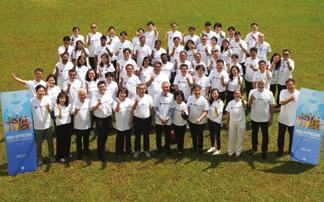
“In debates or legal battles, it is possible to win the argument but lose the person. True victory is drawing people to the fold through the message of the cross.”
—Christian Abenir, legal services and human resources director in the East Central Philippine Union Conference of Seventh-day Adventists, in presenting at a regional leadership convention in Cebu City, Philippines. The recent gathering sought to review policies and reflect on Adventist identity, with the goal of strengthening leadership alignment and organizational direction at the start of the new quinquennium.
The number of leaders of the Northern Asia-Pacific Division who met in February in Bangkok, Thailand, to review the region’s mission direction, evaluate administrative strategies, and shape an integrated vision for the future. The main speaker for the meetings was G. T. Ng, former secretary of the General Conference.
Do you want to keep up with what is happening in our church? If you want to receive our weekly newsletter that features news, inspirational stories, videos, and more, sign up today.
Church members were asked whether they thought that God loves them even when they sin.
“ Whatever I was able
to
achieve, this has never
been
a solitary effort, but always shared journeys with inspiring local church members, students, professional colleagues, and mentors who shaped me to be the person I am today.”
—Daniel Duda, president of the Trans-European Division, after being honored with the Charles Elliott Weniger Award for Excellence. The award ceremony took place on February 14 at the Loma Linda University church in Loma Linda, California, United States. The award recognizes individuals who demonstrate exceptional character, leadership, and contribution to the mission of the Adventist Church.
“Our volunteers are trained comprehensively, both in technical skills and in risk management. But what truly drives them is selfless service.”
—Jair Flórez Guzmán, ADRA Colombia director, in describing the agency’s efforts to assist hundreds of families affected by severe flooding that struck two departments in that South American country in February. It is estimated that at least 10 Adventist churches in rural areas were affected, with many members and residents displaced.
“Social outreach initiatives go hand in hand with spiritual care. Our goal is to welcome people as a whole, offering listening, guidance, and emotional and spiritual support, in addition to social services.”
—Wianne Trindade, local coordinator of the Caleb Mission initiative in Aracaju, Sergipe, Brazil. A local Adventist church recently opened its doors to receive people of various faiths and beliefs, offering medical, psychological, and dental consultations, as well as relaxation massages and legal guidance.
The number of water wells that Adventist supporting ministry Maranatha Volunteers International is planning to build across several African and Asian countries in 2026. The lay-led ministry is also planning to repair many of the older ones and keep assessing local water needs across the regions where it serves. Since the beginning of the water initiative project, Maranatha has built more than 3,500 water wells, its leaders recently reported.
South Pacific members, leaders are gearing up for the upcoming Trans Pacific for Christ.

when the Seventh-day Adventist Church ran PNG for Christ in 2024, the ripple effects were profound. Tens of thousands who attended the evangelistic series were baptized or made decisions for baptism. As the Holy Spirit touched hearts around Papua New Guinea, the mission on the ground was powerful. Equally life-changing was the impact on the speakers, many of whom were moved and inspired by what they experienced.
Now preparations are being made for the South Pacific’s next major evangelistic series—Trans Pacific for Christ. And once again, people from all walks of life are stepping forward to be involved. People such as Jillda Wright, who has committed to be part of Solomon Islands for Christ.
The Solomon Islands is one of eight missions and attached fields taking part in Trans Pacific for Christ, alongside Tuvalu, Tonga, American Samoa, Samoa-Tokelau, Vanuatu, Kiribati, and Fiji.
A trauma counselor for more than 25 years, Wright runs her own private practice on the north coast of New South Wales, Australia. Rebaptized two years ago, she traveled with a team to the Philippines in July 2025 to present the Secrets of Prophecy series. “I had never preached before, nor had any type of role in the church growing up,” she said. “But when the opportunity came up, I felt the Holy Spirit directing me to be involved.”
Wright is now planning to present the series during Solomon Islands for Christ in July.
“Before I was rebaptized, I prayed to God and asked Him, ‘What do You want me to do?’ ” Wright said. “Since that prayer the Holy Spirit has spoken and impressed upon my heart the desire to preach the gospel overseas and locally. I feel that my life journey has prepared me for this time in my life and the roles that God wants me to undertake.”
“I FEEL THAT MY LIFE JOURNEY HAS PREPARED ME FOR THIS TIME IN MY LIFE AND THE ROLES THAT GOD WANTS ME TO UNDERTAKE.”
For Gosford Bible worker Pam Kidd, a mother of three adult children, her experience with PNG for Christ has inspired her to take part in Fiji for Christ. “I was sitting in church in April of 2023 when a pastor from the [South Pacific] Division came and spoke,” she recalled. “During his message he spoke about PNG for Christ . . . I knew God was calling me on that mission trip. So I told my pastor I was going, and he decided to go as well.”
Kidd was a speaker at Nagum Adventist Secondary School in East Sepik near Wewak, with about 500 attending most nights to hear the presentations. “My greatest blessing was to be able to interact with the students and spend time helping them to navigate some heavy decisions, most of which revolved around getting baptized,” she said. “Everyone was so hungry for Christ and extremely welcoming.”
She’s now looking forward to Fiji for Christ. “I felt God calling to go, so I signed up before it was even an official thing,” she said. “What do I hope to experience there? More hearts finding a personal connection to Christ. . . . I hope to interact personally with as many people as possible while there and show them the love of Christ. . . . I love seeing people’s hearts melt in the presence of their Savior and see them surrender their lives to Him.”
Ben Rea, pastor in Coffs Coast, New South Wales, was similarly moved by his experience at PNG for Christ. He has now committed to be part of Solomon Islands for Christ, taking his two teenage daughters with him—who will also be preaching.
“What I realized over there [in PNG] was that it didn’t seem to matter who the preacher was, it was the power of the Word of God, the Seventh-day Adventist message, plus the moving of the Holy Spirit and the willing hearts of the people—and the revival was happening. Like Acts 2, it was happening before our eyes,” Rea said.
At worldwide conference, church leaders call to refocus on mission.
Marcos Paseggi, Adventist Review
aselect group of 88 Seventh-day Adventist health food executives, some of their spouses, and regional church leaders met February 9-13 in Punta Cana, Dominican Republic, for the 2026 Conference of the Adventist Health Food Association (AHFA). The event, held under the theme “Mission: Innovation to Share,” including experts in food production, sales, and marketing from more than a dozen
countries, sought to reaffirm the health food factory mission; discuss experiences, trends, and challenges; and assess better ways to collaborate on a more unified front across continents.
The 2026 conference was hosted by the Inter-American Health Food Company (IAHFC), which coordinates the health food factories across the Inter-American Division (IAD) territory. Its manager,
José Flores Laguna, celebrated the new additions to the association, including the presence of Hany Yacoub, general manager of Adventist Health and Education Foundation, based in Egypt. He also welcomed representatives from Brazil’s Superbom, who have returned after a hiatus.
Flores also emphasized the presence of regional church leaders, including IAD president Abner De los Santos, former IAD
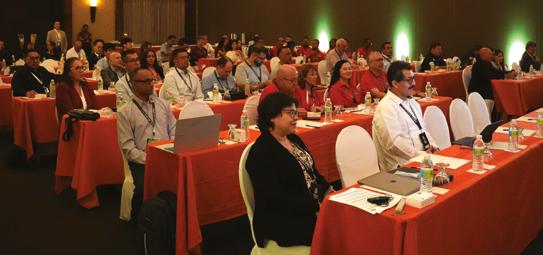
treasurer Filiberto Verduzco, and the three main administrators of the Dominican Union. “We are honored that they found time to be here and show their support,” he said.
De los Santos offered opening remarks, emphasizing that the performance of the health food factories owned by the Adventist Church are not detached from the church’s mission. “In the Seventh-day Adventist Church there’s mission for everyone. It is what gives meaning to every church, institution, and church regional office,” he said. “Thus, without mission, the Adventist food companies have no reason to exist. . . . And everyone is called to serve the broader mission of restoring humanity to God’s image.”
At the same time, De los Santos reminded conference attendees that God’s mission for His people is wholistic. “Health is not separated from faith, and prosperity is not apart from purpose,” he explained. “God wants [Adventist] food companies around the world to prosper for His glory and honor.”
According to De los Santos, Adventist leaders who serve in the food business are in “a unique, sacred space.” He added, “Your job takes place at the intersection of faith and life, combining beliefs with practice, message with methods. Your factories, offices, warehouses, and labs are not outside our mission field. They are a mission field.”
At the same time, De los Santos said, “[Adventist] food companies have the privilege of articulating our message in a special, unique way. Health is not a byproduct of the gospel, but one of its purest expressions. And God wants this health message that food companies are supposed to carry to be the right hand of the gospel.”
In that sense, mission does not take place only from the pulpit or evangelistic initiatives, De los Santos emphasized. “Mission takes place through ethical leadership and decisions grounded on compassion. It takes place in excellence, service, and responsibility in our daily
endeavors. The way a company carries out its activities impacts not only the company but the community. And when our daily work reflects Christ’s character, mission is already in motion.”
De los Santos also emphasized that today “the world is watching to see how we lead, how we treat people, and how we balance success with responsibility. In times of crisis and food crises and uncertainty, our Adventist identity call us to be more than just smart leaders—it calls us to be faithful witnesses.”
“HEALTH IS NOT A BYPRODUCT OF THE GOSPEL, BUT ONE OF ITS PUREST EXPRESSIONS. AND GOD WANTS THIS HEALTH MESSAGE THAT FOOD COMPANIES ARE SUPPOSED TO CARRY TO BE THE RIGHT HAND OF THE GOSPEL.”
In a devotional message after De los Santos’ remarks, Teófilo Silvestre, president of the Dominican Union of the Seventh-day Adventist Church, reminded conference attendees that “God has a mission, and that mission is the source of a church and a food factory. Because mission is God-centered, success is guaranteed. We are here today because God has a mission.”
Silvestre reflected, based on the biblical story of Ruth, on how moments of internal and external crisis come to every leader. “There are crises that we do not look for but are just thrown upon us,” he said.
“Elimelech and Naomi’s family came from Bethlehem—which means ‘the house of bread.’ But in the house of bread, there was lack of bread. And that lack of bread drove their immigration.”
Drawing an analogy with our mission, Silvestre said that it would be unfortunate if in our house of bread we lacked bread—if we as leaders lacked clarity on what our mission is. “It would be a tragedy if we focused on things that are not important even if they were good,” he said.
Against that challenging background, living mission means not isolating faith from our environment, De los Santos said. And then he asked, “Do we uplift our values in every meeting, in our policies and product development? in our internal and external partnerships? Do we ask ourselves not only ‘Is this product going to work?’ but also ‘Does it contribute to making the world healthier? Is this product honoring God? Are we serving humanity through our products?’ ”
De los Santos concluded by reminding participants that “God has placed each one of us to be a light. And your workplace is your lighthouse. When we live our faith with integrity, compassion, and excellence, Christ’s light shines through us even when we don’t say a word. We fulfill our mission as we go.”
Fortunately, the Bible tells us how eventually, when Naomi and Ruth returned, there was abundance of bread again. “If we have somehow strayed from our mission, not everything is lost,” Silvestre said, following the analogy once more. “And I believe this type of meeting is useful exactly for that— so that we refocus on mission and we may have abundance of bread again.”
Finally, Silvestre mentioned the example of Jesus when He fed the 5,000, noting that Jesus was “moved with compassion” for the people (Matt. 14:14). “Jesus’ compassion was not calculated, theoretical, or abstract—He felt it in the depths of His soul,” he said. “And if we want to accomplish God’s mission as a health food factory, we must also be moved with compassion from the deepest parts of our souls. We must focus on people, not on financial gain, because that’s our raison d’être. Jesus’ ultimate goal is to save people, and this should also be our goal—to get people to befriend God again and be saved.”

Alan Parker
“Honey, I’ve been thinking.” From the tone of her voice, I knew this was not going to be a casual conversation.
My wife motioned for me to sit beside her, and slowly turned her laptop toward me. On the screen was the picture of a young girl I had never met. Her dark, unevenly cut hair framed an anxious face, and her penetrating brown eyes seemed to look straight through me.
“We could host this girl for Christmas,” my wife said gently, “and give her a chance to experience what it’s like to be part of a family.”
I stared at the picture, torn between two powerful emotions. On the one hand, I felt deep compassion for this child. On the other, I felt fear—fear of what this might cost us and how it might upend our carefully ordered lives. Welcoming a stranger into our home, for even a short time, felt risky.
And yet, a month later we found ourselves embracing her at the airport.
She stayed with us for three weeks. On the morning before her return flight, she took some chalk and walked out to our driveway. There she drew a large heart. Inside the heart she wrote the names of each member of our family—and then added her own name alongside ours. Beneath it all, she wrote one word: сімя, the Ukrainian word for family.
As we stood there looking at that chalk drawing, none of us could speak. We knew something had changed.
That summer we invited her back, and not long after, we made the decision to begin the adoption process. When people heard what we were planning, their reactions were mixed. Some asked sincere questions: “Is this a good idea?” “What will this do to your family?” Others were more openly skeptical. Even the boarding school where she lived seemed surprised. Her teachers expressed genuine confusion about why we would want to adopt this child—one they considered difficult and troubled.
Why adopt a child?
Our answer was simple: We love her.
That is also the reason God adopts us.
The apostle John captures the wonder of this truth when he writes, “Behold what manner of love the Father has bestowed on us, that we should be called children of God!” (1 John 3:1). God looked upon us—wounded by sin, shaped by trauma, and far from home—and chose to bring us into His family. Not because we were model children. Not because we had earned a place. But because He loved us.
Our experience with adoption has given us a small glimpse into the heart of God. Whatever compassion and tenderness we felt toward our daughter was only a faint reflection of God’s immeasurable love for us.
Ellen White expressed it beautifully:
“What love, what matchless love, that, sinners and aliens as we are, we may be brought back to God and adopted into His family! . . . All the paternal love which has come down from generation to generation through the channel of human hearts . . . are but as a

This is better than Eden, because it is not just Paradise restored— it is family secured.
(Eph. 1:5, 6). From the very beginning Jesus was determined to enter our broken world and bring humanity into God’s family.
No wonder Paul asks, “Who shall separate us from the love of Christ?” (Rom. 8:35).
I still remember the first time our daughter gave me a card and signed it, “I love you, Daddy.” I’ll admit, I cried. We had seen a response to our deep love for her. As Ellen White once wrote: “Only by love is love awakened.”2 Love heals trauma, and God’s gracious compassion transforms us from the inside out.
tiny rill to the boundless ocean, when compared with the infinite, exhaustless love of God.”1
Scripture presents adoption as a work of grace with profound consequences. First, adoption changes our past. It moves us from bondage to freedom, from fear to belonging. Paul writes that we are “no longer a slave but a son” (Gal. 4:7). Our status changes completely. We move from slavery to royalty.
But adoption is never cheap.
My wife and I quickly learned that adoption is costly. There were tens of thousands of dollars in expenses, hundreds of hours of paperwork, countless interviews, and later, many more hours spent helping our daughter process deep emotional wounds. When you love an orphan, you sacrifice for them.
God did the same.
“For God so loved the world that He gave His only begotten Son” (John 3:16). These familiar words describe the greatest act of adoption the universe has ever known. God gave His one Son so that He could have many sons and daughters. Calvary—the deepest pain in the heart of God—was also the place of His greatest joy.
Understanding God’s compassionate love changes everything. It tells me that no matter how I have messed up, ’fessed up, or tried to dress myself up to look better than I am, God loves me as His adopted child.
One day, not long after our daughter joined our family, she did something she knew she wasn’t supposed to do—and then lied about it. When the truth finally came out, she was overwhelmed with fear. Through tears she asked, “Are you sad that you adopted me?”
“We are disappointed that you made this choice,” we told her honestly, “but that doesn’t change our love for you.”
Our heavenly Father feels the same way. God is grieved by sin, but He does not stop loving His children. Even knowing all our failures in advance, He “predestined us to adoption as sons by Jesus Christ to Himself” and “made us accepted in the Beloved”
Paul writes, “You did not receive the spirit of bondage again to fear, but you received the Spirit of adoption by whom we cry out, ‘Abba, Father’ ” (Rom. 8:15). Once we are adopted, God becomes not just Lord, but Father.
Paul uses both Aramaic and Greek here for a reason. Abba was the word Jesus Himself used in the Garden of Gethsemane (see Mark 14:36), a term of deep intimacy and trust. Because Jesus cried out to His Father in His darkest moment, believers throughout history have echoed that same cry in prayer.
When fear presses in, when I feel overwhelmed or cornered, I remember that I belong to God’s family. I lift my heart and pray, “Abba, Father, please help me!” And I sense His tender compassion, as real and comforting as when I have held my own children.
One evening our daughter played us a song about a mother. As the melody and haunting lyrics filled the room, something inside her broke. Memories of her mother’s death and the years of abandonment that followed came rushing to the surface. She collapsed into sobs, and we held her as she cried—our tears mingling with hers.
Adoption not only redeems the past; it reshapes the present. Love transforms and heals.
Adoption is not a single moment. It is a process. Our daughter had to leave her country, her friends, and her familiar culture to take on a new identity. It was beautiful—and it was messy.
She had to learn that behaviors normal in her old life—swearing, smoking, drinking—were not part of her new family culture. She no longer had to shout, fight, or lie to survive. She could trust that she was loved and that we wanted what was best for her. Over time, love transformed her, and she began to flourish.
For the child of God, this ongoing transformation is called sanctification. As adopted sons and daughters, we bear God’s name and learn to live in a way that reflects His character.
We want to honor the Father who saved us.
“Just as in the ancient world all sons, including those who had been adopted, were expected to behave in a manner that would not discredit their father or besmirch the family name, so it is the responsibility for spiritually adopted sons belonging to the divine household to live scrupulously and blamelessly by bringing glory to their holy, heavenly Father.”3
Finally, adoption gives us an astonishing future. “The Spirit Himself bears witness with our spirit that we are children of God,” Paul writes, “and if children, then heirs—heirs of God and joint heirs with Christ” (Rom. 8:16, 17).
Our daughter knows that everything that belongs to our family belongs to her as well. She shares fully in our love and care. In the same way, God invites us into the inheritance of His Son. We who were once slaves are now sons and daughters of the King.
Paul goes even further. He says that all creation is “eagerly waiting for the adoption, the redemption of our body” (Rom. 8:23). One day adoption will be complete. Our broken bodies and weary minds will be restored. We will be made whole, and the universe itself will rejoice.
Two years ago our daughter gave her heart to Jesus and was baptized. Next year she will be married. The fruit of love and adoption is a beautiful young woman living for God.
And still, the story does not end there.
Paul says that we are “heirs of God” (Rom. 8:17). God Himself is our inheritance. One day we will live with Him in perfect intimacy forever. This is better than Eden, because it is not just Paradise restored—it is family secured.
It is hard to imagine our family without our adopted daughter. Without her contagious laughter and joyful spirit, something essential would be missing. Our table would feel strangely empty.
Scripture reminds us that adoption is a gift—but it is also a choice. Not everyone is adopted. When our daughter stood in court, she had to tell the judge whether she wanted to become part of our family. If she had said no, the chair prepared for her would have remained vacant. She almost did. For a moment she considered choosing her familiar world—her friends, her past—over the unknown future being offered to her.
The Bible presents the same sobering reality. “But to all who believed Him and accepted Him, He gave the right to become children of God” (John 1:12, NLT).4 God’s love is freely offered, but it must be received. Unless we choose to believe and accept Jesus, we cannot claim our place in His family.
What a tragedy it would be to leave that place empty! To refuse the love that calls us home. How the heart of God must ache at the thought of sons and daughters who never take their seat at His table.
Adoption is a love story, but its ending is not automatic. It depends on our response. Will we allow God’s love to transform us? Will we embrace both the privileges and the responsibilities of belonging to His family? Or will we cling to old identities and familiar comforts?
The invitation has been extended. The place has been prepared. The final chapter is still being written.
Will we choose it?
1 Ellen G White, My Life Today (Washington, D.C.: Review and Herald Pub. Assn., 1952), p. 289.
2 Ellen G. White, The Desire of Ages (Mountain View, Calif.: Pacific Press Pub. Assn., 1898, 1940), p. 22.
3 Trevor J. Burke, Adopted Into God’s Family, New Studies in Biblical Theology (Downers Grove, Ill.: IVP Academic, 2006), vol. 22, p. 43.
4 Scripture quotations marked NLT are taken from the Holy Bible, New Living Translation, copyright © 1996, 2004, 2015 by Tyndale House Foundation. Used by permission of Tyndale House Publishers, Inc., Carol Stream, Illinois 60188. All rights reserved.
Alan Parker is professor and director of the Pierson Institute of Evangelism and World Missions at Southern Adventist University.
Unless we choose to believe and accept Jesus, we cannot claim our place in His family.

the Bible uses many vivid metaphors to describe the relationship God has with us; one of those metaphors is adoption Take a few moments, alone or with friends, to reflect on the following passages.
1. What do both Moses and Esther have in common, and how do you think it would help their perspective on their divinely appointed work? (Ex. 2:10; Esther 2:7)
Both Moses and Esther were adopted, and neither remained precisely where they were born when they entered adulthood. Adoption can help you realize what it means to be deliberately chosen and understand better how God adopts us.
2. Some people believe that God only accepts sinners begrudgingly because of a legal arrangement secured at the cross. What does the Bible reveal about God’s attitude toward our adoption? (Eph. 1:3-6)
God adopted us because it pleased Him to do it; it’s what He wanted! “For the Father Himself loves you,” Jesus taught (John 16:27).
3. Paul explains that our adoption has “made us accepted” (Eph. 1:6). What made us unacceptable prior to our
redemption? What does it mean to be adopted out of the world and into the family of Christ? How should that encourage us to live, and how do we learn to function well in the context of belonging to this new heavenly family?
name is written in our foreheads, it’s an indication that His character is being written on our hearts. We become more Christlike. God’s character, of course, is also found described in His moral law.
If we are children of the King— members of the royal family— what have we to fear in this life?
Families come with their own sets of rules, values, and culture. All of us enter this world with a sin-stained heart that prizes selfishness over God’s values. But in a family, self must often be surrendered for the sake of others—and as part of God’s family, we strive to belong, adopting God’s values and esteeming others as better than ourselves (see Phil. 2:3).
4. When children are adopted, they receive the family name. What do you notice about Christ’s adopted brothers and sisters in Revelation 14:1? How does this relate to what we read in Hebrews 8:10-12 and Exodus 34:5-7?
In the Bible, names are highly significant, and when Scripture reveals that God’s
5. What destructive mindset can be remedied by the knowledge that we have been adopted? (Rom. 8:15-17)
If we are children of the King—members of the royal family—what have we to fear in this life?
Shawn Boonstra is an associate editor at Adventist Review.

Katie Flores
Many may picture special needs adoption as a heartwarming scene—a smiling, neatly dressed child and peaceful, well-rested parents. A picture in which everything broken has been “fixed,” and parents wear imaginary superhero capes as they swoop in to save the day. But the lived reality, the one that unfolds in kitchens, doctors’ offices, school meetings, and long nights, is far more complex. It is a journey that is humbling, demanding, deeply sanctifying, and profoundly holy.
Special needs adoption is not about extraordinary people, but about ordinary families leaning heavily on an extraordinary God. And it is a ministry that the wider church must understand. Whether or not God is calling you to welcome a child with special needs into your home, He is calling you to uphold, encourage, and support those who do. Scripture reminds us of this sacred responsibility: “Pure and undefiled religion before God and the Father is this: to visit orphans* and widows in their trouble” (James 1:27). Upon this
foundation we can look at five truths regarding the reality of special needs adoption. These truths will enable us to better understand our individual calling and how to best walk beside those who have already stepped into it.
Before anything else, special needs adoption requires surrender. Welcoming a child with complex needs, whether physical or emotional, is to let go of the dream of ease, predictability, and tidy outcomes. We must let go of the idea that we are the heroes of the story and instead realize that we are simply servants in God’s hands. In this calling God does not ask for perfection or superhuman strength. In fact, He can work best when we recognize that this is something we cannot do in our own power, nor can it be done while we cling to our personal desires and dreams.
We step into a holy place when we are willing to let go of our plans so that God can accomplish His. When we offer a heart ready to sacrifice, adapt, and love in ways that refine and reshape us, we make way for miracles and healing. This surrender to God’s plans turns the everyday tasks of managing medical diagnoses and deeply disturbing behaviors, folding yet another load of soiled linens and clothes, or preparing a specialized diet, into a work of profound importance for God’s glory.
Prior to one of our special needs adoptions I remember poring over descriptions of children, mentally sorting diagnoses that I felt I “could handle” and those that I wasn’t willing to tackle. Confessing that makes me smile (with a blush of embarrassment). At the time I genuinely believed I understood what lay ahead. Yet no medical chart, no list of conditions, and no amount of research could have prepared us for the full range of challenges that would unfold over the years.
symptom or diagnosis late into the night. He gives grace for each moment as it comes, not for the ones we imagine lie ahead.
When we welcome a child through adoption, we open our arms and hearts to the often unseen, but very real, wounds of their story. Regardless of a child’s age or circumstances before joining a family through adoption, trauma is always part of the journey. One of the most common, well-intended, but deeply misguided comments we heard after our adoptions was “Your new child is so fortunate to have you.” These words made us cringe because they overlooked the truth that our children had lost more in their early years than most adults face in a lifetime. It is vital to remember that adoption always begins with incredible loss.
It is vital to remember that adoption always begins with incredible loss.
Over time, the needs of our children have evolved, fluctuated, and even intensified in some areas. In hindsight, I can genuinely say that this is one of God’s mercies, that He doesn’t reveal the entire journey at once. Instead, He equips us step by step: to attend the next therapy session, navigate the next doctor’s visit, spend hours on the phone with the insurance company, or research a new
For children with special needs, there is often an added layer of trauma. Many of these children have undergone invasive medical testing and procedures without the comfort, love, and presence of a consistent caregiver. Their bodies may have survived those moments, but their hearts and nervous systems remember. Recognizing this reality helps families relate to their children, not with pity, but with compassion, patience, and a long-term commitment to the hard road they are walking together.
This work that feels hard, ordinary, and unseen is treasured by God and is being used for purposes we will not fully comprehend until heaven.
Special needs adoption rarely yields the kind of newsworthy, spotlight-friendly outcomes that are easily measured or celebrated. Progress is often slow, hardfought, and known only to those who live closest to it. With eyes and hearts open to seeing, it’s in this hard place that God’s faithfulness can be felt most clearly.
The trauma these precious ones have endured reshapes their brains and emotional responses, calling us to practice trauma-informed parenting. While it’s not within the scope of this article to fully explore such a complex topic as trauma-informed parenting, it is worth noting that strategies effective for a trauma-wired brain often run counter to traditional parenting advice, or even our own instincts. These “different” approaches to parenting children, who often exhibit significant behavioral challenges, can invite misunderstanding and criticism.
Trauma-informed parenting asks more of us, more patience, more self-control, and more humility, but it also provides the surest path for our children to learn trust and heal at their own pace.
Special needs adoption places initial and ongoing demands on a family’s resources. Not just financial but also physical, emotional, relational, and spiritual. This is not a temporary stretching, but often a long-term reality that changes how a family lives, works, plays, and plans. Medical appointments, therapies, specialized equipment, medications, travel, and time away from work quickly add up, stretching family budgets and emotional and physical reserves.
Sleep deprivation, caregiver fatigue, and the emotional toll of chronic advocacy can wear down even the most resilient. Marriages are tested. Siblings are asked to make everyday sacrifices and share stretched-thin parents. Ordinary rhythms, mealtimes, church attendance, social opportunities, vacations, and, simply put, everyday life require extensive planning and frequent recalibration.
God never told us that obedience would be easy, or that it would necessarily promote success from a worldly standpoint. Pursuing a special needs adoption will push you to the point where you feel you have nothing left to give, but we serve a God whose resources are limitless, and He meets us right there in the middle of the stretched-thin spots and provides what we need to continue the work that He has called us to.
Sometimes this faithfulness is displayed through the small victories unseen by most. Maybe a calmer morning, a transition without a meltdown, a sweet moment of connection, a met milestone. Other times God’s faithfulness is displayed, not through the child’s progress, but rather through the way He provides the parents with exactly what is needed in the form of patience, wisdom, and endurance day by day.
With many special needs adoptions the parenting journey is lifelong. God’s faithfulness will meet those families during every season. This work that feels hard, ordinary, and unseen is treasured by God and is being used for purposes we will not fully comprehend until heaven.
Special needs adoption is a true ministry and a sacred calling, but it should not be a road traveled alone. Some families are called to open their homes. Many more are called to open their hands, hearts, schedules, and prayers. As a church we are invited to move beyond admiration for families called to special needs adoption to a real understanding of the role God has for us in this work. We must move beyond sympathy to loving support. Perhaps this looks like a smile and a hug rather than offering advice. It could be a well-timed meal or gift card, a listening ear, or a thousand other possibilities.
The ministry of loving special needs adoptees, whether as a family or a church body, is a beautiful opportunity to reflect the heart of a God who does not turn away from suffering, who does not abandon the vulnerable, and who never asks His people to walk a difficult road without walking it with them.
* For more information about ministry to orphans, visit: https://www.possibilityministries.org/ resources/orphans-vulnerable-children-ministry-resources/.
Katie Flores is a mom of three and a freelance writer living in Maryland, United States. Her family was formed, in part, through the gift of special needs adoption.

Scientists have long searched for a single unifying formula to explain the universe. They call it the “theory of everything.”
The night Albert Einstein died, beside his bed, they found “twelve pages of tightly written equations, littered with cross-outs and corrections . . . [as] he struggled to find his elusive unified field theory.”1
But alas, this “holy grail” for scientists still remains “one of the major unsolved problems in physics.”2
Makes you wonder—in our quest for God, is there a theological “theory of everything,” a unifying formula that is the sum of all revealed truth in the universe?
Consider evidence from the fourth Gospel. “In the beginning was the Word, . . . and the Word was God. . . . All things were made through Him” (John 1:1-3). Whoever the Word is, He is clearly “the Maker of all things.”
But we know who He is. “And the Word became flesh and dwelt among us, and we beheld His glory” (verse 14). Of course, the Maker of all things is Jesus, the very incarnation (literally “in-fleshment,” Latin) of God, whose love for the human race is epic: “For God so loved the world that He gave His only begotten Son . . .” (John 3:16). No question, the Maker of all things loves us.
But there is more. In His moving “last prayer” on the fateful night of His betrayal, arrest, and eventual crucifixion, the Maker of all things petitions the Father: “I desire that they [His disciples] . . . may be with Me where I am” (John 17:24). That is, He not only loves us, He wants us.
Thus, it is clear: “The Maker of all things loves and wants me.”3 Could this be the summation of all revealed truth, a divine “theory of everything”?
But aren’t the three words “God is love” sufficient? They are indeed. But for a generation preoccupied with its existential angst, here is an internalization of “God is love” in the introspective language of social media: God is not only love—He loves and wants me
Think about it. Isn’t “the Maker of all things loves and wants me” the shining truth undergirding Creation, Calvary, the Scriptures, the Sabbath, and salvation? Is it not the pulsating heart of the
First Coming, the Second Coming, the bright hope of resurrection after death’s dark night? What more universal truth lies at the heart of all we believe?
Why, even Revelation 14’s three angels streaking across earth’s last midnight—what truth do they urgently proclaim, if not this truth? “Worship Him who made heaven and earth” (i.e., the Maker of all things [Rev. 14:6, 7]), for “the hour of His judgment has come” and the evil confederacy of “Babylon is fallen,” so beware the enemy’s “mark of the beast” assault (Rev. 14:8-11)—their “everlasting gospel” endgame appeal is fueled by the divine verity “The Maker of all things loves and wants me.”
“It is the darkness of misapprehension of God that is enshrouding the world. . . . At this time a message from God is to be proclaimed, a message illuminating in its influence and saving in its power. . . . The last rays of merciful light, the last message of mercy to be given to the world, is a revelation of His character of love.”4
Because the Maker of all things, who loves and wants me, loves and wants us all, every lost one of us.
What does this have to do with this new column—The Endgame? I believe Jesus is coming sooner than we think, much sooner. Over the course of the journey ahead, we will share the mounting evidence. But listen—if we aren’t clear about the core of our beliefs, why should we care about the rest of our beliefs?
To read more of The Endgame series, be sure to keep an eye on the Adventist Review website.—Editors.
1 Walter Isaacson, Einstein: His Life and Universe p. 543.
2 https://en.wikipedia.org/wiki/Theory_of_everything
3 Thirty years ago I came across this sentence in Philip Yancey’s The Jesus I Never Knew, p. 269. He attributed it to the writer and literary critic Reynolds Price, who deemed it “the sentence humankind craves from stories.”
4 Ellen G. White, Christ’s Object Lessons (Washington, D.C.: Review and Herald Pub. Assn., 1900, 1941), p. 415. (Emphasis supplied.)
Dwight K. Nelson continues to write and preach from Berrien Springs, Michigan, United States.

Isn’t “the Maker of all things loves and wants me” the shining truth undergirding Creation, Calvary, the Scriptures, the Sabbath, and salvation?

Does Jesus’ story of the rich man and Lazarus describe what happens when we die?
this is a very important question, since it is the one place in the Bible that might suggest that people go either to heaven or to hell when they die. Jesus’ story of the rich man and Lazarus (Luke 16:19-31) vividly describes a rich man living lavishly and feasting sumptuously, heedless of his future and thinking only of his present bliss, while poor Lazarus, full of sores and destitute, is laid at the gate of the rich man’s house, “desiring to be fed with the crumbs” that fall from his table (verse 21). When they die, Lazarus is “carried by the angels to Abraham’s bosom” (verse 22) and the rich man is described as “being in torments” (verse 23).
Several points are worth noting. First, the larger context of the chapter deals with one’s use of financial resources, and Jesus begins this story the same way as He did His previous parable (Luke 16:19; cf. verse 1), suggesting that the story is not necessarily to be taken literally. Rather, it reflects popular ideas of the time about the afterlife, not unlike today’s widespread but unbiblical notion that Peter guards heaven’s gates and decides who can enter. Many unrealistic details signal that this story is not to be taken
literally (for example, the rich man is calm while in torment, a drop of water could soothe his tongue, and a supposed spirit existence includes body parts).
Second, the Greek word hadēs (verse 23), though translated in some versions as “hell” (e.g., KJV, CEV, NLV), refers—like its Hebrew counterpart Sheol—to the grave, where all the dead go to “rest” with their fathers. Such heroes as Moses (Deut. 31:16), David (2 Sam. 7:12), and Solomon (1 Kings 11:43) rest with their fathers, but so do wicked kings like Jeroboam (1 Kings 14:20), Omri (1 Kings 16:28), and Ahab
Jesus, not before (Matt. 16:27; 2 Cor. 5:10; Rev. 22:12). Both men are depicted (in traditional Jewish terms) in hadēs, or the grave (Acts 2:27; 13:36; Rev 1:18). Jesus uses popular misconceptions whereby one area of Hades (“Abraham’s bosom”) was for the righteous and another (“in torments”) for the wicked but was not intended as a literal description of the afterlife.
The key takeaways from this parable are: (1) those in genuine need, like Lazarus, are to be shown mercy; (2) the “great gulf fixed” reflects the biblical teaching that only in this life is one’s destiny deter-
Many unrealistic details signal that this story is not to be taken literally.
(1 Kings 22:40). “The dead know nothing” (Eccl. 9:5); they descend “into silence” (Ps. 115:17). Both the evil and the good “sleep” in the grave (John 11:11-14; 1 Cor. 15:51) until the resurrection (Dan. 12:2; John 5:28, 29).
Third, the parable does not actually say that one is in heaven and the other is in hell, which would contradict the clear scriptural teaching that people receive their reward at the second coming of
mined; (3) we must heed the Scriptures as the all-important witness to the way of salvation (Luke 16:29-31); and (4) Jesus’ parable admonishes us to ensure our eternal destiny now.
Clinton Wahlen is an associate director at the Biblical Research Institute.

it was one of those mornings. I woke up feeling tired and worn down, not quite ready to face the day. As I sat at my computer, trying to compose an email, my husband entered the room, and during our brief interchange he reminded me of something I had done that needed to be done differently in the future. You just can’t do anything right, my mind reiterated. My husband didn’t intend for his request to make me feel that way, but it came at a time when I was feeling fragile and overwhelmed, and my thoughts immediately took a negative turn.
Most of us understand, in theory, that feedback helps us grow, that no one is perfect, and that correction is part of becoming better at what we do. But knowing those things doesn’t make criticism feel any lighter when it arrives on a day when we already feel stretched thin.
If you’ve ever had a moment when a piece of feedback, a suggestion, or an offhand comment made you feel as though you “can’t do anything right,” you’re in good company. So here are a few grounded ways to approach criticism and to find encouragement in the middle of it.
Criticism doesn’t land in a vacuum. A comment that you could normally shrug off may feel harsher when you’re already worn down.
Before you interpret the full meaning of someone’s critique, take a moment to acknowledge where you are emotionally, naming your state of mind. That simple awareness helps prevent you from jumping to such conclusions as “I’m failing” or “I never get anything right.” Emotions can distort reality; awareness brings perspective. Feedback speaks to what you did, not who you are. Our worth is secure long before we succeed at anything and long after we fail at something.
Not all criticism is accurate, fair, or helpful. When feedback feels heavy, take a step back and evaluate it. Discernment is not defensiveness. Even Jesus faced misguided, unfair criticism, based on incorrect assumptions. He did not accept every accusation as true. Instead He responded from a place of confidence, knowing who He was and what He was called to do. Sometimes criticism is accurate. It points out something we overlooked or an area in which we need improvement. While that can sting, it doesn’t need to produce shame. The strongest people are not those who never need correction. They are those who can hear it and grow from it.
When criticism accumulates—real or imagined—it’s easy to feel overwhelmed. A sense of “I can’t get anything right” is almost always a sign of inner fatigue, not actual incompetence. In those moments, give yourself permission to slow down. Step away for a moment to regain composure. Ask God for perspective and calm. This kind of pause is not avoidance; it’s wisdom. Elijah’s exhaustion in 1 Kings 19 was met by God not with correction but with rest, nourishment, and gentleness. God understands human limits far better than we do. He knows when our discouragement is fueled by depletion. Sometimes the best way to regain steadiness is simply to stop pushing for a moment.
When criticism feels overwhelming, remind yourself that this is a single step on a long path.
Feeling as if you “can’t do anything right” is a temporary moment, not a lasting verdict. Everyone— absolutely everyone—has seasons of struggle. Skills develop gradually. Confidence builds slowly. Resilience grows through repeated practice. The Christian life consistently emphasizes process: “Grow in grace.” “Run with endurance.” None of these implies instant mastery. They assume a journey. When criticism feels overwhelming, remind yourself that this is a single step on a long path. You are shaped by ongoing faithfulness, steady effort, and God’s continual guidance.
When you’re struggling to find your footing after criticism, let grace remind you that you are loved, that growth is possible, that God is patient with you, and that you are more than your hardest day.
Beth Thomas is an assistant editor at Adventist Review
Gordon Christo
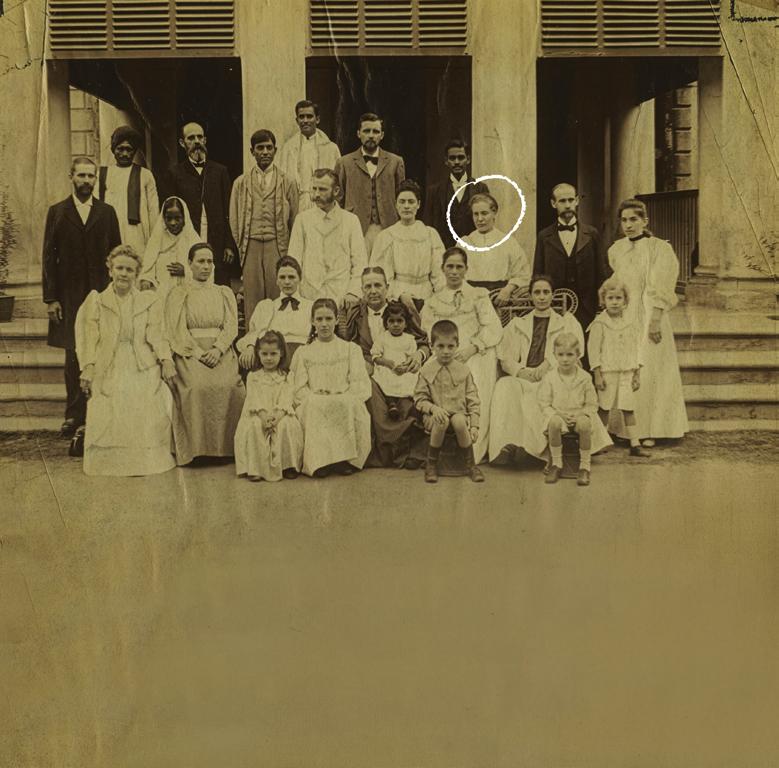
this article draws upon Gordon Christo’s biographies of Georgia Burrus, Kheroda Bose, and Nanibala Burrus, published in the Encyclopedia of Seventh-day Adventists (ESDA), available at encyclopedia. adventist.org. It was prepared by Dragoslava Santrac, ESDA managing editor.—Editors.
This story follows how one woman’s faith started a mission that spread across India, and how Indian women became its first living proof.
On January 23, 1895, a single woman arrived in Calcutta, British India, with little more than a trunk, a sense of purpose, and quiet determination. Georgia Anna Burrus traveled alone from the far side of the world to a new country. At that time India was large and diverse, and had not
yet seen Adventist mission work. There was no mission station waiting for her, no guaranteed salary, and no promise of success. What she did have was a strong belief that God had sent her and a willingness to start from nothing.
Her arrival marked a turning point in Seventh-day Adventist history. Georgia Burrus was the first Adventist missionary to the Indian subcontinent and the first single woman sent by the church to a non-Christian country. She began her work in the shadows by changing the lives of women hidden behind walls, customs, and centuries of silence. From these quiet beginnings would come the firstfruits of Adventist faith in India.
Georgia Burrus was born on July 19, 1866. She joined the Adventist Church at 16, even
though her family strongly opposed it. This choice shaped her life. She worked her way through Healdsburg College in California and later taught at the Bible Training School in Oakland. As a Bible worker she gained practical skills and a strong sense of mission.
When Stephen N. Haskell, a well-traveled early Adventist leader, asked for women to serve in India’s zenanas, the private areas where many women lived away from public life, Georgia answered right away. In 1893 the General Conference decided to send her and Myrtle Griggs to India. Knowing the challenges of working abroad, Georgia trained in nursing at St. Helena Sanitarium in California. She also took a special course at the Battle Creek School and Sanitarium in Michigan to prepare for overseas mission work.
Sadly, Myrtle Griggs had to give up her plans because of poor health. Georgia also faced health problems, but recovered. She believed her recovery was a sign of God’s guidance. After months of getting ready and waiting, she joined a group of missionaries going to South America via London. At first she was supposed to travel with Dores A. Robinson, who would lead the mission to India. When he was delayed in England, Georgia decided to go on her own and support herself until the mission was set up. The Mission Board paid for her trip, trusting she could earn a living by teaching and selling books while learning the local language.
There was no mission station waiting for her, no guaranteed salary, and no promise of success.
Georgia sailed on the S.S. Bengal in December 1894 and reached Calcutta (now Kolkata) on January 23, 1895. She stayed at the Young Women’s Christian Association (YWCA). She quickly started learning Bengali, believing it was crucial to speak to people in their own language. Focused on her studies, she had little time to earn money. Although her simple vegetarian meals helped lower her food costs, she soon ran low on funds. When her Indian teacher found out, he offered to teach her for free. Around the same time, she got an unexpected letter from someone in South Africa she had never met, offering to support her for a year. This help reminded her that her work was supported by faith from far away.
Georgia spent her days studying the language, teaching, and visiting women in zenanas. She sang hymns, shared Bible stories, and patiently made friends. The work was slow and often unnoticed, but it was based on lasting relationships that quietly laid the groundwork for future mission efforts.
By the end of her first year, Georgia was renting a bungalow to serve as the first Adventist mission office in Calcutta. Missionaries Dores A. Robinson and Martha May Taylor arrived on November 8, 1895. In March 1896 Georgia and May opened a school for Hindu girls on the first floor of the mission house. But even before official mission buildings were set up, something lasting had started. The gospel had reached Indian homes through trust and kindness.
One of the first people to respond to the Adventist message was Kheroda Bose. Born around 1870 near Calcutta, Kheroda was married as a child, which was common then. She lived with her parents until she was about 12, then moved in with her in-laws. Afterward, she endured many hardships and could leave the house only to bathe at the river with the other women of the household.
During her trips to the river Kheroda first heard about Jesus. A European Christian woman spoke to the women from a boat and later visited their home. Although opposition soon stopped these visits, Kheroda was deeply moved.
Her life changed for the worse when her husband disappeared and was never found. Still very young, she was blamed for his loss and had to live as a suffering widow. Only her small knowledge of Jesus helped her through those years.
Things changed again when, after moving from Calcutta to Benares, the same missionary woman who had visited them before came to their door in Benares, handing out literature. The women recognized each other, and the missionary encouraged Kheroda to trust Jesus. One night, when her family was asleep, 21-yearold Kheroda escaped her difficult situation and found safety at the Baptist mission. She faced public anger and court cases, and was separated from her family for good. At the Baptist mission she got an education and trained to be a teacher, hoping to support herself with dignity. God had good plans for her life.
In 1896 D. A. Robinson announced his evangelistic meetings in a hall near where Kheroda lived. Even though she was warned not to listen to Adventist teachings, Kheroda went to the meetings. She was drawn in by the Bible’s message, especially the hope of Christ’s soon return. When the Adventists opened their first school in Calcutta, Georgia Burrus welcomed Kheroda as a teacher. They studied the Bible together, and soon Kheroda was baptized, becoming the first Adventist convert in India.
Soon after Kheroda was baptized, Georgia Burrus met someone else whose life would be changed. This time it was a child.
Nanibala Biswas was born in 1885 into a high-caste Hindu family in Calcutta. Similar to Kheroda, she was married and widowed at a very young age, a victim of the child marriage custom. When Nanibala was 11, she met Georgia Burrus in 1896 when Georgia visited homes to find students for the Adventist school.

Nanibala loved the songs and Bible stories and asked Georgia to come back. Georgia returned regularly for the next several months.
As Nanibala became more interested, she refused to worship the idols in her home. Her father became very angry, locked her up, and threatened her if she tried to escape. He also told Georgia not to visit again.
One night, while everyone was asleep, a kind aunt helped Nanibala climb over the compound wall with a ladder. Scared, Nanibala ran to the Adventist mission office where Georgia lived. Even though her father tried to bring her back, Nanibala refused to leave. She chose her faith and gave up worldly riches and status.
Nanibala was later baptized, becoming the first non-Christian to accept the Adventist message in India. Georgia Burrus made sure she got an education and cared for her, helping her grow both spiritually
and in daily life. To show her thanks, Nanibala took the last name Burrus, honoring the woman who had led her to Christ.
Nanibala trained as a nurse with Adventist missionary Dr. Olney Galen Place and later went with his family to the United States. There she continued her studies at the Glendale Sanitarium, California, and Battle Creek Sanitarium, Michigan. She settled in Attleboro, Massachusetts, where she opened a health center and helped young people who wanted an education. Although she could not return to India, the faith she found as a child stayed with her until she died on December 4, 1958.
Kheroda Bose also trained as a nurse with Dr. Place and worked faithfully in Adventist treatment rooms in Calcutta. She later worked with other Adventist medical staff, including Drs. Robert and Olive Ingersoll. After retiring, she spent her time visiting women in zenanas, carrying on the work Georgia Burrus had started. Kheroda stayed active in church until she died on February 22, 1948, remembered for her deep love for Jesus and steady service.
Georgia Burrus’ legacy includes nearly four decades of mission service and the many lives she helped transform.
Georgia Burrus’ influence went far beyond the first baptisms that started Adventist work in India. In 1902 she married Luther Burgess, who was the secretary and treasurer of the India Mission. Together they continued to lead the work in Bengal, Punjab, and the Himalayan foothills, learning new languages and encouraging other missionaries to do the same.
The year after they married, Luther left his office job, and the couple moved to Karmatar to run the Adventist school and orphanage. But soon Luther’s health got worse, and they had to return to the United States in mid-1904. Since the Mission Board did not have enough money to send them back to India, Georgia and Luther came up with a plan to raise the funds themselves. They decided to sell 20,000 copies of the Bible Training School magazine. For months they traveled, spoke to many groups, and raised money not just for their return but also for such needs of the India mission as school costs and student fees.
Their hard work paid off. In 1906 the Burgesses returned to India and settled in the northwest. There they learned Hindustani and started Adventist work in Almora, Dehradun, Najibabad, and Patiala, in the Garhwal and Punjab regions. One of their first converts was John Last, the first Punjabi Adventist
and later the first Adventist martyr in India. The Burgesses also played a key role in the important 1907 conference that sent Adventist workers all over the country and encouraged them to learn local languages. After the conference the Burgesses returned to work in the northwest, where in 1910 they started the Garhwal Industrial School near Dehradun.
In 1914 Georgia’s ongoing health problems forced the couple to return to California for a short time. But her illness did not stop her missionary spirit. After only a few months they went back to Calcutta, where Luther became superintendent of the Bengal Mission. Together they started a Bengali Girls’ School, which helped strengthen Adventist education in the area.
In the 1920s they helped start Adventist work in Ranchi and Hazaribagh. They later moved to Shillong, a hill station about 5,000 feet above sea level, where they began ministry among the Khasi-speaking people.
During these years Georgia carefully recorded the mission’s progress. She regularly reported on the work in the Review and Herald and the other Adventist periodicals. Her writing inspired ongoing support for the growing mission in India.
Poor health finally forced the Burgesses to return permanently to the United States in 1934. They settled near Paradise Valley Sanitarium in National City, California. Luther died on May 4, 1946.1 Georgia died on September 25, 1948.2
Georgia Burrus’ legacy includes nearly four decades of mission service and the many lives she helped transform. From her obedience to God’s calling came the first harvest of the Adventist mission in India. From her whispered hymns and Bible stories came faith strong enough to withstand loss, opposition, and separation. And from those early converts came a witness that outlived the missionary herself. Through Nanibala and Kheroda the Adventist message took root in India as a lived faith. The quiet light kindled behind the closed doors of the zenanas has never been extinguished, but continues to shine today through the lives of millions of Adventists across India, Bangladesh, Pakistan, Sri Lanka, and beyond.
1 “Burgess, L. J.,” obituary, Review and Herald, June 10, 1946, p. 86.
2 “Burgess—Sister Georgia Burrus,” obituary, Pacific Union Recorder, Oct. 25, 1948, p. 11.
Gordon Christo is retired and working on contract as assistant editor of the Encyclopedia of Seventh-day Adventists and assistant editor of the SDA International Biblical-Theological Dictionary. He is currently setting up a heritage center for the Southern Asia Division.
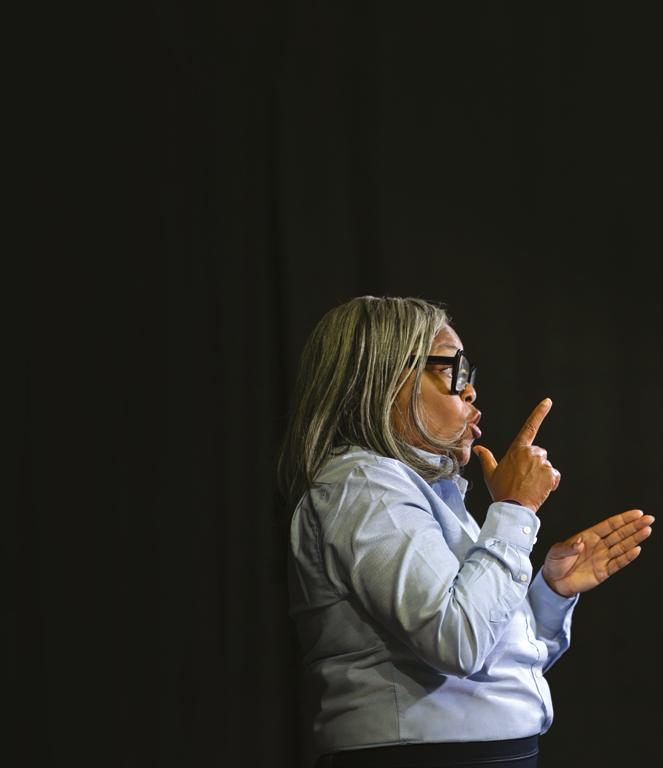
Nohelani Jarnes and Esther Doss
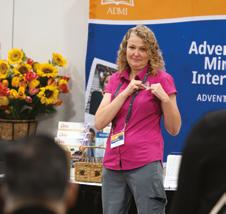
while Nohelani did not grow up Adventist, she became a member as a teenager through an evangelistic program at a local church. From a young age she felt called to become a sign language interpreter, and years later—after joining the Adventist Church—she knew God was leading her to use that gift in ministry.
As a youth she attended Sacramento Central Seventh-day Adventist Church in Sacramento, California, where Pastor Doug Batchelor served as head pastor. When he invited her to interpret for an upcoming evangelistic series, Nohelani hesitated. She had only recently begun interpreter training at a local college and felt unprepared for such a responsibility. After prayer and encouragement, she accepted the challenge.
The program proved difficult, and Nohelani quickly realized how overwhelming theological content could be without adequate training. Midway through the series, however, a Deaf woman named Nancy attended. With tears of joy Nancy shared that she had been praying for more interpreters in the Adventist Church—and seeing Nohelani interpret was an answer to her prayer.
Soon after, Nohelani met Jerry, another Deaf church member. Jerry became a mentor, patiently guiding her and offering feedback to improve her interpreting skills. Through this partnership the church became a welcoming space where Nancy and Jerry could fully participate and connect with hearing members because communication access was finally available.
This experience—and others like it—revealed a deeper truth: hearing interpreters alone are not the complete solution. For Deaf ministry to truly grow, hearing and Deaf members must work together—not just through interpretation, but through shared leadership, collaboration, and mutual respect. Interpreters open the door, but lasting inclusion and spiritual growth happen when both communities unite to serve and share the gospel with the Deaf. The Adventist Church is in desperate need of highly skilled interpreters to work alongside Deaf members and support the growth of Deaf ministry.
More than 70 million people worldwide are culturally Deaf and use sign language.1 They are ordinary people with hopes, dreams, abilities, and God-given talents—they simply cannot hear. Because spoken language is inaccessible, Deaf individuals rely on their eyes for communication. While some can lip-read, only about 30 percent of English is visible on the lips, leaving most of the message to guesswork. For this reason, sign language is preferred for its clarity, richness, and ease of use.
Esther, who was born to Deaf parents, encountered this reality firsthand when she visited a small church in Hermosa, South Dakota. Because it was a small congregation, there was only one adult Sabbath School class, which had already begun when she stepped into the room and chose a seat in the back. As a first-time visitor, she quietly took in her surroundings. Everyone was seated facing the teacher at the front—everyone except for one man. He sat in a folding chair facing the congregation, silently mouthing every word spoken. To some, that might seem unusual, but Esther had a strong hunch that she needed to meet him. During the break between services, she walked to the front and, using both voice and sign, asked one individual, “Are you deaf?”
His eyes filled with curiosity as he followed Esther’s fingers from her ear to her mouth while she signed “deaf.” He nodded and responded, in sign and voice, “Do you sign?”
That was all it took. They quickly became acquainted. The man, Ken, explained that he was skilled at lip reading and that the members were gracious enough to mouth the words spoken each week. Because no one in the congregation knew sign language, that was all they could offer.
Esther couldn’t imagine the strain of staring at someone’s lips for hours every Sabbath morning, trying to decode movements into

meaningful sentences. She admired his perseverance and offered to interpret the worship service in ASL. Ken’s eyes lit up with excitement—“Yes!”
After the service Ken repeatedly expressed his gratitude and wished Esther were relocating to the area. For him, seeing the sermon in sign language was refreshing and far easier to follow than lip reading.
For Deaf ministry to truly grow, hearing and Deaf members must work together—not just through interpretation, but through shared leadership, collaboration, and mutual respect.
While Esther’s experience highlights the strain of worship without access, Sam’s story reflects what becomes possible when Deaf members are fully included.
Sam, a Deaf German man living in British Columbia, Canada, was invited to the Ferndale Seventh-day Adventist Church in the Washington Conference (United States) for fellowship with other Deaf members. Wanting to ensure clear communication, Nancy Brown, one of the Deaf members at Ferndale, arranged for an interpreter. During Sabbath School the interpreter voiced Sam’s comments, surprising the hearing attendees and allowing Sam to fully participate.
In the worship service the interpreter’s skill brought the sermon to life—something Sam later said he hadn’t experienced in a long time. Although he deeply appreciated this access, Sam continued attending church even when no interpreter was available. After befriending Mat, a new Polish church member with no sign language skills, Sam encouraged him to become an interpreter. The reason for this seemingly odd request? Sam recognized in Mat something not all interpreters possess: a genuine heart for ministry.
Sign language interpreters may receive different levels of formal training, but in church settings there are qualities they cannot learn in a classroom— chief among them a genuine love for Jesus and a deep, selfless love for the Deaf community. They must embrace Deaf culture, recognize the unique gifts within this community, and advocate for full inclusion in church life and mission. Because interpreters are often the primary bridge of communication, they should build real friendships, offering social, emotional, and spiritual support rather than seeking recognition or leadership for selfish reasons. Above all, their highest calling is to clearly communicate and help the Deaf understand the Word of God.
Yet connecting with Deaf members is not the interpreter’s responsibility alone. The entire church family shares the call to build relationships and engage with one another. Deaf members bring God-given spiritual gifts that strengthen the congregation and advance its mission, and they should be welcomed as full participants. While some interpreters may lack proper qualifications—and even skilled ones still carry a “hearing accent”—the broader church community must actively support inclusion rather than relying solely on interpreters.
The Ferndale church offers one example of what this shared commitment to Deaf ministry can look like. In preparation for an upcoming Deaf Big Day—a special Sabbath gathering featuring a Deaf speaker—hearing members spent months taking sign language classes so that visiting Deaf attendees would feel genuinely welcomed. Their efforts were evident, as Deaf guests felt the warmth of members who communicated directly in sign rather than relying solely on interpreters.
On the Sabbaths that no interpreter is available, the pastor provides a sermon script to their dedicated Deaf member, Nancy Brown, and the song service often includes a YouTube video with music and a sign language interpreter to ensure accessibility. The congregation consistently seeks to include Deaf members and visitors, hiring interpreters when possible and communicating as best they can when one is not present. Their love for the Deaf is unmistakable within this small church community, and visitors immediately sense that care.
While the Adventist Church urgently needs more sign language interpreters worldwide, hearing congregations can still do much to help Deaf members feel welcome. Some churches have embraced Deaf visitors so warmly that they have stayed—even without an interpreter each Sabbath—because they found genuine love and community.
Churches can learn basic sign language through online resources, greet Deaf visitors warmly even if they do not sign, and sponsor individuals who feel called to train as interpreters.2 By taking these simple steps, congregations can better support their Deaf brothers and sisters and partner with them in sharing the gospel with one of the world’s largest unreached people groups.
1 World Federation of the Deaf, Frequently Asked Questions, https://wfdeaf.org/contact/faqs/.
2 For resources from Adventist Deaf Ministries International, please visit https://www.adventistdeaf.org.
Esther Doss, whose first language is American Sign Language, was born to Deaf parents and now serves as the North American Division Deaf Ministries coordinator and a video relay service interpreter. Nohelani Jarnes has been signing since age 11 and is a certified interpreter, serving as the volunteer Deaf Ministry coordinator for the Washington Conference and Interpreter Ministry coordinator for her local Seventh-day Adventist church, while also working as a video relay service interpreter.
tH e dea F Mi SS ion g ap
83,141,165
estimated Deaf people worldwide1
400+
distinct sign languages used globally by Deaf communities2
236
Deaf people groups among the world’s 12,348 identified people groups3
98%
Deaf people worldwide who do not know Jesus Christ, primarily because of communication barriers4
1
Adventist pastor is employed to serve the Deaf population of an entire country in at least eight countries worldwide, including Tanzania, United States, Sri Lanka, Poland, Latvia, Ukraine, Nigeria, and Ghana.5
1 https://www.peoplegroups.org.
2 https://www.sil.org/sign-languages
3 https://www.peoplegroups.org
4 https://www.deafmissions.com/about
5 Information submitted by each division in 2025.
this Holy Book [the Bible] has withstood the assaults of Satan, who has united with evil men to make everything of divine character shrouded in clouds and darkness. But the Lord has preserved this Holy Book by His own miraculous power in its present shape—a chart or guidebook to the human family to show them the way to heaven.
But the oracles of God have been so manifestly neglected that there are but few in our world, even of those who profess to explain it to others, who have the divine knowledge of the Scriptures. There are learned men who have a college education, but these shepherds do not feed the flock of God. They do not consider that the excellencies of the Scriptures will be continually unfolding their hidden treasures as precious jewels are discovered by digging for them.
There are men who strive to be original, who are wise above what is written; therefore, their wisdom is foolishness. . . . In seeking to make plain or to unravel mysteries hid from ages from mortal man, they are like a man floundering about in the mud, unable to extricate himself and yet telling others how to get out of the muddy sea they themselves are in. This is a fit representation of the men who set themselves to correct the errors of the Bible. No man can improve the Bible by suggesting what the Lord meant to say or ought to have said. . . .
Ellen G. White
Brethren, let not a mind or hand be engaged in criticizing the Bible. It is a work that Satan delights to have any of you do, but it is not a work the Lord has pointed out for you to do.
Men should let God take care of His own Book, His living oracles, as He has done for ages. They begin to question some parts of revelation, and pick flaws in the apparent inconsistencies of this statement and that statement. Beginning at Genesis, they give up that which they deem questionable, and their minds lead on, for Satan will lead to any length they may follow in their criticism, and they see something to doubt in the whole Scriptures. Their faculties of criticism become sharpened by exercise, and they can rest on nothing with a certainty. You try to reason with these men, but your time is lost. They will exercise their power of ridicule even upon the Bible. They even become mockers, and they would be astonished if you put it to them in that light.
Brethren, cling to your Bible, as it reads, and stop your criticisms in regard to its
validity, and obey the Word, and not one of you will be lost. The ingenuity of men has been exercised for ages to measure the Word of God by their finite minds and limited comprehension. If the Lord, the Author of the living oracles, would throw back the curtain and reveal His wisdom and His glory before them, they would shrink into nothingness and exclaim as did Isaiah, “I am a man of unclean lips, and I dwell in the midst of people of unclean lips” (Isa. 6:5).
Simplicity and plain utterance are comprehended by the illiterate, by the peasant, and the child as well as by the full-grown man or the giant in intellect. If the individual is possessed of large talents of mental powers, he will find in the oracles of God treasures of truth, beautiful and valuable, which he can appropriate. He will also find difficulties, and secrets and wonders which will give him the highest satisfaction to study during a long lifetime, and yet there is an infinity beyond. . . .
We thank God that the Bible is prepared for the poor man as well as for the learned man. It is fitted for all ages and all classes.
Seventh-day Adventists believe that Ellen G. White (1827-1915) exercised the biblical gift of prophecy during more than 70 years of ministry. This excerpt is taken from Selected Messages, book 1, pp. 15-18.

Letting your light shine . . . even when it’s awkward.
Hey, Rachel, I’m having a party at my house this Friday night,” my friend Sarah called to me as we passed each other in the school hallway between classes. “I hope you can come! We’ll play games and maybe watch a movie.”
“Uh, great!” I said, pasting a fake smile on my face.
“I’ll have to see if I can make it. I might have something going on already.”
Pressing through a crush of students toward my next class, I mentally kicked myself. You practically lied to Sarah. You don’t have to check your calendar. You know right now you’re not going to her party during Sabbath!
I’d decided long before that going to parties with my friends from public school wouldn’t help me get closer to God on Sabbath. But Sarah didn’t know that. Neither did my other friends. I’d told them that I went to church on Saturday, but I’d never explained that Sabbath meant so much more than spending a few hours in church.
Whenever my friends invited me to a social event on Sabbath, I always came up with a weak excuse.
“I’m doing something with my family” was the most common one. That was mostly true, since my family did spend a lot of time together on Sabbath starting Friday night.
Thinking up excuses was hard, but it seemed easier than launching into a Bible study. It’s already obvious enough that I’m different, I told myself. I don’t swear; I don’t wear skimpy outfits; I bring homemade veggie burgers for lunch. My friends would never understand my beliefs anyway. Some of them aren’t even Christians.
As I settled into my seat in English class, I pondered my dilemma. This is ridiculous, I scolded mentally. You’ve gone to this school for three years, and you still haven’t told your friends something so important? What kind of witness is that?
That night I was still thinking about Sarah and her party. It’s time to stop making excuses, I resolved. I’m going to tell Sarah the real reason I’m not coming. But I was sure I’d never have the courage to do it in person. So I decided to write a letter explaining why and how I kept the Sabbath.
Hunched over my desk in my bedroom, I stayed up late working on the letter. It had to sound just right. I explained that according to the Bible, Sabbath is an entire day set aside for God, and it goes from sundown on Friday night till sundown on Saturday night.
Please, God, help this to make sense, I prayed.
Folding up the lined paper, I decorated the outside with funny sayings and drawings, as Sarah and I often did when we wrote notes to each other.
Whenever my friends invited me to a social event on Sabbath, I always came up with a weak excuse.
When I finally went to bed, I tossed and turned, wondering how Sarah would react. She’s going to think I’m hopelessly weird, I worried.
The next day at school I waited until the very end of the day to find Sarah. That way I wouldn’t have to face her right away after she read my bombshell.
“Here’s a note for you,” I said, forcing a casual grin to hide my anxiety. Then I hurried to catch my bus.
Sarah and I had no classes together, so over the next couple of days I didn’t see much of her. My uneasiness grew each time
we passed each other in the hall. She hadn’t said anything about the letter. What did she think?
Finally Sarah spotted me after school and handed me a note as I rushed toward the door. On the bus I carefully unfolded the paper, my heart pounding.
“It’s OK that you can’t come to my party,” Sarah’s letter said. “Actually, I respect you for sticking with your principles. I’d love to hear more about your beliefs sometime.”
I took a deep breath as relief washed over me. Thank You, God, that she still wants to be my friend, I prayed silently. I guess I shouldn’t have worried so much.
A few weeks later Sarah met me before school. “I’m having a party this weekend,” she told me. “I planned it for Saturday night instead of Friday night so it won’t conflict with your Sabbath. You can come then, can’t you?”
“Of course!” I said, a genuine smile spreading across my face. “I’ll be there!” Sarah grinned back. “Great! I really wanted you to come. See you then.”
As I hurried off to class, I felt a warm glow knowing that Sarah had made special plans just to include me—and let me stay true to God. In fact, I could think of only one bad thing about the whole situation: I should have let my light shine a lot sooner!
DISCUSSION QUESTION:
Tell about a time you felt nervous or fearful about sharing your beliefs. What was the result? Do you feel more confident about witnessing now than you did then? How can you become more bold or excited about sharing your faith?
I have heard that beetroot juice is the wonder cure for high blood pressure. My friends are encouraging me to stop my medications and just drink beetroot juice twice a day. What is your advice?
High blood pressure, also called hypertension, is often called the “silent killer” because most people don’t feel sick when they have it, yet it can cause serious health problems over time.
Globally, high blood pressure affects more than 1.2 billion people and is a leading cause of death, especially common in adults over 40. Its main causes are a mix of lifestyle and inherited (genetic) factors. Eating foods high in salt, sugar, and unhealthy fats, being overweight, smoking, drinking alcohol, less than adequate restful sleep, and not exercising regularly all raise blood pressure. Family history also plays a role, meaning that if your parents have high blood pressure, you are more likely to develop it too. Stress and aging also make blood vessels stiffer, which raises blood pressure. Some medical conditions raise blood pressure levels, such as hormonal disorders, diabetes, kidney diseases, and sleep apnea (often accompanied by loud snoring), among others.
If high blood pressure is not controlled, it can lead to serious complications. The most dangerous include stroke (when the flow of blood to the brain is blocked or a blood vessel bursts), heart attack (when blood flow to the heart is blocked), heart failure (when the heart muscle becomes weak and cannot pump efficiently), kidney
disease, and vision loss. Because there are usually no early symptoms, many people do not know they have high blood pressure until these complications occur. This is why high blood pressure is called the silent killer.
Beetroot juice is rich in nitrate, a natural chemical compound found in many vegetables. Upon consumption, nitrate is changed by friendly bacteria in the mouth (oral microbiome) into nitrite, and then into nitric oxide, which relaxes the blood vessels. Relaxed vessels can lower blood pressure (BP). This “nitrate → nitrite → nitric oxide” pathway is well documented in human studies.
Drinking beetroot juice can modestly lower systolic BP for some people, especially those with hypertension, but results are not guaranteed and may fade when you stop drinking it, just as what happens with prescribed BP medicines.* Think of it as an adjunct to, not a substitute for, proven lifestyle interventions (exercise, maintaining ideal weight, avoiding tobacco and alcohol, and getting enough sleep) and appropriate medications as needed.
How to use it safely (with your doctor’s guidance):
Talk to a qualified health professional first. Beetroot juice can interact with BP medicines by adding to their BP-lowering effect. Your doctor can advise on dose,


timing, and routine monitoring of your blood pressure for efficacy and safety.
Typical research doses: 250 to 500 milliliters (1 to 2 cups) per day of beetroot juice (often split), providing about 200 to 800 milligrams nitrate.
Raw beetroot (and nitrite-rich leafy vegetables) retain more nitrites than when cooked, and adequate time in the mouth and thorough chewing help bacteria convert nitrites.
Strong antiseptic mouthwashes (e.g., chlorhexidine) can kill the helpful oral bacteria that convert nitrate and may raise BP, blunting the beetroot juice’s effect. Avoid routine antiseptic mouthwash unless your dentist or doctor recommends it. Regular flossing and brushing are generally sufficient.
Beetroot juice may help lower BP for some people through its nitrate content and influence on the oral microbiome, but it is one tool among many. Additions such as beetroot juice should be layered on top of medications and lifestyle—not instead of them. Use it only with medical advice, keep up the lifestyle foundations, take your medications as prescribed, and follow up regularly to stay on target.
An extended version of this article is available at adventistreview.org Editors.
* For studies relating to the safety and effectiveness of beetroot in regulating blood pressure, see the following: https://doi.org/10.1161/HYPERTENSIONAHA.114.04675; https://doi.org/10.1016/j.numecd.2024.06.009; and https://pubmed.ncbi.nlm.nih.gov/40522148/.
Zeno L. Charles-Marcel, a board-certified internist, is the director of Adventist Health Ministries at the General Conference. Peter N. Landless, a board-certified nuclear cardiologist and General Conference Adventist Health Ministries director emeritus, is also a boardcertified internist.
one of the greatest dangers to the church today comes not from external pressure but from internal haste. Truth can be wounded not only by error but also by the way it is defended.
Scripture consistently teaches that motive alone is not enough. Methodology matters. When Jesus was arrested in Gethsemane, Peter reacted immediately. “Then Simon Peter, having a sword, drew it and struck the high priest’s servant, and cut off his right ear” (John 18:10). His loyalty was sincere, but his response was wrong. Jesus stopped the escalation, healed the wound, and restored order. Love without wisdom still injures. Zeal without discernment still divides.
It is possible to defend the truth and still wound the body.
A similar lesson appears in Joshua 22. The tribes west of the Jordan heard that their brothers on the east had built an altar. Their concern for pure worship was legitimate. They wanted to protect faithfulness and avoid compromise. Yet they prepared for conflict based on a report rather than verified facts. The tension ended only when assumptions gave way to verified truth and confirmed facts. The problem was never devotion to truth. The problem was haste without understanding.
That same pattern is visible today. Digital platforms reward immediacy, not accuracy. Short clips replace context. Headlines replace investigation. Many sincere believers share unverified information, believing they are protecting the church. Yet Scripture warns against this approach: “He who answers a matter before he hears it, it is folly and shame to him” (Prov. 18:13). Discernment is not silence: It is disciplined speech guided by wisdom.
Ellen G. White addressed this tension with clarity: “While it is important on the one hand that laxness in dealing with sin be avoided, it is equally important on the other to shun harsh judgment and groundless suspicion.”* These words do not excuse wrongdoing. They protect trustworthy relationships. They preserve unity. They safeguard the mission from internal erosion. Mission advances most effectively when integrity guides our actions. Spiritual power flows when our lives, ministries, and service are based on truth. This builds confidence in our communities. Scripture reminds us that “the wisdom that is from above is first pure, then peaceable, gentle, willing to yield, full of mercy and good fruits, without partiality and without hypocrisy” (James 3:17).
Therefore, the call before us is clear. Before reacting, pause. Before sharing, verify. Speak to people, not about people. If action is required, let it reflect the Spirit of Christ, not the energy of the moment. It is possible to defend the truth and still wound the body. God calls His people to something better.
Grounded in the Bible, focused on the mission, the church moves forward not by speed alone, but by wisdom, grace, and faithfulness. When right motives are joined to right methods, the witness of Christ remains credible, healing continues, and the mission advances with strength and unity.
Founded 1849. Published by the General Conference of Seventh-day Adventists, Northern Asia-Pacific Divison
PUBLISHING BOARD
Erton Köhler, chair; Pierre E. Omeler, vice chair; Justin Kim, secretary; Audrey Andersson, G. Alexander Bryant, Zeno CharlesMarcel, Sabrina DeSouza, Paul H. Douglas, Mark A. Finley, James Howard, Leonard Johnson, Mario Martinelli, Richard E. McEdward, Magdiel Perez Schulz, Artur Stele, Alyssa Truman, Ray Wahlen, Todd R. McFarland, legal advisor
MANAGEMENT BOARD BASED IN SEOUL, KOREA Soon Gi Kang, chair; Justin Kim, secretary; Todd R. McFarland; SeongJun Byun; Toshio Shibata; Tae Seung Kim; Ray Wahlen
Ex-officio: Paul H. Douglas; Erton Köhler; Richard E. McEdward
EDITOR Justin Kim
ASSOCIATE EDITORS Shawn Boonstra, Sikhululekile Daco
ASSOCIATE DIRECTOR Greg Scott
ASSISTANT EDITORS
Hannah Drewieck, Beth Thomas, Jonathan Walter
EDITORS BASED IN SEOUL, KOREA Jae Man Park, Hyo-Jun Kim, SeongJun Byun
NEWS CORRESPONDENT Marcos Paseggi
FINANCE MANAGER John F. Feezer IV
DIRECTOR OF SYSTEMS INTEGRATION AND INNOVATION Daniel Bruneau
ART DIRECTION AND DESIGN
Brett Meliti, Ellen Musselman/Types & Symbols
CUSTOM TYPEFACE DESIGN RK Type
LAYOUT TECHNICIAN Fred Wuerstlin
COPY EDITOR James Cavil
EDITORIAL ASSESSMENT COORDINATOR Marvene Thorpe-Baptiste
KIDSVIEW DESIGN Merle Poirier
SENIOR ADVISOR E. Edward Zinke
AD SALES Glen Gohlke
DISTRIBUTION Sharon Tennyson
WEBSITE: www.adventistreview.org
TO WRITERS: Writer’s guidelines are available at www.adventistreview.org at the footer. For further correspondence, email manuscripts@adventistreview.org. Unless otherwise noted, Bible texts in this issue are from the New King James Version. Copyright © 1979, 1980, 1982 by Thomas Nelson, Inc. All rights reserved. Bible texts credited to NIV are from the Holy Bible, New International Version. Copyright © 1973, 1978, 1984, 2011 by Biblica, Inc. Used by permission. All rights reserved worldwide. Bible texts credited to NRSV are from the New Revised Standard Version of the Bible, copyright © 1989 by the Division of Christian Education of the National Council of the Churches of Christ in the U.S.A. Used by permission. Scripture quotations marked ESV are from The Holy Bible, English Standard Version © 2001 by Crossway, a publishing ministry of Good News Publishers. ESV Text Edition: 2016. Used by permission. All rights reserved. Scripture quotations marked NASB are from the New American Standard Bible, copyright © 1960, 1971, 1977, 1995, 2020 by The Lockman Foundation. All rights reserved.
The Adventist Review (ISSN 0161-1119) is the general paper of the Seventh-day Adventist® Church. It is printed simultaneously around the world in Argentina, Australia, Austria, Brazil, Germany, Indonesia, Korea, Mexico, South Africa, and the United States. It is published monthly by the General Conference of Seventh-day Adventists®, 12501 Old Columbia Pike, Silver Spring, MD 20904, U.S.A. The Korean editorial and business offices are located at the Northern Asia-Pacific Division, 67-20 Beonttwigi-gil, Paju-si, Gyeonggi-do 10909, Republic of Korea.
Copyright © 2026, General Conference of Seventh-day Adventists®.
Erton C. Köhler is the president of the General Conference