We like to think we’re more advanced than the people who came before us, but are we actually better? As much as we like to believe humanity is progressing, history keeps telling a different story.
This year, my husband and I celebrated 10 years of marriage with a trip to one of our favourite countries: Japan. It was our second time there, and while we explored new places, we also returned to some we had loved—one of those places was Hiroshima.
You’ve probably heard of the city’s tragic history. At 8:15am on August 6, 1945, Hiroshima was devastated by the first atomic bomb used as a weapon of war, destroying approximately 70 per cent of all buildings and instantly killing 80,000 people. Three days later, the same happened in Nagasaki.
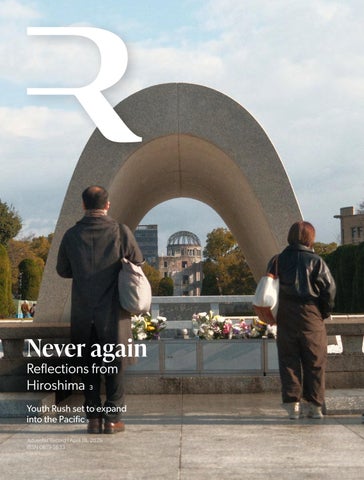
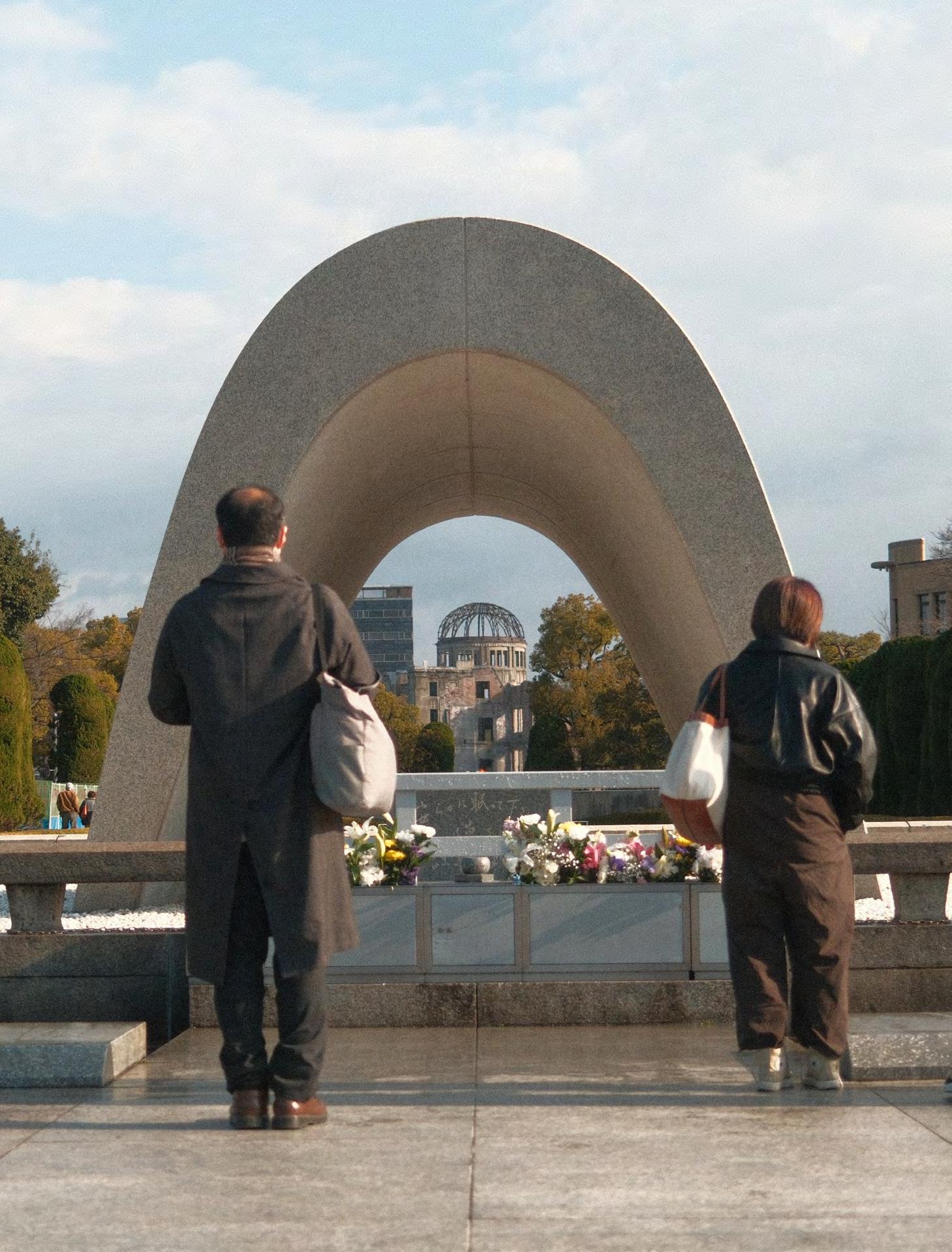
Today, Hiroshima is a thriving, modern city. But despite its renewal, it carries a quiet, persistent grief. Walking through the Peace Memorial Park— where you’ll find monuments, ruins and the Peace Museum—a certain stillness is quite noticeable. Visitors move slowly, often in silence. The Bomb Dome (pictured on the cover), preserved near the hypocentre of the blast, stands as a stark reminder of what once happened there.
We returned to Hiroshima partly because we feel drawn to that contrast— between devastation and renewal. It’s a city that tells a story not only of tragedy, but also of resilience. But visiting Hiroshima this time felt different.
When we arrived in Japan, the current conflict in the Middle East had just erupted. Each evening, after full days of sightseeing, we would return to our accommodation and watch the news—images of destruction, death tolls rising, more countries getting involved. And in Hiroshima, it was impossible to forget or even ignore the state of our world.
During the day, we walked through a place shaped by one of the darkest moments in human history, where the message “Never again” is repeated in different forms. At night, we watched a world where violence continues, where innocent people are still caught in the crossfire.
I couldn’t help but ask: why is humanity unable to learn from its past? Of course, what happened in Hiroshima is not the same as what is happening in the Middle East. In fact, no atomic weapons have been used since then.
But whatever the method or the scale, the human tendency for evil keeps showing up. The cycle of violence in this world is never-ending. We like to think we’re more advanced than the people who came before us, but are we actually better? Because when I look at the state of the world, I see Genesis 6:5 all over again: “The Lord saw how great the wickedness of the human race had become on the earth, and that every inclination of the thoughts of the human heart was only evil all the time.”
Maybe the problem is not that we haven’t learned. Maybe it’s that we can’t fix ourselves. As much as we like to believe humanity is progressing, history keeps telling a different story. Left to our own nature, we don’t drift towards good—we drift towards selfishness, towards harm, towards sin.
And that’s why memory alone is not enough. Standing in Hiroshima, surrounded by reminders of the past and calls for “Never again”, I couldn’t ignore the reality that remembering doesn’t necessarily change us.
Real change requires something beyond us. It requires transformation— something only God can do in us. Only through Jesus can our hearts be reshaped, our instincts redirected, our capacity to love others restored.
In a world where violence and selfishness continue to surface in different forms, we are called to live differently—to reflect that transformation in the way we treat others, in the way we respond, in the way we choose compassion over indifference. By doing so, we give more people the opportunity to find this transformative power. A power that will finally give us the much-awaited “Never again”, when “‘He will wipe every tear from their eyes. There will be no more death’ or mourning or crying or pain, for the old order of things has passed away” (Revelation 21:4).
We cannot keep it to ourselves. The world needs the hope that we have to offer. If you don’t know where to start, there will things happening across the South Pacific designed to reach our communities. To get involved, visit <southpacificforchrist.org>.
North Star
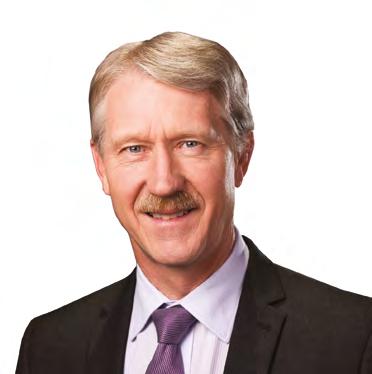
Brad Kemp Adventist Media CEO
For centuries, mariners crossed vast and unpredictable oceans with little more than a sextant, a compass and the night sky. Among the many stars, one held particular importance: the North Star. Fixed in the sky and visible night after night, it provided a constant point of reference. Even when clouds obscured the horizon or storms pushed ships off course, sailors could reorient themselves by returning their gaze to that single, dependable star. It did not tell them every turn to make, but it ensured they were heading in the right direction.
Every now and then, the church can benefit from having a North Star to which everyone and everything orients. I remember Net ‘98. It was a North Star moment. Satellite dishes were erected around the world, and the message of Jesus went global. Even in rural villages in PNG, satellite dishes went up, and people gathered to see the image on the screen and hear the message preached every evening. For that one moment, the world church came together. Common purpose. Shared activity. North Star.
Today, we live busy lives, and this is also true for our church life. Each church has its own goals and community projects. We move in different directions, and this is often necessary and good. However, there are times when pulling together can make a difference.
A North Star is not a detailed strategy or a list of annual goals. It is a unifying purpose, project or goal. And 2027 is going to provide the church with a North Star opportunity again through the evangelistic initiative called OneVoice27. This calls all churches to point in the same direction. It is a global initiative that celebrates 2000 years since the baptism of Jesus, and it will utilise our many media platforms to reach both our digital and in-person communities.
Every local church—yes, even your church—is called to become involved and to be part of the movement that points north, a movement that will share Jesus in new and familiar ways.
Just as the North Star provided a point of reference for ancient mariners, you are being asked to align with your fellow churches around another point of reference and become part of the OneVoice27 initiative.
Youth Rush set to expand into the Pacific
Wahroonga, NSW | Tracey Bridcutt
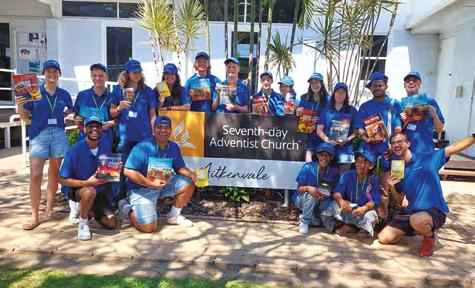
A youth-led Literature Ministry initiative introduced in Australia in 2021—part of the global Youth Rush program that originated in the United States—is now expanding into the Pacific, with plans underway to launch the first Youth Rush programs in Fiji, Vanuatu and Solomon Islands.
Three Youth Rush leaders from Australia and one from New Zealand will travel to the Pacific in May to work alongside local mission youth directors and Literature Ministry leaders. Their goal is to provide training in each territory, laying groundwork ahead of the Trans Pacific for Christ campaigns.
“The idea is to prepare the way for Trans Pacific for Christ as well as leaving the young people out there better equipped to continue Youth Rush in the future,” said Brenton Lowe, Literature Ministry coordinator for Australia and NZ.
Mr Lowe said Youth Rush also provides a practical pathway for young people who may not yet feel ready to serve as presenters during Trans Pacific for Christ.
“Youth Rush gives them a powerful way to be involved. When baptisms happen later and they see the photos, they can say, ‘I played a part in that,’” he said.
Since its introduction in Australia in 2021, with just three conferences and about 20 participants, Youth Rush has grown rapidly. Last year, 211 young people across Australia and New Zealand were involved.
While organisers acknowledge that the Pacific context will require adaptation—including working closely with local leaders and respecting village protocols— they believe the model will translate well.
“We need to find what works in their culture,” Mr Lowe said. “I think we’ll find that young people everywhere respond the same way: they thrive when they work together.”
The long-term vision is to leave Pacific youth leaders better equipped to continue Youth Rush in their missions.
“The hope is that along the way, young people will experience for themselves how life-changing it is to serve and help others.”
Historian tells story of another Anzac chaplain
Cooranbong, NSW | Nathan Brown
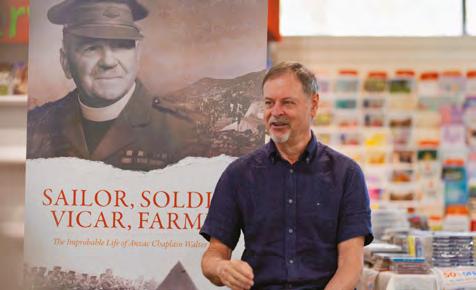
A new book telling the story of Anzac chaplain Walter Dexter was launched at Better Books and Foods in Cooranbong on March 15. As the book’s title suggests, Sailor, Soldier, Vicar, Farmer narrates Chaplain Dexter’s adventurous and many-faceted life as a later-inlife Anglican priest who was assigned to Australia a few years before the outbreak of World War I, in which he served as a chaplain with Anzac troops for the entirety of the war.
Author Dr Daniel Reynaud is Emeritus Professor of History at Avondale University and inaugural Visiting Historian at the Anzac Memorial in Sydney’s Hyde Park. His previous book—The Man the Anzacs Revered, published in 2015—told the story of Anzac chaplain William McKenzie. In contrast with McKenzie, Chaplain Dexter lived his post-war life in relative obscurity as a failing farmer and country clergyman, but remains the
most decorated chaplain in Australian military history, receiving awards for bravery on the battlefields of both Gallipoli and France.
“About one in four of the Anzacs were active Christians, so their stories can and should be told,” Dr Reynaud said. “And the chaplains, in particular, played such an important role in terms of soldier morale, and no-one exemplifies that more than Chaplain Dexter with the work he did for their emotional, spiritual and physical wellbeing.”
After its initial launch with family, friends and colleagues, a public book launch is planned at the Australian War Memorial in Canberra on April 21.
Sailor, Soldier, Vicar, Farmer is available now from Adventist bookshops in Australia/New Zealand, or online at <adventistbookcentre.com.au/sailor-soldier-vicar-farmer.html>.
Youth Rush team in Townsville, Australia . . . there will soon be teams in the Pacific.
Dr Daniel Reynaud speaks at the book launch.
Tributes flow after Pacific leader passes
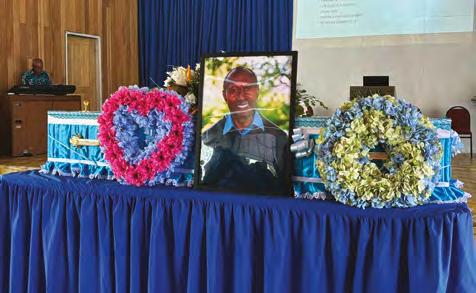
The first Pacific Island national to serve as a senior administrator at the South Pacific Division (SPD), has died in the Solomon Islands, months after receiving the New Year’s Honours for his services to the Seventh-day Adventist Church internationally and at home.
Pastor Lawrence Gilmore Pita Tanabose, 73, passed March 17 at the National Referral Hospital in Honiara. He was buried March 19 in a ceremony at Betikama Adventist College attended by government officials, church representatives, family and friends.
Pastor Tanabose served the Seventhday Adventist Church for 37 years in a range of pastoral, educational and senior administrative roles across the Solomon Islands, Papua New Guinea, Fiji and Australia. His service included leadership positions at mission, union and division levels within the Church.
Recently appointed a Companion of the Order of St Michael and St George in the 2026 New Year’s Honours—approved by King Charles III and announced by Sir David Tiva Kapu—Pastor Tanabose received the honour with gratitude and humility.
Church leaders, past and present have paid tribute to Pastor Tanabose’s contributions across the Pacific region.
Former SPD president Dr Barry Oliver described him as “a warm pastor and a capable administrator—a greater asset for our church than most people will ever realise.”
Adventist Media CEO Dr Brad Kemp also worked closely with Pastor Tanabose. “He had a clear vision of what needed to be done and a heart for seeing the work of God advance, particularly in the Pacific,” he said.
SPD president Pastor Glenn Townend added, “Courage and compassion, and standing for what was right were exemplified in his life.”
Outside of his church work, Pastor Tanabose had a creative streak, drawing, sketching and painting murals and posters for evangelistic campaigns. He was also a prolific blood donor throughout his life, receiving a medal for being one of the top donors in the Pacific.
Born in PNG as a child of missionaries, Pastor Tanabose lived in many places across the SPD and served the cause of mission his whole life. He was predeceased by his wife, Rosina, in May 2025. Rosina was from Vanuatu and stayed beside him in ministry across multiple calls. The couple are survived by six children and five grandchildren, and a large extended family.
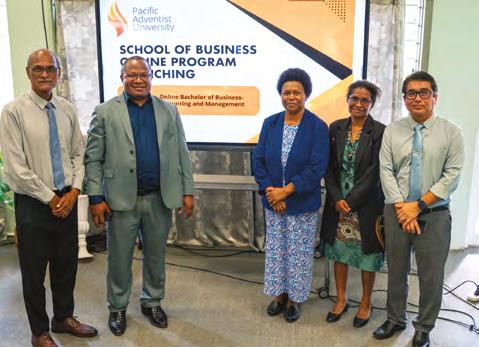
PAU launches first fully online degree program
Port Moresby, PNG | Douglas Rinny
Pacific Adventist University (PAU) has launched its first fully online academic program, expanding access to higher education across Papua New Guinea and the Pacific.
The Bachelor of Business (Accounting & Management) will serve as a pilot as the university moves into digital learning. The program is designed to support both school leavers and working adults seeking flexible study options.
PAU vice chancellor Professor Lohi Matainaho said the initiative extends the university’s reach beyond the classroom.
“Today marks an important milestone for the university as we extend our learning beyond the traditional classroom. Each online program represents
our commitment to providing affordable and accessible quality education that prepares students to succeed in the modern business world,” he said.
The transition to online delivery has been developed over six years, including investment in digital systems and staff training.
Minister for Higher Education, Research, Science and Technology Kinoka Feo welcomed the initiative.
“With limited resources for physical infrastructure, online technology offers unlimited capacity for expanding tertiary education,” he said.
PAU plans to expand its online offerings, with each school expected to introduce courses in the coming years.
Honiara, Solomon Islands | Jarrod Stackelroth
L-R: Professor Lohi Matainaho, PAU vice chancellor; Kinoka Feo, minister for Higher Education, Research, Science and Technology; Professor Lalen Simeon, PAU Deputy Vice Chancellor (Academic); Leah Margis, assistant secretary, Department of Higher Education, Research, Science and Technology; and Dr Khin Kyi, PAU School of Business dean.
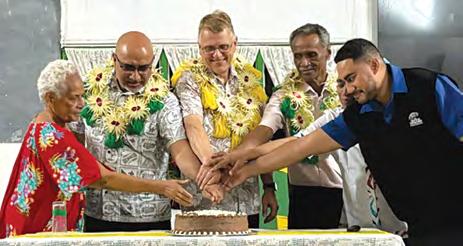
A special ceremony was held at Betikama Adventist College.
Media leaders align ahead of major mission initiatives
Wahroonga, NSW | Tracey Bridcutt
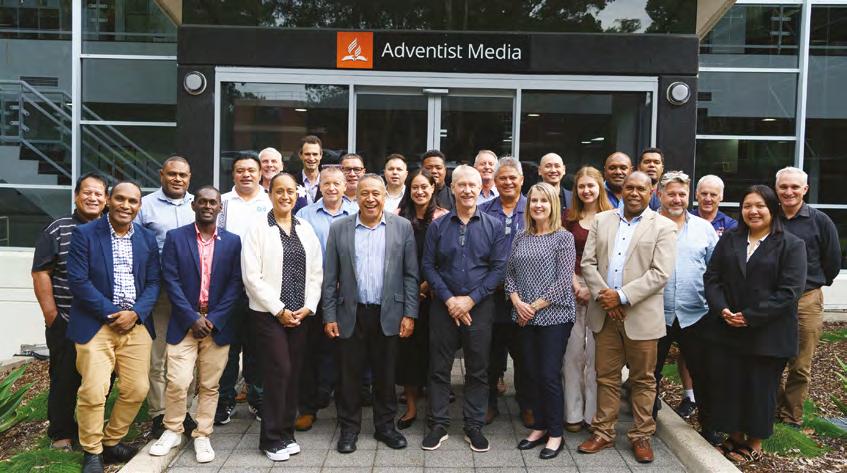
Communication and media leaders from across the South Pacific Division (SPD) gathered at Adventist Media on March 16–18 to discuss strategy, collaboration and mission.
The SPD Media and Communication Advisory brought together representatives from Fiji, Vanuatu, Solomon Islands, Kiribati, French Polynesia, American Samoa, the Cook Islands, Papua New Guinea, New Zealand and Australia, and was held at the start of the quinquennium to strengthen networks and align media efforts across the region.
The advisory focused on major upcoming initiatives, including South Pacific for Christ and OneVoice27, and featured workshops on crisis communication and reputation management, digital evangelism and storytelling, technology and artificial intelligence in ministry, Adventist identity and branding, and the role of literature in mission.
Participants were introduced to new developments and tools designed to support their work in media ministry, with presentations from the Adventist Media team and guest presenters, including Hope Channel International vice president Pastor Robbie Berghan, who shared insights into Hope Channel’s strategic direction and future opportunities.
Concluding the advisory, Adventist Media CEO Dr Brad Kemp challenged attendees to recognise the significance of their role in the Church’s mission. “God has brought us to this point at this time,” he said. “What are we going to do with the stewardship we’ve been given of media?”
Dr Kemp emphasised the importance of collaboration across the region.
“Across this team we have a unique and complementary set of skills. If we can bring that together, we can make a significant difference. That’s what I’m hoping for—a team of people working together to achieve the mission God has given us.”
Media and communication associate director for the Solomon Islands Mission, Travis Ronnie, said the advisory was a valuable experience.
“I left the advisory feeling inspired and more affirmed in the mission of Adventist media,” he said. “It reminded me that our work is about sharing hope, wholeness and leading people to have an experience with Christ.”
The advisory concluded with a season of prayer, as participants gathered in small groups to seek God’s guidance for the road ahead— particularly for the success of South Pacific for Christ and OneVoice27.
making headlines
Sewing hope
More than 1000 Adventist women sewed 700 heart-shaped pillows for breast cancer patients as part of a Women’s Ministries Convention in Brazil. Designed to ease post-surgical pain, each pillow was paired with a handwritten letter and delivered to a local cancer hospital.—SAD
Wheels and meals
Hope Channel Indonesia distributed 150 free takjil packages to motorcyclists and drivers in South Jakarta during Ramadan, offering practical support to Muslims breaking their fast. The initiative, carried out by the organisation’s entire staff, saw all food and drink packages handed out in just 15 minutes.—Hope Channel Indonesia
Braving borders
A Zimbabwean pastoral team braved rivers and rugged terrain to prepare remote Mozambique border communities for May’s Impact Mozambique evangelistic campaign. They met two Mozambicans already drawn to the Sabbath, highlighting the need for an Adventist presence in the region.—ANN
Move now, age better
Researchers at the AdventHealth Research Institute found that regular, moderate aerobic exercise in younger and midlife adults helped brains appear structurally younger than expected, suggesting movement can support long-term cognitive health before any decline begins. Unlike previous studies focused on older adults, this randomised study showed that simple, consistent activity like walking, swimming or cycling directly influenced brain ageing.—Adventist Review
Communication and media leaders from around the South Pacific attended the advisory.
Reaching every home
Youth across the Solomon Islands Mission took part in Global Youth Day on March 21, engaging in community outreach under the theme “Communion in Action”. Churches in Honiara and surrounding areas carried out initiatives including “Bucket and Basket” ministry, food distribution and home visits. At Naha, youth and Pathfinders visited more than 40 homes across two communities, sharing short messages, prayer and practical support. Groups also split across locations in Honiara and East Guadalcanal, distributing food and literature in public spaces and visiting nearby villages. Community members expressed appreciation for the initiative —Juliana Muniz
Service on the rise
Global Youth Day outreach across the Greater Sydney Conference (GSC) expanded significantly this year, with 23 projects organised across Sydney and Wollongong—up from five in 2025. Hundreds of young people were involved in community-focused initiatives throughout the day. Activities included visits to aged care homes, hospitals and church members in need, as well as street outreach where youth distributed flowers, offered conversations and prayed with members of the public. Other groups provided food and clothing for people experiencing homelessness, cleaned local parks and conducted simple health checks. GSC youth director Pastor Dejan Stojkovic thanked youth for being “a church that moves beyond its walls” and emphasised the initiative is intended to continue beyond a single day. “Global Youth Day is not just an event, it’s a lifestyle,” he said —Dejan Stojkovic/Record staff
Ministry thanksgiving
Otara church, in Auckland, NZ, celebrated the ordination of Pastor Ronald Mangayao on March 7, bringing together members from Auckland International and Tuvaluan congregations. Pastor Mangayao has served in New Zealand for three years and previously ministered in the Philippines for more than a decade. Church leaders and pastors from the North New Zealand Conference and the New Zealand Pacific Union Conference attended the service which focused on thanksgiving for his ministry —William Iererua
Women of prayer
Thousands of women gathered across Western Highlands Mission, Papua New Guinea, on March 7 to take part in Women’s International Day of Prayer. At Rakamanda church in Enga Province, a week-long program from March 2 to 6 included evening seminars on the theme “Praying the name of God”. The program featured Bible study, small group discussions and prayer. Attendees shared testimonies and more than 20 women publicly proclaimed their faith during Sabbath worship —Paul Bopalo
Faith amid conflict
The Maip Mulitaka Maramuni District, Western Highlands Mission, Papua New Guinea, held a local church department dedication meeting at district headquarters on March 12, despite more than five months of living in a battle zone. More than a hundred congregants attended the ceremony, in an area where evangelism and regular church work have been disrupted by violence.
The district has seen ongoing battles within ethnic groups, which led to the closure of two organised churches and their branches. Properties have been destroyed and there have been deaths in the region.
With some church members leaving their villages and fleeing, people were living in fear of possible attack. However, under the leadership of newly appointed district director, Minister Solo Jaiman, all coordinators, field pastors, Bible workers and disciple-makers were called to gather in full uniform to officially open the church departmental work for the year.
Pastor Paul Bopalo (Enga provincial area supervisor) accompanied by Pastor Elias Keran and Pastor Daniel Philip (pastor of Wabag town church, Enga) made the visit to the Maip Mulitaka Maramuni District.
Pastor Bopalo preached, urging participants to remain focused on Jesus despite dilemmas faced in the district.
Attendees made a firm commitment to serve God and to reach out to afflicted families in the area, with the message that God cares for them, despite their situations.
—Paul Bopalo/Record staff
have news to share?
Send info and photos to <news@record.net.au>
Children take the lead
Children at 15 Mile church in Port Moresby took an active role in worship and outreach during Global Children’s Day on March 21, under the theme “My God and Me”. From Sabbath school to the service, children led the program and took part in roles, including receiving offerings and assisting during the service. Following the program, the children visited inmates at the 15 Mile Police Station, sharing their lunch and offering encouragement. Children’s ministries leader Agnes Tambui encouraged greater involvement from families. “We must see every child as our own because some children come to worship by themselves,” she said. Youth from the church also supported a blood donation drive at Port Moresby General Hospital.—Rose Maine Sinias
Service that prepares
Youth across Fiji Mission were active on Global Youth Day. In Lautoka, the Nayagoyago church plant distributed care packages to 26 families in Koroipita and offered health screenings and nutrition initiatives. In Tailevu, members in Lawaki Village combined health education, screenings and music ministry. Elsewhere, youth visited a prison, hospital and surrounding communities in Rakiraki, while in Labasa 100 fruit packs were distributed to commuters. In Savusavu and nearby areas, young people reached out to communities and hospital wards, alongside “bucket” ministry and outreach in settlements and public spaces. Fiji Mission president Pastor Epeli Saukuru also took part in some of the initiatives. “I want to thank all the youth and church members across Fiji for joining GYD,” Pastor Saukuru said, adding that this service prepares them for the upcoming Fiji for Christ campaign.—Juliana Muniz
Solar radio expands gospel reach on Rotuma
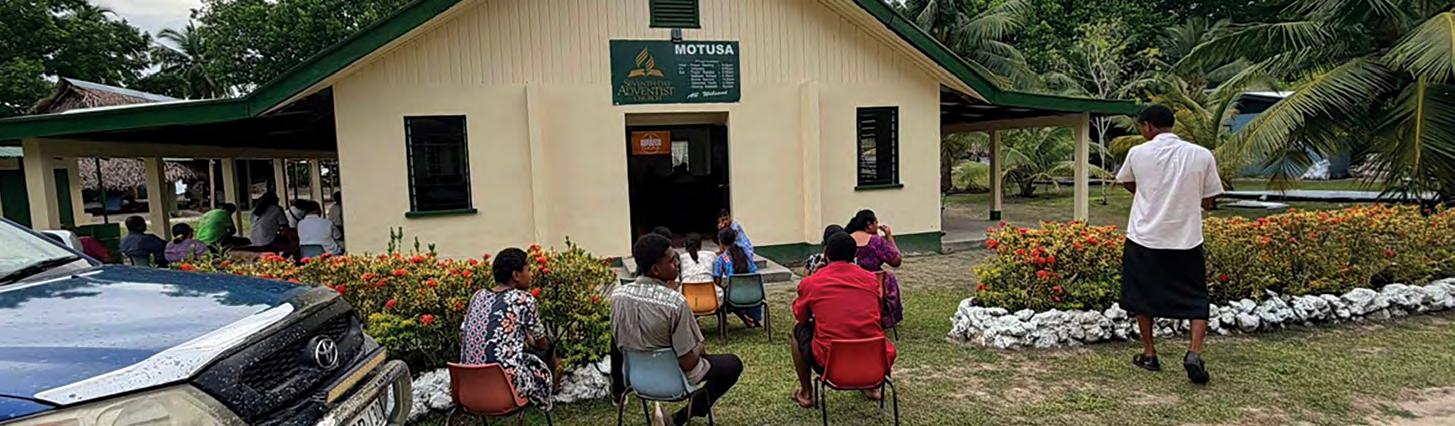
The remote island of Rotuma is preparing for a new chapter in mission outreach as local Seventh-day Adventists plan Rotuma for Christ, supported by newly installed solar power and a community radio station.
The Trans Pacific Union Mission (TPUM), in partnership with Fiji Mission, has supported the local church by coordinating the installation of a radio broadcasting system designed to carry the gospel into homes and businesses across Rotuma.
Although the solar-powered radio system is currently operating at just 50 watts, field testing has confirmed coverage of approximately 75 to 80 per cent of the island at a 30km radius coverage. Reception has been confirmed near the airport, five kilometres from the transmission site, despite Rotuma’s mountainous terrain.
The station currently rebroadcasts content from Hope FM (Fiji), with plans underway to develop locally produced programming, including Sabbath school discussions, sermons, devotionals, and health and family programs.
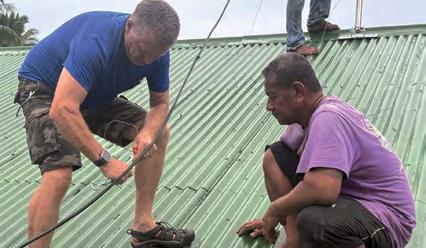
The installation of the new solar and radio systems was led by Paul Holton, who has been a communications engineer for Faith FM, the Australian Union Conference and Adventist Media. Mr Holton has contributed significantly over the years with the installation and repair of radio towers in the Pacific and has also served in a volunteer capacity.
Mr Holton has been coaching TPUM Information Technology assistant Felix Enasio, who is of Rotuman heritage. Together they have worked during the holiday season to install the radio tower.
“Despite the challenges, it has been an incredible experience working alongside new friends to install the infrastructure that will now help share God’s message across Rotuma,” Mr Holton said.
Former TPUM general secretary Jane Gibson-Opetaia, now serving as Pacific human resources manager for
the South Pacific Division (SPD), expressed appreciation for the intentional collaboration across the Church in preparation for TPUM for Christ in July and August.
“Many have come together to pray, invest, participate and plan,” she said. “As 1 Corinthians 3:9 reminds us, ‘For we are co-workers in God’s service.’ When the church moves together in unity, God multiplies the impact.”
In addition to the radio installation, the church has received a donated sound system and LED screen, and Starlink internet has been installed to provide reliable connectivity.
Previously, the congregation relied on a village generator for power, which was unreliable and dependent on diesel availability. The newly installed 3.5 kilowatt hybrid solar system now powers the church consistently, allowing it to operate throughout the day and night.
Fiji Mission president Pastor Epeli Saukuru expressed appreciation to all who contributed to the project’s completion.
“This development is more than a technical achievement—it is a strategic step in preparing Fiji Mission for greater impact,” he said. “Through uninterrupted broadcasting, Hope FM will share Bible messages, health and family programs, music and spiritual encouragement day and night, reaching communities like Rotuma, including those who may not yet attend church.”
Lily Mario-Suliana, Hope FM radio announcer for Fiji Mission, believes the station in Rotuma will play a vital role in the months ahead.
“As Fiji and the wider Pacific renew their focus on mission, the voice of Hope FM in Rotuma will help plant seeds of faith, strengthen believers and proclaim hope in preparation for Rotuma for Christ,” she said.
Jane Gibson-Opetaia/Record Staff.
Once
The New Testament places great value in a small word: hapax, “once”. In Hebrews 9:26–28 (NKJV), it rings like a gospel bell. Christ “appeared to put away sin by the sacrifice of Himself”, was “offered once to bear the sins of many”, and will “appear a second time, apart from sin, for salvation” to those who wait for Him. This one word connects past grace, present confidence and future hope.
In everyday Greek, hapax means that something happens only once. It can also mean something is final when comparing it to things that occur repeatedly. Sometimes the NT intensifies this with ephapax, “once for all” (Romans 6:10; Hebrews 10:10). Hebrews uses hapax to insist that Jesus’ sacrifice is not one among many but a decisive, sufficient sacrifice that settles everything.
In Hebrews, Paul contrasts the work of earthly priests who offer sacrifices “daily”, repeating them, without bringing peace to the conscience (Hebrews 10:1–3, 11). Repetition suggests incompleteness. But Christ, offered Himself “once” (hapax) and “sat down at the right hand of God” (Hebrews 10:12). His one-time sacrifice was “enough”. Hebrews 9 shows the limits of the earthly tabernacle (v1–10) to Christ’s High Priestly ministry in the “greater and more perfect tabernacle” (v11). He enters the heavenly sanctuary “not with the blood of goats and calves, but with His own blood, having obtained eternal redemption” (v12). “Eternal” points to enduring results, and hapax tells us why it lasts. He “appeared to put away sin” (v26)—to remove it, not merely cover it.
Then come verses 27 and 28: humans “die once, but after this the judgement”, Christ instead was “offered once
to bear the sins of many”. Our single death and certain judgement meets His single, sufficient sacrifice. Thus, He will appear again, “apart from sin”, to complete salvation for a waiting people.
Hapax affirms two truths Adventists embrace.
1) Atonement accomplished at the cross. Jesus’ sacrifice is complete and non-repeatable. “By one offering He has perfected forever those who are being sanctified” (Hebrews 10:14). We do not supplement or re-stage His death. We proclaim it and live from it. Assurance rests here; our forgiveness is not based on our best performances but on Christ’s once-for-all “gift” of salvation.
2) Atonement applied by a living High Priest. Hebrews does not end at Calvary. The risen Christ serves in the heavenly sanctuary (Hebrews 8:1,2), applying the benefits of His “once for all” sacrifice until He returns. The cross is sufficient and His priesthood is effective. In that light, the “judgment” of Hebrews 9:27 is not a threat to the faithful, but the arena where Christ’s saving work is declared, and His people are vindicated (cf. Daniel 7:22; Revelation 14:6,7). We have a complete sacrifice, a present intercessor and a soon-coming Lord—all these belong together.
Hapax appears elsewhere: Christ “suffered once for sins, the just for the unjust” (1 Peter 3:18). He does not need to daily “offer up sacrifices . . . for this He did once for all when He offered up Himself” (Hebrews 7:27). So that “faith” was “once for all delivered to the saints” (Jude 3). Christ’s one-time action is the basis for a gospel that is for all time, entrusted to the church.
What are the pastoral implications of hapax?
Assurance. Because Christ’s sacrifice is hapax, we stop trying to pay for what He has already covered. Confession is not re-purchasing forgiveness; it is receiving what the cross secured (1 John 1:9). A cleansed conscience frees us for worship and service (Hebrews 9:14).
Holiness. “Once for all” grace is not a licence; it is a launch. Since Christ died once and now lives to the glory of God, we “reckon” ourselves dead to sin and alive to God (Romans 6:10,11). Sabbath discipleship helps here: we cease from self-saving work and live from finished grace (Hebrews 4:9,10).
Hope. The hapax of the cross guarantees the certainty of the second coming. We wait “eagerly” (Hebrews 9:28), with eyes up and hands at work.
Pray it simply: “Lord Jesus, thank You for Your oncefor-all sacrifice. Anchor my assurance in Your finished work, cleanse my conscience and keep me eagerly waiting for Your appearing.”
Hapax means once—and enough. Christ’s single, decisive sacrifice secures forgiveness now and guarantees salvation when He returns (Hebrews 9:26–28; 10:12–14, NKJV).
Dr Limoni Manu O’Uiha dean of the school of Theology, Fulton Adventist University, Fiji.
ways to make your church more accessible
This Sabbath (April 18) is Possibility Ministries Sabbath, an initiative of Adventist Possibility Ministries (General Conference), represented in the South Pacific by Christian Vision and Hearing Services (CVHS). CVHS warmly supports people who are blind, have low vision, are Deaf, hard of hearing, deafblind or living with other special needs in the South Pacific Division. While these are just recommendations, we hold a deeper calling to ensure our churches—and therefore the gospel—are accessible to everyone.
1. Some church members should know or be in the process of learning sign language, at least basics words like “hello”, “good morning” and “welcome”.
2. Upfront presentations should include on-screen visual support for clarity (eg verses when reading from the Bible) and should use large print and contrasting colours, avoiding pastels, drop lettering or outlining.
3. The annual worship program cycle should include a special needs emphasis day, eg, on Possibility Ministries Sabbath.
4. Greeters should be aware of the specific needs of the blind and there should be people to guide those needing assistance to available seating.
5. Your church should offer an Assistive Listening System that is clearly signposted and preferably uses up-to-date tech—hearing loops are older technology and can be prone to failure and poor service.
6. The Assistive Listening System should avoid selective seating and allow a hard of hearing person to sit anywhere within the auditorium.
7. Churches should have adequate designated wheelchair placement locations within the general seating area.
8. Bathrooms should be able to accommodate scooters and wheelchairs, allowing a minimum 1.5m turning radius for wheelchair users.
9. The main entrance should be signposted and easily seen from the carpark, and the room numbers/ names, and directional and exit sign text should also be in Braille.
10. Churches should advertise events and note accessibility on their website so that families planning on visiting can know ahead of time what is available for them.
For more information, resources and to learn more about how you can make your church accessible for everyone, visit <cvhs.info>.
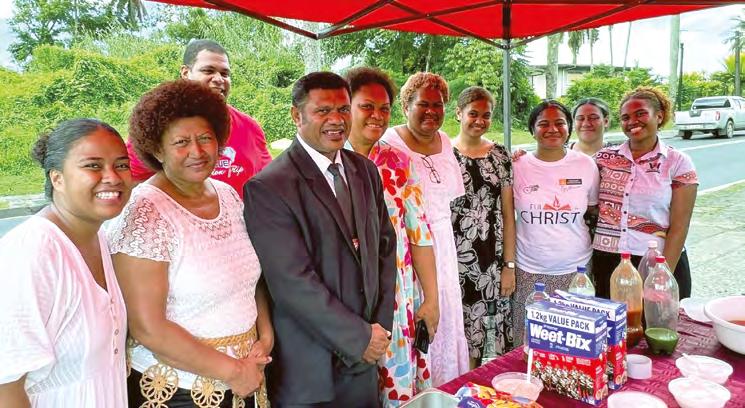
Weet-Bix™ Anzac Biscuits
Serves 12 Prep: 15 minutes Cook: 20 minutes
A delicious, wholegrain, Anzac-inspired biscuit, with the goodness of Weet-BixTM. These biscuits are a family favourite!
Ingredients
4 Sanitarium Weet-Bix™, crushed
½ cup wholemeal self-raising flour
½ cup rolled oats
½ cup desiccated coconut
¼ cup sugar
¼ cup honey
100g of butter or margarine
Nutritional Information (per serving)
Method
Step 1: Combine Weet-Bix™, flour, oats and coconut in a large bowl.
Step 2: Place sugar, honey and butter (or margarine) in a saucepan. Bring mixture to boil then reduce and simmer until well combined.
Step 3: Add liquid ingredients to dry ingredients and mix well. Roll mixture into balls and press onto a lined baking tray.
Step 4: Bake in a moderate oven, 180°C, for 15 minutes or until golden.
What the world needs from the church right now
Asmall but meaningful part of my ministry is creating short devotional videos. I genuinely enjoy the challenge of taking big theological ideas and distilling them into something brief and accessible. Even when no-one comments or likes a video, I still love the process. And often, the real conversations happen later when someone mentions a video weeks afterward and shares how it stayed with them or a thought they had when they watched it.
Recently, someone commented on a video to say that he lives with a disability and has been searching for an online church community he can engage with. He asked for details, and I gladly shared our church’s information.
Then another person jumped into the comment section with a very different message: “Forget the church. Just focus on Jesus.” That sentiment isn’t new. Over the years, I’ve heard countless variations of it: “I love Jesus, but I’m not really into church.” “I watch online, but I don’t want to be part of a church community.” “I just want teaching—I don’t need the rest.”
To be clear, online church matters. Accessibility matters. Teaching matters. But beneath these comments is a deeper discomfort many people feel toward the church itself.
In Australia, as in much of the Western world, the word church often carries negative associations—hypocrisy, harm, irrelevance, institutional failure. And honestly, we can’t ignore that. The global church has made real mistakes and some of those wounds are still very present in people’s memories.
So the question becomes unavoidable: What do we do with the church when so much feels broken?
Why Jesus and the church can’t be separated
I struggle to embrace the idea of “Jesus without the church”, and here’s why. I’m happily married. Recently, my wife and I celebrated 11 years of marriage. So I’d find it deeply strange if someone approached me and said, “I love your teaching. I want to learn from you . . . but I don’t really like your wife.” That wouldn’t work. Not because my wife is an accessory to my life, but because we are one. To reject her would be to reject me.
The New Testament uses that same language to describe Jesus and the church. The church is His bride. His body. His chosen means of presence in the world. In Matthew 16:18, Jesus says, “I will build my church, and the gates of Hades will not overcome it.” Jesus believes in the church. He loves the church. He commits Himself to building it.
The word church comes from the Greek ekklesia, which simply means a gathered or called-out people. In the ancient world, it referred to citizens who gathered to seek the good of their city—to ask, what does our community need, and how can we meet those needs?
Jesus deliberately chose that word. The church is meant to be a people who look outward—toward the world’s pain, need and longing—and ask how they can reflect the love of God there.
With that vision in mind, I believe there are five things the
world desperately needs from the church in 2026.
1. A lonely world needs a loving church
We are living through what many researchers now call a loneliness epidemic. In Australia, studies suggest that more than 40 per cent of young people describe themselves as generally lonely. Researchers speak of a growing friendship recession: in 1990, about one-third of people reported having 10 or more close friends (outside family). By 2021, that number had dropped to around 13 per cent.
Fewer deep friendships. Less community. More isolation.
For churchgoers, this can be easy to miss. Many of us experience built-in community from our weekly gatherings, shared meals, familiar faces. But even within churches, people can feel unseen and unknown.
The early church offers a compelling alternative. “Every day they continued to meet together . . . They broke bread in their homes and ate together with glad and sincere hearts . . . And the Lord added to their number daily those who were being saved” (Acts 2:46,47). They gathered frequently. They shared meals. They opened their homes. And people were drawn into that love.
The church is uniquely positioned to respond to loneliness, not with programs alone, but with genuine presence. With radical hospitality. With a willingness to notice those on the margins. A lonely world doesn’t need a perfect church. It needs a loving one.
2. A fake world needs an authentic church
We are increasingly surrounded by questions of what is real. AI-generated images, videos and text blur the line between truth and fabrication. Studies show that many people lack confidence in distinguishing reality from digital imitation—and that uncertainty is bleeding into everyday life.
Trust is declining. Scepticism is rising. People are constantly asking: Is this person genuine? Is there a catch? Is this real, or am I being manipulated? In that environment, authenticity becomes countercultural. The church should be a place where masks come off. Where faith isn’t performative. Where joy and struggle coexist. Not oversharing or pretending everything is fine, but honest, grounded faith that says: I am not perfect but Jesus is with me.
The early believers shared life closely. They ate together daily. And when you do life that closely, authenticity isn’t optional, it’s inevitable. In a fake world, the church must be unmistakably real.
3. An anxious world needs a courageous church
Anxiety is everywhere. Around 40 per cent of Australians report struggling with general anxiety, and younger generations increasingly express fear about the future—fear that shapes decisions about careers, relationships and even whether to have children.
Worry itself isn’t the enemy. It’s a normal human response. The problem arises when anxiety moves from the
passenger seat into the driver’s seat. The church is called to model a different posture—not denial, but courage.
Philippians 4:6,7, written to a church community, says, “Do not be anxious about anything . . . And the peace of God, which transcends all understanding, will guard your hearts and your minds in Christ Jesus.”
Courage doesn’t mean pretending the world isn’t broken. It means stepping into uncertainty with confidence that God is present, active and faithful. An anxious world needs a church that lives and loves without fear.
4. A divided world needs a united church
Across the globe, people increasingly describe their societies as deeply divided—politically, economically, culturally. Everything feels polarised. Every issue demands a side. Every opinion becomes a label. The church is called to something radically different.
Ephesians 4:3-5 reminds us to “Make every effort to keep the unity of the Spirit through the bond of peace . . . There is one body and one Spirit . . . one Lord, one faith, one baptism.”
Unity does not mean uniformity. The early church was incredibly diverse—Jew and Gentile, rich and poor, free and enslaved. What united them wasn’t agreement on everything, but shared allegiance to Jesus.
That unity was so unusual it confused the surrounding culture. People didn’t know what category to place them in. Eventually, they called them Christians—little Christs.
In a divided world, a united church is a living witness to another way of being human.
5. A bleak world needs a hopeful church
Hope is in short supply. Recent Australian surveys suggest that only 19 per cent of people feel hopeful about the future, while nearly half describe themselves as low in hope. That should shake us. The Christian story is, at its core, a story of hope. Not naive optimism but confident expectation that God is not finished with this world.
Jesus has come. Jesus is present. Jesus will come again. That hope changes how we live, how we suffer, how we love and how we imagine the future. A bleak world doesn’t need more despair echoed back to it. It needs a church willing to say through words and actions there is still hope.
Looking ahead
As we journey through these challenging times, the invitation is simple: will we be the church the world needs? A loving church. An authentic church. A courageous church. A united church. A hope-filled church. Not because we have it all together but because we belong to Jesus, and He is still building His church.
Josh Stothers is the associate pastor and chaplain at Kellyville church and Hills Adventist College (NSW).
Life beyondthe sun
There’s a tradition in Polish Seventh-day Adventism that my family kept: when you get baptised, you get a Bible verse. Before my own baptism I was incredibly excited to learn what verse I would get. My dad was baptising me and my parents chose Ecclesiastes 12:1:
“Remember the Lord in the days of your youth, before the days of trouble come and the years approach when you will say ‘I find no pleasure in them.’”
I was 11 and took this verse very seriously. I was determined that while I was young I would hold tight to my faith and never let anything get between me and God. I was also glad to get a verse in Ecclesiastes because chapter 12 had
long been a favourite Bible passage of mine. My sister and I would get our dad to read it out loud—we loved the line about the grasshopper dragging himself along, and we’d make him read it in a croaky voice as if he were really old.
When I was young, Ecclesiastes was easy to understand. Love God, nothing else matters. What could be confusing about that? I read the whole book a couple times in my early teen years and thought it was great. But I think a lot of it went over my head. As I grew older, my views around it changed. It became a bit more challenging to understand, and I thought Solomon was a cynical old crank who just thought life was bleak and joyless, and I stopped
reading Ecclesiastes. How could everything be meaningless? I understood that God was what mattered most in life, but I didn’t understand how everything else could be meaningless—things that brought me joy, all the good things that I thought weren’t directly connected to God.
You would think that the wisest man in the world, King Solomon, would be able to come to a conclusive point about God providing meaning in life. Instead, Solomon seemingly veers off into nihilistic and hedonistic territory. Nihilism argues that everything is meaningless—that life has no purpose or value. That sounds about right: “‘Meaningless, meaningless’, says the Teacher. ‘Utterly meaningless! Everything is meaningless’” (Ecclesiastes 1:1).
Hedonism, on the other hand, is the idea that pleasure is what we should aim for above all else. “I know that there is nothing better for people than to be happy and to do good while they live. That each of them may eat and drink, and find satisfaction in all their toil—this is the gift of God” (3:12,13). At face value, it would appear that Solomon has wracked his larger-than-normal brain and come up empty with meaning in life, instead pointing his readers towards finding pleasure where they can and just accepting that there is no meaning.
Depressing, right? But there’s a lot more to this book than meets the eye.
First of all let’s have a look at the word “meaningless”— lacking in significance or having no purpose. Some translations use the word “vanity”—empty or valueless. Both of those words are pretty bleak. But the original word used is havel, which means vapour, or breath. That’s a little different to the modern definition of the word meaningless.
Have you ever gone outside on a cold morning and seen your breath in the air? When I was a kid, I would force as much air out of my lungs as I could to make the cloud last as long as possible, but it would disappear in a matter of seconds. It was temporary, fleeting, one second hanging in the air before me like a cloud, the next second gone. Everything is breath. Everything is vapour. Nothing lasts, everything in our lives is temporary, “under the sun”.
The phrase “under the sun” is used 27 times throughout Ecclesiastes and basically means everything that happens on earth. Some scholars believe it means a life without God. Without God, we are nothing more than smoke in the wind, our short lives coming and going, then forgotten by later generations. We are haunted by time and death, things humanity has wrestled with since the beginning of, well, time. There’s a reason that they’ve been popularised into famous fictional figures: think Father Time and the Grim Reaper.
No-one likes to ponder the fact that the seconds, days and years tick by and you can never get them back. Even less fun is thinking about death—coming to terms with the fact that your own life will end one day—and dealing with the grief of losing loved ones.
Humanity wasn’t originally created to experience such
things, but because of sin, we were born into a life under the sun. Time and death will leave their mark on us. And as Solomon wrote, poverty, oppression and lack of justice affect many who toil away under the sun.
It is bleak. But Solomon isn’t as cynical as I once thought he was. Being the king of Israel and the wisest man on earth he saw a thing or two (or thought a thing or two, one thing more than the rest of us), and he came to some pretty good conclusions: one, life is going to hurt. There’s no way around that, not while we live here “under the sun”. Two, searching for wealth, status and power does not bring contentment. It’s all temporary—even wisdom itself is temporary.
Solomon’s antidote to this? Apparently, hedonism! But a closer look reveals something entirely different. This is what Soloman says he has “observed to be good”: “that it is appropriate for a person to eat, to drink and to find satisfaction in their toilsome labour under the sun during the few days of life God has given them—for this is their lot” (Ecclesiastes 5:18).
There’s a difference between searching for pleasure and finding pleasure in what you already have. Being content with your everyday life and finding joy in the day-to-day small moments is what Solomon calls “the gift of God” (3:13).
We can go in search of status and wealth, or spend money bioengineering ourselves to try and stop the ageing process, but none of that brings true joy, and none of it lasts. 1 Timothy 6:7 says that “we brought nothing into the world, and we can take nothing out of it”.
While the big moments in life can be important and bring temporary joy, they will inevitably fade to memory. But it’s possible to find contentment in the simple joys of life. When I find joy in the little things—a stunning sunset, a smile from a stranger or laughing with friends—I imagine God smiling along with me, happy that I’m delighting in this life He’s given me.
True meaning, however, in the modern definition, does come from God, a relationship with Him and the acceptance of His grace. He has “set eternity in the human heart” (3:11). We long for more, because we were made for more, but that more is found in God, not in chasing earthly things that don’t last.
Life is going to hurt. We deal with grief and the unforgiving passage of time, and people and things we love vanish like smoke, but we have Someone who knows that hurt. Someone who doesn’t want us to bear it alone, who will give us strength as we walk through our valleys of the shadow of death. Someone who left heaven and joined us here, under the sun, so that one day we might have a life beyond the sun.
Ashley Jankiewicz assistant editor, Adventist Record
Parable of the Gaza doctor
The Good Samaritan is one of the best-known and most-loved parables of Jesus, yet the real story begins before the parable’s first telling. A lawyer came to “test” Jesus. This parable was Jesus’ response to the lawyer’s questions. This lawyer was seeking perhaps the greatest possession imaginable—eternal life.
“Teacher,” the lawyer asked, “what must I do to inherit eternal life?”
“What is written in the Law?” Jesus replied.
The lawyer answered, “‘Love the Lord your God with all your heart and with all your soul and with all your strength and with all your mind’; and ‘Love your neighbour as yourself.’”
“You have answered correctly,” Jesus replied. “Do this and you will live.”
Next comes the question that segues into the story of the Good Samaritan. “And who is my neighbour?” asked the lawyer. As a teacher, my first response is, “Good question Mr Lawyer. I’m glad you asked.” Yet there is more than meets the eye in this lawyer’s question. Luke 10:29 states that the lawyer asked this question because “he wanted to justify himself”. What’s that about?
Theologian Michelle Barnewall suggests that “The lawyer’s question implies that he thinks there is such a thing as a non-neighbour—in other words, someone to whom he does not need to extend mercy and compassion.”1 Ah! That adds an interesting twist to the matter. Yes. I want eternal life and that depends on me loving my neighbour. So, I want to make sure that the person I hate and loathe is not in my neighbour group. That way I can continue to love just those whom I want to love without jeopardising my inheritance of eternal life. Great deal!
New Testament scholar John Dominic Crossan reminds us that this parable is a challenge parable “because it reverses the expectations and judgements, the presuppositions and prejudices”. 2 First-century Jewish ears were confronted with estrangement that had “hardened into ethnic, political and religious animosity within the land of Israel”.3 Think of the story in Luke 9:52-56 when some messengers were sent ahead into a Samaritan village to get things ready for Jesus. The people did not welcome the messengers because Jesus was heading for Jerusalem. When James and John saw this, they asked, “Lord, do you want us to call fire down from heaven to destroy them?” Let’s just say that there was no love lost between Jews and Samaritans.
Couple this tension with Jesus’ presentation mode of parable and we see that while the Good Samaritan story can be read in less than one minute, it probably engaged Jesus’ audience for much longer. “An oral audience would have interrupted him with questions and objections, comments and disagreements.”4
What story would challenge us to rethink that important question, “Who is my neighbour?” With the help of ChatGPT, I have created a modern-day parable that amplifies the real-life tensions exposed in this parable— tensions that beg for resolution through the process of radical compassion that crosses lines of hostility, in our current world context. But beware! Challenge parables are “tiny pins dangerously close to big balloons. They push or pull us into pondering whatever is taken for granted in our world—in its cultural customs, social relations, traditional politics and religious traditions.”5
Big balloons are visible and colourful, yet fragile. The
balloons of positioning, prejudice, theatrics and ego— if they burst, that might just turn out to be the best possible scenario, providing an opportunity for a deep rethink about what truly matters. Gillies Ambler 6 thinks of challenge parables as “hand grenade” stories—you inquisitively pull out the pin and the story explodes in your being. Once that happens, you are never the same. That sounds deadly, and it is, but only to the big balloons. What big balloons do you flaunt or parade? Let’s pull the pin . . .
Narrator: A young Israeli man was travelling alone near the border, visiting a relative in a kibbutz near Gaza. On his way home, his car was caught in a sudden rocket attack. Shrapnel tore through the vehicle. Bleeding and barely conscious, he stumbled out and collapsed in a ditch by the side of the road.
Audience member: “Why was he even near Gaza? Foolish!”
Another voice: “He was visiting family! What, are we supposed to abandon the South now too?”
Narrator: A Rabbi came by. He saw the wreckage, saw the man, and hesitated. Then he said to himself, It’s not safe—someone else will help him, and drove on.
Heckler: “Selfish coward! That’s not how we do things.”
Another: “Hey, would you stop if there might be another rocket? Don’t judge so quickly.”
Narrator: A second came—a settler from the West Bank. He slowed down, saw the wounded man, then muttered, “Probably got what was coming, driving near Gaza like that”, and drove away.
Loud shout: “Hey! Not all settlers think like that! That’s a smear!”
Another voice, sarcastic: “Unless he’s Arab, then maybe they stop?”
Narrator: But then came a Palestinian doctor, crossing the checkpoint to volunteer at a medical clinic. He saw the wounded Israeli and stopped. Despite the risk of being mistaken for a threat, despite knowing he could be accused of aiding the enemy, he got out.
Heckler (mocking): “Yeah right. Probably finishing the job, not helping.”
Calm voice: “No, I’ve heard of this—some of them really do help. I’ve seen it with my own eyes.”
Narrator: The doctor applied a tourniquet, stabilised the man and drove him to the nearest hospital—an Israeli hospital—where he stayed until the man’s family arrived.
Sceptical shout: “And security just let him waltz in? Give me a break.”
Defensive voice: “He’s a doctor, not a terrorist. Some of them risk more than we ever will.”
Narrator: When people asked him later why he helped someone from the other side, he said, “When I looked at him, I didn’t see a soldier or an enemy. I saw a man bleeding, and I remembered what I swore when I became
a doctor—to preserve life, no matter whose.”
Quiet voice: “That’s the kind of courage we need more of.”
Angry voice: “Nice speech. But one hand heals, the other launches rockets. You still trust them?”
Firm reply: “Maybe we start by trusting one hand at a time.”
Final Narrator Reflection (over the noise): So, I ask you—not who was from our side, or who was right. I ask: Who was the neighbour?
One person whispers: “The one who showed mercy.”
Can you imagine Jesus sharing this parable in today’s Israel? What a challenge this story would be to the listeners’ ears. Would Jesus be run out of town? Or worse? What Good Samaritan story context would raise my ire? And how would you respond?
It is easy to love those who look like us, think like us and live like us. It costs nothing to be kind to those we already call friend. But mercy—real mercy—is when we lower our guard to help the one we’ve been told to fear.
As Bob Dylan challenges, “Yes, and how many times can a man turn his head, and pretend that he just doesn’t see?”7 Every generation must ask: Are we brave enough to see a stranger as our brother or sister? Or do we let the walls between us grow taller with each wound?
Just like the Good Samaritan, that doctor didn’t erase the war. He didn’t change the headlines. But in that one moment, he did something no government could do—he reminded us that our enemy is still a human being—a challenge for many of us. Is that a challenge for you?
Perhaps it is time to revisit this parable in our present world context. Are we any different to the Jews and Samaritans of Jesus’ times? We see geopolitical conflict between Ukraine and Russia. Ethnic/nationalist conflict between ethnic Albanians and Serb minorities. Ethnic and religious clashes in Nigeria between Christian farming communities and Muslim Fulani herders. And closer to home, we experience divides that separate us in our own extended families and workplaces. Can we see our enemy as a human being? Perhaps that, maybe, is where peace can take root and grow, like a mustard seed, watered by kindness.
1. Going Deeper in the Parable of the Good Samaritan, by Michelle Barnewall, January 25, 2021. <biola.edu/blogs/good-bookblog/2021/going-deeper-in-the-parable-of-the-good-samaritan>
2. John Dominic Crossan, The Power of Parable (London: SPCK Publishing, 2012), 56.
3. Ibid., 60-61.
4. Ibid., 90.
5. Ibid., 62.
6. Dr GM Ambler, personal communication, July 4, 2025.
7. Words from the Bob Dylan song, “Blowin’ In the Wind”
Craig Mattner mathematics and religion teacher at Prescott College, SA.
INTROVERTED
evangelism
If you are anything like me, the thought of being in the middle of a big crowd just makes you want to be absorbed into the ground. I am an introvert and so, unlike extroverts, I do not like crowds, lots of people or being in the spotlight. My energy comes from solitude and downtime.
Often when we think of evangelism, however, we think big crowds, larger-than-life speakers, conviction on mass scale with lots of people eager to listen. It’s almost a fundamental part of our Adventist heritage with history books recording evangelistic meeting after evangelistic meeting. The Bible also gives plenty of examples of this scenario (see Matthew 5-7, Matthew 14, Mark 4, Mark 8 and more).
Being an introvert, I have often felt—and wondered—how does my personality type fit into the “box” that is evangelism? I mean, you would never catch me in front of a big crowd!
In addition, as society changes and becomes more individualistic, it seems as though this method of evangelism faces more challenges than it once did.
So where to now?
I would like to suggest that extroverted evangelism is no longer the only way to evangelise. Something I would like to call introverted evangelism can be just as powerful.
This idea of a more personal, more one-to-one mission style is something that Jesus also demonstrated repeatedly during His mission on earth. There is the Woman at the Well (John 4), Nicodemus (John 3), Mary Magdalene (John 20) and Zacchaeus (Luke 19). The list could go on.
Humanity today is craving intimate connection, and intimate connection is hard to find in crowds. Intimate connections are found and built during smallscale interactions. Ones us introverts much prefer.
If you have resonated with this and also wonder how your introversion could possibly be used for evangelism, think again. You do not need to stand on a big stage with lights aiming for you; you do not need to grab the attention of masses of people. You can chat with your neighbour, you can sit down and have a drink with a friend from work, you can invite your children’s school friends’ families around for a meal. This is how you create connection and how you can have an impact on someone’s life. These small conversations may one day lead to followers of Jesus.
So, here’s to introverted evangelism! Give it a try!
Claire Taylor
wife, mum of four and relief teacher at Southland Adventist Christian School, Invercargill (NZ). She currently oversees communications at the Invercargill church and helps run the Invercargill Mums at the Table group.
Conversations
Unenviable task
The article “Be kind to your pastor” (February 21) is a very thoughtful article especially from a partner of a pastor. I have been a member of the Adventist Church since 1986 and I certainly share this author’s concerns. Pastors often impress as having an unenviable task within the church. It must be almost impossible to meet each member’s expectations for what they perceive as the pastor’s priority: possibly more home visits,
Colour cover
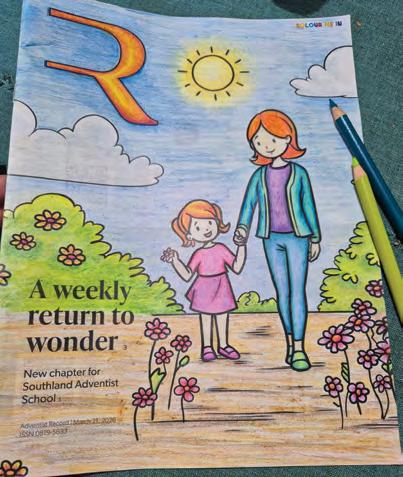
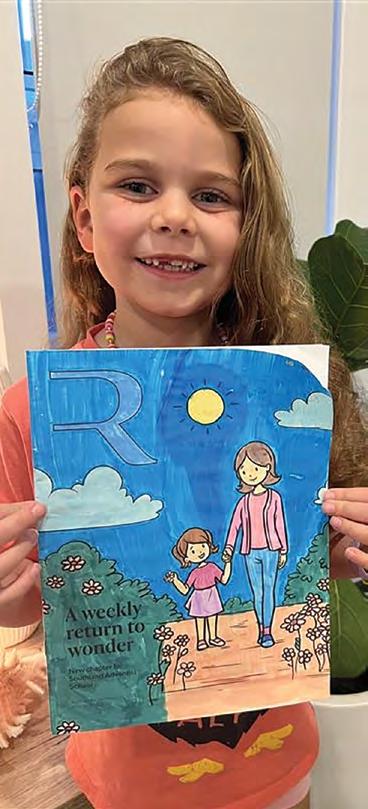
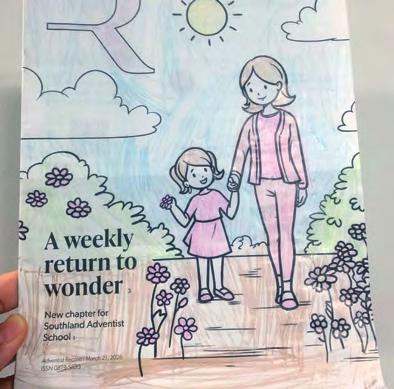
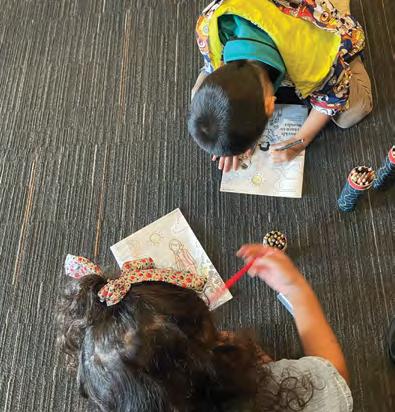
Just wanted to thankyou for the awesome Record cover to colour (March 21). As a creative I really enjoyed colouring it, once I got over my initial frustration of colouring on gloss (my problem not Record’s). Please do this again sometime.
Marcelle Kleinmeulman, via email
more Bible studies, less confronting sermons, more outreach and so it goes. Then the employer also has expectations that may not be known to the congregation. Wow, what a juggling act.
I know for many years working within a health bureaurocracy the competing demands: patients on one hand; on the other hand team members and management committees. Usually patients were the least problematic. I would love
6
to suggest that the support and validation of our pastors is an issue which maybe members of the editorial team could expand on. I am personally aware of many pastors who feel they have been compromised/betrayed by the church leadership and are now hurting casualties of the system. Of course the devil is pretty clever—he knows where to attack and cause the most harm.
Gary Grant, NSW
Children in church.
Arwyn, 6
Obituaries
DEVRIES, Abel, born 8.6.1933 in Holland; died 17.8.25 in Bonnells Bay, NSW. Abel is survived by his beloved wife, Gwen; his daughters and son; grandchildren and great-grandchildren. Abel was adored and will be sorely missed by his family. He was always active in the church he loved. He spent three years in New Guinea as a missionary and time in Africa assembling a peanut butter factory. He also worked for many years with Sanitarium in the Plant Development Department. His beautiful life reflected the God he loved.
Leticia Moreno
ETHEREDGE, Fredrick Richard, born 19.12.1928 in Glen Huntly, Vic; died 16.2.26 in Mooroolbark. He is survived by his wife, Alice (Mooroolbark); daughters, Jenny (Mooroolbark), Linette (Camberwell), Collene (Gympie, Qld) and Kathryn (Gold Coast); grandchildren, Lee, Grace, Rachel, Hugh, Jasmine, Ella and Will; and great-grandchildren, Harry, Billy and Max. Fred was a much-loved husband, father, “fard”, “grandfardy” and friend. He was a true gentleman, always kind, smiling and making an effort to greet and thank those around him. He will be greatly missed. Resting peacefully until Jesus comes.
Darren Croft
MANNERS, Don, born 28.5.1945 in Adelaide, SA; died 29.5.25 in Perth, WA.
On 7.7.1982 he married Robyn. Don is survived by his wife (Perth); children, Kristy (Perth), Jaemie and Kylie (Perth); grandchildren, Saige Nzuki, Isla, Heath and Liam Manners (all of Perth); and siblings, Hector and Robyn, Bob and Merrilyn, Kevin (since deceased) and Jenny, Raelene and Brian Abrahams, and Lyn and Paul Wright. Don was a gifted manual arts teacher and a
devoted husband and father. He was thoughtful, committed, caring, wise, adventurous and had a rich sense of humour. Don was a pioneer member of Livingston church and worked tirelessly in fundraising to establish the church and then served as youth leader, Sabbath school teacher, family ministries leader, occasional preacher and often the MC at church events.
Andrew Skeggs, Bob Manners
Advertising
SOUTH QUEENSLAND CONFERENCE
CONSTITUENCY MEETING
Notice is hereby given that a regular constituency meeting of the South Queensland Conference of the Seventh-day Adventist Church will be convened at Watson Park Convention Centre, 337 Old Gympie Road, Dakabin, from August 22-23, 2026. The business of the meeting will be as provided for in the constitution of the South Queensland Conference of the Seventh-day Adventist Church, including proposed constitutional changes and reports covering all phases of the work carried on within the South Queensland Conference. The officers and the executive committee of the conference for the next quadrennium will also be elected.
Joseph Maticic, General Secretary
GREATER SYDNEY CONFERENCE
CONSTITUENCY MEETING
Notice is hereby given that the thirty-first constituency meeting of the Greater Sydney Conference of the Seventh-day Adventist Church will be held in the auditorium of Mountain View Adventist College, 41 Doonside Road, Doonside, from August 29-30, 2026. The program will commence on Sabbath, August 29 at 3:30pm with a praise and thanksgiving program, including closing of Sabbath. The seating of delegates and the constituency meeting, to include the presentation of administration and departmental reports and
financial statements for the years 2022 to 2025, will commence at 7pm and will continue on Sunday, August 30 The officers, executive committee, appointments committee, nominating committee and constitution committee of the Conference for the next quadrennium will be elected at this constituency meeting.
Cheonneth Strickland, Secretary
DORA CREEK 75TH ANNIVERSARY
All past members and ministers are invited to celebrate this special occasion on the weekend of May 15-17, 2026. Friday night Sabbath Sing Along with Sandra Entermann. Sabbath all day, including lunch provided. Sunday morning a Family Fun Day outreach into the community. For more details contact Helen on 0476 107 984 or Ben on 0404 314 776.
THE INCREDIBLE JOURNEY
Discover the biblical sites of Israel, Jordan and Egypt in Oct-Nov 2026. Join Pastor Gary Kent on an amazing and unforgettable travel journey. For full details please contact Anita at Allround Travel <alltrav@ bigpond.net.au> or 0405 260 155.
IN THE STEPS OF PAUL TOUR OF TURKEY AND GREECE
September 13 to October 4, 2026. Follow the footsteps of the apostle Paul, connecting faith to the ancient sites of Ephesus, Corinth, Thessaloniki and Philipi. Visit the Seven Churches of Revelation and overnight on the Isle of Patmos. Conducted by Dr Peter Roennfeldt. Contact Anita at <alltrav@bigpond.net.au> or 0405 260 155.
ABSOLUTE CARE FUNERALS
The Adventist family owned and operated business, caring for you from Sydney to Newcastle and Wollongong. Contact Arne Neirinckx, who understands our Adventist philosophy. Contact us on 1300 982 803 or 0408 458 452 or <arne@ absolutecarefunerals.com.au>, even if you have already paid for your funeral.
NOTE: Neither the editor, Adventist Media, nor the Seventh-day Adventist Church is responsible for the quality of goods or services advertised. Publication does not indicate endorsement of a product or service. Classified advertisements in Adventist Record are available to Seventh-day Adventist members, churches and institutions only. All advertisements, appreciation, anniversary, wedding and obituary notices may be submitted via <ads@record.net.au> or online at <record.adventistchurch. com>. Notices will not be reprinted unless there is an error of fact caused by Record staff.