Calling all Health Leaders, Health Professionals, Pastors & Wellness Enthusiasts!
Join the 7th ELIA Wellness Summit — designed to:
REFUEL with the latest lifestyle medicine science
RENEW your thinking with practical behaviour-change strategies
REVIVE your passion and calling for mission
Be inspired by global keynote speakers Dr Zeno Charles-Marcel and Dr Katia Reinert from the General Conference, alongside a great lineup of local speakers.
EDITOR’S NOTE:
A weekly return to wonder
Danelle Stothers Assistant Editor
When we stop producing and pushing to do more, then we can finally pause to notice and delight.
Yesterday it rained heavily all day. It eased just enough at bedtime for a walk with my daughters down our driveway to check the mailbox. As we went past the neighbour’s fence, their dogs came barking to greet us. As an avid dog-lover, my one-year-old squealed in excitement and veered off the path to greet them. Further down the road, my five-year-old stopped in front of an overgrown hedge with blue flowers and asked with deep concern why all the flowers had suddenly died. When I explained that it was because of the heavy rain, she asked, “But how come none of the other flowers have died?”, gesturing at a few other plants that looked less droopy. I had no answer. To be honest, I hadn’t even noticed the appearance of the plants we’d walked past.
Children often have a way of seeing what we, as adults, miss. The colours in a sunset are the prettiest thing they have ever seen, a bug on the ground is so fascinating that they need to stop and watch it, and a glimpse of the moon during the daytime can completely blow their mind. They naturally seem to notice what is in front of them and allow it to affect them. I, on the other hand, am usually moving too quick to linger. Life is busy with parenting, working, caring, thinking, doing, being. From the moment I wake up I am trying to fit the most into the least amount of time possible. I’m paying attention, but not to the small things. On the never-ending to-do list, pausing to watch a sunset does not feature. Somewhere along the way efficiency became more important than wonder.
Since becoming a mum and watching the way my daughters experience the world, Matthew 18:3 has often come to mind: “Truly I tell you, unless you change and become like little children, you will never enter the kingdom of heaven.” I think of my daughter’s unfiltered prayers, her surprisingly big questions about God and the certainty with which she talks about how much He loves her. What if becoming more childlike is not about being more simplistic, but about recovering trust, openness and wonder? What if it is about slowing down enough to notice again?
The problem is that I can decide to be more present and attentive, only to find myself rushing again the next day. But God has built a pause into our week. In Genesis 2, after creating the world, instead of rushing ahead to the next task, He stops. He blesses the day and declares it holy. Sabbath is a practical interruption to the adult instinct to measure everything by output. As Eugene Peterson writes, “Sabbath is that uncluttered time and space in which we can distance ourselves from our own activities enough to see what God is doing.” It’s a weekly chance to stop focusing on productivity and instead make space for presence. When we stop producing and pushing to do more, then we can finally pause to notice and delight. We remember we are not machines, but children of a God who wants us to experience wonder.
The sun came back out again today, so I went for another walk with my girls. As we walked down the driveway past the overgrown hedge my daughter exclaimed with much happiness and relief, “Look Mum! The flowers are alive again!”. She had been sure the rain had ruined them, but nothing died. They were standing and still a shade of vibrant blue. All they needed was the sun to lift them up again.
As adults, we don’t lose our capacity for wonder, we just stop making room for it. We fill every minute of our day, cover the quiet with noise, move so fast that beauty flashes right by, and then wonder why childlike faith feels so distant. But Sabbath is God’s gift to us. A weekly reminder to step out of the race of life and remember who we are. We don’t become more childlike by trying harder, we become more childlike by stopping. It might be that the way back to childlike faith isn’t dramatic at all but simply making time to walk the driveway again and actually looking.
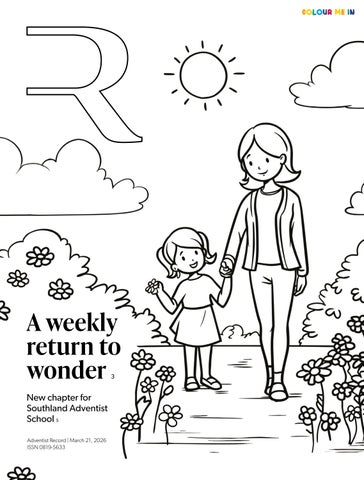
As we celebrate Global Children’s Day on Sabbath, March 21, we recognise the immeasurable worth of children. This issue leaves space (quite literally) for our youngest readers to add their own colour to the cover.
INSIGHT:
Need a reset?
Glenn Townend South Pacific Division president
This year has started at a hectic pace. Two long distance work trips in January. New committee members and staff to orient, and new committees to serve. Ongoing challenges. By the start of February I felt like I needed another break.
What do you do when you need a recharge? I have reasonable habits of prayer, gratitude, service, and digesting and reflecting on Scripture. I have family and friends who are willing to listen. Daily exercise and weekly biking challenges, a plant-based diet, plenty of water, stretching, quietness, good sleep patterns . . . I’m very committed to being the best I can be and will take on any tip to be healthier. But sometimes you still feel flat and overwhelmed by what is in front of you.
One of my cousins is turning 50 this year and is also a cyclist. He invited my brother, brother-in-law and friends to ride a few days in the Australian bush and mountains in late February as part of his birthday celebrations. His invitation came well in advance, and I could adjust my schedule to not miss any important meetings.
I knew the ride would be challenging as we climbed mountains on overgrown bush tracks, on inclines up to 20 per cent. I expected to see kangaroos, snakes, birds and other wildlife. I knew there would be magnificent scenery—mountains, rivers, trees. I also expected fun and laughter as we talked, ate and swam.
What I did not expect was the complete reset. I was unreachable by phone for a few days and that was rewarding. We made time to pray for each other, our families and situations each day. We had deep theological and biblical discussions—refreshing to the soul even as our bodies were physically exhausted. There were two moments I could only explain as me understanding my smallness in God’s vastness–His transcendence. In a forest with no-one else in sight, in the silence of the bush, I felt thankful for the water in my bottles, the trees providing shade, the sun providing light and warmth, the air I was breathing. I felt as small as the ants in the nests I was standing near. The other time was overlooking a huge dam, high up in the mountains with “blue hills” to the horizon—a vast expanse of majestic wonder. Knowing that life had purpose because God was Creator. I was His child. It’s hard to explain but the reset just happened and was worth it. How do humility and transcendence work in your life as a disciple of Jesus?
First 10,000 Toes wellness centre opens in Fiji
Nadi, Fiji | Tracey Bridcutt
The 10,000 Toes Campaign has opened its first wellness centre in Fiji, establishing a permanent base for its lifestyle-health ministry.
The facility was officially launched on February 23, expanding the initiative’s work across the South Pacific.
“We’ve got lots of wellness hubs, but now we have opened our very first wellness centre,” said campaign coordinator Pamela Townend. “It’s where everybody who has been diagnosed with risk factors can go and meet doctors and dietitians and get their health back on track.”
Her remarks follow the 2025 World Health Organisation STEPwise report, which revealed that 98.5 per cent of Fijian adults have at least one major risk factor for non-communicable diseases, with 47 per cent having three or more.
Operating in 13 Pacific countries, 10,000 Toes has until now primarily operated through grassroots wellness hubs and community ambassadors.
The new centre provides a dedicated
referral site for those identified as high risk. Located in Namaka, the repurposed two-storey facility includes a plant-based café and cooking school, a beverage and health-food outlet, and a Hope Clinic led by a doctor specialising in lifestyle medicine and supported by a multidisciplinary team. A training and conference space will be used to upskill health professionals and mobilise 10,000 Toes ambassadors.
Trans Pacific Union Mission health coordinator George Kwong said the centre establishes a permanent base for the campaign after five years of delivering wellness hubs across the Pacific. “The prayerful vision centred around the Lord led us to a place where all health services could be offered under one roof,” he said.
Mrs Townend said early intervention and sustained support are key to addressing lifestyle-related disease. “When caught early enough—and when individuals are supported and empowered—these conditions can be slowed, stopped and in some cases even reversed,” she said.
New chapter for Southland Adventist School
Invercargill, NZ | Tracey Bridcutt
Southland Adventist Christian School in Ivercargill, New Zealand, has announced a historic development in its journey, with approval granted to expand to a full Year 1–13 school.
Principal Joshua Taylor announced that the Ministry of Education has approved the school’s application for a change of class and maximum roll increase, clearing the way for a staged expansion into secondary education.
“It gives me great pleasure to make the biggest announcement in our school’s history,” Mr Taylor said. “We are becoming a high school!”
Currently a Year 1–8 school with 116 students, Southland Adventist will introduce Year 9 in 2027, followed by Year 10 in 2028, Year 11 in 2029, Year 12 in 2030 and Year 13 in 2031. By the time the transition is complete, the school’s maximum roll will increase to 260 students. The expansion represents what Mr Taylor described as “a dream come true for our community and an answer to
many, many prayers”.
Nine years ago, during his first term as principal, Mr Taylor was approached by a parent asking whether the school would one day become a high school. “I hesitantly said I would look into it and that maybe it could happen one day in the future.”
Since then, the journey has included extensive consultation and two applications to the Ministry of Education. An earlier bid to add Years 9 and 10 was declined, a setback Mr Taylor described as disheartening. “However, God clearly had bigger plans in store as we will now be able to go all the way through to Year 13,” he said.
The school is preparing for the transition, with two new classrooms close to opening to support the initial growth while further building development is planned.
Adventist education in Invercargill dates back to 1955. The current Durham Street campus opened in February 2021.
Pamela Townend cutting the ribbon to open the new wellness centre.
Approval has been granted to expand to a full Year 1–13 school.
Mums At The Table launches first Tas group
Devonport, Tas | Melody Tan/Record staff
Mums At The Table has launched a local group in Devonport, the first of its kind in the Australian state of Tasmania.
The Devonport Mums At The Table group officially opened in February, partnering with Devonport Seventh-day Adventist church.
“Launching our first Mums At The Table group in Tasmania feels incredibly special as we had been planning for this for a few years now,” said Melody Tan, project manager of Mums At The Table.
“We’ve always believed that every mum deserves a safe, welcoming village and now Tasmanian mums have a space to connect and feel less alone. This is just the beginning of building a community where mums can truly support and uplift one another.”
Pastor Jacob Ellis from the Devonport church first approached Mums At The Table about a partnership in 2023.
“Through this partnership, I hope to see a thriving, welcoming space where mums can genuinely connect and feel supported,” said Pastor Ellis. “Success won’t be measured by the number of people who attend, but by the depth of the relationships formed and the sense of community that grows from those meaningful connections.”
Mums At The Table operates on a community-first model that equips local
churches to build meaningful, lasting relationships with families beyond their congregations. By providing resources, training and a proven framework for hosting mum-focused gatherings, the initiative helps churches create safe, welcoming spaces where parents can connect, support one another and access practical help. Rather than relying on traditional outreach programs, the model centres on genuine connection, meeting mums where they are, fostering trust and strengthening the social fabric of the wider community.
“Partnering with Mums At The Table is a great opportunity for my own and other children to play in a safe environment whilst also nourishing bodies and souls, something that can feel quite low on the priority list as a mum,” said Melinda Pearson, volunteer moderator for the Devonport group.
The group currently runs weekly Pilates sessions for mums while offering child-minding services during the workout. It also plans to organise playground meet-ups, walking groups and invitations to relevant church events.
Churches or individuals interested in being part of the ministry can contact Mums At The Table at <hello@MumsAtTheTable.com> or visit <mumsatthetable.com/partner/>.
San achieves gold status for stroke care Wahroonga, NSW | Tayla Woods
Sydney Adventist Hospital has become the first private hospital in Australia to receive an Angels Award from the World Stroke Organisation, achieving gold status for stroke care.
The award recognises hospitals that consistently deliver high-quality stroke care, from rapid diagnosis through to timely treatment.
To coincide with the recognition, clinical teams at the San participated in a live stroke simulation, demonstrating the hospital’s coordinated and rapid response to stroke. The simulation followed the full patient journey, from arrival in Emergency through to diagnostic imaging and treatment decision-making,
showcasing the teamwork and clinical precision required to deliver effective stroke care, when every minute matters.
The recognition builds on the San’s strong foundations in stroke services.
The San is one of 40 hospitals in NSW participating in the RISE (Realising Improvement in Stroke) program, focused on improving patient outcomes and setting global benchmarks. The hospital is also accredited as a Primary Stroke Centre by the Australian Stroke Coalition, with certification valid through to 2028.
Stroke care at the San is delivered by a highly skilled multidisciplinary team led by Dr Kong Chung and stroke clinical nurse consultant Krista Dormitorio.
Clinical teams participating in a live stroke simulation.
Mums At The Table partners with local Seventhday Adventist churches to help women build friendships, find support and connect in meaningful ways. (Credit: Gilmore Tanabose)
Silver Crown for Adventist Media
Wahroonga, NSW | Tracey Bridcutt
A four-part documentary series produced by Adventist Media has received a Silver Crown Award for Best Television Production at the 53rd annual ICVM Crown Awards, held during the NRB Christian Media Convention in Nashville, Tennessee, in the United States.
Developed in partnership with Off the Rails Productions, Ancient Bible Destinations: Turkiye takes viewers on a journey through Istanbul, Tarsus and the seven churches of Revelation, exploring the historical and spiritual significance of these ancient sites.
Adventist Media CEO Dr Brad Kemp, an executive producer for the series, described the award as “a huge accomplishment and a great honour for Adventist Media”.
The Christian version of the documentary has already received multiple international accolades, including Gold for Best Christian Documentary at the Christian Family Film Festival 2025, Best Documentary and Best Narrator at the Christian Film Festival 2025.
A shorter, general-audience version titled Turkiye’s Astonishing Antiquities has also garnered strong recognition on the international festival circuit. Awards include Best Documentary at the Golden Bridge Istanbul Short Film Festival 2025 and the Symbiotic Film Festival 2025, as well as Best Narration in a Documentary at the Anatolia International Film Festival 2025.
According to Ole Pedersen, general manager of Hope Media for the New Zealand Pacific Union Conference, the Christian version contains stronger biblical messaging and theological reflection, while the general-market edit has been tailored for broader audiences.
“This is recognition of the work that can be done by Adventist Media when it’s focused and there’s a clear purpose in what we want to do,” said Mr Pedersen, who also served as an executive producer on the series. “We had a great partner to work with who had the connections to create the content with us.”
He added the recognition sets a strong benchmark for future projects. “We know what the standard is in terms of producing content that gets recognised, but it also gets distribution. The interest from non-Adventist Christian networks worldwide has been great, and distributors are asking to carry it.”
The Christian version will air on Hope Channel from late March across New Zealand, the Cook Islands and Papua New Guinea. Meanwhile, the general-audience edition is scheduled for later this year in Australia on television and cable networks.
making headlines
Help for migrants
A new Migrant Assistance Centre in Santo Domingo (Ecuador) will provide urgent support and basic services to thousands of families in transit. Backed by ADRA Ecuador’s HOPE project, the centre offers essential services like showers, toilets, laundry facilities, hydration stations and hygiene kits to reduce health risks and restore dignity.—SAD
Churches offer warmth
During the harsh winter of 2025–2026, with many regions left without electricity or heating for up to 15-20 hours a day, Adventists across Ukraine are expanding their support despite damage to their own church buildings. Fifty warming centres in church facilities are being established (with some already operating) to offer displaced people and local residents a place to warm up, recharge devices and receive pastoral care amid the ongoing crisis.—ANN
Unity and justice
Ndaba Mandela, grandson of Nelson Mandela, spoke at Community Praise Adventist Church (USA) during a Black History Month celebration, urging attendees to act for justice and unity. The celebration included music, gifts and the city declaring the day “Mandela Legacy Day”.—NAD
Real or robot?
A study found that most people were overconfident about spotting AI-generated faces, with even “super-recognisers” performing only slightly better than average. The research showed that modern AI faces looked too perfect, rather than flawed, making visual judgement alone unreliable in areas such as social media, online dating and recruitment.—UNSW Sydney
Ole Pedersen with the award—one of many the series has received.
Equipped for mission
Officers and senior institutional leaders of the Papua New Guinea Union Mission (PNGUM) met at Pacific Adventist University in February for the 2026 Quinquennial Mission Orientation Program, held at the start of the new fiveyear term. The week combined spiritual reflection with practical training in governance, finance, education, health and workforce development, aligning leadership roles with the Church’s mission priorities. PNGUM president Pastor Danny Philip said the gathering was a time of “renewed trust, responsibility and opportunity” and thanked South Pacific Division facilitators for their support. Participants travelled from across the country, including remote regions, and took part in workshops and planning sessions focused on discipleship, church planting, youth engagement and institutional collaboration.—Jane Gibson-Opetaia
“Abundant Life” Week of Prayer focus
Adventist HealthCare celebrated its annual Week of Prayer with the theme “Abundant Life”, reflecting the promise of Jesus in John 10:10. Hosted by San Spiritual Care Services, the week featured morning and evening services in the chapel at Sydney Adventist Hospital. Guest speaker Dr Katia Garcia Reinert, associate director of Adventist Health Ministries at the General Conference, presented a series of practical, faith-based messages exploring whole-person wellbeing. Topics included Food that Heals, Improving Emotional Intelligence and Setting Healthy Boundaries. The week concluded with a Sabbath service titled “Connected in a Disconnected World” —Tracey Bridcutt
Students dedicated
More than 60 students from elementary to tertiary level gathered with church leaders and families at 15 Mile church in Port Moresby (PNG) on January 24 for special prayer ahead of the new school year. The prayer took place just before the Sabbath service and was led by Pastor Thomas Bem, president of the South West Papua Mission, who was attending the service. During the dedication, Pastor Bem reminded students of the responsibility they carry as representatives of their families and faith communities as they return to their studies —Rose Maine Sinias
Preparing the way
Sun Valley Church, one of the newest churches in the eastern part of Honiara, is already playing an active role in preparations for Solomon Islands for Christ. Members have been engaging the community through Bible studies, focusing on strengthening faith, building relationships and preparing hearts for the upcoming evangelistic emphasis. Solomon Islands for Christ Facebook Page
Church accessibility
World Hearing Day on March 3 encouraged Adventist churches to reflect on how accessible their services are for people living with hearing loss, a condition affecting around 9.6 per cent of the Australian population. Christian Vision and Hearing Services (CVHS), a ministry of Adventist Media, is calling on congregations to consider practical steps that make worship more inclusive for the Deaf and hard of hearing.
“This is a very real issue that affects many in our community,” said CVHS coordinator Cassie Etwell. “Churches need to ensure they have systems in place to make church accessible to the hard of hearing and Deaf in our community. If churches haven’t already done so, we encourage them to consider purchasing and installing an assistive listening device, which significantly improves audio clarity and reduces background noise for the hard of hearing.”
For Kevin Rabe (pictured above), who has lived with hearing loss his entire life, improved accessibility in church has been life-changing. “My church, Fox Valley Adventist Church, has set up Listen Everywhere technology which has been a great help in enabling me to understand the sermon.”
CVHS offers limited free trials of assistive listening devices and provides a $A500 subsidy to churches that proceed with a purchase. For more information about Christian Vision and Hearing Services, visit <csfbhi.adventistchurch.com/> or contact +61 2 9847 2296 or cvhs@adventistmedia. org.au.—Tracey Bridcutt
have news to share?
Send info and photos to <news@record.net.au>
Responsibility and protection
Adsafe’s recent South Island road trip in New Zealand brought together 129 church leaders and members for safeguarding training focused on best practice, awareness and proactive leadership. The meetings were hosted by local churches across the region and are part of Adsafe’s ongoing work to strengthen safe ministry environments and community care. Adsafe safeguarding services team leader Silvia Pedzisi thanked host congregations for their support and participants for their engagement, noting the program aims to build a stronger culture of responsibility and protection within churches.—SouthNews
Serving with a purpose
The Rakiraki District Youth Ministry in Fiji demonstrated faith in action as young people stepped out onto the mission field through a community outreach held at Dramasi Community in Rabulu. With hearts committed to service, the youth were actively involved in health screening initiatives and the renovation of a community hall—meeting both practical and spiritual needs of the community. The mission activity formed part of the wider preparation for Fiji for Christ. By offering health services and improving community facilities, the youth became living testimonies of God’s love, building trust and opening doors for deeper relationships and future ministry.—Maika
Tuima
Youth engagement:
And there is more!
Last year in Record I addressed the Big Three when it comes to youth engagement: parental influence, intergenerational connections and mentoring (July 19).
The title above points to the fact that my research discovered much more than these three. Come with me on a journey into the minds of our youth and young adults.
It would be great if you knew my name!
It’s important when the people we associate with know our names—it implies belonging. It’s good when first names are used, with a note of personal relevance. In some of the larger congregations there is no real effort to learn who other members are. This makes it easier for youth/young adults to walk away from church at transition points: finishing high school, going to TAFE, university or starting work. If deep bonds of friendship have developed there is a good reason to stay.
Active listening
Active listening means that we endeavour to hear what the other person is saying. We listen without interrupting or judging, fully focusing on what another is saying—both verbally and nonverbally—and responding in a way that shows we understand and care. This includes asking clarifying questions, summarising points to ensure understanding and validating others’ feelings.
We are social creatures
As young people grow and mature they need support across various aspects of their lives. Religion, worship and church can be well and good, but please remember that youth and young adults also need development that speaks to their physical, social and intellectual life. Luke 2:52 speaks of this balance: “And Jesus increased in wisdom and in years, and in divine and human favour” (NRSV). Big decisions and choices face youth and young adults: choice of career, friends, educational and trade pathways, partners and much more.
Practical
ways that Christianity makes a difference
The best witness for being a Christian is goodness, toleration, love, care, acceptance and understanding. It takes quite a while to learn how to drive a car, but it takes even longer to learn how to live a life. Both younger and older Christians find the way difficult at times, but if the church is seen more like a hospital for life, rather than a museum of achievement, it is going to be a kinder place for youth and young adults to grow and mature in.
Don’t judge harshly
One thing that can destroy someone more than anything else is when harsh criticism is directed their way. It is hard enough to deal with failure, let alone having to carry harsh judgement as well.
Treat others with respect
Youth may not always treat older people with respect, but have you considered that how you respond can be a powerful demonstration of maturity? How many young adults have reflected upon kind and sincere reactions of an older person that may have been undeserved? Ultimately the best teacher is actions, not words. Kindness is powerful.
Learning is important
No-one starts as experts—we all had to learn, often by trial and error— and the more we learn, the more we realise we remain learners our whole lives. It’s one of those journeys where we never actually arrive! Being a participant is much more rewarding than being a mere spectator and can be a wonderful learning experience for youth and young adults. Be patient as others learn. Being slower to learn does not mean someone is not trying.
This brings me to the end, and I am reminded that I myself am a constant learner just like you.
Dr Jeff Parker Tasmanian Conference president and former Australian Union Conference youth director (2014-2025)
Two young chaplains answer the call to "dive in"
You could say that Chappy G and Chappy Steph are “diving” into their new roles. But principal of Brisbane Adventist College (BAC), Peter Charleson, admits, “They may have felt a little bit thrown in the deep end, too.”
In late 2025, Stephanie Scott (Chappy Steph) was appointed as chaplain to fill in for Pastor JP Martinez—who is taking six months’ long service leave. Mr Charleson was impressed by her strong spiritual life and positive connection with students. “She’s always talking about Jesus,” he says.
However, Ashlon Ghazali (Chappy G) had much less time to prepare. Just weeks before students returned to school this year, there was still no replacement for Pastor Annalise Cherry, our other regular chaplain—who is also taking extended leave as a new parent. Then someone came up with a name that seemed like a natural fit: Ashlon.
Being a chaplain as a young person in your 20s is challenging. Less common is two new chaplains working in a big Adventist school without the benefit of a senior, experienced colleague. But these two young women—who have so much creativity and spiritual maturity to offer—stepped up when they could so easily have said the role was too big or there was not enough time to prepare, Mr Charleson observes.
Ashlon and Stephanie are seasoned summer camp counsellors, which is where they met and where Stephanie explains she met Jesus. Their friendship developed, and when Ashlon set up a youth Bible study group, Steph naturally came along too. Discovering they would be partners in chaplaincy at BAC this year, Steph recalls, “I hugged her. Then I unhugged her. Then I hugged her again!”
Stephanie has a business degree and has worked at BAC for two years as a primary teacher aide while completing her teaching qualification. Ashlon is an experienced occupational therapist and BAC alumna. Both are mentored by pastors and school leaders.
They delivered their first report to the school advisory council four weeks after they started. Personal assistant to the principal, Keroli Jones, recalls, “They’re so expressive—
all hands and long limbs flying while they explained their vision and the projects they’ve been working on. We all just sat and watched them with big smiles on our faces.”
Among their earliest responsibilities was introducing BAC’s spiritual theme for the year to a multipurpose centre packed with students and parents. The theme “Dive In” calls students and staff to go beyond the surface in faith, community and service.
BAC students are excited and keen to be involved. Many remember both chaplains from summer camps. “Hey, I’ve seen Chappy G singing ‘Jesus Got Heaps of Lambs’ at Junior Camp talent night!” recalls one 2026 student leader, referring to a popular camp song. At a recent leadership breakfast, the chaplains led a leadership game and prayer, helping students reflect on the act of serving others.
Beyond the events and logistics, both chaplains are navigating what it means to lead spiritually at such a young age.
What does their faith ask of them in this role that they have not had to face before?
Ashlon says, “Similar to how Steph and I were friends and now colleagues, it’s been interesting to navigate me and Jesus being friends as well as colleagues who are working together. Having ‘Jesus Time’, thoughts about work can intrude. Life with God is real and honest and sometimes messy.”
Stephanie sees her challenge this way: “The story of Mary and Martha comes to mind. I might want to just get into the ‘cooking’ and sacrifice my connection time with Jesus. Or, I'll be starting some administration work—there’s always setup work before we can start each project—but then realise that it’s the kids who need my attention right now.”
Ashlon and Stephanie aren‘t just dipping their toes in. They’re diving in—and inviting the whole BAC community to jump in with them as they journey through 2026 together.
Debbie Cosier Brisbane Adventist College marketing coordinator.
Faith-filled kids' shows
While Adventist Record is aware that some parents may not want to give any screen time to their children, we also know that, for those who do, they’re looking for good, faith-filled content that can help teach children about Jesus.
The Rescue
A puppet-based show, and available on Hope Channel The Rescue deals with themes of the great controversy and the “greatest rescue of all time”, how Jesus rescues humanity. Produced in Australia by Abide Family Ministries, this Adventist show will educate and entertain your kids.
The Tuis
Produced right here in the South Pacific by Adventist Media, this Pacific Island family learn lessons together, with all the beats of regular Adventist life like Pathfinders in the background. For great animation and even discussion guides that can be downloaded, visit <thetuis.com.au>.
Animal Encounters
For kids who love learning about animals, this show has all the best animals while acknowledging God as the Creator. Available on Hope Channel online, look out for a new season based in the South Pacific that is coming soon!
VeggieTales
Some millennial parents grew up on this classic and now want to share it with their children. Fun and funny, these vegetables tell Bible stories and teach moral lessons. And the good thing for Adventists, no meat in sight.
The Chosen Adventures
From the makers of The Chosen, a popular TV show that follows the life of Jesus, these animated shorts follow the lives of nine-year-old Abby and her best friend Joshua in the ancient city of Capernaum, as they encounter Jesus and His teachings. Pitched at 6–12-year-olds but could be of interest to the whole family.
Listener kids
With almost 2 million subscribers on YouTube, this channel contains family favourite kids' songs, with some that are both upbeat and also lullaby style for helping settle younger children. The cute animal animations and classic Christian children’s songs make this a favourite for kids.
Superbook
In this show, Superbook (some kind of Bible time machine) appears in the middle of the lives of school children Chris and Joy and their robot friend Gizmo, and whisks them back in time to witness a Bible story happening, teaching them lessons that they can use when they return to their modern lives. Note that some scenes might be scary for young children.
Goodnews Guys
This fun-loving duo perform Wiggles-style, with coloured T-shirts and a monkey puppet friend Harry that makes a cameo from time to time. They sing many kids' favourite Bible songs and can be found on YouTube.
Slugs and bugs
Musician Randall Goodgame is joined by puppet favourites Doug the Slug and Sparky the Lightning Bug, in this fun and quirky music-filled show from a producer of VeggieTales
King’s Kids
Another puppet-based show, produced for Hope Channel in Australia by Abide Family Ministries. With plenty of songs and beloved characters like Arnie and Postman PJ, this show has loads of life lessons, laughter and fun along the way.
Flower Power Bliss Balls
16 Prep 10
0
We’re bringing the good vibes with these ’70s inspired Flower Power Bliss Balls. With delicious cranberries and crunchy almonds, these little balls of power create an unexpected treat both kids and adults will love.
Ingredients
3 Weet-Bix, finely crushed
2 tbs honey or maple syrup
1 cup dried cranberries
1 cup almond meal
¼ cup almonds, chopped
2 tbs water
Nutritional Information (per serving)
Method
1. Add all ingredients, except water, into a food processor and pulse to a coarse consistency.
2. Add water and pulse again until mixture sticks together.
3. Form into tablespoon-sized balls. Store in refrigerator.
Serves
TO THE FRONTLINES from Fiji
In 2023, after sharing my story on a podcast, I believed I was on the cusp of something great. Just months later, I graduated with a degree in theology, hopeful and eager to serve wherever God would send me.
My first application was to the Tonga Mission in response to a chaplaincy vacancy. When I received a positive reply through friends two weeks later, I packed with excitement and prayed with confidence, believing this was it—my first official missionary post. But just as quickly as the door opened, it closed. The Mission reconsidered its decision, and I was no longer needed.
I applied for mission positions at other Adventist organisations, but nothing worked out. I was discouraged. I felt invisible and forgotten. But then, a quiet word of wisdom changed everything.
One of my former lecturers looked me in the eyes and said, “Start your ministry in Fiji before stepping out into the world.” His words took root in my heart.
Not long after, I crossed paths with the ministerial secretary of the Fiji Mission. He encouraged me to send a formal request to the Mission office. With a humble heart, I submitted a simple resume, expressing a desire
to serve among native Fijian speakers and work in the field of communication.
In late March 2024, God opened a door I hadn’t expected. I was assigned to oversee three churches in the city.
From day one, I faced steep challenges. The language barrier was a mountain I had to climb. I had to learn quickly how to preach, pray and minister fluently in my Indigenous language. One day, an elder’s wife quietly confessed, “Some of our members don’t like our new pastor because he preaches in English.” Others questioned why the Mission had sent someone so young. I was only 22.
Those words cut deep, but I didn’t let them define me. I stayed. I prayed. I persisted.
My schedule was intense. Sabbaths were a marathon: Sabbath school in one church, divine service in another and Adventist Youth in the third. Weekdays were filled with prayer meetings, youth programs and small group ministries. But something beautiful happened amid the busyness: I began to understand my people. Their language became my language. Their trust became my reward.
Then, in May, a new chapter unfolded. I was invited to host our church’s Coast to Coast Breakfast Show on Hope FM Fiji, while serving my local community. At first, I was terrible. I stumbled over words, fumbled with equipment and battled exhaustion from late-night ministry. Negative messages came through texts and emails. But I didn’t quit. I studied. I listened. I grew. Slowly, my voice became familiar, not just in Fiji, but also across the world.
On air, I shared testimonies, explored church principles, unpacked Scripture and encouraged listeners. Off air, I was fighting a personal storm.
With my little income, I carried the burden of helping those close to my heart. I supported my 16-year-old sister’s education and offered the same opportunity to my cousin, who had dropped out of school due to hardship. I promised to cover their fees for three terms, trusting God would provide. My head elder would give me lifts, sometimes slipping me a small gift. I’ve never forgotten his quiet generosity.
My one day off—Monday—wasn’t mine. I spent it volunteering at an elderly shelter, praying that God would teach me humility. And He did, through the wrinkled hands and wise eyes of those I served.
In late November 2024, with the help of many, I had the privilege of paying the school fees for both girls completely. A miracle, truly.
Today, I’m in Southeast Asia, far from home, yet exactly where God wants me. I teach English at an academy, mentoring students toward Christlike character in a place where declaring Jesus publicly isn’t welcome.
I struggle. I feel alone. There is no church in sight. Yet every day I’m reminded: this is your mission field. I cling to the truth that Jesus is my constant Companion, my best Friend.
I am honoured to be part of the I Will Go initiative: I will go to my family: God answered my prayers and helped my mother.
I will go to my neighbour: I helped my cousin return to school.
I will go to my workplace: I offered my voice and time to serve through media and writing.
I will go to the ends of the earth: And now I serve in a land where I can’t speak His name freely, but I can live it out boldly.
This is my journey of faith, service and surrender. From Fiji to Southeast Asia—God has led me every step of the way, and I say that without a doubt.
The I Will Go initiative is a rallying cry for total member involvement. It’s a call for every church member to become actively involved in reaching the world for Jesus using their God-given spiritual gifts in witness and service. Explore the I Will Go plan and find your place in this global movement! Visit <IWillGo.org>.
*Originally published by Adventist Mission
Jordan Weatherall was born in Fiji and is currently working as an English teacher missionary for Trans Pacific Union Mission in Southeast Asia.
We need one another to grow
If you’ve ever planted a tree and watched it grow, you’ll know that a young tree’s growth is all about getting taller. And then, as trees get older, instead of racing upward, their roots deepen and they become stronger. We use words such as “slender” or “flexible” to describe a young tree; and “solid” or “deeply rooted” to describe a mature tree. For as long as a tree is alive, it continues to grow toward greater maturity. The same is true of human growth and development, and we use words such as “energetic” or “playful” to describe children; and “experienced” or “wise” to describe an older person. For as long as we are alive, growth toward greater maturity is the one journey every one of us is on.
The same is true of our spiritual lives. No matter how long we’ve called ourselves followers of Jesus, and no matter how young or old we are, each one of us is meant to grow toward maturity (2 Corinthians 10:15; 2 Thessalonians 1:3; 1 Peter 2:2; cf. Ephesians 4:11-16; Galatians 4:19). The apostle Peter described this as growing up to be “mature and whole in God” (1 Peter 2:2, MSG).
If “spiritual maturity” exists, so must “spiritual immaturity”. But how would you feel if I asked you to identify and describe a spiritually immature person? For many of us, labelling a fellow-believer as spiritually immature seems wrong, somehow. But how would you feel if I asked if you think of yourself as spiritually mature? Would this also seem wrong, somehow? Presumptuous, maybe?
We may feel ambivalent speaking about spiritual maturity or lack thereof, and yet the writers of the New Testament, particularly the apostle Paul, had no such qualms. For example, the Ephesian believers were instructed to grow toward maturity, so that they would “no longer be children” (Ephesians 4:14). Similarly, the
Corinthians were described as “mere infants in Christ”, who needed “milk”, for they were not yet ready for “solid food” (1 Corinthians 3:1,2). Paul seemed to consider spiritual immaturity a normal part of learning to follow Jesus. Just as there is beauty—and not shame—in being a young tree or young person, there is beauty—and not shame—in being “a mere infant” in our spiritual journey.
But what if we get stuck in spiritual immaturity?
In the early 1800s, medical doctors coined the term “arrested development” to describe a halt in physical growth. Today, psychologists use this term to describe emotional or psychological growth that has stopped prematurely. This can result from trauma, neglect or significant life disruptions, such as addiction, and describes a person’s inability to move beyond certain immature patterns of behaviour, despite being physically grown.
While we may assume that growth toward spiritual maturity is an inevitable outcome of choosing to follow Jesus, something similar to “arrested development” can happen in our spiritual lives. As the book of Hebrews tells us, “though by this time you ought to be teachers, you need someone to teach you the elementary truths of God’s word all over again. You need milk, not solid food!” (Hebrews 5:12, NIV).
Based on the New Testament passages that encourage believers to meet together (eg, Acts 2:42-47; Ephesians 4:12; Colossians 3:16; 1 Thessalonians 5:11; Hebrews 10:25), we tend to assume that spiritual growth will be the natural outcome of regular church attendance and participation. However, while church attendance is vital, it is not enough. According to theologian Dallas Willard, one of the most significant barriers to spiritual growth is assuming that regular church attendance is enough. Willard tells the story of visiting a missionary friend who was working hard to revive dying churches. When Willard asked his friend about plans for helping people grow spiritually, his friend answered, “Just get people in the door. They’ll catch on.” As he thought of all the interpersonal anger and hostility he’d witnessed among people who’d been “in the door” for a long time, Willard remembered the old saying that going to church didn’t make one a Christian any more than going into a garage made one a car.
And yet, as Dietrich Bonhoeffer declared, “The Christian needs another Christian who speaks God’s word to him. He needs him again and again when he becomes uncertain and discouraged, for by himself he cannot help himself.” Is it possible that Scripture’s “meeting together” and Bonhoeffer’s “needing one another” is describing something different to our contemporary experience of church attendance?
The first epistle to the Thessalonians provides a unique perspective on “meeting together” and “needing one another” for growth toward spiritual maturity. According to this passage, believers in the infant stage of spiritual maturity need a “nursing mother” (1 Thessalonians 2:7) to
provide love and care, as well as teaching and modelling of the Christian life (v8). As new believers gradually grow from spiritual infancy toward spiritual childhood, they need someone more like a “father” (v11), who can encourage them toward spiritual maturity (v12). And finally, mature believers are referred to as “brothers and sisters” (v14), implying reciprocal learning from one another.
The parent-child and brother-sister imagery in this passage implies that spiritual growth occurs in the context of intentional and close personal relationships. Essentially, it resembles what should occur in Christian families—the intergenerational fostering of faith development and spiritual growth. Without intentional and close personal relationships, both children growing up in Christian homes and new believers are less likely to grow toward spiritual maturity.
Unfortunately, in the busyness of modern life, we struggle to have the time and emotional capacity for fostering relationships with our own families, let alone with other believers. As a result, without shared spiritual experiences within the context of close relationships, our children and new believers learn to attend church and put on their Sabbath face by mimicking the language and behaviour of other members, all the while not knowing how to truly live a Christian life. At best, the spiritual development of even long-term church members is arrested in spiritual infancy. At worst, our children and new believers are inoculated against the gospel, having tried it and found it to offer only false promises of spiritual transformation.
So, what can we do?
In the busyness of our lives, we must intentionally prioritise at least one close personal relationship with someone who can help us grow. If you’re a young person or young in faith, be intentional in connecting with a spiritual “nursing mother”, regardless of gender, who can provide the love and care, teaching and modelling that will help you grow spiritually. If you’re a little further along in your spiritual journey, be intentional in building a relationship with a spiritual “father”, also regardless of gender, with whom you can share authentic spiritual conversation, safely expressing doubt and differences of opinion, and who can encourage, teach and model spiritual maturity. And if you’re a more mature believer, as evidenced by the fruit of the Spirit exemplified in your life, seek a spiritual friendship with a “brother” or “sister”—someone with whom you can share vulnerably about your faith journey and from whom you can learn; and also consider the young believers in your sphere of influence, maybe a child, grandchild or new member, and consider how you might be a spiritual “nursing mother” or “father” to that person. Because we need one another to grow.
Dr Edyta Jankiewicz family ministries director, South Pacific Division.
Of Sabbath
"foreigners living among us" AND THE
When Jesus returned to His home town of Nazareth after His baptism, He gave His first recorded public sermon. He had already earned a reputation as a synagogue speaker who “was praised by everyone” (Luke 4:15), so it is likely His family, friends and community were waiting for His return with great anticipation. And He took the opportunity to make a dramatic announcement.
Whether it was the reading for the day or a passage that Jesus specifically sought out, He read from the scroll of Isaiah, using language drawn from the Hebrew tradition of Jubilee as part of the Sabbath-shaped life that God had designed for them. He announced good news to the poor, freedom for the captive, liberation for the oppressed and healing for the blind. These were specific things He would
enact in His practical ministry (see Luke 7:22), but He was also using language that His boyhood neighbours and family members gathered that Sabbath recognised. He was announcing that the great Jubilee had come, wrongs would be set right, liberation was on its way and the Messiah had come.
There was probably an expectant hush as Jesus rolled up the scroll, returned it to the synagogue attendant and sat down. “The Scripture you’ve just heard has been fulfilled this very day!” He said (Luke 4:21).
The congregation was buzzing. They recognised the remarkable proclamation He was making—and from a local boy, no less. They were ready to stand and cheer.
But Jesus’ sermon—brief though the record of it is—was not finished. Jesus did not seem to trust their enthusiasm and as He continued, the crowd turned.
In effect, He told them that this liberation, healing and redemption was not exclusively for them. Drawing on two stories from the Hebrew scriptures—the widow of Zarephath and the healing of Naaman (see Luke 4:25–27)— He pointed out that God’s plans and actions often included and welcomed those outside the stories, people and promises that they assumed.
Again, the people heard what Jesus was saying. They were so angry that they mobbed Him and dragged Him to the nearby hilltop, trying to throw Him over the cliff (see verses 28,29).
That was quite a Sabbath, a sermon the people of Nazareth would not soon forget. But remarkably, Jesus’ announcement of Jubilee and Messiah was overshadowed by their anger at His inclusion of the foreigner and the stranger in this moment of national triumph. Unfathomably, the jubilant proclamation that God was with them and for them—“that the time of the Lord’s favour has come” (Luke 4:19)—was eclipsed by their discomfort, even anger, that God was also concerned for the strangers and foreigners.
But these outsiders were there all along. Yes, this Sabbath-shape was embedded in creation as a pattern for all humanity, but the Sabbath commandment itself made it explicit. As the most detailed of the commandments given to Moses, the fourth commandment directed those who would “remember” to also remember and share its benefits with “any foreigners living among you” (Exodus 20:10). In short, Sabbath-keepers will be those who look out for and include the strangers and the foreigners.
It was a pattern that would be repeated in another passage from the prophet Isaiah. While affirming the importance of honouring the laws of God and drawing the people back to celebrating Sabbath, the prophet pointed the people to the “kind of fasting” that God would like to see (see Isaiah 58:6–10): to set free those who are wrongly imprisoned, “let the oppressed go free and remove the chains that bind people . . . Feed the hungry and help those in trouble.”
Like the commandment, both this ancient Hebrew prophet and various commentators on his proclamation link concern for those most in need of help and liberation with attention to the Sabbath. This is one reason it has been suggested that Isaiah 58 might be the Bible passage most referenced in the writings of Ellen White. She pointed out that “the prophet is addressing Sabbath-keepers, not sinners, not unbelievers, but those who make great pretensions to godliness. It is not the abundance of your meetings that God accepts. It is not the numerous prayers, but the rightdoing, doing the right thing and at the right time. It is to be less self-caring and more benevolent. Our souls must expand. . . . With the work of advocating the commandments of God and repairing the breach that has been made in the law of God, we are to mingle compassion for suffering humanity” (Welfare Ministry, pages 28, 32).
Pulling these biblical threads together—and others that could be woven in—those who seek to remember the Sabbath must also remember “any foreigners living among you”. Sabbath keeping should not be a religious observance “to please yourselves” (Isaiah 58:3)—compare, not “pursu[ing] your own interests on that day” in verse 13. Rather, the kind of religious observance God is most interested in and honoured by is that described by Isaiah’s urgent call to justice, liberation and generosity (verses 6–10).
We live in a time when the foreigners living among us—and even those who are not particularly foreign, but who look different, worship differently or speak differently—are being targeting by populist politics, antiimmigration protest movements and specific government policies in different nations around the world. But there is a special imperative on those who seek to worship God and remember the Sabbath to respond differently: to speak up, stand up and act on behalf of those who perhaps even the majority in some nations are seeking to attack and exclude.
The biblical call to “do justice” was never merely about noble sentiments, good intentions or nice sermons. Rather, “our souls must expand”. The experience of Jesus that morning in Nazareth shows that taking this call seriously will confront people’s power, position, policies and prejudices—even those of our family, friends, fellow citizens and political leaders. That might well make people angry. It put Jesus’ life in danger right at the beginning of His ministry— even among His hometown crowd.
But in our world today, this might be one of the ways that we can best demonstrate—as Jesus would put it in another Sabbath-day confrontation—that “the Sabbath was made to meet the needs of people, and not people to meet the requirements of the Sabbath” (Mark 2:27, NLT). Including the foreigners living among us.
Nathan Brown book editor, Signs Publishing.
Conversations
Both sides of the story
I read the recent article “Be kind to your pastor” (February 21) with mixed emotions. There is no question pastoral work is demanding, often unseen, and at times deeply heavy. Compassion fatigue and burnout are real, and pastors and their families deserve care and grace.
However, what was missing from this article was any acknowledgement that church communities can also experience real harm, grief and confusion during difficult ministry seasons. While the piece speaks at length about the burdens carried by pastors, it presents congregations largely as critics or persecutors, without recognising that members are often responding to genuine concerns, not pettiness or malice. In some cases, churches have worked hard to act with restraint, kindness and integrity—even while carrying their own pain.
When articles present only one side of such experiences, particularly without context, they risk oversimplifying complex situations and unintentionally placing blame where it does not fully belong.
If we are serious about healing and unity in the church, then honesty must run both ways. Pastors are human. So are congregations. Both can be wounded, and both deserve to be seen.
Grace is not strengthened by onesided stories. It is strengthened by
humility, balance and a willingness to reflect honestly on our own part, not just the shortcomings of others. It is also led by precept and example, which is fair to expect from one who chooses to take on the burden of shepherding the flock.
Name supplied, via email
Rewarding and demanding
Further to the excellent article “Be kind to your pastor” (February 21), may I affirm the sentiments of the writer. I am a retired pastor. I (we) retired 11 years ago after 38 years in full-time ministry, six of which were in departmental work, the latter meaning I was away most weekends. We worked in the South Queensland, Northern Australia, South New Zealand and North New Zealand conferences. Our first seven years in ministry involved seven different locations. That, and the other relocations, was very hard on my wife, and on the children. Making and maintaining friendships with (in those days) frequent relocations was demanding.
Because the pastor is away from home a lot, it leaves a big load on the shoulders of the wife for running the household and raising children. And, as my wife notes, everybody wants to be friends with the pastor, but the wife has to make it on her own. Being a pastor’s wife is both rewarding and demanding (and often lonely). Indeed, let’s support not
only our pastor, but also his wife and children. Eternity will reveal the results of their sacrifice.
Paul Gredig, NZ
Thank your for creating awareness around pastoral wellbeing. I’m encouraged by your willingness to speak up and for the support of Adventist Record in publishing this. Carina Martin, via Facebook
Re: “Be kind to your pastor” (February 21). Amen. What a role you play as a wife too. I take my hat off to you. I’m not a pastor. I've loved every single pastor my God has chosen for whichever church/time/place I was at the time. Each was uniquely different. What I noticed was that God knew what kind of pastor we needed next. For example, years of supporting church planting, followed by a nurturer who did home visits, followed by another pastor who heard me. One characteristic stood out though! Each had a beautiful and personal love for God and souls for His kingdom.
The work pastors do is limitless. Not ever can one pastor do everything! As a people it is time we stood up, linked hands with the pastor and his family and asked the question, “What can I do to help?” Let's make a stand! Pastors rock! I, for one, am truly grateful for every single pastor that’s been a part of my life to-date.
Lindy Grace, via Facebook
Wedding
DUTLOW–MUNDALL, Pastor
Quintin Andre Dutlow, son of Rodney and Sandra Dutlow (South Africa), and April Michelle Mundall, daughter of Cameron Russel and Donna Wilkinson (United States), were married on 7.2.26 at the Yarra Adventure Park Chapel in Stuarts Point, NSW. Family from overseas and church members from Kempsey, South Kempsey and Macksville gathered to shower the couple with honour and love and support the celebration. Quintin served as pastor of the South Kempsey Adventist church, and April worked as a nurse at an Adventist doctor’s medical surgery in Kempsey. Following their honeymoon, the couple plan to relocate to Coonabarabran for ministry.
Obituaries
Gordon
Smith
GAZSIK, Pastor
Sandor Laszlo (Alec), born 1.12.1946 in Pecs, Hungary; died 5.12.25 in Ipswich, Qld. He is survived by his wife, Karen (nee Sforcina) (Ipswich); sons, Nathan (Bangkok, Thailand) and Trafford (Yokohama, Japan); and daughter, Melissa (Ipswich, Qld). He was a faithful minister of the gospel and cherished by many.
Neil Marks
HARTWIG, Janice
Margaret (nee Wood), born 25.11.1939 in Wahroonga, NSW; died 9.1.26 in Adelaide, SA. She was predeceased by her husband, Arthur, in 1997, and her daughter, Rosslyn, in 1975. Janice is survived by her son, Justin; and daughter, Vicky (both of SA). Janice was the daughter of Pastor and Mrs Wood and granddaughter of Pastor and Mrs WW Fletcher. All were prominent Adventists in service of the worldwide Church. She lived in New Zealand for 20 years and Australia for 66 years. The service was held at Ivan Butler
Chapel, Klemzig, followed by the committal at Enfield Memorial Park on 19.1.26.
David Butcher
HEBBARD, John Alexander, born 27.12.1943 in Brisbane, Qld; died 2.1.26 in Bundaberg. John is survived by his wife, Maxine; children, Clinton and Fiona (Rockhampton), Sherree and David Morgan (Bundaberg), and Dean and Lisa (Bundaberg); seven grandchildren and three great-grandchildren. John started his building trade at age 14. He later helped build Gin Gin church, and went on a restoration trip to Karalundi, WA. He loved the Lord with all his being and was well known in the Rockhampton, Yeppoon, Bundaberg, Gin Gin and Rosedale areas. Always in our hearts, now resting peacefully, awaiting Jesus’ return.
Ray Richter
JEFFRIES, Pastor
Aaron, born 23.10.1946 in Hamilton, NSW; died 24.1.26 in RPA Hospital, Camperdown. On 15.12.1968 Aaron married Glenda Gilbert in Wahroonga church. He is survived by his wife; and sons, Mark, Darren and Craig. Baptised as a late teenager in Hamilton, Aaron trained as an electrician before studying ministry at Avondale College (1970–73). He was ordained in 1982 and served as a pastor and missionary pilot in Australia, New Zealand and Papua New Guinea. Known for his helpfulness, practical skills, love of gardening, travel and photography, Aaron mentored many students and touched the lives of countless church members, family and friends.
Abel Iorgulescu, Raymond Coombe
KERRISON,
Anthony Allen, born 14.3.1945 in Launceston, Tas; died 24.9.25 in Hobart. He is survived by his wife, Verona. Tony met Verona through work and became interested in the Adventist Church. They were married in 1989. Together they ministered in several of the smaller churches in Tasmania, particularly in the Hobart area. They enjoyed travelling and spent a few holidays exploring distant lands. Tony awaits the call of the Lifegiver at the resurrection.
Mark Falconer
MANNERS, Kevin Edgar, born 7.9.1952 in North Adelaide, SA; died 7.2.26 in Melbourne, Vic. He was predeceased by his first wife, Denise, in 2002. Kevin is survived by his wife, Jenni; daughter, Sheree; and son, Simon (all of Lilydale). Kevin will be remembered for his infectious smile and sense of humour. He valued his connection with God and was strong in his faith. Kevin grew up in Adelaide, attended Carmel College, WA, and lived in Melbourne, with treasured friendships across Lilydale, Vic and Broken Hill, NSW church communities. Forever missed by many. A life well-lived, a heart well-loved.
M c IVER, Susan Marie (nee Pidgeon), born 24.2.1955 in Christchurch, NZ; died 9.2.26 in Lake Macquarie, NSW. She is survived by her husband, Robert (Martinsville); children, Althea and Mark Willis (Hornsby Heights), and Skye (Toowoomba, Qld); and grandsons, Lawson and Marshall Willis. In 1976 she graduated as a nurse from Sydney Adventist Hospital and married Robert. Susan had a distinguished career in nursing care and administration in Australia and overseas. Retiring in 2020, Susan engaged with her love of travel and crafts and, with the encouragement of her grandsons, became a keen cricket fan. Susan was farewelled at the Palmdale Lawn Cemetery, NSW, on February 13. Awaiting Jesus’ return.
Ray Roennfeldt
M c KAY, Peter Brian Rex, born 21.2.1939 in Launceston, Tas; died 22.1.26 in Legana. The second of nine children, he married Helen Sheppard in 1961. He is survived by his wife (Legana); daughter, Julianne Creely (Launceston); son, Craig (Launceston); grandchildren, Rochelle, Tiffany, Amber, Ebony, Bradley and Brandon; and two great-grandchildren. Peter was a hardworking man whose longest job was as a linesman at the Tasmanian government railways. He split tons of firewood and grew a good garden from which many of his neighbours were blessed. Baptised as a young person, he later recommitted and remained a loyal and faithful
member of the Launceston church.
Don Fehlberg
M c LEOD, Heather Christina, born 6.11.1940 in Mosgiel, NZ; died 25.1.26 in Lake Haven, NSW. On the 19.11.1962 she married Trevor Masters in Christchurch, NZ. She is survived by her husband; brother, George (Christchurch); son, Darren and Kylie (Sydney, NSW); daughter, Sharon and Paul Pannekoek (Coralville); and four grandchildren. Heather was a receptionist at the Sanitarium Health Food Company for several years. She devoted much of her time as a Pink Lady for the Wyong Public Hospital and this volunteer service was greatly appreciated. Heather was a committed Christian, a loving wife, mother, grandmother and valued friend to many. Until then. Roger Nixon, Philip Bishop
MILLETT, Margaret Alice (nee Gates), born 29.1.1934 in Mildura, Vic; died 15.1.26 in Vermont South. Margaret was predeceased by her husband, Ron. She is survived by her children, Darren and Melissa (Croydon Hills), Lyndon and Nadene (Ferntree Gully), Tracie and Warwick Hailey (Glen Waverley); and grandchildren, Jacob, Hayley, Caitlyn, Brianna and Jordan. Margaret loved her Glen Huntly church community, serving with cheerful hospitality over many years. She passed peacefully, surrounded by her family.
Paul Kotanko
MONSON, Lyle Maurice, born 8.10.1942 in Irishtown, Tas; died 7.2.26 in Bunbury, WA. He was predeceased by his sister, Iris. Lyle is survived by his wife, Beverley; children, Bevan, Renee and Rochelle; eight grandchildren; two great-grandchildren; and siblings, Trevor and Bev. Lyle will be remembered for his kindness, generosity and for being a friend to all. Sleeping until Jesus returns.
Robert Stankovic
MORTON, Clifford Leslie, born 28.11.1946; died 28.6.25 in Hornsby Ku-ring-gai Hospital, NSW. Cliff is survived by his wife, Jan (Dural); children, Dean and Sandy (Norah Head), Mark and Jo-Anne Vint (Dural), Mark and Terese Baines (Mona Vale), and Brayden and Luisiana (Bellangry);
and 11 grandchildren. We look forward to meeting him again when Jesus comes.
Barry Gane, Mark Baines
RENWICK, Maureen
Beryl (nee Delaney), born 15.2.1941 in Melbourne, Vic; died 17.1.26 in AdventCare Whitehorse, Nunawading. She is survived by her husband John (Mitcham); sisters and brothers-in-law Glenda and David Parker (Yarra Junction) and Dorothy and Max Carvill (Lilydale); their children and families; and many relatives and extended church family. Maureen trained at Avondale University and worked as an executive assistant for senior management at Shell Australia, Imperial Chemical Industries (ICI) Australia and Maroondah City Council. A devoted member of Ringwood church, she served in several ministries. She now sleeps peacefully waiting for her Saviour.
Jorge Munoz
ROBERTS, George Brian, born 21.12.1941 in Boort, Vic; died 31.1.26 in Warburton. George married Bronwyn Barber on 19.3.1967 in Warburton. He is survived by his wife; children, Alicia (Toowoomba, Qld), Charleen Dane (Tolga), Khirralee Keher (Skye, Vic), and Andre (Bayswater); 12 grandchildren; and two great-grandchildren. A faithful church member and Bible student, he worked for the church in Warburton, operated a home printing business and served with the CFA. He enjoyed being in nature, loved his family
Position Vacant
ASSISTANT MANAGER
and will be sadly missed. Farewell, George, we will see you on the resurrection morning.
Peter Watts
ROBINSON, Derek
Arthur, born 1.7.1927 in Christchurch, NZ; died 17.2.26 in Christchurch. He was predeceased by his brothers, Barry in 1943 and Pastor Rex in 2005; and his wife, Joan (nee Munro) in 2021. He is survived by his children, Vicky, Mark and Robyn; and siblings, Kath, Joy and Graham. Derek was a pivotal figure in the establishment of Bishopdale church. He was always innovating and enjoyed tending to his abundant fruit trees and gardens, keeping bees and sharing his produce with his neighbours and church community. He was a man who loved the Lord dearly. We look forward to reuniting with him on that beautiful morning.
Tinus de Nysschen, Ben Flynn
Advertising
BISHOPDALE CHURCH 50TH
ANNIVERSARY. April 17 and 18. Join us for a weekend of celebration, worship and thanksgiving as we honour God’s provision and step into our refurbished building. See <ourchurch. co.nz/50years> for details
75TH ANNIVERSARY OF DORA CREEK CHURCH
All past members and ministers are invited to celebrate this special occasion on May 16, 2026. For more details contact Helen on 0476 107 984 or Ben on 0404 314 776.
WATSON PARK CONVENTION CENTRE, DAKABIN, QLD
100TH ANNIVERSARY OF AYR CHURCH
May 15-16, 2026 at 15 Parker St, Ayr, Northern Australia. Past members, friends, descendants all welcome. Contact Fina 0439821232 or chriskirkwood@ adventist.org.au. Please send your photos ASAP.
STUDY THE ADULT SABBATH SCHOOL LESSON YOUR WAY
Accessible formats for vision loss (large print, audio CD, app, YouTube, podcast and braille) or hearing loss (Hope SS captioned). Contact CVHS on +61 (02) 9847 2296 or email <cvhs@adventistmedia.org.au>
ABSOLUTE CARE FUNERALS
The Adventist family owned and operated business, caring for you from Sydney to Newcastle and Wollongong. Contact Arne Neirinckx, who understands our Adventist philosophy. Contact us on 1300 982 803 or 0408 458 452 or <arne@absolutecarefunerals.com.au>, even if you have already paid for your funeral.
NEED LOGOS, TEMPLATES OR BRANDING RESOURCES?
The Adventist Identity website provides official tools to help your church communicate professionally and consistently. Explore <identity. adventistchurch.com.au>.
RECORD QUANTITIES
Is your church receiving the correct number of Record magazines? Adjust your numbers by notifying Kelli Geelan at <subscriptions@record.net.au> or on +61 (03) 5965 6300
Watson Park Convention Centre, owned and operated by the Seventh-day Adventist Church (South Queensland Conference) Limited, is currently seeking a full-time assistant manager. This role supports daily operations, site development, financial outcomes and event preparation, including the annual convention. Key responsibilities include equipment and building maintenance, grounds and garden oversight, and assisting the manager with reports and administrative tasks. We are looking for a practising Seventh-day Adventist with strong communication, administration and organisational skills, who has the ability to obtain a blue card, has experience in maintenance, groundskeeping or mechanical work (desirable) and has Certificate IV or relevant qualifications (desirable). To apply, please submit your resume and references to <SQCHumanResources@adventist.org.au>. Applicants must have the legal right to work in Australia. Applications close Friday, April 10, 2026.
NOTE: Neither the editor, Adventist Media, nor the Seventh-day Adventist Church is responsible for the quality of goods or services advertised. Publication does not indicate endorsement of a product or service. Classified advertisements in Adventist Record are available to Seventh-day Adventist members, churches and institutions only. All advertisements, appreciation, anniversary, wedding and obituary notices may be submitted via <ads@record.net.au> or online at <record.adventistchurch. com>. Notices will not be reprinted unless there is an error of fact caused by Record staff.