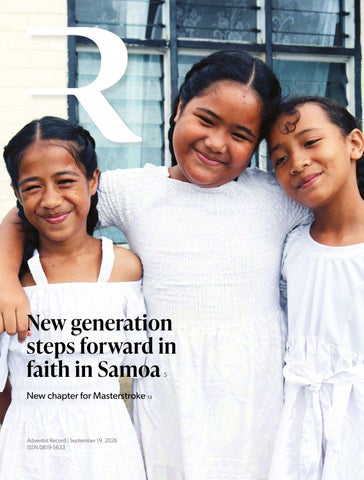
New generation steps forward in faith in Samoa 5
New chapter for Masterstroke 13
Adventist Record | September 19, 2026 ISSN 0819-5633
“Test me in this” says the Lord Almighty. (Malachi 3:10)
E-Book Out Now! Download your FREE COPY at tinyurl.com/jw4cccj6
“A Biblical, easy-to-read overview of God’s will for His tithe.” Reid’s PDF e-book covers tithing basics—percentage, place and purpose—but also looks at touchier issues such as: Tithe & Other Ministries, Problems in the Ministry or Conference, and Ellen White’s Use of the Storehouse. Short enough to read in an afternoon, Reid has really packed a lot into this excellent resource. It’s a great read for anyone who is genuinely seeking to follow God’s will in the calculating, returning and use of His tithe. ~Julian Archer, Stewardship Director, South Pacific Division
EDITOR’S NOTE:
The value of showing up Juliana Muniz News editor
News of our arrival spread across the whole island, and many were excited to see us come to their churches and meeting sites.
Few things in life make you feel as special as arriving in the Pacific Islands for the Church. I’ve been privileged to visit a couple of Pacific Islands in the past year or two and, let me tell you, not even my own family welcomes me with such excitement and fanfare. I started writing this editorial while in Kiribati. I was there with two colleagues covering the Kiribati for Christ campaign—or KFC as the locals love to call it. The experience was rather intense. From the moment I stepped off the plane, my whole body was inundated by the heat and humidity. But as soon as we exited the airport, we were inundated by the warmth of the people. A sea of lovely church members was excitedly waiting for us. After church leaders greeted us at the door, we walked through a Pathfinder corridor with a special choir at the end, singing a welcome song I still hum at least once a day. Pacific Islanders have a way of making visitors feel special, and for us in Kiribati, they went above and beyond. But why is it? Why were they so excited to welcome us into their country? News of our arrival spread across the whole island, and many were excited to see us come to their churches and meeting sites. The Mission youth director told us that our presence there was important for the young people because it gave them a better sense that the Seventh-day Adventist Church was not limited to Kiribati. For such an isolated community, there are immeasurable benefits in making the effort of crossing the distance and showing up. And isolated it is. Kiribati is one of the most remote and scattered countries in the world. To get from the capital, Tarawa, to the eastern part, Christmas Island, it takes almost five hours by plane. Its 33 atolls and islands are spread across all four hemispheres. Living on an atoll also brings challenges: There’s barely any land—and the little they have is being threatened by rising sea levels. The soil is sandy, fresh water is limited, almost everything has to come from somewhere else, waste has nowhere obvious to go and infrastructure is limited. Those physical realities then create sanitation, nutrition and health challenges. Those realities also create challenges—and opportunities—for the Church. Health initiatives are already demonstrating what happens when the Church meets a community need. During KFC, 10,000 Toes health screenings brought hundreds of people to the evangelistic meeting sites, and many of them will continue the follow-up program to improve their health. Imagine what more could be done. There is incredible potential for sustainability projects—from recycling initiatives to innovative ways of growing fresh food— as well as partnerships and mission groups bringing skills and expertise in areas identified by the local Mission. There are many communities across our Division that would benefit from more of us showing up. But perhaps we would benefit just as much from going. I know I did. During our time there, I asked the international speakers from Australia, Fiji and French Polynesia what they learned from their experience there and what they will bring home with them. Their responses highlighted the generosity of the local people, their dedication, commitment and faithfulness despite limited resources—aspects I have also experienced and been inspired by. It’s easy to think of mission in terms of what we can bring—our resources, expertise, programs, funding—but there is plenty to receive as well. I-Kiribati Adventists made me want to be more patient, more willing to serve others, more generous. It’s been beautiful to see our church uniting through South Pacific for Christ. Many connections were formed with our church family in the Trans Pacific and more will be formed across other parts of the Division as we move forward with this movement. My hope is that those connections don’t end with the campaign. Where could you show up? What expertise do you have that could meet a genuine need? Who could you partner with? Find an opportunity and go. You may be surprised to discover that mission is just as much about what we receive as what we have to give. September 19, 2026 | Adventist Record
3
INSIGHT:
Less religion, more authenticity: what Australians are really looking for Kevin Jackson Director, Adventist Health Food department
4
Adventist Record | September 19, 2026
The recent Census reminds us that across Australia, a paradox is emerging. While fewer people are identifying with organised religion, many continue to search for meaning, purpose and spiritual connection. As churches experience declining attendance, the question is: what are people looking for? I believe for many Australians, the issue is not spirituality itself. It is authenticity. We live in an age where people are sceptical of institutions, authority and crafted public images. Young people have grown up viewing advertising, social media and public discourse with suspicion. They are less interested in polished presentations and more interested in what is genuine. The advent of AI is increasing this scepticism. The same is true when it comes to faith. Throughout the Gospels, Jesus reserved His strongest criticism not for those who struggled with belief, but for those whose outward religion did not match their inward lives. He challenged hypocrisy, legalism and performative spirituality. He welcomed those who came seeking truth, however imperfectly. That remains a lesson for the church today. Perhaps people are not asking whether Christians have all the answers. They are asking whether Christians live what they profess to believe. Do our actions reflect our words? Do our churches welcome people who are struggling? Are we known for compassion as much as conviction? The Adventist Church has a heritage of Bible-based faith, health ministry, education and community service. Yet our greatest witness may not be found in programs or institutions, but in ordinary believers whose lives consistently reflect the character of Christ. Authenticity does not mean perfection. It means honesty. It means acknowledging our failures, extending grace to others and continuing to grow in faith. It means being transparent about our journey while committed to biblical truth. In a culture weary of appearances, authentic Christianity has power. When people encounter believers who are humble, kind, trustworthy and deeply committed to Jesus, barriers begin to fall. The opportunity before the church is significant. The world may be becoming less religious, but it is not necessarily less spiritual. People are still searching. Will they find in us a faith that is real?
New generation steps forward in faith in Samoa Apia, Samoa | Zanita Fletcher/Tracey Bridcutt
Samoa Mission president Pastor Afiipu Tuaoi (third from left) with church planter Pastor Taei Siaki (second from left) and members outside Nuu Fou church in the village of Malie.
Children’s programs were very popular. This one was held at Vaitele Fou church.
Fifty-nine people were baptised at the Samoa Aquatic Centre.
Hundreds of baptisms have taken place across Samoa following the twoweek Samoa for Christ evangelistic campaign. According to the latest report, 1487 people have been baptised so far as a result of the campaign, which was held at 64 sites across the country. At Siufaga Adventist Primary School on the island of Savai‘i, 21 students and a teacher were baptised on August 28. Two days later, baptismal ceremonies were held across Samoa as the campaign came to a close. At the Samoa Aquatic Centre, 59 people were baptised as six churches from three meeting sites came together for a combined service. More than half of the candidates were young people. Among those baptised was Auomala Auvaa, a young man who had not previously belonged to a church or denomination—unusual in a country where around 98 per cent of the population identifies as Christian. Mr Auvaa attended many of the Samoa for Christ meetings but had not planned to be baptised at the Aquatic Centre that day. However, he responded to the final call after all the other candidates had been baptised. He said the message presented by Pastor Faafetai Matai, from the South New Zealand Conference, had made a strong impression on him, building on what he had heard throughout the campaign. “The preaching of the gospel over the past two weeks has been very powerful,” he said, adding that messages on family and the character of Jesus had particularly resonated with him. “Our country is very Christian, so there are a lot of churches that talk about God and Jesus Christ. But this is the first time I have heard the gospel of Jesus Christ preached like this.” Across Samoa, local presenters were joined by speakers from Australia, Tahiti, Papua New Guinea, American Samoa, New Zealand and Kenya for the campaign. Months of preparation preceded the meetings, with churches reaching into
their communities through food programs, home visits and other activities designed to build relationships. Prayer was central to the preparation. Church members held early morning prayer walks around evangelism sites and took part in a 150-day prayer initiative that included weekly fasting and prayer. Churches also prepared their facilities, with one undergoing a complete renovation and others receiving new paint, pews or floor tiles. Health ministry formed another part of the outreach, with health teams and 10,000 Toes Campaign ambassadors offering wellness checks at some sites before the evening meetings. The dedication and commitment of the local church members inspired visiting speakers. Victorian pastor Rahel Gungadoo preached at a church plant with around 20 members who had funded a new church building themselves. The building was deliberately constructed for a congregation much larger than their current membership. “For me, that shows a little bit of their heart,” he said. “It’s only a small church plant, but they’re willing to grow.” More than 40 visitors attended each night of the campaign. “A lot of the times when we do evangelism, we think about the speaker. We get the biggest names, biggest people, and we want that to be our drawcard,” he said. “Here, the drawcard has been that each and every member has been visiting the people in this community.” With the public campaign concluded, Samoa and Tokelau Mission president Pastor Afiipu Tuaoi said the focus is now on helping new members become established in their local churches, with small groups forming an important part of the strategy. “This is the end of Samoa for Christ, but it’s just the beginning of the journey for all of these baptismal candidates,” Pastor Tuaoi said. “Our work continues in nurturing them.” For more stories from Samoa for Christ, visit <record.adventistchurch.com>. September 19, 2026 | Adventist Record
5
Fulton honours education pioneer Nadi, Fiji | Ben Vula
Church leaders, government representatives, educators and members of the Tausere family attended the official opening.
The legacy of pioneering Adventist educator and leader Dr Nemani Tausere has been honoured with the naming of a lecture theatre at Fulton Adventist University in Fiji. The Dr Nemani Tausere Lecture Theatre was officially opened and dedicated at a special ceremony attended by church leaders, government representatives, educators and members of the Tausere family. The event recognised the significant contribution of the late Dr Tausere to Adventist education in Fiji and throughout the Pacific. His influence on educational development, leadership and mission continues to be felt across the region. The ceremony commenced with prayer led by Professor Lohi Matainaho, vice chancellor of Pacific Adventist University in Papua New Guinea. The official ribbon-cutting ceremony was led by Fiji’s Minister for Education, Aseri Radrodro,
accompanied by Pastor Charlie Jimmy, president of the Trans Pacific Union Mission, Pastor Epeli Saukuru, president of the Fiji Mission, and John Tausere, the son of Dr Tausere and manager of the production department at Adventist Media in Sydney. Mr Radrodro acknowledged the longstanding contribution of Fulton Adventist University to national development. He thanked the institution for more than 120 years of service to education in Fiji and for its ongoing commitment to developing leaders and professionals who continue to serve both Fiji and the wider Pacific region. Mr Tausere described his father’s passion for Adventist education through three guiding principles. “My father was passionate about people. He was passionate about the Pacific. And he always sought to build purpose in people’s lives,” he said.
Connecting across borders
South Papua Province, Indonesia | Jacqueline Wari
At the end of the camporee 24 Pathfinders committed their lives to Jesus through baptism.
6
Adventist Record | September 19, 2026
Almost 200 Pathfinders and leaders from Papua New Guinea attended the Arafura International Pathfinder Camporee in Merauke, South Papua Province, Indonesia. The camporee, held July 7-11, was organised by the Papua Mission in the East Indonesia Union Conference. A total of 191 Pathfinders attended from the Papua New Guinea Union Mission (PNGUM). At the end of the camporee 24 Pathfinders committed their lives to Jesus through baptism. Six were Papua New Guineans. PNGUM youth director Pastor Moses Melua said the camporee offered many spiritual, physical and educational activities. “Pathfinders participated in worship, honours classes, drills, camping skills, community interaction, cultural exchanges and fellowship,” he said. “These activities strengthened their
faith, developed leadership skills and created lasting friendships across borders.” PNGUM local mission youth directors assisted with the morning and evening devotions. According to Pastor Melua, it was more than attending a camporee. “It was a mission journey that strengthened friendships, built partnerships and opened new opportunities for God’s work along the PNG–Indonesia border.” He added that the journey to Merauke was challenging but inspiring. “Some of the Pathfinders and leaders walked for four days, crossing rivers and difficult, rugged roads before reaching the border,” he said. “They then travelled another five hours by truck to the campsite. Others flew to Vanimo before crossing into Indonesia. Despite the hardships, everyone arrived safely.”
making headlines Run for a reason Zimbabwean marathon runner Emmanuel Mandeya ran 160 kilometres, raising $US12,000 to help complete Eastlea Adventist Church, which had remained unfinished for more than a decade. His fundraising will help finish the roof, windows and floors, enabling the congregation to worship in their own sanctuary for the first time.—SID
The initiative brought local church members together in service to their community.
Clean-up bags big results South Tarawa, Kiribati | Juliana Muniz
Church members collected around 500 bags of rubbish during a community clean-up in Betio as part of the Kiribati for Christ campaign. Plastic litter is one of the most pressing environmental threats facing Kiribati. The nation generates roughly 9.7 tonnes of plastic waste daily, much of which ends up littering beaches and entering the marine environment. The initiative brought together local Adventist churches for a clean-up along the Dai Nippon Causeway, where participants usually gather for the Walk4Life program—a Trans Pacific Union Mission health and wellness initiative to combat high rates of chronic diseases across Pacific nations through physical activity. Plastic bottles, food packaging, broken glass and even marine debris were some of the discarded items scattered along the beach before volunteers began the clean-up. The initiative was conducted in partnership with Kiribati’s Ministry of Women, Youth and Social Affairs. Minister Ruth Cross Kwansing sponsored the activity by donating $A1 for every bag of rubbish collected. Funds raised through the clean-up were distributed to participating local churches according to the number of bags they collected and supported local Kiribati for Christ programs. “We appreciate the government and the minister who is looking after church ministry,” said Kiribati Mission president Pastor Taabua Rokeatau. “Rubbish all around the country is currently an issue in Kiribati. I am very happy that we, as Seventh-day Adventists, are recognised as one of the organisations actively helping the government with this.” Among those taking part was Betio Seventh-day Adventist Church member Tairati Toakarawa, who is blind. With guidance from other church members, he contributed to the clean-up, saying serving the community reflected Christ’s example. “We copy the work of Jesus when He was on Earth. He helped people and showed that He was there to help them,” said Mr Toakarawa. More stories from Kiribati for Christ will be published in the next edition.
Faith behind bars The Adventist Church has opened a Bible study room inside a Paraguay prison, creating a space for worship, discipleship and literature to support a growing prison ministry. During its inauguration, 10 inmates were baptised while dozens more study the Bible and grow their faith.—SAD
Stronger than revenge A new YouTube documentary, In the Face of Revenge, tells the story of Finnish Adventist Viktor Ståhlberg, who carried his Bible to an execution site during Finland’s civil war and persuaded authorities to spare 10 prisoners being killed in revenge for his son’s murder. His act of forgiveness not only broke a cycle of violence but led others to Christianity and influenced generations of his own family.—Adventist Review
The gut-brain link Researchers found that gut microbes can influence brain chemistry, stress responses and mood, suggesting that mental health may begin in the gut. Their review highlights probiotics, dietary changes and faecal transplants as promising, low-cost ways to improve mental wellbeing. —Adelaide University
September 19, 2026 | Adventist Record
7
flashpoint
Disaster training Called to create Adventists from across Australia gathered at Gold Coast Central Seventhday Adventist Church from August 14–15 for the seventh annual Creative Conference. Across 15 sessions, attendees discovered how creativity can bring new life to almost every area of ministry—from discipleship, children’s ministry and worship environments to songwriting, live painting, podcasting, videography, content creation and social media. Organiser Charmaine Patel said, “The church does not need creativity for creativity’s sake. It needs creativity surrendered to God—creativity that reveals Jesus, reaches hearts and builds a vibrant, Spirit-led and mission-focused church.”—Record Staff
More than 60 church members took part in disaster preparedness training aimed at strengthening the ability of local churches in Honiara, Solomon Islands, to respond to emergencies. The Disaster Preparedness and Evacuation Centre Management (DPECM) training was conducted by ADRA Solomon Islands at White River Seventh-day Adventist Church in West Honiara from August 23 to 25. Topics included identifying hazards and vulnerabilities, community mapping, disaster risk and response planning, and local early warning systems. —Denver Newter
123 years of caring
New classroom
Sydney Adventist Hospital marked its 123rd anniversary with three days of events bringing together chaplains, staff, alumni, volunteers and friends. Held across the San campus and Wahroonga Adventist Church from August 13-15, the event included worship, learning, fellowship and thanksgiving opportunities. “As the San celebrates 123 years, the challenge for the next generation is not simply to preserve what has been handed down, but to carry the spirit of compassionate service forward into a changing world,” said San Spiritual Care Services chaplain Yvonne Hypolite.—Yvonne
Toule Junior High School, an Adventist boarding school in Rigo East, Papua New Guinea, has received a new double classroom. With more than 700 students, the new building will provide additional learning space and help the school accommodate its students more effectively.—Rose Maine Sinias
Hypolite/Record Staff
8
Adventist Record | September 19, 2026
flashpoint
Planting for the future More than 100 pastors, church planters, lay leaders, administrators and departmental directors gathered on the Gold Coast from August 3-4 for the inaugural Australian Union Conference (AUC) Church Planting Summit, hosted by the AUC Ministerial Department and Adventist Mission. Participants attended from across Australia and New Zealand, representing both the AUC and the New Zealand Pacific Union Conference.
Welcome to The Quarters The Quarters at Wahroonga Estate was officially opened in a ceremony that brought together current and former South Pacific Division (SPD) administrators, ministry leaders, and representatives from Avondale University and Sydney Adventist Hospital. The project represents a significant renewal of residential accommodation on the estate, replacing the former mission flats and the ageing nurses’ residence to better serve the needs of those living, studying and working within the precinct. SPD CFO Francois Keet said the project demonstrated the long-term vision required to ensure church assets continue to serve future generations effectively.—Record Staff
Themed “Equip. Connect. Multiply.”, the summit was the first national gathering of church planters and church planting leaders in the history of the AUC. The event was designed to bring together those passionate about mission, disciplemaking and the establishment of new faith communities across both countries. “In a nation where many churches are experiencing declining attendance, church planting continues to be one of the most effective ways of reaching new people and establishing vibrant disciple-making communities,” said Pastor Roy Kim, associate ministerial association secretary for Adventist Mission. “The summit provided a clear signal that the Seventh-day Adventist Church in Australia is committed to investing in church planting, leadership development and innovative approaches to mission.” —Roy Kim/Juliana Muniz
have news to share?
Send info and photos to <news@record.net.au>
Small acts, big impact A group of 12 senior students and seven staff from Longburn Adventist College (New Zealand) travelled to Kaitaia for a service trip focused on building relationships and serving the local community. The group led out in Murupara and Kaitaia churches and conducted a week-long kids’ club for around 30 children, featuring games, crafts, worship and devotions. Although only a few children came from Christian homes, nearly all attended Kaitaia church on Sabbath, with some taking part in the service. Students also collected pinecones for senior citizens to use in their fireplaces and helped clean the church building. The trip reminded students how working together and serving others can made a big difference.—Plugin, North New Zealand Conference September 19, 2026 | Adventist Record
9
Barbed wire fences
10 Adventist Record | September 19, 2026
B
arbed wire—it’s something I am all too familiar with having grown up in a rural environment. In my many outdoor adventures growing up with my brothers and their friends (there were no girls my age in my neighbourhood until I was about 12), I encountered barbed wire a lot. We also had to navigate barbed wire while mushroom picking as a family across the paddocks surrounding our house. Usually there were gates we could open but some of these were loosely termed gates made by the local farmer—a mix of Number 8 Wire with barbed wire running across the top and middle—and were likely to collapse as you released the catch. If you weren’t careful and were standing in the wrong place, you could get caught up in the spiky nest. Our back fence had barbed wire and sometimes an electric fence as well due to the cow paddock behind us. I can remember clearly getting a boot from the electric fence because I touched a branch from our back hedge that was touching the electric fence. Somehow, the current went directly through the branch to me. After we moved to a property with acreage, my dad often had cows in one of our paddocks and would sometimes strip graze them. This meant we had to navigate the electric fence to get across the paddock to the shed and gardens. One crucial time the electric fence didn’t work was when our local church had a plot of capsicums growing in one of Dad’s paddocks as a fundraiser for the new church building. The cows were so determined to get to those tasty capsicums that they bulldozed down the electric fence and bolted in to enjoy the treats, eating the lot. Needless to say, the church didn’t use Dad’s paddocks for their fundraiser growing after that. Back to the barbed wire. Have you ever experienced that feeling when you are trying to climb through or over a barbed wire fence and almost making it through the narrow spiky gap unscathed, when one of the barbs catches you on the back of your shirt or pants just out of your reach
to unhook yourself? You don’t know whether to go backwards or forwards, but you do know if you move you will likely hook yourself further, or worse, the barb catches your flesh in a meaty grab. Ouch—I have—multiple times! But isn’t that its purpose? To catch you, or a curious animal that doesn’t know better, or to stop you when you think you know better, but really don’t, from progressing further than you should. It’s a boundary, a dividing line, a safeguard, a protector of sorts. A little fear or pain as a small warning that there could be something more dangerous lurking on the other side. Most of the time, the biggest danger we encountered on our childhood adventures was the fence itself. I do recall though, being chased by an angry mare across a nearby paddock when I attempted to go and pat her newborn foal. I have never run so fast in my life. I didn’t wait to undo the gate to get to safety. I vaulted it with that angry mama horse hot on my heels. I have had a healthy respect for horses ever since. As children, when we got ourselves into difficulty with the barbed wire, we would call out for a saviour to unhook us. In my case, it was usually in the form of my big, strong dad. Or, if Dad wasn’t present, my older brother who was taller than me and had learned how to climb across the fence safely. Most of the animals in my childhood wanderings across barbed wire-laced paddocks were cows who weren’t very clever—albeit stubborn and curious. On the odd occasion, we also encountered sheep who were no different. Which is why I believe that we are likened to sheep a lot throughout the Bible. We all need barbed wire fences as boundaries to protect us from ourselves. Little warnings that something might not be good for us or others, to stop us in our tracks. God in His loving wisdom has given us plenty of practical examples of boundaries in the Bible. These apply to many areas of life, including relationships, raising children, marriage and health, to name a few. Most lead us directly to a loving relationship with
Him. But in that same loving wisdom He gives us free choice. Choice to make the decision as to whether we are going to try and climb those fences, despite the barbs of consequences, or whether we are going to trust Him and stay where we need to be. With this freedom of choice comes a warning: “You, my brothers and sisters, were called to be free. But do not use your freedom to indulge the flesh; rather, serve one another humbly in love” (Galatians 5:13,14). It is important that we recognise those barbs on the fences as the warning that they are. Sometimes breaching them hurts. God, when He was desperately trying to reach Israel to bring them back to Him, said in Hosea 2:6, “Therefore I will block her path with thornbushes; I will wall her in so that she cannot find her way.” God let Israel experience the spikes of hardship to hinder their wilful, destructive behaviours. The thorny wall of affliction protected them from straying further into sin so they would call on God and return to a faithful relationship with Him. Life’s fences, whether they have barbed wire, are laced with electricity or are covered with ivy, can be teachers that help us develop and fortify our trust in Jesus, ensuring we stay on the path that He has set before us. Choose today to see the barbed wire fence not as a symbol of hurt, pain and discouragement but as a hedge of protection guarding your soul. “Trust in the Lord with all your heart and lean not on your own understanding; in all your ways submit to Him, and He will make your paths straight” (Proverbs 3:5,6). Wendy Hunter works in the People and Culture team at Adventist Senior Living and attends Lakeside church in Bonnells Bay, NSW. She writes as a way of pausing to notice and remember the God moments woven through ordinary days.
September 19, 2026 | Adventist Record
11
The
Great Story B
efore it was the Great Commission, it was a story (see Matthew 28:16–20). A mismatched group of believers—“but some of them doubted!” (see verse 17)—gathered on a rocky mountaintop, looking across the Sea of Galilee sparkling blue in the springtime sunshine and to the hills of the “foreign lands” beyond. In the previous few weeks, they had been through the most traumatic and confusing time of their lives. When Jesus was welcomed by the crowds in Jerusalem, they had hoped that He was about to become their King, but less than a week later He was crucified as a political rebel, executed among thieves. Barely had they time to grasp the brutal reality, cruelty and injustice of His death that there emerged claims and stories of His resurrection—and then He began appearing to many of them: to Mary at the tomb, on the road to Emmaus, in the Upper Room, on the beach in Galilee and more. Then they met Jesus on this mountaintop in Galilee, “where Jesus had told them to go” (verse 16). And He gave them the instructions to go and tell and teach and baptise that we now know as the Great Commission. But before it was the Great Commission, it was a story. Which means we should first read it as a story. Which means Jesus was not primarily talking to us. If anything, He was talking about us. As much as we might wish we were, we weren’t there. We were not among the group of disciples described in verses 16 and 17, but in the instructions given to the disciples in verse 19: “Go and make disciples of all the nations . . . to the end of the age” (see verse 20). We find ourselves in this story, not at its centre but at its fringe. These verses are so familiar to many of us that we often miss how remarkable it is that we read them together in a church or small group almost 2000 years later—in a
12 Adventist Record | September 19, 2026
place they could never have imagined, so far away, in a society so different from theirs, using technology—whether a bound book, printed magazine or a small screen—that would have boggled their minds, in a language that would not be recognisable for almost 1500 years. It’s an amazing story of the stories of Jesus being told and re-told, translated and transmitted across the generations, from person to person, group to group, people to people, and from continent to continent and island to island. And somehow across all those people and places, the story came to our place and to us. When we recognise ourselves situated at these farthest reaches of this commission, we can understand more of its great scope and inclusivity. We find ourselves in this story first as recipients and beneficiaries of this commission and of the faithful response of those first disciples—and the countless others who have taken on the story as their own. They and their stories are only reasons why we can then read it as our commission. When we read it first as a story, this climactic command in Matthew’s story of Jesus should first invite a response of wonder, gratitude and humility. We receive before we are asked to give. We are amazed—and then invited to take our place in this great story of the Great Commission. It is a story that we have received only because of the goodness of God, the reality of Jesus and the sacrifices of so many of His followers across the centuries since. The invitation to be His disciples in our time and place begins with reading the Great Commission for the unlikely and awe-inspiring story that it is. Nathan Brown book editor, Signs Publishing.
New chapter for Masterstroke
M
ore than a decade after first appearing on Hope Channel, Masterstroke is entering a new chapter— taking conversations about art, faith and life’s big questions into galleries, cultural centres and communities. An Adventist Media ministry presented by pastor and historian Dr Neale Schofield, Masterstroke uses the lives and works of well-known artists as a starting point for exploring meaning, suffering, hope and faith. The original Masterstroke series featured 12 half-hour programs and 28 shorter segments, which were broadcast internationally through Hope Channel. Since then, Dr Schofield has further developed his interest in the relationship between art and faith, completing a master’s degree in Christianity and the Arts at King’s College London in collaboration with The National Gallery, followed by a PhD in history at the University of St Andrews in Scotland. Now Masterstroke is expanding its reach through a new website, fresh digital content, Bible studies and live community events. Its online offerings include films, a gallery highlighting the stories and meaning behind significant artworks, and “Today’s Masterstroke”, a daily reflection using art as a starting point for exploring faith and life. Dr Schofield is particularly passionate about using Masterstroke to help local churches connect with people in their communities who may not be reached through more traditional approaches to evangelism. “If you look at a work of art, then you’re interpreting what it means to you, and there are so many different layers,” he said. “It’s not confrontational. It’s a totally different approach.” Earlier this year, Dr Schofield presented “Vincent: A Spiritual Journey”, exploring the life and faith of Vincent
van Gogh, at the Naracoorte Art Gallery in South Australia. Although hosting a faith-based program was somewhat outside the gallery’s usual scope, gallery leaders were intrigued by the subject and agreed to host the series. More than 30 people from the community attended, with gallery leaders delighted by the response and the event attracting coverage in a regional newspaper. Organised by Pastor Fine Paiaaua and Sharyn Hole from Naracoorte Adventist Church, the program has also created opportunities for ongoing connections. The church is following up the event with “Bible Q+A”, a 25-part Masterstroke Bible study series. Dr Schofield said the aim is not simply to hold events, but to help local churches build relationships with people in their communities. “Because it’s done through the artist’s life story, people can identify with them,” he said. “They don’t even have to be that interested in art.” According to Dr Schofield, art can connect with people in ways that preaching sometimes cannot. “Like music, art has a way of reaching people and reaching the heart,” he said. Masterstroke is continuing its community focus with a series in Perth this month at the Clarkson Community Centre Auditorium, featuring “Mysteries of the Louvre”, “Vincent: A Spiritual Journey” and “Spirit of the Reformation”. For more information on Masterstroke and upcoming community events, visit <masterstroke.tv>. Tracey Bridcutt communication director, South Pacific Division.
September 19, 2026 | Adventist Record
13
The tongues of
CORINTH
P
astor, our friends are speaking in tongues. Should we do it too?” I once pastored a church where many teenagers attended a Pentecostal school. In Bible studies, our conversations often circled back to the topic of speaking in tongues. As I looked to deepen my understanding of this practice, I discovered Speaking in Tongues: A Critical Historical Examination by Dr Philip Blosser (a Catholic philosopher) and Charles Sullivan (a Pentecostal linguist). Unlike other authors, Blosser and Sullivan did not set out to prove that Catholics, Pentecostals or other religious groups had the “correct” understanding of speaking in tongues. Instead, their goal was to investigate how Christians have perceived and practised tongues throughout history. This article summarises their findings.
Two types of “speaking in tongues” Christians often distinguish between two forms of speaking in tongues: xenolalia and glossolalia. Xenolalia is the miraculous ability to speak a real human language that the speaker has never learned. For example, an English speaker suddenly being able to speak French. The classic biblical example is Acts 2:6 when members of a crowd heard the disciples preaching in their own language. In contrast, glossolalia is where people in heightened emotional states utter sounds or speech-like syllables in
14 Adventist Record | September 19, 2026
rapi, repetitive patterns. These vocalisations are understood to be language unknown to the person making them. Furthermore, they are often called a “heavenly language”, the “language of angels” or a God-given personal prayer language. 1 Corinthians 13:1 and 1 Corinthians 14 are often cited in support of this view.
Historical redefinition: 1st to 18th centuries Some assume that the glossolalia model has always represented the Christian understanding of tongues. However, after investigating the first 1800 years of Christian history, Blosser and Sullivan concluded that prior to the 18th century, neither Catholic nor Protestant theologians taught that the gift of tongues was glossolalia. Instead, they understood tongues to be xenolalia—the miraculous ability to speak a previously unlearned human language.
19th century origins, 20th century expansion The first recorded practice of glossolalia occurred in 1830. Edward Irving, a Presbyterian pastor, encountered Christians in Scotland who prayed in unintelligible languages. Irving incorporated this behaviour into his ministry which awakened widespread interest and controversy across Europe. At the turn of the 20th century, American Pentecostals prepared for mission work in Asia. During prayer meetings,
some of them began speaking unintelligible sounds. They became convinced that these sounds were actually the Japanese, Indian and Chinese languages, and that the Holy Spirit had given them the gift of xenolalia to preach to these nations without needing to learn their native languages. However, when they arrived overseas, the local people could not understand them. Returning home, these Pentecostals maintained their practice of ecstatic vocalisations and reinterpreted them as glossolalia—a Spirit-given personal language of praise and prayer. Today, the Pentecostal/Charismatic movement has grown from less than one million people in 1900 to more than 660 million people in 2025—and still teaches the concept of glossolalia from the 20th Century. Their understanding of the gift of tongues has become highly influential around the world, including in Adventist churches I have pastored and attended. But if a Christian from the first century walked into a contemporary Pentecostal church, would they understand what was happening?
Corinth: a multilingual city The city of Corinth was a bustling, multilingual trading hub drawing people from across the Roman Empire. As a Roman colony on a narrow land bridge connecting mainland Greece to the Peloponnese, Corinth was home to a clash of Greek Dialects: Doric, Aeolic and Attic/Koine. In this setting, language was not merely practical. It was both political and spiritual, as one’s language of choice might signal power, status or theological loyalty.
The apostle’s dilemma According to the fourth century church father Epiphanius, Paul was “dispatched” to Corinth to (1) address factions created by people boasting about their ability to speak different Greek dialects (Doric, Aeolic, Attic) and (2) address the use of Hebrew in synagogue services. Some were apparently using their linguistic abilities to exalt themselves rather than to build up the community. Epiphanius reports that Paul affirmed the value of proclaiming the Scriptures in Hebrew while also rebuking those who used language as a tool for arrogance rather than for the church’s edification.
Jewish liturgical practices The apostle Paul founded the Corinthian church around AD 50-52. Evidence suggests that for several decades, Hebrew functioned as the primary language of instruction in the Corinthian church. However, Hebrew had become a sacred liturgical language that most Jews could not comprehend (similar to the historical use of Latin in the Catholic Church). So, this raises an important question: how was Hebrew used during their worship services and what did “speaking in tongues” actually look like in the Corinthian church? First, a “reader” would read a passage from the Hebrew Scriptures in the Hebrew language. Next, a “translator/
interpreter” (meturgeman) who was standing next to the reader would listen and translate the Hebrew into a language the congregation understood, like Aramaic or Greek. This translation was not a word-for-word translation but a thought-for-thought version to make the ideas in the Hebrew text clear to the listeners, often expanding with historical illustrations and contemporary references. As stated in the Jewish Encyclopedia: “The weekly lesson from the Pentateuch and the Prophets was read [in Hebrew] by a member of the congregation, and the meturgeman had to translate into the vernacular the Pentateuchal lesson verse by verse; from the Prophets he translated three verses at a time. While the reader of the Hebrew text was forbidden to recite by heart, the meturgeman was not permitted to read his translation from a book, or to look at the Hebrew text when translating, in order that the people should not think that the translation was contained in the text. The meturgeman was also forbidden to raise his voice higher than that of the reader of the text. He did not limit himself to a mere literal translation, but dilated upon the Biblical contents, bringing in haggadic elements [i.e. legends, parables, or anecdotes from rabbinic literature], illustrations from history, and references to topics of the day.”
The apostle’s hope Understanding history and culture transforms how we read 1 Corinthians 14. Paul is not teaching the Corinthian Christians to speak in heavenly languages, ecstatic vocalisation or a God-given personal prayer language. Instead, Paul is addressing a practical linguistic challenge in their multicultural, multilingual worship service, and is urging the Corinthians that the sacred teaching of the Scriptures must be interpreted clearly into a language that everyone understands. Ultimately, Paul’s goal was that everyone would be drawn closer to Jesus as they listened to an intelligible proclamation of Scripture and not miss the message of salvation due to language barriers or the performance of the translator. As Paul taught the Corinthian church—and as the Bible continues to teach us today—true spirituality grows through understanding, which opens the way for everyone to hear, believe and be transformed by the good news of Jesus. To read an expanded version of this article with footnotes and a new paraphrase of 1 Corinthians 14:1-27 in modern English, visit Adventist Record online at <record. adventistchurch.com>. Jared Martin ordained minister in the Seventh-day Adventist Church in Australia. He holds an MA in Biblical and Theological Studies from Avondale University along with degrees in construction management, Adventist history and teaching.
September 19, 2026 | Adventist Record
15
SUFFERING
THE DIVINE PARADOX
I
have lived with cerebral palsy for 72 years. It’s not a path I chose for myself, but one chosen for me by God. Is that a provocative statement? Maybe. And perhaps for some, too simplistic. However, walking, stumbling and, yes, even falling along any path for many years has provided the opportunity for me to consider my own attitude to suffering, as well as the dilemma it presents. You may ask, as I have, “How can a loving God allow suffering to continue?” In other words, is the existence of suffering compatible with a God of love? The question can’t be answered by some clever turn of phrase, but by a story Jesus told. It’s a story framed in the context of a bigger picture involving the whole of humanity—and God’s purpose for us. The biblical text reveals God as One who desires a relationship with you and me. In the
16 Adventist Record | September 19, 2026
beginning, Adam and Eve enjoyed a face to face relationship with God. Regrettably, their relationship with Him was severed and they were banished from Eden because they chose to believe the lies of Satan in preference to the truth of God. Their disobedience—in the taking and eating of forbidden fruit—brought consequences: the sin and death we see in our world today. Yet, we are not without hope. God valued His relationship with us so much that through the death of Jesus our transgressions were forgiven and face-to-face communion will eventually be restored. That’s the promise for all who believe and follow God today. I must recognise, as we all must, that one of the consequences of the choice made in Eden is the existence of disability. But this is not the work of God. Yes, He permits
“
To me, faith is a choice to place my trust in God. That begins by believing He exists and that His Word is true.
it, but it is a result of the work of the enemy. Satan is a liar and uses deception in an attempt to discredit God to take us down the path to destruction. God’s path leads to life—eternal life—an existence no longer marred by sin and death. This redemption story has been told for centuries. It’s a story familiar to many. The danger is that because it’s been around for a long time, we become dismissive of its importance. But as the words of the gospel song, “It’s Not Just A Story” put it, “It’s not just a story; but reality.” We do a gross injustice to anyone in our community living with a disability when we say, “Jesus can heal you if you have enough faith.” What if the anticipated healing doesn’t occur? It could turn them away from Christ altogether—with eternal consequences.
When Jesus walked this earth, He spent much of His time healing the sick. His actions were a fulfilment and declaration of His mission to reach humanity with the gospel. His life embodied the truth about God and His purpose for His creation. Can we place our trust in a God who allows suffering? I believe we can! But how? I believe it is stated best by the biblical phrase, “For we live by believing and not by seeing (2 Corinthians 5:171). What then is faith? To me, faith is a choice to place my trust in God. That begins by believing He exists and that His Word is true. I naturally love the stories of God’s healing miracles, particularly the healing miracle recorded in Mark 2. It tells of Jesus visiting Capernaum and healing a paralysed man who was let down through the roof of the house where Jesus was staying. What a stir this caused among the stunned onlookers! I like to imagine myself in that scene and feeling the sheer, pulsating joy in the healing presence of Jesus. In September of 2025, I was anointed. Pastors and elders from my church met with me in my home together with family and friends for a special time of prayer. It was a time of commitment and trust in God who is fully acquainted with every aspect of my life. Did God remove my disability? No. I still have cerebral palsy. Though it is sometimes a difficult path to walk—and there are many paths I literally cannot walk—I know Jesus is with me. Beside me. Guiding me. The amazing thing is that “when I am weak, then I am strong” (2 Corinthians 12:10). That’s a divine paradox! God has acquainted me with my human weakness so I can discover His divine strength. The Lord told the apostle Paul, “My grace is all you need. My power works best in weakness” (2 Corinthians 12:9). Yes, I believe that suffering is compatible with my belief in a loving God. For me, the ultimate proof of that reality is Jesus’ reconciling, redemptive death on the Cross at Calvary. It was for me. It was for you. It’s for every soul who accepts it. Jesus will forever bear the marks of that sacrifice. The suffering we experience in this life is not permanent. The apostle Paul puts it this way: “For our present troubles are small and won’t last very long. Yet they produce for us a glory that vastly outweighs them and will last forever! So we don’t look at the troubles we can see now; rather, we fix our gaze on things that cannot be seen. For the things we see now will soon be gone, but the things we cannot see will last forever” (2 Corinthians 4:17,18). I invite you to believe the story and to trust in the God who wrote it. 1. All Bible references taken from the NLT.
Geoffrey Panckhurst writes from Ringwood, Victoria.
September 19, 2026 | Adventist Record
17
One million Pathfinders
I
n 1980, there were 180,000 Pathfinders worldwide. In 1985, 450,000. Today, more than 700,000 Pathfinders meet in over 40,000 clubs. Within three years there’ll be a million. The motivation, dedication and enthusiasm of Pathfinders and their leaders remain constant. The differences among Pathfinders around the world come in the levels of resources and equipment they have available. In the Spanish areas of Inter and South America, Pathfinders are called Conquistadores. In Brazil, which is Portuguese-speaking, they’re Desbravadores. In the French areas of Africa and Inter-America they’re Explorateur. The badges and insignia are the same worldwide, but the uniform may differ in colour depending on the economy or political considerations of the country. When Pastor Neal Wilson visited the city of Kumasi, in Ghana, some 10,000 Pathfinders and Master Guides marched down the street to a large stadium. What a sight! A mass of excited young people in uniform waved flags and sang. They completely blocked the street. Then there was the Pathfinder rally in Harare, Zimbabwe, with 6000 attending. And 1500 Pathfinders marched at a camporee at Lake Kyle (also Zimbabwe), with no drums or music. One leader produced an old tin trunk and two large sticks. I took the salute on the dais and watched as he attacked the “drum”. He flattened it. “The soldiers came into our church last month with machine guns and told us to close the Bibles and leave,” an 11-year-old boy from Northern Columbia told me. “What did you do?” I asked. “Oh, we all left very quickly!” “Do you still go to church?” “Oh yes! But we changed the time.” That’s the spirit of Pathfinders. In Pennsylvania (United States) last year, 15,000 Pathfinders assembled in front of a full-size Noah’s Ark built for the occasion. However, some of the highlights of my experience occurred in the South Pacific last year. My welcome at Batuna (Solomon Islands), a ride in a leaky war canoe and
18 Adventist Record | September 19, 2026
a camporee on Mussau Island, were unforgettable experiences. One pastor and seven Pathfinders walked seven days over the mountains to be with us at Milne Bay. Fifty-five Pathfinders travelled three days in an enormous dugout canoe from Kikori in the Papuan Gulf to join us for another camporee. The greatest inspiration of Pathfindering is the people. I’m confident from what I see that this is God’s church and that His people are going forward to victory. At a recent Euro-Africa Division Pathfinder Camporee in the South of France, I met Manuel. He’s from Spain, a Pathfinder counsellor and the father of teenage boys. Manuel moved out of the city and attended a small country church where, to his dismay, he found there were only three children. But within three years the church had 30 young people and a strong, active Pathfinder club. Last year nine young people and three parents were baptised. He’s currently studying with 12 more. At the end of the camporee we had a baptism and many indicated their desire to be baptised. I saw Manuel making his way toward me through the crowd. His face shone with excitement. He had brought seven non-Adventist boys to the camporee. Two had gone forward in response to the appeal. I didn’t have to ask him whether Pathfinders was worthwhile. Many unsung heroes—parents, leaders and counsellors—make Pathfindering so successful around the world. They help the Pathfinder Club play its part as one of God’s methods for saving youth. Malcolm Allen Pathfinder director at the General Conference, 1986–1996. This story was adapted from the July 21, 1990 issue of Adventist Record. Today, there are nearly 2 million Pathfinders worldwide. September 19 is World Pathfinder Day. To learn more and participate, visit <gcyouthministries.org/ministries/pathfinders>.
Baked Berry-Bix Cups Serves 2
Prep: 5
Cook: 25 min
A baked twist on Weet-Bix porridge, these berry cups are a wholesome breakfast to start your morning well.
Ingredients
Method
4 Weet-Bix™ wheat biscuits 2 large eggs 1 medium sized banana ½ tsp baking powder A pinch of salt ½ cup frozen mixed berries
Step 1 Preheat oven to 200°C (400°F). Step 2 Combine Weet-Bix, egg, banana, baking powder and salt in the jug of a processor or blender. Pulse until smooth.
To Serve 2 tsp of maple syrup, optional
Step 3 Divide batter into two 1-cup ramekins, and top with berries.
Nutritional Information (per serving)
Step 4 Bake for 20-25 min until puffed and cooked through—a toothpick inserted into the centre will come out with a few crumbs clinging to it. Drizzle with maple syrup if using and serve warm or at room temperature.
ENERGY
CALORIES
PROTEIN
FAT
SATURATES
980kJ
234
11g
1g
1g
CARBOHYDRATE
32g
SUGARS
FIBRE
CALCIUM
SODIUM
IRON
POTASSIUM
9g
6.2g
34mg
315mg
4.3mg
511mg
Weddings
Obituaries
COCA—KAVUR. Jordan Coca, son of Daniel and Amanda Coca (Woodridge, Qld), and Emily Kavur, daughter of Jonathan Kavur and Ingrid Rivera (New Beith), were married on 30.7.26 at Tamborine Mountain Glades. A sunny winter’s day up in the tranquil mountains of Tamborine surrounded by family and friends provided the perfect backdrop for their wedding day. They met three years ago and what began as friendship blossomed into a genuine, loving relationship. Their wedding was officiated by Emily’s grandfather, Pastor Humberto Rivera Moya, and an owl brought them their wedding rings during the ceremony, making their day very special. They will establish their home in New Beith. Humberto Rivera Moya
BLAGDEN, Valmae Jean (nee Stewart), born 5.2.1943 in Esperance, WA; died 14.6.26 in Rossmoyne. She was predeceased by her son, David, in 2003. Val is survived by her husband, Edgar (Rossmoyne); son, Gary (Perth); and daughter, Darlene Granger (Bunbury). During her lifetime she touched many lives as a mother, teacher and friend. Retreating to the country after surviving cancer, Val and Ed lived for many years near Augusta, where she enjoyed her garden and made many good friends. Failing health required her to make her final move into Adventist Care in Rossmoyne. Val is deeply missed and rests in the hope of the resurrection.
McFAULL, Noeline (nee Fairclough), born 10.1.1940 in Wanganui, NZ; died 12.7.26 in Adventist Care, Rossmoyne, WA. In October 1962 she married Colin, who predeceased her in 2021. Noeline is survived by her children, Wayne (Brisbane, Qld), Dean (Augusta, WA), Roydon (Perth) and Andrea (Perth); nine grandchildren; four great-grandchildren; and siblings, Val Cole (Palmerston North, NZ) and Don Fairclough (Sunshine Coast, Qld). Noeline always had a broad smile and a happy outlook despite many personal challenges. Her family was her world. They moved many times with Colin’s work as a colporteur and LE leader in New Zealand, Victoria, Western Australia and finally at Sanitarium in Perth. Noeline was always busy helping someone else. She now rests, waiting for her Saviour.
Clark Riggins
Roger Millist
HEEGER, Denzil John Edward, born 13.11.1937 in Cape Town, South Africa; died 6.6.26 in Rossmoyne, WA. Denzil is survived by his wife, Maureen; daughters, Jewelleen and Les Heeger-Smith and Delene and Fred de Vries; and son, Denver and Corelle (all of WA). As a humble and gentle man, Denzil is remembered as a wonderful husband and loving father. He was also a wonderful grandfather and great-grandfather. He will be dearly missed and was loved so much by his family and friends. He was a resilient and spiritual man and faithful servant of God.
PAGE, Anthony Michael, born 6.11.1931 in London, UK; died 27.6.26 in Perth, WA. He was predeceased by his wife, Myra in 2024. Tony is survived by his daughter, Barbara Chelman (Mackay, Qld); sons, Michael (Kingsley, WA) and Robert (Gingin); six grandchildren; and five great-grandchildren. Sent to Australia at age six as one of the “lost children of the empire”, Tony lived and worked in many places across WA. He worked as a LE for 10 years, served as senior elder in several churches and was active in giving Bible studies. Enthusiastic, positive and practical, he went out of his way to help people and saw many contacts baptised. He eagerly looked forward to Jesus’ return.
Clark Riggins
JESNOEWSKI—GORRY. Gary Wayne Jesnoewski, son of Eric and Heather Jesnoewski (both deceased), and Deborah Susan Gorry, daughter of William (deceased) and Glendalea Gorry (Redland Bay, Qld), were married on 25.7.26 at Pine Mountain, followed by dinner and celebration at Hotel Commonwealth in Ipswich. The wedding was held on the rural property of the bride’s brother, overlooking Australian bush and serenaded by many Australian birds. Guests were family and friends, who were thrilled to see Gary and Susan (Sooz) united in marriage. They have established a new home in Toowoomba. Gordon Smith
JESNOEWSKI, Heather June (nee Hagen), born 1.7.1930 in Paddington, NSW; died 18.7.26 in Rossmoyne, WA. Heather was predeceased by her husband, Eric; and siblings, Jack, Peggy and Esma. She is survived by her children, Denise, Gary and Leanne Franke; and brother, David Hagen. She was a beloved mother, grandmother and great-grandmother who was loved and cherished by her family. Her memory will live on through the generosity she showed everyone. She will be remembered for her willingness to open her home and look after anyone in need. Clark Riggins
22 Adventist Record | September 19, 2026
Don Fehlberg, Clark Riggins
ROBSON, Dr Kenneth, born 22.2.1937 in Brisbane, Qld; died 8.5.26 in Victoria Point, Qld. He is survived by his wife, Evelyn (Victoria Point); daughter, Sue and Greg Harker (Carindale); daughter, Alison (New York, USA); son, Paul and Chrissie (Mt Eliza, Vic); daughter, Sharon Wood (Hindmarsh Island, SA); niece, Heidi and Brian Sremcevic (Woodside); and seven grandchildren. Ken loved people and his Lord, demonstrated through his work at the Church’s former leprosarium at Togoba, Papua New Guinea. After receiving a
Winston Churchill Scholarship in 1967, he trained under renowned leprosy specialist Dr Paul Brand in India before serving at Togoba. Returning to Adelaide, Ken established a successful career as a plastic and reconstructive surgeon. He was remembered for his skill, compassion and thoughtful care for patients, staff and church community. Stephen Bews, Greg Harker
TINWORTH, Allan Roy, born 2.6.1937 in Kingaroy, Qld; died 30.6.26 in Wyong, NSW. Allan was predeceased by his first wife, Enid Hill in 1997 and son, Rodney in 2019. He is survived by his wife June, whom he married in 2012; son, Graham; daughter, Karen; 10 grandchildren; stepchildren; and step-grandchildren. Allan graduated from Avondale College in 1959 and commenced a distinguished career in accounting administration in many parts of Australia, New Zealand and overseas. He was much loved by his family and known to be diligent, well-organised and faithful in all things. Alex Currie, John Hammond
WATSON, James Henry, born 18.2.1944 in Mullumbimby, NSW; died 8.6.26 in hospital in Adelaide, SA. Jim was predeceased by his brother, Ray and grandson, Nathan. He is survived by his wife Ethel, whom he married in 1967; brother, Barry (Gold Coast, Qld); sister, Gwenda (Port Macquarie, NSW); children and their families, Glynn, Vaughan, Alicia, Juanita, Kendrick (all of Adelaide, SA), Max (Sunshine Coast, Qld), and Caroline (Mildura, Vic). He worked as an electrical inspector, contributing to electrical safety standards in Australia and New Zealand. He was known for his caring and friendly manner, unwavering faith in Jesus and dedicated service to his church community and those he loved. Wolfgang Stefani
Advertising AITKENVALE SEVENTH-DAY ADVENTIST CHURCH CELEBRATES 60 YEARS OF GOD’S FAITHFULNESS. October 16-17, 2026. Former pastors, members, friends and community are warmly invited to attend. Follow us on Facebook.
ABSOLUTE CARE FUNERALS The Adventist family owned and operated business, caring for you from Sydney to Newcastle and Wollongong. Contact Arne Neirinckx, who understands our Adventist philosophy. Contact us on 1300 982 803 or 0408 458 452 or <arne@absolutecarefunerals.com.au>, even if you have already paid for your funeral. RECORD QUANTITIES Is your church receiving the correct number of Record magazines? Adjust your numbers by notifying Kelli Geelan at <subscriptions@record.net.au> or on +61 (03) 5965 6300.
STUDY THE ADULT SABBATH SCHOOL LESSON YOUR WAY Accessible formats for vision loss (large print, audio CD, app, YouTube, podcast and braille) or hearing loss (Hope SS captioned). Contact CVHS on +61 (02) 9847 2296 or email <cvhs@adventistmedia.org.au>. NEED LOGOS, TEMPLATES OR BRANDING RESOURCES ? The Adventist Identity website provides official tools to help your church communicate professionally and consistently. Explore what’s available at <identity.adventistchurch.com. au>.
BRAND-NEW MUMS AT THE TABLE PUBLICATION: YOUR MENTAL WELLNESS GUIDE. A 40-page, full-colour, magazine-style booklet packed with expert-led, practical advice designed to bring immediate support to parents. Bulk copies available, perfect for welcoming visitors, parenting seminars and small groups, and community outreach. $1.60 AUD per booklet + GST + freight/postage. Find out more at <mumsatthetable.com/ booklet-your-mental-wellnessguide> or email <Hello@ MumsAtTheTable.com>.
abn 59 093 117 689 vol 131 no 18 Consulting editor Glenn Townend Editor Jesse Herford News editor Juliana Muniz Assistant editors Ashley Jankiewicz Danelle Stothers Copyeditor Tracey Bridcutt
Positions Vacant
Graphic designer Theodora Pau’u
EXECUTIVE ASSISTANT—SOUTH QUEENSLAND CONFERENCE BRISBANE, QLD A full-time opportunity is available within the South Queensland Conference treasury team, based in Brisbane. Reporting to the chief finance officer, the executive assistant will provide administrative support, working alongside the senior executive assistant and independently managing responsibilities. The successful applicant will be a practising member of the Seventh-day Adventist Church, have extensive experience in an administrative support/personal assistant role, demonstrate strong proficiency in computer and spreadsheet software, possess excellent communication and interpersonal skills, and demonstrate effective time management and organisational abilities. A detailed position description is available on request. Applications, including a resume and references, should be forwarded to Human Resources manager Susan Hensley at <SQCHumanResources@adventist.org.au>. Applicants must have the legal right to work in Australia. The South Queensland Conference reserves the right to make an appointment. Applications close Friday, October 9, 2026.
Noticeboard Julie Laws
PROGRAM COORDINATOR—CAMP SOMERSET SOMERSET DAM, QLD Camp Somerset is looking for a program coordinator to provide leadership to the Outdoor Programs team and support the senior program coordinator in running the program department. Responsibilities include program coordination, activity delivery, equipment maintenance, client liaison and promoting outdoor education programs. Applicants will have strong communication and administration skills, a minimum Certificate IV in outdoor recreation and at least six years’ experience delivering expedition and centrebased programs. The successful applicant will support the mission of the Seventh-day Adventist Church and hold, or be eligible to obtain, a blue card. This is a full-time, 12-month fixed-term contract, with potential for ongoing employment. Applicants must have the legal right to work in Australia. The South Queensland Conference reserves the right to make an appointment. To apply, email <manager@campsomerset.org.au> to request a link to the online application form. Applications close Friday, October 2, 2026. CHAPLAIN—ADVENTIST HEALTHCARE LIMITED WAHROONGA, NSW Join the Pastoral Care team at Sydney Adventist Hospital, providing compassionate spiritual care and support to patients, families, staff and volunteers. Applicants should have demonstrated experience in Christian ministry and pastoral care, a strong personal Christian faith and active local church involvement. Relevant qualifications in theology, ministry, pastoral care or a related field are required; completion of at least one unit of Clinical Pastoral Education is desirable. Experience providing person-centred spiritual care, particularly for people with serious illness, strong communication skills, emotional resilience and the ability to work across diverse cultures and faith traditions are essential. A current Working With Children Check and National Police Check, or ability to obtain them, is required. Permanent full-time, with a rotating Monday to Sunday roster and shared on-call responsibilities. Commences January 2027. Find out more and apply online at <careers.sah.org.au>.
NOTE: Neither the editor, Adventist Media, nor the Seventh-day Adventist Church is responsible for the quality of goods or services advertised. Publication does not indicate endorsement of a product or service. Classified advertisements in Adventist Record are available to Seventh-day Adventist members, churches and institutions only. All advertisements, appreciation, anniversary, wedding and obituary notices may be submitted via <ads@record.net.au> or online at <record.adventistchurch. com>. Notices will not be reprinted unless there is an error of fact caused by Record staff.
Letters editor@record.net.au News & photos news@record.net.au Noticeboard ads@record.net.au Subscriptions subscriptions@record.net.au + 61 (03) 5965 6300 Mailed within Australia and New Zealand $A60.00; $NZ90.00 Other prices on application Website record.adventistchurch.com Mailing address Adventist Media Locked Bag 1115 Wahroonga NSW 2076 Australia + 61 (02) 9847 2222 Cover credit Tracey Bridcutt, “Baptismal candidates from Siufaga Adventist Primary School, Samoa” Next issue Adventist Record October 3
Help Aussies in need YOUR GIFT TODAY CAN HELP AUSSIES WITH FOOD & BASIC NEEDS, COUNSELLING AND SUPPORT
SUPPORT THE 2026
Scan here or visit adra.org.au/donate to help Aussies in need