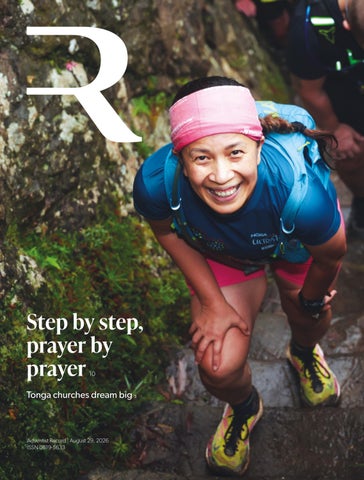
Step by step, prayer by prayer 10
Tonga churches dream big 5
Adventist Record | August 29, 2026 ISSN 0819-5633
This September, we’re kicking off the ADRA Appeal with a virtual race around Australia. Join us to get active and raise vital funds to help Aussies in need.
JOIN ADRA’S RACE AROUND AUSTRALIA SIGN UP NOW
race.adra.org.au
EDITOR’S NOTE:
Who is your village? Jesse Herford Editor
You don’t need to be a dad to be a father figure. You don’t even need to be a man.
“I’m old enough to be your dad.” Those were the words of Pastor Andrew West, my first pastoral mentor. I had just graduated from Avondale and become a pastoral intern in Tauranga, New Zealand. Andrew and I had been getting to know each other when he asked me, offhand, how old I was. When I replied, a look of concern flashed across his eyes. I wondered if I’d said something wrong. Quietly, almost embarrassed, he revealed I was only a few months younger than his daughter. With some nervous laughter, we joked about the relationship we were about to embark on. In many ways, that interaction reveals much about the often-awkward mentor-mentee relationship. Though (if we’re lucky) most of us look to our parents for guidance early in life, as the saying goes, “it takes a village”. And not just to raise a child. Grown-ups need a village, too. I was fortunate enough to have a great dad growing up—one who instilled in me lessons of discipline, spirituality and a heart for ministry. When I was a young pastor, I was also fortunate enough to have people who took the time for me. From pastoral mentors early in my ministry career to peers who helped me see the world, life and ministry in a different way, these people all shaped the direction of my life. You don’t need to be a dad to be a father figure. You don’t even need to be a man. This dynamic also flows both ways. One young couple in my church were engaged and had completed pre-marital counselling, but I discovered it had not included any discussion of marital intimacy. Though only married a few years ourselves, my wife and I broached the topic one day over dinner. It was awkward. It’s something that should have been covered by a parent, a wise elder—but it wasn’t, so we stepped into the gap. Thankfully, they were able to return the favour in a way, teaching me many things about home DIY—skills I should have learned from my dad, but never thought to ask. Spiritual parenting is a wonderful contribution the church makes that those who aren’t Christians miss out on. From our Sabbath school teachers, Pathfinder leaders and ministry teams, each person takes the role, whether they know it or not, of a father, a mother, cousin or sibling. Anytime a Christian comes alongside you, they contribute to the village it takes to grow you. As Paul said of the new Gentile converts at Ephesus, “Consequently, you are no longer foreigners and strangers, but fellow citizens with God’s people and also members of his household” (Ephesians 2:19). The family of God (or perhaps is it God’s Village?) is imperfect, fragile and subject to the vicissitudes of this world, but it is important to remember that it is God’s family, and we have the privilege to belong to it. As New Testament scholar NT Wright once said, “The church as a whole, and every member, is called to become a small working model of new creation.” My question for you is, “Who is your village?” Who are the “father figures” in your life who you know you can count on? And, inversely, who are the people to whom you can act as a “father figure”? Is it the teenager whose parents desperately drag to church, full of angst? Is it the young first-time mother, operating on three hours of sleep? Is it the homeless man who sits in the back, seemingly only present for free food and a warm place to sit for a few hours? Whatever the case, I invite you to embrace your village. Be that “father figure”, and allow others to be that for you. Even if it’s awkward, and especially if it’s hard. After all, these could be the very people you’ll spend eternity with.
August 29, 2026 | Adventist Record
3
INSIGHT:
Sabbaths Glenn Townend South Pacific Division president
4
Adventist Record | August 29, 2026
One of the joys of being a Seventh-day Adventist is experiencing Sabbath every week. For me, that can be in places all around the Pacific and the world— each Sabbath has a special blessing. Here are a few that I experienced recently. At the start of Trans Pacific for Christ, Pam and I were in Honiara. This was the Sabbath that we held the South Pacific wide prayer for the Trans Pacific Union Mission. Mamulele church was excited to have guest pastors from Sydney preach in their church and in their new church plant during Solomons for Christ. There were welcomes, special introductions, prayer and great singing. At the end of Solomons for Christ, Pam and I were in Buala. There were people from four different village churches from Isabel Province for a combined Sabbath. Just being together brought exceeding joy as I baptised 10 people from these churches. Sabbath school was also a joy as the various SS ages had larger groups of participants. I noticed that there was one SS lesson book for each division. I also noticed that no-one did any of the craft activities—they are just too expensive for village Adventists. Before the Papua New Guinea Union Mission mid-year meetings I accompanied Union president Pastor Danny Philip to a regional camp meeting. There were about 1500 Adventists from the Wau-Wari and Bulolo districts camped in small dome tents under a corridor of tarpaulins in an old garden beside the main road. There was a baptism of 15 people in a dammed-up section of the alluvial river where many pan for gold. Another 15 people responded to the call for baptism. At the end of the Sabbath Bible studies, sermon, news sharing and mission stories the people wanted to shake my hand. Perhaps a 1000 did that and gave me bilums and other gifts to show their gratitude for the Division’s presence. Worshipping at the Adventist University of Asia Pacific just out of Bangkok was special. The student music groups and choir sang with finesse and gusto. A couple of traditional groups played instruments I had never seen or heard before. Pastor Erton Kohler preached an excellent sermon on mission—”Someone is waiting for you”—based on Acts 9. Another highlight was meeting and talking with South Pacific missionaries on staff—Mark and Sharon Vodell—and meeting the pastor who runs the Church’s training centre on the border between Myanmar and Thailand that the SPD funded. What are the joys of your Sabbaths in the past few weeks?
Tonga churches dream big as mission grows Nuku‘alofa, Tonga | Marcos Paseggi, Adventist Review
Vunivesi Taione, elder of the Houmakelikao Seventh-day Adventist Church. [Credit: Marcos Paseggi]
View of the Pelehake Adventist Church tent, where evangelistic meetings took place in July. [Credit: Marcos Paseggi]
A choir of Tongan women living in New Zealand sing during a visit to the Pelehake Adventist Church evangelistic meetings. [Credit: Marcos Paseggi]
Through two large loudspeakers the singing of Christian songs told residents of the quiet neighbourhood that it was time to come to the evening gathering on July 13. The sun had just set in that unassuming corner of Nuku‘alofa, the capital city of the Kingdom of Tonga. A gentle breeze from the ocean moved the early arrivals to the venue to put their shawls and light jackets to good use. Vunivesi Taione, elder of the Houmakelikao Seventh-day Adventist Church, smiled broadly as he welcomed the first families arriving for the meeting. The speaker, a Tongan visiting from his current residence in Tahiti, had not yet arrived. Mr Taione was proud of the group accomplishments. After creating a core group out of a mother church and moving to the area, the fledgling group rented a property where they met for a few years. When the owner told them he needed the plot, they were happy to find the current plot, where they built a simple church building. The group soon gained company status. As space inside the current building was limited, they added an outside, wall-less structure to welcome neighbours to the “Mysteries Revealed” evangelistic series. “Our company currently has 27 adult baptised members and many children,” Mr Taione shared. “And we want to keep growing.” Behind the current structure and before a line of banana trees, a grassy plot remained unused. “Here’s where we are planning to build a new church building,” Mr Taione reported. While there are no concrete plans to start soon, he said, “We are dreaming and praying about it. We know God will do the rest.” Across the island of Tongatapu, where Nuku‘alofa is located, Seventhday Adventist churches are springing up, growing and extending their reach. The focus is on accessibility, local church leaders say.
Instead of putting all their efforts on big structures for hundreds of members, the idea is that every village or section can soon have a congregation at walking distance from where people live. “An Adventist church in each town,” they say. Time after time, however, local church members revealed that small church buildings are just the beginning. The idea is to keep growing, building better and, if possible, eventually adding more Adventist schools to various compounds. Closer to downtown Nuku‘alofa, the generous Nuku‘alofa Adventist Church premises also hosts the Hilliard Adventist Memorial School. By the church building, another Adventist ministry is developing. From those humble headquarters, Hope Channel Tonga is spreading a message of hope in Tongan. A half hour from downtown Nuku‘alofa, a new congregation has sprung up not far from the airport. Pelehake Seventh-day Adventist Church began after Adventists living in the area requested a piece of land and eventually were granted access to a plot much larger than they had anticipated, reported local church elder Evaleti Schaaf. “The plot is in a prime location and is extremely large,” he shared. “It’s definitely a blessing.” For the series in July at Pelehake, a choir of Tongan women living in New Zealand sang in English and Tongan. Through the speakers their melodious voices resounded beyond the plot and into the night. “We dream of building a church here,” Mr Schaaf said. “It would be lovely!” But Pelehake dreams do not end there, he added. “Then, who knows?” he said. “We could also build a church school. Why not? There’s more than enough space for it!” For more stories on the Tonga for Christ campaign visit our website: <record.adventistchurch.com>.
August 29, 2026 | Adventist Record
5
Historic first for Sonoma students and lecturers Papua New Guinea | Record Staff
Some of the students who went to Fiji with Pastor Kaidavu.
Pastor Kaidavu with members of the Vanuatu group.
Sixteen lecturers and students from Sonoma Adventist College in Papua New Guinea are participating in the Trans Pacific for Christ evangelistic campaigns in Vanuatu and Fiji. The initiative, sponsored by the South Pacific Division through the Institute of Public Evangelism, is giving participants an opportunity to share the gospel while gaining ministry experience in a different cultural setting. According to college leaders, this is the first time in the history of Sonoma Adventist College and its Ministerial and Theology Department that lecturers and students have been sent outside the Papua New Guinea Union Mission for preaching engagements. A group of lecturers served in the Vanuatu for Christ campaign, held August 9-22. The Fiji group comprises 11 selected students and Ministerial and Theology head of department
Pastor Julius Divu Kaidavu. The Fiji for Christ campaign concludes tomorrow (August 30). Student John Dorobe said being selected to participate was a blessing for students and an affirmation of their calling to ministry. Former Sonoma lecturer Barrie Abel Jr, who was recently called to serve at Pacific Adventist University, encouraged students remaining at the college to pray for those travelling to Fiji. College leaders hope the initiative will pave the way for more students and lecturers to participate in similar evangelistic campaigns. “I believe that such participation will surely bring a lot of meaningful learning experiences for the students [and] lecturers, and inspiration to other students who wish to experience such opportunities in the future,” Pastor Kaidavu said.
Greater Sydney connects digital creators ahead of major mission initiatives Sydney, NSW | Juliana Muniz/Dejan Stojkovic
Pastor Pablo Lillo addresses gathered creatives.
6
Adventist Record | August 29, 2026
The Greater Sydney Conference (GSC) has taken a new step in building a network of digital creators, hosting its first gathering for content creators as the Church prepares for Sydney for Christ 2028 and OneVoice27. GSC youth director Pastor Dejan Stojkovic explained the aim of The Digital Creator Gathering, held at Kellyville Seventh-day Adventist Church on August 1, was to bring together those already serving in digital ministry alongside others sensing the call. “The evening reminded us that every follower of Jesus has a place in God’s mission,” he said. The idea for the gathering developed through conversations between Pastor Stojkovic, Kellyville church pastor Josh Stothers and others about how to better support digital creators who have a passion for ministry. “We eventually had a Zoom
meeting and talked about some of the things we wanted to achieve,” Pastor Stothers said. “That’s when the idea of an in-person gathering came up.” Those conversations culminated in the inaugural gathering, where South Pacific Division OneVoice27 coordinator Pastor Pablo Lillo shared the initiative’s vision and invited participants to help raise up 500 digital ambassadors across the South Pacific. The evening featured TED-style presentations from digital creators, including Hannah Li, creator of the Instagram page Time to Say Hello Again, who encouraged participants to create spaces where people can “connect, collaborate and share what God is doing through His people”. Pastor Stothers said, “What I really appreciated was that it was incredibly encouraging and collaborative rather than competitive.”
making headlines A new reason to smile
TNC Asia-Pacific regional managing director Will McGoldrick and Papua New Guinea Union Mission president Pastor Danny Philip.
ADRA Romania and Malawi have established the first permanent dental clinic in Malawi, bringing essential healthcare to 2289 vulnerable people and providing many with dental treatment for the first time. The initiative also distributed food and hygiene supplies to families and supported hundreds of school students, with plans to launch a daily meal program for children.—EUD
Church partners with conservation group to promote environmental stewardship Bautama, Papua New Guinea | Rose Maine Sinais
A new pathway through one of Papua New Guinea’s significant mangrove ecosystems was officially opened on July 29 through a partnership between the Central Papua Conference (CPC) and The Nature Conservancy (TNC). The Bautama Mangrove Educational Boardwalk initiative, located in Central Province near Port Moresby, brings together the Church, traditional landowners, local communities and conservation partners to help protect the Bautama mangrove ecosystem while promoting education and community engagement. Speaking during the launch, CPC president Pastor Lonnel Winnie described mangroves as one of God’s greatest gifts to humanity. “They protect our coastlines from erosion, provide breeding grounds for fish and marine life, improve water quality and help reduce the effects of climate change,” he said. According to Pastor Winnie, the boardwalk will serve as an outdoor classroom where students, local communities and visitors can learn about the environment and develop a deeper appreciation for conservation and environmental stewardship. Bible verses have also been
incorporated into signs along the boardwalk. Representing TNC, Asia-Pacific regional managing director Will McGoldrick said the project had been years in the making and highlighted Papua New Guinea’s global significance for mangrove diversity. “What we are about to see is a really special place. A mangrove forest is unique and incredibly important, and it is remarkable that it exists so close to Port Moresby,” he said. The 27-hectare Bautama mangrove site supports marine life, strengthens food security, protects coastlines and stores carbon. During the ceremony, Mr McGoldrick also acknowledged the late Manoa Wanaga for his contribution to the development of the project and encouraged schoolchildren to become future custodians of the environment. The first stage of the planned three-kilometre boardwalk has now been completed, with work continuing on the remaining sections. The launch also included the opening of a resource centre, the unveiling of Blue Carbon information signage and a guided walk along the new boardwalk.
Where learning grows An Adventist educator in Mexico has created a therapeutic sensory garden to transform learning for nearly 280 students with disabilities, helping them develop new skills, stimulate their senses and regulate their emotions. Inspired by her time at Montemorelos Adventist University, Claudia Figueroa brought together parents, staff and community partners to create the accessible space and open new pathways for learning.—Adventist Review
Beyond the books Solusi Adventist High School in Zimbabwe hosted 542 commerce students from 16 schools for a threeday symposium that combined exam preparation with mentoring from national examiners ahead of final assessments. The event also introduced visiting students to worship through chapel services.—ANN
The 96-hour sermon A pastor in the United States preached through the entire Bible from Genesis to Revelation for four days straight (a total of 96 hours), setting a Guinness World Record for the longest marathon speech. —Relevant
August 29, 2026 | Adventist Record
7
flashpoint
School on a mission
Baptisms in Niue Seven people were baptised following the Niue for Christ evangelistic program, held July 12-25. The initiative combined practical health education with Bible presentations, drawing strong community participation. Daily radio segments covered health and family life, while evening meetings featured healthy cooking demonstrations, natural remedies, health talks from a Sydney Adventist Hospital team and spiritual messages. Church leaders from other denominations joined local residents. South Pacific Division vice president Pastor Maveni Kaufononga, who served as one of the presenters, said, “We rejoice in these decisions and pray that the local church will continue to nurture these new believers and follow up the many interests that came out of the program.”—Record Staff
Students from Wahroonga Adventist School (Sydney, NSW) were encouraged to continue serving their communities after returning from a STORMCo outreach in Tasmania, where 35 students and staff partnered with the Waratah community through practical service projects. At a school chapel following the July 2–9 trip, participants reflected on how the experience had shown them that acts of service do not need to be extraordinary to make a difference. They encouraged fellow students to look for opportunities to serve in their own communities South Pacific Division Adventist Mission director Pastor Wayne Boehm attended the chapel to recognise the students’ commitment to service and encourage them to continue living out their faith through practical ministry.—Juliana Muniz
Teacher training
High note for a good cause The Tweed Valley Adventist College community (northern NSW) raised more than $A14,000 during its annual SCENT Concert on July 30. The concert attracted around 180 people and featured performances from students, staff and local church members. Funds will purchase materials and resources for service projects to be completed alongside a local primary school community in Vanuatu later this year. A highlight came when male teachers and senior students performed Heritage Singers classic Gotta Do Right, with an encore challenge raising an additional $A2000.—Teresa Smith/Juliana Muniz
8
Adventist Record | August 29, 2026
More than 400 Adventist teachers in the New Guinea Islands and southern regions of Papua New Guinea have been trained to improve the standard of Adventist education in the country. The training took place during Adventist Teachers’ Summits held at Kambubu Adventist Secondary School and Mt Diamond Adventist School. South Pacific Division education director Dr Elisapesi Manson ran the training sessions, encouraging the teachers to be inclusive and studentcentred. —Jacqueline Wari
flashpoint
Building God’s Kingdom Message of peace A week-long Adventist Community Service (ACS) conference in Papua New Guinea’s Laiagam district encouraged peace and spiritual renewal in a community affected by tribal conflict. More than 400 church members, Bible workers and pastors attended the July 12–18 event in Enga Province, held under the theme “Integrated for Mission, Grounded in the Bible and Focused on the Mission”.
Invercargill Seventh-day Adventist Church (New Zealand) held a “Messy Church” program celebrating Children’s Sabbath on July 26. The program brought together nearly 80 children and adults for a morning of hands-on activities centred on the theme “Building God’s Kingdom”. Rather than a traditional church service, participants built LEGO models, tested handmade structures symbolising a firm foundation in Jesus, created flower gardens representing Christlike character and decorated windows depicting nature. Claire Taylor, who runs the Invercargill Mums at the Table group and helped organise the event, said it was designed to help children engage with biblical themes in a practical way while encouraging different generations to participate together.—Juliana Muniz/Claire Taylor
The conference was held against the backdrop of ongoing tribal conflict, which has disrupted church life and hindered mission in the district. Throughout the week, the event promoted messages of peace and encouraged people to remain grounded in the Bible. Newly appointed district director Minister Manase Namaio presented the evening messages, while Minister Joel Jeffery led morning worship services. The event concluded with the baptism of three people, including Pastor John Sikipet, an ordained minister who had served in another Christian denomination for 40 years. Minister Namaio said the conference strengthened the spiritual lives of church members. “It brings teamwork, unity and motivation, and rejuvenates their commitment to mission.”—Paul Bopalo/Juliana Muniz
have news to share?
Send info and photos to <news@record.net.au>
Mental fitness focus Around 30 senior leaders from Pacific Adventist University in Papua New Guinea recently completed a ground-breaking six-month Resilient Leadership and Mental Fitness program, equipping them with practical tools to thrive personally while leading others through the growing demands and complexities of leadership. Developed and delivered through a partnership between South Pacific Division (SPD) Leadership and the SPD Health Department, the pilot program combined faceto-face retreats, monthly group coaching webinars, practical learning experiences and guided personal reflection. Participants explored mental fitness, values-based leadership, sustainable behaviour change, wellbeing, and the vital connection between mind, body and spirit. —Dean Banks/Record Staff
August 29, 2026 | Adventist Record
9
Step by step, prayer by
PRAYER
M
t Solitary Ultra is one of the toughest trail races in New South Wales. This race demands smart pacing, resilience and the determination to keep moving when both legs and mind begin to question why you’re out there. Part of my fear stemmed from the race’s qualification requirements. These rules exist for a reason. Ultra distance events push the body into extreme stress—dehydration, heat, illness, hyperthermia, injury—and the terrain can be unforgiving. Organisers need to know that runners have enough endurance and experience to stay safe, especially in remote areas where first aid might take hours to reach them. Cutoff times are another major factor. Ultras have strict limits and if too many under-prepared runners enter they may not finish
10 Adventist Record | August 29, 2026
in time, creating complications for volunteers, medical teams and event permits. To my relief, they accepted my registration, but they strongly advised me to stay well ahead of the two cutoffs, warning that if I reached them too close to the limit, it would be nearly impossible to cross the valley and reach the finish in time. By the time my registration was finally approved, I had only four days left before race day. I was fully aware of the risk—the possibility of failure felt overwhelmingly high. The only way forward was to strengthen my mindset and anchor myself in faith. But I was terrified and kept asking myself, How dare you take on a race like this? So, I turned to my prayer group and asked for their prayers and support.
As I expected, they surrounded me with encouragement, love and prayerful intercession. One of the ladies sent me a memory verse: “For God has not given us a spirit of fear and timidity” (2 Timothy 1:7). I had read this verse many times before, but this time it struck my soul with unusual force. Tears fell instantly. I felt fear flee from my heart because I knew this was a promise from my Creator. I thanked God for giving me two more memory verses to fortify my mind for the mission ahead: • “For with God nothing is impossible” (Luke 1:37). • “I can do all things through Christ who gives me strength” (Philippians 4:13). Sunday morning finally arrived. As I prepared myself mentally, physically and spiritually, I prayed: “Dear God, I ask for two miracles today. Miracle number one: help me reach checkpoint one before the cutoff. Miracle number two: help me reach the finish line before the cutoff.” The countdown began and the early wave crossed the starting line. I started steady, humbled and grateful for the opportunity to experience the journey ahead. After the first 5 km I reached Kedumba River. Suddenly, I heard footsteps behind me and someone calling out: “Don’t go through there! If you trust me, you can cross here so you won’t get wet!” I introduced myself: “Hi, my name is Eranita. What’s your name?” She introduced herself—a kind, friendly woman. When I asked her how far Mt Solitary was from where we stood, she looked at me with a puzzled expression and said gently, “You obviously haven’t run this track before.” She lived locally and knew the terrain well. “We’re just about to start the climb,” she added. “I’m going to go steady. If you want to go faster, please go ahead.” “Oh no, definitely not,” I replied. Staying behind her felt like the right decision. If I could match her pace,
I wouldn’t have to waste energy figuring out how far to go or how hard to push. But following her was tough. Several times she asked if I was okay—she could hear my laboured breathing as I tried to keep up. She wasn’t wrong—the climb was far from over. The day before the race, my friend James gave me simple but powerful advice: “Iyen, your goal is to aim for one tree at a time.” Eventually, I reached the top of Mt Solitary. By then, I had aimed for hundreds of trees. As I continued climbing alone, I remembered the moment in Scripture when the disciples asked Jesus to teach them how to pray. Jesus taught them to ask for daily bread—not a lifetime supply, but enough for today.
During this race, I finally understood that teaching in a new way. Jesus was showing me the power of micro goals. Life’s challenges can feel overwhelming when we look at the whole mountain. But when we break them into small, faithful steps—one tree, one breath, one prayer—victory becomes possible. Every small action surrendered to God becomes a daily victory. Eventually, I reached checkpoint one with only a few minutes to spare. I climbed the Furber steps at Scenic World with everything I had left. Miracle number one was accomplished. But I still needed miracle number two. By this stage, my quads and calves were burning. Every fibre in my body begged me to stop and rest. Yet deep inside, I knew God had not brought me this far just to let me fail. I believed He wanted me to finish the race. When my body screamed for rest, I knew I needed to change the atmosphere of my mind. I needed something stronger than pain; something that would shift my focus from my weakness to God’s power. So I decided to sing “Faith Is the Victory” and “Power in the Blood”. I sang loudly in my heart and the songs became my strength, my rhythm, my prayer. As I checked my watch, I realised I was on track to reach Jamison Creek before the cutoff. I claimed the power God promised through the Holy Spirit. The words of the song echoed in my soul: “There is power, power, Wonder working power, In the blood of the Lamb; There is power, power, Wonder working power, In the precious Blood of the Lamb.” From Jamison Creek—the
lowest point of the course—the elevation gain was brutal. It was roughly 600–700 metres of vertical climb for another 5 km. The ascent began immediately. My legs went from downhill fatigue to uphill burn in an instant. The climb was long and continuous. My heart rate soared to the 160s, pounding like a drum inside my chest. I prayed, “God, I don’t have any energy left. But if You give me strength, I will keep putting one foot in front of the other.” Surrounded by hundreds of towering trees, I felt small and intimidated. The vertical gain ahead of me looked impossible. But I kept climbing—one tree at a time. The vertical gain ahead of me was intimidating. In life, we face so many challenges that demand perseverance, yet we often feel tempted to give up before the task is complete. As I climbed, I reflected on my own life— the times I made premature decisions, the dreams I abandoned because the goals felt too big or too audacious. But when God journeys with you, He encourages you to take on the impossible tasks He has prepared. He invites you to sing of His goodness and claim the victory that can only be found through Jesus. Step by step, tree by tree, prayer by prayer, I kept moving. I finally reached the finish line with just 10 minutes to spare. I was the final finisher of the Mt Solitary Ultra 2026. My heart leaped with joy; tears filled my eyes. I felt the weight of every prayer, every verse, every step. Thank You, Jesus, for answering miracle number two. Thank You for fulfilling every promise I claimed throughout this race. Eranita Lamplough lecturer at Avondale University and a casual intensive care registered nurse at Sydney Adventist Hospital. She is married to Nathan, and they are blessed with a daughter, Felicity.
August 29, 2026 | Adventist Record
11
BE IN THE WORLD BUT NOT OF IT
H
ave you heard the phrase “be in the world, but not of it”? Guess what! It’s not in the Bible. For the longest time I thought it was—and the sentiment is, but the exact phrase is not. Jesus, when praying for His disciples, says, “They are not of the world any more than I am of the world. My prayer is not that you take them out of the world but that you protect them from the evil one. They are not of the world, even as I am not of it” (John 17:14-16). In another instance, right after Jesus has instructed His disciples to love one another, He says, “If you belonged to the world, it would love you as its own. As it is, you do not belong to the world, but I have chosen you out of the world . . .” (15:19). Jesus emphasises that we do not belong in this world, while also praying that we are not to be taken out of it. From those verses came the phrase we know and love: Be in the world but not of it. Although it’s not in the Bible word for word, it’s a good thing to keep in mind. However, do we actually understand what it means? Something I have come to realise is that we as Adventists seem to have “being not of this world” down pat, but we struggle a little more with the concept of being “in the world”. I’ve always equated not being of this world with my values and beliefs, remembering what Jesus has done for me and carrying with me the promise of a better world once Jesus returns. I think most people would agree with this. Being “in this world” has generally been interpreted much more broadly—there are varying opinions on just how far in the world we really need to be. Now we don’t really have a choice; we’re stuck here on Earth, sometimes an incredibly challenging thing to stomach. However, we are also incredibly blessed to have been created and given this beautiful world to call our home. Sometimes we forget
12 Adventist Record | August 29, 2026
that amid the pain and ruin. And sometimes we spend so much time looking towards heaven and the wonderful promise of eternal life that we forget to look around us, to be “in” the world and see the work that still needs to be done. We are perfectly capable of holding tight to our beliefs and values while also letting people into our lives who may disagree with us. And through us being “in” the world, others may see how we interact with them and be curious about our faith. But we can’t lead people to Jesus if we refuse to mingle with the masses. And leading people to Jesus via mingling doesn’t necessarily mean calling people out for doing things we see as sinful. Leading with what it is we shouldn’t do as Christians is a great way to turn people away from the true message of Christianity: Jesus’ great love and sacrifice. Actions come later. I find it interesting how Jesus prefaces His statement on the disciples not belonging in the world with talking about how love is what’s most important. Love God; love one another. To me it reiterates that this love is what separates us from the world—what causes us to be “not of” the world—but it is this same love that challenges us to be “in” the world, because those who most need to see evidence of that love are those who have not yet met Jesus. And so it’s true—we don’t belong here, but we don’t belong not because we are somehow elitist and above everyone else, but because we hold tight to a promise that there is Someone who loves us despite our messiness and promises us eternal life with Him. So next time you’re doing your best to not be of this world, remember to also be in it.
Ashley Jankiewicz assistant editor, Adventist Record.
Lemon Cheesecake Overnight Weet-Bix
for Father's day
Make this easy prep, refreshing high fibre breakfast idea this Father’s Day. This recipe delivers cheesecake flavour in a lighter breakfast. It’s ready in just five minutes of prep, left to chill overnight, making Father’s Day morning effortless. Prep: 5 min
Serves 1
Ingredients
Method
2 Weet-Bix, roughly crushed ¹∕³ cup So Good Almond Milk Unsweetened 1 tbsp light cream cheese, room temperature ¹∕³ cup low fat natural yoghurt 1 tsp finely grated lemon zest, plus extra to garnish 1 tbsp lemon juice 1 tsp honey (optional) 1 tbsp lemon curd, to garnish (optional) 1 slice lemon, to garnish
1. 2. 3.
4. 5. Nutritional Information (per serving) ENERGY
CALORIES
996kJ
PROTEIN
FAT
SATURATES
11g
7g
3g
30g
SODIUM
IRON
POTASSIUM
3.2mg
417mg
SUGARS
FIBRE
CALCIUM
9g
6g
305mg 222mg
CARBOHYDRATE
In a small bowl, mix together the crushed Weet-Bix and almond milk. In a separate bowl, mix the cream cheese, yoghurt, lemon zest, lemon juice and honey until smooth. Choose a glass, small jar or container. Layer however you like, smooth all of the Weet-Bix mixture on the bottom and top with the cream cheese mixture, or create layers by alternating half of each mixture at a time for a layered effect. Top with a spoonful of lemon curd, a slice of lemon and a little extra lemon zest if you wish. Place in the fridge for 3 hours or overnight.
Safeguarding our children and
vulnerable adults
E
very Sabbath, 15-year-old Noah walks into church with his family. Like many teenagers, he lingers behind his parents, gives short answers when adults greet him and looks as though he would rather be somewhere else. Most people simply see a typical teenager navigating church, family and growing up. What they do not see is what Noah carries beneath the surface. The anxiety. The confusion. The impact of abuse and hurt that has quietly shaped how he sees adults, trust, safety and even himself. Sometimes that pain appears as withdrawal, irritability or disengagement. Sometimes it remains hidden behind a smile. Over time, small moments begin to accumulate. A youth leader remembers his name. A Sabbath school teacher takes an interest in his life. Adults consistently create spaces that are safe, respectful and caring. Guided by a commitment to care well for others, they listen, respect boundaries and help build an environment where trust can grow. For Noah, those moments matter more than they realise. National Child Protection Week (September 6-12) in Australia and National Child Safeguarding Week (September 7-13) in Aotearoa New Zealand, encourage conversations about safety, prevention, advocacy and care for children and vulnerable adults. They remind us that safeguarding is not only about responding when harm occurs. It is about creating communities where children and vulnerable adults feel
14 Adventist Record | August 29, 2026
safe, valued, heard and protected. As followers of Jesus, this is more than a responsibility— it is part of our mission. Throughout His ministry, Jesus consistently welcomed, protected and valued those who were vulnerable. He created spaces where people experienced dignity, belonging and hope. Long before children understand doctrine or theology, they learn something about God through the way adults treat them. The way we listen. The way we respond. The way we make them feel safe. When churches create environments where people are respected, protected and cared for, we do more than reduce the risk of harm. We help remove barriers that can prevent people from experiencing the love of Jesus. Our churches should be places of refuge, healing and hope. Places where trust can grow, where those who have been hurt can find support and where the love of Christ is demonstrated in practical ways. Many people wonder what difference they can make. Yet safeguarding often begins with simple everyday actions: noticing, listening, respecting boundaries, supporting safe practices and helping create a culture where people are protected and valued. Child Protection Week and Child Safeguarding Week invite each of us to ask, “What part can I play?” The answer may be simpler than we think. A conversation. A welcome. A listening ear. A willingness to notice. Sometimes the smallest actions become the clearest reflection of the heart of Jesus. Together, we can help create churches where abuse has no place, people are valued and protected, and every person can encounter the love of Christ.
AUSTRALIA
NEW ZEALAND
CHILD PROTECTION WEEK 2026
CHILD SAFEGUARDING WEEK 2026
6—12 SEPTEMBER
7—13 SEPTEMBER
Shifting Conversations to Action
How safe are the places your children go?
As followers of Christ, we are called to care for and protect the most vulnerable. Let’s move beyond conversation and live out safeguarding in everyday actions.
As followers of Christ, let’s create communities where children and vulnerable people are safe, valued, and cared for.
WHAT CAN YOU DO?
Safeguarding is something we all share. Everyone has a role in keeping children and young people safe.
Visibility keeps everyone safe.
Be present, alert and engaged. Notice, listen and respond.
It’s okay to share a concern. Speaking up can make a big difference.
Clear boundaries help children feel safe. Respectful relationships and appropriate behaviours matter.
Let’s continue building a safe church.
Together, we can create caring spaces where everyone belongs.
More resources and information at
Adsafe.org.au
August 29, 2026 | Adventist Record
15
HARDWIRED
TO CONNECT
G
od created us for love and connection—with Him and with each other. While sin resulted in separation from God and alienation from each other, our need for love and connection continues to be a fundamental human need. However, because of sin, we tend to look for this love and connection in places that don’t deliver. Nowhere is this truer than our use of social technologies. When used to enhance existing relationships and forge new friendships, technologies such as social media and online gaming can be useful tools for facilitating social support and a sense of belonging. However, increasingly, social scientists report that social technologies are making us lonelier and more disconnected, taking away from rather than contributing to our sense of love and belonging. There are several reasons for this. First, social technologies can displace the time we would otherwise spend in offline, face-to-face social interactions. Unfortunately, this can become a self-reinforcing negative feedback loop. The less time we spend in face-to-face interactions, the less we develop social skills and tolerance for the discomfort and awkwardness of social interactions. As we become increasingly uncomfortable with social interactions, we increasingly withdraw from the social pain of interaction and instead try to fill our need for love and connection through social technologies. This is particularly evident in the rise in individuals who report attachments, romantic or otherwise, to their AI companions. Another reason the use of social technologies can make us feel less rather than more connected is the complicated relationship between technology use and dopamine. Since the 1950s, dopamine has been known as the pleasure hormone. Research in more recent decades, however, has
16 Adventist Record | August 29, 2026
revealed that dopamine is not a pleasure hormone at all; it does not result in feelings of happiness. Rather, dopamine is a hormone of want or desire that is released during pleasurable activities. In other words, dopamine creates a reward loop that motivates us to go out and get what we need to survive—not just once, but repeatedly. In the past, our dopamine systems were activated during activities such as eating and social interactions. In our modern world, however, the dopamine system is activated when we use social technologies, making us want them more. This is particularly true of both social media and online gaming, which begin as pleasurable but usually make us feel worse rather than better. Many of us, particularly teens and young adults who grew up online and are heavy users of social technologies, want to stop or reduce our use, so we block or delete our accounts, often with only limited success. These are signs of wanting something that no longer brings us pleasure. So, how can we reduce our dependence on social technologies and make more space for real social connection? First, begin by implementing very small changes. This feels easy and allows your brain and body to adjust more slowly. And small changes are more likely to result in more permanent habit change. Ultimately, small changes can create the momentum needed for larger changes. One small change you can begin with is avoiding reaching for your phone upon waking. Checking your phone first thing in the morning not only reinforces the habit of constant screen use, thus encouraging dopamine addiction, but it also triggers stress and increases anxiety by forcing your brain into a reactive, distracted state rather than allowing it to transition calmly from sleep to alertness. Other small changes you might consider implementing
are deciding on one device-free meal per day; choosing one hour each day for completely device-free time; designating short car trips as device-free times; removing devices from bedrooms; establishing a communal devicefree space in your home; and experimenting with one screen-free evening per week. A second important strategy for reducing social technology dependence and creating more space for real social connection is replacing screen time with activities that are both enjoyable and that facilitate love and connection. Instead of reaching for your phone, plan for connection in the first 10-20 minutes of your day. Wake up slowly and thank God for the good things in your life. Enjoy a favourite drink while reading Scripture and talking some more with God. If you share a home with family, friends or a pet, connect through hugs, cuddles and quiet conversation. This quiet routine enables you to start your day with a less reactive brain and feeling loved and connected. If you decide to aim for one device-free meal each day, you may need to plan how to fill that time with love and connection. For example, if you live alone, you may want to plan on sharing a device-free meal with a friend. If you share a home with friends or family, conversation starter cards can facilitate enjoyment and connection, thereby increasing buy-in from others. A short car trip without digital technologies can be an excellent time for connection, as many people, particularly boys and men, find it easier to talk more openly and vulnerably when connecting side-by-side rather than faceto-face. What’s more, children who grow up in families who regularly have conversations that connect daily life with faith are more likely to adopt their family’s values, and short car trips can provide natural opportunities for such
connection—whether through singing along with a worship song, sharing a reflective conversation or praying together. If you decide on a device-free hour each day, make plans for how you’ll fill this hour in a way that facilitates connection. An evening walk, a family bike ride, cooking a meal or playing a board game together all require intentionality. However, if you plan at a time of day when time and mental energy are higher, you’ll be less likely to default to your screens at the end of the day. If you decide on a screen-free evening in a communal space in your home, you might like to equip that space with screen-free activities, such as art or craft supplies, books and puzzles. Reading aloud or listening to an audiobook together while working on an activity, either individually or together, creates a strong sense of connection and belonging. And if family worship has not been a habit in your home, lighting a candle, listening to worship music or a faith-based audiobook and then sharing a prayer together can be a beautiful way of connecting with each other and with God. Social technologies can never fill the need for love and connection that God created you for. Only connecting openly and vulnerably with Him and with others can fill that need. Learning to do this might require you to set boundaries on your social technology use and to practise face-toface conversation and connection, even when it’s awkward or uncomfortable. But with practice, you can build your social interaction skills and grow toward the sense of love and belonging you were created for. Try it. You might like it. Edyta Jankiewicz family ministries director, South Pacific Division. August 29, 2026 | Adventist Record
17
The red flannelette shirt
A
while back, when the sun had finally shown its face, I thought it was time to finally get out into the garden to do a clean-up ahead of planting for the new season. My son Asher—who loves getting his hands dirty—jumped at the opportunity to do some gardening work. We popped on our gardening gloves and headed out to begin with some weeding. His interest in weeding, however, dwindled rather quickly. I had a sense that he was anticipating using a spade or other gardening tool, not just pulling out weeds. Not long after we had started, Asher noticed the red flannelette shirt I was wearing and realised he had one the same. Like a flash of lightening, he darted inside to put on his red flannelette shirt. Asher was very proud of himself when he reappeared outside again, exclaiming, “Look at me, now I look like a gardener like you!” The concept of “doing” gardening was somewhat lost on Asher. He was happy as long as he “looked” like a gardener. As Christians, I think we can easily fall into this same pattern too. There are a myriad of things we do that make us “look” like Christians. We may attend church (and on time for some), we wear the correct clothes, we smile politely (while possibly hiding hurt and pain from the previous week). We sit and listen during the sermon. We quietly sing along to the music. Then the moment we head home again, it’s like we take off our Christianity. It’s all appearances. I think we need to remember that we don’t just need to
18 Adventist Record | August 29, 2026
“look” like Christians. We need to “do” Christianity. This week I have been reading through the New Testament book of James. This book, in particular, explores this concept of faith in action. James says in 1:23, “Do not merely listen to the word, and so deceive yourselves. Do what it says.” There is an endless list of things the Bible says we should do as Christians. Love God (Matthew 22), love others (Matthew 22), don’t lie, don’t murder (and the rest of the Ten Commandments found in Exodus 20), care for orphans and widows (James 1), welcome strangers (Leviticus 19), gather with fellow believers (Hebrews 10), forgive others (Ephesians 4), love your enemies (Matthew 5), read God’s Word (Joshua 1), show stewardship towards things we have, pray (Philippians 4), repent (1 John 1) . . . I could go on and on . . . With God’s strength, we can not only look like Christians but act like Christians too. Let’s put on God’s garments— the belt of truth, the breastplate of righteousness, shoes of peace, shield of faith, helmet of salvation and the sword of the Spirit. This is the real way to both look and do Christianity. Claire Taylor wife, mum of four and relief teacher at Southland Adventist Christian School in Invercargill (NZ). She currently oversees communications at the Invercargill church and helps run the Invercargill Mums at the Table group.
Father figures in the Bible The Bible is filled with fathers—good ones and not-so-good ones. But what about the men who made a remarkable difference in someone’s life despite not being their dad? Here are 10 men in the Bible who mentored and acted as father figures.
1. Eli When Hannah gave birth to Samuel, she dedicated him to God by leaving him under the care of the priest Eli. Samuel grew up under Eli’s care and it was he who encouraged Samuel to listen when God spoke to the boy for the first time (1 Samuel 1-3).
6. Elijah Elijah called Elisha to follow him, and Elisha served as his prophetic apprentice for several years before Elijah was taken to heaven. Elisha inherited a double portion of Elijah’s spirit and became Israel’s prophet (1 Kings 19; 2 Kings 2).
2. Samuel Samuel became Israel’s prophet, anointing David as king. David’s journey to the throne was fraught with challenges and he often turned to Samuel for advice. Samuel, guided by God, advised David as he fled for his life and continually encouraged him to become the king God had called him to be (1 Samuel 16, 19).
7. Abraham Abraham was like a father to his nephew, Lot. Lot came with Abraham when he left his homeland and Abraham acted as a peacemaker and protector, as well as generously allowing Lot to choose the better lands to settle in. (Genesis 12,13,18).
3. Paul Paul mentored Timothy as they travelled together, spreading the gospel. Paul referred to Timothy as his “true son . . . in the faith” (1 Timothy 1:2), encouraging him to not let anyone look down on him because of how young he was (4:12). 4. Joseph Joseph was not the biological father of Jesus, yet he accepted his role as father and raised Jesus as if He were his own. Joseph taught Him his carpentry trade and raised Him in the faith as He grew “in wisdom and stature and in favour with God and man” (Luke 2:52). 5. Moses Moses mentored Joshua over the many years they spent in the wilderness. Joshua was Moses’ right hand man before Moses officially appointed him as his successor to lead the Israelites into the Promised Land (Numbers 27).
8. Mordecai Esther was raised by her cousin, Mordecai, as she was an orphan. When she was taken to the palace he advised her, helped her hide her Jewish identity and then encouraged her to reveal it at the moment when it would make the most difference (Esther 4). 9. Jehoiada The priest Jehoiada and his wife Jehosheba hid the king’s son, Joash, in the temple for six years, protecting him from his grandmother who had tried to kill all the heirs to the throne. When Joash was seven, Jehoiada publicly crowned him king of Judah, assuring him protection and guidance as he took the throne (2 Chronicles 23,24). 10. God God is perhaps the best example of a father figure. There are countless times in the Bible where He is referred to as our Father (John 20:17; Galatians 4:6; Isaiah 64:8). He shows us unconditional love and mercy, and though our earthly fathers and father figures may fail us, God will not. August 29, 2026 | Adventist Record
19
Conversations
Facebook comments re: “Standing on shoulders” (July 18).
Facebook comments re: “Posting with purpose” (August 1).
East Narembeen was a great place for my children to grow up because they were treated as a vital part of the church family with adults including them in conversations, social events and in formal roles—a great training place. Every church should do the same.
Thank you Lesi, for all your hard work and contributions. Your willingness to serve and assist others has not gone unnoticed. May God continue to open more doors and opportunities for you to make an even greater impact. In God we trust. Jobeth Leba
Diane Major
1958 was the year we moved to beyond Wogil Rd, east Narembeen. The memories I have for the next seven years were all centred around my early informative church life. The Ashmore farm and church activities was the centre of my life. The first church was built just a little further away. I clearly remember sitting in the shearing shed on the Ashmore farm. Watching mice run around in the rafters and fresh shearing shed smells was all part of the experience. There is so much of my life, past and present, that is totally influenced by Narembeen church. Glenn Stanley
20 Adventist Record | August 29, 2026
Thank you Mr Lesi for representing Christ and His love to the many you’ve assisted and spreading God’s grace through your actions. Kalougata saka tiko nomu vuvale kei na qaravi tavi.
Join the conversation! Share your thoughts with us via email or on social media. /AdventistRecord
Lella Moreen
/AdventistRecord
Vinaka Lesi na nomu yalo vinaka ena dau vei vukei vei ira era gadreva dina me ra vukei. Blessings to you and your family.
/AdventistRecord
Repeka Ralulu
@AdventistNews or email editor@record.net.au
Obituaries BARKER, David Ferguson, born 27.3.1948 at Murray Bridge Soldiers’ Memorial Hospital, SA; died 13.5.26 at Murray Bridge Soldiers’ Memorial Hospital. In 1985 he married Lorna (Detoya). He is survived by his wife; daughter, Dana; and son-in-law, Mark. At 26, David accepted the Advent message and his faith became central to his life. He graduated with a Bachelor of Theology from Avondale at the age of 60 and served for many years as an elder in the Murray Bridge/Mannum church district. David lived simply, dreamed greatly, was committed to his family, loved God wholeheartedly, believed in people, had a great sense of humour and never stopped serving others. Wolfgang Stefani, Jan Pollok
COLLINS, Betty Glenda, born 4.2.1937 in Murwillumbah Hospital, NSW; died 2.6.26 in the Tweed Valley Hospital. Betty is survived by her husband, Keith; son, Mark; and daughters, Lana and Neroli. Betty was a devoted wife, mother, grandmother
22 Adventist Record | August 29, 2026
to seven grandchildren and great-grandmother to seven great-grandchildren. She loved her church and gave many years caring for the cradle roll and kindergarten divisions. She was known for her sense of humour and hospitality. Betty was also a very caring person who was more than ready to extend a helping hand. She passed away quietly in her sleep after spending most of her life serving the Lord and putting others first. Errol Wright
DELL, Maurice Bramwell, born 30.1.1951 in Warburton, Vic; died 3.5.26 in Port Macquarie, NSW. He is survived by his wife, Carol (Kew); children, Tammy and Chris Wind (Brisbane, Qld), Anne-Maire and Paul Deppeler (Cooranbong, NSW), Tony and Alison (Brisbane, Qld); sister, Melitah and Anthony Davis (Adelaide, SA); grandchildren, Kalan Howse, Ashlyn Howse, Hannah Howse, Hayden, Charlotte, Kody Deppeler, Kiana Deppeler and Braedyn Deppeler. Maurie lived a life of service to his church as a printing machinist
for Signs Publishing Company, retiring in 2015 after 50 years. He leaves behind a legacy built on kindness, loyalty, service and love. His life touched many people, and the memories he created with family and friends will continue to be treasured. Sharyn Harrington
HAYES, Edward Arthur, born 1.9.1933 in Boonah, Qld; died 11.6.26 in Victoria Point. Ted is survived by his wife Glenda (Victoria Point); daughter, Aleta and her husband, Noel Cherry (Brisbane); daughter, Gayl and her husband, David Fong (Sydney, NSW); son, Alan; daughter, Erin; son, Lance and his wife, Hayley (Brisbane, Qld); 16 grandchildren; and 16 great-grandchildren. Ted was loved by his family and friends and a much appreciated and respected member of the Gold Coast Central church community. A man of firm convictions, he fully trusted in his Saviour. We look forward to the day when his faith will be realised and Jesus will bring him back to life with Him for eternity. Peter Stojanovic
JOLLY, Joan Hannah, born 8.11.1942 in Canberra, ACT; died 19.6.26 in Victoria Point, Qld. Joan is survived by her husband, Bryan (Victoria Point); son and daughter-in-law, Stephen and Zoe (Camira); daughter and son-in-law, Kathy and Don Fletcher (Forest Lake); son, Christopher (New Beith); eight grandchildren; and three great-grandchildren. Joan was, among other things, a rescuer, and we look forward to the resurrection day when Jesus will rescue her from death to life with Him forevermore. Stephen Bews
MCCARTNEY, Peter Ronald, born 14.1.1947 in Temora, NSW; died 16.3.26 in Hobart, Tas. Pete is survived by his wife, Merryl (Tas); and brothers, Raymond (Narromine, NSW) and David (Hervey Bay, Qld). Pete was a much-loved husband, brother, uncle and friend. He lived a busy and fruitful life as a builder and church member. He loved to travel and assist with fly’n’builds. Deeply missed and awaiting the resurrection.
NORTHEAST, Judith, died 2.5.26 in Deloraine, Tas, aged 86. Judith is survived by her husband, John. Judith worked as a diversional therapist and will be remembered for her kind, supportive and empathetic approach to her clients, regardless of their level of disability or difficulty, in retirement and nursing homes from North Queensland to Tasmania to Sydney. Her innovation, planning skills and happy, friendly nature endeared her to many. WARD, Annette Marelle (nee Ohern), born 31.10.1941 in Coffs Harbour, NSW; died 24.3.26 and buried in Redcliffe, Qld. Annette was predeceased by her husband, Earl John. She is survived by her children, Marelle, Wayne and Stephen. Annette will be remembered as a devoted
wife, loving mother and cherished grandmother. Her kindness, gentle humour and unwavering faith in her Lord touched the lives of all who knew her. While she will be deeply missed, her family look forward to the day when the Lord returns and they will be reunited in the resurrection. She has been laid to rest with her beloved husband. Steve Ward
WATT, Raymond Ronald Edward, born 2.11.1946 in Essendon, Vic; died 17.6.26 in the Rockhampton Mater Hospital, Qld after a short illness. His loving family grieve the sudden loss of a man with such strong Christian faith. Raymond served as head deacon at Geelong (Vic) and St Andrews (Bundaberg, Qld) churches, and as a deacon at Gin Gin and Biloela churches. Always ready to share the Word of God, Raymond will be sadly missed. Peter Rollo
Advertising STUDY THE ADULT SABBATH SCHOOL LESSON YOUR WAY Accessible formats for vision loss (large print, audio CD, app, YouTube, podcast and braille) or hearing loss (Hope SS captioned). Contact CVHS on +61 (02) 9847 2296 or email <cvhs@adventistmedia.org.au>. RECORD QUANTITIES Is your church receiving the correct number of Record magazines? Adjust your numbers by notifying Kelli Geelan at subscriptions@record.net.au or on +61 (03) 5965 6300. NEED LOGOS, TEMPLATES OR BRANDING RESOURCES ? The Adventist Identity website provides official tools to help your church communicate professionally and consistently. Explore what’s available at <identity.adventistchurch.com. au>.
abn 59 093 117 689 vol 131 no 17 Consulting editor Glenn Townend Editor Jesse Herford News editor Juliana Muniz Assistant editors Ashley Jankiewicz Danelle Stothers Copyeditor Tracey Bridcutt Graphic designer Theodora Pau’u Noticeboard Julie Laws Letters editor@record.net.au News & photos news@record.net.au
Positions Vacant MARKETING AND PARTNERSHIPS SPECIALIST ADVENTIST MEDIA, WAHROONGA, NSW Do you have a passion for marketing that makes a difference? We’re looking for a creative and strategic marketer to help grow the reach and impact of Signs of the Times and Mums At The Table—two ministries that inspire hope, encourage wellbeing and connect with people through practical, faith-informed content. This newly created role is ideal for someone who enjoys developing campaigns, growing audiences, engaging supporters and using digital channels to tell compelling stories. With the flexibility to work from home part of the week, you’ll be joining a passionate, collaborative team producing content that changes lives and serves communities across Australia and beyond. Email <corpserv@adventistmedia.org.au> for a copy of the full job description. The appointing body reserves the right to fill this position at its discretion and to close applications early. Only those who have a legal right to work in Australia may apply. Applications close August 31, 2026. ASSISTANT MANAGER—SPRING BEACH YOUTH CAMP SPRING BEACH, TAS If you’re energetic, hands-on and love a mix of hospitality, outdoor adventure and youth ministry, this role was made for you! Working alongside our camp managers, no two days are the same—you might start your morning leading groups through outdoor activities or presenting to a visiting school, then spend your afternoon helping in the kitchen, prepping cabins or assisting with property maintenance. We’re looking for a flexible, self-motivated team player with a genuine servant heart; someone happy rolling up their sleeves to tackle a variety of tasks while building relationships with youth and camp leaders. If you’re a confident communicator who loves keeping things running smoothly while making young people feel valued, safe and welcome, you’ll be a perfect fit. To apply, send your resume and cover letter explaining why you’d be a great fit to <jeffparker@adventist.org.au> or email Jeff with any questions. Applications close Thursday, September 10, 2026.
NOTE: Neither the editor, Adventist Media, nor the Seventh-day Adventist Church is responsible for the quality of goods or services advertised. Publication does not indicate endorsement of a product or service. Classified advertisements in Adventist Record are available to Seventh-day Adventist members, churches and institutions only. All advertisements, appreciation, anniversary, wedding and obituary notices may be submitted via <ads@record.net.au> or online at <record.adventistchurch. com>. Notices will not be reprinted unless there is an error of fact caused by Record staff.
Noticeboard ads@record.net.au Subscriptions subscriptions@record.net.au + 61 (03) 5965 6300 Mailed within Australia and New Zealand $A60.00; $NZ90.00 Other prices on application Website record.adventistchurch.com Mailing address Adventist Media Locked Bag 1115 Wahroonga NSW 2076 Australia + 61 (02) 9847 2222 Cover credit Image supplied Eranita Lamplough Next issue Adventist Review September 5
BEFORE WE SPEAK WITH ONE VOICE
WE PRAY WITH
Seek God’s presence with your church, your family, your friends and in your personal prayer time during the OneVoice27 Prayer Weekend.
SEPTEMBER
48 HOURS OF PRAYER Scan QR code for details.
ONE CHURCH. ONE MISSION. ONE VOICE IN PRAYER.
4–6