vim& vigor
FIND CLASSES AND EVENTS IN THE BACK OF THIS ISSUE
HEALTHY LIVING FOR YOUR FAMILY winter 2009 $2.95
avoiding winter weight gain
protect that beautiful baby belly healthy knees, happy you
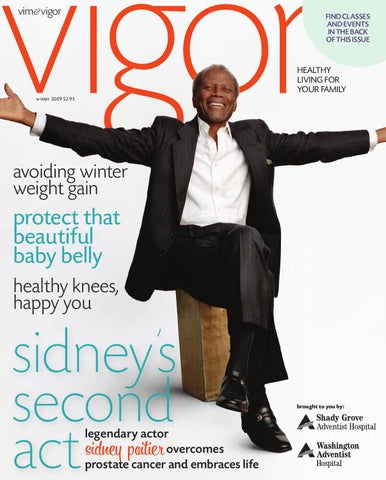
sidney s second act ’
brought to you by:
legendary actor overcomes prostate cancer and embraces life
sidney poitier
fdvvwi0994_00_cover.indd 1
9/28/09 11:54:56 AM
contents special
3
let the instinct to sit around and stuff yourself get the best of you this season. Learn how to stay fit and trim through the winter weather.
features 4
jump for joy Taking care of your knees now can pay big dividends later. Think it’s too late? Learn how new surgical options can give your legs a new lease on life.
6
losing to win If you’re obese, you’re at higher risk for a host of medical conditions. Thankfully, your fate hasn’t been decided yet. Learn how medical and surgical options can help you turn it all around.
kick-start your winter Don’t
21
your heart: the owner’s manual A handy guide to caring for your ticker, from exercise and nutrition to screenings and stress management.
26
independence days Discover how innovative technology is improving senior safety and boosting self-sufficiency. the right stuff Some of the best tools to get healthy are everyday items you already own.
departments 2
opening thoughts Keeping you and your family healthy and flufree this winter is easier than you might think.
winter 8 10
baby on board Learn how to keep your belly—and your baby—safe during your nine-month pregnancy journey.
38 40
model behavior Three women share their secrets for exercise, nutrition and staying healthy despite a busy schedule.
44
16
is it a sign? Knowing these five symptoms of cancer can help catch problems early.
up to speed Emergency department work is fast-paced, multifaceted and rewarding. Find out how you can join the team.
46
pedi-cures Follow these tips to give your feet the TLC they deserve.
watch and learn Are these famous TV chefs serving up healthy delights or fat-laden fare? Here’s what you need to know before tuning in.
HA1 health advisor Health and wellness classes, programs and support groups for a healthy mind, body and spirit.
34
on the cover
Sidney Poitier is one of film’s greatest actors, but that didn’t make him immune to prostate cancer. Learn how he overcame the disease and about tips for prevention.
COVER PHOTOGRAPH BY GASPER TRINGALE/CPI
fdvvwi0994_01_toc2.indd 1
vim & vigor · wi nter 2009
1
9/28/09 11:56:05 AM
opening thoughts
healthy holidays simple steps can help you fend off flu this winter
A family health magazine brought to you by Shady Grove Adventist Hospital and Washington Adventist Hospital, members of Adventist HealthCare President & CEO, Adventist HealthCare Inc. William G. “Bill” Robertson
President, Shady Grove Adventist Hospital Dennis Hansen
President, Washington Adventist Hospital Jere Stocks
E
PRODUCTION Editorial V.P./Creative Director: Beth Tomkiw Executive Editor: Tom Weede
Every year in the U.S., more than 200,000 people are hospitalized from flu complications, and about 36,000 people die from flu-related causes. This winter, the 2009-10 flu season introduces additional health concerns with the arrival of the H1N1 virus, or the swine flu, which spread internationally this year. Although flu vaccinations are Dennis Hansen Jere Stocks available to treat both types of influenza, it’s important to take preventive steps to avoid catching and spreading the disease. For example, getting a flu vaccination, washing your hands often, and avoiding touching your mouth and nose can help fend off the flu. To help you and your family stay healthy this winter, Shady Grove Adventist Hospital and Washington Adventist Hospital are holding flu clinics throughout Montgomery and Prince George’s counties. This year, our flu campaign, “Help Stop the Flu,” includes adult and pediatric clinics for kids younger than 18. For more information on our upcoming flu shot clinics, including dates and locations, call our flu hot line at 301-315-3800 or visit our campaign page online at www.helpstoptheflu.com. For answers to general health questions about the flu, pneumonia or the flu shot, submit an online question to our flu expert at www.AdventistHealthCare.com/experts. As always, there is a wealth of healthcare information and tips in this issue of Vim & Vigor. You’ll learn how taking good care of your knees can help them last a lifetime (page 4), get the scoop on caring for your heart (page 21), and find a listing of all our classes and events in Health Advisor in the back of this issue.
Editors: Shelley Flannery, Sam Mittelsteadt, Matt Morgan, Amanda Myers, Kari Redfield, Jill Schildhouse, Julie Wlodychak Copy Editor: Cindy Hutchinson
Design Creative Director: Lisa Altomare Art Directors: Erica Brooks, Maggie Conners, Ralph Groom, Monya Mollohan, Kay Morrow, Tami Rodgers, Keith Whitney
Production Senior Production Manager: Laura Marlowe Ancillary Production Managers: Tanya Clark, Angela Liedtke Imaging Specialist: Dane Nordine Prep Specialists: Julie Fong, Sonia Washington
Circulation V.P./Business Intelligence Group: Patrick Kehoe Postal Affairs & Logistics Director: Joseph Abeyta
client services V.P./Sales and Product Development: Chad Rose, 888-626-8779 V.P./Strategic Marketing: Heather Burgett Group Publisher: Russell Cherami Strategic Marketing Team: Robyn LaMont, Barbara Mohr, Andrea Parsons, Todd Speranzo
Advertising Sales Advertising Sales Representatives New York: Phil Titolo, Publisher, 212-626-6835 Phoenix: Soliteir Jaeger, Associate Publisher, 888-626-8779 Mail Order: Bernbach Advertising Reps, 914-769-0051
ADMINISTRATION Vim & Vigor Founder: J. Barry Johnson Chairman: Preston V. McMurry Jr. President/Chief Executive Officer: Christopher McMurry Chief Operating Officer/Financial Officer: Audra L. Taylor President/Custom Media: Fred Petrovsky
9901 Medical Center Drive, Rockville, MD 20850 www.ShadyGroveAdventistHospital.com
In good health, 7600 Carroll Ave., Takoma Park, MD 20912 www.WashingtonAdventistHospital.com
Dennis Hansen President Shady Grove Adventist Hospital
2
Jere Stocks President Washington Adventist Hospital
If you receive more than one copy of Vim & Vigor, or if you do not wish to receive this publication, please call 301-315-3044. Vim &Vigor,TM Winter 2009, Volume 25, Number 4 is published quarterly by McMurry, McMurry Campus Center, 1010 E. Missouri Ave., Phoenix, Arizona 85014, 602-395-5850. Vim & Vigor TM is published for the purpose of disseminating health-related information for the well-being of the general public and its subscribers. The information contained in Vim & Vigor TM is not intended for the purpose of diagnosing or prescribing. Please consult your physician before undertaking any form of medical treatment and/or adopting any exercise program or dietary guidelines. Vim & Vigor TM does not accept advertising promoting the consumption of alcohol or tobacco. Copyright © 2009 by McMurry. All rights reserved. Subscriptions in U.S.: $4 for one year (4 issues). Single copies: $2.95. For subscriptions and address changes, write: Circulation Manager, Vim & Vigor,TM McMurry Campus Center, 1010 E. Missouri Ave., Phoenix, Arizona 85014.
vim & vigor • w inte r 2 0 0 9
fdvvwi0994_02_thoughts.indd 2
9/28/09 1:27:27 PM
kick-start your winter fight the urge to hibernate, and find new ways to get moving
It’s
not just your imagination: When the weather cools off, our bodies start trying to conserve energy to use as heat. We eat a little more and exercise a little less. Unfortunately, this natural survival strategy is also a surefire way for packing on a few extra pounds during the winter. But winter doesn’t have to be the season of sloth. There are plenty of cold-weather activities suitable for most people. Some of them don’t cost a penny, and even those that do don’t have to be expensive. Check with your doctor before starting any new physical activity, especially outdoor exercise, which can aggravate some conditions.
for free ❋ Take the stairs. At home or work, spend 20 minutes walking up and down stairs for a workout that’s more vigorous than you might expect. ❋ Clean your house. Washing windows or floors can burn about 350 to 450 calories per hour for women and men, respectively. Even light housework burns calories.
go
start off right
Need to find a doctor to have a physical before you begin exercising? Visit www.AdventistHealthCare.com/doctors.
❋ Build a snowman. This is a great activity for the whole family. Just be sure everyone bundles up. And you can toss in a friendly snowball fight for even more movement and fun. ❋ Use exercise videos. Many local libraries have collections of exercise videos or DVDs. Some cable and satellite TV systems have exercise shows you can watch on demand, or you can record fitness shows from a TV station to use at your convenience.
for a fee ❋ Find an indoor pool. Try a local community center or school, where the public is often allowed to swim during off hours. Swimming and water aerobics are great forms of lowimpact exercise. ❋ Venture outdoors. Many recreational areas have paths devoted to hiking, snowshoeing and cross-country skiing. Equipment can be rented there or from an outdoor equipment retailer. ❋ Create your own home gym. Look for a gently used stationary bike or treadmill at a garage sale. Or invest in some hand weights, an exercise ball and a jump-rope, all for about $50. ❋ Join a fitness club. The cost of membership to your local gym or YMCA may be worth every penny if it means staying in shape during these colder months.
stay safe
For outdoor winter activities, avoid frostbite and hypothermia by wearing layered clothing, eating a well-balanced diet, and drinking warm, nonalcoholic, caffeine-free liquids to maintain fluid levels. Also avoid becoming wet, as wet clothing loses 90 percent of its insulating value.
know the signs FROSTBITE: a white or grayish-yellow skin area, skin that feels unusually firm or waxy, and numbness. HYPOTHERMIA: shivering, exhaustion, confusion and memory loss in adults; bright-red, cold skin and very low energy in infants. vim & vigor · wi nter 2009
fdvvwi0994_03_jumpstart.indd 3
3
9/28/09 1:32:11 PM
jump for joy taking good care of your knees can keep them healthy for a lifetime Without healthy knees, you’re not going anywhere. Think that sounds extreme? Just try walking without bending your knees. Or sitting. Or simply getting out of bed. Fortunately, a few precautions and a generally healthy lifestyle can keep your knees going strong. “No matter what you do, you’re not going to avoid all possible injuries,” says Christopher Magee, M.D., board-certified orthopedic surgeon and chief medical officer at Washington Adventist Hospital. “But having the proper training, getting in good shape, and using the right techniques and equipment for whatever sports you play can help reduce the risk.” ❋ twist and shout Some of the most common causes of knee injuries are sports-related: changing or twisting direction rapidly, landing from a jump or slowing down when running. But damage can also be caused by impact, such as a car accident, or falling and landing on your knee. Being overweight can increase the risk of injury, too, by placing additional strain on your knees. When it comes to preventing sports-related knee injuries, proper alignment and body mechanics are vital, says Mark Peterson, M.D., board-certified orthopedic surgeon and chief of surgery at Shady Grove Adventist Hospital. “When you land from a jump, for example, your feet should be centered underneath you, and your legs should be straight,” he explains.
4
healthy knees, happy knees
For more information about total joint surgery, call Judy Mardirossian, Shady Grove Adventist Hospital joint program coordinator, at 240-826-7591, or Toni Clark, Washington Adventist Hospital orthopedic program coordinator, at 301-891-5050. To find an orthopedic physician near you, visit www.AdventistHealthCare.com/docs.
go
vim & vigor · w inte r 2 0 0 9
fdvvwi0994_04-5_joy.indd 4
9/28/09 1:36:14 PM
“Your legs are not supposed to buckle in or out, and your knees should bend to dissipate the force. Keeping your knees in perfect alignment is the key.” Peterson and Magee emphasize the importance of training in the right techniques for your sport, whether by working with a school coach, a personal trainer or even a video prepared by a reputable source.
❋ walk this way The basics of good knee care remain constant throughout your life. But, of course, some changes occur with the passage of time. As people age, so do their joints, muscles and bones. Adults may develop osteoarthritis, which can affect one or both knees and is more likely to develop in people who have injured their knees in the past.
The onset of some forms of arthritis can be delayed by sticking to low-impact exercise, including walking or elliptical machine workouts, Peterson says. In the early stages of arthritis, exercises such as swimming or cycling can increase function. Stretching is also important to retain flexibility. At any age, staying in good shape is helpful, as is exercising consistently three or four times a week. If your knee is red or swollen or hurts for more than a few days, see your doctor to determine the cause. And, perhaps most important, Magee says, know your limits. “You have to set reasonable goals and understand what your body is capable of,” he says. “Depending on your abilities, you might have to decide to be a biker or a swimmer instead of playing defensive tackle for a football team.”
avoiding injury
Want to keep your knees out of harm’s way? Here’s how: • Use the appropriate equipment for your sport, and make sure it’s the best possible quality, paying particular attention to footwear. • Low-impact exercise is safest, but whatever activities you choose, do them consistently, preferably three to four times a week. • When exercising, start slowly and build up stamina and strength. • Stay flexible by stretching, ideally after a brief warm-up and again after exercising. • Work with a coach or trainer to make sure you’re using the right techniques and body positions for your sport. • Maintain a healthy weight.
a case for joint replacement
Many knee injuries can be treated using the RICE method—rest, ice, compression and elevation— or with physical therapy or anti-inflammatory medications. Sometimes, however, total knee replacement is the best way to eliminate pain and return people to their daily activities. “You can think of knee replacement like retreading a tire,” explains Mark Peterson, M.D., board-certified orthopedic surgeon and chief of surgery at Shady Grove Adventist Hospital. “Your bones are like the steel tread on a tire, and the cartilage on the surface of your bones is like the rubber.” Without the rubber on a tire, you’ve got steel on concrete. And without cartilage, you’ve got bone on bone, a painful condition known as osteoarthritis. Total knee replacement surgery takes about two hours. The orthopedic surgeon removes the damaged cartilage and bone, replacing them with new metal and plastic joint surfaces. After surgery and appropriate rest and physical rehabilitation, most people can return to their regular activities within a few weeks. vim & vigor • wi nter 2009
fdvvwi0994_04-5_joy.indd 5
5
9/28/09 1:37:31 PM
l sing to win
being obese carries with it a heavy load of health risks, but it doesn’t have to be your destiny
More than one-third of the adult population is overweight. Unfortunately, along with excess weight come a number of medical conditions such as diabetes, hypertension, hyperlipidemia, sleep apnea and arthritis that decrease life expectancy, impair physical function and decrease quality of life. The good news? Evidence shows that To learn more about the Center significant weight loss can improve for Medical Weight Manageand sometimes cure obesity-related ment at Washington Adventist health conditions.
go
ready for a change?
Hospital, call 301-891-6105 or go to www.Washington AdventistHospital.com/ weightmanagement. For more information about the bariatric surgery program at Shady Grove Adventist Hospital, call 240-826-5278.
❋ weight-loss programs
For some, a medically supervised weight-loss program like the one at Washington Adventist Hospital is the answer. The Center for Medical Weight Management at Washington Adventist Hospital is a comprehensive weight-loss program in which patients are supervised by a physician and a registered dietitian. These experts provide individualized guidance and weight-loss planning to achieve long-lasting results.
THE PROGRAM The physician and dietitian will meet with you for a comprehensive initial assessment and work closely with you to decide what program is the best option to help you meet your goals. Your program may include the following:
6
• The physician may prescribe or dispense medications to assist you with weight loss.
• You may benefit from portion-controlled meal plans, or a combination of nutritionally balanced meal replacement products along with regular food. • Your blood levels, weight, blood pressure, organ function and overall health will be continually monitored by the doctor to ensure your well-being. • The dietitian will work with you to ensure you are getting adequate nutrition and losing weight at the correct rate. • Weekly support groups and educational information sessions are available so that you will always feel that you are prepared and encouraged in your journey toward health.
THE TEAM Sean Saedi, M.D., is a board-certified physician. He is specially trained in the area of weight loss and has worked in hospitals and private settings. He is on the board of the American Society of Bariatric Physicians and is actively involved with the latest weight-loss research. Jamie Futterman, R.D., L.D., CDE, is a registered dietitian, diabetes educator and certified personal trainer. She has worked for many years in weight loss in both clinical and research settings, and has worked extensively with patients who have high blood pressure, high cholesterol and diabetes.
vim & vigor · w inte r 2 0 0 9
fdvvwi0994_06-7_weight.indd 6
9/28/09 1:44:37 PM
help your kids stay slim
❋ bariatrics For others, when diet and exercise programs have not yielded the desired results, bariatric/ weight-loss surgery may be an option. Shady Grove Adventist Hospital is a center of excellence as designated by the American Society for Metabolic and Bariatric Surgery. The goal of weight-loss surgery is to improve health, improve quality of life and increase life span; it’s not just for the cosmetic effect. People who have the surgery lose an average of 60 to 70 percent of their excess body weight in 12 to 18 months. Most important, they can also see an improvement or even a resolution of obesityrelated health problems. For the surgical and nonsurgical options, success is dependent on a person’s commitment to making the necessary lifestyle changes.
The program The weight-loss surgery program at Shady Grove Adventist Hospital includes: • Patient and support person education • Exercise training • Nutritional counseling • Psychological evaluation and support • Medical clearance • Support group meetings • Lifelong follow-up
The Team Barry Greene, M.D., is a board-certified general surgeon and fellow of the American College of Surgeons. He is a member of the American Society of Bariatric Physicians, American College of Surgeons, American Medical Association and
Children who are overweight develop more health problems later in life. As a parent, you have the power to help your kids stay at a healthy weight. Here’s how. Love them. Children know if they weigh too much. They need you to encourage and support them. Be active. Go outside with your kids and take a walk, play ball or go swimming. Eat together. And eat at the table, not in front of the television. Don’t use food as a reward or punishment. Keep healthy snacks on hand. Good choices include fruit and vegetables, low-fat cheese, yogurt, frozen fruit juice bars, and graham crackers or gingersnaps.
the Montgomery County Medical Society. In the U.S. Air Force he developed a laparoscopic surgery program, and through the years he has taught laparoscopic surgery. Greene has received numerous honors, including the Air Force Commendation Medal and Oak Leaf. Cynthia L. Long, M.D., is a board-certified general surgeon who specializes in minimally invasive general and bariatric surgery and has completed a fellowship in advanced laparoscopic and bariatric surgery. Long is a diplomate of the American Board of Surgery and an associate fellow of the American College of Surgeons. She is also a member of the American Society for Metabolic and Bariatric Surgery and the Society of American Gastrointestinal Endoscopic Surgery. Amy L. Hernandez, R.N., M.S., CRNP, is the bariatric program coordinator at Shady Grove Adventist Hospital. She holds Bachelor of Science and Master of Science degrees in nursing. Each bariatric surgical patient will have an individual presurgical consultation with Hernandez, where she reviews preop tests and medical history and performs a brief physical exam. Hernandez provides postoperative support, assists with medical treatment and ensures that patients have a good understanding of their discharge instructions. Mandy Mirzaie, R.D., LDN, works as bariatric clinical dietitian and holds a Bachelor of Science degree in nutrition. Mirzaie is responsible for outpatient counseling of all bariatric surgical patients and group education sessions for preoperative and postoperative patients. The bariatric surgery team welcomes two new physicians to the Shady Grove Adventist Hospital medical staff: Eric Pinnar, M.D., and Stephen McKenna, M.D.
❋ am I a candidate? You may be if: • You have been unsuccessful in previous dieting efforts and have regained weight. • You are more than 100 pounds over your ideal weight. • You have obesity-related physical problems that interfere with employment, walking or daily activities. • You are between 18 and 65 years of age. • Your body mass index is 40 or greater and you have high blood pressure, diabetes, heart disease, sleep apnea or high cholesterol. vim & vigor • wi nter 2009
fdvvwi0994_06-7_weight.indd 7
7
9/28/09 1:45:01 PM
baby on board W tips for keeping you and your baby out of harm’s way as your belly blossoms
When a woman is pregnant, her body goes through a miraculous transformation. But these physical changes can make even the simplest tasks a challenge. In fact, by the final trimester, many women can barely see their feet. That, combined with less-stable joints and a forward-shifted center of gravity, can put pregnant women at risk for falling. Here are some tips for protecting your belly during your nine-month journey.
ask the expert
info
Do you have childbirth-related questions? Submit your question to Susan Hine, the birth advisor at Shady Grove Adventist Hospital, by visiting www. AdventistHealthCare.com/experts. While you’re there, check out other expert forums: cancer care, weight-loss surgery and heart health.
TO PREVENT FALLS, WEAR SENSIBLE SHOES. Don’t try to climb on anything, and ask for help getting in and out of the bathtub or shower if you need it. Also remove household hazards that could trip you. BUCKLE UP. Be sure to wear your seat belt properly when you’re in the car, even though it can be a little tricky. Secure the lap belt below your belly, across your hipbones, and make sure the shoulder belt fits snugly between your breasts and to the side of your belly.
when labor comes early
The March of Dimes calls premature birth “a national crisis.” The number of babies born prematurely—before 37 weeks gestation—has risen dramatically over the past two decades. Each year, nearly half a million babies are born too early. It’s the leading cause of newborn death and leaves many survivors suffering from cerebral palsy, retardation, blindness and chronic lung problems. Pregnant women should know the signs of preterm labor. Acting quickly can reduce the risk of complications from early delivery. Symptoms of preterm labor include: • Contractions every 10 minutes or faster • Fluid leaking from the vagina • Pelvic pressure—feeling as if the baby is pushing down • Low, dull backache • Abdominal cramps with or without diarrhea • Menstrual-like cramps If you experience any of these symptoms, call your doctor or go to the hospital right away. You don’t need to have all of these symptoms to be in preterm labor. Even one can signal it’s time to seek medical care.
8
LIFT WISELY. Most experts recommend that pregnant women avoid lifting children and heavy objects because the weakening of abdominal muscles puts women at risk for a back injury. Check with your doctor for specific guidance, and lift with your legs, not your back, if you must pick up your tot.
❋ environmental worries Pregnant women usually have plenty of questions about which everyday items are safe to use and which should be avoided. Here are a few rules of thumb: CLEAN WISELY. It’s generally OK to use bleach and other cleaning products, but be sure the area is well-ventilated. If you don’t want to expose yourself or your baby to chemicals, try all-natural cleansers such as vinegar or baking soda. GET THE FACTS. Worried about working through your pregnancy in front of a computer? Don’t be. There’s no evidence that computer use causes birth defects or miscarriage. EAT FOR TWO. Eating well-balanced meals is essential when you’re pregnant. But there are some foods to avoid during pregnancy, says the American Pregnancy Association. These include raw meat, deli meat, fish that is likely to contain mercury (such as shark and swordfish) and smoked seafood. Raw eggs, soft cheeses, unpasteurized milk and alcohol are other items to avoid. SIP SMARTLY. Although experts don’t all agree when it comes to caffeine, it’s probably best to avoid it. Consult your doctor if you have questions.
vim & vigor · w inte r 2 0 0 9
fdvvwi0994_08_baby.indd 8
9/28/09 1:46:04 PM
MODEL BEHAVIOR meet three
inspiring women who’ve
adopted healthy habits and discover how you can do the same by kari redfield
❋
photography by jackie mercandetti
SIXTY YEARS OLD AND EMBRACING AN ACTIVE LIFE that includes yoga and weightlifting; 28 and exploring the world from the seat of a mountain bike; 44 and running, cycling and swimming her way
through triathlon races.
Though not perfect, these women make good choices for a healthy lifestyle, despite their busy schedules. And it shows: in how they look and in their fitness, energy levels, skin and health numbers. From these three you’re sure to find inspiration to make positive choices in your own life, whether it’s adopting one or two tips or making multiple changes.
10
vim & vigor · w inte r 2 0 0 9
FdVVWI0900_10-15_Behavior.indd 10
7/10/09 10:09:36 AM
❋ Melanie Racz Age: 28 Blood pressure: 120/80 Cholesterol: LDL, 60; HDL, 56; total, 127 Favorite exercise: mountain biking Best health advice ever received: “Make your veggies exciting with spices.”
Motivation to stay healthy: “I enjoy a better self-image when I am healthy.”
Tip for getting started: “Set small, achievable goals.”
systolic less than 120
diastolic less than 80
Cholesterol
Blood pressure
OPTIMAL NUMBERS
Melanie Racz, a computer engineer, says a healthy diet is a work in progress. Instead of simpler carbs found in many processed foods, she chooses complex carbs, such as whole grains. She tries to make healthy eating simpler by consuming a variety of colors. She also keeps frozen veggies handy in case she runs out of the fresh stuff, and she cooks enough for more than one meal. Racz works out frequently, taking her 1-year-old border collie-shepherd mix on walks 30 to 60 minutes twice a day, and fitting in three additional workouts a week by cycling, weightlifting or swimming. Two other important habits that promote good health: getting enough sleep and keeping up with her medical screenings, which at her age include yearly Pap smears, blood work as needed and dental visits.
HDL Total less than 200 mg/dL
at least 60 mg/dL (50 to 60 mg/dL for women, 40 to 50 mg/dL for men considered average)
LDL less than 100 mg/dL
vim & vigor • wi nter 2009
FdVVWI0900_10-15_Behavior.indd 11
11
7/10/09 10:09:57 AM
❋ Laura Hays Age: 44 Blood pressure: 92/60 Cholesterol: LDL, 72; HDL, 72; total, 168 Favorite exercise: triathlons Best health advice ever received: “Eat what you want in moderation.”
Motivation to stay healthy: “I feel great and project myself with a lot more confidence.” Tip for getting started: “Start slow, especially with running. Run one mile a day four times a week for three weeks and then build up mileage.” Laura Hays, a mother of two, is the owner of Trek Physician Solutions, which helps hospitals recruit and retain physicians. Her business tagline, “It’s a journey, not a sprint,” is something of a motto of how she lives her life personally and professionally. This triathlete and runner is one of the fastest in her age group but has accepted she has too many time demands to excel at all three triathlon sports (swim, bike, run), so she has adopted a healthy attitude that participation is better than a top placing. For relaxation and stress relief, in addition to exercise, Hays enjoys reading and the occasional two- to three-hour dinner with friends in a restaurant or at home. When eating, despite her Type A personality, she tries to slow down and appreciate the food. Timesaving tips: Hays runs around the perimeter during the kids’ softball practices. During the school year, her daughters, ages 10 and 11, swim with her one night a week.
12
vim & vigor • w inte r 2 0 0 9
FdVVWI0900_10-15_BehaviorB.indd 12
7/22/09 1:44:05 PM
❋ Pamela Swayze AGE: 60 BLOOD PRESSURE: 100/64 CHOLESTEROL: LDL, 104; HDL, 87; total, 191 FAVORITE EXERCISES: weight training, yoga, cardio on the elliptical machine and walking
BEST HEALTH ADVICE EVER RECEIVED: “Drink lots of water because it keeps your skin and body hydrated.” MOTIVATION TO STAY HEALTHY: “To live to be at least 100 and be healthy doing it.” TIP FOR GETTING STARTED: “Have a goal and commit to it.” Pamela Swayze owns her own business with her husband. Typically, when not traveling, she works out six days a week. She’s a pescetarian, meaning she eats fish but not other forms of meat. She believes that her positive attitude goes a long way toward being healthy and looking younger. “So many people my age seem to feel like life is over. But this is just another phase of my life. I am looking at what’s next for me.” She constantly learns, and is taking photography and Spanish classes. Another tip: “I think that breathing from the diaphragm is underrated. If I’m hit with a stressful situation, I stop and take three deep breaths and get present in my body.”
putting it together
Healthy habits matter. “It’s estimated that one-third of cancer deaths are related to smoking, and another third are related to diet and exercise habits,” says Robin Brannon, M.S., R.D., CSO, certified oncology nutritionist at Shady Grove Adventist Hospital and one of only four such experts in Maryland. Follow her tips to take control of your odds. 1. FOCUS ON SMALL CHANGES. “Starting with something small and being successful will help motivate you to continue to make healthy lifestyle changes.” 2. STOP SMOKING. “It’s the most important thing you can do for your health.” 3. WATCH YOUR WEIGHT. “Fit into those jeans and reduce your risk of cancer at the same time.” If you or your loved one has cancer and needs help consuming the nutrients necessary for healing, fighting infection and maintaining energy, call 240-826-6606 to speak to Brannon or schedule an appointment.
eat well, be well
To meet with a registered dietitian for one-on-one nutrition counseling, call Shady Grove Adventist Hospital at 800-542-5096 or Washington Adventist Hospital at 301-8916105.
go
vim & vigor · wi nter 2009
FdVVWI0900_10-15_Behavior.indd fdvvwi0994_commons2.indd 1 15
15
7/16/09 1:59:38 9/28/09 9:20:02 PM AM
s it a sign? 5 symptoms you shouldn’t ignore— they could mean cancer by shelley flannery
As my friends and family know, I’m a fairly, OK very, indecisive person. There are just too many options out there when it comes to dinner out, movies to rent, clothes to buy, vacations to go on—you name it, and I will resist narrowing it down to one. So, often I look for signs in making a decision. Just yesterday, I was about to order a takeout dinner when my phone died. I took it as a sign and foraged my pantry for something to eat instead. Finding a can of my favorite soup waaaay in the back, I saved $13.49 plus tax and delivery—and probably hundreds of calories. Of course, following “signs” doesn’t always pan out. Like the time I bought a set of eight wine glasses on clearance that matched my dinnerware perfectly, only to get them home and discover they were too tall to fit in my kitchen cabinets. Looking for signs when it comes to health follows the same principles. Sometimes they mean something, and sometimes they don’t. Regardless, when it comes to symptoms that could possibly indicate cancer, it’s better to find out for sure. “Many people have symptoms that aren’t related to cancer,” says Len Lichtenfeld, M.D., deputy chief medical officer for the American Cancer Society. “But there’s no question, if you have persistent symptoms, see your doctor.” Here are five signs you shouldn’t ignore:
1
a lump
“Any lump that wasn’t there previously—whether in your neck, stomach, breast or somewhere else—needs to be evaluated,” says Linda Vahdat, M.D., a spokeswoman for the American Society of Clinical Oncology. It’s important to be familiar with your body. For instance, younger women tend to have denser breast tissue than older women and may
16
vim & vigor · w inte r 2 0 0 9
FdVVWI0900_16-9_CancerB.indd 16
have lumps that come and go throughout the month, Vahdat says. “As long as they go, that’s good. But if they stay, see your doctor.” WHAT ELSE IT COULD BE Most lumps don’t prove to be cancerous. They could be cysts, calcifications or abscesses.
2
an unusual mole
About 1 million Americans develop skin cancer each year, making it the most common form of cancer in the U.S., according to the National Cancer Institute. “If you notice an unusual mole or a change in your skin, have it checked,” suggests Susan M. Schneider, Ph.D., R.N., a member of the board of directors for the Oncology Nursing Society. She recommends following the ABCD rule from the American Cancer Society on what to look out for: • Asymmetry—two halves of a birthmark or mole don’t match. • Border—edges are irregular, ragged or not well-defined. • Color—pigmentation is not uniform and may include brown, black, pink, red, white or blue coloring. • Diameter—larger than a quarter inch, or roughly the diameter of a pencil eraser. WHAT ELSE IT COULD BE Normal moles can develop later in life—or even fade away. Harmless liver spots, which develop due to sun exposure and have nothing to do with liver function, also are common with aging.
3
vague abdominal discomforts
Not every stomachache warrants a trip to the doctor, but if you have persistent abdominal pain, pressure or swelling, or if you fill up quickly when eating or need to urinate often, it’s time to make an appointment. PHOTOGRAPH BY PHOTOLIBRARY
10/1/09 3:14:39 PM
HAVE IT CHECKED
NO BIG DEAL
KEEP AN EYE ON IT 17
FdVVWI0900_16-9_CancerB.indd 17
10/1/09 3:14:57 PM
“If you have vague abdominal discomforts lasting several weeks, see your doctor,” Lichtenfeld says. “It could be ovarian cancer.” WHAT ELSE IT COULD BE The abdomen is a big area, so pain could signal any number of conditions, including appendicitis, diverticulitis, gas, food poisoning, gastroesophageal reflux disease, hernia, kidney stones, lactose intolerance or ulcers.
4
unusual bleeding
Anytime you have bleeding that can’t be attributed to a benign cause, get it checked out. “All unusual bleeding should be evaluated,” Schneider says. “Coughing up blood could mean lung cancer, frequent nosebleeds could signal leukemia, and blood in the … stool might be a sign of colon cancer.” WHAT ELSE IT COULD BE Bleeding is often a sign of infection. Coughing up blood could mean bronchitis, laryngitis, pneumonia or tuberculosis. Nosebleeds can be caused by minor irritations, colds, sinusitis or low humidity. And blood in the urine or stool may signal urinary tract infection, kidney or bladder stones, hemorrhoids, inflammatory bowel disease or trauma to the intestinal system.
5
in the right direction Finding out you have cancer is devastating, to say the least. Even before the news sinks in, you may have to make decisions about your care. Here, Susan M. Schneider, Ph.D., R.N., offers tips for navigating the first few weeks after diagnosis: 1. Carry a notebook to keep track of all doctor appointments, notes and questions for the physicians, and lab work documents. 2. Take someone with you to the doctor’s office or carry a tape recorder. When you’re stressed, you don’t always hear everything correctly. 3. Get a second opinion, not just about the diagnosis but about treatment options as well. And do research of your own. There are many avenues to take; be sure you have all the information available. 4. Take time to consider your options and discuss them with loved ones. It’s important to get moving on a treatment plan, but rarely is it an emergency.
unexplained weight loss
While dropping a few pounds may sound like a good thing, be cautious if you lose 10 pounds or more without even trying, recommends the American Cancer Society. People with cancer are likely to lose weight at some point during their illness, but it most often happens in the cases of pancreatic, stomach, esophageal and lung cancers. WHAT ELSE IT COULD BE Unintentional weight loss could also be caused by depression, chronic diarrhea, hyperthyroidism, malnutrition or smoking.
can’t decide?
When faced with cancer, you’ll need to make decisions about your treatment. Your doctor will assist you, but ultimately the choice is yours. Learn more about the options by visiting the American Cancer Society’s website, cancer.org, and clicking “Treatment Decision Tools” today.
the power of screenings Being in tune with your body and keeping your doctor apprised of changes are important. “But many, many people have symptoms that aren’t related to cancer,” says Len Lichtenfeld, M.D., of the American Cancer Society, who stresses that cancer can be present without symptoms. “Don’t rely on symptoms. Take advantage of the screenings and other
18
vim & vigor · w inte r 2 0 0 9
FdVVWI0900_16-9_CancerB.indd 18
early-detection methods we have today. “We didn’t have mammography when I became a doctor,” he continues. “Women used to come in with a lump and we’d say, ‘Great! You caught it early!’ Nowadays, that’s late. Mammography catches cancer so much earlier. But you have to do it.” Linda Vahdat, M.D., a spokeswoman for the American Society of Clinical
go
Oncology, agrees. “By the time you have a symptom, the cancer is already there and needs treating,” she says. “One of the best things you can do for long-term care is early detection.” If you catch it soon enough, “the thing to stress is that most of the time now cancer can be treated or cured,” Vahdat says. “Today, it’s more of a chronic illness that you can live with. It’s a factor in your life, not your whole life.” PHOTOGRAPH BY PHOTOLIBRARY
10/1/09 3:15:44 PM
W
e receive instructions for toasters, blenders and hair dryers, but we’re left to our own devices when it comes to the most important machinery of all—our hearts. This vital organ is our life center, yet we come into
book photograph by luminis/dreamstime, illustration by rmcragu/dreamstime
FdVVWI0900_21-25_Heart2.indd 21
vim & vigor • wi nter 2009
21
9/16/09 8:35:14 AM
Exercise improves heart diseaserelated conditions like diabetes.
22
vim & vigor · w inte r 2 0 0 9
FdVVWI0900_21-25_Heart2.indd 22
this world not realizing that many of our daily choices affect how well it operates. And that’s a shame, especially with 80 million American adults suffering from some type of cardiovascular disease. The good news is that the body has an incredible ability to reverse damage and heal itself. A study published this year in the Journal of Cardiopulmonary Rehabilitation and Prevention found that changes in lifestyle habits such as exercise, diet, stress management and group support improve blood pressure readings, cholesterol levels and other heart-health measurements. These actions may substantially decrease heart disease in those who have it and reduce the risk in those who don’t. So to help you on the way to a healthier heart we’ve put together an owner’s guide to get you started. And rest easy—unlike those instructions for your DVD player, these actually will make sense!
BOOK PHOTOGRAPH BY LUMINIS/DREAMSTIME, APPLE PHOTOGRAPH BY ANDRESR/DREAMSTIME
9/16/09 8:44:22 AM
exercise k the benefits “The bottom line is that to prevent heart disease, people need to be active,” said John Quindry, Ph.D., a fellow with the American College of Sports Medicine (ACSM), in a prepared statement last March. “Research shows that exercise consistently improves heart disease-related factors like diabetes, high blood pressure and other chronic conditions, so you’re essentially knocking out multiple risk factors through physical activity.” k how much The American Heart Association and ACSM recommend a minimum of 30 minutes of moderate-intensity aerobic exercise five days a week. Moderateintensity exercise is generally classified as a brisk walk, but anything that noticeably accelerates your heart rate will do. Also, research shows that breaking up the exercise into three sessions of 10 minutes is beneficial, too. k what to do The mode of exercise you choose has little significance, according to Quindry, as long as you’re raising your heart rate. In terms of both biological and cardiovascular perspectives, your body won’t distinguish between hopping on an elliptical trainer or taking a vigorous hike. So do something you enjoy! k caution! ACSM recommends that if you’re sedentary and have one or more cardiovascular risk factors, seek exercise advice from your doctor. According to ACSM, risk factors are: age (45 or older for males, 55 or older for females), family history of heart disease, high blood pressure, diabetes, smoking, high cholesterol, poor diet and a sedentary lifestyle.
a blue heart
If you have heart disease, feelings of sadness are normal, but be aware that depression can set in, advises Steven Israel, M.D., medical director of Adventist Behavioral Health at Rockville. “If you experience a low for two weeks, don’t be afraid to talk about your feelings,” Israel says. “Depression is a common medical condition, not a character flaw.” Signs of depression include: loss of sleep or too much sleep, feelings of hopelessness and helplessness, loss of appetite or eating too much, irritability and short-temperedness, and thoughts that life is not worth living (seek help immediately). If you identify with several of these signs, call 301-251-4500 or talk to your physician about treatment options.
A diet high in salt can lead to high blood pressure and increased risk of heart attack and stroke.
illustration by rmcragu/dreamstime
FdVVWI0900_21-25_Heart2.indd fdvvwi0994_commons2.indd 2 23
vim & vigor • wi nter 2009
23
9/17/09 2:00:01 9/28/09 5:50:25 PM
nutrition ❋ THE BENEFITS “Along with healthy weight and regular physical activity, an overall healthy diet can help to lower blood pressure and cholesterol levels and prevent obesity, diabetes, heart disease and stroke,” says Yuling Hong, M.D., Ph.D., associate director for science at the Centers for Disease Control and Prevention’s Division for Heart Disease and Stroke Prevention. ❋ DIETARY DETAILS The CDC recommends the Dietary Approaches to Stop Hypertension (DASH) diet. This eating plan is low in saturated fat, cholesterol and total fat. It emphasizes fruits, vegetables and fat-free or low-fat dairy products and includes whole grains, fish, poultry and nuts. The diet also is higher in potassium—which, according to Hong, can reduce the effects of salt on blood pressure levels—as well as magnesium and calcium. ❋ CAUTION! Put down the salt shaker! “Having a high-salt diet can lead to high blood pressure, and high blood pressure increases your risk for heart disease and stroke,” Hong says. Also, avoid or minimize as much as possible processed foods, which provide nearly 77 percent of sodium consumption in the American diet.
stress management ❋ THE BENEFITS Getting a handle on stress will help control an emotional factor that affects heart health. During times of stress, arteries constrict and your blood clots faster, which can reduce blood supply to the heart. Stress also increases the likelihood of having irregular heartbeats and the rate at which blockages clog up your arteries, independent of your diet. ❋ DE-STRESSING STRATEGIES Consider doing mindful activities such as tai chi and Transcendental Meditation. A scientific literature review published in 2006 in the European Journal of Cardiovascular Prevention and Rehabilitation found that these activities showed promise as stress-reduction techniques for those at risk of heart disease. Yoga also has been found to reduce anxiety in people suffering from hypertension and heart disease. ❋ CAUTION! If you decide to try yoga, make sure that your instructor is registered through Yoga Alliance and that he or she knows anatomy and biomechanics, suggests Argie Tang, a New York-based yoga instructor of 33 years. Also, you may want to opt for a smaller class so that you can receive more attention from your instructor.
24
vim & vigor · w inte r 2 0 0 9
FdVVWI0900_21-25_Heart2.indd 24
PHOTOGRAPH BY ACIK/DREAMSTIME
9/16/09 8:46:09 AM
screenings ❋ THE BENEFITS Tests can help determine whether your blood has too much fat or cholesterol—both of which make it difficult for your heart to do its job. ❋ WHAT KIND The basic screening tests cover cholesterol, blood pressure and diabetes, says Hong. Your doctor may recommend other exams such as an exercise test, echocardiogram or triglyceride reading, if you exhibit risk factors or symptoms of heart issues, such as a murmur. ❋ WHEN Use this guide and your doctor’s recommendations concerning your own particular circumstances to schedule your screenings: • Cholesterol and blood pressure: Adults should have their cholesterol levels tested every five years and blood pressure checked on a regular basis. • Diabetes: Anyone 45 or older should consider getting tested for diabetes, especially if overweight. If you are younger than 45 but are overweight and have one or more additional heart disease risk factors, you should consider testing. ❋ CAUTION! The scientific jury is still out on whether the exercise test should be a routine screening for heart disease. Still, research has shown that your functional capacity—an oxygen-related reading measured by an exercise test—is an important indicator of heart health, so consider discussing this screening with your physician, especially if you have any risk factors.
all heart attacks are not the same
A heart attack can take different forms depending on your sex. “As with men, women’s most common heart attack symptom is chest pain or discomfort,” says Drew White, M.D., medical director of the emergency department at Washington Adventist Hospital. “But women are somewhat more likely than men to experience some of the other common symptoms, particularly shortness of breath, nausea/vomiting, and back or jaw pain.” Below are the signs that you might be having a heart attack.
men
women
• Chest discomfort—an uncomfortable
You may have the symptoms listed for men, but research at the University of Arkansas for Medical Sciences indicates you may exhibit the following symptoms days, weeks or even months before an attack: • Unusual fatigue • Sleep disturbances • Shortness of breath • Indigestion • Anxiety
pressure, squeezing, fullness or pain in the center of your chest that will last more than a few minutes or stop and return • Upper-body discomfort—pain in one or both arms, your back, neck, jaw or stomach • Shortness of breath • Cold sweat • Nausea • Lightheadedness
matters of the heart
For more information about heart health, visit the heart library online at www.Adventist HealthCare.com/ heartcenter.
go
vim & vigor · wi nter 2009
FdVVWI0900_21-25_Heart2.indd fdvvwi0994_commons2.indd 3 25
25
9/17/09 2:00:27 9/28/09 5:56:38 PM
independe n â?‹ innovative products are fusing healthcare and technology to help enhance senior safety by john tomkiw
26
vim & vigor ¡ w inte r 2 0 0 9
FdVVWI0900_26-33_Senior3.indd 26
9/17/09 11:08:41 AM
e nce days It sounds like something out of a sci-fi novel. A daughter worries about the well-being of her fiercely independent elderly mother 3,000 miles away. She has a high-tech company affix radio-frequency identification (RFID) chips to her mother’s belongings—coffee mugs, bedding, furniture and other household items. When her mother wears a tiny receiver embedded in her clothing, the RFID chips track her movements. The daughter gets an update by computer throughout the day. And has peace of mind. But this isn’t the product of a writer’s runaway imagination. Computer chip maker Intel tried it out as a way to showcase opportunities for seniors to continue living at home (as opposed to moving to assisted-living facilities) while affording family members a chance to “check in” regularly. >
fall detection device around chest
phone adapted to aid hearing
“talking” prescription bottle
PHOTOGRAPH BY PHOTOLIBRARY
FdVVWI0900_26-33_Senior3.indd 27
vim & vigor · wi nter 2009
27
9/17/09 11:09:06 AM
k already strained healthcare systems will mean more elderly people living independently as long as possible.
28
vim & vigor • w inte r 2 0 0 9
FdVVWI0900_26-33_Senior3.indd 28
photograph by photolibrary
9/17/09 11:10:08 AM
Similarly, researchers are testing experimental monitoring devices like motion detectors that track household activity and send back reports to family members using the Internet. And technology company Healthsense has developed eNeighbor, a motion sensing system that follows a senior’s movements and alerts monitors of significant changes in habits and movements.
the future is now So why all this tech-attention on monitoring senior activities in the home? According to the Deloitte Center for Health Solutions, a large graying population and already strained healthcare systems will mean more elderly people living independently as long as possible. And since there is already a shortage of caregivers, technology will have to help fill that role. “I think as companies see the opportunity, more and more of them will be jumping into this market,” says Laurie Orlov, a technology industry consultant and self-published author of When Your Parents Need Elder Care. “You could argue that it’s a recession-proof market because everybody gets older.” And, she says, consumers needn’t look to pie-in-the-sky research projects for inspiration. She cites a number of here-and-now products that are aimed at melding technology and healthcare for seniors, such as: ❋ MYHALO A fall-detection system consisting of a receiver and a strap that is worn around the chest, under clothing. When a person falls, the receiver senses it and sends an alert over the Web to family members or caregivers. ❋ INTEL HEALTH GUIDE This lightweight system includes a touch-screen monitor, a miniature computer and links to a Web portal. The device reminds patients to take their medication and offers a number of diagnostics, such as blood pressure monitoring. Best yet, it features live video conferencing with doctors. Vital signs are also collected and sent to the person’s doctor through a secure Web link.
push button watch to summon help
mini-GPS device in pocket
vim & vigor · wi nter 2009
FdVVWI0900_26-33_Senior3.indd 29
29
9/17/09 11:10:46 AM
❋ ZOOMBAK A cigarette-case-sized global positioning system (GPS). Drop it into a pocket, car or purse (or wear it on a belt) and it can track a person’s movements. This can be a lifesaver if an elder becomes confused or is prone to getting lost, since family members can use the Web to track the GPS’ location. ❋ PILL PHONE Several cellular carriers offer Pill Phone, a downloadable software package for cell phones providing text or call reminders for participants to take their medications. The software also stores dosage and side effects information. ❋ CLARITYLIFE C900 PHONE This cell phone features large buttons, a louder headset for the hard-of-hearing and a recessed button that will summon authorities in an emergency. ❋ TEL-RX A small recorder is attached to a prescription bottle, allowing a pharmacist to record 20 seconds of instructions. ❋ PHILIPS LIFELINE A home medic alert system consisting of a receiver and a watch or pendant, allowing seniors to summon help with the touch of a button. But sometimes, technology needn’t be focused on health and safety for seniors, just well-being. Marion Somers, Ph.D, author of Elder Care Made Easier (Addicus Books, 2006), tells of getting a Nintendo Wii for one of her geriatric clients. Apparently, he longed for the days he spent bowling as a youth, but couldn’t lift the 12-pound balls anymore. The virtual bowling games allowed him to “bowl” again. His only complaint: The Wii couldn’t re-create the stale-beer-and-dirty-socks smell of the bowling alley. Technology can’t do everything, after all.
is it time?
If you are unsure if your loved one is able to live on his or her own, speak to someone about senior-care options. Adventist Senior Living Services offers comprehensive senior services including assisted living and nursing homes to meet the needs of the whole family. For more information, visit www.adventist seniorliving.com.
worried about mom or dad?
There’s something about being able to enjoy the comfort of home that makes us feel great. So keep the focus on your family’s well-being. Adventist Home Care Services offers 35 years of in-home experience to help meet any challenges around the house. From managing medications and wound care to changing the linens or watering the plants, licensed caregivers offer a wide range of assistance. For a free consultation, call 301-592-4500 and Adventist Home Care Services will help determine the right plan of care for your mom or dad. Get the peace of mind you desire and the care that’s best for your family.
go
vim & vigor · wi nter 2009
FdVVWI0900_26-33_Senior3.indd fdvvwi0994_commons2.indd 4 33
33
9/17/09 2:00:41 9/28/09 6:18:03 PM
over
-
sidney poitier, 82, triumphed over poverty and racial prejudice to become one of the greatest movie actors ever—and then he
overcame prostate cancer
A
lready recognized as one of the most successful actors of all time, Sidney Poitier was still flourishing in his mid-60s: acting, directing and enjoying the attention of his children, grandchildren and an adoring public. But then the biopsy result came back: prostate cancer. Like the unprovoked punch to the face from a white man when he was 14—an early encounter with racism he’ll never forget—the blow was unexpected and devastating. How could this happen? Born the seventh child to a semiliterate tomato farmer in the Bahamas, Poitier began his unlikely rise to stardom after trying an acting class in Harlem at 18. He is not the only tall, handsome, confident and articulate black man to reach the top of his calling. The list unfurls from Frederick Douglass, George Washington Carver and Thurgood Marshall to Muhammad Ali, Tiger Woods, Denzel Washington, Colin Powell and Barack Obama. But he stands as high as any of them in the impact he had in breaking down racial prejudice because of the roles he undertook. In the racially charged 1960s, he burst stereotypes by playing exemplary leading men who exuded dignity. He builds a chapel for no pay in Lilies of the Field, teaches inner-city kids in To Sir, with Love, solves a homicide in a racist Southern town in In the Heat of the Night and confronts the prejudice of
34
FdVVWI0900_34-7_Poitier2.indd 34
by bob cooper
PHOTOGRAPH BY GASPER TRINGALE/CPI
9/16/09 8:57:44 AM
vim & vigor 路 wi nter 2009
FdVVWI0900_34-7_Poitier2.indd 35
35
9/16/09 8:58:29 AM
early poitier
his white fiancée’s father in Guess Who’s Coming to Dinner. Only Gary Cooper has starred in as many movies (five) among the American Film Institute’s “100 Most Inspiring Movies of All Time.” Poitier set a standard that black actors have emulated ever since. On the night he was handed an Oscar for his life’s work in 2002, Halle Berry and Denzel Washington lavished praise on him when they won their own Best Actor and Best Actress awards—the first black stars to win the award since Poitier in 1964, who was the very first back then. “Forty years I’ve been chasing Sidney,” Washington told the audience. “I’ll always be chasing you, Sidney.” But it was prostate cancer that had chased him several years before that special night. His oldest brother, Cyril, died of the disease before Sidney’s diagnosis and two longtime friends, Harry Belafonte and Quincy Jones, have survived the disease. Only lung cancer kills more men among all cancers, but Poitier won this chase because he got ahead of it.
a cancer you can beat “What most men don’t realize is that when prostate cancer is caught early, before it spreads beyond the prostate gland, the five-year survival rate is above 99 percent,” says Durado Brooks, M.D., director of prostate and colorectal cancer for the American Cancer Society. “Some men still believe that a prostate cancer diagnosis is a death sentence, which prevents them from getting needed tests.” It was during such a test, a routine blood check, that Poitier’s doctor noticed a jump in his prostatespecific antigen (PSA) level from four to six. An elevated PSA is one indicator of prostate cancer, although more often it’s only a sign of inflammation, an infection or nothing at all. A urologist took four biopsies, and the fourth one revealed cancer cells. His doctor’s diligence proved to be a lifesaver. If cancer is detected, the most common treatment options are “watchful waiting,” radiation therapy, and partial or full surgical removal of the prostate— the option that Poitier chose. (Hormone therapy or chemotherapy are considered if the cancer has spread beyond the prostate.) Poitier was taking no chances because of what happened to his brother. Cyril, also a film actor, lost his battle with the disease at age 81 because it was too far advanced to stop it when diagnosed. Most scientists believe that the growing number of men getting regular prostate screenings—a digital rectal exam (DRE) and PSA blood test—has dramatically reduced fatalities.
36
vim & vigor · w inte r 2 0 0 9
FdVVWI0900_34-7_Poitier2.indd 36
highlights
1967
Above, Poitier as Virgil Tibbs, alongside costar Rod Steiger in In the Heat of the Night
1963 Right, from his starring role in Lilies of the Field.
1967
Breaking down racial barriers in the controversial film To Sir, with Love.
PHOTOGRAPHS BY (TOP TO BOTTOM) SUNSHINE/RETNA LTD., J.T./RETNA LTD., CAMERA PRESS/RETNA LTD.
9/16/09 8:58:56 AM
are you at risk? “When I learned about the cancer I was mostly concerned for my family, more than myself,” he told Vim & Vigor. “But fortunately, because I got the tests, the cancer was diagnosed early and the surgery stopped it before it could spread. It’s very important for all men, beginning in their 40s and 50s, to talk to their doctors and to get exams. This is especially true for African-Americans because they’re affected more often.” Black men contract prostate cancer in higher numbers, so Poitier has been promoting the importance of regular screenings for black men, in particular, since his close call. He wrote in his 2008 book, Life Beyond Measure (HarperOne): “As a result of my own experience, I try to deliver to them the message … ‘Whatever it takes, go and get an examination for prostate cancer, because it can kill you like it has killed many, many men.’ … I’ve lived a normal life, normal in every way, and I’m here—15 years later, I’m here.”
detecting smoke
Age is the biggest risk factor for prostate cancer. “Scientists believe that the DNA mutations needed for it to form take decades to accumulate,” explains Jonathan Simons, M.D., president of the Prostate Cancer Foundation, “so we see far more cases in older men.” Here are the key risk factors: AGE About two-thirds of all diagnosed cases are in men over 65, and nearly 12 percent of men in their 70s or 80s develop it. FAMILY HISTORY The risk doubles if an immediate family member had it. RACE Black men have the highest rate (1.6 times higher than whites); Hispanics and Asian-Americans have the lowest rates.
showed that heavy drinkers are susceptible to prostate cancer. • EAT RIGHT Research reveals that a high-fat diet may slightly increase prostate cancer risk, and eating fruits, vegetables, vitamin-rich foods and soy products may reduce the risk. The role that diet plays in prostate cancer needs more study, the American Cancer Society says. • EXERCISE Regular exercise might slightly reduce the risk of advanced prostate cancer.
All men in their 40s should talk to their doctors about getting DRE and PSA screenings, and will likely be advised to get annual checks beginning at 45 or 50, depending on their risk factors. “These screenings are like a smoke detector,” says Jonathan Simons, M.D., president of the Prostate Cancer Foundation. “Sometimes they go off when there’s be smart like sidney no fire, but they’re our best way to catch a problem In his Best Actor Oscar role in Lilies of the Field, Poitier early so that a small fire doesn’t become a lethal plays a handyman whose car troubles strand him one.” Some doctors don’t think that annual tests at a farm where five nuns live. When he arrives, the are necessary for all men because prostate cancer mother superior—intent on getting a chapel built— grows so slowly, but there is wide agreement that pronounces, “God is good. He has sent me a big, men should at least discuss screenings with their strong man.” In his acting roles and in life, Poitier doctors. Also, screenings sometimes miss prosis big and strong and confident, but prostate cancer tate cancer, so see your doctor if you have any of temporarily opened a crack in his armor. its symptoms: problems that involve urination “With blunt honesty,” he wrote in his 2000 autoor ejaculation, or frequent stiffness or pain in the biography, The Measure of a Man (HarperCollins), lower back, hips or upper thighs. “my cancer said, ‘You’re not Keep in mind that most a star, you’re a human being, of the same healthy lifestyle vulnerable like all the rest.’ ” habits that help prevent other By getting ahead of the cancancers, stroke and heart disIf you’re at risk for prostate cer early, he overcame that ease promote prostate health: cancer, get screened at one of vulnerability and has gone • DON’T SMOKE Heavy, Adventist HealthCare’s many comlong-term smokers are more on to accept an Oscar, write munity health screenings. Visit likely to die from prostate three books and meet his www.AdventistHealthCare. cancer than nonsmokers. great-grandchildren. As in com/calendar or see DON’T DRINK TO EXCESS most of his movies, this story • Health Advisor in the back A 2009 review of studies has a happy ending.
a prostate primer
of this issue.
go
vim & vigor · wi nter 2009
FdVVWI0900_34-7_Poitier2.indd fdvvwi0994_commons2.indd 5 37
37
9/17/09 2:00:58 9/28/09 6:01:58 PM
stuff
the right
surprise! you
by amy lynn smith
38
vim & vigor • w inte r 2 0 0 9
FdVVWI0900_38-9_RightStuff2.indd 38
probably already own some of the most effective tools to boost your health
Photography by: © iStockphoto.com/Laborer, magnetcreative, miflippo, marcusarm, ene, ronen
9/16/09 9:01:46 AM
E
ven high-end fashion magazines showcase the occasional bargain. And, just like looking good, taking good care of yourself doesn’t have to be expensive. In fact, many essential elements of a healthy lifestyle are already in your closet (or your cupboard). Here are six of our favorites:
watch
tape measure
Fashion statement? Maybe. But a watch is a necessity for checking your resting heart rate, an important measure of health, says Barry Franklin, Ph.D., a spokesman for the American Heart Association. With an eye on your watch, place two or three fingers on the thumb side of your other wrist and count the number of beats in your pulse for 10 seconds. Multiply that number by six to get your resting heart rate, which should be between 50 and 90. Check your resting heart rate after waking up, sitting up and relaxing for a few minutes.
This simple item can help you measure two important indicators of your weight: your waist circumference and your body mass index (BMI). According to Franklin, a healthy waist circumference for men is less than 40 inches; for women it’s less than 35 inches. To check your BMI, have someone measure your height with the tape measure and then weigh yourself and enter the figures into the BMI calculator at nhlbisupport.com/bmi. A BMI of less than 25 and more than 18.5 is ideal. Staying at a healthy weight can help prevent heart disease, diabetes, high blood pressure, breast cancer and colon cancer.
good shoes Look for footwear with firm soles that are still flexible enough to bend in half, suggests Melissa Gerdes, M.D., a spokeswoman for the American Academy of Family Physicians. You want good arch support, too, and make sure there’s enough room to wiggle your toes in the toe box. The right shoes can make a big difference, especially if you have back problems or diabetes.
water bottle Dehydration can cause a lot of health issues, including poor sleep, dry skin, headaches and intestinal problems, Gerdes says. Drinking eight eight-ounce glasses of water daily is a good guideline for most people. And if you’re thirsty or exercising a lot, drink more.
a dose of don’ts
Living a healthy lifestyle means making smarter choices every day. Here are a few things not to do when it comes to your health: DON’T SKIP THE SUNSCREEN, even if you’re wearing a hat. DON’T SCRIMP ON ATHLETIC SHOES. You need good ones to provide adequate support. If you run or walk, replace them about every 200 miles. DON’T PASS UP REGULAR CHECKUPS, because a small investment in preventive care could protect your health and save you money in the long run. Need a physician? Visit www.AdventistHealthCare.com/doctors or call 800-642-0101 to find an expert physician near you.
wide-brimmed hat Barriers provide better sun protection than sunscreen alone. “Hats block somewhere between 60 and 70 percent of the sun’s rays to the face,” Gerdes explains. Add to your protection—and style—with sunglasses, which screen about 50 percent of the rays to the eyes. For maximum eye safety, choose sunglasses that block 99 to 100 percent of UVA and UVB radiation and screen 75 to 90 percent of visible light. Limiting sun exposure can help prevent skin cancer and keep your skin looking younger, too.
salad plate “If you eat your meals off a smaller plate, it will encourage you to eat less,” Franklin says. Swap out your dinner plates for salad plates or dinner roll plates. That way, a full plate will add up to smaller portion sizes, which can help you lose weight or maintain your stylish figure.
take control
Fight diabetes head-on with diabetes management classes at Shady Grove Adventist Hospital and Washington Adventist Hospital. Visit www.AdventistHealthCare.com/ calendar for more information.
go
vim & vigor · wi nter 2009
FdVVWI0900_38-9_RightStuff2.indd fdvvwi0994_commons2.indd 6 39
39
9/17/09 2:01:12 9/28/09 6:03:35 PM
by jill schildhouse
illustration by marci roth
CHEF PHOTOGRAPHS (LEFT TO RIGHT) GETTY IMAGES , GLENN HARRIS/PR PHOTOS
which of these top tv chefs have put
FdVVWI0900_40-43_Food2.indd 40
your health on the back burner?
9/16/09 9:03:41 AM
w
CHEF PHOTOGRAPHS (LEFT TO RIGHT) BY JANET MAYER/PR PHOTOS, ERIK KABIK/PR PHOTOS
hose mouth doesn’t water while watching Food Network chefs effortlessly whip up one tasty treat after another? The shows leave us feeling empowered to get into our own kitchens and emulate their creations. But our favorite culinary stars may be offering up more than cooking competency and satisfaction to our taste buds—some recipes also come with a dash of extra calories, a pinch of fat, a few too many sprinkles of salt and heaping portions. So, which celebrity chefs’ cooking styles deserve role-model status and which could use a little garnish of health? Let’s examine Paula Deen, Giada De Laurentiis, Rachael Ray and Bobby Flay to find out—each rated on a scale of one to three forks, with three the healthiest.
vim & vigor · wi nter 2009
FdVVWI0900_40-43_Food2.indd 41
41
9/16/09 9:04:10 AM
HEALTHY RECIPES KEY 1 FORK: health on the back burner 2 FORKS: a dollop of health thrown in 3 FORKS: health is main ingredient
paula deen Having picked up the secrets of Southern cooking from her grandmother, Paula Deen is no stranger to comfort food. A few of her best-known recipes include fried peanut butter, honey and banana sandwiches (and while rolling them in sugar, Deen chuckles and says, “Yes, we manage to make it a little bit more fattening!”), and macaroni and cheese that’s wrapped in bacon and deep-fried. While she does serve up a few healthier items, such as basil grilled chicken and salmon and citrus asparagus, it’s her down-home style that viewers have come to expect (and love). “These recipes are decadent indulgences and should be treated so,” says Elisa Zied, R.D., spokeswoman for the American Dietetic Association. “The main message her followers should take away is portion control.” So don’t shun all the deliciously fattening goodies made on Paula’s Home Cooking, just keep servings to a sliver, pair them with lighter sides and only make them on special occasions.
42
vim & vigor · w inte r 2 0 0 9
FdVVWI0900_40-43_Food2.indd 42
giada de laurentiis Born in Rome and raised in a large Italian family, Giada De Laurentiis long has had a passion for cooking. From Mediterranean classics such as sautéed shrimp with basil mint pesto to grilled lamb chops marinated in garlic and herbs, her dishes are often well-rounded and full of fresh, healthful ingredients. Of course, she also enjoys making chocolate calzones and biscotti and topping many dishes with cheese, so proceed with caution when she starts using these ingredients on her show, Everyday Italian. “Giada’s use of olive oil in many of her dishes is a heart-healthy choice,” says Zied, who also suggests pairing pastas with healthy vegetable-based sauces and switching to whole-wheat noodles. “To cut down your carb intake,” she adds, “serve pasta as an accompaniment, not as the centerpiece of your meal.” Zied also likes De Laurentiis’ use of seafood, such as salmon, which provides a lower total fat intake than similar servings of meats and chicken while delivering key nutrients and healthy omega-3 fats.
PHOTOGRAPHY BY (TV) JGROUP/DREAMSTIME, (WOOD FORK) LAQUI/DREAMSTIME
9/16/09 9:06:19 AM
Rachael Ray
Bobby Flay
When looking for meals that are quick to make but seem as though you slaved over the stove for hours, many turn to Rachael Ray’s 30 Minute Meals. America’s cooking sweetheart reminds viewers that home-cooked meals, with help from store-bought shortcuts, are a much healthier alternative to takeout meals made with too much salt and fat. Ray offers up lots of fresh vegetables, healthy proteins and herbs as seasonings, such as salmon burgers made with lemon juice, parsley, egg whites and finely chopped garlic, with fresh slaw and romaine lettuce salad. Her pet name for heart-healthy extra-virgin olive oil, EVOO, has become so popular it was added to the Oxford American College Dictionary. “With all of her shows and cookbooks, Rachael seems to cover all the basic food groups and mixes up the types of fare she cooks,” says Zied of Ray’s vegetarian and low-carb options. “She also shows viewers that it doesn’t have to cost a fortune to eat healthfully.”
Proving you can throw everything from lobster to dessert on the grill, Bobby Flay teaches Boy Meets Grill viewers an alternative cooking method that’s healthier than frying or sautéing because fat can drip away from the food. Flay uses fresh ingredients and goes way beyond burgers and hot dogs—try Cabernet-marinated flank steak stuffed with cheese, prosciutto and basil; or grilled plums on a bed of Greek yogurt mixed with walnuts, cinnamon, orange zest and honey. “While Bobby grills a lot of red meat, he also often chooses chicken breasts and fish as his protein source,” says Zied, noting that you shouldn’t eat more than a 4- to 6-ounce serving of lean protein each day, with lower-fat options such as beans, soy, tofu and fish being the better choices. If you eat beef, such as a 4-ounce serving of filet mignon, limit your intake to once or twice a week. “Too much is linked to cancer,” warns Zied.
sign up for a class
go
Turn to the back of this magazine to check out the many classes offered to help you live a healthy lifestyle. There is something for everyone. Featured classes include diabetes management, smoking cessation and nutrition/cooking.
become your household’s celebrity chef Big-name chefs don’t always pay attention to healthy habits in the kitchen, but you can. For a more nutrition-friendly home, follow this advice from Jamie Futterman, R.D., L.D., CDE, dietitian and diabetes educator at Washington Adventist Hospital. 1. CONTROL PORTIONS. By savoring smaller amounts of something you really enjoy, you can still indulge on occasion. “Eating a small portion of something that is full-fat, as opposed to a low-fat replacement, often allows you to eat less overall because you are more satisfied.”
2. USE REAL INGREDIENTS. Fresh, unprocessed foods are best—for nutrition and for taste. It may be easier to reach for prepackaged foods, but they are full of unhealthy ingredients you can’t pronounce, and usually cost more than fresh food. 3. SEASON SOUNDLY. “Make your food taste better without adding fat or sodium,” Futterman says. Try fresh herbs, vinegar and lemon juice to flavor meat, poultry, fish and vegetables. vim & vigor · wi nter 2009
FdVVWI0900_38-43_Food.indd fdvvwi0994_commons2.indd 7 43
43
7/16/09 2:01:35 9/28/09 9:55:57 PM AM
up to
you’ll find real-life heroes in the emergency department. are you ready to join the team? by robert mcgarvey 44
vim & vigor · w inte r 2 0 0 9
FdVVWI0900_44-5_Recruiting.indd 44
7/7/09 1:59:06 PM
Watching an episode of ER, the television program from the patient, explains Wipfler. that ended a 15-year run this year, you could get the An X-ray technologist and CT idea that a hospital emergency department is a scan technologist are available pretty hectic place, with doctors, nurses and in most emergency departments to staff making split-second decisions and savprovide the physician with fast and ing patients’ lives. And you’d be right. accurate information for the “Everybody in the ER has a specific diagnosis (one person may be job to do,” says John Wipfler, M.D., an trained to operate both devices). emergency physician and co-editor These technologists usually of the textbook Emergency Medicine qualify by completing a certifi(Lippincott Williams & Wilkins, cate program, although some 2006). “That’s true for the physihave four-year degrees. cians in the ER, but every bit as In some emergency department EMT emp true for everybody else.” situations, a social worker is called l oy is Emergency medical peron, says Wipfler. If an elderly patient t o g fo re c a m e n t s ro w sonnel share this goal: solving appears disoriented or if child abuse by 2 t 0% whatever health issue brings a is suspected, for exampatient to them as swiftly as circumple, this may prompt stances permit. In addition to highly trained the physicians to request physicians, several key members of the team assistance from a social contribute their skills to the task. Here’s a closer worker who has training look at some of these professionals—and how in emergency departments. you could join them. These team members have at least a four-year degree (many Visit www.Adventist ❋ first things first ❋ have a master’s) and meet state HealthCare.com/ In most cases, a patient entering the emergency licensing requirements. health to learn about department is greeted by a triage nurse who deterWhatever the role, working heart health. Get informines how serious the condition is, says Wipfler. in an emergency department mation on screenings, This step is crucial in determining which patients requires adapting to a fast-paced ask our experts, watch are seen immediately. A person with symptoms of a environment. But the rewards videos, and access tips, heart attack probably will go straight to a physician, are great. Every day, through tools, calculators and a but someone with a clean, simple break of a bone teamwork and individual skill, health library. may have to wait. The point, in all cases, is to deliver emergency medical professionthe care that is needed as soon as possible. als turn crisis into recovery for Triage nurses typically qualify for the position with countless patients. a degree—usually a bachelor’s, sometimes a two-year associate degree—coupled with specialized training, both in the classroom and on the job. The triage nurse, and his or her ability to make quick, accurate If you are experiencing chest pain, you should call 911. When you arrive judgments, is essential to a smoothly operating ER. For most patients, the next person they see is a with symptoms of a heart attack at the Shady Grove Adventist Hospital or registration clerk, says Wipfler. This job involves Washington Adventist Hospital emergency department or the Shady Grove gathering routine patient data, such as name, address Adventist Emergency Center in Germantown, you will be diagnosed within and information on previous visits. Education stanminutes to confirm whether you are having a heart attack. dards for this position vary, but in most cases a Our approach allows physicians to reduce time to treatment during the high school diploma is the bare-bones requirement. Hospitals sometimes want clerks to have completed critical early stages of a heart attack, when treatments are most effective. a post-high school certificate program in medical We have the right equipment, and our employees have received intensive assistantship training.
yo u r nam e h e re
get hip to heart health
go
when seconds count
❋ getting technical ❋ A lab technologist is called into action when the attending physician needs a blood or urine sample PHOTOGRAPHY (LEFT) BY PHOTOLIBRARY, (TOP) ROBYNMAC/DREAMSTIME
FdVVWI0900_44-5_Recruiting.indd fdvvwi0994_commons2.indd 8 45
training in recognizing the symptoms of acute coronary symptoms. Our standardized procedures ensure that all patients with potential heart attack symptoms undergo the same rapid screening process, including an EKG within 10 minutes of their arrival so that they get care fast.
vim & vigor · wi nter 2009
45
7/16/09 2:01:53 9/28/09 9:59:06 PM AM
pedi-cures
it’s time to show a little love and respect
FdVVWI0900_46-8_Pedi-Cures.indd 46
7/7/09 2:08:29 PM
for
ect
for the body part most of us take for granted by allison thomas
ing to morn go, m o r eed to t. F e n e e f w d re glecte either ywhe or, ne s ever We’re . u e ur po e v r new i k t ecia or ou ey ta r f h p t h , p g t a onal ou m nigh y pers tite en ly see e e M r p ( a . ’t r s n o e re e Frit yet w e’s.) hey a ell lik that t ntston m i s l g F y n i e d n e th lai les Fr r that comp et for eels o esemb r h our fe e y o e p t k g a i t b e job e strap at w get th at my h t h s t y s i s a i w beef truth ost al thing e the y alm some e n h t e Mayb h e w caus raises e. But ed be hassl . This a grant w t o u n t with sk witho ur fee t let u o e g e done f n i r t u e trea iss, o are w is am , n oto i t es oor fo p m the qu o ? fr l h TLC occur rsona or pe lems enoug b e o n r e i p t s yg “Mos ,” say oor h ercise the ices, p x o e f h o f c o an r m lack wear o d w n s a c ke are, paedi ., spo foot c , M.D Ortho e propy f e o r F y Carol cadem it som nsity inher ican A r o e d m u prope o , A t Y h “ g . ei of the ons arch h and shape Surge s a e h suc ize ies ar opert foot s erties r , s not p n e o o s ni the nd d f a o s t e s for bu r o tu but m al fea foot, tomic a ful n a y .” e pain s r a m simpl s e l e wo , they prob e foot gross cause m n i o a s l e p if Whil e just cerns r con ers ar e h this g t g o h i t to b and . Wi d n a o e l y l r n es all ca ith ea e rul ealt w re are som d t o s n e be t nd, h t your u p in mi u p yo . And to hel ward r o f t re. foo it the keep
photograph by photolibrary
FdVVWI0900_46-8_Pedi-Cures.indd 47
vim & vigor • wi nter 2009
47
7/7/09 2:08:58 PM
practice good hygiene
what’s your foot type?
You put weight on your feet 1,500 to 2,500 times each day. Does having a flat or arched foot make the stress harder to bear? And how do you know which type you have? Hop out of a pool and step onto the concrete. “The footprint is a good way to go,” says Carol Frey, M.D., spokeswoman for the American Academy of Orthopaedic Surgeons. “The flat foot has a lot of contact with the floor while the high arch will pretty much only touch the ground at the ball of the foot and the heel area, and the average arch contacts at the ball and the heel with a collar of contact along the side.” Here’s a look at what your foot type could mean for you: FOOT TYPE
ATTRIBUTES AND INJURY RISK
SHOE NEEDS Firm support
FLAT
More flexible; at greater risk for overuse injuries, tendinitis and plantar fasciitis (heel pain)
ARCHED
Less flexible; at greater risk for fracture of the metatarsals (long bones in your foot) and tibia (shinbone)
Softer shoe with shock absorption
wear shoes around the house Forget about leaving them at the front door; wearing shoes at home is a suggested habit for foot care. “Just like other animals, there is nothing wrong with the construction of the human foot that requires you to wear shoes,” says Frey. “Yet they are important to protect you from the environment [heat and cold] and man-made surfaces, like cement and other obstacles that can damage the foot.” Frey suggests wearing shoes that most closely If you have foot or ankle pain resemble bare feet, such as and need a physician, visit sandals and even flip-flops. www.AdventistHealth “They make you use the small Care.com/doctors or muscles of the foot and toes call 800-642-0101 to to keep them on your feet, locate an area specialist. and help condition the foot,” she says.
a step forward
go 48
vim & vigor · w inte r 2 0 0 9
FdVVWI0900_46-8_Pedi-Cures.indd fdvvwi0994_commons2.indd 9 48
Consider how much time you spend washing your hair versus your feet. Now ponder this: According to the American Podiatric Medical Association (APMA), each of your feet has more than 250,000 sweat glands and can produce four to six ounces of perspiration a day if you’re active. Combat the stench by washing your feet, including between each toe, with warm, soapy water and a washcloth, and dry them thoroughly. (This will help remove dead skin and bacteria and prevent nail fungus.) And for goodness’ sake, change your socks and shoes.
wear shoes that fit Common sense doesn’t always prevail, especially when it comes between a woman and her stilettos. Yet we wear them at our own peril, as many foot conditions—bunions, heel pain and hammertoes are three of the most common—are aggravated by ill-fitting footwear. Your shoes should offer plenty of support and be wide enough to accommodate the ball of your foot, and the back should be cushioned and not dig into your heel or touch your anklebone. It’s also important to match the shoe to the activity. “There are some shoes, such as running shoes, that can be used for walking or aerobics; but if you do a sport three or more times a week, you should purchase a specialty shoe,” says Frey.
get regular exercise You already know that stretching can help you stay flexible, and that regular exercise can build stronger bones and muscle and help maintain your weight. Being fit also keeps your feet happy. “Obesity is associated with plantar fasciitis [heel pain] and tendinitis—especially the posterior tibial tendon that supports your arch and the Achilles,” says Frey.
observe and report problems Examine your feet daily, looking for minor changes such as redness, irritation, calluses and toenail fungus, and don’t ignore pain, says Frey. “If you have pain in your feet that lasts for two or more days—even with rest, ice and simple over-the-counter cushions and anti-inflammatories—you should see an orthopedic foot and ankle specialist.”
PHOTOGRAPH BY PHOTOLIBRARY
7/16/09 9/28/09 10:01:11 2:02:13 PM AM
health advisor
12/09-3/10
health and wellness classes, programs and support groups for a healthy mind, body and spirit
location legend consult this key to find the location for your class, program or support group
s
= Shady Grove Adventist Hospital, 9901 Medical Center Drive, Rockville Note: Paid parking
w
= Washington Adventist Hospital, 7600 Carroll Ave., Takoma Park
a = Adventist HealthCare, 1801 Research Blvd., Rockville r
= Adventist Rehabilitation Hospital of Maryland, 9909 Medical Center Drive, Rockville
h = Holiday Park Multipurpose Senior Center, 3950 Ferrara Drive, Wheaton g = Gaithersburg Upcounty Senior Center, 80 A Bureau Drive, Gaithersburg
t = Takoma Park Community Center, 7500 Maple Ave., Takoma Park
c
= Shady Grove Cardiac Rehab Center, 9715 Medical Center Drive, Suite 130, Rockville
g = Green Earth Goods, 23341 Frederick Road, Clarksburg
m = Margaret Schweinhaut Senior Center, 1000 Forest Glen Road, Silver Spring
t
= Temple Beth Ami, 14330 Travilah Road, Rockville
i = Institute for Genomic Research, 9712 Medical Center Drive, Rockville j = Jewish Community Center, 6125 Montrose Road, Rockville p = Potomac Ridge Behavioral Health Center, 14901 Broschart Road, Rockville
L = Long Branch Community Center,
8700 Piney Branch Road, Silver Spring
d = Damascus Senior Center, 9701 Main St., Damascus
r = Rockville Senior Center, 1150 Carnation Drive, Rockville m = Marilyn J. Praisner Community Center, 14906 Old Columbia Pike, Burtonsville g = Great Beginnings, 18501 N. Frederick Ave., Gaithersburg
r
= Renaissance Gardens at Riderwood, 3160 Gracefield Road, Silver Spring
L = Life Support Training Center, 16220 Frederick Road, Suite 410, Gaithersburg b = Bowie Senior Center, 14900 Health Center Drive, Bowie
c = Clarksburg/ Residents Club, 12901 Sugarloaf Chapel Drive, Clarksburg
registration
Detailed descriptions of our classes are available online at www.Adventist HealthCare.com/calendar. To register for any of our winter classes and events, call the registrar at 800-542-5096 or call the number listed in the program description.
go
to register, call 800-542-5096
fdvvwi0994_49-56_healthadvisor.indd 1
路
health advisor
路
wi nter 2009
HA1
9/28/09 1:49:02 PM
health advisor contents special events health and faith maternal/child health education classes cardiac and vascular programs cardiac support groups cancer programs cancer support groups community lectures youth health and education nutrition classes fitness and weight management self-improvement first-aid/CPR classes support groups
❋ special events CANCER SCREENING DAY
Doctors and nurses will be providing FREE screenings, such as colorectal, prostate (PSA and DRE), skin, oral, bladder, thyroid and clinical breast exams. Cost: FREE w Where: Short Stay Unit When: 3/7, 9 a.m.-1 p.m.
s Where: Outpatient Surgery When: 3/28, 9 a.m.-1 p.m. JEWISH COMMUNITY CENTER MONTHLY HEALTH EDUCATION DAY
HA2 HA2 HA2 HA3 HA4 HA4 HA5 HA5 HA5 HA6 HA6 HA6 HA7 HA7
301-315-3800; www. AdventistHealthCare. com/flu
❋ health and faith FAITH COMMUNITY NURSING AND HEALTH MINISTRY SUPPORT
Support meetings and education for parish
nursing and health ministry, integrating health and faith where you live and worship. a When: Tuesday, 1/12, 6-8 p.m. Info: Marybeth Terrell at 301-315-3714
w When: Monday, 1/25, 6-8 p.m. Cost: FREE Info: Katia Reinert at 301-891-6102 Where: Trinity United Methodist Church, Frederick When: Monday, 1/11, 5:30-7 p.m. Where: Prince George’s County Health Department Info: Gwen Jones at 301891-6937
w
HEALTH MINISTRY TEAM BUILDING COURSE
Provides training and preparation for building and sustaining your health ministry team. When: Saturday, 2/20 and Sunday, 2/21, 2-6 p.m. Cost: FREE Info: 301-315-3141 or 301-891-6102; preregistration required
COMPREHENSIVE CHILDBIRTH AND INFANT CARE SERIES
Available in six-week, three-day and two-day formats.
❋ maternal/ child health education classes
Six-Week Series a Cost: $140 per couple Info: If you register for a breastfeeding class when you register for this course, the breastfeeding class will be FREE.
Please visit www. AdventistHealthCare. com/calendar to find specific dates for the following maternal/child health education classes.
w Cost: $130 per couple Info: Your FREE breastfeeding class is included in these dates.
before your baby arrives MATERNITY TOURS
Information for expectant parents about our maternity services. s Where: Third Floor/ Mother Baby Unit When: Please call the registrar for specific dates and times. Cost: FREE
w
When: Please call the registrar for specific dates and times. Cost: FREE
j When: 10:30 a.m.12:30 p.m. 1/10, Beating the Winter Blahs 2/7, Heart Health Day 3/14, Colorectal Cancer Day Cost: FREE FLU SHOT CLINIC
a Three-Day Series Cost: $150 per couple Info: If you register for a breastfeeding class when you register for this course, the breastfeeding class will be FREE.
c Two-Day, OneWeekend Course Where: Clarksburg Info: If you register for a breastfeeding class when you register for this course, the breastfeeding class will be FREE. w Two-Day Course Cost: $150 per couple
registration
Detailed descriptions of our classes are available online at www.Adventist HealthCare.com/calendar. To register for any of our winter classes and events, call the registrar at 800-542-5096 or call the number listed in the program description.
go
Info: Flu Hotline at
HA2 to register, call 800-542-5096 · w ww. S h ad y G rove Adve nt i st H o spit a l. com/ c a len d a r · health advisor · winter 2009
fdvvwi0994_49-56_healthadvisor.indd 2
9/28/09 1:49:46 PM
Info: 240-826-MOMS (6667)
Info: Please sign up for a FREE breastfeeding class when you register for this course.
w
The Latch Clinic—TLC for
Express Childbirth Class
Breastfeeding Moms
This four-hour class provides just the basics for labor and birth. a Cost: $65 per couple
Cost: FREE when you deliver at Washington Adventist Hospital Info: 301-891-4TLC (4852)
w
Cost: $65 per couple Info: Split into two 2.5-hour sessions at this location only
a Refresher Childbirth Class For those who have taken a childbirth class in the past four years and simply need a brief refresher. Cost: $50 per couple Cesarean Birth Class
For those who are expecting to give birth by cesarean. a Cost: $40 per couple
w
Cost: $40 per couple or $100 as a private class Info: 301-891-5305 Customized Private Childbirth Class
This class meets your special needs— scheduling difficulty, bed-rest restrictions, VBAC preparation and more. a When: Arranged Cost: $60 per hour Info: 301-315-3130
w When: Arranged Cost: $50 per hour Info: 301-891-5305
Infant Massage
Breastfeeding Class
dads meet the challenges of fatherhood. Cost: $20
s Brother and Sister Class (ages 3 to 9)
Infant Safety and CPR
Cost: $12 for first child, $8 for each additional child
This program presents accurate, up-to-date information to get you off to the best start with breastfeeding. a Cost: $35 per couple, but FREE when registering at the same time for the Comprehensive Childbirth and Infant Care Series
This course covers childproofing, CPR, rescue breathing and airway management techniques. s Cost: $35 per person, $50 per couple
w
w
Cost: $35 per couple, but FREE when registering at the same time for the Two-Day Childbirth and Infant Care Series Info: Already included in the Six-Week Childbirth Series (this location only) Baby Care Basics Class
Learn how to care for your newborn. a Cost: $35 per couple
w
Cost: $35 per couple
s Fatherhood 101 Classes Helps expectant or new
When: Saturdays Cost: $35 per person, $50 per couple
s
So, You’re Going to be a Grandparent?
Information on how to be a helpful grandparent to the family with a new baby. Cost: $20 per person, $25 per couple
sibling classes The following classes prepare big brothers and big sisters for the arrival of a new baby to their families.
Classes can be arranged for parents and care givers of newborns up to 4-month-olds. w Info: 301-891-5305 Where: Main Street Massage, Gaithersburg Info: 301-792-2496
w
Where: Hands in Harmony, Germantown Info: 301-540-8805
When: Arranged Cost: $50 per family
k cardiac and vascular programs
Sibling Preparation Class (ages 3 to 9)
after baby arrives Lactation Services
Lactation consultation, breast-pump sales and rentals, and breastfeeding support groups. a Info: 240-826MOMS (6667) w Info: 301-8914852
a
BEST Program: “Breastfeeding, Education, Support and Togetherness”
An informal group for breastfeeding information, support and assistance with challenging situations. Cost: FREE
Community Screenings
Private consultation with a licensed medical professional to discuss your risks (one to four minutes each). s When: Wednesdays, 1/20, 3/3, 8-10 a.m.
m When: Wednesday, 3/10, 9-11 a.m.
r When: Fridays, 1/22, 3/12, 10 a.m.-noon w When: Wednesday, 2/24, 8-10 a.m. g When: Wednesday, 2/17, 10 a.m.-noon
health advisor • w inter 2009 • w w w. Wa shin gton Advent ist H ospit a l. com/ c a len d a r
fdvvwi0994_49-56_healthadvisor.indd 3
• to register, call 800-542-5096 HA3
9/28/09 1:53:06 PM
health advisor Screening Description and Fees
• Lipid Profile: Basic cholesterol test—total cholesterol, HDL, LDL, VLDL, triglycerides, cholesterol/HDL ratio (12 hours of fasting recommended); $35, $31 for seniors (55-plus); only order this or the VAP test • VAP (Vertical Auto Profile): Expanded cholesterol test including all of the lipid profile plus information that can help identify inherited and hidden heart disease risks; $65, $61 for seniors (55-plus); only order this or the lipid profile test • Homocysteine: Vascular fitness test; $95 • HsCRP: Tests highsensitivity C-reactive protein for cardiovas cular risk; $45 • Blood pressure monitoring: FREE • Glucose: Basic screening for diabetes (12 hours of fasting recommended); $8 • A1c: Blood sugar test for known diabetics; $40 • Prostate-Specific Antigen (PSA): Prostate cancer; $40 • Body-Fat Analysis: Tests percentage of body fat; $10 • BodyGemTM: Measures resting metabolic rate; $60
• Heart Risk Special: VAP, homocysteine and HsCRP; $199 • Diabetes Check: Glucose and A1c; $42
w Where: Cafeteria When: Thursdays, 12/3, 1/7 and 2/4, 11:30 a.m.1:30 p.m.
Monthly Blood Pressure Testing
k cardiac support groups
Cost: FREE Info: 301-258-6380
All support groups are free.
b When: Second Tuesday of each month, 1/12, 2/9, 3/9 Info: 301-809-2300
s Where: Cafeteria When: Wednesdays, 12/16, 1/20 and 2/17, 11:30 a.m.-1:30 p.m. r
Where: Lobby When: Tuesdays, 12/8, 1/12 and 2/9, 12:302:30 p.m.
s
Congestive Heart Failure Discussion Group
Where: Willow Room When: Monday, 2/8, 7 p.m. Info: Mike at 301-2796662
c w Introduction to Cardiac Rehabilitation and EECP
When: By appointment
Info: Shady Grove Adventist Hospital Cardiac Rehab at 301279-6662; Washington Adventist Hospital Cardiac Rehab at 301-891-6016
s
Internal Cardiac Defibrillator and Pacemaker Discussion Group
Group discussion for patients, and the families of patients, with these devices. When: Mondays, 1/11 and 3/8, 7 p.m. Info: 301-279-6662
c
• Sweetheart: Lipid profile and glucose; $38 • Heart Smart: VAP and glucose; $69
k cancer programs Many of the programs are free to the commu nity, although some programs may have eli gibility requirements.
Info: Shady Grove Adventist Hospital programs at 301-315-3507; Washington Adventist Hospital programs at 301-315-3147; or www.AdventistHealth Care.com
Heart-to-Heart
Support group for individuals adjusting to life with heart disease. Spouses are welcome.
Heart Screening Packages
When: Third Thursday of each month, 7-8 p.m. Cost: FREE Info: 301-279-6662
Colorectal Cancer Screening Program
Adventist HealthCare partners with Montgomery County Health Department to offer this free screening. Info: 301-315-3507 or 301-315-3147 to see if you are eligible Montgomery County Cancer Crusade Coalition Meeting
Monthly meeting to discuss community needs for cancer screenings. Info: 301-315-3507 or 301-315-3147 for meeting dates and times Look Good ... Feel Better
A program for women undergoing cancer treatments. a When: Monday, 2/8, 10 a.m.-noon Cost: FREE
HA4 to register, call 800-542-5096 • w ww. S h ad y G rove Adve nt i st H o spit a l. com/ c a len d a r • health advisor • winter 2009
fdvvwi0994_49-56_healthadvisor.indd 4
9/28/09 1:53:52 PM
w Where: Conference Room A When: Monday, 12/7, 10 a.m.-noon Cost: FREE
r
FOCUS ON HEALING THROUGH MOVEMENT AND DANCE
Cost: $120 for six sessions Info: 240-864-6200 for dates, times and location
When: Third Tuesday of each month, 12/15, 1/19, 2/16, 6:30-8:30 p.m.
When: Fourth Tuesday of each month, 12/22, 1/26, 2/23, 6:30-8:30 p.m.
s GENERAL CANCER SUPPORT GROUP
s HER2+ BREAST CANCER SUPPORT GROUP
Open to all cancer patients, their families and friends. When: Second Monday of each month, 12/14, 1/11, 2/8, 6:30-8:30 p.m.
Connecting women with other women who are HER2-positive. When: Second Tuesday of each month, 12/8, 1/12, 2/9, 6:30-8 p.m.
registration
s
LUNG CANCER SUPPORT GROUP
When: Fourth Monday of each month, 12/28, 1/25, 2/22, 6:30-8:30 p.m.
s MELANOMA WARRIOR SUPPORT GROUP For persons living with melanoma. When: First Monday of each month, 12/7, 1/4, 2/1, 6:30-8:30 p.m.
s
HOW TO BE YOUR PERSONAL CANCER NAVIGATOR
❋ cancer support groups All support groups are free.
Info: Sharon Francz at 301-279-6136 or sfrancz@adventist healthcare.com for more information
s MOVING FORWARD BREAST CANCER SUPPORT GROUP Open to all breast cancer patients
s
HEMATOLOGY SUPPORT GROUP
For adults coping with leukemia, lymphoma, Hodgkin’s disease and myeloma. When: Third Wednesday of each month, 12/16, 1/20, 2/17, 6:30-8:30 p.m.
s CANCER CAREGIVER SUPPORT GROUP For those caring for a loved one with cancer.
COLORECTAL CANCER SUPPORT GROUP
For adults coping with colorectal cancer. When: First Tuesday of each month, 12/1, 1/5, 2/2, 6:30-8:30 p.m.
s WOMEN’S GYN CANCER SUPPORT GROUP For women coping with gynecological cancers. When: First Thursday of each month, 12/3, 1/7, 2/4, 6:30-8 p.m. health advisor
fdvvwi0994_49-56_healthadvisor.indd 5
Tips on how to advocate, organize, ask questions and find resources when you or your loved one has cancer. Info: Call for an appointment
s
·
w inter 2009
·
go
Detailed descriptions of our classes are available online at www.AdventistHealthCare.com/ calendar. To register for any of our winter classes and events, call the registrar at 800-542-5096 or call the number listed in the program description.
❋ community lectures L LONG-LIFE LECTURE SERIES When: 11 a.m.-noon 1/12: Getting Enough Calcium 2/9: Oral Health 3/9: Communication Tips and Coping Strategies for Hearing Loss Cost: FREE Info: 301-431-5708
(Spanish translation available)
m MEET AND MOTIVATE LECTURE SERIES When: Tuesdays, 10:30-11:30 a.m. 1/26: Healthy Seniors 2010 2/23: How to Avoid a Broken Heart 3/23: Diabetes Alert Cost: FREE Info: 240-777-8085
h HEALTHY LIVING LECTURE SERIES When: 1:15-2:15 p.m. 2/17: The Correlation Between Heart Disease and Diabetes Cost: FREE Info: 240-777-4999
❋ youth health and education a
BABY-SITTING
This two-session class for children ages 11 to 15 covers accident prevention and basic care for infants and children. Both sessions required for certificate. When: Sundays, 12/6 and 12/13, 2/21 and 2/28, 10 a.m.-noon
w w w. Wa shin gton Advent ist H ospit a l. com/ c a len d a r
· to register, call 800-542-5096 HA5
9/28/09 1:54:47 PM
health advisor Saturdays, 1/16 and 1/23, 10 a.m.-noon Saturday, 1/9 (one-day class), 10 a.m.-1 p.m. Cost: $30 per person (Clarksburg residents receive 10 percent discount)
s TEEN CPR COMPANION TO BABY-SITTING Rescue breathing, CPR skills, use of automated external defibrillator and management of choking for all ages. When: Saturdays, 12/19, 1/30, 2/27, 2-5 p.m. Cost: $60 per person ($10 discount when taken with baby-sitting class). HOME ALONE
Prepares 8- to 11-yearolds and their parents for children spending brief periods alone at home. Children must attend with a guardian. s Where: SGAH When: Saturdays, 12/12, 1/30, 2/27, 10 a.m.-noon Cost: $10 c Where: Clarksburg When: Saturday, 2/20, 10 a.m.-noon Cost: $10 for child and parent (Clarksburg residents receive a 10 percent discount)
❋ nutrition classes a NUTRITION AND DIABETIC COUNSELING Individual consultation with a registered dietitian for all nutrition needs. Cost: $80 per hour
WEIGHT MANAGEMENT
An eight-week program built around nutrition and physical activity. w Where: Lisner Building, Room 1 When: Tuesdays, 1/123/2, 6-8 p.m. Cost: $140
a
Where: Adventist HealthCare Building When: Thursdays, 1/14-3/4, 6-8 p.m. Cost: $140 FOOD FOR LIFE: NUTRITION AND COOKING CLASSES
For cancer survivors and individuals interested in healthy food choices to help prevent cancer. Presented by Cancer Project. w Where: Conference Center, third floor When: Mondays, 6:30-8:15 p.m. 3/1: Favoring Fiber/ Planning Healthy Meals 3/8: Discovering Dairy Alternatives/ Replacing Meat 3/15: Antioxidants and Phytochemicals/ Immune-Boosting Foods 3/22: Maintaining a Healthy Weight/Fueling Up on Low-Fat Foods Cost: FREE (donations appreciated)
Phytochemicals and Immune-Boosting Foods
registration
Detailed descriptions of our classes are available online at www.Adventist HealthCare.com/calendar. To register for any of our winter classes and events, call the registrar at 800-542-5096 or call the number listed in the program description.
❋ fitness and weight management w
BEGINNER T’AI CHI
This Chinese coed exercise program helps improve balance and coordination. Where: Conference Center When: Thursdays, 1/14-3/8, 6:30-7:30 p.m. Cost: $15 per class, $120 for entire series
r
SUGARLOAFERS WALKING CLUB
A club for people who share an interest in keeping fit through walking. When: Second Tuesday of each month, 7:15-9 p.m. (except January) Cost: FREE Info: Jackie at 301-9776870; Maribeth at 301946-5496 or gammie 0612@verizon.net
go
❋ selfimprovement c STOP SMOKING FOR GOOD! This class will provide techniques to keep you smoke-free. Cost: FREE Info: 301-279-6662 for dates and times ARE YOU SUFFERING FROM ARTHRITIS OR JOINT PAIN?
Learn about the surgical procedure, hospital stay and rehabilitation program. s When: First Wednesday of each
month, 1:30-3 p.m. Cost: FREE Info: 800-642-0101
r When: Thursdays, 7-8 p.m. Cost: $120 for six sessions Info: 240-864-6200 g CONTEMPORARY ISSUES DISCUSSION GROUP
When: 7-8:30 p.m. Cost: FREE
w BEING A PATIENT 101: MAKING THE MOST OF YOUR HEALTHCARE EXPERIENCE Learn to manage your
s
When: Wednesdays, 6:30-8 p.m, 1/20: Flavoring Fiber and Maintaining a Healthy Weight 2/17: Fueling Up on Low-Fat Foods and Planning Healthy Meals 3/10: Antioxidants and
HA6 to register, call 800-542-5096 · w ww. S h ad y G rove Adve nt i st H o spit a l. com/ c a len d a r · health advisor · winter 2009
fdvvwi0994_49-56_healthadvisor.indd 6
9/28/09 1:55:53 PM
and your family’s health with confidence and skill. Cost: $20
r
d When: 1/16, 10 a.m.-1:30 p.m. Cost: $45
The Community Aphasia Group
Infant safety and CPR
Cost: $120 for six-week class Info: Sandi Lancaster at 240-864-6200 or slancas2@adventist healthcare.com
This course covers childproofing, CPR, rescue breathing and airway management. s When: 12/6, 12/13, 12/20, 1/17, 1/24, 1/31, 10 a.m.-noon Cost: $35 per person, $50 per couple
s Diabetes Management Program Three programs to meet your needs: Nuts and Bolts of Diabetes, Carbohydrate Counting and Diabetes Meal Planning, and Getting the Most from Your Insulin Pump. Where: Oak Room Cost: FREE Info: 800-542-5096
k first-aid/ CPR classes American Safety and Health Institute Basic First Aid
Learn how to treat first-aid emergencies. Preregistration is required. w Where: Lisner Building, Room 1 When: 1/20, 2/9, 3/8, 6-9 p.m. Cost: $45
s
Where: Tower Oak Conference Room When: 1/6, 6-9:30 p.m. 1/23, 10 a.m.-1:30 p.m. 2/9, 6-9:30 p.m. 3/1, 6-9:30 p.m. Cost: $45 Info: Preregistration is required.
Life-Support Classes
We offer classes in ACLS, PALS, NRP, emergency pediatrics, and CPR for healthcare providers, and provide AED consultation services. For a complete list of class dates and times, call 301-315-3266 or visit www.adventist lifesupport.com. Price includes cost of book. AHA Heartsaver CPR and AED
AHA Heartsaver CPR for Teens
Cost: $69 w When: 12/19, 12-4 p.m., or 1/30, 1-5 p.m.
s
When: 11/29, 1-5 p.m.
L When: 2/6; 1-5 p.m.
Cost: $73 w When: 11/7, 10 a.m.2 p.m., or 1/27, 6-10 p.m.
AHA Family and Friends CPR for All Ages
6-10 p.m. AHA Heartsaver First Aid
When: 11/1, 9 a.m.1 p.m., 12/9, 6-10 p.m., 1/23 or 2/19, 8 a.m.-noon
s When: 11/15, 9 a.m.-1 p.m., or 2/9, 6-10 p.m.
a.m.-1 p.m.; 12/8, 6-9 p.m.; 1/31, 2-5 p.m.
L When: 2/25,
Cost: $73 L When: 12/11, 8 a.m.noon, 1/20, 1-5 p.m.
w
AHA Heartsaver for Childcare Providers
Cost: $60 w When: 11/1, 2-5 p.m., or 1/23, 1-4 p.m.
L When: 12/11, 1-4 p.m. AHA Family and Friends Pediatric CPR
Cost: $35, or $50 per couple w When: 11/17, 6-9 p.m.; 2/21, 2-5 p.m.
s
When: 11/8, 10
Cost: $35 w When: 11/16 or 1/26, 6-9 p.m.; 12/6, 12-3 p.m.
s
When: 11/8, 2-5 p.m.; 2/16, 6-9 p.m.
k support groups All support groups are free.
r
Alcoholics Anonymous
When: Sundays, 7:30-10 p.m. Info: 202-966-9783
r Al-Anon/ Alateen A fellowship for family and friends
whose lives have been affected by someone else’s drinking. When: Sundays, 6:30-7:30 p.m. Info: 202-635-2023
r Amputee Support Group “Ability with Mobility” for amputees and caregivers. When: Last Thursday of each month, 6-8 p.m. Info: Sandy at 240-864-6200
r Brain Injury Support Group For brain injury survivors, caregivers and their families. When: Second and fourth Thursday of each month, 7 p.m. Info: Tom at 301-294-9205; Brain Injury Association at www.biamd.org
health advisor • w inter 2009 • w w w. Wa shin gton Advent ist H ospit a l. com/ c a len d a r
fdvvwi0994_49-56_healthadvisor.indd 7
• to register, call 800-542-5096 HA7
9/28/09 1:56:57 PM
health advisor DIABETES DINING CLUB
Info: Diane at 301-421-5767 EMPTY ARMS, ACHING HEARTS
For those experiencing pregnancy loss, miscarriage, stillbirth or infant death. New Spanishspeaking group available. s Where: Chapel When: 12/14, 1/7, 2/4, 7-9 p.m. Info: 301-279-6112
w Where: Conference Room A When: Second Sunday of each month, 2:30-4 p.m. Cost: FREE Info: Carolyn Jones at 301-891-5265 w EMPTY ARMS, ACHING HEARTS (IN SPANISH) When: Second Sunday of each month, 2:30-4 p.m. Info: Carolyn Jones at 301-891-5265 GASTRIC BYPASS SUPPORT GROUP
s
Where: Willow Room When: Fourth Sunday of each month, 6:308:30 p.m.
t When: Second Monday of each month, 6:30-8:30 p.m.
i
LAPAROSCOPIC BAND SUPPORT GROUP
When: First and third Thursday of each month, 6:30-8:30 p.m. Info: 301-251-4128
s
GRIEF CARE
This mutual support group meets for six consecutive weeks for those experiencing loss. When: Mondays, 10/12-11/16, 7-9 p.m. Info: 240-826-6112 to preregister
w GRIEF CARE SUPPORT GROUP This support group meets for six consecutive weeks and provides a safe place to grieve and helpful tools for coping. Where: Conference Room A Info: Carolyn Jones at 301-891-5265 to preregister
w
DIVORCE CARE
An eight-week support group for those healing from separation or divorce. Info: Carolyn Jones at 301-891-5265 for dates and times and to preregister MARYLAND METRO-POLITAN MS SUPPORT GROUP
s NARCOTICS ANONYMOUS SUPPORT GROUP
When: Second Tuesday of each month, 7 p.m. Info: Judi at 301-9908797
When: Saturdays, 7:308:30 p.m. Info: 800-543-4670
r MONTGOMERY COUNTY STROKE ASSOCIATION SUPPORT GROUP For stroke survivors, caregivers and their families. When: Second Wednesday of each month, 7-9 p.m. Info: 301-869-1580, www.onehealthylife.org
p OPERATION
12:30-2:30 p.m. Info: Beatrice at 301-972-2442
r SPINAL CORD INJURY/ MULTIPLE SCLEROSIS
SUPPORT GROUP
Where: Outpatient Gym When: 12/17, 6-8 p.m. Info: Lisa Mathews at 240-864-6076 or sci-ms_ support@adventist healthcare.com
RUNAWAY
For runaway youths and their parents/guardians. When: Wednesdays, 6:30-8:30 p.m. Info: 301-251-4545 or 800-204-8600
s SICKLE CELL ANEMIA When: First Saturday of each month,
registration
Detailed descriptions of our classes are available online at www.Adventist HealthCare.com/calendar. To register for any of our winter classes and events, call the registrar at 800-542-5096 or call the number listed in the program description.
go
HA8 to register, call 800-542-5096 路 health advisor 路 wi nte r 2 0 0 9
fdvvwi0994_49-56_healthadvisor.indd 8
9/28/09 1:57:31 PM
Important information when time is of the essence. y.
enc
ical
med
sta
Cut
out
and
fold
fo
FREE inside this issue: A personal
h fold
ere
☛
for
et merg wall an e p in nce in Kee t fere alle w re r u r yo ff to
medications card to carry in your wallet.
☛
Download extra copies for your entire family at
h fold
ere
www.AdventistHealthCare.com/vimandvigor
Main
(240) 826-6000
(301) 891-7600
Admitting
Admitting
(240) 826-6400
(301) 891-5350
Emergency Department
Emergency Department
(240) 826-6053
(301) 891-5070
Cancer Care Navigator
Cancer Care Navigator
(240) 826-6297
(301) 891-5559
Birth Advisor
To Volunteer
(240) 826-6643
(301) 891-5444
To Volunteer
To Donate
(240) 826-6111
(301) 891-6920
To Donate
(240) 826-6570
My Physician’s Number:
To k e e p t h i s s h e e t c u t a l o n g t h i s l i n e . A t t a c h i t t o y o u r f r i d g e .
Main
Shady Grove Adventist Emergency Center in Germantown
(301) 444-8000 Find a Physician
Health & Wellness Classes and Events
Employment Center
1-800-642-0101
1-800-542-5096
(240) 826-6135
Other Emergency Contacts:
AHC-1027 V&V Back Cover.indd 1 fdvvwi0994_c4.indd 1
8/14/09 9:37:23 AM 9/28/09 1:58:26 PM