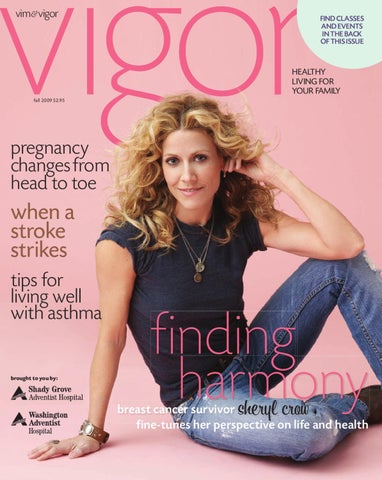
vim& vigor
FIND CLASSES AND EVENTS IN THE BACK OF THIS ISSUE
HEALTHY LIVING FOR YOUR FAMILY fall 2009 $2.95
pregnancy changes from head to toe
when a stroke strikes tips for living well with asthma brought to you by:
finding harmony sheryl crow
breast cancer survivor fine-tunes her perspective on life and health
FdVVFA0994_00_Cover.indd 1
6/17/09 11:14:26 AM
contents special
3
Obesity is an epidemic. Find out if you’re at risk and what you can do about it.
features
fall
4 6
time is everything When a stroke strikes, you have to act fast. Learn the signs that could mean trouble.
8
breathe at your best Learn how proper planning of daily activities can go a long way toward helping asthmatics keep their condition under control.
10 16
she’s having a baby Having a baby affects more than just your belly—a lot more. Find out what changes you can expect during this exciting ninemonth journey.
take five Better health is just five minutes away with these easy-toimplement tips.
root causes Give the gift of wellness to your kids, grandkids and future generations by creating a medical family tree.
24
on the cover
Musician Sheryl Crow beat breast cancer and emerged with a new attitude on health and life. Read about her personal journey and her message on early detection.
COVER PHOTOGRAPH BY ROBERT ASCROFT/CPI
FdVVFA0994_01_TOC2.indd 1
know the ‘o’ word
18
bouncing back from boomeritis Avoid injury and maintain an active lifestyle with this boomer-tailored fitness advice.
32 34 39
eat to beat cholesterol Stock up on these foods to help keep your numbers in check.
42 46
view masters Discover the wonders of medical imaging tests and what they mean for your care.
men: don’t duck the doc A guide to screenings and early diagnosis to make sure you’re in top form. diabetes decoded Diabetes myths abound—find out what’s fact and fiction from a writer who has the condition.
departments 2
opening thoughts Find out why Shady Grove Adventist Hospital and Washington Adventist Hospital are on the front lines in the battle against cancer.
HA1 health advisor Health and wellness classes, programs and support groups for a healthy mind, body and spirit.
small change, big results You’ll be surprised to learn how charities can benefit from the most modest of donations.
vim & vigor · fall 2009
1
6/17/09 11:13:21 AM
opening thoughts
quality cancer care
A family health magazine brought to you by Shady Grove Adventist Hospital and Washington Adventist Hospital, members of Adventist HealthCare President & CEO, Adventist HealthCare Inc. William G. “Bill” Robertson
President, Shady Grove Adventist Hospital Dennis Hansen
President, Washington Adventist Hospital
find out how we excel in treating this most serious concern
Jere Stocks
Dennis Hansen
a
Jere Stocks
PRODUCTION Editorial V.P./Creative Director: Beth Tomkiw Executive Editor: Tom Weede
According to the American Cancer Society, almost 1.5 million new cancer cases are expected to be diagnosed this year. With breast cancer as the second leading cause of death in American women and prostate cancer the No. 1 diagnosed malignancy in men, cancer care is a growing concern. Cancer care programs at both Shady Grove Adventist Hospital and Washington Adventist Hospital offer sophisticated diagnostic and treatment services that are delivered with compassion and a deep understanding of the unique challenges of dealing with this disease. Doctors, nurses, social workers, pain management specialists, pastors and hospice workers combine many years of specialized training in an interdisciplinary approach to treat and help persons with cancer. In addition to the outstanding direct care, our accreditations set us apart as healthcare providers of excellence. • The cancer program at Shady Grove Adventist Hospital is accredited with commendation by the American College of Surgeons’ Commission on Cancer for offering the best in cancer care, and is one of just 1,400 oncology programs in the country approved as a community hospital comprehensive cancer program. • Washington Adventist Hospital also is approved to pursue this designation, which will be completed in late 2009. Radiation Oncology at Washington Adventist Hospital is the first facility in the Washington metropolitan area to be accredited by the American College of Radiation Oncology. It is the only hospital-based facility in all of Montgomery and Prince Georges counties. As we focus on promoting breast cancer awareness in October, we want you to know what you can do to keep you and your family healthy. Be sure to read the cover story about Sheryl Crow’s experience with breast cancer. Also in this issue you’ll read about: • Six tips to good health that can be accomplished in five minutes or less • An inside look at medical imaging tests • The FAST way to identify stroke symptoms And don’t forget to check out our Health Advisor at the back of the issue for a complete listing of our health screenings, classes and events. Wishing you all a safe and healthy fall season,
Editors: Michael Berg, Shelley Flannery, Sam Mittelsteadt, Matt Morgan, Amanda Myers, Kari Redfield, Jill Schildhouse Copy Editor: Cindy Hutchinson
Design Creative Director: Lisa Altomare Art Directors: Erica Brooks, Maggie Conners, Ralph Groom, Monya Mollohan, Kay Morrow, Tami Rodgers, Keith Whitney
Production Senior Production Manager: Laura Marlowe Ancillary Production Managers: Tanya Clark, Angela Liedtke Imaging Specialist: Dane Nordine Prep Specialists: Julie Fong, Sonia Washington
Circulation V.P./Business Intelligence Group: Patrick Kehoe Postal Affairs & Logistics Director: Joseph Abeyta
client services V.P./Sales and Product Development: Chad Rose, 888-626-8779 V.P./Strategic Marketing: Heather Burgett Group Publisher: Russell Cherami Strategic Marketing Team: Robyn LaMont, Barbara Mohr, Andrea Parsons, Todd Speranzo
Advertising Sales Advertising Sales Representatives New York: Phil Titolo, Publisher, 212-626-6835 Phoenix: Soliteir Jaeger, Associate Publisher, 888-626-8779 Mail Order: Bernbach Advertising Reps, 914-769-0051
ADMINISTRATION Vim & Vigor Founder: J. Barry Johnson Chairman: Preston V. McMurry Jr. President/Chief Executive Officer: Christopher McMurry Chief Financial Officer: Audra L. Taylor President/Custom Media: Fred Petrovsky
9901 Medical Center Drive, Rockville, MD 20850 www.ShadyGroveAdventistHospital.com
7600 Carroll Ave., Takoma Park, MD 20912 www.WashingtonAdventistHospital.com If you receive more than one copy of Vim & Vigor, or if you do not wish to receive this publication, please call 301-315-3044.
Dennis Hansen President Shady Grove Adventist Hospital
2
Jere Stocks President Washington Adventist Hospital
Vim &Vigor,TM Fall 2009, Volume 25, Number 3 is published quarterly by McMurry, McMurry Campus Center, 1010 E. Missouri Ave., Phoenix, Arizona 85014, 602-395-5850. Vim & Vigor TM is published for the purpose of disseminating health-related information for the well-being of the general public and its subscribers. The information contained in Vim & Vigor TM is not intended for the purpose of diagnosing or prescribing. Please consult your physician before undertaking any form of medical treatment and/or adopting any exercise program or dietary guidelines. Vim & Vigor TM does not accept advertising promoting the consumption of alcohol or tobacco. Copyright © 2009 by McMurry. All rights reserved. Subscriptions in U.S.: $4 for one year (4 issues). Single copies: $2.95. For subscriptions and address changes, write: Circulation Manager, Vim & Vigor,TM McMurry Campus Center, 1010 E. Missouri Ave., Phoenix, Arizona 85014.
vim & vigor • fal l 2 0 0 9
FdVVFA0994_02_Thoughts.indd 2
6/17/09 10:45:16 AM
helping you get real results
know the ‘o’ word would you know if you were obese? would you know how to get healthy?
The U.S. is facing an obesity epidemic. Data presented by the Centers for Disease Control and Prevention (CDC) show that nearly a third of adults are obese—nearly double the number from two decades ago. An adult is considered obese when his or her body mass index measures 30 or higher. For example, a 5-foot-9 man is obese when he is at least 35 pounds heavier than a healthy weight. The stark increase in the number of obese adults (and a corresponding increase in children and teens) is especially worrisome because of the host of health risks that accompany obesity. These include heart disease (the nation’s top killer), stroke, type 2 diabetes, high blood pressure, sleep apnea and other respiratory problems, and some types of cancer. The CDC has estimated that 300,000 deaths can be attributed to obesity annually. However, just as a vaccination can fight a disease, losing weight through a healthy diet and regular exercise is the surest way to curtail obesity-related diseases and conditions. The weight loss doesn’t have to be dramatic. Start by shedding 5 percent of your weight. If you weigh 200 pounds, that’s just 10 pounds. For tips on how to lose weight and stay healthy, visit www.AdventistHealthCare.com/ wellness.
If you’re struggling with obesity, diabetes, high blood pressure, high cholesterol or joint pain or if you have tried other weight-loss programs without success, Shady Grove Adventist Hospital and Washington Adventist Hospital offer weight-loss programs to help you shed those extra pounds. The programs include educational information sessions and support groups for encouragement, guidance and skills for long-term success, and individualized guidance and weight-loss planning to help you achieve real, long-lasting results. Continuous monitoring by a physician and a registered dietitian to ensure that participants are receiving adequate nutrition also is offered. For more information or to schedule your first visit to the Center on Medical Weight Management at Washington Adventist Hospital, call 301-891-6105.
ready to make a change?
info
If you might need weightloss surgery, Shady Grove Adventist Hospital is a designated bariatric center of excellence. Call 240-826-5278 for more information.
vim & vigor · fall 2009
FdVVFA0994_03_Weight.indd 3
3
6/17/09 10:45:58 AM
every second counts when a stroke strikes. do you know the signals that could
save your life?
time is everything A
A pounding headache comes on suddenly while you’re eating dinner. You’re taking a stroll around the neighborhood when you become very dizzy. You’ve just curled up on the couch with the new James Patterson thriller when your left arm unexpectedly goes tingly and numb. Sure, everyone gets headaches, loses their balance or has a limb fall asleep once in a while. But these symptoms also could be your first signal of stroke, the third leading cause of death in the U.S. Surprised that these ordinary symptoms could be so serious? You’re not alone. A study in the Archives of Internal Medicine shows that 18 percent of Americans with no history of stroke had experienced one symptom in the past—and may have completely missed or ignored it.
4
❋ read the signs Use the FAST method for recognizing symptoms to avoid the sometimes-permanent damage a stroke may render, including paralysis, speech impairment and vision trouble. Be on the lookout for:
f = face.
Ask the person to smile. Does one side of the face droop?
a = arm. Ask the person to raise both arms. Does one arm drift downward?
s = speech. Ask the person to repeat a
simple phrase, for example, “The sky is blue.” Does the speech sound slurred or strange?
t = time.
If you observe any of these signs, it’s time to call 911.
vim & vigor • fal l 2 0 0 9
FdVVFA0994_04-5_Stroke.indd 4
6/17/09 10:48:52 AM
❋ time is brain A stroke happens when blood vessels in your brain get blocked or break open. With less blood going to your brain, the cells there begin to die rapidly, leading to the symptoms mentioned earlier. Knowing those signals and getting to the hospital emergency department quickly is your best chance at avoiding disability or death. If a doctor can deliver proper drug treatment to restore blood flow to the brain within three hours of the first sign of a stroke, damage can be limited or even reversed, according to the National Stroke Association (NSA).
❋ 6 prevention points Being aware of symptoms is only half the battle when it comes to fighting stroke. Almost 80 percent of 750,000 new or recurrent strokes that occur every year are largely preventable, the NSA says. Here are six controllable factors to keep your risk of stroke low:
1 2 3
Control your blood pressure. High blood pressure is a major cause of stroke. Most often, diet, exercise and medication can help you keep your blood pressure at healthy levels.
Don’t smoke. Smoking doubles your risk of stroke. Kick the butt by joining a smoking cessation program at www.AdventistHealthCare.com/calendar. Control your diabetes. People with diabetes have a greatly increased risk of cardiovascular disease, including stroke. Controlling your glucose levels will limit health problems. Need help managing your diabetes? Sign up for a diabetes class at www.AdventistHealthCare.com/ calendar.
4
Exercise every day. As little as 30 minutes a day of brisk activity can reduce stroke risk by 20 percent to 30 percent. Exercise also helps keep your weight down, another risk factor for stroke. Get going now! Sign up for a yoga class by visiting www. AdventistHealthCare.com/ calendar.
5
Reduce sodium. Read food labels to avoid highly processed foods. And use herbs and other seasonings instead of salt when you cook.
6
See your doctor regularly. Regular checkups by your doctor can spot potential heart or circulation problems early, when they can be more easily treated. Need a primary care physician? Find one by calling 800-642-0101 or visiting www.AdventistHealthCare.com/doctors.
you’re in good hands
Shady Grove Adventist Hospital and Washington Adventist Hospital have expert physicians, highly trained staff and state-of-the-art equipment to effectively manage your unique needs. In addition, Shady Grove Adventist Hospital is designated as a primary stroke center by the Maryland Institute for Emergency Medical Services Systems. The stroke program includes an integrated emergency in-house response system; a team of neurologists, board-certified emergency department doctors, and specially trained nurses; a dedicated stroke unit; and state-of-the-art neuroimaging services available 24 hours a day, seven days a week.
visit us online
go
Find out more about stroke by visiting our stroke library at www. AdventistHealthCare.com/stroke.
vim & vigor · fall 2009
FdVVFA0994_04-5_Stroke.indd 5
5
6/17/09 10:49:01 AM
a baby
she’s having the changes your body makes to accommodate your developing baby can trigger a variety of unexpected symptoms
To the casual observer, pregnancy manifests itself primarily as an expanding belly. But when you’re the one expecting a baby, you find the changes in your body go far beyond a need for maternity clothes. Some changes may feel logical, but you may experience a variety of seemingly random symptoms, too—“things that aren’t even close to your belly,” says Heidi Murkoff, co-author of What to Expect When You’re Expecting (Workman Publishing, 2002). You probably expect to feel tired and a little nauseated. But if your whole body feels pregnant, you’re not imagining things. To support your baby-to-be, your body makes dramatic shifts in hormone production, and your blood volume increases by 50 percent, which affects your entire body. Of course, not all women notice every symptom. Be sure to talk to your care provider about any symptoms that concern you.
❋ head-to-toe changes Headaches. Both your increased blood volume and hormonal changes can cause headaches.
ready, set, baby!
Another way to avoid unnecessary chaos on the big day is to make sure that you preregister by 28 weeks. Go to your hospital website and sign up today: www.ShadyGroveAdventistHospital.com/preregister www.WashingtonAdventistHospital.com/preregister
go
6
Talk to your doctor before using prescription or over-the-counter painkillers, and try other relief measures such as cool cloths, relaxation techniques or massage. Dizziness. During pregnancy, more blood flows toward your uterus and your growing baby, which can make you feel lightheaded. Dizziness also can be caused by low blood sugar, a result of your changing metabolism. Stuffy nose. That extra blood volume means more blood is going to the lining of the airways, making them swell and narrow, which can make you feel congested. Enlarged, tender breasts. As your hormones prepare your breasts to produce milk, the milk glands increase in number. Later in pregnancy,
vim & vigor · fal l 2 0 0 9
FdVVFA0994_06-7_OB.indd 6
6/17/09 10:49:45 AM
you may leak a little colostrum—the thick, yellowish, first milk that is high in antibodies. Breathlessness. Your growing uterus leaves less room for your lungs. Progesterone also signals your brain to lower the level of carbon dioxide in the blood. This means you breathe faster and more deeply to exhale more carbon dioxide. Heartburn. Progesterone relaxes the sphincter at the end of your esophagus, which can allow the stomach’s contents to flow backward. Pressure from your uterus makes this more pronounced. Skin changes. The skin around your nipples may get darker, and you may notice a dark line down the middle of your abdomen. Some women develop a brown pigment on their
cheeks, nose and forehead, which is called “the mask of pregnancy.” Your face may break out more frequently than usual, and some women get itchy. You may get stretch marks as the skin on your belly or breasts expands. Joint and back pain. Your joints and ligaments become more flexible, and your increasing weight pulls your spine forward, shifting your center of gravity. Growing uterus. This one’s no surprise, but the change is dramatic. “The uterus changes from the size of the ball of your thumb to the size of a soccer ball,” says Machelle Seibel, M.D., former editor in chief of the journal Sexuality, Reproduction & Menopause. Frequent urination. “Your bladder gets squished between the pregnant uterus and the pubic bone,” explains Arshad Sheikh, M.D., medical director of women’s services and a board-certified OB/GYN at Washington Adventist Hospital. Also, the increase in total blood volume sends more blood flow through your kidneys. Constipation. Pressure from your uterus on the rectum and lower intestine can cause constipation. Progesterone also slows down the muscular contractions of the intestines, which contributes to the problem. Growing feet. Extra circulating blood and water retention can cause your feet to swell. “Your feet may grow a shoe size and may never go back, even after the baby is born,” Murkoff says. They’re not much fun, but the physical changes of pregnancy are good practice for the major life changes your new baby will bring.
folate guards against birth defects
A vitamin called folate helps prevent birth defects. Be sure to ask your doctor about taking a folate pill before you get pregnant. And eat folate-rich foods, such as beans and green, leafy vegetables, before and during pregnancy. For other helpful information, be sure to register for prenatal classes— from childbirth classes to infant care and CPR instruction. Learning from compassionate professionals will help ease your mind so that you can enjoy this new chapter in your life. Find classes now in the back of this issue or visit www. AdventistHealthCare. com/calendar.
vim & vigor • fall 2009
FdVVFA0994_06-7_OB.indd 7
7
6/17/09 10:50:52 AM
breathe
trouble breathing?
If you think you could have asthma, find a specialist at www.Adventist HealthCare.com/ doctors.
go
at your best
simple lifestyle changes can help asthma sufferers manage their condition
8
A
ffecting 35.6 million Americans, asthma results in 2.5 million emergency department visits, 1.5 million hospital admissions and 3 million lost workdays annually, reports the National Hospital Discharge Survey. But proper management of the chronic lung condition can reduce the disease’s impact. Early identification is a key to successful treatment. Your doctor can diagnose asthma with a few simple, noninvasive tests— including a peak-flow breathing test that measures airflow through your lungs. In some cases, your doctor’s office or your health plan may automatically enroll you in an asthma management program based on your medical history. In this kind of program, you, your family and your medical team work together to coordinate support that will help you avoid dangerous attacks and hospital visits. The next step in managing your condition often is establishing an asthma action plan. Such a plan
4 steps to more efficient lungs
Although there is no way to increase the size of your lungs, there are many ways to increase the efficiency with which they capture oxygen. There are daily exercises that can increase your lung capacity. • Breathe deeply. • Exercise in water. • Play a wind instrument. • Participate in rigorous cardiovascular activities.
might be based around peak-flow readings that you take at home. ❋ GREEN ZONE. Peak flow is at the ideal level, and you have no asthma symptoms. Your action plan includes preventive suggestions, such as a list of your personal asthma triggers and how to avoid them, as well as a list of your controller medications and doses. ❋ YELLOW ZONE. Your peak flow level is lower than it should be, but not critical. You may have symptoms such as coughing, wheezing and mild shortness of breath. Your action plan includes information about when to call the doctor, what to do if the doctor is not available, and what medications and doses to take to stop the symptoms. ❋ RED ZONE. Your peak flow level is critically low and you may have serious asthma symptoms such as chest tightness, pain and severe shortness of breath. Your action plan includes what emergency medications and doses to take, where to seek emergency care and the emergency telephone numbers you need to get assistance immediately.
vim & vigor · fal l 2 0 0 9
FdVVFA0994_08_Asthma.indd 8
6/17/09 10:51:25 AM
5
by shelley flannery
minutes isn’t long,
but sometimes it can make all the difference in the world. An extra five minutes could mean being on schedule for a job interview, barely catching your next flight out of town or not burning the casserole in the oven. And, believe it or not, those few ticks of the clock can also be vital to your health. You don’t need to devote hours upon hours to live a healthier life—simple actions can quickly add up to boost your wellness. “In fact, the healthiest people are the ones who make small choices throughout the day,” says Lori Heim, M.D., president of the American Academy of Family Physicians. “It’s the easy things that make a big difference.” Here are six tips from the Centers for Disease Control and Prevention that take just five minutes or less, but can make a big impact on your health.
1
stop for a moment
Spending a few minutes a day relaxing not only helps calm your nerves, but it will also clear your head, allowing you to make better decisions regarding other aspects of your health. “Make time for yourself in a healthy way,” Heim says. “Exercise—even if it’s just a short walk.”
2
set an appointment— or three
Have you been putting off going to the doctor or dentist? Take a few minutes and make all of your annual health appointments in one sitting. Besides getting the task out of the way, if you book them far enough in advance, you will be more likely to get an appointment that’s convenient for you. But here’s the key: You have to keep them.
10
vim & vigor • fal l 2 0 0 9
FdVVFA0900_10-5_TakeFive.indd 10
think good health requires lots of time? think again. these six tips can be accomplished in five minutes or less
take
5
4/21/09 9:31:45 AM
vim & vigor • fall 2009
FdVVFA0900_10-5_TakeFive.indd 11
11
4/10/09 3:02:22 PM
It’s the easy things that make a big difference.
While you’re there, be sure to get up to date on immunizations. Adults tend to forget to ask about this, thinking they’re finished once they turn 18. But some immunizations require boosters, such as the tetanus shot. And don’t forget your annual flu shot!
3
brush up
The connection between oral hygiene and heart health is still being explored, but if there’s a chance polishing your pearly whites can help prevent cardiovas cular disease, why not make the effort? Plus, taking care of your mouth can help fight infec tion and tooth decay. And it doesn’t take much: The American Dental Association recommends brushing your teeth twice a day, flossing daily, replacing your toothbrush at least every three months and visiting the dentist regularly.
12
4
ready the alarms
Home fires cause more than 3,400 deaths every year, according to the Home Safety Council. “Every household should have at least one smoke alarm on every floor and preferably in every bedroom,” says Meri-K Appy, Home Safety Council president. “Test alarms monthly to make sure they are working properly and install new batteries at least once a year. They are critical to saving lives.”
5
learn it by heart
When it comes to heart attack and stroke, getting treated quickly is a matter of life and death. Educate yourself on the warning signs, and call 911 immediately if you experience them or recognize them in someone else. Heart attack, according to the American Heart Association, is usually marked by chest discomfort, discomfort in other areas of the upper body, shortness of breath, nausea, cold sweat and lightheadedness.
vim & vigor • fal l 2 0 0 9
FdVVFA0900_10-5_TakeFive.indd 12
4/10/09 3:02:45 PM
Some foods look healthy on the surface but aren’t at all.
get heart smart Stroke is often identified by the sudden onset of numbness or weakness, especially on one side of the body; confusion, or trouble speaking or understanding; difficulty seeing; dizziness or loss of balance; and severe headache.
6
do a label check
A healthy diet helps you maintain an appropriate weight, and it can also help prevent certain diseases, including heart disease, diabetes and some cancers. But eating well requires taking a moment to see what’s in the products you purchase. “Some foods look healthy on the surface but aren’t at all,” Heim says. “Be an informed consumer.” Look for natural ingredients and whole grains. Stay away from too much sugar, which can hide in ingredient lists under names like dextrose, fructose, maltose and sucrose. And skip foods that contain trans fat, the worst kind.
PHOTOGRAPH BY MONKEYBUSINESS@DREAMSTIME.COM
FdVVFA0900_10-5_TakeFive.indd FdVVFA0994_Commons2.indd 1 15
every minute matters
Do your research. Visit our online heart library at www. AdventistHealthCare.com/ heartcenter to find out more about heart health.
go
The speed of diagnosis and intervention is critical when you’re having a heart attack. That’s why when you arrive in the emergency departments at Shady Grove Adventist Hospital, Washington Adventist Hospital and Shady Grove Adventist Emergency Center in Germantown, 10 minutes is all we need to diagnose whether you are having a heart attack. Be sure to call 911 immediately if you or a loved one experiences the signs of a heart attack.
vim & vigor · fall 2009
15
6/17/09 4/23/09 11:00:09 3:52:20 PM AM
creating a medical family tree for your loved ones can help current and future generations fight disease and nurture their health by carey rossi
root causes The family tree is making a comeback, and it isn’t the kind your grandson does for his school project. This one is much more important and is best completed by you. This tree, or pedigree, tracks your health history
16
and provides an opportunity for you to educate your family about inherited diseases. “Close relatives share many of the same genes,” says Rodolfo Valdez, Ph.D., an epidemiologist in the National Office of Public Health Genomics at the
Centers for Disease Control and Prevention. “They also tend to adopt similar behaviors and cultural practices. Therefore, when a family member is affected by a disease, other family members may also be at risk for developing that disease.”
vim & vigor • fal l 2 0 0 9
FdVVFA0900_16-7_RootCauses.indd 16
4/10/09 3:09:46 PM
uncovering the past A medical family tree alerts you to diseases or conditions that run in your family. Before you get nervous, there are a few things you should know. First, having a relative with a disease does not mean you will contract the illness, Valdez says. “It means that there is a probability that some family members will get the disease depending on whether or not they inherited the same genetic predisposition, were exposed to the same environment, and adopted the same health habits as their relative,” he explains. Also, if a family member is healthy, but several close relatives are affected by a preventable disease, it’s never too late for him or her to adopt healthy behaviors— for example, increasing physical activity, controlling weight and not smoking. Your family health history doesn’t just provide insight into what diseases appear more frequently among your relatives; it also reveals the patterns of how they appear. This includes age of onset, whether males or females are affected, and whether the disease skips generations—all of which can help you and your family physician understand more about your health.
prevention is in your hands
Begin your commitment to healthy living by checking out www.AdventistHealth Care.com/calendar to take part in one of many community screenings offered by Shady Grove Adventist Hospital and Washington Adventist Hospital.
go
relatively speaking When creating your medical pedigree, include the person’s position in the family tree (father, sister, so on), current age and age at diagnosis if the person has a disease, age at death if applicable, ethnic or racial background, treatments (what worked and what didn’t), and healthy or unhealthy habits. Unlike traditional family trees that go back for generations, a family health history includes your health information and that of your parents, grandparents, brothers, sisters and children. Health information about other relatives (aunts, uncles, cousins) is fine to incorporate, too, Valdez says. But keep in mind that distant relatives may add little to your health risk history. “We share half of our genes with our biological parents, siblings and children, but we only share a quarter of our genes with a grandparent and one-eighth with a great-grandparent. The proportion is even lower for other relatives.”
Now that you know whose information you should capture, where you record it is just as important. Luckily, tools are available on the Internet that make the process easier. It usually takes about 20 minutes to compile a threegeneration pedigree. A popular tool is “My Family Health Portrait,” available at the U.S. surgeon general’s website (familyhistory.hhs.gov). You can transfer the results to your electronic medical record or print it out for safekeeping. Once you create your medical family tree, it’s a living document that has to be updated periodically. And here’s where your kids or grandkids can take over: Make sure your family members understand it’s their responsibility to maintain it. “If we know that a serious but preventable disease is likely to run in our family,” Valdez says, “an updated family health history for this disease could provide an important signal calling for the early adoption of preventive behaviors.”
hereditary hits
“There is a group of chronic, common diseases that are known to have a strong genetic component, and it’s always important to record the occurrence of these diseases in a family health history,” says Gaurov Dayal, M.D., chief medical officer at Shady Grove Adventist Hospital. They are: • Heart disease • Breast cancer • Asthma • Stroke • Ovarian cancer • Hypertension • Diabetes • Colorectal cancer • Reproductive issues
FdVVFA0900_16-7_RootCauses2.indd FdVVFA0994_Commons2.indd 2 17
6/17/09 4/23/09 11:00:22 3:56:29 PM AM
by donna shryer
baby boomers can stay active well into their 80s by following this injury-avoiding advice
If you’re one of America’s nearly 78 million baby boomers, then you’ve probably traded in the proverbial “gone fishing” sign for something a little spunkier, like “gone biking.” Fact is, today’s 40- to 60-somethings are more physically fit than any previous generation, and that’s good. Regular exercise boosts muscle and joint function, strengthens bones, decreases risk of heart disease, controls weight gain and in effect turns back the biological clock. But no matter how young you feel, your muscles and bones aren’t 30 anymore. You can’t sprint into new or even routine activities without adding exercises that toughen up worn-down body parts and promote flexibility, strength and
18
vim & vigor · fal l 2 0 0 9
FdVVFA0900_18-23_Seniority 2.indd 18
6/11/09 3:02:59 PM
balance—three things that decline with age. Skip these precautionary measures and you could aggravate “boomeritis,” a term coined by Nicholas DiNubile, M.D., spokesman for the American Academy of Orthopaedic Surgeons and author of FrameWork: Your 7-Step Program for Healthy Muscles, Bones, and Joints (Rodale Books, 2005).
the weakest links DiNubile originally created the word to label a surge in generally healthy patients in their 40s, 50s and 60s with musculoskeletal system problems, like tendinitis, bursitis and arthritis. With time, though, the doctor fine-tuned his definition. “Boomeritis is not so much about the injuries or ailments that we get after the age of 40,” he says. “It’s about vulnerabilities—weak points in the musculoskeletal system. Whether you feel them or not, they’re lurking. Boomeritis is about kinks in the armor.” As for the recent increase in patients with boomeritis, DiNubile explains, “we’ve doubled our life expectancy in the last hundred years or so, but evolution’s not fast enough to give us a musculoskeletal system that’s going to hold up that long. By the time we hit 40, we’ve worn out the warranty on some body parts, and if we keep exercising like always, things will break down.” As cumulative stress further weakens the body, a kink may turn into pain. “Boomeritis can affect anything,” DiNubile says. “But the most common vulnerabilities I see are in the shoulders, knees, lower back and a lot of tendon-related issues.”
mixing things up No one can escape the effects of boomeritis, but you may be able to reduce injuries and aches by, first, making sure you maintain an exercise program, and then diversifying your physical activities so that you alternate stresses on the body. A jogger with vulnerable knees, for example, could mix in biking or swimming, or any non-weight-bearing exercise that takes the load off the knees, says certified athletic trainer Marjorie J. Albohm, M.S., president of the National Athletic Trainers’ Association. vim & vigor · fall 2009
FdVVFA0900_18-23_Seniority 2.indd 19
19
6/11/09 3:03:25 PM
go
it’s online
Visit our online Health & Wellness center at www. AdventistHealthCare.com/ healthtools for information on upcoming screenings and classes, health experts, videos, tips, tools, and a health library of helpful information on diseases, symptoms, injuries, tests, nutrition and more.
Also, it’s important that in addition to an aerobic component, your workout regimen includes balance, flexibility and strength training, Albohm adds. Here’s a look at each: BALANCE exercises will strengthen core muscles—those in the midsection of your body—that contribute to steadying yourself during a fall. Performing “crunches” on a large, inflated exercise ball, for example, targets abdominal muscles by requiring them to stabilize your body on the wiggling ball. FLEXIBILITY training involves stretching your muscles and tendons. Albohm recommends yoga and Pilates, but if your busy schedule doesn’t allow those, you still can spend five to 10 minutes stretching as part of your exercise routine. Focus on large muscle groups—thighs (front and back), shoulders and lower back. “Our muscles and tendons lose elasticity as we age,” Albohm says, “and we know anecdotally that stretching may be a key component in preventing muscle and tendon injury.” STRENGTH training reinforces muscle groups that protect extremities, like your shoulders, knees, ankles and lower back. Strengthening these muscles, Albohm says, helps prevent further wear and tear and may protect existing weak links from injury. After decades of jogging,
for example, many boomers need to toughen up their front thigh muscles that help protect the knees and reduce strain from overuse. Swimmers and tennis players will likely need to focus on their rotator cuff muscles, which help keep the shoulder joint intact.
Before beefing up your strength exercises, Albohm suggests a quick consultation with a qualified athletic trainer or physical therapist. “You want the right activity that improves function without overstressing the joint or aggravating a condition.”
stretch your legs As we age, our muscles, tendons and ligaments lose elasticity, and what once stretched so effortlessly could, with time, suffer a tear. Lauren Korshak, a clinical exercise physiologist at Washington Adventist Hospital, says, “Stretching exercises should be as important to someone’s exercise program as their aerobic and weight-training exercises. Being flexible is not only about being able to
touch your toes and increasing your range of motion. Individuals who are flexible have better balance and are also less likely to be injured.” Be sure to stretch your hamstrings and calves. These muscles in the back of your legs play a crucial role in many daily activities, such as walking. For hamstrings: Sit on the floor with back straight, legs straight in front of you and knees slightly flexed.
Bend from the waist and touch your fingers to your toes—or as far as you can go without pain. Hold for five to 10 seconds and return to the starting position. For calves: Stand on a step with toes on the edge of the step. Drop one heel below the step, with knee slightly flexed. Hold for 10 to 15 seconds and return to the starting position. Complete two sets of 15 repetitions for each leg. vim & vigor · fall 2009
FdVVFA0900_18-23_Seniority 2.indd FdVVFA0994_Commons2.indd 3 23
23
6/17/09 6/11/09 11:00:35 4:32:43 PM AM
new life,
after beating breast cancer, musician sheryl crow has a new perspective and a vital message about early detection
n
by john tomkiw
A N D T O T H I N K 2 0 0 6 WA S G O I N G T O B E S O S P E C I A L . In 2005, singer and songwriter Sheryl Crow had come off creating a successful album, garnered Grammy nominations, traveled through France following her fiancé, Lance Armstrong, during his pursuit of a seventh Tour de France Championship and penned the opening track for the animated film Cars, all while planning her upcoming wedding. Then 2006 hit. In early February, Armstrong called off the engagement. Crow was diagnosed with breast cancer. And the hectic life of a touring musician was put on hold. For healing.
24
vim & vigor · fal l 2 0 0 9
FdVVFA0900_24-31_SherylCrow.indd 24
ROBERT ASCROFT/CPI
4/10/09 3:26:14 PM
new tune
vim & vigor • fall 2009
FdVVFA0900_24-31_SherylCrow.indd 25
25
4/10/09 3:32:33 PM
“The idea that food can help in protecting the body from sickness and disease was a new concept for me.” Sheryl Crow and fellow cancer survivor Sharon Plynn at the Entertainment Industry Foundation’s Revlon Walk/Run for Women in 2007.
“I was so blessed that my cancer was caught in the earliest stages by way of my yearly mammogram,” the nine-time Grammy winner said in a 2006 question-and-answer session on CNN.com. “I am a walking advertisement for early detection.” And that early detection could only come during a doctor’s visit. “I have very dense breasts,” the 47-year-old Crow said. “I have never been able to find anything in my selfexaminations, so I have always relied on my yearly mammograms to tell me what’s going on. I had calcifications turn up in both breasts and … the calcifications looked to be forming … suspicious patterns.” Her radiologist suggested she come back in six months to look at the calcifications, but her OB/GYN physician suggested she have a biopsy performed. “Because I had no signs or symptoms, I feel compelled to encourage women to know your
26
family history and … get yearly mammograms, particularly if you have dense breasts,” she said. Crow considers herself lucky that the cancer was caught early enough that she did not have to undergo chemotherapy. She had a lumpectomy and seven weeks of radiation treatment.
understanding her options A lumpectomy is a surgical procedure in which the tumor and some surrounding healthy tissue are removed; it is the most common form of breast cancer surgery and treatment. Like Crow, most patients receive several rounds of radiation therapy to ensure that cancerous cells are destroyed. And as with many women, Crow used her diagnosis to get a better understanding of the disease and all the options. “I remember when I was first diagnosed and was deep into doing research on what it meant to have cancer and what I could expect from
vim & vigor · fal l 2 0 0 9
FdVVFA0900_24-31_SherylCrow.indd 26
4/10/09 3:31:08 PM
more than a mammogram
Now that rocker Sheryl Crow is cancer-free, she plans to stay that way through yearly testing. But she doesn’t just undergo a mammogram. She also opts for a magnetic resonance imaging (MRI) scan. During a traditional MRI, a patient lies on a table, which is placed inside a special tube. Internal images are then provided to a computer, and the computer assembles the images for a 3-D view inside a body. According to a 2004 study published by the New England Journal of Medicine, more tumors were found among highrisk women who underwent an MRI than a mammogram alone.
you have options
go
For more information on cancer care options and treatment, visit www.AdventistHealthCare.com/ experts and get your questions answered by Shady Grove Adventist Hospital’s and Washington Adventist Hospital’s experts online.
LISA O’CONNOR/ZUMA PRESS; PHIL MCCARTEN/REUTERS/CORBIS
FdVVFA0900_24-31_SherylCrow.indd FdVVFA0994_Commons2.indd 4 27
my treatment,” she said on CNN.com. “I called a great friend who is one of the top guys at the Lance Armstrong Foundation and asked what he thought about seeking holistic treatment in conjunction with my radiation. His response was, ‘If your doctor isn’t open to that, then you have the wrong doc.’ In fact, it was my surgical oncologist who recommended I check out the Tao of Wellness [in Santa Monica, Calif.], where I supported my treatment with acupuncture, as well as herbal teas. The idea is to fortify the immune system. I say, why not?” To that end, Crow also focused on her diet for an immunity boost, and she met with nutritionist Rachel Beller. “I can safely say that Rachel has changed the way I look at my body and what I put in it,” Crow said in an online testimonial for Beller. “She has educated me as to how to eat ‘defensively.’ The idea that food can help in protecting the body from sickness or disease was vim & vigor · fall 2009
27
6/17/09 4/23/09 11:03:27 4:14:01 PM AM
a new concept for me. Her knowledge of what foods and spices are important in the different areas of promoting wellness has been an integral part of how I have changed the way I look at what I put into my body.” Beller, who founded the Beller Nutritional Institute, is an advocate of using foods in their natural states as part of a “defensive” strategy. “Food and nutrients in their natural form are best adapted to the human digestive system,” Beller says on her website. “The body knows what to use and what to discard. In other words, it is always better to eat the tomato with the meal than to take an isolated lycopene supplement with the meal. Simplicity in design is tantamount to a reliable and useful dietary regimen.” Crow revitalized her diet with organic foods, lots of fish and plenty of colorful vegetables, which contain antioxidants that may help fight cancer.
getting connected As Crow has changed her outlook about food, she also has changed her view about life in general. “I feel more connected to my life now that I’ve had—and beat—breast cancer,” she told People. >
a closer look at risk Breast cancer is the most common form of cancer among women after skin cancers, with a 12 percent chance of a woman developing it in her lifetime. But there are things you can do to lessen your risk. “We know of factors that either increase or decrease breast cancer risk, some of which are reasonably modifiable and some of which aren’t,” says Debra Pollak, executive director
28
vim & vigor · fal l 2 0 0 9
FdVVFA0900_24-31_SherylCrow.indd FdVVFA0994_Commons2.indd 5 28
of cancer care services for Adventist HealthCare. For example, long-term hormone replacement therapy, being obese after menopause, excessive weight gain after adolescence, and alcohol consumption all separately increase a woman’s risk of getting breast cancer, as does starting menstruation at an early age. “Basically, the more menstrual cycles a woman has, the more times the breast tissue proliferates and regresses, and the
more opportunity there is to promote a cancer,” Pollak says. Conversely, there are things that decrease a person’s risk of getting cancer, such as maintaining a healthy body weight and engaging in physical activity. Also, breastfeeding may lower risk. As for genetic predispositions to breast cancer, Pollak says there are other, more prevalent environmental factors, such as those listed above, that take precedence. VAUGHN YOUTZ/ZUMA PRESS
6/17/09 4/23/09 11:03:43 4:14:45 PM AM
And on The Oprah Winfrey Show in 2006, she said, “I’ve had so many people [say to] me, ‘Gosh, you know, everything’s really gone wrong for you this year,’ and it took me going through that to realize that everything really went right for me. It brought me to this point where I am now, and I really feel like I have a lot of clarity.” That clarity involves rechanneling her energy. “I do feel there was a colossal shift in my life when I was diagnosed,” she said on CNN.com. “My situation was interesting in that I was also going through a lot of personal upheaval and the [cancer] experience really dictated that I show up for myself in ways I had never done before. I am a person who typically tries to take care of everyone … [It] is not a particularly healthy way to live because … you wind up at the bottom of your list of those you take care of … I am aware of the fact that sometimes ‘no’ is the answer, no matter how hard it is to say. And I guess the
biggie for me is knowing that it will never be my goal to prove to anyone that I matter.” Crow told Australia’s Courier-Mail newspaper that she wasn’t sure “whether cancer made me a better person, but it definitely made me more of an awake person. When I was diagnosed, everything came to a screeching halt and I needed to take a good look at my life.” “Once I stepped out of radiation [therapy],” Crow told People, “I had to remember that the only person who could take care of me was me.” Rather than try to suppress her experience, Crow would like to “remember every moment of what was going on at that time, because we talk about defining moments, but I think nothing can define you. They’re all refining moments. You’re constantly refining yourself and refining your life.” And as the song goes: A change would do you good.
“I feel more connected to my life now that I’ve had—and beat— breast cancer.”
ROBERT ASCROFT/CPI
FdVVFA0900_24-31_SherylCrow.indd 31
vim & vigor · fall 2009
31
4/10/09 3:49:18 PM
e
e a b t o c t h t ol a ods can help lower your o f e num e fiv s e ber th s
an
ero
e lif
l
32
ds av e
ur yo
by jill schildhouse My grandma Gertie is 89 years old. Her total cholesterol has hovered around 350 mg/dL for decades, she smoked for half her life, and she’s a couch potato. Yet somehow, she lucked out and has outlived most of her friends who practiced healthier habits. But rather than test fate like my grandma, your cholesterol level is something you should keep in check. Why? Most of us won’t have Gertie’s good fortune when it comes to this important measurement and our health. “High cholesterol can result in coronary heart disease, which can lead to a heart attack or stroke,” says Gerald Fletcher, M.D., spokesman for the American Heart Association. A sedentary lifestyle, smoking and a poor diet all can have a negative impact. But here’s some good news: According to the American Heart Association, your body produces about 75 percent of the cholesterol in your blood while food accounts for the rest. This means you have a chance to control a significant portion of your cholesterol by making healthy meal choices. In particular, certain foods may lower LDL (“bad”) cholesterol, according to Christine Gerbstadt, M.D., R.D., spokeswoman for the American Dietetic Association. So let’s explore five of the best nutritional picks.
est
oatmeal
beans and lentils
Can you think of a better way to start your day than with a bowl of hot oatmeal? “It’s very filling because of its high soluble fiber content,” says Gerbstadt. “Eating a cup a day of cooked oatmeal can help lower your cholesterol. And it doesn’t matter if you make oldfashioned rolled oats or instant, as long as the instant variety has no sugar or flavorings.” Adding fruit, nuts and skim milk can make the meal complete. Tip: Not a breakfast person? Try substituting oatmeal for bread crumbs in meatloaf, or using oat bran when baking bread or muffins.
It looks as if the saying is true: Beans are a magical “fruit.” So magical, in fact, that they can help lower your cholesterol. There are kidney, pinto and black beans, as well as another healthful legume, lentils. “It doesn’t matter which kind you choose,” says Gerbstadt. Canned beans are as healthy as dried beans, she says, provided you dump them in a colander and rinse off the excess sodium first. Tip: Gerbstadt suggests you strive for one cup of beans a day added to an entrée, served as a side dish or tossed in a cold salad.
vim & vigor • fal l 2 0 0 9
FdVVFA0900_32-3_Food.indd 32
4/10/09 4:04:28 PM
unsaturated fat
nuts
fruits and veggies
While these terms may sound daunting, polyunsaturated and monunsaturated fatty acids just refer to the healthy fats found in fish, nuts, seeds and oils from plants. A good way to introduce these fats into your diet is by cooking with vegetable oils such as canola and sunflower seed. “These are light and versatile oils you can use to bake or sauté or as the base of homemade salad dressings,” says Gerbstadt. Tip: Although these oils are good for you, you still must watch your overall consumption. Gerbstadt recommends two to three tablespoons per day total, which adds up pretty quickly.
Sometimes you feel like a nut— and that’s good news for your cholesterol level, because nuts contain polyunsaturated fatty acids. “Adding walnuts, pecans and almonds to your diet is a great way to help lower your cholesterol,” says Gerbstadt. Aside from snacking on nuts, you can sprinkle them onto salads, on top of yogurt, mix them into your baked goods or spread nut butters on apple slices. Tip: Beware of your serving sizes. While nuts are a healthy fat, they are still fat. “A daily serving is about 20 pieces of nuts, or oneeighth of a cup,” says Gerbstadt.
This should come as no surprise: Fruits and vegetables can lower your cholesterol. How? Their plant sterols and stanols help prevent dietary cholesterol from being absorbed by your body. “People only take in about 200 to 400 milligrams of plant sterols and stanols each day,” says Gerbstadt. “However, the target is 1 gram a day.” One gram equals 1,000 milligrams. Tip: If you’re a bit picky when it comes to vegetables and fruits, not to worry. There are ways to sneak in these healthy items and trick your taste buds: Add bananas or zucchini to breads and muffins, purée cauliflower into faux mashed potatoes or hide sautéed veggies in lasagna or chili.
know your numbers
It doesn’t matter if you’re old or young, overweight or thin. High cholesterol— a significant contributor to heart disease—can hit even the healthiest of bodies, especially if it runs in the family. The American Heart Association recommends getting your cholesterol checked at least once every five years—more often for men older than 55 and women older than 45. Here are a few other numbers to keep in mind: 30—The number of minutes of exercise you should get on most days of the week. 300—The number of milligrams to which you should limit your daily cholesterol intake. 37 MILLION—The number of Americans with high cholesterol. LESS THAN 200—What you want your total cholesterol count to be.
get cooking
go
Still need help? Learn how to fight high cholesterol through nutrition and healthy cooking classes. Visit www. AdventistHealthCare.com/calendar to find the right class for you.
vim & vigor · fall 2009
FdVVFA0900_32-3_Food.indd 33 FdVVFA0994_Commons2.indd 6
33
6/17/09 4/23/09 11:05:00 4:21:02 PM AM
34
vim & vigor • fal l 2 0 0 9
FdVVFA0900_34-5_MensHealth 2.indd 34
6/11/09 3:00:33 PM
men: don’t duck the
doc! by bob cooper • illustration by eric palma
screenings and early diagnosis can help
m
guys stay healthy for the long haul
en who would never be five minutes late to a baseball
game or an important meeting are often five years late in getting recommended medical screenings. They aren’t much better about having unexplained symptoms evaluated by a physician, either. In fact, men see doctors for annual exams and preventive health services half as often as women. Why the hang-up? Jean Bonhomme, M.D., a leading men’s health advocate and Men’s Health Network advisory board member, says it all begins in childhood. “When a boy skins his knees he’s told that boys don’t cry, and when he gets hurt in a ballgame he’s told to take one for the team,” notes Bonhomme. “So it’s no surprise that boys taught to ignore pain because they’re told it will go away become men who avoid doctors. But beginning at middle age, pain and illness often won’t go away on [their] own, and catching a problem early can be critical.” So it’s time to retire the “take it like a man” approach and get up to speed on prevention. Here are the most essential routine screenings, tests and symptoms that should prompt visits by men to a medical professional. vim & vigor • fall 2009
FdVVFA0900_34-5_MensHealth 2.indd 35
35
6/11/09 3:01:01 PM
No pain, no gain? That high school locker-room version of toughness is, unfortunately, never forgotten by many men. cardiology Half of all heart attacks occur when there are no previously diagnosed symptoms, which might have been noticed and treated in a routine physical. “Most of those heart attacks can be prevented or delayed, but men tend to come in only when they have a problem,” says Richard Stein, M.D., spokesman for the American Heart Association (AHA). He advises annual physical exams beginning at 35. “Elevated blood pressure or cholesterol levels will prompt your doctor to recommend medications or behavioral changes that reduce those levels.” KNOW THIS: The AHA calls for blood pressure to be checked at least every two years and cholesterol levels every five years when readings are normal. Your physician will increase the checkups if levels are elevated. You should also know the symptoms of a heart attack, which are usually mild at first. These include shortness of breath; discomfort or pain in the midchest or elsewhere that lasts more than a few minutes or comes and goes; cold sweat; nausea; and lightheadedness. If you experience any of these symptoms and they can’t be easily explained, call 911 immediately.
oncology “Women are accustomed to preventive medical care,” says Otis Brawley, M.D., chief medical officer of the American Cancer Society. “But while they make regular OB/GYN visits in their 30s and 40s, many men may not see a doctor once during those years.” That’s one reason most women stay up-to-date later in life with breast and cervical cancer screenings—they’re in the habit—while most men never get a colorectal cancer screening, the only cancer examination proven to save lives in men, says Brawley.
36
KNOW THIS: Colorectal screenings range from providing fecal samples once a year to getting a colonoscopy once a decade, depending on your doctor’s advice. For men with an average cancer risk, these tests should begin at 50. That’s also when you can consider getting PSA (prostate-specific antigen) screenings that check for prostate cancer. Their necessity is widely debated, so discuss the pros and cons with your doctor. There are also several potential cancer symptoms that should be checked by a doctor— just in case. These include nodules under the skin (commonly on the neck, armpit or groin); any appearance change in moles; a lump on a testicle; difficulty urinating or ejaculating; fecal blood; a chronic cough; or unexplained abdominal pain or fevers.
orthopedics No pain, no gain? That high school lockerroom version of toughness is, unfortunately, never forgotten by many men. Real pain, unlike muscle aches and soreness, should be taken seriously at any age. “Many men feel that if they neglect a problem, it might just go away,” says Ronald Delanois, M.D., a spokesman for the American Academy of Orthopaedic Surgeons. “They also fear they’ll be told they need surgery. But by postponing a diagnosis, they’re actually increasing the odds they’ll eventually need it.” KNOW THIS: Prolonged muscle or joint pain or instability and the inability to perform daily activities are the most common symptoms that should be checked by an orthopedist. Back, knee and shoulder pain are the most common parts of the body affected. “Symptoms are like
vim & vigor · fal l 2 0 0 9
FdVVFA0900_34-5_MensHealth 2.indd 36
6/11/09 2:56:54 PM
the warning lights on your dashboard,” says Delanois. “The longer you ignore them, the more serious the problem becomes.”
mental health “My male patients have told me they were embarrassed to come in,” says Jon Grant, M.D., a psychiatrist and co-editor of the Textbook of Men’s Mental Health (API, 2006). “There’s a stigma because men are raised to think we can handle any problem on our own. But the reality, as with most medical problems, is that treatment is easier and more effective if a problem is caught early. Otherwise you can be incapacitated to the point that you can’t function well at work or at home.” KNOW THIS: Depression and anxiety are the most common mental health disorders and both exhibit similar symptoms: an unexplained mood or personality change; irritability; low energy; and unexplained physical problems. An increase in alcohol use is another warning flag. Another common condition, bipolar disorder, causes drastic mood swings between manic and depressive episodes. A long-term study published in 2005 in the American Journal of Psychiatry found that this condition tends to appear earlier in life in men than in women. If any symptoms of a mental health disorder occur over several days or weeks, see your physician, who may refer you to a psychiatrist or psychologist.
stand by your man’s health
Ladies, when it comes to men and breast cancer, eating disorders and depression, the statistics may surprise you: • About 20 percent of men with breast cancer have close male or female relatives with the condition. • On any given day, 25 percent of American men are dieting. • Four times as many men as women commit suicide. Encourage the men in your lives to schedule their annual checkups and screenings today. If they need a healthcare provider, visit www.AdventistHealthCare.com/doctors or call 800-642-0101 to locate one near you. And to find health screenings, such as prostate and blood pressure, visit www.AdventistHealthCare.com/calendar or call 800-542-5096.
ophthalmology “People who obediently go to the dentist every six months often go for many years between eye exams,” says Louis Cantor, M.D., a spokesman for the American Academy of Ophthalmology. “But which would you rather live without: your teeth or your sight?” He notes that most men do something about their eyes only if there are
joint appointments
For information about joint care, call Judy Mardirossian, Shady Grove Adventist Hospital joint program coordinator, at 240826-7591; or Toni Clark, Washington Adventist Hospital orthopedic program coordinator, at 301-891-5050.
go
symptoms or a crisis. That’s risky because many eye diseases lack symptoms until they reach an advanced stage. Glaucoma can permanently damage 80 percent of the optic nerve before vision loss is noticed. KNOW THIS: Adults should get a complete eye exam at 40 from an ophthalmologist or optometrist, who will then recommend the frequency of later exams (typically every one to three years). Eye disease can strike even if you’ve never needed prescription glasses. Also, seek a diagnosis immediately if you experience a sudden change in the quality of your vision, such as flashes of light or “floaters” (floating spots), or redness or a discharge accompanied by pain.
vim & vigor · fall 2009
FdVVFA0900_34-5_MensHealth 72.indd 37 FdVVFA0994_Commons2.indd
37
6/17/09 6/11/09 11:05:22 4:31:59 PM AM
diabetes
decoded armed with new scientific
insights, our writer—who has the condition—separates fact from fiction to help make this confusing disease manageable by amy lynn smith • photographs by joe vaughn
styling by Annette Abdelfatah/Antonino Salon
I
’m about to celebrate my 20th year of living with type 2 diabetes—and there actually is a lot to celebrate, despite the daily challenges of living with a chronic condition. Since my diagnosis, the treatments and tools available to manage diabetes have improved dramatically, making the illness more predictable and less burdensome. Doctors have a better understanding of diabetes and its management, as researchers continue discovering new facts. Admittedly, it can be hard to keep up. I write about the subject often and still learn new tips every time I interview an expert. So it’s not surprising that many people cling to misconceptions about diabetes that are no longer true, or never were in the first place. But when it comes to your health, knowledge is power. So here are some of the most common diabetes myths, and the facts you should know to ensure a lifetime of good health.
Amy Lynn Smith knows firsthand how diabetes affects the daily routine. vim & vigor • fall 2009
FdVVFA0900_39-41_Diabetes.indd 39
39
4/13/09 9:23:12 AM
myth vs. fact Myth: People with diabetes are destined to develop complications or even die because of the condition. Fact: Diabetes is a controllable disease, says John Buse, M.D., Ph.D., an endocrinologist and immediate past president, Medicine & Science, for the American Diabetes Association. “With proper care and follow-up,” he explains, “people with diabetes can expect a normal life span without disabling complications.” Even better, the risk of developing type 2 diabetes in the first place can be reduced by 60 percent just by losing 5 to 10 percent of your body weight and exercising 30 minutes a day.
Myth: If
I have type 2 diabetes, I can make it go away by doing exactly what my doctor tells me. Fact: Many people believe this, but it’s not true, says
40
Angela Ginn-Meadow, R.D., a certified diabetes educator and national spokeswoman for the American Dietetic Association. “Diabetes is a lifetime disease,” she says. “But if you manage it every day, you can stay healthy and avoid complications.”
Myth: People with diabetes cannot eat sugar, ever. And eating sugar can cause diabetes. Fact: These are two of the biggest misunderstandings about diabetes. Eating sugar does not cause the disease, but does contribute to weight gain, which can be a factor in developing type 2 diabetes, Buse says. What’s more, effective diabetes management doesn’t mean avoiding sugar entirely. A piece of pie or a cookie can be an occasional treat for people with diabetes, as long as they balance it with an overall healthy eating plan.
Myth: Having diabetes means you need to follow a low-carbohydrate diet. Fact: “Carbohydrates are our first source of fuel for energy, and your body needs carbohydrates whether or not you
vim & vigor • fal l 2 0 0 9
FdVVFA0900_39-41_Diabetes.indd 40
4/13/09 9:23:42 AM
diabetes and you
By learning about advances in diabetes treatment, Smith has empowered herself to better manage the disease.
have diabetes,” Ginn-Meadow says. “If you have diabetes, about half of your daily calories should come from carbohydrates. The key is choosing healthy carbohydrates, watching portion sizes and eating your carbohydrates at the right times.” It’s not easy for most people to estimate a one-cup portion of something like pasta or mashed potatoes, so Ginn-Meadow offers a tip: Make a fist and put it into a measuring cup to see how closely your fist compares to a one-cup serving. Then you can use your fist as a portable measuring cup.
MYTH: Blood sugar level is the only indicator of diabetes control that really matters. FACT: Many people with diabetes also have high blood pressure and high cholesterol, and managing these conditions can help prevent complications. “Even just a couple of years ago, many doctors focused almost exclusively on blood sugar control,” Buse says. “But blood pressure and cholesterol levels are equally important in diabetes care.”
Have you recently been diagnosed with diabetes? Have you had diabetes for a while, but feel overwhelmed by all the new information on how to manage it? We can help. Shady Grove Adventist Hospital and Washington Adventist Hospital offer classes on all you need to know about diabetes, including: • The nuts and bolts of diabetes—why diabetes occurs, the different types and what is happening in your body. • Eating a well-balanced, carbohydrate-controlled diet. • Nutrition to help manage blood pressure, weight and cholesterol. • Testing and managing blood glucose, setting goals, and managing highs and lows. • Taking medications correctly. • Getting the most out of your insulin pump. • Coping with diabetes and stress. • Preventing and managing the complications of diabetes.
MYTH: If I take insulin or oral medication, I don’t need to do anything else to manage my diabetes. FACT: It’s true that medications today are extremely effective. But this doesn’t mean people with diabetes can ignore proper diet and regular physical activity, Buse says. Ginn-Meadow actually writes prescriptions for exercise. “For some people,” she says, “that exercise can be all the medicine they need.”
sign up for help
go
Visit www.AdventistHealthCare.com/ calendar or call 800-542-5096 to learn how to sign up for a diabetes class and other health programs and screenings near you.
vim & vigor · fall 2009
FdVVFA0900_39-41_Diabetes.indd FdVVFA0994_Commons2.indd 8 41
41
5/22/09 11:05:34 6/17/09 12:07:28 AM PM
view masters an inside look at medical
imaging tests
and how they can improve your care by teresa caldwell board
I
maging devices are like high-tech detectives, inconspicuously allowing a revealing look into the nooks and crannies of everything from luggage to purses to the human body. Without X-rays, airport security would have to open and look through every bag (and you thought the lines were long now!). And without medical imaging, doctors would have to use guesswork or exploratory surgery to diagnose problems inside their patients. You’re probably familiar with the names of common medical imaging tests—X-ray, CT scan, MRI and ultrasound. But do you know how the tests work and how they differ from one another?
x-rays: picture this Getting an X-ray is similar to going to a photographer. X-rays produce an image because they are absorbed by the body to varying degrees. Dense bone absorbs the most X-rays, so it appears white on the X-ray image. Soft tissue shows up in shades of gray, and air looks black. X-ray is the oldest imaging test, and still the most frequently used. For example, mammograms use low-dose X-rays to detect breast disease. X-rays can diagnose broken bones, dislocated joints or arthritis. Chest X-rays can look
42
for pneumonia, emphysema or lung cancer. Sometimes patients swallow a contrast material or have it injected, and then X-rays are used to view organs or joints in motion. When you get an X-ray, you will either lie on a table or stand in front of an image recording plate. While X-rays used to be taken on film, now they are usually recorded digitally so they can be stored on a computer and sent to other experts electronically. PROS: Relatively inexpensive and widely available. Fast and easy for emergency diagnosis. CONS: Slight chance of cancer from excessive radiation exposure, but benefit of an accurate diagnosis far outweighs risk. Further imaging tests may be needed to look for abnormalities not visible on X-ray.
CT scans: a closer view During a computed tomography (CT) scan, you pass through a tube while a ring rotates around you, continuously emitting X-rays. “A CT scan is a lot more informative, specific and sensitive than a plain X-ray,” says Leonard Berlin, M.D., spokesman for the Radiological Society of North America. “As well, bone and blood show up better on a CT scan than an MRI.”
vim & vigor · fal l 2 0 0 9
FdVVFA0900_42-5_ImagingKW.indd 42
4/13/09 9:36:08 AM
FdVVFA0900_42-5_ImagingKW.indd 43
4/13/09 9:37:29 AM
Each rotation of the X-ray beam captures an image of a cross-section of anatomy, like the slices in a loaf of bread. To create these cross-sectional images, “the computer calculates what’s going on in a patient’s body based on how difficult it is for the X-rays to penetrate the body at different angles,” says Myke Kudlas, director of instructional technology for the American Society of Radiologic Technologists. CT scans can detect tumors and show their size, precise location and degree of involvement with nearby tissue. They can reveal internal injuries from trauma, as well as blood clots and signs of stroke. For spinal and skeletal problems, CT gives detailed images of even very small bones and surrounding muscles and blood vessels. Pros: Can image bone, soft tissue and blood vessels at the same time. Less sensitive to patient movement than MRI. Can be performed if you have an implanted medical device of any kind (unlike MRI). Cons: Slight chance of cancer from excessive radiation exposure, but benefit of an accurate diagnosis far outweighs risk. Deliver more radiation than regular X-rays. Soft-tissue details can be seen more clearly on MRI.
MRIs: tuning in Magnetic resonance imaging (MRI) uses a magnetic field and radio waves instead of X-ray radiation. “The molecules of your body are all spinning at different rates,” Kudlas says. “The MRI machine causes the molecules to spin at a constant rate for a short period of time.” The MRI machine then gives off a radio signal, Kudlas explains. This causes the molecules of the body to emit a signal as they begin to return to their normal spinning rate. The computer takes that information and constructs a detailed, cross-sectional image based on how fast molecules go back to their normal state. This method produces better soft-tissue images than X-rays do. So MRI is commonly used to scan the brain, spine, thorax, vascular system and musculoskeletal system. During an MRI, you will need to hold very still while the images are recorded. In some cases, you may be asked to hold your breath. You will hear tapping or thumping sounds while the radio-frequency pulses are activated. The part of your body that is being scanned may feel slightly warm. If you feel anxious being confined in the MRI tube, your doctor can prescribe a sedative to help you relax.
44
vim & vigor • fal l 2 0 0 9
FdVVFA0900_42-5_ImagingKW.indd 44
4/13/09 9:38:25 AM
radiology saves a life
PROS: No exposure to radiation. Excellent at imaging soft tissue. Can detect abnormalities that might be obscured by bone during other imaging tests. CONS: Typically more expensive and time-consuming than other tests. Some implanted medical devices may interfere with the exam. Need to stay very still to get a high-quality image.
The last four weeks of Sarah Miller’s pregnancy were filled with fear and frustration. Leg numbness and pain had left her almost completely immobile, and it was only getting worse as it got closer to her daughter’s birth. Diagnostic imaging and the quick actions of the hospital’s radiology staff immediately set into motion fast, coordinated, lifesaving care. Her serious injury was obvious to the radiologist: The cause of Miller’s sciatica was not the pregnancy, but rather very large disk herniations. He immediately called her primary care physician, who consulted an orthopedic surgeon, who scheduled back surgery at Shady Grove Adventist Hospital. “Everyone worked so quickly. I felt I could have been their only patient,” Miller says. This coordination of care and communication between departments saved this new mom. Today, she is walking pain-free and soaking in all the joys of her new baby girl.
ultrasound: sound effects Like MRI, ultrasound imaging does not use X-ray radiation. Instead, “it uses sound waves just like sonar in a submarine,” Kudlas says. A hand-held device called a transducer sends high-frequency sound waves into the body. These sound waves bounce off internal structures, creating echoes that are captured by the transducer and translated into an image on a monitor.
just a few more questions
How many times have you walked out of your doctor’s office and thought of the questions you should have asked? Go to www. AdventistHealthCare.com/radiology to download your free checklist of questions to ask when you are sent for any kind of medical test. Bring these with you to all of your appointments.
go
Among its many applications, ultrasound can be used to capture images of the heart and blood vessels. It can detect breast cysts or gallstones and examine other organs for stones, cysts or tumors. “Ultrasound is the first imaging [choice] for evaluating gynecological disease,” Berlin says. It is probably best known for its use in obstetrics to evaluate fetal growth and well-being. During an ultrasound exam, clear gel will be applied to the part of your body being examined to help the transducer make good contact with the skin. The ultrasound technician or radiologist will firmly press the transducer against the skin and move it around. This usually won’t be uncomfortable, unless the area being examined is tender. PROS: Widely available, easy to use and less expensive than other imaging tests. No exposure to radiation. Preferred for safe diagnoses in pregnant women. Provides real-time imaging, which can guide minimally invasive procedures. CONS: Ultrasound waves can’t travel through air, so are not ideal for viewing the stomach or bowel or organs they may be blocking. Can see only outer surfaces of bony structures. vim & vigor · fall 2009
FdVVFA0900_42-5_ImagingKW.indd FdVVFA0994_Commons2.indd 9 45
45
6/17/09 4/23/09 11:05:45 4:29:18 PM AM
46
vim & vigor • fal l 2 0 0 9
FdVVFA0900_46-8_Donations.indd 46
5/13/09 9:52:32 AM
small change,
big results
even modest gifts can really add up for your favorite charity by robert mcgarvey
W
What use is that forgotten $5 you found in the pocket of your old coat, or maybe the $10 you won on last week’s lottery scratch-off ticket? Don’t instantly assume these little amounts are meaningless to hospitals and healthcare foundations dedicated to helping people and the community. Quite the contrary, in fact: It’s a steady stream of comparatively small donations that enable many institutions to do their good works. And, no, you won’t get a new building named after you for a $20 gift, but you’ll make a profound difference in the lives of others.
❋ power of the people Proof of this phenomenon is in the 2007 American Express Gift Survey, as analyzed by the Center on Philanthropy at Indiana University, one of the nation’s leading authorities on charitable giving. According to this research, two-thirds of all donations are $100 or less, and the median gift is $50. Those numbers start out small but get big, fast. Giving USA Foundation estimates that all U.S. charitable giving amounted to a jaw-dropping $306.39 billion in 2007. “As long as there are no strings attached to the gifts— and usually there aren’t with small donations—even very small gifts matter to most institutions. They definitely add vim & vigor • fall 2009
FdVVFA0900_46-8_Donations.indd 47
47
5/13/09 9:52:55 AM
up,” says Paul Brest, coauthor of Money Well Spent: A Strategic Plan for Smart Philanthropy (Bloomberg Press, 2008). The lack of strings is key, he says. Large donors often want an equally large say in how their money is used. Of course, sometimes that works out well for everyone concerned, but a reality is that unfettered cash is the best of all. “Unrestricted gifts, no matter their size, get aggregated, and the sum can become substantial,” Brest says. “Most institutions definitely know how to put small contributions to very good use,” says Steve McSwain, author of The Giving Myths (Smyth & Helwys Publishing, 2007). “Everyone can make a positive difference. Small gifts are so important.”
❋ money well spent Just what will small gifts buy? Well, $18 buys two dozen teddy bears for ill children, for instance. Reading glasses—to let seniors more
considering planned giving?
If you have an institution you wish to do more for eventually, philanthropy expert Steve McSwain, author of The Giving Myths, suggests initiating a conversation about ways to benefit the institution in your will. Many organizations offer free estate planning assistance designed to help navigate the ins and outs of tax laws. “Often there are real benefits to the donors and also to their beneficiaries and the charitable institutions they want to help,” McSwain says. For information on gift and estate planning services at Shady Grove Adventist Hospital, call 240-826-6171, or at Washington Adventist Hospital, call 301-891-6920.
48
comfortably peruse newspapers, books and magazines—can be bought for as little as 76 cents apiece in wholesale lots of 12 dozen (144 glasses for $109.44). Paperback books can be purchased for $1 apiece, potted plants to dress up a hospital room cost a few dollars each, and a variety of children’s toys sell for under $10. Bottom line: Small amounts quickly can be turned into joy for the right recipients. But there may be still more good that happens when that spare $5 or $20 is donated to a good cause. That’s because, as McSwain explains, the giver benefits too. “We all feel better when we give—when we find it in ourselves to help another—and the truth is that very often small gifts are given because the donor really wants to help another person. “The more we share,” McSwain says, “the happier we will be.”
leave your mark
Go to www.AdventistHealthCare. com/giving to learn how you can make a donation, become a volunteer, or support an event sponsored by your local hospital.
go
vim & vigor · fal l 2 0 0 9
FdVVFA0900_46-8_Donations.indd FdVVFA0994_Commons2.indd 10 48
6/17/09 4/23/09 11:05:57 4:32:51 PM AM
health advisor
9/09-11/09 health and wellness classes, programs and support groups for a healthy mind, body and spirit
location legend consult this key to find the location for your class, program or support group
s
= Shady Grove Adventist Hospital, 9901 Medical Center Drive, Rockville Note: Paid parking
w
= Washington Adventist Hospital, 7600 Carroll Ave., Takoma Park
a
= Adventist HealthCare, 1801 Research Blvd., Rockville
r
= Adventist Rehabilitation Hospital of Maryland, 9909 Medical Center Drive, Rockville
h = Holiday Park Multipurpose Senior Center, 3950 Ferrara Drive, Wheaton g = Gaithersburg Upcounty Senior Center, 80 A Bureau Drive, Gaithersburg
t
= Takoma Park Community Center,
7500 Maple Ave., Takoma Park
c
= Cardiac Rehab Center, 9715 Medical Center Drive, Suite 130, Rockville
L = Long Branch
p = Potomac Ridge Behavioral Health Center, 14901 Broschard Road, Rockville
d = Damascus Senior Center, 9701 Main St., Damascus
r = Rockville Senior Center, 1150 Carnation Drive, Rockville m = Marilyn J. Praisner
Community Center, 8700 Piney Branch Road, Silver Spring
Community Center, 14906 Old Columbia Pike, Burtonsville
m = Margaret Schweinhaut Senior Center, 1000 Forest Glen Road, Silver Spring
g = Great Beginnings, 18501 N. Frederick Ave., Gaithersburg
t
= Temple Beth Ami, 14330 Travilah Road, Rockville
i
= Institute for Genomic Research, 9712 Medical Center Drive, Rockville
m = MD Metropolitan MS Support Group, 303 Adclare Road, Rockville
g = Green Earth Goods, 23341 Frederick Road, Clarksburg
r = Renaissance Gardens at Riderwood, 3160 Gracefield Road, Silver Spring L = Life Support Training Center, 16220 Frederick Road, Suite 410, Gaithersburg
❋ special
events
LEGS FOR LIFE— ANNUAL LEG PAIN SCREENING FOR PERIPHERAL ARTERY DISEASE
Leg pain often results from peripheral artery disease (PAD), which is treatable. Our FREE screening program includes a health risk questionnaire, blood pressure measurements and post-assessment consultation with a physician. We will also have hourly lectures by our leading specialized physicians on related topics. All are welcome to attend the lectures. Cost: FREE Info: Call for a screening appointment
w
Where: Short Stay Unit When: 9/20, 1-4 p.m.
a Where: Outpatient Surgery When: 10/4, 1-4 p.m.
FLU SHOT CLINIC
Info: Flu Hotline at 301-315-3800; www. AdventistHealthCare. com/flu
❋ health
and faith
FAITH COMMUNITY NURSING AND HEALTH MINISTRY SUPPORT
Support meetings and education for parish nursing and health ministry, integrating health and faith where you live and worship. a When: Tuesdays, 9/1 and 12/1 Info: 301-315-3714 or 301-315-3141 for locations and times
w When: Mondays, 11/2 and 12/7, 6-8 p.m.
register online
Detailed descriptions of our classes are available online at www.Adventist HealthCare.com/calendar. To register for any of our fall classes and events, call the registrar at 800-542-5096 or call the number listed in the program description.
go
to register, call 800-542-5096
FdVVFA0994_49-56_HealthAdvisor.indd 1
·
health advisor
·
fall 2009
HA1
6/17/09 10:52:12 AM
health advisor contents special events health and faith maternal/child health education classes cardiac and vascular programs cancer programs cancer support groups community lectures youth health and education nutrition classes fitness and weight management self-improvement first-aid/CPR classes support groups
Cost: FREE Info: 301-315-3141 or 301-891-6102
s
HEALTH MINISTRY TEAM BUILDING COURSE
Provides training and preparation for building and sustaining your health ministry team. When: Saturday, 9/19, and Sunday, 9/20, 2-6 p.m. Cost: FREE Info: 301-315-3141 or 301-891-6102; preregistration required
w
FRIENDSHIP SUPPORT GROUPS FOR THE BEREAVED IN YOUR CONGREGATION SETTING
A workshop for community congregations presented by the pastoral care department. Where: Conference Center, Room 2 When: Saturdays, 9/19 and 9/26, 2:30-6 p.m. Cost: FREE Info: 301-891-5265 to register
HA1 HA1 HA2 HA4 HA4 HA5 HA5 HA6 HA6 HA6 HA6 HA7 HA8
w HOSPITAL VISITATION WORKSHOP FOR CLERGY/LAITY A workshop on providing appropriate spiritual support among patients and their family members within a healthcare setting. Where: Conference Center, Rooms 1 and 2 When: Saturday, 11/14, 2:30-6 p.m. Cost: FREE Info: 301-891-5265 to register
w
‘WHEN HOLIDAYS COME’ WORKSHOP
Offers helpful tools for healing during the holidays. Where: Conference Center, third floor When: Sunday, 11/15, 2:30-4:30 p.m. Cost: FREE Info: Carolyn Jones at 301-891-5265 to preregister
❋ maternal/
child health education classes
before your baby arrives MATERNITY TOURS
Information for expectant parents about our maternity services. s Where: Third Floor/ Mother Baby Unit When: Wednesdays, 9/2, 9/16, 10/7, 10/21, 11/4, 11/18, 12/2 or 12/16, 7-8 p.m.; Sundays, 9/13, 9/20, 10/4, 10/11, 10/25, 11/1, 11/8, 11/22, 12/6 or 12/13 (please call registrar for specific times) Cost: FREE
w
When: Sundays, 9/13, 10/4, 11/1 or 12/6, 1-2:30 p.m.; Saturdays, 9/26, 10/24, 11/21 or 12/19, 1-2:30 p.m. Cost: FREE COMPREHENSIVE CHILDBIRTH AND INFANT CARE SERIES
Available in six-week, three-day and two-day formats and includes information on preparation for labor and birth, pain management, postpartum care for mom, and infant care. Six-Week Series a When: Sundays, 9/13-11/1 (skip 9/27 and 10/11) or 11/8-12/20 (skip 11/29), 7-9 p.m.; Tuesdays, 9/22-10/27, 9/29-11/3, 11/3-12/8 or 11/10-12/15, 7:30-9:30 p.m.; Wednesdays, 9/1610/21 or 10/28-12/9 (skip 11/25), 7:30-9:30 p.m.; Thursdays, 9/310/8 or 10/22-12/3 (skip 11/26), 7:30-9:30 p.m.
Cost: $140 per couple Info: If you register for a breastfeeding class when you register for this course, the breastfeeding class will be FREE.
w When: Saturdays, 9/26-10/31, 11/7-12/19 (skip 11/8), 3-5:30 p.m. Cost: $130 per couple Info: Your FREE breastfeeding class is included in these dates.
a Three-Day Series When: Saturday mornings, 9/12, 9/26 and 10/3 (skip 9/19); 10/10, 10/17 and 10/24; 11/7, 11/14 and 11/21; or 12/5, 12/12 and 12/19, 9 a.m.1 p.m. Saturday afternoons, 9/12, 9/26 and 10/3 (skip 9/19); 10/10, 10/17 and 10/24; 11/7, 11/14 and 11/21; or 12/5, 12/12 and 12/19, 2-6 p.m. Sunday afternoons, 10/4, 10/11 and 10/18; or 10/25, 11/1 and 11/8, 2-6 p.m. Cost: $150 per couple Info: If you register for a breastfeeding class when you register for this course, the breastfeeding class will be FREE. w
Two-Day Course When: Sundays, 9/20
and 9/27, 10/18 and 10/25, 11/15 and 11/22, 12/13 and 12/20, 10 a.m.-5 p.m. Cost: $150 per couple Info: Please sign up for a FREE breastfeeding class when you register for this course. EXPRESS CHILDBIRTH CLASS
This four-hour class provides just the basics for labor and birth. a When: Sundays, 10/4 or 12/6, 2-6 p.m. Cost: $65 per couple
w
When: Wednesdays, 10/3 and 10/10, 11/14 and 11/21, 3-5:30 p.m. Cost: $65 per couple Info: Split into two 2.5-hour sessions at this location only
a
REFRESHER CHILDBIRTH CLASS
For those who have taken a childbirth class in the past four years and simply need a brief refresher. When: Sundays, 10/4 or 12/6, 9 a.m.-noon Cost: $40 per couple CESAREAN BIRTH CLASS
For those who are
register online
Detailed descriptions of our classes are available online at www.Adventist HealthCare.com/calendar. To register for any of our fall classes and events, call the registrar at 800-542-5096 or call the number listed in the program description.
go
HA2 to register, call 800-542-5096 · w ww. S h ad y G rove Adve nt i st H o spit a l. com/ c a len d a r · health advisor · fall 2009
FdVVFA0994_49-56_HealthAdvisor.indd 2
6/17/09 10:52:29 AM
expecting to give birth by cesarean. a When: Mondays, 10/12 or 12/14, 7:309:30 p.m. Cost: $40 per couple
w
When: Arranged Cost: $40 per couple or $100 as a private class Info: 301-891-5305 Customized Private Childbirth Class
This class meets your special needs—scheduling
information to get you off to the best start with breastfeeding. a When: Saturdays, 9/12, 9/19, 9/26, 10/3, 10/24, 11/7, 11/14, 11/21, 12/5, 12/12 or 12/19, 9-11:30 a.m.; Sundays, 10/4, 11/8 or 12/6, 9-11:30 a.m.; or Mondays, 9/14, 10/5, 11/9 or 12/7, 7-9:30 p.m. Cost: $35 per couple, but FREE when registering at the same time for the Comprehensive
Learn how to care for your newborn. a When: Mondays, 9/21 or 11/16, 7-9:30 p.m. Cost: $35 per couple
w
When: Saturdays, 10/21 or 12/12, 3-5:30 p.m. Cost: $35 per couple
w
Baby Care For Adoptive Parents
A private class customized for the expected age of your baby at the
rescue breathing and airway management techniques. s When: Sundays, 10 a.m.-noon. Cost: $35 per person, $50 per couple
w When: Saturdays, 9/26, 10/24 or 12/19, 10 a.m.-noon; Sunday, 11/1, 3-5 p.m. Cost: $35 per person, $50 per couple
s
So, You’re Going to be a Grandparent?
Information on how to be a helpful grandparent to the family with a new baby. When: Mondays, 9/14 or 12/7, 7:30-9:30 p.m. Cost: $20 per person, $25 per couple
sibling classes The following classes prepare big brothers and big sisters for the arrival of a new baby to their families.
difficulty, bed-rest restrictions, VBAC preparation and more. a Where: Adventist HealthCare or in your own home When: Arranged Cost: $60 per hour Info: 301-315-3130
w
When: Arranged Cost: $50 per hour Info: 301-891-5305 Breastfeeding Class
This program presents accurate, up-to-date
Childbirth and Infant Care Series
w
When: Saturday, 11/21, 10 a.m.-12:30 p.m.; Saturdays, 10/31 or 12/19, 3-5:30 p.m. Cost: $35 per couple, but FREE when registering at the same time for the Two-Day Childbirth and Infant Care Series Info: Already included in the Six-Week Childbirth Series (this location only) Baby Care Basics Class
time of adoption. When: Arranged Cost: $100 per couple Info: 301-891-5305
s Fatherhood 101 Classes Helps expectant or new dads meet the challenges of fatherhood. When: Saturdays, 9/12 or 11/7, 1-3:30 p.m. Cost: $20 Infant Safety and CPR
This course covers childproofing, CPR,
s Brother and Sister Class (ages 3 to 9) When: Wednesdays, 9/2, 9/16, 10/7, 10/21, 11/4, 11/18, 12/2 or 12/16, 5:30-6:30 p.m. Cost: $12 for first child, $8 for each additional child
w
Sibling Preparation Class (ages 3 to 9)
When: Arranged Cost: $50 for family
after baby arrives
a Lactation Services Lactation consultation, breast-pump sales and rentals, and breastfeeding support groups. Info: 240-826-MOMS (6667)
a BEST Program: “Breastfeeding, Education, Support and Togetherness” An informal group for breastfeeding information, support and assistance with challenging situations. When: Most Wednesdays, 2-3:30 p.m. Cost: FREE Info: 301-279-MOMS (6667)
w
The Latch Clinic—TLC for Breastfeeding Moms
When: Most Tuesdays, 2-3:30 p.m. Cost: FREE when you deliver at Washington Adventist Hospital Info: 240-826-4TLC (4852)
c
Discovering Motherhood Classes
This program provides an educational and emotional support group for new moms and their babies. Cost: $45 Info: 301-315-3130 for dates
a Going Back to Work BreastPump Class Information on how to
health advisor • fa ll 2009 • w w w. Wa shin gton Advent ist H ospit a l. com/ c a len d a r
FdVVFA0994_49-56_HealthAdvisor.indd 3
• to register, call 800-542-5096 HA3
6/17/09 10:52:54 AM
health advisor continue pumping when returning to work. When: Thursdays, 9/10, 10/15, 11/19 or 12/10, 2-3 p.m. Cost: FREE Infant Massage
Classes can be arranged for parents and caregivers of newborns up to 4-month-olds. w Info: 301-891-5305 Where: Main Street Massage, Gaithersburg Info: 301-792-2496 Where: Hands in Harmony, Germantown Info: 301-540-8805
k cardiac
and vascular programs
Community Screenings
Private consultation with a licensed medical professional to discuss your risks (one to four minutes each). s When: Wednesdays, 9/9, 11/4, 8-10 a.m.
h When: Friday, 11/13, 10 a.m.-noon Screening Description and Fees
• Lipid Profile: Basic cholesterol test—total cholesterol, HDL, LDL, VLDL, triglycerides, cholesterol/HDL ratio (12 hours of fasting recommended); $35, $31 for seniors (55-plus); only order this or the VAP test • VAP (Vertical Auto Profile): Expanded cholesterol test including all of the lipid profile plus information that can help identify inherited and hidden heart disease risks; $65, $61 for seniors (55-plus); only order this or the lipid profile test • Homocysteine: Vascular fitness test; $95 • HsCRP: Tests highsensitivity C-reactive protein for cardiovascular risk; $45 • Blood pressure monitoring: FREE
• Glucose: Basic screening for diabetes (12 hours of fasting recommended); $8 • A1c: Blood sugar test for known diabetics; $40 • Prostate-Specific Antigen (PSA): Prostate cancer; $40 • Body-Fat Analysis: Tests percentage of body fat; $10 • BodyGemTM: Measures resting metabolic rate; $60 Heart Screening Packages
• Sweetheart: Lipid
profile and glucose; $38 • Heart Smart: VAP and glucose; $69 • Heart Risk Special: VAP, homocysteine and HsCRP; $199 • Diabetes Check: Glucose and A1c; $42
g Monthly Blood Pressure Testing
When: Fourth Wednesday of each month, 9/23, 10/28, 11/18 and 12/16,
m When: Wednesday, 9/16, 9-11 a.m.
r When: Fridays, 9/25, 11/20, 10 a.m.-noon d When: Wednesday, 9/30, 9:30-11:30 a.m.
w
When: Wednesdays, 10/7, 12/9, 8-10 a.m.
g When: Wednesday, 10/14, 10 a.m.-noon
m When: Wednesday, 10/21, 9:30-11:30 a.m.
9:30-11:30 a.m. Cost: FREE Info: 301-258-6380
s
Where: Cafeteria When: Wednesdays, 9/16, 10/21 and 11/18, 11:30 a.m.-1:30 p.m. Cost: FREE
r Where: Lobby When: Tuesdays, 9/8, 10/13 and 11/10, 12:302:30 p.m. Cost: FREE w Where: Cafeteria When: Thursdays, 9/3, 10/1 and 11/5, 11:30 a.m.-1:30 p.m. Cost: FREE
t Where: Senior Room When: Fourth Thursday of the month, 9/24, 10/22, 11/19, 12/17, 11:30 a.m.-12:30 p.m. Cost: FREE Info: 301-258-6380
s Congestive Heart Failure Discussion Group Where: Willow Room
When: Mondays, 10/19 and 12/7, 7 p.m. Cost: FREE Info: Mike at 301-2796662 Introduction to Cardiac Rehabilitation and EECP
When: By appointment Cost: FREE Info: Shady Grove Adventist Hospital Cardiac Rehab at 301279-6662; Washington Adventist Hospital Cardiac Rehab at 301891-6016
s
Internal Cardiac Defibrillator and Pacemaker Discussion Group
Group discussion for patients, and the families of patients, with these devices. When: Mondays, 9/7 (Maple Room) and 11/9 (Willow Room), 7 p.m. Cost: FREE Info: 301-279-6662
c
Heart-to-Heart
Support group for individuals adjusting to life with heart disease. Spouses are welcome. When: Third Thursday of each month, 7-8 p.m. Cost: FREE Info: 301-279-6662
k cancer
programs
Many of the programs are free to the commu nity, although some programs may have eligibility requirements.
Info: Shady Grove Adventist Hospital
HA4 to register, call 800-542-5096 • w ww. S h ad y G rove Adve nt i st H o spit a l. com/ c a len d a r • health advisor • fall 2009
FdVVFA0994_49-56_HealthAdvisor.indd 4
6/17/09 10:53:18 AM
programs at 301-3153507; Washington Adventist Hospital programs at 301-315-3147; or www.Adventist HealthCare.com COLORECTAL CANCER SCREENING PROGRAM
Adventist HealthCare partners with Montgomery County Health Department to offer this free screening. Info: 301-315-3507 or 301-315-3147 to see if you are eligible MONTGOMERY COUNTY CANCER CRUSADE COALITION MEETING
Monthly meeting to discuss community needs for cancer screenings. Info: 301-315-3507 or 301-315-3147 for meeting dates and times LOOK GOOD ... FEEL BETTER
A program for women undergoing cancer treatments. a Where: Third floor When: Monday, 11/2, 10 a.m.-noon Cost: FREE Info: Call to register
w
When: Tuesday, 9/15, 10 a.m.-noon Cost: FREE Info: Call to register
r
FOCUS ON HEALING THROUGH MOVEMENT AND DANCE
Cost: $120 for six sessions Info: 240-864-6200 for dates, times and location
❋ cancer
support groups
All support groups are free.
Info: Sharon Francz at 301-279-6136 or sfrancz@adventist healthcare.com for more information
s
MOVING FORWARD BREAST CANCER SUPPORT GROUP
This monthly support group is open to all breast cancer patients and their families. Where: Tower Willow Room When: Third Tuesday of each month, 9/15, 10/20, 11/17 and 12/15, 6:30-8:30 p.m.
s
GENERAL CANCER SUPPORT GROUP
loved one with cancer. Where: Oak Room When: Tuesdays, 9/22, 10/27, 11/24 and 12/22, 6:30-8:30 p.m.
Connecting women with other women who are HER2-positive. Where: Maple Room When: Tuesdays, 9/8, 10/13, 11/10 and 12/8, 6:30-8 p.m.
s
COLORECTAL CANCER SUPPORT GROUP
For adults coping with colorectal cancer. Where: Willow Room When: Tuesdays, 9/1, 10/6, 11/3 and 12/1, 6:30-8:30 p.m.
s
WOMEN’S GYN CANCER SUPPORT GROUP
For women coping with gynecological cancers. When: Thursdays, 9/3 (Willow Room), 10/1 (Maple Room), 11/5 and 12/10 (Willow Room), 6:30-8 p.m.
s HEMATOLOGY SUPPORT GROUP
s LUNG CANCER SUPPORT GROUP
For adults coping with leukemia, lymphoma, Hodgkin’s disease and myeloma. When: Wednesdays, 9/16, 10/21, 11/18 (Oak Room) and 12/16 (Maple Room), 6:30-8:30 p.m.
Where: Willow Room When: Fourth Monday of each month, 6-9 p.m. MELANOMA WARRIOR SUPPORT GROUP
When: Mondays, 8/31 and 10/5 (Dogwood Room), 11/2 (Maple Room), 12/7 (Dogwood Room), 6:30-8:30 p.m.
For those caring for a health advisor
FdVVFA0994_49-56_HealthAdvisor.indd 5
s
HOW TO BE YOUR PERSONAL CANCER NAVIGATOR
This program will give you the tools to navigate through this difficult time. Info: Call for an appointment
❋ community
lectures
g CONTEMPORARY ISSUES DISCUSSION GROUP When: 7-8:15 p.m. September: Makeup: Avoiding Products That Can Hurt Us October: Benefits of Drinking Tea November: Is Sugar Bad for Us? Discussing Sugar and Other Sweet Alternatives December: Natural Stress Remedies Cost: FREE Info: Call for dates
L LONG-LIFE
s
·
fa ll 2009
·
go
Detailed descriptions of our classes are available online at www.AdventistHealthCare.com/ calendar. To register for any of our fall classes and events, call the registrar at 800-542-5096 or call the number listed in the program description.
s HER2+ BREAST CANCER SUPPORT GROUP
This monthly group is open to all cancer patients and their families. When: Mondays, 9/14 (Oak Room), 10/12 (Maple Room), 11/9 (Willow Room) and 12/14 (Maple Room), 6:30-8:30 p.m.
s CANCER CAREGIVER SUPPORT GROUP
register online
LECTURE SERIES
When: 11 a.m.-noon 10/13: Beating the Blues: How to Recognize and Overcome Depression 11/10: Arthritis Advice 12/8: Forgetfulness and Memory Cost: FREE
Info: 301-431-5708 (Spanish translation available)
t HEALTH AWARENESS LECTURE SERIES Where: Senior Room When: Noon-1 p.m. 9/1: Cholesterol: Do You Know What’s Going On in Your Arteries? Cost: FREE Info: 301-431-5708 (Spanish translation available)
r RIDERWOOD LECTURE SERIES When: 9/9, 2-4:30 p.m.: Health Fair and Tour of Riderwood (FREE screenings) 10/7, noon-1 p.m.: Tea Time: Everything You Need to Know About Tea 11/2, 5:30-7 p.m.: Preventing Falls 12/7, 5:30-7 p.m.: How to Attain and Maintain Your Fitness Goals for the New Year Cost: FREE
m MEET AND MOTIVATE LECTURE SERIES When: Tuesdays, 10:30-11:30 a.m. 9/22: 10 Things You
w w w. Wa shin gton Advent ist H ospit a l. com/ c a len d a r
· to register, call 800-542-5096 HA5
6/17/09 10:53:31 AM
health advisor Should Know About Lupus 10/27: A Breath of Fresh Air: Breathing Difficulties 11/24: GERD: Gastroesophageal Reflux Disease 12/15: Oh, My Aching Back Cost: FREE Info: 240-777-8085
h HEALTHY LIVING LECTURE SERIES When: 1:15-2:15 p.m. 10/21: Eating Healthy on a Budget, by Libby Lamancusa, R.D. Cost: FREE Info: 240-777-4999
d PREVENTING FLU LECTURE
When: Thursday, 9/17, 1-2 p.m. Cost: FREE Info: 240-777-6995
❋ youth
health and education a
BABY-SITTING
This two-session class for children ages 11 to 15 covers accident prevention and basic care for infants and children. Both sessions required for certificate. When: Sundays, 9/13 and 9/20, 10 a.m.-noon; Saturdays, 10/10 and 10/17, or 11/14 and 11/21, 10 a.m.-noon Cost: $30 per person
s TEEN CPR COMPANION TO BABY-SITTING Rescue breathing, CPR skills, use of automated external defibrillator and
management of choking for all ages. When: 9/26, 10/31, 11/28, 2-5 p.m. Cost: $60 per person
s
HOME ALONE
10/14, 6:30-8 p.m. Cost: $40 per session, $25 class materials
CLASS FOR THE FAMILY
Learn to make healthy appetizers, quick salads and soups, delicious main dishes and desserts. When: Mondays, 10/510/26, 6:30-8 p.m. Cost: $15 per class, $60 for entire series
❋ nutrition
These classes are for cancer survivors and individuals interested in healthy food choices to help prevent cancer. Presented by Cancer Project. Donation is recommended: $20 per class, $50 for entire series. w Where: Lisner Building, Room 1 When: Mondays, 6:308:15 p.m. 9/14: Favoring Fiber: Planning Healthy Meals 9/21: Discovering Dairy Alternatives and Replacing Meat 9/28: Antioxidants and Phytochemicals: Immune-Boosting Foods 10/5: Maintaining a Healthy Weight: Fueling Up on Low-Fat Foods Cost: FREE (donations appreciated)
a NUTRITION AND DIABETIC COUNSELING Individual consultation with a registered dietitian for all nutrition needs. Cost: $80 per hour WEIGHT MANAGEMENT
An eight-week program built around nutrition and physical activity. w Where: Conference Room B When: Mondays, 9/2811/16, 6-8 p.m. Cost: $140
a When: Thursdays, 10/1-11/19, 6-8 p.m. Cost: $140
s HEALTH BENEFITS OF DRINKING TEA Four-week program on the history, preparation methods, types and benefits of tea. When: Wednesdays, 9/23 and 9/30, 10/7 and
Detailed descriptions of our classes are available online at www.Adventist HealthCare.com/calendar. To register for any of our fall classes and events, call the registrar at 800-542-5096 or call the number listed in the program description.
g VEGAN COOKING
Prepares 8- to 11-yearolds and their parents for children spending brief periods alone at home. Children must attend with a parent or guardian. When: 9/26, 10/24, 11/21, 10 a.m.-noon Cost: $10 for child and parent
classes
register online
FOOD FOR LIFE: NUTRITION AND COOKING CLASSES
s When: Wednesdays, 6-8:15 p.m. 10/7: Flavoring Fiber and Maintaining a Healthy Weight 10/14: Discovering
go
Dairy Alternatives and Replacing Meat 10/21: Fueling Up on Low-Fat Foods and Planning Healthy Meals 10/28: Antioxidants and Phytochemicals and Immune-Boosting Foods Cost: FREE (donations appreciated)
Introduces challenging inverted poses to enhance and hold familiar poses. When: 6:30-7:30 p.m. Cost: $80 per session Info: Call for dates; preregistration required; please bring your own mat
❋ fitness
r SUGARLOAFERS WALKING CLUB
and weight management w
BEGINNER T’AI CHI
This Chinese coed exercise program helps improve balance and coordination. Where: Conference Center When: Thursdays, 10/112/10, 6:30-7:30 p.m. Cost: $15 per class, $120 for entire series Info: Call to preregister
A walking club for people who share an interest in keeping fit through walking. When: Tuesdays, 7:15-9 a.m. Cost: FREE Info: Jackie at 301977-6870; Maribeth at 301-946-5496 or gam mie0612@verizon.net
❋ self-
improvement
s YOGA FOR BEGINNERS
STRESS MANAGEMENT
Ease tense muscles, tone the internal organs and improve flexibility. When: 6:30-7:30 p.m. Cost: $80 per session Info: Call for dates; preregistration required; please bring your own mat
Class can be taken individually or as a four-part series. w When: Thursdays, 7-9 p.m. 10/1: Learn How to Manage Your Anger 10/8: Learn How to Handle Everyday Worries 10/15: Simplify Your Life 10/22: Learn to Relax
s
INTERMEDIATE YOGA
HA6 to register, call 800-542-5096 · w ww. S h ad y G rove Adve nt i st H o spit a l. com/ c a len d a r · health advisor · fall 2009
FdVVFA0994_49-56_HealthAdvisor.indd 6
6/17/09 10:54:04 AM
Cost: $20 per session, $50 for entire series
w
Freedom From Smoking
This eight-session program combines support group meetings and positive behavior-change. When: 6-7:30 p.m. Cost: $50 Info: Call for dates; preregistration required
c Stop Smoking for Good! This class will provide techniques to keep you smoke-free. Cost: FREE Info: 301-279-6662 for dates and times Are You Suffering from Arthritis or Joint Pain?
Learn about the surgical procedure, hospital stay and rehabilitation program. s When: First Wednesday of each month, 1:30-3 p.m.
Cost: FREE Info: 800-642-0101
r
When: Thursdays, 7-8 p.m. Cost: $120 for six sessions Info: 240-864-6200
w
Being a Patient 101: Making the Most of Your Healthcare Experience
Learn to manage your and your family’s health with confidence and skill. Where: Conference Center, third floor When: Wednesdays, 6-7 p.m., 10/7 and 10/14 Cost: $20
r The Community Aphasia Group Cost: $120 for six-week class Info: Sandi Lancaster at 240-864-6200 or slancas2@adventist healthcare.com
s Diabetes Management Program Three programs to meet your needs: Nuts and Bolts of Diabetes, Carbohydrate Counting and Diabetes Meal Planning, and Getting the Most from Your Insulin Pump. Where: Oak Room Cost: FREE Info: Call for dates and times
k first-aid/
CPR classes
American Safety and Health Institute Basic First Aid
Learn how to treat first-aid emergencies. Preregistration is required. w Where: Lisner Building, Room 1 When: 10/6, 11/18 and 12/14, 6-9 p.m. Cost: $45
s Where: Tower Oak Conference Room When: 9/10, 6-9:30 p.m.; 10/7, 6-9:30 p.m.; 11/14, 10 a.m.-1:30 p.m.; 12/8, 6-9:30 p.m. Cost: $45 Infant safety and CPR
Rescue breathing, CPR skills and management. A “Friends & Family” attendance card will be given to each participant upon completion. s When: Sundays, 9/6, 9/20, 10/4, 10/18, 10/25, 11/1, 11/22 and 11/29, 10 a.m.-noon
a When: Sundays, 9/13, 9/27, 10/11, 11/8 and 11/15, 10 a.m.-noon Cost: $35 per person, $50 per couple Life-Support Classes
We offer classes in ACLS, PALS, NRP, emergency pediatrics, and CPR for healthcare providers, and provide AED consultation services. For a complete list of class dates and times, call 301-315-3266 or visit www.adventistlife support.com. Price includes cost of book.
s When: 8/8, noon4:15 p.m.; 9/12 or 11/15, 9 a.m.-1:15 p.m. AHA Heartsaver CPR for Teens
Cost: $69 w When: 8/29 or 10/3, noon-4:15 p.m.
s When: 9/5, noon-4:15 p.m.; 11/29, 1-5:15 p.m. AHA Heartsaver for Childcare Providers
Cost: $73 w When: 9/20, noon4:15 p.m.; 11/7, 10 a.m.2:15 p.m.
s When: 8/16, noon-4:15 p.m.; 10/17, 2-6:15 p.m. AHA Heartsaver First Aid
Cost: $60 w When: 9/18, 1-4:15 p.m.; or 11/1, 2-5:15 p.m.
L When: 8/14 and 10/16, 1-4:15 p.m. AHA Family and Friends Pediatric CPR
AHA Heartsaver CPR and AED
Cost: $35, or $50 per couple w When: 8/22 or 9/26, 2-4:45 p.m.; 10/18, 3-5:45 p.m.; 11/17, 6-8:45 p.m.
Cost: $73 L When: 8/14, 9/24 or 10/16, 8 a.m.-12:15 p.m.
s When: 9/27 and 11/8, 10 a.m.-12:45 p.m.
w When: 8/22 or 11/1, 9 a.m.-1:15 p.m.; 9/18, 8 a.m.-12:15 p.m.; 10/28, 6-10:15 p.m.
AHA Family and Friends CPR for All Ages
Cost: $35 w When: 9/14 or
health advisor • fa ll 2009 • w w w. Wa shin gton Advent ist H ospit a l. com/ c a len d a r
FdVVFA0994_49-56_HealthAdvisor.indd 7
• to register, call 800-542-5096 HA7
6/17/09 10:54:27 AM
health advisor 11/16, 6-8:45 p.m.; 10/18, 10 a.m.-12:45 p.m.
s
When: 8/9, noon2:45 p.m.; 9/27 or 11/8, 2-4:45 p.m.; 10/25, 10 a.m.-12:45 p.m.
❋ support
groups
All support groups are free.
r ALCOHOLICS ANONYMOUS When: Sundays, 7:30-10 p.m. Info: 202-966-9783
r
AL-ANON/ ALATEEN
A fellowship for family members and friends whose lives have been affected by someone else’s drinking. When: Sundays, 6:30-7:30 p.m. Info: 202-635-2023
r AMPUTEE SUPPORT GROUP “Ability with Mobility” for amputees and caregivers. When: Last Thursday of each month, 6-8 p.m. Info: Sandy at 240-864-6200
r
BRAIN INJURY SUPPORT GROUP
For brain injury survivors, caregivers and their families. When: Second and fourth Thursday of each month, 7 p.m. Info: Tom at 301-2949205; Brain Injury Association at www.biamd.org
DIABETES DINING CLUB
Info: Diane at 301-421-5767 EMPTY ARMS, ACHING HEARTS
For those experiencing pregnancy loss, miscarriage, stillbirth or infant death. New Spanishspeaking group available. s Where: Chapel When: First Thursday of each month, 7-9 p.m. Cost: FREE Info: 301-279-6112
w
Where: Conference Room A When: Second Sunday of each month, 2:304 p.m. Cost: FREE Info: Carolyn Jones at 301-891-5265
w
EMPTY ARMS, ACHING HEARTS (IN SPANISH)
Where: Conference Room B When: Second Sunday of each month, 2:304 p.m. Cost: FREE Info: Carolyn Jones at 301-891-5265 GASTRIC BYPASS SUPPORT GROUP
s Where: Willow Room When: Fourth Sunday of each month, 6:308:30 p.m. t When: Second Monday of each month, 6:30-8:30 p.m.
i
LAPAROSCOPIC BAND SUPPORT GROUP
When: First and third Thursday of each month, 6:30-8:30 p.m. Info: 301-251-4128
s
GRIEF CARE
This mutual support group meets for six consecutive weeks for those experiencing loss. When: Mondays, 10/1211/16, 7-9 p.m. Info: 240-826-6112 to preregister
w GRIEF CARE SUPPORT GROUP Where: Conference Room A Info: Carolyn Jones at 301-891-5265 to preregister
w
DIVORCE CARE
An eight-week support group for those healing from separation or divorce. Info: Carolyn Jones at 301-891-5265 for dates and times and to preregister
m MD METROPOLITAN MS SUPPORT GROUP When: Second Tuesday of each month, 7 p.m. Info: Judi at 301-990-8797
r MONTGOMERY COUNTY STROKE ASSOCIATION SUPPORT GROUP For stroke survivors, caregivers and their families. When: Second Wednesday of each month, 7-9 p.m. Info: 301-869-1580, www.onehealthylife.org
s
NARCOTICS ANONYMOUS SUPPORT GROUP
When: Saturdays, 7:30-8:30 p.m. Info: 800-543-4670
p OPERATION RUNAWAY
For runaway youths and their parents/ guardians.
When: Wednesdays, 6:30-8:30 p.m. Info: 301-251-4545 or 800-204-8600
s SICKLE CELL ANEMIA When: First Saturday of each month, 12:30-2:30 p.m. Info: Beatrice at 301-972-2442
register online
Detailed descriptions of our classes are available online at www.Adventist HealthCare.com/calendar. To register for any of our fall classes and events, call the registrar at 800-542-5096 or call the number listed in the program description.
go
HA8 to register, call 800-542-5096 · health advisor · fa l l 2 0 0 9
FdVVFA0994_49-56_HealthAdvisor.indd 8
6/17/09 10:54:49 AM
Shady Grove Adventist Hospital 9901 Medical Center Drive Rockville MD 20850
Non-Profit Org. US Postage
PAID
Vim & Vigor
AHC-1025 Vim & Vigor BC-outlined.indd 1
5/20/09 12:41:53 PM
FdVVFA0994S_C4.indd 1
6/17/09 11:06:31 AM