Social Impact strategy
April 2026


April 2026
Dear Reader,
Welcome to the ADNEC Group Social Impact Strategy. This document marks a significant milestone in our sustainability journey – one that moves beyond measuring what we do, to understanding and quantifying the difference we make in the lives of people, communities, and the broader ecosystem in which we operate.
Since our earliest steps in sustainability reporting, social impact has been woven into the fabric of how we think about growth. We have long recognized that ADNEC Group is more than a venue operator or events business. Every exhibition we host, every community we engage, every supplier we empower, and every employee we develop represents an opportunity to generate lasting social value. This strategy formalizes that recognition – translating years of social initiatives and commitments into a structured, measurable, and forward-looking framework.
Our social impact journey has been shaped by the millions of people who pass through our venues and events each year. We have prioritized building an inclusive workforce through our Emiratization programs, talent development initiatives, and commitments to gender balance and equal opportunity. We have invested in community resilience – forging partnerships with local organizations, opening our platforms to public programming, and ensuring that our growth creates shared value for Abu Dhabi's residents and neighborhoods. And we have extended our accountability beyond our direct operations, embedding social standards into our supply chain and holding our partners to the same expectations we hold ourselves.
This strategy builds on those foundations. It defines, for the first time, a clear and structured architecture for social impact at ADNEC Group – articulating our vision and pillars, mapping the social value we create across each of our business clusters, setting measurable targets aligned with our ESG timeline, and establishing the governance and measurement frameworks necessary to track and grow our impact over time.
Importantly, this document reaffirms our alignment with Abu Dhabi's and the UAE's broader social ambitions – including We the UAE 2031, the UAE Principles of the 50, the Abu Dhabi Economic Vision 2030, and the In-Country Value Program – as well as with global frameworks including the UN Sustainable Development Goals and the UN Guiding Principles on Business and Human Rights. Social impact is not a parallel agenda. It is central to who we are and how we grow.
As we move forward, we recognise that social impact is an evolving commitment – one that requires continuous learning, honest measurement, and genuine engagement with the people and communities we serve. We invite our employees, partners, suppliers, and stakeholders to join us in this journey, and we look forward to reporting our progress with transparency and accountability in the years ahead.
ESG and Sustainability Team
ADNEC Group
















ADNEC Group aims to generate measurable, inclusive value by connecting communities, creating economic opportunity, advancing knowledge, and formalizing impact strategy.
ADNEC Group is not merely a venue operator or events business. It is a platform for social value creation – one that convenes economies, connects communities, and accelerates human progress through the power of gathering. Every exhibition hosted, every tourist guided, every meal served, and every event delivered represents an opportunity to generate social outcomes that extend well beyond commercial return.
This Social Impact Strategy formalizes ADNEC's commitment to that opportunity. It defines what social value ADNEC creates, how it is generated, who benefits, and how it will be measured and grown over time.
ADNEC Group operates at the intersection of economic development, cultural exchange, and community life. Its activities draw millions of visitors annually, employ thousands directly and indirectly, engage hundreds of SMEs, and position Abu Dhabi as a globally competitive destination.
Alignment with National Mandate
Shareholder Expectation
ADNEC's operations directly support We the UAE 2031, Abu Dhabi Economic Vision 2030, the UAE Principles of the 50, and the In-Country Value (ICV) Program – all of which explicitly require demonstrable social and economic contribution
Global Stakeholder Demand
As a Modon Holding subsidiary, ADNEC is required to demonstrate social performance aligned with Modon's ESG Policy, which explicitly includes community impact, workforce equity, and responsible value-chain management
International clients, partners, ratings agencies, and institutional investors increasingly expect quantified social impact. ADNEC's competitiveness in global event bids depends on credible social credentials
Social impact creates intangible assets – reputation, trust, talent attraction, and community license to operate – that directly support ADNEC's commercial resilience and growth
ADNEC generates social value through five primary mechanisms, each embedded across its business clusters:
ADNEC's operations stimulate direct and indirect economic value through employment, procurement, visitor spend, and supply chain engagement. In 2024, ADNEC generated AED 93 million in quantified social value – supporting jobs, local businesses, and economic inclusion across Abu Dhabi.
Through conferences, exhibitions, forums, and media productions, ADNEC facilitates the transfer of industry knowledge, technical expertise, and innovation across sectors – contributing to human capital development at city and national scale.
ADNEC directly employs thousands of full-time and temporary workers across its clusters and indirectly supports thousands more through its contractor and supplier ecosystem. Skills development, Emiratization, and inclusive hiring are core levers of social value.
Events hosted by ADNEC bring together diverse nationalities, traditions, and perspectives – enabling cultural exchange, civic participation, and the promotion of Emirati heritage in alignment with national identity objectives.
ADNEC venues serve as civic infrastructure – hosting community events, public programs, educational activities, and CSR initiatives that extend social benefit beyond commercial event attendees.
This Social Impact Strategy is a direct extension of ADNEC's broader ESG Strategy, not a standalone document. It operationalises the social dimension of ADNEC's ESG commitment – specifically Priority 2 (Growing and Investing in Our Employees) and Priority 3 (Collaborating with Our Communities, Partners, and Suppliers)
ADNEC Corporate strategy
ADNEC ESG strategy (4 priority areas)
Social impact strategy
Cluster-level implementation plans
Social impact performance is integrated into ADNEC's ESG Index, reported to Modon Holding on a monthly basis, and disclosed publicly through the annual ESG report in alignment with GRI Standards, the UN SDGs, and the UN Guiding Principles on Business and Human Rights.
This definition is deliberately outcome-oriented. It focuses not on what ADNEC does, but on what changes as a result of what ADNEC does – for individuals, communities, and society.
The measurable changes in the well-being, opportunities, and capabilities of people and communities that result from ADNEC's operational activities, its ecosystem of events, venues, tourism, and services – whether intended or unintended, positive or negative.
What social impact is and is not
A critical step in building a credible social impact strategy is defining scope with precision. The table below distinguishes social impact from adjacent concepts that are often blended:
Concept Definition ADNEC Examples
Social Impact
Corporate Social Responsibility (CSR)
Measurable outcomes generated through core operations and ecosystem activities –employment, economic inclusion, knowledge access, community wellbeing
Jobs supported through events; SME revenue enabled through exhibitions; skills transferred through media productions
Scope for This Strategy?
Yes – Primary Focus
Philanthropy / In-Kind Contributions
Voluntary initiatives undertaken to contribute positively to society, often as a complement to commercial activity
Employee volunteering programs; community donations; sustainability campaigns
Partially – where CSR generates measurable social outcomes
Internal Workforce Policies
Charitable giving, donations, or free/subsidized services provided to external beneficiaries
Venue subsidies for non-profits; food donation programs; scholarships
Partially – captured as a distinct social impact sub-category
HR policies governing ADNEC's own employees (wellbeing, DEI, training)
Emiratization targets; flexible working policies; training hours
Captured under ESG Social Pillar –referenced but not primary focus here
ADNEC creates external social value through three interconnected pathways:
1
Through its operations – by directly employing people, sourcing locally, and making its venues and services accessible
2
Through its ecosystem – by enabling exhibitors, organizers, and suppliers to generate economic and social value through participation in ADNEC's platforms
3
Through its programming – by deliberately designing events, initiatives, and partnerships that extend social benefit to communities beyond commercial attendees
ADNEC's social impact agenda is structured around six strategic pillars, each representing a domain where ADNEC has both a significant impact footprint and a strategic opportunity to generate measurable, lasting social value.
1. Economic Opportunity and SME Development
• SMEs and local suppliers
• Exhibitors and event organizers
• Local business community
• Government economic development partners
2. Knowledge Exchange and Industry Advancement
• Conference delegates and attendees
• Industry professionals
• Academic and research institutions
• Government and regulatory bodies
ADNEC’s social impact strategic pillars
3. Job Creation and Workforce Participation
• Full-time and part-time employees
• Temporary and contract event workers
• Emirati and UAE national workforce
• Supply chain and contractor workers
4. Community Access and Cultural Engagement
• Local communities and residents
• Youth and students
• Cultural and heritage organizations
• People of Determination and underrepresented groups
5. Inclusive and Accessible Events
• People of Determination
• International and diverse visitor groups
• Families and children
• Marginalized or underrepresented communities
6. Responsible Supply Chain and Local Value Creation
• Direct suppliers and contractors
• Migrant and temporary workers in the supply chain
• Local and SME suppliers
• External advisors and service providers
Description:
ADNEC generates direct and indirect economic value through its operations, procurement, and ecosystem. Exhibitions and events enable SMEs to access new markets, generate business leads, and grow their revenues. Procurement policies that prioritize local and SME suppliers extend this economic benefit upstream.
Economic inclusion is the single largest social impact lever available to ADNEC. The scale of spend flowing through ADNEC's supply chain, combined with the business-generation capacity of its events, creates a uniquely powerful economic multiplier. This pillar directly supports the UAE's ICV Program and Abu Dhabi Economic Vision 2030.
• SMEs and local suppliers
• Exhibitors and event organizers
• Local business community
• Government economic development partners
Headline Metrics:
• % of procurement spend with local and SME suppliers
• Number of SMEs participating in exhibitions
• Economic value of new business leads generated through events
• AED value of local procurement spend
Description:
ADNEC's events, conferences, and media platforms facilitate the transfer of knowledge, expertise, and innovation across industries and geographies. This pillar captures the educational and professional development value generated through participation in ADNEC's events ecosystem.
Rationale for Inclusion:
Knowledge exchange is a distinctive and high-value form of social impact that is uniquely enabled by the events sector. ADNEC hosts events across sectors including healthcare, technology, energy, and defense – generating knowledge spillovers that contribute to workforce capability and national competitiveness. This aligns directly with UAE Principles of the 50 (human capital development) and We the UAE 2031.
• Conference delegates and attendees
• Industry professionals
• Academic and research institutions
• Government and regulatory bodies
Headline Metrics:
• Number of educational events hosted
• Number of participants in knowledge-sharing events
• Countries represented at ADNEC events (diversity of knowledge exchange)
• Number of knowledge-transfer programs or publications supported
Description:
ADNEC directly and indirectly creates employment across full-time, part-time, temporary, and contract roles. This pillar captures the employment footprint of ADNEC's operations – including its Emiratization contribution, skills development activities, and the jobs supported through its supply chain and event ecosystem.
Rationale for Inclusion:
Employment is the most tangible and widely recognized form of social value. ADNEC's workforce is large, diverse, and extends far beyond its directly employed staff – encompassing contractors, event staff, catering workers, and supply chain employees. Responsible workforce practices, including training, fair wages, and inclusion, amplify the quality of this social value. This pillar supports ADNEC's Nationalization commitments
Key Stakeholders Impacted:
• Full-time and part-time employees
• Temporary and contract event workers
• Emirati and UAE national workforce
• Supply chain and contractor workers
Headline Metrics:
• Total direct and indirect jobs supported
• Emiratization rate and Emirati retention
• Training hours per employee
• % of workforce from local community
Description:
ADNEC venues function as civic infrastructure – enabling community gatherings, cultural events, public programming, and educational activities. This pillar captures the social value generated when ADNEC opens its platforms to communities beyond commercial event attendees, including through subsidized or free access.
Rationale for Inclusion:
Abu Dhabi's identity as a cultural destination and the UAE's commitment to preserving Emirati heritage create a clear mandate for ADNEC to actively contribute to cultural engagement. Community access also strengthens ADNEC's social licence to operate and builds long-term goodwill with local stakeholders. This pillar aligns with the Community Initiatives and Engagement material topic in ADNEC's ESG strategy.
• Local communities and residents
• Youth and students
• Cultural and heritage organizations
• People of Determination and underrepresented groups
Headline Metrics:
• Number of community events hosted
• Community beneficiaries reached
• Venue days donated or subsidized for community use
• Number of youth/educational programs supported
Description:
ADNEC is committed to ensuring that its events, venues, and services are physically, digitally, and socially accessible to all people – including People of Determination, elderly visitors, international attendees with language barriers, and economically disadvantaged community members..
Rationale for Inclusion:
Inclusion is both a moral imperative and a commercial differentiator. International event standards and global best practice frameworks (GRI, ESRS) increasingly require organizations to demonstrate accessible and inclusive practices. ADNEC's venues host millions of visitors annually – the scale of this reach creates a significant inclusion impact opportunity. This pillar also supports ADNEC's Gender Balance and Equal Opportunity ESG material topic.
Key Stakeholders Impacted:
• People of Determination
• International and diverse visitor groups
• Families and children
• Marginalized or underrepresented communities
Headline Metrics:
• % of venue space meeting accessibility standards
• Number of accessibility features implemented
• % of staff trained in inclusion and accessibility
• Number of inclusive event offerings or programs
Description:
ADNEC's supply chain represents one of its largest leverage points for social value creation. By embedding ethical sourcing standards, supporting local suppliers, and ensuring fair labor practices across its value chain, ADNEC extends its social impact well beyond its direct operations.
International frameworks (CSDDD, GRI ESRS S2) now require organizations to extend social accountability to their supply chains. ADNEC's benchmarking revealed that value-chain and external advisor rights represent the most significant gap relative to peer best practice. Responsible supply chain management also protects ADNEC from reputational and operational risk. This pillar directly supports the Ethical Sourcing and Supply Chain Oversight ESG material topic.
• Direct suppliers and contractors
• Migrant and temporary workers in the supply chain
• Local and SME suppliers
• External advisors and service providers
Headline Metrics:
• Supplier ESG compliance rate
• % of spend with local/UAE-based suppliers
• Number of suppliers subject to social compliance audits
• % of key suppliers with signed Supplier Code of Conduct
The following map identifies the primary stakeholder groups affected by or benefiting from ADNEC's operations, the nature of social value created for each group, and the relevant social impact pillar(s) through which value is generated.
Stakeholder Group
Visitors and Attendees
Exhibitors and organizers
SMEs and Local Suppliers
Local Communities
Temporary and Contract Workforce
Emirati and UAE National Workforce
Industry Professionals
Government and Economic Development
Partners
People of Determination
Supply Chain Workers (Value Chain)
Youth and Students
Cultural and Heritage organizations
Nature of Social Value Created
Access to knowledge, cultural experiences, networking, and economic opportunity
Business lead generation, market access, brand visibility, revenue growth
Revenue generation, market access, skills development, supply chain inclusion
Access to civic infrastructure, cultural programming, community events, employment
Employment, fair wages, skills development, safe working conditions
Preferential employment pathways, skills development, leadership opportunities
Knowledge access, professional development, global networking
National mandate delivery, ICV contribution, economic diversification data
Physical and digital accessibility, inclusive participation
Fair treatment, safe conditions, labor rights, access to grievance mechanisms
Skills exposure, educational access, career pathways, mentorship
Platform access, audience reach, cultural preservation support
Primary Pillar(s)
Pillars 2, 4, 5
Pillar 1, 2
Pillar 1, 6
Pillars 3, 4
Pillar 3, 6
Pillar 3
Pillar 2
Pillars 1, 2, 3
Pillar 5
Pillar 6
Pillars 2, 3, 4
Pillar 4
Key Engagement Mechanism
Event participation, surveys, accessibility programs
Exhibition platforms, B2B matchmaking, ADNEC Events services
Procurement processes, supplier development programs
Community engagement programs, subsidized venue access
labor standards, training programs, grievance mechanisms
Emiratization Program, mentorship, career development
Conferences, forums, professional events
Reporting, strategic alignment, public events
Accessibility standards, inclusive programming
Supplier Code of Conduct, audits, grievance channels
Educational events, internships, community programs
Cultural event partnerships, subsidized programming
Each of ADNEC Group's business clusters generates social value through a distinct set of activities, mechanisms, and stakeholder relationships. The following profiles define the social impact pathway for each cluster


















Dimension
Core Activities
Social Outcomes Generated
Content
Stakeholders Impacted
Example Metrics
Hosting exhibitions, conferences, public events, and community programming; managing large-scale venue infrastructure
Large-scale visitor access; employment of on-site and subcontracted workforce; provision of accessible civic infrastructure; cultural engagement through diverse event programming
Visitors and attendees; on-site employees; subcontractors; local communities; People of Determination
Total annual visitors hosted; number of events by type; % of accessible venue space; subcontractor workers engaged; community events hosted
Priority Pillars
Pillars one, two, three, four and five
Dimension
Core Activities
Social Outcomes Generated
Content
Stakeholders Impacted
Example Metrics
Organising and managing exhibitions, trade shows, conferences, and public events across sectors
Business lead generation for exhibitors and SMEs; knowledge transfer between industry professionals; intercultural exchange among international participants; temporary employment
Exhibitors; delegates; industry professionals; temporary event workers; local business community
Number of exhibitors per event; international participation rate; business leads generated; temporary workers employed per event; educational sessions delivered
Priority Pillars
Pillars one, two and three
Core Activities
Social Outcomes Generated
Stakeholders Impacted
Providing food and beverage services across venues and events; managing catering operations and supply chains
Direct employment in hospitality roles; local and SME food supplier development; food safety and consumer wellbeing; food redistribution to vulnerable populations
F&B employees; local food suppliers; event attendees; food charity beneficiaries; temporary catering staff
Total F&B employees; % spend with local/SME suppliers; meals donated; food safety certification rate; food diverted from landfill (kg)
Priority Pillars
Pillars one, three and six
Core Activities
Social Outcomes Generated
Stakeholders Impacted
Example Metrics
Providing operational support services including protocol, logistics, facilities management, and security
Operational employment across skilled and semi-skilled roles; indirect employment through service contractor ecosystem; public value through government and protocol services
Service employees; SME contractors; government and diplomatic clients; public institutions
Total service employees; SME contractor spend; government engagements supported; safety incident rate (LTIFR); pro bono/subsidized service engagements
Priority Pillars Pillars three and six
Core Activities
Social Outcomes Generated
Stakeholders Impacted
Managing tourism operations, destination experiences, hotel services, and visitor engagement in Abu Dhabi
Cultural exchange through international tourism; local employment in tourism roles; engagement with local communities and heritage; accessible tourism offerings
International tourists; local guides and hospitality workers; cultural partners; local communities; People of Determination
Example Metrics
Tourists served; countries of origin represented; % local guides employed; local partner spend; accessible tourism packages offered
Priority Pillars
Pillars two, three, four and five
Core Activities
Social Outcomes Generated
Stakeholders Impacted
Operating media production facilities, creative studios, and content platforms; supporting creative professionals and productions
Creative ecosystem development; Emirati creative sector advancement; skills development for media professionals and freelancers; SME and startup incubation
Creative professionals; Emirati creatives; SMEs and media startups; youth and aspiring professionals; educational institutions
Example Metrics
Active community members/occupancy; SMEs supported; Emirati creatives engaged; training hours; productions hosted
Priority Pillars
Pillars two, three and four
ADNEC's social impact follows a structured, evidence-based model aligned with global frameworks, enabling clear measurement and communication of lasting value
• What ADNEC does for social impact
• Direct, measurable results
• Changes in behavior, capability or wellbeing
• Long-term, systemic change
ADNEC drives measurable economic, social, and cultural impact through events, local sourcing, inclusion, workforce development, and responsible supply chain practices
Host international trade exhibition
500 exhibitors; 25,000 visitors; 40 countries represented
SMEs generate new business leads; professionals gain knowledge; cultural exchange occurs
Economic growth for local businesses; industry advancement; international reputation of Abu Dhabi
Source F&B ingredients from local SME suppliers
60% of food spend with local suppliers; 35 SME suppliers engaged
SMEs increase revenue; local food ecosystem strengthened
Economic resilience and diversification in local supply chain
Implement accessibility upgrades across venues
15 new accessibility features installed; 95% of staff trained
People of Determination attend events independently; visitor satisfaction improves
Deliver Emiratization Program
28% Emiratization rate; 25 Emiratis in senior roles
UAE nationals gain professional experience and progression
Inclusive participation in public and economic life; societal equity
Subsidise venue access for community events
20 community events hosted; 5,000 community beneficiaries reached
Local communities access civic infrastructure; cultural programs delivered
National workforce capability; alignment with UAE Principles of the 50
Implement Supplier Code of Conduct
80% of key suppliers signed; 40 suppliers audited
Fair labor standards enforced in supply chain; worker rights protected
Strengthened community cohesion; cultural preservation
Responsible business ecosystem; reduction of exploitative labor practices
The following headline figures represent ADNEC's social impact baseline, derived from the Social Impact Calculation Tool (2024 data)
The year 2024 is established as ADNEC's Social Impact Strategy baseline year, consistent with the baseline used for the Social Impact Calculation Tool and aligned with ADNEC's ESG reporting cycle. The 2024 baseline captures the first full year of Group-wide social impact data following ADNEC's integration within Modon Holding. Metric 2024 Baseline Value
[To be confirmed – extrapolated from 2023
Food diverted from landfill [Calculated at 0.3 kg/portion; ~1,250 kg total]
The 2024 baseline serves four purposes:
Trend Tracking – Enabling year-on-year comparison of social impact performance across clusters and at Group level
Target Setting – Providing an evidence-based foundation from which SMART social impact targets are derived
Benchmarking – Enabling comparison against peer organizations and industry standards (see Appendix )
Accountability – Establishing a verifiable starting point against which progress can be assessed by stakeholders, including Modon Holding, regulators, and the public
• Specific to ADNEC's operational context and cluster structure
• Measurable through the Social Impact Calculation Tool
• Achievable based on current performance and available levers
• Relevant to the six Social Impact Pillars and aligned with ADNEC's ESG strategy timeline
• Time-bound with milestones aligned to 2026, 2028, and 2030
ADNEC Events
of events with inclusion-focused programming
ADNEC F&B
ADNEC Tourism
Meals donated to food redistribution programs
Establish baseline +50% vs. baseline
% of tourism packages meeting accessibility standards Establish baseline
ADNEC Media Emirati creatives supported annually Establish baseline
vs. baseline
ADNEC Services % of contractor spend with local SMEs
Venues
Community events hosted per venue per year
Establish baseline ≥12 per major venue
Foundation
Establish Social Impact Champions Group with defined roles
Implementation is structured across three phases, progressing from foundation-building through acceleration to leadership and assurance.
Phase 2: Acceleration (Q3 2026 – 2028)
Launch first Annual Social Impact Report (2026 data)
Roll out Supplier Code of Conduct to top 100 suppliers
Implementation is structured across three phases, progressing from foundation-building through acceleration to leadership and assurance.
"Achieve best-in-class social impact performance and independent verification"
Achieve third-party assurance on Annual Social Impact Report
Reach 2030 social impact targets across all pillars
Pursue relevant social responsibility certification (e.g. ISO 26000 alignment, B Corp consideration)
Publish thought leadership on social impact in MICE sector
Benchmark against global leaders and refine strategy
Modon Holding Board of Directors
(strategic oversight and approval)
ADNEC Group Managing Director/ CEO
(Executive accountability for social impact performance)
ADNEC ESG Committee
(Social impact strategy oversight; quarterly review)
Social impact champions group
(Operational coordination; monthly meetings)
Effective social impact governance requires clear ownership, escalation paths, and integration with existing ESG structures – not a parallel bureaucracy.
ADNEC's social impact governance is embedded within its existing ESG governance framework, with additions to ensure operational accountability at cluster level.
Cluster social impact champions
(Cluster-level data collection, initiative delivery)
Department teams
(operational implementation)
Role
Modon Holding Board
ADNEC Group CEO / MD
ESG Department
Approve social impact strategy; receive annual performance summary Annual
Champion social impact agenda; hold cluster heads accountable for targets Quarterly
Own Social Impact Strategy; coordinate Champions Group; manage tool and reporting; ensure GRI/SDG alignment
Champion Lead (ESGappointed)
Cluster Social Impact Champions
Procurement Department
HR Department
Communications
Finance
Monthly (internal); Annual (public)
Chair monthly Champions meetings; consolidate Group-level social impact data; report to Group CEO and ESG Committee Monthly
Collect and validate cluster-level data; deliver cluster initiatives; report monthly to Champion Lead Monthly
Implement supplier social standards; conduct audits; report supplier compliance metrics Quarterly
Own workforce social metrics (Emiratization, training, wellbeing); report to Champion Lead Monthly
Produce Social Impact Report; manage internal and external messaging; coordinate stakeholder engagement Annual + ongoing
Allocate social impact budgets; track social investment ROI Annual + quarterly
Each cluster head is accountable for delivering their cluster's social impact targets as defined in Section 8.3. Cluster-level performance is reviewed by the Champion Lead on a monthly basis and reported to the ESG Committee quarterly. Cluster champions are responsible for:
• Data collection and validation within their cluster
• Reporting against cluster-specific KPIs through the Social Impact Calculation Tool
• Identifying and escalating delivery risks or data gaps to the Champion Lead
ADNEC's social impact measurement follows a bottom-up, outcome-focused methodology, aggregating cluster-level data into Group-level social impact results. The approach is designed to be:
• Consistent same methodology applied across clusters and over time
• Auditable transparent assumptions, documented sources, and defined calculation rules
• Practical manageable data requirements that grow with capability maturity
• Scalable tool architecture that accommodates new clusters, metrics, and years
The Social Impact Calculation Tool, developed by Roland Berger, is the primary platform for quantifying and aggregating ADNEC's social impact. It operates through a structured three-step logic:
Multiplication Factors
Operational data from cluster systems (headcount, spend, events, visitors, meals, etc.)
Defined conversion rates (e.g. average salary, spend per visitor, value per lead)
Calculated outcomes by cluster
Inputted by cluster champions into standardised template
Activity-level data by cluster and year
Applied to activity data to translate scale into social value
Aggregated to Group level; pivotable by year, cluster, and metric
Social outcome indicators
Group social impact dashboard
Economic Opportunity &
Knowledge Exchange
Job Creation & Workforce
Procurement system; finance records
Event management system; attendance records
HR system (Oracle/SAP); payroll; contractor records
Procurement + Finance Quarterly
ADNEC Events + Clusters Per event + annual
HR + Operations Monthly
Community Access
Inclusive Events
Responsible Supply Chain
Venue booking records;
community partnership logs
Facilities audit records; accessibility survey data
Supplier audit reports; procurement records
Venues + Community Lead Quarterly
Facilities + Operations Semi-annual
Procurement + ESG Quarterly
Report
Social Impact Dashboard Update ESG Committee + Cluster Heads
Cluster Social Impact Performance Update
Committee
Champions
ESG Index Update (Social Component) Modon Holding Bi-weekly (as per ESG Index) ESG Department
Annual Social Impact Report Public, Modon Holding Board, Regulators
ESG + Communications
Internal Review – Champion Lead reviews cluster submissions for completeness and plausibility before aggregation
Cross-Functional Verification – Finance and HR validate workforce and spend data against financial records
ESG Committee Review – Quarterly social impact performance reviewed and challenged by ESG Committee
Third-Party Assurance – From 2027, ADNEC will seek independent assurance of social impact data and reporting (aligned with ESG report assurance ambition)
Social impact is not reported in isolation. It is an integrated component of ADNEC's ESG framework, feeding into the same governance, reporting, and disclosure infrastructure.
Social impact data (cluster level)
Social impact calculation tool
ESG Index (social component)
Annual ESG report
Internal ESG dashboard
Modon Holding (Monthly)
Public, GRI, Regulators
Executive management, board
Social impact performance is disclosed annually within ADNEC's ESG Report, under the Social pillar of the ESG framework. Specific integrations include:
ESG Report Section
Material Topics (Social)
Social Impact Integration
Social impact results mapped to Workforce Well-Being, Community Initiatives, Customer Experience, and Nationalization material topics
GRI Index
Social impact KPIs referenced against GRI Standards (LA, HR, SO indicators)
SDG Contributions
Social impact outcomes linked to relevant SDGs (SDG 4, 5, 8, 10, 11, 17)
Social risks (workforce disruption, community relations) addressed under risk management disclosures
Social impact KPIs are integrated into ADNEC's internal performance management dashboards, enabling:
• Real-time cluster performance tracking against social impact targets
• Monthly reporting to the ESG Committee and Group leadership
• Bi-weekly ESG Index updates submitted to Modon Holding
Beyond the annual ESG Report, social impact performance is communicated through:
• Event sustainability reports (for major events and exhibitions)
• ADNEC corporate website – dedicated Social Impact section
• Stakeholder briefings – for government partners, institutional clients, and media
• Press releases and media engagement – for milestone achievements and notable social outcomes
ADNEC acknowledges that its operations, at scale, carry the potential to generate negative social impacts alongside positive ones. Proactively identifying, monitoring, and mitigating these risks is a fundamental component of responsible social impact management and a requirement under the UN Guiding Principles on Business and Human Rights.
Event Congestion & Community Disruption
Supply Chain labor Conditions
Large-scale events generate traffic, noise, and disruption to local residents and businesses
Contractor and supplier workers –including migrant workers – may face unsafe conditions, excessive hours, or wage violations outside ADNEC's direct control
Accessibility Barriers
Community Relations and Social Licence
Physical, digital, or linguistic barriers may exclude People of Determination, elderly visitors, or non-Arabic/English speakers from full participation
Insufficient community engagement or perceived indifference to local needs may erode trust and social licence to operate
Data Privacy at Events
Child Protection at Events
Responsible
Disengagement from Suppliers
Collection and use of attendee and visitor data may infringe on privacy rights if not governed appropriately
Large public events may create risks for unaccompanied minors or vulnerable children
Abrupt termination of supplier relationships may harm workers dependent on those contracts
Traffic management plans; community notification; event scheduling consideration; dedicated community liaison Operations + Facilities
Supplier Code of Conduct; social compliance audits; worker grievance mechanisms accessible to supply chain workers; regular contractor reviews
Phased accessibility upgrade Program; inclusive event design standards; multilingual communications; staff inclusion training Facilities + Operations
Structured community engagement Program; community advisory channel; regular community event programming; transparent communication ESG + Communications
GDPR and UAE data law compliance; data processing agreements with technology vendors; privacy notices at events; IT security protocols IT + Legal
Child safeguarding policies; staff training on child protection; secure event design; incident reporting protocols Operations + HR
Documented disengagement protocols; proportionate, risk-based disengagement decisions; transition support where appropriate
ADNEC's social impact communication is governed by three principles:
Accuracy – Only verified, validated data is communicated externally
Relevance – Communications are tailored to the needs and expectations of each stakeholder group
Timeliness – Performance updates are provided at a cadence that supports accountability and stakeholder trust
Group CEO + Board Executive Dashboard; Board Updates Monthly / Quarterly
Cluster Heads + Directors Leadership Meetings; Intranet Monthly
Social Impact Champions Group Champions Meetings; Teams/Collaboration Tools
Monthly + ongoing
All Employees Company Emails; Intranet; Town Halls Quarterly
Social KPIs, strategic progress, risks and opportunities
Champion Lead
Cluster performance; initiative progress; action items Theme Leads
Coordination; data sharing; best practices Champion Lead
Policy awareness; achievements; training Champions + Communications
Audience
Modon Holding
General Public and Media
ESG Index Reports; ESG Committee briefings Monthly / Quarterly
Annual ESG/Social Impact Report; Press Releases; Website Annual + ad hoc
Social performance metrics; strategic updates ESG Department
Social impact highlights; case studies; aggregate data Communications + ESG
Suppliers and Partners Supplier Portal; Stakeholder Forums Quarterly Compliance expectations; ESG collaboration initiatives
Government and Regulatory Bodies
Formal reporting; Strategic briefings Annual + as required
International Clients and Bidders
Event credentials documents; sustainability reports Per bid / annual
Procurement + ESG
ICV contribution; Emiratization data; community impact ESG + Strategy
Social impact credentials; ESG certifications; case studies Communications + Events
Appendix Content Source
Appendix A – International Framework Benchmarking
Mapping of UN SDGs, UN GPs, GRI, ESRS, and CSDDD against ADNEC's social impact pillars
Appendix B – Social Impact Calculation Tool
Appendix C – Peer Benchmarking and Gap Assessment
Full methodology, multiplication factors, KPI logic, and Excel-based calculation tool
Module 2, Section B.1
Appendix D – KPI Long-List by Material Topic
Comparison of ADNEC's social topic coverage against TUI, GL Events, and other venue/events peers
Full KPI catalogue with baselines, targets, and benchmarks
Module 2, Section B.4
Module 2, Section B.2
Module 2, Section B.3
Appendix E – Social Impact Policy
Full ADNEC Social Impact Policy document (standalone)
Appendix F – Social Impact Champions Group Charter Roles, responsibilities, meeting cadence, and governance of Champions Group
Module 2, Section B.3
Module 2, Section B.3
We benchmarked international frameworks to facilitate the alignment of the social impact strategy with global best practices
UN SDGs – The UN SDGs are 17 global goals to end poverty, promote equality, enhance health, education and decent work, protect the planet and ensure that by 2030 all people enjoy peace, inclusion and shared prosperity

UN Guiding Principles – UN Guiding Principles on Business and Human Rights outline a global standard for preventing and addressing the risk of adverse human rights impacts linked to business activity




GRI standards – The Global Reporting Initiative (GRI) Standards provide a globally recognized framework for organizations to disclose their economic, environmental and social impacts, including labor practices, human rights, community engagement and equity, in a transparent and comparable manner
ESRS – European Sustainability Reporting Standards (ESRS) sets out mandatory ESG disclosure requirements for companies in scope for the EU Corporate Sustainability Reporting Directive (CSRD). Those ESRSs include standards related to own workforce (ESRS S1), workers in the value chain (ESRS S2), affected communities (ESRS S3) and consumers and end-users (ESRS S4)
CSDDD – The EU Corporate Sustainability Due Diligence Directive requires companies to conduct due diligence on human rights and environmental impacts across operations and value chains, including labor rights, workplace conditions and supply chain practices, supported by grievance mechanisms and transparent reporting

While SDGs and UNGPs set the social ambition and principles, GRI, ESRS and CSDDD translate them into structured and enforceable social requirements




• Broad, outcome-led social agenda across workers, communities and consumers defining what social impact looks like (e.g. decent work, equality, health, etc.)
• Framework itself is largely general/outcome-based rather than disclosure-metric specific
• Human-rights lens for social topics, strongest on preventing, mitigating and remedying harm across the value-chain
• Primarily qualitative/process-based; metrics are encouraged but required process structure includes policy, impact assessment, integration, tracking and remedy
• Most comprehensive social reporting framework covering workforce, value chain, communities and consumers across topics of labor rights, DEI, H&S, etc.
• Clear quantified and indicator-driven topic standards with formulas for calculations, ensuring comparability between companies
• Most structured and stakeholder-explicit social framework, covering stakeholder groups (own workforce, value-chain, communities and end-users)
• Strongly quantified and auditable, requires both qualitative descriptions of policies and hard KPIs while considering how social issues affect the company's financials
• Key focus on preventing child labor, forced labor and unsafe working conditions, specifically within the "upstream" (suppliers) and parts of the "downstream" chain
• Structured as obligations/legal-style requirements mandating due diligence for human rights


Key social impact topics have been mapped across relevant international standards
Affected stakeholders
Workers in the value chain
Workers in the value chain
Workers in the value chain
Workers in the value chain
Workers in the value chain
Workers in the value chain
Workers in the value chain
Working conditions, equal treatment and rights of external advisors
Working conditions, equal treatment and rights of external advisors
Working conditions, equal treatment and rights of external advisors
Working conditions, equal treatment and rights of external advisors
Working conditions, equal treatment and rights of external advisors
Working conditions, equal treatment and rights of external advisors
Working conditions, equal treatment and rights of external advisors
Affected communities Culture and heritage
Affected communities
Affected communities
Local socio-economic development
Local socio-economic development
Topic present in standard/framework
Other work-related rights
Other work-related rights
Privacy (external advisors)
Water and sanitation (external advisors)
Working conditions Adequate wages (external advisors)
Working conditions
Working conditions
Working conditions
Occupational Health and safety (external advisors)
Secure employment (external advisors)
Workers voice, engagement & representation mechanisms (external advisors)
Working conditions Working time (external advisors)
Rights of local communities
Communities civil rights
Communities economic, social and cultural rights
Culture and heritage
Grievance mechanisms (Freedom of expression)
Access to basic products and services (food, water, sanitation, energy, housing, transport)
Key social impact topics have been mapped across relevant international standards
Affected stakeholders Sub-topic Sub-sub-topic Topic
Affected communities
Affected communities
Affected communities
Affected communities
Affected communities
Affected communities
Affected communities
Affected communities
Affected communities
Local socio-economic development Communities economic, social and cultural rights
Local socio-economic development Communities economic, social and cultural rights
Local socio-economic development Communities economic, social and cultural rights
Local socio-economic development Communities economic, social and cultural rights
Local socio-economic development Communities economic, social and cultural rights
Localization and local content in the value chain
Localization and local content in the value chain
Responsible use of data and AI
Responsible use of data and AI
Affected communities Responsible use of data and AI
Topic present in standard/framework
Localization and local content in the value chain
Localization and local content in the value chain
Other work-related rights
Other work-related rights
Other work-related rights
Access to education and skills development
Access to healthcare
Access to Sports and Physical Activity
Community safety and human security (securityrelated impacts)
Land use and community rights (land-related impacts)
Localization and local content in the value chain (downstream)
Localization and local content in the value chain (upstream)
Data privacy and cybersecurity in the value chain
Responsible AI use
Responsible AI use by external advisors
Affected
Consumers and end-users
Consumers and end-users
Consumers and end-users
Consumers and end-users
Consumers and end-users
Data privacy and cybersecurity in the value chain
Responsible communication and stakeholder relations
Responsible communication and stakeholder relations
Responsible communication and stakeholder relations
Responsible communication and stakeholder relations
Consumers and end-users Responsible communication and stakeholder relations
Consumers and end-users Responsible marketing and stakeholder relations
Consumers and end-users
Responsible use of data and AI
Data privacy and cybersecurity in the value chain
Information-related impacts for consumers /end-users
Personal safety of consumers/end-users
Personal safety of consumers/end-users
Data privacy and cybersecurity in the value chain
Access to quality information
Protection of children
Social inclusion of consumers/end-users Digital accessibility
Social inclusion of consumers/end-users Responsible marketing practices
Information-related impacts for consumers/end-users
Information-related impacts for consumers/end-users
Freedom of expression
Global ESG frameworks consistently address core social topics while extending accountability beyond direct employees to the value chain

Core social topics (including workforce conditions, DEI, health & safety, human rights and privacy) are consistently addressed across UN SDGs, UN Guiding Principles, GRI, ESRS and CSDDD, establishing a shared global baseline for social sustainability
UN SDGs, GRI and ESRS serve as the most comprehensive reference frameworks for social sustainability, offering consistent, exhaustive coverage of traditional and emerging social risks (including data privacy and responsible AI) essential for defining, structuring & evaluating social strategies 1 2 3
Social policies are expanding beyond direct employees to cover value-chain workers and external advisors, reflecting that many social impacts arise outside the organization and require recognition and preventative measures
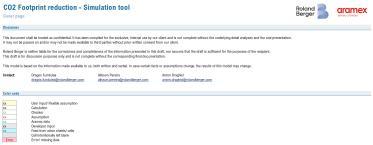
To quantify and manage ADNEC’s social impact, we developed a customizable Social Impact Calculation Tool
Tool provided to ADNEC
The tool identifies businessspecific social impact metrics, translates them into measurable indicators and quantifies social impact bottom-up, enabling consistent, data-driven assessment of ADNEC’s social value across business clusters & at Group level


Social impact calculation at Business Cluster level
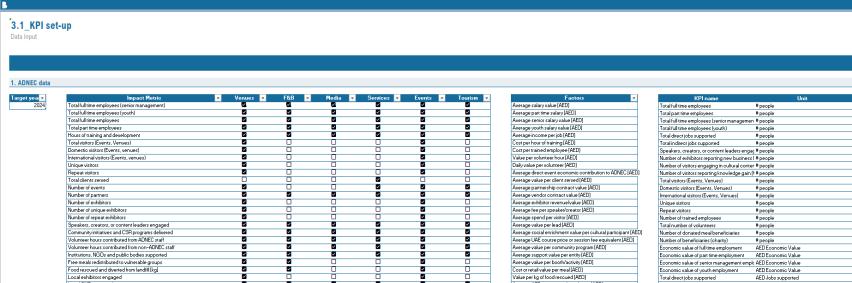
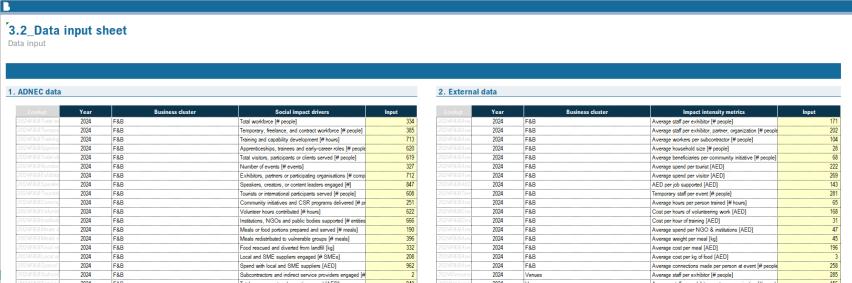
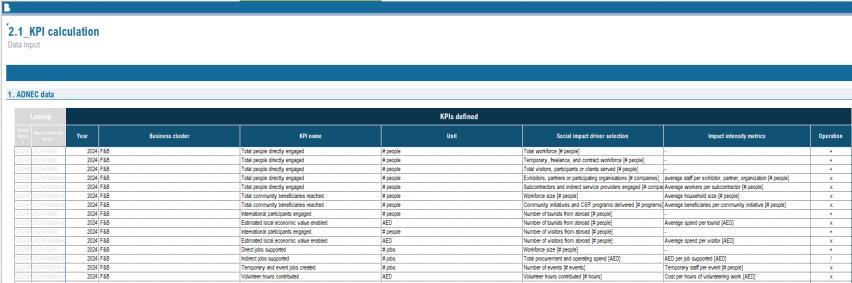
The tool’s key output is a comprehensive ADNEC social impact profile, enabling management to:
• Understand how each business cluster contributes to social value
• Track social impact across employment, inclusion, community and wellbeing
• Compare performance across clusters and over time
• Support ESG reporting, stakeholder communication and strategic prioritization
In addition, we created a simplified version (i.e., a 1-pager calculation document) to facilitate a lower-complexity alternative
First, we reviewed relevant, internationally recognized social impact methodologies to understand available calculation, measurement & valuation approaches
B Impact Assessment (formerly B Rating System) Rating system
Balanced Scorecard (Impact-modified) Management framework
CHAT (Charity Analysis Tool)
Assessment process
Compass Assessment for Investors Impact strategy framework
Dalberg Approach – Theory of Change Impact strategy framework
DOTS (Development Outcome Tracking System) Outcome tracking system
Ecological Footprint Environmental metric
EPRS (Environmental Performance Reporting System)
Reporting system
Fair Trade Certification Certification
HIP (Human Impact + Profit Framework) Rating system
LEED Certification Certification
Uses standardized evaluation to measure a company’s positive social and environmental impact across governance, workers, community and environment
Defines a framework for managing strategy and linking/measuring social performance topics by embedding them across stakeholder outcomes, responsible operations, organizational capacity and stewardship
Assesses Results, Risks and Capacity ratings, combining qualitative analysis and 1–5 quantitative scores to evaluate the scale, depth and systemic change of impact, alongside organizational factors
Measures organizational impact through a point-based assessment across Nature, Society, Economy, Wellbeing and Synergy, using defined indicators to capture impacts & interconnections
Measures social impact by showing how a project’s activities lead to real social outcomes and then compares those results to a baseline to demonstrate the added value beyond traditional performance
Tracks development and social outcomes over time at project or program level using structured indicators
Measures impact by calculating how much biologically productive land and resources are needed to support a population or product, capturing resource use and waste generation relative to nature’s capacity
Measures impact by establishing portfolio-specific indicators and baselines, then tracking and comparing company performance against a base case to quantify net environmental (and related) benefits
Provides certifications grounded on compliance with social and labor standards in specific supply chains based on binary compliance audit rather than quantified impact scoring
Calculates impact by scoring and ranking investments on a 0–100 scale based on 5 categories (health, wealth, earth, equality & trust) and mgmt. practices to rate human impact, profit and mgmt. practices
Uses a point based certification system for buildings focusing on environmental/health standards; awards surplus points to projects demonstrating fair labor & social equity standards in their supply chain practices
First, we reviewed relevant, internationally recognized social impact methodologies to understand available calculation, measurement & valuation approaches
Methodology / approach Type
Movement Above the $1 a Day Threshold
Pulse Impact Investing Management Software (formerly PDMS (Portfolio Data Mgmt System))
Poverty Probability Index (formerly PPI (Progress out of Poverty Index))
Outcome tracking system
Brief description / overview
Tracks whether microfinance clients move out of extreme poverty, using surveys, poverty scorecards and expert validation to monitor income changes over time against the US$1/day threshold
Outcome tracking system Tracked and benchmarked social impact metrics with financial & operational data, combining quantitative indicators with qualitative reporting to compare performance against peers at portfolio and sector level
Poverty estimation tool
PROI (Political Return on Investment) Rating system
RISE / OASIS
SIA (Social Impact Assessment)
Social Rating Systems
Outcome tracking system
Assessment process
Rating systems
Uses a 10-question poverty score to estimate the likelihood that individuals or households live below the poverty line, enabling orgs. to identify and track poverty levels within their client or workforce populations
Collects standardized resource and outcome data through questionnaires, then scores & ranks orgs. against peers using core and sector-specific metrics to assess relative social performance and effectiveness
Tracks individual outcomes over time through regular interviews with program participants, using standardized questions on employment, income and housing to assess changes from baseline
Uses theory of change to define intended outcomes, then tracking a small set of key indicators linked to business activities and, possibly, monetizing those outcomes to estimate the long-term social value created
Combines and analyzes document reviews, management and client interviews, field surveys and poverty assessments to produce a standardized social rating with quantitative analysis and qualitative insights
Social Value Metrics Outcome tracking system Integrates standardized social, economic and environmental indicators into the loan application process, then tracking changes in these indicators annually through data analysis and site visits
SROI (Social Return on Investment) (all variants) Outcome tracking system (SROI variants) measure social impact by screening and tracking standardized social outputs and workforce outcomes across portfolios, aggregating results and monetizing them through SROI methods to link investment performance, operational data and social value creation in a comparable, decision-useful way
TruCost Assessment process
Measures impact by quantifying direct and supply-chain environmental impacts using modeled and company data, translating resource use and emissions into efficiency metrics and external cost estimates
To identify best-practice social impact calculation methodologies, approaches were compared based on the breadth of coverage, quantification and reliability
Extent to which the methodology covers relevant social topics and stakeholder groups
Narrow focus (e.g. single issue such as poverty or jobs only)
Degree to which the approach captures outputs, outcomes and longer-term / systemic change.
Ability to produce comparable, decision-ready scores or metrics
Ability to compare across peers, sectors, or portfolios
Organization-specific, not comparable Outputs only (activities, counts)
Narrative or qualitative only
Covers multiple social themes but limited stakeholder groups
Outcomes (short- to mediumterm change)
Mixed qualitative and quantitative indicators
Comparable within a sector or portfolio
Extent to which results can be validated and audited for accuracy and credibility
Self-reported, no external verification
Off-site verification, document review, spot checks
Comprehensive coverage across stakeholders & social themes
Outcomes plus causality, counterfactuals, or systemic change
Clear scoring, ratings, or monetized outputs (e.g. SROI, point scales)
Standardized scores enabling cross-sector or peer comparison
On-site audits, third-party certification, statistical sampling
Then we assessed the selected methodologies against the criteria and extracted key learnings to consider for
Use standardized scoring that measures across governance, workers, community and ensure potential for third-party verification
Embed social KPIs into strategy, operations and performance management dashboards
Track society, well-being, environment and economy & show synergies between the
Build a Theory of Change and benchmark actual outcomes against counterfactuals/status-quo scenario
Use structured indicators with strong auditability for reporting and comparability
Then we assessed the selected methodologies against the criteria and extracted key learnings to consider for
The social impact methodology assessment informs a tailored, practical approach that suggests outcome-focused social impact methodology

• Outcome-focused, bottom-up approaches are stronger because they clearly show impact and can be aggregated, but they require well-designed indicators
• High-scoring tools/methodologies are robust and comprehensive, but they differ in how practical, scalable and easy they are to implement in practice
• A tailored, hybrid approach is needed to balance impact measurement quality with operational feasibility

• Focus on outcomes rather than activities, capturing the real social impact of ADNEC’s operations and events
• Measure impact bottom-up at venue and business-cluster level and aggregate consistently to the ADNEC Group
• Ensure results are comparable and auditable, allowing for third-party verification (e.g. for certifications)
• Design a practical, repeatable approach based on available data and clear ownership across ADNEC entities
This assessment confirms that ADNEC needs a tailored, hybrid social impact methodology that balances reliability and rigor with practicality and combines clear impact logic, measurable KPIs and disciplined aggregation
Based on the assessment of relevant calculation methodologies, we developed a systematic 5-step approach to quantify ADNEC’s social impact
5 4 3 2 1
Define social impact logic by business cluster
• Identify how each ADNEC business cluster creates social outcomes, based on its operating model and sphere of influence
• Clear definition of intended social outcomes, not activities
• Identification of who experiences the impact (visitors, employees, creatives, communities, SMEs)
• Distinction between direct impacts and enabled impacts
• Consideration of positive impact and potential risks (e.g. safety, accessibility)
Translate impact metric into measurable indicators
• Convert each impact metric into a limited, outcome-oriented set of measurable KPIs
Define social multiplication factors
social impact KPIs
• Define standardized factors that express the average social outcome generated per unit of activity
• Outcome-oriented indicators (people reached, jobs enabled, access provided) Indicators reflecting scale, reach, and intensity of impact
• Consistency across clusters where possible, flexibility where needed
• Practical data availability and ownership
• Metrics such as spend per visitor, participants per event, jobs supported per unit of spend, beneficiaries per initiative
• Separation between operational activity data and multiplication factors
• Use of internal data where available, complemented by benchmarks where needed
• Transparent, documented, and adjustable parameters
• Define the social impact KPIs that result from applying multiplication factors to the corresponding impact metrics
• KPI logic defined as impact metric × factor
• KPIs covering key social impact themes relevant for ADNEC (e.g. people impacted, jobs supported, skills developed, local economic value enabled)
• Clear aggregation rules & no double counting
• KPI structure suitable for internal mgmt. and external reporting
Social impact logic and metrics by business cluster
KPI catalogue by business cluster, with clear definitions
Set of standalone social multiplication factors
Defined set of quantified social impact KPIs
• Operationalize the methodology into a repeatable, auditable Excelbased tool
• Clear separation of inputs (impact metrics), parameters (multiplication factors), and outputs (KPIs)
• Bottom-up calculation logic with cluster-level granularity and Group-level aggregation
• Flexibility to update assumptions, add KPIs, and evolve scope over time
• Visual dashboards to facilitate internal reporting Tool creation and social impact calculation
Annual, repeatable ADNEC Social Impact Calculation Tool
F&B delivers social impact through employment, skills development, food safety, local sourcing, and targeted food access initiatives for vulnerable populations
Number of meals served
F&B workforce size and composition
Scale of service to people
Employment and skills in hospitality
Training
Human capital development
Local and SME suppliers
Economic inclusion through procurement
Food safety and hygiene practices
Food redistribution initiatives
Direct impact on consumer wellbeing
Social food access programs
Improved food access for vulnerable populations
Total meals served; meals served per event
Total F&B employees; % local workforce; % permanent vs temporary
Training hours; trained employees; certification completion rate
% spend with local suppliers; % spend with SMEs; number of SME suppliers
Food safety incidents; % staff food safety certified; audit compliance rate
Intentional extension of social value beyond operations
Meals donated; beneficiaries reached; charity/NGO partners engaged
Events with redistribution program; frequency of donations (per year)
Venues generate social impact by enabling large-scale participation, employment, inclusion & community access via safe, accessible civic infrastructure
Volume of visitors hosted
Number and type of events hosted
On-site workforce
Subcontractors and service providers
Physical accessibility of space
Educational events
Community access initiatives
Accessibility enhancement initiatives
Venues create impact by enabling large numbers of people to gather, interact, and access events
Different event types generate different social value (commercial, cultural, community, educational)
Direct employment and job quality at venues
Significant indirect employment (security, cleaning, logistics, AV)
Inclusion is driven by how accessible the infrastructure is
Knowledge sharing & learning opportunities
Total annual visitors; average visitors per event
Total events hosted; share of events by type
Total on-site employees (FTE); % permanent vs temporary; training hours per FTE
Subcontractor workers engaged; subcontractor spend; contractor days worked
% accessible sqm; number of accessibility features; staff trained in inclusion
Number of events, number of participants, educational materials published
Venues act as civic infrastructure enabling access for local communities
Inclusion impact increases through continuous improvements beyond baseline compliance
Community events hosted; venue days donated or subsidized; community beneficiaries reached
New accessibility features introduced; inclusion training coverage (%)
Media generates social impact by enabling a creative ecosystem, supporting SMEs &jobs, building local talent, and promoting inclusive creative participation
Size of creative ecosystem
Number of active companies and SMEs
Creative professionals and freelancers
Productions supported
Access to infrastructure (studios, facilities)
Training and talent development
Local / Emirati participation
Youth / underrepresented groups
Social impact comes from enabling a creative community
Economic inclusion and entrepreneurship
Jobs enabled, not audiences reached
Cultural output and global visibility
Democratization of production capabilities
Active community members; occupancy / memberships
Resident companies; SMEs supported; new companies onboarded
Creative jobs enabled; freelancers engaged (unique)
Productions supported; production days hosted
Studio days utilized; facility utilization rate (%)
Long-term capability building
National creative sector development
Inclusive access to the creative economy
Creatives trained; training hours; program completion rate
% Emirati creatives; Emirati-led productions; Emirati beneficiaries (count)
Participants from targeted groups; scholarships/grants awarded
Services contribute social impact via operational employment, contractor inclusion, public-value services, workforce
wellbeing & selective pro bono initiatives
Size of service workforce
Employment creation in operational roles
Use of contractors and SMEs
Nature of services provided
Indirect employment and local economic impact
Some services (protocol, government support) have public value
Total service employees; contractor headcount; training hours per FTE
% spend with contractors; % spend with SMEs; number of SME contractors
Government/protocol engagements (count); high-level delegations supported
Health and safety exposure
Pro bono / public value services
Worker wellbeing in physically intensive roles
Direct support to public institutions and NGOs
LTIFR; safety incidents; safety training hours; compliance checks completed
Workforce inclusion initiatives
Inclusion beyond standard hiring
Pro bono/subsidized engagements; institutions supported; beneficiary institutions (count)
Participants from targeted groups; placements or internships (count)
Events create social value by convening diverse stakeholders, enabling intercultural exchange, temporary employment, and targeted community initiatives
Delegates, exhibitors, speakers
Social value is driven by convening people and organizations
Total delegates; total exhibitors; total speakers
International vs local participation
Intercultural exchange and knowledge transfer
Event workforce and contractors
Temporary and project-based employment
Educational events
Knowledge sharing & learning opportunities
Public and CSR-oriented events
Inclusion-focused programming
Direct community benefit beyond commercial value
% international participants; number of countries represented
Temporary event workers; contractor days worked; % local workforce
Number of events, number of participants, educational materials published
Number of public / CSR events; beneficiaries reached; volunteer hours
Events can serve youth, education, or inclusion agendas
Events with youth/education focus; events with inclusion theme (count)
Tourism creates social value by enabling cultural exchange, local employment, community partnerships and inclusive tourism offerings
Number of tourists served
Origin of visitors
Tourism workforce and guides
Core driver of cultural and social exchange Tourists served; packages sold
Depth of intercultural interaction
Local employment and skills
Engagement with local partners
Visitor experience and safety
Community-based tourism initiatives
Whether tourism benefits communities or bypasses them
Wellbeing and reputation of destination
Shared value creation with local communities
% international tourists; number of source countries
Tourism employees; local guides employed; training hours
Local partners engaged; % spend with local partners; local SME partners (count)
Visitor satisfaction score; safety incidents; complaints resolved (%)
Accessible tourism initiatives
Tourism-for-all and inclusion
Community partners engaged; community beneficiaries reached; community revenue supported
Accessible packages offered; tourists served through inclusive offerings
Multiplication factors express the average social outcome generated per unit of activity, translating operational scale into measurable social impact
• Standardized metrics that describe the typical level of social impact per unit of activity (e.g., people, spend, time, or resources)
• They sit between operational data and final KPIs, acting as the translation mechanism from activity to outcome
• Defined using internal ADNEC data where available, complemented by external benchmarks or conservative assumptions where needed
• Documented with clear units, sources, and update rules to ensure transparency, consistency, and auditability
• Applied by multiplying the relevant impact metric by the corresponding impact intensity metric to calculate social impact KPIs
• Designed to be adjustable over time, enabling refinement as data quality improves or scope evolves.
Note: in some cases, the use of factors is not required – Some impact metrics may be considered social impact KPIs as standalone (e.g., total number of attendees to conferences)
Multiplication factors
Average salary value [AED]
Cost per hour of training [AED]
Value per volunteer hour [AED]
Average value per client served [AED]
Average exhibitor revenue/value [AED]
Average spend per visitor [AED]
Average value per lead [AED]
Average value per community program [AED]
Cost or retail value per meal [AED]
Average AED support per beneficiary [AED]
Leads per reporting exhibitor [# leads]
Average interactions per cultural visitor [#]
Average number of new contacts exchanged per visitor [# connections]
Average number of meetings or leads per exhibitor [# connections]
Average value per business lead [AED]
Average number of visitors per CSR event [# people]
Average value of business support from exposure [AED]
Average exhibitor revenue/value [AED]
Average income per job [AED]
Average value per booth/activity [AED]
Social impact KPIs quantify ADNEC’s social outcomes by combining activity data and factors into clear, decisionrelevant results
• Quantified measures of social outcomes achieved, such as people impacted, jobs supported, economic value enabled, or wellbeing outcomes delivered
• They represent the final outputs of the social impact calculation, not inputs or assumptions
• Defined as the result of impact metrics multiplied by factors, with clear units (e.g., people, jobs, AED, meals etc.)
• Structured around key social impact themes relevant for ADNEC, ensuring consistency across business clusters
• Calculated bottom-up at business-cluster level and aggregated to a Group-level social impact view
• Used for management decision-making, ESG reporting, and external communication, with transparent logic and no double counting.
Social impact KPIs
Total employees
Total visitors
Number of exhibitors reporting new business leads [# people]
Number of visitors engaging in cultural content [# people]
Number of trained employees
Number of donated meal beneficiaries
Economic value of full time employment
Total direct jobs supported
Total indirect jobs supported
Economic value of training investment
Value of volunteering contribution from ADNEC staff
Economic value from partners engaged
Economic value of local procurement spend
Economic value of SME procurement spend
Value of new business leads generated
Monetary donations
Value of discounts provided
Total knowledge gain participation
Exhibitor-buyer connections facilitated
Total food rescued and diverted from landfill
The calculation process follows three steps: data collection & processing, input of factors, and the final social impact computation
Social impact metrics Impact intensity metrics ADNEC’s social impact
• Operational data reflecting the scale of ADNEC’s activities across business clusters, including people served, events and productions delivered, workforce engaged, services provided, and community initiatives undertaken
• These metrics represent the fundamental sources through which social impact is generated.
• Standardized metrics expressing the average social outcome per unit of activity, such as participants per event, spend per visitor, jobs supported per unit of spend, or beneficiaries per initiative
• These metrics translate operational scale into measurable social outcomes.
• Quantified social outcomes resulting from the application of multiplication factors to ADNEC’s activity data, capturing people impacted, jobs supported, skills developed, economic value enabled, and community and wellbeing outcomes at cluster and Group level
The tool is designed to flexibly adapt to ADNEC’s evolving business structure, KPIs, and time horizons while keeping calculations fully automated
The tool produces, a single, consolidated, pivot-ready output table with automated calculations; Manual processing is minimized: users only configure KPIs and upload data, while all calculations and aggregations run automatically in the background
Users first define the calculation scope, including the number of years to be assessed and the number of business clusters, which can be expanded or reduced as ADNEC evolves; Users then select the relevant social impact metrics and multiplication factors, all of which are maintained in expandable, centrally managed lists
KPIs are configured through a simple setup table; For each KPI, the user defines the name and unit, selects the relevant social impact metric from a dropdown, selects the relevant multiplication factor from a second dropdown, and defines the mathematical relationship between them – This can be multiplication (e.g., visitors × spend per visitor), addition etc., allowing standalone metrics to be included without forcing artificial assumptions
Once KPIs are defined, the input sheet automatically generates a standardized, pivotable data structure; Each year, business cluster, and metric combination is created dynamically (e.g. Year 1 – Cluster A – Metric 1). Adding years or clusters automatically expands the structure, enabling seamless bottom-up calculation and aggregation without manual restructuring
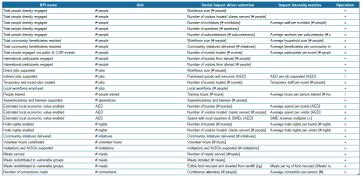
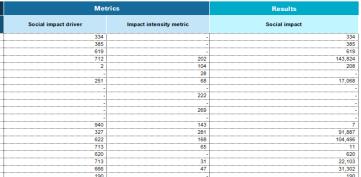
Following the development of the flexible social impact calculation tool, we have also created a simplified alternative
ADNEC addresses most ESG social dimensions, with targeted opportunities for further improvement in select topics
Career development and future skills
Human rights and fair treatment of workers
Culture and heritage
Data privacy and cybersecurity in the value chain
Diversity, equity & inclusion
Healthy and safe working environment
Responsible use of data and AI
Working conditions and employment quality
Social impact of external advisors Working conditions, equal treatment & rights of external advisors
Local socio-economic development
Localization and local content in the value chain
Responsible use of data and AI
Social impact of external advisors
Responsible communication and stakeholder relations
Responsible marketing and stakeholder relations
Responsible use of data and AI
Sub-topics that are not covered by ADNEC are mainly concentrated in the value chain/ external advisor rights, responsible tech. & AI use and community impact
Own workforce
Healthy and safe working environment
• Child labor
• Forced labor
• Secure employment
Workers in the value chain
Human rights and fair treatment of workers (vulnerable workers)
• Diversity
• Employment and inclusion of persons with disabilities
• Measures against violence and harassment in the workplace
• Privacy
• Secure employment
• Working time
Social impact of external advisors
• Responsible disengagement from suppliers
Working conditions, equal treatment & rights of external advisors
• Diversity
• Employment and inclusion of persons with disabilities
• Measures against violence and harassment in the workplace
• Privacy
• Secure employment
• Working time
Potential topic area for ADNEC to develop Sub-topics not covered
Local socio-economic development
• Access to basic products and services (food, water, sanitation, energy, housing, transport)
• Grievance mechanisms (Freedom of expression)
• Land use and community rights (landrelated impacts)
Responsible use of data and AI
• Responsible AI use by external advisors
Social impact of external advisors
• Social impact of external advisors
Data privacy and cybersecurity in the value chain
• Data privacy and cybersecurity in the value chain
Responsible communication and stakeholder relations
• Protection of children
Most gaps can be addressed by extending workforce policies to the value chain, external advisors and communities through clear standards and contracts
Healthy and safe working environment
Human rights and fair treatment of workers (vulnerable workers)
Social impact of external advisors
Working conditions, equal treatment & rights of external advisors
Local socio-economic development
Responsible use of data and AI
Data privacy and cyber security in the value chain
Responsible communication and stakeholder relations
• Formalize a Human Rights & Labor Standards Policy
• Introduce secure employment terms and benefits and include them in the ESG report
• Expand Supplier Code of Conduct to explicitly cover vulnerable workers1)
• Enable grievance access for value-chain workers, including anonymous reporting channels
• Extend access to grievance mechanisms to external advisors and affected third parties
• Require declarations or evidence of compliance with labor and human-rights standards
• Assess community impact of activities and recommendations
• Define “external advisors” as a distinct stakeholder group within the social policy
• Embed minimum social, labor, ethics, data-privacy and AI-use standards in advisory contracts
• Establish policies on maximum working hours and forced overtime
• Apply responsible engagement and disengagement protocols
• Establish a community engagement and grievance channels; train staff on handling grievance
• Partner with local entities (NGOs, municipalities) to support access to services and community benefits
• Extend responsible data & AI principles to third parties handling community or attendee data
• Introduce AI and data-use safeguards in vendor contracts, incl. transparency, consent and misuse prevention
• Implement data processing agreements with external advisors
• Expand data-privacy requirements to suppliers and partners, including minimum cybersecurity standards
• Conduct regular cybersecurity audits of value chain partners
• Introduce child-protection principles across events, marketing and digital platforms
• Train staff and partners on maintaining child safeguarding, health and safety standards at venues and events
Potential topic area for ADNEC to develop
1) Includes supply chain workers such as migrant, temporary or low-wage workers

To identify gaps, we conducted a benchmarking exercise – Peers with the broadest social topic coverage in their materiality assessments were shortlisted










1) For clusters with at least two benchmarks; whereas clusters with only one company were included as is

• Concentrated coverage on value-chain workforce particularly human rights and external advisors’ working conditions
• Limited depth on own-workforce development, notably skills development and data & AI responsibilities
• Strong and well-rounded focus on own workforce, especially working conditions, DE&I and skills
• Relatively lighter emphasis on affected communities, including cultural impact and external advisor social impacts
• Balanced coverage across own workforce and consumers/end-users, with emphasis on working conditions and stakeholder relations





• Less developed recognition of value-chain worker rights beyond direct employment
• Clear emphasis on affected communities notably local socio-economic development and localization
• Limited treatment of value-chain labor topics, including external advisors’ conditions
• Deep coverage of value-chain workers, external advisors and own workforce
• Less emphasis on consumer-facing topics including responsible marketing and data & AI impacts
• Strong positioning on consumers/end-users and community-related topics, especially access to information and safety
• Thinner coverage of value-chain workforce issues, particularly external advisor rights and conditions
• Most comprehensive peer, advanced focus on value-chain human rights and working conditions
• Lower relative emphasis on community-level themes including culture, heritage and local development
• Solid baseline across own workforce and value-chain labor fundamentals, aligned with peer norms
• Potential to further expand coverage of communities/consumer impacts (responsible marketing and data/AI implications) and value chain (hiring, hours)
• Overall, ADNEC has a very strong foundation of social frameworks, especially for directly employed or value chain stakeholders, in line with top peers
• Going forward, focusing on community and cultural impact will enhance ADNEC’s overall social impact
• In parallel, strengthening value chain coverage through clearer labor standards, grievance mechanisms and contractor disengagement would improve accountability and alignment with best practices





Key social impact topics were reviewed across benchmarked peers and ADNEC’s ESG reports to identify coverage gaps
Affected stakeholders
Workers in the value chain
Workers in the value chain
Workers in the value chain
Workers in the value chain
Workers in the value chain
Workers in the value chain
Workers in the value chain
Working conditions, equal treatment and rights of external advisors
Working conditions, equal treatment and rights of external advisors
Working conditions, equal treatment and rights of external advisors
Working conditions, equal treatment and rights of external advisors
Working conditions, equal treatment and rights of external advisors
Working conditions, equal treatment and rights of external advisors
Working conditions, equal treatment and rights of external advisors
Other work-related rights
Other work-related rights Water and sanitation (external advisors)
Working conditions Adequate wages (external advisors)
Working conditions
Occupational Health and safety (external advisors)
Working conditions Secure employment (external advisors)
Working conditions Workers voice, engagement & representation mechanisms (external advisors)
Working conditions Working time (external advisors)
Affected communities Culture and heritage Rights of local communities Culture and heritage
Affected communities Local socio-economic development Communities civil rights
Affected communities
Local socio-economic development Communities economic, social and cultural rights
Grievance mechanisms (Freedom of expression)
Access to basic products and services (food,water, sanitation, energy,housing,transport)
Topic present in benchmark’s ESG strategy document Topic not present in ADNEC’s ESG report
Key social impact topics were reviewed across benchmarked peers and ADNEC’s ESG reports to identify coverage gaps
Affected stakeholders
Affected communities
Affected communities
Affected communities
Affected communities
Affected communities
Affected communities
Affected communities
Affected communities
Affected communities
Local socio-economic development Communities economic, social and cultural rights
Local socio-economic development Communities economic, social and cultural rights
Local socio-economic development Communities economic, social and cultural rights
Local socio-economic development Communities economic, social and cultural rights
Local socio-economic development Communities economic, social and cultural rights
Localization and local content in the value chain
Localization and local content in the value chain
Responsible use of data and AI
Responsible use of data and AI
Affected communities Responsible use of data and AI
Localization and local content in the value chain
Localization and local content in the value chain
Other work-related rights
Other work-related rights
Other work-related rights
Access to education and skills development
Access to healthcare
Access to Sports and Physical Activity
Community safety and human security (securityrelated impacts)
Land use and community rights (land-related impacts)
Localization and local content in the value chain (downstream)
Localization and local content in the value chain (upstream)
Data privacy and cybersecurity in the value chain
Responsible AI use
Responsible AI use by external advisors
Key social impact topics were reviewed across benchmarked peers and ADNEC’s ESG reports to identify coverage gaps
Affected communities
Consumers and end-users
Consumers and end-users
Consumers and end-users
Consumers and end-users
Consumers and end-users
Consumers and end-users
Consumers and end-users
Consumers and end-users
Affected stakeholders Topic
Social impact of external advisors
Data privacy and cybersecurity in the value chain
Responsible communication and stakeholder relations
Responsible communication and stakeholder relations
Responsible communication and stakeholder relations
Responsible communication and stakeholder relations
Responsible communication and stakeholder relations
Responsible marketing and stakeholder relations
Responsible use of data and AI
Data privacy and cybersecurity in the value chain
Information-related impacts for consumers /end-users
Personal safety of consumers/end-users
Personal safety of consumers/end-users
Social inclusion of consumers/end-users
Social inclusion of consumers/end-users
Information-related impacts for consumers/end-users
Information-related impacts for consumers/end-users
Social impact of external advisors
Data privacy and cybersecurity in the value chain
Access to quality information
Health & safety
Protection of children
Digital accessibility
Responsible marketing practices
Freedom of expression
Privacy
Overall, ADNEC has strong social topic coverage, with further opportunity to enhance consistency across value chain, tech. and community topics

ADNEC’s ESG report demonstrates strong coverage across social topics and stakeholder groups; however, the depth and consistency of policies vary across ADNEC, ExCeL London and BDC (e.g. employment & inclusion of persons with disabilities are only present in Excel London and BDC)
Among the benchmarked companies, TUI and GL Events demonstrate the strongest social reporting, reflecting best practices through comprehensive approaches that address both affected stakeholders across core topics 1 2 3
Sub-topics not currently covered by ADNEC are in three areas: value-chain and external advisor rights; responsible use of technology and AI, including data governance and ethical AI use, and community impacts (e.g. civil grievance mechanisms)
We applied a structured three-step approach to deliver a social impact policy draft, a potential governance set-up and a communication framework
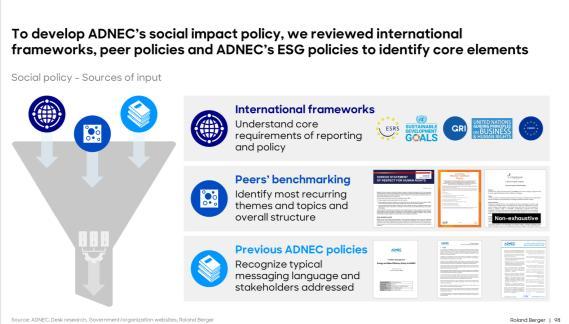
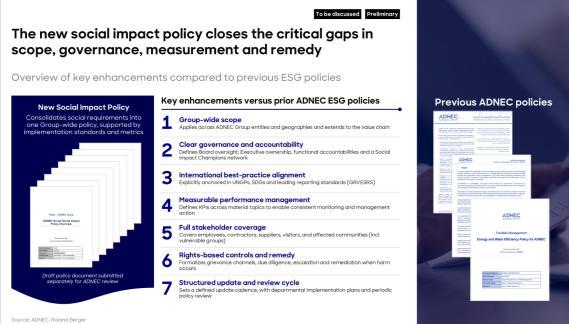
Reviewed int’l frameworks, peer benchmarks and existing ADNEC policies to identify core topics and draft the social impact policy
Governance definition
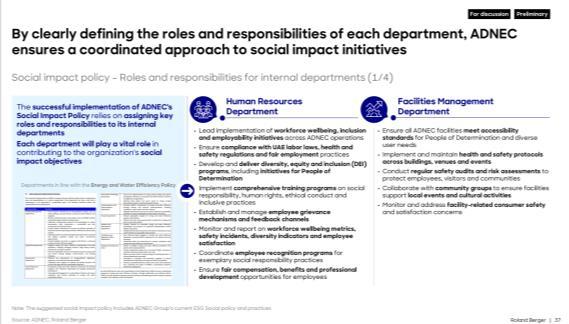
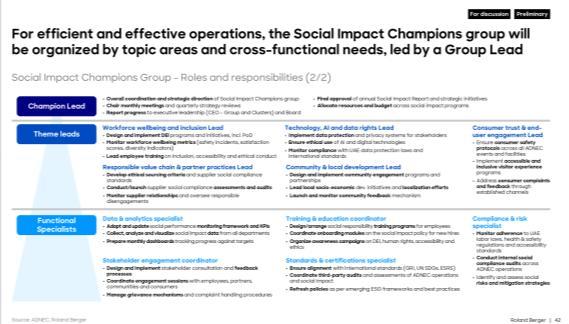
Translated strategy actions into departmental plans and designed a Social Impact Champions Group Communication framework
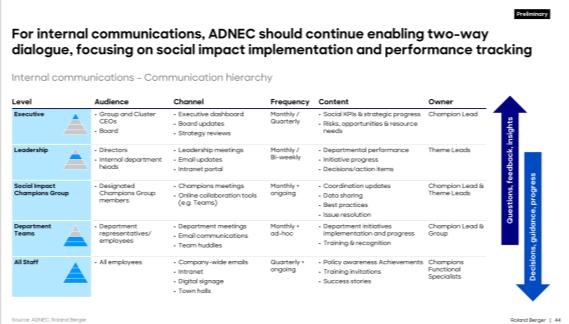
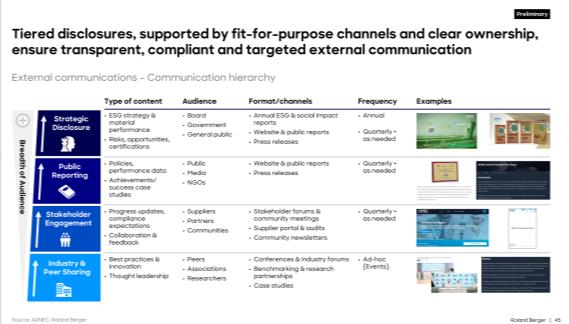
Reviewed communication channels and defined protocols and timelines for rolling out social impact messaging
We applied a structured three-step approach to deliver a social impact policy draft, a potential governance set-up and a communication framework
1 3
2 Social policy draft Governance definition Communication framework
Reviewed int’l frameworks, peer benchmarks and existing ADNEC policies to identify core topics and draft the social impact policy
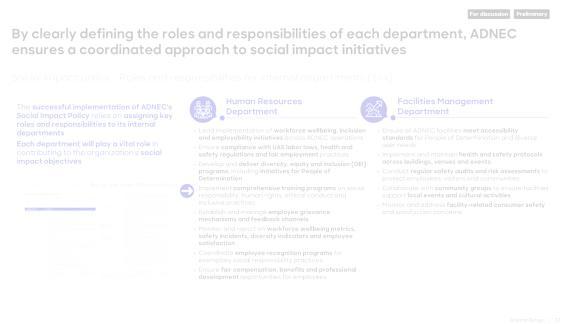
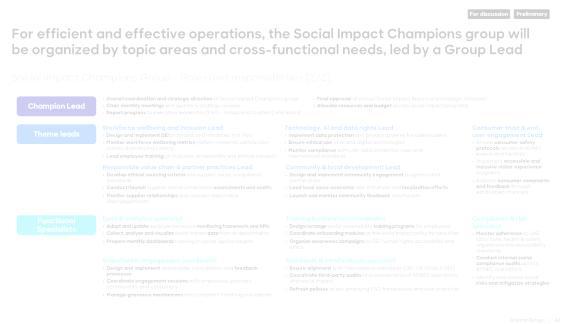
Translated strategy actions into departmental plans and designed a Social Impact Champions Group
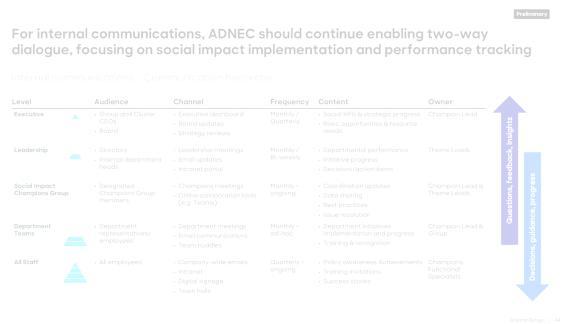
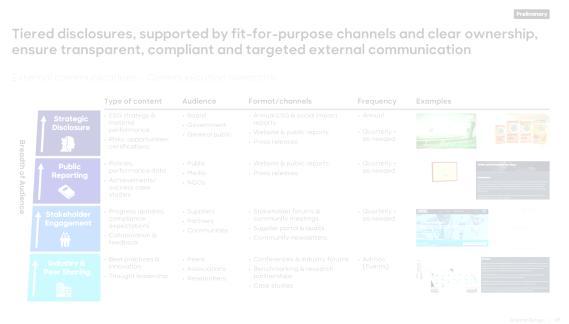
Reviewed communication channels and defined protocols and timelines for rolling out social impact messaging
To develop ADNEC’s social impact policy, we reviewed international frameworks, peer policies and ADNEC’s ESG policies to identify core elements
International frameworks
Understand core requirements of reporting and policy

benchmarking
ADNEC policies
Recognize typical messaging language and stakeholders addressed
Identify most recurring themes and topics and overall structure Non-exhaustive
Key
• Built on UNGPs’ Respect–Protect–Remedy framework: commitment, due diligence, and access to remedy
• Focuses on salient human rights risks (e.g. forced labor, child labor, unsafe work, discrimination) as non-negotiables
• Extends responsibility beyond direct employees to contractors, suppliers, and event partners
• Embeds required processes: due diligence, KPIs, reporting, and remediation
• Clear, concise, non-legalistic structure that is usable by operations and business teams
• Explicit commitments for worker welfare in a GCC / events context (migrant workers, recruitment fees, accommodation)
• Health & safety elevated as a standalone, visible pillar with strong governance
• Strong zero-tolerance statements on abuse, harassment, forced and child labor
• Responsible supply chain framed as both enforcement and supplier capability-building
• Community impact positioned as strategic value creation, not philanthropy
ADNEC ESG policies
• Tailored to event-venue operations with multiple contractors and high safety exposure
• Builds on ADNEC’s existing ESG governance structure (Board, management, functions)
• Reflects UAE priorities (Emiratization, local suppliers, community development)
• Highlights ADNEC’s KPI-led culture with measurable targets and dashboards
• Formalizes multi-stakeholder engagement through structured forums and steering mechanisms
Accordingly, we have defined and developed the core policy sections to ensure ADNEC’s social policy is comprehensive, robust and aligned with best practices
Sets leadership accountability, scope, and alignment with international standards to ensure credibility and compliance
Defines ADNEC’s non-negotiable social standards for rights, safety, inclusion, and responsible valuechain and community impact
Establishes engagement, grievance, and due diligence processes to make commitments operational and prevent issues
Uses KPIs and public reporting to track performance, build trust, and enforce delivery
Assigns departmental ownership and ensures continuous updates so the policy stays effective and relevant
The new social impact policy closes the critical gaps in scope, governance, measurement and remedy
Consolidates social requirements into one Group-wide policy, supported by implementation standards and metrics
Draft policy document submitted separately for ADNEC review
Key enhancements versus prior ADNEC ESG policies
Group-wide scope
Applies across ADNEC Group entities and geographies and extends to the value chain
Clear governance and accountability
Defines Board oversight, Executive ownership, functional accountabilities and a Social Impact Champions network
International best-practice alignment
Explicitly anchored in UNGPs, SDGs and leading reporting standards (GRI/ESRS)
Measurable performance management
Defines KPIs across material topics to enable consistent monitoring and management action
Full stakeholder coverage
Covers employees, contractors, suppliers, visitors, and affected communities (incl. vulnerable groups)
Rights-based controls and remedy
Formalizes grievance channels, due diligence, escalation and remediation when harm occurs
Structured update and review cycle
Sets a defined update cadence, with departmental implementation plans and periodic policy review 1 2 3 4 5 6 7

We applied a structured three-step approach to deliver a social impact policy draft, a potential governance set-up and a communication framework
2 Social policy draft Governance definition Communication framework
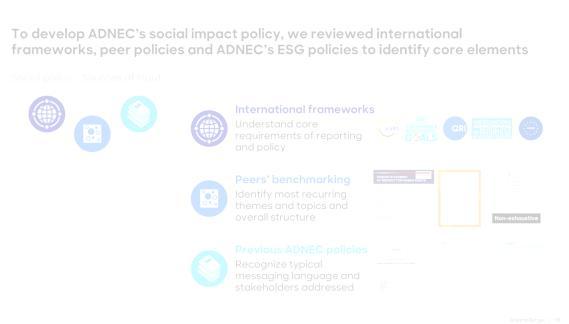
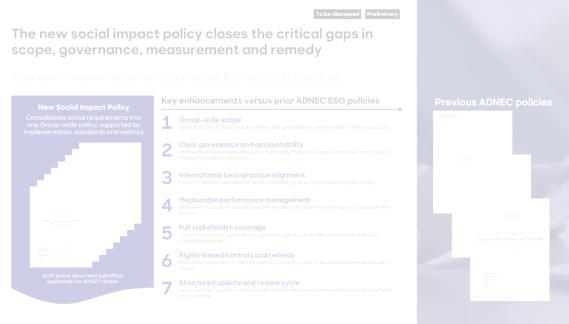
Reviewed int’l frameworks, peer benchmarks and existing ADNEC policies to identify core topics and draft the social impact policy
Translated strategy actions into departmental plans and designed a Social Impact Champions Group
3
Reviewed communication channels and defined protocols and timelines for rolling out social impact messaging
Based on peer KPI benchmarking and ADNEC’s material topics, we have developed a long list of success metrics to help track progress on Social topics
KPI1)
Well-Being Index score (composite)
Employee turnover rate
Average sickness absence per colleague (days)
% of eligible employees who took parental leave
% leave utilization rate
Overtime intensity
% of promotions awarded to women
% women in new hires
Average gender pay ratio
Emiratizations rate (% local employees)
# of Emiratis in senior management roles
Emirati retention rate (12month)
Measures avg. score across mental, physical, and financial well-being questions (survey-based)
Signals workplace culture, compensation, or engagement issues requiring attention.
Proxy for workforce health, well-being, and workload strain (non-injury related)
Demonstrates support for work-life balance and family-friendly workplace policies
Indicates healthy work-life balance practices and employee wellbeing
Measures workload peaks and work-life balance pressure, especially during event cycles
Indicates progression equity and strength of the female leadership pipeline
Tracks gender balance in recruitment and the future talent pipeline
Measures the average pay of women relative to men across comparable roles and levels
Tracks progress against nationalization objectives and local workforce participation
Indicates meaningful progression opportunities for local talent and leadership diversity
Reflects success in creating supportive career pathways for local talent
KPI1)
# of end-user interviews (or as a % of end-users)
# of unique visitors (engagement)
Net Promoter Score (NPS)
Total value of donations contributed
# of volunteering hours
# of beneficiaries (direct and indirect)
Total Recordable Incident Rate (TRIR) (e.g. per 200,000 hours)
Lost Time Injury Frequency Rate (LTIFR)
% of required safety training completed on time
Demonstrates commitment to understanding stakeholder needs and improving service quality
Measures reach, accessibility, and community engagement effectiveness
Indicates visitor experience quality and brand reputation strength
Quantifies community investment and contribution scale
Reflects active community engagement and employee participation in social impact initiatives
Measures the breadth and reach of social impact activities
Indicates safety performance for employees and contractors
Reflects the impact of injuries on workforce availability and recovery time
Measures safety training completion rate, targeting competence and compliance

1)
We determined targets for each KPI based on international best practices benchmarks and positioned ADNEC’s performance accordingly
Material topic
Well-Being Index score (composite)
Employee turnover rate
# of end-user interviews (or as a % of end-users)
# of unique visitors (engagement)
Average sickness absence per colleague (days) Net Promoter Score (NPS)
% of eligible employees who took parental leave
% leave utilization rate
Overtime intensity
% of promotions awarded to women
Total value of donations contributed
# of volunteering hours
# of beneficiaries (direct and indirect)
rate (% local employees)
# of Emiratis in senior management roles
Emirati retention rate (12month)
Target met Room for improvement New metric
By
The successful implementation of ADNEC's Social Impact Policy relies on assigning key roles and responsibilities to its internal departments
Each department will play a vital role in contributing to the organization's social impact objectives
• Lead implementation of workforce wellbeing, inclusion and employability initiatives across ADNEC operations
• Ensure compliance with UAE labor laws, health and safety regulations and fair employment practices
• Develop and deliver diversity, equity and inclusion (DEI) programs, including initiatives for People of Determination
• Implement comprehensive training programs on social responsibility, human rights, ethical conduct and inclusive practices
• Establish and manage employee grievance mechanisms and feedback channels
• Monitor and report on workforce wellbeing metrics, safety incidents, diversity indicators and employee satisfaction
• Coordinate employee recognition programs for exemplary social responsibility practices
• Ensure fair compensation, benefits and professional development opportunities for employees
• Ensure all ADNEC facilities meet accessibility standards for People of Determination and diverse user needs
• Implement and maintain health and safety protocols across buildings, venues and events
• Conduct regular safety audits and risk assessments to protect employees, visitors and communities
• Collaborate with community groups to ensure facilities support local events and cultural activities
• Monitor and address facility-related consumer safety and satisfaction concerns
By
• Ensure consumer safety and accessibility during ADNEC-hosted events and services
• Implement inclusive practices in event planning and visitor engagement
• Promote responsible practices among staff and visitors through signage, communication and operational protocols
• Monitor and respond to consumer feedback and satisfaction metrics
• Coordinate with security and emergency services to ensure visitor safety and wellbeing
• Prioritize suppliers and contractors who demonstrate commitment to human rights, fair labor practices and social responsibility
• Conduct social compliance assessments and audits of key suppliers and partners
• Collaborate with suppliers to advance shared social objectives and capacity building/host trainings
• Support local procurement and localization initiatives to benefit host communities
• Establish clear expectations and accountability mechanisms for partner conduct
• Monitor supplier adherence to ADNEC's social impact standards and take corrective action when necessary
• Establish clear triggers for disengagement with suppliers/partners (e.g., severe human-rights violations, repeated non-compliance…)
• Ensure supplier disengagements are risk-based, proportionate, documented and designed to prevent further harm, not simply to terminate contracts
• Implement and maintain robust data protection and privacy systems for workforce, partners, consumers and communities
• Ensure responsible and ethical use of digital technologies and AI systems
• Develop accessible digital platforms and communications for diverse user needs
• Monitor cybersecurity threats and protect stakeholder data from unauthorized access
• Establish transparent data governance protocols aligned with UAE data protection laws
By clearly defining the roles and responsibilities of each department, ADNEC can ensure a coordinated approach to deliver on social impact initiatives & metrics
• Promote ADNEC's commitment to social responsibility through internal and external communications
• Highlight achievements and success stories related to social impact initiatives
• Prepare and publish annual Social Impact Reports with transparent performance data
• Manage stakeholder engagement and consultation processes
• Ensure communications protect consumer rights and provide accurate, honest information
• Coordinate community outreach programs and awareness campaigns
• Allocate budgets for social impact initiatives, community programs and employee wellbeing
• Monitor and track cost savings and value generated from social investment and community partnerships
• Ensure transparent financial reporting related to social impact expenditures
• Support impact measurement and return on social investment analysis
• Allocate resources for training, certifications and capacity building in social responsibility
• Stay aligned with changes in UAE labor laws, health and safety regulations, human rights legislation and accessibility standards
• Ensure ADNEC's adherence to all relevant social compliance requirements and regulations
• Coordinate regular compliance audits and assessments related to workforce rights, data protection and consumer safety
• Implement corrective actions and remediation measures for identified non-compliance
• Maintain grievance mechanisms and complaint handling procedures aligned with regulatory requirements
• Represent ADNEC and liaise with government authorities on social responsibility matters
Note: The suggested social impact policy governance includes ADNEC Group’s
• Coordinate overall implementation of the Social Impact Policy across departments
• Monitor and report on social performance metrics aligned with GRI, SDGs and ISO 26000
• Conduct regular benchmarking against industry best practices and standards
• Pursue relevant social responsibility certifications2)
• Coordinate annual social impact assessments and thirdparty audits
• Identify opportunities for continuous improvement and innovation in social practices
• Collaborate with external research institutions and NGOs to stay at forefront of social responsibility advancements
• Adhere to ADNEC's Social Impact Policy guidelines and ethical conduct standards in daily work
• Practice inclusive behaviors and support diversity, equity and inclusion in the workplace
• Participate in social responsibility training and awareness programs
• Report concerns related to human rights, safety, discrimination or unethical conduct through established channels
• Contribute ideas and feedback for improving ADNEC's social impact performance
• Support community engagement initiatives and volunteer programs


Establishing an interdepartmental Social Impact Champions group will enable coordinated implementation
The Social Impact Champions will be a cross-functional team of initiative leaders responsible for driving the implementation, monitoring and continuous improvement of ADNEC's Social Impact Policy
Individual Performance:
• Achievement of role-specific targets and deliverables
• Quality and timeliness of reporting
• Stakeholder satisfaction scores (relevant to role)
• Attend monthly Champions meetings and quarterly strategy reviews
• Champion social impact initiatives within their respective departments
• Serve as visible role models demonstrating inclusive and responsible behaviors
• Share knowledge, best practices and lessons learned across the group
• Support cross-departmental collaboration on social initiatives
• Contribute to annual Social Impact Report preparation
• Participate in continuous improvement and innovation efforts
• Maintain confidentiality of sensitive stakeholder information Collective responsibilities
• Monthly Champions Meetings: Review progress, share updates, coordinate initiatives
• Quarterly Strategy Reviews: Assess performance against targets, strategic planning
• Annual Planning Sessions: Set objectives and priorities for upcoming year
• Ad-hoc Working Groups: Address specific initiatives or challenges as needed
• Cross-departmental collaboration effectiveness Collective Performance:
• Overall achievement of social impact targets across five themes
• Employee engagement and awareness scores
• Progress toward certifications and standards compliance
• Stakeholder feedback ratings
• External recognition and awards

For efficient and effective operations, the Social Impact Champions group will be organized by topic areas and crossfunctional needs, led by a Group Lead
• Overall coordination and strategic direction of Social Impact Champions group
• Chair monthly meetings and quarterly strategy reviews
• Report progress to executive leadership (CEO – Group and Clusters) and Board
Workforce wellbeing and inclusion Lead
• Design and implement DEI programs and initiatives, incl. PoD
• Monitor workforce wellbeing metrics (safety incidents, satisfaction scores, diversity indicators)
• Lead employee training on inclusion, accessibility and ethical conduct
Responsible value chain & partner practices Lead
• Develop ethical sourcing criteria and supplier social compliance standards
• Conduct/launch supplier social compliance assessments and audits
• Monitor supplier relationships and oversee responsible disengagements
Functional Specialists
Data & analytics specialist
• Adapt and update social performance monitoring framework and KPIs
• Collect, analyze and visualize social impact data from all departments
• Prepare monthly dashboards tracking progress against targets
Stakeholder engagement coordinator
• Design and implement stakeholder consultation and feedback processes
• Coordinate engagement sessions with employees, partners, communities and consumers
• Manage grievance mechanisms and complaint handling procedures
• Final approval of annual Social Impact Report and strategic initiatives
• Allocate resources and budget across social impact programs
Technology, AI and data rights Lead
• Implement data protection and privacy systems for stakeholders
• Ensure ethical use of AI and digital technologies
• Monitor compliance with UAE data protection laws and international standards
Community & local development Lead
• Design and implement community engagement programs and partnerships
• Lead local socio-economic dev. initiatives and localization efforts
• Launch and monitor community feedback mechanism
Consumer trust & enduser engagement Lead
• Ensure consumer safety protocols across ADNEC events and facilities
• Implement accessible and inclusive visitor experience programs
• Address consumer complaints and feedback through established channels
Training & education coordinator
• Design/arrange social responsibility training programs for employees
• Coordinate onboarding modules on the social impact policy for new hires
• Organize awareness campaigns on DEI, human rights, accessibility and ethics
Standards & certifications specialist
• Ensure alignment with international standards (GRI, UN SDGs, ESRS)
• Coordinate third-party audits and assessments of ADNEC operations and social impact
• Refresh policies as per emerging ESG frameworks and best practices
Compliance & risk specialist
• Monitor adherence to UAE labor laws, health & safety regulations and accessibility standards
• Conduct internal social compliance audits across ADNEC operations
• Identify and assess social risks and mitigation strategies
For efficient and effective operations, the Social Impact Champions group will be organized by topic areas and crossfunctional needs, led by a Group Lead
2 Social policy draft Governance definition Communication framework
Reviewed int’l frameworks, peer benchmarks and existing ADNEC policies to identify core topics and draft the social impact policy
Translated strategy actions into departmental plans and designed a Social Impact Champions Group
3
Reviewed communication channels and defined protocols and timelines for rolling out social impact messaging
For internal communications, ADNEC should continue enabling two-way dialogue, focusing on social impact implementation and performance tracking
Level
Executive
Audience Channel Frequency
• Group and Cluster CEOs
• Board
Leadership
• Directors
• Internal department heads
Social Impact Champions Group
• Designated Champions Group members
• Executive dashboard
• Board updates
• Strategy reviews
• Leadership meetings
• Email updates
• Intranet portal
• Champions meetings
• Online collaboration tools (e.g. Teams)
Monthly / Quarterly
• Social KPIs & strategic progress
• Risks, opportunities & resource needs
Monthly / Bi-weekly
• Departmental performance
• Initiative progress
• Decisions/action items
Monthly + ongoing
Department Teams
• Department representatives/ employees
• Department meetings
• Email communications
• Team huddles
Monthly + ad-hoc
• Coordination updates
• Data sharing
• Best practices
• Issue resolution
• Department initiatives implementation and progress
• Training & recognition
Owner
Champion Lead
Theme Leads
Champion Lead & Theme Leads
Champion Lead & Group
All Staff
• All employees
• Company-wide emails
• Intranet
• Digital signage
• Town halls
Quarterly + ongoing
• Policy awareness
• Achievements
• Training invitations
• Success stories
Champions
Functional
Specialists
Tiered disclosures, supported by fit-for-purpose channels and clear ownership, ensure transparent, compliant and targeted external communication
Type of content
Strategic Disclosure
Public Reporting
• ESG strategy & material performance
• Risks, opportunities, certifications
• Policies, performance data
• Achievements/ success case studies
Audience
• Board
• Government
• General public
Format/channels
• Annual ESG & social impact reports
• Website & public reports
• Press releases
• Public
• Media
• NGOs
Stakeholder Engagement
• Progress updates, compliance expectations
• Collaboration & feedback
Industry & Peer Sharing
• Best practices & innovation
• Thought leadership
• Suppliers
• Partners
• Communities
• Website & public reports
• Press releases
• Official social media posts
Frequency
• Annual
• Quarterly + as needed
Examples

• Quarterly + as needed
• Stakeholder forums & community meetings
• Supplier portal & audits
• Community newsletters
• Quarterly + as needed

• Peers
• Associations
• Researchers
• Conferences & industry forums
• Benchmarking & research partnerships
• Case studies
• Ad-hoc (Events)


ADNEC already has strong feedback mechanisms – Social impact topics can be further embedded through a new Champions communication channel


(Partners1) , Communities, Public)
Core channels
• Social Impact Champions Group Email2) – inquiries & suggestions
• Champions Office Hours2) – live consultation
• Anonymous Feedback & Grievance / Speak Up Channel / MyWEB –confidential issues
• Employee/Staff Satisfaction Surveys –structured pulse feedback
Response standard
• 3–5 business days (acknowledgement)
• ≤30 days (resolution for grievances)
Ownership
• Social Impact Champions Group –Theme Leads
• Compliance & risk specialist
• Compliance and Regulatory Affairs or HR Department (for sensitive cases)
Core channels
• Website general enquiry form/Contact details – public inquiries
• Supplier/Procurement portal –compliance & sourcing issues
• Public grievances / Speak Up Channel – whistleblowing/local concerns
• Consumer surveys & social media monitoring – experience & sentiment
Response standard
• 24 hours (social media monitoring)
• 3–5 business days (other channels)
Ownership
• Responsible value chain & partner practices Lead
• Community & local development Lead
• Stakeholder engagement coordinator
Implementation progresses from establishing core protocols and channels to reporting, assurance and advanced stakeholder engagement

• Finalize communication protocols and engagement plan
• Establish Champions Group communication channels and tools
• Launch policy awareness campaign internally
• Develop website Social Impact section
• Complete employee training rollout
• Establish stakeholder engagement calendar
• Launch first quarterly performance update
• Conduct first stakeholder forums
• Launch recognition programs to reward top internal (employees, etc.) or external stakeholders (suppliers, etc.)
• Initiate development of the Social Impact report with 2026 figures
• Publish Annual Social Impact Report
• Conduct year-end town hall review and refine communication protocols
• Plan Year 2 engagement activities
• Expand stakeholder engagement to new groups
• Introduce advanced communication tools (dashboards, apps)
• Increase frequency and depth of external disclosure
• Pursue third-party assurance for Annual Report
• Launch innovation challenges and collaborative initiatives
• Benchmark communication effectiveness against industry leaders
To support the policy launch, the message house translates the core topics into clear, focused messaging
One Social Standard across ADNEC
to protect dignity, safety and rights for employees, contractors, visitors and communities
1
Dignity and Respect (Zero Tolerance)
“We protect dignity at work and on site with zero tolerance for harassment, bullying, violence or abuse”
Safety and Wellbeing (Zero Harm)
“We deliver safe venues and events across the full lifecycle for employees, contractors and visitors”
Inclusion & Opportunity
“We build an inclusive workplace and guest experience where everyone is respected and able to succeed”
Speak Up and Remedy (No Retaliation)
“We provide confidential ways to speak up, protect people from retaliation and ensure fair case handling and remedy”
Pillar 5
AccountabilityAcross Our Ecosystem
“We set clear expectations for partners and we engage communities and measure, report and improve performance”
• Aligned with the UN Guiding Principles, UN SDGs and GRI with ESRS Social as a reference and compliant with UAE laws and regulations
• Board oversight supported by the ESG Department, CEO accountability with COO delivery, cluster and functional implementation, Social Impact Champions Group coordination
• Due diligence across operations and the value chain supported by accessible speak up channels, no retaliation protections and documented case management procedures

A strategic communication framework that organizes complex information into a simple, memorable structure
•Umbrella statement: single core message
•Pillars that explain the message
•Foundation: Facts, actions, policies, tools, and examples that make the message credible
✓ Consistency
✓ Clarity
✓ Alignment
✓ Memorability
From the pillars, engaging headlines and taglines can be crafted to reinforce the policy
Pillar 1
Dignity and Respect (Zero Tolerance)
Pillar 2
Safety and Wellbeing (Zero Harm)
Protecting dignity in every workplace and event
Zero tolerance for abuse and misconduct
Every role. Every venue.
One standard of conduct
Respect and accountability as core standards
Preventing harm through clear conduct expectations
Dignity, Safety, Accountability
Professional Always
Zero Tolerance, Full Respect
Safe, Respectful Spaces
We Act Fast. We Protect First.
Recommended
Safe events from setup to show close
Safety embedded in every operation
Protecting health, safety and wellbeing at all times
Prepared for every scenario
Safe kitchens, safe crowds, safe venues
Plan Safe, Work Safe
Well-being is Our Priority
Your Safety, Our Promise
Safety First, Always
Ready for Every Scenario
Pillar 3
Inclusion & Opportunity
Enabling growth through access and development
Reflecting the diversity of the communities we serve
We empower every individual to reach their full potential Advancing equal opportunity and fair pay
Empowering talent across the UAE
Pillar 4
Speak Up and Remedy (No Retaliation)
Safe to speak up at every site
Confidential reporting and fair case handling
Protecting individuals who raise concerns
Clear channels across every cluster
Your voice strengthens our operations
Pillar 5
Accountability Across Our Ecosystem
One social standard across our value chain
Extending social standards across the value chain
From supplier to stage, accountability matters
Strong partnerships build trusted events
Community impact you can see and measure
Headlines
Attention-grabbing titles or headers at the top of articles, posters, or sections
✓ Informative and direct
✓ Used to introduce or organize info
✓ Summarizes main idea
Taglines
We Listen, We Act
Inclusion in Action
Opportunity for All Succeed Together
Diversity Makes Us Strong
Equal Pay, Equal Progress
Your Voice Matters
Fair Resolution, No Retaliation Report, Resolve, Improve
Report It, We Handle It
One Standard, Every Partner
Measure, Report, Improve
Performance with Purpose
Shared Success, Shared Duty
Responsible Partners. Responsible Events.

Short, memorable phrases designed to stick in people’s minds
✓ Memorable and catchy
✓ Used for brand/policy recall
✓ Emotional or motivational
Structured communication across launch, activation and reinforcement phases will maintain clear and consistent messaging across stakeholders & platforms


Stakeholders (Internal/External/All)
Note: Mockups were created using generative AI for visualization purposes