Women in Military Service A Legacy of Courage & Equality
Women's History Month
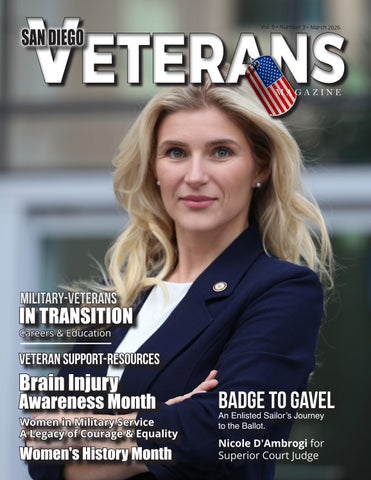
An Enlisted Sailor’s Journey to the Ballot. Nicole D'Ambrogi for Superior Court Judge
VA HOMEBUYERS, THIS ONE’S
;
; Energy-Efficient Features: Save on utilities while enjoying modern living.
Take the next step toward homeownership today.
www.SanDiegoVeteransMagazine.com
Welcome to San Diego Veterans Magazine!
SDVM is a veteran-focused magazine throughout ALL San Diego & Southern California. It serves to assist all veterans, active military as well as their spouses and families.
It is the leading veteran magazine emphasizing resources & support and focusing on topics and issues facing today’s veteran community. SDVM focuses on resources, support, community, transition, mental health, inspiration and more...
The content is the driving force behind our magazine and the connection it makes with our veterans, service members, military families, and civilians.
The magazine is supported by the city of San Diego and a distinguishing list of veteran organizations & members, resource centers, coalitions, veteran advocates, and more. We are honored to share the work of so many committed and thoughtful people.
Despite all the challenges, our team has upheld their focus and let not one opportunity go to provide resources and support to our veterans & military personnel.
On behalf of our team, we wanted to take this moment to say THANK YOU to the readers and our military-veteran community for supporting our magazine. With that support we aim to make a difference and continuing to make a profound impact on the quality of life for our veterans, military personnel and their families.
If you want to catch up on the current and past issues, please visit: www.sandiegoveteransmagazine.com/archives
San Diego Veterans Magazine is published monthly. Submissions of photographs, Illustrations, drawings, and manuscripts are considered unsolicited materials and the publisher assumes no responsibility for the said items. All rights reserved
*The appearance of U.S. Department of Defense (DoD) visual information does not imply or constitute DoD endorsement.
March
2026 INSIDE THIS ISSUE
teamstepusa.org
Tomcat Pilot Comes Full Circle on Midway
Space and infrastructure limitations kept F-14 Tomcat squadrons from ever being assigned to the USS Midway’s airwing.
On a frigid and deplorable-weather day in September 1982, however, an F-14 pilot made history and became a member of an exclusive naval aviator club. Rick Berg was a young Tomcat pilot who had just reported to Fighter Squadron 114 (VF-114) aboard the USS Enterprises (CVN65). He found himself in an untenable situation during a large joint training exercise in the Northern Pacific, and was unable to return to his carrier. His only option, short of ejecting over icy waters just south of the Aleutian Islands, was Midway.
“The battle force exercise was designed to train more than 15,000 men in all-weather conditions,” said Rick, who had joined the Aardvarks of VF-114 only a month earlier.
The exercise included the carrier battle groups of both the Enterprise and Midway. Not surprisingly, the Soviet Union was keeping a close watch on theses naval operations with its Tu-95 Bear and Tu-16 Badger long-range
reconnaissance aircraft. The Soviet planes were routinely intercepted by F-14s as well as F-4 Phantoms when they got too close to the ships in the task force.
“I was launched out on an alert to intercept an unidentified aircraft inbound to the battle group," said Rick. “The inbound aircraft was eventually identified as commercial traffic and we were directed to return to the carrier.”
During his flight, however, weather conditions around Enterprise had deteriorated rapidly reducing visibility to less than 200 feet which was below the minimum acceptable visibility required to attempt a landing on the carrier.
After “waving off” on a missed approach to the ship, Rick climbed above the clouds to await further instructions from the Enterprise’s air traffic controllers.
“My radar intercept officer (RIO) and I reflected on our options,” remembered Rick. “We discussed whether the ship could steam to an area with better visibility for us to have another chance to shoot an approach. The other option was less attractive – go for a swim in the 38-degree ocean with limited search and rescue support.”
As luck would have it, Midway, although operating covertly in emission control conditions (EMCON), was only 100 miles away. During EMCON conditions, only missionessential and emergency communications are normally allowed. The Enterprise’s commanding officer, however, authorized sending a message to Midway requesting they set up to take Rick’s F-14, as well as another F-14 from Fighter Squadron 213 (VF-213) that was also unable to land back aboard Enterprise.
While preparations were being made, Rick turned a course for Midway. Although conditions at Midway were also worsening, the carrier steamed at flank speed to stay ahead of the fog to give the F-14s the best chance to land in the eroding weather.
Tension was high as Rick flew a challenging instrument approach to Midway. He recalled the relatively few number of carrier landings he had made in the F-14 during his young Navy carrier.
LT Berg & VF-161 – Rich is welcomed on board Midway by Cmdr. Robert Williamson, the executive officer of Fighter Squadron 161 (VF-161), following his landing.
“I had logged 22 carrier-qualification landings on the USS Constellation (CV-64) and had logged 14 more landings on Enterprise,” reflected Rick. “I stayed focused and relied on excellent Navy training. We broke out (of the fog) just above minimums at approximately a half mile behind Midway.”
The visibility minimum needed to be able to trap on the carrier was 250 feet above the water.
Rick’s Tomcat was cutting it close, breaking out of the fog at just 260 feet.
“I was relieved to catch a wire,” said Rick. “My adrenaline was up a bit.”
Safely on the Midway’s flight deck, Rick’s emotions turned from relief to surprised jubilation.
“The flight deck was full of Midway spectators,” said Rick. “The executive officer of Fighter Squadron 161 (VF-161) greeted my RIO and I as we climbed out of the jet. Midway’s airwing commander presented me with a Midway Centurion Patch with both 00s crossed out with yellow stitching in VF-161’s ready room, and Midway’s commanding officer presented me with an engraved Midway lighter.”
Inscribed on the lighter was “LT Rick Berg, First F-14 Landing.”
While the manner of his first arrival on Midway couldn’t have been more thrilling, his return to the ship, while every bit as enthusiastic, was somewhat more subdued. Rick recently rejoined the Midway family as one of the museum’s newest volunteer docents.
“It is fun to be back on Midway and remember what took place in September 1982,” said Rick, who has been a docent since August 2025.
“I always had a desire to support the Midway and I enjoy meeting our guests.”
Ultimately for Rick, like an old friend who came to his rescue nearly 45 years ago, he’s grateful to be able to walk Midway’s decks once again.
www.midway.org/contact/volunteer-opportunities
www.midway.org
Point Loma’s Liberty Station Celebrates the Nation’s 250th Anniversary with Art Installation and Community Events
Once San Diego’s Naval Training Center (NTC), Liberty Station (libertystation.com) has evolved into a vibrant cultural and community hub while staying deeply connected to its military roots. As part of its commitment to preserve the property’s naval heritage, Liberty Station is proud to present specialty programming celebrating 250 years of America and naval legacy that honors the service members who shaped this historic site. (libertystation.com/events/250th-anniversary)
To commemorate its vital role in shaping generations of Navy sailors, Liberty Station’s specialty Semiquincentennial programming includes a militaryinspired public art installation created by retired Navy Chief Joe Pisano, a community-wide celebration to commemorate America’s founding and patriotic propertywide branding.
“The Guardian – Wings of Sacrifice” Art Installation
In early 2026, Liberty Station unveiled The Guardian – Wings of Sacrifice, a powerful public art installation recognizing 250 years of Navy service, courage and sacrifice. This impressive piece was created by retired Navy Chief and award-winning artist Joe Pisano in partnership with the Resurrecting Lives Foundation, a national nonprofit organization focused on preventing suicides among U.S. service members and veterans by raising awareness of and advocating treatment for undiagnosed or untreated cases of Traumatic Brain Injuries and Post Traumatic Stress Disorder. Pisano’s piece features 2,500 military dog tags and mixed materials, each symbolizing the lives and dedication of those who served.
Located in the Arts District Liberty Station, the installation invites reflection and remembrance. A commemorative plaque links to Liberty Station’s NTC Alumni video series, where visitors can hear firsthand stories from veterans who trained on the grounds.
The exhibit is on view at the Command Center, 2640 Historic Decatur Road, open Monday through Saturday from 8 a.m. to 7 p.m. and Sunday from 11 a.m. to 5 p.m
Anchored in Freedom: An Independence Day Celebration
On Friday, July 3, 2026, Liberty Station will host Anchored in Freedom to honor both America’s Semiquincentennial and the Navy’s 250th anniversary. The free, communitywide celebration will feature a patriotic parade, themed floats and family-friendly activities that spotlight freedom, service and community pride.
Neighbors, families and visitors will gather for one of San Diego’s most memorable Independence Day celebrations - an opportunity to recognize the sacrifices that safeguard our freedoms on Liberty Station’s historic grounds.
A Historic Property with a Living Legacy
For seven decades, the 600-acre NTC served as the training ground for up to 50,000 recruits annually. Young men and women arrived as civilians and left as sailors ready to serve their country. From 1923 to 1997, nearly two million Navy recruits and one million A and C school sailors trained on this property, preparing generations of service members to defend the nation.
Today, Liberty Station is proud to be an adaptive reuse project. Its 361-acres blends history with modern life. What originally housed barracks, parade grounds and training facilities that prepared generations of Navy recruits for service now houses restaurants, galleries, shops and public spaces for locals and tourists alike to enjoy.
Honoring the Past, Celebrating the Present
Whether you are an NTC alum, active-duty member, military relative or a history enthusiast, Liberty Station offers meaningful ways to connect with Naval history timed with the impactful 250th anniversary milestone. Every visit provides a chance to walk the same grounds where generations trained, reflect on the freedoms we enjoy, and honor those who served.
"Liberty Station is not just a destination; it is a living tribute to the brave men and women who have defended our freedoms for the past 250 years," said Laurie Albrecht, director of Liberty Station Community Association. "As we celebrate the Navy’s Semiquincentennial, we are honored to bring our community together to recognize the sacrifices, triumphs and unbreakable spirit that define our nation. Here, where naval heroes once trained to protect our shores, we are creating unforgettable moments that connect past, present and future, reminding us all why liberty is worth celebrating every single day."
As the nation marks 250 years of independence, Liberty Station stands as a powerful reminder that America was forged by bravery and remains anchored in liberty.
To learn more, please visit libertystation.com/events/250th-anniversary
AGING & END OF LIFE CARE
By: Shelly Dew, CFRE, CDE Director of Philanthropy Hospice of the North Coast
Meeting the Unique Needs of Aging Vietnam Veterans
As many Vietnam veterans move through their 70s and 80s, aging often brings more than just physical changes. Alongside the normal challenges of growing older, there can be lasting effects of military service, including memories, injuries, and experiences that never fully fade. Serious illness, chronic conditions, and increasing frailty can stir things up in unexpected ways. For some veterans, this season of life brings reflection. For others, it can reopen doors they thought had long been closed.
It’s not uncommon for post-traumatic stress, survivor’s guilt, grief, or moral injury to resurface during serious illness. When the body slows down, the mind and heart sometimes revisit the past. As physical strength declines, emotional walls may come down too. While that can feel overwhelming, it can also create space for meaningful conversations, healing, and even peace.
At Hospice of the North Coast, we believe caring for veterans means caring for the whole person — body, mind, and spirit. Our involvement in the We Honor Veterans program has helped our team better understand military culture and the unique experiences that shape a veteran’s life. That understanding matters. It shapes how we listen, how we show up, and how we support both veterans and their families.
Emotional support is central to what we do. We offer counseling and simply a steady, respectful presence — a place where veterans can tell their stories if and when they’re ready. Sometimes just being heard makes a difference. When appropriate, therapies like EMDR can help ease the intensity of traumatic memories. The goal is never to force painful memories to the surface, but to lighten the load and help veterans feel more at ease.
Recognition is just as important. Many Vietnam veterans did not receive the welcome home they deserved. At the end of life, a simple but heartfelt acknowledgment of service can carry deep meaning. Honor salutes and pinning ceremonies, often held at the bedside with loved ones present, offer gratitude, dignity, and validation. For some, that moment provides a sense of closure that brings real comfort.
Connection also plays a powerful role. Through Vet-to-Vet Cafés and the presence of trained veteran volunteers, we create opportunities for shared stories and quiet understanding. There is something special about sitting with someone who “gets it” without needing much explanation. That peer support often builds trust and opens conversations that might not happen otherwise.
Each March 29, we are reminded of National Vietnam Veterans Day. For ten years, Hospice of the North Coast participated in a national war commemoration. Although the federally sponsored program concluded last year, our commitment has not changed. We continue to honor Vietnam veterans locally every March 29 with our annual “Welcome Home” gathering, which is a meaningful opportunity to say, simply and sincerely, thank you.
As veterans age and approach the end of life, no one should feel invisible or alone. By combining expert medical care with emotional support, heartfelt recognition, and genuine camaraderie, hospice care can offer comfort, dignity and, when possible, a measure of healing.
For more information about our palliative care and hospice services, or to speak with one of our team members, contact us today: 760.431.4100 | Hospicenorthcoast.org
Shelly Dew serves as Director of Philanthropy and Community Outreach at Hospice of the North Coast, a community-based nonprofit dedicated to compassionate end of-life care, comfort, and support for patients and their loved ones.
WOMEN IN MILITARY SERVICE: A LEGACY OF COURAGE AND EQUALITY
The National Women’s History Project (now, Alliance) set out to make women’s history celebrated and visible, because the stories of women’s contributions to American History were often untold. Starting in March, 1980 , a group of women in Santa Rosa, CA visited schools and held parades, and in 1987, by lobbying and, with Jimmy Carter’s support and signature, Women’ History was given a month—March! Many buried accomplishments of women are being recorded and promoted, especially in fields where few women were recognized, as in the Military. Military women have served with dogged courage, facing and defying bias and barriers, to earn their right to serve their country. It is our Right to know our Women’s History, so let us commemorate the achievements and contributions of women in the military during this Women’s History Month, 2026.
Traditionally, the military world is not women’s work; it is unladylike, indelicate; culturally, women should stay at home with the kids! But Women’s History proves otherwise. This brief salute to these women is but a sentence in the full record. Women in service to America is also the story of advancing equality and empowering the unique and important qualities of women.
In the Revolutionary War, women defied societal norms and served beside their husbands in the Continental Army as nurses, cooks, cannon loaders, often on the battlefield. Deborah Sampson, who fought for over a year in combat disguised as a man, embodies this commitment women have had to our country.
From the War of 1812, the Civil War, the SpanishAmerican War (1898), women were not only nurses and medical workers, but also spies and disguised soldiers; in 1901 the Army Nurse Corps was established to deliver medical and health care to soldiers and their families.
in battlefield hospitals, and on ships; they served in command offices and communications stations. Women also stepped into crucial roles back home, competently filling positions in factories, businesses, and government.
Over 30,000 women served in various capacities, yet they were denied official military status and received no distinctions or honors. Finally in 1920, women in the Army gained official status as Army Nurses, with the Army Reorganization Act.
With World War II’s demand for troops, more women joined the military and formed distinctive groups for support: WAC (Army Corps), WAVES (Navy) and the Marine Corps Women’s Reserves. The Women Airforce Service Pilots (WASP) were the first women to fly military aircrafts. They ferried planes and soldiers, towed targets for training, and challenged the biases that women were not fit for this dangerous and important work.
Thirty-eight WASP pilots died in service. Because WASP pilots were not recognized with military status until 1977, the federal government refused to pay for their funeral expenses. The women’s colleagues had to pool money to send their bodies home to their families. This 1977 Ruling defined women veteran’s status and advanced Women’s Right to Serve. In 2008, President Obama granted the Congressional Gold Medal to the WASPs.
The last 75 years have witnessed the dramatic expansion of women ‘s roles in the military. They are now admitted to US military academies, allowed to serve in combat, and in 1994, the Pentagon lifted the RISK RULE, giving women more direct combat-related roles. From this “march” for
By Martha Wheelock, Board President, National Women’ s History Alliance.
Women Air Force Service Pilots (WASP) Photo: USAF Public Domain
First female 4-star General, Ann Dunwoody (2008); full integration of women in combat roles (2015); women graduating from military colleges and leaders like Admiral Linda Fagan (US Coast Guard) and JoAnne Bass (Air Force Chief Master Sargent) show that women are ready and able to serve in the highest ranks ofthe military.
Despite these advances, there are still challenges. Sexual harassment, in equality in pay and rank and lack of recognition for women’s contributions persist. We must continue to tell the stories of women in the military, highlighting their courage, sacrifices, and victories to ensure true equality.
Today’s women veterans are making profound impact on our society, enriched by their leadership and experiences in the military: Tammy Duckworth (Army Veteran) , US Senator, IL ; Martha McSally, first America woman to fly in combat, Senator, AZ. Phyllis Newhouse, Army Veteran who founded a million dollar cybersecurity company, Xtreme Solutions; Lynda Bengtsson-Davis ( Air Force) founded a movement to fight Sexual Harassment in the Military: Jas Boothe (Army) founded FINAL SALUTE, a non-profit offering housing and care for homeless women veterans. Many veterans go back into the nation’s hospitals and research areas to advance medical care.
Today’s active and veteran women are standing on the shoulders of the unsung heroes since the Revolutionary War to today. From battlefield nurses to four-star generals, women have continually shattered barriers in the military. Their service, sacrifice, and leadership continue to shape the armed forces and the civilian society, proving their resilience and dedication to the nation. Their contributions have evolved from supporting roles to full integration into combat and leadership positions. They are role models for us all --to develop our abilities and strengths, for their courage in dangerous and unfamiliar zones, for their sisterhood and commitment to others, and for their determination to be in service to America, proudly and equally.
The National Women’s History Alliance has resources and tools for a celebration, and for research. We invite you to share your story there, at the email below.
Happy Women’s History Month www.nationalwomenshistoryalliance.org info@nationalwomenshistory.org
This Women’s History Month, let us celebrate the legacy of women in the military. Their courage, resilience, and dedication have shaped our armed forces and our nation. They have inspired generations. We must continue to support their full participation and equal recognition in service to America. Thank you, Women of the Military, for your service and your inspiration.
Major General Marcelite J. Harris, USAF (Ret) Harris, a Houston native, became the first African American female brigadier general in the United States Air Force in 1991.
Sen. Martha McSally (R-AZ) Official Senate Portrait
Sen. McSally, a 1988 Air Force Academy graduate, is the first female pilot in the Air Force to fly in combat and to serve as a squadron commander of a combat aviation squadron.
Numerous films and books, even audible books are telling the stories of Women in the Military:
- Servicewomen Who Helped Win World War II, By: Lena S. Andrews
- The Women by Kristin Hannah – Vietnam nurses.
- A Girl Called Sampson – Revolutionary War.
- PBS has a new series on women in the Military, available online through their portal.
US Air Force Photo
Gen. Ann E. Dunwoody U.S. Army
Admiral Linda Fagan, Vice Commandant U.S. Coast Guard
CMSgt Joanne Bass U.S. Air Force
(All Photos Public Domain)
Badge to Gavel
An Enlisted Sailor’s Journey to the Ballot
Nicole
D’Ambrogi
for Superior Court Judge
By Nicole D’Ambrogi, Esq.
I walk the halls of the San Diego Superior Court most weeks, moving between courtrooms, preparing for hearings, and navigating the steady rhythm of the justice system. At the entrance, deputies stand at security, scanning each person who enters. Inside the courtroom, they position themselves deliberately between the judge and the people before the court. They are the first line of defense, responsible for maintaining the safety and order of the room. In my opinion, they are one of the most important people there.
In the hallways, they wait to be called as witnesses, calm and attentive, carrying their responsibility without drawing attention to it.
Most of them have no clue that I see them the way that I do.
When we pass each other, there is usually nothing more than a nod. Professional. Routine. But to me, it is something more. It is recognition. It is familiarity. It is a reminder of where my own journey began.
In 2005, at 18 years old, I enlisted in the United States Navy. After completing A school, I received orders to Marine Corps Security Force Company at Kings Bay, Georgia. It was my first assignment, and it placed me in an environment that demanded immediate accountability.
There was no easing into the role. Respect was earned through performance, not words. As part of the security force, we were entrusted with protecting critical national defense assets. Standing watch required focus, discipline, and the understanding that others depended on your presence and reliability. The responsibility was real, and it was constant.
Serving in that role shaped how I would approach every responsibility that followed. I learned that leadership begins long before authority. I learned that trust is earned through preparation and consistency. And I learned that perspective matters, especially at the ground level, where responsibility is carried without recognition and where accountability is immediate.
When my military service ended, I faced the transition that so many veterans experience. The uniform came off, but the mindset stayed with me. The military had given me structure, purpose, and a mission. Civilian life required me to find a way to carry those values forward.
The law became that path.
I built my career representing individuals and families during some of the most difficult moments of their lives. My work in probate and fiduciary litigation brought me face to face with situations where the court becomes the final safeguard for those who cannot protect themselves. Probate court is often misunderstood. It is not simply about financial matters. It is where elders face exploitation, where families navigate loss, and where the legal system serves as a stabilizing force during uncertainty.
In those moments, perspective matters. The people who come before the court are not abstract legal issues. They are members of our community. They are families seeking stability, fairness, and protection.
My commitment to veterans remained central to my work. That commitment led me to serve as supervising attorney and clinical director of the Veterans Legal Assistance Clinic at Thomas Jefferson School of Law. The clinic provides pro bono legal representation to veterans throughout San Diego County, addressing the legal challenges that directly affect their stability and well-being.
Our work is hands on and often urgent. We represent veterans in family law disputes, including custody and support matters. We assist with landlord-tenant conflicts that threaten their housing stability. We advocate for veterans seeking discharge upgrades and access to earned benefits. We stand beside them in contested legal proceedings and active litigation, ensuring they are not alone when facing complex legal systems.
For many veterans, the clinic is more than legal assistance. It is a place where they are heard and supported by people who understand the weight of their service.
Today, as Director of Clinical Programs, I continue mentoring future attorneys and preparing them to serve with integrity and purpose. I teach them that the law is not simply about knowledge. It is about responsibility. It is about recognizing that every case represents a real person whose life may be shaped by the outcome.
I have now practiced law for twice as long as I wore the uniform, yet that early experience continues to shape how I see myself. I do not feel removed from the community I serve. I see myself as part of it. I understand what it means to stand in the rank and file, to carry responsibility without recognition, and to remain focused on the mission.
Perspective matters. Service matters. Community matters. From badge to gavel, I am still standing watch.
That perspective now guides me as I run for Superior Court Judge in San Diego County.
In a county with more than 150 Superior Court judges, fewer than ten have served in the armed forces. Many of those judges served as officers in the JAG Corps, entering military service as attorneys. Their service is honorable and important. But to my knowledge, none began their careers as enlisted personnel assigned to a security force unit, and there are currently no women veterans serving on the Superior Court bench.
Representation on the bench should reflect not only legal achievement but lived experience. Perspective matters because judges serve communities, not abstractions. Judges make decisions that affect real people, real families, and real lives. That responsibility requires not only knowledge of the law, but an understanding of the people who stand before the court.
Each time I walk through the courthouse, I am reminded that service takes many forms. The deputies who stand between the judge and the public carry a responsibility that is both visible and unseen. They protect the integrity of the courtroom. They protect everyone inside it.
Most of them will never know that I still see myself in their role.
My journey from standing watch at Kings Bay to serving in courtrooms across San Diego County has been defined by the same mission: to serve with integrity, to protect others, and to carry responsibility with humility.
Over the next two issues of San Diego Veterans Magazine (April and May), I will share my unlikely journey from the rank and file to a candidate for Superior Court Judge here in San Diego. I will also highlight my work advocating for veterans throughout the justice system, from those who were incarcerated and working to rebuild their lives, to veterans in family court, and those facing eviction or disability access violations.
These experiences showed me how much a judge’s decisions matter, and they are what led me to run for Superior Court Judge. I am seeking this role to continue serving my community with fairness, accountability, and respect.
My hope is that this story reminds others that service does not end when the uniform comes off, and that leadership can begin wherever you stand.
Women Veterans Alliance is the leading national network dedicated to enhancing the lives of women veterans. Through innovative networking strategies, we facilitate direct connections between individuals and programs, revolutionizing community engagement in the process.
Our mission is to UNITE over 2 million Women Veterans and their supporters worldwide, fostering collaboration and empowerment. We are dedicated to fostering a supportive environment that equips, empowers, and encourages women who have served our nation, offering access to valuable resources, mentorship, and career opportunities to help them realize their full potential.
We've established a vibrant community both online and offline, comprising local women veteran networking groups, community events, and national conferences held globally, providing avenues for connection and personal growth.
Our offerings include:
• A Directory of Women Veteran Owned Businesses to promote or connect with local and global enterprises.
• Support for women looking to launch or expand their businesses.
• An Allies Directory encompassing networking groups, meetups, support groups, veteran service, councils, organizations, and advisory committees tailored for women veterans.
• A comprehensive resource directory for veterans.
• An online event calendar featuring nationwide events.
• An online store offering a range of items including t-shirts, jewelry, hats, books, pins, and more!
• Women Veterans Magazine
Women Veterans Alliance is a woman-owned, disabled veteran-owned small business, founded in 2015 by Navy Veteran Melissa A. Washington. Recognizing the need to unite women veterans and provide them with essential support, Melissa established our organization to equip, empower, and encourage each other on their journey.
Join us at www.WomenVeteransAlliance.com to learn more and sign up for updates. Stay connected by following us on Facebook, Twitter, LinkedIn, Pinterest, Instagram, and YouTube.
DONATION MAKES DREAMS BECOME A REALITY
After being awarded the Melissa Washington Small Business Award in 2020, Jennifer was able to invest in critical resources to help grow her business and make her dreams of being a successful entrepreneur come true!
MWSBA will now be awarded Quarterly. Visit website for more information. We have awarded over $21,000 to date!
Ways to help us help her — Donate: One Time, Monthly, or Volunteer www.WomenVeteransGiving.org/donate
www.WomenVeteransgiving,org/donate
WOMEN’S HISTORY MONTH VIRTUAL 5K
RUN | WALK
Honor the trailblazing women who defied societal norms and celebrate a woman in history who inspires you. Complete your miles throughout the month of March, whenever and wherever you choose.
a community of support. For more information visit: foundationforwomenwarriors.org
Women in the Military: Progress Made, Progress Tested
By Lori Noonan, US Navy Veteran & In-House Contributor, Homeland Magazine and San Diego Veterans Magazine
Women have always served this country. Long before policies caught up, long before roles were officially opened, long before the language of “equality” entered the conversation, women were already there — contributing, leading, and carrying responsibilities that often went unrecognized.
Women’s History Month is a reminder that the story of women in the U.S. military is not new. It is long, complicated, and defined by persistence. From the nurses who served near front lines in World Wars I and II, to the Women’s Army Corps and the Women Airforce Service Pilots, women stepped forward even when the system treated their presence as temporary or auxiliary. Their service was essential, yet their opportunities were tightly controlled.
Over time, that began to change — though never quickly and never easily.
Doors opened because women proved, repeatedly, that they belonged. Military occupational specialties expanded.
Leadership roles grew. The combat exclusion policy was lifted. Women earned the right to fly missions, command units, and serve across nearly every facet of military life. These shifts were not symbolic. They were hard-fought and long overdue.
But progress has never meant that the experience became simple.
Women in uniform have continued to navigate challenges that extend beyond the job itself. Many have confronted disparities in representation, endured cultural resistance, or managed policies that did not always reflect the realities of their lives. Still, women adapted, excelled, and redefined what leadership and service look like inside the armed forces.
And yet, progress rarely travels in a straight line.
In recent years, broader national debates surrounding women’s rights — particularly those tied to healthcare and personal autonomy — have created new layers of concern for many women serving today. For military members, these issues are not abstract political talking points. They touch readiness, family planning, career decisions, and basic stability.
Military life already asks for extraordinary flexibility. Frequent moves. Deployments. Extended separations. For women balancing service with family responsibilities or healthcare needs, clarity and consistency matter. When legal frameworks or policies shift, uncertainty can follow — and uncertainty is difficult to manage in a profession built on structure and predictability.
For some women, these changes feel less like distant policy adjustments and more like personal disruptions. Questions arise about access, protections, and the degree to which hard-won gains remain secure. None of this erases the military’s undeniable progress, but it does highlight an uncomfortable truth: advances can feel less permanent when the surrounding environment keeps changing.
That reality is deeply familiar in women’s history.
The story of women in the military has always been about more than access to roles. It has been about legitimacy, recognition, and the ongoing effort to ensure that inclusion is not conditional. Each generation of women has inherited both expanded opportunities and fresh uncertainties.
Despite this, women continue to serve — and not quietly. They lead commands, fly aircraft, operate in combat environments, and shape the future of the force. They are not an exception within the military. They are an integral part of it.
Women’s History Month is often framed as a celebration, and rightly so. But it is also a moment to acknowledge complexity. Progress has been real. Barriers have fallen. At the same time, the conversation about equity, stability, and rights is far from settled.
• Women make up approximately 16–20% of the U.S. military and represent a vital and growing force within the ranks.
• Since 2016, all combat roles have been fully open to women, marking a historic shift toward complete operational integration.
• Women continue to bring distinct operational perspectives, adaptive leadership, and strategic insight, strengthening mission effectiveness across all branches.
• They have advanced from newly integrated service members to elite combat-qualified professionals, including graduates of demanding programs such as the Army Ranger course.
• Women have risen to the highest levels of command, achieving four-star leadership positions and shaping strategic military direction.
If history offers any lesson, it is this: women have never waited for conditions to be perfect before stepping forward. They have served anyway. They have led anyway. And they will continue to do so.
Key Milestones
• 1948: The Women’s Armed Services Integration Act granted women permanent status in the armed forces.
• 2013: The Secretary of Defense announced the repeal of the combat exclusion policy.
• 2016: All military occupations, including elite special operations roles, were officially opened to women.
Looking Ahead
As integration continues, women are increasingly serving in roles requiring advanced technical expertise and highlevel leadership. Their expanding presence is shaping the future of military readiness and national security.
Progressive Facts: Women in the U.S. Military
Women in Blue Luncheon Highlights the Importance of Gender Diversity in Policing
The San Diego Police Foundation will convene regional business and community leaders to honor the achievements of three outstanding female leaders in public safety and to elevate inclusion, leadership, and the empowerment of women. The 15th annual Women in Blue Luncheon: “Heart of Service,” will be held on Thursday, April 2 at the Manchester Grand Hyatt San Diego. The luncheon will honor Captain Jo Makwana, Assistant Crime Laboratory Director Stacey Houg, and Officer Serafina Marquez of the San Diego Police Department.
“Since the inception of the Women in Blue Initiative, SDPD has increased the number of female sworn officers to 17%, exceeding the national average of 12%,” stated Sara Napoli, President, and CEO of the San Diego Police Foundation. “Yet, there is more effort and awareness needed to achieve gender parity, which is critical, as police departments operate best when they reflect the communities they serve.”
The Women in Blue Initiative provides funding for training, mentoring, collaboration, and networking opportunities for rising female leaders in law enforcement, including scholarships for women in blue to attend the Rise: Women in Policing Conference.
A female police officer who attended the conference reflected, “I felt a spark relight in me for this amazing career I have chosen. Before, I wasn't entirely interested in being in upper command, but this conference empowered me to rethink my career goals and future with this department. I have been able to implement a lot of what I have learned with being a mentor for the recruits coming in.”
Studies have proven that women officers are better suited for responding to crimes involving violence against women, facilitating community policing, and de-escalating violent confrontations; they are also less likely to use force and have fewer citizen complaints. Bringing the strengths of men and women together makes the department a better place to work, and therefore positively impacts the communities SDPD serves.
As part of a concerted effort to increase women in the department’s ranks, the San Diego Police Department signed on to the 30x30 Pledge, a national movement to advance the representation and experiences of women
in all ranks of policing, with a specific goal of achieving 30% female recruits in training academies by 2030.
“The police officers of SDPD work tirelessly to ensure that our workplaces, schools, and communities are safe,” said Barbara Savaglio, Women in Blue Executive Cabinet Chair. “A growing number of those officers are women. This is an important trend that needs our support.”
Rise Women in Policing Conference Attendes
SDPD officers at 2025 Women in Blue Luncheon
Move Women in Blue Forward:
Women in Blue is a fundraiser for the San Diego Police Foundation to support SDPD by cultivating positive community engagement and helping fund vital equipment and specialized training that ensures peace and safety for all. Proceeds from this event will propel the mission of the San Diego Police Foundation, including support for SDPD’s peer mentoring program, the Women’s Leadership Conference, efforts to recruit more females to the ranks of SDPD, the Women’s Hiring Expo, as well as scholarships to empower women and inspire the next generation of women in blue.
For more information on the Women in Blue Initiative, please call (619) 232-2130 or visit womeninblue.org
The Women in Blue Luncheon is produced by the San Diego Police Foundation Executive Cabinet led by Sara Napoli, chaired by Barbara Savaglio, and supported by members Susan Couch, Alison Fleming, Denise Friedman, Brittany Haile, Randi Kolender-Hock, René McKee, Merrilee Neal, Karen Newhard, Elizabeth Ruch, and Alexandra Taylor.
About San Diego Police Foundation:
Since 1998, the San Diego Police Foundation, a California 501(c)(3) nonprofit, has funded equipment, training, and outreach programs to ensure that those who protect and serve San Diego have what they need to do their jobs safely and with excellence. The Police Foundation is dedicated to preventing crime, saving lives, and making our community a safer place to live and work by providing resources not otherwise available to the San Diego Police Department (SDPD).
Heart of Service
Thursday, April 2, 2026 Manchester
SDPD Officer Amber Banning & Electronic Storage Detection Dog Phoebe Zorra at Rise
Real Talk: Mental Health
By Giselle Vallejo, LPCC, NCC
The Steven A. Cohen Military Family Clinic at VVSD, San Diego www.vvsd.net/cohenclinics
Honoring Women in Uniform: Courage Beyond the Military
Each March, Women’s History Month invites us to recognize the women whose service, leadership, and perseverance have shaped the Armed Forces and continue to strengthen our communities. At our Cohen Clinics at VVSD, we are honored to work alongside women veterans who not only served with distinction, but who now channel those same skills into supporting others navigating life after the military.
This month, we highlight two members of our clinic team whose stories reflect the evolving legacy of women in military service and the powerful journey of transition from military to civilian life.
From Broadcasting Missions to Guiding Change
Jill Neufeld, a Marriage and Family Therapy Intern at our San Diego location, served six years on active duty in the United States Air Force as a Broadcast Journalist, separating as an E-5/Staff Sergeant. Stationed in Charleston, South Carolina, her mission was to tell the Air Force story through media and video production. As part of the Flying Program within Public Affairs, she documented strategic operations, joint exercises, and humanitarian missions alongside aircrew.
Today, Neufeld brings the same discipline and composure she developed in uniform. When reflecting on what most shaped her transition to civilian life, Neufeld points to three core strengths: structure, discipline, and adaptability.
“Especially in uncertain or high-pressure environments, the military taught me that growth happens in moments that feel unpredictable or uncomfortable,” she shared. “The Air Force gave me a sense of mental toughness that has carried into my civilian life.”
That mindset now supports her work with clients navigating their own periods of change and uncertainty.
Neufeld is candid about the fear many service members feel when separating, something she experienced herself.
“It feels safer to stay because it’s familiar,” she explained. “But transition isn’t about losing your identity in the military, it’s about expanding it.”
Her message to the next generation of women veterans is one of courage and trust: “Don’t let fear of uncertainty keep you from stepping into what’s next. The leadership, adaptability, and resilience you gain in the military absolutely transfer. Trust yourself and take the leap of faith — you never know what is waiting on the other side.”
From Military Missions to Meaningful Support
With 23 combined years of service in the United States Navy as an 8404 Fleet Marine Force Corpsman, Tami Brown brings deep operational experience and grounded leadership to her role as a case manager at the clinic.
Brown describes herself as naturally straightforward and assertive, traits that were sharpened through years of military service.
“As a woman in the military, these attributes strengthened leadership and resilience skills I didn’t know I had,” she said.
Her time in uniform also expanded her capacity for compassion and empathy, shaping a leadership philosophy she still carries today.
“I developed the mentality: I will never ask you to do something I have never done or wouldn’t do.”
This approach proved critical while leading junior personnel through planned missions, rapid field movements, and the familiar military rhythm of “hurry up and wait.” Today, that same grounded leadership supports veterans and families served by the clinic.
Brown has also witnessed significant shifts in opportunities for women in uniform. When she joined the Navy in 1997, women were not assignedto direct combat units and were typically attached to support commands. She served with 3rd Medical Battalion, 3rd Force Service Support Group in Okinawa, Japan.
Since then, she has seen meaningful progress.
“Now, women are integrated into combat units for culturally sensitive searches in Iraq and Afghanistan and other missions right alongside their male counterparts.”
A Commitment to Women Veterans
Stories like Neufeld’s and Brown’s reflect a broader truth: the transition from military to civilian life is both a challenge and an opportunity for growth. At our clinics, supporting veterans, especially women veterans, means recognizing the unique strengths they bring while helping them navigate the complexities of change.
Through clinical services, case management, and community support, our team remains committed to honoring the legacy of women in military service by walking alongside them in their next chapter.
This Women’s History Month, we celebrate not only the history being made by women in uniform, but the continued impact they are creating right here in our veteran community.
PTSD: Reclaiming Control
By: Robert ‘Bob’ Cuyler, PhD Psychologist and Trauma Expert
PTSD and the Female Veteran, Part III
For this month’s column, I’m continuing my dialogue with my colleague Lori-Ann Landry, a social worker in private practice in Denver with extensive experience in PTSD treatment and research.
Q: I am curious in your practice and treatment of PTSD if you see a difference in how symptoms manifest for male versus female veterans?
A: Absolutely. I think this can relate to how males and females are socialized differently growing up. We know from neurodiversity research that there are definite differences in how symptoms can manifest based on gender which can lead to delayed diagnosis and treatment as well as emphasizing the need for careful history taking and personalized treatment plans. I think the same is true for how PTSD can manifest in males versus females, leading to similar delays in diagnosis and treatment. Some examples for women: there can be a greater level of masking learned earlier in life, a pressure to “stay strong,” to keep household and family management intact, and a tendency to prioritize others’ needs over our own mental health. Women’s symptoms can sometimes be more internally focused with anxiety and depression as most prominent features.
For men, symptoms can be more externalized with risktaking behaviors, irritability, aggression and substance use. Stigma around vulnerability with pressure to “tough it out” in fear of judgment and rejection can lead to delayed treatment for men. Men may also experience more traditional “fight or flight” responses to triggers, while a womens’ responses are more likely to be “tend and befriend,” where we will manage threats through connection/community and nurturing needs. That being said, there are core commonalities such as hypervigilance, numbing, avoidance, sleep disturbance and delayed access of treatment, though for different reasons as identified above.
Q: In looking at these differences, do you see additional variations in PTSD caused by combat trauma versus military sexual trauma (MST)?
A: That’s a great question and we’re definitely seeing variations based on type of trauma events. In bigger picture, combat trauma is ‘within systems’, for example our country against another country where many people are experiencing similar trauma concurrently. There is an enemy that has been defined. There is a level of honor in combat even if at the core, symptoms of shame can be similar. The violation of trust in combat that occurs is about losing trust in the safety of your larger environment. With MST, it is an interpersonal violation of trust, sometimes with colleagues or leadership that are supposed to be keeping you safe.
The hypervigilance is more at the person-toperson level, readily leading to distrust and isolation. The sense of shame can be more individualized. In combat trauma spaces/ communities become unsafe and with MST, people become unsafe.
In summary, we see a lot of individual variations, some related to gender, others to more unique background and personal variables. All of this points to the need for careful individualization of treatment approaches and availability of a range of options that best fit for each veteran.
Dr. Cuyler is chief clinical officer of Freespira, an FDA-cleared non-medication treatment that helps people with panic and PTSD manage their symptoms by learning how to regulate their breathing. www.freespira.com
“I am shocked and surprised that this treatment worked. When I think about PTSD, I think about the brain and this being a brain problem… There is no denying the calming effect this treatment had on me. This has made a significant difference in my personal life. This treatment is remarkably effective.” — Kevin, US veteran whose symptoms included social anxiety and monthly panic attacks before he found Freespira
They’re signs of impact. At
No matter where you are on your brain injury journey, your story deserves to be told. It’s up to us – survivors, families, caregivers, and friends – to tell those stories. Because the more people who know about life with brain injury and the resilience it requires, the easier it will be for them to understand us, our experiences, and our community.
Share your journey. Tell us who you are, where you’ve been, what you’ve accomplished, and where you hope to go at biausa.org/MyBrainInjuryJourney.
www.biausa.org | @biaamerica
Brain Injury
Facts & Statistics
Prior brain injury and head trauma has been linked to the development of neurodegenerative diseases and other conditions, including:
Chronic pain
Depression
A traumatic brain injury (TBI) is a type of brain injury caused by trauma to the brain from an external force
A non-traumatic brain injury is a type of brain injury caused by internal factors, such as lack of oxygen or exposure to toxins.
Since
Five years after surviving a moderate to severe TBI, more than half of adults who were employed at the time of their injury no longer have a job
Falls
Motor vehicle crashes
Sports related injuries
Explosive blast/military
Stroke
Near-drowning
Aneurysm
Tumor
Infectious disease that affects the brain
Lack of oxygen supply to the brain
On a Mission to Serve Our Military
While the military pledges to support and defend our country, this commitment can come at the cost of behavioral health.
At Thousand Branches Wellness in Mission Valley, we honor the sacrifices of servicemen and women by proudly providing specialized mental health treatment for veterans and military service members.
Some of the issues we address:
• PTSD
• Depression and anxiety
• Grief and loss
• Relationship challenges
• Work and career concerns
Our personalized programs can include:
• Individual therapy with a licensed clinician
• Weekly group therapy sessions
• Medication management
We understand the distinct challenges of military life and are dedicated to supporting those who have bravely served.
If you or someone you love is struggling, call our 24/7 intake line 619-202-8586 for a level-of-care assessment.
3838 Camino Del Rio North, Ste. 380 San Diego, CA 92108 ThousandBranchesWellness.com
https://tinyurl.com/apply-mosiac
themosaicfoundation.org themosaicfoundation.org
San Diego Veterans Magazine
March 2026 Issue
TRANSITION To Civilian Life
Veterans Embracing Entrepreneurship in 2026
How AI is Reshaping the Employee Experience
A Resume is Not a Plan
Patriots to Education: Building Pathways for Veterans
Major in Motion: Creating AI-Powered Cyber Defenders
The Entrepreneur: Building a Breakthrough Business
Misconceptions About Franchising: Insights for Veterans
Why do I Need an Asset Protection Attorney?
Careers in Law Enforcement
VETERANS IN TRANSITION
For trusted guidance on transition, careers, education, entrepreneurship, workshops, and legal resources for veterans and military business owners, explore Veterans In Transition.
Earn Your Degree Anytime, Anywhere. Flexible, Affordable, and 100% Online!*
Military life comes with constant changes—deployments, PCS moves, and unpredictable schedules. But your education doesn’t have to wait. At Los Angeles Pacific University, we understand the unique challenges military members, spouses, veterans, and dependents face. That’s why our fully online programs offer the flexibility you need to study at your own pace, no matter where life takes you. Whether you’re on base, deployed overseas, or at home, your degree moves with you!
• 100% Online & Flexible: Learn from anywhere, on a schedule that fits your life.
• Maximize Your Benefits: Use GI Bill®, tuition assistance, and spousal benefits.
• Earn Credit for Your Experience: Take advantage of CLEP, DSST (DANTES), and AARTS/JST to turn your military training and knowledge into college credit.
• Fully Accredited: LAPU offers fully accredited associate, bachelor’s, and master’s degrees through the WASC Senior College and University Commission (WSCUC).
• Faith-Based & Supportive: Dedicated military-friendly success coaches who care about your journey.
Your Future Starts Today! Take the Next Step
*At this time, LAPU is unable to offer distance programs or courses to students residing in the following states and districts: Alabama, Arkansas, Connecticut, the District of Columbia, Indiana, Kansas, Maryland, Minnesota, New Mexico, New York, North Carolina, Oregon, Wisconsin, and Wyoming.
WHAT’S NEXT Transition to Civilian Life
By Eve Nasby eve@infused.work
FLASHBACK - February 2024
Unleashing Your True Potential: Veterans Embracing Entrepreneurship in 2026
Are You Kidding Me?!
Humility comes before honor….and before a $500k salary right out of the military. Naval Academy Graduate Alan Lerchbacher is a Professor at University of San Diego and Cal State San Marcos and teaches the Capstone Course for the Master's of Global Leadership. He tells a woeful tale of how, 40 years ago, his attitude lost a $500,000 year salary right out of transitioning from the Navy. Through a few serendipitous encounters with retired military leaders and business owners, Alan found himself in the interview of a lifetime.
After decades invested in the Navy he had seen and done it all and was ready to transition out on a new adventure. He was not sure anything could top the mission focused success he had in his decorated Navy Diving career but being the CEO of a company might come close. Walking into the interview, because of his high recommendations, he had the job. The interview was a mere formality. Unfortunately, he spent the entire interview trying to convince the Chairman of the Board that he’d be a better candidate for the same role in another state because he just did not want to live in the Midwest.
Jim Gruny
After his interview the man who referred him to the company called him enraged and through his fourletter explicative asked what he thought he was doing? Alan flatly responded that he thought he’d be a better fit in another city.
When his friend asked him how much he thought that the position he just interviewed for was paying. Alan, who was making $72,000 per year in all honesty said, “I don’t know.” “$500,000 a year, plus bonuses!!” was the loud response.
There was no going back. He blew it.
Photo by: Jamie Howren Photography
We spoke with Alan about his tips to transition if you want to be an entrepreneur or you are interested in running a company as he was.
Days to Broke
He begins his business classes by asking a simple question. How many of you want to be an entrepreneur?
70-80% raise their hands. By the end of the semester only 1-3 students have the same answer. Why? He gives them a strong dose of reality.
He teaches them to track “DTB” or “Days to Broke”. Think about that. Continue to keep that figure in the forefront of your mind as you press on into your entrepreneurship dream. He cautions that if you have a family, you better be having conversations with them to make sure they and you are all on the same page and in agreement. Make sure you know how much you ‘want’ to make and how much you ‘need’ to make so as to not stress your family financially.
He also encourages that there is nothing wrong with getting a job out of the military and then figuring out what you really want to do. Maybe while on the job you think of a better way to do something, or you invent something that serves as a catalyst and driver for you to start your own business.
Motivational speaker and life coach Julianne Kirkland says, “In a world filled with opportunities, there exists a unique path for veterans to fully embrace their integrated identity and tap into the limitless potential within them.“
As a former facilitator for Tony Robbins’ Mastery Program, she has seen firsthand the transformative power of harnessing one’s knowledge, skills, and passions. She notes, “By embracing entrepreneurship, veterans can embark on a journey that not only enables them to tap into their full potential but also helps them overcome some of the most common obstacles they face upon returning to civilian life.”
Continuing on with purpose, on purpose
“Leaving the structured and purpose-driven environment of the military can leave veterans feeling lost and disconnected. Entrepreneurship offers a unique opportunity to regain that sense of purpose by pursuing a passion or cause that truly resonates with you.”
Post-Traumatic Stress and Mental Health
“Many veterans grapple with the invisible wounds of war, such as post-traumatic stress disorder (PTSD) and mental health challenges. Entrepreneurship can provide a therapeutic outlet and a sense of purpose that aids in the healing process. It offers the flexibility to create a work environment that accommodates your needs and allows you to focus on self-care.”
Julianne offers practical tools
1. Self-Discovery and Goal Setting: Reflect on your strengths, interests, and passions. What excites you? What do you want to achieve through your entrepreneurial venture? Set clear, achievable goals that align with your values.
2. Education and Training: Invest in acquiring the knowledge and skills needed for your chosen business. Seek out courses, workshops, coaches and mentors who can help you build a strong foundation.
3. Networking: Build a network of fellow veterans, mentors, and business professionals who can provide guidance and support. Connect with organizations like Band of Hands, Bunker Labs and SCORE that specifically assist veteran entrepreneurs.
4. Funding: Explore funding options, such as grants, loans, or crowdfunding, to kickstart your business. Organizations like the Veterans Business Outreach Center (VBOC) can assist in accessing financial resources.
5. Resilience: Entrepreneurship is a journey filled with ups and downs. Cultivate resilience by staying adaptable, learning from setbacks, and maintaining a growth mindset. You have this skill from fighting for your country, now it’s time to apply it to YOU.
Need help with your transition? Have questions? Link up with Eve on Linked In today www.linkedin.com/in/eve-nasby-given-hiring-expert
HUMAN RESOURCES Transition to Business
By Paul Falcone PaulFalconeHR.com
How AI is Reshaping the Employee Experience
Artificial Intelligence (AI) is certainly the talk of the town, and what better time is there than now to assess how it’s impacting workers and transforming the workplace experience in exciting ways? You'll likely find new tools to help your career and professional development, coaching, and training needs before too long, if they’re not available quite yet at your company.
AI is being rapidly adopted across workplaces. Two-thirds of managers report fielding questions from their teams about AI tools at least once a week, and the technology is moving beyond simple automation to become a genuine partner in professional development. Currently, research shows that 45% of employees are already using AI tools daily or weekly in one form or another, and the momentum behind new AI adoption is exponential.
Career Development and Coaching Tools
Employee coaching is a personalized development process where a leader or coach guides an employee to improve specific skills, performance, and career growth.
“Executive coaching” is typically reserved for senior executives and business owners and can be costly. But new apps look to cascade the coaching experience to employees at all levels by helping them to set goals, overcome obstacles, and foster self-discovery. Companies pay for AI apps on a PEPM (per employee per month) basis, and they can be an exceptionally cost effective investment, especially since the tools are designed to help people align their personal success with company objectives, build their self-confidence, and reach their full potential.
AI coaching platforms can likewise serve as “communication partners” where employees can practice difficult conversations multiple times to address challenges with their managers, peers, or subordinates. Note that there are career development tools that can help you in your job search journey as well. Platforms like Careerflow, Himalayas (for remote jobs), and Rocky.ai offer personalized career guidance, resume optimization, and interview preparation. While I can’t personally recommend any of these apps or the ones that follow because many of them are new and being released as we speak, other better known AI apps can be found in SkillUp’s “The Best AI Job Search Tools in 2025,” which you can find here: https://skillup.org/resources/ai-job-search-tools. Note that you can access some of these AI apps yourself for free or for a fee, while many of these workplace apps and platforms must be purchased and administered by your employer.
AI is Reshaping the Employee Experience
Training and Learning Tools
AI is attempting to revolutionize workplace training by customizing learning solutions that personalize content based on your career goals. Adaptive learning systems personalize content based on your progress and career interests, making your experience with the app more personalized and integrated. By coordinating your goals with self-identified challenges and longerterm career aspirations, AI apps can make customized recommendations that help you build new muscle in the performance and communications space. Their goal is to assess skills and identify gaps, then create customized learning paths. Their purpose is to provide 24/7 access to career guidance, skill gap analysis, and personalized learning paths. It’s this focus on customized learning paths that takes traditional corporate Learning & Development to the next level.
Digital AI Employee Recognition Tools
Recognition for a job well done or for extraordinary effort is said to be the “psychic income” that keeps employees happy, engaged, and otherwise performing at peak performance. Some managers are great at providing well deserved employee recognition, while others lack this ability—either due to lack of awareness or a philosophical disbelief in recognizing others for fear of it ”going to their heads.” Whatever the case, employee recognition apps like Bonusly, Achievers, Workhuman, Empuls, and Awardco all integrate AI features that prompt employees to log and quantify achievements, share insights with their managers that might otherwise miss awareness, and generate personalized award graphics and messages. They’re not about showing off: they’re simply focused on highlighting achievements that increase revenue, decrease expenses, save time, or improve customer satisfaction. What a great way to put your best foot forward!
The Bottom Line
The key to effective AI implementation lies in its ability to personalize its solutions for your particular needs. The employee experience market is projected to hit $11.1 billion by 2028, with a growth rate of 10.2% from 2023 to 2028. The technology is here, it's accessible, and organizations are actively implementing it. Whether you're looking for career guidance, want recognition for your contributions, or need personalized training, AIpowered tools are increasingly available to enhance your professional journey.
You can connect with Paul on LinkedIn at www.linkedin.com/in/paulfalcone1
Paul Falcone (www.PaulFalconeHR.com) is a management trainer, executive coach, and bestselling author on hiring, performance management, and leadership development.
www.HarperCollinsLeadership.com
A RESUME IS NOT A PLAN!
By Maurice D. Wilson, MCPO USN (Ret), President/Executive Director, National Veterans Transition Services, Inc. (NVTSI.org / VeteranMatch) aka REBOOT
Why Transitioning Service Members and Veterans Must Think Beyond Paper Toward Purposeful Careers
Too many transitioning service members (TSMs) and veterans walk out of the military with one goal in mind: get a résumé and land a job. But focusing on crafting a résumé without first creating a genuine is like building a house on sand. It may look solid at first, but it won’t stand up under pressure.
A résumé is a document. A plan is a strategy. The distinction matters because the outcomes veterans experience after service are directly tied to how well they think about their future before they leave. Unfortunately, far too many do not.
The Reality Behind Transition Outcomes
Current research and surveys paint a clear picture: military exit is one of the most consequential career inflection points a service member will face, and many are unprepared for what comes next. While official unemployment rates for veterans are relatively low— hovering around historically low levels near civilian averages—these numbers mask deeper issues.
Underemployment—working in jobs that don’t fully utilize skills, experience, or education—is pervasive. Recent research shows that over 60% of post-9/11 veterans report underemployment because their civilian jobs do not match their capabilities. Penn State studies also indicate that many veterans facing underemployment remain in roles that fail to satisfy their potential pay and responsibility for years after separation.
Underemployment has real consequences: it’s linked to lower job commitment, frequent job changes, stalled wage growth, and frustration that can ripple into financial strain and emotional stress.
Why a Résumé Alone Is Inadequate
A résumé tells an employer what you did A career plan tells you what you aim to become.
Many veterans fall into the trap of equating a résumé with a plan because:
• Transition Assistance Programs (TAP) often emphasize documentation more than career visioning
• Military skills are powerful but may not be easily understood by civilian employers without context.
• Separating service members are not always equipped to translate their capabilities into career trajectories
Without a strong plan, veterans frequently:
• Accept the first job offer out of immediate necessity.
• Enter fields where growth prospects are limited.
• Miss opportunities that align with their highest potential.
The result? Veterans may take jobs that pay a paycheck but not a purpose. Over time, this leads to high job turnover, slower career progression, and greater financial and emotional stress.
The High Stakes of Not Planning
Failure to plan a meaningful career doesn’t just impact job satisfaction—it affects well-being. Veterans with unclear post-service direction often face:
• Financial instability
• Delayed career progress
• Loss of identity and purpose
• Increased risk of stress and mental health challenges
Research consistently shows that the transition to civilian life is a critical period with elevated vulnerability to unemployment, underemployment, housing instability, and reduced mental wellness if not properly supported.
While direct causal links from underemployment to suicide are complex, social determinants such as job loss, financial insecurity, and loss of purpose are well-established risk factors among veteran populations
This Is Why We Built VeteranMatch
At NVTSI, we recognized that one of the core root causes of poor transition outcomes is planning in the dark—leaving service without a clear, evidence-based understanding of what kind of career will best fit a veteran’s unique experience, aspirations, and the future job market.
That realization led us to build VeteranMatch—a predictive career planning platform powered by advanced analytics and AI that helps TSMs, veterans, and spouses identify meaningful, future-aligned careers, not just jobs.
VeteranMatch goes beyond résumé creation. It helps users:
• Discover their Career DNA—a personalized profile of transferable skills and motivations.
• Match with future-fit roles that align with both personal strengths and labor market trends.
• Understand pathways to career success, including recommended skill development and certifications.
• Predict long-term outcomes based on data and i nsights rather than guesswork alone.
In a world where technology is transforming jobs faster than traditional pathways can adapt, VeteranMatch provides a technological edge—a necessity for thriving in the modern workforce, not a luxury.
VeteranMatch Beta Is Now Live
We are excited to announce the rollout of the VeteranMatch beta version—an early release designed
to gather rich feedback and improve the tool with the help of users themselves.
We recognize that every veteran’s journey is unique, and the development of this platform depends on the real experiences of those who use it. If you:
• Are struggling to plan your next career move,
• Have been unable to find a job that fits,
• Or simply want a clearer vision for your future—
We invite you to join our first cohort and help shape the future of veteran career planning.
Create an account here and start with a plan, not just a résumé:
Visit: https://veteranmatch.org/join/T7PPRQHD
A Final Thought
Transition is not a moment—it’s a journey. A résumé is only one small tool in that journey. A career plan that uses data, self-insight, and future workforce intelligence is what ensures veterans not only find a job—but build a life of purpose, growth, and success.
At NVTSI, we believe every veteran deserves more than a job at the end of service—they deserve a career worth building. NVTSI.org
https://veteranmatch.org/join/T7PPRQHD
Patriots to Education continues its mission to connect Veterans, National Guard members, Reservists, and military spouses with meaningful second-career opportunities in public education. Across the states where we are active—California, Florida, Texas, Nevada, Nebraska and now Kentucky—our work is focused on raising awareness of these opportunities and providing hands-on support as service members and their families transition into second careers in public education.
What Benefits May A Veteran Expect to Receive from a Career in Public Education
1. Continuing a Life of Service
2. Having an Impact on the Lives of Students; Doing Something that Matters
3. Applying Transferable Skills
4. Stability and Purpose
5. Community and Belonging
6. Opportunities for Growth
7. Personal Fulfillment
What Benefits Would a School District Expect to Receive by Hiring a Veteran or Military Spouse
1. Commitment to Service
2. Leadership and Teamwork Experience
3. Discipline and Work Ethic
4. Adaptability and Problem-Solving Skills
5. Communication and Relationship-Building Skills
6. Cultural Competence and Diversity Awareness
7. Experience with Change and Crisis Management
8. Mentorship and Role Modeling Experience
9. Conflict Resolution Skills
Just like boot camp molded you into the service member you would become, our free on-site and virtual programs mold you into the college student you strive to be. Boot camp prepared you for the military. We prepare you for college. Scan the code to learn how our programs help enlisted veterans succeed in college
Patriots to Education: Building Pathways for Veterans
Major in motion: Space Force officer Tyler Williams is creating AI-powered cyber defenders
Inside a dimly lit computer lab at Arizona State University, U.S. Space Force Maj. Tyler Williams leans over a glowing monitor, lines of simulated network traffic scrolling by faster than most eyes could follow. To the untrained observer, it looks abstract. But, to Williams, it’s the pulse of a system under attack. Somewhere in that blur might be a weakness, a signal that an enemy has found a way in.
That search for hidden vulnerabilities and the desire to close them defines both his research and his military career.
A soldier who never stopped learning For Williams, cyber defense is an academic pursuit and a continuation of his service.
After earning his bachelor’s degree in computer systems engineering from the School of Computing and Augmented Intelligence at ASU, in 2014, he commissioned through the Army ROTC program and began his career as a signal officer.
Over the next several years, he became a network systems engineer, overseeing complex communications systems. In 2022, he transferred to the U.S. Space Force (www.spaceforce.mil/)
Those years in uniform shaped how he sees cybersecurity: the lifeline of every modern mission. After seeing how a single configuration error or unpatched system could compromise an entire operation, Williams decided to return to ASU to deepen his technical knowledge through the Space Force’s Advanced Academic Degree Program. (www.spaceforce.com/education/officer)
Now in his second year toward a master’s degree in computer engineering, he focuses on how artificial intelligence can strengthen human decision-making in defense networks.
His research takes place inside ASU’s Secure, Trusted, and Assured Microelectronics Center, or STAM Center, using the Arizona Cyber Range, a controlled, high-fidelity simulation environment that mirrors the complexity of real-world systems.
“Personally, I am optimistic about the future,” Williams says. “Using an
environment like the Arizona Cyber Range will help cybersecurity professionals be better prepared for new and complex threats.” (https://azcyberrange.asu.edu)
Serving and studying at the same time Going back to school while remaining on active duty isn’t easy. But Williams says it’s one of the best decisions he’s made. His dual identities of engineer and officer allow him to approach research through a mission lens.
“As the attack surface for the internet and everything connected to the internet grows, there’s always going to be some difference between what a cybersecurity professional can react to and what the potential risk could be,” he says. “We’re looking to shore up that gap.”
That “gap” is what Williams’ thesis aims to close. His research focuses on agentic AI, or the systems made up of multiple collaborating artificial intelligence agents that learn and react together, similar to how a coordinated military team would.
“Most research right now focuses on a single AI agent doing one simple task,” he says. “What I’m looking at is scaling that up to create multiple AI agents that operate and collaborate in a shared environment to accomplish more complex goals.”
Working under the supervision of Michel Kinsy, a Fulton Schools associate professor of computer science and engineering, Williams conducts tests in a high-fidelity environment to simulate real-world networks and attacks.
The goal is to build networks that are as realistic as possible, to evaluate AI systems in environments that mirror what operators face in the real world.
Williams’ experiments pit defensive and offensive AI systems against each other, mirroring “red team versus blue team” exercises used across the Department of Defense. The results could lead to better tools for both training and real-time defense, creating AI systems that assist, not replace, the human experts in the loop.
Paying it forward
After graduation, Williams will report to Los Angeles Air Force Base as a branch chief, which offers another chance to merge research insight with leadership in the field.
“Ideally, with my degree and the experience I will gain in my upcoming assignment, I’d like to be a program element monitor,” he says. “This is a critical role in the defense acquisition process, directly responsible for a given program and all documentation needed to harmonize the program in the budget.”
He also hopes to inspire other service members to pursue advanced education.
“If you’re the type like me that loves learning and enjoyed your time at university, you should 100% go back,” he says. “Get your master’s degree. Be ready to work.”
A model for military learners
Williams’ path shows how modern military service is evolving. Today’s defenders operate not only in the air, land and space domains, but in the invisible world of data and code. Programs like the Air Force and Space Force Advanced Academic Degree Program create pathways for officers to gain those skills without leaving active service, keeping operational experience connected to innovation.
From the outside, the glowing screens in Williams’ lab might look like an ordinary graduate project. But to him, each simulation, each algorithm and each test run has a purpose that reaches far beyond the campus network.
Did you know?
Veterans go back to school to ease their transition to civilian life, gain better career opportunities with higher earning potential, develop new skills, find a supportive community, and translate their valuable military experience into a meaningful civilian path.
What challenges and opportunities exist when transitioning from military service to civilian work and education?
Moving into the civilian workforce or returning to school might look easy at first. After all, you’ve developed real-world skills, strong leadership, and the initiative to thrive anywhere.
Yet the transition can be tougher than expected. Many veterans face challenges that feel overwhelming or isolating. That’s where we come in—to support you every step of the way.
Our Veterans-in-Transition archives provide trusted guidance and insights on life after service—education options & resources, career advice, business and entrepreneurship resources, workshops, legal tips, veteran franchises, and much more to help you move forward with confidence.
About ASU
Arizona State University has developed a new model for the American Research University, (www.asu.edu/research) creating an institution that is committed to access, excellence and impact. ASU measures itself by those it includes, not by those it excludes. As the prototype for a New American University, ASU pursues research that contributes to the public good, and ASU assumes major responsibility for the economic, social and cultural vitality of the communities that surround it.
For assistance in your journey please visit: Veterans-In-Transition https://tinyurl.com/vet-in-transition
VETERANS
Own Your Future: Why Franchising is a Great Fit for Veterans
By Liz Leonard
The transition from veteran to civilian life can be daunting. But the grit, determination, and exactness honed in the military gives veterans a full arsenal of skills to pull from on the journey forward—including entrepreneurial pursuits.
Here’s how franchising can work for veterans, and how time in the service can work to your advantage as a business owner.
Own
Your Future
Franchising Is Not Just For Millionaires
The greatest barrier (or perceived barrier) for most potential franchisees is cost. However, not only do many franchises have a lower cost of entry than you might think, but many franchisors also look for and reward the multitude of strengths veterans bring to the table.
Hundreds of franchises offer discounts or reduced ownership costs to veterans, as well as on equipment and initial inventory. Working with a franchise advisor— most often at no cost to you—can help focus your search on brands offering veteran discounts that also align with your personal goals and interests.
Franchising Can Be Affordable
Even with special discounts, franchise ownership requires an initial buy-in and additional funds to scale the business. Fortunately, there are many ways to make it an accessible and savvy investment.
Certain government loan programs through the Small Business Administration (SBA) are tailored for veterans, plus equipment leasing makes starting up a business and scaling it attainable. VA disability payments or pensions offer steady income and stability that make veterans great candidates for financing options.
Franchising Goes Beyond a Storefront
Owning your own business doesn’t need to be tied to brick-and-mortar. There are hundreds of options for franchising in the United States that touch every conceivable industry. Automotive services, pet grooming, senior care, cleaning, fitness training, and many more franchises are perfect options for owning a business and can be operated from a vehicle.
If you’re not interested in face-to-face interaction with clients, other franchises such as those in healthcare billing, IT, or coaching can be run completely online from home.
Franchising is an Approachable Way to Own a Business
One of the biggest draws of franchised businesses for many veterans is the offer of a “business in a box.” Not only do owners have proof of a franchise’s success, but they also have corporate support in everything from training to marketing, operations, and more.
These opportunities, paired with the skill and drive of military veterans, can maximize the potential for long-term success, and franchisors are looking for these qualities. For example, a veteran’s ability to follow established procedures, lead a team, and adapt to challenges can directly translate to successfully managing a franchise location, ensuring consistency and quality while driving growth.
There is a Franchise for You
For veterans looking forward to the next career stage, franchising can align with your work experience in the service, hobbies and personal pursuits, and long-term financial and lifestyle goals. A franchise advisor can help you find the perfect fit.
Liz Leonard is a certified Franchise Advisor who has helped hundreds find the right-fit franchise for their budget and aspirations. Liz authored the book Your FranchisE Fast Pass to give potential business owners a stepby-step guide for finding the ideal business. www.yourfranchisefastpass.com
By Barbara Eldridge President/ Founder of Mind Masters www.mindmasters.com
The Entrepreneur Building a Breakthrough Business BUSINESS FOR VETERANS
As I’ve watched entrepreneurs build companies from nothing more than an idea and a laptop, I often ask myself what fuels the human drive to persist through uncertainty, long hours, rejection, and financial risk. What moves someone from hoping their business might work to knowing they will find a way to make it succeed?
Every founder who eventually builds a breakthrough company crosses that same internal threshold. They stop operating from possibility and start operating from inevitability. Once that shift occurs, quitting is no longer on the table. There is only problem-solving, adaptation, and forward motion.
When I asked my Mind Masters members to consider setting goals at 10X their current revenue, the response was fascinating. For some, the idea felt overwhelming— almost irresponsible. For others, it triggered a realization: incremental thinking had been keeping them safe but small. To reach a goal that audacious, they couldn’t simply work harder; they had to think differently, lead differently, and become a different version of themselves.
The moment the brain receives a directive that demands expansion, it reorganizes. Old strategies become insufficient. Comfort zones collapse. You either retreat— or you rise. Those who rise accept that the price must be paid in focus, discipline, courage, and persistence. You understand that if the vision matters enough, you don’t wait for ideal conditions—you create them.
This is the essence of a Game Changer. It requires your BEST. It demands that you stretch beyond what feels reasonable and step into what feels bold, even uncomfortable. As Paul Lemberg writes, “being reasonable kills potential.” Reasonableness keeps the lights on—but it rarely builds something extraordinary.
When you commit to a Game Changer in business, you are committing to your vision, your passion, and your willingness to lead yourself into unknown territory.
It’s a decision to abandon worn-out assumptions and outdated limits. You choose a direction, step to the edge, and discover—only after you leap—that you can fly.
Just like a founder who builds a category-defining company, you must focus on what’s possible, not what’s likely. Worthy goals don’t already exist, waiting to be found. They must be imagined, declared, and pursued with relentless conviction.
That is the game worth playing.
Barbara Eldridge has built a solid reputation as a Results strategies specialist, within industry and business over the past 40 years. Her unique message, since starting Mind Masters 30 years ago for entrepreneurs and small business owners, continually stresses vision, purpose and values as the key elements of business philosophy. Her undying compassion for the entrepreneur’s journey, her tireless capacity to listen, and her sincere enthusiasm for other’s success have insured her growing influence and her own mastery with MIND MASTERS. www.mindmasters.com
Veterans Make Great Entrepreneurs FRANCHISE DREAMs
By Doug Dwyer doug.dwyer@dreammakerbk.com
Misconceptions About Franchising: Insights for Veterans
Franchising presents a unique opportunity for veterans transitioning from military service to civilian life. The structure, support, and established systems can make it an appealing option for those accustomed to discipline and teamwork. However, several misconceptions about franchising can deter veterans. I’d like to take a moment to debunk some of the most common myths, specifically from a veteran's perspective.
Myth 1: Franchising Guarantees Success
A prevalent myth is that franchising guarantees business success. While franchises often have higher success rates than independent startups due to established brand standards and support systems, they are not a guaranteed ticket to prosperity. Veterans, familiar with rigorous training and strategic planning, understand that success depends on several factors such as location, market conditions, and their management skills. The military's emphasis on preparedness and adaptability can be crucial in navigating these variables.
Myth 2: Franchises Are Easy to Run
Some believe that franchises are simple to operate because they come with a set operational model. This misconception can be misleading. Managing a franchise requires effort in areas like staffing, marketing, and customer service. Veterans, who excel in leadership and operational excellence, are well-suited to handle these challenges. The franchisor provides a framework, but veterans must apply their discipline and leadership to execute the business plan effectively.
Myth 3: Franchises Are Mainly for Fast Food
When people think of franchises, they often picture fast food chains like McDonald's. However, franchising spans numerous industries, including healthcare, education, home services, and even kitchen and bath remodeling. Veterans, with their diverse skill sets and experiences, can explore a wide array of franchise opportunities that align with their interests and strengths. This opens possibilities that allow veterans to find a niche that suits their passions and career goals.
Myth 4: Franchisees Lack Independence
Another common misconception is that franchisees are merely extensions of the franchisor with little independence. Franchisees are independently owned and operated, providing you with significant control over your business operations, from staff management to local community involvement. Veterans, who are used to making decisions in high-stakes environments, can thrive in this model. The structure provided by the franchisor ensures consistency, but the day-to-day operations and local adaptations are in the hands of the franchisee.
Myth 5: Franchising Is Only for Large Investors
Many veterans might believe that franchising requires a substantial financial investment. While some franchises do have high entry costs, many are affordable and offer financing options. There are also specific programs and incentives designed to assist veterans in franchise ownership. Organizations like VetFran (go to VetFran.org to learn more) provide resources and discounts to help veterans transition into franchising, making it accessible to those with varying budget levels. At DreamMaker, we’re proud to offer veterans a 20% discount on their franchise fee.
For veterans considering franchising, understanding these misconceptions is crucial. Franchising offers a structured yet flexible path to entrepreneurship, blending the benefits of proven processes and systems with the autonomy of running a business. With realistic expectations and the right approach, veterans can find a rewarding and prosperous career in franchising.
Doug Dwyer is the President & CSO of DreamMaker Bath & Kitchen, a company dedicated to helping its remodeling franchisees achieve Strong Margins and a Quality of Life. doug.dwyer@dreammakerbk.com
www.dreammakerfranchise.com
legal Eagle
Straight-forward legal tips for Military and Veteran Business Owners
By Kelly Bagla, Esq.
Why do I Need an Asset Protection Attorney?
Business owners work hard for years to accumulate assets and a comfortable life. Frankly, the question is not, “Why do I need an asset protection attorney?” The question is, “Why risk getting sued and losing it all - just because I didn’t have the right legal counsel?”
More specifically, how would you answer the following questions?
• Are your business assets, personal assets and intellectual property protected?
• Are you sure that your business is corporate compliant?
• Does your business have a succession plan?
• Is your real estate portfolio protected from devastating law suits?
More than a business attorney, an asset protection attorney specializes in building legal structures that create barriers between your assets and potential risks. Rather than reacting after-the-fact to lawsuits or financial hardship, asset protection attorneys focus on proactively safeguarding your wealth. No asset protection plan can guarantee 100% impenetrability, but having an asset protection plan in place is an excellent lawsuit deterrent.
When it comes to asset protection, there are different strategies that can be used. An experienced asset protection lawyer can help you determine the strategy that will work for you. Generally, a good asset protection plan is a combination of financial and investment instruments that an asset protection lawyer designs based a client’s unique situation.
Here are 5 investment instruments to consider as part of your asset protection strategy:
Offshore asset protection
Offshore asset protection involves forming a business entity or trust in another country with favorable legal jurisdiction. Offshore jurisdictions usually add a layer of protection over an individual’s or business’s assets. Generally, the greater the distance between assets and opportunistic third parties, the safer the assets.
"Asset protection begins with the knowledge that you could be at risk. A highly qualified asset protection attorney you can ensure that your assets are well-protected to secure your business and protect your legacy."
Asset Protection Trust
A domestic asset protection trust is another tool that can help with asset protection. Giving up some control over your assets can help you stay in control of them. With a trust, you have a wall of protection around your assets. The trust owns your assets, and so if a third-party lawsuit arises, the assets in the trust are beyond their reach.
Business
Forming a corporation is an essential step to protect your personal assets from any liabilities of the company. Each business structure has its own advantages and disadvantages, depending on your specific circumstances. Each entity is different and is taxed differently. A business formation and asset protection attorney can advise you on your best options.
Trademark and Copyright Protection
Trademark law is complex, and simply registering your company in your state does not automatically give you common-law rights to your name. In order to claim first use, the name must be trademarkable and in use in commerce. Your asset protection attorney can advise you regarding trademark and copyright law to safeguard all your intellectual property.
Asset protection for Real Estate Investors
This is a legal way of protecting your assets from third-party claims such as creditors or tenants. It’s one of the most important steps you can take to ensure your assets are protected while building your portfolio. Having the proper legal structure in place for your real estate is critical and protecting your real estate properties through a combination of limited liability companies and corporations is the key to mitigating the risk of loosing your investment properties.
Asset protection begins with the knowledge that you could be at risk. A highly qualified asset protection attorney you can ensure that your assets are wellprotected to secure your business and protect your legacy.
When it comes to investing in real estate, your hard-earned assets are at risk! YOU NEED THE RIGHT ATTORNEY ON YOUR SIDE!
Bagla Law Firm, APC is a business formation and asset protection firm with more than twenty years of years of legal excellence coupled with real-life entrepreneurial experience, to help you keep what’s yours.
For more information visit my website at www.BaglaLaw.com
Disclaimer: This information is made available by Bagla Law Firm, APC for educational purposes only as well as to give you general information and a general understanding of the law, and not to provide specific legal advice. This information should not be used as a substitute for competent legal advice from a licensed professional attorney in your state
Kelly Bagla, Esq., and her team at Bagla Law Firm, APC, a Business Formation and Asset Protection firm, have over twenty years of experience protecting real estate for rental owners. They customize your asset protection plan to ensure that your rentals are protected in case of a lawsuit.
Build your real estate empire with confidence through legally proven strategies.
Veterans Chamber of Commerce
By Joseph Molina veteransccsd@gmail.com www.vccsd.org
Home Space Refresh
Re-designing
Homes That Support Well-Being
Many Veterans transitioning into civilian life may encounter some unexpected challenges when re-entering home life. Home can become the first “real test” of life after military service, where even simple routines—such as resting, focusing on school or work, or contributing to household responsibilities—can feel far more difficult than anticipated. Thoughtful changes within the home environment can help ease this transition.
How to Plan for a Home Space Refresh?
The Home Space Refresh program helps Veterans create a health-focused lifestyle through small, manageable, and intentional changes that support an easier transition into civilian life. The program focuses on a series of practical, achievable adjustments within the home such as rearranging furniture, setting up quite rooms etc. With guidance and support through The Veterans Chamber (NVCC), Veterans can set clear goals, realistic timelines and establish partnerships with veteran-friendly organizations to receive further support. Creating a structured yet realistic Home Space Refresh plan helps reduce the “decision fatigue” that often appears during the transition period.
1. Choose one outcome and clearly define “done”.
2. Map your budget with benefits first. Use only about 10% income
3. Realistic timeline. Keep each project to be completed within 2 weeks then market it as done!
4. Connect with vetted, veteran-friendly resources
Ask the Veterans Chamber (NVCC) www.vccsd.org for referrals to resources.
5. Family Communication is Key: It is important that your family is part of the planning process.
Home Space Refresh Questions
Q: What home remodeling projects have the greatest impact on improving veterans' health and well-being?
A: Start with small upgrades that reduce daily strain: safer bathrooms, better lighting, quieter rooms.
Q: Creating a more sleep-friendly bedroom.
A: Aim for a dark, cool, quiet room by adding blackout shades, weatherstripping, and soft-close hardware. If noise is a trigger, consider adding additional insulation.
Q: How does The Veterans Chamber (NVCC) assist veterans in finding skilled tradespeople for home upgrade projects?
A: The Veterans Chamber can connect you with veteranfriendly tradespeople who understand accessibility, safety, and local resources.
Family communication is key during this process. This plan works best when the entire family is part of the process. It may be a good idea to enlist the help of a transition coach who understands Family dynamics.
Reach out to The Veterans Chamber (NVCC) www.vccsd.org for support on how to establish a clear path to a successful household and budget, Transition Plan with clear Objectives and archivable outcome.
Thank you, Lucy for providing content for this article. Lucy Reed is a contributor to the NVCC blog, providing resources and content for the Chamber’s blog.
Insurance Info & Risk Management Tips
By Hadley Wood www.hlinwood-insurance.com
travel insurance
As spring breaks and summertime gets closer, many people may be planning a exciting vacation, friend getaway, destination wedding or little time overseas exploring a foreign country. Traveling can be a much-needed break from our daily routines and a way to relax and reset our bodies and brains. With this in mind, it is a good idea to set in motion some risk management tools prior to leaving on your trip and that might include purchasing travel insurance. But what does this cover and is it really worth getting?
Travel insurance is offered online or through an agent or broker and can be very reasonable in cost and be comprehensive in coverage. One of the main reasons to have this coverage is for unforeseen medical emergencies that happen outside the country. Most US health insurance plans do not cover medical costs or needed prescriptions overseas. Should you get into a car accident, break a bone, get a virus, or need any special medical attention, it can be a very costly and out-of-pocket expense.
Another reason to purchase travel insurance is to cover lost baggage, equipment, hotel mishaps, trip changes, emergency removal from an area, and other unforeseen events that could really dampen your experience. Some of these events may be covered under certain credit cards when used to book your trip BUT you will want to ask your credit card company what specifically is covered and not covered should something happen. This is especially true for car rental insurance.
Michael Kidd
Comprehensive car rental insurance is generally not included in travel insurance, and it is usually best to purchase it through the car rental agency directly. It makes the claim filing process so much smoother!
The cost for travel insurance depends on where you are travelling, the length of time you will be traveling and the amount of coverage you choose. Certain areas that may be deemed high risk or dangerous would cost more - but generally, the prices are reasonable ($60-$100 per week).
Many plans can cover children under 17 at no cost if the parents or guardians purchase the coverage for themselves.
If you travel overseas often, you can also purchase an annual travel insurance plan that can cover all your trips as long as each trip is under a set amount of travel time (sometimes 45 days). This works well for businesspeople traveling abroad, a world cruise, semester abroad and those of us that just like to wanderlust through the world. If you have employees that travel for the company it is a smart idea to purchase this coverage for them and bulk plans can be purchased.
Traveling can be expensive and takes a lot of time in planning to execute a successful trip. You should consider looking into having the travel insurance as part of the cost of the trip so you can truly relax and not worry about all the ‘what-if’s’ that might jeopardize your fun!
Please reach out to me at www.hlinwood-insurance.com with any business insurance or risk management questions.
For all your cartoon entertainment from one of the world’s most published cartoonists and army veteran, go to: www.patreon.com/cw/jerrykingcartoons
THE SAN DIEGO VETERANS COALITION IS A COALITION OF OVER 150 UNIQUE NON-PROFITS, BUSINESSES, GOVERNMENT AGENCIES AND EDUCATIONAL ENTITIES ALL UNITED BY THE GOAL OF SUPPORTING MEMBERS OF OUR COMMUNITY WHO SERVED OUR COUNTRY IN THE ARMED FORCES, THEIR FAMILIES, AND THEIR CARETAKERS.
SAN DIEGO VETERANS COALITION
The San Diego Veterans Coalition was organized in 2009 and incorporated as a non-profit on May 24, 2011. Using the Collective Impact Model, SDVC is a premier San Diego County-wide monthly convener of over 150 unique member and participating organizations, businesses, and agencies, as well as convening many of that body in our four action groups, and other activities and events. The Collective Impact Model is based on leveraging relationships with other veteran and family serving organizations so that we may provide veterans and their families with a complete array of services and other opportunities.
Many of the organizations that belong to SDVC specialize in one field (education, housing, employment, healthcare). Knowing what services each other provides, we can offer comprehensive support to our local Veteran community. We are proud to work alongside a wide variety of non-profit and for-profit organizations, as well as governmental agencies and individuals.
The SDVC is a catalyst that inspires collaboration and cooperation among service partners to deliver premier support for Veterans in the San Diego region and beyond.
SDVC is proud to have partnered with ONWARD OPS, which has partnered with the Veterans Administration, the Department of Defense, and local communities to support service members through the process from military to civilian life by matching them with one-on-one sponsors in their specific community.
ONWARD OPS Sponsors all complete a VA-Certified Sponsor Training Course and the Community Integration Coordinators are all validated as best-in-class, trusted, and capable partners in their local region. Our national network, working with the department of defense, the department of veterans affairs, and the department of labor, brings a team together in one common mission: to securely provide the information and relationships needed to help every transitioning service member successfully make the journey out of the military and into civilian life.