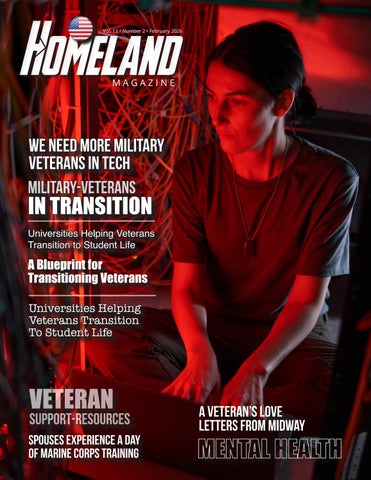
Homeland Magazine February 2026

Page 1


www.HomelandMagazine.com

Welcome to Homeland Magazine!

Homeland is a veteran-focused magazine throughout the country. It serves to assist all veterans, active military as well as their spouses and families.

It’s the leading veterans magazine emphasizing resources, support and focusing on topics and issues facing today’s veteran community. Homeland focuses on resources, support, community, transition, mental health and inspiration for our veterans, & military personnel.

The content is the driving force behind our magazine and the connection it makes with our veterans, service members, military families, and civilians.

The magazine is supported by a distinguishing list of veteran organizations & members, resource centers, coalitions, veteran advocates, and more.

We are honored to share the work of so many committed and thoughtful people.

Despite all the challenges, our team has upheld their focus and let not one opportunity go to provide resources and support to our veterans & military personnel.

On behalf of our team, we wanted to take this moment to say THANK YOU to the readers and the military and veteran community for supporting our magazine. With that support we aim to make a difference and continuing to make a profound impact on the quality of life for our veterans, military personnel and their families.

If you want to catch up on the current and all past issues please visit: www.homelandmagazine.com/archives

Editor-In-Chief

mikemiller@homelandmagazine.com www.homelandmagazine.com

Publisher

Editor-In-Chief

Mike Miller

mikemiller@SDVetsMagazine.com

Monthly Columns

What’s Next In Transition

Eve Nasby

Human Resources

Paul Falcone

Veterans in Business

Barbara Eldridge

Risky Business

Hadley Wood

Real Talk: Mental Health

Hope Phifer

PTSD: Reclaiming Control

Robert ‘Bob’ Cuyler, PhD

Aging & End of Life Care

Shelly Dew

Legal Eagle

Kelly Bagla, Esq.

Midway Magic

David Koontz

Cartoons For Veterans

Jerry King

Contributing Writers

Wounded Warrior Project

Disabled American Veterans

(In-House) Correspondents

Holly Shaffner

CJ Machado

Lori Noonan

Homeland Magazine 9528 Miramar Road, #41 San Diego, CA 92126 (858) 275-4281

mikemiller@homelandmagazine.com

Homeland Magazine is published monthly. Submissions of photographs, Illustrations, drawings, and manuscripts are considered unsolicited materials and the publisher assumes no responsibility for the said items. All rights reserved *The appearance of U.S. Department

WOMEN’S HISTORY MONTH VIRTUAL 5K

RUN | WALK

Honor the trailblazing women who defied societal norms and celebrate a woman in history who inspires you. Complete your miles throughout the month of March, whenever and wherever you choose.

‘FINEST OF RECORDS’

This Black, American World War I regiment fought longer than any other. They returned home to more battles.

Even the blaring sounds of a 100-piece jazz band turned to whispers in the throngs of cheering Americans who lined New York City’s Fifth Avenue on Feb. 17, 1919.

It was the city’s first homecoming for troops returning from the Great War. The Sun newspaper described the crowds as “two solid walls of booming, roaring welcomers,” and soldiers “decorated with flowers like brides.”

The men were the city’s own, having originated as the 15th New York National Guard Regiment in Harlem before being shipped off to France as the 369th Infantry Regiment. They quickly gained a reputation for their steadfast fierceness in battle, eventually earning the moniker “the Harlem Hellfighters.”

“Theirs is the finest of records,” the New York Tribune reported at the time. “Under fire 191 days, they never lost a prisoner or a foot of ground.”

But their welcome was a far cry from the regiment’s sendoff in 1917 when they were prohibited from marching

in the farewell parade of New York’s National Guard because of the color of their skin.

It wasn’t the first and wouldn’t be the last battle the men of the 369th—composed entirely of Black soldiers under a white commander and mostly white officers—faced on the home front.

They fought racist ideologies and policies to even be allowed to wear the uniform. Once in service, they were often overlooked, disrespected and undermined. Somehow, even sacrificing their bodies and contributing to the Allied victory still wasn’t enough to fully realize the rights, esteem and dream of American citizenship.

RED-BLOODED AMERICANS

Black Americans had served in uniform since the Revolutionary War, segregated from their white counterparts and often treated as inferior. Leading up to World War I, those circumstances hadn’t changed.

Even in New York, a beacon for Black Americans escaping the post-Civil War South, resistance to Black people serving in uniform persisted. It wasn’t until 1913 that legislation allowed for a Black unit in the New York National Guard—but victory was delayed.

“It would be another three years before the actual organization of the 15th New York National Guard would take place because of the resistance of the white New York National Guard,” said Jeffrey Sammons, a professor emeritus of history at New York University and co-author of “Harlem’s Rattlers and the Great War: The Undaunted 369th Regiment and the African American Quest for Equality.”

A series of events—including a 1916 fight on the Mexican border that depleted New York National Guard troops as World War I raged—finally led to the formation of a Black unit.

“We need men in this war effort, and it doesn’t matter what color they are,” Sammons said of the sentiment at the time.

Thousands of Black men answered the call.

“An awful lot of them were patriotic and were redblooded Americans who wanted to serve their country,” said Krewasky Salter, a retired Army colonel and military historian. “Their motivations for joining were analogous to just about any other American soldier.”

But the Black service member who expected to prove his value and patriotism had a unique burden. That burden grew heavier on April 2, 1917, when thenPresident Woodrow Wilson declared in his address to Congress calling for war, “The world must be made safe for democracy.”

Salter said that many Black soldiers thought, “If I continue to show my willingness to fight and die for this country, then perhaps I’m going to reap all of the benefits” of American democracy.

By December 1917, the 369th was in France.

A SLAP IN THE FACE

When Gina McVey recounts the story of the Hellfighters, she tells it like it’s old family lore—because it is. As a member of the 369th, her grandfather Lawrence McVey was among the first American infantry soldiers to arrive in France. But instead of rifles, McVey and his fellow soldiers were given pickaxes and shovels, Salter said.

Although the regiment was all volunteer and infantry, it was designated as a draftee unit and given manual labor duties.

“That was kind of a slap in the face,” Salter said.

By early 1918, the 369th found their place in the war— under the French flag. Fighting since 1914, France’s forces were depleted. There was pressure for the U.S. to supply reinforcements to French command, but Army Gen. John Pershing, commander of the American Expeditionary Forces (AEF), had marching orders to maintain the independence and identity of American forces.

“So the African American soldier gave Pershing an out, because he wasn’t going to give any of the white soldiers,” Salter said. “So he gave the African American soldier.”

When Gina McVey started researching the 369th, she came upon a now-infamous letter from AEF headquarters to French forces. In it, the French are advised not to eat with or shake hands with Black soldiers and not to “commend too highly” the Black American troops. The danger, the letter stated, was that contact with the French—who didn’t hold the same racist ideologies held in America—would “inspire in Black Americans aspirations which to them [the whites] appear intolerable.”

“It broke my heart,” McVey said of the letter.

Under French command, the men of the 369th performed their duty, serving in the trenches longer and suffering more casualties than any other American regiment. They participated in important battles, including the deadly Meuse-Argonne Offensive, during which they captured the village of Séchault, and were there for the armistice of Nov. 11, 1918.

Regiment soldier Henry Johnson became the first American ever awarded France’s Croix de Guerre military honor after engaging in hand-to-hand combat with an enemy raiding party.

(Continued on next page)

Throngs of New Yorkers line Fifth Avenue to welcome home the soldiers of the 369th Infantry Regiment returning from World War I. But despite their valiant, patriotic service, members of the Black unit continued to face racism and discrimination at home.

Lawrence McVey received the same French military honor for his courage in leading an attack that resulted in him being injured. According to his application for veterans disability allowance years later, McVey had suffered a gunshot wound to the arm.

“I’m just so proud that he fulfilled his duties to the best of his ability, and they were instrumental in turning the tide of war,” Gina McVey said. “Knowing that—all the times people have told us we didn’t do anything and we were lazy and we were good for nothing—that we were good for something.”

Another 169 members of the 369th received the prestigious Croix de Guerre. Yet at the time, few Black members received formal American honors.

HONOR DELAYED

“They need to be honored, because they fought for a country that didn’t fight for them.”
—Gina McVey

Once the glory of their welcome home faded, the members of the 369th and other Black regiments were left to deal with racism intensified by the shifting roles brought on by the war.

“One can see in the press that there’s a great deal of trepidation, of concern about these guys who have been trained to kill and had been transformed in many ways by their war experience and their interaction with people on a global stage,” Sammons said. “So it’s essentially, ‘how are we going to return Blacks to the status quo after the war?’”

Within months of returning home, the country was seized by the Red Summer of 1919, an outbreak of racial violence across dozens of cities. Over the course of 10 months, an estimated 250 Black Americans were killed. In Arkansas, wounded 369th veteran Leroy Johnston and his three brothers were killed in the Elaine Massacre, the deadliest racial confrontation in that state’s history.

It became clear that Wilson’s call to make the world safe for democracy didn’t apply to Black Americans, even those who fought in its name.

Then in 1925, the Army War College released a report on the role and value of Black soldiers. In the report, Black Americans were described as “inherently weak in character” and accused of having “failed in the World War.”

“This is a devastating document,” Sammons said, adding that it institutionalized the denigration of the Black soldier,

Above: Lawrence McVey, who served with the 369th, was honored with France’s Croix de Guerre after leading an attack that left him wounded. Thanks to the efforts of his granddaughter, Gina McVey, the medal now resides at the Smithsonian’s National Museum of African American History and Culture.

something that continued into World War II. It wasn’t until 1948 that then-President Harry Truman signed an executive order desegregating the U.S. military and mandating equality.

For most of the 369th’s Black members, it would take years, even decades, to receive American military honors. McVey received the Purple Heart in 1932. Johnson received the same in 1996, as well as the Medal of Honor in 2015.

In late 2021, the 369th Infantry Regiment was awarded the Congressional Gold Medal—well after its members had died.

“They need to be honored,” McVey said, “because they fought for a country that didn’t fight for them.”

More than a century after the Harlem Hellfighters marched up Fifth Avenue to thunderous cheers, their story still resonates—proof that courage often arrives long before recognition.

As the echoes of that parade fade, the nation can finally hear what was once drowned out: the call to honor all who fought for freedom. n

DAV Community Impact Day

A nationwide movement is underway to show veterans how much they matter. When you pledge your time at communityimpactday.org, you’re showing that simple acts of gratitude and service can have a profound effect on people’s lives.

It’s a chance to come together as a community— DAV members, families and friends of veterans are all welcome and encouraged to get involved.

Even an hour can make a difference.

Register today, and we’ll send you ideas for meaningful ways to give back, along with information on how to connect with others in your area.

Because “thank you for your service” is more than just words. It’s action.

“It’s Pure Luck” or “Good Luck Gail”

Veteran’s WWII Service Begins a Decades-Long Association with the Air Force

Gail Farrell always carried a youthful spark. He enjoyed a single Guinness each day and readily shares stories from his World War II service—memories that marked only a brief chapter in his life yet set the course for a lifelong connection to the United States Air Force.

Farrell grew up during the Great Depression. In the early 1930s, his mother moved all five children from Colorado to their grandmother’s home in Manhattan, Kansas, where Farrell spent his formative years. As World War II intensified, he felt compelled to do his part. In 1943, before even leaving high school, he enlisted in the Army Air Forces as an aviation cadet.

Shortly after graduation, Farrell reported to Fort Leavenworth, Kansas, and was soon sent to Miami, Florida, for boot camp. He vividly recalls the oppressive heat and the stench from dried drainage canals. Following initial training, he was assigned to St. Vincent’s College in Latrobe, Pennsylvania, one of several institutions contracted to provide aviation instruction during the war. Like most cadets, Farrell hoped to become a pilot and logged some early flight time in small training aircraft. Why Gail was at Latrobe PA. He bunked with President Jimmy Carter for 2 weeks.

By February 1944, however, the needs of the service redirected his path. While stationed briefly in Nashville, Tennessee, Farrell was selected to train as an aerial gunner rather than a pilot. His training continued at Buckley Field, Colorado—then a primitive base—where he attended armament school and learned to operate and maintain .50-caliber machine guns. He later completed gunnery school in Las Vegas, mastering the responsibilities of a B-17 tail gunner.

Farrell was next assigned to Tampa, Florida, and then Keesler Field, Mississippi, where he joined a full B-17 crew. For six months, the crew trained together over the Gulf of Mexico before traveling to Savannah, Georgia, to pick up a new bomber. In February 1945, they departed for Europe, making stops in Labrador, Greenland, and Iceland before arriving in England. There, they were assigned to Kimbolton Field as part of the 379th Bomb Wing.

Flying bombing missions over targets such as Schweinfurt and Berlin, Farrell witnessed the scale and danger of the air war. Original crews were required to complete 25 missions before returning home, later increased to 35. Farrell’s crew completed 21 missions before the war in Europe ended in May 1945.

He returned to the United States to prepare for B-29 service in the Pacific, but the atomic bombings brought the war with Japan to an end. Farrell was ultimately discharged in Lincoln, Nebraska. Using the GI Bill, he earned a journalism degree from Kansas State University in 1950 and received a commission as a second lieutenant through ROTC.

Recalled during the Korean War, Farrell served as a public information officer and later worked in psychological warfare programs. After leaving active duty in 1953, he continued his Air Force association as a civilian, eventually spending 22 years as associate editor of Combat Crew, a Strategic Air Command publication.

A father of three, Farrell notes that his oldest son retired from the Air Force as a master sergeant. Reflecting on his life, Farrell calls his wartime survival “pure luck” and credits World War II as the foundation of a decades-long, deeply meaningful connection to the Air Force—one that shaped a “splendid experience” spanning an entire lifetime.

Jeremy P. Amick writes on behalf of the Silver Star Families of America.

Staff Sgt. Gail Farrell, front row, far right, poses with its flight crew in 1945 just prior to leaving on a bombing mission.

MACV FOUNDATION

HE SERVED HIS COUNTRY THEN CANCER CAME FOR HIS FAMILY

Sergeant Andrew Poulsen (U S Army, Ret ) he’d been on three Afghanistan tours rising from artilleryman to PSYOPS Sergeant, fluent in 7 languages carrying the weight of a combat acquired disability rating He had faced enemy fire, stage three cancer, and now forced to live in his truck bed with a Phoenix heat index of 110 degrees. But his toughest battle? Watching his wife and young children suffer alongside him, unable to cover shelter with his disability pay When he called for help? It would be ten weeks before a family shelter could accommodate them. They wouldn’t make it.

We don’t stop at the crisis. We stay with the veteran until the situation is resolved because no veteran should ever be left behind.

MACV Foundation responded immediately. Partnering with Commissioner Chuck Byers of the Arizona Department of Veterans Services and the Military Order of the Purple Heart in Apache Junction, the foundation secured emergency hotel accommodations to get the family out of the heat.

Over the next several weeks, MACV case-managed the situation directly helping the family navigate services, advocate for support, and meet every challenge halfway with effort and resolve.

Within 7 weeks, the Poulsen family moved into a safe, two-story home provided by the Supportive Services for Veteran Families program.

Relationships Are a Force Multiplier

What Veterans Teach Us About Connection, Trust, and Showing Up

February often reduces relationships to romance—flowers, dinners, and carefully curated gestures. For veterans and military families, relationships are something far more consequential. They are not accessories to life; they are infrastructure.

In military and veteran communities, relationships often determine whether someone thrives, survives, or silently struggles. They shape transitions, influence health and wellbeing, and create the difference between isolation and belonging. And unlike the glossy versions we’re sold, these relationships are rarely simple, always tested, and deeply earned.

Built Under Pressure, Not Perfection

Military relationships are forged under conditions most civilians never experience—long separations, constant uncertainty, geographic instability, and high-stress environments where trust isn’t optional. Connection isn’t built in comfort; it’s built under pressure.

That pressure creates clarity. Veterans learn quickly who shows up, who follows through, and who can be trusted when it counts. Relationships aren’t about proximity; they’re about reliability. When you’ve relied on others for safety, survival, and mission success, you understand that connection is not sentimental—it’s strategic.

This mindset carries into civilian life, sometimes beautifully and sometimes painfully. Veterans often crave depth and meaning in relationships, yet struggle in environments where commitment feels casual or conditional. When trust has been sacred, surface-level connection can feel hollow.

Transition Tests Every Relationship

Leaving the military doesn’t just change a career—it reshapes identity, routine, and relationships all at once. The transition period is where many relationships are strained or lost.

Veterans may feel misunderstood by friends who can’t relate to their experiences. Military spouses often carry invisible burdens while navigating their own transitions. Families must renegotiate roles, communication patterns, and expectations—often without a roadmap.

This is also when isolation can take hold. Many veterans hesitate to ask for help, fearing they’ll be seen as weak or burdensome. But relationships don’t fracture because people struggle; they fracture when struggle goes unspoken.

Why Connection Is a Health Issue

We often talk about veteran wellbeing in terms of services—employment, housing, healthcare, benefits. All are critical. But connection is the thread that determines whether those supports actually work.

Strong relationships reduce suicide risk, improve mental health outcomes, and increase long-term stability. Veterans with trusted peers, supportive families, or meaningful community ties are more likely to engage in care, remain employed, and build purpose beyond service.

This isn’t theoretical—it’s observable and urgent. Yet too often, we treat relationships as “soft” or secondary. In reality, they are one of the strongest protective factors veterans have. Connection isn’t a nice-to-have; it’s a necessity.

Relearning How to Relate

One of the hardest parts of post-service life is relearning how to relate in a civilian world that communicates differently. Directness can be mistaken for bluntness. Loyalty can be misread as intensity. Silence can be mistaken for disengagement.

Healthy relationships—romantic, familial, professional, or peer-based—require mutual adaptation. They thrive when expectations are named, boundaries are respected, and vulnerability is treated as strength, not liability.

Beyond February

February’s focus on romantic love often overlooks the relationships that quietly sustain veterans every day: the peer who answers the phone late at night, the spouse who manages change with grit, the mentor who helps translate military skills into civilian opportunity, the community that says, You belong here.

For veterans, love often looks like commitment over convenience, action over words, and presence over perfection. Relationships don’t maintain themselves—they require intention and effort.

Because in the end, relationships aren’t just about who we love. They’re about who stands with us when life changes course. And for veterans, that kind of connection isn’t seasonal. It’s essential.

A Veteran’s Love Letters From Midway

He came into this world at the start of the Great Depression. Life was not easy growing up during one of the most devastating economic times in the country’s history, but there was something special about him. Even as a kid, he saw light instead of darkness.

Later, his older friends and relatives served in the military during World War II, but he was too young to join the fight. In 1948, however, after a few unfulfilling semesters at college, he enlisted in the Navy.

Having learned to play multiple instruments in his youth, Bill earned a coveted spot in the Navy’s School of Music in Washington D.C. It was there that he met Bea, who would become the love of his life.

The daughter of an American diplomat, born and raised in Europe, and speaking three languages, Bea only came to the United States as a 10-year-old to escape the Nazis at the start of the Second World War.

After a chance meeting in 1949, their casual conservations blossomed into a romance. A few years later, after tying the knot in the nation’s capital, they moved to Norfolk, Va., where Bill was assigned to the USS Midway (CV-41) as member of the ship’s band.

In May 1951, Midway pushed away from the pier in Norfolk. The ship would be at sea for most of

Dozens of other letters and cards were written between 1951 and 1952 while Bill was assigned to Midway. For more than 50 years, they remained hidden. It wasn’t until 2007, shortly after Bea’s death, that the letters were discovered.

“The night of Bea's memorial service, my sister, cousins and I retreated to the upper loft, our hang-out space at my grandparents' house,” said Peyton Roberts, Bill and Bea’s granddaughter. “My older sister was rummaging through old family artifacts and found a small, fireproof box. Inside the box was a neat stack of love letters.”

With Bill still alive, Peyton and her relatives didn't feel comfortable reading the letters. However, since Bea had made the point to save them for more than five decades, they knew they were significant.

Sadly, Bea’s death was very difficult on Bill. It was only after he passed away a few years later that the letters resurfaced.

“My mom brought the letters to our duty station in Virginia Beach,” said Peyton, whose husband is currently in the Navy. “I remember feeling absolutely astonished when I discovered the letters were written just weeks after Bea and Bill were married. The letters were such treasures, and I instantly wanted my mom, aunt, sister and cousins to be able to read them. I spent the next year transcribing them, researching their contents, and editing it all into a book just for family and close friends.”

the next two years. Bill and Bea would routinely be separated by hundreds to thousands of miles. Thus began a longdistance letter writing crusade – letters of love – that would ensure the two would remain united in spirit regardless of how far they were apart.

It would take a few more years before elevating her efforts into a book available to all. The re-sult is an intimate examination of the relationship between her grandparents through his letters when he was deployed on Midway. The book titled “My Dearest Bea” was published earlier this year.

“I worked on this book over the next 10 years,” said Peyton. “The project morphed and changed as time passed, and the significance of the letters took on new meaning. During the past two years, I revised the story for readers who didn't know my grandfather personally, but might take interest in the love letters or in his story. Turning the letters into a book was such a worth-while process because of the time spent savoring every sentence my grandfather wrote.”

For Peyton, it’s hard to say which of the letters is her favorite as each one holds a special meaning. However, the constant thread woven through each letter was how much he loathed being away from his darling Bea.

The book has been both an emotional and personal journey for Peyton, one that has helped her become even closer, albeit now in spirit, to her grandparents. It has also been a rare opportunity to share with others a poignant love story, a story that spans the ages.

“When I spend time with these letters, I feel the warm glow of a love that crossed oceans,” said Peyton. “I hope “My Dearest Bea” will be an encouragement to couples, especially those who are enduring a season of separation. I also hope all readers, no matter their background or season of life, will see the tremendous, lasting value of writing down what you appreciate about someone and sharing those words with them.”

“My Dearest Bea” is available at the USS Midway Museum’s gift shop and on Amazon. www.midway.org

www.midway.org/contact/volunteer-opportunities

www.midway.org

Bill and Bea (1950's)

Valentine’s Day

Impress your Valentine’s Day sweetie with an encyclopedic knowledge of the facts surrounding this quintessential day of love that’s been around since Roman times.

Surely, someone so well versed in the day must also know a thing or two about actual amore.

February 14th

Dying for Love

Theories abound on the origin of Valentine’s Day, but the most popular dates back to 270 A.D and the reign of Roman Emperor Claudius II. Seems Claudius didn’t want men marrying during wartime because he believed single men fought better. Bishop Valentine took exception and performed secret nuptials anyway. Claudius found out, jailed Valentine and had him executed on Feb. 14. From jail the holy man wrote a love letter and signed it “From your Valentine” and greeting card industry cheered.

First Speed Dating

In the Middle Ages, young men and women picked names out of a box to see who would be their Valentine. Then they would wear the names pinned to their sleeves for a week. This lead to the expression “to wear your heart on your sleeve.”

The Chocolate Connection

Doctors in the 1800s routinely advised patients pining for lost love to eat chocolate to calm themselves. Later in the century Richard Cadbury produced the first box of chocolates for Valentine’s Day. Today, no fewer than 35 million boxes of chocolate are sold each Valentine’s Day. (More than $1 billion in chocolate is bought in the United States alone.

Not just a U.S. Holiday

Besides the United States, Valentine’s Day is celebrated in Canada, Mexico, United Kingdom, France, Australia, Denmark and Italy.

Japan’s Take

Valentine’s Day was introduced here in 1936 and quickly became popular – with a twist. Because of a translation error, women buy men chocolates on this day to show interest. The men return the favor, if so inclined, on White Day, March 14.

It’s a Good Day for the Roses

Valentine’s Day – along with Christmas and Mothers Day – is huge day for florists. This single day generates sales of $14.7 billion, which is greater than the gross domestic product of several countries. An estimated 189 million flowers are sold in the United States this day of which about 110 million are roses.

Feb. 14 in History ….

Capt. James Cook killed by natives in Hawaii (1779), Oregon and Arizona admitted to the Union (1859 and 1912, respectively), James Polk becomes first president photographed in office (1848), United Parcel Service formed (1919), the League of Women Voters established (1920), Aretha Franklin recorded “Respect” (1967), Richard Nixon installed a secret taping system in the White House (1971) and Voyager I photographs entire solar system (1990)

For all your cartoon entertainment from one of the world’s most published cartoonists and army veteran, go to: www.patreon.com/cw/jerrykingcartoons

Helping Veterans and Spouses Find Healing and Mental Well-Being Together

For many military service members, overcoming challenges and finding a way forward is part of the job. But when faced with mental health challenges, such as post-traumatic stress disorder (PTSD), anxiety, and depression, stigma, fear, and uncertainty often stand in the way of getting help.

According to the National Alliance on Mental Illness, the average delay between when mental health symptoms first appear and intervention is 11 years. This delay can often lead to strained relationships, tension, and a growing sense of isolation for veterans and their loved ones.

Navigating the mental health care journey together can be overwhelming, but having support from a spouse is crucial to success.

‘I Knew Something Was Different’ Sara Geiger vividly remembers when her husband, Bill, returned home from a deployment in 2003. “Almost immediately after he came home, I knew something was different. He wasn’t himself.”

Bill struggled with a short temper, anger, and isolation. But PTSD wasn’t well known then.

“I was confused, hurt and angry,” recalled Sara. “I was always walking on eggshells because he was so easily triggered. But back then, we didn’t know what we were dealing with; we just knew something was wrong and that we had to figure it out.”

‘Barely Hanging On’

Christina Lopez Alfaro faced a similar realization with her husband, Sergio, a former Army medic who served in Iraq. Though his service ended six years prior to their marriage, PTSD disrupted their wedded bliss.

“On the surface, everything seemed fine – he had a job, I had a job. We were living and working, getting things done, but barely hanging on,” she recalled. “Sergio was suicidal, and my worry was whether he would take his own life while I was out.”

Breaking the Stigma, Encouraging Treatment

Convincing a loved one to seek mental health treatment can be a delicate and sometimes painful process.

For Christina, it meant being brutally honest. “I knew love alone wasn’t going to be enough to get us through this. The best thing I did was being vulnerable with him. I told him, ‘I don’t know how long I can do this.’ It scared him, and that fear became a motivator,” she said.

“I realized my relationship wouldn’t last if I didn’t change. I knew I needed more help,” admitted Sergio.

For Bill, the realization that he needed help came after he saw an email Sara had written to their pastor about their crumbling marriage. “It wasn’t until I found out how badly those emotions affected my family that I realized something was wrong,” he said.

Finding the Right Path to Recovery

Both Bill and Sergio turned to Wounded Warrior Project (WWP) for support and ultimately, Warrior Care Network,® an accelerated brain health treatment program that helps warriors heal from PTSD and other mental health concerns. The program offers innovative clinical care, wellness workshops, and peer-to-peer

Sergio & Christina Alfaro
Bill & Sara Geiger
Warrior Project

support, giving participants a better understanding of their symptoms and helping them find relief.

“I had to learn how to communicate that to my family. And some days are still just bad days. But through Warrior Care Network, I learned to address anger and handle stressful situations better,” said Bill, adding that he still relies on the lessons learned ten years later, and continues to thrive.

For Sergio, Warrior Care Network brought the realization that there were others like him. “For the first time, I felt like I wasn’t alone,” he said.

Their spouses also gained from the treatment.

“Learning his language was crucial for me,” she said. “[Through] Warrior Care Network, we received educational therapy that helped us both understand PTSD and triggers and learn about coping mechanisms. Now, when Sergio says, ‘My stress levels are up,’ I know exactly what that means and how to support him.”

Managing Frustration and Helplessness as a Spouse

Loving someone with PTSD takes patience.

“In the beginning, we struggled a lot as we needed to be educated on PTSD and what it meant,” said Sara. “But we knew we would find healing since we had faith and were committed to our relationship and to our family.”

She credits WWP with helping her heal and learn new ways to support her husband.

“Through Wounded Warrior Project I also found resources and support,

including spousal retreats. I learned to read my husband and understand what may have triggered him. I learned to separate my emotions from his trauma and how to be a better support system for him,” she added.

Finding Hope for Tomorrow

Both families admit that tough days still exist, but they continue to rely on the strategies they learned to navigate difficult times.

“We recognize it, and we give him space and take space for ourselves as well. Then later, we come back together again,” said Sara.

“Sometimes, I just sit with Sergio in silence. Other times, I will encourage him to reach out– to a therapist, a friend – or tell him to go outside to have a change of scenery,” said Christina.

Both women also ensure they take time for themselves. “I pray a lot,” Sara said. “And I am a big fan of naps, even 10 minutes to calm my mind. I also walk a lot and listen to audiobooks.”

Christina heads outside, too. “Spending time with our dog and taking her out on a trail helps me to clear my mind. It helps me ground myself and fill up my tank so I can see things with more clarity,” she said.

A Solid Future Built on Healing

Healing isn’t easy. There are twists and turns, but both couples emphasize that every step is worth it. “We love each other fiercely,” Sara said. “I’m just so grateful we fought for this life together. And fortunate for Wounded Warrior Project. It has been invaluable for our family and gave Bill a sense of purpose again.”

Now a mentor for other veterans, Sergio credits WWP for helping his family have a bright future.

“The organization takes care of the whole family, which is so important because my spouse lives with my PTSD, too. We’re in a better place for today and tomorrow,” he said.

Tips to Support Your Veteran Spouse’s Mental Health

Sara and Christina share their top five tips to support spouses with PTSD.

1. Separate yourself from your spouse’s trauma. It’s not about you –it’s about their experiences. Sara said she used to take it personally when Bill had bad days. “Now, I know it’s not me or the kids.”

Christina said she learned not to internalize Sergio’s struggles. “I cohabitate with PTSD, but I learned that while I can’t take that away, I can separate myself from it. Even if he’s having a bad day, I can still be a good wife and partner.”

2. Encourage, but don’t force. Sometimes, direct encouragement works (“Have you scheduled your therapy session?”), but other times, a softer approach is better (“Would you like me to call and set up that appointment for you?”).

3. Find your own support system. Support groups can help connect spouses with others who understand the journey.

4. Be present. Don’t feel the need to force conversation. Sometimes, silence and presence are enough.

5. Take care of you. Whether through therapy, meditation, or exercise, find ways to refill your own cup.

To learn more, visit woundwarriorproject.org or call 888.WWP.ALUM (997.2586) to connect with the WWP Resource Center.

Spouses Experience a Day of Marine Corps Training

Spouses of 4th Marine Regiment and 3rd Reconnaissance Battalion participated in an "In Their Boots" event at Camp Schwab, Okinawa, Japan, Jan. 15. The one-day event was designed to give spouses a firsthand look at the training their Marine spouses conduct to sustain a ready and capable combat force.

By participating in a series of hands-on activities, spouses can better understand daily challenges while building a stronger connection to their Marine and with other families throughout the commands.

The day included multiple events modeled after standard Marine Corps requirements. Spouses fired rifles on a live-fire range, conducted the obstacle course, completed a modified combat fitness test, descended a rappel tower and rode in a combat rubber reconnaissance craft.

"Our spouses can see not only what their significant other does throughout the day and throughout the year, but the other opportunities that are available in the Marine Corps," said Marine Corps 1st Lt., Headquarters Company executive officer, 4th Marine Regiment.

Throughout the day, Marines assigned to 4th Marine Regiment and 3rd Reconnaissance Battalion served as instructors and safety guides, explaining each task and encouraging spouses. Through their involvement, spouses gained insight into Marine Corps training standards and unit culture.

The spouse of Marine Corps 1st Lt., Headquarters Company executive officer, 4th Marine Regiment, and another spouse perform a body drag during a combat fitness test as part of an "In Their Boots" event at Camp Schwab, Okinawa, Japan, Jan. 2026. The event provides spouses an opportunity to learn more about their Marines' work and experience Marine Corps training.

For many spouses, the experience was both challenging and rewarding.

"It's harder than I thought, and I definitely [have] a lot more respect for the Marines that are able to finish the O-course and the CFT," said Isabelle Rebert, Rebert's wife. "They planned out the schedule really well to show us as much as they could in a one-day span and we got to do a lot of really cool stuff."

Leaders of 4th Marine Regiment emphasized that family readiness is a critical component of mission readiness. Events like "In Their Boots" reinforce the idea that spouses play an essential role in supporting Marines, both at home and during deployments. By the end of the day, participants left with a deeper appreciation for the training that their Marine spouse endures and a deeper connection to their spouse's service.

"It is not often that military spouses can see the intricate complexities and professionalism of their Marine spouse on the job, and this event helped demonstrate how much their Marine is capable of and ready to do on behalf of our nation," said Marine Corps Col. Richard Barclay, commanding officer, 4th Marine Regiment. "This was a great opportunity for the spouses, across several commands, to spend the day together doing high-quality Marine training and foster a greater sense of community amongst our families here in Okinawa. Given the opportunity, I would highly encourage any military spouse to take full advantage of events like this."

A spouse of a Marine assigned to 4th Marine Regiment receives an award from Marine Corps Sgt. Maj., 4th Marine Regiment, 3rd Marine Division command senior enlisted advisor, for having the best score on a combat fitness test during an "In Their Boots" event at Camp Schwab, Okinawa, Japan, Jan. 2026.

Photo Credit: Marine Corps Cpl. Joaquin Dela Torre

Photo Credit: Marine Corps Cpl. Joaquin Dela Torre

of Marines assigned to 4th Marine Regiment and 3rd Reconnaissance Battalion participate in a combat rubber reconnaissance craft ride during an "In Their Boots" event at Camp

Spouses of 4th Marine Regiment and 3rd Reconnaissance Battalion participated in an "In Their Boots" event at Camp Schwab, Okinawa, Japan, Jan. 2026.

The one-day event was designed to give spouses a firsthand look at the training their Marine spouses conduct to sustain a ready and capable combat force.

Spouses
Schwab in Okinawa, Japan, Jan. 2026.
Photo Credit: Marine Corps Cpl. Joaquin Dela Torre
A spouse of a Marine rappels during an "In Their Boots" event at Camp Schwab in Okinawa, Japan, Jan. 2026.
Photo Credit: Marine Corps Cpl. Joaquin Dela Torre

Real Talk: Mental Health

Your Journey to Self-Love

Self-love can be interpreted in different ways, such as appreciation of oneself or respecting your worth. It is often difficult for people to take time out of their day to provide a moment of self-appreciation or self-compassion. And, understandably so, we are often trying to meet or exceed the expectations and needs of others. We often see military families having to juggle many roles at once, especially around deployments or Permanent Change of Station (PCS) season. For example, one parent might find themself taking on extra responsibilities and having to navigate everything on their own, while their spouse might be deployed. And, on the opposite end, the person serving also must find ways to manage duties at work while making time to stay connected from afar.

Some people might feel “selfish” to engage in self-love activities, while others might feel “unworthy”. Self-love is not about being selfish or not worthy. In fact, it is the opposite of that. Self-love is about respecting yourself and prioritizing your individual needs. Let’s face it, the more we make it a priority to take care of ourselves, the more space we can hold for everything else in our lives. Providing time for self-love can increase awareness, positivity, and balance in your life by setting time aside to understand what your needs and wants are. In addition, it gives us the opportunity to grow mentally, physically, and spiritually through self-reflection.

Setting time aside to practice self-love can be done in many ways. Below are some ways to engage in self-love that will, hopefully, help you start your journey this year with a fresh perspective on how to appreciate yourself a little more.

1. Start with identifying what your values are. Values are important to understanding your “why” when engaging in different activities. For example, if you value

health, it will be easier to engage in healthy eating habits when you identify why health is important to you. An increased awareness of your values can also help develop a stronger relationship with yourself and your needs.

2. Set healthy boundaries by putting your needs first. Whether this is in your home life or work life, it is important to know what your limit is to avoid being burnt out. Setting boundaries can look like taking a social media break for mental clarity or saying no when you already have too much on your plate.

3. Try speaking to yourself in the same compassionate way you would to a friend or a loved one. When you find yourself speaking down or harsh to yourself, attempt to identify what you appreciate about what you have done.

4. Take a moment to reflect on your emotional state and write out the feeling you may be experiencing. This can also help you understand where those emotions are coming from and can lift some weight off your shoulders.

5. Make time in your day to participate in something you enjoy, even if it is for 5 minutes. For example, it can be completing a word puzzle, listening to your favorite song, dancing, or calling a friend to let them know you have been thinking about them.

6. When in doubt of how to proceed with practicing or implementing self-love, try seeking out for support with a mental health expert. The Steven A. Cohen Military Family Clinics are great resources to utilize in order to help manage your stressors and to provide guidance on enhancing your self-love techniques.

Whatever it is you do to focus on self-love, remember that starting something new can be difficult and will take time.

The suggestions above are just a few ways to practice self-love. Also, consider looking at the Cohen Veterans Network’s Self-Love Tips for the New Year for more tips. Learn more by visiting cohenveteransnetwork.org/self-love-tips-for-the-new-year

Cohen Clinics provide therapy to post-9/11 veterans, service members, and military families, including National Guard and Reserves. All sexual orientations and genders welcome. LEARN MORE vvsd.net/cohenclinics

3609 Ocean Ranch Blvd. Suite 120

20800 Madrona Ave. Suite C-100, Torrance, CA San Diego Oceanside Los Angeles our CALIFORNIA locations

8885 Rio San Diego Dr. Suite 301

PTSD: Reclaiming Control

PTSD and the Female Veteran, Part 2

For this month's column, I've asked my colleague Lori-Ann Landry, a social worker in private practice in Denver with extensive experience in PTSD treatment and research, to share her insights.

One area of particular interest and direction many trauma treatment programs are taking is the integration of somatic or body-centered modalities with talk-centered, or cognitive therapies. Bessel van der Kolk’s book ‘The Body Keeps the Score’ is a leading treatise on the importance of whole health approaches to trauma. Treatments such as Somatic Experiencing, somatic-focused EMDR, bodymind psychology, and Freespira, as well as wellness practices such as meditation, trauma-informed yoga, and martial arts practice can help female veterans who through traumatic experiences no longer feel safe in their bodies learn to feel grounded and safe within themselves.

Many times, the female veteran’s world gets smaller as trauma reminders are avoided to manage triggers. Female Veterans may stop going to the grocery store or out socializing when there are crowds or too much stimulation to feel safe. They may become hypervigilant with locations that involve too many movements or sounds. They may stop dating or feel uneasy with more intimate connections. Dissociation (separating oneself from troubling thoughts, feelings and sensations) is an understandable coping mechanism, but one that backfires. They can become “stuck,” facing outwards and forget that their bodies even exist or need and deserve nourishment and care. This is done to survive the event and aftermath, but unfortunately this can cause a ruptured relationship between self and body. Somatic therapies can “bring you home,” so to speak and allow you feel safer from the inside out.

Cognitive therapies will help you manage your thought processes and challenge irrational thoughts and fears. Somatic and body-centered therapies will help you complete movements that are stuck in your body, help your body release trauma reminders bound in gut and muscles, listen and hear what different parts of your body are needing from you and learn to nourish and care for your body the way you would your own child.

When experiencing panic, human bodies erupt with frightening sensations: racing heart, hyperventilation, nausea, dizziness. In this frightening state, the human capacity to evaluate options and take perspective goes away. Breathing programs such as Freespira, or other forms of breathwork such as trauma-informed yoga and martial arts teaches you to engage or deescalate bodily distress in a similar way that cognitive therapies teach you to recalibrate thoughts and emotions.

These approaches help you slow down and appreciate the interactive relationship between mind and body.

Somatic and Cognitive therapies together can help you heal at the whole-body level which is particularly important for women and female veterans who have been sexually assaulted. Many individual therapists and trauma specialists have been including somatic components to their treatment methods over the past two decades with good results. We are also starting to see more intensive therapy programs such as IOPs and inpatient begin adding breath work, wellness groups and somatic therapies as core treatment components. Programs such as offered by Laurel Ridge or the Salt Lake Behavioral Health Military Sexual Trauma Recovery Program offers mindfulness, expressive therapy, yoga and pet therapy in addition to their more cognitive treatment methods for a whole body centered approach. Continued research is ongoing in the ways somatically informed treatment methods can complement and enhance the more historically used cognitive treatment methods for military sexual trauma.

Dr. Cuyler is chief clinical officer of Freespira, an FDA-cleared non-medication treatment that helps people with panic and PTSD manage their symptoms by learning how to regulate their breathing. www.freespira.com

“I am shocked and surprised that this treatment worked. When I think about PTSD, I think about the brain and this being a brain problem… There is no denying the calming effect this treatment had on me. This has made a significant difference in my personal life. This treatment is remarkably effective.”

— Kevin, US veteran whose symptoms included social anxiety and monthly panic attacks before he found Freespira

Beyond Sticker Shock: A Q&A on the Veteran Medication Access Crisis

Homeland Magazine sat down with Alexandra Robertson, Senior Vice President of Growth at Visory Health, to discuss the challenges of medication access and affordability faced by Veterans.

Homeland: Alexandra, 40% of Veterans, battle chronic conditions like hypertension, plus service-related injuries and PTSD. What is their most significant health management challenge today?

Alexandra: The biggest hurdle is the consistent, day-today management of chronic conditions like the ones you mentioned. More pressing, however, can be the challenge of medication access and affordability. It’s not enough to have a prescription; patients must be able to access and afford their medications month after month. That’s why at Visory we’re working to inform communities like Veterans about choices they have available to them.

Homeland: We’ve seen news about “pharmacy deserts.” How do pharmacy closures impact the Veteran community?

Alexandra: Pharmacy deserts are a major barrier, especially for Veterans in rural areas or with limited mobility. When a local pharmacy closes, a 20-minute trip can become a 60-minute one. Many won’t make that drive, which leads to “prescription abandonment.” For a Veteran managing a chronic condition, that’s a direct threat to their health.

Homeland: What’s the most effective, actionable step a Veteran can take to avoid “sticker shock” before leaving their doctor’s office?

Alexandra: Some Veterans may have benefits, such as TRICARE, which can help provide medications at a reduced cost. However, many Veterans experience gaps in their healthcare, including prescription coverage. So when a provider prescribes a medication, ask: “Is there a generic version available? Does my insurance cover this? Are there lower-cost alternatives?” Initiating that conversation is a crucial part of the treatment plan. A prescription you can’t afford isn’t an effective one.

Homeland:: What other resources or strategies can lower costs once they have the prescription?

Alexandra: Everyone might not know that when using a prescription discount card, the prices may vary by pharmacy. Prescription discount cards, like Visory Health, work best on generic medications, and for those who are prescribed brand drugs, I recommend seeing if Patient Assistance Programs are available.

Homeland: How can modern health-tech platforms and price transparency tools help bridge these gaps in access?

Alexandra: The key is removing the lack of transparency that often drives up costs. By using digital tools to compare prices in real-time, Veterans can bypass hidden fees and find the price of their medication with ease. These platforms empower patients with information to find affordable and accessible options.

Homeland: Alexandra, this landscape is complicated. What does Visory Health do to help Veterans navigate these challenges?

Alexandra: Our mission is to create access to affordable medications for underserved communities, especially Veterans. We eliminate “sticker shock” through our price transparency and free prescription discount card, which can give Veterans up to 80% off their medications. We also work closely with Veteran service organizations such as Folds of Honor to help reach as many Veterans and their families as possible. We empower Veterans with information like we’re doing today to let them know what affordable, accessible options are available to them and their families, so they never face an impossible choice between their health and other essentials. We believe no one, especially our Veterans, should go without their medications. For more information please visit www.visoryhealth.com

THE HARMONETIKS PROJECT

From Kidney 1, Earth Surge to Heart 1, Supreme Spring

Grounded song

In ancient medicine, Kidney 1 Earth Surge is the root: the place where we touch the ground and remember that we are held Heart 1 Supreme Spring is the opening: where courage lives, where breath becomes feeling, and feeling becomes connection When Kidney 1 awakens, the body settles. When Heart 1 softens, the spirit returns. And when these energies connect, something remarkable happens. Between sole and soul, root and ribcage, music arises a steady rhythm that grows into a living song

Susan Welch, former Marine, is doing this work through horses helping veterans find their footing, then their breath, and then their heart. As she moves toward

purchasing a new home for her horses an anchored place for this mission she plans to begin Harmonetiks Somatic Experiential Equine Embodied Learning there If you’d like to support her, collaborate, or learn how to get involved, you can reach her at susan.welch87@gmail.com.

Doc Mike Williams, former Army Special Operations combat medic, carries this same pathway through music. He teaches Easy Breath as a lived experience breath you can feel, rhythm you can trust, and a heart you can return to. Doc Mike is available to teach through the Harmonetiks Warriors community and website.

As the rest of The Harmonetiks Project shares this work through our online

home, we’ll keep the purpose simple: ground the body (Kidney 1), open the heart (Heart 1), and let the breath become a bridge to community, to steadiness, to life For more information email info@theharmonetiksproject o rg

Sign up for your first class HERE

Veterans Helping Veterans

TRANSITION To Civilian Life

+ A Blueprint for Veterans Transitioning to Civilian Life

+ Why We Need More Military Veterans in Tech

+ A Veteran's Guide to Thriving in the Civilian Workforce

+ LinkedIn Tips for Business Development

+ Helping Veterans Transition to Student Life

+ A New Mission for Veterans in Public Schools

+ Readiness Now Means Predicting the Future

+ A Sailor’s Path to Civil Service

+ Visibility in the Changing Marketplace

+ Fall in Love with Your Business

+ Cybersecurity Training for California Employers

+ Surviving an Insurance Audit

+ Careers in Law Enforcement

For trusted guidance on transition, careers, education, entrepreneurship, workshops, and legal resources for veterans and military business owners, explore Veterans In Transition.

www.homelandmagazine.com/category/veterans-in-transition

Military Life Is Unpredictable. Your Education Shouldn’t Be.

Earn Your Degree Anytime, Anywhere. Flexible, Affordable, and 100% Online!*

Military life comes with constant changes—deployments, PCS moves, and unpredictable schedules. But your education doesn’t have to wait. At Los Angeles Pacific University, we understand the unique challenges military members, spouses, veterans, and dependents face. That’s why our fully online programs offer the flexibility you need to study at your own pace, no matter where life takes you. Whether you’re on base, deployed overseas, or at home, your degree moves with you!

• 100% Online & Flexible: Learn from anywhere, on a schedule that fits your life.

• Maximize Your Benefits: Use GI Bill®, tuition assistance, and spousal benefits.

• Earn Credit for Your Experience: Take advantage of CLEP, DSST (DANTES), and AARTS/JST to turn your military training and knowledge into college credit.

• Fully Accredited: LAPU offers fully accredited associate, bachelor’s, and master’s degrees through the WASC Senior College and University Commission (WSCUC).

• Faith-Based & Supportive: Dedicated military-friendly success coaches who care about your journey.

Your Future Starts Today! Take the Next Step

*At this time, LAPU is unable to offer distance programs or courses to students residing in the following states and districts: Alabama, Arkansas, Connecticut, the District of Columbia, Indiana, Kansas, Maryland, Minnesota, New Mexico, New York, North Carolina, Oregon, Wisconsin, and Wyoming.

LAPU Voted #1

Military Friendly School & Spouse School

Mission Accomplished: A Blueprint for Veterans Transitioning to Civilian Life

Homeland Magazine sat down with Dr. Jeff Harley Senior Director of Military Engagement, Western Governors University to share his story and blueprint for veterans transitioning.

Homeland: What influenced your decision to join the United States Navy?

Dr. Harley: I was very blessed to serve the United States for 37 years. I enlisted in the Navy right out of high school because it felt like a chance to give back and be part of something bigger than myself, to learn a skill trade and to serve my great nation.

Homeland: What were your responsibilities and duties during your time in the service?

Dr. Harley: I began my career as an E1 and worked my way up to Rear Admiral Upper Half. I was blessed along the way to command six different organizations, including serving as Director of the White House Situation Room and President of the U.S. Naval War College.

In the military, responsibilities revolve around collaborative team building and leading others. I had the privilege of doing challenging, demanding work alongside extraordinary individuals who shared an unwavering sense of camaraderie and dedication to the mission. “Honor, courage, commitment” is what we called it in the U.S. Navy. That sense of purpose and teamwork was the most rewarding part of my role.

Homeland: Describe the transition from being a highly dedicated military leader to having a career outside the military and challenges you faced.

Dr. Harley: That transition is difficult. Military members are part of a world built on strong camaraderie and shared values, and that sense of connection is something you deeply miss after leaving. You miss interacting with so many young people whose lives you feel you can positively impact, which is really what everybody wants to do.

One of the biggest challenges I faced was applying for jobs. Translating military skills into terms that resonate with employers can be incredibly tough. Many of us are also naturally humble, which makes it harder to confidently speak about ourselves—which is an essential skill in the interview process. Translating a commendation medal into the civilian equivalent is incredibly hard.

Homeland: Were there any mentors or resources that helped guide you through your transition from service to civilian life?

Dr. Harley: I had an extraordinary number of mentors and some of them were people who were in the military, and some weren’t. Mentors are critically important during the transition phase because they work to help you understand how to highlight your value and how to translate your skills meaningfully to employers. It’s a value proposition, after all.

In addition to mentors, there are a lot of helpful resources for veterans that provide valuable support with resumés, mock interviews and connecting with potential employers. Transitioning from a military structure to the ambiguity and uncertainty of a civilian job search makes having a strong support system essential to a successful transition.

Homeland: What inspired you to pursue a career in higher education?

I was eager to find a role where I could continue giving back. I like the idea of education as a way to work with young people and help be a part of creating the future.

Homeland: Why did you choose Western Governors University?

Dr. Harley: There are a lot of elements that make WGU special. The degree programs are designed to accommodate students’ different life circumstances, including those of the military community. 85% of military students pursue their education online. WGU’s real differentiator, though, is its competency-based education model, which allows students to progress toward their degrees at their own pace based on how quickly they meet the competencies.

I’ve found that the camaraderie and teamwork at WGU are as extraordinary as when I was in the military. I also appreciate that students gain practical skillsthat can be immediately applied to current, in-demand roles.

Homeland: As senior director of military engagement at WGU, how do you support veterans in their educational journey?

Dr. Harley: My team manages the entire military student journey ecosystem—from pre-enrollment to graduation and beyond. Many military students want tuition assistance and scholarships, but they also need a support organization that understands them and their needs. My team’s job is to provide that one-on-one support based on shared experience. We help military students navigate their educational requirements to ensure their retention, success, and achievement of their degree.

Homeland: Why is it important for veterans to continue learning?

Dr. Harley: Lifelong learning paves the way for greater opportunities. With each degree I earned, my career advanced, opening new doors for success. For example, achieving a high school degree allowed me to join the Navy. Once I earned my bachelor’s degree, I had the ability to become an officer in the military. Once I obtained my master’s, I had access to even more senior roles. It’s about continuously seeking and achieving more for your future.

Homeland: What advice would you give to veterans and active-duty service members about pursuing higher education or translating their military skills into civilian careers?

Dr. Harley: Regardless of whether you’re pursuing a degree or a civilian career, your skills are transferable. Skills that are critical in the military, like the ability to be on time, work with a team and communicate effectively, will translate across almost any job and are attributes that most employers seek out. If you’re still struggling, education can be another way to transfer those skills – don’t be afraid to pursue both job opportunities and education opportunities.

Be less humble in defining what value you can bring to other organizations; what veterans can offer is so extraordinary.

Veterans are a great fit for companies because they bring unparalleled discipline, work ethic, leadership, and adaptability, honed through rigorous military training, translating to mission focus, teamwork, integrity, and problem-solving.

Transitioning out of the Military into the Civilian Workforce?

Finding a job in the civilian workplace may seem easy at first. After all, you have learned skills, practiced leadership and demonstrated initiative that will make you successful wherever you go.

The reality, though, is that In fact, it can be downright depressing, demotivating, and you may feel totally disillusioned. We can help

In our Veterans In Transition archives you will find helpful and informative articles about what’s next in transition, veterans in business, career, advice, tips, workshops, transition to education, entrepreneurship, veteran franchises, legal tips & resources for veteran businesses and much more...

For assistance in your journey please visit: Veterans-In-Transition https://tinyurl.com/vet-in-transition homelandmagazine.com/category/veterans-in-transition

VETERANS IN TRANSITION

Why We Need More Military Veterans in Tech

When I transitioned from military service to the tech world, I quickly realized that while the environments were different, the skills I brought with me were just as valuable—and often under-appreciated.

The tech industry, known for its rapid pace and need for innovation, is perfectly suited for the strengths that veterans bring. Yet, many veterans face significant challenges when making this shift, finding that the road from military to civilian life is paved with both opportunities and obstacles.

Each year, nearly 200,000 military personnel transition to civilian life, but only a fraction find their way into the tech industry. Despite having developed critical skills like problem-solving under pressure, teamwork, adaptability, and effective communication, many veterans face hurdles in translating these strengths into terms that resonate in the civilian job market.

I’ve been there myself, moving from being a U.S. Army Captain to founding and leading a tech company as CEO of BuildOps. (buildops.com/about) This transition wasn’t seamless, and the experience has shown me how essential it is for companies to actively recruit and support veterans.companies to actively recruit and support veterans.

Veterans: An Untapped Resource for the Tech Industry

The skills honed in the military aren’t just relevant to tech—they’re essential. In the Army, I learned to lead teams through complex, high-stress operations where adaptability and clear communication were key. The ability to assess situations and make decisions under pressure is directly transferableto tech projects where deadlines are tight, and stakesare high. These are the same skills that help teams innovate and move projects forward even when plans don’t go as expected.

Yet, too many veterans are overlooked or struggle to showcase their potential. The reasons are varied. For one, translating military experiences into civilian terms can be challenging. What does leading a platoon equate to on a resume? How does coordinating complex logistics operations in a combat zone translate to leading a product launch or managing a development team? Without guidance, many veterans find themselves with a set of unmatched skills and no clear way to present them.

Overcoming the Transition Challenges

The transition from military life to the civilian workforce is more than just changing jobs; it’s an identity shift. Veterans, who are used to a strong sense of purpose, discipline, and structure, often face a new world where expectations and culture are vastly different. This shift can lead to feelings of isolation and uncertainty.

I remember the initial culture shock of moving from a regimented military life to the flexible, often ambiguous world of tech. I was fortunate to have mentors who helped bridge that gap and translate my military background into a set of valuable assets.

However, not all veterans have that support. Data from the Bureau of Labor Statistics shows that while unemployment among veterans is relatively low, disparities exist. For example, Black, Asian, and Latino veterans have higher unemployment rates than their white peers. Women veterans, the fastest-growing segment of the veteran population, face unique challenges, including negative perceptions and difficulties accessing care and support.

Programs like the Soldier for Life – Transition Assistance Program and *Hire Heroes USA* have made significant strides in providing resources and training to help veterans adapt, but more is needed. Companies must actively engagewith these programs, understand the veteran community, and tailor their recruiting and support strategies.

The

tech industry, known for its rapid pace and need for innovation, is perfectly suited for the strengths that veterans bring.

Why Companies Should Actively Recruit Veterans

For the tech industry, recruiting veterans isn’t just a good deed—it’s smart business. Veterans come with built-in resilience, a focus on mission-driven goals, and the ability to lead with both confidence and humility. At BuildOps, I’ve seen how these traits translate directly into team dynamics and innovation. When veterans join our teams, they bring a unique ability to motivate those around them, push projects forward, and maintain a steady hand when challenges arise.

One of the best ways to support veterans transitioning into tech is by offering training that fills specific skill gaps and connects military experience with tech roles. Internships, mentorships, and tailored onboarding programs can make a significant difference. Helping veterans translate their leadership and problemsolving skills into civilian terms isn’t just about a job—it’s about finding new purpose and continuing to contribute meaningfully.

Building a Future Where Veterans Thrive

If we want to truly tap into the potential that veterans bring, we need to create pathways that make sense.

This includes educating hiring managers to understand military backgrounds, creating inclusive support networks, and offering continuous training opportunities that build on existing skills. My experience transitioning into tech showed me that when veterans are given the chance, they excel. They lead with integrity, take ownership, and have a drive that can set teams apart.

It’s time for the tech industry to recognize the value of veterans not just as employees but as leaders, innovators, and changemakers. Companies that invest in veteran talent will find themselves enriched by perspectives built on resilience, adaptability, and dedication—qualities that any high-performing team would be lucky to have.

Alok Chanani, CEO of BuildOps, is a visionary leader transforming the commercial contracting industry.

A former U.S. Army Captain turned tech founder, Alok leverages his military-honed leadership skills and an MBA from Wharton to drive innovation in construction through BuildOps ground breaking cloud-based platform.

WHAT’S NEXT Transition to Civilian Life

FLASHBACK - June 2024

Forging a New Path: A Veteran's Guide to Thriving In the Civilian Workforce

For over three decades, Amy Forsythe dedicated her life to serving in the United States Marine Corps and Navy Her journey through multiple deployments and transitions has provided her with a unique perspective on the challenges veterans face when entering the civilian workforce. As someone who has navigated these uncharted waters herself, Amy offers invaluable insights to those embarking on this exciting, yet often daunting, new chapter.

Change is inevitable. Embrace it!

"One of the most significant hurdles veterans face is adapting to a different work culture and environment," says Amy, author of Heroes Live Here: A Tribute to Camp Pendleton Marines Since 9/11. Having operated within the structured hierarchy of the military, with clearly defined roles and responsibilities, the fluidity and lack of rigid structure in the civilian workforce can be a stark contrast. However, Amy emphasizes the importance of embracing this change and remaining open to new ideas and approaches.

Reframe your military experience and update your LinkedIn profile.

Expand your network beyond military connections. Adaptation has been a constant companion throughout Amy's career, as she currently serves as a U.S Navy Reserve Public Affairs Officer under the U.S. Special Operations Command (Theater Special Operations Command Europe). Her experiences have taught her the value of diversifying her professional network beyond her military circles. "Developing connections with professionals in various industries and locations can open doors to new opportunities and provide valuable insights into the civilian job market," she notes.

Redefining one's personal brand and online presence is another critical component of the military-to-civilian transition process. As a veteran, Amy understands that service members possess a wealth of skills and experiences that are highly transferable and valued by employers. However, she emphasizes the importance of translating military accomplishments into language that resonates with civilian hiring managers. "Your military experience is extremely relevant," Amy states, "but it's crucial to communicate it in terms that hiring managers can directly understand."

She advises veterans to document their military experiences and rephrase them to highlight valuable qualities like leadership, project management, and technical proficiencies. Creating or updating professional platforms like LinkedIn to showcase unique strengths and achievements is also essential. By reframing military backgrounds in corporate vernacular and leveraging modern networking tools, veterans can effectively market their qualifications to prospective employers.

Be honest and transparent with potential employers

Honesty and transparency have been constants throughout Amy's transitions. "Don't be evasive or elusive with potential employers. Be open about your experiences, both the triumphs and the challenges," she advises. "Employers value authenticity and the unique perspectives that veterans bring to the table."

Fuel your journey with education and exploration

Amy's military assignments and adventures have taken her on uncharted paths, from traversing the roads of Sri Lanka, where elephants roamed freely, to navigating the complexities of redefining her brand during transitions. Through it all, she has learned the value of education, pursuing a master's degree after a deployment to broaden her horizons and position herself for rolesin the State Department.

As she reflects on her own transitions, Amy expresses gratitude for the opportunities they have provided her to grow, learn, and expand her horizons. "Volunteering for causes I care about has also played a big role in helping me navigate my passions and purpose. The skills and resilience cultivated during my military service have served me well in the civilian workforce, allowing me to tackle new challenges with confidence and determination."

Transitioning from the military can also be an opportunity to explore new passions and interests. Amy discovered a love for photography and curating exhibits during her time as a public affairs officer, finding fulfillment in visual storytelling and opening up new avenues for creative expression.

For those considering entrepreneurship, Amy's journey with her husband in purchasing a commercial pool cleaning business in 2014 provided invaluable lessons on taking calculated risks and embracing challenges. "Entrepreneurship allows you to leverage your leadership skills, adaptability, and problem-solving abilities honed during your military service," she says, encouraging veterans to explore this path.

Make your journey your own!

Remember, the transition process is not a one-size-fitsall experience. Each veteran's journey is unique, shaped by their individual goals, aspirations, and circumstances. Amy encourages veterans to embrace the uncertainty and be willing to adapt and pivot as needed, seeking out mentors, tapping into veteran support networks, and taking advantage of available resources.

"Know that you possess a wealth of invaluable experiences and a mindset that sets you apart. Embrace the transition as a chance to redefine yourself, explore new passions, and continue making a positive impact in your community and beyond."

Need help with your transition? Have questions? Link up with Eve on Linked In today

www.linkedin.com/in/eve-nasby-given-hiring-expert

To her fellow veterans embarking on this journey, Amy offers these words of wisdom:

LinkedIn Tips

Establishing Your Online Presence is Easier Than You Think

For veterans transitioning into the private sector workforce, the task of building an online and social presence can seem daunting.

It’s easy to hesitate at the thought of building a digital portfolio through websites such as LinkedIn, but the truth is, those who are not taking full advantage of LinkedIn’s services are missing out on an incredibly powerful tool to advance their careers. As a LinkedIn and digital marketing strategist, I’ve seen outstanding LinkedIn profiles and not-so-memorable ones, but one thing’s for sure: LinkedIn represents your online resume and business card, your professional “best self.”

Unlike other social media websites, LinkedIn is strictly business, and it’s the first place that prospective employers look once they’ve received your resume and are considering you for an interview. So, let’s take a few simple steps together to transition into the digital marketing and social media world, highlighting your greatest strengths and putting your experience in the best light. Whether you’re constructing a LinkedIn profile from scratch or dusting the cobwebs off of a previously inactive account, here are five easy steps to help enhance your LinkedIn profile and catch the eyes of recruiters and hiring managers.

Step 1: Upload a Professional Photo

LinkedIn automatically applies a generic avatar icon to newly established profiles, but profiles without your smiley (but professional) face have far fewer hits. You don’t have to spend money on a professional photographer for a formal headshot—instead, take a snapshot of yourself in professional business attire (neck up only!) using your smart phone and upload it to your LinkedIn page. This one step alone will catapult the views you get and interest in the content that follows.

Oh, and while you’re there, be sure to complete your “Contact Info” with as much information as possible— cell phone and email, primarily—to make it easy for prospective employers to contact you.

Step 2: Customize Your LinkedIn URL

Once you establish your account, LinkedIn will automatically assign an address (AKA “Universal Resource Locator,” or URL) to you. However, it will look like a scramble of letters and numbers that reflect random computer code. You’ll want to create what’s known as a “vanity URL” so that it closely matches your name and can easily be added to the top of your resume. For example, my vanity URL is linkedin.com/ in/samfalcone1, which makes it easy enough to find me and has a much cleaner and more professional look. (Feel free to send me an invite once you’re logged in to your LinkedIn account!)

To learn how to customize your URL quickly and easily, click here: https://bit.ly/2HbgULi.

Step 3: Headline

Just below your headshot is your LinkedIn headline, where you can use a call-to-action to catch a recruiter’s attention. Try something like this: “Military veteran transitioning into the private sector and looking for full-time employment” or equivalent. You can be more specific, for example, by writing: “Navy commander looking to transition into a private sector position in technical operations or engineering leadership.” Whatever you decide, make sure you emphasize your goal of transitioning into a private sector career path.

Likewise, let recruiters know you’re actively looking for work by following the steps in the attached LinkedIn article titled, “How to Flag Your LinkedIn Profile to Notify Recruiters you are OPEN to new Opportunities,” which you can find here: https://bit.ly/2EgCNHY.

Step 4: The About and Experience Sections

Think of the “About” section as your 60-second elevator pitch. Who are you and what’s important to you in finding your next employer? What leadership, communication, and technical skills will easily transfer to the private sector? What achievements and accommodations have you received that demonstrate how you stand out as a rarity among your peers? Likewise, in the “Experience” section, display your previous titles, reporting relationships, primary and secondary responsibilities, and the resulting achievements (unless they are classified or restricted, of course). In both sections, be sure to translate your military achievements into their civilian equivalents using a military translator tool like the one found at Military.com (https://bit.ly/3ksXcsO) and similar sites.

Step 5: Skills / Endorsements & Recommendations

Finally, select the skills that you believe you’re best known for and encourage your peers and contacts to endorse you (and which you should, in turn, do for them). Categories include Industry Knowledge, Tools and Technologies, Interpersonal Skills, Foreign Languages, and others. Likewise, in the Recommendations section, ask others to write about how you’ve solved problems, led effectively, communicated through difficult times, and the like. If possible, ask your prior leaders, managers, and supervisors to endorse you here for the equivalent of an “online letter of recommendation.”

Note that once you reach “500+ connections,” LinkedIn stops advertising the number of connections you have. So, whether you have 501 or 50,001, LinkedIn will only show “500+.” Therefore, make it your goal to reach the 500-connection mark over the next year or few years. Along with your personal contacts, your connections could include professionals in your industry or particular discipline, such as Human Resources, Finance, or Marketing, as well as like-minded veterans and connections made at external events. Look to LinkedIn to establish your online presence and serve as your job search calling card. It’s easier than you think, more fun that you might otherwise imagine, and well worth the effort.

www.HarperCollinsLeadership.com

How Universities are Helping Veterans Transition to Student Life

From bravely serving in the U.S. Military, to transitioning to college life as a student, the shift can be challenging in the lives of our veterans. Fortunately, many colleges and universities are proud to have built programs on their campuses that are specialized in providing valuable resources that make this change easier for veterans pursuing higher education.

Universities nationwide have built programs for supporting student veterans. These vary from offering financial assistance and scholarships, opportunities for career exploration and networking tips, mental health resources, campus trainings and everything in between.

Purdue University, home to the Dorothy Stratton Veteran and Military Success Center, provides an inclusive space on campus for student veterans, active-duty members, and their families.

“At the Dorothy Stratton Veteran and Military Success Center, we view support as a holistic mission that begins before a student steps on campus and continues long after they graduate,” said Bryan Arbic, VMSC Assistant Director and United States Army Veteran. “By combining this community foundation with rigorous professional development and advocacy, such as our military absence policies and academic flexibility, we empower our students to bring the full value of their service to the Purdue community."

In addition, Purdue also offers specialized trainings through the Green Zone Workshop. This workshop is directed towards students, veterans, and community members. With the focus on learning how to better support and understand the unique needs of student veterans, and to develop skill sets to better serve these students.

Junior Aviation Management major, Jacob White, explained how the VMSC helped him transition to college after his time serving in the United States Army.

“Since arriving on campus, the VMSC has been kind of a second home for me,” White said. “I have been able to connect with other veterans on a personal level and establish a support structure that I doubt I would have found otherwise. It has given me a profound

sense of security in an otherwise turbulent time and cannot give the VMSC enough credit for what it has done for me.”

With the challenge of entering the workforce during or after college, universities such as the University of Georgia have implemented Corporate Connect. This program connects UGA student veterans seeking employment with potential companies that value hiring veterans. Corporate Connect facilitates the pairing of veterans with charitable organizations, small businesses, and large companies.

In addition to similar career focused programs, for student veterans interested in starting a business of their own, Texas A&M University, the University of Connecticut, Louisiana State University, and Florida State University each offer the program, Entrepreneurship Bootcamp for Veterans. These free-of charge trainings provide student veterans with the opportunity to create their own business plans, learn how to manage a business and to support their entrepreneurship endeavors.

Colorado State University has many resources offered to student veterans that are centered on therapeutic, counseling, and mental health. One of which that is facilitated by CSU is the VA Veteran Integration to Academic Leadership Program. The VA VITAL Program is a counseling service that focuses on equipping student veterans with support and knowledge to overcome mental health challenges, stress, and depression. The VA Vital Program is also focused on building personal development skills such as goal setting and study skills to better succeed in their academics.

“Higher education has been the most valuable transition program for soldiers leaving the military,” said Ben Schrader, director of Adult Learner and Veteran Services at CSU and United States Army Veteran. “We are here to ensure student success on all levels, we do this through engagement and leadership opportunities, community building, and resource facilitation.”

For building personal connections in college, Montana State University and the University of Texas at Austin, have built mentorship programs that pairs student veterans

who are new to college, with their peers who have already experienced this transition. This gives student veterans not only fellowship, but guidance in this new chapter of life.

Penn State University is an additional college that fosters a community of student veterans and active-duty service members through the fraternities of Omega Delta Sigma and Chi Gamma Iota. These co-ed fraternities build a sense of belonging and community within the members through leadership and community service, all while aiding in the transition to college.

With the increased awareness of the challenges of transitioning from serving in our nation’s military to the academic pursuit in the civilian world, universities have seen the need to advocate for and support these students through unique programs directed towards our student veterans.

Kerrigan Jensen, is a graduate student studying Agricultural Media and Communication at West Texas A&M University. Originally from Santa Margarita, near the beautiful Central Coast of California and is currently based on the plains of the Texas Panhandle, in Canyon.

Kerrigan enjoys writing, photography and videography. Her passion is for bringing to life the stories of others and is committed to telling the stories of the lives of our veterans to the public.

West Texas A&M University - Military and Veterans wtamu.edu/student-support/veterans-services/index.html

Veterans go back to school to ease their transition to civilian life, gain better career opportunities with higher earning potential, develop new skills, find a supportive community, and translate their valuable military experience into a meaningful civilian path.

At first glance, finding a job in the civilian world may seem easy. You’ve gained real-world skills, proven leadership, and the initiative to succeed anywhere.

But the transition isn’t always that simple. For many veterans, it can be discouraging, overwhelming, and even isolating. That’s where we come in.

Our Veterans in Transition archives provide trusted guidance and insights on life after service—education options, career advice, business and entrepreneurship resources, workshops, legal tips, veteran franchises, and much more to help you move forward with confidence.

For assistance in your journey please visit: Veterans-In-Transition https://tinyurl.com/vet-in-transition homelandmagazine.com/category/veterans-in-transition

Military-Connected Talent as a Part of the Strategic Solution for the 2026–2027 School Year

Voices from the Field

School districts across the country are beginning to plan their recruitment strategies for the 2026–2027 school year. While that academic year may seem distant, successful recruitment requires early, deliberate action. Districts that begin planning now will be better positioned to recruit, qualify, and place high-quality candidates across a wide range of roles, including teachers, counselors, school nurses, occupational therapists, school safety officers, information technology specialists, skilled trades staff, operations staff, bus drivers, etc.

One largely untapped talent pool consists of militaryconnected individuals—Veterans, National Guard members, Reservists, service members preparing to separate within the next one to two years, military spouses, and spouses of active-duty personnel. For many of these individuals, public education represents a meaningful second career that allows them to continue serving our Country by strengthening local communities and supporting the next generation.

As discussed in previous columns, military-connected professionals bring a unique and valuable skill set to public education. Veterans and other service members offer integrity, discipline, teamwork, leadership, accountability, and strong problem-solving abilities developed through service in complex, high-stakes environments. They are accustomed to working with people from diverse backgrounds and bring a deep sense of responsibility and empathy to their roles. Military spouses contribute resilience, adaptability, and perseverance honed through years of navigating relocations, deployments, and changing professional environments.

An important question often raised is whether those who transition into public education find the work fulfilling and sustainable. The answer, based on the experiences of those currently serving in schools and districts, is a resounding “yes.”

Erin O’Hara-Lee, a 10th-grade English teacher with the Clark County School District in Las Vegas, Nevada, served nine years in the Army Reserves and six years in the Navy Reserves before retiring in 2023. Using her GI Bill benefits, she earned a master’s degree in education. She describes her transition into teaching as an excellent decision, noting her passion for instruction and training, as well as helping students recognize and achieve their potential.

Angel Vazquez, Executive Director of Maintenance Operations for Miami-Dade Public Schools in Florida, retired from the U.S. Coast Guard after 20 years of service. His extensive leadership, technical training, and operational experience made him a natural fit to lead maintenance operations for one of the nation’s largest school districts.

Jennie Escobedo, a military spouse for 19 years during her husband’s Air Force career, is now a school counselor with Travis Unified School District in Northern California. She values the opportunity to support students’ social and emotional development, academic progress, and postsecondary and career planning.

Arnold Murphy II served four years on active duty in the U.S. Army and four years in the National Guard, including deployment to Iraq with Air Defense Artillery. He is now an assistant principal with Killeen Independent School District in Texas. After nine years as a classroom teacher, he moved into campus leadership, where he mentors both students and teachers. He describes his work as deeply rewarding, noting that former students regularly return to share how his guidance helped change their lives.

These stories illustrate the significant value militaryconnected professionals bring to public education—and why early, intentional recruitment of this talent pool is a strategic imperative for districts nationwide.

To learn more, visit our website www.patriotstoeducation.org Follow us on Instagram@patriotstoeducation

The Shift Is Here: Why Veteran Readiness Now Means Predicting the Future, Not Reacting to It

Every generation of veterans returns to a society that has changed while they were serving. But today’s transitioning service members and veterans are not just returning to a new chapter—they are entering a new era

We are living through a profound societal shift driven by the convergence of artificial intelligence, workforce transformation, global instability, and declining institutional certainty. This shift is redefining how people work, how value is created, and how individuals remain economically relevant. For veterans, success in this environment requires more than resilience—it requires foresight, adaptability, and technological readiness.

At NVTSI, we believe that readiness for this moment is not optional. It is essential.

Understanding the Shift—and Its Consequences

A societal shift occurs when the unwritten rules of society change: how careers are built, how stability is achieved, and how opportunity is accessed. Historically, these shifts have always produced winners and losers—not based on effort alone, but on preparedness and adaptability

Today’s shift is unprecedented in speed and complexity.

The workforce is moving away from linear career ladders toward skills-based, outcome-driven roles. Artificial intelligence is transforming jobs at the task level, reshaping what human contribution looks like. Global supply chains are fragmenting, geopolitics are redefining markets, and trust in institutions is weakening. The result is a world where certainty is rare and personal responsibility for reinvention is high.

For veterans, this reality collides with a transition process that was largely designed for a more stable economy—one where experience and credentials reliably translated into opportunity. That world no longer exists.

The Risk of Falling Behind: The “Surplus Population” Reality

Every major societal shift produces a group that economists refer to as the surplus population—capable, willing individuals who are structurally disconnected from opportunity because their skills, positioning, or timing no longer align with market realities.

Veterans are not immune.

The danger is not a lack of discipline, leadership, or work ethic. The danger is relying on outdated assumptions:

• That experience alone guarantees relevance

• That transition is a one-time event

• That stability returns automatically after service

When veterans are not equipped to anticipate change, they are forced to react to it. And in today’s economy, reaction is often too late.

Why Readiness Must Evolve

Modern veteran readiness must extend far beyond resumes and job placement. It must include the ability to predict and prepare for future conditions, not just navigate present ones.

At NVTSI, we define readiness as the capacity to:

• Adapt to uncertainty

• Relearn continuously

• Translate military experience into evolving civilian value

• Leverage technology rather than compete against it

This is why NVTSI developed VeteranMatch AI.

VeteranMatch AI: A Necessity, Not a Luxury VeteranMatch is not just another career platform. It is a predictive intelligence system designed to give transitioning service members (TSMs) and veterans the technological edge required in a rapidly changing world.

VeteranMatch uses predictive analytics and AI-driven insights to help veterans:

• Understand their Career DNA—how their military experience translates into civilian value

• Identify future-fit roles, not just available jobs

• Anticipate workforce trends and skill gaps

• Align with employers where they are most likely to succeed, advance, and retain.

In an era where AI is reshaping hiring, productivity, and performance expectations, access to intelligent tools is no longer optional. Veterans who lack AI fluency and predictive insight risk being outpaced—not because they are less capable, but because they are less equipped.

VeteranMatch is designed to close that gap.

It is not a luxury.

It is not a nice-to-have.

It is a must-have capability for TSMs and veterans who want to remain competitive, relevant, and prepared for what comes next.

AI Is Changing the Workforce—Veterans Must Change With It

Artificial intelligence is not eliminating the need for humans—but it is raising the bar for human contribution. The veterans who thrive will be those who can:

• Frame complex problems

• Exercise judgment and accountability

• Integrate AI tools into workflows

• Own outcomes, not just tasks

VeteranMatch helps veterans move into this reality intentionally, rather than being pushed into it unprepared.

Preparing for Uncertainty Is the New Mission

The greatest misconception about transition is that uncertainty is temporary. In today’s world, uncertainty is permanent.

The new mission for veterans is not to find a single “forever job,” but to build:

• A resilient professional identity

• A diversified and evolving skill portfolio

• A technological advantage

• A support ecosystem that extends beyond the uniform

This is the philosophy behind NVTSI’s High Touch, High Tech, High Trust model—and why VeteranMatch is integrated into our reintegration framework.

A Call to Action

This societal shift will continue—with or without preparation. Veterans who invest early in understanding themselves, the market, and the tools shaping the future will lead through this change. Those who delay risk being left behind, not by choice, but by structural forces moving faster than their transition strategy. At NVTSI, our mission is clear: ensure veterans are not absorbed into the surplus population, but positioned at the leading edge of the future workforce.

VeteranMatch AI is how we do that.

To gain your technological edge and begin preparing for what’s next, visit: www.veteranmatch.org/welcome

The future favors the prepared. The time to prepare is now.

About NVTSI National Veterans Transition Services, Inc. (NVTSI) is a San Diegobased nonprofit dedicated to helping service members, veterans, and spouses successfully transition from military to civilian life.

NVTSI is transforming how America integrates its veterans into the workforce.

All aboard for innovation: A Sailor’s path to civil service

Angelica McKinney admits it “might sound cliché,” but she was excited to join the military to see the world. Born and raised in South America, she moved from Cali, Colombia, to Houston, Texas, with her family as a teenager. She was living in Houston when she decided to enlist in the United States Navy, a decision she says led to her “gaining a deeper understanding and appreciation of the world and the people in it.”

A “new chapter”

As much as she enjoyed her military experiences, McKinney separated to spend more time with her husband and to focus on finishing her bachelor’s degree in computer science from the University of Maryland University College. She and her husband worked on her military transition plan for almost a year. “We were just so excited for that ‘new chapter’ of civilian life,” she explains. She is thankful they spent so much time preparing and offers the following tips to transitioning service members.

Six lessons learned for transitioning service members

1. Take time for reflection. Transitioning from military to civilian life is a big change, and McKinney encourages veterans to consider all aspects of life, from where you’ll live and whether you’ll buy or rent to what jobs you and your spouse will pursue. “If there’s one thing I’ve learned, it’s that you should never just ‘wing it’ when it comes to income and transitioning out of the military. Having as few ‘what-ifs’ as possible is the goal!” she says.

2. Be adaptable. Even with reflection and planning, the process can result in curveballs. When their family’s initial employment and move plan didn’t work out, McKinney says they pivoted. “Talk through all of the things and make decisions as a team.”

3. Don’t wait to get your veteran benefits. Take advantage of the Benefits Delivery at Discharge program, which allows you to file a claim for disability benefits 180 to 90 days before you leave the military.

McKinney served in the Navy for six years, first in auxiliary security forces, then as an operations specialist. Based at Joint Base Pearl Harbor-Hickam, Hawaii, she deployed to Japan, Korea, the Philippines, Palau, Guam, Malaysia, Thailand, Singapore, Bahrain, and the United Arab Emirates in support of Operation Iraqi Freedom and Operation Enduring Freedom.

“[In the military,] I met people from all over our country and worldwide. Traveling abroad allowed me to experience different cultures firsthand,” she says of her service. “I believe that’s the reason I am more open-minded, tolerant, and accepting of different ways of life.”

4. Start considering jobs/careers early. “Begin now so you can see if you have gaps in either education, certifications, or experience. Figure out the steps to get from A to B and ensure that gaps are closed,” she advises.

5. Consider part-time military service. If you’re leaving active duty, consider continuing service in the National Guard or Reserves.

6. Seek out veteran support groups and organizations. “I missed the camaraderie of the military community; I missed knowing that I had a community to lean on no matter what,” she says. She soon found that sense of belonging in her new role.

From

watch shifts to watching innovation

McKinney was first attracted to the patent examiner position at the United States Patent and Trademark Office (USPTO) due to its benefits—a special salary rate, non-competitive career ladder, flexible schedule, telework options, comprehensive health benefits, and a retirement plan.

She quickly discovered, though, that she found the work exciting and fulfilling. As America’s Innovation Agency, the USPTO is the federal agency responsible for granting U.S. patents and registering trademarks, protecting intellectual property and promoting invention and creativity.

“At the USPTO, you see products before they get to market, some of which will later become successful, some not,” she explains. “You constantly see people making attempts to improve existing technology, such as hearing aids, to make things better for people. I am happy to directly contribute to the advancement of innovation.”

McKinney was also able to leverage skills she developed in the Navy in her current role. The need for clarity in military reports is similar, she says, to the need for plain language when writing an office action to notify a patent applicant of their patentability determination. Conducting briefs and debriefs as an operations specialist built her confidence in providing persuasive analysis of technical content and patent regulations to fellow examiners and applicants.

A culture of inclusion

McKinney appreciates the inclusive culture she’s found at the USPTO, participating in multiple voluntary employee organizations like the USPTO Military Association, Caribbean Intellectual Property Association, and Latinos in Trademarks. She is also a board member of the Department of Commerce’s Women in Science, Technology, Engineering, and Math.

“The USPTO promotes a culture of diversity, inclusion, and community engagement. Working in an agency with those values allows me to feel accepted and valued,” she says.

The USPTO values the skills of military veterans. Learn more about the USPTO Veteran Hiring Program or reach out to HireVets@uspto.gov.

Visibility in the Changing Marketplace BUSINESS FOR VETERANS

AI is quickly changing how businesses are marketing themselves. Over that last few weeks several articles have crossed my desk that deal with the relationships we develop with customers. However, of all the ways to keep a business growing, increasing the frequency of interactions we have with clients is probably one of the most important. We would all love to boast a long list of loyal customers; when we increase the effectiveness of all of our business practices, the list increases.

Usually, the cause of challenges is that AI is static in how it engages consumer/client attention. In my experience I find small business owners are so eager to make the sale or get the work done, that they do not take time to do the due diligence in sharing their brand which highlights the expertise, authority and trustworthiness of the business.

If we build a buzz about our business, position ourselves as a leader in our field, deliver quality products and services to our target market—and are promote-able and likeable, what’s to stop us from changing the world—or at least make our mark in our area of expertise?

By identifying and following a set of core values, you will have the foundation for the kind of visibility and credibility you want. From these values come the behaviors that create consistency, integrity and measurement for how you are doing as a business and business owner.

The most important step to positioning yourself in the market is defining yourself. This includes taking stock of your strengths, values, goals and personality to determine the personal messages you want customers to take away from their encounters with you.

When you have taken the time to be consistent to your targeted audience then:

1. You are perceived as an authority in your field, you gain credibility

2. Your performance brands you as highly experienced, talented, proven to get results.

3. Recognition starts to come from leaders in your domain and adds to your credibility.

4. You find ways to differentiate what you excel in.

5. You form alliances with those who are already perceived leaders in their domain.

You must be perceived as truly special, with attributes unique enough to create a strong and lasting market position, being consistent does that. Otherwise, when money is tight, consumers will make a necessary if unpleasant choice: They simply won’t look to you to fulfill their needs.

Few products or services are unique, you make them unique by looking at your strengths to create your competitive edge. What strengths do you have that you can effectively capitalize on? When you have answers to the questions that apply to you, you must be able to deliver that information verbally and in all your written and hand out materials. Remember people want to know “what’s in it for them.” So what is the outcome and value you deliver; this is not the how, but the what, that will keep them coming back over and over again?

Barbara Eldridge has built a solid reputation as a Results strategies specialist, within industry and business over the past 40 years. Her unique message, since starting Mind Masters 30 years ago for entrepreneurs and small business owners, continually stresses vision, purpose and values as the key elements of business philosophy. Her undying compassion for the entrepreneur’s journey, her tireless capacity to listen, and her sincere enthusiasm for other’s success have insured her growing influence and her own mastery with MIND MASTERS. www.mindmasters.com

www.dreammakerfranchise.com/veterans-franchising-opportunity

legal Eagle

Straight-forward legal tips for Military and Veteran Business Owners

FALL IN LOVE WITH YOUR BUSINESS

With each new year, entrepreneurs look to turn their vision into a business. These startups are often overflowing with tremendous ideas, energy and optimism, but don’t always have a roadmap for the legal aspects involved in starting a business. In the flurry of drumming up new customers, getting ready for a website launch and building the first prototype, it’s all too easy to put off some of the less glamorous, more administrative aspects of running a company.

Company filings and regulations are not the most exciting parts of your startup, yet they are critical to the health of your business and personal finances. Here’s a list of administrative aspects you need to consider for your startup or small business:

PICK A NAME – MAKE SURE YOU ARE LEGALLY PERMITTED TO USE IT

Before you start printing our business cards, make sure the great new name you thought of is not infringing on the rights of an already existing business. Start with a simple google search, conduct a free trademark search and then conduct a search with the Secretary of State.

INCORPORATE YOUR BUSINESS

Forming a corporation is an essential step to protect your personal assets from any liabilities of the company. Each business structure has its own advantages and disadvantages, depending on your specific circumstances.

GET A FEDERAL TAX ID NUMBER

To distinguish your business as a separate legal entity, you will need to obtain a Federal Tax Identification Number, also referred to as an Employer Identification Number (EIN). The EIN is issued by the IRS and acts as a social security number for your business. This number will identify your business with the IRS and your clients.

OPEN A BANK ACCOUNT TO START BUILDING BUSINESS CREDIT

When you rely on your personal credit to fund your business, your personal mortgage, auto loan and personal credit cards all affect your ability to qualify for a business loan. Using business credit separates your personal activities from that of the business. The begin building your business credit, you should open a bank account in the name of your company and the account should show a cash flow capable of taking on a business loan.

LEARN ABOUT EMPLOYEE LAWS

Your legal obligations as an employer begin as soon as you hire your first employee. You should spend time understanding what your obligations are according to the state you conduct business in. You should know federal and state payroll and withholding taxes, self-employment taxes, anti-discrimination laws, unemployment insurance, workers’ compensation rules, and wage and hour requirements.

Obtain the necessary business permits and licenses

Depending on your business type and physical location, you may be required to have one or more business licenses or permits from the state, local or even federal level. Such licenses include, general business operation license, zoning and land use permit, sales tax license, or professional licenses.

FILE FOR TRADEMARK PROTECTION

Using a name instantly gives you common law rights as an owner, even without formal registration. However, trademark law is complex and simply registering your company in your state does not automatically give you common-law rights. In order to claim first use, the name has to be trademarkable and in use in commerce. It’s always a great idea to protect your business name as it can become a valuable asset of your company.

GET YOUR LEGAL DUCKS IN A ROW

No matter how busy things with your startup get, set aside some time to address these matters and take your legal obligations seriously. Getting your legal ducks in a row right from the start will help you avoid any pitfalls down the road, and will help you scale your business successfully as you grow.

We help entrepreneurs start, run, and grow their business and I’m proud to provide a limited time offer of 10% discount on our Startup Essentials Package. Please use the code Veteran at checkout.

For more information on how to legally start and grow your business please visit my website at www.BaglaLaw.com

Disclaimer: This information is made available by Bagla Law Firm, APC for educational purposes only as well as to give you general information and a general understanding of the law, and not to provide specific legal advice. This information should not be used as a substitute for competent legal advice from a licensed professional attorney in your state.

Veterans Chamber of Commerce

Cybersecurity

and “How” to prepare your company FREE Training for California Employers:

Cybersecurity is no longer a technical side note for business owners, it is a core operational imperative. Employers must protect their organizations from data breaches, ransomware, phishing, and other cyberattacks that can cripple operations, damage reputation, and incur significant financial loss.

Central to an effective cybersecurity posture is not only investment in technology but also the education and empowerment of employees to act as active defenders of the business.

Why Employers Should Prioritize Cybersecurity

Cyber threats exploit human vulnerabilities as much as technical ones. Phishing attacks, where employees are tricked into clicking malicious links or disclosing credentials, remain one of the most common causes of breaches.

Foundational Cybersecurity Measures for Business Owners

Employers should start with basic safeguards such as strong password policies, multi-factor authentication (MFA), firewalls, and up-to-date antivirus and anti-malware solutions. Implementing MFA significantly reduces the risk of unauthorized access by requiring additional verification beyond passwords. A documented cybersecurity policy, communicated clearly to all employees, creates a shared “Culture” with expectations and accountability.

Essential Training Topics for Employees

Here is an example list of cybersecurity training program/ topics that reflect safe operational practices:

• General Social Awareness: Employees should learn how to recognize deceptive emails, links, texts (smishing), and phone calls (vishing). Training on identifying suspicious sender addresses and unexpected attachments helps reduce the likelihood of scams.

• Password Management and MFA: Teaching staff to create strong, unique passwords and to use password managers enhances account security. Instruction on the importance and use of MFA reinforces secure access practices.

• Safe Internet and Device Usage: Employees Training on secure web browsing habits, risks associated with public Wi-Fi, and the importance of installing updates and identifying unsafe downloads.

• Data Protection and Handling: Training includes m principles for classifying and safeguarding sensitive information, secure file sharing, and proper storage protocols to maintain confidentiality.

• Incident Reporting and Response: Training on establishing essential policies and procedures on how best report suspicious activity and/or potential incidents.

Building a Cyber-Aware Culture in your Company! Cybersecurity training should be set up on stages as ongoing program to best reinforced its importance and to build a Strong Cyber-Aware Culture withing your organization.

Select an Interactive training method such as hands-on scenarios and real-world examples to make the lessons more engaging, more relevant therefore improving employee awareness and commitment to the program.

Ultimately, effective cybersecurity is a shared responsibility, creating a proactive culture should significantly reduce risks of attacks and protect your company’s valuable information.

If you are interested in learning more about Providing Cybersecurity Training for your Employeesv “How to establish a Cyber-Aware Employee Culture, just click this link to Apply or to learn more: https://tinyurl.com/ETPTrainingRequest

Surviving An Insurance Audit

Insurance coverage for business owners is a necessary part of protecting assets and employees. When insurance policies are quoted, the information provided is generally on a projected basis, whether it be for liability coverages or workers comp coverages. Since we don’t have a crystal ball, we are best guessing what our gross sales/receipts, sub-out costs, operating costs or payroll will be for the next 12 months - and even with the most tenacious scrutiny, the projections are rarely right on target. Because of this, most carriers will conduct an end of term audit which sounds scary but is standard practice and can be completed quickly and smoothly.

• The upside to an audit is that you could receive money back from the insurance carrier if you over projected. This is always the case in work comp situations but can also apply to liability coverages.

On or near your policy term, you should expect a notice/letter from the insurance carrier that an audit will be performed to reconcile your projections against actual end of term figures. Insurance companies will generally hire out 3rd party audit companies to perform this task and most of the time these are done over the phone or through email. It is rare these days to have an in-person audit although they are not unheard of especially in the case of very large premiums or very risky types of operations. In some cases, they will simply have you complete a form stating what your actual figures are and rely on good faith that you will not cheat them. These are the easy ones, but they are becoming rarer these days. Most of the time they will need back up documentation to show your actual final numbers. Common asks are:

• Profit/ Loss reports

• Payroll Reports/ Timecards

• Bank Statements for the policy period

• End of Year/Quarterly Tax Forms

Typically, the Auditor will reach out by phone and email to collect the information and will give a set amount of time for audit completion – usually 30-60 days post policy term. My experience is that they are very easy to work with and will assist you along the way as long as you are cooperative. I instruct my clients to be prepared for the audit by making sure information is organized throughout the year and if they work with a bookkeeper, to reach out to them with a heads up that this audit is coming.

Whatever you do, do not ignore the audit requests and think they will just go away. They will not go away and if the audit is ignored, it will be sent back to the insurance company as a non-cooperative audit and will either be sent to collections (which would affect your credit) or you will be uprated to a much higher premium (they will best guess what your final payroll/sales were at based on market standard) and you will be sent a bill. If this happens, you will likely be non-renewed for the following policy term or even have your current policy cancelled. Reopening an audit is possible, but it will take time and end up being much more of a hassle in the long run.

Preparation and patience will get you through it.

Your Franchise Journey Starts Here: Free Expert Guidance

Franchise Wealth Consultants is dedicated to helping you achieve your entrepreneurial dreams and secure your financial future through business ownership.

Our Ideal Franchise Candidates Include:

• Aspiring entrepreneurs eager to control their future.

• Professionals aiming to transition from the corporate world.

• Investors seeking semi-absentee or passive income opportunities.

• Experienced operators looking to expand their portfolios.

• Veterans, public service professionals nearing retirement, and former corporate management professionals represent the largest segment of our franchisee base.

We Help You Find The Opportunity For Success!

• Franchising offers a proven business model and brand recognition

• FWC helps you successfully navigate the world of franchising, which can be overwhelming if you are not familiar with the process.

• We have access to the largest inventory of top-performing franchises through the IFPG network, the largest franchise network available.

Our Consultations &

Services Are FREE TO YOU!

Why is it free? Our consultation comes at no cost to you because we’re compensated by the franchise companies—not by our clients. This means you get unbiased guidance and support, with your best interests as our top priority. So, there is not only no fee, but no obligation on your part.

We Can Find The Right Fit For Success - For You!

• Always personalized recommendations and expert guidance

• We’ll help you find the perfect franchise that aligns with your lifestyle, personality, goals, and budget - at no cost to you

• Clear, honest answers to your questions

• Need to explore financing options for your franchise? We can connect you with trusted partners.

We’re more than just consultants. We are your strategic partner. Franchise

Turn static files into dynamic content formats.

Create a flipbook
Issuu converts static files into: digital portfolios, online yearbooks, online catalogs, digital photo albums and more. Sign up and create your flipbook.