ADIRONDAC
The magazine of the Adirondack Mountain Club
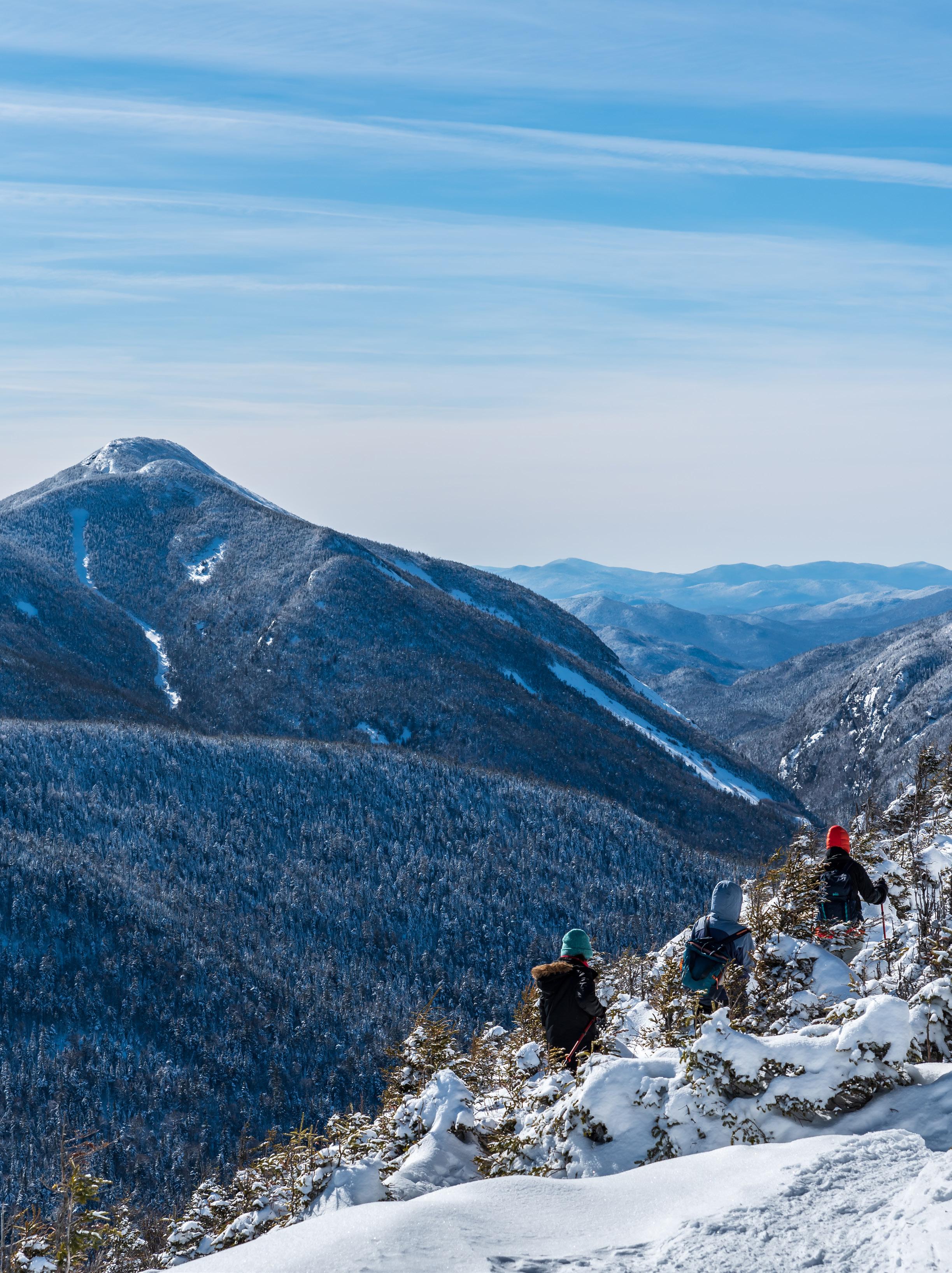
ADK Photo Contest Winners Announced
The JBL Camps Winter Bikepacking
A Great Range of Reading: Adirondac Bookshelf
Central Trails
ADK Releasing New Edition
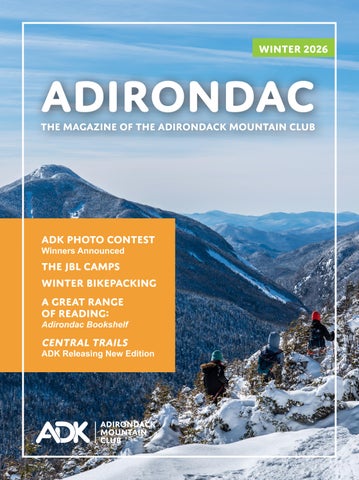
The magazine of the Adirondack Mountain Club
ADK Photo Contest Winners Announced
The JBL Camps Winter Bikepacking
A Great Range of Reading: Adirondac Bookshelf
Central Trails
ADK Releasing New Edition

Online: ADK.org/donate
Phone: 518-668-4447 ext. 211
Email: lauries@ADK.org
Your gift helps support ADK’s programs and mission while working to protect New York’s wild lands and waters. You can use the remittance envelope inside of this issue of Adirondac, or you can give a gift by phone or online (see above).
Become a part our esteemed Legacy Society. Build your legacy with ADK to ensure future generations can enjoy the things you love. Visit ADK.org/giftplanning to learn more.
Your regular, recurring gift goes a long way to support ADK. Giving can be done monthly, quarterly, semi-annually, or yearly.
For folks 70 1/2 and older, a qualifed charitable distribution can be directed to the Adirondack Mountain Club to preserve and advocate for the things that you love. Visit ADK.org/gift-planning to learn more.
Double your donation to ADK with a match. Many employers match employee contributions. This information should be available through your HR department.
Adirondack Mountain Club (ADK) works to protect New York State wild lands and waters by promoting responsible outdoor recreation and bulging a statewide constituency of land stewardship advocates.
ADK works to protect New York’s wild lands and waters by promoting responsible outdoor recreation and building a statewide constituency of land stewardship advocates.
Based out of the Adirondack Park in New York State, the Adirondack Mountain Club (ADK) is a leader in providing outdoor education, promoting responsible recreation, and organizing stewardship experiences. Since 1922, the organization has worked to increase access to the backcountry by building trails, conserving natural areas, and developing a stewardship community that supports the ethical and safe use of New York’s outdoor spaces. A member-, donor-, and volunteer-supported organization, ADK reaches across New York through its chapters to inspire people to enjoy the outdoors ethically.
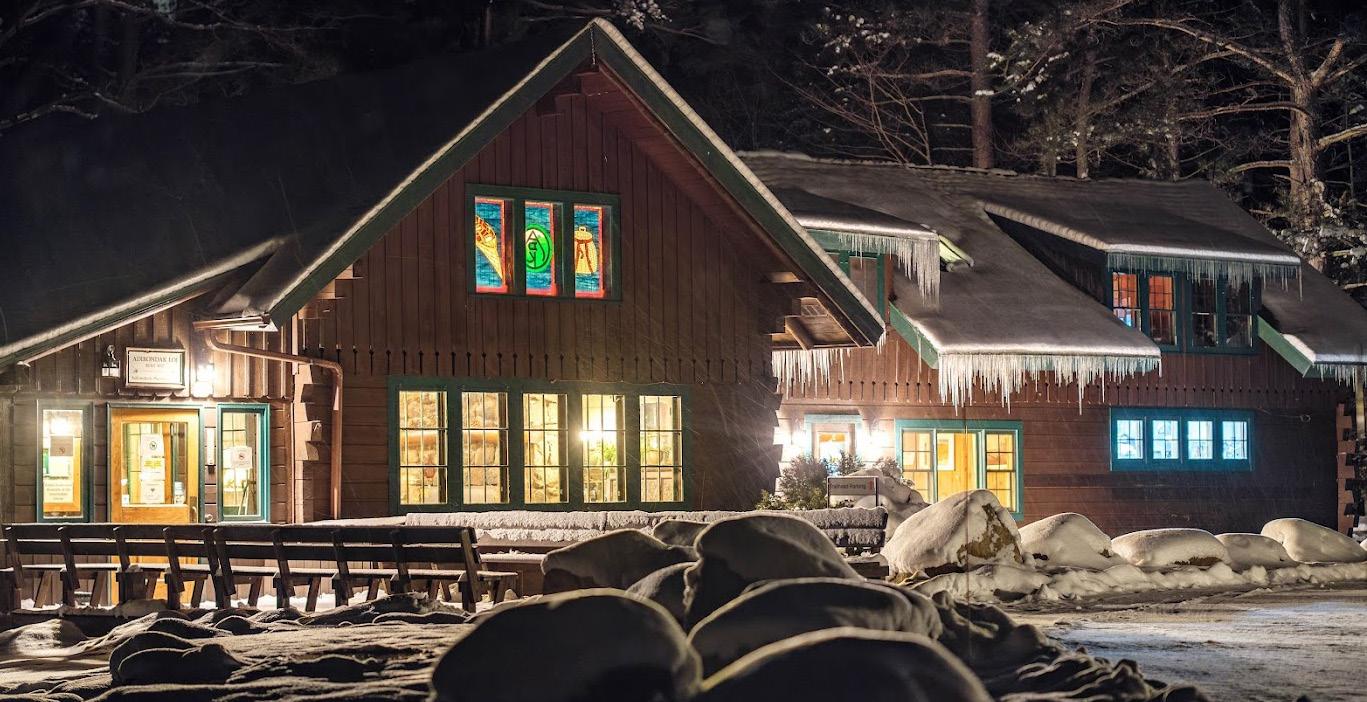
Heart Lake Program Center
Lodging, campground, and programs
PO Box 867
Lake Placid, NY 12946
518-523-3441
loj@adk.org
ADK.org/locations
General Inquiries
518-668-4447
info@adk.org
Member Services Center
Membership and donations
494 Maple Ave, Ste 1
Saratoga Springs, NY 12866
518-668-4447
membership@adk.org
Advocacy Offce
info@adk.org
ADK.org/advocacy
Order Fullfllment
Guidebooks and map orders
800-395-8080
ADK.org/shop
Officers & Key Staff
President Mickey Orta, board@adk.org
Vice President
Charles Kilbourne
Secretary Kate Hacker, hackerks@gmail.com
DONATE
ADK.org/donate
EMPLOYEE GIVING
Employer Matching Gift: Check with your employer to see if your gift can be matched
State Employees Federated Appeals (SEFA)
United Way Campaigns
GIFTS AND ESTATE PLANNING
518-668-4447, ext. 211 lauries@adk.org
JOIN/RENEW/GIFT MEMBERSHIP
800-395-8080
membership@adk.org
ADK.org/membership
VOLUNTEER
ADK.org/volunteer
LODGING
Your stay supports ADK’s mission!
518-523-3441
loj@adk.org
ADK.org/locations
SHOP ONLINE
ADK merchandise and publications ADK.org/shop
DIGITAL VERSION OF THE MAGAZINE
ADK.org, member portal
Executive Director Cortney Worrall, cortney@adk.org
Other Key Staff ADK.org/board-and-staff
(see
ADK welcomes letters to the editor. Letters should be concise and courteous and may be edited for length, style, and tone. They may be short recountings of adventures, refections, or recollections, as well as responses to things read in the ADK newsletter or magazine. They must be original, not copies, must be timely, and must include the writer’s name and place of residence. ADK reserves the discretionary right to refuse to publish letters that contain inaccuracies, that may be offensive to some, or that are otherwise deemed inappropriate. Opinions expressed in letters are those of the writer, not necessarily those of the Adirondack Mountain Club.
As noted in ADK’s frst newsletter, “With Wilderness,” sent to members in October, beginning in 2026, Adirondac will be published annually. Given this new cadence for the magazine, ADK will be using the newsletter to respond to letters. Readers can send their letters to ADK at info@adk.org.

It’s part of CATS’ 98+ miles of uncrowded, family-friendly trails. For maps of all the trails in the Champlain Valley visit:www.champlainareatrails.com

Publisher Cortney Worrall
Editor-in-Chief
Lisa Crosby Metzger
Assistant Editor
David Lynch
Contributing Editor
Neal Burdick
Production
Leigh Campbell
Material for Adirondac, including photos, sketches, cartoons, ADK club and chapter news, and articles on recreation, history, conservation, and natural history relevant to the Adirondacks and the Catskills, should be sent to: Lisa Metzger, lisametzger6@ gmail.com, or 901 Oregon Ave., Niskayuna, NY 12309.
Signed articles may contain the opinion of the author and not necessarily that of ADK. All letters to the editor must be signed and are printed at the editor’s discretion. Letters may be edited for clarity and length.
ADIRONDAC CONTRIBUTORS
Nancie Battaglia, Johnathan Esper, Tony Goodwin, Tom Hart, Audrey Hyson, Joanne Kennedy, Gerry Lemmo, Tom Welch, and Brendan Wiltse
A service opportunity
An ADK/The Nature Conservancy (TNC) project that two other ADK Laurentian Chapter members, Lew Weeks and Perry Yaw, and I took over from its founder, the renowned canoe guidebook author Paul Jamieson, in the 1970s is the annual cleanup at the Everton Falls Preserve, seven miles east of St. Regis Falls along the Red Tavern Road (Franklin County Rt. 14). After Lew and Perry’s passing, about 1990, I carried on by myself.
I am now 90 years old and would like to pass this opportunity on to a fellow ADK member.
We schedule the cleanup for the last Saturday in April and invite someone from TNC to join with us. We walk the half-mile trail beginning at the parking lot by the canoe put-in, clearing winter blowdown, then patrol the mile-long stretch of road by the falls to pick up trash. These two operations take no more than two hours. Then we adjourn to the rock ledge beside the scenic falls for a brown-bag lunch. There is always time for a canoe cruise downriver from the falls to the frst rapids and back, about a mile of delightful scenic paddling.
I’d be more than glad to join with any ADKer next year to introduce him/her/ them to this position, a service stretching continually for ffty years. It’s fun, satisfying, and a great family and friends outing. I’m glad to answer questions at 315-328-4675.
—Duncan Cutter Nicholville, New York
On the amputation of Adirondac
After forty years in editing roles with Adirondac, I admit to prejudice in its favor. I am concerned about the impact of cutting it back from four issues a year (it was six as recently as 2022) to one and flling the vacated space with newsletters.
Several years ago, in one of its cyclical fnancial crises, ADK cut the frequency of its magazines and replaced them with newsletters. They were, to be fair, twelve two-color pages of high-quality newsprint with some, but not all, of the content found in the magazines, but with much of it truncated.
Bad idea. Members hated them. They felt they weren’t getting their money’s worth.
A few dropped out of the club, although I suspect that was not the only reason. We ditched the newsletters and restored the magazines, at some effort and expense.
Who is to say whether or not the same action now will trigger the same result?
Times have changed. In this instantaneous-fulfllment age, more and more people, especially younger people whom the organization needs to recruit, are unable or unwilling to read more than a few sentences. (Surveys show that incoming college students cannot get through a novel.) And printing and mailing are ever more costly. I get all that. But reducing the magazine’s frequency so radically, so abruptly, risks alienating older members/donors who are accustomed to print media and have the patience to appreciate it. For many of these folks, Adirondac is their main club beneft, their principal reminder of what ADK is and does. You risk losing them if you take it away. Will ADK attract enough younger members to compensate?
Has anyone considered going down to twice a year instead of just once? Whatever is done, I hope it works to ADK’s advantage. Not knowing what the proposed newsletters will be like, I hope they are of the highest quality, because the quality of its communications refects the quality of the organization.
—Neal Burdick, Honorary Life Member Shelburne, Vermont
ADK responds:
Thank you for your letter. I realize change is often met with resistance, but I think it’s important that we frame this not as “how many members might we lose” but as “how many new members and opportunities we can gain.” We agree that if a member chooses to leave because of the change in magazine cadence, there are likely other contributing factors at play.
Adirondac and its content have evolved a lot over the past twenty years. Our hope is that the newsletters will feel like “mini-magazines”—delivering some traditional Adirondac content, programmatic content, and chapter and member updates while still maintaining the collaborative spirit of the publication.
Changing the cadence of Adirondac doesn’t mean you’ll hear from us less. In fact, our new full-color newsletter— soon to be available in print or digital, whichever you prefer—will deliver updates that are more timely, accessible, and sustainable. The truth is, Adirondac as a standalone member beneft is no longer a sustainable publication for ADK. By moving to this model, we can better engage our community and reach new audiences with greater impact.
—Cortney Worrall, ADK Executive Director
Practicing
In June of 1990, while being socked in near the summit of Wright Peak, I had a spirit come to me. I believe it was the spirit of Air Force observer A1C Kenneth R. Jensen, who died there but was never found.
As I picked up a small piece from the B-47 bomber he was in when it hit near the summit to put in my backpack, I heard a mournful howl. I put the small piece back down and left without that little souvenir.
On the way back to the trailhead, I felt a sadness for Kenneth, and also an appreciation for one’s fnal resting place. I also appreciate these “Great” Adirondacks we have to enjoy.
Peace be with you, Kenneth, and safe hiking to all my ADK hiker buds. “Get ’er done.”
—Rich Crammond Stillwater, New York
Tick Tip
In your article about fies, ticks, etc. (Summer 2025), you could add the suggestion to throw your clothes in a low temp dryer for ten minutes to kill ticks that might remain on your clothes. Washing them really won’t remove the ticks; they thrive in humid conditions. What they don’t like is dryness. A tenminute spin in a low-temperature dryer will kill them. We’ve had two cases of anaplasmosis in our household (we live in the Adirondack foothills) and believe me, you don’t want to experience that.
—Lorraine VanHatten Barneveld, New York
I’m writing about plastic packaging and the need to avoid it and for greater awareness in the hiking community about reducing plastic consumption whenever possible, both for the environment and for health reasons.
I read the article “Trail Nutrition” in the Spring 2025 issue with interest but was disappointed that, like many other articles on this topic out there, the author comments only on the nutritional aspects of the products he discusses, not the packaging. Energy bars, energy gels, and energy chews are packaged in plastic. Plastic is terrible both from an environmental perspective and from a human health perspective. Among other harmful human health effects, a recent study shows that microplastics accumulate in the human brain. So along with your fruit and nuts, if you eat an energy bar wrapped in plastic, you are eating microplastic that may affect your health.
Of course, hopefully most hikers are also environmentalists and care about the fact that plastic can’t be safely
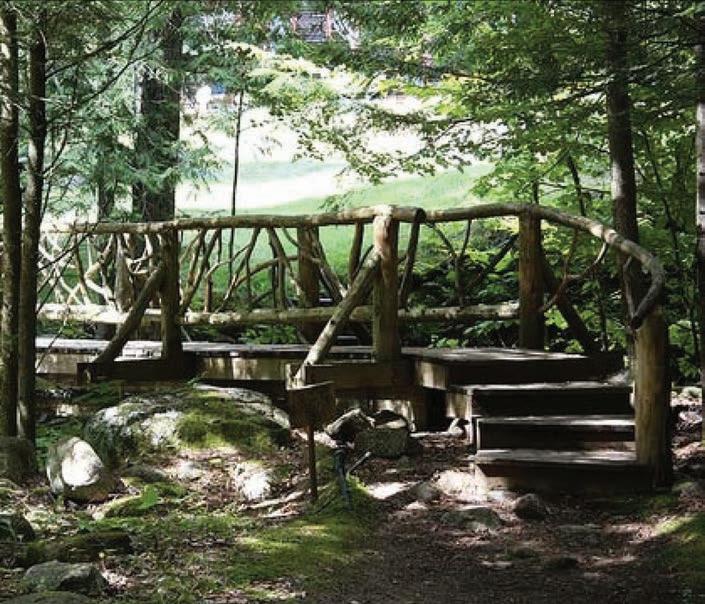
This is a photo from 2009 of a bridge across Putnam Brook, possibly the one that Pamela Cranston writes about in “On Putnam Brook Bridge” (Adirondac, Summer 2025). This bridge was built in 1994 and lasted until 2011 when Tropical Storm Irene removed it for us. The new bridge is nice, but not as rustic.
—Thomas Dodd, Manager, Putnam Camp Keene Valley, New York
recycled, piles up in landflls or is burned in incinerators, creating toxic pollution, worsens climate change (plastic is made of petroleum), results in litter (including on hiking trails!), and is found in all tissues of wildlife, including interfering in reproduction.
Needless to say, hikers avoiding products packaged in plastic may feel like their personal consumption decisions can only have a minimal effect on reducing plastic packaging. But in fact hikers can do much more.
The Packaging Reduction and Recycling Infrastructure Act (PRRIA) is currently pending in the New York State legislature. It would require producers to reduce the amount of plastic in their packaging and would make producers of plastic packaging pay towards the cost of disposal of packaging. You can read more about the bills that are moving through the state assembly (Assembly Bill A1749) and state senate (Senate Bill S1464) on the webpage of Beyond Plastics.
Calling your state assemblymember and state senator to ask them to support
these bills and make sure they get to the foor for a vote this year is a great way to contribute to plastic packaging reduction on a larger scale in addition to avoiding buying trail food packaged in plastic.
—Heidi A. Wendel Nelsonville, New York
ADK responds:
Thank you for your letter. ADK supports the Packaging Reduction and Recycling Infrastructure Act (S1464 and A1749). This legislation is sponsored by Senator Harckham and Assemblymember Glick, New York State environmental leaders who also support funding for trails, educational stewards, visitor centers, land conservation, and recreational access. ADK encourages our members and supporters to send letters of thanks to our Senators, Assemblymembers, and Governor Hochul for their continued support of environmental funding. See ADK.org/advocacy.
—Cathy Pedler, ADK Director of Advocacy

For more than one hundred years, the Adirondack Mountain Club (ADK) has been a strong, stable, and resilient organization committed to serving its members, volunteers, donors, and the broader outdoor community.
2025 was emblematic of this strength, stability, and resilience: we celebrated the 100th anniversary of Johns Brook Lodge, which has provided shelter and comfort to countless hikers exploring the High Peaks and connecting with nature.
As we turn the page on one historic centennial, we now look ahead to another. In 2027, ADK will celebrate the 100th anniversary of the Adirondak Loj, one of several pillars that make the Heart Lake Program Center one of the crown jewels of the Adirondacks.
Over the past century, our Heart Lake Program Center has served as a vibrant hub for our mission and programming. It’s where many local fourth-grade students get their frst outdoor experience, learning about Adirondack cultural history and Leave No Trace principles as part of our Marie L. Haberl School Outreach Program: Three Seasons at Heart Lake.
It’s where hikers of all skills and abilities start and end their journey to several High Peaks and other wild destinations. It’s where the ADK community comes together for naturalist campfres and family-style meals at the Adirondak Loj.
And it’s where ADK is working to make the outdoors a more inclusive and accessible space for all by partnering with organizations like Latino Outdoors and CorpsTHAT.
ADK has a renewed focus on aligning our resources to ensure they can have the greatest possible impact—supporting our advocacy work, education and stewardship programs, and community engagement.
As part of this strategic realignment, we made the diffcult decision to close Cascade Welcome Center, reallocating resources to the Heart Lake Program Center. This allowed us to expand hours at our High Peaks Information Center during the busy foliage season, when recreators from all over fock to the Adirondacks to see the leaves change color. We’re now exploring how to expand winter recreational opportunities at Heart Lake, such as rehabilitating underutilized ski trails on the property with trail work performed by ADK staff and volunteers.
And while our facilities refect all that ADK has built, our true strength comes from you—the members, volunteers, and donors whose dedication allows us to move forward together as a stronger, more united community, protecting the wild lands and waters we all cherish.
—Mickey Orta, President

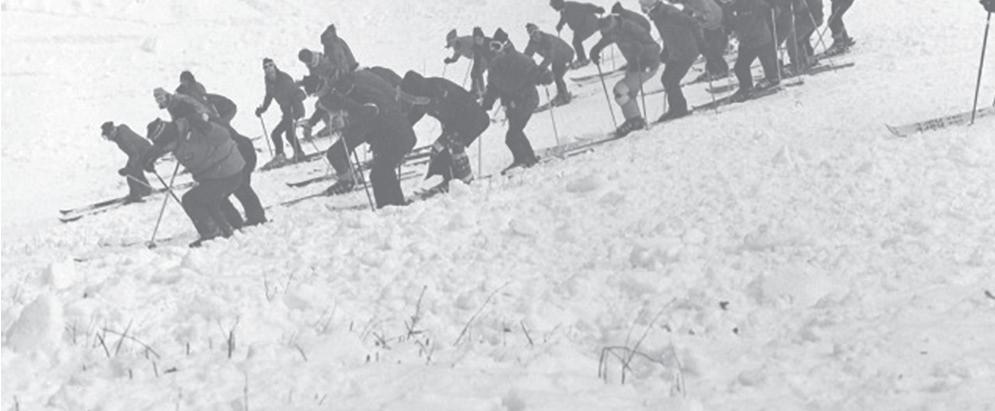

MD
As a long-time vegetarian, fshing is not one of my outdoor pursuits. Yet, I have had plenty of experience removing fshhooks from unfortunate anglers or their bystanders. As I suspect that many readers may encounter this problem themselves at some point, it seems like a good topic to review.
Many experienced anglers have encountered errant fshhooks enough themselves to have their favorite removal methods. I would never suggest altering a technique that one has found works well. What I will share is a technique that is frequently described in the wilderness medicine literature, and one that I have used in the feld successfully.
The operative term here is “in the feld.” I have also removed plenty of hooks in my days working in emergency departments, and there is one big difference between these settings: availability of local anesthesia. Removing hooks is a painful procedure, regardless of method, so the ability to eliminate pain by an anesthetic takes away the major barrier to removal. Once the area around the entrance wound is adequately anesthetized, one can choose almost any method, and undertake it slowly and deliberately. For example, the oftdescribed method of advancing the barb upward through intact skin, cutting it off with pliers, and then backing out the
remaining hook is easy and effective in anesthetized skin; attempting this in the feld without anesthesia, regardless of recommendations in some frst aid texts, is extremely painful and diffcult.
The method I am describing, often called the “string/yank,” is suitable for most embedded hooks, except those on loose tissue (e.g., earlobes), or anywhere on the face, especially near or in the eye. I suggest that anyone unfortunate enough to have a hook in such a location be evacuated for defnitive treatment in a medical facility. The same recommendation applies to hooks deeply embedded in the palm of the hand, as damage to important structures can occur as the hook is removed.
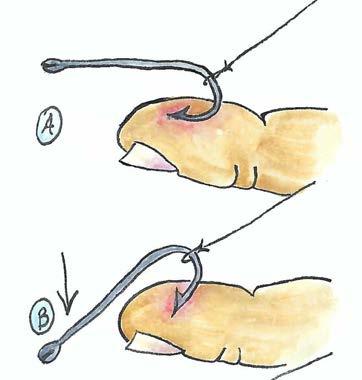
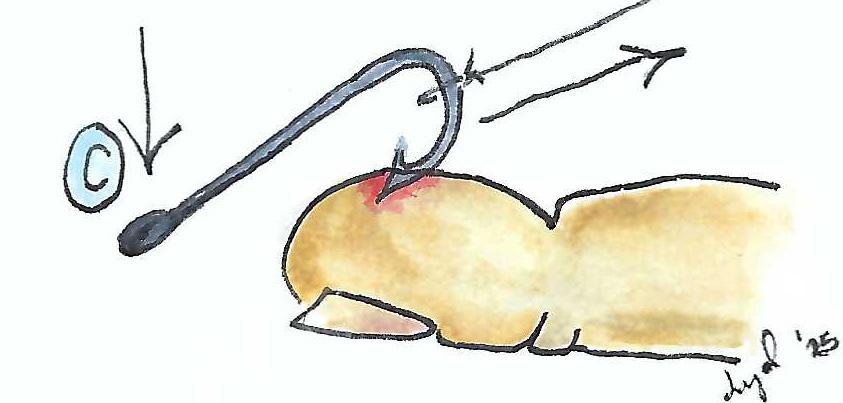
The advantage of the “string/yank” technique is that it is quick—enough so that the pain is intense but feeting, if it is done correctly. To begin, tie a piece of strong cord (such as fshing line) around the midpoint of the bend of the hook. Secure the cord tightly around your hand or wrist, while keeping it in line with the shank of the hook. With your other hand (or, better, the hand of a helper), depress the eye of the hook such that the shank is parallel to the skin surface. When all is positioned, give a quick, strong yank on the cord. The hook should come out with ease. Keep in mind that the hook will fy out very quickly, so be sure to take precautions (such as eye protection) to ensure that someone else is not “hooked” as it comes out. The technique is shown in the illustration. There are also several online videos describing the method; this is my favorite: ADK.org/ string-yank.
Once the hook is removed, the wound should be treated as any puncture: clean it with soap and water, apply a topical antibiotic ointment, and observe for any sign of infection. A recent study in the journal Wilderness and Environmental Medicine (2025, 32:166–170) demonstrated no beneft to administration of oral antibiotics after these injuries. We should also say a word about tetanus prevention. Fishhook embedment should be considered a potentially “tetanus-prone” injury. The organism that causes tetanus can be found in mud, on lake bottoms, and on stream edges. Puncture wounds are more of a tetanus risk because it is challenging to irrigate their depths. This means that the immunization recommendations for tetanus-prone injuries should be followed. Although a tetanus booster within the past ten years is adequate for most wounds, individuals with tetanus-prone injuries should have a booster if their last one was more than fve years previously.
Tom Welch, MD, is a physician at Upstate Medical University in Syracuse and an active member of the Wilderness Medical Society. He is a licensed professional guide, and a certifying instructor for the Wilderness Education Association, and has guided groups in the Adirondacks, Montana, and Alaska. More information is available at his website and blog, adirondoc.com.
by Tony Goodwin
While there were no lengthy searches or complicated evacuations this past season, it was a busy one for the forest rangers. In addition to the usual leg and shoulder injuries, there were many cases of dehydration, along with a few searches because of separated groups. Along with these more common incidents, there were two incidents involving hikers behaving erratically because they had ingested mushrooms—the hallucinogenic kind, not the poisonous kind.
The frst one involved two hikers on Cascade who had called 911 to report that the third member of their party was dead. Forest Ranger Hannah Praczkajlo responded to the call. Reached by phone, the third member of the party said he was not injured. Meanwhile, the pair encountered a summit steward and said they were lost. The steward determined that they were in an “altered mental state.” The pair was then turned over to Ranger Praczkajlo, who escorted them to the trailhead and to a waiting ambulance and a New York State Police unit. The second incident, in the Catskills, required the rangers to assist an impaired individual back to the trailhead and to medical attention.
Given the mostly dry conditions, forest rangers also had to respond to numerous wildfres. Some of these were caused by lightning, but others were from campfres. These were campfres built on the dry duff that burned underground out under whatever stones might have been placed around the fre. This is a reminder to always build a fre on rock or gravel, or in an established fre pit.
A sampling of other incidents includes:
● A party guided by a phone call back onto the Mt. Jo trail.
● A party in May that was unable to cross Roaring Brook on their descent from Giant due to higher water from the last of the spring melt.
● A 76-year-old on the Calamity Brook Trail who was intermittently fainting at 8:30 p.m. after having been hiking since 6:30 a.m.
● A June search for a party on Giant without any light.
Rangers also searched for an individual who had separated from an original group of fve that had set out to hike a three-day, thirty-mile AllTrails challenge called the “Dragon’s Load.” The challenge route started at Elk Lake and climbed Haystack with a night at SnoBird. It continued to Gothics and then down over Sawteeth to the Warden’s Camp at the Upper Ausable Lake. From there, the challenge went up to Colvin and down the Colvin Range to Pinnacle, with a second camp on the connector to the Elk Lake–Marcy Trail. Somewhere along the Colvin Range, the individual who had separated from the group, apparently because he couldn’t keep up, called his mother to say he didn’t know where he was. Rangers swept the likely trails but ultimately learned that everyone in the group had safely reached the trailhead.
Many readers will remember last winter’s multiday search for Canadian hiker Leo DuFour on Allen, and the unfortunate outcome. The subject’s remains were found shortly before the deadline for the previous report (Adirondac, Summer 2025), and we felt it was worth repeating some of the details that later emerged. On May 10, hikers approaching Allen Mt. shortly after the last snow had melted were detouring around wet spots east of Lake Sally when they observed some color a few yards farther back in the woods. The color turned out to be the subject’s snowshoes. As they realized what they were seeing, the party turned back and called the DEC as soon as they had cell service. The point where the subject was found was just over two miles from the trailhead.
Obviously, we will never know exactly what happened. We do, however, now know that he had erroneously started
his descent off the north side of Allen. Rangers had found his tracks going up Allen Brook, but not down, and the last ping from his cell phone was north of the summit. So, he somehow managed to get back on the proper course and was headed in the direction of the trailhead when he succumbed. It had started snowing on Saturday, the day he hiked, and continued into Sunday. The intensive search began on Monday and searchers presumably would have found tracks had the subject still been moving as of then. Thus, a reasonable supposition would be that he may have spent an unplanned night out on Saturday, but was too weak or cold on Sunday to make it back to the trailhead.
APRIL 8–9: OVERLY AMBITIOUS
On April 8, a 57-year-old male set out to hike all four peaks in the Seward Range. He summited Seymour frst before summiting the other peaks and reaching Emmons. At some point on his return from Emmons, however, he turned the wrong way off the ridge and ended up at or near Ouluska Lean-to, where he was found the next day. The weather was cloudy with a valley high temperature around freezing. Some snow fell during the day, and there was a four-inch accumulation by the morning of the ninth.
A call to DEC dispatch around 11:00 p.m. on the eighth initiated a search the next day. One team of rangers started up the Seward herd path from the Ward Brook Trail. That group managed to scrape away the new snow and found the subject’s tracks from the day before. Other rangers using ATVs with chains went onto the Northville–Placid Trail and down toward Ouluska Lean-to, where they found tracks heading west from the lean-to. They followed the tracks and found the subject at 12:30 p.m. The subject was tired, but otherwise in good health. He was taken by ATV back to the trailhead, arriving there at 5:00 p.m.
SOURCES: DEC reports with additional answers from the DEC press offce
DISCUSSION: The subject admitted that the trip was not well-planned. He had a battery pack to supplement his
phone’s battery, but the battery pack had fallen out of his pack at some point, so he had no navigational aid when the weather conditions caused him to leave the ridge. Fortunately, he was equipped well enough to survive the night (with a low in Saranac Lake of 17°F). With no navigational aid, we can only guess how far and by what route the subject might have traveled that day if the rangers hadn’t found him.
Navigation (a compass and paper map) is one of the Ten Essentials for good reason. While your phone can be a good supplementary resource, it should not be your only navigational aid when you’re in the backcountry. Simply put, your compass and paper map will never run out of battery life.
JULY 29: DEHYDRATION, HYPERTHERMIA, HELICOPTER EVACUATION
The incident that received the most publicity last summer was the rescue in Elk Pass of a 14-year-old boy who was lapsing in and out of consciousness after a hike. The DEC report described his condition as “hyperthermia, a form of heat stroke.” The subject was part of a summer camp group that had climbed Nippletop and Dial and then returned back up the ridge and down to their camp in Elk Pass. The camp group leader was able to call DEC dispatch.
Given the seriousness of the situation, a helicopter was quickly deployed; it dropped Forest Rangers Andrew Lewis and Patrick O’Dell in the pass. Ranger Lewis ended up having to carry the boy on his shoulders through the swamp, which was at some points waist deep. A dramatic photo of Ranger Lewis, carrying the boy and accompanied by Ranger O’Dell, was widely published, including, apparently, in a national magazine devoted to search and rescue.
SOURCES: DEC reports and Adirondack Explorer article
DISCUSSION: The route that the camp group followed that day was a challenging one, especially given the heat, with valley temperatures near 90°F. However, this was not the frst time that a group from this camp had followed that route, and all other times had been without incident. There was no report
on how much water the subject had drunk during the hike, but it’s likely that dehydration contributed to his condition.
SEPTEMBER 7–8:
On Sunday, September 7, two women, 42 and 39, from Michigan, hiked Marcy from the Adirondak Loj. At the summit of Marcy, the pair somehow separated, with the 39-year-old descending to Four Corners and then, inexplicably, heading up Skylight. At the summit of Skylight, the subject started down the south side. She stopped not far from treeline and called 911 at 8:00 p.m.
A ranger initially tried by phone to convince the subject to return to the summit and try to fnd the trail, but the subject refused to move. As a result, Forest Rangers Charlie Foutch and Hannah Praczkajlo went in via the Ausable Lakes and climbed to the summit. At 2:30 a.m., Ranger Praczkajlo, standing at treeline, made voice contact with the subject, who was subsequently escorted out through the Ausable Lakes. Separately, at 9:45 p.m., the 42-yearold member of the party called for help, thinking she had lost the trail near Marcy Dam. Two rangers responded to this call and assisted her out to Adirondak Loj. The two were reunited at the Ausable Club trailhead the following morning.
SOURCES: DEC report and ranger interview
DISCUSSION: There are many details to this incident that perhaps only the subjects can provide, but this pair made a whole host of mistakes and kept four rangers occupied for the better part of a night. The night was not particularly cold, and neither of the subjects apparently had any health issues, so the question would be whether the rangers could have just waited until morning and tried again to talk the subject on Skylight back on the trail and out to a trailhead—or at least to a closer point, where additional food and clothing could be provided.
Tony Goodwin edited ADK’s High Peaks Trails for many years. He lives in Keene, New York.
ATTENTION: Everyone interested to learn more about safe and responsible use of the Adirondack wilderness.
ATTENTION: Everyone interested in learning more about safe and responsible use of the Adirondack wilderness.
WHAT: An intensive weekend workshop, at an introductory level, aimed at exposing partcipants to the breadth of wilderness usage knowledge.
WHAT: An intensive weekend workshop, at an introductory level, aimed at exposing participants to the breadth of wilderness usage knowledge.
WHO ATTENDS: The program is open to actve adults interested broaden their current skills and knowledge in wilderness hiking and stewardship.
WHO ATTENDS: The program is open to active adults interested in broadening their current skills and knowledge in wilderness hiking and stewardship.
TOPICS COVERED: Pre-trip planning and safety, food planning and packaging, campsite organizaton and safety, meal preparaton, basic map and compass, group leadership, wilderness emergencies, and much more. Please use the email below to request full details.
TOPICS COVERED: Pre-trip planning and safety, food planning and packaging, campsite organization and safety, meal preparation, basic map and compass, group leadership, wilderness emergencies, and much more. Please use the email below to request full details.
WHEN: May 1, 2, 3, 2026 (Fri-Sun) WHERE: Adirondak Loj, Lake Placid, NY
WHEN: May 1/2/3, 2026 (Fri-Sun) WHERE: Adirondak Loj, Lake Placid NY
SPONSORED BY: The Adirondack Forty-Sixers; as an outreach to all who are interested in utilizing the Adirondacks in safety and stewardship
SPONSORED BY: The Adirondack Forty-Sixers; as an outreach to all who are interested in utlizing the Adirondacks in safety and stewardship
COST: $50 fee includes lean-to/ campsite for two nights, fve meals, workshop patch
COST: $50 fee includes leanto/ campsite for two nights, fve meals, workshop patch.
For more informaton, please contact osw@adk46er.org
by Tom Hart

Winter conditions range wildly across our unique Adirondack Mountains, from deep and steep snow to exposed rock gardens, ice fows, and hardpacked trails that form lovely ribbons of white, making winter hiking such a joy. Snowshoes allow travel across all of these.
What snowshoes should you consider? All need aggressive traction with metal crampons as part of the boot binding and metal rails on the foatation deck or frame. Snowshoes that only have tubular perimeters without metal traction are only for fatland snow travel. An easy-touse and secure binding system plus a heel lift are essential.
Some brands to consider are Tubbs, Atlas, MSR, and TSL Outdoor. Some of my friends swear by the Tubbs Flex VRTs, with its easy-to-use BOA binding system and aggressive traction design. The BOA binding (a knob-actuated cable system) is complemented by an adjustable heel strap with a fip-style buckle.
The Atlas Montane is the only tubular style snowshoe I’d consider, as it does add substantial traction. In the most severe terrain, though, I feel much more comfortable with a hinged design, rather than a strap-mounted binding.
Most of my experience is with the MSR brand, with Evo, Revo, and the Lightning Ascent models. Some folks really don’t like the MSR multi-strap binding. I leave the heel strap set to the right length and then adjust the front straps, rather than trying to do all the straps every time. This binding works very well, though, and
was the number one choice by climbers on my recent Denali expedition. It is a good binding choice for large coldweather or ski boots. Too often I see folks with their toes far forward in the binding. The boot front then digs into steep snow, releasing underfoot traction at the worst times. This is an issue to be aware of with fully adjustable straps.
If you don’t like the MSR strap setup, try MSR’s Paragon binding. It features a front mesh boot pocket, automatically placing the foot in the right location, and adds easier-to-use front and back fip buckles. There’s a lot to like about this binding, including the handles at the strap ends with a neat tuck-away design. The MSR Evo comes with either binding and is probably the most popular Adirondack design (and the MSR Evo Ascent is the snowshoe offered for rent or purchase at the ADK High Peaks Information Center). The full plastic deck sure squeaks a lot on cold, hard-packed trails!
I often use the MSR Lightning Ascent model, with its full metal perimeter frame and quiet decking, with either binding style. It’s extremely strong and durable— and I’ve put it through years of abuse. Front binding crampon teeth were redesigned to provide good durability.
All models come in women’s designs, too, which include bindings for smaller feet and narrower frames for a narrower gait, which is also a good feature for our narrow winter trails. Some of my male friends have opted for this design because of its lighter weight and more comfortable gait.
TSL Outdoor offers snowshoes that are reimagined, using unorthodox approaches and innovative designs. Two TSL Outdoor designs I’ve tested (they did offer both for evaluation) are the Symbioz Hyperfex and the Highlander Grip series. The hyperfex platform is articulated, rather than rigid, so that it, well, fexes—a lot. Think of walking with regular boots versus full-steel shank boots and the advantage is obvious.
The profle of the snowshoe is waspwaisted, so they ft well next to each other within the confnes of narrow snowshoe trails, providing a more natural gait. The design does lose some loft in deep snow, but if you love running along
an already broken-out trail, the Hyperfex design excels. I’ve also used them in deep snow and have no more complaints than usual when traveling in any deep snow.
The Highlander Grip snowshoe is more aggressive, with a frm, less fexible deck with traction rails; it’s ideal for our deep snow, icy stretches, and rocky terrain. My wife, Marie, prefers the Symbioz Hyperfex on all terrain types, while I lean towards the Highlander, which performs more like the MSR Lightning Ascent.
The TSL Outdoor lineup absolutely shines in binding design and choices, none of which involve fumbling about in the cold to use. Three different designs are available: Instinct—a complete BOA system, with one knob ruling both front and heel/ankle straps; Adjust—a BOA toe and a comfortable ratchet ankle buckle; and Elite—one buckle each for front and back straps.
The Instinct complete BOA is extremely fast and easy to use. I can get in and out of my snowshoes before my hiking pals even manage one snowshoe. The Adjust BOA toe and ratchet buckle ankle is also quick and effcient, and the ratchet buckle is very comfortable. The Elite uses a preset design where the straps are adjusted once (in the comfort of home) and the buckle is a simple, single fip-over toggle.
All styles use presets adjusting the binding sole length and width before you go out. One difference with the Instinct is the sole adjustments are only in full sizes. Their reasoning seems to be that the BOA holds your foot so completely, it doesn’t need to adjust in half sizes. Both series perform well and truly transform the snowshoe walking experience on what are usually uncomfortable death marches—think walking out from the far end of the many long approach trails at the end of a long day.
Another feature I’ve only seen on TSL Outdoor snowshoes is the riser, which is attached to the heel of the binding boot plate as opposed to the deck of the snowshoe. It is truly easy to engage/ disengage with the fick of your hiking pole. Really!
Practically speaking
Whatever snowshoes you use, of course
use them to avoid postholing, but when they are on your pack, consider placing one shoe on each side of the pack with the curved front to the top and bindings facing in. You should have existing pack straps or added cords to pack the shoes neatly, rather than having them swinging about sideways or on the back of the pack.
“Whatever snowshoes you use, of course use them to avoid postholing, but when they are on your pack, consider placing one shoe on each side of the pack....”
All of these snowshoes beneft from good stepping technique. When going uphill in steep snow, be sure to kick the shoes in level (with heel elevators up) to create steps for both you and those behind you. Trying to go uphill following the snow’s angled surface creates a lot more work! When going downhill, drag the heels of the snowshoes forward just a bit to add a little smooth glide to your step and certainly engage all those metal teeth on icy sections.
Finally, in warm, sticky snow conditions, all snowshoe decks can ball up with caked-on snow. Take a tip from our cross-country skiers and bring along some Maxiglide wax to prevent snow from sticking.
ADK member and environmental scientist Tom Hart reviews gear for Adirondac from his home in Lake Placid, New York.
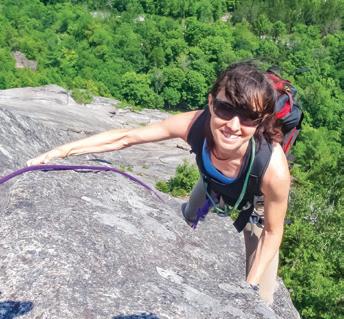
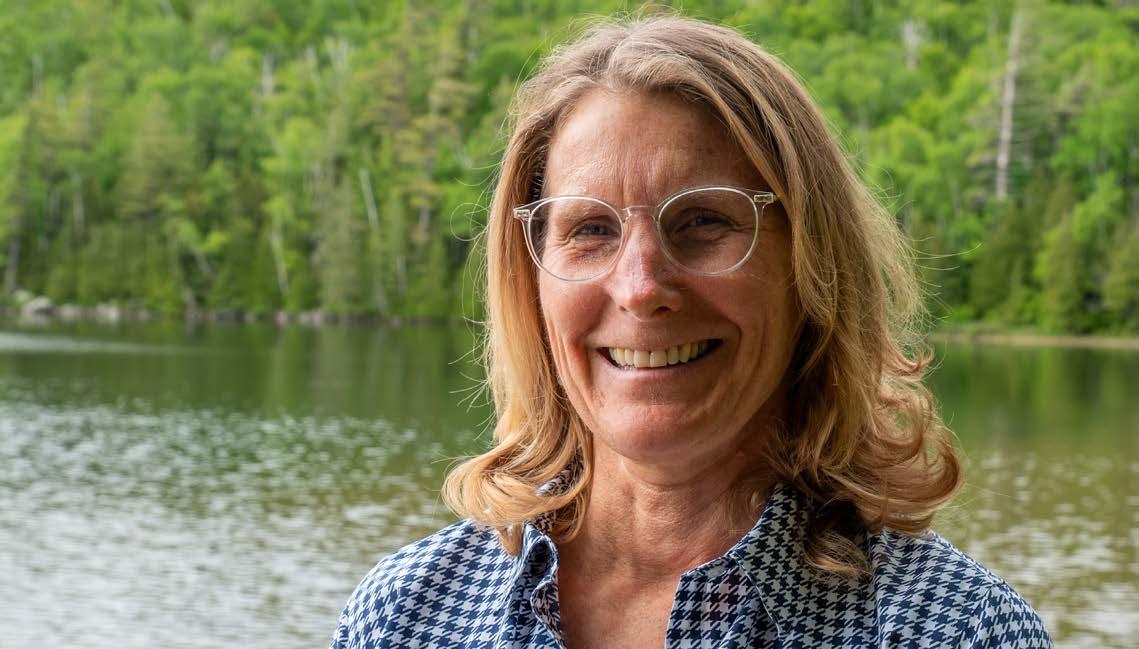
Q: What was your path to working for ADK?
I came from a seven-year career in National Parks and had been hoping to move back to the conservation and recreation sector. There are so many opportunities for people to better connect to wild, outdoor spaces and help protect the Forest Preserve.
This region offers some of the greatest opportunities to be in nature, but also faces some of the greatest threats from climate change.
Q: What are your top priorities for the organization?
Preparing for climate change and connecting the organization with the next generation of land stewardship advocates. It’s imperative that we bring young people into advocacy to preserve and protect the wilderness.
Q: What new opportunities do you see for ADK to grow as an organization and reach younger audiences?
Cortney Koenig Worrall stepped in as Executive Director of the Adirondack Mountain Club (ADK) on April 30. After she had spent several months in this position, we sat down with her to discuss her priorities for ADK, how the organization can reach more people, and what ADK is doing to help mitigate climate change amid a period of uncertainty about future state and federal funding.
More frequent and intense rainstorms have already caused signifcant damage to the infrastructure in the North Country and threaten the viability of our trails, which are especially prone to erosion. Warming temperatures are expected to cause an expansion of treeline in the alpine zone, potentially displacing rare alpine species.
Q: What are your favorite ways to enjoy the outdoors?
Camping, hiking, and especially open water swimming.
It’s about fnding and meeting people where they are. To reach a younger audience, we’re building up our social media presence on multiple platforms.
As an organization, we need to get in front of them and demonstrate that ADK has a lot to offer. We help people build outdoor skills. We’re addressing threats to wild lands and waters through our robust advocacy work. And so much more.
Q: You’ve written and spoken extensively about climate change. What role do you see ADK playing in mitigating climate change?
It starts with funds, which will allow us to do things like electrify the organization’s vehicles and convert our facilities to renewable energy wherever we can.
There are a lot of opportunities to connect our members to climate change legislation so they feel empowered to advocate when an opportunity arises at the local, state, or federal level.
We can also promote to our membership ways that all of us can reduce our carbon emissions through personal choices like composting or conserving energy.
Q: In other interviews, you’ve mentioned that you’re really passionate about “climate anxiety.” What is climate anxiety, and what can ADK do to combat it?
Climate anxiety is a feeling of distress and worry about the impacts of climate change. It may sound counterintuitive, but research shows that the more people who have climate anxiety connect with the natural world, the less anxious they become. Those outdoor experiences can be positive and inspirational.
Nature is always changing (now at a much faster and larger scale than before), and that ability to change is baked into the genetic makeup of all things. People inherently connect to that.
Any opportunities people have to connect in the natural world is a great antidote to the singular, isolating experience of being alone with climate anxiety.
Q: There is a lot of uncertainty about how federal budget cuts are impacting state funding. What is ADK doing to prepare?
ADK is continuing to push state legislators to fully fund the Environmental Protection Fund, infrastructure, and the salaries of state-level staff who play a crucial role in keeping the Forest Preserve beautiful. We’re also continuing to reach out to private philanthropy to support the organization and make up for what is likely going to be a loss in government support for some of our work.
Now more than ever, it’s important for people to be very vocal about environmental funding. Reach out to every member of Congress and state government to tell them how much environmental funding means to you, because federal cuts might affect the state.
Even with federal and state funding cuts potentially on the horizon, what ADK does will not fundamentally change, but we need your support.
Q: What else would you like readers to know?
One big change you may notice right off the bat is the publishing schedule of Adirondac magazine. Moving forward, Adirondac will be published annually rather than quarterly. In its place, ADK members will begin to receive “With Wilderness,” a new physical newsletter highlighting the work ADK is doing throughout the year. This is certainly a shift, but we’re confdent we’ll be able to reach more people more effectively with the same quality content through regular newsletters and an annual magazine. We’ve also made the diffcult decision to close Cascade Welcome Center, which unfortunately means we will not be hosting a ski season. Our staff have been scouting the ski trails at Heart Lake to assess their viability for programming this winter. (Editor’s note: see page 44 for more information about the closure.)
—Coordinated by David Lynch, ADK Digital Marketing Coordinator
ADIRONDACK “BY OWNER” AdkByOwner.com—1000+ photo listings of Adirondack real estate, vacation rentals, and timeshares offered by owner. (Property owners: List with us for only $350 per year!
ADIRONDACK “BY OWNER” AdkByOwner.com—1000+ photo listings of Adirondack real estate, vacation rentals, and timeshares offered by owner. (Property owners: List with us for only $350 per year!)
HEADWALL BAND
Make your next event or party memorable with live top-notch classic/new rock music band “Headwall”! Surprisingly low cost! Call/text Paul for details: 518-932-9917
FOR SALE: WARREN LIGHT CRAFT LITTLE WING KAYAK $899.00
Carbon composite, L: 13′11″; W: 22″; 26 lbs. Speedy, stable, light touring Albany, Call or Text 518-5737786 hstoller130@gmail.com

Communities in New York are feeling the effects of climate change with more frequent and severe weather, long dry spells followed by fooding, wild swings in temperature, and increasing fre risk. Weather disasters are increasing and with this comes risk to lives, homes, infrastructure, and businesses, and power outages. It is a hard truth that while a community is recovering from a disaster, it is more vulnerable to the next event.
With federal rollbacks to climate regulations and policy, New York State needs lasting solutions that protect communities and public infrastructure. The Adirondack Mountain Club (ADK) is looking to the Climate Resilient New York Act as the frst step to addressing this pressing need.
A lack of preparation for climate change can result in costs up to six times more than they would have been if proactive renovations and infrastructure upgrades were in place. New York has had sixteen climate disaster declarations between 2011 and 2021, with spending for community recovery being the second highest in the country.
In the Adirondack and Catskill Parks, hurricanes and record rain events are causing fooding, landslides, loss of power, and damage to roads, bridges, and homes, as well as impacting trails and recreation infrastructure. Recovery in communities or on public lands can completely consume a town’s budget, requiring loans and setting back for years the land managers’ funding priorities.
According to the New York State Climate Impacts Assessment, average temperatures in the Adirondacks are
expected to increase by 6.1°F to 10.6°F by the 2080s—some of the largest increases in the state. The Catskills are not far behind, with projected increases from 5.7°F to 10°F over the same period. These changes will bring a shift in snowfall and lake ice with winter precipitation predicted to increase in these regions, but as rain rather than snow due to warmer temperatures. Further, the Catskills has one of the largest projected increases in the number of days with extreme levels of precipitation and in total annual precipitation. The increase in precipitation is likely to come from more severe storms, which will result in higher streamfow and increased fooding.
New York State needs a solid multiagency plan for preparing the state for these changes. A new model of governance and proactive planning must emphasize climate resilience as a priority, coordinate agencies and funding sources, and clear the path to implementing priority projects that build resilience into communities and in public infrastructure.
This past year, New York legislative leaders took the frst step towards a lasting solution with the Climate Resilient New York Act. This legislation would establish the Offce of Resilience and Interagency Climate Resilience Governance Structure, which would:
• coordinate and provide strategic direction for governmental resilience initiatives to build long climate resilience;
• establish a statewide resilience plan and framework;
• provide technical guidance to agencies and local and regional jurisdictions;
• establish a means of tracking progress toward statewide goals on climate resilience;
• appoint a Chief Resilience Offcer who will manage the Offce of Resilience and monitor and seek available funds to support the state’s resilience priorities.
The bill also highlights that some communities are less able to adapt or fnancially recover from climate impacts, and that these communities should beneft from the resilience plan to ensure that losses from future disasters are reduced.
The legislation would also ensure the development of an updated inventory to identify critical infrastructure that is vulnerable to current and future fooding and severe weather. New York State’s infrastructure is currently graded a C by the American Society of Civil Engineers, and a plan to ensure that our roads, electrical grid, sewers, and other systems we depend on remain viable for the long term is a critical need.
The climate is changing, severe weather events are increasing, and the impacts in the Adirondacks and Catskills are, and will continue to be, demonstrably great. The Climate Resilient New York Act will improve resilience in our communities and ensure that they remain safe and great places to live, work, and visit. We look forward to working with legislative leaders and advocacy partners to advance this legislation in the year ahead.
— Cathy Pedler, ADK Director of Advocacy


by Edward Kanze
Five hours past sunset, the temperature plunged toward 0° Fahrenheit as I trudged from the house to my writing studio. A few snowfakes were falling, adding to the four or fve inches of fresh powder that blanketed the ground. Clouds circled the night sky like a wreath.
Straight up, all was clear. In the open sky I was able to pick out a few dim stars and a bright moon. Moonshine imparted a ghostly glow to the black-and-white world that surrounded me.
“What’s that?” I might have said to a companion. “Do you hear what I hear?” The night’s silence had been broken by a sound. It was a drumbeat. Instead of holding to a tempo, as human drummers usually do, this percussionist raced faster and faster until he could accelerate no more. Then his volume diminished. The soft thumping fell away. Again, it was a silent night. All was calm. All was bright.
The drumming I heard was so faint that I wondered if I’d imagined it. Then it came again. “Do you hear what I hear?” I would have said to a companion. The beats foated out of the snowy woods, heaven and nature singing and thumping in harmony.
Moving along, I knew it was late and time to go gentle into the good night. (Or gently, to improve on Dylan Thomas and get the adverb right.) The beats came again, more loudly this time. There was no mistaking them now. Either the drummer was playing more forcefully, or he had changed direction, or my hearing had somehow grown more sharp.
Do you know what I know? If you’re a watcher of birds, and a listener to them, too, you know whose performance I heard that night. You know that this cousin of the turkey
and the chicken beats its rich, mellow drum throughout the year. Until then, I’d never heard it in winter.
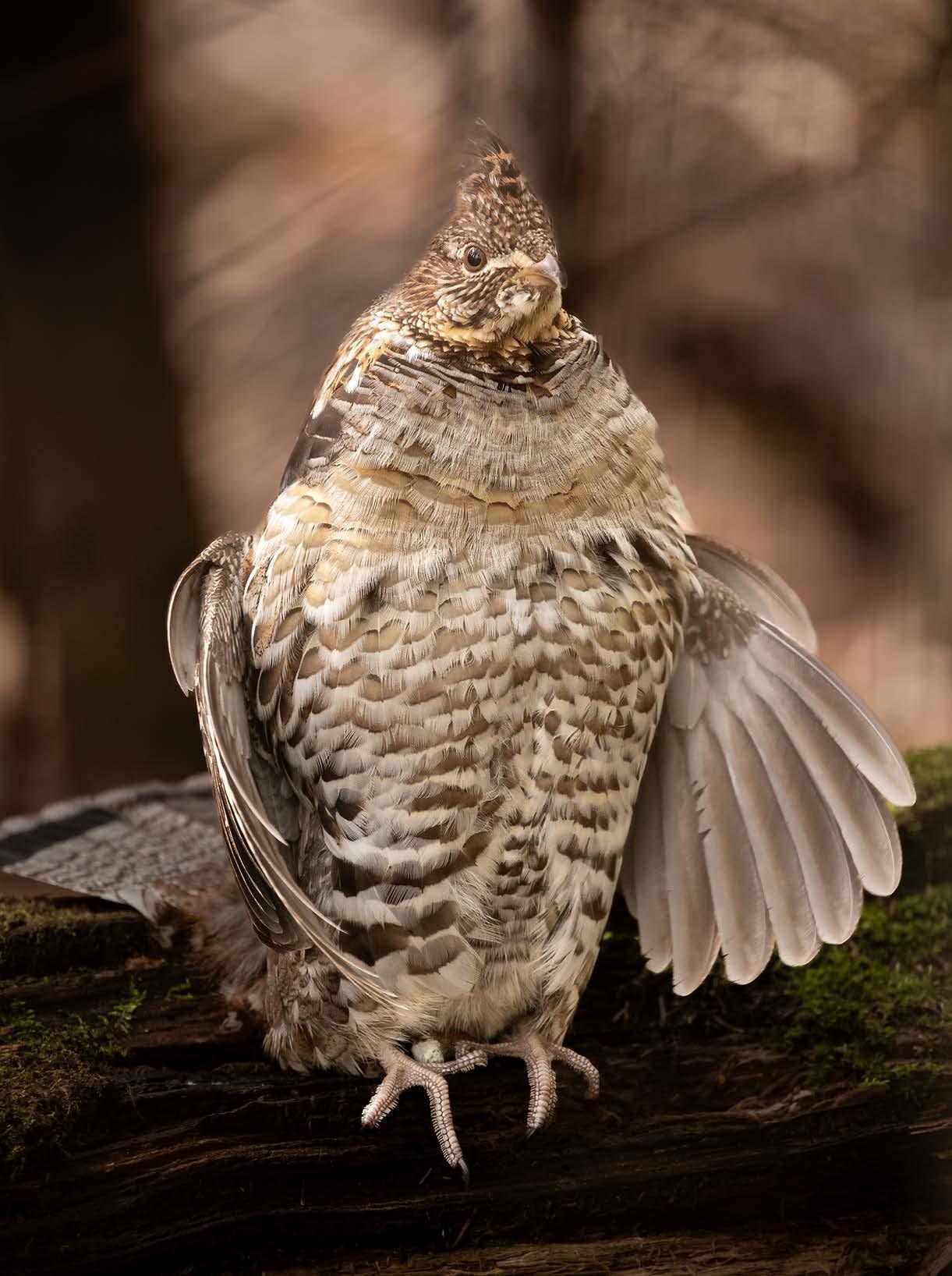
The little drummer boy was a male ruffed grouse. If I could have spied him, I’d have seen a vaguely chicken-like bird, boldly patterned in gray, black, brown, and white. He’d have had a crest on his head, a black band across the end of his tail, and would stand about a foot high. Each of his toes would have been fringed with structures called pectinations. These grow as winter comes on. They serve the bird as snowshoes.
Somewhere out among the moon shadows, the grouse stood on a rotting log, probably one carpeted with moss. From visits I’d had with others of his kind, I knew he launched into each burst of percussion by cocking his tail, then lowering it, then raising his wings like an orchestra conductor. Next he’d cup his wings as we might cup our hands and with great force pull them swiftly downward and in toward his sides. This would make the frst drumbeat. Over and over he’d repeat the downbeats, the tempo rapidly increasing. Then it would be over. A message had been delivered. The male grouse would then survey the landscape, rest, and compose
himself for the next performance. It might come a few seconds later. It could wait for months.
All this had to do with romance, of course, even though, on that frigid winter night, I doubt the Romeo had much of a chance of warming a female’s heart. Then why drum? Maybe he was doing it to lay the groundwork for love in springtime. Maybe he was asserting his right like a king of old to lord over a domain and drive away rivals. Maybe he was cold and wanted to warm up, and this was the best way to do it.
Or perhaps, just perhaps, because it was Christmastime and from the house he’d heard that most unlikely pair, Bing Crosby and David Bowie, pa-rum-pum-pum pumming on a set of loudspeakers, he couldn’t resist joining in.
Extracted with permission from The Nature of the Place by Edward Kanze, North Country Books, 2025. A male ruffed grouse drums on a vintage Adirondack log | Edward Kanze
by Tony Goodwin
While the focus of this year’s centennial for Johns Brook Lodge (JBL) has appropriately been on the main lodge, the interesting history of the two camps, Grace Camp and Camp Peggy O’Brien, deserves some mention.
From the beginning
Shortly after the main lodge was constructed, a group decided to use it on a winter trip. Recalling that trip in Cloud Splitter, the ADK Albany Chapter’s newsletter, William Howard noted that ice had remained on the kitchen foor even though the group had a roaring fre going all day.
ADK groups thus occasionally leased two smaller camps just down the brook, from the original builder, Homer Brown. Brown had frst built what became Winter Camp. He called it “Thistle-Dhu” (as in “This’ll do”) and he and his friends used it as a hunting camp. His wife, Grace, said that she would help cook for the groups, but only if she had separate quarters. So, Brown built a smaller building and dubbed it “Camp Grace.” Later, “Grace” and “Camp” were transposed, and it became “Grace Camp.”
In 1929, ADK bought both camps from Brown. In the early years, maintenance on the camps was spotty at best, and by the early 1950s Winter Camp was in danger of collapse. The ADK Keene Valley Chapter raised some funds so it could be shored up, while ten years later, the Glens Falls and Schenectady Chapters raised funds to shore up Grace Camp.
At the same time Grace Camp was being
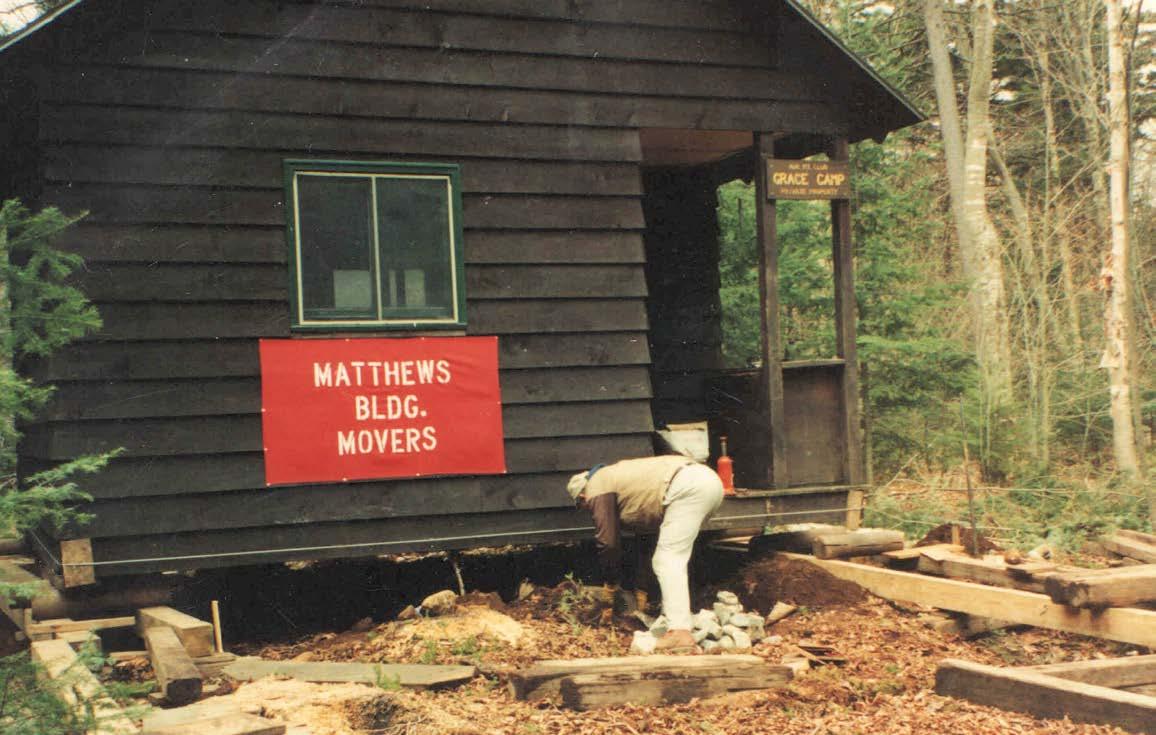
top photo: Matthews Building Movers at Grace Camp, May 1991 | ADK Archives
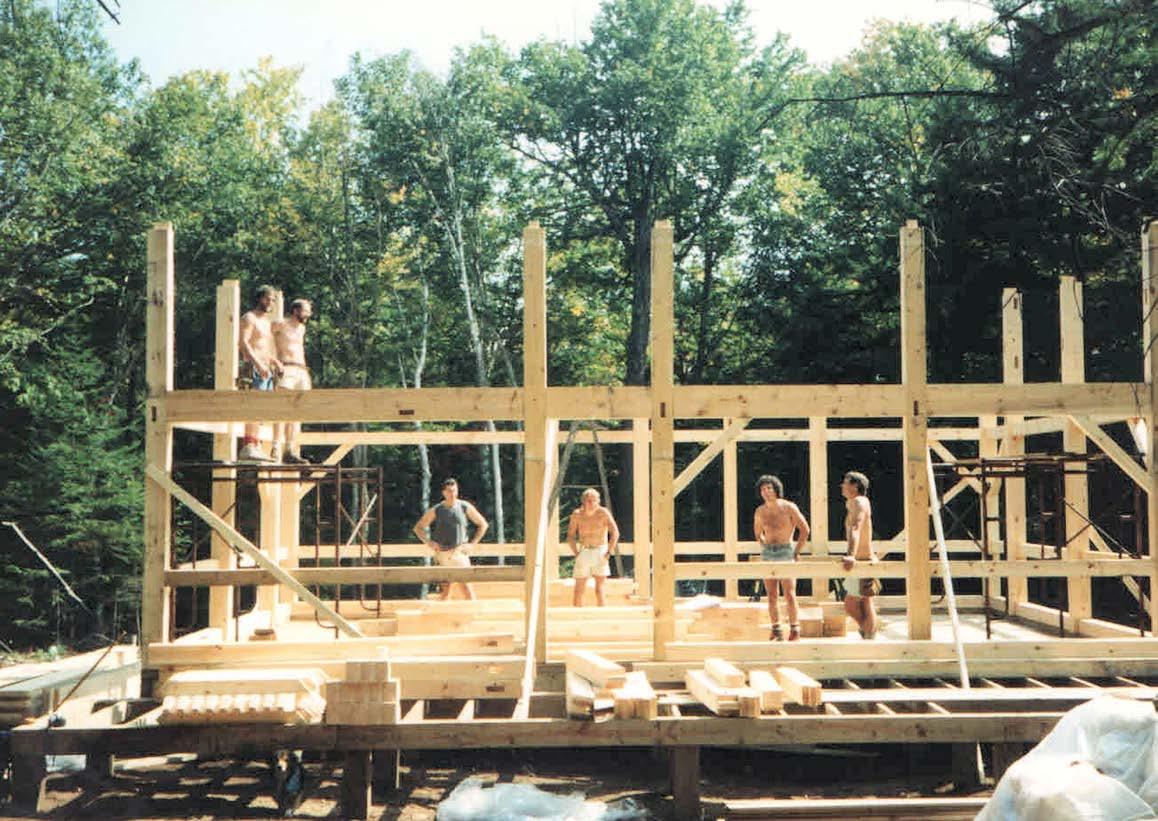
bottom photo: Volunteers work on the frame of Camp Peggy O'Brien | ADK Archives
refurbished, Peggy O’Brien, a local ADK member and active volunteer, was asked to see what could be done to improve the interior conditions at Winter Camp. Peggy’s recruitment of volunteers to do a thorough housecleaning of Winter Camp led to her becoming the chair of the Johns Brook Lodge (JBL) Committee in 1965, a position she held until 1976.
During the winter of 1967–68, Grace Camp burned; no cause for the fre was ever determined. A new cabin was designed by a former ADK president, Henry Young, and was built by a crew of three from Keene Valley in three weeks during the summer of 1968. Grace Camp’s fnal chapter was its move back away from the brook in the spring of 1991. ADK member Bill Matthews and others from Matthews Building Movers of Rochester volunteered their time and expertise to move the estimated fve-ton building approximately 150 feet. By 1987, the condition of Winter Camp had become dire. There had never been any proper ventilation in the roof, and moisture from the wet clothing of generations of
hikers had saturated the ceiling and, by extension, the roof. It was deemed in danger of imminent collapse. That’s when the JBL Committee had to fnally say, “This will NOT do,” and contemplate a complete rebuild.
A fundraising campaign was started to raise the $65,000 thought to be needed for rebuilding the cabin on a different and more environmentally appropriate site. Initially, the fundraising lagged, and a proposed fy-in of materials in April 1988 had to be postponed. But by November 1989, the camp was complete and hosted its frst occupants. It was named Camp Peggy O’Brien, in memory of Peggy, who had passed away in 1987. The opening was followed by a formal dedication, attended by many family members and friends, the following summer. Throughout the decline and rebirth of these two camps, demand for their use remained strong, so that in 1990, ADK initiated a lottery system to allocate these scarce resources as fairly as possible. Today, the cabins are booked online frst come, frst served (visit ADK.org to learn more).
Finally, some mention should be made of the Crew Cabin that is located just below the main lodge. The cabin is dedicated to Henry Young, who designed it and then celebrated his eightieth birthday in 1977 by working on its construction. The cabin replaced a wall tent on a platform that had been in service as crew housing since 1968. The Adirondack Park Agency (APA) review that permitted the construction of this structure also prohibited renting it out. For several years, there was a Winter Host program, which had volunteers spending weekends at the cabin to provide any help that winter users might require. The host program has been phased out, and currently, the cabin is occupied on a part-time basis by either a seasonal caretaker or the facility manager. Tony Goodwin was part of the Johns Brook Lodge hut crew from 1967–68 and hut master in 1969. He still lives in Keene, New York, and is still active in trail work throughout the Johns Brook Valley and vicinity.
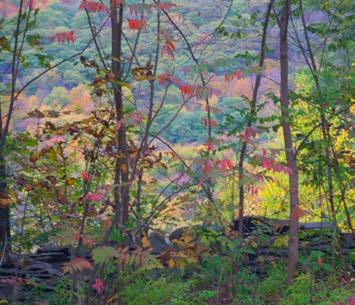
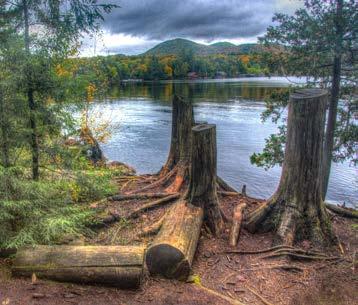
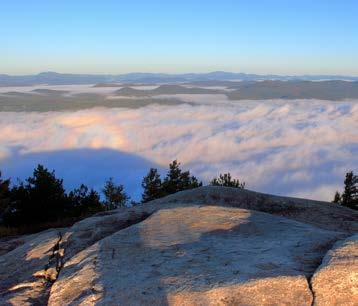
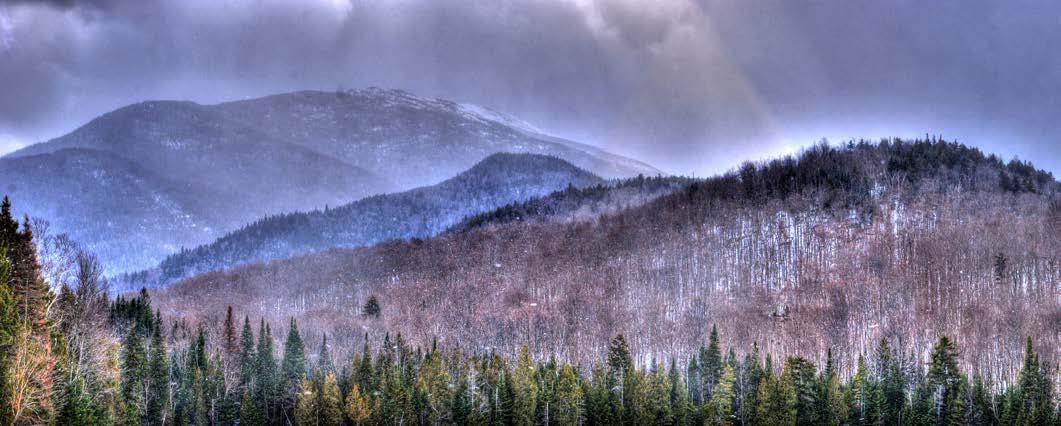
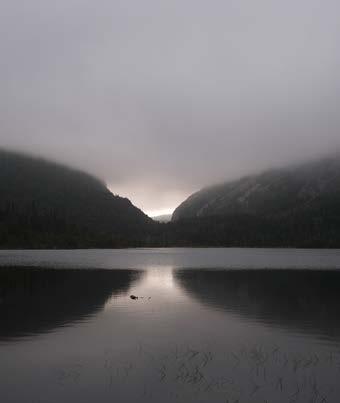
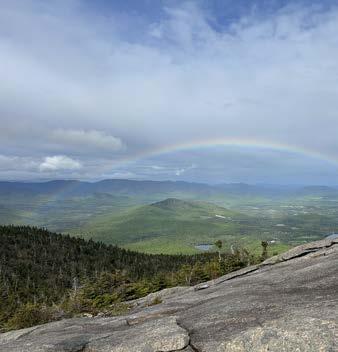
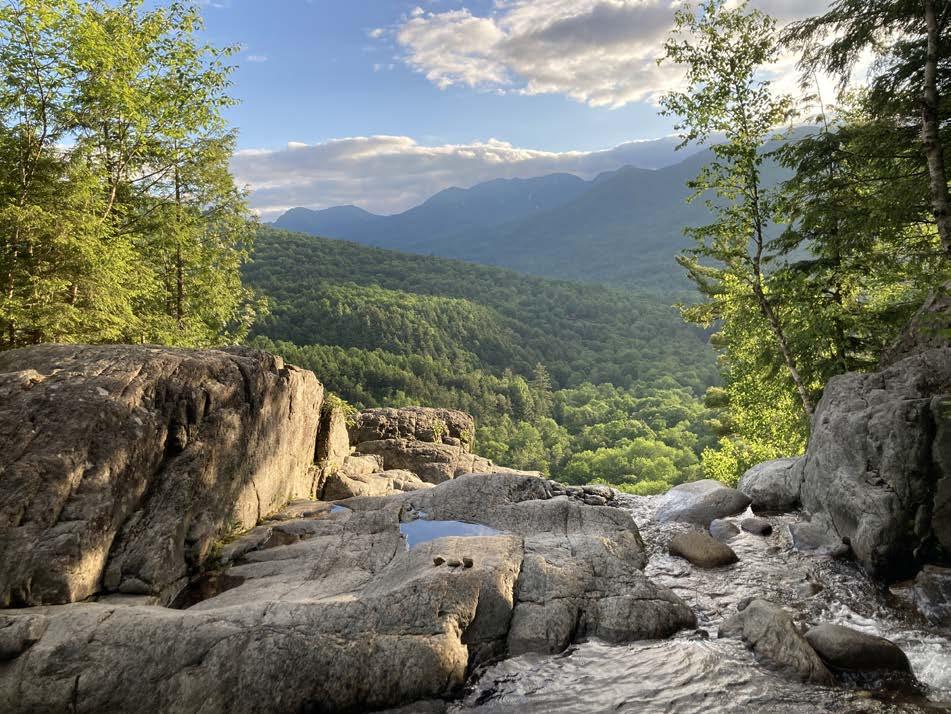
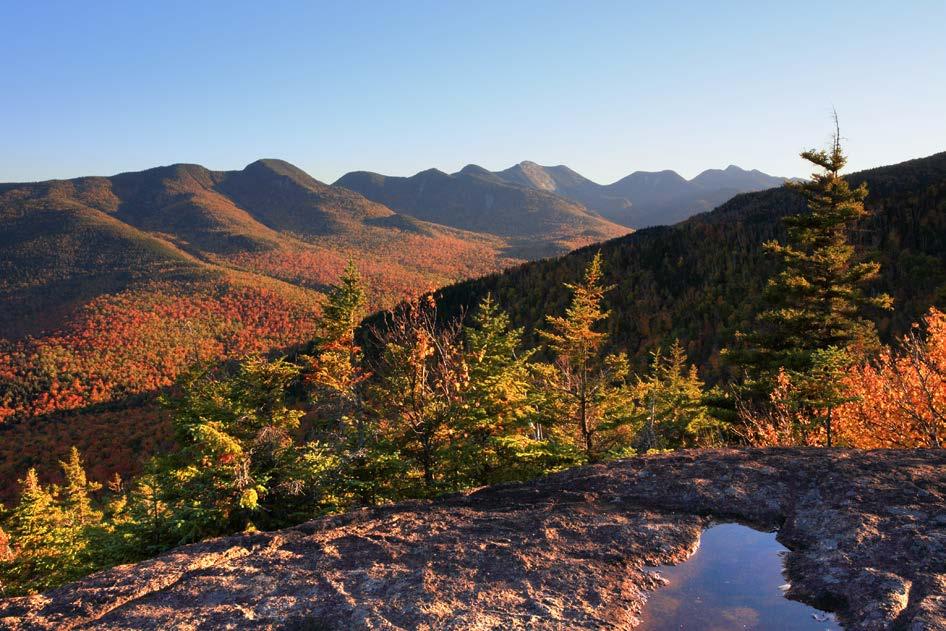
ADK Photography Contest winners announced
Photographs and illustrations have graced the pages of Adirondack Mountain Club (ADK) publications since the organization was founded. Talented and generous contributors have given the public beautiful portrayals of the Forest Preserve and photographed all aspects of the wild lands and waters that are central to ADK’s mission.
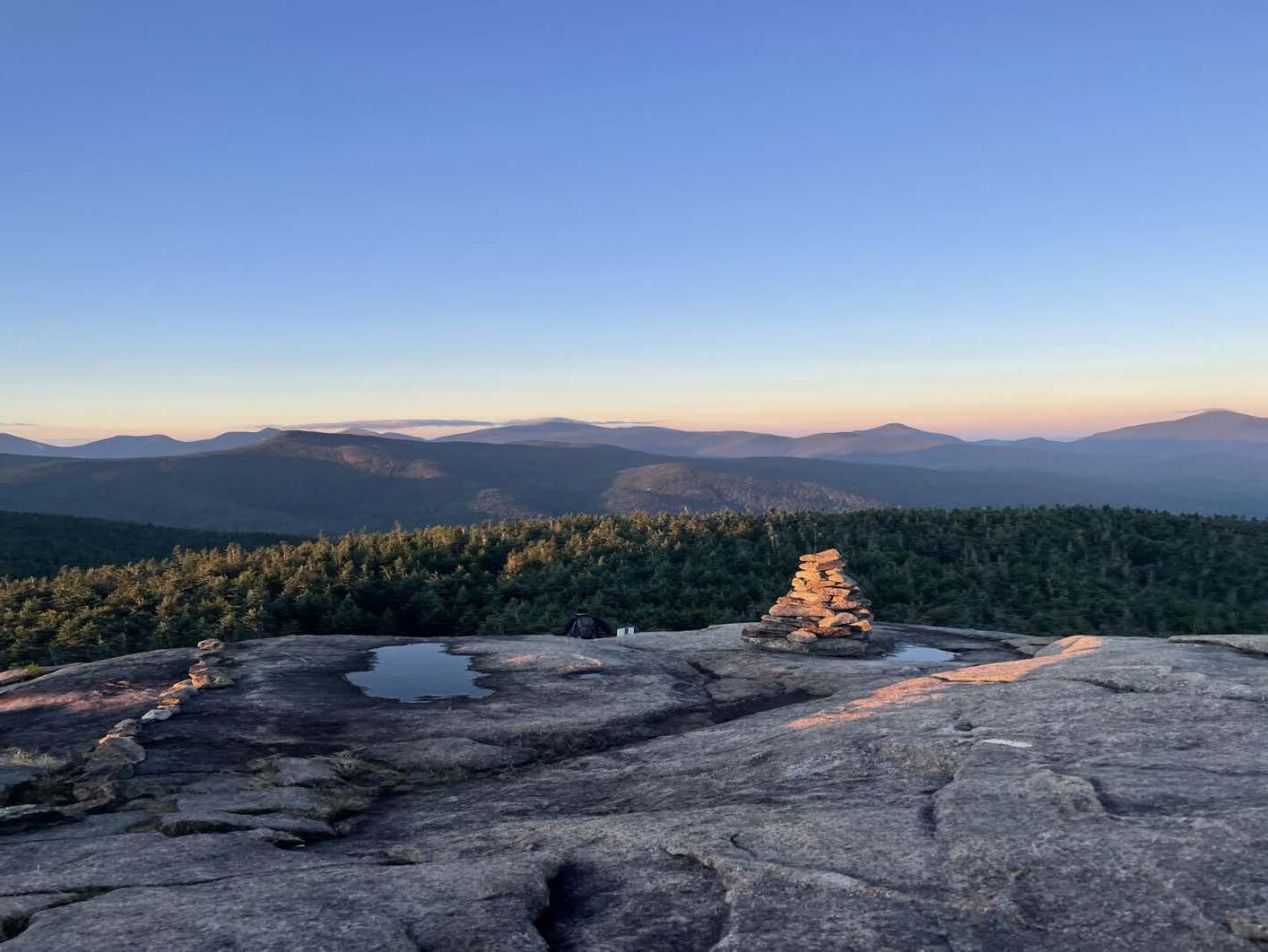
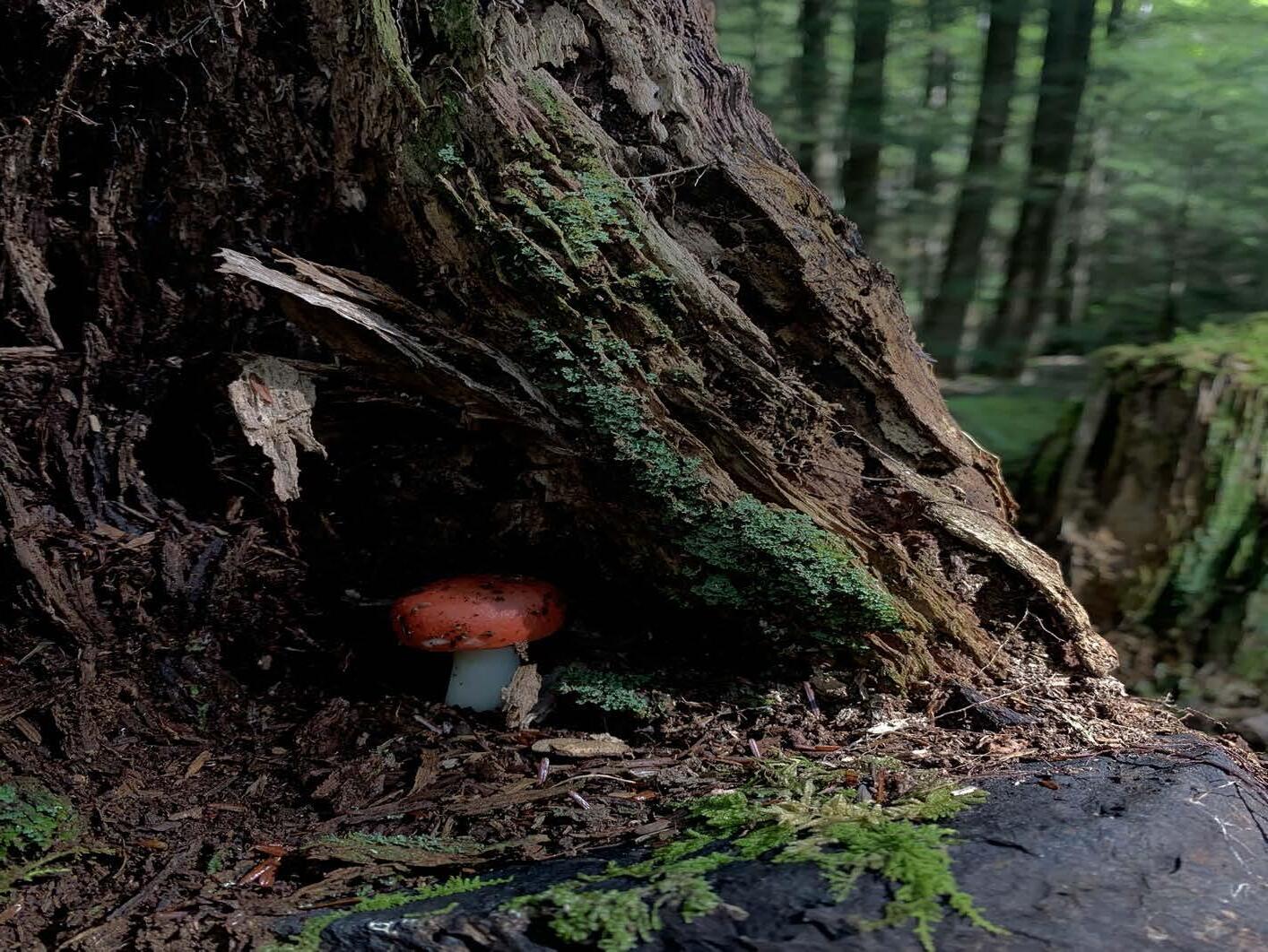
This spring, ADK announced a photography contest to encourage the community to continue sharing their talents, explorations, and discoveries. We were thrilled to receive thirty-four submissions. After an initial round of voting on ADK.org, the top eleven photos were shared on ADK’s Facebook and Instagram pages for a fnal round of voting. Congratulations to Annie Kiernan, who had the two most popular photos!
ADK sends a hearty congratulations to Maude Halle Saint-Cyr for third place, and Henning Vahlenkamp for fourth place. Thank you for your participation!
Our three winning photographers each received a prize package from ADK that included two ADK books, ADK branded gear, the latest edition of the ADK High Peaks Adirondack Trail Map, and a one-year parking pass to the hiker parking lots at Heart Lake.
We are pleased to share the winning photos and some honorable mentions (see following pages and above [and on the left], respectively).
Thank you to all contributors, past and present, all who entered this photography contest, and those who voted to select the winners. We are grateful for your participation and support!
by Audrey Hyson
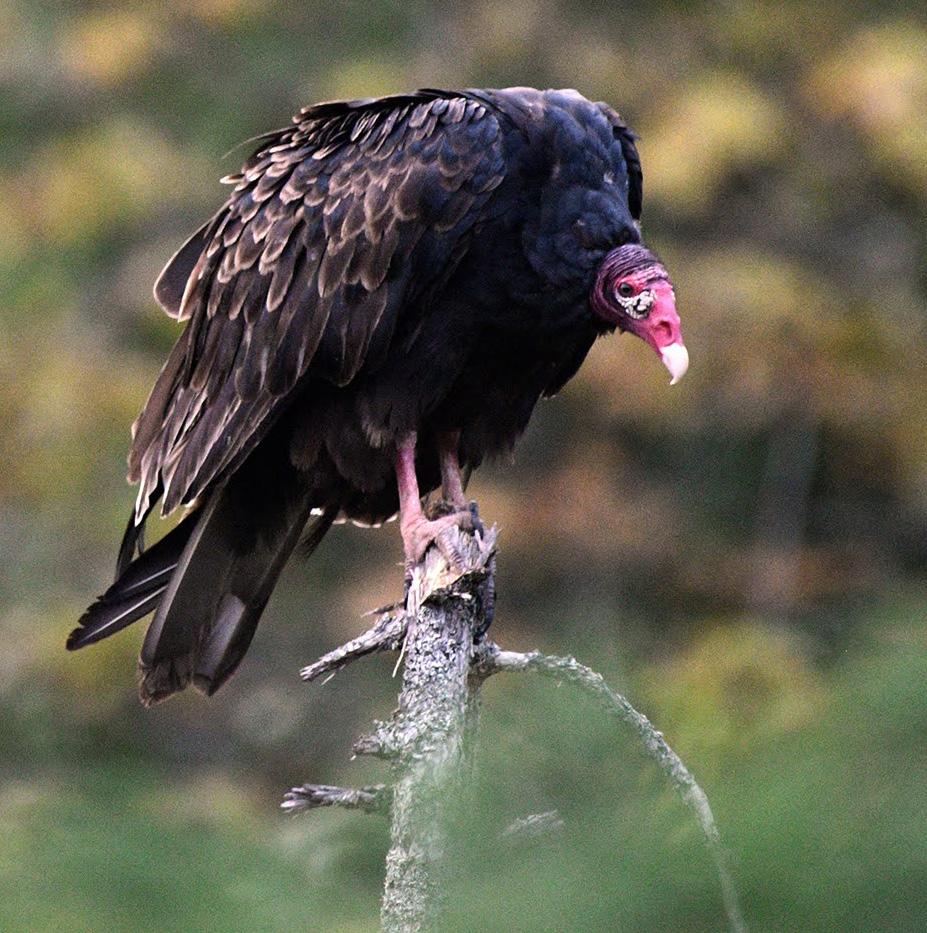
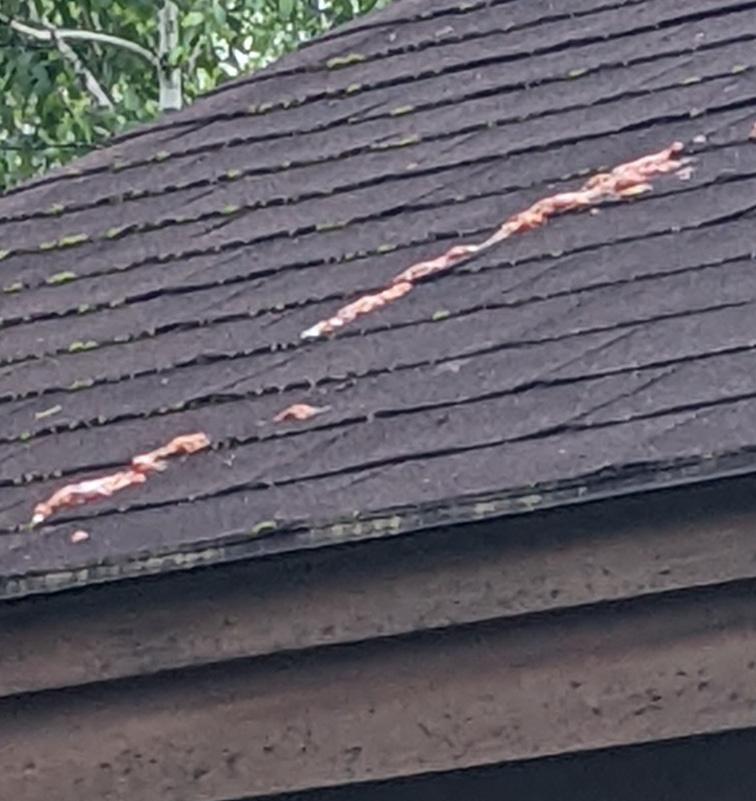
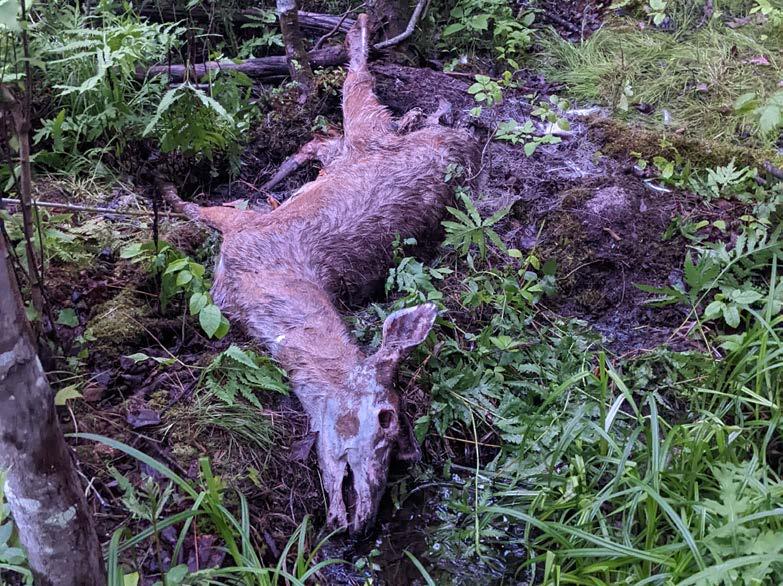
The photos on the next page tell a story. You may have noticed in the frst photo that the deer carcass is missing its eyes and tongue. These are the easiest parts for a scavenger to access prior to starting the work of tearing open the thick skin of a dead animal.
The scavenger that was consuming the remains of the deer in the frst photo was startled by a domestic dog and, in its distress, it regurgitated the contents of its stomach onto the roof and screened porch of a nearby home as it few up out of reach of its pursuer (see second photo). The release of foul-smelling, highly acidic vomit onto a pursuer can be an effective deterrent. Emptying the stomach also lightens the load as a scavenger fies upwards quickly to escape a threat.
Highly evolved to succeed in the important niche it occupies in the circle of life, Cathartes aura, the American turkey vulture, provides the service of cleaning the roadsides, towns, and wilderness of decomposing remains. This helps prevent the spread of disease and accelerates the process of decomposition, recycling the essential nutrients and biomass of carrion back into the ecosystem.
When I asked a birding acquaintance to share her thoughts on the turkey vulture, she praised the grace of a vulture gliding on a summer thermal, foating upwards on the sun-warmed column of rising air created by uneven heating of the earth’s surface. The vulture rocks slightly back and forth, dipping one wing and then the other, making micro adjustments to maximize the lift provided by its six-foot wingspan. When arriving at the top of the thermal, the vulture glides with an occasional fap to catch the updraft of another thermal. This is a strategy used by many large birds during migration.
My friend also spoke of the remarkable adaptations to the life of a scavenger: the acute sense of smell and the sharp, curved bill for tearing tissue and poking around in the body cavity of carrion to access remote morsels. Not to mention the distasteful, but perhaps enviable, ability to eat rotting fesh without becoming ill. This is due to strong digestive acids and a special gut microbiome.
All vulture species prefer carrion that has been dead for two to three days, so it’s soft enough to tear but isn’t rotten. Hygiene is important for a vulture to stay healthy.
A featherless head and neck allow the vulture to keep these areas clean. To maintain its wings and feathers, a vulture will perch in a sunny location with its wing spread to “bake” potentially damaging parasites out of the feathers.
Like all birds, vultures preen to remove dirt and parasites. Preening also helps maintain the feathers by zipping together the interlocking feather barbules of their wings to maintain a smooth, aerodynamic surface.
A turkey vulture in fight is easily identifed by the dark blackish-brown body, large size (close to that of a bald eagle), and small head. The undersides of the fight feathers are silver-gray, forming a broad whitish band on the trailing edge of each wing. In fight, the wings are held in a slight upward “v” called a dihedral.
“Although we may not all fnd the turkey vulture lovable, we can certainly respect the important role it plays.”
When our family took up residence in the Adirondacks, turkey vultures were not commonly seen. Now they are quite common, and the black vulture population is also increasing. Both species are seasonal residents who migrate south in winter. Several factors can be credited for this range expansion, not the least of which is the banning of DDT in the 1970s. Other factors include our extensive highway system that provides abundant roadkill, a substantial increase in the deer population, and a warming climate, which allows many species to survive in more northern latitudes.
Although we may not all fnd the turkey vulture lovable, we can certainly respect the important role it plays in the world and can appreciate its unique adaptations and talents. Here’s to the carrion cleansers.
Audrey Hyson has been pursuing her fascination for natural history since childhood and is always seeking to gain a better understanding of the wild outdoors.
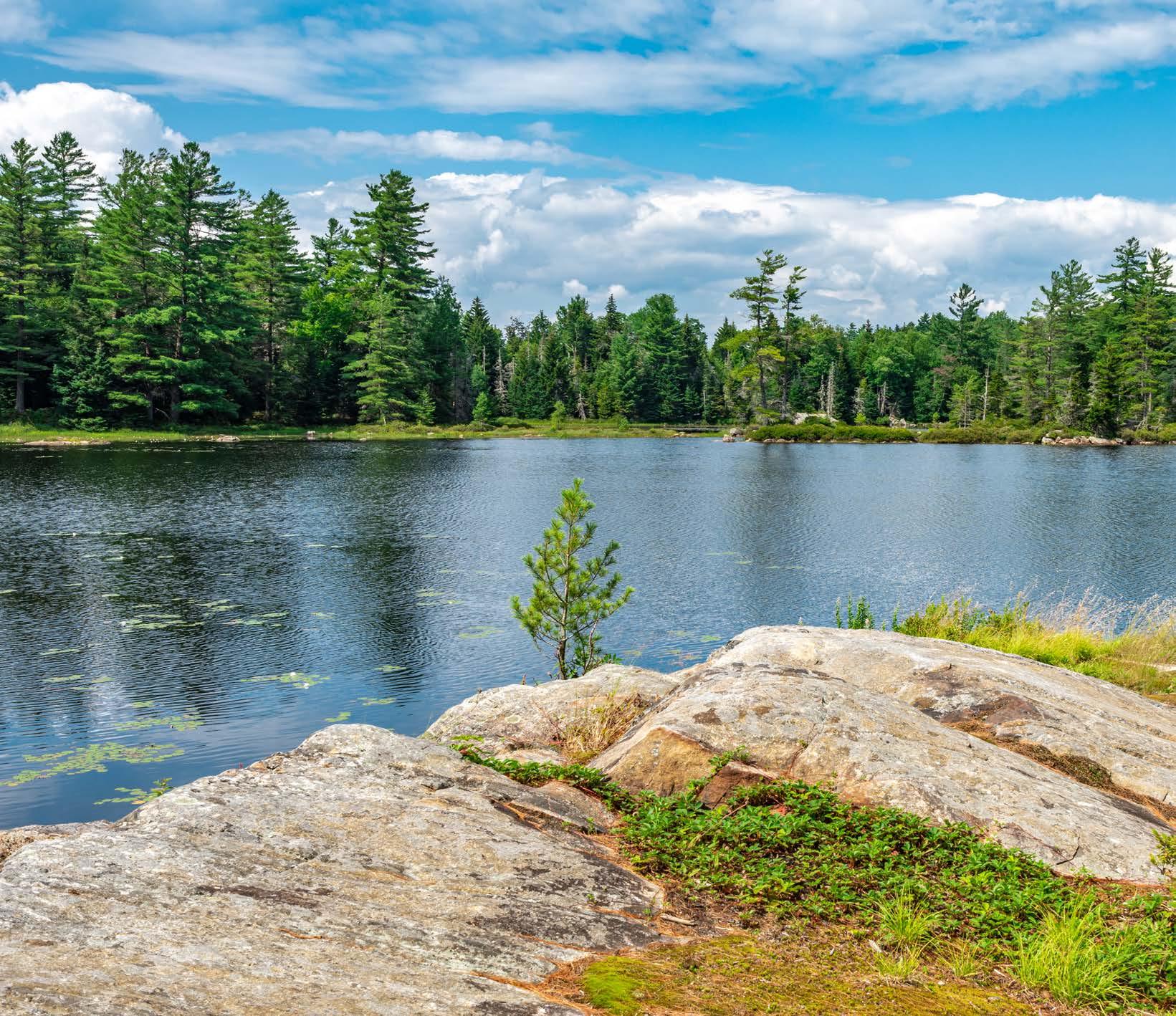
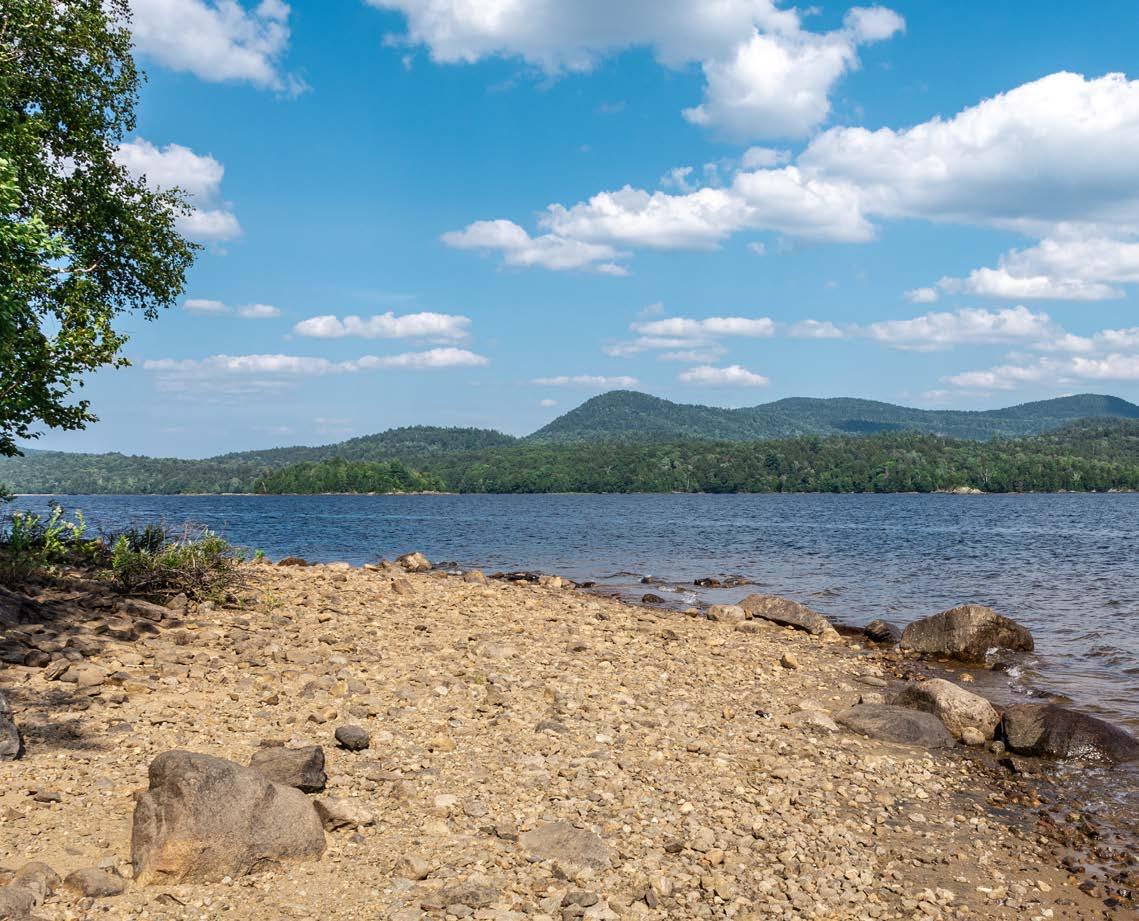
ADK has news! The ffth edition of Adirondack Mountain Club Central Trails, edited by Stephanie Graudons, will be available this winter from ADK’s High Peaks Information Center, online at ADK.org, or at local bookstores. It is a substantial revision of the fourth edition.
As Graudons writes in the preface, “The region covered in Central Trails is comprised of countless bodies of water and rolling hills, punctuated by steeper mountains, which provide a range of year-round recreational opportunities….This area features challenging mountains and scenic views…, and also contains lakes, ponds, campsites, and cliffs that attract hikers, paddlers, anglers, and climbers. Several trails in this region allow for snowmobiling and mountain biking, while others are truly wilderness.” More than half of the 138-mile Northville–Placid Trail is found here.
The Central Trails region is defned by the Adirondack Park boundary to the south and the hamlets of Blue Mountain Lake and Indian Lake to the north. It also includes the communities of Piseco, Speculator, North Creek, Raquette Lake, Northville, and Caroga.
Graudons continues, “Just as the weather and seasons change, so does this landscape, creating a need for an updated guidebook. Young trees grow, older ponds drain, and dramatic storms occasionally sweep through, knocking down trees and washing out bridges. Beavers continuously work to construct dams, creating new ponds and wetlands, as well as a need for trail work.”
This new edition features updates to many trails, including the Kunjamuk Trail and trails to Shallow Lake and Raquette Lake–West Mt. Additions include trails to Slim Pond and OK Slip Falls, and a new section of the North Country National Scenic Trail.
Editor Stephanie Graudons is a licensed hiking guide, Leave No Trace Level 2 Instructor, and adventure photographer. She grew up in Mayfeld, New York, and has always enjoyed being outdoors. She started hiking more seriously in college and began leading outings for ADK in 2009. Graudons previously worked as ADK’s
Young Member Outreach Coordinator, where she implemented and improved programming targeting young adults and families.
Graudons became an Adirondack 46er in 2009 and Winter 46er in 2014. Her experience extends beyond the Adirondacks, as she has led backpacking trips for youth in Colorado, climbed Mount Rainier, and hiked all forty-eight of the New Hampshire FourThousand Footers in both summer and winter. In 2021, she summited Hamlin Peak in Maine, completing the Northeast 111.
Graudons’ photographs are used widely in this edition of Central Trails, and appear as well on ADK.org and in other guidebooks in the Forest Preserve Series. She has nearly seventy adventure guides published by Outdoor Project and enjoys supporting others in their outdoor adventures. She currently lives in Vermont with her husband, Ted Letcher, and their two cats.
Distances in the ffth edition have been measured with GPS, and the book includes GPS coordinates for the parking area or the trailhead. Central Trails corresponds to National Geographic Trails Illustrated Map 744:
Northville/Raquette Lake. This book is the third volume in ADK’s Forest Preserve Series.
Featured here are two recommended hikes from Adirondack Mountain Club Central Trails, ffth edition.
Trail 41: Watch Hill from NY 30 Trails Illustrated Map 744: O17 GPS coordinates: 43.68951, -74.34299 (parking area)
Watch Hill is a small mountain that makes an excellent beginner’s climb, ending with a magnifcent view of Snowy Mt. and the south end of Indian Lake.
Trailhead: Access to the trailhead is off the east side of NY 30, approximately 1 mile south of the Snowy Mt. parking area. This is 8 miles south of the NY 28/NY 30 intersection in the hamlet of Indian Lake, or 3.6 mi north of the Lewey Lake outlet bridge. A DEC sign indicates the trailhead at a pullout.
From the trailhead (0.0 miles), a well-defned woods road angles into the forest and quickly comes to a T intersection. A sign points left, and red DEC trail markers begin. At a junction at 0.5 miles, the Watch Hill Trail turns right, and continues to follow red markers on a slightly narrower footpath. (Straight here connects to the Snowy Mt. trailhead.)
The trail swings left at 0.6 miles and crosses a ski trail at 0.9 miles. The ascent is often gradual. A rock ledge at 1.1 miles offers a peek at Snowy Mt. through an opening in the pines. Across the rocky opening the trail dips back into the woods. A short, steep section leads up to a second rock ledge, higher and more open than the frst, at 1.2 miles. Bare rock slopes slightly upward, then drops off sharply several hundred feet to the valley foor. Hikers should avoid getting too close to the edge.
The view is fantastic. Snowy Mt. dominates to the west, with Lewey and Cellar Mts. to its left. The three tongues of the south end of Indian Lake are to the south. From the viewpoint, the red markers continue southeast for approximately 0.5 miles and descend to the shore of Indian Lake. This can extend the outing, though hikers will have to re-ascend the hill to return to the parking area.
Trail in winter: This climb is excellent for beginner snowshoers.
Distances: To right turnoff into woods from road, 0.5 miles; to ski trail, 0.9 miles; to frst lookout, 1.1 miles; to summit, 1.2 miles (1.9 kilometers). Ascent, 357 feet (109 meters). Summit elevation, 2125 feet (648 meters).
Trail 106: Clockmill Pond
Trails Illustrated Map 744: G13 GPS coordinates: 43.35098, -74.61226 (parking area)
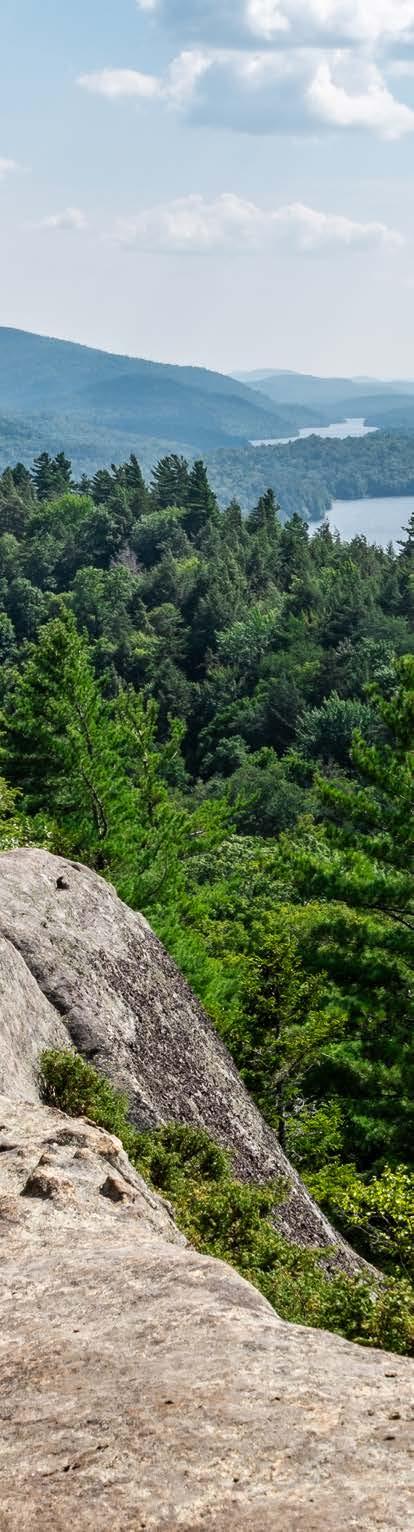
An attractive old logging road has become a marked hiking and snowmobile trail leading into several
ponds, including picturesque Clockmill Pond. This pretty pond once boasted a large dam at its west end, the remnants of which can be found with a bit of effort.
Trailhead: From NY 10 in Piseco, the signed trailhead is approximately 4.2 miles west on the unpaved Piseco–Powley Rd. Parking is on the shoulder. Note that this is a seasonal road and the gate is closed during the winter.
The trail starts at a yellow barrier gate (0.0 miles) and crosses a series of wooden snowmobile bridges. Orange snowmobile disks guide the way on relatively fat terrain. At 0.1 miles the trail bends left, with a lush vlei visible left. The trail crosses a rough snowmobile bridge over part of this swampy section at 0.2 miles.
The trail crosses a small stream, and at 0.3 miles crosses a snowmobile bridge that cuts across the vlei in a southeast direction. The trail still bears occasional resemblances to the old road, offering relatively fat and pleasant walking. It crosses another wooden bridge at 0.5 miles over a fast-fowing stream. At 0.7 miles the trail cuts right up a gentle grade, crossing an aluminum culvert. At 0.9 miles it descends to cross a snowmobile bridge at the bottom of a gully.
The trail crosses another stream before entering a large clearing at 1.1 miles. The trail forks here. The blue-marked trail left (east) goes to Clockmill Pond. The right fork is the snowmobile trail to Rock Lake and Kennels Pond.
The route to Clockmill Pond begins to descend to the pond at 1.3 miles. Glimpses of the water are visible through the trees. The trail soon reaches the edge of the pond, traverses a few ups and downs, and ends at a rocky outcrop with a view of the pond at 1.5 miles. An informal campsite dotted with blueberries sits above the water. Trail in winter: Not recommended for skiers owing to the distances needed to access the trailhead on unplowed Piseco–Powley Rd.
Distances: To clearing and junction, 1.1 miles; to Clockmill Pond, 1.5 miles (2.4 kilometers).
by Daniel Way
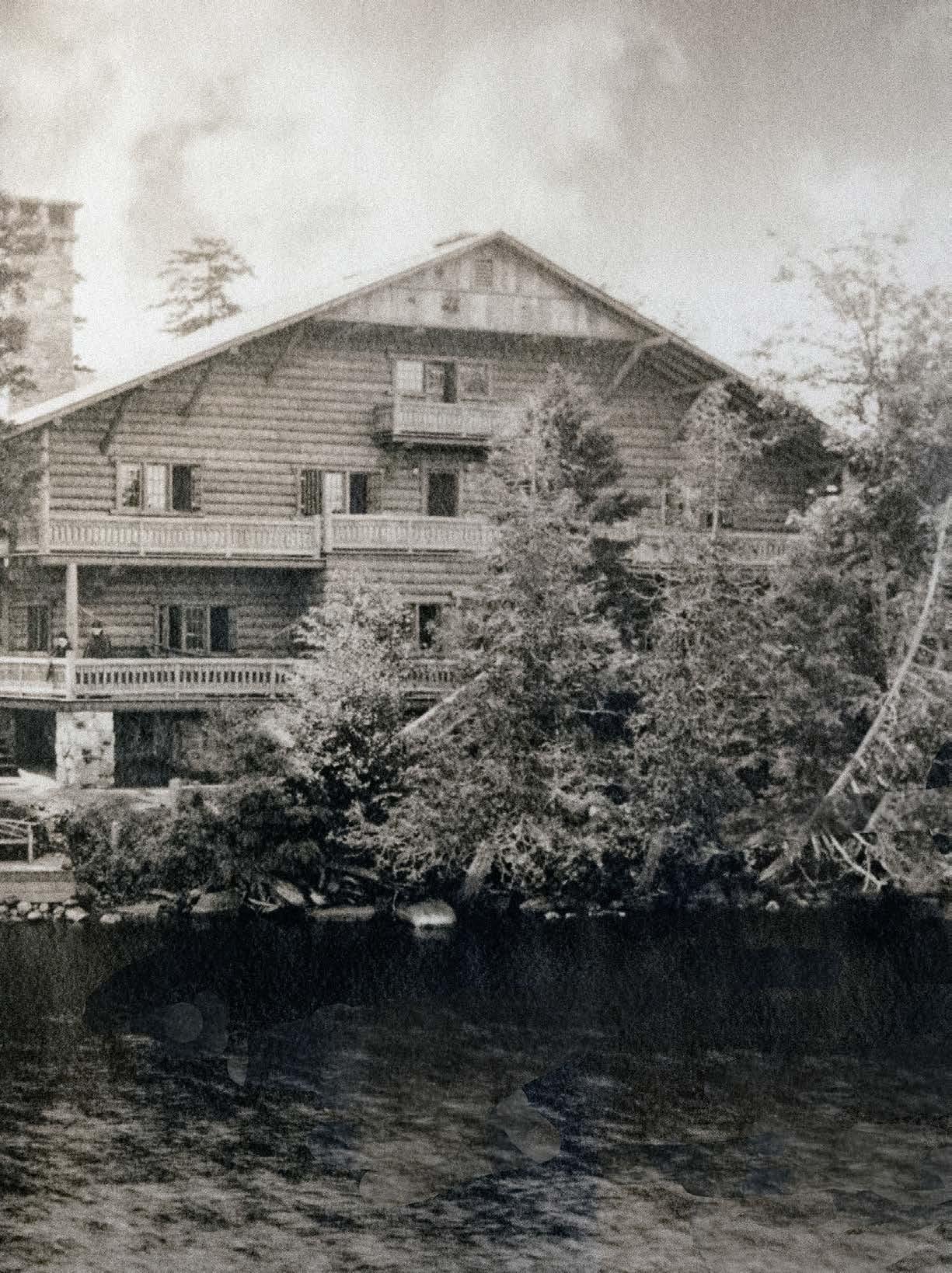
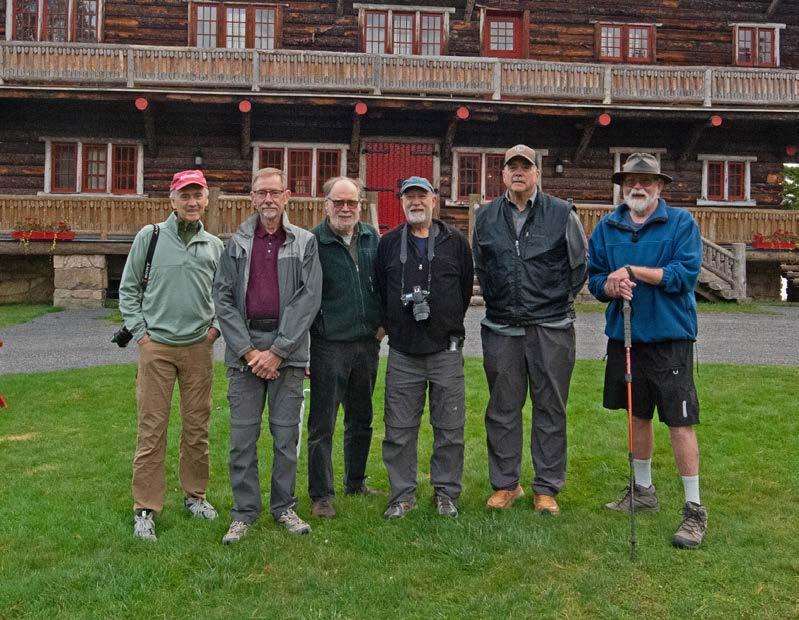
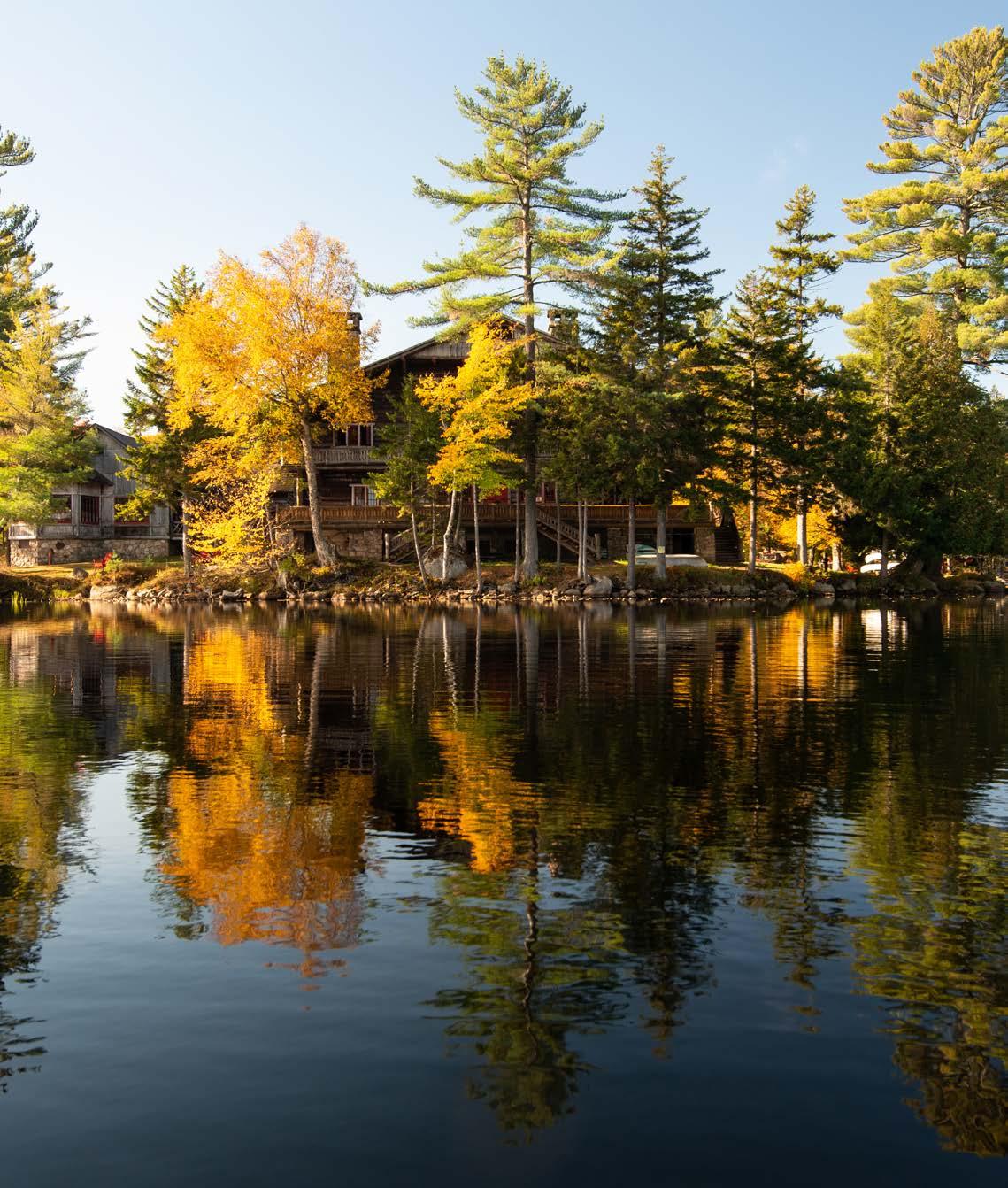
For the ffteenth anniversary outing of the League of Extraordinary Adirondack Gentlemen (LEAG) in 2024, we chose to spend a few luxurious days at Great Camp Sagamore in the town of Raquette Lake during the peak of the fall foliage season. Where else could we simultaneously enjoy the autumn colors, the clean Adirondack air, elegant cuisine, the remarkable rustic dwellings of the Vanderbilt family—who were by all accounts the wealthiest family on Earth a century ago—along with great paddling and access to a variety of DEC trails? When I learned that my greatgreat-uncle and renowned Victorian-era photographer Seneca Ray Stoddard frequented the establishment and developed his photographs in the great lodge basement, it became a no-brainer! So it was that seven LEAG members gathered in downtown Raquette Lake to catch up on each other’s lives before we headed to Sagamore. Rick Conney, our newest member, introduced himself, and we welcomed back Rick Rosen, who had missed out on last year’s Elk Lake adventure (see Adirondac, Fall 2024). Our party consisted of Tom Curley, Tom Bessette, Mike Prescott, me, and Dan Berggren. Sadly, a couple of our group— both with an infectious sense of humor— were unable to join us.
As the awaited hour for check-in approached, we drove our caravan of cars bedecked with our Hornbeck boats the fve miles down the Camp Sagamore road to our destination. As we negotiated the unpaved but well-worn surface, surrounded by towering trees all around, I could only wonder at the amount of manpower it must have taken to cut this road back in 1897. The road’s creator, William West Durant, was a dreamer whose dreams involved creating rustic splendor in the heart of the Adirondacks for wealthy patrons. Unfortunately, he didn’t give much thought to how he could afford to keep possession of it for himself.
The weather was perfect for a paddle, and upon arriving at the complex of rustic buildings on the shore of Sagamore Lake, we checked in and unpacked our boats and gear. We were booked for
three rooms on the third foor of the main lodge. We had access to the lake and hiking trails that surrounded the lake (all open to the public), plus musical and historical entertainment, and three luxurious meals every day!
Soon we were settled in the main lodge, which exuded history and rustic charm. After unpacking, I descended to the ground foor main room, settling into one of the 125-year-old wood and leather chairs by the freplace. I imagined the many celebrities that may have sat in the same chair a century ago—Alfred Vanderbilt, Generals Pershing and George C. Marshall, Lord Mountbatten, Gary Cooper, and Hoagy Carmichael (who wrote the timeless song “Stardust” while there), among hundreds of others.
As the afternoon sun approached the western shore of the lake, we gathered with our boats. We put in at the camp’s boathouse just above the lake’s outlet into the South Inlet that runs into Raquette Lake several miles downstream, but there is a public boat launch near the trailhead for the DEC trail that goes around the lake. We paddled the entire circumference of the threehundred-acre lake and explored the inlet at the far end in about ninety minutes,
while taking in the pristine solitude of the surrounding mature forest, which has been spared from the lumbermen’s axes since the 1890s.
After our paddle, we were joined by Dan Berggren, the other founding member of the LEAG. Together, we took a table that offered a great view of the beautiful sunset down the lake and enjoyed our dinner. As we fnished, golden beams of sunlight illuminated our table from the west; we were being treated to a magnifcent sunset from the far end of Sagamore Lake. We all agreed that our outing was off to a smashingly good start.
Unfortunately, the next morning a lowpressure cold front delivered misty, clammy weather that lasted all day long. We opted for a guided tour of the entire Sagamore campus, which would be provided by Ellen Butz, who was the niece of Margaret Collins Cunningham. Margaret, the daughter of the Vanderbilts’ original caretaker and manager, had once been a patient of mine and would tell me stories of having been born there and growing up among the Vanderbilt children. (Her story and portrait can be found in my 2003 book, All in a Day’s Work.)
Ellen showed us every signifcant
building on the campus, providing a history of each, including its place in the function and timeline of the estate. Knowing my obsession with Stoddard, she showed us where his darkroom was when he would visit Sagamore.
Ellen described how the great camp was built by William West Durant, who intended to keep it for his own use. Unfortunately, thanks to his lavish and reckless lifestyle, he couldn’t afford to do so. Then she told us about its most famous owner, Alfred Vanderbilt, who died heroically during the First World War. His widow, Margaret Emerson, then ran the place for four decades, using it as a rustic but very exclusive gathering place for famous, wealthy, and interesting characters.
Eventually, she donated Sagamore to Syracuse University. After twenty years of use, it was put up for auction. As the Sagamore’s website explains, “Two young preservationists…won the bidding for
Sagamore and began a forty-year heritage of running educational programming on Adirondack history, culture and the environment at Sagamore.”
Evening entertainment
After dinner, we joined a crowd of about thirty for an evening of music with Dan Berggren (a ticketed event). I looked forward to a performance of songs, some traditional, some written by Dan, and performed solo with his cedar-top guitar with a cherry back and sides. “Most acoustic guitars have a spruce-top,” he told me, “but I like the cedar for its warmer sound.”
Once he started playing, his smooth and mellow baritone seemed to bring the audience back in time. The music was timeless, humorous, intimate, and melodic, and I left with a very warm and content feeling that I had witnessed a very entertaining piece of Adirondack history.
The next morning dawned with a clear blue sky and no wind. As we packed up to head back to the modern world, I found myself almost wishing I could temporarily turn back the calendar to Stoddard’s era when the Sagamore was brand new. To console myself, I paddled out onto Lake Sagamore once more, to re-create a photographic view of the main lodge that he had taken over a century earlier.
Although the view had become obscured by towering white pine trees, the lake’s surface was as limpid as when Stoddard tripped his shutter. I paused to refect on the effort it took to maintain the great camp and silently prayed that someone else a century from now will be able to take the same image.
Retired general-practice physician Daniel Way has written and photographed several paddling articles for Adirondac
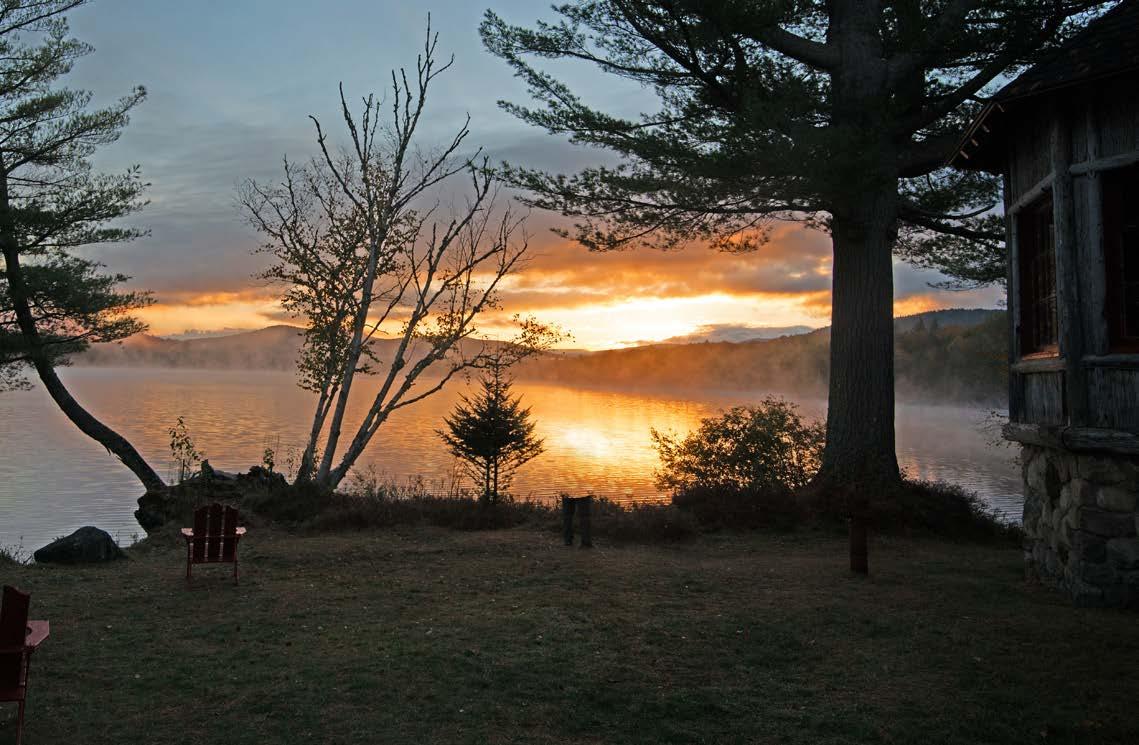
Compiled by Neal Burdick
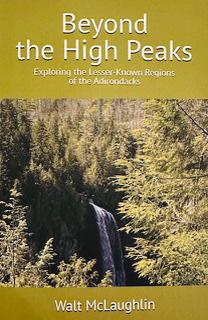

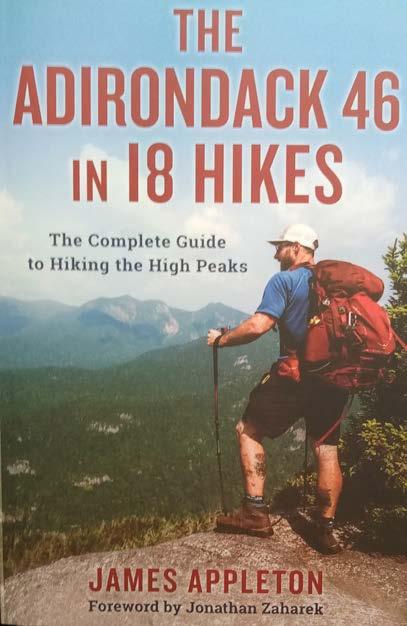
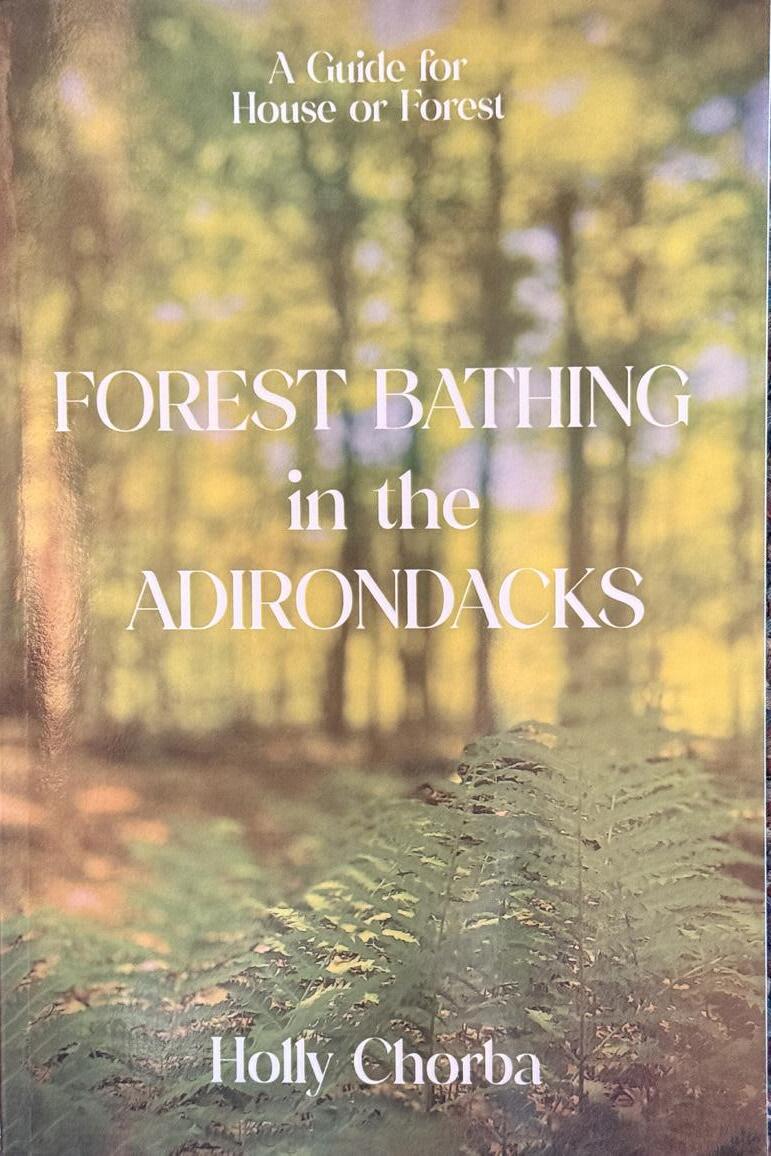
For your reading enjoyment, ADK recommends the following, arranged alphabetically, by author. ADK members' names are in boldface.
Some notices are excerpted, by mutual agreement, from reviews that appeared in Saranac Lake’s Adirondack Daily Enterprise newspaper; they are by Rich Frost (“RF” below), Jerry McGovern (“JM”), or Erena Fulton (“EF”).
For information about acquiring any of these books, check regional bookstores, web-search the author’s or publisher’s name, or visit a site such as Amazon. Some titles may also be available through ADK’s online store or High Peaks Information Center. If all else fails, contact ADK’s reviews editor at nealburdick@gmail.com.
ADK Members:
If you publish in the coming months a book whose subject matter is relevant to the interests of ADKers, please notify the reviews editor, nealburdick@gmail.com.

The Adirondack 46 in 18 Hikes: The Complete Guide to Hiking the High Peaks, by licensed guide James Appleton (North Country Books, 2025), is a guidebook with a twist in that it compresses the 46er quest into eighteen plausible outings. Experienced climbers and casual outdoor enthusiasts alike will enjoy the author’s entertaining, readable tales of each climb, along with tips for safe and ethical hiking.
Afoot in Morris: Walking the Parks and Trails of Morris County, by Daniel Chazin and Jim Simpson, a publication of the New York–New Jersey Trail Conference, is a guide to the four hundred plus miles of trails in Morris County, New Jersey, where, just a few miles from the New York City megalopolis, one can imagine wilderness. It features in-depth descriptions of trails and parks, along with other points of interest, historical notes, and detailed topographic color maps.
Forest Bathing in the Adirondacks: A Guide for House or Forest, by Holly Chorba (Native Publishers, 2024), defnes and provides a brief history of forest bathing, describes a guided forest bathing experience, and offers additional resources. Chorba describes these intentional walks through the woods as meditative and peaceful with the aim of emerging from the experience with a heightened sense of well-being. —EF
Keep an eye out for these recently released or forthcoming books:
Wild Forest Lands: Finding History and Meaning in the Adirondacks, by Phil Terrie (Syracuse University Press, 2025), the region’s premiere historian.
Adirondack Solitude: Peace and Stillness in the Adirondack Wilderness, by Russ Hartung (North Country Books, 2025), photographs and text.
Adirondack Green (tentative title), Brad Edmondson’s next volume on recent Adirondack history, due in 2026.
The Great Genesee Road: Traveling Through Time on New York State’s Historic Route 5, by Richard Figiel (North Country Books, 2024), is a history of New York State’s “Main Street” south of the Adirondacks, from Schenectady through the Mohawk Valley to Buffalo. Featuring rich storytelling, generous illustrations, historical and contemporary photographs, and detailed maps old and new, the volume takes readers through events that infuenced the shaping of the vast wilderness to its north.
A Force for Nature: Paul Schaefer’s Adirondack Coalitions, by David Gibson (Syracuse University Press, 2025), explains how staunch Adirondack Park and Forest Preserve advocate, activist, and writer Paul Schaefer profoundly infuenced conservation policy in New York State, and at the federal level with the Wilderness Act of 1964, and how he brought people and groups together to advance that cause.
Outsider: Stories of Growing Up Black in the Adirondacks, by Alice Paden Green (Center for Law and Justice, 2023). A native of the gritty iron-mining town of Witherbee, Green explores growing up Black and impoverished, perceptions of race in the Adirondacks of the 1950s and ’60s, and whether those perceptions persist. Formerly the executive director of the Center for Law and Justice in Albany, she died in 2024.
The Nature of the Place: On the Flora and Fauna of the Adirondacks, by Edward Kanze (North Country Books, 2025), is an anthology of years of newspaper and magazine columns by the esteemed, and very articulate, naturalist, who knows, and knows how to tell us about, living things from moose and bears to millipedes and no-see-ums, elegant loons to atmosphere-altering bacteria. (See excerpt from this book on page 18.)
Beyond the High Peaks: Exploring the Lesser-Known Regions of the Adirondacks, by Walt McLaughlin (Wood Thrush Books, 2025), reminds us there’s more to experience in the region than becoming a 46er, more destinations than the High Peaks, more minute subjects like small mushrooms, tiny red
efts, evening peepers, blackfies, mud— and occasionally just the silence or the thrill of having a place to oneself. —RF

Sketching the Adirondacks: Letters from the Wilderness, by Edward Pitts (Syracuse University Press, 2025), portrays the improbable 1851 journey of 170 miles across the nearly trackless Adirondacks by two budding artists, Jervis McEntee and Joseph Tubby, so they could make sketches that they could later translate into paintings. The book consists of fctionalized letters home, based on McEntee’s journals and other documented facts.
Cranberry Lake Fifty Place Names: The Tiny Toponym Tome, by Erik Schlimmer (Beechwood Books, 2024), is in fact a tiny book, only fftyfve pages long; “Cranberry Lake Fifty” refers to the
50-mile multi-trail hike around the lake; and a toponym is a place name bearing a topographical feature. Schlimmer says the book “introduces readers to a tapestry of toponyms that refect the region’s historical and natural variety.” —EF
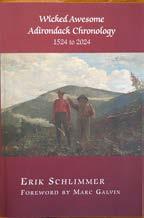
Wicked Awesome Adirondack Chronology: 1524 to 2024, also by Erik Schlimmer (Beechwood Books, 2024), lists dates and a brief description of towns settled, forts built, wars raged, and industries established. There are massacres, foods, and tropical storms. Planes crash, hikers and hunters die, wildfres rage. For serious research or armchair reading, this ordering of events in the Adirondacks is detailed and thorough. —EF

The Manager: A Tale of the Cold War, a novel by Chris Shaw (Outskirts Press, 2025), begins in Saranac Lake in 1982 and ends in 2015 in North Dakota. On a snowy night, a magazine editor picks up the manager of a Russian hockey team, beginning a journey that is diffcult, dangerous, literary and romantic, with alluring Olympic fgure skaters, spies, Adirondack characters, lies, and violence. —JM

Adirondack Ghost Stories, by Dennis Webster (North Country Books, 2025), reminds us that like all remote mountainous regions, the Adirondacks have their trove of ghost stories. This collection of fction by several writers presents spine-tingling tales from White Lake in the southwest
Eric the Skier, by James Kobak Jr. (HumorOutcasts Press, 2025), for ages 8 and up, tells of a family whose members ski, hike, canoe, surf, worry, bicycle, cook, dance, and survey everything in sight as they come to learn about a serious problem, and, with the unexpected guidance of their youngest and most timid member, begin trying to fnd answers and solutions.
First Ascent: The Epic Yosemite Rock-Climbing Rivalry of Royal Robbins and Warren Harding, by North Country author Kate Messner (Yosemite Conservancy, 2025), is meant for ages 6 to 8. It’s the true story of cooperation and rivalry surrounding the pioneering attempts to climb Half Dome in Yosemite National Park.
The Most Marvelous Moose-Call Contest in their series “The Adirondack Kids,” for kindergarten to sixth-grade audiences. Based on an actual event in Indian Lake, it tells the tale of a youngster who enters the contest, and the adventures-with-twists that ensue.

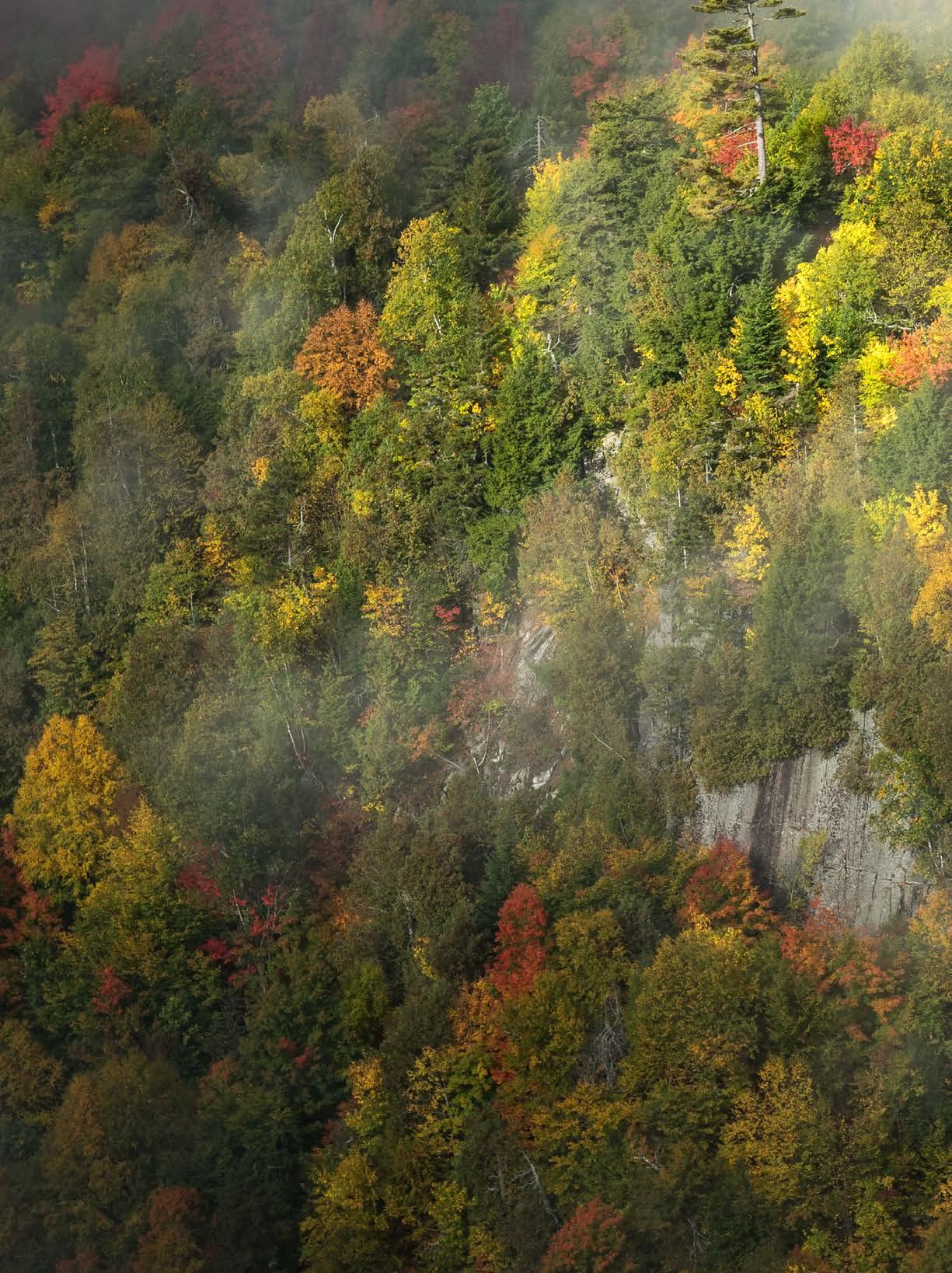
These moss-covered trees— bewhiskered old men— endlessly theorize with wind blowing at their tails as I hike this ruddy gauntlet. They do not talk— wisdom does not bow to conventional chatter but Solomon points to buttress roots, failing arms and sips at the remains of rain curled up in bony leaves as if he were drinking ambrosia.
—John Grey
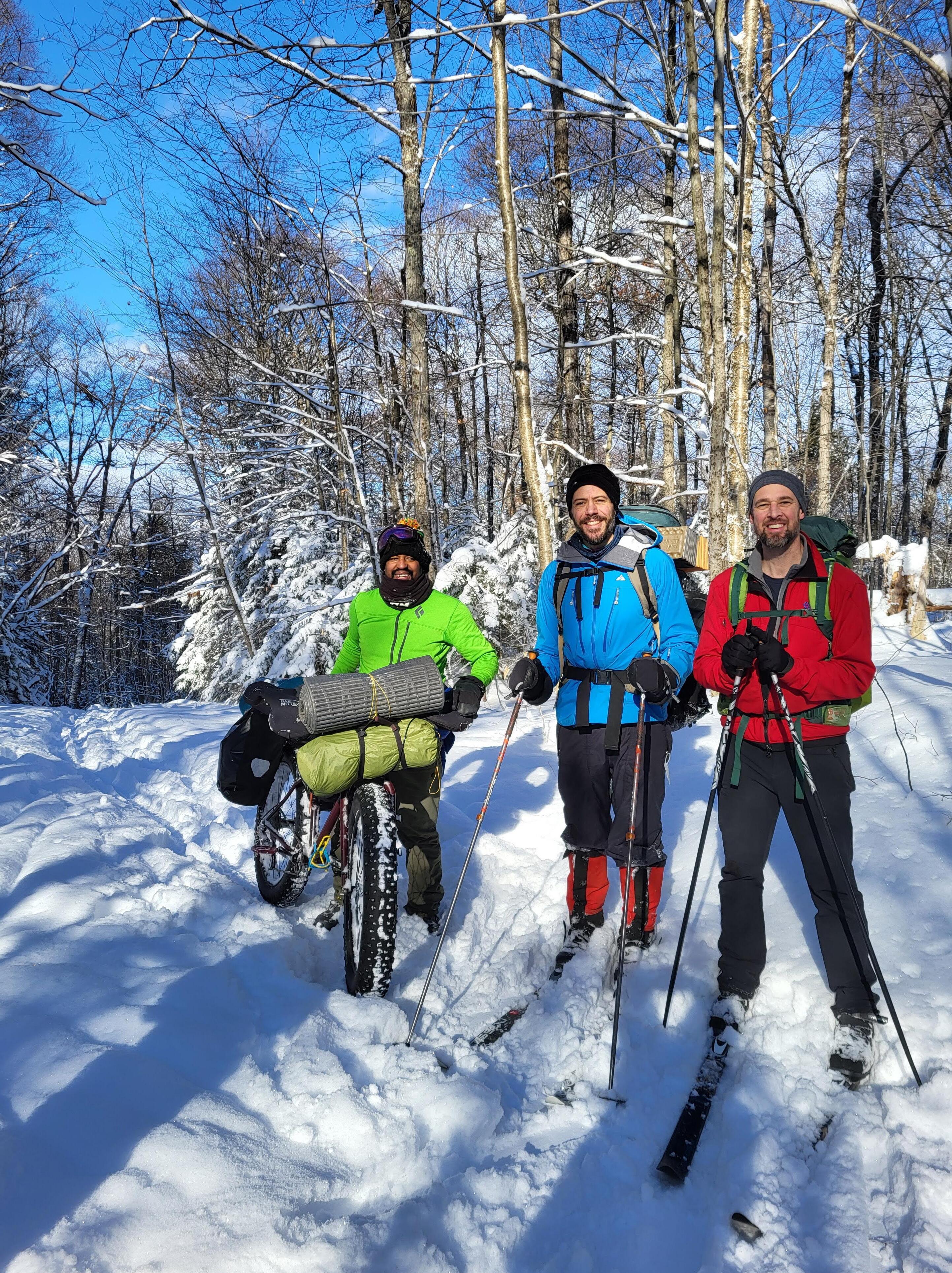
by Justin Oliver
“Even with all that weight, with those big fat tires, your bike is incredibly balanced, and once you're comfortable, you can bounce quite easily with just one hand on the bar.”
The sound of snow crunching beneath your tires; sweating intensely, while any exposed parts of your body are frigidly cold; rolling—or better yet, bouncing— down the trail on tires wider than any ski track you may come across: This is winter bikepacking.
Winter bikepacking has been a mainstay in my life for the better part of ten years. It started for me when a friend and I were going winter camping on a small island and were considering different ways to carry as much gear as we wanted effciently and quickly.
My friend decided on a homemade pulk sled, a Nordic sled with rigid poles that you pull behind you on skis. This allowed him to carry as much gear as he wanted, but at a rather slow pace. I decided I would try my hand at winter bikepacking. I had seen pictures in magazines, and it defnitely seemed doable given the hard-packed crust of snow over the ice. It seemed my fatbike would do just fne.
As I began to put racks and bags on my bike, I wondered how much weight I could put on and still be comfortable. After hours of putting gear on and taking it off again, I decided to just load the bike with pretty much every possible thing that I wanted and could ft. I ended up with about ffty pounds of gear. It looked ridiculous, but, somehow, it also looked doable.
I nervously hopped on my bike thinking I would never be able to pedal it. After a few awkward attempts to get going, I fnally took off. I was astonished at how comfortable I was and how smoothly my
bike rolled. That is when it hit me: Winter bikepacking was really a thing and it was something I wanted to explore further.
Since that day, I have put hundreds of miles on my fatbike in the dead of winter with every manner of gear. For me, when you winter camp, it’s half about comfort and half about fun. With bikepacking, the bike does most of the heavy lifting, so I can be comfortable and have fun! I’m just there to make sure the bike doesn’t fall over and my gear doesn’t end up in a pile of snow.
Last winter, a couple of buddies and I took a trip to Fish Pond. They skied and I was on my bike. I found the frst quarter mile or so a little rough going— but mostly because I had refused to put down the sandwich I was eating. That’s one of the other bonuses about bikepacking: Even with all that weight, with those big fat tires, your bike is incredibly balanced, and once you’re comfortable, you can bounce quite easily with just one hand on the bar.
Once I fnished my sandwich, I put full focus on my bike and the task at hand. I went slow enough to stay with my buddies, but given the ideal conditions, I could have gone much faster.
We traveled up hills, down hills, across a couple of small bridges, and past lots of folks on skis. I stopped only once en route, when we had to navigate around a downed tree on the trail.
Once we arrived, there was a short hike-a-bike for me, because the trail was
The Fish Pond Truck Trail is a former state truck trail now barred to vehicular traffc in conformity with the State Land Master Plan. The trail goes through the heart of the St. Regis Canoe Area to Fish Pond, a wild, remote lake fashioned by the last retreating glacier. The trailhead is on Fish Hatchery Rd., a short loop road that leaves NY 30 a little over 11 miles north of its intersection with NY 3 at Wawbeek Corners.
Spur trails off this trail lead to St. Regis, Bone, Grass, Ochre, and Mud Ponds.
on a bit of a ridge. We found a really nice spot to set up camp, lit a nice little fre, and enjoyed the rest of the evening, comfortable in the deep quiet of winter.
Having moved to the Adirondacks in 2003, Justin Oliver is the owner of Silver Birch Cycles in Saranac Lake, New York. When he is not in the shop, you might fnd him exploring by bike or boat, juggling, splitboarding (in the winter), or listening to old-school hip-hop.
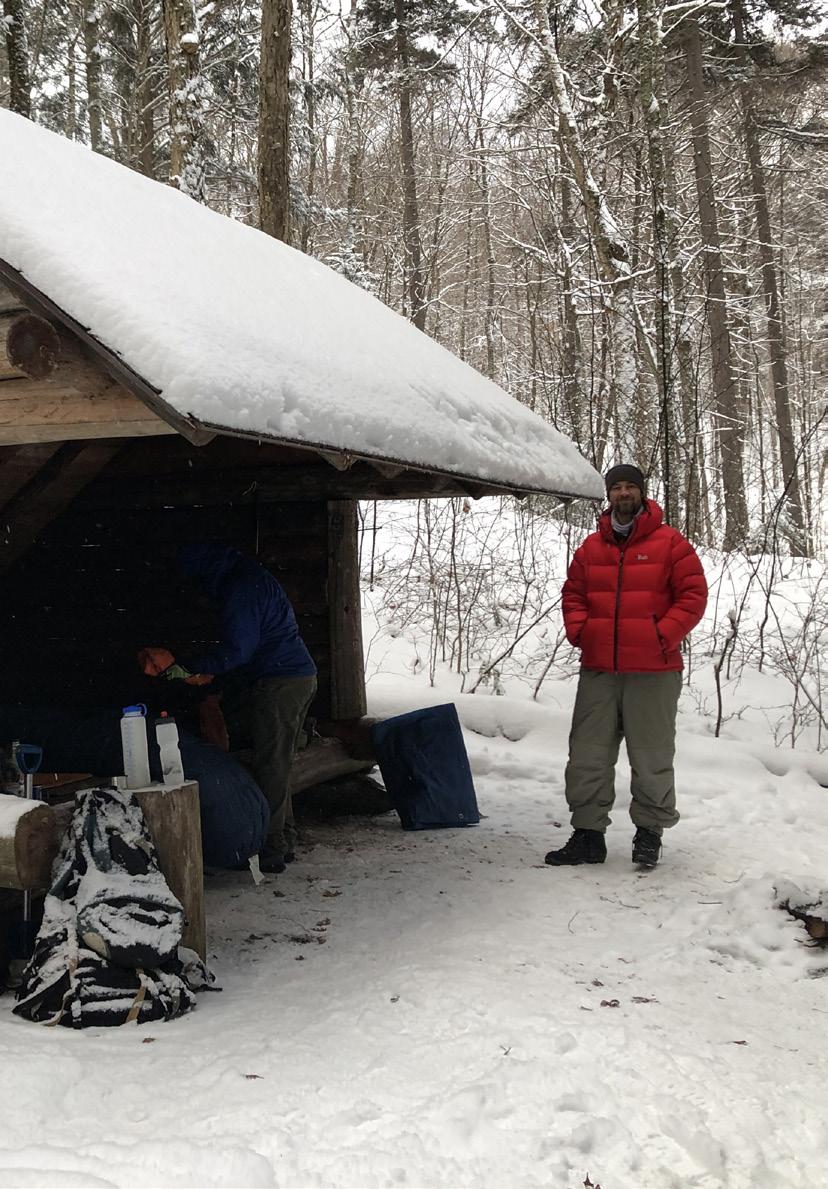




At Van Bortel Subaru, we believe in building lifelong relationships with our customers and being a positive force in our community. Since 1991, we have been committed to providing extraordinary customer experiences by maintaining the highest standards and ensuring kindness, honesty, and integrity in all that we do.

Subaru of America, Inc. recognized the way we do business by honoring us with the 2024 Aftersales Excellence Award as the best Subaru retailer in the nation for vehicle service quality and customer retention. Out of over 600 Subaru retailers across America, Van Bortel Subaru leads the way in various aspects of vehicle service including maintenance and repair quality, high customer satisfaction ratings, and strong customer loyalty.
We are extremely proud and humbled to have earned this accolade, and we will remain committed to providing the highest level of genuine Subaru service and extraordinary customer care. To each and every customer, thank you for trusting us to serve you. We are grateful you’re a part of the Van Bortel Subaru family.
After months of careful deliberation, the Adirondack Mountain Club (ADK) has made the diffcult decision to place Cascade Welcome Center up for sale. When ADK purchased the property, the vision was to create a welcoming hub for the Adirondack community. While the initiative successfully met community demand and broadened outdoor access, a careful assessment revealed that it stretched ADK’s capacity beyond what was sustainable.
Moving forward, ADK will concentrate its resources on strengthening operations at the Heart Lake and Loj facilities and at Johns Brook Lodge, and enhancing its core stewardship, education, and advocacy programs while increasing engagement with
chapters and members across the state. This renewed focus will ensure that ADK continues to thrive as a leader in protecting New York’s wild lands and waters for future generations.
We remain deeply committed to our members, visitors, and the Adirondack community. ADK’s legacy property at Heart Lake continues to serve as a vibrant hub for our mission and programming, refecting the strength and resilience of our century-old organization.
We appreciate your understanding and continued support as we focus on building a stronger, more impactful future for the Adirondacks.
—Cortney Koenig Worrall, ADK Executive Director
On September 15, 2025, nearly every cairn on the summit of Wright Peak was destroyed. Cairns are large rock structures that help hikers navigate above treeline in inclement weather, designated by the land manager as a navigational tool.
The cairns, some of which had been standing for nearly two decades, were rebuilt by ADK summit stewards and trail crew members over the course of several weeks (see photo below). Due to the scale of the vandalism, ADK’s capacity to complete other planned projects was signifcantly curtailed.
As a reminder, please hike on bare rock surfaces above treeline. Shoulder season is when the most damage to alpine vegetation occurs, and these plants are already stressed due to drought-like conditions.
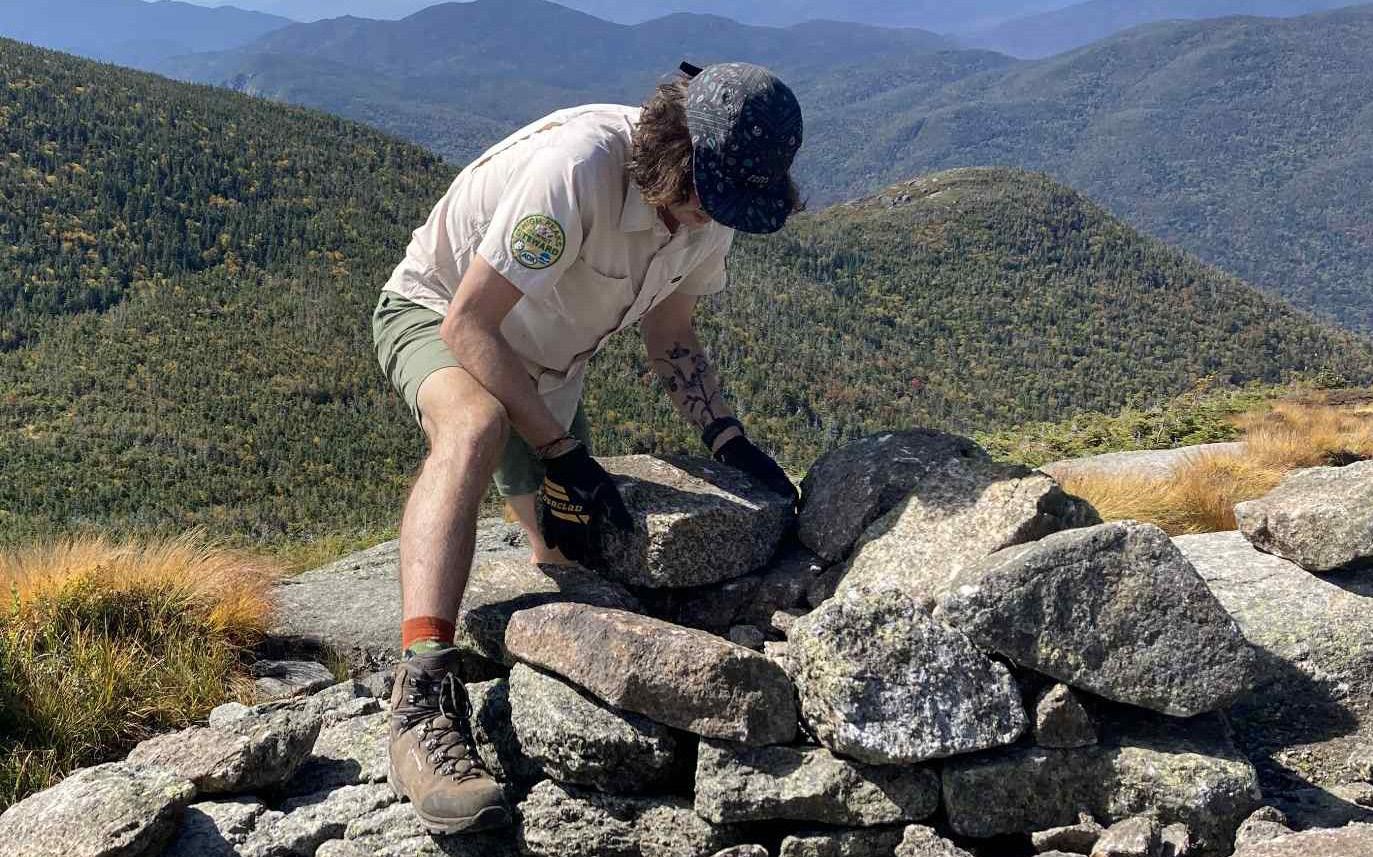
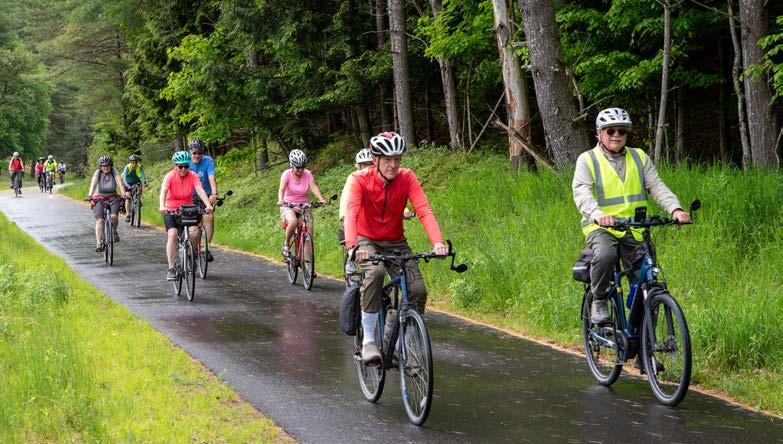
Donald Morris, co-author with the late Paul Jamieson of ADK’s fagship paddling guide, Adirondack Canoe Waters: North Flow (most recent edition, 2002), died peacefully in December 2024, at age 74. An ADK member for more than twenty years, Morris taught psychology at St. Lawrence University in Canton, where he met Jamieson and became an ardent and accomplished paddler at sites such as the St. Regis Canoe Area.
He later spent most of his career at the Sunmount Developmental Center
by bringing them to the outdoors and the outdoors to their classrooms.
The Lake George Land Conservancy (LGLC) has completed a $3.8 million purchase on Pilot Knob, preserving 517 acres of forest, 1.6 miles of streams that fow into Kattskill Bay, and the mountain’s summit and ridgeline. The acquired land is located next to LGLC’s Schumann Preserve at Pilot Knob, a popular, family-friendly hike that offers great views of Lake George.
in Tupper Lake while living in Saranac Lake. He is survived by his wife, Karen, and children Kat and Chris, who, demonstrating that the apple falls not far from the tree, is director of communications and outreach for the Northern Forest Canoe Trail.
—Neal Burdick
For the fourth year, ADK has received a $15,000 grant from the Chapel Hill Foundation in support of ADK’s Marie L. Haberl School Outreach Program: Three Seasons at Heart Lake. Established in 2003, Three Seasons at Heart Lake transforms the lives of fourth-grade students from across the North Country
The Adirondack Park Agency (APA) has released several reports related to the feasibility of the project that would bring the agency’s headquarters to downtown Saranac Lake. The APA unveiled its plans to move to Saranac Lake in 2023. The New York State budget has allocated $29 million for the project, which is estimated to cost $40 million.
The documents include environmental site assessments, geotechnical exploration reports, and other site and building reports. The reports can be viewed on the APA’s website at apa. ny.gov/headquarters-project.html.The agency has said more documents will be made public as they are available.
The NewVida Preserve, formerly the Paleface Ski Center, in Jay has opened forty miles of trails to the general public. The trails will be open from Friday through Sunday. Previously restricted to members and guests, the trail network offers a variety of recreational opportunities, including hiking, mountain biking, cross-country skiing, snowshoeing, and alpine touring. Public visitors must register and sign a waiver before accessing the trails.
Did you get our newsletter last month? These newsletters supplement Adirondac magazine with news and timely updates on what’s happening at ADK, such as our recap of the Johns Brook Lodge centennial celebration on July 4. Be on the lookout for our next newsletter, which will reach your mailbox this winter.
As you may have noticed, there have been some changes to Adirondac First, we skipped the fall issue and concentrated all of our efforts on the winter issue. (Did you miss us?) Second, there are changes to the publication schedule beginning in 2026, as discussed in “Perspectives” (see page 14). And third, we have a new design, with an increased emphasis on readability. Let us know what you think!
—Compiled
by
David Lynch
The Annual Meeting of the Adirondack Mountain Club, Inc., will be held Thursday, December 4, 2025, at 4:30 p.m. ET via Zoom. This meeting is open to all ADK members. Contact luke@adk.org for the meeting link.
For Jim Schneider, ADK’s success comes down to collaboration between its members, staff, and board. He has played a key role in launching three projects that exemplify collaboration.
The frst is the Fire Tower Challenge (FTC), which celebrates its 25th anniversary next year. The inception of the challenge itself was a collaboration between ADK staff and membership. Schneider, with Jack Freeman, Barb Bave, and former ADK publications editor Andrea Masters, conceived of the challenge one evening in 2001, then launched it later that year to coincide with the release of Freeman’s book,
When the focus of ADK’s mission shifted to include all New York State wild lands and waters, the FTC committee saw an opportunity to improve the challenge.
“What is the crosswalk between Leave No Trace principles and a fre tower hiking experience?” Schneider asked. As the Glens Falls-Saratoga Chapter explored that question, ADK education and stewardship staff provided content feedback on draft iterations of the updated challenge.
The question was answered with the FTC 2.0. Launched in 2024, the revitalized challenge includes a Leave No Trace
requirement and a participant pledge to protect the environment, recognize the importance of fre towers, and prioritize safety and responsible recreation.
Today, the FTC committee—comprised of three volunteers from the Glens FallsSaratoga Chapter, including Schneider, and two members of ADK staff—meet quarterly to assess progress.
“Our collective goal is for the Fire Tower Challenge to be a learning experience and a model for outdoor recreation challenges,” says Schneider.
Now in its fourth year, the Buck Mountain Trailhead Stewardship Program was also created to be a model program. “The program is an exportable model and easily adaptable. We’re already working with Saratoga PLAN on a program.” (Send an email to trails@adk-gfs.org if you’re interested in developing a similar program.)
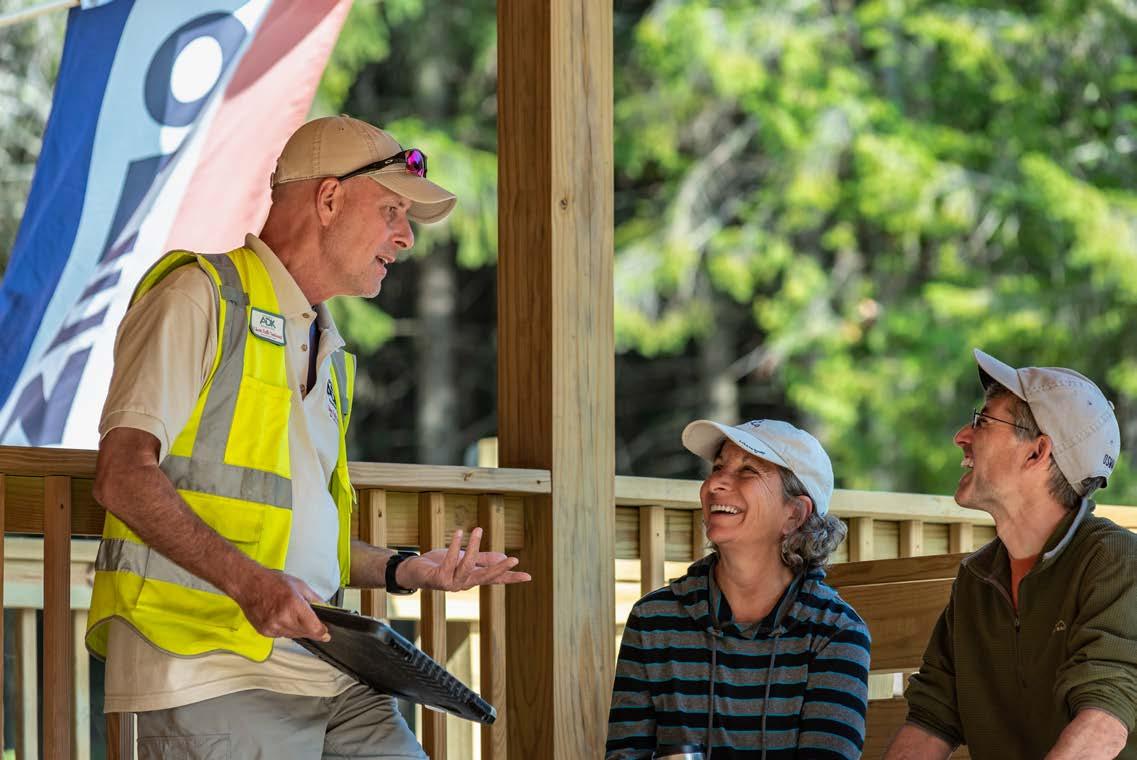

“We can get good work done by talking and listening.”
Buck Mountain trailhead stewards educate hikers about Leave No Trace and responsible recreation at the popular Lake George trailhead. Schneider was one of twenty-two volunteers this past summer.
“The chapter provides organizational framework and recruits stewards. Kayla [White, ADK Stewardship Director] provides expert steward preseason training, the paperwork, and professional oversight,” says Schneider.
The chapter also supports the program, as well as ADK’s other stewardship programs, fnancially, using proceeds from its annual Banff Mountain Film Festival World Tour event.
“ADK is stories. It’s all of our stories,” says Schneider.
Schneider frst heard of OurStoryBridge from his work as a librarian. After looking into the project, he was surprised to learn its founder lived nearby in the Adirondacks. Schneider reached out to



her and got support from ADK’s Advisory Council, with chapters fnancially contributing to the project. In September 2022, the ADK Voices project launched in partnership with OurStoryBridge.
“When ADK celebrated the club centennial, it became apparent we were losing stories. Stories are important to preserve the past, inspire the present, and guide ADK into the future,” says Schneider.
To date, the ADK Voices project has collected nearly one hundred stories. “Working with ADK staff has taken it to the next level,” says Schneider.
In 2024, ADK collected stories about the Northville-Placid Trail to celebrate the trail’s 100th anniversary. This year, the focus has been on collecting stories of Johns Brook Lodge, which opened to the public 100 years ago. To listen to the stories collected by ADK, visit adkvoices. org.
“We have to understand our traditions and history and norms so we stay true to what we’ve been doing for 100 years,” says Schneider.
As for how collaboration can set up ADK for success in the future, Schneider says, “If ADK is going to be successful and
grow, we need to work together...We can argue, we can laugh, we can negotiate, we may not always be in agreement, we can get good work done by talking and listening.”
David Lynch is ADK’s digital marketing coordinator.

ADK offers a variety of programs that promote responsible recreation and stewardship. Join us for a skills workshop, guided day hike, backpacking trip, and more.
Visit ADK.org/event-directory or scan the QR code to browse our current and upcoming programs.
ADK members receive a 10% discount on all educational programs, guided trips, and lodging.
Looking for something in your local community? ADK members who join a chapter can participate in chapter outings. Learn more at ADK.org/chapterevents.
"Our guided hikes, paddles, and backpacking trips are a great resource for beginner recreators who want the peace of mind that comes with exploring the Adirondacks with a New York State licensed guide. For more experienced outdoor enthusiasts, our workshops provide the skills necessary to recreate safely and responsibly."
—Daria Stacy, ADK Education Director
Register online with your name, email address, home address, and phone number. You will receive a confrmation email with additional details for the program you registered for. Health insurance is required to participate in ADK programs and trips. If a program is full, add yourself to the waitlist using the same page. ADK will contact you if there is a cancellation.
ADK has a three-week cancellation policy. Any cancellations made within three weeks of the course start date are nonrefundable. Cancellations made more than three weeks in advance will receive a full refund. If you need to cancel, please contact ADK staff by emailing communication@adk.org.
First, we do not know when the picture was taken, and acknowledge that spellings can change over time. Considering ADK’s High Peaks guidebook, 15th ed., authoritative, the errors are:
On the topmost sign, “Adirondack” Loj should be “Adirondak,” and South “Meadows” should be “Meadow,” there is only one such meadow.
On the third sign down, it’s not clear whether “Wolfjaw” is one word or two words, which is appropriate because while ADK says it’s two, the U.S. Board of Geographic Names (USBGN) has recently decided it’s one. And the lean-to is “Wolf Jaws,” plural, to ADK, not “Wolf Jaw.” In the decades to come, ADK and the USBGN will make every effort to get on the same page, literally. Next one down, perhaps to counterbalance the “Wolf Jaw” dispute, “Ore Bed” should be one word.
—Neal Burdick













ADK’s 2026 wall calendar features a collection of outstanding images by nine photographers celebrating the scenic beauty of the wild lands and waters throughout New York State. Each page includes a description of the advocacy work done by ADK in the area depicted in the image, plus a bonus close-up shot of each season’s unique beauty.
Available online at ADK.org/shop where member discounts apply (plus tax and shipping), or in local bookstores.
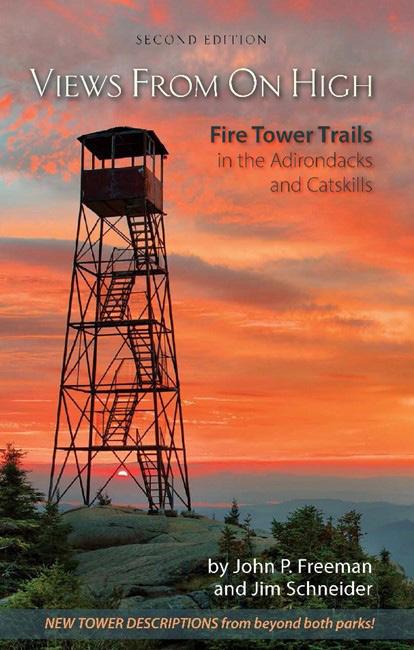
Views from on High is the essential tool for planning and preparing for your fre tower hikes, regardless of the season. In this revised 2nd edition, you’ll fnd driving directions, trail descriptions, maps, and fre tower history.
Available at ADK.org (member discounts apply!) or wherever books are sold.
Learn more: ADK.org/fre-tower-challenge