BUSINESS QUOTIENT
SMALL BUSINESS WEEK 2026
BUSINESS QUOTIENT STRATEGY, ENTERPRISE DEVELOPMENT AND OPTIMISATION
SMALL BUSINESS WEEK 2026 OCTOBER 2026 EDITION | ENTERPRISE & ECONOMY SERIES 01
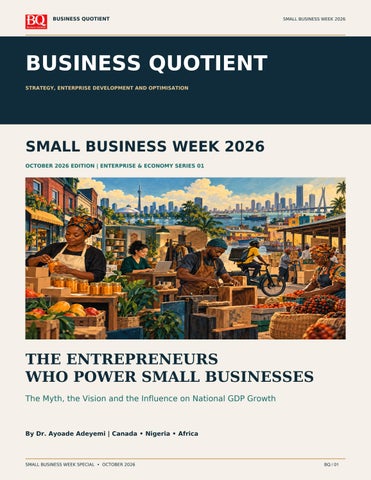
THE ENTREPRENEURS WHO POWER SMALL BUSINESSES The Myth, the Vision and the Influence on National GDP Growth
By Dr. Ayoade Adeyemi | Canada • Nigeria • Africa
SMALL BUSINESS WEEK SPECIAL • OCTOBER 2026
BQ BQ/ 01 / 01
BUSINESS QUOTIENT
CONTENTS
OCTOBER 2026 | ENTERPRISE & ECONOMY SERIES 01
Inside this edition Small Business Week 2026 | Special edition
03
EDITORIAL
05
THE MYTH
07
THE ENTERPRISE SPECTRUM
09
THE GDP CONNECTION
11
CASES ACROSS TWO MARKETS
13
GROWTH & SUSTAINABILITY
15
BUYER READINESS
17
ACTION PLAN & SOURCES
19
THE FINAL WORD
A nation grows through its everyday enterprises
Five myths that make small business harder
Nano, micro, small and medium businesses
Value added, productivity and economic growth
Canadian and Nigerian lessons for enterprise
A practical agenda for stronger businesses
Before the next big order
The next 90 days and research references
Support that continues after the celebration
ADVERTISER DIRECTORY 04 Wisdominds • 06 Loraché • 08 Brighter Tomorrow 10 Unique Elo • 12 AA Mentor Foundation • 14 Beyond AI 16 Business Quotient • 18 The Gentlemen Initiative • 20 N&CBN; GTA Hub
SMALL BUSINESS WEEK SPECIAL • OCTOBER 2026
BQ BQ/ 02 / 19
BUSINESS QUOTIENT
EDITORIAL
EDITORIAL | FROM THE PUBLISHER
A nation grows through its everyday enterprises An original feature by Dr. Ayoade Adeyemi | Publisher, Business Quotient A country’s economic story is often told through its biggest corporations. Yet much of its daily life depends on enterprises small enough for the owner to know customers by name: the baker, the mechanic, the bookkeeper, the food processor and the neighbourhood retailer. Their work deserves more than a ceremonial thank-you. Small Business Week should sharpen our understanding of these enterprises. An entrepreneur does more than open a business. The entrepreneur identifies a problem, organises resources, accepts uncertainty and persuades someone to pay for a solution. When that solution becomes dependable, a private ambition becomes part of public prosperity. Canada’s BDC lists its 2026 Small Business Week activities for October 19-25. [1] This special feature uses that occasion to examine a larger question: how do we help enterprise move from daily survival towards durable value creation? The answer cannot be a universal instruction to borrow more, hire faster or go digital. A home-based food seller, a professional consultancy and a manufacturer face different constraints. Support works when it fits the enterprise, the owner’s goals and the market being served.
From admiration to action In Canada, the conversation must include productivity, succession, access to buyers and the contribution of newcomer founders. In Nigeria and other African economies, it must also confront the cost of unreliable infrastructure, fragmented distribution and the distance between informal activity and useful institutional support. These are connected concerns. A Canadian retailer sourcing a Nigerian product needs consistent quality and delivery. A Nigerian supplier needs a dependable buyer, realistic payment terms and clear specifications. Diaspora networks can help translate trust into transactions, provided relationships are supported by commercial discipline. This is an argument for better businesses and better conditions around them. Not every proprietor wants to build a large company. A stable enterprise that pays its owner fairly and employs a small team responsibly is a worthwhile achievement. Our editorial position is clear: celebrate enterprise, examine the evidence and support practical progress. We invite readers to use this edition as a working resource, share its questions with their teams and turn one useful idea into a measurable improvement.
DR. AYOADE ADEYEMI Publisher, Business Quotient
“The smallest enterprise can carry a national ambition, but ambition needs a workable system.”
SMALL BUSINESS WEEK SPECIAL • OCTOBER 2026
BQ BQ/ 03 / 02
BUSINESS QUOTIENT
ADVERTISEMENT
ADVERTISEMENT • SUPPLIED COMMUNITY PROMOTIONAL MATERIAL
SMALL BUSINESS WEEK SPECIAL • OCTOBER 2026
BQ BQ/ 04 / 04
BUSINESS QUOTIENT
THE MYTH
BEYOND THE HEROIC FOUNDER
Five myths that make small business harder Entrepreneurship is a practice of judgement, not a personality contest. MYTH 1 / Passion is a business model.
MYTH 4 / Every business must become big.
Passion can keep an owner moving through difficult weeks. It cannot establish whether customers will pay a price that covers the real cost of delivery. A founder should test demand with a small offer, record why buyers say yes or no, and calculate the contribution left after each sale. Enthusiasm becomes commercially useful when it learns from evidence.
Size is one possible outcome. Reliability, household security and a healthy return on effort are also valid goals. Growth should solve a business problem or capture a credible opportunity. Opening a second location simply to appear successful can duplicate weak economics and exhaust the owner. MYTH 5 / A grant will solve the problem.
MYTH 2 / More sales always mean success. Sales can rise while cash disappears. A wholesaler may pay suppliers immediately and wait weeks for customers to settle invoices. A service firm may win a large contract while underestimating the staff time required. Before celebrating growth, ask how it will be financed and whether the work remains profitable after wages, transport, rework and overhead.
Funding helps when the problem is a shortage of suitable capital. It does less when the offer is poorly priced, customers are dissatisfied or records are unreliable. Ask what will improve because money arrives: fewer stockouts, faster fulfilment, lower waste or access to a proven market. If the answer is unclear, diagnose before applying. The practical replacement: a weekly review
MYTH 3 / The entrepreneur must do everything. An owner who alone approves every purchase, solves every complaint and remembers every process becomes the limit of the business. Begin with one repeatable task. Write the steps, define an acceptable result and train another person to deliver it. Delegation without standards creates confusion; standards without delegation preserve dependence.
Set aside a fixed hour each week. Review cash available, invoices overdue, orders due, gross margin and customer complaints. Select one bottleneck and assign one corrective action. A business does not become stronger because its owner is constantly busy. It becomes stronger when decisions improve. The founder’s most important transition is often from personal effort to organisational learning. That transition is available to a barber, a caterer and a technology consultant alike. It begins with the willingness to measure what is happening rather than defend what was intended.
“A business grows stronger when it learns faster than its costs rise.” DR. AYOADE ADEYEMI | ORIGINAL EDITORIAL REFLECTION
SMALL BUSINESS WEEK SPECIAL • OCTOBER 2026
BQ BQ/ 05 / 03
BUSINESS QUOTIENT
ADVERTISEMENT
ADVERTISEMENT
People. Process. Performance. Build your people. Strengthen your business. Recruitment • Training • Outsourcing Background checks • Strategy & process HR and advisory services
LORACHÉ CONSULTING www.loracheconsulting.com
SMALL BUSINESS WEEK SPECIAL • OCTOBER 2026
BQ BQ/ 06 / 16
BUSINESS QUOTIENT
THE ENTERPRISE SPECTRUM
KNOW THE BUSINESS BEFORE PRESCRIBING THE SUPPORT
Nano is a starting point. It is not a small ambition. Size, legal form, sector and growth intention describe different things. A sole proprietor can run a sophisticated consultancy; an incorporated firm can still have one worker. A franchise, cooperative, family firm or social enterprise is an organisational model, not a universal size category. Use the relevant local definition when assessing eligibility or comparing statistics. CATEGORY
CANADA: ISED REPORT
NIGERIA: SMEDAN GUIDANCE
Nano
No separate category in this report
1-2 people; turnover below NGN3m
Micro
1-4 paid staff: subset of small
3-9 people; NGN3m-25m turnover
Small
1-99 paid employees
10-49 staff; NGN25m-99m turnover
Medium
100-499 paid employees
50-199 staff; >NGN100m, <NGN1bn
Definition notes: Canada uses paid employees and generally excludes non-employers from the report’s business counts. Nigeria’s figures reproduce SMEDAN’s January 2025 public guidance, not a tax test. Its published turnover bands leave boundary ambiguities; check programme rules directly. NGN = Nigerian naira. [2, 3]
Support should change with the stage At nano level, separating household and business cash may be more useful than a complex strategy document. A simple record of sales, purchases and stock can show whether the activity pays its way. Accessible payments and safe storage may remove immediate barriers. At micro level, the challenge may be repeatability: clear prices, dependable suppliers, a trained assistant and basic quality checks. Introduce systems the owner can actually maintain. A complicated tool abandoned after two weeks is not progress.
SMALL BUSINESS WEEK SPECIAL • OCTOBER 2026
At small-enterprise level, purchasing, payroll, supervision and customer acquisition need coordinated routines. Financing should match the cash cycle. At medium scale, stronger governance, management depth and market diversification become more important. Do not confuse formality with capability Registration can open doors, but it does not automatically create records, profit or reliable service. Formalisation should connect the owner to visible benefits: safer contracting, useful training, suitable finance and customers. The goal is an enterprise that can operate well, honour obligations and withstand disruption.
BQ BQ/ 07 / 05
BUSINESS QUOTIENT
ADVERTISEMENT
ADVERTISEMENT
SMALL BUSINESS WEEK SPECIAL • OCTOBER 2026
BQ BQ/ 08 / 11
BUSINESS QUOTIENT
THE GDP CONNECTION
THE INFLUENCE
Small businesses create value. GDP counts it. GDP measures production through value added, rather than adding every business’s sales together. In a simplified bakery example, CAD1,000 in output less CAD400 of purchased intermediate inputs leaves CAD600 of value added. Wages and profit are components of that value; they should not be added to it again.
Nigeria’s PwC MSME Survey 2024 cites a 46.3% national GDP contribution for MSMEs. Treat this as a historical benchmark cited in that report, not a new 2026 estimate. It covers MSMEs, whereas the Canadian small-firm figure excludes medium firms and uses a different denominator. A direct ranking would mislead. [4]
ISED’s 2025 report puts small firms’ average GDP contribution at 34.2% for 2018-2022. The report’s GDP series concerns the private sector. In 2024, small firms employed 46.6% of private-sector employees; 98.2% of employer businesses were small. These are different measures and reference periods. [2]
My policy conclusion is straightforward: enterprise support should improve value created per unit of effort. Less spoilage, better tools, stronger skills and reliable energy can help a firm deliver more with its available resources. More registrations alone do not demonstrate that improvement.
The practical link to national growth An enterprise adds value when it turns purchased inputs into something more useful. Better scheduling, fewer rejected items and improved equipment can raise output without a matching increase in resources. These are business-level pathways to productivity; one firm’s improvement should not be presented as a measured national GDP effect.
VALUE ADDED: A SIMPLIFIED BAKERY EXAMPLE
CAD1,000
CAD400
CAD600
OUTPUT
PURCHASED INPUTS
VALUE ADDED
Output minus intermediate inputs = value added. Illustrative amounts; not a real company’s accounts.
BEHIND THE NUMBERS Production, skills and customer demand meet in the everyday enterprise. The illustration evokes food production, retail and services across Canadian and Nigerian communities.
SMALL BUSINESS WEEK SPECIAL • OCTOBER 2026
BQ BQ/ 09 / 06
BUSINESS QUOTIENT
ADVERTISEMENT
ADVERTISEMENT • SUPPLIED COMMUNITY PROMOTIONAL MATERIAL
SMALL BUSINESS WEEK SPECIAL • OCTOBER 2026
BQ BQ/ 10 / 08
BUSINESS QUOTIENT
CASES AND PRACTICAL LESSONS
ACROSS TWO MARKETS
Different settings. A shared discipline. Documented cases below are followed by the author’s analysis; no interviews are implied. CANADA / Peace by Chocolate The Hadhad family’s company describes rebuilding its chocolate business in Antigonish with support from the community and people of Nova Scotia, founding Peace by Chocolate in 2016 after displacement from Syria. The family brought earlier chocolate-making experience to its Canadian enterprise. [5] The lesson I draw is that newcomer entrepreneurship combines existing capabilities with a new commercial setting. Community welcome can create an opening; product quality and dependable execution must sustain the relationship. Business support should help translate experience into local market knowledge without assuming a newcomer is starting with no useful skills.
The commercial opportunity is to connect a discarded material with a customer who values the finished product. The management questions are demanding: can inputs be collected consistently, processed safely and converted into goods that meet customer expectations? A circular idea still needs quality control and an economic model. AFRICA / Business capability as shared infrastructure The same foundation’s directory describes Nigeria’s Sourcegig, founded by Aaron Ejeme, as a marketplace connecting SMEs to African graphic-design talent. [6] The wider lesson is that one enterprise can supply a capability that many other small firms cannot economically maintain in-house.
For a Canadian founder, a practical experiment is a tightly controlled local launch: one product range, a manageable production schedule and clear customer feedback. Test packaging, pricing and repeat demand before committing to costs that require optimistic sales to survive.
A food processor may need packaging design only periodically. A retailer may need bookkeeping support each month rather than a full finance department. Shared specialist services can let firms improve capability without carrying every fixed cost themselves.
NIGERIA / D’Rose Recycling
A Canada-Nigeria application
The Tony Elumelu Foundation’s alumni directory profiles Adebimpe Oni’s D’Rose Recycling as a Nigerian enterprise turning waste materials, including tyres, bottles and plastics, into furniture. This is a documented business description, not evidence here of a quantified environmental or financial outcome. [6]
Consider a proposed food-product distribution partnership. Before placing a major order, agree on specifications, compliant labelling, sample approval, delivery responsibilities and payment terms. Start with a trial whose loss each partner could survive. This is an illustrative decision process, not a reported transaction. These cases connect skill, trust and operating discipline. Support must strengthen all three.
“Vision earns attention. Consistent delivery earns the next order.” DR. AYOADE ADEYEMI | ORIGINAL EDITORIAL REFLECTION
SMALL BUSINESS WEEK SPECIAL • OCTOBER 2026
BQ BQ/ 11 / 07
BUSINESS QUOTIENT
ADVERTISEMENT
Invest in people. Expand what is possible. Mentoring • Coaching • Publication Career & Entrepreneurship Support
AA MENTOR FOUNDATION Dr. Ayoade Adeyemi | President Mentoring • Coaching • Publication Career & Entrepreneurship Support www.ayoadeyemi.ca Adeyemiayoade.ca@gmail.com +1 289 623 0354
SMALL BUSINESS WEEK SPECIAL • OCTOBER 2026
BQ BQ/ 12 / 17
BUSINESS QUOTIENT
GROWTH AND SUSTAINABILITY
A PRACTICAL SUPPORT AGENDA
Give enterprise room to become resilient. Buy well and pay predictably. Large organisations can divide suitable contracts into accessible lots, explain procurement requirements and use proportionate qualification rules. Buyers should measure payment speed as well as purchasing savings. A contract is less useful if its payment cycle overwhelms the supplier.
Build capability alongside capital. Combine mentoring with records, customer validation and operational problem-solving. A lender or support body can track whether firms improve margins, repeat orders and cash resilience, rather than count training attendance alone.
Finance a defined improvement. Match working capital to the collection cycle and equipment finance to a realistic productive life. Owners should test repayment capacity against weaker sales, rather than treat access to debt as proof of affordability.
Make sustainability operational. Measure discarded stock, energy interruptions, rework and staff turnover. Choose one improvement with a clear cost and benefit. For an owner, resilience also means backup suppliers, protected business records and someone trained to run essential tasks during an absence.
Make the improvement affordable. A small food producer might first track spoilage by product and day, then adjust purchasing quantities. Buying a larger refrigerator before understanding the waste pattern may increase costs without fixing the cause.
Use a simple resilience scorecard. Review cash coverage, overdue invoices, supplier concentration, rejected work and repeat customers each month. Set a realistic target for one measure and record the decision made from it.
Protect the owner as well as the operation. Document essential tasks, establish reasonable response times and train a second person. Exhaustion is an operating vulnerability when every decision depends on one individual.
Build local partnerships. Owners can explore shared delivery, pooled purchasing or specialist support. Agree on responsibilities and payment before starting. Collaboration should reduce a clear cost or improve a defined service, rather than add meetings without results.
A MORE RESILIENT ENTERPRISE Reliable cash • Skilled people Backup suppliers • Less waste Clear records • Repeat customers Illustration: enterprise resilience is built through connected everyday decisions.
SMALL BUSINESS WEEK SPECIAL • OCTOBER 2026
BQ BQ/ 13 / 09
BUSINESS QUOTIENT
ADVERTISEMENT
ADVERTISEMENT
SMALL BUSINESS WEEK SPECIAL • OCTOBER 2026
BQ BQ/ 14 / 12
BUSINESS QUOTIENT
PRACTICAL BUSINESS RESOURCE
MAKE OPPORTUNITY DELIVERABLE
Before the next big order A buyer-readiness checklist for small enterprises in any market. 1 / Define exactly what you sell
5 / Verify the partner
Prepare a one-page description of the product or service, its scope, price assumptions and delivery limits. Explain what is included, what costs extra and what the buyer must provide. Ambiguity that feels helpful during a sales conversation can become expensive during delivery.
Confirm the customer’s identity, purchasing authority and payment process. For a cross-border relationship, agree on currency, shipment responsibilities and the handling of rejected goods. Obtain qualified advice where the contract or regulatory requirements require it.
2 / Show that quality can repeat
6 / Protect your capacity
Keep a sample, specification or service checklist. Agree on how acceptance will be assessed and who can approve changes. A buyer needs confidence that the second order will meet the same standard as the first.
State realistic lead times. Identify which tasks depend on a single person or supplier and establish a backup. Accepting work beyond capacity can damage existing customers as well as the new relationship. 7 / Learn from the pilot
3 / Understand the cash requirement Map when you must pay suppliers, staff and transport against when the customer will pay. Negotiate deposits or milestones where appropriate. A profitable order on paper can still create a cash shortage before payment arrives.
Begin with a manageable trial. Track actual time, costs, complaints, payment speed and repeat interest. Decide whether to continue, change the terms or decline further work. Treat the pilot as evidence, rather than a promise of automatic expansion. A practical exercise
4 / Prepare essential records Maintain current business details, relevant registrations, invoices and proof of delivery. Check the buyer’s actual requirements before purchasing certifications or services. Build a reusable supplier file so each opportunity does not trigger a frantic search for documents.
Choose one target buyer this week. Assemble your offer, delivery checklist, cash timetable and supplier file. Ask a trusted adviser to review whether the documents tell a consistent story. Fix one weakness before making the approach. This checklist is an original business planning aid. Adapt it to the sector, customer and jurisdiction; it is not a substitute for transaction-specific professional advice.
“Readiness turns a promising introduction into a credible business proposition.” DR. AYOADE ADEYEMI | ORIGINAL EDITORIAL REFLECTION
SMALL BUSINESS WEEK SPECIAL • OCTOBER 2026
BQ BQ/ 15 / 18
BUSINESS QUOTIENT
ADVERTISEMENT
ADVERTISEMENT
Turn your business vision into practical progress. Strategy, Enterprise Development and Optimisation PARTNER WITH BUSINESS QUOTIENT Patronise our services. Bring your business priorities to a practical consulting conversation. Advertise with BQ. Showcase your brand, products and services in Business Quotient magazine. Contact us to discuss placements and artwork requirements. Book a consulting enquiry. Discuss strategy, enterprise development and business optimisation.
CALL +1 289 623 0354 bizq.ca@gmail.com | me@ayoadeyemi.ca
SMALL BUSINESS WEEK SPECIAL • OCTOBER 2026
BQ BQ/ 16 / 14
BUSINESS QUOTIENT
ACTION PLAN AND SOURCES
FROM COMMEMORATION TO COMMITMENT
The next 90 days Celebrate the entrepreneur. Then strengthen the enterprise. DAYS 1-30 / Establish the truth Separate business and personal transactions. List outstanding bills and receivables. Calculate the margin on the main offer, including the owner’s labour where appropriate. Speak with five customers about what they value and what disappoints them. DAYS 31-60 / Repair one constraint Choose one measurable problem: waste, late delivery, slow collection or weak conversion. Give it an owner, a modest budget and a weekly measure. Use technology only where it reduces a clearly identified task or error; review its outputs and protect customer information. DAYS 61-90 / Test the next step Trial a new buyer, a better process or a small distribution partnership. Compare the result with the baseline. Scale the improvement only if cash, quality and capacity support it. Record the lesson even when the experiment fails. For institutions and business networks Ask supported owners what changed in their operations. Help them meet credible buyers, understand standards and find suitable expertise. A useful introduction is one that resolves a specific commercial need. Small businesses do not ask the economy to admire their struggle indefinitely. They need a fair opportunity to turn effort into dependable value. That is the vision worth celebrating, and the work that should continue after Small Business Week.
SMALL BUSINESS WEEK SPECIAL • OCTOBER 2026
SOURCE NOTES [1] BDC, Small Business Week 2026 https://www.bdc.ca/en/about/small-business-week [2] ISED, Key Small Business Statistics 2025: definitions, counts, employment and GDP (private-sector series). https://ised-isde.canada.ca/site/sme-research-statistics/en/key-smallbusiness-statistics/key-small-business-statistics-2025 [3] SMEDAN, What Type of Business Do You Run? 27 January 2025. https://smedan.gov.ng/types-of-businesses/ [4] PwC Nigeria, MSME Survey 2024. Historical GDP benchmark cited in report. https://www.pwc.com/ng/en/assets/pdf/msme-survey-report-july-202 4.pdf [5] Peace by Chocolate, Our Story. Company account of its origins. https://peacebychocolate.ca/pages/our-story [6] Tony Elumelu Foundation, Alumni directory: D’Rose Recycling and Sourcegig. https://www.tonyelumelufoundation.org/alumni
Editorial transparency Research checked 24 October 2026. Historical statistics retain their reference years. Analysis and practical recommendations are the authorial argument developed for this feature. Pull quotes are original editorial lines, not quotations from interviews. Case descriptions rely on the organisations’ own accounts. Cover art is an AI-generated editorial illustration, not a documentary photograph. Advertisements use supplied business materials. New BQ and Loraché layouts use the supplied logos; advertiser statements remain promotional content. Publisher portrait uses the photograph supplied for this edition.
Dr. Ayoade Adeyemi Publisher, Business Quotient Strategy, Enterprise Development and Optimisation me@ayoadeyemi.ca | bizq.ca@gmail.com
BQ BQ/ 17 / 10
BUSINESS QUOTIENT
ADVERTISEMENT
ADVERTISEMENT
THE GENTLEMEN INITIATIVE
A transformative development program dedicated to building wholesome men. Connect with The Gentlemen Initiative www.TGI.ca the.gentlemen.tgi@gmail.com +1 289 623 0354
SMALL BUSINESS WEEK SPECIAL • OCTOBER 2026
BQ BQ/ 18 / 13
BUSINESS QUOTIENT
THE FINAL WORD
BEYOND SMALL BUSINESS WEEK
Support is a habit, too. By Dr. Ayoade Adeyemi A week of celebration can create visibility. A year of useful decisions creates a stronger enterprise environment. The real test begins when the event closes and an owner returns to stock, wages, customers and a demanding cash cycle. For customers, practical support starts with informed purchasing. Compare quality, ask clear questions and give a capable small supplier a fair chance. Where a service meets expectations, a repeat order or thoughtful referral can be more useful than a public compliment without a transaction.
For owners, accepting support also carries responsibility. Keep records, communicate early, honour commitments and acknowledge problems before they become disputes. A transparent explanation of a delay protects a relationship better than silence followed by excuses. Business networks can keep a simple record of introductions and follow through after the meeting. Did the buyer receive a suitable offer? Did the owner understand the requirement? What prevented the conversation from becoming a transaction? Learning from those questions improves the next introduction.
For established businesses, support can mean a realistic trial order, a clearer specification or a shorter approval process. Smaller suppliers should still meet appropriate standards. The opportunity is to remove unnecessary complexity while preserving the controls that protect both parties.
Across Canada, Nigeria and other markets, enterprise deserves a conversation that combines aspiration with operating reality. The founder’s courage matters. So do the systems, institutions and relationships that allow that courage to become reliable value.
For mentors, the question is not how much advice can be delivered in an hour. It is which decision the owner needs to make next. Help the entrepreneur compare options, understand consequences and choose a practical step that can be reviewed.
Let this edition be an invitation to act: improve one process, support one capable supplier, make one useful introduction and review the result. Sustained progress is built through decisions that can be repeated after the celebration has passed.
“The most useful celebration of enterprise is a practical commitment to its future.” DR. AYOADE ADEYEMI | ORIGINAL EDITORIAL REFLECTION
SMALL BUSINESS WEEK SPECIAL • OCTOBER 2026
BQ BQ/ 19 / 20
BUSINESS QUOTIENT
ADVERTISEMENT
ADVERTISEMENT
NIGERIAN & CANADIAN BUSINESS NETWORK GTA HUB | CONNECT • COLLABORATE • GROW
Build relationships across Canada and Nigeria. Connect with entrepreneurs, professionals and business leaders. Explore conversations around enterprise, trade, partnerships and community economic development.
OUR GTA COVERAGE Toronto • Durham • Peel • York • Halton Including Toronto, Pickering, Ajax, Oshawa, Whitby, Clarington, Brock, Scugog, Uxbridge, Mississauga, Brampton, Caledon, Vaughan, Markham, Richmond Hill, Aurora, Newmarket, Whitchurch-Stouffville, East Gwillimbury, Georgina, King, Burlington, Oakville, Milton and Halton Hills.
GTA HUB ENQUIRIES | Dr. Ayoade Adeyemi, President
me@ayoadeyemi.ca | +1 289 623 0354 Contact the GTA Hub to discuss participation and business connections.
SMALL BUSINESS WEEK SPECIAL • OCTOBER 2026
BQ BQ/ 20 / 15