Autumn 2026 | Dyslexia Awareness Week edition
Dyslexia voice
Dyslexia Awareness Week edition
Inspiring stories
Amazing changemakers
Your blue ribbon
T
Charity No. SC 000951 Registered No. SC 153321
Dyslexia Scotland 1st Floor, Cameron House Forthside Way Stirling FK8 1QZ
Office telephone: 01786 446650 Helpline: 0344 800 84 84
dyslexiascotland.org.uk X (formerly Twitter): @DyslexiaScotlan Facebook.com/DyslexiaScotland Instagram @dyslexiascotland LinkedIn.com/company/dyslexiascotland/
Dyslexia Voice Design and Editorial staff: Cathy Magee Katie Carmichael Lena Gillies Sue Bowen
Other ways to read this magazine Members of Dyslexia Scotland can log into our website to access magazine articles online at dyslexiascotland.org.uk/dyslexia-voice-magazine, and download a free PDF version in our online shop.
Send a comment Do you have a comment about this magazine? Scan this QR code to share your feedback, or go to: https://forms.office.com/e/3EU1KarnYA All rights reserved. Dyslexia Voice is published by Dyslexia Scotland. Articles within this magazine provide a view from the author only. Opinions may differ from professional to professional. Dyslexia Scotland may or may not share these views and opinions. Reproduction or transmission in part or whole of any item within this magazine is not permitted. While every effort has been made to ensure the accuracy of the information in this publication, the publisher accepts no responsibility for errors or omissions. Images have been reprinted with the permission of the publishers or copyright holder. We acknowledge the support and funding of the Scottish Government for this work. ©2026 Dyslexia Scotland
RIGHT TOOLS FOR THE JOB
DYSLEXIA
Dyslexia Awareness Week Scotland 2026 28 September to 4 October Dyslexia Scotland Charity No. SC000951 dyslexiascotland.org.uk/dyslexia-awareness-week
Contents Features The CEO’s Voice
6
Tartan update
8
Conference sponsors announcement
10
New Gaelic Medium Education branch
14
Interview with Mamta Singhal
16
RIght Tools for the Job - our campaign for Dyslexia Awareness Week
20
Adults Literacy: an essential tool for empowerment
34
Parents and families Putting the dram into am-dram
42
Educators Welcome to our new recuits
Dyslexia Awareness Week 2026 Read more on page 20
32
Resources Guides for work
36
How to ask for support at work
28
Scran app
37
The right book for the job
40
Young and dyslexic Young Changemakers
44
Young Ambassadors
50
Dyslexia Awareness Week
51
Lachlan’s story p42
Alan’s story p24
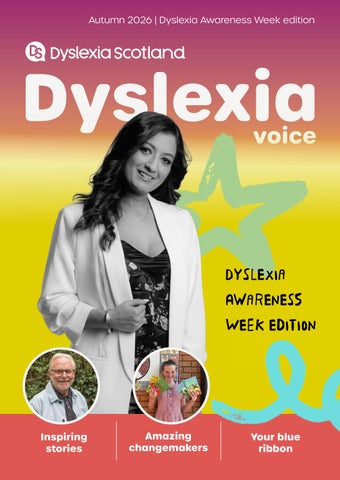
On the cover: Mamta Singhal: Vice President of the IET
Amazing changemakers p44
Features
The CEO’s voice
by Cathy Magee OBE, CEO of Dyslexia Scotland
‘The right tools for the job’ is the theme for Dyslexia Voice this autumn. This ties in with our theme for Dyslexia Awareness Week which takes place from 28 September to 4 October. I hope you’ve found the blue ribbon which was enclosed with your magazine – please do remember to wear it during the week. Read all about our campaign and plans for the week on page 20. People often ask us for examples of reasonable adjustments they can use for themselves, or others, in the workplace, at school or at home. We know that ‘one size doesn’t fit everyone’ but as you’ll see on page 23, respondents to our recent survey have offered inspiring, practical and useful suggestions which you may also wish to try. Elsewhere in this edition our contributors have also described what works for them and those they support. Furthermore, we have included articles about useful resources such as Barrington Stoke’s books and a new cooking app to help dyslexic cooks. The Young Changemakers we have featured in this magazine have excelled themselves by taking actions to help other dyslexic children and young people. Special congratulations go to Alba Crichton who donated £100 of her own money to buy dyslexia-friendly books for her school and to Erin McNeil who lobbied the Parent Council to do the same. Others, like Duloch primary school Young Ambassadors and Harry MacDowall, have been busy raising awareness about dyslexia in their schools. Turn to the Young Changemakers section on page 44 to read more.
Dyslexia Voice | Autumn 2026
6
Our news Behind the scenes here at Dyslexia Scotland, we have some exciting updates: •
Welcome to new Director, Sharon Stewart, who joined the Board in August. Look out for an introduction to Sharon in future editions.
•
Congratulations to our Ambassador Mamta Singhal, who has recently been appointed Vice President of the Institute of Engineering and Technology (better known as the IET) – read all about her achievements in our interview on page 16.
•
A warm welcome to our newest Young Ambassador Ruth King – see page 50.
•
We have launched a new branch focusing on Gaelic Medium Education – read more on page 14.
•
We’re delighted to announce two new members of staff who joined our team in August as Education Programme Co-ordinators. Victoria Armet and Carol Graham are job sharing this important new role, which will oversee the Dyslexia and Inclusive Practice programme for educators. A hundred practitioners will start the sixth cohort of the programme in September. This expansion has been made possible thanks to support from the Scottish Government.
I would like to thank the sponsors of this year’s Education Conference – Grammarsaurus, Cormack Consultancy Group and Blair Drummond Smiddy: Farm Shop, Butchery and Café for their generous contributions to this year’s event – see page 10. Many thanks to all our contributors for your thoughtful, informative and entertaining submissions to this edition I hope you enjoy the magazine – if so, please do encourage others to join Dyslexia Scotland.
7
Features
*Weave* done it The crowdfunder for the DyslexiaFriendly Scotland tartan has exceeded its £5,000 target A crowdfunding campaign by Dyslexia Scotland has raised £5,370 to have a symbolic new tartan woven. The Dyslexia-Friendly Scotland tartan aims to create world-wide inclusion of the learning difference that affects one in ten people. The appeal invited donors to contribute towards the cost of weaving the bespoke cloth that will be made into clothing and accessories expected to generate sustainable income. Dyslexia Scotland’s Lead for Creative and Digital, Katie Carmichael, said: “We are thrilled to see this fundraiser exceed its target. The generosity of contributors really bolsters our vision for a dyslexia-friendly Scotland. Soon, people all over the world will be able to wear our tartan and show
Above and right: Young
that they are part of Clan Dyslexia,
Ambassador Marc and volunteer
making the learning difference
Pat model cardboard kilts
more visible and understood in all Dyslexia Voice | Autumn 2026
8
parts of society. We’re so grateful to everyone who supported this campaign.” Our President, Sir Jackie Stewart, who is known in Formula 1 for his recognisable tartan helmet, was one of the generous donors. Dyslexia Scotland expects to press ‘go’ on the tartan weave at Lochcarron of Scotland before the end of the year, with cloth goods available to buy from 2027.
Postcards with the tartan design
9
Features
Grammarsaurus announced as headline sponsors for 2026 Education Conference
Dyslexia Scotland has announced education resource company Grammarsaurus as the headline sponsor of its 2026 Education Conference The annual event sees nearly 250 educators gather for stimulating professional learning and insights into supporting dyslexic learners in primary and secondary schools. This year’s conference is entitled Closing the Gap as it places particular focus on addressing inequalities in dyslexic learners’ attainment and wellbeing. This is a strategic priority for Dyslexia Scotland as young people with dyslexia often have lower attainment levels than their peers without additional support needs. Created and run by teacher Mitch Hudson, Grammarsaurus is a subscription service and training platform for teachers that aims to provide high-quality resources at an affordable price. Dyslexia Scotland National Development Officer Lena Gillies said: “This is the first year our conference features a headline sponsor, and we’re delighted
Dyslexia Voice | Autumn 2026
10
to have Grammarsaurus take the mantle. There is synergy between their work producing high-quality teaching resources and our conference’s aim of equipping teaching professionals with the right tools to enable dyslexic learners to reach their full potential. By inviting sponsorship, we are also able to keep cost barriers to attending as low as possible, helping ensure as many teachers in Scotland as possible access up-to-date, evidence-based training on dyslexia.” Mitch Hudson, Director and Lead Trainer at Grammarsaurus, said: “We are thrilled to be the headline sponsor for this event. Our company has been on such a journey in understanding the realities of English orthography, and how best to support all pupils in accessing the interrelationship between phonology, morphology and etymology. “This learning has shaped our award-winning spelling scheme, designed to make spelling meaningful for all pupils, including those with specific literacy difficulties such as dyslexia. We have seen the impact that clear, researchinformed teaching can have on children’s confidence, independence and achievement. “Sponsoring Dyslexia Scotland reflects our wider mission to close the disadvantage gap through high-quality curriculum design, teacher development and ongoing support. We believe every school should have access to coherent, research-driven resources at affordable, transparent prices, giving every pupil the opportunity to thrive.” ►
Grammarsaurus aims to provide high-quality resources at an affordable price
11
Features
Supporting sponsors Supporting sponsors include Cormack Consultancy Group and Blair Drummond Smiddy: Farm Shop, Butchery and Café Cormack Consultancy Group Cormack Consultancy Group’s sponsorship addresses another education gap that is a concern to Dyslexia Scotland. Their contribution will cover costs for ten trainee teachers to attend the conference, as training on dyslexia is not routinely included in universities’ teacher education programmes in Scotland. Emily Cormack, Partner Manager, said: “We are delighted to continue our sponsorship with Dyslexia Scotland. It is essential that teachers can recognise the signs of dyslexia so that the right support can be provided as early as possible. We have proudly supported Dyslexia Scotland for several years, and the work they do plays a vital role in helping young people reach their full potential. “This sponsorship builds on our wider work as a mission driven organisation, creating opportunities through partnership – from supporting young people through our work with Lincoln City FC Academy and Durham County Cricket, championing inclusion with Dyslexia Scotland, and helping universities around the world transform lives through education.”
Cormack Consultancy Group will cover costs for ten trainee teachers to attend the conference
Dyslexia Voice | Autumn 2026
12
Blair Drummond Smiddy Blair Drummond Smiddy: Farm Shop, Butchery and Café is another long-term supporter of Dyslexia Scotland. Based just outside Stirling, the award-winning farm shop, butcher and café boasts the training of former Scotland’s Apprentice of the Year, Marc Ingram. Now a level-3 qualified butcher, Marc is a Young Ambassador for the charity and a popular dyslexia influencer. Will Muir, Managing Director of the Smiddy, said: “It’s a pleasure to be able to support this important teacher education event. We know first-hand that quality interventions for dyslexic learners lead to quality apprentices and employees when they leave school. We’re proud to be able to support in making that difference.” Dyslexia Scotland’s Education Conference, Closing the Gap, takes place on 31 October in Glasgow. Full information and tickets are available at dyslexiascotland.org.uk/closing-the-gap ■
dyslexia: closing the gap 2026 education conference
31 October
Early bird
Technology and Innovation Centre 99 George Street Glasgow G1 1RD
tickets available until 21 September 13
Features
New branch to support Gaelic Medium Education Dyslexia Scotland launches GME branch to focus on learner support Dyslexia Scotland has announced the formal launch of its Scotland-wide Gaelic Medium Education (GME) branch. The initiative aims to empower every dyslexic learner in GME to thrive while providing effective support for parents, carers and educators. Although the branch has a specific focus on Gaelic Medium Education, its purpose aligns with Dyslexia Scotland’s strategic priorities in ensuring equitable opportunities for all children, young people and adults with dyslexia. Dyslexia Scotland National Development Officer Lena Gillies said: "The launch of this thematic branch is the result of listening to our community. We have identified a significant gap in education provision and are dedicated to actioning grassroots change. Our goal is to ensure that all dyslexic children and young people in GME, their families and educators have adequate support so that learning Gaelic is accessible to everyone now and all future generations.”
Call for volunteers Branch Team Leader Dr Emma Bolger said: “We are currently recruiting Dyslexia Scotland GME team members to help us to develop the branch. By joining us, you’ll become an integral part of the Dyslexia Scotland volunteer network, gaining access to resources and valuable networking opportunities with other branch volunteers across the country. This is a vital opportunity to change GME for the better and ensure that the gap closes now.
Dyslexia Voice | Autumn 2026
14
“We are particularly keen to hear from parents, educators, and other individuals with a background or strong interest in dyslexia and GME. As a parent volunteer with the group you don’t need to be an expert in dyslexia and GME, just be willing to lend your ideas to help raise awareness.” According to Bòrd na Gàidhlig, 17 local authorities in Scotland offer GME provision at primary and/or secondary school, including some dedicated Gaelic Medium Education schools. In 2024 - 25 there were 2,011 pupils in secondary GME across 33 schools. An increasing number of early learning and childcare centres, secondary schools and further education centres also provide learning through the medium of Gaelic. Parents, carers and educators interested in supporting the branch should email lena@dyslexiascotland.org.uk.
Dr Emma Bolger will lead the branch activity
15
Features
Not expected to succeed Dyslexia Scotland Ambassador Mamta Singhal was barely expected to succeed when she was identified as dyslexic in the 1990s. But the awardwinning engineer recently became Vice President of the IET, one of the largest engineering institutions in the world. She speaks with Dyslexia Voice about the tools that have and
helped her work at her best in the sector.
Dyslexia Voice | Autumn 2026
16
What first drew you into engineering and what keeps you excited about the sector today? I think for me engineering is a very visual profession and with the challenges I had with reading, it was perfect for me. I just love the fact that you could solve problems for the world and that's what we do. I've never been bored of my job so even when I started as a graduate I just loved it. You recently became Vice President of the IET. What does that involve? I will be involved in the governance and strategy for the institution. With 157,000 members in 148 countries, it’s one of the biggest institutions in the world. I started off as one of their WES Young Women Engineer of the Year Prize winners in 2007 and have continued being involved ever since. In my role now as Vice President, I want to ensure we're an inclusive organisation in how we think and how we behave, with diverse representation of people and cultures. The name of the Dyslexia Awareness Week Scotland campaign this year is The Right Tools for the Job, about being able to ask for and get what you need in education and work. What support or adjustments have made the biggest difference to you in your career? I'm a student of the ‘80s and ‘90s where dyslexia wasn’t understood like it is today, and I probably wasn’t expected to succeed in any way. When I was assessed for dyslexia, my parents were told, “she's either going to be a multimillionaire or she's going to end up in jail.” But I got help from home and I do think the education system failed me. When it comes to asking for what I need, things like just giving me a bit of space help because I study very well when it's quiet - I can't have a lot of distractions. ►
My parents were told, “she's either going to be a multimillionaire or she's going to end up in jail.”
17
Features
I need a spell checker but now they're built into our world - I've got such easy access to my phone and my laptop and it’s all right there. Those improvements to technology have helped me and it’s brilliant to think about the engineering work that I help is actually helping me in my work. The tools or supports that help me most are actually quite simple in a lot of ways. I need my quiet time. I need to plan, so at the beginning of a day I like everything to be laid out and I know how long everything will take. I think it’s important that co-workers understand that sometimes I might learn in a different way - I take information in through pictures and diagrams rather than people just talking at me. Once I have information in that way I can pick up things very quickly. Another thing that helps me is communicating one-on-one rather than in big groups. Having templates for work helps me progress quickly. I‘m sure a lot of other people with dyslexia will relate to being very bright overall but we just learn very differently to the non-dyslexic workforce. I’m allowed these adjustments because it helps me work well. I would also say a good mentor is a valuable tool – it’s been very powerful for me to get someone who guides and advocates for you, whether in industry or at school. Even having a family member or a friend you can use as a sounding board makes so much difference. How does the IET and other organisations help people with different needs and strengths to work to their best? The IET has fantastic Equality, Diversity and Inclusion experts who help everyone to belong. One really practical thing we’ve got is great meeting rooms in London where you can get tucked away if you need quiet space to work. The IET is realising that lots of engineers are neurodivergent. Engineers typically process information very visually - they're also generally not good spellers. But that’s okay. When we look at the skills for the future, I've always thought anyone with an engineering brain has got a very bright future because you don't need to be fantastic at spelling – you
Dyslexia Voice | Autumn 2026
18
can build an important career around your other skills. If every employer in the engineering sector could make one change tomorrow to help people do their best work what would you suggest and why? Be a genuine listener to people, to their needs. Sometimes your brightest workers or students are struggling just because they need to do things differently. You might miss out on their talent if you don't leverage those skills that they bring. Every boss can be a listener and help everyone to be their best. What’s next for you? I'm trying to plan things around educating the future generations. I don't have children of my own, so I've often thought what legacy could I leave in the long run. I want to help students that were a bit like me growing up in the outskirts of Glasgow that were kind of written off but how do I go about it? I really don't want anyone to go through what I went through because I could have dropped out of engineering and wouldn't be where I am today. So I’m talking with the two universities I graduated from about what we could possibly do together. ■
19
Dyslexia Awareness Week 2026 | 28 September to 4 October
Dyslexia Scotland believes that work and learning should be neuroinclusive. That means having environments where systems adapt to the people, rather than people to the systems. But until that happens, people with dyslexia need to be able to ask for - and receive - reasonable adjustments that help them work and learn in our current systems. This year, the Dyslexia Awareness Week Scotland campaign is for access to useful reasonable adjustments. Throughout the week, we’re: •
encouraging employers and
DYSLEXIA
educators to provide suitable, useful reasonable adjustments and support •
empowering children, young people and adults with dyslexia to ask for the things they need to help them.
The Right Tools for the Job campaign highlights all the things that actually help people with dyslexia to work and learn at their best. From kindness to clocks, we’ll champion it all. Keep reading for resources and links to help you.
Dyslexia Voice | Autumn 2026
20
RIGHT TOOLS FOR THE JOB Dyslexia Awareness Week Scotland 2026 28 September to 4 October
DYSLEXIA
21
Dyslexia Awareness Week 2026 | 28 September to 4 October
Background to the campaign Research by Dyslexia Scotland and the University of Glasgow* found that less than half (41%) of adults with dyslexia in Scotland receive reasonable adjustments at work - and a quarter of them don’t find them helpful at all This shocking statistic prompted us to promote reasonable adjustments as a performance-enhancing method and to support people with dyslexia to ask for what they need to help them learn and work at their best. Key findings Does your manager provide reasonable adjustments at work for your dyslexia-related difficulties? 41% Yes 59% No How helpful were the workplace adjustments? 9% Extremely helpful 16% Very helpful 28% Moderately helpful 22% Slightly helpful 25% Not helpful at all
*Dyslexia Scotland and the University of Glasgow (2024), Towards a dyslexia-friendly Scotland. Available at: dyslexiascotland.org.uk/report
Dyslexia Voice | Autumn 2026
22
How you helped Earlier this year we asked you to fill in our questionnaire about support and adjustments in education and work 43 people sent responses detailing what helps with particular difficulties in reading, memory, processing information, concentrating, spelling and other issues.
Key insights •
Most people said they had greatest difficulty with spelling, memory and processing information - so that’s where they typically looked for support.
•
Lots of respondents have overlapping difficulties, so feel you need allround support or adjustments, not necessarily for one challenge or another.
•
Personalised adjustments tailored to individual needs make the biggest difference.
•
The right ‘tool’ for the job isn’t always a practical tool - it can mean kindness, support, listening and helpful people.
23
Dyslexia Awareness Week 2026 | 28 September to 4 October
What Support and adjustments help people with dyslexia? Examples from the questionnaire responses
Extra time DYSLEXIA
Lots of people said that having a bit more time for these things really helps: •
reading documents
•
completing a task
•
sitting exams
•
learning new things
•
responding to questions.
Information presented visually With memory as one of the biggest challenges, lots of people said that these are helpful for recalling, organising, understanding and visualising information: •
checklists
•
flowcharts
•
visual timetables
•
marker boards.
Dyslexia Voice | Autumn 2026
24
DYSLEXIA
Assistive technology Lots of people find tech essential for reading, writing and organisation, especially:
DYSLEXIA
•
speech-to-text and text-to-speech
•
spell checking software
•
digital note-taking apps
•
voice recording rather than written notes
•
electronic diaries with reminders and alerts.
Clear communication
Chunking
Lots of people said that clear, simple communication lowers anxiety. Things that help include:
information can feel
•
Large amounts of any overwhelming. Lots of people said they need it broken down into smaller chunks. For example:
short sentences in plain
•
English •
a clear brief for a project
•
written and verbal
or in a clear step-by-step outline •
instructions •
priority lists
•
bullet points, not
one instruction at a time,
documents chunked into sections.
paragraphs.
25
Features
What Else helps? A common theme that emerged was kindness and understanding - often, the best tool for the job is a supportive mentor, manager or teacher who believes in you and shows support
Kindness and communication Lots of people feel that the best tool for any job is having someone who: •
listens
•
doesn’t judge
•
recognises and supports individual differences
•
shows ‘what a good one looks like’
•
checks understanding
•
is patient and helpful
•
adapts communication styles.
Quiet space Lots of people depend on a quiet space to focus as busy environments and background noise can be distracting.
Dyslexia Voice | Autumn 2026
26
Free-sonable adjustments The questionnaire showed us that effective reasonable adjustments are often low cost but high impact. In general, they: •
reduce working memory demands
•
reduce cognitive load
•
simplify communication
•
support concentration
•
allow sufficient processing time
•
make information more visual
•
use in-built assistive technology effectively
•
foster an understanding and supportive working environment.
So why do so many people feel that their reasonable adjustments don’t help? Our research with the University of Glasgow also found that Scotland’s workplaces would benefit from increased awareness and training for all employees and managers about dyslexia. This would foster more inclusive and productive conditions. This includes creating the environments and culture that help people to disclose their dyslexia, identify effective adjustments for their individual needs and advocate for themselves.
New guide on asking for what you need We’ve crafted a simple new guide on how to ask for what you need to help you.
27
Features
Asking for support in the workplace: Top tips Be specific about
Create a list of
Think about who is
what support you
things you have
the best person to
need and why.
tried that worked
ask. A colleague with
and other potential
specific expertise or
solutions.
your line manager?
Choose the right
Don’t apologise for
Rehearse and/or
time to speak to
asking for support
make notes on what
someone. Schedule
at work. It shows
you want to say if it
a time to meet to
that you want to do
will help.
allow them the time
your job to the best
and headspace to
of your ability and
listen and help.
that you trust your co-worker.
Keep the
Give feedback on the
conversation
effectiveness of the
positive. Be confident
help you received at
and polite. Listen
a suitable later date.
carefully and be open to constructive feedback.
Dyslexia Voice | Autumn 2026
28
REMEMBER... Asking for help at work is totally normal. It is a strength not a weakness. It shows you are committed to your work, helps you to be more productive and fosters team spirit. Even if you don’t feel comfortable telling co-workers that you’re dyslexic, you can use these tips to ask for support you need with any kind of difficulties, dyslexia-related or otherwise.
29
Dyslexia Awareness Week 2026 | 28 September to 4 October
Get involved! There are lots of ways to get involved in Dyslexia Awareness Week. We need all of our members to support this important campaign
Wear your blue ribbon
Share posts during the week
Come to an event Ask for - or give - support for a dyslexic difficulty
Dyslexia Voice | Autumn 2026
30
GET IN TOUCH Download the resources
Tell us how you are promoting dyslexic rights
Let’s make sure everyone can access support and adjustments to help them work and learn at their best.
RIGHT TOOLS FOR THE JOB
Find everything on the campaign page dyslexiascotland.org.uk/dyslexia-awareness-week
31
Educators
Welcome to our new programme leads Dyslexia Scotland has appointed two Education Programme Officers to deliver its national Professional Recognition programme in Dyslexia and Inclusive Practice Victoria Armet and Carol Graham have been appointed to the roles on a jobshare basis following a highly competitive recruitment process. The roles will involve strategic programme management, the development of a community of practice and sharing of learning, knowledge and evidence from the programme. Primary school teacher Victoria Armet is an alumnus of the programme, with experience as a group leader on the panel assessing participants’ submissions and sharing of learning from the programme. Carol Graham, a specialist dyslexia assessor and trainer, brings broad experience from Scottish education settings as well as being a member of the Addressing Dyslexia Toolkit working group, Scotland’s national dyslexia resource for teachers. The appointments come at the start of Dyslexia Scotland’s new fiveyear strategy, which prioritises tackling inequalities in the attainment and wellbeing of children and young people with dyslexia. Dyslexia Scotland CEO Cathy Magee said: “Carol and Victoria bring a wealth of expertise in dyslexia and teaching practice. Their commitment to inclusion and dedication to improving outcomes for learners will be a real asset to the programme and make a significant contribution to our goal of closing the attainment gap between learners with dyslexia and their peers.”
Dyslexia Voice | Autumn 2026
32
Education Scotland Senior Education Officer Fran Foreman said: “As the programme moves into a new and exciting phase, Victoria and Carol’s experience, expertise and drive will support the continuing growth of a valuable community of practice across Scotland. We are looking forward to working with them to help educators support children and young people with literacy difficulties and dyslexia.” Carol Graham said: “The identification and support of dyslexic learners have been my driving passion in education for over three decades and I am delighted that I can continue to pursue this in my new role. I will be working hard to support the aims of Dyslexia Scotland and Education Scotland, ensuring quality of assessment and reporting, appropriate intervention, inclusive practice, and wellbeing support are available, on an equitable basis, within all schools in Scotland.” Newly appointed Dyslexia Scotland Education Programme Officer Victoria Armet said: “I feel very privileged to be taking on the role of Education Programme Co-ordinator with Carol Graham. As a class teacher and a parent of dyslexic children, I am very aware of the strengths of dyslexic young people but also of the challenges that they can face. Within my own classroom, I am passionate about ensuring that every learner reaches their full potential and I can attribute much of my day-to-day practice to my own participation on this course back in 2022. I am deeply encouraged by the amount of positive work that is happening in education establishments across Scotland. In this role, I hope to build upon this excellent work and look forward to working with practitioners from across Scotland to bring about lasting change for our young people.” Since the programme’s inception, 265 educators have taken part, with 133 gaining Professional Recognition certification so far. The current cohort’s submissions are due to be reviewed this autumn so this number of Professional Recognition awards will increase.
33
Adults
Literacy: an essential tool for empowerment by Ross Duncan, a Member of Dyslexia Scotland
A belief that he wasn’t smart enough followed Alan for decades until a family friend intervened For much of his early life, Alan Addison believed he simply wasn’t intelligent enough. As a child growing up in Edinburgh, school was a place of confusion rather than opportunity. Questions that seemed obvious to his classmates made little sense to him, and repeated criticism left him believing he was stupid rather than just learning differently to others. It was only after beginning university as a fortyyear-old mature student that Alan finally received the identification that changed everything: dyslexia. Having already failed his first university essays, a family friend who was a Special Education teacher, as the occupation was called then, recognised the signs. She assessed him and gave him the explanation he had unknowingly been searching for all his life. Finding out he was dyslexic brought relief rather than despair. At last, he understood that his difficulties were not a lack of intelligence but simply a different way of processing language and learning. Dyslexia Voice | Autumn 2026
34
Supported by dedicated educators and mentors, Alan persevered, completed his degree in English Literature and transformed what had once been his greatest obstacle into the foundation of a remarkable career. For him, graduation represented far more than an academic achievement. It was a tribute to his late mother, who had lived her entire life unable to read or write and whose own dyslexia had gone unnoticed. Alan has described symbolically handing his degree to her, recognising that their journeys were deeply connected. That discovery shaped the direction of his life's work.
Joining an empowering profession Alan became a Family Literacy Tutor and a leading advocate of intergenerational literacy. His work has shown that when parents gain confidence in reading and writing, their children benefit too. Families become empowered, aspirations grow and cycles of disadvantage can begin to break. He witnessed this first-hand, including one family who progressed from struggling with literacy and self-belief to publishing an award-winning book. Central to Alan's philosophy is the belief that literacy gives people a voice. Without the confidence to read, write and communicate, individuals can become marginalised, particularly in communities facing poverty and deprivation. He argues that literacy enables people to describe their world, challenge inequality and participate fully in society. It is, in his words, an essential tool for empowerment and transformation. Throughout his career, Alan has challenged the stigma surrounding dyslexia. Too often, he argues, learning difficulties are mistaken for laziness or poor behaviour. This misunderstanding damages confidence and prevents people from reaching their potential. His own experience illustrates the cost of that stigma, but also the extraordinary possibilities that emerge when people receive the right support.
35
Resources
Guides for work Access to our dyslexia library is a perk of being a member of Dyslexia Scotland We’ve spent years curating an impressive collection of books on dyslexia and related topics. These popular work-related ones are helpful tools for managing work with dyslexia. Join the library to access these and hundreds of other brilliant dyslexiarelated books in our collection, including reference, biography, how-to guides, fiction and much more.
Join the library
Volunteer Teri co-ordinates the library
Dyslexia Voice | Autumn 2026
36
Now we’re cooking…. by Jonny Kirkaldy, a guest contributor It’s not just work and education that can create challenges – daily life tasks can too, but a new app promises to be the right tool for the job when it comes to meal times
The cooking app redesigning recipes for dyslexic minds Often the hardest part of cooking is following the recipe. Cooking can be a brilliant way for personal strengths to shine. It’s creative, hands-on, visual and full of problem-solving. But recipes aren’t always designed in a way that works for dyslexic minds. ►
37
Resources
They can be hard to read. Hard to follow. Hard to keep your place in. You might find yourself scrolling through adverts, pop-ups and long introductions before you even reach the method. Or the recipe might be hidden in a social media caption, with everything squeezed into one block of text. Then, once you start cooking, the steps can be too long. Ingredient amounts are separated from the instructions. Prep tasks are not always clear. And it can be easy to lose track of what you’ve already done. That can lead to missed ingredients, skipped steps and a lot of frustration.
Dyslexia Voice | Autumn 2026
38
How Scran is different Scran is a new cooking app designed to make recipes easier to follow. You can save recipes from websites, social media posts or even photos of your cookbooks. Scran then simplifies them into a clearer, step-by-step format. Each recipe is broken down into short tasks, with ingredient amounts included in the steps. You can also tick things off as you cook, so it’s easier to stay on track and see what comes next.
Designed with accessibility in mind Scran also includes font options and larger text sizes, so you can choose a format that works best for you. The app has been developed in Edinburgh alongside a community of neurodivergent home cooks, including people with dyslexia, ADHD and autism. The aim is simple: to make cooking feel less overwhelming, more enjoyable and something you want to do more of. ■
Scran is now available on the App Store and Google Play. It’s free to try for 14 days, then £29.99 per year or £4.99 per month if you find it helpful. Find out more at scran.life.
Find out more about Scran at scran.life
39
Resources
The right book for the job! by Barrington Stoke
For over 25 years Barrington Stoke has been pioneering super-readable, accessible books, each expertly designed and edited to counter difficulties including dyslexia and visual stress, and to support those falling behind Our wide range of high-quality, shorter texts by bestselling and awardwinning authors engages and entertains readers, broadens vocabulary, develops fluency and boosts confidence, ensuring that every young person has the opportunity to develop a love of reading. By using a range of dyslexia-friendly techniques such as a specialist font, tinted, heavier paper, accessible layouts and spacing, and expert language editing, we ensure that all readers can access and enjoy top-quality, relatable and engaging stories. The books are written by authors that their friends and classmates are reading, helping to boost their confidence and enthusiasm for reading.
Dyslexia Voice | Autumn 2026
40
We are really excited to share that we now publish dyslexia-friendly Shakespeare, including stunning new editions of Othello, A Midsummer Night's Dream, Macbeth and Romeo and Juliet. Complete and unabridged, they offer an accessible entry point for all students and benefit from larger, super-readable print, thick tinted paper and spacious, uncluttered layouts that offer room for annotations and notes — ideal for curriculum study and open-book exams. For readers who are approaching study of classic texts, we offer expertwritten retellings, with A Christmas Carol: A Retelling and Animal Farm: A Retelling from award-winning author Tanya Landman, published this autumn. Incorporating key themes and scenes in a more concise format, they offer support and encouragement for students who may be daunted by the length or language of the originals. Conscious of the huge need for books to support struggling readers in S1 and beyond, we are also proud to publish super-short new texts for teens, edited to engage those with a reading age of 6. At only around 400 words, these engaging stories include a heart-stopping tale of horror, an eerie fable from the past and an eye-opening imagining of life in war-torn Ukraine. Find the full selection of reading age 6 books for teens on our website. Don't forget to check out the latest super-readable fiction from favourite authors, including a brand-new cricket-themed read from Tom Palmer, a cosy murder mystery from Lucy Strange, a spine-tingling horror-fantasy tale from Jennifer Killick and many more! To learn more about our specialist features and to browse our full collection, visit barringtonstoke.co.uk or feel free to get in touch with any questions at barringtonstoke@harpercollins.co.uk. Barrington Stoke are at DyslexiFest on 3 October in Stirling and the Dyslexia Scotland Education Conference on 31 October. 41
Families
Putting the dram in am-dram: Lachlan’s a rising star An Edinburgh Fringe play charted a whisky-maker’s rocky journey from humble beginnings to renowned success – just like one of its stars Lachlan’s mum describes her son as “very dyslexic” and finding school a continual struggle. But he’s flourished as a young actor in a play that made it to the Fringe this summer. Grants of Glen Grant is a heart-warming musical play that tells the true story of the Grant family of Rothes, the innovative founders of the worldrenowned Glen Grant distillery, which grew from illicit beginnings to global recognition. Lachlan with another actor from the play
Dyslexia Voice | Autumn 2026
42
The play is performed by the Pluscarden Players, an amateur dramatics theatre group in Moray. Since being involved with the group, Lachlan has grown in confidence, experience and skills. He only had to overcome one hurdle to get there: learning lines. Mum Sharon said, “Reading and remembering is really hard for Lachlan, but his drive for being involved in the play really motivated him.” Sharon read Lachlan’s lines over and over to him until they stuck in his mind. Now he’s confidently performing alongside fellow actors in the popular stage show. Alongside help memorising the script, there has been one other key factor in Lachlan’s success: encouragement from the adults he’s working with in the play. Reflecting on her son’s starry journey this summer, Sharon says, “Lachlan has learned that nothing can stop him doing what he wants to do – drive, determination and kindness from others just make the difference.” The starry-eyed family hope that Lachlan’s story encourages other young people with dyslexia to try new experiences.
Lachlan with members of the cast
43
Children and young people
Young s r e k a m e Chang All across Scotland, children and young people are taking positive action to make their learning and social spaces more dyslexia friendly
Erin McNeil, Strathblane primary school in Stirling Council Erin has been very active over the past year. She helped organise our school’s Dyslexia Awareness Week and during the week she presented an assembly about dyslexia to all of the children in her school. In June, she made a presentation to the Parent Council where she explained the definition of dyslexia, shared that all dyslexic thinkers are unique and proudly explained what helps her succeed and feel confident. She asked the Parent Council for money to help build a dyslexiafriendly library and resource bank. Her presentation was very well received and she has been given funding.
Dyslexia Voice | Autumn 2026
44
Alba Crichton, Glasgow City Council Alba says, “When my Great Gran passed away, I was fortunate enough to inherit over £100. I attend St Angela’s primary school in Darnley, Glasgow and I am a member of the Dyslexia Club there. I enjoy reading but find it a challenge and dyslexia-friendly books really help me. However, they were in short supply at my school. I decided to donate my money and buy lots of dyslexia-friendly novels and set up our very own dyslexia library. I find that the friendly format has made me more confident and better at reading the average book as well.”
How this helps people with dyslexia The reason I chose to donate the books is because of the growing number of dyslexic learners in my school, through being assessed and identified as dyslexic and I wanted to encourage others to feel better about books they can actually read.” 45
Children and young people
Duloch myth busters P7 Dyslexia Ambassadors from Duloch primary school in Fife have worked hard all year to raise awareness and improve understanding of dyslexia across their school community Teacher Aimee Denholm says, “We began by taking part in Dyslexia Awareness Week in October 2025, where we helped share key messages about dyslexia with our peers. Building on this, in February we decided to organise and host our first ever Dyslexia Awareness Afternoon for parents and carers. This was a very successful and positive event. We shared helpful information about dyslexia, including what it is and how it can impact learners. Following this, we led a range of interactive activity stations for parents and carers. These included: •
a Myth-Busting station, helping to challenge common misconceptions about dyslexia
•
a Technology/ICT station, where we demonstrated accessibility tools such as dictation and digital supports, as well as Clicker 8 software
•
a Superhero station, encouraging parents to recognise their child’s strengths alongside the challenges they may face
•
a Spelling Strategies station, where we shared practical approaches such as mnemonics.
As Dyslexia Ambassadors, we took responsibility for leading these stations, speaking with parents, and sharing our knowledge. This helped us build confidence and develop our communication and leadership skills. The feedback from parents was extremely positive. Everyone who came reported an increase in their confidence following the session, with many moving from feeling unsure to feeling much more confident in supporting their child. Dyslexia Voice | Autumn 2026
46
Parents shared that they: •
gained a greater understanding of dyslexia and how it affects children
•
became more aware of assistive technology and digital supports
•
developed a better understanding of strategies used in school.
Parents and carers also told us they would like: •
more support with strategies to use at home
•
clearer guidance on how to make the best use of assistive technology.
The event was described as informative, friendly and very useful, and we were proud that the Dyslexia Ambassadors were praised for our confidence, clarity and helpfulness. Some of the words parents used to describe the event were: encouraged, informed, positive, educated and proud. We are proud of the difference we have made in raising awareness of dyslexia in our school community and in helping families feel more informed, confident and supported.” 47
Children and young people
Harry has the right tools for school
When I made this article I used
Harry says, “My name is Harry J
type. I hope this will make all the
Macdowall. I am 10 years old and I
dyslexic people want the help they
go to school at Sgoil nan loch.
are offered. It was so fun making
I was told I was dyslexic in June 2025. I was quite annoyed at first because I thought it meant I could
Dictate, Natural Reader and spell check tools; they help me when I
this article because it shows that dyslexia is not a disadvantage; it’s just a different way of thinking.”
not do work as well as the other kids in my class, but I decided to just accept it and find ways to make it easier to read and write. In September 2025, we were discussing Dyslexia Awareness week in our ambassador group and I offered to do a stall for a few days to raise awareness by showing people the tools that we use like Toe by Toe, Code Cracker and the typeface Century Gothic. I enjoyed the stall because it was fun seeing all the people that were interested. We set up some challenges and games; we used information from the Dyslexia Scotland website including the Busting Myths posters. A good few people were surprised about all the
Above: Harry at the school notice board decorated with Dyslexia Scotland materials; Next page: On his stall, Harry shows a visitor the types of tools that help him learn
tools. We gave out blue awareness ribbons to everyone in our school.
Dyslexia Voice | Autumn 2026
48
Are you a Young Changemaker for dyslexia? Let us know what you’ve achieved!
We love getting your news and updates.
“It shows that dyslexia is not a disadvantage; it’s just a different way of thinking.”
49
Children and young people
Welcome to our new Young Ambassador: Ruth King Ruth says, “I became a Young Dyslexia Ambassador because I want to use my own experience with dyslexia to help others feel confident and less alone. I want to make a positive difference by helping people understand dyslexia better and I’m also excited to hear from different people and learn new things.”
Check out the Young Ambassadors’ videos
Dyslexia Voice | Autumn 2026
50
Dyslexia Awareness Week Make sure your school, youth group or club is getting involved in Dyslexia Awareness Week!
•
Let your teacher or youth worker know about the lesson plans on the webpage.
•
Download posters from the webpage.
•
Let your parents and carers know about the free events on during the week.
•
Remember to let us know how you got involved afterwards.
Let’s make sure everyone can access support and adjustments to help them play and learn at their best.
RIGHT TOOLS FOR THE JOB
dyslexiascotland.org.uk/dyslexia-awareness-week
51
Next Dyslexia Voice:
Scottish life and dyslexia Deadline for submissions: 18 October The winter edition of Dyslexia Voice is devoted to dyslexia in Scotland. Share your stories, news and updates with us through the submission page on the website. •
If you’re based in Scotland, let us know about your experiences as a person with dyslexia or changemaker in Scotland.
•
If you’re from the rest of the UK or the wider international community, let us know how your country’s dyslexia community, support or systems compare with ours. Or share any Scotland-related stories about dyslexia.
Share your story