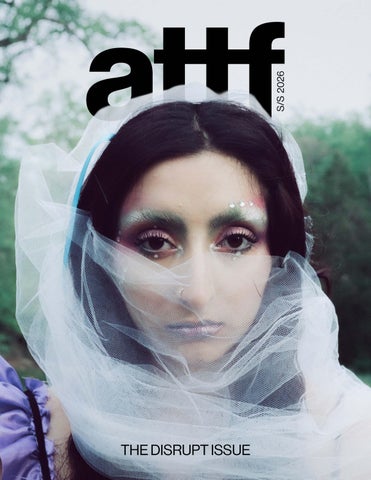
issue 06 DISRUPT explores how fashion and art can fundamentally challenge the standards that society tries to shape us into. Through bold colors, textures, and design, we express ourselves without fear of judgement, and we refuse to let those rules define us.
added to the file The DISRUPT Issue EXECUTIVE DIRECTOR Isabel Liu CREATIVE DIRECTORS Manya Dyer, Abdur Rahman DIRECTOR OF OPERATIONS Brady Stoffregen PHOTOGRAPHY DIRECTORS Madeline Burns, Quisha Lee DESIGN DIRECTORS Jaimie Koh, Heidi Kwak HEAD STYLIST Abdur Rahman WRITING DIRECTOR Julianna Penna DIRECTOR OF DIGITAL PUBLICATIONS Jacob Gardner IDEA DIRECTOR Isabella Pamias DIRECTOR OF MARKETING Alexandra Dassopoulos DIRECTOR OF SOCIAL MEDIA Thandiwe Chikuhwa
CREATIVE DIRECTION Serena Patel, Quinn Ross, Diane Lee, Anna Lynn, Alexandra Dassopoulos, Isabella Kim, Jade Shi, Jacob Gardner
MAKEUP Isabella Pamias, Aaliyah Gala, Joy Fiske, Minhal Nazeer, Molly Jenkins, Maya Singhal, Mara Goldstein
PHOTOGRAPHY Zoe Frantz, Mia Deschapelles, Julian Huang, Marina Gallozzi, Camille Stephant, Annika Nelson, Athena Huynh, Brady Stoffregen, Anna Cordova, Nzinga Sombo
WARDROBE Isabel Liu, Karan Patnaik, Helena Pietkiewicz, Messi Jetter, Quinn Ross, Bella Carmen, Jade Shi, Nora Brue, Teagan Maxymillian, Begum Hussain, Lily Deng, Mary Abi-Karam, Devika Mathur, Ti-Ti Nguyen, Vivica Kalsi
DESIGN Diane Lee, Adey Adeleye, Elaine Jiang, Kate Nugent, Grace Wang MARKETING Boa Seo, Claire Buchanan, Natalya Boufarah, Serena Patel, Isabella Hill, Nina Skweres, Olivia Scharf FUNDRAISING Jessica Harris, Joy Xie, Annabella Gao, Nino Thongwandee, Hannah Chu, Grace Li, Carol Zhou
WRITING Anika Lippke, Olivia Pozen, Annie Quimby, Christina Pan, Diane Lee, Genevieve Jobson, Isabella Alvayero, Ella O’Connor, Emma Garcia, Churan Xu, Serena Gill, Beatriz Fino Morfogen, Jay Wideman SOCIAL MEDIA Jiwoo Park, Claire Buchanan, Alex Sohn, Grace Wang, Emma Zhou, Melody Xu
Table of Contents
Metamorphosis Creative Direction: Isabella Pamias, Isabella Kim Photography: Quisha Lee, Zoe Frantz Wardrobe: Mary AbiKaram, Ti-Ti Nguyen, Bella Carmen Makeup: Isabella Pamias Retouch: Jaimie Koh Design: Elaine Jiang, Jaimie Koh Writing: Serena Gill Models: Eva Sofia Esposito, Camille Stephant
Conformity or Chaos? Creative Direction: Serena Patel Photography: Marina Gallozzi, Annika Nelson Wardrobe: Teagan Maxymillian, Devika Mathur, Lily Deng, Helena Pietkiewicz Makeup: Joy Fiske Retouch: Jaimie Koh Design: Jaimie Koh Writing: Anika Lippke Models: Taylor Moses, Jiwoo Park, David Patnaude, Blake Bertero
On Color, Individuality, and Childhood Creative Direction: Julianna Penna, Alexandra Dassopoulos Photography: Annika Nelson, Manya Dyer Wardrobe: Mary AbiKaram Makeup: Aaliyah Gala, Minhal Nazeer Retouch: Jaimie Koh Design: Grace Wang Writing: Annie Quimby Models: Anna-Sophia Peña, Anika Lippke
Paper Dolls
Noise Creative Direction: Quinn Ross Photography: Manya Dyer, Marina Gallozzi Wardrobe: Abdur Rahman Makeup: Maya Singhal Retouch: Heidi Kwak Design: Kate Nugent, Heidi Kwak Writing: Jacob Gardner, Emma Garcia Models: Ailey Kinsella, Mariela Cruz, Sasha Jayne
Creative Direction: Diane Lee, Jade Shi Photography: Athena Huynh, Zoe Frantz Wardrobe: Messi Jetter, Lily Deng Retouch: Heidi Kwak Makeup: Aaliyah Gala, Isabella Pamias Design: Heidi Kwak Writing: Diane Lee Models: Sonia Fan, Eileen Chen
Uppercut Creative Direction: Jacob Gardner, Julianna Penna Photography: Quisha Lee Wardrobe: Mary Abi-Karam, Teagan Maxymillian Makeup: Minhal Nazeer, Joy Fiske Retouch: Jaimie Koh, Heidi Kwak Design: Diane Lee Models: Kate O’Brien, Madeline Burns
Lost in Wonderland Creative Direction: Anna Lynn Photography: Mia Deschapelles, Julian Huang Wardrobe: Helena Pietkiewicz, Bella Carmen Makeup: Isabella Pamias, Aaliyah Gala, Minhal Nazeer Retouch: Jaimie Koh Design: Jaimie Koh, Adey Adeleye Writing: Genevieve Jobson Models: Minhal Nazeer, Molly Jenkins
Metamorphosis As luxury brands confront slowing sales and shifting tastes, fashion’s creative overhaul signals the end of an era. By Serena Gill
I
n the span of eighteen months, more than twenty major luxury houses have installed new creative directors. Matthieu Blazy transitioned from Bottega Veneta to Chanel, bringing with him a trusted inner circle, including his research director, his ready-to-wear design director, and his accessories director. Jonathan Anderson left Loewe for Dior, becoming the first person since Christian Dior himself to oversee the house’s full creative output. Demna departed Balenciaga and landed at Gucci. Pierpaolo Piccioli, let go from Valentino after a decade, took Demna’s place at Balenciaga. Sarah Burton moved to Givenchy. Grace Wales Bonner was named to Hermès menswear, succeeding Véronique Nichanian after her historic thirty-seven-year tenure; Bonner is the first Black woman to lead design at a major European luxury house. And so on and so forth: Glenn Martens at Margiela, Maria Grazia Chiuri to Fendi, Julian Klausner inheriting Dries Van Noten. Women’s Wear Daily called it, with tasteful understatement, a “great creative reset.” One might also call it fashion’s very own musical chairs.
The proximate causes are financial. Kering’s share price collapsed 78% from its 2021 peak. Its revenues fell 12% in 2024 and a further 14% in the first quarter of 2025, with Gucci, the group’s flagship, down 25%. LVMH’s fashion and leather goods division declined 8% in the first half of 2025. The broader luxury consumer base, once estimated at 400 million active shoppers, contracted to roughly 340 million. It seemed that the luxury market, once a champion racehorse, was flagging. Thus we might conclude that restless shareholders are reaching for a visible lever… a new creative direction, perhaps even a new narrative. But to read the cacophonous shuffle as purely reactive is to mistake its ambition. Each debut has been original and remarkable.
By Serena Gill
FOR A DECADE, THE INDUSTRY ORGANIZED ITSELF AROUND A PARTICULAR IDEA OF RESTRAINT. “Quiet luxury,” a term originating in Han, Nunes and Drèze’s 2010 Journal of Marketing paper on “loud versus quiet” status signals, represents understatement, precise tailoring, composure, and the performance of effortlessness. In other words: beige cashmere. However, the style that dominated the early 2020s has given way to spectacle! Blazy’s first Chanel ready-to-wear featured a number of tricks, including silk mousseline rendered to look like tweed, hand-painted organza impersonating denim, and fabric so light it vanished on camera. Anderson’s couture debut at Dior was staged at the Musée Rodin alongside original Christian Dior garments. Chartreuse appeared across more than a dozen SS26 collections. Silhouettes are increasingly dramatic and voluminous. Web searches for “personal style” surged 440% over the past year, according to Lyst data. Consumers fatigued by algorithmic sameness want to look like themselves again—only better, of course. The new creative directors are in an unusual position to grant it.fashion is undergoing right now is not What fashion is undergoing right now is not a simple rotation of talent but something closer to a collective metamorphosis. This is the simultaneous molt of more than twenty creative identities, each house emerging from its old skin into something not yet fully understood. The incumbent era was an aesthetic of anxiety management. But it has run its course. Consumers and artists alike are prepared to face the anxiety, to face the fear, to dominate the interior, and emerge, as something more remarkable than ever before.
12
attf magazine
conformity or chaos? By Annika Lippke
I’m not really sure what happened, but somehow we ended up in the bad timeline. Pre-dot-com boom and even a little bit after, the premise of technology promised reprieve from a mass incoming cultural ennui. The cellphones my family used when I was little were called BlackBerry and they were chromatic and purple, and at some point there was talk of a spatial technology that would project Minecraft in 3D onto the kitchen counter or the fridge door. (As a kid, real-life Minecraft was the most exciting thing I could ever fathom.) Tech once had the potential to be what everyone right now is calling whimsy, back when it stuck to its pledge to elevate consumer to producer. Even Google, which just faced a civil antitrust lawsuit for its dominance over digital advertising markets,
and has now been appended to a presumptuous list of elite tech companies known collectively as FAANG, once tried to position its technologies as an escape to modern consumerist society. With the mantra “Don’t be evil,” Google stood for the foundational values that gave tech its whimsy as a liberator. Now it’s just another multi-trillion dollar company that pushes out sad software patches routinely and sells your data to brokers online and makes you sad every time you open up LinkedIn.
Apple, another FAANG company, had high hopes for what new personal technologies could accomplish.
W
hat Steve Jobs believed is that computers were to act as a conduit for those with individual or societal inhibitions to do what they could not do in the real world. Before tech became lucrative, it was progressive. It was a chance for a disabled individual to become a real-life cyborg without becoming a page from a science fiction novel; it was a way for citizens suffering from censorship to champion their pursuit of knowledge. Creative used to mean crazy. And crazy bought you a seat aboard a pioneer tech company. Crazy introduced you to bigger and even better crazy. Vint Cerf, the Father of the Internet, is called the Chief Internet Evangelist at Google. His professional, official role at Google is to evangelize (read: yap about his favorite thing, for hours) and understand how very coveted he is for doing it. That’s what creative meant, what crazy meant, before money and standardization came clambering in and everyone tossed in their funky, bespoke pocket computers for rounded little glass panes flavored in the same three trends they’ve been stuck in. Now you sit at your desk, creative technologist, with the very blessed word burnt into your job title and you hammer away at another UX-smoothing minimalist renovation that steals just another drop of whimsy from the world. And your humble rebellion of the day is a pink tie you’ve loosed over an unbuttoned blouse collar.
Google beat you to that...
...once upon a time...
12
attf magazine
... assigning candy-vomit pinwheel hats to new hires to infuse the whimsy that you struggle now to inject. You want to stand out, show up to work one day in piss-yellow tights and rip them up the next time and tie them into your hair the time after that? You go for it; you’ve been working remote since you got hired. You’re flashing nobody but the dog under your desk who’s waiting patiently for you to finish up your lunch. Your textile rebellions don’t stand out because what you don’t understand is that they’ve figured this out already. Without a dress code, you feel like you have more freedom to express yourself at work. Then it’s easier for you to do what needs to be done without ever pushing it to anything past an industry standard.
about music By Jacob Gardner
A bit of sugar, now. The tiger waits for the shift in the tall grass, a ripple of movement to justify the kill. It is only hunger, and the law says a golden coat cannot stay hidden once light falls. By tomorrow, we are stalled. A bright, static violence of brake lights. The horns are a jagged chorus; Men are shouting into the glass, the small, tender lungs of infants heaving in the back. If only a single body would unbuckle, step out into the exhaust, and quiet it—or walk until the concrete softens into soil, to realize there was never a predator, only the ritual of the chase. That the sugar we craved was just the dust of the road. And we were all tigers at some point.
On Gender and Being a Girl on Paper By Diane Lee Your body is not necessarily yours. In “being,” you have already been rendered a social object; your appearance is subject to judgement, as are your mannerisms, interests, and relationships. Gender is one of those identifiers that we are constantly performing based on a prescribed formula that no one really understands— it’s the secret recipe that you have to get right even though you don’t have any of the ingredients.
“Girlhood” is a strange term for me. I am attached to it, fond even, but a deep sense of unease attaches itself stickily to the inside lining of my stomach every time I describe myself through such a noun. I am who I am because I was born a girl; I am both grateful for it and sickened by it. I learned to find comfort through other women and how to be kinder in a world that is not kind to me. At the same time, I learned to objectify myself and observe my body with the perverse fascination of an external voyeur.1
I learned to objectify myself and observe my body with the perverse fascination of an external voyeur. Femininity is everybody’s business. Whether you’re too femme, or not femme enough, or not supposed to be femme at all, or should be femme but aren’t, there’s always something for someone to criticize. Notice that much of this criticism is Barbara L. Fredrickson et al., “Objectification Theory: Toward Undermost harshly targeted towards nonstanding Women’s Lived Experiwhite and/or queer bodies. In that we ences and Mental Health Risks,” Psychology of Women Quarterly can find one of the abstract criteria Volume 21, Issue 2 (1997): https:// doi.org/10.1111/j.1471-6402.1997. for the “proper” way to be a woman. tb00108.x. To be a person is to perform, and to 2 Josie Wenig, “Gender Work: have a gender is to present it. Gender Survival, Subversion, and Subjectivity for Queer and Trans Youth,” expression and performance are not sprinkle: an undergraduate journal feminist and queer studies just fun, theatrical things; rather, they of Volume 8, Article 9 (2015): https:// are means of digitalcommons.calpoly.edu/sprinkle/vol8/iss1/9. 2 survival and integral to forming social opinion on our bodies. 1
Media is one of the most obvious places where we see plainly the stage that gender sets for us. Paper media, like magazines, is particularly fascinating. Print renders the body a two-dimensional image that exists only on a plane; the body is not afforded any depth, only the illusion of it. A girl on a page is just a girl on a page; we may have our interpretation of her, maybe recognize her likeness in the real-life model, but the image itself is stagnant and more caricature than character. For some, the likeness between real-life girls and paper girls is enough to strip the former of their agency. Suddenly, the real-life girl is a “what” instead of a “who.” Girls become amusing dolls rather than agentic beings, and it is incredibly difficult to separate ourselves from the image of ourselves; the persona is the self. We are constantly being influenced by trends, internalizing the “right” way to be a girl or intentionally styling ourselves against that image; either way, the way we present ourselves is informed by our social context. We are objects as much as we are subjects observing ourselves. Is your body your personal dress-up doll?
Is your body your personal dress-up doll?
Lost in Wonderland
Genevieve Jobson
A DWELLING IN MINIATURE My dollhouse lives on a crescent in Glover Park: I named her Dolly because she wore her blue shutters like eyeshadow and because her brick front was pink as a singing voice. Like in most fairytales, we met on a wander down an unfamiliar road. Being naked and blue in the space between girl and woman, I stopped when I saw her in her storybook ordinariness. She smiled at me, porch gleaming white, a swing sedate in its corner. In the yard, four bikes leaned into each other and inside her front windows I could see a living room, sheet music open on the piano and books crammed on shelves. Behind the living room was a kitchen with tulips on the table and a tabby cat between the table’s legs. From my place on the sidewalk, I moved my notebooks into the second floor bedroom. There I also stacked suitcases for all the trips I might someday go on, and the clothes I might need to be a different character on each, like the basket-weaving hiker, or the cat-eyed hedonist, or the sundressed romantic. I put my paints and my easel by a south-facing window, ready for the day I would become a respected painter. I lifted a rocking chair over the threshold and cozied it into a corner for all the babies I might someday hold. I hauled in a chest full of my childhood dresses, the first friends I ever played pretend with, and put it at the foot of the bed. In a whisper, I asked Dolly, What do you think?
I did not leave the sidewalk as I moved Dolly from Glover Park to London to Accra to Oklahoma to California to Montréal to Taiwan And in each place, whether it be city square or country slope, I asked her, How about it, Dolly? Who would you be here? My dolls came too, all the possible iterations of me and mine wandering around my mind. At each new place, I told the dolls to make themselves at home. At first, I had to guide their wooden joints, but quickly they began to move from room to room on their own. They threw open Dolly’s windows, looking past her shutters at the world outside. They hung their coats on hooks, drank milk from porcelain cups, invited friends to play the piano, read books with the tabby cat in their laps. The dolls cut their hair, skinned their knees, shut the windows, opened them again,
screamed “I hate this place!” kissed the doorframes of their bedrooms, left one city only to find themselves without one of their thumbs, went back to get it, only to find the city had changed and their thumb was where it had always been. Beholding them all, I asked Dolly —softly, so the dolls would not grow self-conscious— What do you think? Will they make it? Will they find what they’re looking for? They sky grew dark and so did the house; I lost sight of the dolls until candlelight flickered first from one, then from all, of Dolly’s windows. I took a step closer: the tulips, the tabby, the piano, and all the undone heap of living were still there.
Founded in the 2023-2024 school year, Added to the File (ATTF) is Georgetown’s first fashion photography magazine. It publishes two issues per year, with each issue centered around a “theme” that is explored through writing, fashion, photography, and other forms of visual artwork. ATTF is dedicated to providing a creative space on campus for multidisciplinary collaboration and artistic expression. It was founded as a unique, artistic niche on campus for students to destress and be vulnerable through a variety of creative outlets. Through our publication, we aim to facilitate discussion around topics relevant to students today. Most importantly, we strive to create an environment on campus that instills confidence and self-acceptance in our community.